Cambridge IGCSE Mathematics 0580 — 2018 Oct/Nov Paper 2 · Variant 3
0580/23/O/N/18 · 26 questions · 70 marks · ≈79 min
The question paper and its mark scheme, free to read here and free to download. This is Cambridge’s own paper, exactly as it was sat.
Question paper12 pages
Mark scheme6 pages
Answers below. Sit the paper first if you are practising.
Questions as text
Q1 · Work out of 198 kg
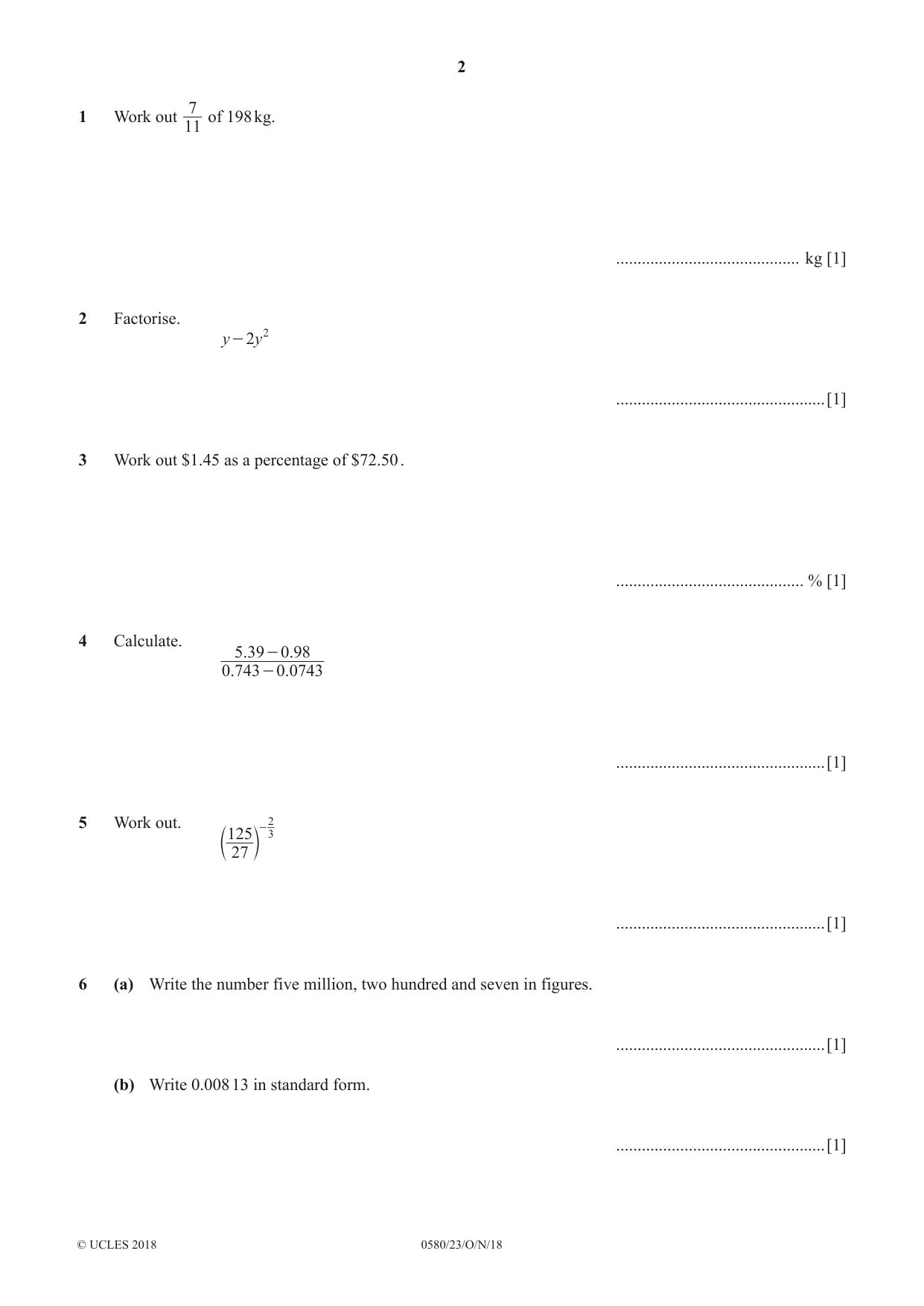
71 Work out of 198 kg. 11 ........................................... kg [1]
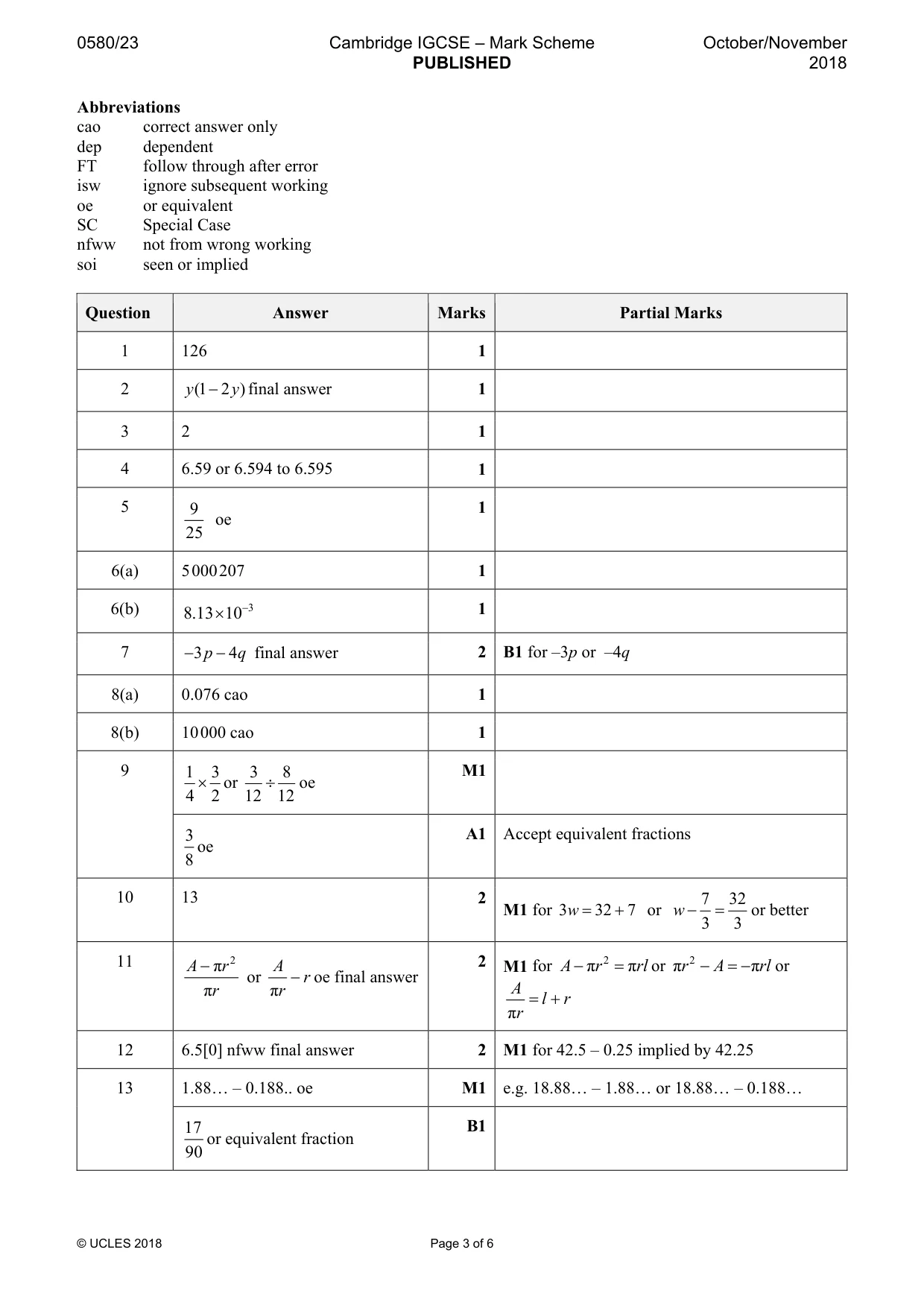
Mark scheme: Question Answer Marks Partial Marks 1 126 1
Question 2
2 Factorise. y - 2y 2 .................................................[1]
Mark scheme: 2 y (1 − 2 y ) final answer 1
Q3 · Work out $1.45 as a percentage of $72.50
3 Work out $1.45 as a percentage of $72.50 . ............................................ % [1]
Mark scheme: 3 2 1
Question 4
4 Calculate. 5.39 - 0.98 0.743 - 0.0743 .................................................[1]
Mark scheme: 4 6.59 or 6.594 to 6.595 1
Question 5
5 Work out. - 2 c 12527 m 3 .................................................[1]
Mark scheme: 5 9 1 oe 25
Q6 · Write the number five million, two hundred and seven in figures
6 (a) Write the number five million, two hundred and seven in figures. .................................................[1] (b) Write 0.008 13 in standard form. .................................................[1]
Mark scheme: 6(a) 5 000 207 1 6(b) 8.13 × 10⁻³ 1
Question 7
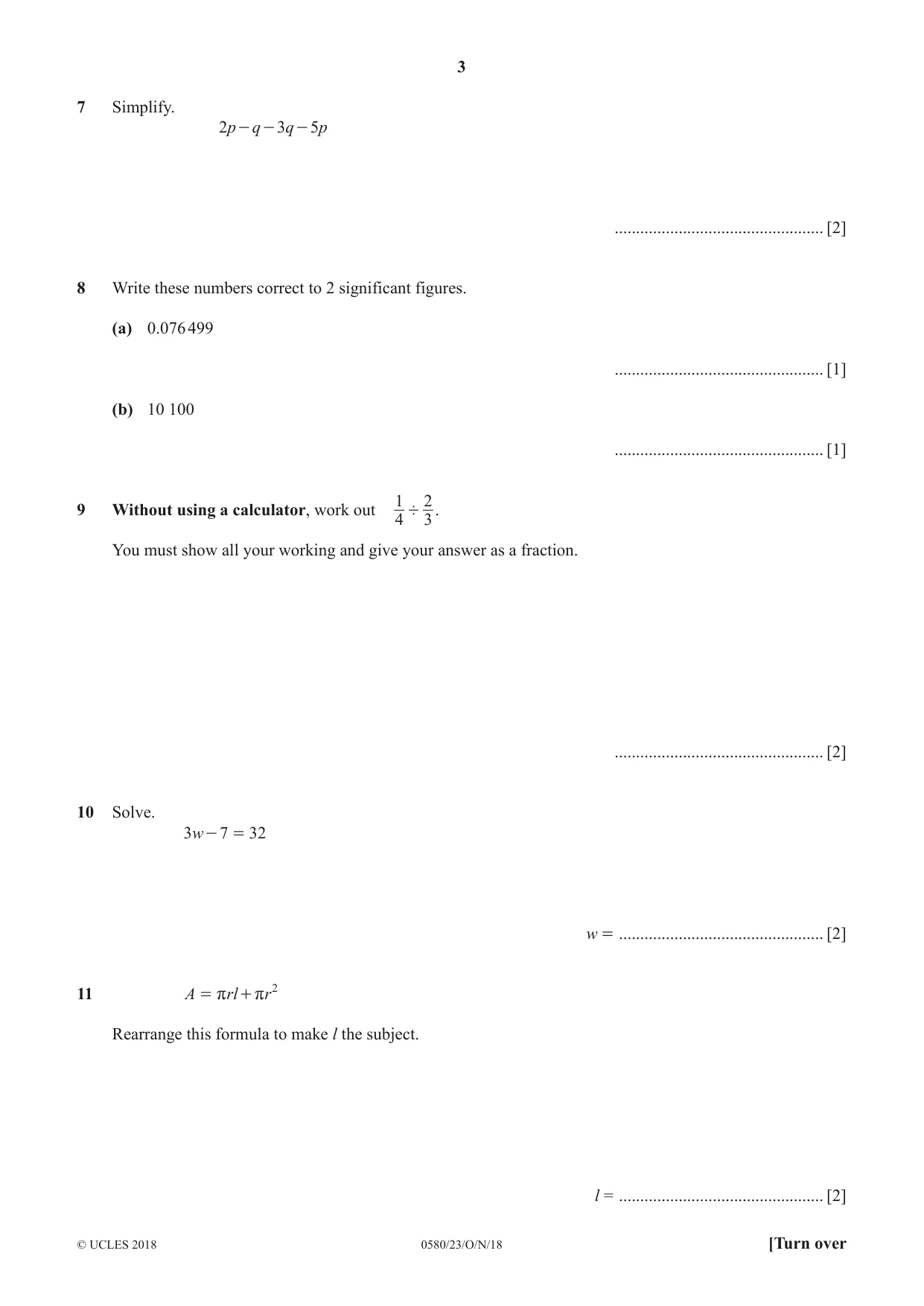
7 Simplify. 2p - q - 3q - 5p ................................................. [2]
Mark scheme: 7 −3 p − 4 q final answer 2 B1 for –3p or –4q
Q8 · Write these numbers correct to 2 significant figures
8 Write these numbers correct to 2 significant figures. (a) 0.076 499 ................................................. [1] (b) 10 100 ................................................. [1]
Mark scheme: 8(a) 0.076 cao 1 8(b) 10 000 cao 1
Q9 · 29 Without using a calculator, work out '
1 29 Without using a calculator, work out ' . 4 3 You must show all your working and give your answer as a fraction. ................................................. [2]
Mark scheme: 9 1 3 3 8 M1 × or ÷ oe 4 2 12 12 3 A1 Accept equivalent fractions oe 8
Question 10
10 Solve. 3w - 7 = 32 w = ................................................ [2]
Mark scheme: 10 13 2 7 32 M1 for 3 w = 32 + 7 or w − = or better 3 3
Q11 · A = r rl + r r2 Rearrange this formula to make l the subject
11 A = r rl + r r2 Rearrange this formula to make l the subject. l = ................................................ [2]
Mark scheme: 11 A − πr 2 A 2 M1 for A − πr 2 = πrl or πr 2 − A = − πrl or or − r oe final answer πr πr A = l + r πr
Q12 · The area of a square is 42.5 cm2, correct to the nearest 0.5 cm2
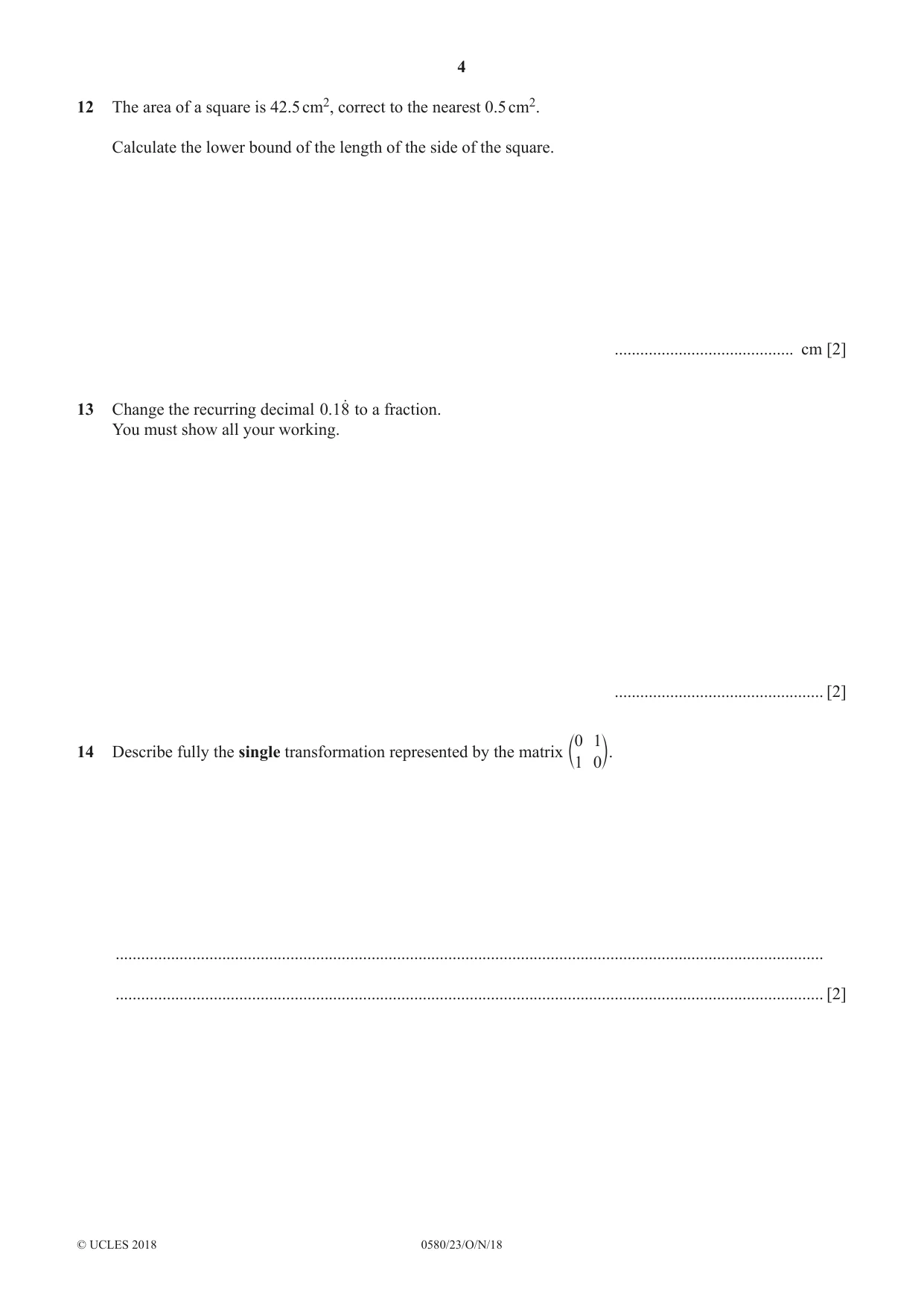
12 The area of a square is 42.5 cm2, correct to the nearest 0.5 cm2. Calculate the lower bound of the length of the side of the square. .......................................... cm [2]
Mark scheme: 12 6.5[0] nfww final answer 2 M1 for 42.5 – 0.25 implied by 42.25
Q13 · Change the recurring decimal .018o to a fraction
13 Change the recurring decimal .018o to a fraction. You must show all your working. ................................................. [2]
Mark scheme: 13 1.88… – 0.188.. oe M1 e.g. 18.88… – 1.88… or 18.88… – 0.188… 17 B1 or equivalent fraction 90
Q14 · 1 14 Describe fully the single transformation represented by the matrix c1 0m
0 1 14 Describe fully the single transformation represented by the matrix c1 0m. ...................................................................................................................................................................... ...................................................................................................................................................................... [2]
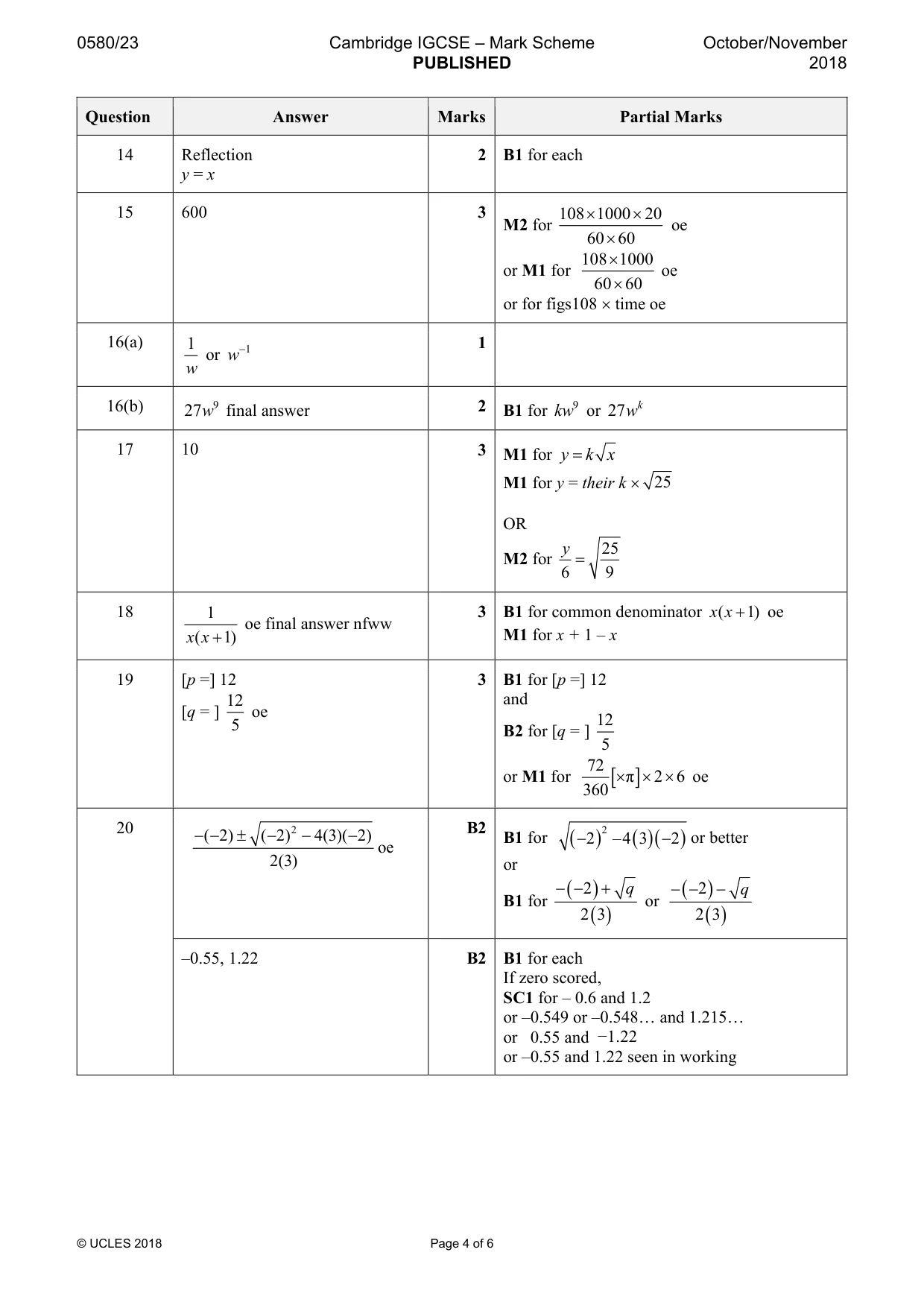
Mark scheme: 14 Reflection 2 B1 for each y = x
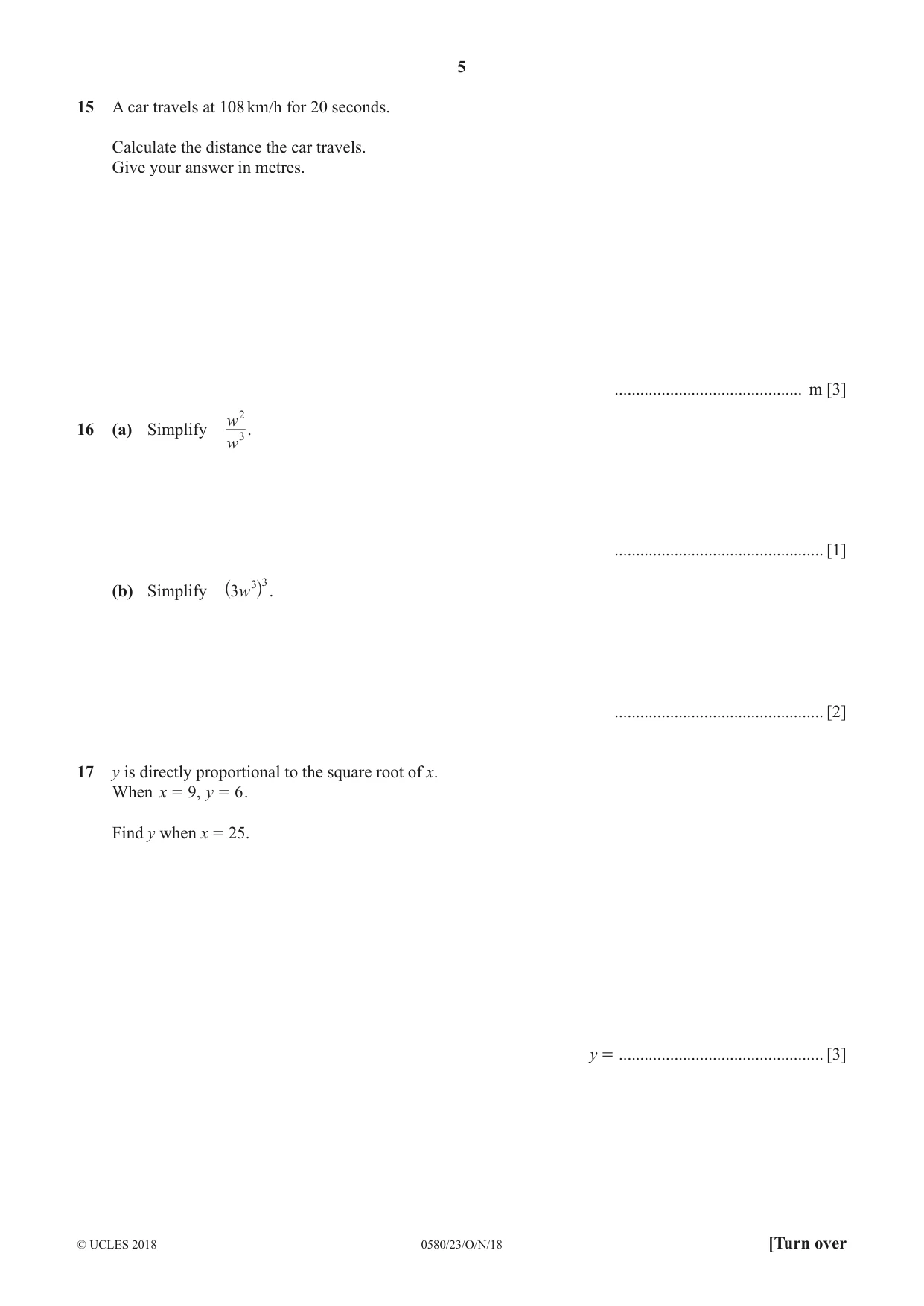
Q15 · A car travels at 108 km/h for 20 seconds
15 A car travels at 108 km/h for 20 seconds. Calculate the distance the car travels. Give your answer in metres. ............................................ m [3]
Mark scheme: 15 600 3 108 × 1000 × 20 M2 for oe 60 × 60 108 × 1000 or M1 for oe 60 × 60 or for figs108 × time oe
Q16 · W 216 (a) Simplify 3
w 216 (a) Simplify 3 . w ................................................. [1] (b) Simplify 3w 3 3 . ^ h ................................................. [2]
Mark scheme: 16(a) 1 −1 1 or w w 16(b) 27w9 final answer 2 B1 for kw9 or 27 w k
Q17 · Y is directly proportional to the square root of x
17 y is directly proportional to the square root of x. When x = 9, y = 6 . Find y when x = 25. y = ................................................ [3]
Mark scheme: 17 10 3 M1 for y = k x M1 for y = their k × 25 OR y 25 M2 for = 6 9
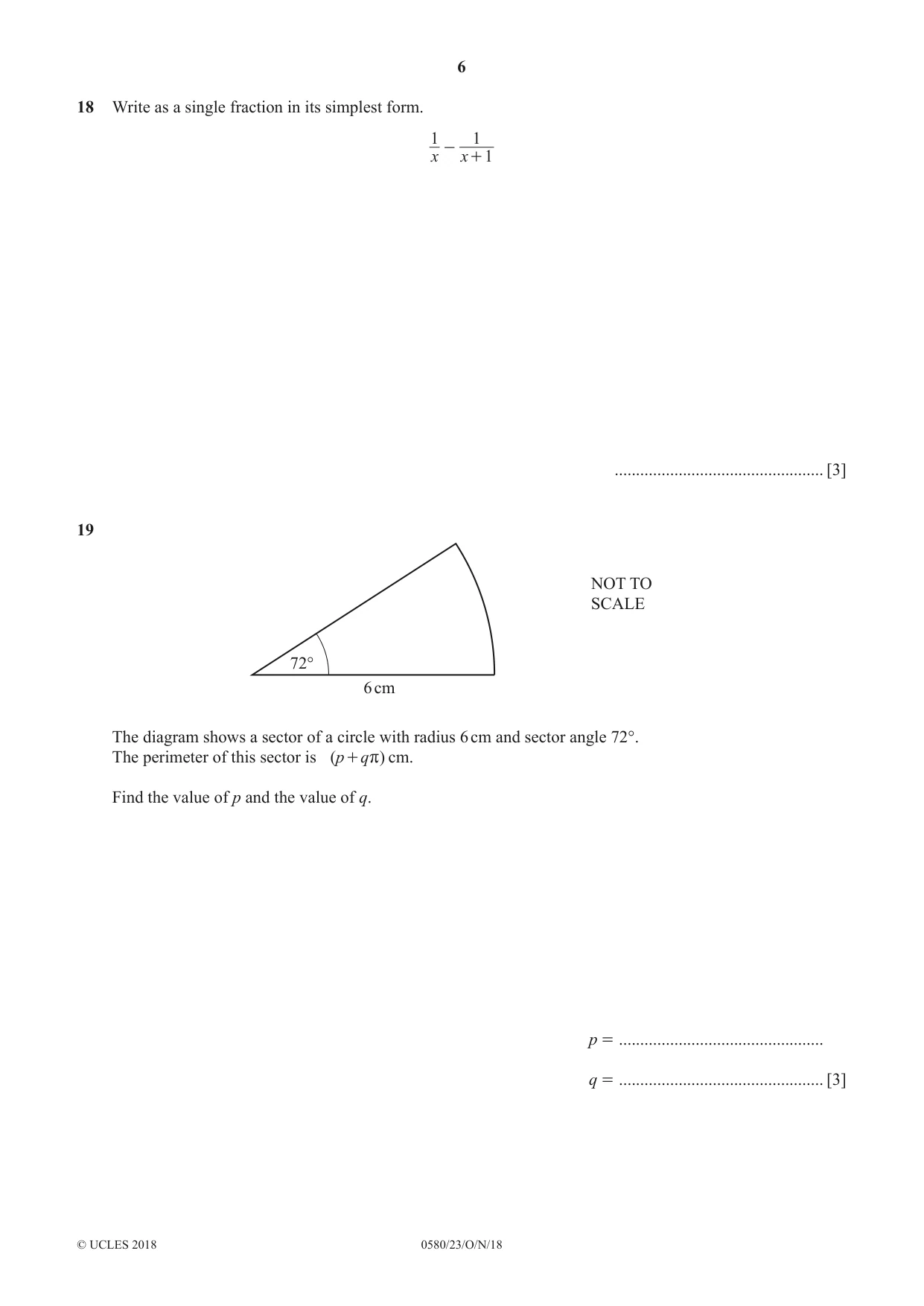
Q18 · Write as a single fraction in its simplest form
18 Write as a single fraction in its simplest form. 1 1 - x x + 1 ................................................. [3]
Mark scheme: 18 1 3 B1 for common denominator x ( x + 1) oe oe final answer nfww x ( x + 1) M1 for x + 1 – x
Q19 · NOT TO SCALE 72° 6 cm The diagram shows a sector of a circle with radius 6 cm and sector…
19 NOT TO SCALE 72° 6 cm The diagram shows a sector of a circle with radius 6 cm and sector angle 72°. The perimeter of this sector is (p + qr ) cm. Find the value of p and the value of q. p = ................................................ q = ................................................ [3]
Mark scheme: 19 [p =] 12 3 B1 for [p =] 12 12 and [q = ] oe 12 5 B2 for [q = ] 5 72 or M1 for [× π ] × 2 × 6 oe 360
Q20 · Solve the equation 3x 2 - 2x - 2 = 0
20 Solve the equation 3x 2 - 2x - 2 = 0 . Show all your working and give your answers correct to 2 decimal places. x = ........................... or x = ........................... [4]
Mark scheme: 20 2 B2 2 −−( 2) ± ( − 2) − 4(3)( − 2) B1 for ( − 2 ) – 4 ( 3 )( − 2 ) or better oe 2(3) or −−( 2 ) + q −−( 2 ) − q B1 for or 2 ( 3 ) 2 ( 3 ) –0.55, 1.22 B2 B1 for each If zero scored, SC1 for – 0.6 and 1.2 or –0.549 or –0.548… and 1.215… or 0.55 and −1.22 or –0.55 and 1.22 seen in working
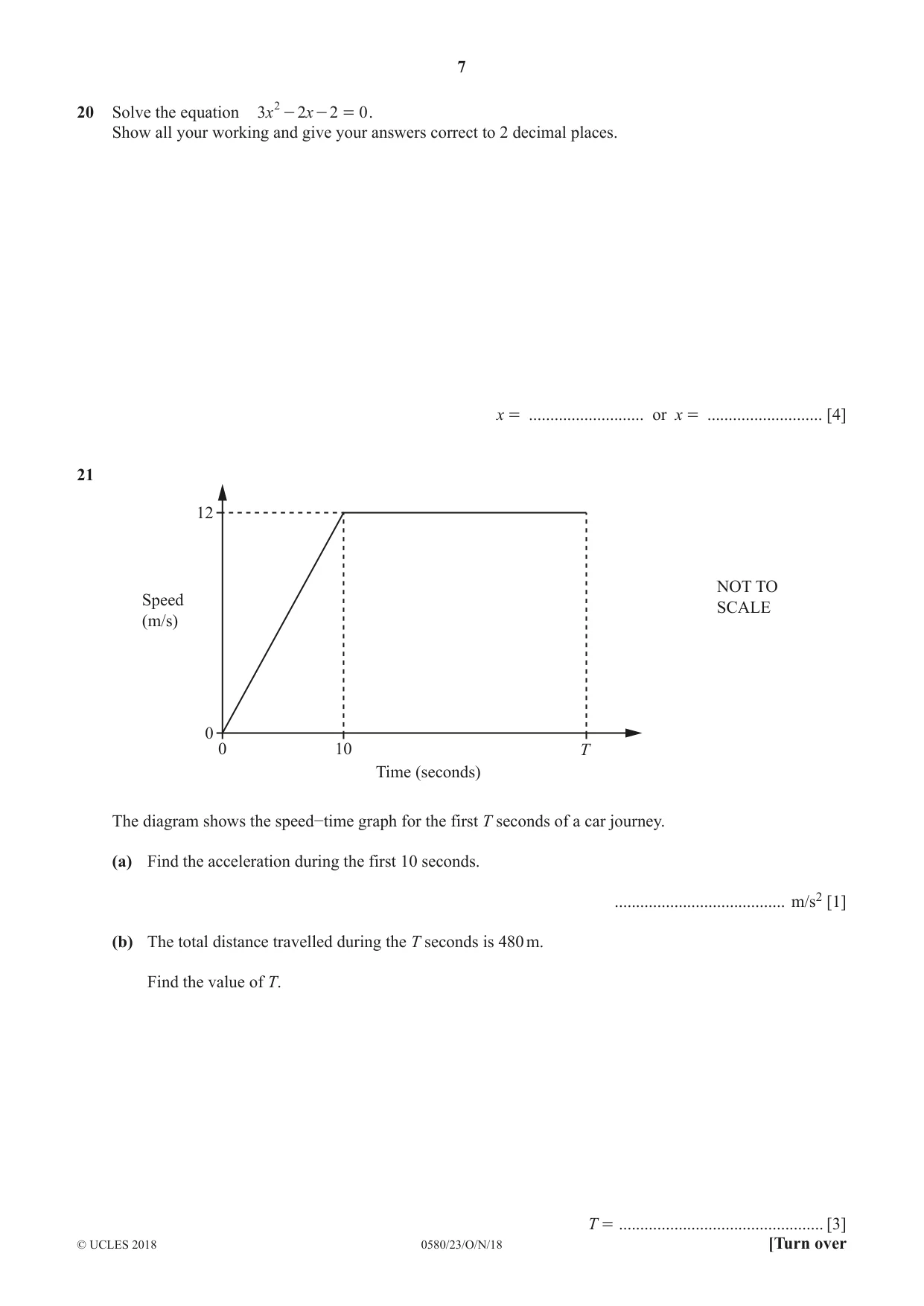
Q21 · 12 NOT TO Speed SCALE (m/s) 0 0 10 T Time (seconds) The diagram shows the speed−time…
21 12 NOT TO Speed SCALE (m/s) 0 0 10 T Time (seconds) The diagram shows the speed−time graph for the first T seconds of a car journey. (a) Find the acceleration during the first 10 seconds. ........................................ m/s2 [1] (b) The total distance travelled during the T seconds is 480 m. Find the value of T.
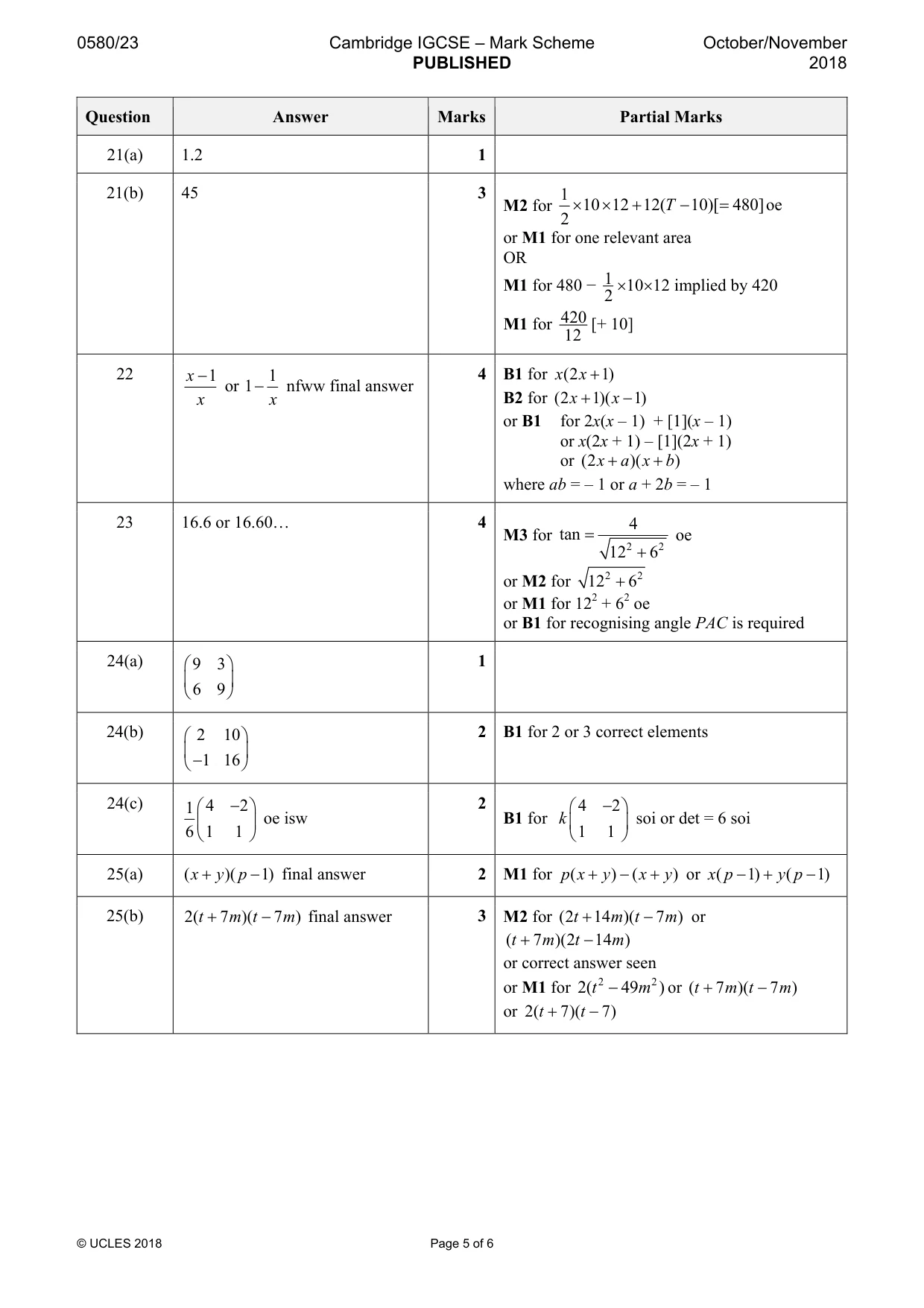
Mark scheme: 21(a) 1.2 1 21(b) 45 3 1 M2 for × 10 × 12 + 12(T − 10)[ = 480] oe 2 or M1 for one relevant area OR 1 M1 for 480 − ×10×12 implied by 420 2 420 M1 for [+ 10] 12
Question 22
22 Simplify. 2x 2 - x - 1 2x 2 + x ................................................. [4]
Mark scheme: 22 x − 1 1 4 B1 for x (2 x + 1) or nfww final answer x 1−x B2 for (2 x + 1)( x − 1) or B1 for 2x(x – 1) + [1](x – 1) or x(2x + 1) – [1](2x + 1) or (2 x + a )( x + b ) where ab = – 1 or a + 2b = – 1
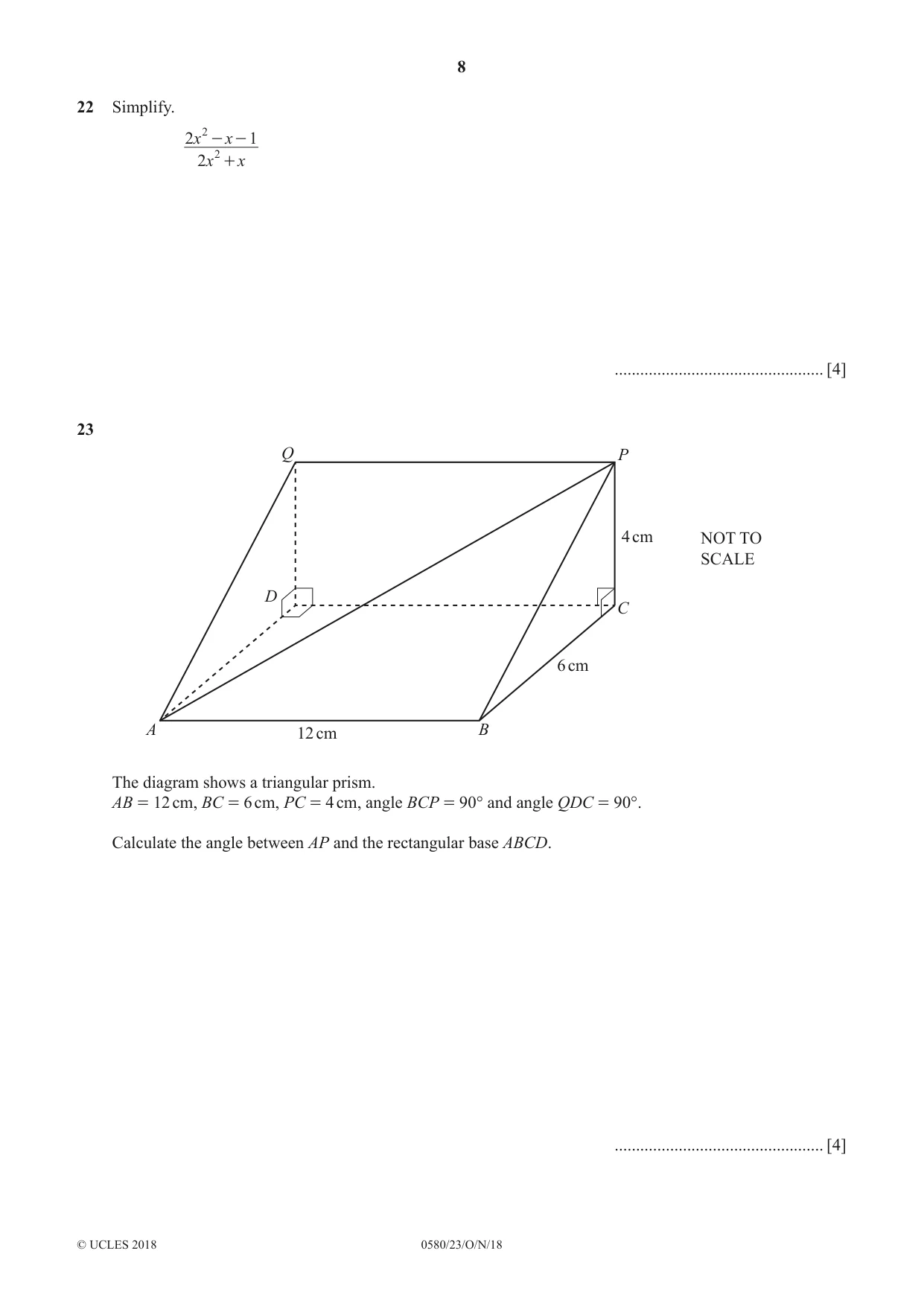
Q23 · Q P 4 cm NOT TO SCALE D C 6 cm A 12 cm B The diagram shows a triangular prism
23 Q P 4 cm NOT TO SCALE D C 6 cm A 12 cm B The diagram shows a triangular prism. AB = 12 cm, BC = 6 cm, PC = 4 cm, angle BCP = 90° and angle QDC = 90°. Calculate the angle between AP and the rectangular base ABCD. ................................................. [4]
Mark scheme: 23 16.6 or 16.60… 4 4 M3 for tan = oe 12 2 + 6 2 or M2 for 12 2 + 6 2 or M1 for 122 + 62 oe or B1 for recognising angle PAC is required
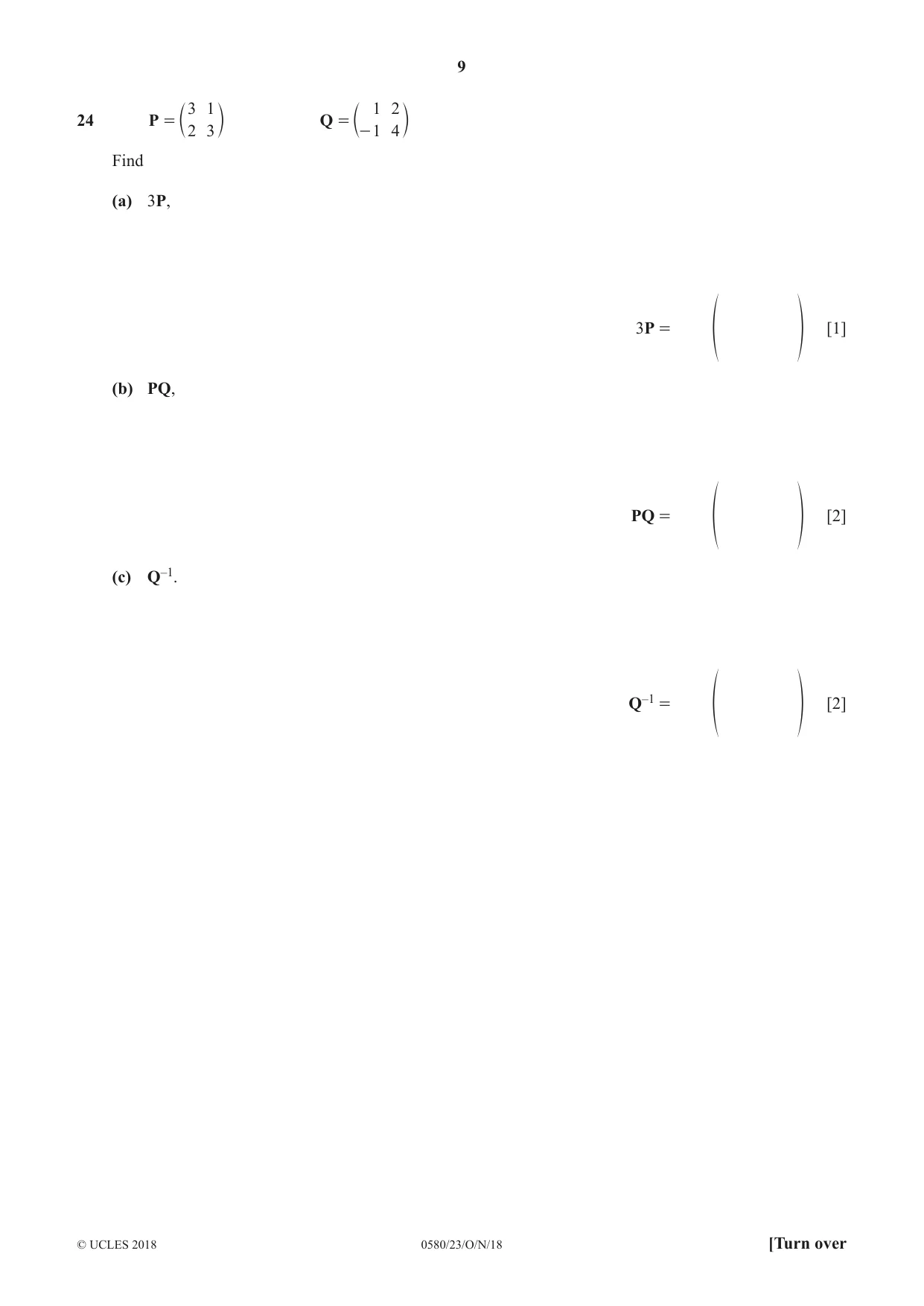
Q24 · 1 1 2 24 P = Q = c 2 3 m c- 1 4 m Find (a) 3P, 3P = [1] f p (b) PQ, PQ = [2] f p (c) Q–1
3 1 1 2 24 P = Q = c 2 3 m c- 1 4 m Find (a) 3P, 3P = [1] f p (b) PQ, PQ = [2] f p (c) Q–1. Q–1 = [2] f p
Mark scheme: 24(a) 9 3 1 6 9 24(b) 2 10 2 B1 for 2 or 3 correct elements −1 16 24(c) 1 4 − 2 2 4 −2 oe isw B1 for k soi or det = 6 soi 6 1 1 1 1
Question 25
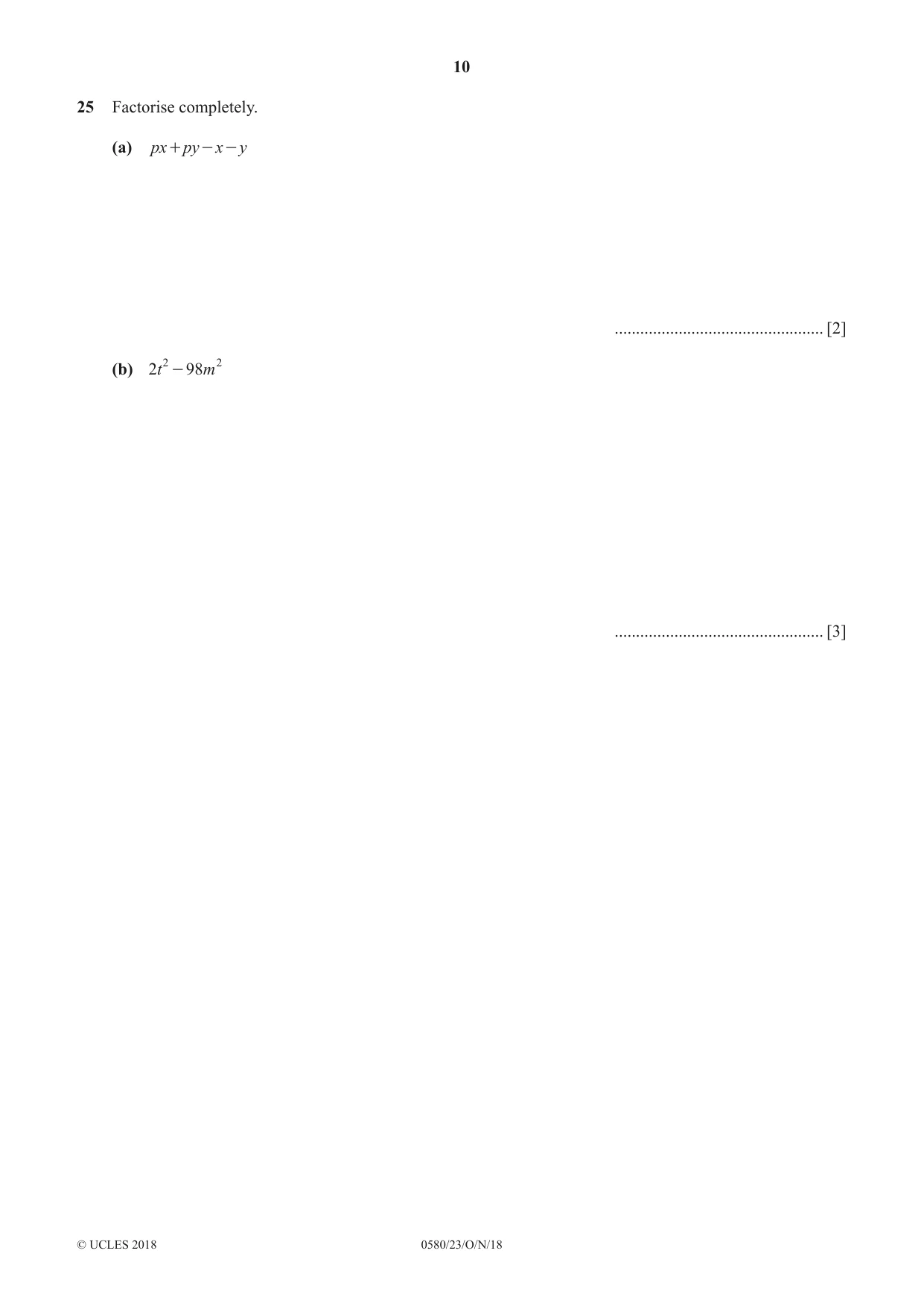
25 Factorise completely. (a) px + py - x - y ................................................. [2] (b) 2t 2 - 98m 2 ................................................. [3]
Mark scheme: 25(a) ( x + y )( p − 1) final answer 2 M1 for p ( x + y ) − ( x + y ) or x ( p − 1) + y ( p − 1) 25(b) 2(t + 7 m )(t − 7 m ) final answer 3 M2 for (2t + 14 m )( t − 7 m ) or (t + 7 m )(2t − 14 m ) or correct answer seen or M1 for 2(t 2 − 49 m 2 ) or (t + 7 m )( t − 7 m ) or 2(t + 7)( t − 7)
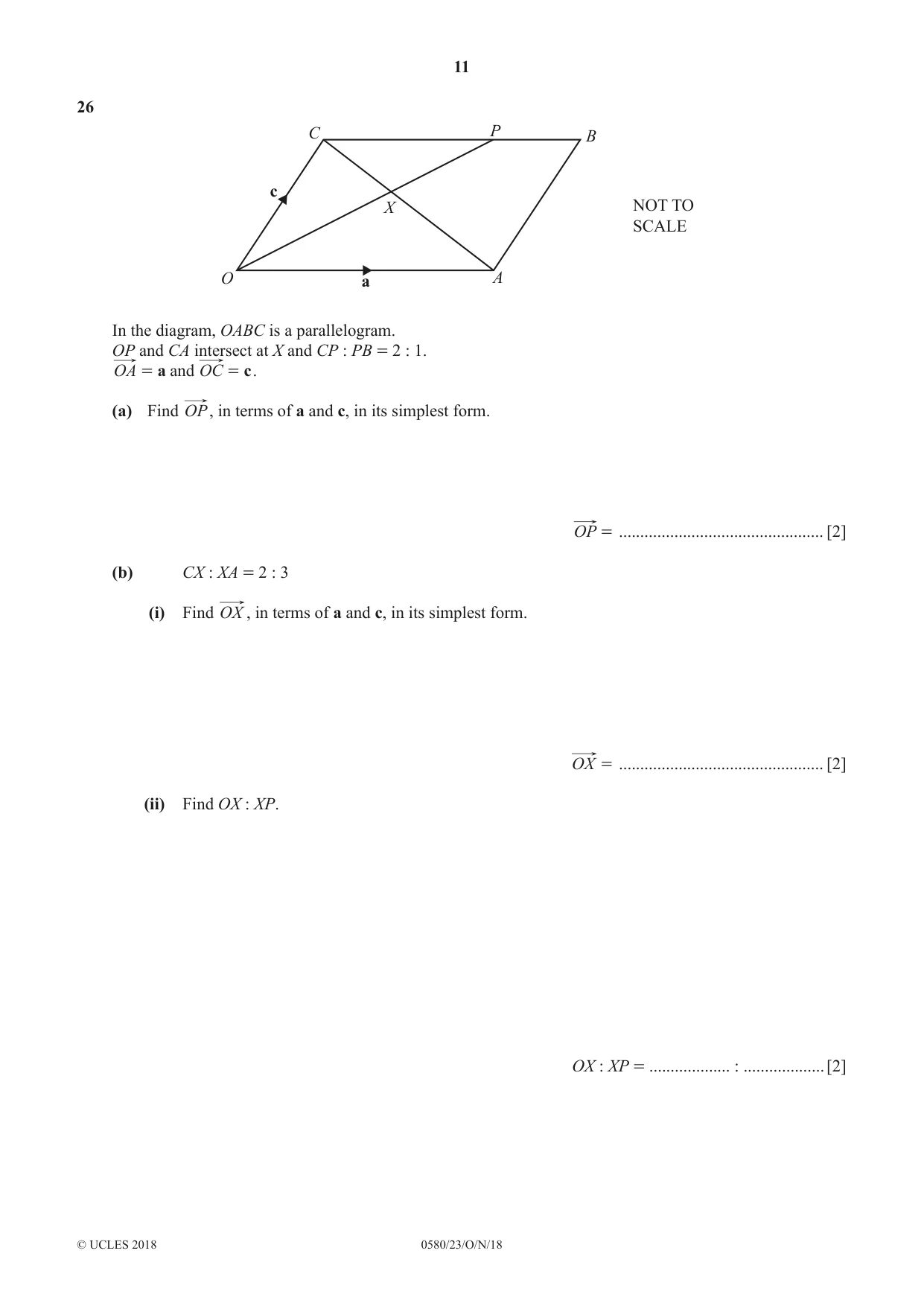
Q26 · C P B c X NOT TO SCALE O a A In the diagram, OABC is a parallelogram
26 C P B c X NOT TO SCALE O a A In the diagram, OABC is a parallelogram. OP and CA intersect at X and CP : PB = 2 : 1. OA = a and OC = c . (a) Find OP, in terms of a and c, in its simplest form. OP = ................................................ [2] (b) CX : XA = 2 : 3 (i) Find OX , in terms of a and c, in its simplest form. OX = ................................................ [2] (ii) Find OX : XP. OX : XP = ................... : ................... [2]
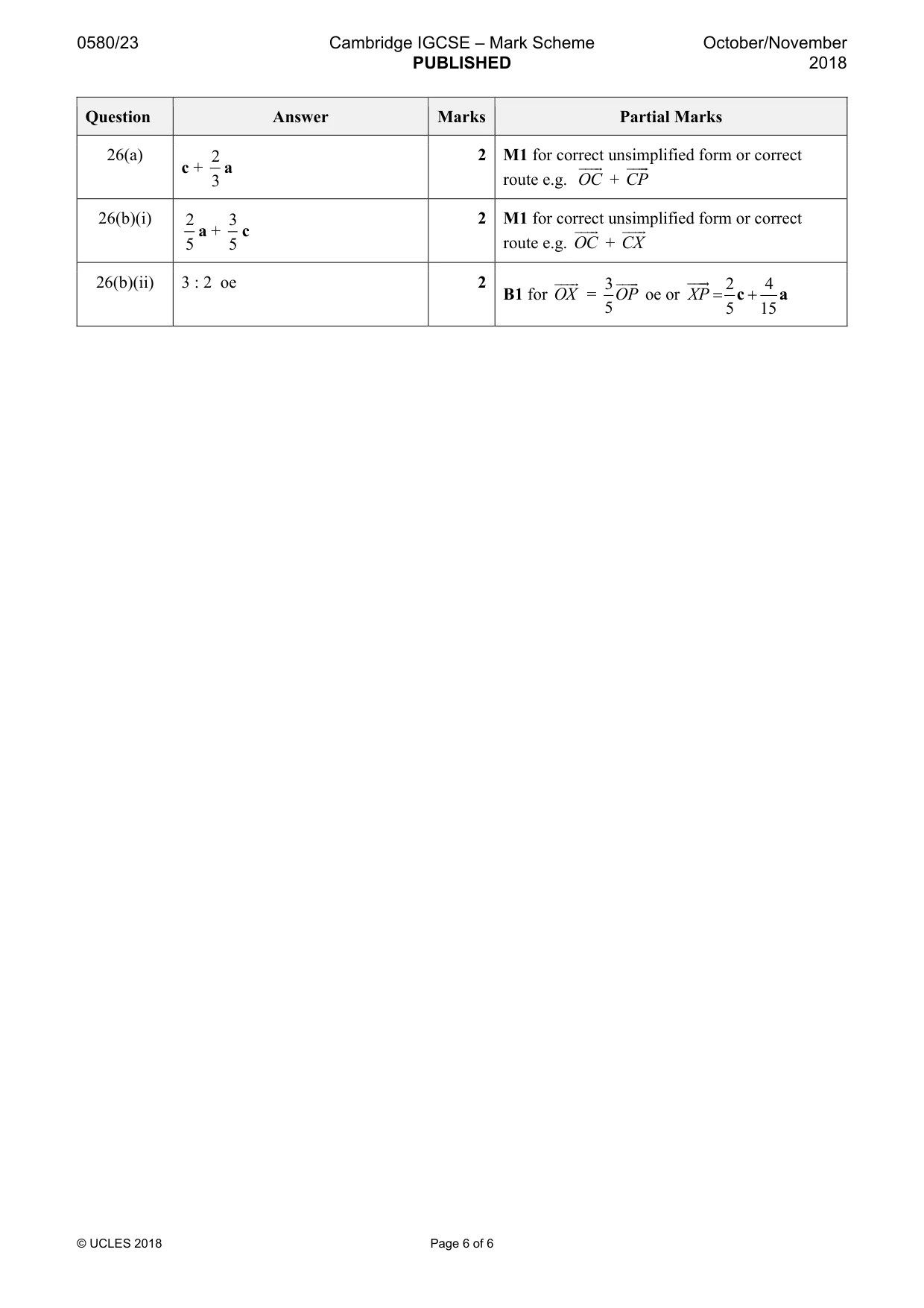
Mark scheme: 26(a) 2 2 M1 for correct unsimplified form or correct c + a JJJG JJJG 3 route e.g. OC + CP 26(b)(i) 2 3 2 M1 for correct unsimplified form or correct a + c JJJG JJJG 5 5 route e.g. OC + CX 26(b)(ii) 3 : 2 oe 2 JJJG 3 JJJG JJJG 2 4 B1 for OX = OP oe or XP = c + a 5 5 15
What was in this paper
The subtopics covered by these 26 questions, and how many questions each got. Open one in a new tab to see every Cambridge question on it.
5Equations2Fractions, decimals and percentages2Limits of accuracy2Rates2Vectors in two dimensions2Algebraic fractions1Circles, arcs and sectors1Indices I1Percentages1Powers and roots1Ratio and proportion1Right-angled triangles1The four operations1Transformations1Types of number1Using a calculator1What you needed in this session
Cambridge’s own grade thresholds for 2018 Oct/Nov, Paper 2 · Variant 3. A higher threshold means an easier paper — the bar moves with how the cohort did.