Cambridge IGCSE Mathematics 0580 — 2017 Feb/March Paper 3 · Variant 2
0580/32/F/M/17 · 9 questions · 104 marks · ≈117 min
The question paper and its mark scheme, free to read here and free to download. This is Cambridge’s own paper, exactly as it was sat.
Question paper16 pages
Mark scheme5 pages
Answers below. Sit the paper first if you are practising.
Questions as text
Q1 · Write down (i) a square number between 30 and 40…
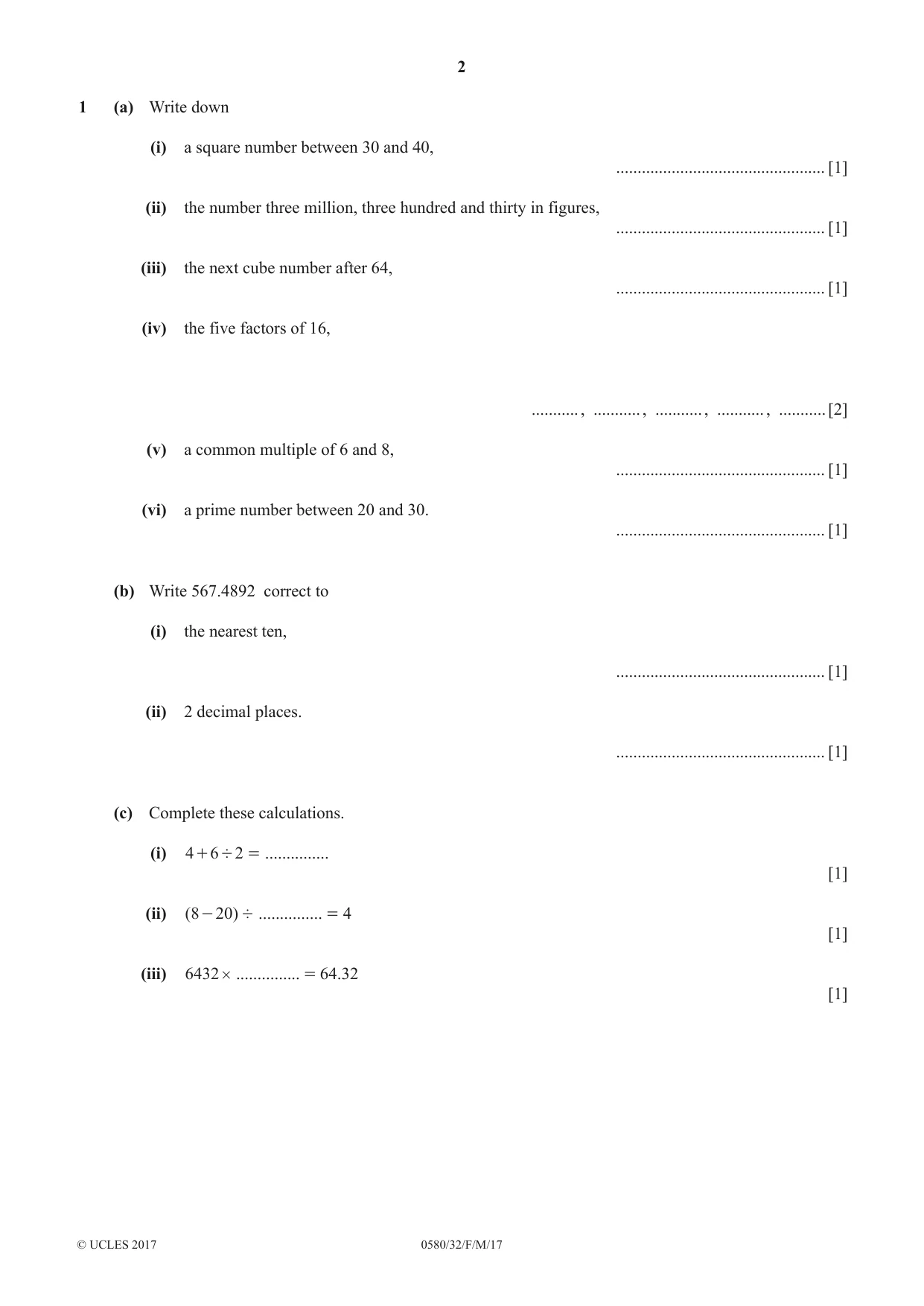
1 (a) Write down (i) a square number between 30 and 40, ................................................. [1] (ii) the number three million, three hundred and thirty in figures, ................................................. [1] (iii) the next cube number after 64, ................................................. [1] (iv) the five factors of 16, ........... , ........... , ........... , ........... , ........... [2] (v) a common multiple of 6 and 8, ................................................. [1] (vi) a prime number between 20 and 30. ................................................. [1] (b) Write 567.4892 correct to (i) the nearest ten, ................................................. [1] (ii) 2 decimal places. ................................................. [1] (c) Complete these calculations. (i) 4 + 6 ' 2 = ............... [1] (ii) (8 - 20) ' ............... = 4 [1] (iii) 6432 # ............... = 64.32 [1]
Mark scheme: Question Answer Marks Part marks 1 (a) (i) 36 1 (ii) 3 000 330 cao 1 (iii) 125 1 (iv) 1, 2, 4, 8, 16 2 M1 for 3 or 4 correct factors and no extras or for 5 correct factors and one extra (v) Any multiple of 24 1 (vi) 23 or 29 1 (b) (i) 570 cao 1 (ii) 567.49 cao 1 (c) (i) 7 1 (ii) –3 1 (iii) [0].01 oe 1
Q2 · Y 6 5 4 3 2 A B 1 x –9 –8 –7 –6 –5 –4 –3 –2 –1 0 1 2 3 4 5 6 –1 –2 –3 –4 –5 –6 –7 –8 The…
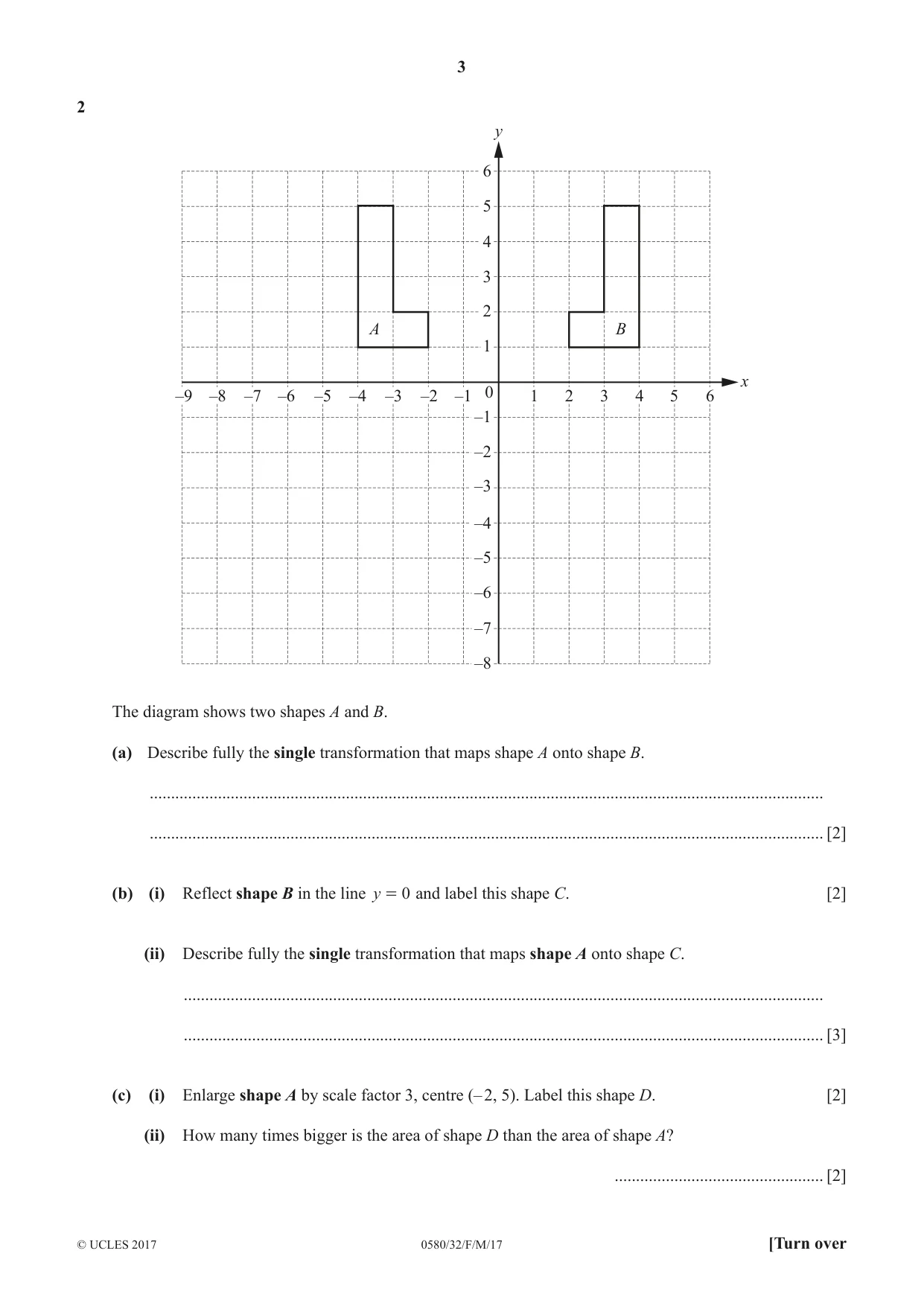
2 y 6 5 4 3 2 A B 1 x –9 –8 –7 –6 –5 –4 –3 –2 –1 0 1 2 3 4 5 6 –1 –2 –3 –4 –5 –6 –7 –8 The diagram shows two shapes A and B. (a) Describe fully the single transformation that maps shape A onto shape B. .............................................................................................................................................................. .............................................................................................................................................................. [2] (b) (i) Reflect shape B in the line y = 0 and label this shape C. [2] (ii) Describe fully the single transformation that maps shape A onto shape C. ...................................................................................................................................................... ...................................................................................................................................................... [3] (c) (i) Enlarge shape A by scale factor 3, centre (– 2, 5). Label this shape D. [2] (ii) How many times bigger is the area of shape D than the area of shape A? ................................................. [2]
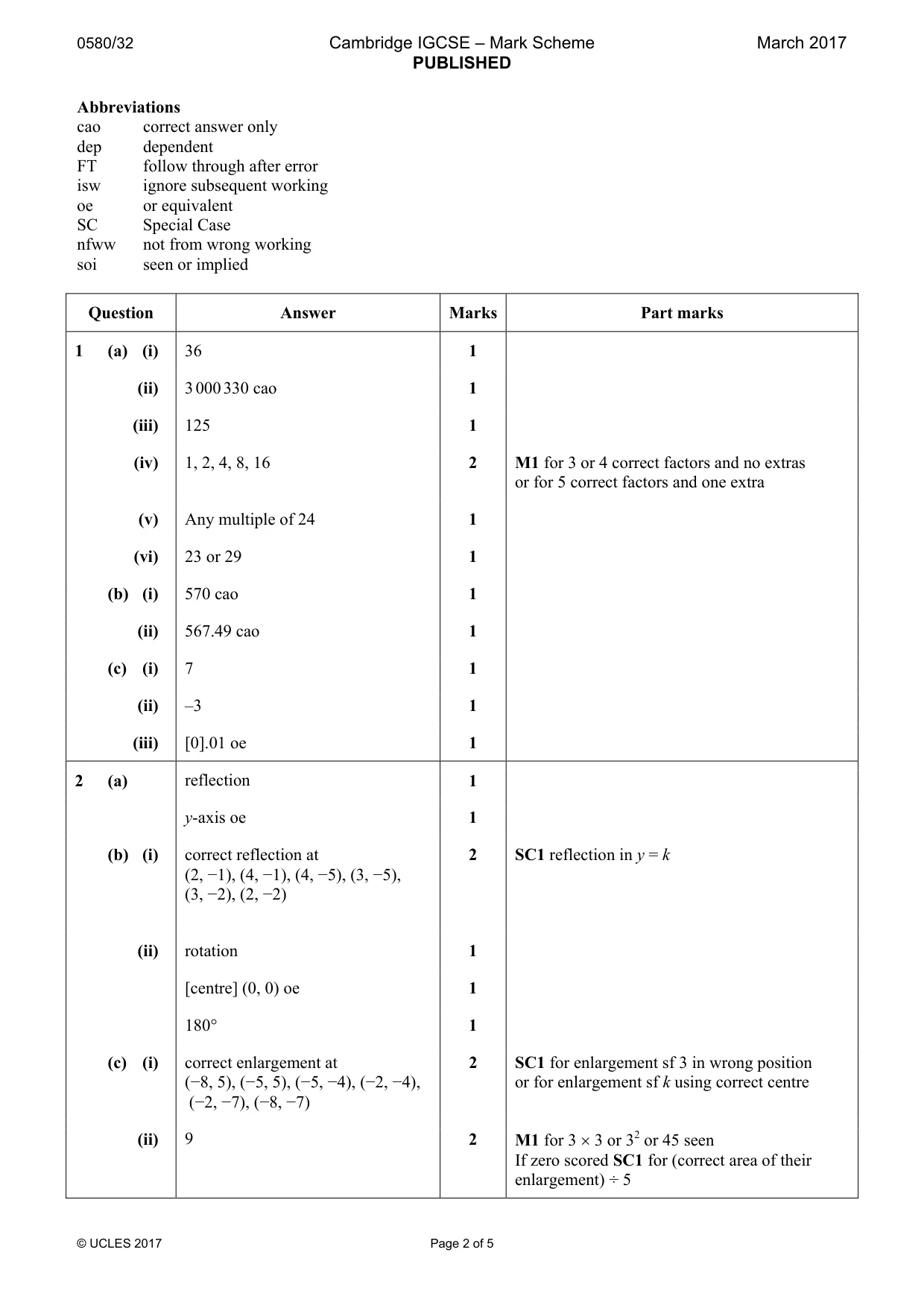
Mark scheme: 2 (a) reflection 1 y-axis oe 1 (b) (i) correct reflection at 2 SC1 reflection in y = k (2, −1), (4, −1), (4, −5), (3, −5), (3, −2), (2, −2) (ii) rotation 1 [centre] (0, 0) oe 1 180° 1 (c) (i) correct enlargement at 2 SC1 for enlargement sf 3 in wrong position (−8, 5), (−5, 5), (−5, −4), (−2, −4), or for enlargement sf k using correct centre (−2, −7), (−8, −7) (ii) 9 2 M1 for 3 × 3 or 32 or 45 seen If zero scored SC1 for (correct area of their enlargement) ÷ 5
Q3 · Mrs Singh and Mr Patel are teachers
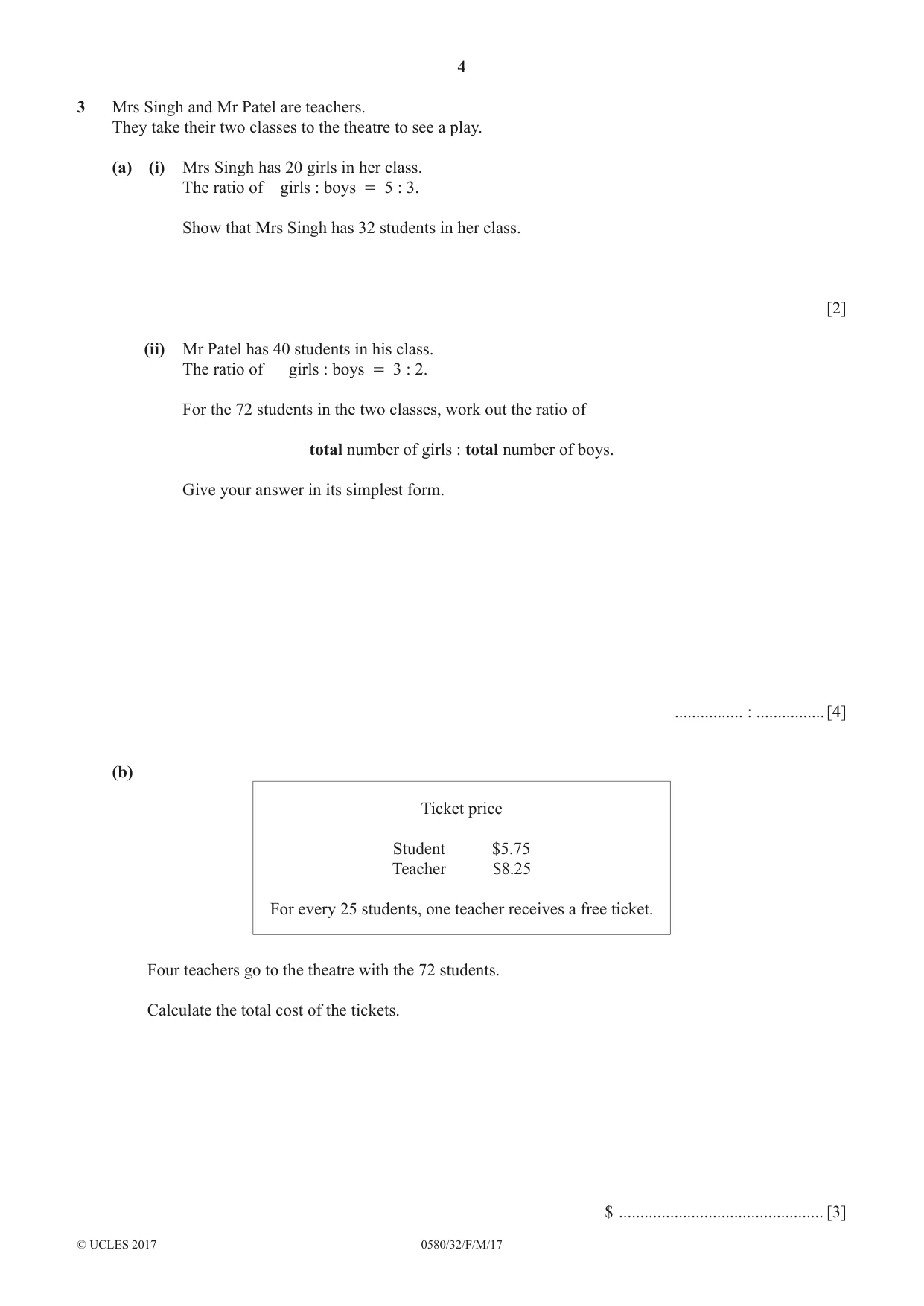
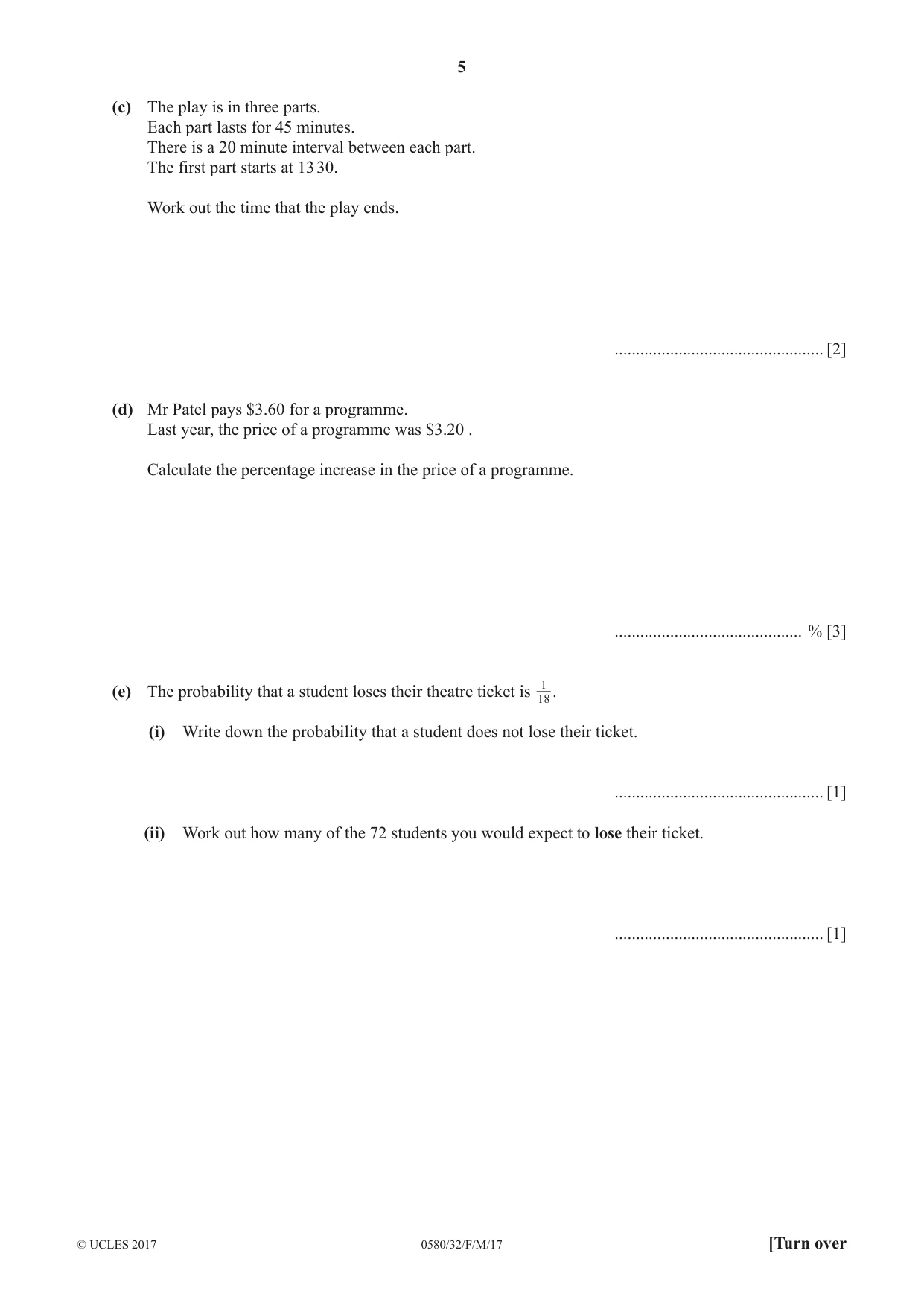
3 Mrs Singh and Mr Patel are teachers. They take their two classes to the theatre to see a play. (a) (i) Mrs Singh has 20 girls in her class. The ratio of girls : boys = 5 : 3. Show that Mrs Singh has 32 students in her class. [2] (ii) Mr Patel has 40 students in his class. The ratio of girls : boys = 3 : 2. For the 72 students in the two classes, work out the ratio of total number of girls : total number of boys. Give your answer in its simplest form. ................ : ................ [4] (b) Ticket price Student $5.75 Teacher $8.25 For every 25 students, one teacher receives a free ticket. Four teachers go to the theatre with the 72 students. Calculate the total cost of the tickets. $ ................................................ [3] (c) The play is in three parts. Each part lasts for 45 minutes. There is a 20 minute interval between each part. The first part starts at 13 30. Work out the time that the play ends. ................................................. [2] (d) Mr Patel pays $3.60 for a programme. Last year, the price of a programme was $3.20 . Calculate the percentage increase in the price of a programme. ............................................ % [3] (e) The probability that a student loses their theatre ticket is 181 . (i) Write down the probability that a student does not lose their ticket. ................................................. [1] (ii) Work out how many of the 72 students you would expect to lose their ticket. ................................................. [1]
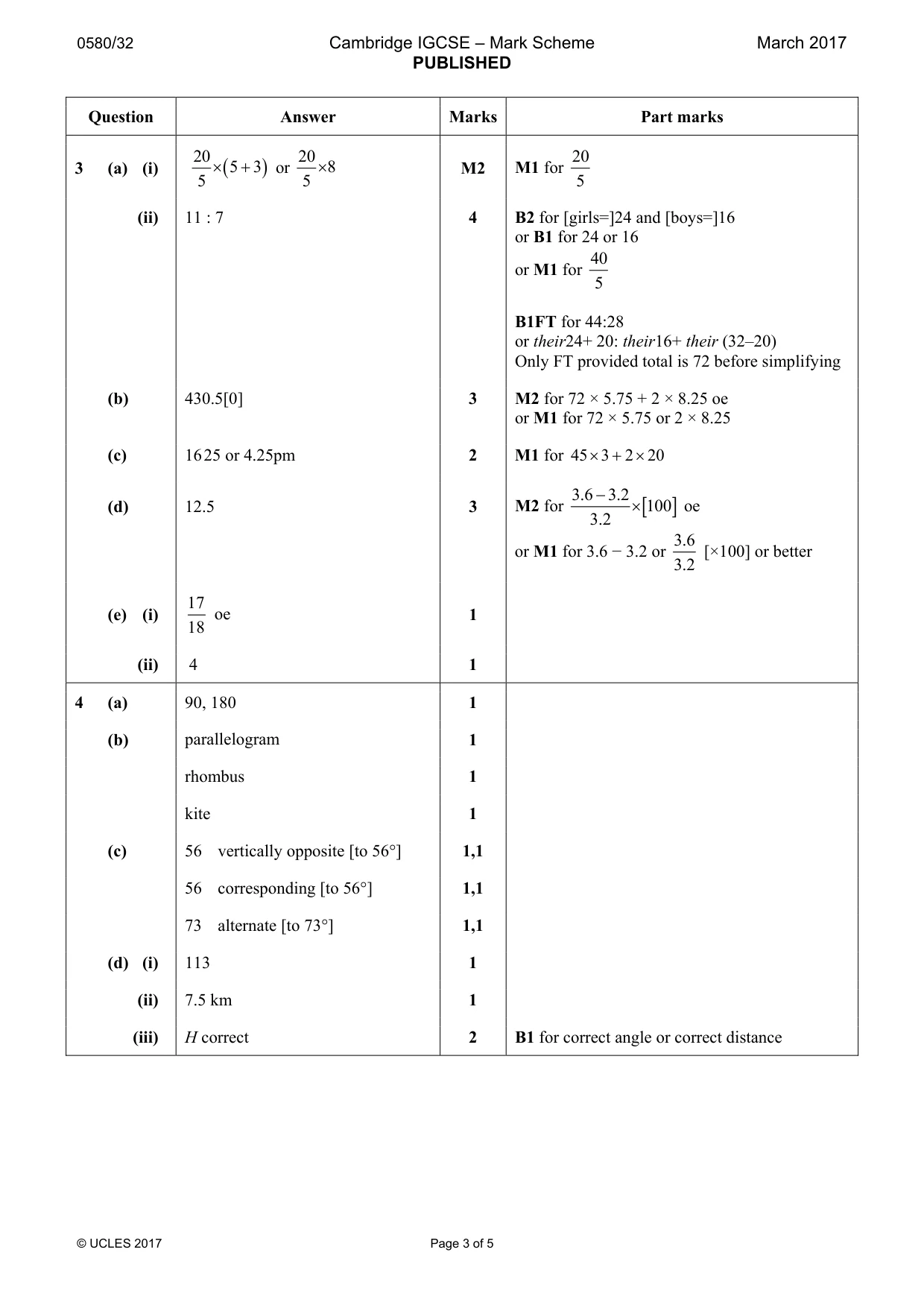
Mark scheme: 20 20 203 (a) (i) × ( 5 + 3 ) or × 8 M2 M1 for 5 5 5 (ii) 11 : 7 4 B2 for [girls=]24 and [boys=]16 or B1 for 24 or 16 40 or M1 for 5 B1FT for 44:28 or their24+ 20: their16+ their (32–20) Only FT provided total is 72 before simplifying (b) 430.5[0] 3 M2 for 72 × 5.75 + 2 × 8.25 oe or M1 for 72 × 5.75 or 2 × 8.25 (c) 16 25 or 4.25pm 2 M1 for 45 × 3 + 2 × 20 3.6 − 3.2 (d) 12.5 3 M2 for × [100 ] oe 3.2 3.6 or M1 for 3.6 − 3.2 or [×100] or better 3.2 17 (e) (i) oe 1 18 (ii) 4 1
Question 4
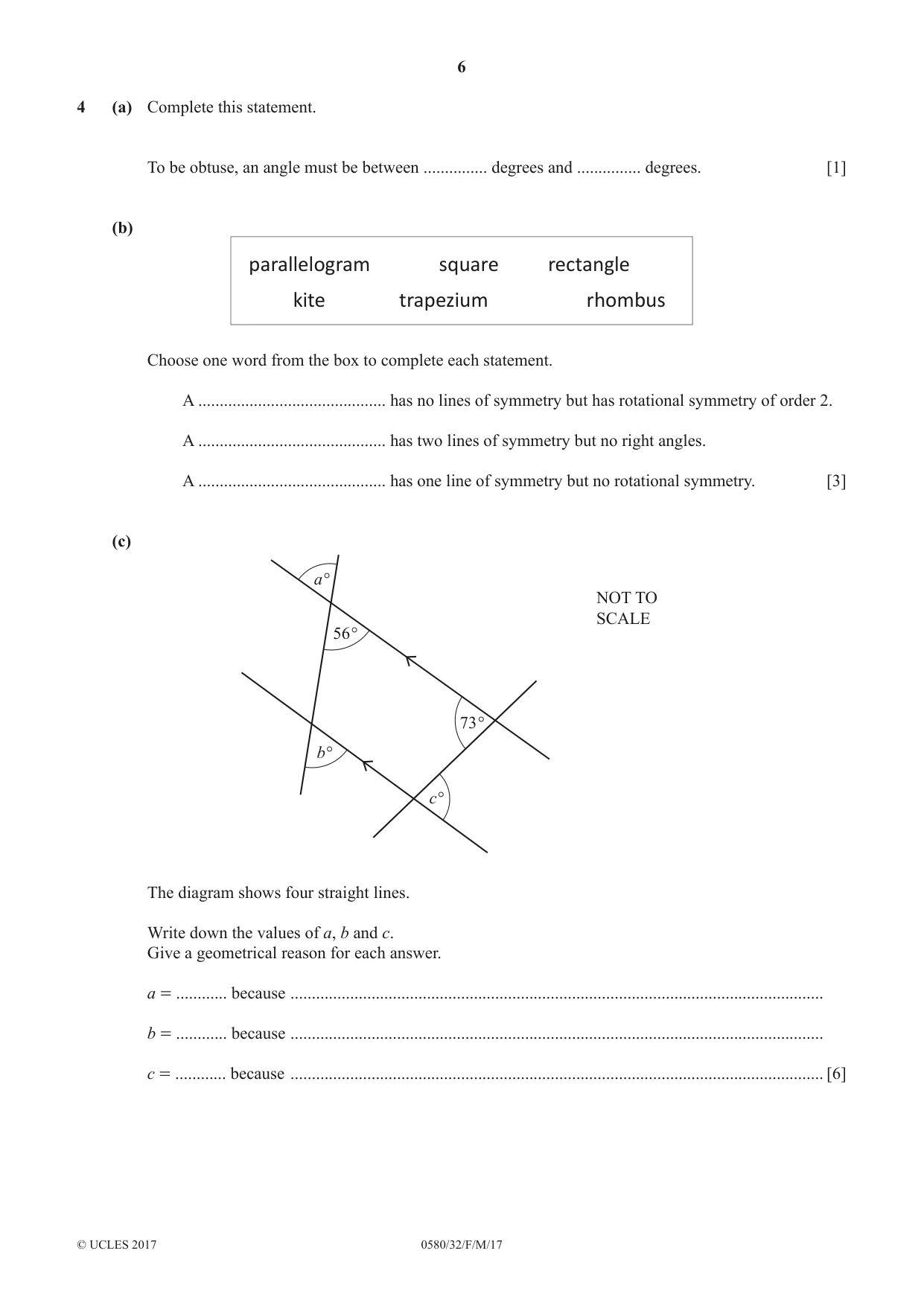
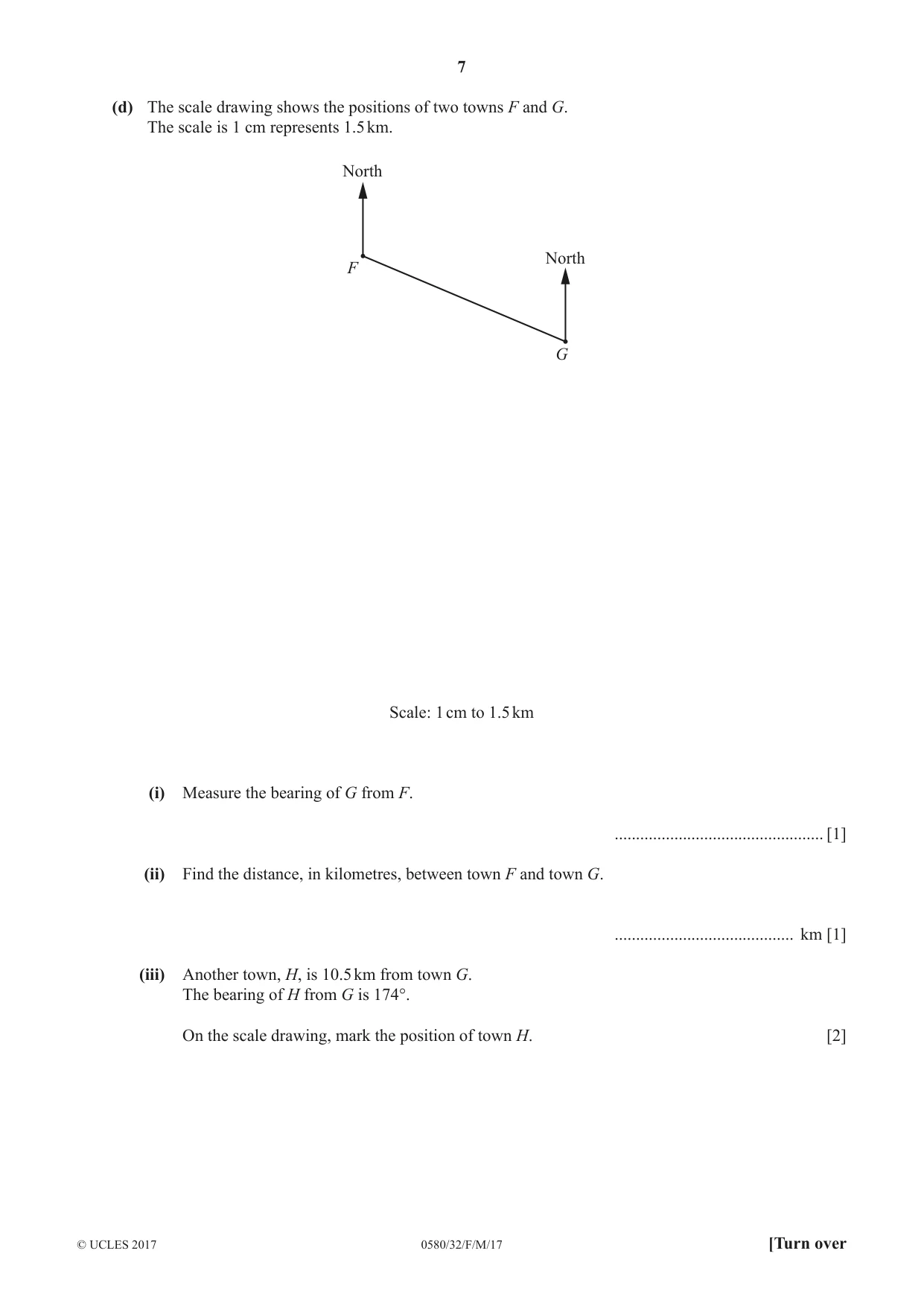
4 (a) Complete this statement. To be obtuse, an angle must be between ............... degrees and ............... degrees. [1] (b) parallelogram square rectangle kite trapezium rhombus Choose one word from the box to complete each statement. A ............................................ has no lines of symmetry but has rotational symmetry of order 2. A ............................................ has two lines of symmetry but no right angles. A ............................................ has one line of symmetry but no rotational symmetry. [3] (c) a° NOT TO SCALE 56° 73° b° c° The diagram shows four straight lines. Write down the values of a, b and c. Give a geometrical reason for each answer. a = ............ because ............................................................................................................................. b = ............ because ............................................................................................................................. c = ............ because ............................................................................................................................. [6] (d) The scale drawing shows the positions of two towns F and G. The scale is 1 cm represents 1.5 km. North North F G Scale: 1 cm to 1.5 km (i) Measure the bearing of G from F. ................................................. [1] (ii) Find the distance, in kilometres, between town F and town G. .......................................... km [1] (iii) Another town, H, is 10.5 km from town G. The bearing of H from G is 174°. On the scale drawing, mark the position of town H. [2]
Mark scheme: 4 (a) 90, 180 1 (b) parallelogram 1 rhombus 1 kite 1 (c) 56 vertically opposite [to 56°] 1,1 56 corresponding [to 56°] 1,1 73 alternate [to 73°] 1,1 (d) (i) 113 1 (ii) 7.5 km 1 (iii) H correct 2 B1 for correct angle or correct distance
Q5 · A train departs from Green Hill, stops at Deep Valley for 5 minutes and then goes on to…
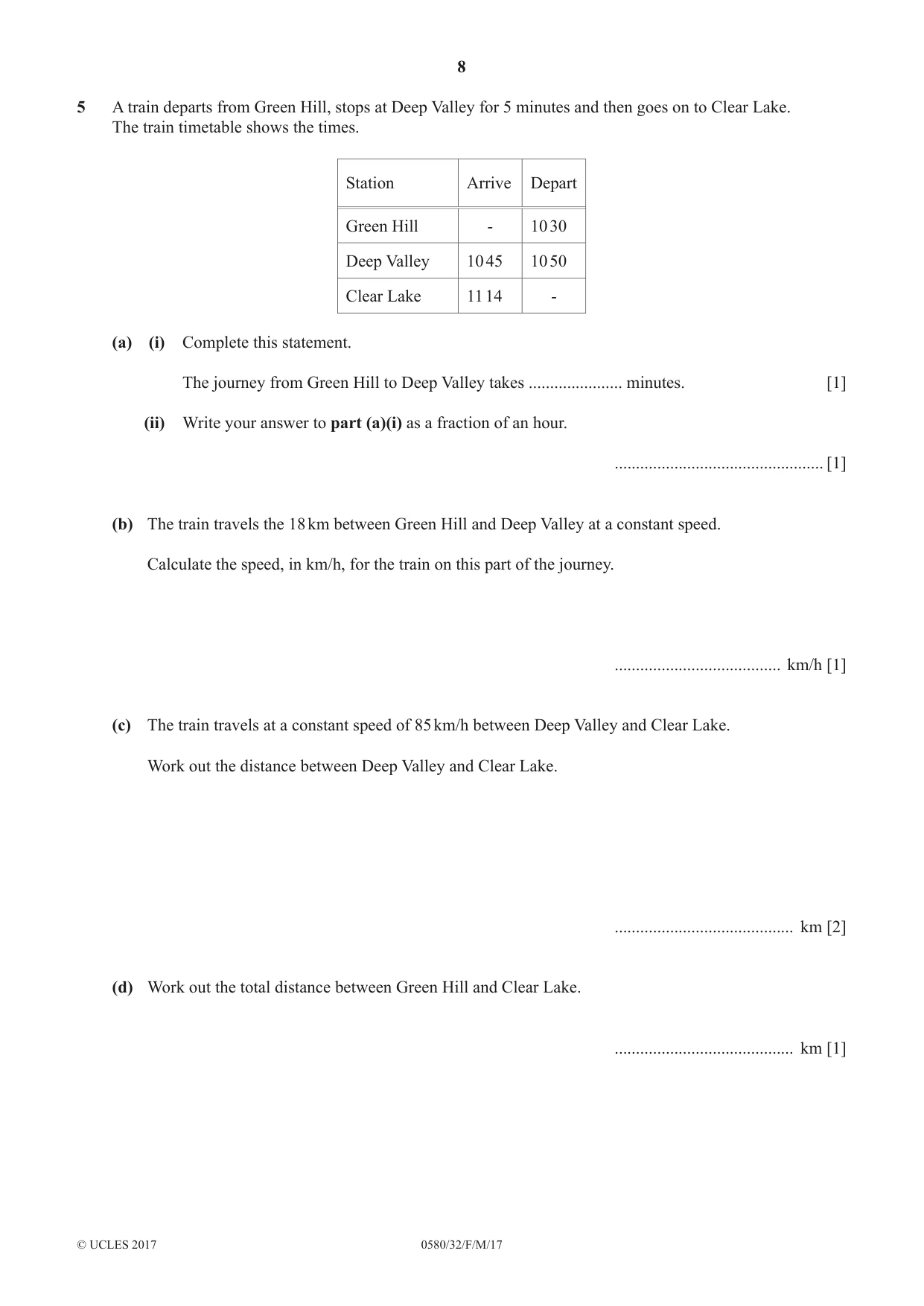
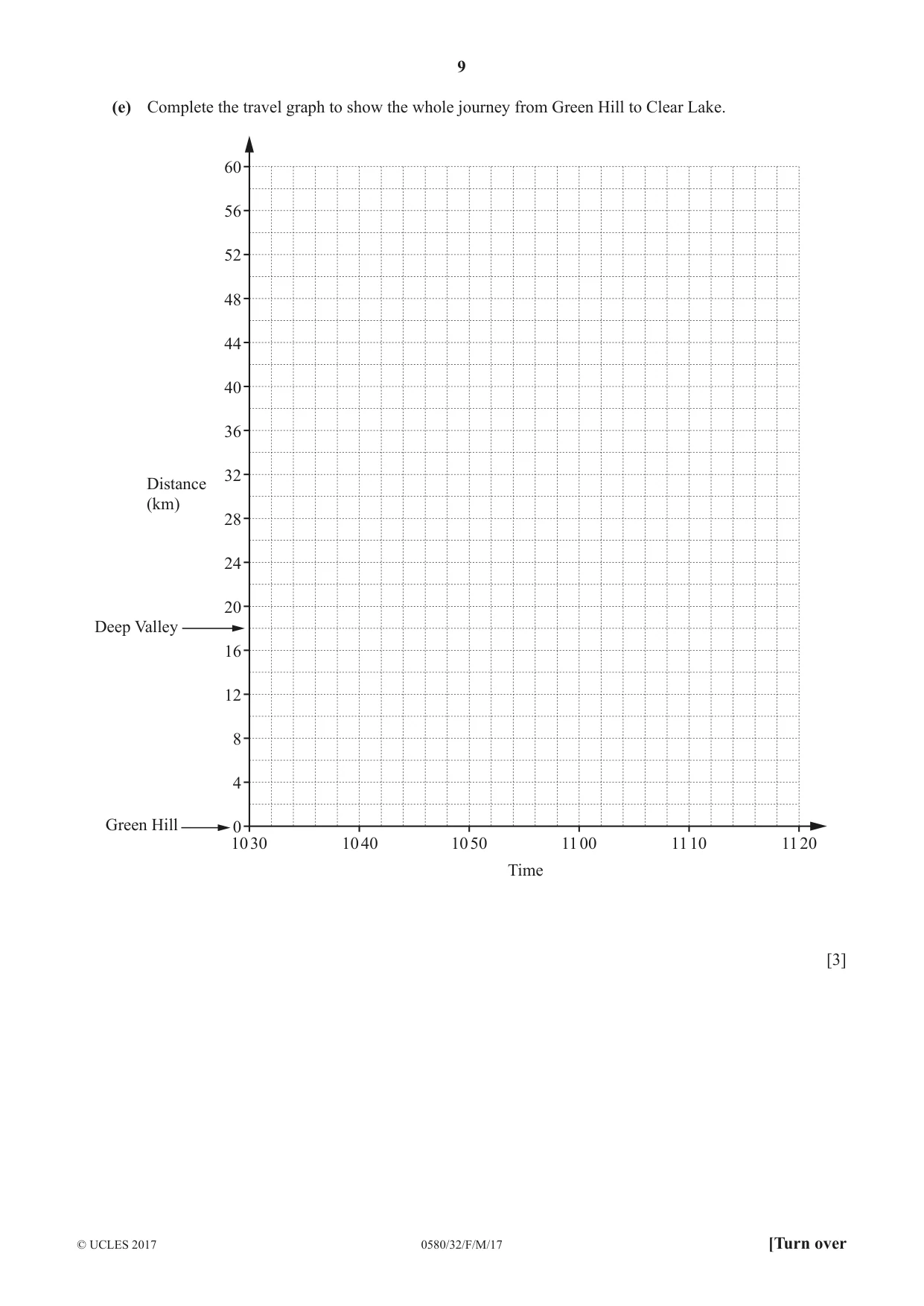
5 A train departs from Green Hill, stops at Deep Valley for 5 minutes and then goes on to Clear Lake. The train timetable shows the times. Station Arrive Depart Green Hill - 10 30 Deep Valley 10 45 10 50 Clear Lake 11 14 - (a) (i) Complete this statement. The journey from Green Hill to Deep Valley takes ...................... minutes. [1] (ii) Write your answer to part (a)(i) as a fraction of an hour. ................................................. [1] (b) The train travels the 18 km between Green Hill and Deep Valley at a constant speed. Calculate the speed, in km/h, for the train on this part of the journey. ....................................... km/h [1] (c) The train travels at a constant speed of 85 km/h between Deep Valley and Clear Lake. Work out the distance between Deep Valley and Clear Lake. .......................................... km [2] (d) Work out the total distance between Green Hill and Clear Lake. .......................................... km [1] (e) Complete the travel graph to show the whole journey from Green Hill to Clear Lake. 60 56 52 48 44 40 36 32 Distance (km) 28 24 20 Deep Valley 16 12 8 4 Green Hill 0 10 30 10 40 10 50 11 00 11 10 11 20 Time [3]
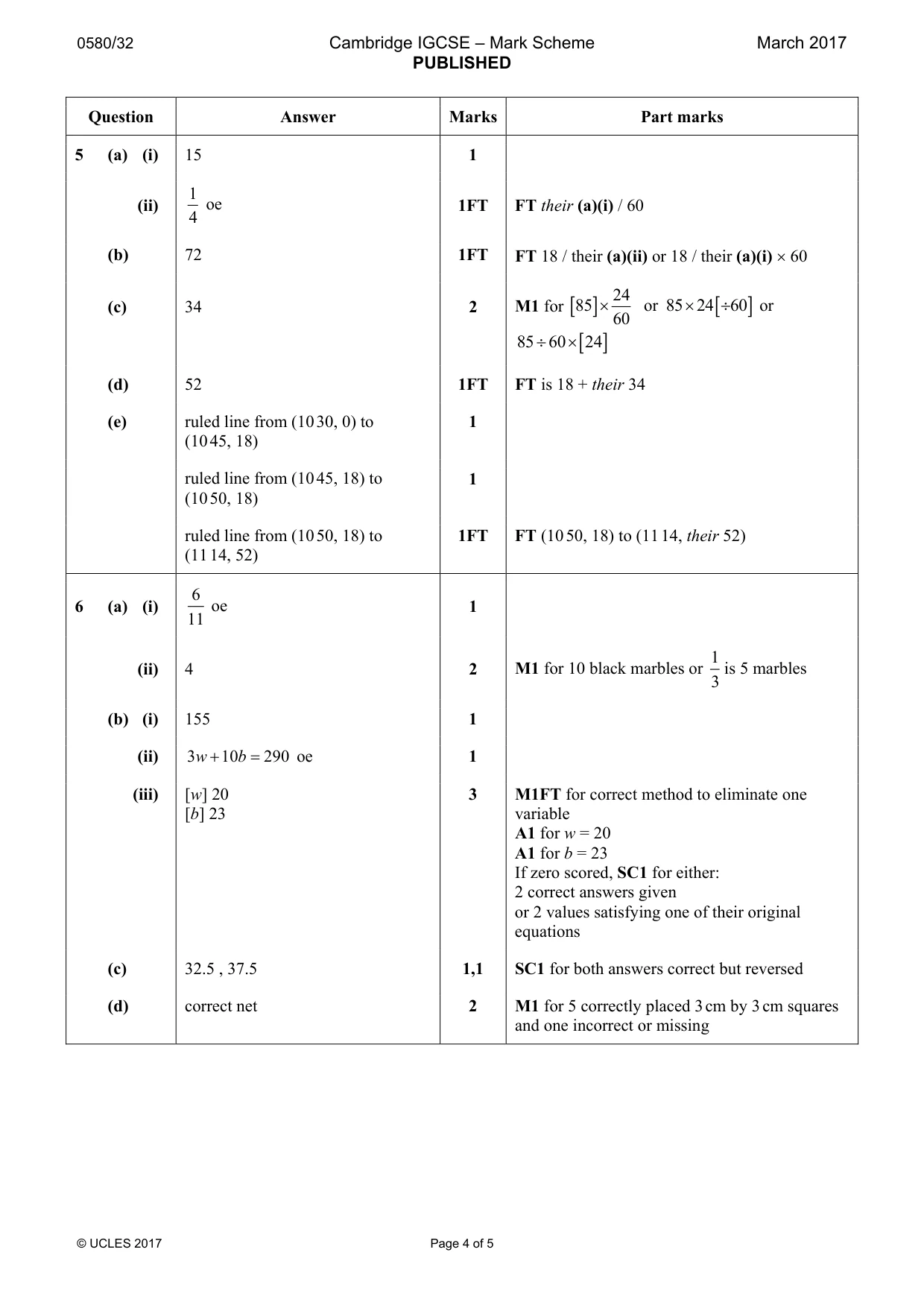
Mark scheme: 5 (a) (i) 15 1 1 (ii) oe 1FT FT their (a)(i) / 60 4 (b) 72 1FT FT 18 / their (a)(ii) or 18 / their (a)(i) × 60 24 (c) 34 2 M1 for [ 85] × or 85 × 24 [ ÷60 ] or 60 85 ÷ 60 × [ 24 ] (d) 52 1FT FT is 18 + their 34 (e) ruled line from (10 30, 0) to 1 (10 45, 18) ruled line from (10 45, 18) to 1 (10 50, 18) ruled line from (10 50, 18) to 1FT FT (10 50, 18) to (11 14, their 52) (11 14, 52) 6
Q6 · A bag contains 5 white and 6 black marbles
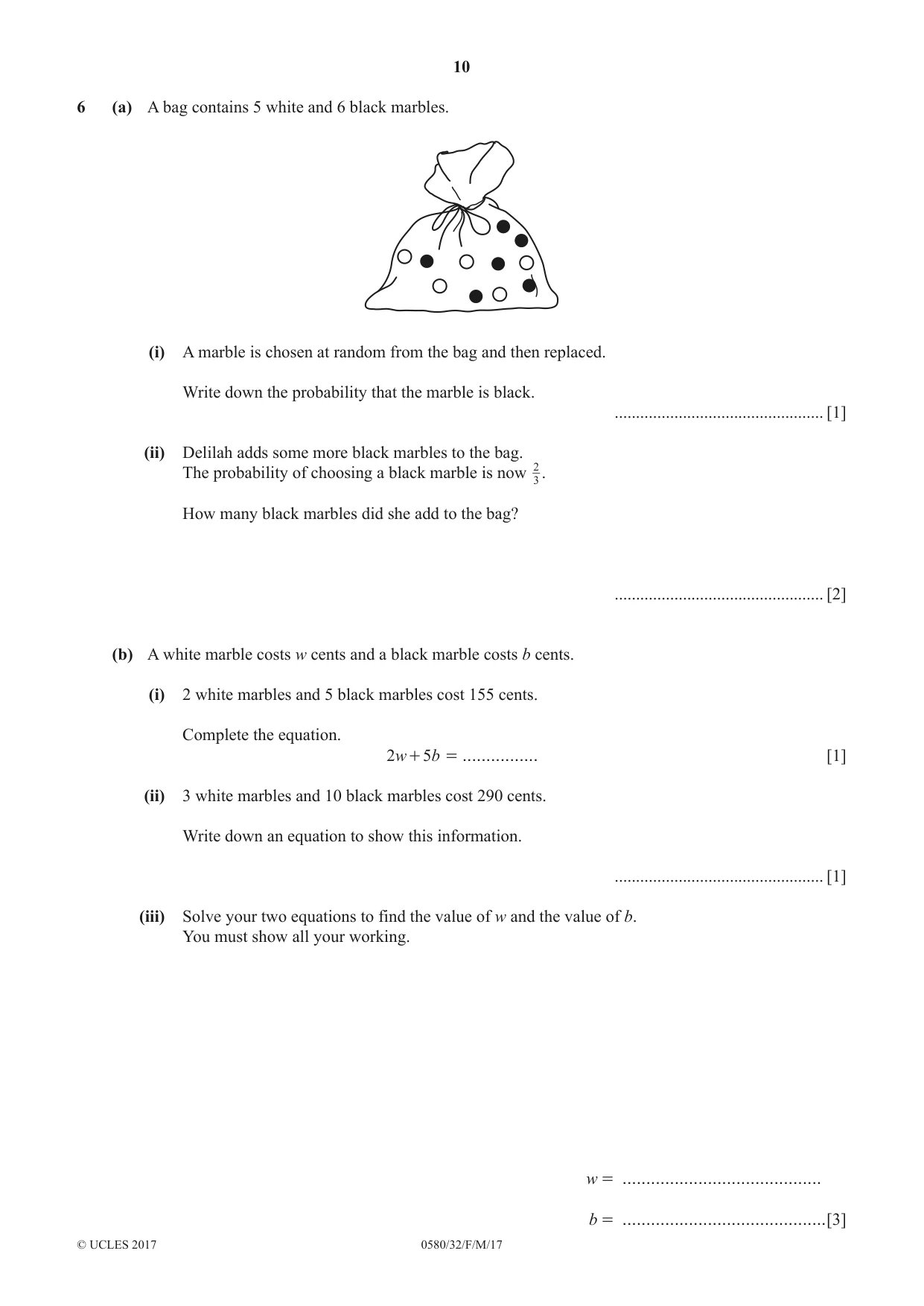
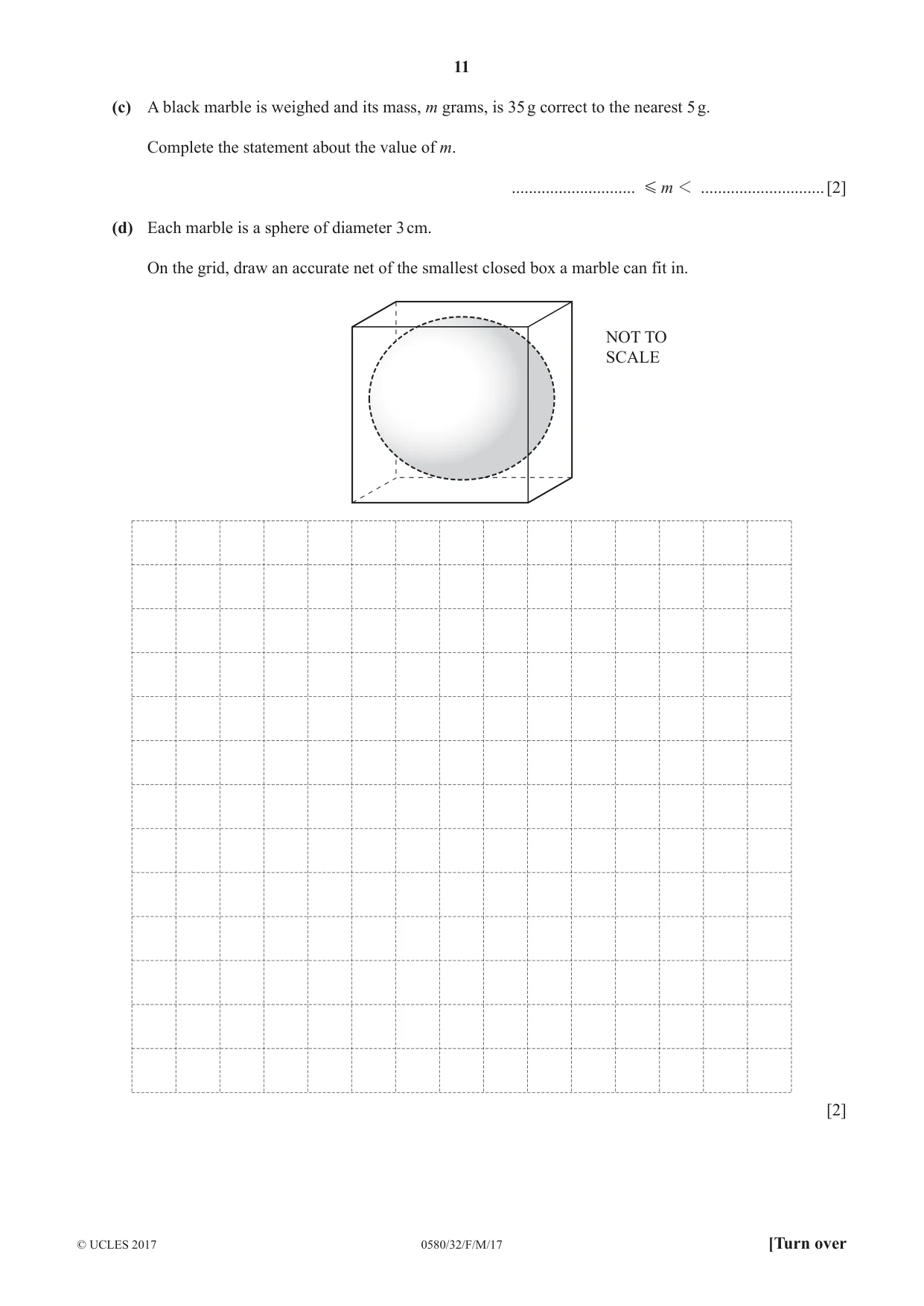
6 (a) A bag contains 5 white and 6 black marbles. (i) A marble is chosen at random from the bag and then replaced. Write down the probability that the marble is black. ................................................. [1] (ii) Delilah adds some more black marbles to the bag. The probability of choosing a black marble is now 23 . How many black marbles did she add to the bag? ................................................. [2] (b) A white marble costs w cents and a black marble costs b cents. (i) 2 white marbles and 5 black marbles cost 155 cents. Complete the equation. 2w + 5b = ................ [1] (ii) 3 white marbles and 10 black marbles cost 290 cents. Write down an equation to show this information. ................................................. [1] (iii) Solve your two equations to find the value of w and the value of b. You must show all your working. w = .......................................... b = ...........................................[3] (c) A black marble is weighed and its mass, m grams, is 35 g correct to the nearest 5 g. Complete the statement about the value of m. ............................. G m 1 ............................. [2] (d) Each marble is a sphere of diameter 3 cm. On the grid, draw an accurate net of the smallest closed box a marble can fit in. NOT TO SCALE [2]
Mark scheme: 6 6 (a) (i) oe 1 11 1 (ii) 4 2 M1 for 10 black marbles or is 5 marbles 3 (b) (i) 155 1 (ii) 3 w + 10b = 290 oe 1 (iii) [w] 20 3 M1FT for correct method to eliminate one [b] 23 variable A1 for w = 20 A1 for b = 23 If zero scored, SC1 for either: 2 correct answers given or 2 values satisfying one of their original equations (c) 32.5 , 37.5 1,1 SC1 for both answers correct but reversed (d) correct net 2 M1 for 5 correctly placed 3 cm by 3 cm squares and one incorrect or missing
Q7 · Ten students estimate the length and width of their rectangular school hall
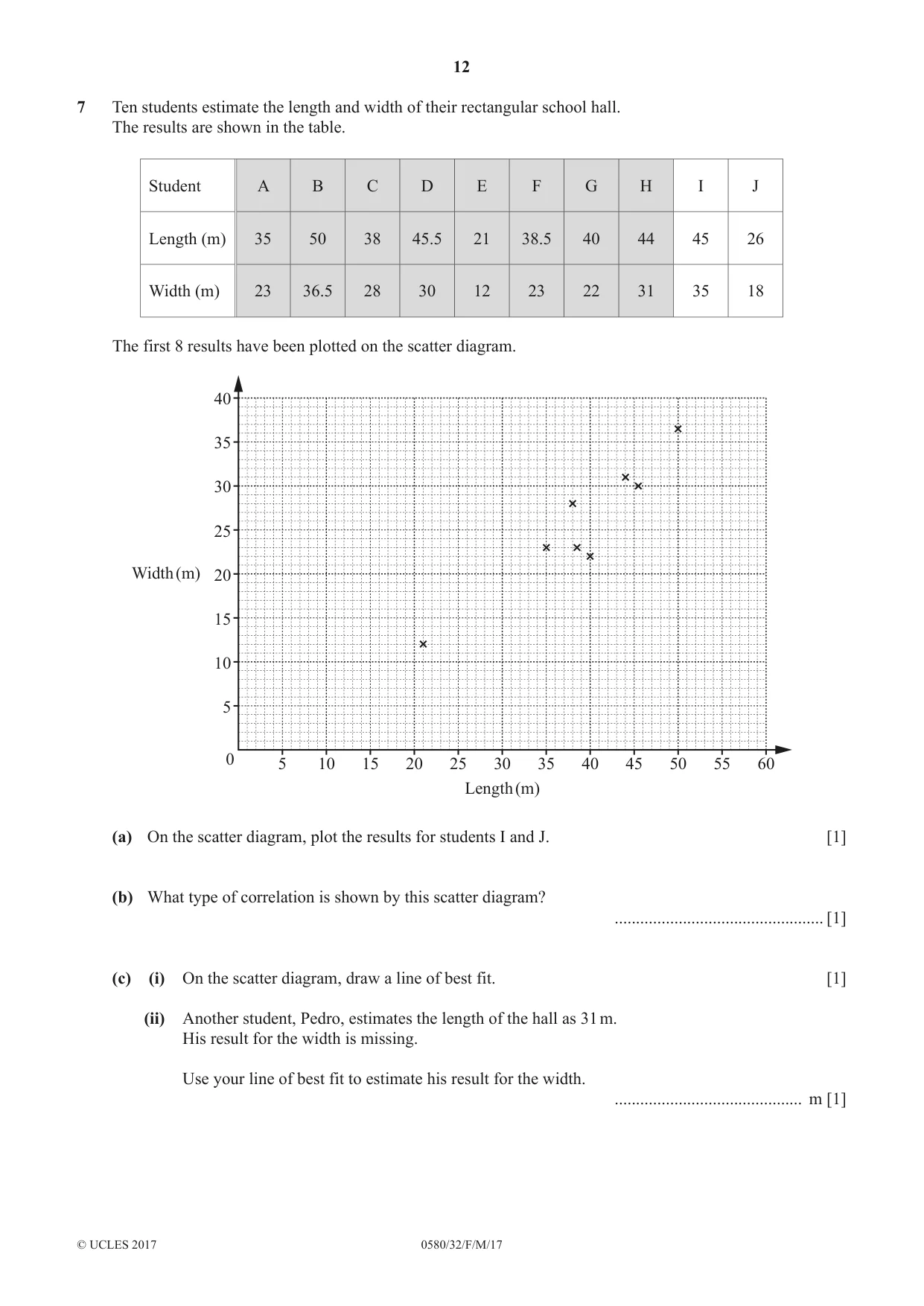
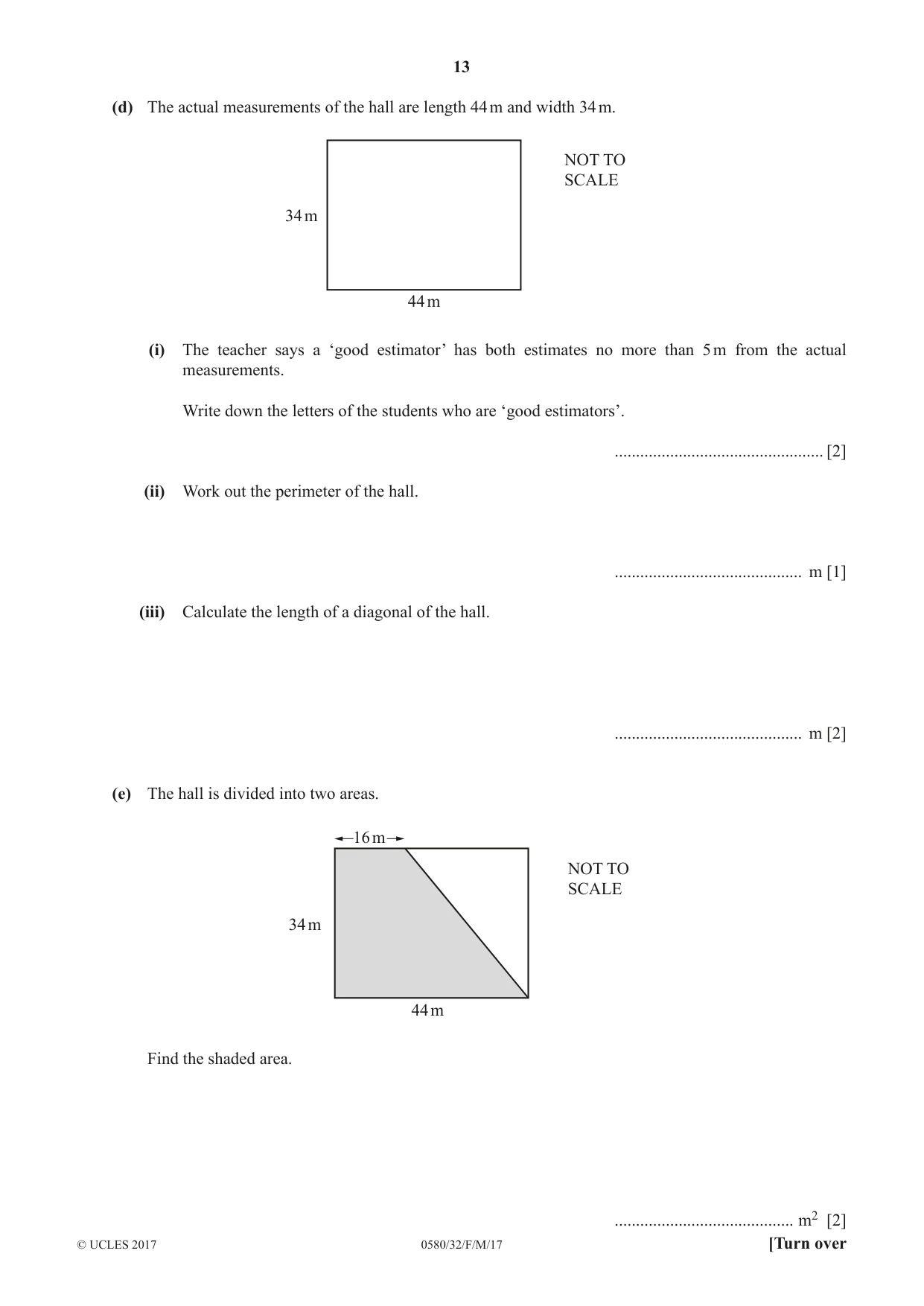
7 Ten students estimate the length and width of their rectangular school hall. The results are shown in the table. Student A B C D E F G H I J Length (m) 35 50 38 45.5 21 38.5 40 44 45 26 Width (m) 23 36.5 28 30 12 23 22 31 35 18 The first 8 results have been plotted on the scatter diagram. 40 35 30 25 Width (m) 20 15 10 5 0 5 10 15 20 25 30 35 40 45 50 55 60 Length (m) (a) On the scatter diagram, plot the results for students I and J. [1] (b) What type of correlation is shown by this scatter diagram? ................................................. [1] (c) (i) On the scatter diagram, draw a line of best fit. [1] (ii) Another student, Pedro, estimates the length of the hall as 31 m. His result for the width is missing. Use your line of best fit to estimate his result for the width. ............................................ m [1] (d) The actual measurements of the hall are length 44 m and width 34 m. NOT TO SCALE 34 m 44 m (i) The teacher says a ‘good estimator’ has both estimates no more than 5 m from the actual measurements. Write down the letters of the students who are ‘good estimators’. ................................................. [2] (ii) Work out the perimeter of the hall. ............................................ m [1] (iii) Calculate the length of a diagonal of the hall. ............................................ m [2] (e) The hall is divided into two areas. 16 m NOT TO SCALE 34 m 44 m Find the shaded area. .......................................... m2 [2]
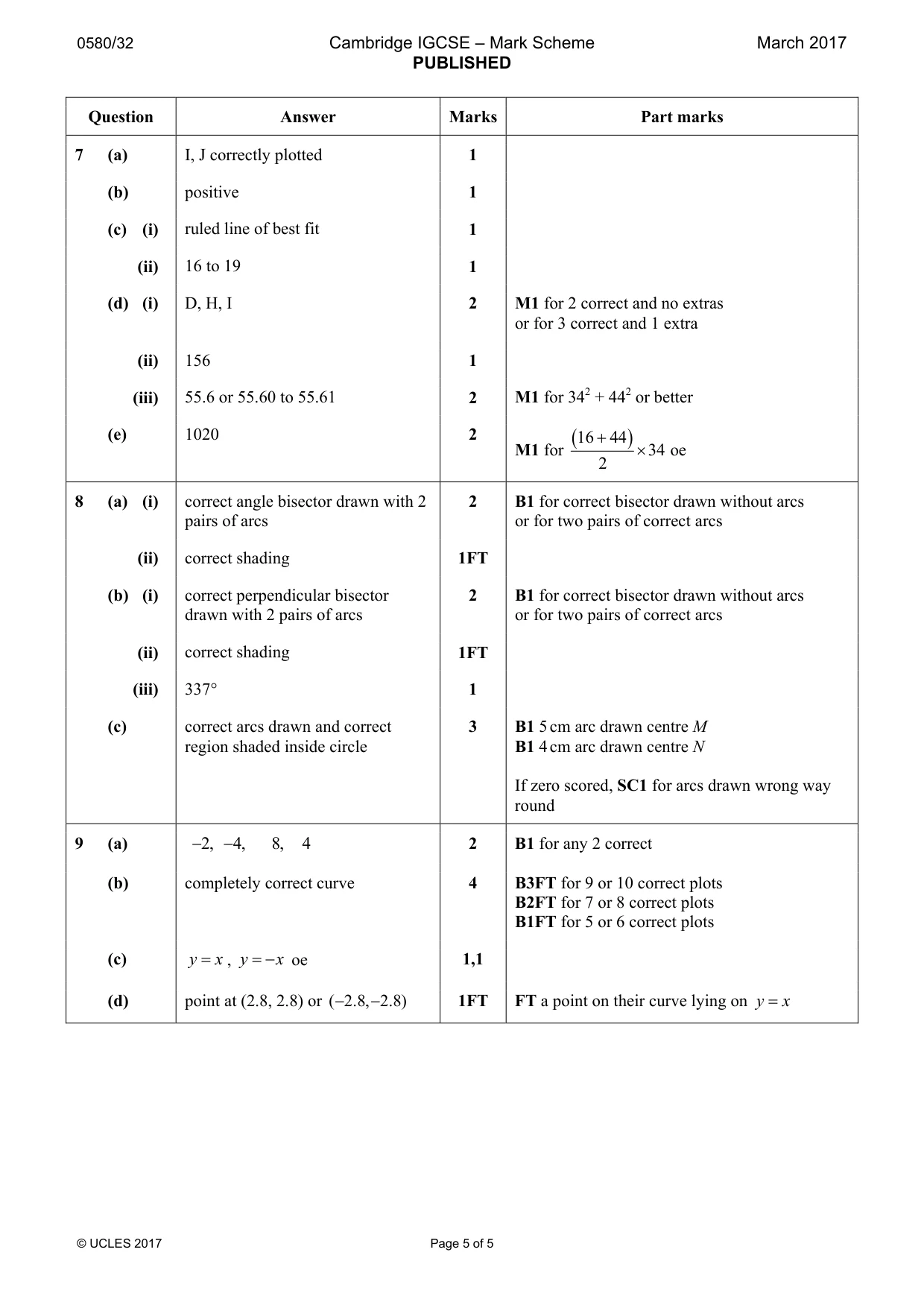
Mark scheme: 7 (a) I, J correctly plotted 1 (b) positive 1 (c) (i) ruled line of best fit 1 (ii) 16 to 19 1 (d) (i) D, H, I 2 M1 for 2 correct and no extras or for 3 correct and 1 extra (ii) 156 1 (iii) 55.6 or 55.60 to 55.61 2 M1 for 342 + 442 or better (e) 1020 2 (16 + 44 ) M1 for × 34 oe 2
Q8 · Complete parts (a)(i) and (b)(i) of this question using a straight edge and compasses only
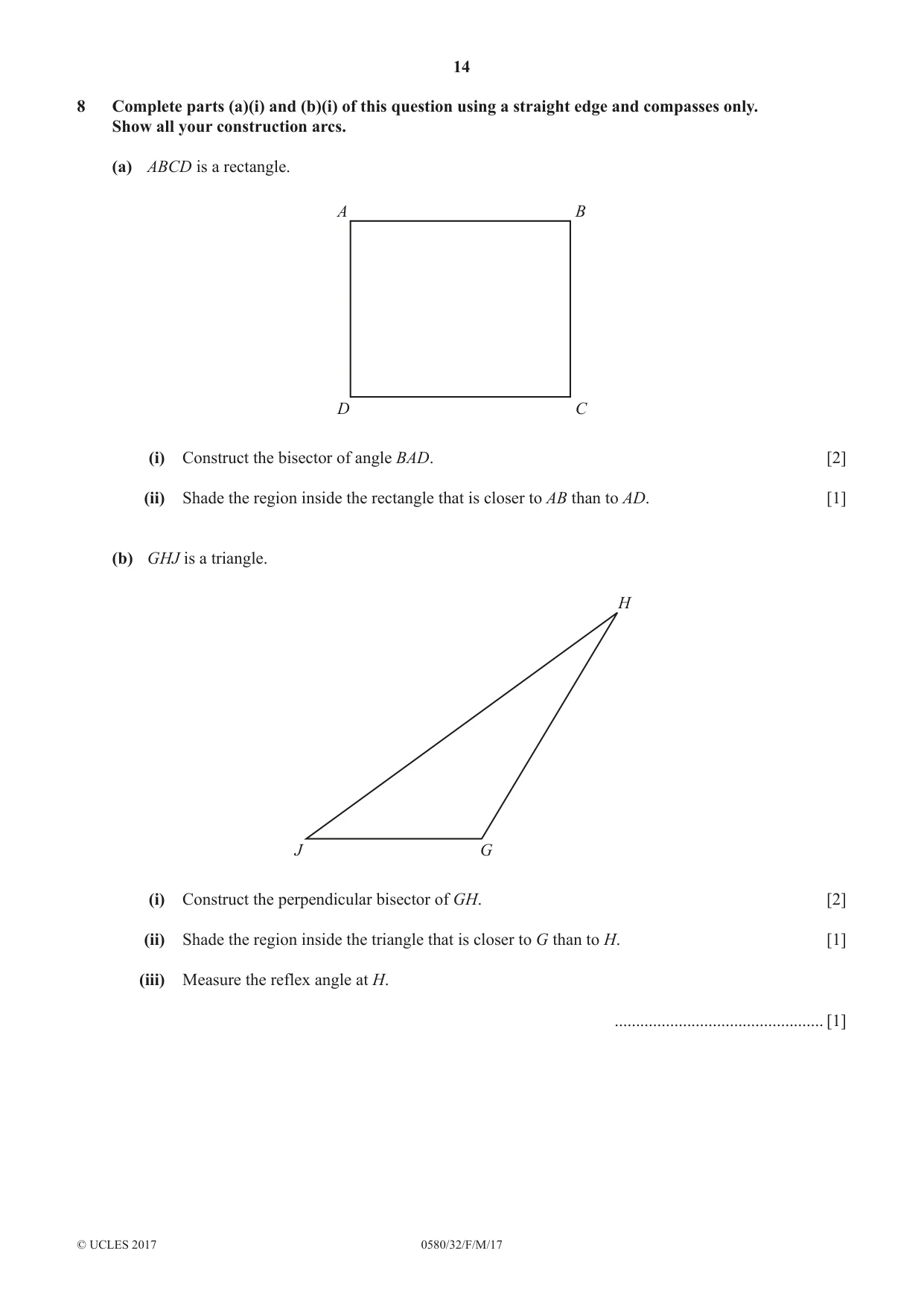
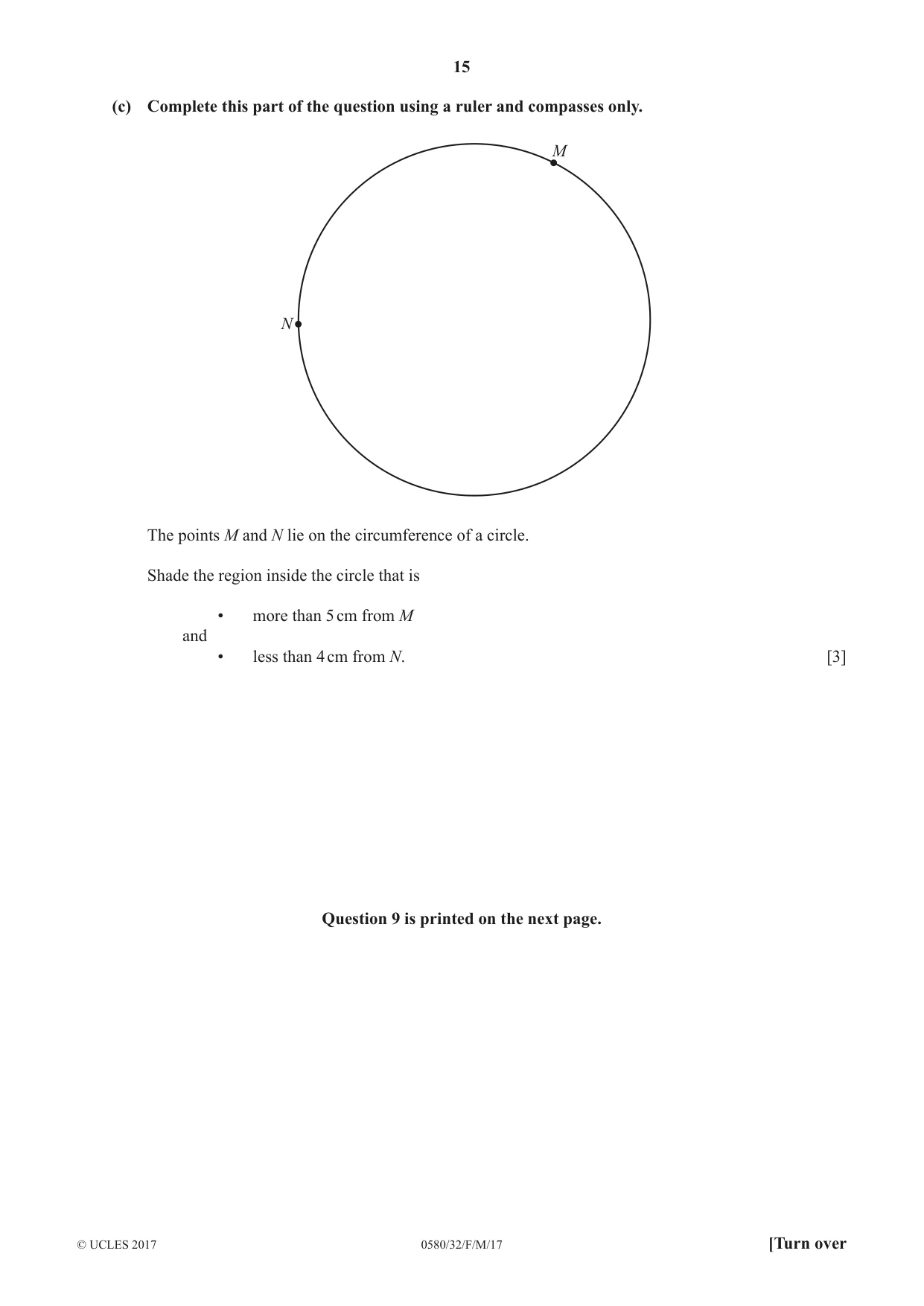
8 Complete parts (a)(i) and (b)(i) of this question using a straight edge and compasses only. Show all your construction arcs. (a) ABCD is a rectangle. A B D C (i) Construct the bisector of angle BAD. [2] (ii) Shade the region inside the rectangle that is closer to AB than to AD. [1] (b) GHJ is a triangle. H J G (i) Construct the perpendicular bisector of GH. [2] (ii) Shade the region inside the triangle that is closer to G than to H. [1] (iii) Measure the reflex angle at H. ................................................. [1] (c) Complete this part of the question using a ruler and compasses only. M N The points M and N lie on the circumference of a circle. Shade the region inside the circle that is • more than 5 cm from M and • less than 4 cm from N. [3] Question 9 is printed on the next page.
Mark scheme: 8 (a) (i) correct angle bisector drawn with 2 2 B1 for correct bisector drawn without arcs pairs of arcs or for two pairs of correct arcs (ii) correct shading 1FT (b) (i) correct perpendicular bisector 2 B1 for correct bisector drawn without arcs drawn with 2 pairs of arcs or for two pairs of correct arcs (ii) correct shading 1FT (iii) 337° 1 (c) correct arcs drawn and correct 3 B1 5 cm arc drawn centre M region shaded inside circle B1 4 cm arc drawn centre N If zero scored, SC1 for arcs drawn wrong way round
Q9 · Complete the table of values for y =
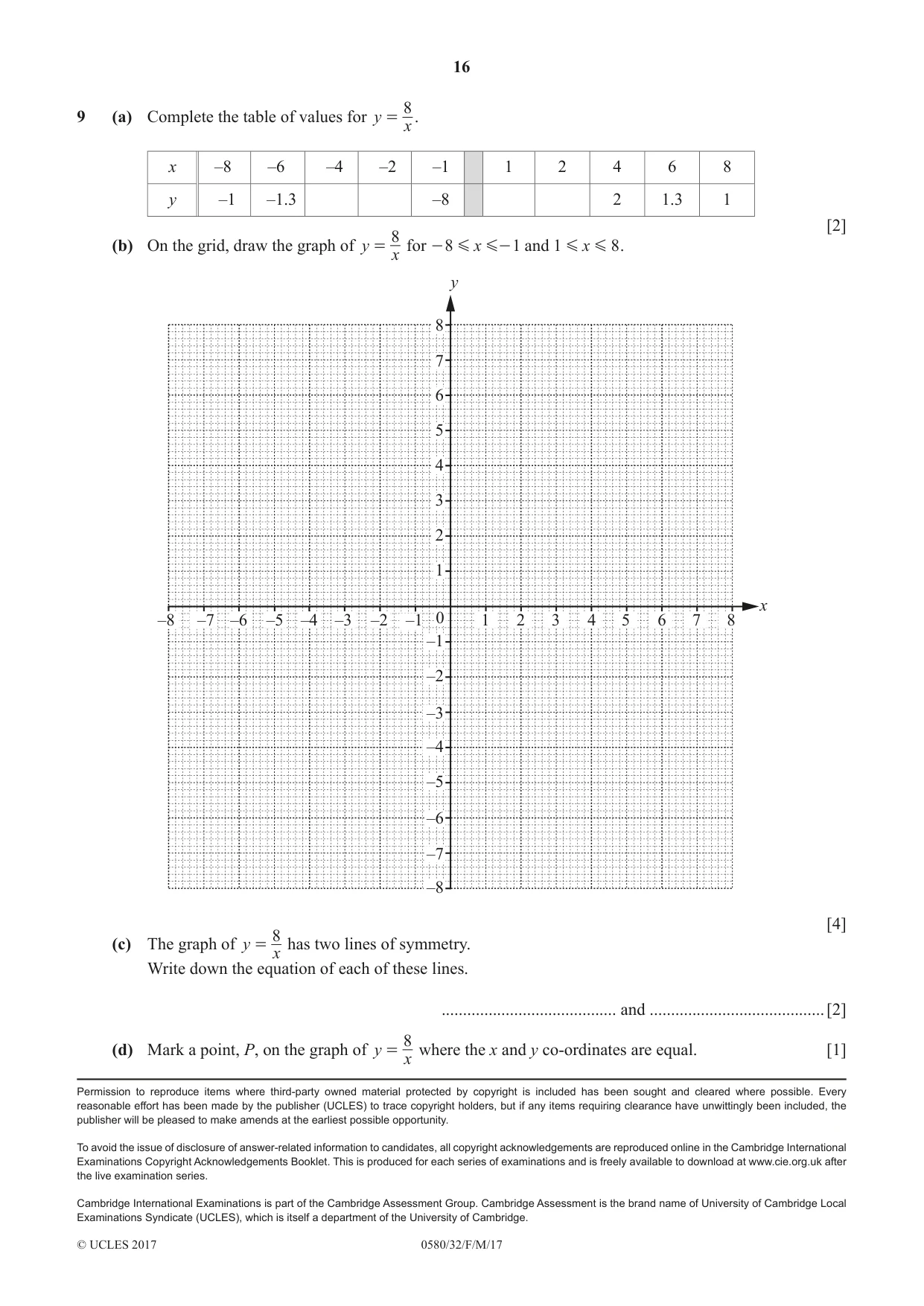
89 (a) Complete the table of values for y = . x x –8 –6 –4 –2 –1 1 2 4 6 8 y –1 –1.3 –8 2 1.3 1 [2] 8 (b) On the grid, draw the graph of y = for - 8 G x G - 1 and 1 G x G 8 . x y 8 7 6 5 4 3 2 1 x –8 –7–7 –6 –5 –4 –3 –2 –1 0 1 2 3 4 5 6 7 8 –1 –2 –3 –4 –5 –6 –7 –8 [4] 8 (c) The graph of y = has two lines of symmetry. x Write down the equation of each of these lines. ......................................... and ......................................... [2] 8 (d) Mark a point, P, on the graph of y = where the x and y co-ordinates are equal. [1] x
Mark scheme: 9 (a) −2, −4, 8, 4 2 B1 for any 2 correct (b) completely correct curve 4 B3FT for 9 or 10 correct plots B2FT for 7 or 8 correct plots B1FT for 5 or 6 correct plots (c) y = x , y = − x oe 1,1 (d) point at (2.8, 2.8) or ( −2.8, − 2.8) 1FT FT a point on their curve lying on y = x
What was in this paper
The subtopics covered by these 9 questions, and how many questions each got. Open one in a new tab to see every Cambridge question on it.
What you needed in this session
Cambridge’s own grade thresholds for 2017 Feb/March, Paper 3 · Variant 2. A higher threshold means an easier paper — the bar moves with how the cohort did.