Cambridge IGCSE Mathematics 0580 — 2015 Feb/March Paper 3 · Variant 2
0580/32/F/M/15 · 9 questions · 104 marks · ≈117 min
The question paper and its mark scheme, free to read here and free to download. This is Cambridge’s own paper, exactly as it was sat.
Question paper16 pages
Mark scheme5 pages
Answers below. Sit the paper first if you are practising.
Questions as text
Question 1
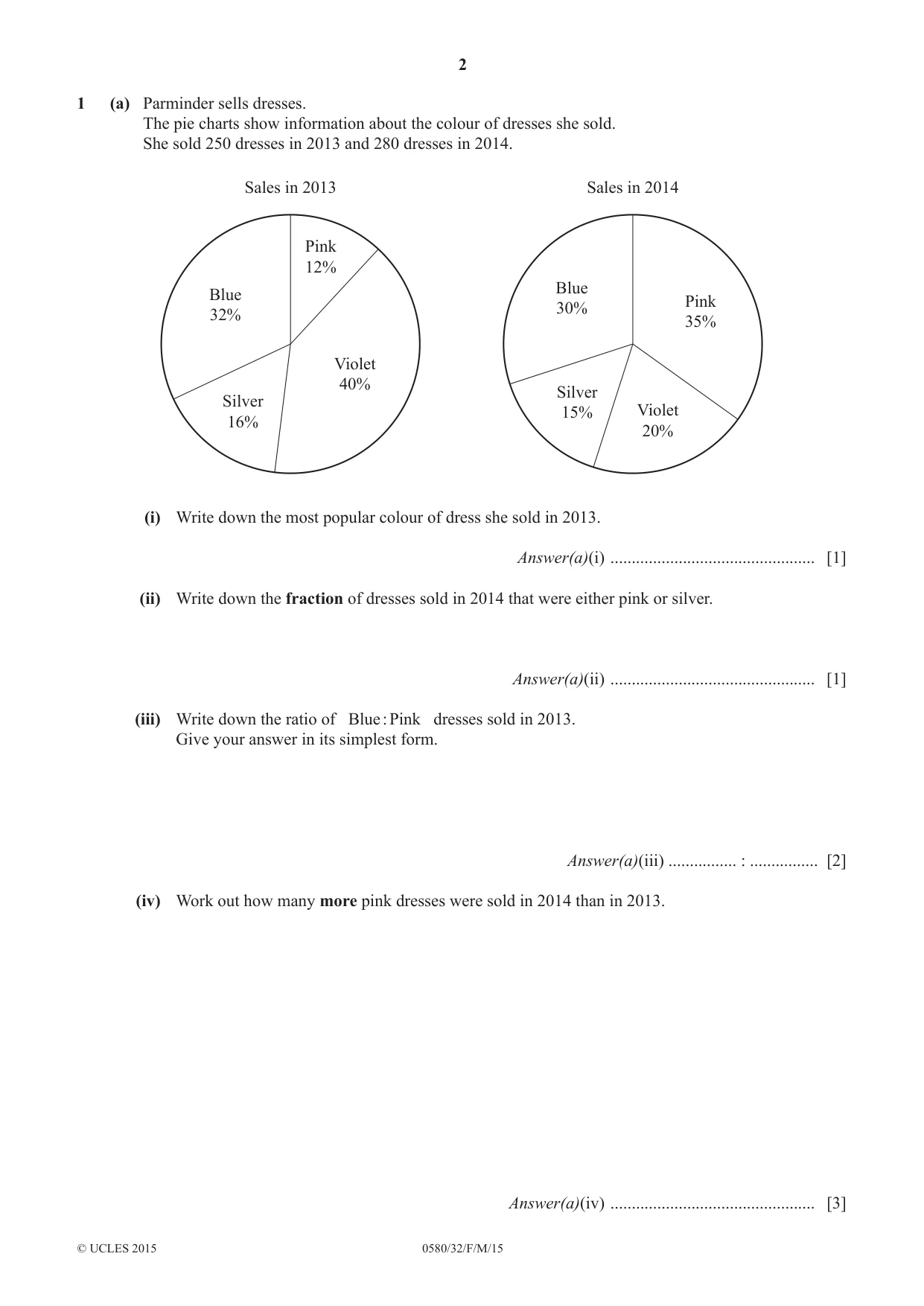
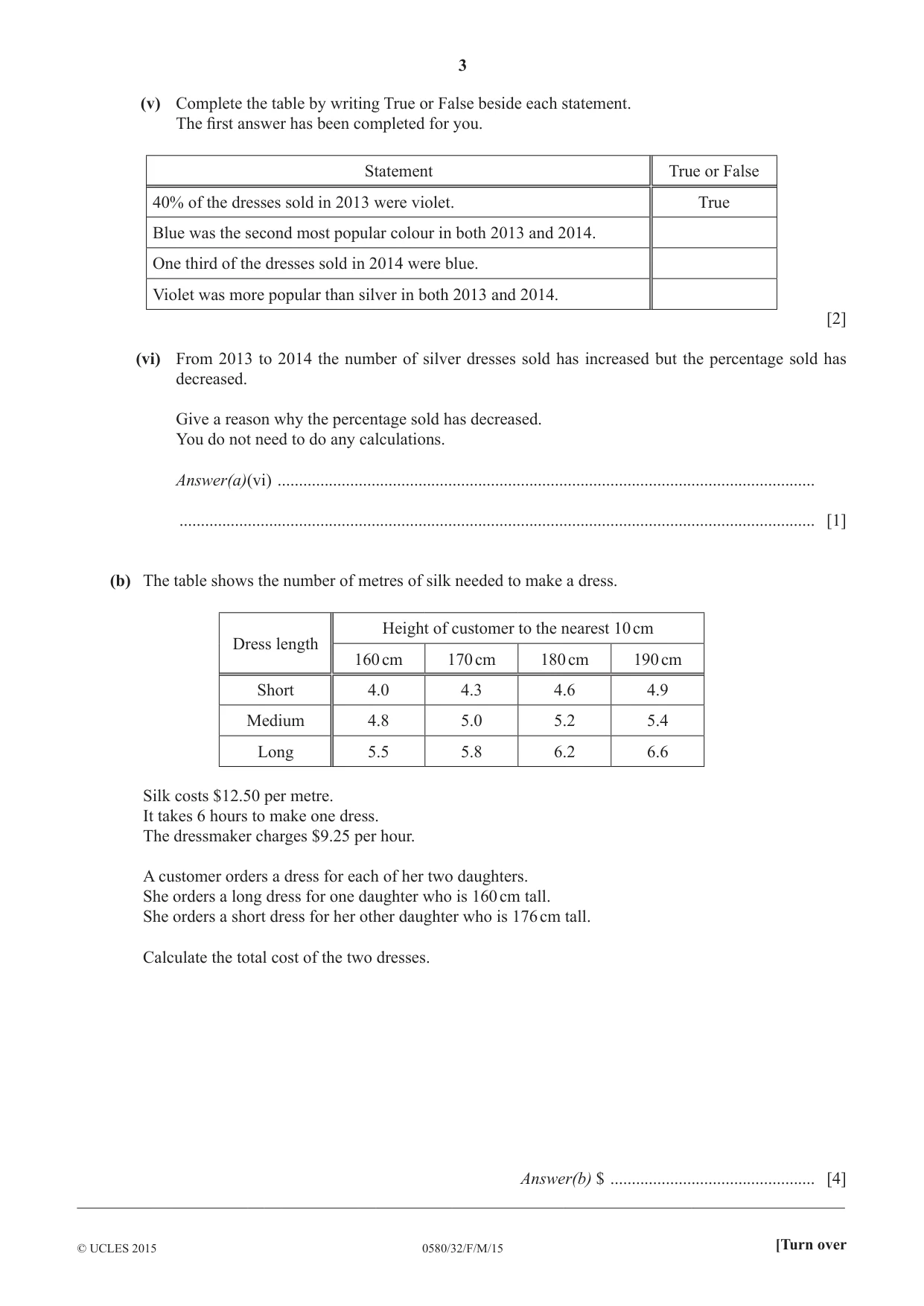
1 (a) Parminder sells dresses. The pie charts show information about the colour of dresses she sold. She sold 250 dresses in 2013 and 280 dresses in 2014. Sales in 2013 Sales in 2014 Pink 12% Blue Blue Pink 30% 32% 35% Violet 40% Silver Silver 15% Violet 16% 20% (i) Write down the most popular colour of dress she sold in 2013. Answer(a)(i) ................................................ [1] (ii) Write down the fraction of dresses sold in 2014 that were either pink or silver. Answer(a)(ii) ................................................ [1] (iii) Write down the ratio of Blue : Pink dresses sold in 2013. Give your answer in its simplest form. Answer(a)(iii) ................ : ................ [2] (iv) Work out how many more pink dresses were sold in 2014 than in 2013. Answer(a)(iv) ................................................ [3] (v) Complete the table by writing True or False beside each statement. The first answer has been completed for you. Statement True or False 40% of the dresses sold in 2013 were violet. True Blue was the second most popular colour in both 2013 and 2014. One third of the dresses sold in 2014 were blue. Violet was more popular than silver in both 2013 and 2014. [2] (vi) From 2013 to 2014 the number of silver dresses sold has increased but the percentage sold has decreased. Give a reason why the percentage sold has decreased. You do not need to do any calculations. Answer(a)(vi) .............................................................................................................................. ..................................................................................................................................................... [1] (b) The table shows the number of metres of silk needed to make a dress. Height of customer to the nearest 10 cm Dress length 160 cm 170 cm 180 cm 190 cm Short 4.0 4.3 4.6 4.9 Medium 4.8 5.0 5.2 5.4 Long 5.5 5.8 6.2 6.6 Silk costs $12.50 per metre. It takes 6 hours to make one dress. The dressmaker charges $9.25 per hour. A customer orders a dress for each of her two daughters. She orders a long dress for one daughter who is 160 cm tall. She orders a short dress for her other daughter who is 176 cm tall. Calculate the total cost of the two dresses. Answer(b) $ ................................................ [4] __________________________________________________________________________________________
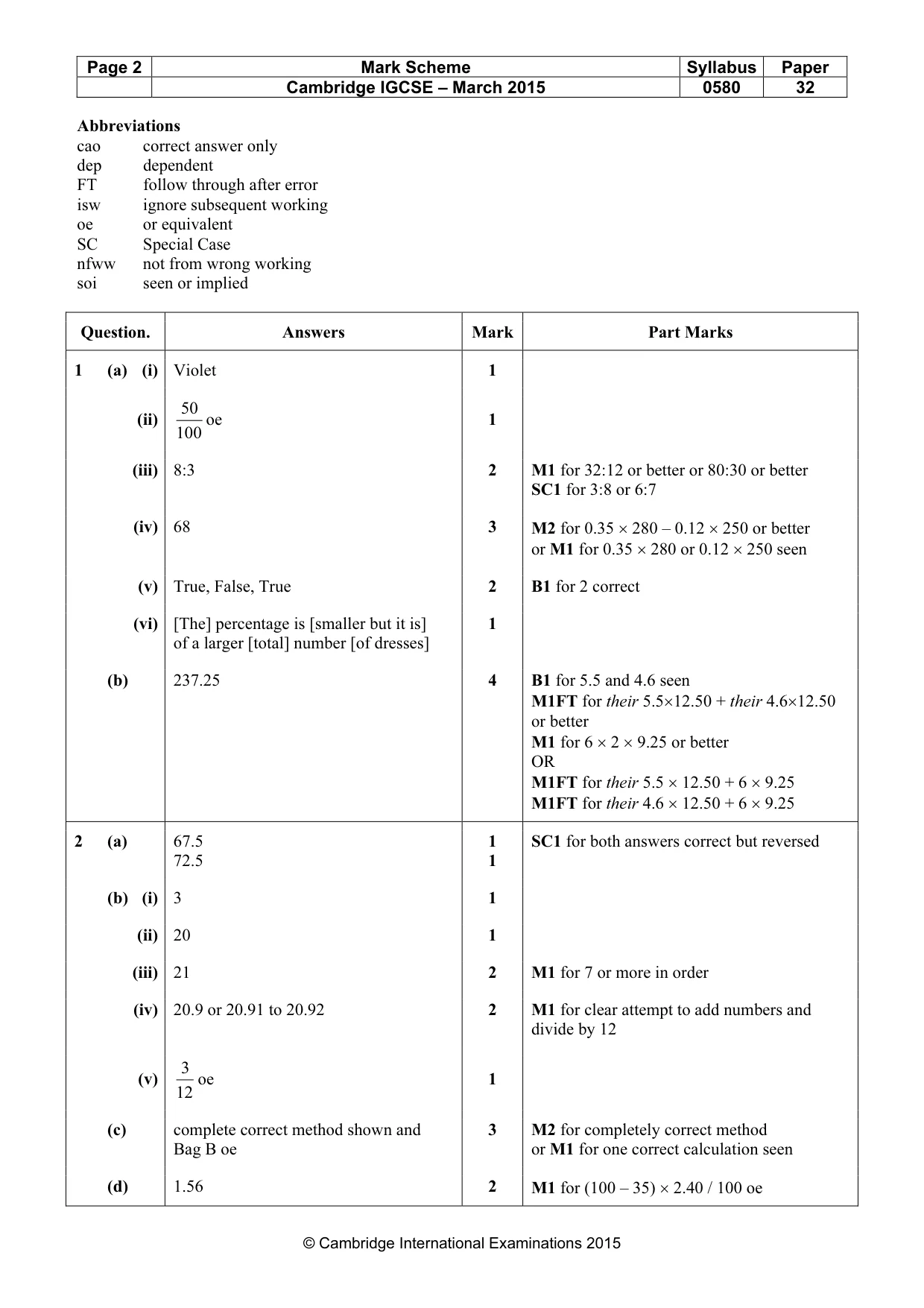
Mark scheme: 1 (a) (i) Violet 1 50 (ii) oe 1 100 (iii) 8:3 2 M1 for 32:12 or better or 80:30 or better SC1 for 3:8 or 6:7 (iv) 68 3 M2 for 0.35 × 280 – 0.12 × 250 or better or M1 for 0.35 × 280 or 0.12 × 250 seen (v) True, False, True 2 B1 for 2 correct (vi) [The] percentage is [smaller but it is] 1 of a larger [total] number [of dresses] (b) 237.25 4 B1 for 5.5 and 4.6 seen M1FT for their 5.5×12.50 + their 4.6×12.50 or better M1 for 6 × 2 × 9.25 or better OR M1FT for their 5.5 × 12.50 + 6 × 9.25 M1FT for their 4.6 × 12.50 + 6 × 9.25
Q2 · Olga owns a fruit and vegetable shop
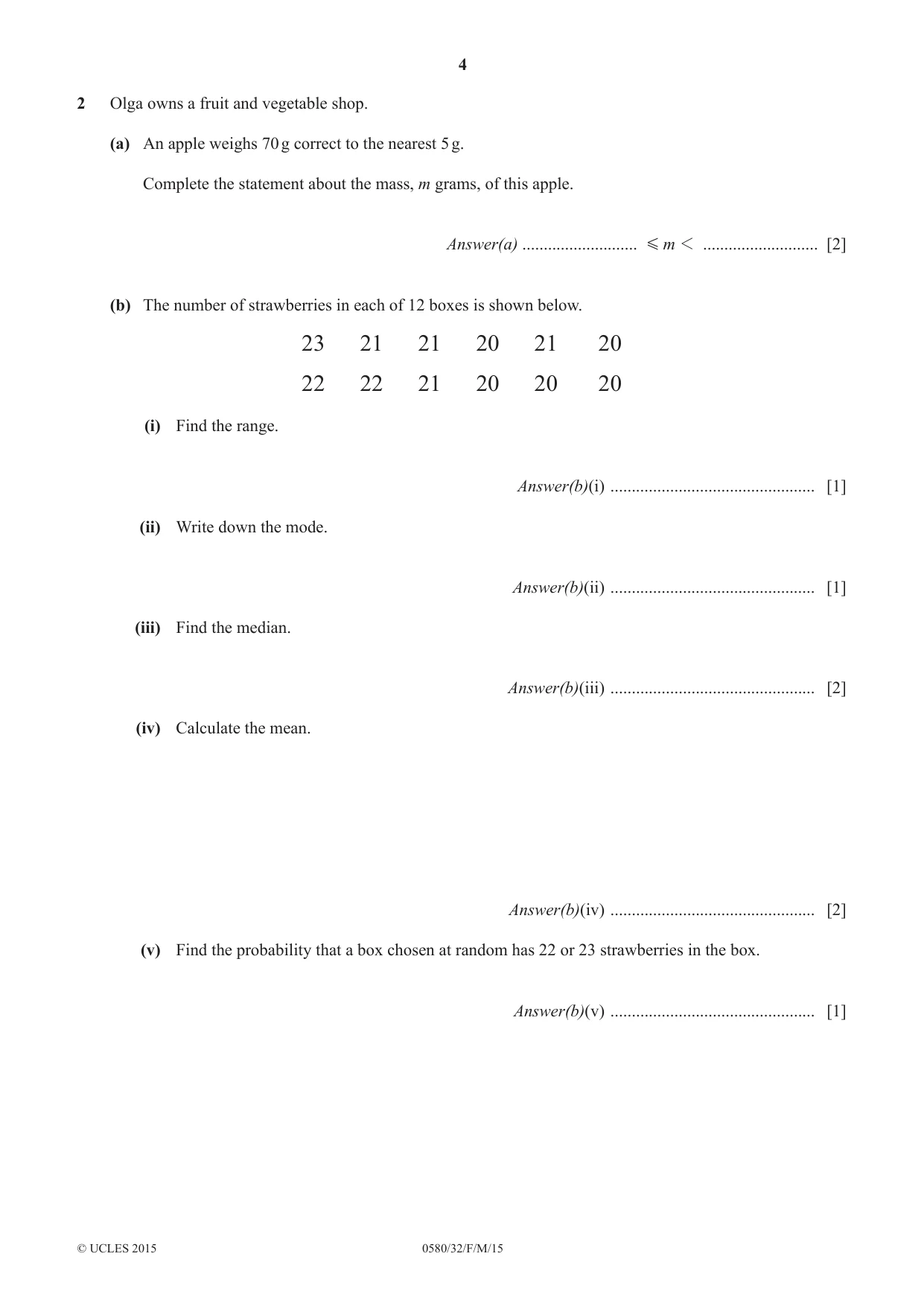
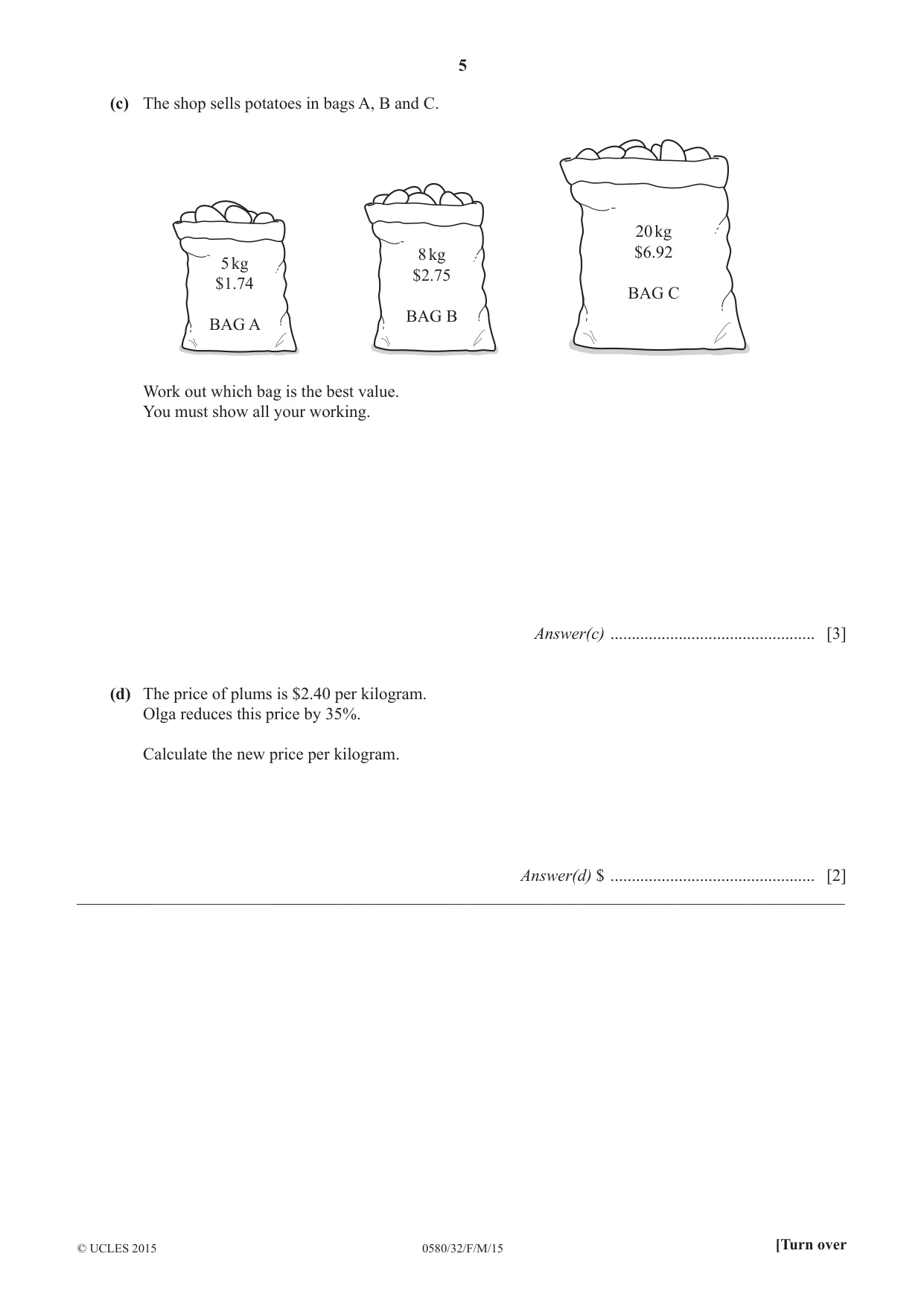
2 Olga owns a fruit and vegetable shop. (a) An apple weighs 70 g correct to the nearest 5 g. Complete the statement about the mass, m grams, of this apple. Answer(a) ........................... G m 1 ........................... [2] (b) The number of strawberries in each of 12 boxes is shown below. 23 21 21 20 21 20 22 22 21 20 20 20 (i) Find the range. Answer(b)(i) ................................................ [1] (ii) Write down the mode. Answer(b)(ii) ................................................ [1] (iii) Find the median. Answer(b)(iii) ................................................ [2] (iv) Calculate the mean. Answer(b)(iv) ................................................ [2] (v) Find the probability that a box chosen at random has 22 or 23 strawberries in the box. Answer(b)(v) ................................................ [1] (c) The shop sells potatoes in bags A, B and C. 20 kg 8 kg $6.92 5 kg $2.75 $1.74 BAG C BAG B BAG A Work out which bag is the best value. You must show all your working. Answer(c) ................................................ [3] (d) The price of plums is $2.40 per kilogram. Olga reduces this price by 35%. Calculate the new price per kilogram. Answer(d) $ ................................................ [2] __________________________________________________________________________________________
Mark scheme: 2 (a) 67.5 1 SC1 for both answers correct but reversed 72.5 1 (b) (i) 3 1 (ii) 20 1 (iii) 21 2 M1 for 7 or more in order (iv) 20.9 or 20.91 to 20.92 2 M1 for clear attempt to add numbers and divide by 12 3 (v) oe 1 12 (c) complete correct method shown and 3 M2 for completely correct method Bag B oe or M1 for one correct calculation seen (d) 1.56 2 M1 for (100 – 35) × 2.40 / 100 oe
Q3 · Ten students take a physics examination and a mathematics examination
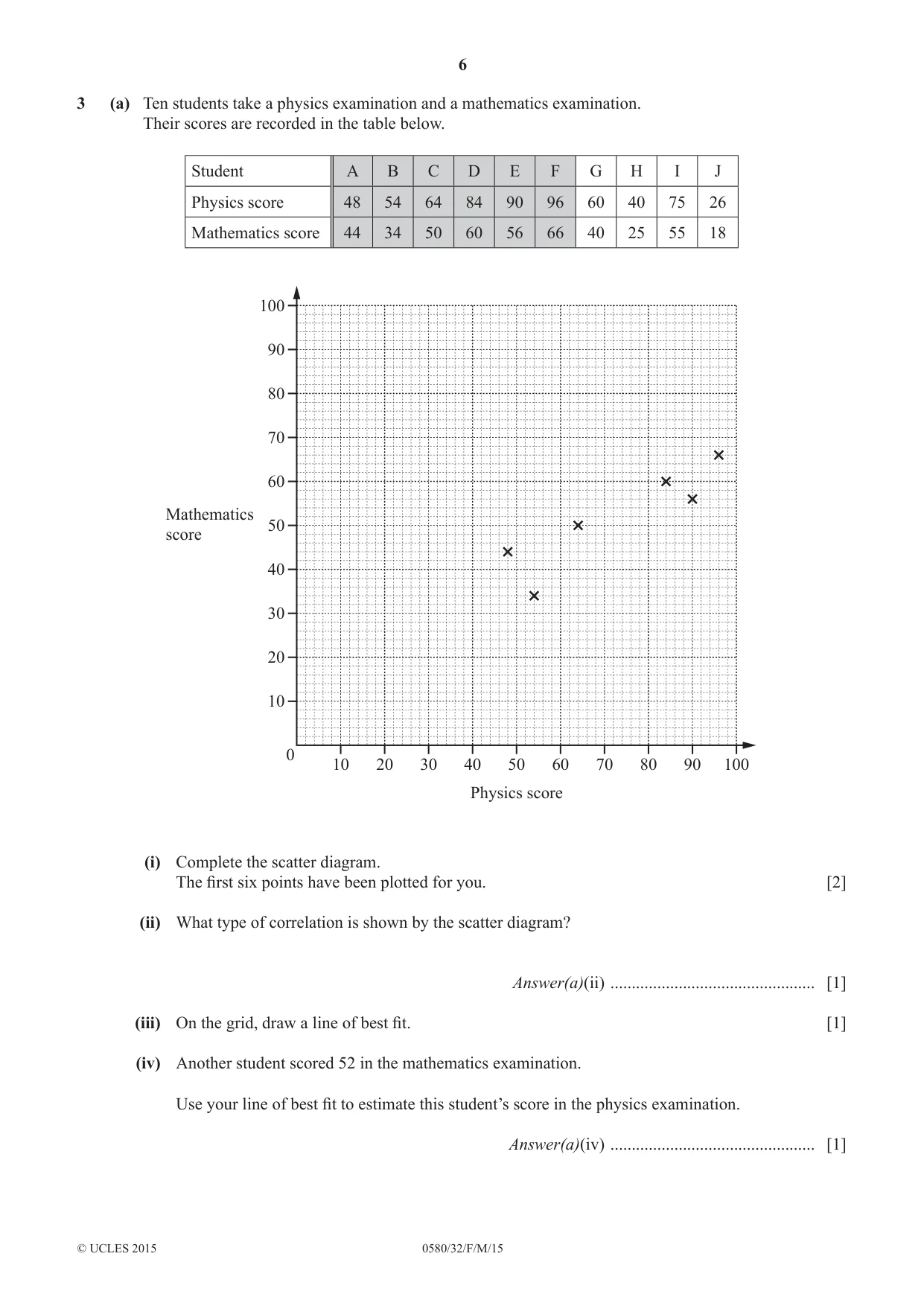
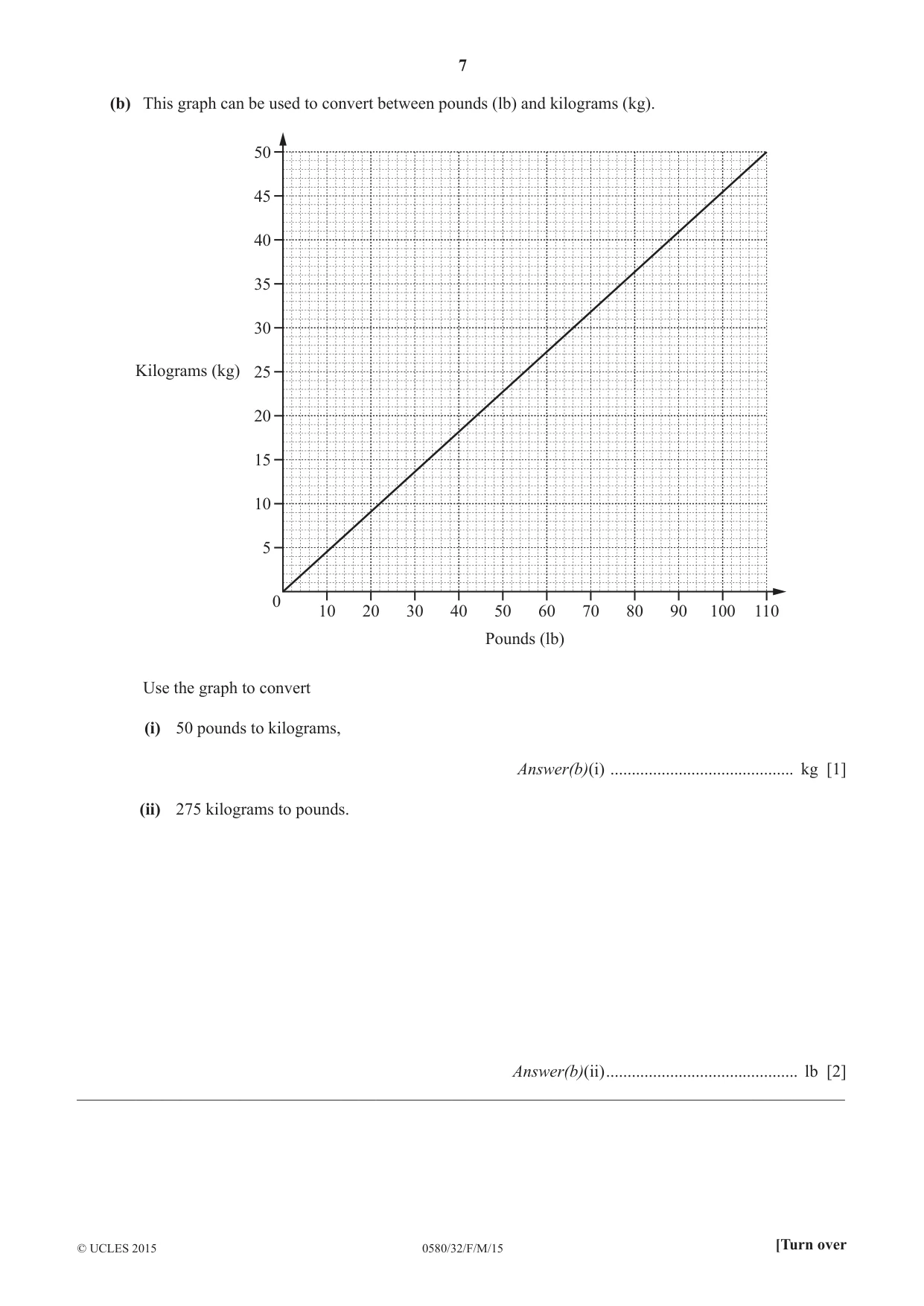
3 (a) Ten students take a physics examination and a mathematics examination. Their scores are recorded in the table below. Student A B C D E F G H I J Physics score 48 54 64 84 90 96 60 40 75 26 Mathematics score 44 34 50 60 56 66 40 25 55 18 100 90 80 70 60 Mathematics 50 score 40 30 20 10 0 10 20 30 40 50 60 70 80 90 100 Physics score (i) Complete the scatter diagram. The first six points have been plotted for you. [2] (ii) What type of correlation is shown by the scatter diagram? Answer(a)(ii) ................................................ [1] (iii) On the grid, draw a line of best fit. [1] (iv) Another student scored 52 in the mathematics examination. Use your line of best fit to estimate this student’s score in the physics examination. Answer(a)(iv) ................................................ [1] (b) This graph can be used to convert between pounds (lb) and kilograms (kg). 50 45 40 35 30 Kilograms (kg) 25 20 15 10 5 0 10 20 30 40 50 60 70 80 90 100 110 Pounds (lb) Use the graph to convert (i) 50 pounds to kilograms, Answer(b)(i) ........................................... kg [1] (ii) 275 kilograms to pounds. Answer(b)(ii) ............................................. lb [2] __________________________________________________________________________________________
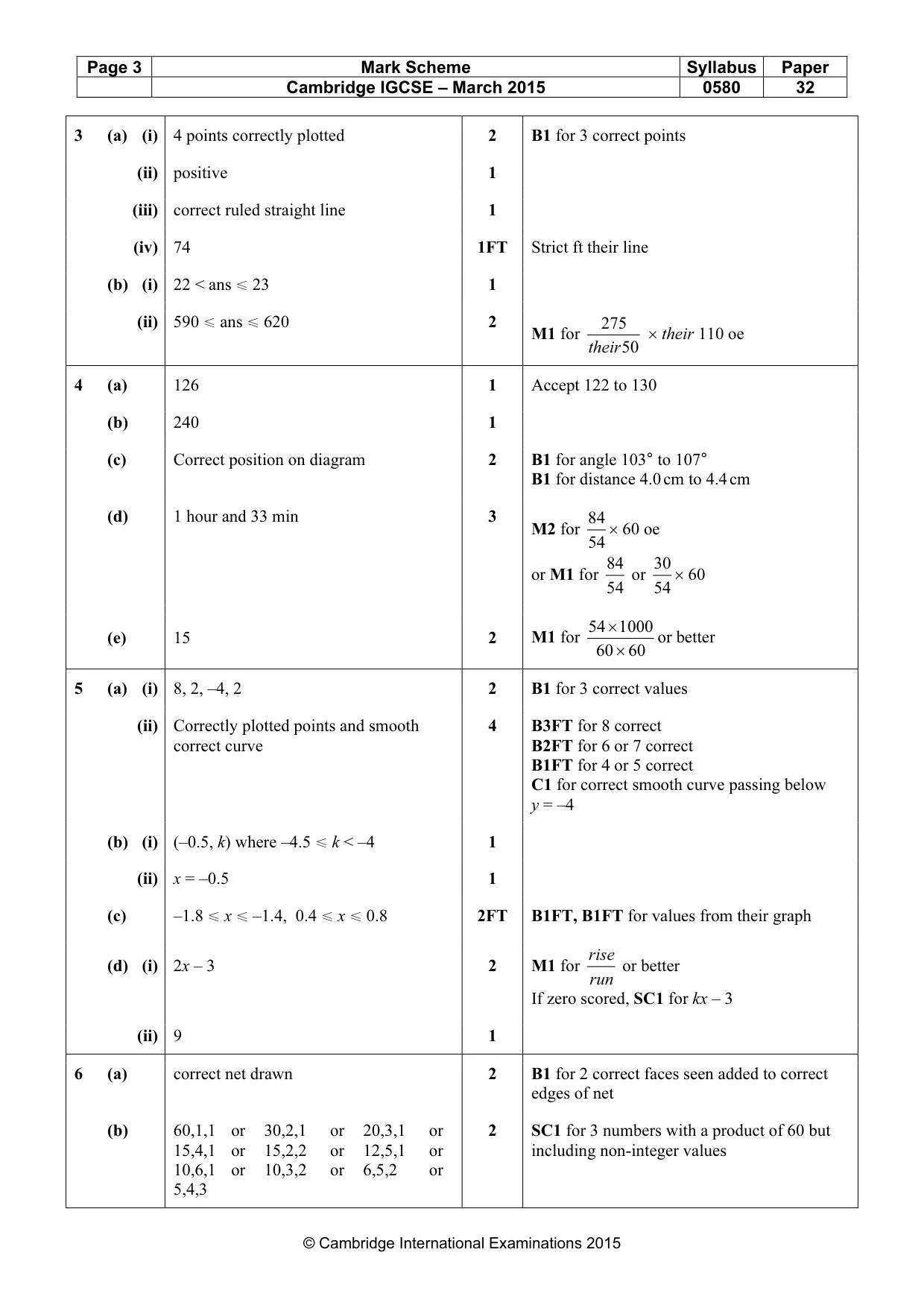
Mark scheme: 3 (a) (i) 4 points correctly plotted 2 B1 for 3 correct points (ii) positive 1 (iii) correct ruled straight line 1 (iv) 74 1FT Strict ft their line (b) (i) 22 < ans ≤ 23 1 (ii) 590 ≤ ans ≤ 620 2 275 M1 for × their 110 oe their 50
Q4 · The diagram shows the positions of two villages Dormouth, D, and Greenton, G
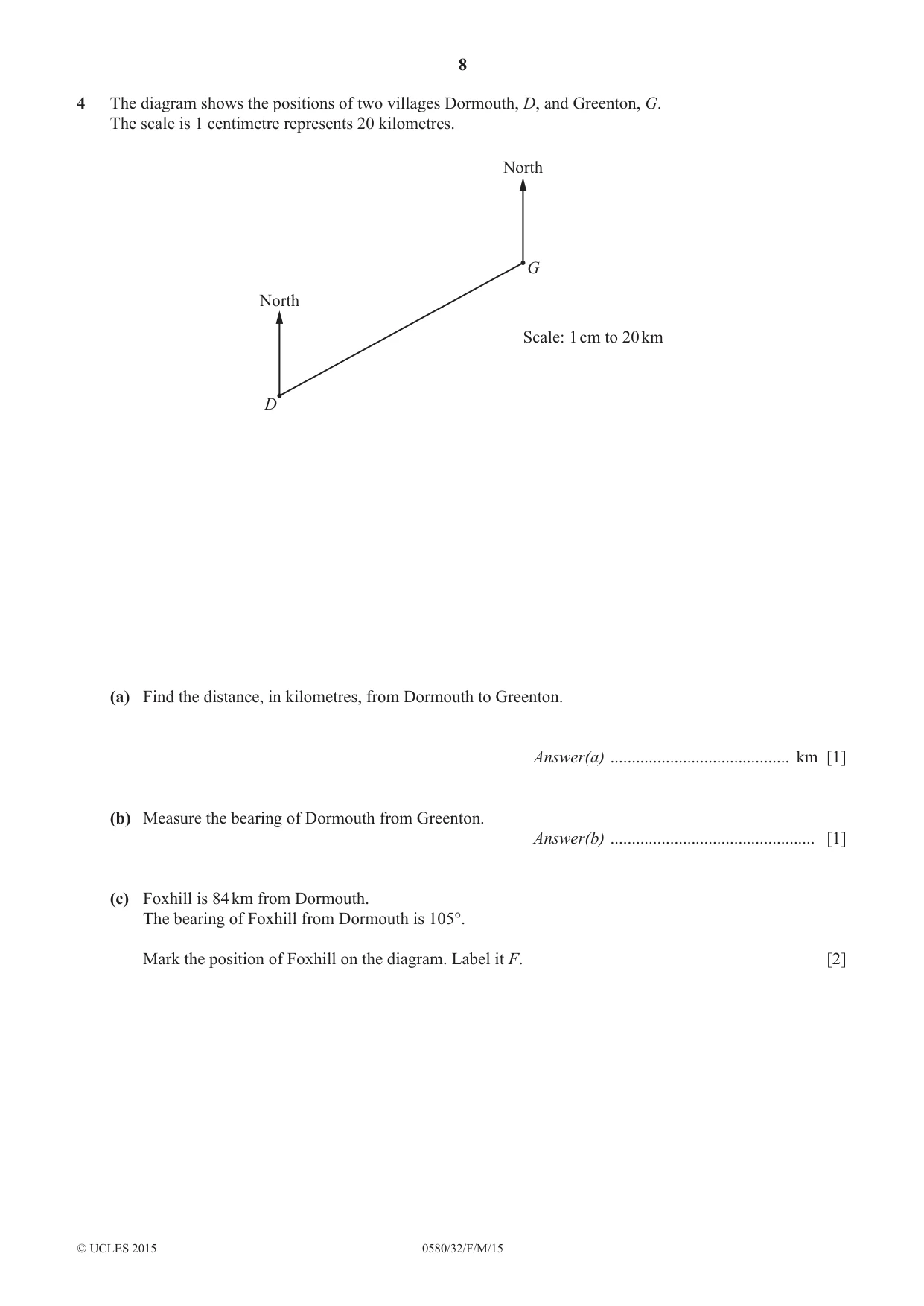
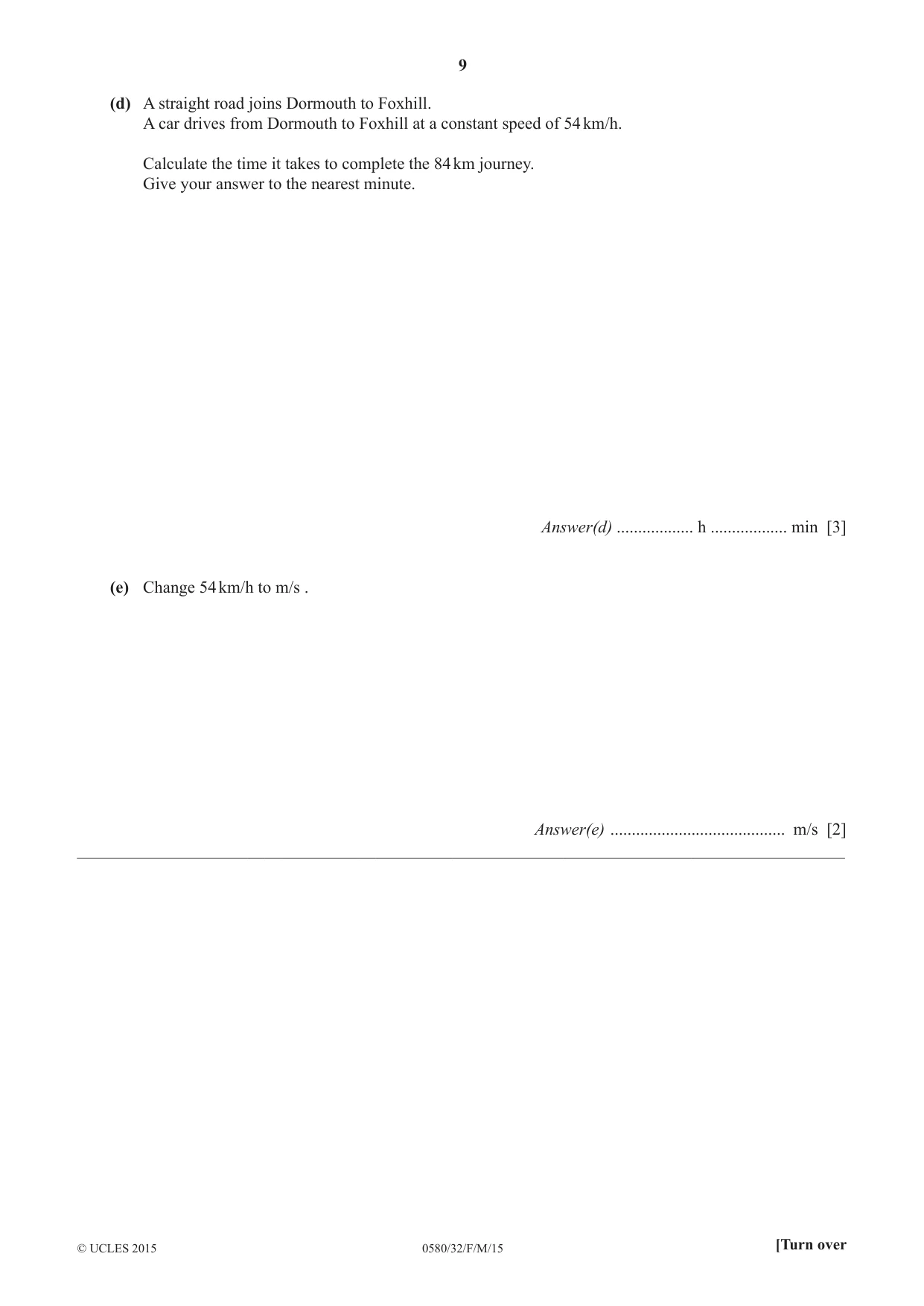
4 The diagram shows the positions of two villages Dormouth, D, and Greenton, G. The scale is 1 centimetre represents 20 kilometres. North G North Scale: 1 cm to 20 km D (a) Find the distance, in kilometres, from Dormouth to Greenton. Answer(a) .......................................... km [1] (b) Measure the bearing of Dormouth from Greenton. Answer(b) ................................................ [1] (c) Foxhill is 84 km from Dormouth. The bearing of Foxhill from Dormouth is 105°. Mark the position of Foxhill on the diagram. Label it F. [2] (d) A straight road joins Dormouth to Foxhill. A car drives from Dormouth to Foxhill at a constant speed of 54 km/h. Calculate the time it takes to complete the 84 km journey. Give your answer to the nearest minute. Answer(d) .................. h .................. min [3] (e) Change 54 km/h to m/s . Answer(e) ......................................... m/s [2] __________________________________________________________________________________________
Mark scheme: 4 (a) 126 1 Accept 122 to 130 (b) 240 1 (c) Correct position on diagram 2 B1 for angle 103° to 107° B1 for distance 4.0 cm to 4.4 cm (d) 1 hour and 33 min 3 84 M2 for × 60 oe 54 84 30 or M1 for or × 60 54 54 54 × 1000 (e) 15 2 M1 for or better 60 × 60
Q5 · Complete the table of values for y = x2 + x – 4
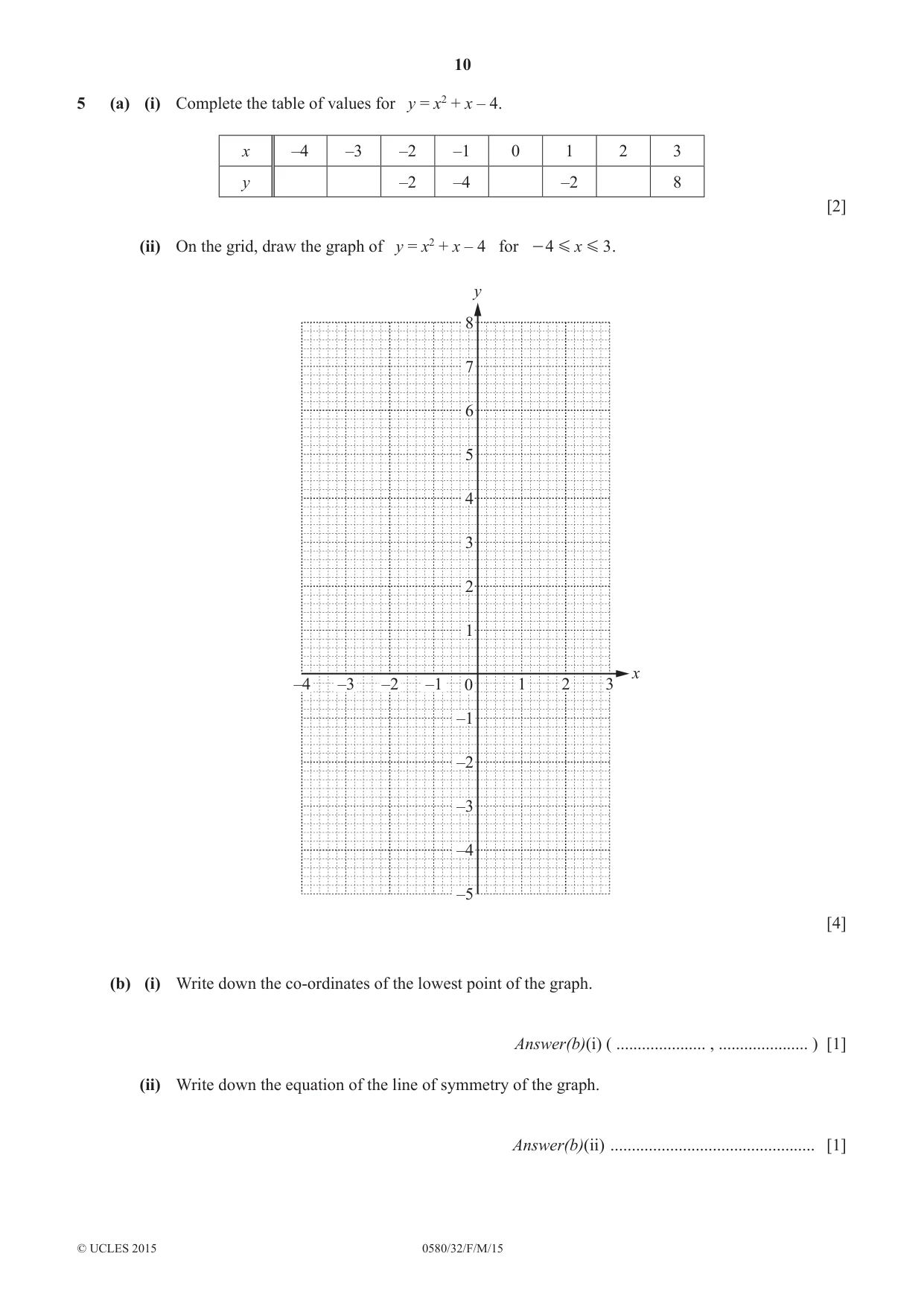
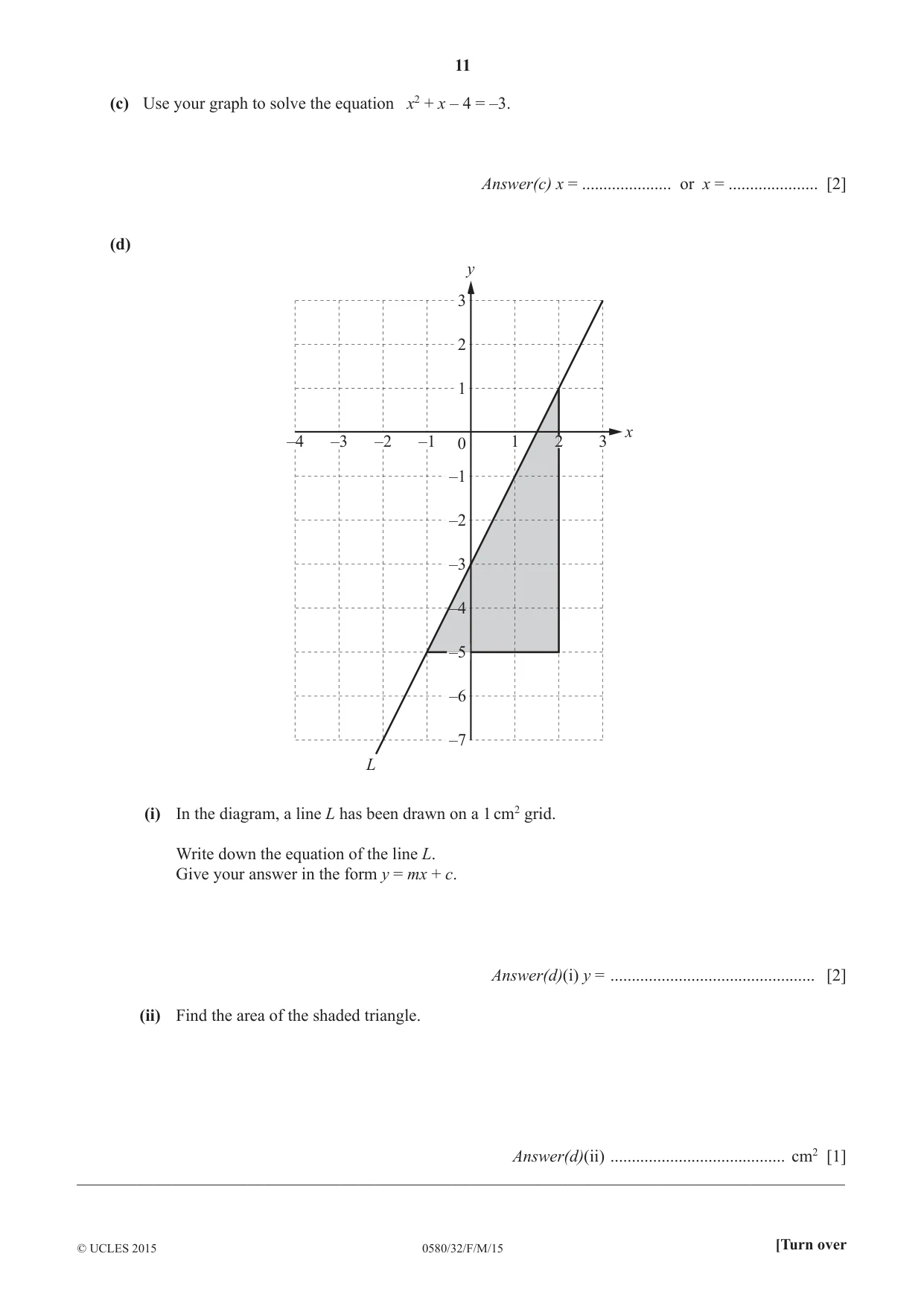
5 (a) (i) Complete the table of values for y = x2 + x – 4. x –4 –3 –2 –1 0 1 2 3 y –2 –4 –2 8 [2] (ii) On the grid, draw the graph of y = x2 + x – 4 for - 4 G x G 3 . y 8 7 6 5 4 3 2 1 x –4 –3 –2 –1 0 1 2 3 –1 –2 –3 –4 –5 [4] (b) (i) Write down the co-ordinates of the lowest point of the graph. Answer(b)(i) ( ..................... , ..................... ) [1] (ii) Write down the equation of the line of symmetry of the graph. Answer(b)(ii) ................................................ [1] (c) Use your graph to solve the equation x2 + x – 4 = –3. Answer(c) x = ..................... or x = ..................... [2] (d) y 3 2 1 x –4 –3 –2 –1 0 1 2 3 –1 –2 –3 –4 –5 –6 –7 L (i) In the diagram, a line L has been drawn on a 1 cm2 grid. Write down the equation of the line L. Give your answer in the form y = mx + c. Answer(d)(i) y = ................................................ [2] (ii) Find the area of the shaded triangle. Answer(d)(ii) ......................................... cm2 [1] __________________________________________________________________________________________
Mark scheme: 5 (a) (i) 8, 2, –4, 2 2 B1 for 3 correct values (ii) Correctly plotted points and smooth 4 B3FT for 8 correct correct curve B2FT for 6 or 7 correct B1FT for 4 or 5 correct C1 for correct smooth curve passing below y = –4 (b) (i) (–0.5, k) where –4.5 ≤ k < –4 1 (ii) x = –0.5 1 (c) –1.8 ≤ x ≤ –1.4, 0.4 ≤ x ≤ 0.8 2FT B1FT, B1FT for values from their graph rise (d) (i) 2x – 3 2 M1 for or better run If zero scored, SC1 for kx – 3 (ii) 9 1
Q6 · The grid shows part of the net of a cuboid
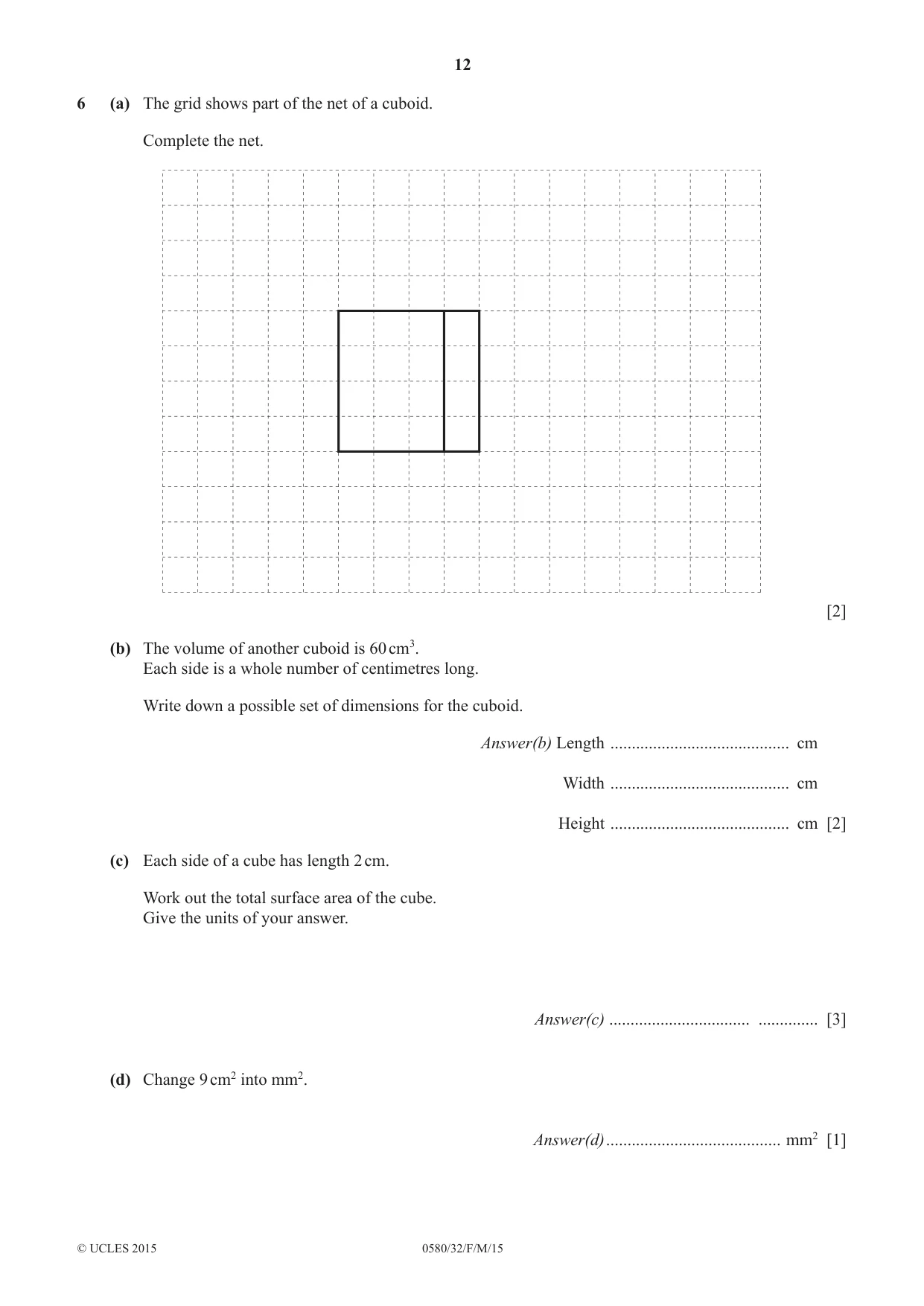
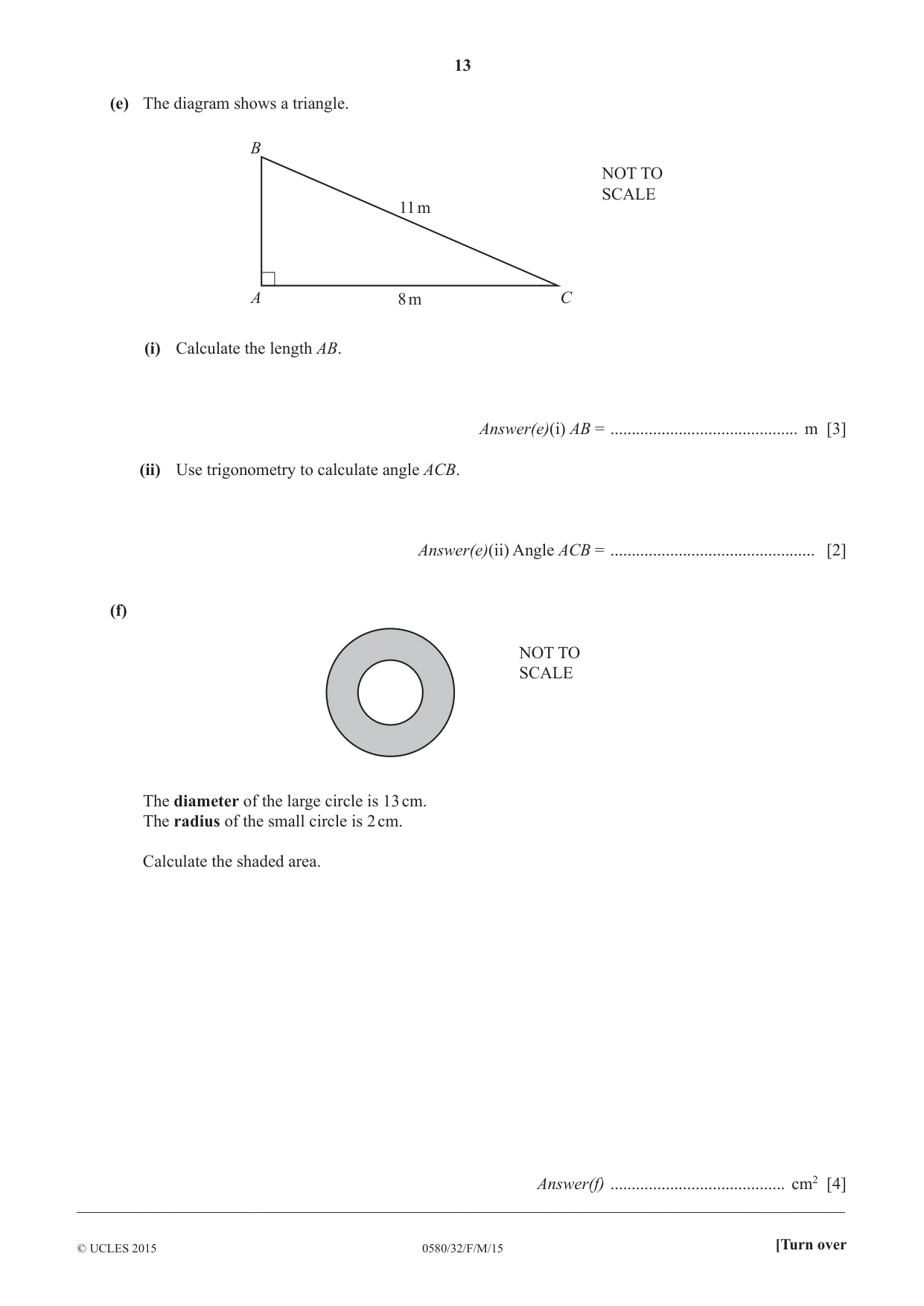
6 (a) The grid shows part of the net of a cuboid. Complete the net. [2] (b) The volume of another cuboid is 60 cm3. Each side is a whole number of centimetres long. Write down a possible set of dimensions for the cuboid. Answer(b) Length .......................................... cm Width .......................................... cm Height .......................................... cm [2] (c) Each side of a cube has length 2 cm. Work out the total surface area of the cube. Give the units of your answer. Answer(c) ................................. .............. [3] (d) Change 9 cm2 into mm2. Answer(d) ......................................... mm2 [1] (e) The diagram shows a triangle. B NOT TO SCALE 11 m A 8 m C (i) Calculate the length AB. Answer(e)(i) AB = ............................................ m [3] (ii) Use trigonometry to calculate angle ACB. Answer(e)(ii) Angle ACB = ................................................ [2] (f) NOT TO SCALE The diameter of the large circle is 13 cm. The radius of the small circle is 2 cm. Calculate the shaded area. Answer(f) ......................................... cm2 [4] __________________________________________________________________________________________
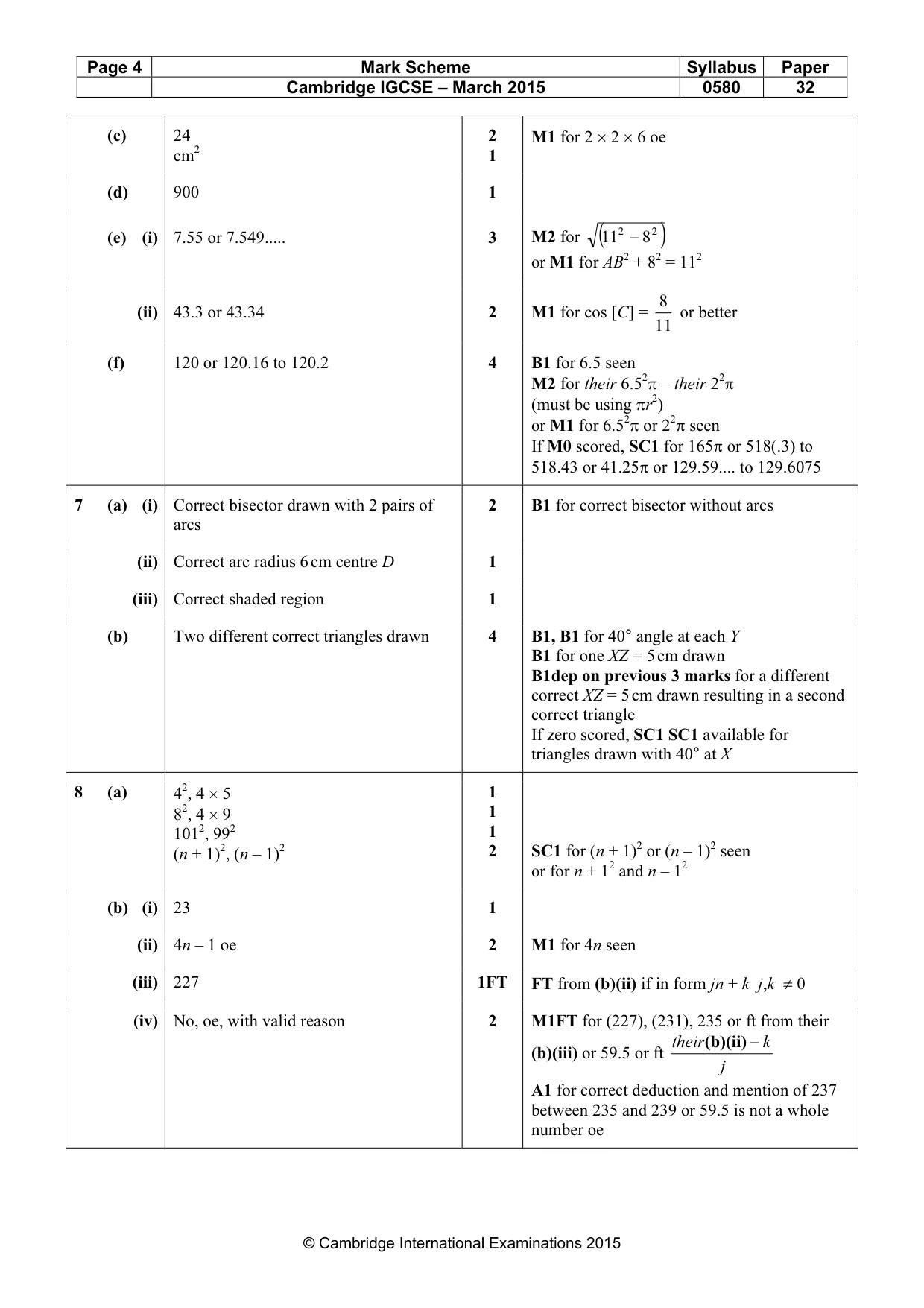
Mark scheme: 6 (a) correct net drawn 2 B1 for 2 correct faces seen added to correct edges of net (b) 60,1,1 or 30,2,1 or 20,3,1 or 2 SC1 for 3 numbers with a product of 60 but 15,4,1 or 15,2,2 or 12,5,1 or including non-integer values 10,6,1 or 10,3,2 or 6,5,2 or 5,4,3 (c) 24 2 M1 for 2 × 2 × 6 oe cm2 1 (d) 900 1 (e) (i) 7.55 or 7.549..... 3 M2 for (11 2 − 8 2 ) or M1 for AB2 + 82 = 112 8 (ii) 43.3 or 43.34 2 M1 for cos [C] = or better 11 (f) 120 or 120.16 to 120.2 4 B1 for 6.5 seen M2 for their 6.52π – their 22π (must be using πr2) or M1 for 6.52π or 22π seen If M0 scored, SC1 for 165π or 518(.3) to 518.43 or 41.25π or 129.59.... to 129.6075
Q7 · In this part, all constructions must be completed using a ruler and compasses only
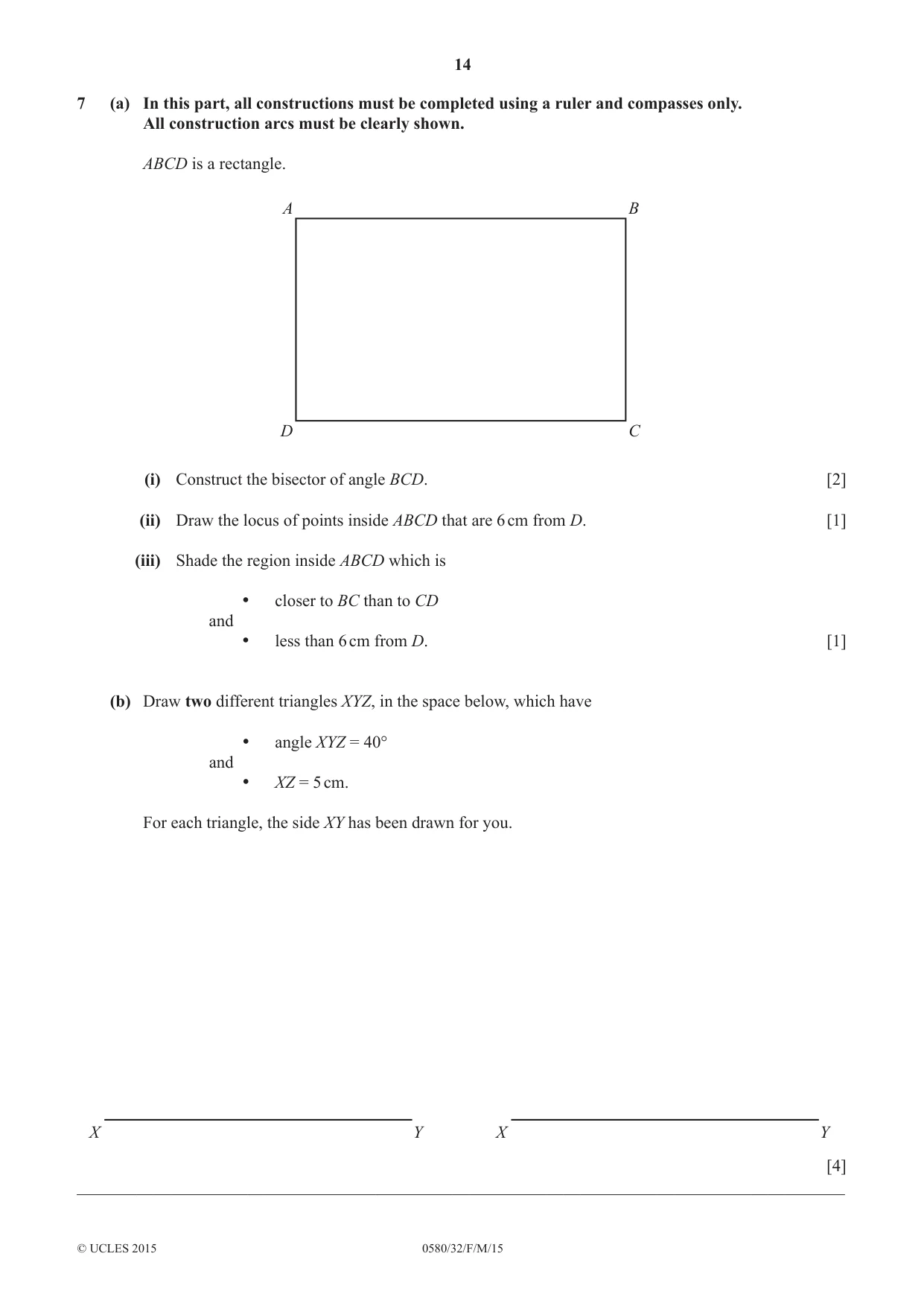
7 (a) In this part, all constructions must be completed using a ruler and compasses only. All construction arcs must be clearly shown. ABCD is a rectangle. A B D C (i) Construct the bisector of angle BCD. [2] (ii) Draw the locus of points inside ABCD that are 6 cm from D. [1] (iii) Shade the region inside ABCD which is • closer to BC than to CD and • less than 6 cm from D. [1] (b) Draw two different triangles XYZ, in the space below, which have • angle XYZ = 40° and • XZ = 5 cm. For each triangle, the side XY has been drawn for you. X Y X Y [4] __________________________________________________________________________________________
Mark scheme: 7 (a) (i) Correct bisector drawn with 2 pairs of 2 B1 for correct bisector without arcs arcs (ii) Correct arc radius 6 cm centre D 1 (iii) Correct shaded region 1 (b) Two different correct triangles drawn 4 B1, B1 for 40° angle at each Y B1 for one XZ = 5 cm drawn B1dep on previous 3 marks for a different correct XZ = 5 cm drawn resulting in a second correct triangle If zero scored, SC1 SC1 available for triangles drawn with 40° at X
Q8 · A pattern of calculations is shown below
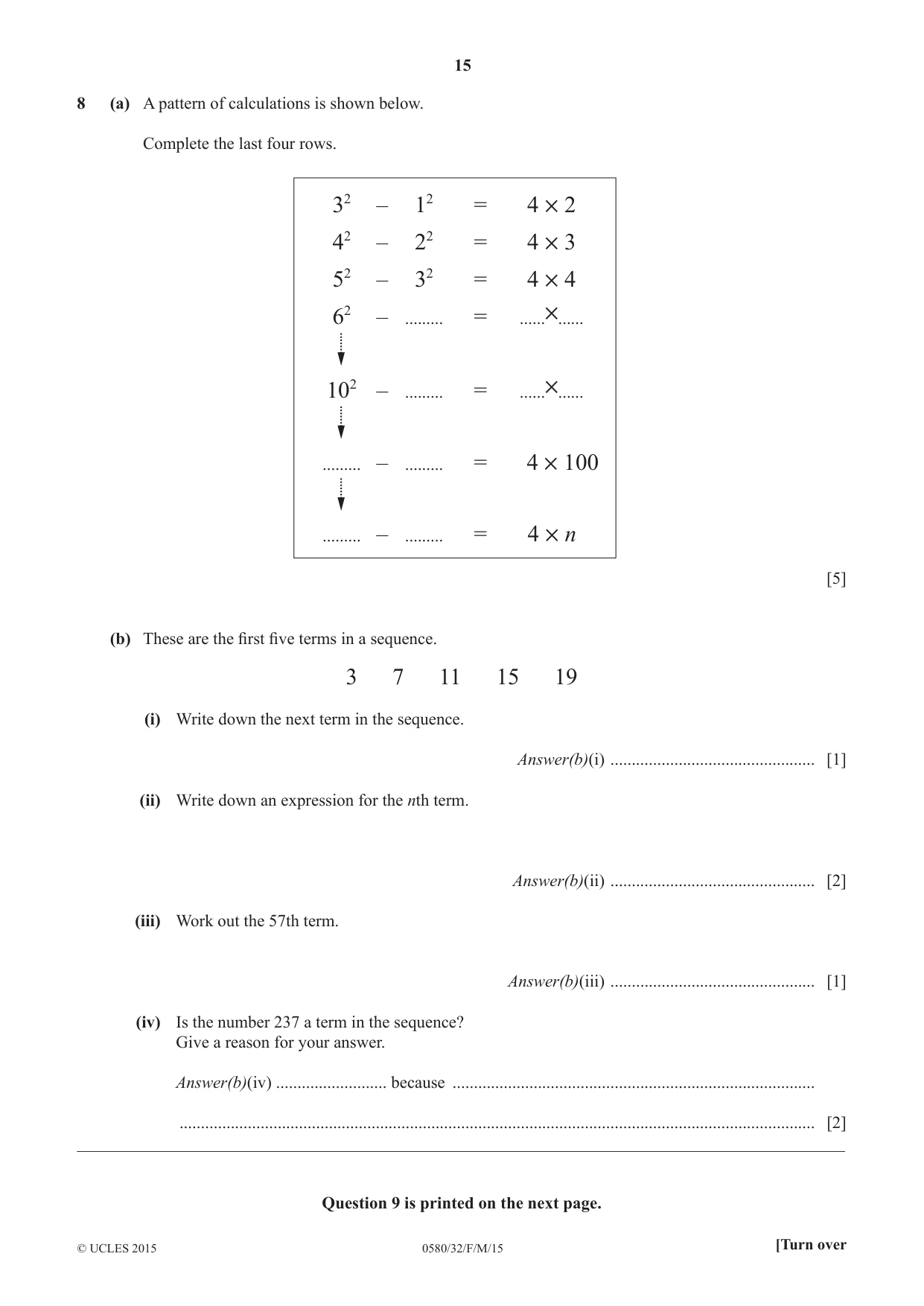
8 (a) A pattern of calculations is shown below. Complete the last four rows. 32 – 12 = 4 × 2 42 – 22 = 4 × 3 52 – 32 = 4 × 4 62 – ......... = ...............× 102 – ......... = ...............× ......... – ......... = 4 × 100 ......... – ......... = 4 × n [5] (b) These are the first five terms in a sequence. 3 7 11 15 19 (i) Write down the next term in the sequence. Answer(b)(i) ................................................ [1] (ii) Write down an expression for the nth term. Answer(b)(ii) ................................................ [2] (iii) Work out the 57th term. Answer(b)(iii) ................................................ [1] (iv) Is the number 237 a term in the sequence? Give a reason for your answer. Answer(b)(iv) .......................... because ..................................................................................... ..................................................................................................................................................... [2] __________________________________________________________________________________________ Question 9 is printed on the next page.
Mark scheme: 8 (a) 42, 4 × 5 1 82, 4 × 9 1 1012, 992 1 (n + 1)2, (n – 1)2 2 SC1 for (n + 1)2 or (n – 1)2 seen or for n + 12 and n – 12 (b) (i) 23 1 (ii) 4n – 1 oe 2 M1 for 4n seen (iii) 227 1FT FT from (b)(ii) if in form jn + k j,k ≠ 0 (iv) No, oe, with valid reason 2 M1FT for (227), (231), 235 or ft from their their (b)(ii) − k (b)(iii) or 59.5 or ft j A1 for correct deduction and mention of 237 between 235 and 239 or 59.5 is not a whole number oe
Q9 · Calculate the cube root of 68 921
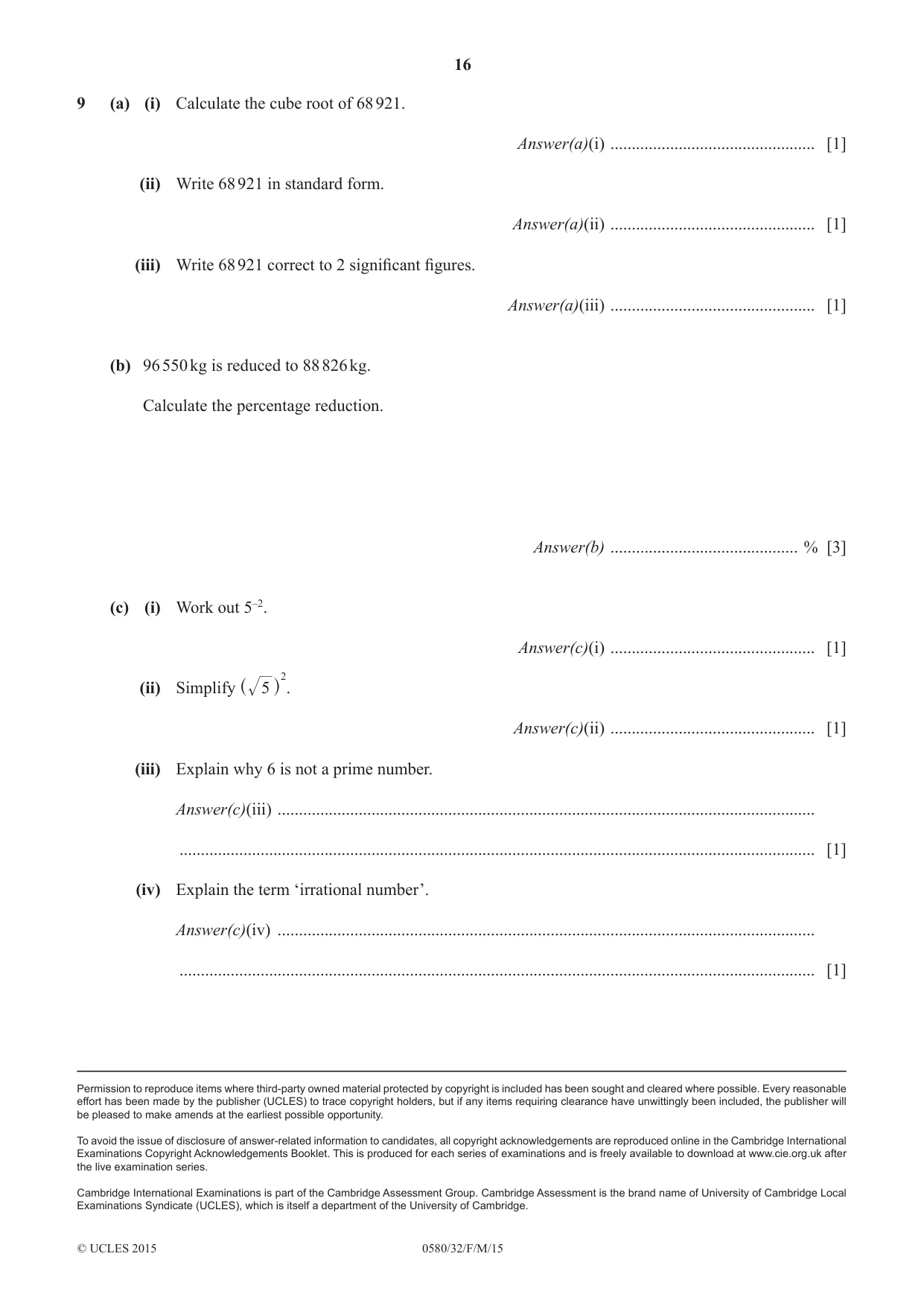
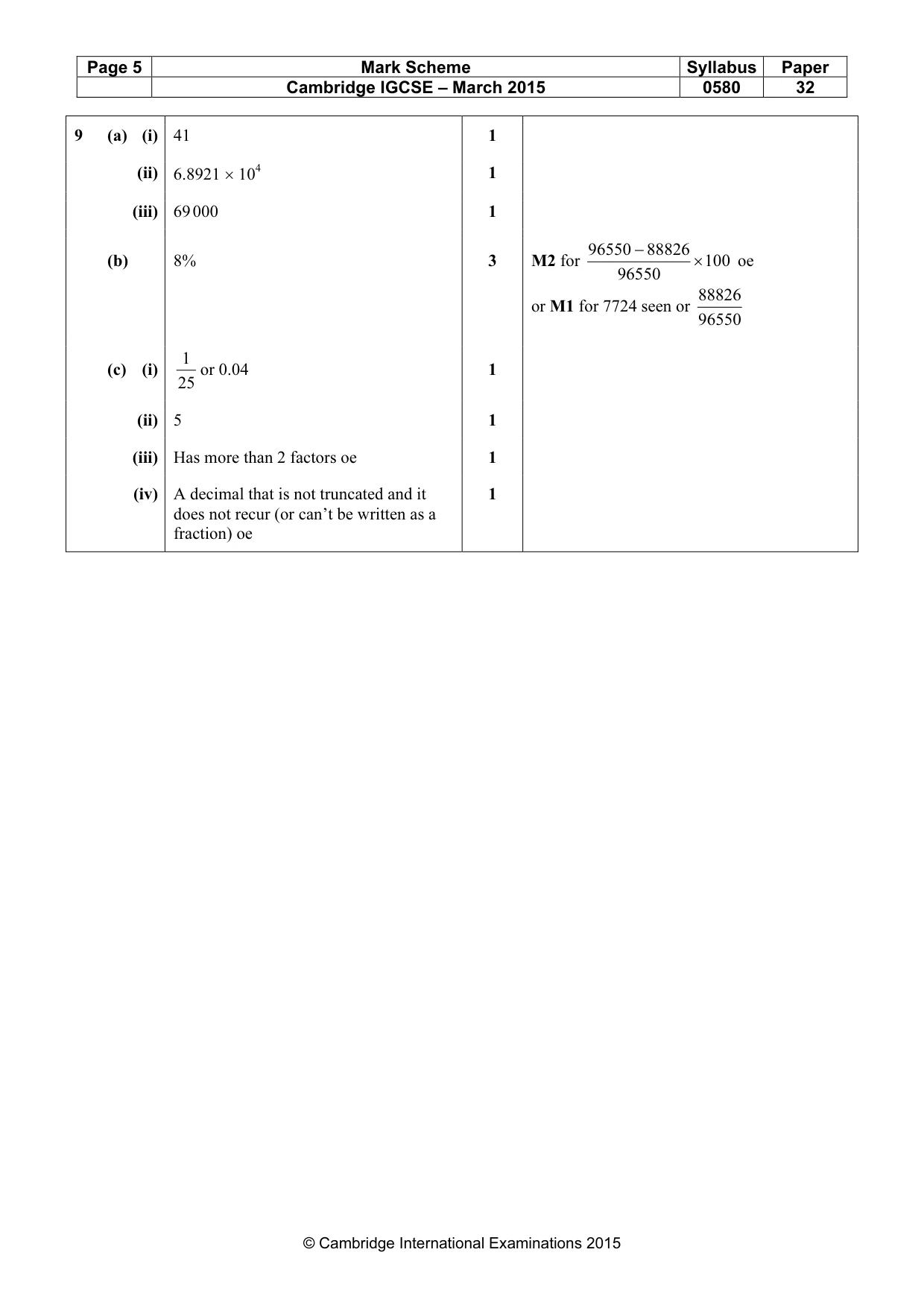
9 (a) (i) Calculate the cube root of 68 921. Answer(a)(i) ................................................ [1] (ii) Write 68 921 in standard form. Answer(a)(ii) ................................................ [1] (iii) Write 68 921 correct to 2 significant figures. Answer(a)(iii) ................................................ [1] (b) 96 550 kg is reduced to 88 826 kg. Calculate the percentage reduction. Answer(b) ............................................ % [3] (c) (i) Work out 5–2. Answer(c)(i) ................................................ [1] 2 (ii) Simplify ^ 5 h . Answer(c)(ii) ................................................ [1] (iii) Explain why 6 is not a prime number. Answer(c)(iii) .............................................................................................................................. ..................................................................................................................................................... [1] (iv) Explain the term ‘irrational number’. Answer(c)(iv) .............................................................................................................................. ..................................................................................................................................................... [1]
Mark scheme: 9 (a) (i) 41 1 (ii) 6.8921 × 10⁴ 1 (iii) 69 000 1 96550 − 88826 (b) 8% 3 M2 for × 100 oe 96550 88826 or M1 for 7724 seen or 96550 1 (c) (i) or 0.04 1 25 (ii) 5 1 (iii) Has more than 2 factors oe 1 (iv) A decimal that is not truncated and it 1 does not recur (or can’t be written as a fraction) oe
What was in this paper
The subtopics covered by these 9 questions, and how many questions each got. Open one in a new tab to see every Cambridge question on it.
What you needed in this session
Cambridge’s own grade thresholds for 2015 Feb/March, Paper 3 · Variant 2. A higher threshold means an easier paper — the bar moves with how the cohort did.