Cambridge IGCSE Mathematics 0580 — 2013 Oct/Nov Paper 3 · Variant 2
0580/32/O/N/13 · 10 questions · 104 marks · ≈117 min
The question paper and its mark scheme, free to read here and free to download. This is Cambridge’s own paper, exactly as it was sat.
Question paper16 pages
Mark scheme6 pages
Answers below. Sit the paper first if you are practising.
Questions as text
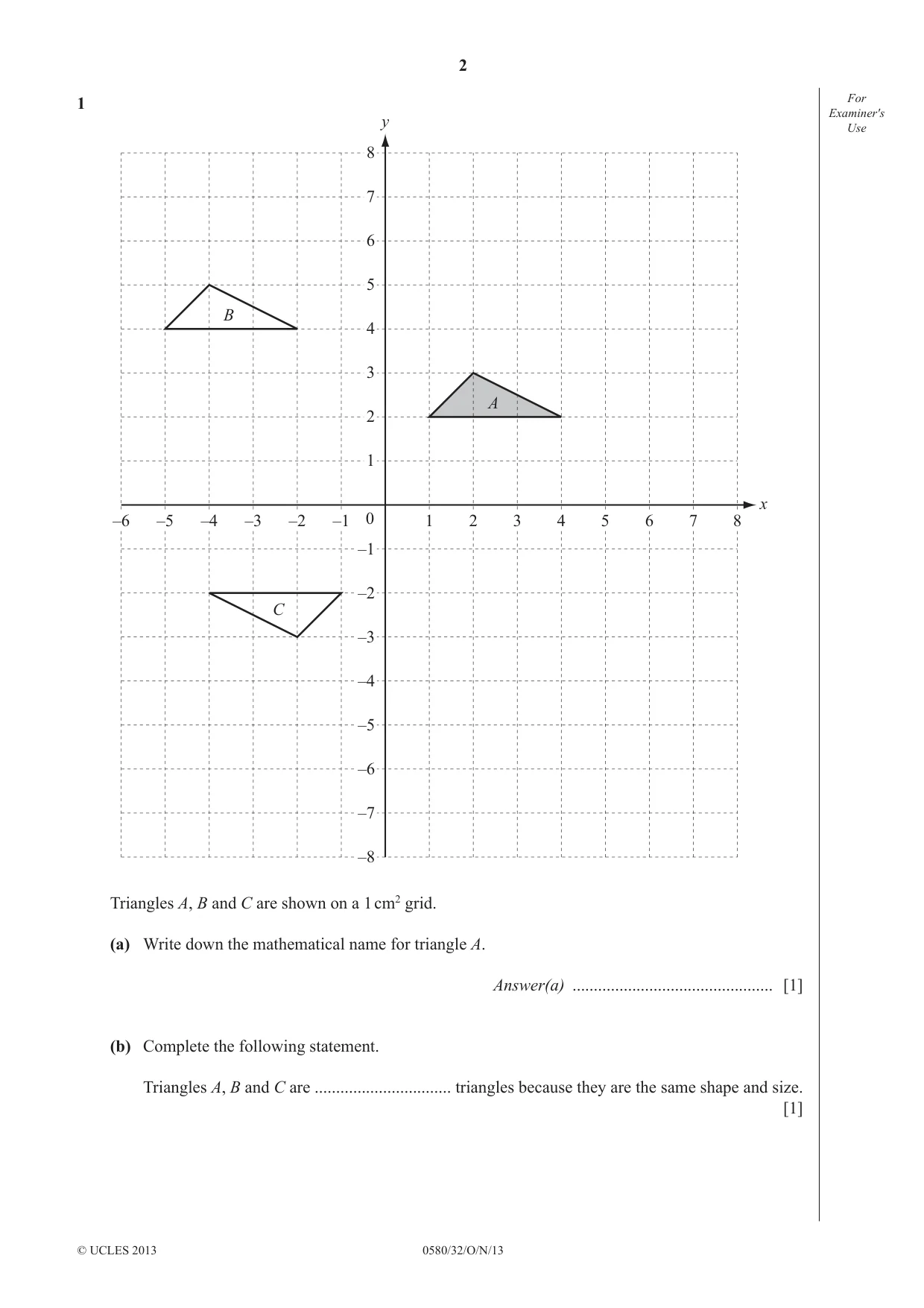
Q1 · For Examiner′s y Use 8 7 6 5 B 4 3 A 2 1 x –6 –5 –4 –3 –2 –1 0 1 2 3 4 5 6 7 8 –1 –2 C –3…
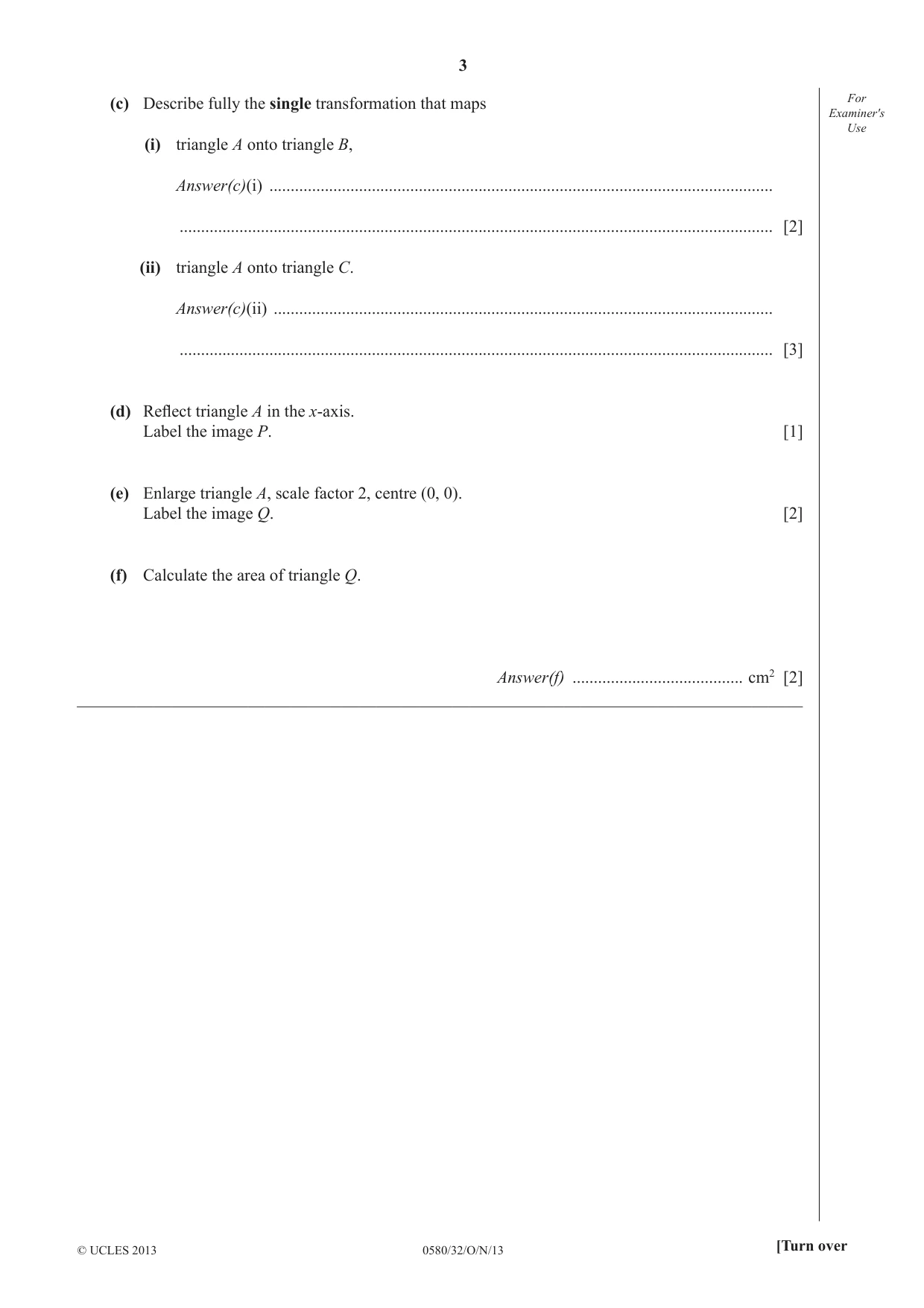
1 For Examiner′s y Use 8 7 6 5 B 4 3 A 2 1 x –6 –5 –4 –3 –2 –1 0 1 2 3 4 5 6 7 8 –1 –2 C –3 –4 –5 –6 –7 –8 Triangles A, B and C are shown on a 1 cm2 grid. (a) Write down the mathematical name for triangle A. Answer(a) ............................................... [1] (b) Complete the following statement. Triangles A, B and C are ................................ triangles because they are the same shape and size. [1] (c) Describe fully the single transformation that maps For Examiner′s Use (i) triangle A onto triangle B, Answer(c)(i) ...................................................................................................................... ........................................................................................................................................... [2] (ii) triangle A onto triangle C. Answer(c)(ii) ..................................................................................................................... ........................................................................................................................................... [3] (d) Refl ect triangle A in the x-axis. Label the image P. [1] (e) Enlarge triangle A, scale factor 2, centre (0, 0). Label the image Q. [2] (f) Calculate the area of triangle Q. Answer(f) ........................................ cm2 [2] _____________________________________________________________________________________
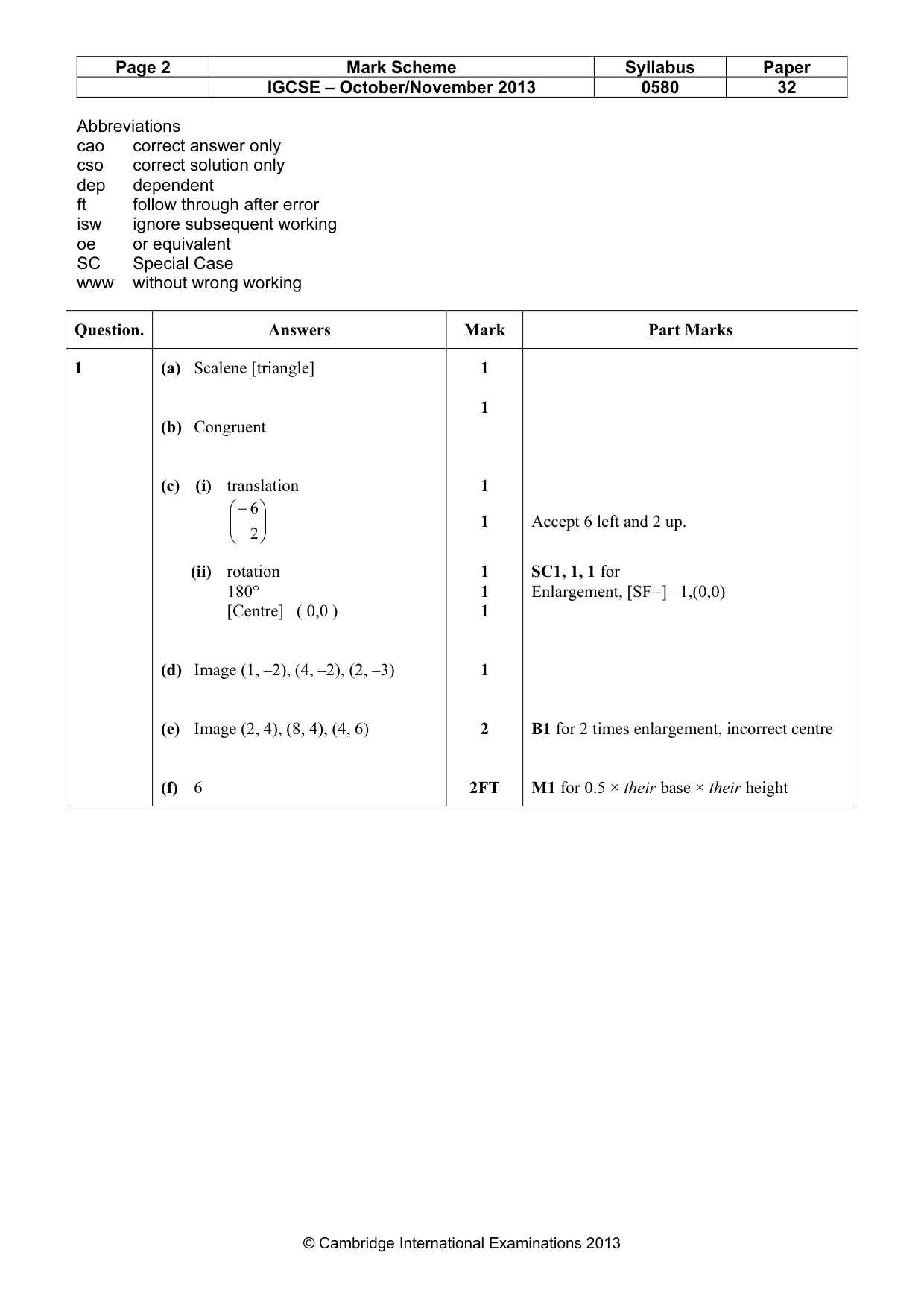
Mark scheme: 1 (a) Scalene [triangle] 1 1 (b) Congruent (c) (i) translation 1 − 6 1 Accept 6 left and 2 up. 2 (ii) rotation 1 SC1, 1, 1 for 180° 1 Enlargement, [SF=] –1,(0,0) [Centre] ( 0,0 ) 1 (d) Image (1, –2), (4, –2), (2, –3) 1 (e) Image (2, 4), (8, 4), (4, 6) 2 B1 for 2 times enlargement, incorrect centre (f) 6 2FT M1 for 0.5 × their base × their height IGCSE – October/November 2013 0580 32 5 80
Question 2
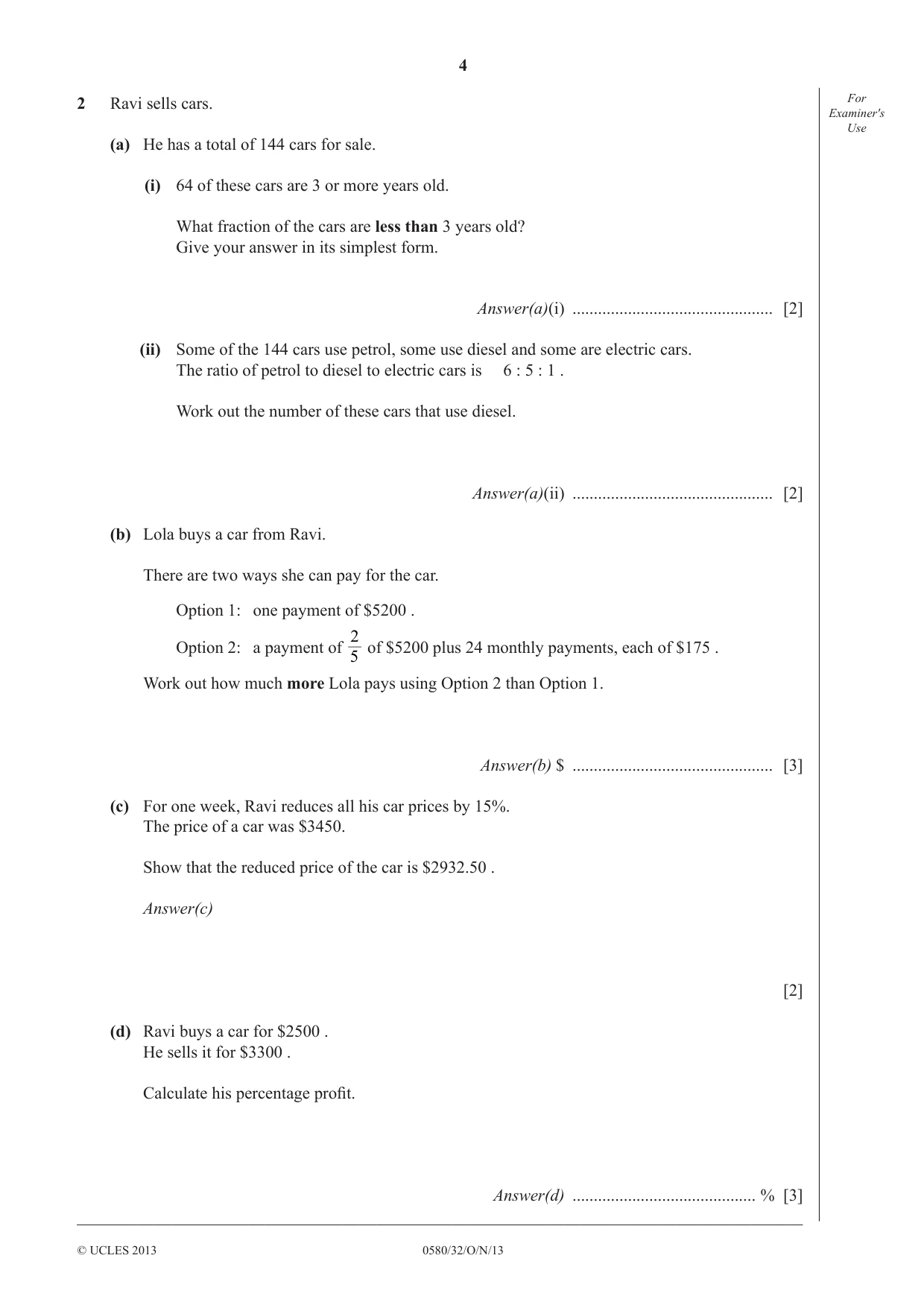
2 Ravi sells cars. For Examiner′s Use (a) He has a total of 144 cars for sale. (i) 64 of these cars are 3 or more years old. What fraction of the cars are less than 3 years old? Give your answer in its simplest form. Answer(a)(i) ............................................... [2] (ii) Some of the 144 cars use petrol, some use diesel and some are electric cars. The ratio of petrol to diesel to electric cars is 6 : 5 : 1 . Work out the number of these cars that use diesel. Answer(a)(ii) ............................................... [2] (b) Lola buys a car from Ravi. There are two ways she can pay for the car. Option 1: one payment of $5200 . 2 Option 2: a payment of of $5200 plus 24 monthly payments, each of $175 . 5 Work out how much more Lola pays using Option 2 than Option 1. Answer(b) $ ............................................... [3] (c) For one week, Ravi reduces all his car prices by 15%. The price of a car was $3450. Show that the reduced price of the car is $2932.50 . Answer(c) [2] (d) Ravi buys a car for $2500 . He sells it for $3300 . Calculate his percentage profi t. Answer(d) ........................................... % [3] _____________________________________________________________________________________
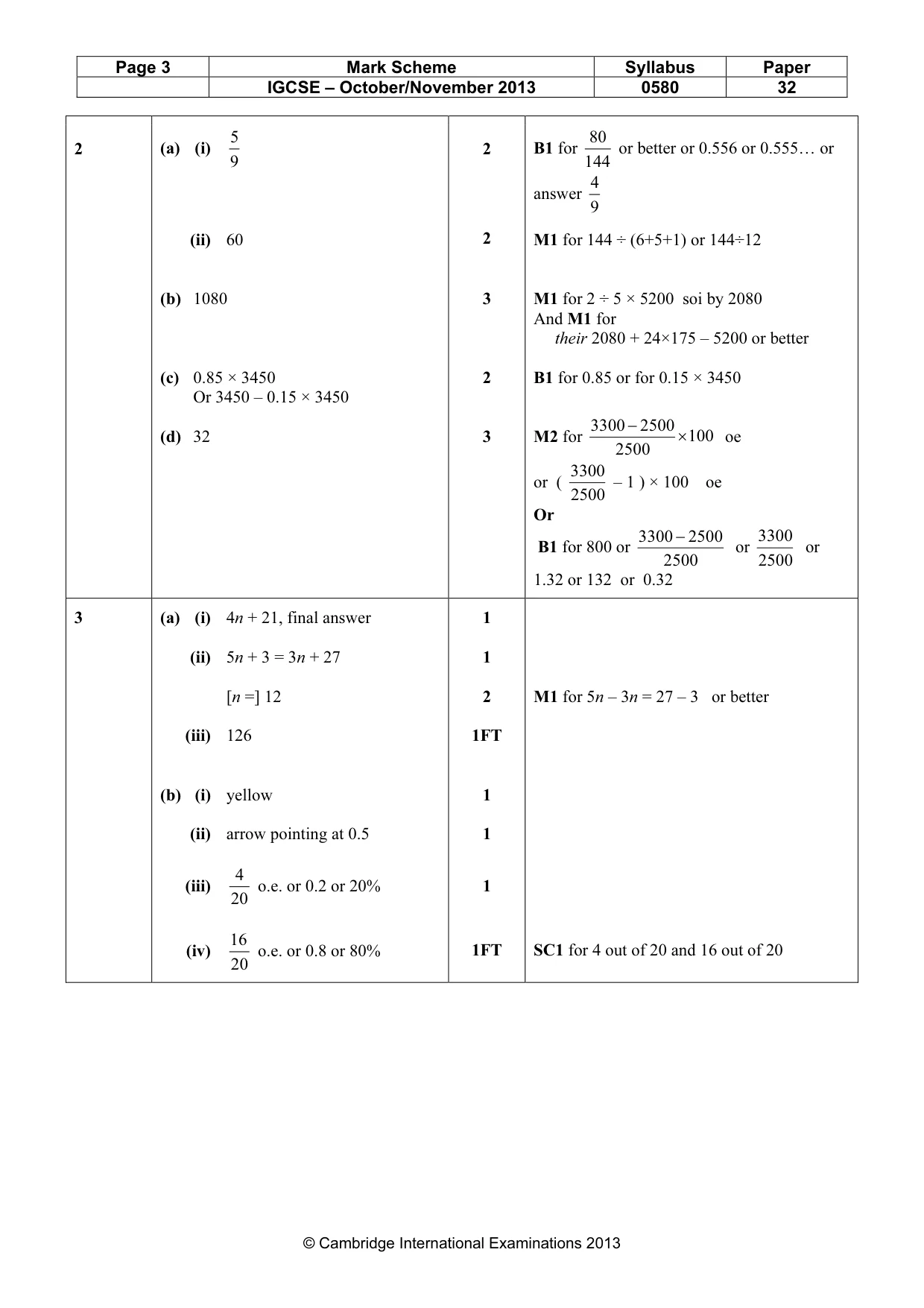
Mark scheme: 5 80 2 (a) (i) 2 B1 for or better or 0.556 or 0.555… or 9 144 4 answer 9 (ii) 60 2 M1 for 144 ÷ (6+5+1) or 144÷12 (b) 1080 3 M1 for 2 ÷ 5 × 5200 soi by 2080 And M1 for their 2080 + 24×175 – 5200 or better (c) 0.85 × 3450 2 B1 for 0.85 or for 0.15 × 3450 Or 3450 – 0.15 × 3450 3300 − 2500 (d) 32 3 M2 for × 100 oe 2500 3300 or ( – 1 ) × 100 oe 2500 Or 3300 − 2500 3300 B1 for 800 or or or 2500 2500 1.32 or 132 or 0.32
Q3 · Sweets are sold in packets
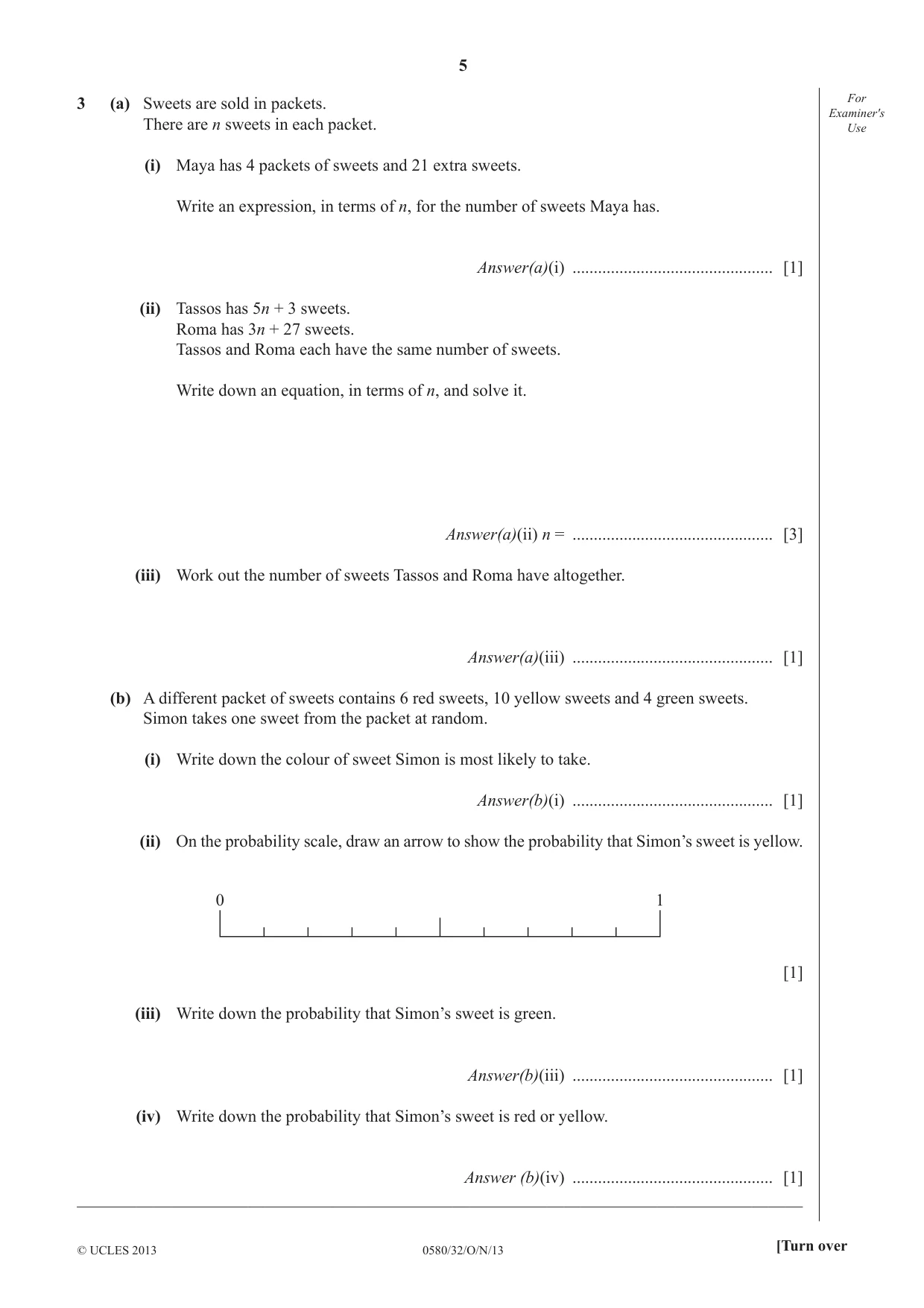
3 (a) Sweets are sold in packets. For Examiner′s There are n sweets in each packet. Use (i) Maya has 4 packets of sweets and 21 extra sweets. Write an expression, in terms of n, for the number of sweets Maya has. Answer(a)(i) ............................................... [1] (ii) Tassos has 5n + 3 sweets. Roma has 3n + 27 sweets. Tassos and Roma each have the same number of sweets. Write down an equation, in terms of n, and solve it. Answer(a)(ii) n = ............................................... [3] (iii) Work out the number of sweets Tassos and Roma have altogether. Answer(a)(iii) ............................................... [1] (b) A different packet of sweets contains 6 red sweets, 10 yellow sweets and 4 green sweets. Simon takes one sweet from the packet at random. (i) Write down the colour of sweet Simon is most likely to take. Answer(b)(i) ............................................... [1] (ii) On the probability scale, draw an arrow to show the probability that Simon’s sweet is yellow. 0 1 [1] (iii) Write down the probability that Simon’s sweet is green. Answer(b)(iii) ............................................... [1] (iv) Write down the probability that Simon’s sweet is red or yellow. Answer (b)(iv) ............................................... [1] _____________________________________________________________________________________
Mark scheme: 3 (a) (i) 4n + 21, final answer 1 (ii) 5n + 3 = 3n + 27 1 [n =] 12 2 M1 for 5n – 3n = 27 – 3 or better (iii) 126 1FT (b) (i) yellow 1 (ii) arrow pointing at 0.5 1 4 (iii) o.e. or 0.2 or 20% 1 20 16 (iv) o.e. or 0.8 or 80% 1FT SC1 for 4 out of 20 and 16 out of 20 20 IGCSE – October/November 2013 0580 32
Q4 · For Examiner′s Use North Sea B North A The scale drawing shows the position of two airfi…
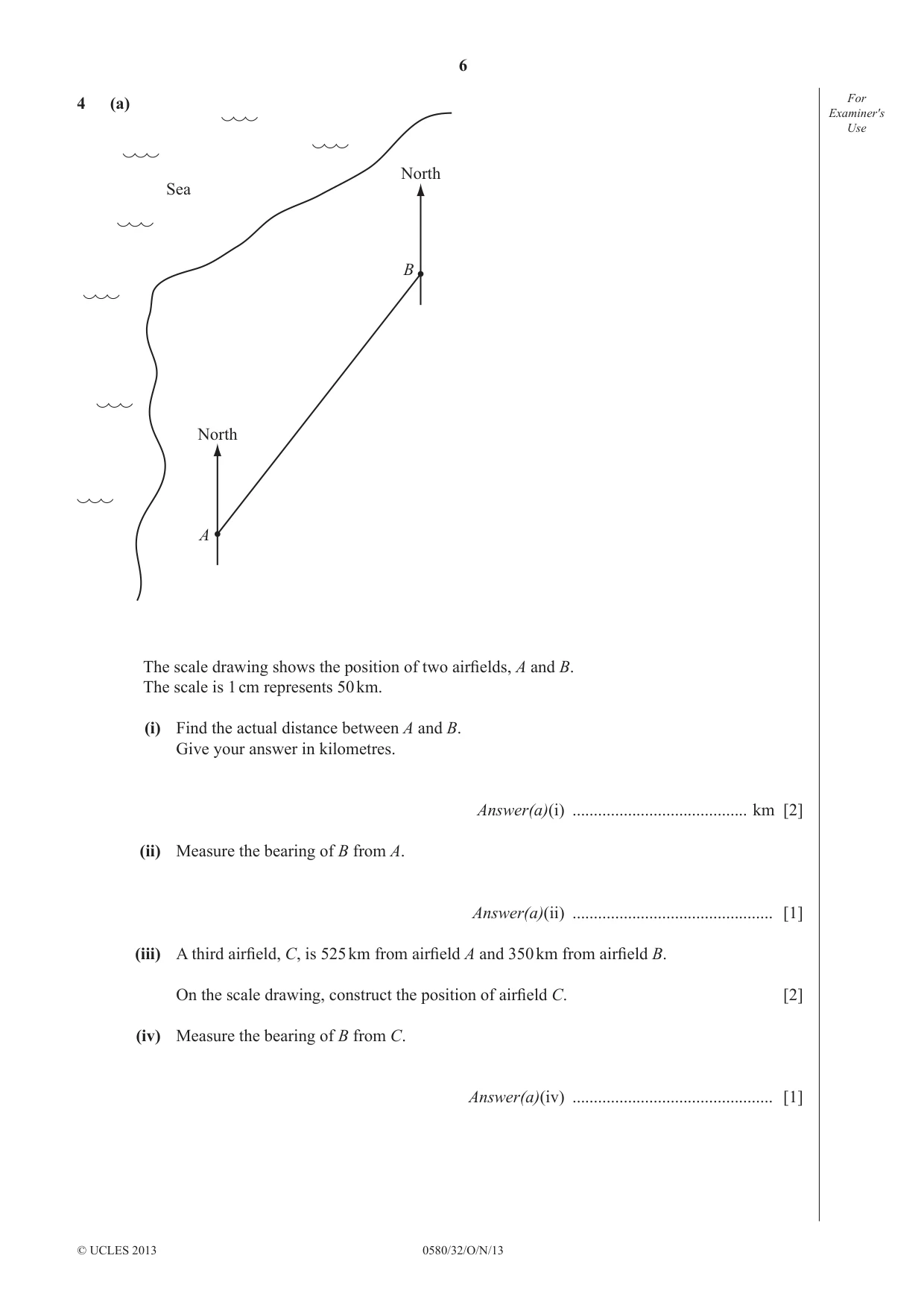
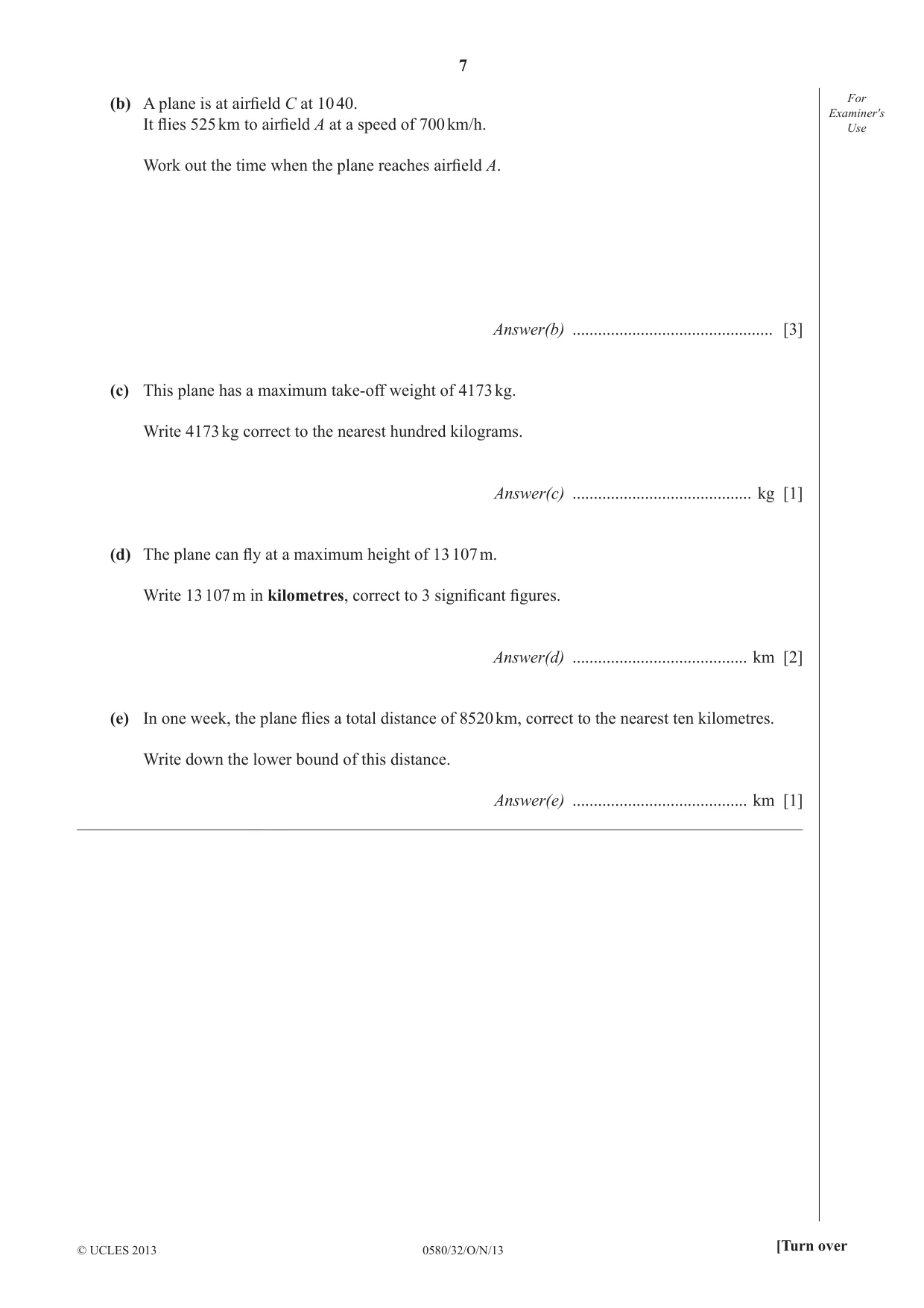
4 (a) For Examiner′s Use North Sea B North A The scale drawing shows the position of two airfi elds, A and B. The scale is 1 cm represents 50 km. (i) Find the actual distance between A and B. Give your answer in kilometres. Answer(a)(i) ......................................... km [2] (ii) Measure the bearing of B from A. Answer(a)(ii) ............................................... [1] (iii) A third airfi eld, C, is 525 km from airfi eld A and 350 km from airfi eld B. On the scale drawing, construct the position of airfi eld C. [2] (iv) Measure the bearing of B from C. Answer(a)(iv) ............................................... [1] (b) A plane is at airfi eld C at 10 40. For Examiner′s It fl ies 525 km to airfi eld A at a speed of 700 km/h. Use Work out the time when the plane reaches airfi eld A. Answer(b) ............................................... [3] (c) This plane has a maximum take-off weight of 4173 kg. Write 4173 kg correct to the nearest hundred kilograms. Answer(c) .......................................... kg [1] (d) The plane can fl y at a maximum height of 13 107 m. Write 13 107 m in kilometres, correct to 3 signifi cant fi gures. Answer(d) ......................................... km [2] (e) In one week, the plane fl ies a total distance of 8520 km, correct to the nearest ten kilometres. Write down the lower bound of this distance. Answer(e) ......................................... km [1] _____________________________________________________________________________________
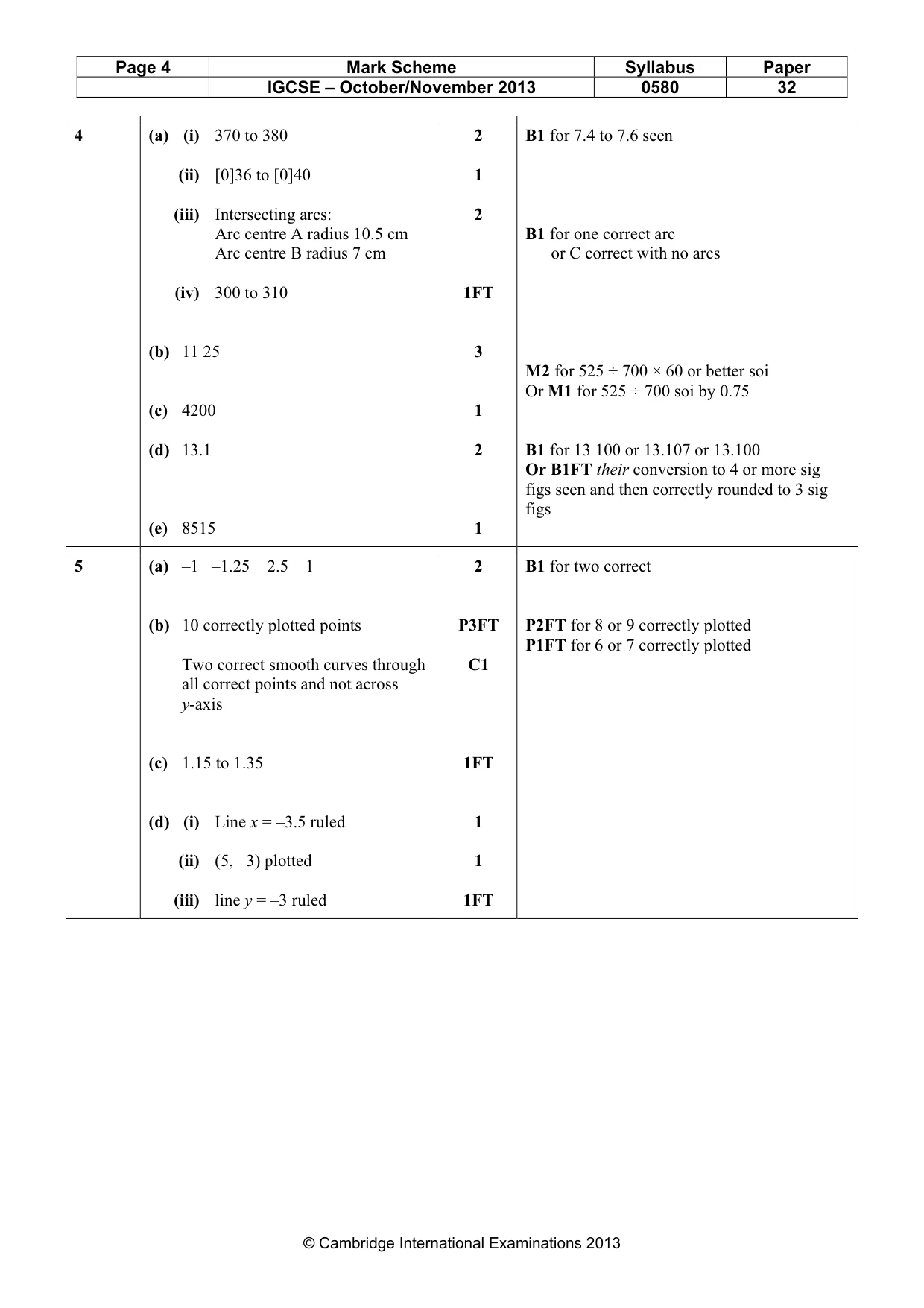
Mark scheme: 4 (a) (i) 370 to 380 2 B1 for 7.4 to 7.6 seen (ii) [0]36 to [0]40 1 (iii) Intersecting arcs: 2 Arc centre A radius 10.5 cm B1 for one correct arc Arc centre B radius 7 cm or C correct with no arcs (iv) 300 to 310 1FT (b) 11 25 3 M2 for 525 ÷ 700 × 60 or better soi Or M1 for 525 ÷ 700 soi by 0.75 (c) 4200 1 (d) 13.1 2 B1 for 13 100 or 13.107 or 13.100 Or B1FT their conversion to 4 or more sig figs seen and then correctly rounded to 3 sig figs (e) 8515 1
Q5 · Examiner′s5 (a) Complete the table of values for y =
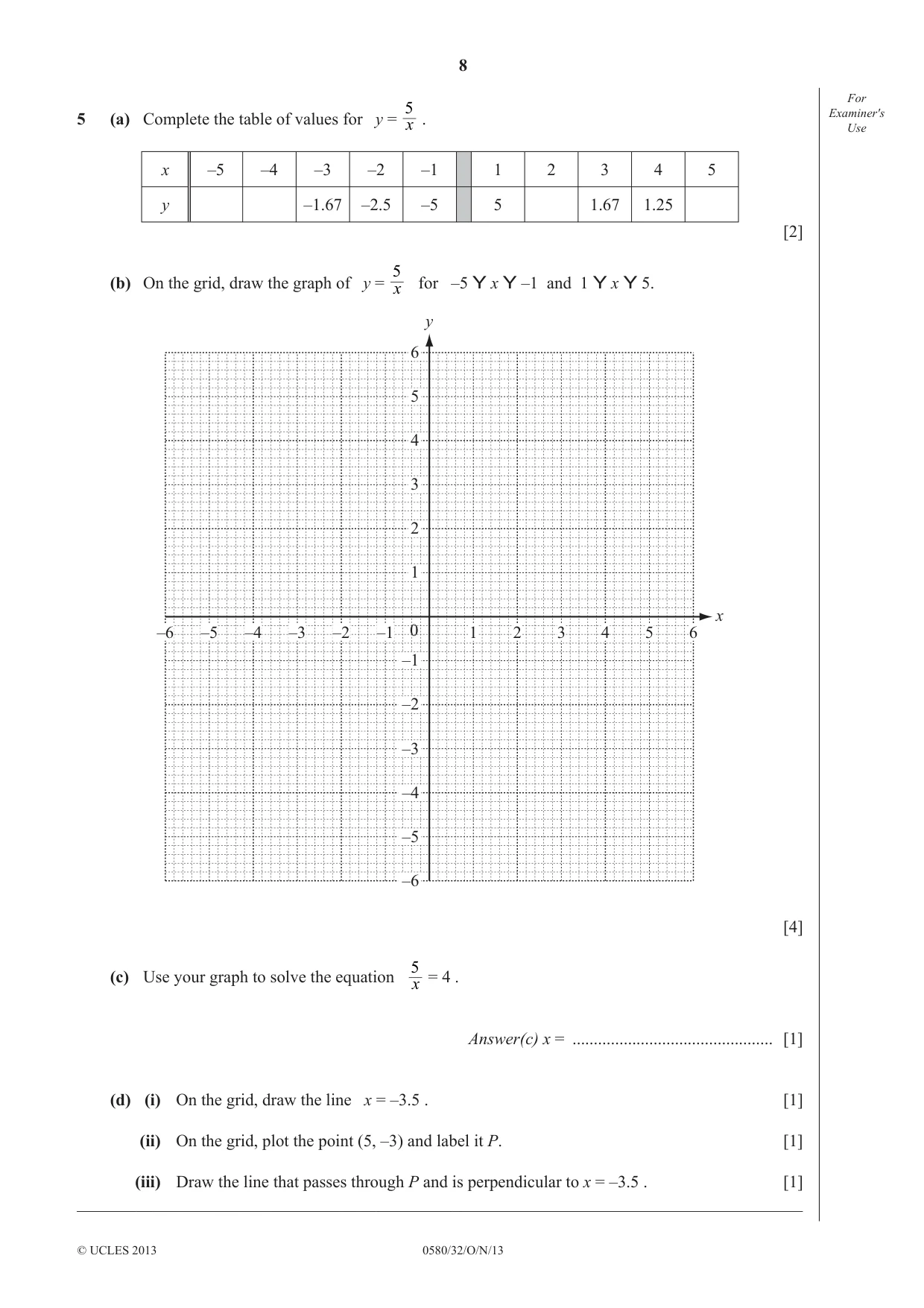
5 Examiner′s5 (a) Complete the table of values for y = . x Use x –5 –4 –3 –2 –1 1 2 3 4 5 y –1.67 –2.5 –5 5 1.67 1.25 [2] 5 (b) On the grid, draw the graph of y = for –5 Y x Y –1 and 1 Y x Y 5. x y 6 5 4 3 2 1 x –6 –5 –4 –3 –2 –1 0 1 2 3 4 5 6 –1 –2 –3 –4 –5 –6 [4] 5 (c) Use your graph to solve the equation = 4 . x Answer(c) x = ............................................... [1] (d) (i) On the grid, draw the line x = –3.5 . [1] (ii) On the grid, plot the point (5, –3) and label it P. [1] (iii) Draw the line that passes through P and is perpendicular to x = –3.5 . [1] _____________________________________________________________________________________
Mark scheme: 5 (a) –1 –1.25 2.5 1 2 B1 for two correct (b) 10 correctly plotted points P3FT P2FT for 8 or 9 correctly plotted P1FT for 6 or 7 correctly plotted Two correct smooth curves through C1 all correct points and not across y-axis (c) 1.15 to 1.35 1FT (d) (i) Line x = –3.5 ruled 1 (ii) (5, –3) plotted 1 (iii) line y = –3 ruled 1FT IGCSE – October/November 2013 0580 32
Q6 · Here are three different sequences
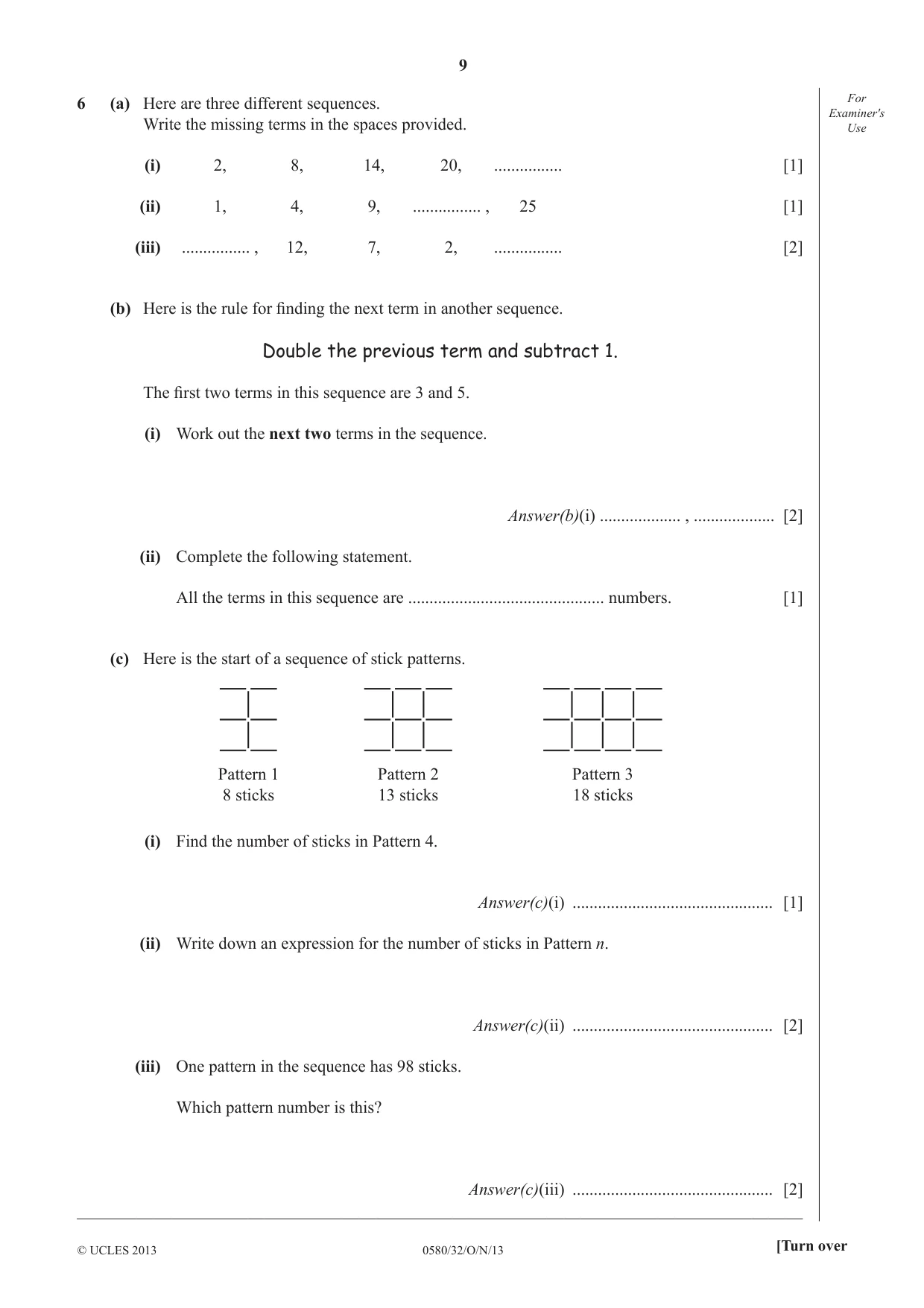
6 (a) Here are three different sequences. For Examiner′s Write the missing terms in the spaces provided. Use (i) 2, 8, 14, 20, ................ [1] (ii) 1, 4, 9, ................ , 25 [1] (iii) ................ , 12, 7, 2, ................ [2] (b) Here is the rule for fi nding the next term in another sequence. Double the previous term and subtract 1. The fi rst two terms in this sequence are 3 and 5. (i) Work out the next two terms in the sequence. Answer(b)(i) ................... , ................... [2] (ii) Complete the following statement. All the terms in this sequence are .............................................. numbers. [1] (c) Here is the start of a sequence of stick patterns. Pattern 1 Pattern 2 Pattern 3 8 sticks 13 sticks 18 sticks (i) Find the number of sticks in Pattern 4. Answer(c)(i) ............................................... [1] (ii) Write down an expression for the number of sticks in Pattern n. Answer(c)(ii) ............................................... [2] (iii) One pattern in the sequence has 98 sticks. Which pattern number is this? Answer(c)(iii) ............................................... [2] _____________________________________________________________________________________
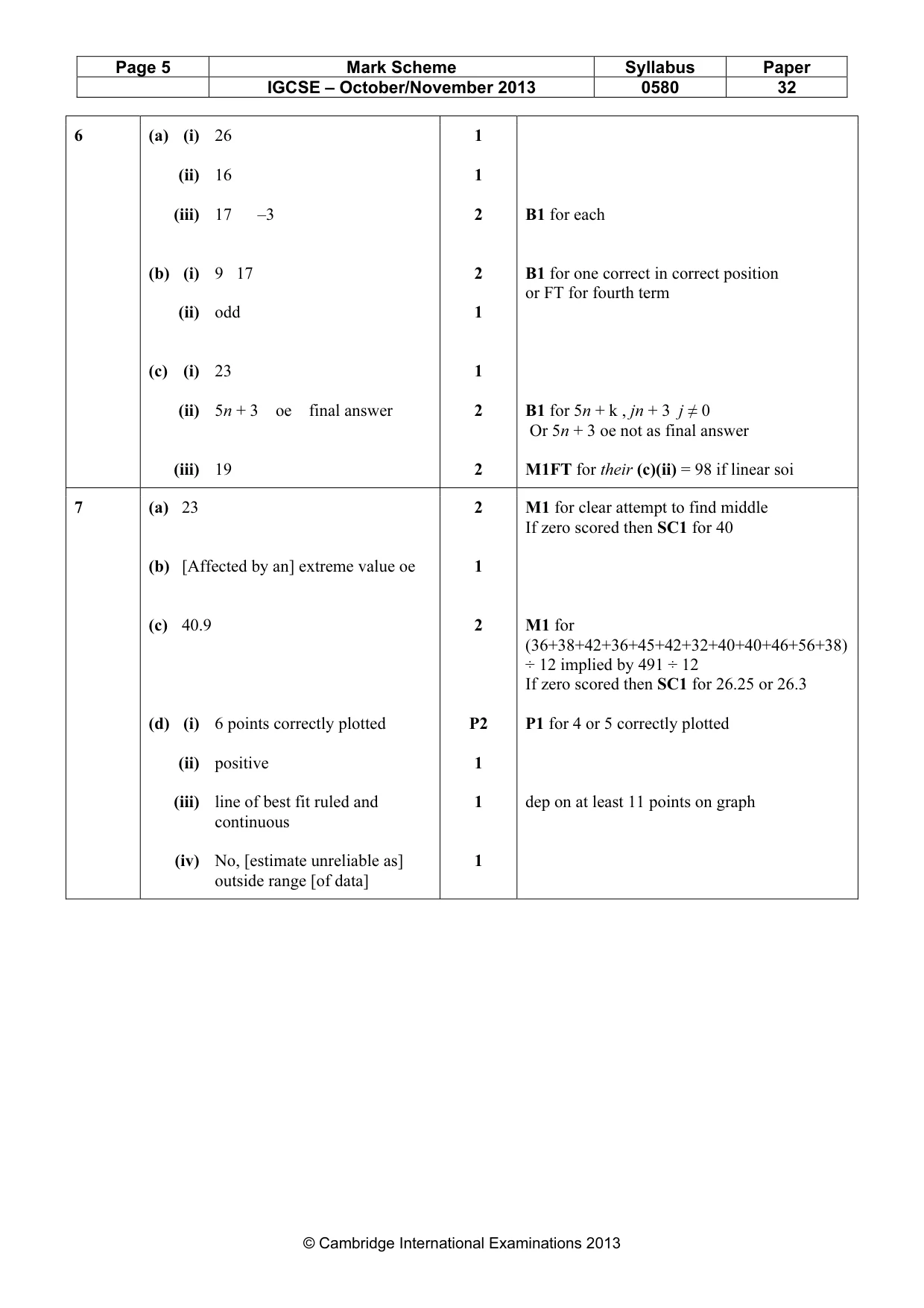
Mark scheme: 6 (a) (i) 26 1 (ii) 16 1 (iii) 17 –3 2 B1 for each (b) (i) 9 17 2 B1 for one correct in correct position or FT for fourth term (ii) odd 1 (c) (i) 23 1 (ii) 5n + 3 oe final answer 2 B1 for 5n + k , jn + 3 j ≠ 0 Or 5n + 3 oe not as final answer (iii) 19 2 M1FT for their (c)(ii) = 98 if linear soi
Q7 · 12 people each solved the same puzzle
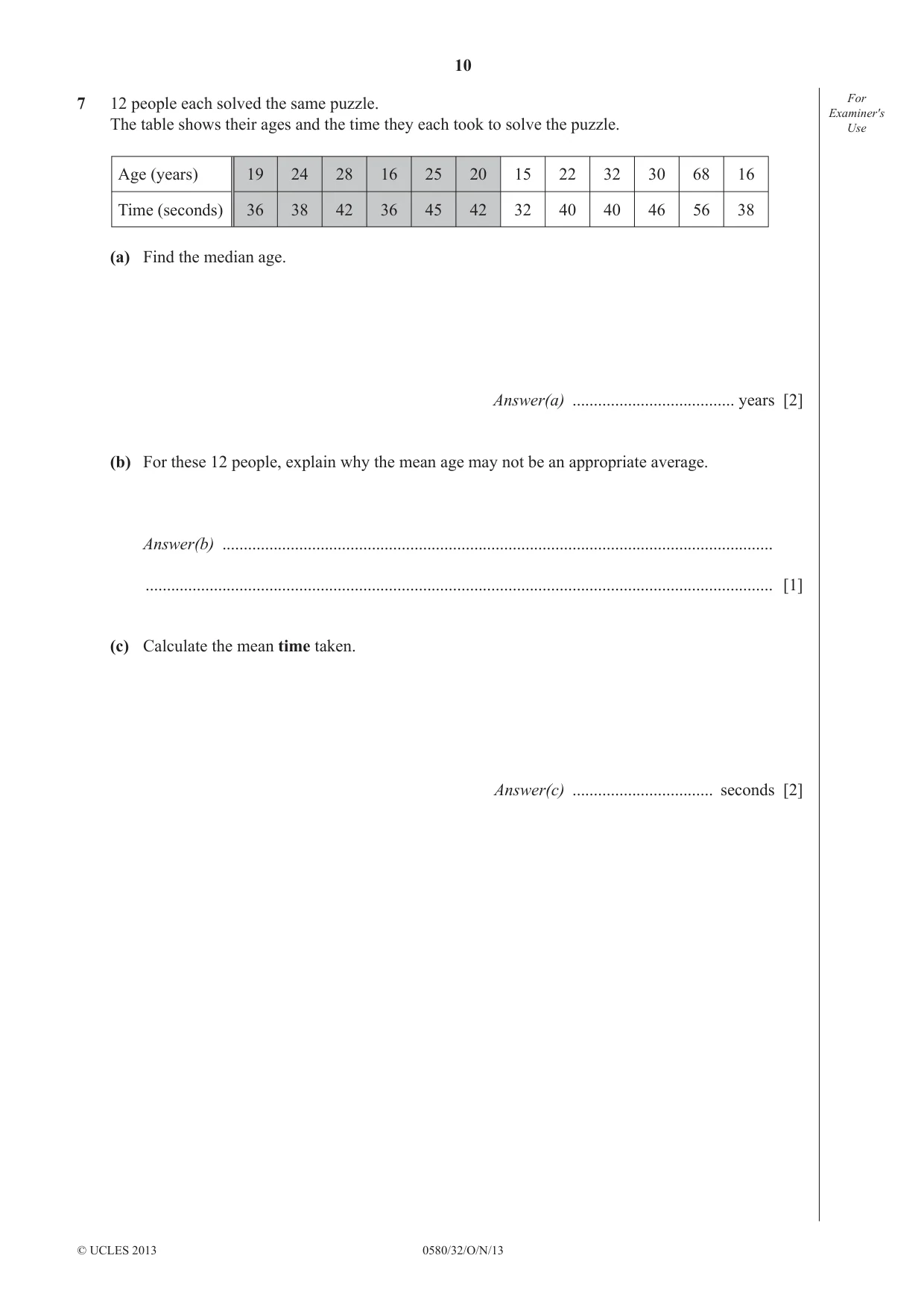
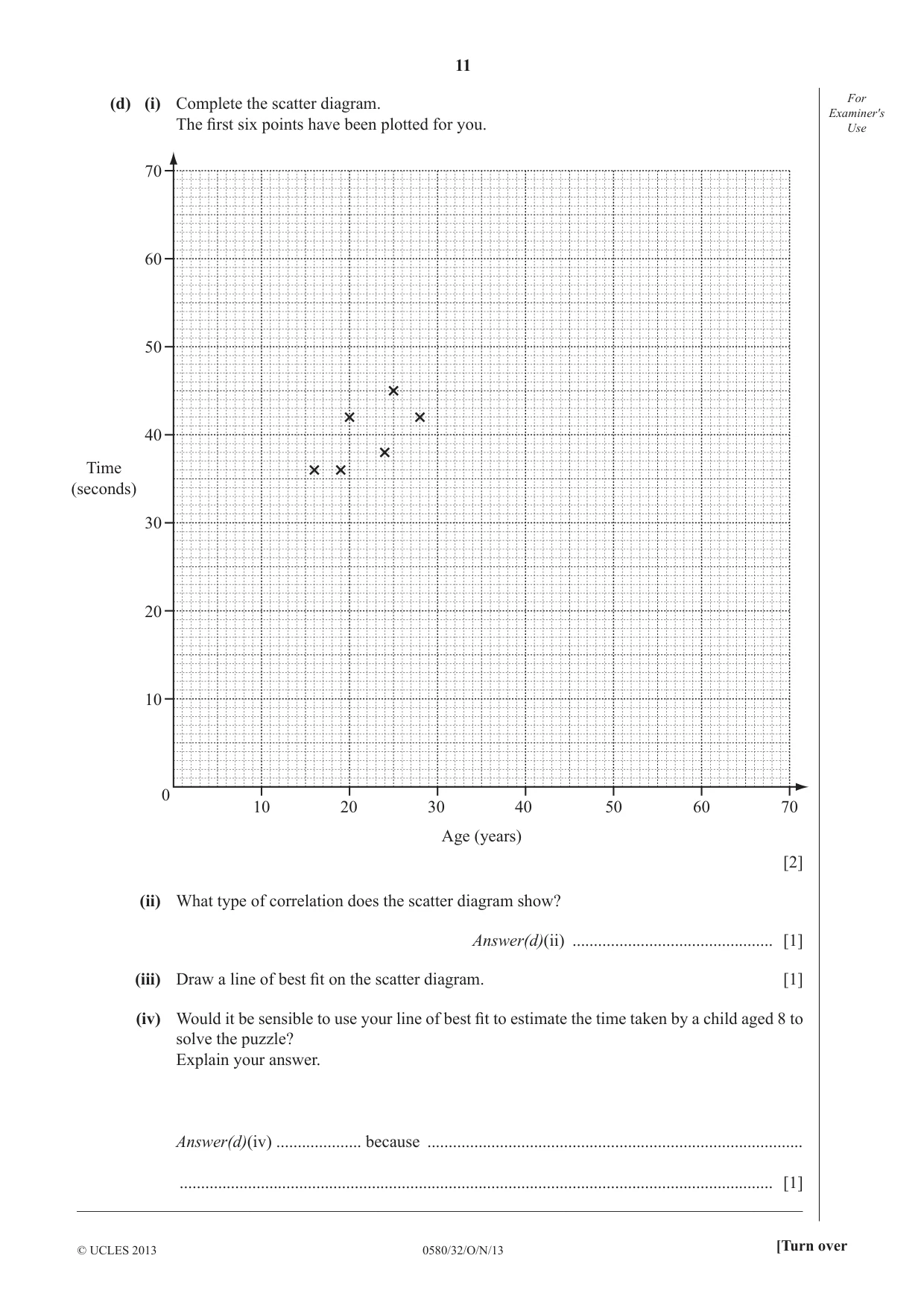
7 12 people each solved the same puzzle. For Examiner′s The table shows their ages and the time they each took to solve the puzzle. Use Age (years) 19 24 28 16 25 20 15 22 32 30 68 16 Time (seconds) 36 38 42 36 45 42 32 40 40 46 56 38 (a) Find the median age. Answer(a) ...................................... years [2] (b) For these 12 people, explain why the mean age may not be an appropriate average. Answer(b) ................................................................................................................................. ................................................................................................................................................... [1] (c) Calculate the mean time taken. Answer(c) ................................. seconds [2] (d) (i) Complete the scatter diagram. For Examiner′s The fi rst six points have been plotted for you. Use 70 60 50 40 Time (seconds) 30 20 10 0 10 20 30 40 50 60 70 Age (years) [2] (ii) What type of correlation does the scatter diagram show? Answer(d)(ii) ............................................... [1] (iii) Draw a line of best fi t on the scatter diagram. [1] (iv) Would it be sensible to use your line of best fi t to estimate the time taken by a child aged 8 to solve the puzzle? Explain your answer. Answer(d)(iv) .................... because ........................................................................................ ........................................................................................................................................... [1] _____________________________________________________________________________________
Mark scheme: 7 (a) 23 2 M1 for clear attempt to find middle If zero scored then SC1 for 40 (b) [Affected by an] extreme value oe 1 (c) 40.9 2 M1 for (36+38+42+36+45+42+32+40+40+46+56+38) ÷ 12 implied by 491 ÷ 12 If zero scored then SC1 for 26.25 or 26.3 (d) (i) 6 points correctly plotted P2 P1 for 4 or 5 correctly plotted (ii) positive 1 (iii) line of best fit ruled and 1 dep on at least 11 points on graph continuous (iv) No, [estimate unreliable as] 1 outside range [of data] IGCSE – October/November 2013 0580 32
Question 8
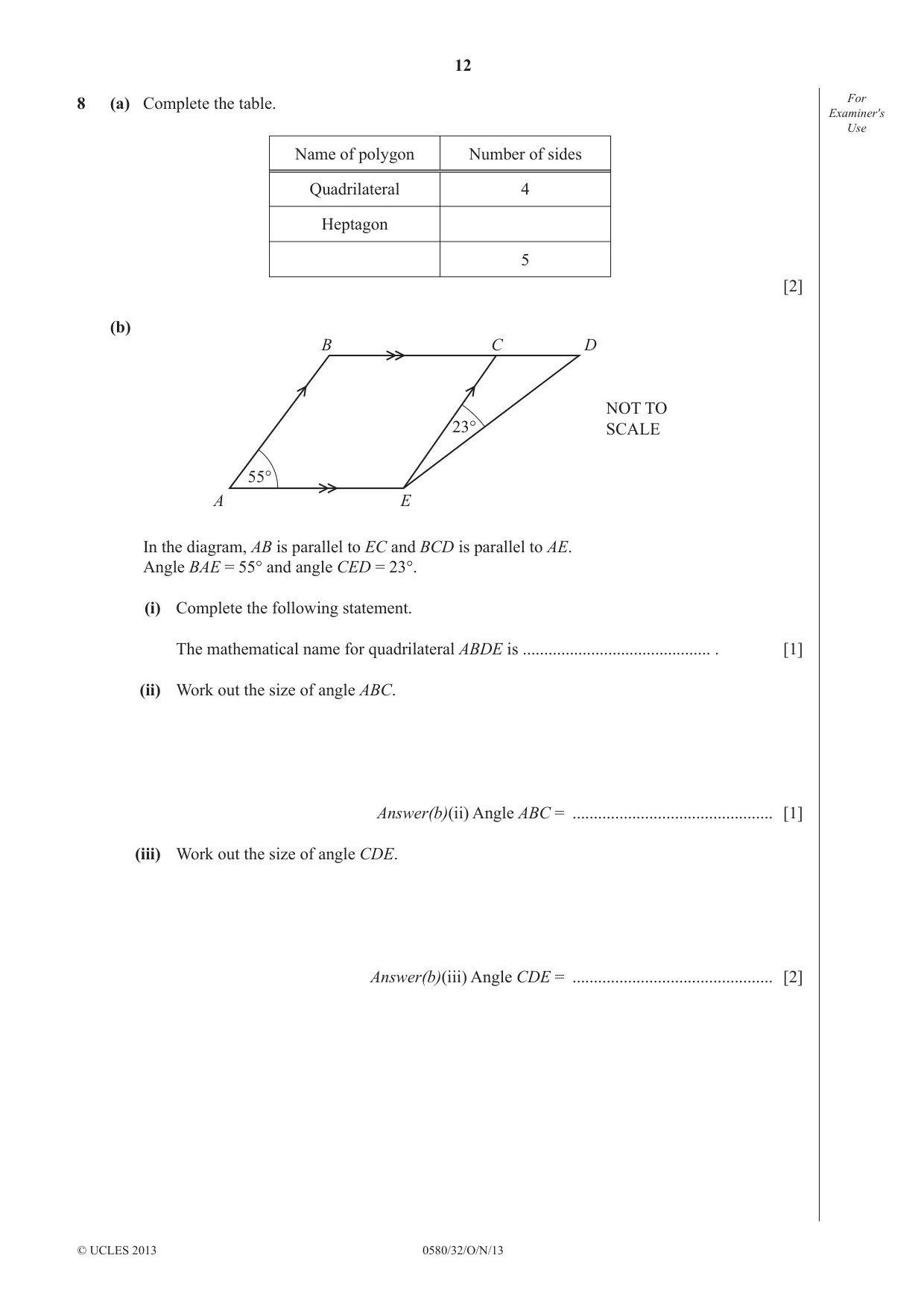
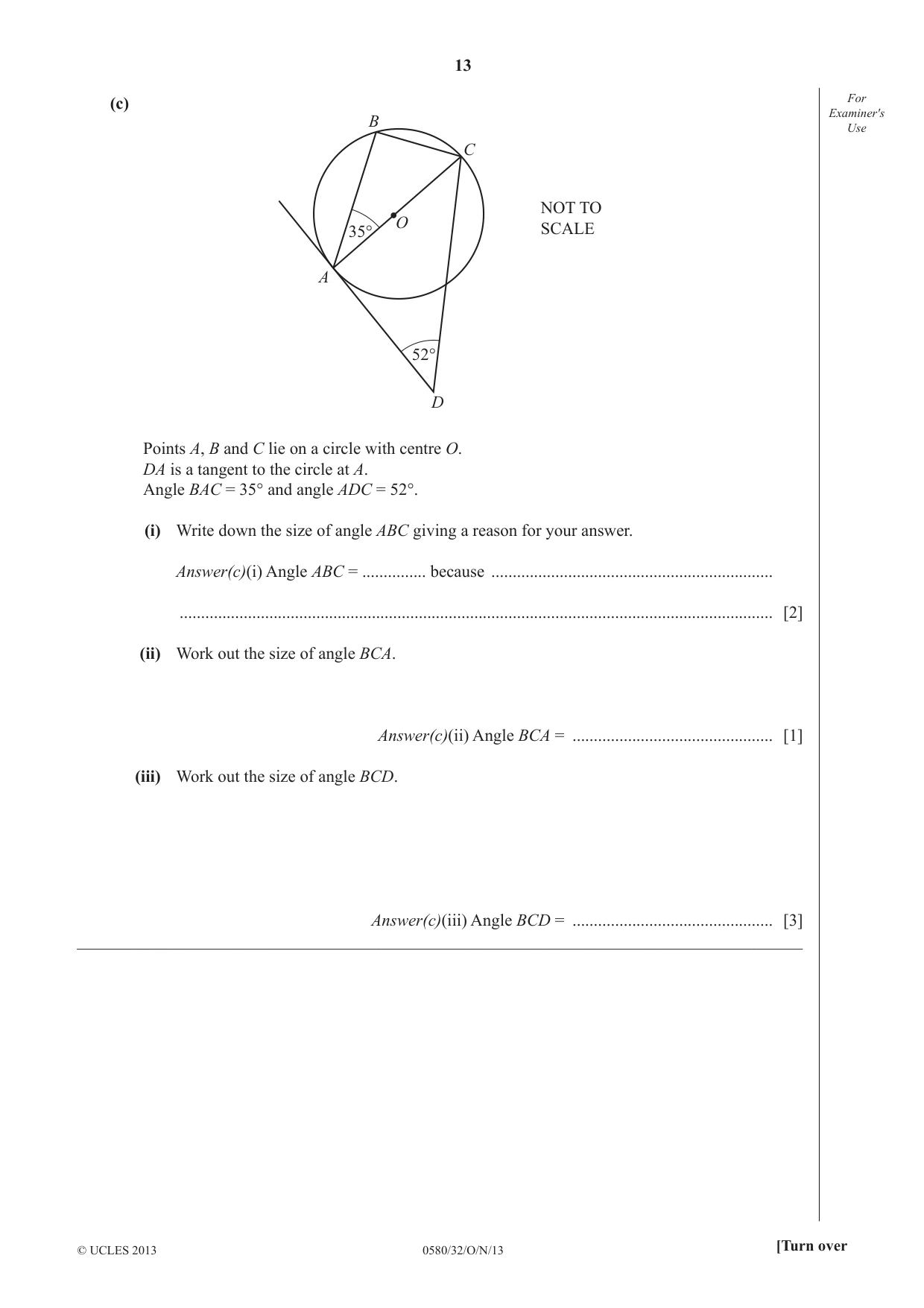
8 (a) Complete the table. For Examiner′s Use Name of polygon Number of sides Quadrilateral 4 Heptagon 5 [2] (b) B C D NOT TO 23° SCALE 55° A E In the diagram, AB is parallel to EC and BCD is parallel to AE. Angle BAE = 55° and angle CED = 23°. (i) Complete the following statement. The mathematical name for quadrilateral ABDE is ............................................ . [1] (ii) Work out the size of angle ABC. Answer(b)(ii) Angle ABC = ............................................... [1] (iii) Work out the size of angle CDE. Answer(b)(iii) Angle CDE = ............................................... [2] (c) For Examiner′s B Use C NOT TO O 35° SCALE A 52° D Points A, B and C lie on a circle with centre O. DA is a tangent to the circle at A. Angle BAC = 35° and angle ADC = 52°. (i) Write down the size of angle ABC giving a reason for your answer. Answer(c)(i) Angle ABC = ............... because .................................................................. ........................................................................................................................................... [2] (ii) Work out the size of angle BCA. Answer(c)(ii) Angle BCA = ............................................... [1] (iii) Work out the size of angle BCD. Answer(c)(iii) Angle BCD = ............................................... [3] _____________________________________________________________________________________
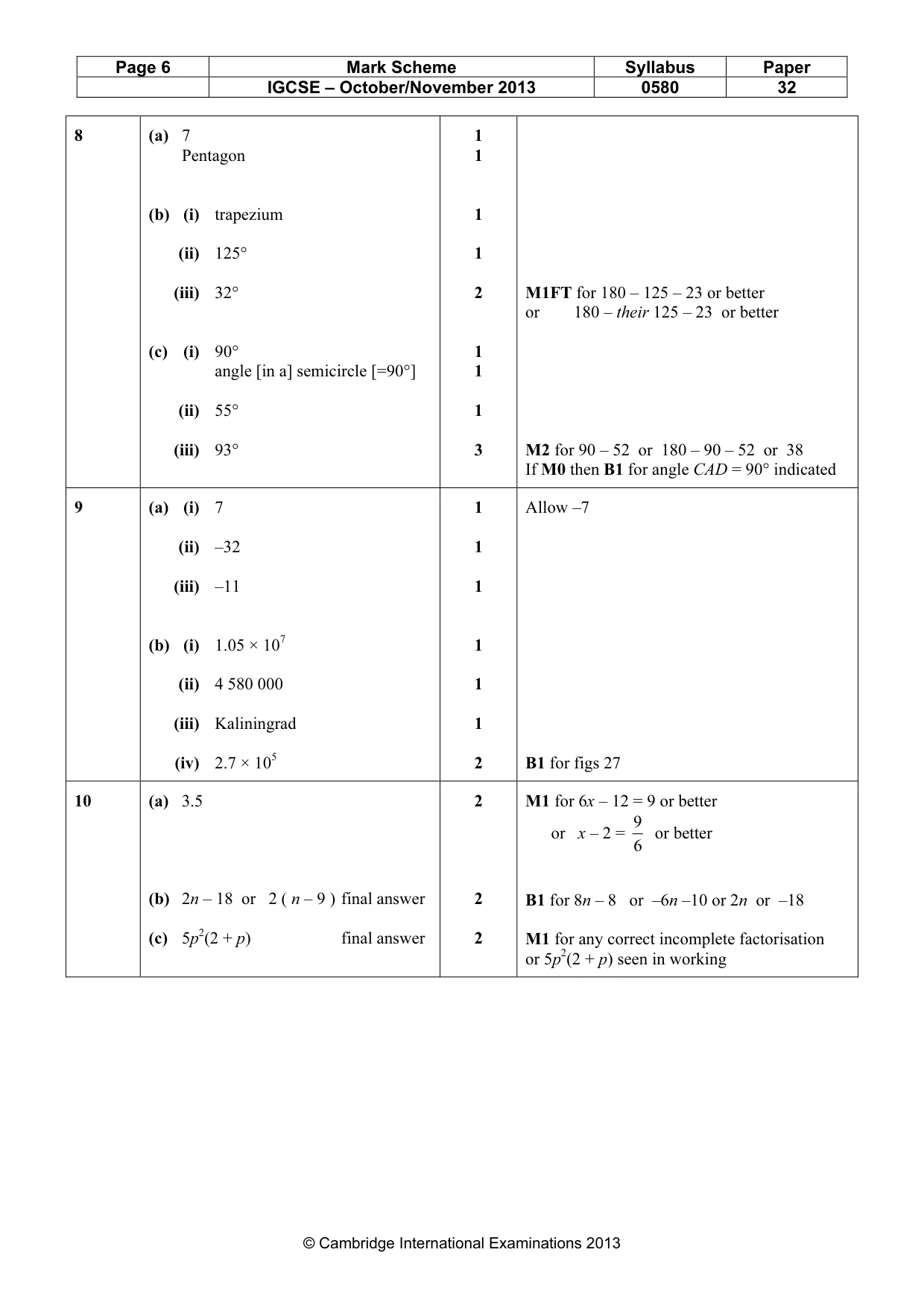
Mark scheme: 8 (a) 7 1 Pentagon 1 (b) (i) trapezium 1 (ii) 125° 1 (iii) 32° 2 M1FT for 180 – 125 – 23 or better or 180 – their 125 – 23 or better (c) (i) 90° 1 angle [in a] semicircle [=90°] 1 (ii) 55° 1 (iii) 93° 3 M2 for 90 – 52 or 180 – 90 – 52 or 38 If M0 then B1 for angle CAD = 90° indicated
Q9 · The table shows some information about minimum and maximum temperatures in Moscow one For…
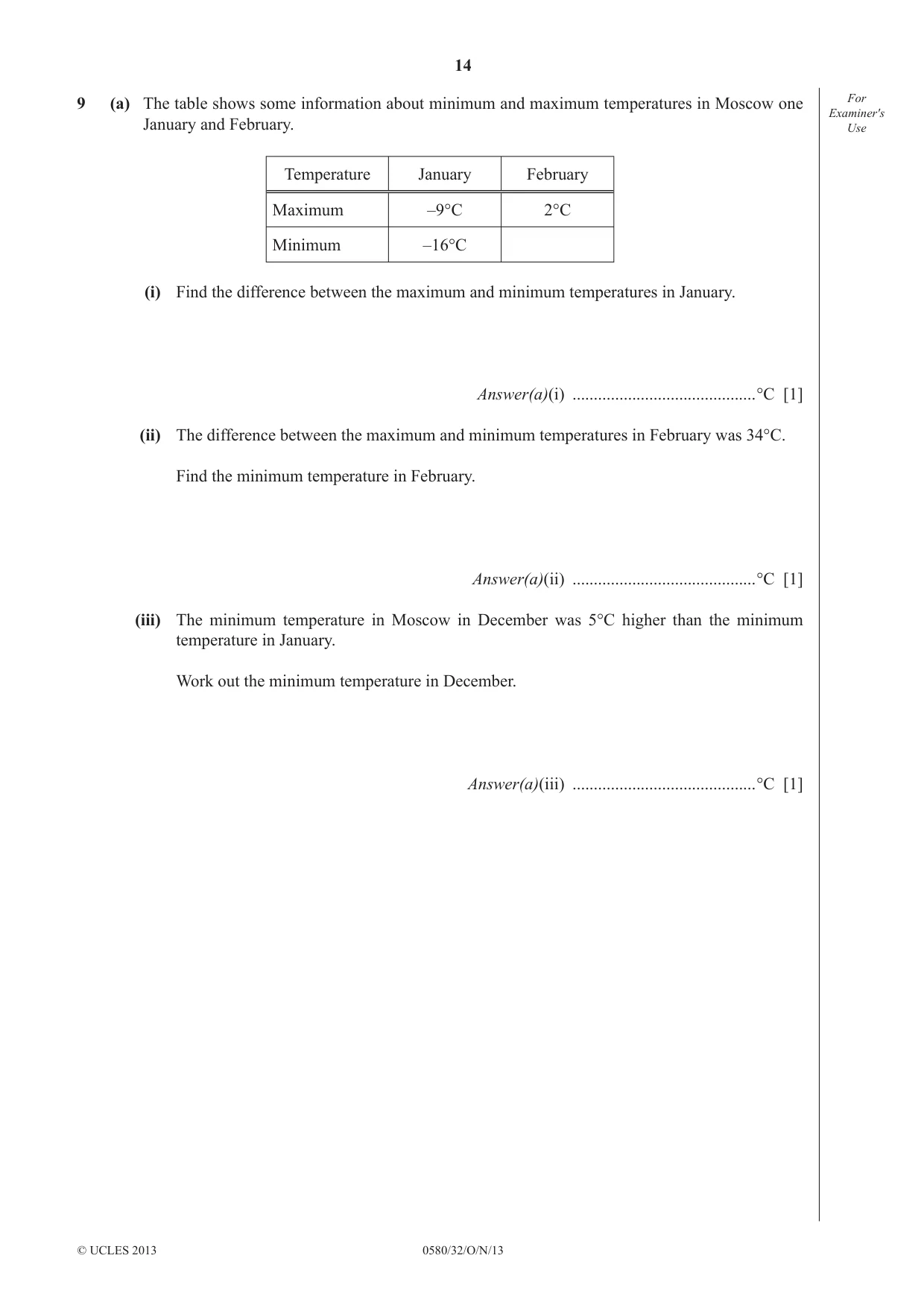
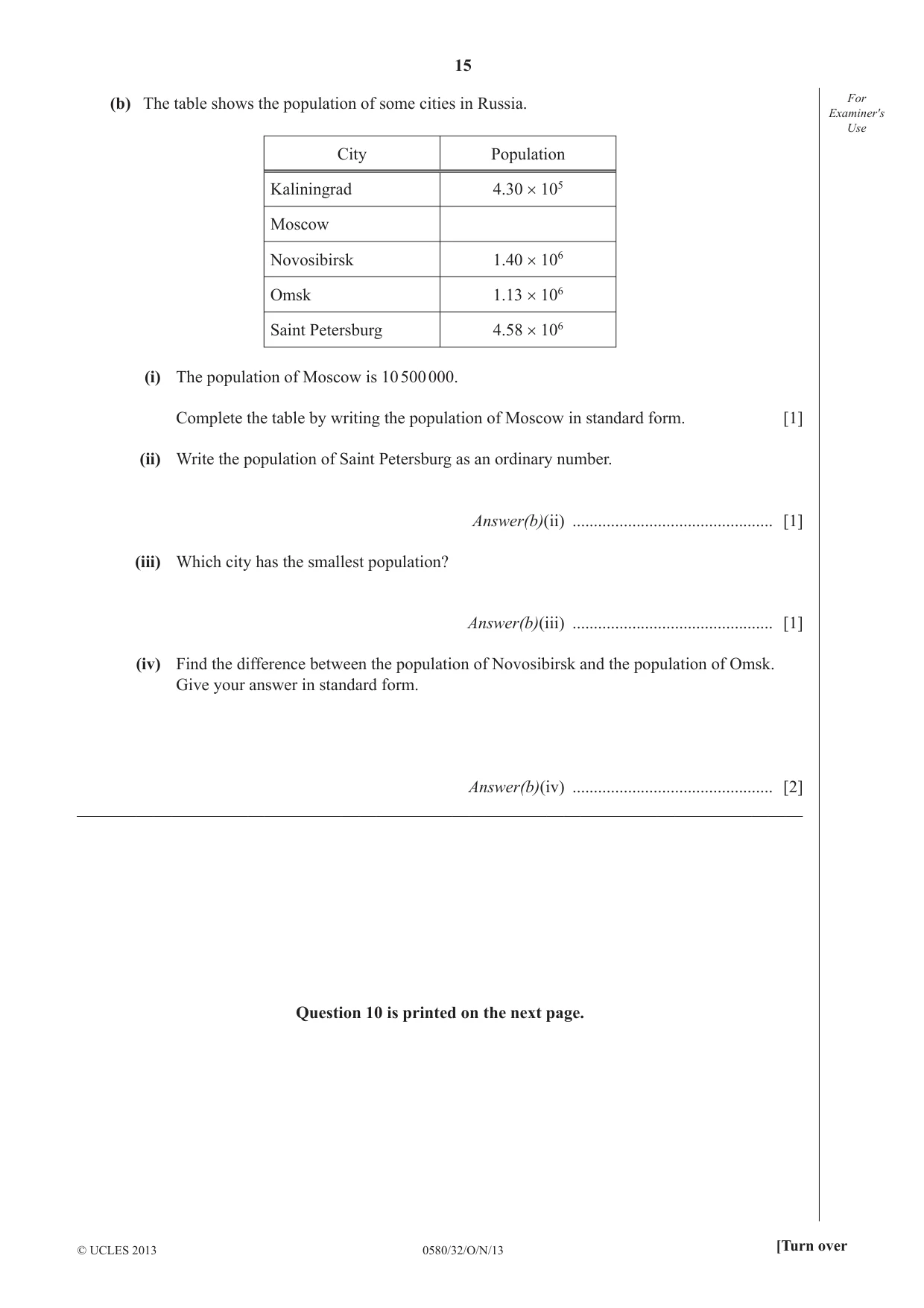
9 (a) The table shows some information about minimum and maximum temperatures in Moscow one For Examiner′s January and February. Use Temperature January February Maximum –9°C 2°C Minimum –16°C (i) Find the difference between the maximum and minimum temperatures in January. Answer(a)(i) ...........................................°C [1] (ii) The difference between the maximum and minimum temperatures in February was 34°C. Find the minimum temperature in February. Answer(a)(ii) ...........................................°C [1] (iii) The minimum temperature in Moscow in December was 5°C higher than the minimum temperature in January. Work out the minimum temperature in December. Answer(a)(iii) ...........................................°C [1] (b) The table shows the population of some cities in Russia. For Examiner′s Use City Population Kaliningrad 4.30 × 10⁵ Moscow Novosibirsk 1.40 × 10⁶ Omsk 1.13 × 10⁶ Saint Petersburg 4.58 × 10⁶ (i) The population of Moscow is 10 500 000. Complete the table by writing the population of Moscow in standard form. [1] (ii) Write the population of Saint Petersburg as an ordinary number. Answer(b)(ii) ............................................... [1] (iii) Which city has the smallest population? Answer(b)(iii) ............................................... [1] (iv) Find the difference between the population of Novosibirsk and the population of Omsk. Give your answer in standard form. Answer(b)(iv) ............................................... [2] _____________________________________________________________________________________ Question 10 is printed on the next page.
Mark scheme: 9 (a) (i) 7 1 Allow –7 (ii) –32 1 (iii) –11 1 (b) (i) 1.05 × 10⁷ 1 (ii) 4 580 000 1 (iii) Kaliningrad 1 (iv) 2.7 × 10⁵ 2 B1 for figs 27
Question 10
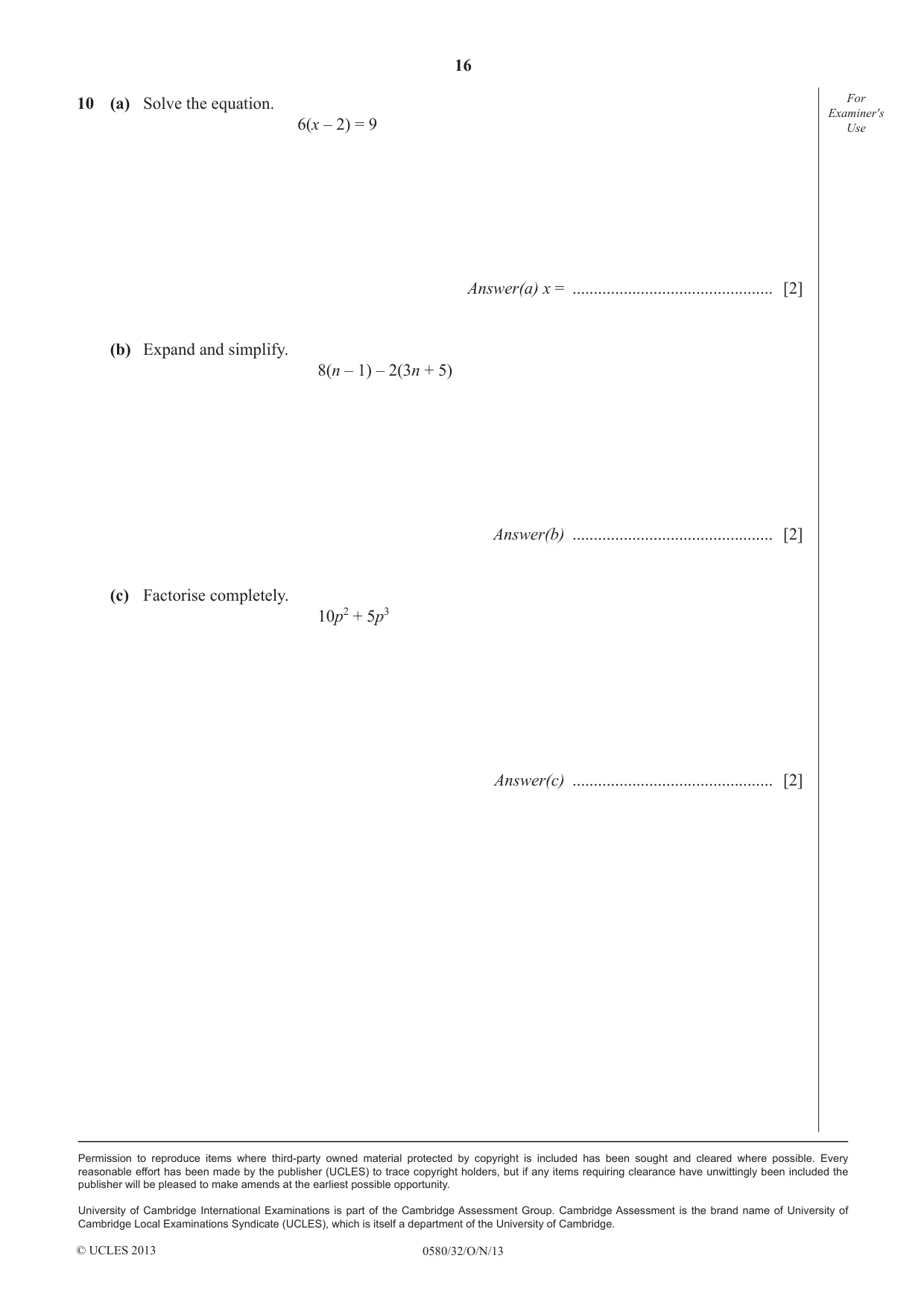
10 (a) Solve the equation. For Examiner′s 6(x – 2) = 9 Use Answer(a) x = ............................................... [2] (b) Expand and simplify. 8(n – 1) – 2(3n + 5) Answer(b) ............................................... [2] (c) Factorise completely. 10p2 + 5p3 Answer(c) ............................................... [2]
Mark scheme: 10 (a) 3.5 2 M1 for 6x – 12 = 9 or better 9 or x – 2 = or better 6 (b) 2n – 18 or 2 ( n – 9 ) final answer 2 B1 for 8n – 8 or –6n –10 or 2n or –18 (c) 5p2(2 + p) final answer 2 M1 for any correct incomplete factorisation or 5p2(2 + p) seen in working
What was in this paper
The subtopics covered by these 10 questions, and how many questions each got. Open one in a new tab to see every Cambridge question on it.