Cambridge IGCSE Mathematics 0580 — 2012 May/June Paper 2 · Variant 3
0580/23/M/J/12 · 21 questions · 70 marks · ≈79 min
The question paper and its mark scheme, free to read here and free to download. This is Cambridge’s own paper, exactly as it was sat.
Question paper12 pages
Mark scheme4 pages
Answers below. Sit the paper first if you are practising.
Questions as text
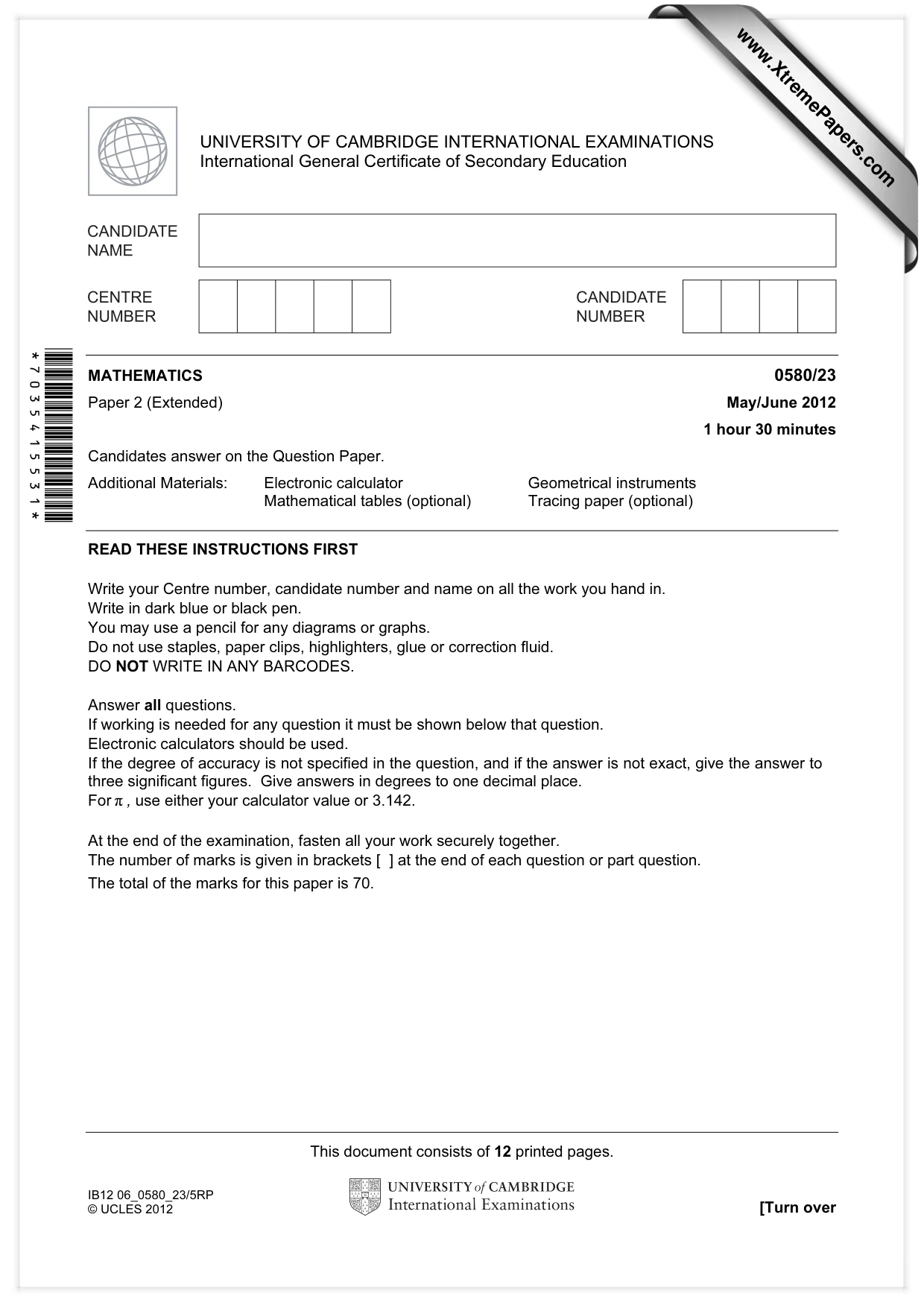
Q1 · For A Examiner's Use 73° B NOT TO 120° SCALE 82° x° C D E The diagram shows a…
1 For A Examiner's Use 73° B NOT TO 120° SCALE 82° x° C D E The diagram shows a quadrilateral ABCD. CDE is a straight line. Calculate the value of x. Answer x = [2]
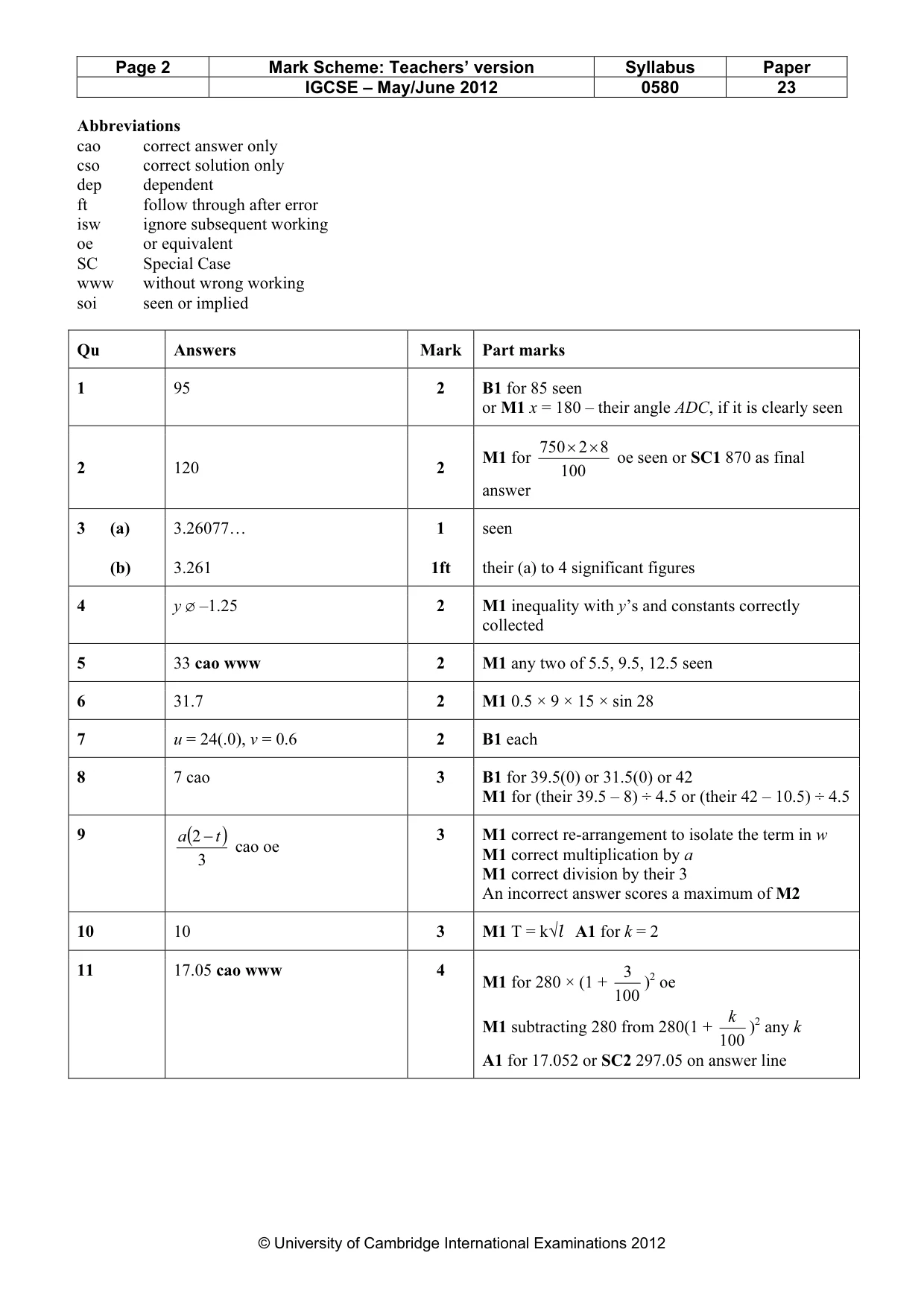
Mark scheme: Qu Answers Mark Part marks 1 95 2 B1 for 85 seen or M1 x = 180 – their angle ADC, if it is clearly seen 750 × 2 × 8 M1 for oe seen or SC1 870 as final
Q2 · Hans invests $750 for 8 years at a rate of 2% per year simple interest
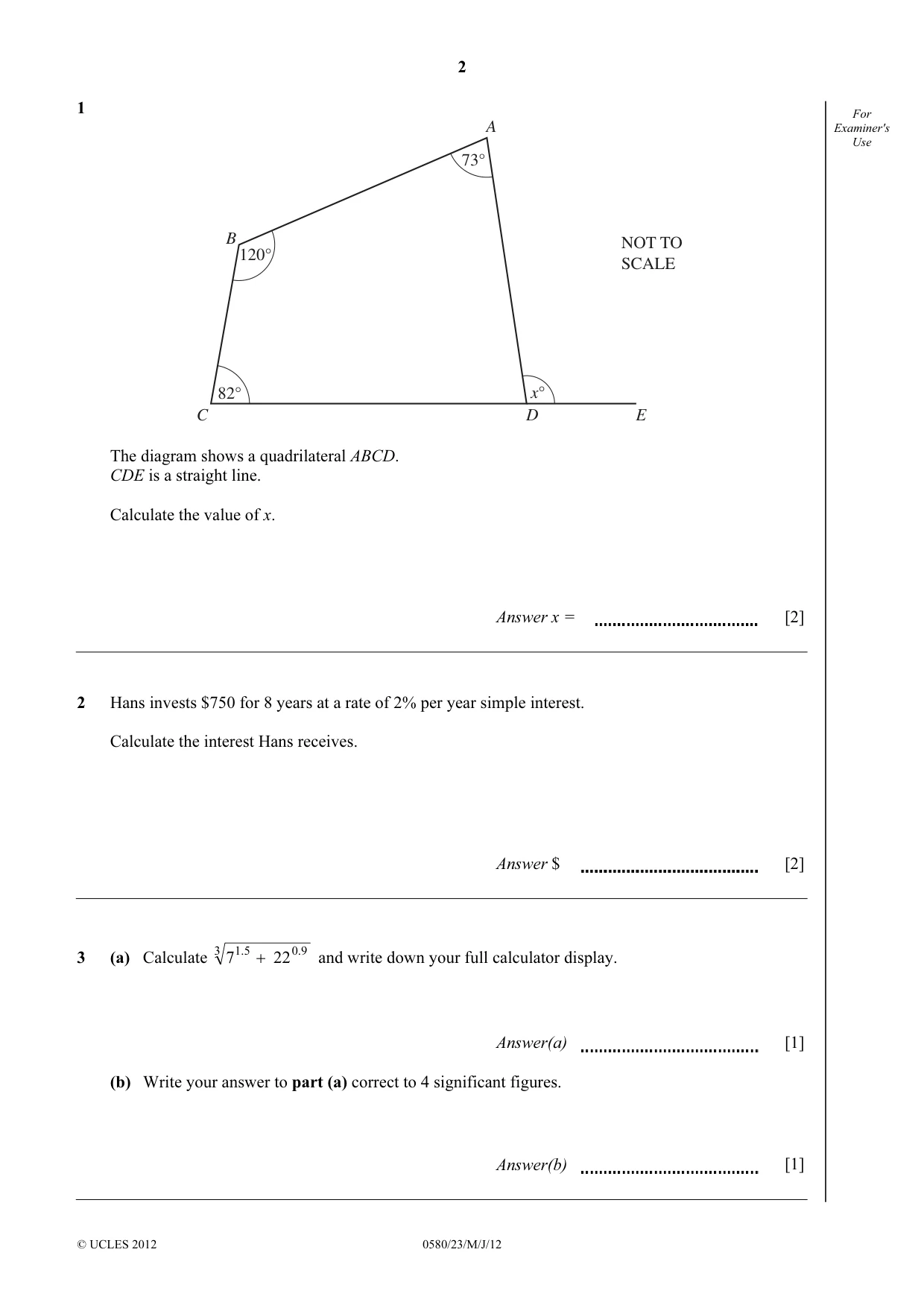
2 Hans invests $750 for 8 years at a rate of 2% per year simple interest. Calculate the interest Hans receives. Answer $ [2]
Mark scheme: M1 for oe seen or SC1 870 as final 2 120 2 100 answer
Q3 · 1.5 0.9 3 (a) Calculate 7 + 22 and write down your full calculator display
3 1.5 0.9 3 (a) Calculate 7 + 22 and write down your full calculator display. Answer(a) [1] (b) Write your answer to part (a) correct to 4 significant figures. Answer(b) [1]
Mark scheme: 3 (a) 3.26077… 1 seen (b) 3.261 1ft their (a) to 4 significant figures
Question 4
4 Solve the inequality. For 3y + 7 Y 2 – y Examiner's Use Answer [2]
Mark scheme: 4 y ø –1.25 2 M1 inequality with y’s and constants correctly collected
Q5 · 9 cm 5 cm 5 cm NOT TO SCALE 12 cm The diagram shows a quadrilateral
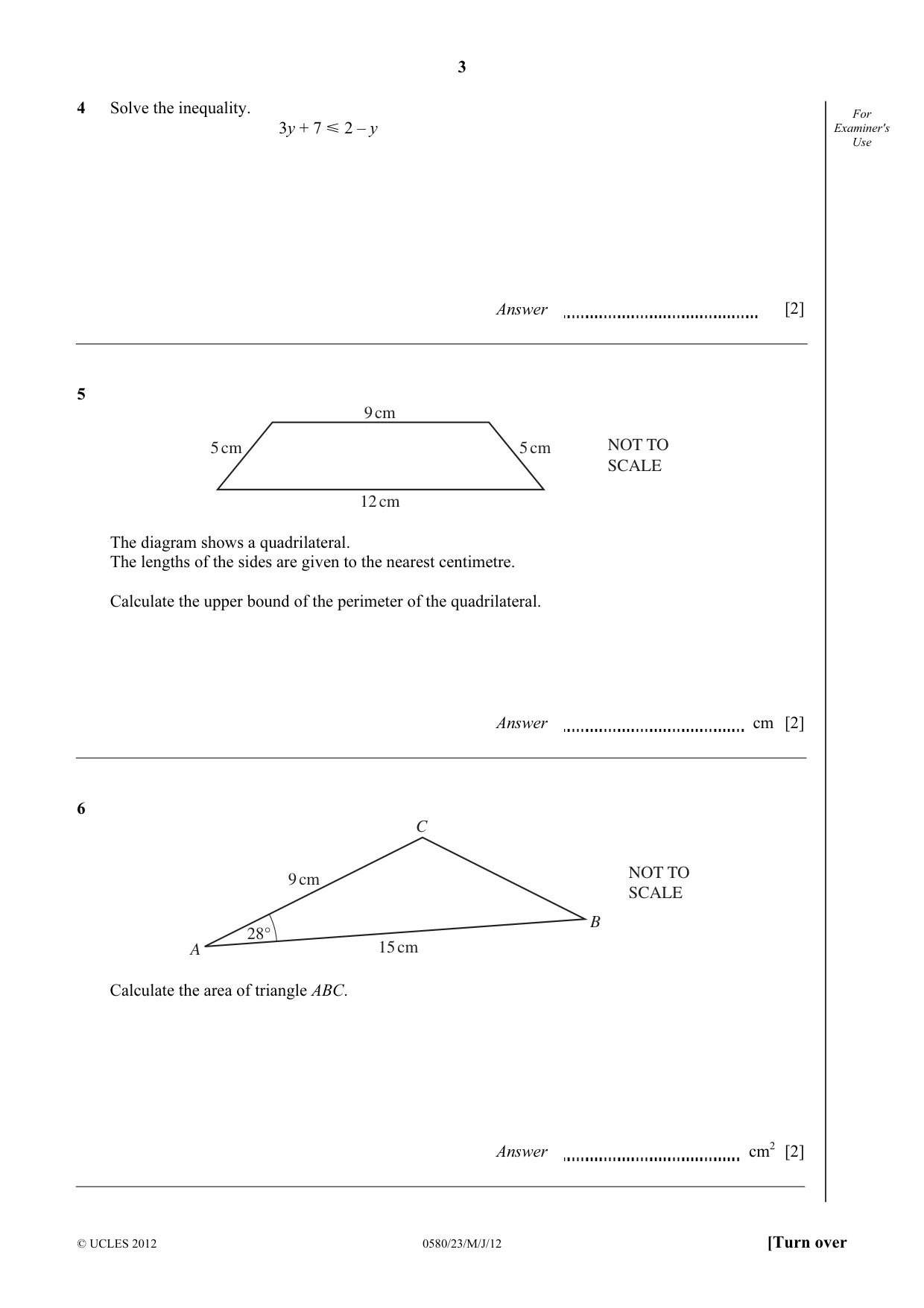
5 9 cm 5 cm 5 cm NOT TO SCALE 12 cm The diagram shows a quadrilateral. The lengths of the sides are given to the nearest centimetre. Calculate the upper bound of the perimeter of the quadrilateral. Answer cm [2]
Mark scheme: 5 33 cao www 2 M1 any two of 5.5, 9.5, 12.5 seen
Q6 · C NOT TO 9 cm SCALE B 28° 15 cm A Calculate the area of triangle ABC
6 C NOT TO 9 cm SCALE B 28° 15 cm A Calculate the area of triangle ABC. Answer cm2 [2]
Mark scheme: 6 31.7 2 M1 0.5 × 9 × 15 × sin 28
Q7 · For Examiner's Height (h cm) 0 < h Y 10 10 < h Y 15 15 < h Y 30 Use Frequency 25 u 9…
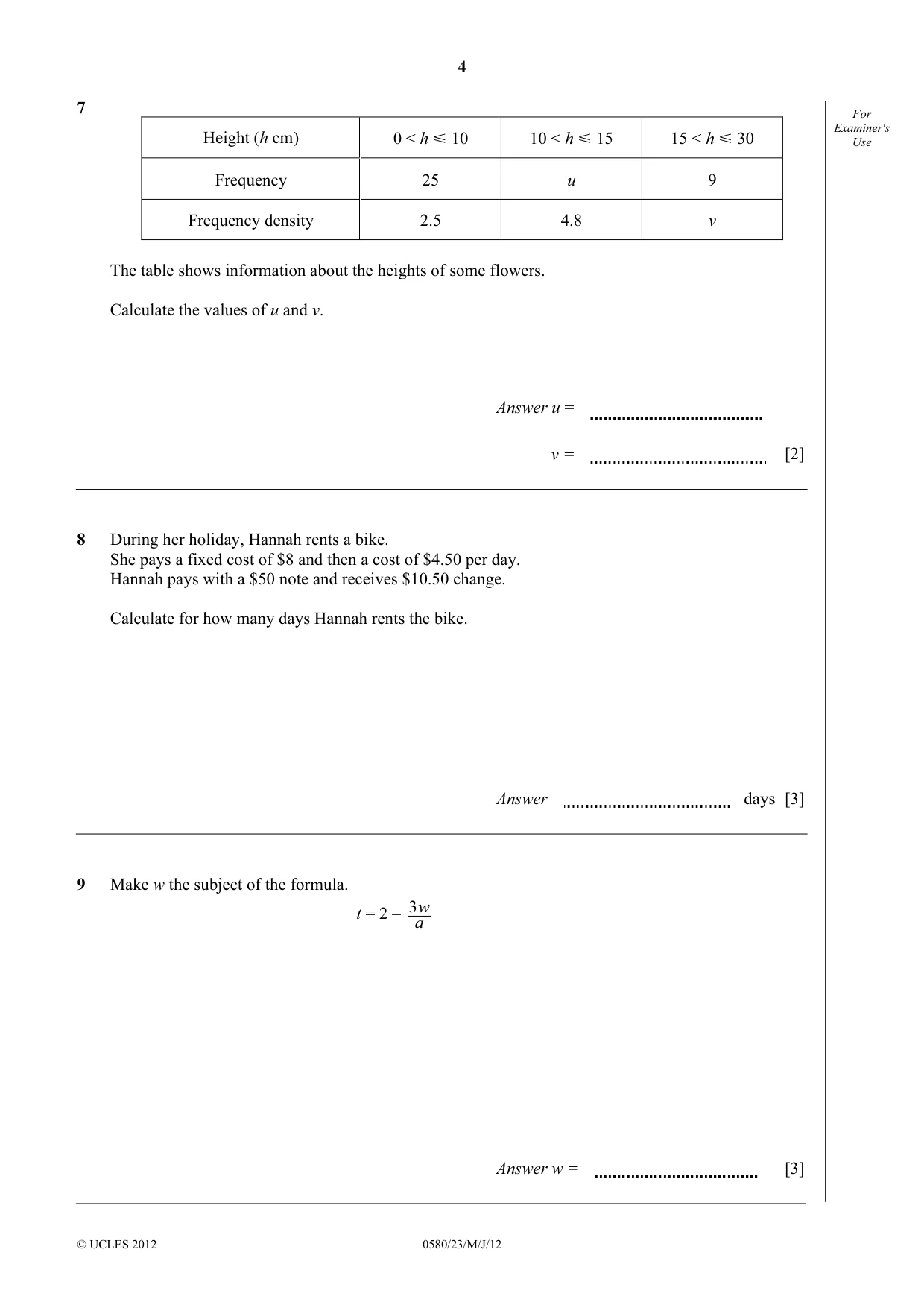
7 For Examiner's Height (h cm) 0 < h Y 10 10 < h Y 15 15 < h Y 30 Use Frequency 25 u 9 Frequency density 2.5 4.8 v The table shows information about the heights of some flowers. Calculate the values of u and v. Answer u = v = [2]
Mark scheme: 7 u = 24(.0), v = 0.6 2 B1 each
Q8 · During her holiday, Hannah rents a bike
8 During her holiday, Hannah rents a bike. She pays a fixed cost of $8 and then a cost of $4.50 per day. Hannah pays with a $50 note and receives $10.50 change. Calculate for how many days Hannah rents the bike. Answer days [3]
Mark scheme: 8 7 cao 3 B1 for 39.5(0) or 31.5(0) or 42 M1 for (their 39.5 – 8) ÷ 4.5 or (their 42 – 10.5) ÷ 4.5
Q9 · Make w the subject of the formula
9 Make w the subject of the formula. 3 w t = 2 – a Answer w = [3]
Mark scheme: 9 a (2 − t ) 3 M1 correct re-arrangement to isolate the term in w cao oe M1 correct multiplication by a 3 M1 correct division by their 3 An incorrect answer scores a maximum of M2
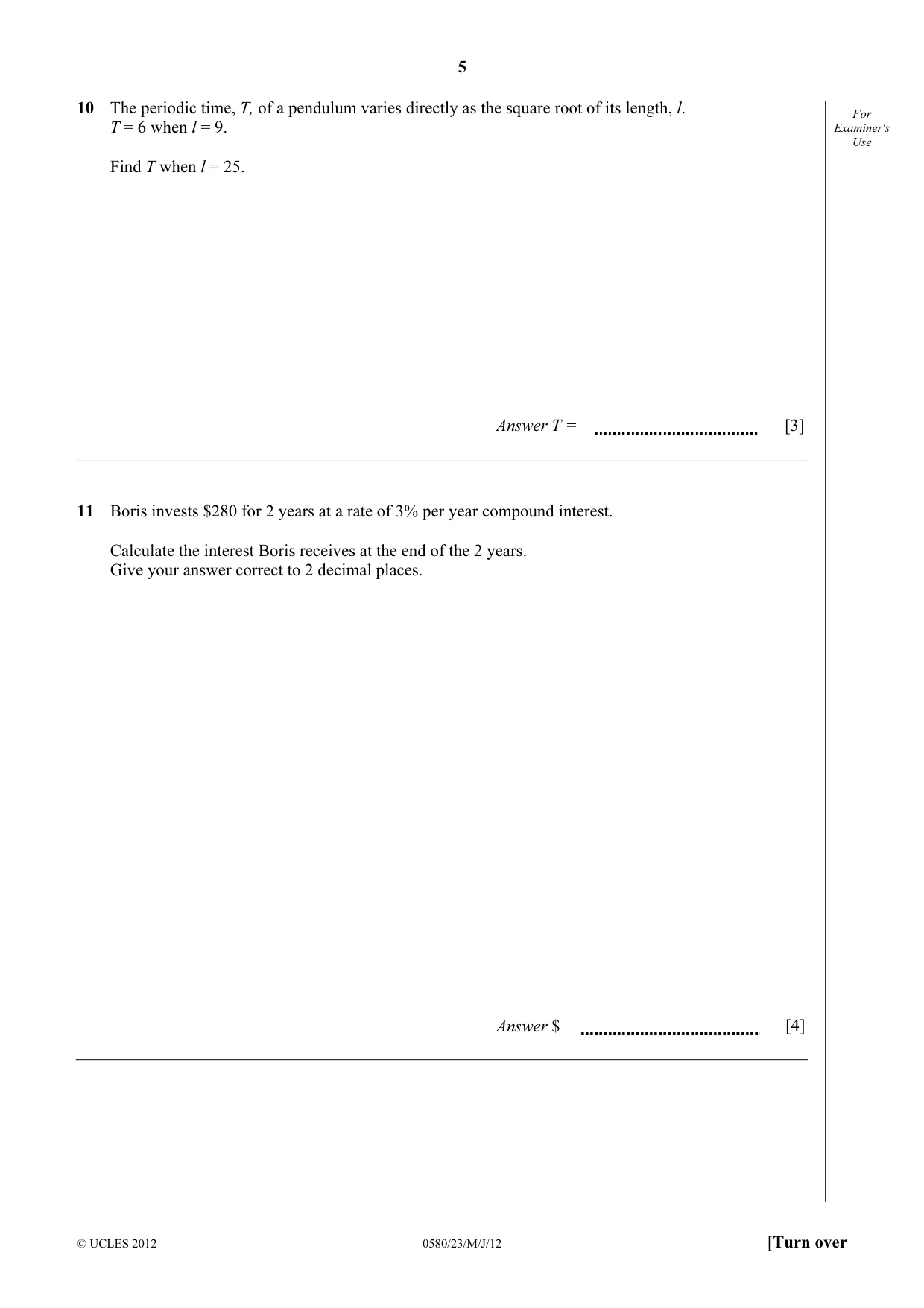
Q10 · The periodic time, T, of a pendulum varies directly as the square root of its length, l
10 The periodic time, T, of a pendulum varies directly as the square root of its length, l. For T = 6 when l = 9. Examiner's Use Find T when l = 25. Answer T = [3]
Mark scheme: 10 10 3 M1 T = k√l A1 for k = 2
Q11 · Boris invests $280 for 2 years at a rate of 3% per year compound interest
11 Boris invests $280 for 2 years at a rate of 3% per year compound interest. Calculate the interest Boris receives at the end of the 2 years. Give your answer correct to 2 decimal places. Answer $ [4]
Mark scheme: 11 17.05 cao www 4 3 M1 for 280 × (1 + )2 oe 100 k M1 subtracting 280 from 280(1 + )2 any k 100 A1 for 17.052 or SC2 297.05 on answer line IGCSE – May/June 2012 0580 23
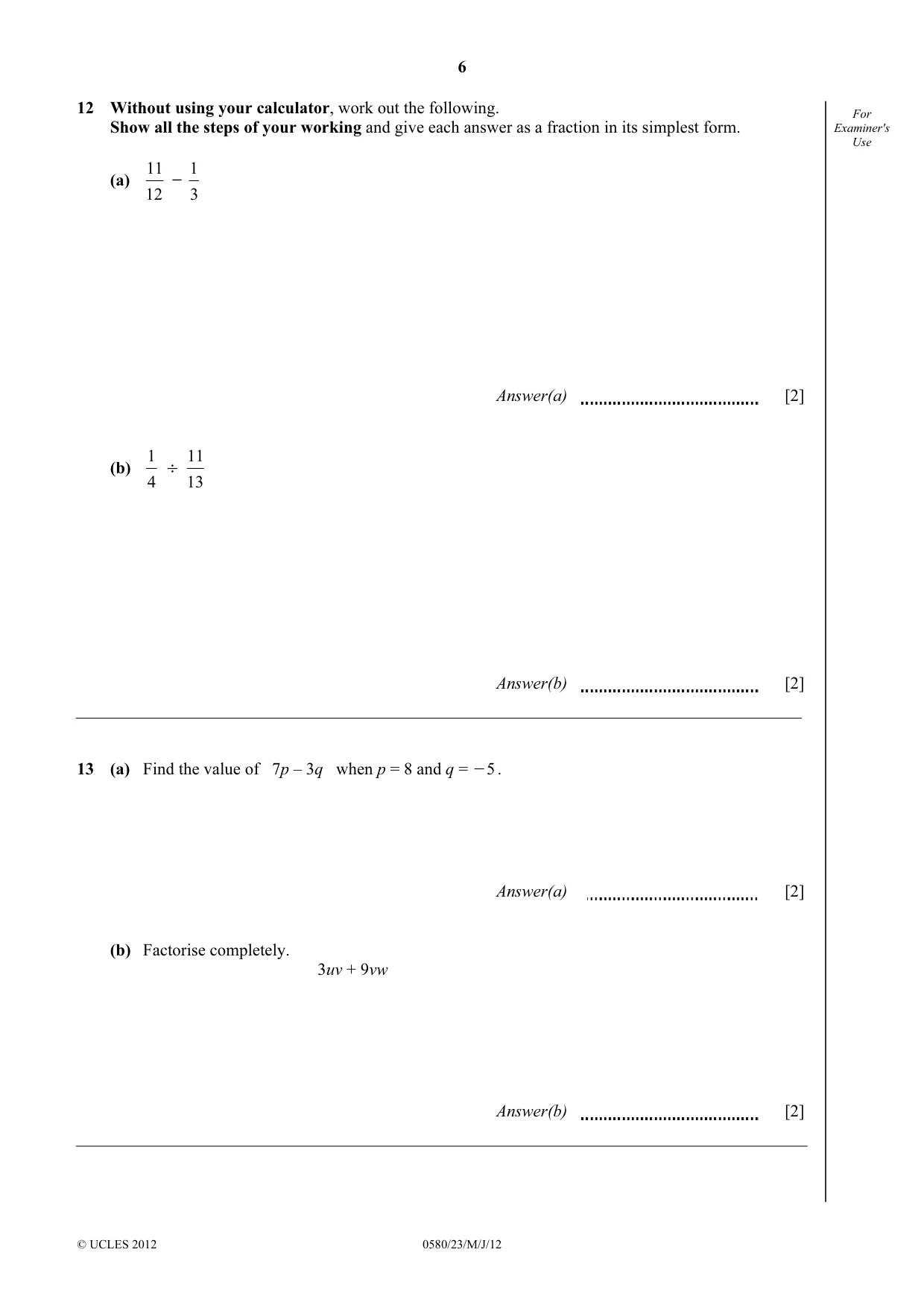
Q12 · Without using your calculator, work out the following
12 Without using your calculator, work out the following. For Show all the steps of your working and give each answer as a fraction in its simplest form. Examiner's Use 11 1 (a) − 12 3 Answer(a) [2] 1 11 (b) ÷ 4 13 Answer(b) [2]
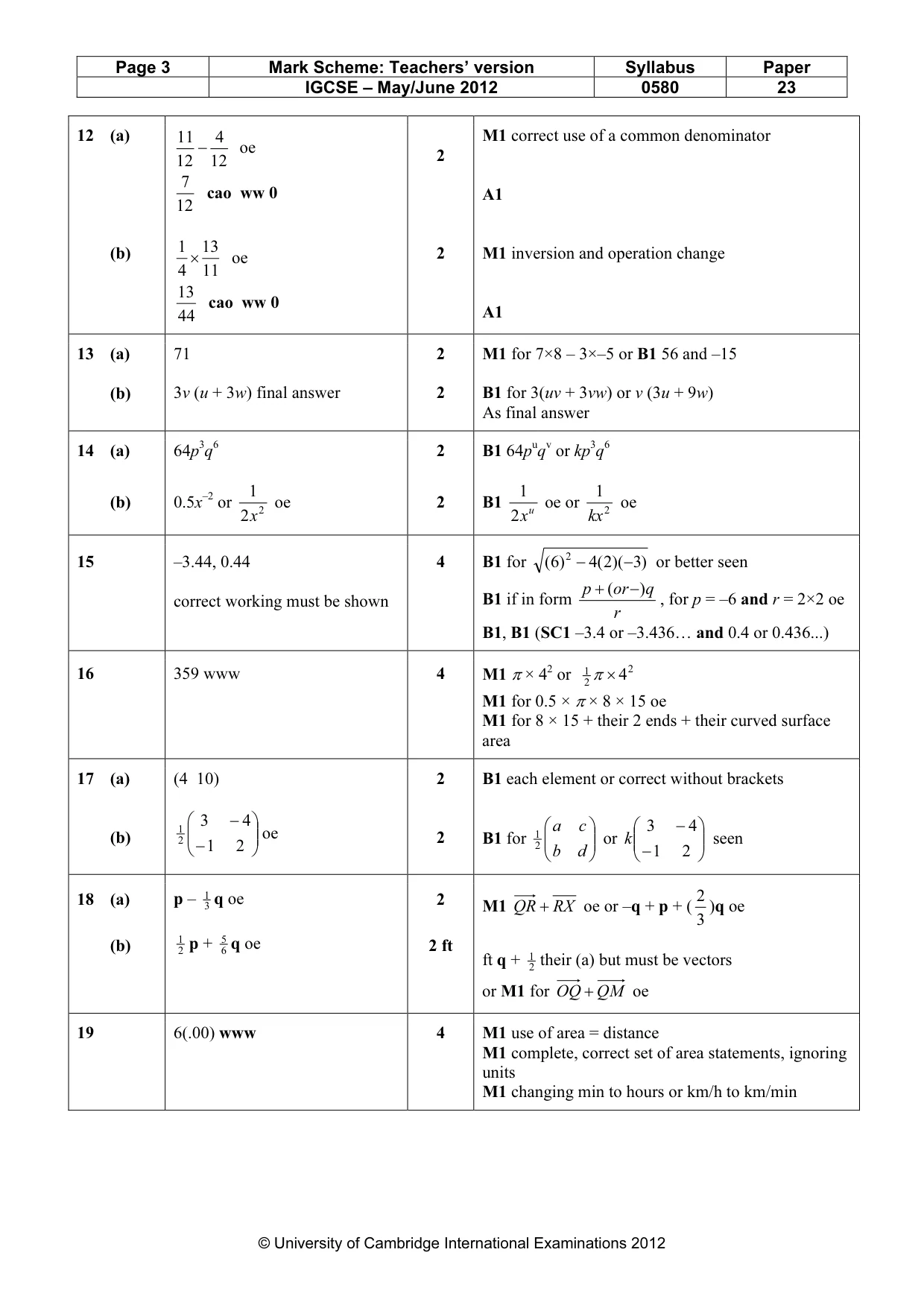
Mark scheme: 12 (a) M1 correct use of a common denominator 11 4 − oe 2 12 12 7 cao ww 0 A1 12 13 (b) 1 2 M1 inversion and operation change × oe 4 11 13 cao ww 0 A1 44
Q13 · Find the value of 7p – 3q when p = 8 and q = O5
13 (a) Find the value of 7p – 3q when p = 8 and q = O5 . Answer(a) [2] (b) Factorise completely. 3uv + 9vw Answer(b) [2]
Mark scheme: 13 (a) 71 2 M1 for 7×8 – 3×–5 or B1 56 and –15 (b) 3v (u + 3w) final answer 2 B1 for 3(uv + 3vw) or v (3u + 9w) As final answer
Question 14
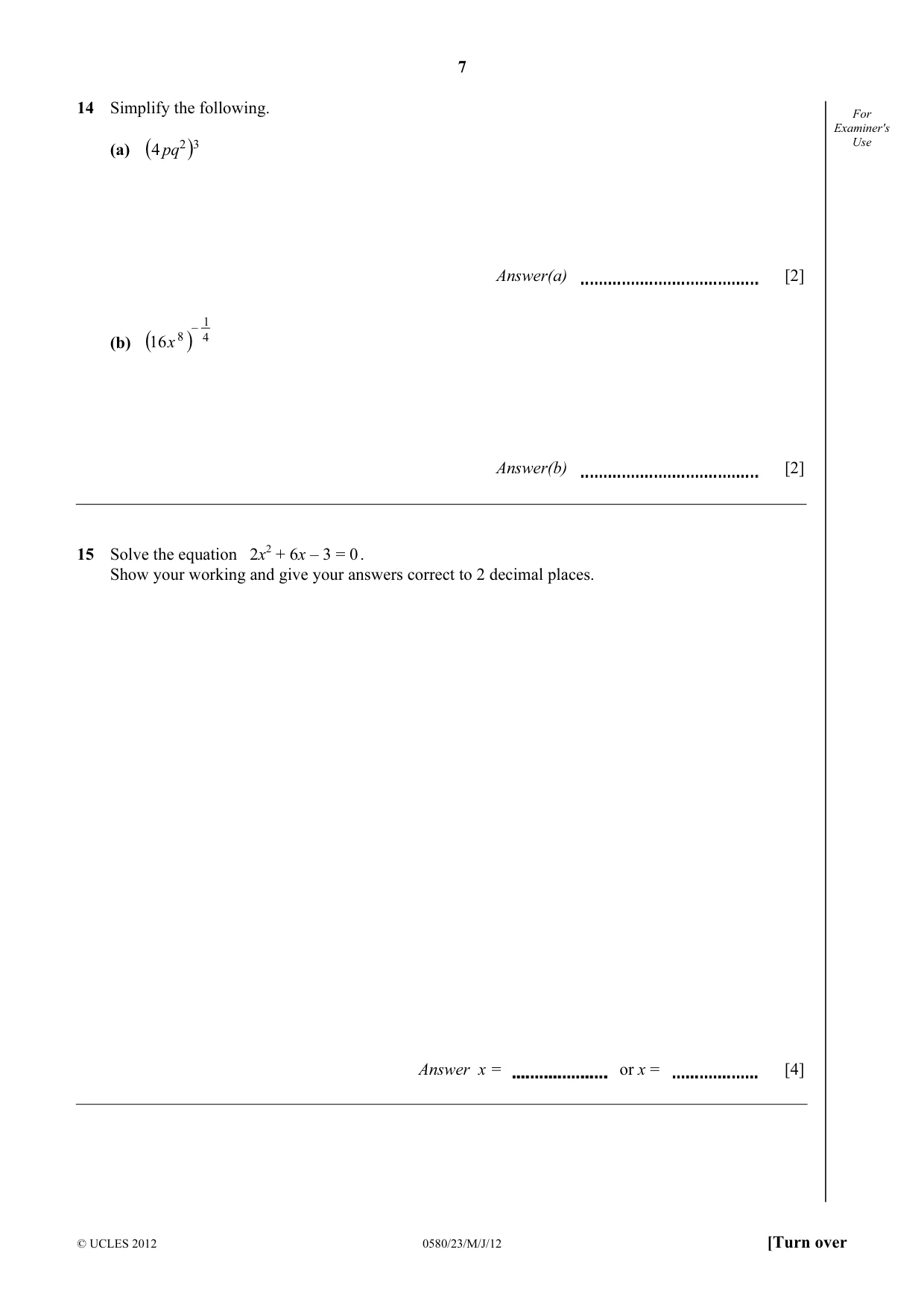
14 Simplify the following. For Examiner's 2 Use (a) (4pq )3 Answer(a) [2] 1 − (b) (16 x 8 ) 4 Answer(b) [2]
Mark scheme: 14 (a) 64p3q6 2 B1 64puqv or kp3q6 1 1 1 (b) 0.5x–2 or 2 oe 2 B1 u oe or 2 oe 2 x 2 x kx
Q15 · Solve the equation 2x2 + 6x – 3 = 0
15 Solve the equation 2x2 + 6x – 3 = 0 . Show your working and give your answers correct to 2 decimal places. Answer x = or x = [4]
Mark scheme: 15 –3.44, 0.44 4 B1 for ( 6) 2 − 4( 2)( −3) or better seen p + ( or − ) q B1 if in form , for p = –6 and r = 2×2 oe correct working must be shown r B1, B1 (SC1 –3.4 or –3.436… and 0.4 or 0.436...)
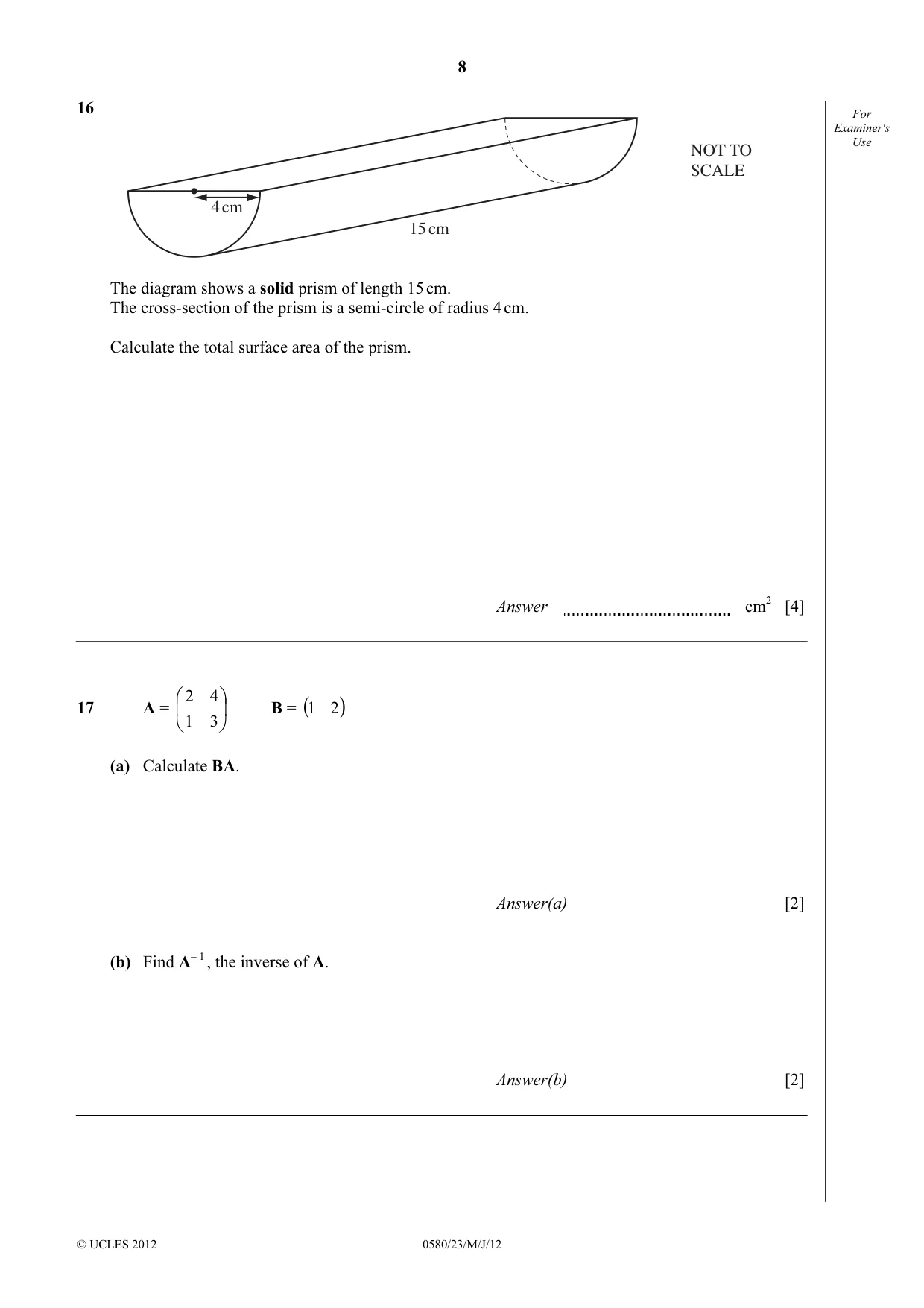
Q16 · For Examiner's NOT TO Use SCALE 4 cm 15 cm The diagram shows a solid prism of length 15 cm
16 For Examiner's NOT TO Use SCALE 4 cm 15 cm The diagram shows a solid prism of length 15 cm. The cross-section of the prism is a semi-circle of radius 4 cm. Calculate the total surface area of the prism. Answer cm2 [4]
Mark scheme: 16 359 www 4 M1 π × 42 or 12 π × 4 2 M1 for 0.5 × π × 8 × 15 oe M1 for 8 × 15 + their 2 ends + their curved surface area
Q17 · 2 4 17 A = B = (1 2 ) 1 3 (a) Calculate BA
2 4 17 A = B = (1 2 ) 1 3 (a) Calculate BA. Answer(a) [2] (b) Find A– 1 , the inverse of A. Answer(b) [2]
Mark scheme: 17 (a) (4 10) 2 B1 each element or correct without brackets 3 − 4 1 a c 3 − 4 seen (b) 2 oe 2 B1 for 12 or k b d − 1 2 − 1 2
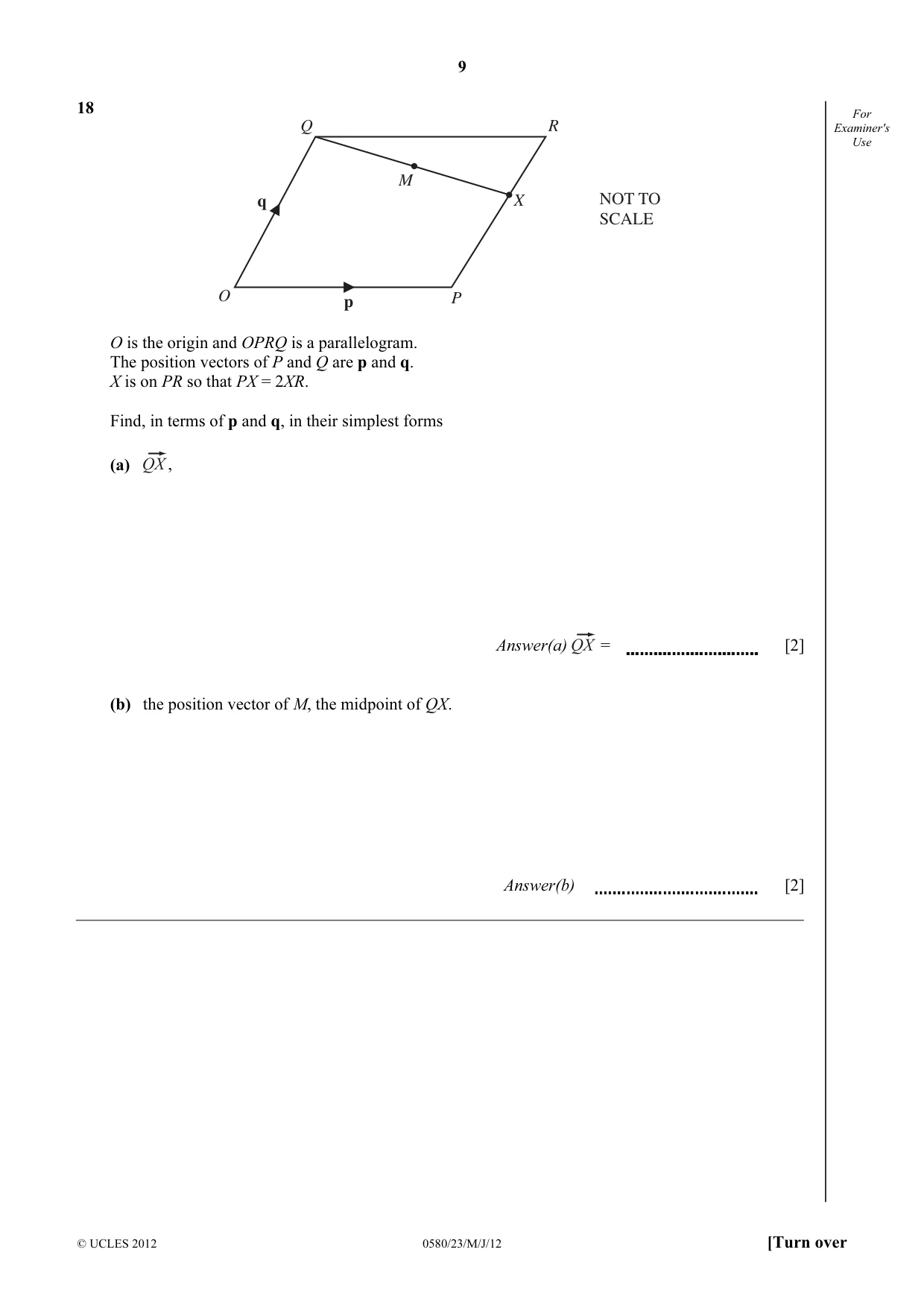
Q18 · For Q R Examiner's Use M NOT TO q X SCALE O p P O is the origin and OPRQ is a…
18 For Q R Examiner's Use M NOT TO q X SCALE O p P O is the origin and OPRQ is a parallelogram. The position vectors of P and Q are p and q. X is on PR so that PX = 2XR. Find, in terms of p and q, in their simplest forms (a) , Answer(a) = [2] (b) the position vector of M, the midpoint of QX. Answer(b) [2]
Mark scheme: 18 (a) p – 13 q oe 2 M1 QR + RX oe or –q + p + ( 2 )q oe 3 (b) 1 2 p + 56 q oe 2 ft ft q + 12 their (a) but must be vectors or M1 for OQ + QM oe
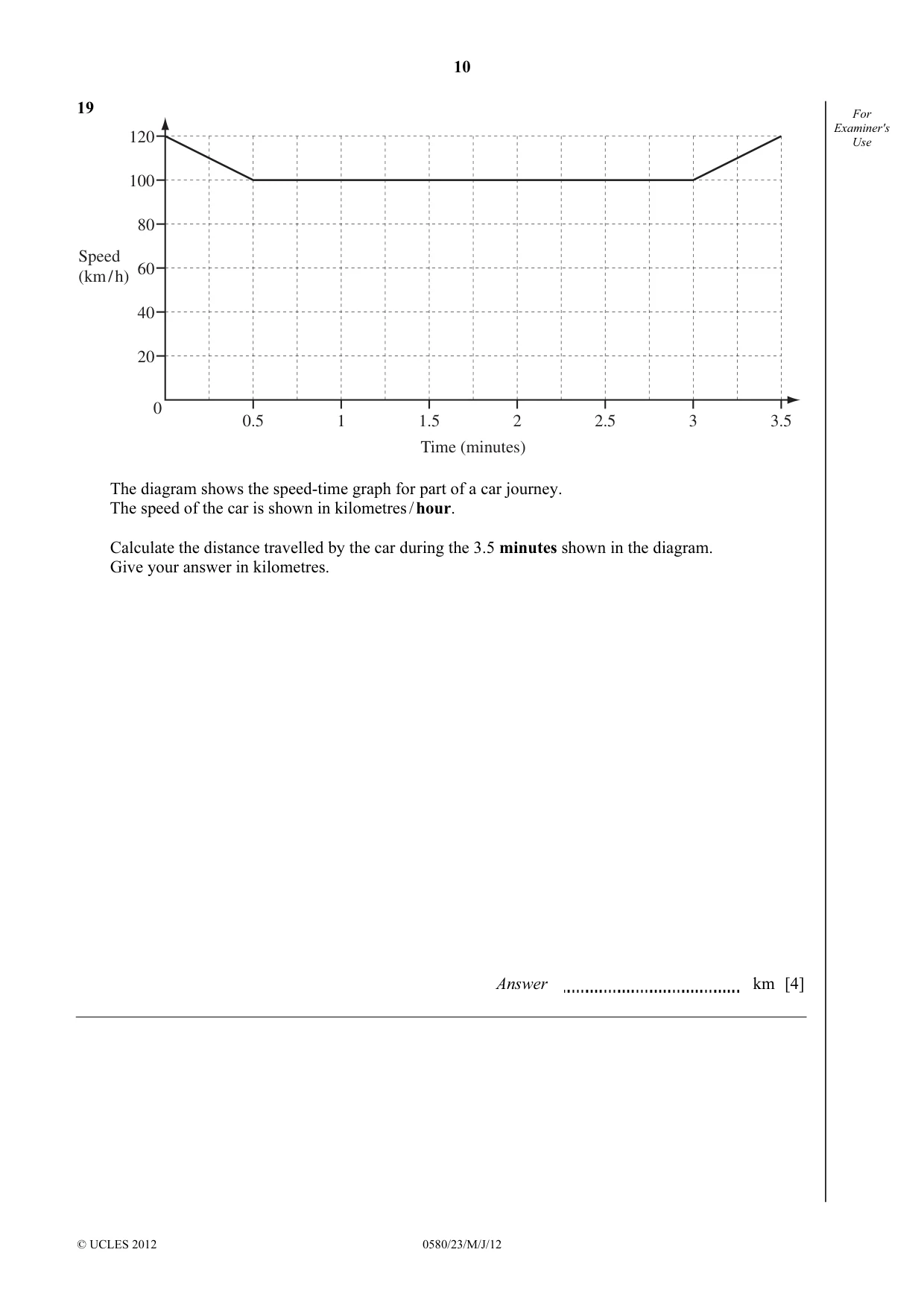
Q19 · For 120 Examiner's Use 100 80 Speed 60(km / h) 40 20 0 0.5 1 1.5 2 2.5 3 3.5 Time…
19 For 120 Examiner's Use 100 80 Speed 60(km / h) 40 20 0 0.5 1 1.5 2 2.5 3 3.5 Time (minutes) The diagram shows the speed-time graph for part of a car journey. The speed of the car is shown in kilometres / hour. Calculate the distance travelled by the car during the 3.5 minutes shown in the diagram. Give your answer in kilometres. Answer km [4]
Mark scheme: 19 6(.00) www 4 M1 use of area = distance M1 complete, correct set of area statements, ignoring units M1 changing min to hours or km/h to km/min IGCSE – May/June 2012 0580 23
Question 20
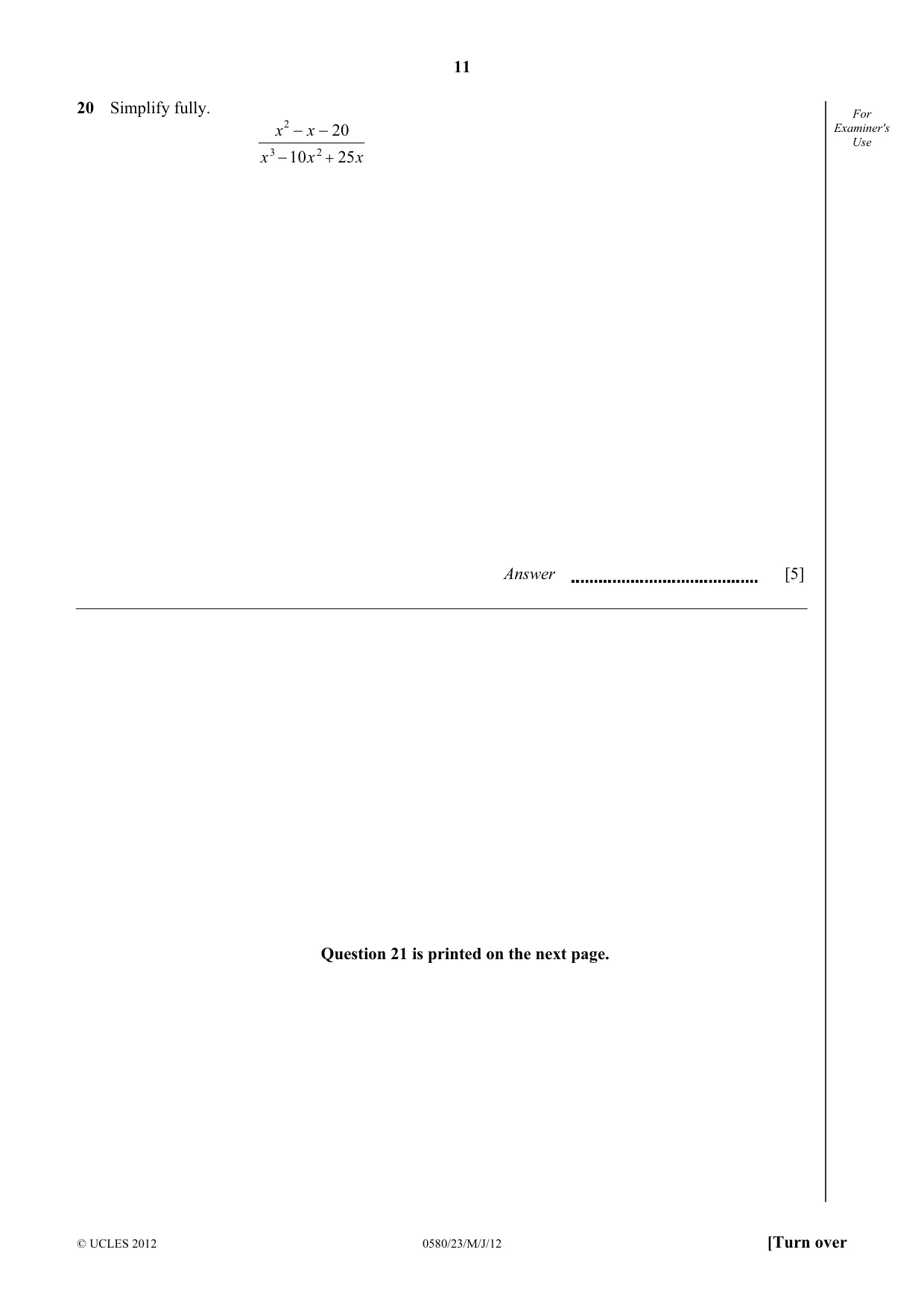
20 Simplify fully. For x 2 − x − 20 Examiner's Use x 3 − 10 x 2 + 25 x Answer [5] Question 21 is printed on the next page.
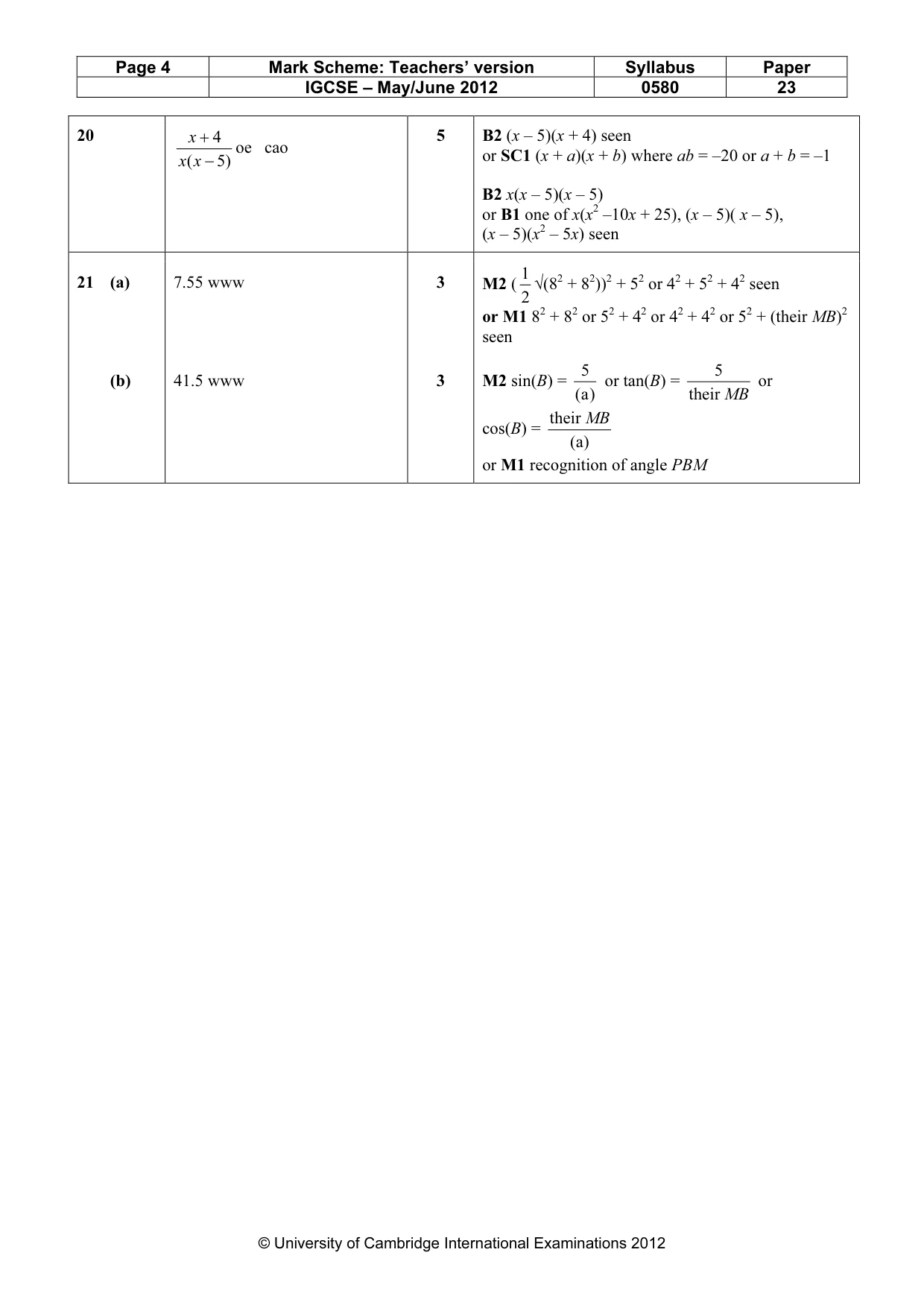
Mark scheme: 20 5 B2 (x – 5)(x + 4) seen x + 4 oe cao or SC1 (x + a)(x + b) where ab = –20 or a + b = –1 x ( x − 5) B2 x(x – 5)(x – 5) or B1 one of x(x2 –10x + 25), (x – 5)( x – 5), (x – 5)(x2 – 5x) seen 1
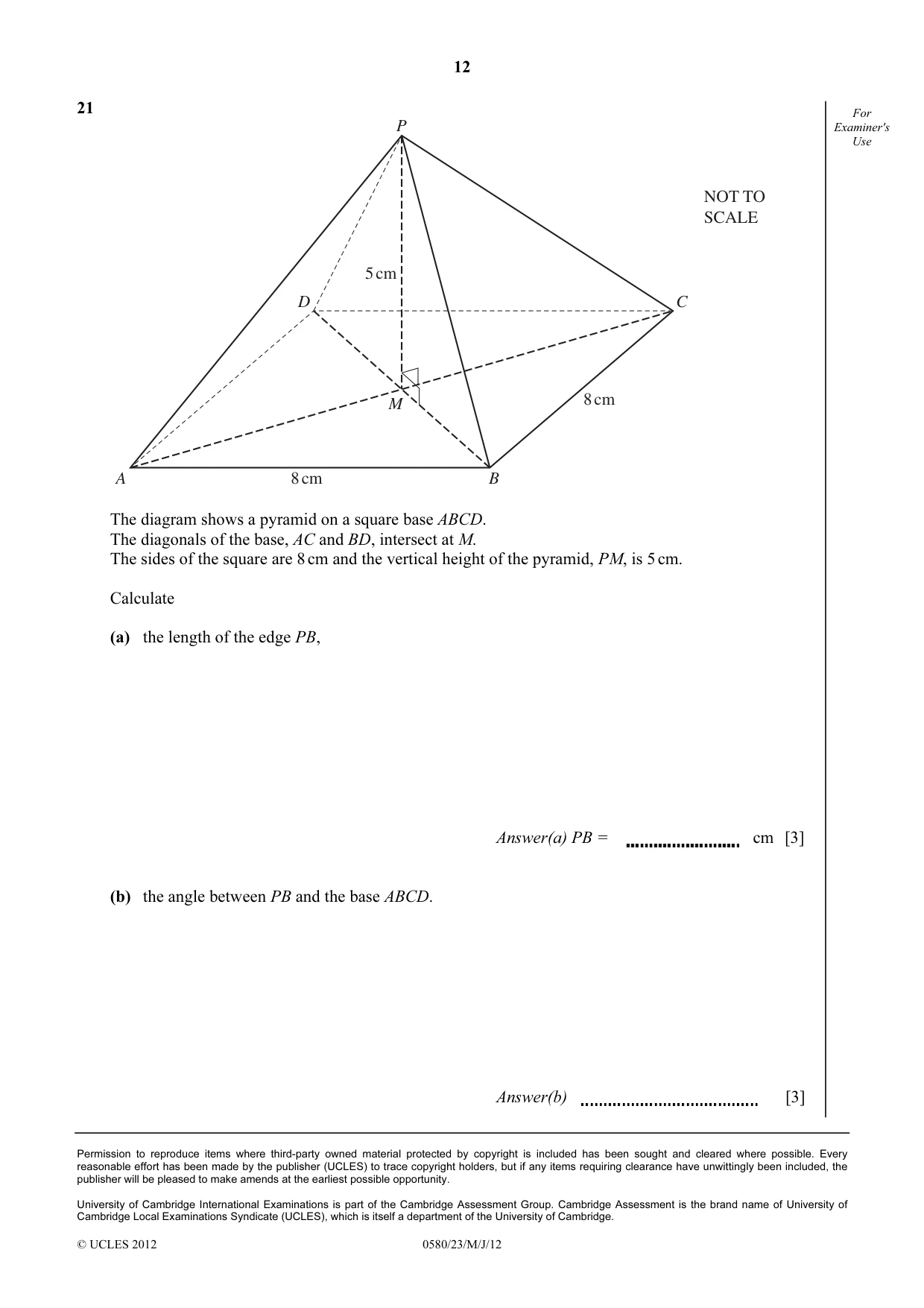
Q21 · For P Examiner's Use NOT TO SCALE 5 cm D C 8 cm M A 8 cm B The diagram shows a pyramid on…
21 For P Examiner's Use NOT TO SCALE 5 cm D C 8 cm M A 8 cm B The diagram shows a pyramid on a square base ABCD. The diagonals of the base, AC and BD, intersect at M. The sides of the square are 8 cm and the vertical height of the pyramid, PM, is 5 cm. Calculate (a) the length of the edge PB, Answer(a) PB = cm [3] (b) the angle between PB and the base ABCD. Answer(b) [3]
Mark scheme: 1 21 (a) 7.55 www 3 M2 ( √(82 + 82))2 + 52 or 42 + 52 + 42 seen 2 or M1 82 + 82 or 52 + 42 or 42 + 42 or 52 + (their MB)2 seen 5 5 (b) 41.5 www 3 M2 sin(B) = or tan(B) = or a( ) their MB their MB cos(B) = (a) or M1 recognition of angle PBM
What was in this paper
The subtopics covered by these 21 questions, and how many questions each got. Open one in a new tab to see every Cambridge question on it.
2Rates2Vectors in two dimensions2Algebraic fractions1Angles1Equations1Fractions, decimals and percentages1Indices I1Inequalities1Limits of accuracy1Money1Non-right-angled triangles1Percentages1Powers and roots1Proportion1Pythagoras’ theorem1Statistical charts and diagrams1Surface area and volume1What you needed in this session
Cambridge’s own grade thresholds for 2012 May/June, Paper 2 · Variant 3. A higher threshold means an easier paper — the bar moves with how the cohort did.