Cambridge IGCSE Mathematics 0580 — 2011 May/June Paper 2 · Variant 3
0580/23/M/J/11 · 21 questions · 70 marks · ≈79 min
The question paper and its mark scheme, free to read here and free to download. This is Cambridge’s own paper, exactly as it was sat.
Question paper12 pages
Mark scheme4 pages
Answers below. Sit the paper first if you are practising.
Questions as text
Question 1
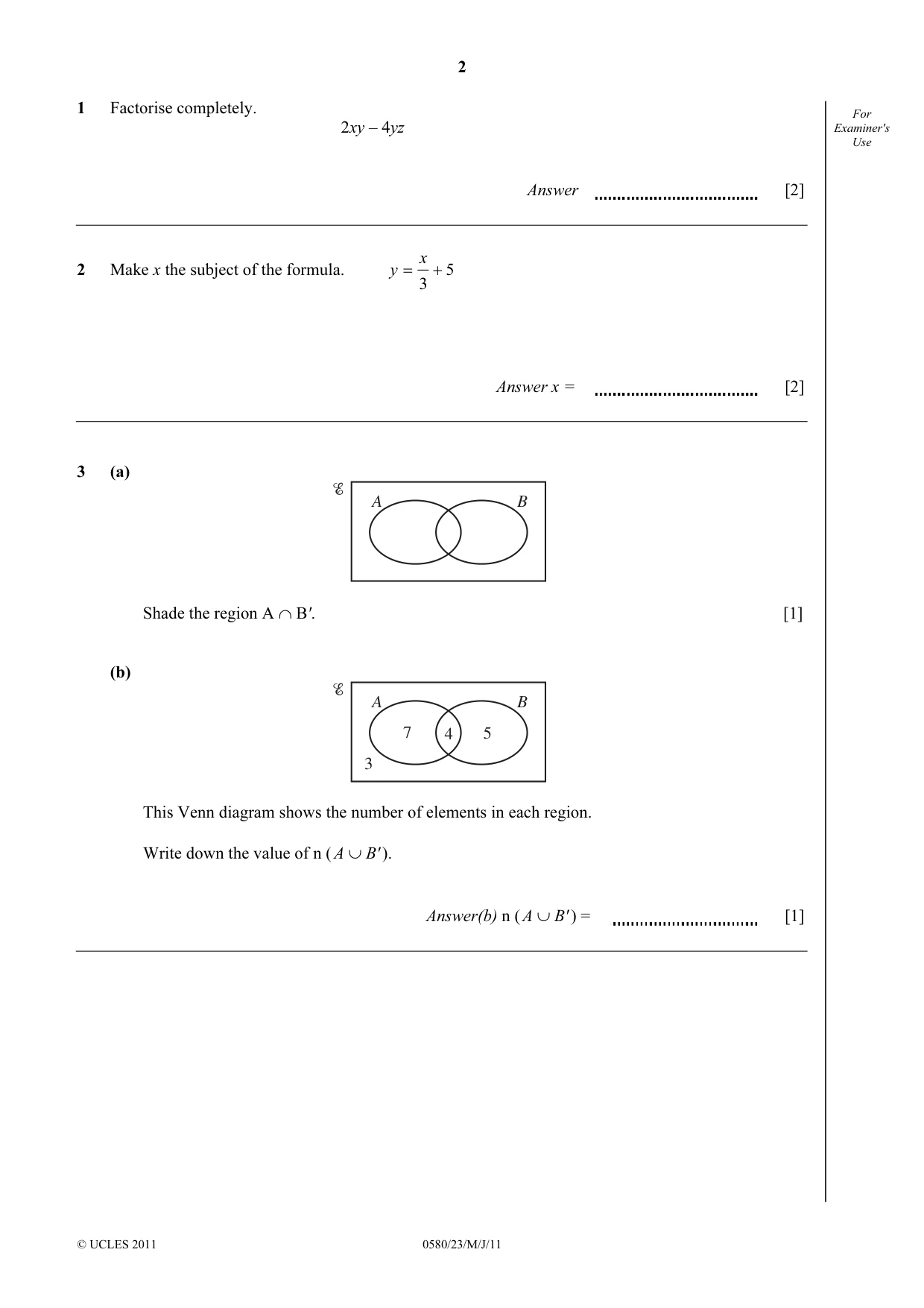
1 Factorise completely. For 2xy – 4yz Examiner's Use Answer [2]
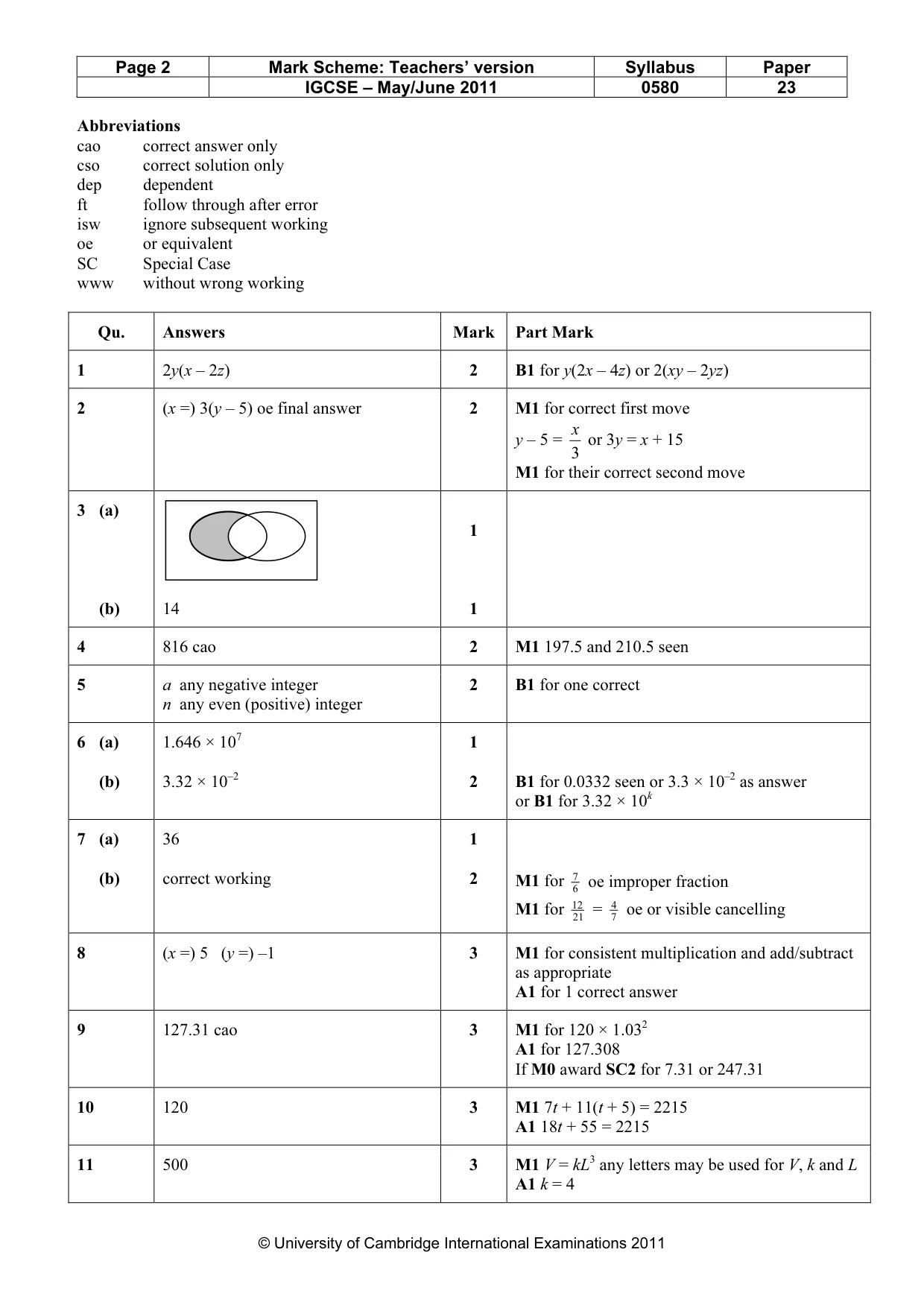
Mark scheme: Qu. Answers Mark Part Mark 1 2y(x – 2z) 2 B1 for y(2x – 4z) or 2(xy – 2yz)
Q2 · X 2 Make x the subject of the formula
x 2 Make x the subject of the formula. y = + 5 3 Answer x = [2]
Mark scheme: 2 (x =) 3(y – 5) oe final answer 2 M1 for correct first move x y – 5 = or 3y = x + 15 3 M1 for their correct second move
Q3 · A B Shade the region A ∩ B'
3 (a) A B Shade the region A ∩ B'. [1] (b) A B 7 4 5 3 This Venn diagram shows the number of elements in each region. Write down the value of n ( A ∪ B' ). Answer(b) n ( A ∪ B' ) = [1]
Mark scheme: 3 (a) 1 (b) 14 1
Q4 · Helen measures a rectangular sheet of paper as 197 mm by 210 mm, each correct to the…
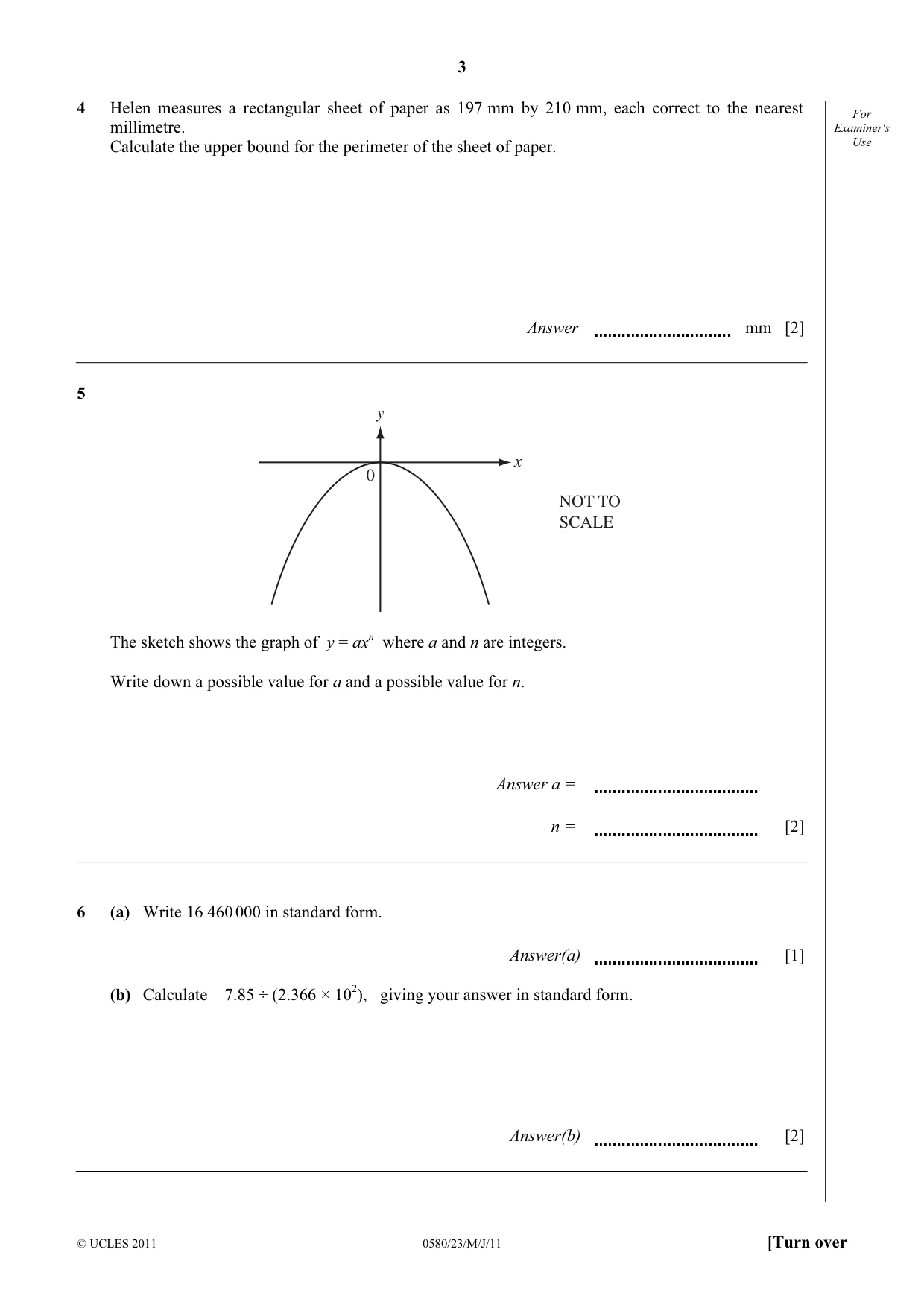
4 Helen measures a rectangular sheet of paper as 197 mm by 210 mm, each correct to the nearest For millimetre. Examiner's Calculate the upper bound for the perimeter of the sheet of paper. Use Answer mm [2]
Mark scheme: 4 816 cao 2 M1 197.5 and 210.5 seen
Q5 · Y x 0 NOT TO SCALE The sketch shows the graph of y = axn where a and n are integers
5 y x 0 NOT TO SCALE The sketch shows the graph of y = axn where a and n are integers. Write down a possible value for a and a possible value for n. Answer a = n = [2]
Mark scheme: 5 a any negative integer 2 B1 for one correct n any even (positive) integer
Q6 · Write 16 460 000 in standard form
6 (a) Write 16 460 000 in standard form. Answer(a) [1] (b) Calculate 7.85 ÷ (2.366 × 10²), giving your answer in standard form. Answer(b) [2]
Mark scheme: 6 (a) 1.646 × 10⁷ 1 (b) 3.32 × 10⁻² 2 B1 for 0.0332 seen or 3.3 × 10⁻² as answer or B1 for 3.32 × 10k
Q7 · 27 For 7 (a) Find the value of x when =
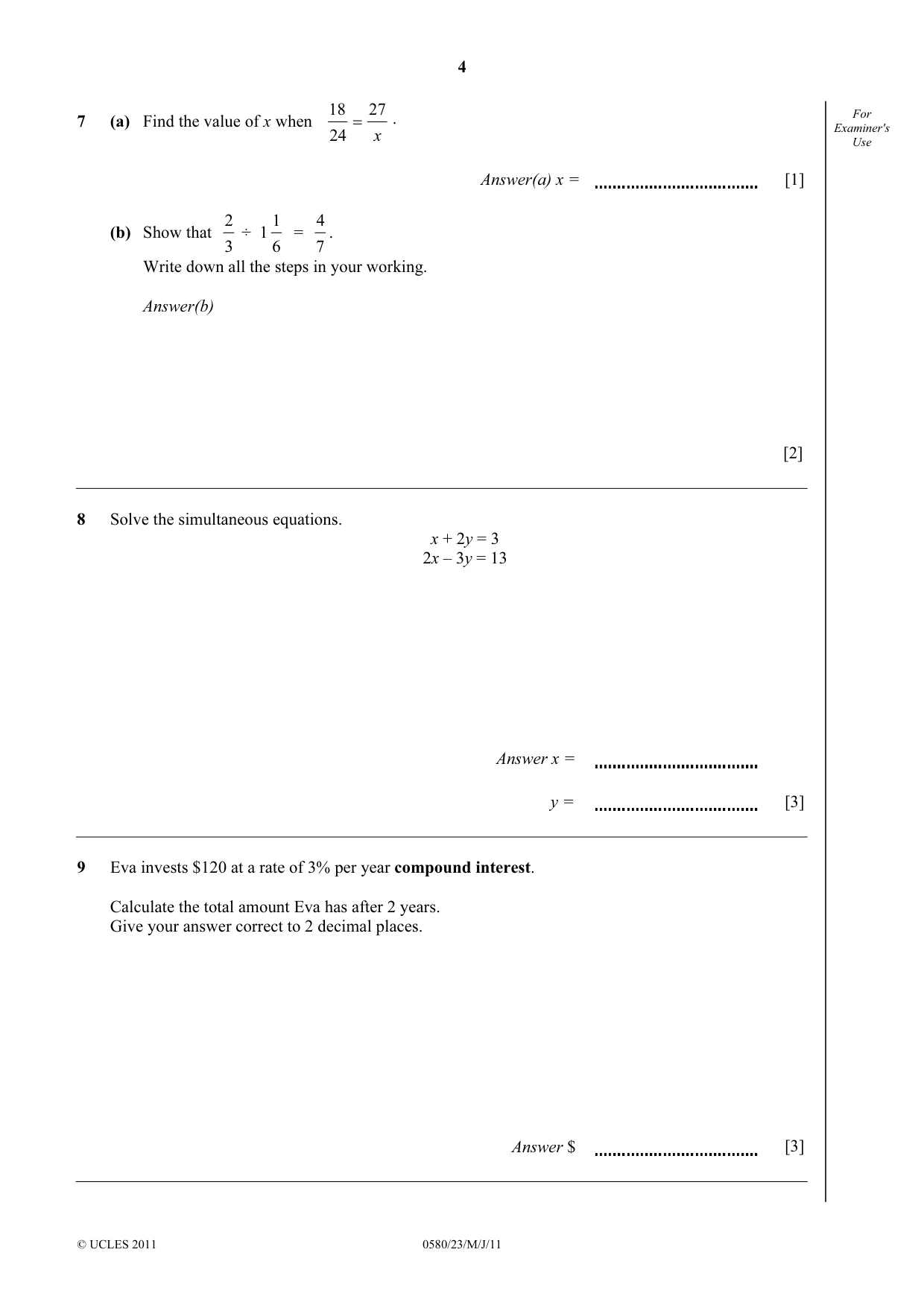
18 27 For 7 (a) Find the value of x when = . Examiner's 24 x Use Answer(a) x = [1] 2 1 4 (b) Show that ÷ 1 = . 3 6 7 Write down all the steps in your working. Answer(b) [2]
Mark scheme: 7 (a) 36 1 7 (b) correct working 2 M1 for 6 oe improper fraction M1 for 1221 = 74 oe or visible cancelling
Q8 · Solve the simultaneous equations
8 Solve the simultaneous equations. x + 2y = 3 2x – 3y = 13 Answer x = y = [3]
Mark scheme: 8 (x =) 5 (y =) –1 3 M1 for consistent multiplication and add/subtract as appropriate A1 for 1 correct answer
Q9 · Eva invests $120 at a rate of 3% per year compound interest
9 Eva invests $120 at a rate of 3% per year compound interest. Calculate the total amount Eva has after 2 years. Give your answer correct to 2 decimal places. Answer $ [3]
Mark scheme: 9 127.31 cao 3 M1 for 120 × 1.032 A1 for 127.308 If M0 award SC2 for 7.31 or 247.31
Q10 · The cost of a cup of tea is t cents
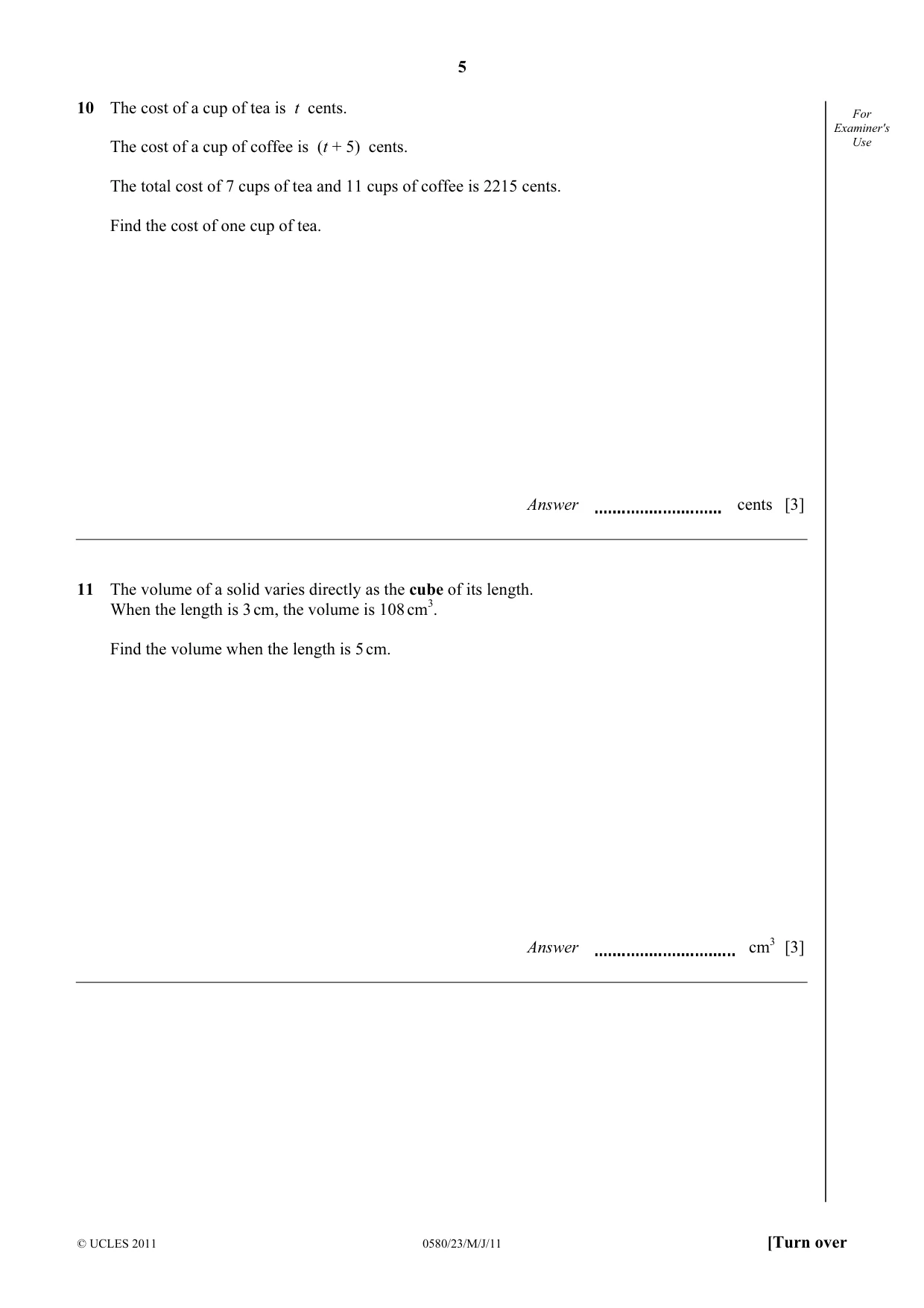
10 The cost of a cup of tea is t cents. For Examiner's The cost of a cup of coffee is (t + 5) cents. Use The total cost of 7 cups of tea and 11 cups of coffee is 2215 cents. Find the cost of one cup of tea. Answer cents [3]
Mark scheme: 10 120 3 M1 7t + 11(t + 5) = 2215 A1 18t + 55 = 2215
Q11 · The volume of a solid varies directly as the cube of its length
11 The volume of a solid varies directly as the cube of its length. When the length is 3 cm, the volume is 108 cm3. Find the volume when the length is 5 cm. Answer cm3 [3]
Mark scheme: 11 500 3 M1 V = kL3 any letters may be used for V, k and L A1 k = 4 IGCSE – May/June 2011 0580 23
Q12 · Federico changed 400 euros (€) into New Zealand dollars (NZ$) at a rate of €1 = NZ$ 2.1
12 Federico changed 400 euros (€) into New Zealand dollars (NZ$) at a rate of €1 = NZ$ 2.1 . For He spent x New Zealand dollars and changed the rest back into euros at a rate of €1 = NZ$ d. Examiner's Use Find an expression, in terms of x and d, for the number of euros Federico received. Answer € [3]
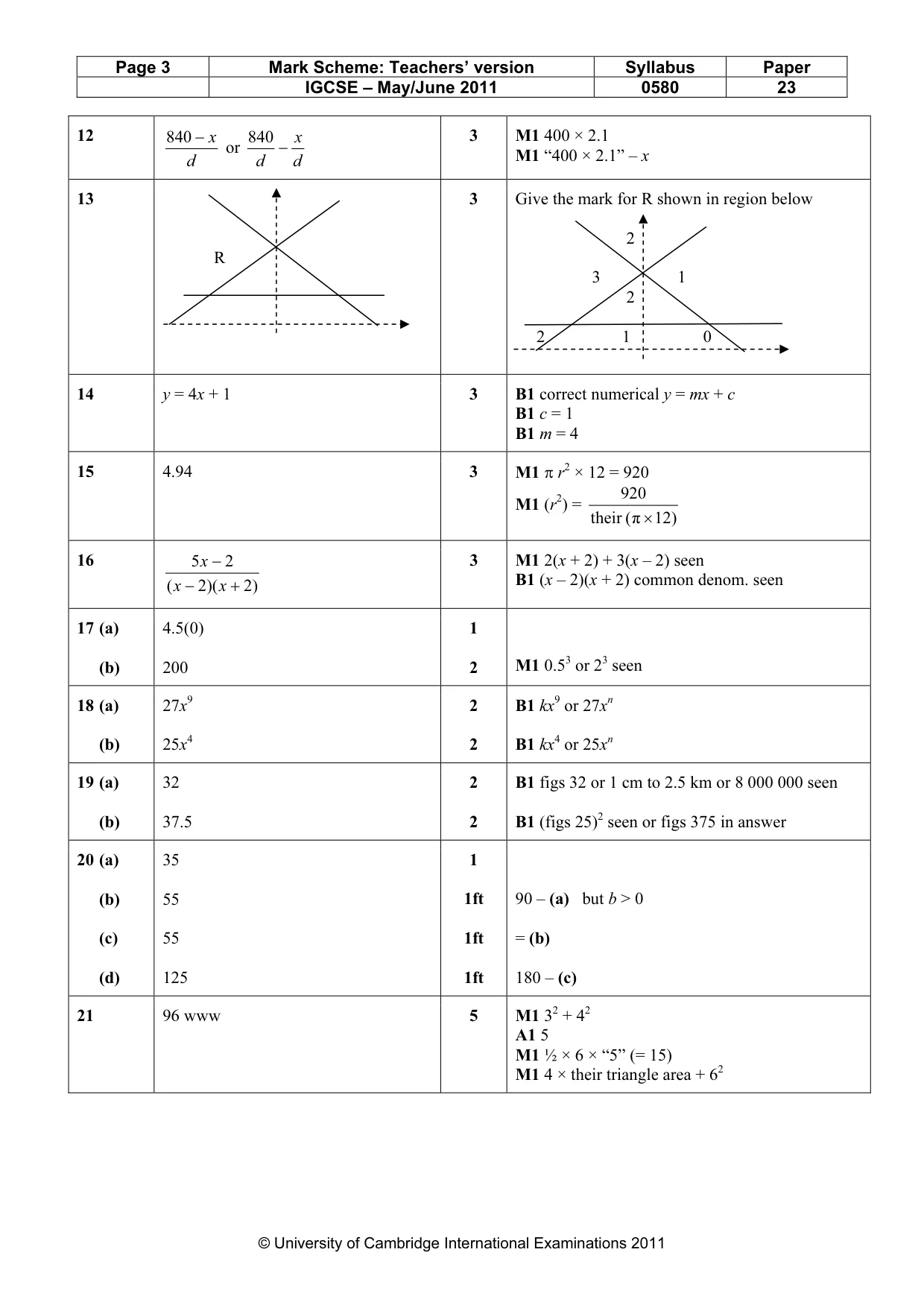
Mark scheme: 12 840 − x 840 x 3 M1 400 × 2.1 − or M1 “400 × 2.1” – x d d d
Q13 · Y NOT TO SCALE x 0 The diagram shows the lines y = 1, y = x + 4 and y = 4 – x
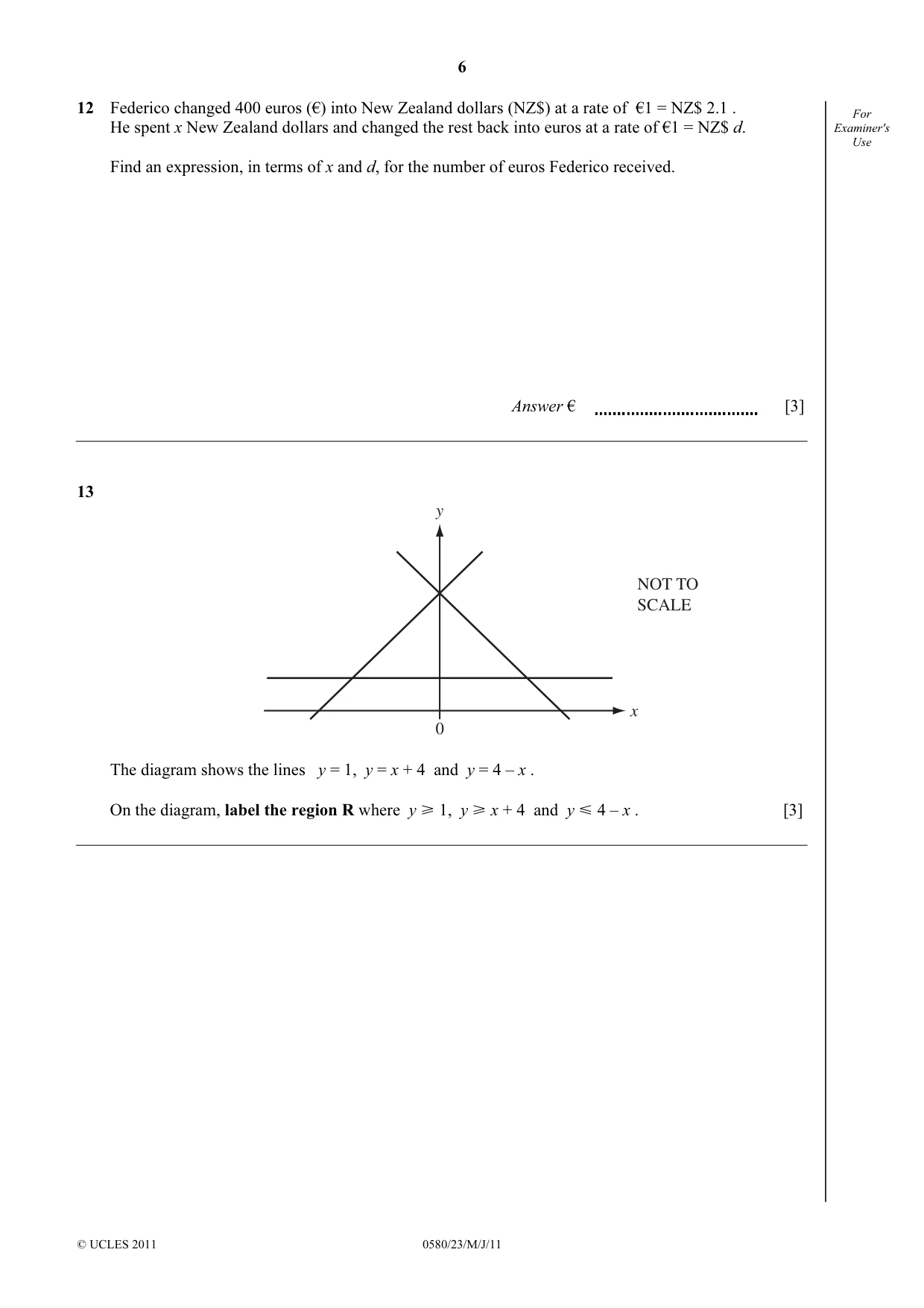
13 y NOT TO SCALE x 0 The diagram shows the lines y = 1, y = x + 4 and y = 4 – x . On the diagram, label the region R where y [ 1, y [ x + 4 and y Y 4 – x . [3]
Mark scheme: 13 3 Give the mark for R shown in region below 2 R 3 1 2 2 1 0
Q14 · For y Examiner's Use 13 NOT TO SCALE 1 x 0 3 The diagram shows the straight line which…
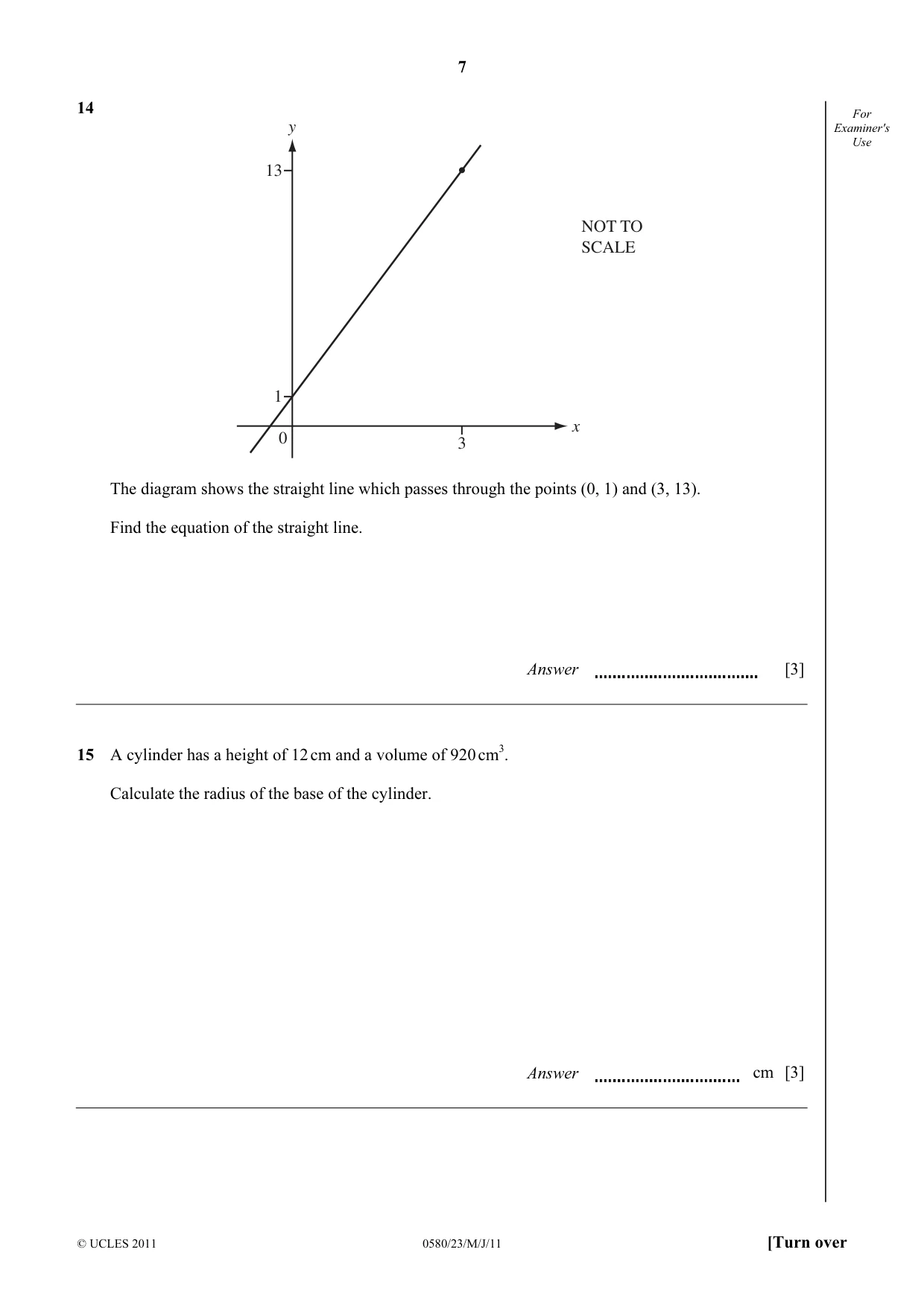
14 For y Examiner's Use 13 NOT TO SCALE 1 x 0 3 The diagram shows the straight line which passes through the points (0, 1) and (3, 13). Find the equation of the straight line. Answer [3]
Mark scheme: 14 y = 4x + 1 3 B1 correct numerical y = mx + c B1 c = 1 B1 m = 4
Q15 · A cylinder has a height of 12 cm and a volume of 920 cm3
15 A cylinder has a height of 12 cm and a volume of 920 cm3. Calculate the radius of the base of the cylinder. Answer cm [3]
Mark scheme: 15 4.94 3 M1 π r2 × 12 = 920 920 M1 (r2) = their ( π × 12)
Q16 · 3 For 16 Write + as a single fraction
2 3 For 16 Write + as a single fraction. Examiner's x − 2 x + 2 Use Give your answer in its simplest form. Answer [3]
Mark scheme: 16 5 x − 2 3 M1 2(x + 2) + 3(x – 2) seen B1 (x – 2)(x + 2) common denom. seen ( x − 2)( x + 2)
Q17 · NOT TO SCALE 20 cm 10 cm 9 cm d cm The diagrams show two mathematically similar containers
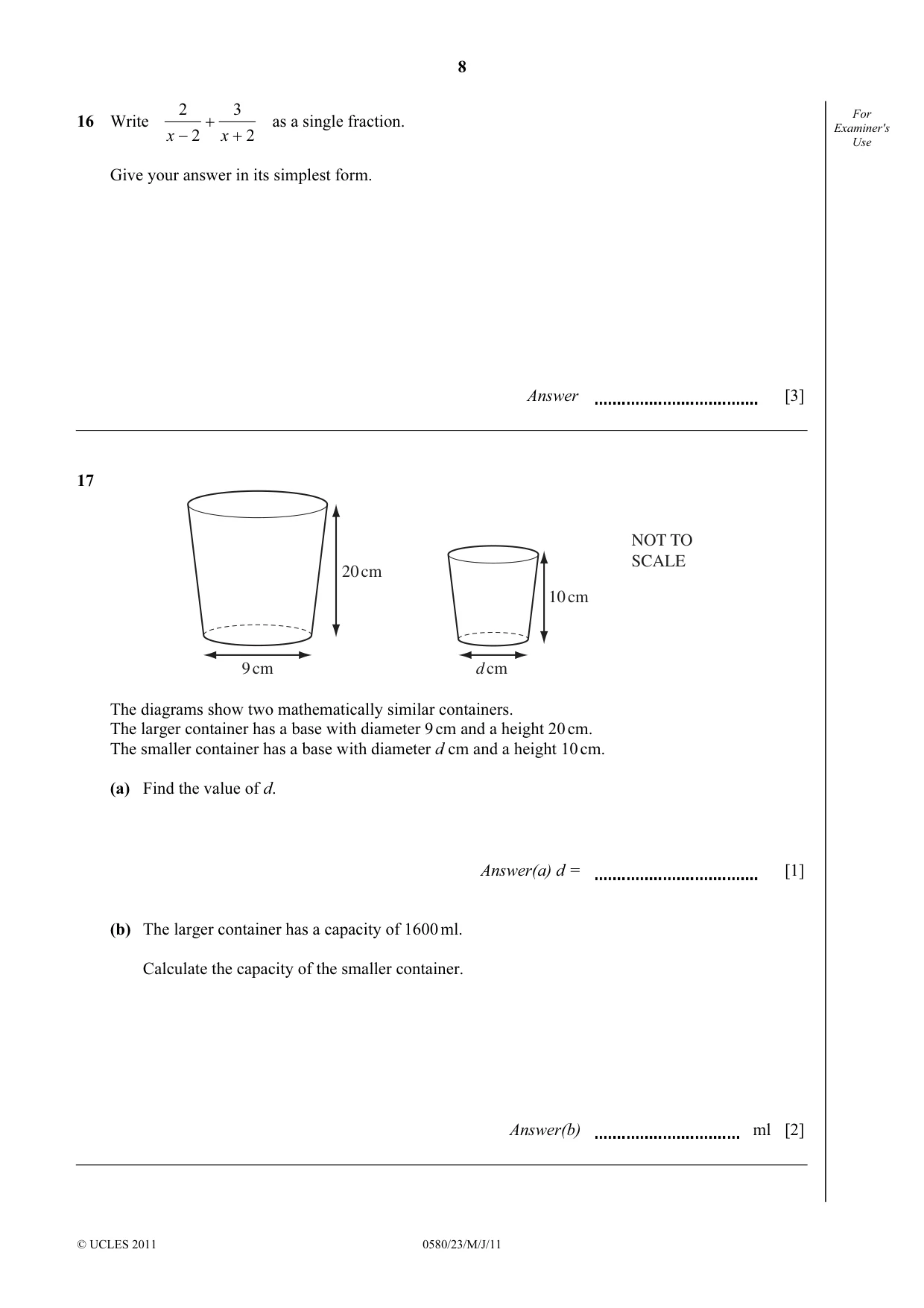
17 NOT TO SCALE 20 cm 10 cm 9 cm d cm The diagrams show two mathematically similar containers. The larger container has a base with diameter 9 cm and a height 20 cm. The smaller container has a base with diameter d cm and a height 10 cm. (a) Find the value of d. Answer(a) d = [1] (b) The larger container has a capacity of 1600 ml. Calculate the capacity of the smaller container. Answer(b) ml [2]
Mark scheme: 17 (a) 4.5(0) 1 (b) 200 2 M1 0.53 or 23 seen
Question 18
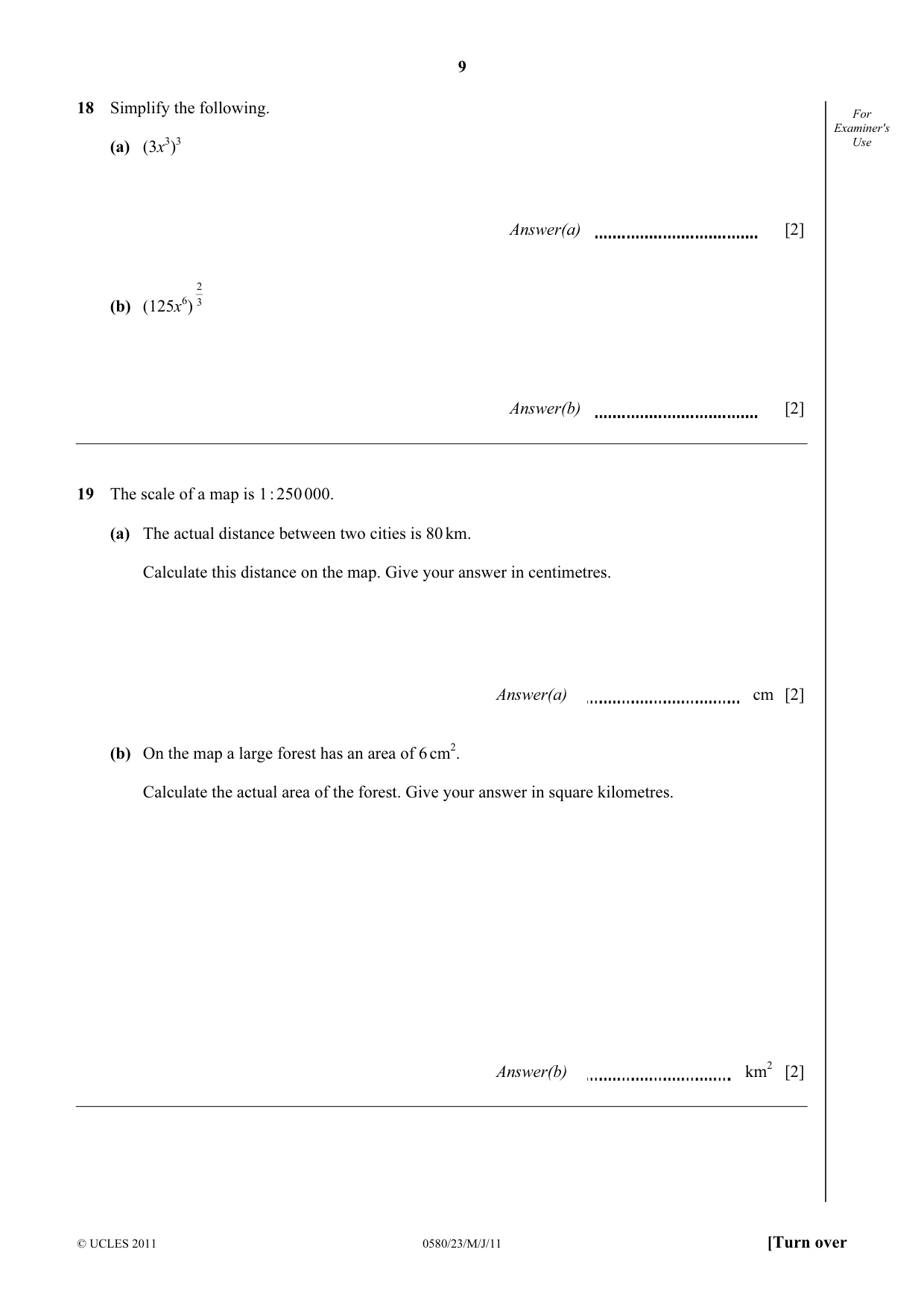
18 Simplify the following. For Examiner's (a) (3x3)3 Use Answer(a) [2] 2 (b) (125x6) 3 Answer(b) [2]
Mark scheme: 18 (a) 27x9 2 B1 kx9 or 27xn (b) 25x4 2 B1 kx4 or 25xn
Q19 · The scale of a map is 1 : 250 000
19 The scale of a map is 1 : 250 000. (a) The actual distance between two cities is 80 km. Calculate this distance on the map. Give your answer in centimetres. Answer(a) cm [2] (b) On the map a large forest has an area of 6 cm2. Calculate the actual area of the forest. Give your answer in square kilometres. Answer(b) km2 [2]
Mark scheme: 19 (a) 32 2 B1 figs 32 or 1 cm to 2.5 km or 8 000 000 seen (b) 37.5 2 B1 (figs 25)2 seen or figs 375 in answer
Q20 · For V Examiner's Use U NOT TO 70° SCALE W g° O h° X e° f ° A T B The diagram shows a…
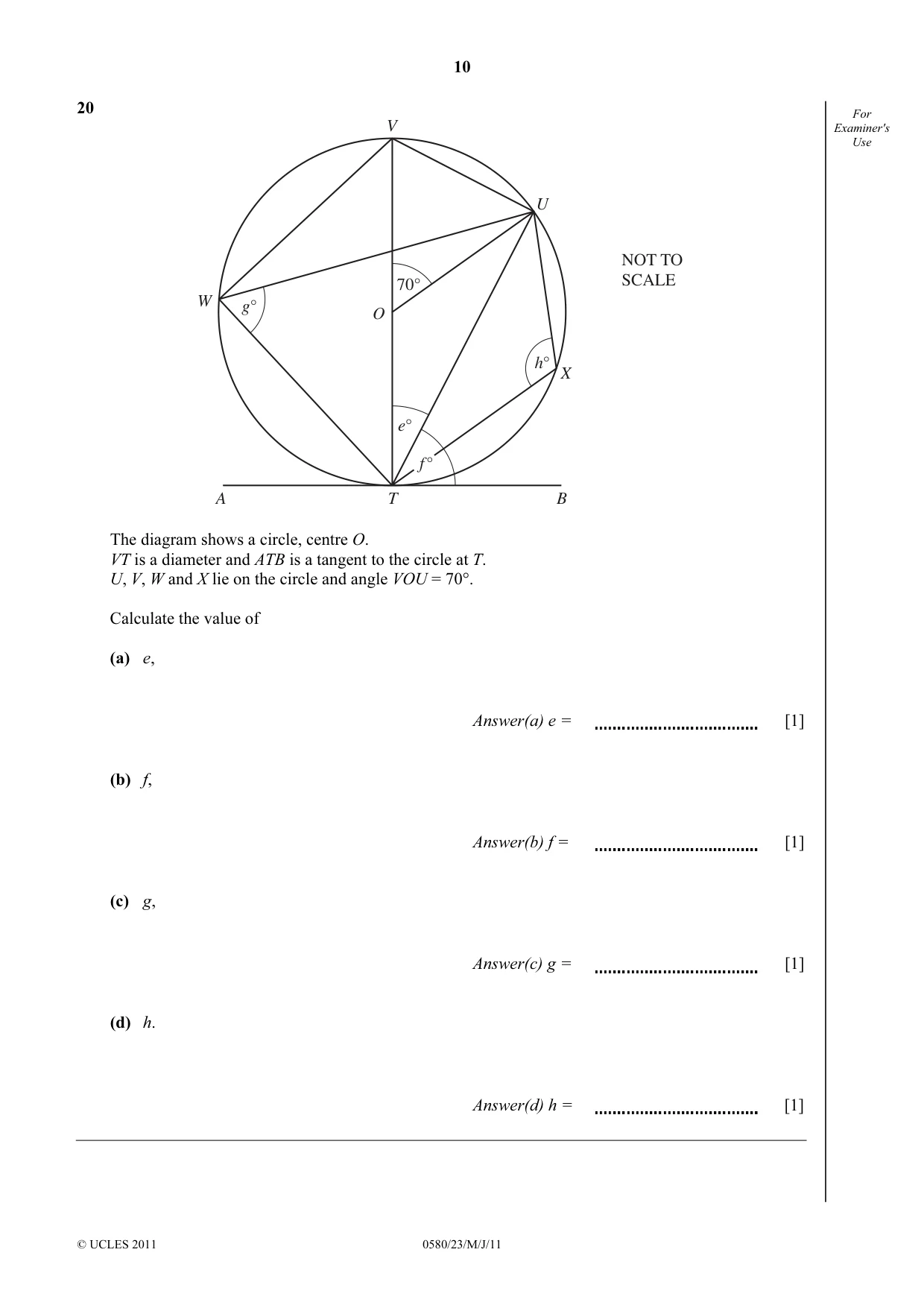
20 For V Examiner's Use U NOT TO 70° SCALE W g° O h° X e° f ° A T B The diagram shows a circle, centre O. VT is a diameter and ATB is a tangent to the circle at T. U, V, W and X lie on the circle and angle VOU = 70°. Calculate the value of (a) e, Answer(a) e = [1] (b) f, Answer(b) f = [1] (c) g, Answer(c) g = [1] (d) h. Answer(d) h = [1]
Mark scheme: 20 (a) 35 1 (b) 55 1ft 90 – (a) but b > 0 (c) 55 1ft = (b) (d) 125 1ft 180 – (c)
Q21 · For P Examiner's Use NOT TO SCALE 4 cm C D 6 cm M A 6 cm B The diagram shows a pyramid…
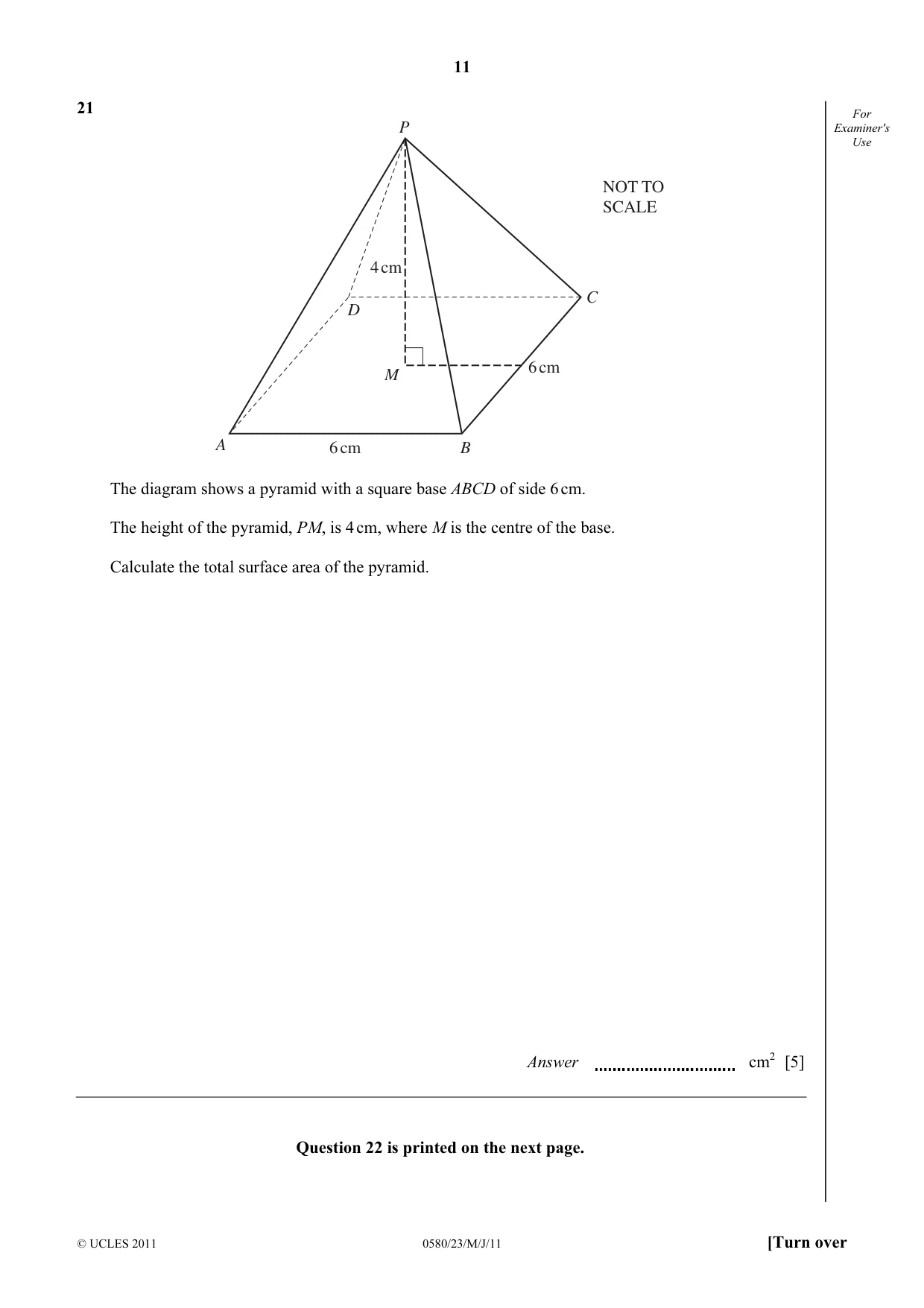
21 For P Examiner's Use NOT TO SCALE 4 cm C D 6 cm M A 6 cm B The diagram shows a pyramid with a square base ABCD of side 6 cm. The height of the pyramid, PM, is 4 cm, where M is the centre of the base. Calculate the total surface area of the pyramid. Answer cm2 [5] Question 22 is printed on the next page.
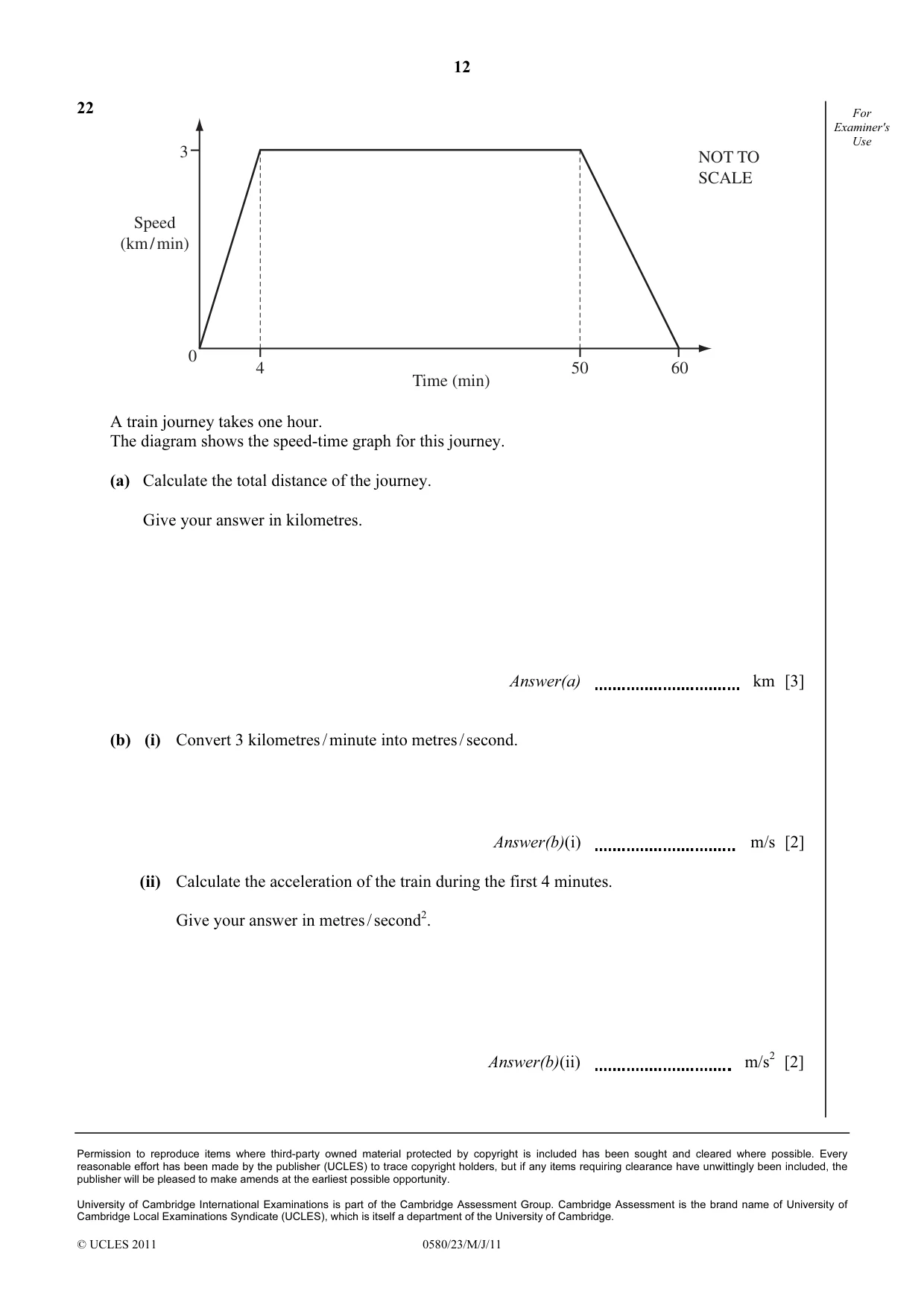
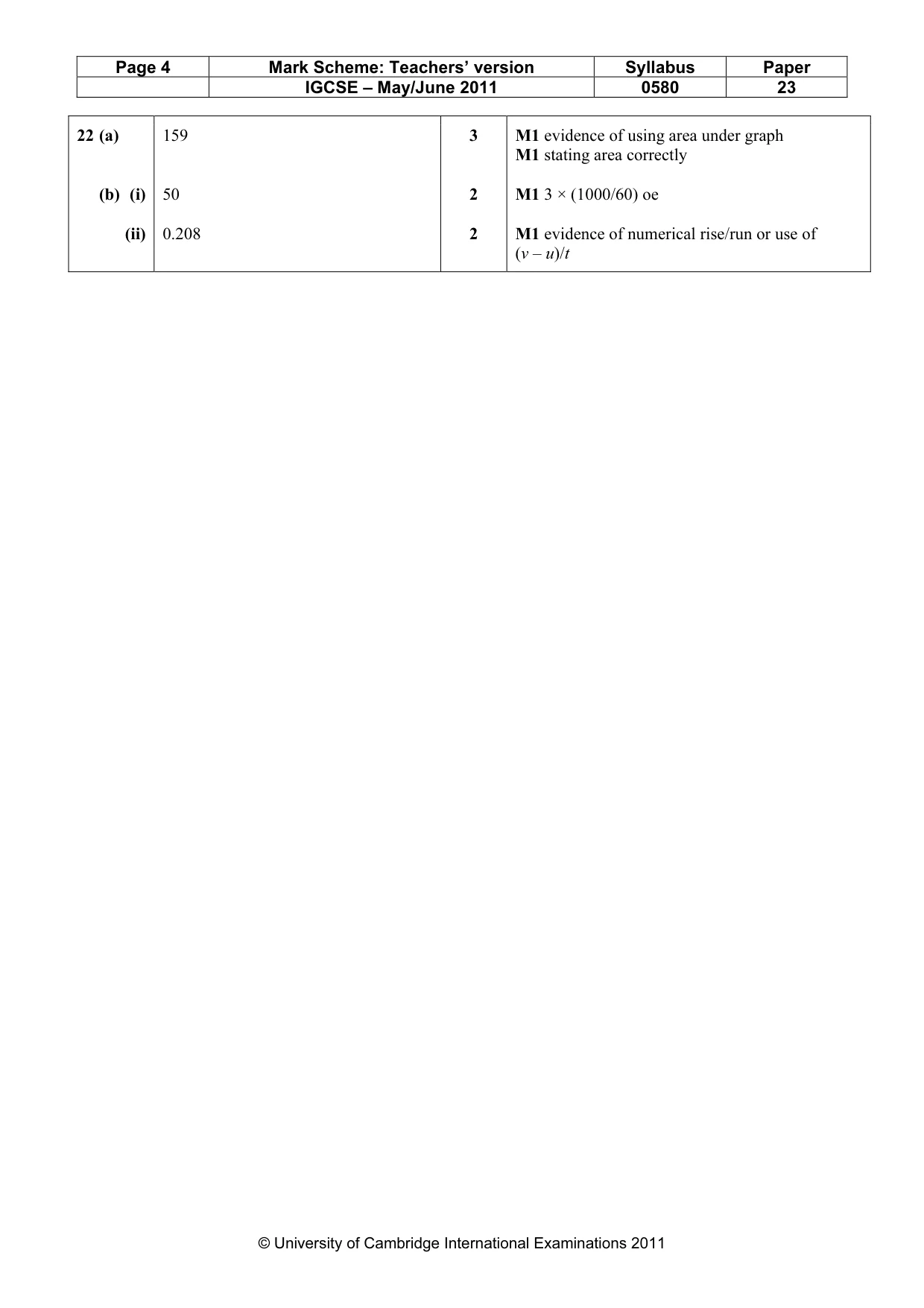
Mark scheme: 21 96 www 5 M1 32 + 42 A1 5 M1 ½ × 6 × “5” (= 15) M1 4 × their triangle area + 62 IGCSE – May/June 2011 0580 23 22 (a) 159 3 M1 evidence of using area under graph M1 stating area correctly
What was in this paper
The subtopics covered by these 21 questions, and how many questions each got. Open one in a new tab to see every Cambridge question on it.
What you needed in this session
Cambridge’s own grade thresholds for 2011 May/June, Paper 2 · Variant 3. A higher threshold means an easier paper — the bar moves with how the cohort did.