Cambridge IGCSE Mathematics 0580 — 2010 May/June Paper 2 · Variant 1
0580/21/M/J/10 · 20 questions · 67 marks · ≈75 min
The question paper and its mark scheme, free to read here and free to download. This is Cambridge’s own paper, exactly as it was sat.
Question paper12 pages
Mark scheme3 pages
Answers below. Sit the paper first if you are practising.
Questions as text
Q1 · Write the numbers in order of size with the smallest first
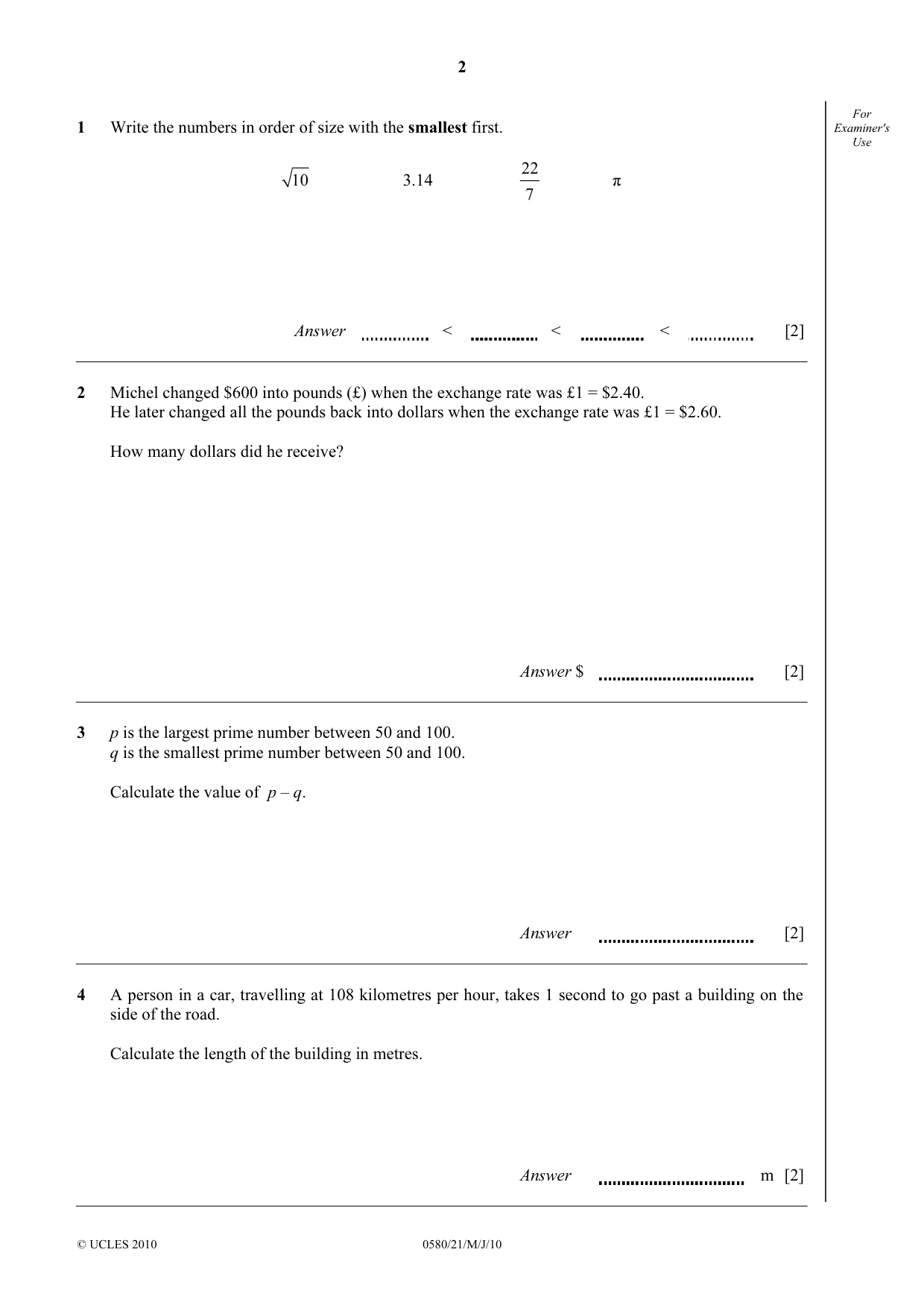
1 Write the numbers in order of size with the smallest first. Examiner's Use 22 10 3.14 π 7 Answer < < < [2]
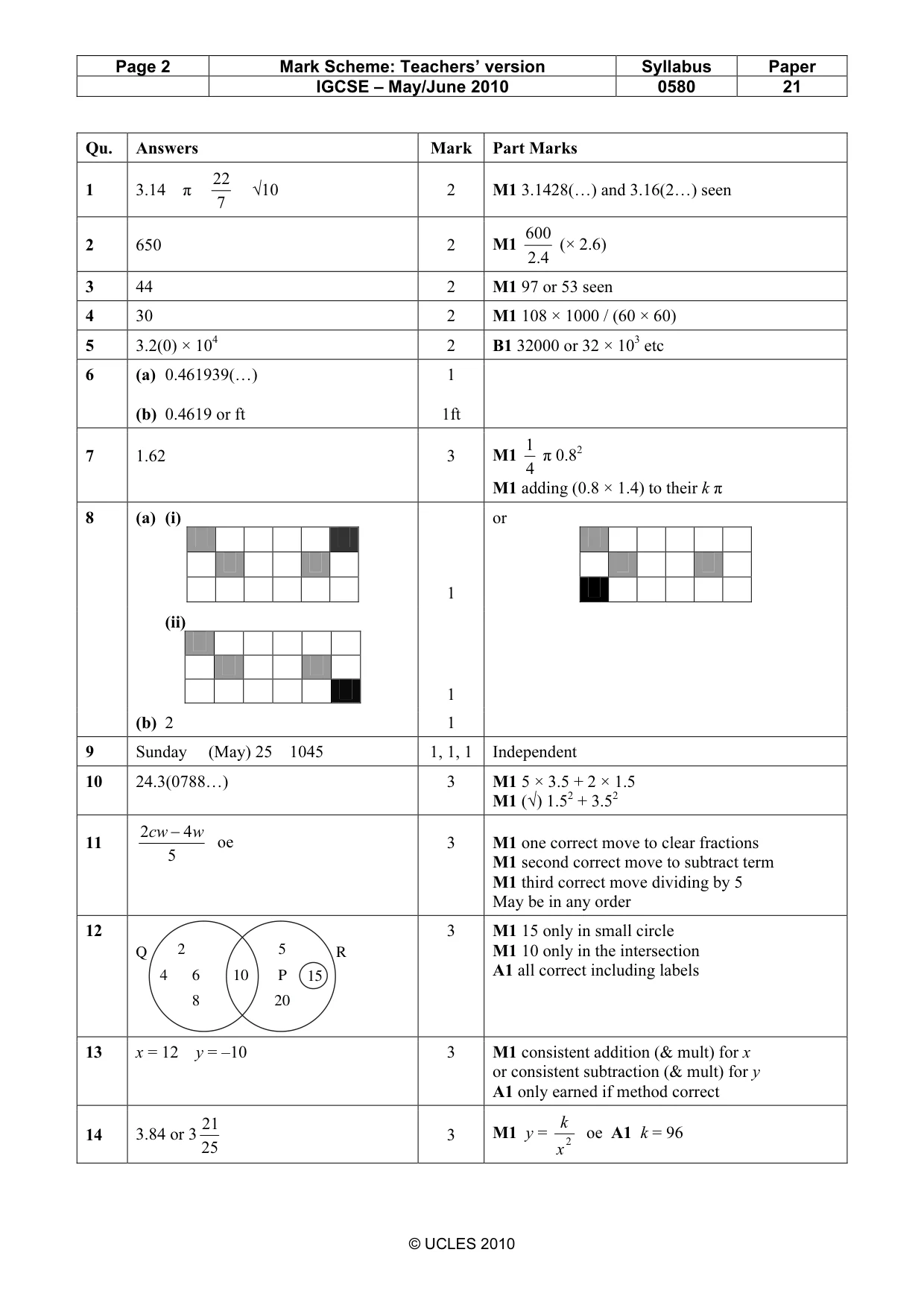
Mark scheme: Qu. Answers Mark Part Marks 2222 1 3.14 π √10√ 2 M1 3.1428(…) and 3.16(2…) seen 7 600
Q2 · Michel changed $600 into pounds (£) when the exchange rate was £1 = $2.40
2 Michel changed $600 into pounds (£) when the exchange rate was £1 = $2.40. He later changed all the pounds back into dollars when the exchange rate was £1 = $2.60. How many dollars did he receive? Answer $ [2]
Mark scheme: 600 2 650 2 M1 (× 2.6) 4.2
Q3 · P is the largest prime number between 50 and 100
3 p is the largest prime number between 50 and 100. q is the smallest prime number between 50 and 100. Calculate the value of p – q. Answer [2]
Mark scheme: 3 44 2 M1 97 or 53 seen
Q4 · A person in a car, travelling at 108 kilometres per hour, takes 1 second to go past a…
4 A person in a car, travelling at 108 kilometres per hour, takes 1 second to go past a building on the side of the road. Calculate the length of the building in metres. Answer m [2]
Mark scheme: 4 30 2 M1 108 × 1000 / (60 × 60) 4 3
Q5 · Calculate the value of 5(6 × 10³ + 400), giving your answer in standard form
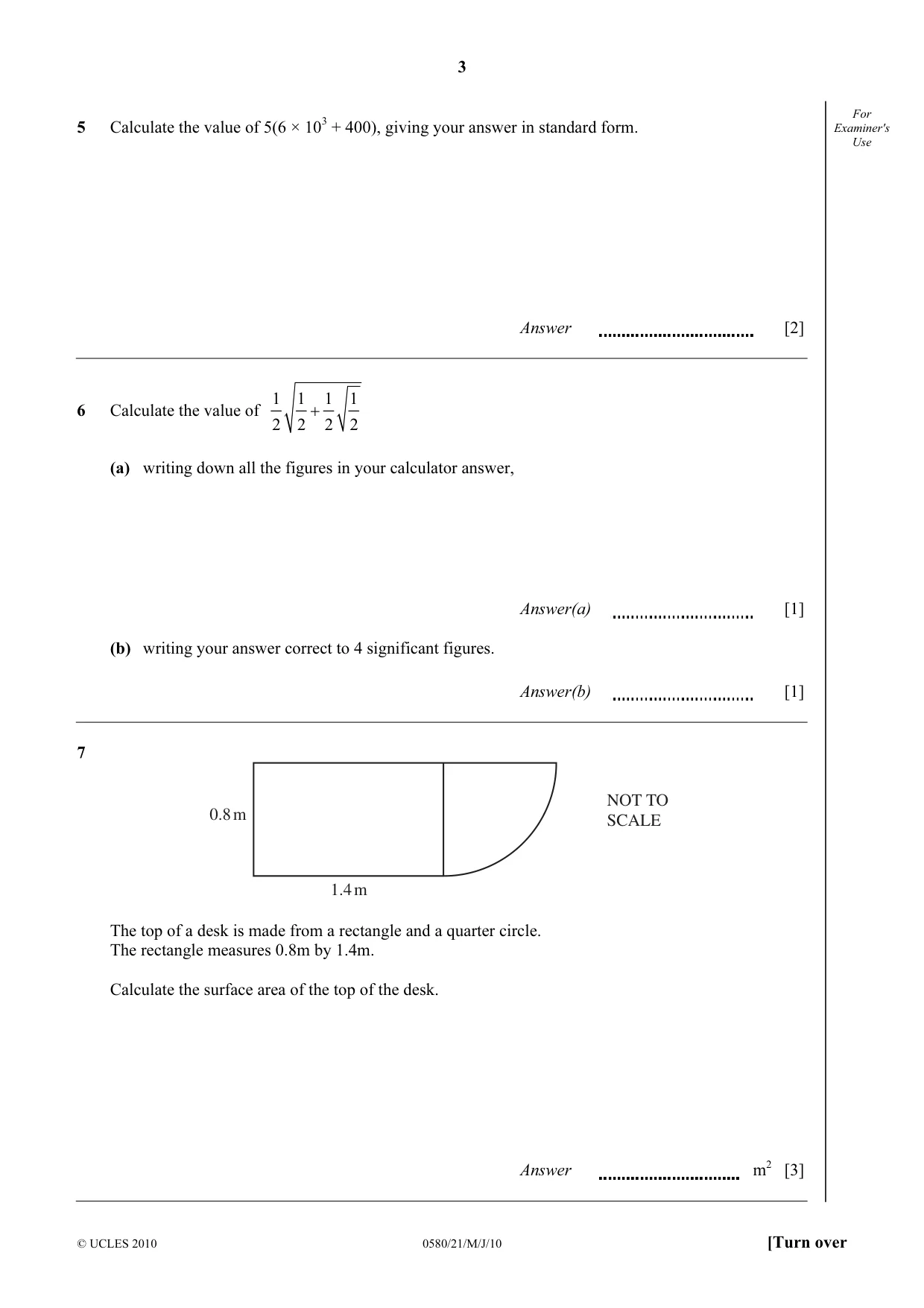
5 Calculate the value of 5(6 × 10³ + 400), giving your answer in standard form. Examiner's Use Answer [2]
Mark scheme: 5 3.2(0) × 104 2 B1 32000 or 32 × 103 etc
Q6 · 1 1 1 6 Calculate the value of + 2 2 2 2 (a) writing down all the figures in your…
1 1 1 1 6 Calculate the value of + 2 2 2 2 (a) writing down all the figures in your calculator answer, Answer(a) [1] (b) writing your answer correct to 4 significant figures. Answer(b) [1]
Mark scheme: 6 (a) 0.461939(…) 1 (b) 0.4619 or ft 1ft 1 2
Q7 · NOT TO 0.8 m SCALE 1.4 m The top of a desk is made from a rectangle and a quarter circle
7 NOT TO 0.8 m SCALE 1.4 m The top of a desk is made from a rectangle and a quarter circle. The rectangle measures 0.8m by 1.4m. Calculate the surface area of the top of the desk. Answer m2 [3]
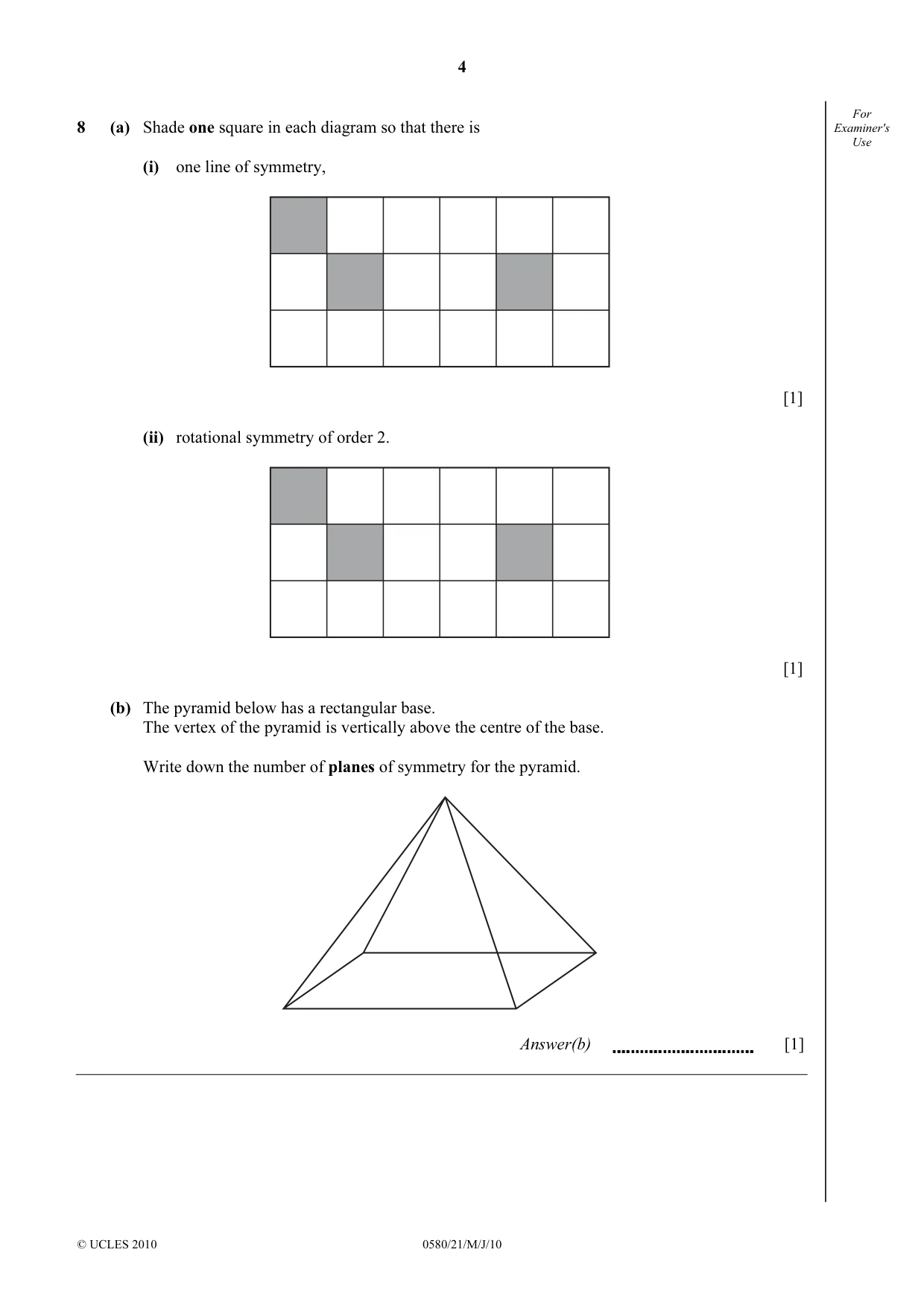
Mark scheme: 1 7 1.62 3 M1 π 0.82 4 M1 adding (0.8 × 1.4) to their k π 8 (a) (i) or 1 (ii) 1 (b) 2 1
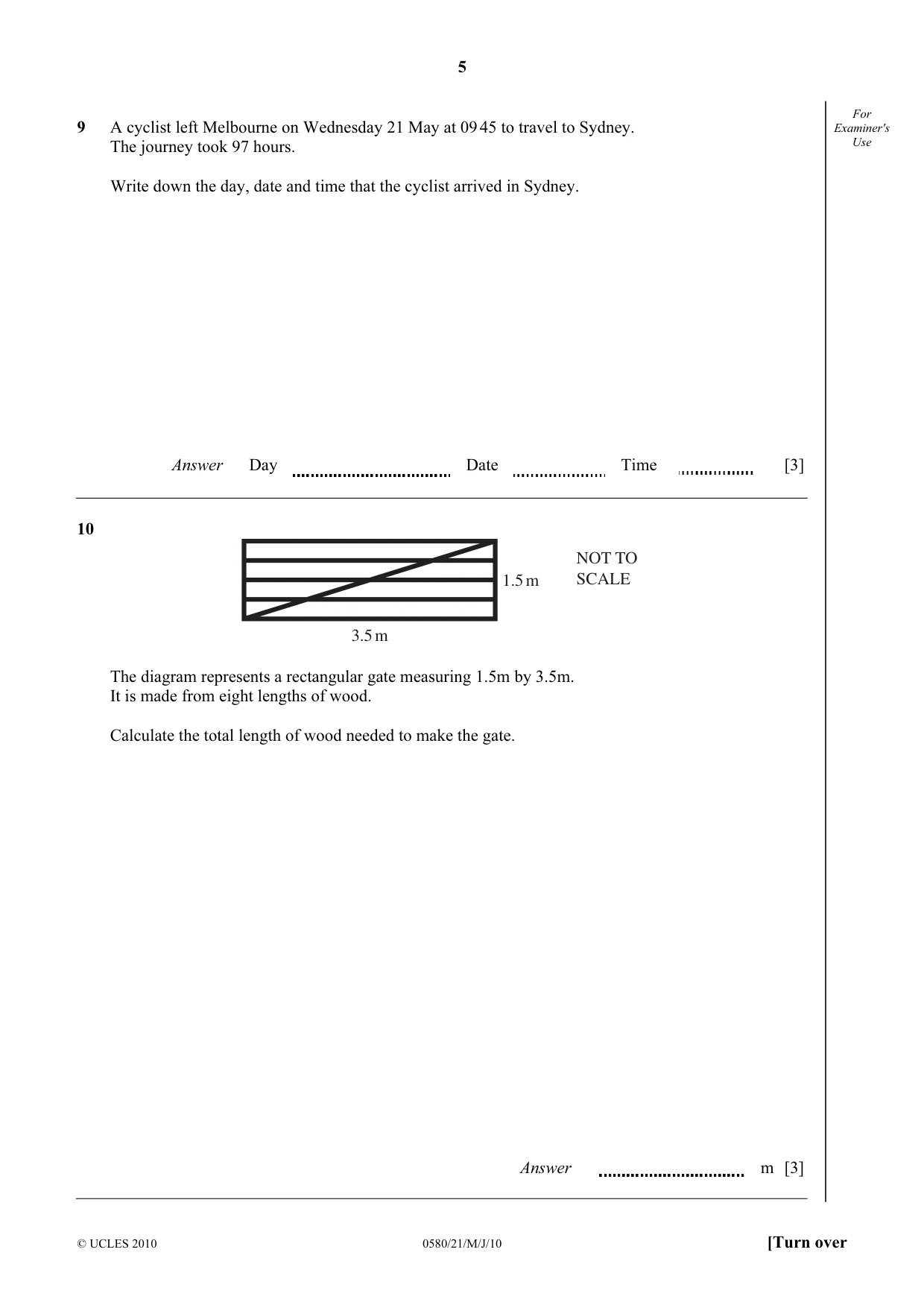
Q9 · A cyclist left Melbourne on Wednesday 21 May at 09 45 to travel to Sydney
9 A cyclist left Melbourne on Wednesday 21 May at 09 45 to travel to Sydney. Examiner's The journey took 97 hours. Use Write down the day, date and time that the cyclist arrived in Sydney. Answer Day Date Time [3]
Mark scheme: 9 Sunday (May) 25 1045 1, 1, 1 Independent
Q10 · NOT TO 1.5 m SCALE 3.5 m The diagram represents a rectangular gate measuring 1.5m by 3.5m
10 NOT TO 1.5 m SCALE 3.5 m The diagram represents a rectangular gate measuring 1.5m by 3.5m. It is made from eight lengths of wood. Calculate the total length of wood needed to make the gate. Answer m [3]
Mark scheme: 10 24.3(0788…) 3 M1 5 × 3.5 + 2 × 1.5 M1 (√) 1.52 + 3.52 2cw − 4 w
Q11 · D + 4w Examiner's 11 Make d the subject of the formula c =
5d + 4w Examiner's 11 Make d the subject of the formula c = . Use 2w Answer d = [3]
Mark scheme: 2cw 4 w 11 oe 3 M1 one correct move to clear fractions 5 M1 second correct move to subtract term M1 third correct move dividing by 5 May be in any order
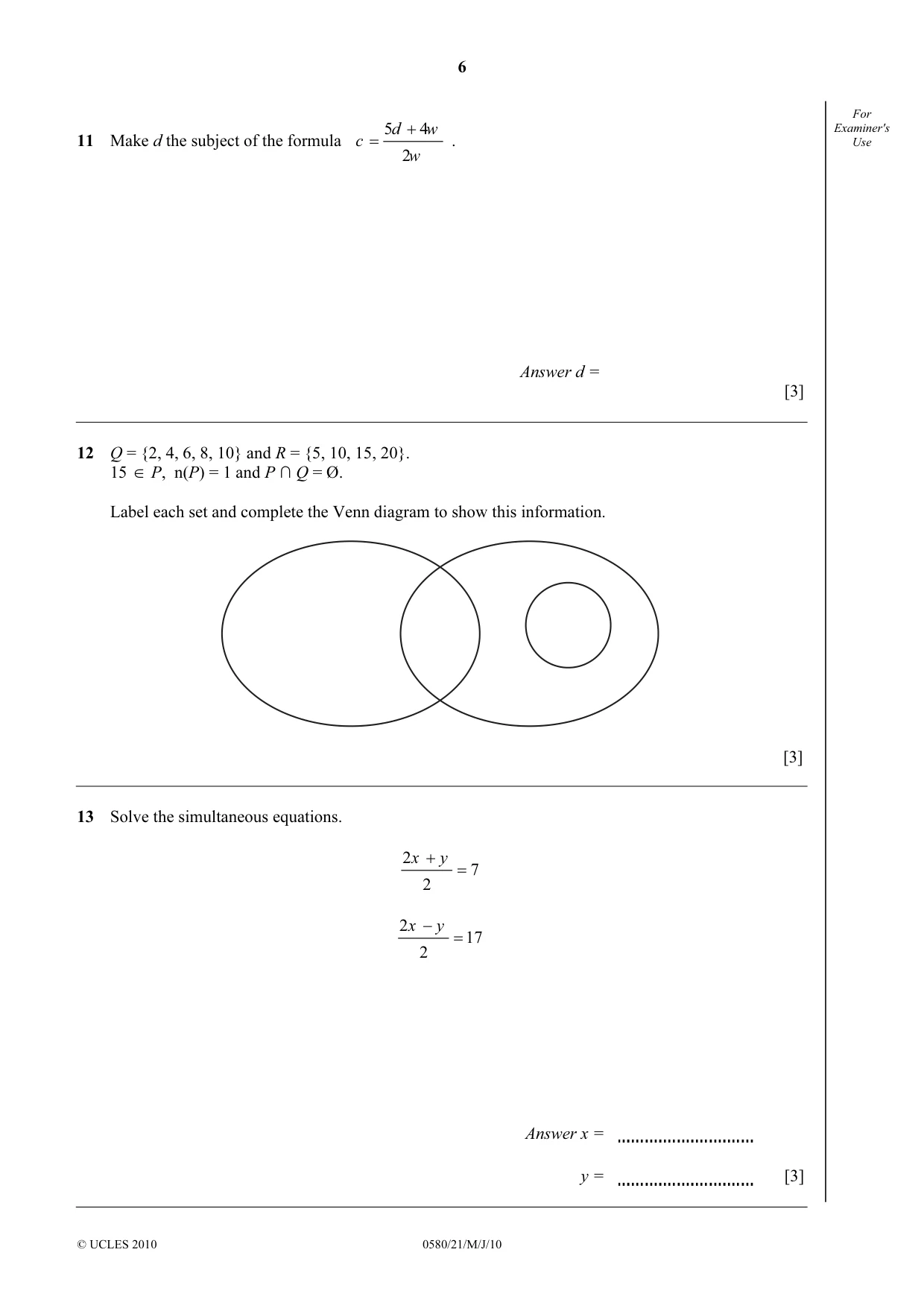
Q12 · Q = {2, 4, 6, 8, 10} and R = {5, 10, 15, 20}
12 Q = {2, 4, 6, 8, 10} and R = {5, 10, 15, 20}. 15 ∈ P, n(P) = 1 and P ∩ Q = Ø. Label each set and complete the Venn diagram to show this information. [3]
Mark scheme: 12 3 M1 15 only in small circle Q 2 5 R M1 10 only in the intersection A1 all correct including labels 4 6 10 P 15 8 20
Q13 · Solve the simultaneous equations
13 Solve the simultaneous equations. 2 x + y = 7 2 2 x − y = 17 2 Answer x = y = [3]
Mark scheme: 13 x = 12 y = –10 3 M1 consistent addition (& mult) for x or consistent subtraction (& mult) for y A1 only earned if method correct 21 k 1 A1 k 96
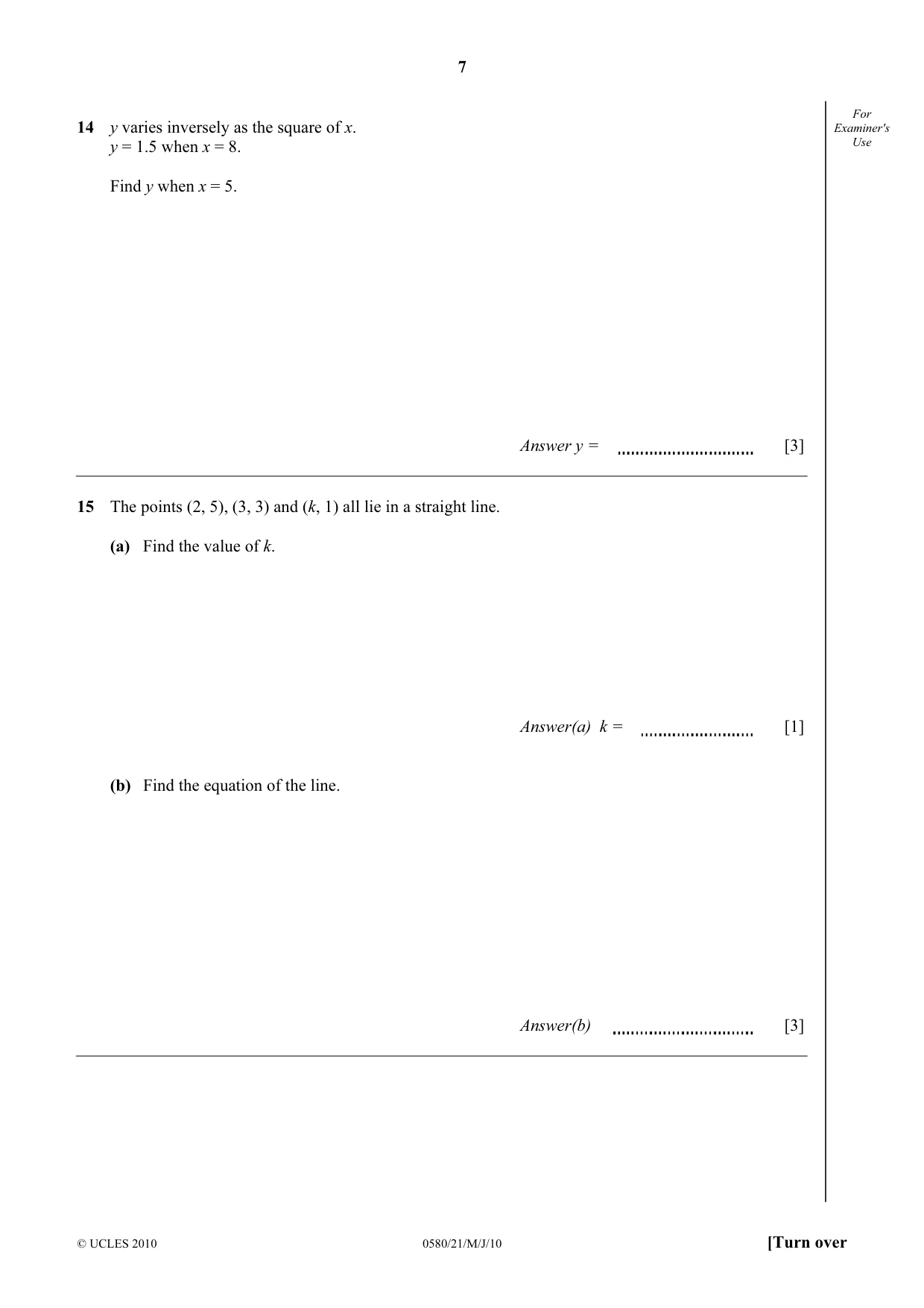
Q14 · Y varies inversely as the square of x
14 y varies inversely as the square of x. Examiner's y = 1.5 when x = 8. Use Find y when x = 5. Answer y = [3]
Mark scheme: 21 k 14 3.84 or 3 3 M1 y = 2 oe A1 k = 96 25 x IGCSE – May/June 2010 0580 21
Q15 · The points (2, 5), (3, 3) and (k, 1) all lie in a straight line
15 The points (2, 5), (3, 3) and (k, 1) all lie in a straight line. (a) Find the value of k. Answer(a) k = [1] (b) Find the equation of the line. Answer(b) [3]
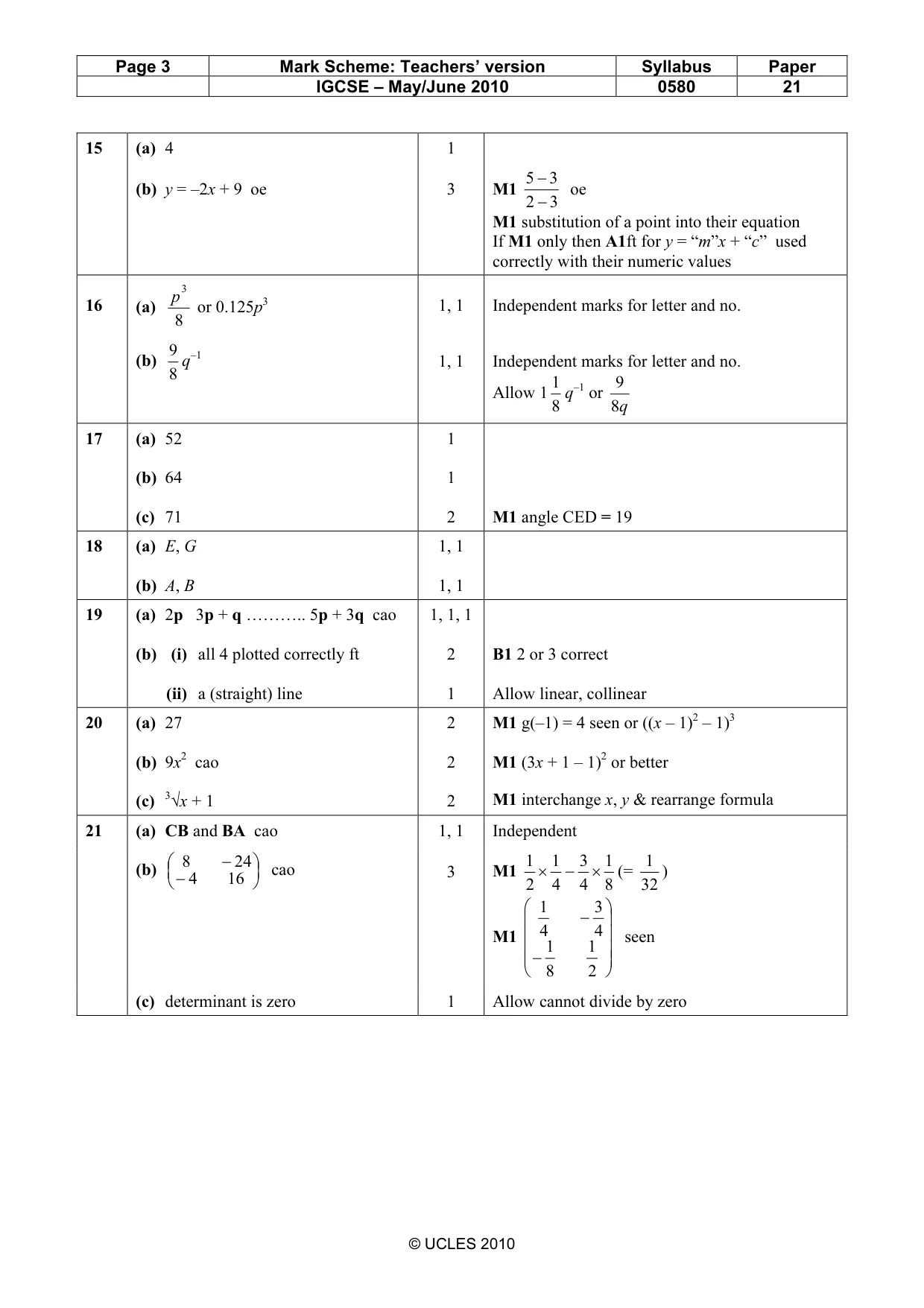
Mark scheme: 15 (a) 4 1 5 − 3 (b) y = –2x + 9 oe 3 M1 oe 2 − 3 M1 substitution of a point into their equation If M1 only then A1ft for y = “m”x + “c” used correctly with their numeric values p 3
Q16 · Simplify Examiner's Use 0.75 p 4 (a) , 16 Answer(a) [2] (b) 32q-3 ÷ 23q-2
16 Simplify Examiner's Use 0.75 p 4 (a) , 16 Answer(a) [2] (b) 32q-3 ÷ 23q-2. Answer(b) [2]
Mark scheme: p 16 (a) or 0.125p3 1, 1 Independent marks for letter and no. 8 9 (b) q–1 1, 1 Independent marks for letter and no. 8 1 9 Allow 1 q–1 or 8 8q
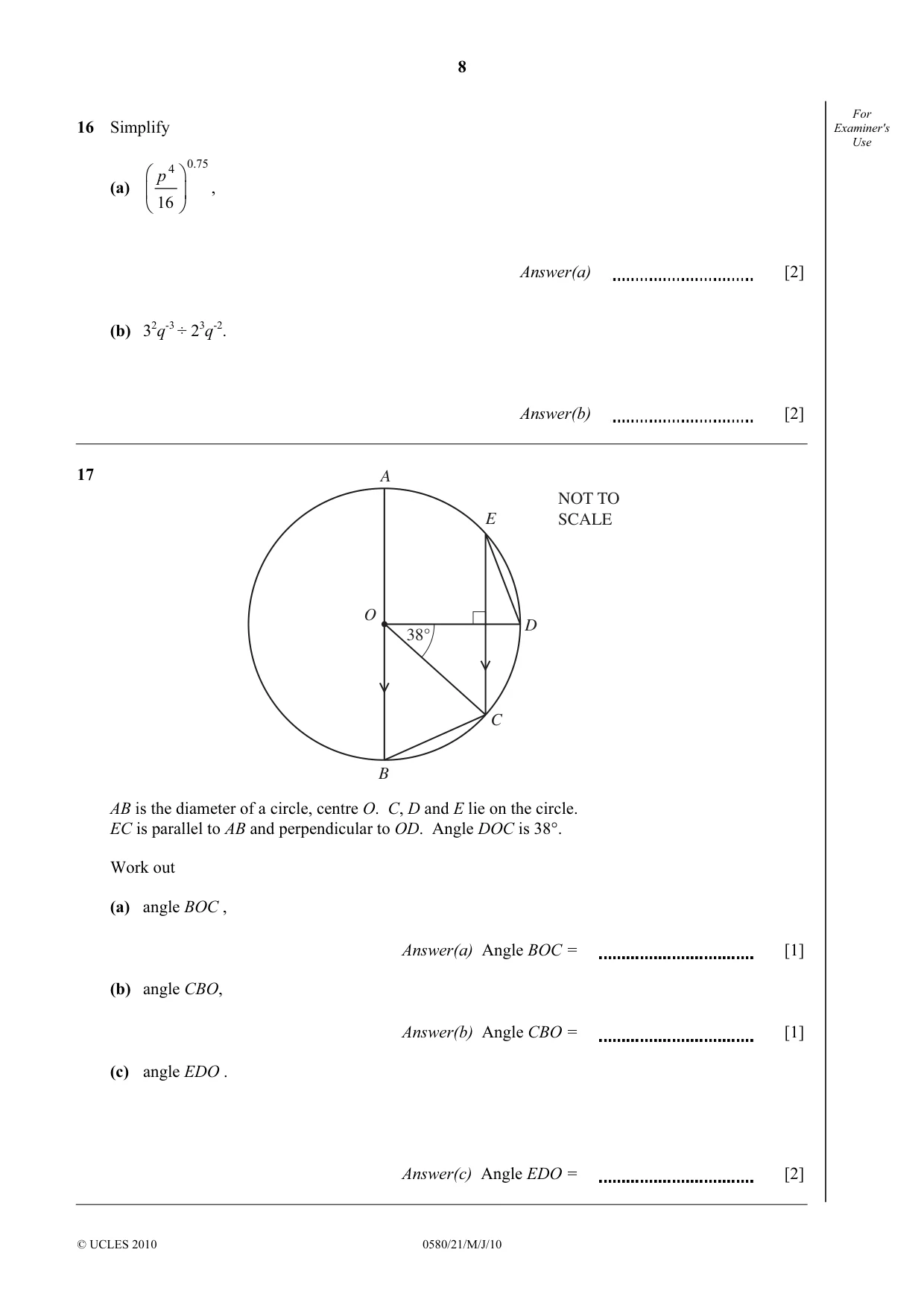
Q17 · A NOT TO E SCALE O D 38° C B AB is the diameter of a circle, centre O
17 A NOT TO E SCALE O D 38° C B AB is the diameter of a circle, centre O. C, D and E lie on the circle. EC is parallel to AB and perpendicular to OD. Angle DOC is 38°. Work out (a) angle BOC , Answer(a) Angle BOC = [1] (b) angle CBO, Answer(b) Angle CBO = [1] (c) angle EDO . Answer(c) Angle EDO = [2]
Mark scheme: 17 (a) 52 1 (b) 64 1 (c) 71 2 M1 angle CED = 19
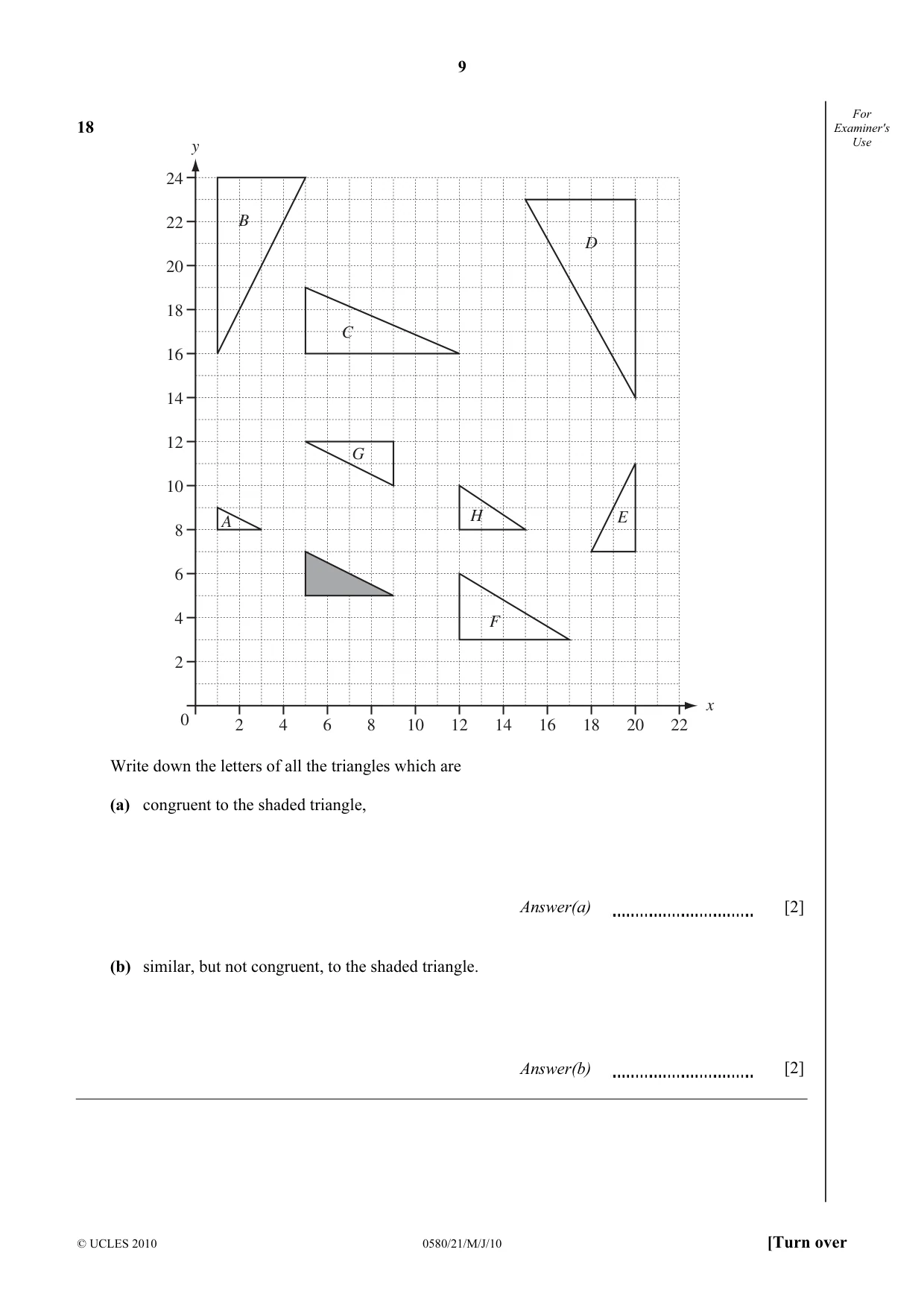
Q18 · Examiner's y Use 24 22 B D 20 18 C 16 14 12 G 10 H E A 8 6 4 F 2 x 0 2 4 6 8 10 12 14 16…
18 Examiner's y Use 24 22 B D 20 18 C 16 14 12 G 10 H E A 8 6 4 F 2 x 0 2 4 6 8 10 12 14 16 18 20 22 Write down the letters of all the triangles which are (a) congruent to the shaded triangle, Answer(a) [2] (b) similar, but not congruent, to the shaded triangle. Answer(b) [2]
Mark scheme: 18 (a) E, G 1, 1 (b) A, B 1, 1
Q19 · The position vector r is given by r = 2p + t(p + q)
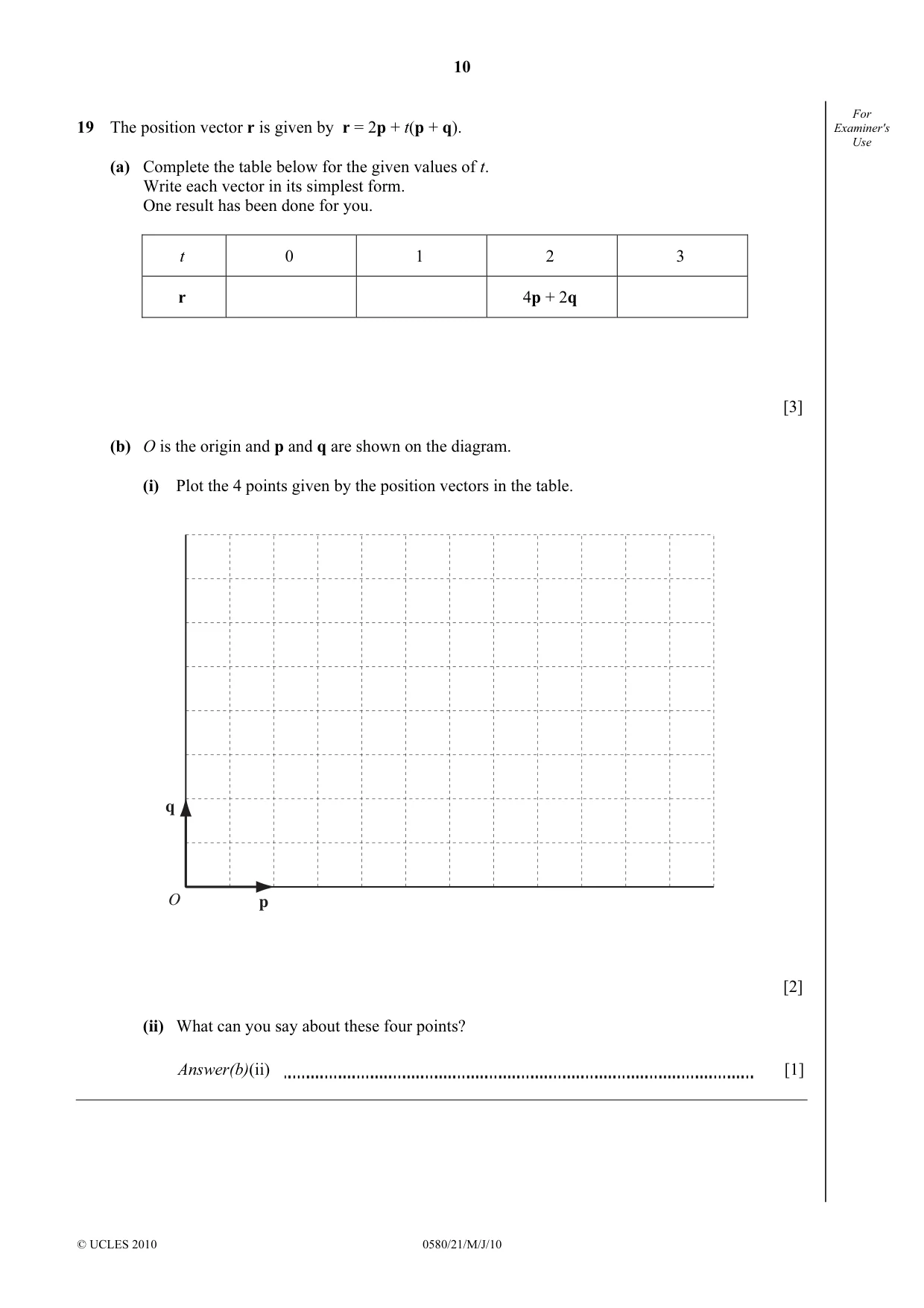
19 The position vector r is given by r = 2p + t(p + q). Examiner's Use (a) Complete the table below for the given values of t. Write each vector in its simplest form. One result has been done for you. t 0 1 2 3 r 4p + 2q [3] (b) O is the origin and p and q are shown on the diagram. (i) Plot the 4 points given by the position vectors in the table. q O p [2] (ii) What can you say about these four points? Answer(b)(ii) [1]
Mark scheme: 19 (a) 2p 3p + q ……….. 5p + 3q cao 1, 1, 1 (b) (i) all 4 plotted correctly ft 2 B1 2 or 3 correct (ii) a (straight) line 1 Allow linear, collinear 2 3
Q20 · F(x) = (x – 1)3 g(x) = (x – 1)2 h(x) = 3x + 1 Examiner's Use (a) Work out fg(-1)
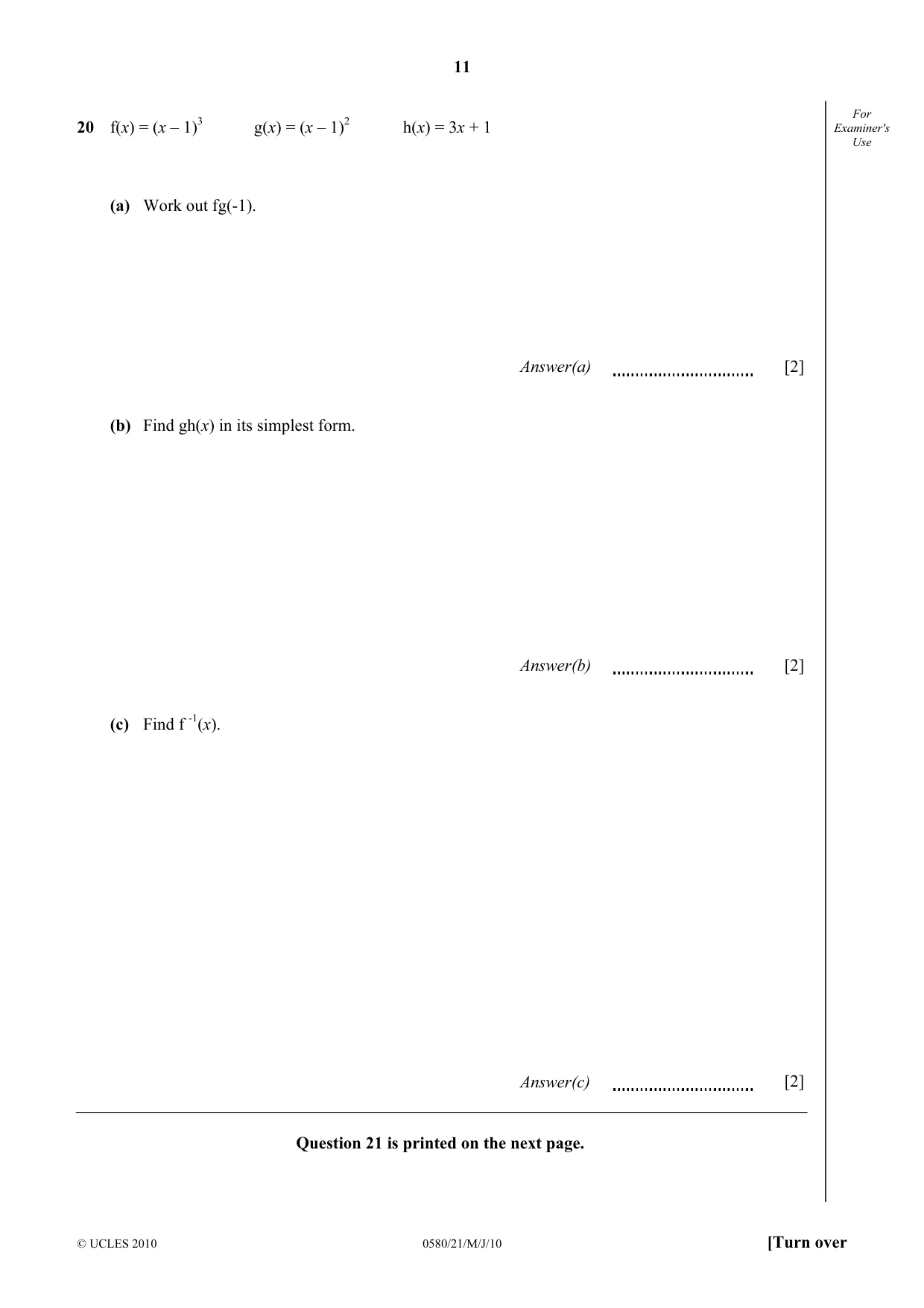
20 f(x) = (x – 1)3 g(x) = (x – 1)2 h(x) = 3x + 1 Examiner's Use (a) Work out fg(-1). Answer(a) [2] (b) Find gh(x) in its simplest form. Answer(b) [2] (c) Find f -1(x). Answer(c) [2] Question 21 is printed on the next page.
Mark scheme: 20 (a) 27 2 M1 g(–1) = 4 seen or ((x – 1)2 – 1)3 (b) 9x2 cao 2 M1 (3x + 1 – 1)2 or better (c) 3√x + 1 2 M1 interchange x, y & rearrange formula
Q21 · A is a (2 × 4) matrix, B is a (3 × 2) matrix and C is a (1 × 3) matrix
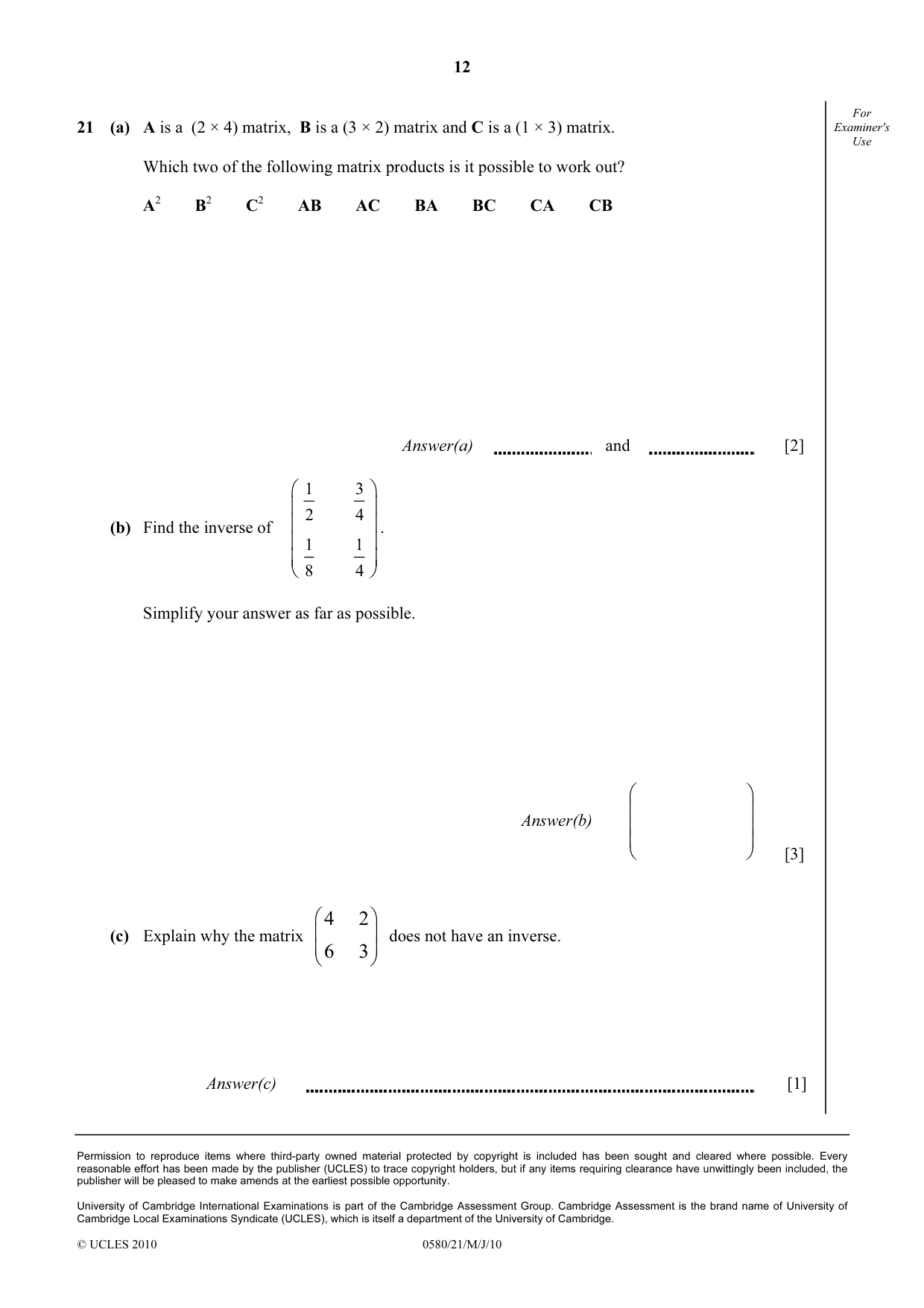
21 (a) A is a (2 × 4) matrix, B is a (3 × 2) matrix and C is a (1 × 3) matrix. Examiner's Use Which two of the following matrix products is it possible to work out? A2 B2 C2 AB AC BA BC CA CB Answer(a) and [2] 1 3 2 4 (b) Find the inverse of . 1 1 8 4 Simplify your answer as far as possible. Answer(b) [3] 4 2 (c) Explain why the matrix does not have an inverse. 6 3 Answer(c) [1]
Mark scheme: 21 (a) CB and BA cao 1, 1 Independent 8 − 24 1 1 3 1 1 (b) − 4 16 cao 3 M1 2 × 4 − 4 × 8 (= 32 )= 1 3 − M1 4 4 seen − 1 1 8 2 (c) determinant is zero 1 Allow cannot divide by zero
What was in this paper
The subtopics covered by these 20 questions, and how many questions each got. Open one in a new tab to see every Cambridge question on it.