Cambridge IGCSE Malay - Foreign Language 0546 — 2013 May/June Paper 2 · Variant 1
0546/21/M/J/13 · 65 marks · ≈73 min
The question paper and its mark scheme, free to read here and free to download. This is Cambridge’s own paper, exactly as it was sat.
Question paper20 pages





Mark scheme10 pages
Answers below. Sit the paper first if you are practising.
Paper as text
Question paper, page 1
This document consists of 17 printed pages and 3 blank pages. DC (LEG/SW) 67238/3 © UCLES 2013 [Turn over UNIVERSITY OF CAMBRIDGE INTERNATIONAL EXAMINATIONS International General Certificate of Secondary Education * 4 0 5 6 3 4 9 1 0 4 * CANDIDATE NAME CENTRE NUMBER CANDIDATE NUMBER MALAY 0546/02 Paper 2 Reading and Directed Writing May/June 2013 1 hour 30 minutes Candidates answer on the Question Paper. No Additional Materials are required. READ THESE INSTRUCTIONS FIRST Write your Centre number, candidate number and name on all the work you hand in. Write in dark blue or black pen. Do not use staples, paper clips, highlighters, glue or correction fluid. DO NOT WRITE IN ANY BARCODES. Answer all questions in Section 1, Section 2 and Section 3. At the end of the examination, fasten all your work securely together. The number of marks is given in brackets [ ] at the end of each question or part question. For Examiner’s Use Section 1 Section 2 Section 3 Total www.XtremePapers.com
Question paper, page 2
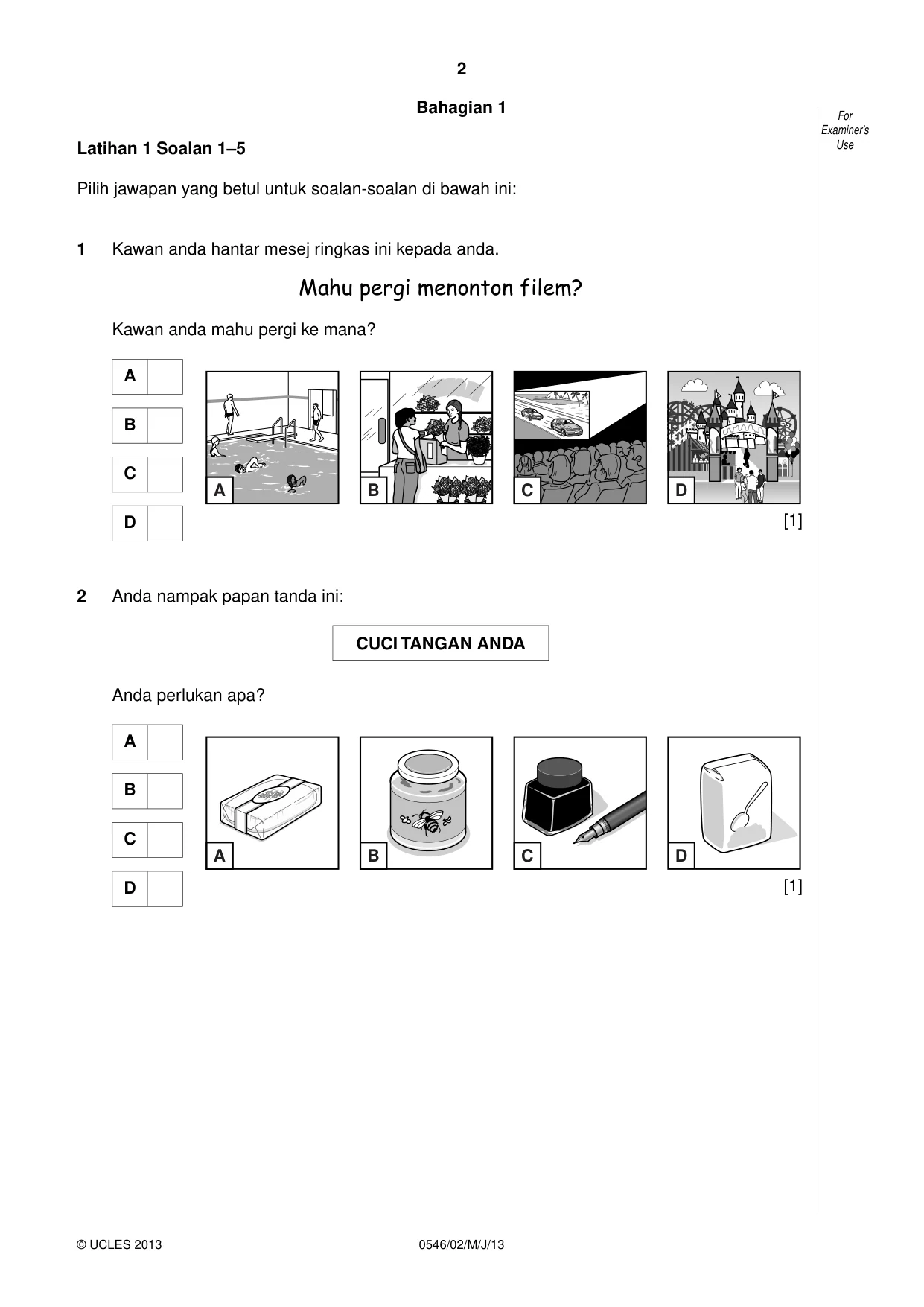
2 0546/02/M/J/13 © UCLES 2013 For Examiner’s Use Bahagian 1 Latihan 1 Soalan 1–5 Pilih jawapan yang betul untuk soalan-soalan di bawah ini: 1 Kawan anda hantar mesej ringkas ini kepada anda. Mahu pergi menonton filem? Kawan anda mahu pergi ke mana? A A B D C [1] B C D 2 Anda nampak papan tanda ini: CUCI TANGAN ANDA Anda perlukan apa? A A B D C [1] B C D
Question paper, page 3
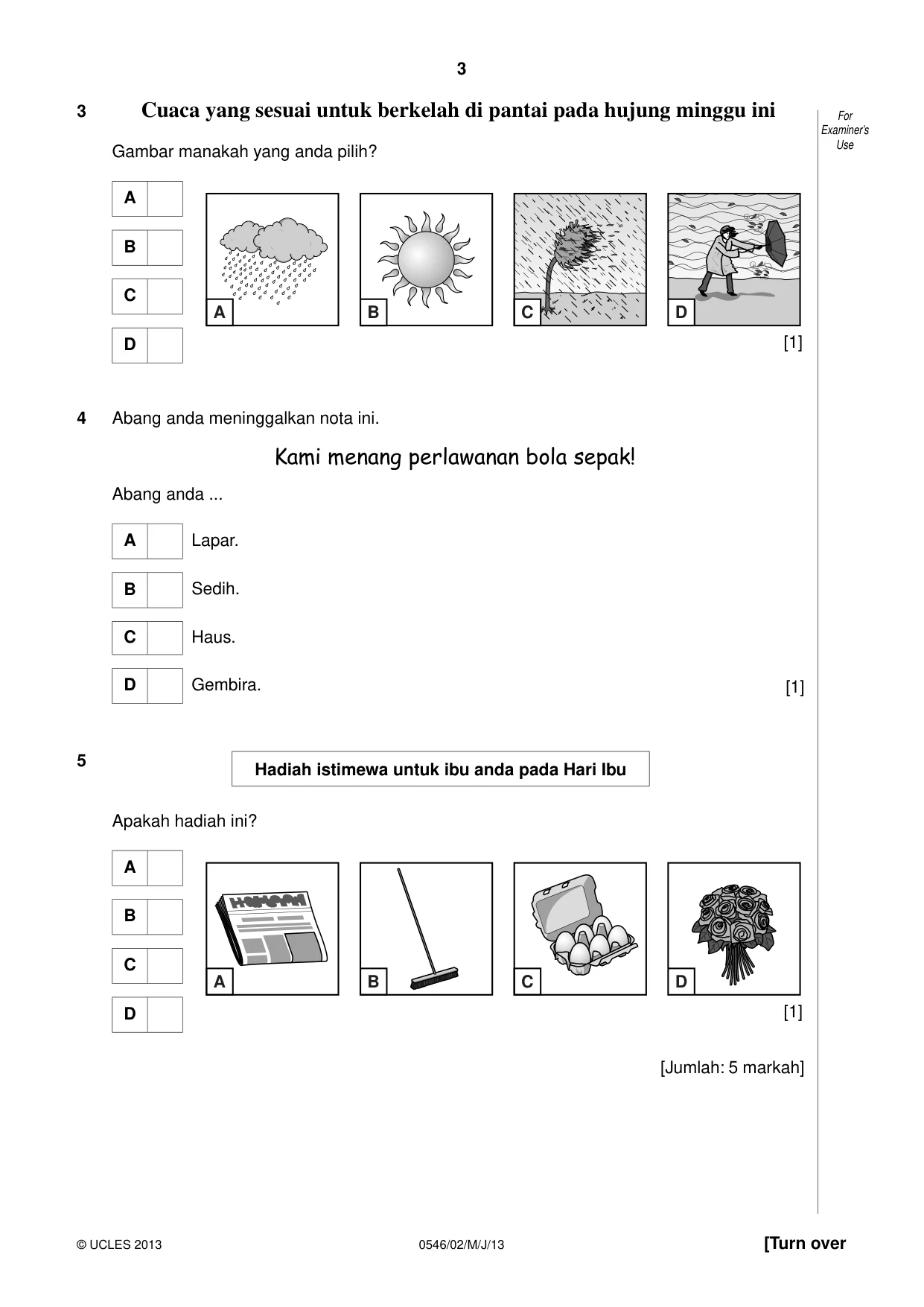
3 0546/02/M/J/13 © UCLES 2013 [Turn over For Examiner’s Use 3 Cuaca yang sesuai untuk berkelah di pantai pada hujung minggu ini Gambar manakah yang anda pilih? A A B D C [1] B C D 4 Abang anda meninggalkan nota ini. Kami menang perlawanan bola sepak! Abang anda ... A Lapar. B Sedih. C Haus. D Gembira. [1] 5 Hadiah istimewa untuk ibu anda pada Hari Ibu Apakah hadiah ini? A A B D C [1] B C D [Jumlah: 5 markah]
Question paper, page 4
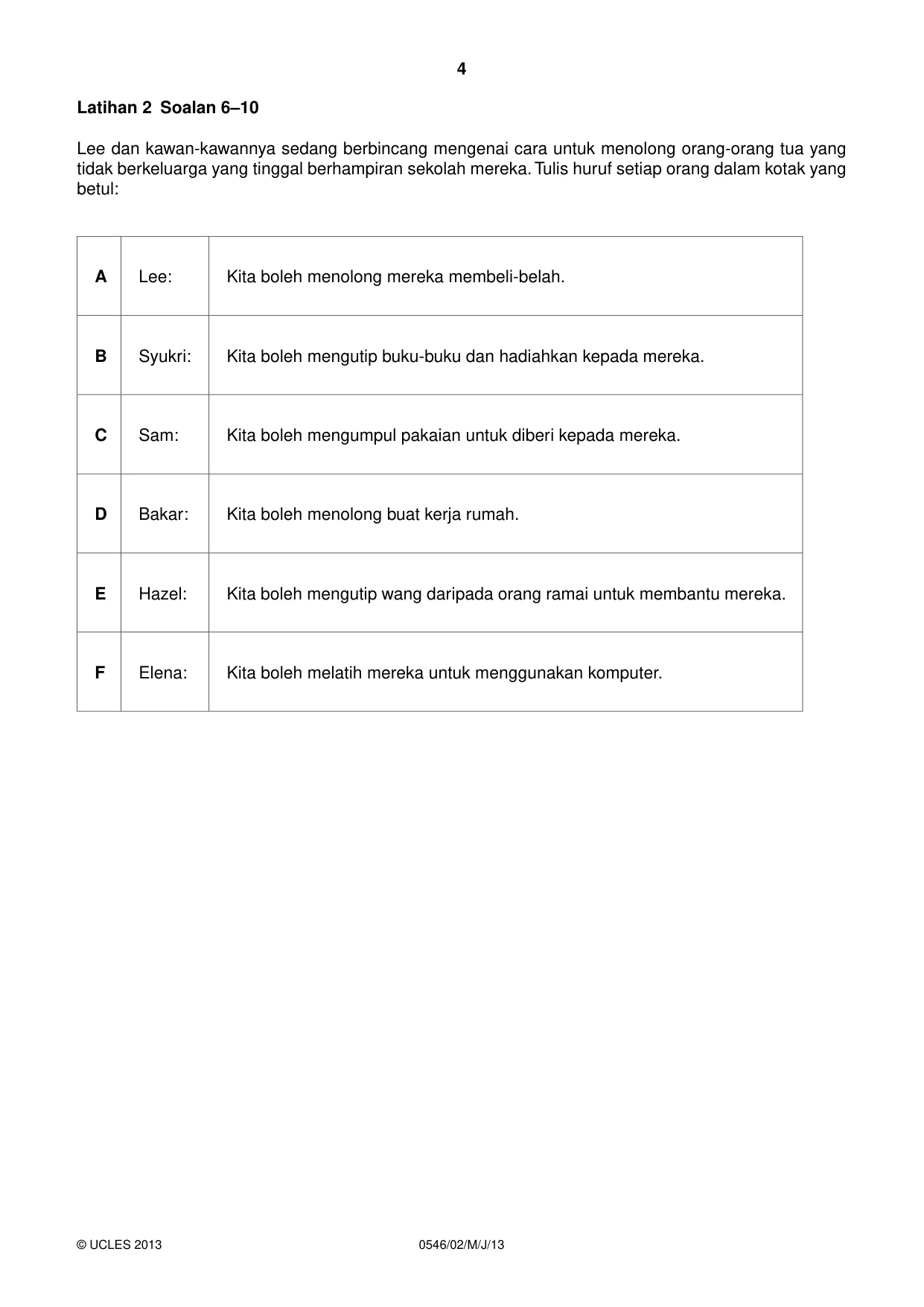
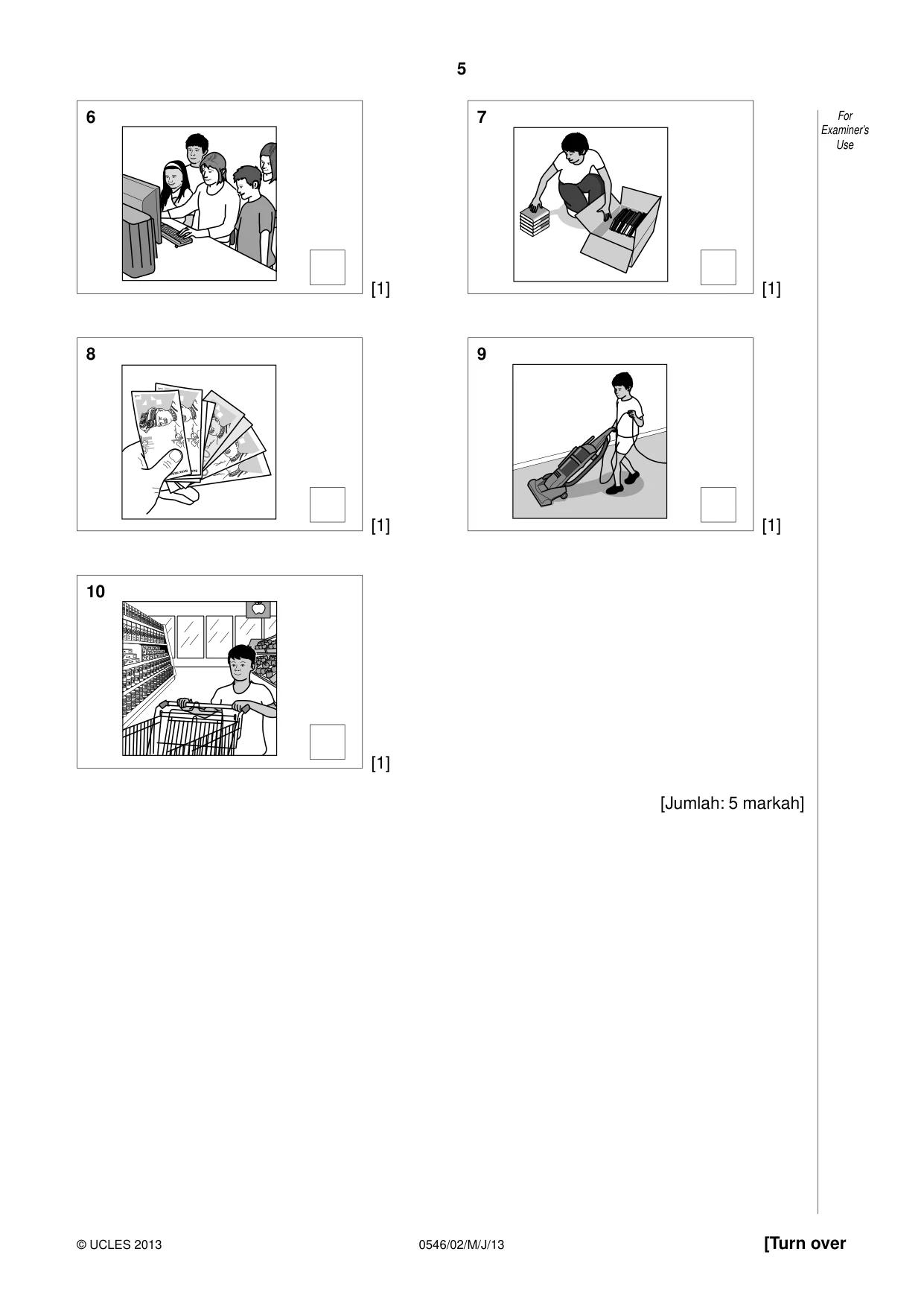
4 0546/02/M/J/13 © UCLES 2013 Latihan 2 Soalan 6–10 Lee dan kawan-kawannya sedang berbincang mengenai cara untuk menolong orang-orang tua yang tidak berkeluarga yang tinggal berhampiran sekolah mereka. Tulis huruf setiap orang dalam kotak yang betul: A Lee: Kita boleh menolong mereka membeli-belah. B Syukri: Kita boleh mengutip buku-buku dan hadiahkan kepada mereka. C Sam: Kita boleh mengumpul pakaian untuk diberi kepada mereka. D Bakar: Kita boleh menolong buat kerja rumah. E Hazel: Kita boleh mengutip wang daripada orang ramai untuk membantu mereka. F Elena: Kita boleh melatih mereka untuk menggunakan komputer.
Question paper, page 5
5 0546/02/M/J/13 © UCLES 2013 [Turn over For Examiner’s Use 6 [1] 7 [1] 8 [1] 9 [1] 10 [1] [Jumlah: 5 markah]
Question paper, page 6
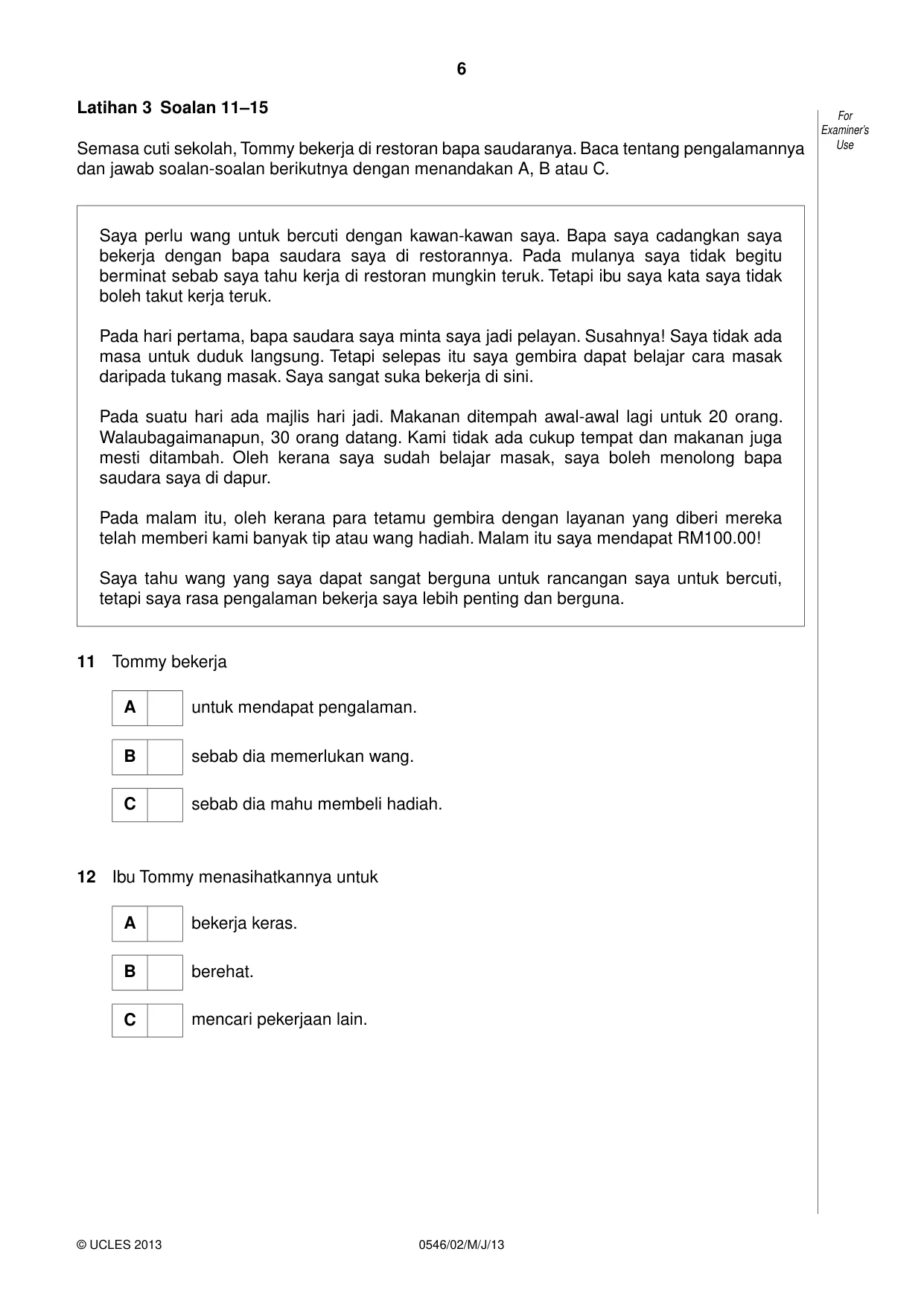
6 0546/02/M/J/13 © UCLES 2013 For Examiner’s Use Latihan 3 Soalan 11–15 Semasa cuti sekolah, Tommy bekerja di restoran bapa saudaranya. Baca tentang pengalamannya dan jawab soalan-soalan berikutnya dengan menandakan A, B atau C. Saya perlu wang untuk bercuti dengan kawan-kawan saya. Bapa saya cadangkan saya bekerja dengan bapa saudara saya di restorannya. Pada mulanya saya tidak begitu berminat sebab saya tahu kerja di restoran mungkin teruk. Tetapi ibu saya kata saya tidak boleh takut kerja teruk. Pada hari pertama, bapa saudara saya minta saya jadi pelayan. Susahnya! Saya tidak ada masa untuk duduk langsung. Tetapi selepas itu saya gembira dapat belajar cara masak daripada tukang masak. Saya sangat suka bekerja di sini. Pada suatu hari ada majlis hari jadi. Makanan ditempah awal-awal lagi untuk 20 orang. Walaubagaimanapun, 30 orang datang. Kami tidak ada cukup tempat dan makanan juga mesti ditambah. Oleh kerana saya sudah belajar masak, saya boleh menolong bapa saudara saya di dapur. Pada malam itu, oleh kerana para tetamu gembira dengan layanan yang diberi mereka telah memberi kami banyak tip atau wang hadiah. Malam itu saya mendapat RM100.00! Saya tahu wang yang saya dapat sangat berguna untuk rancangan saya untuk bercuti, tetapi saya rasa pengalaman bekerja saya lebih penting dan berguna. 11 Tommy bekerja A untuk mendapat pengalaman. B sebab dia memerlukan wang. C sebab dia mahu membeli hadiah. 12 Ibu Tommy menasihatkannya untuk A bekerja keras. B berehat. C mencari pekerjaan lain.
Question paper, page 7
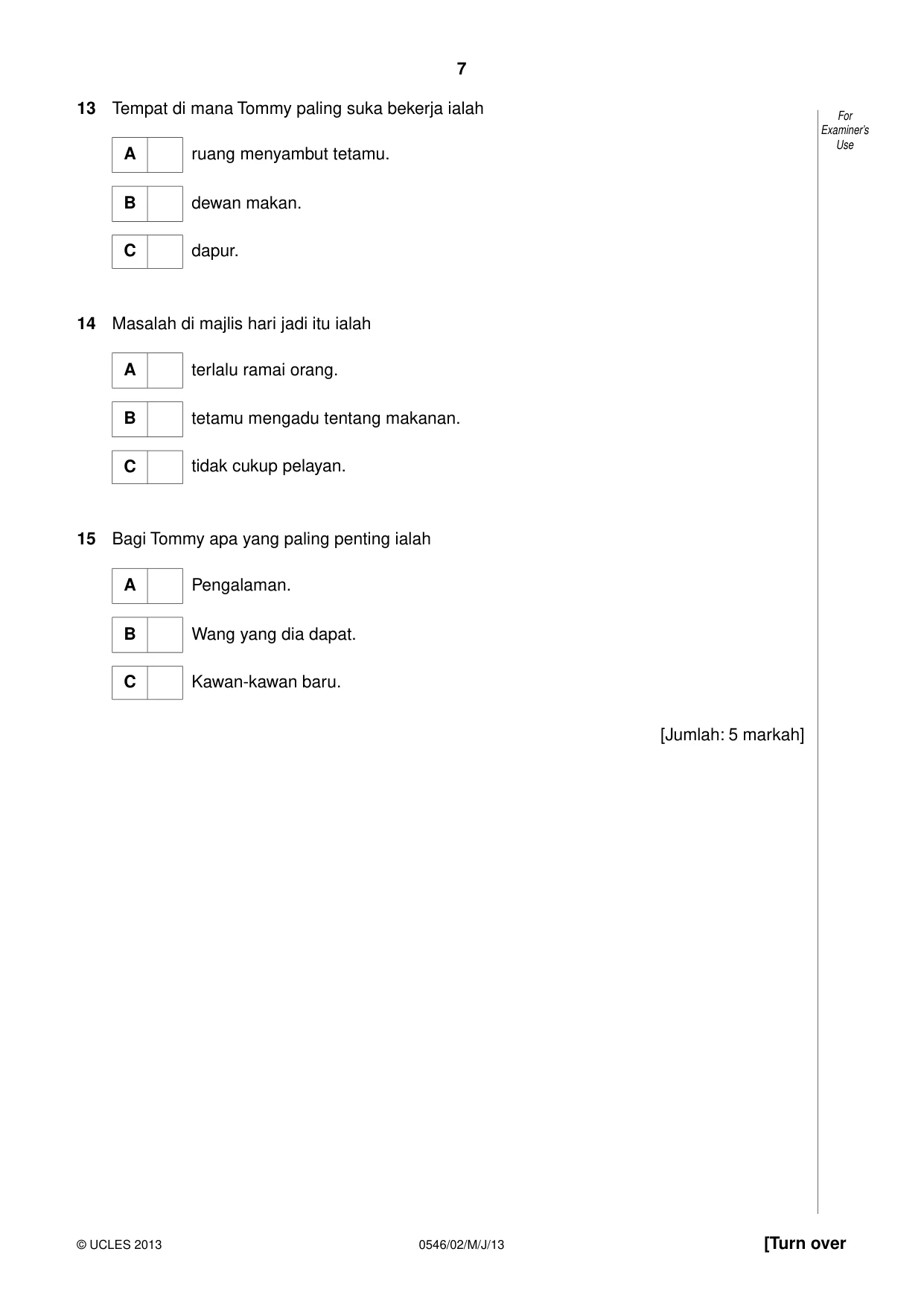
7 0546/02/M/J/13 © UCLES 2013 [Turn over For Examiner’s Use 13 Tempat di mana Tommy paling suka bekerja ialah A ruang menyambut tetamu. B dewan makan. C dapur. 14 Masalah di majlis hari jadi itu ialah A terlalu ramai orang. B tetamu mengadu tentang makanan. C tidak cukup pelayan. 15 Bagi Tommy apa yang paling penting ialah A Pengalaman. B Wang yang dia dapat. C Kawan-kawan baru. [Jumlah: 5 markah]
Question paper, page 8
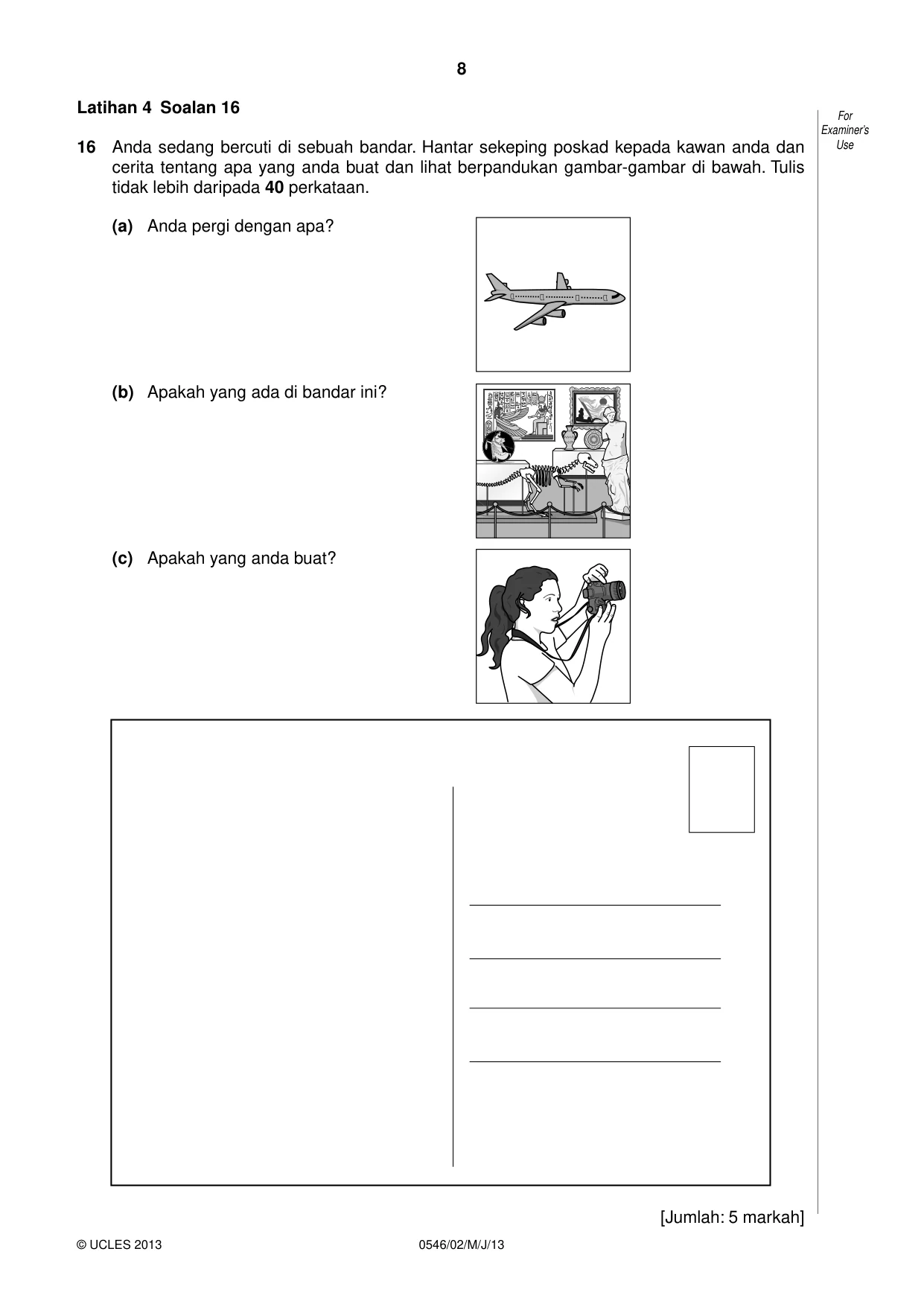
8 0546/02/M/J/13 © UCLES 2013 For Examiner’s Use Latihan 4 Soalan 16 16 Anda sedang bercuti di sebuah bandar. Hantar sekeping poskad kepada kawan anda dan cerita tentang apa yang anda buat dan lihat berpandukan gambar-gambar di bawah. Tulis tidak lebih daripada 40 perkataan. (a) Anda pergi dengan apa? (b) Apakah yang ada di bandar ini? (c) Apakah yang anda buat? [Jumlah: 5 markah]
Question paper, page 9
9 0546/02/M/J/13 © UCLES 2013 [Turn over PLEASE TURN OVER FOR SECTION 2.
Question paper, page 10
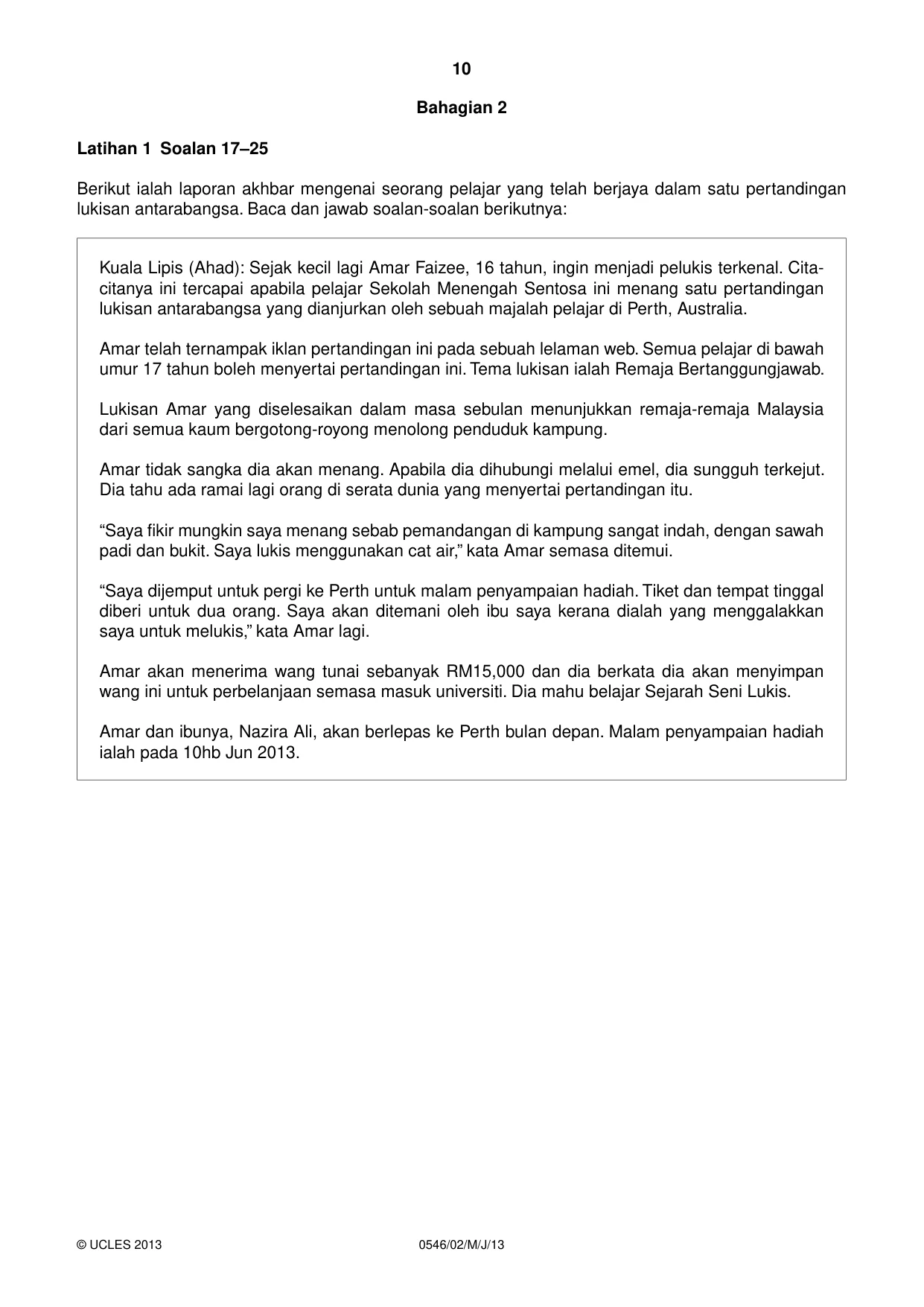
10 0546/02/M/J/13 © UCLES 2013 Bahagian 2 Latihan 1 Soalan 17–25 Berikut ialah laporan akhbar mengenai seorang pelajar yang telah berjaya dalam satu pertandingan lukisan antarabangsa. Baca dan jawab soalan-soalan berikutnya: Kuala Lipis (Ahad): Sejak kecil lagi Amar Faizee, 16 tahun, ingin menjadi pelukis terkenal. Cita- citanya ini tercapai apabila pelajar Sekolah Menengah Sentosa ini menang satu pertandingan lukisan antarabangsa yang dianjurkan oleh sebuah majalah pelajar di Perth, Australia. Amar telah ternampak iklan pertandingan ini pada sebuah lelaman web. Semua pelajar di bawah umur 17 tahun boleh menyertai pertandingan ini. Tema lukisan ialah Remaja Bertanggungjawab. Lukisan Amar yang diselesaikan dalam masa sebulan menunjukkan remaja-remaja Malaysia dari semua kaum bergotong-royong menolong penduduk kampung. Amar tidak sangka dia akan menang. Apabila dia dihubungi melalui emel, dia sungguh terkejut. Dia tahu ada ramai lagi orang di serata dunia yang menyertai pertandingan itu. “Saya fikir mungkin saya menang sebab pemandangan di kampung sangat indah, dengan sawah padi dan bukit. Saya lukis menggunakan cat air,” kata Amar semasa ditemui. “Saya dijemput untuk pergi ke Perth untuk malam penyampaian hadiah. Tiket dan tempat tinggal diberi untuk dua orang. Saya akan ditemani oleh ibu saya kerana dialah yang menggalakkan saya untuk melukis,” kata Amar lagi. Amar akan menerima wang tunai sebanyak RM15,000 dan dia berkata dia akan menyimpan wang ini untuk perbelanjaan semasa masuk universiti. Dia mahu belajar Sejarah Seni Lukis. Amar dan ibunya, Nazira Ali, akan berlepas ke Perth bulan depan. Malam penyampaian hadiah ialah pada 10hb Jun 2013.
Question paper, page 11
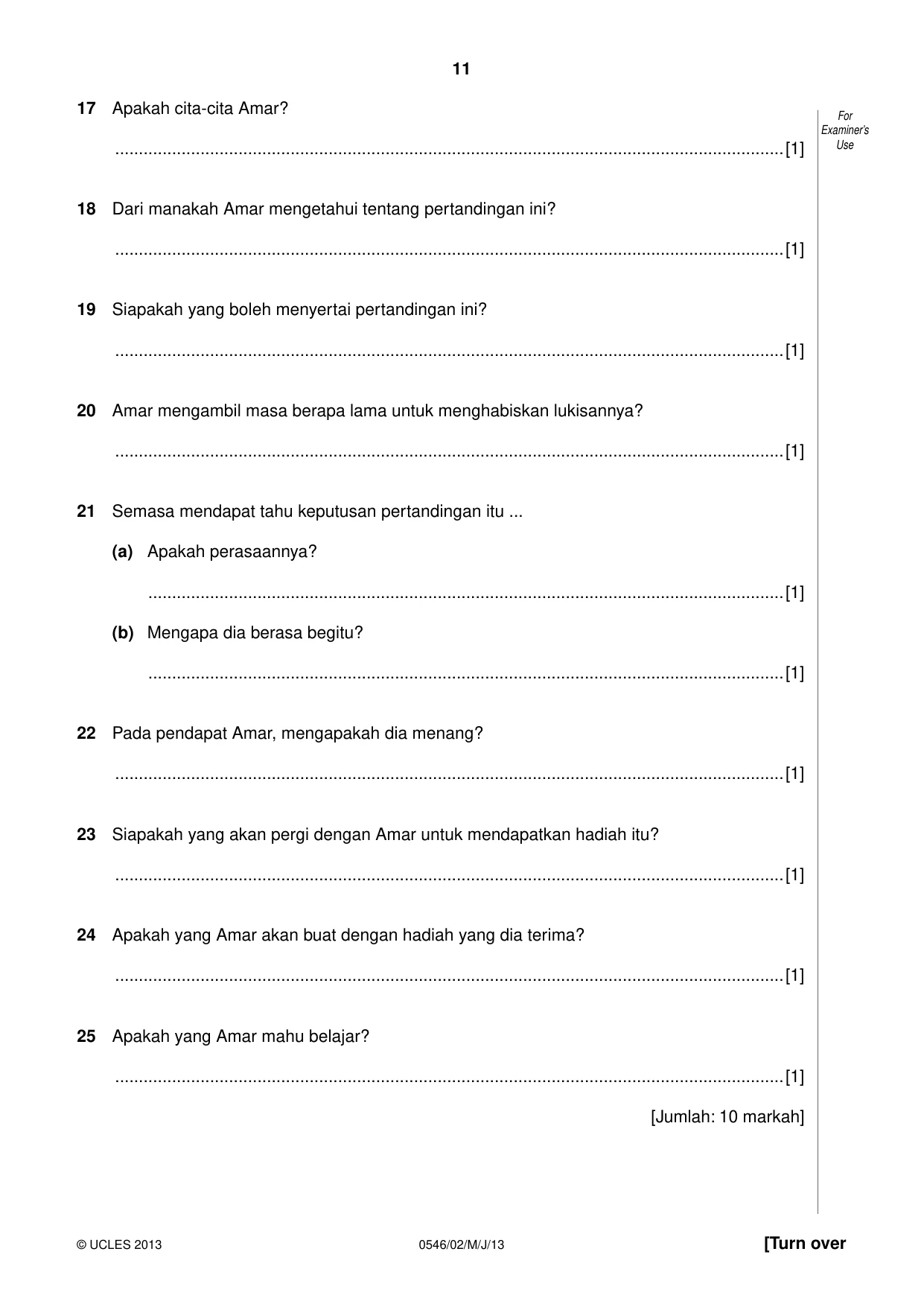
11 0546/02/M/J/13 © UCLES 2013 [Turn over For Examiner’s Use 17 Apakah cita-cita Amar? …[1] 18 Dari manakah Amar mengetahui tentang pertandingan ini? …[1] 19 Siapakah yang boleh menyertai pertandingan ini? …[1] 20 Amar mengambil masa berapa lama untuk menghabiskan lukisannya? …[1] 21 Semasa mendapat tahu keputusan pertandingan itu ... (a) Apakah perasaannya? …[1] (b) Mengapa dia berasa begitu? …[1] 22 Pada pendapat Amar, mengapakah dia menang? …[1] 23 Siapakah yang akan pergi dengan Amar untuk mendapatkan hadiah itu? …[1] 24 Apakah yang Amar akan buat dengan hadiah yang dia terima? …[1] 25 Apakah yang Amar mahu belajar? …[1] [Jumlah: 10 markah]
Question paper, page 12
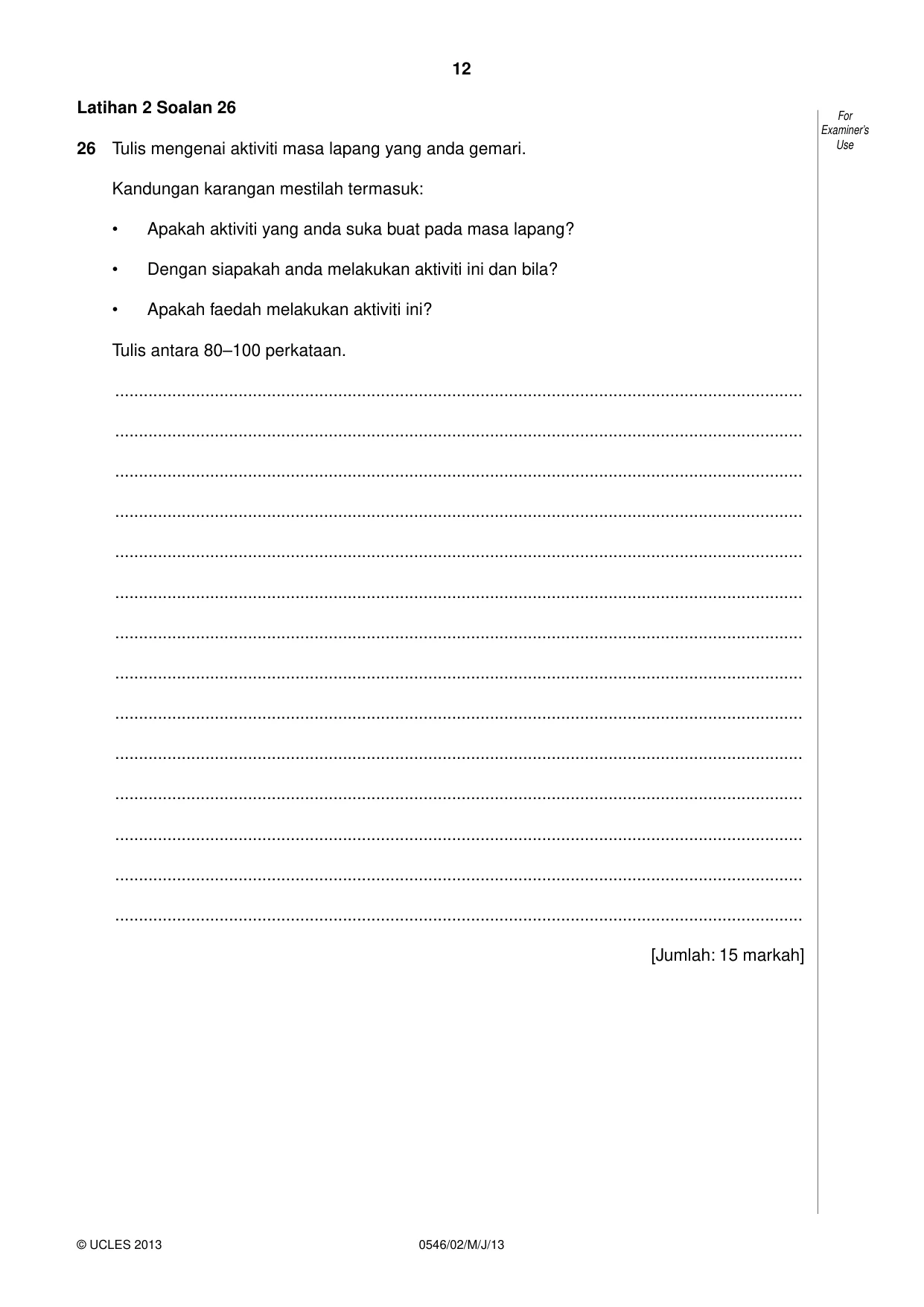
12 0546/02/M/J/13 © UCLES 2013 For Examiner’s Use Latihan 2 Soalan 26 26 Tulis mengenai aktiviti masa lapang yang anda gemari. Kandungan karangan mestilah termasuk: • Apakah aktiviti yang anda suka buat pada masa lapang? • Dengan siapakah anda melakukan aktiviti ini dan bila? • Apakah faedah melakukan aktiviti ini? Tulis antara 80–100 perkataan. … … … … … … … … … … … … … … [Jumlah: 15 markah]
Question paper, page 13
13 0546/02/M/J/13 © UCLES 2013 [Turn over PLEASE TURN OVER FOR SECTION 3.
Question paper, page 14
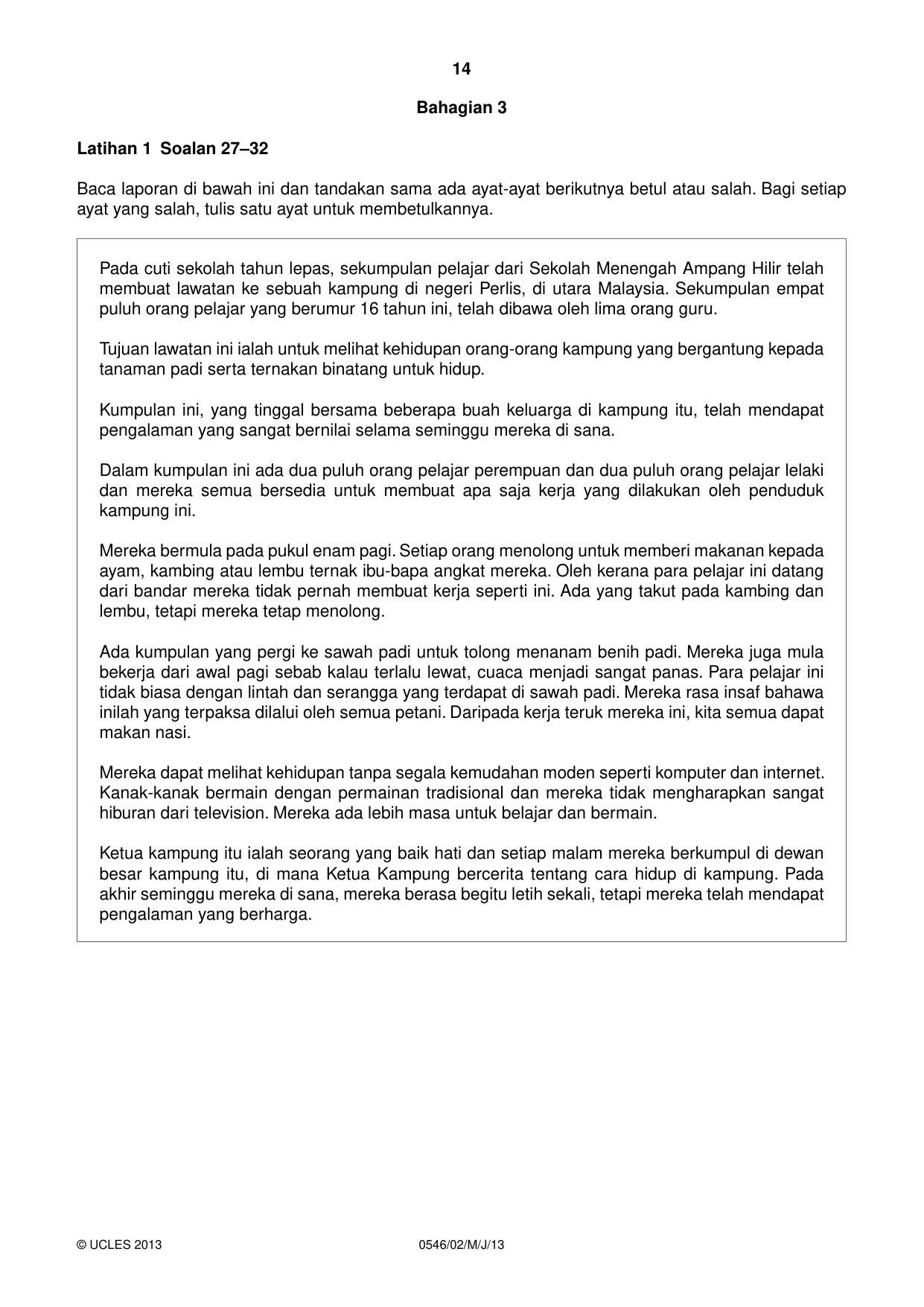
14 0546/02/M/J/13 © UCLES 2013 Bahagian 3 Latihan 1 Soalan 27–32 Baca laporan di bawah ini dan tandakan sama ada ayat-ayat berikutnya betul atau salah. Bagi setiap ayat yang salah, tulis satu ayat untuk membetulkannya. Pada cuti sekolah tahun lepas, sekumpulan pelajar dari Sekolah Menengah Ampang Hilir telah membuat lawatan ke sebuah kampung di negeri Perlis, di utara Malaysia. Sekumpulan empat puluh orang pelajar yang berumur 16 tahun ini, telah dibawa oleh lima orang guru. Tujuan lawatan ini ialah untuk melihat kehidupan orang-orang kampung yang bergantung kepada tanaman padi serta ternakan binatang untuk hidup. Kumpulan ini, yang tinggal bersama beberapa buah keluarga di kampung itu, telah mendapat pengalaman yang sangat bernilai selama seminggu mereka di sana. Dalam kumpulan ini ada dua puluh orang pelajar perempuan dan dua puluh orang pelajar lelaki dan mereka semua bersedia untuk membuat apa saja kerja yang dilakukan oleh penduduk kampung ini. Mereka bermula pada pukul enam pagi. Setiap orang menolong untuk memberi makanan kepada ayam, kambing atau lembu ternak ibu-bapa angkat mereka. Oleh kerana para pelajar ini datang dari bandar mereka tidak pernah membuat kerja seperti ini. Ada yang takut pada kambing dan lembu, tetapi mereka tetap menolong. Ada kumpulan yang pergi ke sawah padi untuk tolong menanam benih padi. Mereka juga mula bekerja dari awal pagi sebab kalau terlalu lewat, cuaca menjadi sangat panas. Para pelajar ini tidak biasa dengan lintah dan serangga yang terdapat di sawah padi. Mereka rasa insaf bahawa inilah yang terpaksa dilalui oleh semua petani. Daripada kerja teruk mereka ini, kita semua dapat makan nasi. Mereka dapat melihat kehidupan tanpa segala kemudahan moden seperti komputer dan internet. Kanak-kanak bermain dengan permainan tradisional dan mereka tidak mengharapkan sangat hiburan dari television. Mereka ada lebih masa untuk belajar dan bermain. Ketua kampung itu ialah seorang yang baik hati dan setiap malam mereka berkumpul di dewan besar kampung itu, di mana Ketua Kampung bercerita tentang cara hidup di kampung. Pada akhir seminggu mereka di sana, mereka berasa begitu letih sekali, tetapi mereka telah mendapat pengalaman yang berharga.
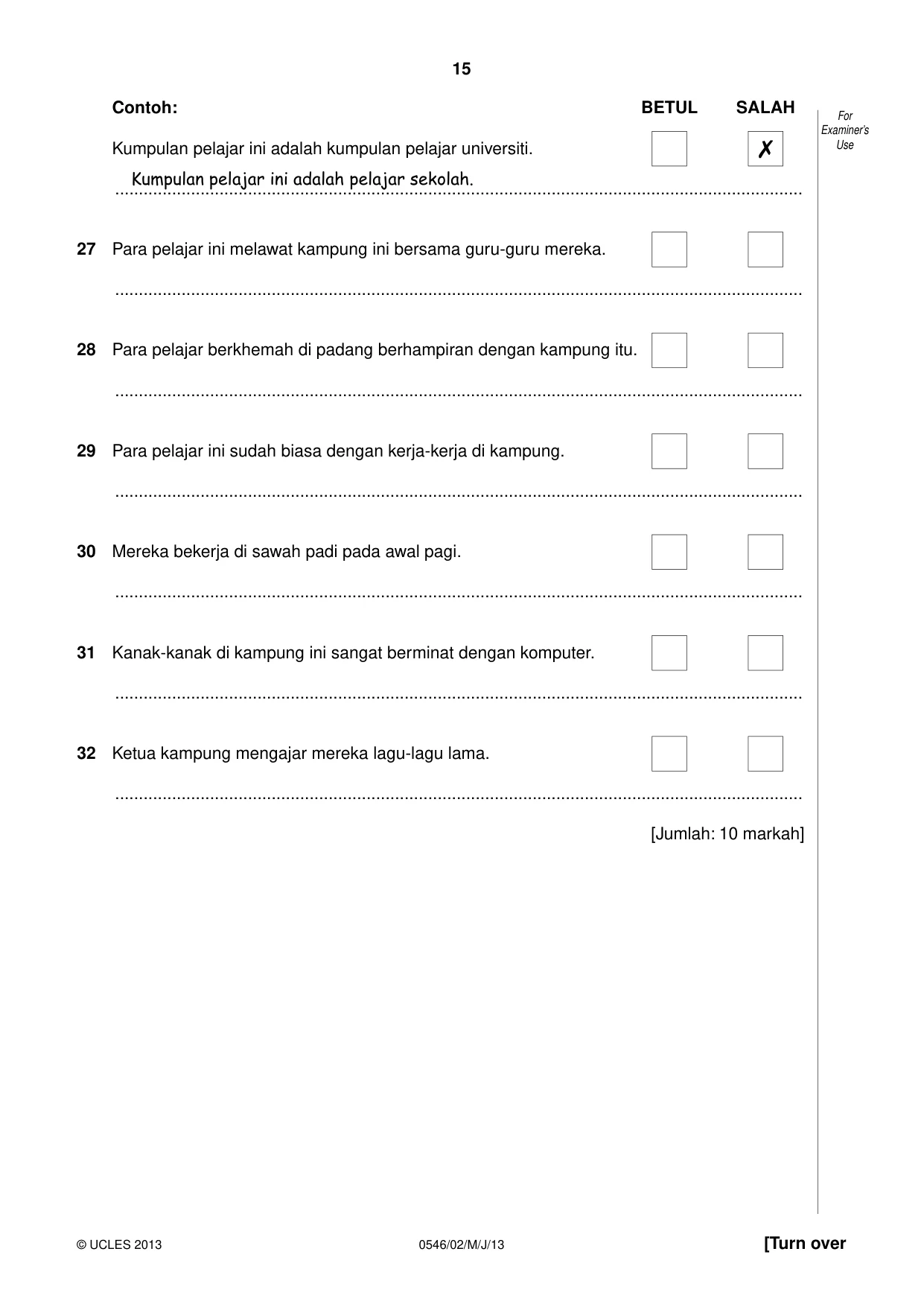
Question paper, page 15
15 0546/02/M/J/13 © UCLES 2013 [Turn over For Examiner’s Use Contoh: BETUL SALAH Kumpulan pelajar ini adalah kumpulan pelajar universiti. ✗ Kumpulan pelajar ini adalah pelajar sekolah. … 27 Para pelajar ini melawat kampung ini bersama guru-guru mereka. … 28 Para pelajar berkhemah di padang berhampiran dengan kampung itu. … 29 Para pelajar ini sudah biasa dengan kerja-kerja di kampung. … 30 Mereka bekerja di sawah padi pada awal pagi. … 31 Kanak-kanak di kampung ini sangat berminat dengan komputer. … 32 Ketua kampung mengajar mereka lagu-lagu lama. … [Jumlah: 10 markah]
Question paper, page 16
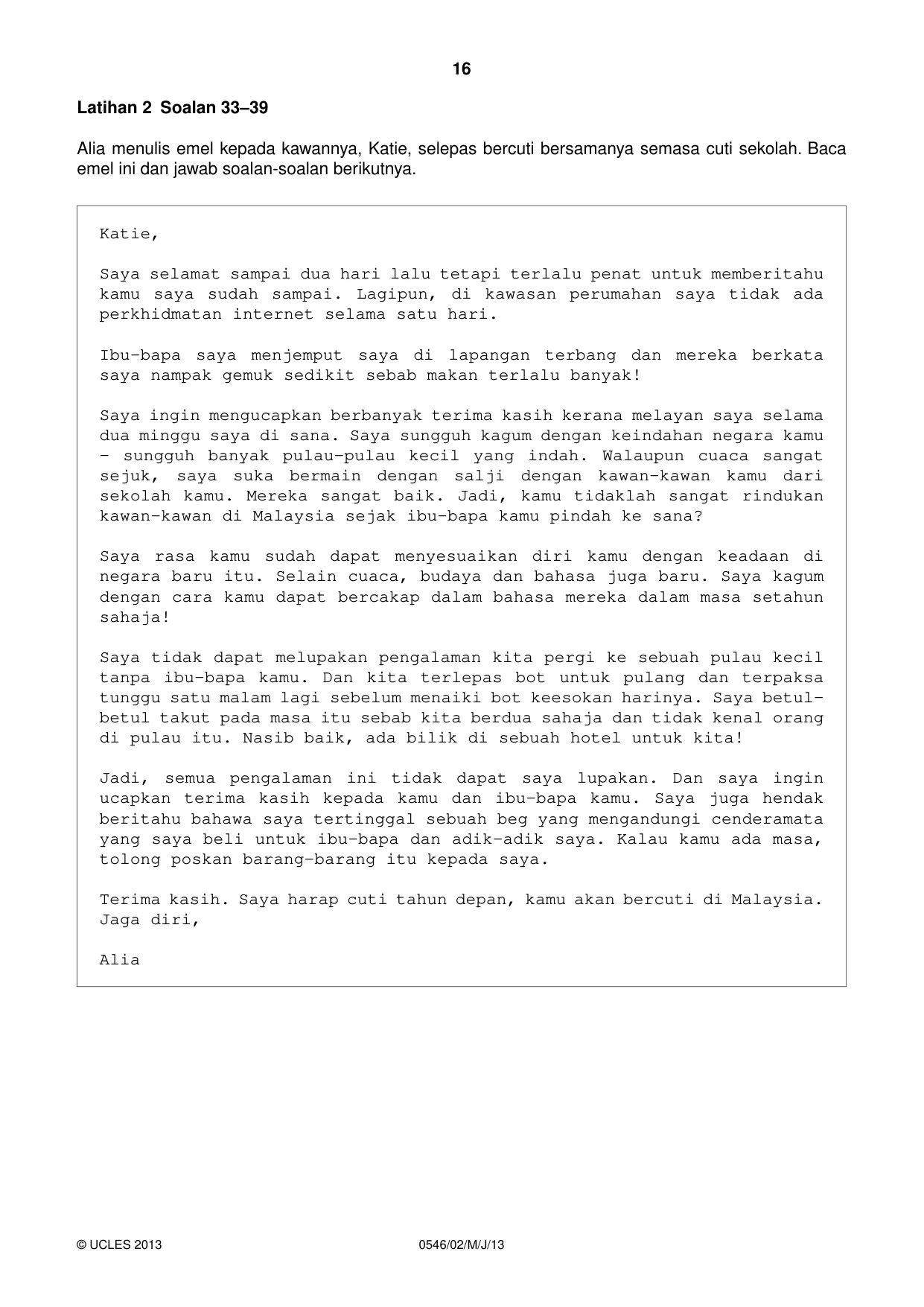
16 0546/02/M/J/13 © UCLES 2013 Latihan 2 Soalan 33–39 Alia menulis emel kepada kawannya, Katie, selepas bercuti bersamanya semasa cuti sekolah. Baca emel ini dan jawab soalan-soalan berikutnya. Katie, Saya selamat sampai dua hari lalu tetapi terlalu penat untuk memberitahu kamu saya sudah sampai. Lagipun, di kawasan perumahan saya tidak ada perkhidmatan internet selama satu hari. Ibu-bapa saya menjemput saya di lapangan terbang dan mereka berkata saya nampak gemuk sedikit sebab makan terlalu banyak! Saya ingin mengucapkan berbanyak terima kasih kerana melayan saya selama dua minggu saya di sana. Saya sungguh kagum dengan keindahan negara kamu – sungguh banyak pulau-pulau kecil yang indah. Walaupun cuaca sangat sejuk, saya suka bermain dengan salji dengan kawan-kawan kamu dari sekolah kamu. Mereka sangat baik. Jadi, kamu tidaklah sangat rindukan kawan-kawan di Malaysia sejak ibu-bapa kamu pindah ke sana? Saya rasa kamu sudah dapat menyesuaikan diri kamu dengan keadaan di negara baru itu. Selain cuaca, budaya dan bahasa juga baru. Saya kagum dengan cara kamu dapat bercakap dalam bahasa mereka dalam masa setahun sahaja! Saya tidak dapat melupakan pengalaman kita pergi ke sebuah pulau kecil tanpa ibu-bapa kamu. Dan kita terlepas bot untuk pulang dan terpaksa tunggu satu malam lagi sebelum menaiki bot keesokan harinya. Saya betul- betul takut pada masa itu sebab kita berdua sahaja dan tidak kenal orang di pulau itu. Nasib baik, ada bilik di sebuah hotel untuk kita! Jadi, semua pengalaman ini tidak dapat saya lupakan. Dan saya ingin ucapkan terima kasih kepada kamu dan ibu-bapa kamu. Saya juga hendak beritahu bahawa saya tertinggal sebuah beg yang mengandungi cenderamata yang saya beli untuk ibu-bapa dan adik-adik saya. Kalau kamu ada masa, tolong poskan barang-barang itu kepada saya. Terima kasih. Saya harap cuti tahun depan, kamu akan bercuti di Malaysia. Jaga diri, Alia
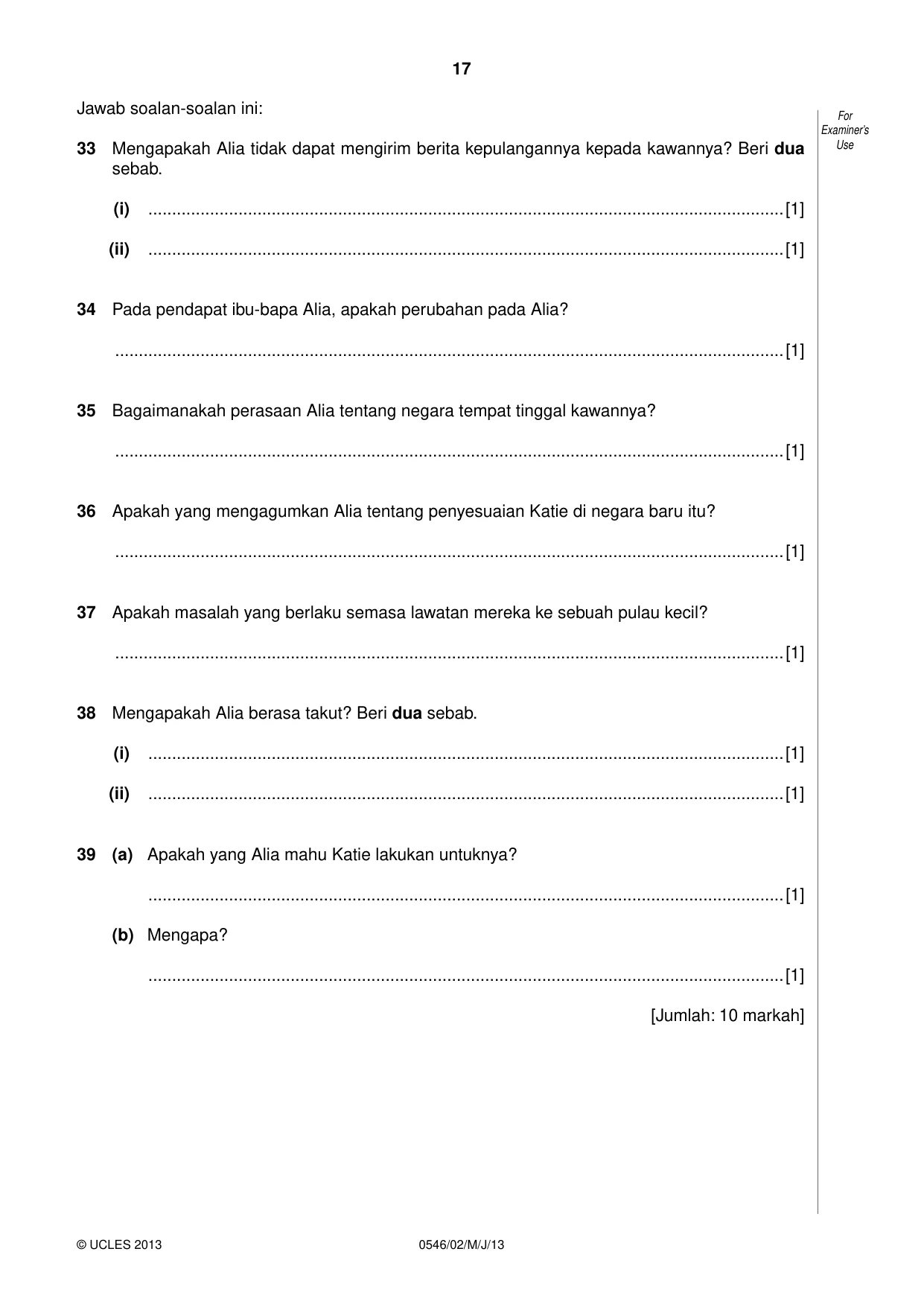
Question paper, page 17
17 0546/02/M/J/13 © UCLES 2013 For Examiner’s Use Jawab soalan-soalan ini: 33 Mengapakah Alia tidak dapat mengirim berita kepulangannya kepada kawannya? Beri dua sebab. (i) …[1] (ii) …[1] 34 Pada pendapat ibu-bapa Alia, apakah perubahan pada Alia? …[1] 35 Bagaimanakah perasaan Alia tentang negara tempat tinggal kawannya? …[1] 36 Apakah yang mengagumkan Alia tentang penyesuaian Katie di negara baru itu? …[1] 37 Apakah masalah yang berlaku semasa lawatan mereka ke sebuah pulau kecil? …[1] 38 Mengapakah Alia berasa takut? Beri dua sebab. (i) …[1] (ii) …[1] 39 (a) Apakah yang Alia mahu Katie lakukan untuknya? …[1] (b) Mengapa? …[1] [Jumlah: 10 markah]
Question paper, page 18
18 0546/02/M/J/13 © UCLES 2013 BLANK PAGE
Question paper, page 19
19 0546/02/M/J/13 © UCLES 2013 BLANK PAGE
Question paper, page 20
20 0546/02/M/J/13 © UCLES 2013 Permission to reproduce items where third-party owned material protected by copyright is included has been sought and cleared where possible. Every reasonable effort has been made by the publisher (UCLES) to trace copyright holders, but if any items requiring clearance have unwittingly been included, the publisher will be pleased to make amends at the earliest possible opportunity. University of Cambridge International Examinations is part of the Cambridge Assessment Group. Cambridge Assessment is the brand name of University of Cambridge Local Examinations Syndicate (UCLES), which is itself a department of the University of Cambridge. BLANK PAGE
Mark scheme, page 1
CAMBRIDGE INTERNATIONAL EXAMINATIONS International General Certificate of Secondary Education MARK SCHEME for the May/June 2013 series 0546 FOREIGN LANGUAGE MALAY 0546/02 Paper 2 (Reading and Directed Writing), maximum raw mark 65 This mark scheme is published as an aid to teachers and candidates, to indicate the requirements of the examination. It shows the basis on which Examiners were instructed to award marks. It does not indicate the details of the discussions that took place at an Examiners’ meeting before marking began, which would have considered the acceptability of alternative answers. Mark schemes should be read in conjunction with the question paper and the Principal Examiner Report for Teachers. Cambridge will not enter into discussions about these mark schemes. Cambridge is publishing the mark schemes for the May/June 2013 series for most IGCSE, GCE Advanced Level and Advanced Subsidiary Level components and some Ordinary Level components. www.XtremePapers.com
Mark scheme, page 2
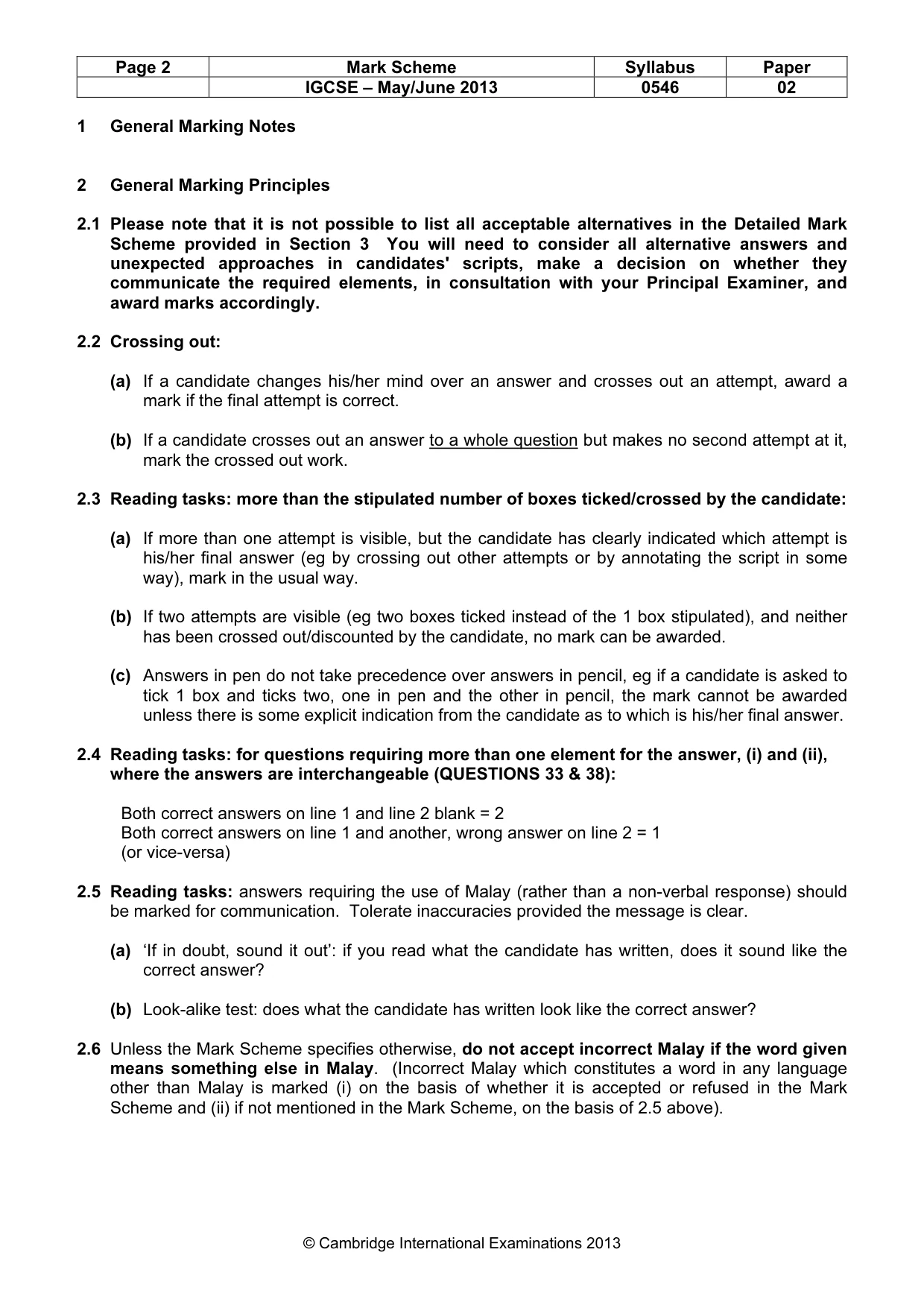
Page 2 Mark Scheme Syllabus Paper IGCSE – May/June 2013 0546 02 © Cambridge International Examinations 2013 1 General Marking Notes 2 General Marking Principles 2.1 Please note that it is not possible to list all acceptable alternatives in the Detailed Mark Scheme provided in Section 3 You will need to consider all alternative answers and unexpected approaches in candidates' scripts, make a decision on whether they communicate the required elements, in consultation with your Principal Examiner, and award marks accordingly. 2.2 Crossing out: (a) If a candidate changes his/her mind over an answer and crosses out an attempt, award a mark if the final attempt is correct. (b) If a candidate crosses out an answer to a whole question but makes no second attempt at it, mark the crossed out work. 2.3 Reading tasks: more than the stipulated number of boxes ticked/crossed by the candidate: (a) If more than one attempt is visible, but the candidate has clearly indicated which attempt is his/her final answer (eg by crossing out other attempts or by annotating the script in some way), mark in the usual way. (b) If two attempts are visible (eg two boxes ticked instead of the 1 box stipulated), and neither has been crossed out/discounted by the candidate, no mark can be awarded. (c) Answers in pen do not take precedence over answers in pencil, eg if a candidate is asked to tick 1 box and ticks two, one in pen and the other in pencil, the mark cannot be awarded unless there is some explicit indication from the candidate as to which is his/her final answer. 2.4 Reading tasks: for questions requiring more than one element for the answer, (i) and (ii), where the answers are interchangeable (QUESTIONS 33 & 38): Both correct answers on line 1 and line 2 blank = 2 Both correct answers on line 1 and another, wrong answer on line 2 = 1 (or vice-versa) 2.5 Reading tasks: answers requiring the use of Malay (rather than a non-verbal response) should be marked for communication. Tolerate inaccuracies provided the message is clear. (a) ‘If in doubt, sound it out’: if you read what the candidate has written, does it sound like the correct answer? (b) Look-alike test: does what the candidate has written look like the correct answer? 2.6 Unless the Mark Scheme specifies otherwise, do not accept incorrect Malay if the word given means something else in Malay. (Incorrect Malay which constitutes a word in any language other than Malay is marked (i) on the basis of whether it is accepted or refused in the Mark Scheme and (ii) if not mentioned in the Mark Scheme, on the basis of 2.5 above).
Mark scheme, page 3
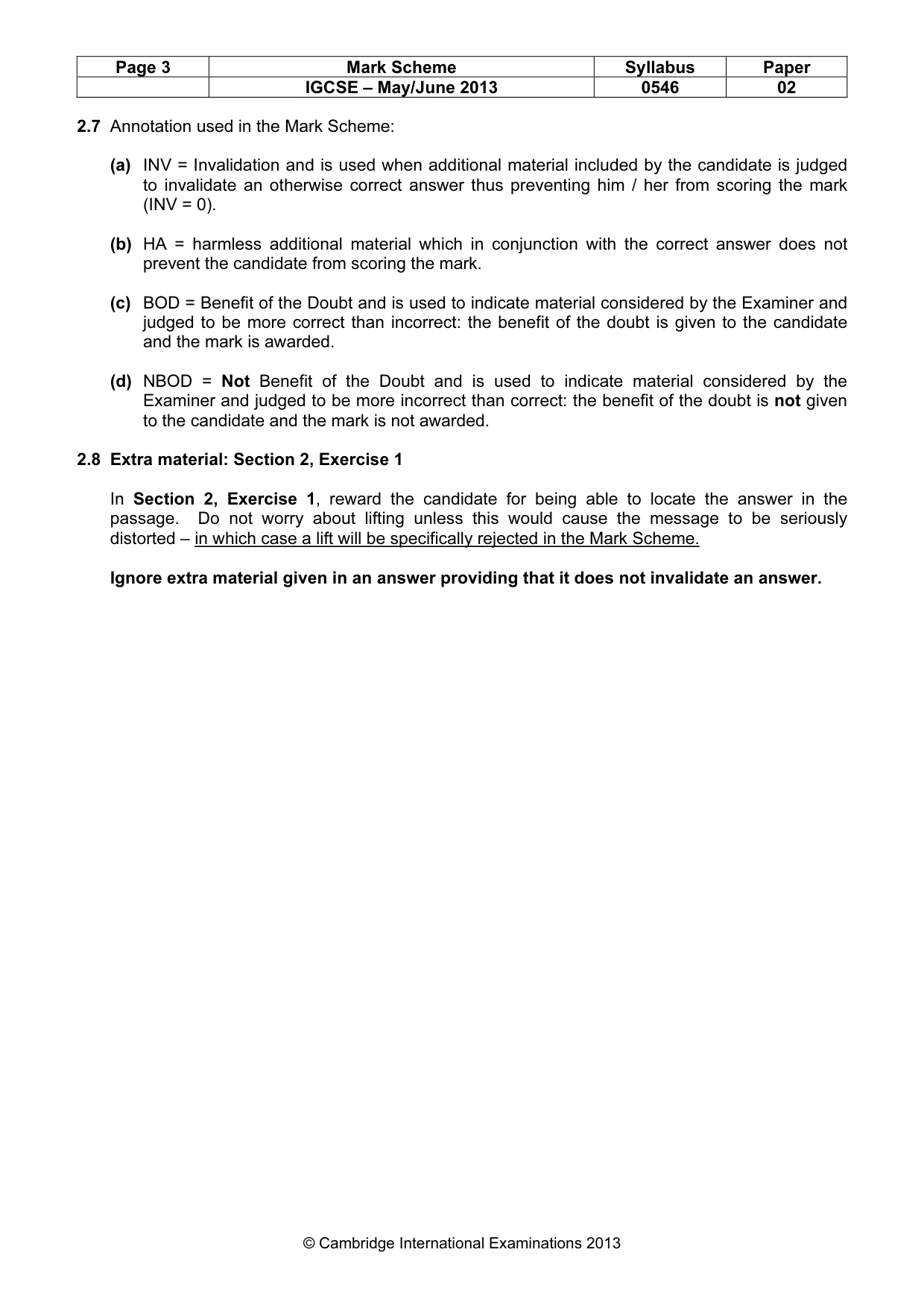
Page 3 Mark Scheme Syllabus Paper IGCSE – May/June 2013 0546 02 © Cambridge International Examinations 2013 2.7 Annotation used in the Mark Scheme: (a) INV = Invalidation and is used when additional material included by the candidate is judged to invalidate an otherwise correct answer thus preventing him / her from scoring the mark (INV = 0). (b) HA = harmless additional material which in conjunction with the correct answer does not prevent the candidate from scoring the mark. (c) BOD = Benefit of the Doubt and is used to indicate material considered by the Examiner and judged to be more correct than incorrect: the benefit of the doubt is given to the candidate and the mark is awarded. (d) NBOD = Not Benefit of the Doubt and is used to indicate material considered by the Examiner and judged to be more incorrect than correct: the benefit of the doubt is not given to the candidate and the mark is not awarded. 2.8 Extra material: Section 2, Exercise 1 In Section 2, Exercise 1, reward the candidate for being able to locate the answer in the passage. Do not worry about lifting unless this would cause the message to be seriously distorted – in which case a lift will be specifically rejected in the Mark Scheme. Ignore extra material given in an answer providing that it does not invalidate an answer.
Mark scheme, page 4
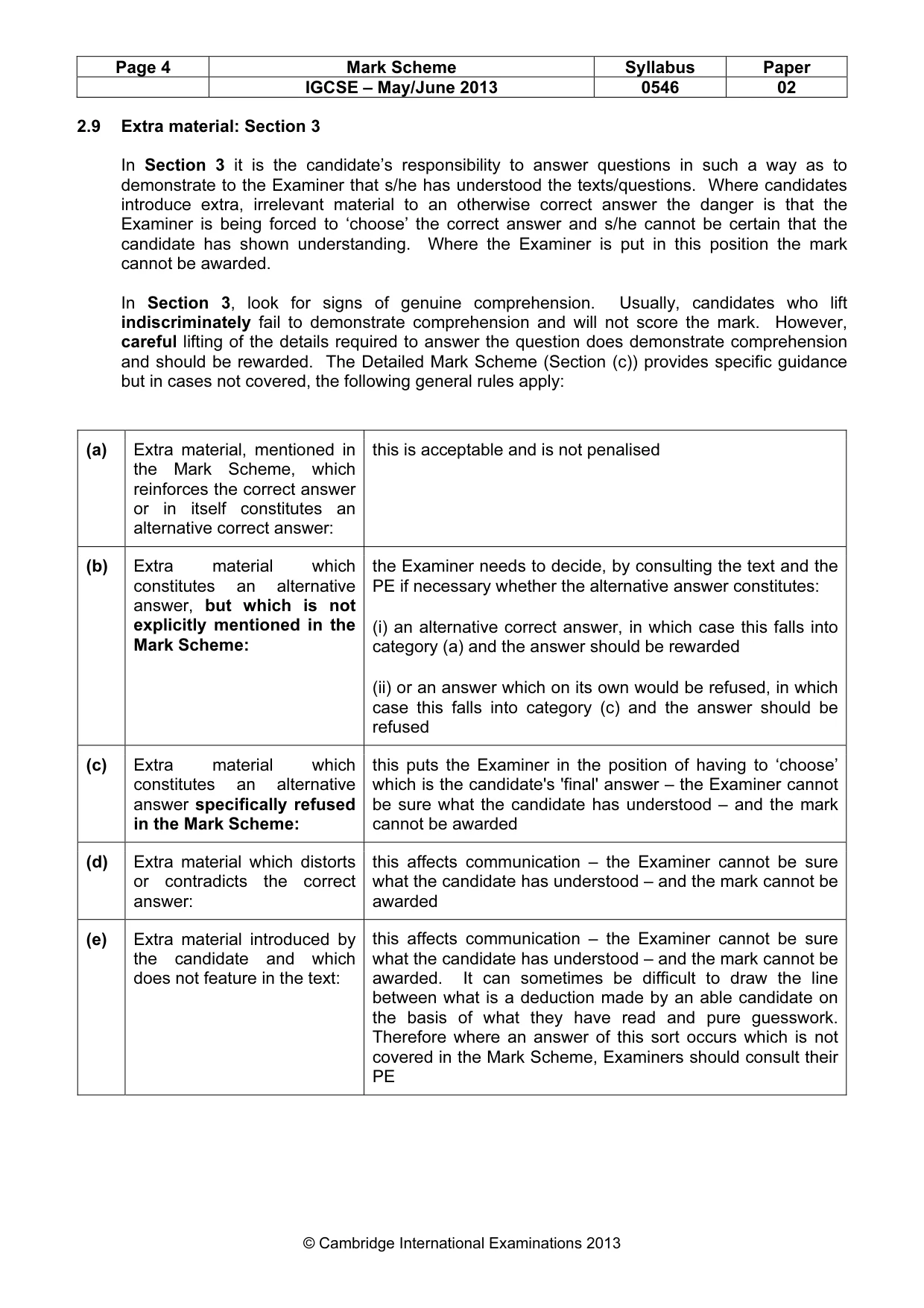
Page 4 Mark Scheme Syllabus Paper IGCSE – May/June 2013 0546 02 © Cambridge International Examinations 2013 2.9 Extra material: Section 3 In Section 3 it is the candidate’s responsibility to answer questions in such a way as to demonstrate to the Examiner that s/he has understood the texts/questions. Where candidates introduce extra, irrelevant material to an otherwise correct answer the danger is that the Examiner is being forced to ‘choose’ the correct answer and s/he cannot be certain that the candidate has shown understanding. Where the Examiner is put in this position the mark cannot be awarded. In Section 3, look for signs of genuine comprehension. Usually, candidates who lift indiscriminately fail to demonstrate comprehension and will not score the mark. However, careful lifting of the details required to answer the question does demonstrate comprehension and should be rewarded. The Detailed Mark Scheme (Section (c)) provides specific guidance but in cases not covered, the following general rules apply: (a) Extra material, mentioned in the Mark Scheme, which reinforces the correct answer or in itself constitutes an alternative correct answer: this is acceptable and is not penalised (b) Extra material which constitutes an alternative answer, but which is not explicitly mentioned in the Mark Scheme: the Examiner needs to decide, by consulting the text and the PE if necessary whether the alternative answer constitutes: (i) an alternative correct answer, in which case this falls into category (a) and the answer should be rewarded (ii) or an answer which on its own would be refused, in which case this falls into category (c) and the answer should be refused (c) Extra material which constitutes an alternative answer specifically refused in the Mark Scheme: this puts the Examiner in the position of having to ‘choose’ which is the candidate's 'final' answer – the Examiner cannot be sure what the candidate has understood – and the mark cannot be awarded (d) Extra material which distorts or contradicts the correct answer: this affects communication – the Examiner cannot be sure what the candidate has understood – and the mark cannot be awarded (e) Extra material introduced by the candidate and which does not feature in the text: this affects communication – the Examiner cannot be sure what the candidate has understood – and the mark cannot be awarded. It can sometimes be difficult to draw the line between what is a deduction made by an able candidate on the basis of what they have read and pure guesswork. Therefore where an answer of this sort occurs which is not covered in the Mark Scheme, Examiners should consult their PE
Mark scheme, page 5
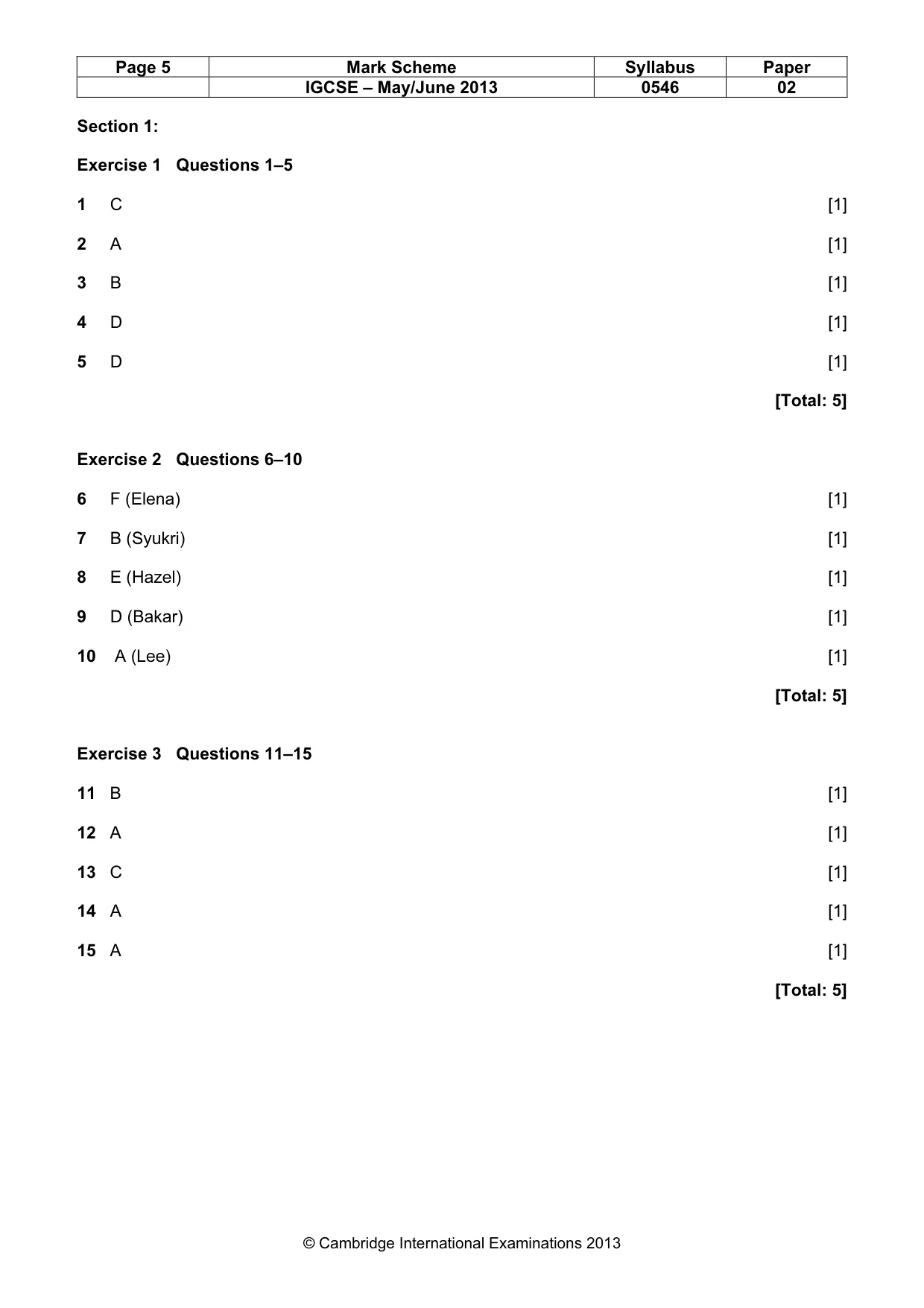
Page 5 Mark Scheme Syllabus Paper IGCSE – May/June 2013 0546 02 © Cambridge International Examinations 2013 Section 1: Exercise 1 Questions 1–5 1 C [1] 2 A [1] 3 B [1] 4 D [1] 5 D [1] [Total: 5] Exercise 2 Questions 6–10 6 F (Elena) [1] 7 B (Syukri) [1] 8 E (Hazel) [1] 9 D (Bakar) [1] 10 A (Lee) [1] [Total: 5] Exercise 3 Questions 11–15 11 B [1] 12 A [1] 13 C [1] 14 A [1] 15 A [1] [Total: 5]
Mark scheme, page 6
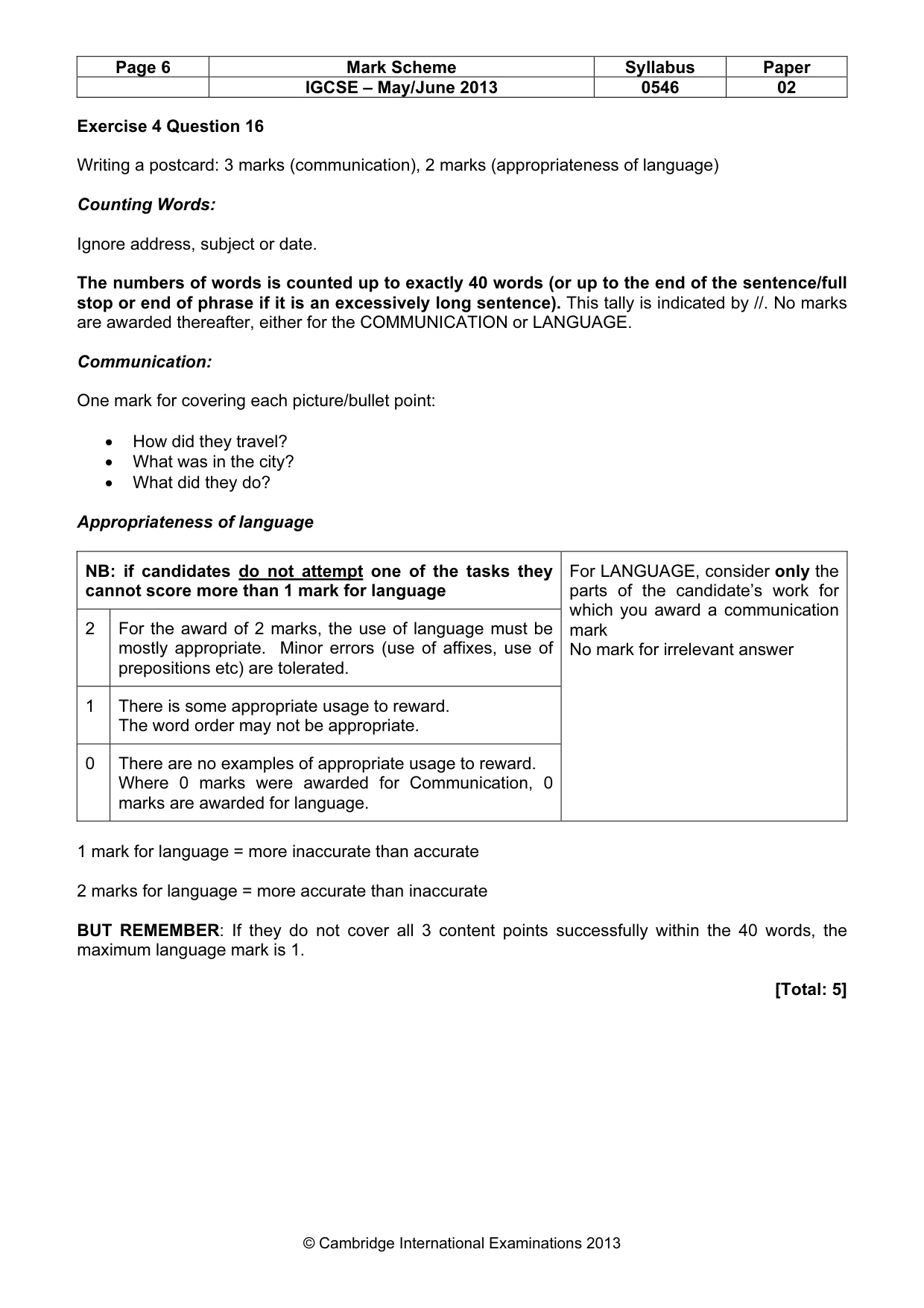
Page 6 Mark Scheme Syllabus Paper IGCSE – May/June 2013 0546 02 © Cambridge International Examinations 2013 Exercise 4 Question 16 Writing a postcard: 3 marks (communication), 2 marks (appropriateness of language) Counting Words: Ignore address, subject or date. The numbers of words is counted up to exactly 40 words (or up to the end of the sentence/full stop or end of phrase if it is an excessively long sentence). This tally is indicated by //. No marks are awarded thereafter, either for the COMMUNICATION or LANGUAGE. Communication: One mark for covering each picture/bullet point: • How did they travel? • What was in the city? • What did they do? Appropriateness of language NB: if candidates do not attempt one of the tasks they cannot score more than 1 mark for language For LANGUAGE, consider only the parts of the candidate’s work for which you award a communication mark No mark for irrelevant answer 2 For the award of 2 marks, the use of language must be mostly appropriate. Minor errors (use of affixes, use of prepositions etc) are tolerated. 1 There is some appropriate usage to reward. The word order may not be appropriate. 0 There are no examples of appropriate usage to reward. Where 0 marks were awarded for Communication, 0 marks are awarded for language. 1 mark for language = more inaccurate than accurate 2 marks for language = more accurate than inaccurate BUT REMEMBER: If they do not cover all 3 content points successfully within the 40 words, the maximum language mark is 1. [Total: 5]
Mark scheme, page 7
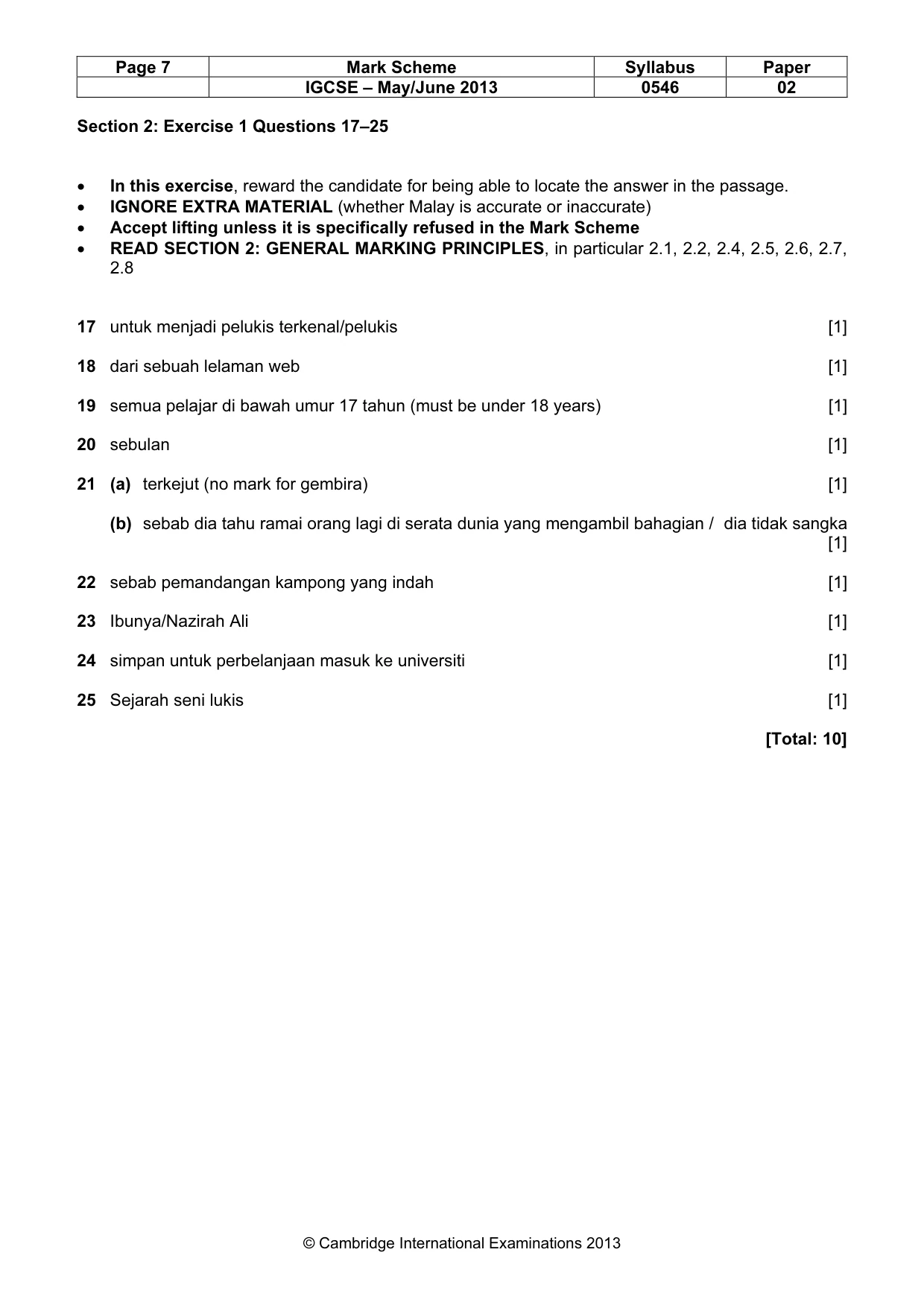
Page 7 Mark Scheme Syllabus Paper IGCSE – May/June 2013 0546 02 © Cambridge International Examinations 2013 Section 2: Exercise 1 Questions 17–25 • In this exercise, reward the candidate for being able to locate the answer in the passage. • IGNORE EXTRA MATERIAL (whether Malay is accurate or inaccurate) • Accept lifting unless it is specifically refused in the Mark Scheme • READ SECTION 2: GENERAL MARKING PRINCIPLES, in particular 2.1, 2.2, 2.4, 2.5, 2.6, 2.7, 2.8 17 untuk menjadi pelukis terkenal/pelukis [1] 18 dari sebuah lelaman web [1] 19 semua pelajar di bawah umur 17 tahun (must be under 18 years) [1] 20 sebulan [1] 21 (a) terkejut (no mark for gembira) [1] (b) sebab dia tahu ramai orang lagi di serata dunia yang mengambil bahagian / dia tidak sangka [1] 22 sebab pemandangan kampong yang indah [1] 23 Ibunya/Nazirah Ali [1] 24 simpan untuk perbelanjaan masuk ke universiti [1] 25 Sejarah seni lukis [1] [Total: 10]
Mark scheme, page 8
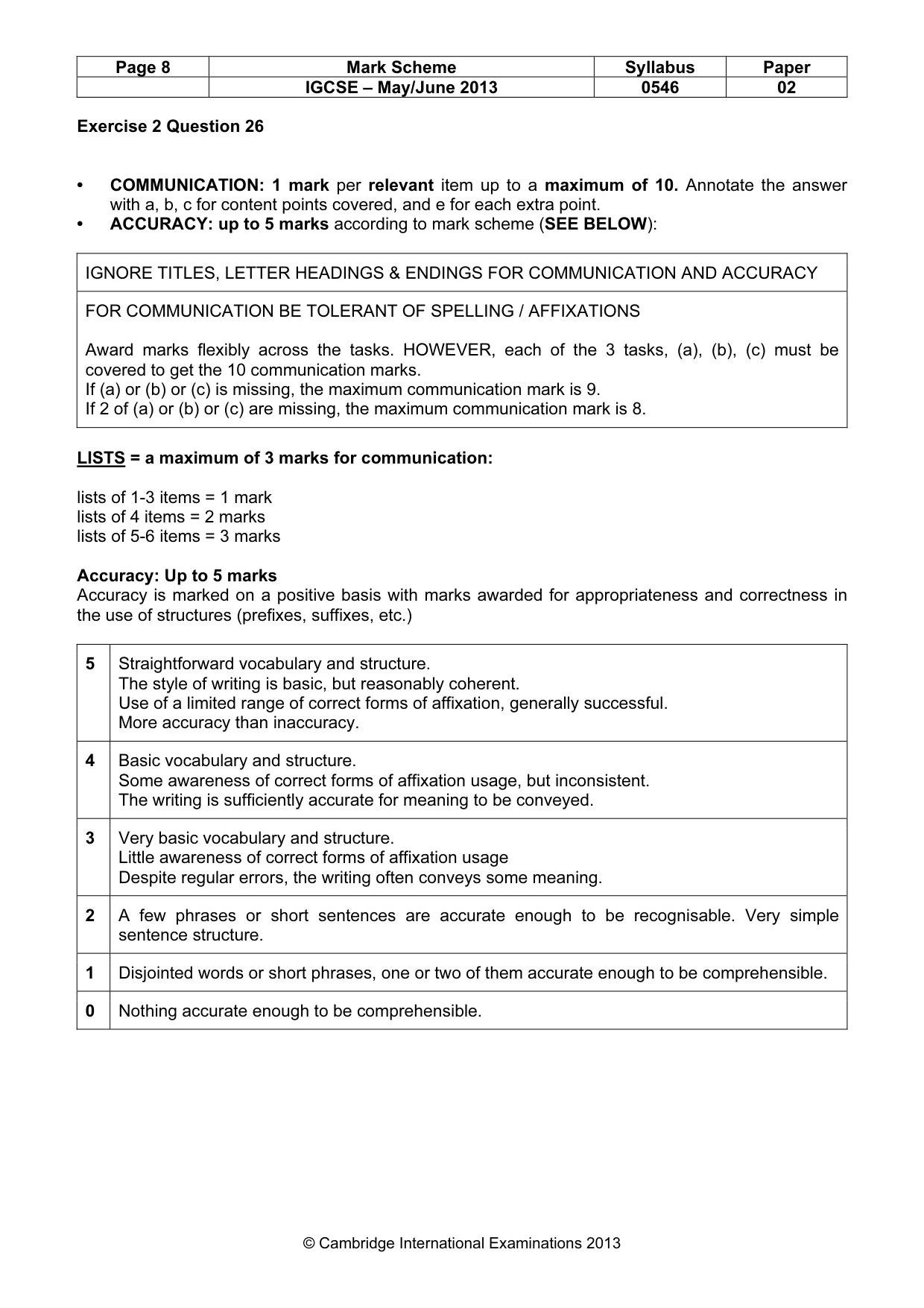
Page 8 Mark Scheme Syllabus Paper IGCSE – May/June 2013 0546 02 © Cambridge International Examinations 2013 Exercise 2 Question 26 • COMMUNICATION: 1 mark per relevant item up to a maximum of 10. Annotate the answer with a, b, c for content points covered, and e for each extra point. • ACCURACY: up to 5 marks according to mark scheme (SEE BELOW): IGNORE TITLES, LETTER HEADINGS & ENDINGS FOR COMMUNICATION AND ACCURACY FOR COMMUNICATION BE TOLERANT OF SPELLING / AFFIXATIONS Award marks flexibly across the tasks. HOWEVER, each of the 3 tasks, (a), (b), (c) must be covered to get the 10 communication marks. If (a) or (b) or (c) is missing, the maximum communication mark is 9. If 2 of (a) or (b) or (c) are missing, the maximum communication mark is 8. LISTS = a maximum of 3 marks for communication: lists of 1-3 items = 1 mark lists of 4 items = 2 marks lists of 5-6 items = 3 marks Accuracy: Up to 5 marks Accuracy is marked on a positive basis with marks awarded for appropriateness and correctness in the use of structures (prefixes, suffixes, etc.) 5 Straightforward vocabulary and structure. The style of writing is basic, but reasonably coherent. Use of a limited range of correct forms of affixation, generally successful. More accuracy than inaccuracy. 4 Basic vocabulary and structure. Some awareness of correct forms of affixation usage, but inconsistent. The writing is sufficiently accurate for meaning to be conveyed. 3 Very basic vocabulary and structure. Little awareness of correct forms of affixation usage Despite regular errors, the writing often conveys some meaning. 2 A few phrases or short sentences are accurate enough to be recognisable. Very simple sentence structure. 1 Disjointed words or short phrases, one or two of them accurate enough to be comprehensible. 0 Nothing accurate enough to be comprehensible.
Mark scheme, page 9
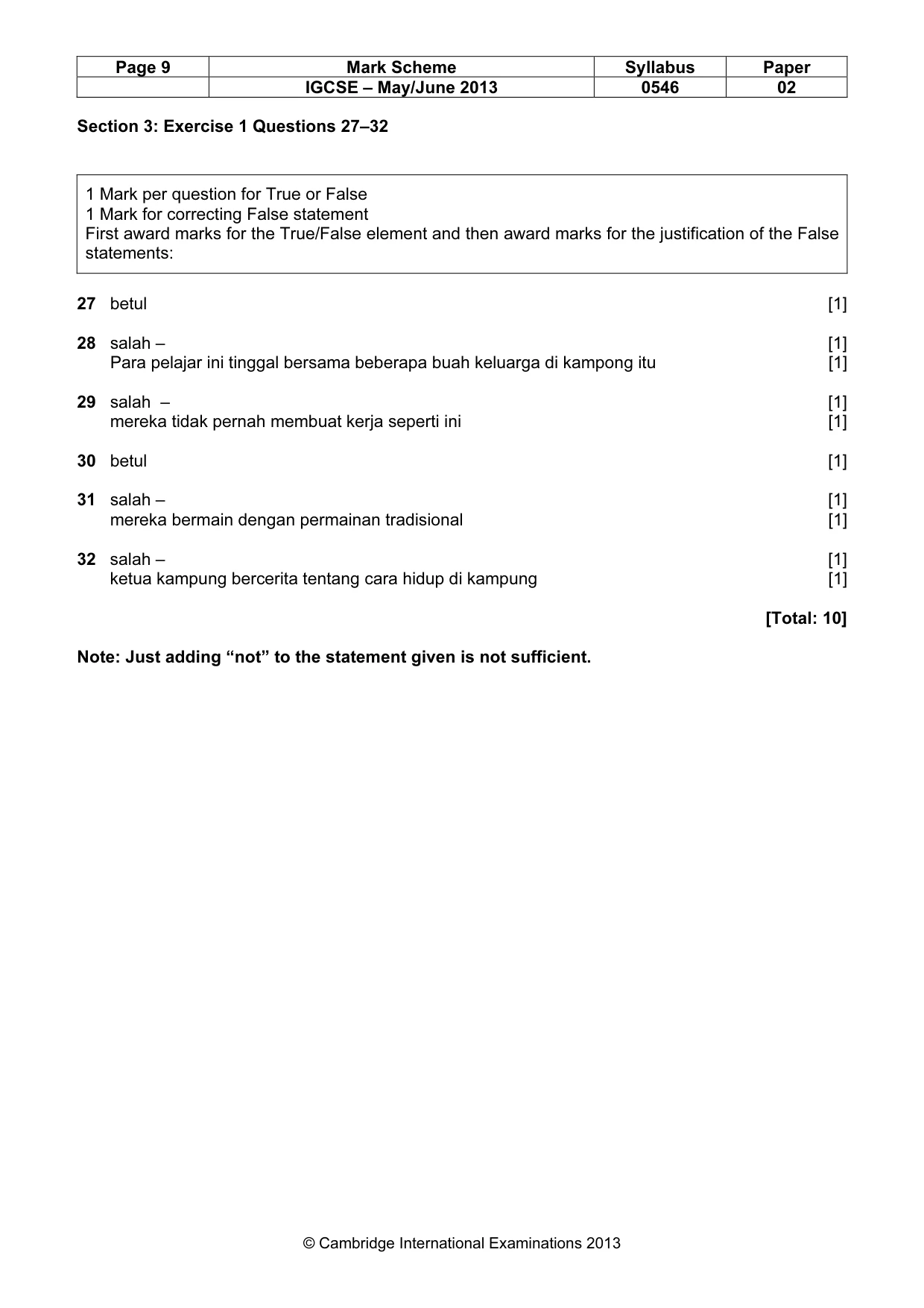
Page 9 Mark Scheme Syllabus Paper IGCSE – May/June 2013 0546 02 © Cambridge International Examinations 2013 Section 3: Exercise 1 Questions 27–32 1 Mark per question for True or False 1 Mark for correcting False statement First award marks for the True/False element and then award marks for the justification of the False statements: 27 betul [1] 28 salah – [1] Para pelajar ini tinggal bersama beberapa buah keluarga di kampong itu [1] 29 salah – [1] mereka tidak pernah membuat kerja seperti ini [1] 30 betul [1] 31 salah – [1] mereka bermain dengan permainan tradisional [1] 32 salah – [1] ketua kampung bercerita tentang cara hidup di kampung [1] [Total: 10] Note: Just adding “not” to the statement given is not sufficient.
Mark scheme, page 10
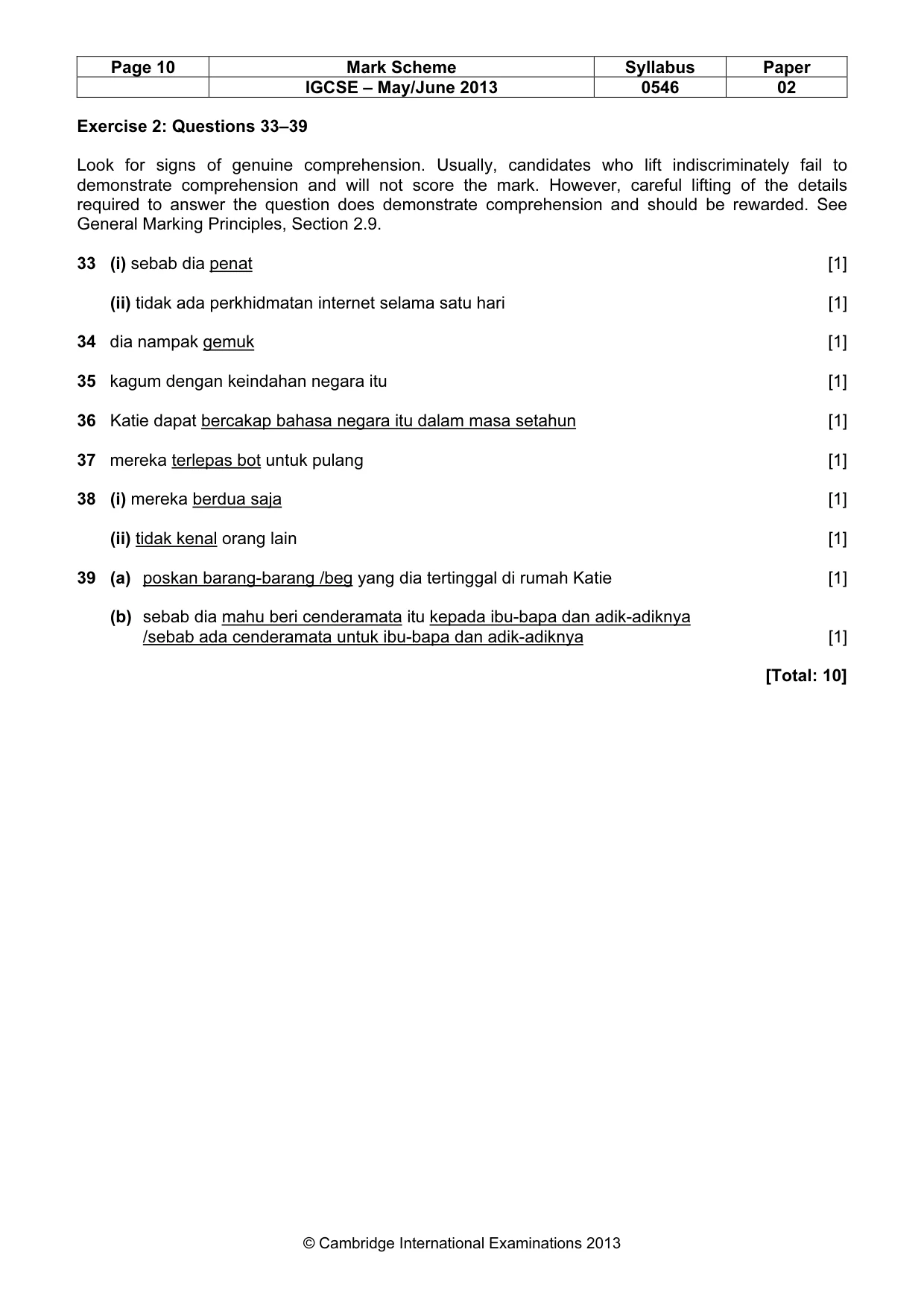
Page 10 Mark Scheme Syllabus Paper IGCSE – May/June 2013 0546 02 © Cambridge International Examinations 2013 Exercise 2: Questions 33–39 Look for signs of genuine comprehension. Usually, candidates who lift indiscriminately fail to demonstrate comprehension and will not score the mark. However, careful lifting of the details required to answer the question does demonstrate comprehension and should be rewarded. See General Marking Principles, Section 2.9. 33 (i) sebab dia penat [1] (ii) tidak ada perkhidmatan internet selama satu hari [1] 34 dia nampak gemuk [1] 35 kagum dengan keindahan negara itu [1] 36 Katie dapat bercakap bahasa negara itu dalam masa setahun [1] 37 mereka terlepas bot untuk pulang [1] 38 (i) mereka berdua saja [1] (ii) tidak kenal orang lain [1] 39 (a) poskan barang-barang /beg yang dia tertinggal di rumah Katie [1] (b) sebab dia mahu beri cenderamata itu kepada ibu-bapa dan adik-adiknya /sebab ada cenderamata untuk ibu-bapa dan adik-adiknya [1] [Total: 10]
What you needed in this session
Cambridge’s own grade thresholds for 2013 May/June, Paper 2 · Variant 1. A higher threshold means an easier paper — the bar moves with how the cohort did.