Cambridge IGCSE Malay - Foreign Language 0546 — 2010 May/June Paper 2 · Variant 1
0546/21/M/J/10 · 65 marks · ≈73 min
The question paper and its mark scheme, free to read here and free to download. This is Cambridge’s own paper, exactly as it was sat.
Question paper16 pages
Mark scheme8 pages
Answers below. Sit the paper first if you are practising.
Paper as text
Question paper, page 1
This document consists of 14 printed pages and 2 blank pages. DC (SM/DJ) 18624/3 © UCLES 2010 [Turn over UNIVERSITY OF CAMBRIDGE INTERNATIONAL EXAMINATIONS International General Certificate of Secondary Education READ THESE INSTRUCTIONS FIRST Write your Centre number, candidate number and name on all the work you hand in. Write in dark blue or black pen. Do not use staples, paper clips, highlighters, glue or correction fluid. DO NOT WRITE IN ANY BARCODES. Answer all questions in Section 1, Section 2 and Section 3. At the end of the examination, fasten all your work securely together. The number of marks is given in brackets [ ] at the end of each question or part question. * 6 9 1 8 7 2 2 5 0 4 * CANDIDATE NAME CENTRE NUMBER CANDIDATE NUMBER MALAY 0546/02 Paper 2 Reading and Directed Writing May/June 2010 1 hour 30 minutes Candidates answer on the Question Paper. No Additional Materials are required. For Examiner’s Use Section 1 Section 2 Section 3 Total www.XtremePapers.com
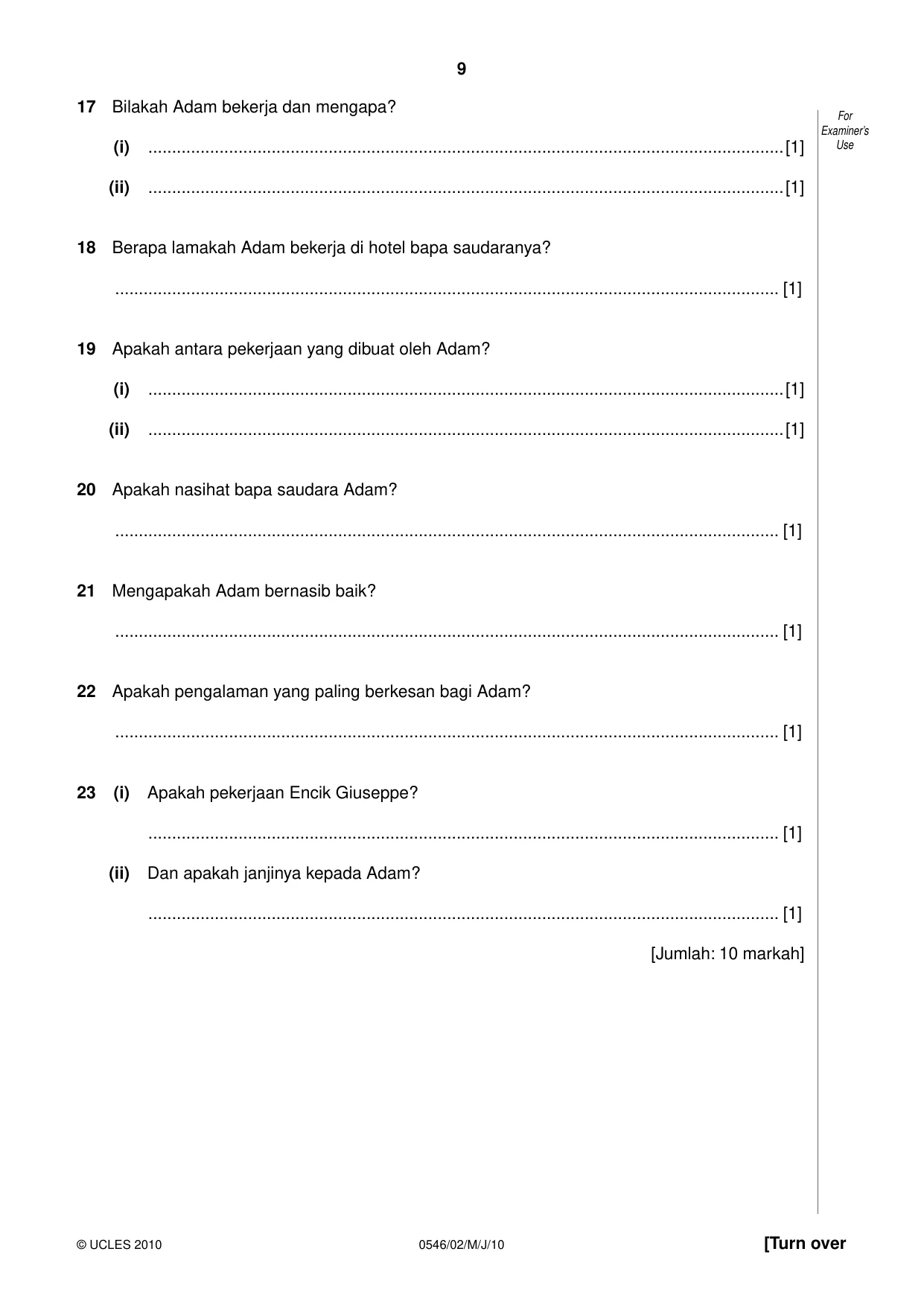
Question paper, page 2
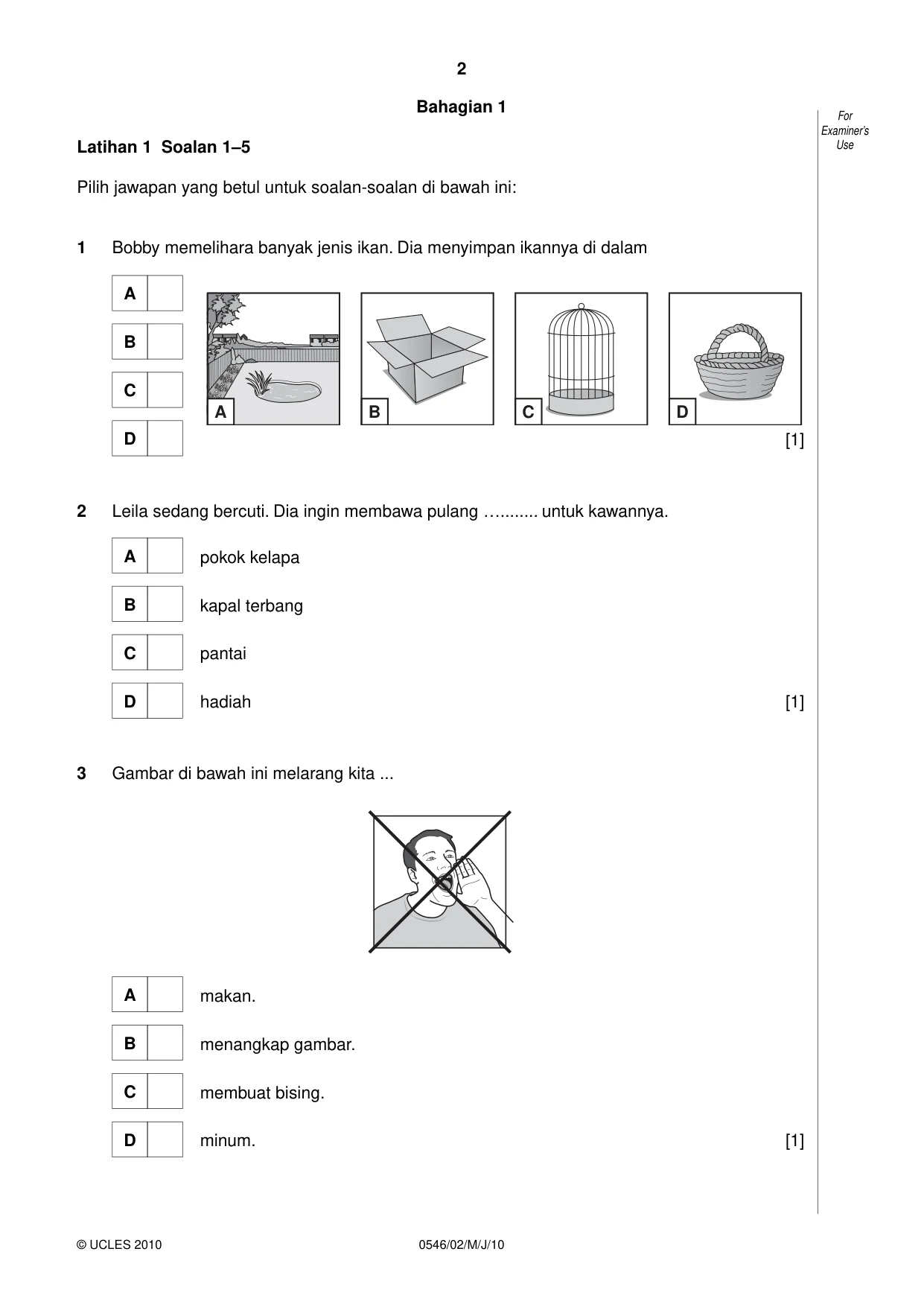
2 0546/02/M/J/10 © UCLES 2010 For Examiner’s Use Bahagian 1 Latihan 1 Soalan 1–5 Pilih jawapan yang betul untuk soalan-soalan di bawah ini: 1 Bobby memelihara banyak jenis ikan. Dia menyimpan ikannya di dalam A B C D A B C D [1] 2 Leila sedang bercuti. Dia ingin membawa pulang …… untuk kawannya. pokok kelapa kapal terbang pantai hadiah [1] A B C D 3 Gambar di bawah ini melarang kita ... makan. menangkap gambar. membuat bising. minum. [1] A B C D
Question paper, page 3
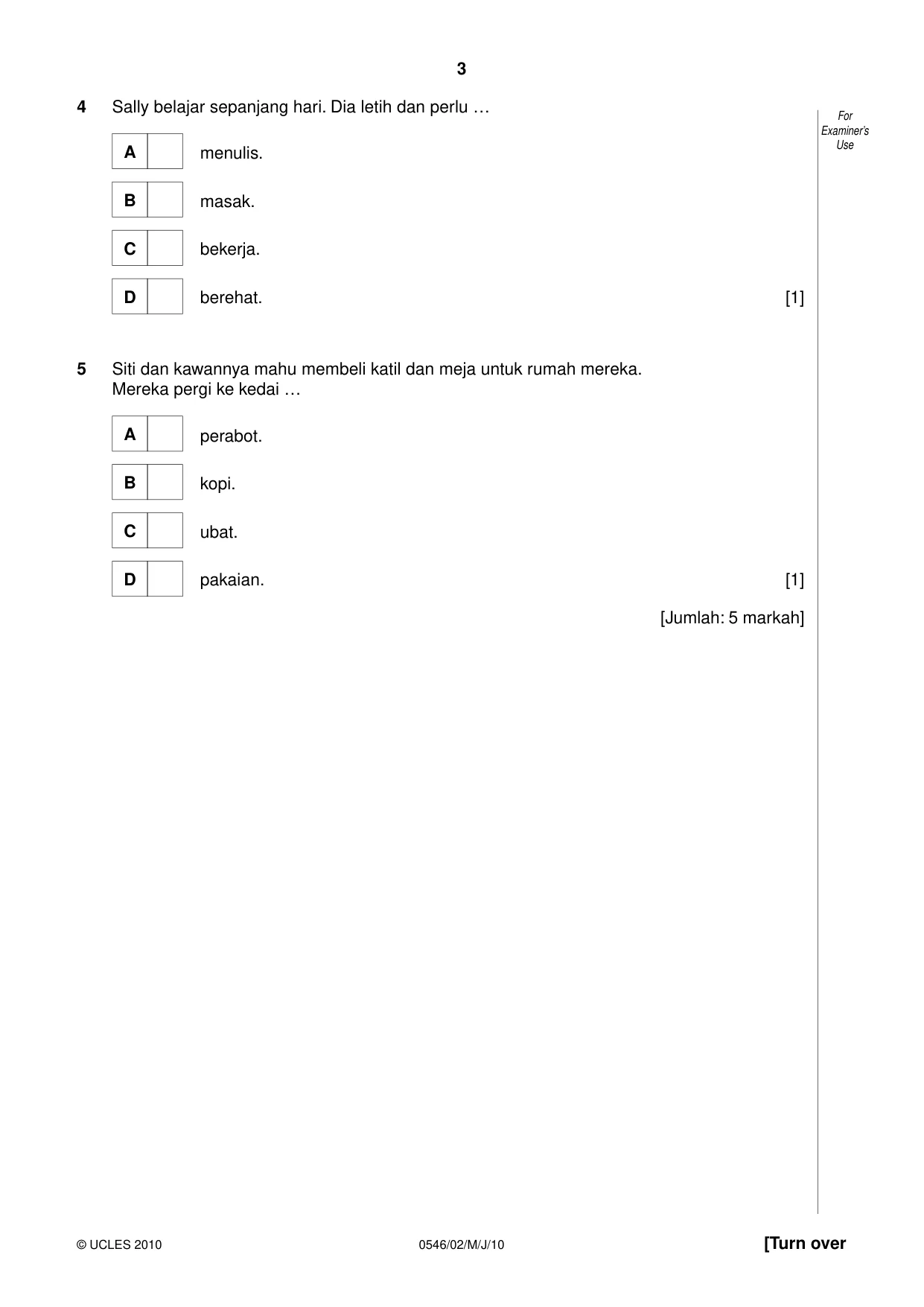
3 [Turn over 0546/02/M/J/10 © UCLES 2010 For Examiner’s Use 4 Sally belajar sepanjang hari. Dia letih dan perlu … menulis. masak. bekerja. berehat. [1] A B C D 5 Siti dan kawannya mahu membeli katil dan meja untuk rumah mereka. Mereka pergi ke kedai … perabot. kopi. ubat. pakaian. [1] A B C D [Jumlah: 5 markah]
Question paper, page 4
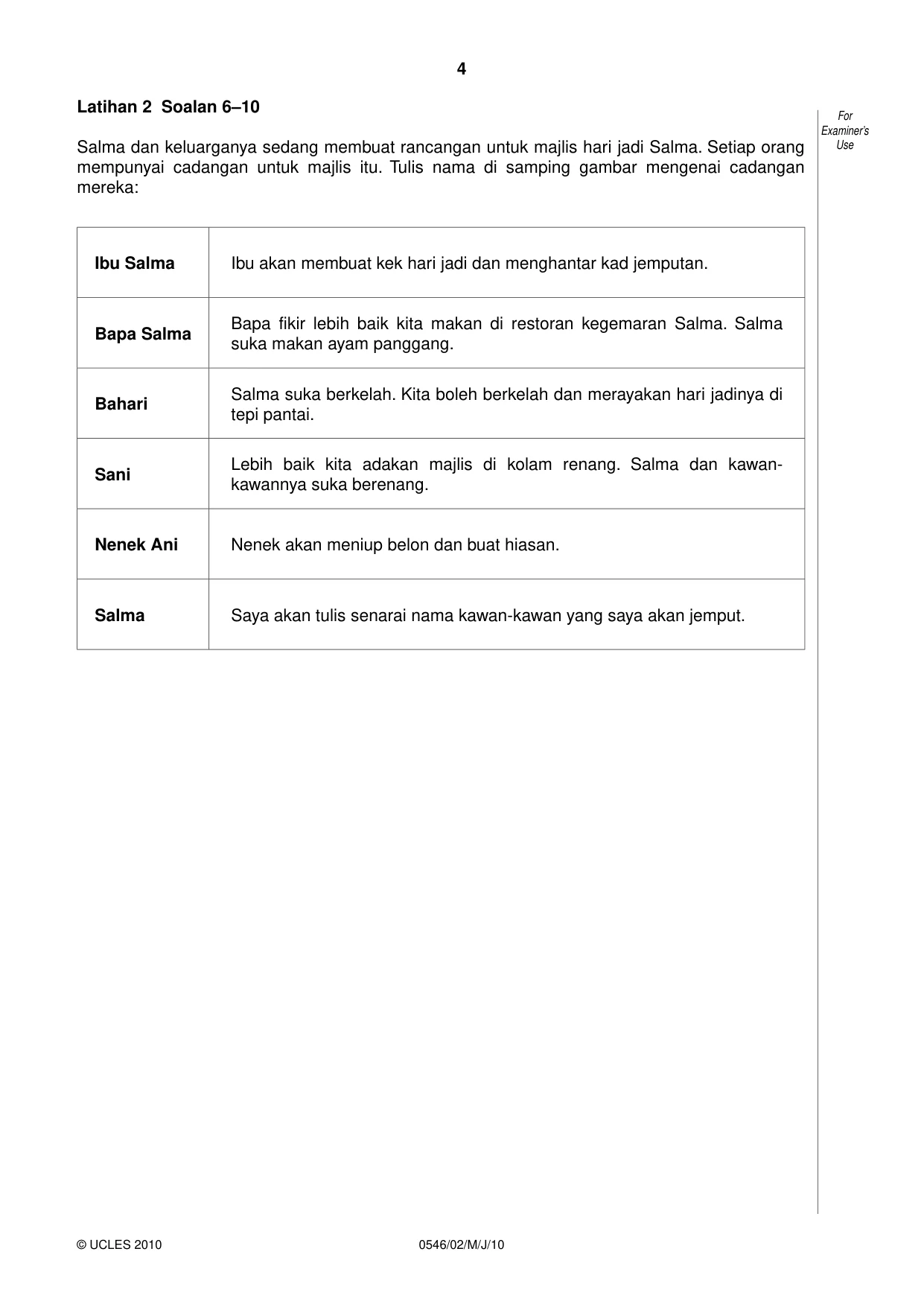
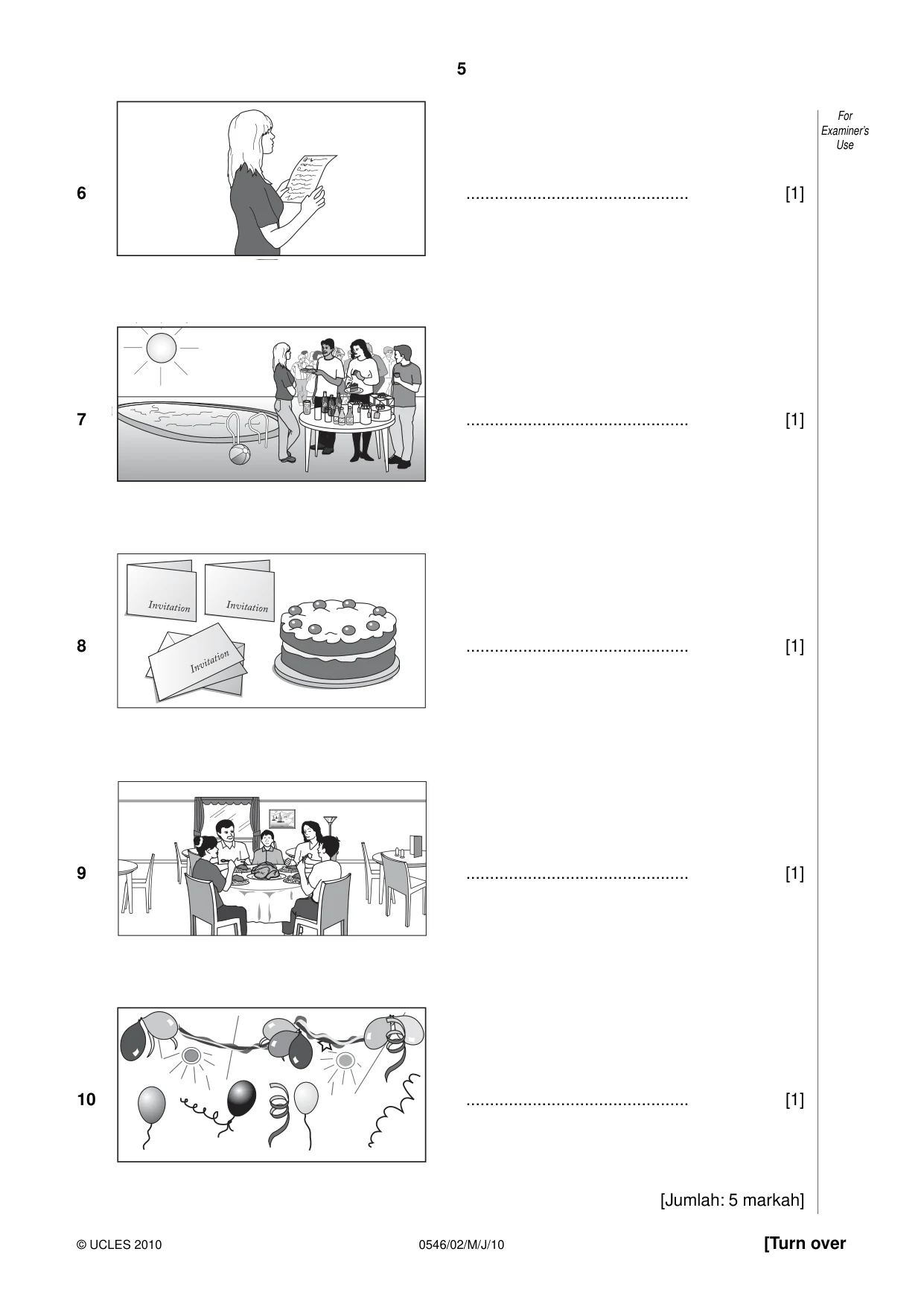
4 0546/02/M/J/10 © UCLES 2010 For Examiner’s Use Latihan 2 Soalan 6–10 Salma dan keluarganya sedang membuat rancangan untuk majlis hari jadi Salma. Setiap orang mempunyai cadangan untuk majlis itu. Tulis nama di samping gambar mengenai cadangan mereka: Ibu Salma Ibu akan membuat kek hari jadi dan menghantar kad jemputan. Bapa Salma Bapa fikir lebih baik kita makan di restoran kegemaran Salma. Salma suka makan ayam panggang. Bahari Salma suka berkelah. Kita boleh berkelah dan merayakan hari jadinya di tepi pantai. Sani Lebih baik kita adakan majlis di kolam renang. Salma dan kawan- kawannya suka berenang. Nenek Ani Nenek akan meniup belon dan buat hiasan. Salma Saya akan tulis senarai nama kawan-kawan yang saya akan jemput.
Question paper, page 5
5 [Turn over 0546/02/M/J/10 © UCLES 2010 For Examiner’s Use 6 … [1] 7 … [1] 8 … [1] 9 … [1] 10 … [1] [Jumlah: 5 markah]
Question paper, page 6
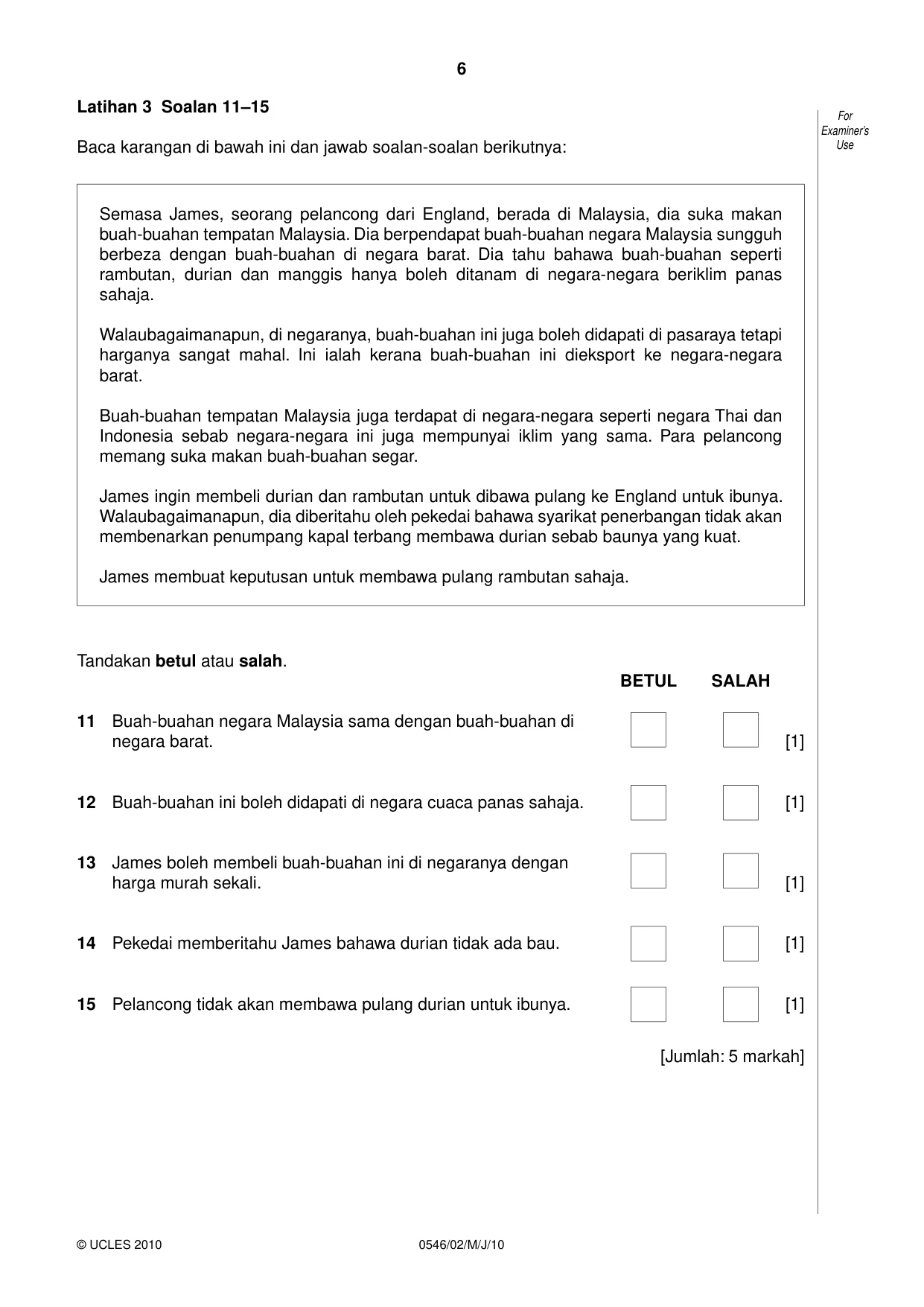
6 0546/02/M/J/10 © UCLES 2010 For Examiner’s Use Latihan 3 Soalan 11–15 Baca karangan di bawah ini dan jawab soalan-soalan berikutnya: Semasa James, seorang pelancong dari England, berada di Malaysia, dia suka makan buah-buahan tempatan Malaysia. Dia berpendapat buah-buahan negara Malaysia sungguh berbeza dengan buah-buahan di negara barat. Dia tahu bahawa buah-buahan seperti rambutan, durian dan manggis hanya boleh ditanam di negara-negara beriklim panas sahaja. Walaubagaimanapun, di negaranya, buah-buahan ini juga boleh didapati di pasaraya tetapi harganya sangat mahal. Ini ialah kerana buah-buahan ini dieksport ke negara-negara barat. Buah-buahan tempatan Malaysia juga terdapat di negara-negara seperti negara Thai dan Indonesia sebab negara-negara ini juga mempunyai iklim yang sama. Para pelancong memang suka makan buah-buahan segar. James ingin membeli durian dan rambutan untuk dibawa pulang ke England untuk ibunya. Walaubagaimanapun, dia diberitahu oleh pekedai bahawa syarikat penerbangan tidak akan membenarkan penumpang kapal terbang membawa durian sebab baunya yang kuat. James membuat keputusan untuk membawa pulang rambutan sahaja. Tandakan betul atau salah. BETUL SALAH 11 Buah-buahan negara Malaysia sama dengan buah-buahan di negara barat. [1] 12 Buah-buahan ini boleh didapati di negara cuaca panas sahaja. [1] 13 James boleh membeli buah-buahan ini di negaranya dengan harga murah sekali. [1] 14 Pekedai memberitahu James bahawa durian tidak ada bau. [1] 15 Pelancong tidak akan membawa pulang durian untuk ibunya. [1] [Jumlah: 5 markah]
Question paper, page 7
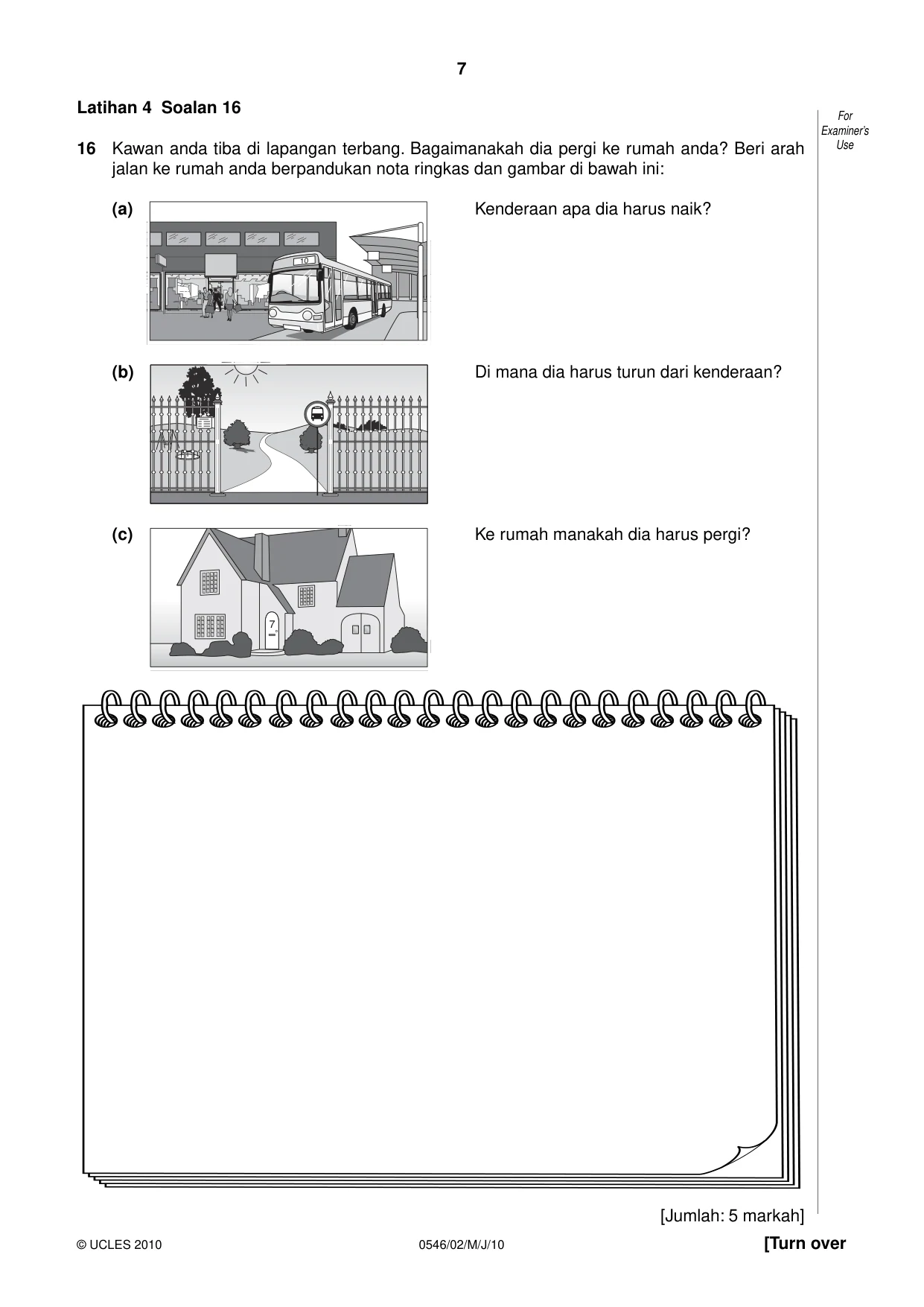
7 [Turn over 0546/02/M/J/10 © UCLES 2010 For Examiner’s Use Latihan 4 Soalan 16 16 Kawan anda tiba di lapangan terbang. Bagaimanakah dia pergi ke rumah anda? Beri arah jalan ke rumah anda berpandukan nota ringkas dan gambar di bawah ini: (a) Kenderaan apa dia harus naik? (b) Di mana dia harus turun dari kenderaan? (c) Ke rumah manakah dia harus pergi? [Jumlah: 5 markah]
Question paper, page 8
8 0546/02/M/J/10 © UCLES 2010 Bahagian 2 Latihan 1 Soalan 17–23 Baca laporan mengenai pengalaman bekerja Adam, seorang pelajar sekolah, semasa bercuti: Semasa cuti sekolah tahun lepas, saya membuat keputusan untuk menggunakan masa percutian saya untuk bekerja. Bekerja semasa cuti sekolah bukan sahaja bermakna saya mendapat wang untuk berbelanja, tetapi juga pengalaman bekerja yang sangatlah berguna. Bapa saudara saya memiliki sebuah hotel di tempat percutian di tepi laut. Saya bekerja di sana selama sebulan dan dalam masa sebulan itu, saya mendapat pengalaman membuat berbagai-bagai pekerjaan, seperti melayan tetamu yang baru sampai untuk bercuti, menolong mengambil pesanan di bilik makan dan juga menyediakan bilik tetamu. Semasa bekerja di hotel tersebut, saya bertemu dengan ramai pelancong, terutama sekali dari luar negara. Saya dapat belajar banyak daripada mereka mengenai negara dan budaya mereka. Kami bertukar pendapat dan berbincang mengenai banyak perkara seperti pelajaran, makanan, cuaca dan banyak lagi. Bapa saudara saya menasihatkan saya tetamu mesti dilayan dengan baik dan sopan. Sebagai pekerja di hotel itu, kita mesti mendengar apa saja yang tetamu kata, sama ada pujian ataupun aduan. Nasib baik semasa bekerja di situ, tidak ada tetamu yang mengadu tentang saya. Satu pengalaman yang tidak dapat saya lupakan semasa bekerja di situ ialah persahabatan saya dengan keluarga dari Itali. Mereka tinggal di hotel itu selama seminggu tetapi saya rasa seperti saya sudah lama kenal mereka. Ketua keluarga ini, Encik Giuseppe, ialah seorang penulis, dan dia datang ke Malaysia untuk mencari bahan untuk bukunya. Dia menulis buku untuk remaja dan dia selalu bercakap dengan saya. Dia berkata dia akan memasukkan cerita tentang saya ke dalam bukunya. Saya tidak sabar menunggu bukunya diterbitkan nanti.
Question paper, page 9
9 [Turn over 0546/02/M/J/10 © UCLES 2010 For Examiner’s Use 17 Bilakah Adam bekerja dan mengapa? (i) …[1] (ii) …[1] 18 Berapa lamakah Adam bekerja di hotel bapa saudaranya? … [1] 19 Apakah antara pekerjaan yang dibuat oleh Adam? (i) …[1] (ii) …[1] 20 Apakah nasihat bapa saudara Adam? … [1] 21 Mengapakah Adam bernasib baik? … [1] 22 Apakah pengalaman yang paling berkesan bagi Adam? … [1] 23 (i) Apakah pekerjaan Encik Giuseppe? … [1] (ii) Dan apakah janjinya kepada Adam? … [1] [Jumlah: 10 markah]
Question paper, page 10
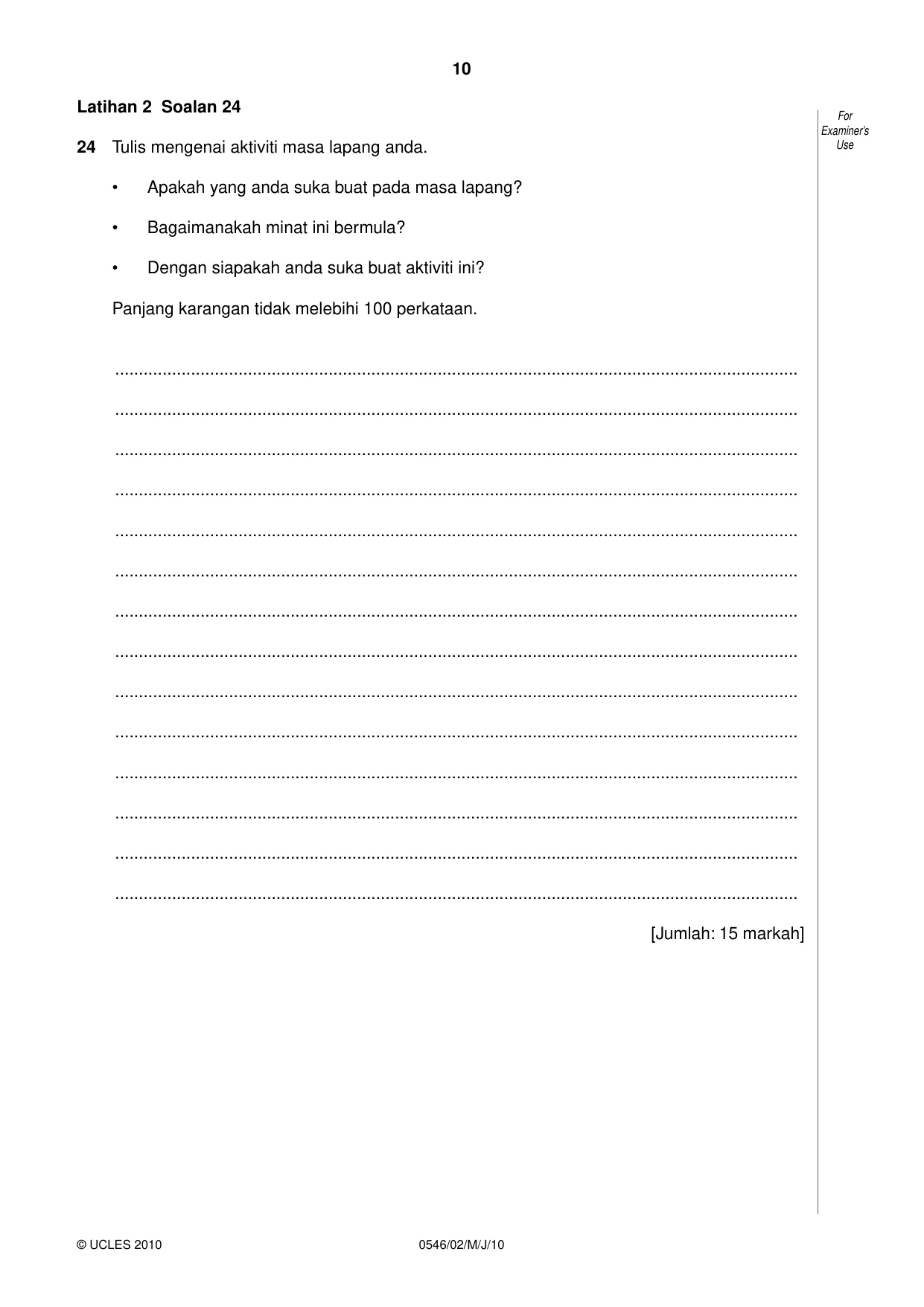
10 0546/02/M/J/10 © UCLES 2010 For Examiner’s Use Latihan 2 Soalan 24 24 Tulis mengenai aktiviti masa lapang anda. • Apakah yang anda suka buat pada masa lapang? • Bagaimanakah minat ini bermula? • Dengan siapakah anda suka buat aktiviti ini? Panjang karangan tidak melebihi 100 perkataan. … … … … … … … … … … … … … … [Jumlah: 15 markah]
Question paper, page 11
11 0546/02/M/J/10 © UCLES 2010 [Turn over BLANK PAGE PLEASE TURN OVER FOR SECTION 3.
Question paper, page 12
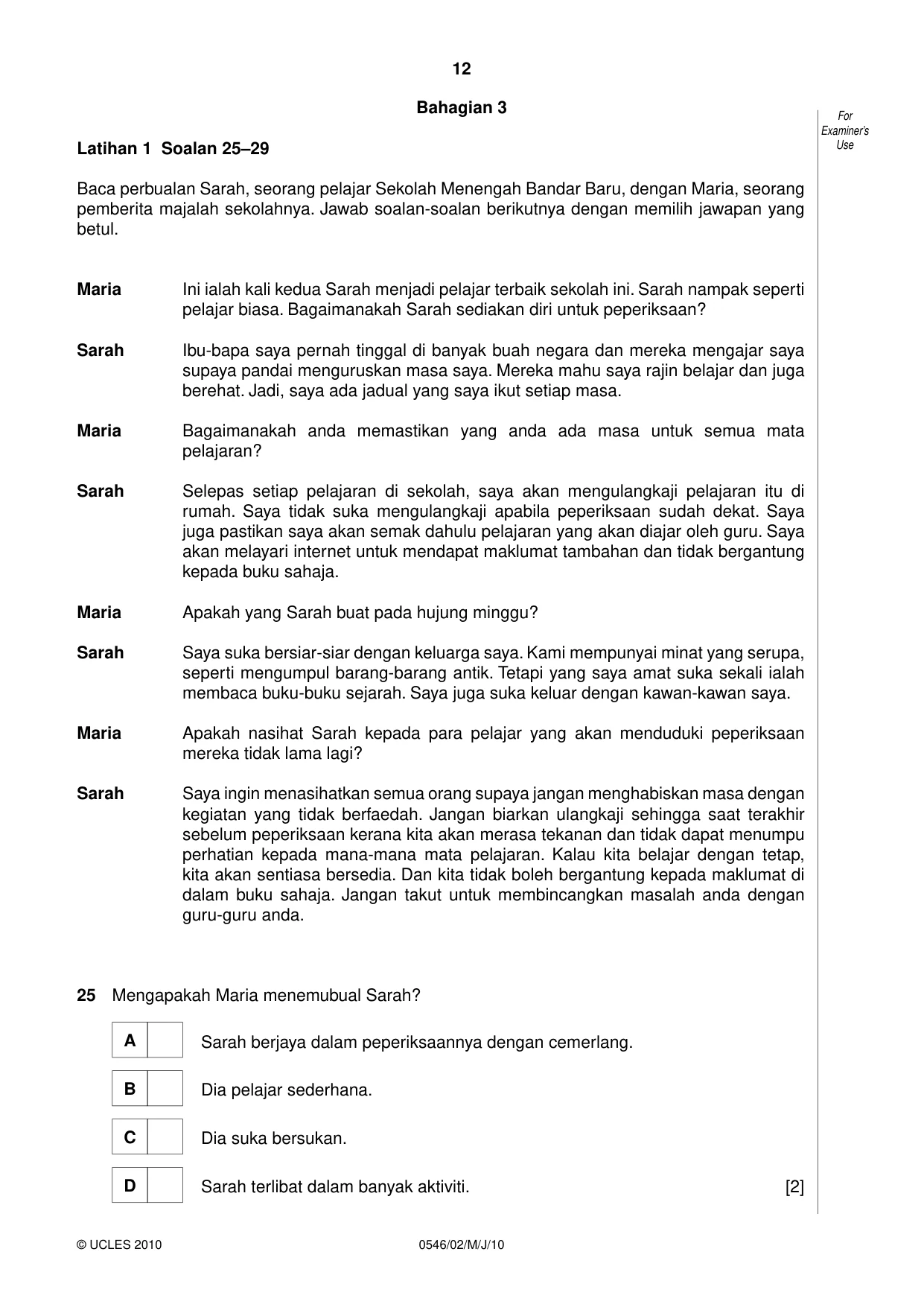
12 0546/02/M/J/10 © UCLES 2010 For Examiner’s Use Bahagian 3 Latihan 1 Soalan 25–29 Baca perbualan Sarah, seorang pelajar Sekolah Menengah Bandar Baru, dengan Maria, seorang pemberita majalah sekolahnya. Jawab soalan-soalan berikutnya dengan memilih jawapan yang betul. Maria Ini ialah kali kedua Sarah menjadi pelajar terbaik sekolah ini. Sarah nampak seperti pelajar biasa. Bagaimanakah Sarah sediakan diri untuk peperiksaan? Sarah Ibu-bapa saya pernah tinggal di banyak buah negara dan mereka mengajar saya supaya pandai menguruskan masa saya. Mereka mahu saya rajin belajar dan juga berehat. Jadi, saya ada jadual yang saya ikut setiap masa. Maria Bagaimanakah anda memastikan yang anda ada masa untuk semua mata pelajaran? Sarah Selepas setiap pelajaran di sekolah, saya akan mengulangkaji pelajaran itu di rumah. Saya tidak suka mengulangkaji apabila peperiksaan sudah dekat. Saya juga pastikan saya akan semak dahulu pelajaran yang akan diajar oleh guru. Saya akan melayari internet untuk mendapat maklumat tambahan dan tidak bergantung kepada buku sahaja. Maria Apakah yang Sarah buat pada hujung minggu? Sarah Saya suka bersiar-siar dengan keluarga saya. Kami mempunyai minat yang serupa, seperti mengumpul barang-barang antik. Tetapi yang saya amat suka sekali ialah membaca buku-buku sejarah. Saya juga suka keluar dengan kawan-kawan saya. Maria Apakah nasihat Sarah kepada para pelajar yang akan menduduki peperiksaan mereka tidak lama lagi? Sarah Saya ingin menasihatkan semua orang supaya jangan menghabiskan masa dengan kegiatan yang tidak berfaedah. Jangan biarkan ulangkaji sehingga saat terakhir sebelum peperiksaan kerana kita akan merasa tekanan dan tidak dapat menumpu perhatian kepada mana-mana mata pelajaran. Kalau kita belajar dengan tetap, kita akan sentiasa bersedia. Dan kita tidak boleh bergantung kepada maklumat di dalam buku sahaja. Jangan takut untuk membincangkan masalah anda dengan guru-guru anda. 25 Mengapakah Maria menemubual Sarah? Sarah berjaya dalam peperiksaannya dengan cemerlang. Dia pelajar sederhana. Dia suka bersukan. Sarah terlibat dalam banyak aktiviti. [2] A B C D
Question paper, page 13
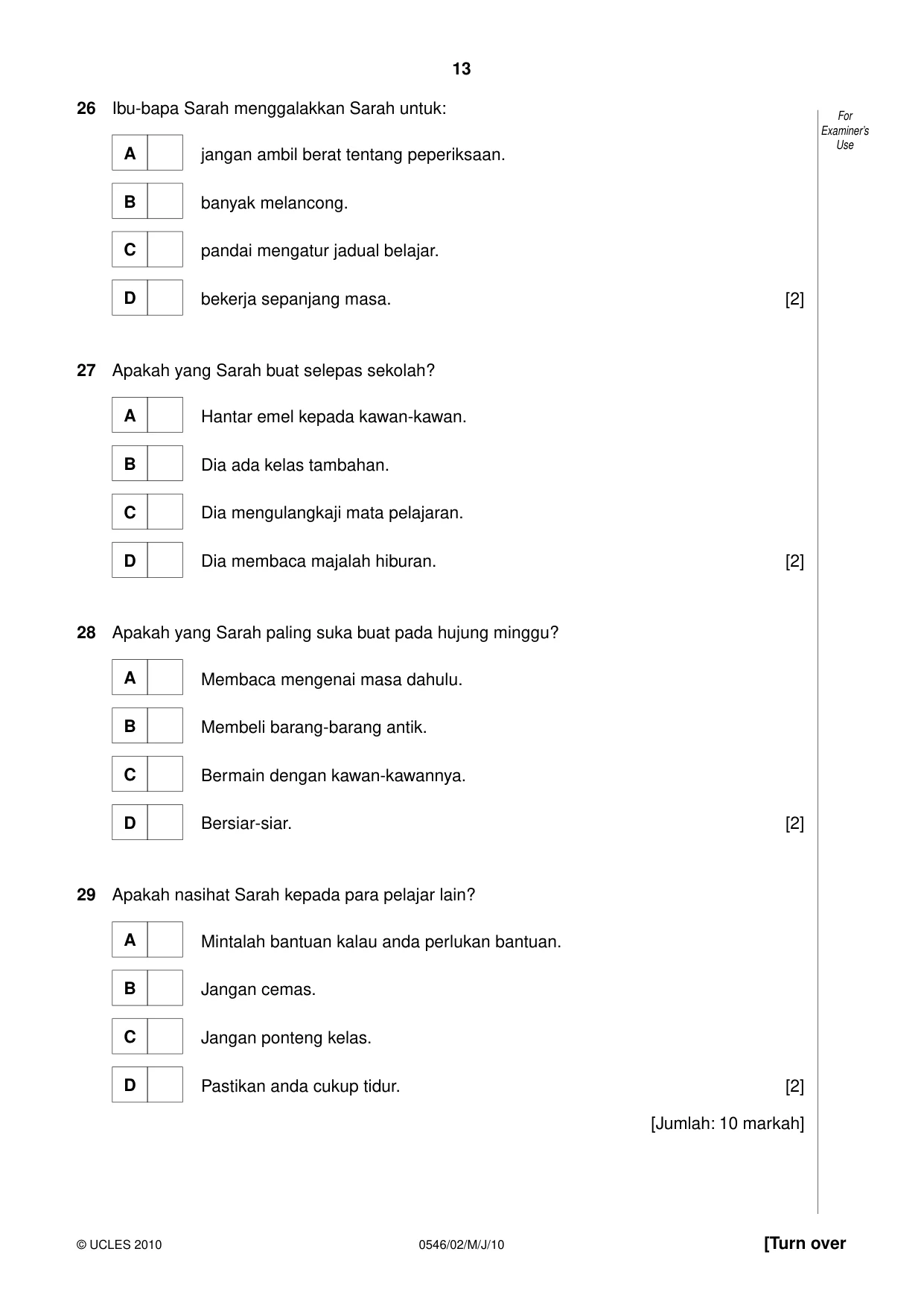
13 [Turn over 0546/02/M/J/10 © UCLES 2010 For Examiner’s Use 26 Ibu-bapa Sarah menggalakkan Sarah untuk: jangan ambil berat tentang peperiksaan. banyak melancong. pandai mengatur jadual belajar. bekerja sepanjang masa. [2] A B C D 27 Apakah yang Sarah buat selepas sekolah? Hantar emel kepada kawan-kawan. Dia ada kelas tambahan. Dia mengulangkaji mata pelajaran. Dia membaca majalah hiburan. [2] A B C D 28 Apakah yang Sarah paling suka buat pada hujung minggu? Membaca mengenai masa dahulu. Membeli barang-barang antik. Bermain dengan kawan-kawannya. Bersiar-siar. [2] A B C D 29 Apakah nasihat Sarah kepada para pelajar lain? Mintalah bantuan kalau anda perlukan bantuan. Jangan cemas. Jangan ponteng kelas. Pastikan anda cukup tidur. [2] A B C D [Jumlah: 10 markah]
Question paper, page 14
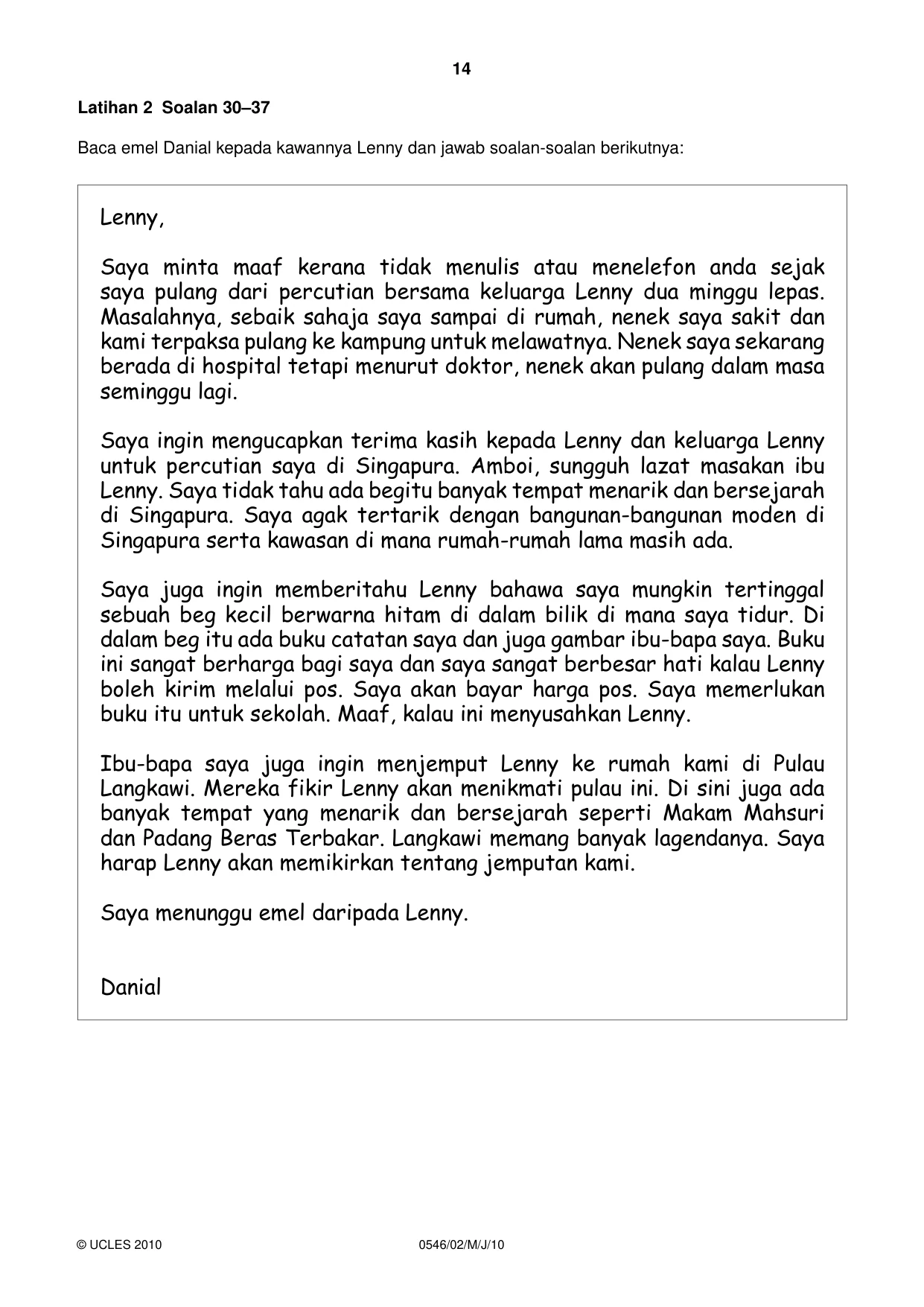
14 0546/02/M/J/10 © UCLES 2010 Latihan 2 Soalan 30–37 Baca emel Danial kepada kawannya Lenny dan jawab soalan-soalan berikutnya: Lenny, Saya minta maaf kerana tidak menulis atau menelefon anda sejak saya pulang dari percutian bersama keluarga Lenny dua minggu lepas. Masalahnya, sebaik sahaja saya sampai di rumah, nenek saya sakit dan kami terpaksa pulang ke kampung untuk melawatnya. Nenek saya sekarang berada di hospital tetapi menurut doktor, nenek akan pulang dalam masa seminggu lagi. Saya ingin mengucapkan terima kasih kepada Lenny dan keluarga Lenny untuk percutian saya di Singapura. Amboi, sungguh lazat masakan ibu Lenny. Saya tidak tahu ada begitu banyak tempat menarik dan bersejarah di Singapura. Saya agak tertarik dengan bangunan-bangunan moden di Singapura serta kawasan di mana rumah-rumah lama masih ada. Saya juga ingin memberitahu Lenny bahawa saya mungkin tertinggal sebuah beg kecil berwarna hitam di dalam bilik di mana saya tidur. Di dalam beg itu ada buku catatan saya dan juga gambar ibu-bapa saya. Buku ini sangat berharga bagi saya dan saya sangat berbesar hati kalau Lenny boleh kirim melalui pos. Saya akan bayar harga pos. Saya memerlukan buku itu untuk sekolah. Maaf, kalau ini menyusahkan Lenny. Ibu-bapa saya juga ingin menjemput Lenny ke rumah kami di Pulau Langkawi. Mereka fikir Lenny akan menikmati pulau ini. Di sini juga ada banyak tempat yang menarik dan bersejarah seperti Makam Mahsuri dan Padang Beras Terbakar. Langkawi memang banyak lagendanya. Saya harap Lenny akan memikirkan tentang jemputan kami. Saya menunggu emel daripada Lenny. Danial
Question paper, page 15
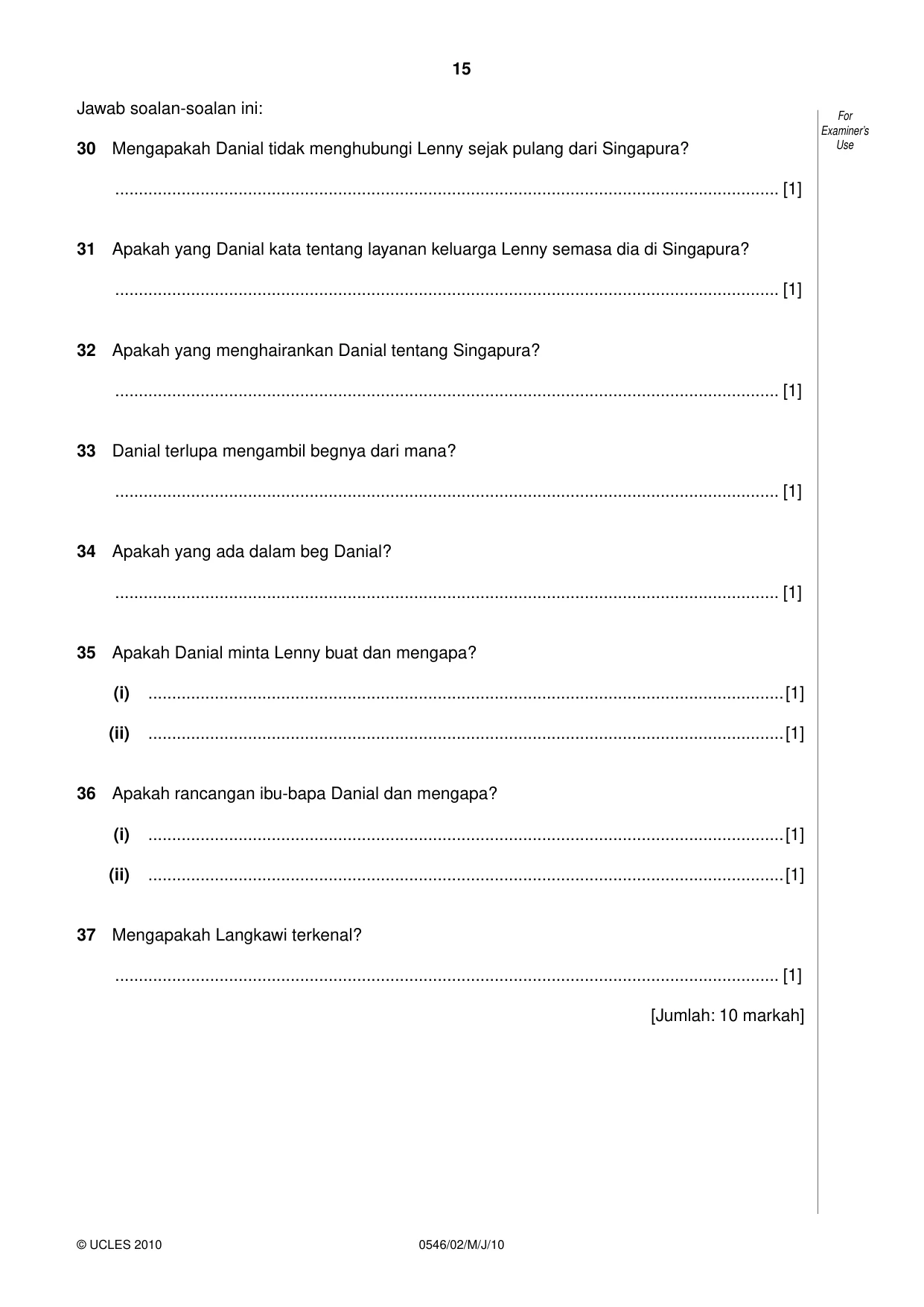
15 0546/02/M/J/10 © UCLES 2010 For Examiner’s Use Jawab soalan-soalan ini: 30 Mengapakah Danial tidak menghubungi Lenny sejak pulang dari Singapura? … [1] 31 Apakah yang Danial kata tentang layanan keluarga Lenny semasa dia di Singapura? … [1] 32 Apakah yang menghairankan Danial tentang Singapura? … [1] 33 Danial terlupa mengambil begnya dari mana? … [1] 34 Apakah yang ada dalam beg Danial? … [1] 35 Apakah Danial minta Lenny buat dan mengapa? (i) …[1] (ii) …[1] 36 Apakah rancangan ibu-bapa Danial dan mengapa? (i) …[1] (ii) …[1] 37 Mengapakah Langkawi terkenal? … [1] [Jumlah: 10 markah]
Question paper, page 16
16 0546/02/M/J/10 © UCLES 2010 BLANK PAGE Permission to reproduce items where third-party owned material protected by copyright is included has been sought and cleared where possible. Every reasonable effort has been made by the publisher (UCLES) to trace copyright holders, but if any items requiring clearance have unwittingly been included, the publisher will be pleased to make amends at the earliest possible opportunity. University of Cambridge International Examinations is part of the Cambridge Assessment Group. Cambridge Assessment is the brand name of University of Cambridge Local Examinations Syndicate (UCLES), which is itself a department of the University of Cambridge.
Mark scheme, page 1
UNIVERSITY OF CAMBRIDGE INTERNATIONAL EXAMINATIONS International General Certificate of Secondary Education MARK SCHEME for the May/June 2010 question paper for the guidance of teachers 0546 MALAY (FOREIGN LANGUAGE) 0546/02 Paper 2 (Reading and Directed Writing), maximum raw mark 65 This mark scheme is published as an aid to teachers and candidates, to indicate the requirements of the examination. It shows the basis on which Examiners were instructed to award marks. It does not indicate the details of the discussions that took place at an Examiners’ meeting before marking began, which would have considered the acceptability of alternative answers. Mark schemes must be read in conjunction with the question papers and the report on the examination. • CIE will not enter into discussions or correspondence in connection with these mark schemes. CIE is publishing the mark schemes for the May/June 2010 question papers for most IGCSE, GCE Advanced Level and Advanced Subsidiary Level syllabuses and some Ordinary Level syllabuses. www.XtremePapers.com
Mark scheme, page 2
Page 2 Mark Scheme: Teachers’ version Syllabus Paper IGCSE – May/June 2010 0546 02 © UCLES 2010 General Marking Principles 1 Please note that it is not possible to list all acceptable alternatives in the Detailed Mark Scheme provided in Section 3 You will need to consider all alternative answers and unexpected approaches in candidates' scripts, make a decision on whether they communicate the required elements, in consultation with your Principal Examiner if necessary (or with your Product Manager if you are a single Examiner), and award marks accordingly. 2 Crossing out: (a) If a candidate changes his/her mind over an answer and crosses out an attempt, award a mark if the final attempt is correct. (b) If a candidate crosses out an answer to a whole question but makes no second attempt at it, mark the crossed out work. 3 Reading tasks: more than the stipulated number of boxes ticked/crossed by the candidate: (a) If more than one attempt is visible, but the candidate has clearly indicated which attempt is his/her final answer (eg by crossing out other attempts or by annotating the script in some way), mark in the usual way. (b) If two attempts are visible (eg two boxes ticked instead of the 1 box stipulated), and neither has been crossed out/discounted by the candidate, no mark can be awarded. (c) In questions where candidates are required to tick a number of boxes (eg tick the 6 true statements) the general rule to be applied is as follows: the number of 'extra' answers indicated by the candidate is deducted from the number of correct answers and the remaining number is the mark awarded, eg the candidate is required to tick 6 true statements, but instead ticks 8 statements. 5 of the 6 ticks are correctly placed, but 2 of the ticks are 'extras' (8 ticks placed by candidate minus 6 ticks required by rubric = 2). Therefore the candidate is awarded a mark of 3 5 number of correct ticks –2 minus number of extra ticks = 3 (d) Answers in pen do not take precedence over answers in pencil, eg if a candidate is asked to tick 1 box and ticks two, one in pen and the other in pencil, the mark cannot be awarded unless there is some explicit indication from the candidate as to which is his/her final answer. 4 Reading tasks: for questions requiring more than one element for the answer, (i) and (ii), where the answers are interchangeable: Both correct answers on line 1 and line 2 blank = 2 Both correct answers on line 1 and another, wrong answer on line 2 = 1 (or vice-versa)
Mark scheme, page 3
Page 3 Mark Scheme: Teachers’ version Syllabus Paper IGCSE – May/June 2010 0546 02 © UCLES 2010 5 Reading tasks: answers requiring the use of Malay (rather than a non-verbal response) should be marked for communication. Tolerate inaccuracies provided the message is clear. (a) ‘If in doubt, sound it out’: if you read what the candidate has written, does it sound like the correct answer? (b) Look-alike test: does what the candidate has written look like the correct answer? (c) Accept incorrect gender or person unless Mark Scheme specifies otherwise. (d) Accept incorrect possessive adjectives eg mon, ton, son etc, unless Mark Scheme specifies otherwise (in general, Section 2 accept, Section 3 consult Mark Scheme carefully). 6 Unless the Mark Scheme specifies otherwise, do not accept incorrect Malay if the word given means something else in Malay. (Incorrect Malay which constitutes a word in any language other than Malay is marked (i) on the basis of whether it is accepted or refused in the Mark Scheme and (ii) if not mentioned in the Mark Scheme, on the basis of 2.5 above). 7 Extra material: Section 2, Exercise 1 In Section 2, Exercise 1, reward the candidate for being able to locate the answer in the passage. Do not worry about lifting unless this would cause the message to be seriously distorted (in general, incorrect possessives should not be judged to cause distortion: see 2.5(d)) – in which case a lift will be specifically rejected in the Mark Scheme. Ignore extra material given in an answer providing that it does not invalidate an answer. 8 Extra material: Section 3 In Section 3 it is the candidate’s responsibility to answer questions in such a way as to demonstrate to the Examiner that s/he has understood the texts/questions. Where candidates introduce extra, irrelevant material to an otherwise correct answer the danger is that the Examiner is being forced to ‘choose’ the correct answer and s/he cannot be certain that the candidate has shown understanding. Where the Examiner is put in this position the mark cannot be awarded. In Section 3, look for signs of genuine comprehension. Usually, candidates who lift indiscriminately fail to demonstrate comprehension and will not score the mark. However, careful lifting of the details required to answer the question does demonstrate comprehension and should be rewarded. The Detailed Mark Scheme (Section (c)) provides specific guidance but in cases not covered, the following general rules apply:
Mark scheme, page 4
Page 4 Mark Scheme: Teachers’ version Syllabus Paper IGCSE – May/June 2010 0546 02 © UCLES 2010 (a) Extra material, mentioned in the Mark Scheme, which reinforces the correct answer or in itself constitutes an alternative correct answer: this is acceptable and is not penalised (b) Extra material which constitutes an alternative answer, but which is not explicitly mentioned in the Mark Scheme: the Examiner needs to decide, by consulting the text and the PE if necessary whether the alternative answer constitutes: (i) an alternative correct answer, in which case this falls into category (a) and the answer should be rewarded (ii) or an answer which on its own would be refused, in which case this falls into category (c) and the answer should be refused (c) Extra material which constitutes an alternative answer specifically refused in the Mark Scheme: this puts the Examiner in the position of having to ‘choose’ which is the candidate's 'final' answer – the Examiner cannot be sure what the candidate has understood – and the mark cannot be awarded (d) Extra material which distorts or contradicts the correct answer: this affects communication – the Examiner cannot be sure what the candidate has understood – and the mark cannot be awarded (e) Extra material introduced by the candidate and which does not feature in the text: this affects communication – the Examiner cannot be sure what the candidate has understood – and the mark cannot be awarded. It can sometimes be difficult to draw the line between what is a deduction made by an able candidate on the basis of what they have read and pure guesswork. Therefore where an answer of this sort occurs which is not covered in the Mark Scheme, Examiners should consult their PE
Mark scheme, page 5
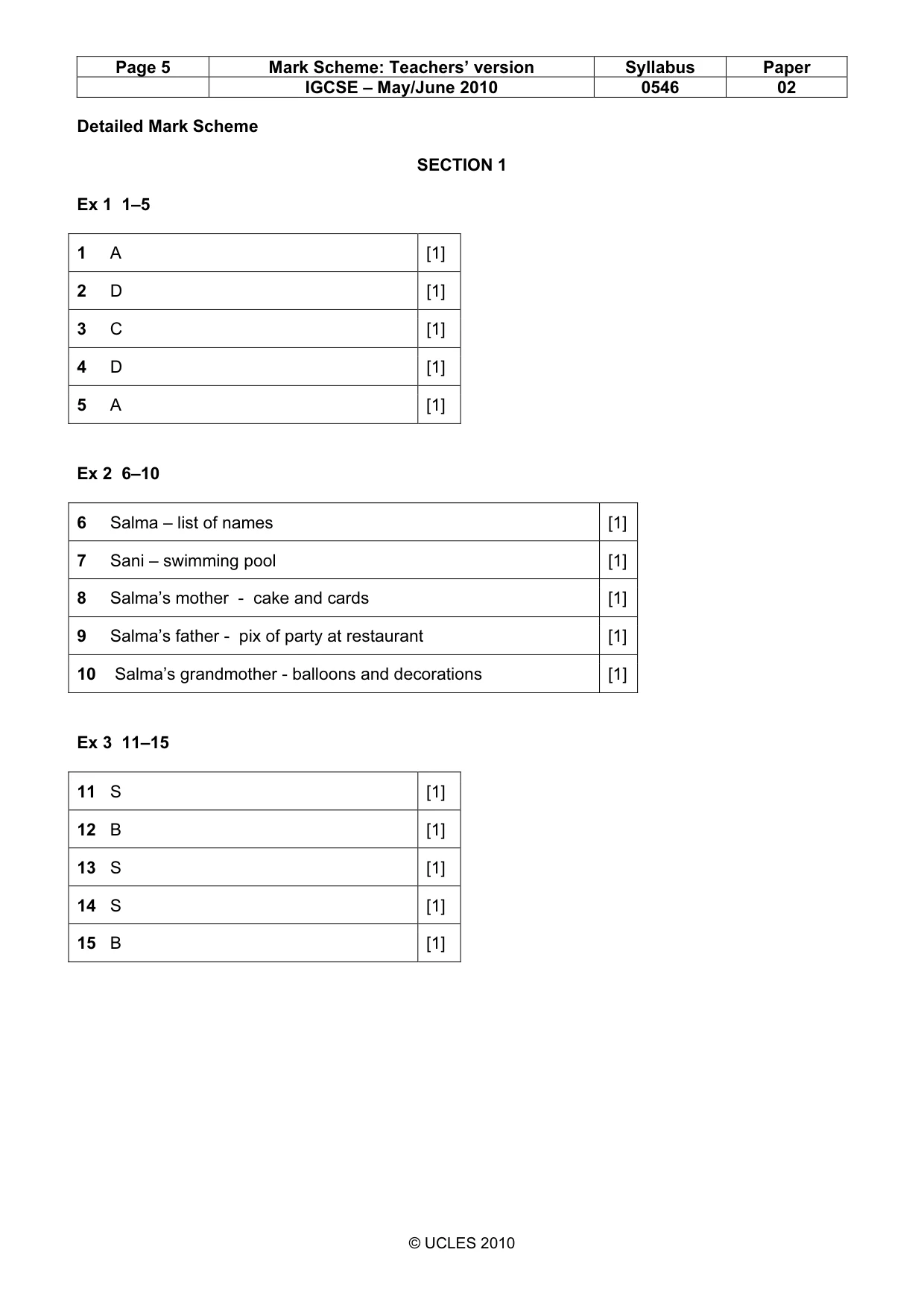
Page 5 Mark Scheme: Teachers’ version Syllabus Paper IGCSE – May/June 2010 0546 02 © UCLES 2010 Detailed Mark Scheme SECTION 1 Ex 1 1–5 1 A [1] 2 D [1] 3 C [1] 4 D [1] 5 A [1] Ex 2 6–10 6 Salma – list of names [1] 7 Sani – swimming pool [1] 8 Salma’s mother - cake and cards [1] 9 Salma’s father - pix of party at restaurant [1] 10 Salma’s grandmother - balloons and decorations [1] Ex 3 11–15 11 S [1] 12 B [1] 13 S [1] 14 S [1] 15 B [1]
Mark scheme, page 6
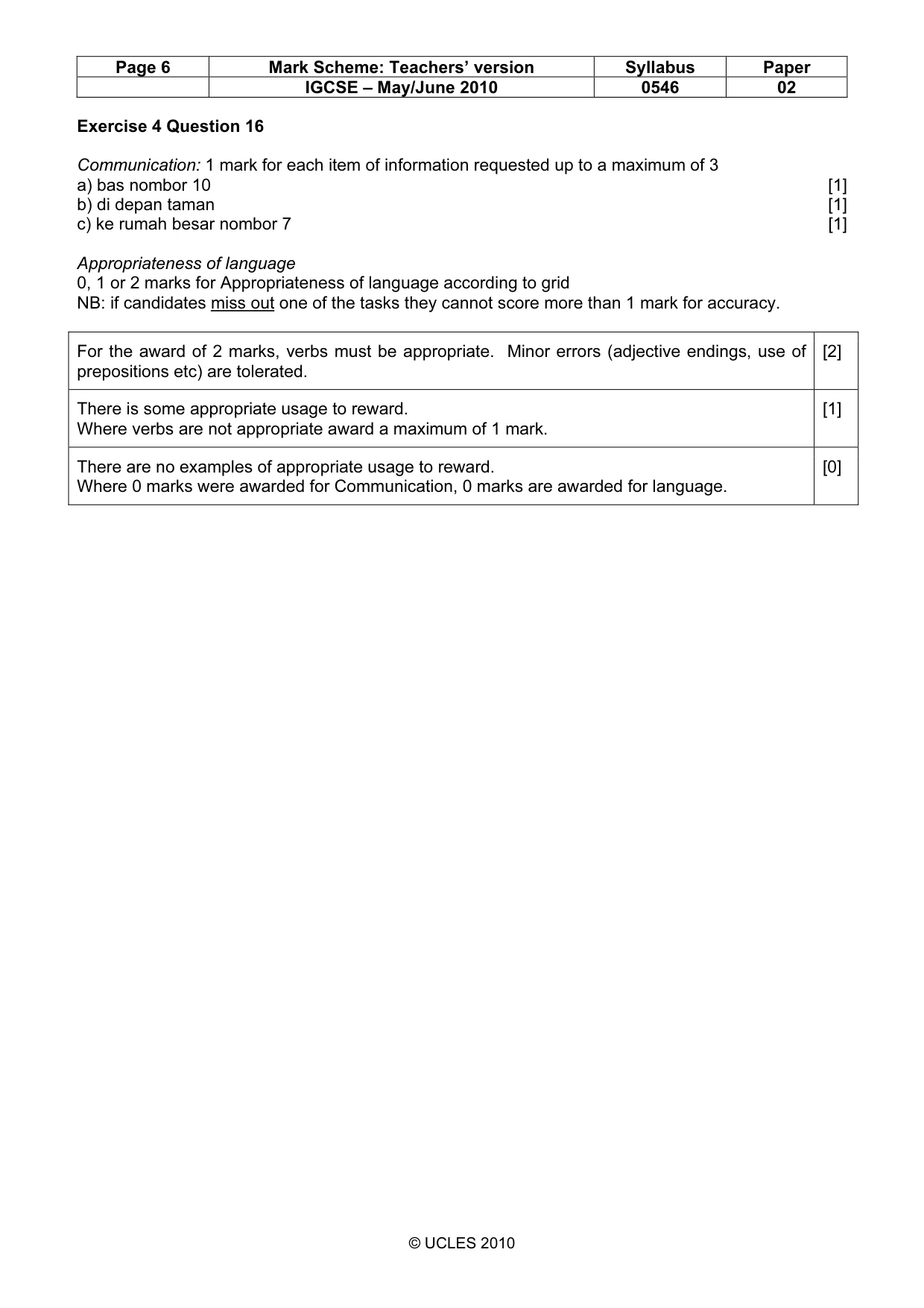
Page 6 Mark Scheme: Teachers’ version Syllabus Paper IGCSE – May/June 2010 0546 02 © UCLES 2010 Exercise 4 Question 16 Communication: 1 mark for each item of information requested up to a maximum of 3 a) bas nombor 10 [1] b) di depan taman [1] c) ke rumah besar nombor 7 [1] Appropriateness of language 0, 1 or 2 marks for Appropriateness of language according to grid NB: if candidates miss out one of the tasks they cannot score more than 1 mark for accuracy. For the award of 2 marks, verbs must be appropriate. Minor errors (adjective endings, use of prepositions etc) are tolerated. [2] There is some appropriate usage to reward. Where verbs are not appropriate award a maximum of 1 mark. [1] There are no examples of appropriate usage to reward. Where 0 marks were awarded for Communication, 0 marks are awarded for language. [0]
Mark scheme, page 7
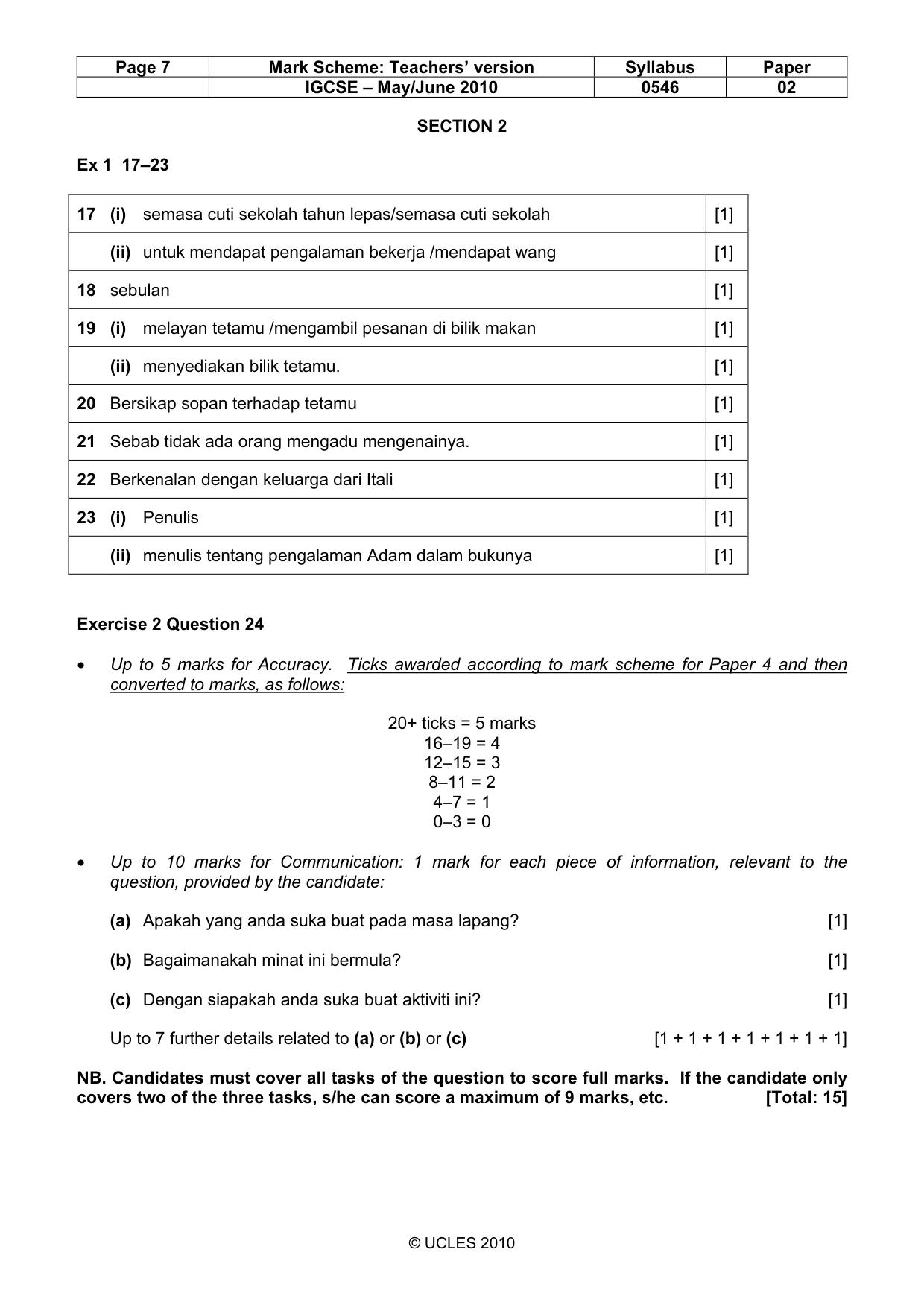
Page 7 Mark Scheme: Teachers’ version Syllabus Paper IGCSE – May/June 2010 0546 02 © UCLES 2010 SECTION 2 Ex 1 17–23 17 (i) semasa cuti sekolah tahun lepas/semasa cuti sekolah [1] (ii) untuk mendapat pengalaman bekerja /mendapat wang [1] 18 sebulan [1] 19 (i) melayan tetamu /mengambil pesanan di bilik makan [1] (ii) menyediakan bilik tetamu. [1] 20 Bersikap sopan terhadap tetamu [1] 21 Sebab tidak ada orang mengadu mengenainya. [1] 22 Berkenalan dengan keluarga dari Itali [1] 23 (i) Penulis [1] (ii) menulis tentang pengalaman Adam dalam bukunya [1] Exercise 2 Question 24 • Up to 5 marks for Accuracy. Ticks awarded according to mark scheme for Paper 4 and then converted to marks, as follows: 20+ ticks = 5 marks 16–19 = 4 12–15 = 3 8–11 = 2 4–7 = 1 0–3 = 0 • Up to 10 marks for Communication: 1 mark for each piece of information, relevant to the question, provided by the candidate: (a) Apakah yang anda suka buat pada masa lapang? [1] (b) Bagaimanakah minat ini bermula? [1] (c) Dengan siapakah anda suka buat aktiviti ini? [1] Up to 7 further details related to (a) or (b) or (c) [1 + 1 + 1 + 1 + 1 + 1 + 1] NB. Candidates must cover all tasks of the question to score full marks. If the candidate only covers two of the three tasks, s/he can score a maximum of 9 marks, etc. [Total: 15]
Mark scheme, page 8
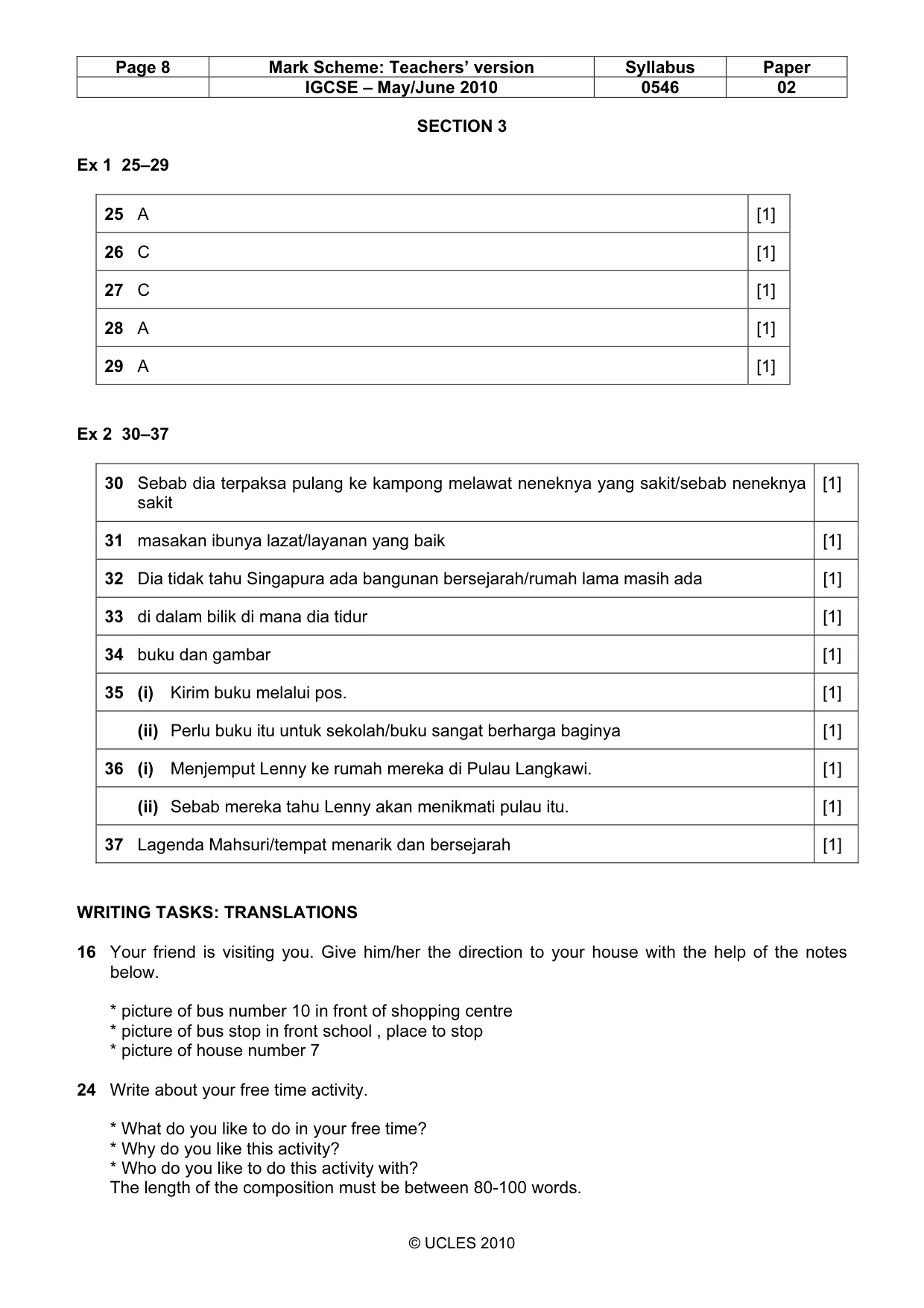
Page 8 Mark Scheme: Teachers’ version Syllabus Paper IGCSE – May/June 2010 0546 02 © UCLES 2010 SECTION 3 Ex 1 25–29 25 A [1] 26 C [1] 27 C [1] 28 A [1] 29 A [1] Ex 2 30–37 30 Sebab dia terpaksa pulang ke kampong melawat neneknya yang sakit/sebab neneknya sakit [1] 31 masakan ibunya lazat/layanan yang baik [1] 32 Dia tidak tahu Singapura ada bangunan bersejarah/rumah lama masih ada [1] 33 di dalam bilik di mana dia tidur [1] 34 buku dan gambar [1] 35 (i) Kirim buku melalui pos. [1] (ii) Perlu buku itu untuk sekolah/buku sangat berharga baginya [1] 36 (i) Menjemput Lenny ke rumah mereka di Pulau Langkawi. [1] (ii) Sebab mereka tahu Lenny akan menikmati pulau itu. [1] 37 Lagenda Mahsuri/tempat menarik dan bersejarah [1] WRITING TASKS: TRANSLATIONS 16 Your friend is visiting you. Give him/her the direction to your house with the help of the notes below. * picture of bus number 10 in front of shopping centre * picture of bus stop in front school , place to stop * picture of house number 7 24 Write about your free time activity. * What do you like to do in your free time? * Why do you like this activity? * Who do you like to do this activity with? The length of the composition must be between 80-100 words.
What you needed in this session
Cambridge’s own grade thresholds for 2010 May/June, Paper 2 · Variant 1. A higher threshold means an easier paper — the bar moves with how the cohort did.