Cambridge IGCSE Information and Communication Technology (9-1) 0983 — 2024 May/June Paper 1 · Variant 2
0983/12/M/J/24 · 80 marks · ≈90 min
The question paper and its mark scheme, free to read here and free to download. This is Cambridge’s own paper, exactly as it was sat.
Question paper16 pages








Mark scheme10 pages
Answers below. Sit the paper first if you are practising.

Paper as text
Question paper, page 1
Cambridge IGCSE™(9-1) 0983/12 May/June 2024 1 hour 30 minutes INFORMATION AND COMMUNICATION TECHNOLOGY Paper 1 Theory You must answer on the question paper. No additional materials are needed. INSTRUCTIONS • Answer all questions. • Use a black or dark blue pen. • Write your name, centre number and candidate number in the boxes at the top of the page. • Write your answer to each question in the space provided. • Do not use an erasable pen or correction fluid. • Do not write on any bar codes. • You may use an HB pencil for any diagrams, graphs or rough working. INFORMATION • The total mark for this paper is 80. • The number of marks for each question or part question is shown in brackets [ ]. • No marks will be awarded for using brand names of software packages or hardware. This document has 16 pages. Any blank pages are indicated. [Turn over 06_0983_12_2024_1.1 © UCLES 2024 *6197599968*
Question paper, page 2
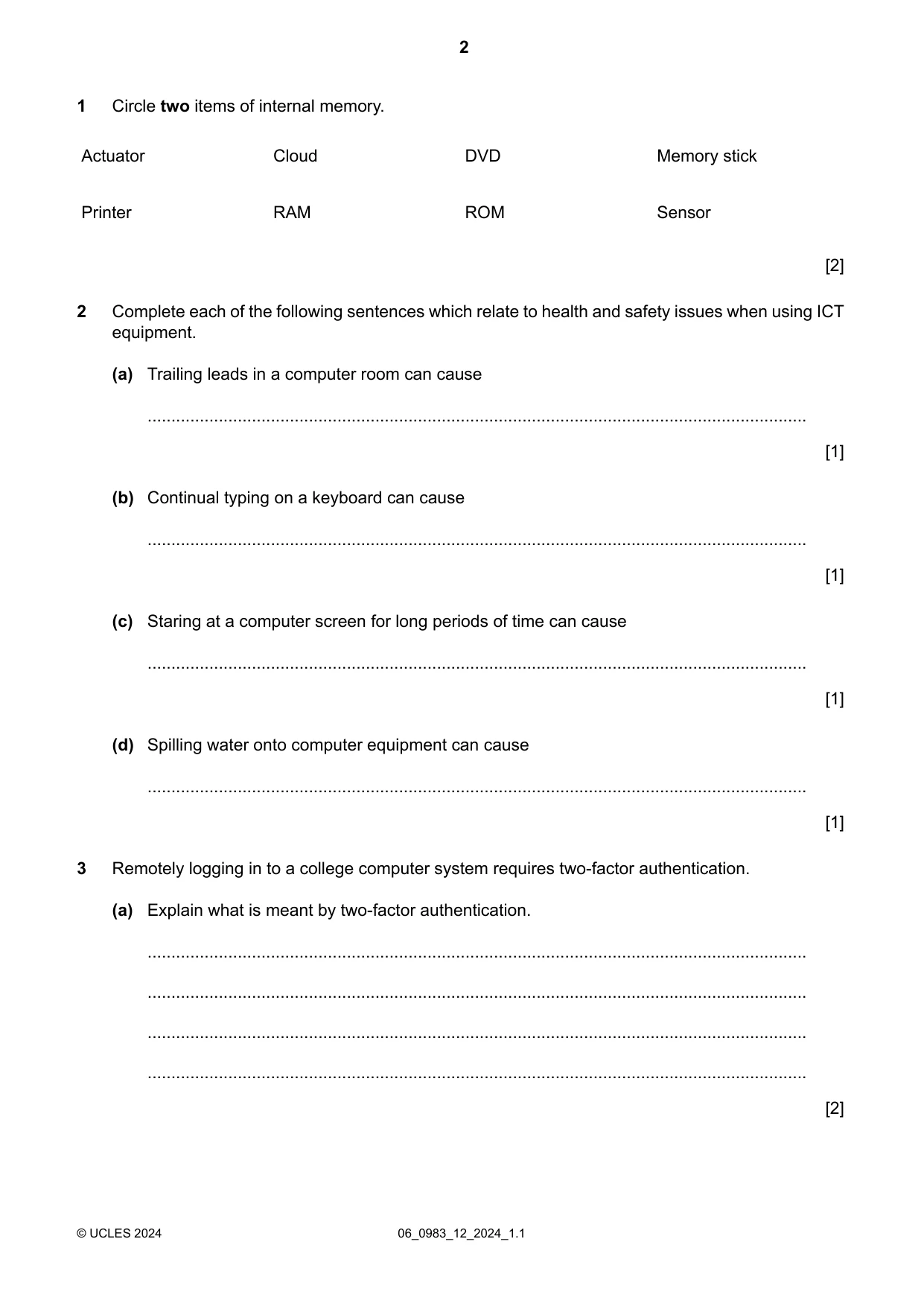
Circle two items of internal memory. 1 Memory stick DVD Cloud Actuator Sensor ROM RAM Printer [2] Complete each of the following sentences which relate to health and safety issues when using ICT equipment. 2 Trailing leads in a computer room can cause (a) … [1] Continual typing on a keyboard can cause (b) … [1] Staring at a computer screen for long periods of time can cause (c) … [1] Spilling water onto computer equipment can cause (d) … [1] Remotely logging in to a college computer system requires two-factor authentication. 3 Explain what is meant by two-factor authentication. (a) … … … … [2] 06_0983_12_2024_1.1 © UCLES 2024 2
Question paper, page 3
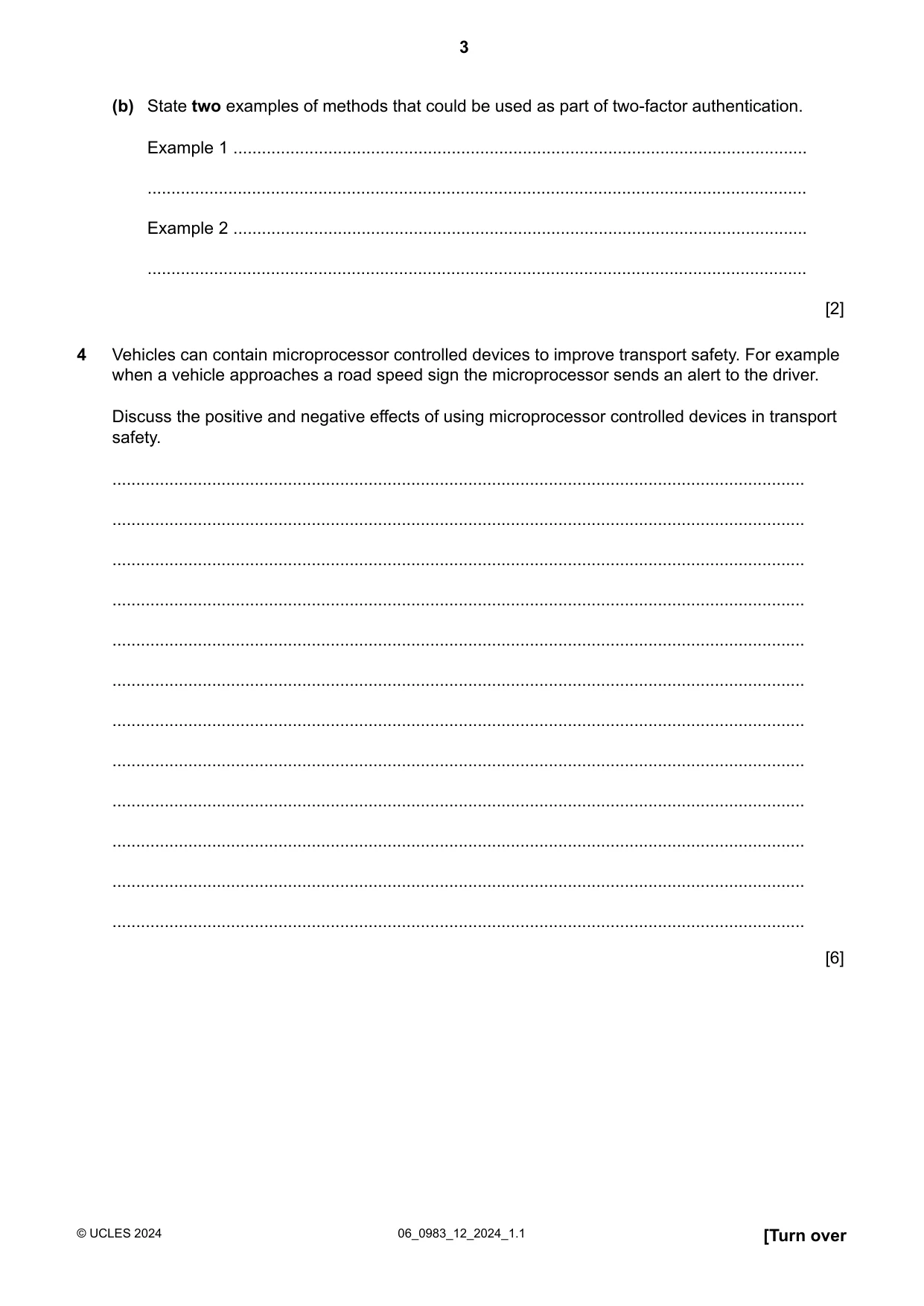
State two examples of methods that could be used as part of two-factor authentication. (b) Example 1 … … Example 2 … … [2] Vehicles can contain microprocessor controlled devices to improve transport safety. For example when a vehicle approaches a road speed sign the microprocessor sends an alert to the driver. Discuss the positive and negative effects of using microprocessor controlled devices in transport safety. 4 … … … … … … … … … … … … [6] [Turn over 06_0983_12_2024_1.1 © UCLES 2024 3
Question paper, page 4
One difference between a command line interface (CLI) and a graphical user interface (GUI) is that a GUI takes up more memory. 5 State two other differences between a CLI and a GUI. (a) 1 … … 2 … … [2] State two other types of user interface. (b) 1 … 2 … [2] 06_0983_12_2024_1.1 © UCLES 2024 4
Question paper, page 5
Explain what is meant by electronic conferencing. (a) 6 … … … … [2] State, giving a reason for your choice, the hardware required to set up an electronic conference. (b) … … … … … … … … [4] [Turn over 06_0983_12_2024_1.1 © UCLES 2024 5
Question paper, page 6
A college principal has decided that students can use mobile devices to take notes in lessons. Some students use laptop computers whilst others use smartphones. 7 Describe the benefits and drawbacks of using laptop computers rather than smartphones for this purpose. (a) … … … … … … … … [4] There are safety issues related to bringing laptop computers into the college. The Network Manager has decided to produce a paper-based certificate for students to prove that their laptop computer is safe to use. Describe the main features that should be considered for the design of this certificate. (b) … … … … … … … … [4] 06_0983_12_2024_1.1 © UCLES 2024 6
Question paper, page 7
Explain the differences between virtual reality (VR) and augmented reality (AR). (a) 8 … … … … [2] Discuss the impact of augmented reality (AR) on everyday life. (b) … … … … … … … … … … … … [6] [Turn over 06_0983_12_2024_1.1 © UCLES 2024 7
Question paper, page 8
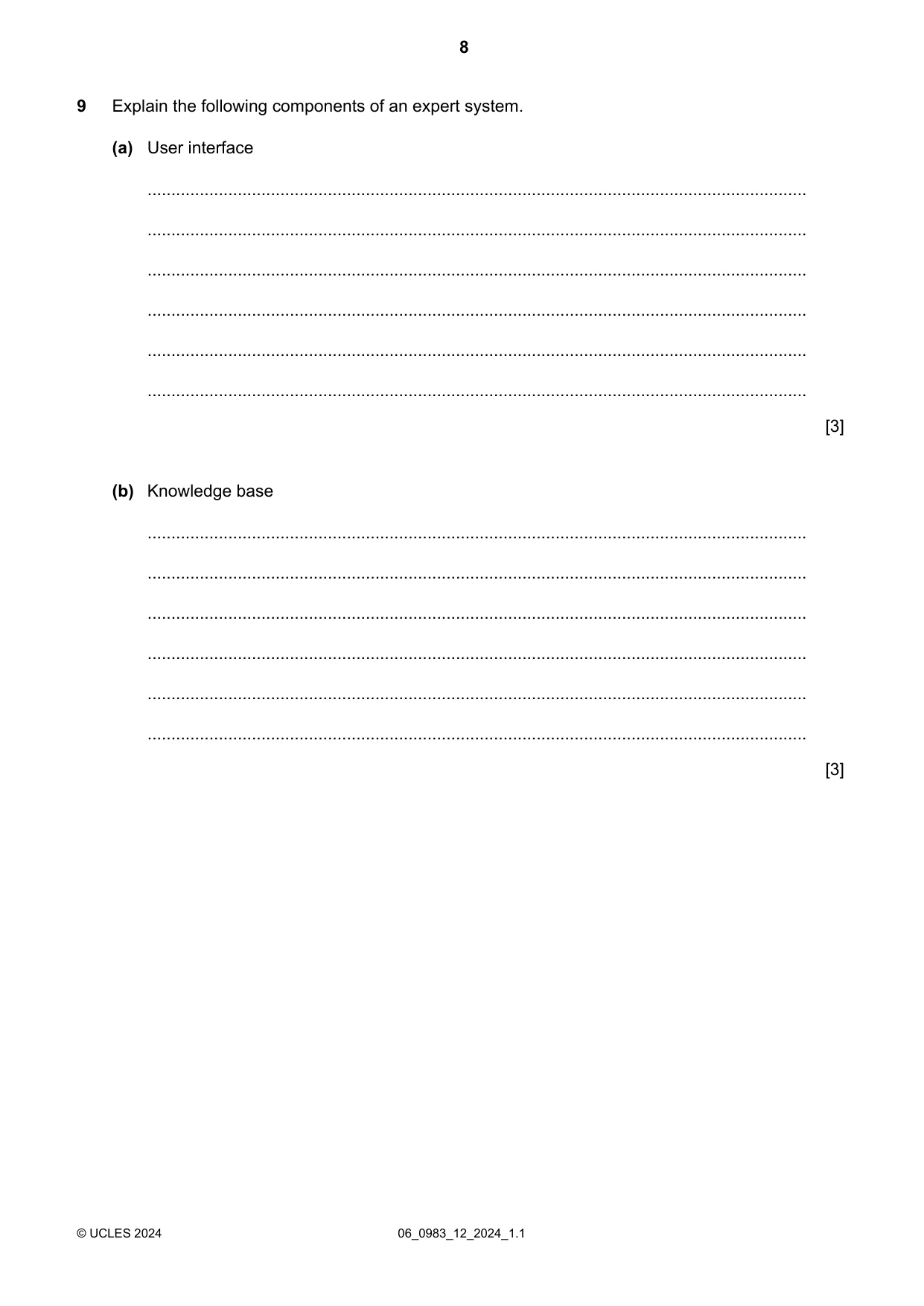
Explain the following components of an expert system. 9 User interface (a) … … … … … … [3] Knowledge base (b) … … … … … … [3] 06_0983_12_2024_1.1 © UCLES 2024 8
Question paper, page 9
Cars can have sensors at the front and rear of the vehicle to detect obstacles. Describe how the sensor detects an obstacle and sends the data to the microprocessor when parking the car. 10 … … … … … … … … [4] [Turn over 06_0983_12_2024_1.1 © UCLES 2024 9
Question paper, page 10
A company with many branches is implementing a new system. The manager is planning to implement the new system either by pilot changeover or parallel running. 11 Contrast pilot changeover and parallel running. (a) … … … … … … … … … … [5] When the system is implemented, technical documentation is produced. State three components that would be included in the technical documentation. (b) 1 … 2 … 3 … [3] 06_0983_12_2024_1.1 © UCLES 2024 10
Question paper, page 11
One of the risks when entering a password into a system is shoulder surfing. 12 Explain what is meant by shoulder surfing. (a) … … … … [2] Give two security improvements that could be made to reduce shoulder surfing. (b) 1 … … 2 … … [2] [Turn over 06_0983_12_2024_1.1 © UCLES 2024 11
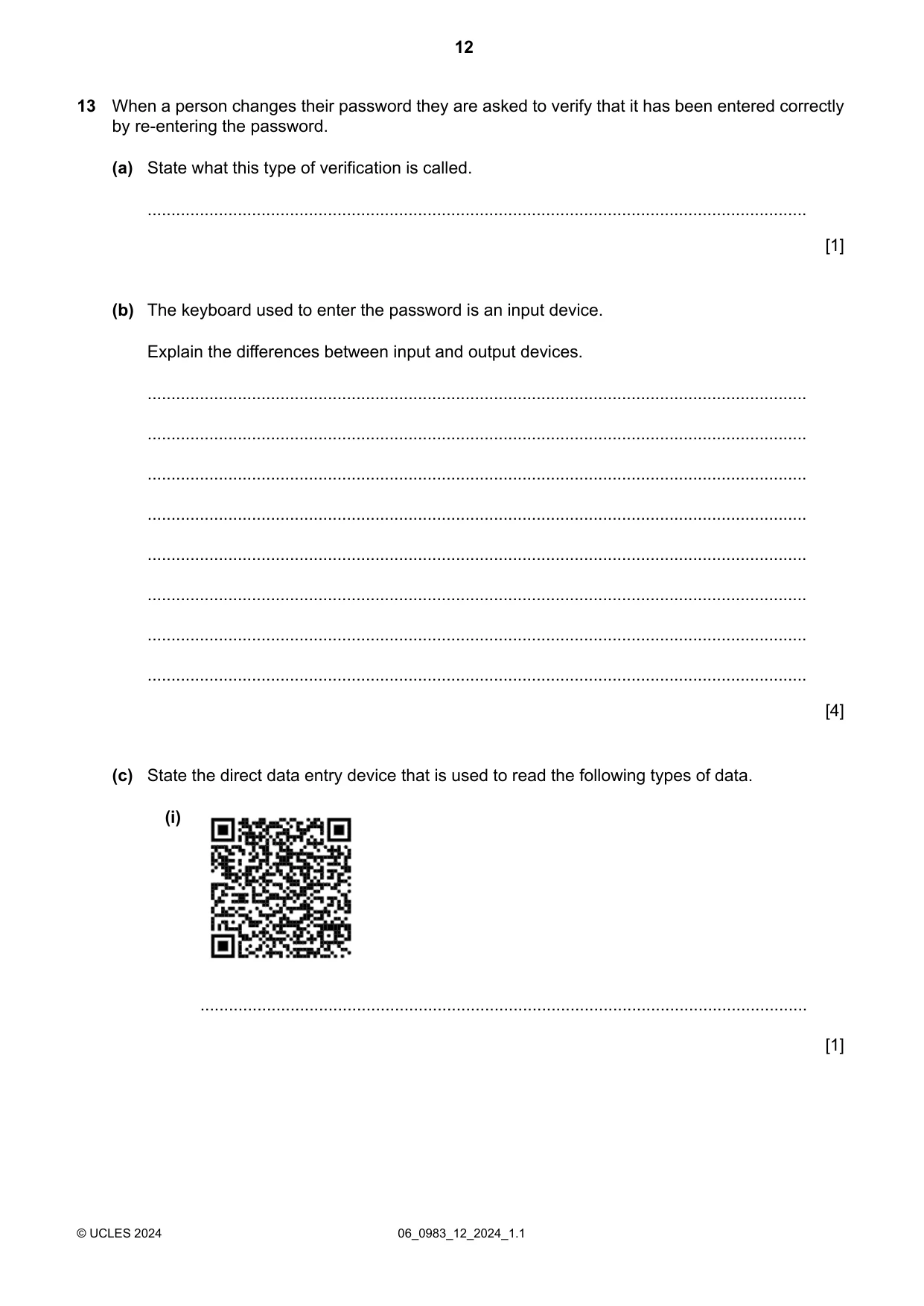
Question paper, page 12
When a person changes their password they are asked to verify that it has been entered correctly by re-entering the password. 13 State what this type of verification is called. (a) … [1] The keyboard used to enter the password is an input device. Explain the differences between input and output devices. (b) … … … … … … … … [4] State the direct data entry device that is used to read the following types of data. (c) (i) … [1] 06_0983_12_2024_1.1 © UCLES 2024 12
Question paper, page 13
(ii) … [1] (iii) … [1] (iv) … [1] [Turn over 06_0983_12_2024_1.1 © UCLES 2024 13
Question paper, page 14
State three advantages of using solid state storage devices rather than magnetic storage devices. 14 1 … … 2 … … 3 … … [3] Explain why data protection legislation is required. 15 … … … … … … … … [4] 06_0983_12_2024_1.1 © UCLES 2024 14
Question paper, page 15
BLANK PAGE 06_0983_12_2024_1.1 © UCLES 2024 15
Question paper, page 16
BLANK PAGE Permission to reproduce items where third-party owned material protected by copyright is included has been sought and cleared where possible. Every reasonable effort has been made by the publisher (UCLES) to trace copyright holders, but if any items requiring clearance have unwittingly been included, the publisher will be pleased to make amends at the earliest possible opportunity. To avoid the issue of disclosure of answer-related information to candidates, all copyright acknowledgements are reproduced online in the Cambridge Assessment International Education Copyright Acknowledgements Booklet. This is produced for each series of examinations and is freely available to download at www.cambridgeinternational.org after the live examination series. Cambridge Assessment International Education is part of Cambridge Assessment. Cambridge Assessment is the brand name of the University of Cambridge Local Examinations Syndicate (UCLES), which is a department of the University of Cambridge. 06_0983_12_2024_1.1 © UCLES 2024 16
Mark scheme, page 1
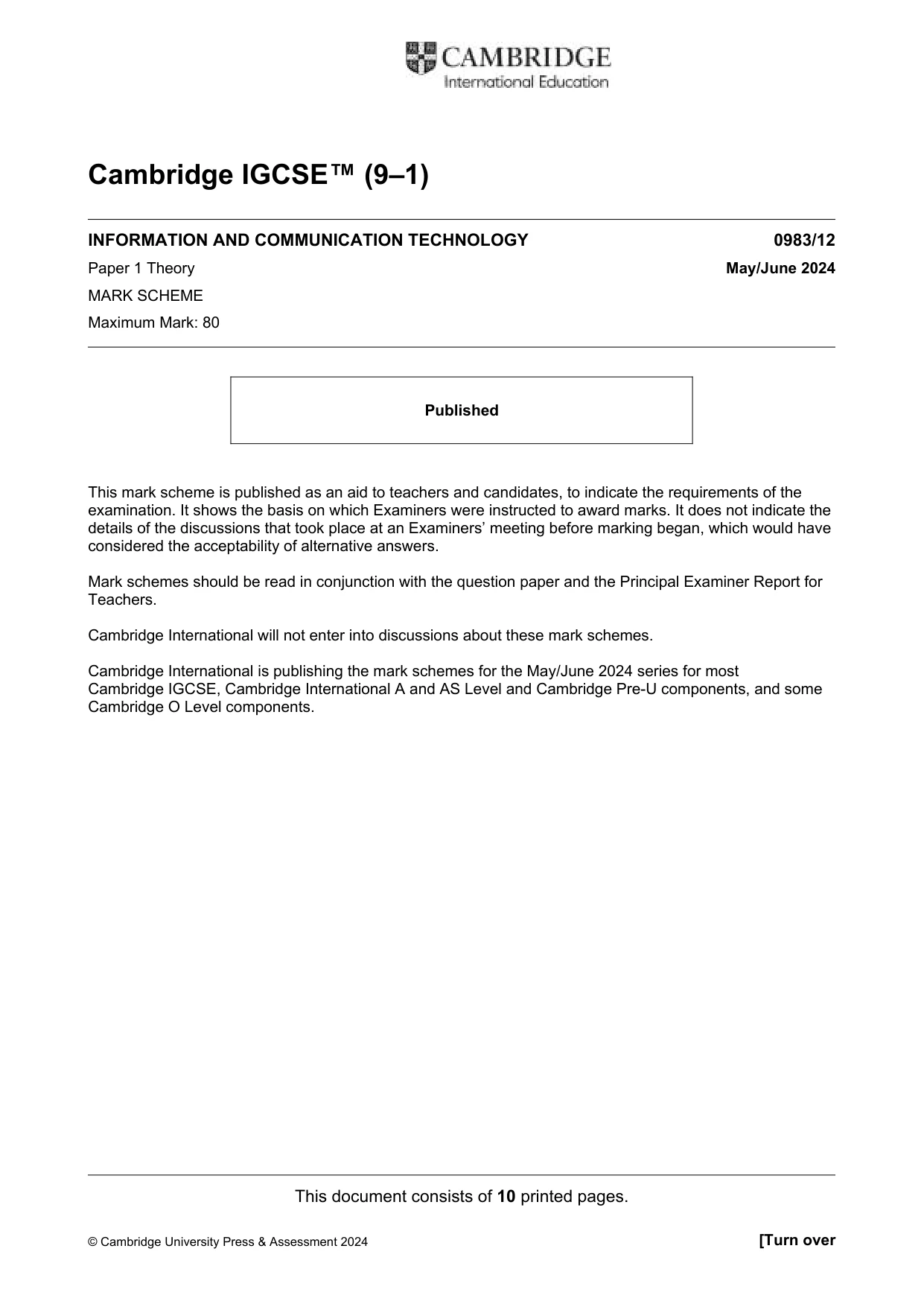
This document consists of 10 printed pages. © Cambridge University Press & Assessment 2024 [Turn over Cambridge IGCSE™ (9–1) INFORMATION AND COMMUNICATION TECHNOLOGY 0983/12 Paper 1 Theory May/June 2024 MARK SCHEME Maximum Mark: 80 Published This mark scheme is published as an aid to teachers and candidates, to indicate the requirements of the examination. It shows the basis on which Examiners were instructed to award marks. It does not indicate the details of the discussions that took place at an Examiners’ meeting before marking began, which would have considered the acceptability of alternative answers. Mark schemes should be read in conjunction with the question paper and the Principal Examiner Report for Teachers. Cambridge International will not enter into discussions about these mark schemes. Cambridge International is publishing the mark schemes for the May/June 2024 series for most Cambridge IGCSE, Cambridge International A and AS Level and Cambridge Pre-U components, and some Cambridge O Level components.
Mark scheme, page 2
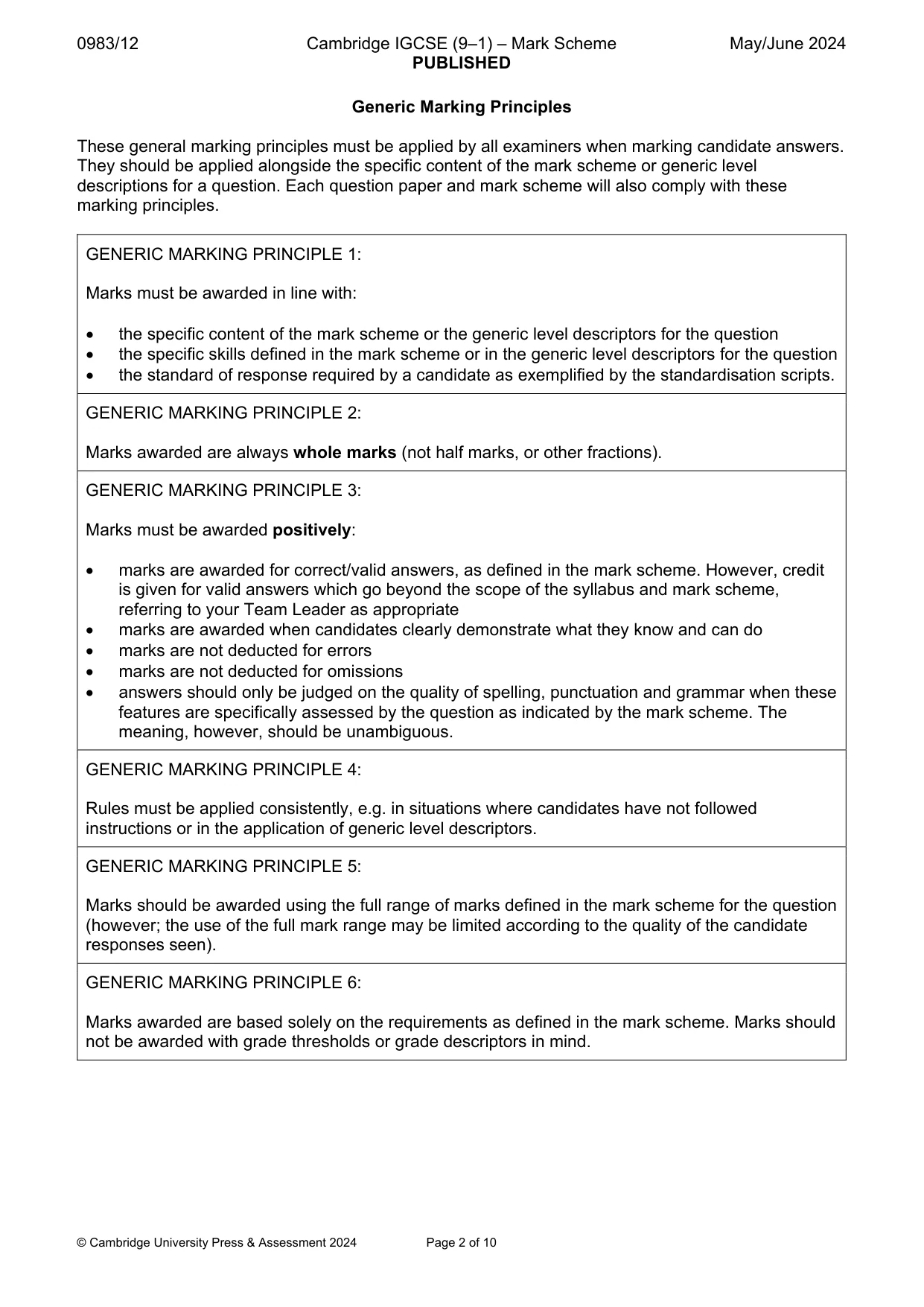
0983/12 Cambridge IGCSE (9–1) – Mark Scheme PUBLISHED May/June 2024 © Cambridge University Press & Assessment 2024 Page 2 of 10 Generic Marking Principles These general marking principles must be applied by all examiners when marking candidate answers. They should be applied alongside the specific content of the mark scheme or generic level descriptions for a question. Each question paper and mark scheme will also comply with these marking principles. GENERIC MARKING PRINCIPLE 1: Marks must be awarded in line with: the specific content of the mark scheme or the generic level descriptors for the question the specific skills defined in the mark scheme or in the generic level descriptors for the question the standard of response required by a candidate as exemplified by the standardisation scripts. GENERIC MARKING PRINCIPLE 2: Marks awarded are always whole marks (not half marks, or other fractions). GENERIC MARKING PRINCIPLE 3: Marks must be awarded positively: marks are awarded for correct/valid answers, as defined in the mark scheme. However, credit is given for valid answers which go beyond the scope of the syllabus and mark scheme, referring to your Team Leader as appropriate marks are awarded when candidates clearly demonstrate what they know and can do marks are not deducted for errors marks are not deducted for omissions answers should only be judged on the quality of spelling, punctuation and grammar when these features are specifically assessed by the question as indicated by the mark scheme. The meaning, however, should be unambiguous. GENERIC MARKING PRINCIPLE 4: Rules must be applied consistently, e.g. in situations where candidates have not followed instructions or in the application of generic level descriptors. GENERIC MARKING PRINCIPLE 5: Marks should be awarded using the full range of marks defined in the mark scheme for the question (however; the use of the full mark range may be limited according to the quality of the candidate responses seen). GENERIC MARKING PRINCIPLE 6: Marks awarded are based solely on the requirements as defined in the mark scheme. Marks should not be awarded with grade thresholds or grade descriptors in mind.
Mark scheme, page 3
0983/12 Cambridge IGCSE (9–1) – Mark Scheme PUBLISHED May/June 2024 © Cambridge University Press & Assessment 2024 Page 3 of 10 Mark scheme comments / separates alternative words / phrases within a marking point // separates alternative answers within a marking point underline actual word given must be used by candidate (grammatical variants accepted) max indicates the maximum number of marks that can be awarded ( ) the word / phrase in brackets is not required, but sets the context Note: No marks are awarded for using brand names of software packages or hardware. Examiners must ensure that annotations are placed to show that the whole answer has been seen Annotations MUST be placed in white space close to where the mark is awarded Before submitting a script please check all ticks match marks If you have not placed any annotation near the end of a long answer then place R to show that the whole answer has been read Read the full sentence/answer before marking it Any blank pages place one SEEN annotation If an answer is left blank then use SEEN and award NR, but if anything has been written for example ‘Don’t know’, ‘?’ etc. then use NAQ and award 0. If an answer has been attempted and crossed out then attempt to mark it. Please make sure you have read the most up to date (10th May) AE guide before you start marking.
Mark scheme, page 4
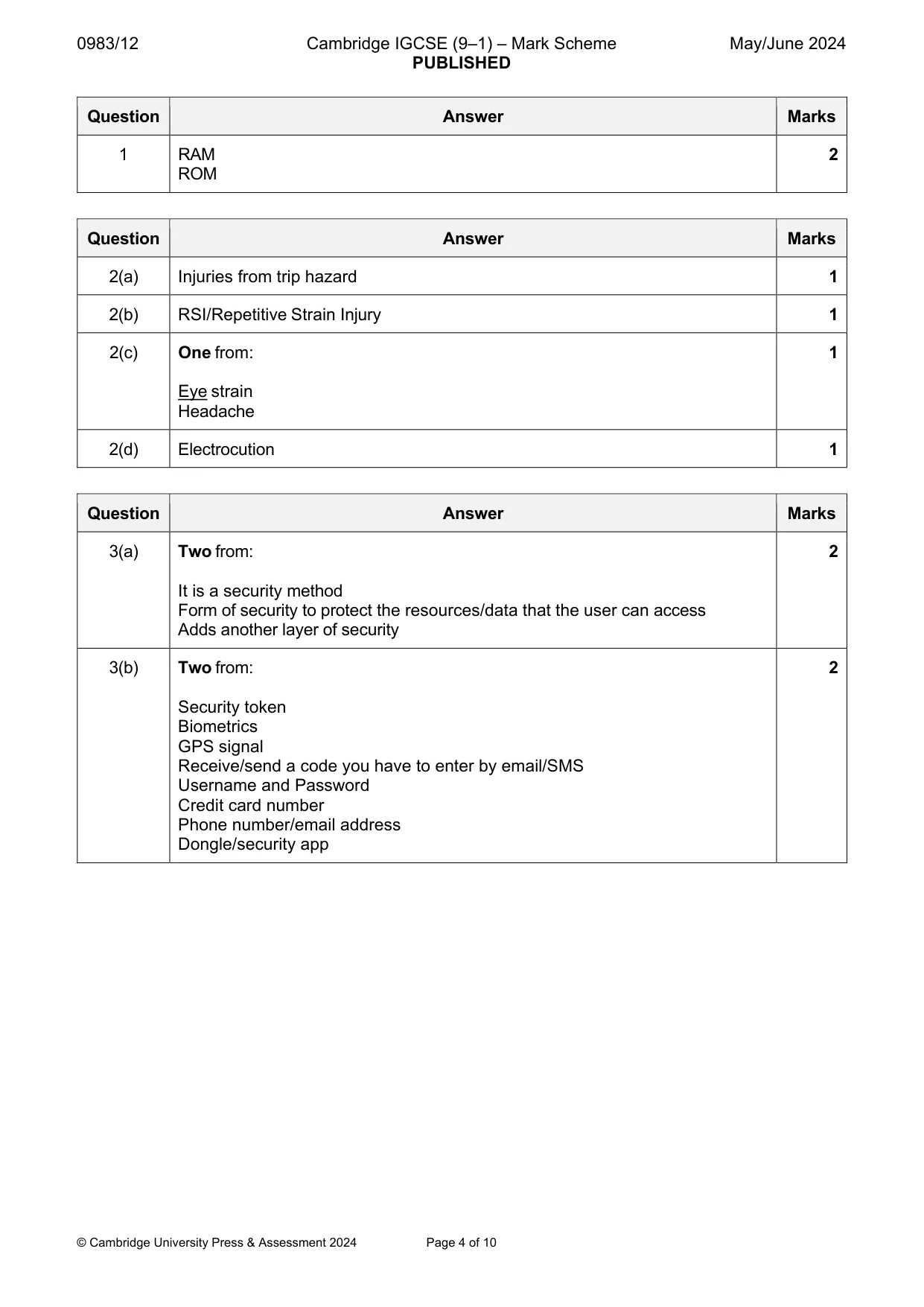
0983/12 Cambridge IGCSE (9–1) – Mark Scheme PUBLISHED May/June 2024 © Cambridge University Press & Assessment 2024 Page 4 of 10 Question Answer Marks 1 RAM ROM 2 Question Answer Marks 2(a) Injuries from trip hazard 1 2(b) RSI/Repetitive Strain Injury 1 2(c) One from: Eye strain Headache 1 2(d) Electrocution 1 Question Answer Marks 3(a) Two from: It is a security method Form of security to protect the resources/data that the user can access Adds another layer of security 2 3(b) Two from: Security token Biometrics GPS signal Receive/send a code you have to enter by email/SMS Username and Password Credit card number Phone number/email address Dongle/security app 2
Mark scheme, page 5
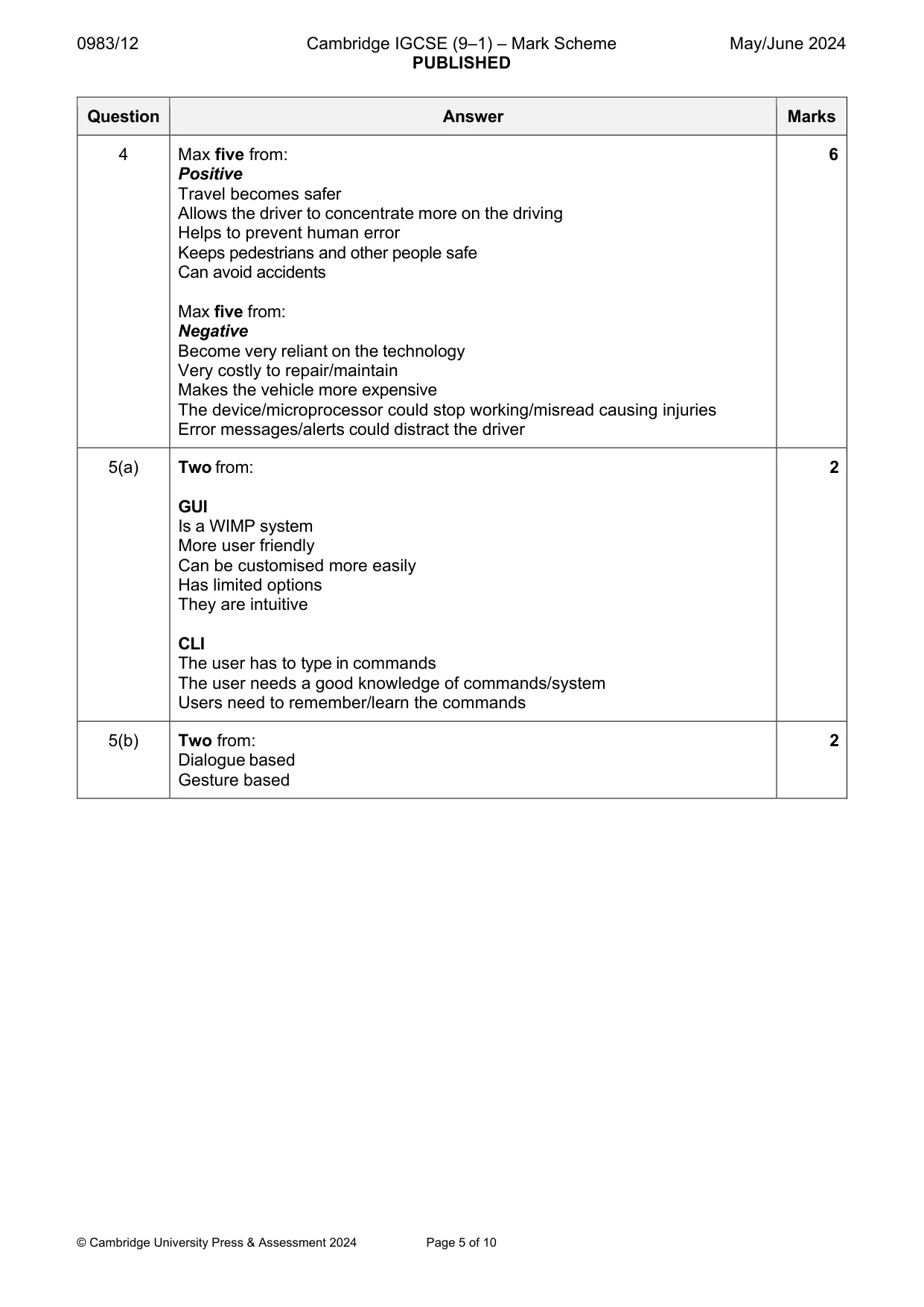
0983/12 Cambridge IGCSE (9–1) – Mark Scheme PUBLISHED May/June 2024 © Cambridge University Press & Assessment 2024 Page 5 of 10 Question Answer Marks 4 Max five from: Positive Travel becomes safer Allows the driver to concentrate more on the driving Helps to prevent human error Keeps pedestrians and other people safe Can avoid accidents Max five from: Negative Become very reliant on the technology Very costly to repair/maintain Makes the vehicle more expensive The device/microprocessor could stop working/misread causing injuries Error messages/alerts could distract the driver 6 5(a) Two from: GUI Is a WIMP system More user friendly Can be customised more easily Has limited options They are intuitive CLI The user has to type in commands The user needs a good knowledge of commands/system Users need to remember/learn the commands 2 5(b) Two from: Dialogue based Gesture based 2
Mark scheme, page 6
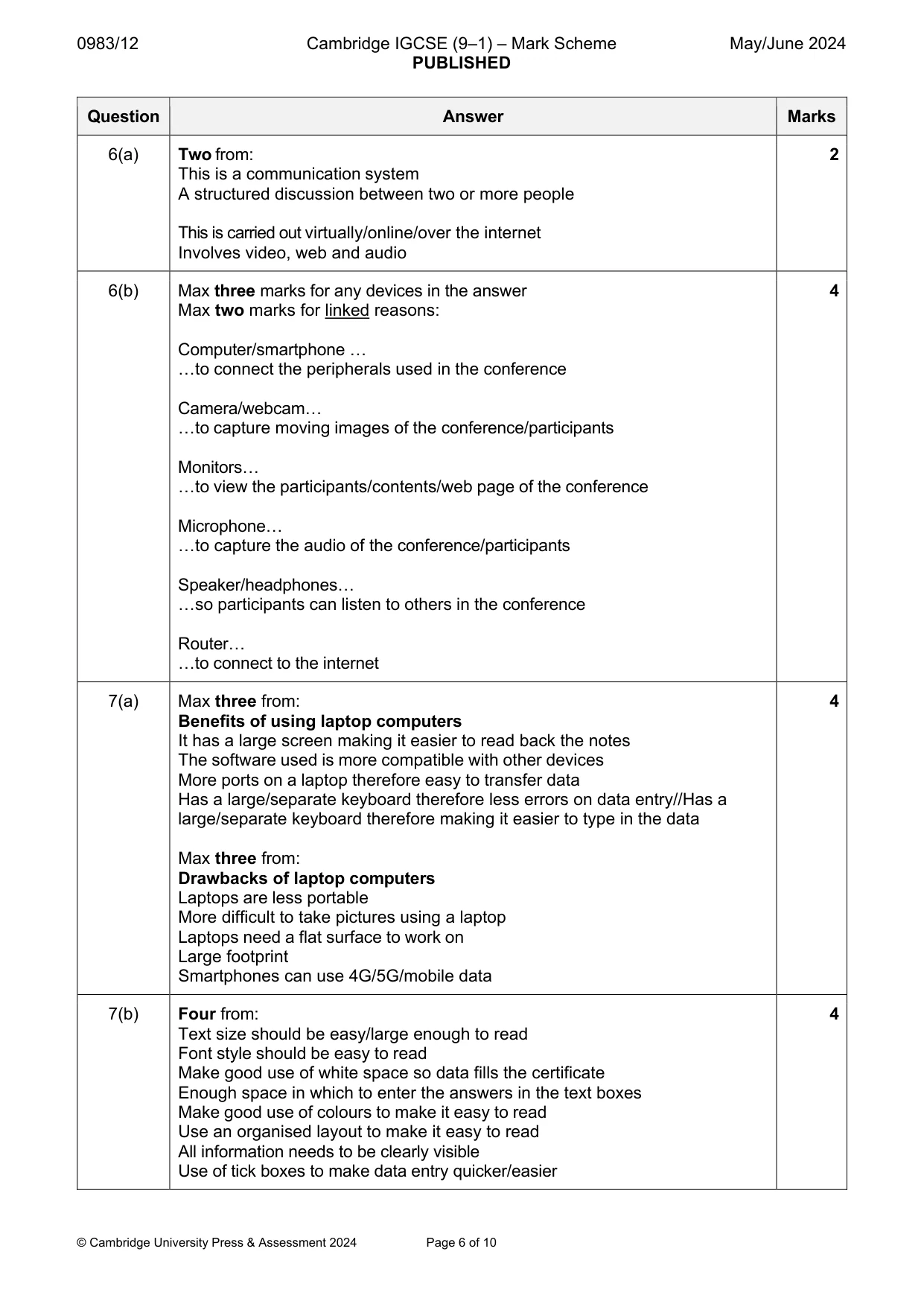
0983/12 Cambridge IGCSE (9–1) – Mark Scheme PUBLISHED May/June 2024 © Cambridge University Press & Assessment 2024 Page 6 of 10 Question Answer Marks 6(a) Two from: This is a communication system A structured discussion between two or more people This is carried out virtually/online/over the internet Involves video, web and audio 2 6(b) Max three marks for any devices in the answer Max two marks for linked reasons: Computer/smartphone … …to connect the peripherals used in the conference Camera/webcam… …to capture moving images of the conference/participants Monitors… …to view the participants/contents/web page of the conference Microphone… …to capture the audio of the conference/participants Speaker/headphones… …so participants can listen to others in the conference Router… …to connect to the internet 4 7(a) Max three from: Benefits of using laptop computers It has a large screen making it easier to read back the notes The software used is more compatible with other devices More ports on a laptop therefore easy to transfer data Has a large/separate keyboard therefore less errors on data entry//Has a large/separate keyboard therefore making it easier to type in the data Max three from: Drawbacks of laptop computers Laptops are less portable More difficult to take pictures using a laptop Laptops need a flat surface to work on Large footprint Smartphones can use 4G/5G/mobile data 4 7(b) Four from: Text size should be easy/large enough to read Font style should be easy to read Make good use of white space so data fills the certificate Enough space in which to enter the answers in the text boxes Make good use of colours to make it easy to read Use an organised layout to make it easy to read All information needs to be clearly visible Use of tick boxes to make data entry quicker/easier 4
Mark scheme, page 7
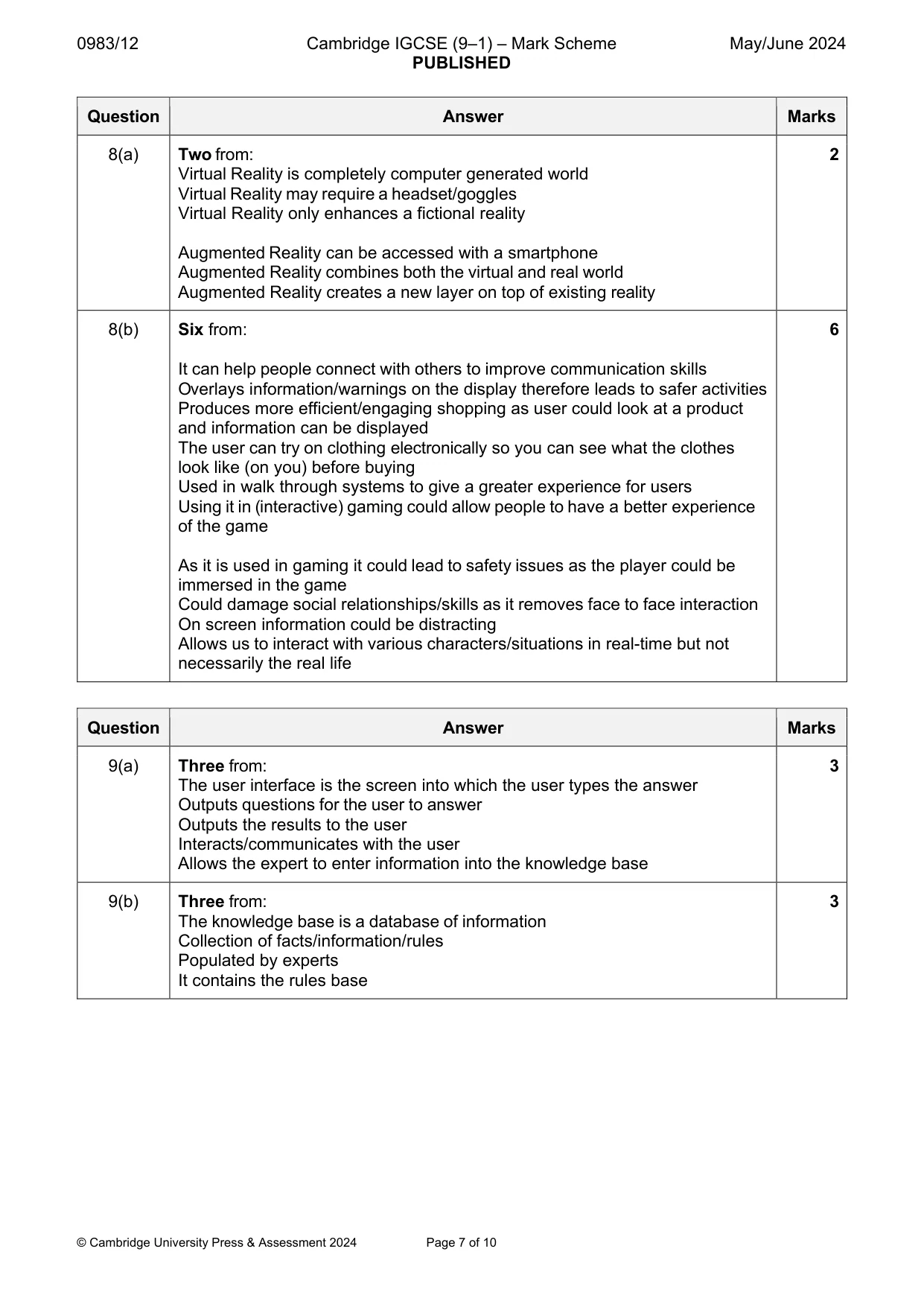
0983/12 Cambridge IGCSE (9–1) – Mark Scheme PUBLISHED May/June 2024 © Cambridge University Press & Assessment 2024 Page 7 of 10 Question Answer Marks 8(a) Two from: Virtual Reality is completely computer generated world Virtual Reality may require a headset/goggles Virtual Reality only enhances a fictional reality Augmented Reality can be accessed with a smartphone Augmented Reality combines both the virtual and real world Augmented Reality creates a new layer on top of existing reality 2 8(b) Six from: It can help people connect with others to improve communication skills Overlays information/warnings on the display therefore leads to safer activities Produces more efficient/engaging shopping as user could look at a product and information can be displayed The user can try on clothing electronically so you can see what the clothes look like (on you) before buying Used in walk through systems to give a greater experience for users Using it in (interactive) gaming could allow people to have a better experience of the game As it is used in gaming it could lead to safety issues as the player could be immersed in the game Could damage social relationships/skills as it removes face to face interaction On screen information could be distracting Allows us to interact with various characters/situations in real-time but not necessarily the real life 6 Question Answer Marks 9(a) Three from: The user interface is the screen into which the user types the answer Outputs questions for the user to answer Outputs the results to the user Interacts/communicates with the user Allows the expert to enter information into the knowledge base 3 9(b) Three from: The knowledge base is a database of information Collection of facts/information/rules Populated by experts It contains the rules base 3
Mark scheme, page 8
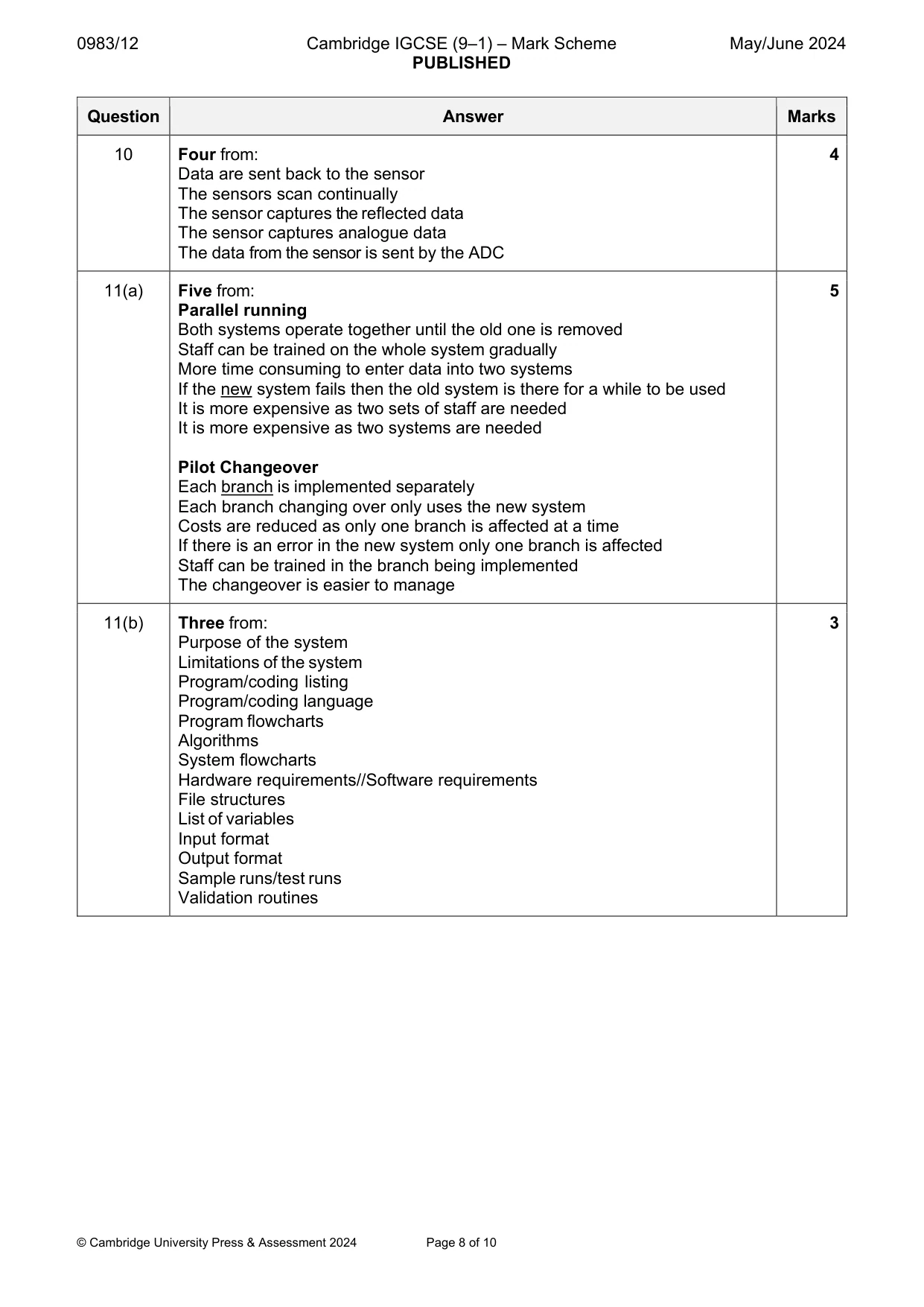
0983/12 Cambridge IGCSE (9–1) – Mark Scheme PUBLISHED May/June 2024 © Cambridge University Press & Assessment 2024 Page 8 of 10 Question Answer Marks 10 Four from: Data are sent back to the sensor The sensors scan continually The sensor captures the reflected data The sensor captures analogue data The data from the sensor is sent by the ADC 4 11(a) Five from: Parallel running Both systems operate together until the old one is removed Staff can be trained on the whole system gradually More time consuming to enter data into two systems If the new system fails then the old system is there for a while to be used It is more expensive as two sets of staff are needed It is more expensive as two systems are needed Pilot Changeover Each branch is implemented separately Each branch changing over only uses the new system Costs are reduced as only one branch is affected at a time If there is an error in the new system only one branch is affected Staff can be trained in the branch being implemented The changeover is easier to manage 5 11(b) Three from: Purpose of the system Limitations of the system Program/coding listing Program/coding language Program flowcharts Algorithms System flowcharts Hardware requirements//Software requirements File structures List of variables Input format Output format Sample runs/test runs Validation routines 3
Mark scheme, page 9
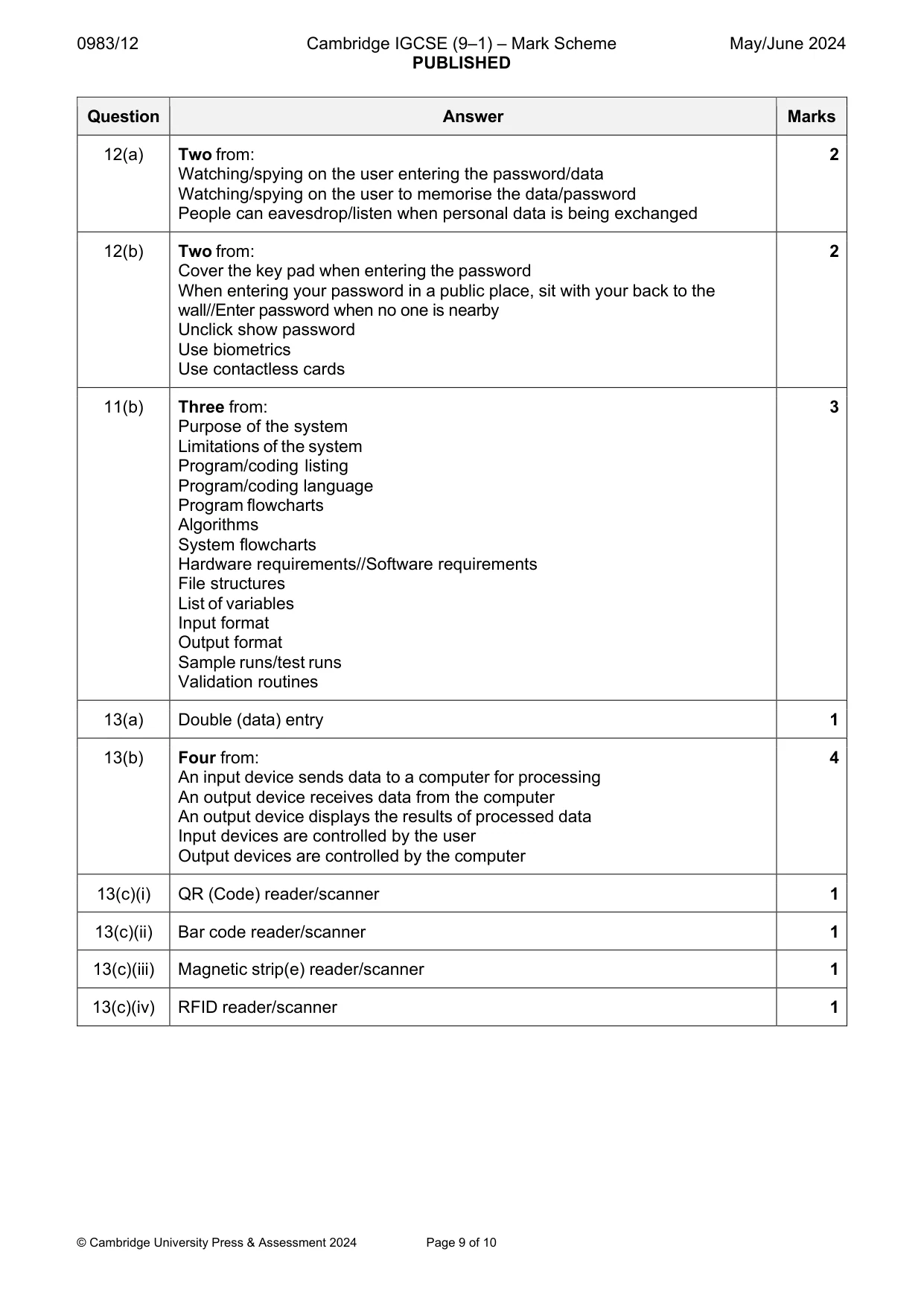
0983/12 Cambridge IGCSE (9–1) – Mark Scheme PUBLISHED May/June 2024 © Cambridge University Press & Assessment 2024 Page 9 of 10 Question Answer Marks 12(a) Two from: Watching/spying on the user entering the password/data Watching/spying on the user to memorise the data/password People can eavesdrop/listen when personal data is being exchanged 2 12(b) Two from: Cover the key pad when entering the password When entering your password in a public place, sit with your back to the wall//Enter password when no one is nearby Unclick show password Use biometrics Use contactless cards 2 11(b) Three from: Purpose of the system Limitations of the system Program/coding listing Program/coding language Program flowcharts Algorithms System flowcharts Hardware requirements//Software requirements File structures List of variables Input format Output format Sample runs/test runs Validation routines 3 13(a) Double (data) entry 1 13(b) Four from: An input device sends data to a computer for processing An output device receives data from the computer An output device displays the results of processed data Input devices are controlled by the user Output devices are controlled by the computer 4 13(c)(i) QR (Code) reader/scanner 1 13(c)(ii) Bar code reader/scanner 1 13(c)(iii) Magnetic strip(e) reader/scanner 1 13(c)(iv) RFID reader/scanner 1
Mark scheme, page 10
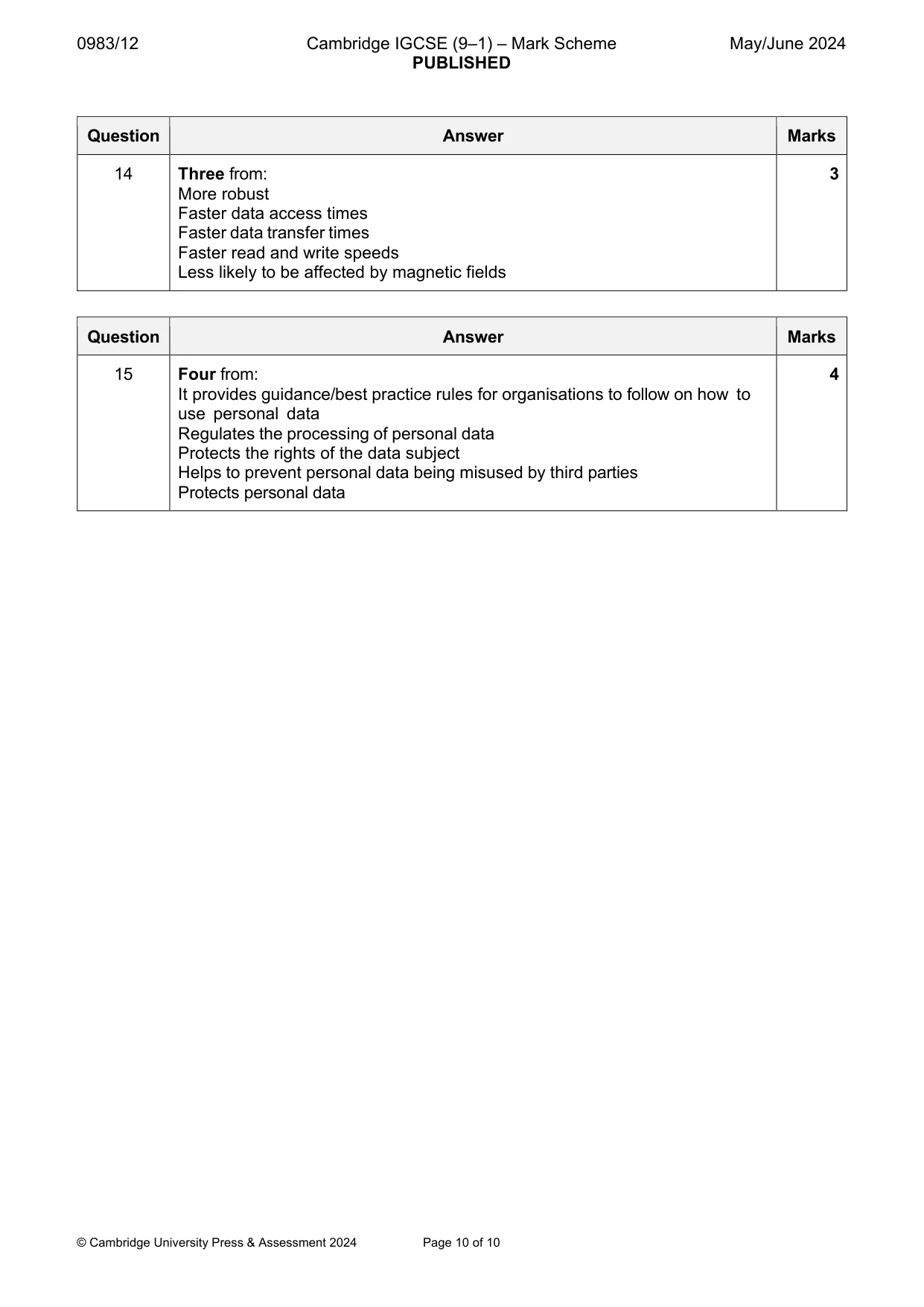
0983/12 Cambridge IGCSE (9–1) – Mark Scheme PUBLISHED May/June 2024 © Cambridge University Press & Assessment 2024 Page 10 of 10 Question Answer Marks 14 Three from: More robust Faster data access times Faster data transfer times Faster read and write speeds Less likely to be affected by magnetic fields 3 Question Answer Marks 15 Four from: It provides guidance/best practice rules for organisations to follow on how to use personal data Regulates the processing of personal data Protects the rights of the data subject Helps to prevent personal data being misused by third parties Protects personal data 4
What you needed in this session
Cambridge’s own grade thresholds for 2024 May/June, Paper 1 · Variant 2. A higher threshold means an easier paper — the bar moves with how the cohort did.