Cambridge IGCSE History American BES 0409 — 2019 Oct/Nov Paper 2 · Variant 1
0409/21/O/N/19 · 20 questions · 45 marks · ≈51 min
The question paper and its mark scheme, free to read here and free to download. This is Cambridge’s own paper, exactly as it was sat.
Question paper8 pages
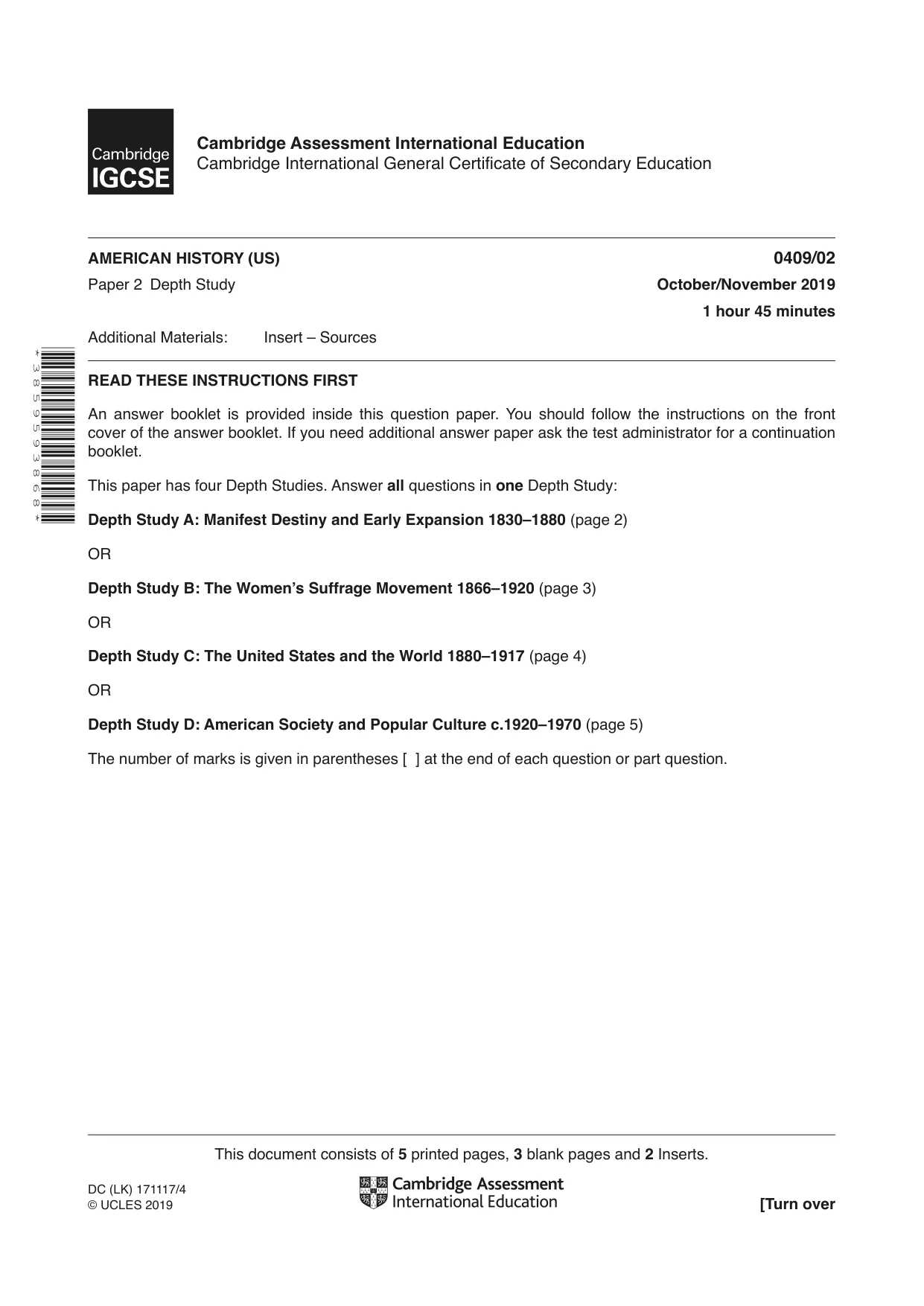
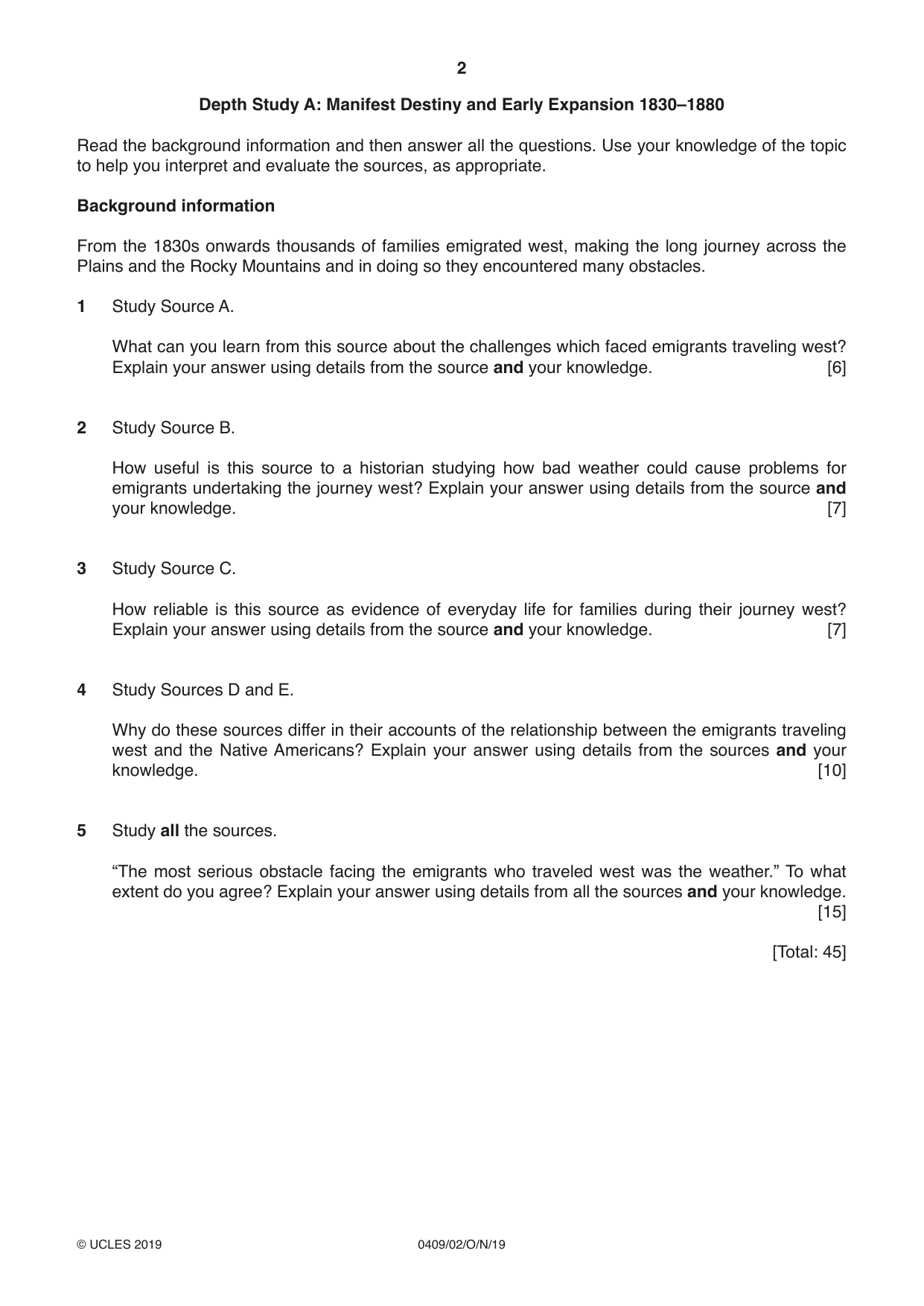
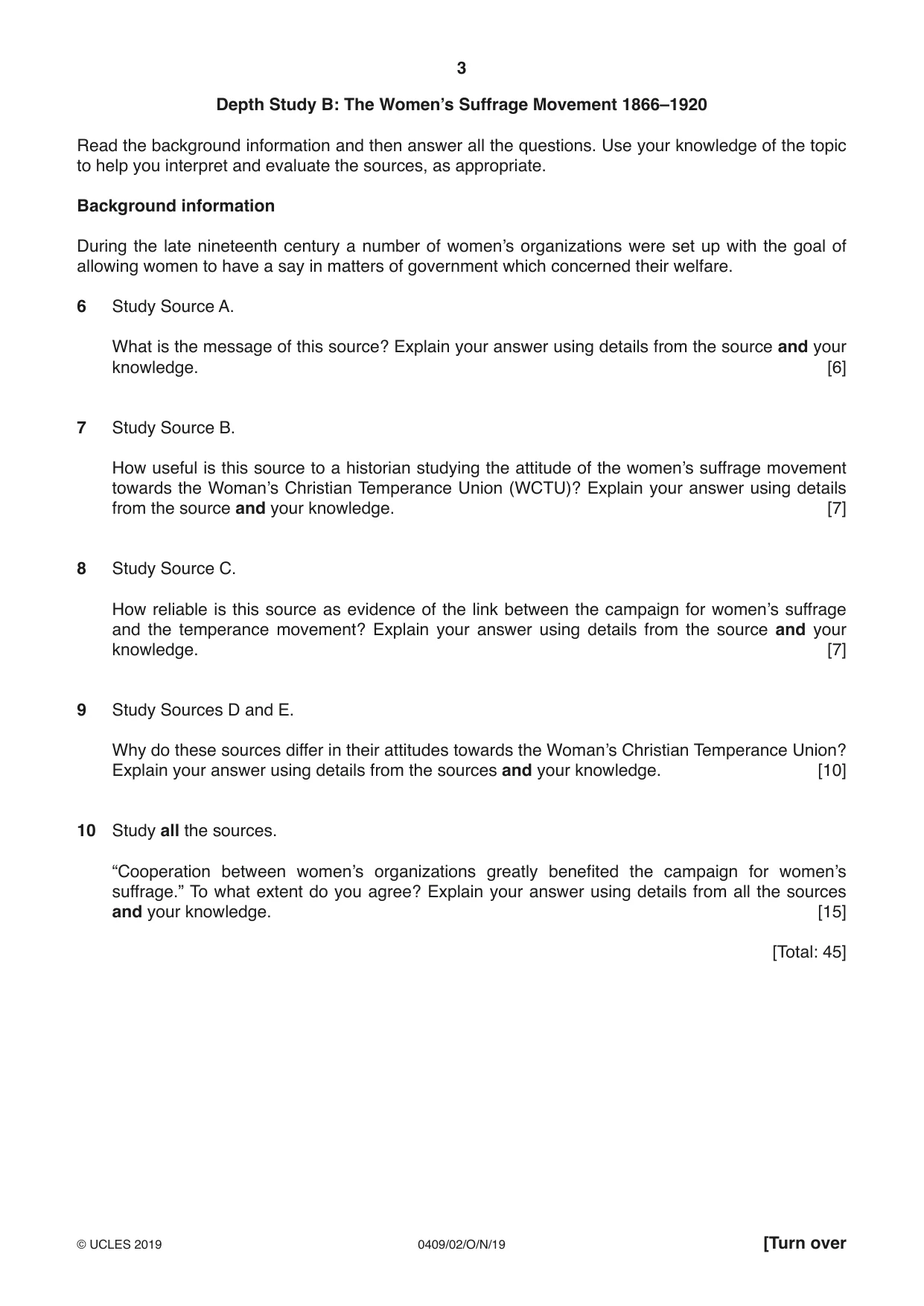
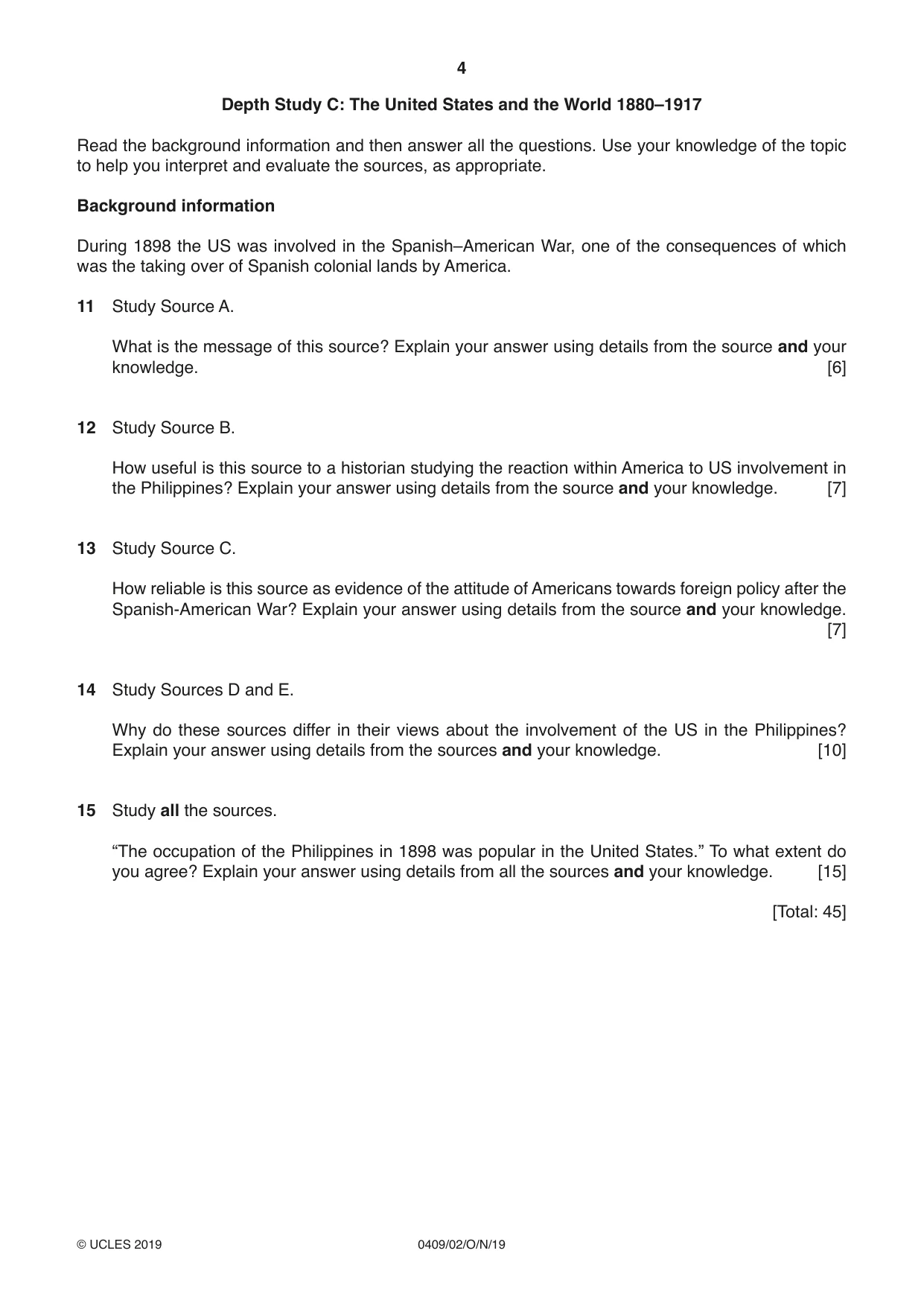


Mark scheme42 pages
Answers below. Sit the paper first if you are practising.
Questions as text
Question 1
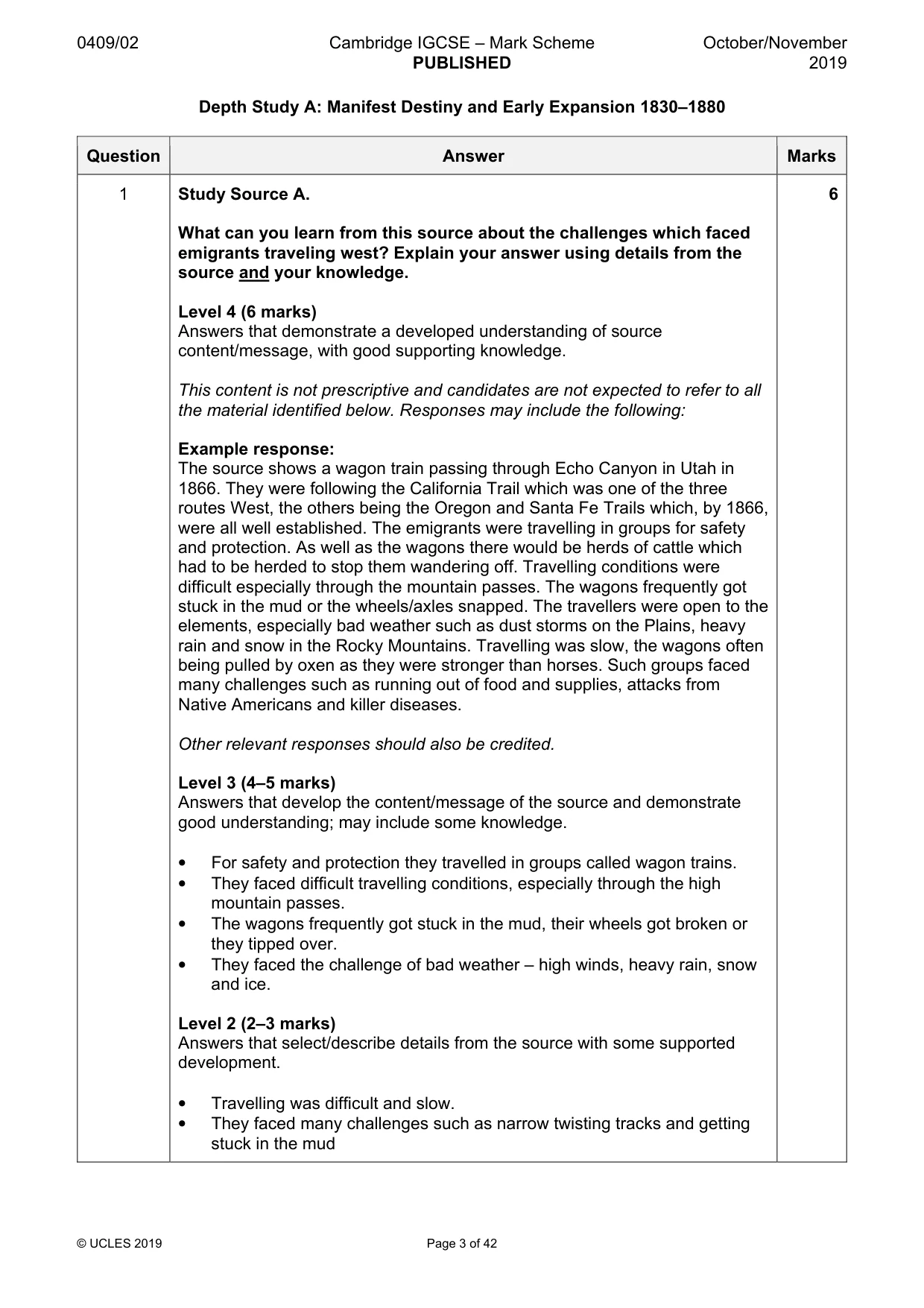
1 Study Source A. What can you learn from this source about the challenges which faced emigrants traveling west? Explain your answer using details from the source and your knowledge. [6]
Mark scheme: Question Answer Marks 1 Study Source A. 6 What can you learn from this source about the challenges which faced emigrants traveling west? Explain your answer using details from the source and your knowledge. Level 4 (6 marks) Answers that demonstrate a developed understanding of source content/message, with good supporting knowledge. This content is not prescriptive and candidates are not expected to refer to all the material identified below. Responses may include the following: Example response: The source shows a wagon train passing through Echo Canyon in Utah in 1866. They were following the California Trail which was one of the three routes West, the others being the Oregon and Santa Fe Trails which, by 1866, were all well established. The emigrants were travelling in groups for safety and protection. As well as the wagons there would be herds of cattle which had to be herded to stop them wandering off. Travelling conditions were difficult especially through the mountain passes. The wagons frequently got stuck in the mud or the wheels/axles snapped. The travellers were open to the elements, especially bad weather such as dust storms on the Plains, heavy rain and snow in the Rocky Mountains. Travelling was slow, the wagons often being pulled by oxen as they were stronger than horses. Such groups faced many challenges such as running out of food and supplies, attacks from Native Americans and killer diseases. Other relevant responses should also be credited. Level 3 (4–5 marks) Answers that develop the content/message of the source and demonstrate good understanding; may include some knowledge. • For safety and protection they travelled in groups called wagon trains. • They faced difficult travelling conditions, especially through the high mountain passes. • The wagons frequently got stuck in the mud, their wheels got broken or they tipped over. • They faced the challenge of bad weather – high winds, heavy rain, snow and ice. Level 2 (2–3 marks) Answers that select/describe details from the source with some supported development. • Travelling was difficult and slow. • They faced many challenges such as narrow twisting tracks and getting stuck in the mud 1 Level 1 (1 mark) Answers that offer a generalised comment with loose reference to the source. • Slow progress through Echo Canyon in Utah. Level 0 (0 marks) No valid response.
Question 2
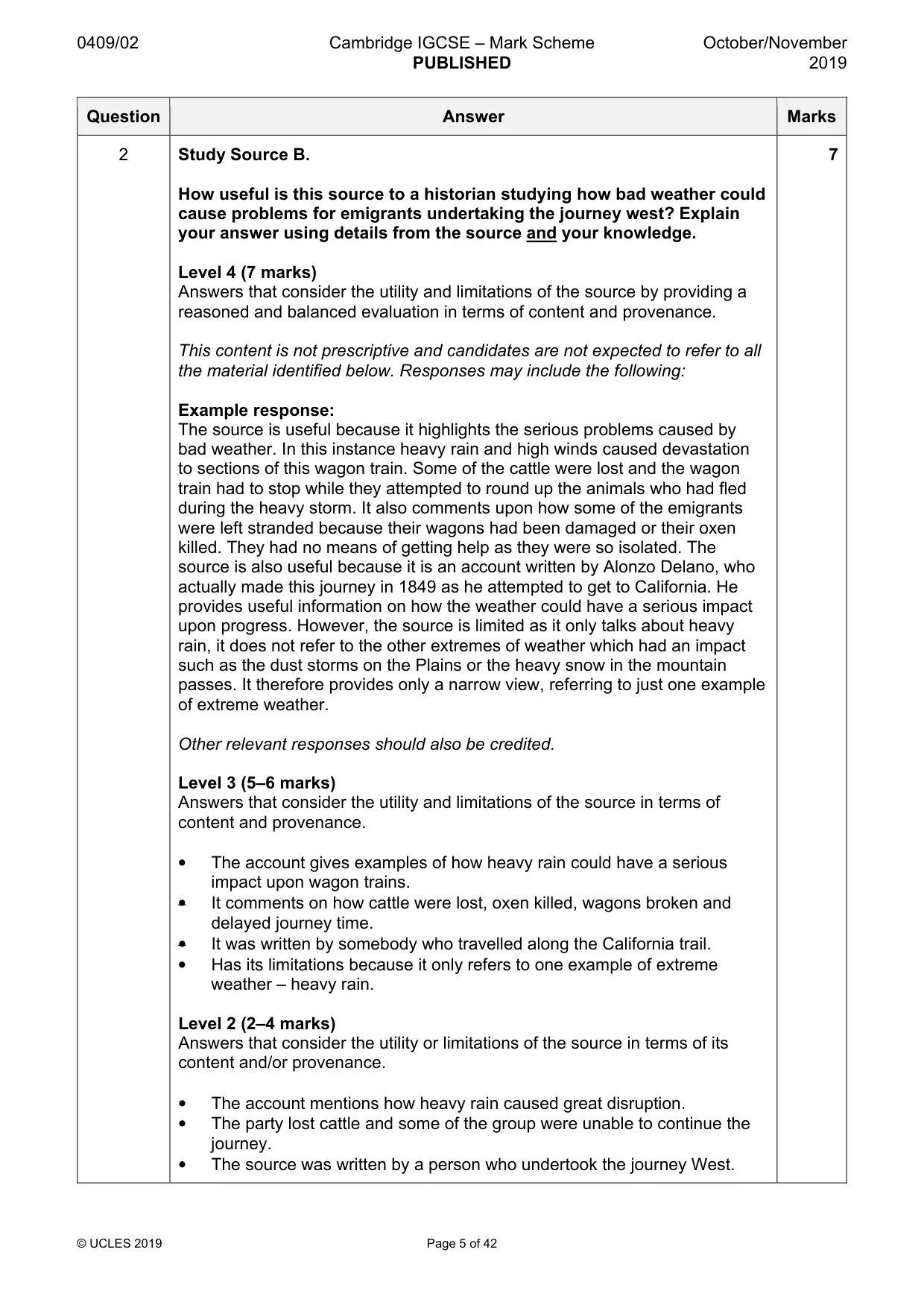
2 Study Source B. How useful is this source to a historian studying how bad weather could cause problems for emigrants undertaking the journey west? Explain your answer using details from the source and your knowledge. [7]
Mark scheme: 2 Study Source B. 7 How useful is this source to a historian studying how bad weather could cause problems for emigrants undertaking the journey west? Explain your answer using details from the source and your knowledge. Level 4 (7 marks) Answers that consider the utility and limitations of the source by providing a reasoned and balanced evaluation in terms of content and provenance. This content is not prescriptive and candidates are not expected to refer to all the material identified below. Responses may include the following: Example response: The source is useful because it highlights the serious problems caused by bad weather. In this instance heavy rain and high winds caused devastation to sections of this wagon train. Some of the cattle were lost and the wagon train had to stop while they attempted to round up the animals who had fled during the heavy storm. It also comments upon how some of the emigrants were left stranded because their wagons had been damaged or their oxen killed. They had no means of getting help as they were so isolated. The source is also useful because it is an account written by Alonzo Delano, who actually made this journey in 1849 as he attempted to get to California. He provides useful information on how the weather could have a serious impact upon progress. However, the source is limited as it only talks about heavy rain, it does not refer to the other extremes of weather which had an impact such as the dust storms on the Plains or the heavy snow in the mountain passes. It therefore provides only a narrow view, referring to just one example of extreme weather. Other relevant responses should also be credited. Level 3 (5–6 marks) Answers that consider the utility and limitations of the source in terms of content and provenance. • The account gives examples of how heavy rain could have a serious impact upon wagon trains. • It comments on how cattle were lost, oxen killed, wagons broken and delayed journey time. • It was written by somebody who travelled along the California trail. • Has its limitations because it only refers to one example of extreme weather – heavy rain. Level 2 (2–4 marks) Answers that consider the utility or limitations of the source in terms of its content and/or provenance. • The account mentions how heavy rain caused great disruption. • The party lost cattle and some of the group were unable to continue the journey. • The source was written by a person who undertook the journey West. 2 Level 1 (1 mark) Answers that offer a generalised comment or paraphrase source content. • It shows how bad weather was a problem for travellers. Level 0 (0 marks) No valid response.
Question 3
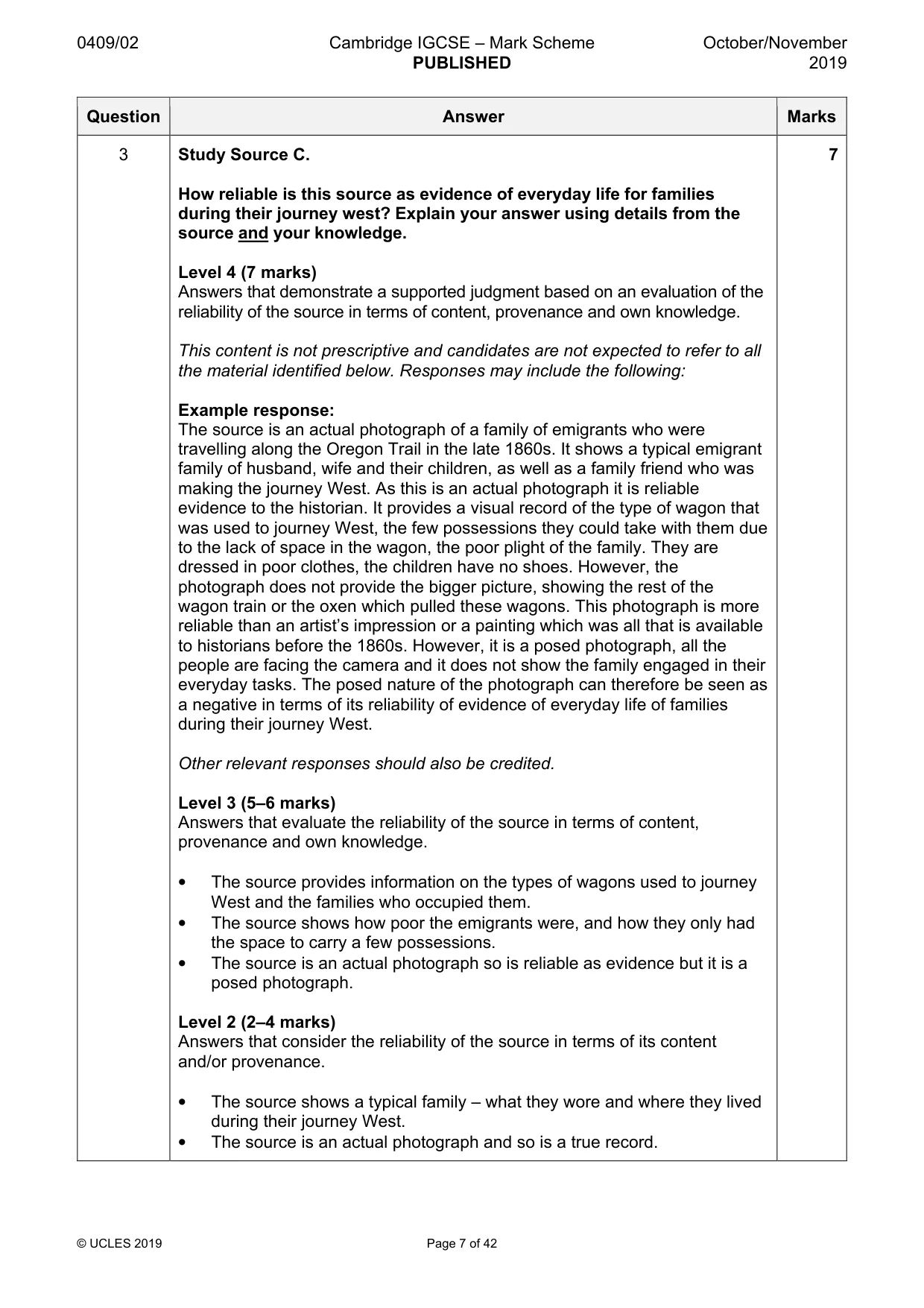
3 Study Source C. How reliable is this source as evidence of everyday life for families during their journey west? Explain your answer using details from the source and your knowledge. [7]
Mark scheme: 3 Study Source C. 7 How reliable is this source as evidence of everyday life for families during their journey west? Explain your answer using details from the source and your knowledge. Level 4 (7 marks) Answers that demonstrate a supported judgment based on an evaluation of the reliability of the source in terms of content, provenance and own knowledge. This content is not prescriptive and candidates are not expected to refer to all the material identified below. Responses may include the following: Example response: The source is an actual photograph of a family of emigrants who were travelling along the Oregon Trail in the late 1860s. It shows a typical emigrant family of husband, wife and their children, as well as a family friend who was making the journey West. As this is an actual photograph it is reliable evidence to the historian. It provides a visual record of the type of wagon that was used to journey West, the few possessions they could take with them due to the lack of space in the wagon, the poor plight of the family. They are dressed in poor clothes, the children have no shoes. However, the photograph does not provide the bigger picture, showing the rest of the wagon train or the oxen which pulled these wagons. This photograph is more reliable than an artist’s impression or a painting which was all that is available to historians before the 1860s. However, it is a posed photograph, all the people are facing the camera and it does not show the family engaged in their everyday tasks. The posed nature of the photograph can therefore be seen as a negative in terms of its reliability of evidence of everyday life of families during their journey West. Other relevant responses should also be credited. Level 3 (5–6 marks) Answers that evaluate the reliability of the source in terms of content, provenance and own knowledge. • The source provides information on the types of wagons used to journey West and the families who occupied them. • The source shows how poor the emigrants were, and how they only had the space to carry a few possessions. • The source is an actual photograph so is reliable as evidence but it is a posed photograph. Level 2 (2–4 marks) Answers that consider the reliability of the source in terms of its content and/or provenance. • The source shows a typical family – what they wore and where they lived during their journey West. • The source is an actual photograph and so is a true record. 3 Level 1 (1 mark) Answers that offer a generalised comment or paraphrase source content. • The source shows a typical wagon. • It shows a group of three adults and five children. • The source is a photograph. Level 0 (0 marks) No valid response.
Q4 · Study Sources D and E
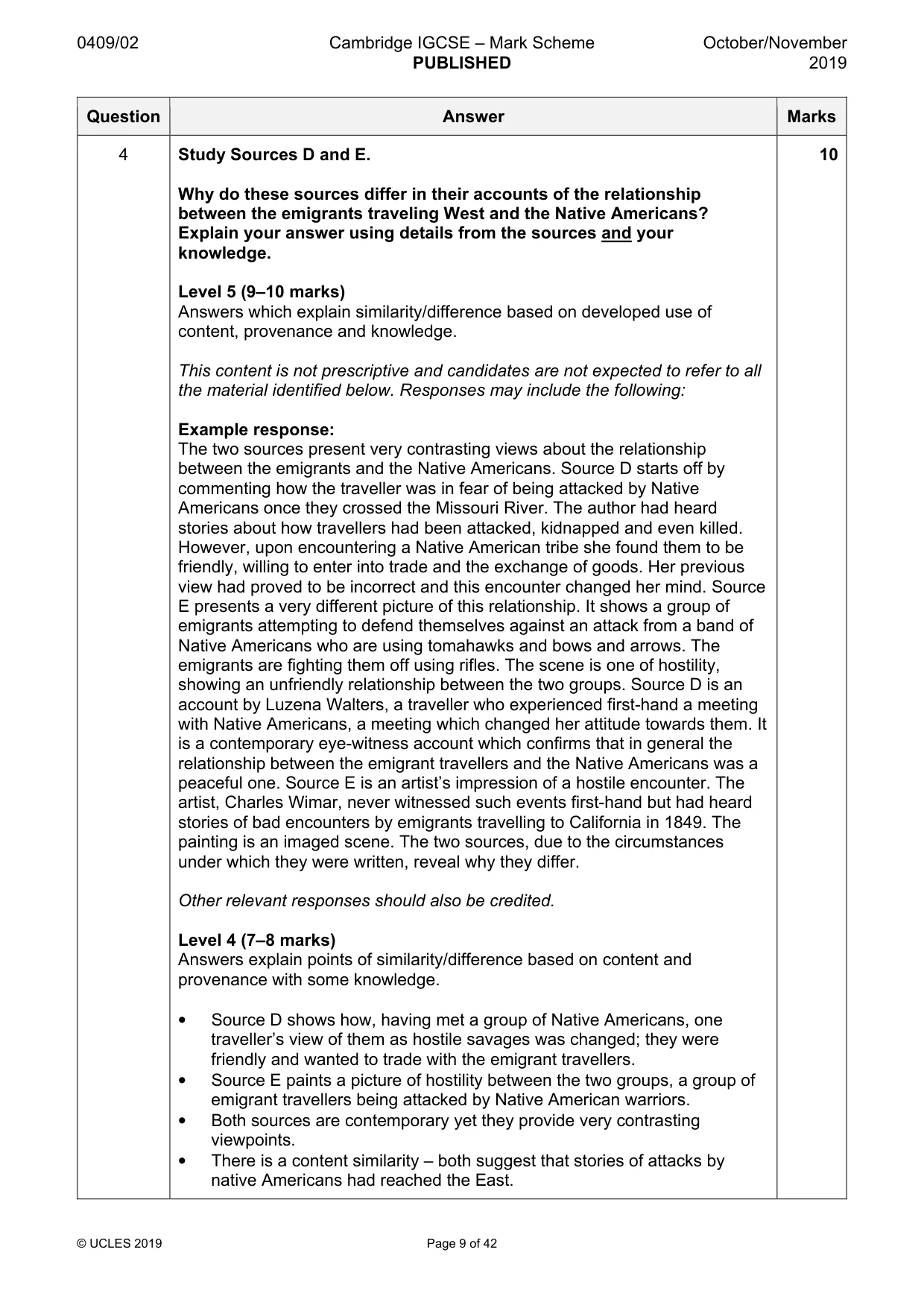
4 Study Sources D and E. Why do these sources differ in their accounts of the relationship between the emigrants traveling west and the Native Americans? Explain your answer using details from the sources and your knowledge. [10]
Mark scheme: 4 Study Sources D and E. 10 Why do these sources differ in their accounts of the relationship between the emigrants traveling West and the Native Americans? Explain your answer using details from the sources and your knowledge. Level 5 (9–10 marks) Answers which explain similarity/difference based on developed use of content, provenance and knowledge. This content is not prescriptive and candidates are not expected to refer to all the material identified below. Responses may include the following: Example response: The two sources present very contrasting views about the relationship between the emigrants and the Native Americans. Source D starts off by commenting how the traveller was in fear of being attacked by Native Americans once they crossed the Missouri River. The author had heard stories about how travellers had been attacked, kidnapped and even killed. However, upon encountering a Native American tribe she found them to be friendly, willing to enter into trade and the exchange of goods. Her previous view had proved to be incorrect and this encounter changed her mind. Source E presents a very different picture of this relationship. It shows a group of emigrants attempting to defend themselves against an attack from a band of Native Americans who are using tomahawks and bows and arrows. The emigrants are fighting them off using rifles. The scene is one of hostility, showing an unfriendly relationship between the two groups. Source D is an account by Luzena Walters, a traveller who experienced first-hand a meeting with Native Americans, a meeting which changed her attitude towards them. It is a contemporary eye-witness account which confirms that in general the relationship between the emigrant travellers and the Native Americans was a peaceful one. Source E is an artist’s impression of a hostile encounter. The artist, Charles Wimar, never witnessed such events first-hand but had heard stories of bad encounters by emigrants travelling to California in 1849. The painting is an imaged scene. The two sources, due to the circumstances under which they were written, reveal why they differ. Other relevant responses should also be credited. Level 4 (7–8 marks) Answers explain points of similarity/difference based on content and provenance with some knowledge. • Source D shows how, having met a group of Native Americans, one traveller’s view of them as hostile savages was changed; they were friendly and wanted to trade with the emigrant travellers. • Source E paints a picture of hostility between the two groups, a group of emigrant travellers being attacked by Native American warriors. • Both sources are contemporary yet they provide very contrasting viewpoints. • There is a content similarity – both suggest that stories of attacks by native Americans had reached the East. 4 Level 3 (5–6 marks) Answers identify points of similarity/difference based on content and provenance. • Source D talks about how the Native Americans were friendly and wanted to trade. • Source E shows the relationship to be bad, the two groups are fighting each other. • Both provide primary evidence about the relationship. Level 2 (3–4 marks) Answers identify points of similarity/difference based on content or provenance. • Source D describes how the Native Americans and travellers were friends. • Source E describes how the Native Americans and travellers were enemies. • Both sources date from this period. Level 1 (1–2 marks) Answer which offers generalised comments with limited reference to sources. • The sources show good and bad in the relationship. Level 0 (0 marks) No valid response.
Q5 · Study all the sources
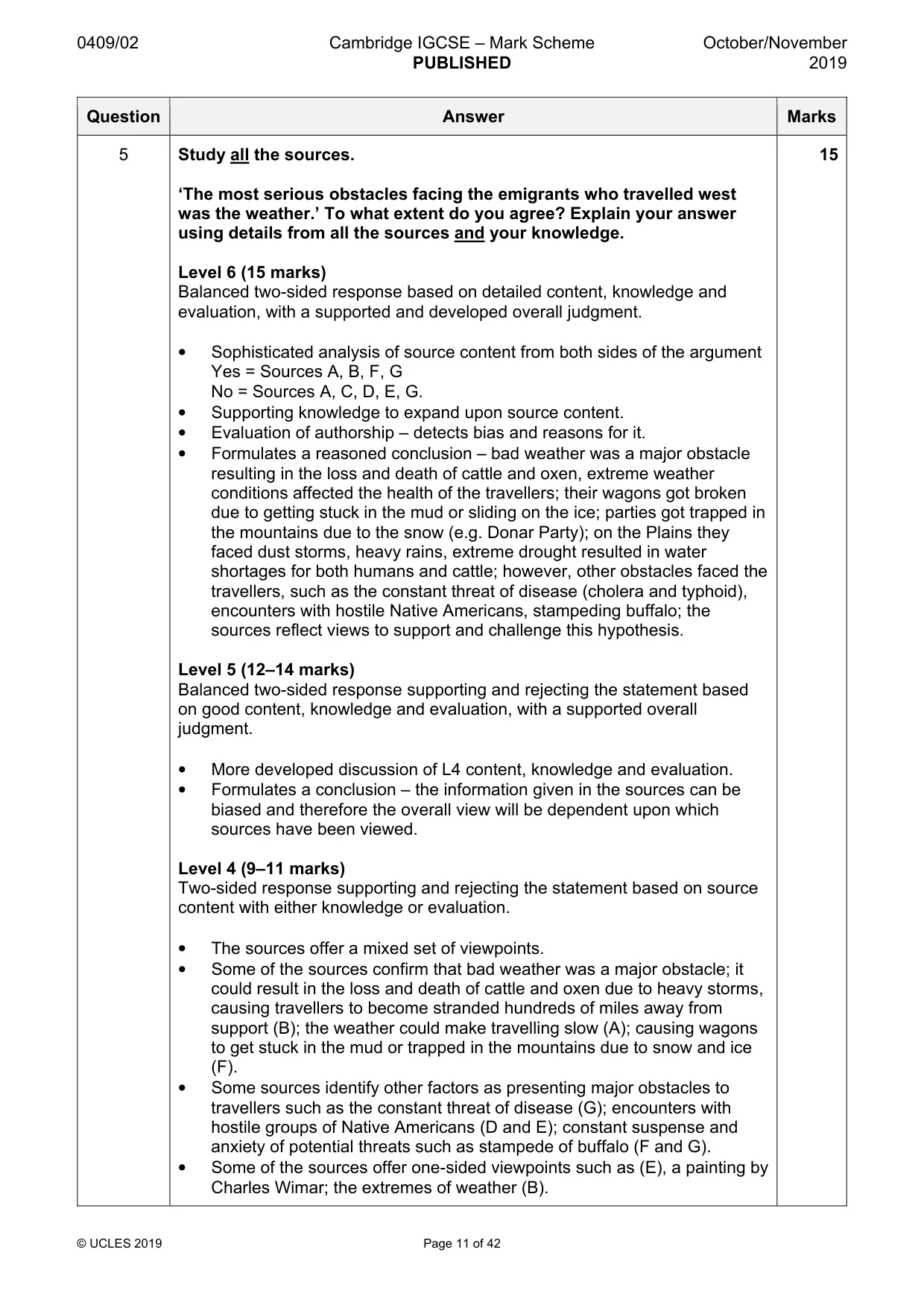
5 Study all the sources. “The most serious obstacle facing the emigrants who traveled west was the weather.” To what extent do you agree? Explain your answer using details from all the sources and your knowledge. [15] [Total: 45] Depth Study B: The Women’s Suffrage Movement 1866–1920 Read the background information and then answer all the questions. Use your knowledge of the topic to help you interpret and evaluate the sources, as appropriate. Background information During the late nineteenth century a number of women’s organizations were set up with the goal of allowing women to have a say in matters of government which concerned their welfare.
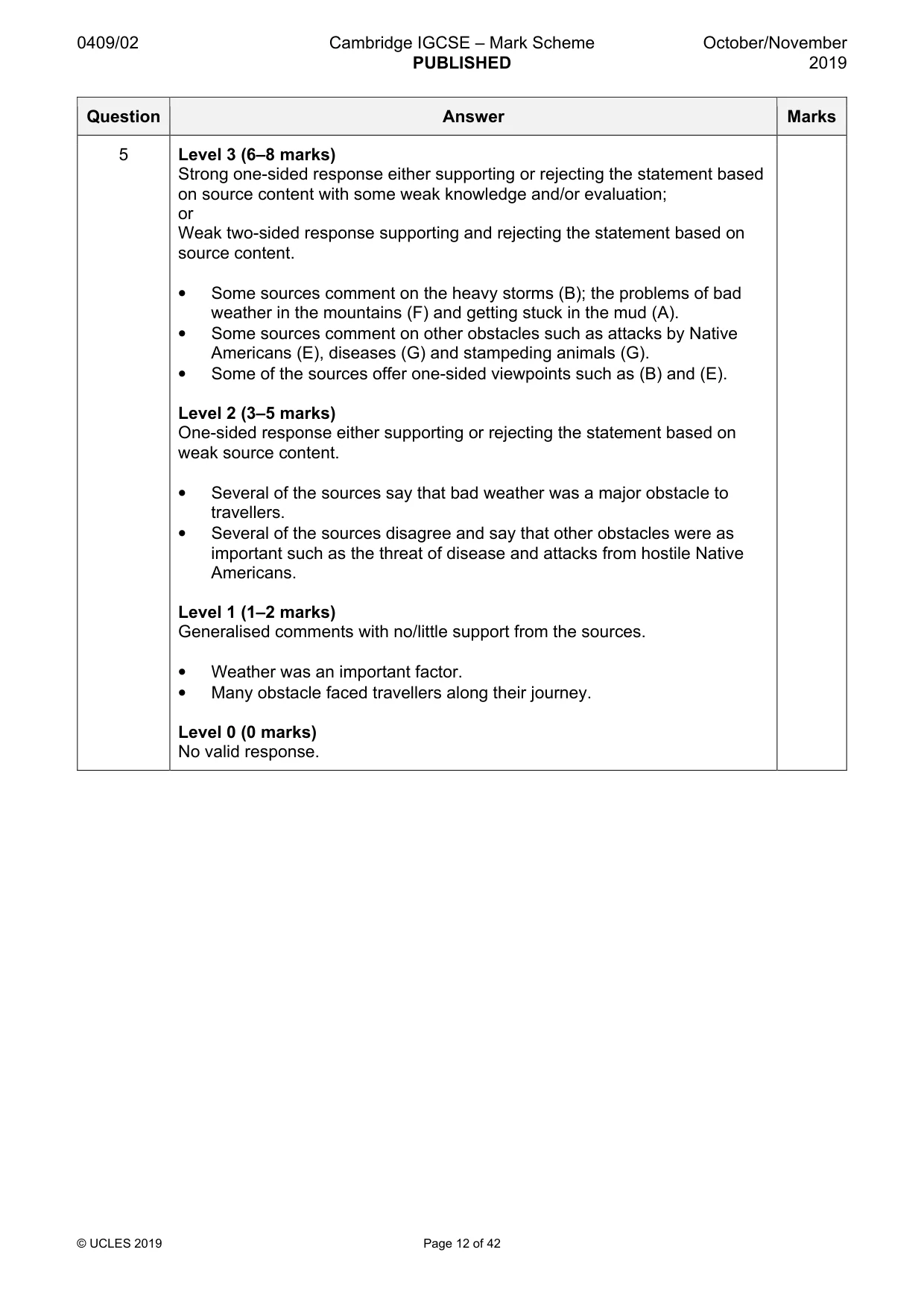
Mark scheme: 5 Study all the sources. 15 ‘The most serious obstacles facing the emigrants who travelled west was the weather.’ To what extent do you agree? Explain your answer using details from all the sources and your knowledge. Level 6 (15 marks) Balanced two-sided response based on detailed content, knowledge and evaluation, with a supported and developed overall judgment. • Sophisticated analysis of source content from both sides of the argument Yes = Sources A, B, F, G No = Sources A, C, D, E, G. • Supporting knowledge to expand upon source content. • Evaluation of authorship – detects bias and reasons for it. • Formulates a reasoned conclusion – bad weather was a major obstacle resulting in the loss and death of cattle and oxen, extreme weather conditions affected the health of the travellers; their wagons got broken due to getting stuck in the mud or sliding on the ice; parties got trapped in the mountains due to the snow (e.g. Donar Party); on the Plains they faced dust storms, heavy rains, extreme drought resulted in water shortages for both humans and cattle; however, other obstacles faced the travellers, such as the constant threat of disease (cholera and typhoid), encounters with hostile Native Americans, stampeding buffalo; the sources reflect views to support and challenge this hypothesis. Level 5 (12–14 marks) Balanced two-sided response supporting and rejecting the statement based on good content, knowledge and evaluation, with a supported overall judgment. • More developed discussion of L4 content, knowledge and evaluation. • Formulates a conclusion – the information given in the sources can be biased and therefore the overall view will be dependent upon which sources have been viewed. Level 4 (9–11 marks) Two-sided response supporting and rejecting the statement based on source content with either knowledge or evaluation. • The sources offer a mixed set of viewpoints. • Some of the sources confirm that bad weather was a major obstacle; it could result in the loss and death of cattle and oxen due to heavy storms, causing travellers to become stranded hundreds of miles away from support (B); the weather could make travelling slow (A); causing wagons to get stuck in the mud or trapped in the mountains due to snow and ice (F). • Some sources identify other factors as presenting major obstacles to travellers such as the constant threat of disease (G); encounters with hostile groups of Native Americans (D and E); constant suspense and anxiety of potential threats such as stampede of buffalo (F and G). • Some of the sources offer one-sided viewpoints such as (E), a painting by Charles Wimar; the extremes of weather (B). 5 Level 3 (6–8 marks) Strong one-sided response either supporting or rejecting the statement based on source content with some weak knowledge and/or evaluation; or Weak two-sided response supporting and rejecting the statement based on source content. • Some sources comment on the heavy storms (B); the problems of bad weather in the mountains (F) and getting stuck in the mud (A). • Some sources comment on other obstacles such as attacks by Native Americans (E), diseases (G) and stampeding animals (G). • Some of the sources offer one-sided viewpoints such as (B) and (E). Level 2 (3–5 marks) One-sided response either supporting or rejecting the statement based on weak source content. • Several of the sources say that bad weather was a major obstacle to travellers. • Several of the sources disagree and say that other obstacles were as important such as the threat of disease and attacks from hostile Native Americans. Level 1 (1–2 marks) Generalised comments with no/little support from the sources. • Weather was an important factor. • Many obstacle faced travellers along their journey. Level 0 (0 marks) No valid response. Depth Study B: The Women’s Suffrage Movement 1866–1920
Question 6
6 Study Source A. What is the message of this source? Explain your answer using details from the source and your knowledge. [6]
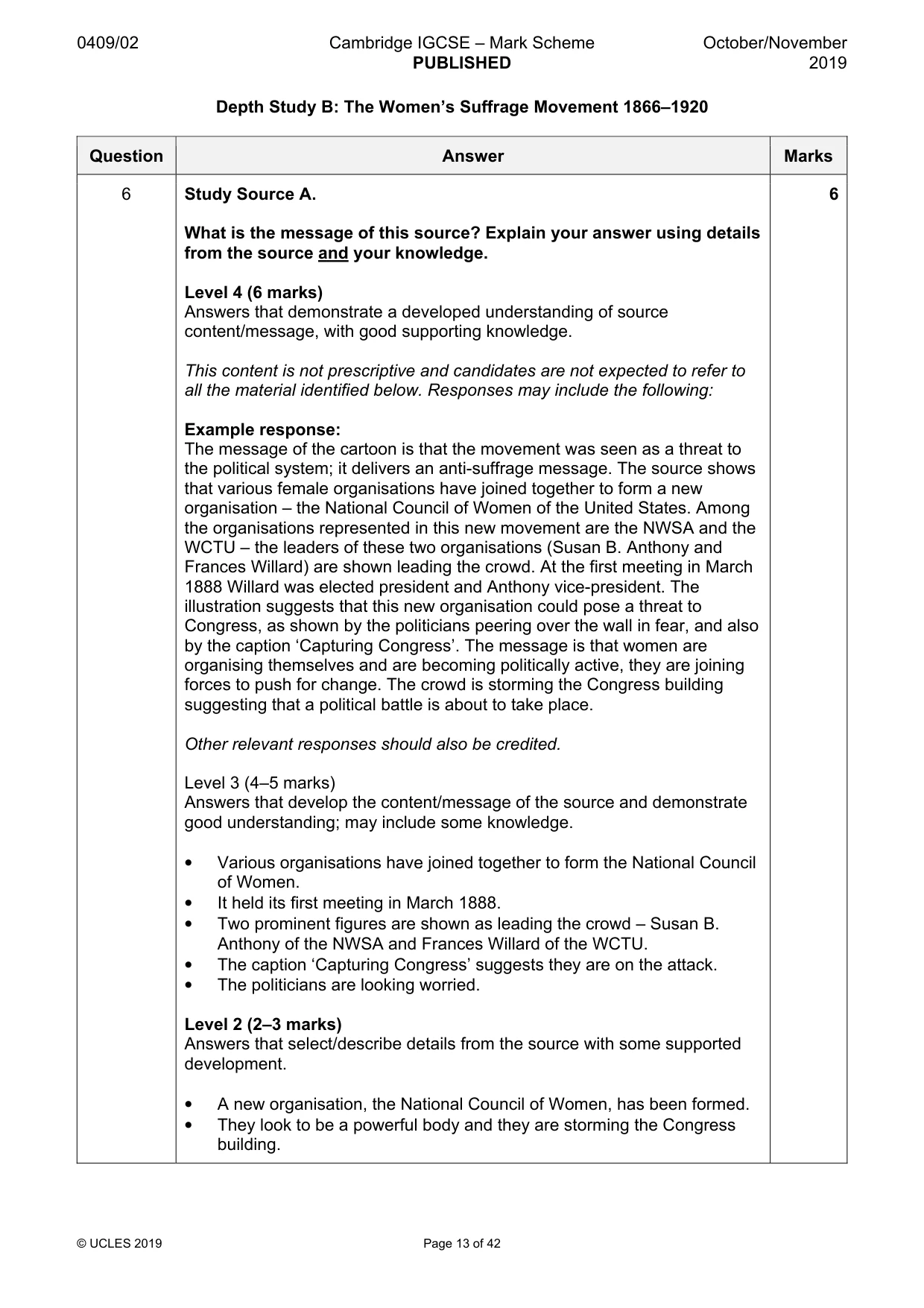
Mark scheme: 6 Study Source A. 6 What is the message of this source? Explain your answer using details from the source and your knowledge. Level 4 (6 marks) Answers that demonstrate a developed understanding of source content/message, with good supporting knowledge. This content is not prescriptive and candidates are not expected to refer to all the material identified below. Responses may include the following: Example response: The message of the cartoon is that the movement was seen as a threat to the political system; it delivers an anti-suffrage message. The source shows that various female organisations have joined together to form a new organisation – the National Council of Women of the United States. Among the organisations represented in this new movement are the NWSA and the WCTU – the leaders of these two organisations (Susan B. Anthony and Frances Willard) are shown leading the crowd. At the first meeting in March 1888 Willard was elected president and Anthony vice-president. The illustration suggests that this new organisation could pose a threat to Congress, as shown by the politicians peering over the wall in fear, and also by the caption ‘Capturing Congress’. The message is that women are organising themselves and are becoming politically active, they are joining forces to push for change. The crowd is storming the Congress building suggesting that a political battle is about to take place. Other relevant responses should also be credited. Level 3 (4–5 marks) Answers that develop the content/message of the source and demonstrate good understanding; may include some knowledge. • Various organisations have joined together to form the National Council of Women. • It held its first meeting in March 1888. • Two prominent figures are shown as leading the crowd – Susan B. Anthony of the NWSA and Frances Willard of the WCTU. • The caption ‘Capturing Congress’ suggests they are on the attack. • The politicians are looking worried. Level 2 (2–3 marks) Answers that select/describe details from the source with some supported development. • A new organisation, the National Council of Women, has been formed. • They look to be a powerful body and they are storming the Congress building. 6 Level 1 (1 mark) Answers that offer a generalised comment with loose reference to the source. • Women are attacking the Congress building demanding change. Level 0 (0 marks) No valid response.
Question 7
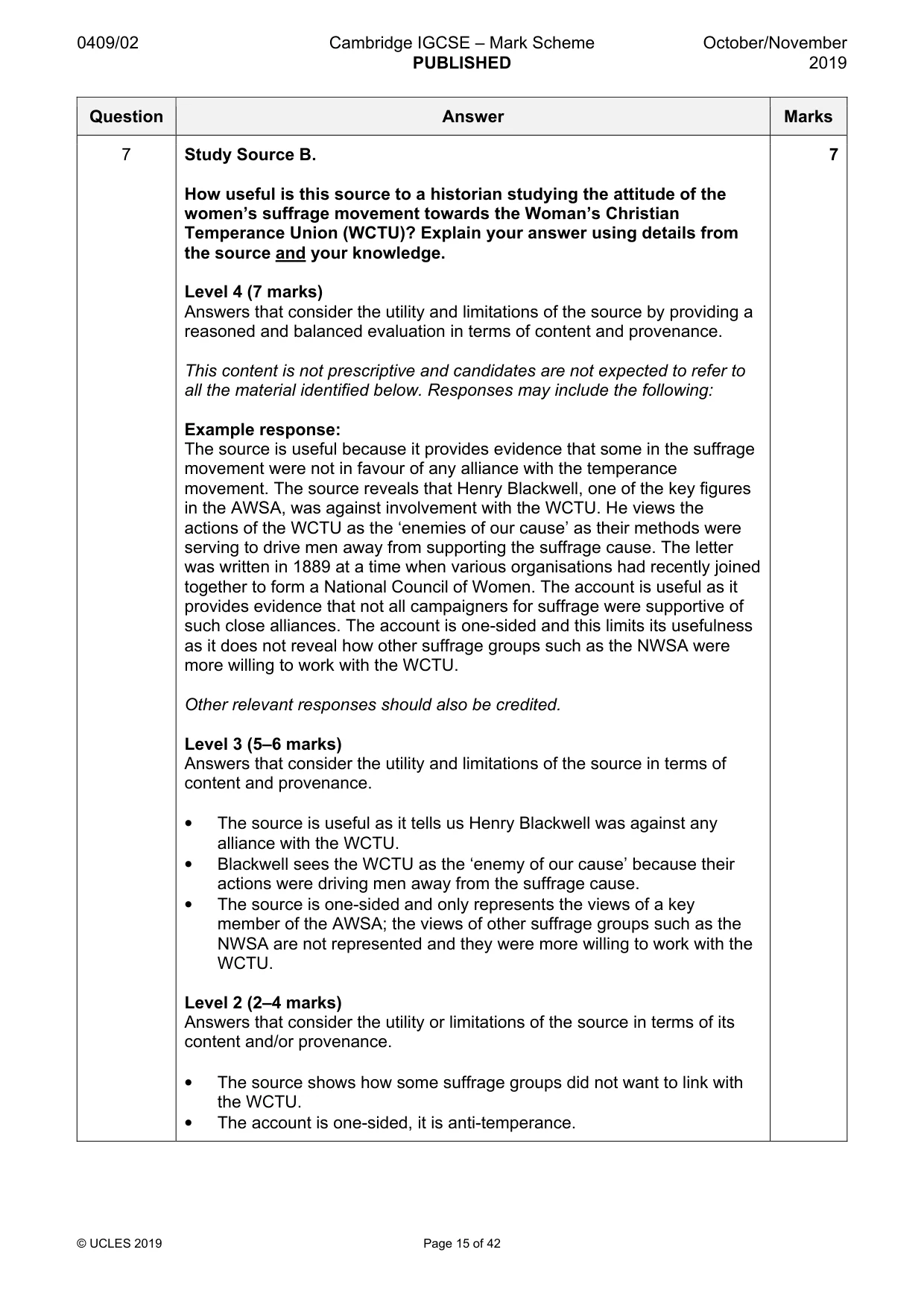
7 Study Source B. How useful is this source to a historian studying the attitude of the women’s suffrage movement towards the Woman’s Christian Temperance Union (WCTU)? Explain your answer using details from the source and your knowledge. [7]
Mark scheme: 7 Study Source B. 7 How useful is this source to a historian studying the attitude of the women’s suffrage movement towards the Woman’s Christian Temperance Union (WCTU)? Explain your answer using details from the source and your knowledge. Level 4 (7 marks) Answers that consider the utility and limitations of the source by providing a reasoned and balanced evaluation in terms of content and provenance. This content is not prescriptive and candidates are not expected to refer to all the material identified below. Responses may include the following: Example response: The source is useful because it provides evidence that some in the suffrage movement were not in favour of any alliance with the temperance movement. The source reveals that Henry Blackwell, one of the key figures in the AWSA, was against involvement with the WCTU. He views the actions of the WCTU as the ‘enemies of our cause’ as their methods were serving to drive men away from supporting the suffrage cause. The letter was written in 1889 at a time when various organisations had recently joined together to form a National Council of Women. The account is useful as it provides evidence that not all campaigners for suffrage were supportive of such close alliances. The account is one-sided and this limits its usefulness as it does not reveal how other suffrage groups such as the NWSA were more willing to work with the WCTU. Other relevant responses should also be credited. Level 3 (5–6 marks) Answers that consider the utility and limitations of the source in terms of content and provenance. • The source is useful as it tells us Henry Blackwell was against any alliance with the WCTU. • Blackwell sees the WCTU as the ‘enemy of our cause’ because their actions were driving men away from the suffrage cause. • The source is one-sided and only represents the views of a key member of the AWSA; the views of other suffrage groups such as the NWSA are not represented and they were more willing to work with the WCTU. Level 2 (2–4 marks) Answers that consider the utility or limitations of the source in terms of its content and/or provenance. • The source shows how some suffrage groups did not want to link with the WCTU. • The account is one-sided, it is anti-temperance. 7 Level 1 (1 mark) Answer that offer a generalised comment or paraphrase source content. • The account shows that they did not really like the WCTU. Level 0 (0 marks) No valid response.
Question 8
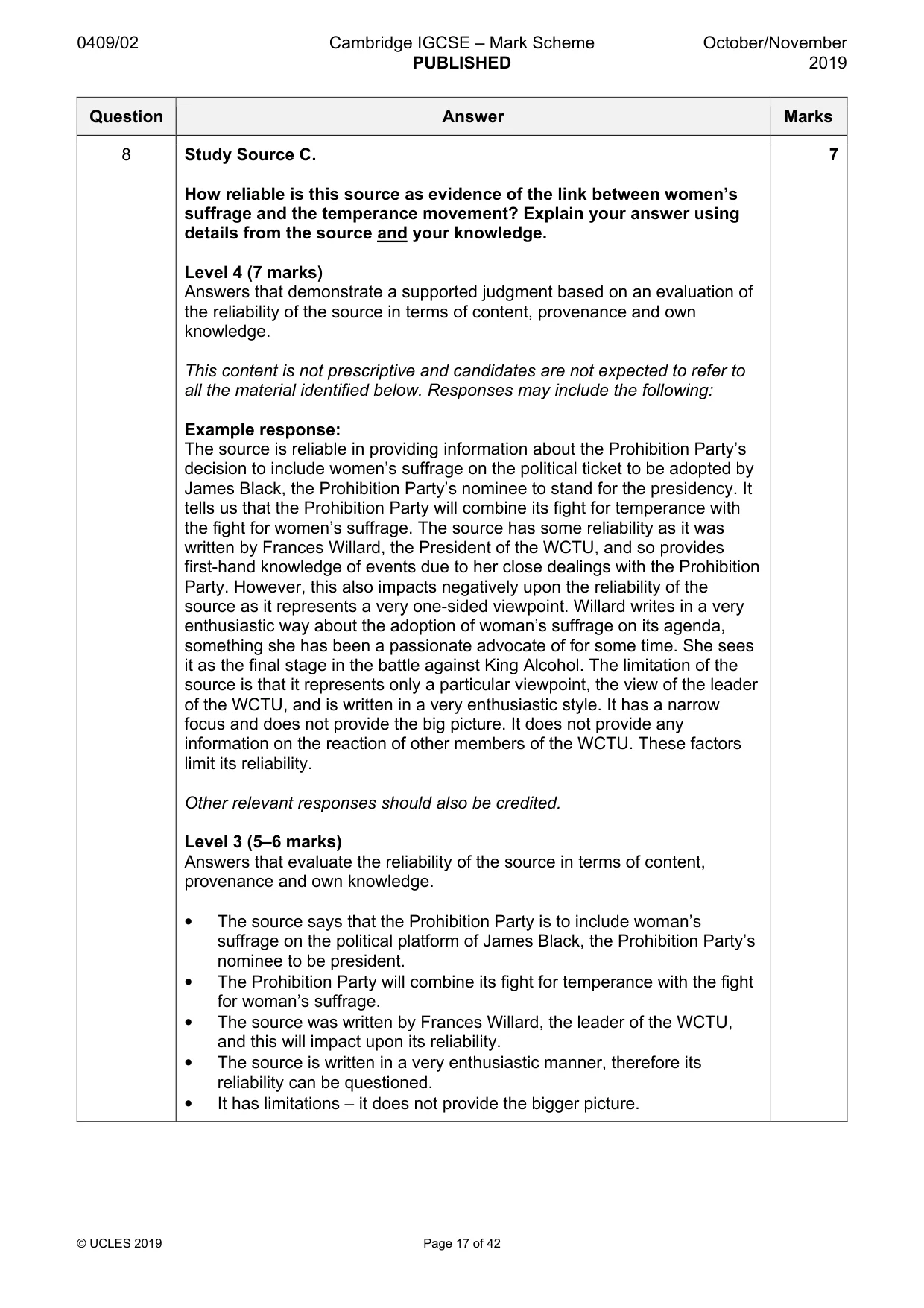
8 Study Source C. How reliable is this source as evidence of the link between the campaign for women’s suffrage and the temperance movement? Explain your answer using details from the source and your knowledge. [7]
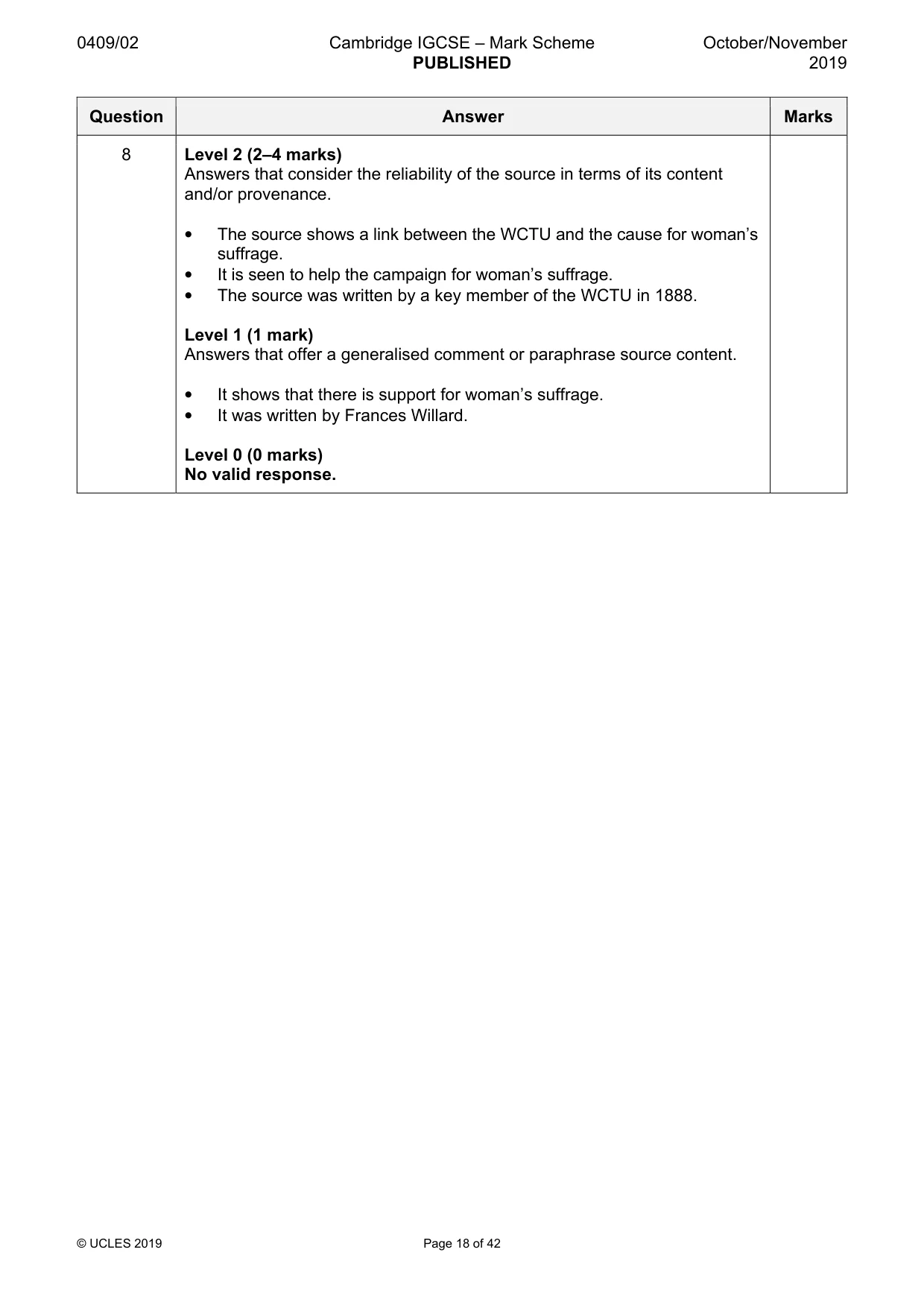
Mark scheme: 8 Study Source C. 7 How reliable is this source as evidence of the link between women’s suffrage and the temperance movement? Explain your answer using details from the source and your knowledge. Level 4 (7 marks) Answers that demonstrate a supported judgment based on an evaluation of the reliability of the source in terms of content, provenance and own knowledge. This content is not prescriptive and candidates are not expected to refer to all the material identified below. Responses may include the following: Example response: The source is reliable in providing information about the Prohibition Party’s decision to include women’s suffrage on the political ticket to be adopted by James Black, the Prohibition Party’s nominee to stand for the presidency. It tells us that the Prohibition Party will combine its fight for temperance with the fight for women’s suffrage. The source has some reliability as it was written by Frances Willard, the President of the WCTU, and so provides first-hand knowledge of events due to her close dealings with the Prohibition Party. However, this also impacts negatively upon the reliability of the source as it represents a very one-sided viewpoint. Willard writes in a very enthusiastic way about the adoption of woman’s suffrage on its agenda, something she has been a passionate advocate of for some time. She sees it as the final stage in the battle against King Alcohol. The limitation of the source is that it represents only a particular viewpoint, the view of the leader of the WCTU, and is written in a very enthusiastic style. It has a narrow focus and does not provide the big picture. It does not provide any information on the reaction of other members of the WCTU. These factors limit its reliability. Other relevant responses should also be credited. Level 3 (5–6 marks) Answers that evaluate the reliability of the source in terms of content, provenance and own knowledge. • The source says that the Prohibition Party is to include woman’s suffrage on the political platform of James Black, the Prohibition Party’s nominee to be president. • The Prohibition Party will combine its fight for temperance with the fight for woman’s suffrage. • The source was written by Frances Willard, the leader of the WCTU, and this will impact upon its reliability. • The source is written in a very enthusiastic manner, therefore its reliability can be questioned. • It has limitations – it does not provide the bigger picture. 8 Level 2 (2–4 marks) Answers that consider the reliability of the source in terms of its content and/or provenance. • The source shows a link between the WCTU and the cause for woman’s suffrage. • It is seen to help the campaign for woman’s suffrage. • The source was written by a key member of the WCTU in 1888. Level 1 (1 mark) Answers that offer a generalised comment or paraphrase source content. • It shows that there is support for woman’s suffrage. • It was written by Frances Willard. Level 0 (0 marks) No valid response.
Q9 · Study Sources D and E
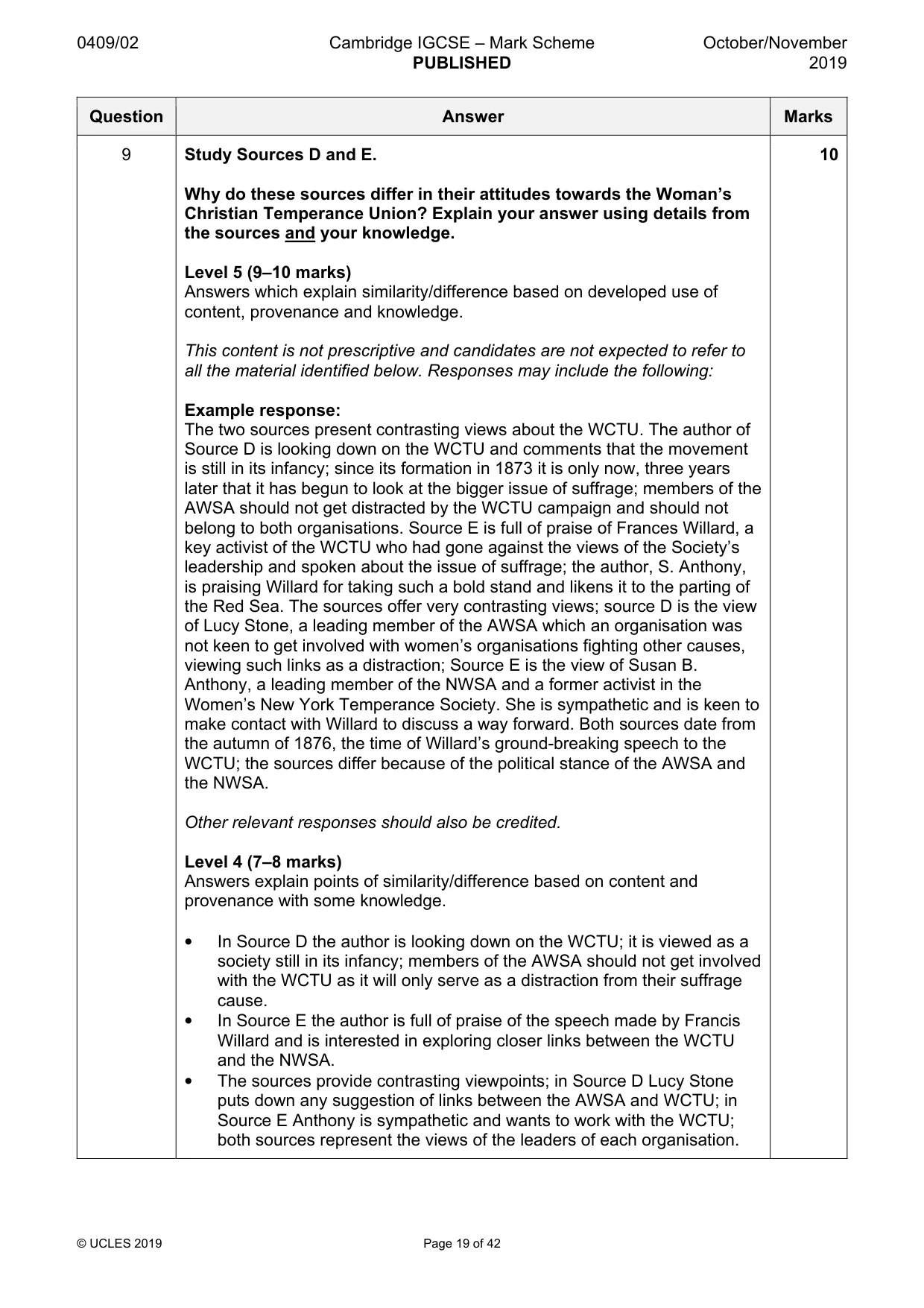
9 Study Sources D and E. Why do these sources differ in their attitudes towards the Woman’s Christian Temperance Union? Explain your answer using details from the sources and your knowledge. [10]
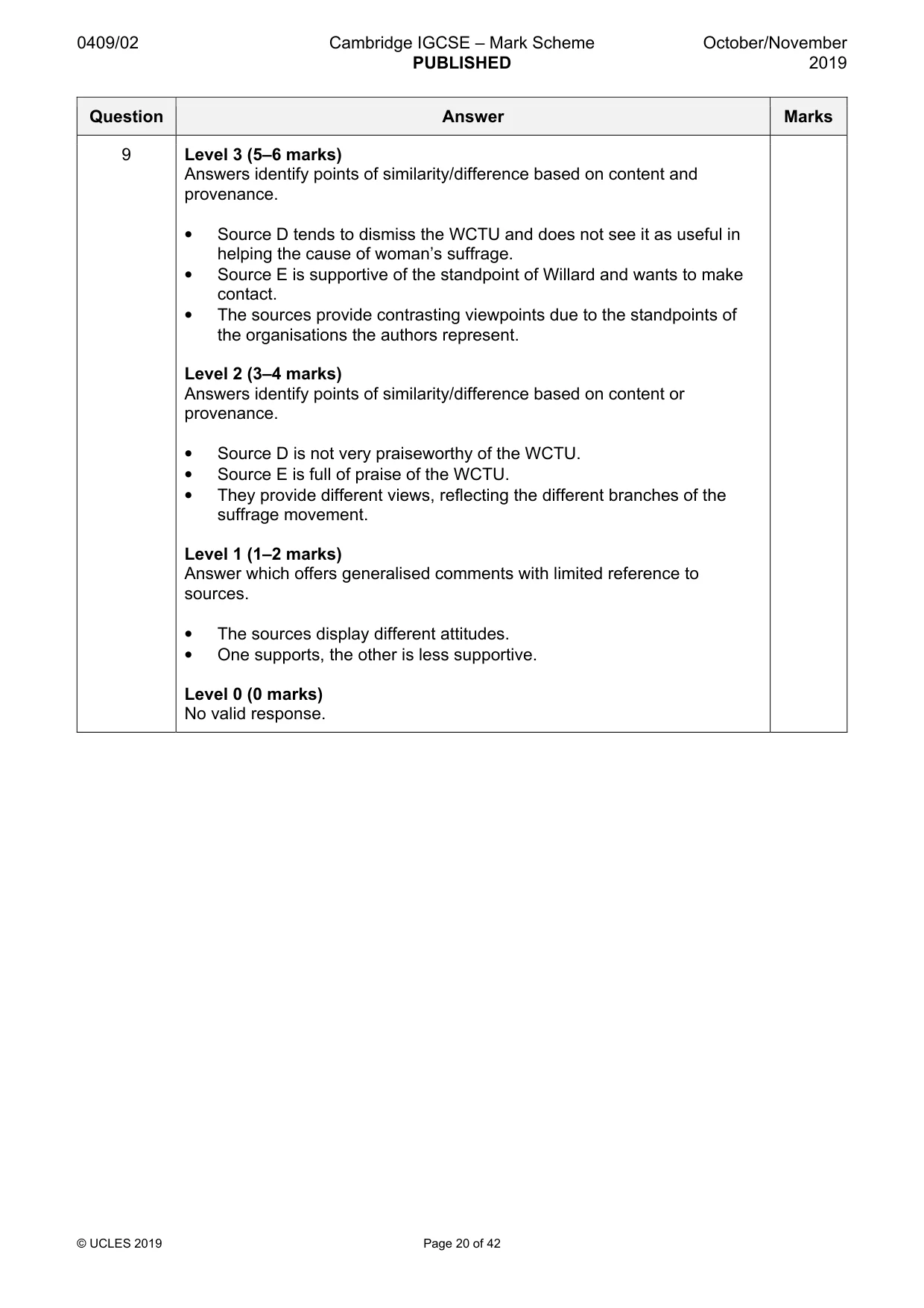
Mark scheme: 9 Study Sources D and E. 10 Why do these sources differ in their attitudes towards the Woman’s Christian Temperance Union? Explain your answer using details from the sources and your knowledge. Level 5 (9–10 marks) Answers which explain similarity/difference based on developed use of content, provenance and knowledge. This content is not prescriptive and candidates are not expected to refer to all the material identified below. Responses may include the following: Example response: The two sources present contrasting views about the WCTU. The author of Source D is looking down on the WCTU and comments that the movement is still in its infancy; since its formation in 1873 it is only now, three years later that it has begun to look at the bigger issue of suffrage; members of the AWSA should not get distracted by the WCTU campaign and should not belong to both organisations. Source E is full of praise of Frances Willard, a key activist of the WCTU who had gone against the views of the Society’s leadership and spoken about the issue of suffrage; the author, S. Anthony, is praising Willard for taking such a bold stand and likens it to the parting of the Red Sea. The sources offer very contrasting views; source D is the view of Lucy Stone, a leading member of the AWSA which an organisation was not keen to get involved with women’s organisations fighting other causes, viewing such links as a distraction; Source E is the view of Susan B. Anthony, a leading member of the NWSA and a former activist in the Women’s New York Temperance Society. She is sympathetic and is keen to make contact with Willard to discuss a way forward. Both sources date from the autumn of 1876, the time of Willard’s ground-breaking speech to the WCTU; the sources differ because of the political stance of the AWSA and the NWSA. Other relevant responses should also be credited. Level 4 (7–8 marks) Answers explain points of similarity/difference based on content and provenance with some knowledge. • In Source D the author is looking down on the WCTU; it is viewed as a society still in its infancy; members of the AWSA should not get involved with the WCTU as it will only serve as a distraction from their suffrage cause. • In Source E the author is full of praise of the speech made by Francis Willard and is interested in exploring closer links between the WCTU and the NWSA. • The sources provide contrasting viewpoints; in Source D Lucy Stone puts down any suggestion of links between the AWSA and WCTU; in Source E Anthony is sympathetic and wants to work with the WCTU; both sources represent the views of the leaders of each organisation. 9 Level 3 (5–6 marks) Answers identify points of similarity/difference based on content and provenance. • Source D tends to dismiss the WCTU and does not see it as useful in helping the cause of woman’s suffrage. • Source E is supportive of the standpoint of Willard and wants to make contact. • The sources provide contrasting viewpoints due to the standpoints of the organisations the authors represent. Level 2 (3–4 marks) Answers identify points of similarity/difference based on content or provenance. • Source D is not very praiseworthy of the WCTU. • Source E is full of praise of the WCTU. • They provide different views, reflecting the different branches of the suffrage movement. Level 1 (1–2 marks) Answer which offers generalised comments with limited reference to sources. • The sources display different attitudes. • One supports, the other is less supportive. Level 0 (0 marks) No valid response.
Q10 · Study all the sources
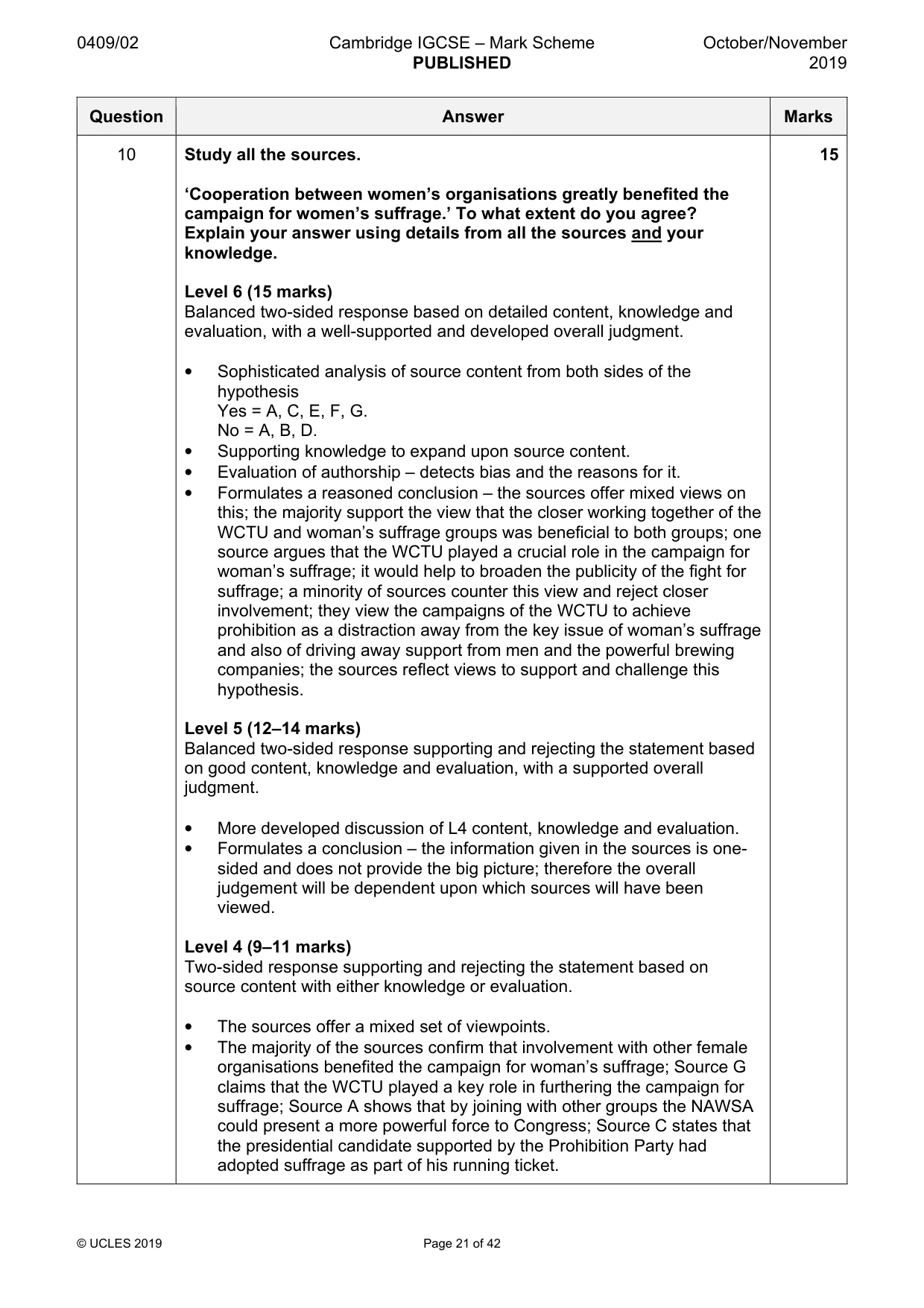
10 Study all the sources. “Cooperation between women’s organizations greatly benefited the campaign for women’s suffrage.” To what extent do you agree? Explain your answer using details from all the sources and your knowledge. [15] [Total: 45] Depth Study C: The United States and the World 1880–1917 Read the background information and then answer all the questions. Use your knowledge of the topic to help you interpret and evaluate the sources, as appropriate. Background information During 1898 the US was involved in the Spanish–American War, one of the consequences of which was the taking over of Spanish colonial lands by America.
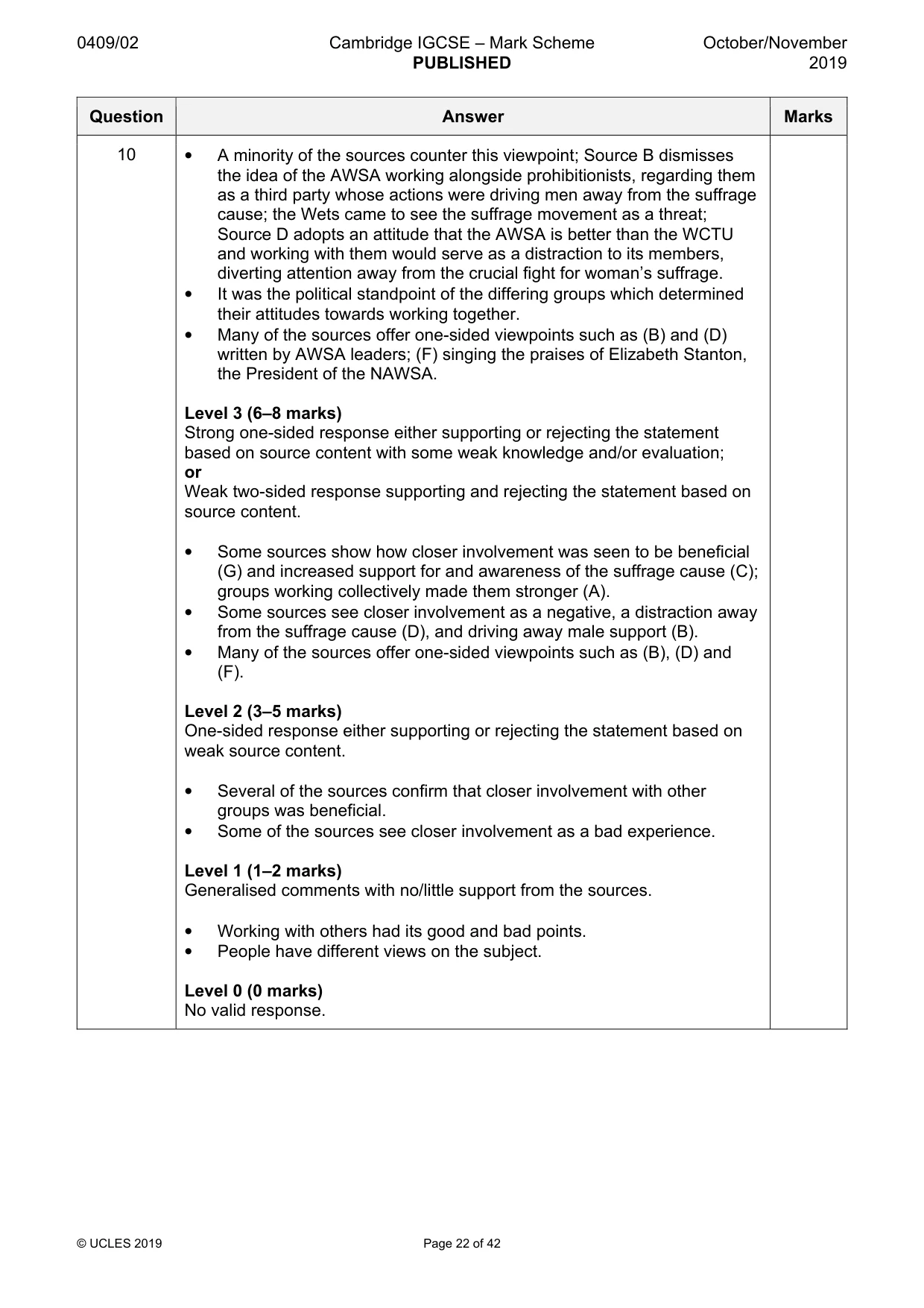
Mark scheme: 10 Study all the sources. 15 ‘Cooperation between women’s organisations greatly benefited the campaign for women’s suffrage.’ To what extent do you agree? Explain your answer using details from all the sources and your knowledge. Level 6 (15 marks) Balanced two-sided response based on detailed content, knowledge and evaluation, with a well-supported and developed overall judgment. • Sophisticated analysis of source content from both sides of the hypothesis Yes = A, C, E, F, G. No = A, B, D. • Supporting knowledge to expand upon source content. • Evaluation of authorship – detects bias and the reasons for it. • Formulates a reasoned conclusion – the sources offer mixed views on this; the majority support the view that the closer working together of the WCTU and woman’s suffrage groups was beneficial to both groups; one source argues that the WCTU played a crucial role in the campaign for woman’s suffrage; it would help to broaden the publicity of the fight for suffrage; a minority of sources counter this view and reject closer involvement; they view the campaigns of the WCTU to achieve prohibition as a distraction away from the key issue of woman’s suffrage and also of driving away support from men and the powerful brewing companies; the sources reflect views to support and challenge this hypothesis. Level 5 (12–14 marks) Balanced two-sided response supporting and rejecting the statement based on good content, knowledge and evaluation, with a supported overall judgment. • More developed discussion of L4 content, knowledge and evaluation. • Formulates a conclusion – the information given in the sources is one- sided and does not provide the big picture; therefore the overall judgement will be dependent upon which sources will have been viewed. Level 4 (9–11 marks) Two-sided response supporting and rejecting the statement based on source content with either knowledge or evaluation. • The sources offer a mixed set of viewpoints. • The majority of the sources confirm that involvement with other female organisations benefited the campaign for woman’s suffrage; Source G claims that the WCTU played a key role in furthering the campaign for suffrage; Source A shows that by joining with other groups the NAWSA could present a more powerful force to Congress; Source C states that the presidential candidate supported by the Prohibition Party had adopted suffrage as part of his running ticket. 10 • A minority of the sources counter this viewpoint; Source B dismisses the idea of the AWSA working alongside prohibitionists, regarding them as a third party whose actions were driving men away from the suffrage cause; the Wets came to see the suffrage movement as a threat; Source D adopts an attitude that the AWSA is better than the WCTU and working with them would serve as a distraction to its members, diverting attention away from the crucial fight for woman’s suffrage. • It was the political standpoint of the differing groups which determined their attitudes towards working together. • Many of the sources offer one-sided viewpoints such as (B) and (D) written by AWSA leaders; (F) singing the praises of Elizabeth Stanton, the President of the NAWSA. Level 3 (6–8 marks) Strong one-sided response either supporting or rejecting the statement based on source content with some weak knowledge and/or evaluation; or Weak two-sided response supporting and rejecting the statement based on source content. • Some sources show how closer involvement was seen to be beneficial (G) and increased support for and awareness of the suffrage cause (C); groups working collectively made them stronger (A). • Some sources see closer involvement as a negative, a distraction away from the suffrage cause (D), and driving away male support (B). • Many of the sources offer one-sided viewpoints such as (B), (D) and (F). Level 2 (3–5 marks) One-sided response either supporting or rejecting the statement based on weak source content. • Several of the sources confirm that closer involvement with other groups was beneficial. • Some of the sources see closer involvement as a bad experience. Level 1 (1–2 marks) Generalised comments with no/little support from the sources. • Working with others had its good and bad points. • People have different views on the subject. Level 0 (0 marks) No valid response. Depth Study C: USA and the World 1880–1917
Question 11
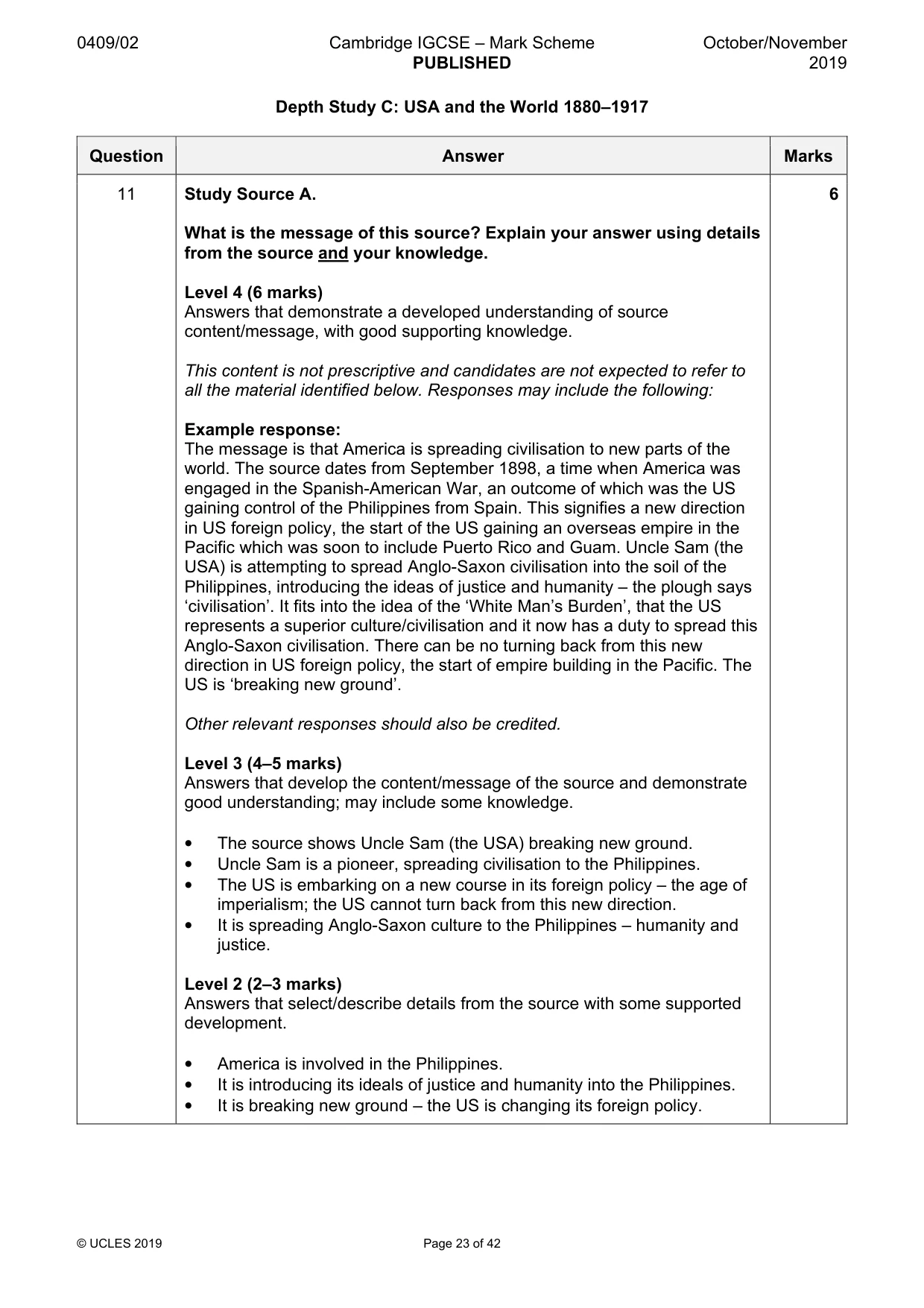
11 Study Source A. What is the message of this source? Explain your answer using details from the source and your knowledge. [6]
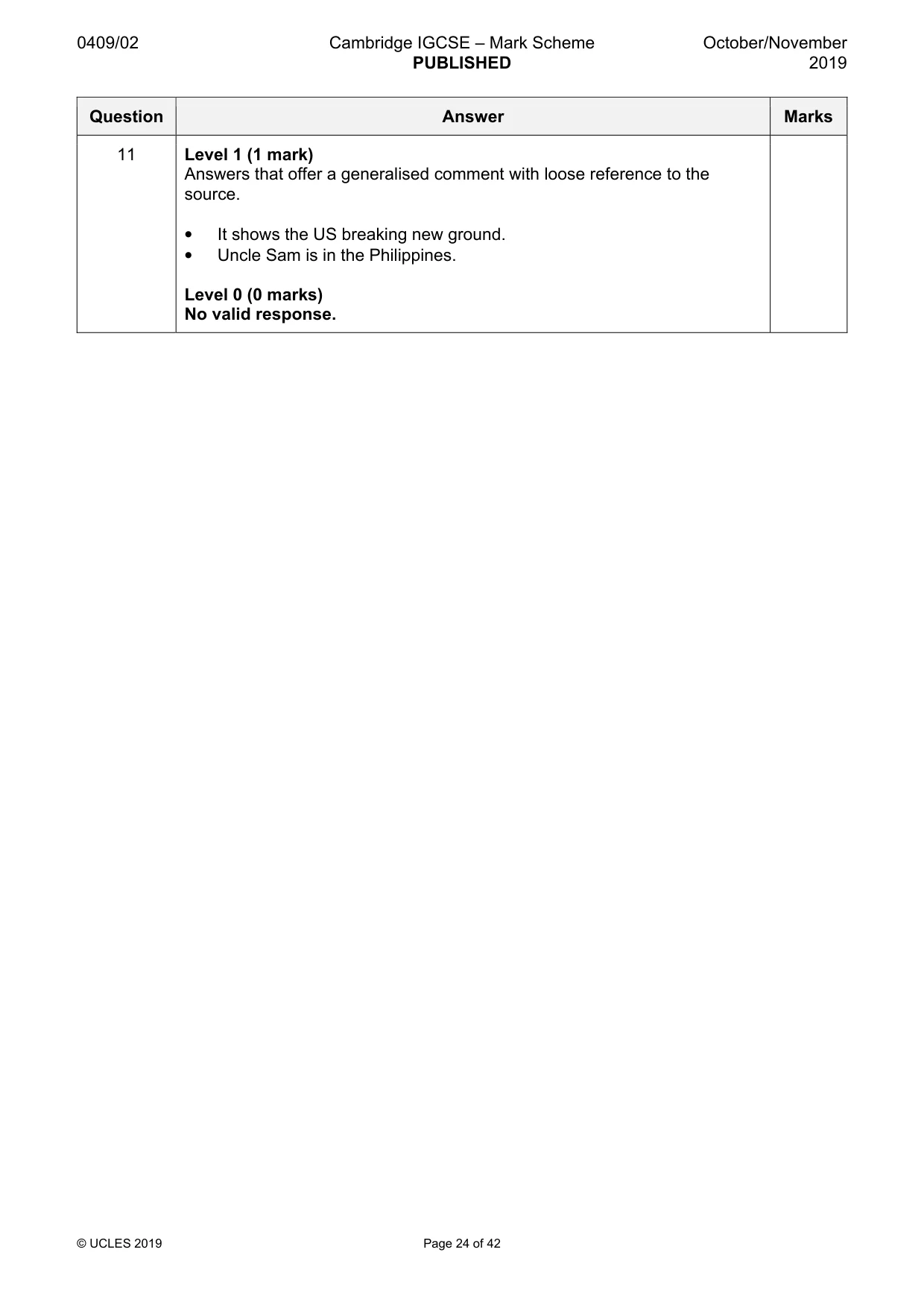
Mark scheme: 11 Study Source A. 6 What is the message of this source? Explain your answer using details from the source and your knowledge. Level 4 (6 marks) Answers that demonstrate a developed understanding of source content/message, with good supporting knowledge. This content is not prescriptive and candidates are not expected to refer to all the material identified below. Responses may include the following: Example response: The message is that America is spreading civilisation to new parts of the world. The source dates from September 1898, a time when America was engaged in the Spanish-American War, an outcome of which was the US gaining control of the Philippines from Spain. This signifies a new direction in US foreign policy, the start of the US gaining an overseas empire in the Pacific which was soon to include Puerto Rico and Guam. Uncle Sam (the USA) is attempting to spread Anglo-Saxon civilisation into the soil of the Philippines, introducing the ideas of justice and humanity – the plough says ‘civilisation’. It fits into the idea of the ‘White Man’s Burden’, that the US represents a superior culture/civilisation and it now has a duty to spread this Anglo-Saxon civilisation. There can be no turning back from this new direction in US foreign policy, the start of empire building in the Pacific. The US is ‘breaking new ground’. Other relevant responses should also be credited. Level 3 (4–5 marks) Answers that develop the content/message of the source and demonstrate good understanding; may include some knowledge. • The source shows Uncle Sam (the USA) breaking new ground. • Uncle Sam is a pioneer, spreading civilisation to the Philippines. • The US is embarking on a new course in its foreign policy – the age of imperialism; the US cannot turn back from this new direction. • It is spreading Anglo-Saxon culture to the Philippines – humanity and justice. Level 2 (2–3 marks) Answers that select/describe details from the source with some supported development. • America is involved in the Philippines. • It is introducing its ideals of justice and humanity into the Philippines. • It is breaking new ground – the US is changing its foreign policy. 11 Level 1 (1 mark) Answers that offer a generalised comment with loose reference to the source. • It shows the US breaking new ground. • Uncle Sam is in the Philippines. Level 0 (0 marks) No valid response.
Question 12
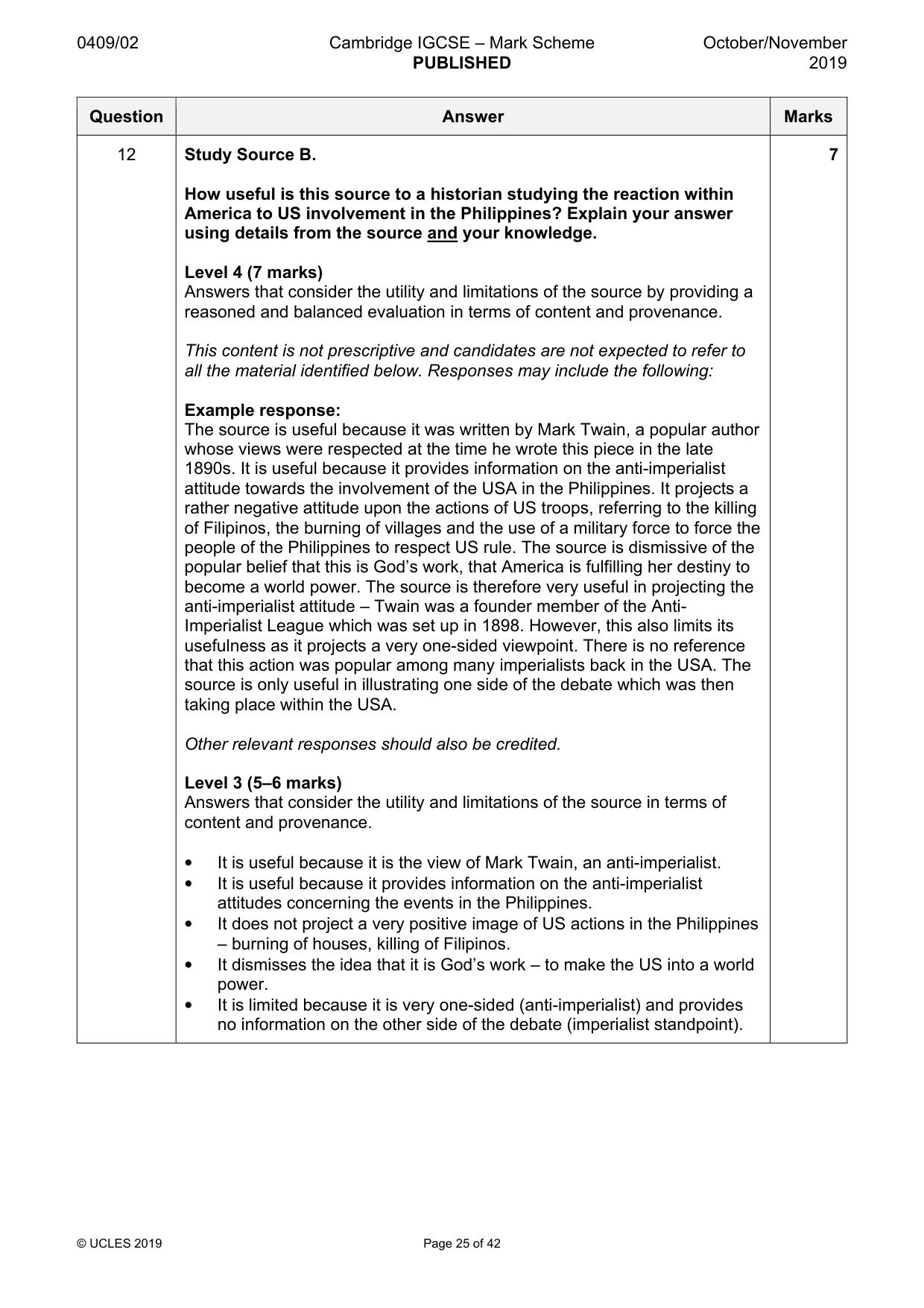
12 Study Source B. How useful is this source to a historian studying the reaction within America to US involvement in the Philippines? Explain your answer using details from the source and your knowledge. [7]
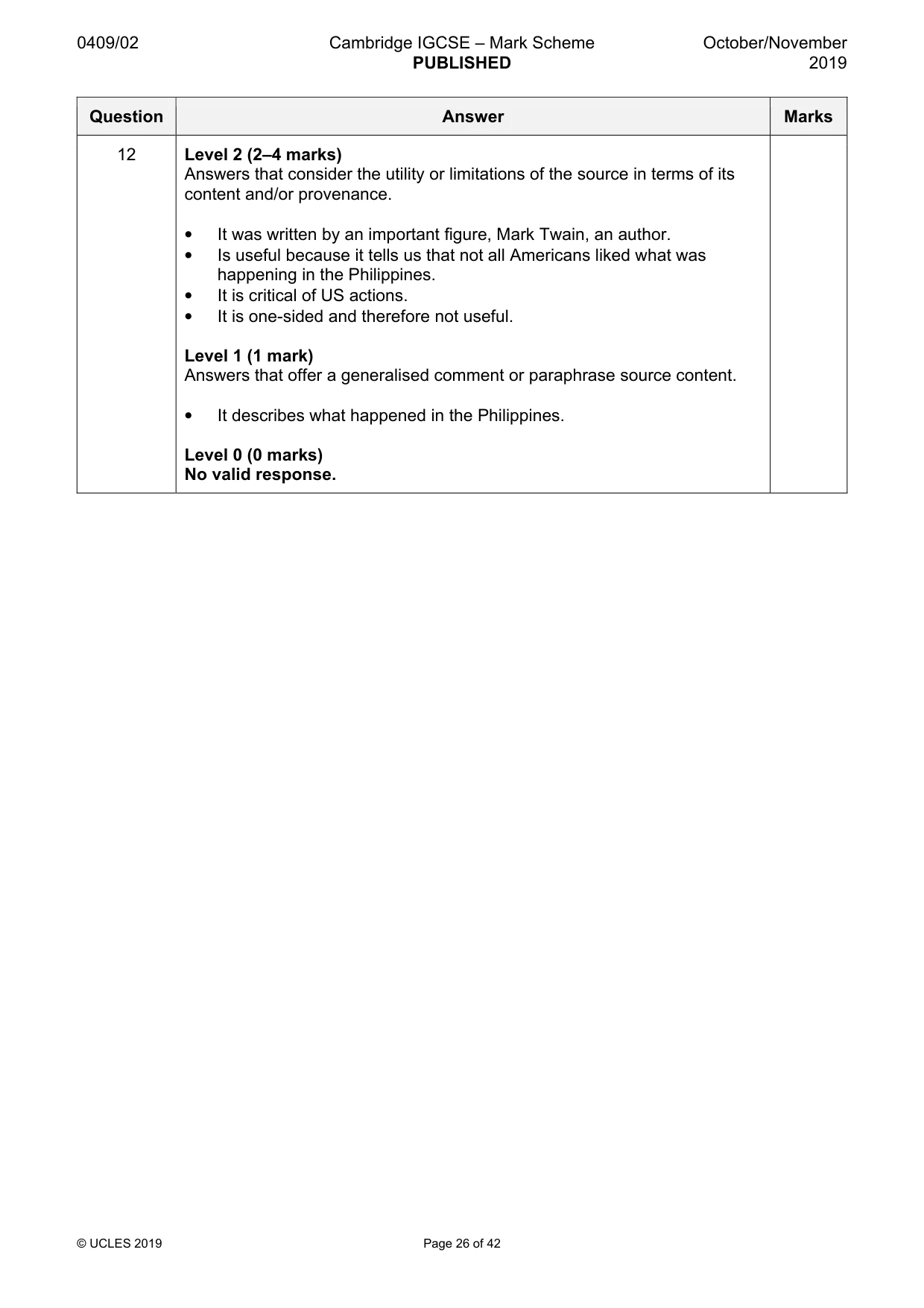
Mark scheme: 12 Study Source B. 7 How useful is this source to a historian studying the reaction within America to US involvement in the Philippines? Explain your answer using details from the source and your knowledge. Level 4 (7 marks) Answers that consider the utility and limitations of the source by providing a reasoned and balanced evaluation in terms of content and provenance. This content is not prescriptive and candidates are not expected to refer to all the material identified below. Responses may include the following: Example response: The source is useful because it was written by Mark Twain, a popular author whose views were respected at the time he wrote this piece in the late 1890s. It is useful because it provides information on the anti-imperialist attitude towards the involvement of the USA in the Philippines. It projects a rather negative attitude upon the actions of US troops, referring to the killing of Filipinos, the burning of villages and the use of a military force to force the people of the Philippines to respect US rule. The source is dismissive of the popular belief that this is God’s work, that America is fulfilling her destiny to become a world power. The source is therefore very useful in projecting the anti-imperialist attitude – Twain was a founder member of the Anti- Imperialist League which was set up in 1898. However, this also limits its usefulness as it projects a very one-sided viewpoint. There is no reference that this action was popular among many imperialists back in the USA. The source is only useful in illustrating one side of the debate which was then taking place within the USA. Other relevant responses should also be credited. Level 3 (5–6 marks) Answers that consider the utility and limitations of the source in terms of content and provenance. • It is useful because it is the view of Mark Twain, an anti-imperialist. • It is useful because it provides information on the anti-imperialist attitudes concerning the events in the Philippines. • It does not project a very positive image of US actions in the Philippines – burning of houses, killing of Filipinos. • It dismisses the idea that it is God’s work – to make the US into a world power. • It is limited because it is very one-sided (anti-imperialist) and provides no information on the other side of the debate (imperialist standpoint). 12 Level 2 (2–4 marks) Answers that consider the utility or limitations of the source in terms of its content and/or provenance. • It was written by an important figure, Mark Twain, an author. • Is useful because it tells us that not all Americans liked what was happening in the Philippines. • It is critical of US actions. • It is one-sided and therefore not useful. Level 1 (1 mark) Answers that offer a generalised comment or paraphrase source content. • It describes what happened in the Philippines. Level 0 (0 marks) No valid response.
Question 13
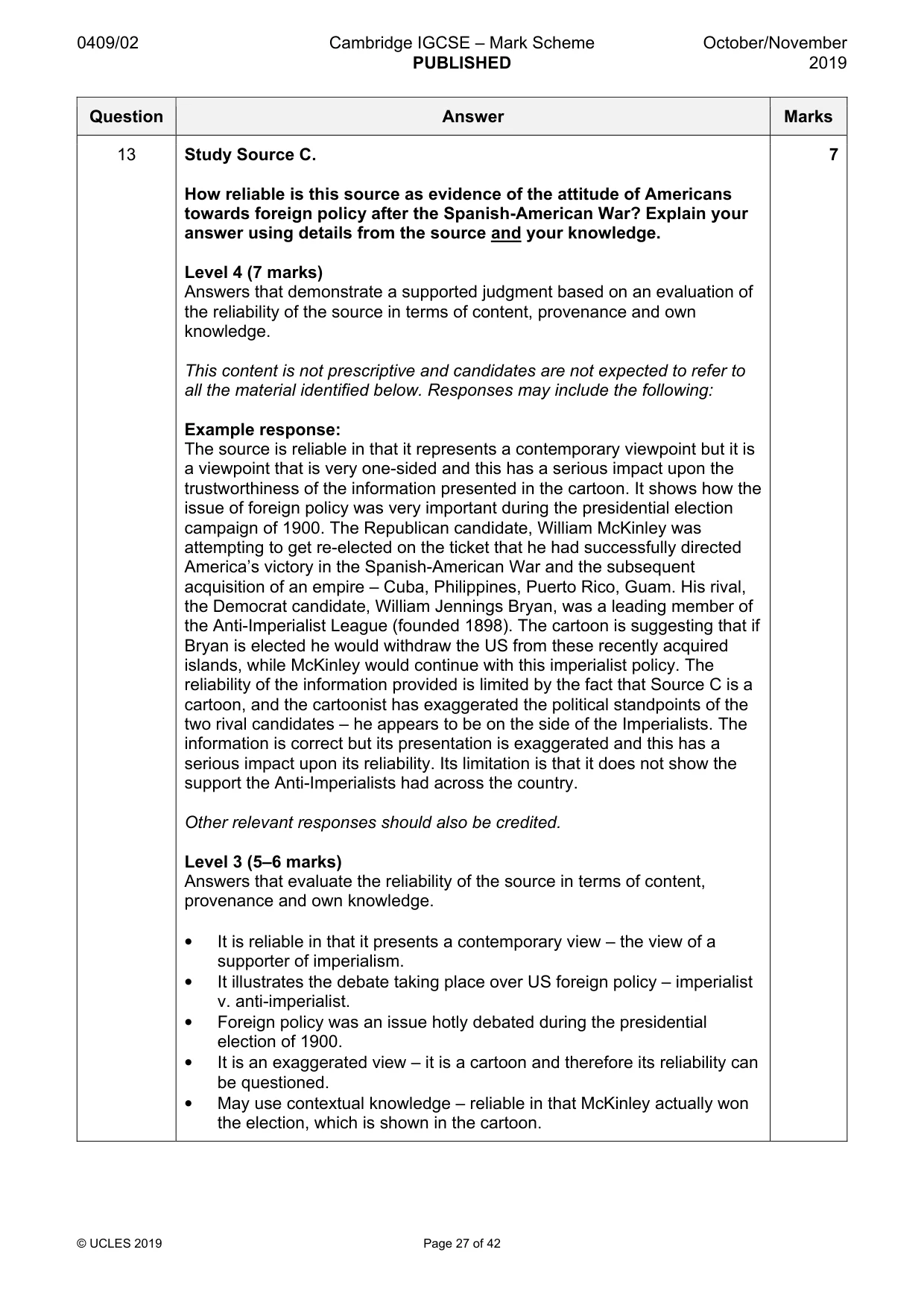
13 Study Source C. How reliable is this source as evidence of the attitude of Americans towards foreign policy after the Spanish-American War? Explain your answer using details from the source and your knowledge. [7]
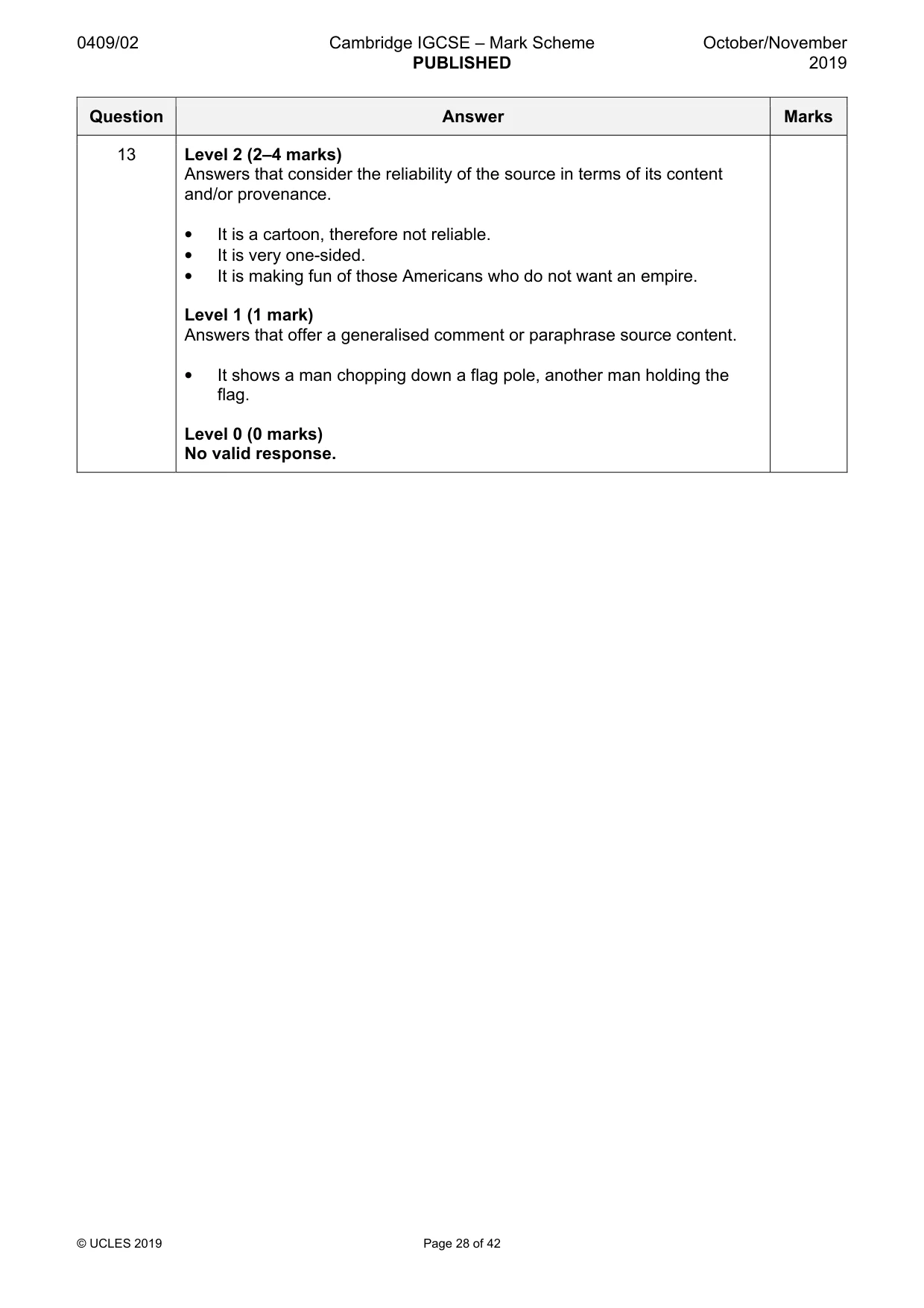
Mark scheme: 13 Study Source C. 7 How reliable is this source as evidence of the attitude of Americans towards foreign policy after the Spanish-American War? Explain your answer using details from the source and your knowledge. Level 4 (7 marks) Answers that demonstrate a supported judgment based on an evaluation of the reliability of the source in terms of content, provenance and own knowledge. This content is not prescriptive and candidates are not expected to refer to all the material identified below. Responses may include the following: Example response: The source is reliable in that it represents a contemporary viewpoint but it is a viewpoint that is very one-sided and this has a serious impact upon the trustworthiness of the information presented in the cartoon. It shows how the issue of foreign policy was very important during the presidential election campaign of 1900. The Republican candidate, William McKinley was attempting to get re-elected on the ticket that he had successfully directed America’s victory in the Spanish-American War and the subsequent acquisition of an empire – Cuba, Philippines, Puerto Rico, Guam. His rival, the Democrat candidate, William Jennings Bryan, was a leading member of the Anti-Imperialist League (founded 1898). The cartoon is suggesting that if Bryan is elected he would withdraw the US from these recently acquired islands, while McKinley would continue with this imperialist policy. The reliability of the information provided is limited by the fact that Source C is a cartoon, and the cartoonist has exaggerated the political standpoints of the two rival candidates – he appears to be on the side of the Imperialists. The information is correct but its presentation is exaggerated and this has a serious impact upon its reliability. Its limitation is that it does not show the support the Anti-Imperialists had across the country. Other relevant responses should also be credited. Level 3 (5–6 marks) Answers that evaluate the reliability of the source in terms of content, provenance and own knowledge. • It is reliable in that it presents a contemporary view – the view of a supporter of imperialism. • It illustrates the debate taking place over US foreign policy – imperialist v. anti-imperialist. • Foreign policy was an issue hotly debated during the presidential election of 1900. • It is an exaggerated view – it is a cartoon and therefore its reliability can be questioned. • May use contextual knowledge – reliable in that McKinley actually won the election, which is shown in the cartoon. 13 Level 2 (2–4 marks) Answers that consider the reliability of the source in terms of its content and/or provenance. • It is a cartoon, therefore not reliable. • It is very one-sided. • It is making fun of those Americans who do not want an empire. Level 1 (1 mark) Answers that offer a generalised comment or paraphrase source content. • It shows a man chopping down a flag pole, another man holding the flag. Level 0 (0 marks) No valid response.
Q14 · Study Sources D and E
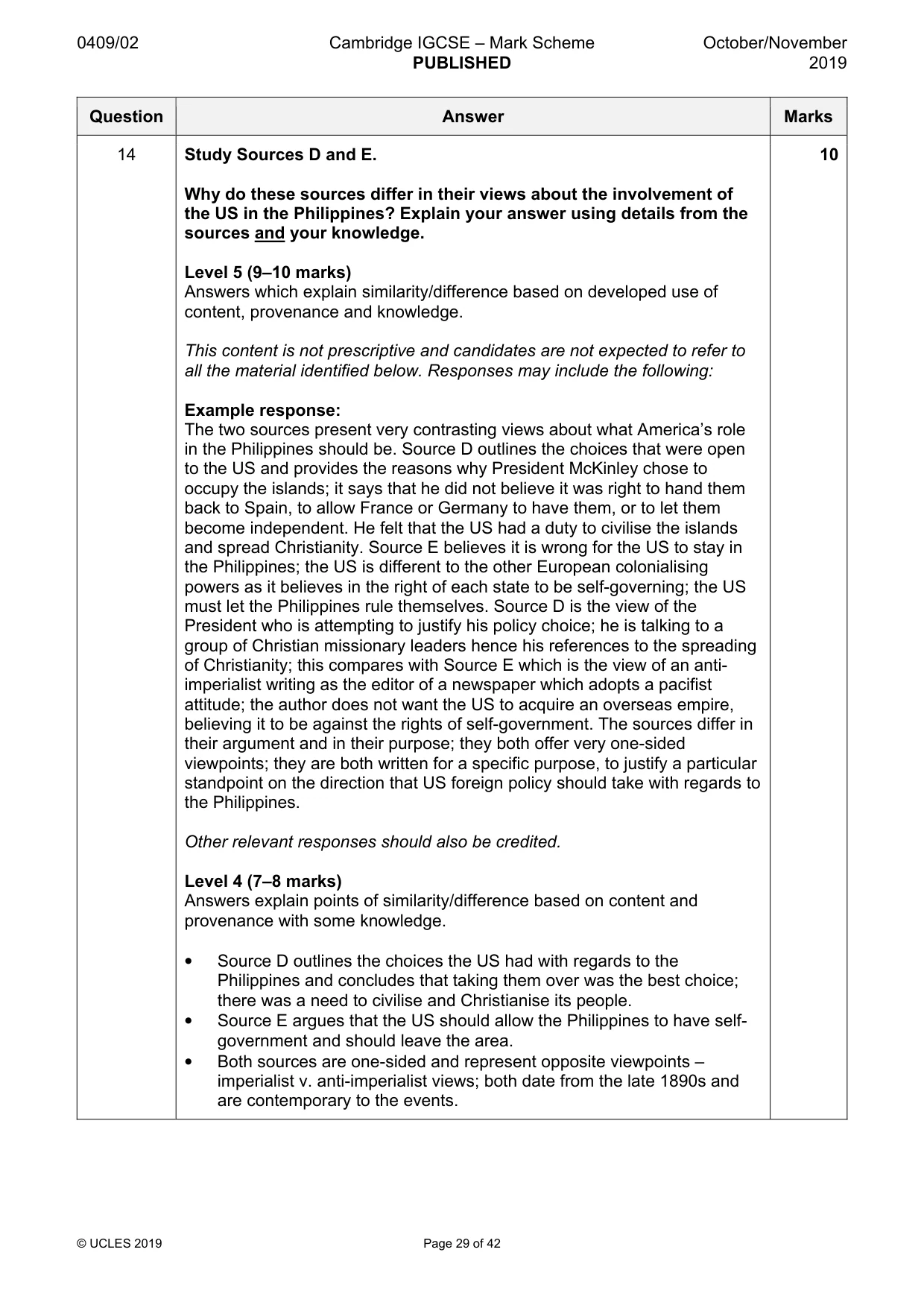
14 Study Sources D and E. Why do these sources differ in their views about the involvement of the US in the Philippines? Explain your answer using details from the sources and your knowledge. [10]
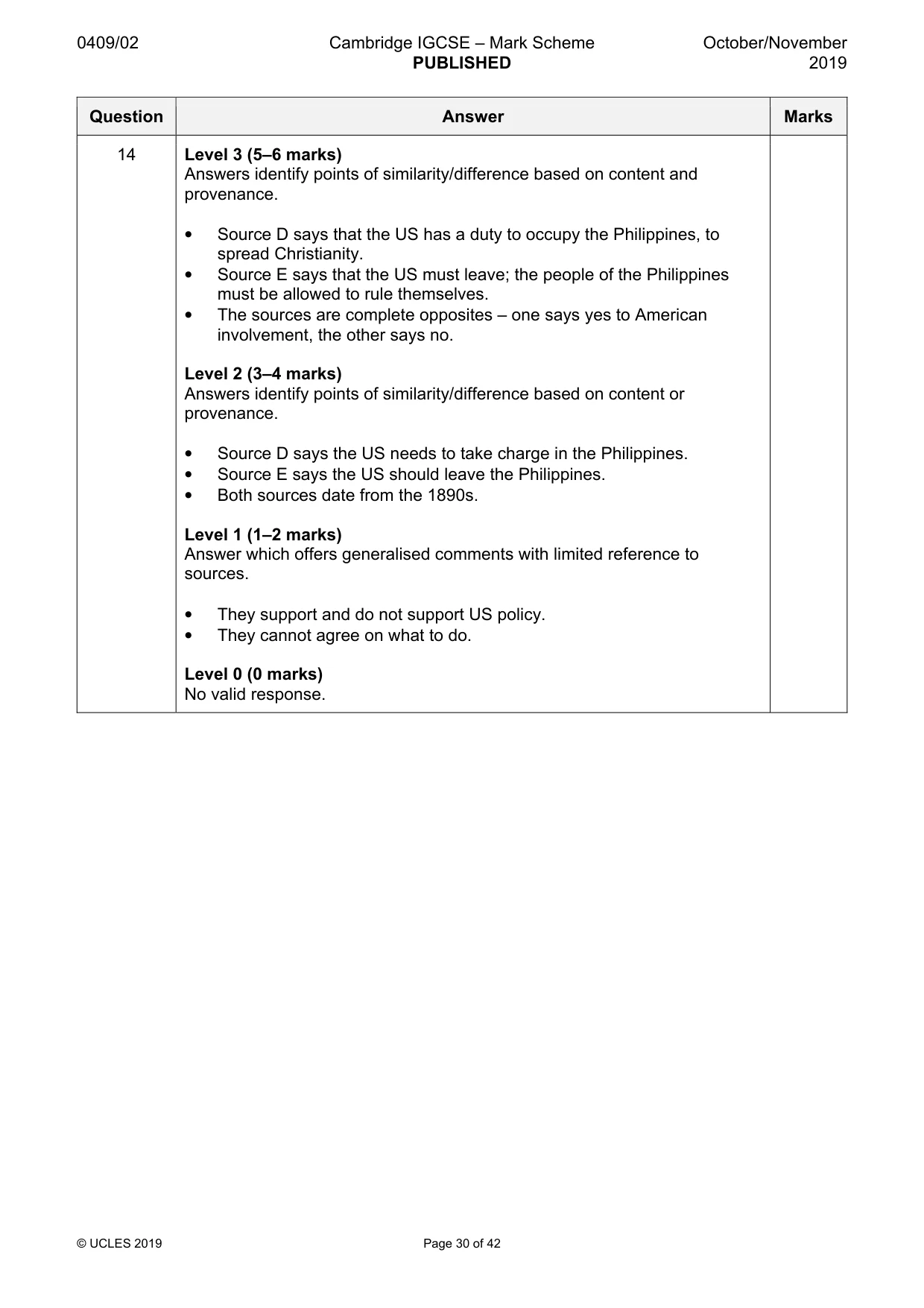
Mark scheme: 14 Study Sources D and E. 10 Why do these sources differ in their views about the involvement of the US in the Philippines? Explain your answer using details from the sources and your knowledge. Level 5 (9–10 marks) Answers which explain similarity/difference based on developed use of content, provenance and knowledge. This content is not prescriptive and candidates are not expected to refer to all the material identified below. Responses may include the following: Example response: The two sources present very contrasting views about what America’s role in the Philippines should be. Source D outlines the choices that were open to the US and provides the reasons why President McKinley chose to occupy the islands; it says that he did not believe it was right to hand them back to Spain, to allow France or Germany to have them, or to let them become independent. He felt that the US had a duty to civilise the islands and spread Christianity. Source E believes it is wrong for the US to stay in the Philippines; the US is different to the other European colonialising powers as it believes in the right of each state to be self-governing; the US must let the Philippines rule themselves. Source D is the view of the President who is attempting to justify his policy choice; he is talking to a group of Christian missionary leaders hence his references to the spreading of Christianity; this compares with Source E which is the view of an anti- imperialist writing as the editor of a newspaper which adopts a pacifist attitude; the author does not want the US to acquire an overseas empire, believing it to be against the rights of self-government. The sources differ in their argument and in their purpose; they both offer very one-sided viewpoints; they are both written for a specific purpose, to justify a particular standpoint on the direction that US foreign policy should take with regards to the Philippines. Other relevant responses should also be credited. Level 4 (7–8 marks) Answers explain points of similarity/difference based on content and provenance with some knowledge. • Source D outlines the choices the US had with regards to the Philippines and concludes that taking them over was the best choice; there was a need to civilise and Christianise its people. • Source E argues that the US should allow the Philippines to have self- government and should leave the area. • Both sources are one-sided and represent opposite viewpoints – imperialist v. anti-imperialist views; both date from the late 1890s and are contemporary to the events. 14 Level 3 (5–6 marks) Answers identify points of similarity/difference based on content and provenance. • Source D says that the US has a duty to occupy the Philippines, to spread Christianity. • Source E says that the US must leave; the people of the Philippines must be allowed to rule themselves. • The sources are complete opposites – one says yes to American involvement, the other says no. Level 2 (3–4 marks) Answers identify points of similarity/difference based on content or provenance. • Source D says the US needs to take charge in the Philippines. • Source E says the US should leave the Philippines. • Both sources date from the 1890s. Level 1 (1–2 marks) Answer which offers generalised comments with limited reference to sources. • They support and do not support US policy. • They cannot agree on what to do. Level 0 (0 marks) No valid response.
Q15 · Study all the sources
15 Study all the sources. “The occupation of the Philippines in 1898 was popular in the United States.” To what extent do you agree? Explain your answer using details from all the sources and your knowledge. [15] [Total: 45] Depth Study D: American Society and Popular Culture c.1920–1970 Read the background information and then answer all the questions. Use your knowledge of the topic to help you interpret and evaluate the sources, as appropriate. Background information During the 1960s a number of new social movements emerged and began active campaigns to press for change. Some of these campaigns were more successful than others.
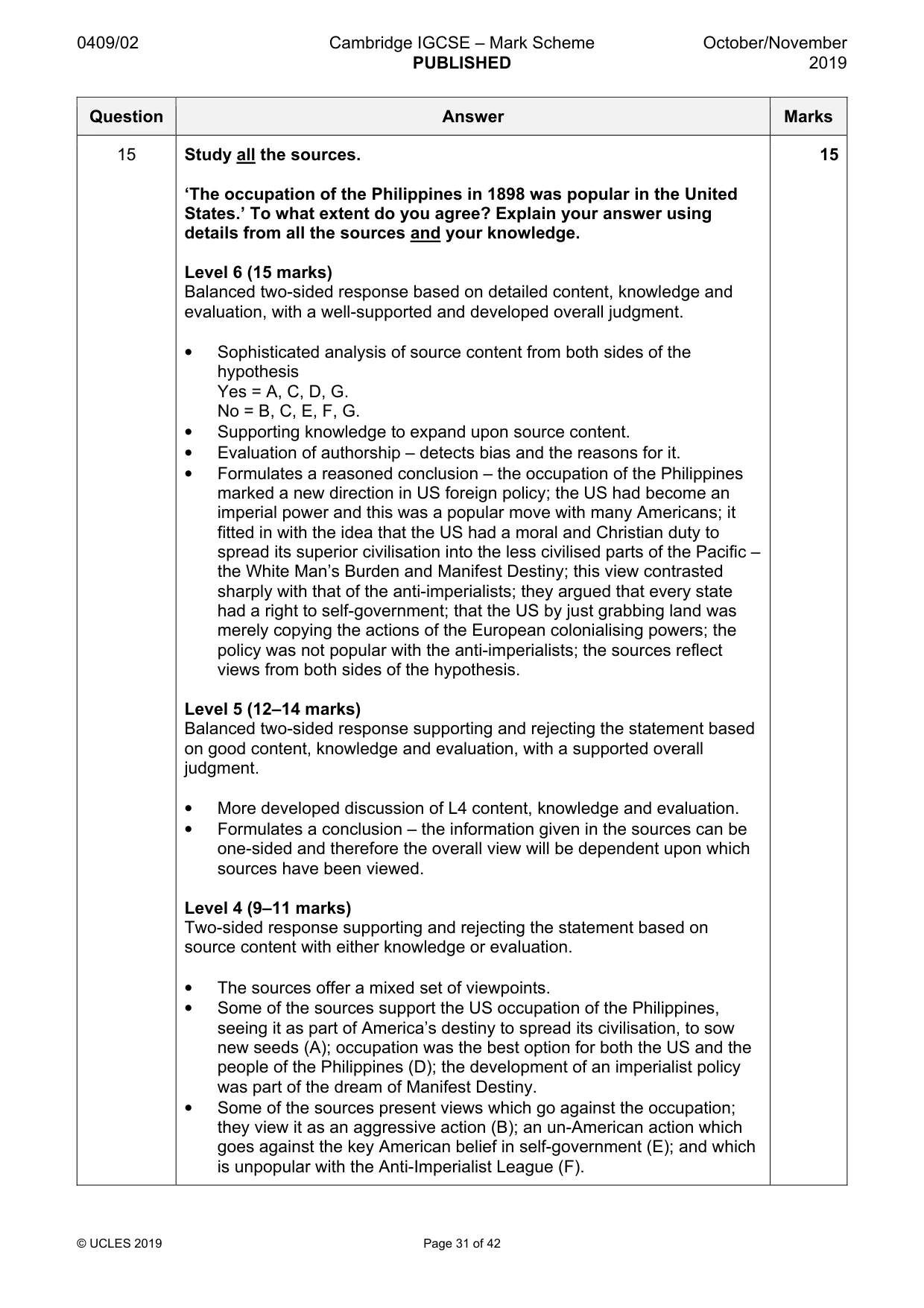
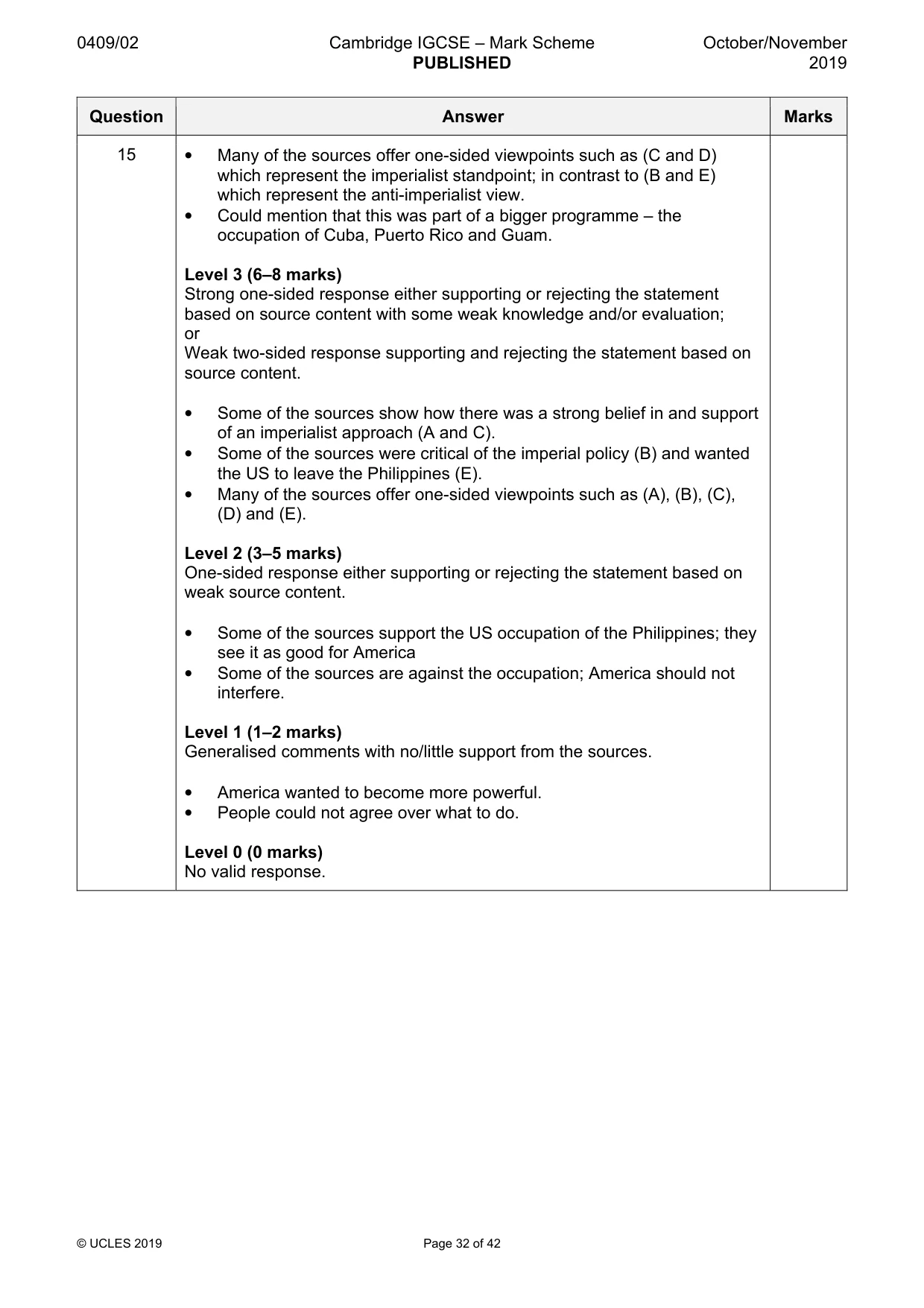
Mark scheme: 15 Study all the sources. 15 ‘The occupation of the Philippines in 1898 was popular in the United States.’ To what extent do you agree? Explain your answer using details from all the sources and your knowledge. Level 6 (15 marks) Balanced two-sided response based on detailed content, knowledge and evaluation, with a well-supported and developed overall judgment. • Sophisticated analysis of source content from both sides of the hypothesis Yes = A, C, D, G. No = B, C, E, F, G. • Supporting knowledge to expand upon source content. • Evaluation of authorship – detects bias and the reasons for it. • Formulates a reasoned conclusion – the occupation of the Philippines marked a new direction in US foreign policy; the US had become an imperial power and this was a popular move with many Americans; it fitted in with the idea that the US had a moral and Christian duty to spread its superior civilisation into the less civilised parts of the Pacific – the White Man’s Burden and Manifest Destiny; this view contrasted sharply with that of the anti-imperialists; they argued that every state had a right to self-government; that the US by just grabbing land was merely copying the actions of the European colonialising powers; the policy was not popular with the anti-imperialists; the sources reflect views from both sides of the hypothesis. Level 5 (12–14 marks) Balanced two-sided response supporting and rejecting the statement based on good content, knowledge and evaluation, with a supported overall judgment. • More developed discussion of L4 content, knowledge and evaluation. • Formulates a conclusion – the information given in the sources can be one-sided and therefore the overall view will be dependent upon which sources have been viewed. Level 4 (9–11 marks) Two-sided response supporting and rejecting the statement based on source content with either knowledge or evaluation. • The sources offer a mixed set of viewpoints. • Some of the sources support the US occupation of the Philippines, seeing it as part of America’s destiny to spread its civilisation, to sow new seeds (A); occupation was the best option for both the US and the people of the Philippines (D); the development of an imperialist policy was part of the dream of Manifest Destiny. • Some of the sources present views which go against the occupation; they view it as an aggressive action (B); an un-American action which goes against the key American belief in self-government (E); and which is unpopular with the Anti-Imperialist League (F). 15 • Many of the sources offer one-sided viewpoints such as (C and D) which represent the imperialist standpoint; in contrast to (B and E) which represent the anti-imperialist view. • Could mention that this was part of a bigger programme – the occupation of Cuba, Puerto Rico and Guam. Level 3 (6–8 marks) Strong one-sided response either supporting or rejecting the statement based on source content with some weak knowledge and/or evaluation; or Weak two-sided response supporting and rejecting the statement based on source content. • Some of the sources show how there was a strong belief in and support of an imperialist approach (A and C). • Some of the sources were critical of the imperial policy (B) and wanted the US to leave the Philippines (E). • Many of the sources offer one-sided viewpoints such as (A), (B), (C), (D) and (E). Level 2 (3–5 marks) One-sided response either supporting or rejecting the statement based on weak source content. • Some of the sources support the US occupation of the Philippines; they see it as good for America • Some of the sources are against the occupation; America should not interfere. Level 1 (1–2 marks) Generalised comments with no/little support from the sources. • America wanted to become more powerful. • People could not agree over what to do. Level 0 (0 marks) No valid response. Depth Study D: American Society and Popular Culture c.1920–1970
Question 16
16 Study Source A. What can you learn from this source about the feminist movement during the 1960s? Explain your answer using details from the source and your knowledge. [6]
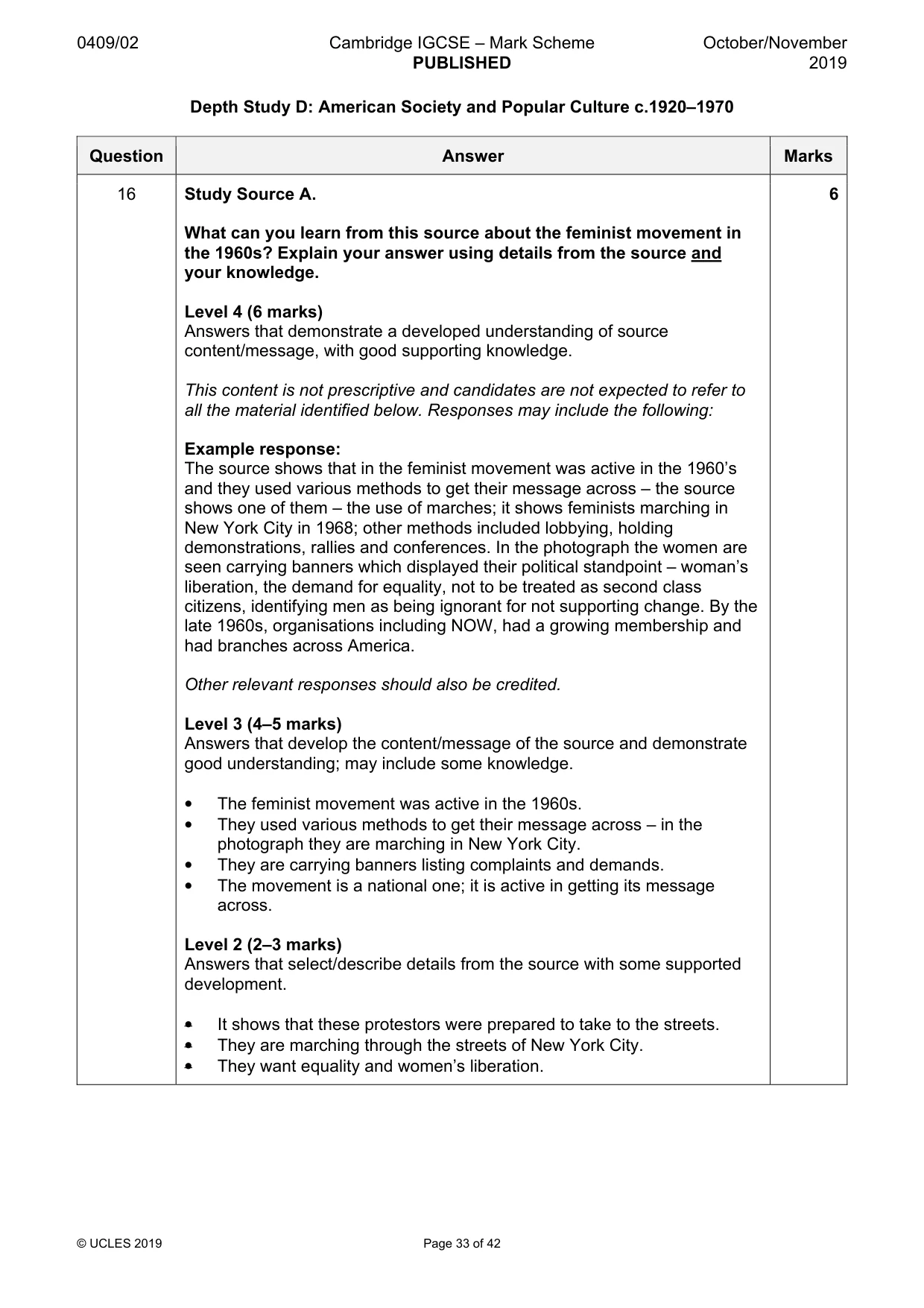
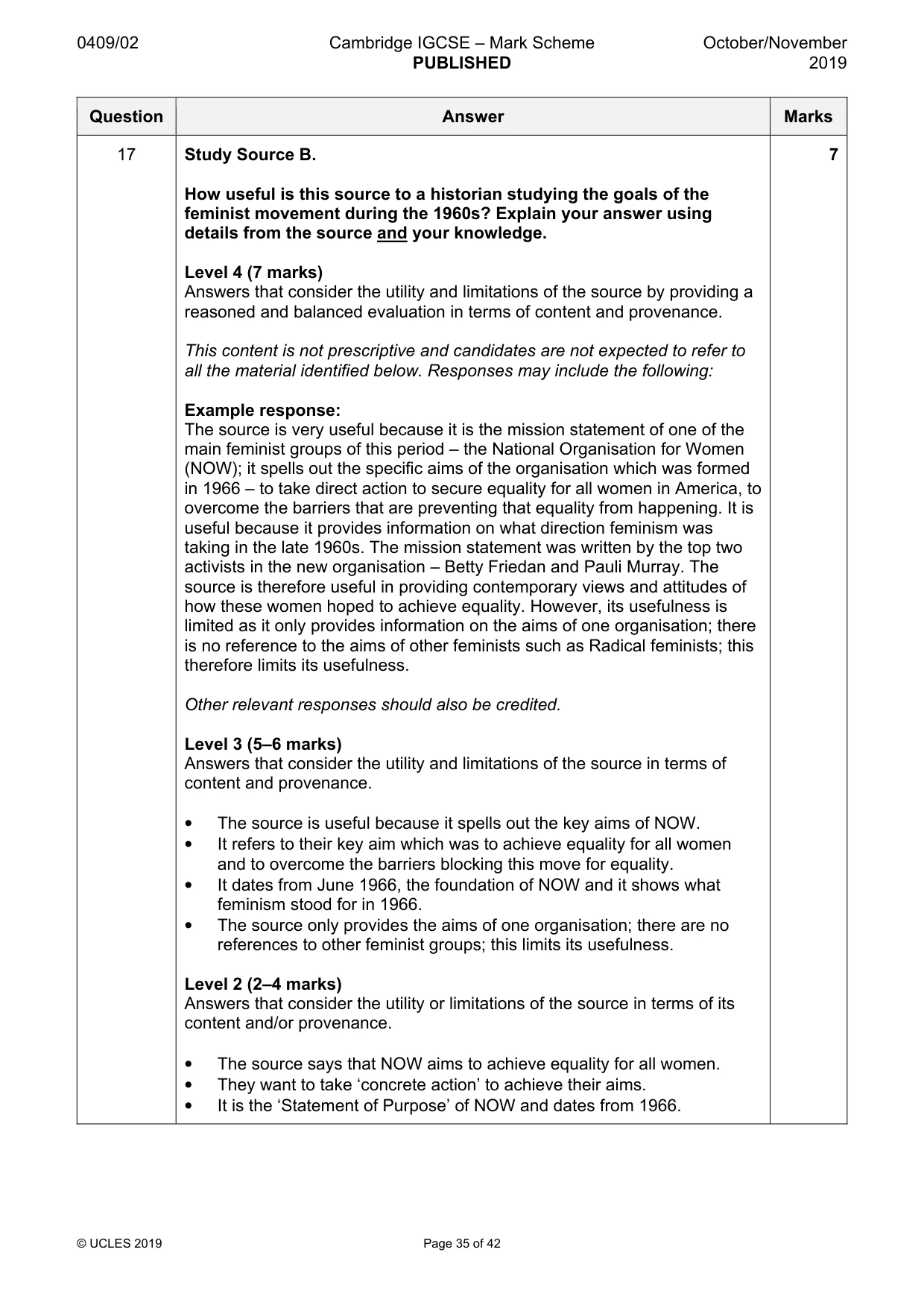
Mark scheme: 16 Study Source A. 6 What can you learn from this source about the feminist movement in the 1960s? Explain your answer using details from the source and your knowledge. Level 4 (6 marks) Answers that demonstrate a developed understanding of source content/message, with good supporting knowledge. This content is not prescriptive and candidates are not expected to refer to all the material identified below. Responses may include the following: Example response: The source shows that in the feminist movement was active in the 1960’s and they used various methods to get their message across – the source shows one of them – the use of marches; it shows feminists marching in New York City in 1968; other methods included lobbying, holding demonstrations, rallies and conferences. In the photograph the women are seen carrying banners which displayed their political standpoint – woman’s liberation, the demand for equality, not to be treated as second class citizens, identifying men as being ignorant for not supporting change. By the late 1960s, organisations including NOW, had a growing membership and had branches across America. Other relevant responses should also be credited. Level 3 (4–5 marks) Answers that develop the content/message of the source and demonstrate good understanding; may include some knowledge. • The feminist movement was active in the 1960s. • They used various methods to get their message across – in the photograph they are marching in New York City. • They are carrying banners listing complaints and demands. • The movement is a national one; it is active in getting its message across. Level 2 (2–3 marks) Answers that select/describe details from the source with some supported development. • It shows that these protestors were prepared to take to the streets. • They are marching through the streets of New York City. • They want equality and women’s liberation. 16 Level 1 (1 mark) Answers that offer a generalised comment with loose reference to the source. • Women are carrying signs. Level 0 (0 marks) No valid response.
Question 17
17 Study Source B. How useful is this source to a historian studying the goals of the feminist movement during the 1960s? Explain your answer using details from the source and your knowledge. [7]
Mark scheme: 17 Study Source B. 7 How useful is this source to a historian studying the goals of the feminist movement during the 1960s? Explain your answer using details from the source and your knowledge. Level 4 (7 marks) Answers that consider the utility and limitations of the source by providing a reasoned and balanced evaluation in terms of content and provenance. This content is not prescriptive and candidates are not expected to refer to all the material identified below. Responses may include the following: Example response: The source is very useful because it is the mission statement of one of the main feminist groups of this period – the National Organisation for Women (NOW); it spells out the specific aims of the organisation which was formed in 1966 – to take direct action to secure equality for all women in America, to overcome the barriers that are preventing that equality from happening. It is useful because it provides information on what direction feminism was taking in the late 1960s. The mission statement was written by the top two activists in the new organisation – Betty Friedan and Pauli Murray. The source is therefore useful in providing contemporary views and attitudes of how these women hoped to achieve equality. However, its usefulness is limited as it only provides information on the aims of one organisation; there is no reference to the aims of other feminists such as Radical feminists; this therefore limits its usefulness. Other relevant responses should also be credited. Level 3 (5–6 marks) Answers that consider the utility and limitations of the source in terms of content and provenance. • The source is useful because it spells out the key aims of NOW. • It refers to their key aim which was to achieve equality for all women and to overcome the barriers blocking this move for equality. • It dates from June 1966, the foundation of NOW and it shows what feminism stood for in 1966. • The source only provides the aims of one organisation; there are no references to other feminist groups; this limits its usefulness. Level 2 (2–4 marks) Answers that consider the utility or limitations of the source in terms of its content and/or provenance. • The source says that NOW aims to achieve equality for all women. • They want to take ‘concrete action’ to achieve their aims. • It is the ‘Statement of Purpose’ of NOW and dates from 1966. 17 Level 1 (1 mark) Answers that offer a generalised comment or paraphrase source content. • They wanted to help women. • They had a number of aims. Level 0 (0 marks) No valid response.
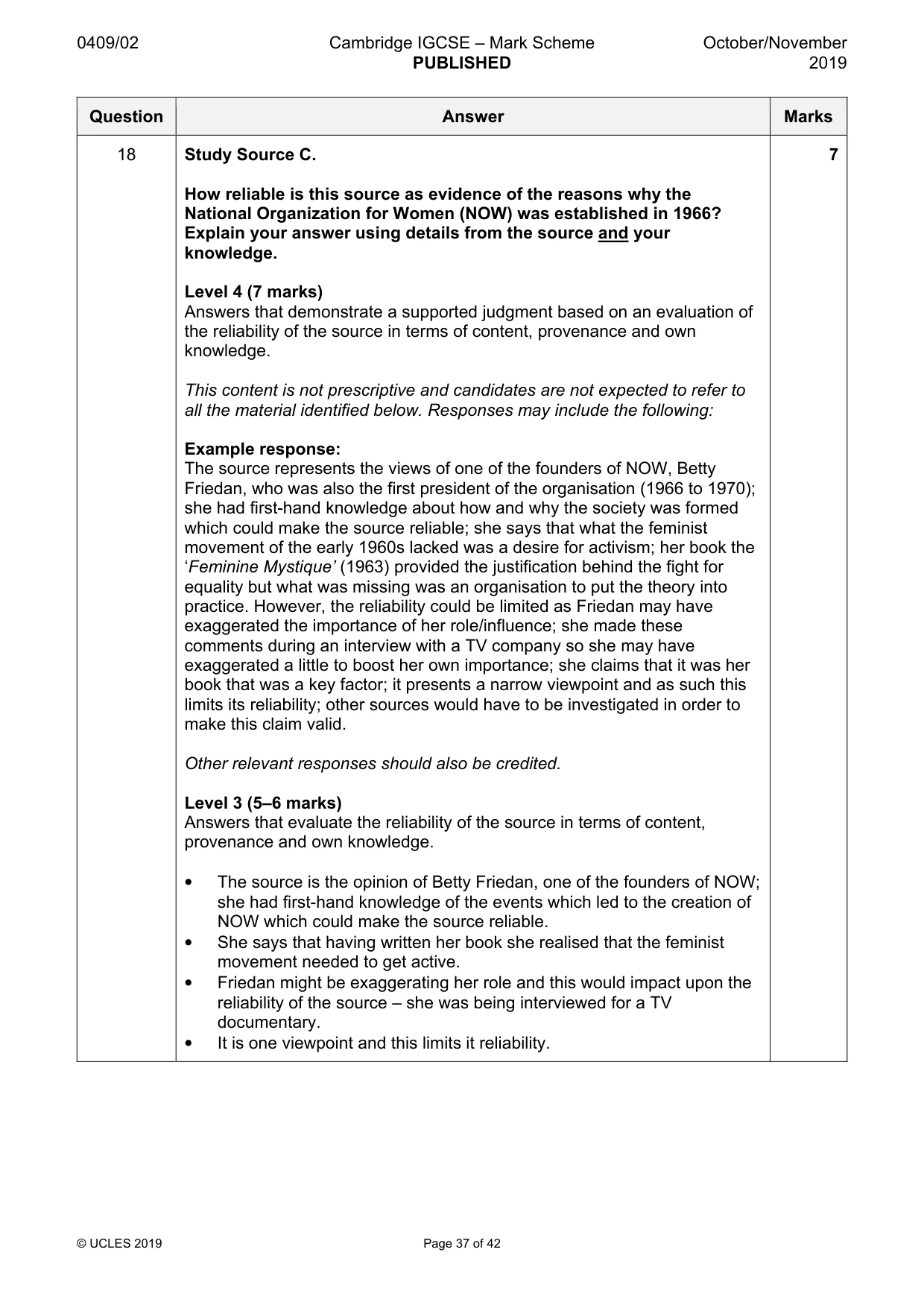
Question 18
18 Study Source C. How reliable is this source as evidence of the reasons why the National Organization for Women (NOW) was established in 1966? Explain your answer using details from the source and your knowledge. [7]
Mark scheme: 18 Study Source C. 7 How reliable is this source as evidence of the reasons why the National Organization for Women (NOW) was established in 1966? Explain your answer using details from the source and your knowledge. Level 4 (7 marks) Answers that demonstrate a supported judgment based on an evaluation of the reliability of the source in terms of content, provenance and own knowledge. This content is not prescriptive and candidates are not expected to refer to all the material identified below. Responses may include the following: Example response: The source represents the views of one of the founders of NOW, Betty Friedan, who was also the first president of the organisation (1966 to 1970); she had first-hand knowledge about how and why the society was formed which could make the source reliable; she says that what the feminist movement of the early 1960s lacked was a desire for activism; her book the ‘Feminine Mystique’ (1963) provided the justification behind the fight for equality but what was missing was an organisation to put the theory into practice. However, the reliability could be limited as Friedan may have exaggerated the importance of her role/influence; she made these comments during an interview with a TV company so she may have exaggerated a little to boost her own importance; she claims that it was her book that was a key factor; it presents a narrow viewpoint and as such this limits its reliability; other sources would have to be investigated in order to make this claim valid. Other relevant responses should also be credited. Level 3 (5–6 marks) Answers that evaluate the reliability of the source in terms of content, provenance and own knowledge. • The source is the opinion of Betty Friedan, one of the founders of NOW; she had first-hand knowledge of the events which led to the creation of NOW which could make the source reliable. • She says that having written her book she realised that the feminist movement needed to get active. • Friedan might be exaggerating her role and this would impact upon the reliability of the source – she was being interviewed for a TV documentary. • It is one viewpoint and this limits it reliability. 18 Level 2 (2–4 marks) Answers that consider the reliability of the source in terms of its content and/or provenance. • The source provides some reasons why NOW was formed – to make women more active in the fight for equality. • The source provides information from Betty Friedan, a key figure in the movement. • She was being interviewed so she might have exaggerated. Level 1 (1 mark) Answers that offer a generalised comment or paraphrase source content. • It was set up for several reasons. • It was said by Betty Friedan. Level 0 (0 marks) No valid response.
Q19 · Study Sources D and E
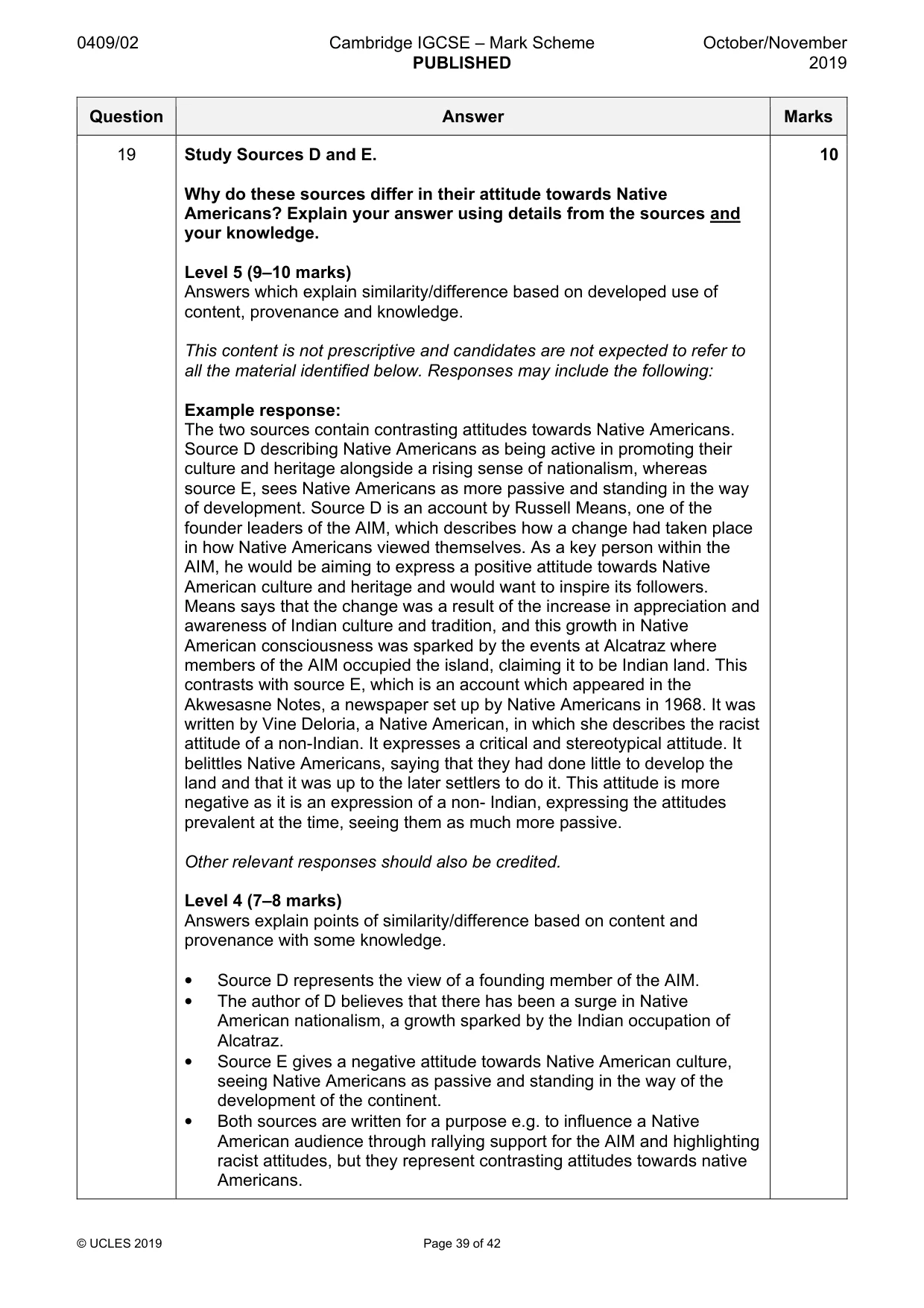
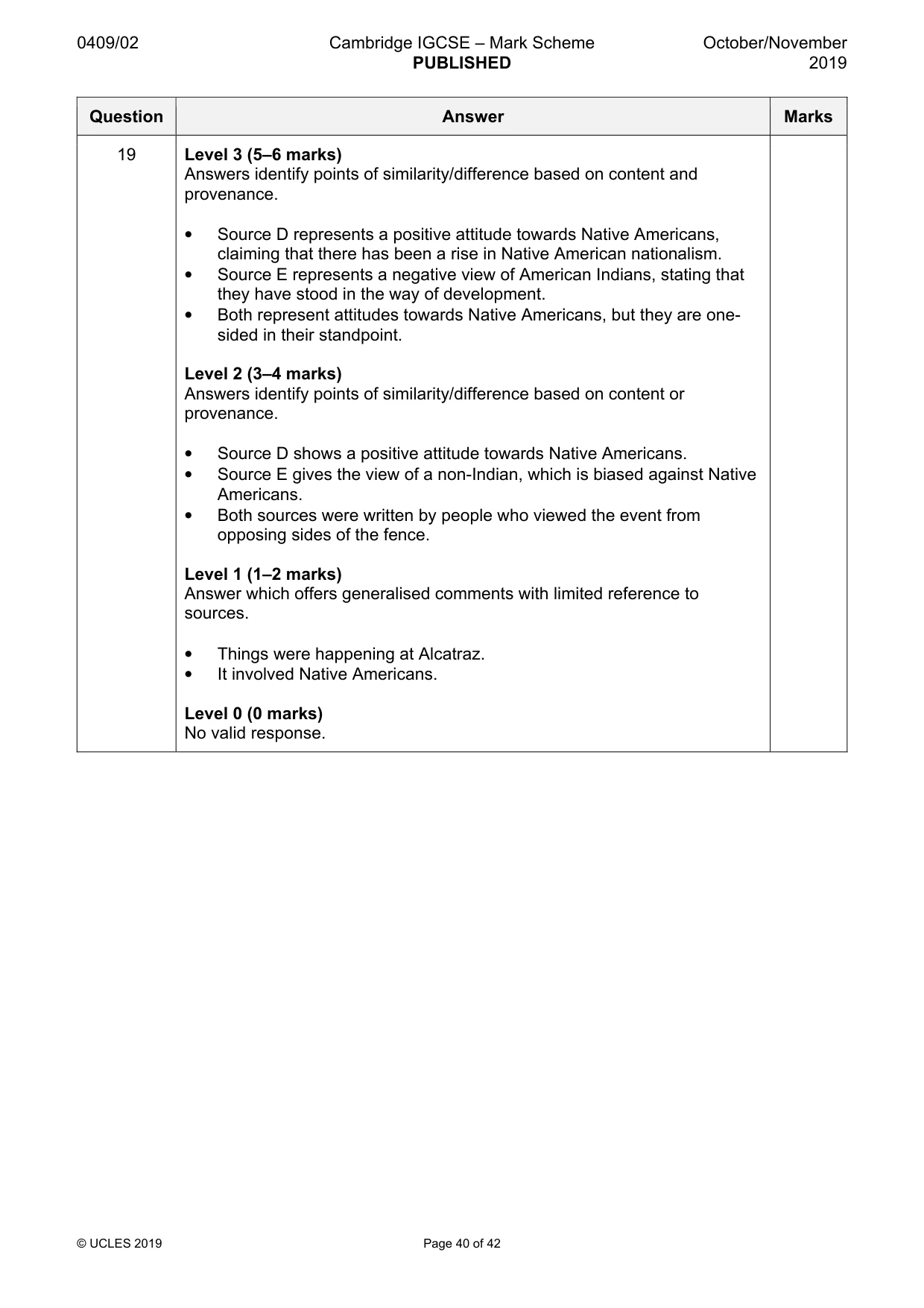
19 Study Sources D and E. Why do these sources differ in their attitude towards Native Americans? Explain your answer using details from the sources and your knowledge. [10]
Mark scheme: 19 Study Sources D and E. 10 Why do these sources differ in their attitude towards Native Americans? Explain your answer using details from the sources and your knowledge. Level 5 (9–10 marks) Answers which explain similarity/difference based on developed use of content, provenance and knowledge. This content is not prescriptive and candidates are not expected to refer to all the material identified below. Responses may include the following: Example response: The two sources contain contrasting attitudes towards Native Americans. Source D describing Native Americans as being active in promoting their culture and heritage alongside a rising sense of nationalism, whereas source E, sees Native Americans as more passive and standing in the way of development. Source D is an account by Russell Means, one of the founder leaders of the AIM, which describes how a change had taken place in how Native Americans viewed themselves. As a key person within the AIM, he would be aiming to express a positive attitude towards Native American culture and heritage and would want to inspire its followers. Means says that the change was a result of the increase in appreciation and awareness of Indian culture and tradition, and this growth in Native American consciousness was sparked by the events at Alcatraz where members of the AIM occupied the island, claiming it to be Indian land. This contrasts with source E, which is an account which appeared in the Akwesasne Notes, a newspaper set up by Native Americans in 1968. It was written by Vine Deloria, a Native American, in which she describes the racist attitude of a non-Indian. It expresses a critical and stereotypical attitude. It belittles Native Americans, saying that they had done little to develop the land and that it was up to the later settlers to do it. This attitude is more negative as it is an expression of a non- Indian, expressing the attitudes prevalent at the time, seeing them as much more passive. Other relevant responses should also be credited. Level 4 (7–8 marks) Answers explain points of similarity/difference based on content and provenance with some knowledge. • Source D represents the view of a founding member of the AIM. • The author of D believes that there has been a surge in Native American nationalism, a growth sparked by the Indian occupation of Alcatraz. • Source E gives a negative attitude towards Native American culture, seeing Native Americans as passive and standing in the way of the development of the continent. • Both sources are written for a purpose e.g. to influence a Native American audience through rallying support for the AIM and highlighting racist attitudes, but they represent contrasting attitudes towards native Americans. 19 Level 3 (5–6 marks) Answers identify points of similarity/difference based on content and provenance. • Source D represents a positive attitude towards Native Americans, claiming that there has been a rise in Native American nationalism. • Source E represents a negative view of American Indians, stating that they have stood in the way of development. • Both represent attitudes towards Native Americans, but they are one- sided in their standpoint. Level 2 (3–4 marks) Answers identify points of similarity/difference based on content or provenance. • Source D shows a positive attitude towards Native Americans. • Source E gives the view of a non-Indian, which is biased against Native Americans. • Both sources were written by people who viewed the event from opposing sides of the fence. Level 1 (1–2 marks) Answer which offers generalised comments with limited reference to sources. • Things were happening at Alcatraz. • It involved Native Americans. Level 0 (0 marks) No valid response.
Q20 · Study all the sources
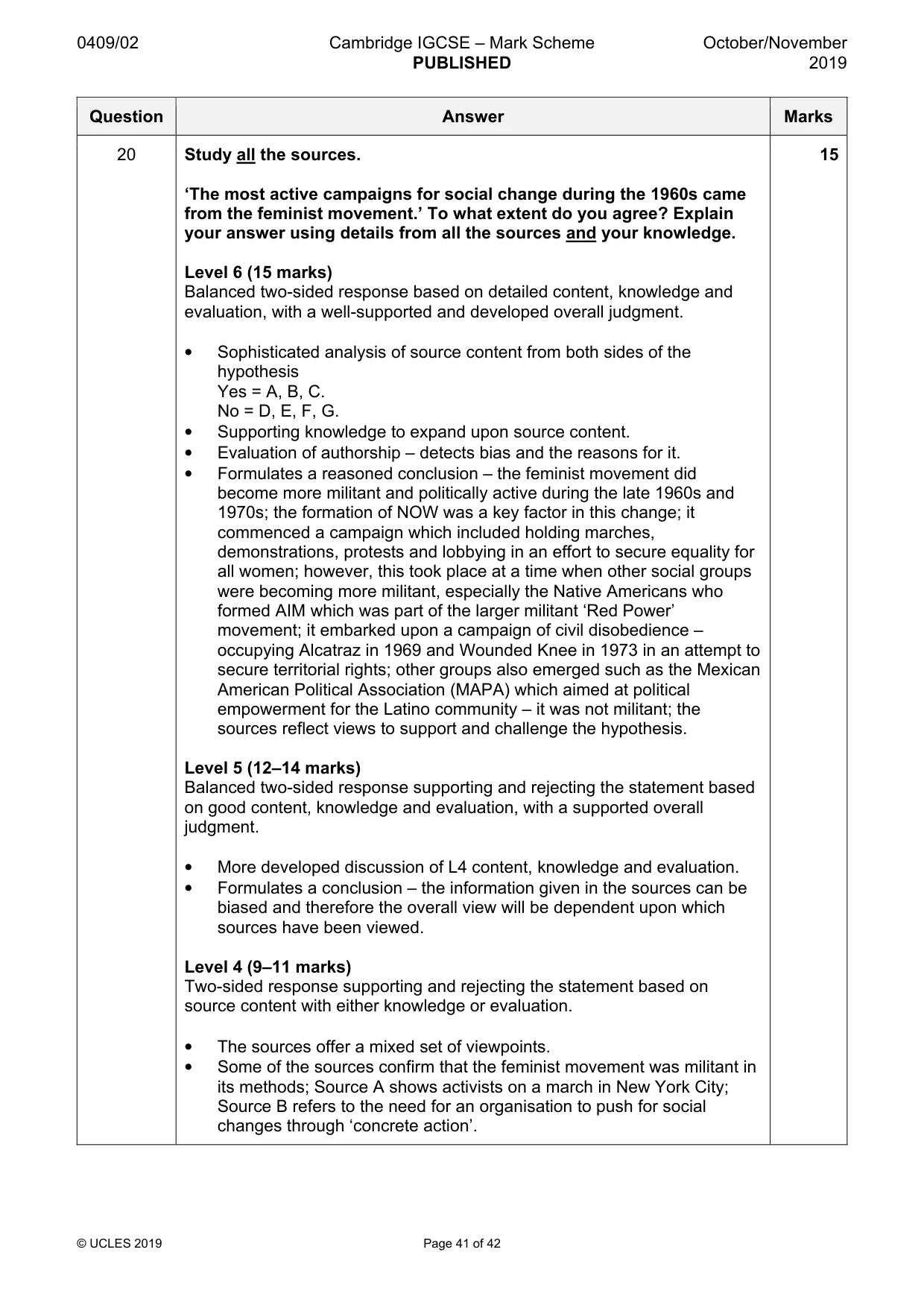
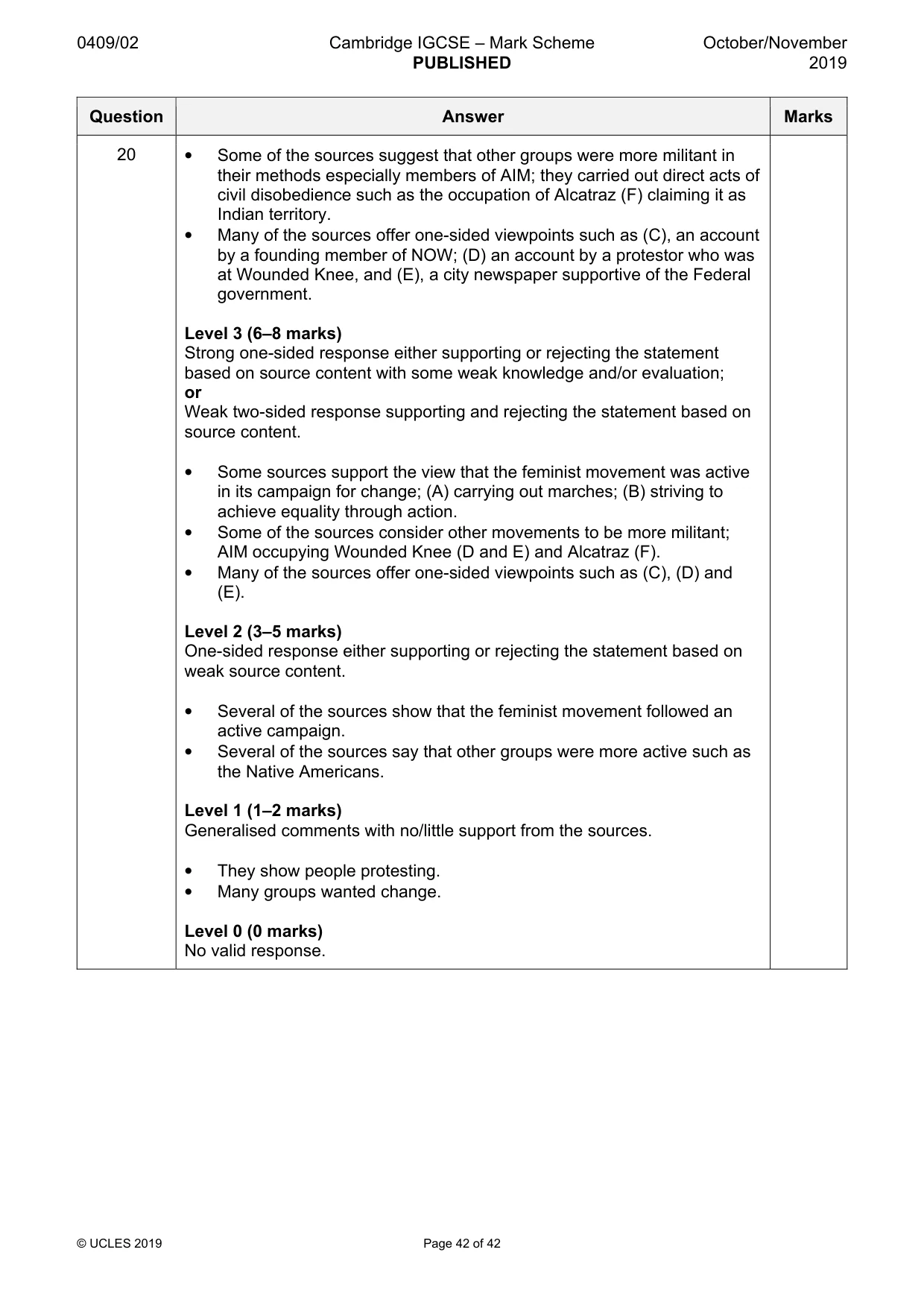
20 Study all the sources. “The most active campaigns for social change during the 1960s came from the feminist movement.” To what extent do you agree? Explain your answer using details from all the sources and your knowledge. [15] [Total: 45]
Mark scheme: 20 Study all the sources. 15 ‘The most active campaigns for social change during the 1960s came from the feminist movement.’ To what extent do you agree? Explain your answer using details from all the sources and your knowledge. Level 6 (15 marks) Balanced two-sided response based on detailed content, knowledge and evaluation, with a well-supported and developed overall judgment. • Sophisticated analysis of source content from both sides of the hypothesis Yes = A, B, C. No = D, E, F, G. • Supporting knowledge to expand upon source content. • Evaluation of authorship – detects bias and the reasons for it. • Formulates a reasoned conclusion – the feminist movement did become more militant and politically active during the late 1960s and 1970s; the formation of NOW was a key factor in this change; it commenced a campaign which included holding marches, demonstrations, protests and lobbying in an effort to secure equality for all women; however, this took place at a time when other social groups were becoming more militant, especially the Native Americans who formed AIM which was part of the larger militant ‘Red Power’ movement; it embarked upon a campaign of civil disobedience – occupying Alcatraz in 1969 and Wounded Knee in 1973 in an attempt to secure territorial rights; other groups also emerged such as the Mexican American Political Association (MAPA) which aimed at political empowerment for the Latino community – it was not militant; the sources reflect views to support and challenge the hypothesis. Level 5 (12–14 marks) Balanced two-sided response supporting and rejecting the statement based on good content, knowledge and evaluation, with a supported overall judgment. • More developed discussion of L4 content, knowledge and evaluation. • Formulates a conclusion – the information given in the sources can be biased and therefore the overall view will be dependent upon which sources have been viewed. Level 4 (9–11 marks) Two-sided response supporting and rejecting the statement based on source content with either knowledge or evaluation. • The sources offer a mixed set of viewpoints. • Some of the sources confirm that the feminist movement was militant in its methods; Source A shows activists on a march in New York City; Source B refers to the need for an organisation to push for social changes through ‘concrete action’. 20 • Some of the sources suggest that other groups were more militant in their methods especially members of AIM; they carried out direct acts of civil disobedience such as the occupation of Alcatraz (F) claiming it as Indian territory. • Many of the sources offer one-sided viewpoints such as (C), an account by a founding member of NOW; (D) an account by a protestor who was at Wounded Knee, and (E), a city newspaper supportive of the Federal government. Level 3 (6–8 marks) Strong one-sided response either supporting or rejecting the statement based on source content with some weak knowledge and/or evaluation; or Weak two-sided response supporting and rejecting the statement based on source content. • Some sources support the view that the feminist movement was active in its campaign for change; (A) carrying out marches; (B) striving to achieve equality through action. • Some of the sources consider other movements to be more militant; AIM occupying Wounded Knee (D and E) and Alcatraz (F). • Many of the sources offer one-sided viewpoints such as (C), (D) and (E). Level 2 (3–5 marks) One-sided response either supporting or rejecting the statement based on weak source content. • Several of the sources show that the feminist movement followed an active campaign. • Several of the sources say that other groups were more active such as the Native Americans. Level 1 (1–2 marks) Generalised comments with no/little support from the sources. • They show people protesting. • Many groups wanted change. Level 0 (0 marks) No valid response.
What you needed in this session
Cambridge’s own grade thresholds for 2019 Oct/Nov, Paper 2 · Variant 1. A higher threshold means an easier paper — the bar moves with how the cohort did.