Cambridge IGCSE History American BES 0409 — 2019 May/June Paper 2 · Variant 1
0409/21/M/J/19 · 20 questions · 45 marks · ≈51 min
The question paper and its mark scheme, free to read here and free to download. This is Cambridge’s own paper, exactly as it was sat.
Question paper8 pages
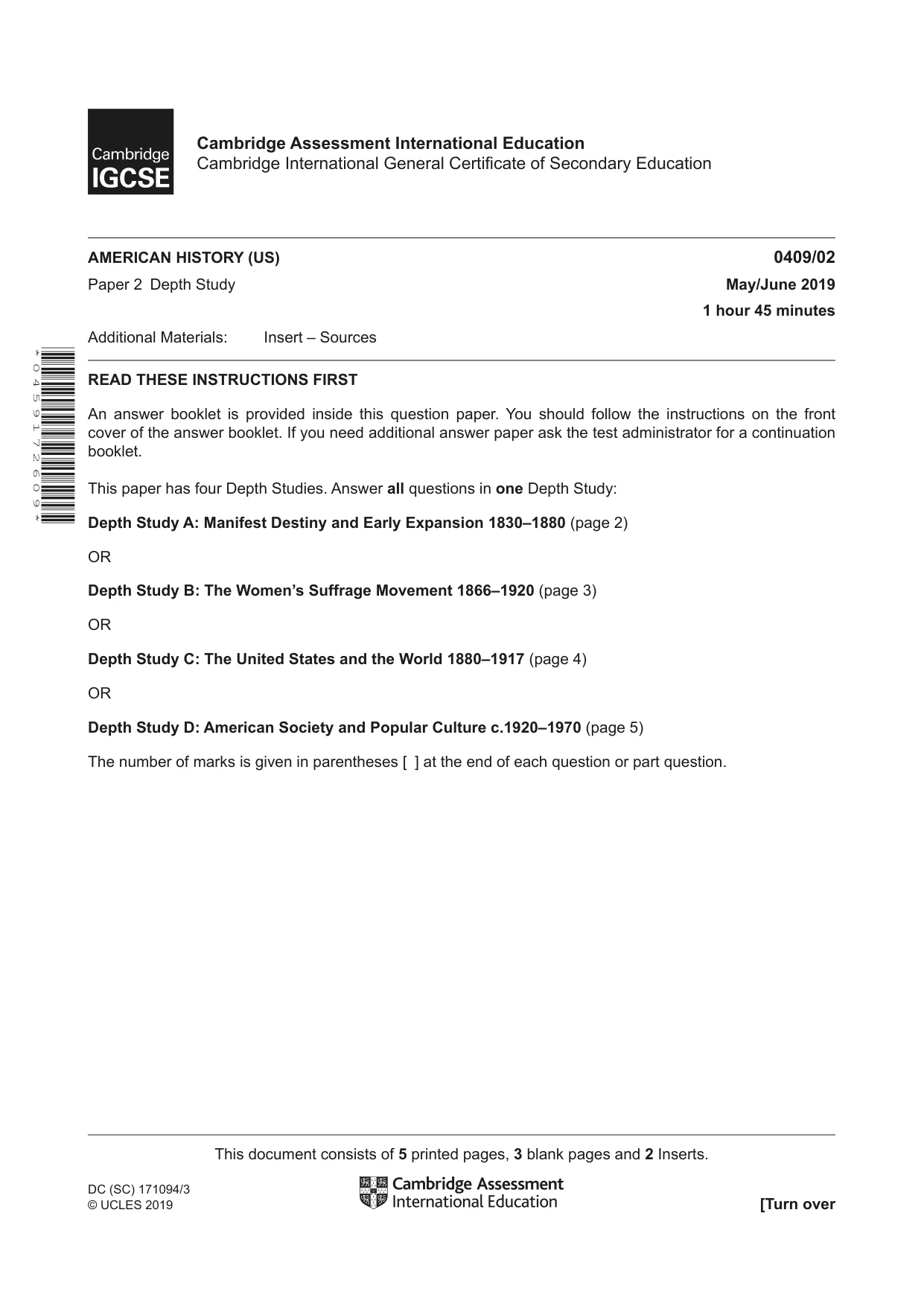
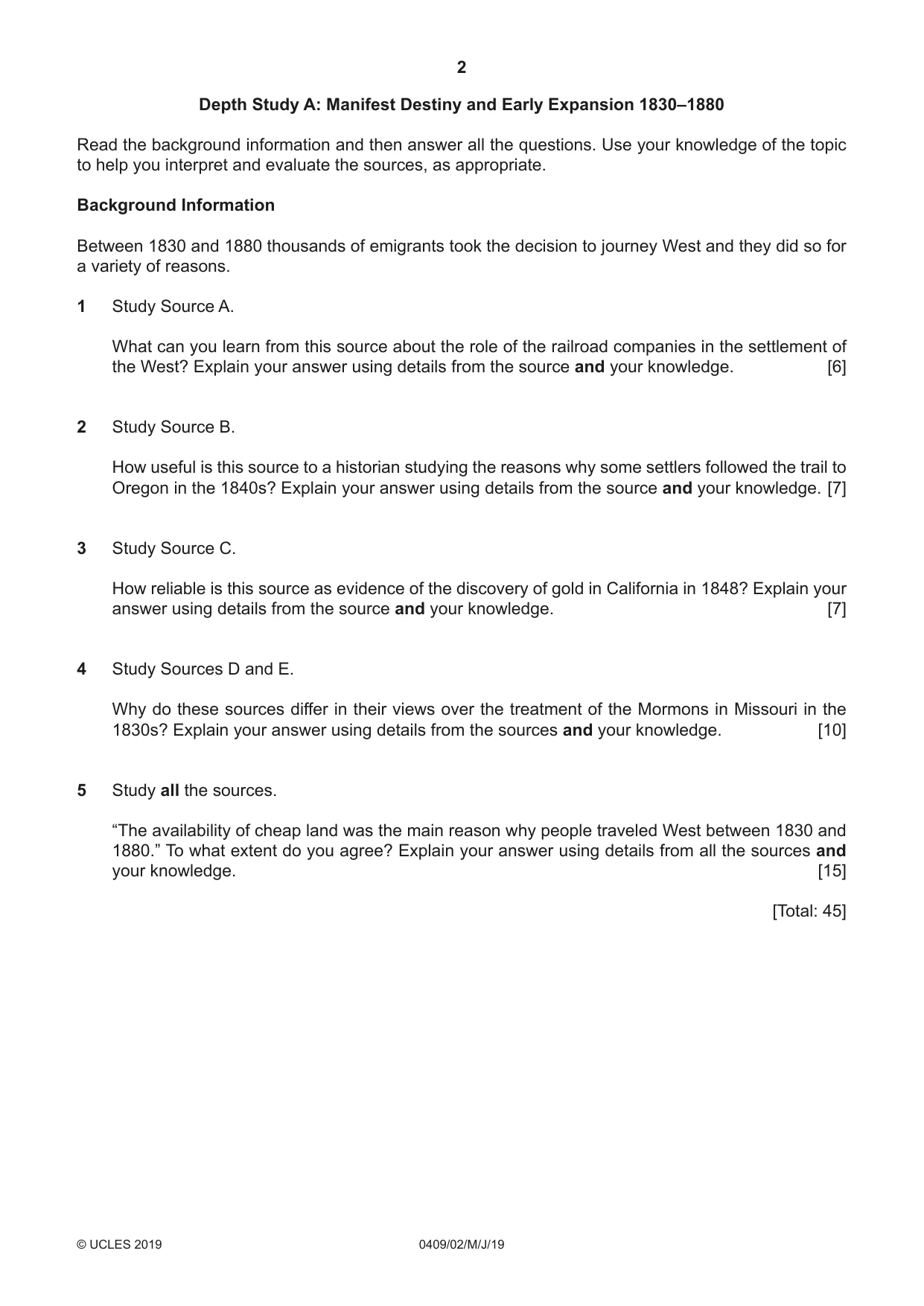
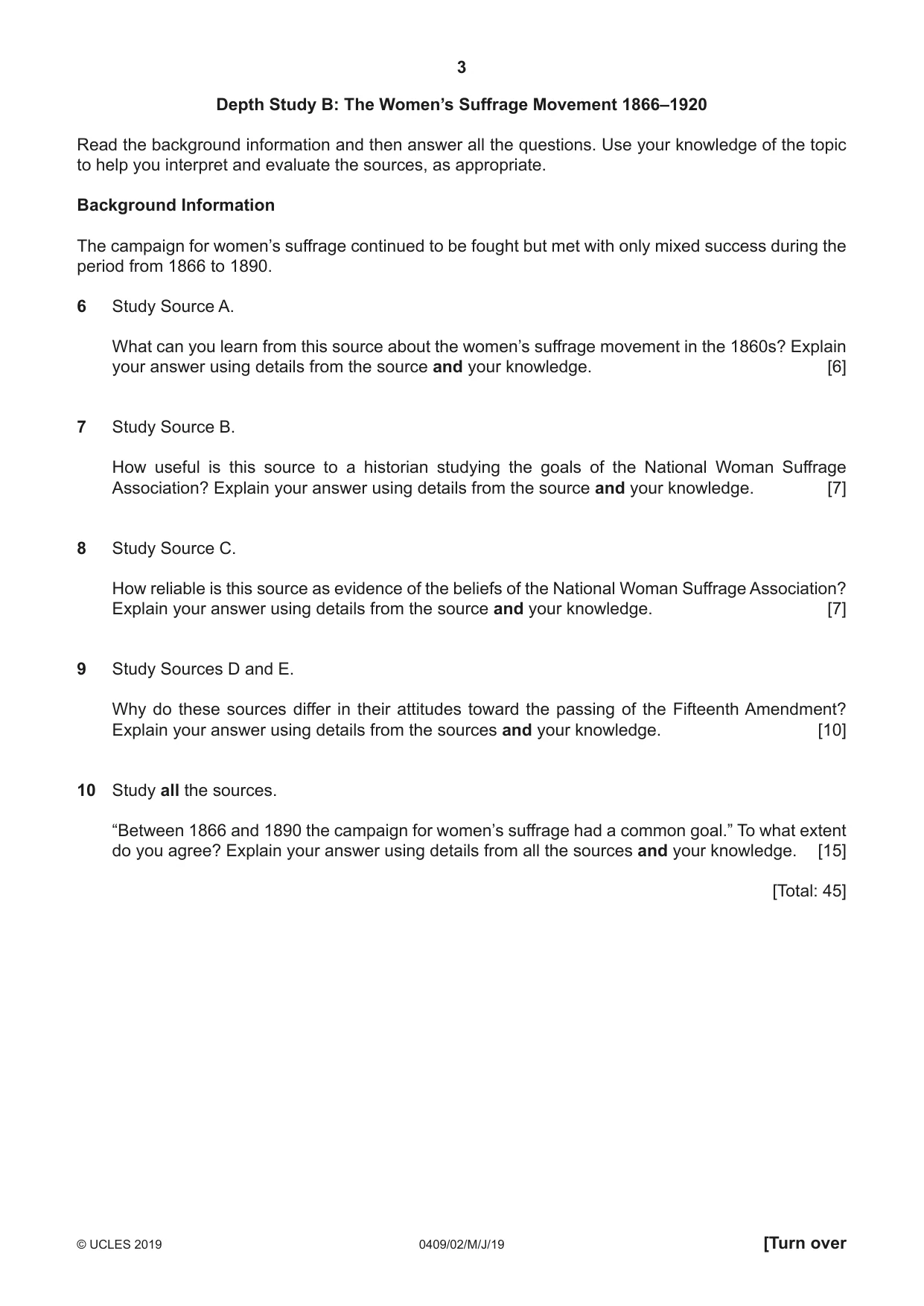
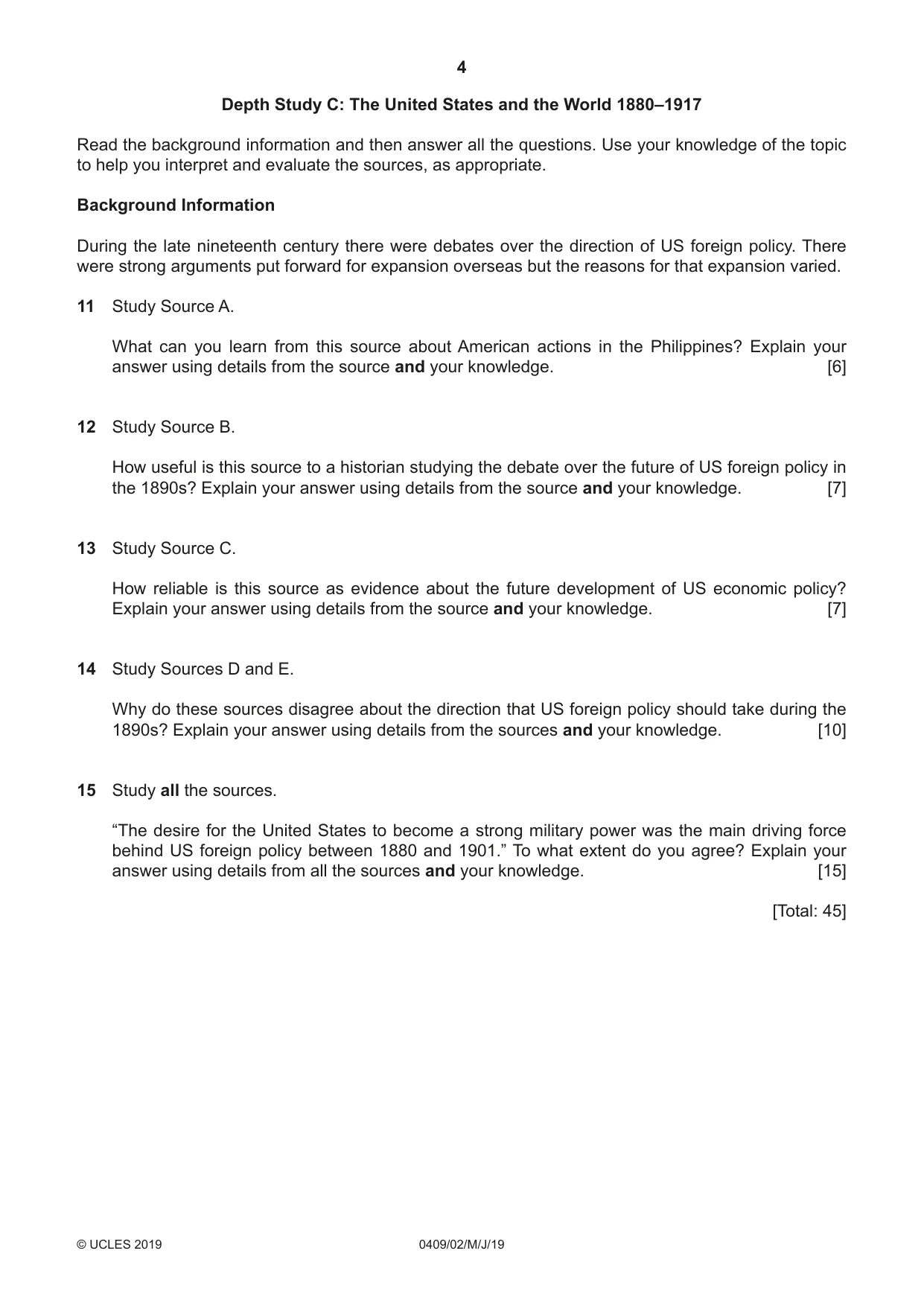


Mark scheme45 pages
Answers below. Sit the paper first if you are practising.
Questions as text
Question 1
1 Study Source A. What can you learn from this source about the role of the railroad companies in the settlement of the West? Explain your answer using details from the source and your knowledge. [6]
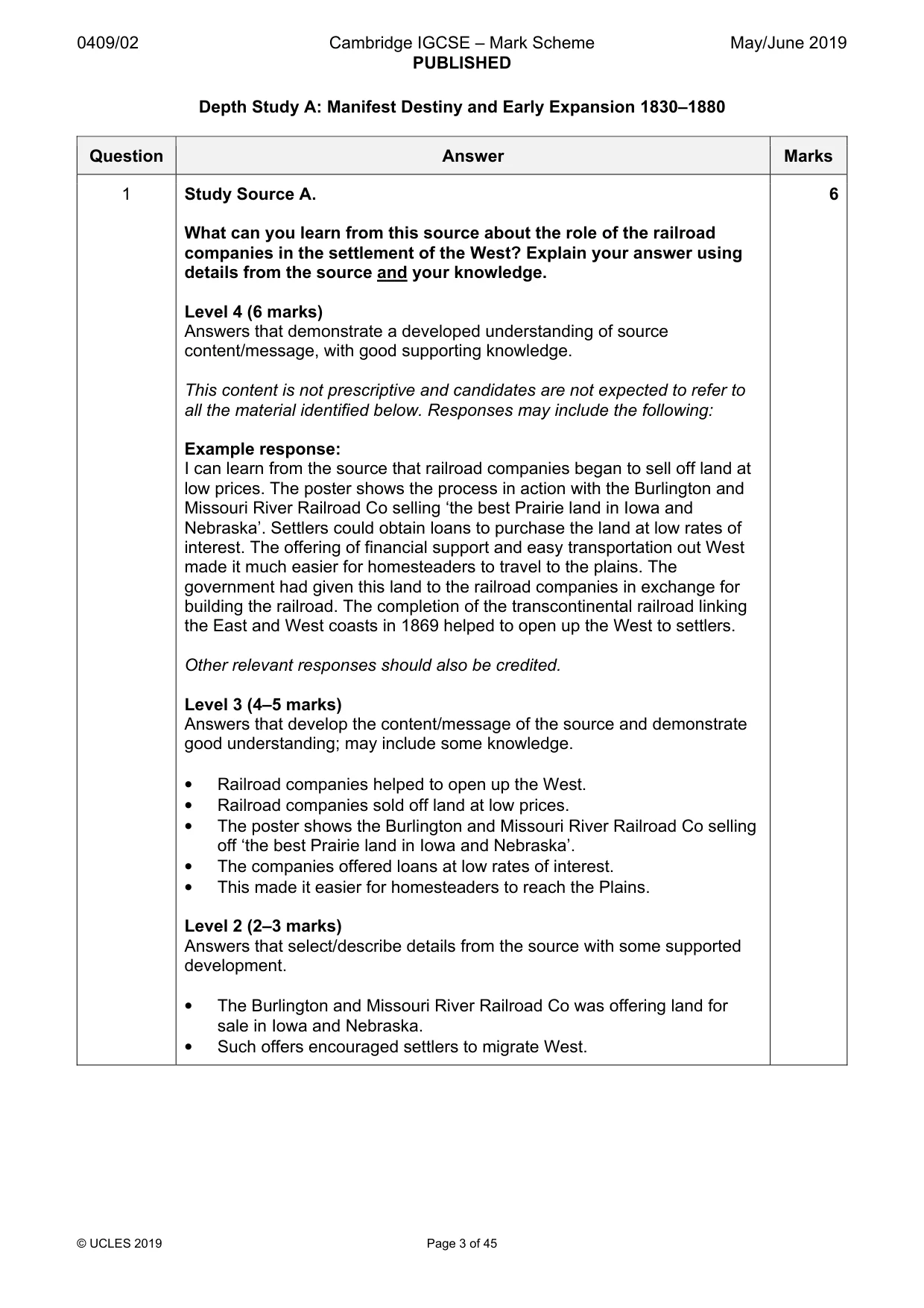
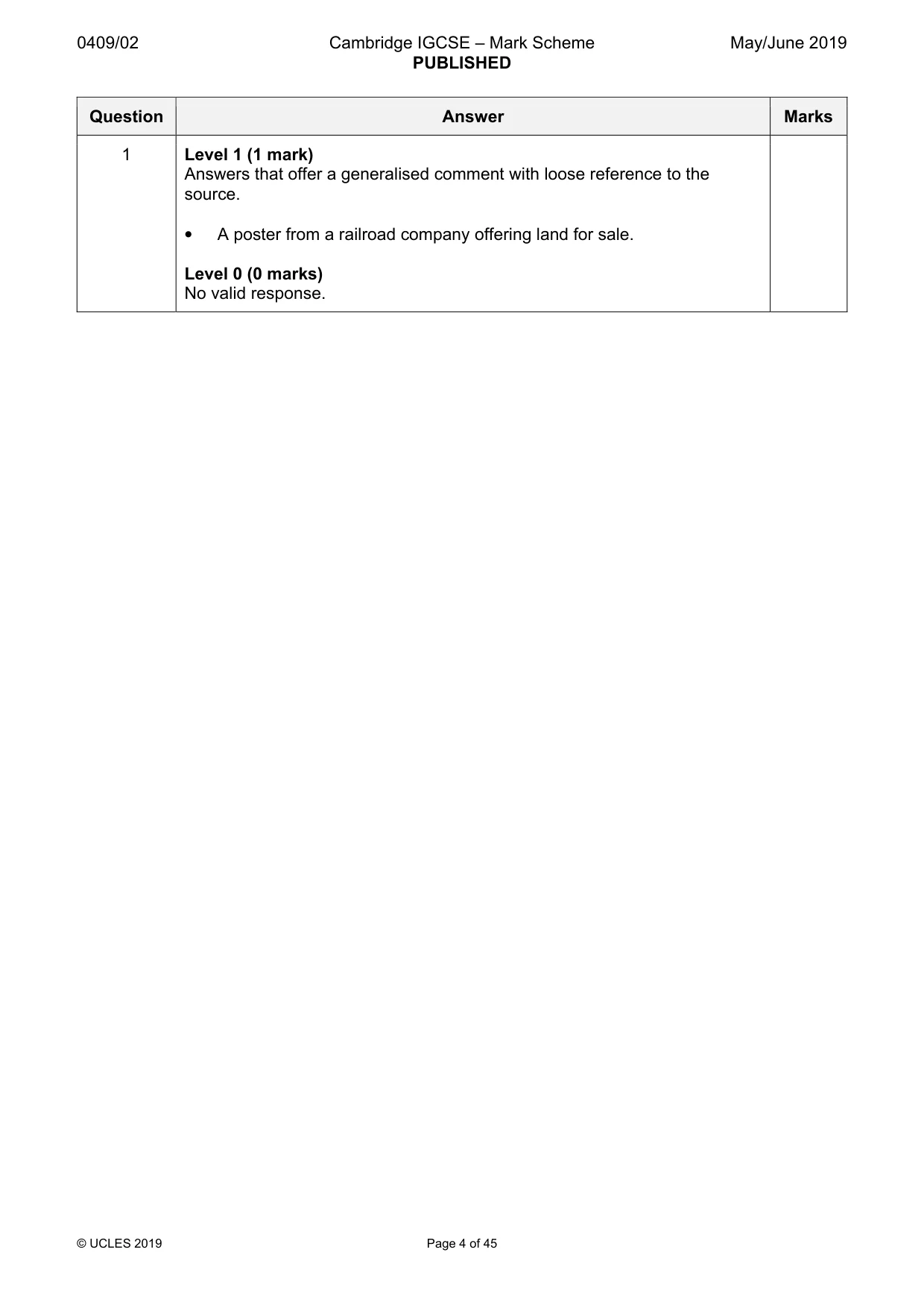
Mark scheme: Question Answer Marks 1 Study Source A. 6 What can you learn from this source about the role of the railroad companies in the settlement of the West? Explain your answer using details from the source and your knowledge. Level 4 (6 marks) Answers that demonstrate a developed understanding of source content/message, with good supporting knowledge. This content is not prescriptive and candidates are not expected to refer to all the material identified below. Responses may include the following: Example response: I can learn from the source that railroad companies began to sell off land at low prices. The poster shows the process in action with the Burlington and Missouri River Railroad Co selling ‘the best Prairie land in Iowa and Nebraska’. Settlers could obtain loans to purchase the land at low rates of interest. The offering of financial support and easy transportation out West made it much easier for homesteaders to travel to the plains. The government had given this land to the railroad companies in exchange for building the railroad. The completion of the transcontinental railroad linking the East and West coasts in 1869 helped to open up the West to settlers. Other relevant responses should also be credited. Level 3 (4–5 marks) Answers that develop the content/message of the source and demonstrate good understanding; may include some knowledge. • Railroad companies helped to open up the West. • Railroad companies sold off land at low prices. • The poster shows the Burlington and Missouri River Railroad Co selling off ‘the best Prairie land in Iowa and Nebraska’. • The companies offered loans at low rates of interest. • This made it easier for homesteaders to reach the Plains. Level 2 (2–3 marks) Answers that select/describe details from the source with some supported development. • The Burlington and Missouri River Railroad Co was offering land for sale in Iowa and Nebraska. • Such offers encouraged settlers to migrate West. 1 Level 1 (1 mark) Answers that offer a generalised comment with loose reference to the source. • A poster from a railroad company offering land for sale. Level 0 (0 marks) No valid response.
Question 2
2 Study Source B. How useful is this source to a historian studying the reasons why some settlers followed the trail to Oregon in the 1840s? Explain your answer using details from the source and your knowledge. [7]
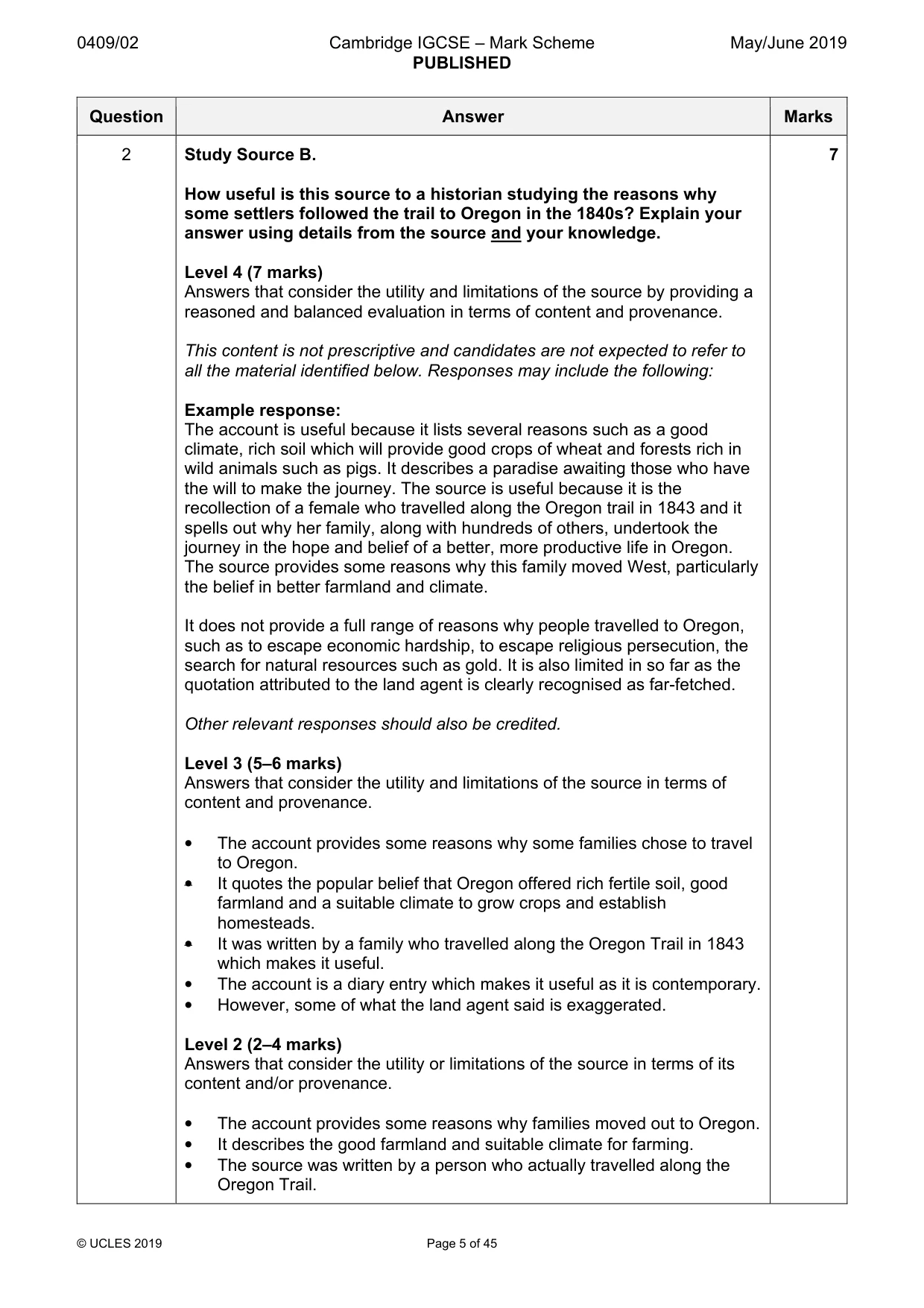
Mark scheme: 2 Study Source B. 7 How useful is this source to a historian studying the reasons why some settlers followed the trail to Oregon in the 1840s? Explain your answer using details from the source and your knowledge. Level 4 (7 marks) Answers that consider the utility and limitations of the source by providing a reasoned and balanced evaluation in terms of content and provenance. This content is not prescriptive and candidates are not expected to refer to all the material identified below. Responses may include the following: Example response: The account is useful because it lists several reasons such as a good climate, rich soil which will provide good crops of wheat and forests rich in wild animals such as pigs. It describes a paradise awaiting those who have the will to make the journey. The source is useful because it is the recollection of a female who travelled along the Oregon trail in 1843 and it spells out why her family, along with hundreds of others, undertook the journey in the hope and belief of a better, more productive life in Oregon. The source provides some reasons why this family moved West, particularly the belief in better farmland and climate. It does not provide a full range of reasons why people travelled to Oregon, such as to escape economic hardship, to escape religious persecution, the search for natural resources such as gold. It is also limited in so far as the quotation attributed to the land agent is clearly recognised as far-fetched. Other relevant responses should also be credited. Level 3 (5–6 marks) Answers that consider the utility and limitations of the source in terms of content and provenance. • The account provides some reasons why some families chose to travel to Oregon. • It quotes the popular belief that Oregon offered rich fertile soil, good farmland and a suitable climate to grow crops and establish homesteads. • It was written by a family who travelled along the Oregon Trail in 1843 which makes it useful. • The account is a diary entry which makes it useful as it is contemporary. • However, some of what the land agent said is exaggerated. Level 2 (2–4 marks) Answers that consider the utility or limitations of the source in terms of its content and/or provenance. • The account provides some reasons why families moved out to Oregon. • It describes the good farmland and suitable climate for farming. • The source was written by a person who actually travelled along the Oregon Trail. 2 Level 1 (1 mark) Answers that offer a generalised comment or paraphrase source content. • It shows that Oregon had good farmland. Level 0 (0 marks) No valid response.
Question 3
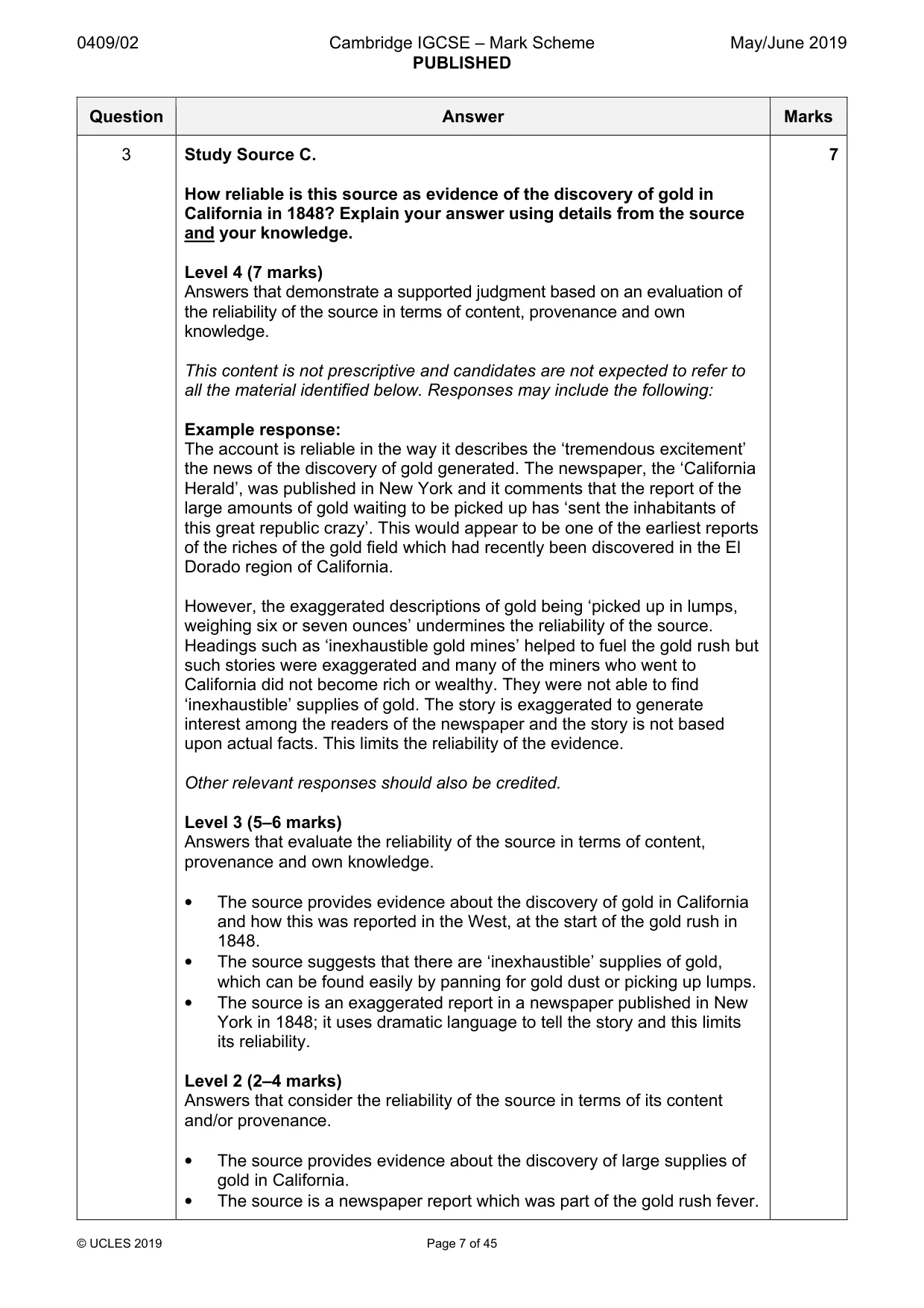
3 Study Source C. How reliable is this source as evidence of the discovery of gold in California in 1848? Explain your answer using details from the source and your knowledge. [7]
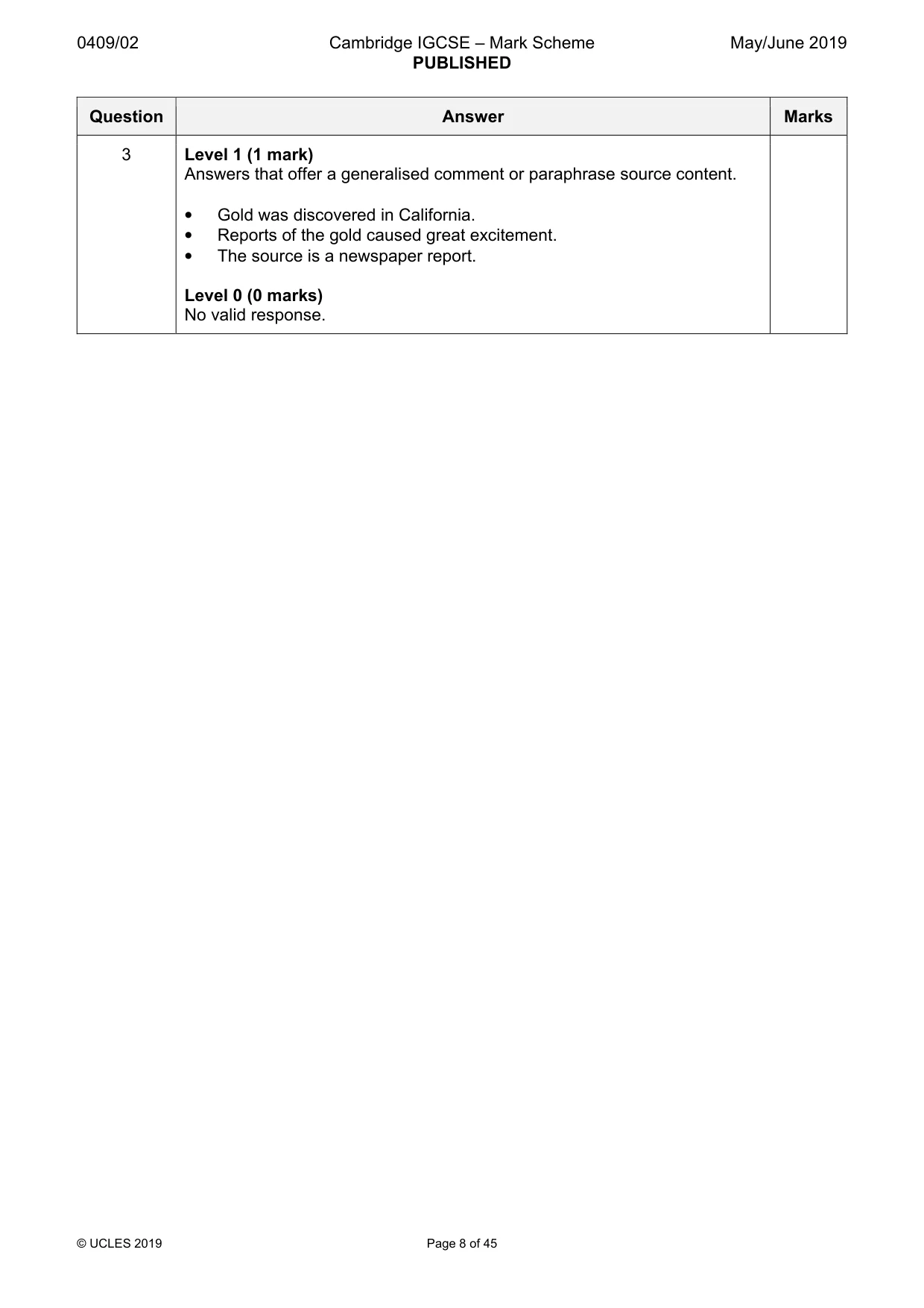
Mark scheme: 3 Study Source C. 7 How reliable is this source as evidence of the discovery of gold in California in 1848? Explain your answer using details from the source and your knowledge. Level 4 (7 marks) Answers that demonstrate a supported judgment based on an evaluation of the reliability of the source in terms of content, provenance and own knowledge. This content is not prescriptive and candidates are not expected to refer to all the material identified below. Responses may include the following: Example response: The account is reliable in the way it describes the ‘tremendous excitement’ the news of the discovery of gold generated. The newspaper, the ‘California Herald’, was published in New York and it comments that the report of the large amounts of gold waiting to be picked up has ‘sent the inhabitants of this great republic crazy’. This would appear to be one of the earliest reports of the riches of the gold field which had recently been discovered in the El Dorado region of California. However, the exaggerated descriptions of gold being ‘picked up in lumps, weighing six or seven ounces’ undermines the reliability of the source. Headings such as ‘inexhaustible gold mines’ helped to fuel the gold rush but such stories were exaggerated and many of the miners who went to California did not become rich or wealthy. They were not able to find ‘inexhaustible’ supplies of gold. The story is exaggerated to generate interest among the readers of the newspaper and the story is not based upon actual facts. This limits the reliability of the evidence. Other relevant responses should also be credited. Level 3 (5–6 marks) Answers that evaluate the reliability of the source in terms of content, provenance and own knowledge. • The source provides evidence about the discovery of gold in California and how this was reported in the West, at the start of the gold rush in 1848. • The source suggests that there are ‘inexhaustible’ supplies of gold, which can be found easily by panning for gold dust or picking up lumps. • The source is an exaggerated report in a newspaper published in New York in 1848; it uses dramatic language to tell the story and this limits its reliability. Level 2 (2–4 marks) Answers that consider the reliability of the source in terms of its content and/or provenance. • The source provides evidence about the discovery of large supplies of gold in California. • The source is a newspaper report which was part of the gold rush fever. 3 Level 1 (1 mark) Answers that offer a generalised comment or paraphrase source content. • Gold was discovered in California. • Reports of the gold caused great excitement. • The source is a newspaper report. Level 0 (0 marks) No valid response.
Q4 · Study Sources D and E
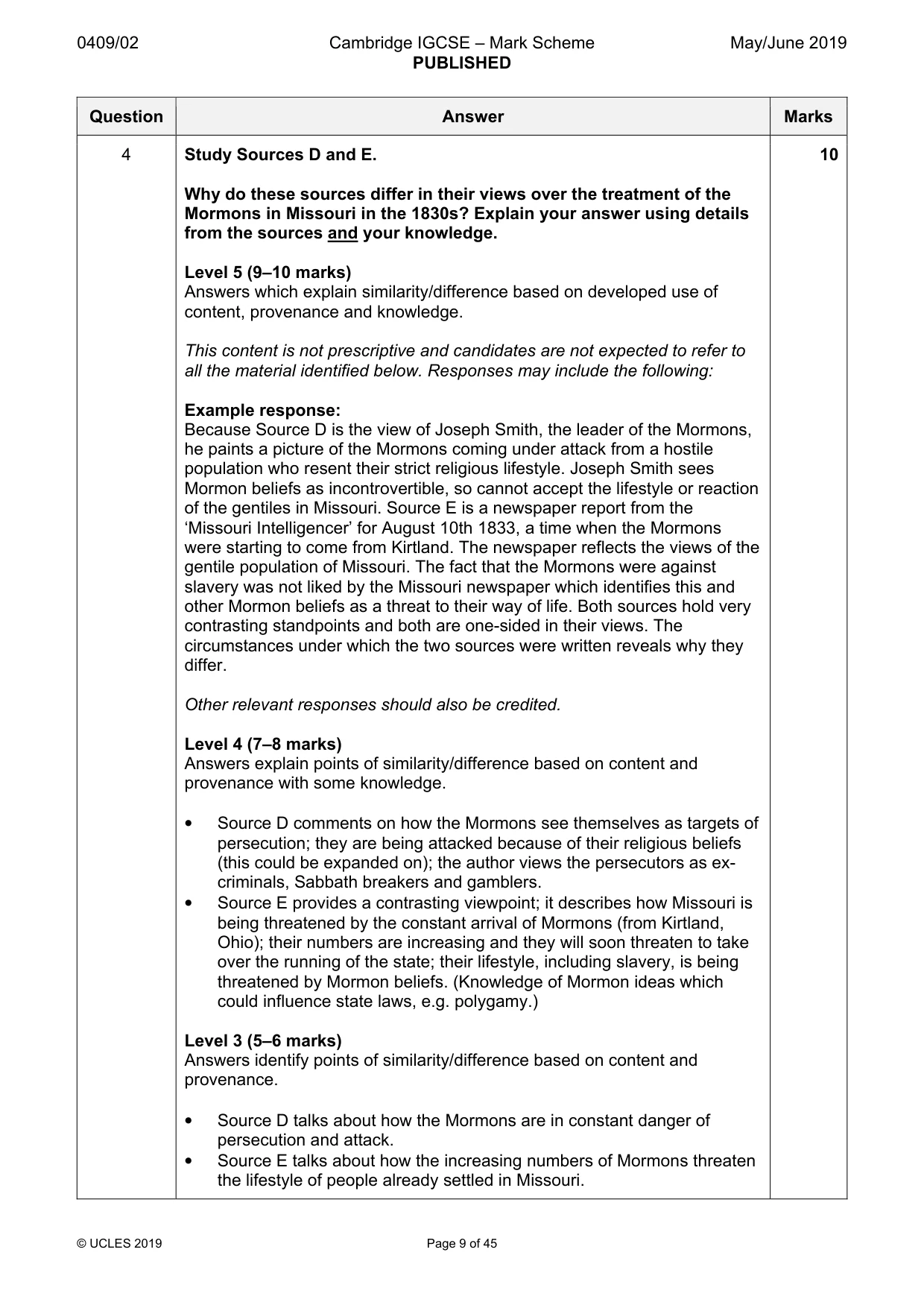
4 Study Sources D and E. Why do these sources differ in their views over the treatment of the Mormons in Missouri in the 1830s? Explain your answer using details from the sources and your knowledge. [10]
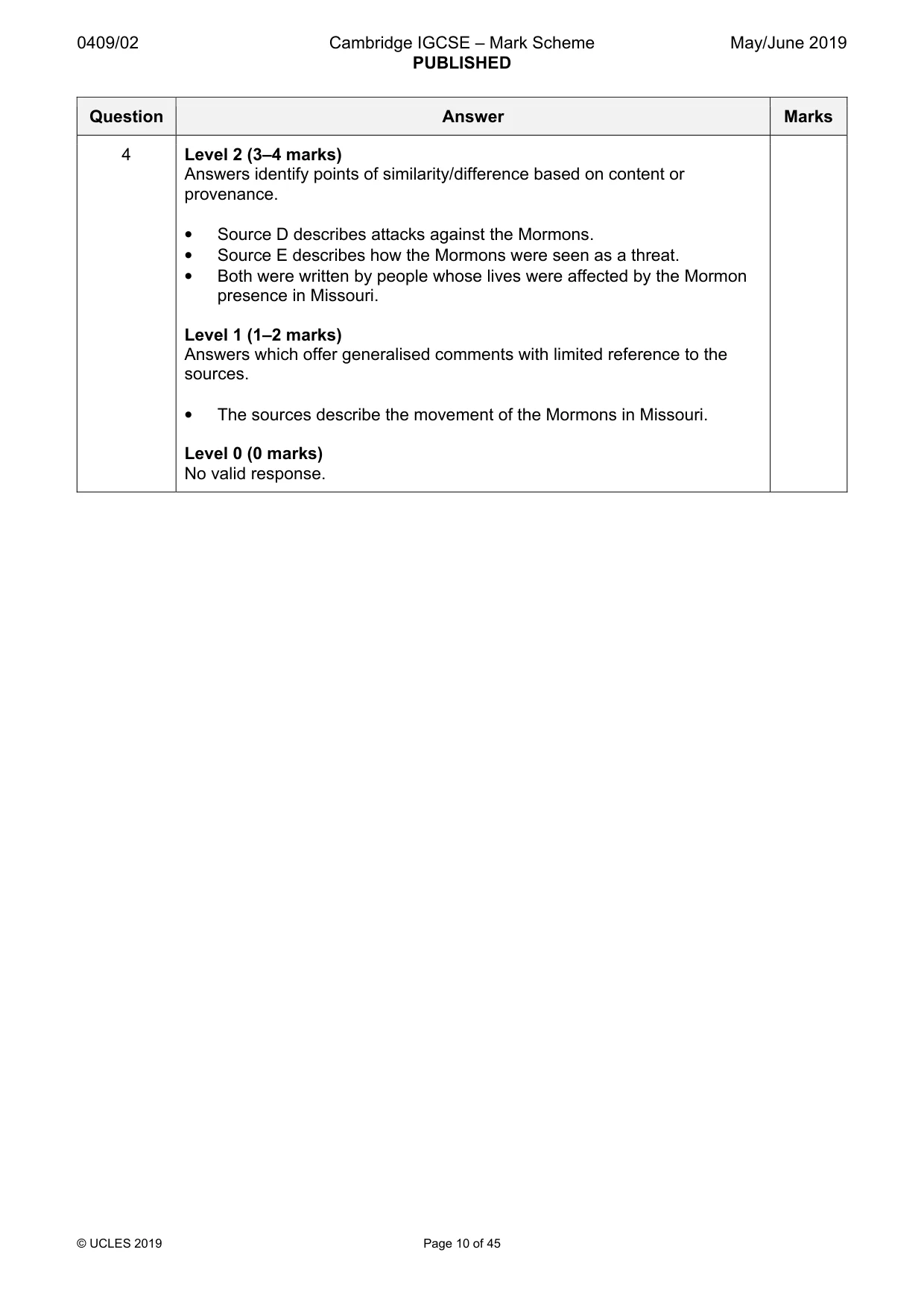
Mark scheme: 4 Study Sources D and E. 10 Why do these sources differ in their views over the treatment of the Mormons in Missouri in the 1830s? Explain your answer using details from the sources and your knowledge. Level 5 (9–10 marks) Answers which explain similarity/difference based on developed use of content, provenance and knowledge. This content is not prescriptive and candidates are not expected to refer to all the material identified below. Responses may include the following: Example response: Because Source D is the view of Joseph Smith, the leader of the Mormons, he paints a picture of the Mormons coming under attack from a hostile population who resent their strict religious lifestyle. Joseph Smith sees Mormon beliefs as incontrovertible, so cannot accept the lifestyle or reaction of the gentiles in Missouri. Source E is a newspaper report from the ‘Missouri Intelligencer’ for August 10th 1833, a time when the Mormons were starting to come from Kirtland. The newspaper reflects the views of the gentile population of Missouri. The fact that the Mormons were against slavery was not liked by the Missouri newspaper which identifies this and other Mormon beliefs as a threat to their way of life. Both sources hold very contrasting standpoints and both are one-sided in their views. The circumstances under which the two sources were written reveals why they differ. Other relevant responses should also be credited. Level 4 (7–8 marks) Answers explain points of similarity/difference based on content and provenance with some knowledge. • Source D comments on how the Mormons see themselves as targets of persecution; they are being attacked because of their religious beliefs (this could be expanded on); the author views the persecutors as ex- criminals, Sabbath breakers and gamblers. • Source E provides a contrasting viewpoint; it describes how Missouri is being threatened by the constant arrival of Mormons (from Kirtland, Ohio); their numbers are increasing and they will soon threaten to take over the running of the state; their lifestyle, including slavery, is being threatened by Mormon beliefs. (Knowledge of Mormon ideas which could influence state laws, e.g. polygamy.) Level 3 (5–6 marks) Answers identify points of similarity/difference based on content and provenance. • Source D talks about how the Mormons are in constant danger of persecution and attack. • Source E talks about how the increasing numbers of Mormons threaten the lifestyle of people already settled in Missouri. 4 Level 2 (3–4 marks) Answers identify points of similarity/difference based on content or provenance. • Source D describes attacks against the Mormons. • Source E describes how the Mormons were seen as a threat. • Both were written by people whose lives were affected by the Mormon presence in Missouri. Level 1 (1–2 marks) Answers which offer generalised comments with limited reference to the sources. • The sources describe the movement of the Mormons in Missouri. Level 0 (0 marks) No valid response.
Q5 · Study all the sources
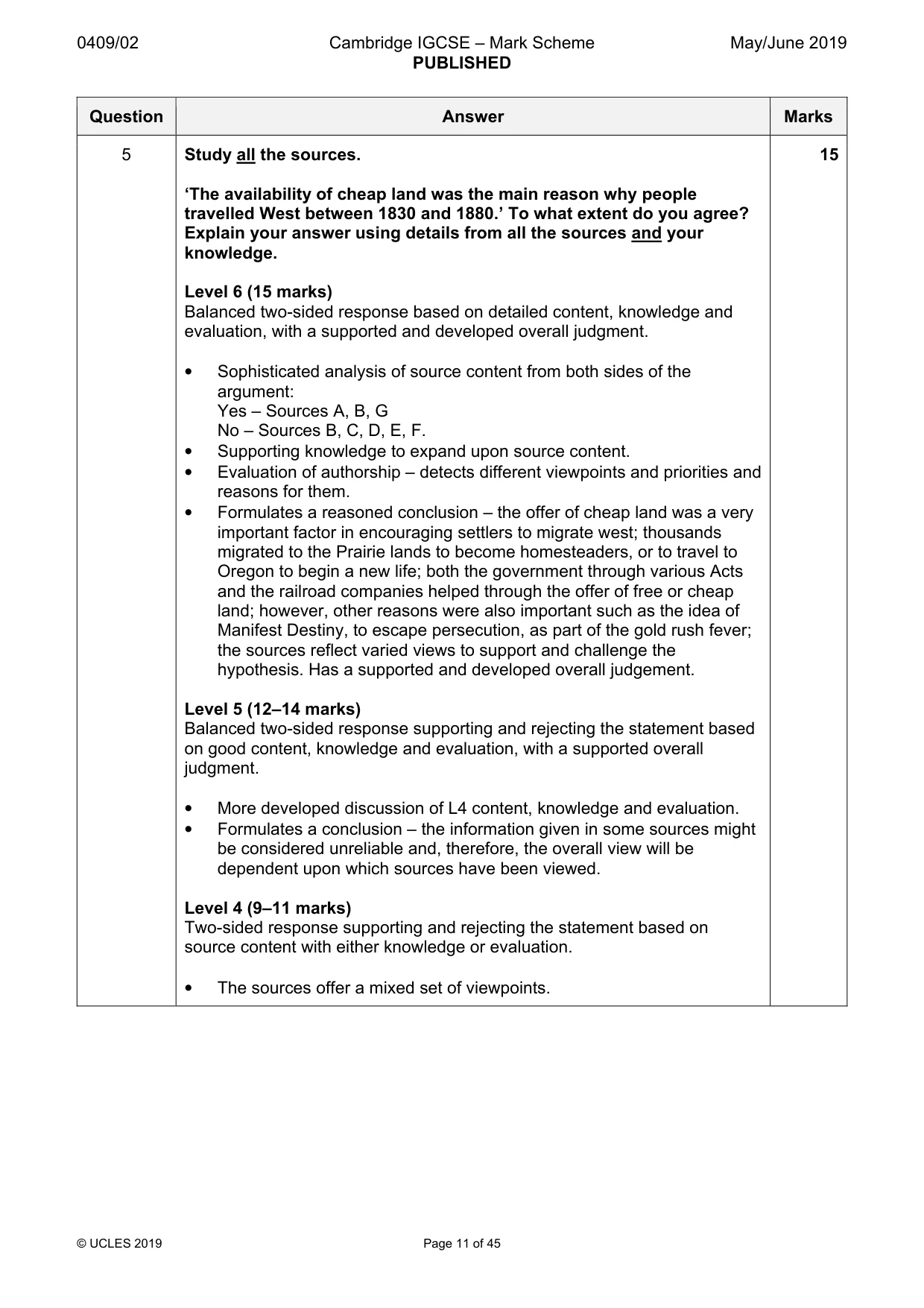
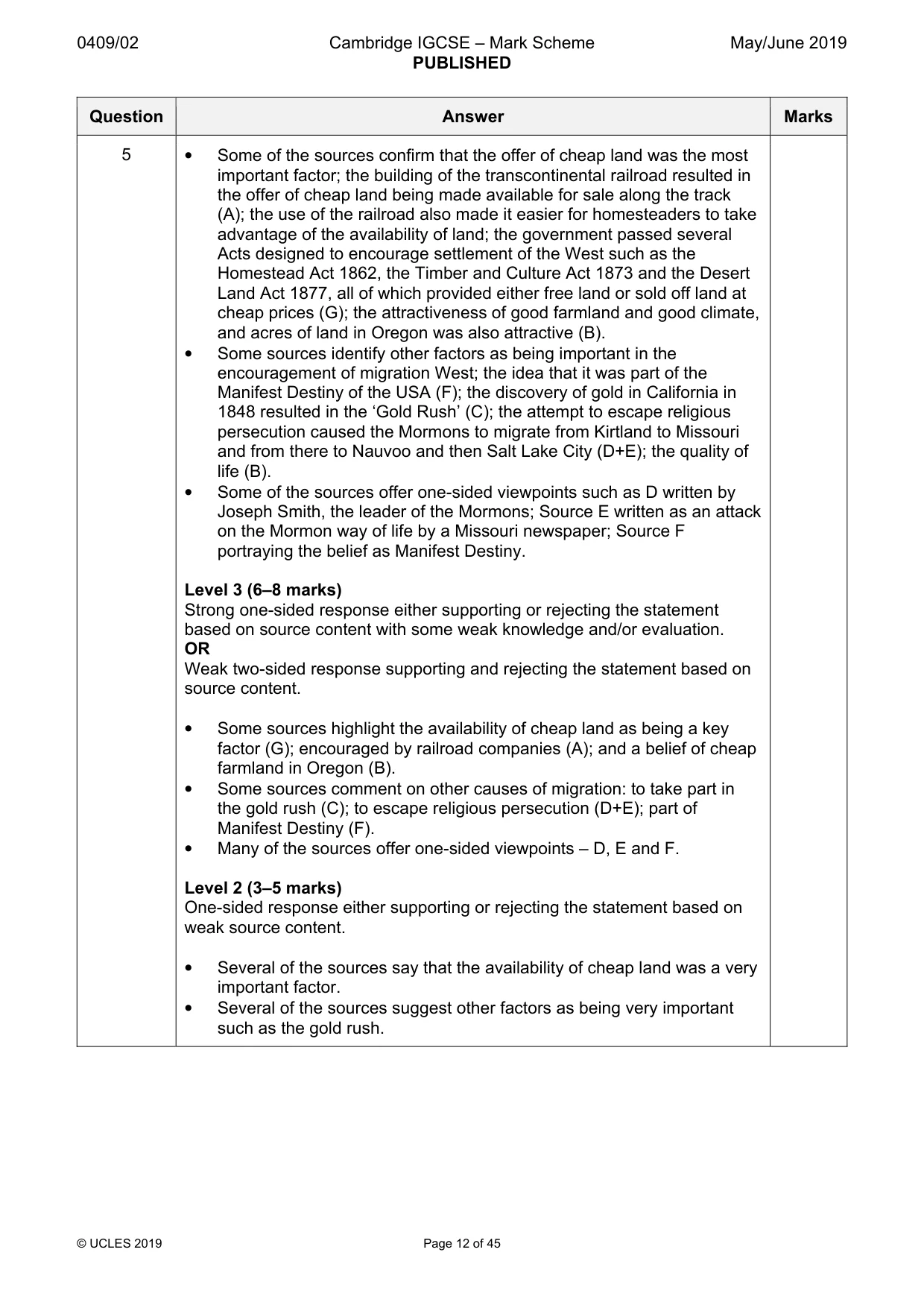
5 Study all the sources. “The availability of cheap land was the main reason why people traveled West between 1830 and 1880.” To what extent do you agree? Explain your answer using details from all the sources and your knowledge. [15] [Total: 45] Depth Study B: The Women’s Suffrage Movement 1866–1920 Read the background information and then answer all the questions. Use your knowledge of the topic to help you interpret and evaluate the sources, as appropriate. Background Information The campaign for women’s suffrage continued to be fought but met with only mixed success during the period from 1866 to 1890.
Mark scheme: 5 Study all the sources. 15 ‘The availability of cheap land was the main reason why people travelled West between 1830 and 1880.’ To what extent do you agree? Explain your answer using details from all the sources and your knowledge. Level 6 (15 marks) Balanced two-sided response based on detailed content, knowledge and evaluation, with a supported and developed overall judgment. • Sophisticated analysis of source content from both sides of the argument: Yes – Sources A, B, G No – Sources B, C, D, E, F. • Supporting knowledge to expand upon source content. • Evaluation of authorship – detects different viewpoints and priorities and reasons for them. • Formulates a reasoned conclusion – the offer of cheap land was a very important factor in encouraging settlers to migrate west; thousands migrated to the Prairie lands to become homesteaders, or to travel to Oregon to begin a new life; both the government through various Acts and the railroad companies helped through the offer of free or cheap land; however, other reasons were also important such as the idea of Manifest Destiny, to escape persecution, as part of the gold rush fever; the sources reflect varied views to support and challenge the hypothesis. Has a supported and developed overall judgement. Level 5 (12–14 marks) Balanced two-sided response supporting and rejecting the statement based on good content, knowledge and evaluation, with a supported overall judgment. • More developed discussion of L4 content, knowledge and evaluation. • Formulates a conclusion – the information given in some sources might be considered unreliable and, therefore, the overall view will be dependent upon which sources have been viewed. Level 4 (9–11 marks) Two-sided response supporting and rejecting the statement based on source content with either knowledge or evaluation. • The sources offer a mixed set of viewpoints. 5 • Some of the sources confirm that the offer of cheap land was the most important factor; the building of the transcontinental railroad resulted in the offer of cheap land being made available for sale along the track (A); the use of the railroad also made it easier for homesteaders to take advantage of the availability of land; the government passed several Acts designed to encourage settlement of the West such as the Homestead Act 1862, the Timber and Culture Act 1873 and the Desert Land Act 1877, all of which provided either free land or sold off land at cheap prices (G); the attractiveness of good farmland and good climate, and acres of land in Oregon was also attractive (B). • Some sources identify other factors as being important in the encouragement of migration West; the idea that it was part of the Manifest Destiny of the USA (F); the discovery of gold in California in 1848 resulted in the ‘Gold Rush’ (C); the attempt to escape religious persecution caused the Mormons to migrate from Kirtland to Missouri and from there to Nauvoo and then Salt Lake City (D+E); the quality of life (B). • Some of the sources offer one-sided viewpoints such as D written by Joseph Smith, the leader of the Mormons; Source E written as an attack on the Mormon way of life by a Missouri newspaper; Source F portraying the belief as Manifest Destiny. Level 3 (6–8 marks) Strong one-sided response either supporting or rejecting the statement based on source content with some weak knowledge and/or evaluation. OR Weak two-sided response supporting and rejecting the statement based on source content. • Some sources highlight the availability of cheap land as being a key factor (G); encouraged by railroad companies (A); and a belief of cheap farmland in Oregon (B). • Some sources comment on other causes of migration: to take part in the gold rush (C); to escape religious persecution (D+E); part of Manifest Destiny (F). • Many of the sources offer one-sided viewpoints – D, E and F. Level 2 (3–5 marks) One-sided response either supporting or rejecting the statement based on weak source content. • Several of the sources say that the availability of cheap land was a very important factor. • Several of the sources suggest other factors as being very important such as the gold rush. 5 Level 1 (1–2 marks) Generalised comments with little/no support from the sources. • The offer of cheap land was important. • Many reasons caused people to move West. Level 0 (0 marks) No valid response. Depth Study B: The Women’s Suffrage Movement 1866–1920
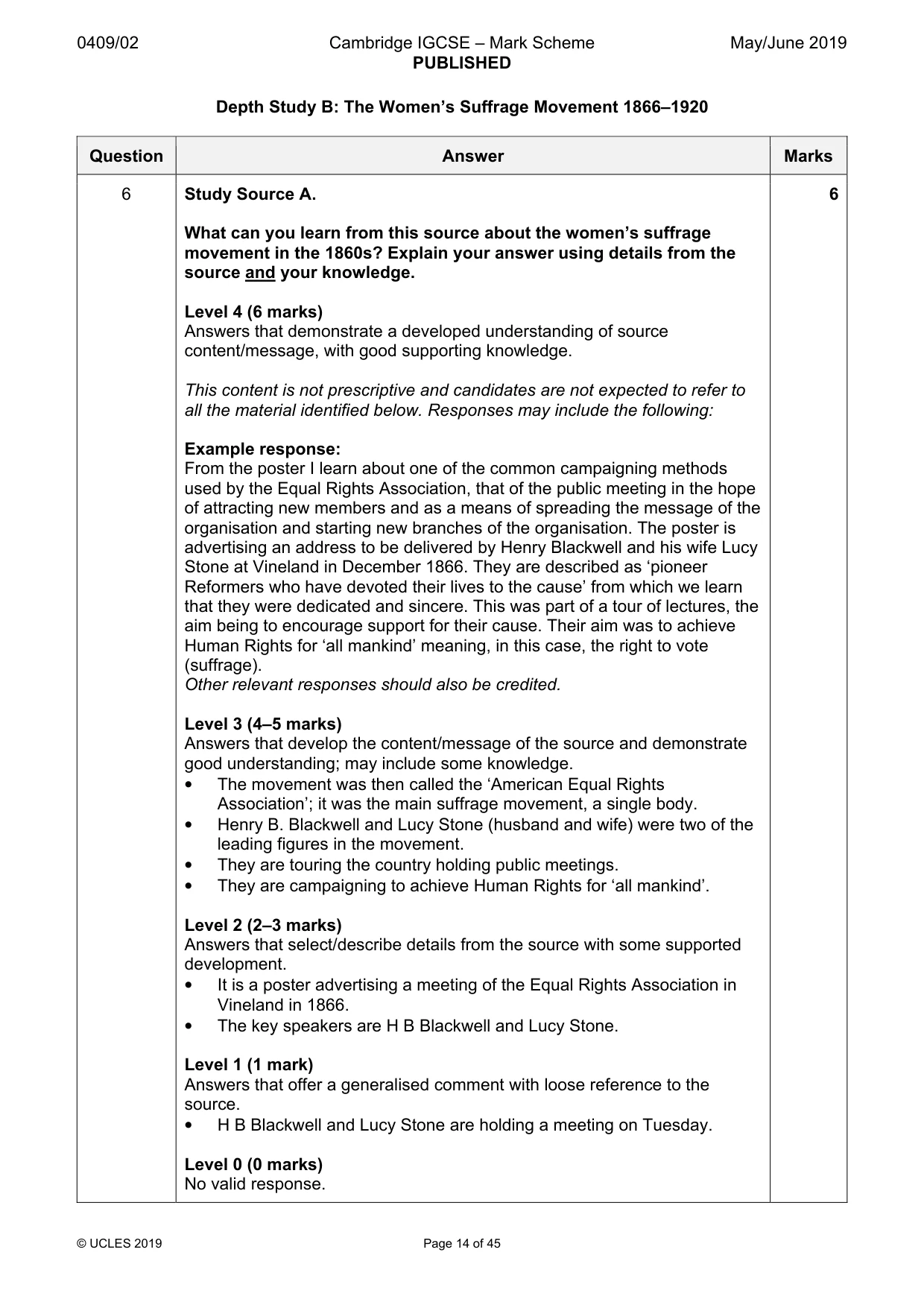
Question 6
6 Study Source A. What can you learn from this source about the women’s suffrage movement in the 1860s? Explain your answer using details from the source and your knowledge. [6]
Mark scheme: 6 Study Source A. 6 What can you learn from this source about the women’s suffrage movement in the 1860s? Explain your answer using details from the source and your knowledge. Level 4 (6 marks) Answers that demonstrate a developed understanding of source content/message, with good supporting knowledge. This content is not prescriptive and candidates are not expected to refer to all the material identified below. Responses may include the following: Example response: From the poster I learn about one of the common campaigning methods used by the Equal Rights Association, that of the public meeting in the hope of attracting new members and as a means of spreading the message of the organisation and starting new branches of the organisation. The poster is advertising an address to be delivered by Henry Blackwell and his wife Lucy Stone at Vineland in December 1866. They are described as ‘pioneer Reformers who have devoted their lives to the cause’ from which we learn that they were dedicated and sincere. This was part of a tour of lectures, the aim being to encourage support for their cause. Their aim was to achieve Human Rights for ‘all mankind’ meaning, in this case, the right to vote (suffrage). Other relevant responses should also be credited. Level 3 (4–5 marks) Answers that develop the content/message of the source and demonstrate good understanding; may include some knowledge. • The movement was then called the ‘American Equal Rights Association’; it was the main suffrage movement, a single body. • Henry B. Blackwell and Lucy Stone (husband and wife) were two of the leading figures in the movement. • They are touring the country holding public meetings. • They are campaigning to achieve Human Rights for ‘all mankind’. Level 2 (2–3 marks) Answers that select/describe details from the source with some supported development. • It is a poster advertising a meeting of the Equal Rights Association in Vineland in 1866. • The key speakers are H B Blackwell and Lucy Stone. Level 1 (1 mark) Answers that offer a generalised comment with loose reference to the source. • H B Blackwell and Lucy Stone are holding a meeting on Tuesday. Level 0 (0 marks) No valid response.
Question 7
7 Study Source B. How useful is this source to a historian studying the goals of the National Woman Suffrage Association? Explain your answer using details from the source and your knowledge. [7]
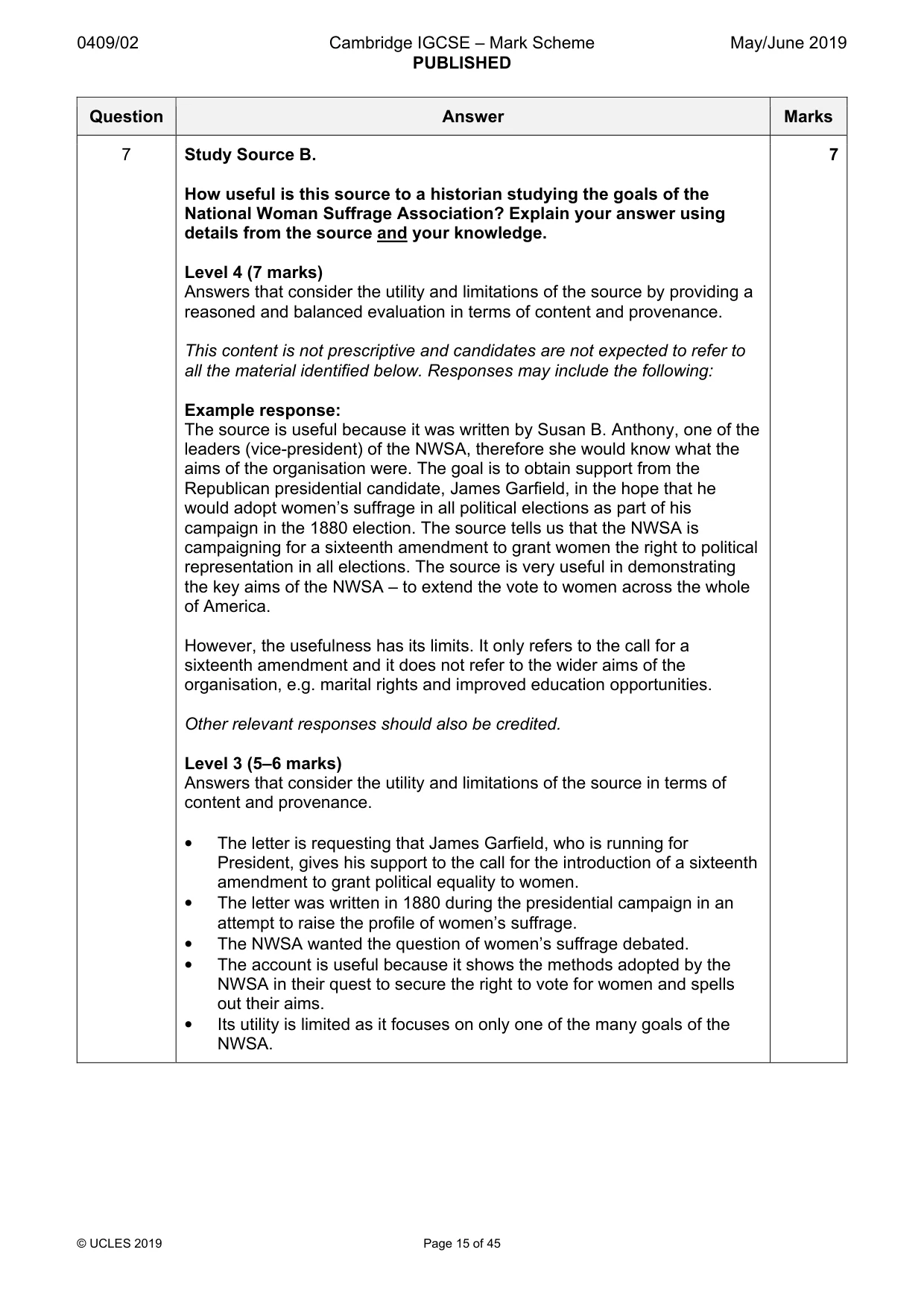
Mark scheme: 7 Study Source B. 7 How useful is this source to a historian studying the goals of the National Woman Suffrage Association? Explain your answer using details from the source and your knowledge. Level 4 (7 marks) Answers that consider the utility and limitations of the source by providing a reasoned and balanced evaluation in terms of content and provenance. This content is not prescriptive and candidates are not expected to refer to all the material identified below. Responses may include the following: Example response: The source is useful because it was written by Susan B. Anthony, one of the leaders (vice-president) of the NWSA, therefore she would know what the aims of the organisation were. The goal is to obtain support from the Republican presidential candidate, James Garfield, in the hope that he would adopt women’s suffrage in all political elections as part of his campaign in the 1880 election. The source tells us that the NWSA is campaigning for a sixteenth amendment to grant women the right to political representation in all elections. The source is very useful in demonstrating the key aims of the NWSA – to extend the vote to women across the whole of America. However, the usefulness has its limits. It only refers to the call for a sixteenth amendment and it does not refer to the wider aims of the organisation, e.g. marital rights and improved education opportunities. Other relevant responses should also be credited. Level 3 (5–6 marks) Answers that consider the utility and limitations of the source in terms of content and provenance. • The letter is requesting that James Garfield, who is running for President, gives his support to the call for the introduction of a sixteenth amendment to grant political equality to women. • The letter was written in 1880 during the presidential campaign in an attempt to raise the profile of women’s suffrage. • The NWSA wanted the question of women’s suffrage debated. • The account is useful because it shows the methods adopted by the NWSA in their quest to secure the right to vote for women and spells out their aims. • Its utility is limited as it focuses on only one of the many goals of the NWSA. 7 Level 2 (2–4 marks) Answers that consider the utility or limitations of the source in terms of its content and/or provenance. • The source is a letter written by Susan Anthony to the presidential candidate James Garfield, and is therefore useful. • It shows that the aim of the NWSA was to obtain the passing of a sixteenth amendment. Level 1 (1 mark) Answers that offer a generalised comment or paraphrase source content. • The aim was the sixteenth amendment. Level 0 (0 marks) No valid response.
Question 8
8 Study Source C. How reliable is this source as evidence of the beliefs of the National Woman Suffrage Association? Explain your answer using details from the source and your knowledge. [7]
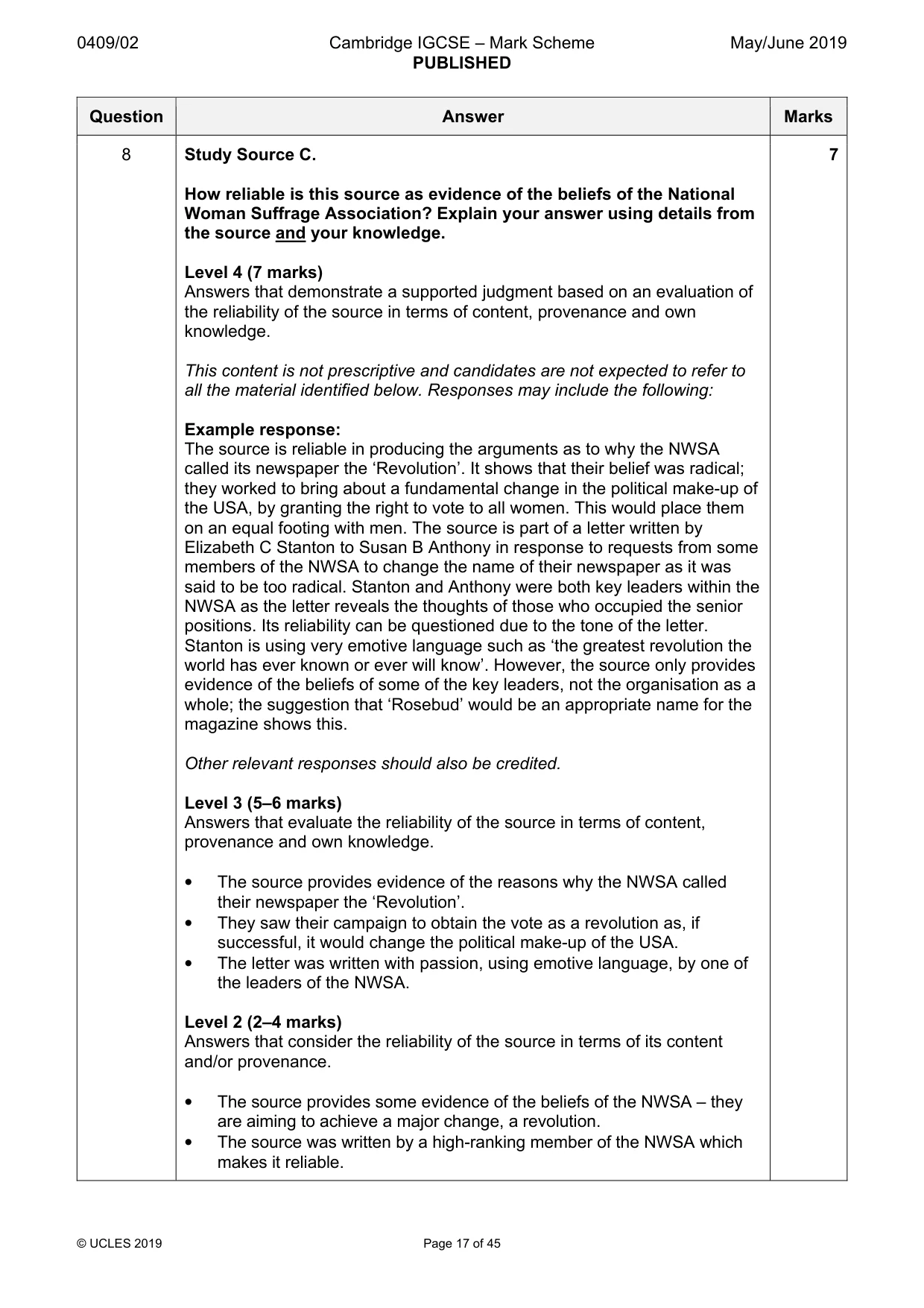
Mark scheme: 8 Study Source C. 7 How reliable is this source as evidence of the beliefs of the National Woman Suffrage Association? Explain your answer using details from the source and your knowledge. Level 4 (7 marks) Answers that demonstrate a supported judgment based on an evaluation of the reliability of the source in terms of content, provenance and own knowledge. This content is not prescriptive and candidates are not expected to refer to all the material identified below. Responses may include the following: Example response: The source is reliable in producing the arguments as to why the NWSA called its newspaper the ‘Revolution’. It shows that their belief was radical; they worked to bring about a fundamental change in the political make-up of the USA, by granting the right to vote to all women. This would place them on an equal footing with men. The source is part of a letter written by Elizabeth C Stanton to Susan B Anthony in response to requests from some members of the NWSA to change the name of their newspaper as it was said to be too radical. Stanton and Anthony were both key leaders within the NWSA as the letter reveals the thoughts of those who occupied the senior positions. Its reliability can be questioned due to the tone of the letter. Stanton is using very emotive language such as ‘the greatest revolution the world has ever known or ever will know’. However, the source only provides evidence of the beliefs of some of the key leaders, not the organisation as a whole; the suggestion that ‘Rosebud’ would be an appropriate name for the magazine shows this. Other relevant responses should also be credited. Level 3 (5–6 marks) Answers that evaluate the reliability of the source in terms of content, provenance and own knowledge. • The source provides evidence of the reasons why the NWSA called their newspaper the ‘Revolution’. • They saw their campaign to obtain the vote as a revolution as, if successful, it would change the political make-up of the USA. • The letter was written with passion, using emotive language, by one of the leaders of the NWSA. Level 2 (2–4 marks) Answers that consider the reliability of the source in terms of its content and/or provenance. • The source provides some evidence of the beliefs of the NWSA – they are aiming to achieve a major change, a revolution. • The source was written by a high-ranking member of the NWSA which makes it reliable. 8 Level 1 (1 mark) Answers that offer a generalised comment or paraphrase source content. • It is a letter from a member of NWSA. • It says they want change. Level 0 (0 marks) No valid response.
Q9 · Study Sources D and E
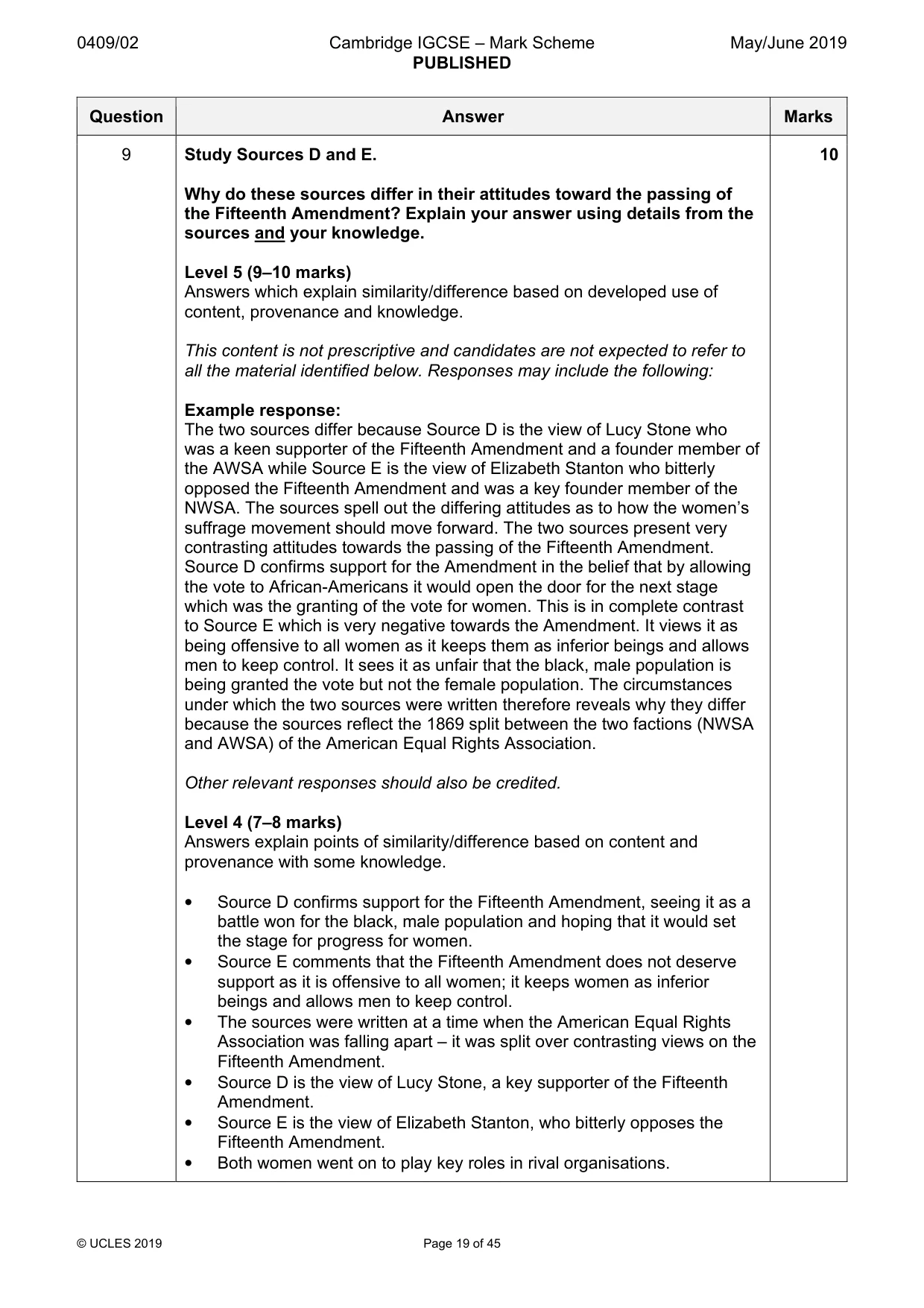
9 Study Sources D and E. Why do these sources differ in their attitudes toward the passing of the Fifteenth Amendment? Explain your answer using details from the sources and your knowledge. [10]
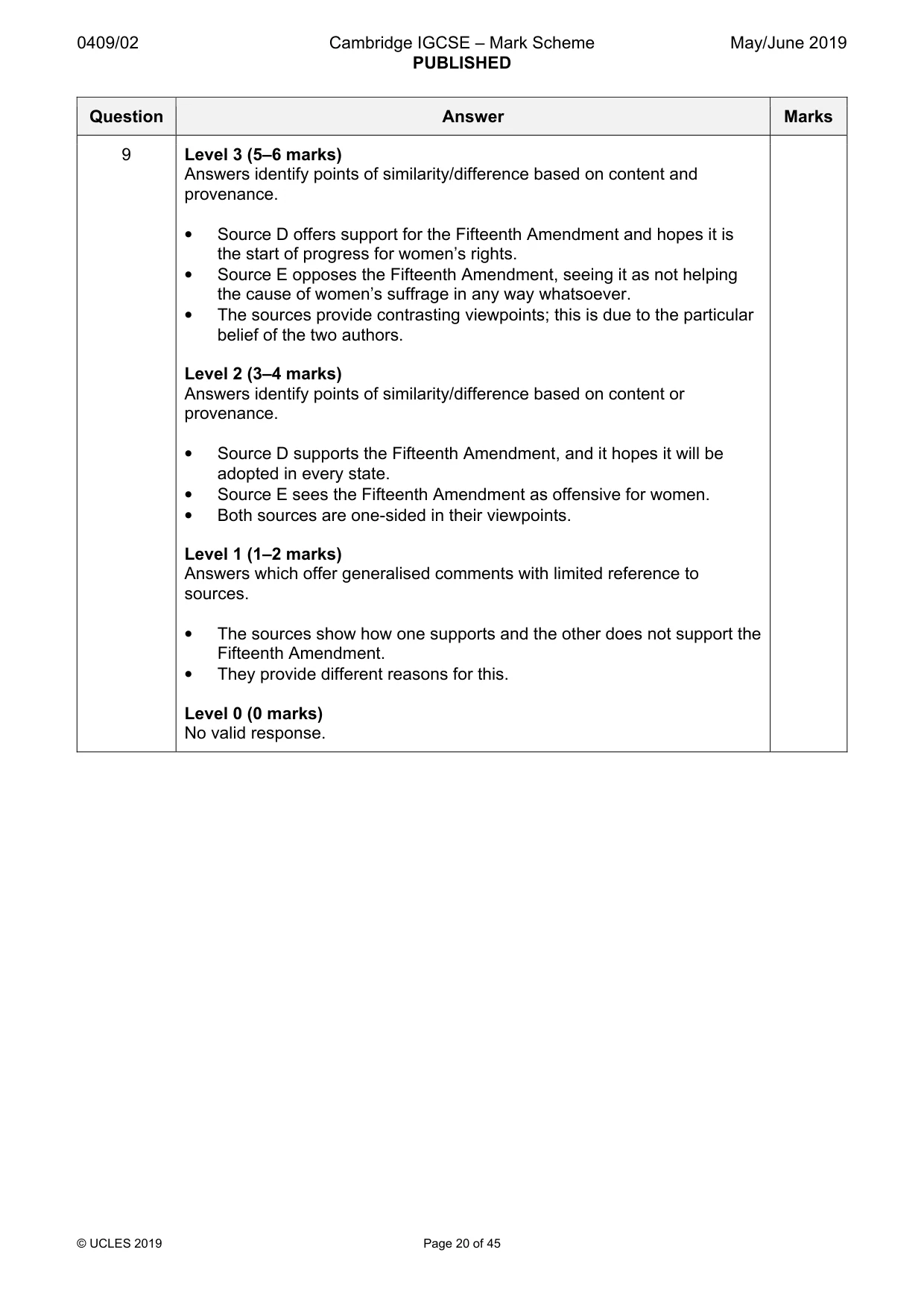
Mark scheme: 9 Study Sources D and E. 10 Why do these sources differ in their attitudes toward the passing of the Fifteenth Amendment? Explain your answer using details from the sources and your knowledge. Level 5 (9–10 marks) Answers which explain similarity/difference based on developed use of content, provenance and knowledge. This content is not prescriptive and candidates are not expected to refer to all the material identified below. Responses may include the following: Example response: The two sources differ because Source D is the view of Lucy Stone who was a keen supporter of the Fifteenth Amendment and a founder member of the AWSA while Source E is the view of Elizabeth Stanton who bitterly opposed the Fifteenth Amendment and was a key founder member of the NWSA. The sources spell out the differing attitudes as to how the women’s suffrage movement should move forward. The two sources present very contrasting attitudes towards the passing of the Fifteenth Amendment. Source D confirms support for the Amendment in the belief that by allowing the vote to African-Americans it would open the door for the next stage which was the granting of the vote for women. This is in complete contrast to Source E which is very negative towards the Amendment. It views it as being offensive to all women as it keeps them as inferior beings and allows men to keep control. It sees it as unfair that the black, male population is being granted the vote but not the female population. The circumstances under which the two sources were written therefore reveals why they differ because the sources reflect the 1869 split between the two factions (NWSA and AWSA) of the American Equal Rights Association. Other relevant responses should also be credited. Level 4 (7–8 marks) Answers explain points of similarity/difference based on content and provenance with some knowledge. • Source D confirms support for the Fifteenth Amendment, seeing it as a battle won for the black, male population and hoping that it would set the stage for progress for women. • Source E comments that the Fifteenth Amendment does not deserve support as it is offensive to all women; it keeps women as inferior beings and allows men to keep control. • The sources were written at a time when the American Equal Rights Association was falling apart – it was split over contrasting views on the Fifteenth Amendment. • Source D is the view of Lucy Stone, a key supporter of the Fifteenth Amendment. • Source E is the view of Elizabeth Stanton, who bitterly opposes the Fifteenth Amendment. • Both women went on to play key roles in rival organisations. 9 Level 3 (5–6 marks) Answers identify points of similarity/difference based on content and provenance. • Source D offers support for the Fifteenth Amendment and hopes it is the start of progress for women’s rights. • Source E opposes the Fifteenth Amendment, seeing it as not helping the cause of women’s suffrage in any way whatsoever. • The sources provide contrasting viewpoints; this is due to the particular belief of the two authors. Level 2 (3–4 marks) Answers identify points of similarity/difference based on content or provenance. • Source D supports the Fifteenth Amendment, and it hopes it will be adopted in every state. • Source E sees the Fifteenth Amendment as offensive for women. • Both sources are one-sided in their viewpoints. Level 1 (1–2 marks) Answers which offer generalised comments with limited reference to sources. • The sources show how one supports and the other does not support the Fifteenth Amendment. • They provide different reasons for this. Level 0 (0 marks) No valid response.
Q10 · Study all the sources
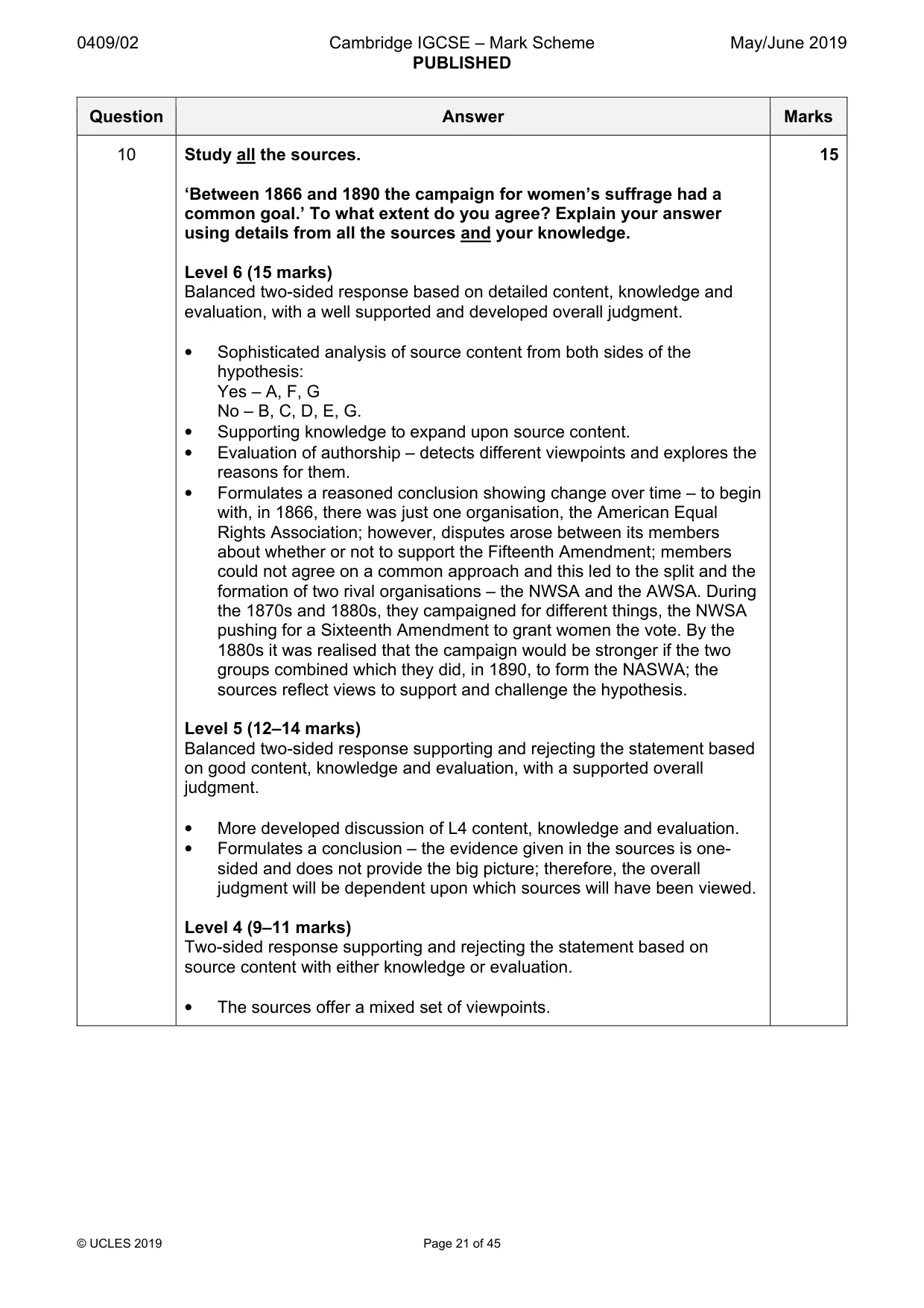
10 Study all the sources. “Between 1866 and 1890 the campaign for women’s suffrage had a common goal.” To what extent do you agree? Explain your answer using details from all the sources and your knowledge. [15] [Total: 45] Depth Study C: The United States and the World 1880–1917 Read the background information and then answer all the questions. Use your knowledge of the topic to help you interpret and evaluate the sources, as appropriate. Background Information During the late nineteenth century there were debates over the direction of US foreign policy. There were strong arguments put forward for expansion overseas but the reasons for that expansion varied.
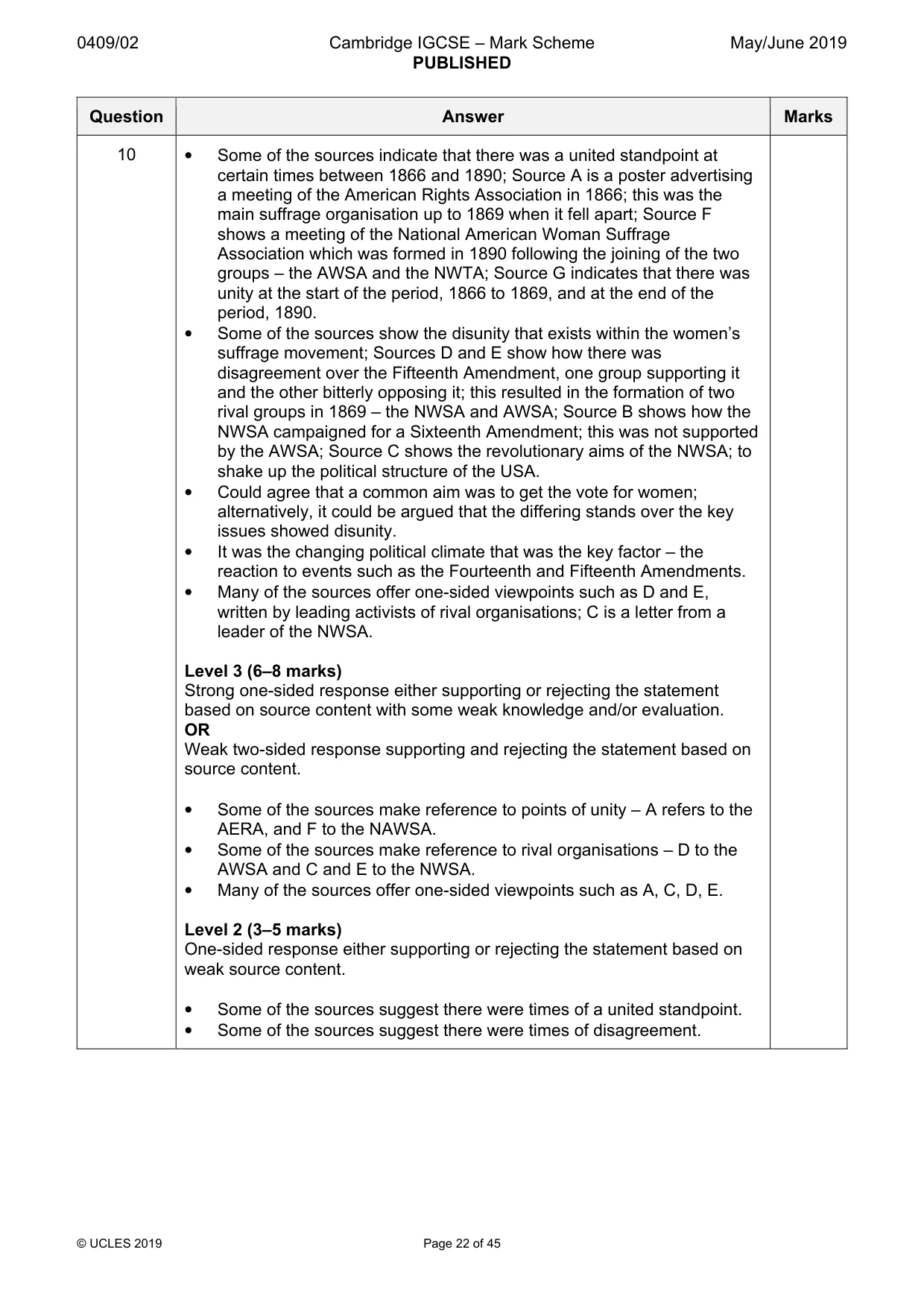
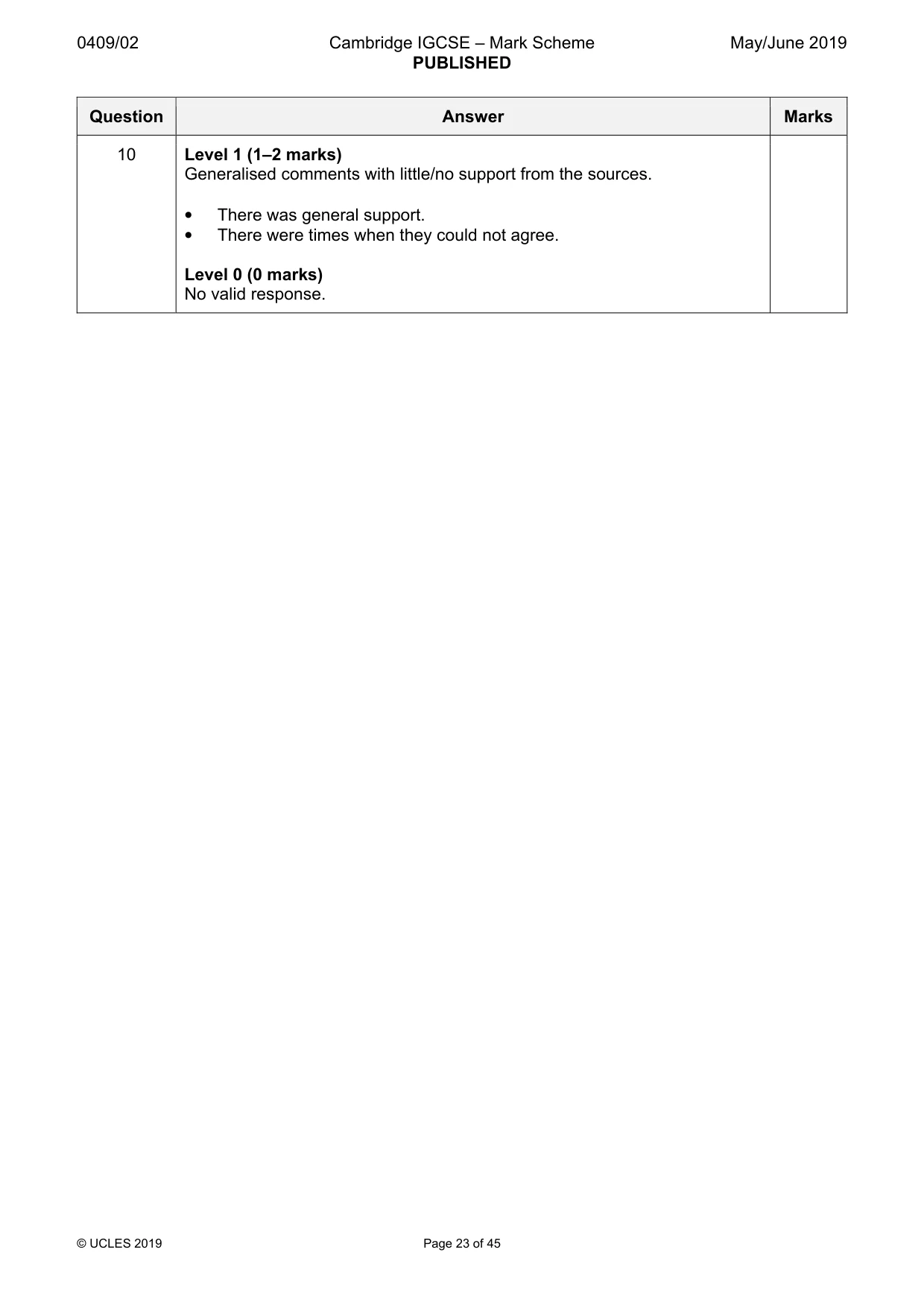
Mark scheme: 10 Study all the sources. 15 ‘Between 1866 and 1890 the campaign for women’s suffrage had a common goal.’ To what extent do you agree? Explain your answer using details from all the sources and your knowledge. Level 6 (15 marks) Balanced two-sided response based on detailed content, knowledge and evaluation, with a well supported and developed overall judgment. • Sophisticated analysis of source content from both sides of the hypothesis: Yes – A, F, G No – B, C, D, E, G. • Supporting knowledge to expand upon source content. • Evaluation of authorship – detects different viewpoints and explores the reasons for them. • Formulates a reasoned conclusion showing change over time – to begin with, in 1866, there was just one organisation, the American Equal Rights Association; however, disputes arose between its members about whether or not to support the Fifteenth Amendment; members could not agree on a common approach and this led to the split and the formation of two rival organisations – the NWSA and the AWSA. During the 1870s and 1880s, they campaigned for different things, the NWSA pushing for a Sixteenth Amendment to grant women the vote. By the 1880s it was realised that the campaign would be stronger if the two groups combined which they did, in 1890, to form the NASWA; the sources reflect views to support and challenge the hypothesis. Level 5 (12–14 marks) Balanced two-sided response supporting and rejecting the statement based on good content, knowledge and evaluation, with a supported overall judgment. • More developed discussion of L4 content, knowledge and evaluation. • Formulates a conclusion – the evidence given in the sources is one- sided and does not provide the big picture; therefore, the overall judgment will be dependent upon which sources will have been viewed. Level 4 (9–11 marks) Two-sided response supporting and rejecting the statement based on source content with either knowledge or evaluation. • The sources offer a mixed set of viewpoints. 10 • Some of the sources indicate that there was a united standpoint at certain times between 1866 and 1890; Source A is a poster advertising a meeting of the American Rights Association in 1866; this was the main suffrage organisation up to 1869 when it fell apart; Source F shows a meeting of the National American Woman Suffrage Association which was formed in 1890 following the joining of the two groups – the AWSA and the NWTA; Source G indicates that there was unity at the start of the period, 1866 to 1869, and at the end of the period, 1890. • Some of the sources show the disunity that exists within the women’s suffrage movement; Sources D and E show how there was disagreement over the Fifteenth Amendment, one group supporting it and the other bitterly opposing it; this resulted in the formation of two rival groups in 1869 – the NWSA and AWSA; Source B shows how the NWSA campaigned for a Sixteenth Amendment; this was not supported by the AWSA; Source C shows the revolutionary aims of the NWSA; to shake up the political structure of the USA. • Could agree that a common aim was to get the vote for women; alternatively, it could be argued that the differing stands over the key issues showed disunity. • It was the changing political climate that was the key factor – the reaction to events such as the Fourteenth and Fifteenth Amendments. • Many of the sources offer one-sided viewpoints such as D and E, written by leading activists of rival organisations; C is a letter from a leader of the NWSA. Level 3 (6–8 marks) Strong one-sided response either supporting or rejecting the statement based on source content with some weak knowledge and/or evaluation. OR Weak two-sided response supporting and rejecting the statement based on source content. • Some of the sources make reference to points of unity – A refers to the AERA, and F to the NAWSA. • Some of the sources make reference to rival organisations – D to the AWSA and C and E to the NWSA. • Many of the sources offer one-sided viewpoints such as A, C, D, E. Level 2 (3–5 marks) One-sided response either supporting or rejecting the statement based on weak source content. • Some of the sources suggest there were times of a united standpoint. • Some of the sources suggest there were times of disagreement. 10 Level 1 (1–2 marks) Generalised comments with little/no support from the sources. • There was general support. • There were times when they could not agree. Level 0 (0 marks) No valid response. Depth Study C: The United States and the World 1880–1917
Question 11
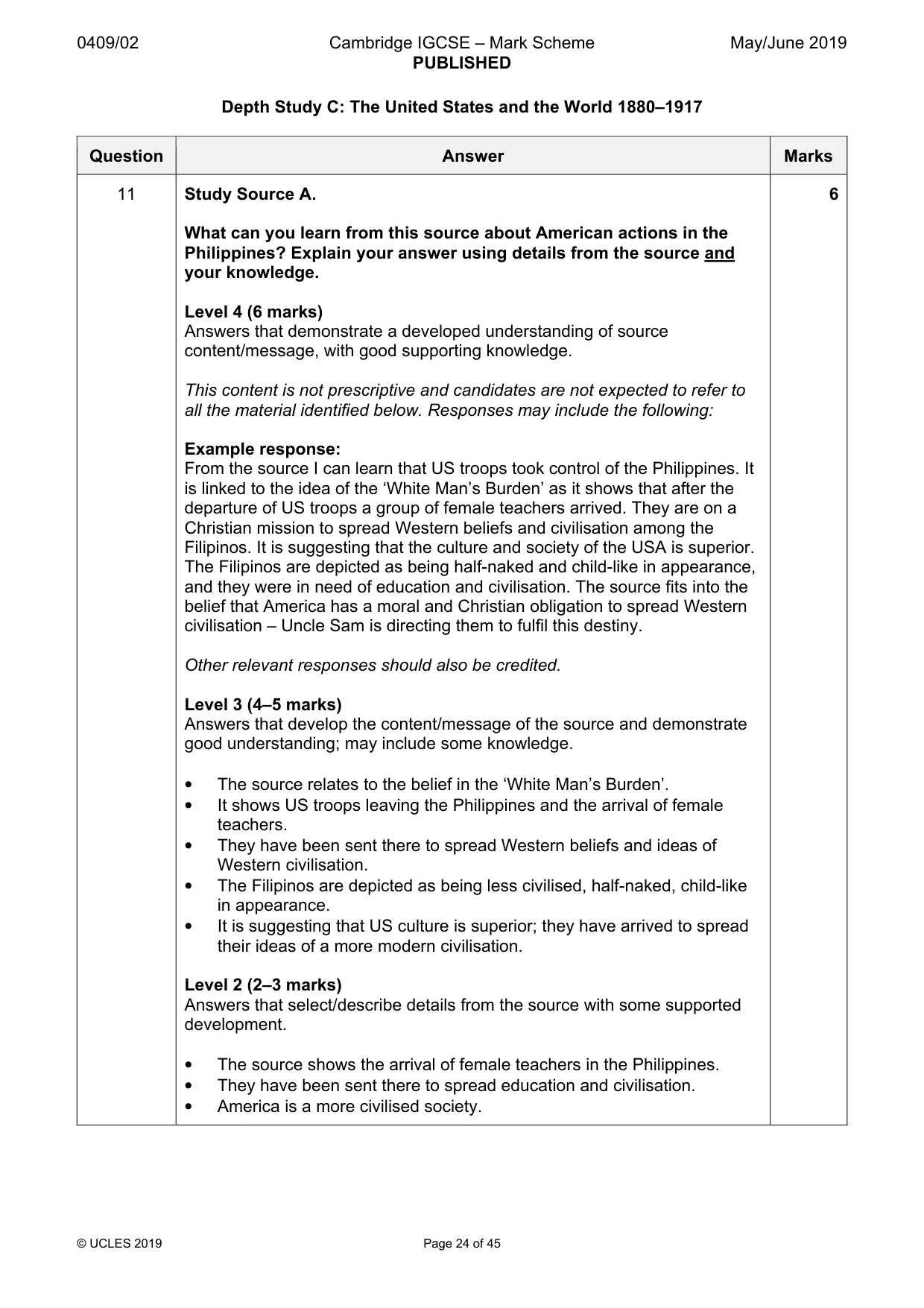
11 Study Source A. What can you learn from this source about American actions in the Philippines? Explain your answer using details from the source and your knowledge. [6]
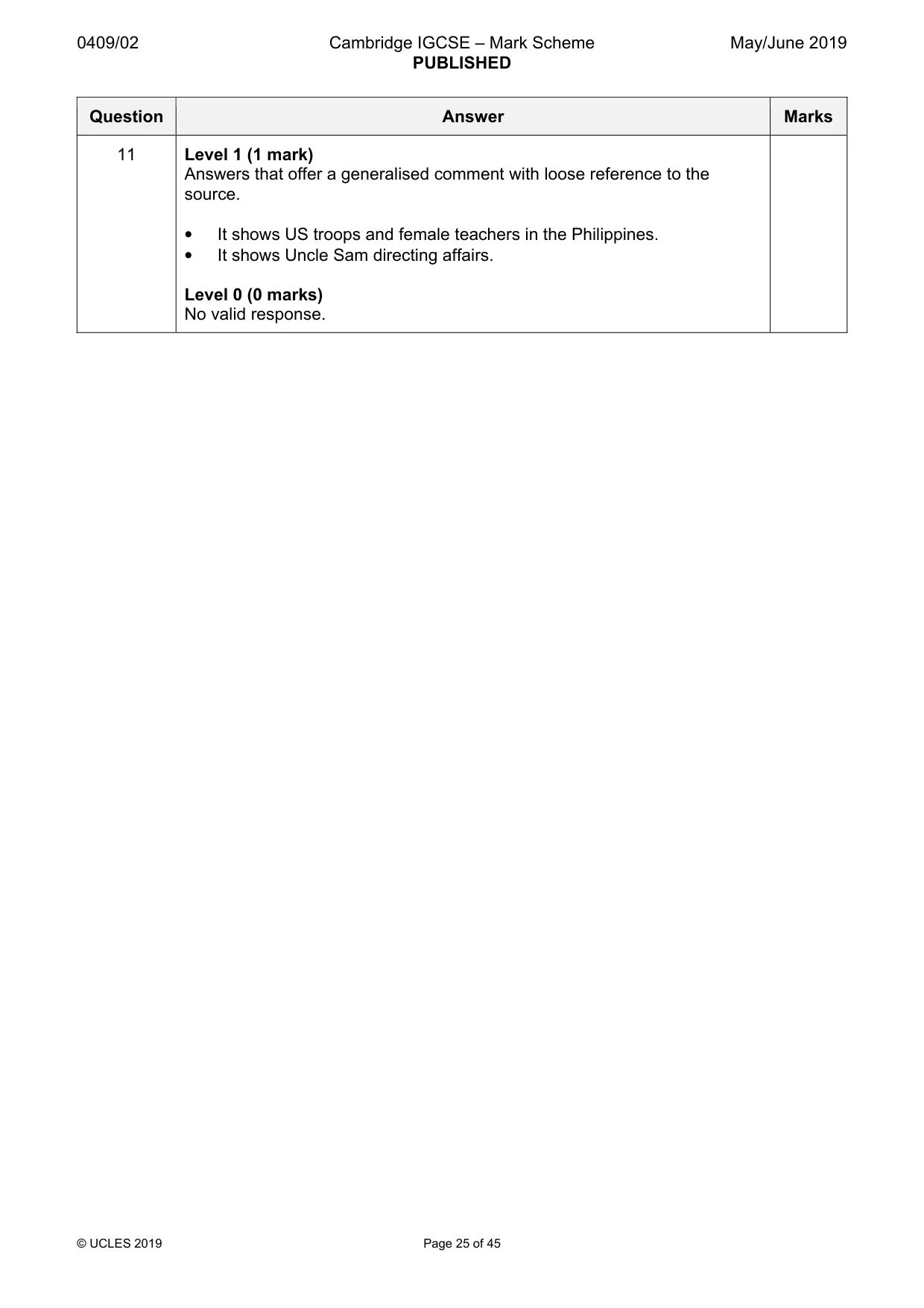
Mark scheme: 11 Study Source A. 6 What can you learn from this source about American actions in the Philippines? Explain your answer using details from the source and your knowledge. Level 4 (6 marks) Answers that demonstrate a developed understanding of source content/message, with good supporting knowledge. This content is not prescriptive and candidates are not expected to refer to all the material identified below. Responses may include the following: Example response: From the source I can learn that US troops took control of the Philippines. It is linked to the idea of the ‘White Man’s Burden’ as it shows that after the departure of US troops a group of female teachers arrived. They are on a Christian mission to spread Western beliefs and civilisation among the Filipinos. It is suggesting that the culture and society of the USA is superior. The Filipinos are depicted as being half-naked and child-like in appearance, and they were in need of education and civilisation. The source fits into the belief that America has a moral and Christian obligation to spread Western civilisation – Uncle Sam is directing them to fulfil this destiny. Other relevant responses should also be credited. Level 3 (4–5 marks) Answers that develop the content/message of the source and demonstrate good understanding; may include some knowledge. • The source relates to the belief in the ‘White Man’s Burden’. • It shows US troops leaving the Philippines and the arrival of female teachers. • They have been sent there to spread Western beliefs and ideas of Western civilisation. • The Filipinos are depicted as being less civilised, half-naked, child-like in appearance. • It is suggesting that US culture is superior; they have arrived to spread their ideas of a more modern civilisation. Level 2 (2–3 marks) Answers that select/describe details from the source with some supported development. • The source shows the arrival of female teachers in the Philippines. • They have been sent there to spread education and civilisation. • America is a more civilised society. 11 Level 1 (1 mark) Answers that offer a generalised comment with loose reference to the source. • It shows US troops and female teachers in the Philippines. • It shows Uncle Sam directing affairs. Level 0 (0 marks) No valid response.
Question 12
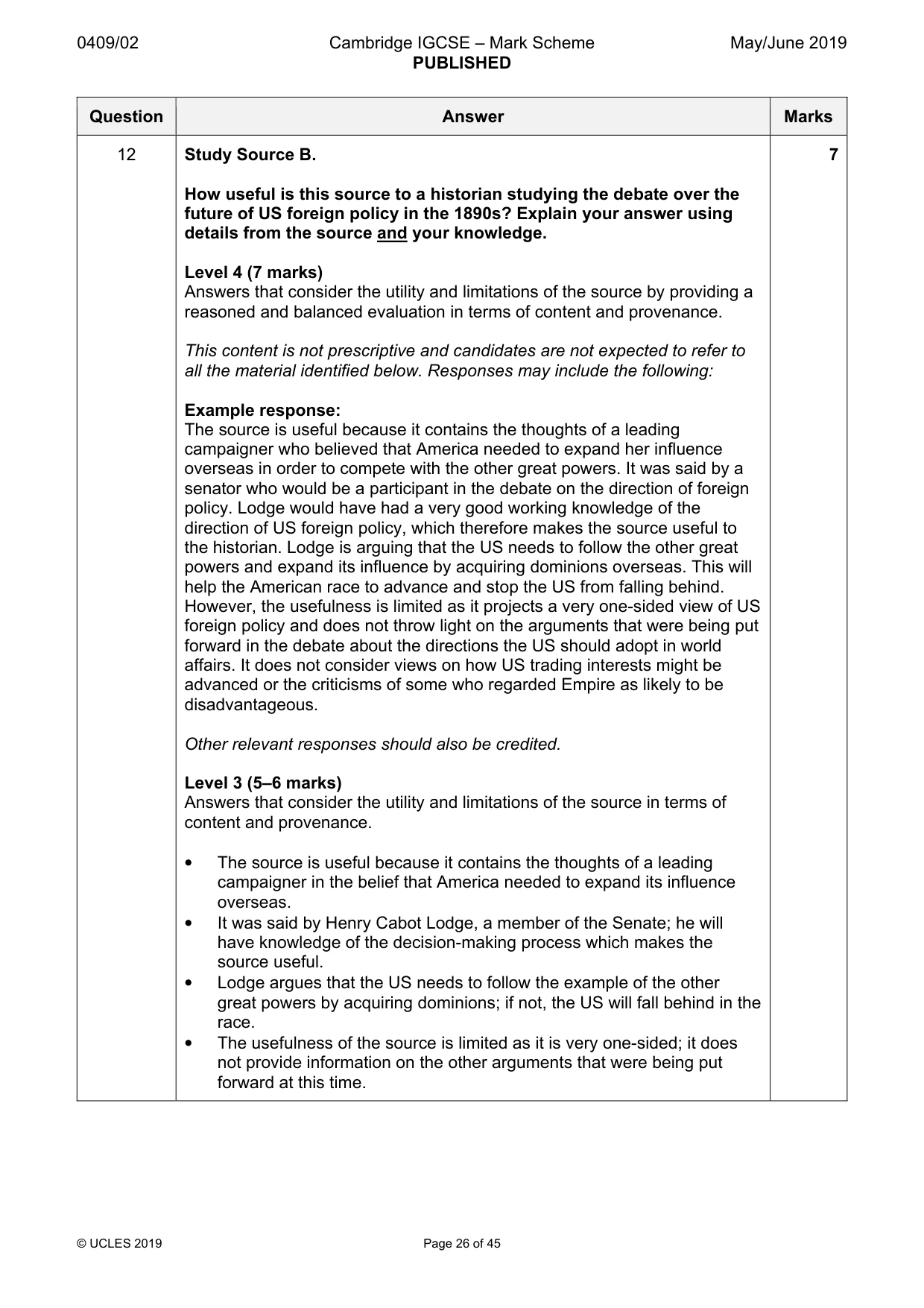
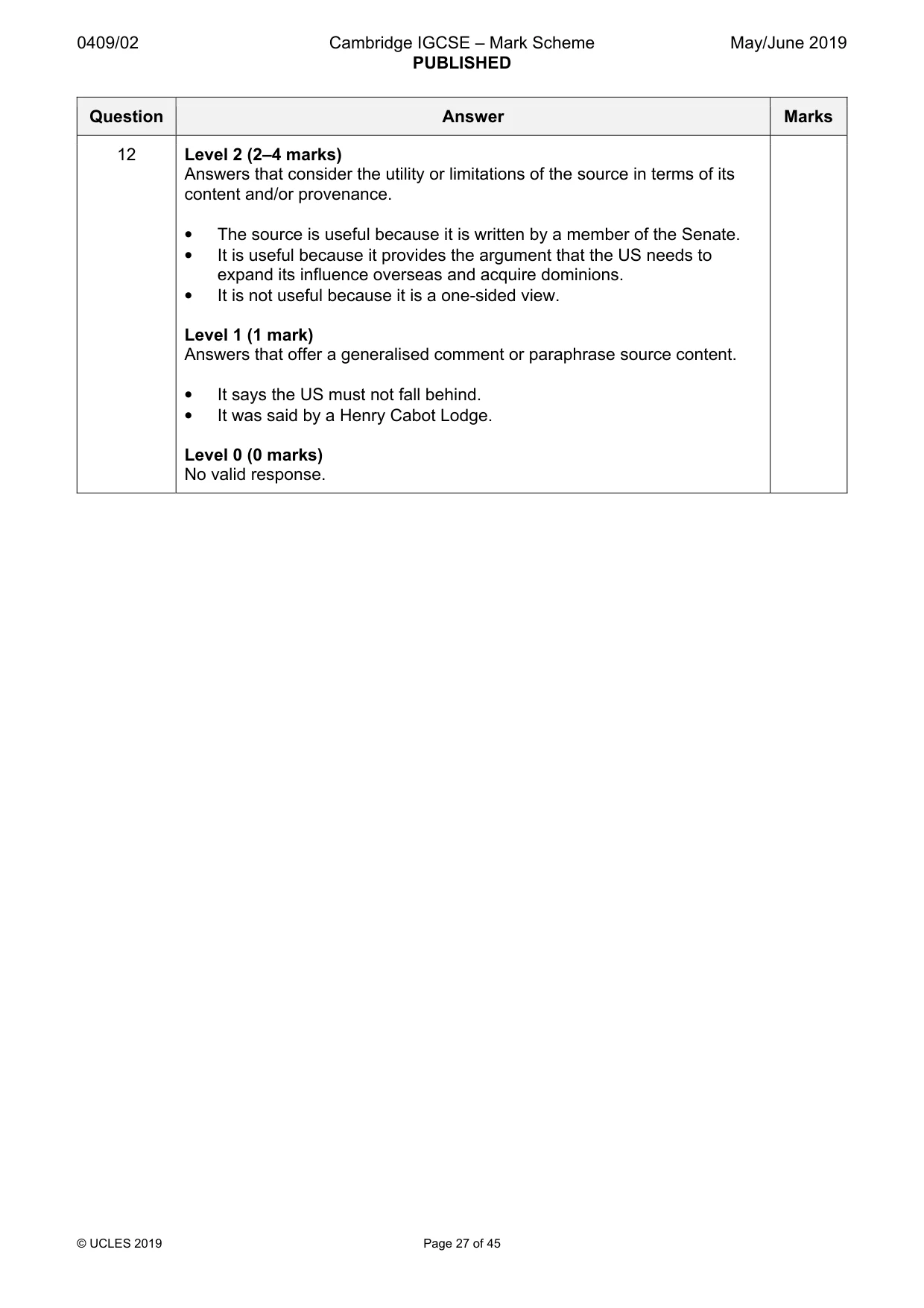
12 Study Source B. How useful is this source to a historian studying the debate over the future of US foreign policy in the 1890s? Explain your answer using details from the source and your knowledge. [7]
Mark scheme: 12 Study Source B. 7 How useful is this source to a historian studying the debate over the future of US foreign policy in the 1890s? Explain your answer using details from the source and your knowledge. Level 4 (7 marks) Answers that consider the utility and limitations of the source by providing a reasoned and balanced evaluation in terms of content and provenance. This content is not prescriptive and candidates are not expected to refer to all the material identified below. Responses may include the following: Example response: The source is useful because it contains the thoughts of a leading campaigner who believed that America needed to expand her influence overseas in order to compete with the other great powers. It was said by a senator who would be a participant in the debate on the direction of foreign policy. Lodge would have had a very good working knowledge of the direction of US foreign policy, which therefore makes the source useful to the historian. Lodge is arguing that the US needs to follow the other great powers and expand its influence by acquiring dominions overseas. This will help the American race to advance and stop the US from falling behind. However, the usefulness is limited as it projects a very one-sided view of US foreign policy and does not throw light on the arguments that were being put forward in the debate about the directions the US should adopt in world affairs. It does not consider views on how US trading interests might be advanced or the criticisms of some who regarded Empire as likely to be disadvantageous. Other relevant responses should also be credited. Level 3 (5–6 marks) Answers that consider the utility and limitations of the source in terms of content and provenance. • The source is useful because it contains the thoughts of a leading campaigner in the belief that America needed to expand its influence overseas. • It was said by Henry Cabot Lodge, a member of the Senate; he will have knowledge of the decision-making process which makes the source useful. • Lodge argues that the US needs to follow the example of the other great powers by acquiring dominions; if not, the US will fall behind in the race. • The usefulness of the source is limited as it is very one-sided; it does not provide information on the other arguments that were being put forward at this time. 12 Level 2 (2–4 marks) Answers that consider the utility or limitations of the source in terms of its content and/or provenance. • The source is useful because it is written by a member of the Senate. • It is useful because it provides the argument that the US needs to expand its influence overseas and acquire dominions. • It is not useful because it is a one-sided view. Level 1 (1 mark) Answers that offer a generalised comment or paraphrase source content. • It says the US must not fall behind. • It was said by a Henry Cabot Lodge. Level 0 (0 marks) No valid response.
Question 13
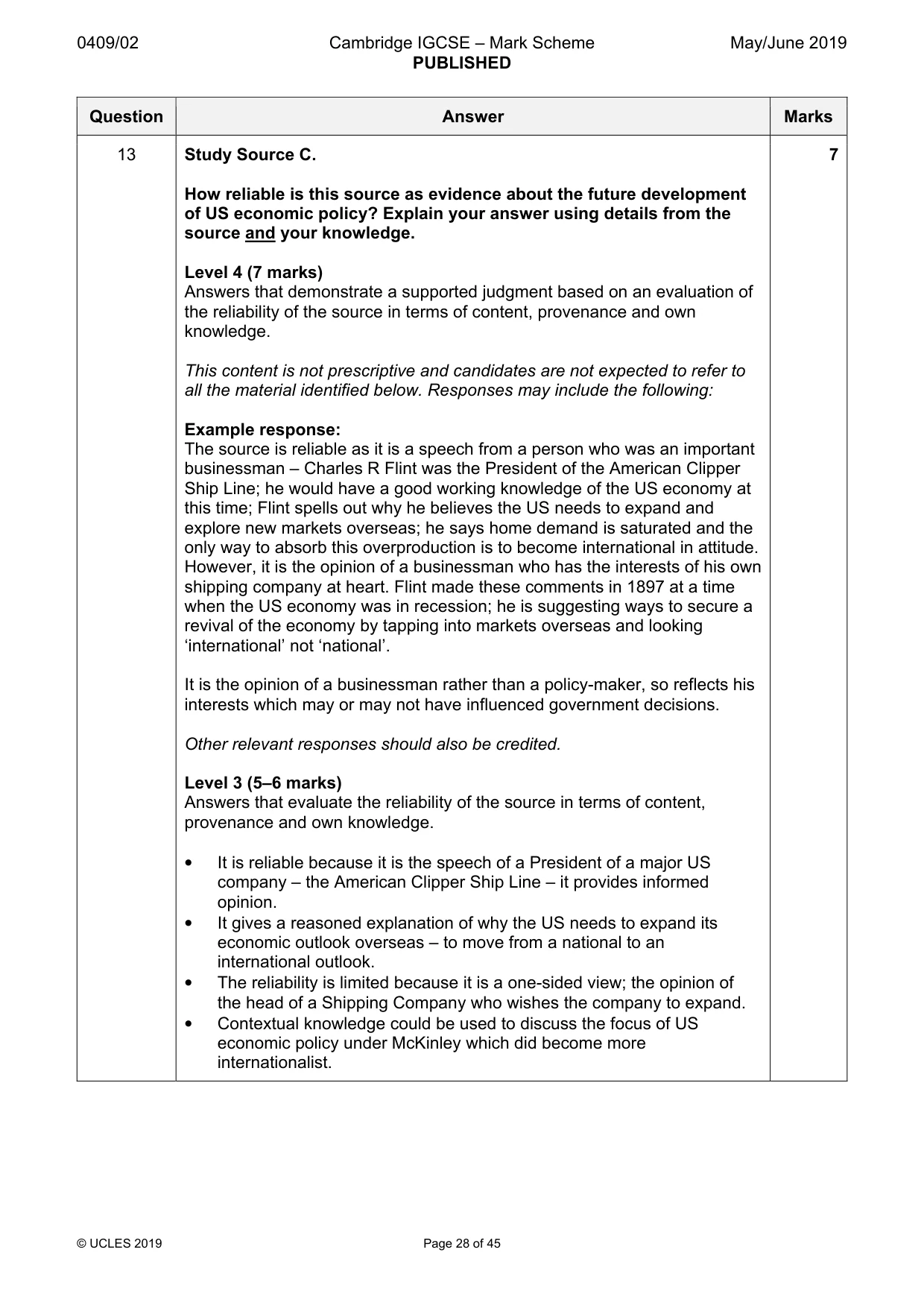
13 Study Source C. How reliable is this source as evidence about the future development of US economic policy? Explain your answer using details from the source and your knowledge. [7]
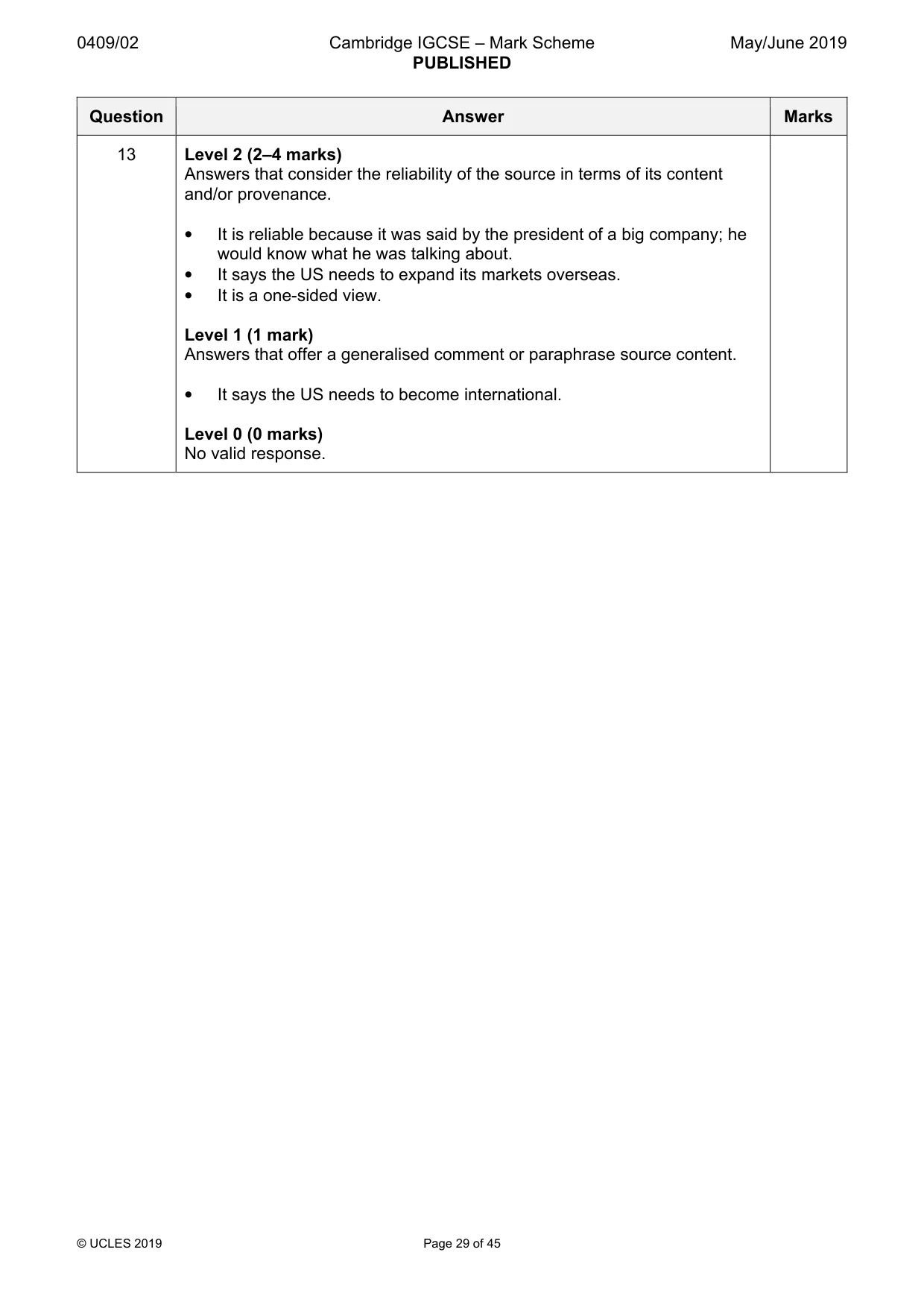
Mark scheme: 13 Study Source C. 7 How reliable is this source as evidence about the future development of US economic policy? Explain your answer using details from the source and your knowledge. Level 4 (7 marks) Answers that demonstrate a supported judgment based on an evaluation of the reliability of the source in terms of content, provenance and own knowledge. This content is not prescriptive and candidates are not expected to refer to all the material identified below. Responses may include the following: Example response: The source is reliable as it is a speech from a person who was an important businessman – Charles R Flint was the President of the American Clipper Ship Line; he would have a good working knowledge of the US economy at this time; Flint spells out why he believes the US needs to expand and explore new markets overseas; he says home demand is saturated and the only way to absorb this overproduction is to become international in attitude. However, it is the opinion of a businessman who has the interests of his own shipping company at heart. Flint made these comments in 1897 at a time when the US economy was in recession; he is suggesting ways to secure a revival of the economy by tapping into markets overseas and looking ‘international’ not ‘national’. It is the opinion of a businessman rather than a policy-maker, so reflects his interests which may or may not have influenced government decisions. Other relevant responses should also be credited. Level 3 (5–6 marks) Answers that evaluate the reliability of the source in terms of content, provenance and own knowledge. • It is reliable because it is the speech of a President of a major US company – the American Clipper Ship Line – it provides informed opinion. • It gives a reasoned explanation of why the US needs to expand its economic outlook overseas – to move from a national to an international outlook. • The reliability is limited because it is a one-sided view; the opinion of the head of a Shipping Company who wishes the company to expand. • Contextual knowledge could be used to discuss the focus of US economic policy under McKinley which did become more internationalist. 13 Level 2 (2–4 marks) Answers that consider the reliability of the source in terms of its content and/or provenance. • It is reliable because it was said by the president of a big company; he would know what he was talking about. • It says the US needs to expand its markets overseas. • It is a one-sided view. Level 1 (1 mark) Answers that offer a generalised comment or paraphrase source content. • It says the US needs to become international. Level 0 (0 marks) No valid response.
Q14 · Study Sources D and E
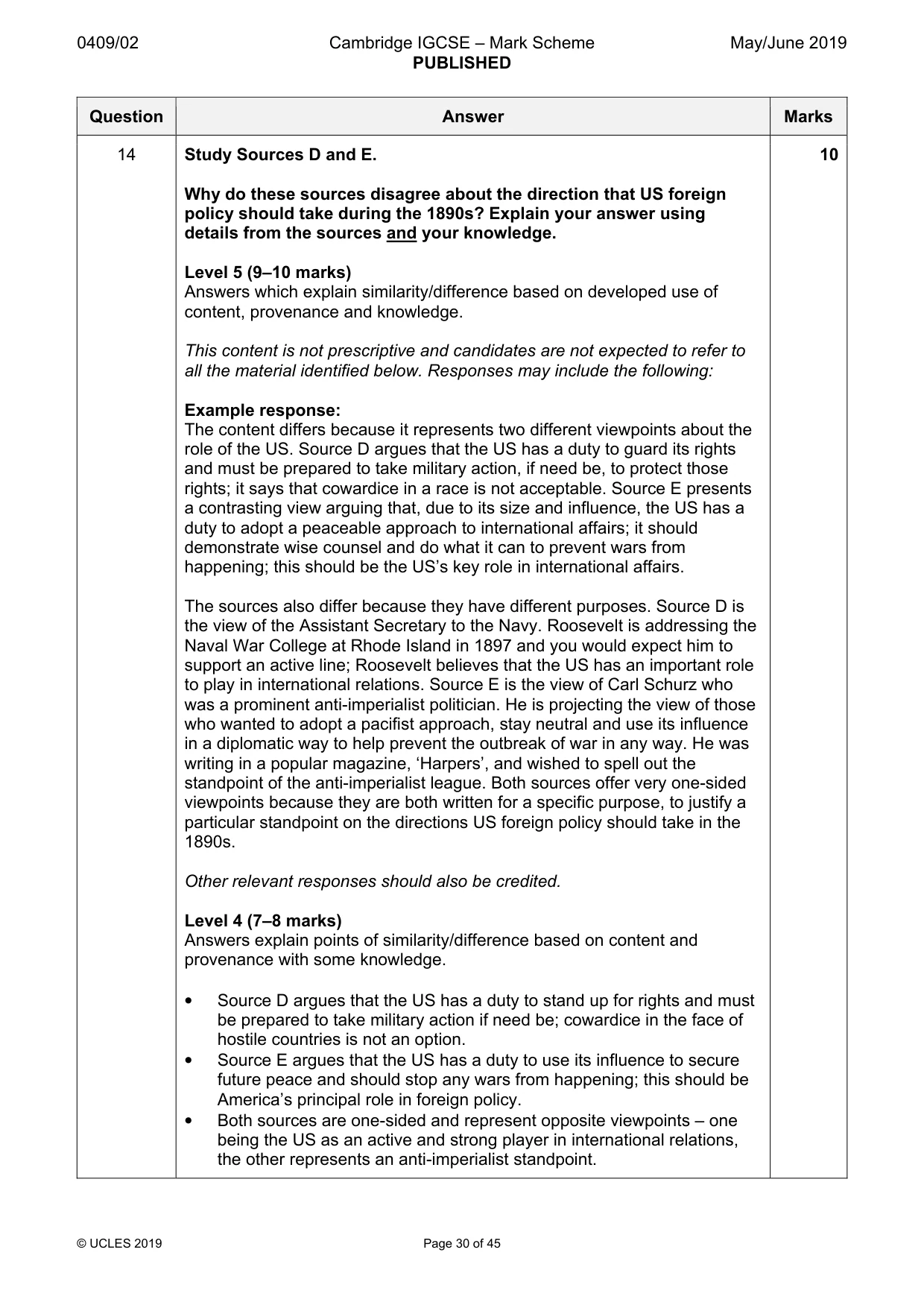
14 Study Sources D and E. Why do these sources disagree about the direction that US foreign policy should take during the 1890s? Explain your answer using details from the sources and your knowledge. [10]
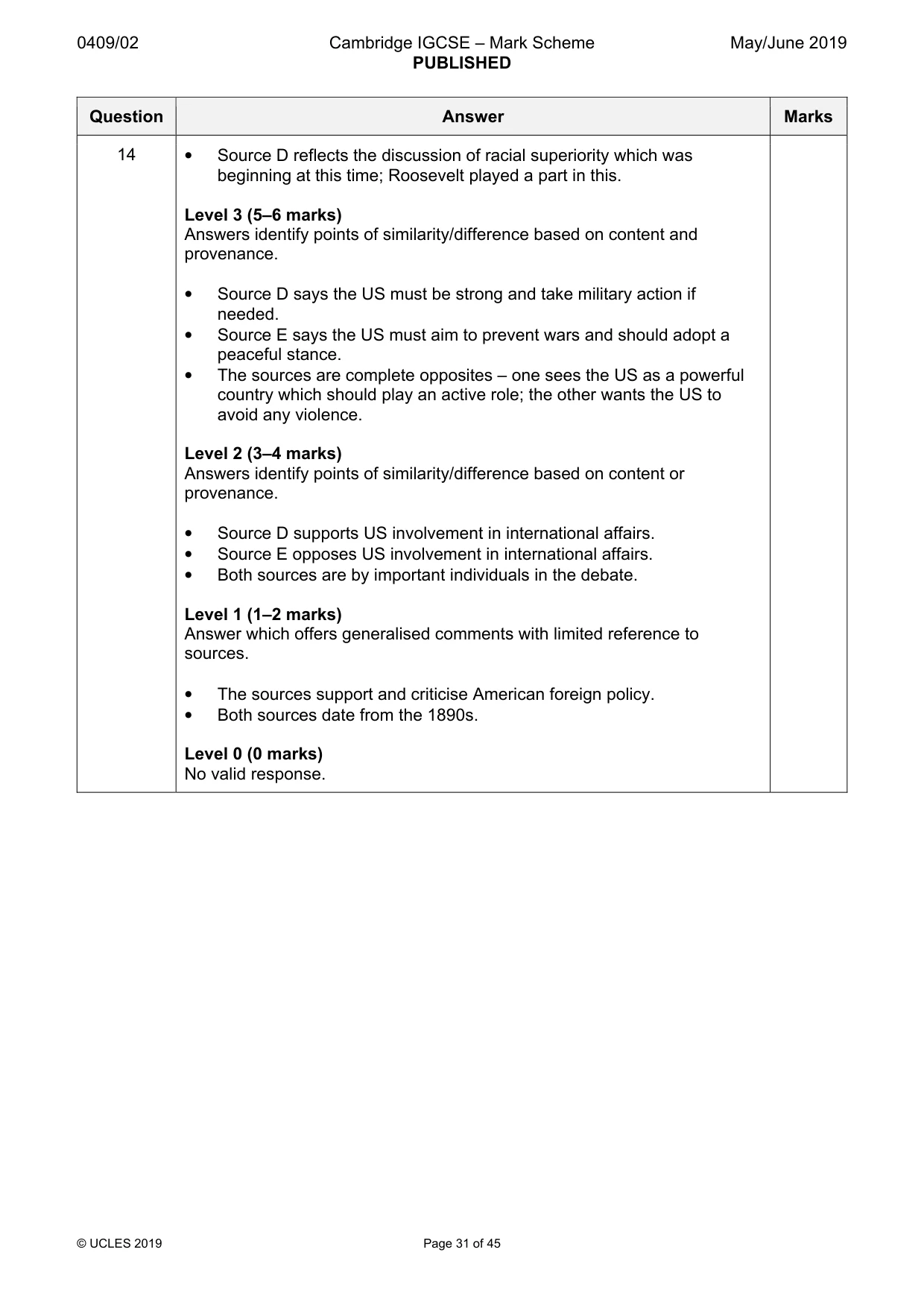
Mark scheme: 14 Study Sources D and E. 10 Why do these sources disagree about the direction that US foreign policy should take during the 1890s? Explain your answer using details from the sources and your knowledge. Level 5 (9–10 marks) Answers which explain similarity/difference based on developed use of content, provenance and knowledge. This content is not prescriptive and candidates are not expected to refer to all the material identified below. Responses may include the following: Example response: The content differs because it represents two different viewpoints about the role of the US. Source D argues that the US has a duty to guard its rights and must be prepared to take military action, if need be, to protect those rights; it says that cowardice in a race is not acceptable. Source E presents a contrasting view arguing that, due to its size and influence, the US has a duty to adopt a peaceable approach to international affairs; it should demonstrate wise counsel and do what it can to prevent wars from happening; this should be the US’s key role in international affairs. The sources also differ because they have different purposes. Source D is the view of the Assistant Secretary to the Navy. Roosevelt is addressing the Naval War College at Rhode Island in 1897 and you would expect him to support an active line; Roosevelt believes that the US has an important role to play in international relations. Source E is the view of Carl Schurz who was a prominent anti-imperialist politician. He is projecting the view of those who wanted to adopt a pacifist approach, stay neutral and use its influence in a diplomatic way to help prevent the outbreak of war in any way. He was writing in a popular magazine, ‘Harpers’, and wished to spell out the standpoint of the anti-imperialist league. Both sources offer very one-sided viewpoints because they are both written for a specific purpose, to justify a particular standpoint on the directions US foreign policy should take in the 1890s. Other relevant responses should also be credited. Level 4 (7–8 marks) Answers explain points of similarity/difference based on content and provenance with some knowledge. • Source D argues that the US has a duty to stand up for rights and must be prepared to take military action if need be; cowardice in the face of hostile countries is not an option. • Source E argues that the US has a duty to use its influence to secure future peace and should stop any wars from happening; this should be America’s principal role in foreign policy. • Both sources are one-sided and represent opposite viewpoints – one being the US as an active and strong player in international relations, the other represents an anti-imperialist standpoint. 14 • Source D reflects the discussion of racial superiority which was beginning at this time; Roosevelt played a part in this. Level 3 (5–6 marks) Answers identify points of similarity/difference based on content and provenance. • Source D says the US must be strong and take military action if needed. • Source E says the US must aim to prevent wars and should adopt a peaceful stance. • The sources are complete opposites – one sees the US as a powerful country which should play an active role; the other wants the US to avoid any violence. Level 2 (3–4 marks) Answers identify points of similarity/difference based on content or provenance. • Source D supports US involvement in international affairs. • Source E opposes US involvement in international affairs. • Both sources are by important individuals in the debate. Level 1 (1–2 marks) Answer which offers generalised comments with limited reference to sources. • The sources support and criticise American foreign policy. • Both sources date from the 1890s. Level 0 (0 marks) No valid response.
Q15 · Study all the sources
15 Study all the sources. “The desire for the United States to become a strong military power was the main driving force behind US foreign policy between 1880 and 1901.” To what extent do you agree? Explain your answer using details from all the sources and your knowledge. [15] [Total: 45] Depth Study D: American Society and Popular Culture c.1920–1970 Read the background information and then answer all the questions. Use your knowledge of the topic to help you interpret and evaluate the sources, as appropriate. Background Information The 1920s was a decade which saw major developments in popular culture across America, but these changes were not always welcomed or viewed in a positive manner.
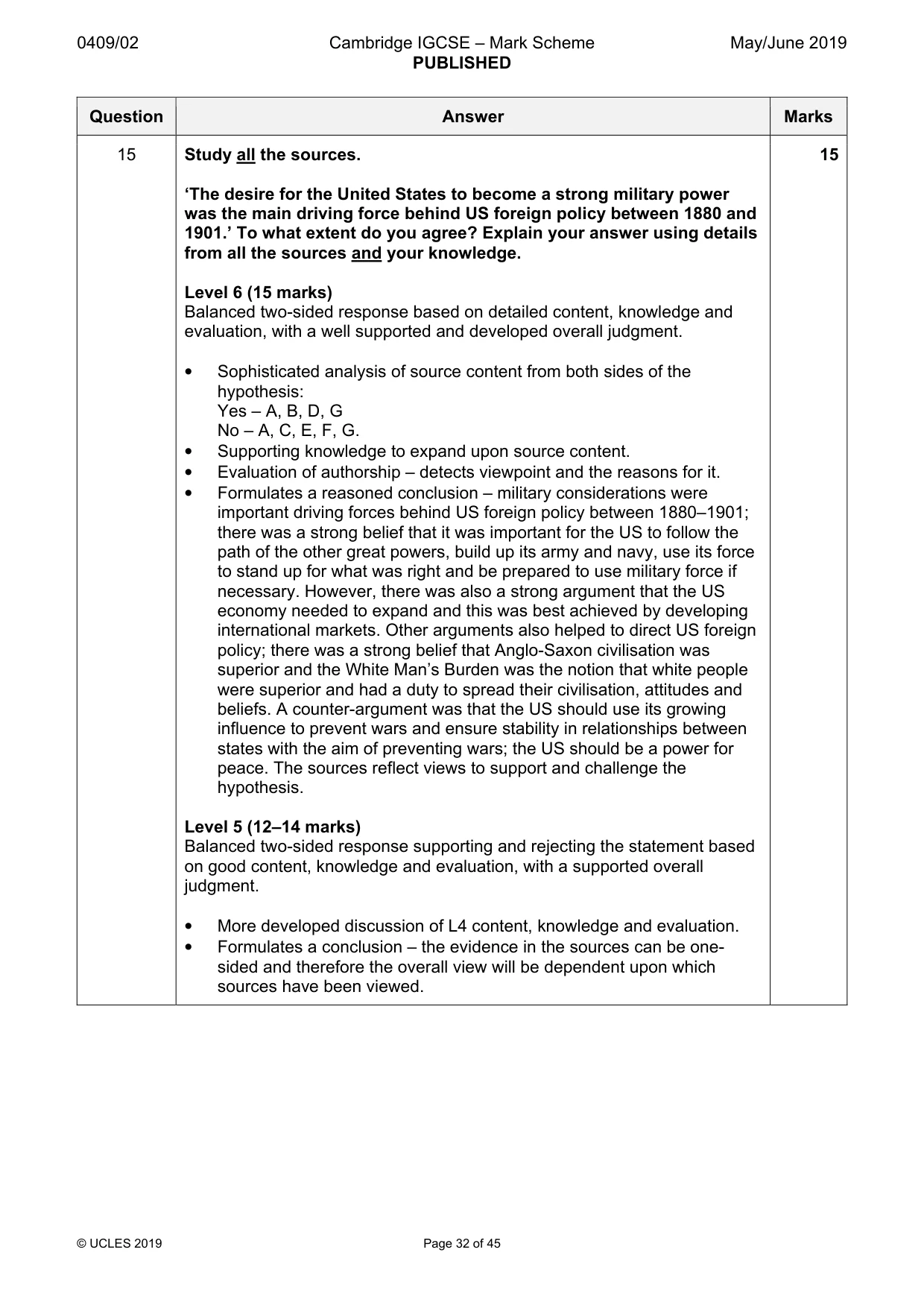
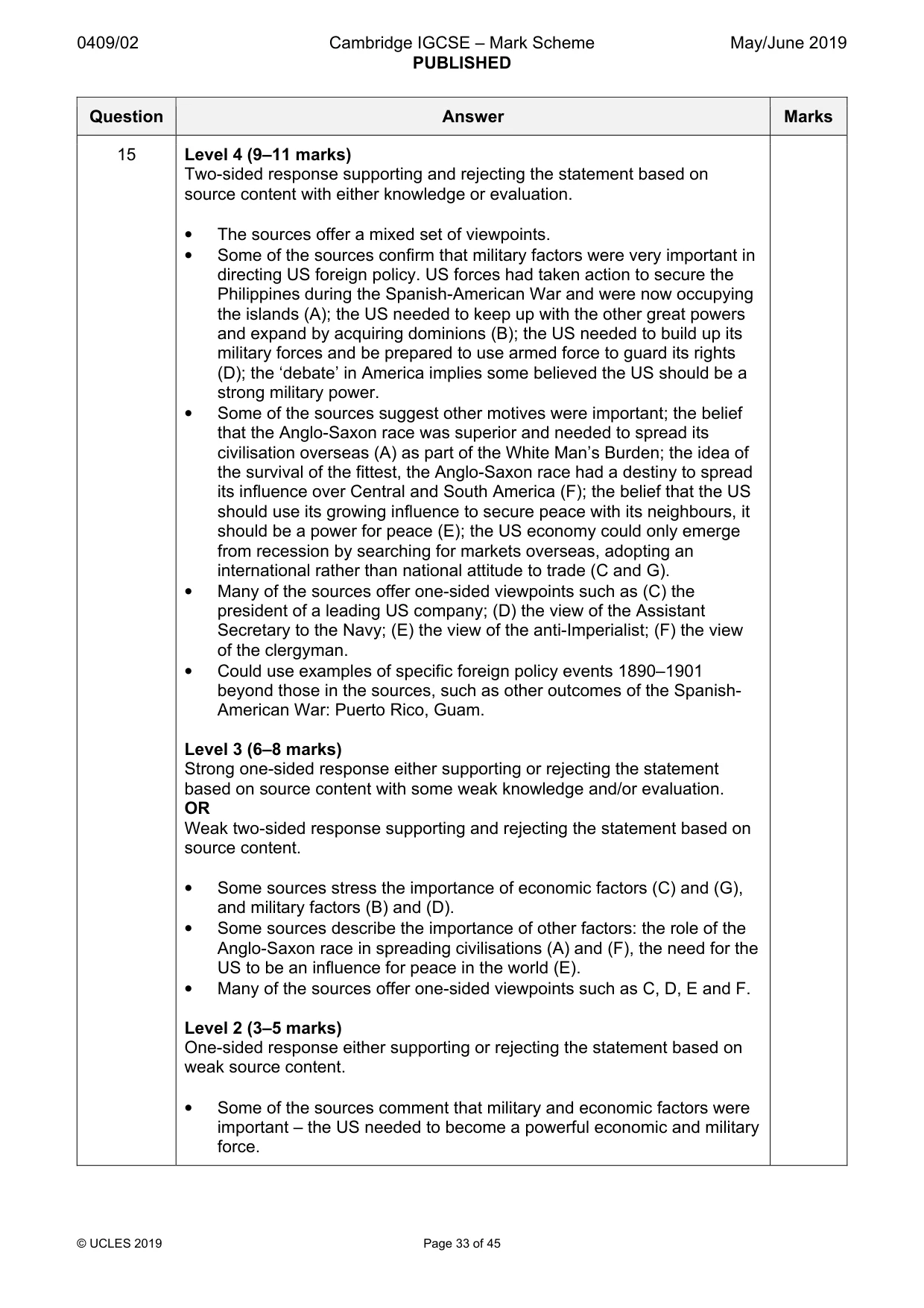
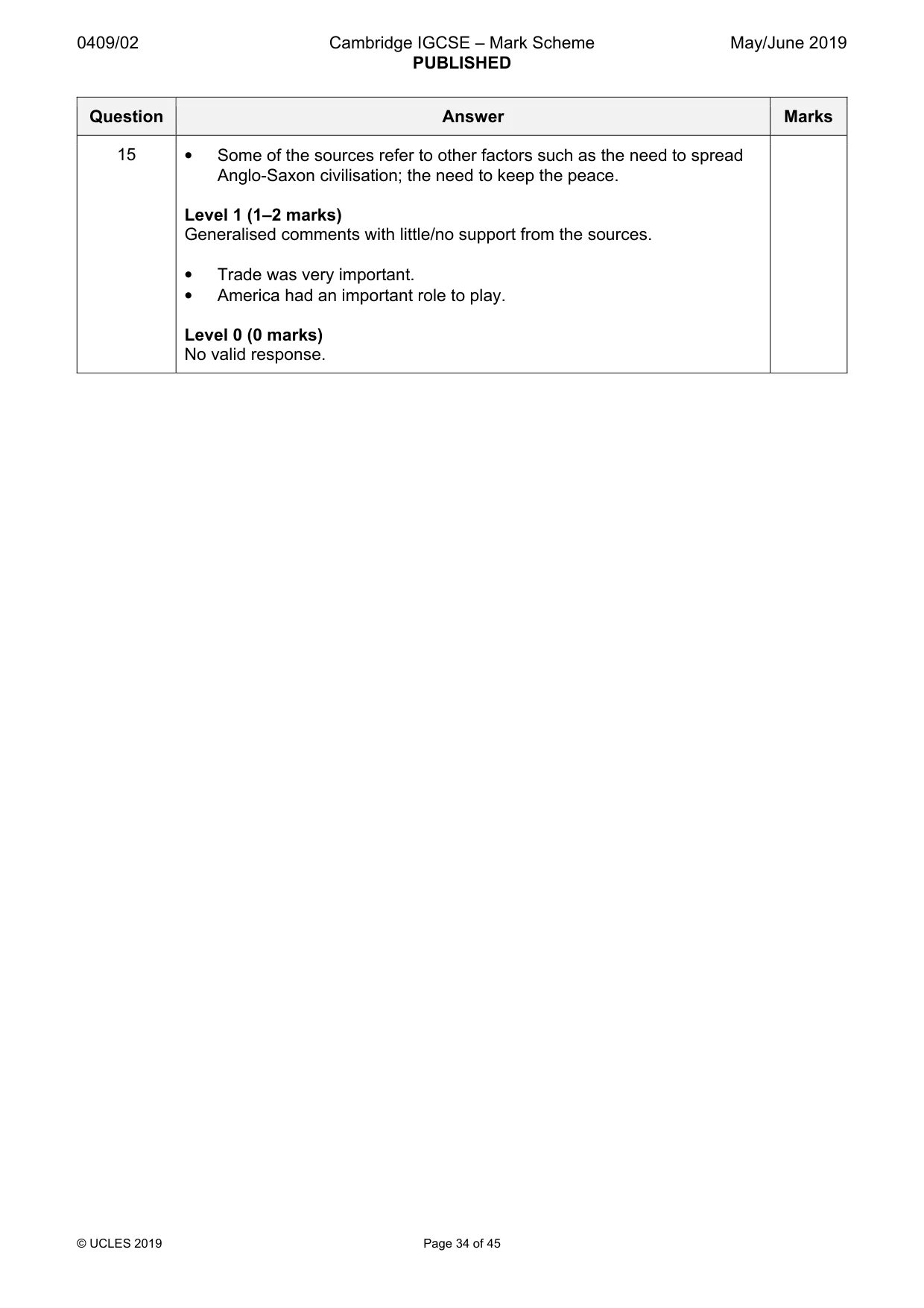
Mark scheme: 15 Study all the sources. 15 ‘The desire for the United States to become a strong military power was the main driving force behind US foreign policy between 1880 and 1901.’ To what extent do you agree? Explain your answer using details from all the sources and your knowledge. Level 6 (15 marks) Balanced two-sided response based on detailed content, knowledge and evaluation, with a well supported and developed overall judgment. • Sophisticated analysis of source content from both sides of the hypothesis: Yes – A, B, D, G No – A, C, E, F, G. • Supporting knowledge to expand upon source content. • Evaluation of authorship – detects viewpoint and the reasons for it. • Formulates a reasoned conclusion – military considerations were important driving forces behind US foreign policy between 1880–1901; there was a strong belief that it was important for the US to follow the path of the other great powers, build up its army and navy, use its force to stand up for what was right and be prepared to use military force if necessary. However, there was also a strong argument that the US economy needed to expand and this was best achieved by developing international markets. Other arguments also helped to direct US foreign policy; there was a strong belief that Anglo-Saxon civilisation was superior and the White Man’s Burden was the notion that white people were superior and had a duty to spread their civilisation, attitudes and beliefs. A counter-argument was that the US should use its growing influence to prevent wars and ensure stability in relationships between states with the aim of preventing wars; the US should be a power for peace. The sources reflect views to support and challenge the hypothesis. Level 5 (12–14 marks) Balanced two-sided response supporting and rejecting the statement based on good content, knowledge and evaluation, with a supported overall judgment. • More developed discussion of L4 content, knowledge and evaluation. • Formulates a conclusion – the evidence in the sources can be one- sided and therefore the overall view will be dependent upon which sources have been viewed. 15 Level 4 (9–11 marks) Two-sided response supporting and rejecting the statement based on source content with either knowledge or evaluation. • The sources offer a mixed set of viewpoints. • Some of the sources confirm that military factors were very important in directing US foreign policy. US forces had taken action to secure the Philippines during the Spanish-American War and were now occupying the islands (A); the US needed to keep up with the other great powers and expand by acquiring dominions (B); the US needed to build up its military forces and be prepared to use armed force to guard its rights (D); the ‘debate’ in America implies some believed the US should be a strong military power. • Some of the sources suggest other motives were important; the belief that the Anglo-Saxon race was superior and needed to spread its civilisation overseas (A) as part of the White Man’s Burden; the idea of the survival of the fittest, the Anglo-Saxon race had a destiny to spread its influence over Central and South America (F); the belief that the US should use its growing influence to secure peace with its neighbours, it should be a power for peace (E); the US economy could only emerge from recession by searching for markets overseas, adopting an international rather than national attitude to trade (C and G). • Many of the sources offer one-sided viewpoints such as (C) the president of a leading US company; (D) the view of the Assistant Secretary to the Navy; (E) the view of the anti-Imperialist; (F) the view of the clergyman. • Could use examples of specific foreign policy events 1890–1901 beyond those in the sources, such as other outcomes of the Spanish- American War: Puerto Rico, Guam. Level 3 (6–8 marks) Strong one-sided response either supporting or rejecting the statement based on source content with some weak knowledge and/or evaluation. OR Weak two-sided response supporting and rejecting the statement based on source content. • Some sources stress the importance of economic factors (C) and (G), and military factors (B) and (D). • Some sources describe the importance of other factors: the role of the Anglo-Saxon race in spreading civilisations (A) and (F), the need for the US to be an influence for peace in the world (E). • Many of the sources offer one-sided viewpoints such as C, D, E and F. Level 2 (3–5 marks) One-sided response either supporting or rejecting the statement based on weak source content. • Some of the sources comment that military and economic factors were important – the US needed to become a powerful economic and military force. 15 • Some of the sources refer to other factors such as the need to spread Anglo-Saxon civilisation; the need to keep the peace. Level 1 (1–2 marks) Generalised comments with little/no support from the sources. • Trade was very important. • America had an important role to play. Level 0 (0 marks) No valid response. Depth Study D: American Society and Popular Culture c.1920–1970
Question 16
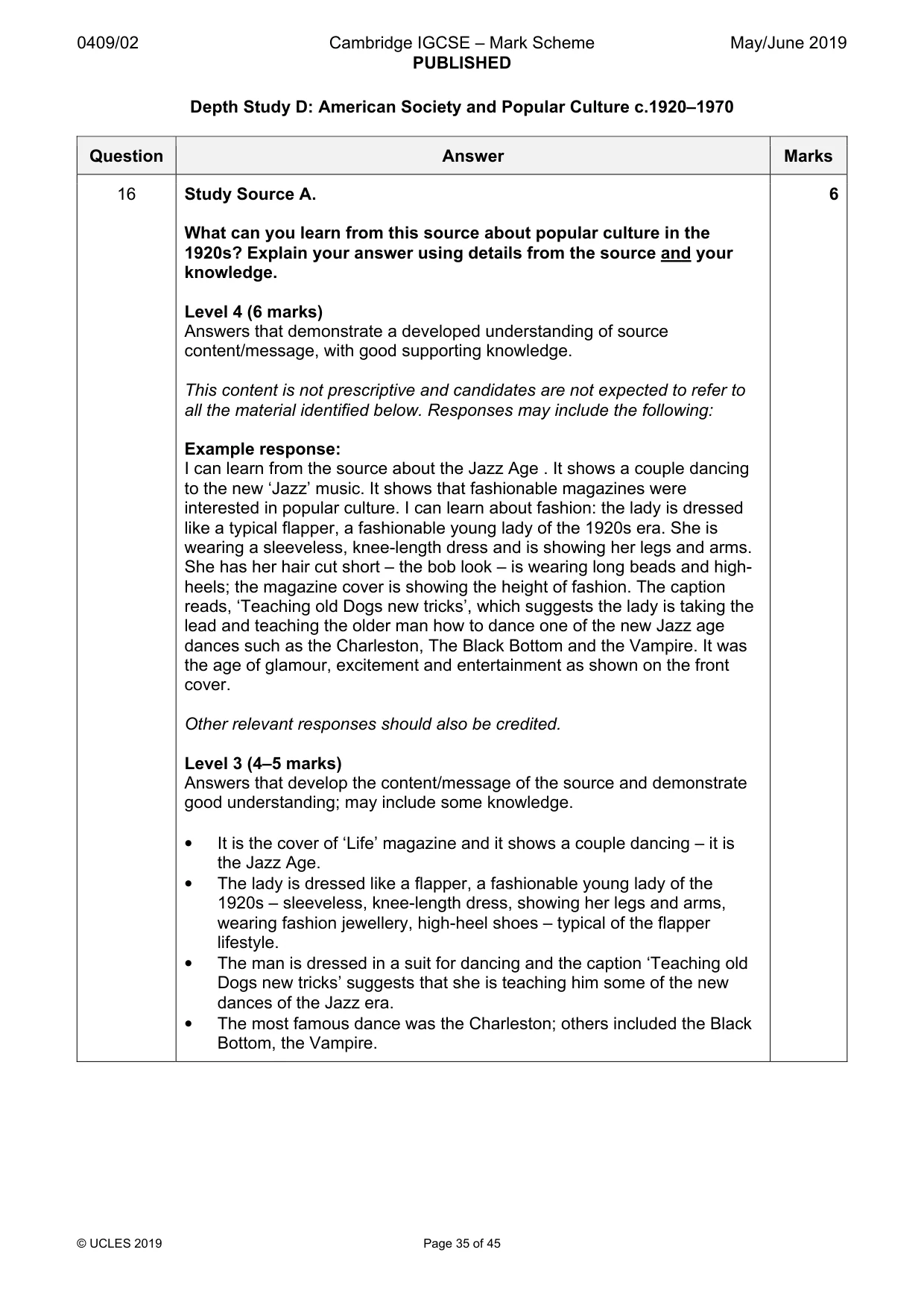
16 Study Source A. What can you learn from this source about popular culture in the 1920s? Explain your answer using details from the source and your knowledge. [6]
Mark scheme: 16 Study Source A. 6 What can you learn from this source about popular culture in the 1920s? Explain your answer using details from the source and your knowledge. Level 4 (6 marks) Answers that demonstrate a developed understanding of source content/message, with good supporting knowledge. This content is not prescriptive and candidates are not expected to refer to all the material identified below. Responses may include the following: Example response: I can learn from the source about the Jazz Age . It shows a couple dancing to the new ‘Jazz’ music. It shows that fashionable magazines were interested in popular culture. I can learn about fashion: the lady is dressed like a typical flapper, a fashionable young lady of the 1920s era. She is wearing a sleeveless, knee-length dress and is showing her legs and arms. She has her hair cut short – the bob look – is wearing long beads and high- heels; the magazine cover is showing the height of fashion. The caption reads, ‘Teaching old Dogs new tricks’, which suggests the lady is taking the lead and teaching the older man how to dance one of the new Jazz age dances such as the Charleston, The Black Bottom and the Vampire. It was the age of glamour, excitement and entertainment as shown on the front cover. Other relevant responses should also be credited. Level 3 (4–5 marks) Answers that develop the content/message of the source and demonstrate good understanding; may include some knowledge. • It is the cover of ‘Life’ magazine and it shows a couple dancing – it is the Jazz Age. • The lady is dressed like a flapper, a fashionable young lady of the 1920s – sleeveless, knee-length dress, showing her legs and arms, wearing fashion jewellery, high-heel shoes – typical of the flapper lifestyle. • The man is dressed in a suit for dancing and the caption ‘Teaching old Dogs new tricks’ suggests that she is teaching him some of the new dances of the Jazz era. • The most famous dance was the Charleston; others included the Black Bottom, the Vampire. 16 Level 2 (2–3 marks) Answers that select/describe details from the source with some supported development. • The magazine cover shows a couple dancing to Jazz music. • She is dressed like a flapper. • It shows people had a good time in the 1920s, enjoying dance. Level 1 (1 mark) Answers that offer a generalised comment with loose reference to the source. • Dancing was popular in the 1920s. • New fashions emerged in the 1920s. Level 0 (0 marks) No valid response.
Question 17
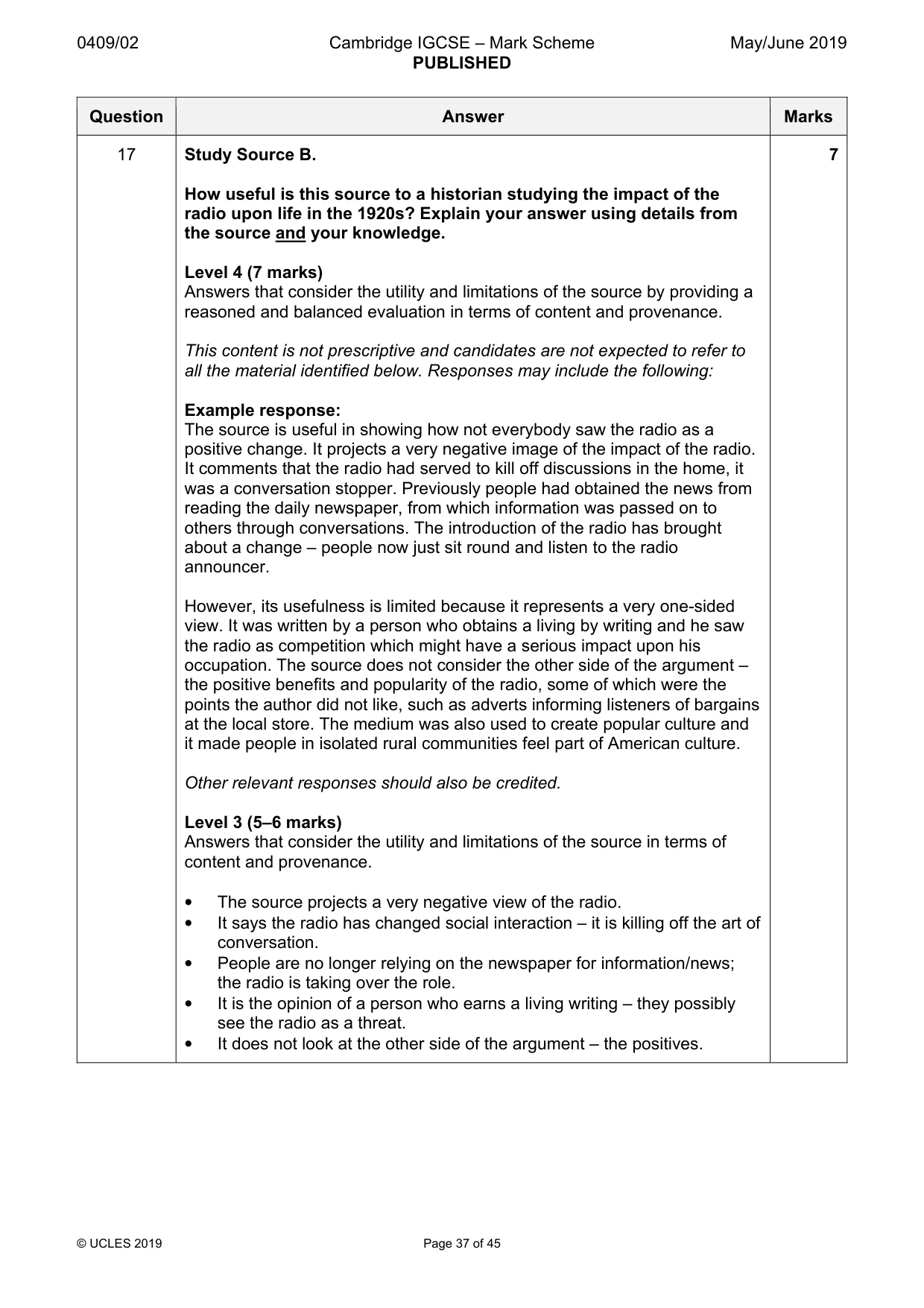
17 Study Source B. How useful is this source to a historian studying the impact of the radio upon life in the 1920s? Explain your answer using details from the source and your knowledge. [7]
Mark scheme: 17 Study Source B. 7 How useful is this source to a historian studying the impact of the radio upon life in the 1920s? Explain your answer using details from the source and your knowledge. Level 4 (7 marks) Answers that consider the utility and limitations of the source by providing a reasoned and balanced evaluation in terms of content and provenance. This content is not prescriptive and candidates are not expected to refer to all the material identified below. Responses may include the following: Example response: The source is useful in showing how not everybody saw the radio as a positive change. It projects a very negative image of the impact of the radio. It comments that the radio had served to kill off discussions in the home, it was a conversation stopper. Previously people had obtained the news from reading the daily newspaper, from which information was passed on to others through conversations. The introduction of the radio has brought about a change – people now just sit round and listen to the radio announcer. However, its usefulness is limited because it represents a very one-sided view. It was written by a person who obtains a living by writing and he saw the radio as competition which might have a serious impact upon his occupation. The source does not consider the other side of the argument – the positive benefits and popularity of the radio, some of which were the points the author did not like, such as adverts informing listeners of bargains at the local store. The medium was also used to create popular culture and it made people in isolated rural communities feel part of American culture. Other relevant responses should also be credited. Level 3 (5–6 marks) Answers that consider the utility and limitations of the source in terms of content and provenance. • The source projects a very negative view of the radio. • It says the radio has changed social interaction – it is killing off the art of conversation. • People are no longer relying on the newspaper for information/news; the radio is taking over the role. • It is the opinion of a person who earns a living writing – they possibly see the radio as a threat. • It does not look at the other side of the argument – the positives. 17 Level 2 (2–4 marks) Answers that consider the utility or limitations of the source in terms of its content and/or provenance. • The source says the radio has changed life in the home – people no longer talk to each other. • It is a very one-sided view – the author does not think highly of the radio. • It was said by a writer/journalist. Level 1 (1 mark) Answers that offer a generalised comment or paraphrase source content. • The radio plays music and adverts. • People sit and listen to the radio and drink gin. Level 0 (0 marks) No valid response.
Question 18
18 Study Source C. How accurately does this source describe the development of the cinema industry during the 1920s? Explain your answer using details from the source and your knowledge. [7]
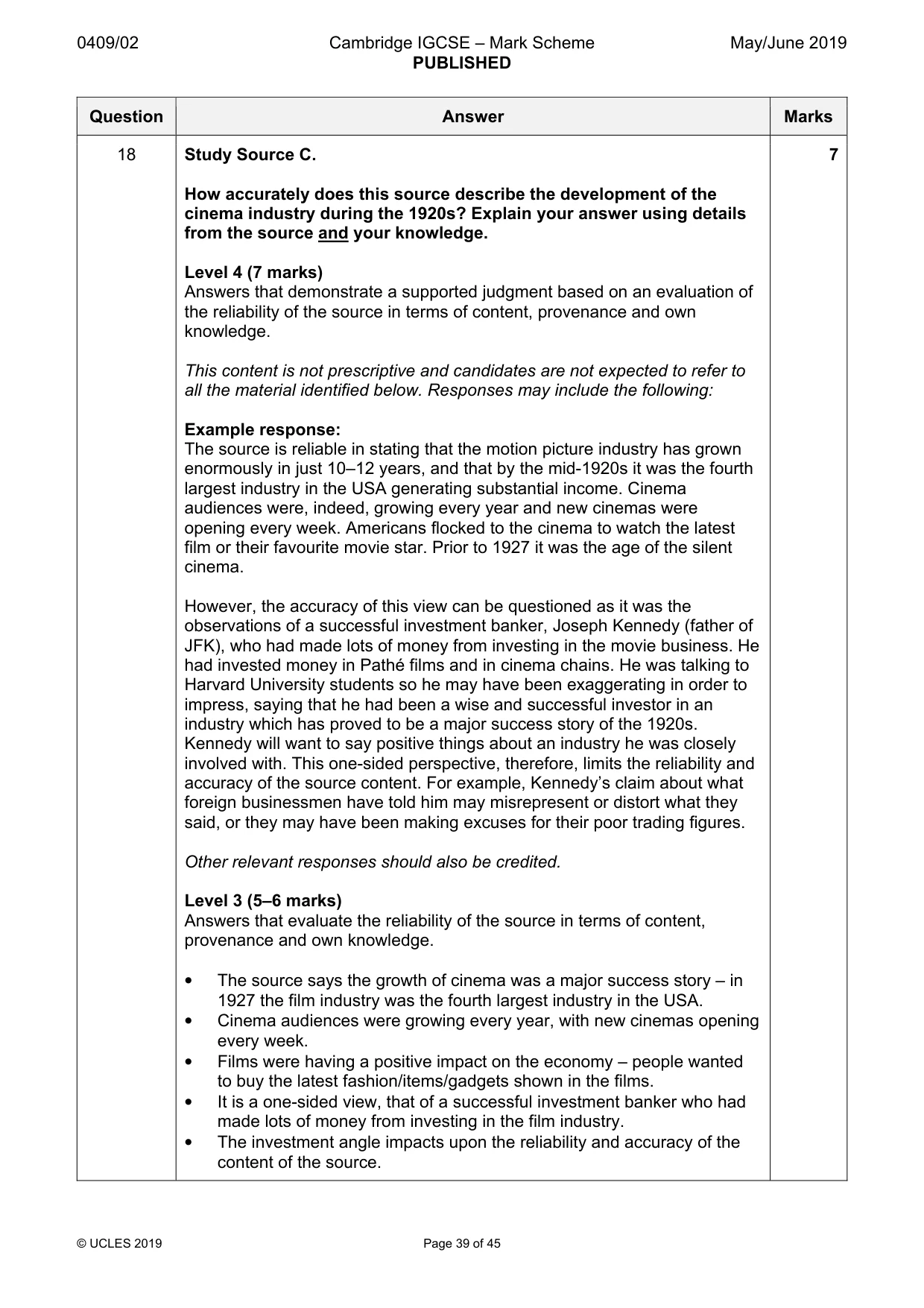
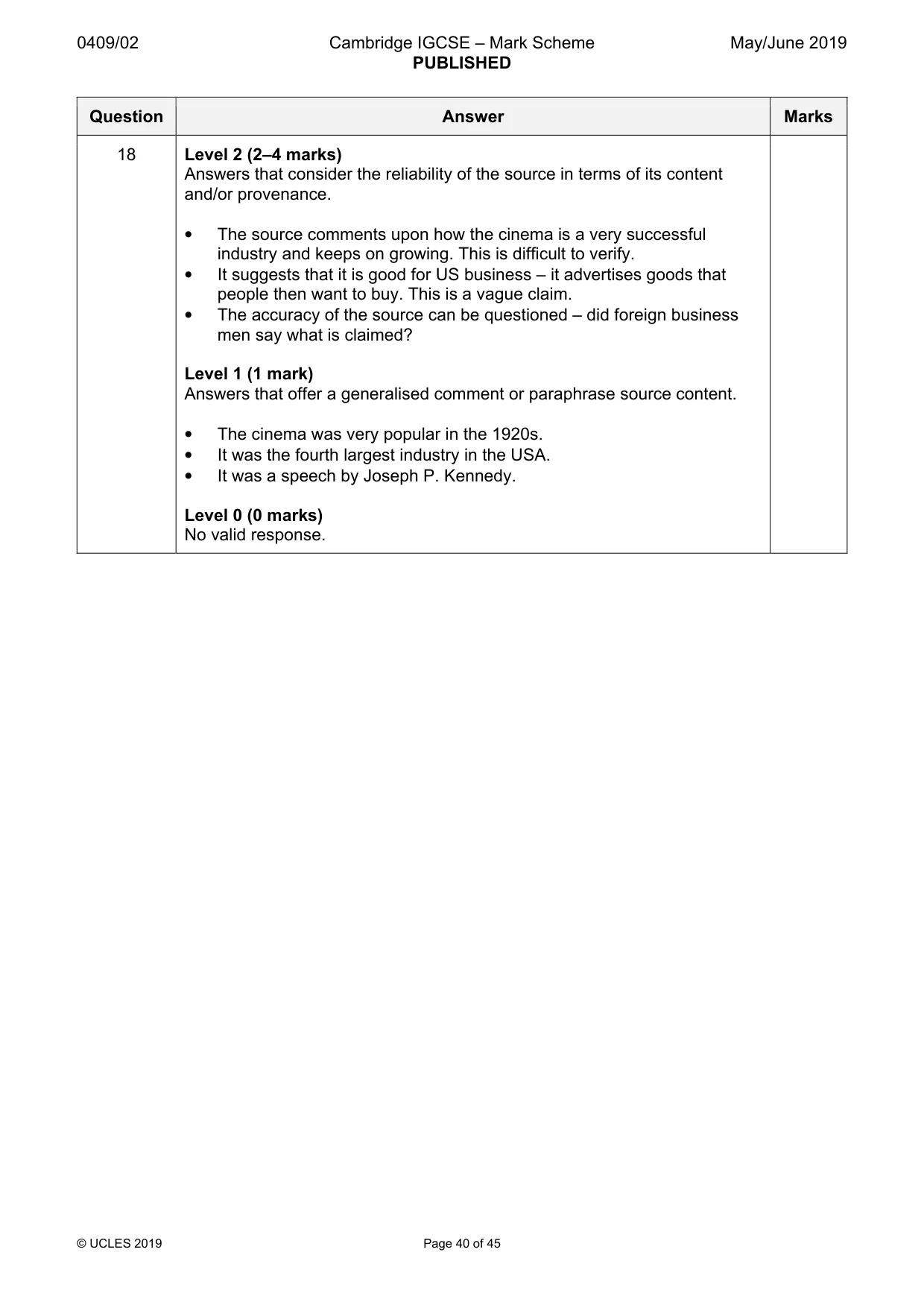
Mark scheme: 18 Study Source C. 7 How accurately does this source describe the development of the cinema industry during the 1920s? Explain your answer using details from the source and your knowledge. Level 4 (7 marks) Answers that demonstrate a supported judgment based on an evaluation of the reliability of the source in terms of content, provenance and own knowledge. This content is not prescriptive and candidates are not expected to refer to all the material identified below. Responses may include the following: Example response: The source is reliable in stating that the motion picture industry has grown enormously in just 10–12 years, and that by the mid-1920s it was the fourth largest industry in the USA generating substantial income. Cinema audiences were, indeed, growing every year and new cinemas were opening every week. Americans flocked to the cinema to watch the latest film or their favourite movie star. Prior to 1927 it was the age of the silent cinema. However, the accuracy of this view can be questioned as it was the observations of a successful investment banker, Joseph Kennedy (father of JFK), who had made lots of money from investing in the movie business. He had invested money in Pathé films and in cinema chains. He was talking to Harvard University students so he may have been exaggerating in order to impress, saying that he had been a wise and successful investor in an industry which has proved to be a major success story of the 1920s. Kennedy will want to say positive things about an industry he was closely involved with. This one-sided perspective, therefore, limits the reliability and accuracy of the source content. For example, Kennedy’s claim about what foreign businessmen have told him may misrepresent or distort what they said, or they may have been making excuses for their poor trading figures. Other relevant responses should also be credited. Level 3 (5–6 marks) Answers that evaluate the reliability of the source in terms of content, provenance and own knowledge. • The source says the growth of cinema was a major success story – in 1927 the film industry was the fourth largest industry in the USA. • Cinema audiences were growing every year, with new cinemas opening every week. • Films were having a positive impact on the economy – people wanted to buy the latest fashion/items/gadgets shown in the films. • It is a one-sided view, that of a successful investment banker who had made lots of money from investing in the film industry. • The investment angle impacts upon the reliability and accuracy of the content of the source. 18 Level 2 (2–4 marks) Answers that consider the reliability of the source in terms of its content and/or provenance. • The source comments upon how the cinema is a very successful industry and keeps on growing. This is difficult to verify. • It suggests that it is good for US business – it advertises goods that people then want to buy. This is a vague claim. • The accuracy of the source can be questioned – did foreign business men say what is claimed? Level 1 (1 mark) Answers that offer a generalised comment or paraphrase source content. • The cinema was very popular in the 1920s. • It was the fourth largest industry in the USA. • It was a speech by Joseph P. Kennedy. Level 0 (0 marks) No valid response.
Q19 · Study Sources D and E
19 Study Sources D and E. Why do these sources differ in their accounts about the impact of jazz music? Explain your answer using details from the sources and your knowledge. [10]
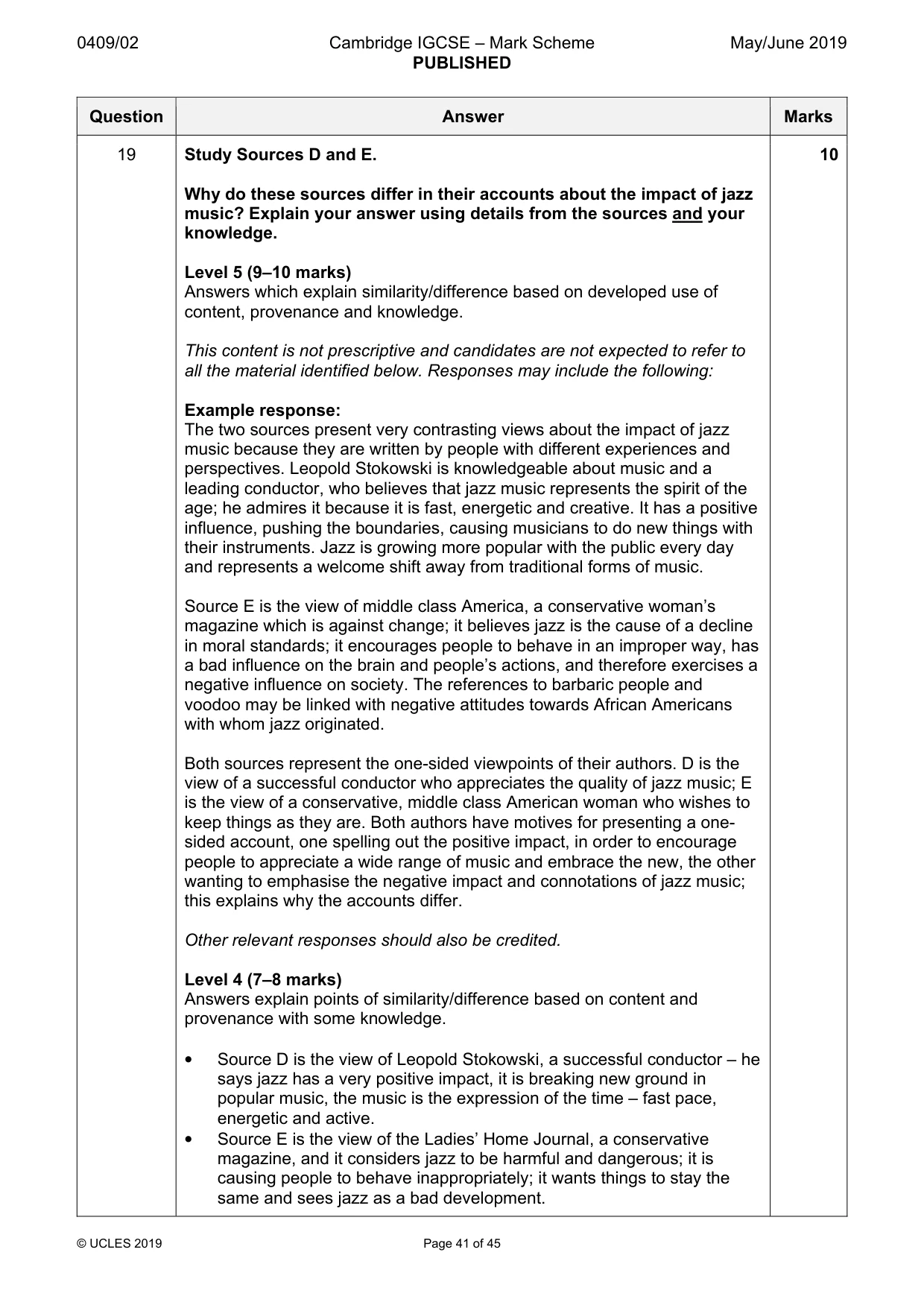
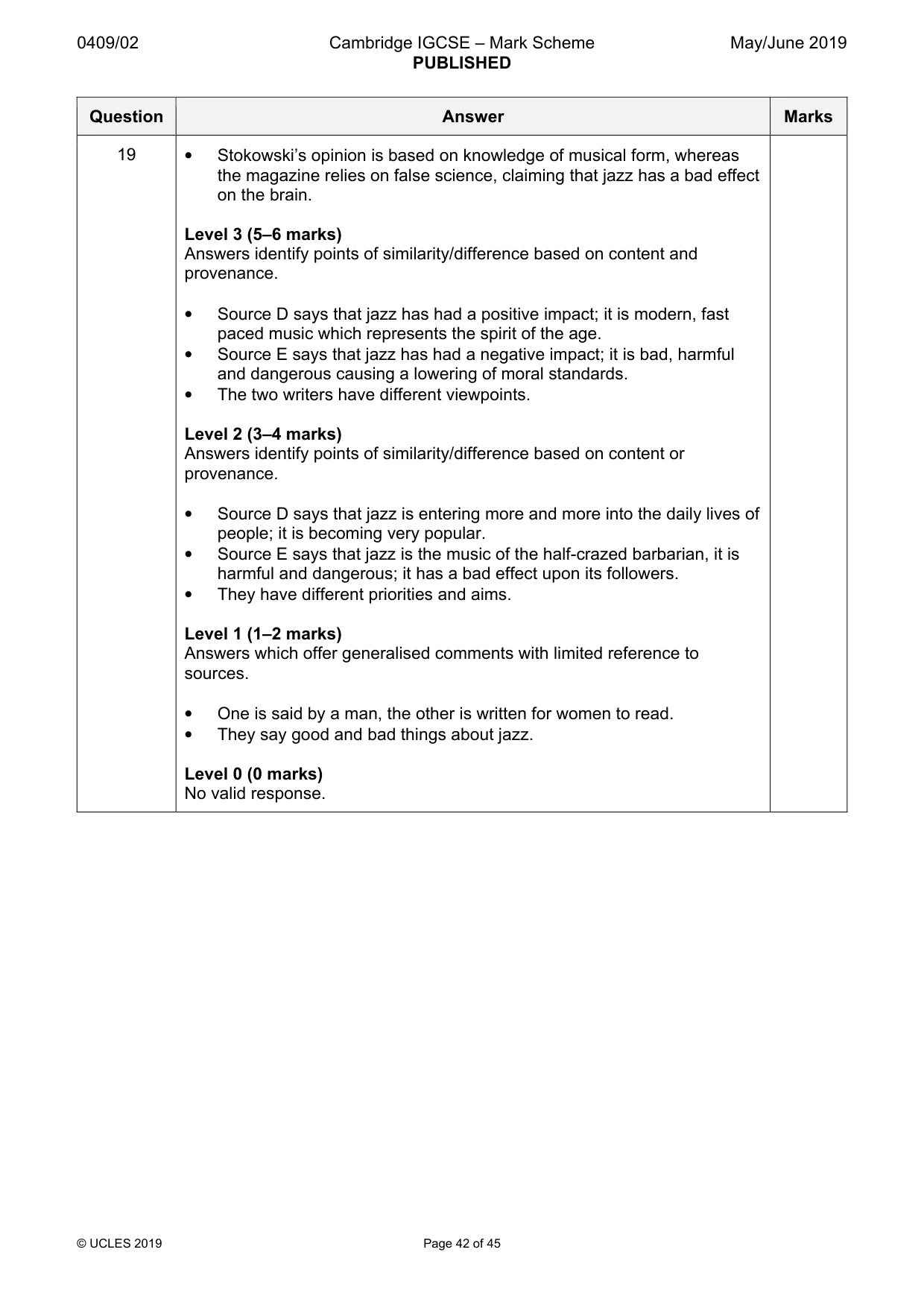
Mark scheme: 19 Study Sources D and E. 10 Why do these sources differ in their accounts about the impact of jazz music? Explain your answer using details from the sources and your knowledge. Level 5 (9–10 marks) Answers which explain similarity/difference based on developed use of content, provenance and knowledge. This content is not prescriptive and candidates are not expected to refer to all the material identified below. Responses may include the following: Example response: The two sources present very contrasting views about the impact of jazz music because they are written by people with different experiences and perspectives. Leopold Stokowski is knowledgeable about music and a leading conductor, who believes that jazz music represents the spirit of the age; he admires it because it is fast, energetic and creative. It has a positive influence, pushing the boundaries, causing musicians to do new things with their instruments. Jazz is growing more popular with the public every day and represents a welcome shift away from traditional forms of music. Source E is the view of middle class America, a conservative woman’s magazine which is against change; it believes jazz is the cause of a decline in moral standards; it encourages people to behave in an improper way, has a bad influence on the brain and people’s actions, and therefore exercises a negative influence on society. The references to barbaric people and voodoo may be linked with negative attitudes towards African Americans with whom jazz originated. Both sources represent the one-sided viewpoints of their authors. D is the view of a successful conductor who appreciates the quality of jazz music; E is the view of a conservative, middle class American woman who wishes to keep things as they are. Both authors have motives for presenting a one- sided account, one spelling out the positive impact, in order to encourage people to appreciate a wide range of music and embrace the new, the other wanting to emphasise the negative impact and connotations of jazz music; this explains why the accounts differ. Other relevant responses should also be credited. Level 4 (7–8 marks) Answers explain points of similarity/difference based on content and provenance with some knowledge. • Source D is the view of Leopold Stokowski, a successful conductor – he says jazz has a very positive impact, it is breaking new ground in popular music, the music is the expression of the time – fast pace, energetic and active. • Source E is the view of the Ladies’ Home Journal, a conservative magazine, and it considers jazz to be harmful and dangerous; it is causing people to behave inappropriately; it wants things to stay the same and sees jazz as a bad development. 19 • Stokowski’s opinion is based on knowledge of musical form, whereas the magazine relies on false science, claiming that jazz has a bad effect on the brain. Level 3 (5–6 marks) Answers identify points of similarity/difference based on content and provenance. • Source D says that jazz has had a positive impact; it is modern, fast paced music which represents the spirit of the age. • Source E says that jazz has had a negative impact; it is bad, harmful and dangerous causing a lowering of moral standards. • The two writers have different viewpoints. Level 2 (3–4 marks) Answers identify points of similarity/difference based on content or provenance. • Source D says that jazz is entering more and more into the daily lives of people; it is becoming very popular. • Source E says that jazz is the music of the half-crazed barbarian, it is harmful and dangerous; it has a bad effect upon its followers. • They have different priorities and aims. Level 1 (1–2 marks) Answers which offer generalised comments with limited reference to sources. • One is said by a man, the other is written for women to read. • They say good and bad things about jazz. Level 0 (0 marks) No valid response.
Q20 · Study all the sources
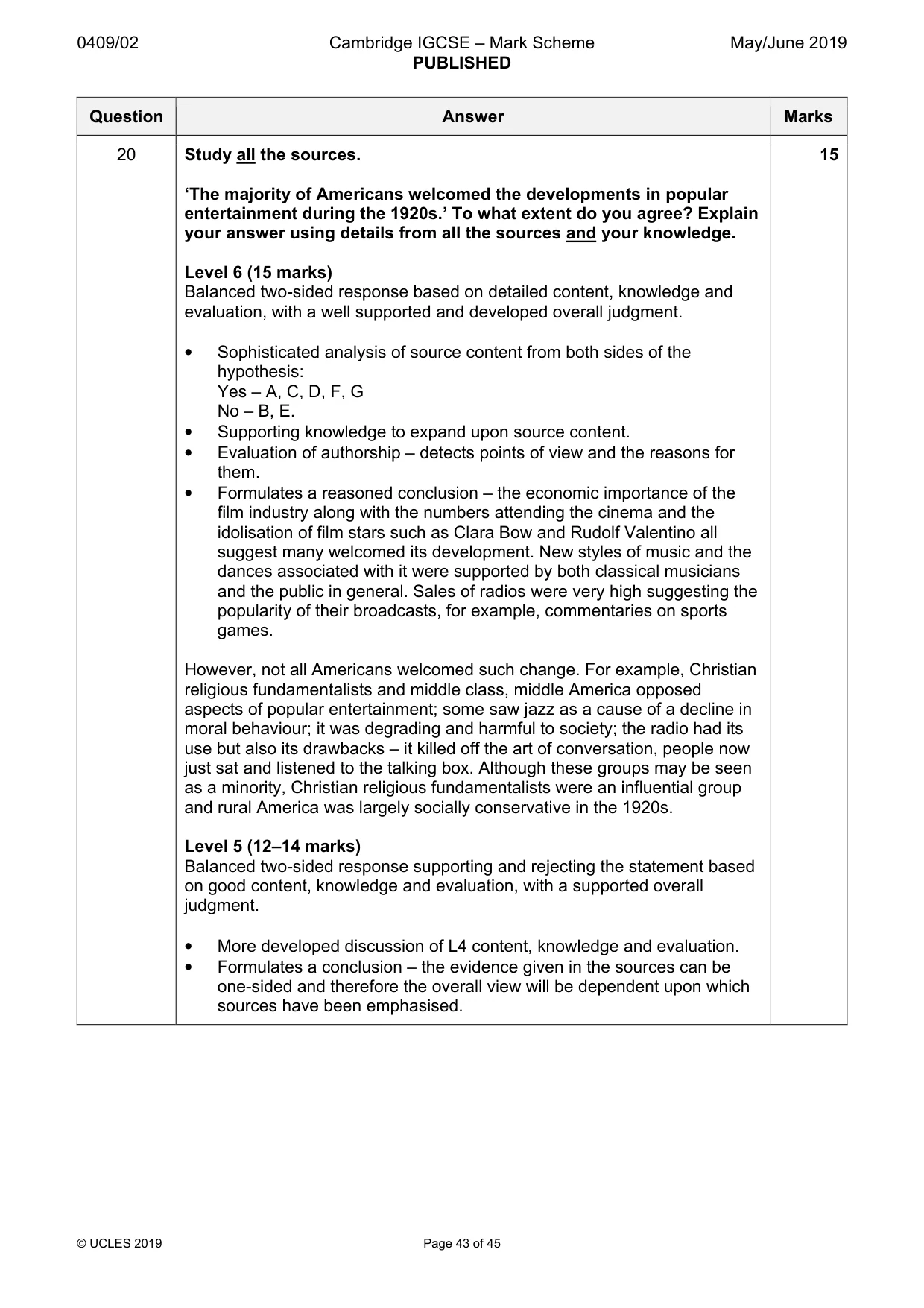
20 Study all the sources. “The majority of Americans welcomed the developments in popular entertainment during the 1920s.” To what extent do you agree? Explain your answer using details from all the sources and your knowledge. [15] [Total: 45]
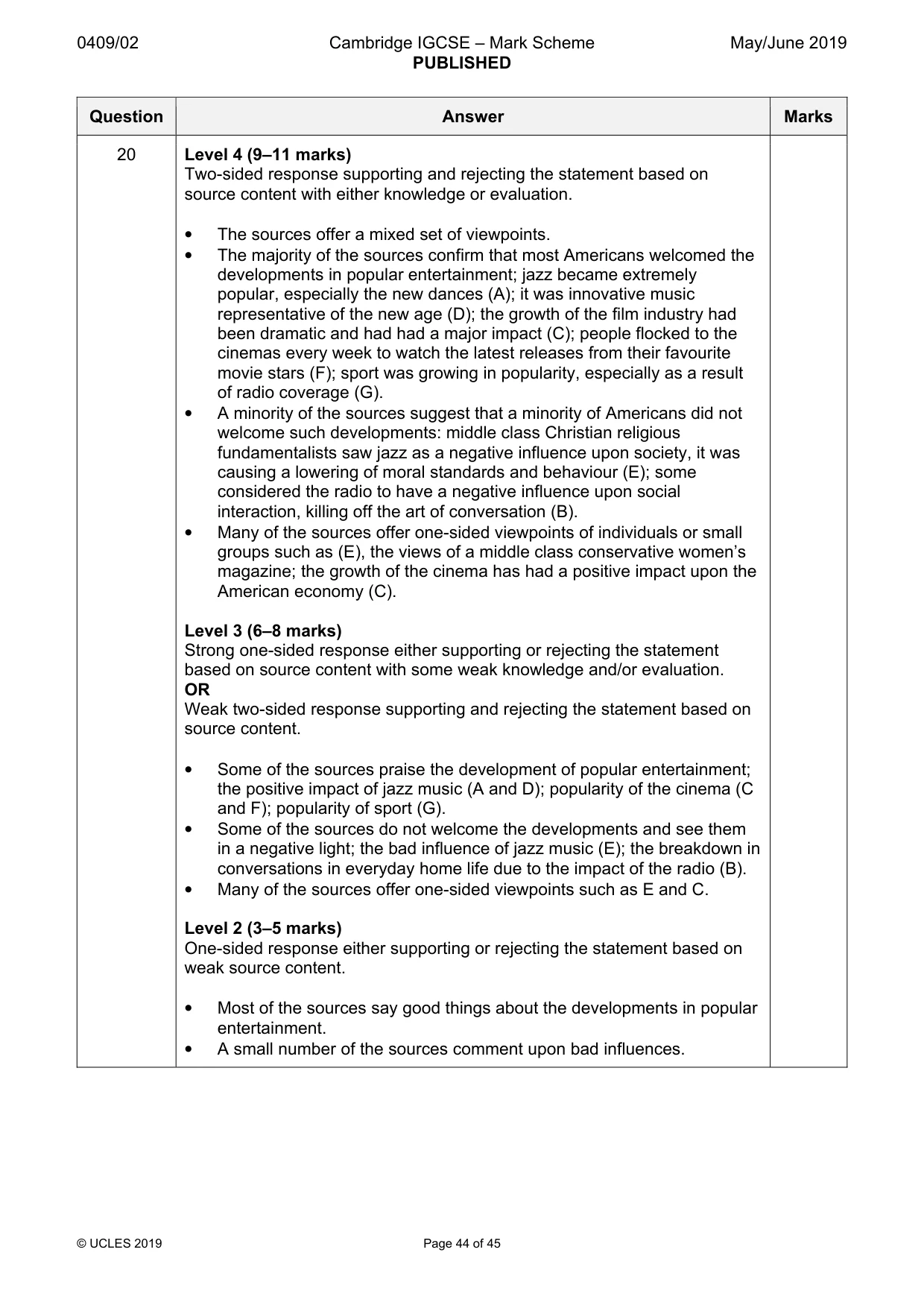
Mark scheme: 20 Study all the sources. 15 ‘The majority of Americans welcomed the developments in popular entertainment during the 1920s.’ To what extent do you agree? Explain your answer using details from all the sources and your knowledge. Level 6 (15 marks) Balanced two-sided response based on detailed content, knowledge and evaluation, with a well supported and developed overall judgment. • Sophisticated analysis of source content from both sides of the hypothesis: Yes – A, C, D, F, G No – B, E. • Supporting knowledge to expand upon source content. • Evaluation of authorship – detects points of view and the reasons for them. • Formulates a reasoned conclusion – the economic importance of the film industry along with the numbers attending the cinema and the idolisation of film stars such as Clara Bow and Rudolf Valentino all suggest many welcomed its development. New styles of music and the dances associated with it were supported by both classical musicians and the public in general. Sales of radios were very high suggesting the popularity of their broadcasts, for example, commentaries on sports games. However, not all Americans welcomed such change. For example, Christian religious fundamentalists and middle class, middle America opposed aspects of popular entertainment; some saw jazz as a cause of a decline in moral behaviour; it was degrading and harmful to society; the radio had its use but also its drawbacks – it killed off the art of conversation, people now just sat and listened to the talking box. Although these groups may be seen as a minority, Christian religious fundamentalists were an influential group and rural America was largely socially conservative in the 1920s. Level 5 (12–14 marks) Balanced two-sided response supporting and rejecting the statement based on good content, knowledge and evaluation, with a supported overall judgment. • More developed discussion of L4 content, knowledge and evaluation. • Formulates a conclusion – the evidence given in the sources can be one-sided and therefore the overall view will be dependent upon which sources have been emphasised. 20 Level 4 (9–11 marks) Two-sided response supporting and rejecting the statement based on source content with either knowledge or evaluation. • The sources offer a mixed set of viewpoints. • The majority of the sources confirm that most Americans welcomed the developments in popular entertainment; jazz became extremely popular, especially the new dances (A); it was innovative music representative of the new age (D); the growth of the film industry had been dramatic and had had a major impact (C); people flocked to the cinemas every week to watch the latest releases from their favourite movie stars (F); sport was growing in popularity, especially as a result of radio coverage (G). • A minority of the sources suggest that a minority of Americans did not welcome such developments: middle class Christian religious fundamentalists saw jazz as a negative influence upon society, it was causing a lowering of moral standards and behaviour (E); some considered the radio to have a negative influence upon social interaction, killing off the art of conversation (B). • Many of the sources offer one-sided viewpoints of individuals or small groups such as (E), the views of a middle class conservative women’s magazine; the growth of the cinema has had a positive impact upon the American economy (C). Level 3 (6–8 marks) Strong one-sided response either supporting or rejecting the statement based on source content with some weak knowledge and/or evaluation. OR Weak two-sided response supporting and rejecting the statement based on source content. • Some of the sources praise the development of popular entertainment; the positive impact of jazz music (A and D); popularity of the cinema (C and F); popularity of sport (G). • Some of the sources do not welcome the developments and see them in a negative light; the bad influence of jazz music (E); the breakdown in conversations in everyday home life due to the impact of the radio (B). • Many of the sources offer one-sided viewpoints such as E and C. Level 2 (3–5 marks) One-sided response either supporting or rejecting the statement based on weak source content. • Most of the sources say good things about the developments in popular entertainment. • A small number of the sources comment upon bad influences. 20 Level 1 (1–2 marks) Generalised comments with little/no support from the sources. • There were major developments in popular entertainment in the 1920s. • People liked going to the cinema or dancing or playing sport. Level 0 (0 marks) No valid response.
What you needed in this session
Cambridge’s own grade thresholds for 2019 May/June, Paper 2 · Variant 1. A higher threshold means an easier paper — the bar moves with how the cohort did.