Cambridge IGCSE History American BES 0409 — 2017 May/June Paper 2 · Variant 1
0409/21/M/J/17 · 10 questions · 45 marks · ≈51 min
The question paper and its mark scheme, free to read here and free to download. This is Cambridge’s own paper, exactly as it was sat.
Question paper8 pages
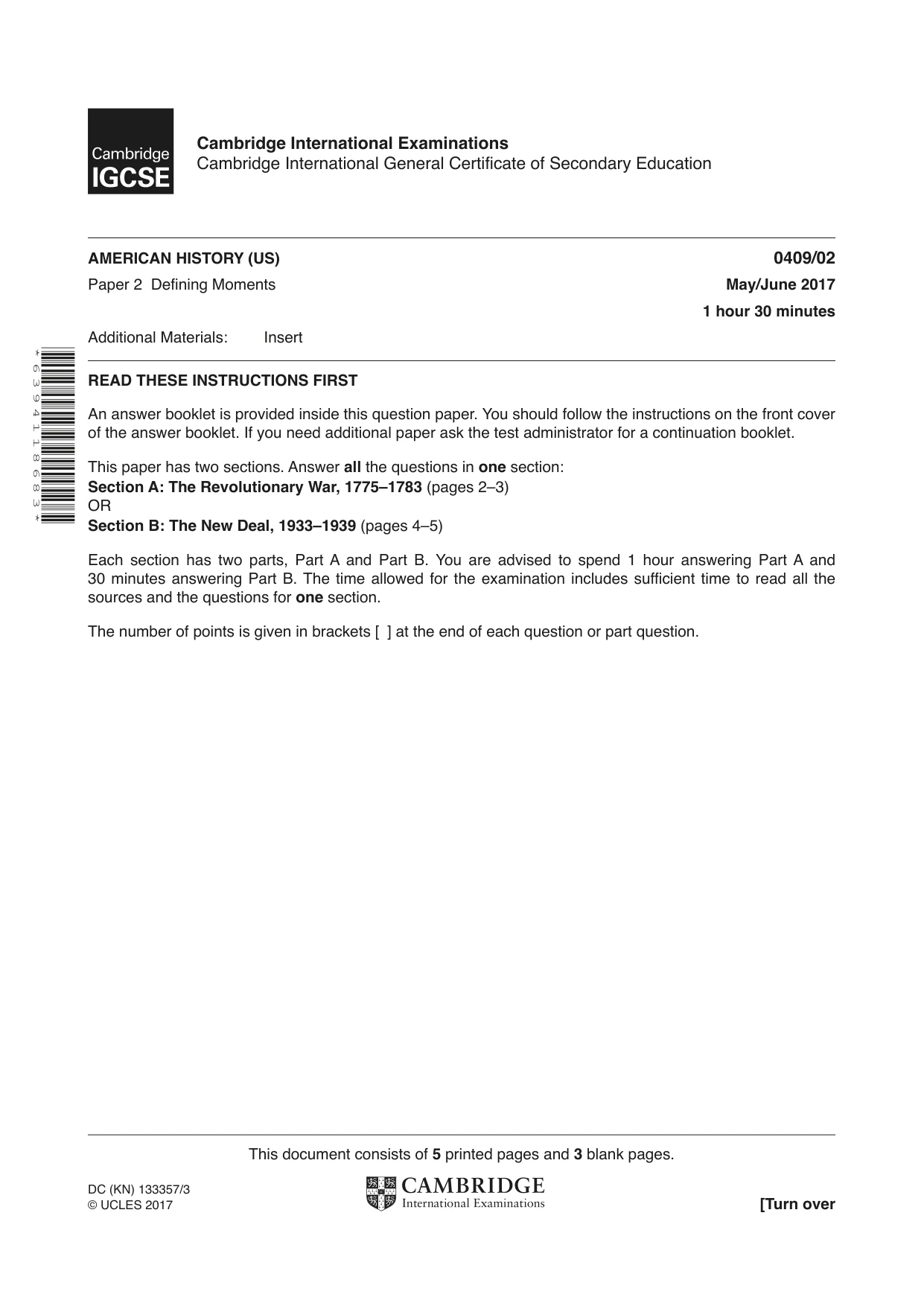



Mark scheme16 pages
Answers below. Sit the paper first if you are practising.
Questions as text
Question 1
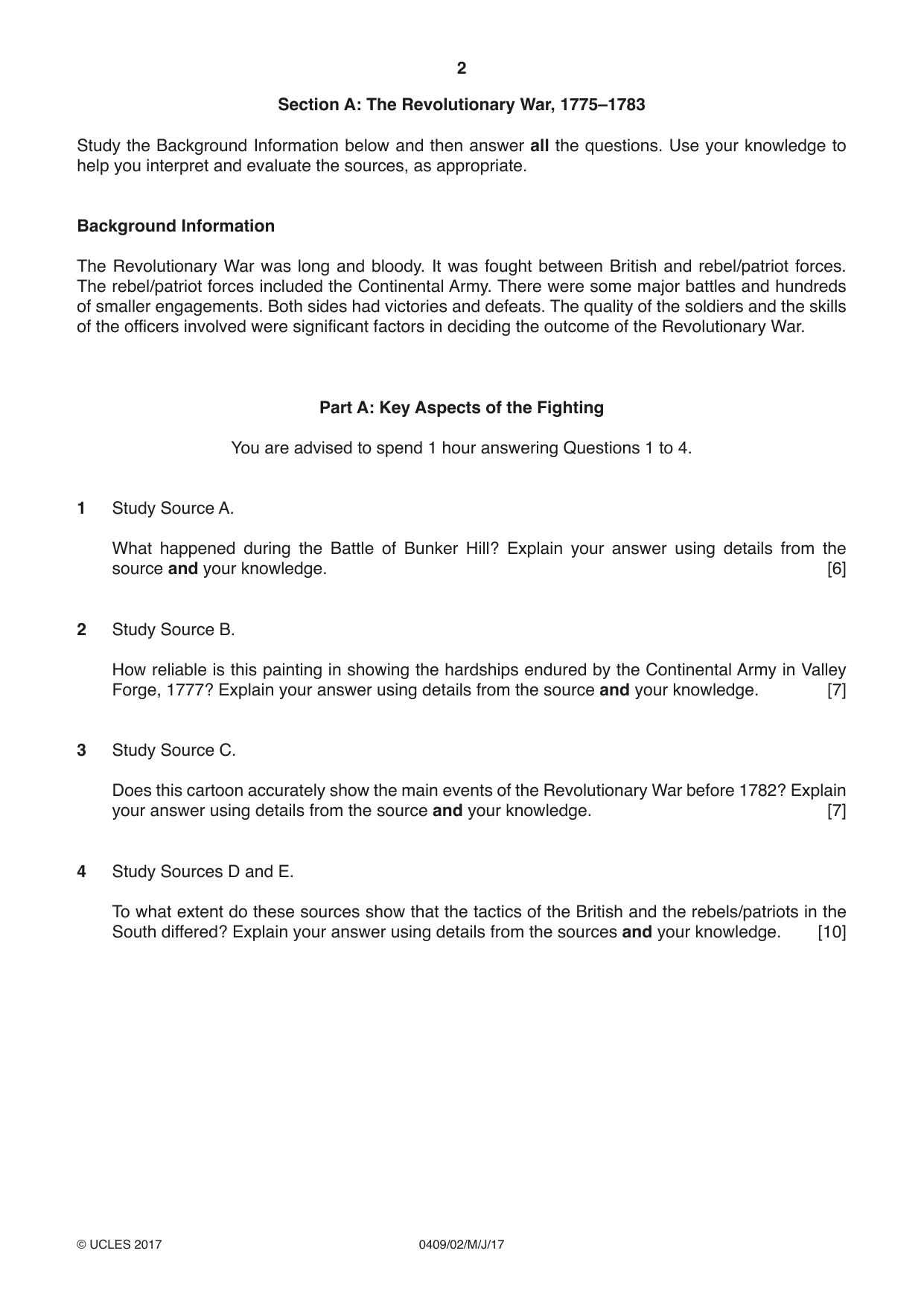
1 Study Source A. What happened during the Battle of Bunker Hill? Explain your answer using details from the source and your knowledge. [6]
Mark scheme: Question Answer Marks 1 Study Source A. 6 What happened during the Battle of Bunker Hill? Explain your answer using details from the source and your knowledge. Level 0: No evidence submitted or response does not address the question [0] Level 1: General comment: loose reference to source and/or question [1–2] • The rebel/patriot forces fought against the enemy. Level 2: Description only: identifies details [3–5] • The British attacked the rebels/patriots (‘the enemy advanced’). • The rebels/patriots were short of ammunition (‘our ammunition was almost used up’). • Rebel fire was effective (‘our gunfire was so fierce they retreated’). • The British counter-attacked and ‘surrounded out little fort’. • The rebels/patriots fought a heroic rearguard action (‘forced to retreat while those in the fort resisted for as long as their ammunition allowed). Level 3: Level 2 with knowledge [5–6] • Rebels had occupied Bunker Hill to prevent the British fortifying it. • Both sides fought hard for the Hill because it effectively dominated Boston and its harbour. • General Howe led the British attack: his men wore red, carried heavy kit and had to advance uphill (Bunker Hill was 75 feet high). • Enemy fire was vicious: the British lost 1150 men (including 92 officers) out of 2,600. • The British succeeded in taking the Hill after three frontal attacks.
Question 2
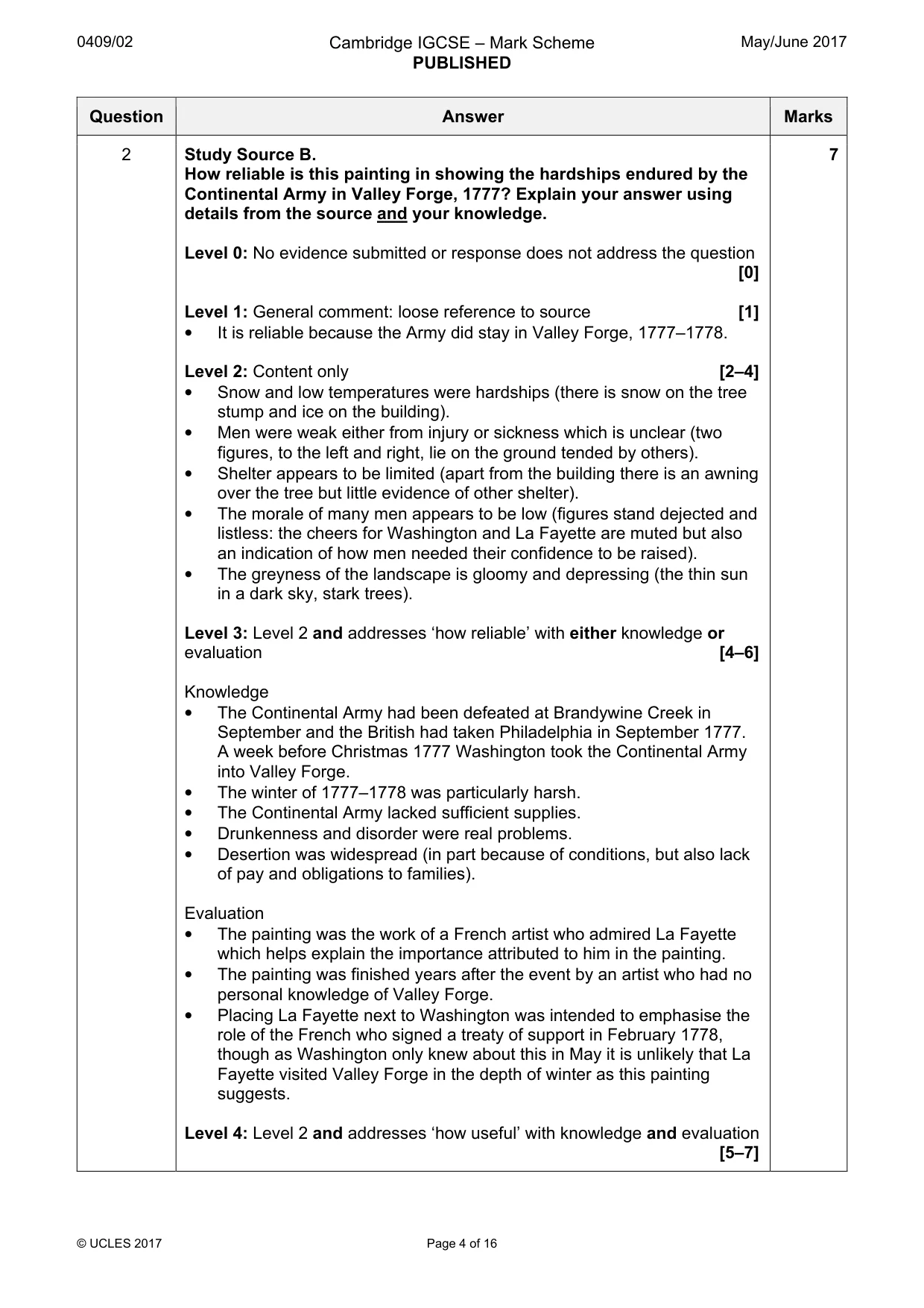
2 Study Source B. How reliable is this painting in showing the hardships endured by the Continental Army in Valley Forge, 1777? Explain your answer using details from the source and your knowledge. [7]
Mark scheme: 2 Study Source B. 7 How reliable is this painting in showing the hardships endured by the Continental Army in Valley Forge, 1777? Explain your answer using details from the source and your knowledge. Level 0: No evidence submitted or response does not address the question [0] Level 1: General comment: loose reference to source [1] • It is reliable because the Army did stay in Valley Forge, 1777–1778. Level 2: Content only [2–4] • Snow and low temperatures were hardships (there is snow on the tree stump and ice on the building). • Men were weak either from injury or sickness which is unclear (two figures, to the left and right, lie on the ground tended by others). • Shelter appears to be limited (apart from the building there is an awning over the tree but little evidence of other shelter). • The morale of many men appears to be low (figures stand dejected and listless: the cheers for Washington and La Fayette are muted but also an indication of how men needed their confidence to be raised). • The greyness of the landscape is gloomy and depressing (the thin sun in a dark sky, stark trees). Level 3: Level 2 and addresses ‘how reliable’ with either knowledge or evaluation [4–6] Knowledge • The Continental Army had been defeated at Brandywine Creek in September and the British had taken Philadelphia in September 1777. A week before Christmas 1777 Washington took the Continental Army into Valley Forge. • The winter of 1777–1778 was particularly harsh. • The Continental Army lacked sufficient supplies. • Drunkenness and disorder were real problems. • Desertion was widespread (in part because of conditions, but also lack of pay and obligations to families). Evaluation • The painting was the work of a French artist who admired La Fayette which helps explain the importance attributed to him in the painting. • The painting was finished years after the event by an artist who had no personal knowledge of Valley Forge. • Placing La Fayette next to Washington was intended to emphasise the role of the French who signed a treaty of support in February 1778, though as Washington only knew about this in May it is unlikely that La Fayette visited Valley Forge in the depth of winter as this painting suggests. Level 4: Level 2 and addresses ‘how useful’ with knowledge and evaluation [5–7]
Question 3
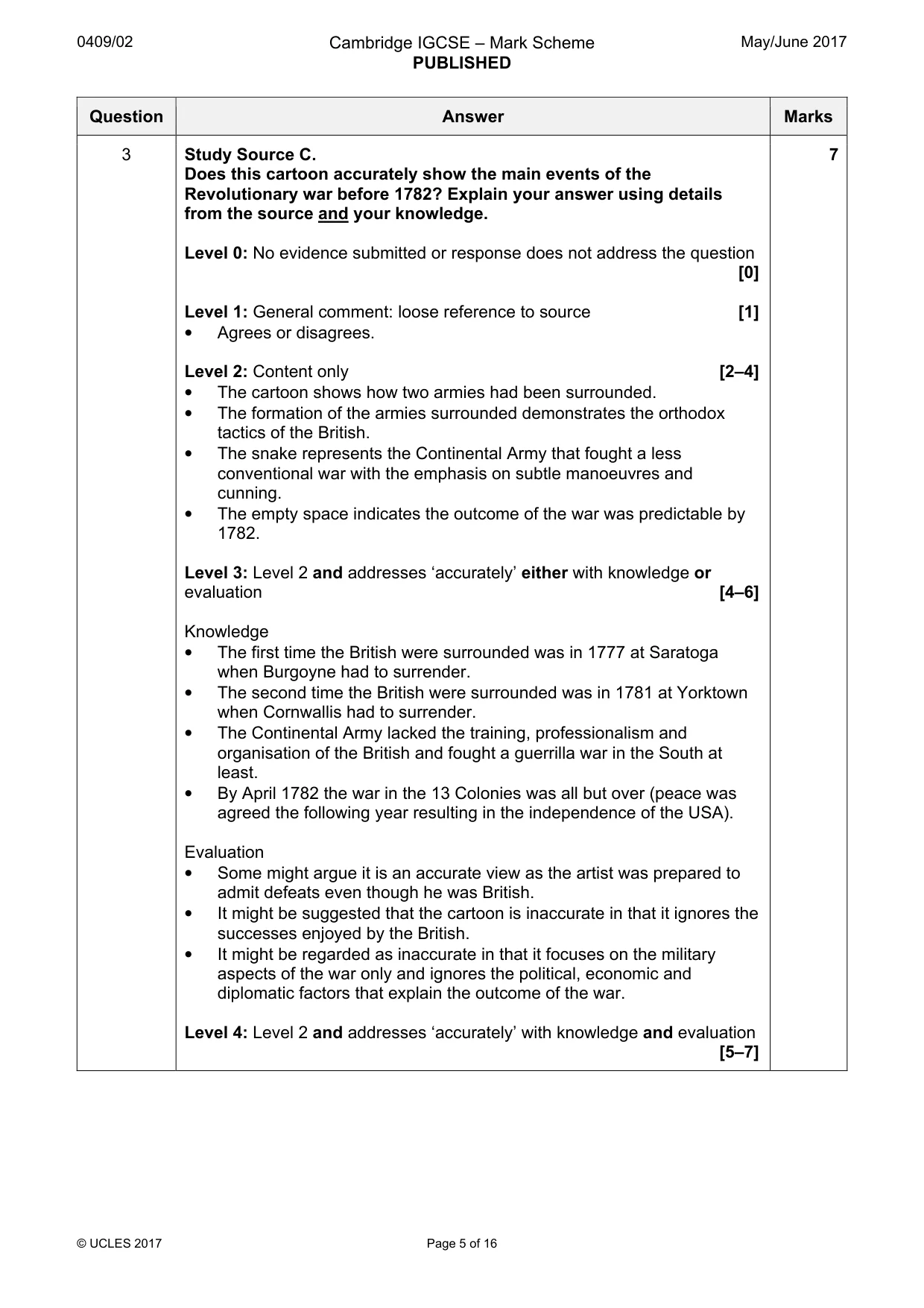
3 Study Source C. Does this cartoon accurately show the main events of the Revolutionary War before 1782? Explain your answer using details from the source and your knowledge. [7]
Mark scheme: 3 Study Source C. 7 Does this cartoon accurately show the main events of the Revolutionary war before 1782? Explain your answer using details from the source and your knowledge. Level 0: No evidence submitted or response does not address the question [0] Level 1: General comment: loose reference to source [1] • Agrees or disagrees. Level 2: Content only [2–4] • The cartoon shows how two armies had been surrounded. • The formation of the armies surrounded demonstrates the orthodox tactics of the British. • The snake represents the Continental Army that fought a less conventional war with the emphasis on subtle manoeuvres and cunning. • The empty space indicates the outcome of the war was predictable by 1782. Level 3: Level 2 and addresses ‘accurately’ either with knowledge or evaluation [4–6] Knowledge • The first time the British were surrounded was in 1777 at Saratoga when Burgoyne had to surrender. • The second time the British were surrounded was in 1781 at Yorktown when Cornwallis had to surrender. • The Continental Army lacked the training, professionalism and organisation of the British and fought a guerrilla war in the South at least. • By April 1782 the war in the 13 Colonies was all but over (peace was agreed the following year resulting in the independence of the USA). Evaluation • Some might argue it is an accurate view as the artist was prepared to admit defeats even though he was British. • It might be suggested that the cartoon is inaccurate in that it ignores the successes enjoyed by the British. • It might be regarded as inaccurate in that it focuses on the military aspects of the war only and ignores the political, economic and diplomatic factors that explain the outcome of the war. Level 4: Level 2 and addresses ‘accurately’ with knowledge and evaluation [5–7]
Q4 · Study Sources D and E
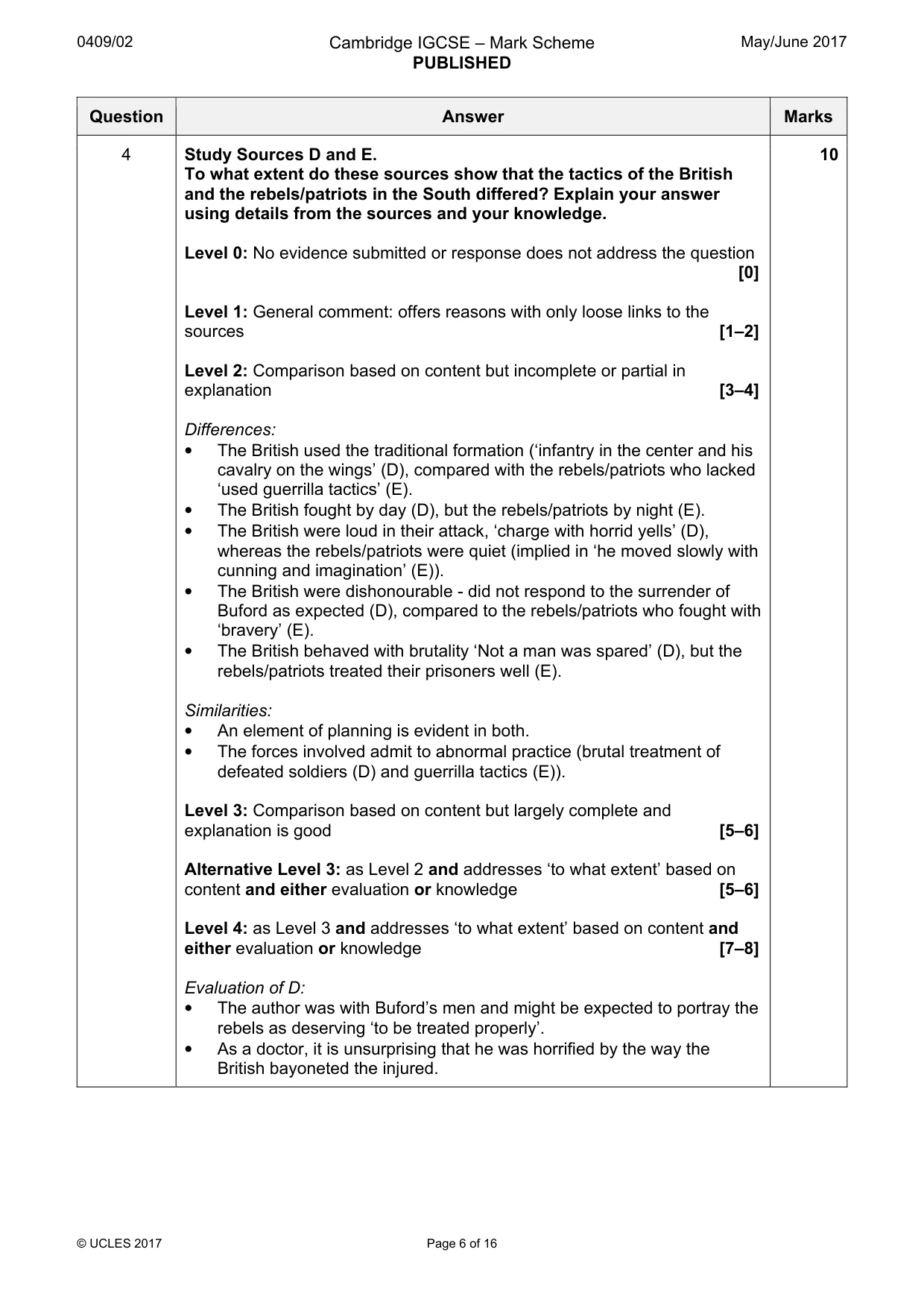
4 Study Sources D and E. To what extent do these sources show that the tactics of the British and the rebels/patriots in the South differed? Explain your answer using details from the sources and your knowledge. [10] Part B: The Armies You are advised to spend 30 minutes on your answer.
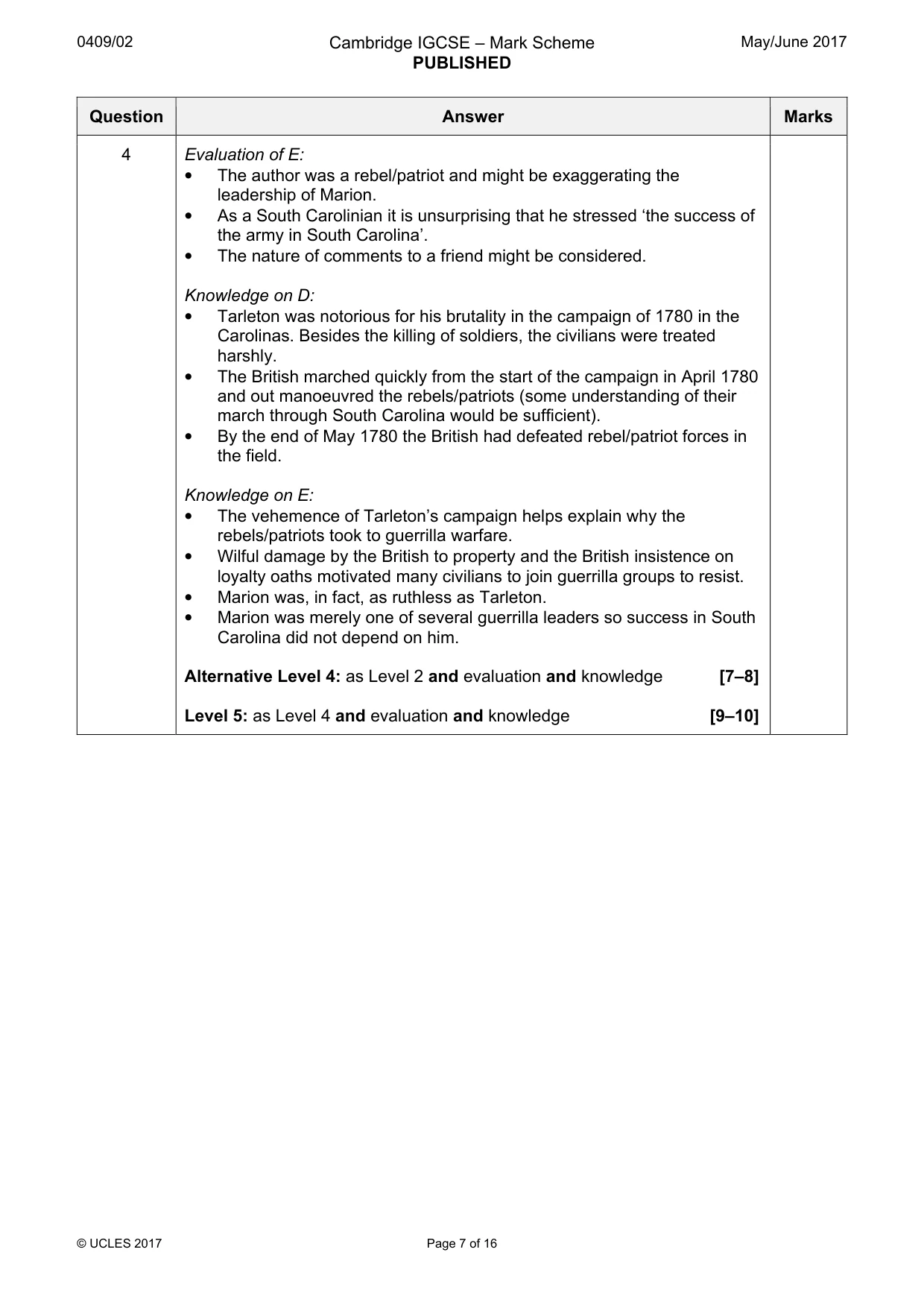
Mark scheme: 4 Study Sources D and E. 10 To what extent do these sources show that the tactics of the British and the rebels/patriots in the South differed? Explain your answer using details from the sources and your knowledge. Level 0: No evidence submitted or response does not address the question [0] Level 1: General comment: offers reasons with only loose links to the sources [1–2] Level 2: Comparison based on content but incomplete or partial in explanation [3–4] Differences: • The British used the traditional formation (‘infantry in the center and his cavalry on the wings’ (D), compared with the rebels/patriots who lacked ‘used guerrilla tactics’ (E). • The British fought by day (D), but the rebels/patriots by night (E). • The British were loud in their attack, ‘charge with horrid yells’ (D), whereas the rebels/patriots were quiet (implied in ‘he moved slowly with cunning and imagination’ (E)). • The British were dishonourable - did not respond to the surrender of Buford as expected (D), compared to the rebels/patriots who fought with ‘bravery’ (E). • The British behaved with brutality ‘Not a man was spared’ (D), but the rebels/patriots treated their prisoners well (E). Similarities: • An element of planning is evident in both. • The forces involved admit to abnormal practice (brutal treatment of defeated soldiers (D) and guerrilla tactics (E)). Level 3: Comparison based on content but largely complete and explanation is good [5–6] Alternative Level 3: as Level 2 and addresses ‘to what extent’ based on content and either evaluation or knowledge [5–6] Level 4: as Level 3 and addresses ‘to what extent’ based on content and either evaluation or knowledge [7–8] Evaluation of D: • The author was with Buford’s men and might be expected to portray the rebels as deserving ‘to be treated properly’. • As a doctor, it is unsurprising that he was horrified by the way the British bayoneted the injured. 4 Evaluation of E: • The author was a rebel/patriot and might be exaggerating the leadership of Marion. • As a South Carolinian it is unsurprising that he stressed ‘the success of the army in South Carolina’. • The nature of comments to a friend might be considered. Knowledge on D: • Tarleton was notorious for his brutality in the campaign of 1780 in the Carolinas. Besides the killing of soldiers, the civilians were treated harshly. • The British marched quickly from the start of the campaign in April 1780 and out manoeuvred the rebels/patriots (some understanding of their march through South Carolina would be sufficient). • By the end of May 1780 the British had defeated rebel/patriot forces in the field. Knowledge on E: • The vehemence of Tarleton’s campaign helps explain why the rebels/patriots took to guerrilla warfare. • Wilful damage by the British to property and the British insistence on loyalty oaths motivated many civilians to join guerrilla groups to resist. • Marion was, in fact, as ruthless as Tarleton. • Marion was merely one of several guerrilla leaders so success in South Carolina did not depend on him. Alternative Level 4: as Level 2 and evaluation and knowledge [7–8] Level 5: as Level 4 and evaluation and knowledge [9–10]
Q5 · Study Sources F and G
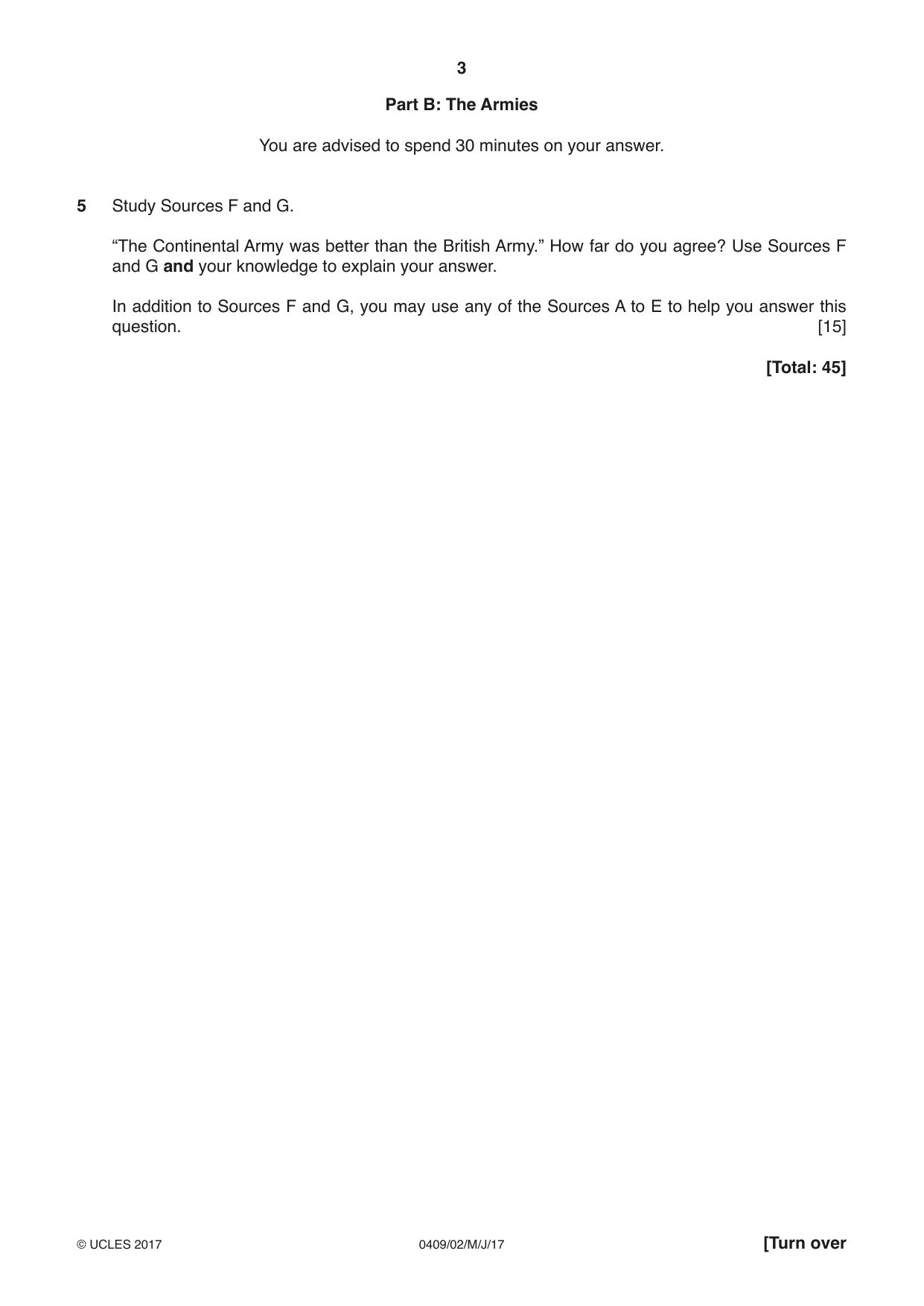
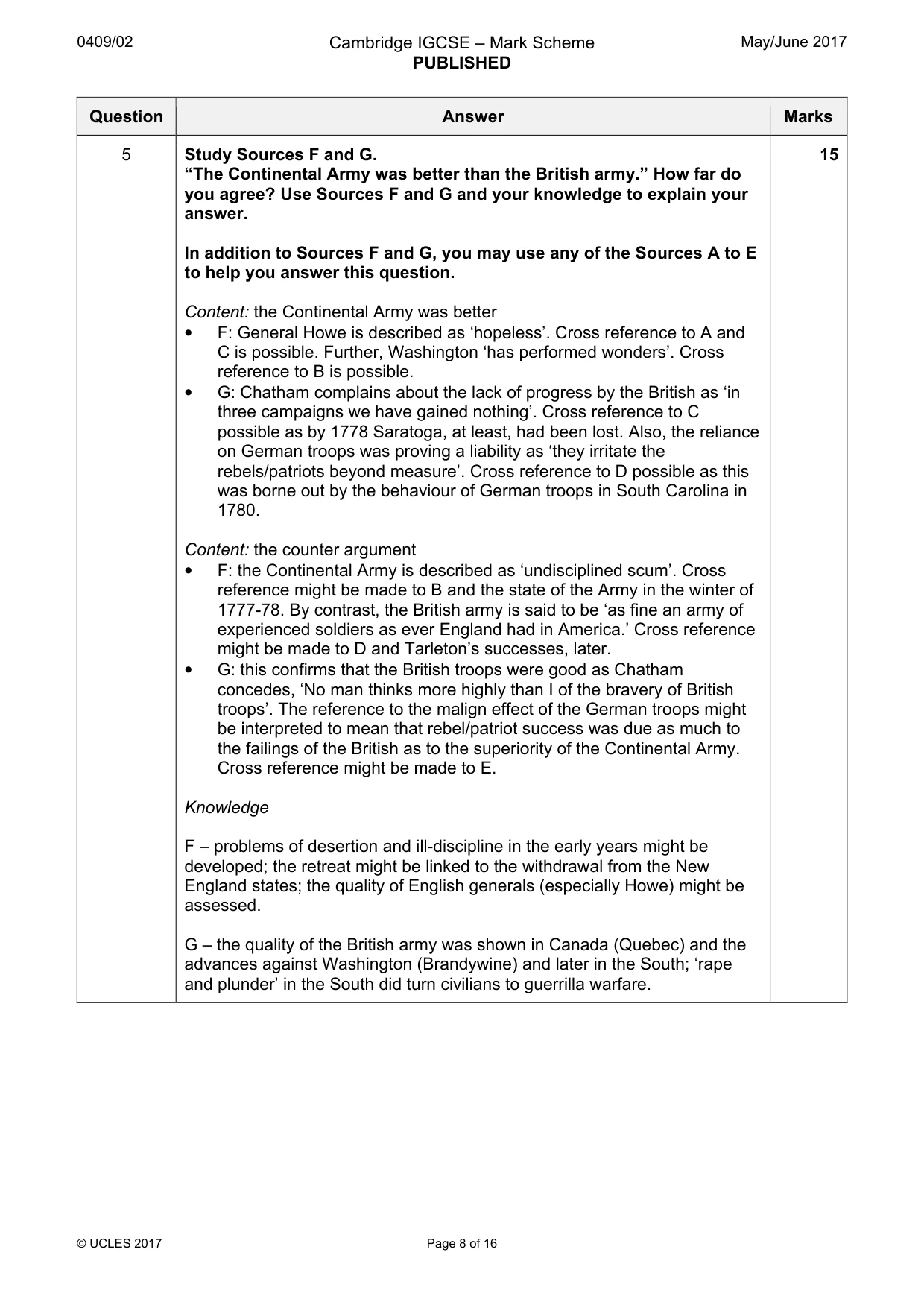
5 Study Sources F and G. “The Continental Army was better than the British Army.” How far do you agree? Use Sources F and G and your knowledge to explain your answer. In addition to Sources F and G, you may use any of the Sources A to E to help you answer this question. [15] [Total: 45]
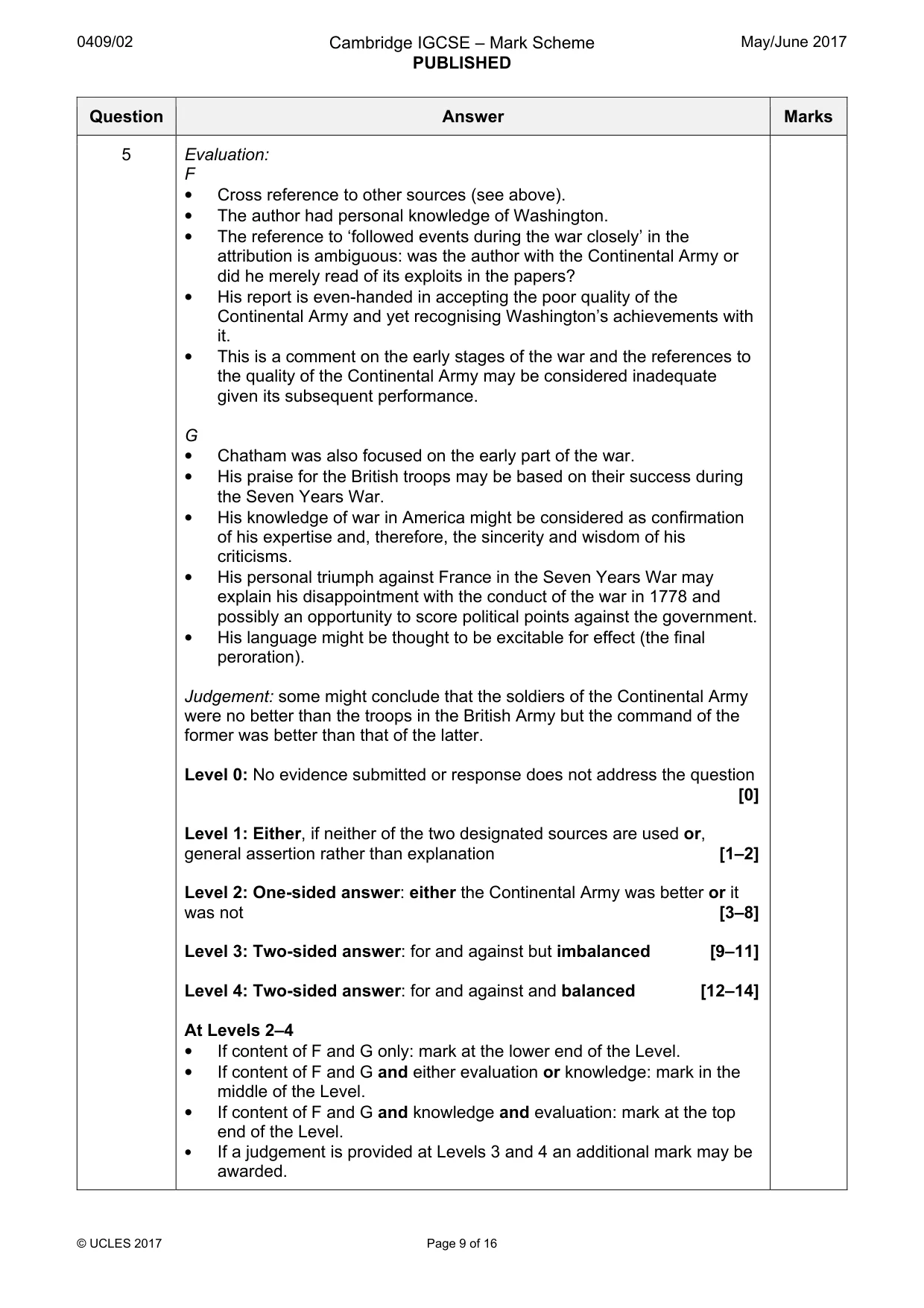
Mark scheme: 5 Study Sources F and G. 15 “The Continental Army was better than the British army.” How far do you agree? Use Sources F and G and your knowledge to explain your answer. In addition to Sources F and G, you may use any of the Sources A to E to help you answer this question. Content: the Continental Army was better • F: General Howe is described as ‘hopeless’. Cross reference to A and C is possible. Further, Washington ‘has performed wonders’. Cross reference to B is possible. • G: Chatham complains about the lack of progress by the British as ‘in three campaigns we have gained nothing’. Cross reference to C possible as by 1778 Saratoga, at least, had been lost. Also, the reliance on German troops was proving a liability as ‘they irritate the rebels/patriots beyond measure’. Cross reference to D possible as this was borne out by the behaviour of German troops in South Carolina in 1780. Content: the counter argument • F: the Continental Army is described as ‘undisciplined scum’. Cross reference might be made to B and the state of the Army in the winter of 1777-78. By contrast, the British army is said to be ‘as fine an army of experienced soldiers as ever England had in America.’ Cross reference might be made to D and Tarleton’s successes, later. • G: this confirms that the British troops were good as Chatham concedes, ‘No man thinks more highly than I of the bravery of British troops’. The reference to the malign effect of the German troops might be interpreted to mean that rebel/patriot success was due as much to the failings of the British as to the superiority of the Continental Army. Cross reference might be made to E. Knowledge F – problems of desertion and ill-discipline in the early years might be developed; the retreat might be linked to the withdrawal from the New England states; the quality of English generals (especially Howe) might be assessed. G – the quality of the British army was shown in Canada (Quebec) and the advances against Washington (Brandywine) and later in the South; ‘rape and plunder’ in the South did turn civilians to guerrilla warfare. 5 Evaluation: F • Cross reference to other sources (see above). • The author had personal knowledge of Washington. • The reference to ‘followed events during the war closely’ in the attribution is ambiguous: was the author with the Continental Army or did he merely read of its exploits in the papers? • His report is even-handed in accepting the poor quality of the Continental Army and yet recognising Washington’s achievements with it. • This is a comment on the early stages of the war and the references to the quality of the Continental Army may be considered inadequate given its subsequent performance. G • Chatham was also focused on the early part of the war. • His praise for the British troops may be based on their success during the Seven Years War. • His knowledge of war in America might be considered as confirmation of his expertise and, therefore, the sincerity and wisdom of his criticisms. • His personal triumph against France in the Seven Years War may explain his disappointment with the conduct of the war in 1778 and possibly an opportunity to score political points against the government. • His language might be thought to be excitable for effect (the final peroration). Judgement: some might conclude that the soldiers of the Continental Army were no better than the troops in the British Army but the command of the former was better than that of the latter. Level 0: No evidence submitted or response does not address the question [0] Level 1: Either, if neither of the two designated sources are used or, general assertion rather than explanation [1–2] Level 2: One-sided answer: either the Continental Army was better or it was not [3–8] Level 3: Two-sided answer: for and against but imbalanced [9–11] Level 4: Two-sided answer: for and against and balanced [12–14] At Levels 2–4 • If content of F and G only: mark at the lower end of the Level. • If content of F and G and either evaluation or knowledge: mark in the middle of the Level. • If content of F and G and knowledge and evaluation: mark at the top end of the Level. • If a judgement is provided at Levels 3 and 4 an additional mark may be awarded. Section B: The New Deal 1933 1939
Question 6
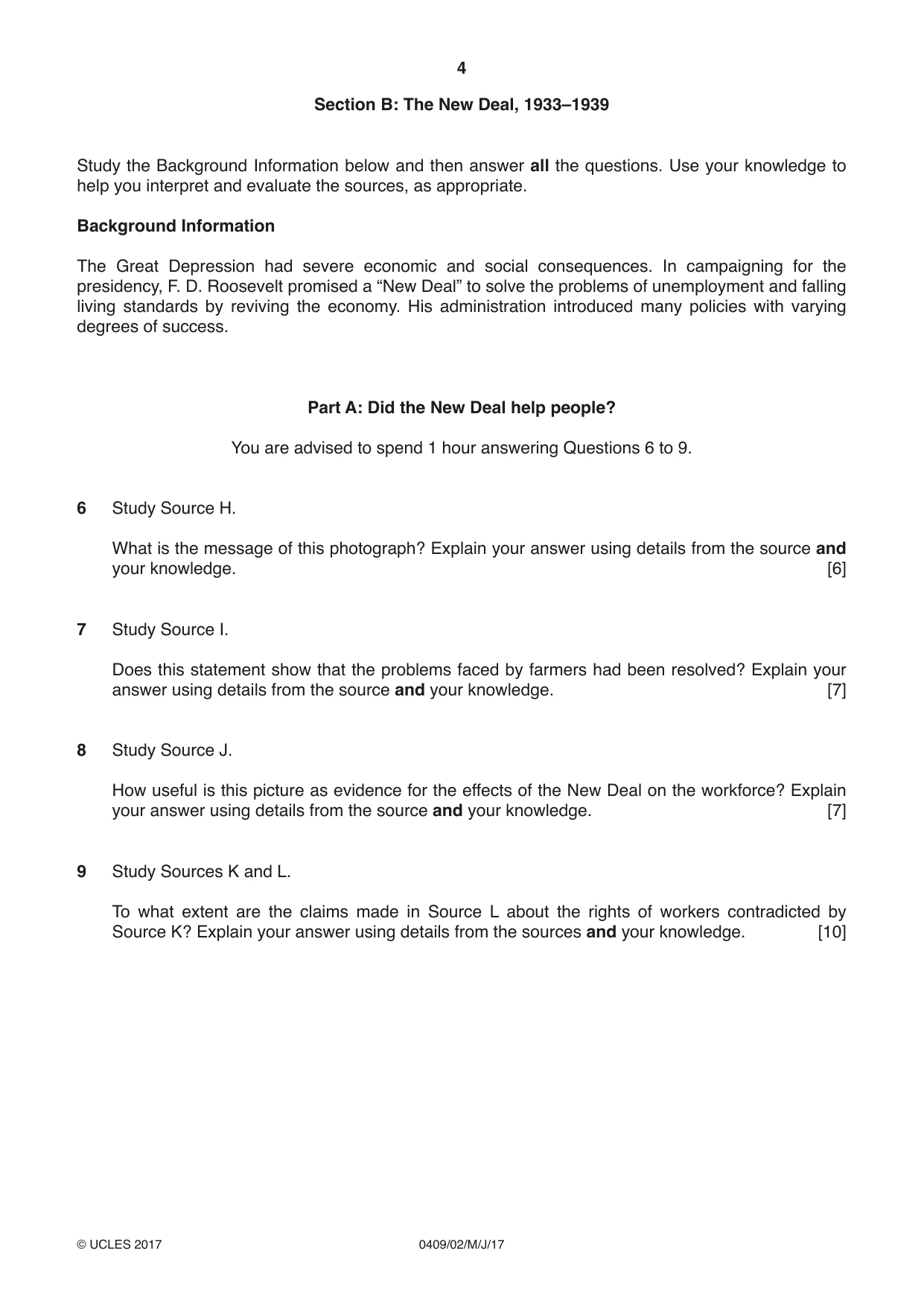
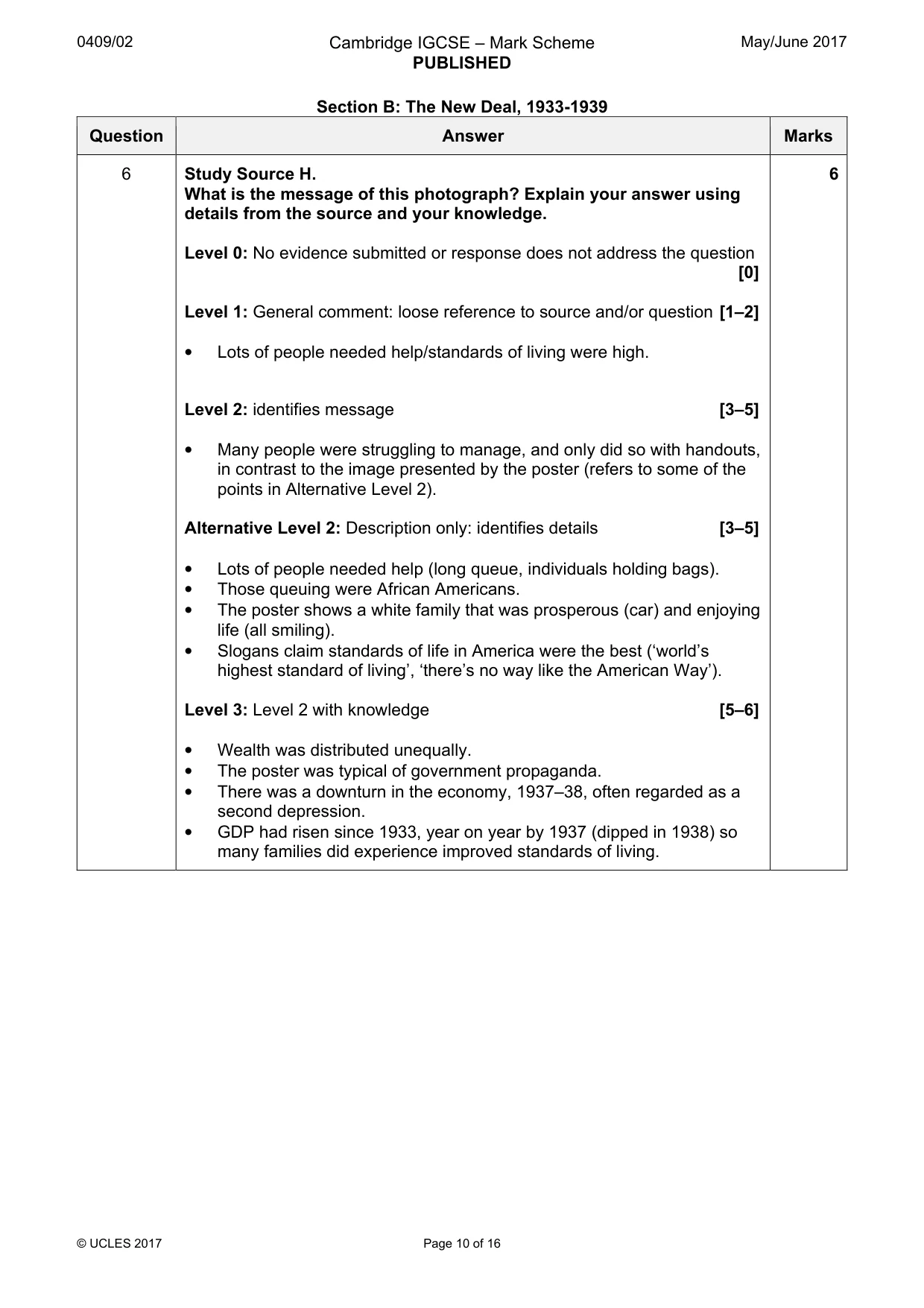
6 Study Source H. What is the message of this photograph? Explain your answer using details from the source and your knowledge. [6]
Mark scheme: 6 Study Source H. 6 What is the message of this photograph? Explain your answer using details from the source and your knowledge. Level 0: No evidence submitted or response does not address the question [0] Level 1: General comment: loose reference to source and/or question [1–2] • Lots of people needed help/standards of living were high. Level 2: identifies message [3–5] • Many people were struggling to manage, and only did so with handouts, in contrast to the image presented by the poster (refers to some of the points in Alternative Level 2). Alternative Level 2: Description only: identifies details [3–5] • Lots of people needed help (long queue, individuals holding bags). • Those queuing were African Americans. • The poster shows a white family that was prosperous (car) and enjoying life (all smiling). • Slogans claim standards of life in America were the best (‘world’s highest standard of living’, ‘there’s no way like the American Way’). Level 3: Level 2 with knowledge [5–6] • Wealth was distributed unequally. • The poster was typical of government propaganda. • There was a downturn in the economy, 1937–38, often regarded as a second depression. • GDP had risen since 1933, year on year by 1937 (dipped in 1938) so many families did experience improved standards of living.
Question 7
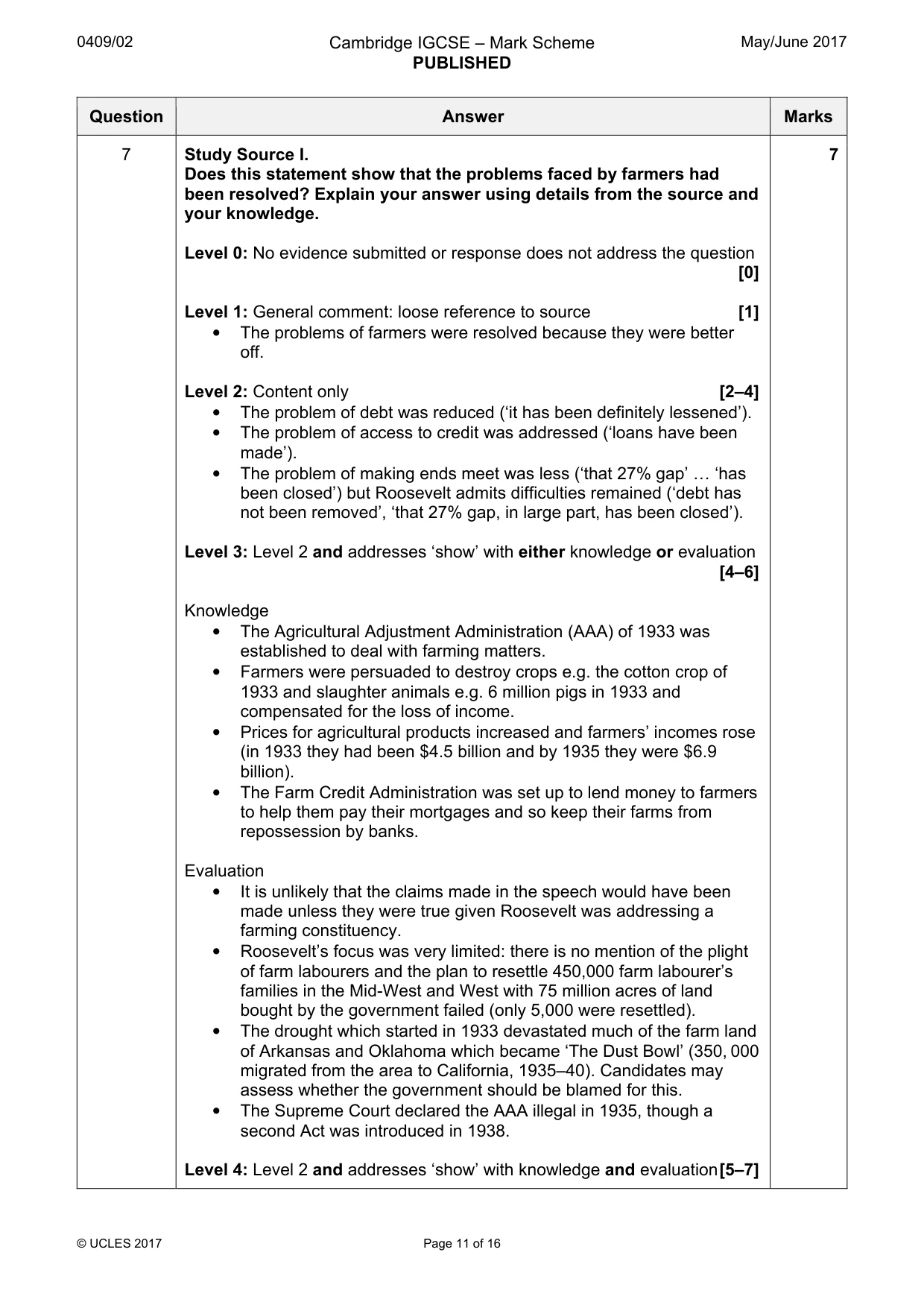
7 Study Source I. Does this statement show that the problems faced by farmers had been resolved? Explain your answer using details from the source and your knowledge. [7]
Mark scheme: 7 Study Source I. 7 Does this statement show that the problems faced by farmers had been resolved? Explain your answer using details from the source and your knowledge. Level 0: No evidence submitted or response does not address the question [0] Level 1: General comment: loose reference to source [1] • The problems of farmers were resolved because they were better off. Level 2: Content only [2–4] • The problem of debt was reduced (‘it has been definitely lessened’). • The problem of access to credit was addressed (‘loans have been made’). • The problem of making ends meet was less (‘that 27% gap’ « ‘has been closed’) but Roosevelt admits difficulties remained (‘debt has not been removed’, ‘that 27% gap, in large part, has been closed’). Level 3: Level 2 and addresses ‘show’ with either knowledge or evaluation [4–6] Knowledge • The Agricultural Adjustment Administration (AAA) of 1933 was established to deal with farming matters. • Farmers were persuaded to destroy crops e.g. the cotton crop of 1933 and slaughter animals e.g. 6 million pigs in 1933 and compensated for the loss of income. • Prices for agricultural products increased and farmers’ incomes rose (in 1933 they had been $4.5 billion and by 1935 they were $6.9 billion). • The Farm Credit Administration was set up to lend money to farmers to help them pay their mortgages and so keep their farms from repossession by banks. Evaluation • It is unlikely that the claims made in the speech would have been made unless they were true given Roosevelt was addressing a farming constituency. • Roosevelt’s focus was very limited: there is no mention of the plight of farm labourers and the plan to resettle 450,000 farm labourer’s families in the Mid-West and West with 75 million acres of land bought by the government failed (only 5,000 were resettled). • The drought which started in 1933 devastated much of the farm land of Arkansas and Oklahoma which became ‘The Dust Bowl’ (350, 000 migrated from the area to California, 1935–40). Candidates may assess whether the government should be blamed for this. • The Supreme Court declared the AAA illegal in 1935, though a second Act was introduced in 1938. Level 4: Level 2 and addresses ‘show’ with knowledge and evaluation [5–7]
Question 8
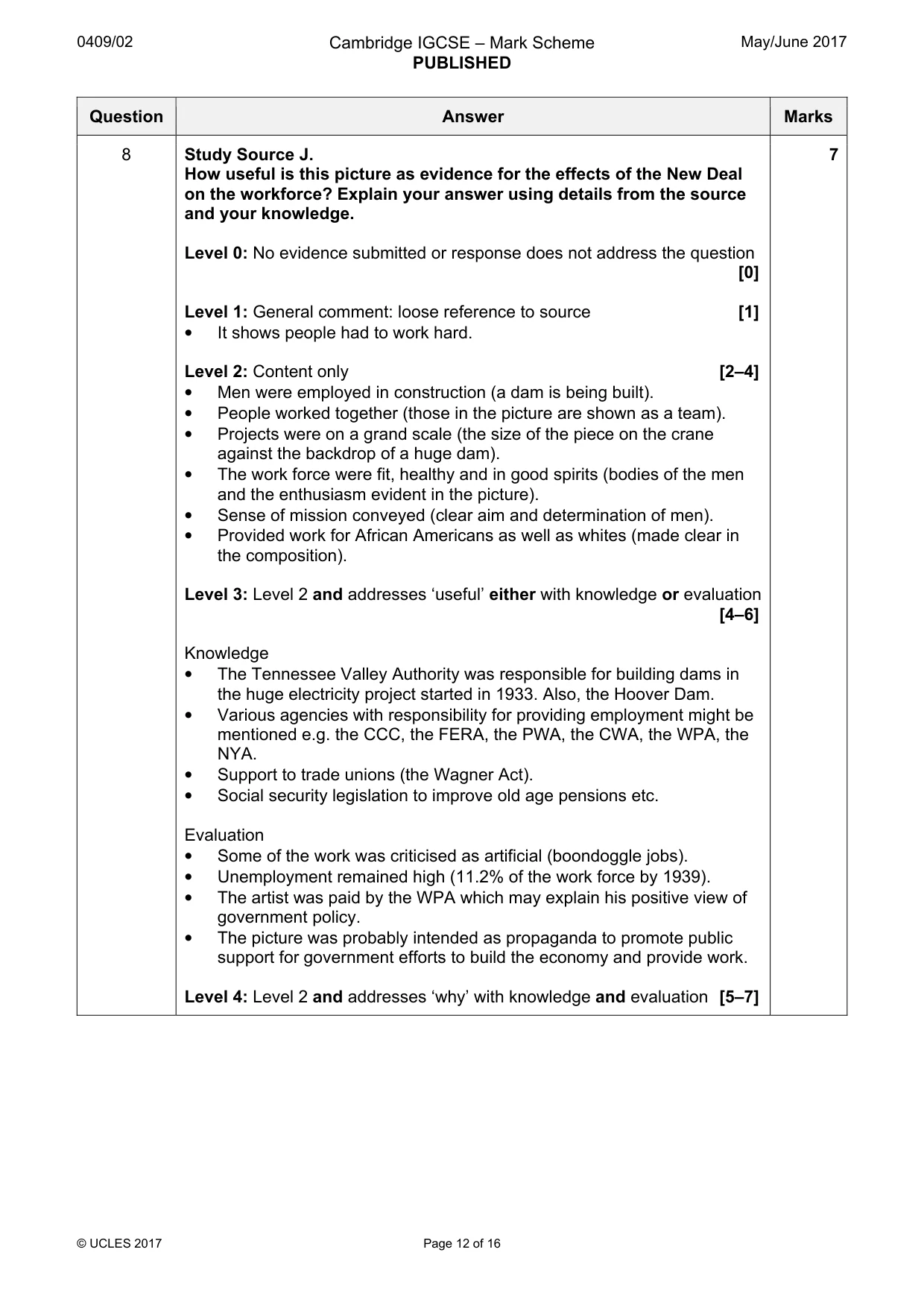
8 Study Source J. How useful is this picture as evidence for the effects of the New Deal on the workforce? Explain your answer using details from the source and your knowledge. [7]
Mark scheme: 8 Study Source J. 7 How useful is this picture as evidence for the effects of the New Deal on the workforce? Explain your answer using details from the source and your knowledge. Level 0: No evidence submitted or response does not address the question [0] Level 1: General comment: loose reference to source [1] • It shows people had to work hard. Level 2: Content only [2–4] • Men were employed in construction (a dam is being built). • People worked together (those in the picture are shown as a team). • Projects were on a grand scale (the size of the piece on the crane against the backdrop of a huge dam). • The work force were fit, healthy and in good spirits (bodies of the men and the enthusiasm evident in the picture). • Sense of mission conveyed (clear aim and determination of men). • Provided work for African Americans as well as whites (made clear in the composition). Level 3: Level 2 and addresses ‘useful’ either with knowledge or evaluation [4–6] Knowledge • The Tennessee Valley Authority was responsible for building dams in the huge electricity project started in 1933. Also, the Hoover Dam. • Various agencies with responsibility for providing employment might be mentioned e.g. the CCC, the FERA, the PWA, the CWA, the WPA, the NYA. • Support to trade unions (the Wagner Act). • Social security legislation to improve old age pensions etc. Evaluation • Some of the work was criticised as artificial (boondoggle jobs). • Unemployment remained high (11.2% of the work force by 1939). • The artist was paid by the WPA which may explain his positive view of government policy. • The picture was probably intended as propaganda to promote public support for government efforts to build the economy and provide work. Level 4: Level 2 and addresses ‘why’ with knowledge and evaluation [5–7]
Q9 · Study Sources K and L
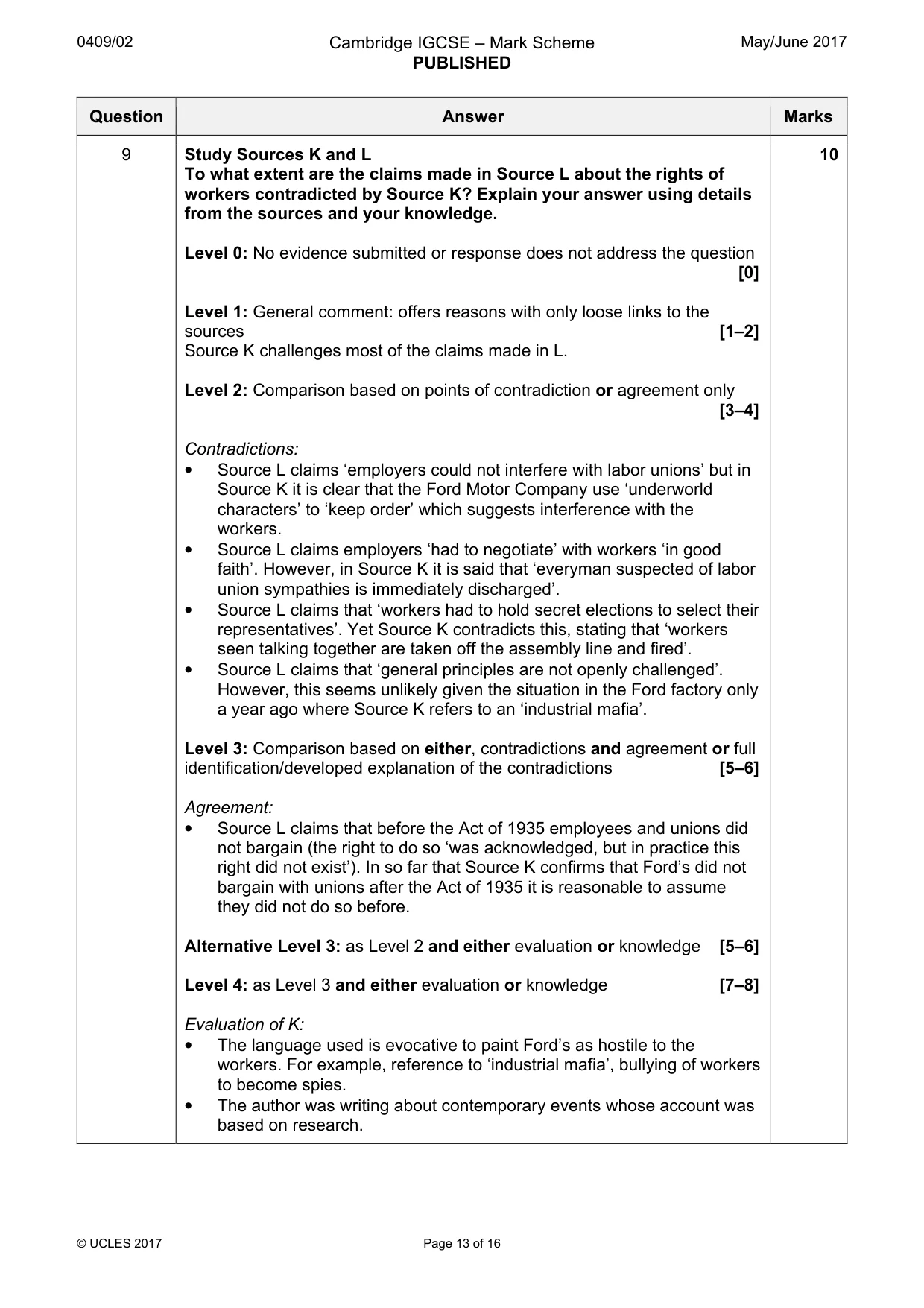
9 Study Sources K and L. To what extent are the claims made in Source L about the rights of workers contradicted by Source K? Explain your answer using details from the sources and your knowledge. [10] Part B: An Assessment of the New Deal You are advised to spend 30 minutes on your answer.
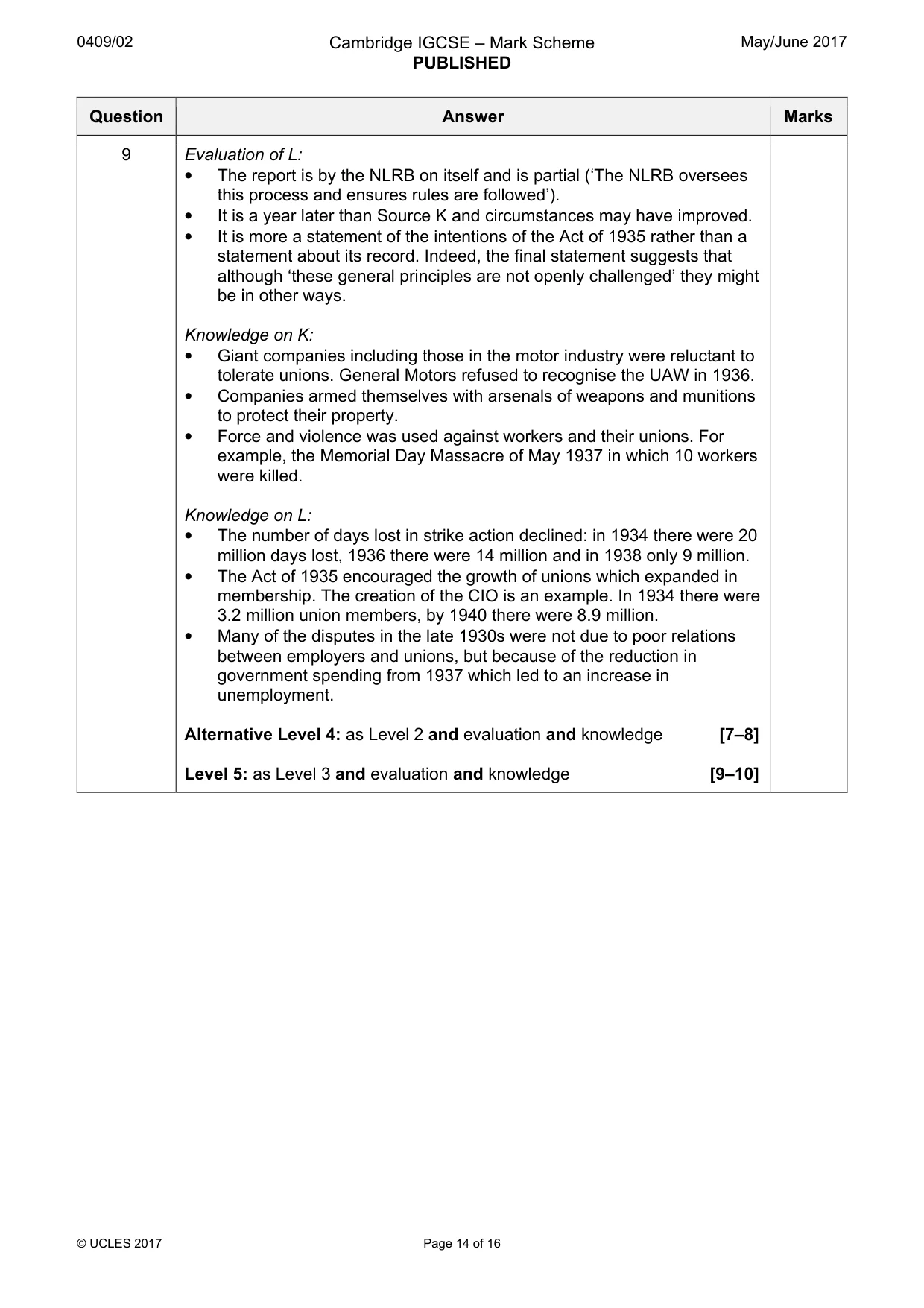
Mark scheme: 9 Study Sources K and L 10 To what extent are the claims made in Source L about the rights of workers contradicted by Source K? Explain your answer using details from the sources and your knowledge. Level 0: No evidence submitted or response does not address the question [0] Level 1: General comment: offers reasons with only loose links to the sources [1–2] Source K challenges most of the claims made in L. Level 2: Comparison based on points of contradiction or agreement only [3–4] Contradictions: • Source L claims ‘employers could not interfere with labor unions’ but in Source K it is clear that the Ford Motor Company use ‘underworld characters’ to ‘keep order’ which suggests interference with the workers. • Source L claims employers ‘had to negotiate’ with workers ‘in good faith’. However, in Source K it is said that ‘everyman suspected of labor union sympathies is immediately discharged’. • Source L claims that ‘workers had to hold secret elections to select their representatives’. Yet Source K contradicts this, stating that ‘workers seen talking together are taken off the assembly line and fired’. • Source L claims that ‘general principles are not openly challenged’. However, this seems unlikely given the situation in the Ford factory only a year ago where Source K refers to an ‘industrial mafia’. Level 3: Comparison based on either, contradictions and agreement or full identification/developed explanation of the contradictions [5–6] Agreement: • Source L claims that before the Act of 1935 employees and unions did not bargain (the right to do so ‘was acknowledged, but in practice this right did not exist’). In so far that Source K confirms that Ford’s did not bargain with unions after the Act of 1935 it is reasonable to assume they did not do so before. Alternative Level 3: as Level 2 and either evaluation or knowledge [5–6] Level 4: as Level 3 and either evaluation or knowledge [7–8] Evaluation of K: • The language used is evocative to paint Ford’s as hostile to the workers. For example, reference to ‘industrial mafia’, bullying of workers to become spies. • The author was writing about contemporary events whose account was based on research. 9 Evaluation of L: • The report is by the NLRB on itself and is partial (‘The NLRB oversees this process and ensures rules are followed’). • It is a year later than Source K and circumstances may have improved. • It is more a statement of the intentions of the Act of 1935 rather than a statement about its record. Indeed, the final statement suggests that although ‘these general principles are not openly challenged’ they might be in other ways. Knowledge on K: • Giant companies including those in the motor industry were reluctant to tolerate unions. General Motors refused to recognise the UAW in 1936. • Companies armed themselves with arsenals of weapons and munitions to protect their property. • Force and violence was used against workers and their unions. For example, the Memorial Day Massacre of May 1937 in which 10 workers were killed. Knowledge on L: • The number of days lost in strike action declined: in 1934 there were 20 million days lost, 1936 there were 14 million and in 1938 only 9 million. • The Act of 1935 encouraged the growth of unions which expanded in membership. The creation of the CIO is an example. In 1934 there were 3.2 million union members, by 1940 there were 8.9 million. • Many of the disputes in the late 1930s were not due to poor relations between employers and unions, but because of the reduction in government spending from 1937 which led to an increase in unemployment. Alternative Level 4: as Level 2 and evaluation and knowledge [7–8] Level 5: as Level 3 and evaluation and knowledge [9–10]
Q10 · Study Sources M and N
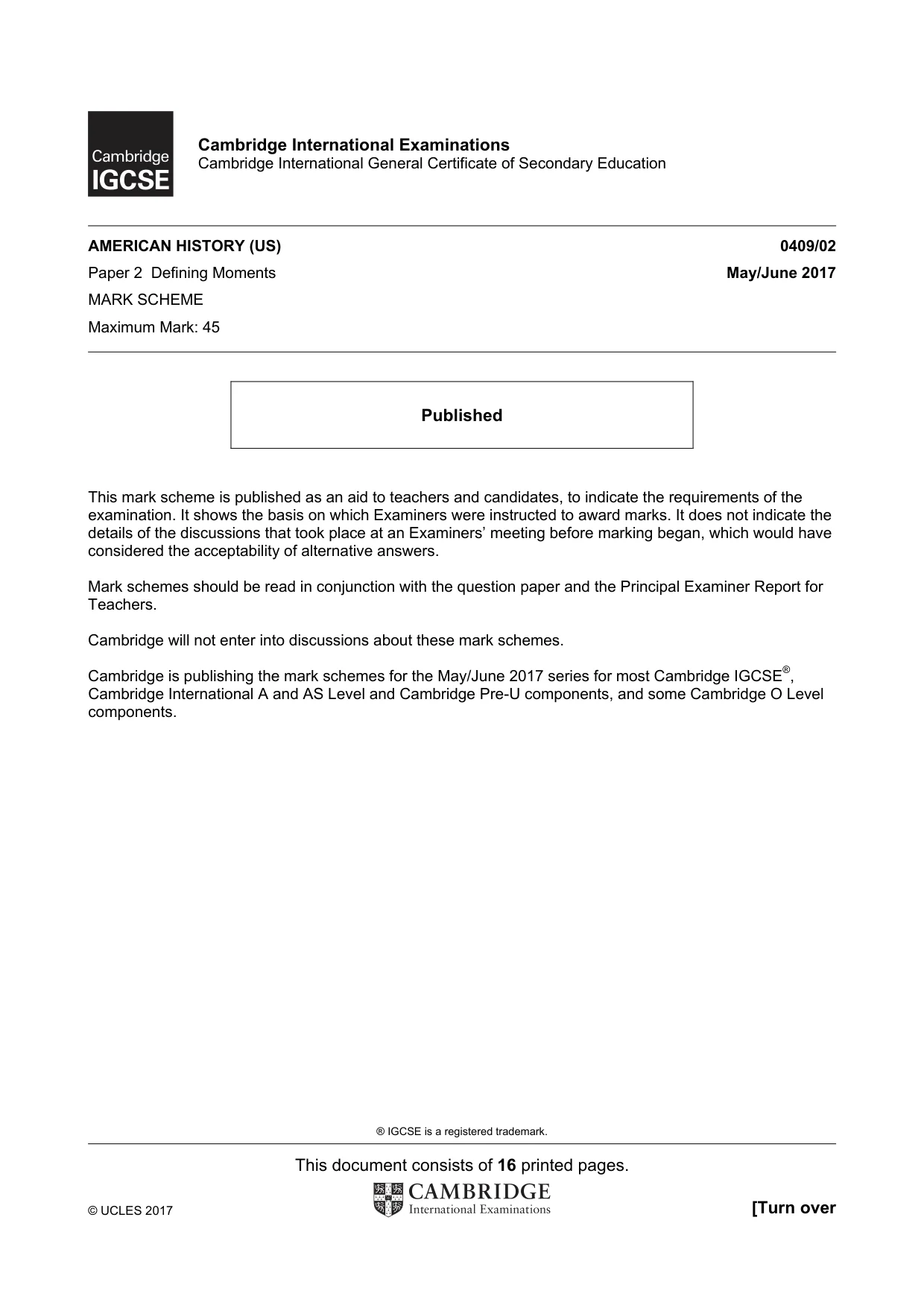
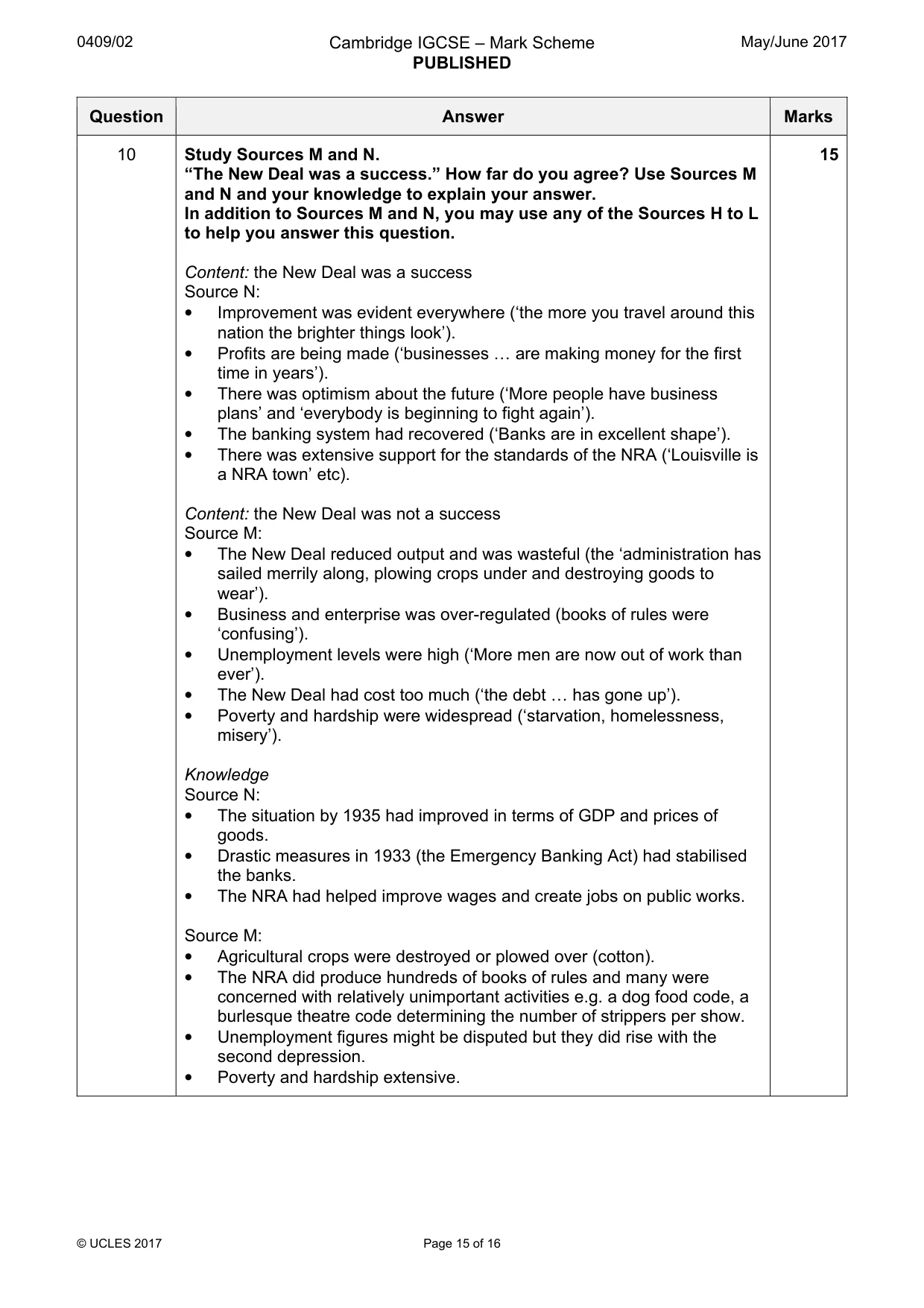
10 Study Sources M and N. “The New Deal was a success.” How far do you agree? Use Sources M and N and your knowledge to explain your answer. In addition to Sources M and N, you may use any of the Sources H to L to help you answer this question. [15] [Total: 45]
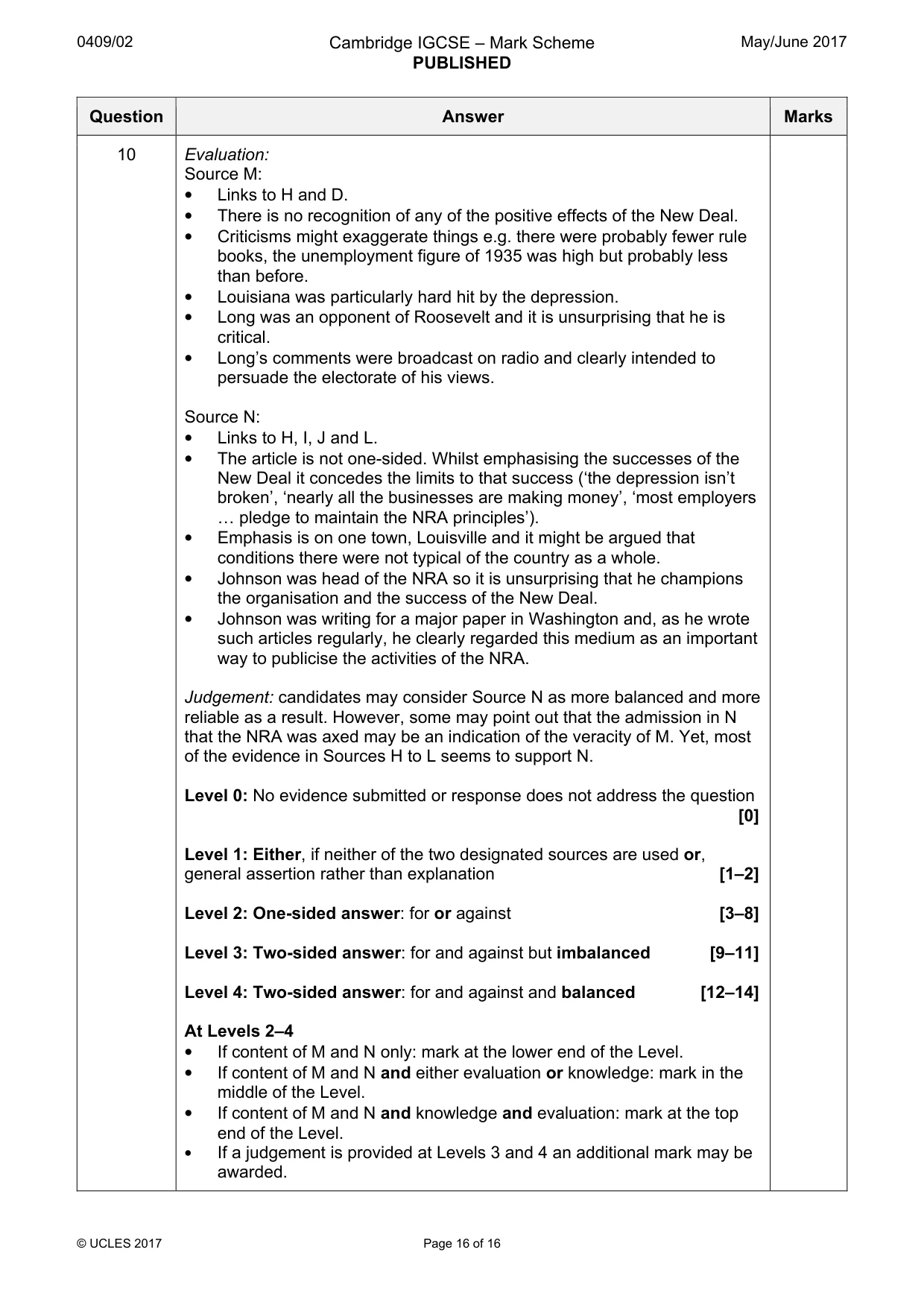
Mark scheme: 10 Study Sources M and N. 15 “The New Deal was a success.” How far do you agree? Use Sources M and N and your knowledge to explain your answer. In addition to Sources M and N, you may use any of the Sources H to L to help you answer this question. Content: the New Deal was a success Source N: • Improvement was evident everywhere (‘the more you travel around this nation the brighter things look’). • Profits are being made (‘businesses « are making money for the first time in years’). • There was optimism about the future (‘More people have business plans’ and ‘everybody is beginning to fight again’). • The banking system had recovered (‘Banks are in excellent shape’). • There was extensive support for the standards of the NRA (‘Louisville is a NRA town’ etc). Content: the New Deal was not a success Source M: • The New Deal reduced output and was wasteful (the ‘administration has sailed merrily along, plowing crops under and destroying goods to wear’). • Business and enterprise was over-regulated (books of rules were ‘confusing’). • Unemployment levels were high (‘More men are now out of work than ever’). • The New Deal had cost too much (‘the debt « has gone up’). • Poverty and hardship were widespread (‘starvation, homelessness, misery’). Knowledge Source N: • The situation by 1935 had improved in terms of GDP and prices of goods. • Drastic measures in 1933 (the Emergency Banking Act) had stabilised the banks. • The NRA had helped improve wages and create jobs on public works. Source M: • Agricultural crops were destroyed or plowed over (cotton). • The NRA did produce hundreds of books of rules and many were concerned with relatively unimportant activities e.g. a dog food code, a burlesque theatre code determining the number of strippers per show. • Unemployment figures might be disputed but they did rise with the second depression. • Poverty and hardship extensive. 10 Evaluation: Source M: • Links to H and D. • There is no recognition of any of the positive effects of the New Deal. • Criticisms might exaggerate things e.g. there were probably fewer rule books, the unemployment figure of 1935 was high but probably less than before. • Louisiana was particularly hard hit by the depression. • Long was an opponent of Roosevelt and it is unsurprising that he is critical. • Long’s comments were broadcast on radio and clearly intended to persuade the electorate of his views. Source N: • Links to H, I, J and L. • The article is not one-sided. Whilst emphasising the successes of the New Deal it concedes the limits to that success (‘the depression isn’t broken’, ‘nearly all the businesses are making money’, ‘most employers « pledge to maintain the NRA principles’). • Emphasis is on one town, Louisville and it might be argued that conditions there were not typical of the country as a whole. • Johnson was head of the NRA so it is unsurprising that he champions the organisation and the success of the New Deal. • Johnson was writing for a major paper in Washington and, as he wrote such articles regularly, he clearly regarded this medium as an important way to publicise the activities of the NRA. Judgement: candidates may consider Source N as more balanced and more reliable as a result. However, some may point out that the admission in N that the NRA was axed may be an indication of the veracity of M. Yet, most of the evidence in Sources H to L seems to support N. Level 0: No evidence submitted or response does not address the question [0] Level 1: Either, if neither of the two designated sources are used or, general assertion rather than explanation [1–2] Level 2: One-sided answer: for or against [3–8] Level 3: Two-sided answer: for and against but imbalanced [9–11] Level 4: Two-sided answer: for and against and balanced [12–14] At Levels 2–4 • If content of M and N only: mark at the lower end of the Level. • If content of M and N and either evaluation or knowledge: mark in the middle of the Level. • If content of M and N and knowledge and evaluation: mark at the top end of the Level. • If a judgement is provided at Levels 3 and 4 an additional mark may be awarded.
What you needed in this session
Cambridge’s own grade thresholds for 2017 May/June, Paper 2 · Variant 1. A higher threshold means an easier paper — the bar moves with how the cohort did.