Cambridge IGCSE History American BES 0409 — 2017 Oct/Nov Paper 2 · Variant 1
0409/21/O/N/17 · 10 questions · 45 marks · ≈51 min
The question paper and its mark scheme, free to read here and free to download. This is Cambridge’s own paper, exactly as it was sat.
Question paper8 pages



Mark scheme20 pages
Answers below. Sit the paper first if you are practising.
Questions as text
Question 1
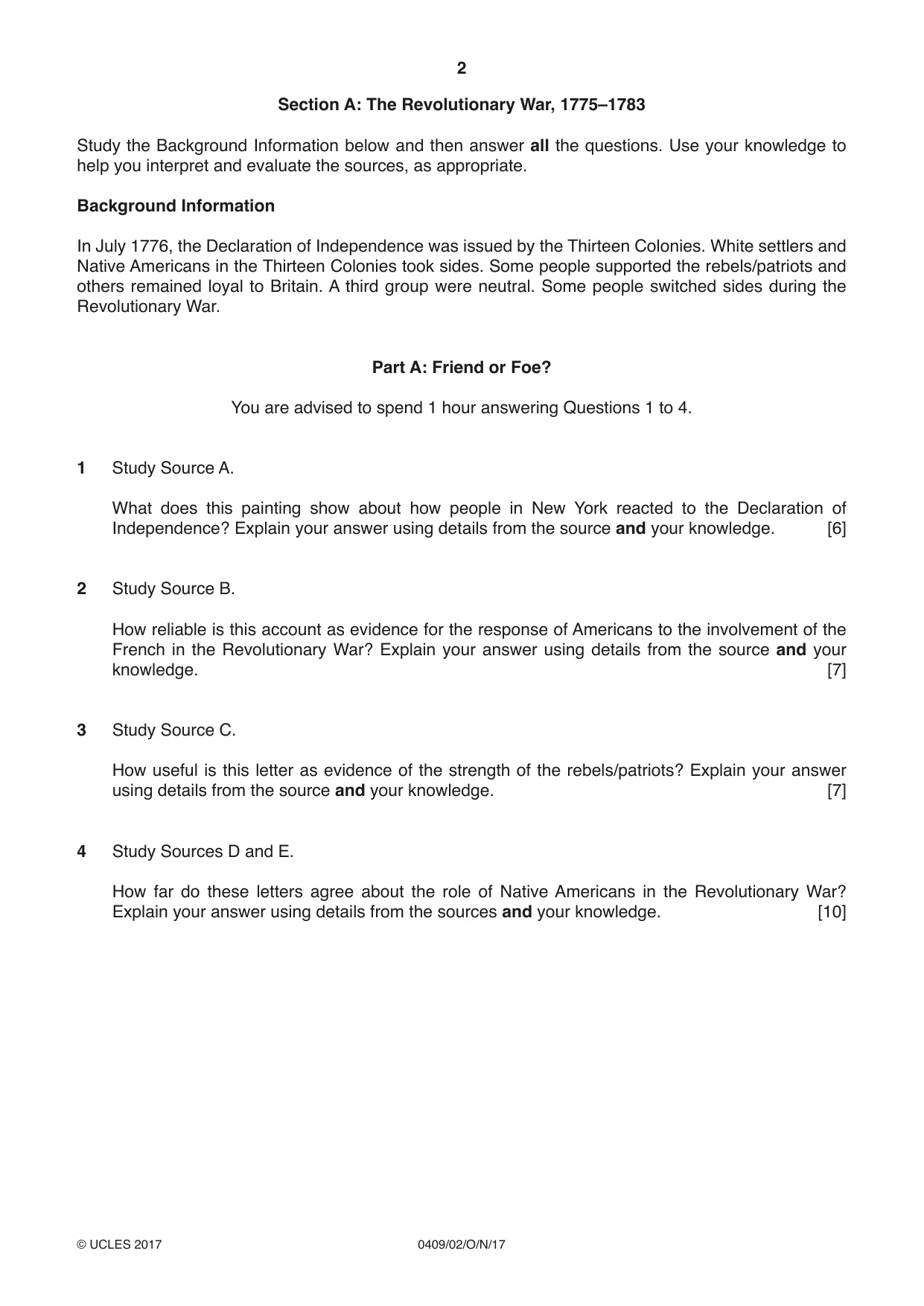
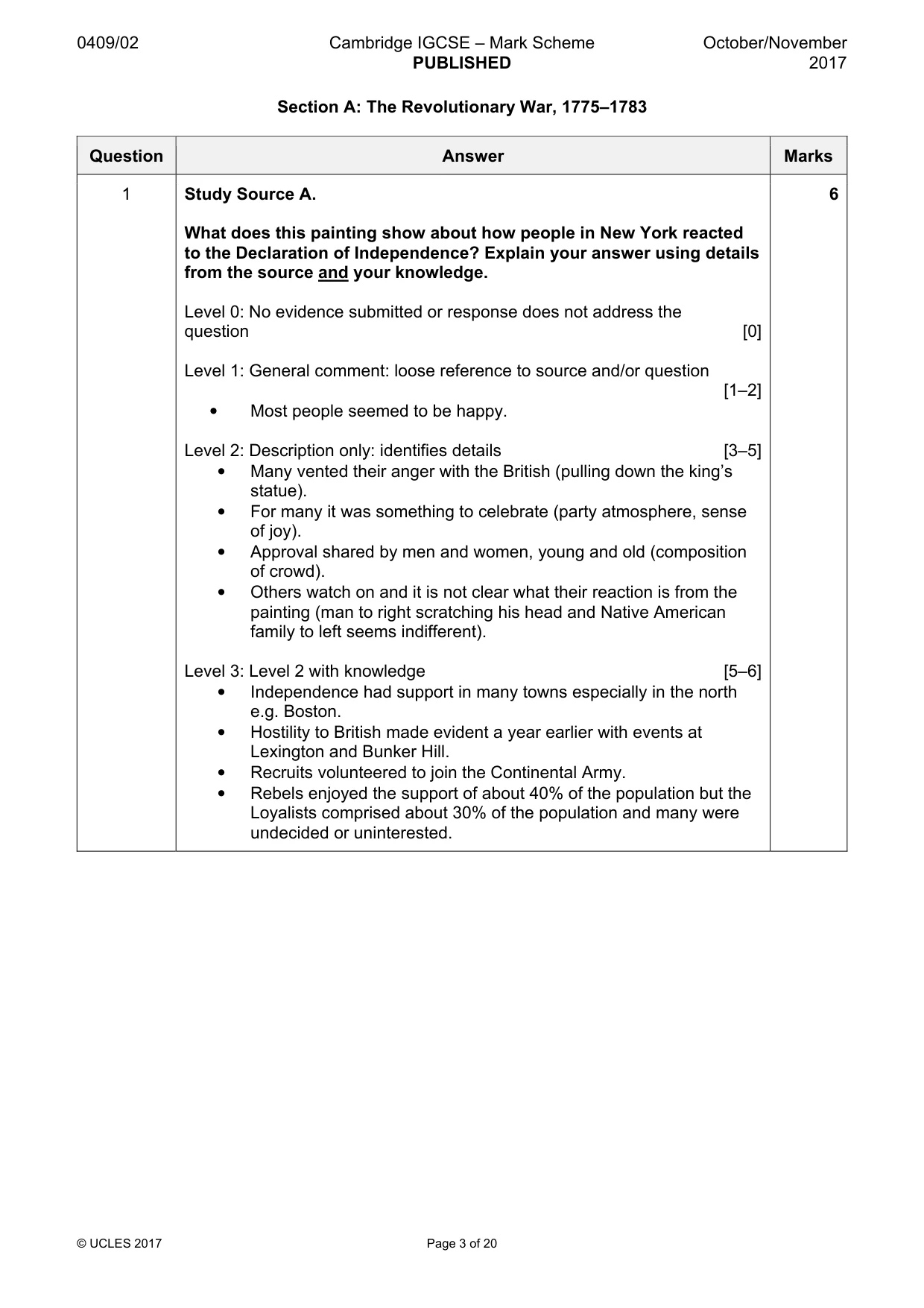
1 Study Source A. What does this painting show about how people in New York reacted to the Declaration of Independence? Explain your answer using details from the source and your knowledge. [6]
Mark scheme: Question Answer Marks 1 Study Source A. 6 What does this painting show about how people in New York reacted to the Declaration of Independence? Explain your answer using details from the source and your knowledge. Level 0: No evidence submitted or response does not address the question [0] Level 1: General comment: loose reference to source and/or question [1–2] • Most people seemed to be happy. Level 2: Description only: identifies details [3–5] • Many vented their anger with the British (pulling down the king’s statue). • For many it was something to celebrate (party atmosphere, sense of joy). • Approval shared by men and women, young and old (composition of crowd). • Others watch on and it is not clear what their reaction is from the painting (man to right scratching his head and Native American family to left seems indifferent). Level 3: Level 2 with knowledge [5–6] • Independence had support in many towns especially in the north e.g. Boston. • Hostility to British made evident a year earlier with events at Lexington and Bunker Hill. • Recruits volunteered to join the Continental Army. • Rebels enjoyed the support of about 40% of the population but the Loyalists comprised about 30% of the population and many were undecided or uninterested.
Question 2
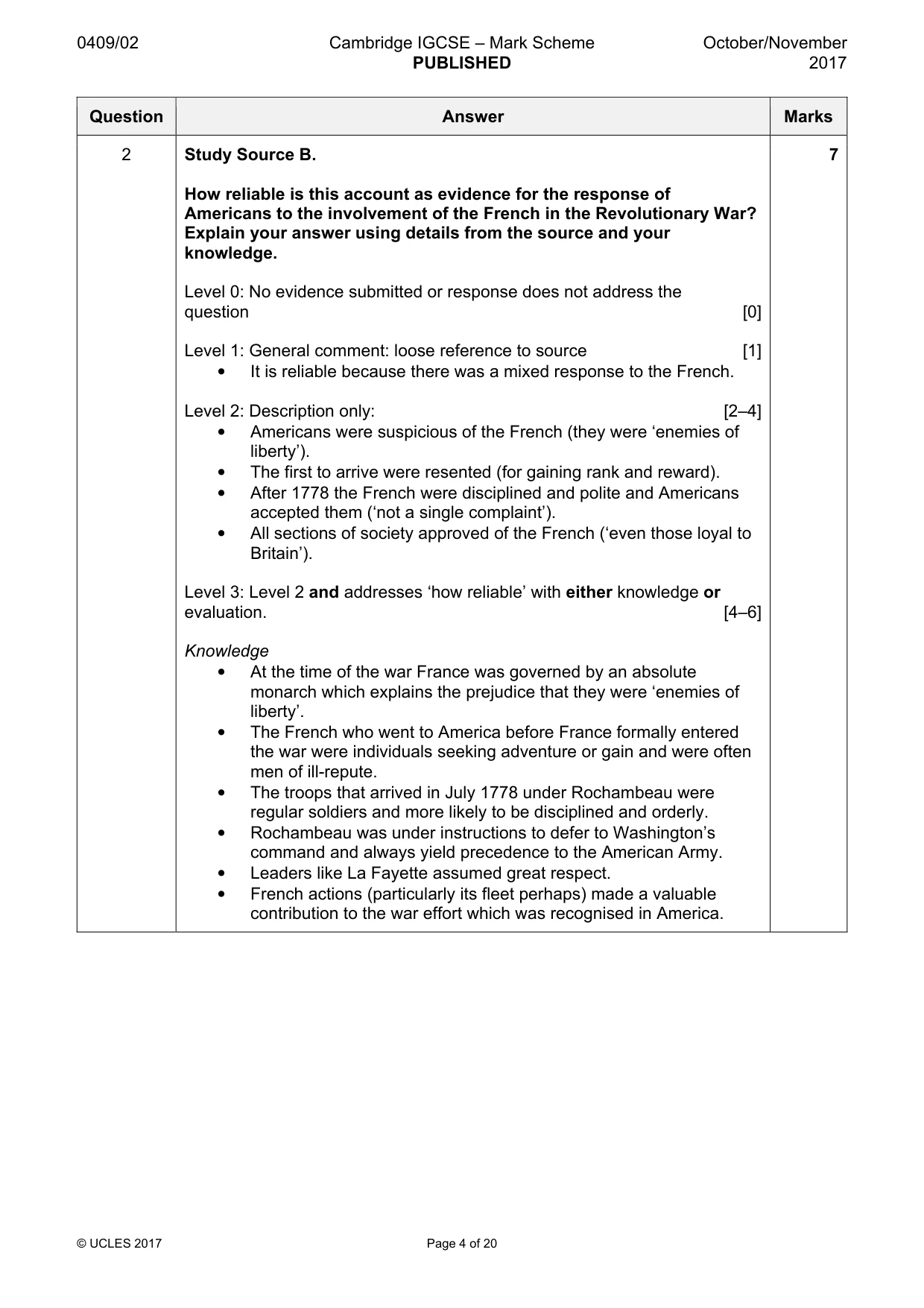
2 Study Source B. How reliable is this account as evidence for the response of Americans to the involvement of the French in the Revolutionary War? Explain your answer using details from the source and your knowledge. [7]
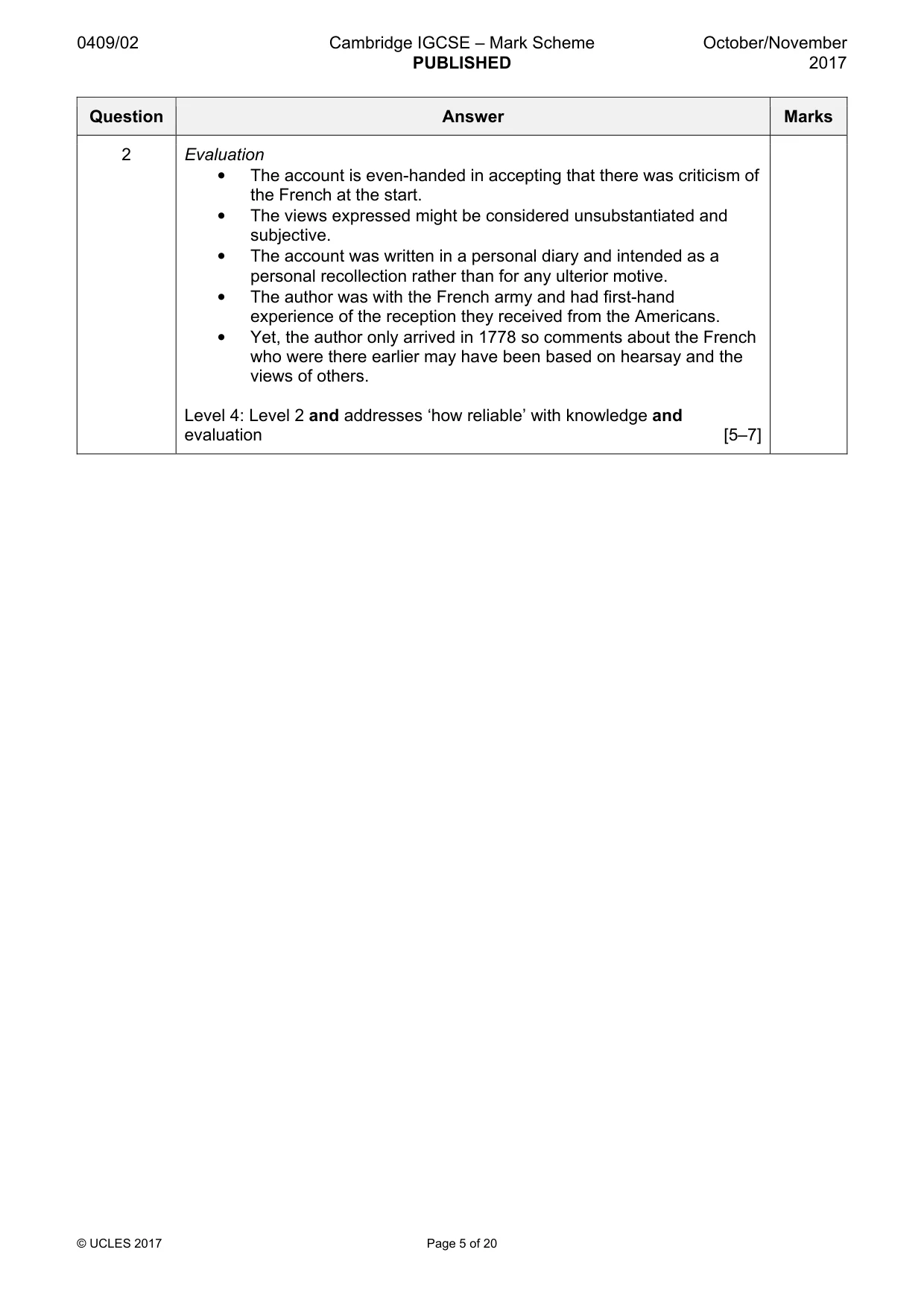
Mark scheme: 2 Study Source B. 7 How reliable is this account as evidence for the response of Americans to the involvement of the French in the Revolutionary War? Explain your answer using details from the source and your knowledge. Level 0: No evidence submitted or response does not address the question [0] Level 1: General comment: loose reference to source [1] • It is reliable because there was a mixed response to the French. Level 2: Description only: [2–4] • Americans were suspicious of the French (they were ‘enemies of liberty’). • The first to arrive were resented (for gaining rank and reward). • After 1778 the French were disciplined and polite and Americans accepted them (‘not a single complaint’). • All sections of society approved of the French (‘even those loyal to Britain’). Level 3: Level 2 and addresses ‘how reliable’ with either knowledge or evaluation. [4–6] Knowledge • At the time of the war France was governed by an absolute monarch which explains the prejudice that they were ‘enemies of liberty’. • The French who went to America before France formally entered the war were individuals seeking adventure or gain and were often men of ill-repute. • The troops that arrived in July 1778 under Rochambeau were regular soldiers and more likely to be disciplined and orderly. • Rochambeau was under instructions to defer to Washington’s command and always yield precedence to the American Army. • Leaders like La Fayette assumed great respect. • French actions (particularly its fleet perhaps) made a valuable contribution to the war effort which was recognised in America. 2 Evaluation • The account is even-handed in accepting that there was criticism of the French at the start. • The views expressed might be considered unsubstantiated and subjective. • The account was written in a personal diary and intended as a personal recollection rather than for any ulterior motive. • The author was with the French army and had first-hand experience of the reception they received from the Americans. • Yet, the author only arrived in 1778 so comments about the French who were there earlier may have been based on hearsay and the views of others. Level 4: Level 2 and addresses ‘how reliable’ with knowledge and evaluation [5–7]
Question 3
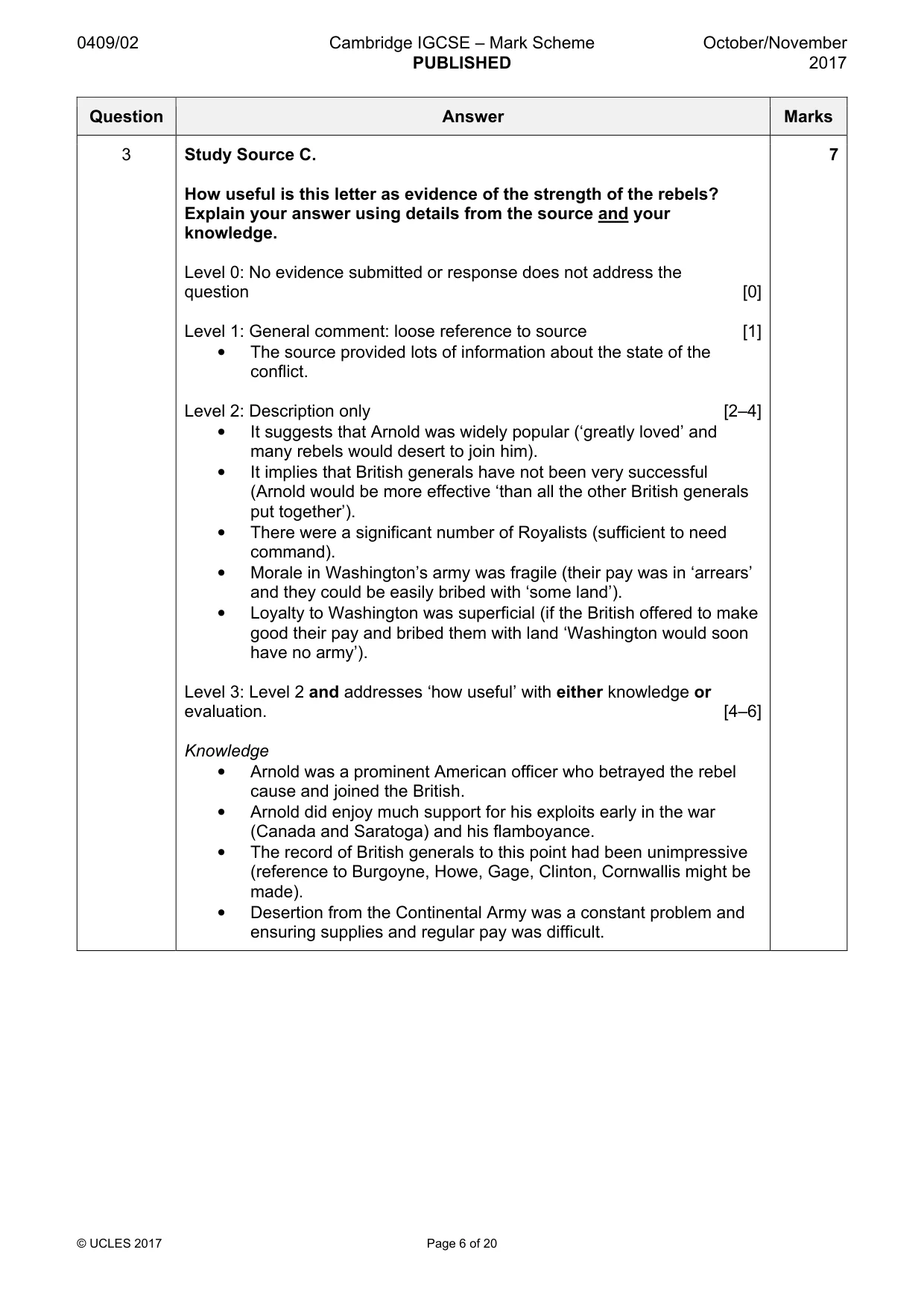
3 Study Source C. How useful is this letter as evidence of the strength of the rebels/patriots? Explain your answer using details from the source and your knowledge. [7]
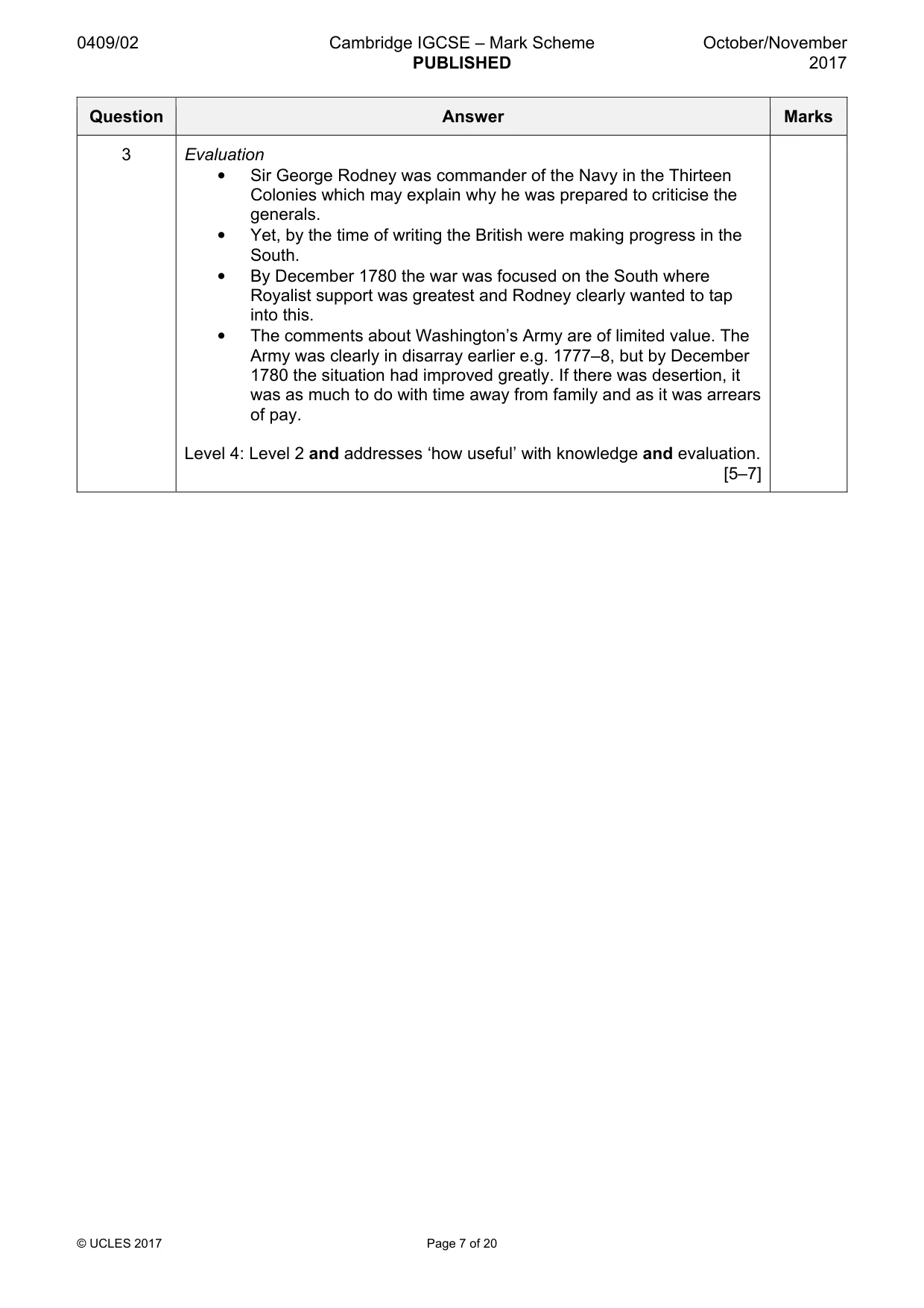
Mark scheme: 3 Study Source C. 7 How useful is this letter as evidence of the strength of the rebels? Explain your answer using details from the source and your knowledge. Level 0: No evidence submitted or response does not address the question [0] Level 1: General comment: loose reference to source [1] • The source provided lots of information about the state of the conflict. Level 2: Description only [2–4] • It suggests that Arnold was widely popular (‘greatly loved’ and many rebels would desert to join him). • It implies that British generals have not been very successful (Arnold would be more effective ‘than all the other British generals put together’). • There were a significant number of Royalists (sufficient to need command). • Morale in Washington’s army was fragile (their pay was in ‘arrears’ and they could be easily bribed with ‘some land’). • Loyalty to Washington was superficial (if the British offered to make good their pay and bribed them with land ‘Washington would soon have no army’). Level 3: Level 2 and addresses ‘how useful’ with either knowledge or evaluation. [4–6] Knowledge • Arnold was a prominent American officer who betrayed the rebel cause and joined the British. • Arnold did enjoy much support for his exploits early in the war (Canada and Saratoga) and his flamboyance. • The record of British generals to this point had been unimpressive (reference to Burgoyne, Howe, Gage, Clinton, Cornwallis might be made). • Desertion from the Continental Army was a constant problem and ensuring supplies and regular pay was difficult. 3 Evaluation • Sir George Rodney was commander of the Navy in the Thirteen Colonies which may explain why he was prepared to criticise the generals. • Yet, by the time of writing the British were making progress in the South. • By December 1780 the war was focused on the South where Royalist support was greatest and Rodney clearly wanted to tap into this. • The comments about Washington’s Army are of limited value. The Army was clearly in disarray earlier e.g. 1777–8, but by December 1780 the situation had improved greatly. If there was desertion, it was as much to do with time away from family and as it was arrears of pay. Level 4: Level 2 and addresses ‘how useful’ with knowledge and evaluation. [5–7]
Q4 · Study Sources D and E
4 Study Sources D and E. How far do these letters agree about the role of Native Americans in the Revolutionary War? Explain your answer using details from the sources and your knowledge. [10] Part B: Rebel/Patriot Support You are advised to spend 30 minutes on your answer.
Mark scheme: 4 Study Sources D and E. 10 How far do these letters agree about the role of Native Americans in the Revolutionary War? Explain your answer using details from the sources and your knowledge. Level 0: No evidence submitted or response does not address the question [0] Level 1: General comment: offers reasons with only loose links to the sources [1–2] • Native Americans were used by the Continental Army in ways that were different from those of the British. Level 2: Comparison based on content but incomplete or partial in explanation [3–4] Differences: • The areas of recruitment appear to have been different. The British recruited from Carolina and Virginia (the Cherokees and ‘other Indians in the region’ (D)) whereas the rebels were prepared to recruit more widely (from the Southern Indians and the Northern Indians (E)). • The British were keen to use as many Native Americans as possible (hoping that ‘all’ would fight their cause (D)) whereas the rebels aimed ‘to employ a body of 400 Indians’ (E). • According to the British, the rebels ‘offered rewards for the scalps of Indians’ (D), but this is contradicted in E which implies that the rebels insisted that the Indians ‘give up their savage customs such as scalping’. • The rebels had specific roles for the Indians; according to E this was to use them as ‘scouts and light troops’ and integrated into rebel forces (‘mixed with our own forces’). By contrast, the British were less definite about the role of the Native Indians, for D advocates using them ‘in various ways’. Similarities: • Both sides recognised the Native Americans could be used. • Rebel practice was to insist on ‘certain conditions’ (E) but the British seem content simply ‘to make an alliance with them’ (D). Level 3: Comparison based on content and largely complete and explanation is good [5–6] Alternative Level 3: Level 2 and addresses ‘how far’ based on content and either evaluation or knowledge. [5–6] 4 Level 4: Level 3 and addresses ‘how far’ based on content and either evaluation or knowledge. [7–8] Evaluation of D: • The author’s directives are based on information received at a distance and with no direct knowledge of the situation. • The policies outlined, to a degree, are speculative assumptions. Evaluation of E: • The author is outlining orders he was expected to carry out. • Washington was the Commander of the Continental Army with specific knowledge about the way the Native Americans might be usefully deployed. • The complacency implicit in Germain’s remarks might be explained by the relative confidence of the British at the time. Knowledge on D: • Tribal differences between Native Americans were evident and exploited by the British. • The focus of British strategy in November 1776 was the New England colonies and the region around New York and the southern colonies were of less interest. • The British regarded the Native Americans as outsiders. Knowledge on E: • The Continental Army was in a weak position in March 1778 and allies were needed. • The rebels (Congress and Washington) treated the Native Americans as citizens who should contribute to the common cause. Alternative Level 4: as Level 2 and addresses ‘how far’ with evaluation or knowledge [7–8] Level 5: as Level 4 and addresses ‘how far’ with evaluation and knowledge [9–10]
Q5 · Study Sources F and G
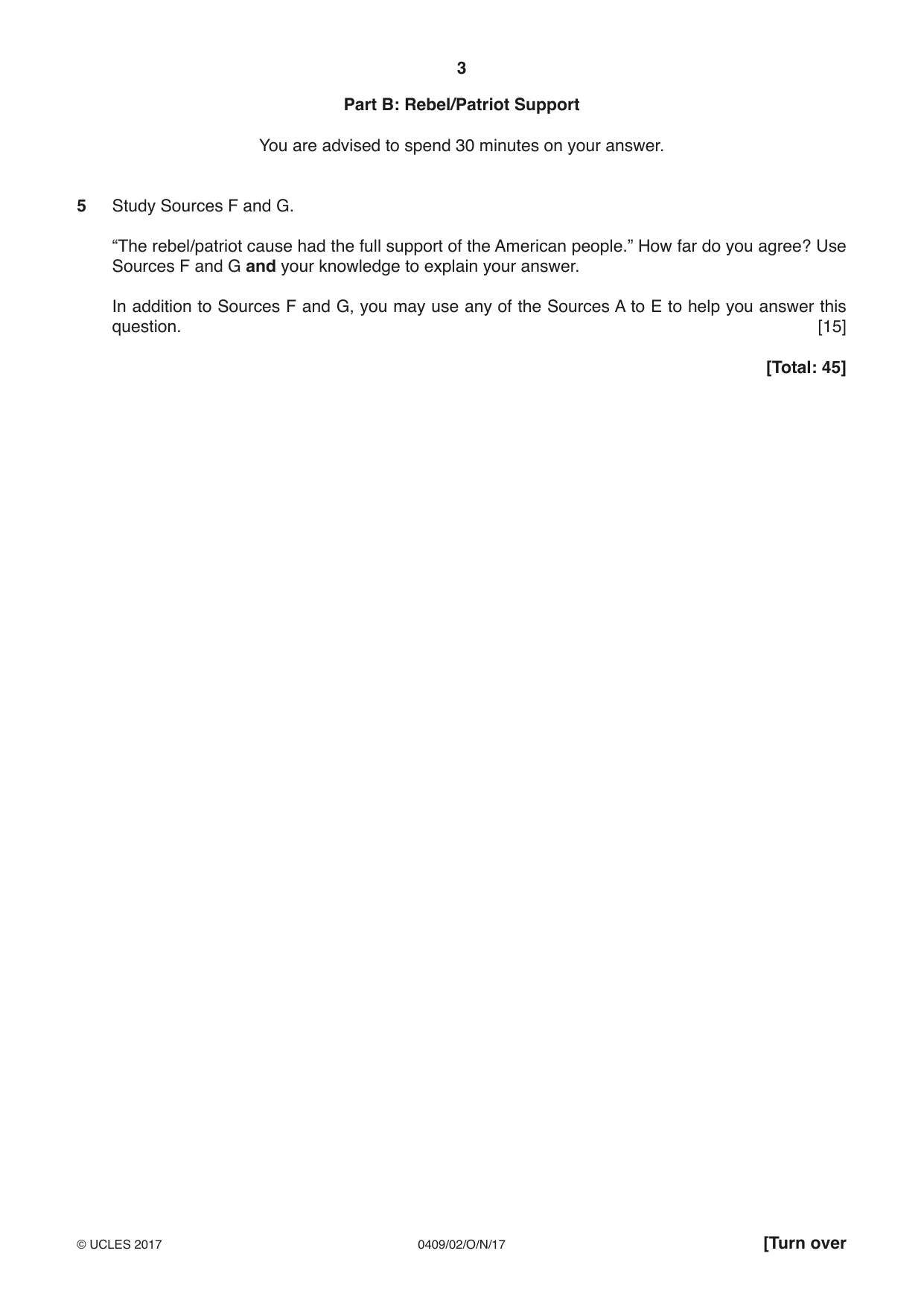
5 Study Sources F and G. “The rebel/patriot cause had the full support of the American people.” How far do you agree? Use Sources F and G and your knowledge to explain your answer. In addition to Sources F and G, you may use any of the Sources A to E to help you answer this question. [15] [Total: 45]
Mark scheme: 5 Study Sources F and G. 15 “The rebel/patriot cause had the full support of the American people.” How far do you agree? Use Sources F and G and your knowledge to explain your answer. In addition to Sources F and G, you may use any of the Sources A to E to help you answer this question. Content: evidence in the sources. Agreeing: Source G: this largely agrees with the view: • Joseph Martin and his fellow rebels were like ‘a family of brothers’ who were clearly committed as they had been together ‘for several years’. • They had endured ‘hardships’ for the cause. • The soldiers would clearly have fought on as ‘they did not want to be parted’ and none parted ‘with more regret than ours did’. Source F: some candidates might consider the following reference: • Walter Dulany was prepared to support his country when independence was conceded. Content: evidence in the sources. Disagreeing: Source F: this largely disagrees with the view: • The major expresses a sense of duty ‘to serve the king’. • He thought life under the British was happier than he anticipates it will be if America was independent. • He felt so strongly about this that there were no dangers ‘I would not cheerfully undergo to restore things to what they were before the war began’. Source G: some candidates might consider the following reference: • Not all soldiers in the rebel ranks were enthusiastic as ‘there were many amongst us who were not fully committed to the cause’. Knowledge: Source F: • There were many loyalists, sufficient in number to be organised into separate regiments like the Maryland Loyalists. • About 20% of the population were thought to be loyalist. • British rule did have benefits and the prospects for America, if independent, were unclear. 5 Source G: • Some rebels were totally committed to the cause and fought throughout the war (most were volunteers so they were willing to fight for the cause). • The commitment of others was more fragile and some deserted or even betrayed the cause by joining the British side. • Details about the ‘hardships, dangers and suffering of a soldier’s life’ might be developed. Evaluation: Source F: • Links to Sources A, B and D. • The motives expressed for supporting the British are plausible. • His views may also be considered sincere as they are written in a letter to a British officer. • At the time of writing the war was effectively finished and loyalists were extremely unpopular which helps explain the author’s decision to support America in the event of independence (Treaty of Versailles was signed in September 1783). Source G: • Links to Sources A, C and E. • The remarks of the soldier may exaggerate the camaraderie of the soldiers as he reflects on several years with others. • He acknowledges the unreliability of some soldiers and so his account is fairly balanced. • His comments were entered into his diary and may be regarded as sincere. Level 0: No evidence submitted or response does not address the question [0] Level 1: General assertion rather than explanation [1–2] Level 2: One-sided answer: either agreeing or disagreeing [3–8] Level 3: Two-sided answer: for and against but imbalanced [9–11] Level 4: Two-sided answer: for and against and balanced [12–14] Note: At Levels 2–4 • If knowledge only: mark at the lower end of the Level. • If only evaluation: mark in the middle of the Level. • If knowledge and evaluation: mark at the top end of the Level. • If a judgement is provided at Levels 3 or 4 an additional mark may be awarded. Section B: The New Deal, 1933–1939
Question 6
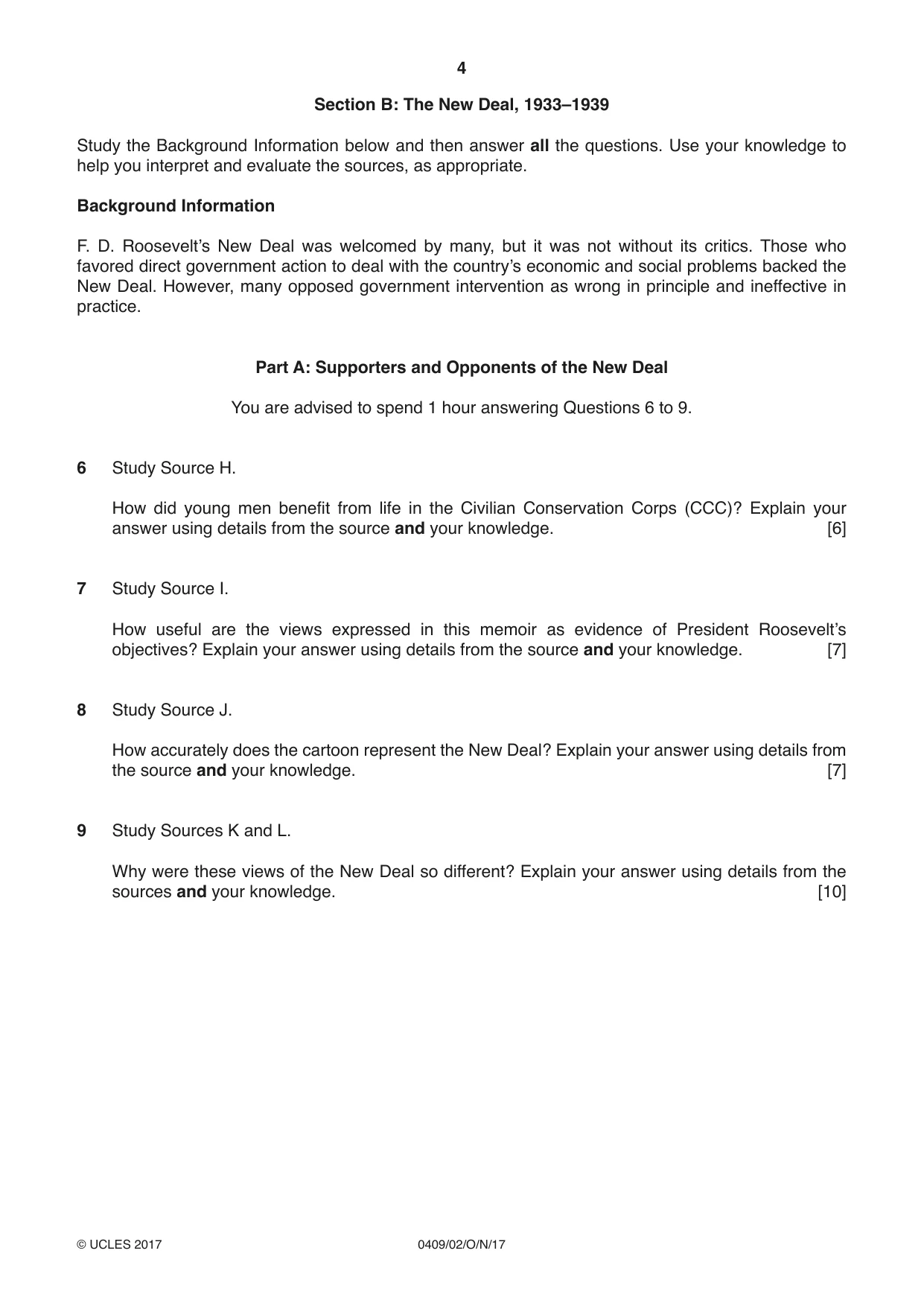
6 Study Source H. How did young men benefit from life in the Civilian Conservation Corps (CCC)? Explain your answer using details from the source and your knowledge. [6]
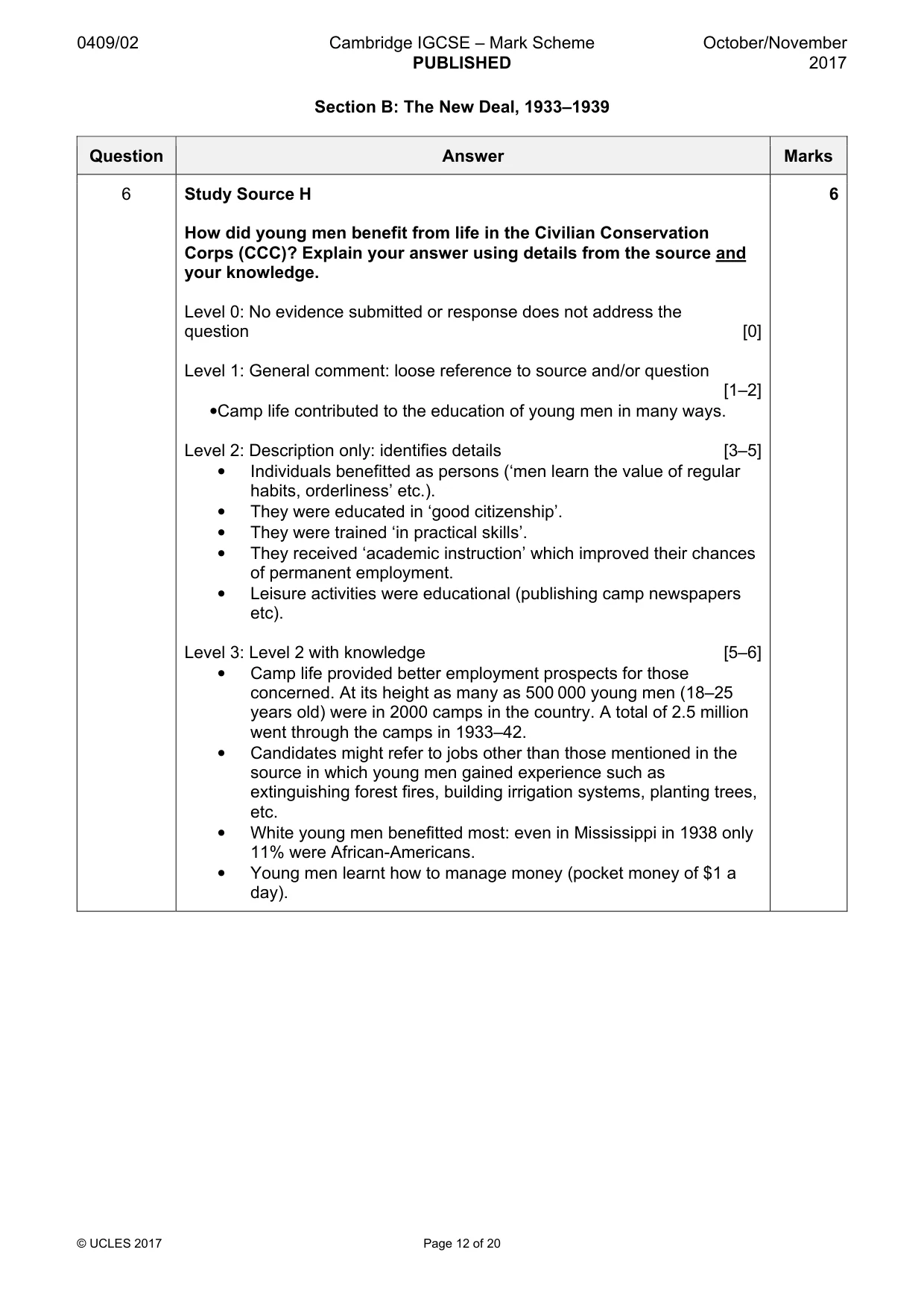
Mark scheme: 6 Study Source H 6 How did young men benefit from life in the Civilian Conservation Corps (CCC)? Explain your answer using details from the source and your knowledge. Level 0: No evidence submitted or response does not address the question [0] Level 1: General comment: loose reference to source and/or question [1–2] •Camp life contributed to the education of young men in many ways. Level 2: Description only: identifies details [3–5] • Individuals benefitted as persons (‘men learn the value of regular habits, orderliness’ etc.). • They were educated in ‘good citizenship’. • They were trained ‘in practical skills’. • They received ‘academic instruction’ which improved their chances of permanent employment. • Leisure activities were educational (publishing camp newspapers etc). Level 3: Level 2 with knowledge [5–6] • Camp life provided better employment prospects for those concerned. At its height as many as 500 000 young men (18–25 years old) were in 2000 camps in the country. A total of 2.5 million went through the camps in 1933–42. • Candidates might refer to jobs other than those mentioned in the source in which young men gained experience such as extinguishing forest fires, building irrigation systems, planting trees, etc. • White young men benefitted most: even in Mississippi in 1938 only 11% were African-Americans. • Young men learnt how to manage money (pocket money of $1 a day).
Question 7
7 Study Source I. How useful are the views expressed in this memoir as evidence of President Roosevelt’s objectives? Explain your answer using details from the source and your knowledge. [7]
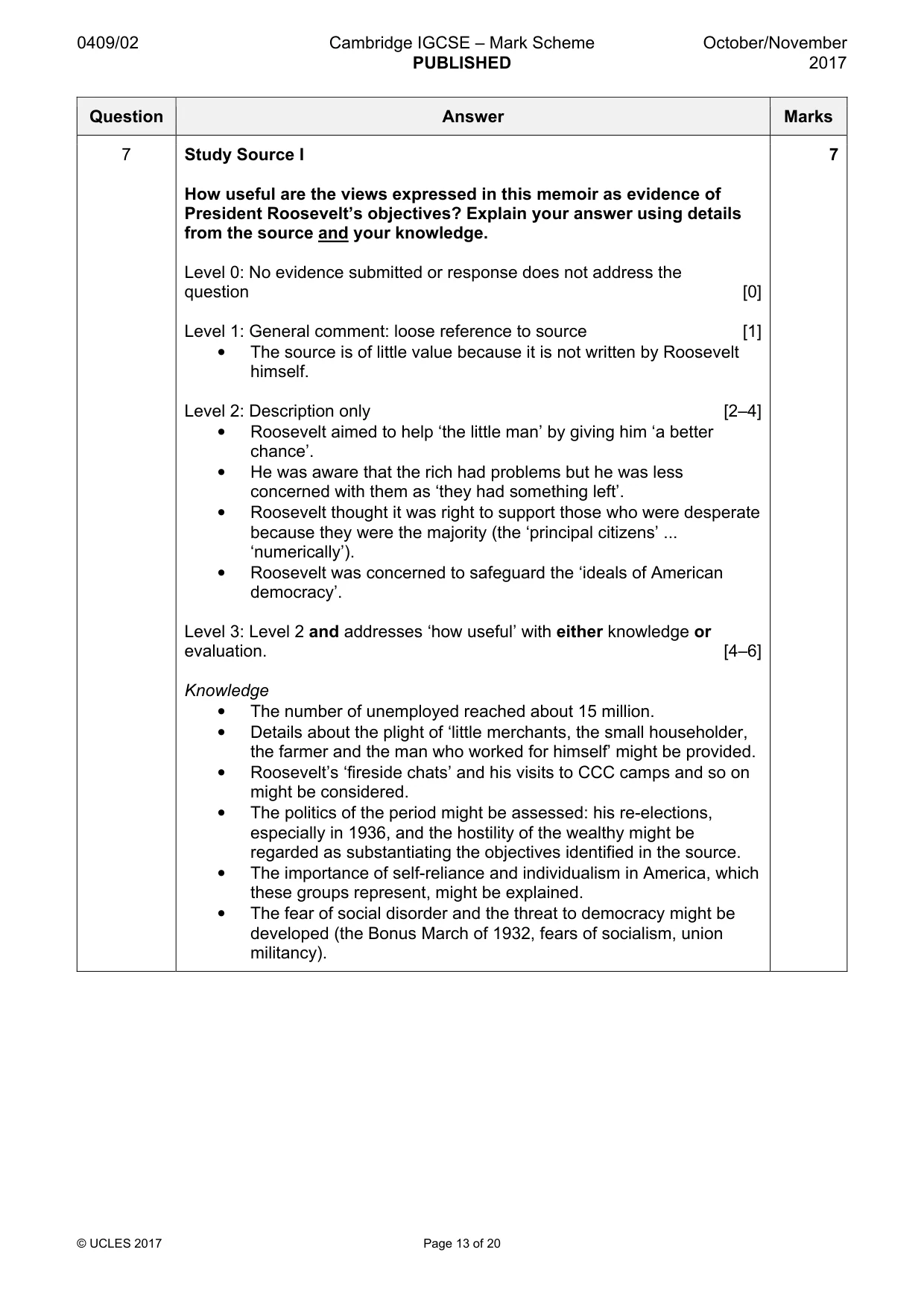
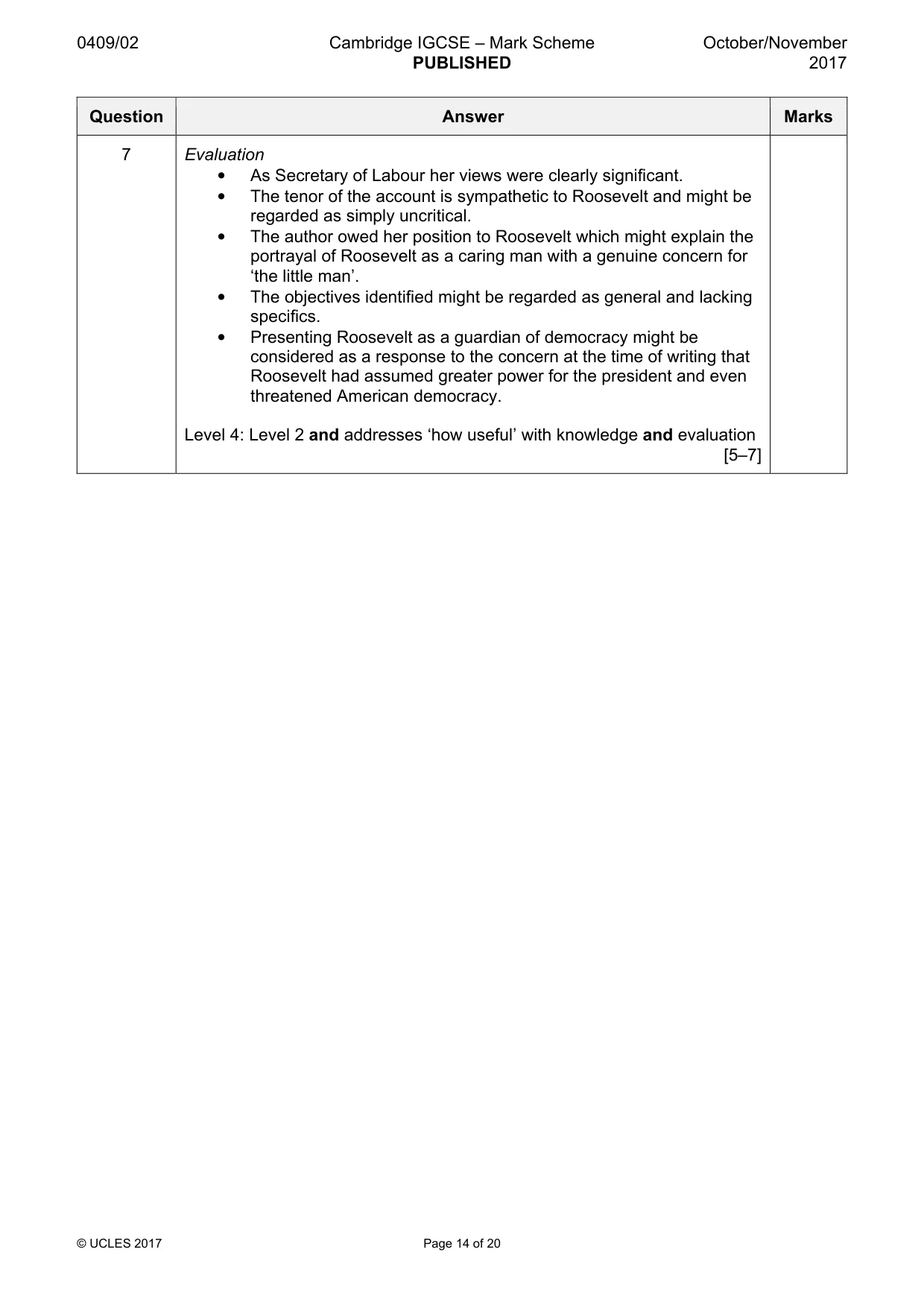
Mark scheme: 7 Study Source I 7 How useful are the views expressed in this memoir as evidence of President Roosevelt’s objectives? Explain your answer using details from the source and your knowledge. Level 0: No evidence submitted or response does not address the question [0] Level 1: General comment: loose reference to source [1] • The source is of little value because it is not written by Roosevelt himself. Level 2: Description only [2–4] • Roosevelt aimed to help ‘the little man’ by giving him ‘a better chance’. • He was aware that the rich had problems but he was less concerned with them as ‘they had something left’. • Roosevelt thought it was right to support those who were desperate because they were the majority (the ‘principal citizens’ ... ‘numerically’). • Roosevelt was concerned to safeguard the ‘ideals of American democracy’. Level 3: Level 2 and addresses ‘how useful’ with either knowledge or evaluation. [4–6] Knowledge • The number of unemployed reached about 15 million. • Details about the plight of ‘little merchants, the small householder, the farmer and the man who worked for himself’ might be provided. • Roosevelt’s ‘fireside chats’ and his visits to CCC camps and so on might be considered. • The politics of the period might be assessed: his re-elections, especially in 1936, and the hostility of the wealthy might be regarded as substantiating the objectives identified in the source. • The importance of self-reliance and individualism in America, which these groups represent, might be explained. • The fear of social disorder and the threat to democracy might be developed (the Bonus March of 1932, fears of socialism, union militancy). 7 Evaluation • As Secretary of Labour her views were clearly significant. • The tenor of the account is sympathetic to Roosevelt and might be regarded as simply uncritical. • The author owed her position to Roosevelt which might explain the portrayal of Roosevelt as a caring man with a genuine concern for ‘the little man’. • The objectives identified might be regarded as general and lacking specifics. • Presenting Roosevelt as a guardian of democracy might be considered as a response to the concern at the time of writing that Roosevelt had assumed greater power for the president and even threatened American democracy. Level 4: Level 2 and addresses ‘how useful’ with knowledge and evaluation [5–7]
Question 8
8 Study Source J. How accurately does the cartoon represent the New Deal? Explain your answer using details from the source and your knowledge. [7]
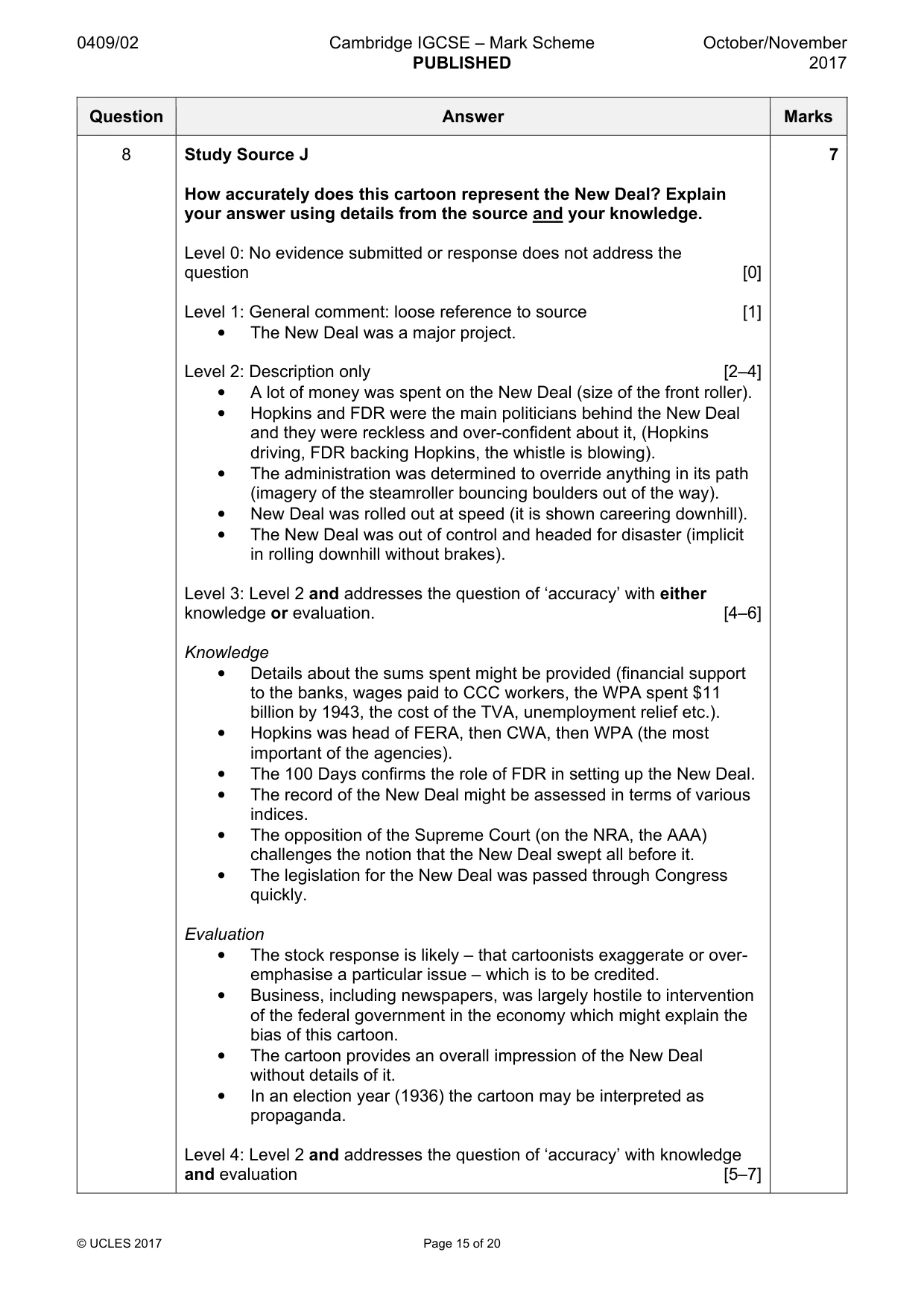
Mark scheme: 8 Study Source J 7 How accurately does this cartoon represent the New Deal? Explain your answer using details from the source and your knowledge. Level 0: No evidence submitted or response does not address the question [0] Level 1: General comment: loose reference to source [1] • The New Deal was a major project. Level 2: Description only [2–4] • A lot of money was spent on the New Deal (size of the front roller). • Hopkins and FDR were the main politicians behind the New Deal and they were reckless and over-confident about it, (Hopkins driving, FDR backing Hopkins, the whistle is blowing). • The administration was determined to override anything in its path (imagery of the steamroller bouncing boulders out of the way). • New Deal was rolled out at speed (it is shown careering downhill). • The New Deal was out of control and headed for disaster (implicit in rolling downhill without brakes). Level 3: Level 2 and addresses the question of ‘accuracy’ with either knowledge or evaluation. [4–6] Knowledge • Details about the sums spent might be provided (financial support to the banks, wages paid to CCC workers, the WPA spent $11 billion by 1943, the cost of the TVA, unemployment relief etc.). • Hopkins was head of FERA, then CWA, then WPA (the most important of the agencies). • The 100 Days confirms the role of FDR in setting up the New Deal. • The record of the New Deal might be assessed in terms of various indices. • The opposition of the Supreme Court (on the NRA, the AAA) challenges the notion that the New Deal swept all before it. • The legislation for the New Deal was passed through Congress quickly. Evaluation • The stock response is likely – that cartoonists exaggerate or over- emphasise a particular issue – which is to be credited. • Business, including newspapers, was largely hostile to intervention of the federal government in the economy which might explain the bias of this cartoon. • The cartoon provides an overall impression of the New Deal without details of it. • In an election year (1936) the cartoon may be interpreted as propaganda. Level 4: Level 2 and addresses the question of ‘accuracy’ with knowledge and evaluation [5–7]
Q9 · Study Sources K and L
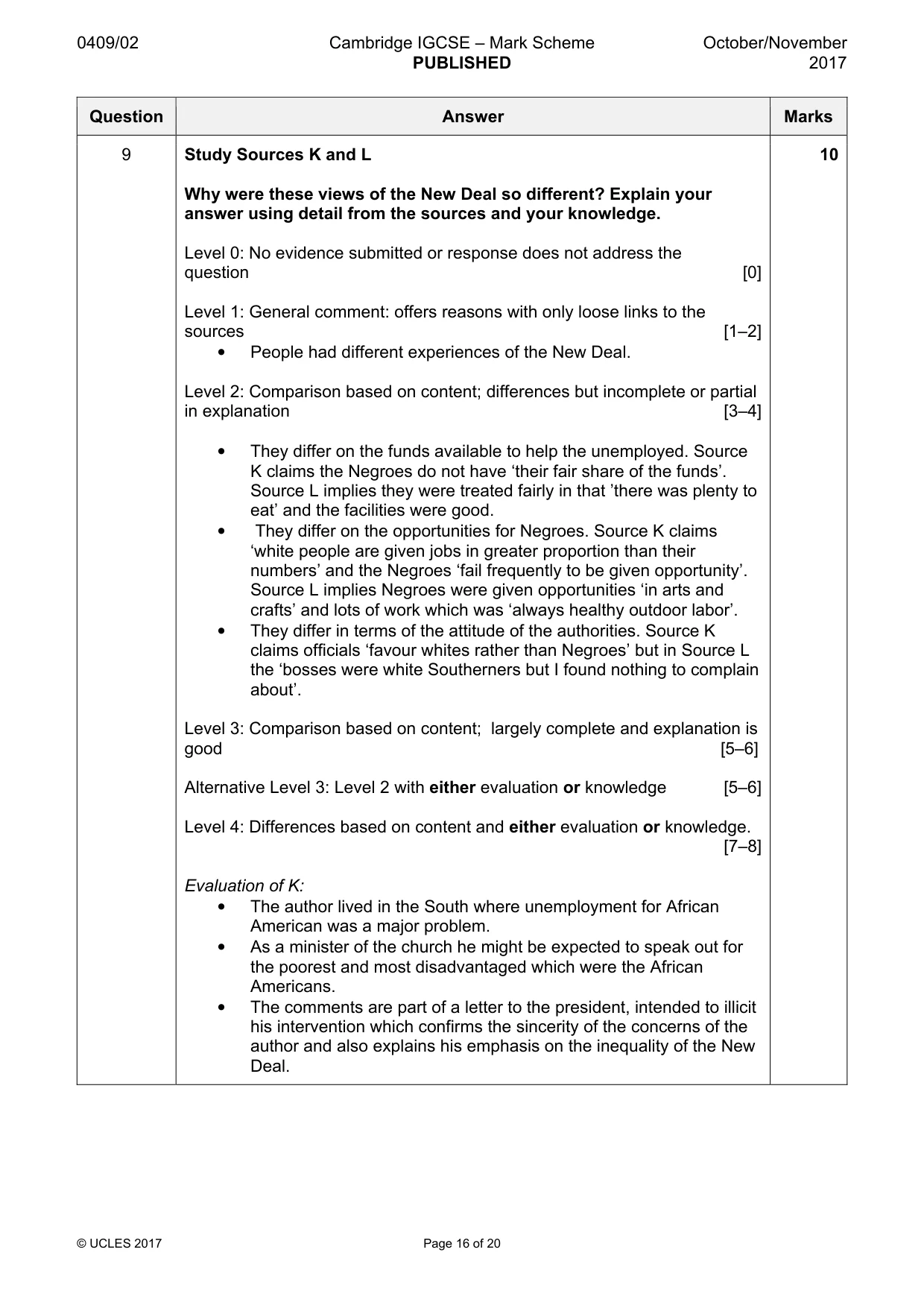
9 Study Sources K and L. Why were these views of the New Deal so different? Explain your answer using details from the sources and your knowledge. [10] Part B: Roosevelt’s Policies You are advised to spend 30 minutes on your answer.
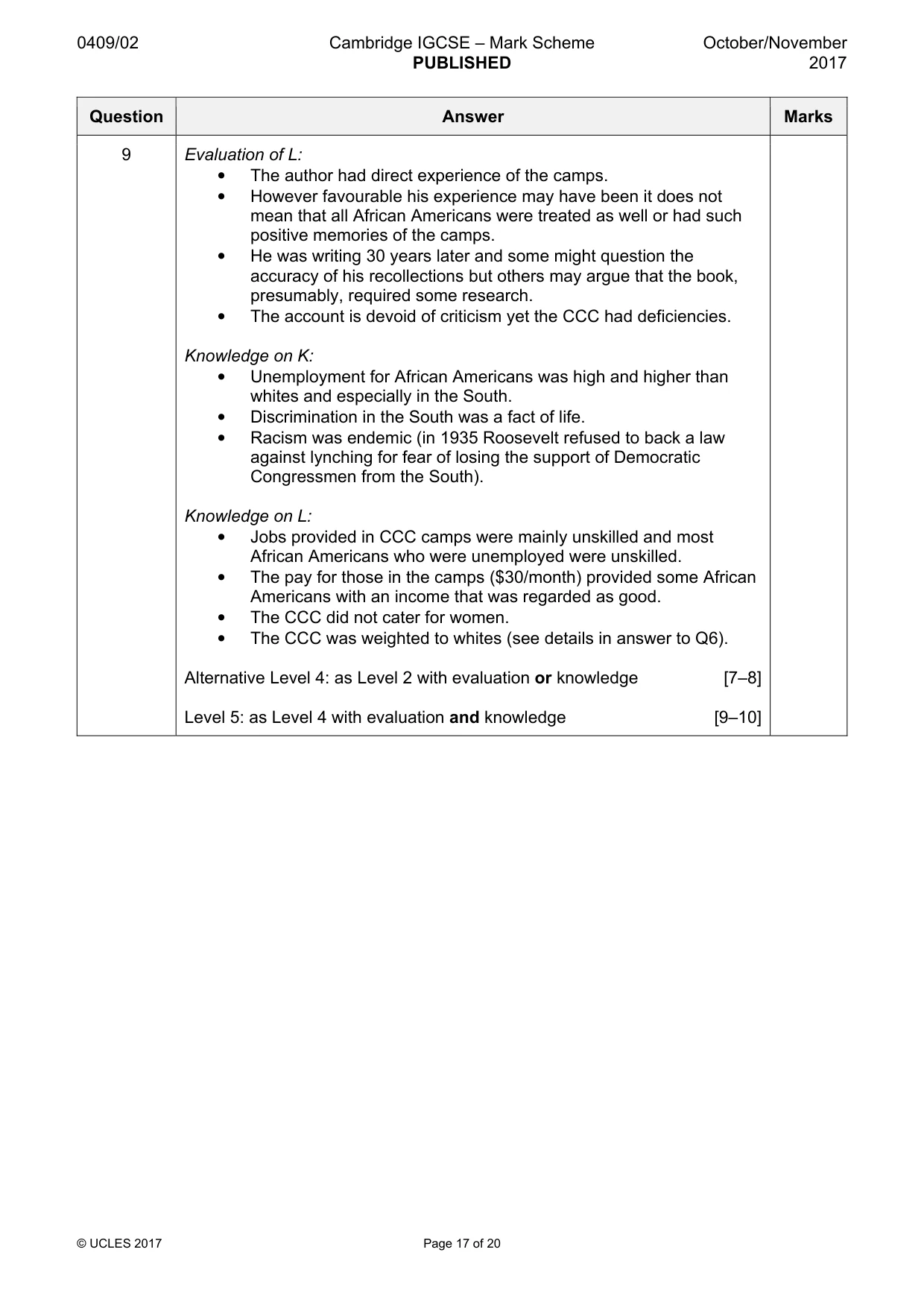
Mark scheme: 9 Study Sources K and L 10 Why were these views of the New Deal so different? Explain your answer using detail from the sources and your knowledge. Level 0: No evidence submitted or response does not address the question [0] Level 1: General comment: offers reasons with only loose links to the sources [1–2] • People had different experiences of the New Deal. Level 2: Comparison based on content; differences but incomplete or partial in explanation [3–4] • They differ on the funds available to help the unemployed. Source K claims the Negroes do not have ‘their fair share of the funds’. Source L implies they were treated fairly in that ’there was plenty to eat’ and the facilities were good. • They differ on the opportunities for Negroes. Source K claims ‘white people are given jobs in greater proportion than their numbers’ and the Negroes ‘fail frequently to be given opportunity’. Source L implies Negroes were given opportunities ‘in arts and crafts’ and lots of work which was ‘always healthy outdoor labor’. • They differ in terms of the attitude of the authorities. Source K claims officials ‘favour whites rather than Negroes’ but in Source L the ‘bosses were white Southerners but I found nothing to complain about’. Level 3: Comparison based on content; largely complete and explanation is good [5–6] Alternative Level 3: Level 2 with either evaluation or knowledge [5–6] Level 4: Differences based on content and either evaluation or knowledge. [7–8] Evaluation of K: • The author lived in the South where unemployment for African American was a major problem. • As a minister of the church he might be expected to speak out for the poorest and most disadvantaged which were the African Americans. • The comments are part of a letter to the president, intended to illicit his intervention which confirms the sincerity of the concerns of the author and also explains his emphasis on the inequality of the New Deal. 9 Evaluation of L: • The author had direct experience of the camps. • However favourable his experience may have been it does not mean that all African Americans were treated as well or had such positive memories of the camps. • He was writing 30 years later and some might question the accuracy of his recollections but others may argue that the book, presumably, required some research. • The account is devoid of criticism yet the CCC had deficiencies. Knowledge on K: • Unemployment for African Americans was high and higher than whites and especially in the South. • Discrimination in the South was a fact of life. • Racism was endemic (in 1935 Roosevelt refused to back a law against lynching for fear of losing the support of Democratic Congressmen from the South). Knowledge on L: • Jobs provided in CCC camps were mainly unskilled and most African Americans who were unemployed were unskilled. • The pay for those in the camps ($30/month) provided some African Americans with an income that was regarded as good. • The CCC did not cater for women. • The CCC was weighted to whites (see details in answer to Q6). Alternative Level 4: as Level 2 with evaluation or knowledge [7–8] Level 5: as Level 4 with evaluation and knowledge [9–10]
Q10 · Study Sources M and N
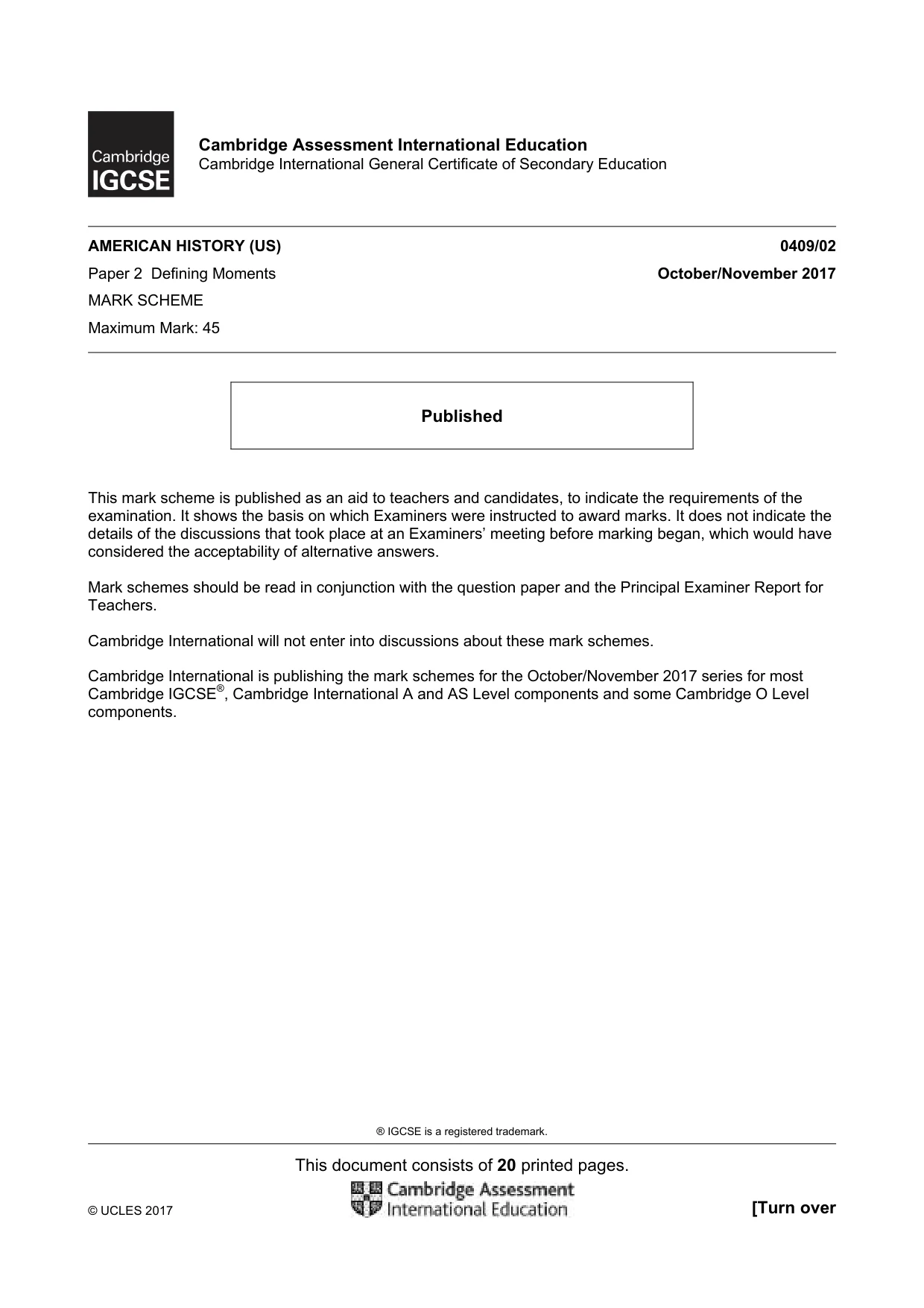
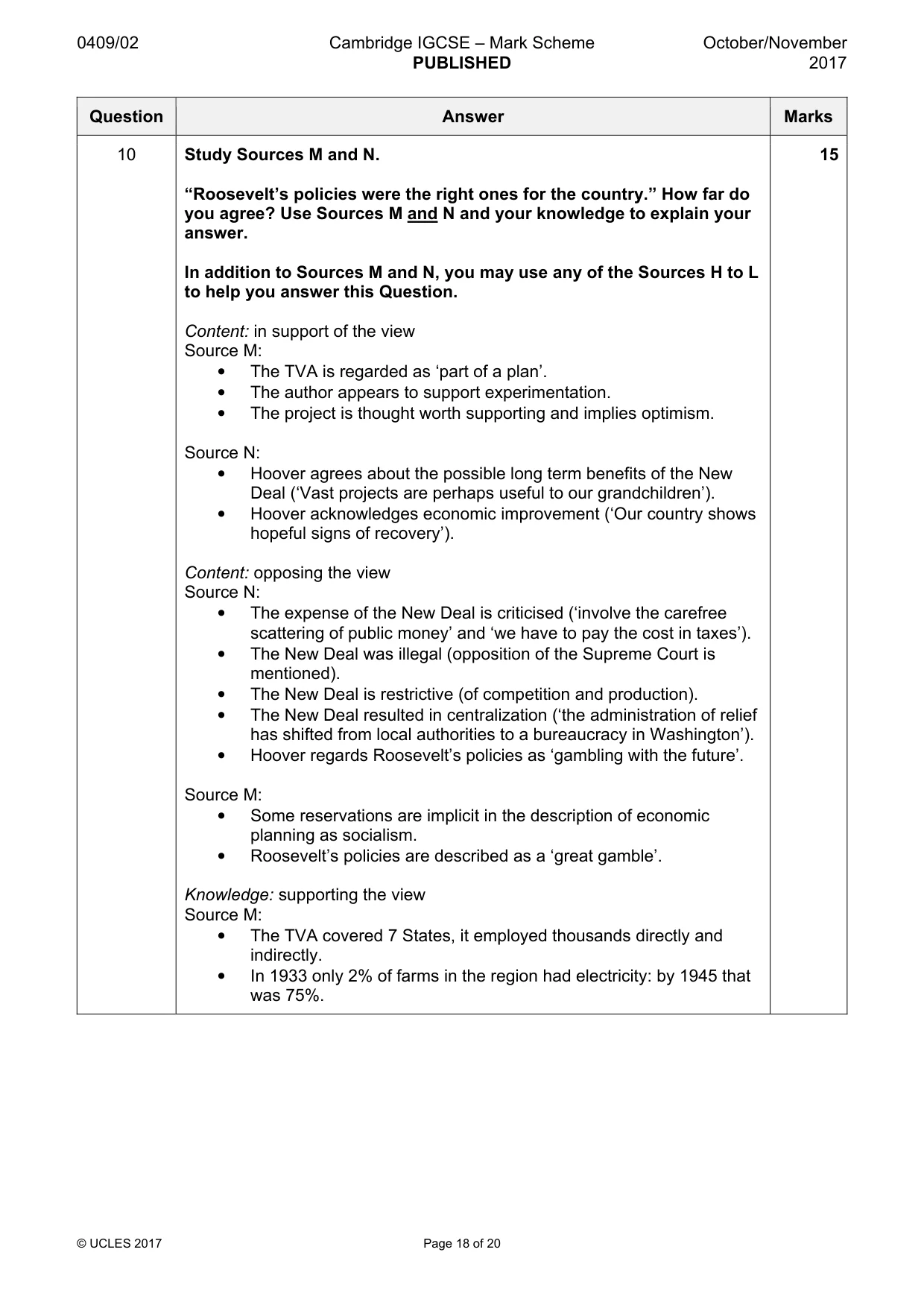
10 Study Sources M and N. “Roosevelt’s policies were the right ones for the country.” How far do you agree? Use Sources M and N and your knowledge to explain your answer. In addition to Sources M and N, you may use any of the Sources H to L to help you answer this question. [15] [Total: 45]
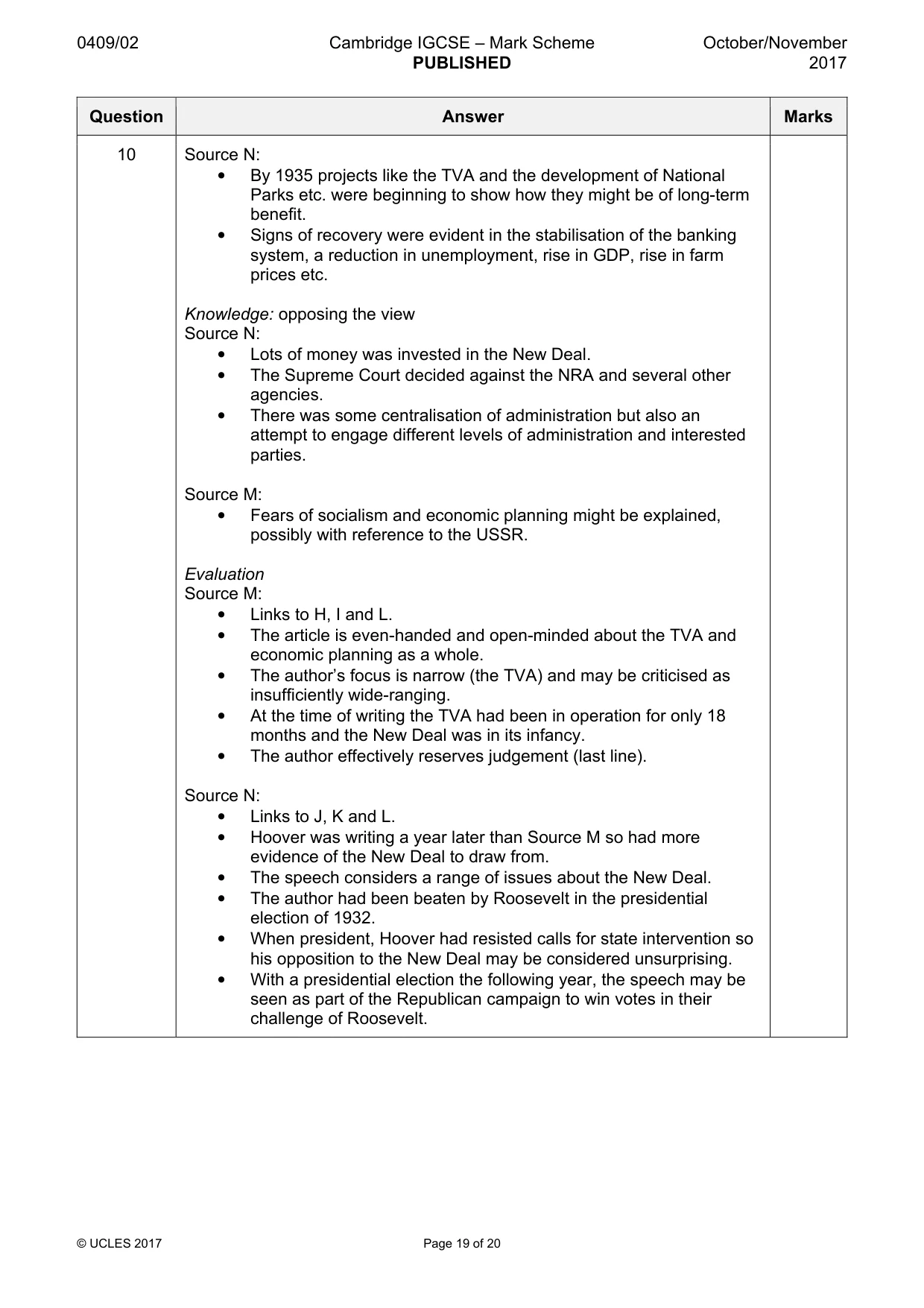
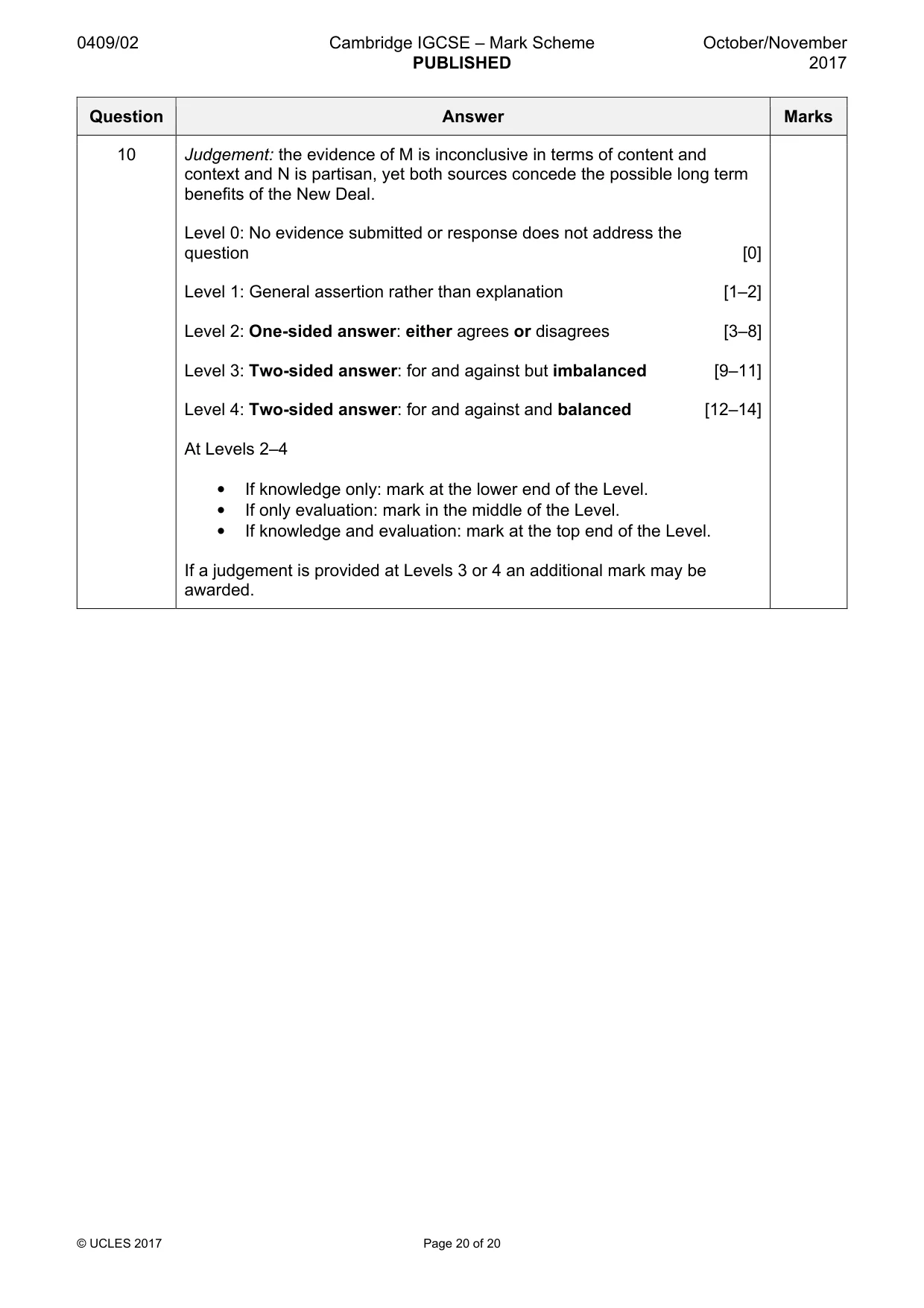
Mark scheme: 10 Study Sources M and N. 15 “Roosevelt’s policies were the right ones for the country.” How far do you agree? Use Sources M and N and your knowledge to explain your answer. In addition to Sources M and N, you may use any of the Sources H to L to help you answer this Question. Content: in support of the view Source M: • The TVA is regarded as ‘part of a plan’. • The author appears to support experimentation. • The project is thought worth supporting and implies optimism. Source N: • Hoover agrees about the possible long term benefits of the New Deal (‘Vast projects are perhaps useful to our grandchildren’). • Hoover acknowledges economic improvement (‘Our country shows hopeful signs of recovery’). Content: opposing the view Source N: • The expense of the New Deal is criticised (‘involve the carefree scattering of public money’ and ‘we have to pay the cost in taxes’). • The New Deal was illegal (opposition of the Supreme Court is mentioned). • The New Deal is restrictive (of competition and production). • The New Deal resulted in centralization (‘the administration of relief has shifted from local authorities to a bureaucracy in Washington’). • Hoover regards Roosevelt’s policies as ‘gambling with the future’. Source M: • Some reservations are implicit in the description of economic planning as socialism. • Roosevelt’s policies are described as a ‘great gamble’. Knowledge: supporting the view Source M: • The TVA covered 7 States, it employed thousands directly and indirectly. • In 1933 only 2% of farms in the region had electricity: by 1945 that was 75%. 10 Source N: • By 1935 projects like the TVA and the development of National Parks etc. were beginning to show how they might be of long-term benefit. • Signs of recovery were evident in the stabilisation of the banking system, a reduction in unemployment, rise in GDP, rise in farm prices etc. Knowledge: opposing the view Source N: • Lots of money was invested in the New Deal. • The Supreme Court decided against the NRA and several other agencies. • There was some centralisation of administration but also an attempt to engage different levels of administration and interested parties. Source M: • Fears of socialism and economic planning might be explained, possibly with reference to the USSR. Evaluation Source M: • Links to H, I and L. • The article is even-handed and open-minded about the TVA and economic planning as a whole. • The author’s focus is narrow (the TVA) and may be criticised as insufficiently wide-ranging. • At the time of writing the TVA had been in operation for only 18 months and the New Deal was in its infancy. • The author effectively reserves judgement (last line). Source N: • Links to J, K and L. • Hoover was writing a year later than Source M so had more evidence of the New Deal to draw from. • The speech considers a range of issues about the New Deal. • The author had been beaten by Roosevelt in the presidential election of 1932. • When president, Hoover had resisted calls for state intervention so his opposition to the New Deal may be considered unsurprising. • With a presidential election the following year, the speech may be seen as part of the Republican campaign to win votes in their challenge of Roosevelt. 10 Judgement: the evidence of M is inconclusive in terms of content and context and N is partisan, yet both sources concede the possible long term benefits of the New Deal. Level 0: No evidence submitted or response does not address the question [0] Level 1: General assertion rather than explanation [1–2] Level 2: One-sided answer: either agrees or disagrees [3–8] Level 3: Two-sided answer: for and against but imbalanced [9–11] Level 4: Two-sided answer: for and against and balanced [12–14] At Levels 2–4 • If knowledge only: mark at the lower end of the Level. • If only evaluation: mark in the middle of the Level. • If knowledge and evaluation: mark at the top end of the Level. If a judgement is provided at Levels 3 or 4 an additional mark may be awarded.
What you needed in this session
Cambridge’s own grade thresholds for 2017 Oct/Nov, Paper 2 · Variant 1. A higher threshold means an easier paper — the bar moves with how the cohort did.