Cambridge IGCSE History American BES 0409 — 2019 Oct/Nov Paper 1 · Variant 1
0409/11/O/N/19 · 60 marks · ≈68 min
The question paper and its mark scheme, free to read here and free to download. This is Cambridge’s own paper, exactly as it was sat.
Question paper8 pages



Mark scheme29 pages
Answers below. Sit the paper first if you are practising.
Paper as text
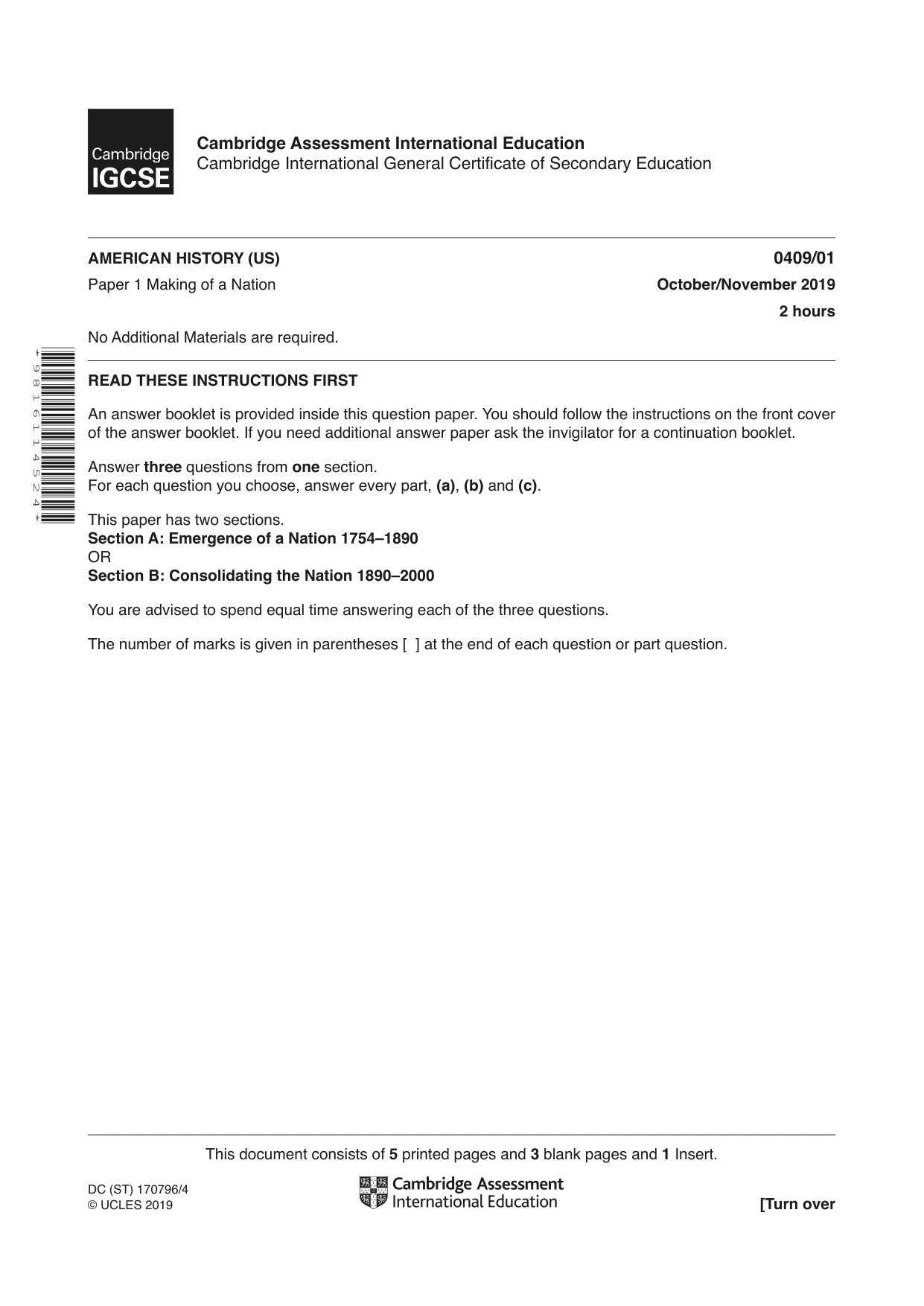
Question paper, page 1
This document consists of 5 printed pages and 3 blank pages and 1 Insert. DC (ST) 170796/4 © UCLES 2019 [Turn over Cambridge Assessment International Education Cambridge International General Certificate of Secondary Education * 9 8 1 6 1 1 4 5 2 4 * AMERICAN HISTORY (US) 0409/01 Paper 1 Making of a Nation October/November 2019 2 hours No Additional Materials are required. READ THESE INSTRUCTIONS FIRST An answer booklet is provided inside this question paper. You should follow the instructions on the front cover of the answer booklet. If you need additional answer paper ask the invigilator for a continuation booklet. Answer three questions from one section. For each question you choose, answer every part, (a), (b) and (c). This paper has two sections. Section A: Emergence of a Nation 1754–1890 OR Section B: Consolidating the Nation 1890–2000 You are advised to spend equal time answering each of the three questions. The number of marks is given in parentheses [ ] at the end of each question or part question.
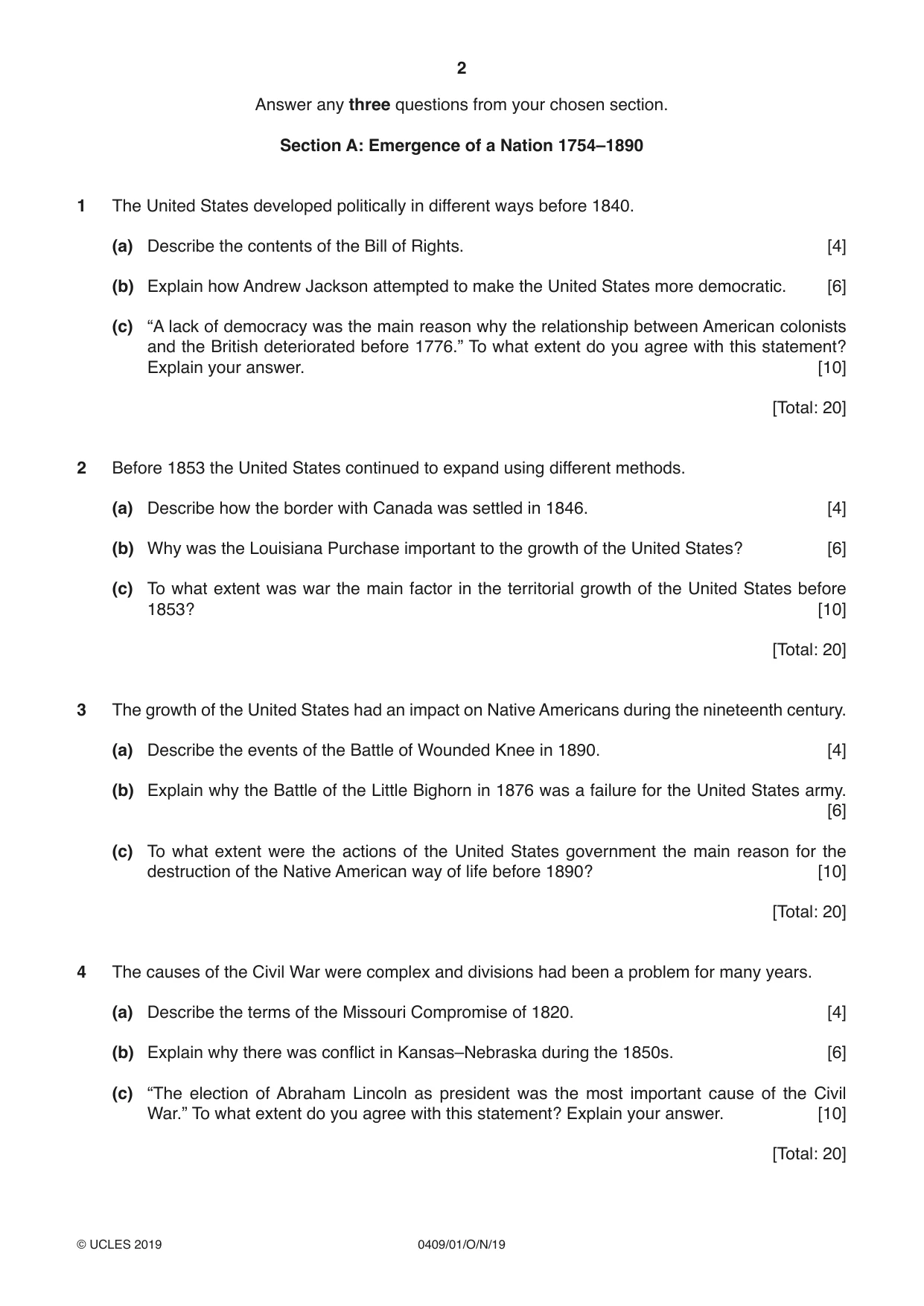
Question paper, page 2
2 0409/01/O/N/19 © UCLES 2019 Answer any three questions from your chosen section. Section A: Emergence of a Nation 1754–1890 1 The United States developed politically in different ways before 1840. (a) Describe the contents of the Bill of Rights. [4] (b) Explain how Andrew Jackson attempted to make the United States more democratic. [6] (c) “A lack of democracy was the main reason why the relationship between American colonists and the British deteriorated before 1776.” To what extent do you agree with this statement? Explain your answer. [10] [Total: 20] 2 Before 1853 the United States continued to expand using different methods. (a) Describe how the border with Canada was settled in 1846. [4] (b) Why was the Louisiana Purchase important to the growth of the United States? [6] (c) To what extent was war the main factor in the territorial growth of the United States before 1853? [10] [Total: 20] 3 The growth of the United States had an impact on Native Americans during the nineteenth century. (a) Describe the events of the Battle of Wounded Knee in 1890. [4] (b) Explain why the Battle of the Little Bighorn in 1876 was a failure for the United States army. [6] (c) To what extent were the actions of the United States government the main reason for the destruction of the Native American way of life before 1890? [10] [Total: 20] 4 The causes of the Civil War were complex and divisions had been a problem for many years. (a) Describe the terms of the Missouri Compromise of 1820. [4] (b) Explain why there was conflict in Kansas–Nebraska during the 1850s. [6] (c) “The election of Abraham Lincoln as president was the most important cause of the Civil War.” To what extent do you agree with this statement? Explain your answer. [10] [Total: 20]
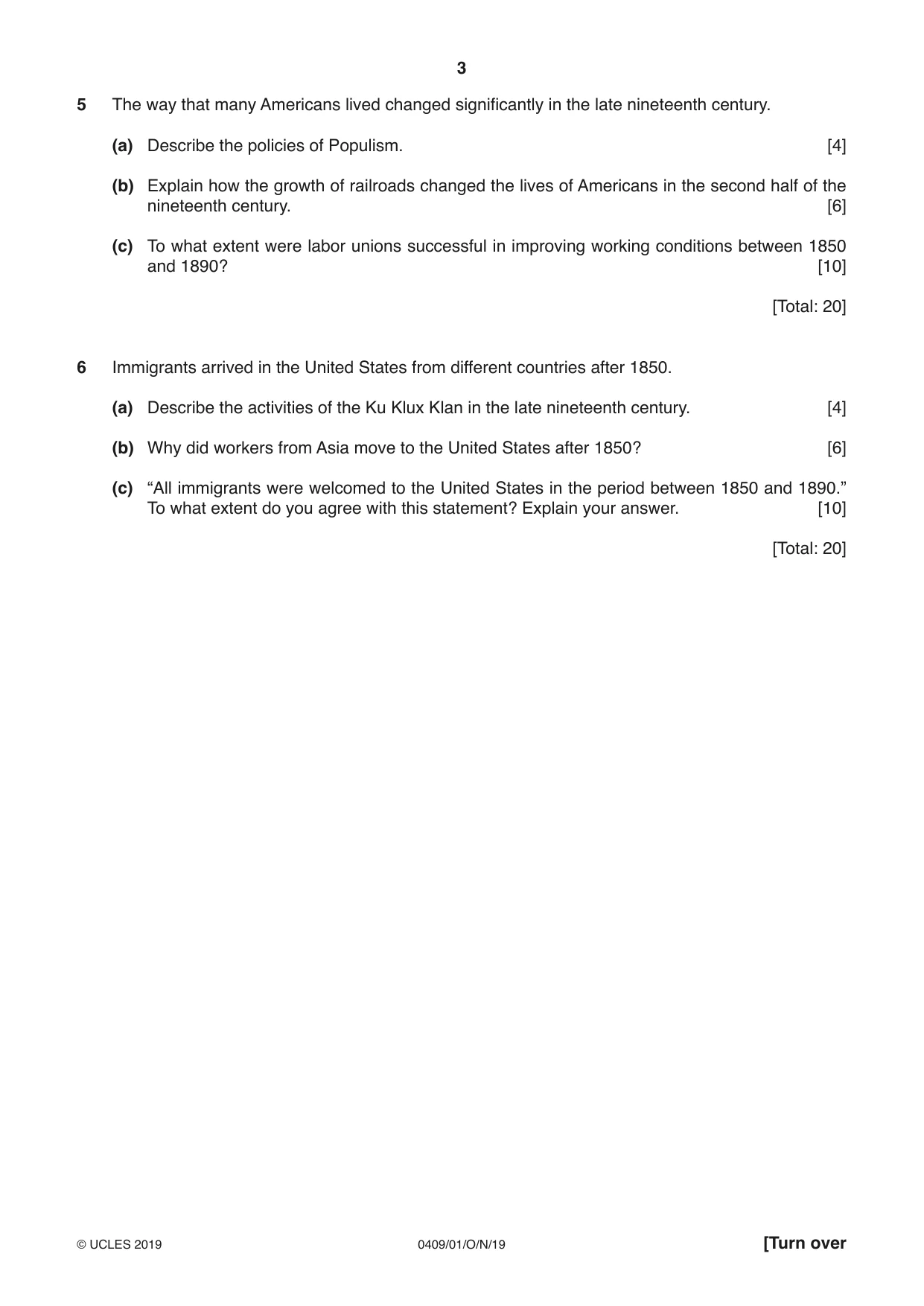
Question paper, page 3
3 0409/01/O/N/19 © UCLES 2019 [Turn over 5 The way that many Americans lived changed significantly in the late nineteenth century. (a) Describe the policies of Populism. [4] (b) Explain how the growth of railroads changed the lives of Americans in the second half of the nineteenth century. [6] (c) To what extent were labor unions successful in improving working conditions between 1850 and 1890? [10] [Total: 20] 6 Immigrants arrived in the United States from different countries after 1850. (a) Describe the activities of the Ku Klux Klan in the late nineteenth century. [4] (b) Why did workers from Asia move to the United States after 1850? [6] (c) “All immigrants were welcomed to the United States in the period between 1850 and 1890.” To what extent do you agree with this statement? Explain your answer. [10] [Total: 20]
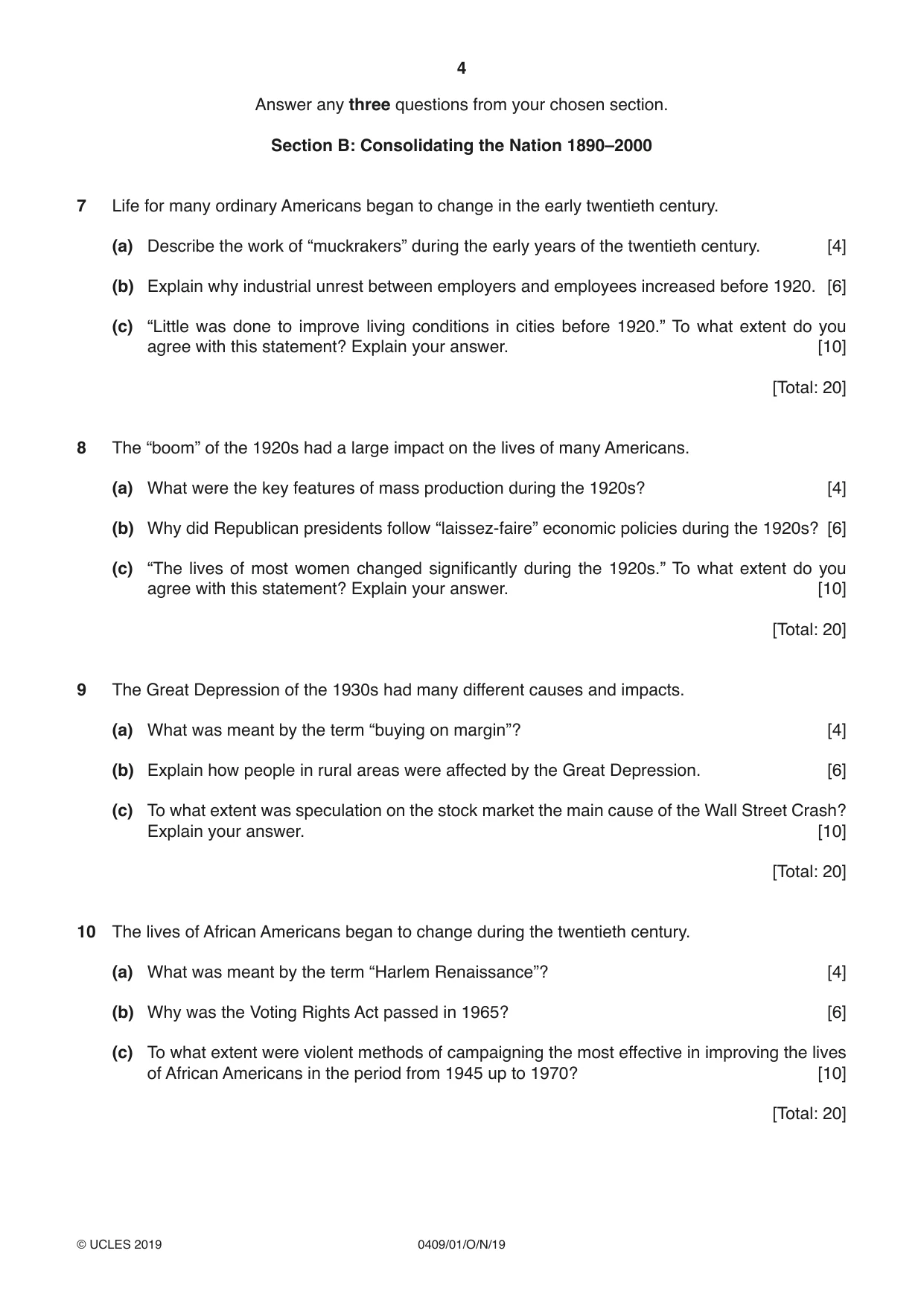
Question paper, page 4
4 0409/01/O/N/19 © UCLES 2019 Answer any three questions from your chosen section. Section B: Consolidating the Nation 1890–2000 7 Life for many ordinary Americans began to change in the early twentieth century. (a) Describe the work of “muckrakers” during the early years of the twentieth century. [4] (b) Explain why industrial unrest between employers and employees increased before 1920. [6] (c) “Little was done to improve living conditions in cities before 1920.” To what extent do you agree with this statement? Explain your answer. [10] [Total: 20] 8 The “boom” of the 1920s had a large impact on the lives of many Americans. (a) What were the key features of mass production during the 1920s? [4] (b) Why did Republican presidents follow “laissez-faire” economic policies during the 1920s? [6] (c) “The lives of most women changed significantly during the 1920s.” To what extent do you agree with this statement? Explain your answer. [10] [Total: 20] 9 The Great Depression of the 1930s had many different causes and impacts. (a) What was meant by the term “buying on margin”? [4] (b) Explain how people in rural areas were affected by the Great Depression. [6] (c) To what extent was speculation on the stock market the main cause of the Wall Street Crash? Explain your answer. [10] [Total: 20] 10 The lives of African Americans began to change during the twentieth century. (a) What was meant by the term “Harlem Renaissance”? [4] (b) Why was the Voting Rights Act passed in 1965? [6] (c) To what extent were violent methods of campaigning the most effective in improving the lives of African Americans in the period from 1945 up to 1970? [10] [Total: 20]
Question paper, page 5
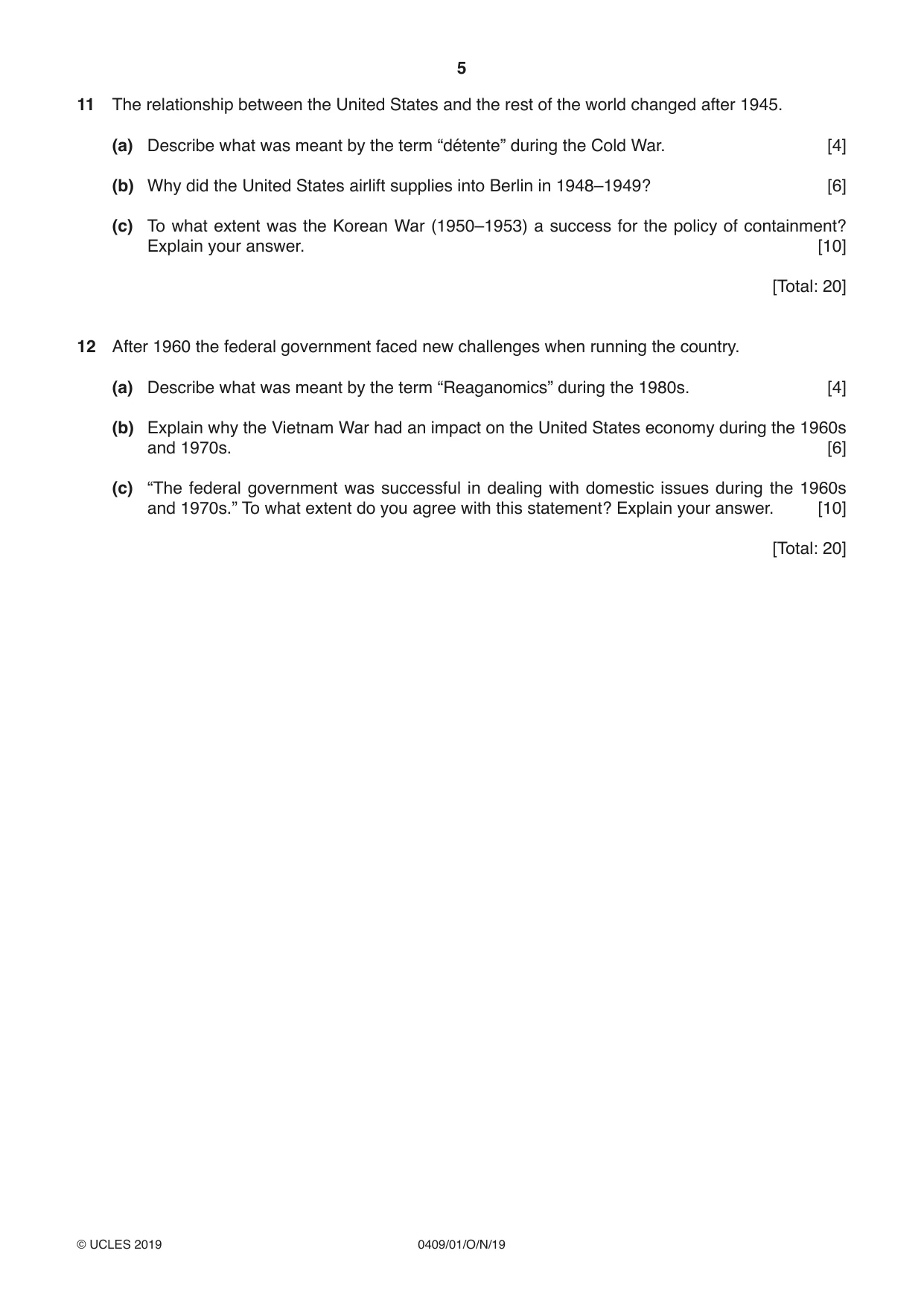
5 0409/01/O/N/19 © UCLES 2019 11 The relationship between the United States and the rest of the world changed after 1945. (a) Describe what was meant by the term “détente” during the Cold War. [4] (b) Why did the United States airlift supplies into Berlin in 1948–1949? [6] (c) To what extent was the Korean War (1950–1953) a success for the policy of containment? Explain your answer. [10] [Total: 20] 12 After 1960 the federal government faced new challenges when running the country. (a) Describe what was meant by the term “Reaganomics” during the 1980s. [4] (b) Explain why the Vietnam War had an impact on the United States economy during the 1960s and 1970s. [6] (c) “The federal government was successful in dealing with domestic issues during the 1960s and 1970s.” To what extent do you agree with this statement? Explain your answer. [10] [Total: 20]
Question paper, page 6
6 0409/01/O/N/19 © UCLES 2019 BLANK PAGE
Question paper, page 7
7 0409/01/O/N/19 © UCLES 2019 BLANK PAGE
Question paper, page 8
8 0409/01/O/N/19 © UCLES 2019 Permission to reproduce items where third-party owned material protected by copyright is included has been sought and cleared where possible. Every reasonable effort has been made by the publisher (UCLES) to trace copyright holders, but if any items requiring clearance have unwittingly been included, the publisher will be pleased to make amends at the earliest possible opportunity. To avoid the issue of disclosure of answer-related information to candidates, all copyright acknowledgements are reproduced online in the Cambridge Assessment International Education Copyright Acknowledgements Booklet. This is produced for each series of examinations and is freely available to download at www.cambridgeinternational.org after the live examination series. Cambridge Assessment International Education is part of the Cambridge Assessment Group. Cambridge Assessment is the brand name of the University of Cambridge Local Examinations Syndicate (UCLES), which itself is a department of the University of Cambridge. BLANK PAGE
Mark scheme, page 1
This document consists of 29 printed pages. © UCLES 2019 [Turn over Cambridge Assessment International Education Cambridge International General Certificate of Secondary Education AMERICAN HISTORY (US) 0409/01 Paper 1 The Making of a Nation October/November 2019 MARK SCHEME Maximum Mark: 60 Published This mark scheme is published as an aid to teachers and candidates, to indicate the requirements of the examination. It shows the basis on which Examiners were instructed to award marks. It does not indicate the details of the discussions that took place at an Examiners’ meeting before marking began, which would have considered the acceptability of alternative answers. Mark schemes should be read in conjunction with the question paper and the Principal Examiner Report for Teachers. Cambridge International will not enter into discussions about these mark schemes. Cambridge International is publishing the mark schemes for the October/November 2019 series for most Cambridge IGCSE™, Cambridge International A and AS Level components and some Cambridge O Level components.
Mark scheme, page 2
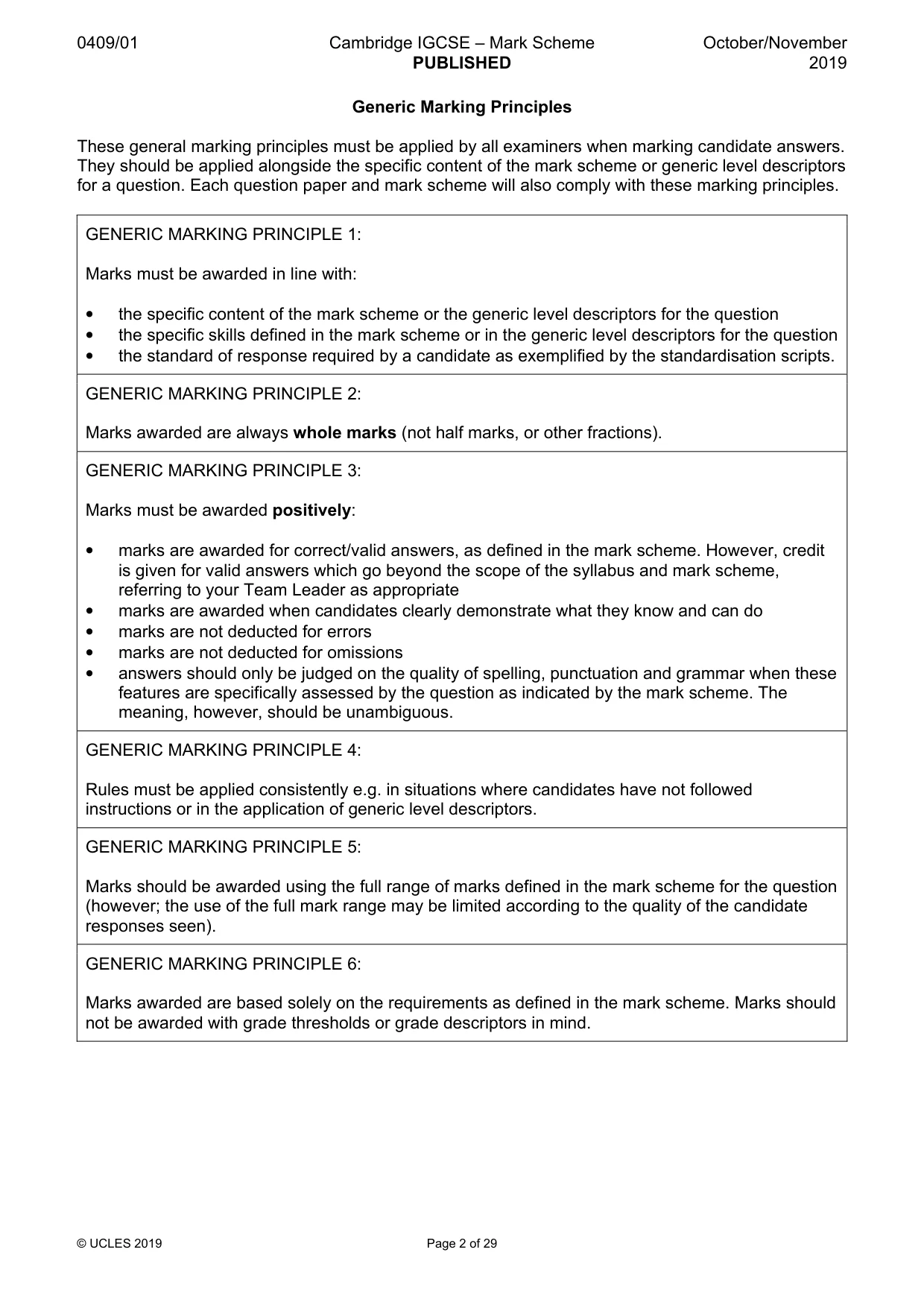
0409/01 Cambridge IGCSE – Mark Scheme PUBLISHED October/November 2019 © UCLES 2019 Page 2 of 29 Generic Marking Principles These general marking principles must be applied by all examiners when marking candidate answers. They should be applied alongside the specific content of the mark scheme or generic level descriptors for a question. Each question paper and mark scheme will also comply with these marking principles. GENERIC MARKING PRINCIPLE 1: Marks must be awarded in line with: • the specific content of the mark scheme or the generic level descriptors for the question • the specific skills defined in the mark scheme or in the generic level descriptors for the question • the standard of response required by a candidate as exemplified by the standardisation scripts. GENERIC MARKING PRINCIPLE 2: Marks awarded are always whole marks (not half marks, or other fractions). GENERIC MARKING PRINCIPLE 3: Marks must be awarded positively: • marks are awarded for correct/valid answers, as defined in the mark scheme. However, credit is given for valid answers which go beyond the scope of the syllabus and mark scheme, referring to your Team Leader as appropriate • marks are awarded when candidates clearly demonstrate what they know and can do • marks are not deducted for errors • marks are not deducted for omissions • answers should only be judged on the quality of spelling, punctuation and grammar when these features are specifically assessed by the question as indicated by the mark scheme. The meaning, however, should be unambiguous. GENERIC MARKING PRINCIPLE 4: Rules must be applied consistently e.g. in situations where candidates have not followed instructions or in the application of generic level descriptors. GENERIC MARKING PRINCIPLE 5: Marks should be awarded using the full range of marks defined in the mark scheme for the question (however; the use of the full mark range may be limited according to the quality of the candidate responses seen). GENERIC MARKING PRINCIPLE 6: Marks awarded are based solely on the requirements as defined in the mark scheme. Marks should not be awarded with grade thresholds or grade descriptors in mind.
Mark scheme, page 3
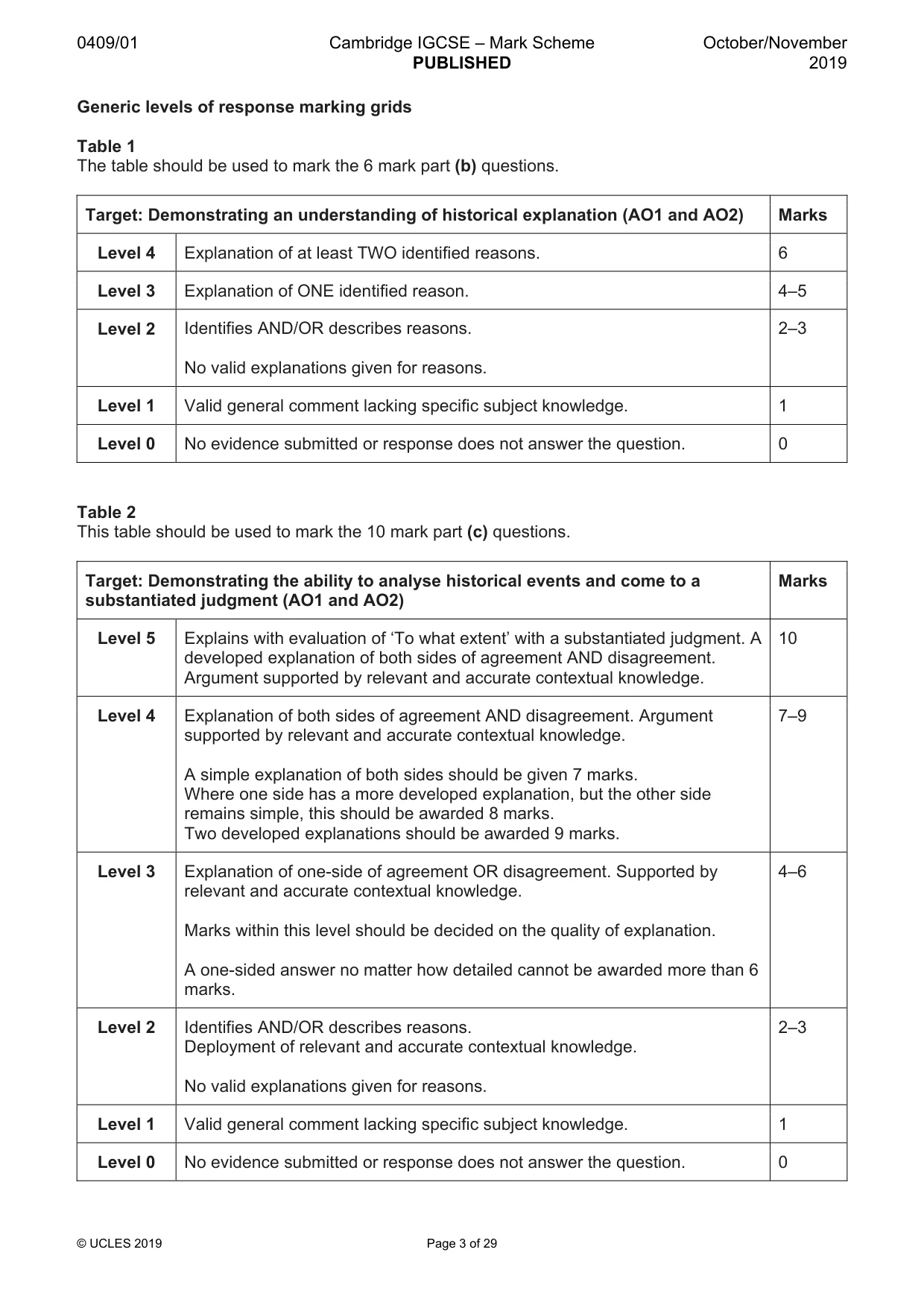
0409/01 Cambridge IGCSE – Mark Scheme PUBLISHED October/November 2019 © UCLES 2019 Page 3 of 29 Generic levels of response marking grids Table 1 The table should be used to mark the 6 mark part (b) questions. Target: Demonstrating an understanding of historical explanation (AO1 and AO2) Marks Level 4 Explanation of at least TWO identified reasons. 6 Level 3 Explanation of ONE identified reason. 4–5 Level 2 Identifies AND/OR describes reasons. No valid explanations given for reasons. 2–3 Level 1 Valid general comment lacking specific subject knowledge. 1 Level 0 No evidence submitted or response does not answer the question. 0 Table 2 This table should be used to mark the 10 mark part (c) questions. Target: Demonstrating the ability to analyse historical events and come to a substantiated judgment (AO1 and AO2) Marks Level 5 Explains with evaluation of ‘To what extent’ with a substantiated judgment. A developed explanation of both sides of agreement AND disagreement. Argument supported by relevant and accurate contextual knowledge. 10 Level 4 Explanation of both sides of agreement AND disagreement. Argument supported by relevant and accurate contextual knowledge. A simple explanation of both sides should be given 7 marks. Where one side has a more developed explanation, but the other side remains simple, this should be awarded 8 marks. Two developed explanations should be awarded 9 marks. 7–9 Level 3 Explanation of one-side of agreement OR disagreement. Supported by relevant and accurate contextual knowledge. Marks within this level should be decided on the quality of explanation. A one-sided answer no matter how detailed cannot be awarded more than 6 marks. 4–6 Level 2 Identifies AND/OR describes reasons. Deployment of relevant and accurate contextual knowledge. No valid explanations given for reasons. 2–3 Level 1 Valid general comment lacking specific subject knowledge. 1 Level 0 No evidence submitted or response does not answer the question. 0
Mark scheme, page 4
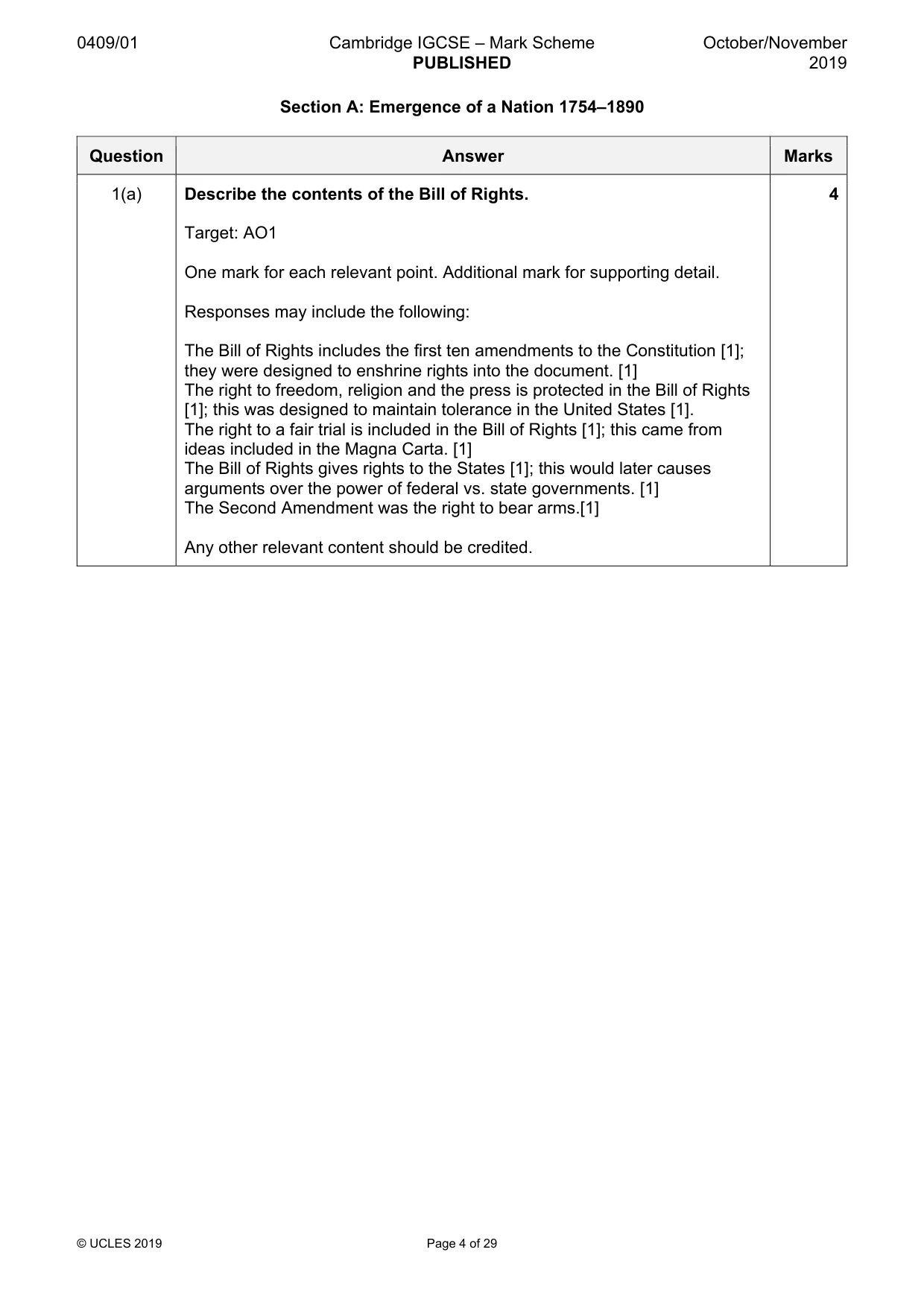
0409/01 Cambridge IGCSE – Mark Scheme PUBLISHED October/November 2019 © UCLES 2019 Page 4 of 29 Section A: Emergence of a Nation 1754–1890 Question Answer Marks 1(a) Describe the contents of the Bill of Rights. Target: AO1 One mark for each relevant point. Additional mark for supporting detail. Responses may include the following: The Bill of Rights includes the first ten amendments to the Constitution [1]; they were designed to enshrine rights into the document. [1] The right to freedom, religion and the press is protected in the Bill of Rights [1]; this was designed to maintain tolerance in the United States [1]. The right to a fair trial is included in the Bill of Rights [1]; this came from ideas included in the Magna Carta. [1] The Bill of Rights gives rights to the States [1]; this would later causes arguments over the power of federal vs. state governments. [1] The Second Amendment was the right to bear arms.[1] Any other relevant content should be credited. 4
Mark scheme, page 5
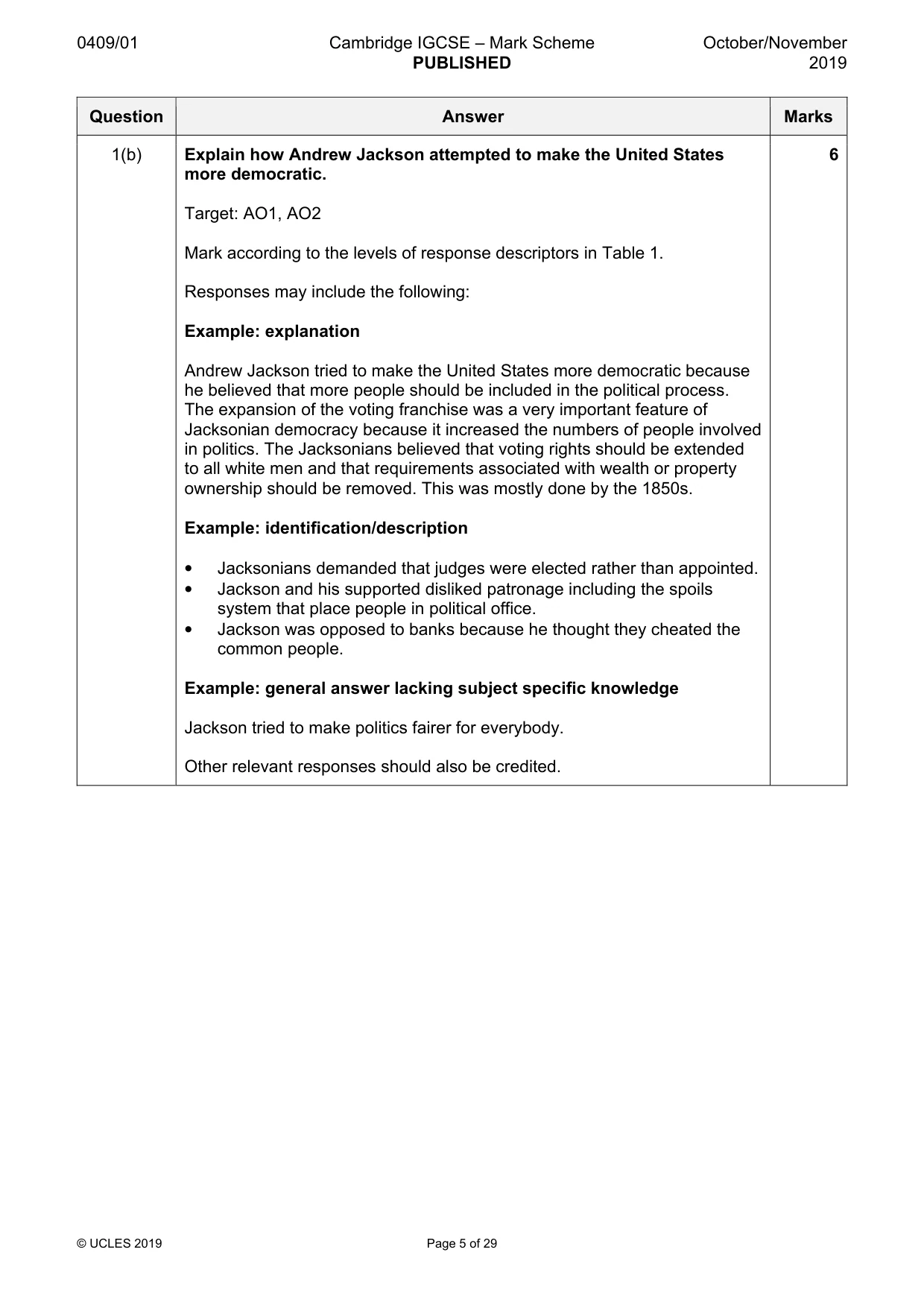
0409/01 Cambridge IGCSE – Mark Scheme PUBLISHED October/November 2019 © UCLES 2019 Page 5 of 29 Question Answer Marks 1(b) Explain how Andrew Jackson attempted to make the United States more democratic. Target: AO1, AO2 Mark according to the levels of response descriptors in Table 1. Responses may include the following: Example: explanation Andrew Jackson tried to make the United States more democratic because he believed that more people should be included in the political process. The expansion of the voting franchise was a very important feature of Jacksonian democracy because it increased the numbers of people involved in politics. The Jacksonians believed that voting rights should be extended to all white men and that requirements associated with wealth or property ownership should be removed. This was mostly done by the 1850s. Example: identification/description • Jacksonians demanded that judges were elected rather than appointed. • Jackson and his supported disliked patronage including the spoils system that place people in political office. • Jackson was opposed to banks because he thought they cheated the common people. Example: general answer lacking subject specific knowledge Jackson tried to make politics fairer for everybody. Other relevant responses should also be credited. 6
Mark scheme, page 6
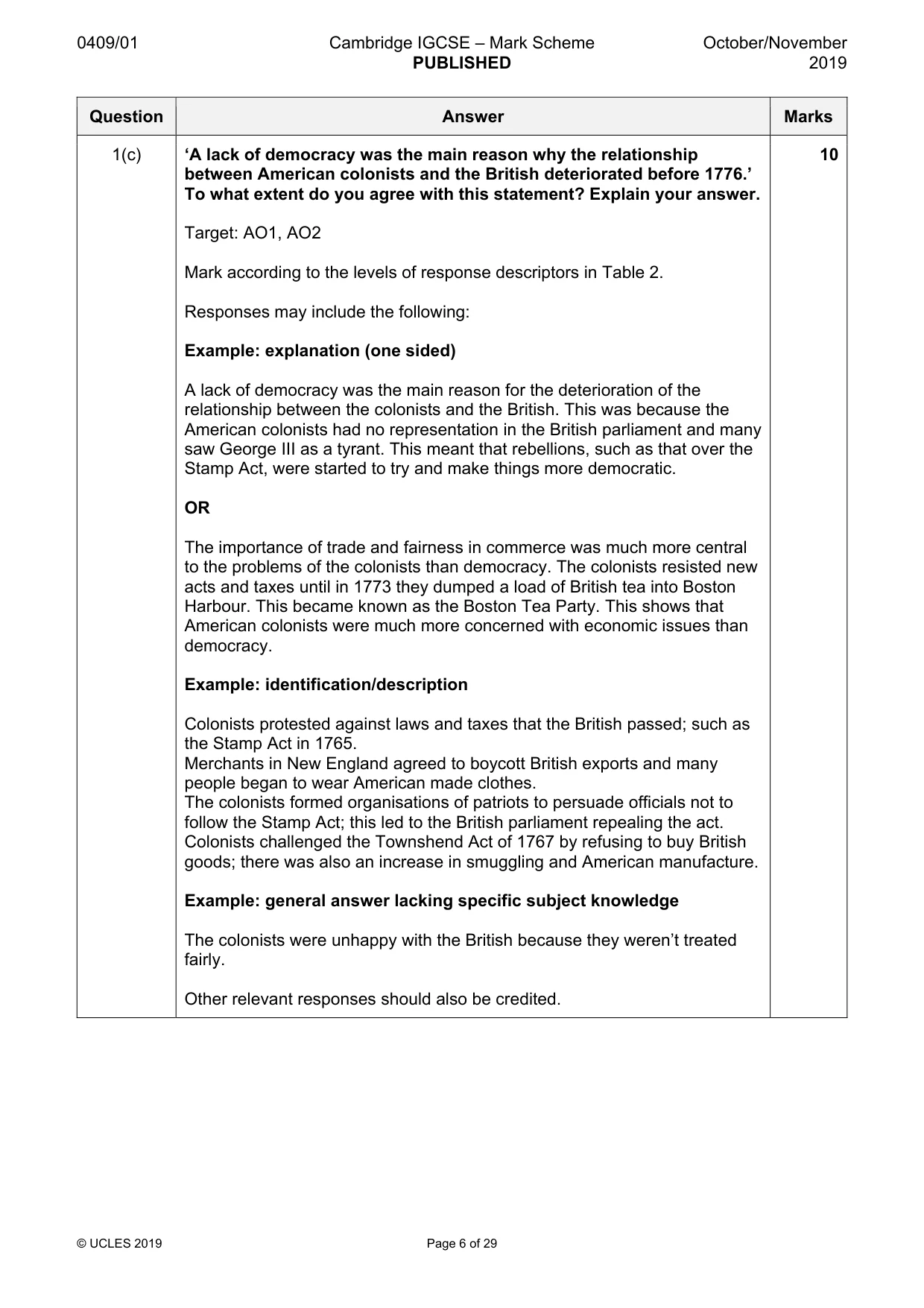
0409/01 Cambridge IGCSE – Mark Scheme PUBLISHED October/November 2019 © UCLES 2019 Page 6 of 29 Question Answer Marks 1(c) ‘A lack of democracy was the main reason why the relationship between American colonists and the British deteriorated before 1776.’ To what extent do you agree with this statement? Explain your answer. Target: AO1, AO2 Mark according to the levels of response descriptors in Table 2. Responses may include the following: Example: explanation (one sided) A lack of democracy was the main reason for the deterioration of the relationship between the colonists and the British. This was because the American colonists had no representation in the British parliament and many saw George III as a tyrant. This meant that rebellions, such as that over the Stamp Act, were started to try and make things more democratic. OR The importance of trade and fairness in commerce was much more central to the problems of the colonists than democracy. The colonists resisted new acts and taxes until in 1773 they dumped a load of British tea into Boston Harbour. This became known as the Boston Tea Party. This shows that American colonists were much more concerned with economic issues than democracy. Example: identification/description Colonists protested against laws and taxes that the British passed; such as the Stamp Act in 1765. Merchants in New England agreed to boycott British exports and many people began to wear American made clothes. The colonists formed organisations of patriots to persuade officials not to follow the Stamp Act; this led to the British parliament repealing the act. Colonists challenged the Townshend Act of 1767 by refusing to buy British goods; there was also an increase in smuggling and American manufacture. Example: general answer lacking specific subject knowledge The colonists were unhappy with the British because they weren’t treated fairly. Other relevant responses should also be credited. 10
Mark scheme, page 7
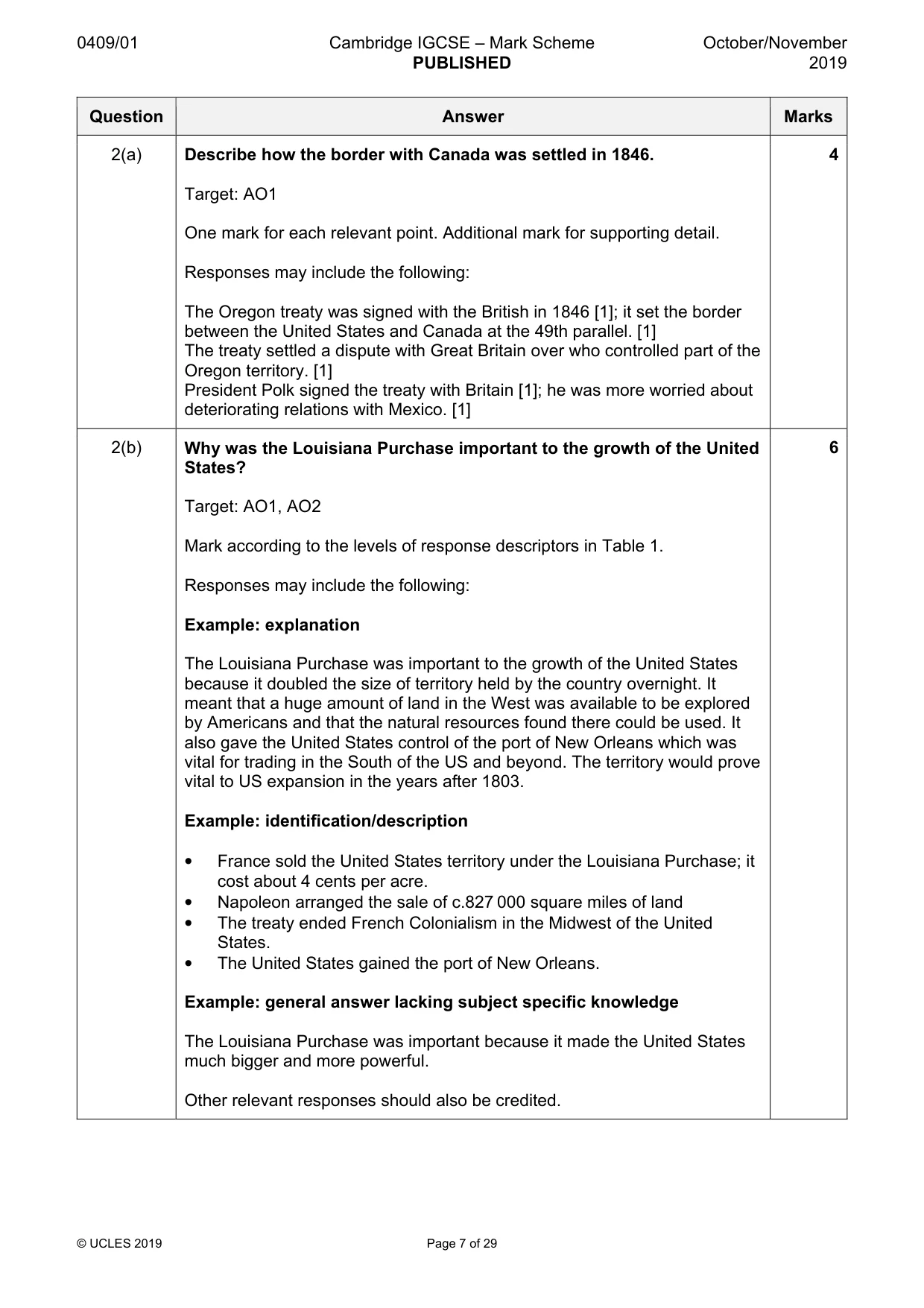
0409/01 Cambridge IGCSE – Mark Scheme PUBLISHED October/November 2019 © UCLES 2019 Page 7 of 29 Question Answer Marks 2(a) Describe how the border with Canada was settled in 1846. Target: AO1 One mark for each relevant point. Additional mark for supporting detail. Responses may include the following: The Oregon treaty was signed with the British in 1846 [1]; it set the border between the United States and Canada at the 49th parallel. [1] The treaty settled a dispute with Great Britain over who controlled part of the Oregon territory. [1] President Polk signed the treaty with Britain [1]; he was more worried about deteriorating relations with Mexico. [1] 4 2(b) Why was the Louisiana Purchase important to the growth of the United States? Target: AO1, AO2 Mark according to the levels of response descriptors in Table 1. Responses may include the following: Example: explanation The Louisiana Purchase was important to the growth of the United States because it doubled the size of territory held by the country overnight. It meant that a huge amount of land in the West was available to be explored by Americans and that the natural resources found there could be used. It also gave the United States control of the port of New Orleans which was vital for trading in the South of the US and beyond. The territory would prove vital to US expansion in the years after 1803. Example: identification/description • France sold the United States territory under the Louisiana Purchase; it cost about 4 cents per acre. • Napoleon arranged the sale of c.827 000 square miles of land • The treaty ended French Colonialism in the Midwest of the United States. • The United States gained the port of New Orleans. Example: general answer lacking subject specific knowledge The Louisiana Purchase was important because it made the United States much bigger and more powerful. Other relevant responses should also be credited. 6
Mark scheme, page 8
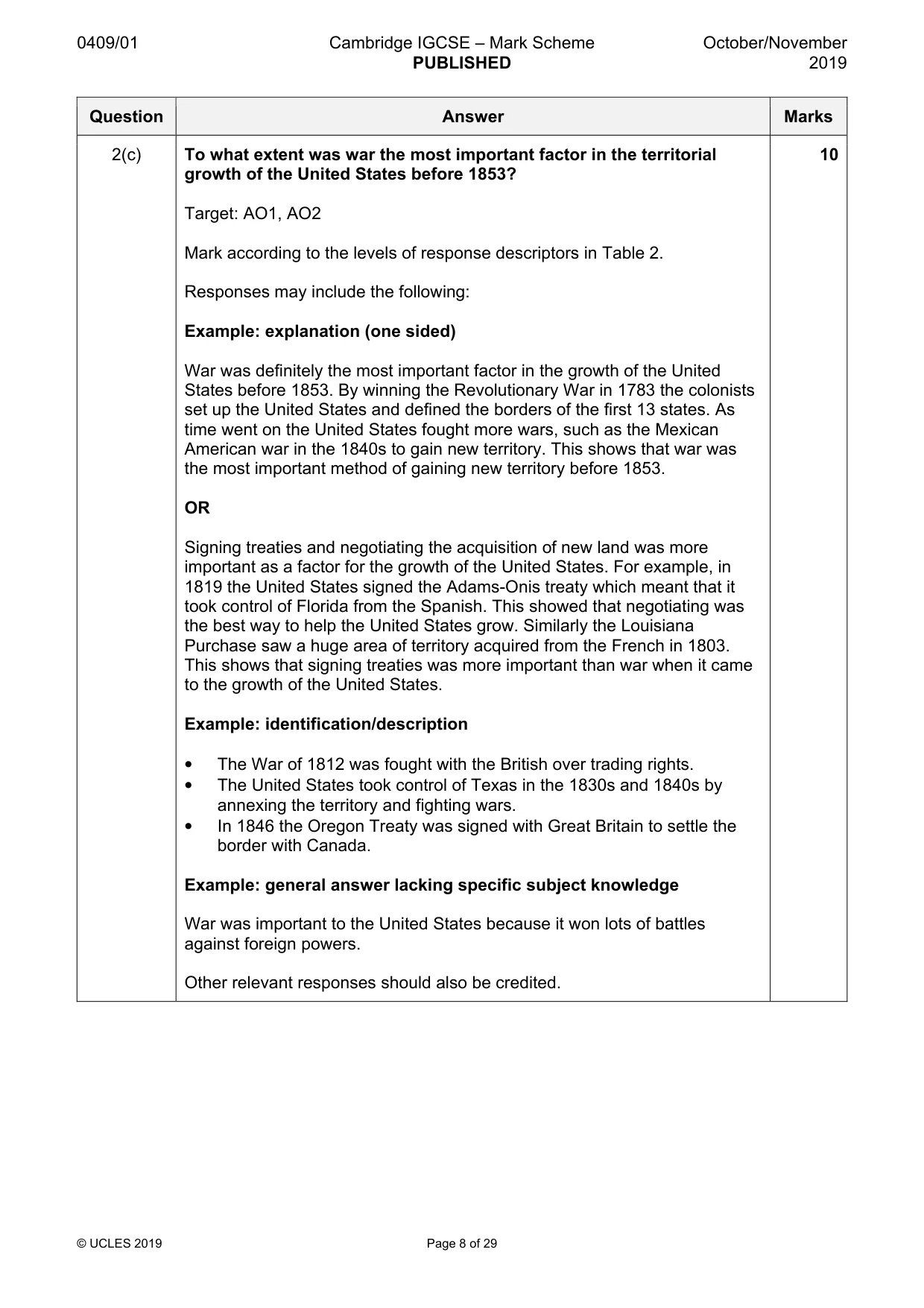
0409/01 Cambridge IGCSE – Mark Scheme PUBLISHED October/November 2019 © UCLES 2019 Page 8 of 29 Question Answer Marks 2(c) To what extent was war the most important factor in the territorial growth of the United States before 1853? Target: AO1, AO2 Mark according to the levels of response descriptors in Table 2. Responses may include the following: Example: explanation (one sided) War was definitely the most important factor in the growth of the United States before 1853. By winning the Revolutionary War in 1783 the colonists set up the United States and defined the borders of the first 13 states. As time went on the United States fought more wars, such as the Mexican American war in the 1840s to gain new territory. This shows that war was the most important method of gaining new territory before 1853. OR Signing treaties and negotiating the acquisition of new land was more important as a factor for the growth of the United States. For example, in 1819 the United States signed the Adams-Onis treaty which meant that it took control of Florida from the Spanish. This showed that negotiating was the best way to help the United States grow. Similarly the Louisiana Purchase saw a huge area of territory acquired from the French in 1803. This shows that signing treaties was more important than war when it came to the growth of the United States. Example: identification/description • The War of 1812 was fought with the British over trading rights. • The United States took control of Texas in the 1830s and 1840s by annexing the territory and fighting wars. • In 1846 the Oregon Treaty was signed with Great Britain to settle the border with Canada. Example: general answer lacking specific subject knowledge War was important to the United States because it won lots of battles against foreign powers. Other relevant responses should also be credited. 10
Mark scheme, page 9
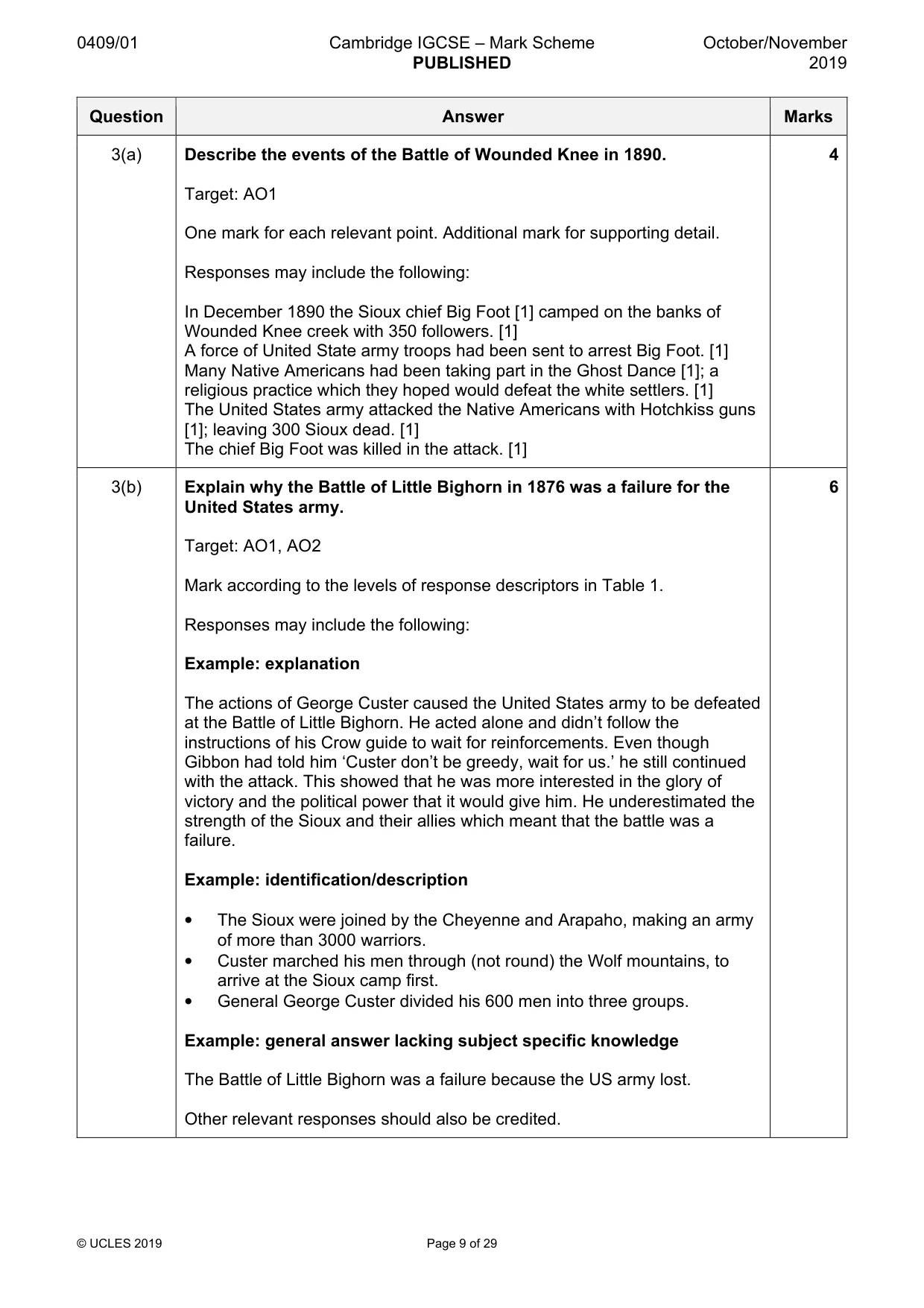
0409/01 Cambridge IGCSE – Mark Scheme PUBLISHED October/November 2019 © UCLES 2019 Page 9 of 29 Question Answer Marks 3(a) Describe the events of the Battle of Wounded Knee in 1890. Target: AO1 One mark for each relevant point. Additional mark for supporting detail. Responses may include the following: In December 1890 the Sioux chief Big Foot [1] camped on the banks of Wounded Knee creek with 350 followers. [1] A force of United State army troops had been sent to arrest Big Foot. [1] Many Native Americans had been taking part in the Ghost Dance [1]; a religious practice which they hoped would defeat the white settlers. [1] The United States army attacked the Native Americans with Hotchkiss guns [1]; leaving 300 Sioux dead. [1] The chief Big Foot was killed in the attack. [1] 4 3(b) Explain why the Battle of Little Bighorn in 1876 was a failure for the United States army. Target: AO1, AO2 Mark according to the levels of response descriptors in Table 1. Responses may include the following: Example: explanation The actions of George Custer caused the United States army to be defeated at the Battle of Little Bighorn. He acted alone and didn’t follow the instructions of his Crow guide to wait for reinforcements. Even though Gibbon had told him ‘Custer don’t be greedy, wait for us.’ he still continued with the attack. This showed that he was more interested in the glory of victory and the political power that it would give him. He underestimated the strength of the Sioux and their allies which meant that the battle was a failure. Example: identification/description • The Sioux were joined by the Cheyenne and Arapaho, making an army of more than 3000 warriors. • Custer marched his men through (not round) the Wolf mountains, to arrive at the Sioux camp first. • General George Custer divided his 600 men into three groups. Example: general answer lacking subject specific knowledge The Battle of Little Bighorn was a failure because the US army lost. Other relevant responses should also be credited. 6
Mark scheme, page 10
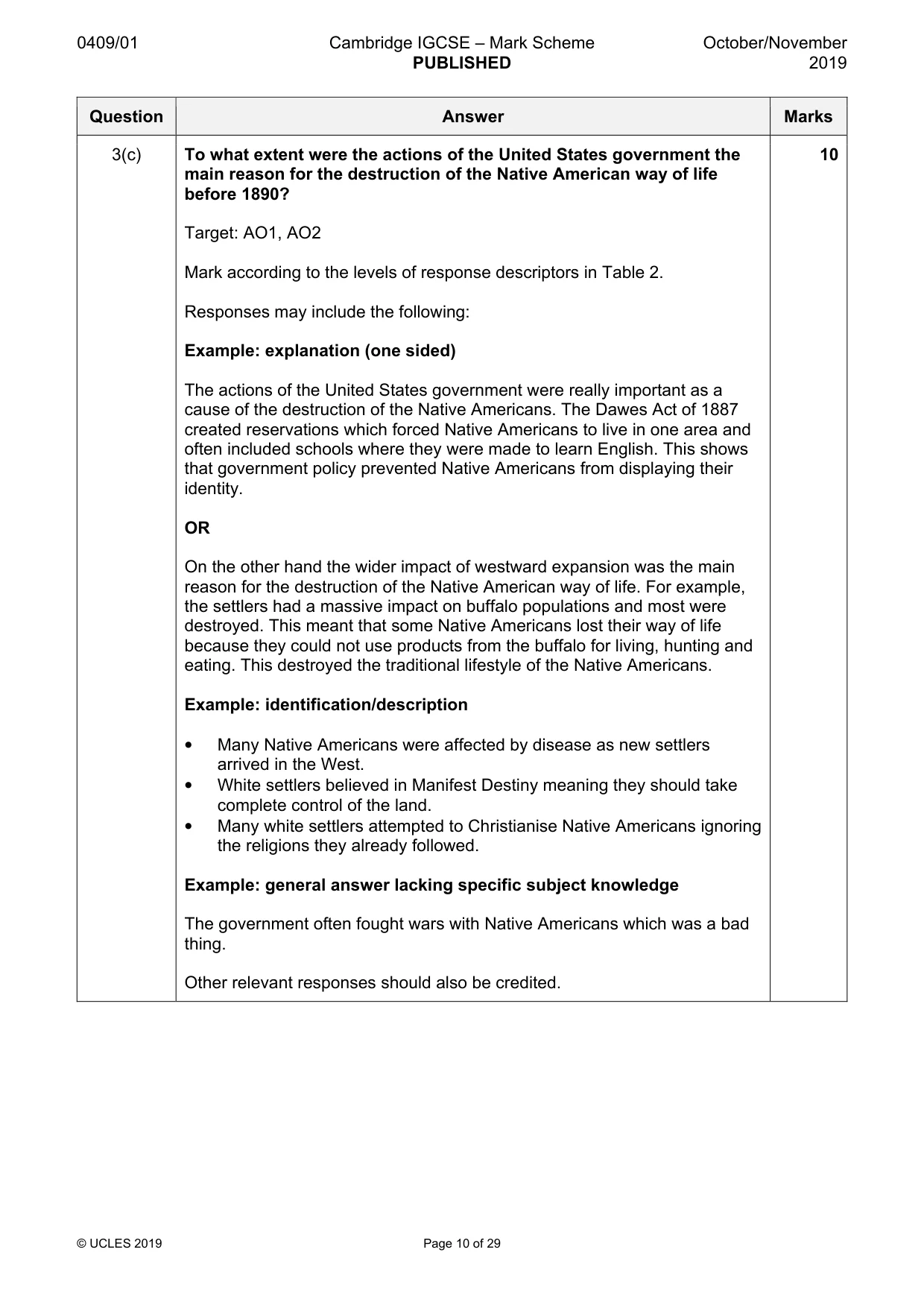
0409/01 Cambridge IGCSE – Mark Scheme PUBLISHED October/November 2019 © UCLES 2019 Page 10 of 29 Question Answer Marks 3(c) To what extent were the actions of the United States government the main reason for the destruction of the Native American way of life before 1890? Target: AO1, AO2 Mark according to the levels of response descriptors in Table 2. Responses may include the following: Example: explanation (one sided) The actions of the United States government were really important as a cause of the destruction of the Native Americans. The Dawes Act of 1887 created reservations which forced Native Americans to live in one area and often included schools where they were made to learn English. This shows that government policy prevented Native Americans from displaying their identity. OR On the other hand the wider impact of westward expansion was the main reason for the destruction of the Native American way of life. For example, the settlers had a massive impact on buffalo populations and most were destroyed. This meant that some Native Americans lost their way of life because they could not use products from the buffalo for living, hunting and eating. This destroyed the traditional lifestyle of the Native Americans. Example: identification/description • Many Native Americans were affected by disease as new settlers arrived in the West. • White settlers believed in Manifest Destiny meaning they should take complete control of the land. • Many white settlers attempted to Christianise Native Americans ignoring the religions they already followed. Example: general answer lacking specific subject knowledge The government often fought wars with Native Americans which was a bad thing. Other relevant responses should also be credited. 10
Mark scheme, page 11
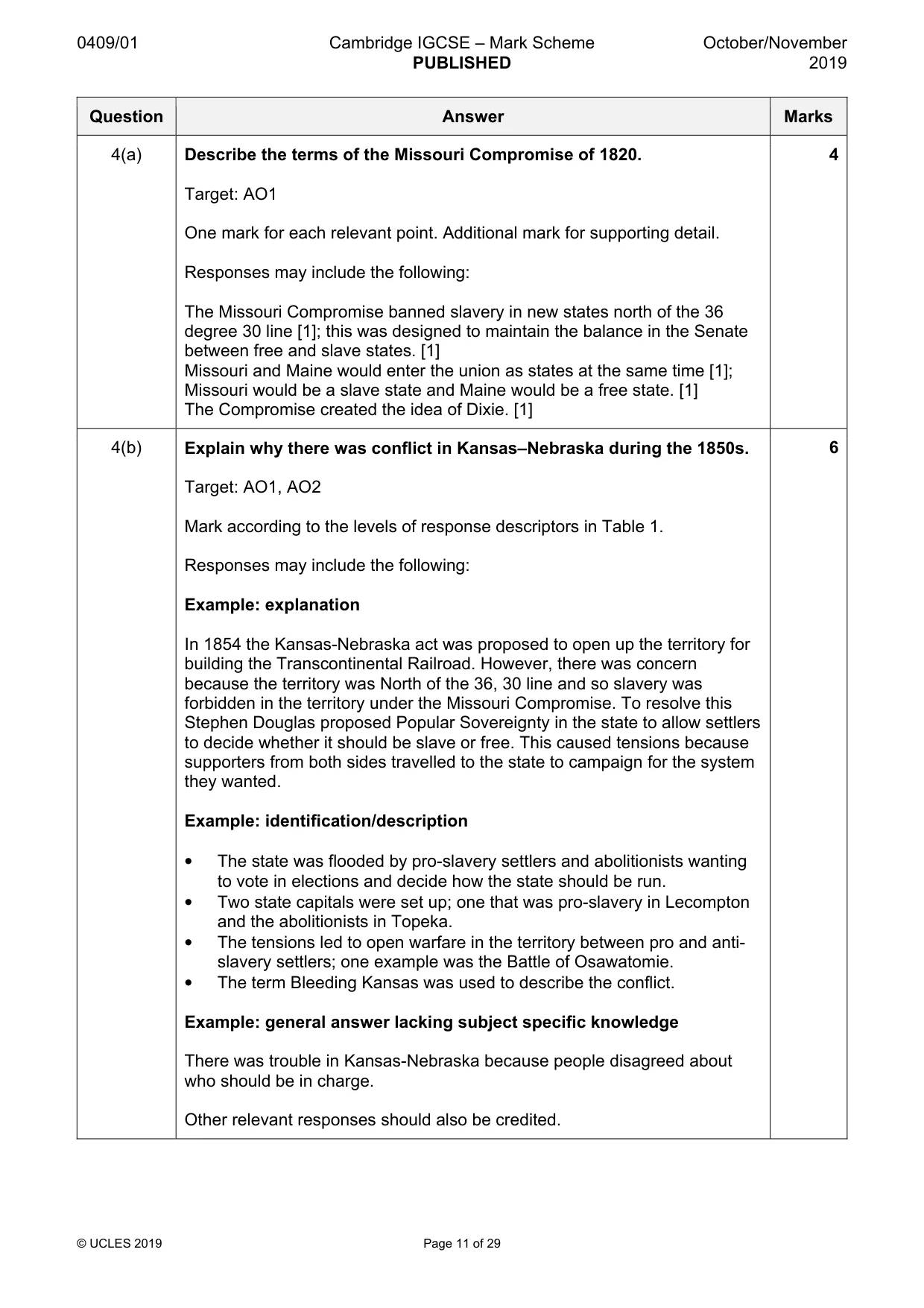
0409/01 Cambridge IGCSE – Mark Scheme PUBLISHED October/November 2019 © UCLES 2019 Page 11 of 29 Question Answer Marks 4(a) Describe the terms of the Missouri Compromise of 1820. Target: AO1 One mark for each relevant point. Additional mark for supporting detail. Responses may include the following: The Missouri Compromise banned slavery in new states north of the 36 degree 30 line [1]; this was designed to maintain the balance in the Senate between free and slave states. [1] Missouri and Maine would enter the union as states at the same time [1]; Missouri would be a slave state and Maine would be a free state. [1] The Compromise created the idea of Dixie. [1] 4 4(b) Explain why there was conflict in Kansas–Nebraska during the 1850s. Target: AO1, AO2 Mark according to the levels of response descriptors in Table 1. Responses may include the following: Example: explanation In 1854 the Kansas-Nebraska act was proposed to open up the territory for building the Transcontinental Railroad. However, there was concern because the territory was North of the 36, 30 line and so slavery was forbidden in the territory under the Missouri Compromise. To resolve this Stephen Douglas proposed Popular Sovereignty in the state to allow settlers to decide whether it should be slave or free. This caused tensions because supporters from both sides travelled to the state to campaign for the system they wanted. Example: identification/description • The state was flooded by pro-slavery settlers and abolitionists wanting to vote in elections and decide how the state should be run. • Two state capitals were set up; one that was pro-slavery in Lecompton and the abolitionists in Topeka. • The tensions led to open warfare in the territory between pro and anti- slavery settlers; one example was the Battle of Osawatomie. • The term Bleeding Kansas was used to describe the conflict. Example: general answer lacking subject specific knowledge There was trouble in Kansas-Nebraska because people disagreed about who should be in charge. Other relevant responses should also be credited. 6
Mark scheme, page 12
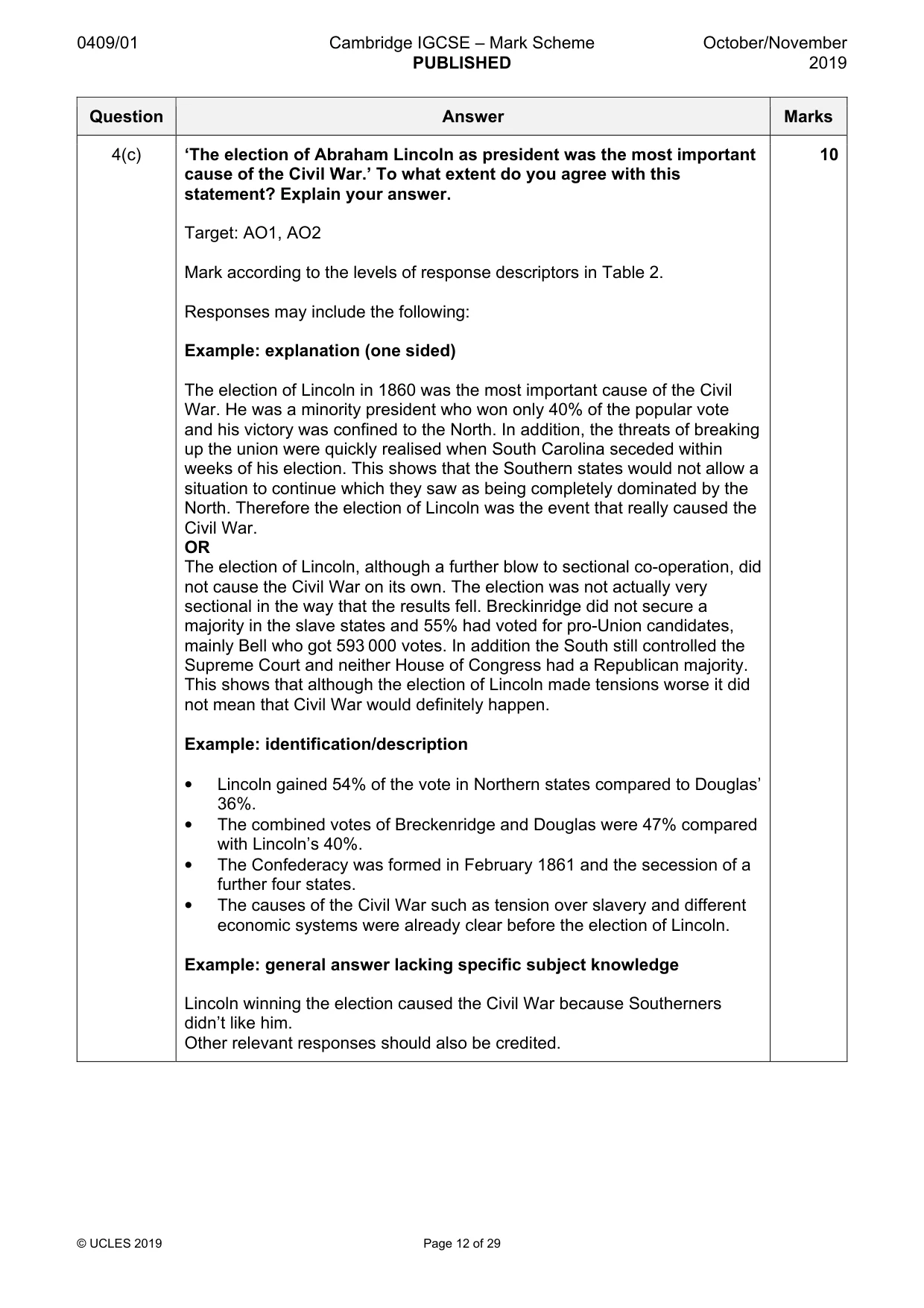
0409/01 Cambridge IGCSE – Mark Scheme PUBLISHED October/November 2019 © UCLES 2019 Page 12 of 29 Question Answer Marks 4(c) ‘The election of Abraham Lincoln as president was the most important cause of the Civil War.’ To what extent do you agree with this statement? Explain your answer. Target: AO1, AO2 Mark according to the levels of response descriptors in Table 2. Responses may include the following: Example: explanation (one sided) The election of Lincoln in 1860 was the most important cause of the Civil War. He was a minority president who won only 40% of the popular vote and his victory was confined to the North. In addition, the threats of breaking up the union were quickly realised when South Carolina seceded within weeks of his election. This shows that the Southern states would not allow a situation to continue which they saw as being completely dominated by the North. Therefore the election of Lincoln was the event that really caused the Civil War. OR The election of Lincoln, although a further blow to sectional co-operation, did not cause the Civil War on its own. The election was not actually very sectional in the way that the results fell. Breckinridge did not secure a majority in the slave states and 55% had voted for pro-Union candidates, mainly Bell who got 593 000 votes. In addition the South still controlled the Supreme Court and neither House of Congress had a Republican majority. This shows that although the election of Lincoln made tensions worse it did not mean that Civil War would definitely happen. Example: identification/description • Lincoln gained 54% of the vote in Northern states compared to Douglas’ 36%. • The combined votes of Breckenridge and Douglas were 47% compared with Lincoln’s 40%. • The Confederacy was formed in February 1861 and the secession of a further four states. • The causes of the Civil War such as tension over slavery and different economic systems were already clear before the election of Lincoln. Example: general answer lacking specific subject knowledge Lincoln winning the election caused the Civil War because Southerners didn’t like him. Other relevant responses should also be credited. 10
Mark scheme, page 13
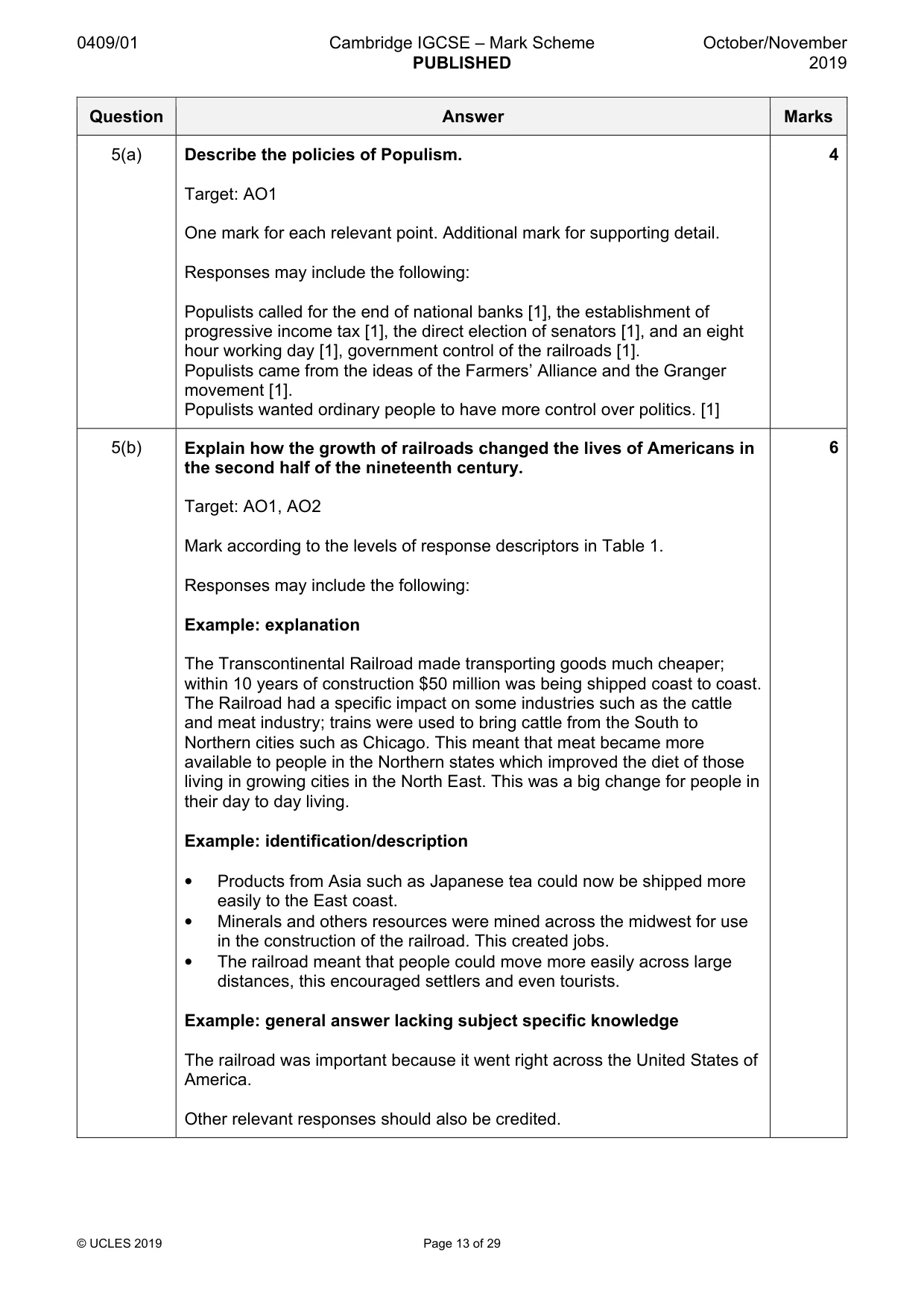
0409/01 Cambridge IGCSE – Mark Scheme PUBLISHED October/November 2019 © UCLES 2019 Page 13 of 29 Question Answer Marks 5(a) Describe the policies of Populism. Target: AO1 One mark for each relevant point. Additional mark for supporting detail. Responses may include the following: Populists called for the end of national banks [1], the establishment of progressive income tax [1], the direct election of senators [1], and an eight hour working day [1], government control of the railroads [1]. Populists came from the ideas of the Farmers’ Alliance and the Granger movement [1]. Populists wanted ordinary people to have more control over politics. [1] 4 5(b) Explain how the growth of railroads changed the lives of Americans in the second half of the nineteenth century. Target: AO1, AO2 Mark according to the levels of response descriptors in Table 1. Responses may include the following: Example: explanation The Transcontinental Railroad made transporting goods much cheaper; within 10 years of construction $50 million was being shipped coast to coast. The Railroad had a specific impact on some industries such as the cattle and meat industry; trains were used to bring cattle from the South to Northern cities such as Chicago. This meant that meat became more available to people in the Northern states which improved the diet of those living in growing cities in the North East. This was a big change for people in their day to day living. Example: identification/description • Products from Asia such as Japanese tea could now be shipped more easily to the East coast. • Minerals and others resources were mined across the midwest for use in the construction of the railroad. This created jobs. • The railroad meant that people could move more easily across large distances, this encouraged settlers and even tourists. Example: general answer lacking subject specific knowledge The railroad was important because it went right across the United States of America. Other relevant responses should also be credited. 6
Mark scheme, page 14
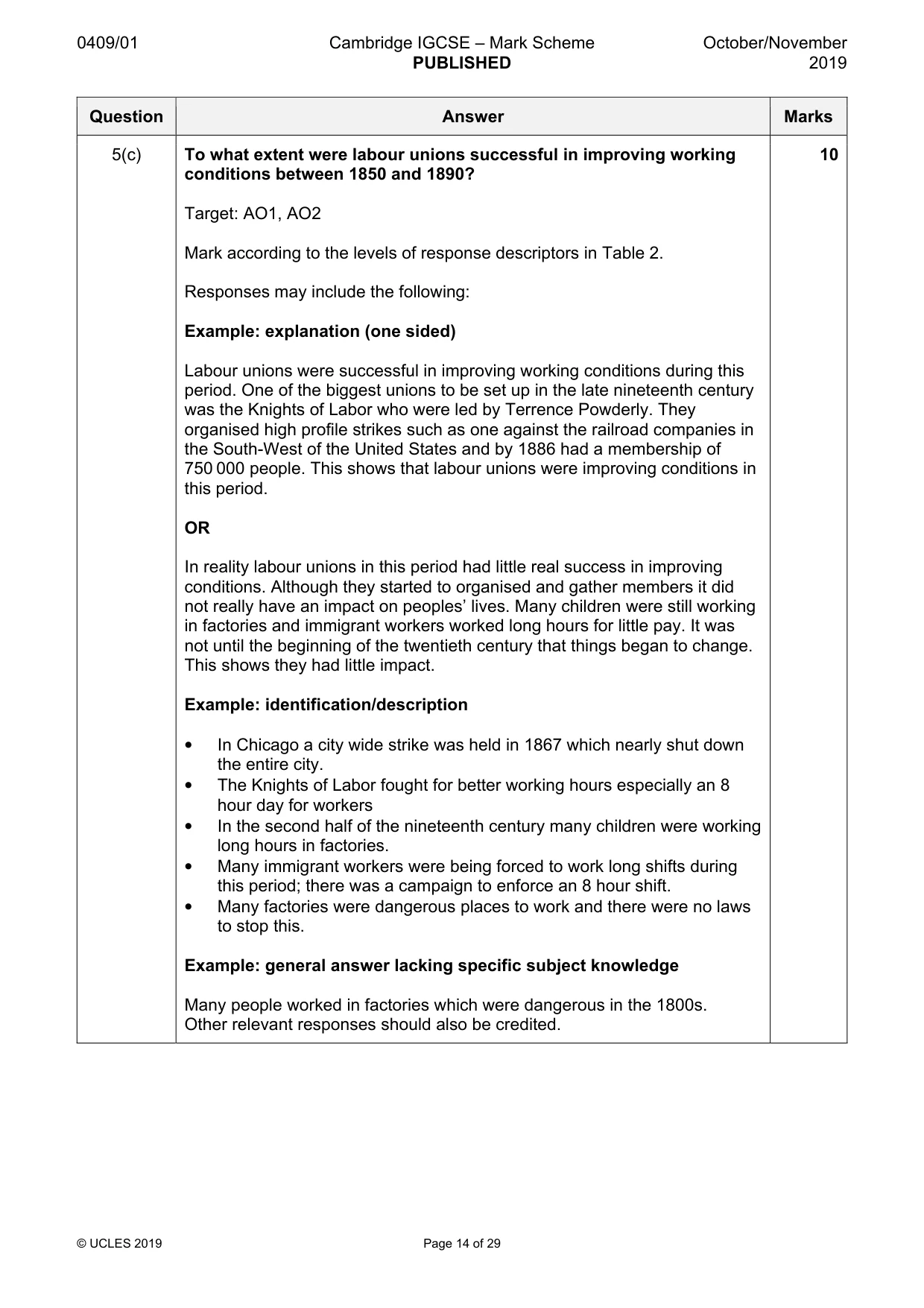
0409/01 Cambridge IGCSE – Mark Scheme PUBLISHED October/November 2019 © UCLES 2019 Page 14 of 29 Question Answer Marks 5(c) To what extent were labour unions successful in improving working conditions between 1850 and 1890? Target: AO1, AO2 Mark according to the levels of response descriptors in Table 2. Responses may include the following: Example: explanation (one sided) Labour unions were successful in improving working conditions during this period. One of the biggest unions to be set up in the late nineteenth century was the Knights of Labor who were led by Terrence Powderly. They organised high profile strikes such as one against the railroad companies in the South-West of the United States and by 1886 had a membership of 750 000 people. This shows that labour unions were improving conditions in this period. OR In reality labour unions in this period had little real success in improving conditions. Although they started to organised and gather members it did not really have an impact on peoples’ lives. Many children were still working in factories and immigrant workers worked long hours for little pay. It was not until the beginning of the twentieth century that things began to change. This shows they had little impact. Example: identification/description • In Chicago a city wide strike was held in 1867 which nearly shut down the entire city. • The Knights of Labor fought for better working hours especially an 8 hour day for workers • In the second half of the nineteenth century many children were working long hours in factories. • Many immigrant workers were being forced to work long shifts during this period; there was a campaign to enforce an 8 hour shift. • Many factories were dangerous places to work and there were no laws to stop this. Example: general answer lacking specific subject knowledge Many people worked in factories which were dangerous in the 1800s. Other relevant responses should also be credited. 10
Mark scheme, page 15
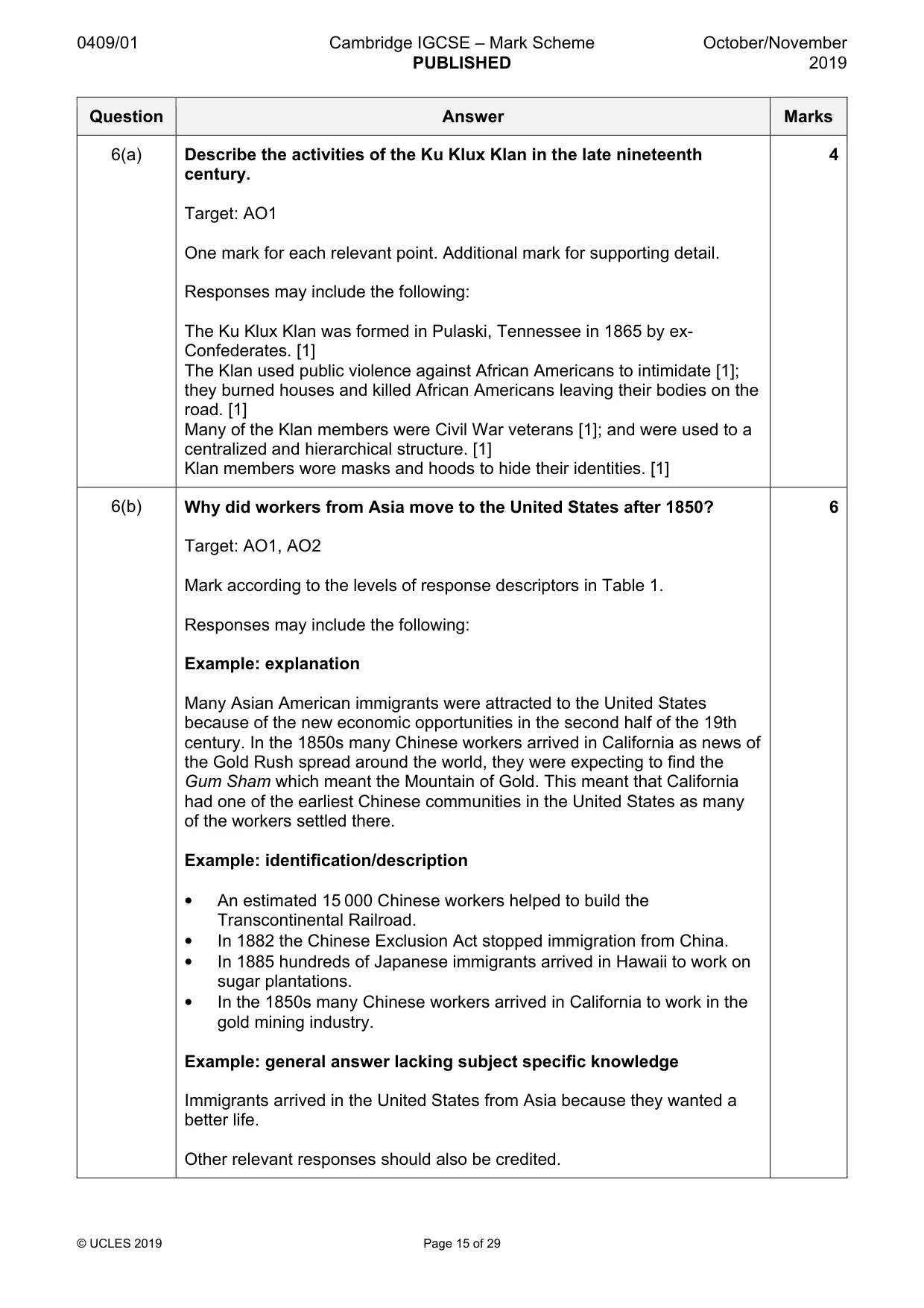
0409/01 Cambridge IGCSE – Mark Scheme PUBLISHED October/November 2019 © UCLES 2019 Page 15 of 29 Question Answer Marks 6(a) Describe the activities of the Ku Klux Klan in the late nineteenth century. Target: AO1 One mark for each relevant point. Additional mark for supporting detail. Responses may include the following: The Ku Klux Klan was formed in Pulaski, Tennessee in 1865 by ex- Confederates. [1] The Klan used public violence against African Americans to intimidate [1]; they burned houses and killed African Americans leaving their bodies on the road. [1] Many of the Klan members were Civil War veterans [1]; and were used to a centralized and hierarchical structure. [1] Klan members wore masks and hoods to hide their identities. [1] 4 6(b) Why did workers from Asia move to the United States after 1850? Target: AO1, AO2 Mark according to the levels of response descriptors in Table 1. Responses may include the following: Example: explanation Many Asian American immigrants were attracted to the United States because of the new economic opportunities in the second half of the 19th century. In the 1850s many Chinese workers arrived in California as news of the Gold Rush spread around the world, they were expecting to find the Gum Sham which meant the Mountain of Gold. This meant that California had one of the earliest Chinese communities in the United States as many of the workers settled there. Example: identification/description • An estimated 15 000 Chinese workers helped to build the Transcontinental Railroad. • In 1882 the Chinese Exclusion Act stopped immigration from China. • In 1885 hundreds of Japanese immigrants arrived in Hawaii to work on sugar plantations. • In the 1850s many Chinese workers arrived in California to work in the gold mining industry. Example: general answer lacking subject specific knowledge Immigrants arrived in the United States from Asia because they wanted a better life. Other relevant responses should also be credited. 6
Mark scheme, page 16
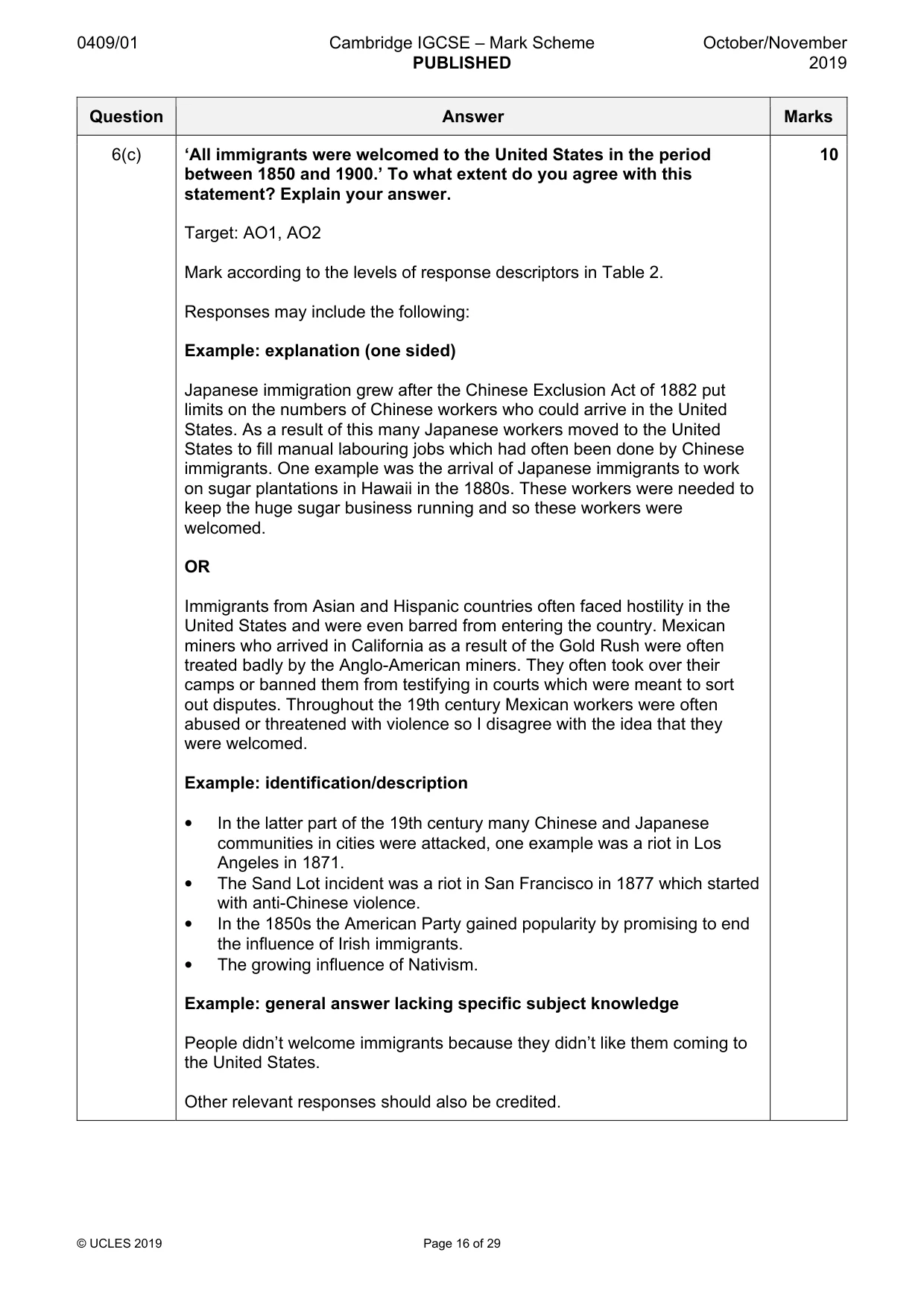
0409/01 Cambridge IGCSE – Mark Scheme PUBLISHED October/November 2019 © UCLES 2019 Page 16 of 29 Question Answer Marks 6(c) ‘All immigrants were welcomed to the United States in the period between 1850 and 1900.’ To what extent do you agree with this statement? Explain your answer. Target: AO1, AO2 Mark according to the levels of response descriptors in Table 2. Responses may include the following: Example: explanation (one sided) Japanese immigration grew after the Chinese Exclusion Act of 1882 put limits on the numbers of Chinese workers who could arrive in the United States. As a result of this many Japanese workers moved to the United States to fill manual labouring jobs which had often been done by Chinese immigrants. One example was the arrival of Japanese immigrants to work on sugar plantations in Hawaii in the 1880s. These workers were needed to keep the huge sugar business running and so these workers were welcomed. OR Immigrants from Asian and Hispanic countries often faced hostility in the United States and were even barred from entering the country. Mexican miners who arrived in California as a result of the Gold Rush were often treated badly by the Anglo-American miners. They often took over their camps or banned them from testifying in courts which were meant to sort out disputes. Throughout the 19th century Mexican workers were often abused or threatened with violence so I disagree with the idea that they were welcomed. Example: identification/description • In the latter part of the 19th century many Chinese and Japanese communities in cities were attacked, one example was a riot in Los Angeles in 1871. • The Sand Lot incident was a riot in San Francisco in 1877 which started with anti-Chinese violence. • In the 1850s the American Party gained popularity by promising to end the influence of Irish immigrants. • The growing influence of Nativism. Example: general answer lacking specific subject knowledge People didn’t welcome immigrants because they didn’t like them coming to the United States. Other relevant responses should also be credited. 10
Mark scheme, page 17
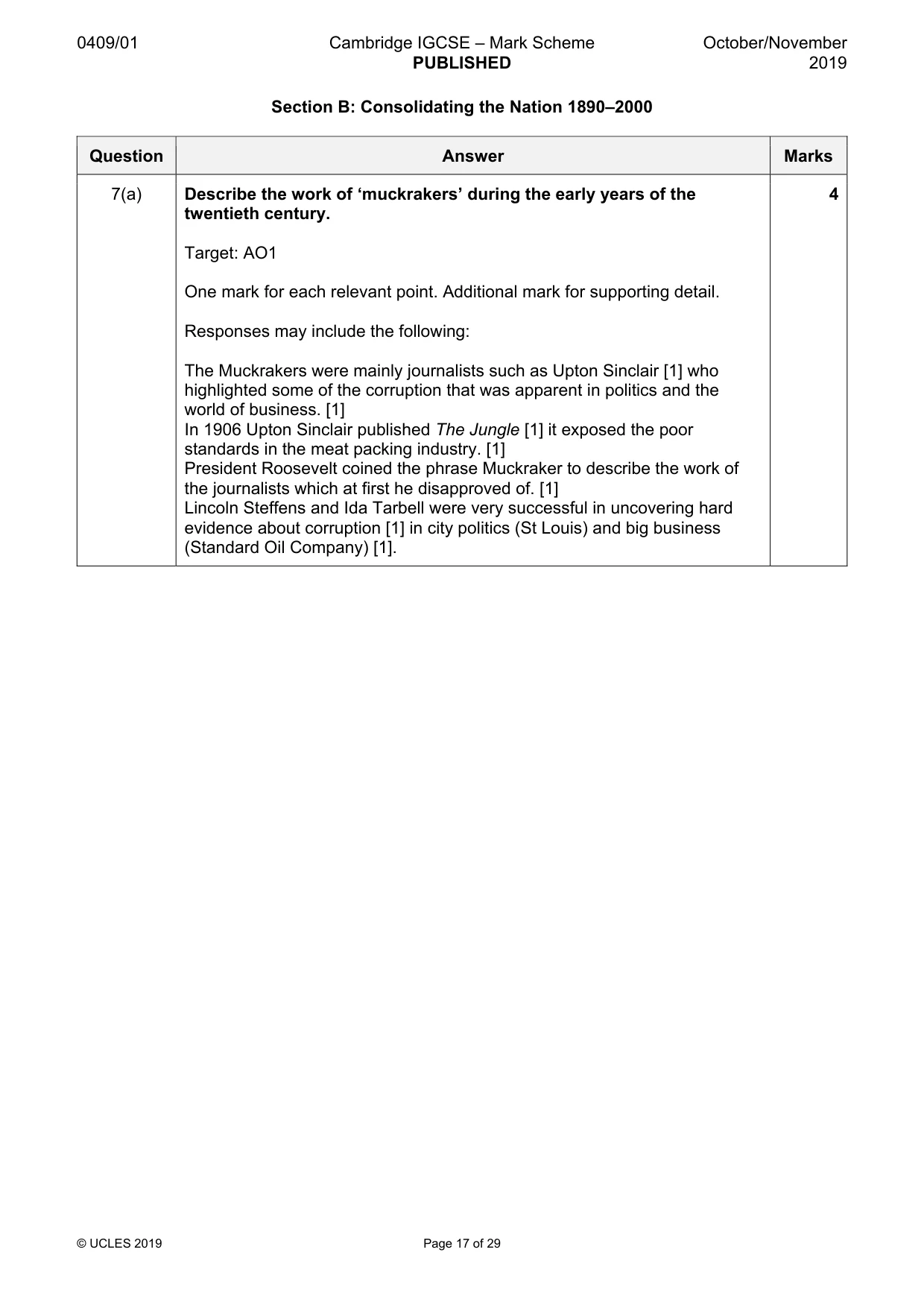
0409/01 Cambridge IGCSE – Mark Scheme PUBLISHED October/November 2019 © UCLES 2019 Page 17 of 29 Section B: Consolidating the Nation 1890–2000 Question Answer Marks 7(a) Describe the work of ‘muckrakers’ during the early years of the twentieth century. Target: AO1 One mark for each relevant point. Additional mark for supporting detail. Responses may include the following: The Muckrakers were mainly journalists such as Upton Sinclair [1] who highlighted some of the corruption that was apparent in politics and the world of business. [1] In 1906 Upton Sinclair published The Jungle [1] it exposed the poor standards in the meat packing industry. [1] President Roosevelt coined the phrase Muckraker to describe the work of the journalists which at first he disapproved of. [1] Lincoln Steffens and Ida Tarbell were very successful in uncovering hard evidence about corruption [1] in city politics (St Louis) and big business (Standard Oil Company) [1]. 4
Mark scheme, page 18
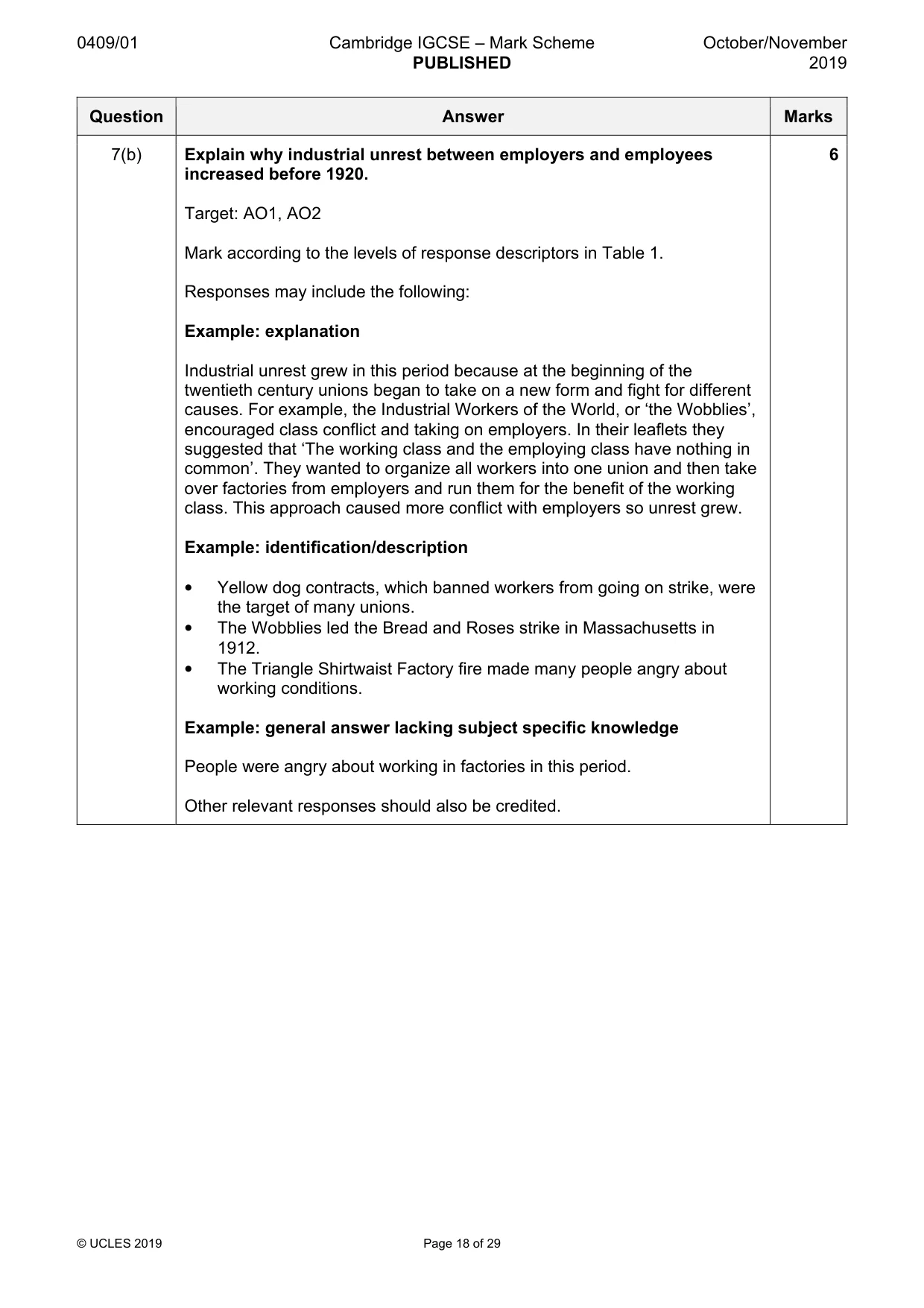
0409/01 Cambridge IGCSE – Mark Scheme PUBLISHED October/November 2019 © UCLES 2019 Page 18 of 29 Question Answer Marks 7(b) Explain why industrial unrest between employers and employees increased before 1920. Target: AO1, AO2 Mark according to the levels of response descriptors in Table 1. Responses may include the following: Example: explanation Industrial unrest grew in this period because at the beginning of the twentieth century unions began to take on a new form and fight for different causes. For example, the Industrial Workers of the World, or ‘the Wobblies’, encouraged class conflict and taking on employers. In their leaflets they suggested that ‘The working class and the employing class have nothing in common’. They wanted to organize all workers into one union and then take over factories from employers and run them for the benefit of the working class. This approach caused more conflict with employers so unrest grew. Example: identification/description • Yellow dog contracts, which banned workers from going on strike, were the target of many unions. • The Wobblies led the Bread and Roses strike in Massachusetts in 1912. • The Triangle Shirtwaist Factory fire made many people angry about working conditions. Example: general answer lacking subject specific knowledge People were angry about working in factories in this period. Other relevant responses should also be credited. 6
Mark scheme, page 19
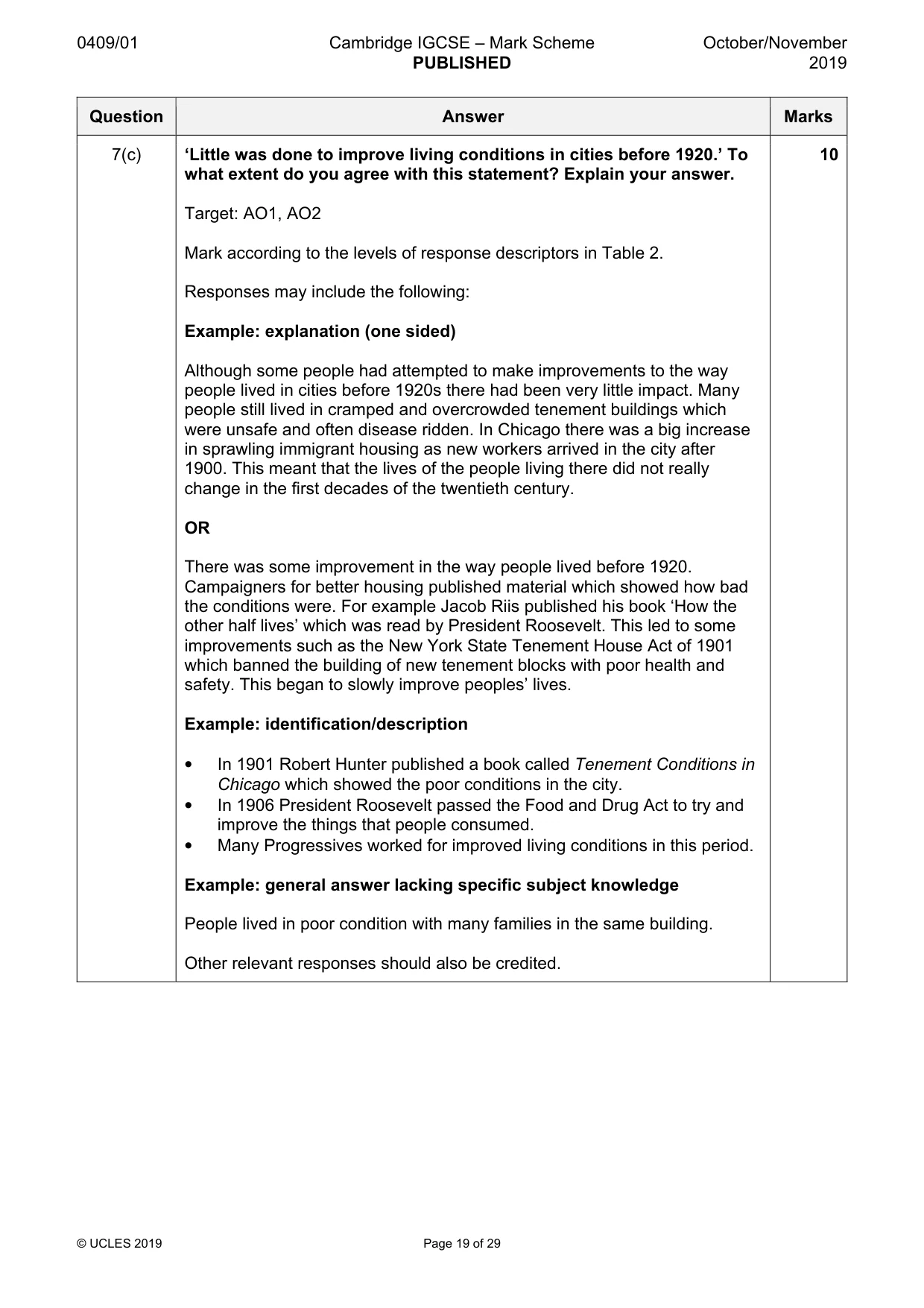
0409/01 Cambridge IGCSE – Mark Scheme PUBLISHED October/November 2019 © UCLES 2019 Page 19 of 29 Question Answer Marks 7(c) ‘Little was done to improve living conditions in cities before 1920.’ To what extent do you agree with this statement? Explain your answer. Target: AO1, AO2 Mark according to the levels of response descriptors in Table 2. Responses may include the following: Example: explanation (one sided) Although some people had attempted to make improvements to the way people lived in cities before 1920s there had been very little impact. Many people still lived in cramped and overcrowded tenement buildings which were unsafe and often disease ridden. In Chicago there was a big increase in sprawling immigrant housing as new workers arrived in the city after 1900. This meant that the lives of the people living there did not really change in the first decades of the twentieth century. OR There was some improvement in the way people lived before 1920. Campaigners for better housing published material which showed how bad the conditions were. For example Jacob Riis published his book ‘How the other half lives’ which was read by President Roosevelt. This led to some improvements such as the New York State Tenement House Act of 1901 which banned the building of new tenement blocks with poor health and safety. This began to slowly improve peoples’ lives. Example: identification/description • In 1901 Robert Hunter published a book called Tenement Conditions in Chicago which showed the poor conditions in the city. • In 1906 President Roosevelt passed the Food and Drug Act to try and improve the things that people consumed. • Many Progressives worked for improved living conditions in this period. Example: general answer lacking specific subject knowledge People lived in poor condition with many families in the same building. Other relevant responses should also be credited. 10
Mark scheme, page 20
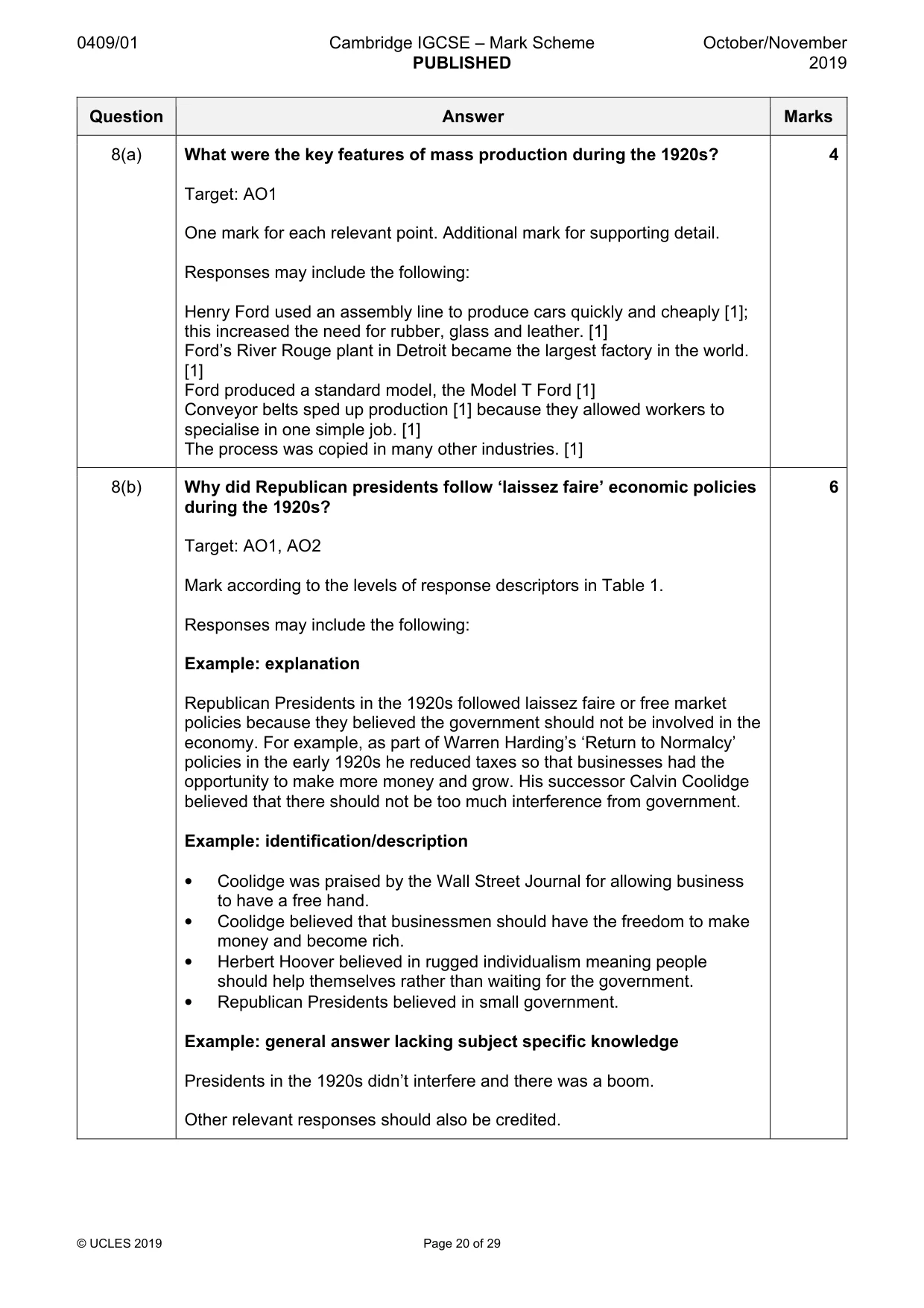
0409/01 Cambridge IGCSE – Mark Scheme PUBLISHED October/November 2019 © UCLES 2019 Page 20 of 29 Question Answer Marks 8(a) What were the key features of mass production during the 1920s? Target: AO1 One mark for each relevant point. Additional mark for supporting detail. Responses may include the following: Henry Ford used an assembly line to produce cars quickly and cheaply [1]; this increased the need for rubber, glass and leather. [1] Ford’s River Rouge plant in Detroit became the largest factory in the world. [1] Ford produced a standard model, the Model T Ford [1] Conveyor belts sped up production [1] because they allowed workers to specialise in one simple job. [1] The process was copied in many other industries. [1] 4 8(b) Why did Republican presidents follow ‘laissez faire’ economic policies during the 1920s? Target: AO1, AO2 Mark according to the levels of response descriptors in Table 1. Responses may include the following: Example: explanation Republican Presidents in the 1920s followed laissez faire or free market policies because they believed the government should not be involved in the economy. For example, as part of Warren Harding’s ‘Return to Normalcy’ policies in the early 1920s he reduced taxes so that businesses had the opportunity to make more money and grow. His successor Calvin Coolidge believed that there should not be too much interference from government. Example: identification/description • Coolidge was praised by the Wall Street Journal for allowing business to have a free hand. • Coolidge believed that businessmen should have the freedom to make money and become rich. • Herbert Hoover believed in rugged individualism meaning people should help themselves rather than waiting for the government. • Republican Presidents believed in small government. Example: general answer lacking subject specific knowledge Presidents in the 1920s didn’t interfere and there was a boom. Other relevant responses should also be credited. 6
Mark scheme, page 21
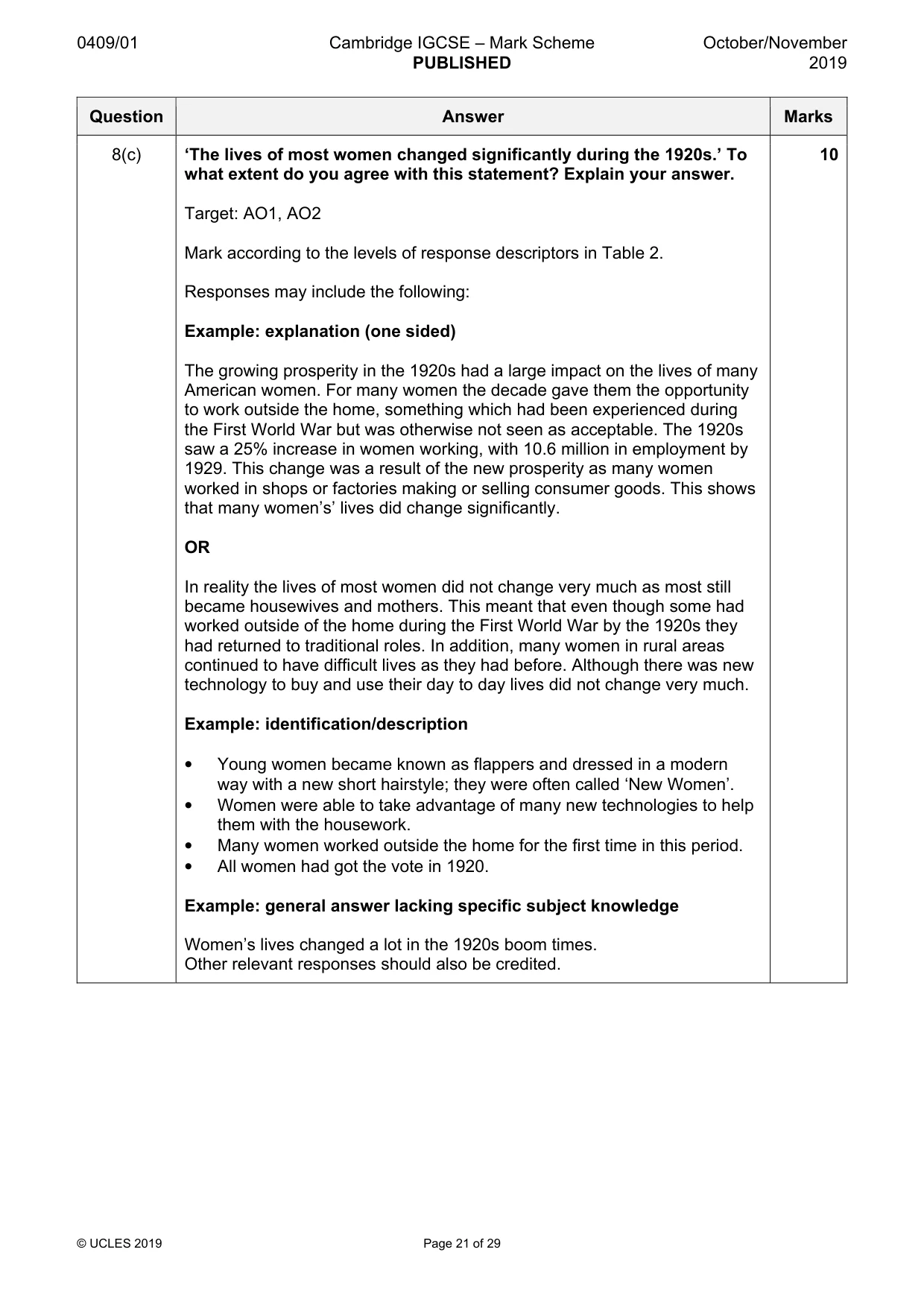
0409/01 Cambridge IGCSE – Mark Scheme PUBLISHED October/November 2019 © UCLES 2019 Page 21 of 29 Question Answer Marks 8(c) ‘The lives of most women changed significantly during the 1920s.’ To what extent do you agree with this statement? Explain your answer. Target: AO1, AO2 Mark according to the levels of response descriptors in Table 2. Responses may include the following: Example: explanation (one sided) The growing prosperity in the 1920s had a large impact on the lives of many American women. For many women the decade gave them the opportunity to work outside the home, something which had been experienced during the First World War but was otherwise not seen as acceptable. The 1920s saw a 25% increase in women working, with 10.6 million in employment by 1929. This change was a result of the new prosperity as many women worked in shops or factories making or selling consumer goods. This shows that many women’s’ lives did change significantly. OR In reality the lives of most women did not change very much as most still became housewives and mothers. This meant that even though some had worked outside of the home during the First World War by the 1920s they had returned to traditional roles. In addition, many women in rural areas continued to have difficult lives as they had before. Although there was new technology to buy and use their day to day lives did not change very much. Example: identification/description • Young women became known as flappers and dressed in a modern way with a new short hairstyle; they were often called ‘New Women’. • Women were able to take advantage of many new technologies to help them with the housework. • Many women worked outside the home for the first time in this period. • All women had got the vote in 1920. Example: general answer lacking specific subject knowledge Women’s lives changed a lot in the 1920s boom times. Other relevant responses should also be credited. 10
Mark scheme, page 22
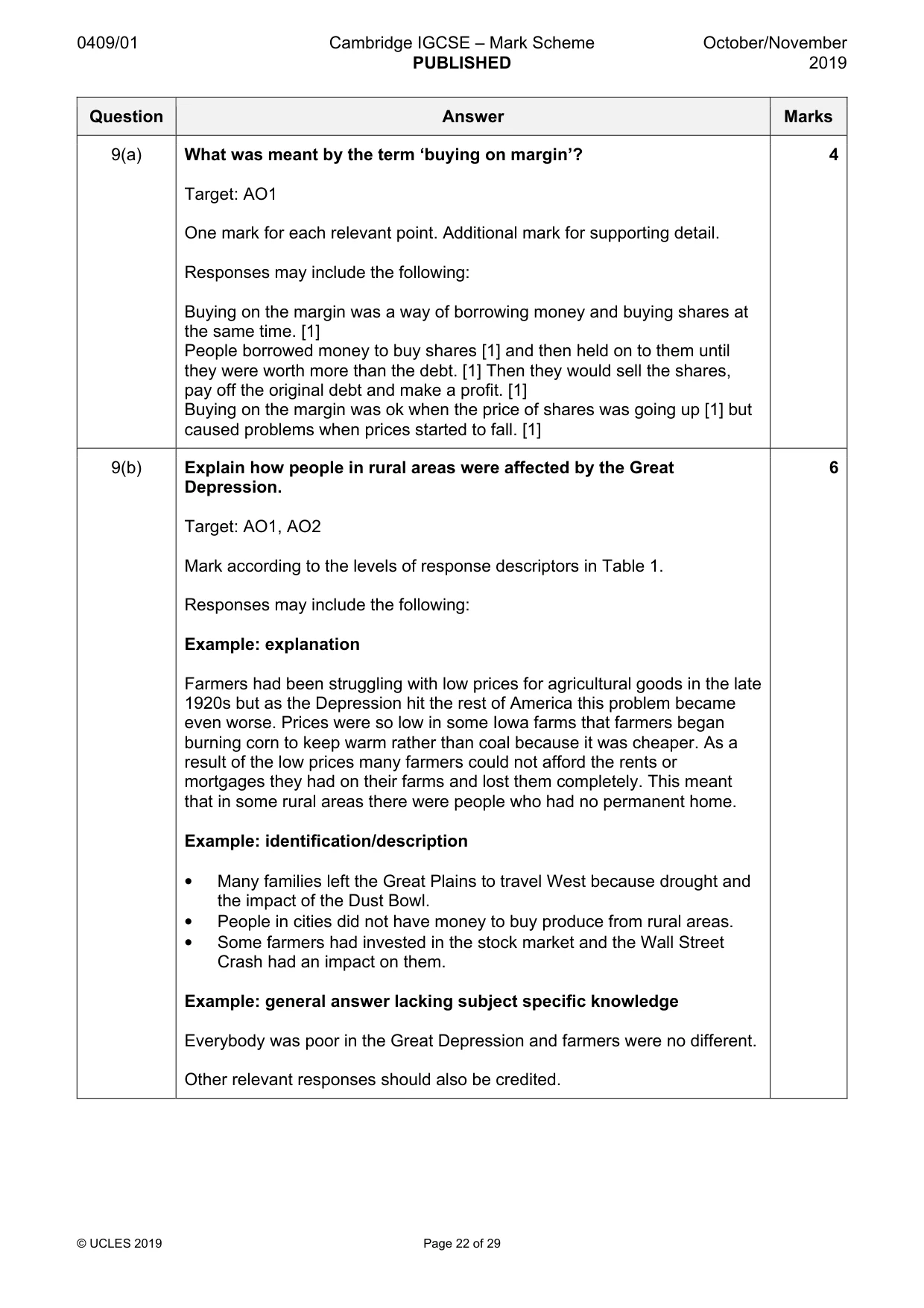
0409/01 Cambridge IGCSE – Mark Scheme PUBLISHED October/November 2019 © UCLES 2019 Page 22 of 29 Question Answer Marks 9(a) What was meant by the term ‘buying on margin’? Target: AO1 One mark for each relevant point. Additional mark for supporting detail. Responses may include the following: Buying on the margin was a way of borrowing money and buying shares at the same time. [1] People borrowed money to buy shares [1] and then held on to them until they were worth more than the debt. [1] Then they would sell the shares, pay off the original debt and make a profit. [1] Buying on the margin was ok when the price of shares was going up [1] but caused problems when prices started to fall. [1] 4 9(b) Explain how people in rural areas were affected by the Great Depression. Target: AO1, AO2 Mark according to the levels of response descriptors in Table 1. Responses may include the following: Example: explanation Farmers had been struggling with low prices for agricultural goods in the late 1920s but as the Depression hit the rest of America this problem became even worse. Prices were so low in some Iowa farms that farmers began burning corn to keep warm rather than coal because it was cheaper. As a result of the low prices many farmers could not afford the rents or mortgages they had on their farms and lost them completely. This meant that in some rural areas there were people who had no permanent home. Example: identification/description • Many families left the Great Plains to travel West because drought and the impact of the Dust Bowl. • People in cities did not have money to buy produce from rural areas. • Some farmers had invested in the stock market and the Wall Street Crash had an impact on them. Example: general answer lacking subject specific knowledge Everybody was poor in the Great Depression and farmers were no different. Other relevant responses should also be credited. 6
Mark scheme, page 23
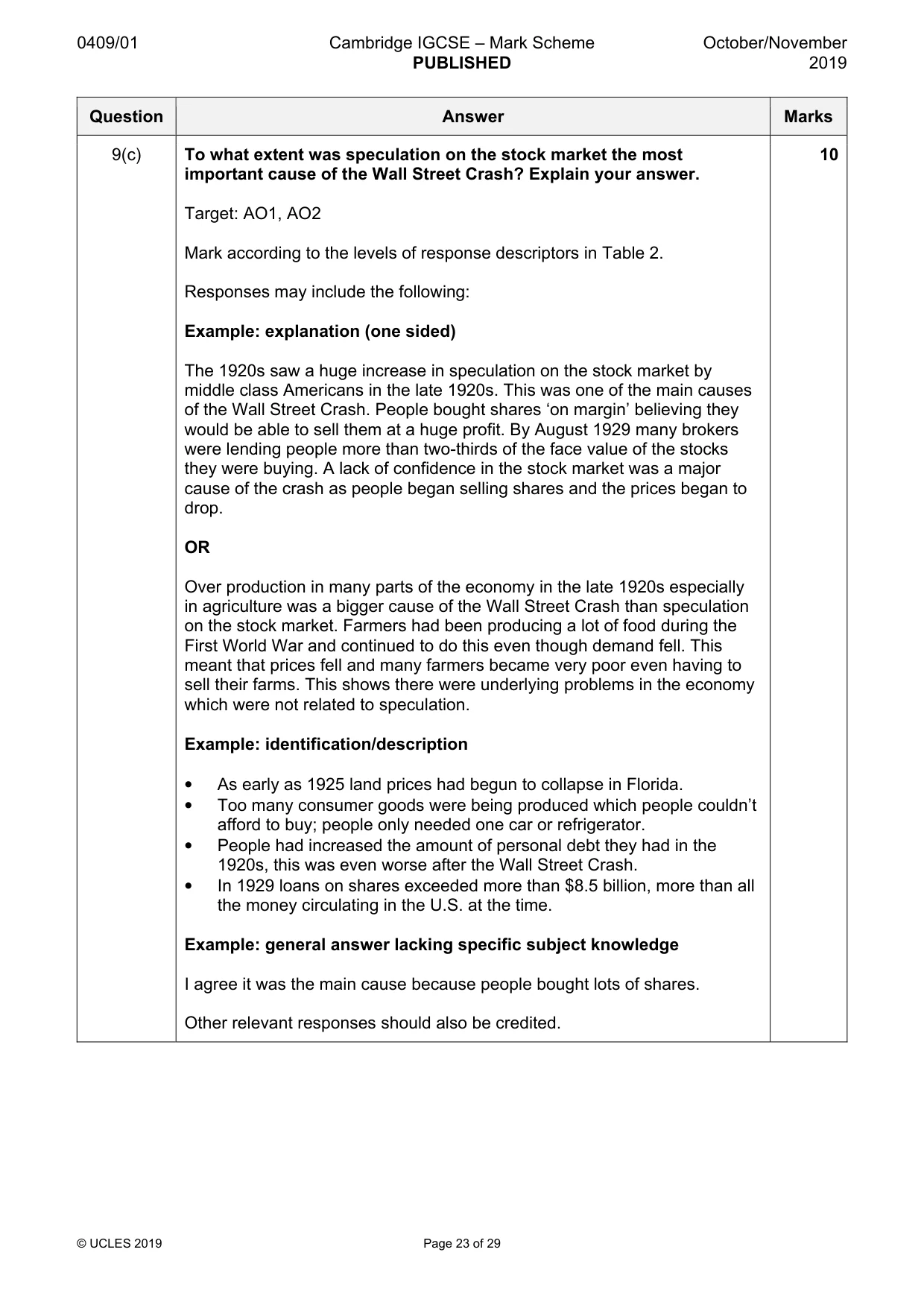
0409/01 Cambridge IGCSE – Mark Scheme PUBLISHED October/November 2019 © UCLES 2019 Page 23 of 29 Question Answer Marks 9(c) To what extent was speculation on the stock market the most important cause of the Wall Street Crash? Explain your answer. Target: AO1, AO2 Mark according to the levels of response descriptors in Table 2. Responses may include the following: Example: explanation (one sided) The 1920s saw a huge increase in speculation on the stock market by middle class Americans in the late 1920s. This was one of the main causes of the Wall Street Crash. People bought shares ‘on margin’ believing they would be able to sell them at a huge profit. By August 1929 many brokers were lending people more than two-thirds of the face value of the stocks they were buying. A lack of confidence in the stock market was a major cause of the crash as people began selling shares and the prices began to drop. OR Over production in many parts of the economy in the late 1920s especially in agriculture was a bigger cause of the Wall Street Crash than speculation on the stock market. Farmers had been producing a lot of food during the First World War and continued to do this even though demand fell. This meant that prices fell and many farmers became very poor even having to sell their farms. This shows there were underlying problems in the economy which were not related to speculation. Example: identification/description • As early as 1925 land prices had begun to collapse in Florida. • Too many consumer goods were being produced which people couldn’t afford to buy; people only needed one car or refrigerator. • People had increased the amount of personal debt they had in the 1920s, this was even worse after the Wall Street Crash. • In 1929 loans on shares exceeded more than $8.5 billion, more than all the money circulating in the U.S. at the time. Example: general answer lacking specific subject knowledge I agree it was the main cause because people bought lots of shares. Other relevant responses should also be credited. 10
Mark scheme, page 24
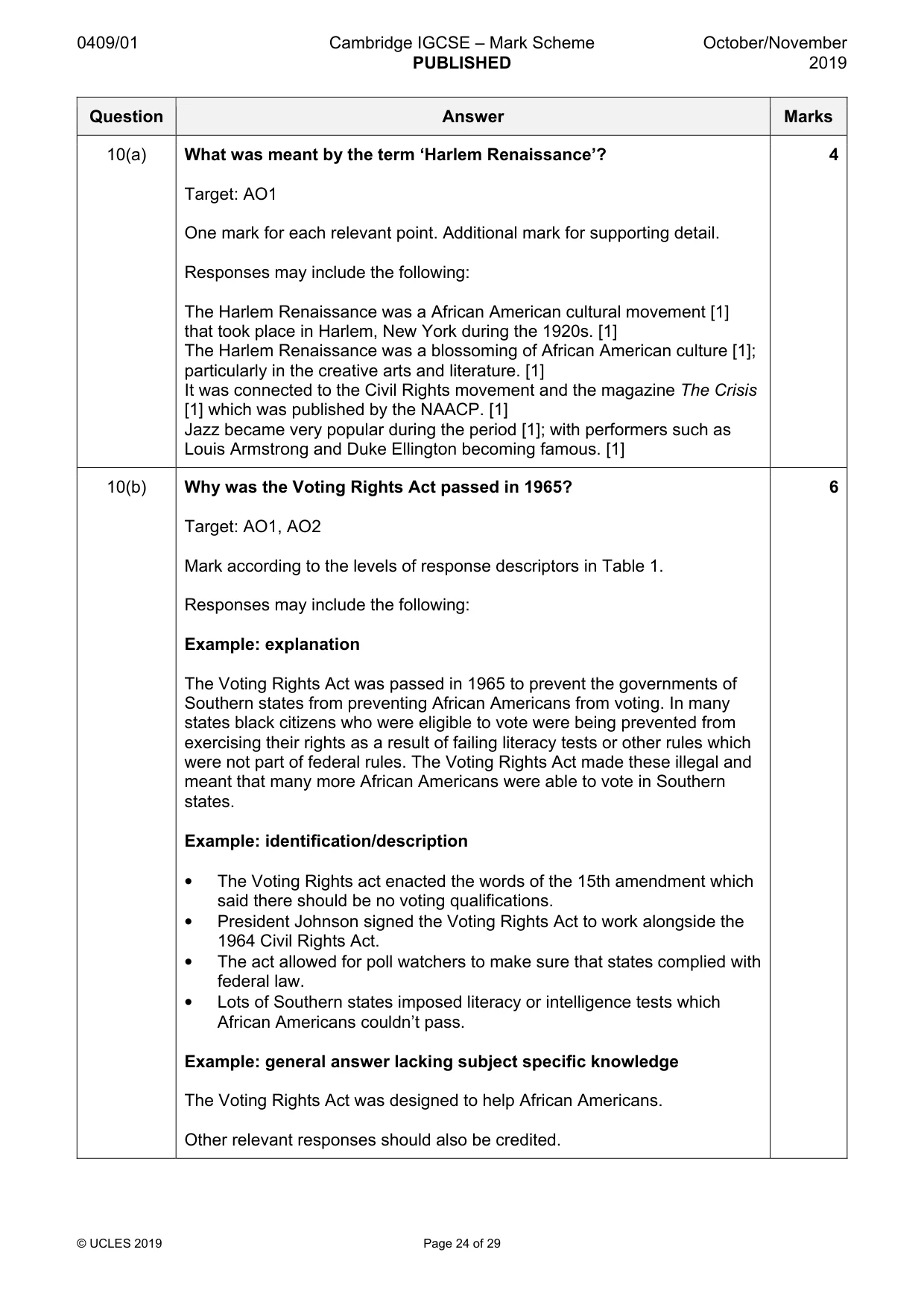
0409/01 Cambridge IGCSE – Mark Scheme PUBLISHED October/November 2019 © UCLES 2019 Page 24 of 29 Question Answer Marks 10(a) What was meant by the term ‘Harlem Renaissance’? Target: AO1 One mark for each relevant point. Additional mark for supporting detail. Responses may include the following: The Harlem Renaissance was a African American cultural movement [1] that took place in Harlem, New York during the 1920s. [1] The Harlem Renaissance was a blossoming of African American culture [1]; particularly in the creative arts and literature. [1] It was connected to the Civil Rights movement and the magazine The Crisis [1] which was published by the NAACP. [1] Jazz became very popular during the period [1]; with performers such as Louis Armstrong and Duke Ellington becoming famous. [1] 4 10(b) Why was the Voting Rights Act passed in 1965? Target: AO1, AO2 Mark according to the levels of response descriptors in Table 1. Responses may include the following: Example: explanation The Voting Rights Act was passed in 1965 to prevent the governments of Southern states from preventing African Americans from voting. In many states black citizens who were eligible to vote were being prevented from exercising their rights as a result of failing literacy tests or other rules which were not part of federal rules. The Voting Rights Act made these illegal and meant that many more African Americans were able to vote in Southern states. Example: identification/description • The Voting Rights act enacted the words of the 15th amendment which said there should be no voting qualifications. • President Johnson signed the Voting Rights Act to work alongside the 1964 Civil Rights Act. • The act allowed for poll watchers to make sure that states complied with federal law. • Lots of Southern states imposed literacy or intelligence tests which African Americans couldn’t pass. Example: general answer lacking subject specific knowledge The Voting Rights Act was designed to help African Americans. Other relevant responses should also be credited. 6
Mark scheme, page 25
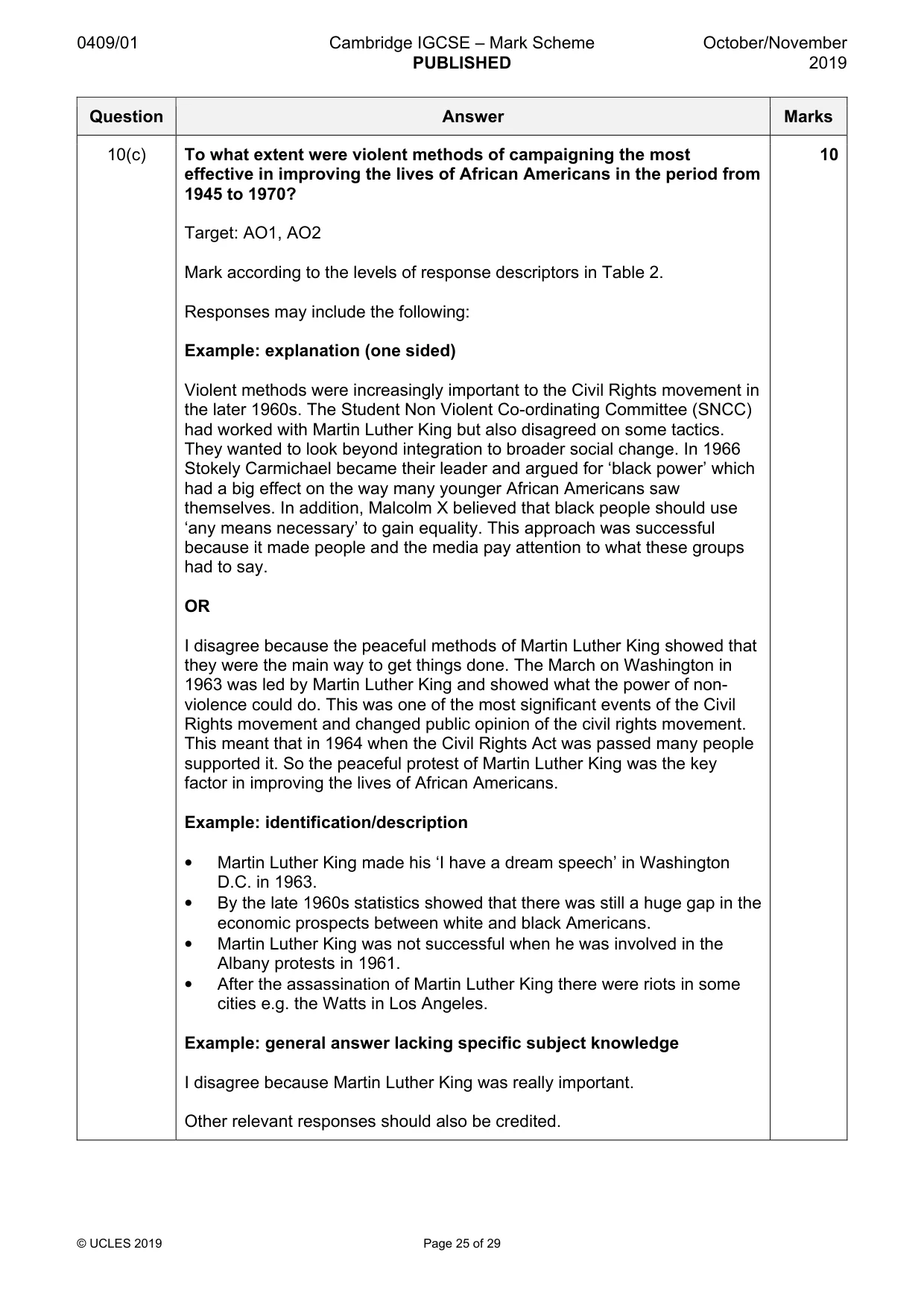
0409/01 Cambridge IGCSE – Mark Scheme PUBLISHED October/November 2019 © UCLES 2019 Page 25 of 29 Question Answer Marks 10(c) To what extent were violent methods of campaigning the most effective in improving the lives of African Americans in the period from 1945 to 1970? Target: AO1, AO2 Mark according to the levels of response descriptors in Table 2. Responses may include the following: Example: explanation (one sided) Violent methods were increasingly important to the Civil Rights movement in the later 1960s. The Student Non Violent Co-ordinating Committee (SNCC) had worked with Martin Luther King but also disagreed on some tactics. They wanted to look beyond integration to broader social change. In 1966 Stokely Carmichael became their leader and argued for ‘black power’ which had a big effect on the way many younger African Americans saw themselves. In addition, Malcolm X believed that black people should use ‘any means necessary’ to gain equality. This approach was successful because it made people and the media pay attention to what these groups had to say. OR I disagree because the peaceful methods of Martin Luther King showed that they were the main way to get things done. The March on Washington in 1963 was led by Martin Luther King and showed what the power of non- violence could do. This was one of the most significant events of the Civil Rights movement and changed public opinion of the civil rights movement. This meant that in 1964 when the Civil Rights Act was passed many people supported it. So the peaceful protest of Martin Luther King was the key factor in improving the lives of African Americans. Example: identification/description • Martin Luther King made his ‘I have a dream speech’ in Washington D.C. in 1963. • By the late 1960s statistics showed that there was still a huge gap in the economic prospects between white and black Americans. • Martin Luther King was not successful when he was involved in the Albany protests in 1961. • After the assassination of Martin Luther King there were riots in some cities e.g. the Watts in Los Angeles. Example: general answer lacking specific subject knowledge I disagree because Martin Luther King was really important. Other relevant responses should also be credited. 10
Mark scheme, page 26
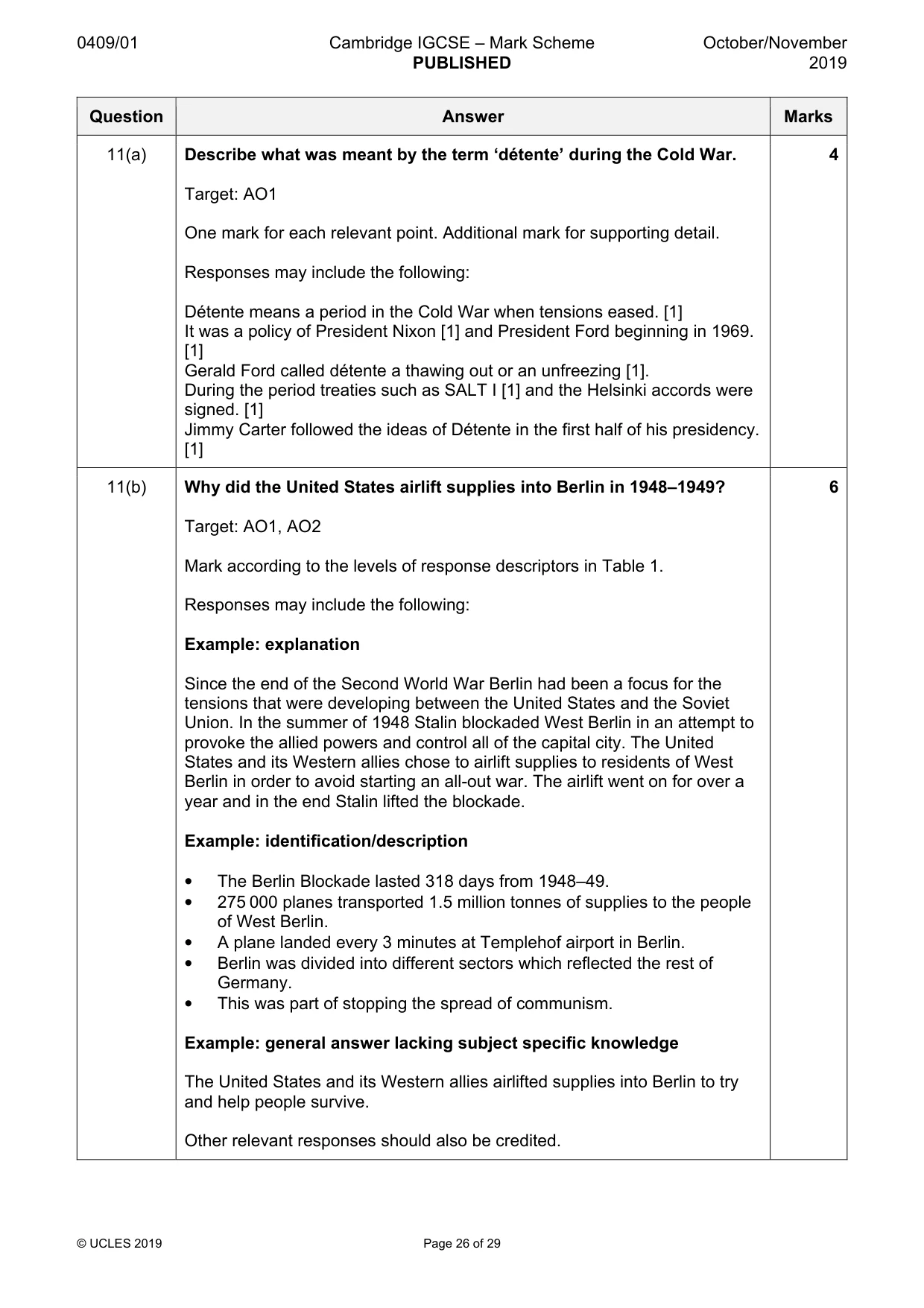
0409/01 Cambridge IGCSE – Mark Scheme PUBLISHED October/November 2019 © UCLES 2019 Page 26 of 29 Question Answer Marks 11(a) Describe what was meant by the term ‘détente’ during the Cold War. Target: AO1 One mark for each relevant point. Additional mark for supporting detail. Responses may include the following: Détente means a period in the Cold War when tensions eased. [1] It was a policy of President Nixon [1] and President Ford beginning in 1969. [1] Gerald Ford called détente a thawing out or an unfreezing [1]. During the period treaties such as SALT I [1] and the Helsinki accords were signed. [1] Jimmy Carter followed the ideas of Détente in the first half of his presidency. [1] 4 11(b) Why did the United States airlift supplies into Berlin in 1948–1949? Target: AO1, AO2 Mark according to the levels of response descriptors in Table 1. Responses may include the following: Example: explanation Since the end of the Second World War Berlin had been a focus for the tensions that were developing between the United States and the Soviet Union. In the summer of 1948 Stalin blockaded West Berlin in an attempt to provoke the allied powers and control all of the capital city. The United States and its Western allies chose to airlift supplies to residents of West Berlin in order to avoid starting an all-out war. The airlift went on for over a year and in the end Stalin lifted the blockade. Example: identification/description • The Berlin Blockade lasted 318 days from 1948–49. • 275 000 planes transported 1.5 million tonnes of supplies to the people of West Berlin. • A plane landed every 3 minutes at Templehof airport in Berlin. • Berlin was divided into different sectors which reflected the rest of Germany. • This was part of stopping the spread of communism. Example: general answer lacking subject specific knowledge The United States and its Western allies airlifted supplies into Berlin to try and help people survive. Other relevant responses should also be credited. 6
Mark scheme, page 27
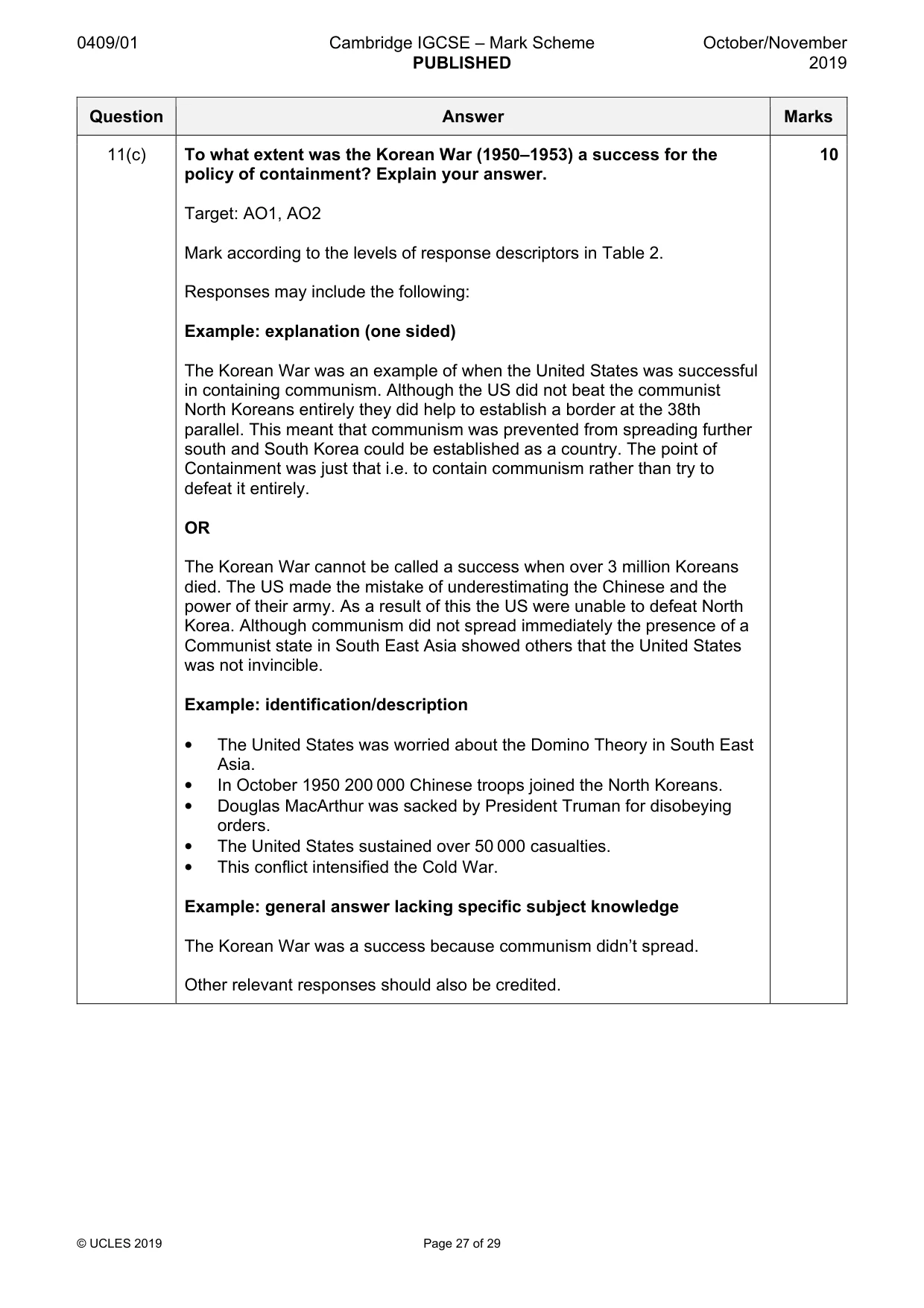
0409/01 Cambridge IGCSE – Mark Scheme PUBLISHED October/November 2019 © UCLES 2019 Page 27 of 29 Question Answer Marks 11(c) To what extent was the Korean War (1950–1953) a success for the policy of containment? Explain your answer. Target: AO1, AO2 Mark according to the levels of response descriptors in Table 2. Responses may include the following: Example: explanation (one sided) The Korean War was an example of when the United States was successful in containing communism. Although the US did not beat the communist North Koreans entirely they did help to establish a border at the 38th parallel. This meant that communism was prevented from spreading further south and South Korea could be established as a country. The point of Containment was just that i.e. to contain communism rather than try to defeat it entirely. OR The Korean War cannot be called a success when over 3 million Koreans died. The US made the mistake of underestimating the Chinese and the power of their army. As a result of this the US were unable to defeat North Korea. Although communism did not spread immediately the presence of a Communist state in South East Asia showed others that the United States was not invincible. Example: identification/description • The United States was worried about the Domino Theory in South East Asia. • In October 1950 200 000 Chinese troops joined the North Koreans. • Douglas MacArthur was sacked by President Truman for disobeying orders. • The United States sustained over 50 000 casualties. • This conflict intensified the Cold War. Example: general answer lacking specific subject knowledge The Korean War was a success because communism didn’t spread. Other relevant responses should also be credited. 10
Mark scheme, page 28
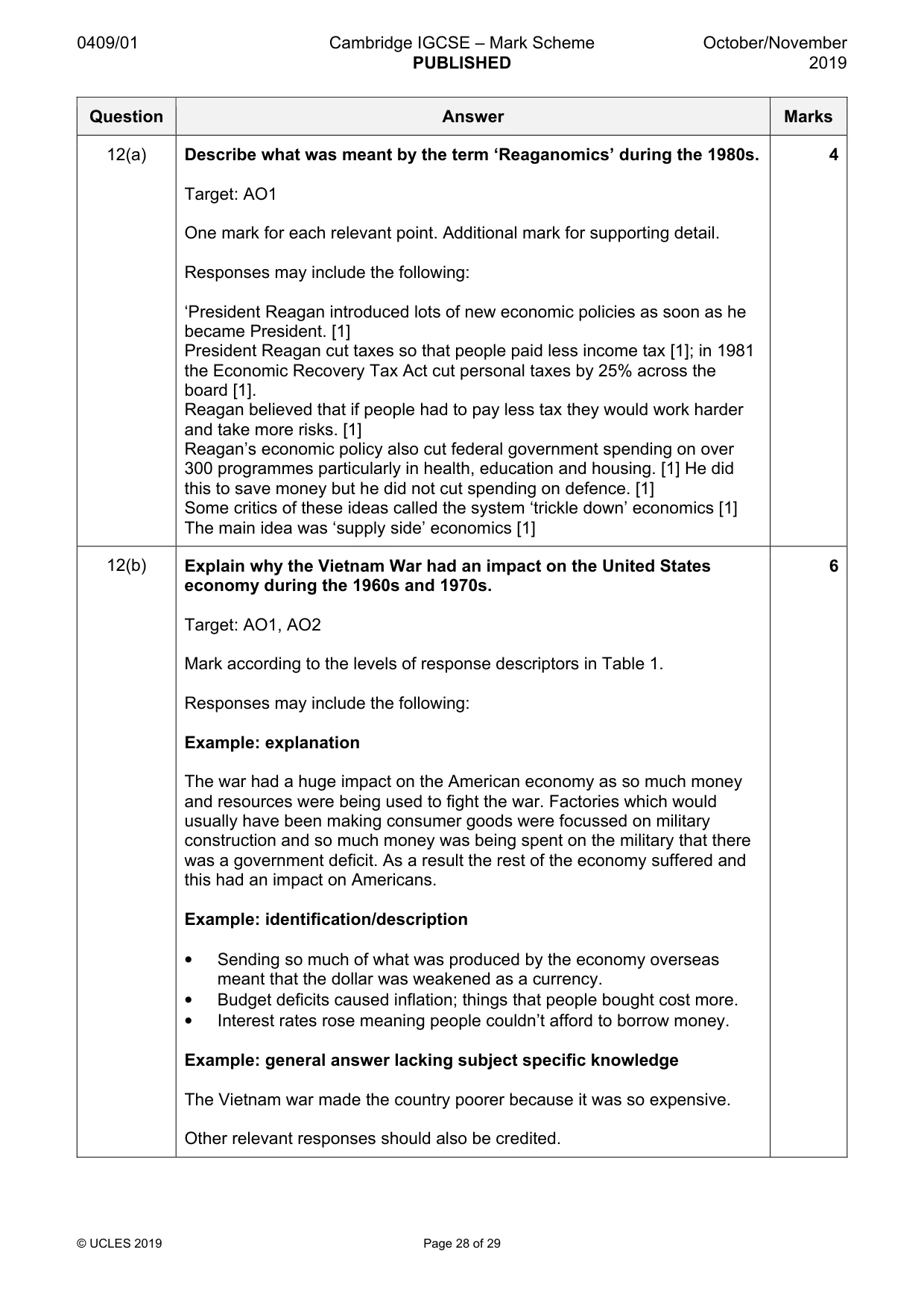
0409/01 Cambridge IGCSE – Mark Scheme PUBLISHED October/November 2019 © UCLES 2019 Page 28 of 29 Question Answer Marks 12(a) Describe what was meant by the term ‘Reaganomics’ during the 1980s. Target: AO1 One mark for each relevant point. Additional mark for supporting detail. Responses may include the following: ‘President Reagan introduced lots of new economic policies as soon as he became President. [1] President Reagan cut taxes so that people paid less income tax [1]; in 1981 the Economic Recovery Tax Act cut personal taxes by 25% across the board [1]. Reagan believed that if people had to pay less tax they would work harder and take more risks. [1] Reagan’s economic policy also cut federal government spending on over 300 programmes particularly in health, education and housing. [1] He did this to save money but he did not cut spending on defence. [1] Some critics of these ideas called the system ‘trickle down’ economics [1] The main idea was ‘supply side’ economics [1] 4 12(b) Explain why the Vietnam War had an impact on the United States economy during the 1960s and 1970s. Target: AO1, AO2 Mark according to the levels of response descriptors in Table 1. Responses may include the following: Example: explanation The war had a huge impact on the American economy as so much money and resources were being used to fight the war. Factories which would usually have been making consumer goods were focussed on military construction and so much money was being spent on the military that there was a government deficit. As a result the rest of the economy suffered and this had an impact on Americans. Example: identification/description • Sending so much of what was produced by the economy overseas meant that the dollar was weakened as a currency. • Budget deficits caused inflation; things that people bought cost more. • Interest rates rose meaning people couldn’t afford to borrow money. Example: general answer lacking subject specific knowledge The Vietnam war made the country poorer because it was so expensive. Other relevant responses should also be credited. 6
Mark scheme, page 29
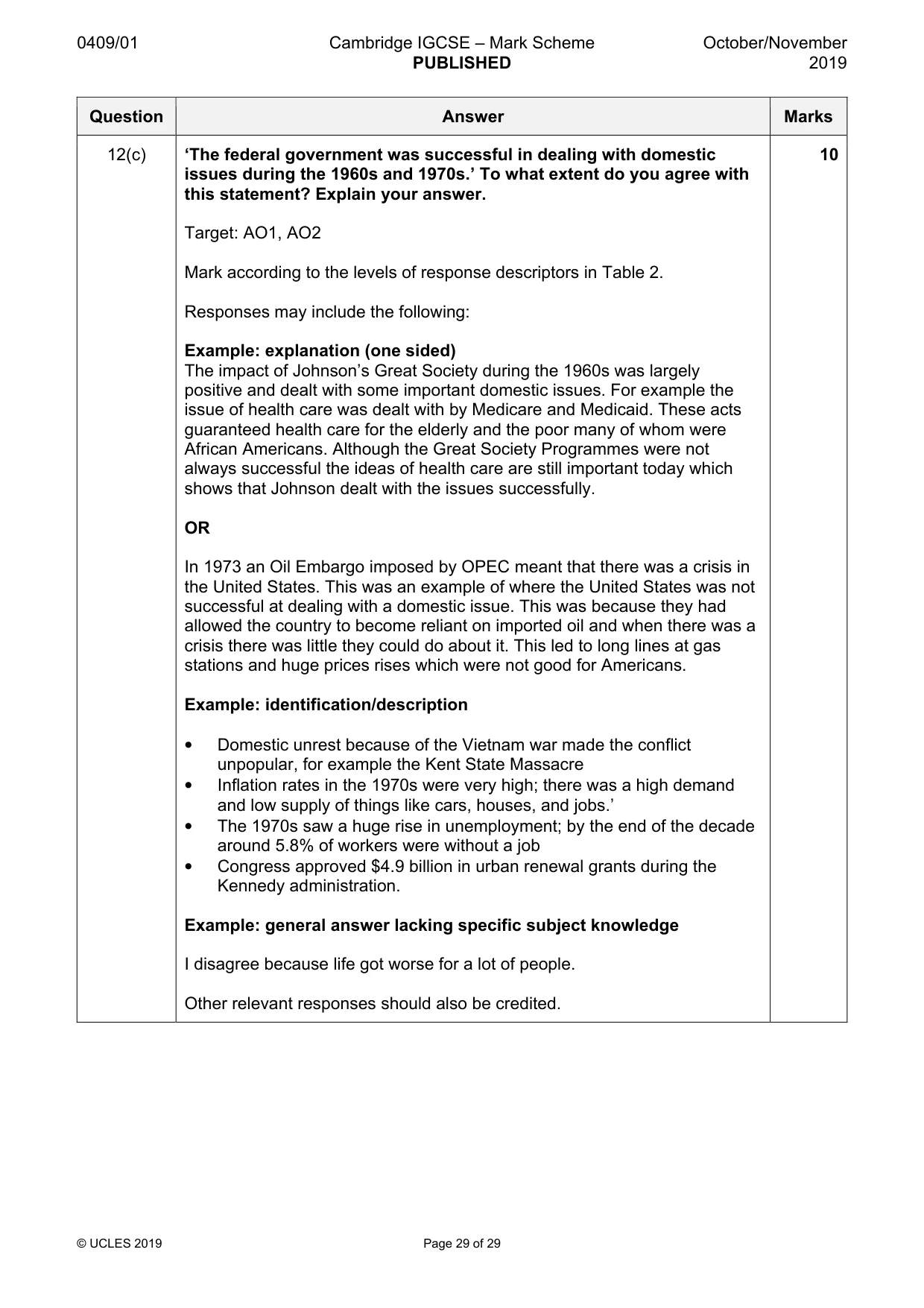
0409/01 Cambridge IGCSE – Mark Scheme PUBLISHED October/November 2019 © UCLES 2019 Page 29 of 29 Question Answer Marks 12(c) ‘The federal government was successful in dealing with domestic issues during the 1960s and 1970s.’ To what extent do you agree with this statement? Explain your answer. Target: AO1, AO2 Mark according to the levels of response descriptors in Table 2. Responses may include the following: Example: explanation (one sided) The impact of Johnson’s Great Society during the 1960s was largely positive and dealt with some important domestic issues. For example the issue of health care was dealt with by Medicare and Medicaid. These acts guaranteed health care for the elderly and the poor many of whom were African Americans. Although the Great Society Programmes were not always successful the ideas of health care are still important today which shows that Johnson dealt with the issues successfully. OR In 1973 an Oil Embargo imposed by OPEC meant that there was a crisis in the United States. This was an example of where the United States was not successful at dealing with a domestic issue. This was because they had allowed the country to become reliant on imported oil and when there was a crisis there was little they could do about it. This led to long lines at gas stations and huge prices rises which were not good for Americans. Example: identification/description • Domestic unrest because of the Vietnam war made the conflict unpopular, for example the Kent State Massacre • Inflation rates in the 1970s were very high; there was a high demand and low supply of things like cars, houses, and jobs.’ • The 1970s saw a huge rise in unemployment; by the end of the decade around 5.8% of workers were without a job • Congress approved $4.9 billion in urban renewal grants during the Kennedy administration. Example: general answer lacking specific subject knowledge I disagree because life got worse for a lot of people. Other relevant responses should also be credited. 10
What you needed in this session
Cambridge’s own grade thresholds for 2019 Oct/Nov, Paper 1 · Variant 1. A higher threshold means an easier paper — the bar moves with how the cohort did.