Cambridge IGCSE History American BES 0409 — 2019 May/June Paper 1 · Variant 1
0409/11/M/J/19 · 60 marks · ≈68 min
The question paper and its mark scheme, free to read here and free to download. This is Cambridge’s own paper, exactly as it was sat.
Question paper8 pages



Mark scheme32 pages
Answers below. Sit the paper first if you are practising.


Paper as text
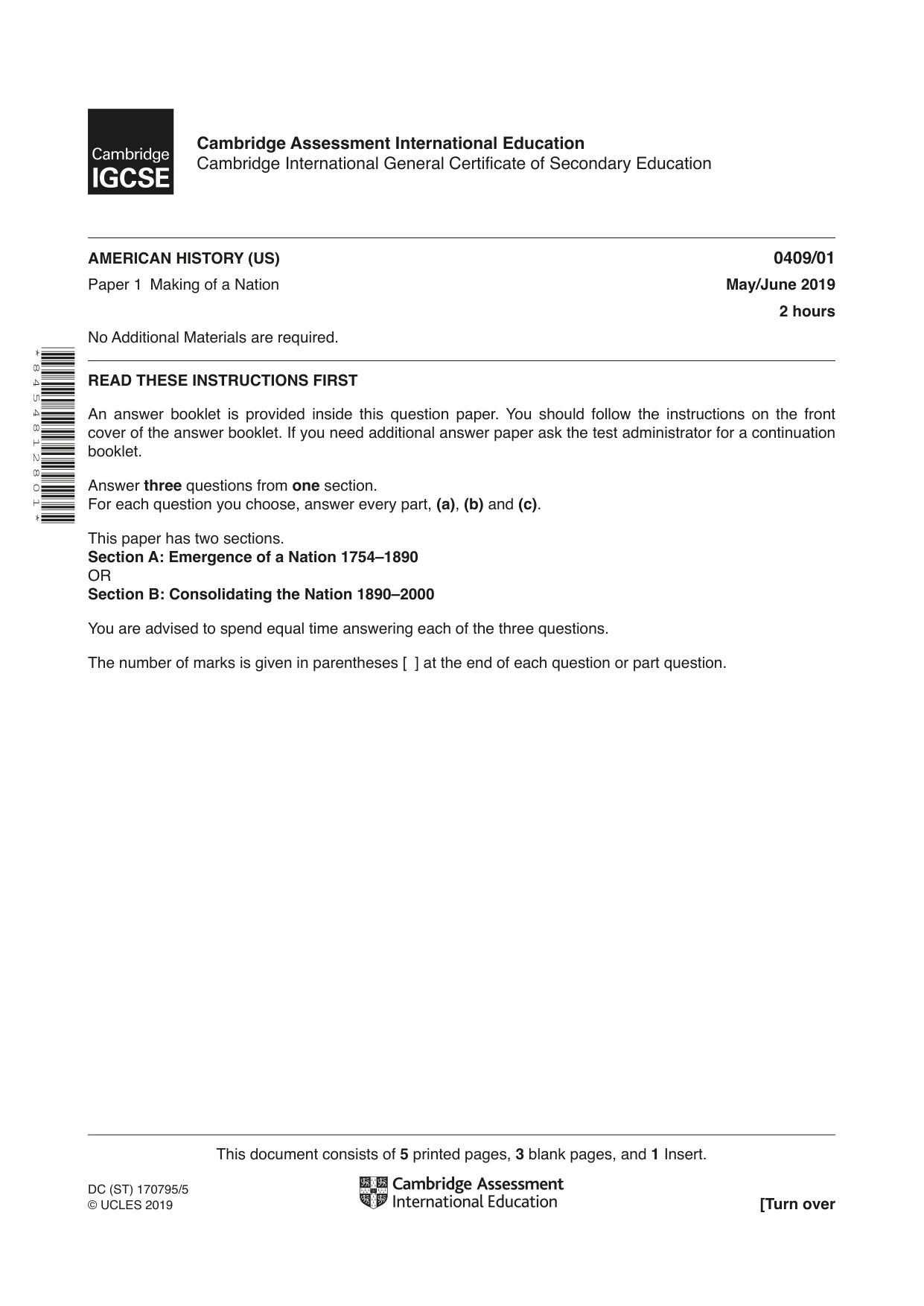
Question paper, page 1
This document consists of 5 printed pages, 3 blank pages, and 1 Insert. DC (ST) 170795/5 © UCLES 2019 [Turn over Cambridge Assessment International Education Cambridge International General Certificate of Secondary Education * 8 4 5 4 8 1 2 8 0 1 * AMERICAN HISTORY (US) 0409/01 Paper 1 Making of a Nation May/June 2019 2 hours No Additional Materials are required. READ THESE INSTRUCTIONS FIRST An answer booklet is provided inside this question paper. You should follow the instructions on the front cover of the answer booklet. If you need additional answer paper ask the test administrator for a continuation booklet. Answer three questions from one section. For each question you choose, answer every part, (a), (b) and (c). This paper has two sections. Section A: Emergence of a Nation 1754–1890 OR Section B: Consolidating the Nation 1890–2000 You are advised to spend equal time answering each of the three questions. The number of marks is given in parentheses [ ] at the end of each question or part question.
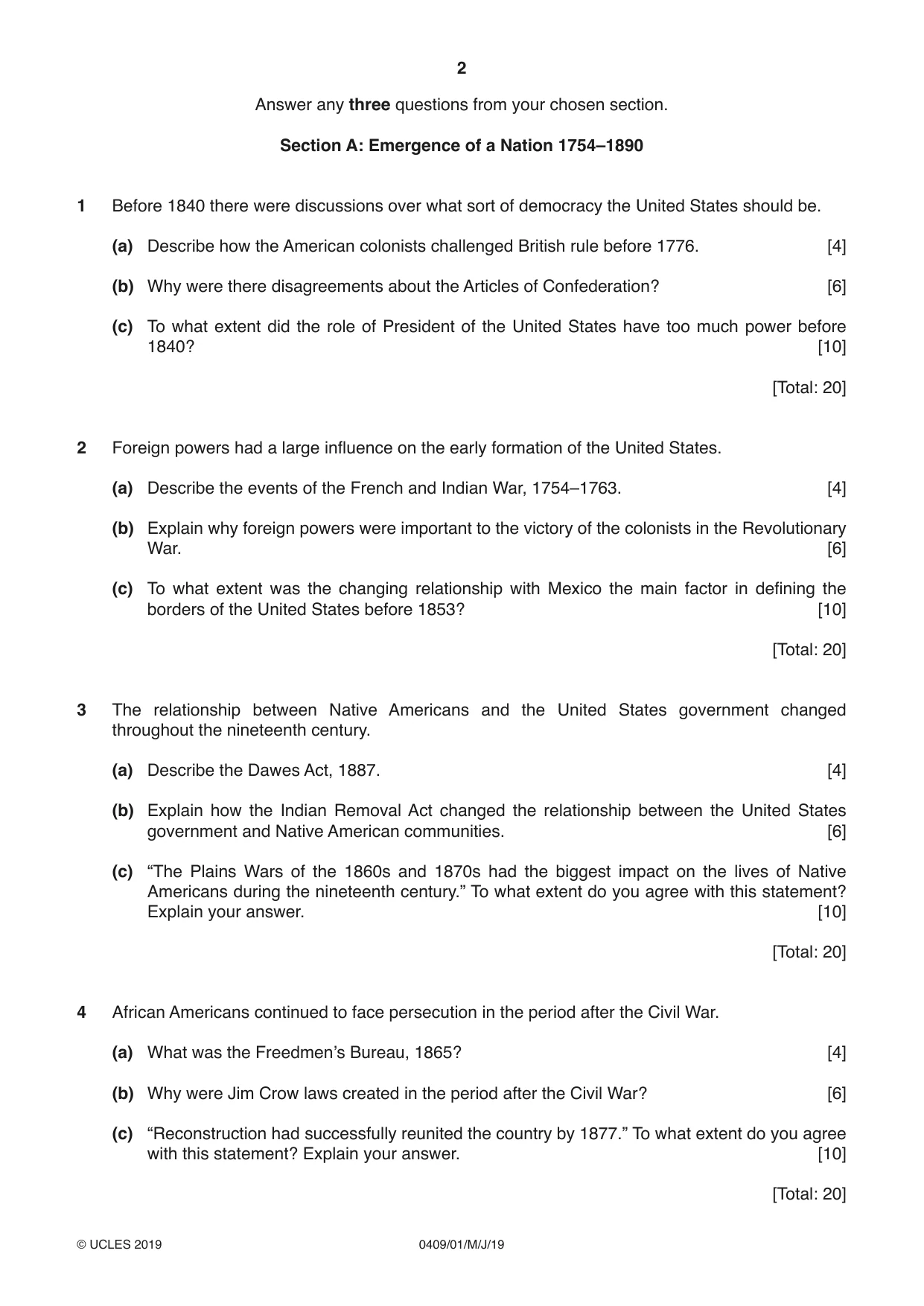
Question paper, page 2
2 0409/01/M/J/19 © UCLES 2019 Answer any three questions from your chosen section. Section A: Emergence of a Nation 1754–1890 1 Before 1840 there were discussions over what sort of democracy the United States should be. (a) Describe how the American colonists challenged British rule before 1776. [4] (b) Why were there disagreements about the Articles of Confederation? [6] (c) To what extent did the role of President of the United States have too much power before 1840? [10] [Total: 20] 2 Foreign powers had a large influence on the early formation of the United States. (a) Describe the events of the French and Indian War, 1754–1763. [4] (b) Explain why foreign powers were important to the victory of the colonists in the Revolutionary War. [6] (c) To what extent was the changing relationship with Mexico the main factor in defining the borders of the United States before 1853? [10] [Total: 20] 3 The relationship between Native Americans and the United States government changed throughout the nineteenth century. (a) Describe the Dawes Act, 1887. [4] (b) Explain how the Indian Removal Act changed the relationship between the United States government and Native American communities. [6] (c) “The Plains Wars of the 1860s and 1870s had the biggest impact on the lives of Native Americans during the nineteenth century.” To what extent do you agree with this statement? Explain your answer. [10] [Total: 20] 4 African Americans continued to face persecution in the period after the Civil War. (a) What was the Freedmen’s Bureau, 1865? [4] (b) Why were Jim Crow laws created in the period after the Civil War? [6] (c) “Reconstruction had successfully reunited the country by 1877.” To what extent do you agree with this statement? Explain your answer. [10] [Total: 20]
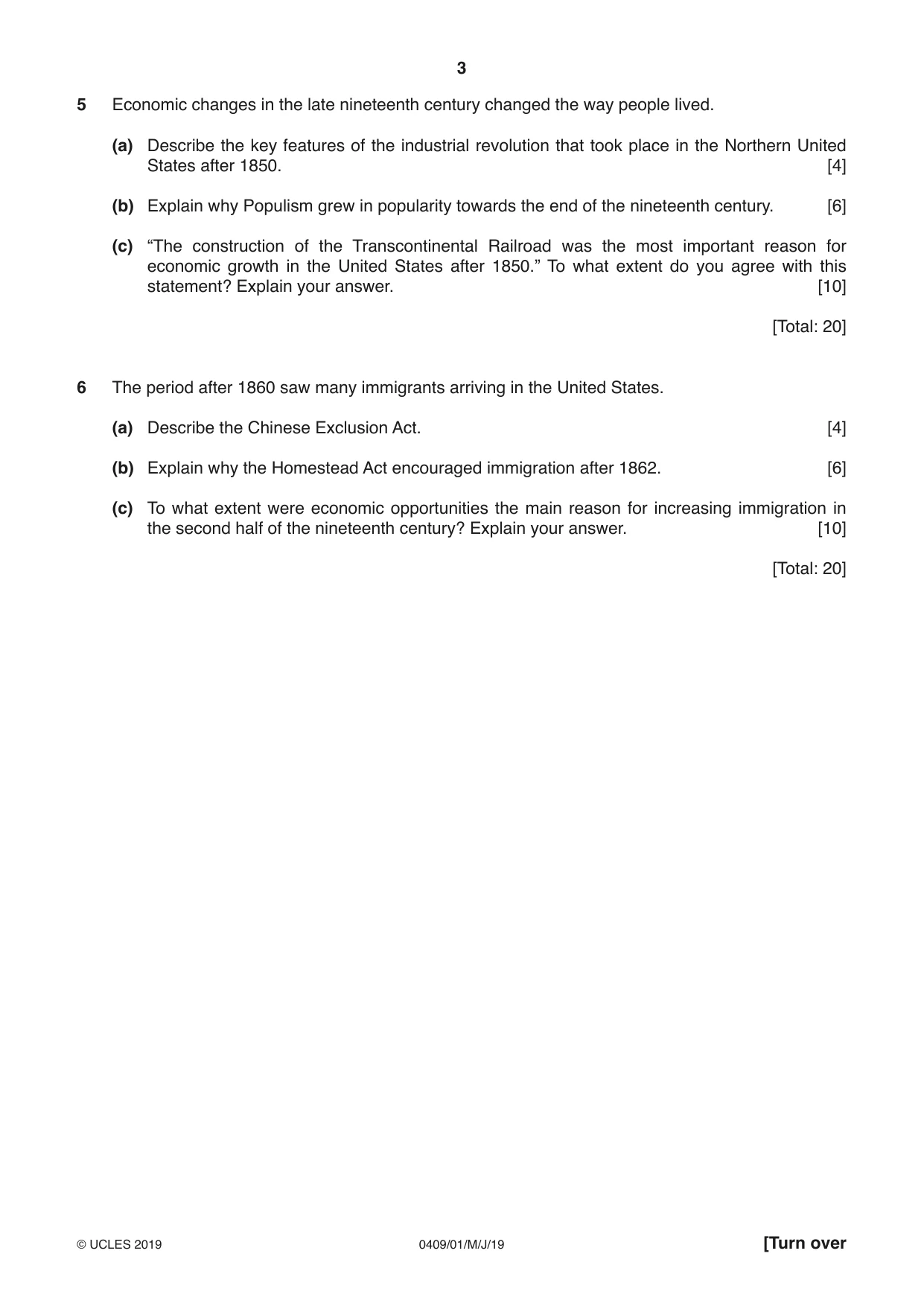
Question paper, page 3
3 0409/01/M/J/19 © UCLES 2019 [Turn over 5 Economic changes in the late nineteenth century changed the way people lived. (a) Describe the key features of the industrial revolution that took place in the Northern United States after 1850. [4] (b) Explain why Populism grew in popularity towards the end of the nineteenth century. [6] (c) “The construction of the Transcontinental Railroad was the most important reason for economic growth in the United States after 1850.” To what extent do you agree with this statement? Explain your answer. [10] [Total: 20] 6 The period after 1860 saw many immigrants arriving in the United States. (a) Describe the Chinese Exclusion Act. [4] (b) Explain why the Homestead Act encouraged immigration after 1862. [6] (c) To what extent were economic opportunities the main reason for increasing immigration in the second half of the nineteenth century? Explain your answer. [10] [Total: 20]
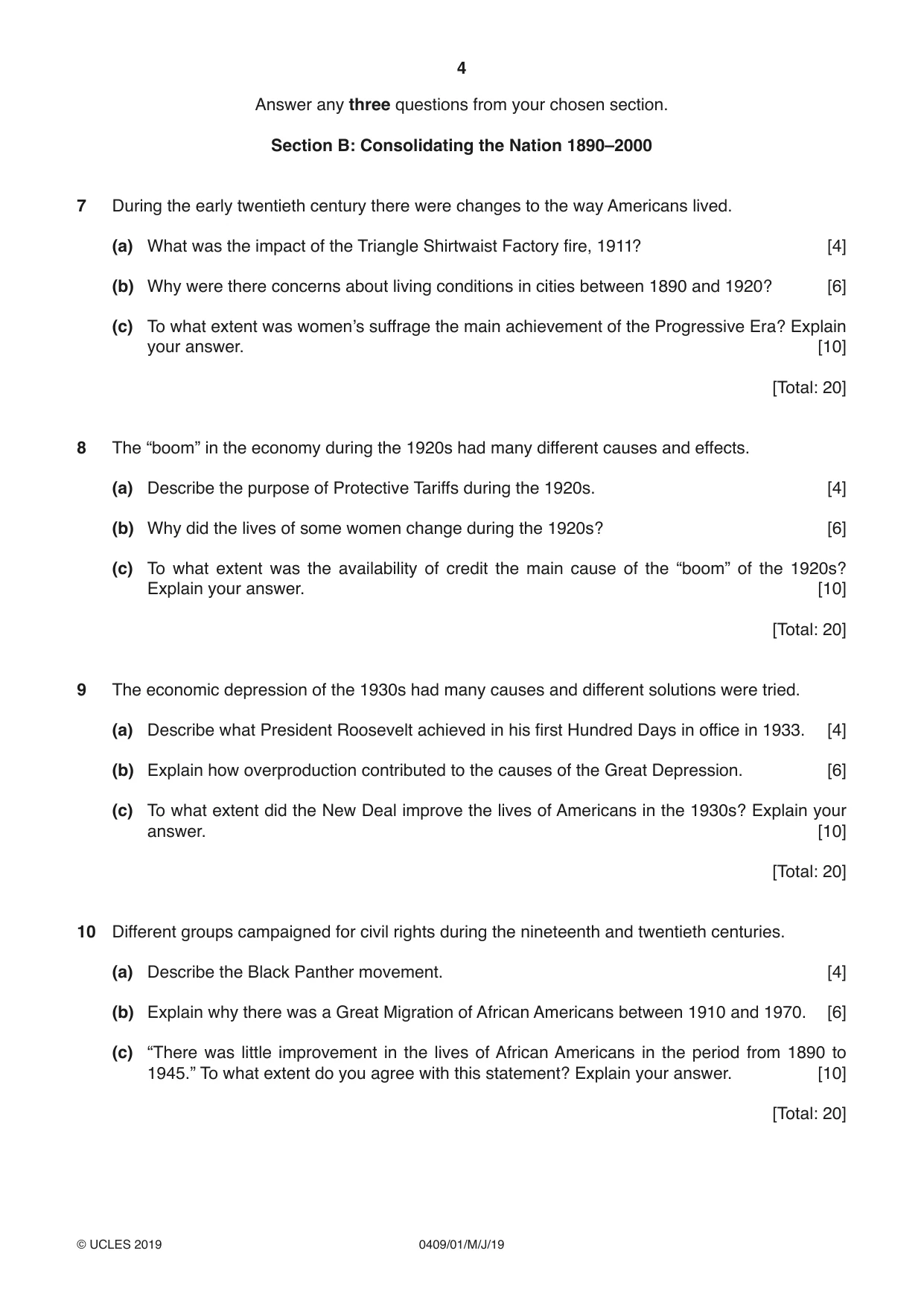
Question paper, page 4
4 0409/01/M/J/19 © UCLES 2019 Answer any three questions from your chosen section. Section B: Consolidating the Nation 1890–2000 7 During the early twentieth century there were changes to the way Americans lived. (a) What was the impact of the Triangle Shirtwaist Factory fire, 1911? [4] (b) Why were there concerns about living conditions in cities between 1890 and 1920? [6] (c) To what extent was women’s suffrage the main achievement of the Progressive Era? Explain your answer. [10] [Total: 20] 8 The “boom” in the economy during the 1920s had many different causes and effects. (a) Describe the purpose of Protective Tariffs during the 1920s. [4] (b) Why did the lives of some women change during the 1920s? [6] (c) To what extent was the availability of credit the main cause of the “boom” of the 1920s? Explain your answer. [10] [Total: 20] 9 The economic depression of the 1930s had many causes and different solutions were tried. (a) Describe what President Roosevelt achieved in his first Hundred Days in office in 1933. [4] (b) Explain how overproduction contributed to the causes of the Great Depression. [6] (c) To what extent did the New Deal improve the lives of Americans in the 1930s? Explain your answer. [10] [Total: 20] 10 Different groups campaigned for civil rights during the nineteenth and twentieth centuries. (a) Describe the Black Panther movement. [4] (b) Explain why there was a Great Migration of African Americans between 1910 and 1970. [6] (c) “There was little improvement in the lives of African Americans in the period from 1890 to 1945.” To what extent do you agree with this statement? Explain your answer. [10] [Total: 20]
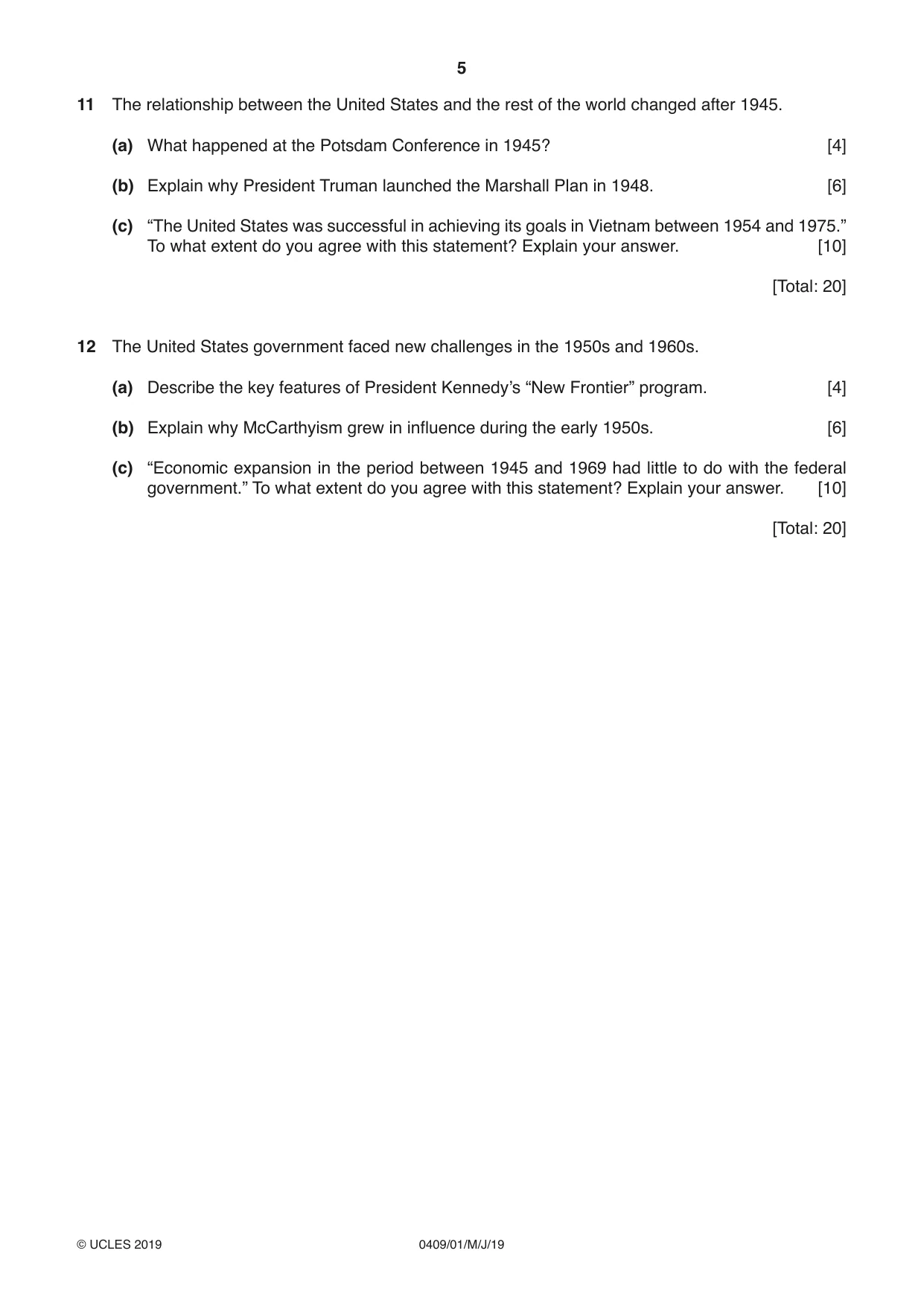
Question paper, page 5
5 0409/01/M/J/19 © UCLES 2019 11 The relationship between the United States and the rest of the world changed after 1945. (a) What happened at the Potsdam Conference in 1945? [4] (b) Explain why President Truman launched the Marshall Plan in 1948. [6] (c) “The United States was successful in achieving its goals in Vietnam between 1954 and 1975.” To what extent do you agree with this statement? Explain your answer. [10] [Total: 20] 12 The United States government faced new challenges in the 1950s and 1960s. (a) Describe the key features of President Kennedy’s “New Frontier” program. [4] (b) Explain why McCarthyism grew in influence during the early 1950s. [6] (c) “Economic expansion in the period between 1945 and 1969 had little to do with the federal government.” To what extent do you agree with this statement? Explain your answer. [10] [Total: 20]
Question paper, page 6
6 0409/01/M/J/19 © UCLES 2019 BLANK PAGE
Question paper, page 7
7 0409/01/M/J/19 © UCLES 2019 BLANK PAGE
Question paper, page 8
8 0409/01/M/J/19 © UCLES 2019 Permission to reproduce items where third-party owned material protected by copyright is included has been sought and cleared where possible. Every reasonable effort has been made by the publisher (UCLES) to trace copyright holders, but if any items requiring clearance have unwittingly been included, the publisher will be pleased to make amends at the earliest possible opportunity. To avoid the issue of disclosure of answer-related information to candidates, all copyright acknowledgements are reproduced online in the Cambridge Assessment International Education Copyright Acknowledgements Booklet. This is produced for each series of examinations and is freely available to download at www.cambridgeinternational.org after the live examination series. Cambridge Assessment International Education is part of the Cambridge Assessment Group. Cambridge Assessment is the brand name of the University of Cambridge Local Examinations Syndicate (UCLES), which itself is a department of the University of Cambridge. BLANK PAGE
Mark scheme, page 1
This document consists of 32 printed pages. © UCLES 2019 [Turn over Cambridge Assessment International Education Cambridge International General Certificate of Secondary Education AMERICAN HISTORY (US) 0409/01 Paper 1 Making of a Nation May/June 2019 MARK SCHEME Maximum Mark: 60 Published This mark scheme is published as an aid to teachers and candidates, to indicate the requirements of the examination. It shows the basis on which Examiners were instructed to award marks. It does not indicate the details of the discussions that took place at an Examiners’ meeting before marking began, which would have considered the acceptability of alternative answers. Mark schemes should be read in conjunction with the question paper and the Principal Examiner Report for Teachers. Cambridge International will not enter into discussions about these mark schemes. Cambridge International is publishing the mark schemes for the May/June 2019 series for most Cambridge IGCSE™, Cambridge International A and AS Level and Cambridge Pre-U components, and some Cambridge O Level components.
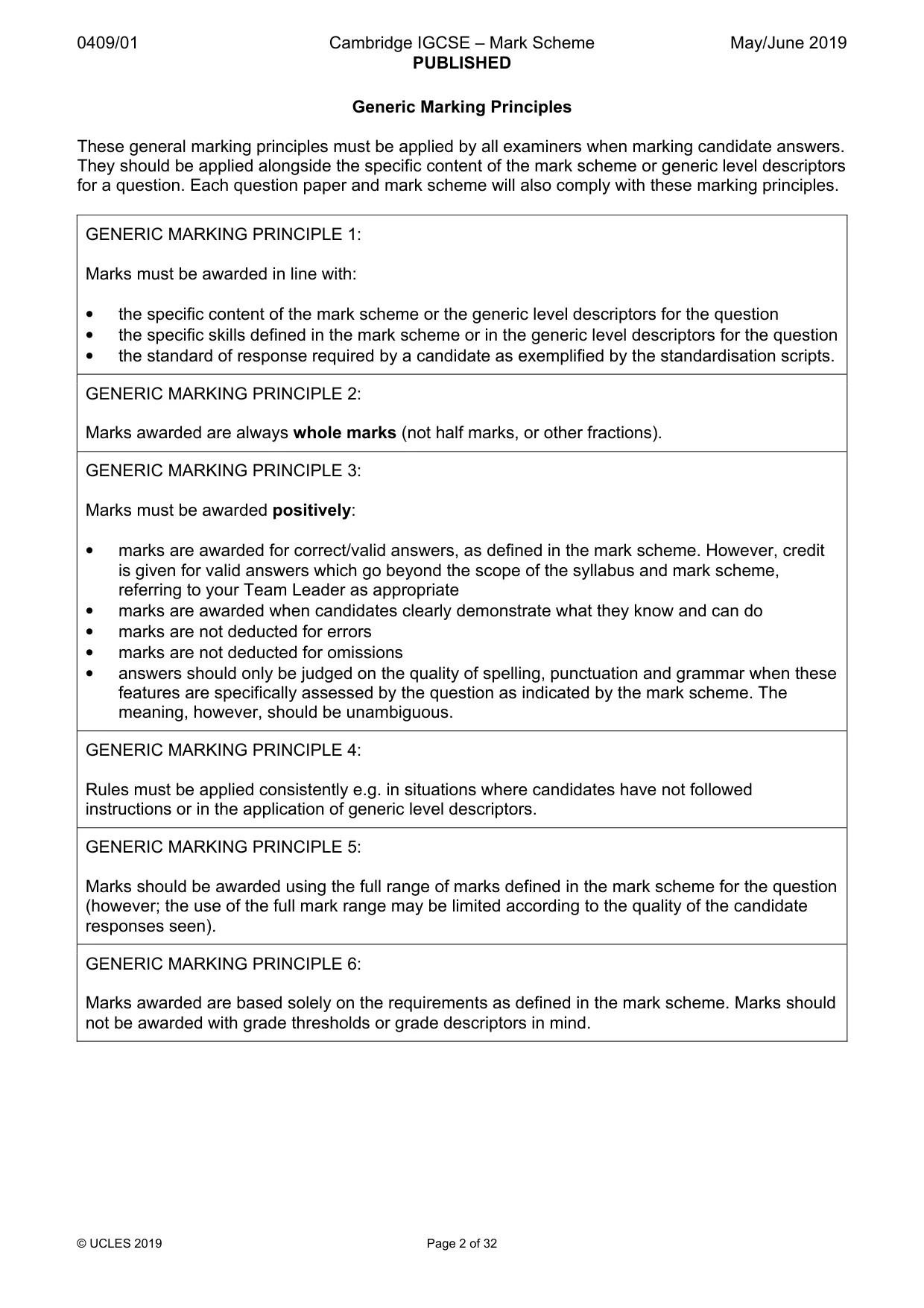
Mark scheme, page 2
0409/01 Cambridge IGCSE – Mark Scheme PUBLISHED May/June 2019 © UCLES 2019 Page 2 of 32 Generic Marking Principles These general marking principles must be applied by all examiners when marking candidate answers. They should be applied alongside the specific content of the mark scheme or generic level descriptors for a question. Each question paper and mark scheme will also comply with these marking principles. GENERIC MARKING PRINCIPLE 1: Marks must be awarded in line with: • the specific content of the mark scheme or the generic level descriptors for the question • the specific skills defined in the mark scheme or in the generic level descriptors for the question • the standard of response required by a candidate as exemplified by the standardisation scripts. GENERIC MARKING PRINCIPLE 2: Marks awarded are always whole marks (not half marks, or other fractions). GENERIC MARKING PRINCIPLE 3: Marks must be awarded positively: • marks are awarded for correct/valid answers, as defined in the mark scheme. However, credit is given for valid answers which go beyond the scope of the syllabus and mark scheme, referring to your Team Leader as appropriate • marks are awarded when candidates clearly demonstrate what they know and can do • marks are not deducted for errors • marks are not deducted for omissions • answers should only be judged on the quality of spelling, punctuation and grammar when these features are specifically assessed by the question as indicated by the mark scheme. The meaning, however, should be unambiguous. GENERIC MARKING PRINCIPLE 4: Rules must be applied consistently e.g. in situations where candidates have not followed instructions or in the application of generic level descriptors. GENERIC MARKING PRINCIPLE 5: Marks should be awarded using the full range of marks defined in the mark scheme for the question (however; the use of the full mark range may be limited according to the quality of the candidate responses seen). GENERIC MARKING PRINCIPLE 6: Marks awarded are based solely on the requirements as defined in the mark scheme. Marks should not be awarded with grade thresholds or grade descriptors in mind.
Mark scheme, page 3
0409/01 Cambridge IGCSE – Mark Scheme PUBLISHED May/June 2019 © UCLES 2019 Page 3 of 32 Generic levels of response marking grids Table 1 The table should be used to mark the 6 mark part (b) questions. Target: Demonstrating an understanding of historical explanation (AO1 and AO2) Marks Level 4 Explanation of at least TWO identified reasons. 6 Level 3 Explanation of ONE identified reason. 4–5 Level 2 Identifies AND/OR describes reasons. No valid explanations given for reasons. 2–3 Level 1 Valid general comment lacking specific subject knowledge. 1 Level 0 No evidence submitted or response does not answer the question. 0 Table 2 This table should be used to mark the 10 mark part (c) questions. Target: Demonstrating the ability to analyse historical events and come to a substantiated judgment (AO1 and AO2) Marks Level 5 Explains with evaluation of ‘To what extent’ with a substantiated judgment. A developed explanation of both sides of agreement AND disagreement. Argument supported by relevant and accurate contextual knowledge. 10 Level 4 Explanation of both sides of agreement AND disagreement. Argument supported by relevant and accurate contextual knowledge. A simple explanation of both sides should be given 7 marks. Where one side has a more developed explanation, but the other side remains simple, this should be awarded 8 marks. Two developed explanations should be awarded 9 marks. 7–9 Level 3 Explanation of one-side of agreement OR disagreement. Supported by relevant and accurate contextual knowledge. Marks within this level should be decided on the quality of explanation. A one-sided answer no matter how detailed cannot be awarded more than 6 marks. 4–6 Level 2 Identifies AND/OR describes reasons. Deployment of relevant and accurate contextual knowledge. No valid explanations given for reasons. 2–3 Level 1 Valid general comment lacking specific subject knowledge. 1 Level 0 No evidence submitted or response does not answer the question. 0
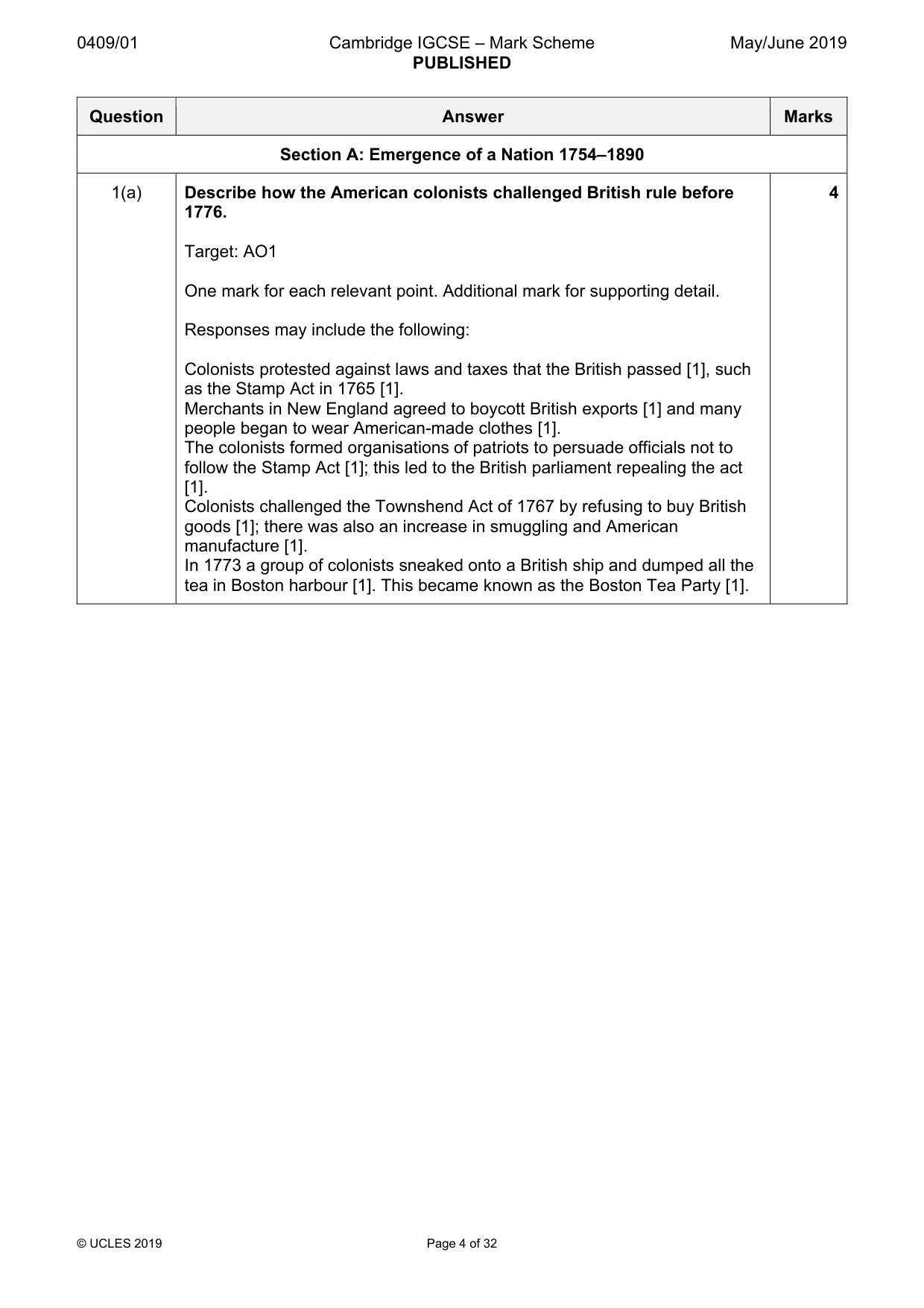
Mark scheme, page 4
0409/01 Cambridge IGCSE – Mark Scheme PUBLISHED May/June 2019 © UCLES 2019 Page 4 of 32 Question Answer Marks Section A: Emergence of a Nation 1754–1890 1(a) Describe how the American colonists challenged British rule before 1776. Target: AO1 One mark for each relevant point. Additional mark for supporting detail. Responses may include the following: Colonists protested against laws and taxes that the British passed [1], such as the Stamp Act in 1765 [1]. Merchants in New England agreed to boycott British exports [1] and many people began to wear American-made clothes [1]. The colonists formed organisations of patriots to persuade officials not to follow the Stamp Act [1]; this led to the British parliament repealing the act [1]. Colonists challenged the Townshend Act of 1767 by refusing to buy British goods [1]; there was also an increase in smuggling and American manufacture [1]. In 1773 a group of colonists sneaked onto a British ship and dumped all the tea in Boston harbour [1]. This became known as the Boston Tea Party [1]. 4
Mark scheme, page 5
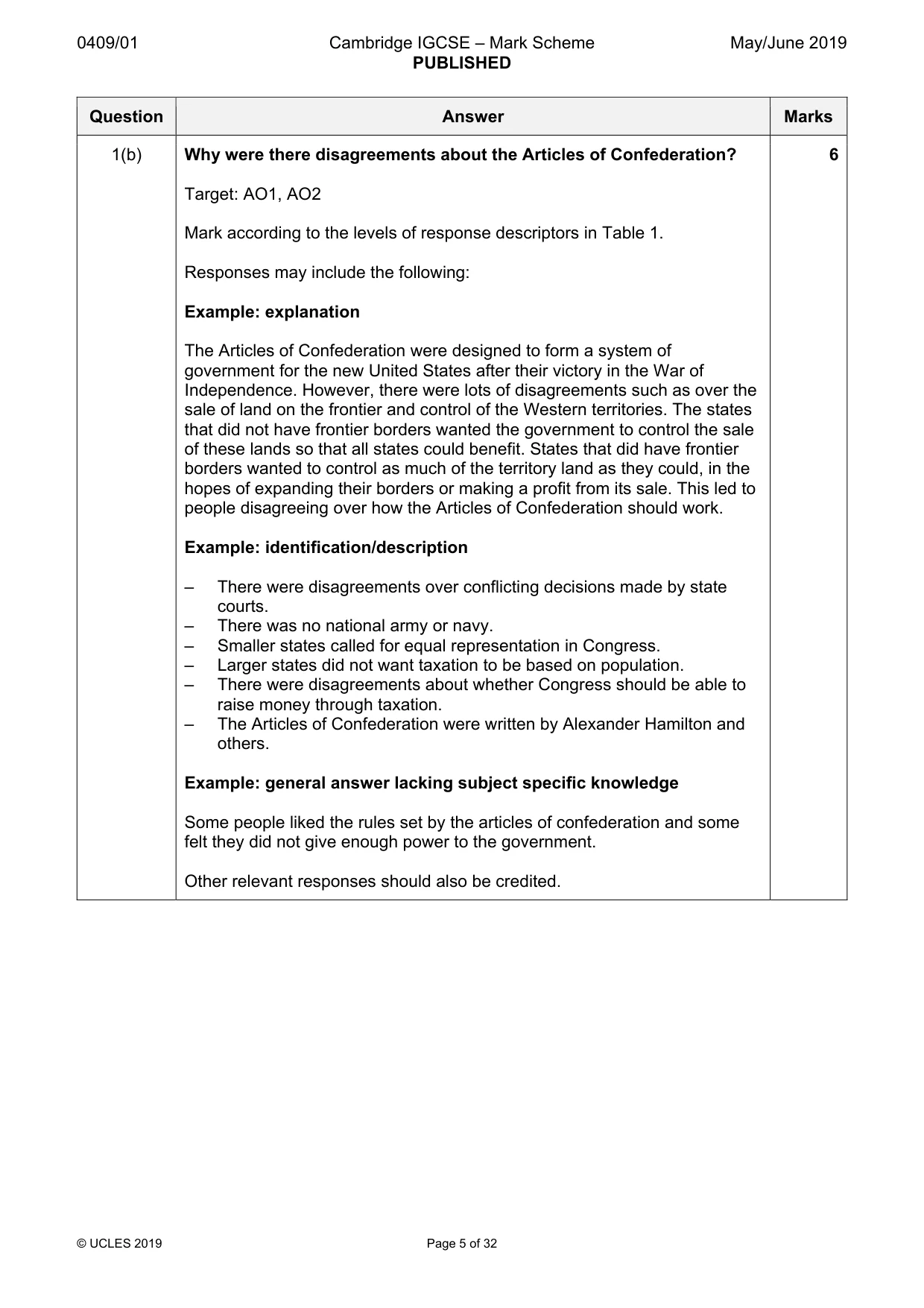
0409/01 Cambridge IGCSE – Mark Scheme PUBLISHED May/June 2019 © UCLES 2019 Page 5 of 32 Question Answer Marks 1(b) Why were there disagreements about the Articles of Confederation? Target: AO1, AO2 Mark according to the levels of response descriptors in Table 1. Responses may include the following: Example: explanation The Articles of Confederation were designed to form a system of government for the new United States after their victory in the War of Independence. However, there were lots of disagreements such as over the sale of land on the frontier and control of the Western territories. The states that did not have frontier borders wanted the government to control the sale of these lands so that all states could benefit. States that did have frontier borders wanted to control as much of the territory land as they could, in the hopes of expanding their borders or making a profit from its sale. This led to people disagreeing over how the Articles of Confederation should work. Example: identification/description – There were disagreements over conflicting decisions made by state courts. – There was no national army or navy. – Smaller states called for equal representation in Congress. – Larger states did not want taxation to be based on population. – There were disagreements about whether Congress should be able to raise money through taxation. – The Articles of Confederation were written by Alexander Hamilton and others. Example: general answer lacking subject specific knowledge Some people liked the rules set by the articles of confederation and some felt they did not give enough power to the government. Other relevant responses should also be credited. 6
Mark scheme, page 6
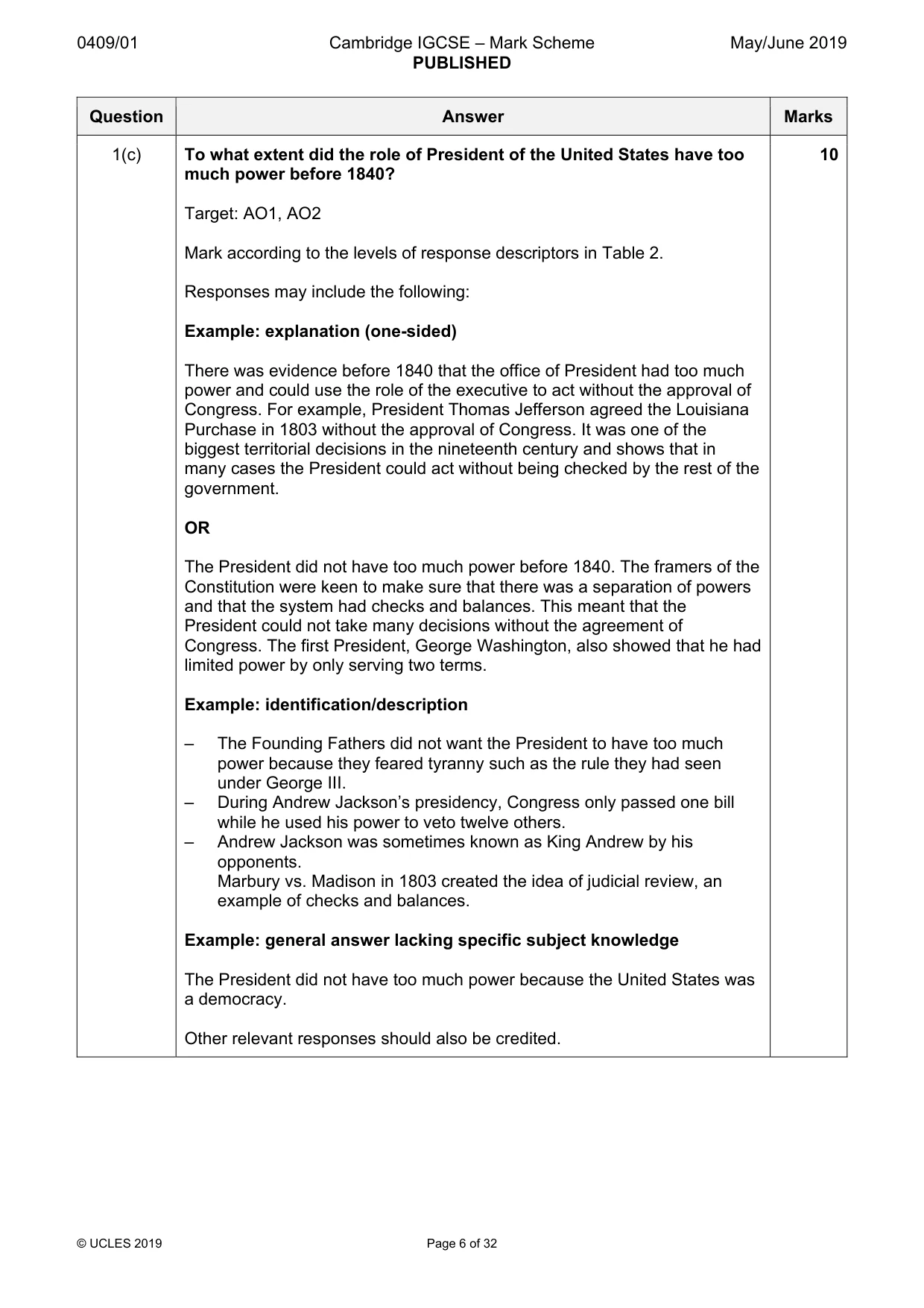
0409/01 Cambridge IGCSE – Mark Scheme PUBLISHED May/June 2019 © UCLES 2019 Page 6 of 32 Question Answer Marks 1(c) To what extent did the role of President of the United States have too much power before 1840? Target: AO1, AO2 Mark according to the levels of response descriptors in Table 2. Responses may include the following: Example: explanation (one-sided) There was evidence before 1840 that the office of President had too much power and could use the role of the executive to act without the approval of Congress. For example, President Thomas Jefferson agreed the Louisiana Purchase in 1803 without the approval of Congress. It was one of the biggest territorial decisions in the nineteenth century and shows that in many cases the President could act without being checked by the rest of the government. OR The President did not have too much power before 1840. The framers of the Constitution were keen to make sure that there was a separation of powers and that the system had checks and balances. This meant that the President could not take many decisions without the agreement of Congress. The first President, George Washington, also showed that he had limited power by only serving two terms. Example: identification/description – The Founding Fathers did not want the President to have too much power because they feared tyranny such as the rule they had seen under George III. – During Andrew Jackson’s presidency, Congress only passed one bill while he used his power to veto twelve others. – Andrew Jackson was sometimes known as King Andrew by his opponents. Marbury vs. Madison in 1803 created the idea of judicial review, an example of checks and balances. Example: general answer lacking specific subject knowledge The President did not have too much power because the United States was a democracy. Other relevant responses should also be credited. 10
Mark scheme, page 7
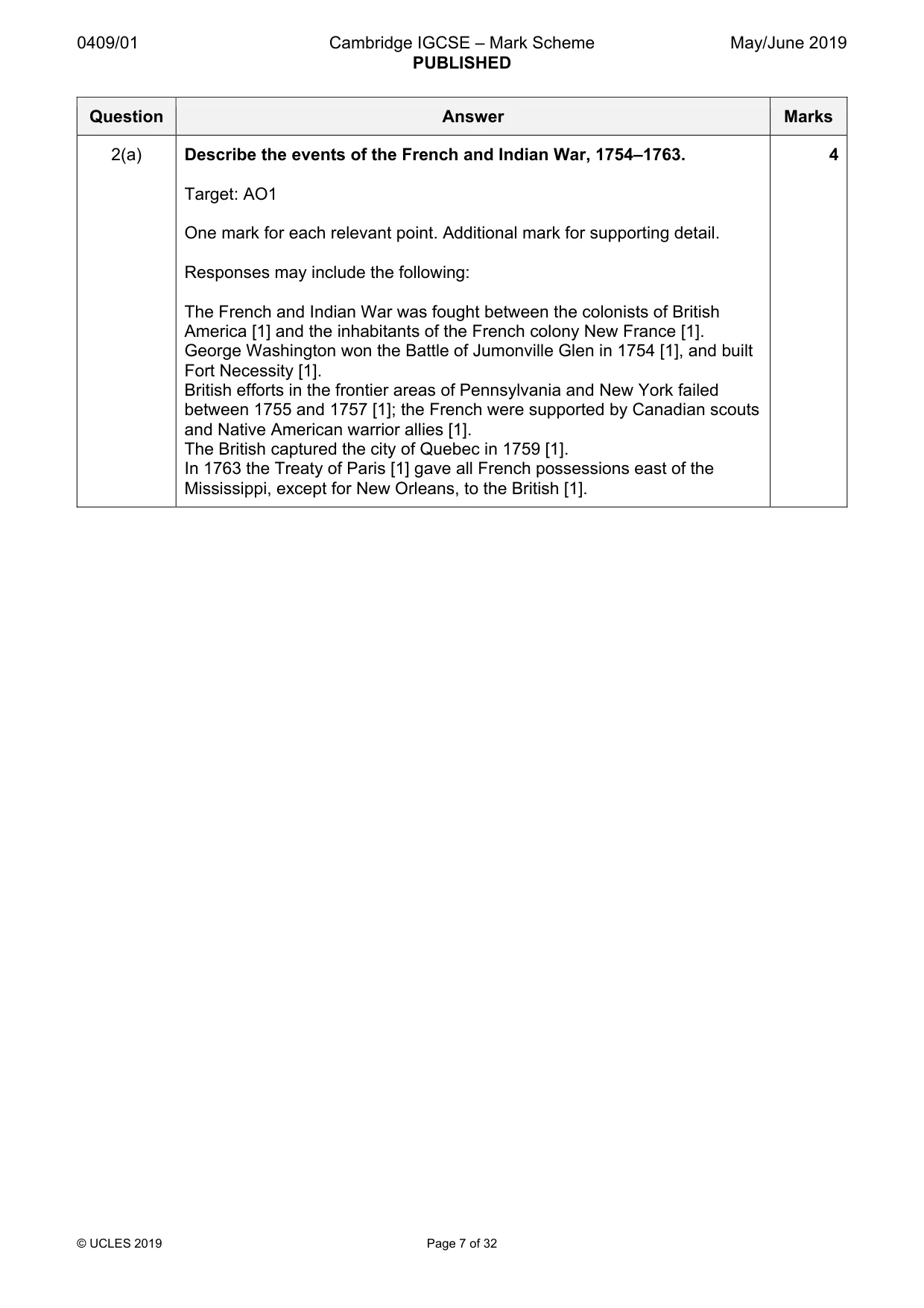
0409/01 Cambridge IGCSE – Mark Scheme PUBLISHED May/June 2019 © UCLES 2019 Page 7 of 32 Question Answer Marks 2(a) Describe the events of the French and Indian War, 1754–1763. Target: AO1 One mark for each relevant point. Additional mark for supporting detail. Responses may include the following: The French and Indian War was fought between the colonists of British America [1] and the inhabitants of the French colony New France [1]. George Washington won the Battle of Jumonville Glen in 1754 [1], and built Fort Necessity [1]. British efforts in the frontier areas of Pennsylvania and New York failed between 1755 and 1757 [1]; the French were supported by Canadian scouts and Native American warrior allies [1]. The British captured the city of Quebec in 1759 [1]. In 1763 the Treaty of Paris [1] gave all French possessions east of the Mississippi, except for New Orleans, to the British [1]. 4
Mark scheme, page 8
0409/01 Cambridge IGCSE – Mark Scheme PUBLISHED May/June 2019 © UCLES 2019 Page 8 of 32 Question Answer Marks 2(b) Explain why foreign powers were important to the victory of the colonists in the Revolutionary War. Target: AO1, AO2 Mark according to the levels of response descriptors in Table 1. Responses may include the following: Example: explanation The support of the French was vital to the colonists’ victory over the British. Between 1778 and 1782 the French provided supplies, arms and ammunition to the Continental army which meant that they had more power against British troops. French assistance was also crucial in securing British surrender at the battle of Yorktown. The French navy blocked Chesapeake Bay which meant that the British could not renew their supplies and that they had no way of escaping. Example: identification/description – In 1779 the Spanish declared war on Britain, supporting their French allies. – Many German soldiers fought on the side of the British during the war. – The presence of German mercenaries on American soil angered many colonists. – The French supported the colonists after Benjamin Franklin signed a treaty with them. Example: general answer lacking subject specific knowledge Lots of other countries helped the Americans to win the war against the British. Other relevant responses should also be credited. Note: Answers may concentrate on one foreign power as long as a developed explanation is given. 6
Mark scheme, page 9
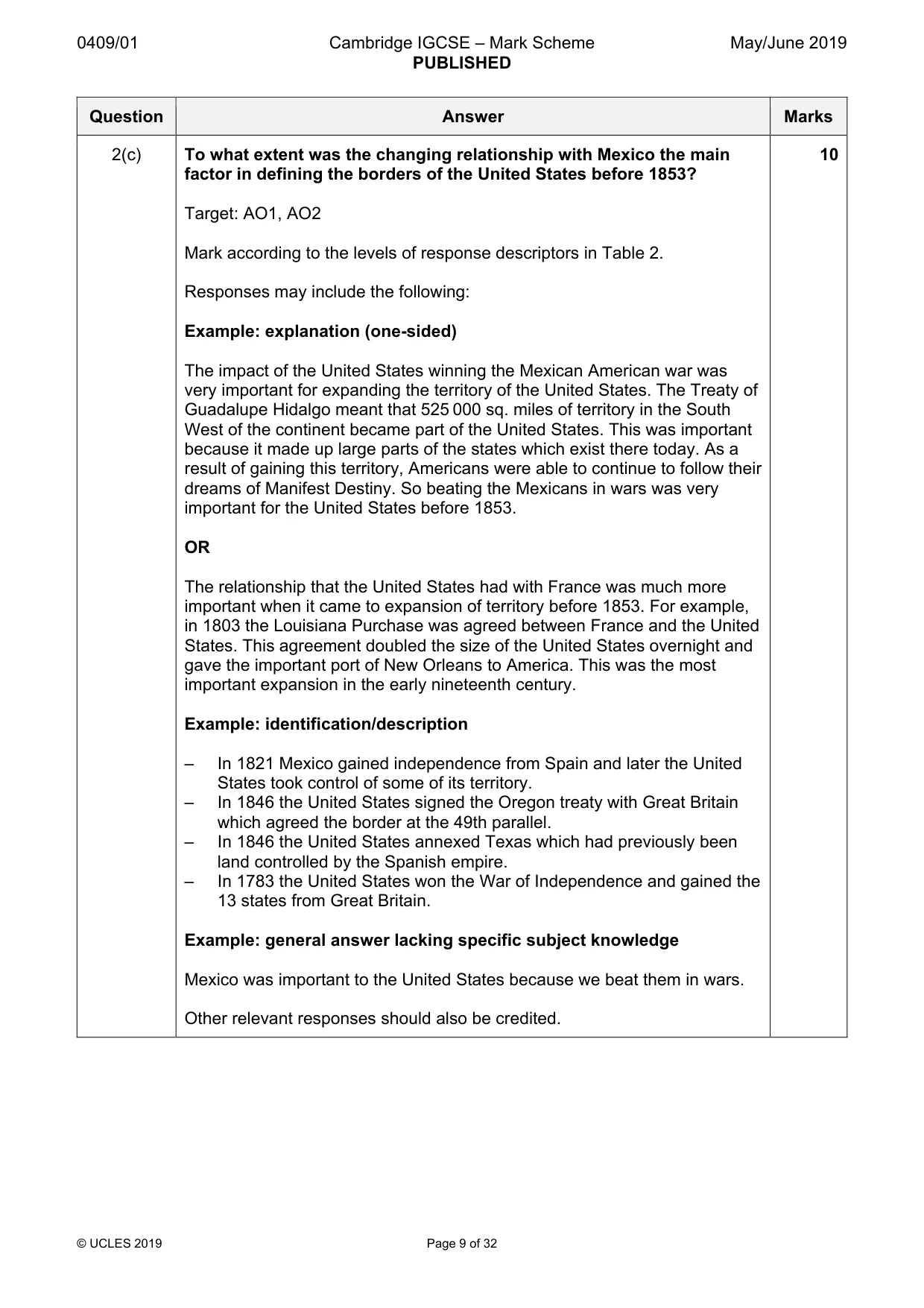
0409/01 Cambridge IGCSE – Mark Scheme PUBLISHED May/June 2019 © UCLES 2019 Page 9 of 32 Question Answer Marks 2(c) To what extent was the changing relationship with Mexico the main factor in defining the borders of the United States before 1853? Target: AO1, AO2 Mark according to the levels of response descriptors in Table 2. Responses may include the following: Example: explanation (one-sided) The impact of the United States winning the Mexican American war was very important for expanding the territory of the United States. The Treaty of Guadalupe Hidalgo meant that 525 000 sq. miles of territory in the South West of the continent became part of the United States. This was important because it made up large parts of the states which exist there today. As a result of gaining this territory, Americans were able to continue to follow their dreams of Manifest Destiny. So beating the Mexicans in wars was very important for the United States before 1853. OR The relationship that the United States had with France was much more important when it came to expansion of territory before 1853. For example, in 1803 the Louisiana Purchase was agreed between France and the United States. This agreement doubled the size of the United States overnight and gave the important port of New Orleans to America. This was the most important expansion in the early nineteenth century. Example: identification/description – In 1821 Mexico gained independence from Spain and later the United States took control of some of its territory. – In 1846 the United States signed the Oregon treaty with Great Britain which agreed the border at the 49th parallel. – In 1846 the United States annexed Texas which had previously been land controlled by the Spanish empire. – In 1783 the United States won the War of Independence and gained the 13 states from Great Britain. Example: general answer lacking specific subject knowledge Mexico was important to the United States because we beat them in wars. Other relevant responses should also be credited. 10
Mark scheme, page 10
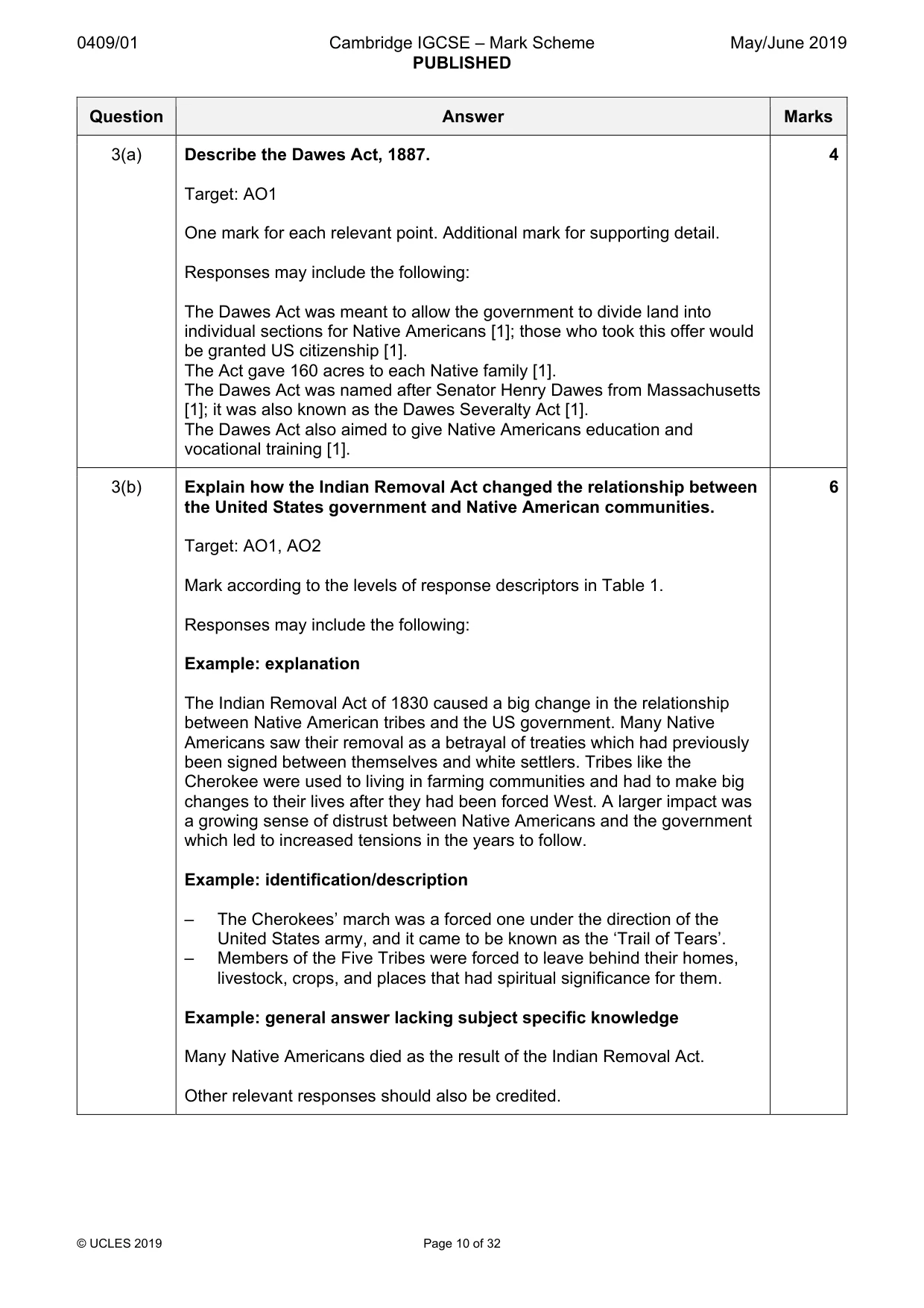
0409/01 Cambridge IGCSE – Mark Scheme PUBLISHED May/June 2019 © UCLES 2019 Page 10 of 32 Question Answer Marks 3(a) Describe the Dawes Act, 1887. Target: AO1 One mark for each relevant point. Additional mark for supporting detail. Responses may include the following: The Dawes Act was meant to allow the government to divide land into individual sections for Native Americans [1]; those who took this offer would be granted US citizenship [1]. The Act gave 160 acres to each Native family [1]. The Dawes Act was named after Senator Henry Dawes from Massachusetts [1]; it was also known as the Dawes Severalty Act [1]. The Dawes Act also aimed to give Native Americans education and vocational training [1]. 4 3(b) Explain how the Indian Removal Act changed the relationship between the United States government and Native American communities. Target: AO1, AO2 Mark according to the levels of response descriptors in Table 1. Responses may include the following: Example: explanation The Indian Removal Act of 1830 caused a big change in the relationship between Native American tribes and the US government. Many Native Americans saw their removal as a betrayal of treaties which had previously been signed between themselves and white settlers. Tribes like the Cherokee were used to living in farming communities and had to make big changes to their lives after they had been forced West. A larger impact was a growing sense of distrust between Native Americans and the government which led to increased tensions in the years to follow. Example: identification/description – The Cherokees’ march was a forced one under the direction of the United States army, and it came to be known as the ‘Trail of Tears’. – Members of the Five Tribes were forced to leave behind their homes, livestock, crops, and places that had spiritual significance for them. Example: general answer lacking subject specific knowledge Many Native Americans died as the result of the Indian Removal Act. Other relevant responses should also be credited. 6
Mark scheme, page 11
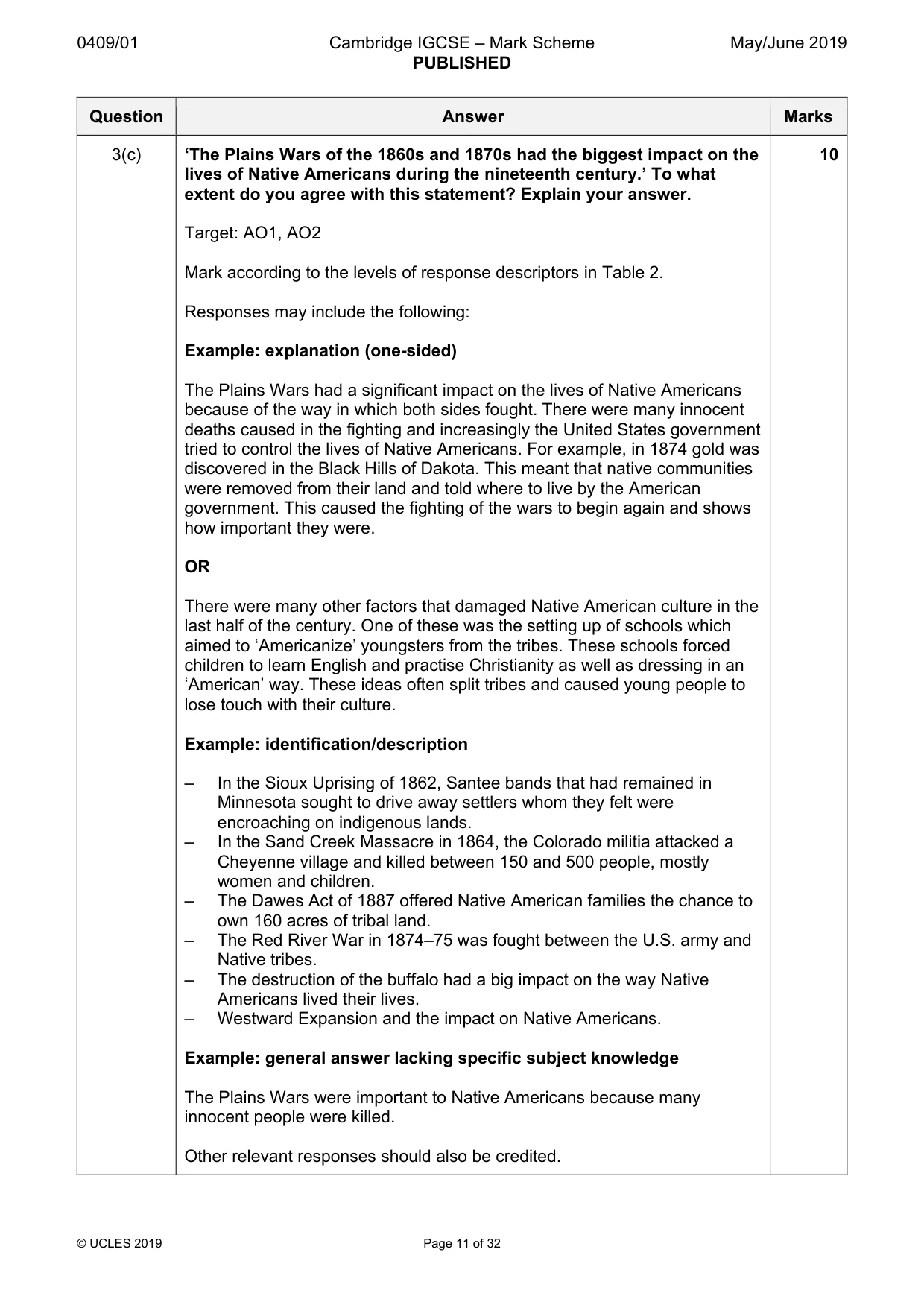
0409/01 Cambridge IGCSE – Mark Scheme PUBLISHED May/June 2019 © UCLES 2019 Page 11 of 32 Question Answer Marks 3(c) ‘The Plains Wars of the 1860s and 1870s had the biggest impact on the lives of Native Americans during the nineteenth century.’ To what extent do you agree with this statement? Explain your answer. Target: AO1, AO2 Mark according to the levels of response descriptors in Table 2. Responses may include the following: Example: explanation (one-sided) The Plains Wars had a significant impact on the lives of Native Americans because of the way in which both sides fought. There were many innocent deaths caused in the fighting and increasingly the United States government tried to control the lives of Native Americans. For example, in 1874 gold was discovered in the Black Hills of Dakota. This meant that native communities were removed from their land and told where to live by the American government. This caused the fighting of the wars to begin again and shows how important they were. OR There were many other factors that damaged Native American culture in the last half of the century. One of these was the setting up of schools which aimed to ‘Americanize’ youngsters from the tribes. These schools forced children to learn English and practise Christianity as well as dressing in an ‘American’ way. These ideas often split tribes and caused young people to lose touch with their culture. Example: identification/description – In the Sioux Uprising of 1862, Santee bands that had remained in Minnesota sought to drive away settlers whom they felt were encroaching on indigenous lands. – In the Sand Creek Massacre in 1864, the Colorado militia attacked a Cheyenne village and killed between 150 and 500 people, mostly women and children. – The Dawes Act of 1887 offered Native American families the chance to own 160 acres of tribal land. – The Red River War in 1874–75 was fought between the U.S. army and Native tribes. – The destruction of the buffalo had a big impact on the way Native Americans lived their lives. – Westward Expansion and the impact on Native Americans. Example: general answer lacking specific subject knowledge The Plains Wars were important to Native Americans because many innocent people were killed. Other relevant responses should also be credited. 10
Mark scheme, page 12
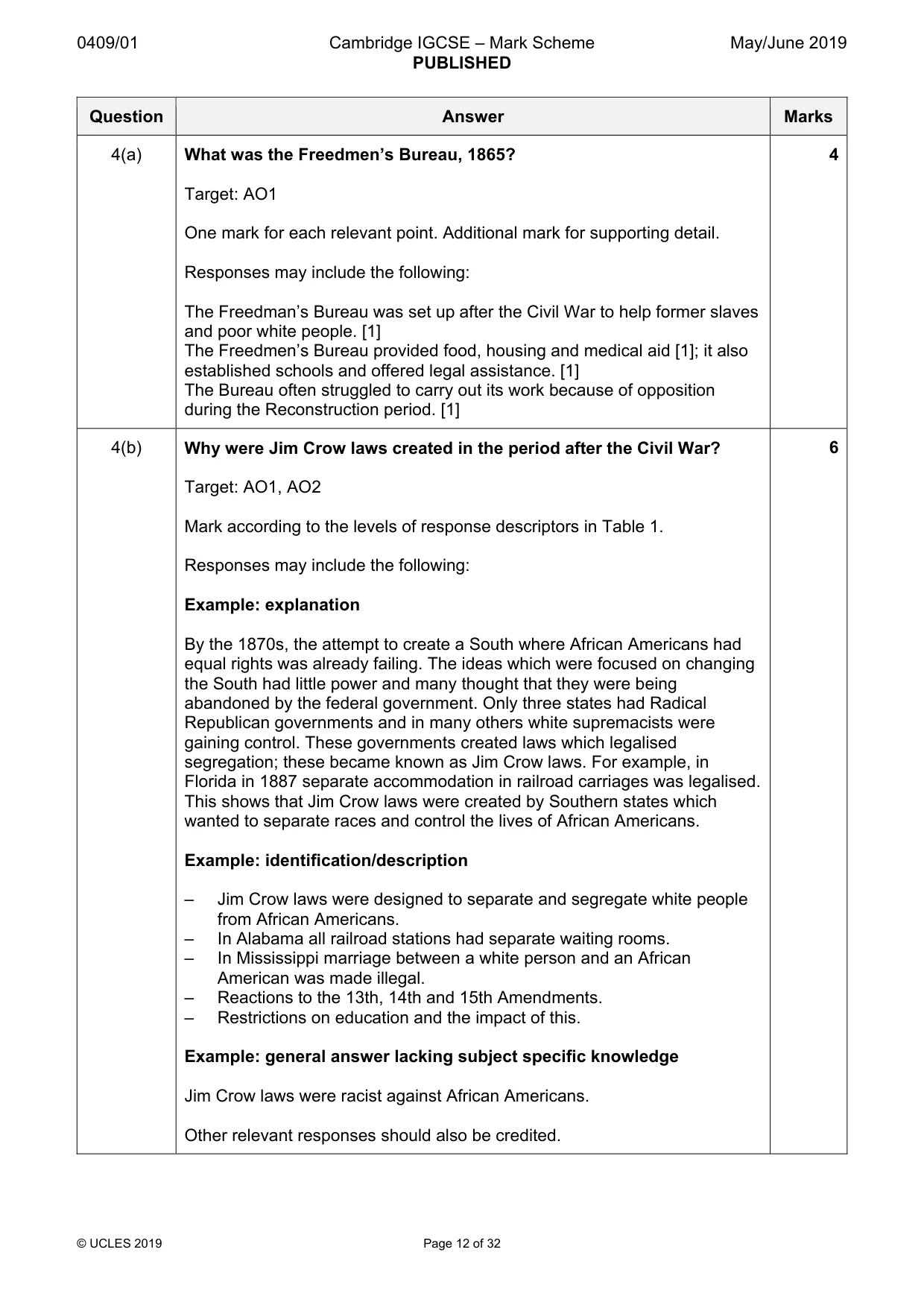
0409/01 Cambridge IGCSE – Mark Scheme PUBLISHED May/June 2019 © UCLES 2019 Page 12 of 32 Question Answer Marks 4(a) What was the Freedmen’s Bureau, 1865? Target: AO1 One mark for each relevant point. Additional mark for supporting detail. Responses may include the following: The Freedman’s Bureau was set up after the Civil War to help former slaves and poor white people. [1] The Freedmen’s Bureau provided food, housing and medical aid [1]; it also established schools and offered legal assistance. [1] The Bureau often struggled to carry out its work because of opposition during the Reconstruction period. [1] 4 4(b) Why were Jim Crow laws created in the period after the Civil War? Target: AO1, AO2 Mark according to the levels of response descriptors in Table 1. Responses may include the following: Example: explanation By the 1870s, the attempt to create a South where African Americans had equal rights was already failing. The ideas which were focused on changing the South had little power and many thought that they were being abandoned by the federal government. Only three states had Radical Republican governments and in many others white supremacists were gaining control. These governments created laws which legalised segregation; these became known as Jim Crow laws. For example, in Florida in 1887 separate accommodation in railroad carriages was legalised. This shows that Jim Crow laws were created by Southern states which wanted to separate races and control the lives of African Americans. Example: identification/description – Jim Crow laws were designed to separate and segregate white people from African Americans. – In Alabama all railroad stations had separate waiting rooms. – In Mississippi marriage between a white person and an African American was made illegal. – Reactions to the 13th, 14th and 15th Amendments. – Restrictions on education and the impact of this. Example: general answer lacking subject specific knowledge Jim Crow laws were racist against African Americans. Other relevant responses should also be credited. 6
Mark scheme, page 13
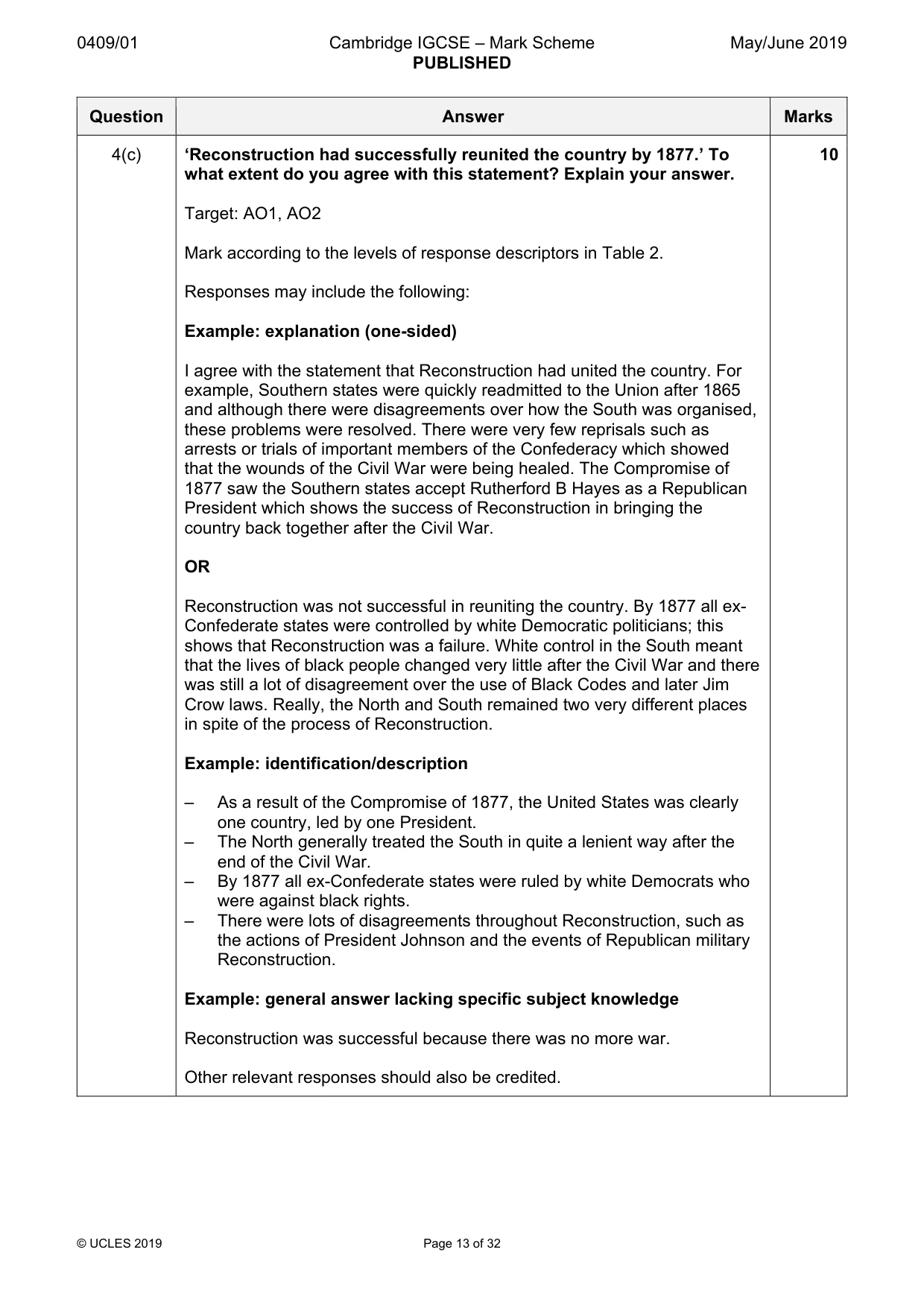
0409/01 Cambridge IGCSE – Mark Scheme PUBLISHED May/June 2019 © UCLES 2019 Page 13 of 32 Question Answer Marks 4(c) ‘Reconstruction had successfully reunited the country by 1877.’ To what extent do you agree with this statement? Explain your answer. Target: AO1, AO2 Mark according to the levels of response descriptors in Table 2. Responses may include the following: Example: explanation (one-sided) I agree with the statement that Reconstruction had united the country. For example, Southern states were quickly readmitted to the Union after 1865 and although there were disagreements over how the South was organised, these problems were resolved. There were very few reprisals such as arrests or trials of important members of the Confederacy which showed that the wounds of the Civil War were being healed. The Compromise of 1877 saw the Southern states accept Rutherford B Hayes as a Republican President which shows the success of Reconstruction in bringing the country back together after the Civil War. OR Reconstruction was not successful in reuniting the country. By 1877 all ex- Confederate states were controlled by white Democratic politicians; this shows that Reconstruction was a failure. White control in the South meant that the lives of black people changed very little after the Civil War and there was still a lot of disagreement over the use of Black Codes and later Jim Crow laws. Really, the North and South remained two very different places in spite of the process of Reconstruction. Example: identification/description – As a result of the Compromise of 1877, the United States was clearly one country, led by one President. – The North generally treated the South in quite a lenient way after the end of the Civil War. – By 1877 all ex-Confederate states were ruled by white Democrats who were against black rights. – There were lots of disagreements throughout Reconstruction, such as the actions of President Johnson and the events of Republican military Reconstruction. Example: general answer lacking specific subject knowledge Reconstruction was successful because there was no more war. Other relevant responses should also be credited. 10
Mark scheme, page 14
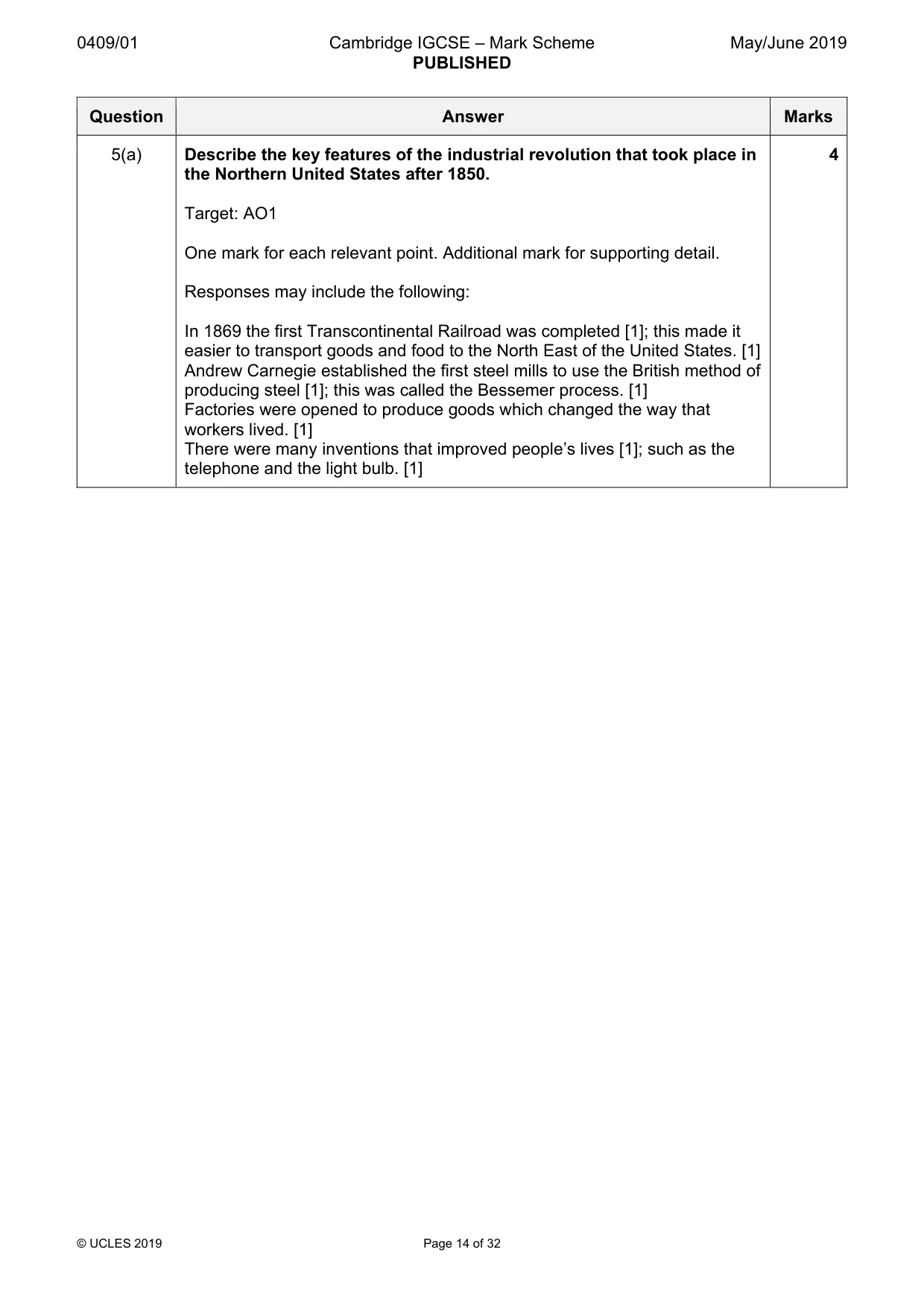
0409/01 Cambridge IGCSE – Mark Scheme PUBLISHED May/June 2019 © UCLES 2019 Page 14 of 32 Question Answer Marks 5(a) Describe the key features of the industrial revolution that took place in the Northern United States after 1850. Target: AO1 One mark for each relevant point. Additional mark for supporting detail. Responses may include the following: In 1869 the first Transcontinental Railroad was completed [1]; this made it easier to transport goods and food to the North East of the United States. [1] Andrew Carnegie established the first steel mills to use the British method of producing steel [1]; this was called the Bessemer process. [1] Factories were opened to produce goods which changed the way that workers lived. [1] There were many inventions that improved people’s lives [1]; such as the telephone and the light bulb. [1] 4
Mark scheme, page 15
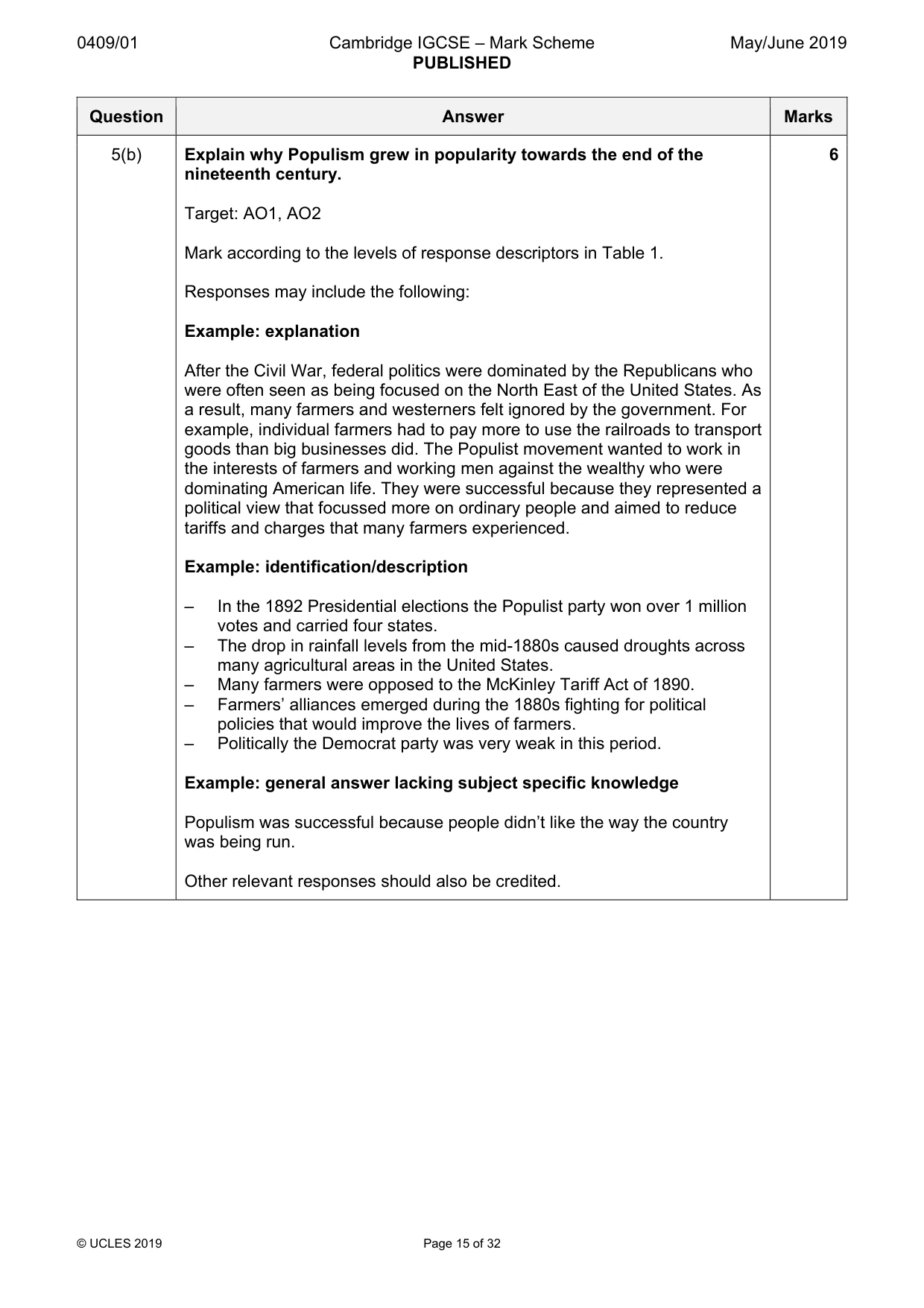
0409/01 Cambridge IGCSE – Mark Scheme PUBLISHED May/June 2019 © UCLES 2019 Page 15 of 32 Question Answer Marks 5(b) Explain why Populism grew in popularity towards the end of the nineteenth century. Target: AO1, AO2 Mark according to the levels of response descriptors in Table 1. Responses may include the following: Example: explanation After the Civil War, federal politics were dominated by the Republicans who were often seen as being focused on the North East of the United States. As a result, many farmers and westerners felt ignored by the government. For example, individual farmers had to pay more to use the railroads to transport goods than big businesses did. The Populist movement wanted to work in the interests of farmers and working men against the wealthy who were dominating American life. They were successful because they represented a political view that focussed more on ordinary people and aimed to reduce tariffs and charges that many farmers experienced. Example: identification/description – In the 1892 Presidential elections the Populist party won over 1 million votes and carried four states. – The drop in rainfall levels from the mid-1880s caused droughts across many agricultural areas in the United States. – Many farmers were opposed to the McKinley Tariff Act of 1890. – Farmers’ alliances emerged during the 1880s fighting for political policies that would improve the lives of farmers. – Politically the Democrat party was very weak in this period. Example: general answer lacking subject specific knowledge Populism was successful because people didn’t like the way the country was being run. Other relevant responses should also be credited. 6
Mark scheme, page 16
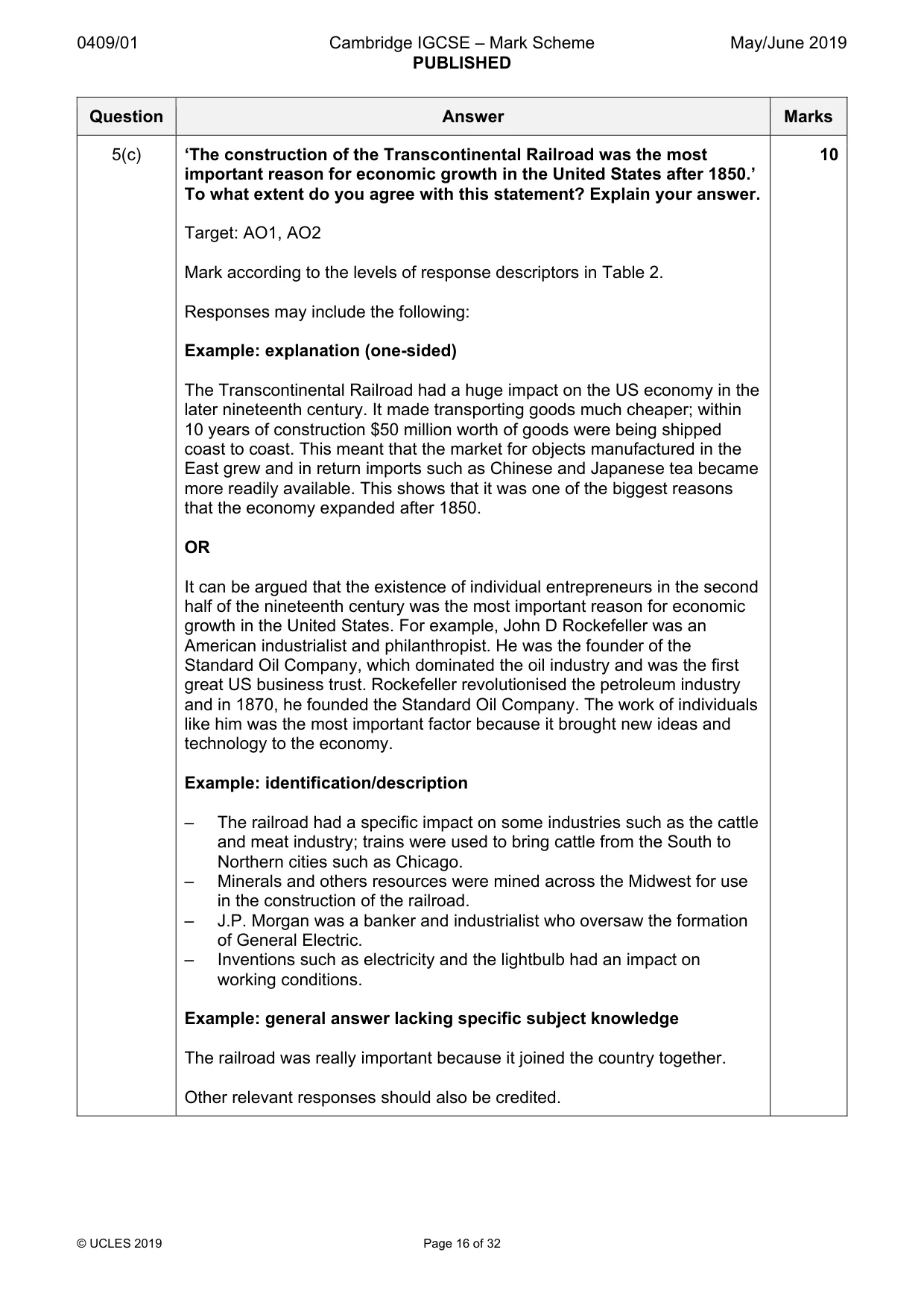
0409/01 Cambridge IGCSE – Mark Scheme PUBLISHED May/June 2019 © UCLES 2019 Page 16 of 32 Question Answer Marks 5(c) ‘The construction of the Transcontinental Railroad was the most important reason for economic growth in the United States after 1850.’ To what extent do you agree with this statement? Explain your answer. Target: AO1, AO2 Mark according to the levels of response descriptors in Table 2. Responses may include the following: Example: explanation (one-sided) The Transcontinental Railroad had a huge impact on the US economy in the later nineteenth century. It made transporting goods much cheaper; within 10 years of construction $50 million worth of goods were being shipped coast to coast. This meant that the market for objects manufactured in the East grew and in return imports such as Chinese and Japanese tea became more readily available. This shows that it was one of the biggest reasons that the economy expanded after 1850. OR It can be argued that the existence of individual entrepreneurs in the second half of the nineteenth century was the most important reason for economic growth in the United States. For example, John D Rockefeller was an American industrialist and philanthropist. He was the founder of the Standard Oil Company, which dominated the oil industry and was the first great US business trust. Rockefeller revolutionised the petroleum industry and in 1870, he founded the Standard Oil Company. The work of individuals like him was the most important factor because it brought new ideas and technology to the economy. Example: identification/description – The railroad had a specific impact on some industries such as the cattle and meat industry; trains were used to bring cattle from the South to Northern cities such as Chicago. – Minerals and others resources were mined across the Midwest for use in the construction of the railroad. – J.P. Morgan was a banker and industrialist who oversaw the formation of General Electric. – Inventions such as electricity and the lightbulb had an impact on working conditions. Example: general answer lacking specific subject knowledge The railroad was really important because it joined the country together. Other relevant responses should also be credited. 10
Mark scheme, page 17
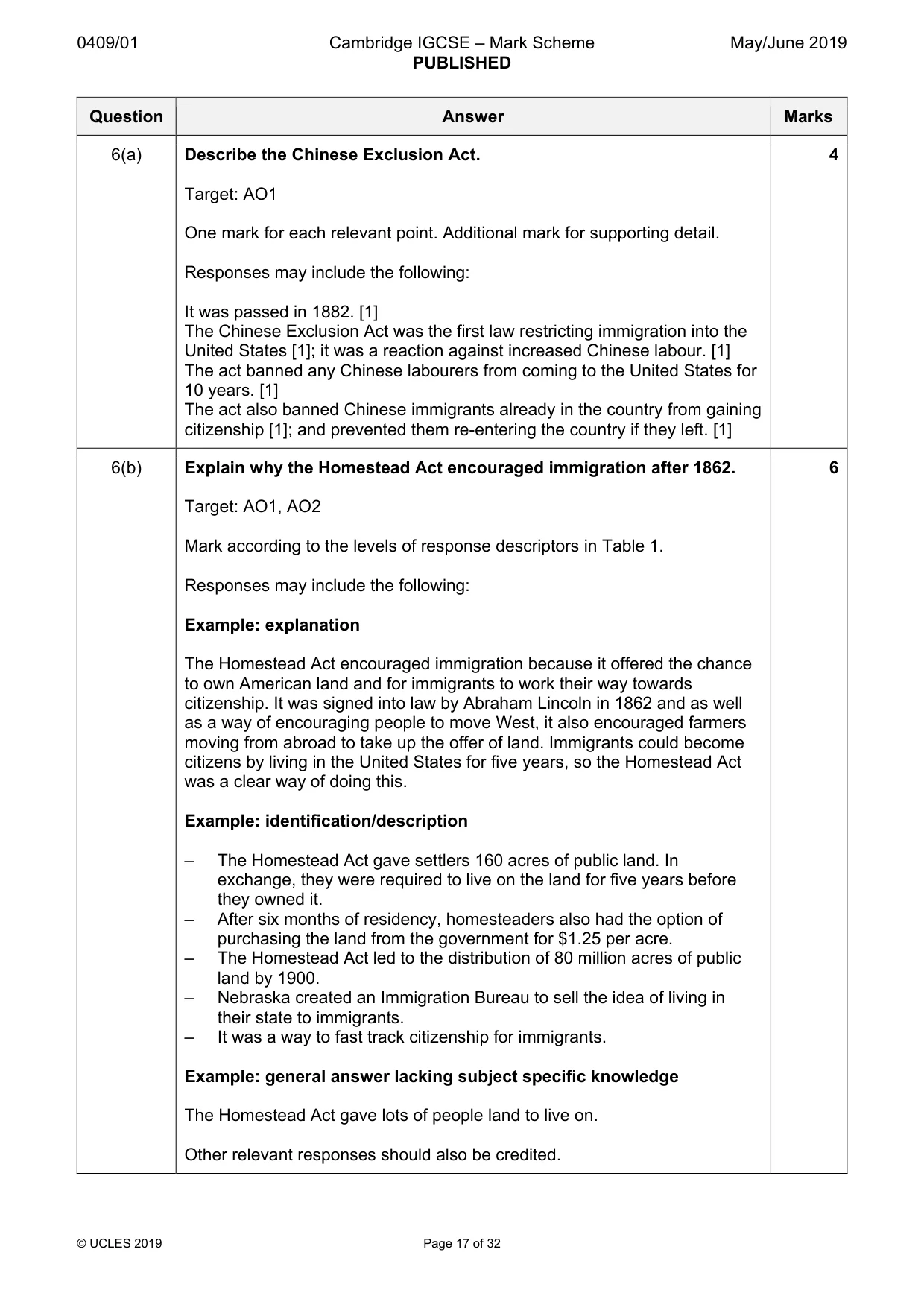
0409/01 Cambridge IGCSE – Mark Scheme PUBLISHED May/June 2019 © UCLES 2019 Page 17 of 32 Question Answer Marks 6(a) Describe the Chinese Exclusion Act. Target: AO1 One mark for each relevant point. Additional mark for supporting detail. Responses may include the following: It was passed in 1882. [1] The Chinese Exclusion Act was the first law restricting immigration into the United States [1]; it was a reaction against increased Chinese labour. [1] The act banned any Chinese labourers from coming to the United States for 10 years. [1] The act also banned Chinese immigrants already in the country from gaining citizenship [1]; and prevented them re-entering the country if they left. [1] 4 6(b) Explain why the Homestead Act encouraged immigration after 1862. Target: AO1, AO2 Mark according to the levels of response descriptors in Table 1. Responses may include the following: Example: explanation The Homestead Act encouraged immigration because it offered the chance to own American land and for immigrants to work their way towards citizenship. It was signed into law by Abraham Lincoln in 1862 and as well as a way of encouraging people to move West, it also encouraged farmers moving from abroad to take up the offer of land. Immigrants could become citizens by living in the United States for five years, so the Homestead Act was a clear way of doing this. Example: identification/description – The Homestead Act gave settlers 160 acres of public land. In exchange, they were required to live on the land for five years before they owned it. – After six months of residency, homesteaders also had the option of purchasing the land from the government for $1.25 per acre. – The Homestead Act led to the distribution of 80 million acres of public land by 1900. – Nebraska created an Immigration Bureau to sell the idea of living in their state to immigrants. – It was a way to fast track citizenship for immigrants. Example: general answer lacking subject specific knowledge The Homestead Act gave lots of people land to live on. Other relevant responses should also be credited. 6
Mark scheme, page 18
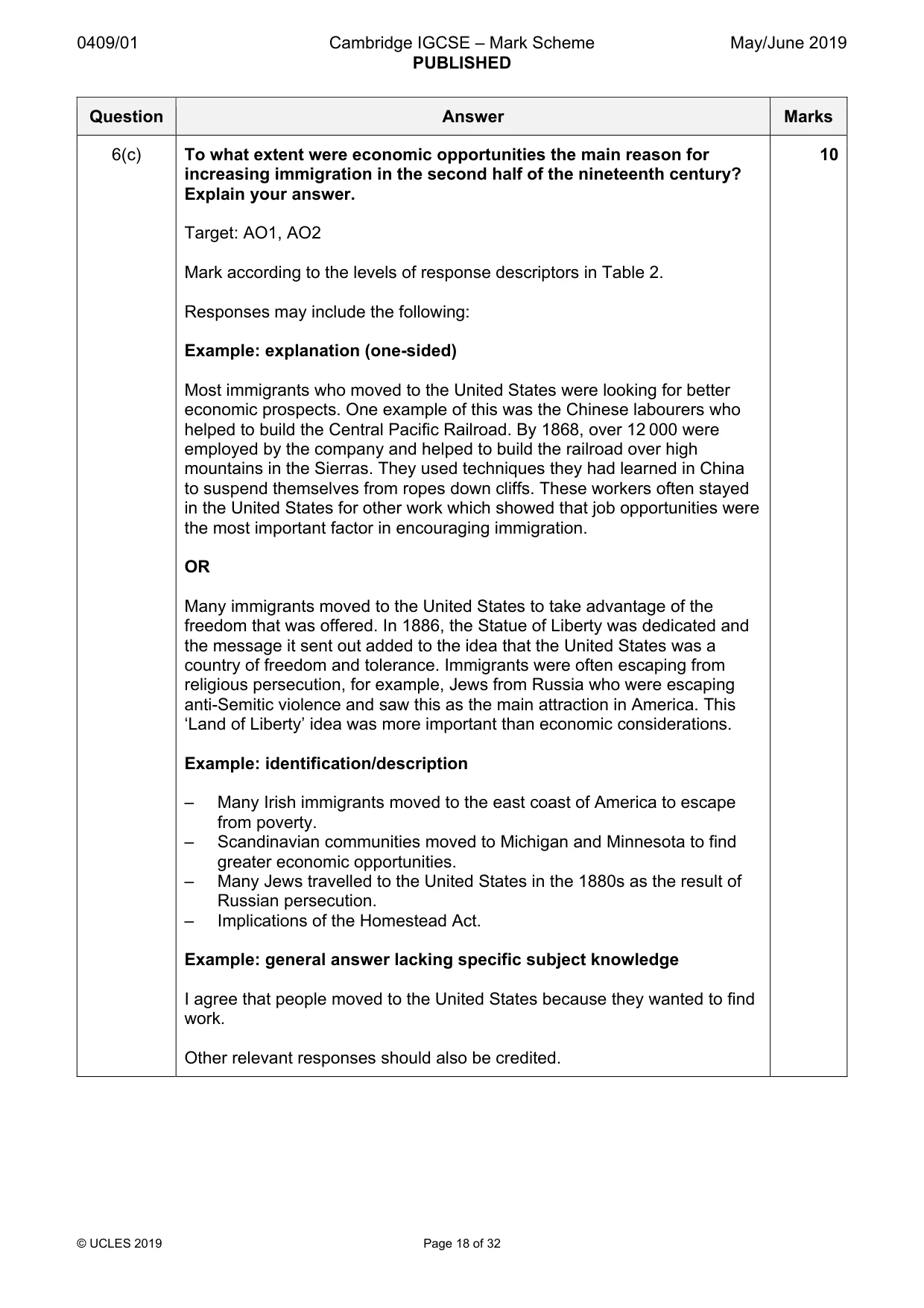
0409/01 Cambridge IGCSE – Mark Scheme PUBLISHED May/June 2019 © UCLES 2019 Page 18 of 32 Question Answer Marks 6(c) To what extent were economic opportunities the main reason for increasing immigration in the second half of the nineteenth century? Explain your answer. Target: AO1, AO2 Mark according to the levels of response descriptors in Table 2. Responses may include the following: Example: explanation (one-sided) Most immigrants who moved to the United States were looking for better economic prospects. One example of this was the Chinese labourers who helped to build the Central Pacific Railroad. By 1868, over 12 000 were employed by the company and helped to build the railroad over high mountains in the Sierras. They used techniques they had learned in China to suspend themselves from ropes down cliffs. These workers often stayed in the United States for other work which showed that job opportunities were the most important factor in encouraging immigration. OR Many immigrants moved to the United States to take advantage of the freedom that was offered. In 1886, the Statue of Liberty was dedicated and the message it sent out added to the idea that the United States was a country of freedom and tolerance. Immigrants were often escaping from religious persecution, for example, Jews from Russia who were escaping anti-Semitic violence and saw this as the main attraction in America. This ‘Land of Liberty’ idea was more important than economic considerations. Example: identification/description – Many Irish immigrants moved to the east coast of America to escape from poverty. – Scandinavian communities moved to Michigan and Minnesota to find greater economic opportunities. – Many Jews travelled to the United States in the 1880s as the result of Russian persecution. – Implications of the Homestead Act. Example: general answer lacking specific subject knowledge I agree that people moved to the United States because they wanted to find work. Other relevant responses should also be credited. 10
Mark scheme, page 19
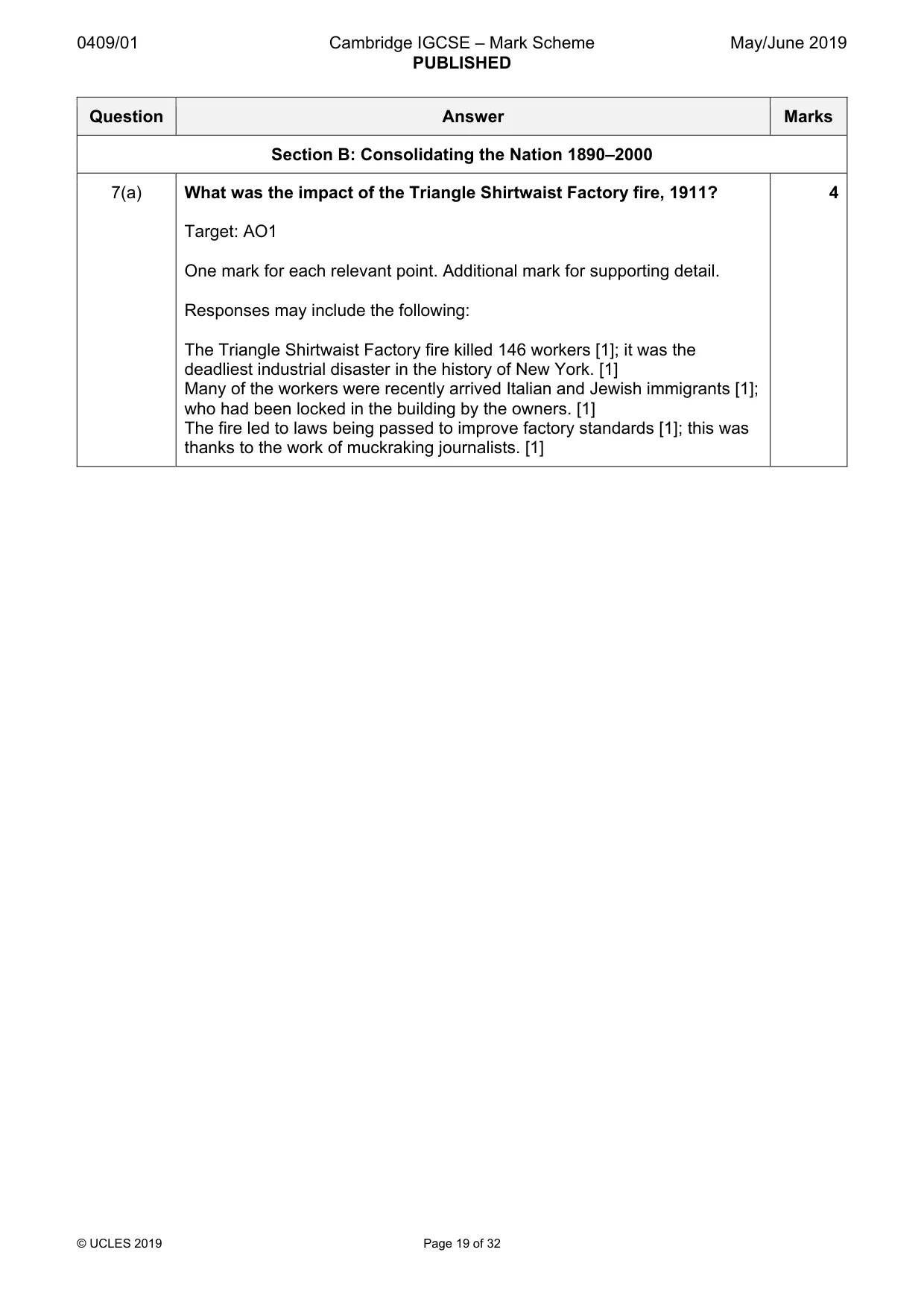
0409/01 Cambridge IGCSE – Mark Scheme PUBLISHED May/June 2019 © UCLES 2019 Page 19 of 32 Question Answer Marks Section B: Consolidating the Nation 1890–2000 7(a) What was the impact of the Triangle Shirtwaist Factory fire, 1911? Target: AO1 One mark for each relevant point. Additional mark for supporting detail. Responses may include the following: The Triangle Shirtwaist Factory fire killed 146 workers [1]; it was the deadliest industrial disaster in the history of New York. [1] Many of the workers were recently arrived Italian and Jewish immigrants [1]; who had been locked in the building by the owners. [1] The fire led to laws being passed to improve factory standards [1]; this was thanks to the work of muckraking journalists. [1] 4
Mark scheme, page 20
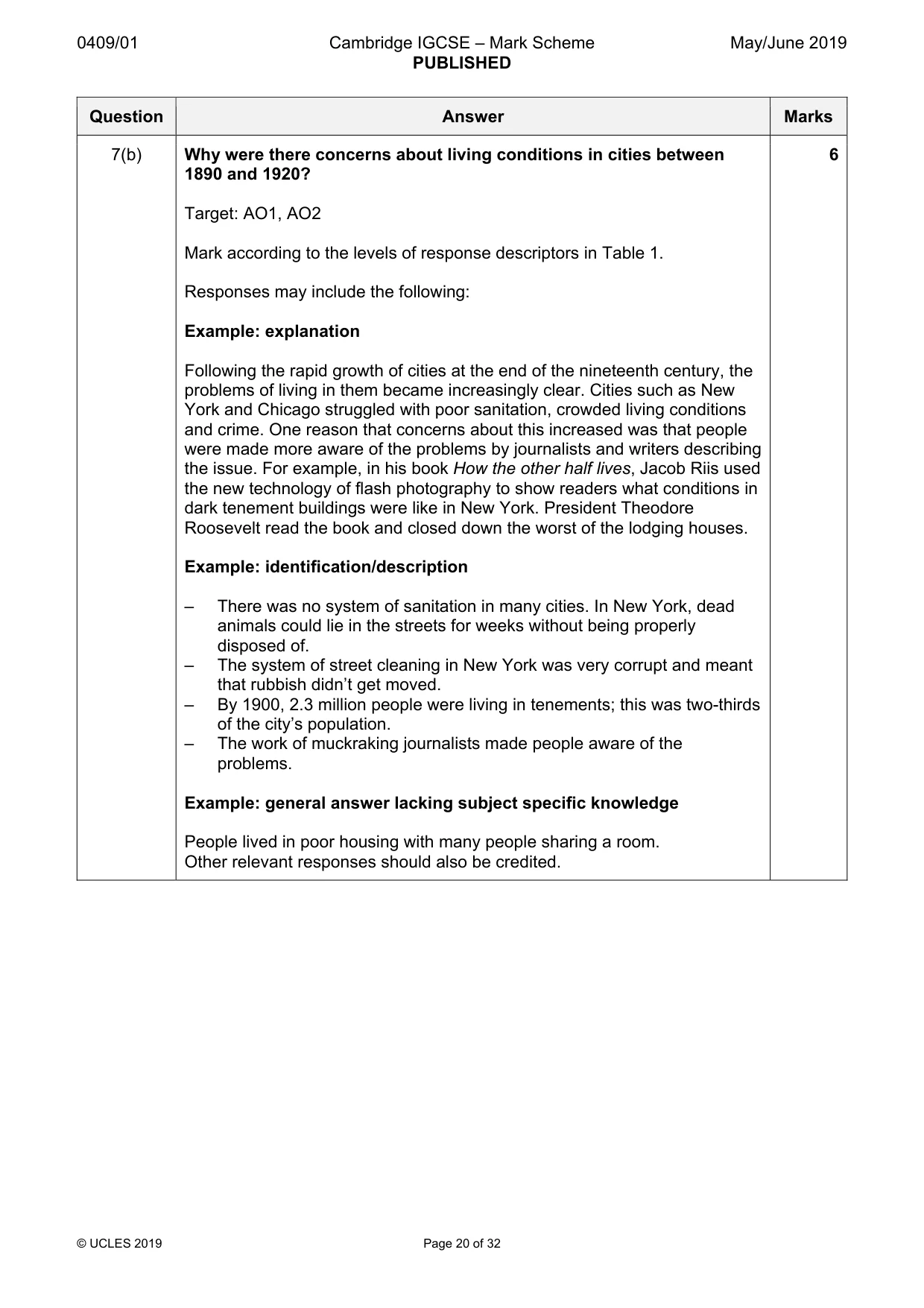
0409/01 Cambridge IGCSE – Mark Scheme PUBLISHED May/June 2019 © UCLES 2019 Page 20 of 32 Question Answer Marks 7(b) Why were there concerns about living conditions in cities between 1890 and 1920? Target: AO1, AO2 Mark according to the levels of response descriptors in Table 1. Responses may include the following: Example: explanation Following the rapid growth of cities at the end of the nineteenth century, the problems of living in them became increasingly clear. Cities such as New York and Chicago struggled with poor sanitation, crowded living conditions and crime. One reason that concerns about this increased was that people were made more aware of the problems by journalists and writers describing the issue. For example, in his book How the other half lives, Jacob Riis used the new technology of flash photography to show readers what conditions in dark tenement buildings were like in New York. President Theodore Roosevelt read the book and closed down the worst of the lodging houses. Example: identification/description – There was no system of sanitation in many cities. In New York, dead animals could lie in the streets for weeks without being properly disposed of. – The system of street cleaning in New York was very corrupt and meant that rubbish didn’t get moved. – By 1900, 2.3 million people were living in tenements; this was two-thirds of the city’s population. – The work of muckraking journalists made people aware of the problems. Example: general answer lacking subject specific knowledge People lived in poor housing with many people sharing a room. Other relevant responses should also be credited. 6
Mark scheme, page 21
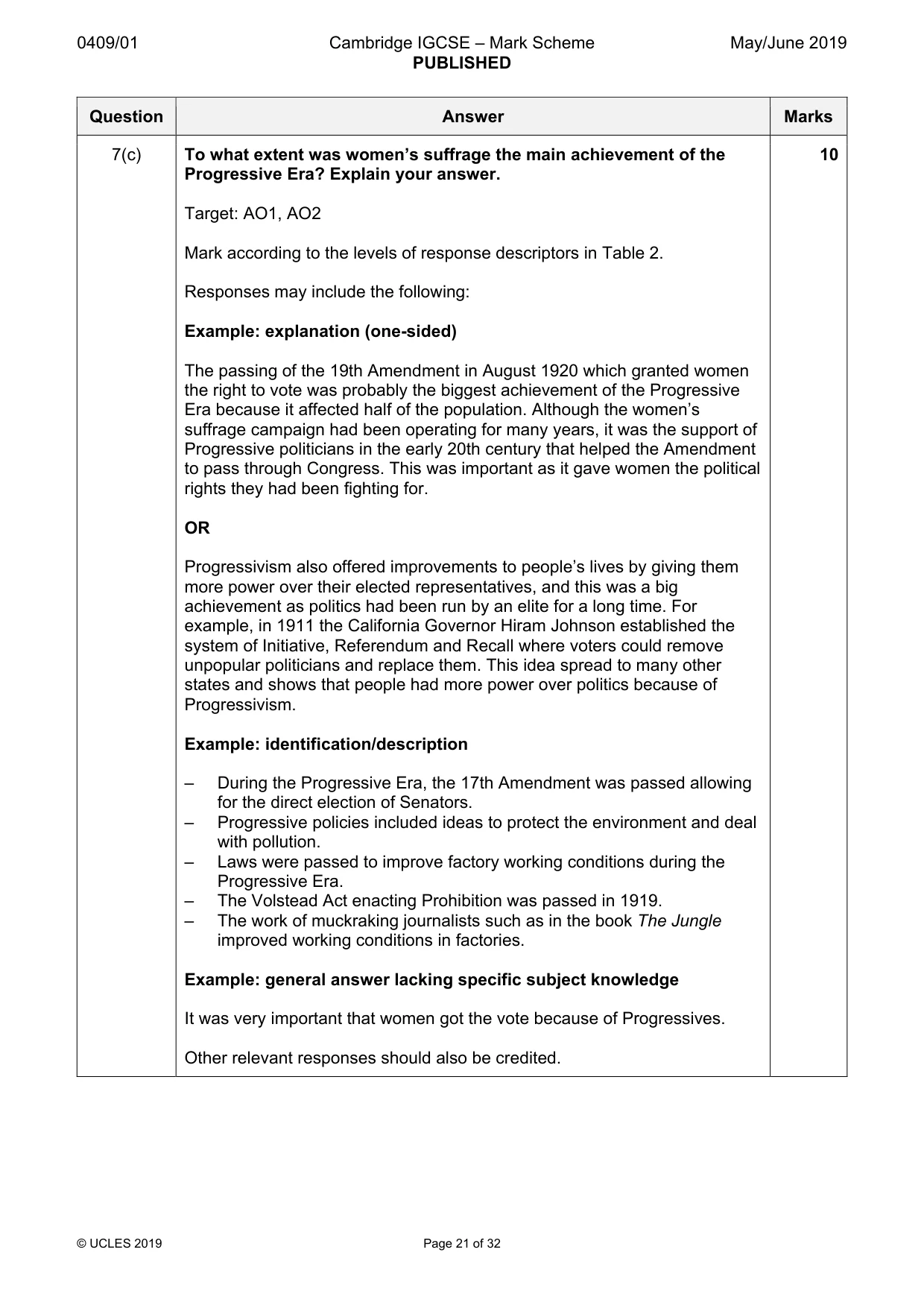
0409/01 Cambridge IGCSE – Mark Scheme PUBLISHED May/June 2019 © UCLES 2019 Page 21 of 32 Question Answer Marks 7(c) To what extent was women’s suffrage the main achievement of the Progressive Era? Explain your answer. Target: AO1, AO2 Mark according to the levels of response descriptors in Table 2. Responses may include the following: Example: explanation (one-sided) The passing of the 19th Amendment in August 1920 which granted women the right to vote was probably the biggest achievement of the Progressive Era because it affected half of the population. Although the women’s suffrage campaign had been operating for many years, it was the support of Progressive politicians in the early 20th century that helped the Amendment to pass through Congress. This was important as it gave women the political rights they had been fighting for. OR Progressivism also offered improvements to people’s lives by giving them more power over their elected representatives, and this was a big achievement as politics had been run by an elite for a long time. For example, in 1911 the California Governor Hiram Johnson established the system of Initiative, Referendum and Recall where voters could remove unpopular politicians and replace them. This idea spread to many other states and shows that people had more power over politics because of Progressivism. Example: identification/description – During the Progressive Era, the 17th Amendment was passed allowing for the direct election of Senators. – Progressive policies included ideas to protect the environment and deal with pollution. – Laws were passed to improve factory working conditions during the Progressive Era. – The Volstead Act enacting Prohibition was passed in 1919. – The work of muckraking journalists such as in the book The Jungle improved working conditions in factories. Example: general answer lacking specific subject knowledge It was very important that women got the vote because of Progressives. Other relevant responses should also be credited. 10
Mark scheme, page 22
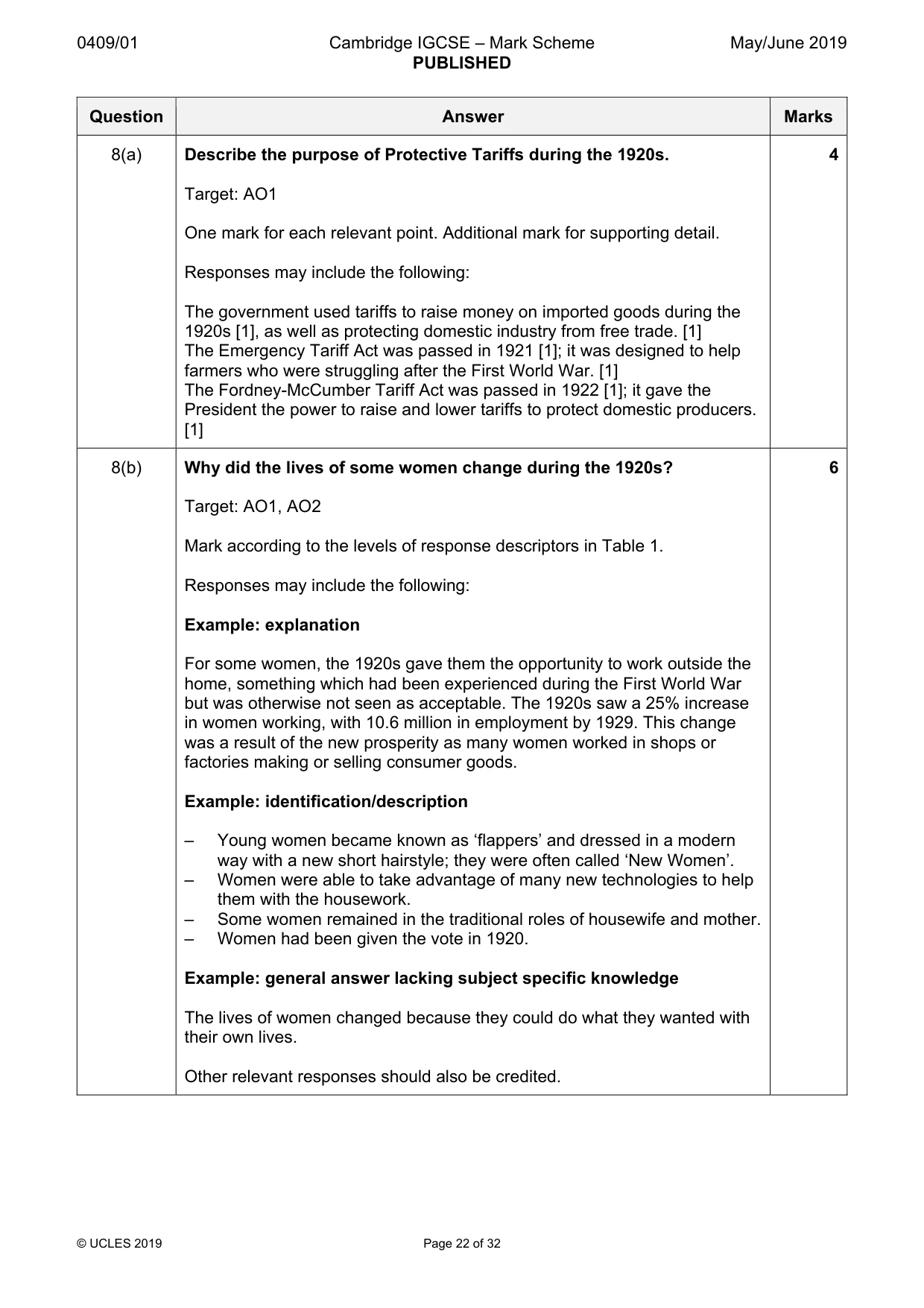
0409/01 Cambridge IGCSE – Mark Scheme PUBLISHED May/June 2019 © UCLES 2019 Page 22 of 32 Question Answer Marks 8(a) Describe the purpose of Protective Tariffs during the 1920s. Target: AO1 One mark for each relevant point. Additional mark for supporting detail. Responses may include the following: The government used tariffs to raise money on imported goods during the 1920s [1], as well as protecting domestic industry from free trade. [1] The Emergency Tariff Act was passed in 1921 [1]; it was designed to help farmers who were struggling after the First World War. [1] The Fordney-McCumber Tariff Act was passed in 1922 [1]; it gave the President the power to raise and lower tariffs to protect domestic producers. [1] 4 8(b) Why did the lives of some women change during the 1920s? Target: AO1, AO2 Mark according to the levels of response descriptors in Table 1. Responses may include the following: Example: explanation For some women, the 1920s gave them the opportunity to work outside the home, something which had been experienced during the First World War but was otherwise not seen as acceptable. The 1920s saw a 25% increase in women working, with 10.6 million in employment by 1929. This change was a result of the new prosperity as many women worked in shops or factories making or selling consumer goods. Example: identification/description – Young women became known as ‘flappers’ and dressed in a modern way with a new short hairstyle; they were often called ‘New Women’. – Women were able to take advantage of many new technologies to help them with the housework. – Some women remained in the traditional roles of housewife and mother. – Women had been given the vote in 1920. Example: general answer lacking subject specific knowledge The lives of women changed because they could do what they wanted with their own lives. Other relevant responses should also be credited. 6
Mark scheme, page 23
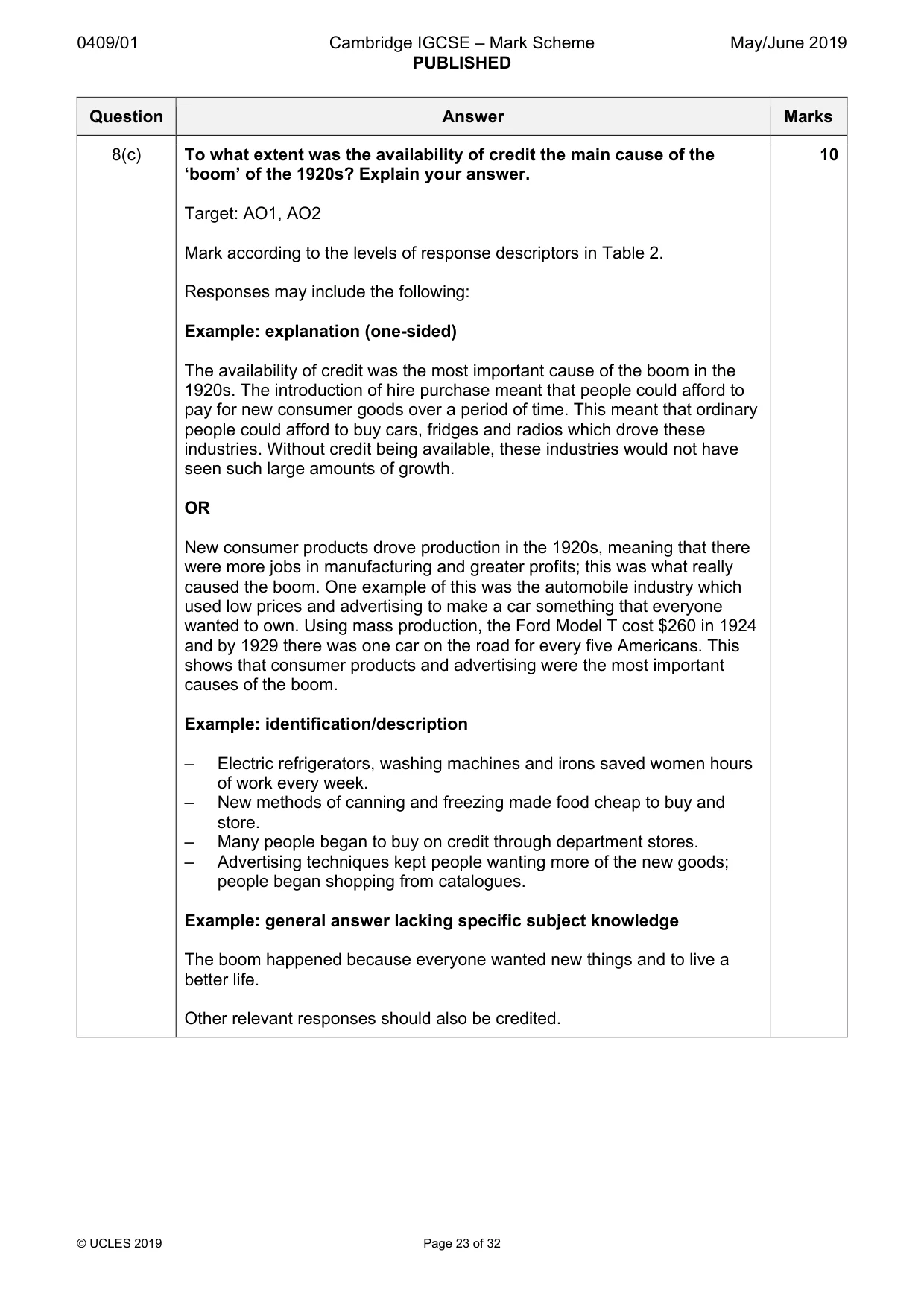
0409/01 Cambridge IGCSE – Mark Scheme PUBLISHED May/June 2019 © UCLES 2019 Page 23 of 32 Question Answer Marks 8(c) To what extent was the availability of credit the main cause of the ‘boom’ of the 1920s? Explain your answer. Target: AO1, AO2 Mark according to the levels of response descriptors in Table 2. Responses may include the following: Example: explanation (one-sided) The availability of credit was the most important cause of the boom in the 1920s. The introduction of hire purchase meant that people could afford to pay for new consumer goods over a period of time. This meant that ordinary people could afford to buy cars, fridges and radios which drove these industries. Without credit being available, these industries would not have seen such large amounts of growth. OR New consumer products drove production in the 1920s, meaning that there were more jobs in manufacturing and greater profits; this was what really caused the boom. One example of this was the automobile industry which used low prices and advertising to make a car something that everyone wanted to own. Using mass production, the Ford Model T cost $260 in 1924 and by 1929 there was one car on the road for every five Americans. This shows that consumer products and advertising were the most important causes of the boom. Example: identification/description – Electric refrigerators, washing machines and irons saved women hours of work every week. – New methods of canning and freezing made food cheap to buy and store. – Many people began to buy on credit through department stores. – Advertising techniques kept people wanting more of the new goods; people began shopping from catalogues. Example: general answer lacking specific subject knowledge The boom happened because everyone wanted new things and to live a better life. Other relevant responses should also be credited. 10
Mark scheme, page 24
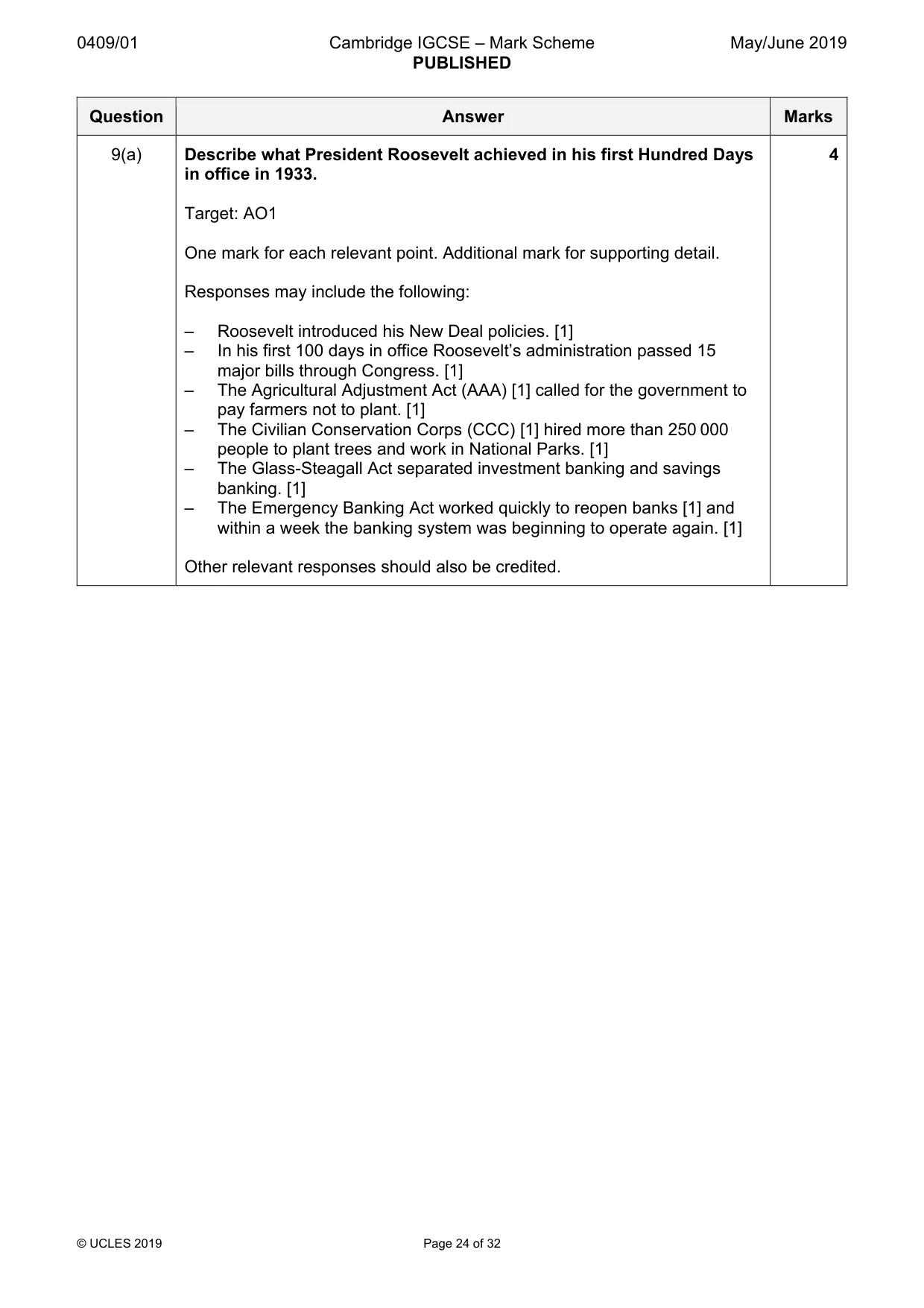
0409/01 Cambridge IGCSE – Mark Scheme PUBLISHED May/June 2019 © UCLES 2019 Page 24 of 32 Question Answer Marks 9(a) Describe what President Roosevelt achieved in his first Hundred Days in office in 1933. Target: AO1 One mark for each relevant point. Additional mark for supporting detail. Responses may include the following: – Roosevelt introduced his New Deal policies. [1] – In his first 100 days in office Roosevelt’s administration passed 15 major bills through Congress. [1] – The Agricultural Adjustment Act (AAA) [1] called for the government to pay farmers not to plant. [1] – The Civilian Conservation Corps (CCC) [1] hired more than 250 000 people to plant trees and work in National Parks. [1] – The Glass-Steagall Act separated investment banking and savings banking. [1] – The Emergency Banking Act worked quickly to reopen banks [1] and within a week the banking system was beginning to operate again. [1] Other relevant responses should also be credited. 4
Mark scheme, page 25
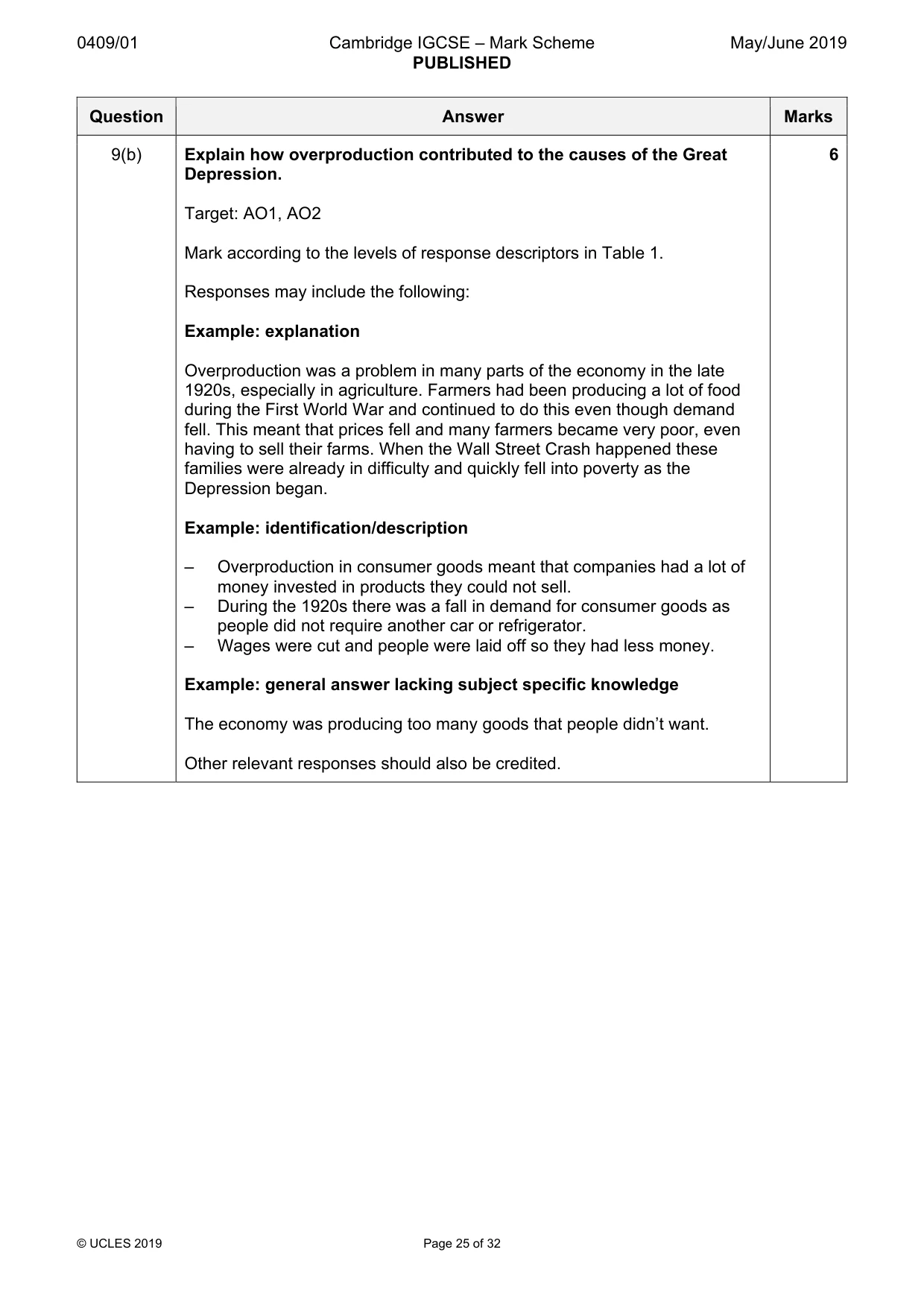
0409/01 Cambridge IGCSE – Mark Scheme PUBLISHED May/June 2019 © UCLES 2019 Page 25 of 32 Question Answer Marks 9(b) Explain how overproduction contributed to the causes of the Great Depression. Target: AO1, AO2 Mark according to the levels of response descriptors in Table 1. Responses may include the following: Example: explanation Overproduction was a problem in many parts of the economy in the late 1920s, especially in agriculture. Farmers had been producing a lot of food during the First World War and continued to do this even though demand fell. This meant that prices fell and many farmers became very poor, even having to sell their farms. When the Wall Street Crash happened these families were already in difficulty and quickly fell into poverty as the Depression began. Example: identification/description – Overproduction in consumer goods meant that companies had a lot of money invested in products they could not sell. – During the 1920s there was a fall in demand for consumer goods as people did not require another car or refrigerator. – Wages were cut and people were laid off so they had less money. Example: general answer lacking subject specific knowledge The economy was producing too many goods that people didn’t want. Other relevant responses should also be credited. 6
Mark scheme, page 26
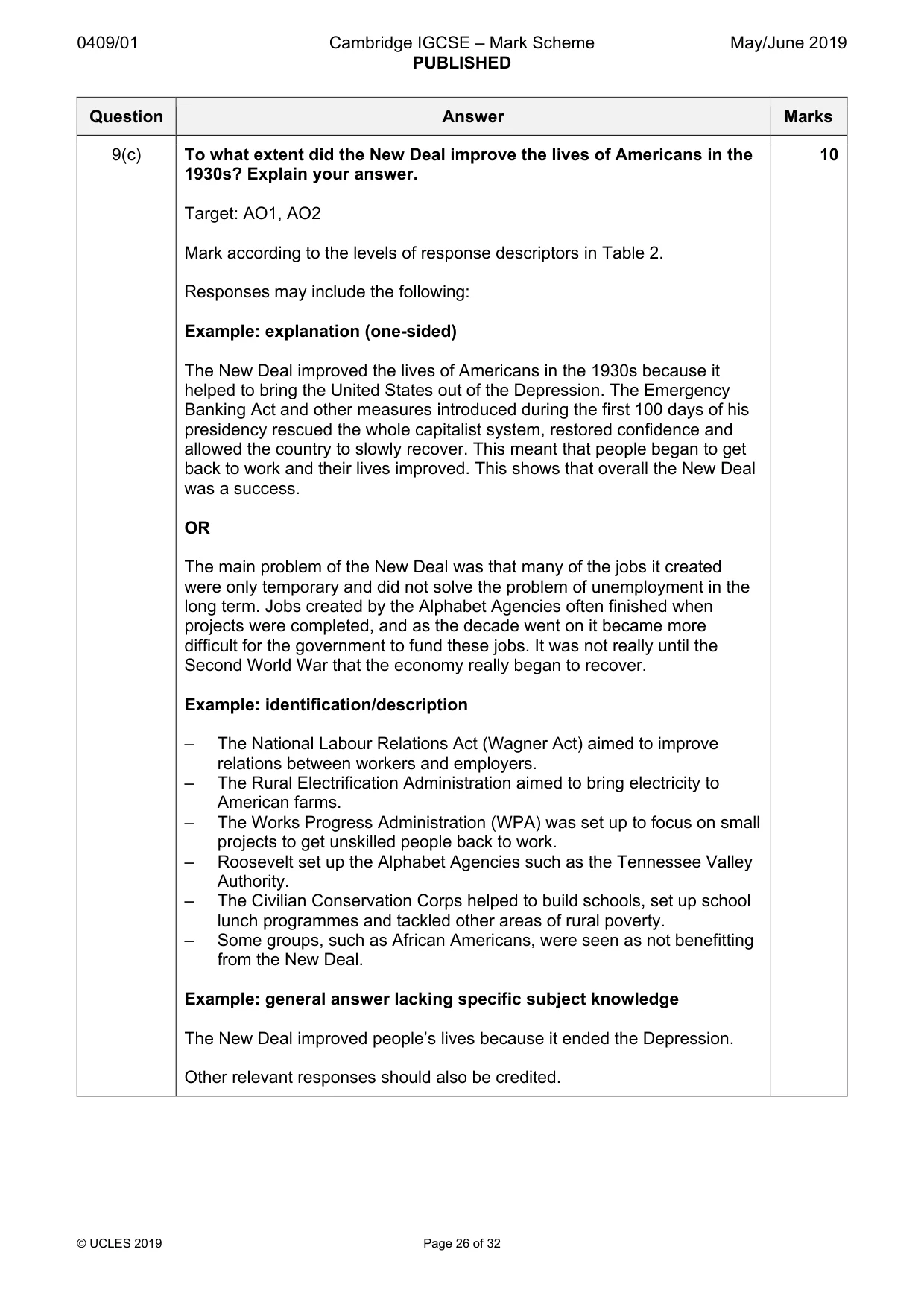
0409/01 Cambridge IGCSE – Mark Scheme PUBLISHED May/June 2019 © UCLES 2019 Page 26 of 32 Question Answer Marks 9(c) To what extent did the New Deal improve the lives of Americans in the 1930s? Explain your answer. Target: AO1, AO2 Mark according to the levels of response descriptors in Table 2. Responses may include the following: Example: explanation (one-sided) The New Deal improved the lives of Americans in the 1930s because it helped to bring the United States out of the Depression. The Emergency Banking Act and other measures introduced during the first 100 days of his presidency rescued the whole capitalist system, restored confidence and allowed the country to slowly recover. This meant that people began to get back to work and their lives improved. This shows that overall the New Deal was a success. OR The main problem of the New Deal was that many of the jobs it created were only temporary and did not solve the problem of unemployment in the long term. Jobs created by the Alphabet Agencies often finished when projects were completed, and as the decade went on it became more difficult for the government to fund these jobs. It was not really until the Second World War that the economy really began to recover. Example: identification/description – The National Labour Relations Act (Wagner Act) aimed to improve relations between workers and employers. – The Rural Electrification Administration aimed to bring electricity to American farms. – The Works Progress Administration (WPA) was set up to focus on small projects to get unskilled people back to work. – Roosevelt set up the Alphabet Agencies such as the Tennessee Valley Authority. – The Civilian Conservation Corps helped to build schools, set up school lunch programmes and tackled other areas of rural poverty. – Some groups, such as African Americans, were seen as not benefitting from the New Deal. Example: general answer lacking specific subject knowledge The New Deal improved people’s lives because it ended the Depression. Other relevant responses should also be credited. 10
Mark scheme, page 27
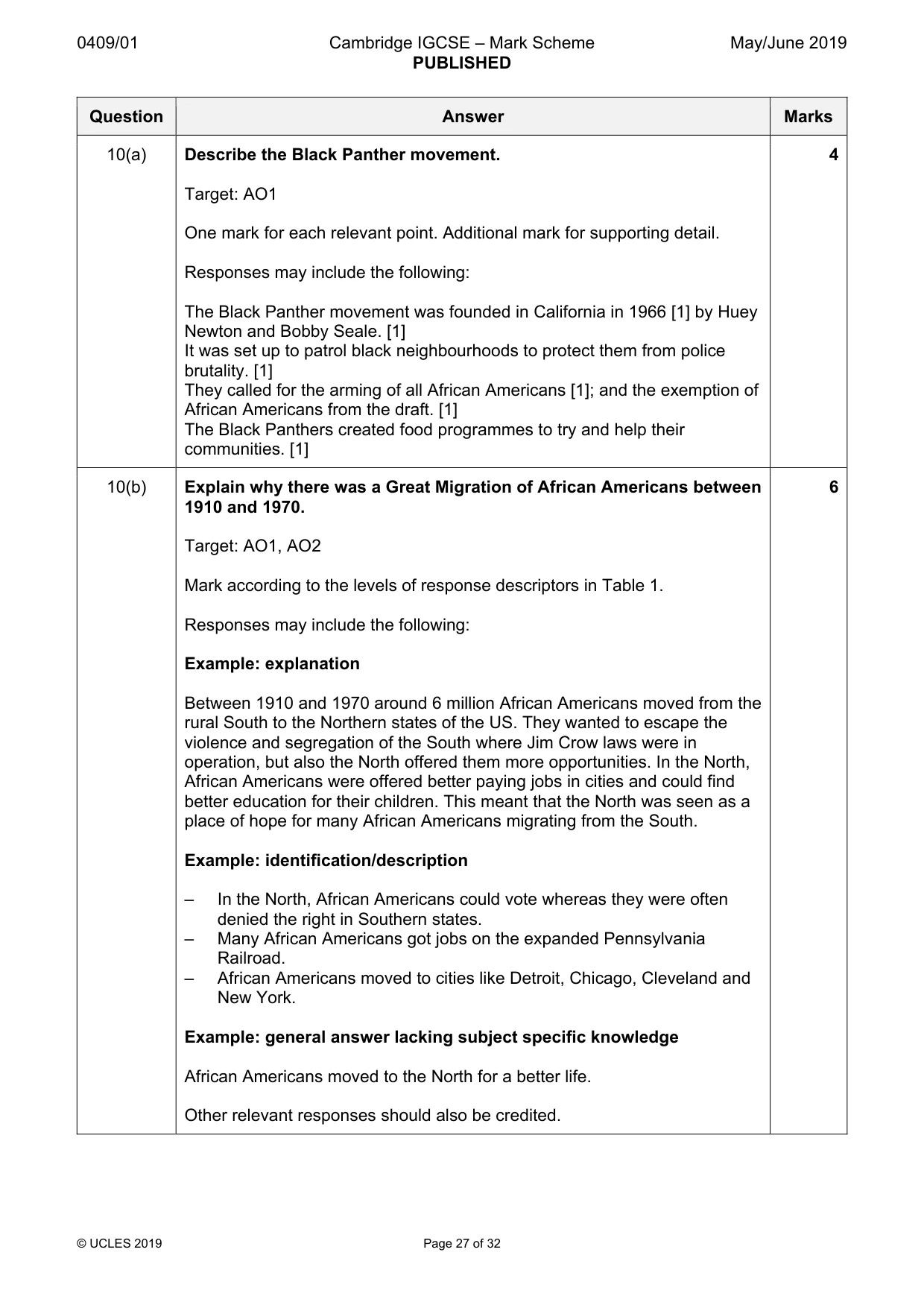
0409/01 Cambridge IGCSE – Mark Scheme PUBLISHED May/June 2019 © UCLES 2019 Page 27 of 32 Question Answer Marks 10(a) Describe the Black Panther movement. Target: AO1 One mark for each relevant point. Additional mark for supporting detail. Responses may include the following: The Black Panther movement was founded in California in 1966 [1] by Huey Newton and Bobby Seale. [1] It was set up to patrol black neighbourhoods to protect them from police brutality. [1] They called for the arming of all African Americans [1]; and the exemption of African Americans from the draft. [1] The Black Panthers created food programmes to try and help their communities. [1] 4 10(b) Explain why there was a Great Migration of African Americans between 1910 and 1970. Target: AO1, AO2 Mark according to the levels of response descriptors in Table 1. Responses may include the following: Example: explanation Between 1910 and 1970 around 6 million African Americans moved from the rural South to the Northern states of the US. They wanted to escape the violence and segregation of the South where Jim Crow laws were in operation, but also the North offered them more opportunities. In the North, African Americans were offered better paying jobs in cities and could find better education for their children. This meant that the North was seen as a place of hope for many African Americans migrating from the South. Example: identification/description – In the North, African Americans could vote whereas they were often denied the right in Southern states. – Many African Americans got jobs on the expanded Pennsylvania Railroad. – African Americans moved to cities like Detroit, Chicago, Cleveland and New York. Example: general answer lacking subject specific knowledge African Americans moved to the North for a better life. Other relevant responses should also be credited. 6
Mark scheme, page 28
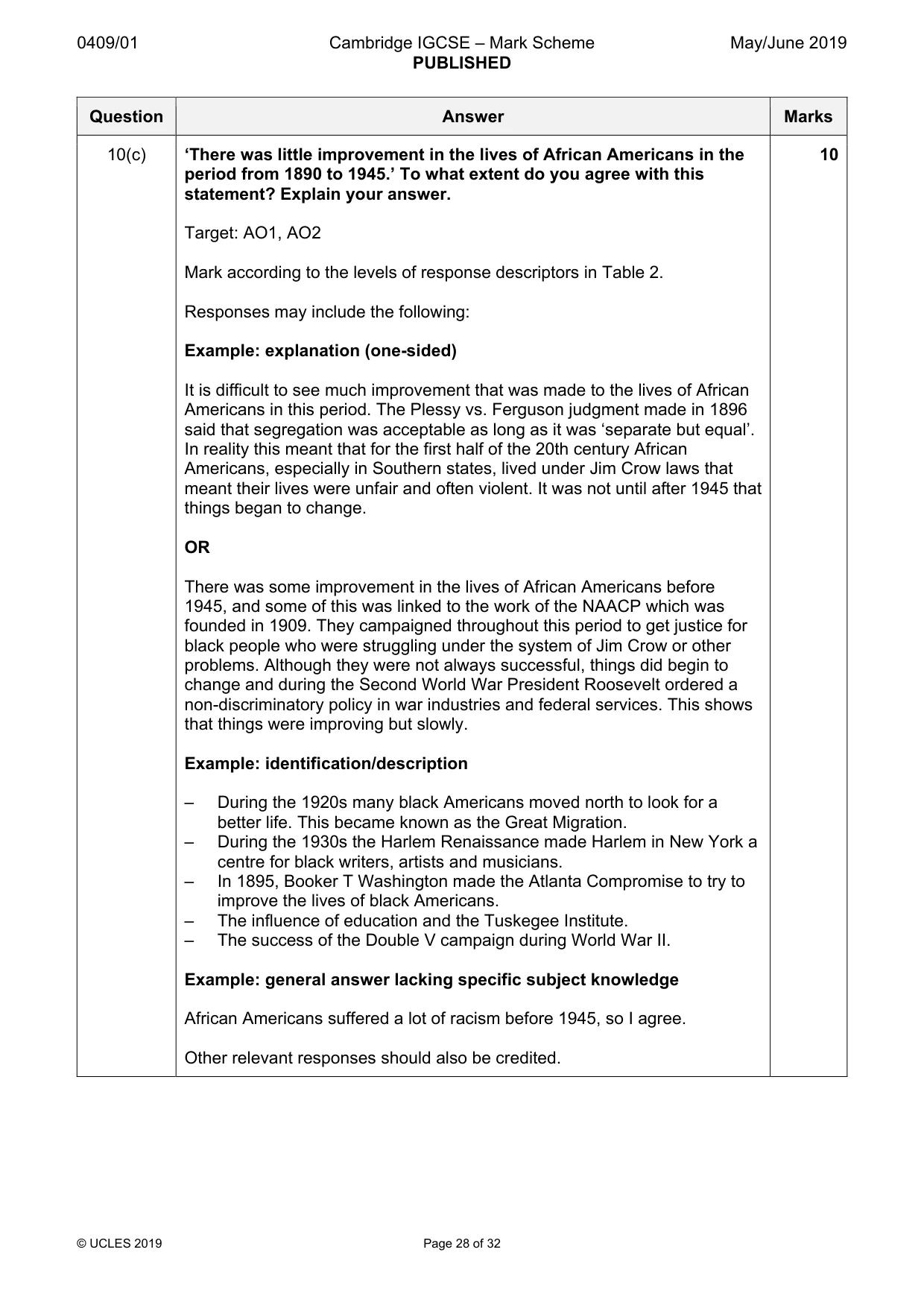
0409/01 Cambridge IGCSE – Mark Scheme PUBLISHED May/June 2019 © UCLES 2019 Page 28 of 32 Question Answer Marks 10(c) ‘There was little improvement in the lives of African Americans in the period from 1890 to 1945.’ To what extent do you agree with this statement? Explain your answer. Target: AO1, AO2 Mark according to the levels of response descriptors in Table 2. Responses may include the following: Example: explanation (one-sided) It is difficult to see much improvement that was made to the lives of African Americans in this period. The Plessy vs. Ferguson judgment made in 1896 said that segregation was acceptable as long as it was ‘separate but equal’. In reality this meant that for the first half of the 20th century African Americans, especially in Southern states, lived under Jim Crow laws that meant their lives were unfair and often violent. It was not until after 1945 that things began to change. OR There was some improvement in the lives of African Americans before 1945, and some of this was linked to the work of the NAACP which was founded in 1909. They campaigned throughout this period to get justice for black people who were struggling under the system of Jim Crow or other problems. Although they were not always successful, things did begin to change and during the Second World War President Roosevelt ordered a non-discriminatory policy in war industries and federal services. This shows that things were improving but slowly. Example: identification/description – During the 1920s many black Americans moved north to look for a better life. This became known as the Great Migration. – During the 1930s the Harlem Renaissance made Harlem in New York a centre for black writers, artists and musicians. – In 1895, Booker T Washington made the Atlanta Compromise to try to improve the lives of black Americans. – The influence of education and the Tuskegee Institute. – The success of the Double V campaign during World War II. Example: general answer lacking specific subject knowledge African Americans suffered a lot of racism before 1945, so I agree. Other relevant responses should also be credited. 10
Mark scheme, page 29
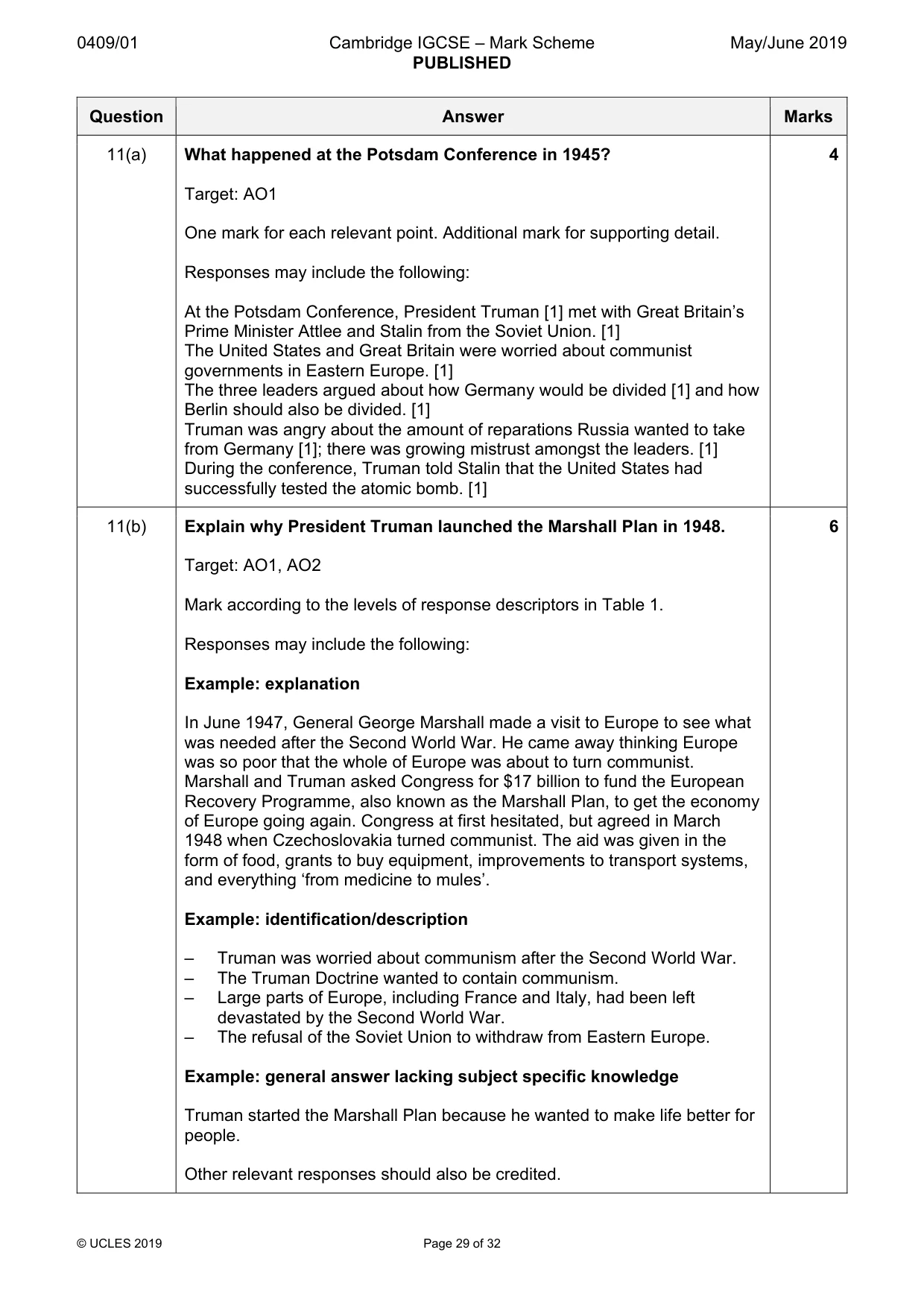
0409/01 Cambridge IGCSE – Mark Scheme PUBLISHED May/June 2019 © UCLES 2019 Page 29 of 32 Question Answer Marks 11(a) What happened at the Potsdam Conference in 1945? Target: AO1 One mark for each relevant point. Additional mark for supporting detail. Responses may include the following: At the Potsdam Conference, President Truman [1] met with Great Britain’s Prime Minister Attlee and Stalin from the Soviet Union. [1] The United States and Great Britain were worried about communist governments in Eastern Europe. [1] The three leaders argued about how Germany would be divided [1] and how Berlin should also be divided. [1] Truman was angry about the amount of reparations Russia wanted to take from Germany [1]; there was growing mistrust amongst the leaders. [1] During the conference, Truman told Stalin that the United States had successfully tested the atomic bomb. [1] 4 11(b) Explain why President Truman launched the Marshall Plan in 1948. Target: AO1, AO2 Mark according to the levels of response descriptors in Table 1. Responses may include the following: Example: explanation In June 1947, General George Marshall made a visit to Europe to see what was needed after the Second World War. He came away thinking Europe was so poor that the whole of Europe was about to turn communist. Marshall and Truman asked Congress for $17 billion to fund the European Recovery Programme, also known as the Marshall Plan, to get the economy of Europe going again. Congress at first hesitated, but agreed in March 1948 when Czechoslovakia turned communist. The aid was given in the form of food, grants to buy equipment, improvements to transport systems, and everything ‘from medicine to mules’. Example: identification/description – Truman was worried about communism after the Second World War. – The Truman Doctrine wanted to contain communism. – Large parts of Europe, including France and Italy, had been left devastated by the Second World War. – The refusal of the Soviet Union to withdraw from Eastern Europe. Example: general answer lacking subject specific knowledge Truman started the Marshall Plan because he wanted to make life better for people. Other relevant responses should also be credited. 6
Mark scheme, page 30
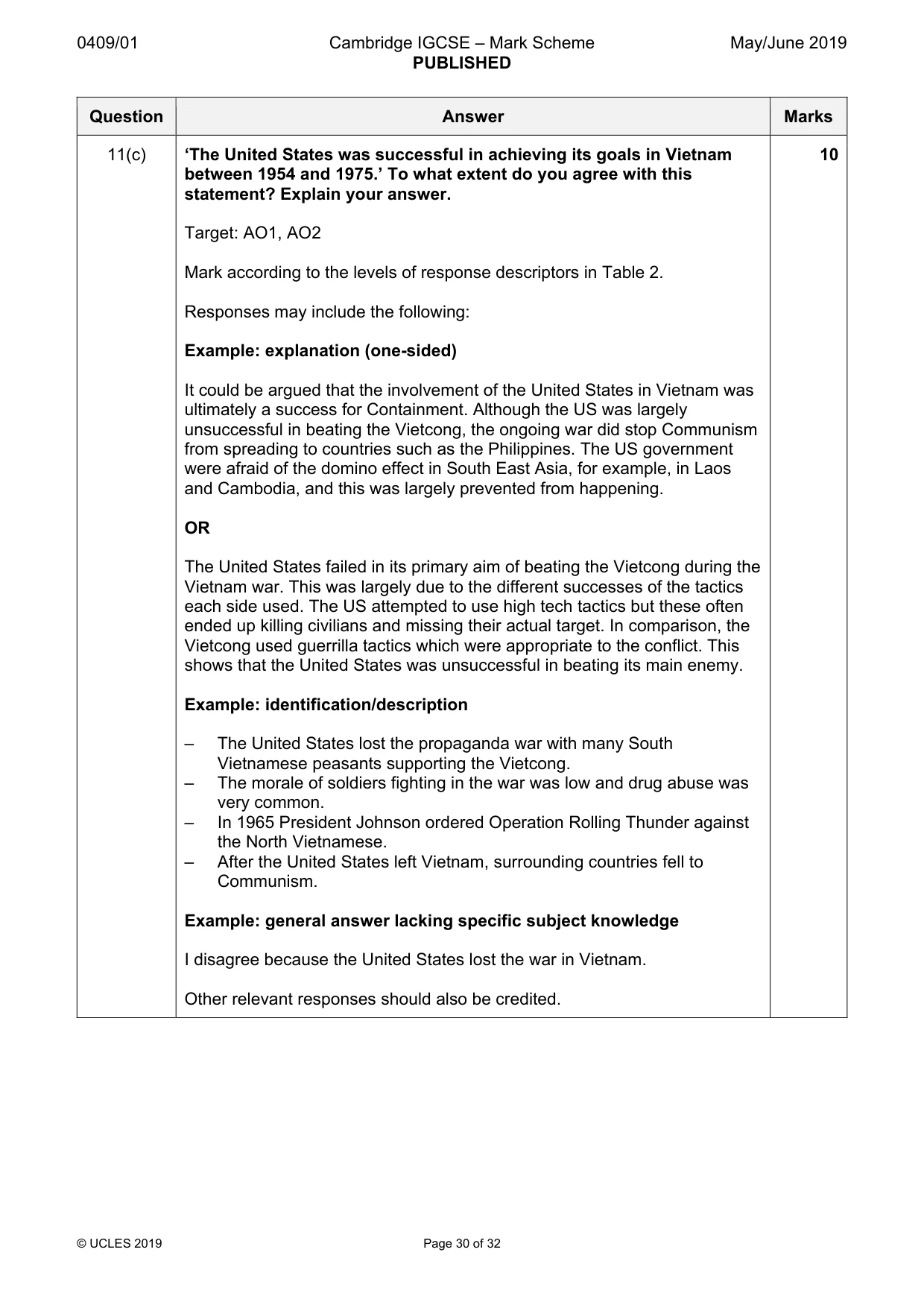
0409/01 Cambridge IGCSE – Mark Scheme PUBLISHED May/June 2019 © UCLES 2019 Page 30 of 32 Question Answer Marks 11(c) ‘The United States was successful in achieving its goals in Vietnam between 1954 and 1975.’ To what extent do you agree with this statement? Explain your answer. Target: AO1, AO2 Mark according to the levels of response descriptors in Table 2. Responses may include the following: Example: explanation (one-sided) It could be argued that the involvement of the United States in Vietnam was ultimately a success for Containment. Although the US was largely unsuccessful in beating the Vietcong, the ongoing war did stop Communism from spreading to countries such as the Philippines. The US government were afraid of the domino effect in South East Asia, for example, in Laos and Cambodia, and this was largely prevented from happening. OR The United States failed in its primary aim of beating the Vietcong during the Vietnam war. This was largely due to the different successes of the tactics each side used. The US attempted to use high tech tactics but these often ended up killing civilians and missing their actual target. In comparison, the Vietcong used guerrilla tactics which were appropriate to the conflict. This shows that the United States was unsuccessful in beating its main enemy. Example: identification/description – The United States lost the propaganda war with many South Vietnamese peasants supporting the Vietcong. – The morale of soldiers fighting in the war was low and drug abuse was very common. – In 1965 President Johnson ordered Operation Rolling Thunder against the North Vietnamese. – After the United States left Vietnam, surrounding countries fell to Communism. Example: general answer lacking specific subject knowledge I disagree because the United States lost the war in Vietnam. Other relevant responses should also be credited. 10
Mark scheme, page 31
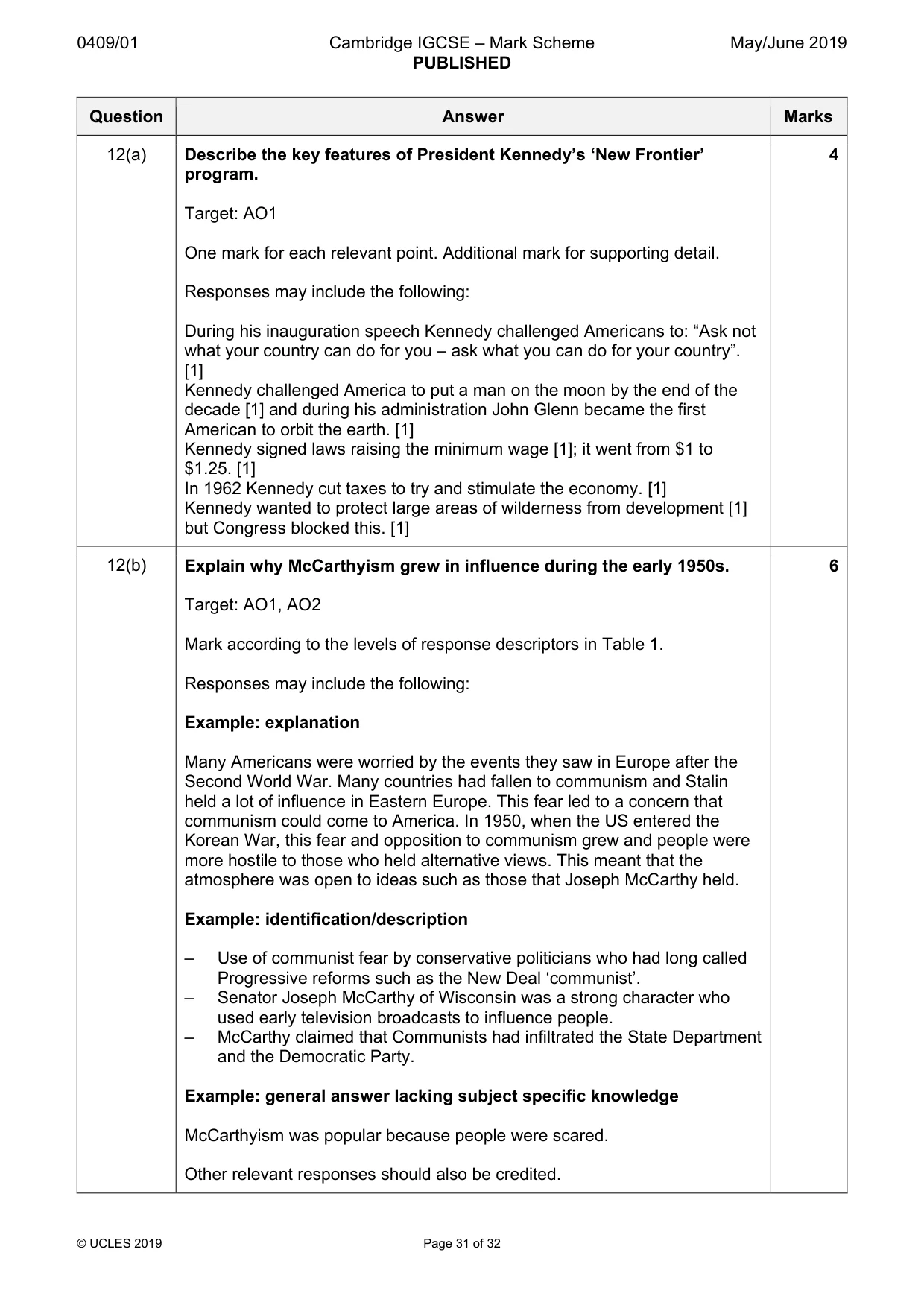
0409/01 Cambridge IGCSE – Mark Scheme PUBLISHED May/June 2019 © UCLES 2019 Page 31 of 32 Question Answer Marks 12(a) Describe the key features of President Kennedy’s ‘New Frontier’ program. Target: AO1 One mark for each relevant point. Additional mark for supporting detail. Responses may include the following: During his inauguration speech Kennedy challenged Americans to: “Ask not what your country can do for you – ask what you can do for your country”. [1] Kennedy challenged America to put a man on the moon by the end of the decade [1] and during his administration John Glenn became the first American to orbit the earth. [1] Kennedy signed laws raising the minimum wage [1]; it went from $1 to $1.25. [1] In 1962 Kennedy cut taxes to try and stimulate the economy. [1] Kennedy wanted to protect large areas of wilderness from development [1] but Congress blocked this. [1] 4 12(b) Explain why McCarthyism grew in influence during the early 1950s. Target: AO1, AO2 Mark according to the levels of response descriptors in Table 1. Responses may include the following: Example: explanation Many Americans were worried by the events they saw in Europe after the Second World War. Many countries had fallen to communism and Stalin held a lot of influence in Eastern Europe. This fear led to a concern that communism could come to America. In 1950, when the US entered the Korean War, this fear and opposition to communism grew and people were more hostile to those who held alternative views. This meant that the atmosphere was open to ideas such as those that Joseph McCarthy held. Example: identification/description – Use of communist fear by conservative politicians who had long called Progressive reforms such as the New Deal ‘communist’. – Senator Joseph McCarthy of Wisconsin was a strong character who used early television broadcasts to influence people. – McCarthy claimed that Communists had infiltrated the State Department and the Democratic Party. Example: general answer lacking subject specific knowledge McCarthyism was popular because people were scared. Other relevant responses should also be credited. 6
Mark scheme, page 32
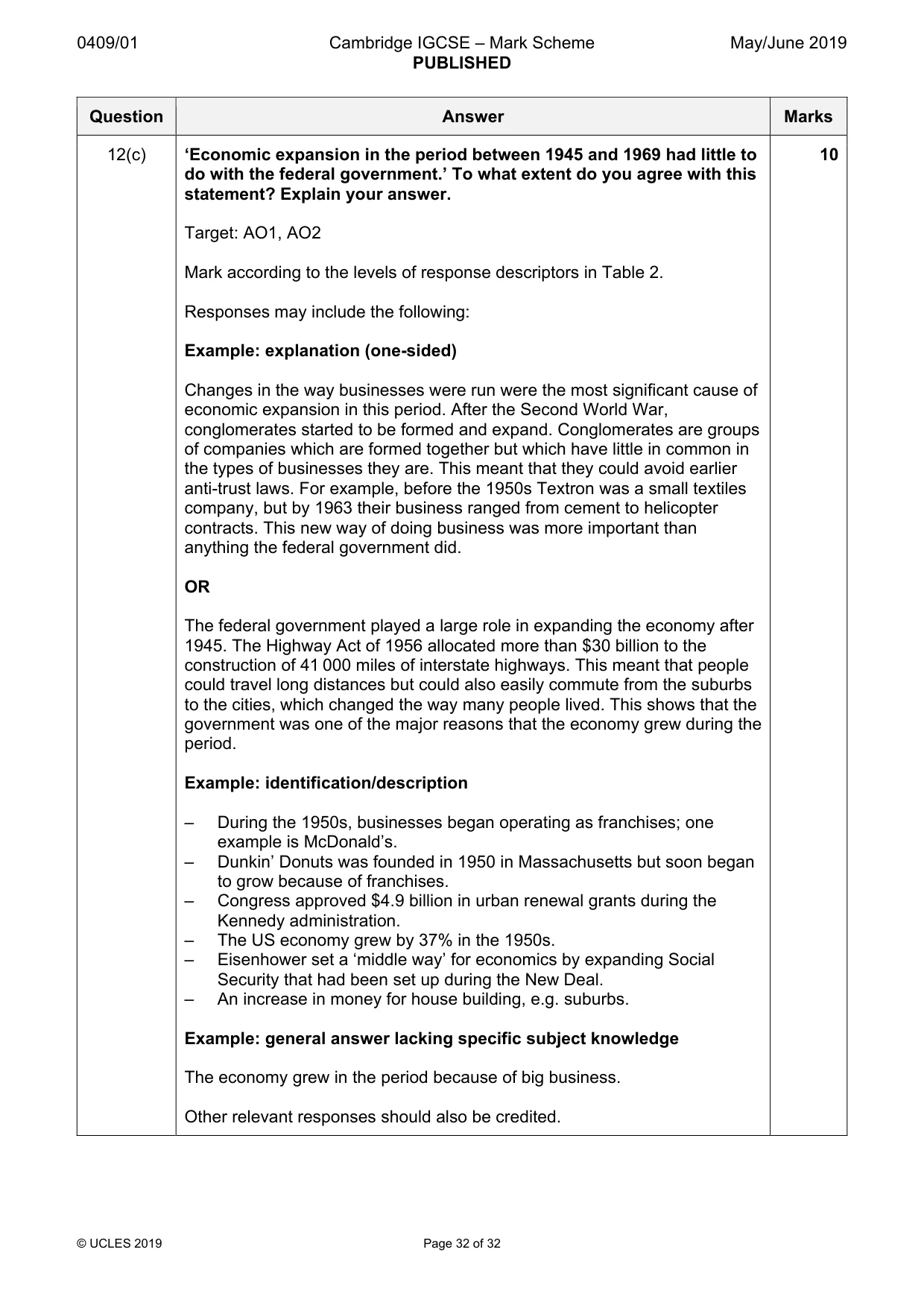
0409/01 Cambridge IGCSE – Mark Scheme PUBLISHED May/June 2019 © UCLES 2019 Page 32 of 32 Question Answer Marks 12(c) ‘Economic expansion in the period between 1945 and 1969 had little to do with the federal government.’ To what extent do you agree with this statement? Explain your answer. Target: AO1, AO2 Mark according to the levels of response descriptors in Table 2. Responses may include the following: Example: explanation (one-sided) Changes in the way businesses were run were the most significant cause of economic expansion in this period. After the Second World War, conglomerates started to be formed and expand. Conglomerates are groups of companies which are formed together but which have little in common in the types of businesses they are. This meant that they could avoid earlier anti-trust laws. For example, before the 1950s Textron was a small textiles company, but by 1963 their business ranged from cement to helicopter contracts. This new way of doing business was more important than anything the federal government did. OR The federal government played a large role in expanding the economy after 1945. The Highway Act of 1956 allocated more than $30 billion to the construction of 41 000 miles of interstate highways. This meant that people could travel long distances but could also easily commute from the suburbs to the cities, which changed the way many people lived. This shows that the government was one of the major reasons that the economy grew during the period. Example: identification/description – During the 1950s, businesses began operating as franchises; one example is McDonald’s. – Dunkin’ Donuts was founded in 1950 in Massachusetts but soon began to grow because of franchises. – Congress approved $4.9 billion in urban renewal grants during the Kennedy administration. – The US economy grew by 37% in the 1950s. – Eisenhower set a ‘middle way’ for economics by expanding Social Security that had been set up during the New Deal. – An increase in money for house building, e.g. suburbs. Example: general answer lacking specific subject knowledge The economy grew in the period because of big business. Other relevant responses should also be credited. 10
What you needed in this session
Cambridge’s own grade thresholds for 2019 May/June, Paper 1 · Variant 1. A higher threshold means an easier paper — the bar moves with how the cohort did.