Cambridge IGCSE History American BES 0409 — 2017 May/June Paper 1 · Variant 1
0409/11/M/J/17 · 60 marks · ≈68 min
The question paper and its mark scheme, free to read here and free to download. This is Cambridge’s own paper, exactly as it was sat.
Question paper4 pages
Mark scheme22 pages
Answers below. Sit the paper first if you are practising.
Paper as text
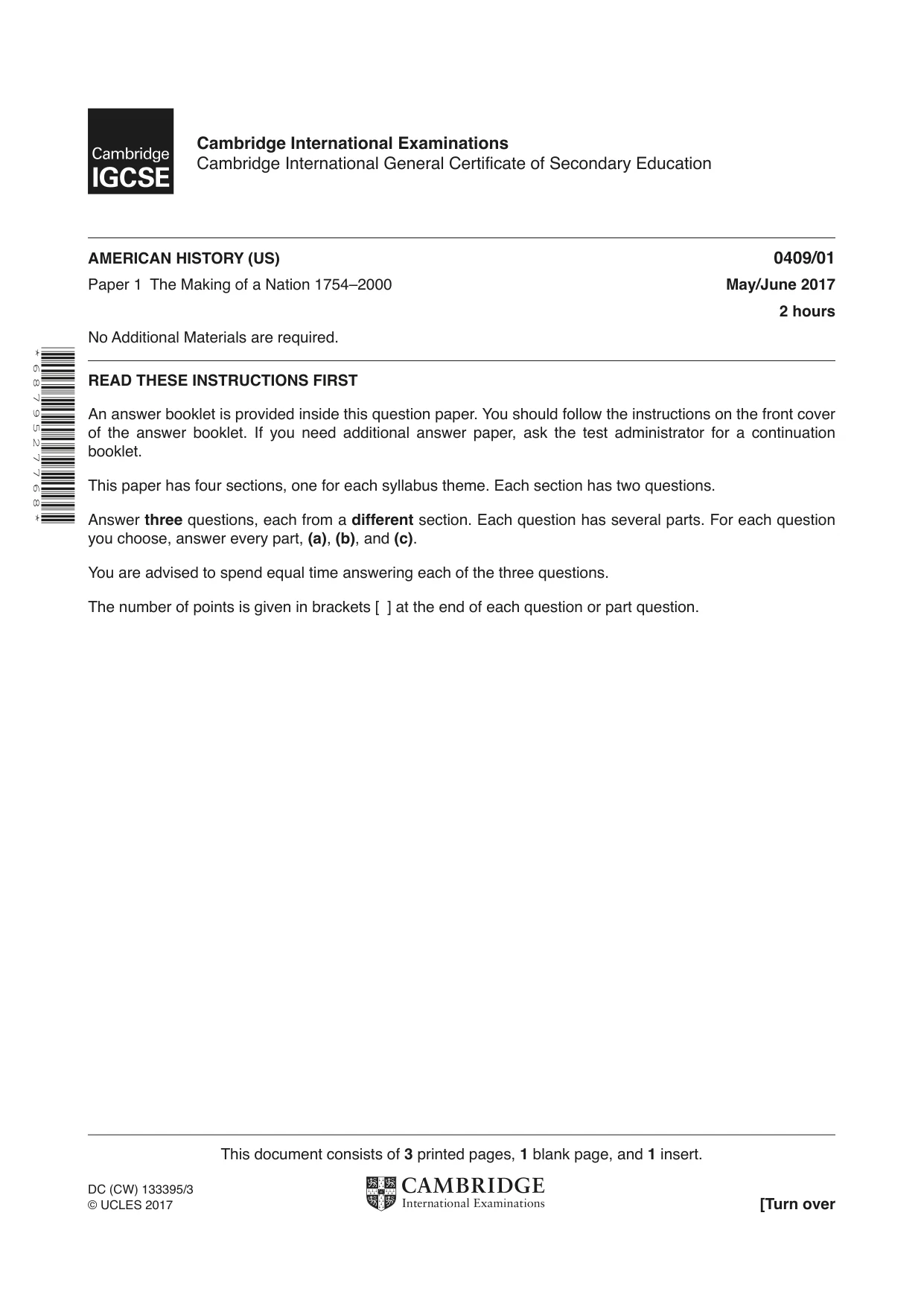
Question paper, page 1
* 6 8 7 9 5 2 7 7 6 8 * This document consists of 3 printed pages, 1 blank page, and 1 insert. DC (CW) 133395/3 © UCLES 2017 [Turn over Cambridge International Examinations Cambridge International General Certificate of Secondary Education AMERICAN HISTORY (US) 0409/01 Paper 1 The Making of a Nation 1754–2000 May/June 2017 2 hours No Additional Materials are required. READ THESE INSTRUCTIONS FIRST An answer booklet is provided inside this question paper. You should follow the instructions on the front cover of the answer booklet. If you need additional answer paper, ask the test administrator for a continuation booklet. This paper has four sections, one for each syllabus theme. Each section has two questions. Answer three questions, each from a different section. Each question has several parts. For each question you choose, answer every part, (a), (b), and (c). You are advised to spend equal time answering each of the three questions. The number of points is given in brackets [ ] at the end of each question or part question.
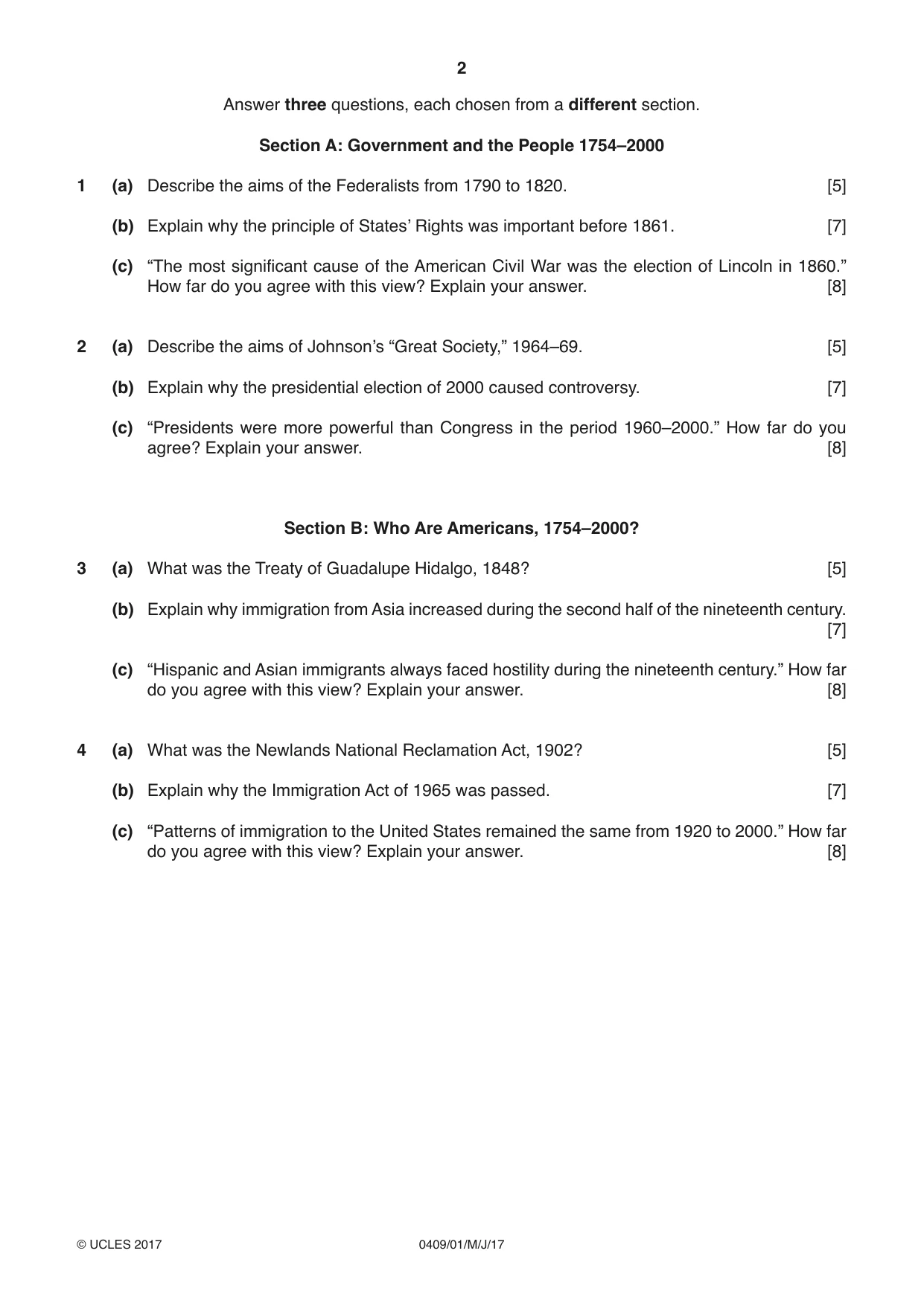
Question paper, page 2
2 0409/01/M/J/17 © UCLES 2017 Answer three questions, each chosen from a different section. Section A: Government and the People 1754–2000 1 (a) Describe the aims of the Federalists from 1790 to 1820. [5] (b) Explain why the principle of States’ Rights was important before 1861. [7] (c) “The most significant cause of the American Civil War was the election of Lincoln in 1860.” How far do you agree with this view? Explain your answer. [8] 2 (a) Describe the aims of Johnson’s “Great Society,” 1964–69. [5] (b) Explain why the presidential election of 2000 caused controversy. [7] (c) “Presidents were more powerful than Congress in the period 1960–2000.” How far do you agree? Explain your answer. [8] Section B: Who Are Americans, 1754–2000? 3 (a) What was the Treaty of Guadalupe Hidalgo, 1848? [5] (b) Explain why immigration from Asia increased during the second half of the nineteenth century. [7] (c) “Hispanic and Asian immigrants always faced hostility during the nineteenth century.” How far do you agree with this view? Explain your answer. [8] 4 (a) What was the Newlands National Reclamation Act, 1902? [5] (b) Explain why the Immigration Act of 1965 was passed. [7] (c) “Patterns of immigration to the United States remained the same from 1920 to 2000.” How far do you agree with this view? Explain your answer. [8]
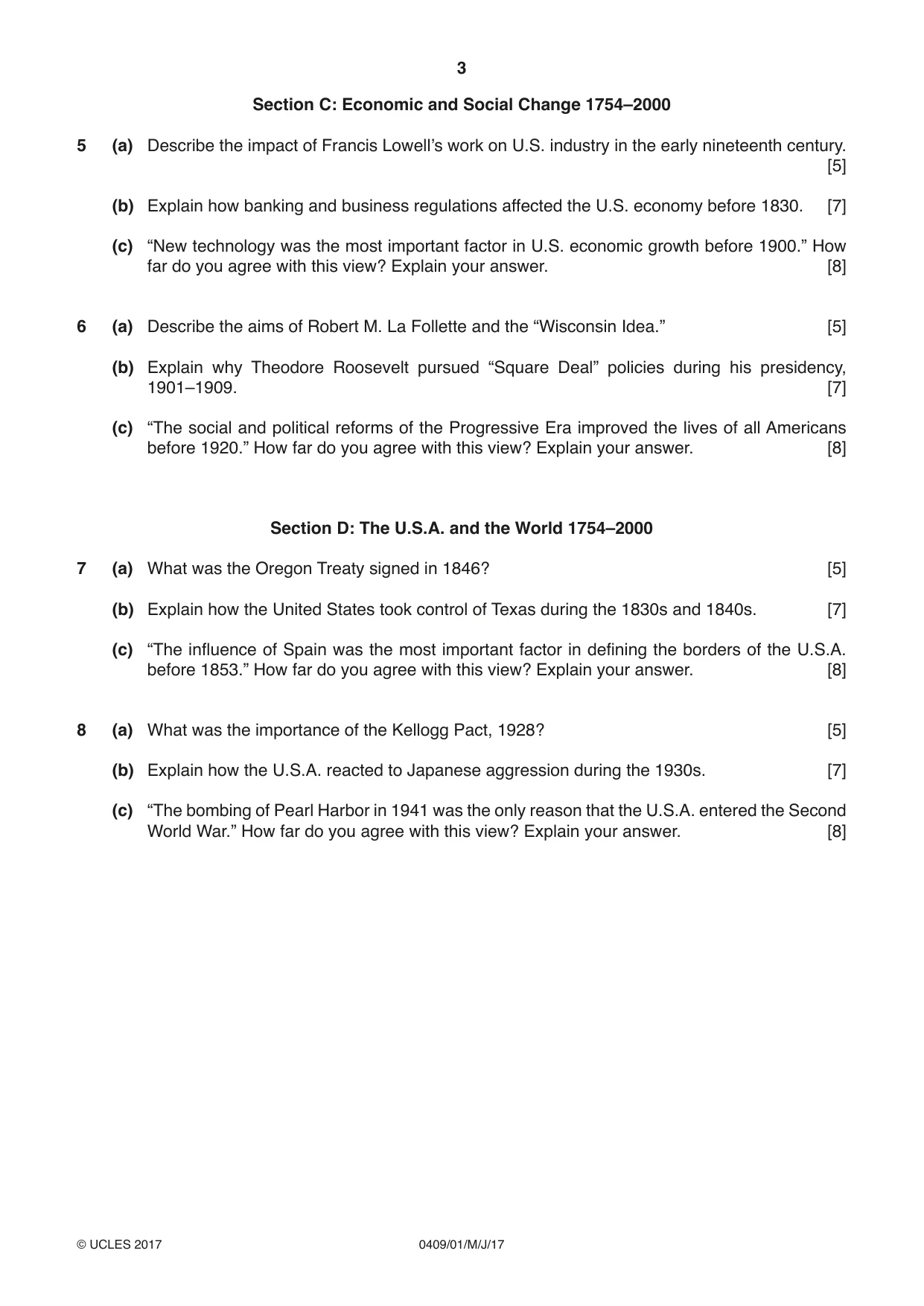
Question paper, page 3
3 0409/01/M/J/17 © UCLES 2017 Section C: Economic and Social Change 1754–2000 5 (a) Describe the impact of Francis Lowell’s work on U.S. industry in the early nineteenth century. [5] (b) Explain how banking and business regulations affected the U.S. economy before 1830. [7] (c) “New technology was the most important factor in U.S. economic growth before 1900.” How far do you agree with this view? Explain your answer. [8] 6 (a) Describe the aims of Robert M. La Follette and the “Wisconsin Idea.” [5] (b) Explain why Theodore Roosevelt pursued “Square Deal” policies during his presidency, 1901–1909. [7] (c) “The social and political reforms of the Progressive Era improved the lives of all Americans before 1920.” How far do you agree with this view? Explain your answer. [8] Section D: The U.S.A. and the World 1754–2000 7 (a) What was the Oregon Treaty signed in 1846? [5] (b) Explain how the United States took control of Texas during the 1830s and 1840s. [7] (c) “The influence of Spain was the most important factor in defining the borders of the U.S.A. before 1853.” How far do you agree with this view? Explain your answer. [8] 8 (a) What was the importance of the Kellogg Pact, 1928? [5] (b) Explain how the U.S.A. reacted to Japanese aggression during the 1930s. [7] (c) “The bombing of Pearl Harbor in 1941 was the only reason that the U.S.A. entered the Second World War.” How far do you agree with this view? Explain your answer. [8]
Question paper, page 4
4 0409/01/M/J/17 © UCLES 2017 Permission to reproduce items where third-party owned material protected by copyright is included has been sought and cleared where possible. Every reasonable effort has been made by the publisher (UCLES) to trace copyright holders, but if any items requiring clearance have unwittingly been included, the publisher will be pleased to make amends at the earliest possible opportunity. To avoid the issue of disclosure of answer-related information to candidates, all copyright acknowledgements are reproduced online in the Cambridge International Examinations Copyright Acknowledgements Booklet. This is produced for each series of examinations and is freely available to download at www.cie.org.uk after the live examination series. Cambridge International Examinations is part of the Cambridge Assessment Group. Cambridge Assessment is the brand name of University of Cambridge Local Examinations Syndicate (UCLES), which is itself a department of the University of Cambridge. BLANK PAGE
Mark scheme, page 1
® IGCSE is a registered trademark. This document consists of 22 printed pages. © UCLES 2017 [Turn over Cambridge International Examinations Cambridge International General Certificate of Secondary Education AMERICAN HISTORY (US) 0409/01 Paper 1 The Making of a Nation 1754–2000 May/June 2017 MARK SCHEME Maximum Mark: 60 Published This mark scheme is published as an aid to teachers and candidates, to indicate the requirements of the examination. It shows the basis on which Examiners were instructed to award marks. It does not indicate the details of the discussions that took place at an Examiners’ meeting before marking began, which would have considered the acceptability of alternative answers. Mark schemes should be read in conjunction with the question paper and the Principal Examiner Report for Teachers. Cambridge will not enter into discussions about these mark schemes. Cambridge is publishing the mark schemes for the May/June 2017 series for most Cambridge IGCSE®, Cambridge International A and AS Level and Cambridge Pre-U components, and some Cambridge O Level components.
Mark scheme, page 2
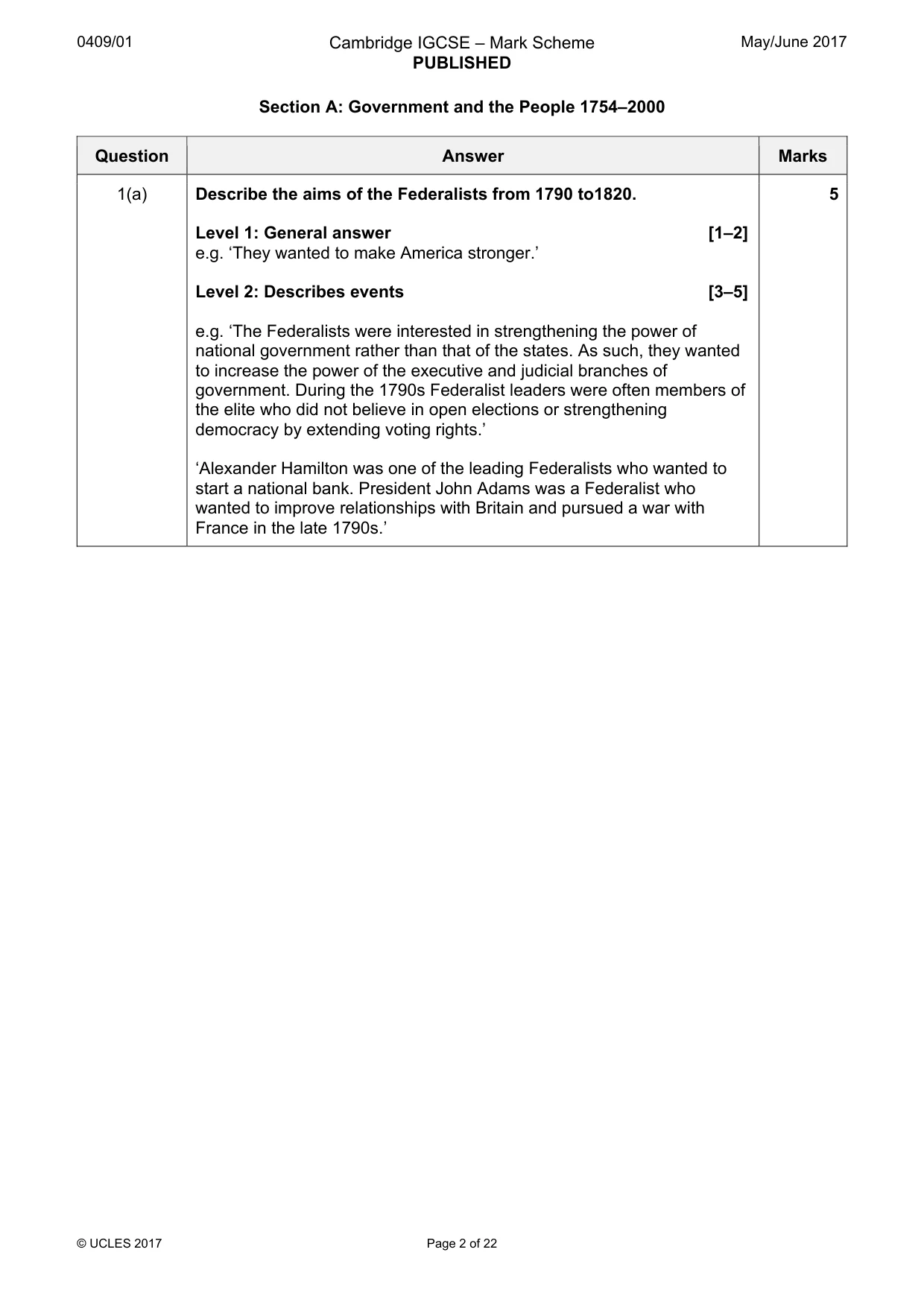
0409/01 Cambridge IGCSE – Mark Scheme PUBLISHED May/June 2017 © UCLES 2017 Page 2 of 22 Section A: Government and the People 1754–2000 Question Answer Marks 1(a) Describe the aims of the Federalists from 1790 to1820. Level 1: General answer [1–2] e.g. ‘They wanted to make America stronger.’ Level 2: Describes events [3–5] e.g. ‘The Federalists were interested in strengthening the power of national government rather than that of the states. As such, they wanted to increase the power of the executive and judicial branches of government. During the 1790s Federalist leaders were often members of the elite who did not believe in open elections or strengthening democracy by extending voting rights.’ ‘Alexander Hamilton was one of the leading Federalists who wanted to start a national bank. President John Adams was a Federalist who wanted to improve relationships with Britain and pursued a war with France in the late 1790s.’ 5
Mark scheme, page 3
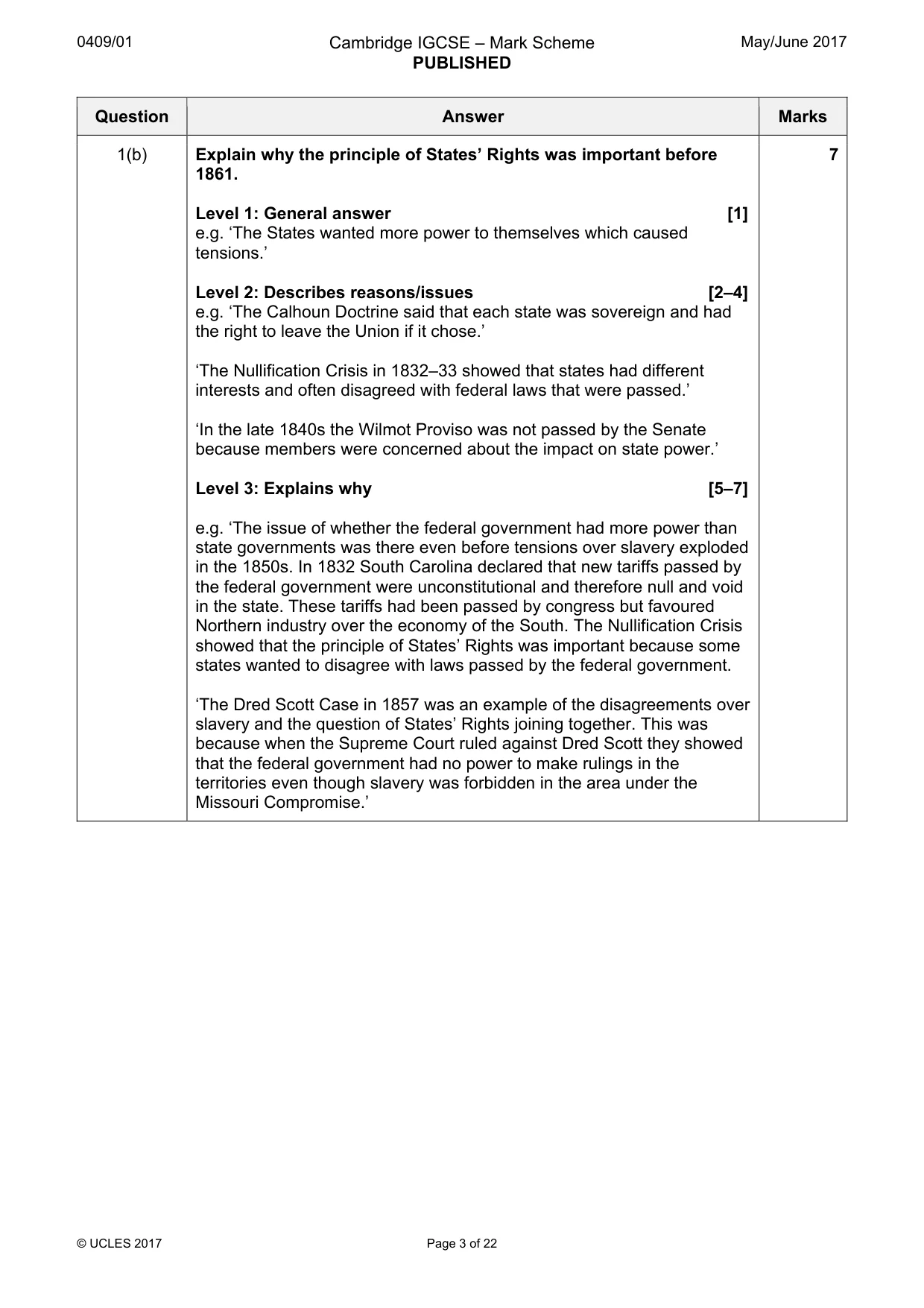
0409/01 Cambridge IGCSE – Mark Scheme PUBLISHED May/June 2017 © UCLES 2017 Page 3 of 22 Question Answer Marks 1(b) Explain why the principle of States’ Rights was important before 1861. Level 1: General answer [1] e.g. ‘The States wanted more power to themselves which caused tensions.’ Level 2: Describes reasons/issues [2–4] e.g. ‘The Calhoun Doctrine said that each state was sovereign and had the right to leave the Union if it chose.’ ‘The Nullification Crisis in 1832–33 showed that states had different interests and often disagreed with federal laws that were passed.’ ‘In the late 1840s the Wilmot Proviso was not passed by the Senate because members were concerned about the impact on state power.’ Level 3: Explains why [5–7] e.g. ‘The issue of whether the federal government had more power than state governments was there even before tensions over slavery exploded in the 1850s. In 1832 South Carolina declared that new tariffs passed by the federal government were unconstitutional and therefore null and void in the state. These tariffs had been passed by congress but favoured Northern industry over the economy of the South. The Nullification Crisis showed that the principle of States’ Rights was important because some states wanted to disagree with laws passed by the federal government. ‘The Dred Scott Case in 1857 was an example of the disagreements over slavery and the question of States’ Rights joining together. This was because when the Supreme Court ruled against Dred Scott they showed that the federal government had no power to make rulings in the territories even though slavery was forbidden in the area under the Missouri Compromise.’ 7
Mark scheme, page 4
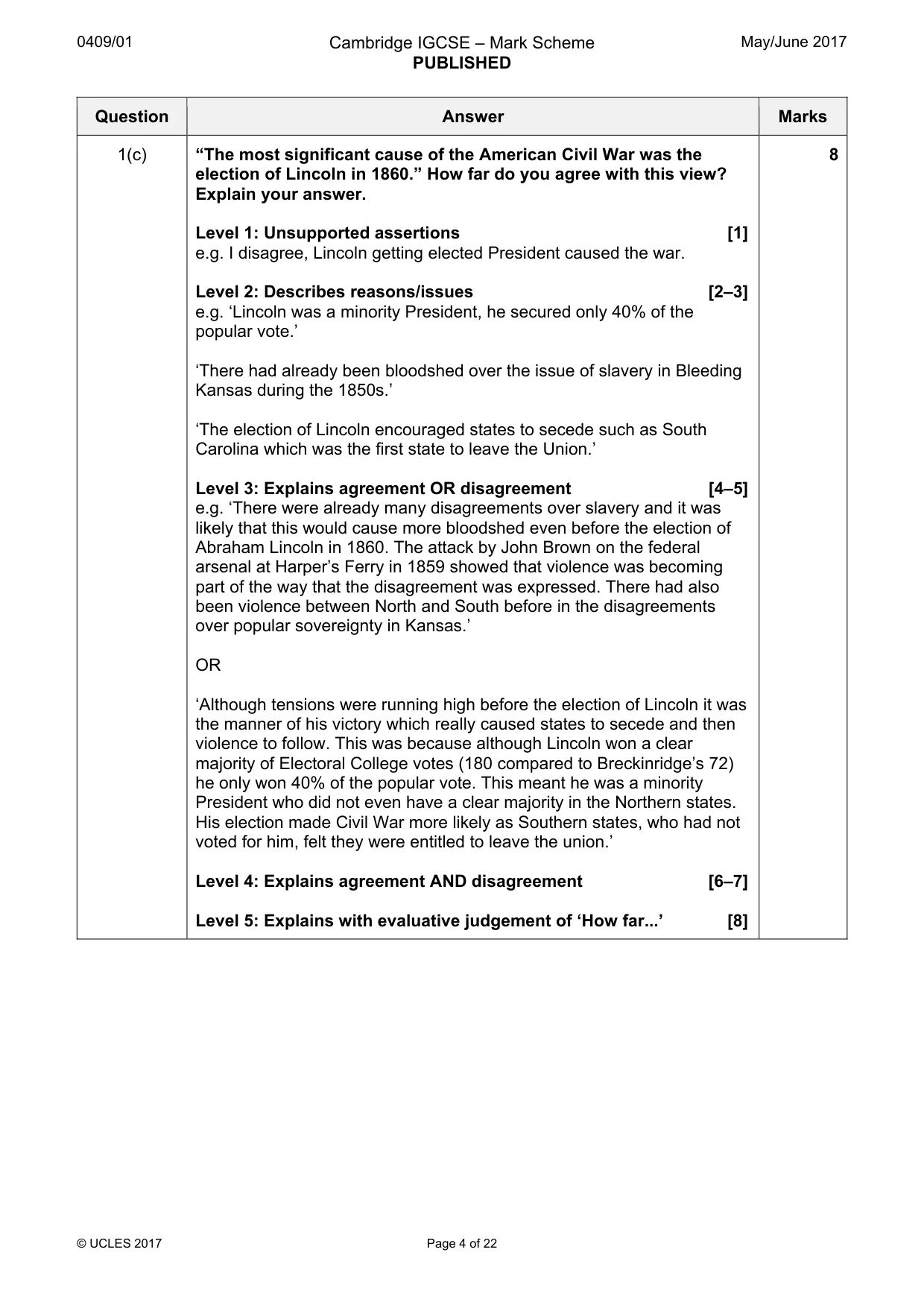
0409/01 Cambridge IGCSE – Mark Scheme PUBLISHED May/June 2017 © UCLES 2017 Page 4 of 22 Question Answer Marks 1(c) “The most significant cause of the American Civil War was the election of Lincoln in 1860.” How far do you agree with this view? Explain your answer. Level 1: Unsupported assertions [1] e.g. I disagree, Lincoln getting elected President caused the war. Level 2: Describes reasons/issues [2–3] e.g. ‘Lincoln was a minority President, he secured only 40% of the popular vote.’ ‘There had already been bloodshed over the issue of slavery in Bleeding Kansas during the 1850s.’ ‘The election of Lincoln encouraged states to secede such as South Carolina which was the first state to leave the Union.’ Level 3: Explains agreement OR disagreement [4–5] e.g. ‘There were already many disagreements over slavery and it was likely that this would cause more bloodshed even before the election of Abraham Lincoln in 1860. The attack by John Brown on the federal arsenal at Harper’s Ferry in 1859 showed that violence was becoming part of the way that the disagreement was expressed. There had also been violence between North and South before in the disagreements over popular sovereignty in Kansas.’ OR ‘Although tensions were running high before the election of Lincoln it was the manner of his victory which really caused states to secede and then violence to follow. This was because although Lincoln won a clear majority of Electoral College votes (180 compared to Breckinridge’s 72) he only won 40% of the popular vote. This meant he was a minority President who did not even have a clear majority in the Northern states. His election made Civil War more likely as Southern states, who had not voted for him, felt they were entitled to leave the union.’ Level 4: Explains agreement AND disagreement [6–7] Level 5: Explains with evaluative judgement of ‘How far...’ [8] 8
Mark scheme, page 5
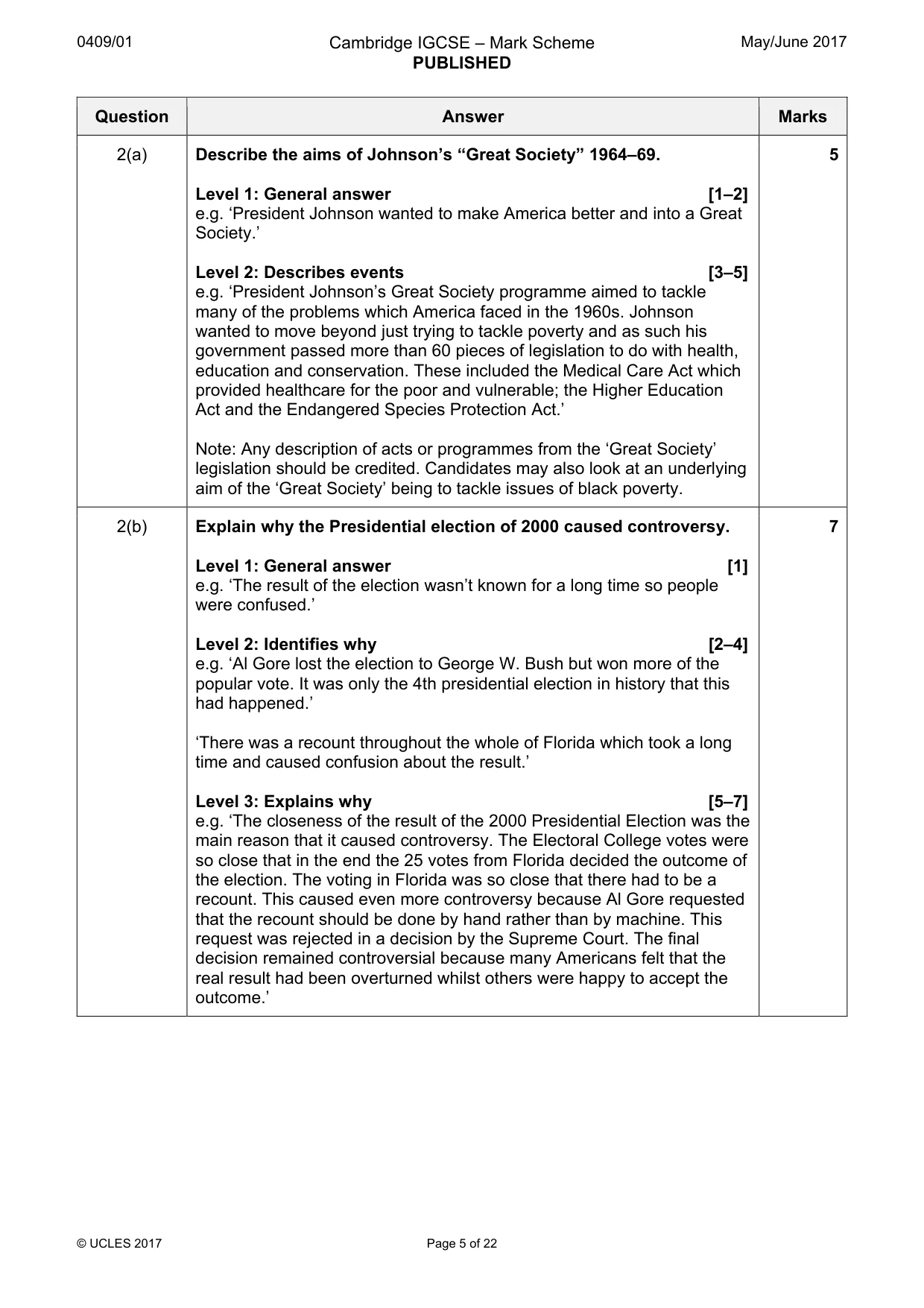
0409/01 Cambridge IGCSE – Mark Scheme PUBLISHED May/June 2017 © UCLES 2017 Page 5 of 22 Question Answer Marks 2(a) Describe the aims of Johnson’s “Great Society” 1964–69. Level 1: General answer [1–2] e.g. ‘President Johnson wanted to make America better and into a Great Society.’ Level 2: Describes events [3–5] e.g. ‘President Johnson’s Great Society programme aimed to tackle many of the problems which America faced in the 1960s. Johnson wanted to move beyond just trying to tackle poverty and as such his government passed more than 60 pieces of legislation to do with health, education and conservation. These included the Medical Care Act which provided healthcare for the poor and vulnerable; the Higher Education Act and the Endangered Species Protection Act.’ Note: Any description of acts or programmes from the ‘Great Society’ legislation should be credited. Candidates may also look at an underlying aim of the ‘Great Society’ being to tackle issues of black poverty. 5 2(b) Explain why the Presidential election of 2000 caused controversy. Level 1: General answer [1] e.g. ‘The result of the election wasn’t known for a long time so people were confused.’ Level 2: Identifies why [2–4] e.g. ‘Al Gore lost the election to George W. Bush but won more of the popular vote. It was only the 4th presidential election in history that this had happened.’ ‘There was a recount throughout the whole of Florida which took a long time and caused confusion about the result.’ Level 3: Explains why [5–7] e.g. ‘The closeness of the result of the 2000 Presidential Election was the main reason that it caused controversy. The Electoral College votes were so close that in the end the 25 votes from Florida decided the outcome of the election. The voting in Florida was so close that there had to be a recount. This caused even more controversy because Al Gore requested that the recount should be done by hand rather than by machine. This request was rejected in a decision by the Supreme Court. The final decision remained controversial because many Americans felt that the real result had been overturned whilst others were happy to accept the outcome.’ 7
Mark scheme, page 6
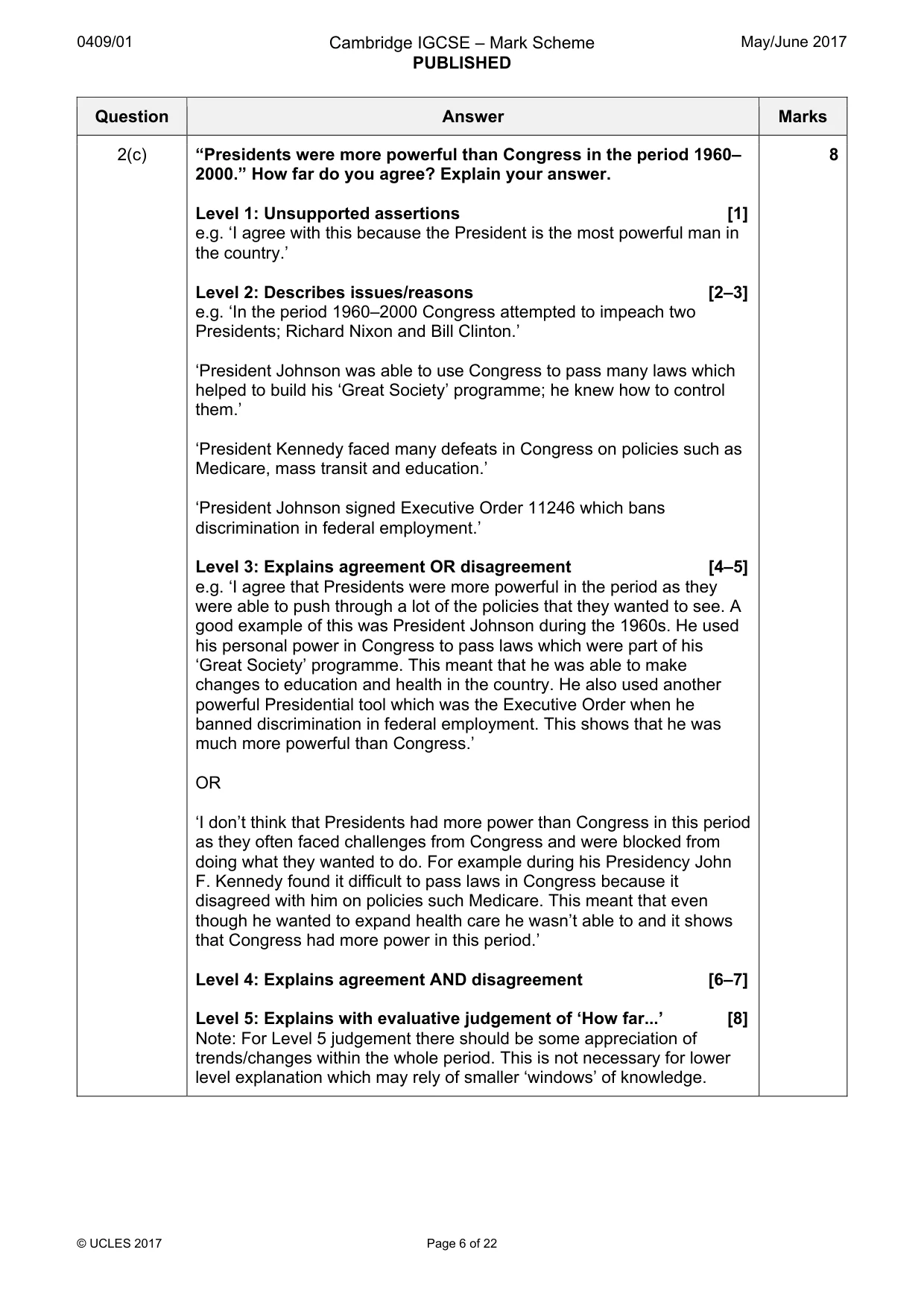
0409/01 Cambridge IGCSE – Mark Scheme PUBLISHED May/June 2017 © UCLES 2017 Page 6 of 22 Question Answer Marks 2(c) “Presidents were more powerful than Congress in the period 1960– 2000.” How far do you agree? Explain your answer. Level 1: Unsupported assertions [1] e.g. ‘I agree with this because the President is the most powerful man in the country.’ Level 2: Describes issues/reasons [2–3] e.g. ‘In the period 1960–2000 Congress attempted to impeach two Presidents; Richard Nixon and Bill Clinton.’ ‘President Johnson was able to use Congress to pass many laws which helped to build his ‘Great Society’ programme; he knew how to control them.’ ‘President Kennedy faced many defeats in Congress on policies such as Medicare, mass transit and education.’ ‘President Johnson signed Executive Order 11246 which bans discrimination in federal employment.’ Level 3: Explains agreement OR disagreement [4–5] e.g. ‘I agree that Presidents were more powerful in the period as they were able to push through a lot of the policies that they wanted to see. A good example of this was President Johnson during the 1960s. He used his personal power in Congress to pass laws which were part of his ‘Great Society’ programme. This meant that he was able to make changes to education and health in the country. He also used another powerful Presidential tool which was the Executive Order when he banned discrimination in federal employment. This shows that he was much more powerful than Congress.’ OR ‘I don’t think that Presidents had more power than Congress in this period as they often faced challenges from Congress and were blocked from doing what they wanted to do. For example during his Presidency John F. Kennedy found it difficult to pass laws in Congress because it disagreed with him on policies such Medicare. This meant that even though he wanted to expand health care he wasn’t able to and it shows that Congress had more power in this period.’ Level 4: Explains agreement AND disagreement [6–7] Level 5: Explains with evaluative judgement of ‘How far...’ [8] Note: For Level 5 judgement there should be some appreciation of trends/changes within the whole period. This is not necessary for lower level explanation which may rely of smaller ‘windows’ of knowledge. 8
Mark scheme, page 7
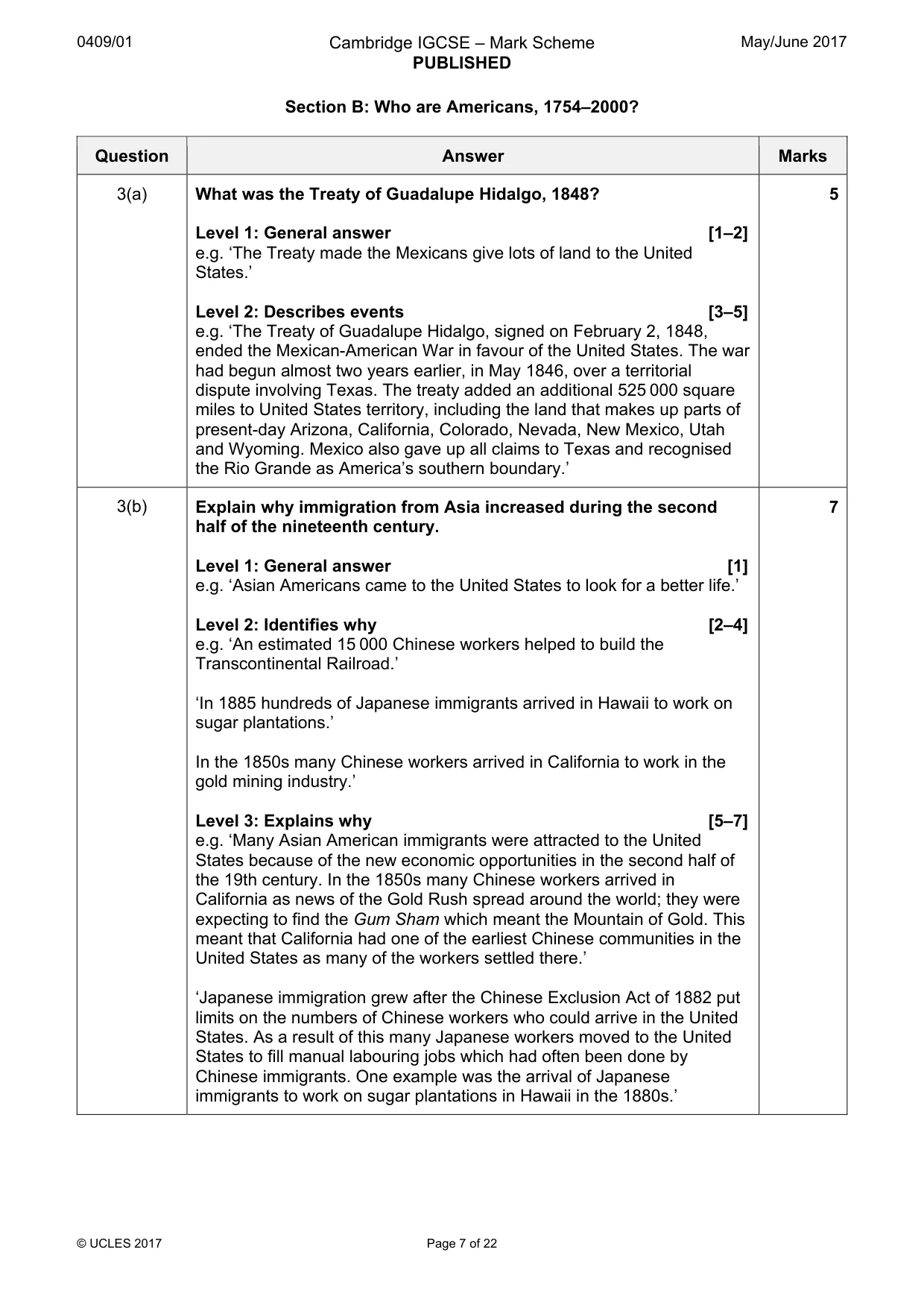
0409/01 Cambridge IGCSE – Mark Scheme PUBLISHED May/June 2017 © UCLES 2017 Page 7 of 22 Section B: Who are Americans, 1754–2000? Question Answer Marks 3(a) What was the Treaty of Guadalupe Hidalgo, 1848? Level 1: General answer [1–2] e.g. ‘The Treaty made the Mexicans give lots of land to the United States.’ Level 2: Describes events [3–5] e.g. ‘The Treaty of Guadalupe Hidalgo, signed on February 2, 1848, ended the Mexican-American War in favour of the United States. The war had begun almost two years earlier, in May 1846, over a territorial dispute involving Texas. The treaty added an additional 525 000 square miles to United States territory, including the land that makes up parts of present-day Arizona, California, Colorado, Nevada, New Mexico, Utah and Wyoming. Mexico also gave up all claims to Texas and recognised the Rio Grande as America’s southern boundary.’ 5 3(b) Explain why immigration from Asia increased during the second half of the nineteenth century. Level 1: General answer [1] e.g. ‘Asian Americans came to the United States to look for a better life.’ Level 2: Identifies why [2–4] e.g. ‘An estimated 15 000 Chinese workers helped to build the Transcontinental Railroad.’ ‘In 1885 hundreds of Japanese immigrants arrived in Hawaii to work on sugar plantations.’ In the 1850s many Chinese workers arrived in California to work in the gold mining industry.’ Level 3: Explains why [5–7] e.g. ‘Many Asian American immigrants were attracted to the United States because of the new economic opportunities in the second half of the 19th century. In the 1850s many Chinese workers arrived in California as news of the Gold Rush spread around the world; they were expecting to find the Gum Sham which meant the Mountain of Gold. This meant that California had one of the earliest Chinese communities in the United States as many of the workers settled there.’ ‘Japanese immigration grew after the Chinese Exclusion Act of 1882 put limits on the numbers of Chinese workers who could arrive in the United States. As a result of this many Japanese workers moved to the United States to fill manual labouring jobs which had often been done by Chinese immigrants. One example was the arrival of Japanese immigrants to work on sugar plantations in Hawaii in the 1880s.’ 7
Mark scheme, page 8
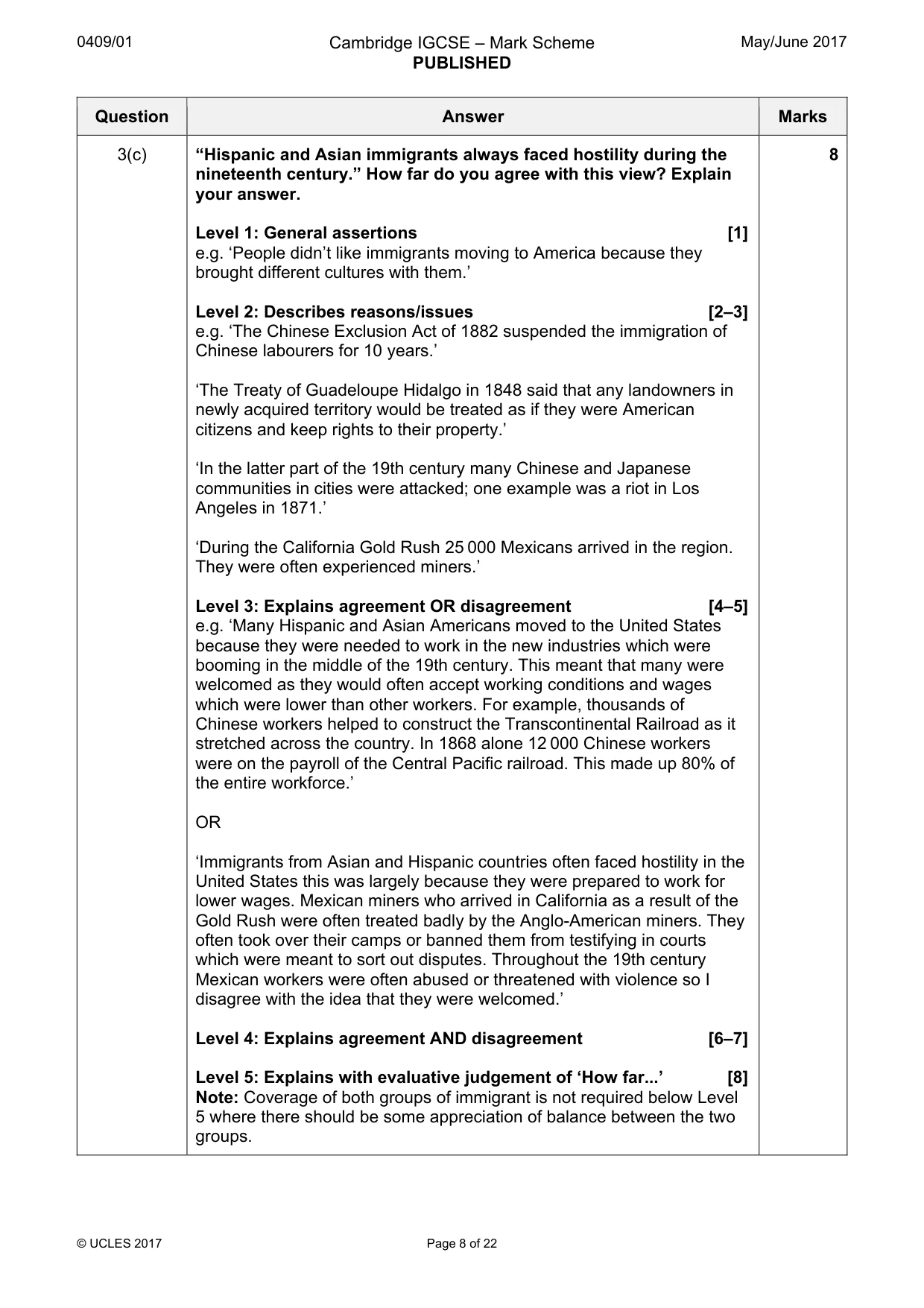
0409/01 Cambridge IGCSE – Mark Scheme PUBLISHED May/June 2017 © UCLES 2017 Page 8 of 22 Question Answer Marks 3(c) “Hispanic and Asian immigrants always faced hostility during the nineteenth century.” How far do you agree with this view? Explain your answer. Level 1: General assertions [1] e.g. ‘People didn’t like immigrants moving to America because they brought different cultures with them.’ Level 2: Describes reasons/issues [2–3] e.g. ‘The Chinese Exclusion Act of 1882 suspended the immigration of Chinese labourers for 10 years.’ ‘The Treaty of Guadeloupe Hidalgo in 1848 said that any landowners in newly acquired territory would be treated as if they were American citizens and keep rights to their property.’ ‘In the latter part of the 19th century many Chinese and Japanese communities in cities were attacked; one example was a riot in Los Angeles in 1871.’ ‘During the California Gold Rush 25 000 Mexicans arrived in the region. They were often experienced miners.’ Level 3: Explains agreement OR disagreement [4–5] e.g. ‘Many Hispanic and Asian Americans moved to the United States because they were needed to work in the new industries which were booming in the middle of the 19th century. This meant that many were welcomed as they would often accept working conditions and wages which were lower than other workers. For example, thousands of Chinese workers helped to construct the Transcontinental Railroad as it stretched across the country. In 1868 alone 12 000 Chinese workers were on the payroll of the Central Pacific railroad. This made up 80% of the entire workforce.’ OR ‘Immigrants from Asian and Hispanic countries often faced hostility in the United States this was largely because they were prepared to work for lower wages. Mexican miners who arrived in California as a result of the Gold Rush were often treated badly by the Anglo-American miners. They often took over their camps or banned them from testifying in courts which were meant to sort out disputes. Throughout the 19th century Mexican workers were often abused or threatened with violence so I disagree with the idea that they were welcomed.’ Level 4: Explains agreement AND disagreement [6–7] Level 5: Explains with evaluative judgement of ‘How far...’ [8] Note: Coverage of both groups of immigrant is not required below Level 5 where there should be some appreciation of balance between the two groups. 8
Mark scheme, page 9
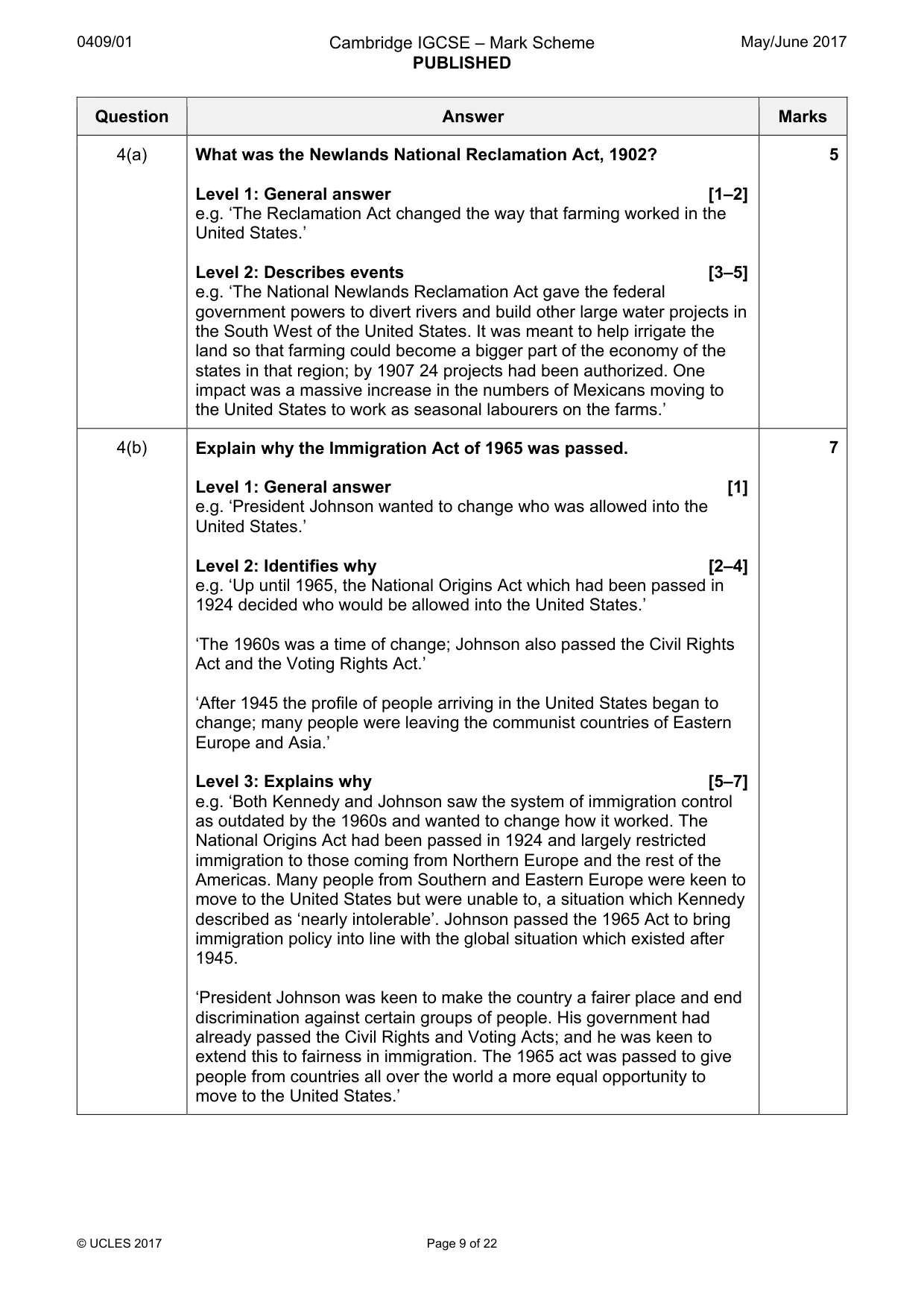
0409/01 Cambridge IGCSE – Mark Scheme PUBLISHED May/June 2017 © UCLES 2017 Page 9 of 22 Question Answer Marks 4(a) What was the Newlands National Reclamation Act, 1902? Level 1: General answer [1–2] e.g. ‘The Reclamation Act changed the way that farming worked in the United States.’ Level 2: Describes events [3–5] e.g. ‘The National Newlands Reclamation Act gave the federal government powers to divert rivers and build other large water projects in the South West of the United States. It was meant to help irrigate the land so that farming could become a bigger part of the economy of the states in that region; by 1907 24 projects had been authorized. One impact was a massive increase in the numbers of Mexicans moving to the United States to work as seasonal labourers on the farms.’ 5 4(b) Explain why the Immigration Act of 1965 was passed. Level 1: General answer [1] e.g. ‘President Johnson wanted to change who was allowed into the United States.’ Level 2: Identifies why [2–4] e.g. ‘Up until 1965, the National Origins Act which had been passed in 1924 decided who would be allowed into the United States.’ ‘The 1960s was a time of change; Johnson also passed the Civil Rights Act and the Voting Rights Act.’ ‘After 1945 the profile of people arriving in the United States began to change; many people were leaving the communist countries of Eastern Europe and Asia.’ Level 3: Explains why [5–7] e.g. ‘Both Kennedy and Johnson saw the system of immigration control as outdated by the 1960s and wanted to change how it worked. The National Origins Act had been passed in 1924 and largely restricted immigration to those coming from Northern Europe and the rest of the Americas. Many people from Southern and Eastern Europe were keen to move to the United States but were unable to, a situation which Kennedy described as ‘nearly intolerable’. Johnson passed the 1965 Act to bring immigration policy into line with the global situation which existed after 1945. ‘President Johnson was keen to make the country a fairer place and end discrimination against certain groups of people. His government had already passed the Civil Rights and Voting Acts; and he was keen to extend this to fairness in immigration. The 1965 act was passed to give people from countries all over the world a more equal opportunity to move to the United States.’ 7
Mark scheme, page 10
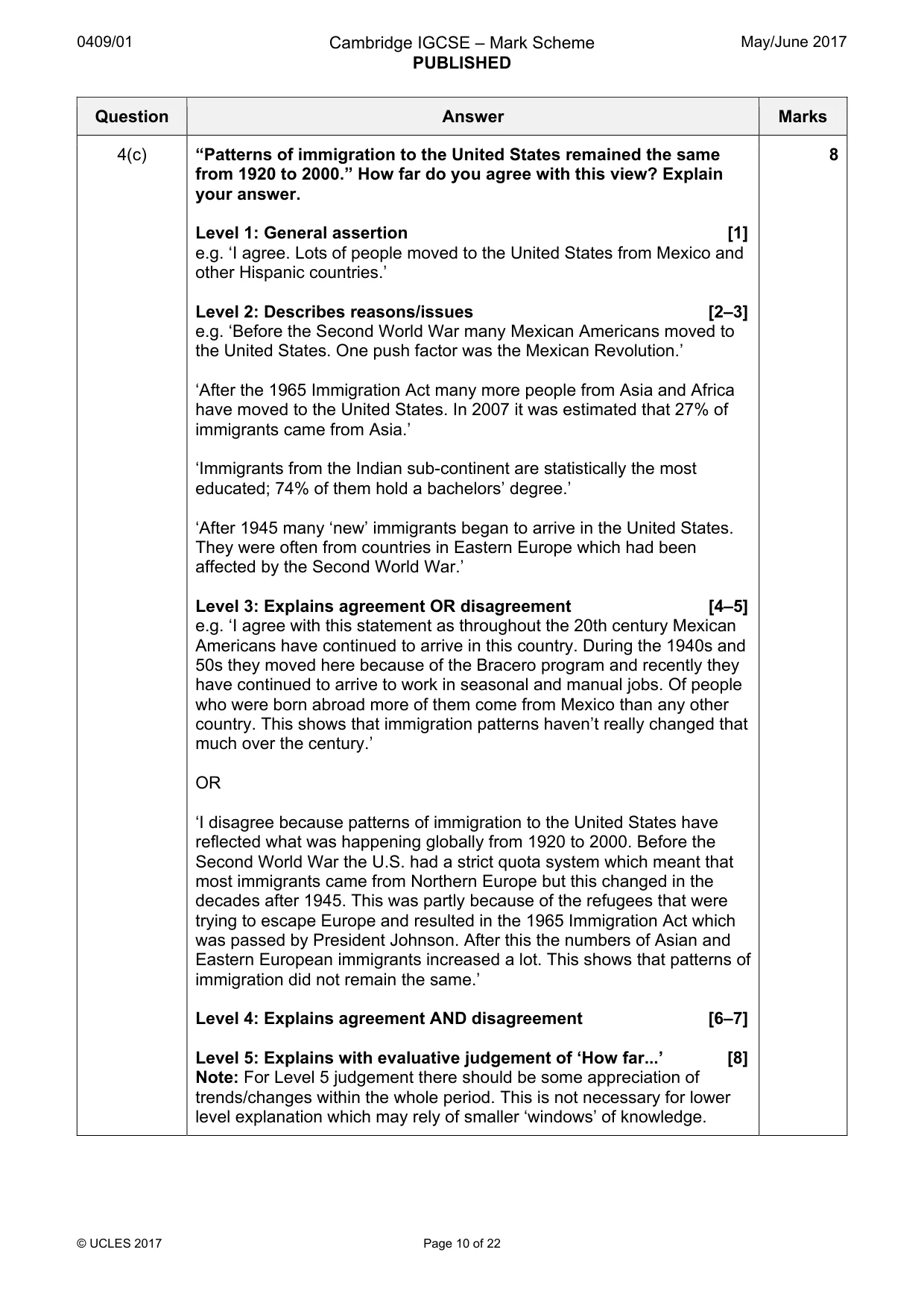
0409/01 Cambridge IGCSE – Mark Scheme PUBLISHED May/June 2017 © UCLES 2017 Page 10 of 22 Question Answer Marks 4(c) “Patterns of immigration to the United States remained the same from 1920 to 2000.” How far do you agree with this view? Explain your answer. Level 1: General assertion [1] e.g. ‘I agree. Lots of people moved to the United States from Mexico and other Hispanic countries.’ Level 2: Describes reasons/issues [2–3] e.g. ‘Before the Second World War many Mexican Americans moved to the United States. One push factor was the Mexican Revolution.’ ‘After the 1965 Immigration Act many more people from Asia and Africa have moved to the United States. In 2007 it was estimated that 27% of immigrants came from Asia.’ ‘Immigrants from the Indian sub-continent are statistically the most educated; 74% of them hold a bachelors’ degree.’ ‘After 1945 many ‘new’ immigrants began to arrive in the United States. They were often from countries in Eastern Europe which had been affected by the Second World War.’ Level 3: Explains agreement OR disagreement [4–5] e.g. ‘I agree with this statement as throughout the 20th century Mexican Americans have continued to arrive in this country. During the 1940s and 50s they moved here because of the Bracero program and recently they have continued to arrive to work in seasonal and manual jobs. Of people who were born abroad more of them come from Mexico than any other country. This shows that immigration patterns haven’t really changed that much over the century.’ OR ‘I disagree because patterns of immigration to the United States have reflected what was happening globally from 1920 to 2000. Before the Second World War the U.S. had a strict quota system which meant that most immigrants came from Northern Europe but this changed in the decades after 1945. This was partly because of the refugees that were trying to escape Europe and resulted in the 1965 Immigration Act which was passed by President Johnson. After this the numbers of Asian and Eastern European immigrants increased a lot. This shows that patterns of immigration did not remain the same.’ Level 4: Explains agreement AND disagreement [6–7] Level 5: Explains with evaluative judgement of ‘How far...’ [8] Note: For Level 5 judgement there should be some appreciation of trends/changes within the whole period. This is not necessary for lower level explanation which may rely of smaller ‘windows’ of knowledge. 8
Mark scheme, page 11
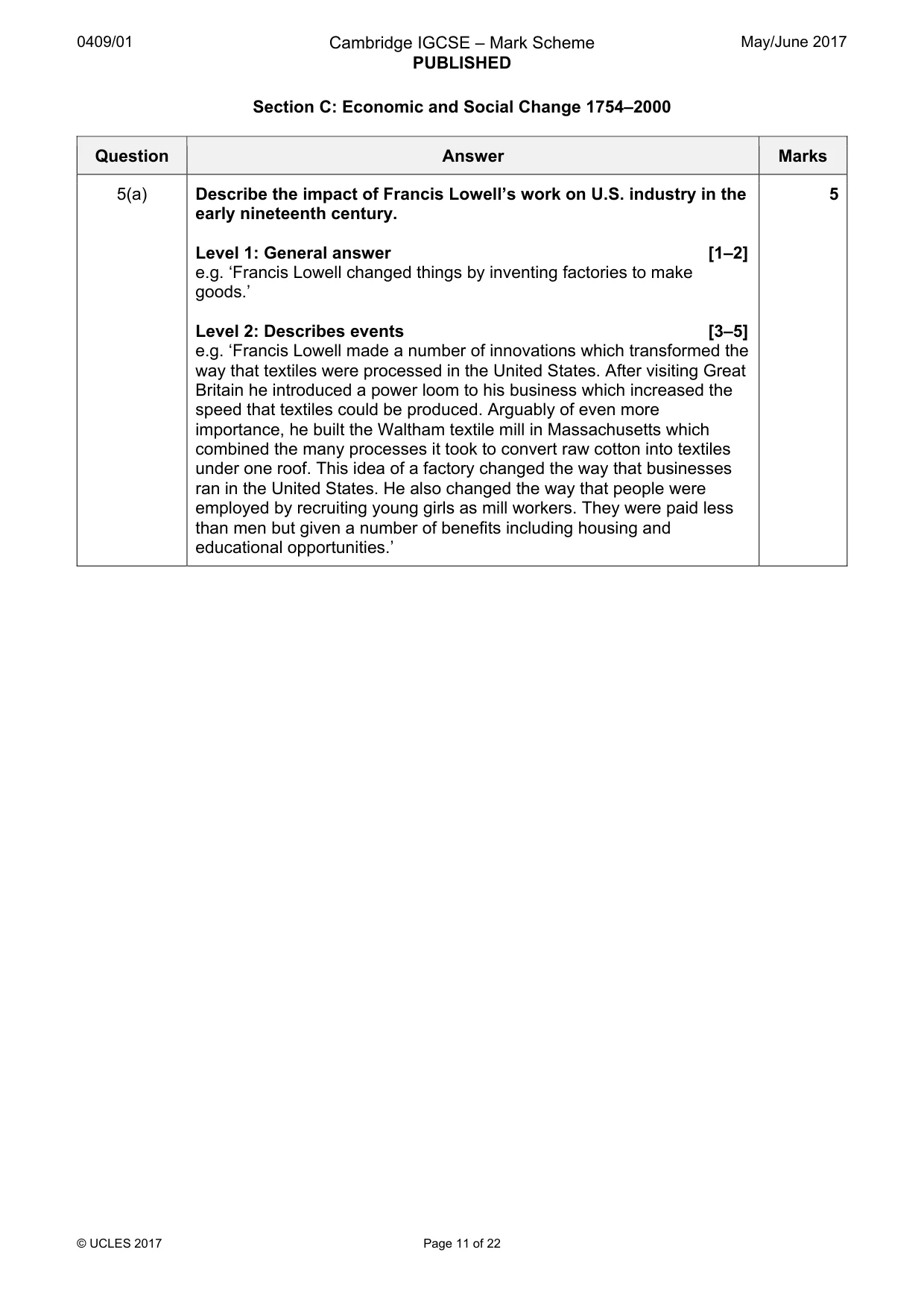
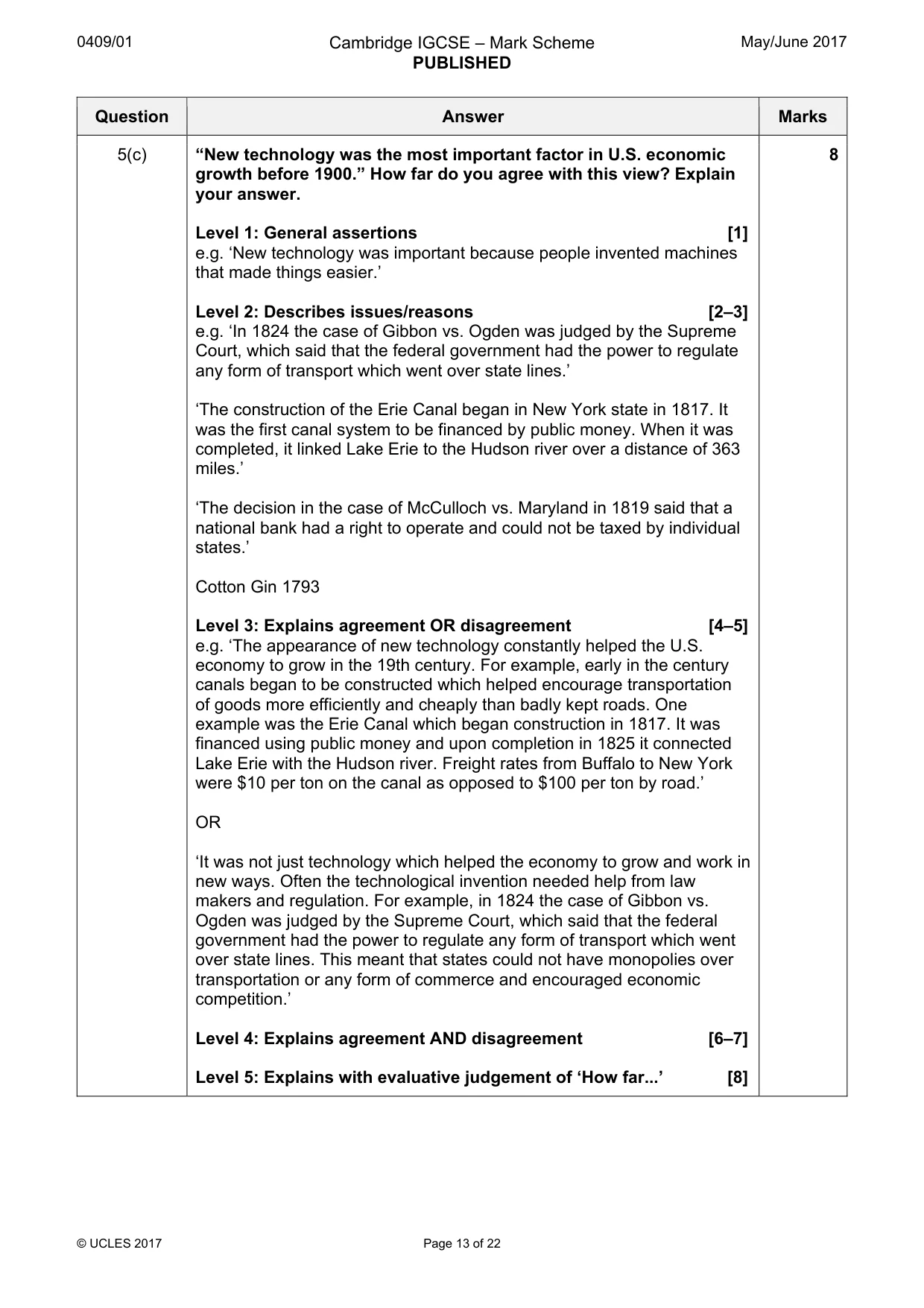
0409/01 Cambridge IGCSE – Mark Scheme PUBLISHED May/June 2017 © UCLES 2017 Page 11 of 22 Section C: Economic and Social Change 1754–2000 Question Answer Marks 5(a) Describe the impact of Francis Lowell’s work on U.S. industry in the early nineteenth century. Level 1: General answer [1–2] e.g. ‘Francis Lowell changed things by inventing factories to make goods.’ Level 2: Describes events [3–5] e.g. ‘Francis Lowell made a number of innovations which transformed the way that textiles were processed in the United States. After visiting Great Britain he introduced a power loom to his business which increased the speed that textiles could be produced. Arguably of even more importance, he built the Waltham textile mill in Massachusetts which combined the many processes it took to convert raw cotton into textiles under one roof. This idea of a factory changed the way that businesses ran in the United States. He also changed the way that people were employed by recruiting young girls as mill workers. They were paid less than men but given a number of benefits including housing and educational opportunities.’ 5
Mark scheme, page 12
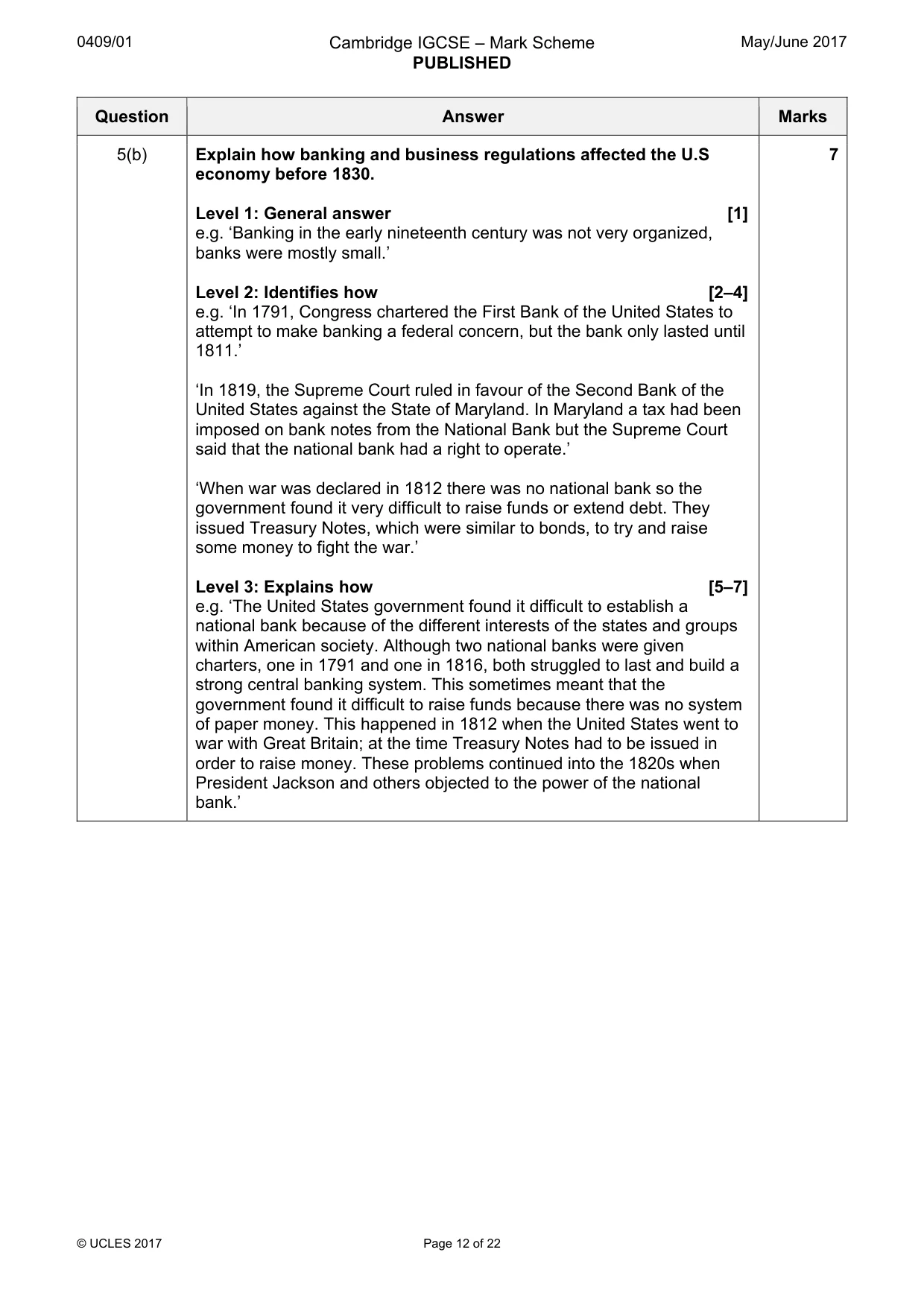
0409/01 Cambridge IGCSE – Mark Scheme PUBLISHED May/June 2017 © UCLES 2017 Page 12 of 22 Question Answer Marks 5(b) Explain how banking and business regulations affected the U.S economy before 1830. Level 1: General answer [1] e.g. ‘Banking in the early nineteenth century was not very organized, banks were mostly small.’ Level 2: Identifies how [2–4] e.g. ‘In 1791, Congress chartered the First Bank of the United States to attempt to make banking a federal concern, but the bank only lasted until 1811.’ ‘In 1819, the Supreme Court ruled in favour of the Second Bank of the United States against the State of Maryland. In Maryland a tax had been imposed on bank notes from the National Bank but the Supreme Court said that the national bank had a right to operate.’ ‘When war was declared in 1812 there was no national bank so the government found it very difficult to raise funds or extend debt. They issued Treasury Notes, which were similar to bonds, to try and raise some money to fight the war.’ Level 3: Explains how [5–7] e.g. ‘The United States government found it difficult to establish a national bank because of the different interests of the states and groups within American society. Although two national banks were given charters, one in 1791 and one in 1816, both struggled to last and build a strong central banking system. This sometimes meant that the government found it difficult to raise funds because there was no system of paper money. This happened in 1812 when the United States went to war with Great Britain; at the time Treasury Notes had to be issued in order to raise money. These problems continued into the 1820s when President Jackson and others objected to the power of the national bank.’ 7
Mark scheme, page 13
0409/01 Cambridge IGCSE – Mark Scheme PUBLISHED May/June 2017 © UCLES 2017 Page 13 of 22 Question Answer Marks 5(c) “New technology was the most important factor in U.S. economic growth before 1900.” How far do you agree with this view? Explain your answer. Level 1: General assertions [1] e.g. ‘New technology was important because people invented machines that made things easier.’ Level 2: Describes issues/reasons [2–3] e.g. ‘In 1824 the case of Gibbon vs. Ogden was judged by the Supreme Court, which said that the federal government had the power to regulate any form of transport which went over state lines.’ ‘The construction of the Erie Canal began in New York state in 1817. It was the first canal system to be financed by public money. When it was completed, it linked Lake Erie to the Hudson river over a distance of 363 miles.’ ‘The decision in the case of McCulloch vs. Maryland in 1819 said that a national bank had a right to operate and could not be taxed by individual states.’ Cotton Gin 1793 Level 3: Explains agreement OR disagreement [4–5] e.g. ‘The appearance of new technology constantly helped the U.S. economy to grow in the 19th century. For example, early in the century canals began to be constructed which helped encourage transportation of goods more efficiently and cheaply than badly kept roads. One example was the Erie Canal which began construction in 1817. It was financed using public money and upon completion in 1825 it connected Lake Erie with the Hudson river. Freight rates from Buffalo to New York were $10 per ton on the canal as opposed to $100 per ton by road.’ OR ‘It was not just technology which helped the economy to grow and work in new ways. Often the technological invention needed help from law makers and regulation. For example, in 1824 the case of Gibbon vs. Ogden was judged by the Supreme Court, which said that the federal government had the power to regulate any form of transport which went over state lines. This meant that states could not have monopolies over transportation or any form of commerce and encouraged economic competition.’ Level 4: Explains agreement AND disagreement [6–7] Level 5: Explains with evaluative judgement of ‘How far...’ [8] 8
Mark scheme, page 14
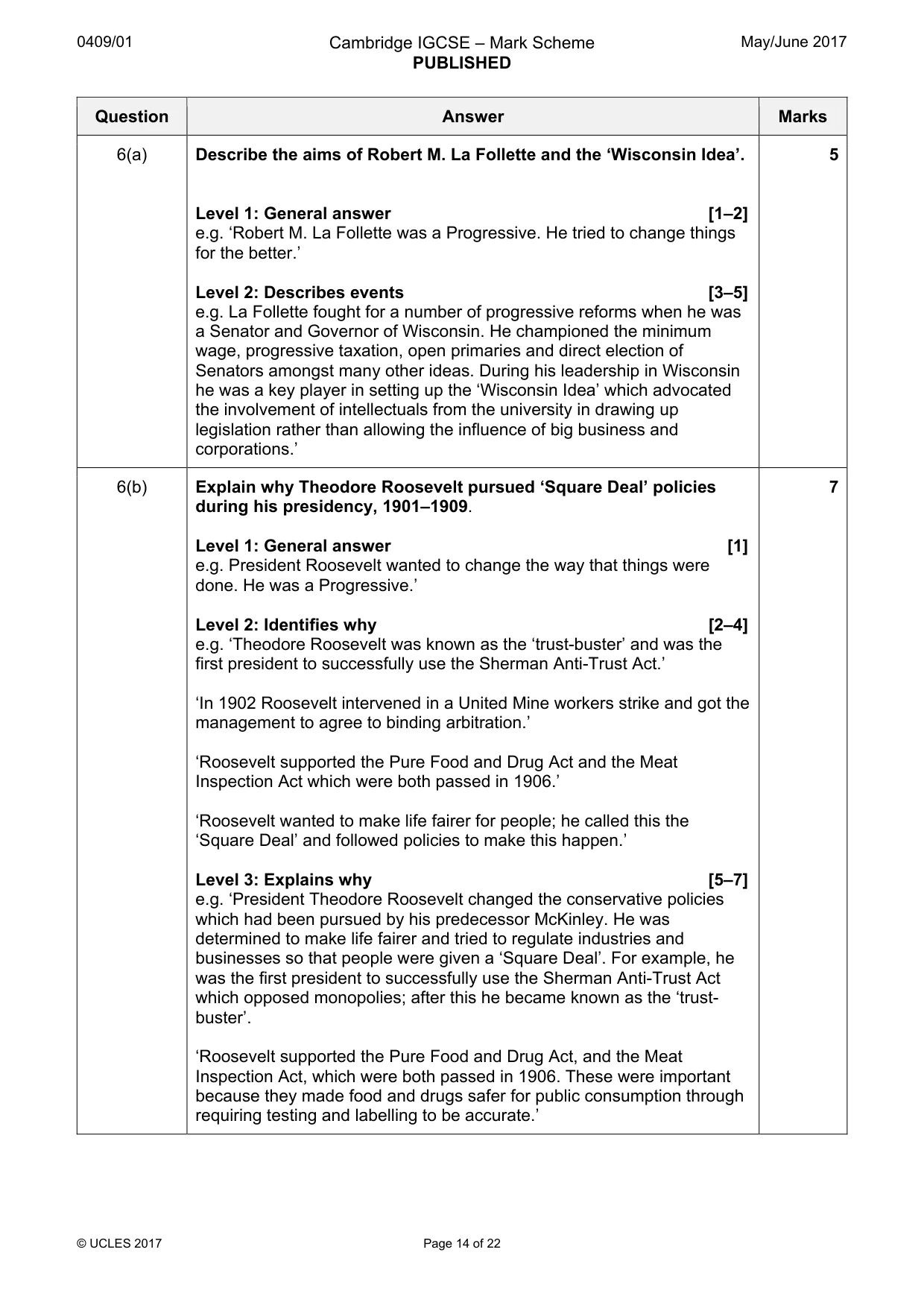
0409/01 Cambridge IGCSE – Mark Scheme PUBLISHED May/June 2017 © UCLES 2017 Page 14 of 22 Question Answer Marks 6(a) Describe the aims of Robert M. La Follette and the ‘Wisconsin Idea’. Level 1: General answer [1–2] e.g. ‘Robert M. La Follette was a Progressive. He tried to change things for the better.’ Level 2: Describes events [3–5] e.g. La Follette fought for a number of progressive reforms when he was a Senator and Governor of Wisconsin. He championed the minimum wage, progressive taxation, open primaries and direct election of Senators amongst many other ideas. During his leadership in Wisconsin he was a key player in setting up the ‘Wisconsin Idea’ which advocated the involvement of intellectuals from the university in drawing up legislation rather than allowing the influence of big business and corporations.’ 5 6(b) Explain why Theodore Roosevelt pursued ‘Square Deal’ policies during his presidency, 1901–1909. Level 1: General answer [1] e.g. President Roosevelt wanted to change the way that things were done. He was a Progressive.’ Level 2: Identifies why [2–4] e.g. ‘Theodore Roosevelt was known as the ‘trust-buster’ and was the first president to successfully use the Sherman Anti-Trust Act.’ ‘In 1902 Roosevelt intervened in a United Mine workers strike and got the management to agree to binding arbitration.’ ‘Roosevelt supported the Pure Food and Drug Act and the Meat Inspection Act which were both passed in 1906.’ ‘Roosevelt wanted to make life fairer for people; he called this the ‘Square Deal’ and followed policies to make this happen.’ Level 3: Explains why [5–7] e.g. ‘President Theodore Roosevelt changed the conservative policies which had been pursued by his predecessor McKinley. He was determined to make life fairer and tried to regulate industries and businesses so that people were given a ‘Square Deal’. For example, he was the first president to successfully use the Sherman Anti-Trust Act which opposed monopolies; after this he became known as the ‘trust- buster’. ‘Roosevelt supported the Pure Food and Drug Act, and the Meat Inspection Act, which were both passed in 1906. These were important because they made food and drugs safer for public consumption through requiring testing and labelling to be accurate.’ 7
Mark scheme, page 15
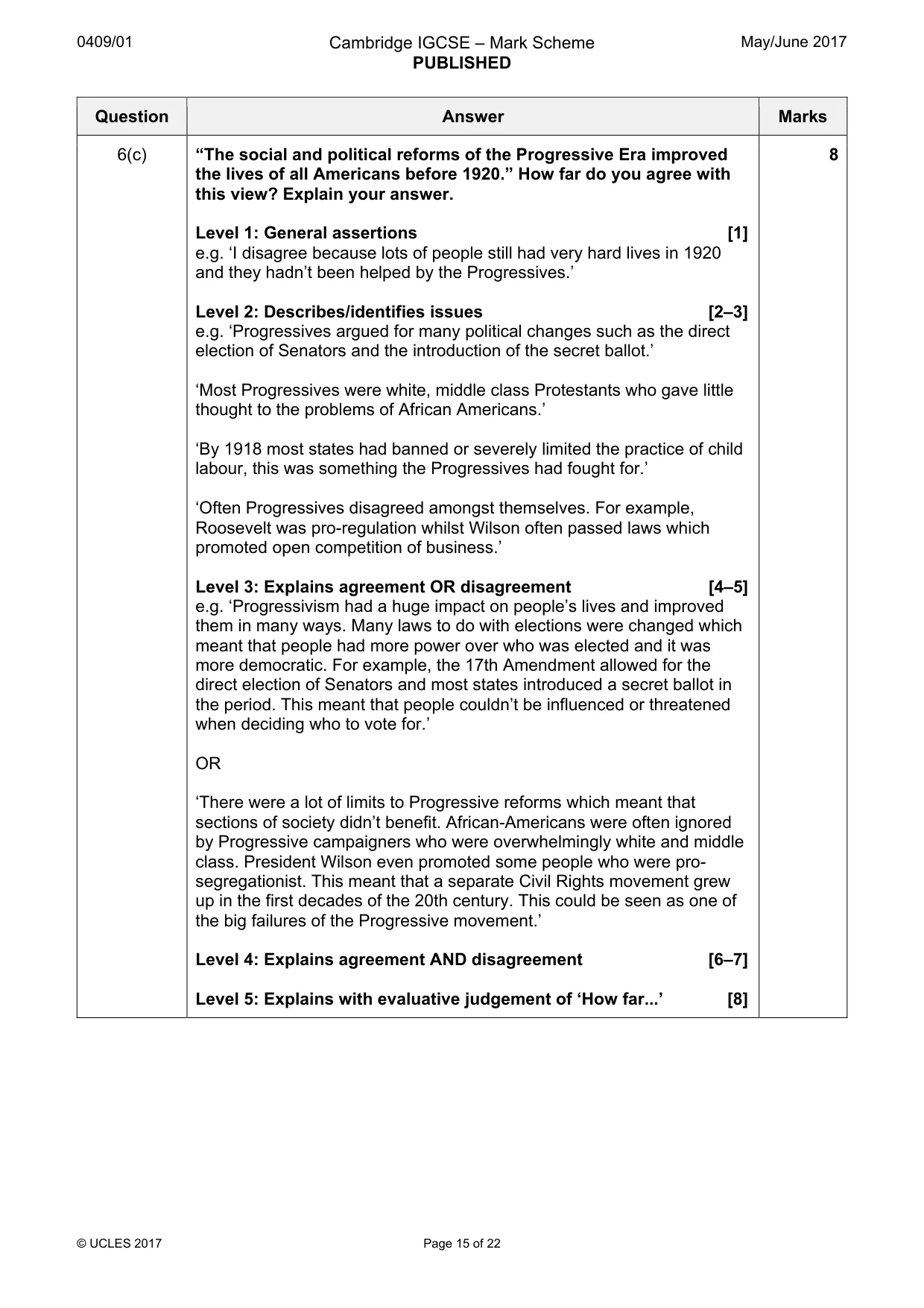
0409/01 Cambridge IGCSE – Mark Scheme PUBLISHED May/June 2017 © UCLES 2017 Page 15 of 22 Question Answer Marks 6(c) “The social and political reforms of the Progressive Era improved the lives of all Americans before 1920.” How far do you agree with this view? Explain your answer. Level 1: General assertions [1] e.g. ‘I disagree because lots of people still had very hard lives in 1920 and they hadn’t been helped by the Progressives.’ Level 2: Describes/identifies issues [2–3] e.g. ‘Progressives argued for many political changes such as the direct election of Senators and the introduction of the secret ballot.’ ‘Most Progressives were white, middle class Protestants who gave little thought to the problems of African Americans.’ ‘By 1918 most states had banned or severely limited the practice of child labour, this was something the Progressives had fought for.’ ‘Often Progressives disagreed amongst themselves. For example, Roosevelt was pro-regulation whilst Wilson often passed laws which promoted open competition of business.’ Level 3: Explains agreement OR disagreement [4–5] e.g. ‘Progressivism had a huge impact on people’s lives and improved them in many ways. Many laws to do with elections were changed which meant that people had more power over who was elected and it was more democratic. For example, the 17th Amendment allowed for the direct election of Senators and most states introduced a secret ballot in the period. This meant that people couldn’t be influenced or threatened when deciding who to vote for.’ OR ‘There were a lot of limits to Progressive reforms which meant that sections of society didn’t benefit. African-Americans were often ignored by Progressive campaigners who were overwhelmingly white and middle class. President Wilson even promoted some people who were pro- segregationist. This meant that a separate Civil Rights movement grew up in the first decades of the 20th century. This could be seen as one of the big failures of the Progressive movement.’ Level 4: Explains agreement AND disagreement [6–7] Level 5: Explains with evaluative judgement of ‘How far...’ [8] 8
Mark scheme, page 16
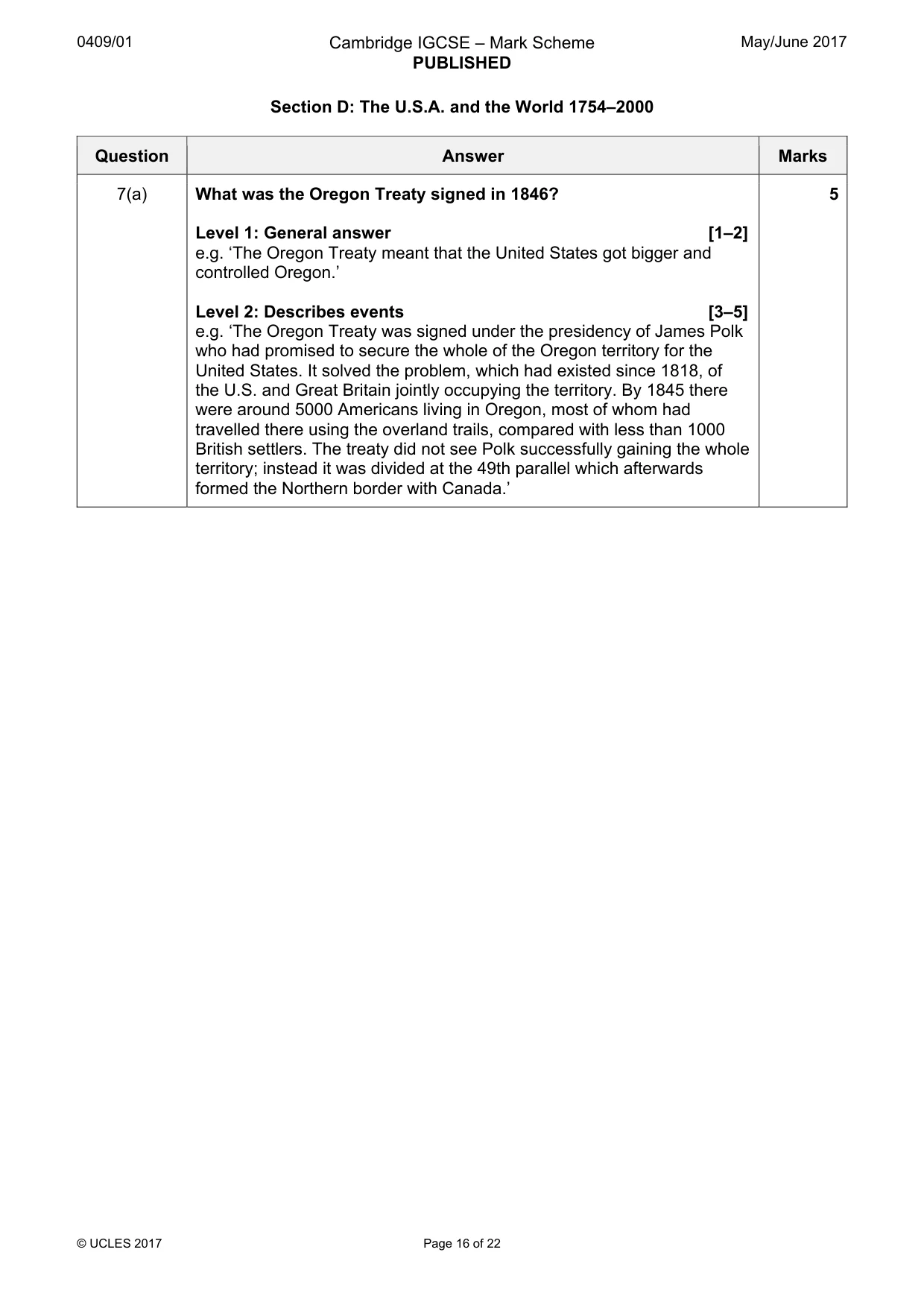
0409/01 Cambridge IGCSE – Mark Scheme PUBLISHED May/June 2017 © UCLES 2017 Page 16 of 22 Section D: The U.S.A. and the World 1754–2000 Question Answer Marks 7(a) What was the Oregon Treaty signed in 1846? Level 1: General answer [1–2] e.g. ‘The Oregon Treaty meant that the United States got bigger and controlled Oregon.’ Level 2: Describes events [3–5] e.g. ‘The Oregon Treaty was signed under the presidency of James Polk who had promised to secure the whole of the Oregon territory for the United States. It solved the problem, which had existed since 1818, of the U.S. and Great Britain jointly occupying the territory. By 1845 there were around 5000 Americans living in Oregon, most of whom had travelled there using the overland trails, compared with less than 1000 British settlers. The treaty did not see Polk successfully gaining the whole territory; instead it was divided at the 49th parallel which afterwards formed the Northern border with Canada.’ 5
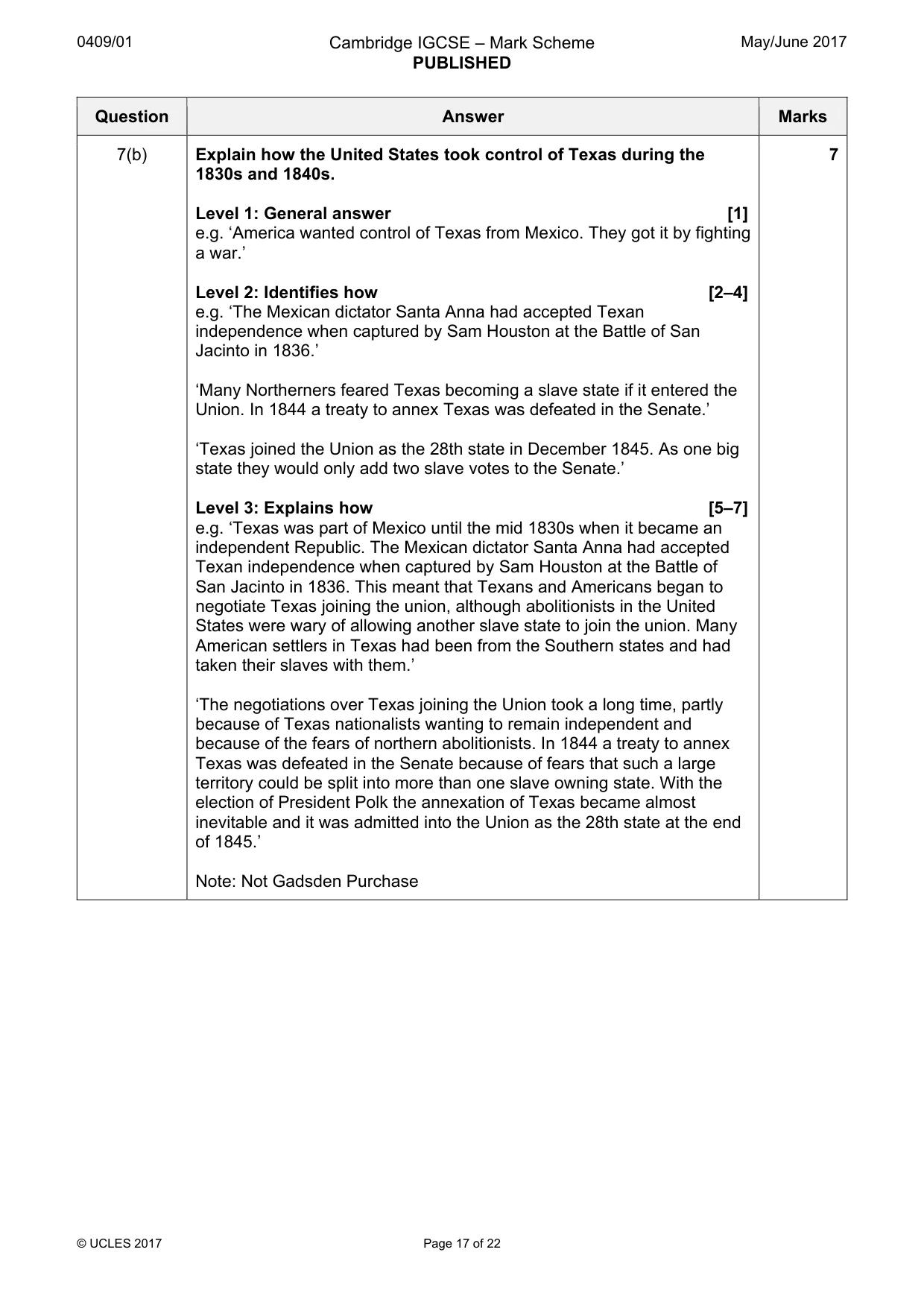
Mark scheme, page 17
0409/01 Cambridge IGCSE – Mark Scheme PUBLISHED May/June 2017 © UCLES 2017 Page 17 of 22 Question Answer Marks 7(b) Explain how the United States took control of Texas during the 1830s and 1840s. Level 1: General answer [1] e.g. ‘America wanted control of Texas from Mexico. They got it by fighting a war.’ Level 2: Identifies how [2–4] e.g. ‘The Mexican dictator Santa Anna had accepted Texan independence when captured by Sam Houston at the Battle of San Jacinto in 1836.’ ‘Many Northerners feared Texas becoming a slave state if it entered the Union. In 1844 a treaty to annex Texas was defeated in the Senate.’ ‘Texas joined the Union as the 28th state in December 1845. As one big state they would only add two slave votes to the Senate.’ Level 3: Explains how [5–7] e.g. ‘Texas was part of Mexico until the mid 1830s when it became an independent Republic. The Mexican dictator Santa Anna had accepted Texan independence when captured by Sam Houston at the Battle of San Jacinto in 1836. This meant that Texans and Americans began to negotiate Texas joining the union, although abolitionists in the United States were wary of allowing another slave state to join the union. Many American settlers in Texas had been from the Southern states and had taken their slaves with them.’ ‘The negotiations over Texas joining the Union took a long time, partly because of Texas nationalists wanting to remain independent and because of the fears of northern abolitionists. In 1844 a treaty to annex Texas was defeated in the Senate because of fears that such a large territory could be split into more than one slave owning state. With the election of President Polk the annexation of Texas became almost inevitable and it was admitted into the Union as the 28th state at the end of 1845.’ Note: Not Gadsden Purchase 7
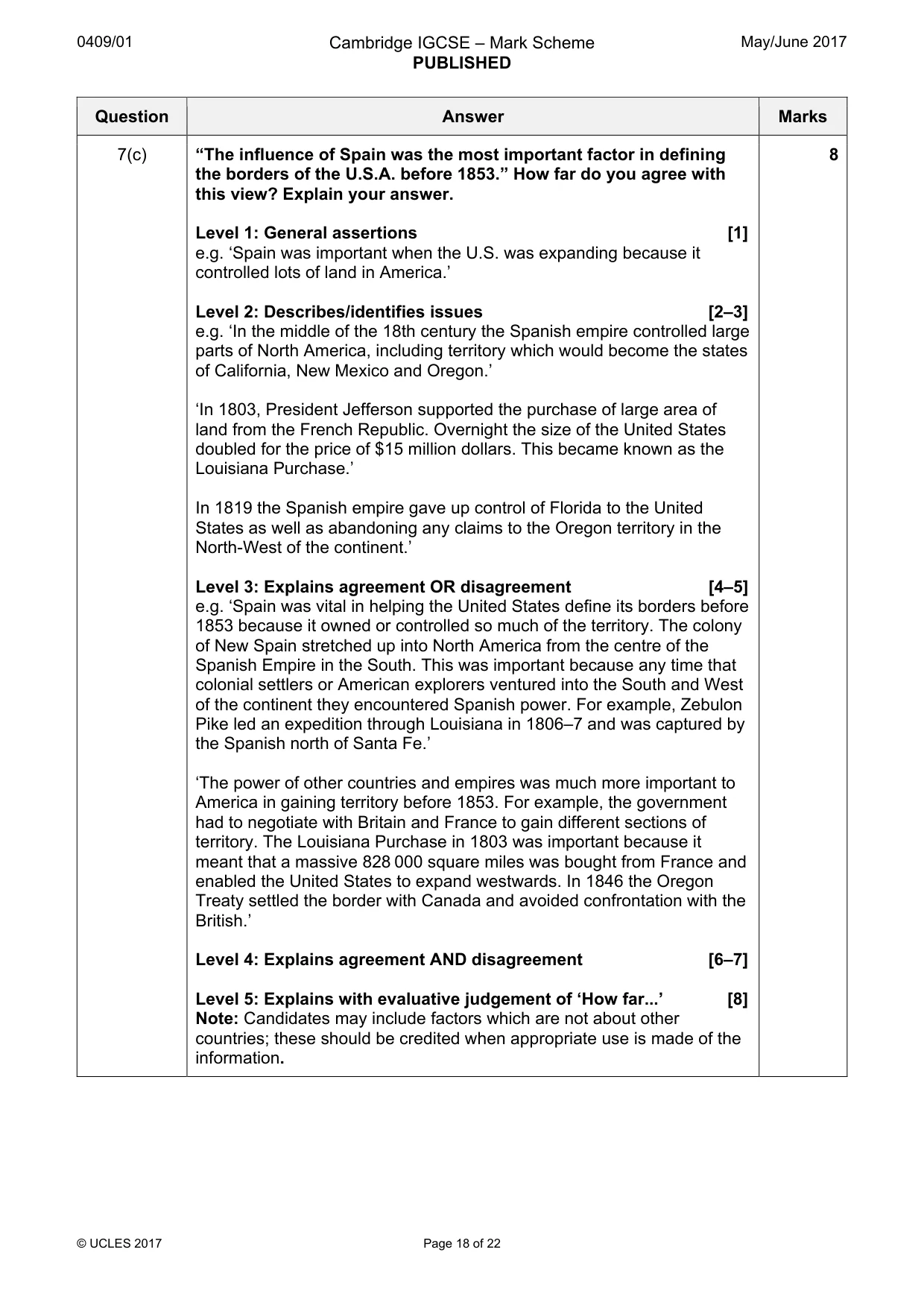
Mark scheme, page 18
0409/01 Cambridge IGCSE – Mark Scheme PUBLISHED May/June 2017 © UCLES 2017 Page 18 of 22 Question Answer Marks 7(c) “The influence of Spain was the most important factor in defining the borders of the U.S.A. before 1853.” How far do you agree with this view? Explain your answer. Level 1: General assertions [1] e.g. ‘Spain was important when the U.S. was expanding because it controlled lots of land in America.’ Level 2: Describes/identifies issues [2–3] e.g. ‘In the middle of the 18th century the Spanish empire controlled large parts of North America, including territory which would become the states of California, New Mexico and Oregon.’ ‘In 1803, President Jefferson supported the purchase of large area of land from the French Republic. Overnight the size of the United States doubled for the price of $15 million dollars. This became known as the Louisiana Purchase.’ In 1819 the Spanish empire gave up control of Florida to the United States as well as abandoning any claims to the Oregon territory in the North-West of the continent.’ Level 3: Explains agreement OR disagreement [4–5] e.g. ‘Spain was vital in helping the United States define its borders before 1853 because it owned or controlled so much of the territory. The colony of New Spain stretched up into North America from the centre of the Spanish Empire in the South. This was important because any time that colonial settlers or American explorers ventured into the South and West of the continent they encountered Spanish power. For example, Zebulon Pike led an expedition through Louisiana in 1806–7 and was captured by the Spanish north of Santa Fe.’ ‘The power of other countries and empires was much more important to America in gaining territory before 1853. For example, the government had to negotiate with Britain and France to gain different sections of territory. The Louisiana Purchase in 1803 was important because it meant that a massive 828 000 square miles was bought from France and enabled the United States to expand westwards. In 1846 the Oregon Treaty settled the border with Canada and avoided confrontation with the British.’ Level 4: Explains agreement AND disagreement [6–7] Level 5: Explains with evaluative judgement of ‘How far...’ [8] Note: Candidates may include factors which are not about other countries; these should be credited when appropriate use is made of the information. 8
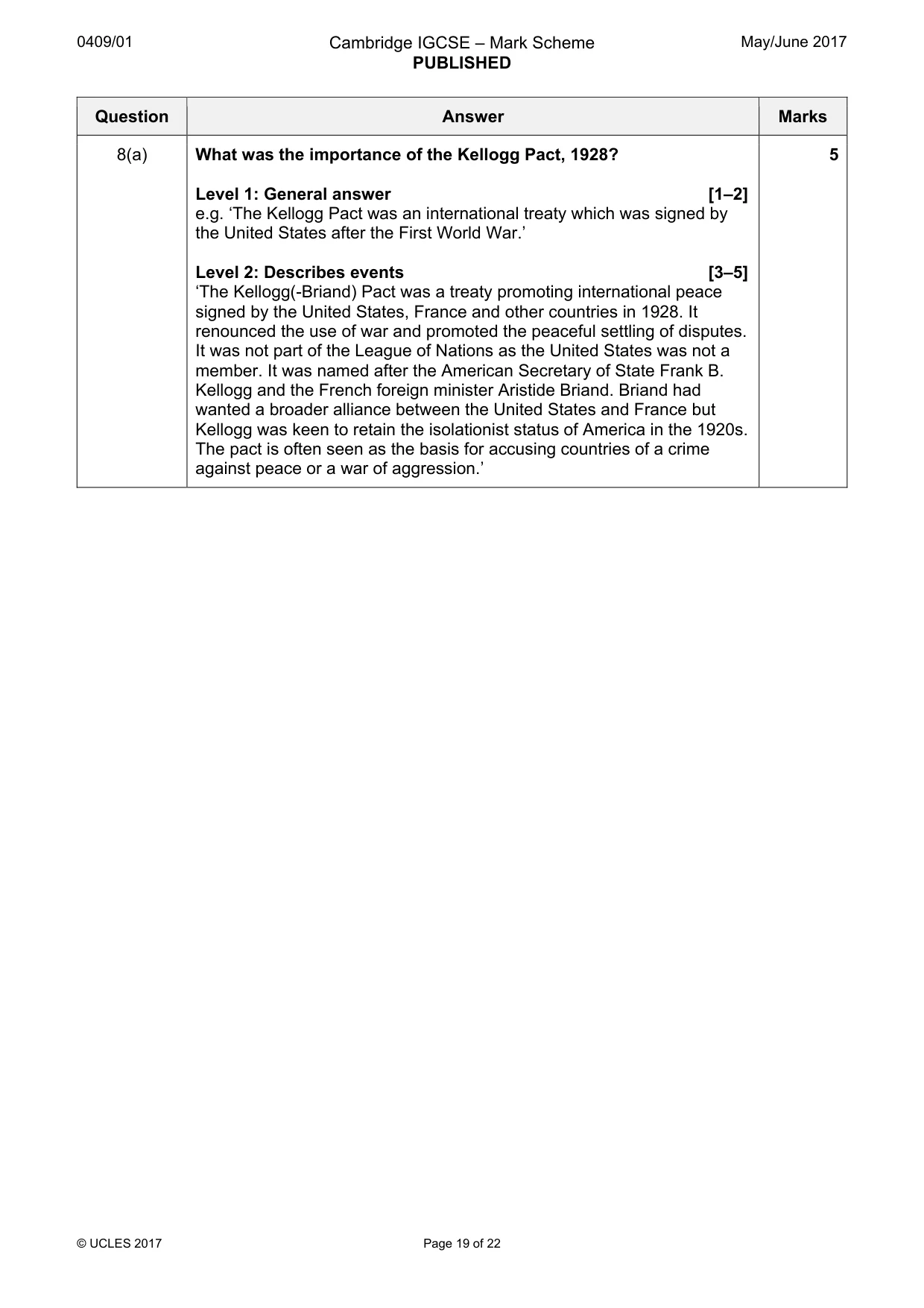
Mark scheme, page 19
0409/01 Cambridge IGCSE – Mark Scheme PUBLISHED May/June 2017 © UCLES 2017 Page 19 of 22 Question Answer Marks 8(a) What was the importance of the Kellogg Pact, 1928? Level 1: General answer [1–2] e.g. ‘The Kellogg Pact was an international treaty which was signed by the United States after the First World War.’ Level 2: Describes events [3–5] ‘The Kellogg(-Briand) Pact was a treaty promoting international peace signed by the United States, France and other countries in 1928. It renounced the use of war and promoted the peaceful settling of disputes. It was not part of the League of Nations as the United States was not a member. It was named after the American Secretary of State Frank B. Kellogg and the French foreign minister Aristide Briand. Briand had wanted a broader alliance between the United States and France but Kellogg was keen to retain the isolationist status of America in the 1920s. The pact is often seen as the basis for accusing countries of a crime against peace or a war of aggression.’ 5
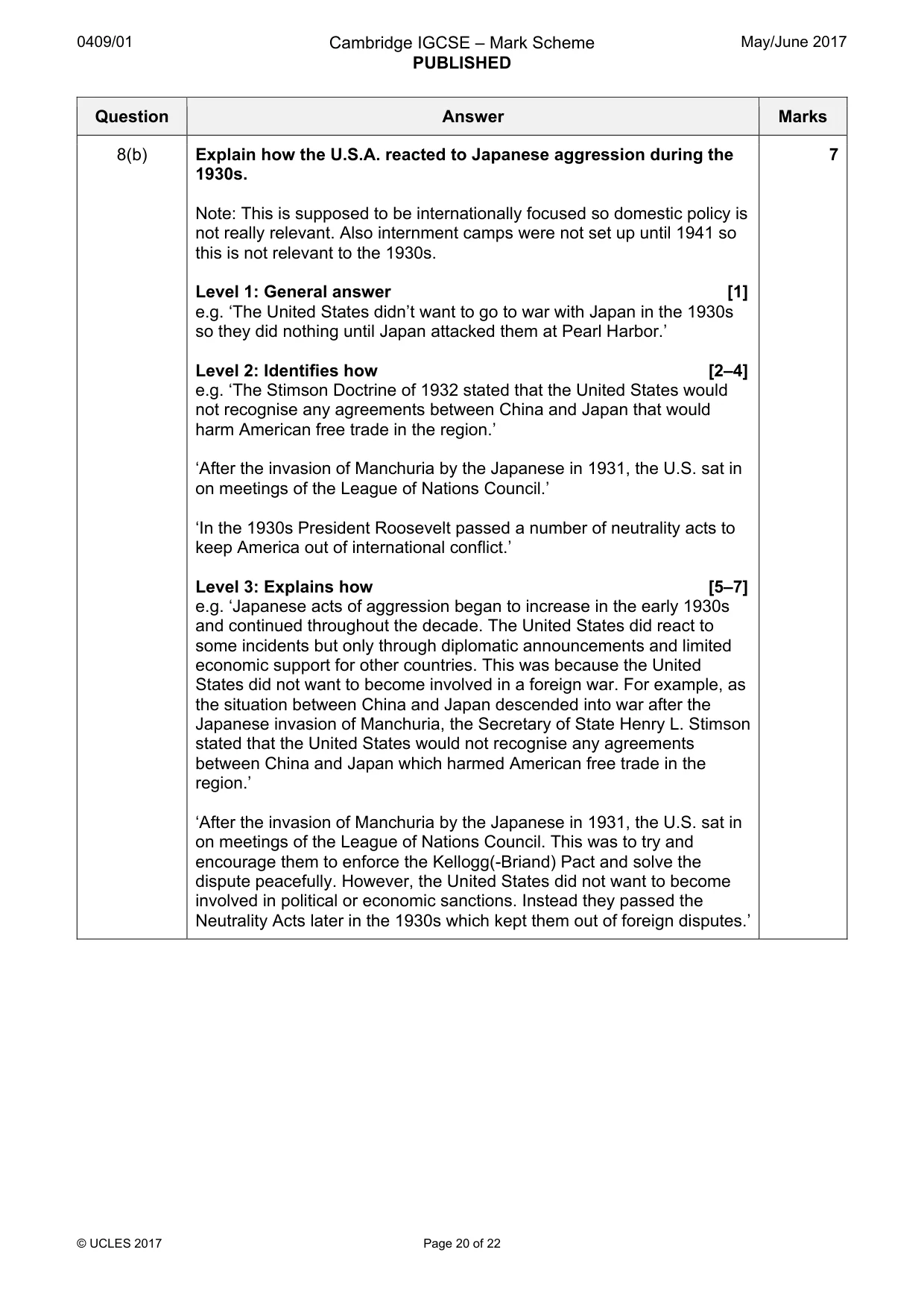
Mark scheme, page 20
0409/01 Cambridge IGCSE – Mark Scheme PUBLISHED May/June 2017 © UCLES 2017 Page 20 of 22 Question Answer Marks 8(b) Explain how the U.S.A. reacted to Japanese aggression during the 1930s. Note: This is supposed to be internationally focused so domestic policy is not really relevant. Also internment camps were not set up until 1941 so this is not relevant to the 1930s. Level 1: General answer [1] e.g. ‘The United States didn’t want to go to war with Japan in the 1930s so they did nothing until Japan attacked them at Pearl Harbor.’ Level 2: Identifies how [2–4] e.g. ‘The Stimson Doctrine of 1932 stated that the United States would not recognise any agreements between China and Japan that would harm American free trade in the region.’ ‘After the invasion of Manchuria by the Japanese in 1931, the U.S. sat in on meetings of the League of Nations Council.’ ‘In the 1930s President Roosevelt passed a number of neutrality acts to keep America out of international conflict.’ Level 3: Explains how [5–7] e.g. ‘Japanese acts of aggression began to increase in the early 1930s and continued throughout the decade. The United States did react to some incidents but only through diplomatic announcements and limited economic support for other countries. This was because the United States did not want to become involved in a foreign war. For example, as the situation between China and Japan descended into war after the Japanese invasion of Manchuria, the Secretary of State Henry L. Stimson stated that the United States would not recognise any agreements between China and Japan which harmed American free trade in the region.’ ‘After the invasion of Manchuria by the Japanese in 1931, the U.S. sat in on meetings of the League of Nations Council. This was to try and encourage them to enforce the Kellogg(-Briand) Pact and solve the dispute peacefully. However, the United States did not want to become involved in political or economic sanctions. Instead they passed the Neutrality Acts later in the 1930s which kept them out of foreign disputes.’ 7
Mark scheme, page 21
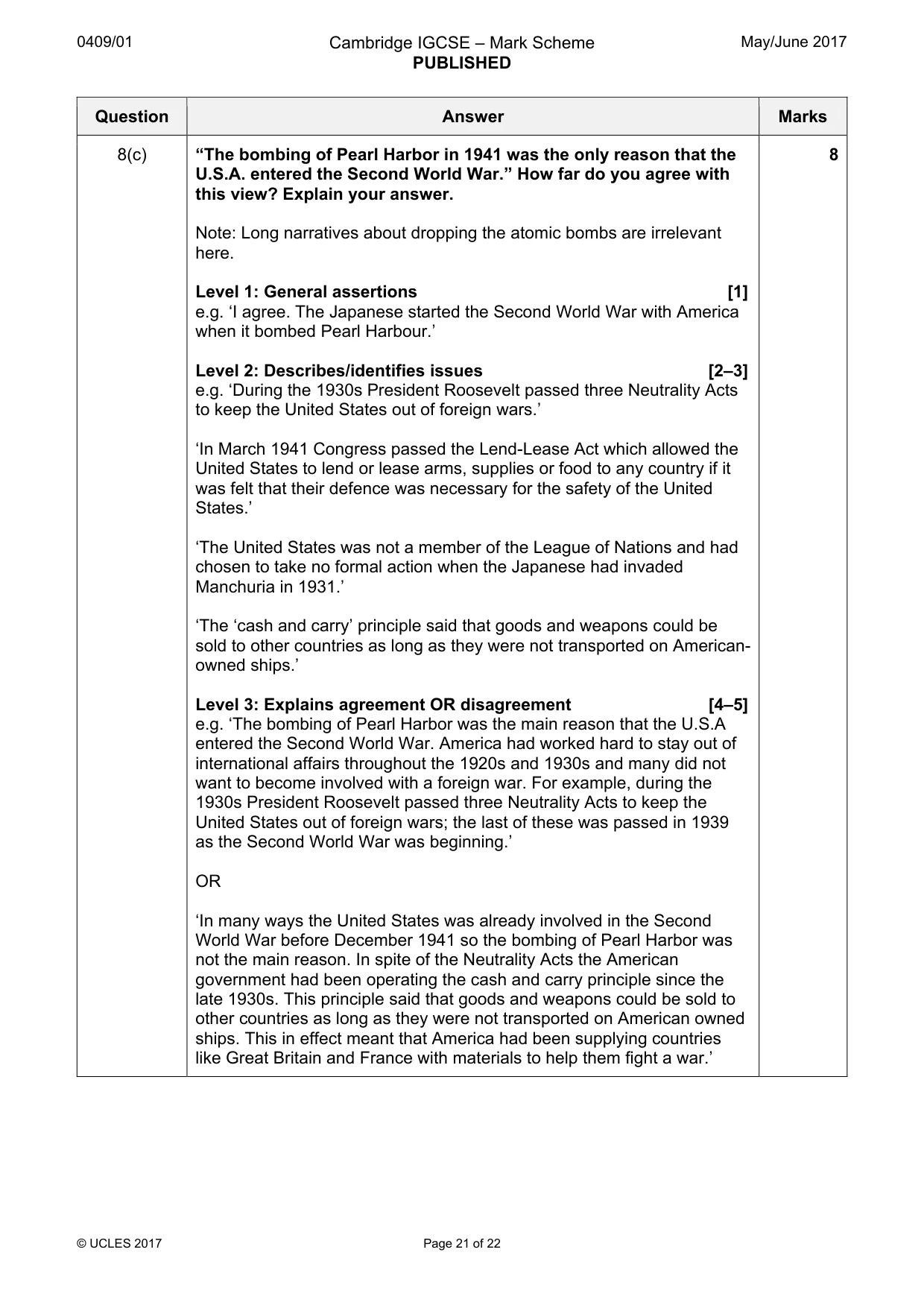
0409/01 Cambridge IGCSE – Mark Scheme PUBLISHED May/June 2017 © UCLES 2017 Page 21 of 22 Question Answer Marks 8(c) “The bombing of Pearl Harbor in 1941 was the only reason that the U.S.A. entered the Second World War.” How far do you agree with this view? Explain your answer. Note: Long narratives about dropping the atomic bombs are irrelevant here. Level 1: General assertions [1] e.g. ‘I agree. The Japanese started the Second World War with America when it bombed Pearl Harbour.’ Level 2: Describes/identifies issues [2–3] e.g. ‘During the 1930s President Roosevelt passed three Neutrality Acts to keep the United States out of foreign wars.’ ‘In March 1941 Congress passed the Lend-Lease Act which allowed the United States to lend or lease arms, supplies or food to any country if it was felt that their defence was necessary for the safety of the United States.’ ‘The United States was not a member of the League of Nations and had chosen to take no formal action when the Japanese had invaded Manchuria in 1931.’ ‘The ‘cash and carry’ principle said that goods and weapons could be sold to other countries as long as they were not transported on American- owned ships.’ Level 3: Explains agreement OR disagreement [4–5] e.g. ‘The bombing of Pearl Harbor was the main reason that the U.S.A entered the Second World War. America had worked hard to stay out of international affairs throughout the 1920s and 1930s and many did not want to become involved with a foreign war. For example, during the 1930s President Roosevelt passed three Neutrality Acts to keep the United States out of foreign wars; the last of these was passed in 1939 as the Second World War was beginning.’ OR ‘In many ways the United States was already involved in the Second World War before December 1941 so the bombing of Pearl Harbor was not the main reason. In spite of the Neutrality Acts the American government had been operating the cash and carry principle since the late 1930s. This principle said that goods and weapons could be sold to other countries as long as they were not transported on American owned ships. This in effect meant that America had been supplying countries like Great Britain and France with materials to help them fight a war.’ 8
Mark scheme, page 22
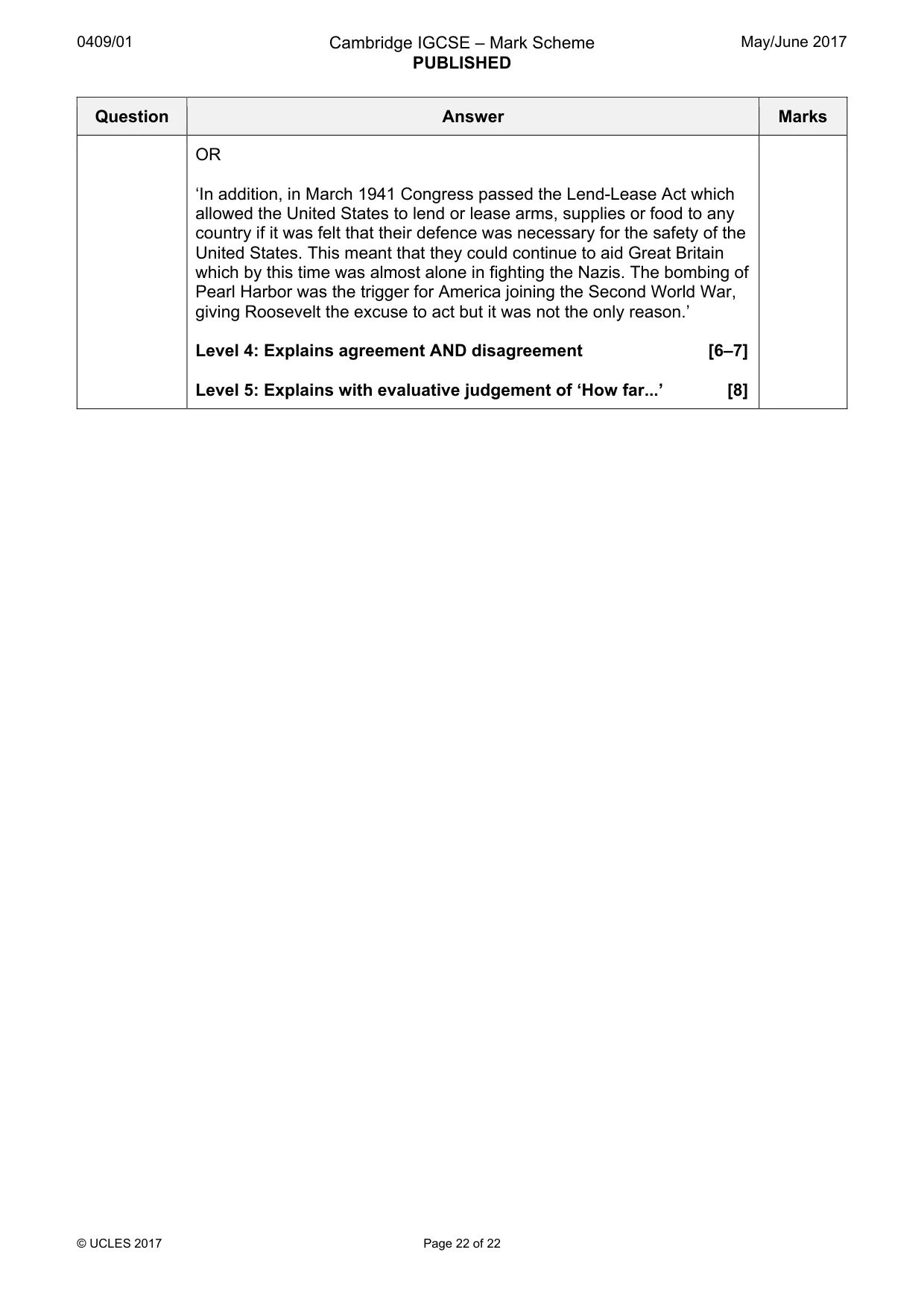
0409/01 Cambridge IGCSE – Mark Scheme PUBLISHED May/June 2017 © UCLES 2017 Page 22 of 22 Question Answer Marks OR ‘In addition, in March 1941 Congress passed the Lend-Lease Act which allowed the United States to lend or lease arms, supplies or food to any country if it was felt that their defence was necessary for the safety of the United States. This meant that they could continue to aid Great Britain which by this time was almost alone in fighting the Nazis. The bombing of Pearl Harbor was the trigger for America joining the Second World War, giving Roosevelt the excuse to act but it was not the only reason.’ Level 4: Explains agreement AND disagreement [6–7] Level 5: Explains with evaluative judgement of ‘How far...’ [8]
What you needed in this session
Cambridge’s own grade thresholds for 2017 May/June, Paper 1 · Variant 1. A higher threshold means an easier paper — the bar moves with how the cohort did.