Cambridge IGCSE History American BES 0409 — 2017 Oct/Nov Paper 1 · Variant 1
0409/11/O/N/17 · 60 marks · ≈68 min
The question paper and its mark scheme, free to read here and free to download. This is Cambridge’s own paper, exactly as it was sat.
Question paper4 pages

Mark scheme20 pages
Answers below. Sit the paper first if you are practising.
Paper as text
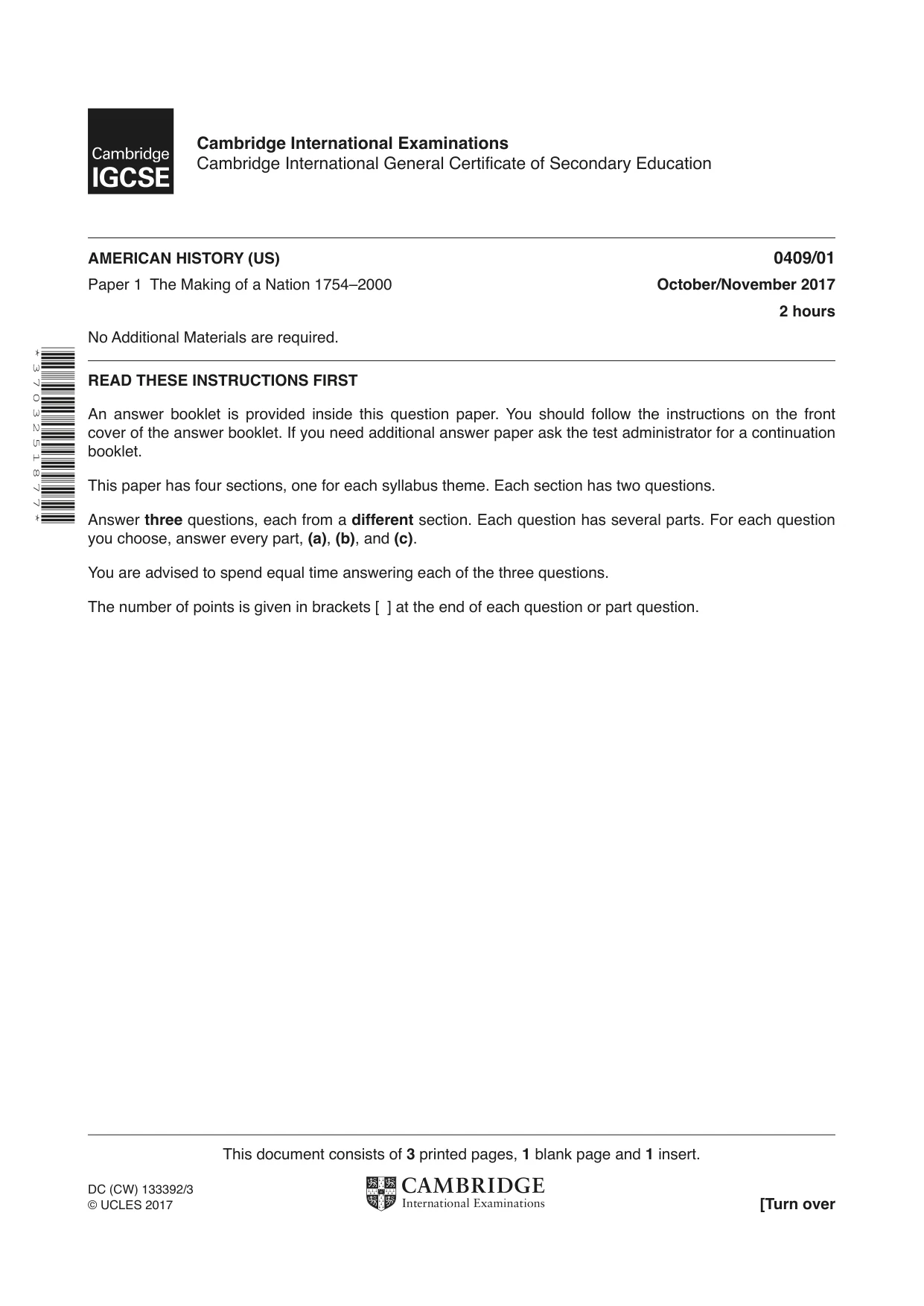
Question paper, page 1
* 3 7 0 3 2 5 1 8 7 7 * This document consists of 3 printed pages, 1 blank page and 1 insert. DC (CW) 133392/3 © UCLES 2017 [Turn over Cambridge International Examinations Cambridge International General Certificate of Secondary Education AMERICAN HISTORY (US) 0409/01 Paper 1 The Making of a Nation 1754–2000 October/November 2017 2 hours No Additional Materials are required. READ THESE INSTRUCTIONS FIRST An answer booklet is provided inside this question paper. You should follow the instructions on the front cover of the answer booklet. If you need additional answer paper ask the test administrator for a continuation booklet. This paper has four sections, one for each syllabus theme. Each section has two questions. Answer three questions, each from a different section. Each question has several parts. For each question you choose, answer every part, (a), (b), and (c). You are advised to spend equal time answering each of the three questions. The number of points is given in brackets [ ] at the end of each question or part question.
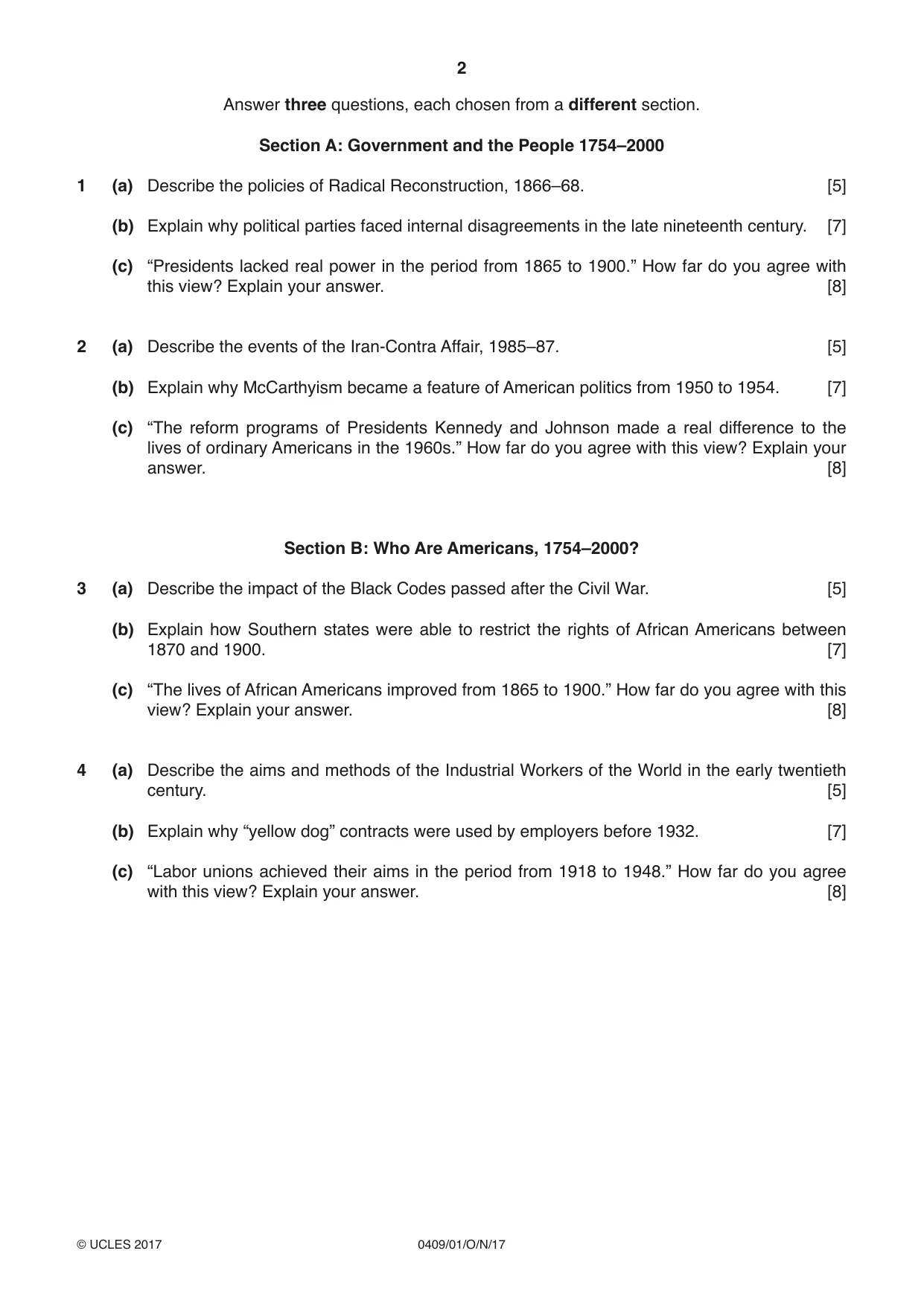
Question paper, page 2
2 0409/01/O/N/17 © UCLES 2017 Answer three questions, each chosen from a different section. Section A: Government and the People 1754–2000 1 (a) Describe the policies of Radical Reconstruction, 1866–68. [5] (b) Explain why political parties faced internal disagreements in the late nineteenth century. [7] (c) “Presidents lacked real power in the period from 1865 to 1900.” How far do you agree with this view? Explain your answer. [8] 2 (a) Describe the events of the Iran-Contra Affair, 1985–87. [5] (b) Explain why McCarthyism became a feature of American politics from 1950 to 1954. [7] (c) “The reform programs of Presidents Kennedy and Johnson made a real difference to the lives of ordinary Americans in the 1960s.” How far do you agree with this view? Explain your answer. [8] Section B: Who Are Americans, 1754–2000? 3 (a) Describe the impact of the Black Codes passed after the Civil War. [5] (b) Explain how Southern states were able to restrict the rights of African Americans between 1870 and 1900. [7] (c) “The lives of African Americans improved from 1865 to 1900.” How far do you agree with this view? Explain your answer. [8] 4 (a) Describe the aims and methods of the Industrial Workers of the World in the early twentieth century. [5] (b) Explain why “yellow dog” contracts were used by employers before 1932. [7] (c) “Labor unions achieved their aims in the period from 1918 to 1948.” How far do you agree with this view? Explain your answer. [8]
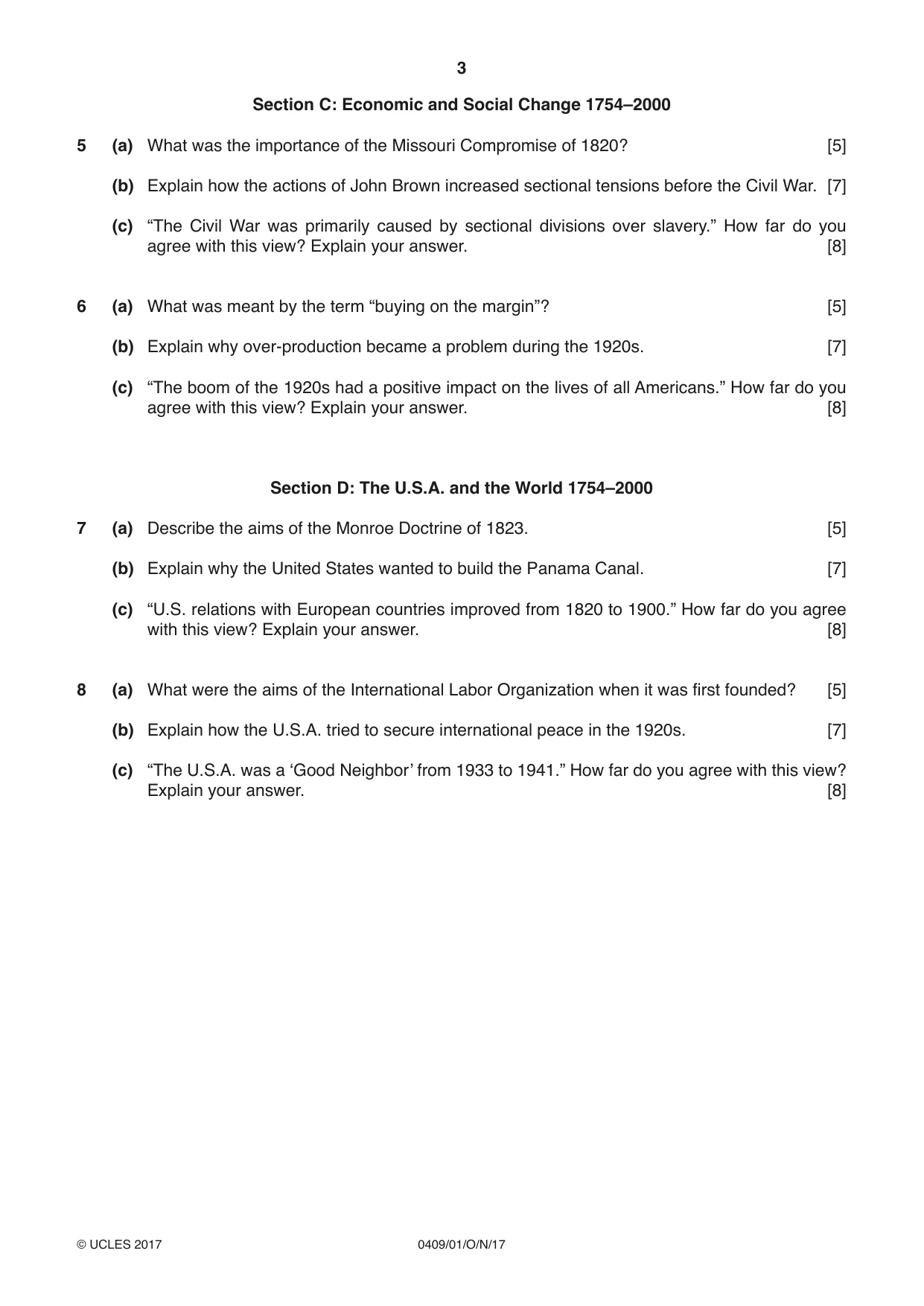
Question paper, page 3
3 0409/01/O/N/17 © UCLES 2017 Section C: Economic and Social Change 1754–2000 5 (a) What was the importance of the Missouri Compromise of 1820? [5] (b) Explain how the actions of John Brown increased sectional tensions before the Civil War. [7] (c) “The Civil War was primarily caused by sectional divisions over slavery.” How far do you agree with this view? Explain your answer. [8] 6 (a) What was meant by the term “buying on the margin”? [5] (b) Explain why over-production became a problem during the 1920s. [7] (c) “The boom of the 1920s had a positive impact on the lives of all Americans.” How far do you agree with this view? Explain your answer. [8] Section D: The U.S.A. and the World 1754–2000 7 (a) Describe the aims of the Monroe Doctrine of 1823. [5] (b) Explain why the United States wanted to build the Panama Canal. [7] (c) “U.S. relations with European countries improved from 1820 to 1900.” How far do you agree with this view? Explain your answer. [8] 8 (a) What were the aims of the International Labor Organization when it was first founded? [5] (b) Explain how the U.S.A. tried to secure international peace in the 1920s. [7] (c) “The U.S.A. was a ‘Good Neighbor’ from 1933 to 1941.” How far do you agree with this view? Explain your answer. [8]
Question paper, page 4
4 0409/01/O/N/17 © UCLES 2017 Permission to reproduce items where third-party owned material protected by copyright is included has been sought and cleared where possible. Every reasonable effort has been made by the publisher (UCLES) to trace copyright holders, but if any items requiring clearance have unwittingly been included, the publisher will be pleased to make amends at the earliest possible opportunity. To avoid the issue of disclosure of answer-related information to candidates, all copyright acknowledgements are reproduced online in the Cambridge International Examinations Copyright Acknowledgements Booklet. This is produced for each series of examinations and is freely available to download at www.cie.org.uk after the live examination series. Cambridge International Examinations is part of the Cambridge Assessment Group. Cambridge Assessment is the brand name of University of Cambridge Local Examinations Syndicate (UCLES), which is itself a department of the University of Cambridge. BLANK PAGE
Mark scheme, page 1
® IGCSE is a registered trademark. This document consists of 20 printed pages. © UCLES 2017 [Turn over Cambridge Assessment International Education Cambridge International General Certificate of Secondary Education AMERICAN HISTORY (US) 0409/01 Paper 1 The Making of a Nation October/November 2017 MARK SCHEME Maximum Mark: 60 Published This mark scheme is published as an aid to teachers and candidates, to indicate the requirements of the examination. It shows the basis on which Examiners were instructed to award marks. It does not indicate the details of the discussions that took place at an Examiners’ meeting before marking began, which would have considered the acceptability of alternative answers. Mark schemes should be read in conjunction with the question paper and the Principal Examiner Report for Teachers. Cambridge International will not enter into discussions about these mark schemes. Cambridge International is publishing the mark schemes for the October/November 2017 series for most Cambridge IGCSE®, Cambridge International A and AS Level components and some Cambridge O Level components.
Mark scheme, page 2
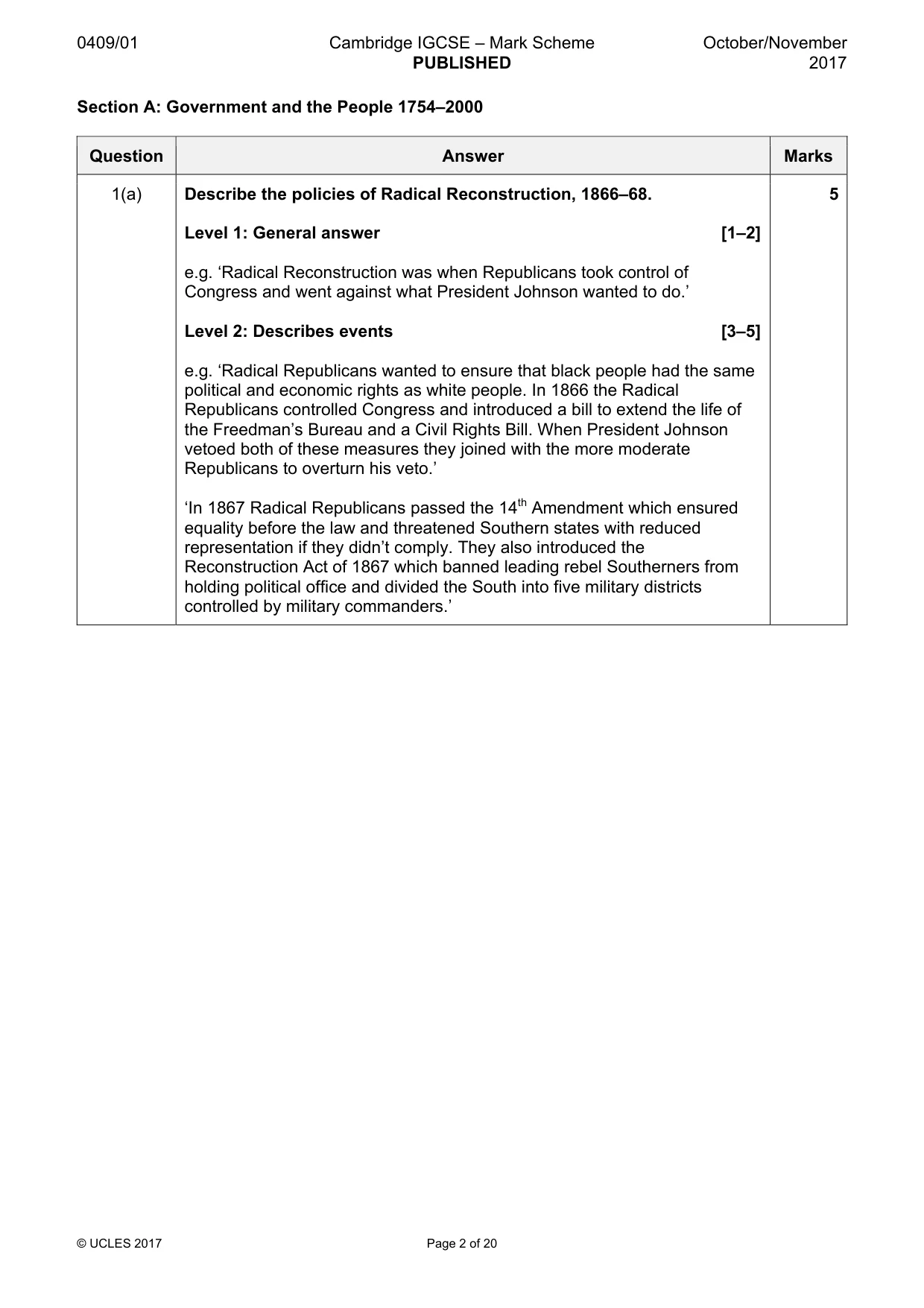
0409/01 Cambridge IGCSE – Mark Scheme PUBLISHED October/November 2017 © UCLES 2017 Page 2 of 20 Section A: Government and the People 1754–2000 Question Answer Marks 1(a) Describe the policies of Radical Reconstruction, 1866–68. Level 1: General answer [1–2] e.g. ‘Radical Reconstruction was when Republicans took control of Congress and went against what President Johnson wanted to do.’ Level 2: Describes events [3–5] e.g. ‘Radical Republicans wanted to ensure that black people had the same political and economic rights as white people. In 1866 the Radical Republicans controlled Congress and introduced a bill to extend the life of the Freedman’s Bureau and a Civil Rights Bill. When President Johnson vetoed both of these measures they joined with the more moderate Republicans to overturn his veto.’ ‘In 1867 Radical Republicans passed the 14th Amendment which ensured equality before the law and threatened Southern states with reduced representation if they didn’t comply. They also introduced the Reconstruction Act of 1867 which banned leading rebel Southerners from holding political office and divided the South into five military districts controlled by military commanders.’ 5
Mark scheme, page 3
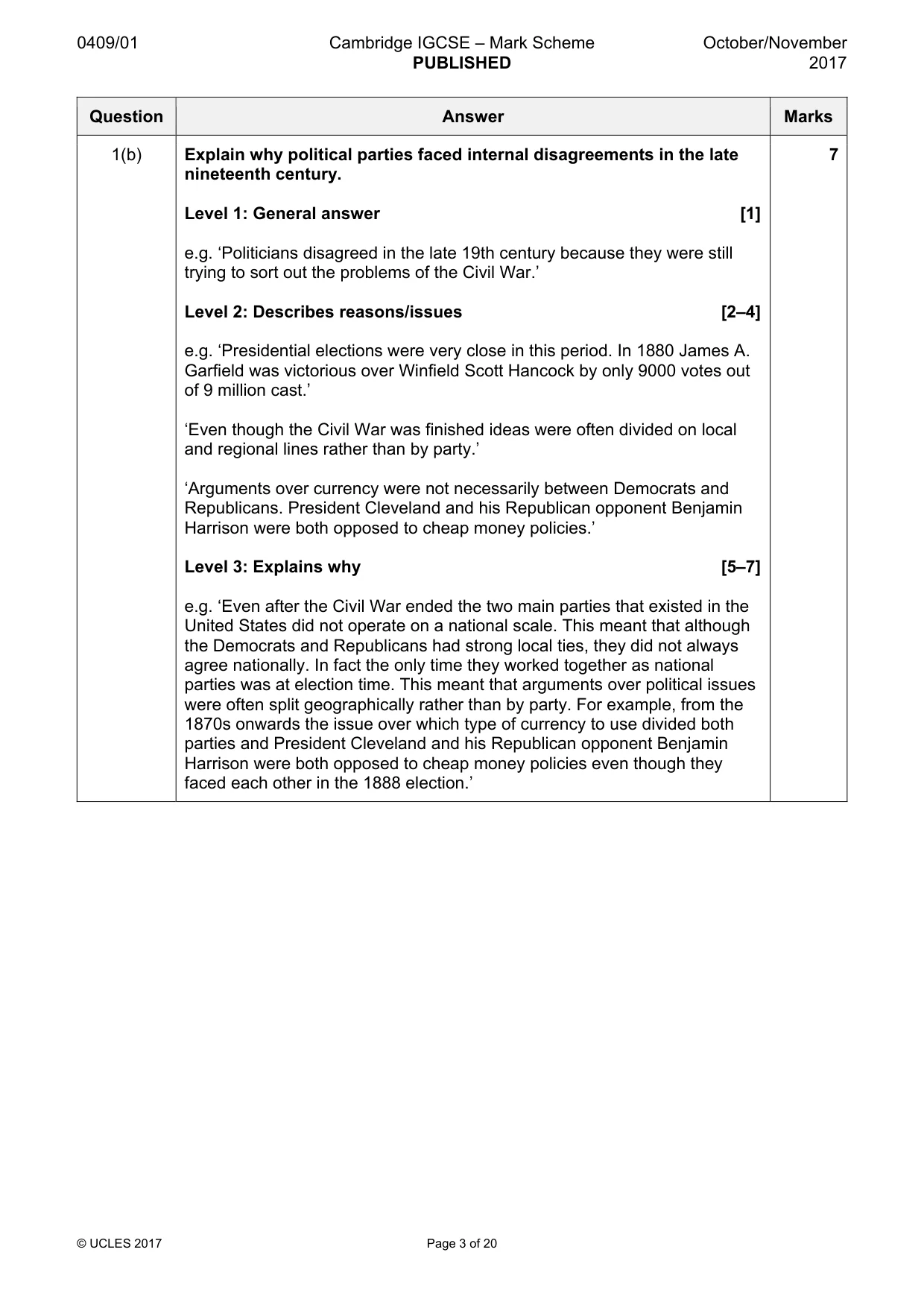
0409/01 Cambridge IGCSE – Mark Scheme PUBLISHED October/November 2017 © UCLES 2017 Page 3 of 20 Question Answer Marks 1(b) Explain why political parties faced internal disagreements in the late nineteenth century. Level 1: General answer [1] e.g. ‘Politicians disagreed in the late 19th century because they were still trying to sort out the problems of the Civil War.’ Level 2: Describes reasons/issues [2–4] e.g. ‘Presidential elections were very close in this period. In 1880 James A. Garfield was victorious over Winfield Scott Hancock by only 9000 votes out of 9 million cast.’ ‘Even though the Civil War was finished ideas were often divided on local and regional lines rather than by party.’ ‘Arguments over currency were not necessarily between Democrats and Republicans. President Cleveland and his Republican opponent Benjamin Harrison were both opposed to cheap money policies.’ Level 3: Explains why [5–7] e.g. ‘Even after the Civil War ended the two main parties that existed in the United States did not operate on a national scale. This meant that although the Democrats and Republicans had strong local ties, they did not always agree nationally. In fact the only time they worked together as national parties was at election time. This meant that arguments over political issues were often split geographically rather than by party. For example, from the 1870s onwards the issue over which type of currency to use divided both parties and President Cleveland and his Republican opponent Benjamin Harrison were both opposed to cheap money policies even though they faced each other in the 1888 election.’ 7
Mark scheme, page 4
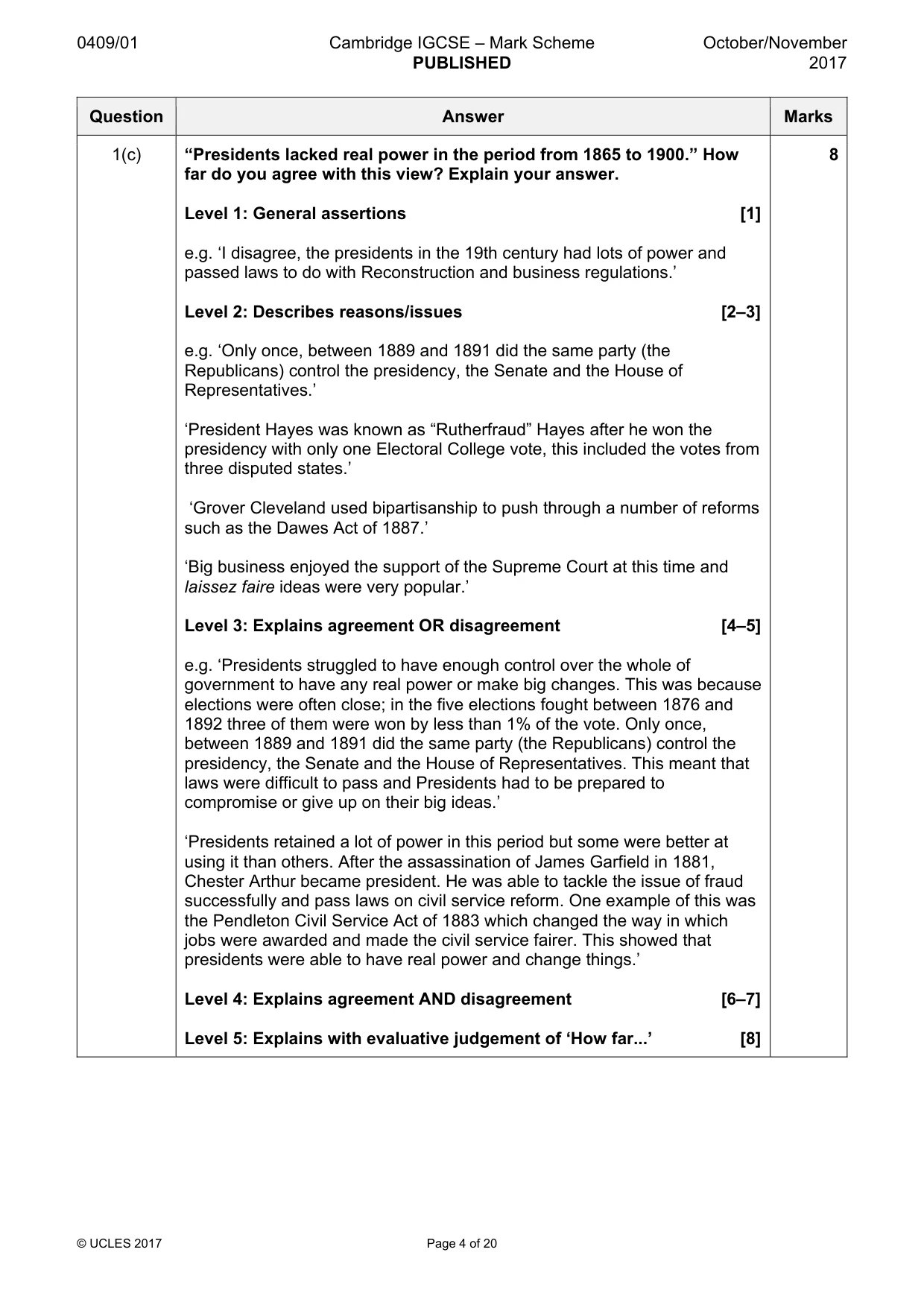
0409/01 Cambridge IGCSE – Mark Scheme PUBLISHED October/November 2017 © UCLES 2017 Page 4 of 20 Question Answer Marks 1(c) “Presidents lacked real power in the period from 1865 to 1900.” How far do you agree with this view? Explain your answer. Level 1: General assertions [1] e.g. ‘I disagree, the presidents in the 19th century had lots of power and passed laws to do with Reconstruction and business regulations.’ Level 2: Describes reasons/issues [2–3] e.g. ‘Only once, between 1889 and 1891 did the same party (the Republicans) control the presidency, the Senate and the House of Representatives.’ ‘President Hayes was known as “Rutherfraud” Hayes after he won the presidency with only one Electoral College vote, this included the votes from three disputed states.’ ‘Grover Cleveland used bipartisanship to push through a number of reforms such as the Dawes Act of 1887.’ ‘Big business enjoyed the support of the Supreme Court at this time and laissez faire ideas were very popular.’ Level 3: Explains agreement OR disagreement [4–5] e.g. ‘Presidents struggled to have enough control over the whole of government to have any real power or make big changes. This was because elections were often close; in the five elections fought between 1876 and 1892 three of them were won by less than 1% of the vote. Only once, between 1889 and 1891 did the same party (the Republicans) control the presidency, the Senate and the House of Representatives. This meant that laws were difficult to pass and Presidents had to be prepared to compromise or give up on their big ideas.’ ‘Presidents retained a lot of power in this period but some were better at using it than others. After the assassination of James Garfield in 1881, Chester Arthur became president. He was able to tackle the issue of fraud successfully and pass laws on civil service reform. One example of this was the Pendleton Civil Service Act of 1883 which changed the way in which jobs were awarded and made the civil service fairer. This showed that presidents were able to have real power and change things.’ Level 4: Explains agreement AND disagreement [6–7] Level 5: Explains with evaluative judgement of ‘How far...’ [8] 8
Mark scheme, page 5
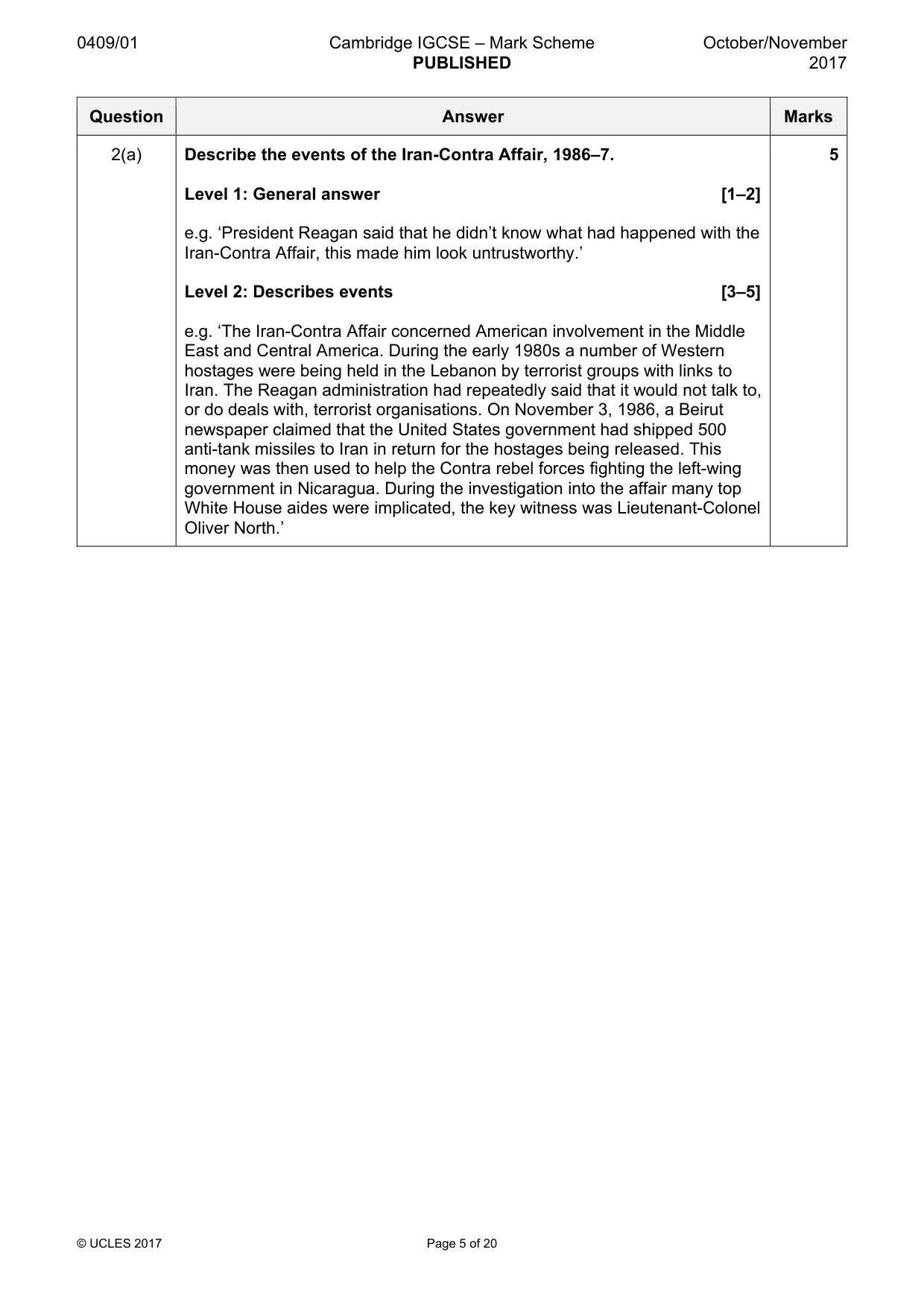
0409/01 Cambridge IGCSE – Mark Scheme PUBLISHED October/November 2017 © UCLES 2017 Page 5 of 20 Question Answer Marks 2(a) Describe the events of the Iran-Contra Affair, 1986–7. Level 1: General answer [1–2] e.g. ‘President Reagan said that he didn’t know what had happened with the Iran-Contra Affair, this made him look untrustworthy.’ Level 2: Describes events [3–5] e.g. ‘The Iran-Contra Affair concerned American involvement in the Middle East and Central America. During the early 1980s a number of Western hostages were being held in the Lebanon by terrorist groups with links to Iran. The Reagan administration had repeatedly said that it would not talk to, or do deals with, terrorist organisations. On November 3, 1986, a Beirut newspaper claimed that the United States government had shipped 500 anti-tank missiles to Iran in return for the hostages being released. This money was then used to help the Contra rebel forces fighting the left-wing government in Nicaragua. During the investigation into the affair many top White House aides were implicated, the key witness was Lieutenant-Colonel Oliver North.’ 5
Mark scheme, page 6
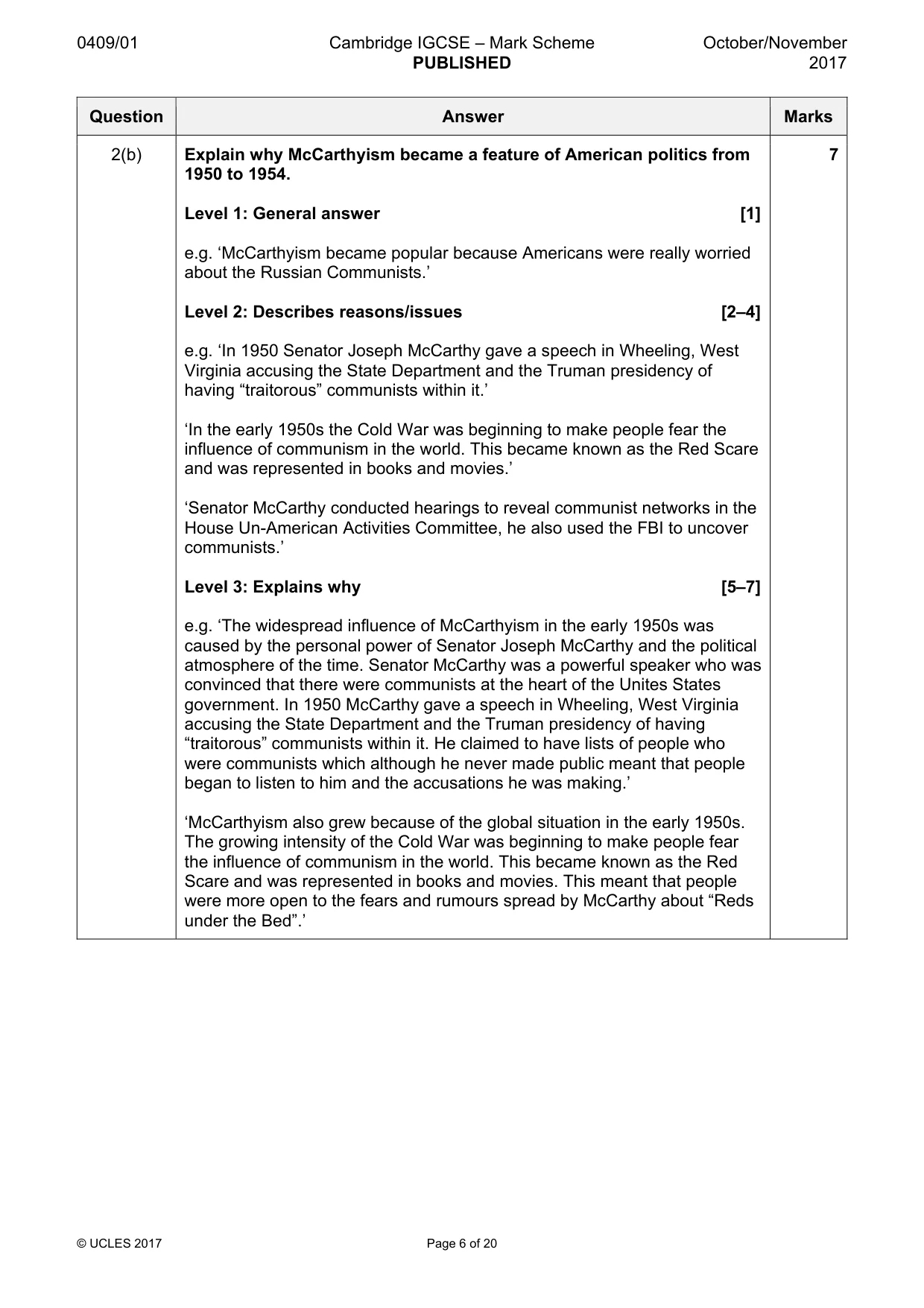
0409/01 Cambridge IGCSE – Mark Scheme PUBLISHED October/November 2017 © UCLES 2017 Page 6 of 20 Question Answer Marks 2(b) Explain why McCarthyism became a feature of American politics from 1950 to 1954. Level 1: General answer [1] e.g. ‘McCarthyism became popular because Americans were really worried about the Russian Communists.’ Level 2: Describes reasons/issues [2–4] e.g. ‘In 1950 Senator Joseph McCarthy gave a speech in Wheeling, West Virginia accusing the State Department and the Truman presidency of having “traitorous” communists within it.’ ‘In the early 1950s the Cold War was beginning to make people fear the influence of communism in the world. This became known as the Red Scare and was represented in books and movies.’ ‘Senator McCarthy conducted hearings to reveal communist networks in the House Un-American Activities Committee, he also used the FBI to uncover communists.’ Level 3: Explains why [5–7] e.g. ‘The widespread influence of McCarthyism in the early 1950s was caused by the personal power of Senator Joseph McCarthy and the political atmosphere of the time. Senator McCarthy was a powerful speaker who was convinced that there were communists at the heart of the Unites States government. In 1950 McCarthy gave a speech in Wheeling, West Virginia accusing the State Department and the Truman presidency of having “traitorous” communists within it. He claimed to have lists of people who were communists which although he never made public meant that people began to listen to him and the accusations he was making.’ ‘McCarthyism also grew because of the global situation in the early 1950s. The growing intensity of the Cold War was beginning to make people fear the influence of communism in the world. This became known as the Red Scare and was represented in books and movies. This meant that people were more open to the fears and rumours spread by McCarthy about “Reds under the Bed”.’ 7
Mark scheme, page 7
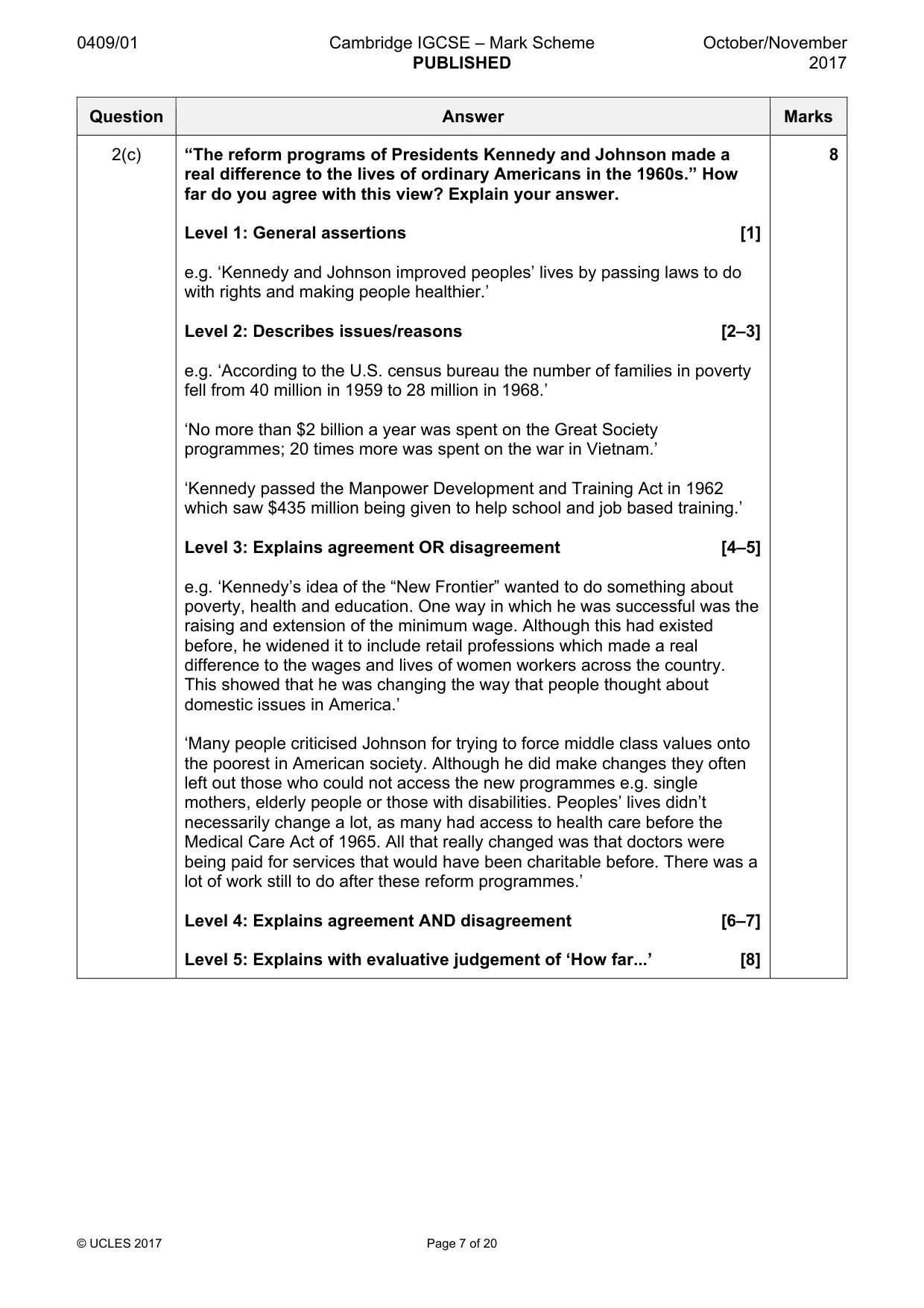
0409/01 Cambridge IGCSE – Mark Scheme PUBLISHED October/November 2017 © UCLES 2017 Page 7 of 20 Question Answer Marks 2(c) “The reform programs of Presidents Kennedy and Johnson made a real difference to the lives of ordinary Americans in the 1960s.” How far do you agree with this view? Explain your answer. Level 1: General assertions [1] e.g. ‘Kennedy and Johnson improved peoples’ lives by passing laws to do with rights and making people healthier.’ Level 2: Describes issues/reasons [2–3] e.g. ‘According to the U.S. census bureau the number of families in poverty fell from 40 million in 1959 to 28 million in 1968.’ ‘No more than $2 billion a year was spent on the Great Society programmes; 20 times more was spent on the war in Vietnam.’ ‘Kennedy passed the Manpower Development and Training Act in 1962 which saw $435 million being given to help school and job based training.’ Level 3: Explains agreement OR disagreement [4–5] e.g. ‘Kennedy’s idea of the “New Frontier” wanted to do something about poverty, health and education. One way in which he was successful was the raising and extension of the minimum wage. Although this had existed before, he widened it to include retail professions which made a real difference to the wages and lives of women workers across the country. This showed that he was changing the way that people thought about domestic issues in America.’ ‘Many people criticised Johnson for trying to force middle class values onto the poorest in American society. Although he did make changes they often left out those who could not access the new programmes e.g. single mothers, elderly people or those with disabilities. Peoples’ lives didn’t necessarily change a lot, as many had access to health care before the Medical Care Act of 1965. All that really changed was that doctors were being paid for services that would have been charitable before. There was a lot of work still to do after these reform programmes.’ Level 4: Explains agreement AND disagreement [6–7] Level 5: Explains with evaluative judgement of ‘How far...’ [8] 8
Mark scheme, page 8
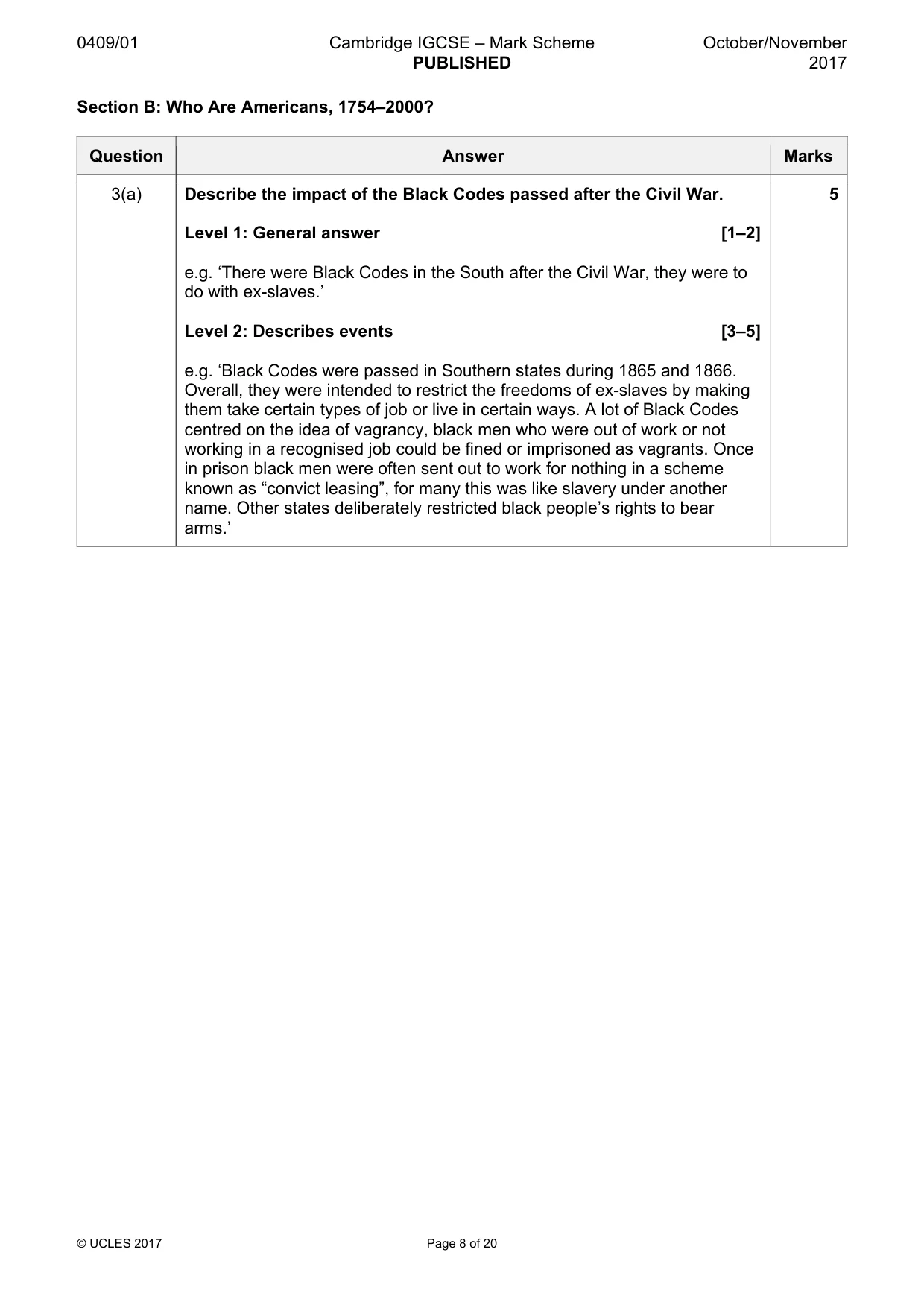
0409/01 Cambridge IGCSE – Mark Scheme PUBLISHED October/November 2017 © UCLES 2017 Page 8 of 20 Section B: Who Are Americans, 1754–2000? Question Answer Marks 3(a) Describe the impact of the Black Codes passed after the Civil War. Level 1: General answer [1–2] e.g. ‘There were Black Codes in the South after the Civil War, they were to do with ex-slaves.’ Level 2: Describes events [3–5] e.g. ‘Black Codes were passed in Southern states during 1865 and 1866. Overall, they were intended to restrict the freedoms of ex-slaves by making them take certain types of job or live in certain ways. A lot of Black Codes centred on the idea of vagrancy, black men who were out of work or not working in a recognised job could be fined or imprisoned as vagrants. Once in prison black men were often sent out to work for nothing in a scheme known as “convict leasing”, for many this was like slavery under another name. Other states deliberately restricted black people’s rights to bear arms.’ 5
Mark scheme, page 9
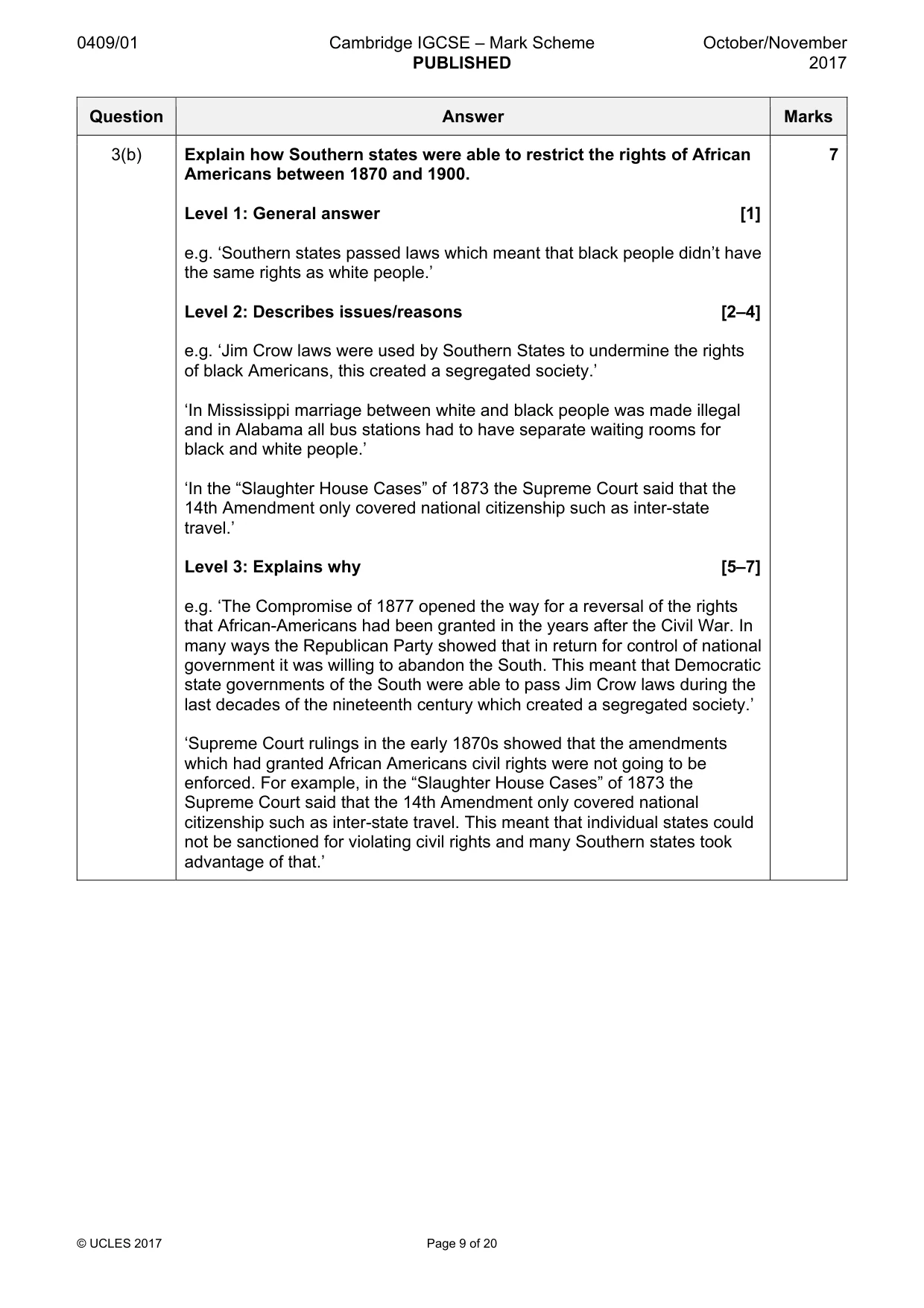
0409/01 Cambridge IGCSE – Mark Scheme PUBLISHED October/November 2017 © UCLES 2017 Page 9 of 20 Question Answer Marks 3(b) Explain how Southern states were able to restrict the rights of African Americans between 1870 and 1900. Level 1: General answer [1] e.g. ‘Southern states passed laws which meant that black people didn’t have the same rights as white people.’ Level 2: Describes issues/reasons [2–4] e.g. ‘Jim Crow laws were used by Southern States to undermine the rights of black Americans, this created a segregated society.’ ‘In Mississippi marriage between white and black people was made illegal and in Alabama all bus stations had to have separate waiting rooms for black and white people.’ ‘In the “Slaughter House Cases” of 1873 the Supreme Court said that the 14th Amendment only covered national citizenship such as inter-state travel.’ Level 3: Explains why [5–7] e.g. ‘The Compromise of 1877 opened the way for a reversal of the rights that African-Americans had been granted in the years after the Civil War. In many ways the Republican Party showed that in return for control of national government it was willing to abandon the South. This meant that Democratic state governments of the South were able to pass Jim Crow laws during the last decades of the nineteenth century which created a segregated society.’ ‘Supreme Court rulings in the early 1870s showed that the amendments which had granted African Americans civil rights were not going to be enforced. For example, in the “Slaughter House Cases” of 1873 the Supreme Court said that the 14th Amendment only covered national citizenship such as inter-state travel. This meant that individual states could not be sanctioned for violating civil rights and many Southern states took advantage of that.’ 7
Mark scheme, page 10
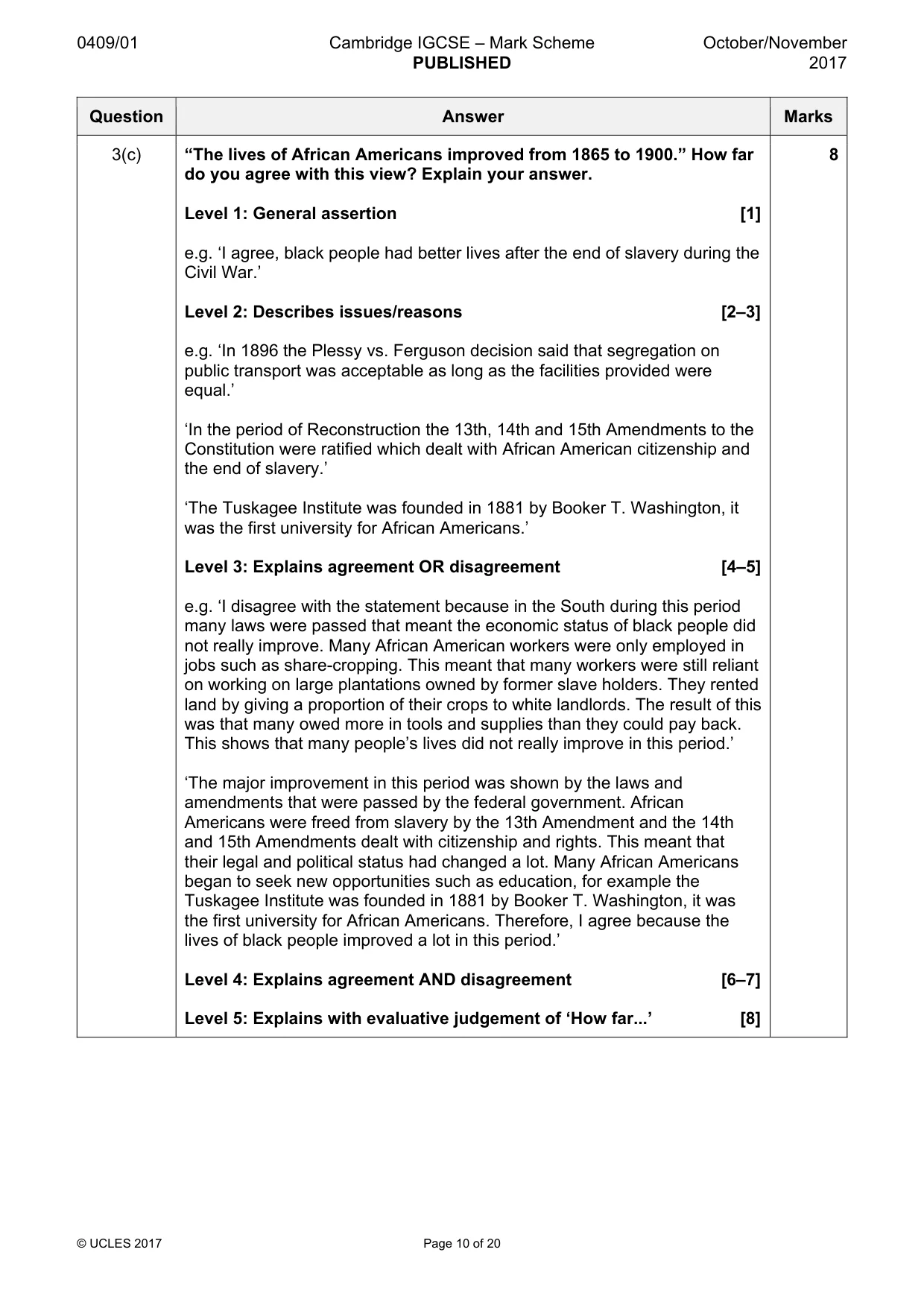
0409/01 Cambridge IGCSE – Mark Scheme PUBLISHED October/November 2017 © UCLES 2017 Page 10 of 20 Question Answer Marks 3(c) “The lives of African Americans improved from 1865 to 1900.” How far do you agree with this view? Explain your answer. Level 1: General assertion [1] e.g. ‘I agree, black people had better lives after the end of slavery during the Civil War.’ Level 2: Describes issues/reasons [2–3] e.g. ‘In 1896 the Plessy vs. Ferguson decision said that segregation on public transport was acceptable as long as the facilities provided were equal.’ ‘In the period of Reconstruction the 13th, 14th and 15th Amendments to the Constitution were ratified which dealt with African American citizenship and the end of slavery.’ ‘The Tuskagee Institute was founded in 1881 by Booker T. Washington, it was the first university for African Americans.’ Level 3: Explains agreement OR disagreement [4–5] e.g. ‘I disagree with the statement because in the South during this period many laws were passed that meant the economic status of black people did not really improve. Many African American workers were only employed in jobs such as share-cropping. This meant that many workers were still reliant on working on large plantations owned by former slave holders. They rented land by giving a proportion of their crops to white landlords. The result of this was that many owed more in tools and supplies than they could pay back. This shows that many people’s lives did not really improve in this period.’ ‘The major improvement in this period was shown by the laws and amendments that were passed by the federal government. African Americans were freed from slavery by the 13th Amendment and the 14th and 15th Amendments dealt with citizenship and rights. This meant that their legal and political status had changed a lot. Many African Americans began to seek new opportunities such as education, for example the Tuskagee Institute was founded in 1881 by Booker T. Washington, it was the first university for African Americans. Therefore, I agree because the lives of black people improved a lot in this period.’ Level 4: Explains agreement AND disagreement [6–7] Level 5: Explains with evaluative judgement of ‘How far...’ [8] 8
Mark scheme, page 11
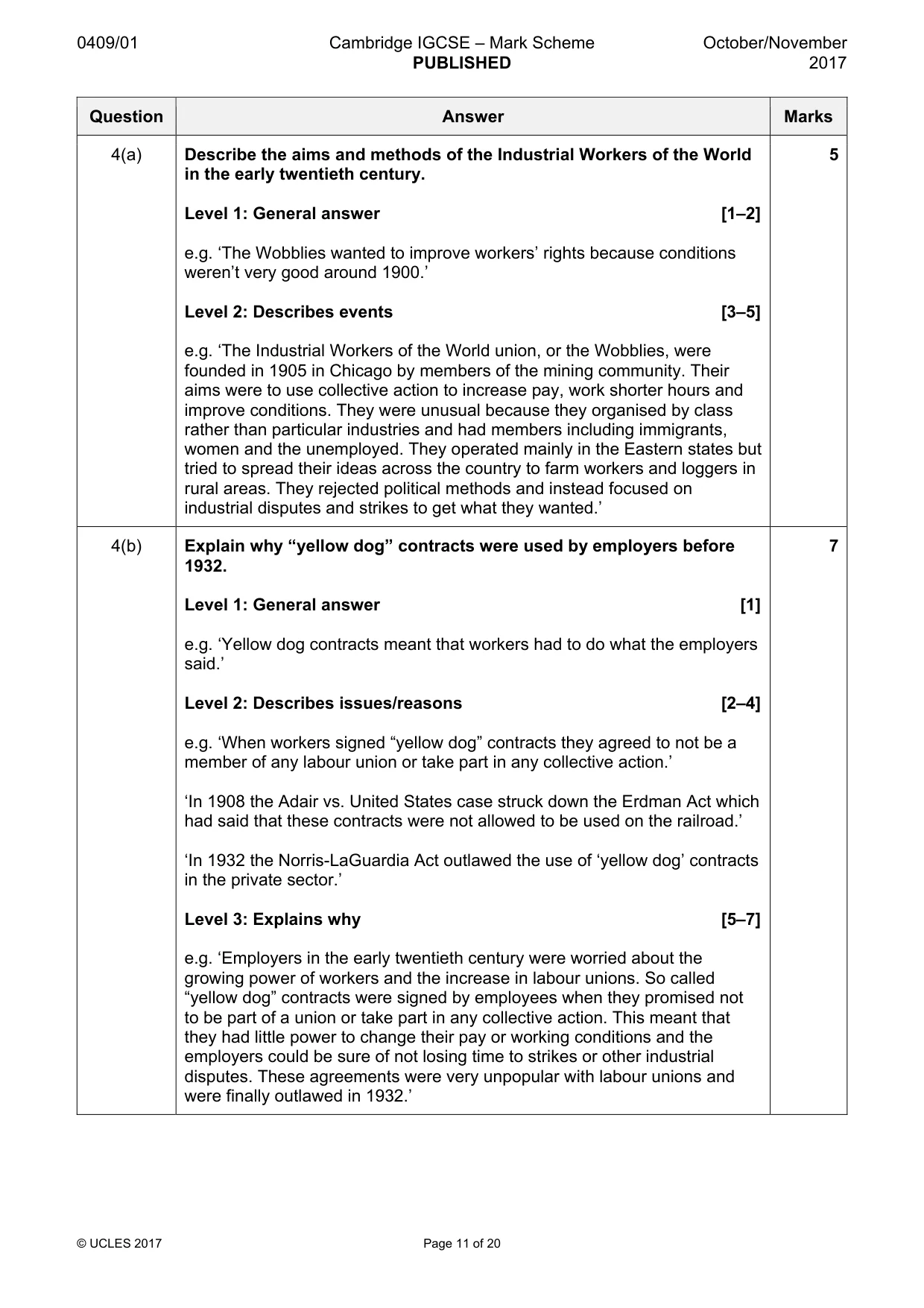
0409/01 Cambridge IGCSE – Mark Scheme PUBLISHED October/November 2017 © UCLES 2017 Page 11 of 20 Question Answer Marks 4(a) Describe the aims and methods of the Industrial Workers of the World in the early twentieth century. Level 1: General answer [1–2] e.g. ‘The Wobblies wanted to improve workers’ rights because conditions weren’t very good around 1900.’ Level 2: Describes events [3–5] e.g. ‘The Industrial Workers of the World union, or the Wobblies, were founded in 1905 in Chicago by members of the mining community. Their aims were to use collective action to increase pay, work shorter hours and improve conditions. They were unusual because they organised by class rather than particular industries and had members including immigrants, women and the unemployed. They operated mainly in the Eastern states but tried to spread their ideas across the country to farm workers and loggers in rural areas. They rejected political methods and instead focused on industrial disputes and strikes to get what they wanted.’ 5 4(b) Explain why “yellow dog” contracts were used by employers before 1932. Level 1: General answer [1] e.g. ‘Yellow dog contracts meant that workers had to do what the employers said.’ Level 2: Describes issues/reasons [2–4] e.g. ‘When workers signed “yellow dog” contracts they agreed to not be a member of any labour union or take part in any collective action.’ ‘In 1908 the Adair vs. United States case struck down the Erdman Act which had said that these contracts were not allowed to be used on the railroad.’ ‘In 1932 the Norris-LaGuardia Act outlawed the use of ‘yellow dog’ contracts in the private sector.’ Level 3: Explains why [5–7] e.g. ‘Employers in the early twentieth century were worried about the growing power of workers and the increase in labour unions. So called “yellow dog” contracts were signed by employees when they promised not to be part of a union or take part in any collective action. This meant that they had little power to change their pay or working conditions and the employers could be sure of not losing time to strikes or other industrial disputes. These agreements were very unpopular with labour unions and were finally outlawed in 1932.’ 7
Mark scheme, page 12
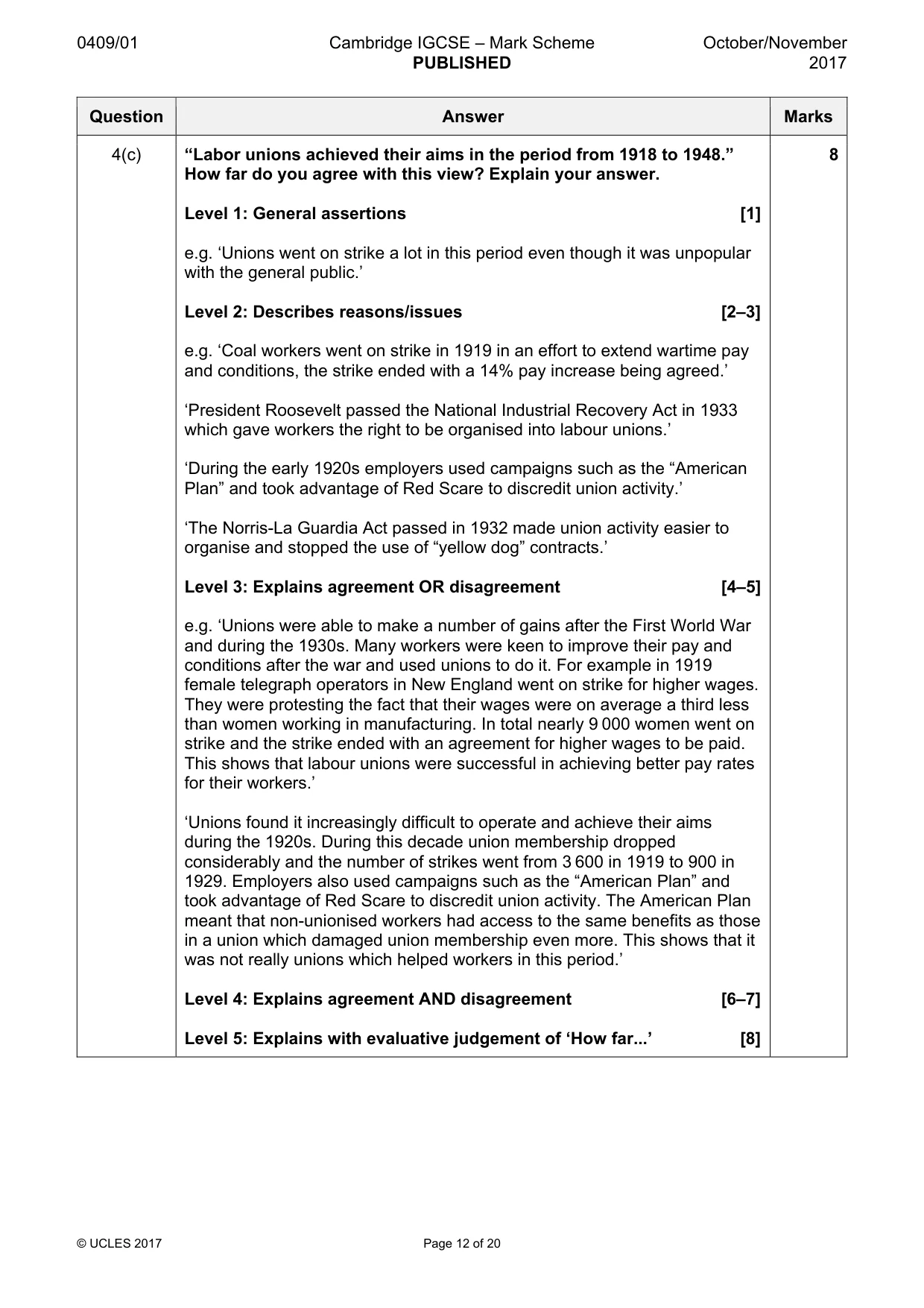
0409/01 Cambridge IGCSE – Mark Scheme PUBLISHED October/November 2017 © UCLES 2017 Page 12 of 20 Question Answer Marks 4(c) “Labor unions achieved their aims in the period from 1918 to 1948.” How far do you agree with this view? Explain your answer. Level 1: General assertions [1] e.g. ‘Unions went on strike a lot in this period even though it was unpopular with the general public.’ Level 2: Describes reasons/issues [2–3] e.g. ‘Coal workers went on strike in 1919 in an effort to extend wartime pay and conditions, the strike ended with a 14% pay increase being agreed.’ ‘President Roosevelt passed the National Industrial Recovery Act in 1933 which gave workers the right to be organised into labour unions.’ ‘During the early 1920s employers used campaigns such as the “American Plan” and took advantage of Red Scare to discredit union activity.’ ‘The Norris-La Guardia Act passed in 1932 made union activity easier to organise and stopped the use of “yellow dog” contracts.’ Level 3: Explains agreement OR disagreement [4–5] e.g. ‘Unions were able to make a number of gains after the First World War and during the 1930s. Many workers were keen to improve their pay and conditions after the war and used unions to do it. For example in 1919 female telegraph operators in New England went on strike for higher wages. They were protesting the fact that their wages were on average a third less than women working in manufacturing. In total nearly 9 000 women went on strike and the strike ended with an agreement for higher wages to be paid. This shows that labour unions were successful in achieving better pay rates for their workers.’ ‘Unions found it increasingly difficult to operate and achieve their aims during the 1920s. During this decade union membership dropped considerably and the number of strikes went from 3 600 in 1919 to 900 in 1929. Employers also used campaigns such as the “American Plan” and took advantage of Red Scare to discredit union activity. The American Plan meant that non-unionised workers had access to the same benefits as those in a union which damaged union membership even more. This shows that it was not really unions which helped workers in this period.’ Level 4: Explains agreement AND disagreement [6–7] Level 5: Explains with evaluative judgement of ‘How far...’ [8] 8
Mark scheme, page 13
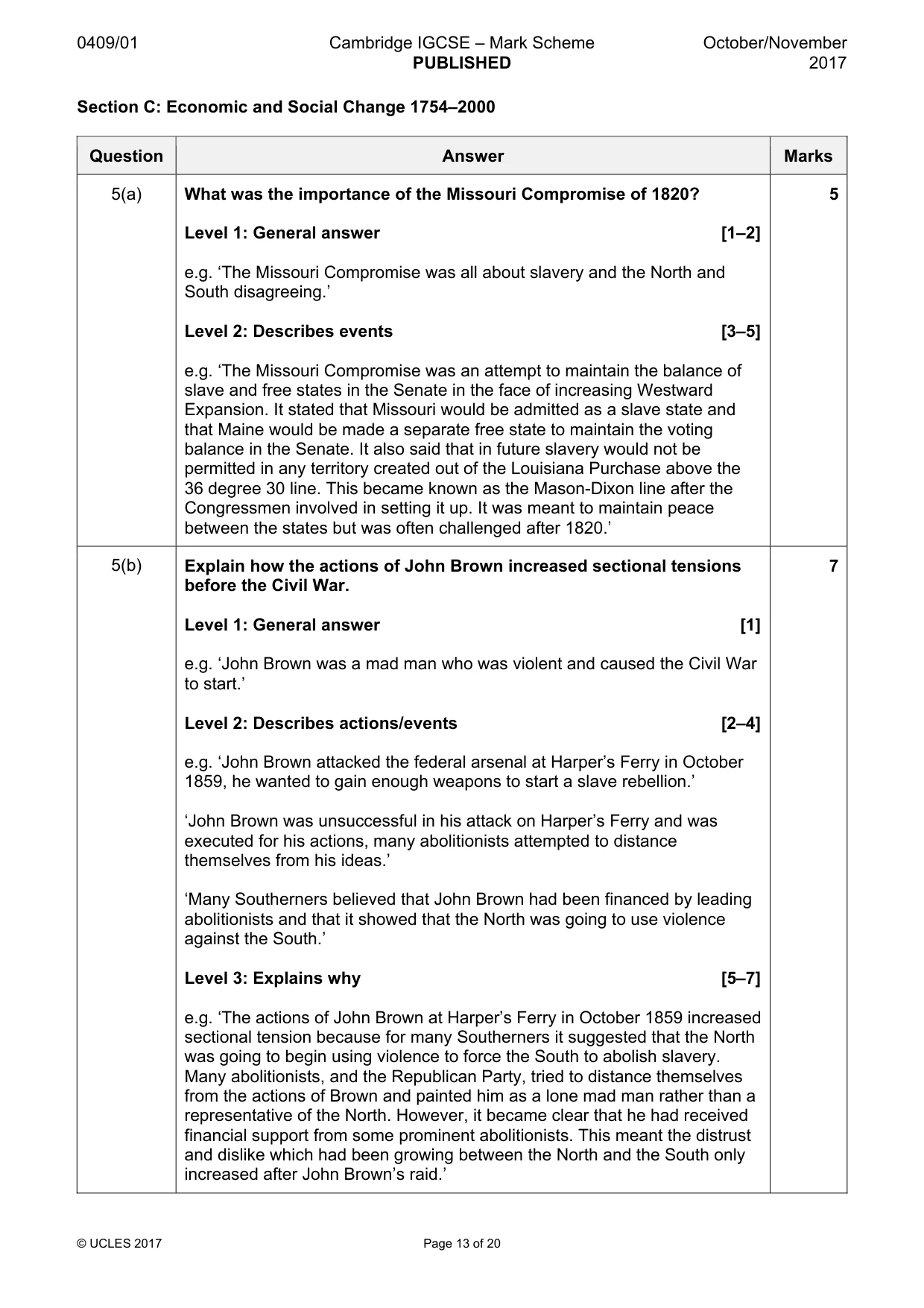
0409/01 Cambridge IGCSE – Mark Scheme PUBLISHED October/November 2017 © UCLES 2017 Page 13 of 20 Section C: Economic and Social Change 1754–2000 Question Answer Marks 5(a) What was the importance of the Missouri Compromise of 1820? Level 1: General answer [1–2] e.g. ‘The Missouri Compromise was all about slavery and the North and South disagreeing.’ Level 2: Describes events [3–5] e.g. ‘The Missouri Compromise was an attempt to maintain the balance of slave and free states in the Senate in the face of increasing Westward Expansion. It stated that Missouri would be admitted as a slave state and that Maine would be made a separate free state to maintain the voting balance in the Senate. It also said that in future slavery would not be permitted in any territory created out of the Louisiana Purchase above the 36 degree 30 line. This became known as the Mason-Dixon line after the Congressmen involved in setting it up. It was meant to maintain peace between the states but was often challenged after 1820.’ 5 5(b) Explain how the actions of John Brown increased sectional tensions before the Civil War. Level 1: General answer [1] e.g. ‘John Brown was a mad man who was violent and caused the Civil War to start.’ Level 2: Describes actions/events [2–4] e.g. ‘John Brown attacked the federal arsenal at Harper’s Ferry in October 1859, he wanted to gain enough weapons to start a slave rebellion.’ ‘John Brown was unsuccessful in his attack on Harper’s Ferry and was executed for his actions, many abolitionists attempted to distance themselves from his ideas.’ ‘Many Southerners believed that John Brown had been financed by leading abolitionists and that it showed that the North was going to use violence against the South.’ Level 3: Explains why [5–7] e.g. ‘The actions of John Brown at Harper’s Ferry in October 1859 increased sectional tension because for many Southerners it suggested that the North was going to begin using violence to force the South to abolish slavery. Many abolitionists, and the Republican Party, tried to distance themselves from the actions of Brown and painted him as a lone mad man rather than a representative of the North. However, it became clear that he had received financial support from some prominent abolitionists. This meant the distrust and dislike which had been growing between the North and the South only increased after John Brown’s raid.’ 7
Mark scheme, page 14
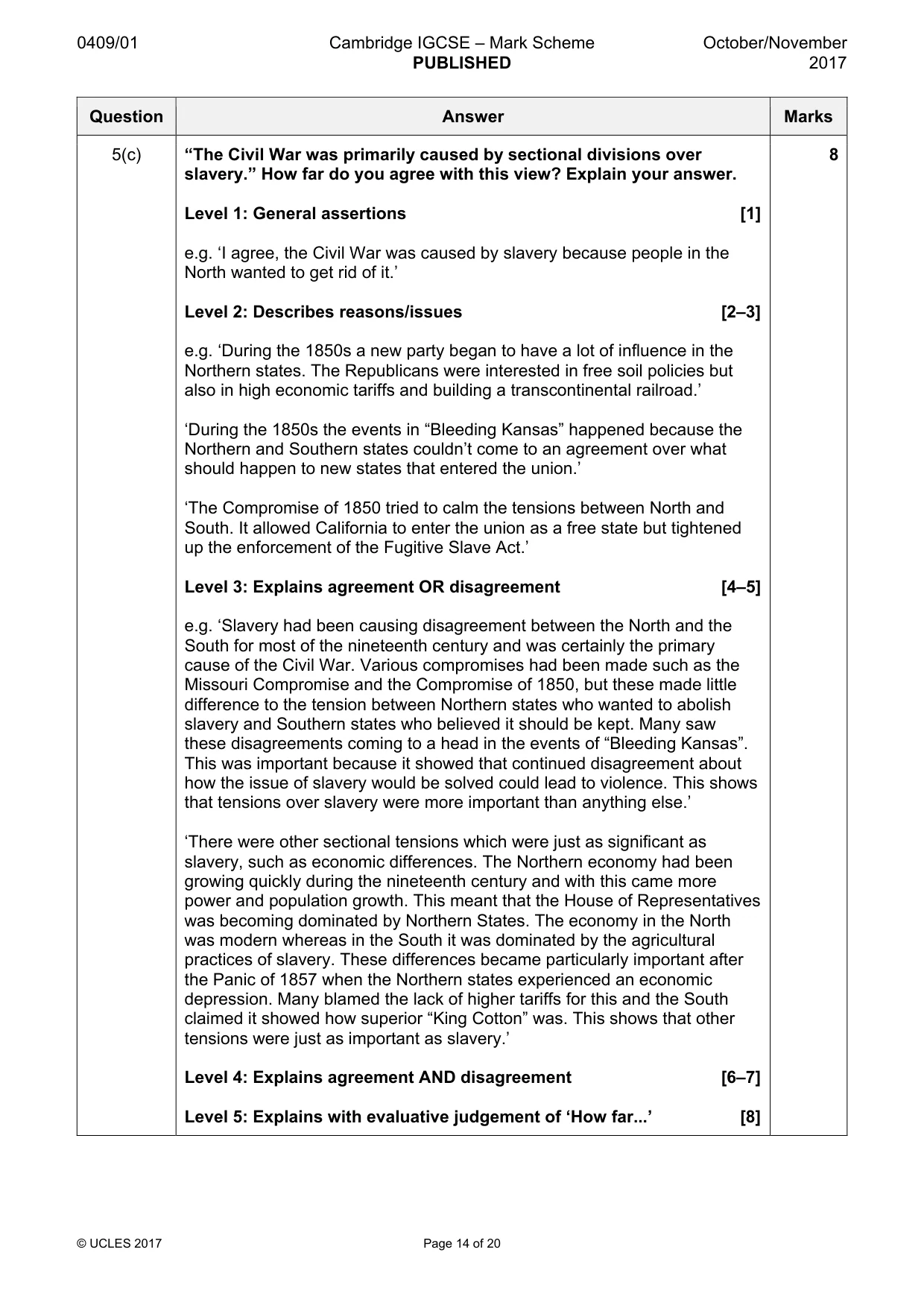
0409/01 Cambridge IGCSE – Mark Scheme PUBLISHED October/November 2017 © UCLES 2017 Page 14 of 20 Question Answer Marks 5(c) “The Civil War was primarily caused by sectional divisions over slavery.” How far do you agree with this view? Explain your answer. Level 1: General assertions [1] e.g. ‘I agree, the Civil War was caused by slavery because people in the North wanted to get rid of it.’ Level 2: Describes reasons/issues [2–3] e.g. ‘During the 1850s a new party began to have a lot of influence in the Northern states. The Republicans were interested in free soil policies but also in high economic tariffs and building a transcontinental railroad.’ ‘During the 1850s the events in “Bleeding Kansas” happened because the Northern and Southern states couldn’t come to an agreement over what should happen to new states that entered the union.’ ‘The Compromise of 1850 tried to calm the tensions between North and South. It allowed California to enter the union as a free state but tightened up the enforcement of the Fugitive Slave Act.’ Level 3: Explains agreement OR disagreement [4–5] e.g. ‘Slavery had been causing disagreement between the North and the South for most of the nineteenth century and was certainly the primary cause of the Civil War. Various compromises had been made such as the Missouri Compromise and the Compromise of 1850, but these made little difference to the tension between Northern states who wanted to abolish slavery and Southern states who believed it should be kept. Many saw these disagreements coming to a head in the events of “Bleeding Kansas”. This was important because it showed that continued disagreement about how the issue of slavery would be solved could lead to violence. This shows that tensions over slavery were more important than anything else.’ ‘There were other sectional tensions which were just as significant as slavery, such as economic differences. The Northern economy had been growing quickly during the nineteenth century and with this came more power and population growth. This meant that the House of Representatives was becoming dominated by Northern States. The economy in the North was modern whereas in the South it was dominated by the agricultural practices of slavery. These differences became particularly important after the Panic of 1857 when the Northern states experienced an economic depression. Many blamed the lack of higher tariffs for this and the South claimed it showed how superior “King Cotton” was. This shows that other tensions were just as important as slavery.’ Level 4: Explains agreement AND disagreement [6–7] Level 5: Explains with evaluative judgement of ‘How far...’ [8] 8
Mark scheme, page 15
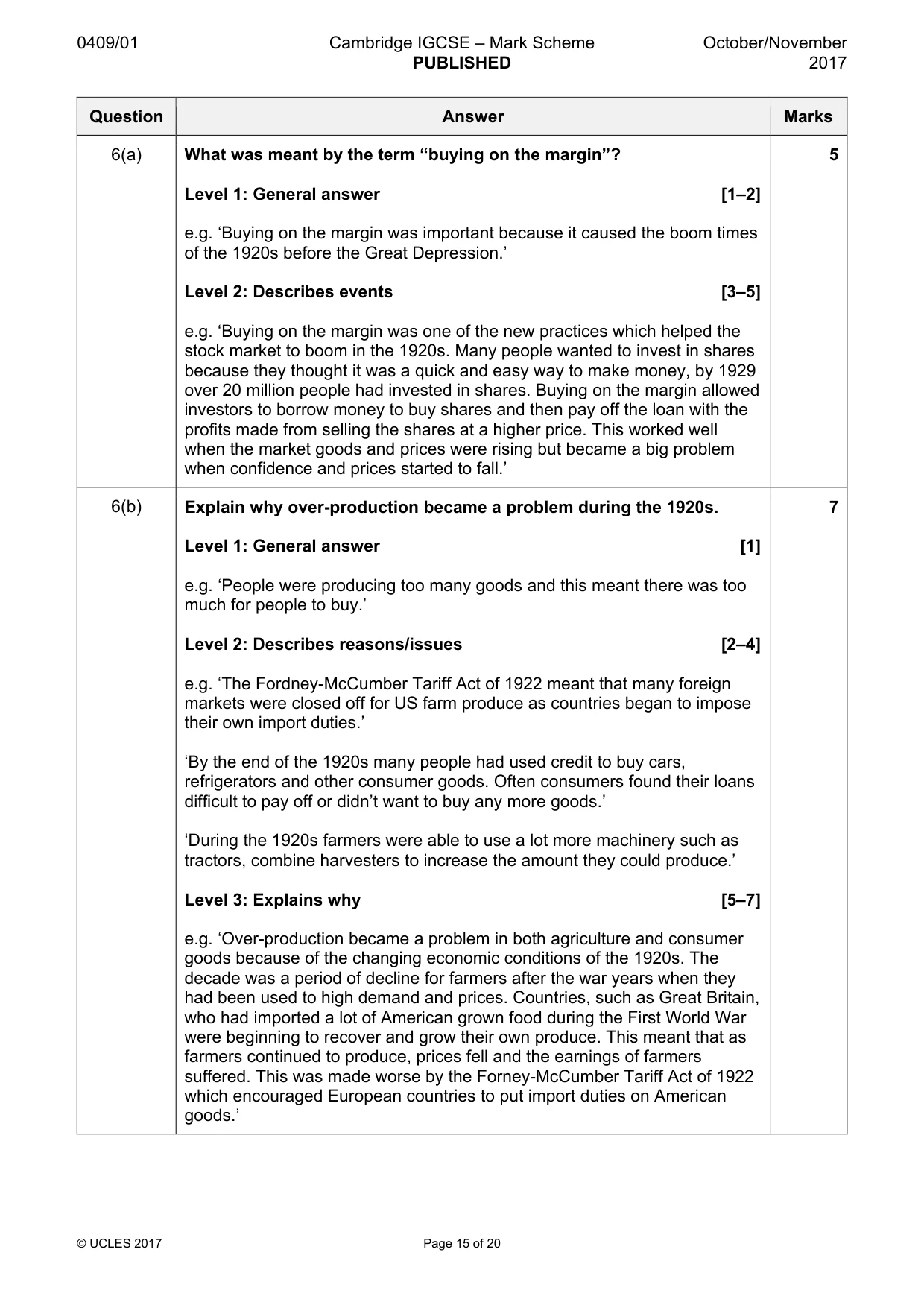
0409/01 Cambridge IGCSE – Mark Scheme PUBLISHED October/November 2017 © UCLES 2017 Page 15 of 20 Question Answer Marks 6(a) What was meant by the term “buying on the margin”? Level 1: General answer [1–2] e.g. ‘Buying on the margin was important because it caused the boom times of the 1920s before the Great Depression.’ Level 2: Describes events [3–5] e.g. ‘Buying on the margin was one of the new practices which helped the stock market to boom in the 1920s. Many people wanted to invest in shares because they thought it was a quick and easy way to make money, by 1929 over 20 million people had invested in shares. Buying on the margin allowed investors to borrow money to buy shares and then pay off the loan with the profits made from selling the shares at a higher price. This worked well when the market goods and prices were rising but became a big problem when confidence and prices started to fall.’ 5 6(b) Explain why over-production became a problem during the 1920s. Level 1: General answer [1] e.g. ‘People were producing too many goods and this meant there was too much for people to buy.’ Level 2: Describes reasons/issues [2–4] e.g. ‘The Fordney-McCumber Tariff Act of 1922 meant that many foreign markets were closed off for US farm produce as countries began to impose their own import duties.’ ‘By the end of the 1920s many people had used credit to buy cars, refrigerators and other consumer goods. Often consumers found their loans difficult to pay off or didn’t want to buy any more goods.’ ‘During the 1920s farmers were able to use a lot more machinery such as tractors, combine harvesters to increase the amount they could produce.’ Level 3: Explains why [5–7] e.g. ‘Over-production became a problem in both agriculture and consumer goods because of the changing economic conditions of the 1920s. The decade was a period of decline for farmers after the war years when they had been used to high demand and prices. Countries, such as Great Britain, who had imported a lot of American grown food during the First World War were beginning to recover and grow their own produce. This meant that as farmers continued to produce, prices fell and the earnings of farmers suffered. This was made worse by the Forney-McCumber Tariff Act of 1922 which encouraged European countries to put import duties on American goods.’ 7
Mark scheme, page 16
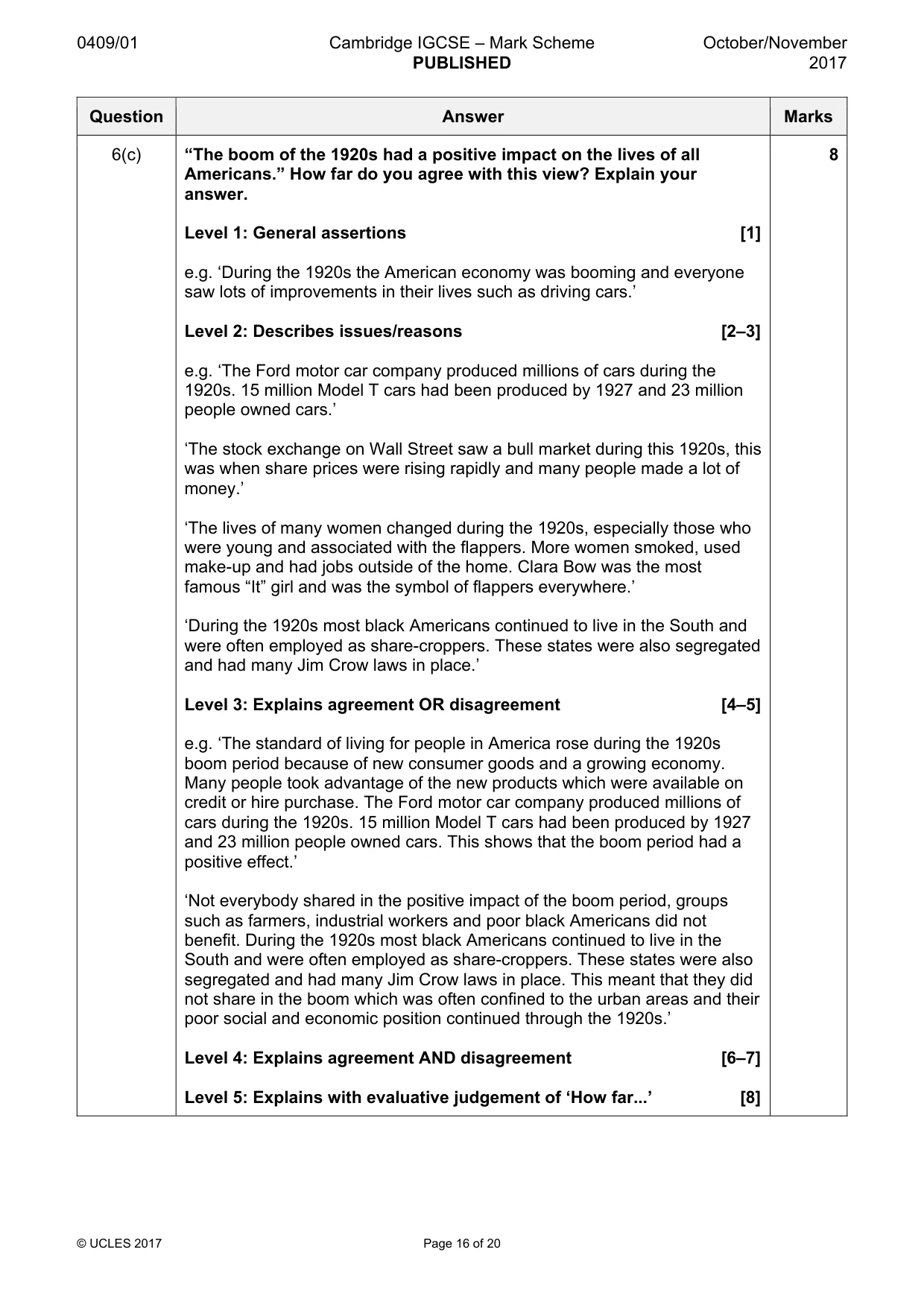
0409/01 Cambridge IGCSE – Mark Scheme PUBLISHED October/November 2017 © UCLES 2017 Page 16 of 20 Question Answer Marks 6(c) “The boom of the 1920s had a positive impact on the lives of all Americans.” How far do you agree with this view? Explain your answer. Level 1: General assertions [1] e.g. ‘During the 1920s the American economy was booming and everyone saw lots of improvements in their lives such as driving cars.’ Level 2: Describes issues/reasons [2–3] e.g. ‘The Ford motor car company produced millions of cars during the 1920s. 15 million Model T cars had been produced by 1927 and 23 million people owned cars.’ ‘The stock exchange on Wall Street saw a bull market during this 1920s, this was when share prices were rising rapidly and many people made a lot of money.’ ‘The lives of many women changed during the 1920s, especially those who were young and associated with the flappers. More women smoked, used make-up and had jobs outside of the home. Clara Bow was the most famous “It” girl and was the symbol of flappers everywhere.’ ‘During the 1920s most black Americans continued to live in the South and were often employed as share-croppers. These states were also segregated and had many Jim Crow laws in place.’ Level 3: Explains agreement OR disagreement [4–5] e.g. ‘The standard of living for people in America rose during the 1920s boom period because of new consumer goods and a growing economy. Many people took advantage of the new products which were available on credit or hire purchase. The Ford motor car company produced millions of cars during the 1920s. 15 million Model T cars had been produced by 1927 and 23 million people owned cars. This shows that the boom period had a positive effect.’ ‘Not everybody shared in the positive impact of the boom period, groups such as farmers, industrial workers and poor black Americans did not benefit. During the 1920s most black Americans continued to live in the South and were often employed as share-croppers. These states were also segregated and had many Jim Crow laws in place. This meant that they did not share in the boom which was often confined to the urban areas and their poor social and economic position continued through the 1920s.’ Level 4: Explains agreement AND disagreement [6–7] Level 5: Explains with evaluative judgement of ‘How far...’ [8] 8
Mark scheme, page 17
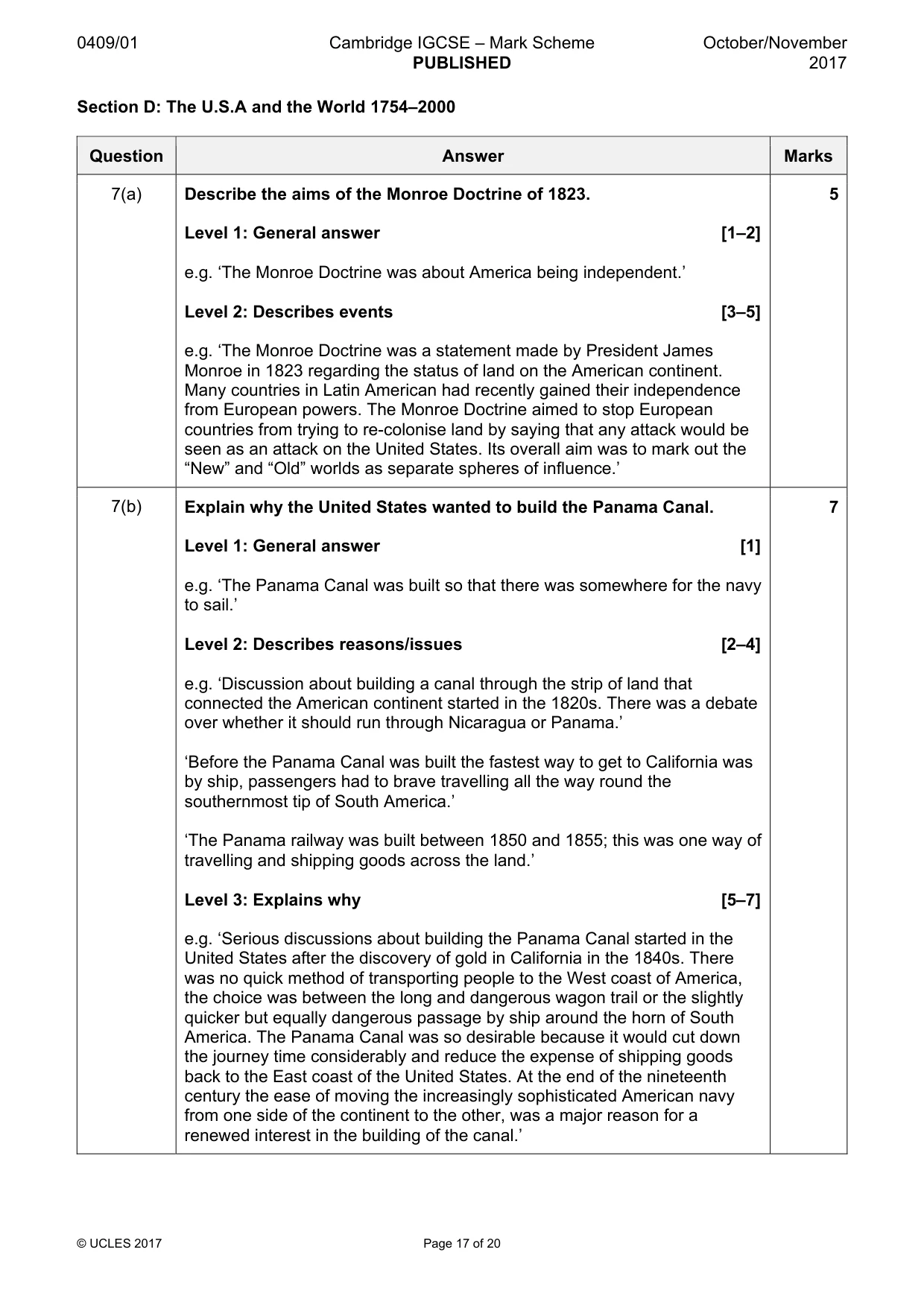
0409/01 Cambridge IGCSE – Mark Scheme PUBLISHED October/November 2017 © UCLES 2017 Page 17 of 20 Section D: The U.S.A and the World 1754–2000 Question Answer Marks 7(a) Describe the aims of the Monroe Doctrine of 1823. Level 1: General answer [1–2] e.g. ‘The Monroe Doctrine was about America being independent.’ Level 2: Describes events [3–5] e.g. ‘The Monroe Doctrine was a statement made by President James Monroe in 1823 regarding the status of land on the American continent. Many countries in Latin American had recently gained their independence from European powers. The Monroe Doctrine aimed to stop European countries from trying to re-colonise land by saying that any attack would be seen as an attack on the United States. Its overall aim was to mark out the “New” and “Old” worlds as separate spheres of influence.’ 5 7(b) Explain why the United States wanted to build the Panama Canal. Level 1: General answer [1] e.g. ‘The Panama Canal was built so that there was somewhere for the navy to sail.’ Level 2: Describes reasons/issues [2–4] e.g. ‘Discussion about building a canal through the strip of land that connected the American continent started in the 1820s. There was a debate over whether it should run through Nicaragua or Panama.’ ‘Before the Panama Canal was built the fastest way to get to California was by ship, passengers had to brave travelling all the way round the southernmost tip of South America.’ ‘The Panama railway was built between 1850 and 1855; this was one way of travelling and shipping goods across the land.’ Level 3: Explains why [5–7] e.g. ‘Serious discussions about building the Panama Canal started in the United States after the discovery of gold in California in the 1840s. There was no quick method of transporting people to the West coast of America, the choice was between the long and dangerous wagon trail or the slightly quicker but equally dangerous passage by ship around the horn of South America. The Panama Canal was so desirable because it would cut down the journey time considerably and reduce the expense of shipping goods back to the East coast of the United States. At the end of the nineteenth century the ease of moving the increasingly sophisticated American navy from one side of the continent to the other, was a major reason for a renewed interest in the building of the canal.’ 7
Mark scheme, page 18
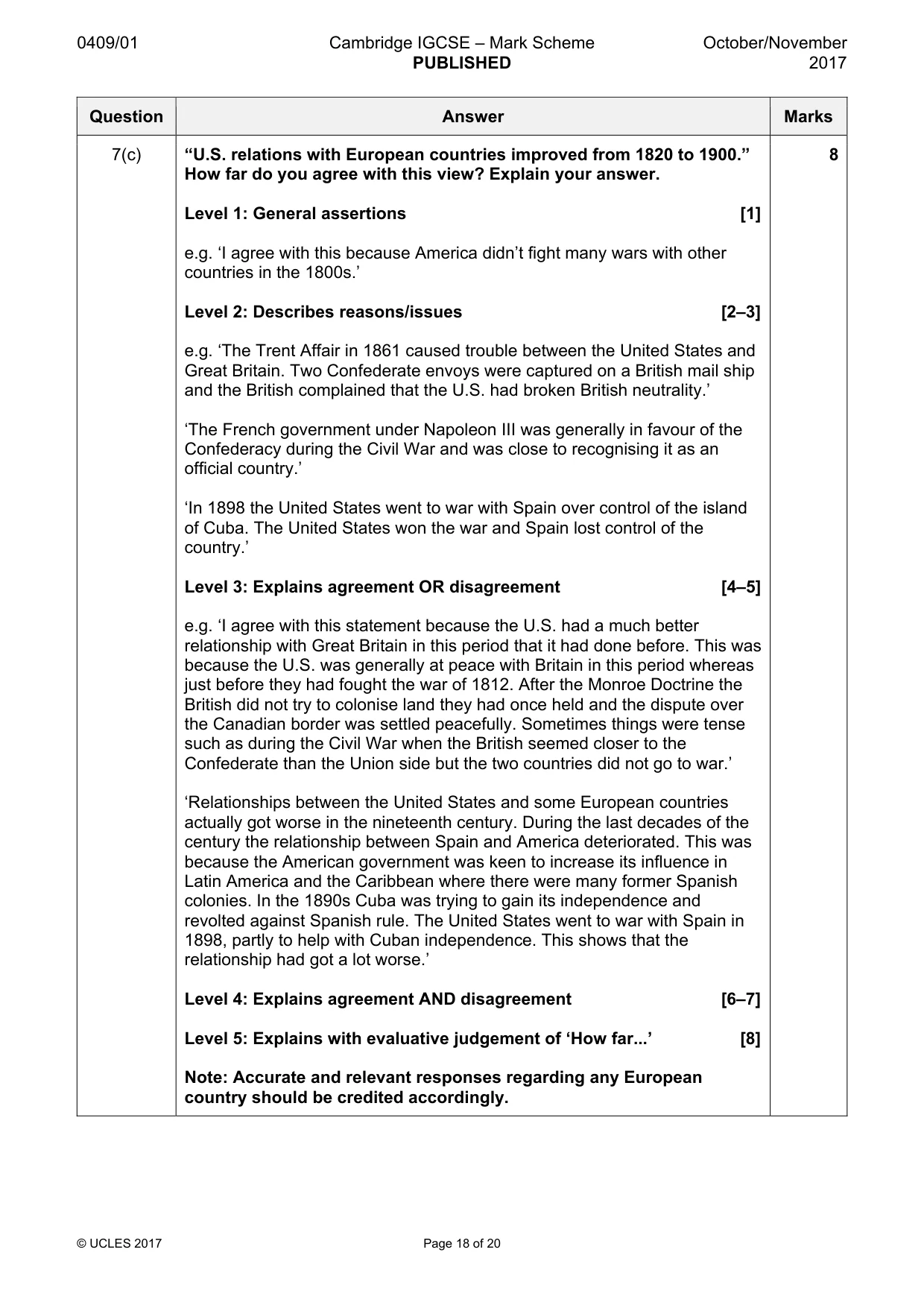
0409/01 Cambridge IGCSE – Mark Scheme PUBLISHED October/November 2017 © UCLES 2017 Page 18 of 20 Question Answer Marks 7(c) “U.S. relations with European countries improved from 1820 to 1900.” How far do you agree with this view? Explain your answer. Level 1: General assertions [1] e.g. ‘I agree with this because America didn’t fight many wars with other countries in the 1800s.’ Level 2: Describes reasons/issues [2–3] e.g. ‘The Trent Affair in 1861 caused trouble between the United States and Great Britain. Two Confederate envoys were captured on a British mail ship and the British complained that the U.S. had broken British neutrality.’ ‘The French government under Napoleon III was generally in favour of the Confederacy during the Civil War and was close to recognising it as an official country.’ ‘In 1898 the United States went to war with Spain over control of the island of Cuba. The United States won the war and Spain lost control of the country.’ Level 3: Explains agreement OR disagreement [4–5] e.g. ‘I agree with this statement because the U.S. had a much better relationship with Great Britain in this period that it had done before. This was because the U.S. was generally at peace with Britain in this period whereas just before they had fought the war of 1812. After the Monroe Doctrine the British did not try to colonise land they had once held and the dispute over the Canadian border was settled peacefully. Sometimes things were tense such as during the Civil War when the British seemed closer to the Confederate than the Union side but the two countries did not go to war.’ ‘Relationships between the United States and some European countries actually got worse in the nineteenth century. During the last decades of the century the relationship between Spain and America deteriorated. This was because the American government was keen to increase its influence in Latin America and the Caribbean where there were many former Spanish colonies. In the 1890s Cuba was trying to gain its independence and revolted against Spanish rule. The United States went to war with Spain in 1898, partly to help with Cuban independence. This shows that the relationship had got a lot worse.’ Level 4: Explains agreement AND disagreement [6–7] Level 5: Explains with evaluative judgement of ‘How far...’ [8] Note: Accurate and relevant responses regarding any European country should be credited accordingly. 8
Mark scheme, page 19
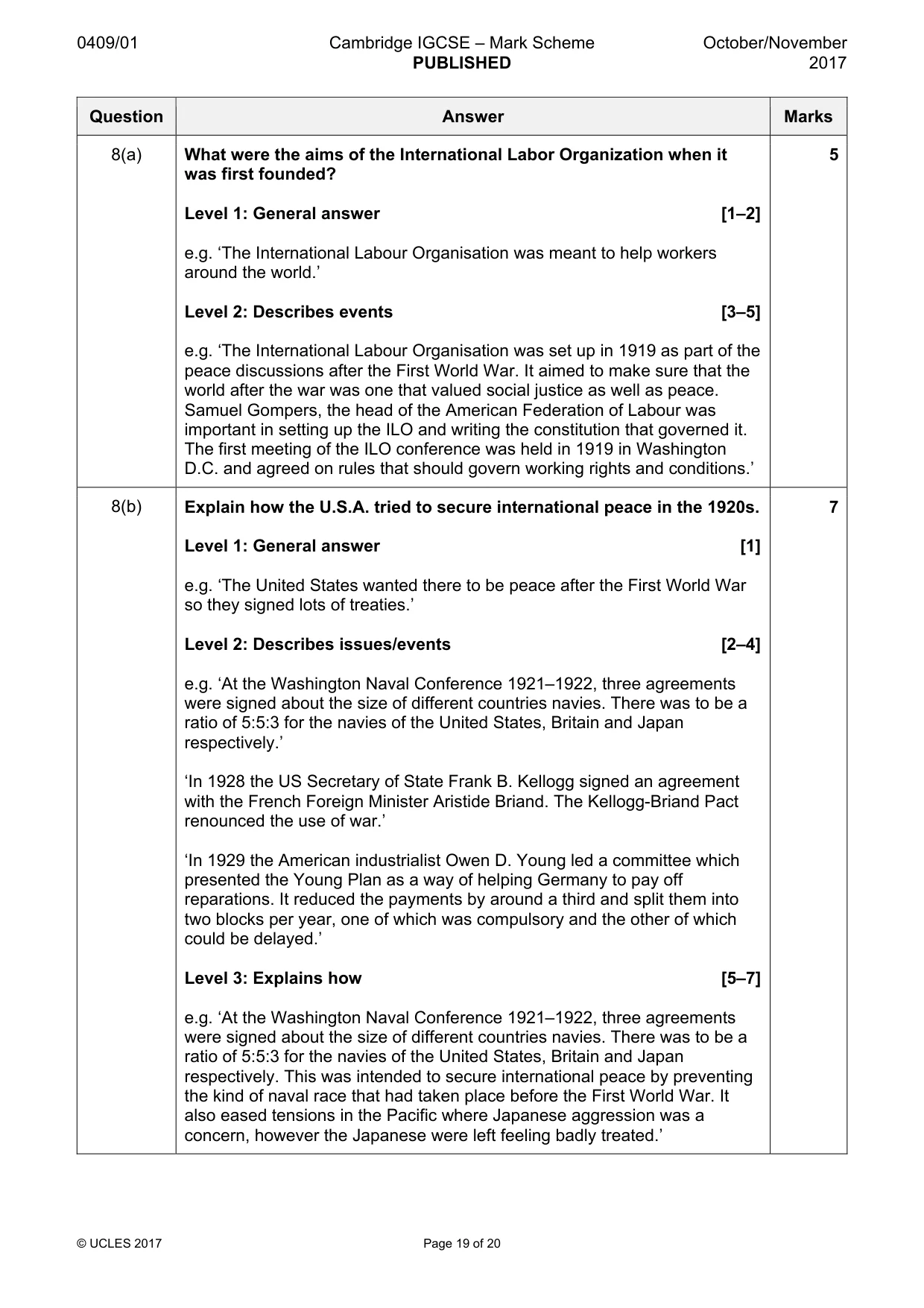
0409/01 Cambridge IGCSE – Mark Scheme PUBLISHED October/November 2017 © UCLES 2017 Page 19 of 20 Question Answer Marks 8(a) What were the aims of the International Labor Organization when it was first founded? Level 1: General answer [1–2] e.g. ‘The International Labour Organisation was meant to help workers around the world.’ Level 2: Describes events [3–5] e.g. ‘The International Labour Organisation was set up in 1919 as part of the peace discussions after the First World War. It aimed to make sure that the world after the war was one that valued social justice as well as peace. Samuel Gompers, the head of the American Federation of Labour was important in setting up the ILO and writing the constitution that governed it. The first meeting of the ILO conference was held in 1919 in Washington D.C. and agreed on rules that should govern working rights and conditions.’ 5 8(b) Explain how the U.S.A. tried to secure international peace in the 1920s. Level 1: General answer [1] e.g. ‘The United States wanted there to be peace after the First World War so they signed lots of treaties.’ Level 2: Describes issues/events [2–4] e.g. ‘At the Washington Naval Conference 1921–1922, three agreements were signed about the size of different countries navies. There was to be a ratio of 5:5:3 for the navies of the United States, Britain and Japan respectively.’ ‘In 1928 the US Secretary of State Frank B. Kellogg signed an agreement with the French Foreign Minister Aristide Briand. The Kellogg-Briand Pact renounced the use of war.’ ‘In 1929 the American industrialist Owen D. Young led a committee which presented the Young Plan as a way of helping Germany to pay off reparations. It reduced the payments by around a third and split them into two blocks per year, one of which was compulsory and the other of which could be delayed.’ Level 3: Explains how [5–7] e.g. ‘At the Washington Naval Conference 1921–1922, three agreements were signed about the size of different countries navies. There was to be a ratio of 5:5:3 for the navies of the United States, Britain and Japan respectively. This was intended to secure international peace by preventing the kind of naval race that had taken place before the First World War. It also eased tensions in the Pacific where Japanese aggression was a concern, however the Japanese were left feeling badly treated.’ 7
Mark scheme, page 20
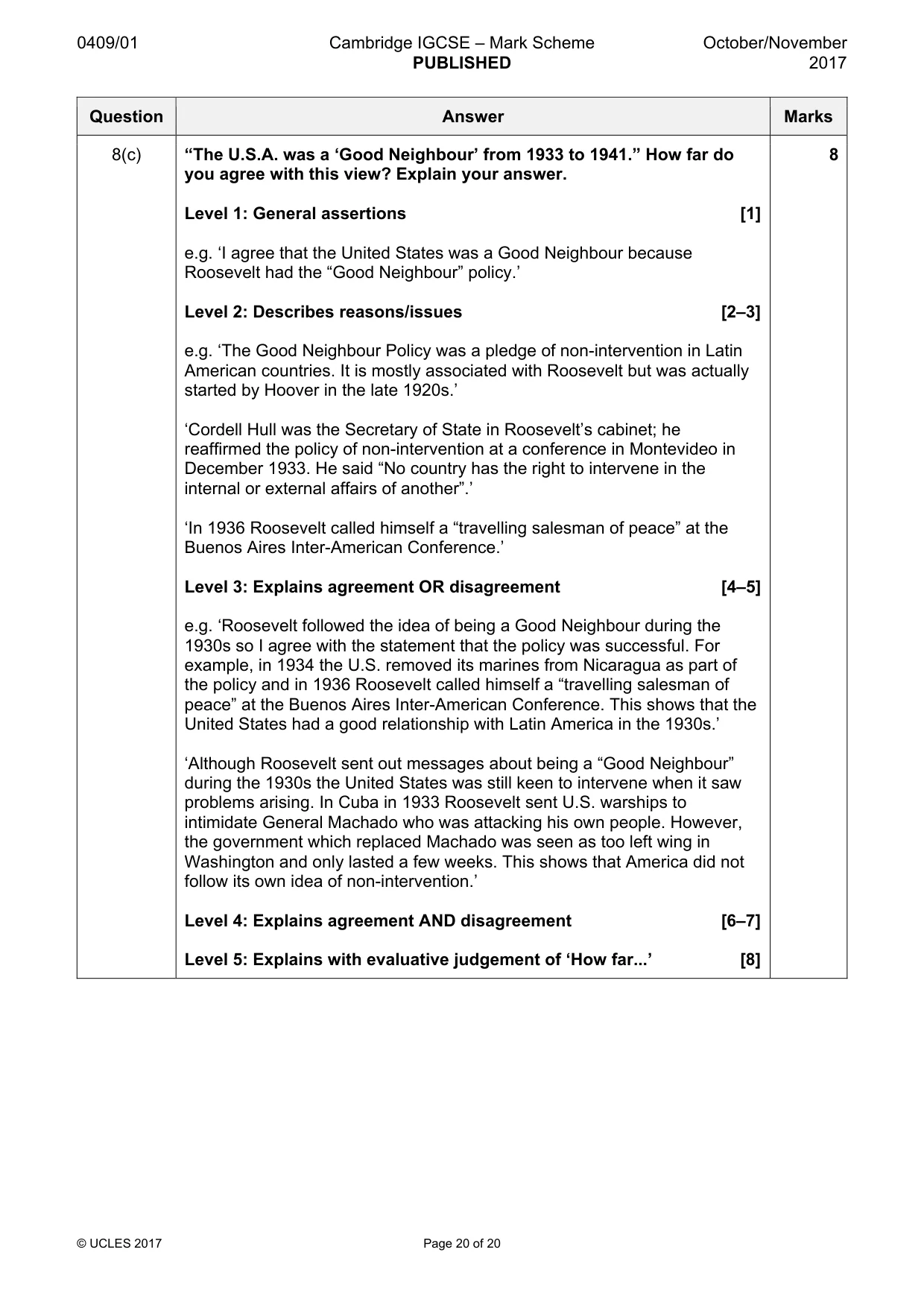
0409/01 Cambridge IGCSE – Mark Scheme PUBLISHED October/November 2017 © UCLES 2017 Page 20 of 20 Question Answer Marks 8(c) “The U.S.A. was a ‘Good Neighbour’ from 1933 to 1941.” How far do you agree with this view? Explain your answer. Level 1: General assertions [1] e.g. ‘I agree that the United States was a Good Neighbour because Roosevelt had the “Good Neighbour” policy.’ Level 2: Describes reasons/issues [2–3] e.g. ‘The Good Neighbour Policy was a pledge of non-intervention in Latin American countries. It is mostly associated with Roosevelt but was actually started by Hoover in the late 1920s.’ ‘Cordell Hull was the Secretary of State in Roosevelt’s cabinet; he reaffirmed the policy of non-intervention at a conference in Montevideo in December 1933. He said “No country has the right to intervene in the internal or external affairs of another”.’ ‘In 1936 Roosevelt called himself a “travelling salesman of peace” at the Buenos Aires Inter-American Conference.’ Level 3: Explains agreement OR disagreement [4–5] e.g. ‘Roosevelt followed the idea of being a Good Neighbour during the 1930s so I agree with the statement that the policy was successful. For example, in 1934 the U.S. removed its marines from Nicaragua as part of the policy and in 1936 Roosevelt called himself a “travelling salesman of peace” at the Buenos Aires Inter-American Conference. This shows that the United States had a good relationship with Latin America in the 1930s.’ ‘Although Roosevelt sent out messages about being a “Good Neighbour” during the 1930s the United States was still keen to intervene when it saw problems arising. In Cuba in 1933 Roosevelt sent U.S. warships to intimidate General Machado who was attacking his own people. However, the government which replaced Machado was seen as too left wing in Washington and only lasted a few weeks. This shows that America did not follow its own idea of non-intervention.’ Level 4: Explains agreement AND disagreement [6–7] Level 5: Explains with evaluative judgement of ‘How far...’ [8] 8
What you needed in this session
Cambridge’s own grade thresholds for 2017 Oct/Nov, Paper 1 · Variant 1. A higher threshold means an easier paper — the bar moves with how the cohort did.