Cambridge IGCSE German - Foreign Language 0525 — 2018 May/June Paper 2 · Variant 1
0525/21/M/J/18 · 45 marks · ≈51 min
The question paper and its mark scheme, free to read here and free to download. This is Cambridge’s own paper, exactly as it was sat.
Question paper16 pages
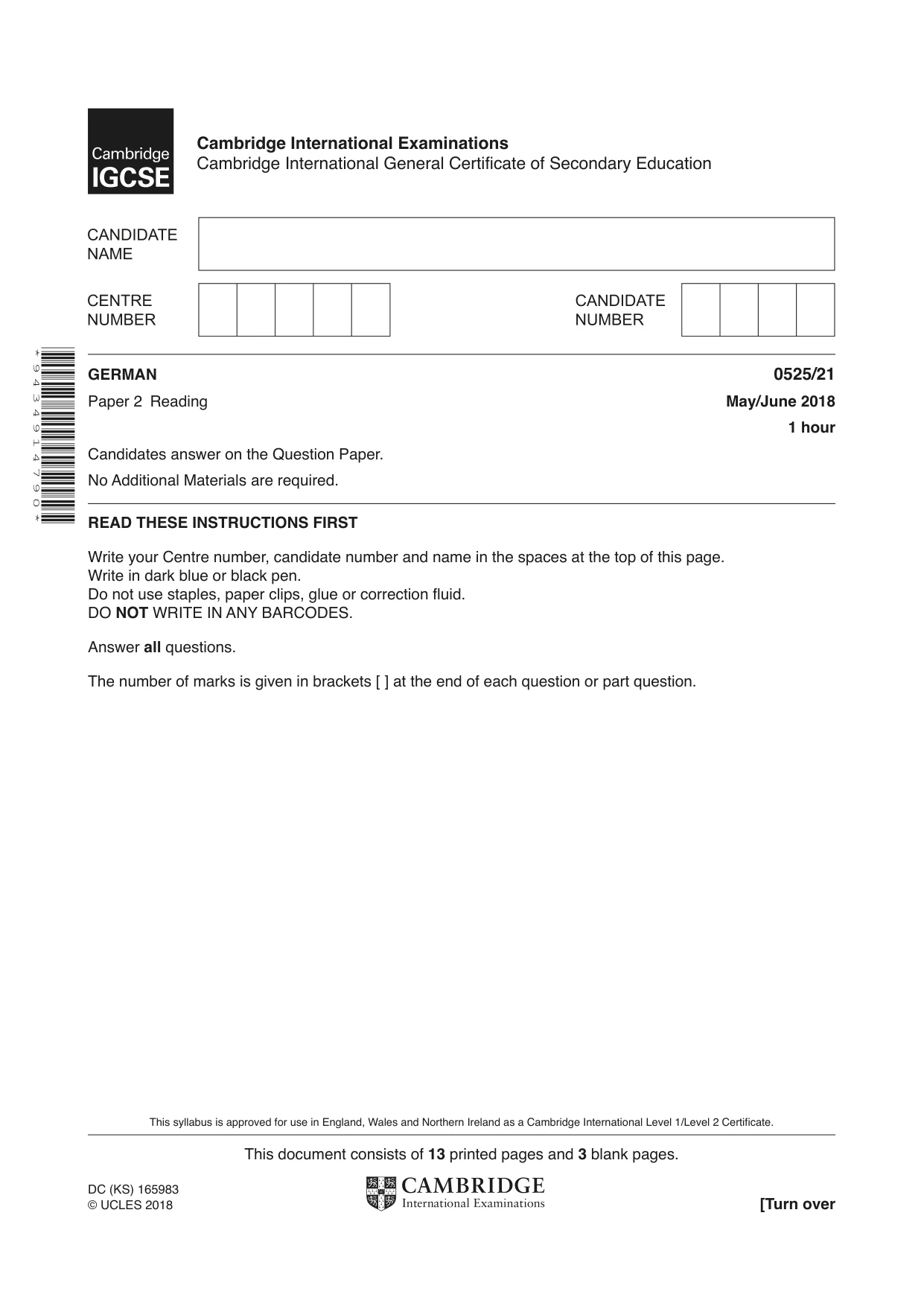

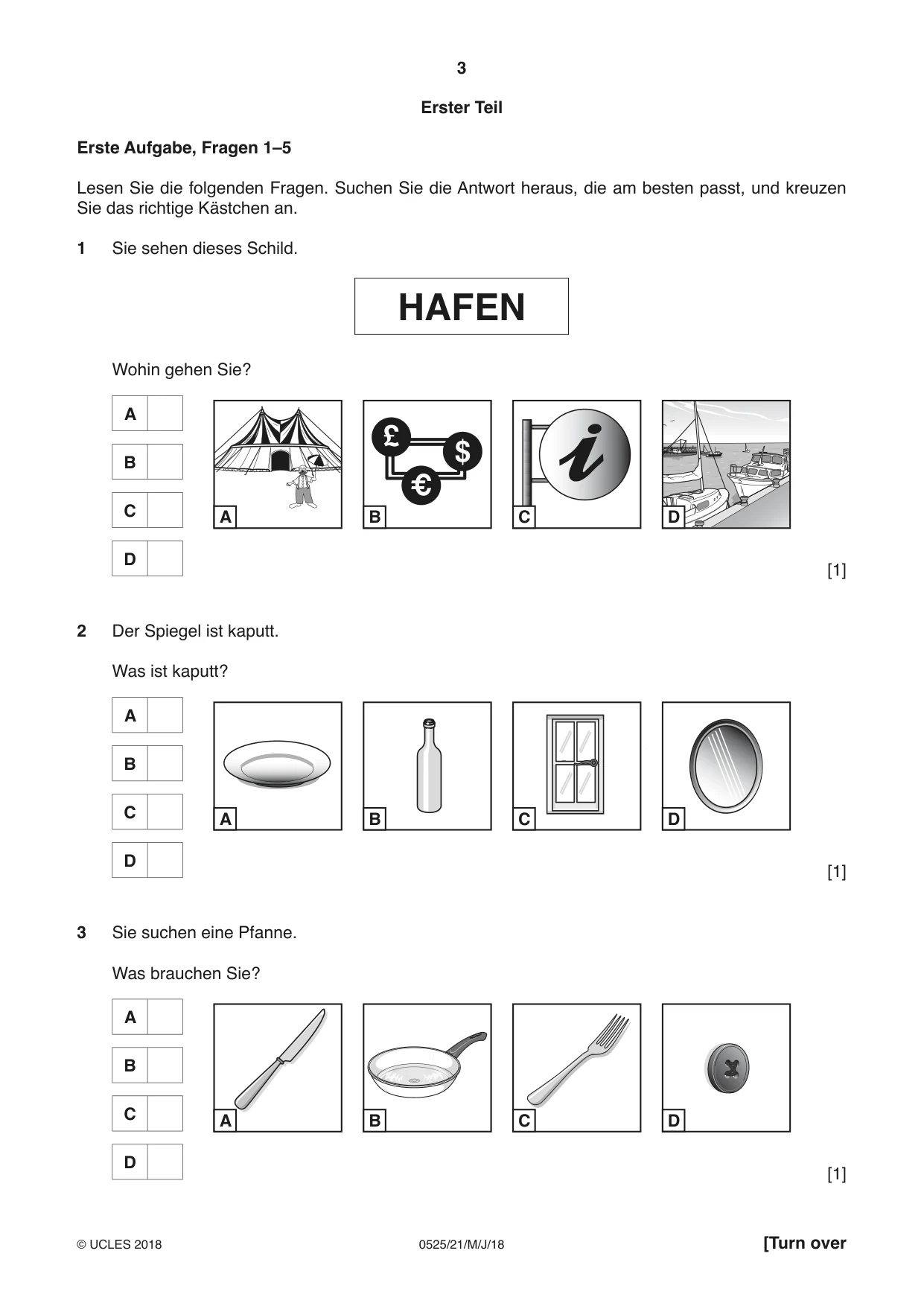
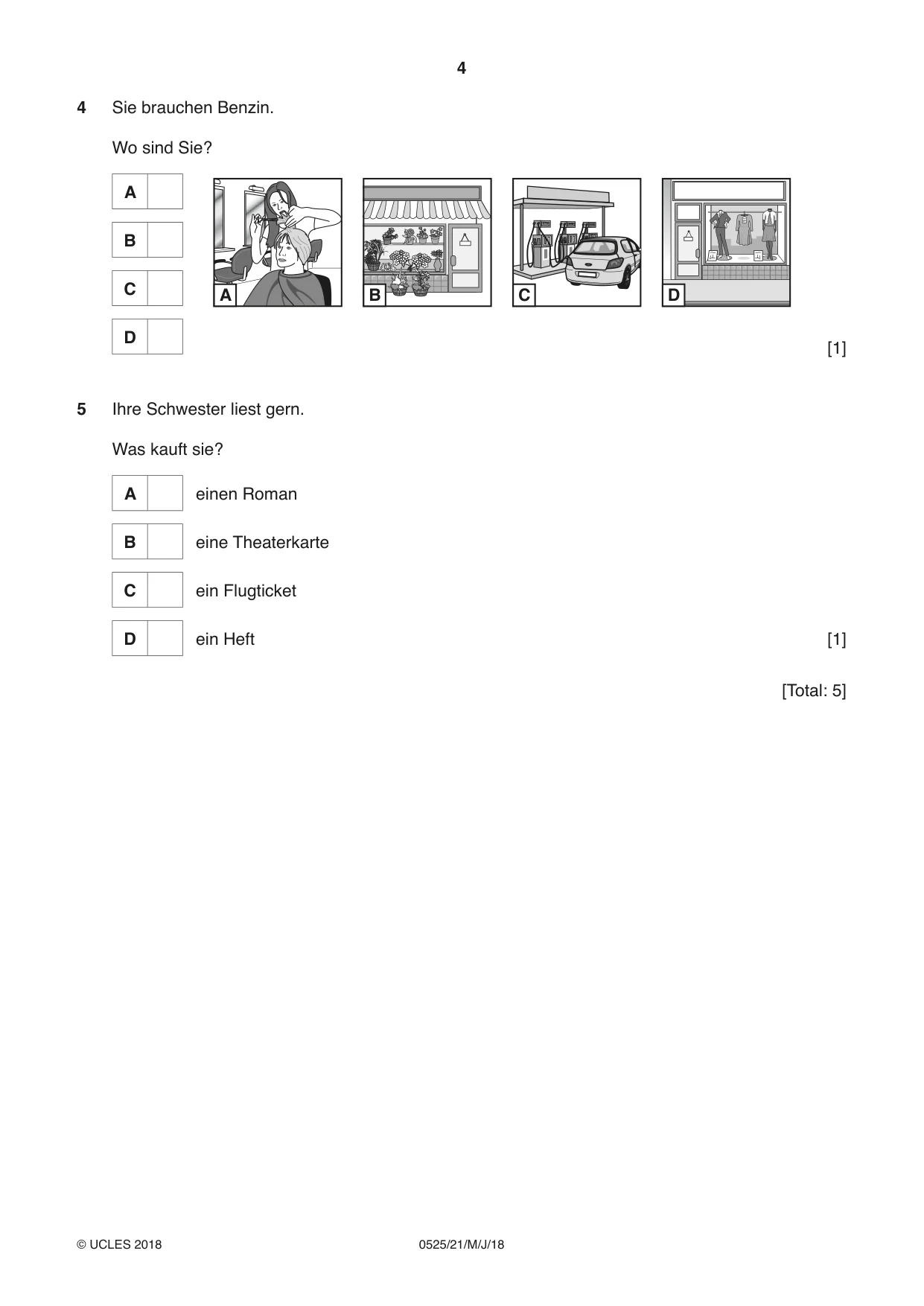
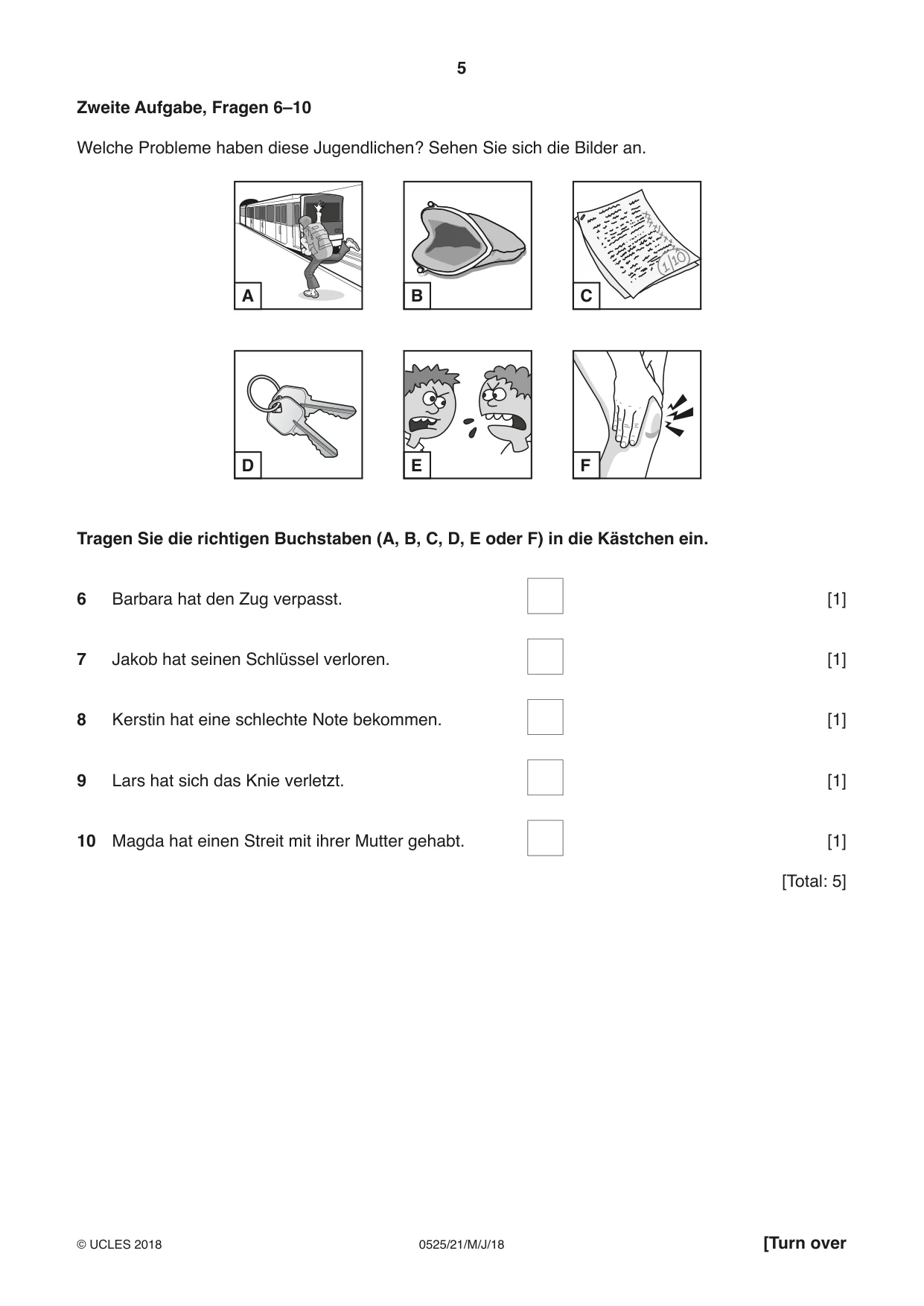

Mark scheme14 pages
Answers below. Sit the paper first if you are practising.
Paper as text
Question paper, page 1
* 9 4 3 4 9 1 4 7 9 0 * This syllabus is approved for use in England, Wales and Northern Ireland as a Cambridge International Level 1/Level 2 Certificate. This document consists of 13 printed pages and 3 blank pages. DC (KS) 165983 © UCLES 2018 [Turn over Cambridge International Examinations Cambridge International General Certificate of Secondary Education GERMAN 0525/21 Paper 2 Reading May/June 2018 1 hour Candidates answer on the Question Paper. No Additional Materials are required. READ THESE INSTRUCTIONS FIRST Write your Centre number, candidate number and name in the spaces at the top of this page. Write in dark blue or black pen. Do not use staples, paper clips, glue or correction fluid. DO NOT WRITE IN ANY BARCODES. Answer all questions. The number of marks is given in brackets [ ] at the end of each question or part question.
Question paper, page 2
2 0525/21/M/J/18 © UCLES 2018 BLANK PAGE
Question paper, page 3
3 0525/21/M/J/18 © UCLES 2018 [Turn over Erster Teil Erste Aufgabe, Fragen 1–5 Lesen Sie die folgenden Fragen. Suchen Sie die Antwort heraus, die am besten passt, und kreuzen Sie das richtige Kästchen an. 1 Sie sehen dieses Schild. HAFEN Wohin gehen Sie? A £ € $ A B C D [1] B C D 2 Der Spiegel ist kaputt. Was ist kaputt? A A B C D [1] B C D 3 Sie suchen eine Pfanne. Was brauchen Sie? A A B C D [1] B C D
Question paper, page 4
4 0525/21/M/J/18 © UCLES 2018 4 Sie brauchen Benzin. Wo sind Sie? A A B C D [1] B C D 5 Ihre Schwester liest gern. Was kauft sie? A einen Roman B eine Theaterkarte C ein Flugticket D ein Heft [1] [Total: 5]
Question paper, page 5
5 0525/21/M/J/18 © UCLES 2018 [Turn over Zweite Aufgabe, Fragen 6–10 Welche Probleme haben diese Jugendlichen? Sehen Sie sich die Bilder an. B C D F A E Tragen Sie die richtigen Buchstaben (A, B, C, D, E oder F) in die Kästchen ein. 6 Barbara hat den Zug verpasst. [1] 7 Jakob hat seinen Schlüssel verloren. [1] 8 Kerstin hat eine schlechte Note bekommen. [1] 9 Lars hat sich das Knie verletzt. [1] 10 Magda hat einen Streit mit ihrer Mutter gehabt. [1] [Total: 5]
Question paper, page 6
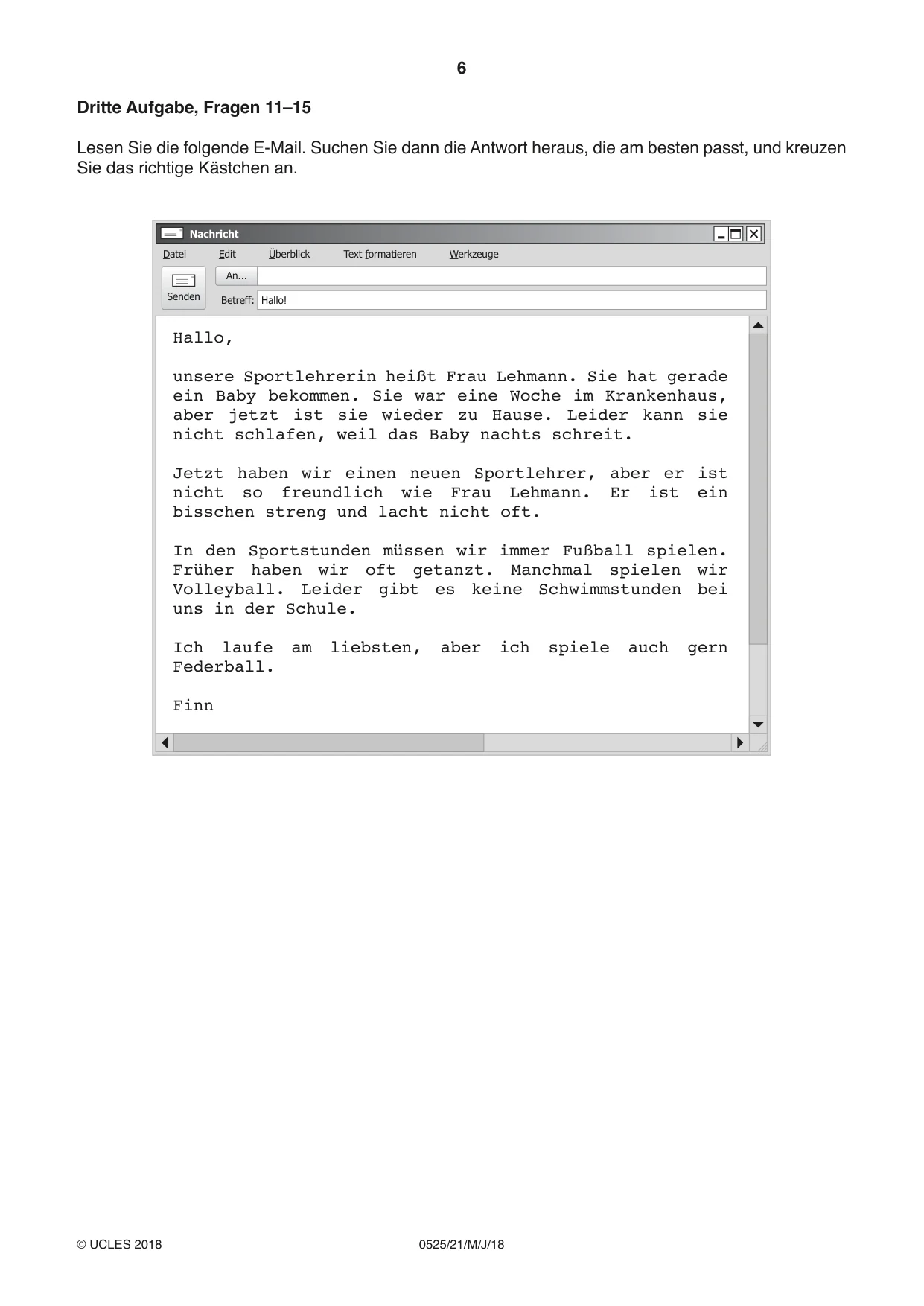
6 0525/21/M/J/18 © UCLES 2018 Dritte Aufgabe, Fragen 11–15 Lesen Sie die folgende E-Mail. Suchen Sie dann die Antwort heraus, die am besten passt, und kreuzen Sie das richtige Kästchen an. Betreff: Hallo! An... Senden Datei Edit Überblick Text formatieren Werkzeuge Nachricht Hallo, unsere Sportlehrerin heißt Frau Lehmann. Sie hat gerade ein Baby bekommen. Sie war eine Woche im Krankenhaus, aber jetzt ist sie wieder zu Hause. Leider kann sie nicht schlafen, weil das Baby nachts schreit. Jetzt haben wir einen neuen Sportlehrer, aber er ist nicht so freundlich wie Frau Lehmann. Er ist ein bisschen streng und lacht nicht oft. In den Sportstunden müssen wir immer Fußball spielen. Früher haben wir oft getanzt. Manchmal spielen wir Volleyball. Leider gibt es keine Schwimmstunden bei uns in der Schule. Ich laufe am liebsten, aber ich spiele auch gern Federball. Finn
Question paper, page 7
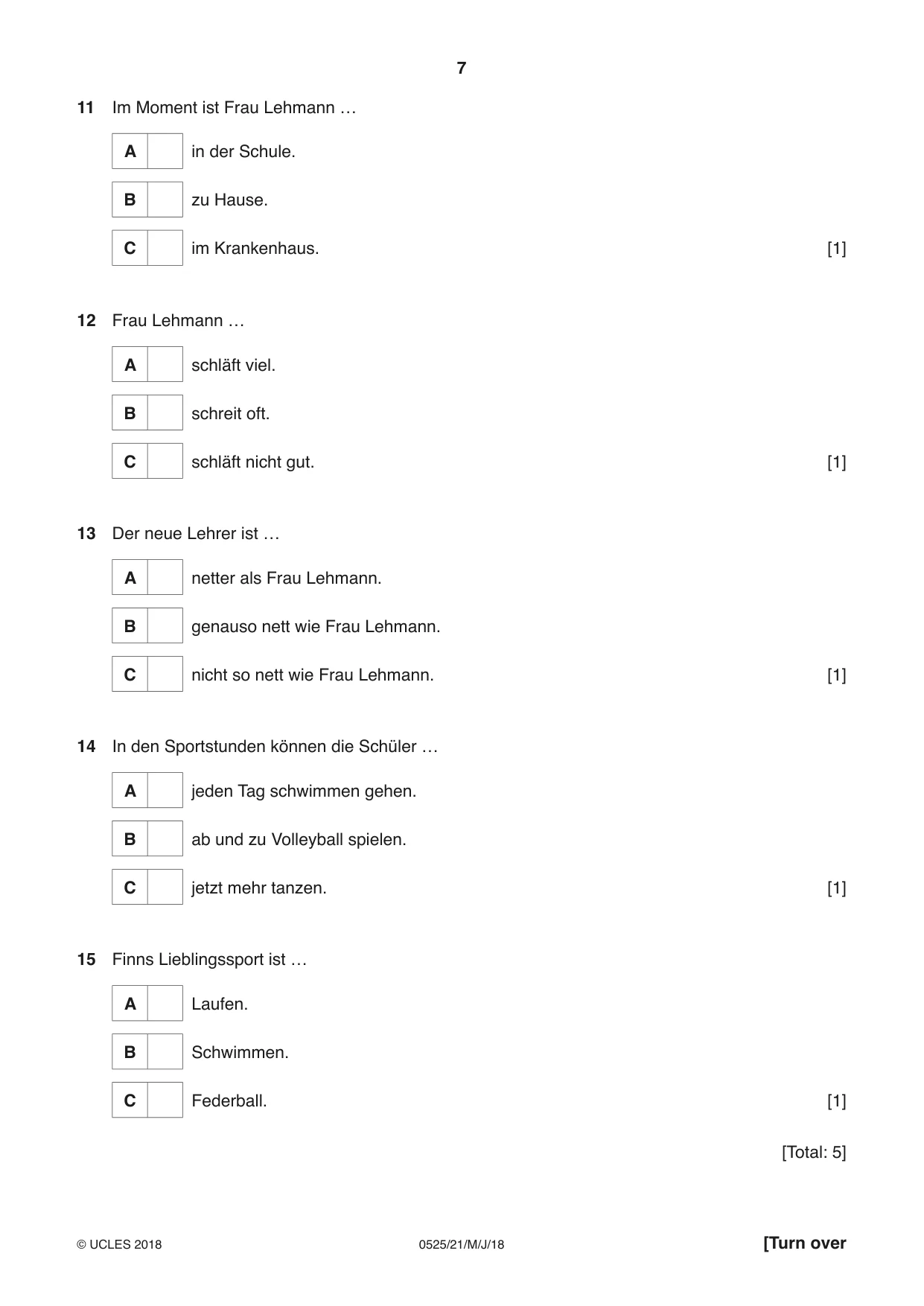
7 0525/21/M/J/18 © UCLES 2018 [Turn over 11 Im Moment ist Frau Lehmann … A in der Schule. B zu Hause. C im Krankenhaus. [1] 12 Frau Lehmann … A schläft viel. B schreit oft. C schläft nicht gut. [1] 13 Der neue Lehrer ist … A netter als Frau Lehmann. B genauso nett wie Frau Lehmann. C nicht so nett wie Frau Lehmann. [1] 14 In den Sportstunden können die Schüler … A jeden Tag schwimmen gehen. B ab und zu Volleyball spielen. C jetzt mehr tanzen. [1] 15 Finns Lieblingssport ist … A Laufen. B Schwimmen. C Federball. [1] [Total: 5]
Question paper, page 8
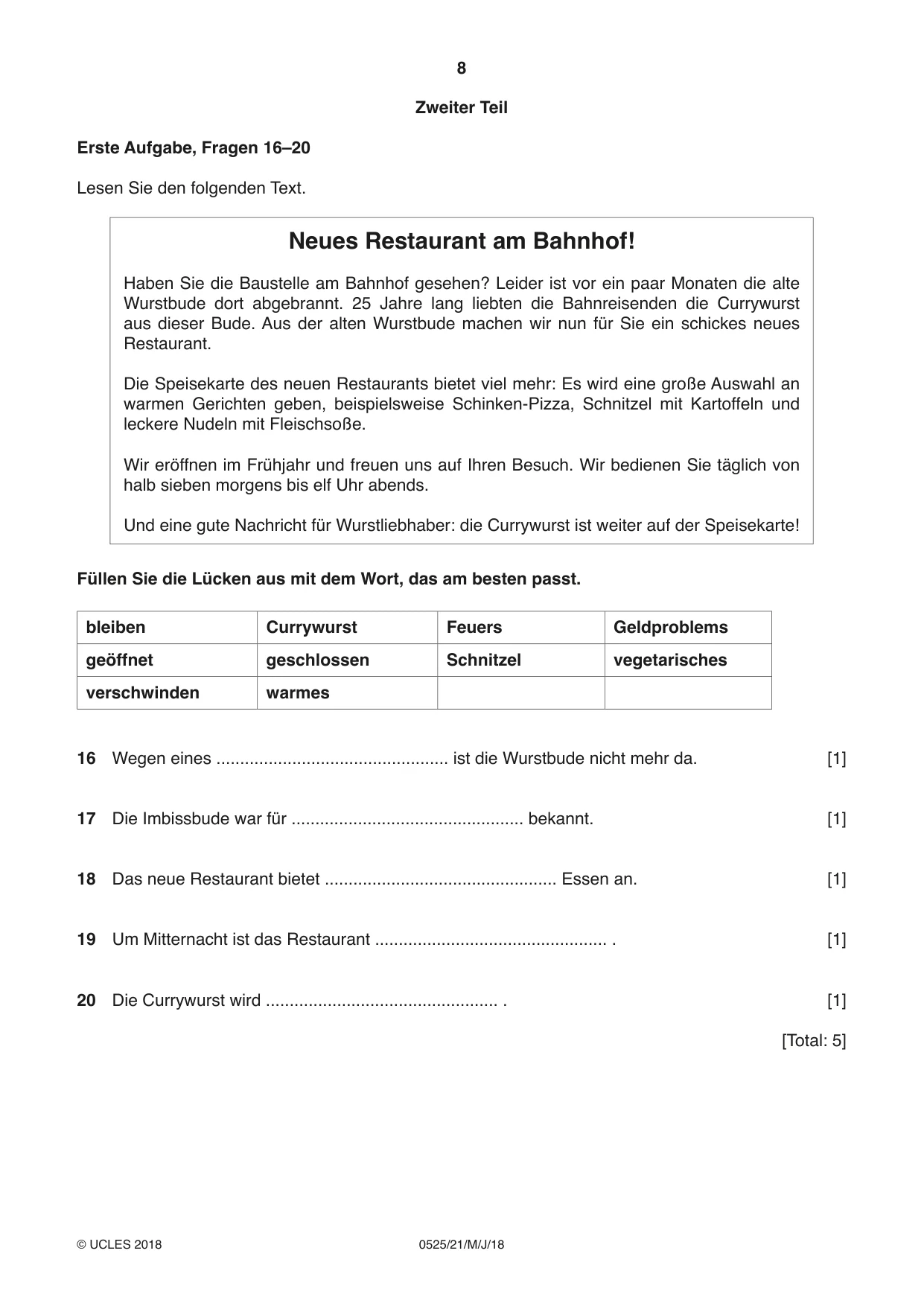
8 0525/21/M/J/18 © UCLES 2018 Zweiter Teil Erste Aufgabe, Fragen 16–20 Lesen Sie den folgenden Text. Neues Restaurant am Bahnhof! Haben Sie die Baustelle am Bahnhof gesehen? Leider ist vor ein paar Monaten die alte Wurstbude dort abgebrannt. 25 Jahre lang liebten die Bahnreisenden die Currywurst aus dieser Bude. Aus der alten Wurstbude machen wir nun für Sie ein schickes neues Restaurant. Die Speisekarte des neuen Restaurants bietet viel mehr: Es wird eine große Auswahl an warmen Gerichten geben, beispielsweise Schinken-Pizza, Schnitzel mit Kartoffeln und leckere Nudeln mit Fleischsoße. Wir eröffnen im Frühjahr und freuen uns auf Ihren Besuch. Wir bedienen Sie täglich von halb sieben morgens bis elf Uhr abends. Und eine gute Nachricht für Wurstliebhaber: die Currywurst ist weiter auf der Speisekarte! Füllen Sie die Lücken aus mit dem Wort, das am besten passt. bleiben Currywurst Feuers Geldproblems geöffnet geschlossen Schnitzel vegetarisches verschwinden warmes 16 Wegen eines … ist die Wurstbude nicht mehr da. [1] 17 Die Imbissbude war für … bekannt. [1] 18 Das neue Restaurant bietet … Essen an. [1] 19 Um Mitternacht ist das Restaurant … . [1] 20 Die Currywurst wird … . [1] [Total: 5]
Question paper, page 9
9 0525/21/M/J/18 © UCLES 2018 [Turn over BLANK PAGE
Question paper, page 10
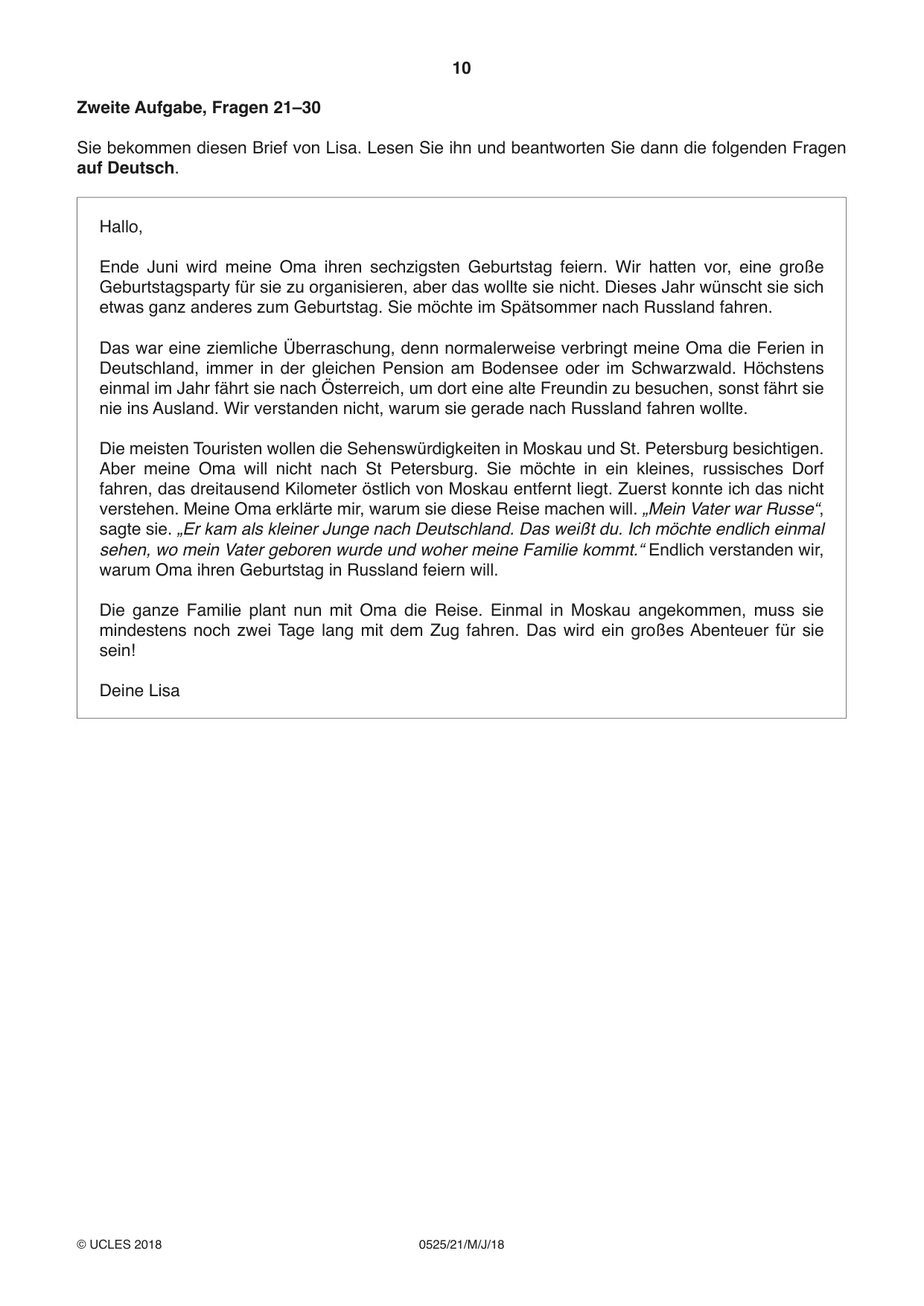
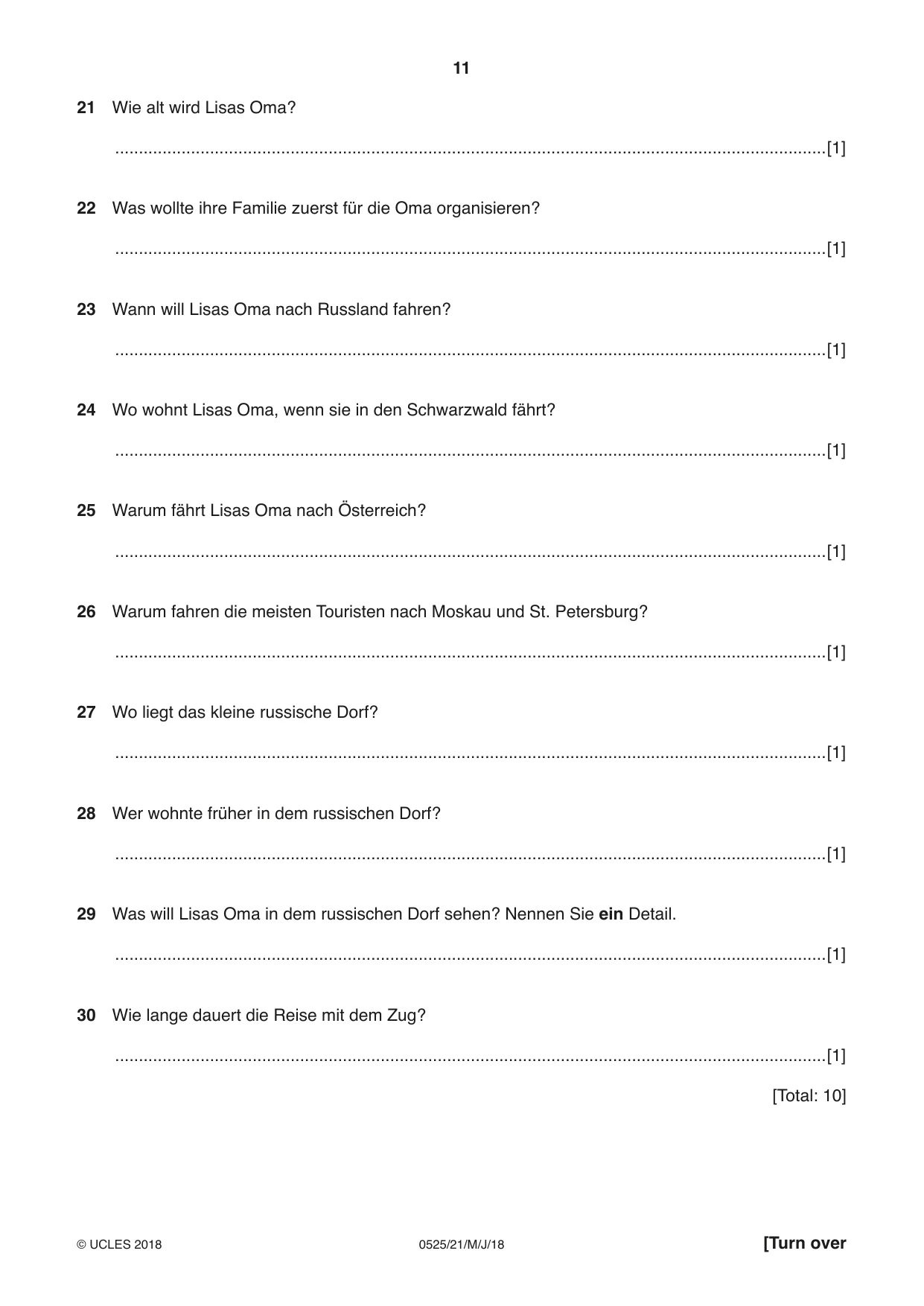
10 0525/21/M/J/18 © UCLES 2018 Zweite Aufgabe, Fragen 21–30 Sie bekommen diesen Brief von Lisa. Lesen Sie ihn und beantworten Sie dann die folgenden Fragen auf Deutsch. Hallo, Ende Juni wird meine Oma ihren sechzigsten Geburtstag feiern. Wir hatten vor, eine große Geburtstagsparty für sie zu organisieren, aber das wollte sie nicht. Dieses Jahr wünscht sie sich etwas ganz anderes zum Geburtstag. Sie möchte im Spätsommer nach Russland fahren. Das war eine ziemliche Überraschung, denn normalerweise verbringt meine Oma die Ferien in Deutschland, immer in der gleichen Pension am Bodensee oder im Schwarzwald. Höchstens einmal im Jahr fährt sie nach Österreich, um dort eine alte Freundin zu besuchen, sonst fährt sie nie ins Ausland. Wir verstanden nicht, warum sie gerade nach Russland fahren wollte. Die meisten Touristen wollen die Sehenswürdigkeiten in Moskau und St. Petersburg besichtigen. Aber meine Oma will nicht nach St Petersburg. Sie möchte in ein kleines, russisches Dorf fahren, das dreitausend Kilometer östlich von Moskau entfernt liegt. Zuerst konnte ich das nicht verstehen. Meine Oma erklärte mir, warum sie diese Reise machen will. „Mein Vater war Russe“, sagte sie. „Er kam als kleiner Junge nach Deutschland. Das weißt du. Ich möchte endlich einmal sehen, wo mein Vater geboren wurde und woher meine Familie kommt.“ Endlich verstanden wir, warum Oma ihren Geburtstag in Russland feiern will. Die ganze Familie plant nun mit Oma die Reise. Einmal in Moskau angekommen, muss sie mindestens noch zwei Tage lang mit dem Zug fahren. Das wird ein großes Abenteuer für sie sein! Deine Lisa
Question paper, page 11
11 0525/21/M/J/18 © UCLES 2018 [Turn over 21 Wie alt wird Lisas Oma? …[1] 22 Was wollte ihre Familie zuerst für die Oma organisieren? …[1] 23 Wann will Lisas Oma nach Russland fahren? …[1] 24 Wo wohnt Lisas Oma, wenn sie in den Schwarzwald fährt? …[1] 25 Warum fährt Lisas Oma nach Österreich? …[1] 26 Warum fahren die meisten Touristen nach Moskau und St. Petersburg? …[1] 27 Wo liegt das kleine russische Dorf? …[1] 28 Wer wohnte früher in dem russischen Dorf? …[1] 29 Was will Lisas Oma in dem russischen Dorf sehen? Nennen Sie ein Detail. …[1] 30 Wie lange dauert die Reise mit dem Zug? …[1] [Total: 10]
Question paper, page 12
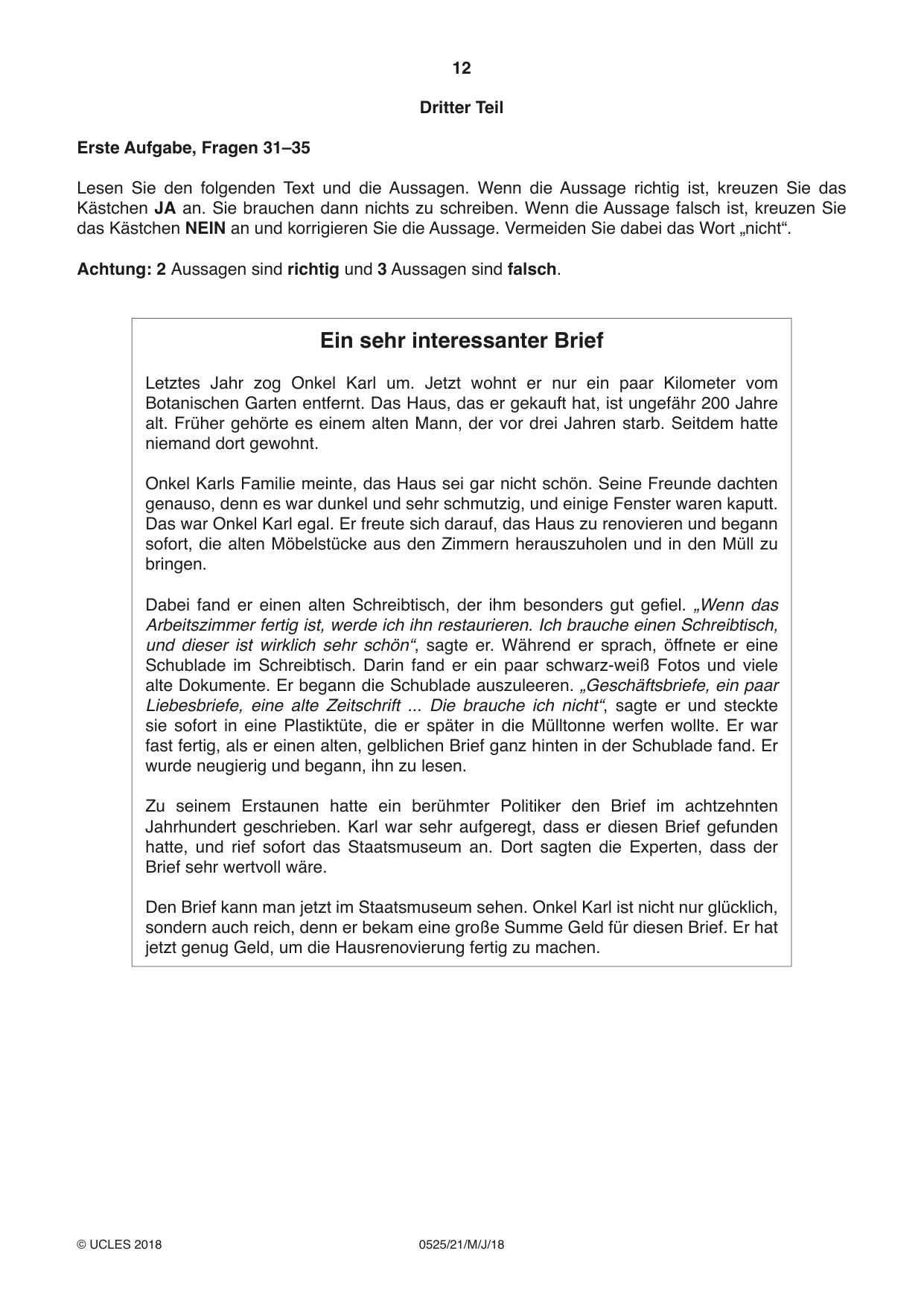
12 0525/21/M/J/18 © UCLES 2018 Dritter Teil Erste Aufgabe, Fragen 31–35 Lesen Sie den folgenden Text und die Aussagen. Wenn die Aussage richtig ist, kreuzen Sie das Kästchen JA an. Sie brauchen dann nichts zu schreiben. Wenn die Aussage falsch ist, kreuzen Sie das Kästchen NEIN an und korrigieren Sie die Aussage. Vermeiden Sie dabei das Wort „nicht“. Achtung: 2 Aussagen sind richtig und 3 Aussagen sind falsch. Ein sehr interessanter Brief Letztes Jahr zog Onkel Karl um. Jetzt wohnt er nur ein paar Kilometer vom Botanischen Garten entfernt. Das Haus, das er gekauft hat, ist ungefähr 200 Jahre alt. Früher gehörte es einem alten Mann, der vor drei Jahren starb. Seitdem hatte niemand dort gewohnt. Onkel Karls Familie meinte, das Haus sei gar nicht schön. Seine Freunde dachten genauso, denn es war dunkel und sehr schmutzig, und einige Fenster waren kaputt. Das war Onkel Karl egal. Er freute sich darauf, das Haus zu renovieren und begann sofort, die alten Möbelstücke aus den Zimmern herauszuholen und in den Müll zu bringen. Dabei fand er einen alten Schreibtisch, der ihm besonders gut gefiel. „Wenn das Arbeitszimmer fertig ist, werde ich ihn restaurieren. Ich brauche einen Schreibtisch, und dieser ist wirklich sehr schön“, sagte er. Während er sprach, öffnete er eine Schublade im Schreibtisch. Darin fand er ein paar schwarz-weiß Fotos und viele alte Dokumente. Er begann die Schublade auszuleeren. „Geschäftsbriefe, ein paar Liebesbriefe, eine alte Zeitschrift ... Die brauche ich nicht“, sagte er und steckte sie sofort in eine Plastiktüte, die er später in die Mülltonne werfen wollte. Er war fast fertig, als er einen alten, gelblichen Brief ganz hinten in der Schublade fand. Er wurde neugierig und begann, ihn zu lesen. Zu seinem Erstaunen hatte ein berühmter Politiker den Brief im achtzehnten Jahrhundert geschrieben. Karl war sehr aufgeregt, dass er diesen Brief gefunden hatte, und rief sofort das Staatsmuseum an. Dort sagten die Experten, dass der Brief sehr wertvoll wäre. Den Brief kann man jetzt im Staatsmuseum sehen. Onkel Karl ist nicht nur glücklich, sondern auch reich, denn er bekam eine große Summe Geld für diesen Brief. Er hat jetzt genug Geld, um die Hausrenovierung fertig zu machen.
Question paper, page 13
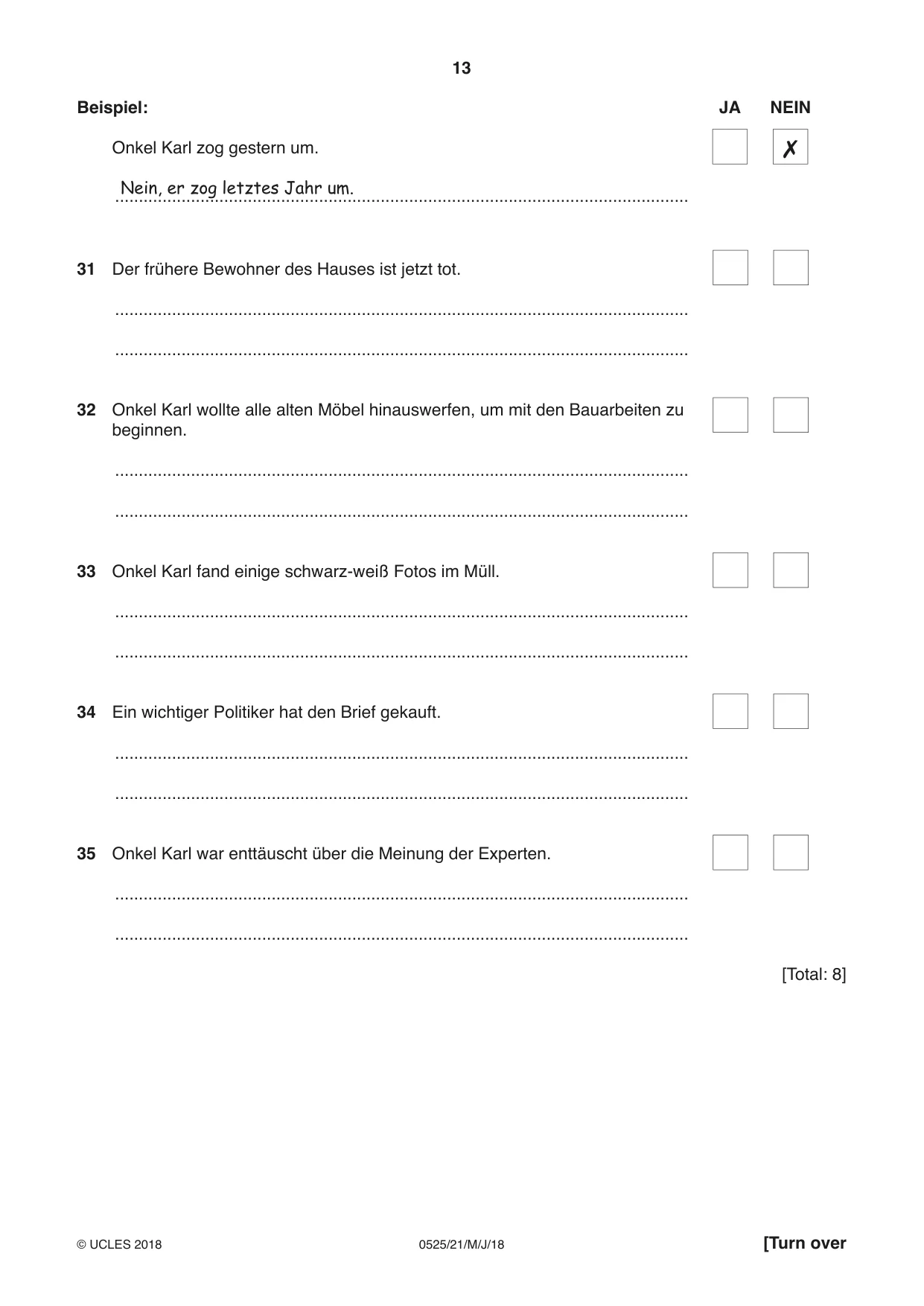
13 0525/21/M/J/18 © UCLES 2018 [Turn over Beispiel: JA NEIN Onkel Karl zog gestern um. 7 Nein, er zog letztes Jahr um. … 31 Der frühere Bewohner des Hauses ist jetzt tot. … … 32 Onkel Karl wollte alle alten Möbel hinauswerfen, um mit den Bauarbeiten zu beginnen. … … 33 Onkel Karl fand einige schwarz-weiß Fotos im Müll. … … 34 Ein wichtiger Politiker hat den Brief gekauft. … … 35 Onkel Karl war enttäuscht über die Meinung der Experten. … … [Total: 8]
Question paper, page 14
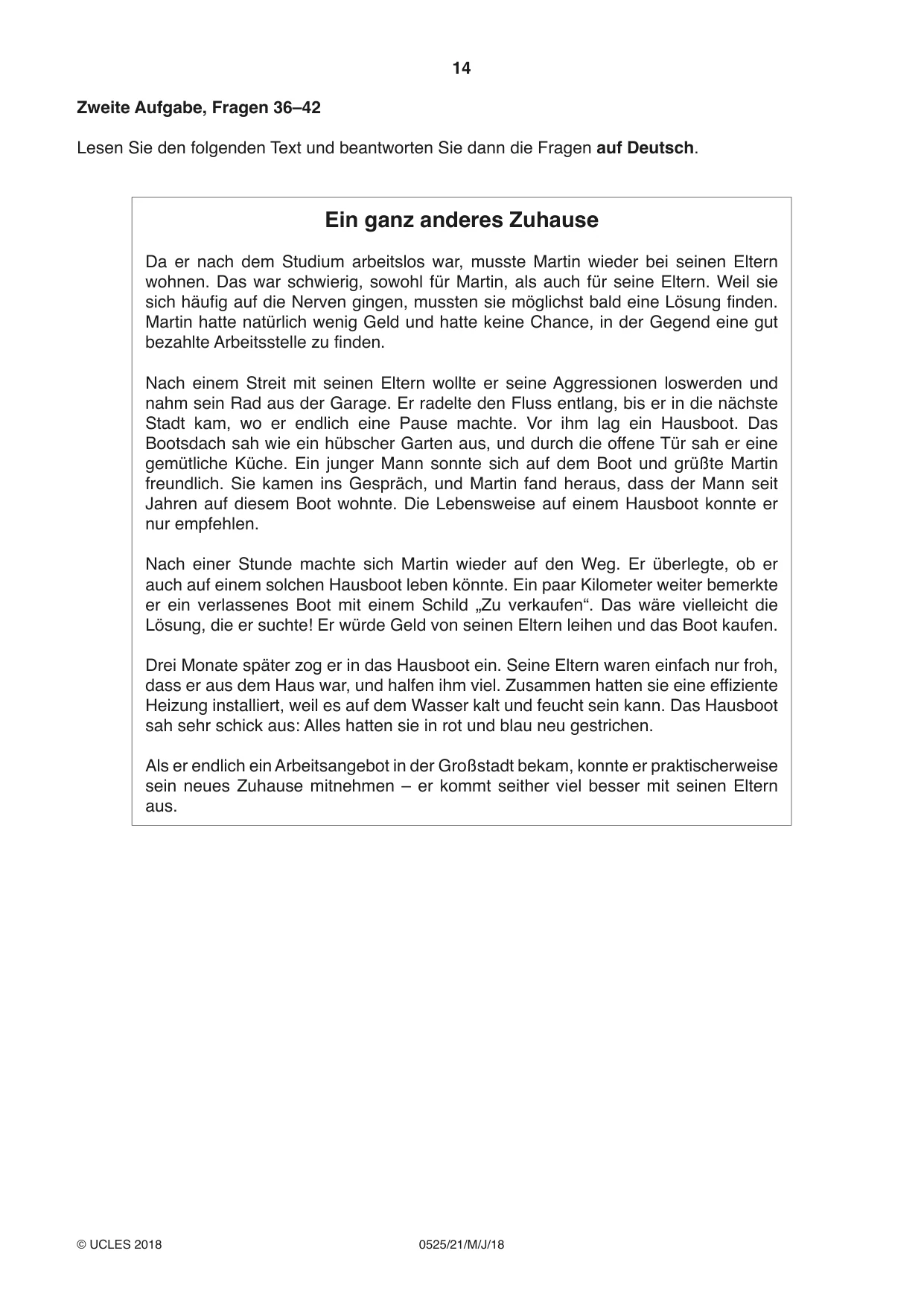
14 0525/21/M/J/18 © UCLES 2018 Zweite Aufgabe, Fragen 36–42 Lesen Sie den folgenden Text und beantworten Sie dann die Fragen auf Deutsch. Ein ganz anderes Zuhause Da er nach dem Studium arbeitslos war, musste Martin wieder bei seinen Eltern wohnen. Das war schwierig, sowohl für Martin, als auch für seine Eltern. Weil sie sich häufig auf die Nerven gingen, mussten sie möglichst bald eine Lösung finden. Martin hatte natürlich wenig Geld und hatte keine Chance, in der Gegend eine gut bezahlte Arbeitsstelle zu finden. Nach einem Streit mit seinen Eltern wollte er seine Aggressionen loswerden und nahm sein Rad aus der Garage. Er radelte den Fluss entlang, bis er in die nächste Stadt kam, wo er endlich eine Pause machte. Vor ihm lag ein Hausboot. Das Bootsdach sah wie ein hübscher Garten aus, und durch die offene Tür sah er eine gemütliche Küche. Ein junger Mann sonnte sich auf dem Boot und grüßte Martin freundlich. Sie kamen ins Gespräch, und Martin fand heraus, dass der Mann seit Jahren auf diesem Boot wohnte. Die Lebensweise auf einem Hausboot konnte er nur empfehlen. Nach einer Stunde machte sich Martin wieder auf den Weg. Er überlegte, ob er auch auf einem solchen Hausboot leben könnte. Ein paar Kilometer weiter bemerkte er ein verlassenes Boot mit einem Schild „Zu verkaufen“. Das wäre vielleicht die Lösung, die er suchte! Er würde Geld von seinen Eltern leihen und das Boot kaufen. Drei Monate später zog er in das Hausboot ein. Seine Eltern waren einfach nur froh, dass er aus dem Haus war, und halfen ihm viel. Zusammen hatten sie eine effiziente Heizung installiert, weil es auf dem Wasser kalt und feucht sein kann. Das Hausboot sah sehr schick aus: Alles hatten sie in rot und blau neu gestrichen. Als er endlich ein Arbeitsangebot in der Großstadt bekam, konnte er praktischerweise sein neues Zuhause mitnehmen – er kommt seither viel besser mit seinen Eltern aus.
Question paper, page 15
15 0525/21/M/J/18 © UCLES 2018 36 Was musste Martin tun, weil er arbeitslos war? … …[1] 37 Wie kam Martin mit seinen Eltern aus? … …[1] 38 Was gefiel Martin an dem Hausboot des jungen Mannes? Nennen Sie ein Detail. … …[1] 39 Was meinte der junge Mann über die Lebensweise auf einem Hausboot? … …[1] 40 Warum wollte Martin Geld von seinen Eltern leihen? … …[1] 41 Warum waren Martins Eltern glücklich, als er auf das Hausboot zog? … …[1] 42 Was fand Martin praktisch, als er einen neuen Job in der Großstadt bekam? … …[1] [Total: 7]
Question paper, page 16
16 0525/21/M/J/18 © UCLES 2018 Permission to reproduce items where third-party owned material protected by copyright is included has been sought and cleared where possible. Every reasonable effort has been made by the publisher (UCLES) to trace copyright holders, but if any items requiring clearance have unwittingly been included, the publisher will be pleased to make amends at the earliest possible opportunity. To avoid the issue of disclosure of answer-related information to candidates, all copyright acknowledgements are reproduced online in the Cambridge International Examinations Copyright Acknowledgements Booklet. This is produced for each series of examinations and is freely available to download at www.cie.org.uk after the live examination series. Cambridge International Examinations is part of the Cambridge Assessment Group. Cambridge Assessment is the brand name of University of Cambridge Local Examinations Syndicate (UCLES), which is itself a department of the University of Cambridge. BLANK PAGE
Mark scheme, page 1
IGCSE™ is a registered trademark. This syllabus is approved for use in England, Wales and Northern Ireland as a Cambridge International Level 1/Level 2 Certificate. This document consists of 14 printed pages. © UCLES 2018 [Turn over Cambridge Assessment International Education Cambridge International General Certificate of Secondary Education GERMAN 0525/21 Paper 2 Reading May/June 2018 MARK SCHEME Maximum Mark: 45 Published This mark scheme is published as an aid to teachers and candidates, to indicate the requirements of the examination. It shows the basis on which Examiners were instructed to award marks. It does not indicate the details of the discussions that took place at an Examiners’ meeting before marking began, which would have considered the acceptability of alternative answers. Mark schemes should be read in conjunction with the question paper and the Principal Examiner Report for Teachers. Cambridge International will not enter into discussions about these mark schemes. Cambridge International is publishing the mark schemes for the May/June 2018 series for most Cambridge IGCSE™, Cambridge International A and AS Level and Cambridge Pre-U components, and some Cambridge O Level components.
Mark scheme, page 2
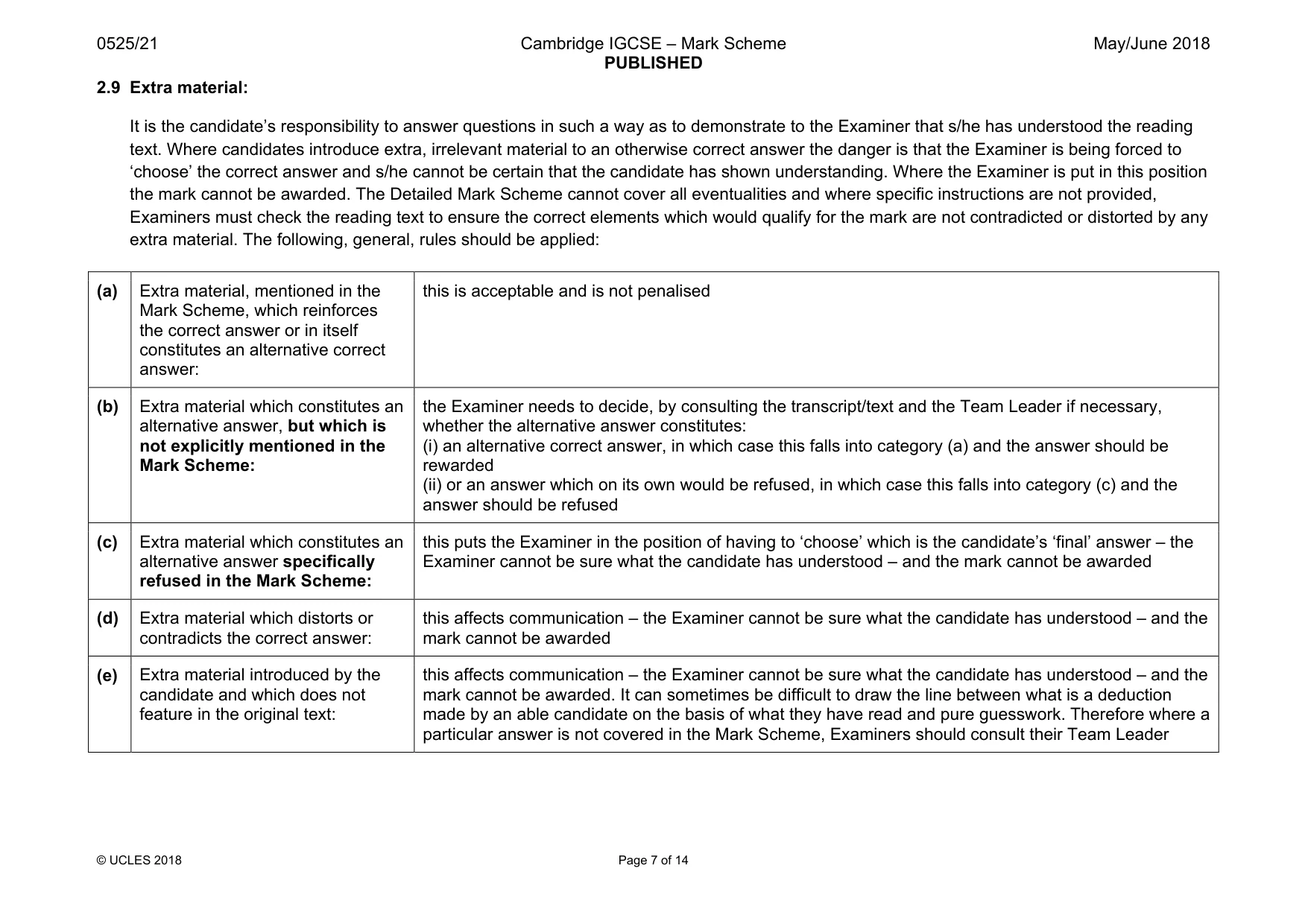
0525/21 Cambridge IGCSE – Mark Scheme PUBLISHED May/June 2018 © UCLES 2018 Page 2 of 14 1 Generic Marking Principles These general marking principles must be applied by all examiners when marking candidate answers. They should be applied alongside the specific content of the mark scheme or generic level descriptors for a question. Each question paper and mark scheme will also comply with these marking principles. GENERIC MARKING PRINCIPLE 1: Marks must be awarded in line with: • the specific content of the mark scheme or the generic level descriptors for the question • the specific skills defined in the mark scheme or in the generic level descriptors for the question • the standard of response required by a candidate as exemplified by the standardisation scripts. GENERIC MARKING PRINCIPLE 2: Marks awarded are always whole marks (not half marks, or other fractions). GENERIC MARKING PRINCIPLE 3: Marks must be awarded positively: • marks are awarded for correct/valid answers, as defined in the mark scheme. However, credit is given for valid answers which go beyond the scope of the syllabus and mark scheme, referring to your Team Leader as appropriate • marks are awarded when candidates clearly demonstrate what they know and can do • marks are not deducted for errors • marks are not deducted for omissions • answers should only be judged on the quality of spelling, punctuation and grammar when these features are specifically assessed by the question as indicated by the mark scheme. The meaning, however, should be unambiguous. GENERIC MARKING PRINCIPLE 4: Rules must be applied consistently e.g. in situations where candidates have not followed instructions or in the application of generic level descriptors.
Mark scheme, page 3
0525/21 Cambridge IGCSE – Mark Scheme PUBLISHED May/June 2018 © UCLES 2018 Page 3 of 14 GENERIC MARKING PRINCIPLE 5: Marks should be awarded using the full range of marks defined in the mark scheme for the question (however; the use of the full mark range may be limited according to the quality of the candidate responses seen). GENERIC MARKING PRINCIPLE 6: Marks awarded are based solely on the requirements as defined in the mark scheme. Marks should not be awarded with grade thresholds or grade descriptors in mind.
Mark scheme, page 4
0525/21 Cambridge IGCSE – Mark Scheme PUBLISHED May/June 2018 © UCLES 2018 Page 4 of 14 2 General Marking Principles 2.1 It is not possible to list all acceptable alternatives in the Detailed Mark Scheme provided in Section 4. You will need to consider all alternative answers and unexpected approaches in candidates’ scripts, make a decision on whether they communicate the required elements, in consultation with your Team Leader if necessary (or with your Product Manager if you are a single Examiner), and award marks accordingly. The following marking principles underpin the detailed instructions provided in Section 4 of the Mark Scheme. Where a decision is taken to deviate from these principles for a particular question, this will be specified in the Mark Scheme. Often the general principles will have to be weighed up against each other, e.g. the answer might pass the look-alike test (3.5(b)), but if the candidate has produced an answer that is another word in the target language they will not score (3.6). 2.2 Crossing out: (a) If a candidate changes his/her mind over an answer and crosses out an attempt, award a mark if the final attempt is correct. (b) If a candidate crosses out an answer to a whole question but makes no second attempt at it, mark the crossed out work. 2.3 More than the stipulated number of boxes ticked/crossed by the candidate: (a) If more than one attempt is visible, but the candidate has clearly indicated which attempt is his/her final answer (e.g. by crossing out other attempts or by annotating the script in some way), mark in the usual way. (b) If two attempts are visible (e.g. two boxes ticked instead of the 1 box stipulated), and neither has been crossed out/discounted by the candidate, no mark can be awarded. (c) Where candidates must tick a number of boxes (e.g. tick the 6 true statements) and tick too many, apply the following rule: deduct the number of ‘extra’ answers indicated by the candidate from their number of correct answers. The remaining number is the mark awarded, e.g. the candidate is asked to tick 6 statements, but ticks 8. 5 of the ticks are correctly placed, but 2 are ‘extras’ (8 ticks placed by candidate minus 6 ticks required by rubric = 2 ‘extras’). Therefore the candidate is awarded a mark of 3. (d) Answers in pen do not take precedence over answers in pencil, e.g. if a candidate is asked to tick 1 box and ticks two, one in pen and the other in pencil, the mark cannot be awarded unless there is explicit indication from the candidate as to which is his/her final answer.
Mark scheme, page 5
0525/21 Cambridge IGCSE – Mark Scheme PUBLISHED May/June 2018 © UCLES 2018 Page 5 of 14 2.4 For questions requiring more than one element for the answer, (i) and (ii), where the answers are interchangeable: (a) Both correct answers on line 1 and line 2 blank = 2 (b) Both correct answers on line 1 and line 2 wrong = 1 (or vice-versa) 2.5 Answers requiring the use of German (rather than a non-verbal response) should be marked for communication. Tolerate inaccuracies provided the message is clear. (a) ‘If in doubt, sound it out’: if you read what the candidate has written, does it sound like the correct answer? (b) Look-alike test: does what the candidate has written look like the correct answer? (c) Accept incorrect gender or person unless Mark Scheme specifies otherwise. (d) Accept incorrect possessive adjectives, e.g. mein, dein, ihr, sein, etc., unless Mark Scheme specifies otherwise. (e) Accept incorrect tense unless Mark Scheme specifies otherwise. (f) Tolerate incorrect auxiliary unless Mark Scheme specifies otherwise. (g) Tolerate incorrect use of infinitive unless Mark Scheme specifies otherwise. 2.6 Unless the Mark Scheme specifies otherwise, do not accept incorrect German if the word given means something else in German. (Incorrect German which constitutes a word in any language other than German is marked (i) on the basis of whether it is accepted or refused in the Mark Scheme and (ii) if not mentioned in the Mark Scheme, on the basis of 3.5 above).
Mark scheme, page 6
0525/21 Cambridge IGCSE – Mark Scheme PUBLISHED May/June 2018 © UCLES 2018 Page 6 of 14 2.7 Annotation used in the Mark Scheme: (a) INV = invalidation and is used when additional material included by the candidate is judged to invalidate an otherwise correct answer thus preventing him/her from scoring the mark (INV = 0). (b) tc = ‘tout court’ and means that on its own the material is not sufficient to score the mark. (c) HA = harmless additional material which in conjunction with the correct answer does not prevent the candidate from scoring the mark. (d) BOD = benefit of the doubt and is used to indicate that the Examiner has considered the answer/that part of the answer and judged it to be more correct than incorrect: the benefit of the doubt is given to the candidate and the mark is awarded 2.8 No response and ‘0’ marks There is a NR (No Response) option. Award NR (No Response): If there is nothing written at all in the answer space or If there is only a comment which does not in any way relate to the question being asked (e.g. ‘can’t do’ or ‘don’t know’) or If there is only a mark which isn’t an attempt at the question (e.g. a dash, a question mark). Award 0: If there is any attempt that earns no credit. This could, for example, include the candidate copying all or some of the question, or any working that does not earn any marks, whether crossed out or not.
Mark scheme, page 7
0525/21 Cambridge IGCSE – Mark Scheme PUBLISHED May/June 2018 © UCLES 2018 Page 7 of 14 2.9 Extra material: It is the candidate’s responsibility to answer questions in such a way as to demonstrate to the Examiner that s/he has understood the reading text. Where candidates introduce extra, irrelevant material to an otherwise correct answer the danger is that the Examiner is being forced to ‘choose’ the correct answer and s/he cannot be certain that the candidate has shown understanding. Where the Examiner is put in this position the mark cannot be awarded. The Detailed Mark Scheme cannot cover all eventualities and where specific instructions are not provided, Examiners must check the reading text to ensure the correct elements which would qualify for the mark are not contradicted or distorted by any extra material. The following, general, rules should be applied: (a) Extra material, mentioned in the Mark Scheme, which reinforces the correct answer or in itself constitutes an alternative correct answer: this is acceptable and is not penalised (b) Extra material which constitutes an alternative answer, but which is not explicitly mentioned in the Mark Scheme: the Examiner needs to decide, by consulting the transcript/text and the Team Leader if necessary, whether the alternative answer constitutes: (i) an alternative correct answer, in which case this falls into category (a) and the answer should be rewarded (ii) or an answer which on its own would be refused, in which case this falls into category (c) and the answer should be refused (c) Extra material which constitutes an alternative answer specifically refused in the Mark Scheme: this puts the Examiner in the position of having to ‘choose’ which is the candidate’s ‘final’ answer – the Examiner cannot be sure what the candidate has understood – and the mark cannot be awarded (d) Extra material which distorts or contradicts the correct answer: this affects communication – the Examiner cannot be sure what the candidate has understood – and the mark cannot be awarded (e) Extra material introduced by the candidate and which does not feature in the original text: this affects communication – the Examiner cannot be sure what the candidate has understood – and the mark cannot be awarded. It can sometimes be difficult to draw the line between what is a deduction made by an able candidate on the basis of what they have read and pure guesswork. Therefore where a particular answer is not covered in the Mark Scheme, Examiners should consult their Team Leader
Mark scheme, page 8
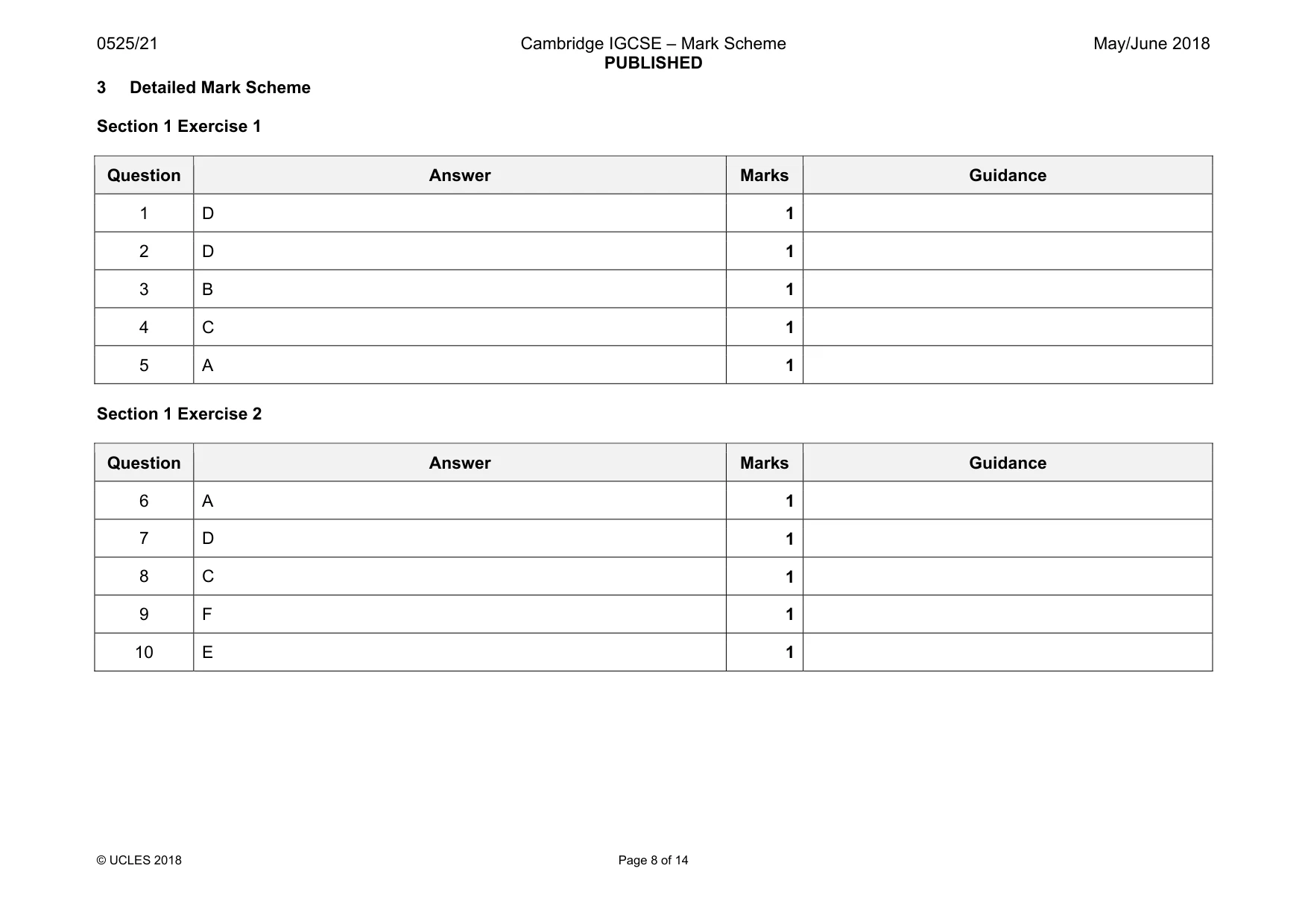
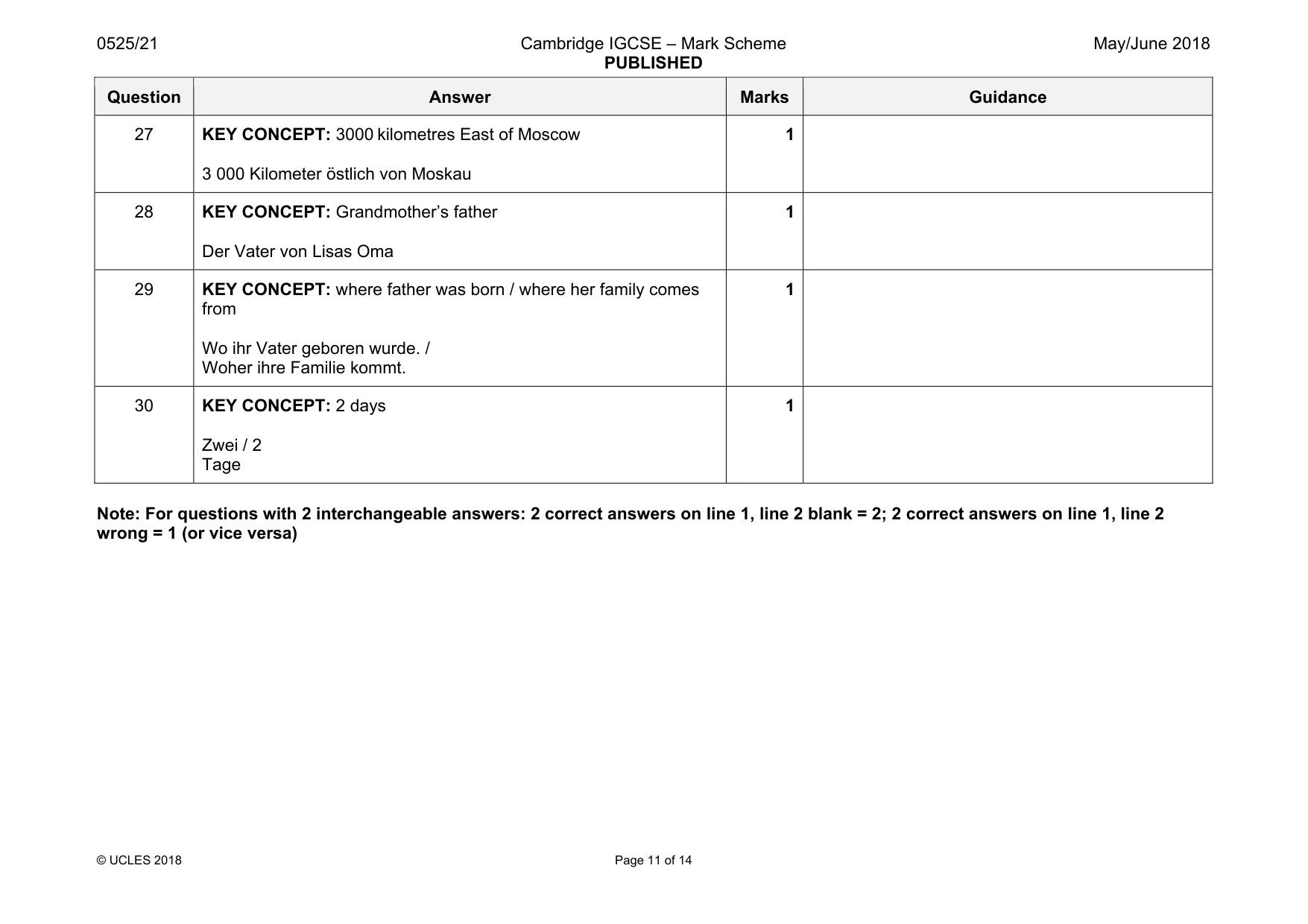
0525/21 Cambridge IGCSE – Mark Scheme PUBLISHED May/June 2018 © UCLES 2018 Page 8 of 14 3 Detailed Mark Scheme Section 1 Exercise 1 Question Answer Marks Guidance 1 D 1 2 D 1 3 B 1 4 C 1 5 A 1 Section 1 Exercise 2 Question Answer Marks Guidance 6 A 1 7 D 1 8 C 1 9 F 1 10 E 1
Mark scheme, page 9
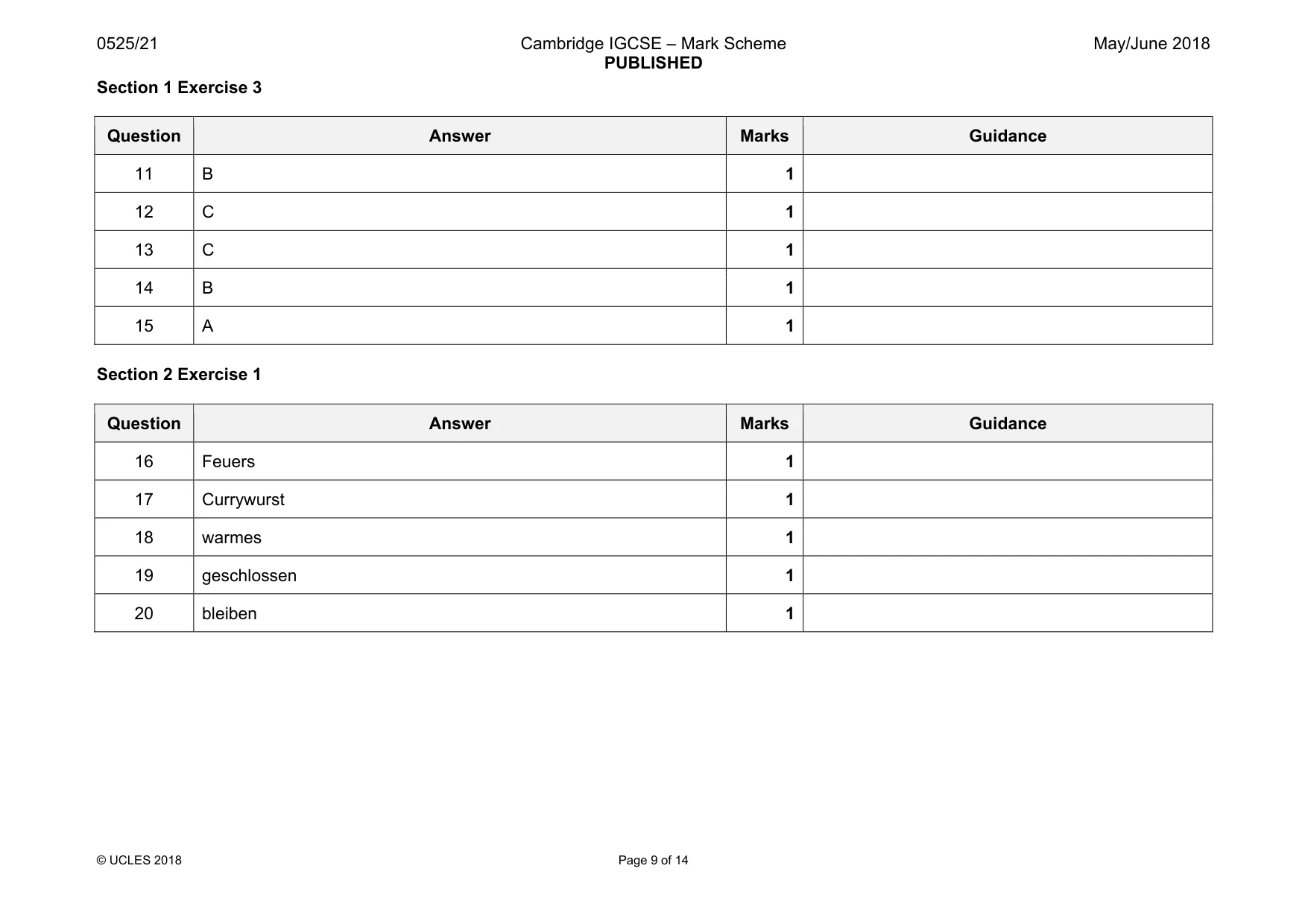
0525/21 Cambridge IGCSE – Mark Scheme PUBLISHED May/June 2018 © UCLES 2018 Page 9 of 14 Section 1 Exercise 3 Question Answer Marks Guidance 11 B 1 12 C 1 13 C 1 14 B 1 15 A 1 Section 2 Exercise 1 Question Answer Marks Guidance 16 Feuers 1 17 Currywurst 1 18 warmes 1 19 geschlossen 1 20 bleiben 1
Mark scheme, page 10
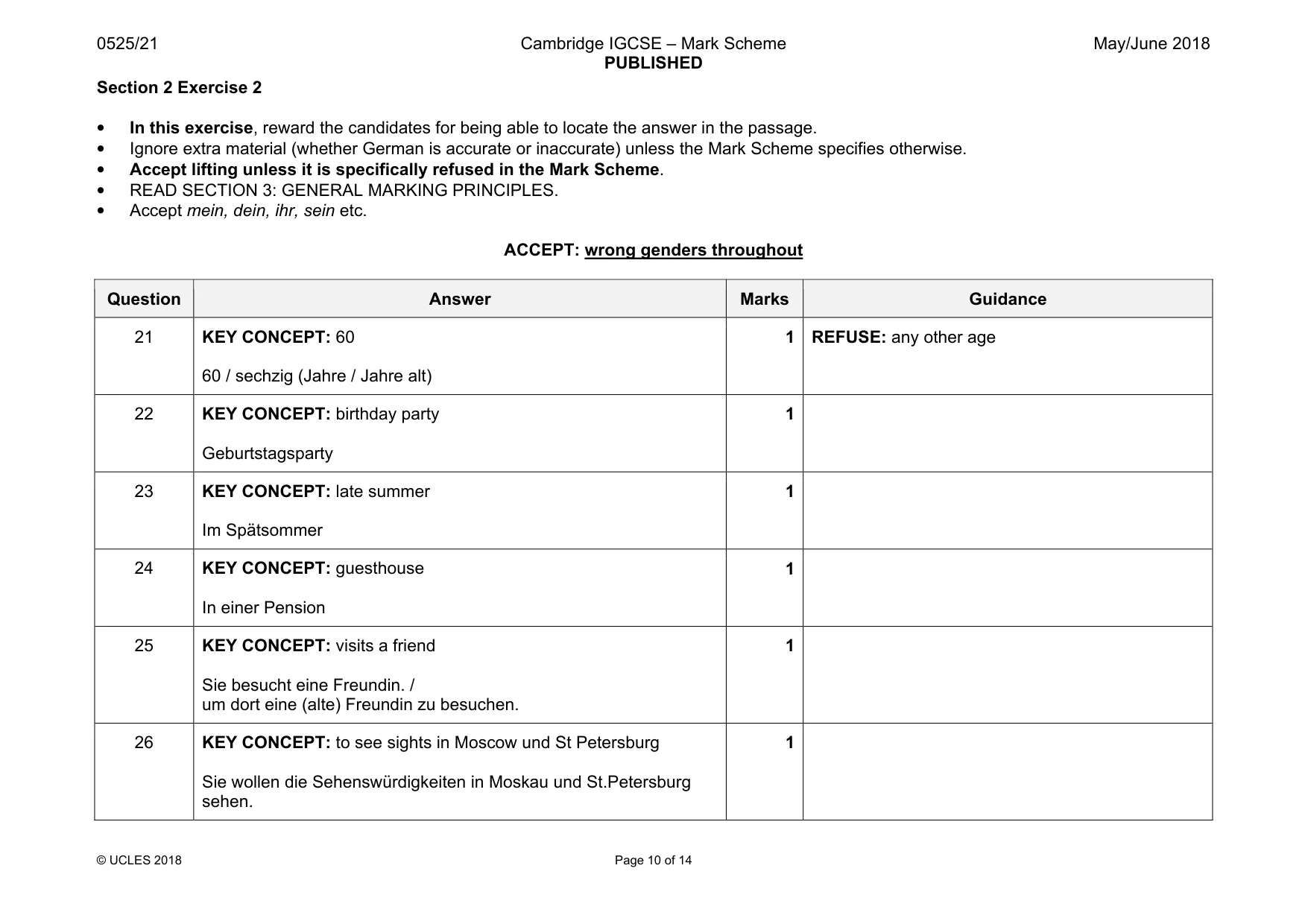
0525/21 Cambridge IGCSE – Mark Scheme PUBLISHED May/June 2018 © UCLES 2018 Page 10 of 14 Section 2 Exercise 2 • In this exercise, reward the candidates for being able to locate the answer in the passage. • Ignore extra material (whether German is accurate or inaccurate) unless the Mark Scheme specifies otherwise. • Accept lifting unless it is specifically refused in the Mark Scheme. • READ SECTION 3: GENERAL MARKING PRINCIPLES. • Accept mein, dein, ihr, sein etc. ACCEPT: wrong genders throughout Question Answer Marks Guidance 21 KEY CONCEPT: 60 60 / sechzig (Jahre / Jahre alt) 1 REFUSE: any other age 22 KEY CONCEPT: birthday party Geburtstagsparty 1 23 KEY CONCEPT: late summer Im Spätsommer 1 24 KEY CONCEPT: guesthouse In einer Pension 1 25 KEY CONCEPT: visits a friend Sie besucht eine Freundin. / um dort eine (alte) Freundin zu besuchen. 1 26 KEY CONCEPT: to see sights in Moscow und St Petersburg Sie wollen die Sehenswürdigkeiten in Moskau und St.Petersburg sehen. 1
Mark scheme, page 11
0525/21 Cambridge IGCSE – Mark Scheme PUBLISHED May/June 2018 © UCLES 2018 Page 11 of 14 Question Answer Marks Guidance 27 KEY CONCEPT: 3000 kilometres East of Moscow 3 000 Kilometer östlich von Moskau 1 28 KEY CONCEPT: Grandmother’s father Der Vater von Lisas Oma 1 29 KEY CONCEPT: where father was born / where her family comes from Wo ihr Vater geboren wurde. / Woher ihre Familie kommt. 1 30 KEY CONCEPT: 2 days Zwei / 2 Tage 1 Note: For questions with 2 interchangeable answers: 2 correct answers on line 1, line 2 blank = 2; 2 correct answers on line 1, line 2 wrong = 1 (or vice versa)
Mark scheme, page 12
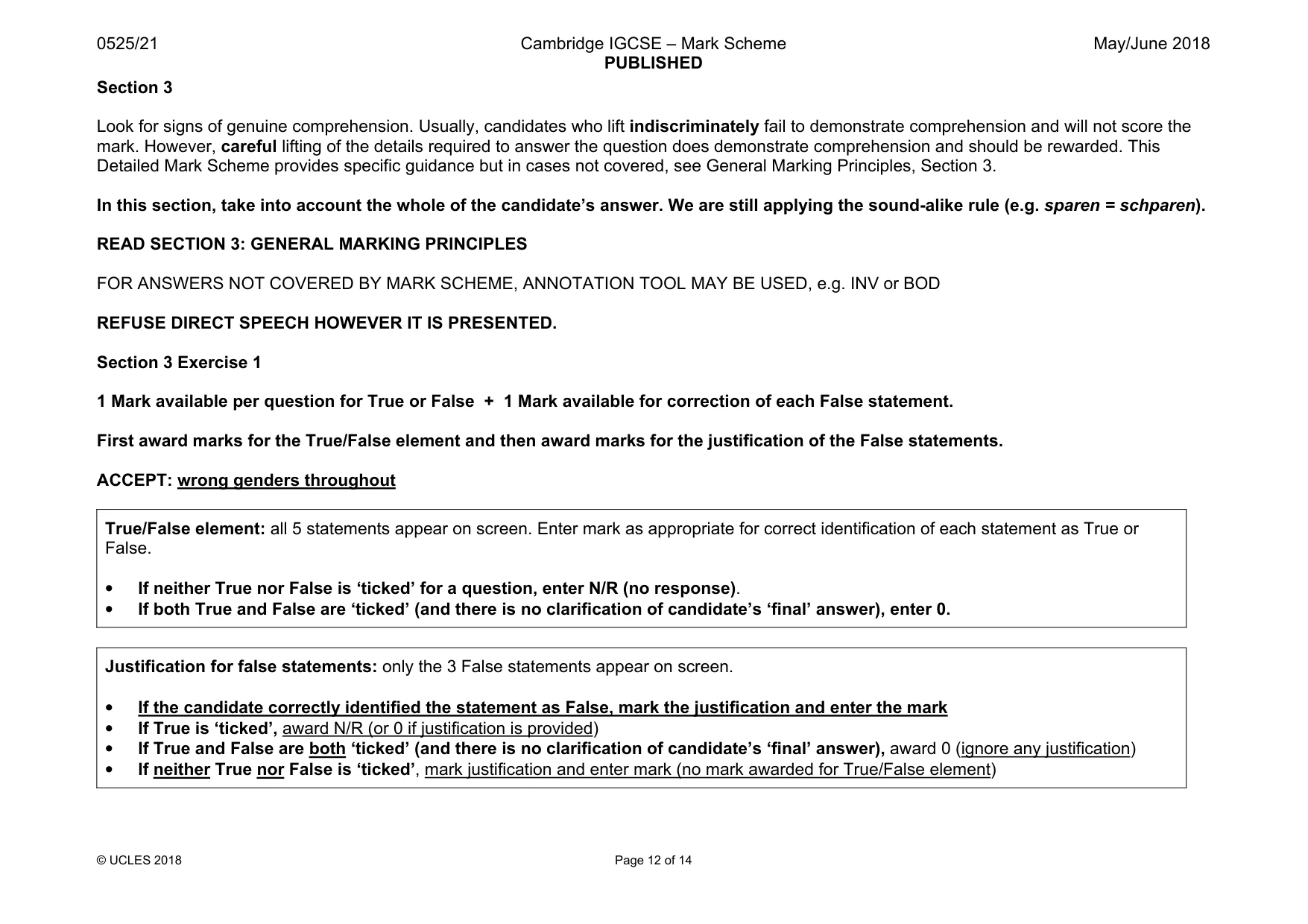
0525/21 Cambridge IGCSE – Mark Scheme PUBLISHED May/June 2018 © UCLES 2018 Page 12 of 14 Section 3 Look for signs of genuine comprehension. Usually, candidates who lift indiscriminately fail to demonstrate comprehension and will not score the mark. However, careful lifting of the details required to answer the question does demonstrate comprehension and should be rewarded. This Detailed Mark Scheme provides specific guidance but in cases not covered, see General Marking Principles, Section 3. In this section, take into account the whole of the candidate’s answer. We are still applying the sound-alike rule (e.g. sparen = schparen). READ SECTION 3: GENERAL MARKING PRINCIPLES FOR ANSWERS NOT COVERED BY MARK SCHEME, ANNOTATION TOOL MAY BE USED, e.g. INV or BOD REFUSE DIRECT SPEECH HOWEVER IT IS PRESENTED. Section 3 Exercise 1 1 Mark available per question for True or False + 1 Mark available for correction of each False statement. First award marks for the True/False element and then award marks for the justification of the False statements. ACCEPT: wrong genders throughout True/False element: all 5 statements appear on screen. Enter mark as appropriate for correct identification of each statement as True or False. • If neither True nor False is ‘ticked’ for a question, enter N/R (no response). • If both True and False are ‘ticked’ (and there is no clarification of candidate’s ‘final’ answer), enter 0. Justification for false statements: only the 3 False statements appear on screen. • If the candidate correctly identified the statement as False, mark the justification and enter the mark • If True is ‘ticked’, award N/R (or 0 if justification is provided) • If True and False are both ‘ticked’ (and there is no clarification of candidate’s ‘final’ answer), award 0 (ignore any justification) • If neither True nor False is ‘ticked’, mark justification and enter mark (no mark awarded for True/False element)
Mark scheme, page 13
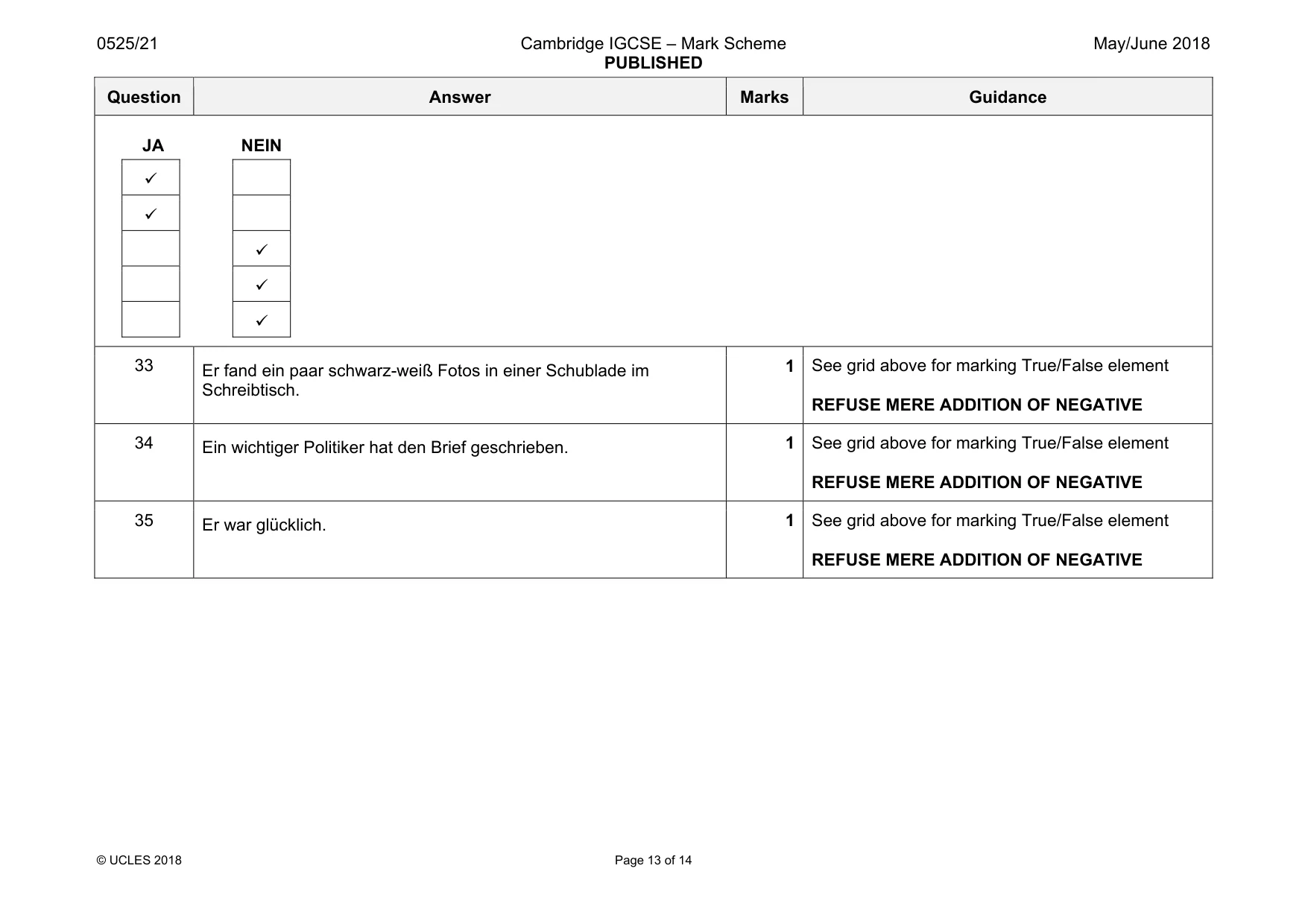
0525/21 Cambridge IGCSE – Mark Scheme PUBLISHED May/June 2018 © UCLES 2018 Page 13 of 14 Question Answer Marks Guidance JA NEIN 9 9 9 9 9 33 Er fand ein paar schwarz-weiß Fotos in einer Schublade im Schreibtisch. 1 See grid above for marking True/False element REFUSE MERE ADDITION OF NEGATIVE 34 Ein wichtiger Politiker hat den Brief geschrieben. 1 See grid above for marking True/False element REFUSE MERE ADDITION OF NEGATIVE 35 Er war glücklich. 1 See grid above for marking True/False element REFUSE MERE ADDITION OF NEGATIVE
Mark scheme, page 14
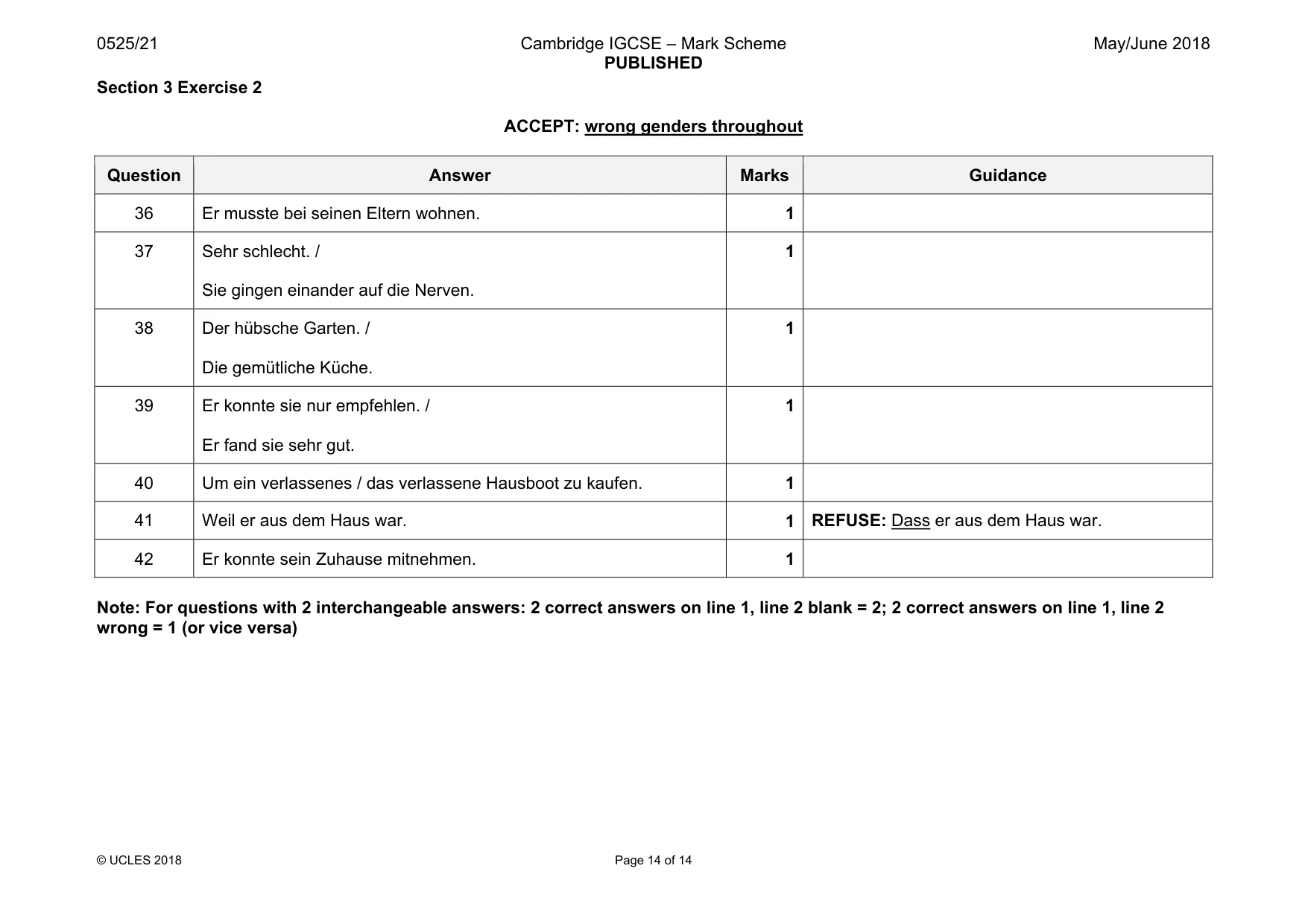
0525/21 Cambridge IGCSE – Mark Scheme PUBLISHED May/June 2018 © UCLES 2018 Page 14 of 14 Section 3 Exercise 2 ACCEPT: wrong genders throughout Question Answer Marks Guidance 36 Er musste bei seinen Eltern wohnen. 1 37 Sehr schlecht. / Sie gingen einander auf die Nerven. 1 38 Der hübsche Garten. / Die gemütliche Küche. 1 39 Er konnte sie nur empfehlen. / Er fand sie sehr gut. 1 40 Um ein verlassenes / das verlassene Hausboot zu kaufen. 1 41 Weil er aus dem Haus war. 1 REFUSE: Dass er aus dem Haus war. 42 Er konnte sein Zuhause mitnehmen. 1 Note: For questions with 2 interchangeable answers: 2 correct answers on line 1, line 2 blank = 2; 2 correct answers on line 1, line 2 wrong = 1 (or vice versa)
What you needed in this session
Cambridge’s own grade thresholds for 2018 May/June, Paper 2 · Variant 1. A higher threshold means an easier paper — the bar moves with how the cohort did.