Cambridge IGCSE Geography 0460 — 2020 May/June Paper 1 · Variant 3
0460/13/M/J/20
The question paper and its mark scheme, free to read here and free to download. This is Cambridge’s own paper, exactly as it was sat.
Question paper32 pages










Mark scheme14 pages
Answers below. Sit the paper first if you are practising.
Paper as text
Question paper, page 1
Cambridge IGCSE™ * 1 8 2 5 7 6 9 8 6 5 * DC (PQ/CB) 180135/8 © UCLES 2020 [Turn over This document has 32 pages. Blank pages are indicated. GEOGRAPHY 0460/13 Paper 1 Geographical Themes May/June 2020 1 hour 45 minutes You must answer on the question paper. You will need: Insert (enclosed) Ruler Calculator Protractor INSTRUCTIONS ● Answer three questions in total, one from each section. ● Use a black or dark blue pen. You may use an HB pencil for any diagrams or graphs. ● Write your name, centre number and candidate number in the boxes at the top of the page. ● Write your answer to each question in the space provided. ● Do not use an erasable pen or correction fluid. ● Do not write on any bar codes. ● If additional space is needed, you should use the lined pages at the end of this booklet; the question number or numbers must be clearly shown. INFORMATION ● The total mark for this paper is 75. ● The number of marks for each question or part question is shown in brackets [ ]. ● The insert contains additional resources referred to in the questions. Definitions MEDCs – More Economically Developed Countries LEDCs – Less Economically Developed Countries
Question paper, page 2
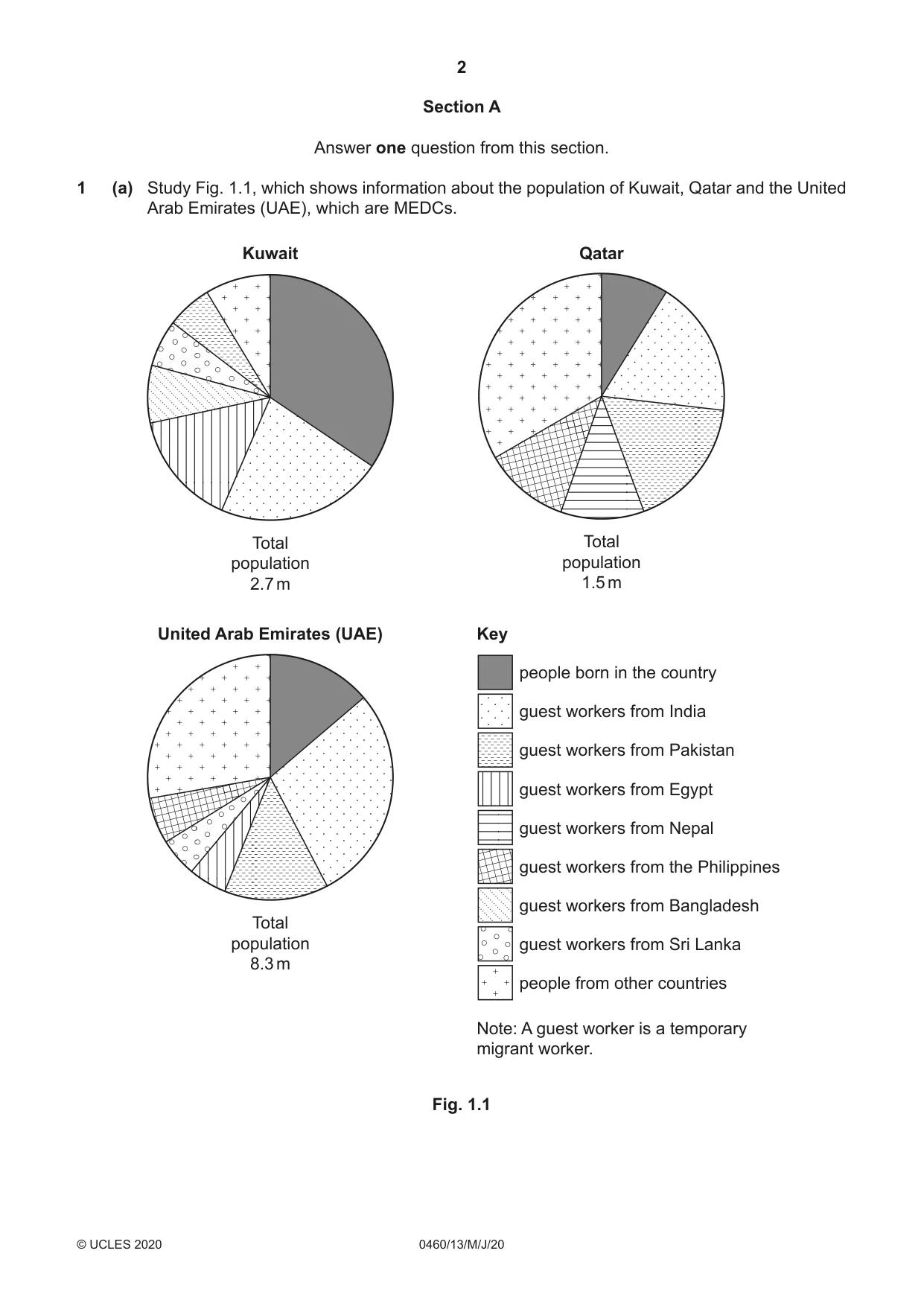
2 0460/13/M/J/20 © UCLES 2020 Section A Answer one question from this section. 1 (a) Study Fig. 1.1, which shows information about the population of Kuwait, Qatar and the United Arab Emirates (UAE), which are MEDCs. Kuwait Total population 2.7 m Total population 1.5 m Total population 8.3 m Qatar United Arab Emirates (UAE) Note: A guest worker is a temporary migrant worker. Key people born in the country guest workers from India guest workers from Pakistan guest workers from Egypt guest workers from Nepal guest workers from the Philippines guest workers from Bangladesh guest workers from Sri Lanka people from other countries Fig. 1.1
Question paper, page 3
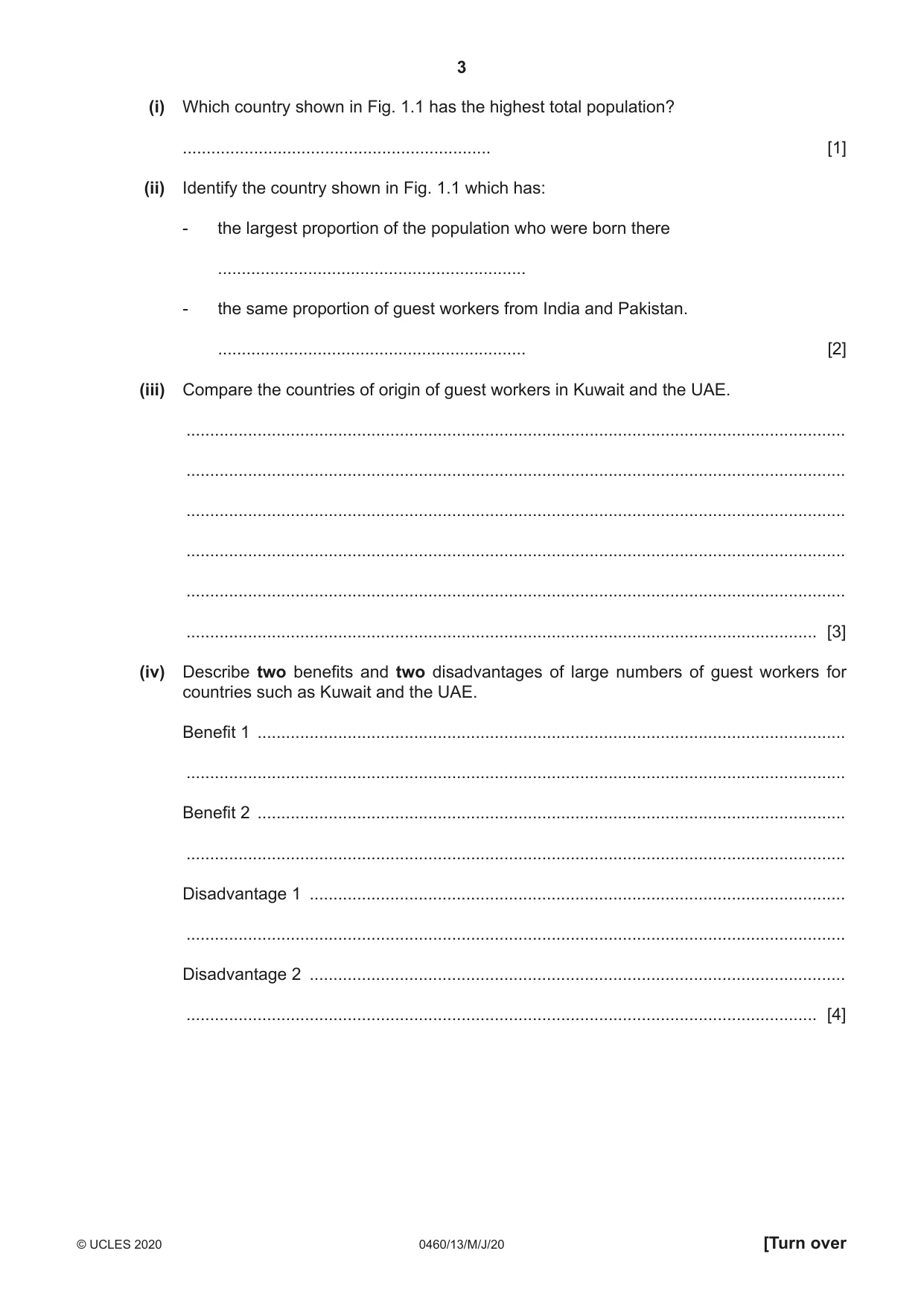
3 0460/13/M/J/20 © UCLES 2020 [Turn over (i) Which country shown in Fig. 1.1 has the highest total population? … [1] (ii) Identify the country shown in Fig. 1.1 which has: - the largest proportion of the population who were born there … - the same proportion of guest workers from India and Pakistan. … [2] (iii) Compare the countries of origin of guest workers in Kuwait and the UAE. … … … … … … [3] (iv) Describe two benefits and two disadvantages of large numbers of guest workers for countries such as Kuwait and the UAE. Benefit 1 … … Benefit 2 … … Disadvantage 1 … … Disadvantage 2 … … [4]
Question paper, page 4
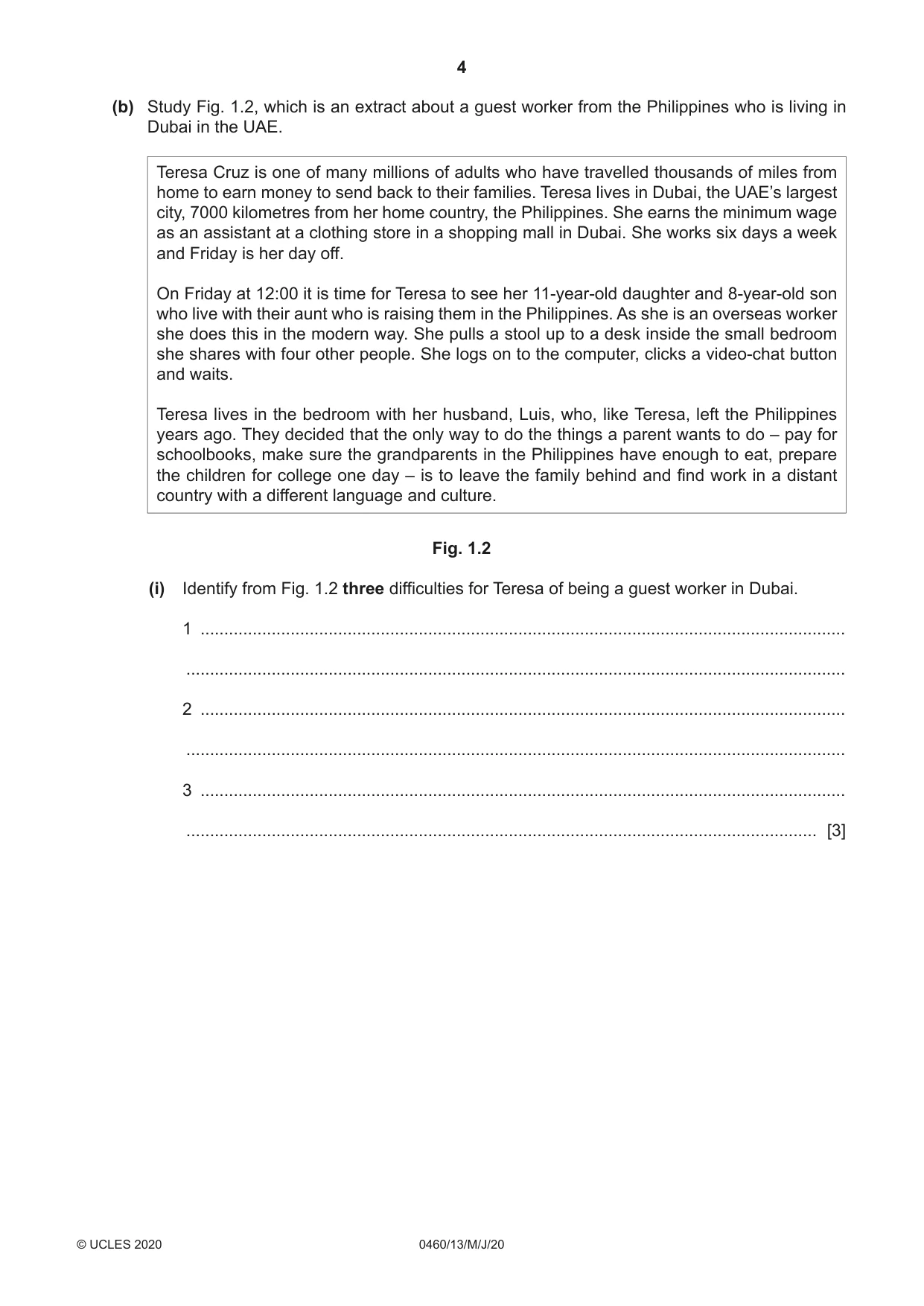
4 0460/13/M/J/20 © UCLES 2020 (b) Study Fig. 1.2, which is an extract about a guest worker from the Philippines who is living in Dubai in the UAE. Teresa Cruz is one of many millions of adults who have travelled thousands of miles from home to earn money to send back to their families. Teresa lives in Dubai, the UAE’s largest city, 7000 kilometres from her home country, the Philippines. She earns the minimum wage as an assistant at a clothing store in a shopping mall in Dubai. She works six days a week and Friday is her day off. On Friday at 12:00 it is time for Teresa to see her 11-year-old daughter and 8-year-old son who live with their aunt who is raising them in the Philippines. As she is an overseas worker she does this in the modern way. She pulls a stool up to a desk inside the small bedroom she shares with four other people. She logs on to the computer, clicks a video-chat button and waits. Teresa lives in the bedroom with her husband, Luis, who, like Teresa, left the Philippines years ago. They decided that the only way to do the things a parent wants to do – pay for schoolbooks, make sure the grandparents in the Philippines have enough to eat, prepare the children for college one day – is to leave the family behind and find work in a distant country with a different language and culture. Fig. 1.2 (i) Identify from Fig. 1.2 three difficulties for Teresa of being a guest worker in Dubai. 1 … … 2 … … 3 … … [3]
Question paper, page 5
5 0460/13/M/J/20 © UCLES 2020 [Turn over (ii) Explain why many people from LEDCs, such as the Philippines, work in MEDCs despite facing many difficulties. … … … … … … … … … … [5]
Question paper, page 6
6 0460/13/M/J/20 © UCLES 2020 (c) For a named country you have studied, explain why its natural population growth is high. Name of country … … … … … … … … … … … … … … … … … … … … … … … … … … [7] [Total: 25]
Question paper, page 7
7 0460/13/M/J/20 © UCLES 2020 [Turn over 2 (a) Study Fig. 2.1 (Insert), which is a map of the CBD of Manly, Australia (an MEDC). (i) What is meant by the initials CBD? C…B…D… [1] (ii) Identify from Fig. 2.1: - a street which is pedestrianised … - a form of public transport which serves Manly CBD. … [2] (iii) Explain why there are high-rise buildings in the CBD of many urban areas. … … … … … … [3] (iv) Explain why some shops and services are being located in shopping malls in the rural-urban fringe. … … … … … … … … [4]
Question paper, page 8
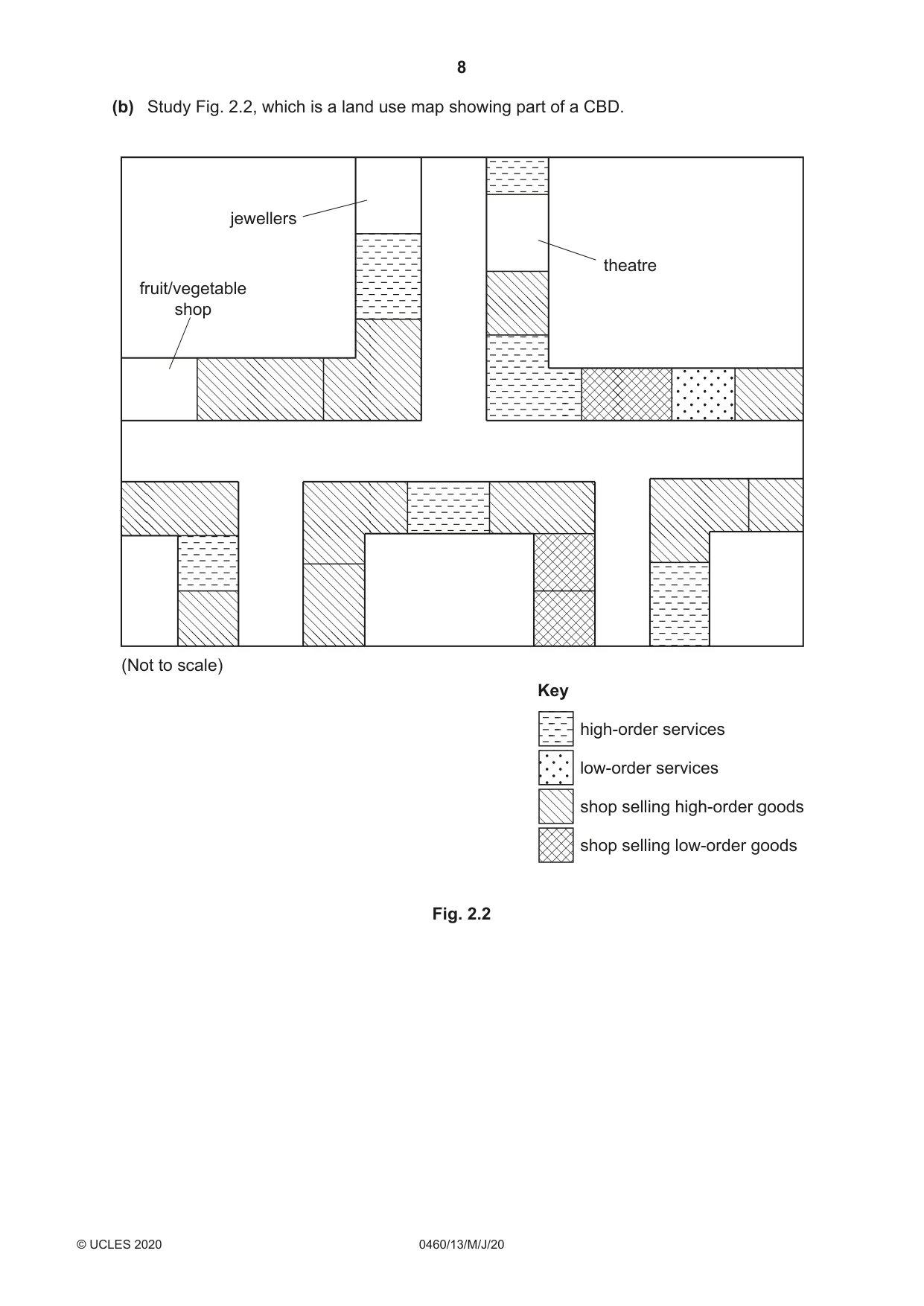
8 0460/13/M/J/20 © UCLES 2020 (b) Study Fig. 2.2, which is a land use map showing part of a CBD. (Not to scale) theatre fruit/vegetable shop jewellers Key high-order services low-order services shop selling high-order goods shop selling low-order goods Fig. 2.2
Question paper, page 9
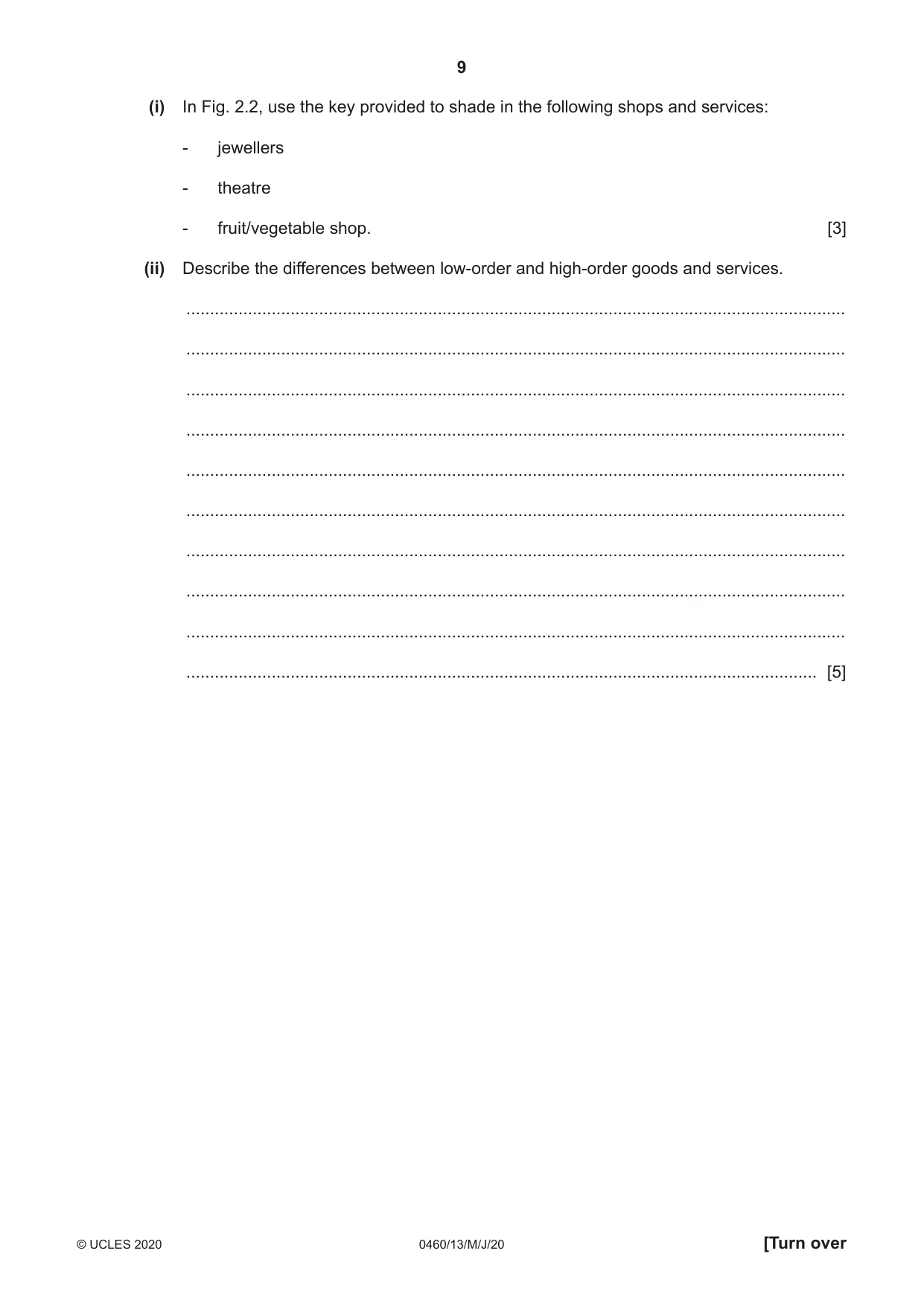
9 0460/13/M/J/20 © UCLES 2020 [Turn over (i) In Fig. 2.2, use the key provided to shade in the following shops and services: - jewellers - theatre - fruit/vegetable shop. [3] (ii) Describe the differences between low-order and high-order goods and services. … … … … … … … … … … [5]
Question paper, page 10
10 0460/13/M/J/20 © UCLES 2020 (c) For a named urban area you have studied, describe how traffic problems have been managed. Name of urban area … … … … … … … … … … … … … … … … … … … … … … … … … … [7] [Total: 25]
Question paper, page 11
11 0460/13/M/J/20 © UCLES 2020 [Turn over TURN PAGE FOR QUESTION 3
Question paper, page 12
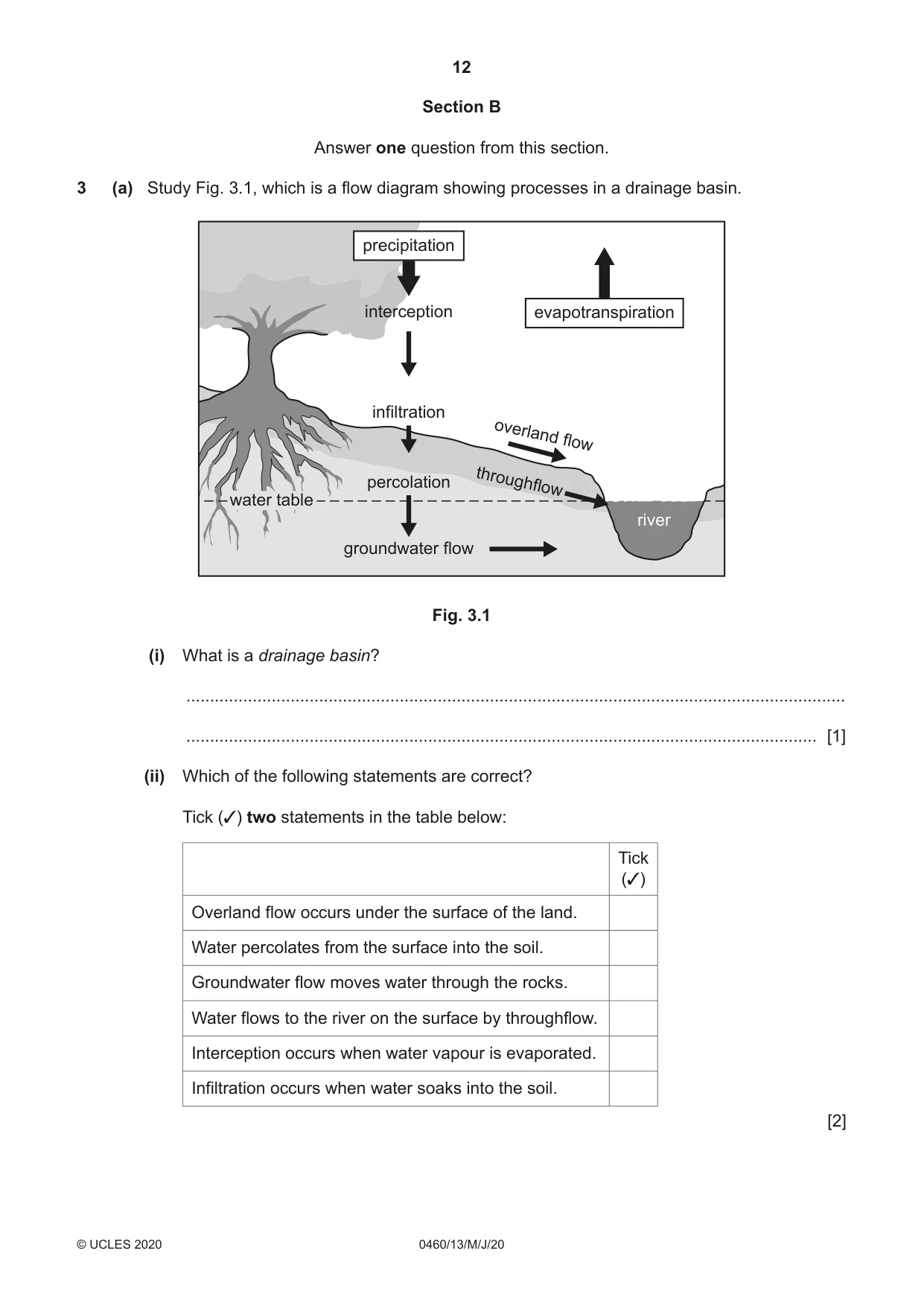
12 0460/13/M/J/20 © UCLES 2020 Section B Answer one question from this section. 3 (a) Study Fig. 3.1, which is a flow diagram showing processes in a drainage basin. precipitation interception infiltration percolation groundwater flow river water table throughflow overland flow evapotranspiration Fig. 3.1 (i) What is a drainage basin? … … [1] (ii) Which of the following statements are correct? Tick (3) two statements in the table below: Tick (3) Overland flow occurs under the surface of the land. Water percolates from the surface into the soil. Groundwater flow moves water through the rocks. Water flows to the river on the surface by throughflow. Interception occurs when water vapour is evaporated. Infiltration occurs when water soaks into the soil. [2]
Question paper, page 13
13 0460/13/M/J/20 © UCLES 2020 [Turn over (iii) Explain why overland flow may occur in a drainage basin. … … … … … … [3] (iv) Describe the changes in the characteristics of a river from its source to its mouth using the following headings: width … … depth … … speed of flow … … gradient … … [4]
Question paper, page 14
14 0460/13/M/J/20 © UCLES 2020 (b) Study Fig. 3.2 (Insert), which is a photograph showing a waterfall. (i) Describe three features of the waterfall shown in Fig. 3.2. 1 … … 2 … … 3 … … [3] (ii) Suggest how the waterfall shown in Fig. 3.2 was formed. … … … … … … … … … … [5]
Question paper, page 15
15 0460/13/M/J/20 © UCLES 2020 [Turn over (c) For a named river you have studied, describe attempts to manage flooding. Name of river … … … … … … … … … … … … … … … … … … … … … … … … … … [7] [Total: 25]
Question paper, page 16
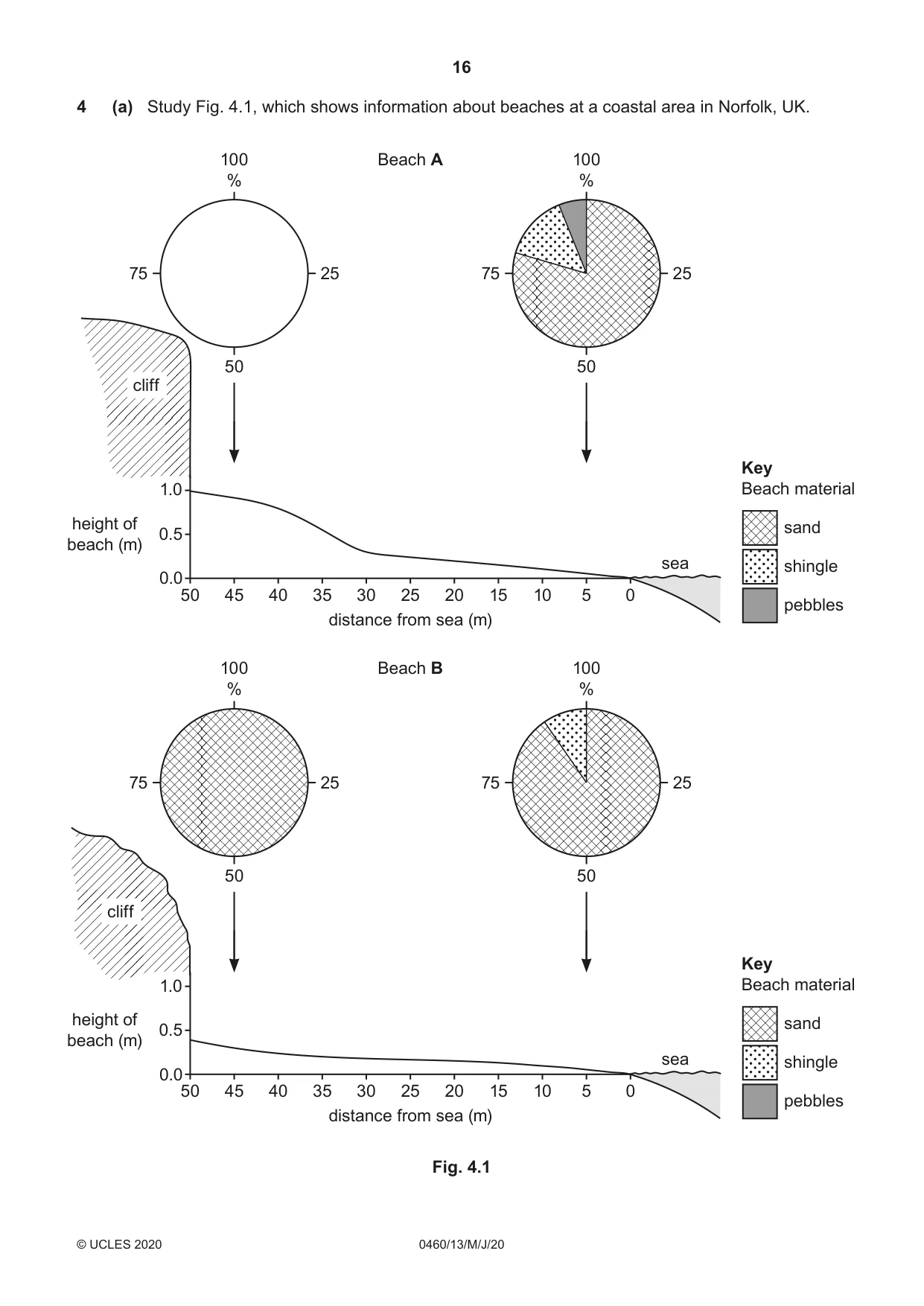
16 0460/13/M/J/20 © UCLES 2020 4 (a) Study Fig. 4.1, which shows information about beaches at a coastal area in Norfolk, UK. distance from sea (m) 50 0.0 0.5 height of beach (m) 1.0 45 25 Beach A cliff sea 75 50 100 % 25 75 50 40 35 30 25 20 15 10 5 0 Key Beach material sand shingle pebbles distance from sea (m) 50 0.0 0.5 height of beach (m) 1.0 45 25 Beach B cliff sea 75 50 100 % 100 % 100 % 25 75 50 40 35 30 25 20 15 10 5 0 Key Beach material sand shingle pebbles Fig. 4.1
Question paper, page 17
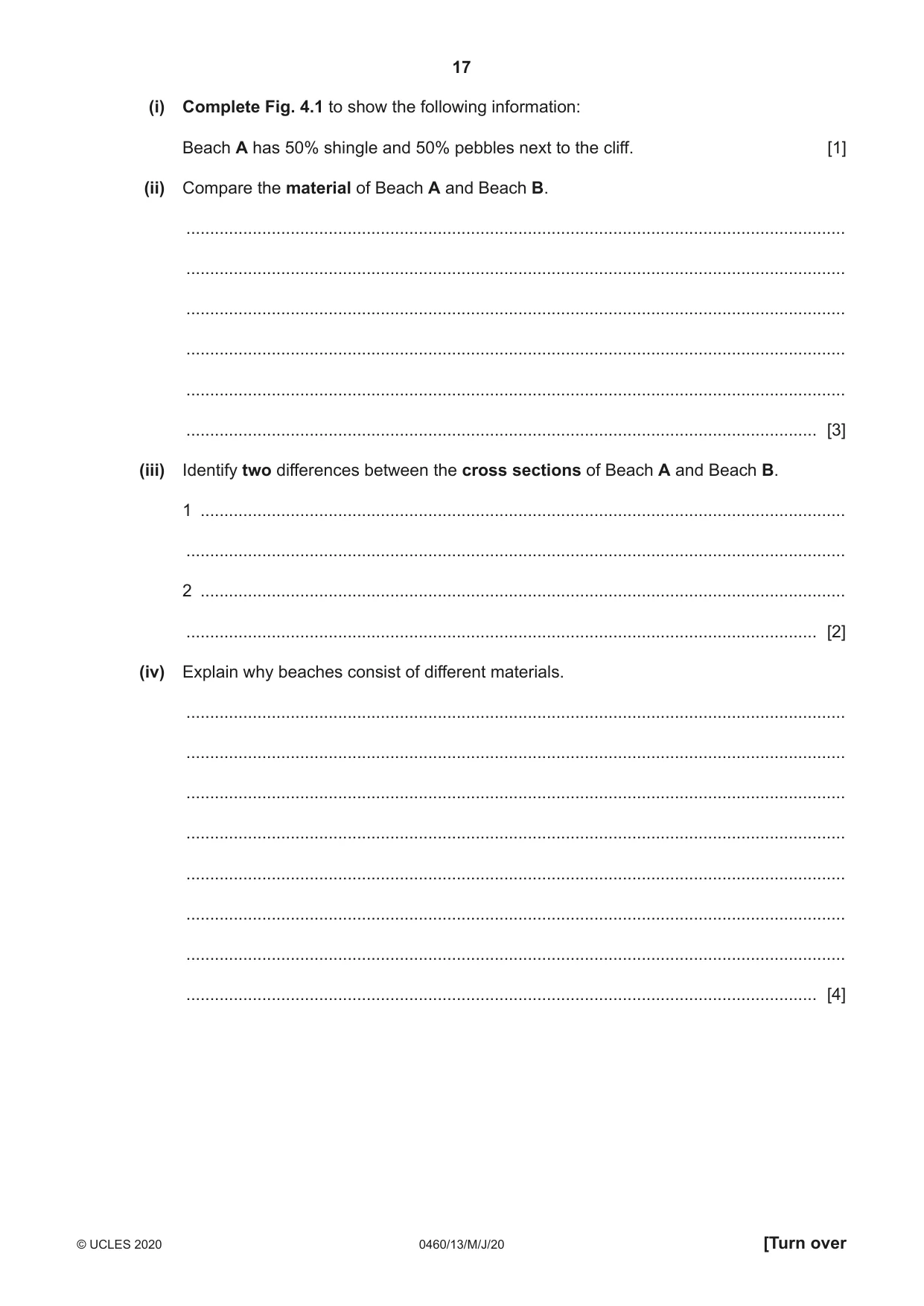
17 0460/13/M/J/20 © UCLES 2020 [Turn over (i) Complete Fig. 4.1 to show the following information: Beach A has 50% shingle and 50% pebbles next to the cliff. [1] (ii) Compare the material of Beach A and Beach B. … … … … … … [3] (iii) Identify two differences between the cross sections of Beach A and Beach B. 1 … … 2 … … [2] (iv) Explain why beaches consist of different materials. … … … … … … … … [4]
Question paper, page 18
18 0460/13/M/J/20 © UCLES 2020 (b) Study Fig. 4.2 (Insert), which is a photograph of an area of coastal sand dunes. (i) Describe three natural features of the coastal sand dunes shown in Fig. 4.2. 1 … … 2 … … 3 … … [3] (ii) Suggest how the coastal sand dunes shown in Fig. 4.2 were formed. … … … … … … … … … … [5]
Question paper, page 19
19 0460/13/M/J/20 © UCLES 2020 [Turn over (c) For a named coastal area you have studied, explain how coastal erosion has affected the people who live there. Name of coastal area … … … … … … … … … … … … … … … … … … … … … … … … … … [7] [Total: 25]
Question paper, page 20
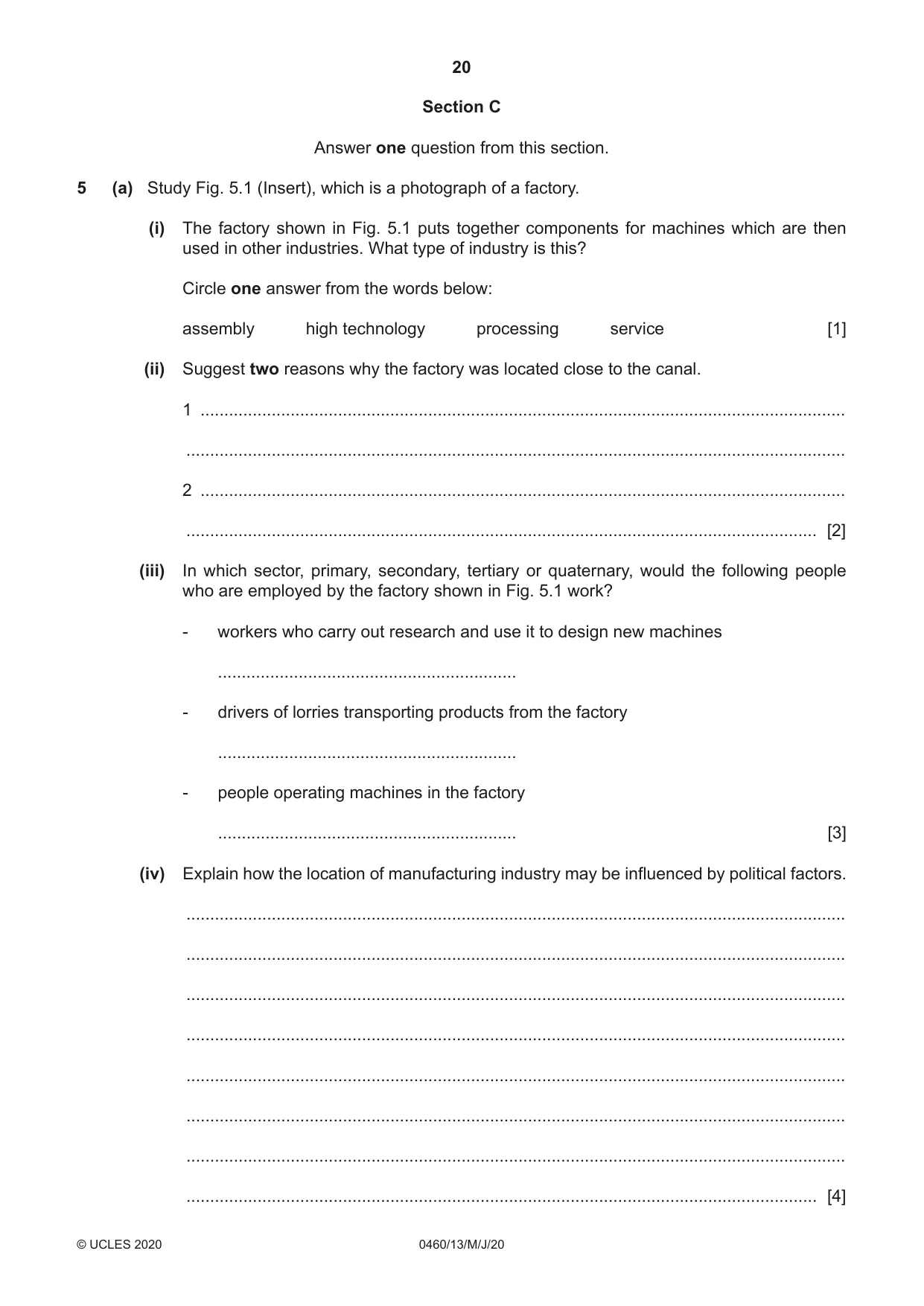
20 0460/13/M/J/20 © UCLES 2020 Section C Answer one question from this section. 5 (a) Study Fig. 5.1 (Insert), which is a photograph of a factory. (i) The factory shown in Fig. 5.1 puts together components for machines which are then used in other industries. What type of industry is this? Circle one answer from the words below: assembly high technology processing service [1] (ii) Suggest two reasons why the factory was located close to the canal. 1 … … 2 … … [2] (iii) In which sector, primary, secondary, tertiary or quaternary, would the following people who are employed by the factory shown in Fig. 5.1 work? - workers who carry out research and use it to design new machines … - drivers of lorries transporting products from the factory … - people operating machines in the factory … [3] (iv) Explain how the location of manufacturing industry may be influenced by political factors. … … … … … … … … [4]
Question paper, page 21
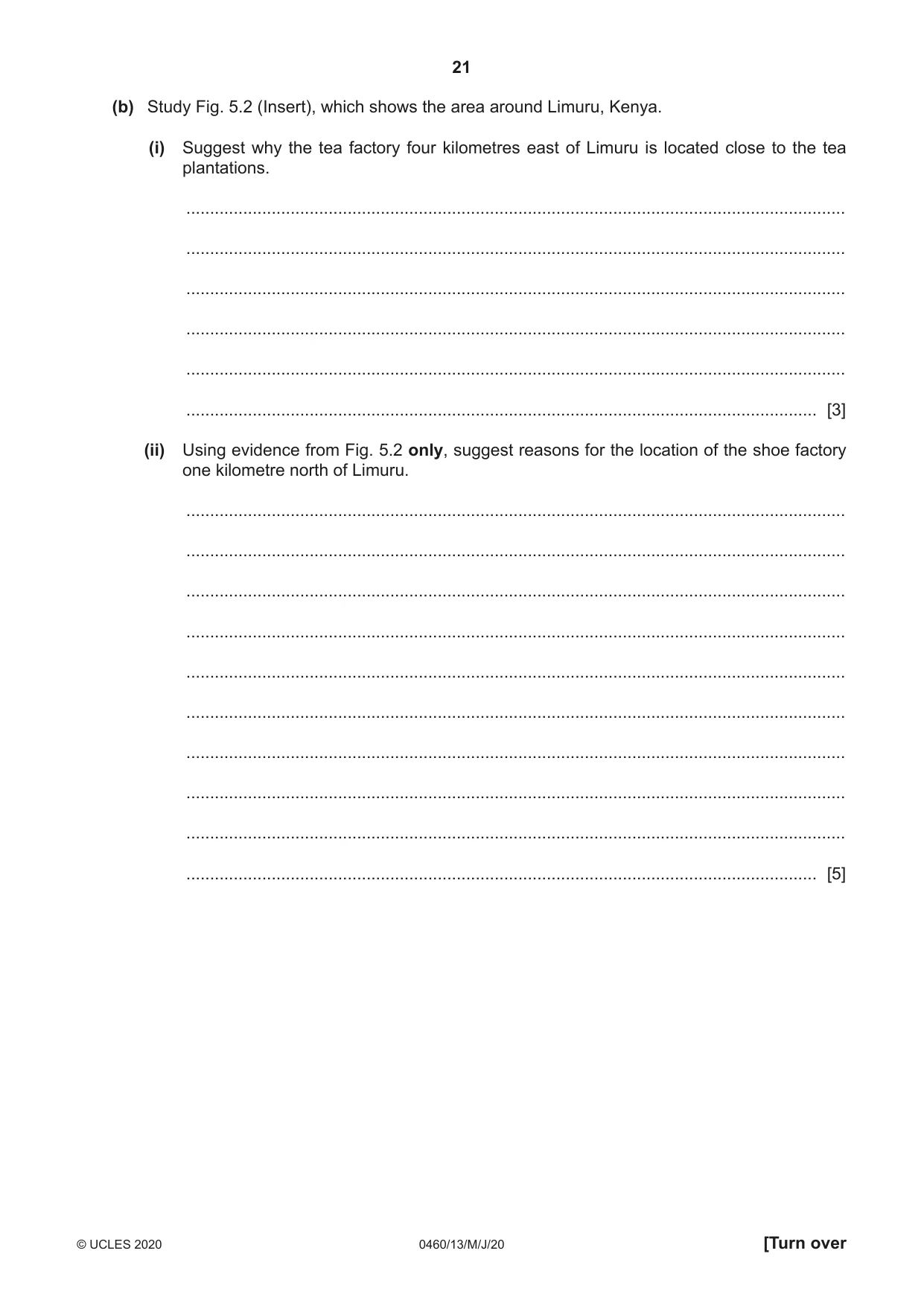
21 0460/13/M/J/20 © UCLES 2020 [Turn over (b) Study Fig. 5.2 (Insert), which shows the area around Limuru, Kenya. (i) Suggest why the tea factory four kilometres east of Limuru is located close to the tea plantations. … … … … … … [3] (ii) Using evidence from Fig. 5.2 only, suggest reasons for the location of the shoe factory one kilometre north of Limuru. … … … … … … … … … … [5]
Question paper, page 22
22 0460/13/M/J/20 © UCLES 2020 (c) For a named country or area you have studied, describe the different methods which are used to supply energy. Name of country or area … … … … … … … … … … … … … … … … … … … … … … … … … … [7] [Total: 25]
Question paper, page 23
23 0460/13/M/J/20 © UCLES 2020 [Turn over TURN PAGE FOR QUESTION 6
Question paper, page 24
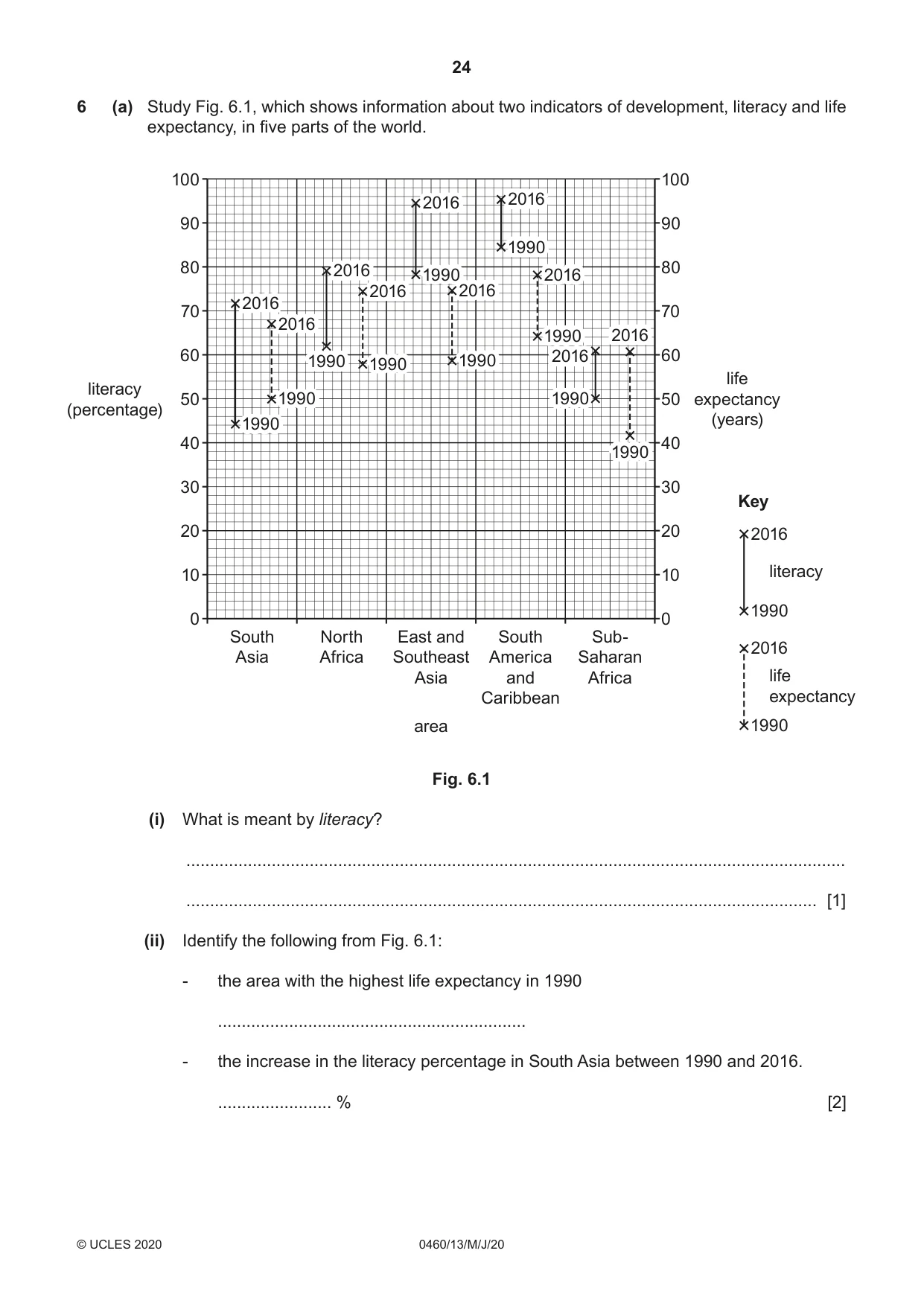
24 0460/13/M/J/20 © UCLES 2020 6 (a) Study Fig. 6.1, which shows information about two indicators of development, literacy and life expectancy, in five parts of the world. 0 10 20 30 40 50 literacy (percentage) life expectancy (years) South Asia North Africa East and Southeast Asia area South America and Caribbean Sub- Saharan Africa 60 70 80 90 100 0 10 20 30 40 50 60 70 80 90 100 2016 2016 1990 1990 2016 2016 1990 1990 2016 2016 1990 1990 2016 2016 1990 1990 2016 2016 1990 1990 Key 2016 literacy 1990 2016 life expectancy 1990 Fig. 6.1 (i) What is meant by literacy? … … [1] (ii) Identify the following from Fig. 6.1: - the area with the highest life expectancy in 1990 … - the increase in the literacy percentage in South Asia between 1990 and 2016. … % [2]
Question paper, page 25
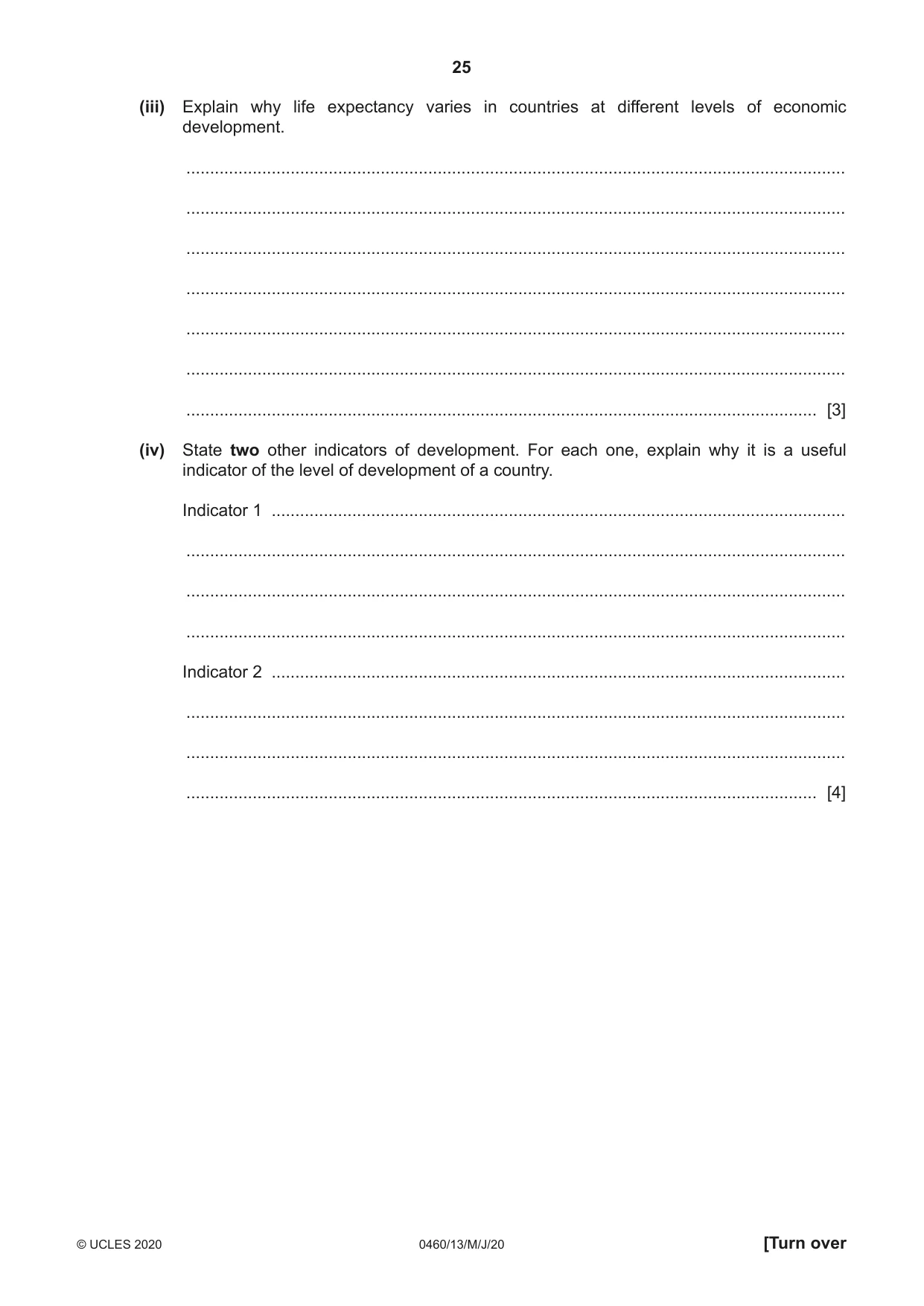
25 0460/13/M/J/20 © UCLES 2020 [Turn over (iii) Explain why life expectancy varies in countries at different levels of economic development. … … … … … … … [3] (iv) State two other indicators of development. For each one, explain why it is a useful indicator of the level of development of a country. Indicator 1 … … … … Indicator 2 … … … … [4]
Question paper, page 26
26 0460/13/M/J/20 © UCLES 2020 (b) Study Fig. 6.2, which shows an example of globalisation. A transnational corporation decides to produce a new type of mobile phone. Fig. 6.2 (i) Identify the following from Fig. 6.2: - the country where the new mobile phones are being manufactured … - the country where the research and development took place … - a continent where the new mobile phones are sold. … [3] Content removed due to copyright restrictions.
Question paper, page 27
27 0460/13/M/J/20 © UCLES 2020 [Turn over (ii) Explain how changes in technology have enabled globalisation to occur. … … … … … … … … … … [5]
Question paper, page 28
28 0460/13/M/J/20 © UCLES 2020 (c) For a named example of a transnational corporation you have studied, describe its impacts at a local and national scale. Name of transnational corporation … … … … … … … … … … … … … … … … … … … … … … … … … … [7] [Total: 25]
Question paper, page 29
29 0460/13/M/J/20 © UCLES 2020 Additional Pages If you use the following lined pages to complete the answer(s) to any question(s), the question number(s) must be clearly shown. … … … … … … … … … … … … … … … … … … … … … … … … … …
Question paper, page 30
30 0460/13/M/J/20 © UCLES 2020 … … … … … … … … … … … … … … … … … … … … … … … … … … … …
Question paper, page 31
31 0460/13/M/J/20 © UCLES 2020 BLANK PAGE
Question paper, page 32
32 0460/13/M/J/20 © UCLES 2020 BLANK PAGE Permission to reproduce items where third-party owned material protected by copyright is included has been sought and cleared where possible. Every reasonable effort has been made by the publisher (UCLES) to trace copyright holders, but if any items requiring clearance have unwittingly been included, the publisher will be pleased to make amends at the earliest possible opportunity. To avoid the issue of disclosure of answer-related information to candidates, all copyright acknowledgements are reproduced online in the Cambridge Assessment International Education Copyright Acknowledgements Booklet. This is produced for each series of examinations and is freely available to download at www.cambridgeinternational.org after the live examination series. Cambridge Assessment International Education is part of the Cambridge Assessment Group. Cambridge Assessment is the brand name of the University of Cambridge Local Examinations Syndicate (UCLES), which itself is a department of the University of Cambridge.
Mark scheme, page 1
This document consists of 14 printed pages. © UCLES 2020 [Turn over Cambridge IGCSE™ GEOGRAPHY 0460/13 Paper 1 May/June 2020 MARK SCHEME Maximum Mark: 75 Published Students did not sit exam papers in the June 2020 series due to the Covid-19 global pandemic. This mark scheme is published to support teachers and students and should be read together with the question paper. It shows the requirements of the exam. The answer column of the mark scheme shows the proposed basis on which Examiners would award marks for this exam. Where appropriate, this column also provides the most likely acceptable alternative responses expected from students. Examiners usually review the mark scheme after they have seen student responses and update the mark scheme if appropriate. In the June series, Examiners were unable to consider the acceptability of alternative responses, as there were no student responses to consider. Mark schemes should usually be read together with the Principal Examiner Report for Teachers. However, because students did not sit exam papers, there is no Principal Examiner Report for Teachers for the June 2020 series. Cambridge International will not enter into discussions about these mark schemes. Cambridge International is publishing the mark schemes for the June 2020 series for most Cambridge IGCSE™ and Cambridge International A & AS Level components, and some Cambridge O Level components.
Mark scheme, page 2
0460/13 Cambridge IGCSE – Mark Scheme PUBLISHED May/June 2020 © UCLES 2020 Page 2 of 14 Generic Marking Principles These general marking principles must be applied by all examiners when marking candidate answers. They should be applied alongside the specific content of the mark scheme or generic level descriptors for a question. Each question paper and mark scheme will also comply with these marking principles. GENERIC MARKING PRINCIPLE 1: Marks must be awarded in line with: • the specific content of the mark scheme or the generic level descriptors for the question • the specific skills defined in the mark scheme or in the generic level descriptors for the question • the standard of response required by a candidate as exemplified by the standardisation scripts. GENERIC MARKING PRINCIPLE 2: Marks awarded are always whole marks (not half marks, or other fractions). GENERIC MARKING PRINCIPLE 3: Marks must be awarded positively: • marks are awarded for correct/valid answers, as defined in the mark scheme. However, credit is given for valid answers which go beyond the scope of the syllabus and mark scheme, referring to your Team Leader as appropriate • marks are awarded when candidates clearly demonstrate what they know and can do • marks are not deducted for errors • marks are not deducted for omissions • answers should only be judged on the quality of spelling, punctuation and grammar when these features are specifically assessed by the question as indicated by the mark scheme. The meaning, however, should be unambiguous. GENERIC MARKING PRINCIPLE 4: Rules must be applied consistently e.g. in situations where candidates have not followed instructions or in the application of generic level descriptors. GENERIC MARKING PRINCIPLE 5: Marks should be awarded using the full range of marks defined in the mark scheme for the question (however; the use of the full mark range may be limited according to the quality of the candidate responses seen). GENERIC MARKING PRINCIPLE 6: Marks awarded are based solely on the requirements as defined in the mark scheme. Marks should not be awarded with grade thresholds or grade descriptors in mind.
Mark scheme, page 3
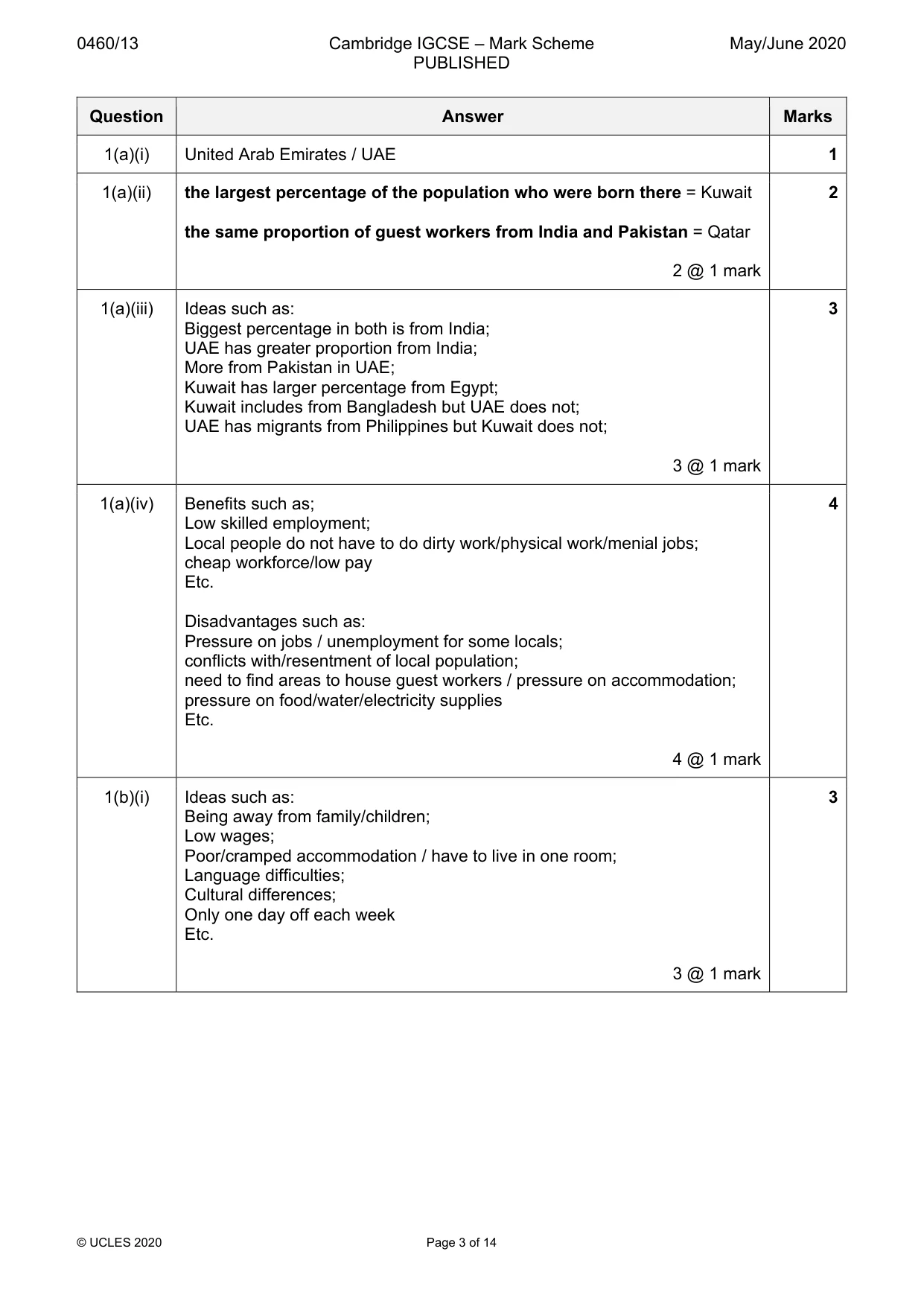
0460/13 Cambridge IGCSE – Mark Scheme PUBLISHED May/June 2020 © UCLES 2020 Page 3 of 14 Question Answer Marks 1(a)(i) United Arab Emirates / UAE 1 1(a)(ii) the largest percentage of the population who were born there = Kuwait the same proportion of guest workers from India and Pakistan = Qatar 2 @ 1 mark 2 1(a)(iii) Ideas such as: Biggest percentage in both is from India; UAE has greater proportion from India; More from Pakistan in UAE; Kuwait has larger percentage from Egypt; Kuwait includes from Bangladesh but UAE does not; UAE has migrants from Philippines but Kuwait does not; 3 @ 1 mark 3 1(a)(iv) Benefits such as; Low skilled employment; Local people do not have to do dirty work/physical work/menial jobs; cheap workforce/low pay Etc. Disadvantages such as: Pressure on jobs / unemployment for some locals; conflicts with/resentment of local population; need to find areas to house guest workers / pressure on accommodation; pressure on food/water/electricity supplies Etc. 4 @ 1 mark 4 1(b)(i) Ideas such as: Being away from family/children; Low wages; Poor/cramped accommodation / have to live in one room; Language difficulties; Cultural differences; Only one day off each week Etc. 3 @ 1 mark 3
Mark scheme, page 4
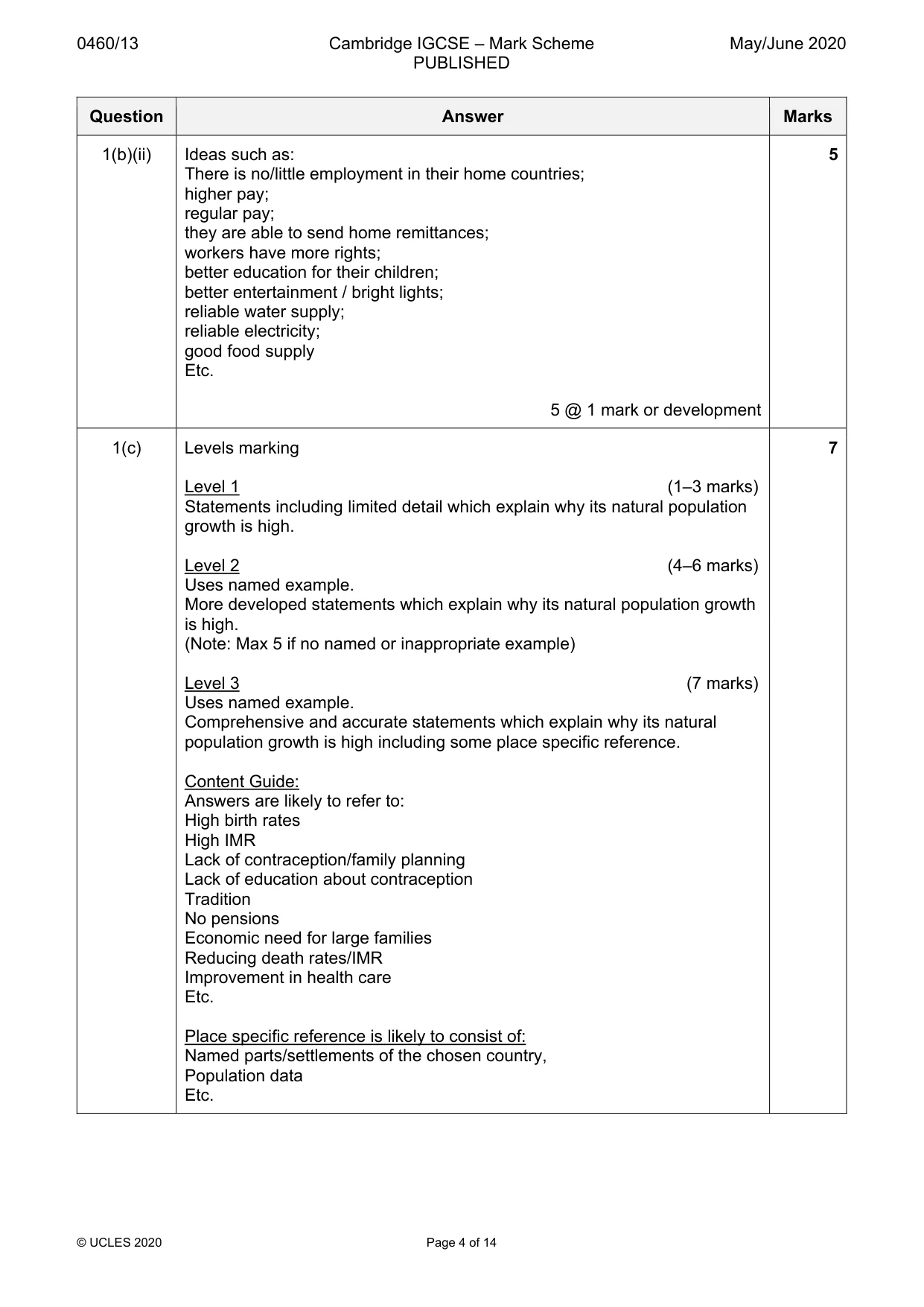
0460/13 Cambridge IGCSE – Mark Scheme PUBLISHED May/June 2020 © UCLES 2020 Page 4 of 14 Question Answer Marks 1(b)(ii) Ideas such as: There is no/little employment in their home countries; higher pay; regular pay; they are able to send home remittances; workers have more rights; better education for their children; better entertainment / bright lights; reliable water supply; reliable electricity; good food supply Etc. 5 @ 1 mark or development 5 1(c) Levels marking Level 1 (1–3 marks) Statements including limited detail which explain why its natural population growth is high. Level 2 (4–6 marks) Uses named example. More developed statements which explain why its natural population growth is high. (Note: Max 5 if no named or inappropriate example) Level 3 (7 marks) Uses named example. Comprehensive and accurate statements which explain why its natural population growth is high including some place specific reference. Content Guide: Answers are likely to refer to: High birth rates High IMR Lack of contraception/family planning Lack of education about contraception Tradition No pensions Economic need for large families Reducing death rates/IMR Improvement in health care Etc. Place specific reference is likely to consist of: Named parts/settlements of the chosen country, Population data Etc. 7
Mark scheme, page 5
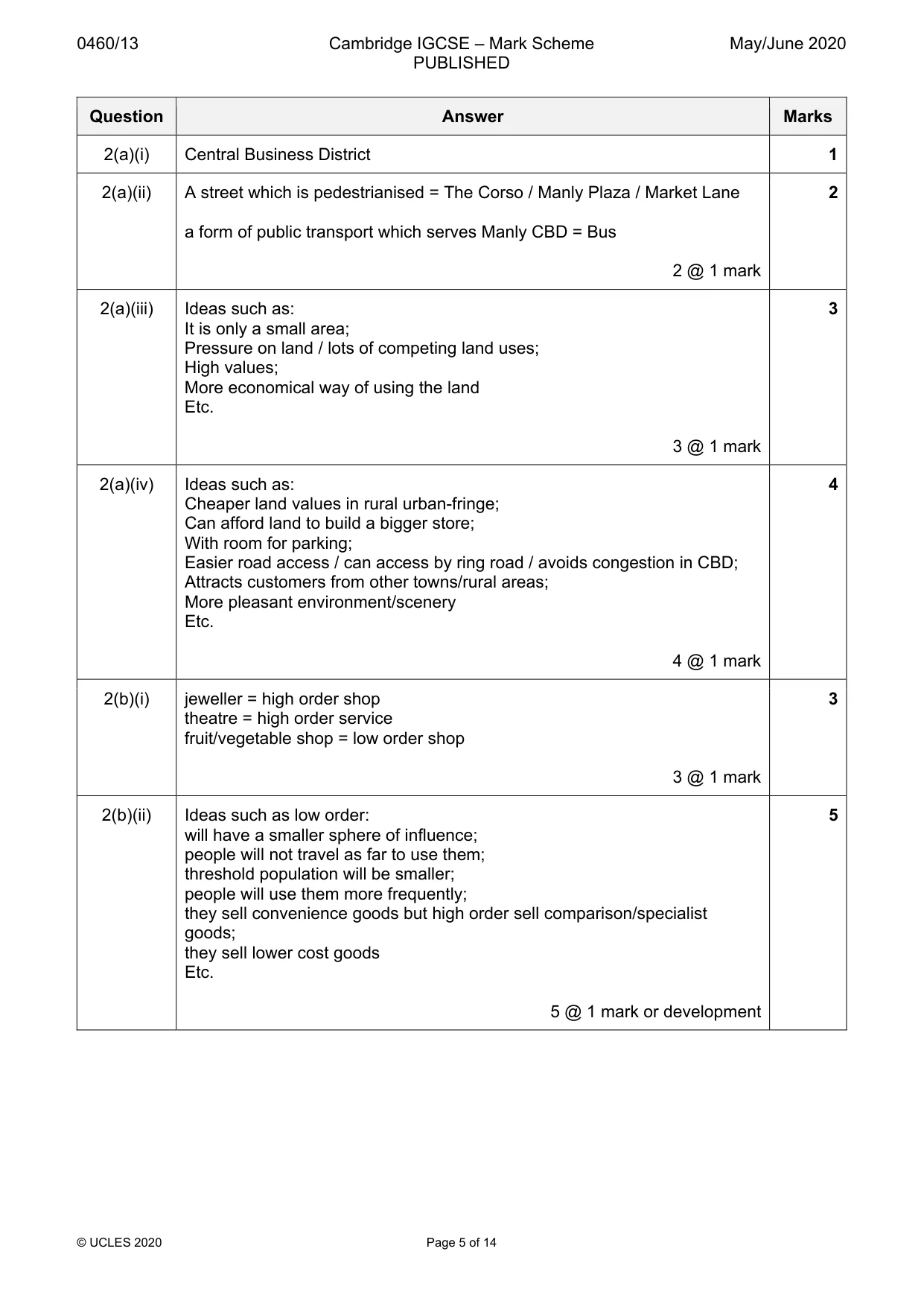
0460/13 Cambridge IGCSE – Mark Scheme PUBLISHED May/June 2020 © UCLES 2020 Page 5 of 14 Question Answer Marks 2(a)(i) Central Business District 1 2(a)(ii) A street which is pedestrianised = The Corso / Manly Plaza / Market Lane a form of public transport which serves Manly CBD = Bus 2 @ 1 mark 2 2(a)(iii) Ideas such as: It is only a small area; Pressure on land / lots of competing land uses; High values; More economical way of using the land Etc. 3 @ 1 mark 3 2(a)(iv) Ideas such as: Cheaper land values in rural urban-fringe; Can afford land to build a bigger store; With room for parking; Easier road access / can access by ring road / avoids congestion in CBD; Attracts customers from other towns/rural areas; More pleasant environment/scenery Etc. 4 @ 1 mark 4 2(b)(i) jeweller = high order shop theatre = high order service fruit/vegetable shop = low order shop 3 @ 1 mark 3 2(b)(ii) Ideas such as low order: will have a smaller sphere of influence; people will not travel as far to use them; threshold population will be smaller; people will use them more frequently; they sell convenience goods but high order sell comparison/specialist goods; they sell lower cost goods Etc. 5 @ 1 mark or development 5
Mark scheme, page 6
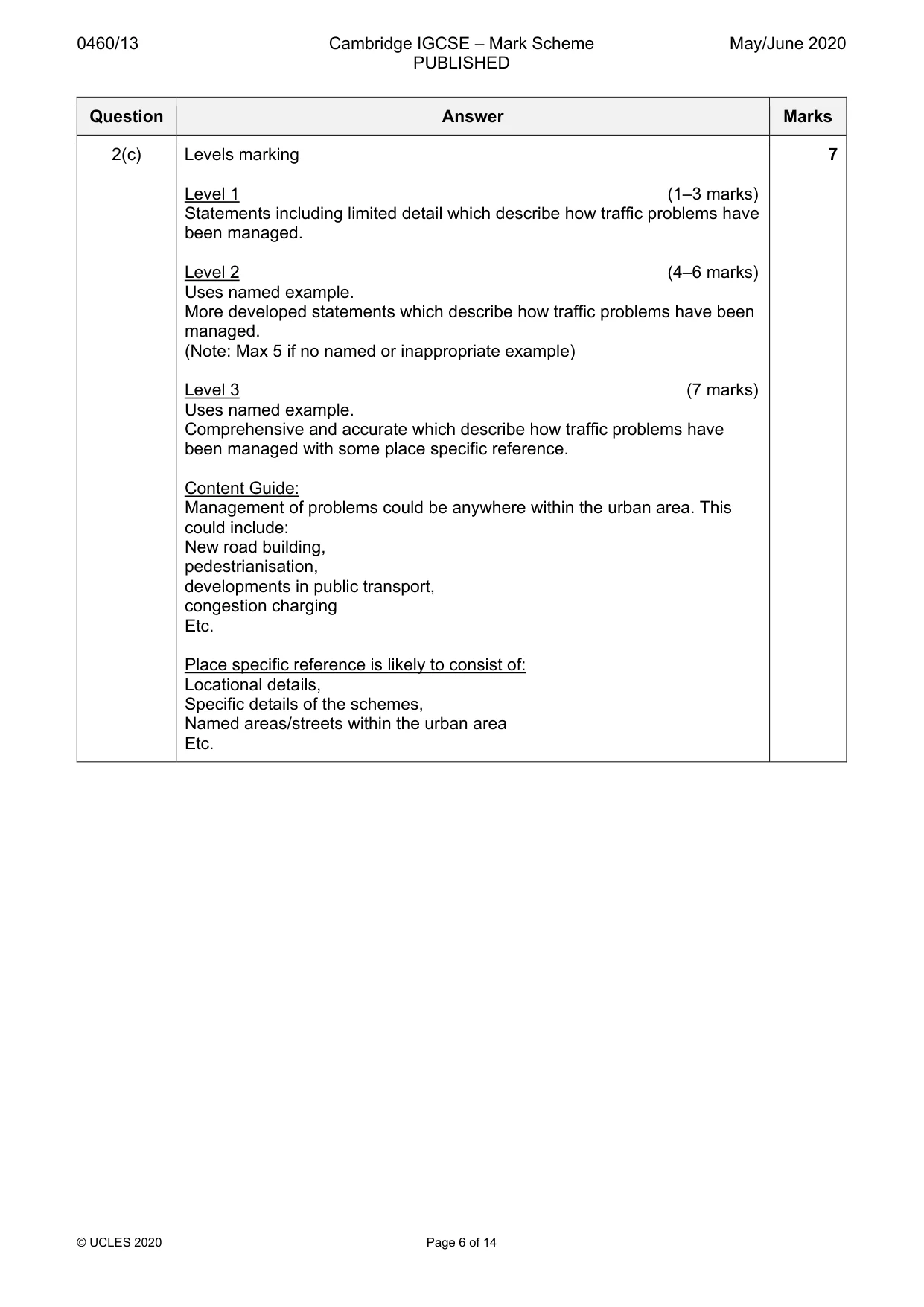
0460/13 Cambridge IGCSE – Mark Scheme PUBLISHED May/June 2020 © UCLES 2020 Page 6 of 14 Question Answer Marks 2(c) Levels marking Level 1 (1–3 marks) Statements including limited detail which describe how traffic problems have been managed. Level 2 (4–6 marks) Uses named example. More developed statements which describe how traffic problems have been managed. (Note: Max 5 if no named or inappropriate example) Level 3 (7 marks) Uses named example. Comprehensive and accurate which describe how traffic problems have been managed with some place specific reference. Content Guide: Management of problems could be anywhere within the urban area. This could include: New road building, pedestrianisation, developments in public transport, congestion charging Etc. Place specific reference is likely to consist of: Locational details, Specific details of the schemes, Named areas/streets within the urban area Etc. 7
Mark scheme, page 7
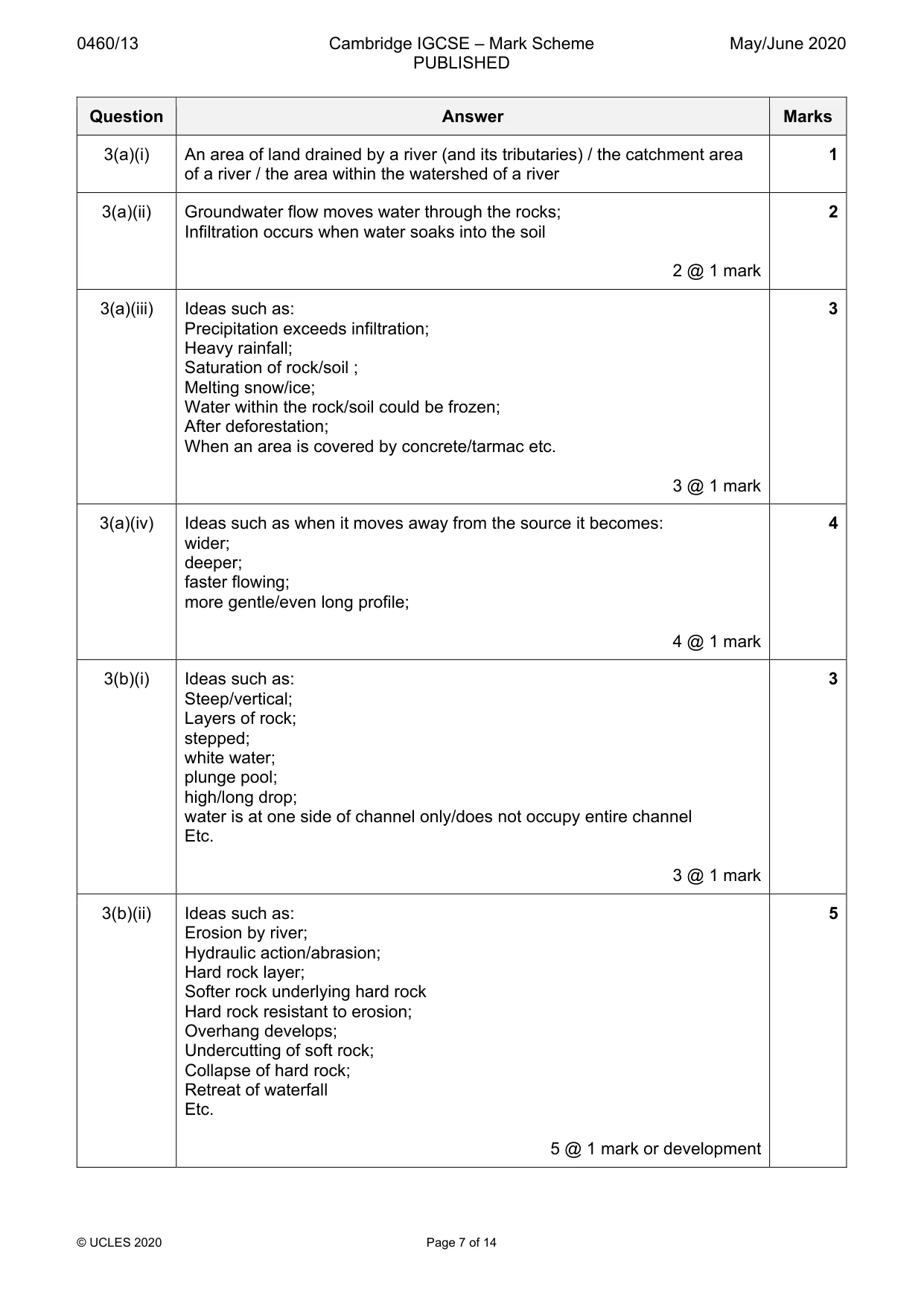
0460/13 Cambridge IGCSE – Mark Scheme PUBLISHED May/June 2020 © UCLES 2020 Page 7 of 14 Question Answer Marks 3(a)(i) An area of land drained by a river (and its tributaries) / the catchment area of a river / the area within the watershed of a river 1 3(a)(ii) Groundwater flow moves water through the rocks; Infiltration occurs when water soaks into the soil 2 @ 1 mark 2 3(a)(iii) Ideas such as: Precipitation exceeds infiltration; Heavy rainfall; Saturation of rock/soil ; Melting snow/ice; Water within the rock/soil could be frozen; After deforestation; When an area is covered by concrete/tarmac etc. 3 @ 1 mark 3 3(a)(iv) Ideas such as when it moves away from the source it becomes: wider; deeper; faster flowing; more gentle/even long profile; 4 @ 1 mark 4 3(b)(i) Ideas such as: Steep/vertical; Layers of rock; stepped; white water; plunge pool; high/long drop; water is at one side of channel only/does not occupy entire channel Etc. 3 @ 1 mark 3 3(b)(ii) Ideas such as: Erosion by river; Hydraulic action/abrasion; Hard rock layer; Softer rock underlying hard rock Hard rock resistant to erosion; Overhang develops; Undercutting of soft rock; Collapse of hard rock; Retreat of waterfall Etc. 5 @ 1 mark or development 5
Mark scheme, page 8
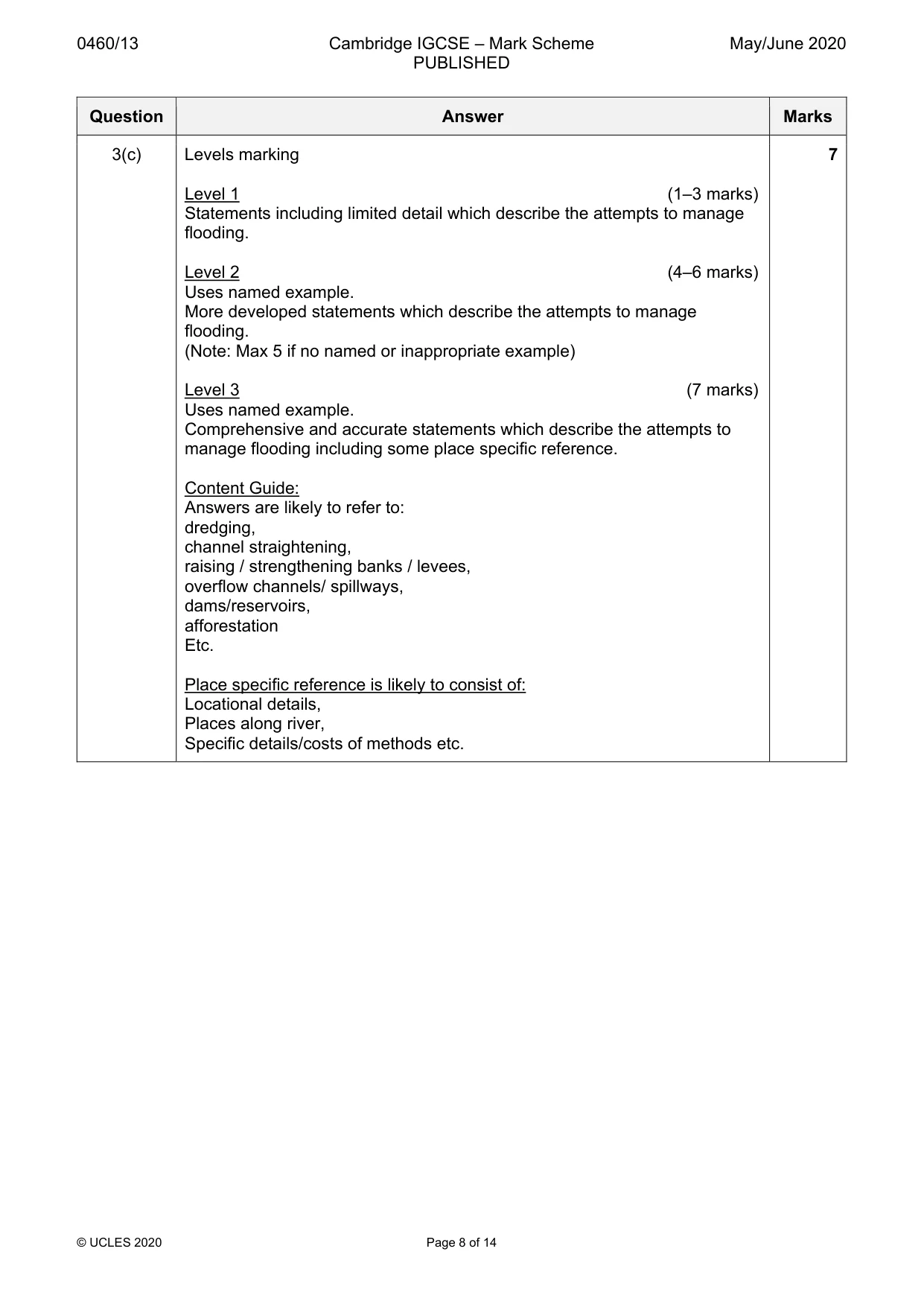
0460/13 Cambridge IGCSE – Mark Scheme PUBLISHED May/June 2020 © UCLES 2020 Page 8 of 14 Question Answer Marks 3(c) Levels marking Level 1 (1–3 marks) Statements including limited detail which describe the attempts to manage flooding. Level 2 (4–6 marks) Uses named example. More developed statements which describe the attempts to manage flooding. (Note: Max 5 if no named or inappropriate example) Level 3 (7 marks) Uses named example. Comprehensive and accurate statements which describe the attempts to manage flooding including some place specific reference. Content Guide: Answers are likely to refer to: dredging, channel straightening, raising / strengthening banks / levees, overflow channels/ spillways, dams/reservoirs, afforestation Etc. Place specific reference is likely to consist of: Locational details, Places along river, Specific details/costs of methods etc. 7
Mark scheme, page 9
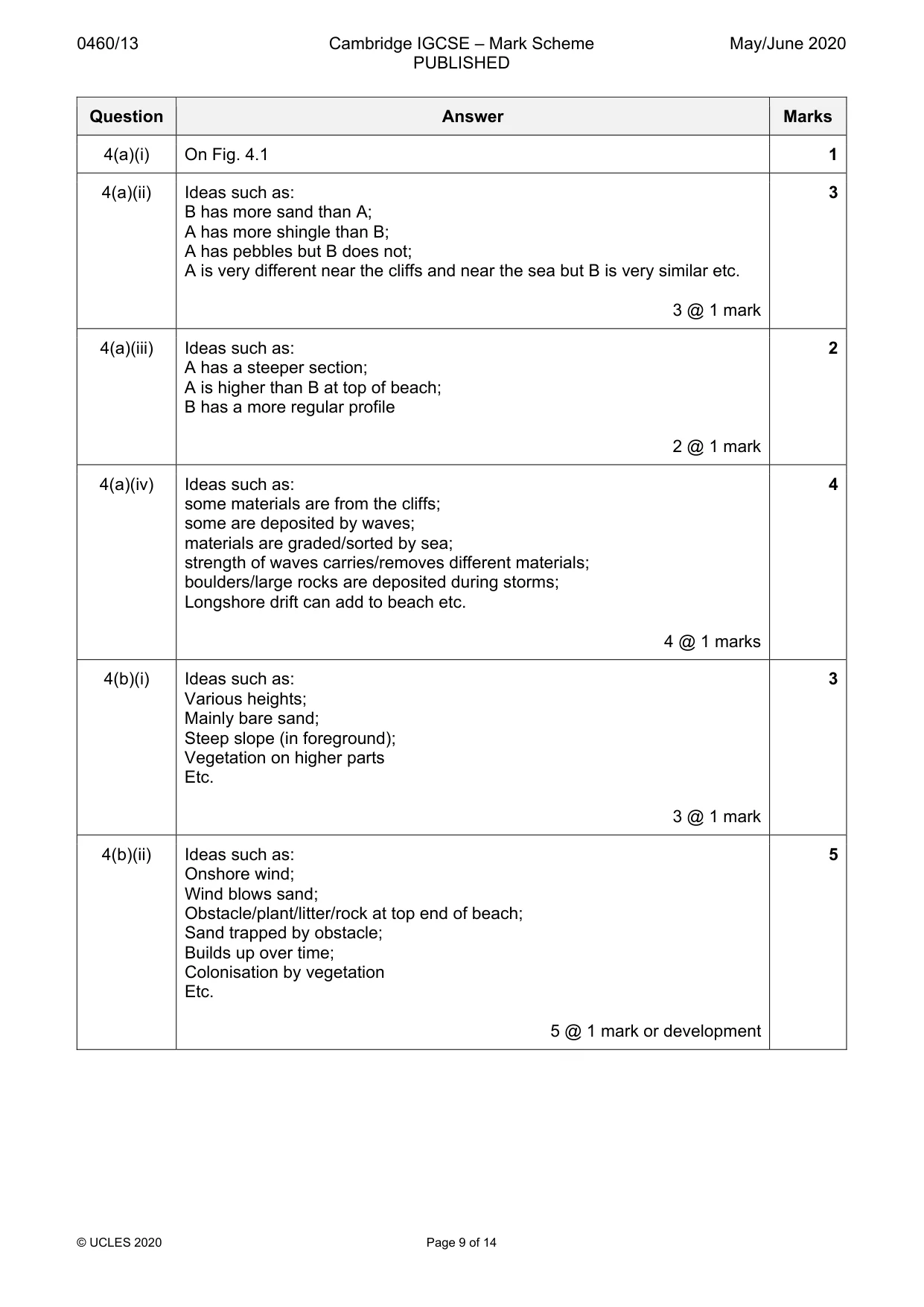
0460/13 Cambridge IGCSE – Mark Scheme PUBLISHED May/June 2020 © UCLES 2020 Page 9 of 14 Question Answer Marks 4(a)(i) On Fig. 4.1 1 4(a)(ii) Ideas such as: B has more sand than A; A has more shingle than B; A has pebbles but B does not; A is very different near the cliffs and near the sea but B is very similar etc. 3 @ 1 mark 3 4(a)(iii) Ideas such as: A has a steeper section; A is higher than B at top of beach; B has a more regular profile 2 @ 1 mark 2 4(a)(iv) Ideas such as: some materials are from the cliffs; some are deposited by waves; materials are graded/sorted by sea; strength of waves carries/removes different materials; boulders/large rocks are deposited during storms; Longshore drift can add to beach etc. 4 @ 1 marks 4 4(b)(i) Ideas such as: Various heights; Mainly bare sand; Steep slope (in foreground); Vegetation on higher parts Etc. 3 @ 1 mark 3 4(b)(ii) Ideas such as: Onshore wind; Wind blows sand; Obstacle/plant/litter/rock at top end of beach; Sand trapped by obstacle; Builds up over time; Colonisation by vegetation Etc. 5 @ 1 mark or development 5
Mark scheme, page 10
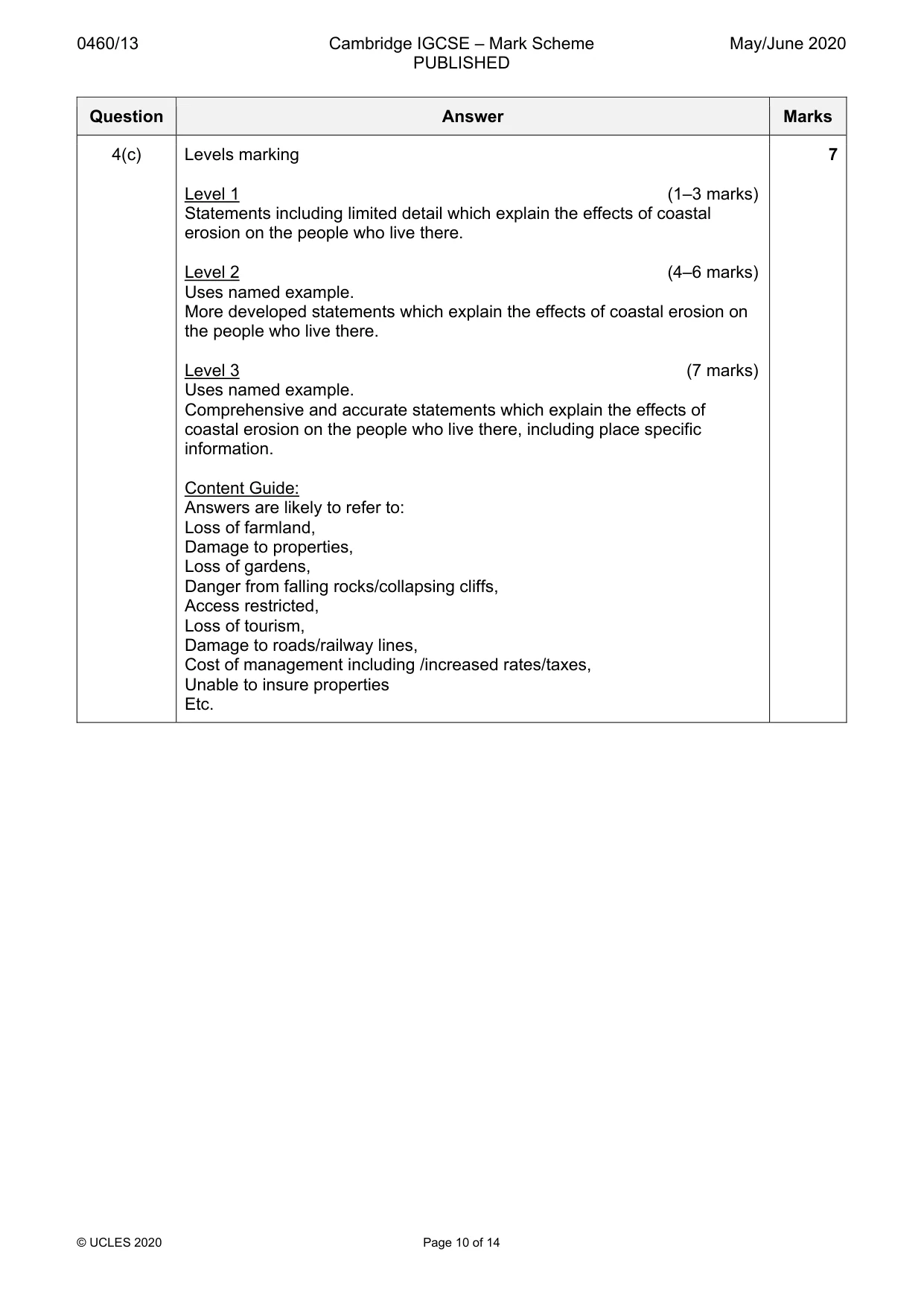
0460/13 Cambridge IGCSE – Mark Scheme PUBLISHED May/June 2020 © UCLES 2020 Page 10 of 14 Question Answer Marks 4(c) Levels marking Level 1 (1–3 marks) Statements including limited detail which explain the effects of coastal erosion on the people who live there. Level 2 (4–6 marks) Uses named example. More developed statements which explain the effects of coastal erosion on the people who live there. Level 3 (7 marks) Uses named example. Comprehensive and accurate statements which explain the effects of coastal erosion on the people who live there, including place specific information. Content Guide: Answers are likely to refer to: Loss of farmland, Damage to properties, Loss of gardens, Danger from falling rocks/collapsing cliffs, Access restricted, Loss of tourism, Damage to roads/railway lines, Cost of management including /increased rates/taxes, Unable to insure properties Etc. 7
Mark scheme, page 11
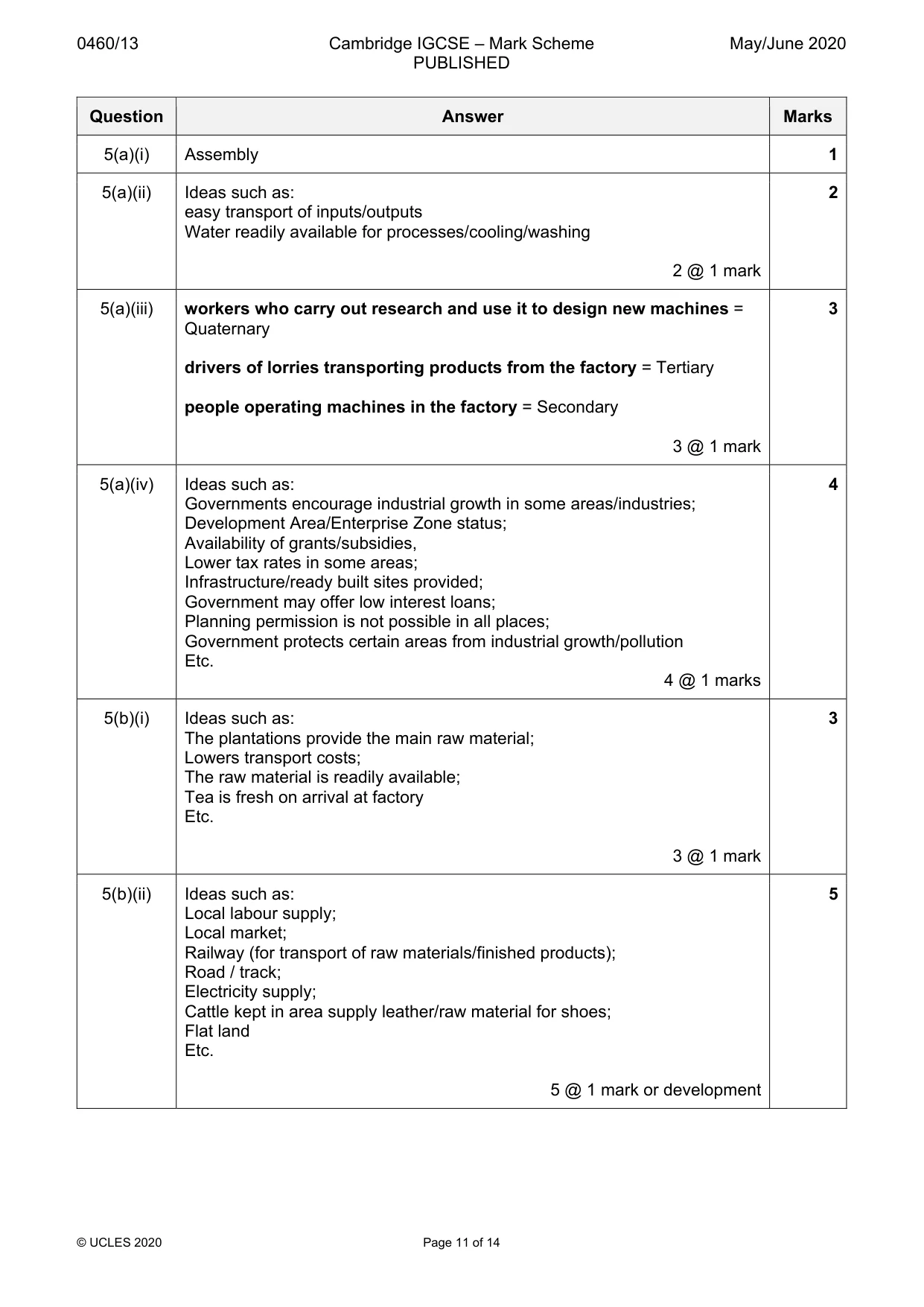
0460/13 Cambridge IGCSE – Mark Scheme PUBLISHED May/June 2020 © UCLES 2020 Page 11 of 14 Question Answer Marks 5(a)(i) Assembly 1 5(a)(ii) Ideas such as: easy transport of inputs/outputs Water readily available for processes/cooling/washing 2 @ 1 mark 2 5(a)(iii) workers who carry out research and use it to design new machines = Quaternary drivers of lorries transporting products from the factory = Tertiary people operating machines in the factory = Secondary 3 @ 1 mark 3 5(a)(iv) Ideas such as: Governments encourage industrial growth in some areas/industries; Development Area/Enterprise Zone status; Availability of grants/subsidies, Lower tax rates in some areas; Infrastructure/ready built sites provided; Government may offer low interest loans; Planning permission is not possible in all places; Government protects certain areas from industrial growth/pollution Etc. 4 @ 1 marks 4 5(b)(i) Ideas such as: The plantations provide the main raw material; Lowers transport costs; The raw material is readily available; Tea is fresh on arrival at factory Etc. 3 @ 1 mark 3 5(b)(ii) Ideas such as: Local labour supply; Local market; Railway (for transport of raw materials/finished products); Road / track; Electricity supply; Cattle kept in area supply leather/raw material for shoes; Flat land Etc. 5 @ 1 mark or development 5
Mark scheme, page 12
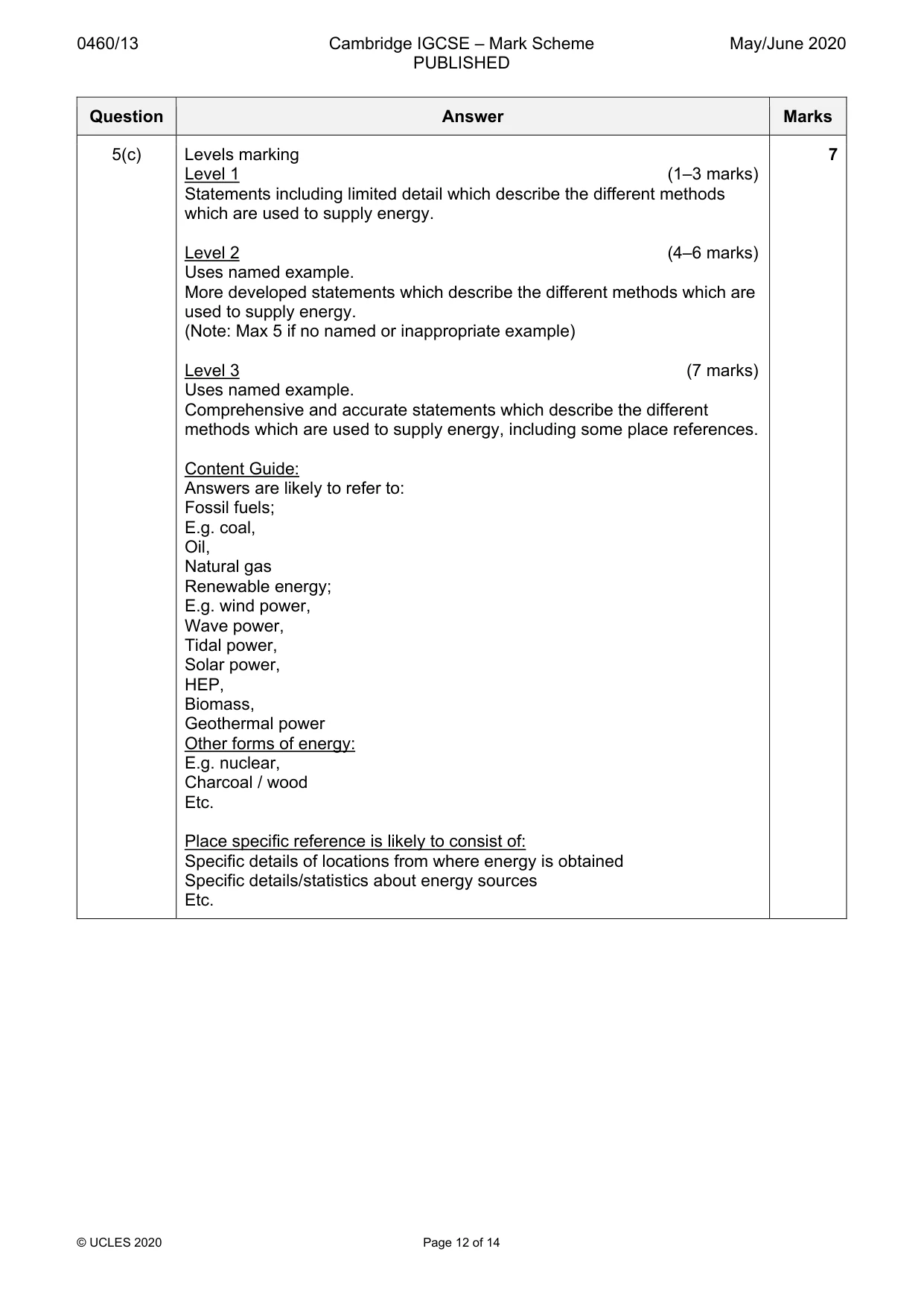
0460/13 Cambridge IGCSE – Mark Scheme PUBLISHED May/June 2020 © UCLES 2020 Page 12 of 14 Question Answer Marks 5(c) Levels marking Level 1 (1–3 marks) Statements including limited detail which describe the different methods which are used to supply energy. Level 2 (4–6 marks) Uses named example. More developed statements which describe the different methods which are used to supply energy. (Note: Max 5 if no named or inappropriate example) Level 3 (7 marks) Uses named example. Comprehensive and accurate statements which describe the different methods which are used to supply energy, including some place references. Content Guide: Answers are likely to refer to: Fossil fuels; E.g. coal, Oil, Natural gas Renewable energy; E.g. wind power, Wave power, Tidal power, Solar power, HEP, Biomass, Geothermal power Other forms of energy: E.g. nuclear, Charcoal / wood Etc. Place specific reference is likely to consist of: Specific details of locations from where energy is obtained Specific details/statistics about energy sources Etc. 7
Mark scheme, page 13
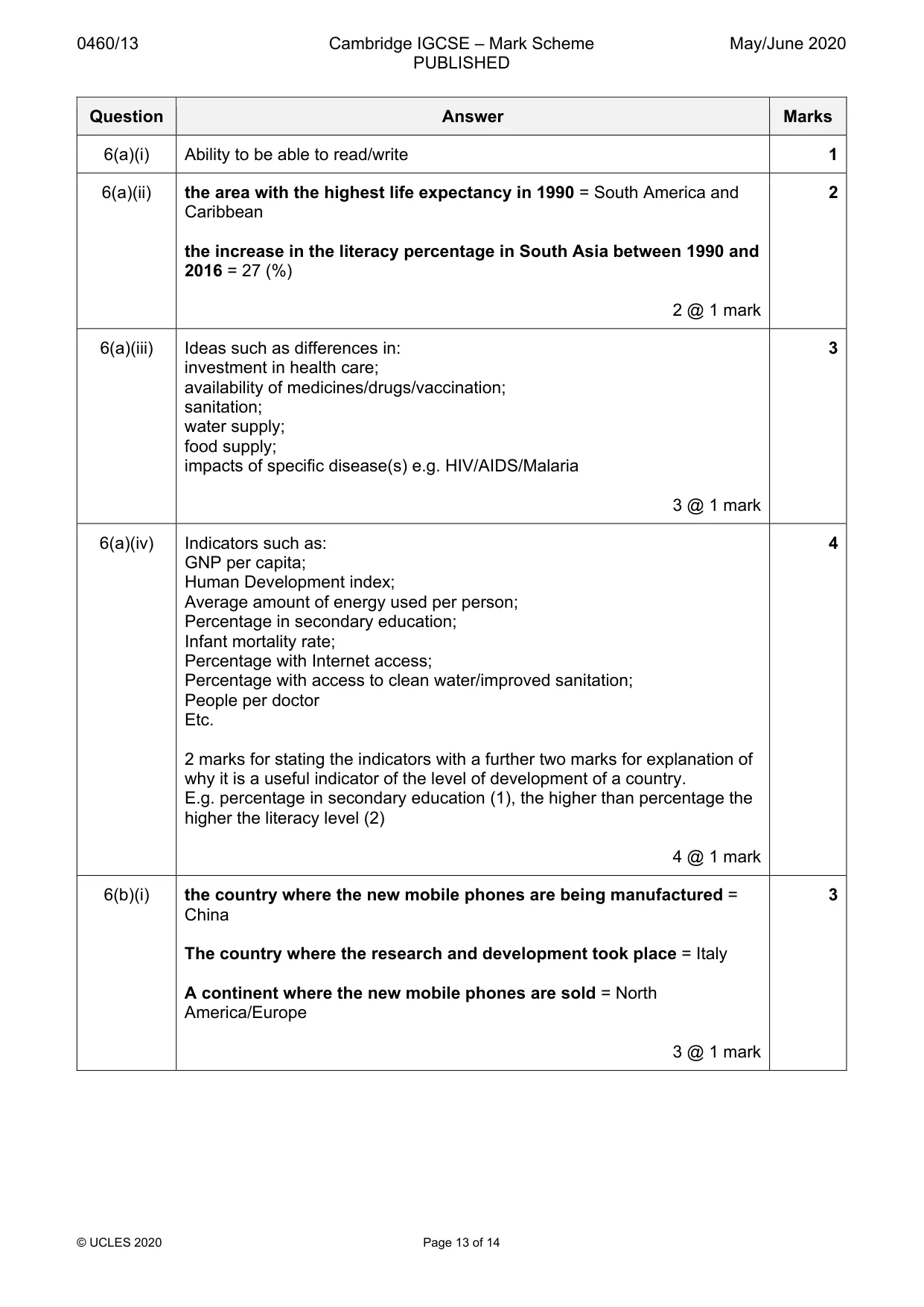
0460/13 Cambridge IGCSE – Mark Scheme PUBLISHED May/June 2020 © UCLES 2020 Page 13 of 14 Question Answer Marks 6(a)(i) Ability to be able to read/write 1 6(a)(ii) the area with the highest life expectancy in 1990 = South America and Caribbean the increase in the literacy percentage in South Asia between 1990 and 2016 = 27 (%) 2 @ 1 mark 2 6(a)(iii) Ideas such as differences in: investment in health care; availability of medicines/drugs/vaccination; sanitation; water supply; food supply; impacts of specific disease(s) e.g. HIV/AIDS/Malaria 3 @ 1 mark 3 6(a)(iv) Indicators such as: GNP per capita; Human Development index; Average amount of energy used per person; Percentage in secondary education; Infant mortality rate; Percentage with Internet access; Percentage with access to clean water/improved sanitation; People per doctor Etc. 2 marks for stating the indicators with a further two marks for explanation of why it is a useful indicator of the level of development of a country. E.g. percentage in secondary education (1), the higher than percentage the higher the literacy level (2) 4 @ 1 mark 4 6(b)(i) the country where the new mobile phones are being manufactured = China The country where the research and development took place = Italy A continent where the new mobile phones are sold = North America/Europe 3 @ 1 mark 3
Mark scheme, page 14
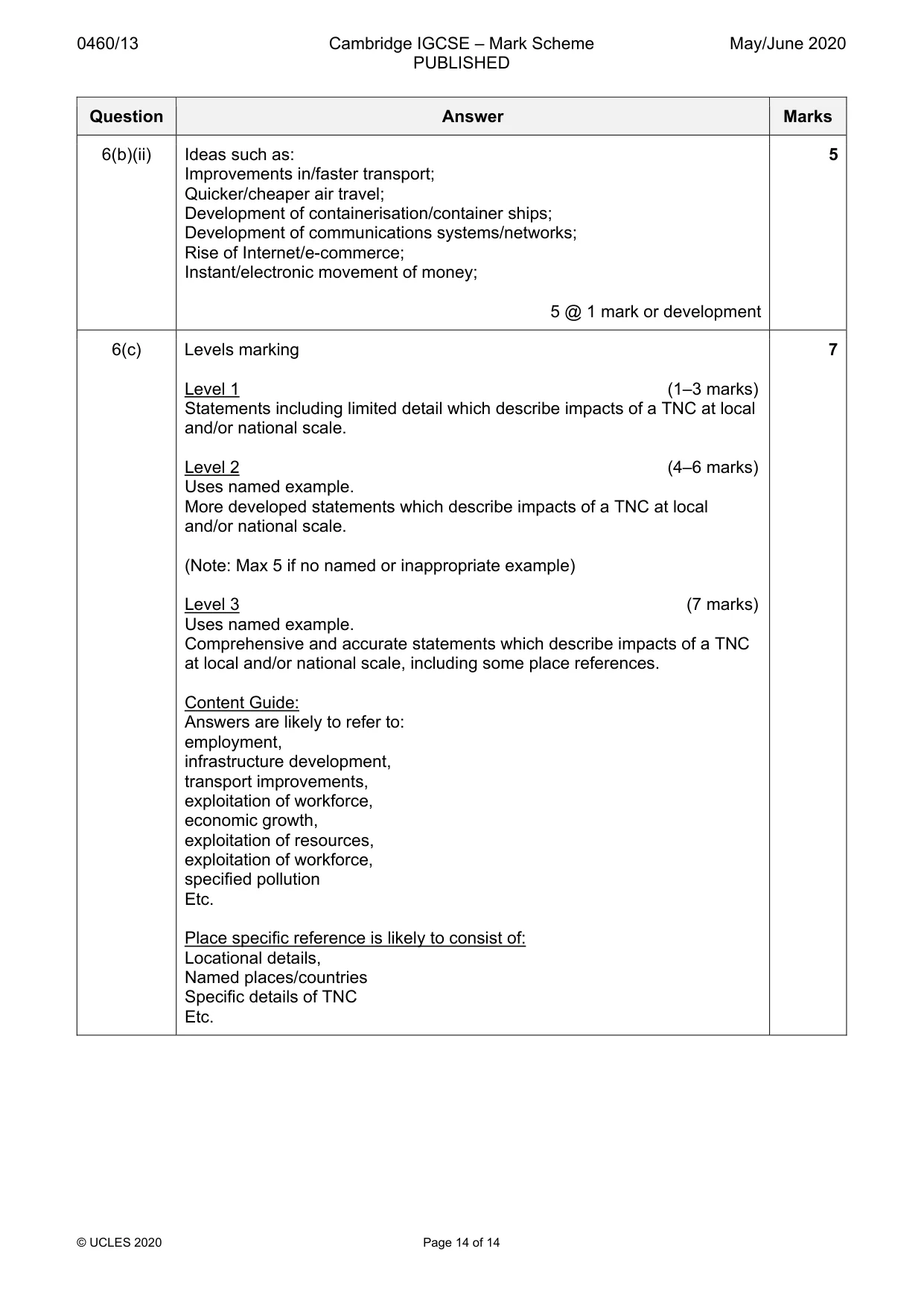
0460/13 Cambridge IGCSE – Mark Scheme PUBLISHED May/June 2020 © UCLES 2020 Page 14 of 14 Question Answer Marks 6(b)(ii) Ideas such as: Improvements in/faster transport; Quicker/cheaper air travel; Development of containerisation/container ships; Development of communications systems/networks; Rise of Internet/e-commerce; Instant/electronic movement of money; 5 @ 1 mark or development 5 6(c) Levels marking Level 1 (1–3 marks) Statements including limited detail which describe impacts of a TNC at local and/or national scale. Level 2 (4–6 marks) Uses named example. More developed statements which describe impacts of a TNC at local and/or national scale. (Note: Max 5 if no named or inappropriate example) Level 3 (7 marks) Uses named example. Comprehensive and accurate statements which describe impacts of a TNC at local and/or national scale, including some place references. Content Guide: Answers are likely to refer to: employment, infrastructure development, transport improvements, exploitation of workforce, economic growth, exploitation of resources, exploitation of workforce, specified pollution Etc. Place specific reference is likely to consist of: Locational details, Named places/countries Specific details of TNC Etc. 7