Cambridge IGCSE Geography 0460 — 2024 Feb/March Paper 1 · Variant 2
0460/12/F/M/24 · 75 marks · ≈84 min
The question paper and its mark scheme, free to read here and free to download. This is Cambridge’s own paper, exactly as it was sat.
Question paper28 pages



Mark scheme25 pages
Answers below. Sit the paper first if you are practising.
Paper as text
Question paper, page 1
This document has 28 pages. Any blank pages are indicated. [Turn over Cambridge IGCSE™ GEOGRAPHY 0460/12 Paper 1 Geographical Themes February/March 2024 1 hour 45 minutes You must answer on the question paper. You will need: Insert (enclosed) Calculator Ruler INSTRUCTIONS ● Answer three questions in total, one from each section. ● Use a black or dark blue pen. You may use an HB pencil for any diagrams or graphs. ● Write your name, centre number and candidate number in the boxes at the top of the page. ● Write your answer to each question in the space provided. ● Do not use an erasable pen or correction fluid. ● Do not write on any bar codes. ● If additional space is needed, you should use the lined pages at the end of this booklet; the question number or numbers must be clearly shown. INFORMATION ● The total mark for this paper is 75. ● The number of marks for each question or part question is shown in brackets [ ]. ● The insert contains additional resources referred to in the questions. Definitions MEDCs – More Economically Developed Countries LEDCs – Less Economically Developed Countries * 4 8 9 8 5 3 4 9 5 1 * DC (PQ/CB) 327202/3 © UCLES 2024
Question paper, page 2
2 0460/12/F/M/24 © UCLES 2024 BLANK PAGE
Question paper, page 3
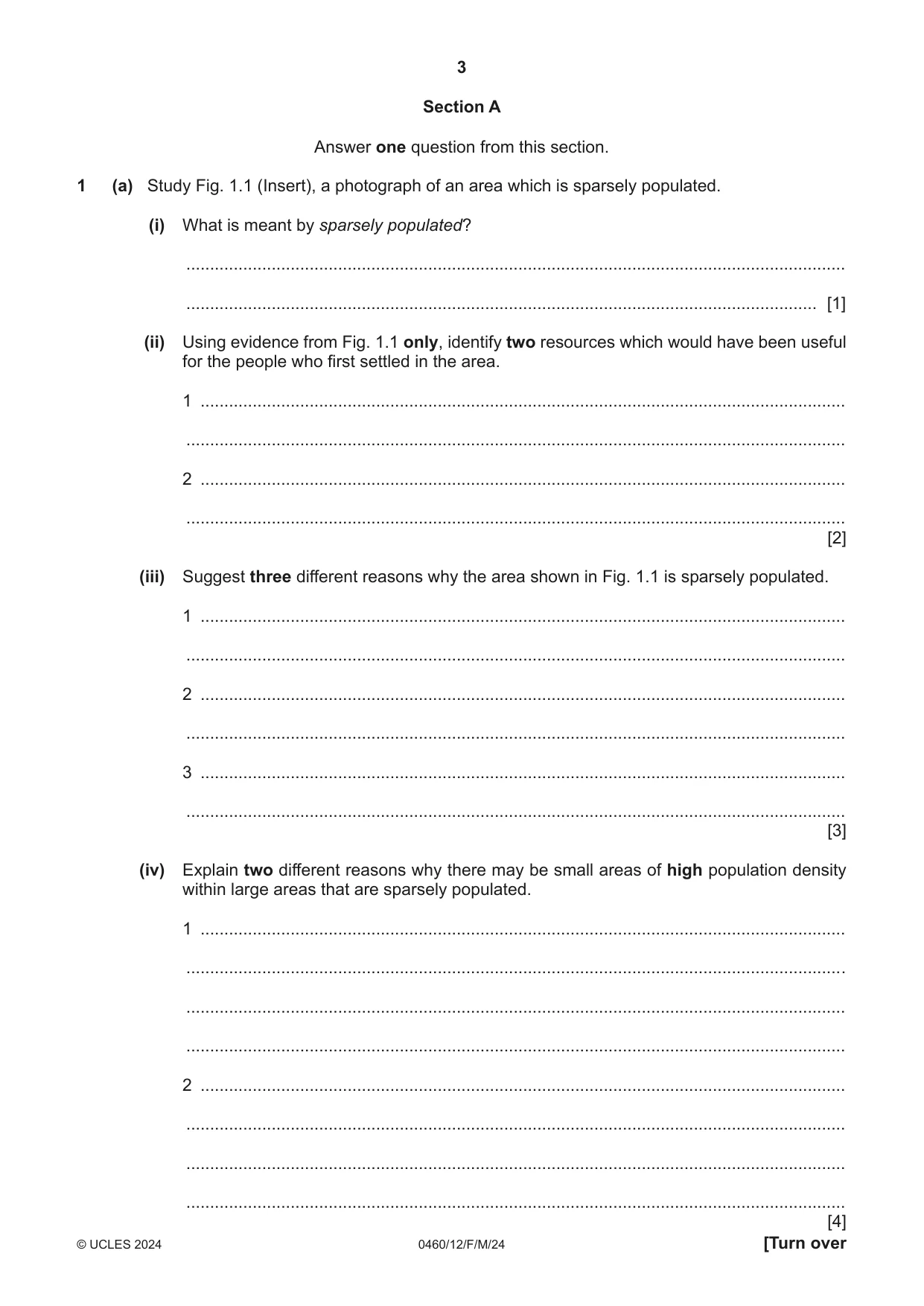
3 0460/12/F/M/24 © UCLES 2024 [Turn over Section A Answer one question from this section. 1 (a) Study Fig. 1.1 (Insert), a photograph of an area which is sparsely populated. (i) What is meant by sparsely populated? … … [1] (ii) Using evidence from Fig. 1.1 only, identify two resources which would have been useful for the people who first settled in the area. 1 … … 2 … … [2] (iii) Suggest three different reasons why the area shown in Fig. 1.1 is sparsely populated. 1 … … 2 … … 3 … … [3] (iv) Explain two different reasons why there may be small areas of high population density within large areas that are sparsely populated. 1 … … … … 2 … … … … [4]
Question paper, page 4
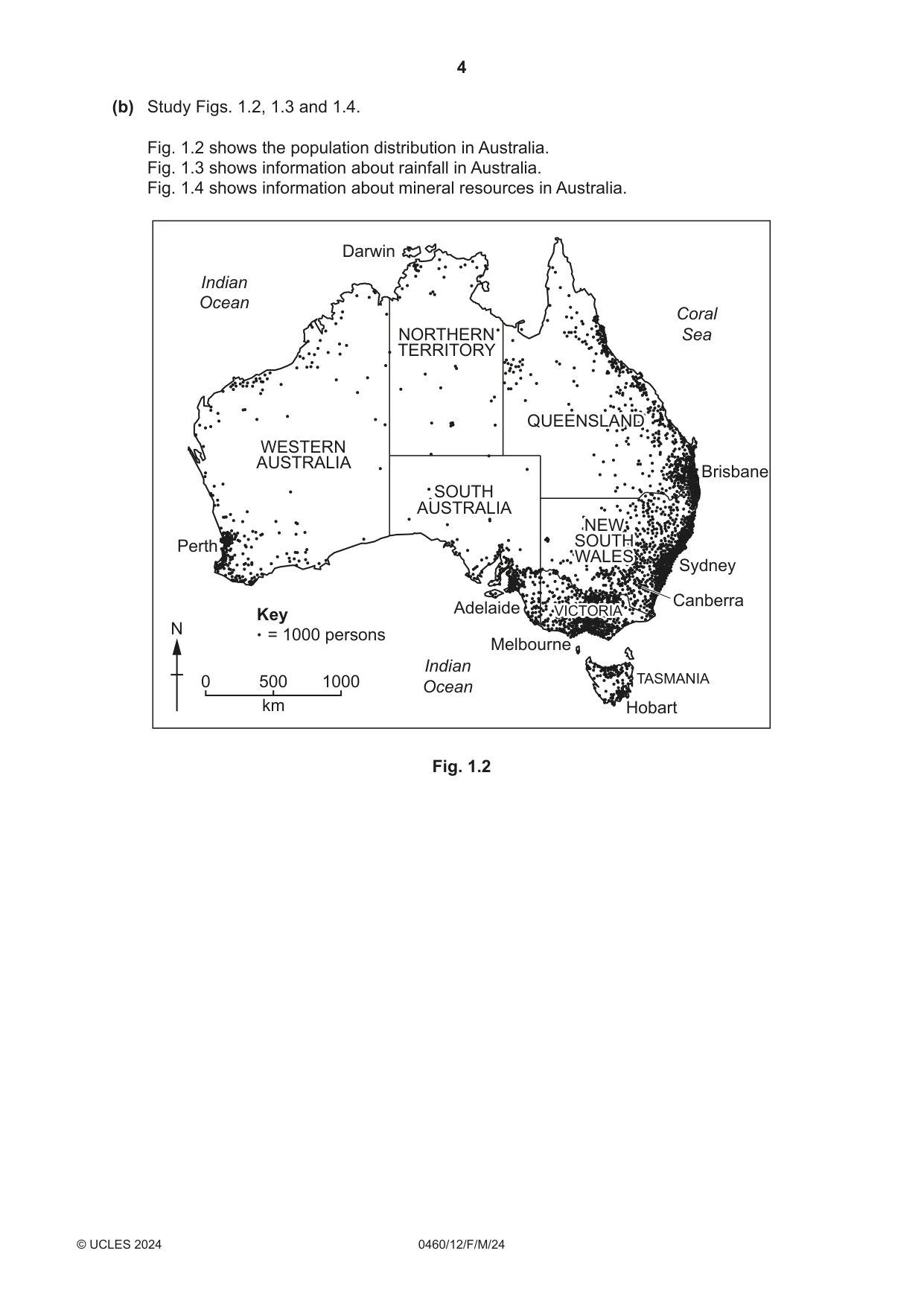
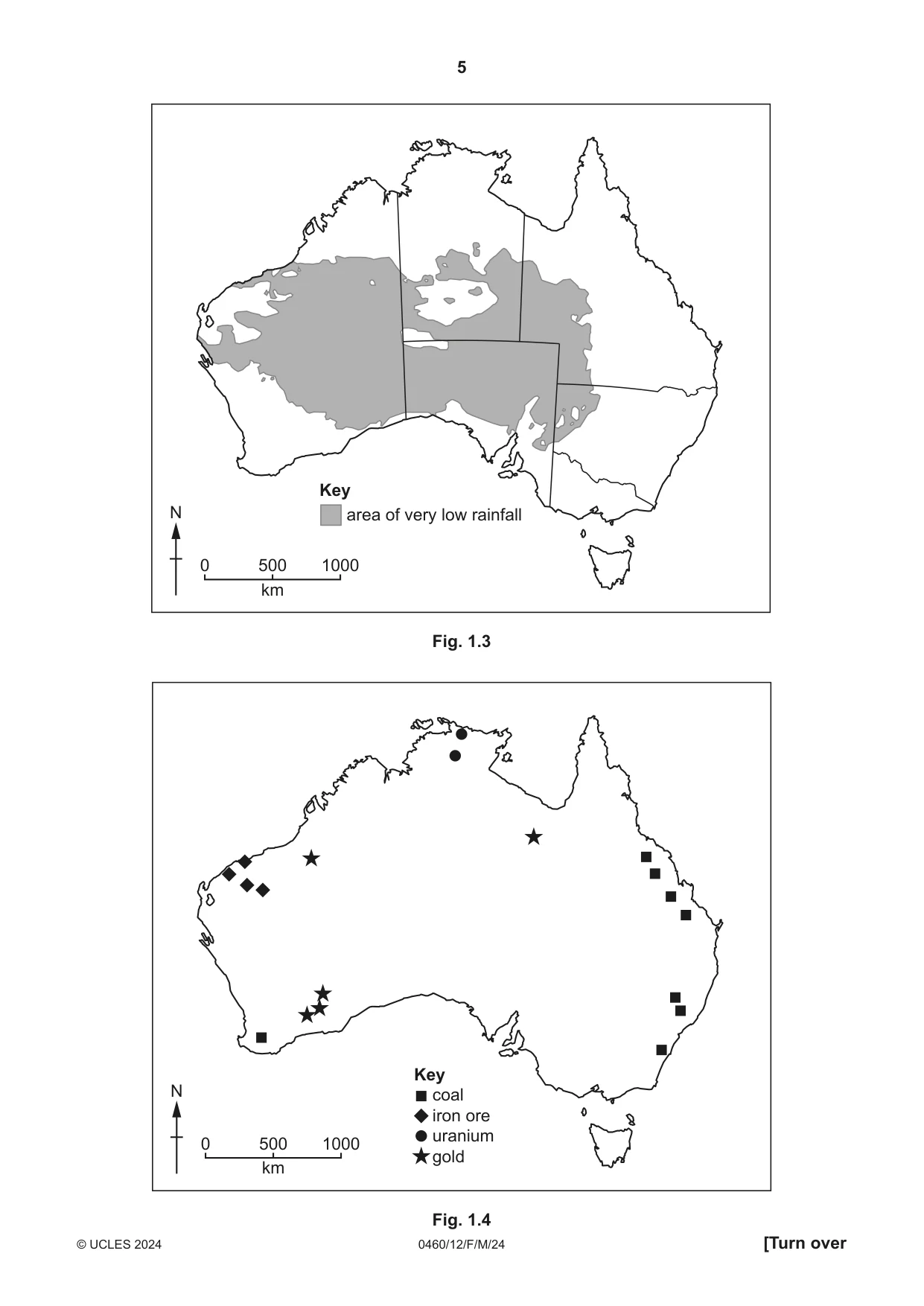
4 0460/12/F/M/24 © UCLES 2024 (b) Study Figs. 1.2, 1.3 and 1.4. Fig. 1.2 shows the population distribution in Australia. Fig. 1.3 shows information about rainfall in Australia. Fig. 1.4 shows information about mineral resources in Australia. WESTERN AUSTRALIA SOUTH AUSTRALIA QUEENSLAND NEW SOUTH WALES VICTORIA TASMANIA NORTHERN TERRITORY Key = 1000 persons Adelaide Perth Indian Ocean Indian Ocean Coral Sea Melbourne Hobart Canberra Sydney Brisbane Darwin 0 500 km 1000 N Fig. 1.2
Question paper, page 5
5 0460/12/F/M/24 © UCLES 2024 [Turn over 0 500 km 1000 N area of very low rainfall Key Fig. 1.3 Key coal iron ore uranium gold 0 500 km 1000 N Fig. 1.4
Question paper, page 6
6 0460/12/F/M/24 © UCLES 2024 (i) Using Fig. 1.2 only, describe the distribution of population in Australia. … … … … … … [3] (ii) Using evidence from Figs. 1.2, 1.3 and 1.4 only, explain the reasons for the distribution of population in Australia. … … … … … … … … … … [5]
Question paper, page 7
7 0460/12/F/M/24 © UCLES 2024 [Turn over (c) For a named country you have studied, describe the problems caused by under-population. Name of country … … … … … … … … … … … … … … … … … … … … … … … … … [7] [Total: 25]
Question paper, page 8
8 0460/12/F/M/24 © UCLES 2024 2 (a) Study Fig. 2.1, a graph showing the percentage of the population living in urban areas in five continents in 1950 and 2020. Fig. 2.1 (i) What percentage of the population of Europe lived in urban areas in 1950? … % [1] (ii) Identify the continent with: – the smallest percentage of population living in urban areas in 2020 … – the smallest percentage increase in population living in urban areas between 1950 and 2020. … [2] Content removed due to copyright restrictions.
Question paper, page 9
9 0460/12/F/M/24 © UCLES 2024 [Turn over (iii) Give three reasons why many rural areas are unattractive places to live in LEDCs. 1 … … 2 … … 3 … … [3] (iv) The migration of people from rural areas may result in rural depopulation. Describe the problems caused for rural areas by rural depopulation. … … … … … … … … [4]
Question paper, page 10
10 0460/12/F/M/24 © UCLES 2024 (b) Study Figs. 2.2 and 2.3 (Insert), photographs taken in part of a squatter settlement in Labuan, an urban area in Malaysia. (i) Describe the buildings shown in Figs. 2.2 and 2.3. … … … … … … [3] (ii) Using evidence from Figs. 2.2 and 2.3 only, describe the problems of living in this squatter settlement. … … … … … … … … … … [5]
Question paper, page 11
11 0460/12/F/M/24 © UCLES 2024 [Turn over (c) For a named urban area you have studied, describe the strategies used to improve the living conditions in squatter settlements. Name of urban area … … … … … … … … … … … … … … … … … … … … … … … … … [7] [Total: 25]
Question paper, page 12
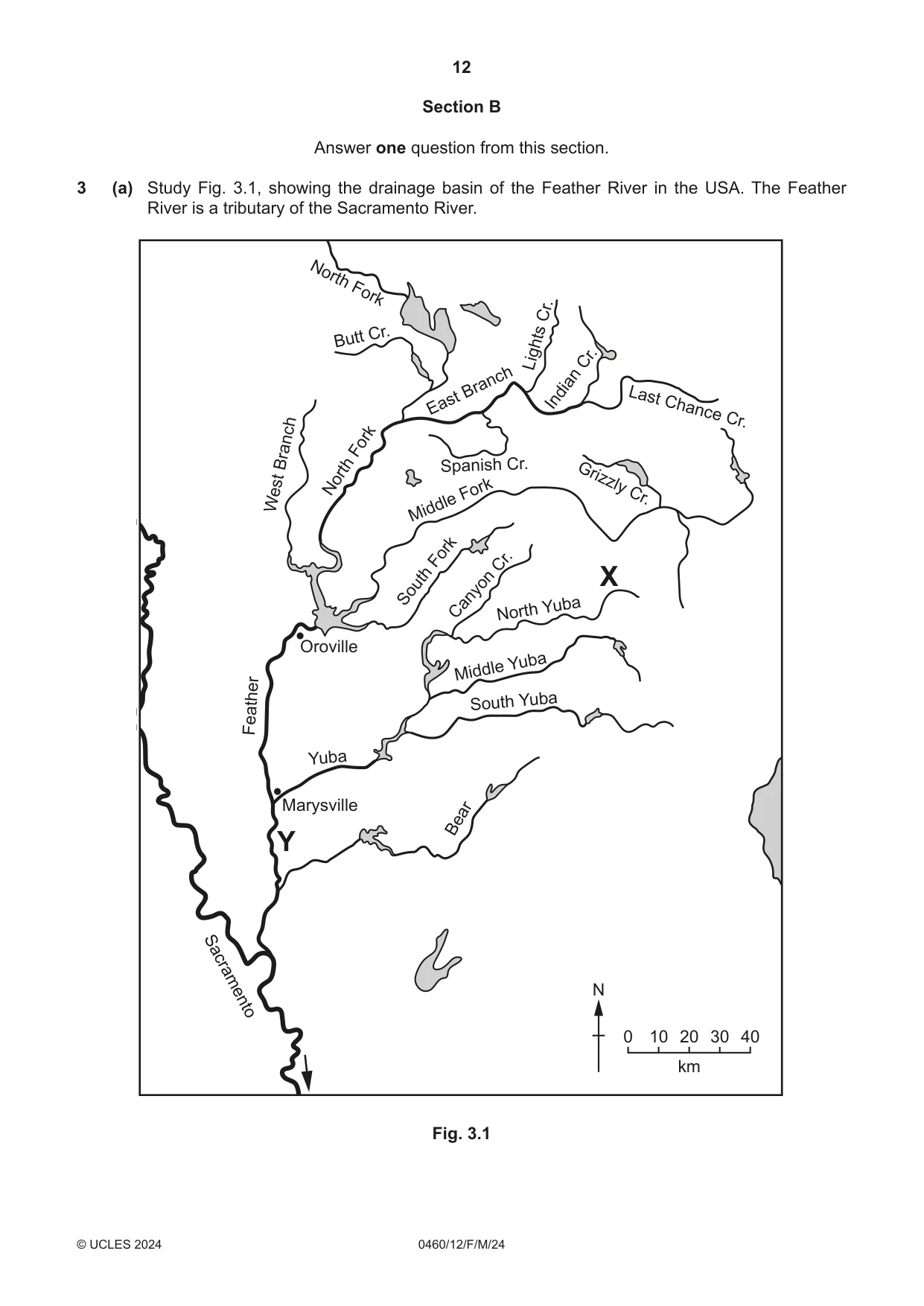
12 0460/12/F/M/24 © UCLES 2024 Section B Answer one question from this section. 3 (a) Study Fig. 3.1, showing the drainage basin of the Feather River in the USA. The Feather River is a tributary of the Sacramento River. 0 10 20 30 40 Oroville Marysville Sacramento Bear South Yuba Yuba Feather West Branch North Fork Middle Fork Spanish Cr. South Fork Canyon Cr. North Yuba Grizzly Cr. Last Chance Cr. Indian Cr. Lights Cr. East Branch Butt Cr. North Fork Middle Yuba Y X km N Fig. 3.1
Question paper, page 13
13 0460/12/F/M/24 © UCLES 2024 [Turn over (i) What is meant by a tributary of the Sacramento River ? … … [1] (ii) What are the distance and compass direction along the Feather River from Oroville to Marysville? distance … km compass direction … [2] (iii) Use an arrow and a letter to label each of the following on Fig. 3.1: – the confluence of the Feather River and the Bear River (label with C) – the source of the Bear River (label with S) – a lake with four rivers flowing into it (label with L). [3] (iv) Describe the likely changes to the characteristics of the river as it flows from X to Y. … … … … … … … … [4]
Question paper, page 14
14 0460/12/F/M/24 © UCLES 2024 (b) Study Fig. 3.2 (Insert), a photograph of the River Vltava which flows through Prague, Czechia (an MEDC in Europe). (i) The River Vltava floods frequently. Describe three possible impacts of flooding on the area shown in Fig. 3.2. 1 … … 2 … … 3 … … [3] (ii) Suggest why flooding of the River Vltava may occur. … … … … … … … … … … [5]
Question paper, page 15
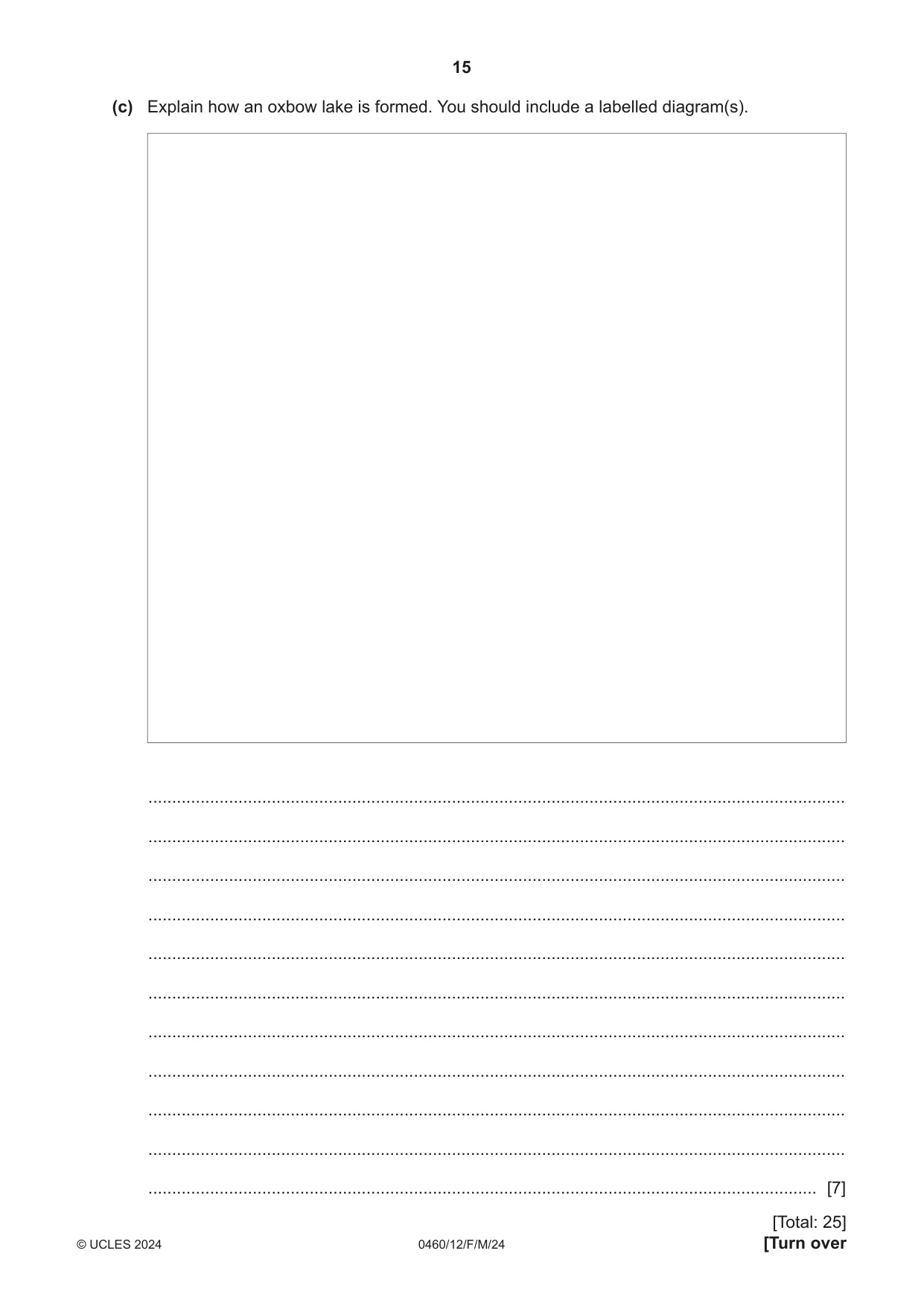
15 0460/12/F/M/24 © UCLES 2024 [Turn over (c) Explain how an oxbow lake is formed. You should include a labelled diagram(s). … … … … … … … … … … … [7] [Total: 25]
Question paper, page 16
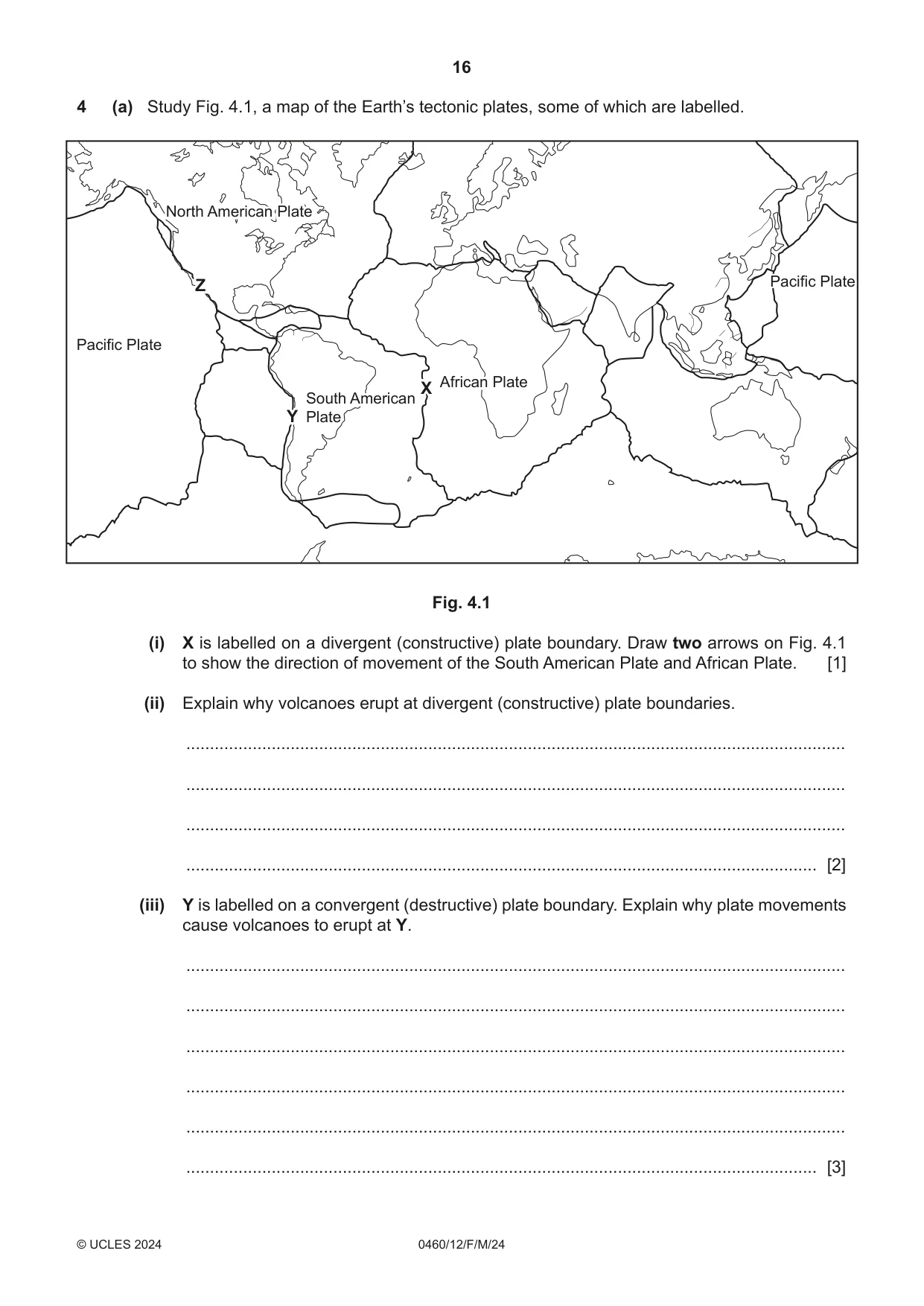
16 0460/12/F/M/24 © UCLES 2024 4 (a) Study Fig. 4.1, a map of the Earth’s tectonic plates, some of which are labelled. Pacific Plate Pacific Plate South American Plate South American Plate African Plate African Plate North American Plate North American Plate X Y Z Pacific Plate Pacific Plate Fig. 4.1 (i) X is labelled on a divergent (constructive) plate boundary. Draw two arrows on Fig. 4.1 to show the direction of movement of the South American Plate and African Plate. [1] (ii) Explain why volcanoes erupt at divergent (constructive) plate boundaries. … … … … [2] (iii) Y is labelled on a convergent (destructive) plate boundary. Explain why plate movements cause volcanoes to erupt at Y. … … … … … … [3]
Question paper, page 17
17 0460/12/F/M/24 © UCLES 2024 [Turn over (iv) Z is labelled on a conservative plate boundary. Describe the processes which may result in earthquakes in the region around Z. … … … … … … … … [4] (b) Study Fig. 4.2 (Insert), a map showing the area around the Cumbre Vieja volcano in La Palma, part of the Canary Islands. This volcano erupted in 2021. (i) Describe the location of the area affected by the lava flow from the Cumbre Vieja volcano. … … … … … … [3] (ii) Describe the problems caused for people by volcanic eruptions. … … … … … … … … … … [5]
Question paper, page 18
18 0460/12/F/M/24 © UCLES 2024 (c) Explain why people live close to a named volcano you have studied. Name of volcano … … … … … … … … … … … … … … … … … … … … … … … … … [7] [Total: 25]
Question paper, page 19
19 0460/12/F/M/24 © UCLES 2024 [Turn over BLANK PAGE
Question paper, page 20
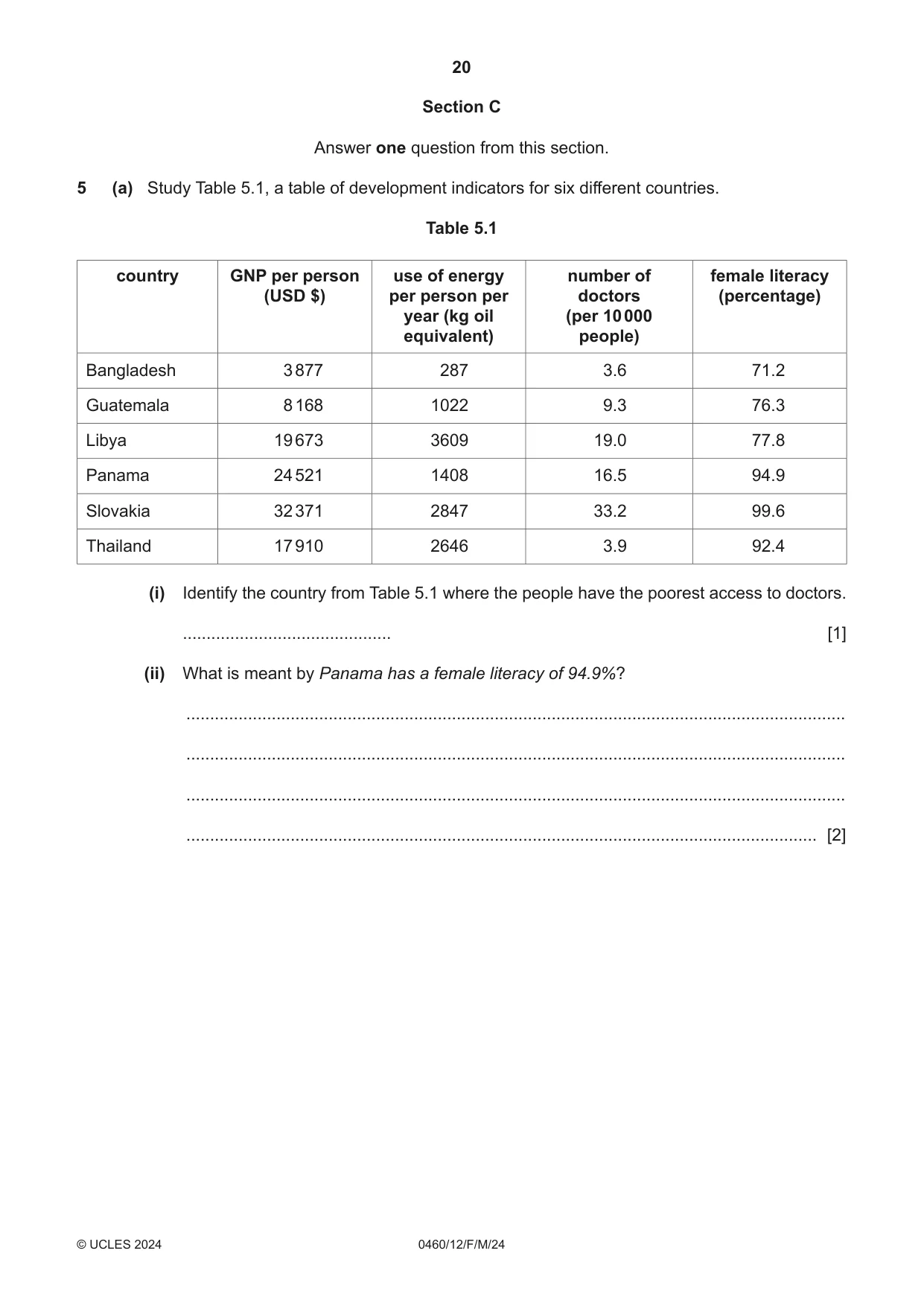
20 0460/12/F/M/24 © UCLES 2024 Section C Answer one question from this section. 5 (a) Study Table 5.1, a table of development indicators for six different countries. Table 5.1 country GNP per person (USD $) use of energy per person per year (kg oil equivalent) number of doctors (per 10 000 people) female literacy (percentage) Bangladesh 3 877 287 3.6 71.2 Guatemala 8 168 1022 9.3 76.3 Libya 19 673 3609 19.0 77.8 Panama 24 521 1408 16.5 94.9 Slovakia 32 371 2847 33.2 99.6 Thailand 17 910 2646 3.9 92.4 (i) Identify the country from Table 5.1 where the people have the poorest access to doctors. … [1] (ii) What is meant by Panama has a female literacy of 94.9%? … … … … [2]
Question paper, page 21
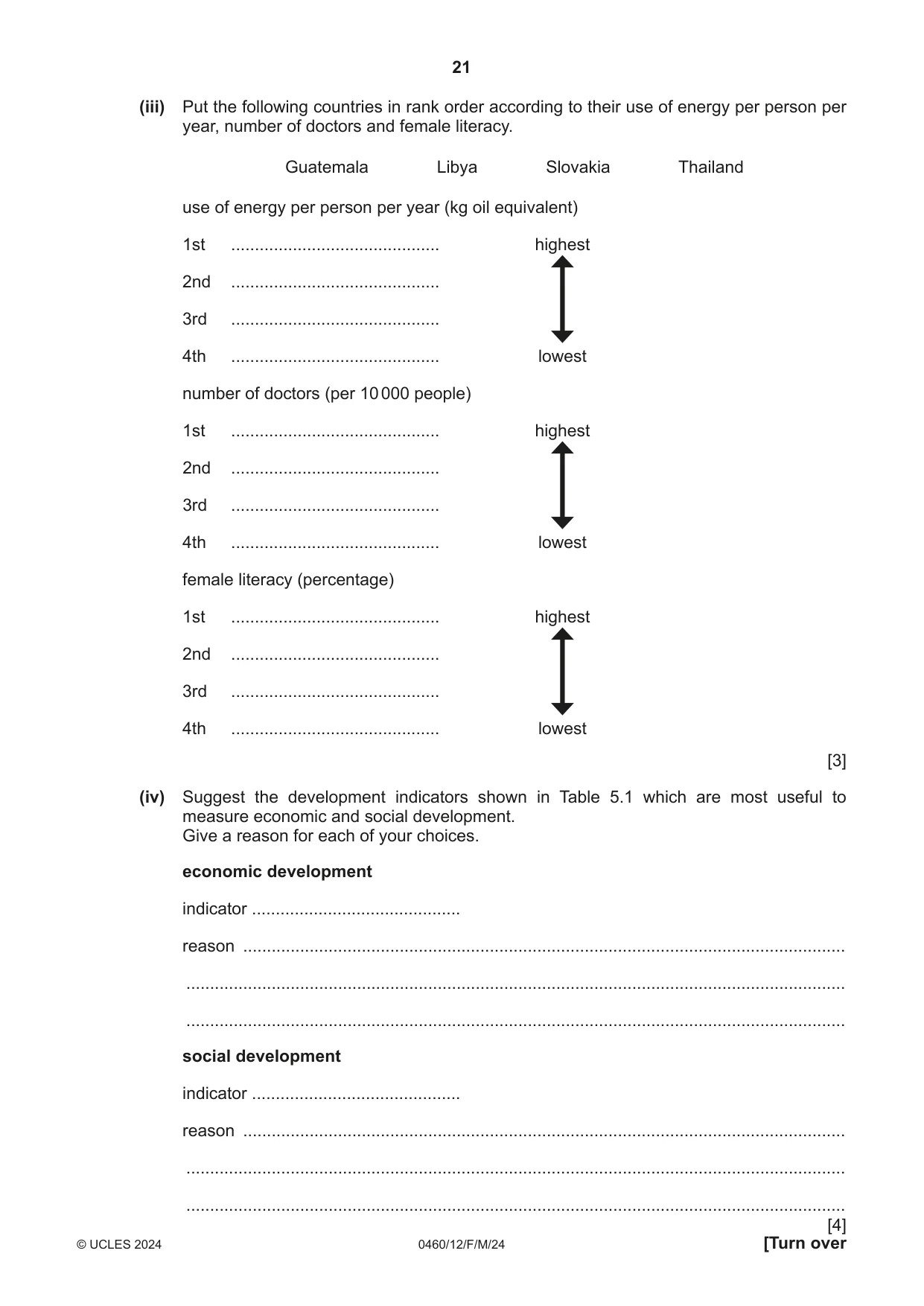
21 0460/12/F/M/24 © UCLES 2024 [Turn over (iii) Put the following countries in rank order according to their use of energy per person per year, number of doctors and female literacy. Guatemala Libya Slovakia Thailand use of energy per person per year (kg oil equivalent) 1st … highest 2nd … 3rd … 4th … lowest number of doctors (per 10 000 people) 1st … highest 2nd … 3rd … 4th … lowest female literacy (percentage) 1st … highest 2nd … 3rd … 4th … lowest [3] (iv) Suggest the development indicators shown in Table 5.1 which are most useful to measure economic and social development. Give a reason for each of your choices. economic development indicator … reason … … … social development indicator … reason … … … [4]
Question paper, page 22
22 0460/12/F/M/24 © UCLES 2024 (b) Study Figs. 5.1, 5.2 and 5.3 (Insert), photographs showing places where people are employed. (i) Identify the photograph where each of the following types of employment are available: Primary employment Fig. … Secondary employment Fig. … Tertiary employment. Fig. … [3] (ii) Describe and explain the relationship between the level of development of a country and its employment structure. … … … … … … … … … … [5]
Question paper, page 23
23 0460/12/F/M/24 © UCLES 2024 [Turn over (c) Describe the advantages and disadvantages for LEDCs of a named transnational corporation (TNC) you have studied. Name of transnational corporation … … … … … … … … … … … … … … … … … … … … … … … … … [7] [Total: 25]
Question paper, page 24
24 0460/12/F/M/24 © UCLES 2024 6 (a) Study Fig. 6.1 (Insert), a map showing information about the risk of water shortages. (i) Which one of the four countries labelled on Fig. 6.1 is most at risk of water shortages? … [1] (ii) Describe the distribution of countries with the highest risk of water shortages. … … … … [2] (iii) Explain why many people living in rural areas in LEDCs do not have enough water. … … … … … … … [3] (iv) Describe the problems caused by water shortages in rural areas of LEDCs. … … … … … … … … [4]
Question paper, page 25
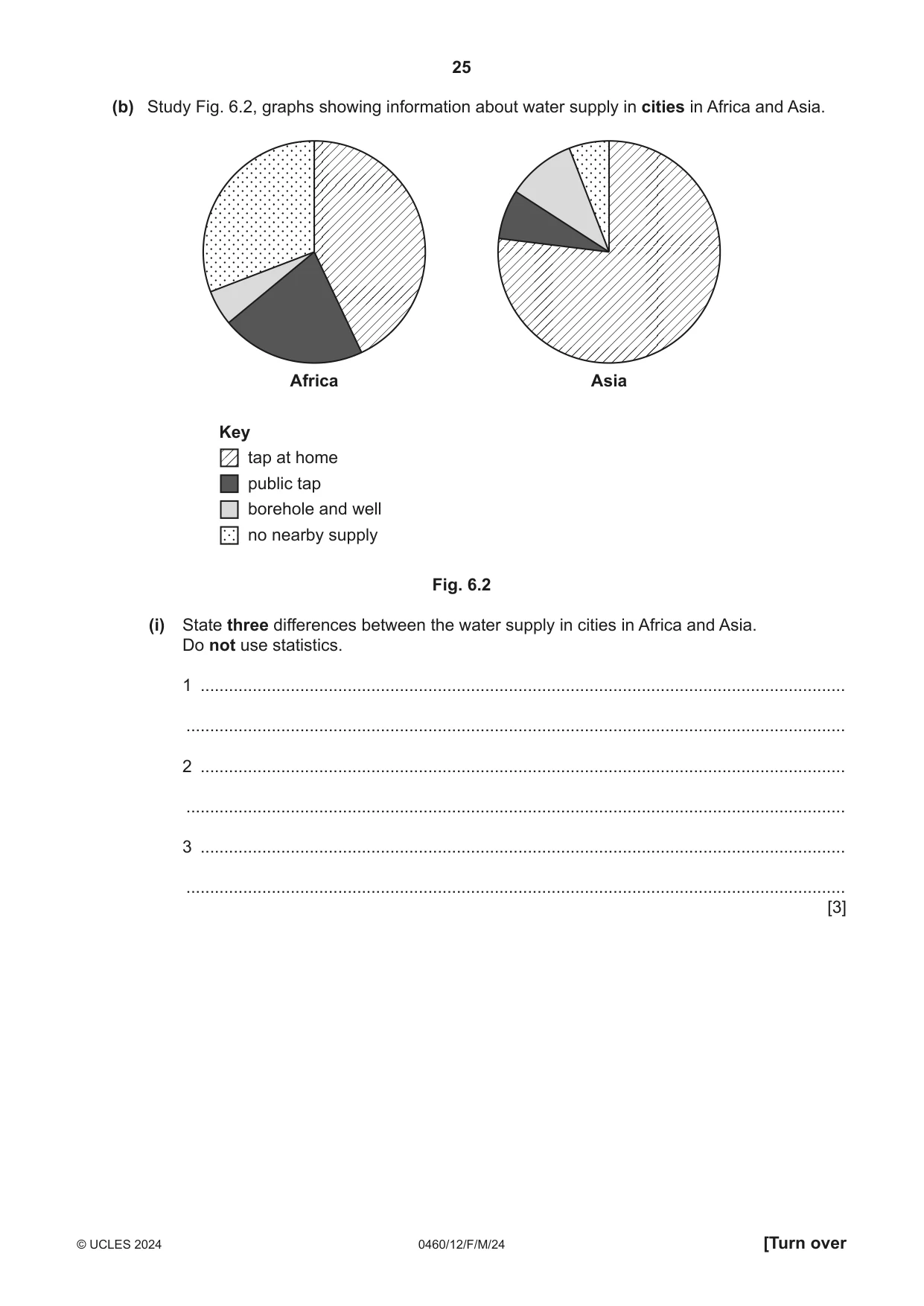
25 0460/12/F/M/24 © UCLES 2024 [Turn over (b) Study Fig. 6.2, graphs showing information about water supply in cities in Africa and Asia. Africa tap at home Key Asia public tap borehole and well no nearby supply Fig. 6.2 (i) State three differences between the water supply in cities in Africa and Asia. Do not use statistics. 1 … … 2 … … 3 … … [3]
Question paper, page 26
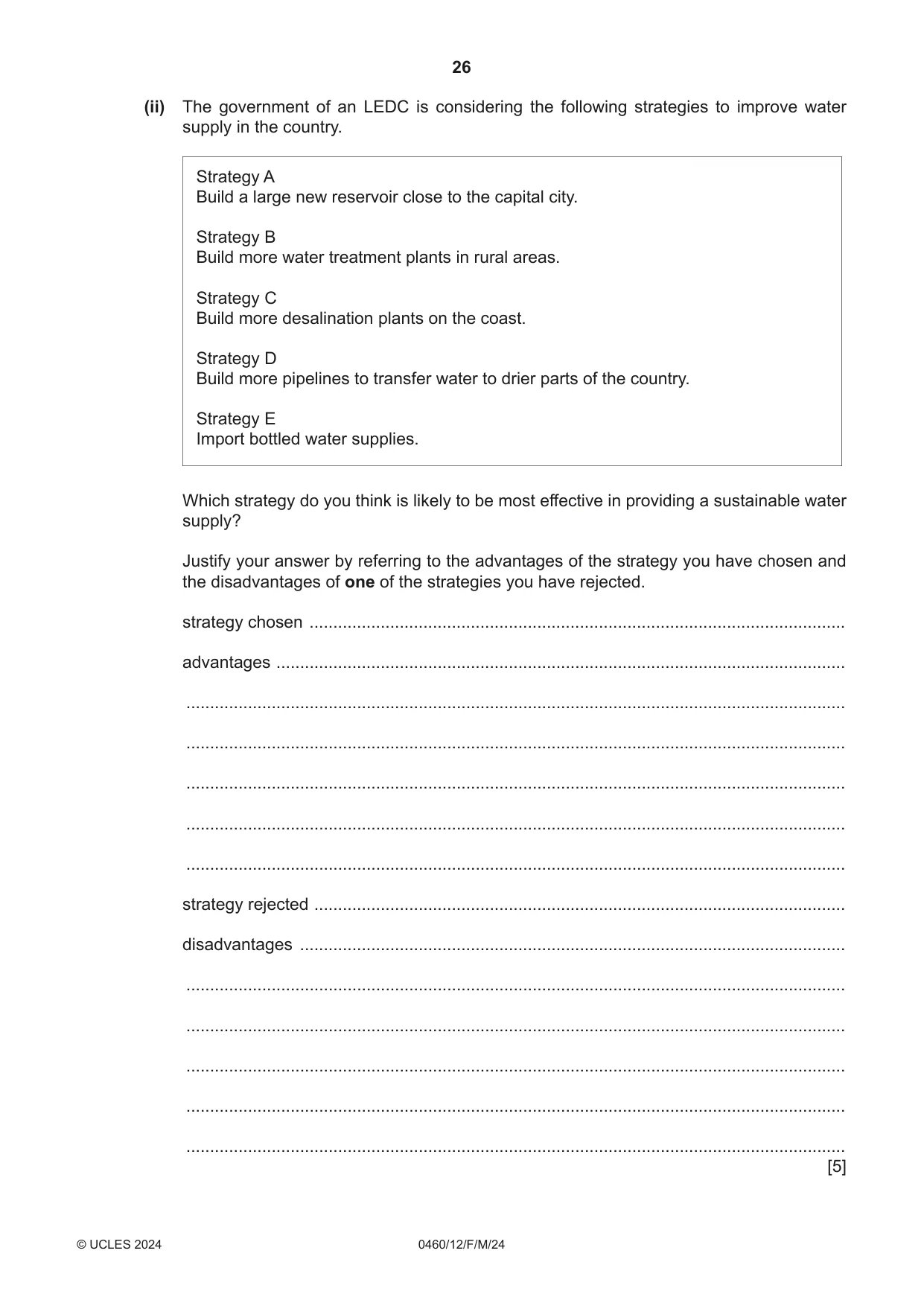
26 0460/12/F/M/24 © UCLES 2024 (ii) The government of an LEDC is considering the following strategies to improve water supply in the country. Strategy A Build a large new reservoir close to the capital city. Strategy B Build more water treatment plants in rural areas. Strategy C Build more desalination plants on the coast. Strategy D Build more pipelines to transfer water to drier parts of the country. Strategy E Import bottled water supplies. Which strategy do you think is likely to be most effective in providing a sustainable water supply? Justify your answer by referring to the advantages of the strategy you have chosen and the disadvantages of one of the strategies you have rejected. strategy chosen … advantages … … … … … … strategy rejected … disadvantages … … … … … … [5]
Question paper, page 27
27 0460/12/F/M/24 © UCLES 2024 (c) For a named country or area you have studied, describe the different strategies which are used to supply energy. Name of country or area … … … … … … … … … … … … … … … … … … … … … … … … … [7] [Total: 25]
Question paper, page 28
28 0460/12/F/M/24 © UCLES 2024 Additional page If you use the following page to complete the answer to any question, the question number must be clearly shown. … … … … … … … … … … … … … … … … … … … … The boundaries and names shown, the designations used and the presentation of material on any maps contained in this question paper/insert do not imply official endorsement or acceptance by Cambridge Assessment International Education concerning the legal status of any country, territory, or area or any of its authorities, or of the delimitation of its frontiers or boundaries. Permission to reproduce items where third-party owned material protected by copyright is included has been sought and cleared where possible. Every reasonable effort has been made by the publisher (UCLES) to trace copyright holders, but if any items requiring clearance have unwittingly been included, the publisher will be pleased to make amends at the earliest possible opportunity. To avoid the issue of disclosure of answer-related information to candidates, all copyright acknowledgements are reproduced online in the Cambridge Assessment International Education Copyright Acknowledgements Booklet. This is produced for each series of examinations and is freely available to download at www.cambridgeinternational.org after the live examination series. Cambridge Assessment International Education is part of Cambridge Assessment. Cambridge Assessment is the brand name of the University of Cambridge Local Examinations Syndicate (UCLES), which is a department of the University of Cambridge.
Mark scheme, page 1
This document consists of 25 printed pages. © Cambridge University Press & Assessment 2024 [Turn over Cambridge IGCSE™ GEOGRAPHY 0460/12 Paper 1 February/March 2024 MARK SCHEME Maximum Mark: 75 Published This mark scheme is published as an aid to teachers and candidates, to indicate the requirements of the examination. It shows the basis on which Examiners were instructed to award marks. It does not indicate the details of the discussions that took place at an Examiners’ meeting before marking began, which would have considered the acceptability of alternative answers. Mark schemes should be read in conjunction with the question paper and the Principal Examiner Report for Teachers. Cambridge International will not enter into discussions about these mark schemes. Cambridge International is publishing the mark schemes for the February/March 2024 series for most Cambridge IGCSE, Cambridge International A and AS Level components, and some Cambridge O Level components.
Mark scheme, page 2
0460/12 Cambridge IGCSE – Mark Scheme PUBLISHED February/March 2024 © Cambridge University Press & Assessment 2024 Page 2 of 25 Generic Marking Principles These general marking principles must be applied by all examiners when marking candidate answers. They should be applied alongside the specific content of the mark scheme or generic level descriptions for a question. Each question paper and mark scheme will also comply with these marking principles. GENERIC MARKING PRINCIPLE 1: Marks must be awarded in line with: • the specific content of the mark scheme or the generic level descriptors for the question • the specific skills defined in the mark scheme or in the generic level descriptors for the question • the standard of response required by a candidate as exemplified by the standardisation scripts. GENERIC MARKING PRINCIPLE 2: Marks awarded are always whole marks (not half marks, or other fractions). GENERIC MARKING PRINCIPLE 3: Marks must be awarded positively: • marks are awarded for correct/valid answers, as defined in the mark scheme. However, credit is given for valid answers which go beyond the scope of the syllabus and mark scheme, referring to your Team Leader as appropriate • marks are awarded when candidates clearly demonstrate what they know and can do • marks are not deducted for errors • marks are not deducted for omissions • answers should only be judged on the quality of spelling, punctuation and grammar when these features are specifically assessed by the question as indicated by the mark scheme. The meaning, however, should be unambiguous. GENERIC MARKING PRINCIPLE 4: Rules must be applied consistently, e.g. in situations where candidates have not followed instructions or in the application of generic level descriptors. GENERIC MARKING PRINCIPLE 5: Marks should be awarded using the full range of marks defined in the mark scheme for the question (however; the use of the full mark range may be limited according to the quality of the candidate responses seen). GENERIC MARKING PRINCIPLE 6: Marks awarded are based solely on the requirements as defined in the mark scheme. Marks should not be awarded with grade thresholds or grade descriptors in mind.
Mark scheme, page 3
0460/12 Cambridge IGCSE – Mark Scheme PUBLISHED February/March 2024 © Cambridge University Press & Assessment 2024 Page 3 of 25 Each question carries 25 marks. Candidates cannot earn above the maximum marks available within each sub section. The marking scheme attempts to give guidance about the requirements of each answer and lists a number of responses, which will earn marks along with the general principles to be applied when marking each question. It should be noted that candidates can earn marks if their answers are phrased differently provided they convey the same meaning as those in the mark scheme. THE CANDIDATES DO NOT NEED TO USE THE SAME WORDING TO EARN MARKS. The notation ‘etc’ at the end of an answer in the mark scheme signifies that there may well be other correct responses or examples that can be given credit. Providing the statement is true, relevant to the question asked and not repetition of a previous point made credit should be given. A point made within one sub-section which is an answer to the question set in a different sub- section should not be given credit as each sub-section asks different questions which require independent answers. The mark scheme uses semi colons (;) to separate marks and diagonals to separate alternative answers. During coordination the mark scheme is modified to add points agreed after discussion or to delete any points not allowed. All examiners should ensure that their modified scheme is fully up-to-date before marking begins.
Mark scheme, page 4
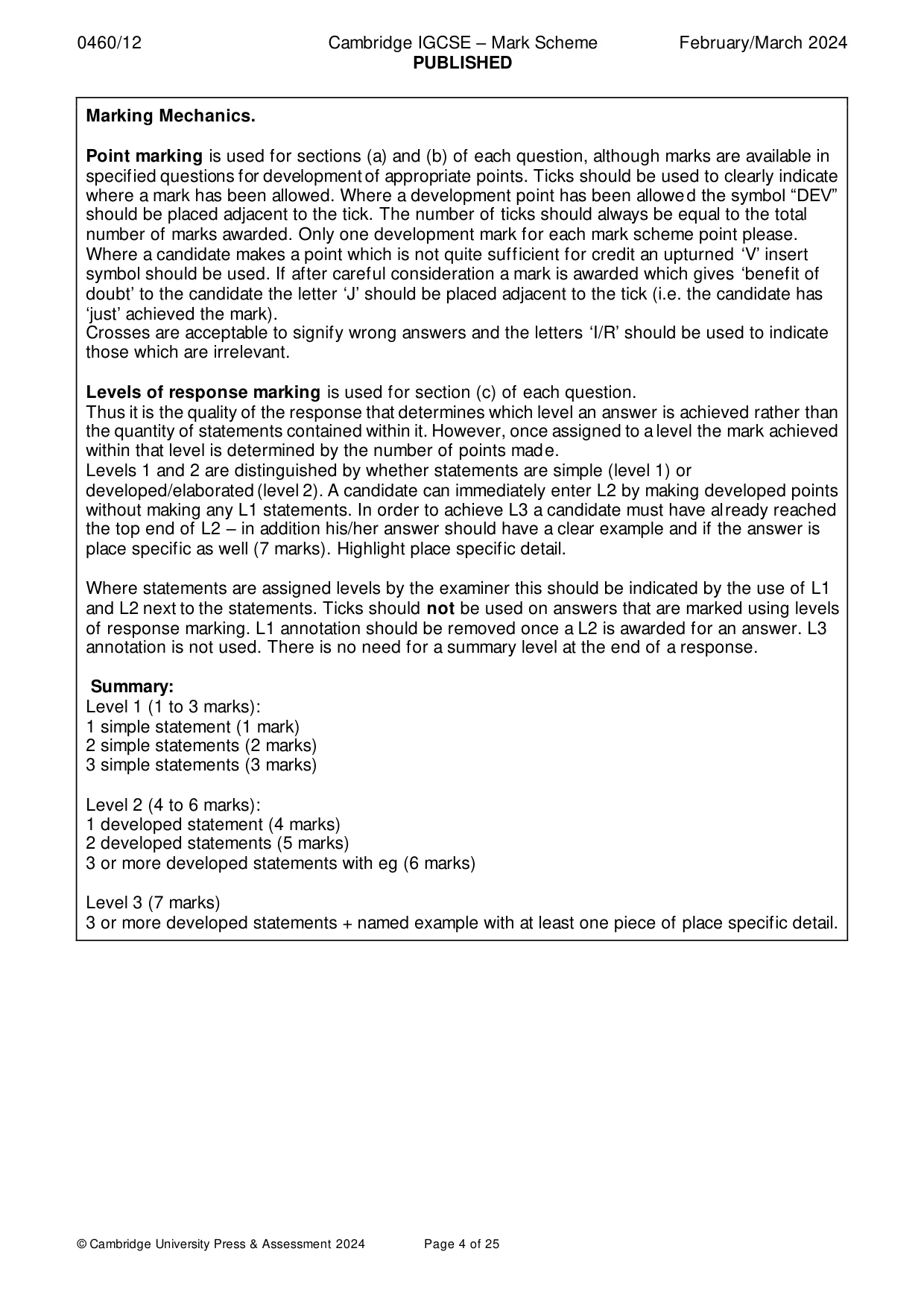
0460/12 Cambridge IGCSE – Mark Scheme PUBLISHED February/March 2024 © Cambridge University Press & Assessment 2024 Page 4 of 25 Marking Mechanics. Point marking is used for sections (a) and (b) of each question, although marks are available in specified questions for development of appropriate points. Ticks should be used to clearly indicate where a mark has been allowed. Where a development point has been allowed the symbol “DEV” should be placed adjacent to the tick. The number of ticks should always be equal to the total number of marks awarded. Only one development mark for each mark scheme point please. Where a candidate makes a point which is not quite sufficient for credit an upturned ‘V’ insert symbol should be used. If after careful consideration a mark is awarded which gives ‘benefit of doubt’ to the candidate the letter ‘J’ should be placed adjacent to the tick (i.e. the candidate has ‘just’ achieved the mark). Crosses are acceptable to signify wrong answers and the letters ‘I/R’ should be used to indicate those which are irrelevant. Levels of response marking is used for section (c) of each question. Thus it is the quality of the response that determines which level an answer is achieved rather than the quantity of statements contained within it. However, once assigned to a level the mark achieved within that level is determined by the number of points made. Levels 1 and 2 are distinguished by whether statements are simple (level 1) or developed/elaborated (level 2). A candidate can immediately enter L2 by making developed points without making any L1 statements. In order to achieve L3 a candidate must have already reached the top end of L2 – in addition his/her answer should have a clear example and if the answer is place specific as well (7 marks). Highlight place specific detail. Where statements are assigned levels by the examiner this should be indicated by the use of L1 and L2 next to the statements. Ticks should not be used on answers that are marked using levels of response marking. L1 annotation should be removed once a L2 is awarded for an answer. L3 annotation is not used. There is no need for a summary level at the end of a response. Summary: Level 1 (1 to 3 marks): 1 simple statement (1 mark) 2 simple statements (2 marks) 3 simple statements (3 marks) Level 2 (4 to 6 marks): 1 developed statement (4 marks) 2 developed statements (5 marks) 3 or more developed statements with eg (6 marks) Level 3 (7 marks) 3 or more developed statements + named example with at least one piece of place specific detail.
Mark scheme, page 5
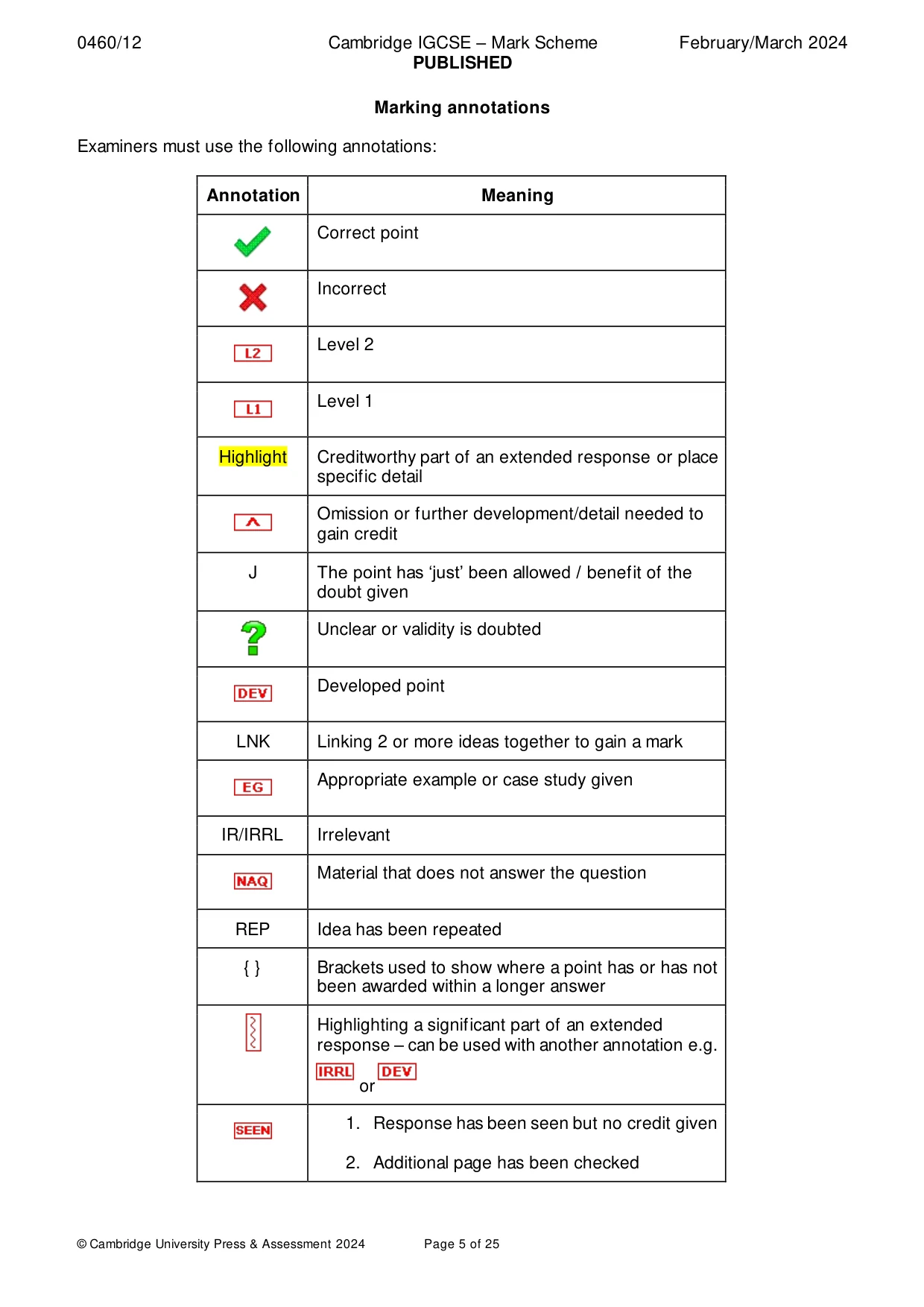
0460/12 Cambridge IGCSE – Mark Scheme PUBLISHED February/March 2024 © Cambridge University Press & Assessment 2024 Page 5 of 25 Marking annotations Examiners must use the following annotations: Annotation Meaning Correct point Incorrect Level 2 Level 1 Highlight Creditworthy part of an extended response or place specific detail Omission or further development/detail needed to gain credit J The point has ‘just’ been allowed / benefit of the doubt given Unclear or validity is doubted Developed point LNK Linking 2 or more ideas together to gain a mark Appropriate example or case study given IR/IRRL Irrelevant Material that does not answer the question REP Idea has been repeated { } Brackets used to show where a point has or has not been awarded within a longer answer Highlighting a significant part of an extended response – can be used with another annotation e.g. or 1. Response has been seen but no credit given 2. Additional page has been checked
Mark scheme, page 6
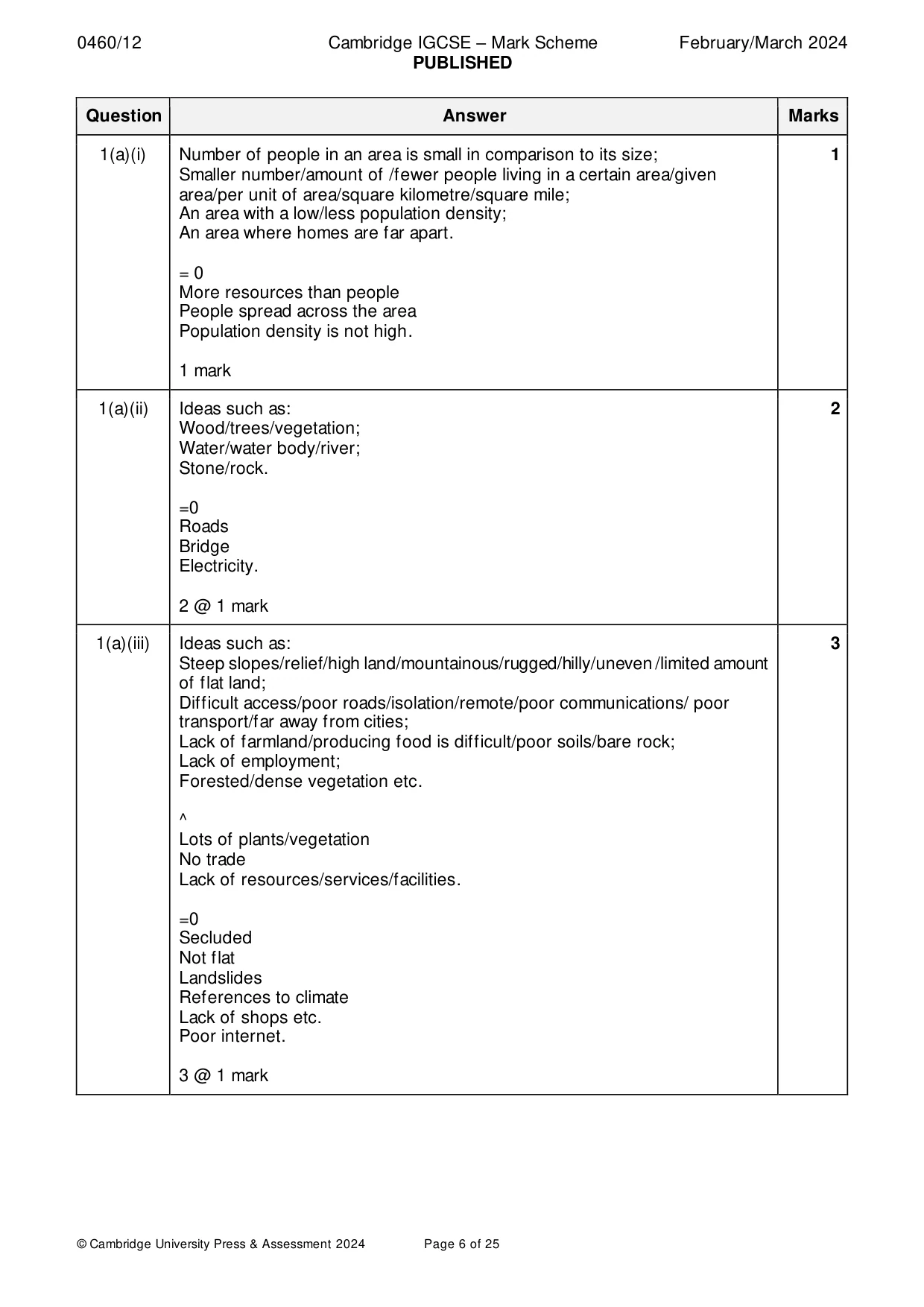
0460/12 Cambridge IGCSE – Mark Scheme PUBLISHED February/March 2024 © Cambridge University Press & Assessment 2024 Page 6 of 25 Question Answer Marks 1(a)(i) Number of people in an area is small in comparison to its size; Smaller number/amount of /fewer people living in a certain area/given area/per unit of area/square kilometre/square mile; An area with a low/less population density; An area where homes are far apart. = 0 More resources than people People spread across the area Population density is not high. 1 mark 1 1(a)(ii) Ideas such as: Wood/trees/vegetation; Water/water body/river; Stone/rock. =0 Roads Bridge Electricity. 2 @ 1 mark 2 1(a)(iii) Ideas such as: Steep slopes/relief/high land/mountainous/rugged/hilly/uneven /limited amount of flat land; Difficult access/poor roads/isolation/remote/poor communications/ poor transport/far away from cities; Lack of farmland/producing food is difficult/poor soils/bare rock; Lack of employment; Forested/dense vegetation etc. ^ Lots of plants/vegetation No trade Lack of resources/services/facilities. =0 Secluded Not flat Landslides References to climate Lack of shops etc. Poor internet. 3 @ 1 mark 3
Mark scheme, page 7
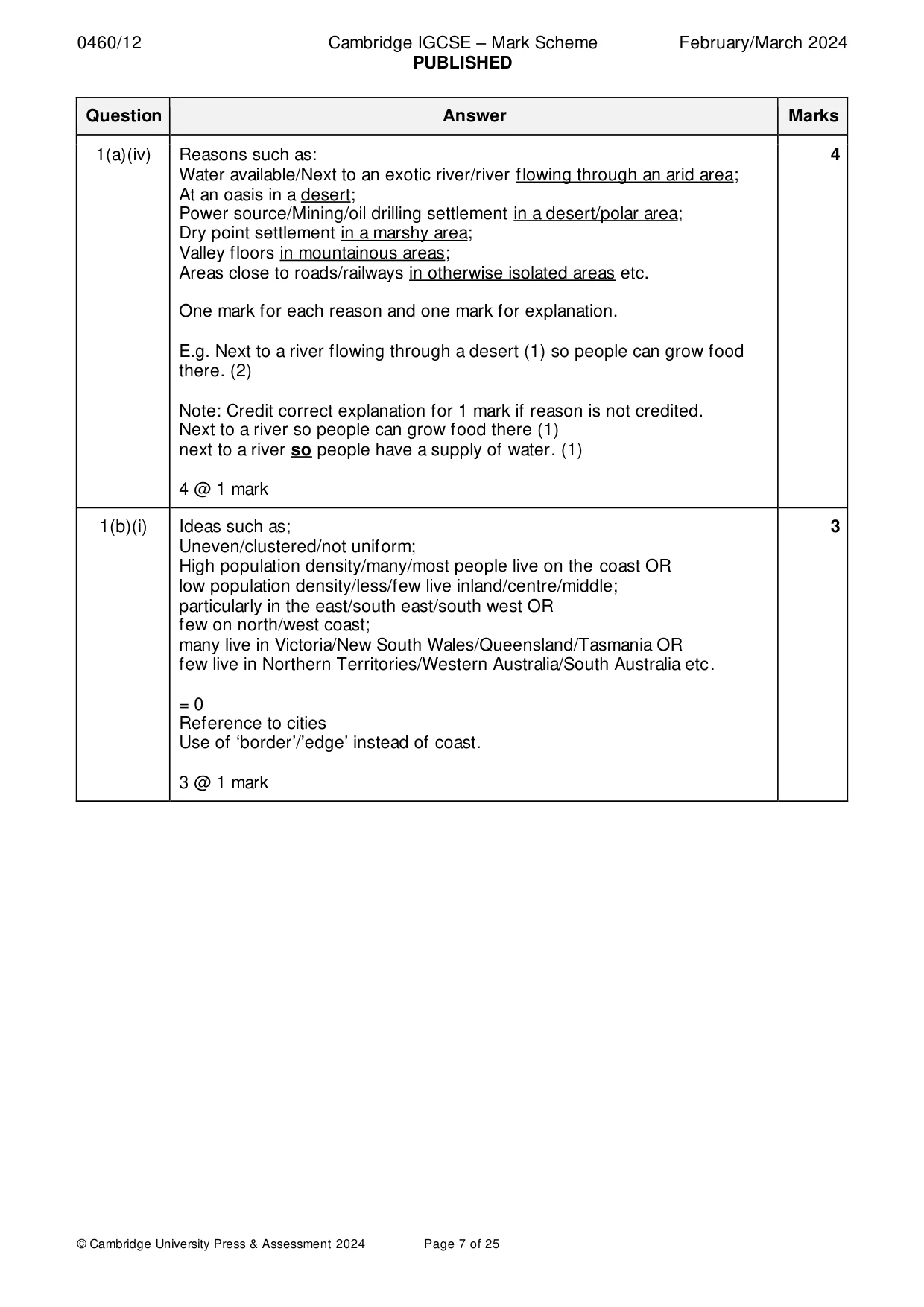
0460/12 Cambridge IGCSE – Mark Scheme PUBLISHED February/March 2024 © Cambridge University Press & Assessment 2024 Page 7 of 25 Question Answer Marks 1(a)(iv) Reasons such as: Water available/Next to an exotic river/river flowing through an arid area; At an oasis in a desert; Power source/Mining/oil drilling settlement in a desert/polar area; Dry point settlement in a marshy area; Valley floors in mountainous areas; Areas close to roads/railways in otherwise isolated areas etc. One mark for each reason and one mark for explanation. E.g. Next to a river flowing through a desert (1) so people can grow food there. (2) Note: Credit correct explanation for 1 mark if reason is not credited. Next to a river so people can grow food there (1) next to a river so people have a supply of water. (1) 4 @ 1 mark 4 1(b)(i) Ideas such as; Uneven/clustered/not uniform; High population density/many/most people live on the coast OR low population density/less/few live inland/centre/middle; particularly in the east/south east/south west OR few on north/west coast; many live in Victoria/New South Wales/Queensland/Tasmania OR few live in Northern Territories/Western Australia/South Australia etc. = 0 Reference to cities Use of ‘border’/’edge’ instead of coast. 3 @ 1 mark 3
Mark scheme, page 8
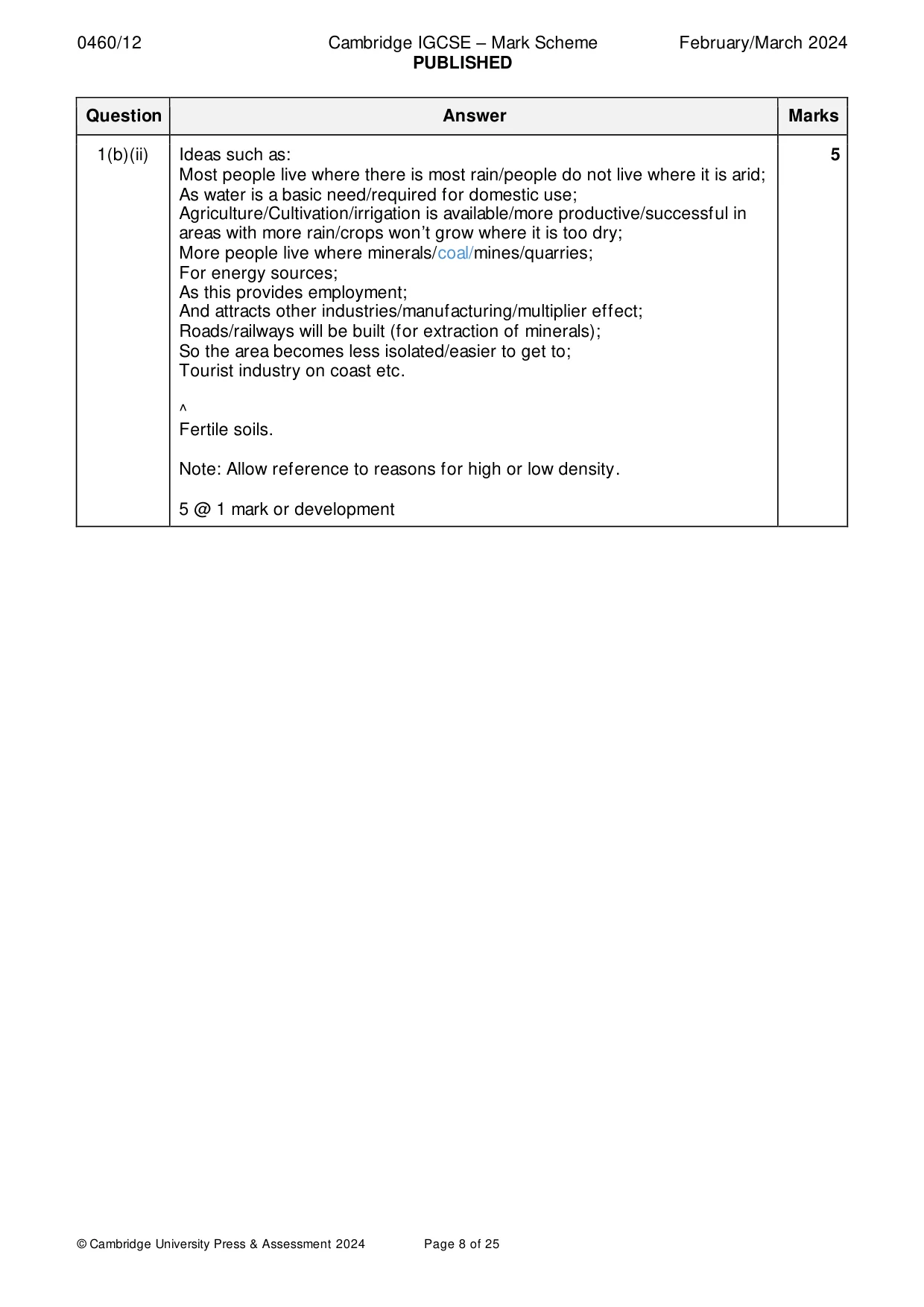
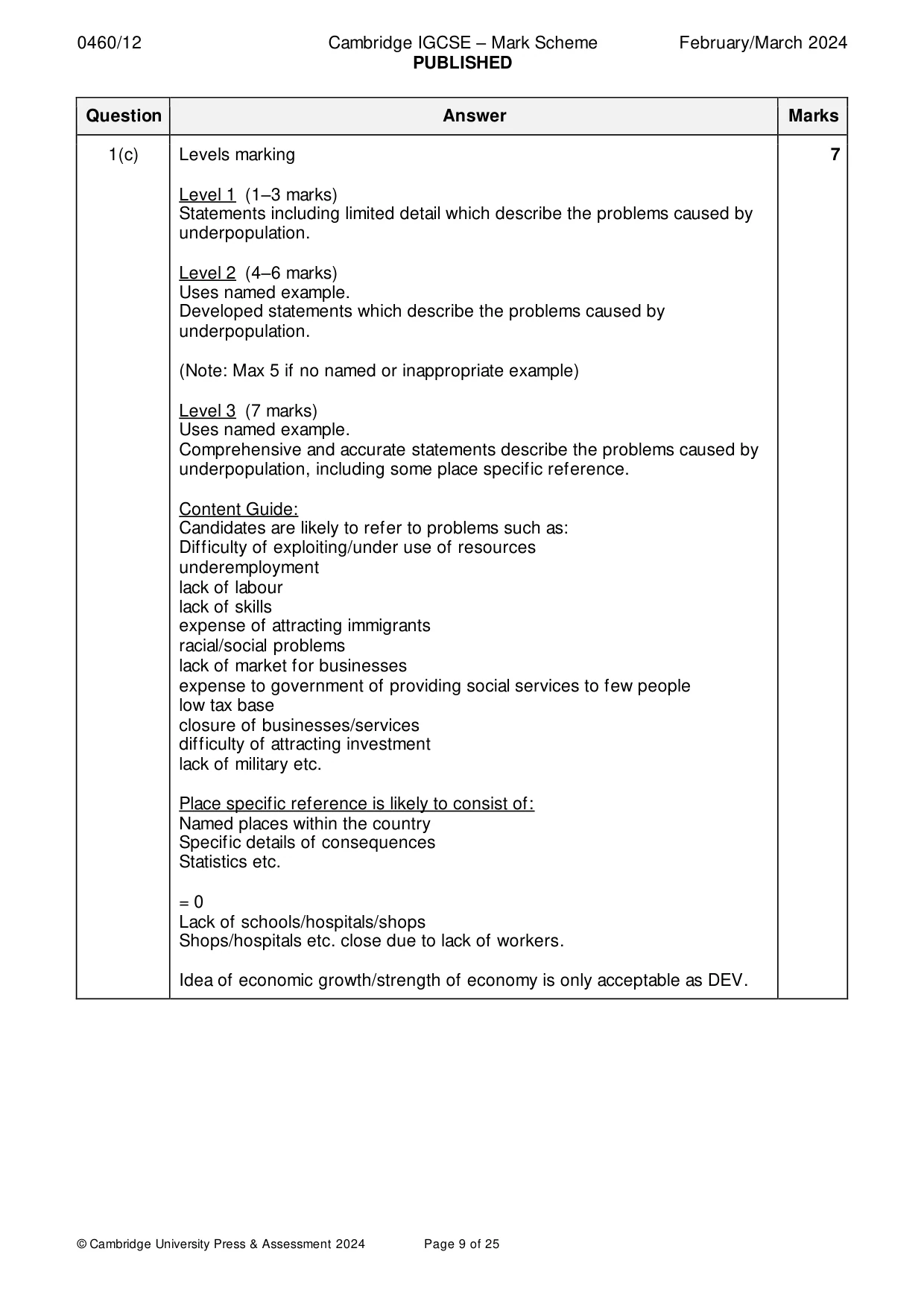
0460/12 Cambridge IGCSE – Mark Scheme PUBLISHED February/March 2024 © Cambridge University Press & Assessment 2024 Page 8 of 25 Question Answer Marks 1(b)(ii) Ideas such as: Most people live where there is most rain/people do not live where it is arid; As water is a basic need/required for domestic use; Agriculture/Cultivation/irrigation is available/more productive/successful in areas with more rain/crops won’t grow where it is too dry; More people live where minerals/coal/mines/quarries; For energy sources; As this provides employment; And attracts other industries/manufacturing/multiplier effect; Roads/railways will be built (for extraction of minerals); So the area becomes less isolated/easier to get to; Tourist industry on coast etc. ^ Fertile soils. Note: Allow reference to reasons for high or low density. 5 @ 1 mark or development 5
Mark scheme, page 9
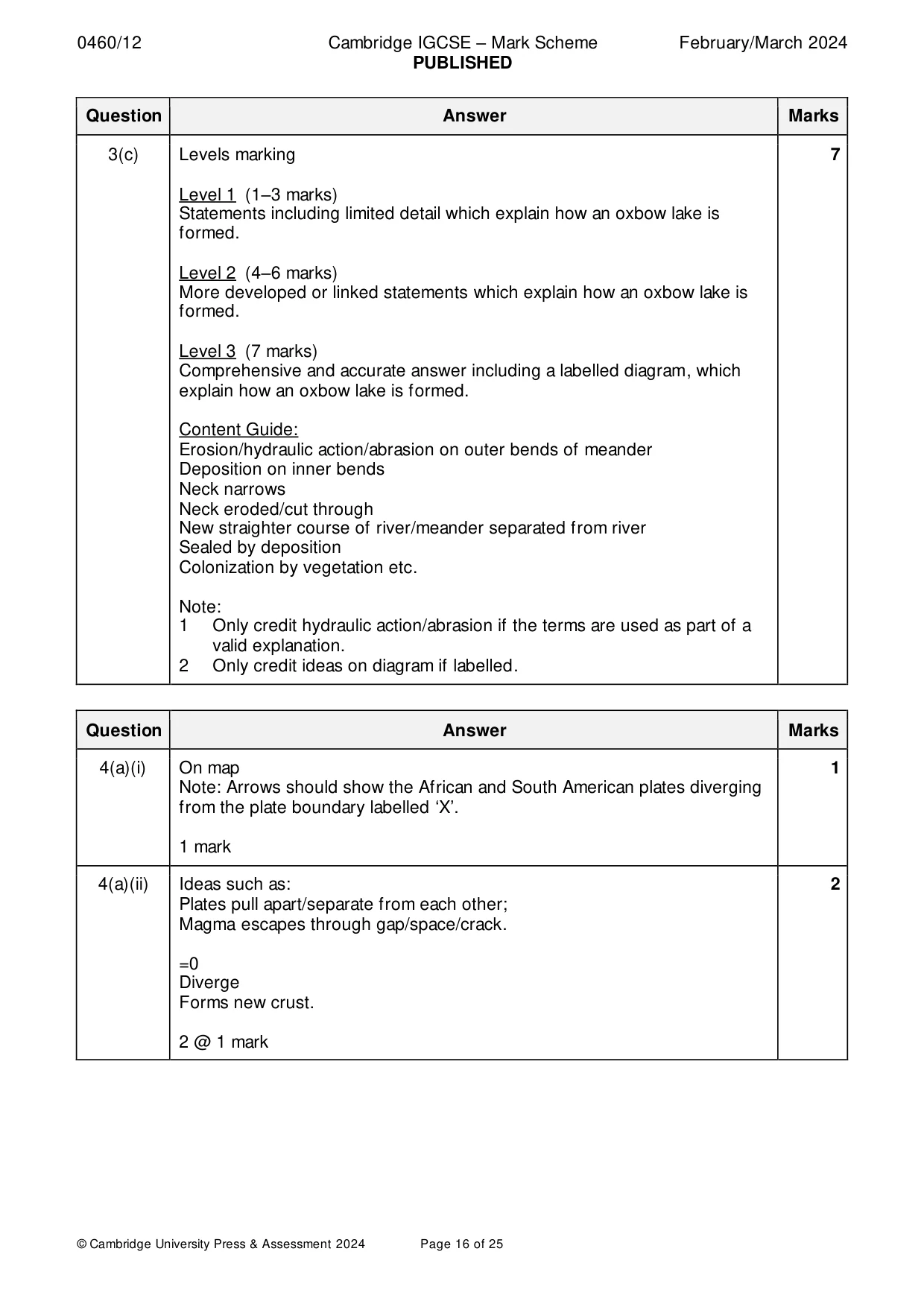
0460/12 Cambridge IGCSE – Mark Scheme PUBLISHED February/March 2024 © Cambridge University Press & Assessment 2024 Page 9 of 25 Question Answer Marks 1(c) Levels marking Level 1 (1–3 marks) Statements including limited detail which describe the problems caused by underpopulation. Level 2 (4–6 marks) Uses named example. Developed statements which describe the problems caused by underpopulation. (Note: Max 5 if no named or inappropriate example) Level 3 (7 marks) Uses named example. Comprehensive and accurate statements describe the problems caused by underpopulation, including some place specific reference. Content Guide: Candidates are likely to refer to problems such as: Difficulty of exploiting/under use of resources underemployment lack of labour lack of skills expense of attracting immigrants racial/social problems lack of market for businesses expense to government of providing social services to few people low tax base closure of businesses/services difficulty of attracting investment lack of military etc. Place specific reference is likely to consist of: Named places within the country Specific details of consequences Statistics etc. = 0 Lack of schools/hospitals/shops Shops/hospitals etc. close due to lack of workers. Idea of economic growth/strength of economy is only acceptable as DEV. 7
Mark scheme, page 10
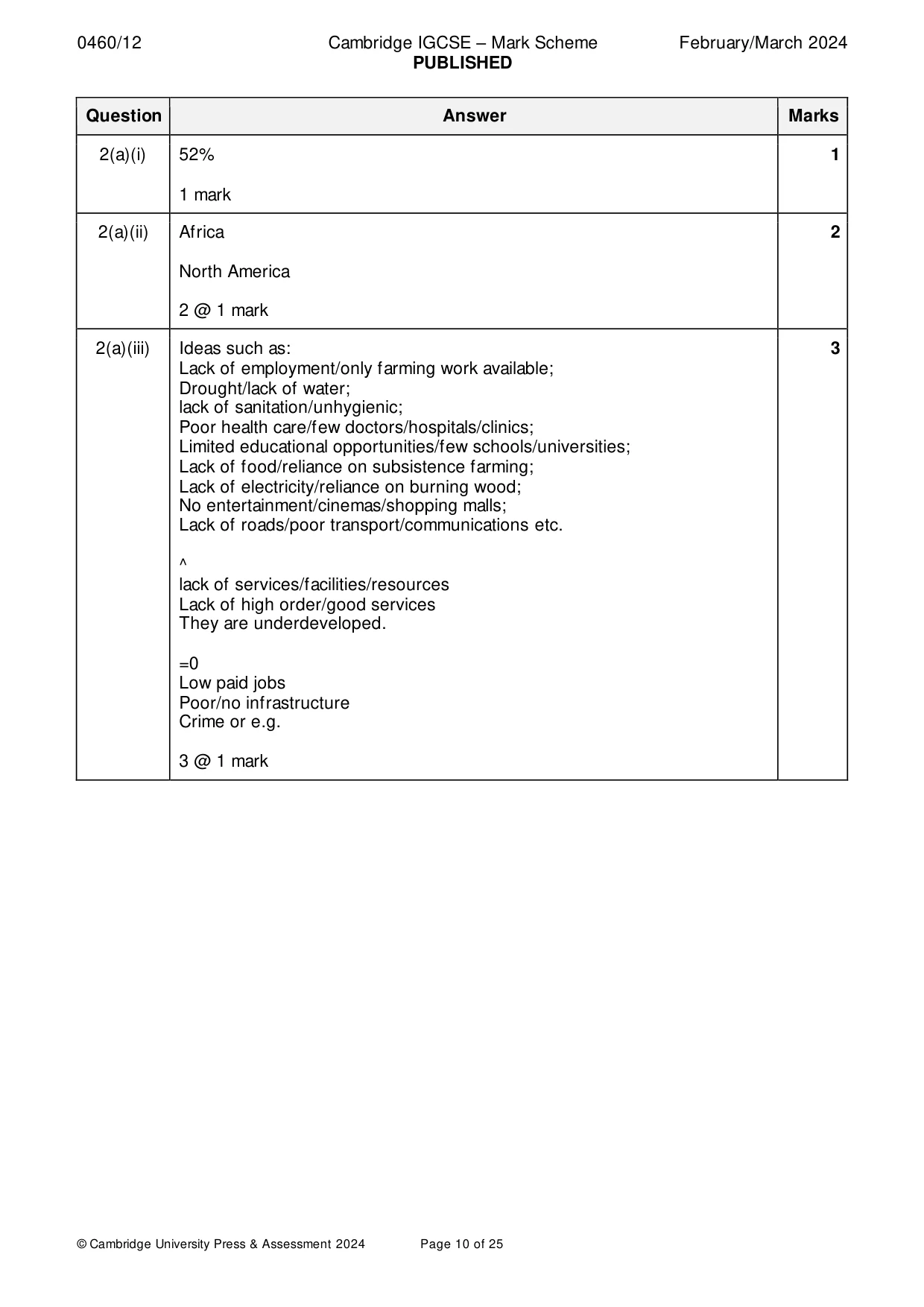
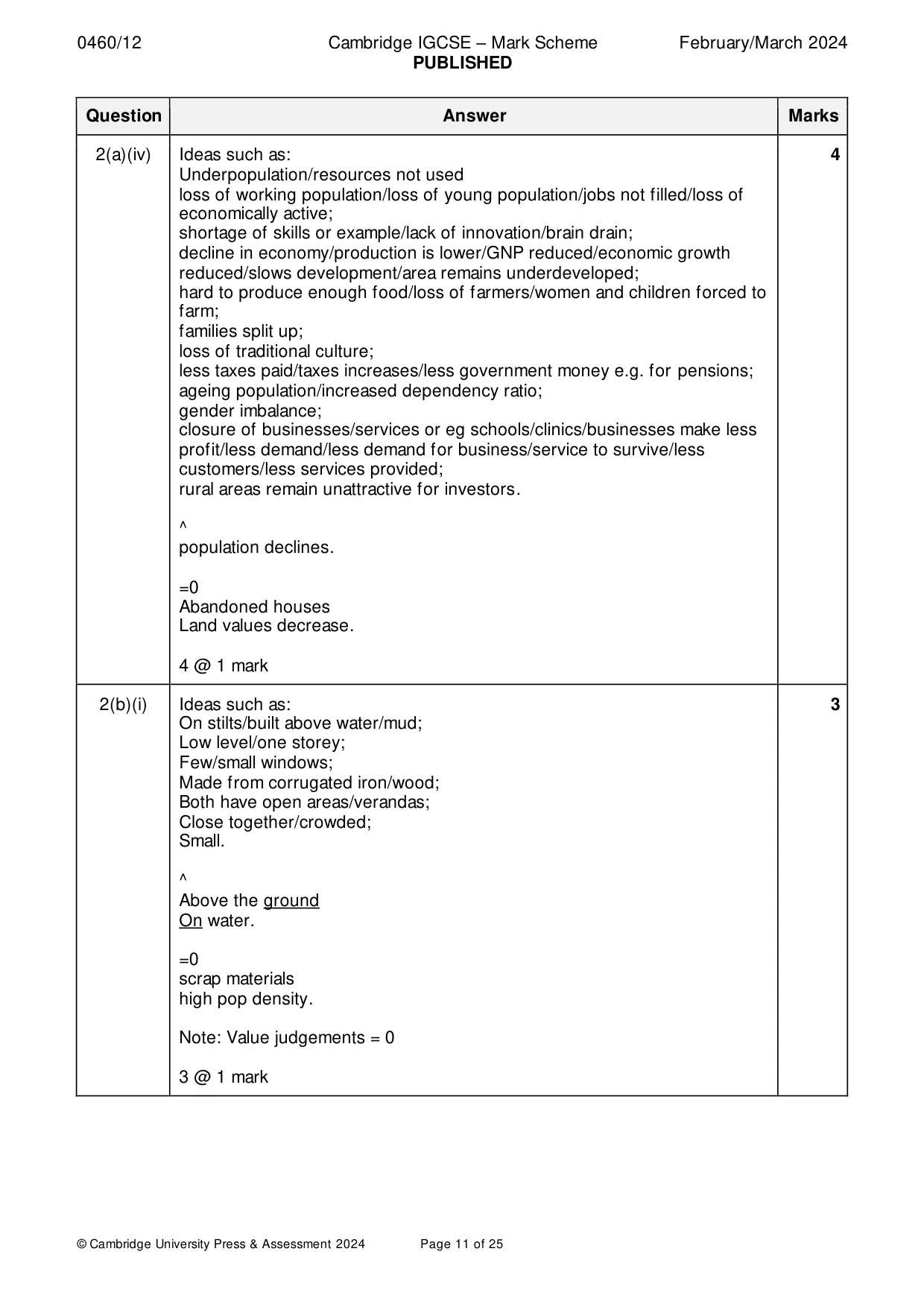
0460/12 Cambridge IGCSE – Mark Scheme PUBLISHED February/March 2024 © Cambridge University Press & Assessment 2024 Page 10 of 25 Question Answer Marks 2(a)(i) 52% 1 mark 1 2(a)(ii) Africa North America 2 @ 1 mark 2 2(a)(iii) Ideas such as: Lack of employment/only farming work available; Drought/lack of water; lack of sanitation/unhygienic; Poor health care/few doctors/hospitals/clinics; Limited educational opportunities/few schools/universities; Lack of food/reliance on subsistence farming; Lack of electricity/reliance on burning wood; No entertainment/cinemas/shopping malls; Lack of roads/poor transport/communications etc. ^ lack of services/facilities/resources Lack of high order/good services They are underdeveloped. =0 Low paid jobs Poor/no infrastructure Crime or e.g. 3 @ 1 mark 3
Mark scheme, page 11
0460/12 Cambridge IGCSE – Mark Scheme PUBLISHED February/March 2024 © Cambridge University Press & Assessment 2024 Page 11 of 25 Question Answer Marks 2(a)(iv) Ideas such as: Underpopulation/resources not used loss of working population/loss of young population/jobs not filled/loss of economically active; shortage of skills or example/lack of innovation/brain drain; decline in economy/production is lower/GNP reduced/economic growth reduced/slows development/area remains underdeveloped; hard to produce enough food/loss of farmers/women and children forced to farm; families split up; loss of traditional culture; less taxes paid/taxes increases/less government money e.g. for pensions; ageing population/increased dependency ratio; gender imbalance; closure of businesses/services or eg schools/clinics/businesses make less profit/less demand/less demand for business/service to survive/less customers/less services provided; rural areas remain unattractive for investors. ^ population declines. =0 Abandoned houses Land values decrease. 4 @ 1 mark 4 2(b)(i) Ideas such as: On stilts/built above water/mud; Low level/one storey; Few/small windows; Made from corrugated iron/wood; Both have open areas/verandas; Close together/crowded; Small. ^ Above the ground On water. =0 scrap materials high pop density. Note: Value judgements = 0 3 @ 1 mark 3
Mark scheme, page 12
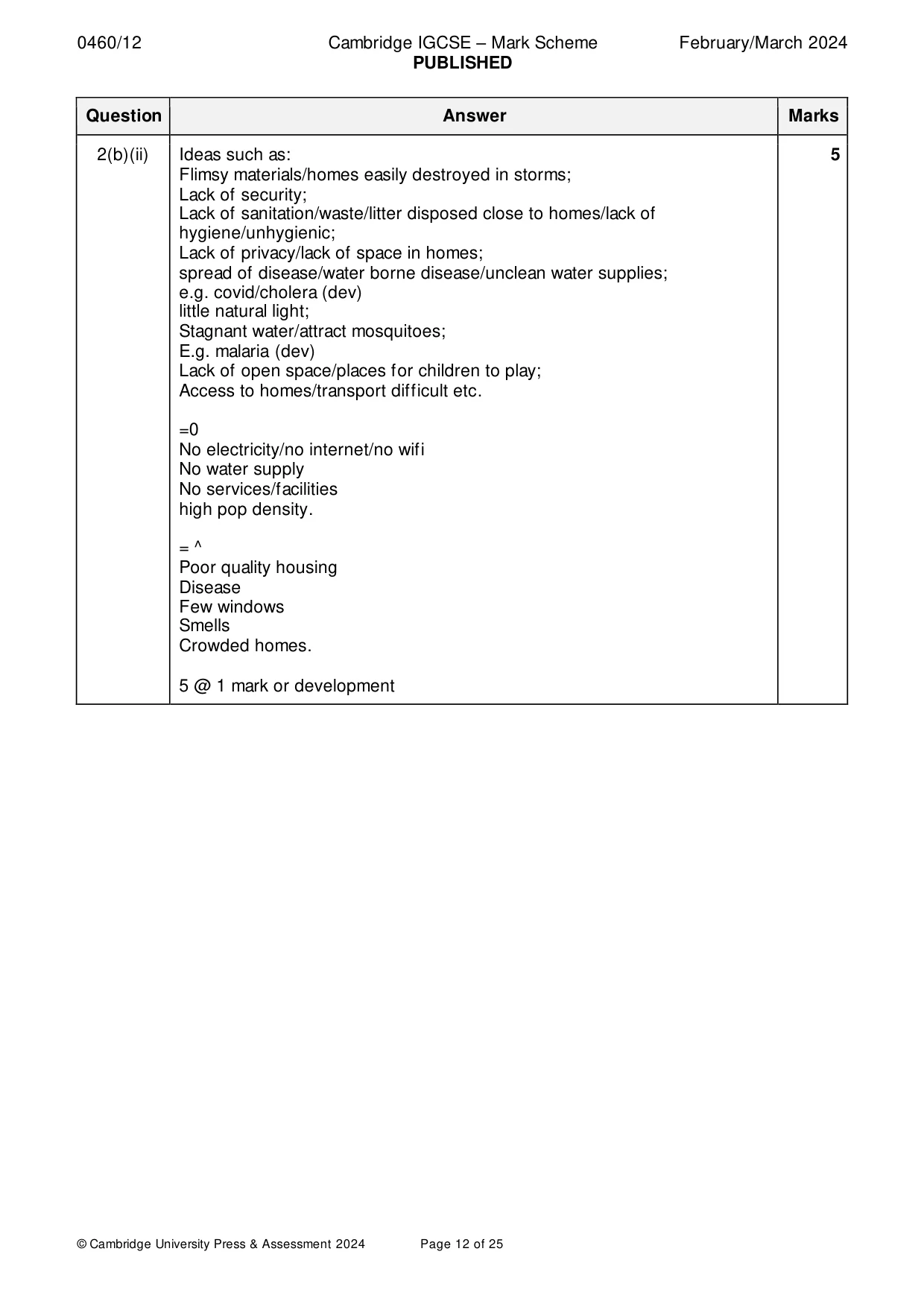
0460/12 Cambridge IGCSE – Mark Scheme PUBLISHED February/March 2024 © Cambridge University Press & Assessment 2024 Page 12 of 25 Question Answer Marks 2(b)(ii) Ideas such as: Flimsy materials/homes easily destroyed in storms; Lack of security; Lack of sanitation/waste/litter disposed close to homes/lack of hygiene/unhygienic; Lack of privacy/lack of space in homes; spread of disease/water borne disease/unclean water supplies; e.g. covid/cholera (dev) little natural light; Stagnant water/attract mosquitoes; E.g. malaria (dev) Lack of open space/places for children to play; Access to homes/transport difficult etc. =0 No electricity/no internet/no wifi No water supply No services/facilities high pop density. = ^ Poor quality housing Disease Few windows Smells Crowded homes. 5 @ 1 mark or development 5
Mark scheme, page 13
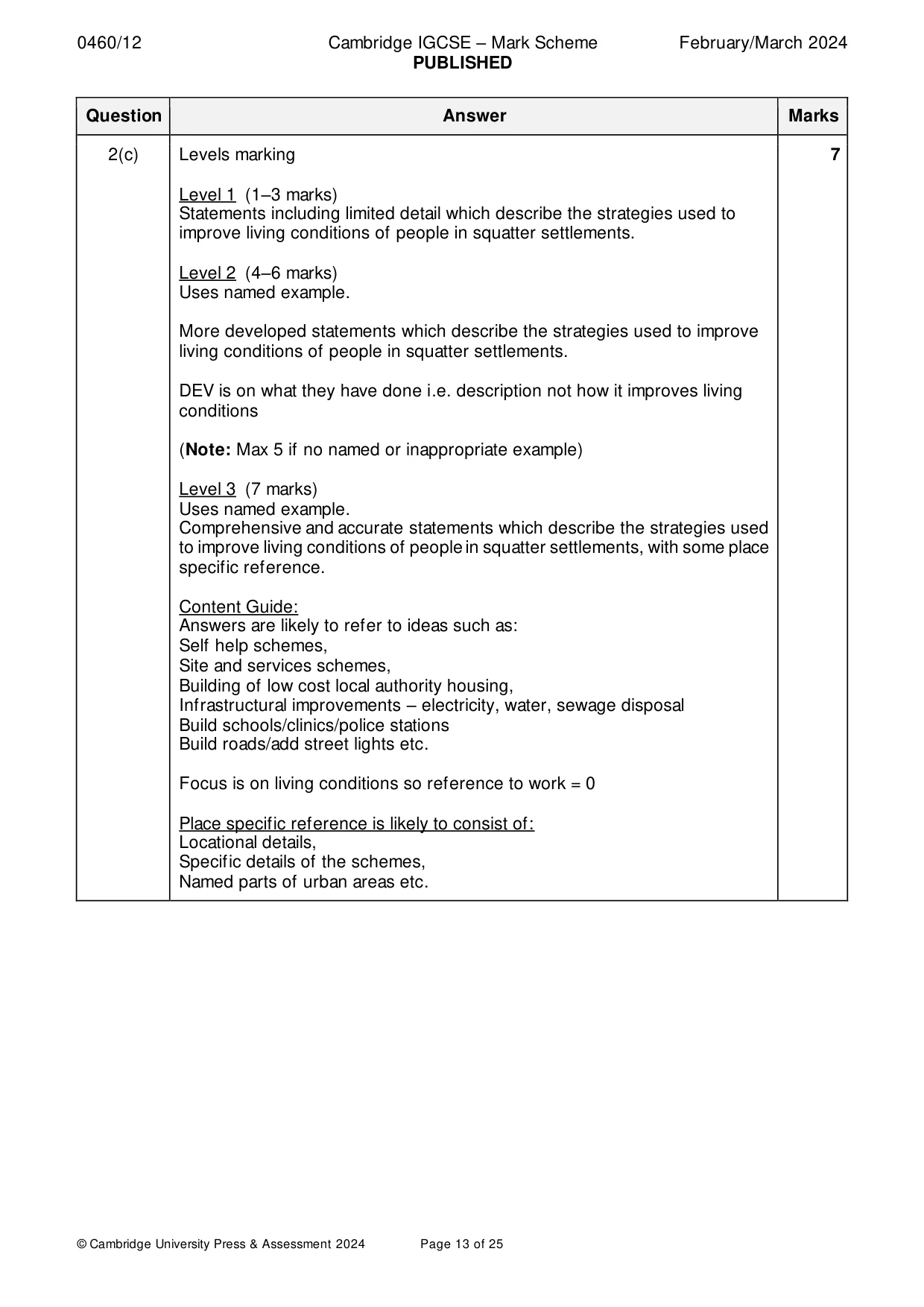
0460/12 Cambridge IGCSE – Mark Scheme PUBLISHED February/March 2024 © Cambridge University Press & Assessment 2024 Page 13 of 25 Question Answer Marks 2(c) Levels marking Level 1 (1–3 marks) Statements including limited detail which describe the strategies used to improve living conditions of people in squatter settlements. Level 2 (4–6 marks) Uses named example. More developed statements which describe the strategies used to improve living conditions of people in squatter settlements. DEV is on what they have done i.e. description not how it improves living conditions (Note: Max 5 if no named or inappropriate example) Level 3 (7 marks) Uses named example. Comprehensive and accurate statements which describe the strategies used to improve living conditions of people in squatter settlements, with some place specific reference. Content Guide: Answers are likely to refer to ideas such as: Self help schemes, Site and services schemes, Building of low cost local authority housing, Infrastructural improvements – electricity, water, sewage disposal Build schools/clinics/police stations Build roads/add street lights etc. Focus is on living conditions so reference to work = 0 Place specific reference is likely to consist of: Locational details, Specific details of the schemes, Named parts of urban areas etc. 7
Mark scheme, page 14
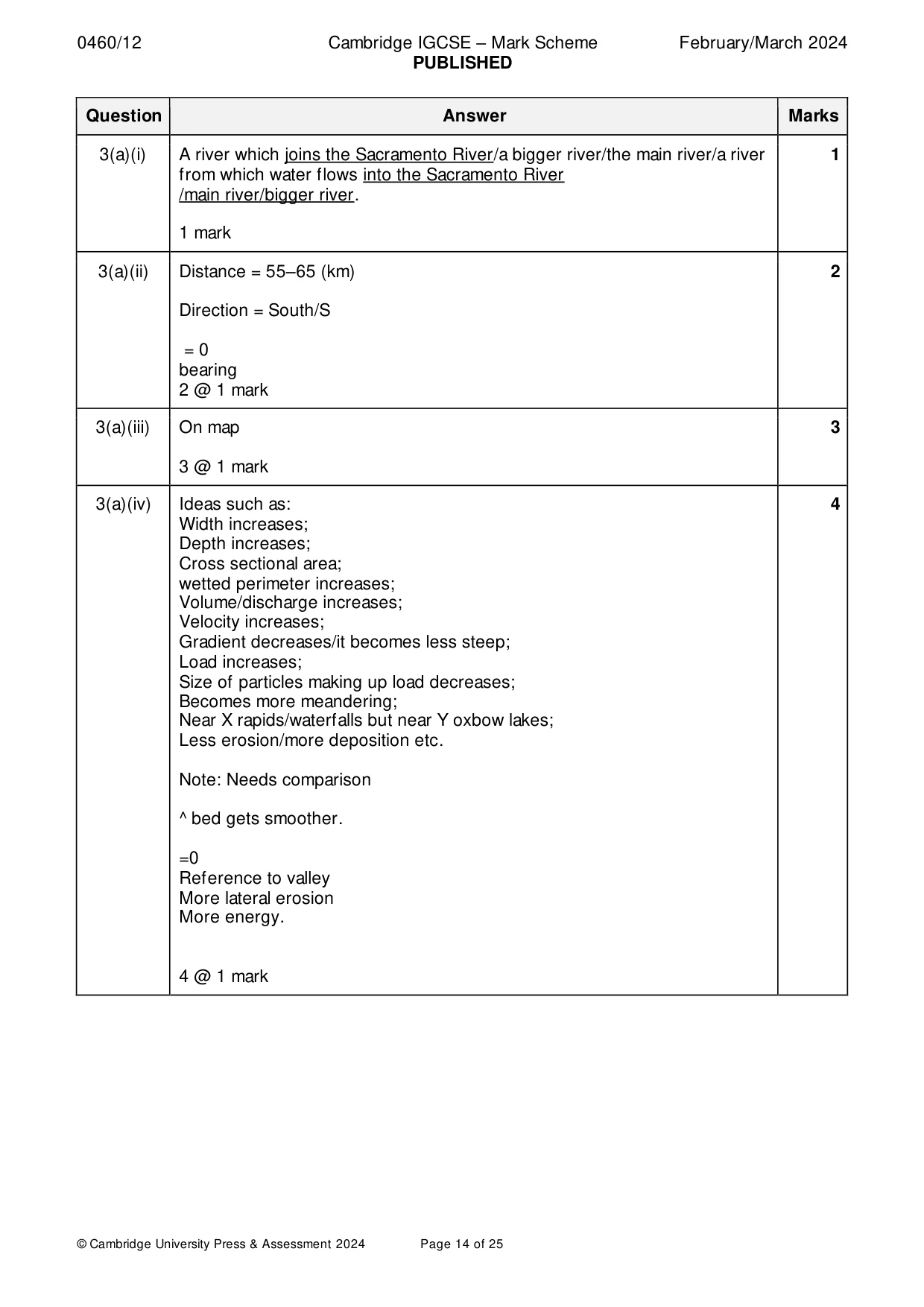
0460/12 Cambridge IGCSE – Mark Scheme PUBLISHED February/March 2024 © Cambridge University Press & Assessment 2024 Page 14 of 25 Question Answer Marks 3(a)(i) A river which joins the Sacramento River/a bigger river/the main river/a river from which water flows into the Sacramento River /main river/bigger river. 1 mark 1 3(a)(ii) Distance = 55–65 (km) Direction = South/S = 0 bearing 2 @ 1 mark 2 3(a)(iii) On map 3 @ 1 mark 3 3(a)(iv) Ideas such as: Width increases; Depth increases; Cross sectional area; wetted perimeter increases; Volume/discharge increases; Velocity increases; Gradient decreases/it becomes less steep; Load increases; Size of particles making up load decreases; Becomes more meandering; Near X rapids/waterfalls but near Y oxbow lakes; Less erosion/more deposition etc. Note: Needs comparison ^ bed gets smoother. =0 Reference to valley More lateral erosion More energy. 4 @ 1 mark 4
Mark scheme, page 15
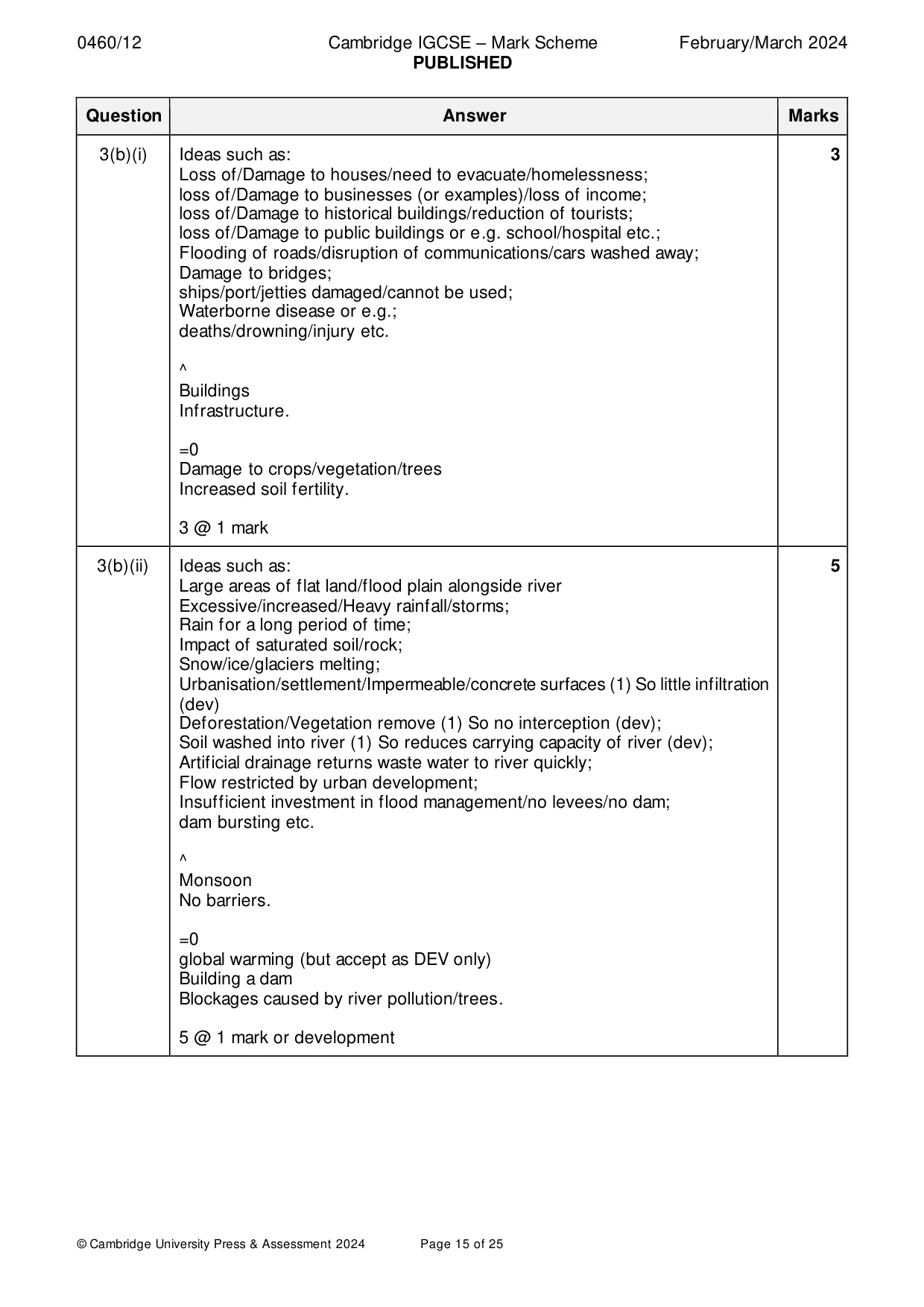
0460/12 Cambridge IGCSE – Mark Scheme PUBLISHED February/March 2024 © Cambridge University Press & Assessment 2024 Page 15 of 25 Question Answer Marks 3(b)(i) Ideas such as: Loss of/Damage to houses/need to evacuate/homelessness; loss of/Damage to businesses (or examples)/loss of income; loss of/Damage to historical buildings/reduction of tourists; loss of/Damage to public buildings or e.g. school/hospital etc.; Flooding of roads/disruption of communications/cars washed away; Damage to bridges; ships/port/jetties damaged/cannot be used; Waterborne disease or e.g.; deaths/drowning/injury etc. ^ Buildings Infrastructure. =0 Damage to crops/vegetation/trees Increased soil fertility. 3 @ 1 mark 3 3(b)(ii) Ideas such as: Large areas of flat land/flood plain alongside river Excessive/increased/Heavy rainfall/storms; Rain for a long period of time; Impact of saturated soil/rock; Snow/ice/glaciers melting; Urbanisation/settlement/Impermeable/concrete surfaces (1) So little infiltration (dev) Deforestation/Vegetation remove (1) So no interception (dev); Soil washed into river (1) So reduces carrying capacity of river (dev); Artificial drainage returns waste water to river quickly; Flow restricted by urban development; Insufficient investment in flood management/no levees/no dam; dam bursting etc. ^ Monsoon No barriers. =0 global warming (but accept as DEV only) Building a dam Blockages caused by river pollution/trees. 5 @ 1 mark or development 5
Mark scheme, page 16
0460/12 Cambridge IGCSE – Mark Scheme PUBLISHED February/March 2024 © Cambridge University Press & Assessment 2024 Page 16 of 25 Question Answer Marks 3(c) Levels marking Level 1 (1–3 marks) Statements including limited detail which explain how an oxbow lake is formed. Level 2 (4–6 marks) More developed or linked statements which explain how an oxbow lake is formed. Level 3 (7 marks) Comprehensive and accurate answer including a labelled diagram, which explain how an oxbow lake is formed. Content Guide: Erosion/hydraulic action/abrasion on outer bends of meander Deposition on inner bends Neck narrows Neck eroded/cut through New straighter course of river/meander separated from river Sealed by deposition Colonization by vegetation etc. Note: 1 Only credit hydraulic action/abrasion if the terms are used as part of a valid explanation. 2 Only credit ideas on diagram if labelled. 7 Question Answer Marks 4(a)(i) On map Note: Arrows should show the African and South American plates diverging from the plate boundary labelled ‘X’. 1 mark 1 4(a)(ii) Ideas such as: Plates pull apart/separate from each other; Magma escapes through gap/space/crack. =0 Diverge Forms new crust. 2 @ 1 mark 2
Mark scheme, page 17
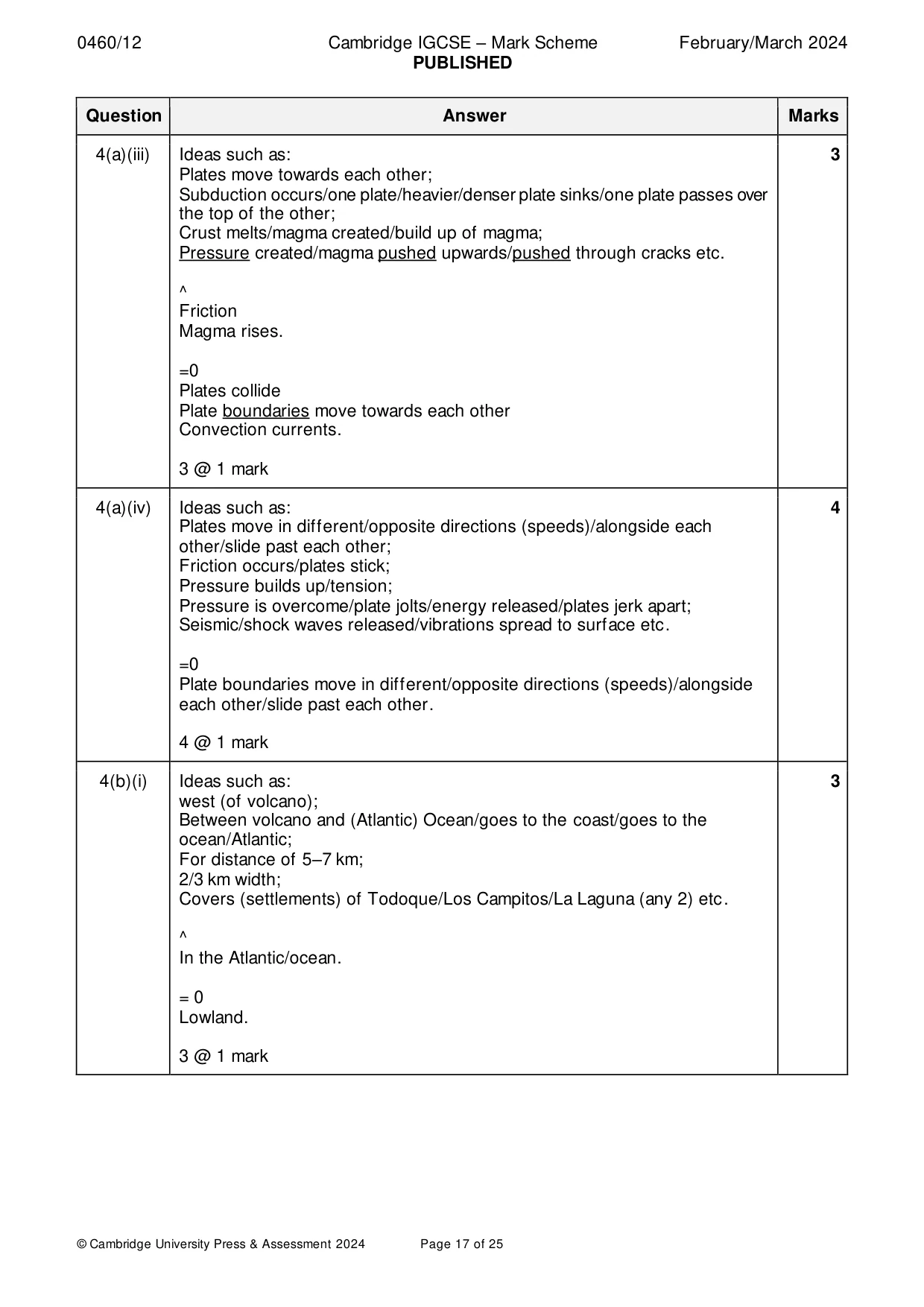
0460/12 Cambridge IGCSE – Mark Scheme PUBLISHED February/March 2024 © Cambridge University Press & Assessment 2024 Page 17 of 25 Question Answer Marks 4(a)(iii) Ideas such as: Plates move towards each other; Subduction occurs/one plate/heavier/denser plate sinks/one plate passes over the top of the other; Crust melts/magma created/build up of magma; Pressure created/magma pushed upwards/pushed through cracks etc. ^ Friction Magma rises. =0 Plates collide Plate boundaries move towards each other Convection currents. 3 @ 1 mark 3 4(a)(iv) Ideas such as: Plates move in different/opposite directions (speeds)/alongside each other/slide past each other; Friction occurs/plates stick; Pressure builds up/tension; Pressure is overcome/plate jolts/energy released/plates jerk apart; Seismic/shock waves released/vibrations spread to surface etc. =0 Plate boundaries move in different/opposite directions (speeds)/alongside each other/slide past each other. 4 @ 1 mark 4 4(b)(i) Ideas such as: west (of volcano); Between volcano and (Atlantic) Ocean/goes to the coast/goes to the ocean/Atlantic; For distance of 5–7 km; 2/3 km width; Covers (settlements) of Todoque/Los Campitos/La Laguna (any 2) etc. ^ In the Atlantic/ocean. = 0 Lowland. 3 @ 1 mark 3
Mark scheme, page 18
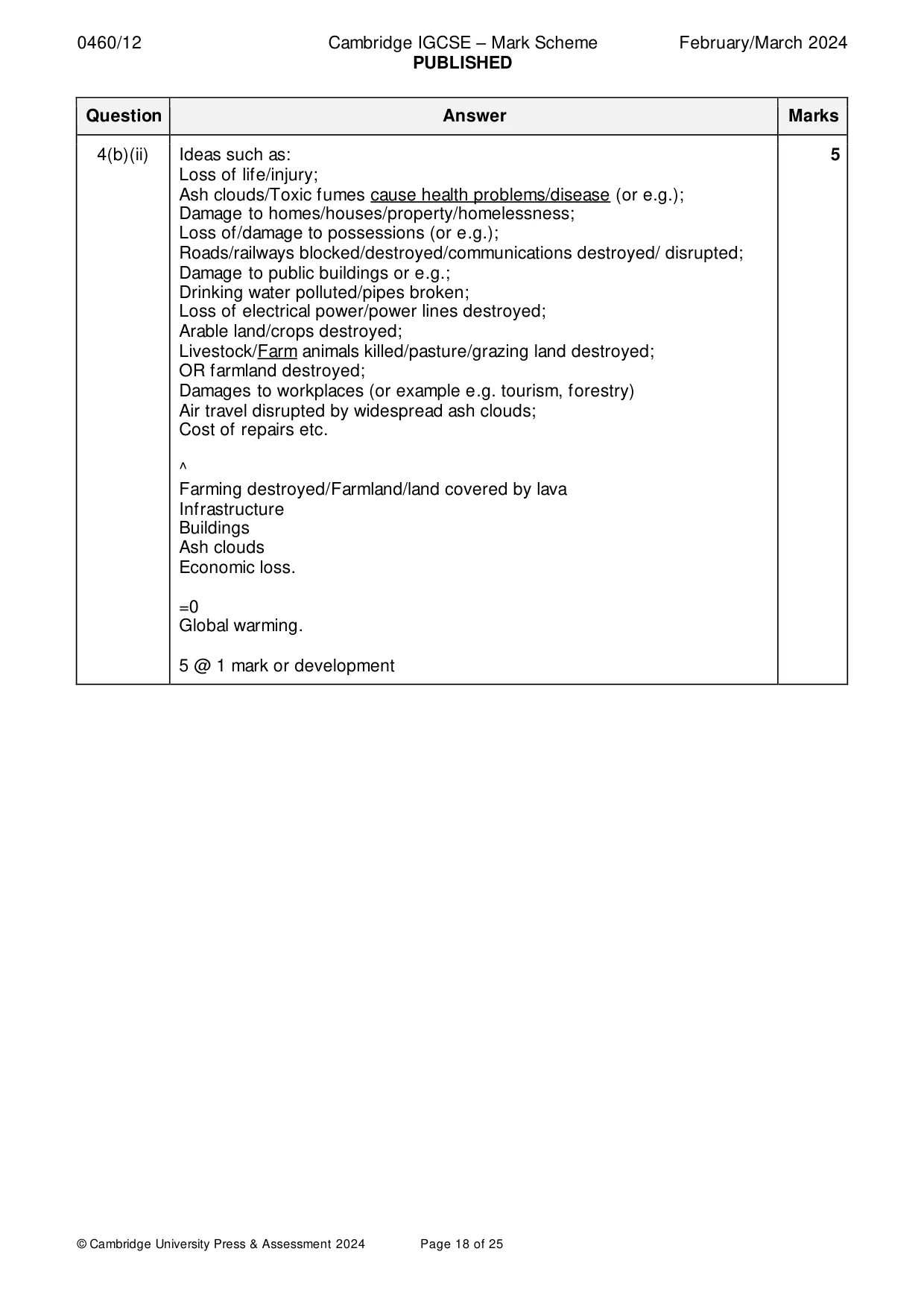
0460/12 Cambridge IGCSE – Mark Scheme PUBLISHED February/March 2024 © Cambridge University Press & Assessment 2024 Page 18 of 25 Question Answer Marks 4(b)(ii) Ideas such as: Loss of life/injury; Ash clouds/Toxic fumes cause health problems/disease (or e.g.); Damage to homes/houses/property/homelessness; Loss of/damage to possessions (or e.g.); Roads/railways blocked/destroyed/communications destroyed/ disrupted; Damage to public buildings or e.g.; Drinking water polluted/pipes broken; Loss of electrical power/power lines destroyed; Arable land/crops destroyed; Livestock/Farm animals killed/pasture/grazing land destroyed; OR farmland destroyed; Damages to workplaces (or example e.g. tourism, forestry) Air travel disrupted by widespread ash clouds; Cost of repairs etc. ^ Farming destroyed/Farmland/land covered by lava Infrastructure Buildings Ash clouds Economic loss. =0 Global warming. 5 @ 1 mark or development 5
Mark scheme, page 19
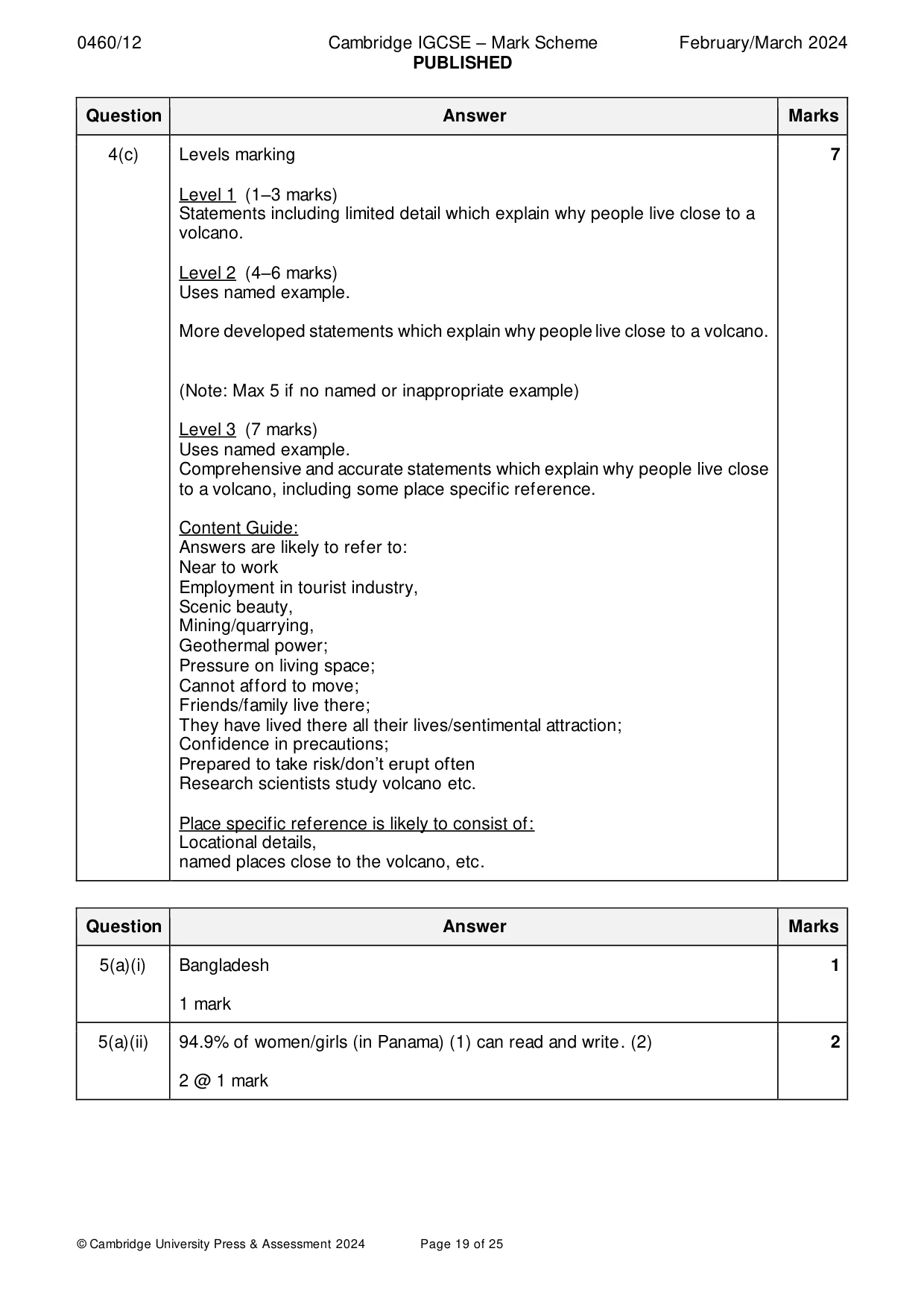
0460/12 Cambridge IGCSE – Mark Scheme PUBLISHED February/March 2024 © Cambridge University Press & Assessment 2024 Page 19 of 25 Question Answer Marks 4(c) Levels marking Level 1 (1–3 marks) Statements including limited detail which explain why people live close to a volcano. Level 2 (4–6 marks) Uses named example. More developed statements which explain why people live close to a volcano. (Note: Max 5 if no named or inappropriate example) Level 3 (7 marks) Uses named example. Comprehensive and accurate statements which explain why people live close to a volcano, including some place specific reference. Content Guide: Answers are likely to refer to: Near to work Employment in tourist industry, Scenic beauty, Mining/quarrying, Geothermal power; Pressure on living space; Cannot afford to move; Friends/family live there; They have lived there all their lives/sentimental attraction; Confidence in precautions; Prepared to take risk/don’t erupt often Research scientists study volcano etc. Place specific reference is likely to consist of: Locational details, named places close to the volcano, etc. 7 Question Answer Marks 5(a)(i) Bangladesh 1 mark 1 5(a)(ii) 94.9% of women/girls (in Panama) (1) can read and write. (2) 2 @ 1 mark 2
Mark scheme, page 20
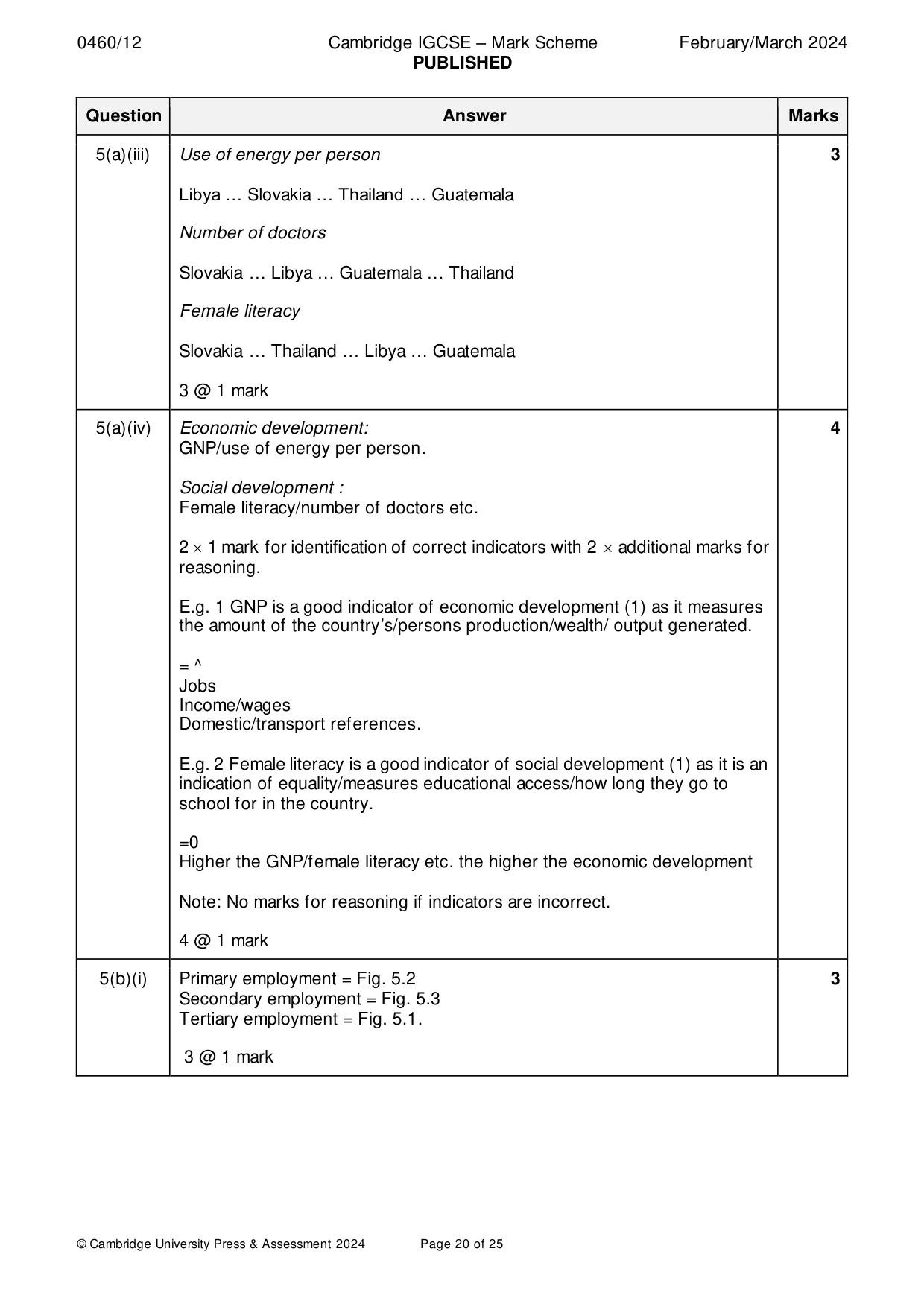
0460/12 Cambridge IGCSE – Mark Scheme PUBLISHED February/March 2024 © Cambridge University Press & Assessment 2024 Page 20 of 25 Question Answer Marks 5(a)(iii) Use of energy per person Libya … Slovakia … Thailand … Guatemala Number of doctors Slovakia … Libya … Guatemala … Thailand Female literacy Slovakia … Thailand … Libya … Guatemala 3 @ 1 mark 3 5(a)(iv) Economic development: GNP/use of energy per person. Social development : Female literacy/number of doctors etc. 2 1 mark for identification of correct indicators with 2 additional marks for reasoning. E.g. 1 GNP is a good indicator of economic development (1) as it measures the amount of the country’s/persons production/wealth/ output generated. = ^ Jobs Income/wages Domestic/transport references. E.g. 2 Female literacy is a good indicator of social development (1) as it is an indication of equality/measures educational access/how long they go to school for in the country. =0 Higher the GNP/female literacy etc. the higher the economic development Note: No marks for reasoning if indicators are incorrect. 4 @ 1 mark 4 5(b)(i) Primary employment = Fig. 5.2 Secondary employment = Fig. 5.3 Tertiary employment = Fig. 5.1. 3 @ 1 mark 3
Mark scheme, page 21
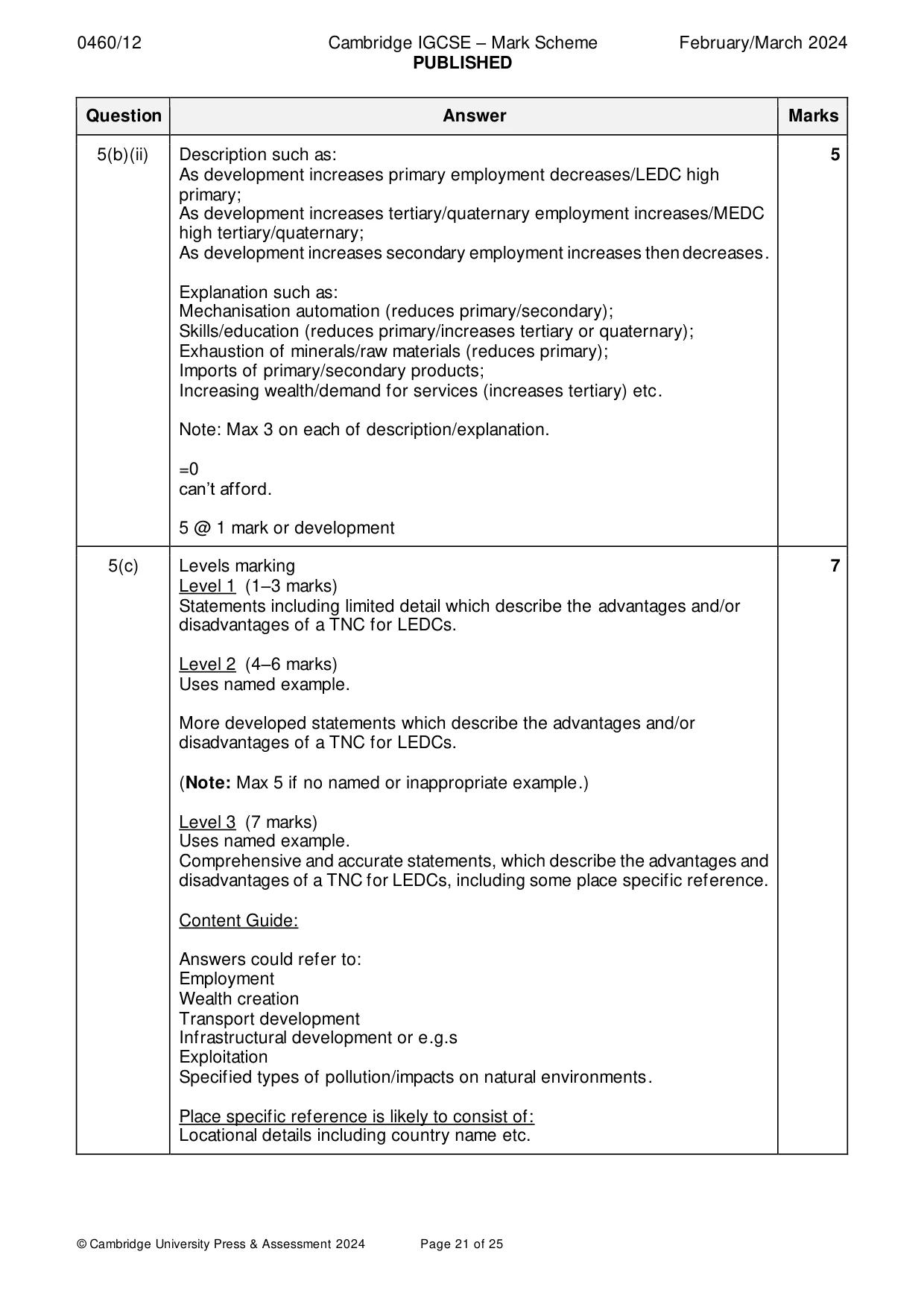
0460/12 Cambridge IGCSE – Mark Scheme PUBLISHED February/March 2024 © Cambridge University Press & Assessment 2024 Page 21 of 25 Question Answer Marks 5(b)(ii) Description such as: As development increases primary employment decreases/LEDC high primary; As development increases tertiary/quaternary employment increases/MEDC high tertiary/quaternary; As development increases secondary employment increases then decreases. Explanation such as: Mechanisation automation (reduces primary/secondary); Skills/education (reduces primary/increases tertiary or quaternary); Exhaustion of minerals/raw materials (reduces primary); Imports of primary/secondary products; Increasing wealth/demand for services (increases tertiary) etc. Note: Max 3 on each of description/explanation. =0 can’t afford. 5 @ 1 mark or development 5 5(c) Levels marking Level 1 (1–3 marks) Statements including limited detail which describe the advantages and/or disadvantages of a TNC for LEDCs. Level 2 (4–6 marks) Uses named example. More developed statements which describe the advantages and/or disadvantages of a TNC for LEDCs. (Note: Max 5 if no named or inappropriate example.) Level 3 (7 marks) Uses named example. Comprehensive and accurate statements, which describe the advantages and disadvantages of a TNC for LEDCs, including some place specific reference. Content Guide: Answers could refer to: Employment Wealth creation Transport development Infrastructural development or e.g.s Exploitation Specified types of pollution/impacts on natural environments. Place specific reference is likely to consist of: Locational details including country name etc. 7
Mark scheme, page 22
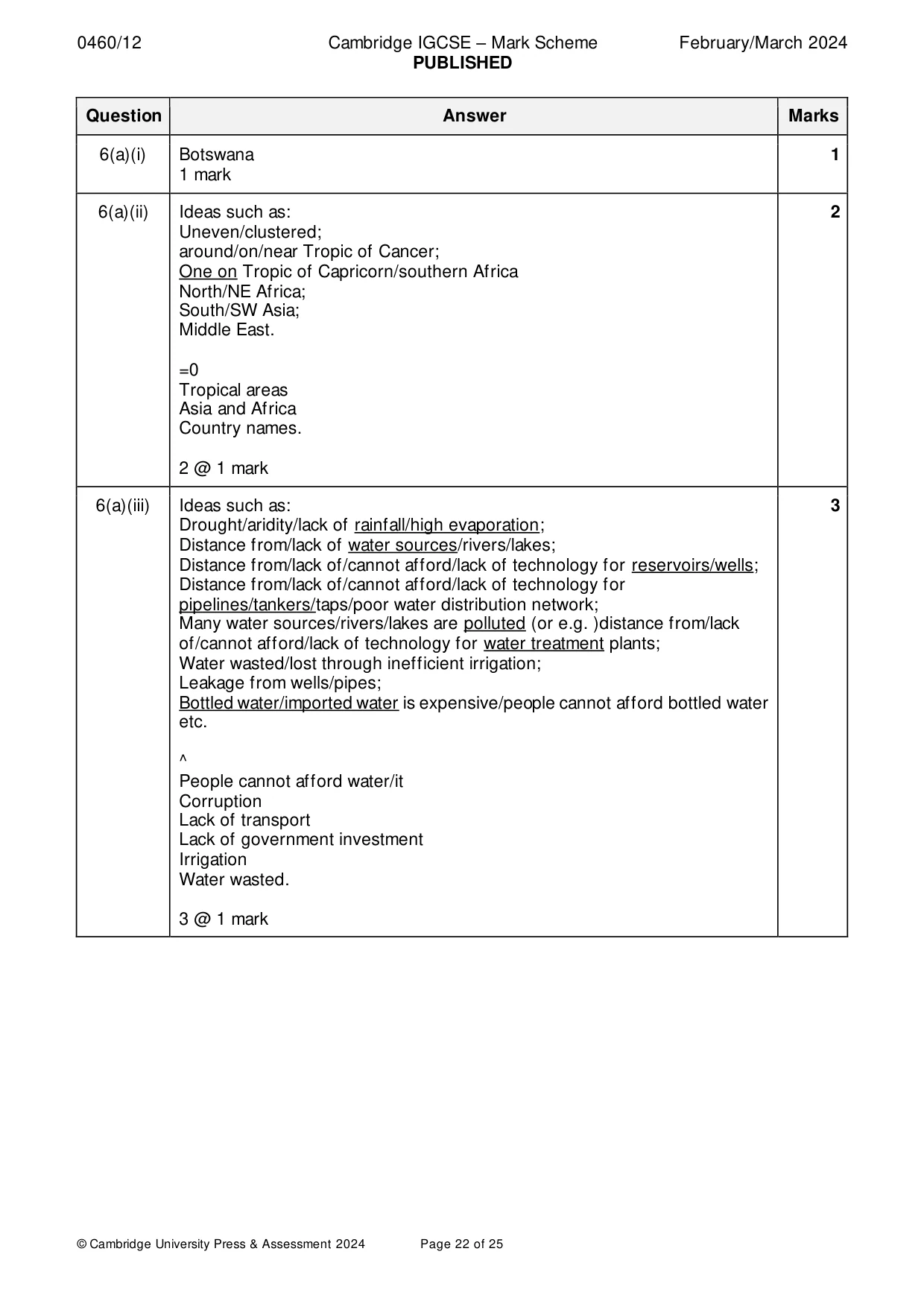
0460/12 Cambridge IGCSE – Mark Scheme PUBLISHED February/March 2024 © Cambridge University Press & Assessment 2024 Page 22 of 25 Question Answer Marks 6(a)(i) Botswana 1 mark 1 6(a)(ii) Ideas such as: Uneven/clustered; around/on/near Tropic of Cancer; One on Tropic of Capricorn/southern Africa North/NE Africa; South/SW Asia; Middle East. =0 Tropical areas Asia and Africa Country names. 2 @ 1 mark 2 6(a)(iii) Ideas such as: Drought/aridity/lack of rainfall/high evaporation; Distance from/lack of water sources/rivers/lakes; Distance from/lack of/cannot afford/lack of technology for reservoirs/wells; Distance from/lack of/cannot afford/lack of technology for pipelines/tankers/taps/poor water distribution network; Many water sources/rivers/lakes are polluted (or e.g. )distance from/lack of/cannot afford/lack of technology for water treatment plants; Water wasted/lost through inefficient irrigation; Leakage from wells/pipes; Bottled water/imported water is expensive/people cannot afford bottled water etc. ^ People cannot afford water/it Corruption Lack of transport Lack of government investment Irrigation Water wasted. 3 @ 1 mark 3
Mark scheme, page 23
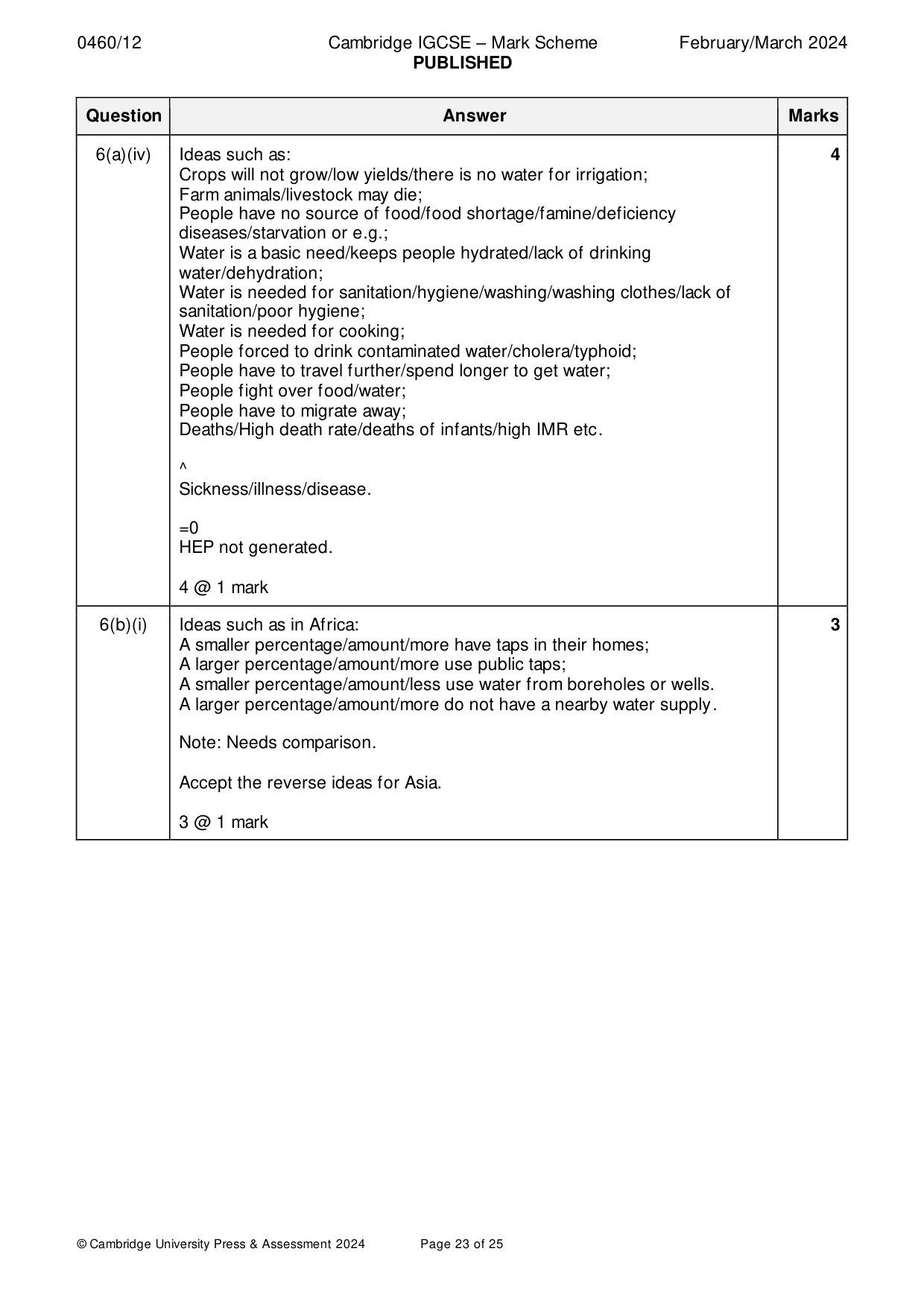
0460/12 Cambridge IGCSE – Mark Scheme PUBLISHED February/March 2024 © Cambridge University Press & Assessment 2024 Page 23 of 25 Question Answer Marks 6(a)(iv) Ideas such as: Crops will not grow/low yields/there is no water for irrigation; Farm animals/livestock may die; People have no source of food/food shortage/famine/deficiency diseases/starvation or e.g.; Water is a basic need/keeps people hydrated/lack of drinking water/dehydration; Water is needed for sanitation/hygiene/washing/washing clothes/lack of sanitation/poor hygiene; Water is needed for cooking; People forced to drink contaminated water/cholera/typhoid; People have to travel further/spend longer to get water; People fight over food/water; People have to migrate away; Deaths/High death rate/deaths of infants/high IMR etc. ^ Sickness/illness/disease. =0 HEP not generated. 4 @ 1 mark 4 6(b)(i) Ideas such as in Africa: A smaller percentage/amount/more have taps in their homes; A larger percentage/amount/more use public taps; A smaller percentage/amount/less use water from boreholes or wells. A larger percentage/amount/more do not have a nearby water supply. Note: Needs comparison. Accept the reverse ideas for Asia. 3 @ 1 mark 3
Mark scheme, page 24
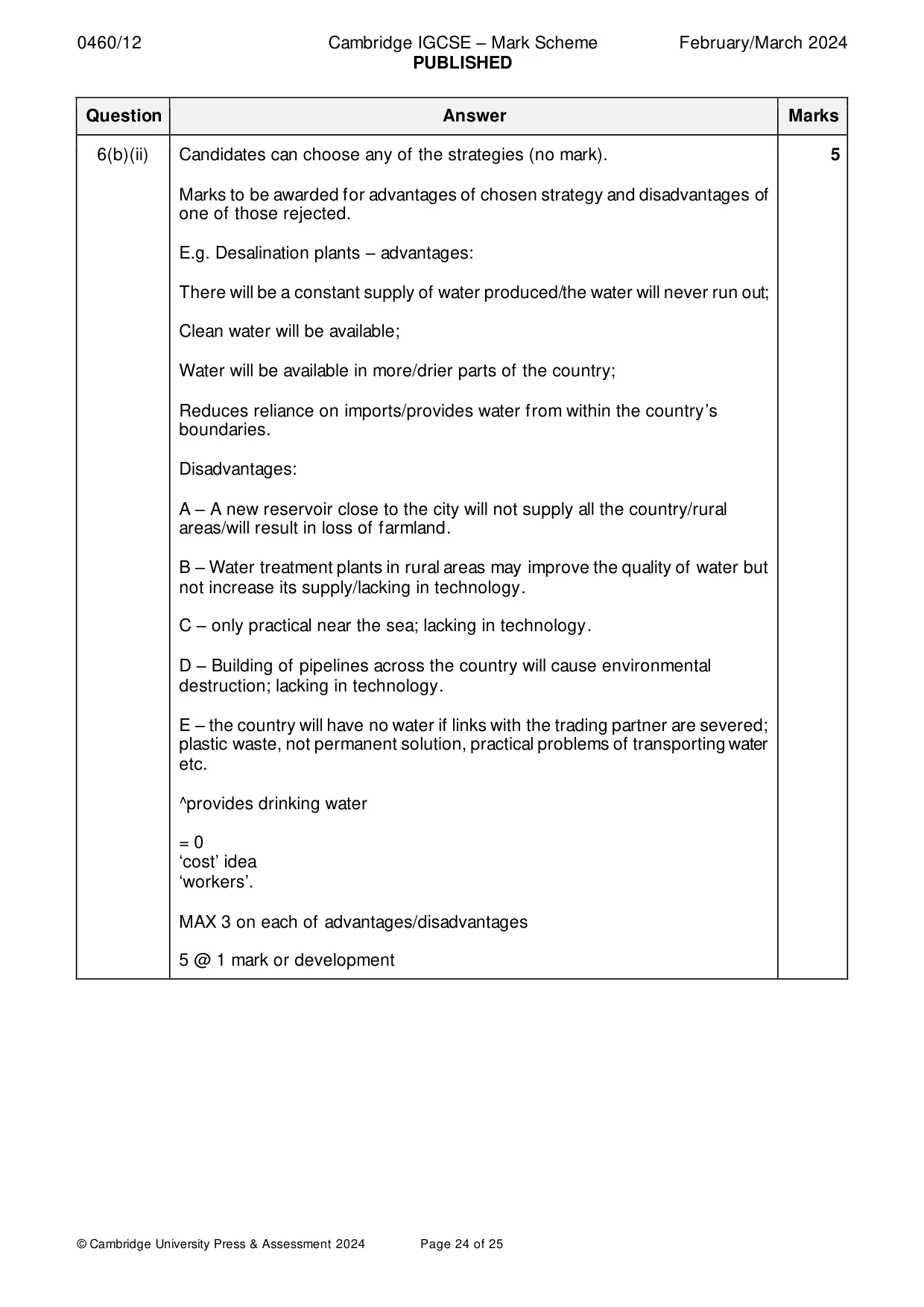
0460/12 Cambridge IGCSE – Mark Scheme PUBLISHED February/March 2024 © Cambridge University Press & Assessment 2024 Page 24 of 25 Question Answer Marks 6(b)(ii) Candidates can choose any of the strategies (no mark). Marks to be awarded for advantages of chosen strategy and disadvantages of one of those rejected. E.g. Desalination plants – advantages: There will be a constant supply of water produced/the water will never run out; Clean water will be available; Water will be available in more/drier parts of the country; Reduces reliance on imports/provides water from within the country’s boundaries. Disadvantages: A – A new reservoir close to the city will not supply all the country/rural areas/will result in loss of farmland. B – Water treatment plants in rural areas may improve the quality of water but not increase its supply/lacking in technology. C – only practical near the sea; lacking in technology. D – Building of pipelines across the country will cause environmental destruction; lacking in technology. E – the country will have no water if links with the trading partner are severed; plastic waste, not permanent solution, practical problems of transporting water etc. ^provides drinking water = 0 ‘cost’ idea ‘workers’. MAX 3 on each of advantages/disadvantages 5 @ 1 mark or development 5
Mark scheme, page 25
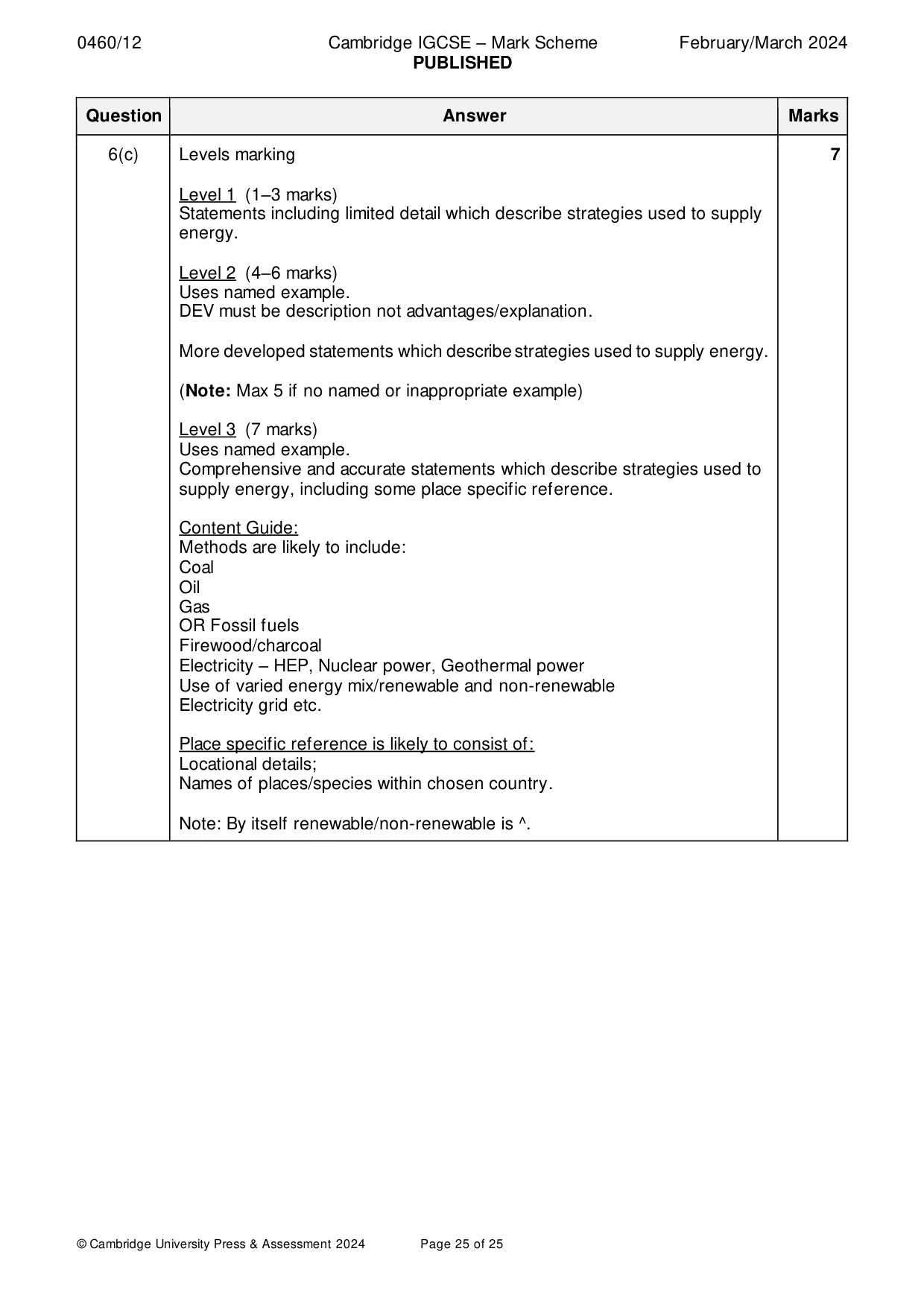
0460/12 Cambridge IGCSE – Mark Scheme PUBLISHED February/March 2024 © Cambridge University Press & Assessment 2024 Page 25 of 25 Question Answer Marks 6(c) Levels marking Level 1 (1–3 marks) Statements including limited detail which describe strategies used to supply energy. Level 2 (4–6 marks) Uses named example. DEV must be description not advantages/explanation. More developed statements which describe strategies used to supply energy. (Note: Max 5 if no named or inappropriate example) Level 3 (7 marks) Uses named example. Comprehensive and accurate statements which describe strategies used to supply energy, including some place specific reference. Content Guide: Methods are likely to include: Coal Oil Gas OR Fossil fuels Firewood/charcoal Electricity – HEP, Nuclear power, Geothermal power Use of varied energy mix/renewable and non-renewable Electricity grid etc. Place specific reference is likely to consist of: Locational details; Names of places/species within chosen country. Note: By itself renewable/non-renewable is ^. 7
What you needed in this session
Cambridge’s own grade thresholds for 2024 Feb/March, Paper 1 · Variant 2. A higher threshold means an easier paper — the bar moves with how the cohort did.