Cambridge IGCSE Geography 0460 — 2013 Oct/Nov Paper 1 · Variant 3
0460/13/O/N/13 · 75 marks · ≈84 min
The question paper and its mark scheme, free to read here and free to download. This is Cambridge’s own paper, exactly as it was sat.
Question paper28 pages




Mark scheme14 pages
Answers below. Sit the paper first if you are practising.
Paper as text
Question paper, page 1
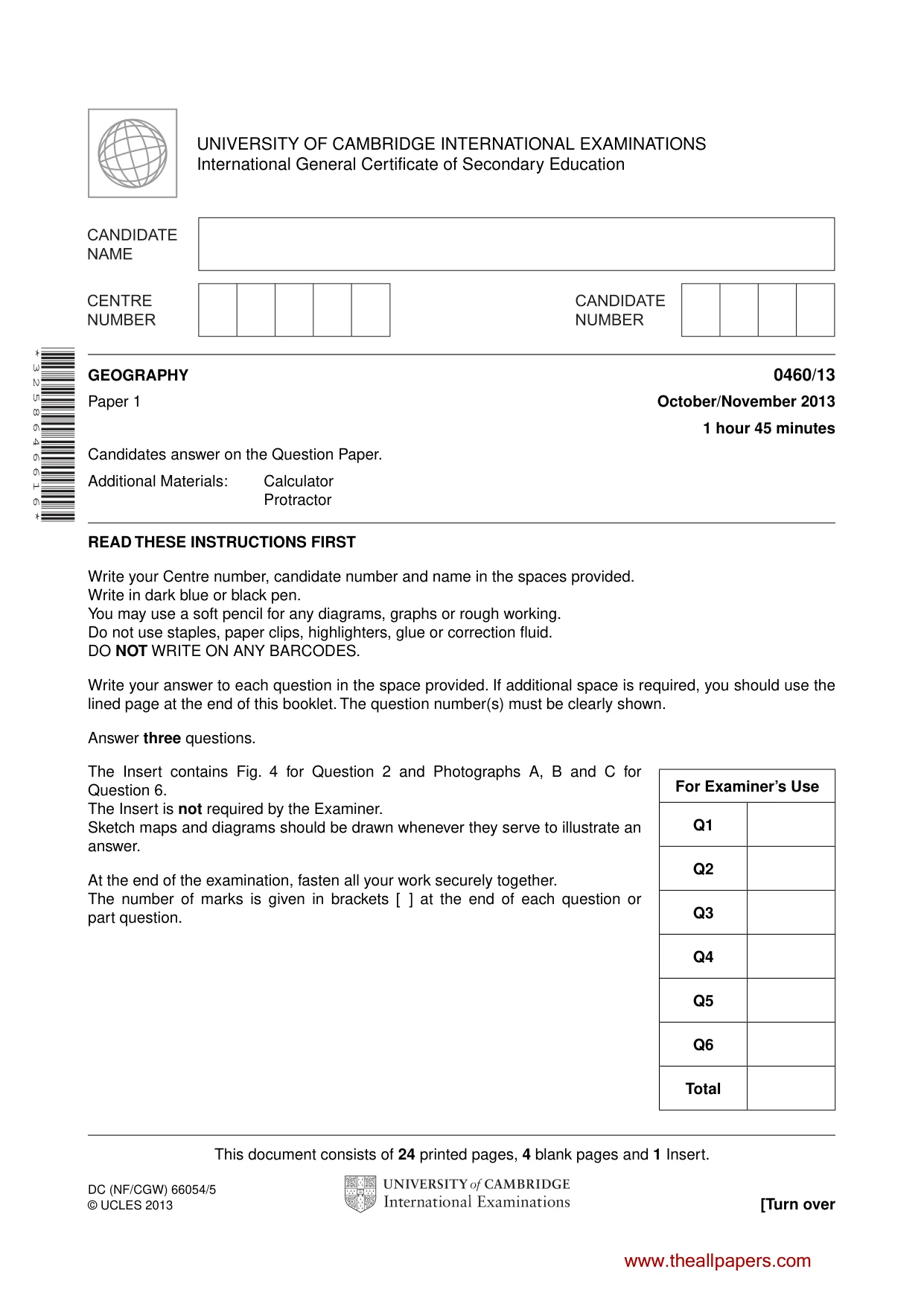
This document consists of 24 printed pages, 4 blank pages and 1 Insert. DC (NF/CGW) 66054/5 © UCLES 2013 [Turn over UNIVERSITY OF CAMBRIDGE INTERNATIONAL EXAMINATIONS International General Certificate of Secondary Education * 3 2 5 8 6 4 6 6 1 6 * GEOGRAPHY 0460/13 Paper 1 October/November 2013 1 hour 45 minutes Candidates answer on the Question Paper. Additional Materials: Calculator Protractor READ THESE INSTRUCTIONS FIRST Write your Centre number, candidate number and name in the spaces provided. Write in dark blue or black pen. You may use a soft pencil for any diagrams, graphs or rough working. Do not use staples, paper clips, highlighters, glue or correction fluid. DO NOT WRITE ON ANY BARCODES. Write your answer to each question in the space provided. If additional space is required, you should use the lined page at the end of this booklet. The question number(s) must be clearly shown. Answer three questions. The Insert contains Fig. 4 for Question 2 and Photographs A, B and C for Question 6. The Insert is not required by the Examiner. Sketch maps and diagrams should be drawn whenever they serve to illustrate an answer. At the end of the examination, fasten all your work securely together. The number of marks is given in brackets [ ] at the end of each question or part question. For Examiner’s Use Q1 Q2 Q3 Q4 Q5 Q6 Total www.theallpapers.com
Question paper, page 2
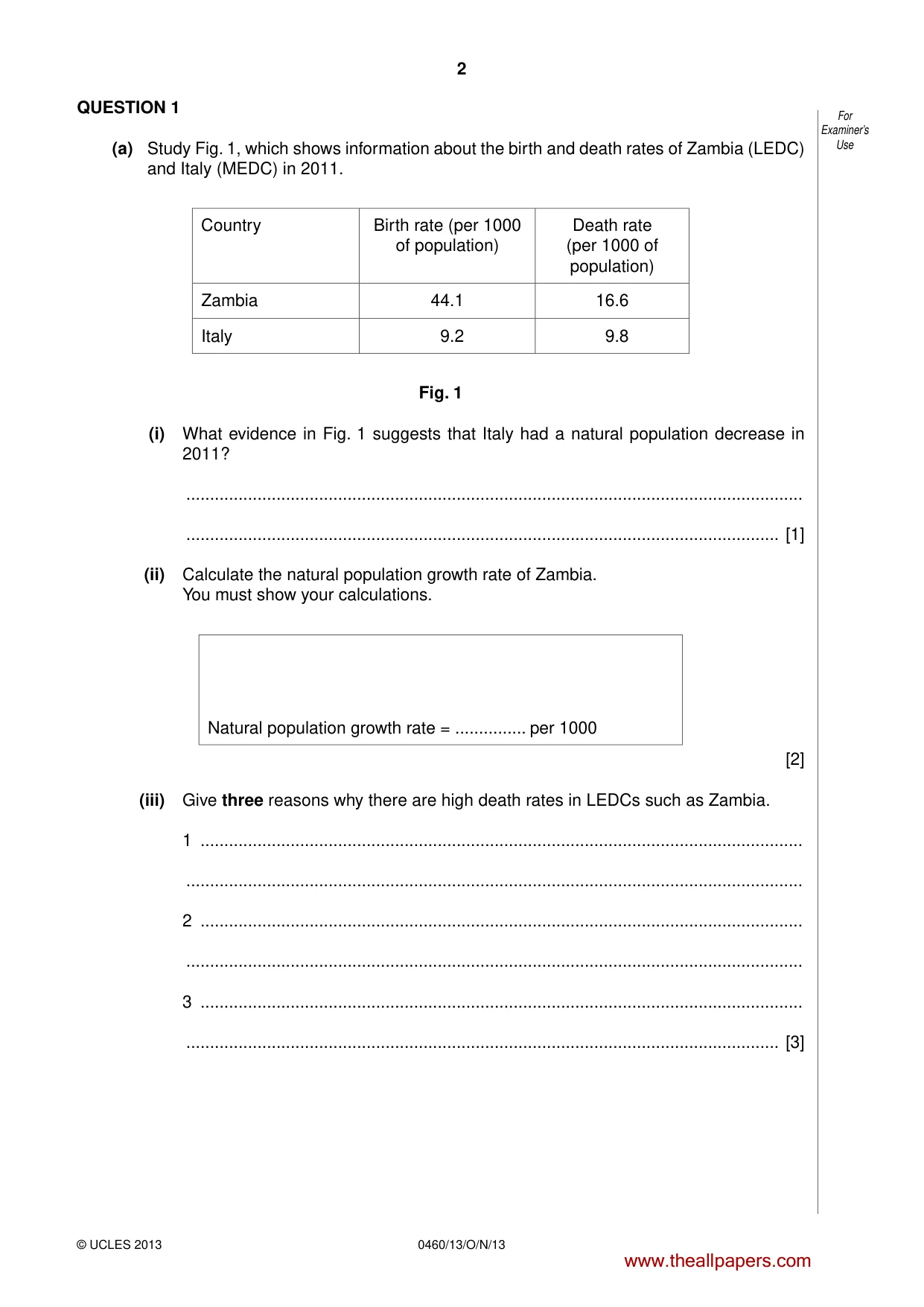
2 0460/13/O/N/13 © UCLES 2013 For Examiner’s Use QUESTION 1 (a) Study Fig. 1, which shows information about the birth and death rates of Zambia (LEDC) and Italy (MEDC) in 2011. Country Birth rate (per 1000 of population) Death rate (per 1000 of population) Zambia 44.1 16.6 Italy 9.2 9.8 Fig. 1 (i) What evidence in Fig. 1 suggests that Italy had a natural population decrease in 2011? … … [1] (ii) Calculate the natural population growth rate of Zambia. You must show your calculations. Natural population growth rate = … per 1000 [2] (iii) Give three reasons why there are high death rates in LEDCs such as Zambia. 1 … … 2 … … 3 … … [3] www.theallpapers.com
Question paper, page 3
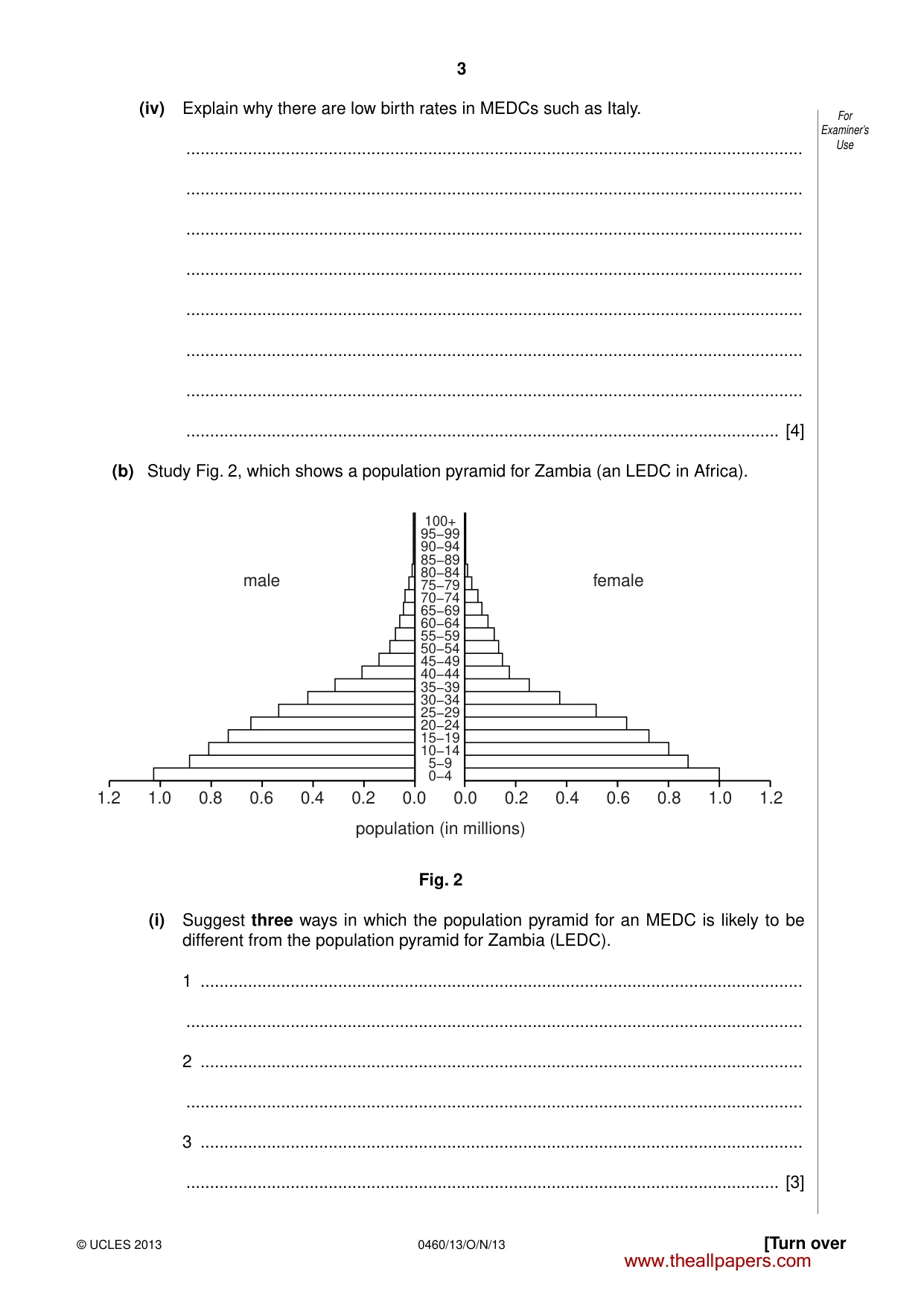
3 0460/13/O/N/13 © UCLES 2013 [Turn over For Examiner’s Use (iv) Explain why there are low birth rates in MEDCs such as Italy. … … … … … … … … [4] (b) Study Fig. 2, which shows a population pyramid for Zambia (an LEDC in Africa). male 1.2 1.0 0.8 0.6 0.4 0.2 0.0 0.0 population (in millions) 0.2 0.4 0.6 0.8 1.0 1.2 female 0−4 5−9 10−14 15−19 20−24 25−29 30−34 35−39 40−44 45−49 50−54 55−59 60−64 65−69 70−74 75−79 80−84 85−89 90−94 95−99 100+ Fig. 2 (i) Suggest three ways in which the population pyramid for an MEDC is likely to be different from the population pyramid for Zambia (LEDC). 1 … … 2 … … 3 … … [3] www.theallpapers.com
Question paper, page 4
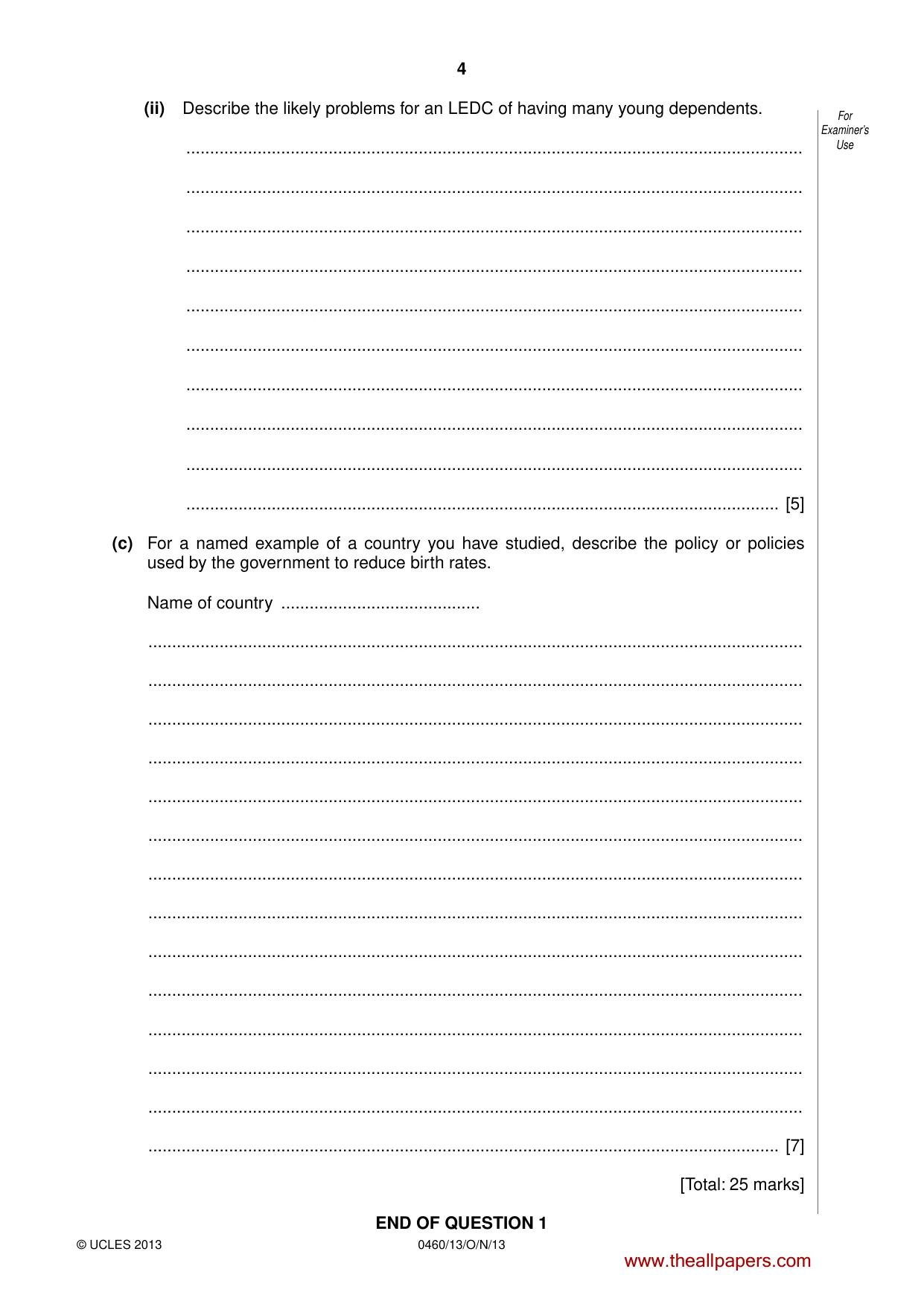
4 0460/13/O/N/13 © UCLES 2013 For Examiner’s Use (ii) Describe the likely problems for an LEDC of having many young dependents. … … … … … … … … … … [5] (c) For a named example of a country you have studied, describe the policy or policies used by the government to reduce birth rates. Name of country … … … … … … … … … … … … … … … [7] [Total: 25 marks] END OF QUESTION 1 www.theallpapers.com
Question paper, page 5
5 0460/13/O/N/13 © UCLES 2013 [Turn over BLANK PAGE www.theallpapers.com
Question paper, page 6
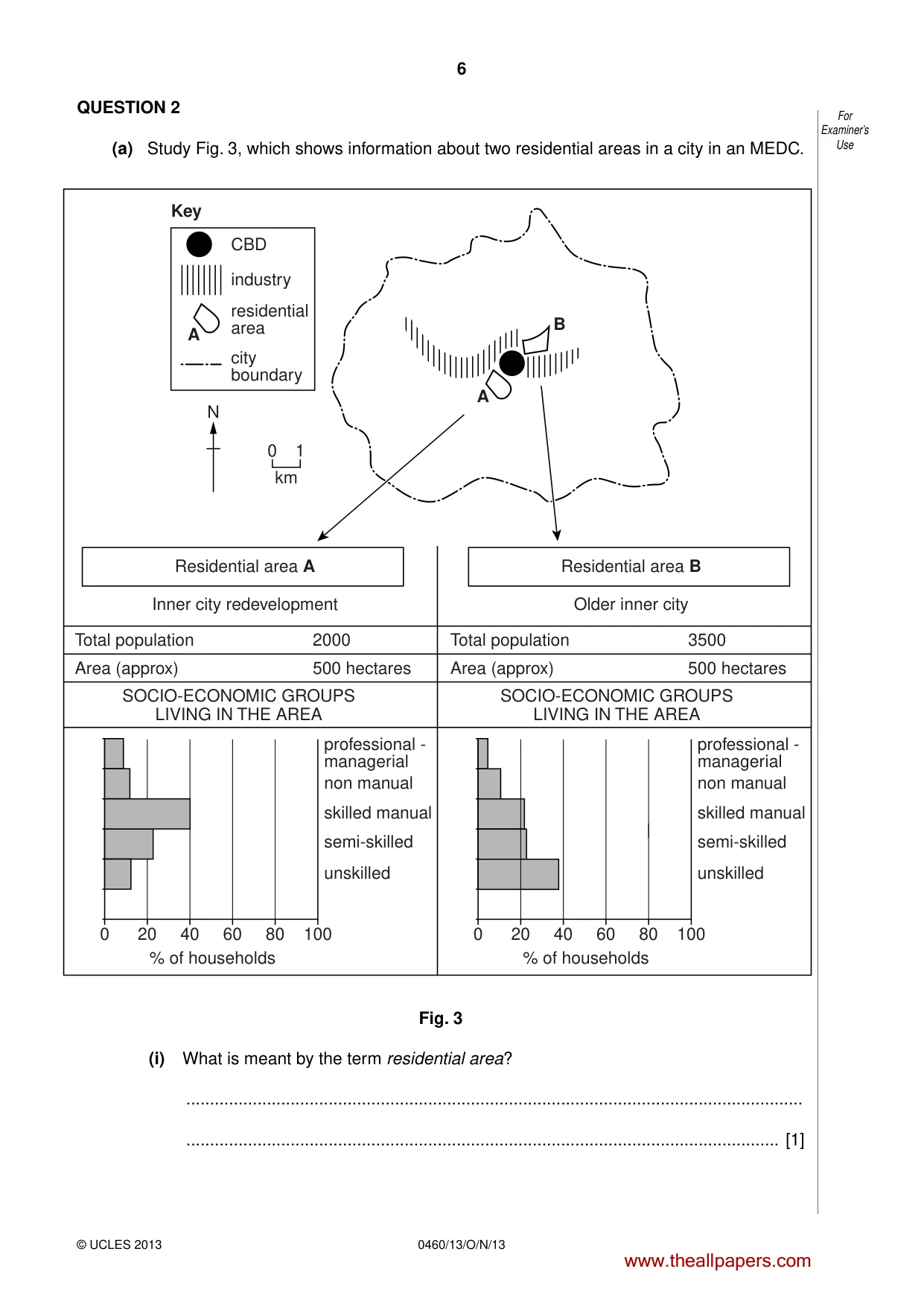
6 0460/13/O/N/13 © UCLES 2013 For Examiner’s Use QUESTION 2 (a) Study Fig. 3, which shows information about two residential areas in a city in an MEDC. industry CBD Residential area A residential area city boundary N 0 km 1 Key A A B Residential area B Inner city redevelopment Total population 2000 Area (approx) 500 hectares Total population 3500 0 20 40 60 % of households 80 100 Area (approx) 500 hectares SOCIO-ECONOMIC GROUPS LIVING IN THE AREA SOCIO-ECONOMIC GROUPS LIVING IN THE AREA Older inner city professional - managerial non manual skilled manual semi-skilled unskilled professional - managerial non manual skilled manual semi-skilled unskilled 0 20 40 60 % of households 80 100 Fig. 3 (i) What is meant by the term residential area? … … [1] www.theallpapers.com
Question paper, page 7
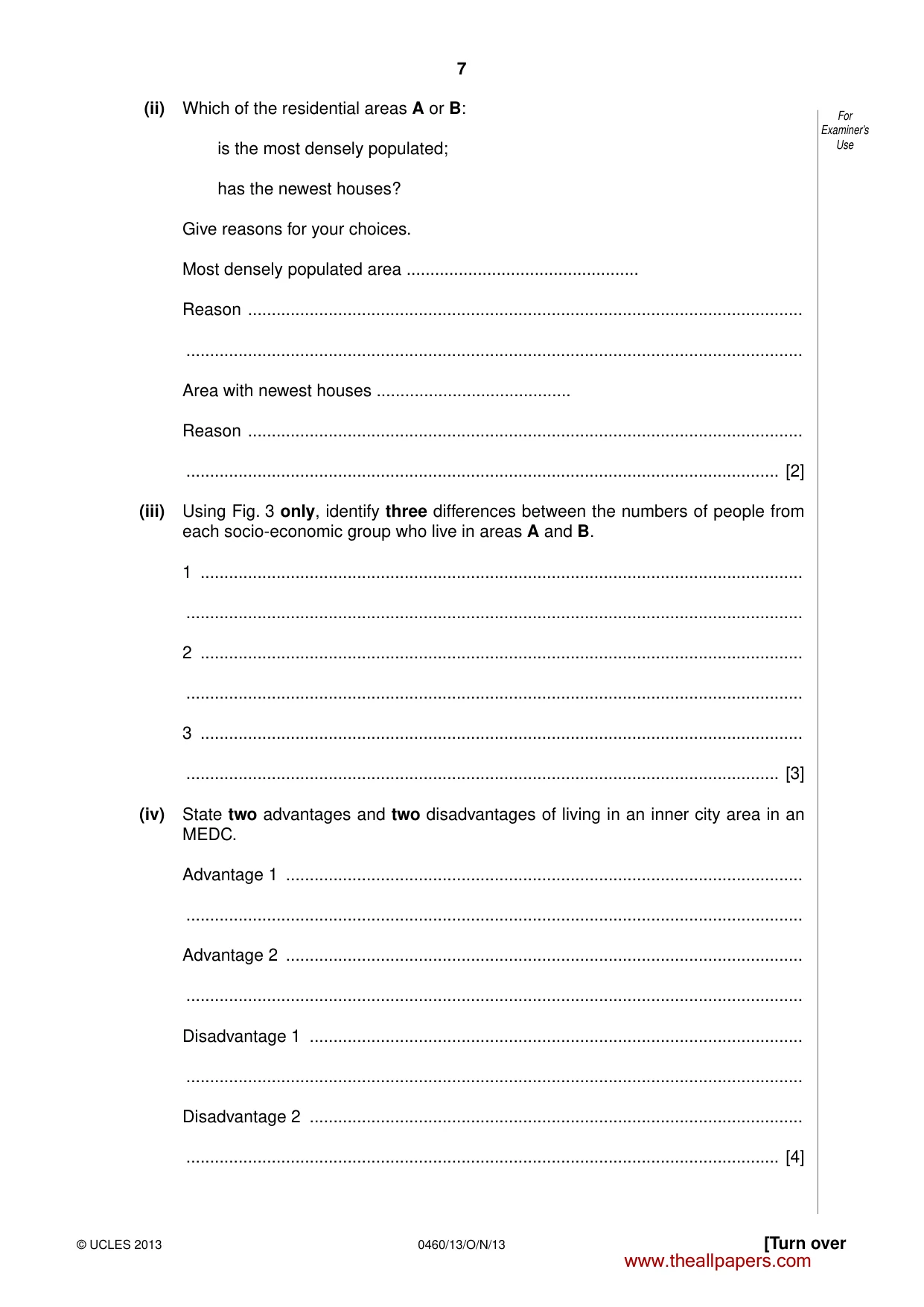
7 0460/13/O/N/13 © UCLES 2013 [Turn over For Examiner’s Use (ii) Which of the residential areas A or B: is the most densely populated; has the newest houses? Give reasons for your choices. Most densely populated area … Reason … … Area with newest houses … Reason … … [2] (iii) Using Fig. 3 only, identify three differences between the numbers of people from each socio-economic group who live in areas A and B. 1 … … 2 … … 3 … … [3] (iv) State two advantages and two disadvantages of living in an inner city area in an MEDC. Advantage 1 … … Advantage 2 … … Disadvantage 1 … … Disadvantage 2 … … [4] www.theallpapers.com
Question paper, page 8
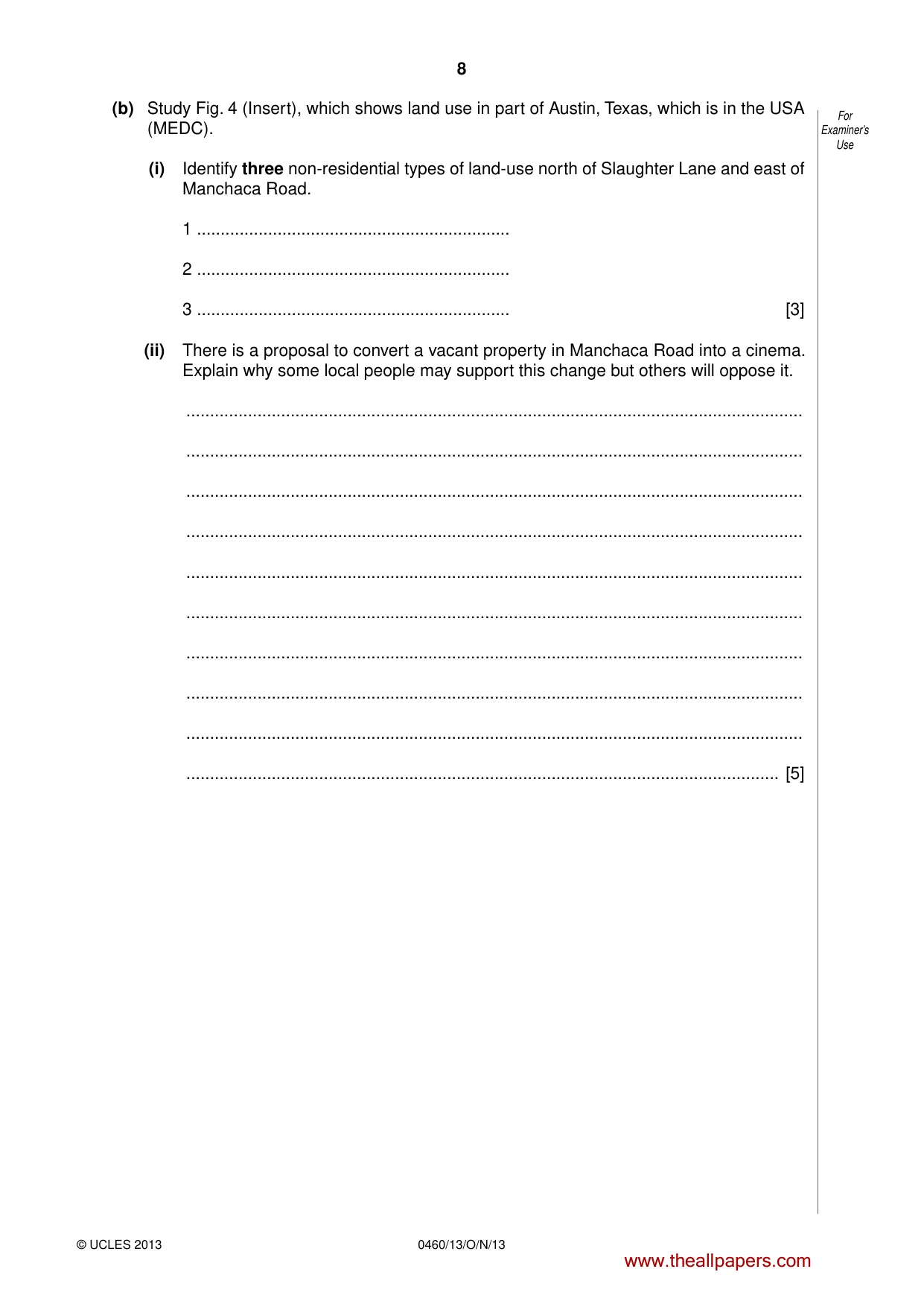
8 0460/13/O/N/13 © UCLES 2013 For Examiner’s Use (b) Study Fig. 4 (Insert), which shows land use in part of Austin, Texas, which is in the USA (MEDC). (i) Identify three non-residential types of land-use north of Slaughter Lane and east of Manchaca Road. 1 … 2 … 3 … [3] (ii) There is a proposal to convert a vacant property in Manchaca Road into a cinema. Explain why some local people may support this change but others will oppose it. … … … … … … … … … … [5] www.theallpapers.com
Question paper, page 9
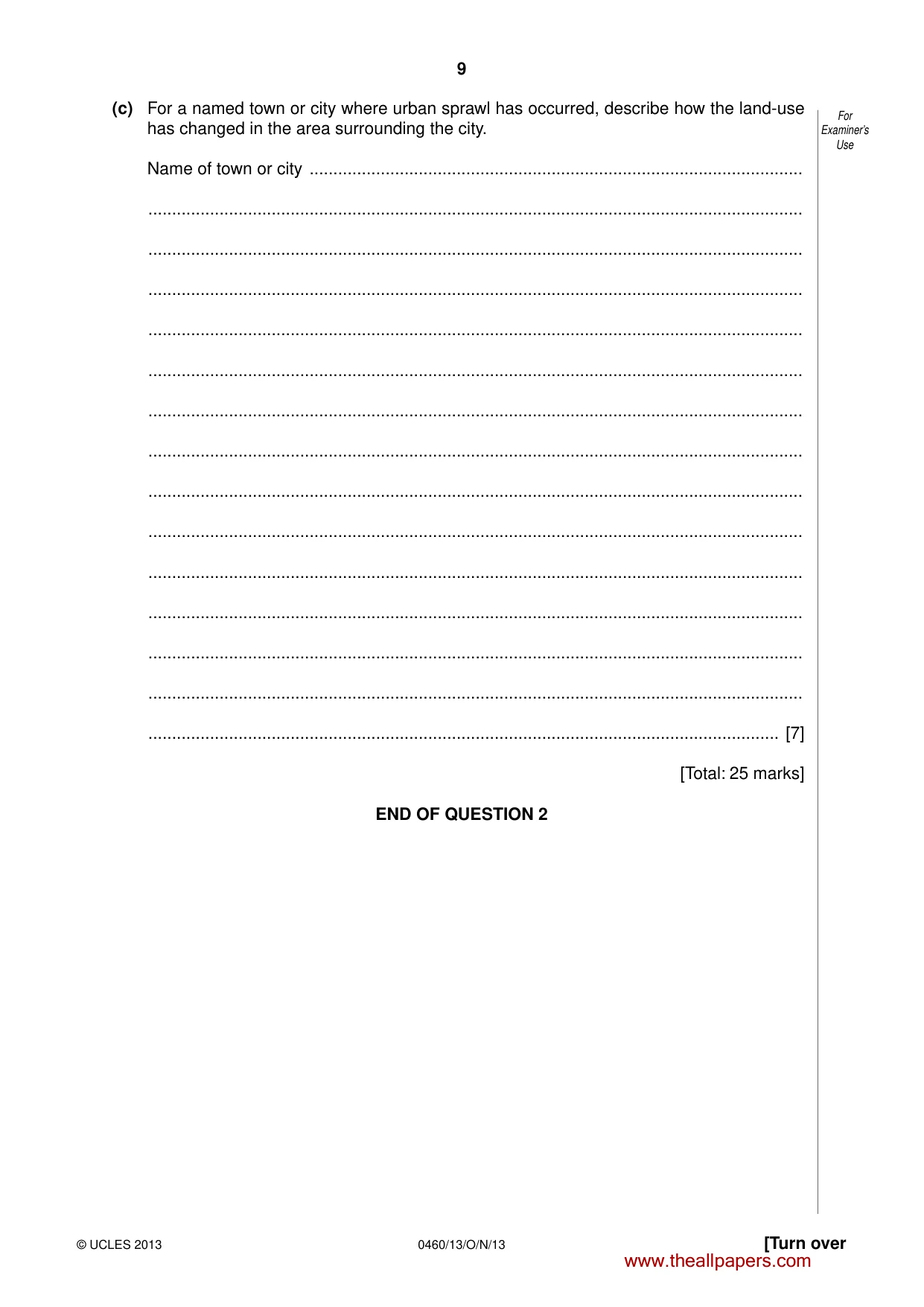
9 0460/13/O/N/13 © UCLES 2013 [Turn over For Examiner’s Use (c) For a named town or city where urban sprawl has occurred, describe how the land-use has changed in the area surrounding the city. Name of town or city … … … … … … … … … … … … … … … [7] [Total: 25 marks] END OF QUESTION 2 www.theallpapers.com
Question paper, page 10
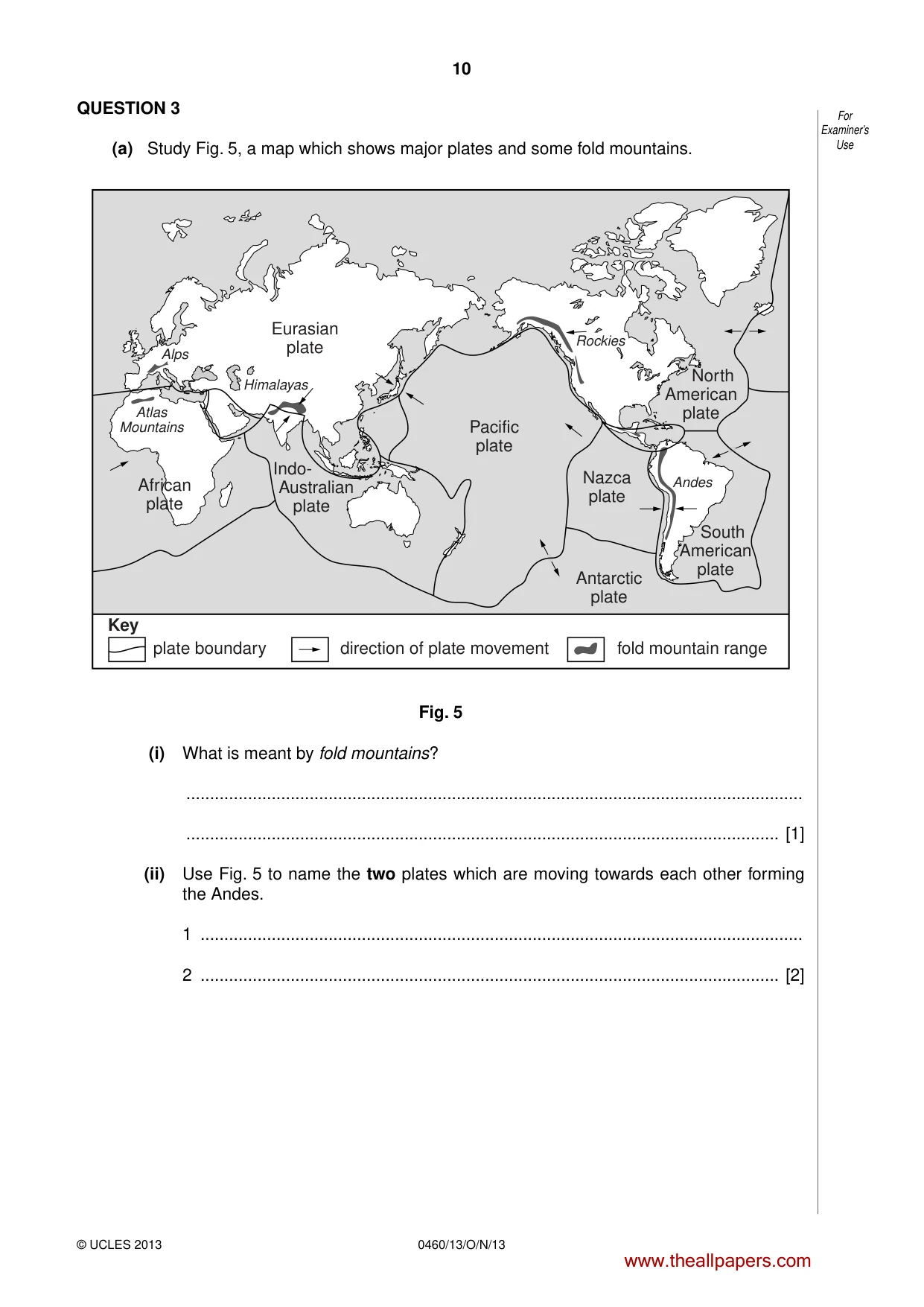
10 0460/13/O/N/13 © UCLES 2013 For Examiner’s Use QUESTION 3 (a) Study Fig. 5, a map which shows major plates and some fold mountains. Eurasian plate Pacific plate plate boundary Key direction of plate movement fold mountain range Rockies Andes Himalayas Alps Atlas Mountains Nazca plate South American plate North American plate Antarctic plate African plate Indo- Australian plate Fig. 5 (i) What is meant by fold mountains? … … [1] (ii) Use Fig. 5 to name the two plates which are moving towards each other forming the Andes. 1 … 2 … [2] www.theallpapers.com
Question paper, page 11
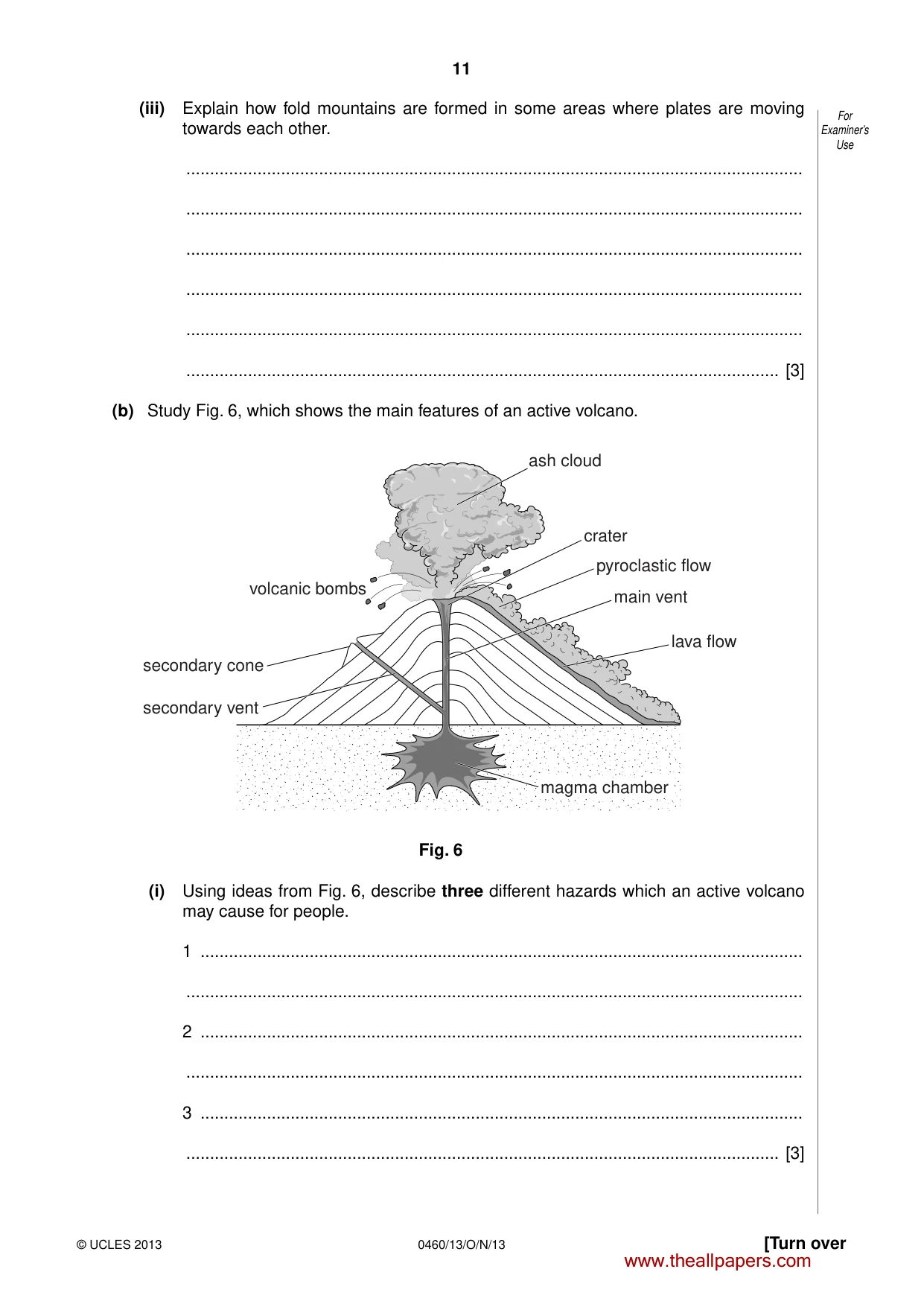
11 0460/13/O/N/13 © UCLES 2013 [Turn over For Examiner’s Use (iii) Explain how fold mountains are formed in some areas where plates are moving towards each other. … … … … … … [3] (b) Study Fig. 6, which shows the main features of an active volcano. ash cloud pyroclastic flow main vent secondary vent lava flow secondary cone volcanic bombs crater magma chamber Fig. 6 (i) Using ideas from Fig. 6, describe three different hazards which an active volcano may cause for people. 1 … … 2 … … 3 … … [3] www.theallpapers.com
Question paper, page 12
12 0460/13/O/N/13 © UCLES 2013 For Examiner’s Use (ii) Explain why there are active volcanoes along destructive plate boundaries. … … … … … … … … [4] (iii) Explain how an area of volcanic activity can provide opportunities for people living there. … … … … … … … … … … [5] www.theallpapers.com
Question paper, page 13
13 0460/13/O/N/13 © UCLES 2013 [Turn over For Examiner’s Use (c) For a named area which you have studied, describe the impacts of an earthquake. Name of area … … … … … … … … … … … … … … … [7] [Total: 25 marks] END OF QUESTION 3 www.theallpapers.com
Question paper, page 14
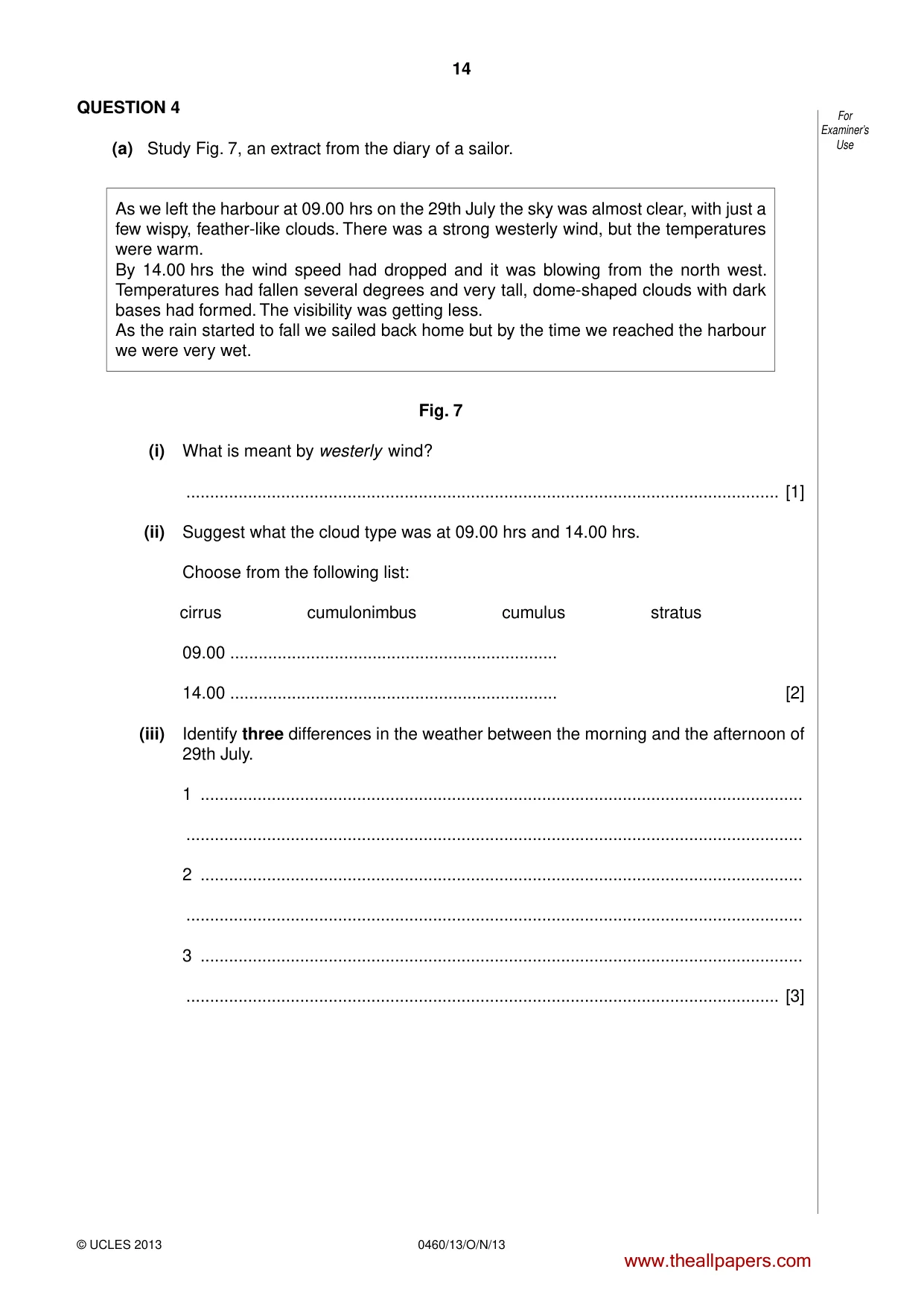
14 0460/13/O/N/13 © UCLES 2013 For Examiner’s Use QUESTION 4 (a) Study Fig. 7, an extract from the diary of a sailor. As we left the harbour at 09.00 hrs on the 29th July the sky was almost clear, with just a few wispy, feather-like clouds. There was a strong westerly wind, but the temperatures were warm. By 14.00 hrs the wind speed had dropped and it was blowing from the north west. Temperatures had fallen several degrees and very tall, dome-shaped clouds with dark bases had formed. The visibility was getting less. As the rain started to fall we sailed back home but by the time we reached the harbour we were very wet. Fig. 7 (i) What is meant by westerly wind? … [1] (ii) Suggest what the cloud type was at 09.00 hrs and 14.00 hrs. Choose from the following list: cirrus cumulonimbus cumulus stratus 09.00 … 14.00 … [2] (iii) Identify three differences in the weather between the morning and the afternoon of 29th July. 1 … … 2 … … 3 … … [3] www.theallpapers.com
Question paper, page 15
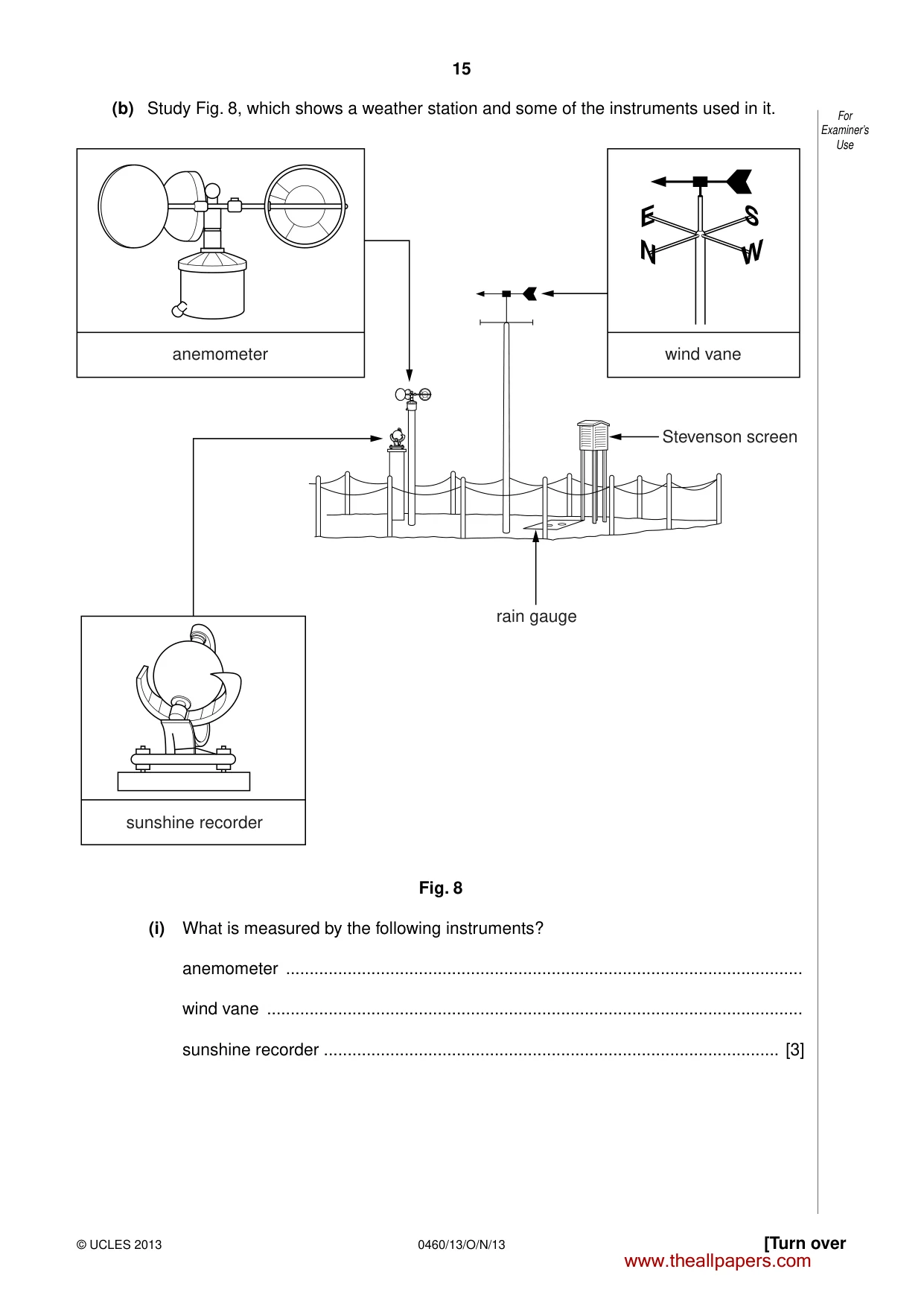
15 0460/13/O/N/13 © UCLES 2013 [Turn over For Examiner’s Use (b) Study Fig. 8, which shows a weather station and some of the instruments used in it. Stevenson screen rain gauge wind vane anemometer sunshine recorder Fig. 8 (i) What is measured by the following instruments? anemometer … wind vane … sunshine recorder … [3] www.theallpapers.com
Question paper, page 16
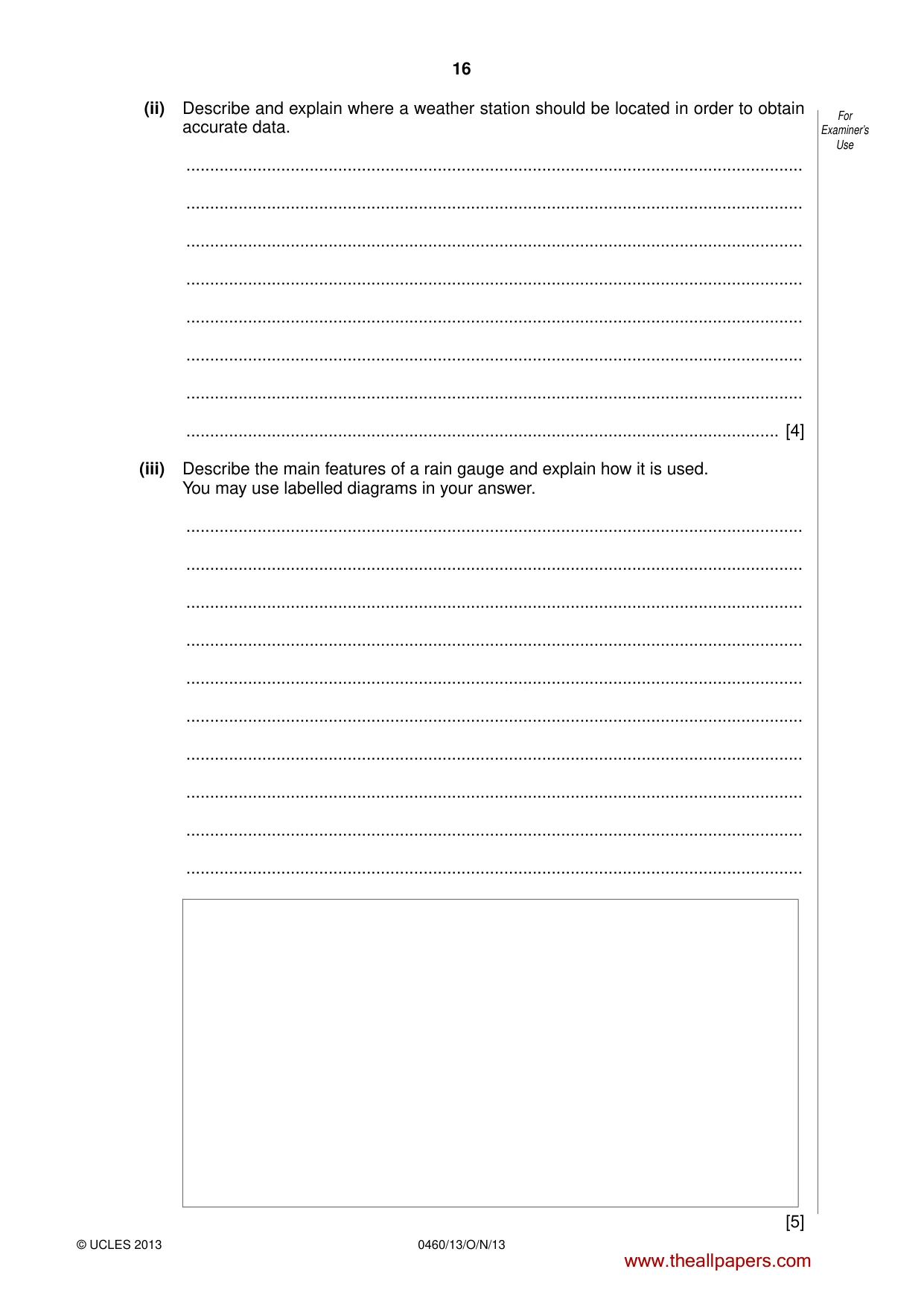
16 0460/13/O/N/13 © UCLES 2013 For Examiner’s Use (ii) Describe and explain where a weather station should be located in order to obtain accurate data. … … … … … … … … [4] (iii) Describe the main features of a rain gauge and explain how it is used. You may use labelled diagrams in your answer. … … … … … … … … … … [5] www.theallpapers.com
Question paper, page 17
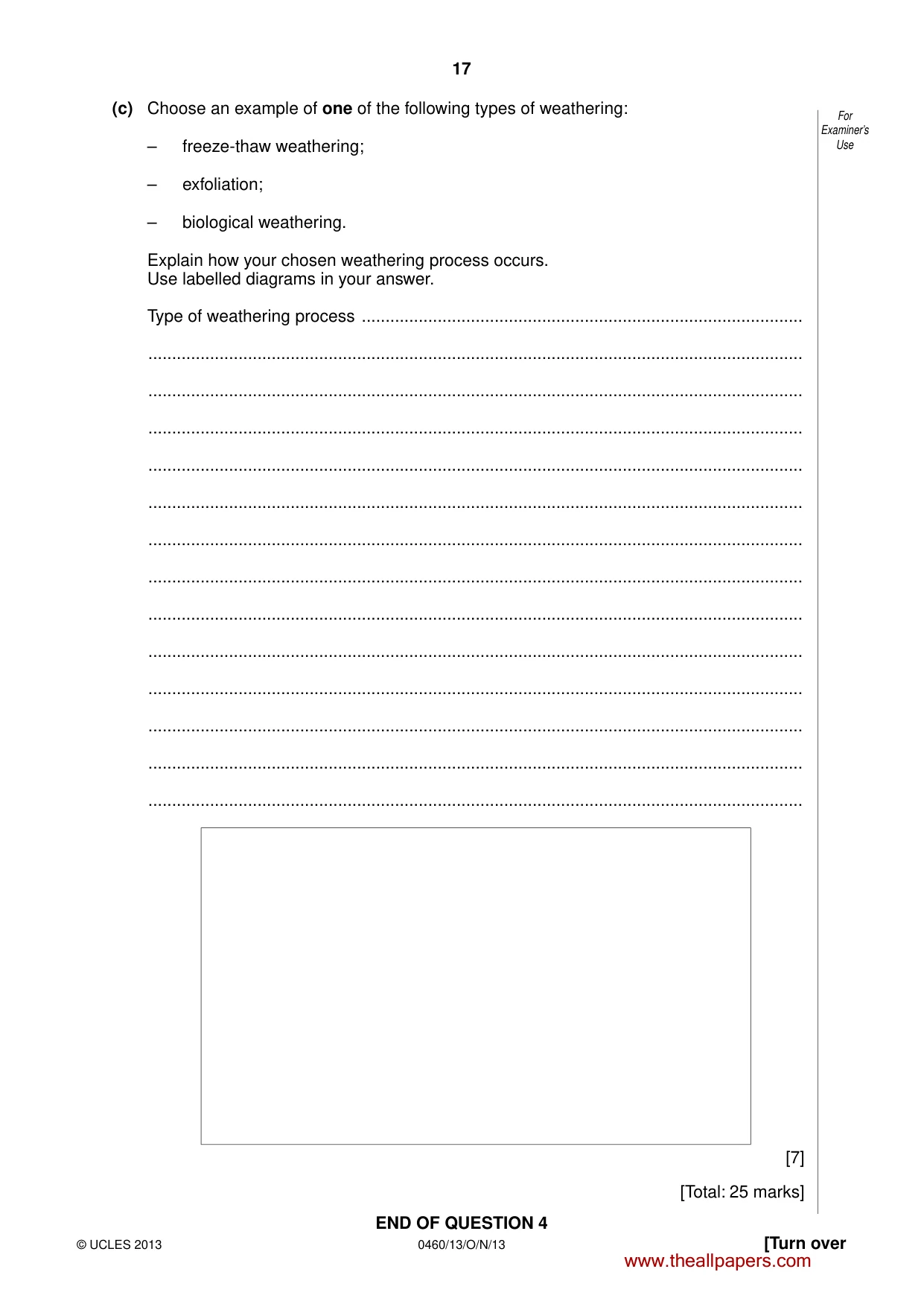
17 0460/13/O/N/13 © UCLES 2013 [Turn over For Examiner’s Use (c) Choose an example of one of the following types of weathering: – freeze-thaw weathering; – exfoliation; – biological weathering. Explain how your chosen weathering process occurs. Use labelled diagrams in your answer. Type of weathering process … … … … … … … … … … … … … … [7] [Total: 25 marks] END OF QUESTION 4 www.theallpapers.com
Question paper, page 18
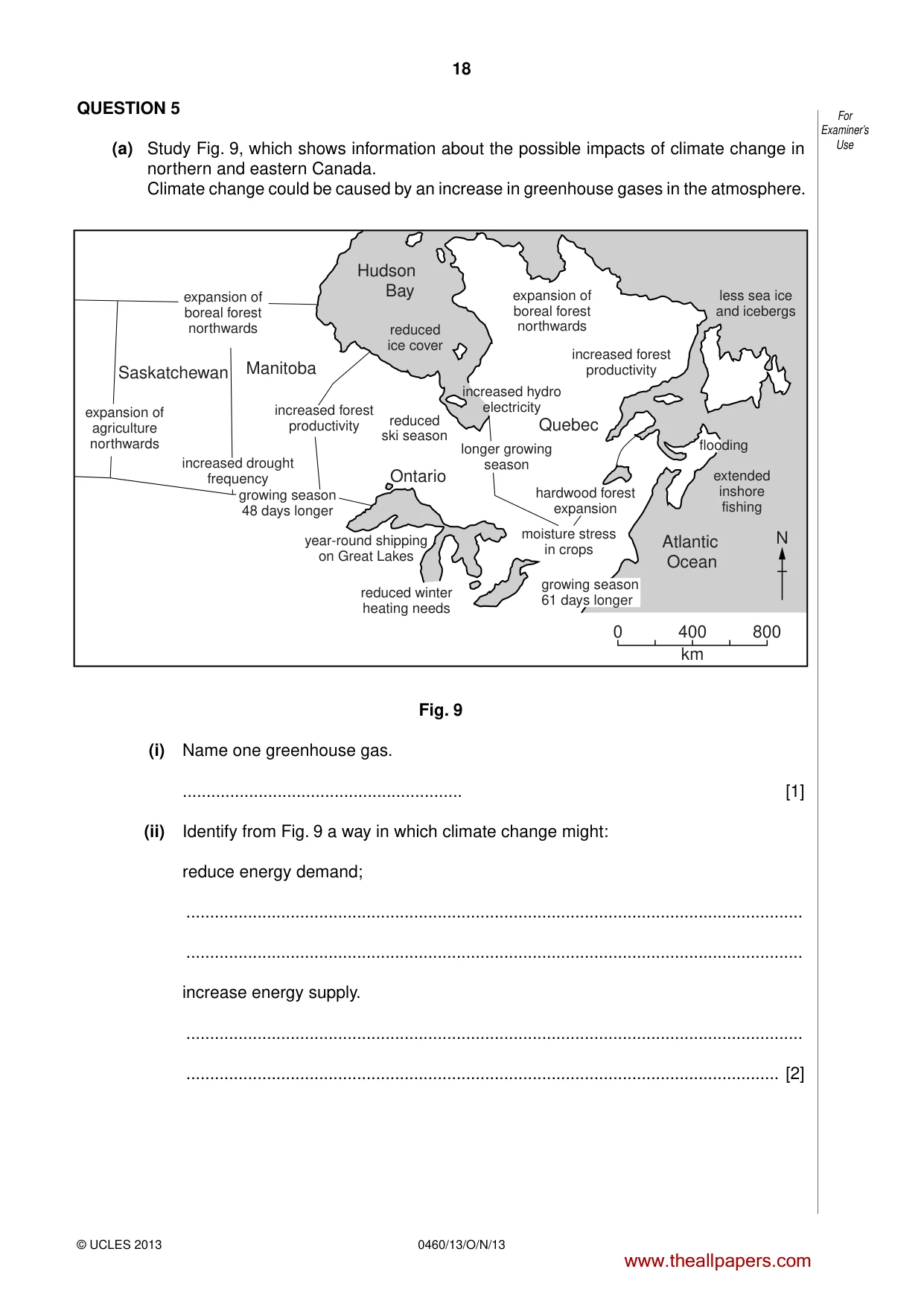
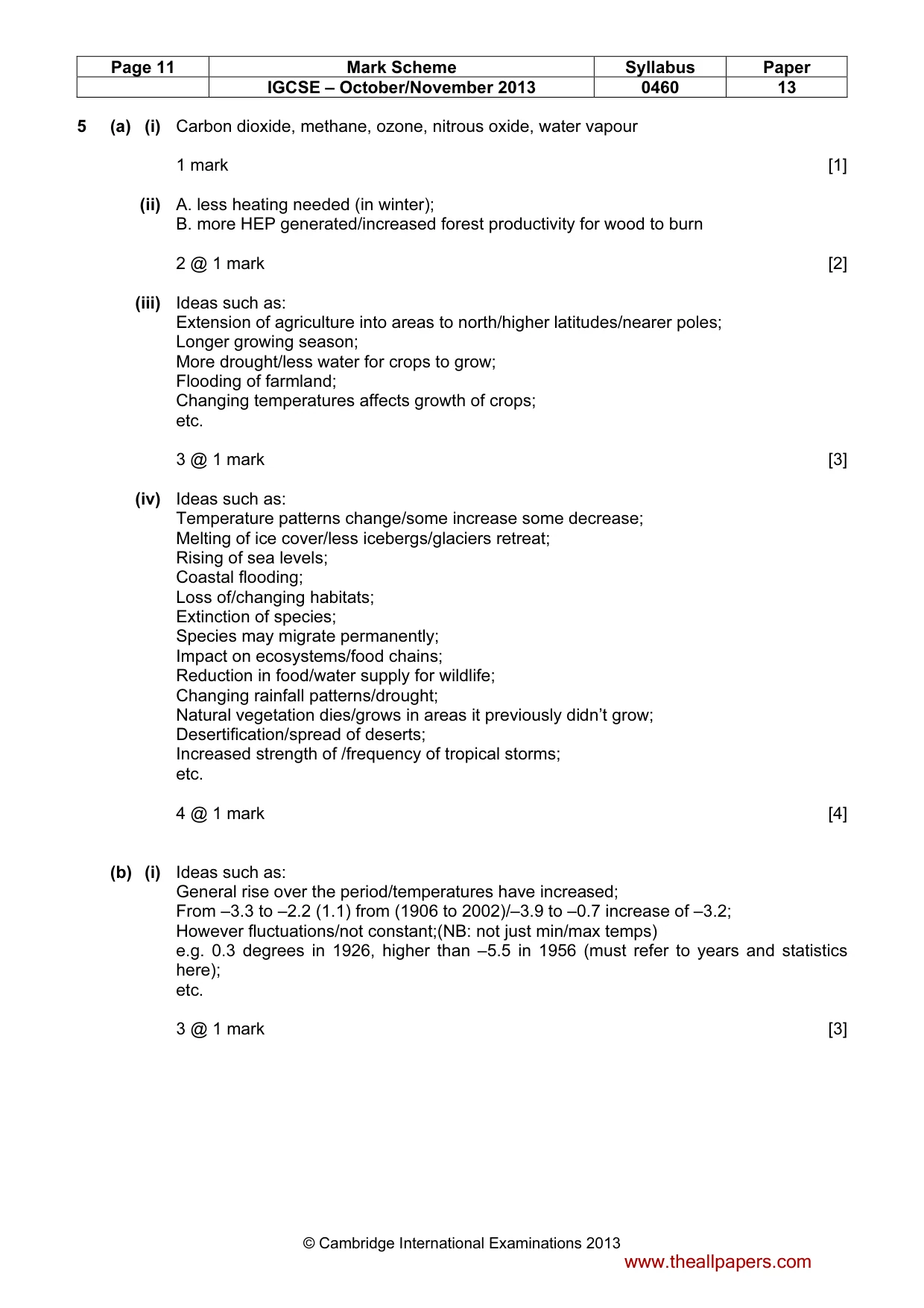
18 0460/13/O/N/13 © UCLES 2013 For Examiner’s Use QUESTION 5 (a) Study Fig. 9, which shows information about the possible impacts of climate change in northern and eastern Canada. Climate change could be caused by an increase in greenhouse gases in the atmosphere. Hudson Bay Atlantic Ocean N 0 400 km 800 expansion of boreal forest northwards expansion of agriculture northwards Saskatchewan Manitoba Ontario Quebec reduced ice cover increased drought frequency growing season 48 days longer year-round shipping on Great Lakes reduced winter heating needs moisture stress in crops hardwood forest expansion increased forest productivity reduced ski season increased hydro electricity longer growing season increased forest productivity less sea ice and icebergs flooding extended inshore fishing expansion of boreal forest northwards growing season 61 days longer Fig. 9 (i) Name one greenhouse gas. … [1] (ii) Identify from Fig. 9 a way in which climate change might: reduce energy demand; … … increase energy supply. … … [2] www.theallpapers.com
Question paper, page 19
19 0460/13/O/N/13 © UCLES 2013 [Turn over For Examiner’s Use (iii) Identify three ways in which climate change might affect agricultural systems around the world. 1 … … 2 … … 3 … … [3] (iv) Describe the possible impacts of climate change on the natural environment. … … … … … … … … [4] www.theallpapers.com
Question paper, page 20
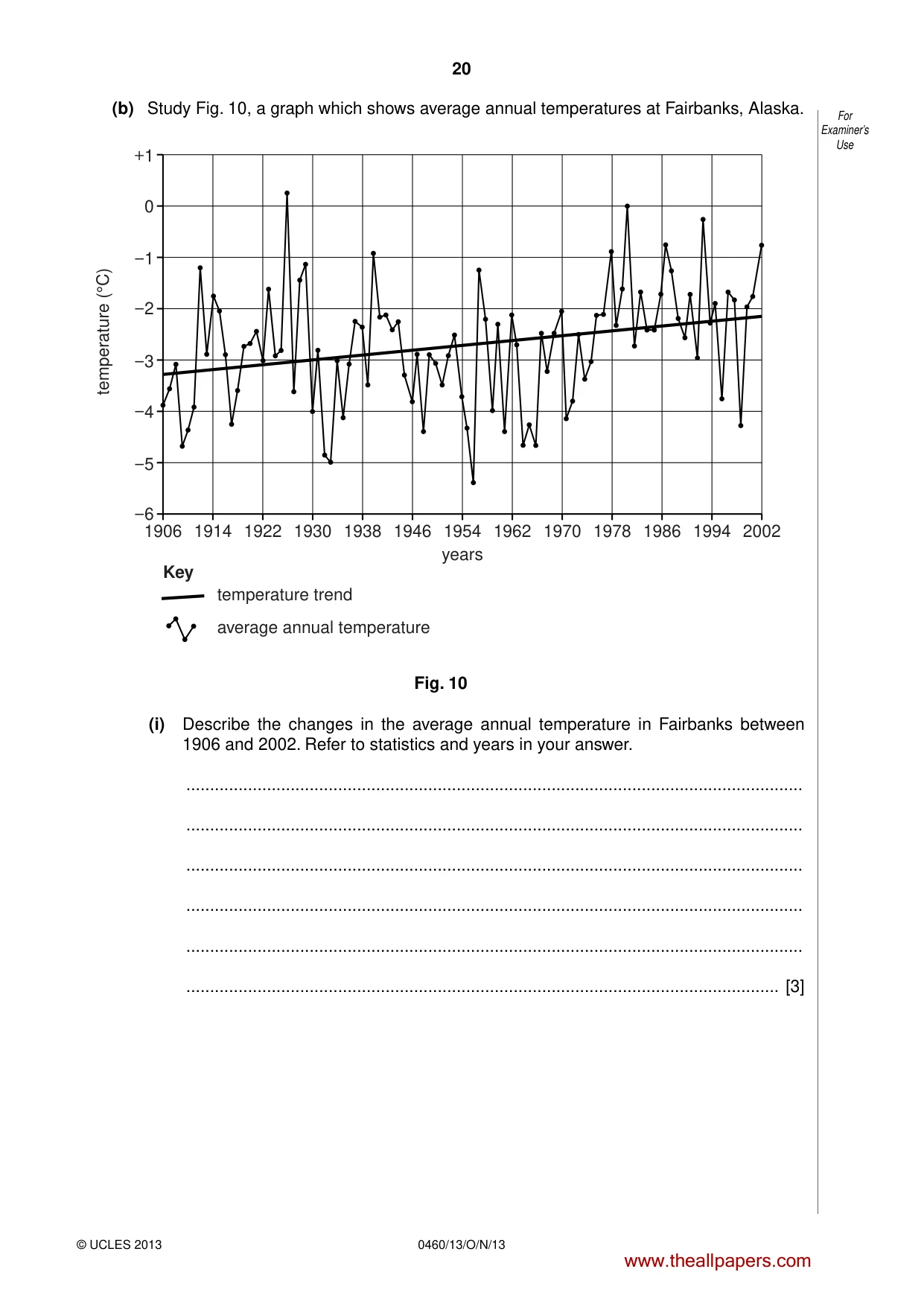
20 0460/13/O/N/13 © UCLES 2013 For Examiner’s Use (b) Study Fig. 10, a graph which shows average annual temperatures at Fairbanks, Alaska. 1906 Key −6 −5 −4 −3 −2 temperature (°C) −1 0 +1 1914 temperature trend average annual temperature 1922 1930 1938 1946 1954 years 1962 1970 1978 1986 1994 2002 Fig. 10 (i) Describe the changes in the average annual temperature in Fairbanks between 1906 and 2002. Refer to statistics and years in your answer. … … … … … … [3] www.theallpapers.com
Question paper, page 21
21 0460/13/O/N/13 © UCLES 2013 [Turn over For Examiner’s Use (ii) Many scientists believe that global changes in temperature are due to the increase of greenhouse gases. Explain why greenhouse gases are increasing in the atmosphere. … … … … … … … … … … [5] (c) For a named river, sea or lake which you have studied, describe the causes of water pollution. Name of river, lake or sea … … … … … … … … … … … … … … … [7] [Total: 25 marks] END OF QUESTION 5 www.theallpapers.com
Question paper, page 22
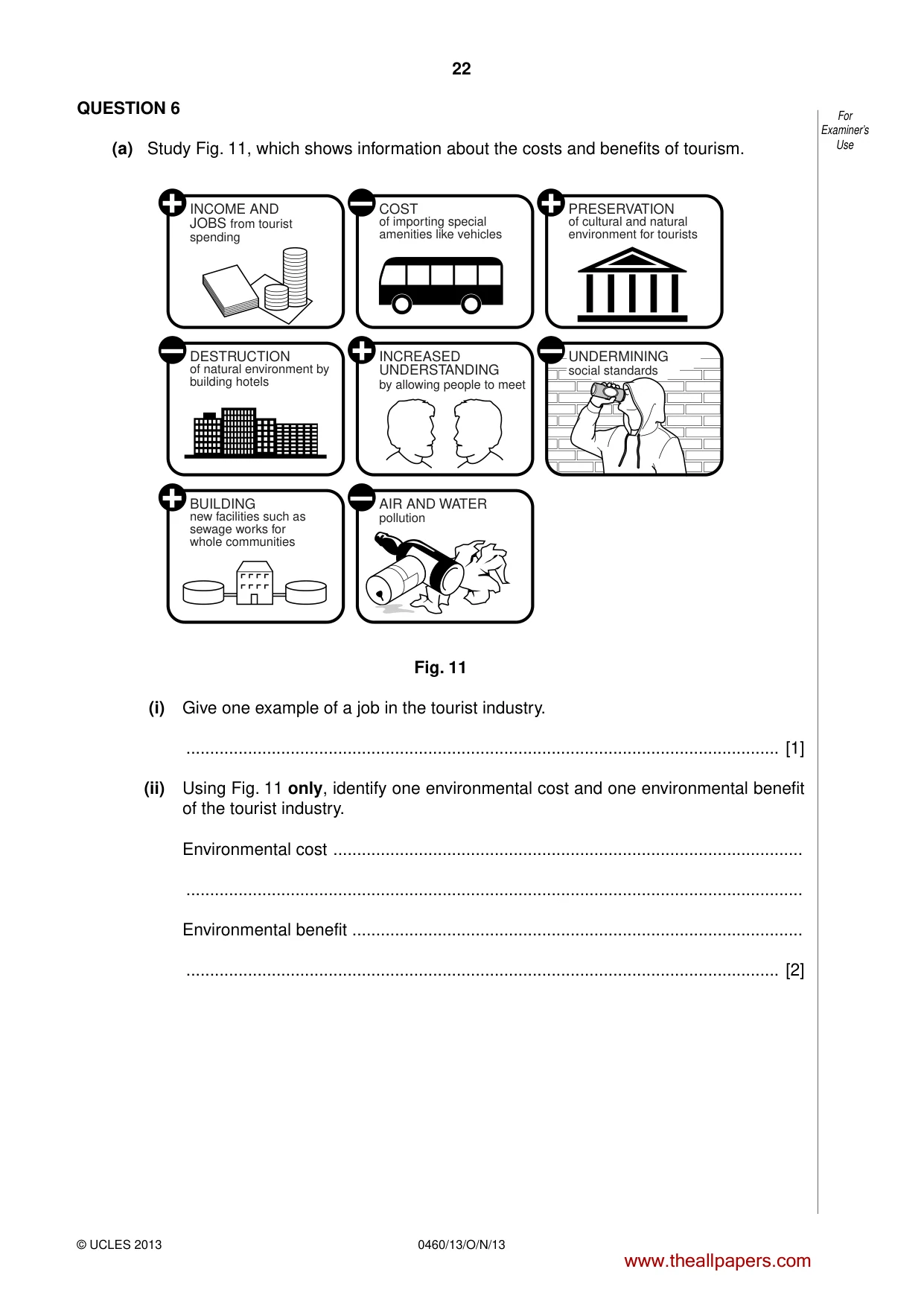
22 0460/13/O/N/13 © UCLES 2013 For Examiner’s Use QUESTION 6 (a) Study Fig. 11, which shows information about the costs and benefits of tourism. + INCOME AND JOBS from tourist spending – COST of importing special amenities like vehicles PRESERVATION of cultural and natural environment for tourists + DESTRUCTION of natural environment by building hotels – INCREASED UNDERSTANDING by allowing people to meet UNDERMINING social standards + BUILDING new facilities such as sewage works for whole communities – AIR AND WATER pollution + – Fig. 11 (i) Give one example of a job in the tourist industry. … [1] (ii) Using Fig. 11 only, identify one environmental cost and one environmental benefit of the tourist industry. Environmental cost … … Environmental benefit … … [2] www.theallpapers.com
Question paper, page 23
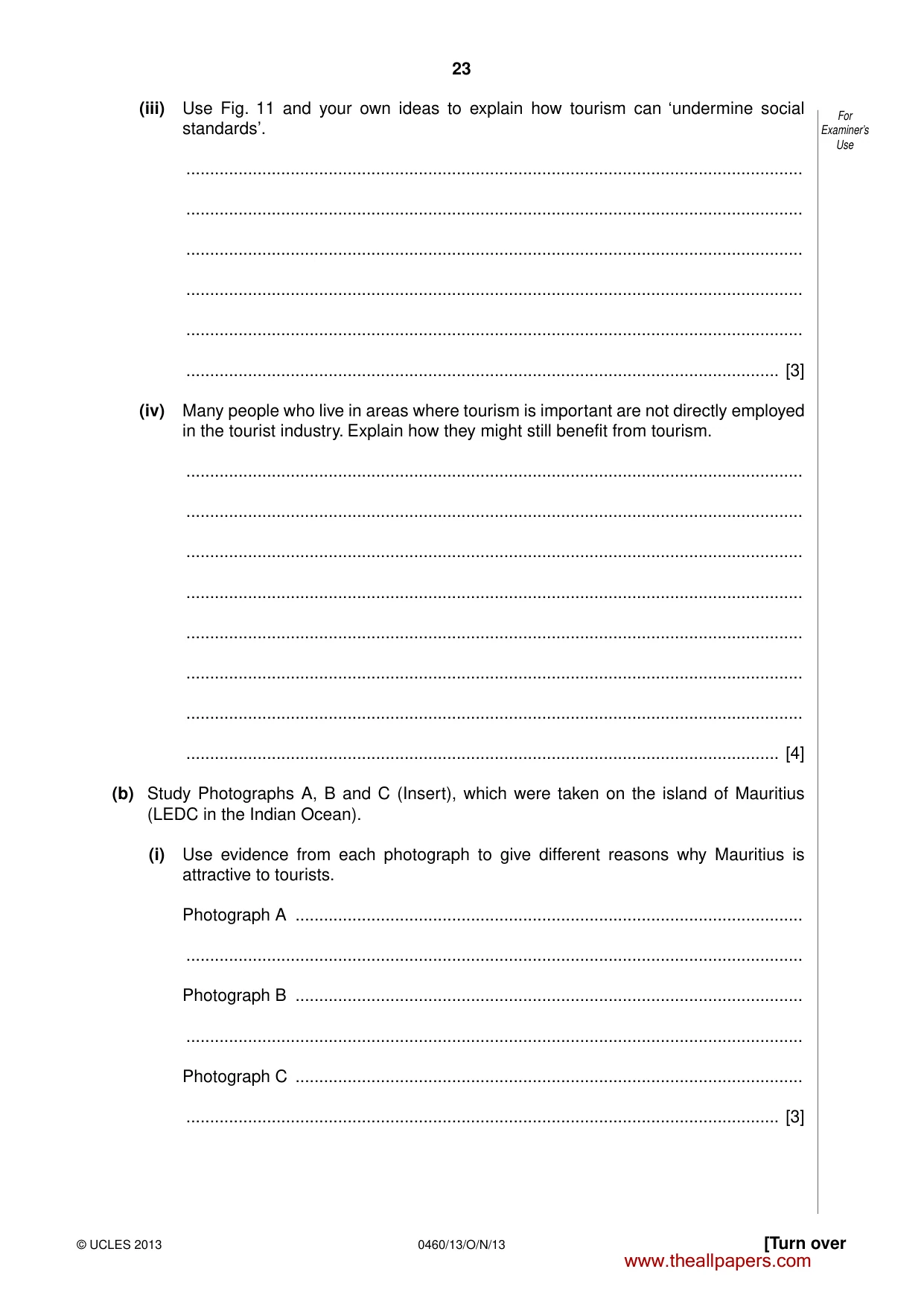
23 0460/13/O/N/13 © UCLES 2013 [Turn over For Examiner’s Use (iii) Use Fig. 11 and your own ideas to explain how tourism can ‘undermine social standards’. … … … … … … [3] (iv) Many people who live in areas where tourism is important are not directly employed in the tourist industry. Explain how they might still benefit from tourism. … … … … … … … … [4] (b) Study Photographs A, B and C (Insert), which were taken on the island of Mauritius (LEDC in the Indian Ocean). (i) Use evidence from each photograph to give different reasons why Mauritius is attractive to tourists. Photograph A … … Photograph B … … Photograph C … … [3] www.theallpapers.com
Question paper, page 24
24 0460/13/O/N/13 © UCLES 2013 For Examiner’s Use (ii) Explain why it is easier to develop tourism than manufacturing industry in LEDCs. … … … … … … … … … … [5] (c) For a named area which you have studied where the tourist industry is important, describe what has been done in the area to conserve the natural environment. Name of area … … … … … … … … … … … … … … … [7] [Total: 25 marks] END OF QUESTION 6 www.theallpapers.com
Question paper, page 25
25 0460/13/O/N/13 © UCLES 2013 For Examiner’s Use Additional Page If you use the following lined page to complete the answer(s) to any question(s), the question number(s) must be clearly shown. … … … … … … … … … … … … … … … … … … … … … … … … … … www.theallpapers.com
Question paper, page 26
26 0460/13/O/N/13 © UCLES 2013 BLANK PAGE www.theallpapers.com
Question paper, page 27
27 0460/13/O/N/13 © UCLES 2013 BLANK PAGE www.theallpapers.com
Question paper, page 28
28 0460/13/O/N/13 © UCLES 2013 BLANK PAGE Copyright Acknowledgements: Question 2 Fig. 4 © Austin, Texas Landuse Map; http://bluntproperties.com/monarch; 17 October 2011. Question 4 Fig. 8 © amended: G Cambers & S Currie; Geography for Avery Hill Teacher’s Resource Pack; Heinemann. Question 5 Fig. 9 © Geography Magazine; 1991. Question 6 Fig. 11 © WWF Data Support Sheet, 14 June 1991. Permission to reproduce items where third-party owned material protected by copyright is included has been sought and cleared where possible. Every reasonable effort has been made by the publisher (UCLES) to trace copyright holders, but if any items requiring clearance have unwittingly been included, the publisher will be pleased to make amends at the earliest possible opportunity. University of Cambridge International Examinations is part of the Cambridge Assessment Group. Cambridge Assessment is the brand name of University of Cambridge Local Examinations Syndicate (UCLES), which is itself a department of the University of Cambridge. www.theallpapers.com
Mark scheme, page 1
CAMBRIDGE INTERNATIONAL EXAMINATIONS International General Certificate of Secondary Education MARK SCHEME for the October/November 2013 series 0460 GEOGRAPHY 0460/13 Paper 1, maximum raw mark 75 This mark scheme is published as an aid to teachers and candidates, to indicate the requirements of the examination. It shows the basis on which Examiners were instructed to award marks. It does not indicate the details of the discussions that took place at an Examiners’ meeting before marking began, which would have considered the acceptability of alternative answers. Mark schemes should be read in conjunction with the question paper and the Principal Examiner Report for Teachers. Cambridge will not enter into discussions about these mark schemes. Cambridge is publishing the mark schemes for the October/November 2013 series for most IGCSE, GCE Advanced Level and Advanced Subsidiary Level components and some Ordinary Level components. www.theallpapers.com
Mark scheme, page 2
Page 2 Mark Scheme Syllabus Paper IGCSE – October/November 2013 0460 13 © Cambridge International Examinations 2013 The features of the marking scheme Each question carries 25 marks. Candidates cannot earn above the maximum marks available within each sub section. The marking scheme attempts to give guidance about the requirements of each answer and lists a number of responses, which will earn marks along with the general principles to be applied when marking each question. It should be noted that candidates can earn marks if their answers are phrased differently provided they convey the same meaning as those in the mark scheme. THE CANDIDATES DO NOT NEED TO USE THE SAME WORDING TO EARN MARKS. The notation ‘etc.’ at the end of an answer in the mark scheme signifies that there may well be other correct responses or examples that can be given credit. Providing the statement is true, relevant to the question asked and not repetition of a previous point made credit should be given. A point made within one sub-section which is an answer to the question set in a different sub-section should not be given credit as each sub-section asks different questions which require independent answers. The mark scheme uses semi colons (;) to separate marks and diagonals to separate alternative answers. Levels of response marking is used for section (c) of each question. Thus it is the quality of the response that determines which level an answer is achieved rather than the quantity of statements contained within it. However, once assigned to a level the mark achieved within that level is determined by the number of points made. Levels 1 and 2 are distinguished by whether statements are simple (level 1) or developed/elaborated (level 2). A candidate can immediately enter L2 by making developed points without making any L1 statements. In order to achieve L3 a candidate must have already reached the top end of L2 – in addition his/her answer should have a clear and appropriate example and if the answer is place specific as well (7 marks). Highlight place specific detail. Where statements are assigned levels by the examiner this should be indicated by the use of L1, L2 and L3 next to the statements. A summary of the overall level and mark awarded should be written at the end of the answer. Ticks should not be used on answers that are marked using levels of response marking. Summary: Level 1 (1 to 3 marks): 1 simple statement (1 mark) 2 simple statements (2 marks) 3 simple statements (3 marks) Level 2 (4 to 6 marks): 1 developed statement (4 marks) 2 developed statements (5 marks) 3 or more developed statements with e.g. (6 marks) Level 3 (7 marks) 3 or more developed statements + named example with at least one piece of place specific detail. www.theallpapers.com
Mark scheme, page 3
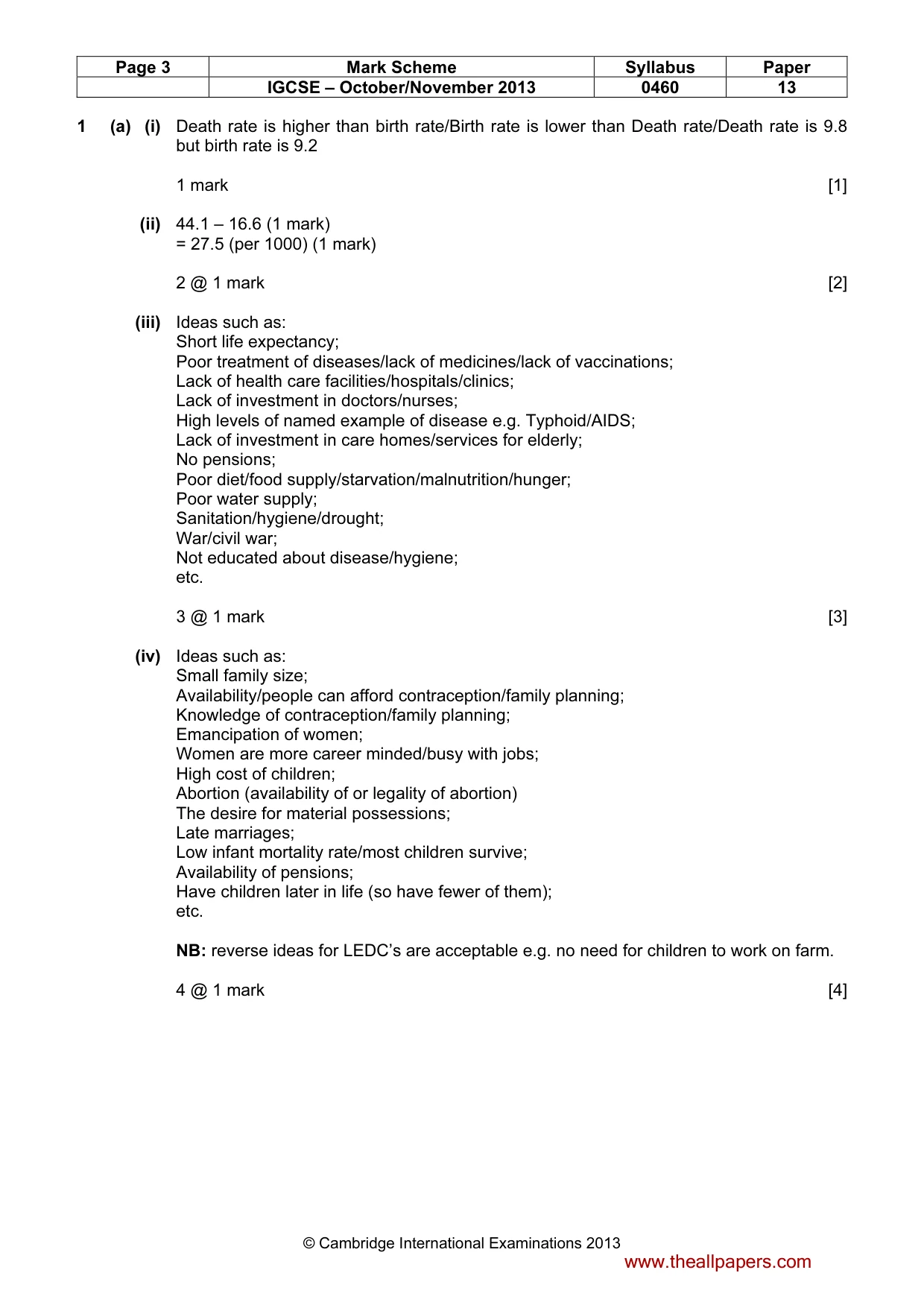
Page 3 Mark Scheme Syllabus Paper IGCSE – October/November 2013 0460 13 © Cambridge International Examinations 2013 1 (a) (i) Death rate is higher than birth rate/Birth rate is lower than Death rate/Death rate is 9.8 but birth rate is 9.2 1 mark [1] (ii) 44.1 – 16.6 (1 mark) = 27.5 (per 1000) (1 mark) 2 @ 1 mark [2] (iii) Ideas such as: Short life expectancy; Poor treatment of diseases/lack of medicines/lack of vaccinations; Lack of health care facilities/hospitals/clinics; Lack of investment in doctors/nurses; High levels of named example of disease e.g. Typhoid/AIDS; Lack of investment in care homes/services for elderly; No pensions; Poor diet/food supply/starvation/malnutrition/hunger; Poor water supply; Sanitation/hygiene/drought; War/civil war; Not educated about disease/hygiene; etc. 3 @ 1 mark [3] (iv) Ideas such as: Small family size; Availability/people can afford contraception/family planning; Knowledge of contraception/family planning; Emancipation of women; Women are more career minded/busy with jobs; High cost of children; Abortion (availability of or legality of abortion) The desire for material possessions; Late marriages; Low infant mortality rate/most children survive; Availability of pensions; Have children later in life (so have fewer of them); etc. NB: reverse ideas for LEDC’s are acceptable e.g. no need for children to work on farm. 4 @ 1 mark [4] www.theallpapers.com
Mark scheme, page 4
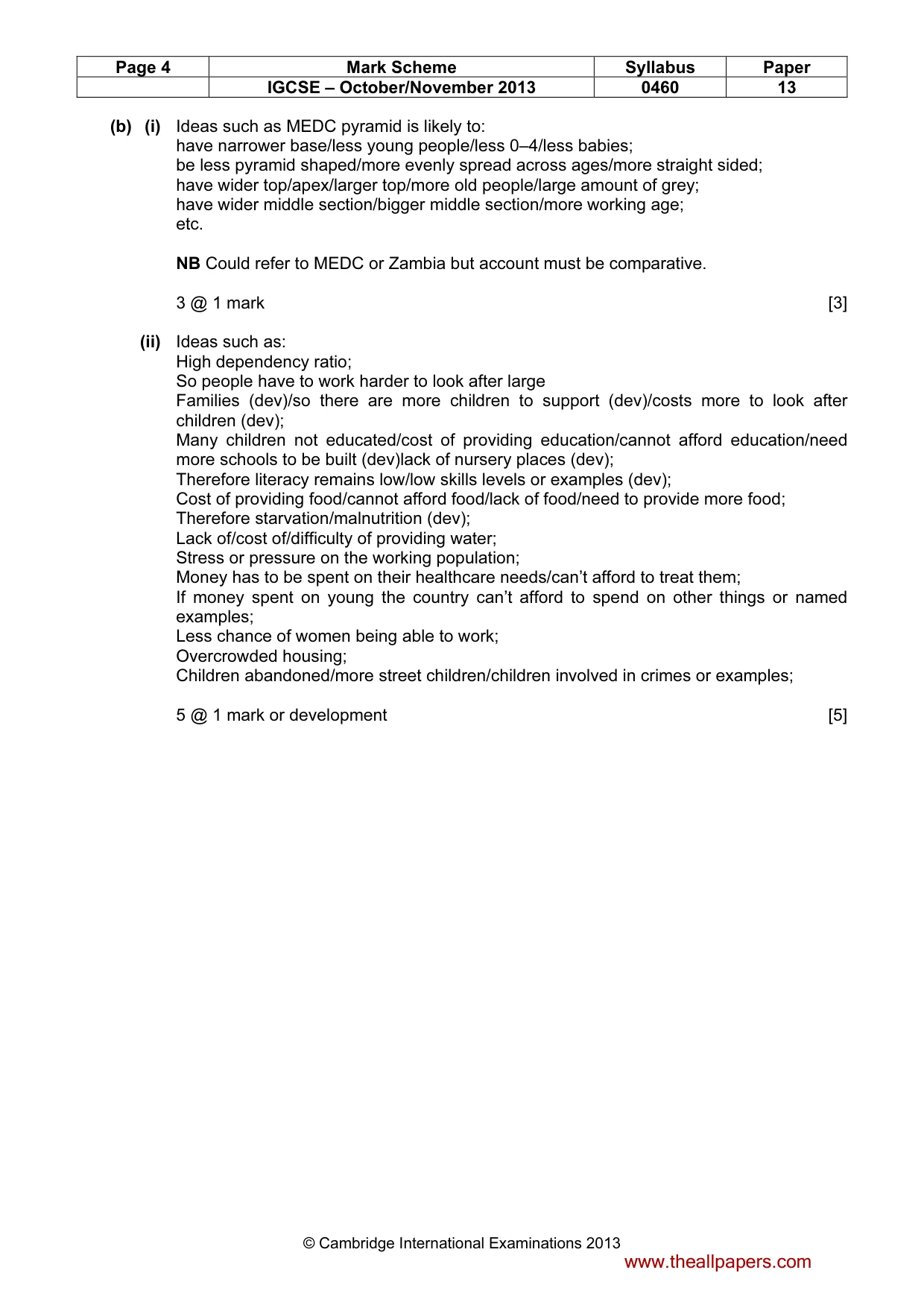
Page 4 Mark Scheme Syllabus Paper IGCSE – October/November 2013 0460 13 © Cambridge International Examinations 2013 (b) (i) Ideas such as MEDC pyramid is likely to: have narrower base/less young people/less 0–4/less babies; be less pyramid shaped/more evenly spread across ages/more straight sided; have wider top/apex/larger top/more old people/large amount of grey; have wider middle section/bigger middle section/more working age; etc. NB Could refer to MEDC or Zambia but account must be comparative. 3 @ 1 mark [3] (ii) Ideas such as: High dependency ratio; So people have to work harder to look after large Families (dev)/so there are more children to support (dev)/costs more to look after children (dev); Many children not educated/cost of providing education/cannot afford education/need more schools to be built (dev)lack of nursery places (dev); Therefore literacy remains low/low skills levels or examples (dev); Cost of providing food/cannot afford food/lack of food/need to provide more food; Therefore starvation/malnutrition (dev); Lack of/cost of/difficulty of providing water; Stress or pressure on the working population; Money has to be spent on their healthcare needs/can’t afford to treat them; If money spent on young the country can’t afford to spend on other things or named examples; Less chance of women being able to work; Overcrowded housing; Children abandoned/more street children/children involved in crimes or examples; 5 @ 1 mark or development [5] www.theallpapers.com
Mark scheme, page 5
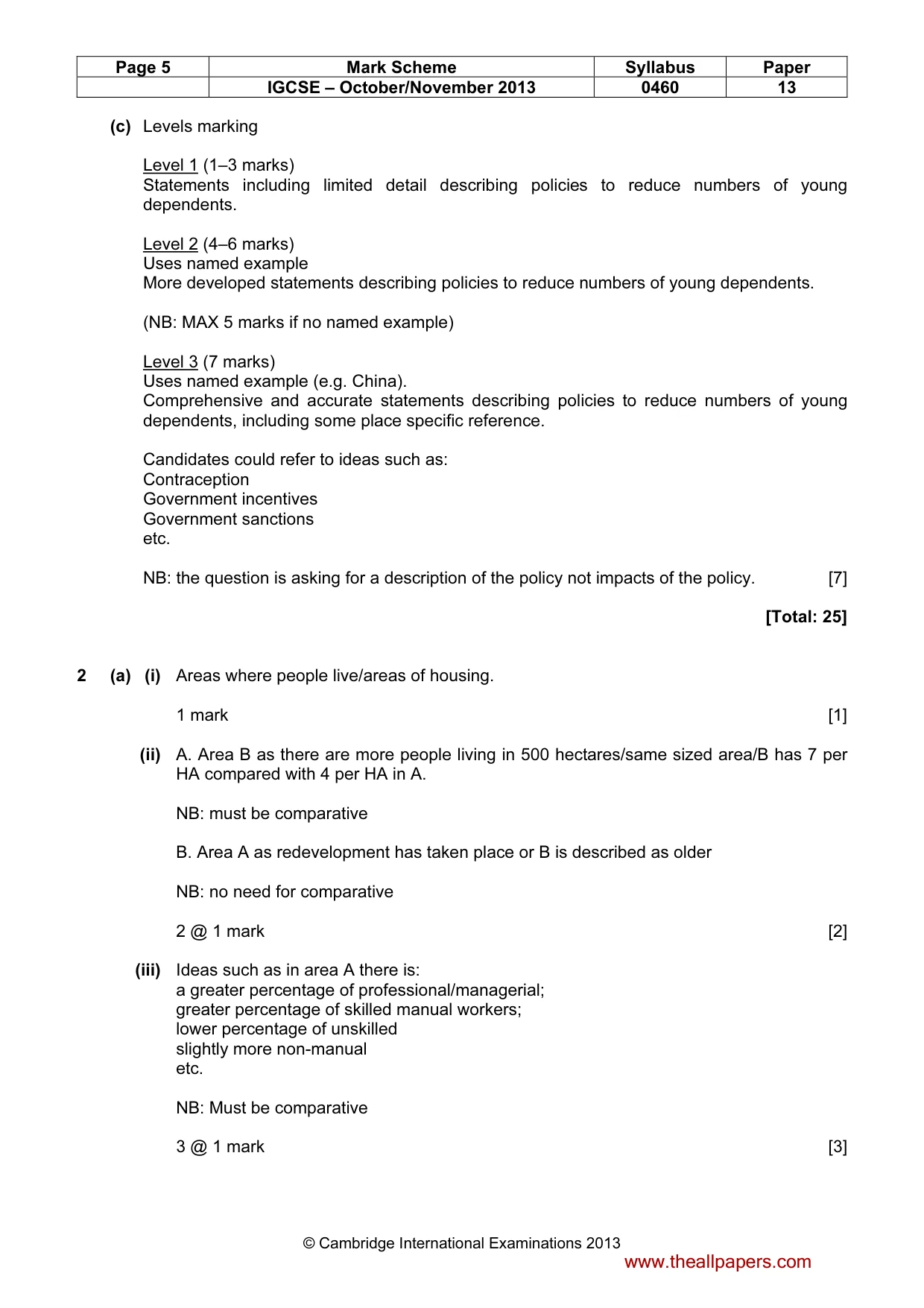
Page 5 Mark Scheme Syllabus Paper IGCSE – October/November 2013 0460 13 © Cambridge International Examinations 2013 (c) Levels marking Level 1 (1–3 marks) Statements including limited detail describing policies to reduce numbers of young dependents. Level 2 (4–6 marks) Uses named example More developed statements describing policies to reduce numbers of young dependents. (NB: MAX 5 marks if no named example) Level 3 (7 marks) Uses named example (e.g. China). Comprehensive and accurate statements describing policies to reduce numbers of young dependents, including some place specific reference. Candidates could refer to ideas such as: Contraception Government incentives Government sanctions etc. NB: the question is asking for a description of the policy not impacts of the policy. [7] [Total: 25] 2 (a) (i) Areas where people live/areas of housing. 1 mark [1] (ii) A. Area B as there are more people living in 500 hectares/same sized area/B has 7 per HA compared with 4 per HA in A. NB: must be comparative B. Area A as redevelopment has taken place or B is described as older NB: no need for comparative 2 @ 1 mark [2] (iii) Ideas such as in area A there is: a greater percentage of professional/managerial; greater percentage of skilled manual workers; lower percentage of unskilled slightly more non-manual etc. NB: Must be comparative 3 @ 1 mark [3] www.theallpapers.com
Mark scheme, page 6
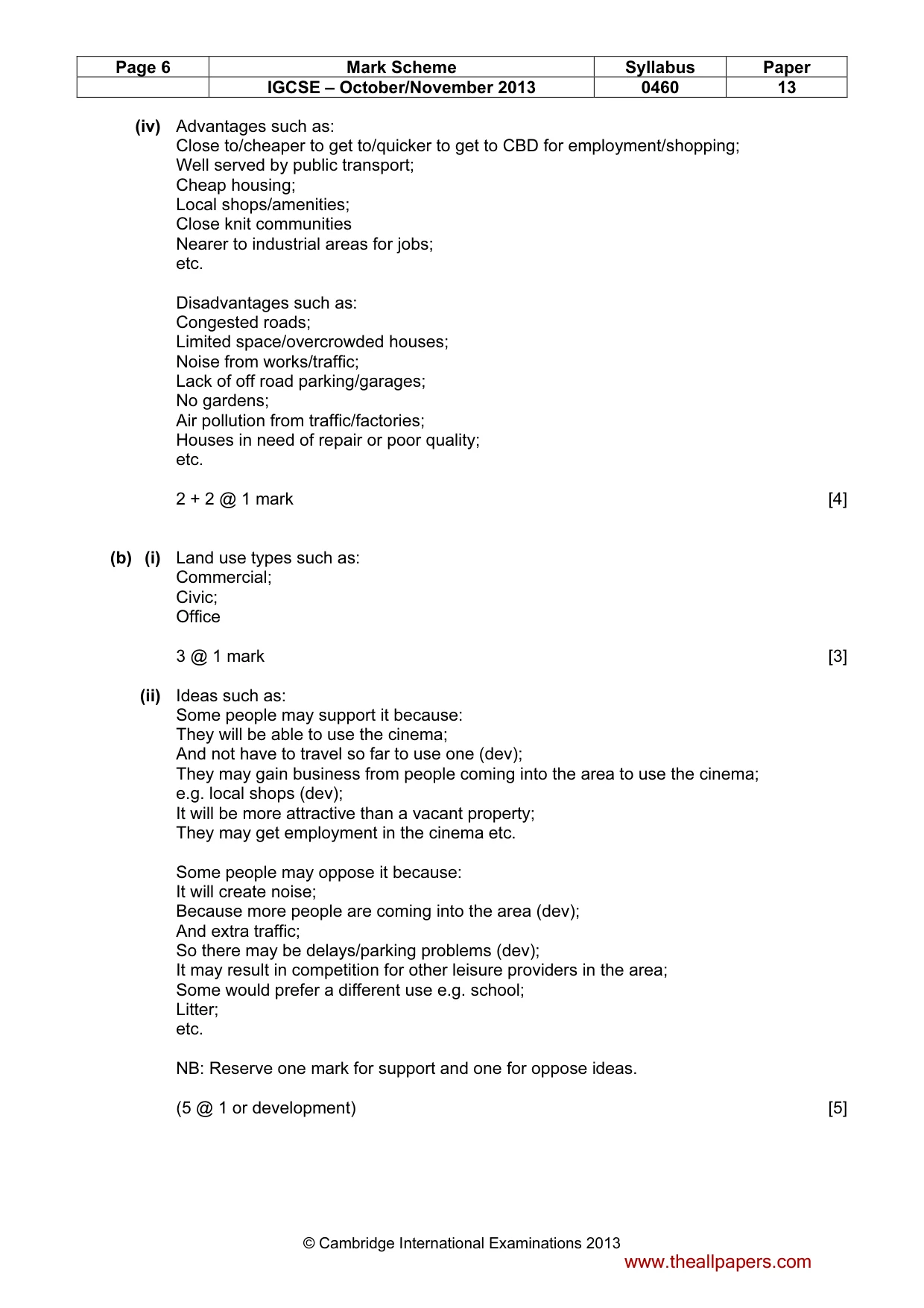
Page 6 Mark Scheme Syllabus Paper IGCSE – October/November 2013 0460 13 © Cambridge International Examinations 2013 (iv) Advantages such as: Close to/cheaper to get to/quicker to get to CBD for employment/shopping; Well served by public transport; Cheap housing; Local shops/amenities; Close knit communities Nearer to industrial areas for jobs; etc. Disadvantages such as: Congested roads; Limited space/overcrowded houses; Noise from works/traffic; Lack of off road parking/garages; No gardens; Air pollution from traffic/factories; Houses in need of repair or poor quality; etc. 2 + 2 @ 1 mark [4] (b) (i) Land use types such as: Commercial; Civic; Office 3 @ 1 mark [3] (ii) Ideas such as: Some people may support it because: They will be able to use the cinema; And not have to travel so far to use one (dev); They may gain business from people coming into the area to use the cinema; e.g. local shops (dev); It will be more attractive than a vacant property; They may get employment in the cinema etc. Some people may oppose it because: It will create noise; Because more people are coming into the area (dev); And extra traffic; So there may be delays/parking problems (dev); It may result in competition for other leisure providers in the area; Some would prefer a different use e.g. school; Litter; etc. NB: Reserve one mark for support and one for oppose ideas. (5 @ 1 or development) [5] www.theallpapers.com
Mark scheme, page 7
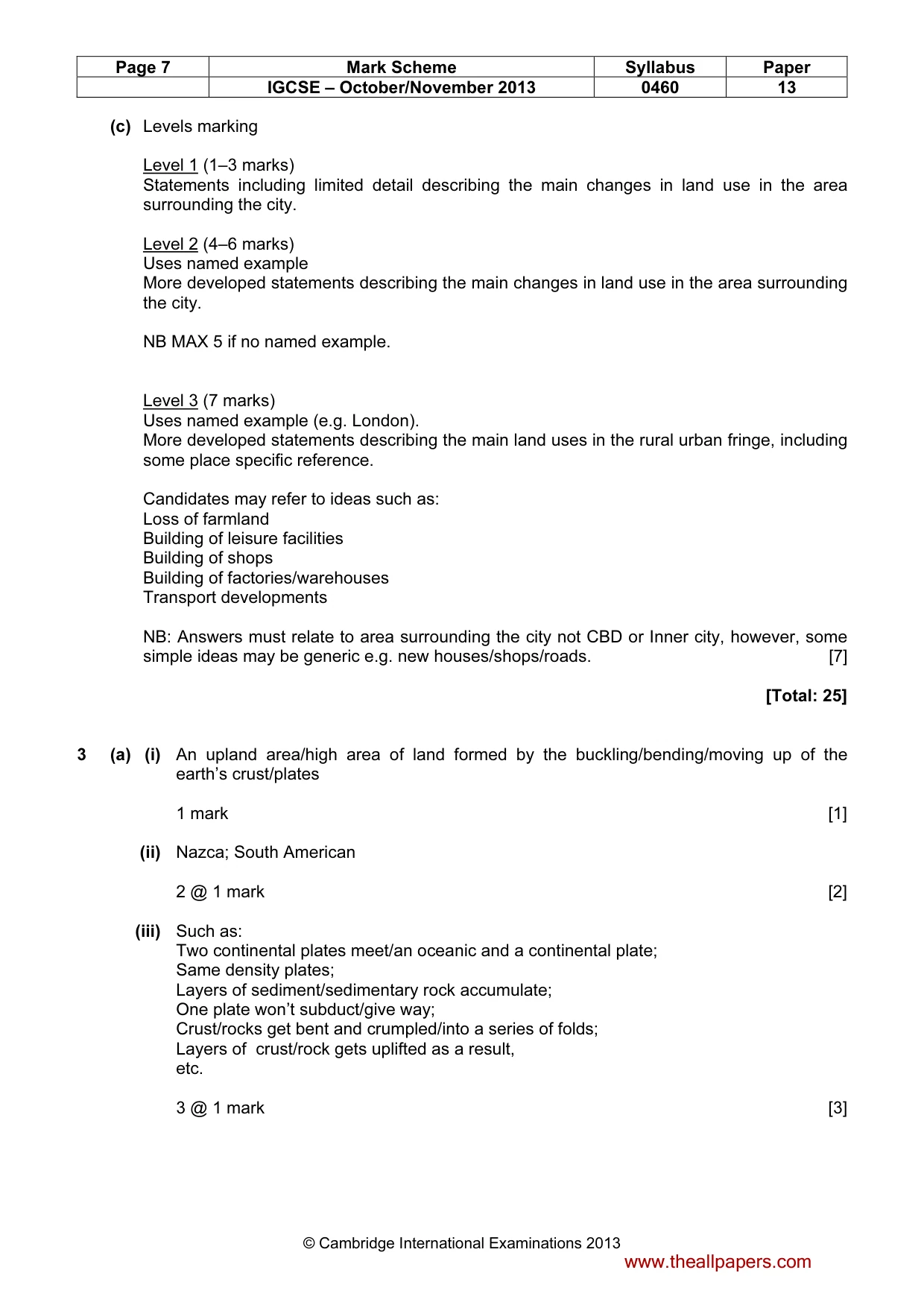
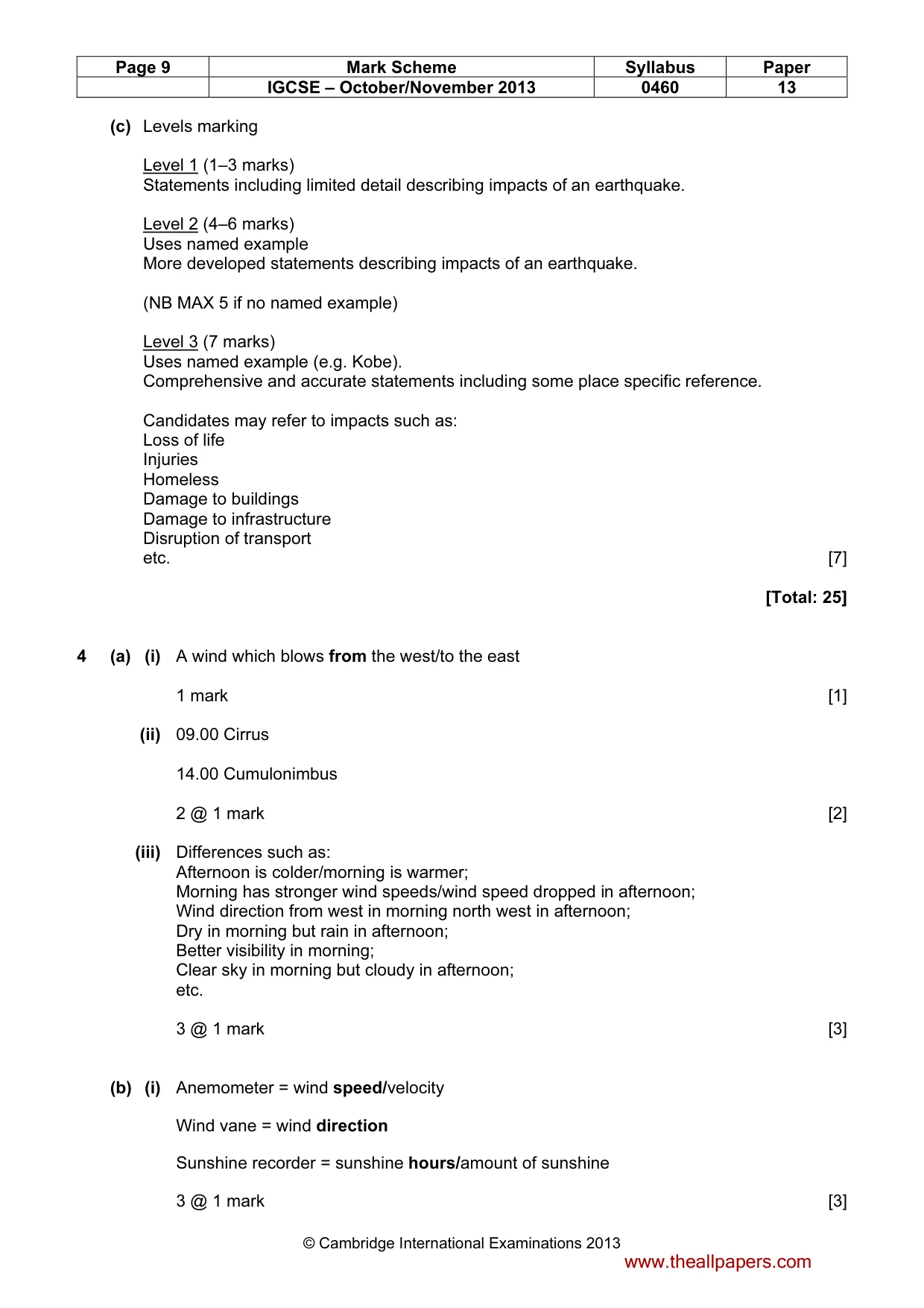
Page 7 Mark Scheme Syllabus Paper IGCSE – October/November 2013 0460 13 © Cambridge International Examinations 2013 (c) Levels marking Level 1 (1–3 marks) Statements including limited detail describing the main changes in land use in the area surrounding the city. Level 2 (4–6 marks) Uses named example More developed statements describing the main changes in land use in the area surrounding the city. NB MAX 5 if no named example. Level 3 (7 marks) Uses named example (e.g. London). More developed statements describing the main land uses in the rural urban fringe, including some place specific reference. Candidates may refer to ideas such as: Loss of farmland Building of leisure facilities Building of shops Building of factories/warehouses Transport developments NB: Answers must relate to area surrounding the city not CBD or Inner city, however, some simple ideas may be generic e.g. new houses/shops/roads. [7] [Total: 25] 3 (a) (i) An upland area/high area of land formed by the buckling/bending/moving up of the earth’s crust/plates 1 mark [1] (ii) Nazca; South American 2 @ 1 mark [2] (iii) Such as: Two continental plates meet/an oceanic and a continental plate; Same density plates; Layers of sediment/sedimentary rock accumulate; One plate won’t subduct/give way; Crust/rocks get bent and crumpled/into a series of folds; Layers of crust/rock gets uplifted as a result, etc. 3 @ 1 mark [3] www.theallpapers.com
Mark scheme, page 8
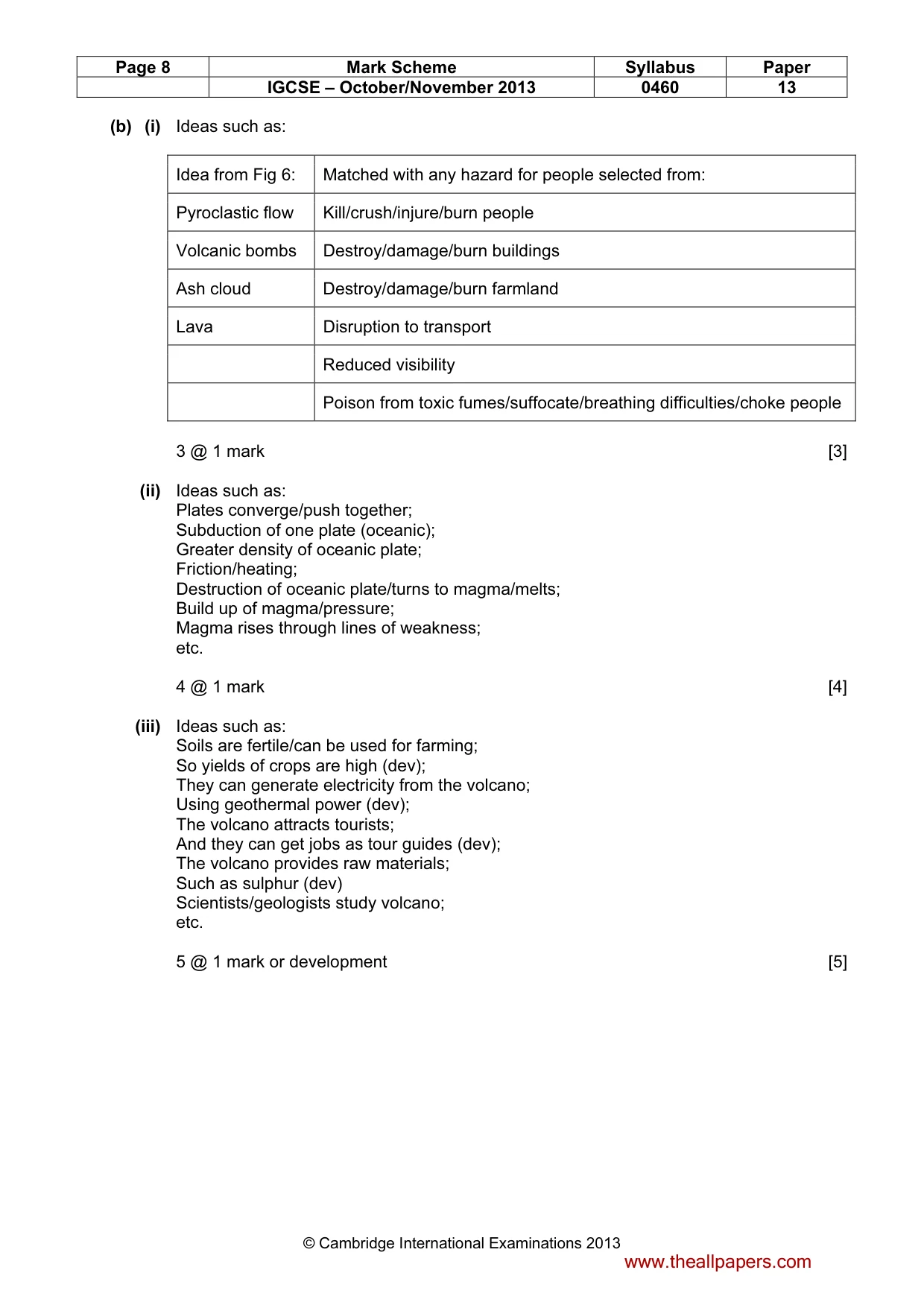
Page 8 Mark Scheme Syllabus Paper IGCSE – October/November 2013 0460 13 © Cambridge International Examinations 2013 (b) (i) Ideas such as: Idea from Fig 6: Matched with any hazard for people selected from: Pyroclastic flow Kill/crush/injure/burn people Volcanic bombs Destroy/damage/burn buildings Ash cloud Destroy/damage/burn farmland Lava Disruption to transport Reduced visibility Poison from toxic fumes/suffocate/breathing difficulties/choke people 3 @ 1 mark [3] (ii) Ideas such as: Plates converge/push together; Subduction of one plate (oceanic); Greater density of oceanic plate; Friction/heating; Destruction of oceanic plate/turns to magma/melts; Build up of magma/pressure; Magma rises through lines of weakness; etc. 4 @ 1 mark [4] (iii) Ideas such as: Soils are fertile/can be used for farming; So yields of crops are high (dev); They can generate electricity from the volcano; Using geothermal power (dev); The volcano attracts tourists; And they can get jobs as tour guides (dev); The volcano provides raw materials; Such as sulphur (dev) Scientists/geologists study volcano; etc. 5 @ 1 mark or development [5] www.theallpapers.com
Mark scheme, page 9
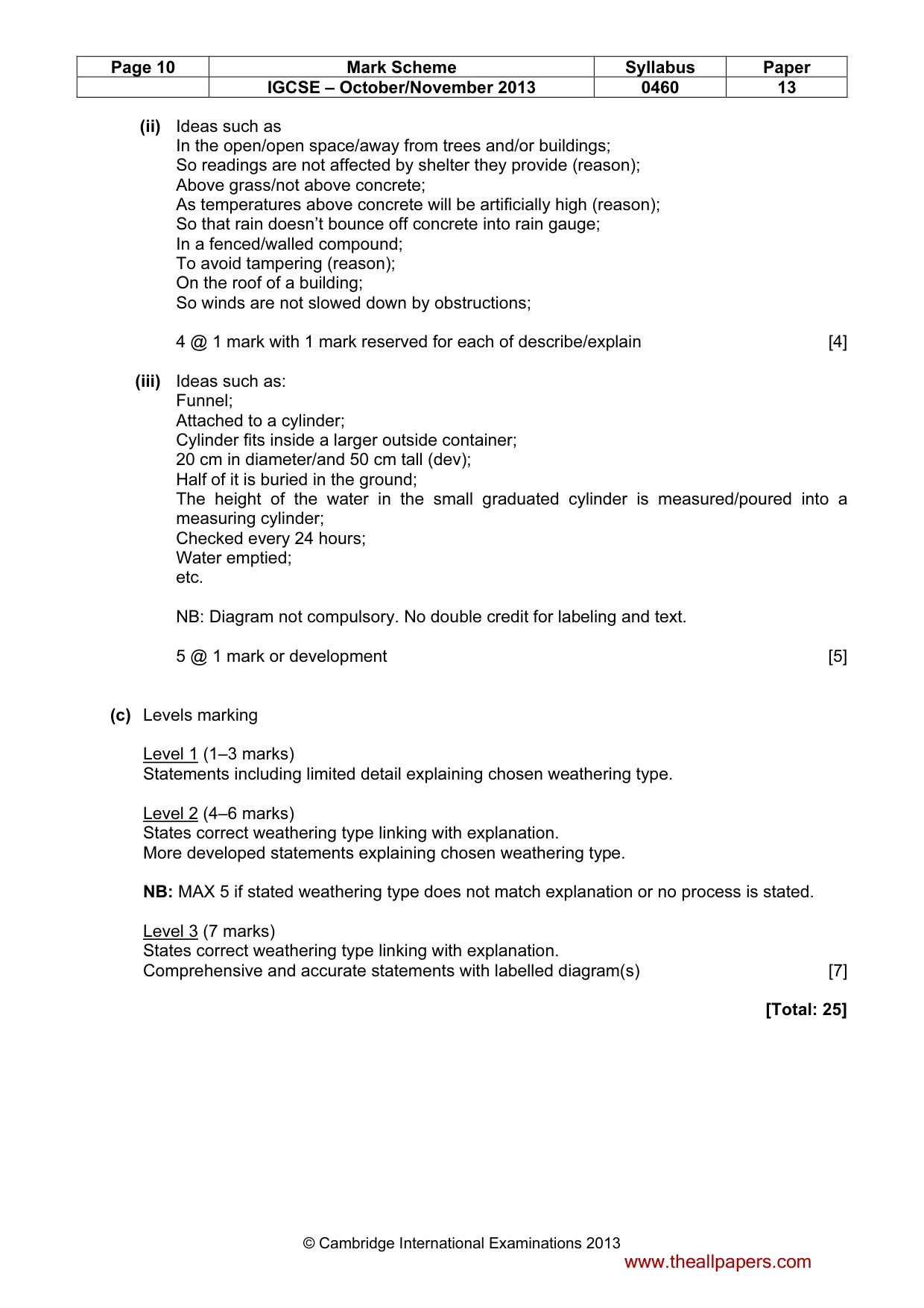
Page 9 Mark Scheme Syllabus Paper IGCSE – October/November 2013 0460 13 © Cambridge International Examinations 2013 (c) Levels marking Level 1 (1–3 marks) Statements including limited detail describing impacts of an earthquake. Level 2 (4–6 marks) Uses named example More developed statements describing impacts of an earthquake. (NB MAX 5 if no named example) Level 3 (7 marks) Uses named example (e.g. Kobe). Comprehensive and accurate statements including some place specific reference. Candidates may refer to impacts such as: Loss of life Injuries Homeless Damage to buildings Damage to infrastructure Disruption of transport etc. [7] [Total: 25] 4 (a) (i) A wind which blows from the west/to the east 1 mark [1] (ii) 09.00 Cirrus 14.00 Cumulonimbus 2 @ 1 mark [2] (iii) Differences such as: Afternoon is colder/morning is warmer; Morning has stronger wind speeds/wind speed dropped in afternoon; Wind direction from west in morning north west in afternoon; Dry in morning but rain in afternoon; Better visibility in morning; Clear sky in morning but cloudy in afternoon; etc. 3 @ 1 mark [3] (b) (i) Anemometer = wind speed/velocity Wind vane = wind direction Sunshine recorder = sunshine hours/amount of sunshine 3 @ 1 mark [3] www.theallpapers.com
Mark scheme, page 10
Page 10 Mark Scheme Syllabus Paper IGCSE – October/November 2013 0460 13 © Cambridge International Examinations 2013 (ii) Ideas such as In the open/open space/away from trees and/or buildings; So readings are not affected by shelter they provide (reason); Above grass/not above concrete; As temperatures above concrete will be artificially high (reason); So that rain doesn’t bounce off concrete into rain gauge; In a fenced/walled compound; To avoid tampering (reason); On the roof of a building; So winds are not slowed down by obstructions; 4 @ 1 mark with 1 mark reserved for each of describe/explain [4] (iii) Ideas such as: Funnel; Attached to a cylinder; Cylinder fits inside a larger outside container; 20 cm in diameter/and 50 cm tall (dev); Half of it is buried in the ground; The height of the water in the small graduated cylinder is measured/poured into a measuring cylinder; Checked every 24 hours; Water emptied; etc. NB: Diagram not compulsory. No double credit for labeling and text. 5 @ 1 mark or development [5] (c) Levels marking Level 1 (1–3 marks) Statements including limited detail explaining chosen weathering type. Level 2 (4–6 marks) States correct weathering type linking with explanation. More developed statements explaining chosen weathering type. NB: MAX 5 if stated weathering type does not match explanation or no process is stated. Level 3 (7 marks) States correct weathering type linking with explanation. Comprehensive and accurate statements with labelled diagram(s) [7] [Total: 25] www.theallpapers.com
Mark scheme, page 11
Page 11 Mark Scheme Syllabus Paper IGCSE – October/November 2013 0460 13 © Cambridge International Examinations 2013 5 (a) (i) Carbon dioxide, methane, ozone, nitrous oxide, water vapour 1 mark [1] (ii) A. less heating needed (in winter); B. more HEP generated/increased forest productivity for wood to burn 2 @ 1 mark [2] (iii) Ideas such as: Extension of agriculture into areas to north/higher latitudes/nearer poles; Longer growing season; More drought/less water for crops to grow; Flooding of farmland; Changing temperatures affects growth of crops; etc. 3 @ 1 mark [3] (iv) Ideas such as: Temperature patterns change/some increase some decrease; Melting of ice cover/less icebergs/glaciers retreat; Rising of sea levels; Coastal flooding; Loss of/changing habitats; Extinction of species; Species may migrate permanently; Impact on ecosystems/food chains; Reduction in food/water supply for wildlife; Changing rainfall patterns/drought; Natural vegetation dies/grows in areas it previously didn’t grow; Desertification/spread of deserts; Increased strength of /frequency of tropical storms; etc. 4 @ 1 mark [4] (b) (i) Ideas such as: General rise over the period/temperatures have increased; From –3.3 to –2.2 (1.1) from (1906 to 2002)/–3.9 to –0.7 increase of –3.2; However fluctuations/not constant;(NB: not just min/max temps) e.g. 0.3 degrees in 1926, higher than –5.5 in 1956 (must refer to years and statistics here); etc. 3 @ 1 mark [3] www.theallpapers.com
Mark scheme, page 12
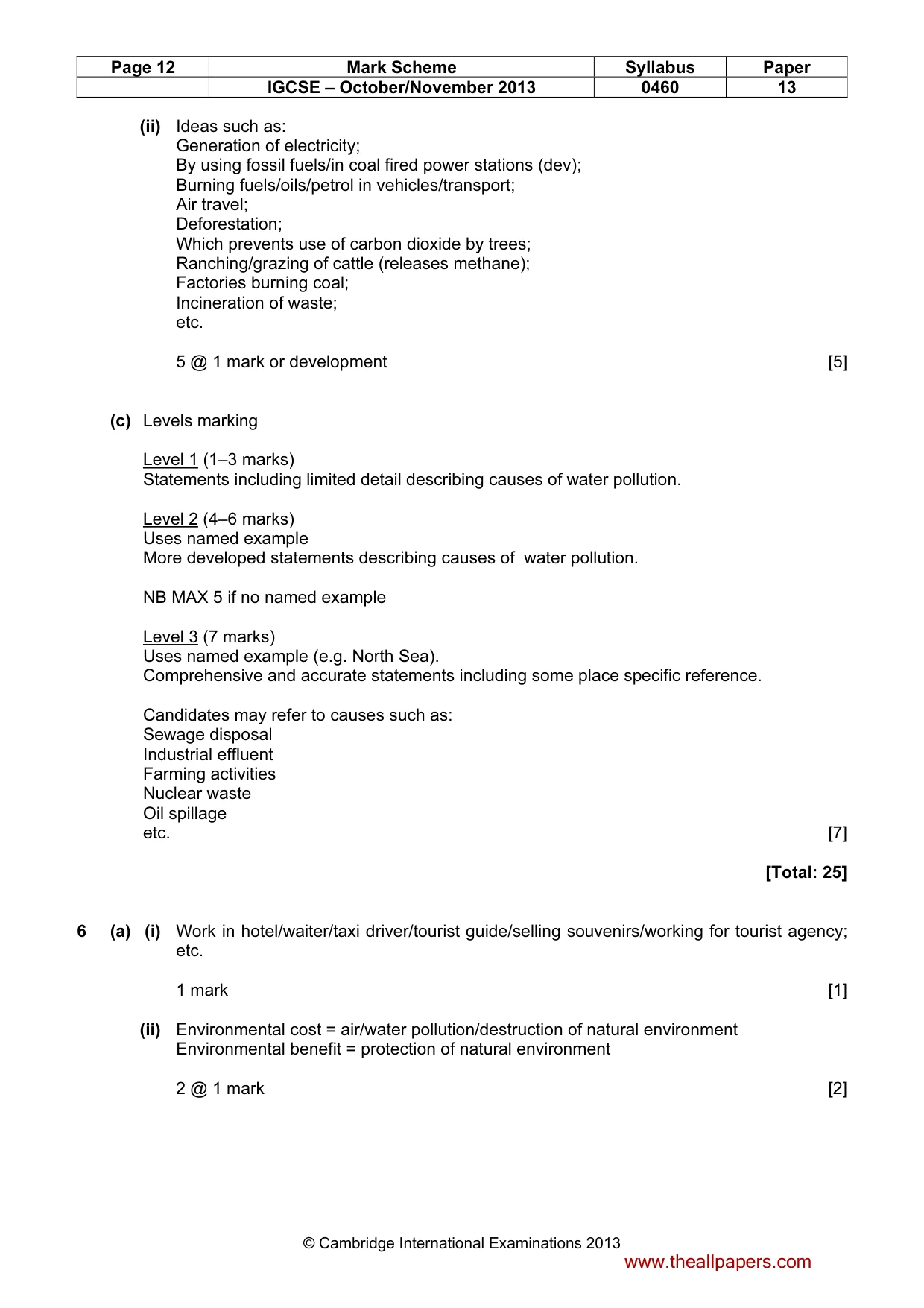
Page 12 Mark Scheme Syllabus Paper IGCSE – October/November 2013 0460 13 © Cambridge International Examinations 2013 (ii) Ideas such as: Generation of electricity; By using fossil fuels/in coal fired power stations (dev); Burning fuels/oils/petrol in vehicles/transport; Air travel; Deforestation; Which prevents use of carbon dioxide by trees; Ranching/grazing of cattle (releases methane); Factories burning coal; Incineration of waste; etc. 5 @ 1 mark or development [5] (c) Levels marking Level 1 (1–3 marks) Statements including limited detail describing causes of water pollution. Level 2 (4–6 marks) Uses named example More developed statements describing causes of water pollution. NB MAX 5 if no named example Level 3 (7 marks) Uses named example (e.g. North Sea). Comprehensive and accurate statements including some place specific reference. Candidates may refer to causes such as: Sewage disposal Industrial effluent Farming activities Nuclear waste Oil spillage etc. [7] [Total: 25] 6 (a) (i) Work in hotel/waiter/taxi driver/tourist guide/selling souvenirs/working for tourist agency; etc. 1 mark [1] (ii) Environmental cost = air/water pollution/destruction of natural environment Environmental benefit = protection of natural environment 2 @ 1 mark [2] www.theallpapers.com
Mark scheme, page 13
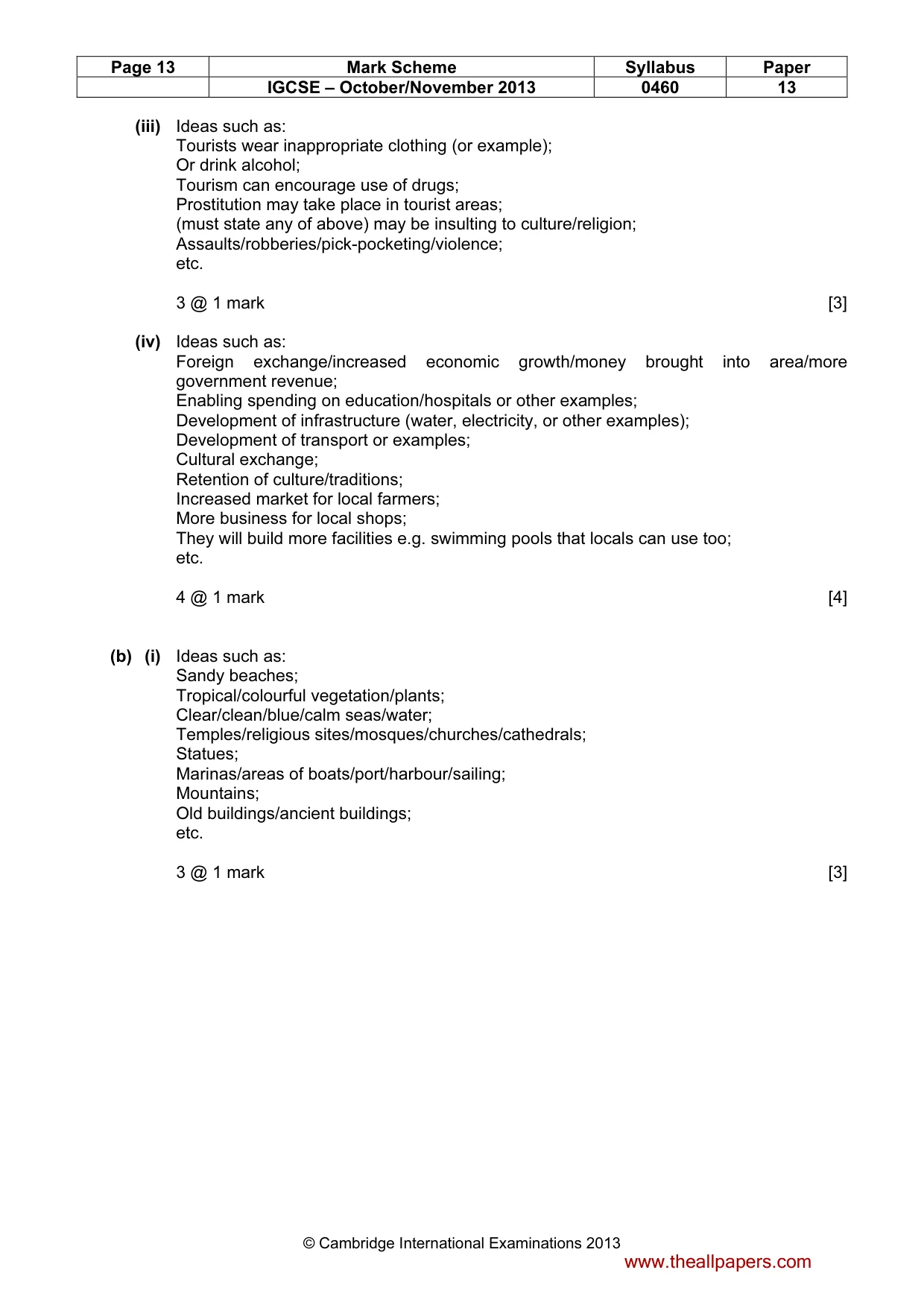
Page 13 Mark Scheme Syllabus Paper IGCSE – October/November 2013 0460 13 © Cambridge International Examinations 2013 (iii) Ideas such as: Tourists wear inappropriate clothing (or example); Or drink alcohol; Tourism can encourage use of drugs; Prostitution may take place in tourist areas; (must state any of above) may be insulting to culture/religion; Assaults/robberies/pick-pocketing/violence; etc. 3 @ 1 mark [3] (iv) Ideas such as: Foreign exchange/increased economic growth/money brought into area/more government revenue; Enabling spending on education/hospitals or other examples; Development of infrastructure (water, electricity, or other examples); Development of transport or examples; Cultural exchange; Retention of culture/traditions; Increased market for local farmers; More business for local shops; They will build more facilities e.g. swimming pools that locals can use too; etc. 4 @ 1 mark [4] (b) (i) Ideas such as: Sandy beaches; Tropical/colourful vegetation/plants; Clear/clean/blue/calm seas/water; Temples/religious sites/mosques/churches/cathedrals; Statues; Marinas/areas of boats/port/harbour/sailing; Mountains; Old buildings/ancient buildings; etc. 3 @ 1 mark [3] www.theallpapers.com
Mark scheme, page 14
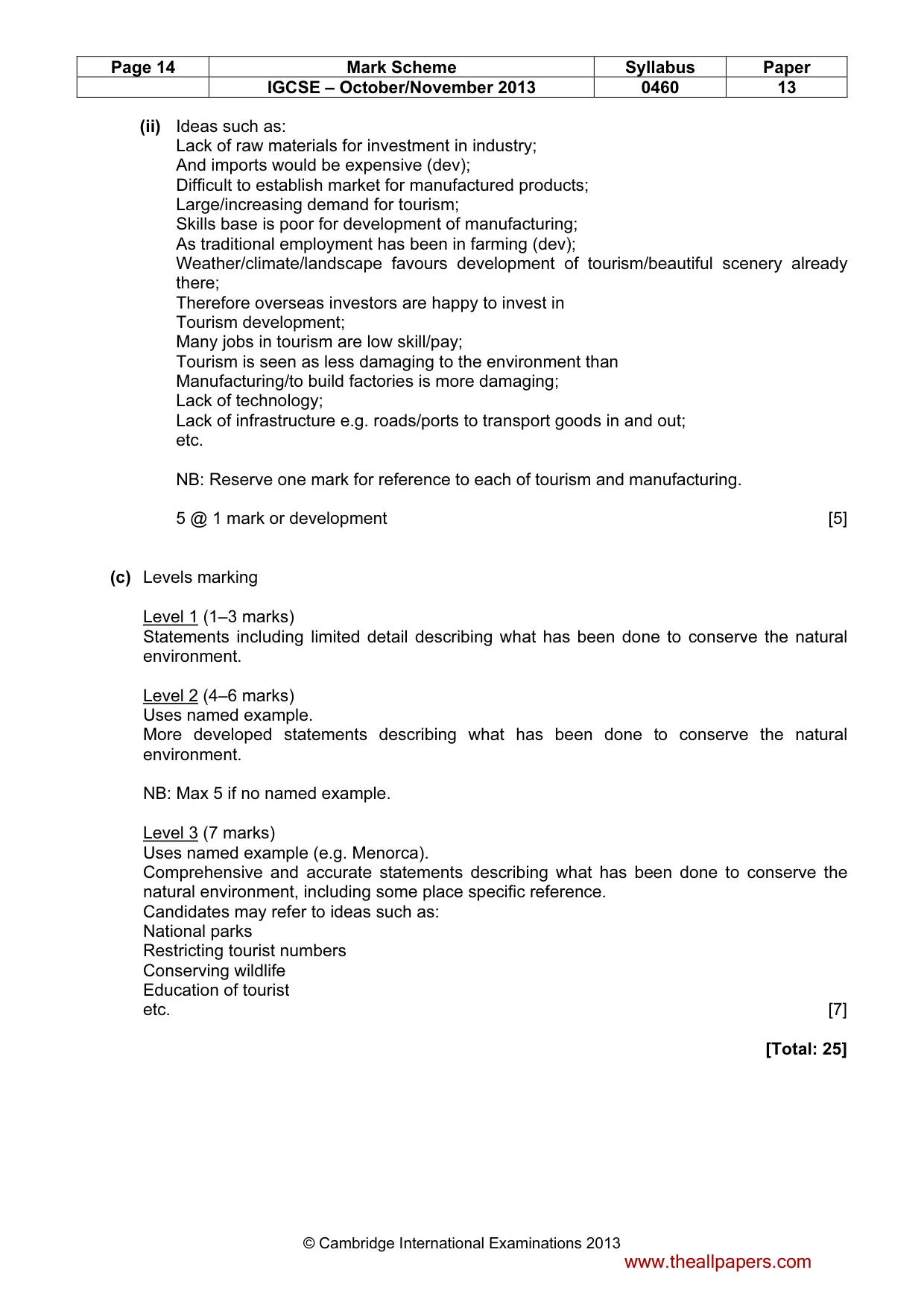
Page 14 Mark Scheme Syllabus Paper IGCSE – October/November 2013 0460 13 © Cambridge International Examinations 2013 (ii) Ideas such as: Lack of raw materials for investment in industry; And imports would be expensive (dev); Difficult to establish market for manufactured products; Large/increasing demand for tourism; Skills base is poor for development of manufacturing; As traditional employment has been in farming (dev); Weather/climate/landscape favours development of tourism/beautiful scenery already there; Therefore overseas investors are happy to invest in Tourism development; Many jobs in tourism are low skill/pay; Tourism is seen as less damaging to the environment than Manufacturing/to build factories is more damaging; Lack of technology; Lack of infrastructure e.g. roads/ports to transport goods in and out; etc. NB: Reserve one mark for reference to each of tourism and manufacturing. 5 @ 1 mark or development [5] (c) Levels marking Level 1 (1–3 marks) Statements including limited detail describing what has been done to conserve the natural environment. Level 2 (4–6 marks) Uses named example. More developed statements describing what has been done to conserve the natural environment. NB: Max 5 if no named example. Level 3 (7 marks) Uses named example (e.g. Menorca). Comprehensive and accurate statements describing what has been done to conserve the natural environment, including some place specific reference. Candidates may refer to ideas such as: National parks Restricting tourist numbers Conserving wildlife Education of tourist etc. [7] [Total: 25] www.theallpapers.com
What you needed in this session
Cambridge’s own grade thresholds for 2013 Oct/Nov, Paper 1 · Variant 3. A higher threshold means an easier paper — the bar moves with how the cohort did.