Cambridge IGCSE French - Foreign Language 0520 — 2021 Feb/March Paper 2 · Variant 2
0520/22/F/M/21 · 45 marks · ≈51 min
The question paper and its mark scheme, free to read here and free to download. This is Cambridge’s own paper, exactly as it was sat.
Question paper12 pages

Mark scheme9 pages
Answers below. Sit the paper first if you are practising.
Paper as text
Question paper, page 1
This document has 12 pages. Any blank pages are indicated. Cambridge IGCSE™ DC (ST/CT) 202484 © UCLES 2021 [Turn over * 8 6 5 4 1 5 1 3 1 7 * FRENCH 0520/22 Paper 2 Reading February/March 2021 1 hour You must answer on the question paper. No additional materials are needed. INSTRUCTIONS ● Answer all questions. ● Use a black or dark blue pen. ● Write your name, centre number and candidate number in the boxes at the top of the page. ● Write your answer to each question in the space provided. ● Do not use an erasable pen or correction fluid. ● Do not write on any bar codes. ● Dictionaries are not allowed. INFORMATION ● The total mark for this paper is 45. ● The number of marks for each question or part question is shown in brackets [ ].
Question paper, page 2
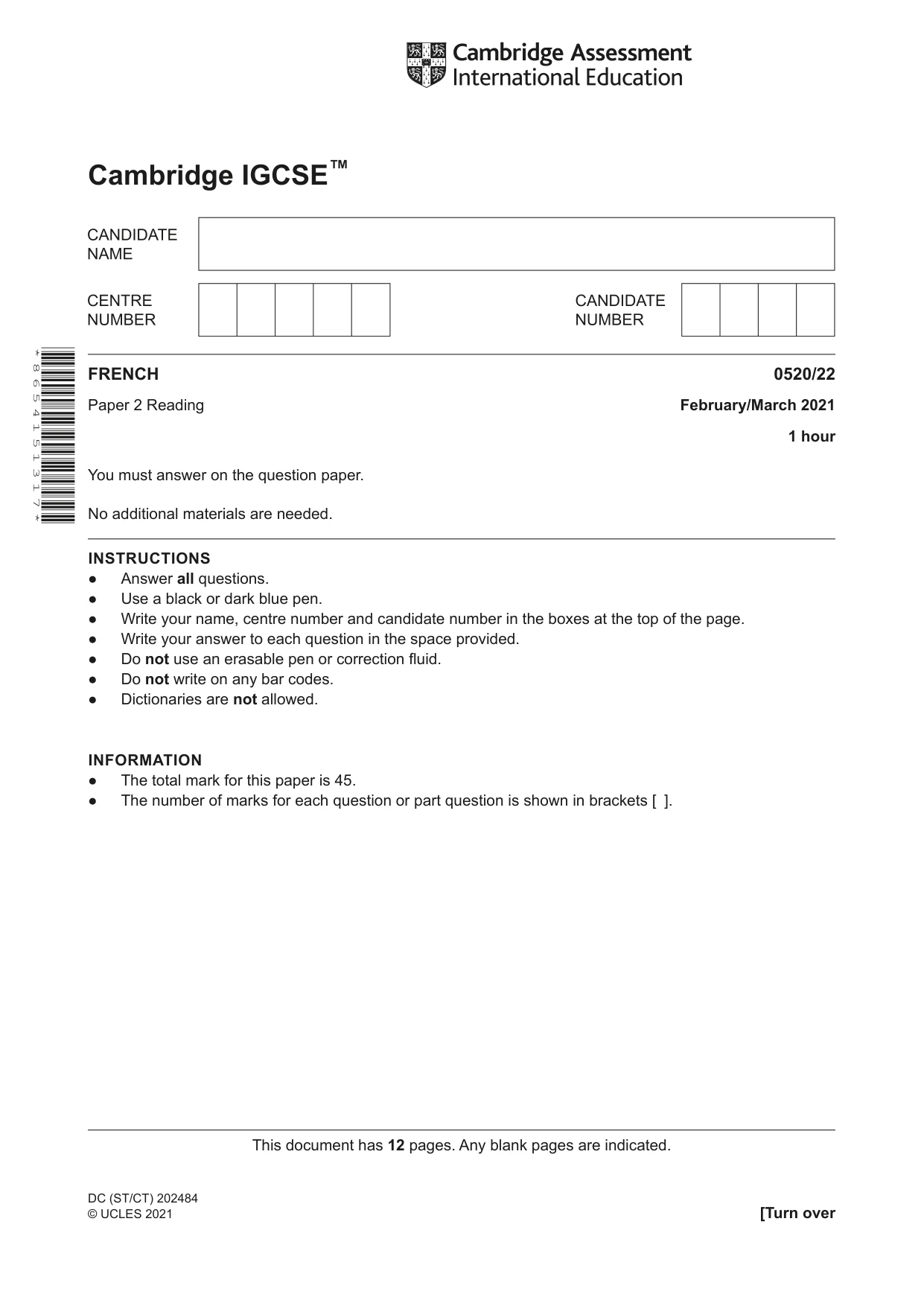
2 0520/22/ F /M /21 © UCLES 2021 1 Regardez les images. 2 + 3 = 5 C B A E D F Pour chaque question, écrivez la bonne lettre (A–F) dans la case appropriée. (a) Daniel adore la géographie. [1] (b) Alain a deux heures de maths ce matin. [1] (c) Karine apprend le français depuis trois ans. [1] (d) Paula trouve la biologie intéressante. [1] (e) La musique est la matière préférée de Marc. [1] [Total : 5]
Question paper, page 3
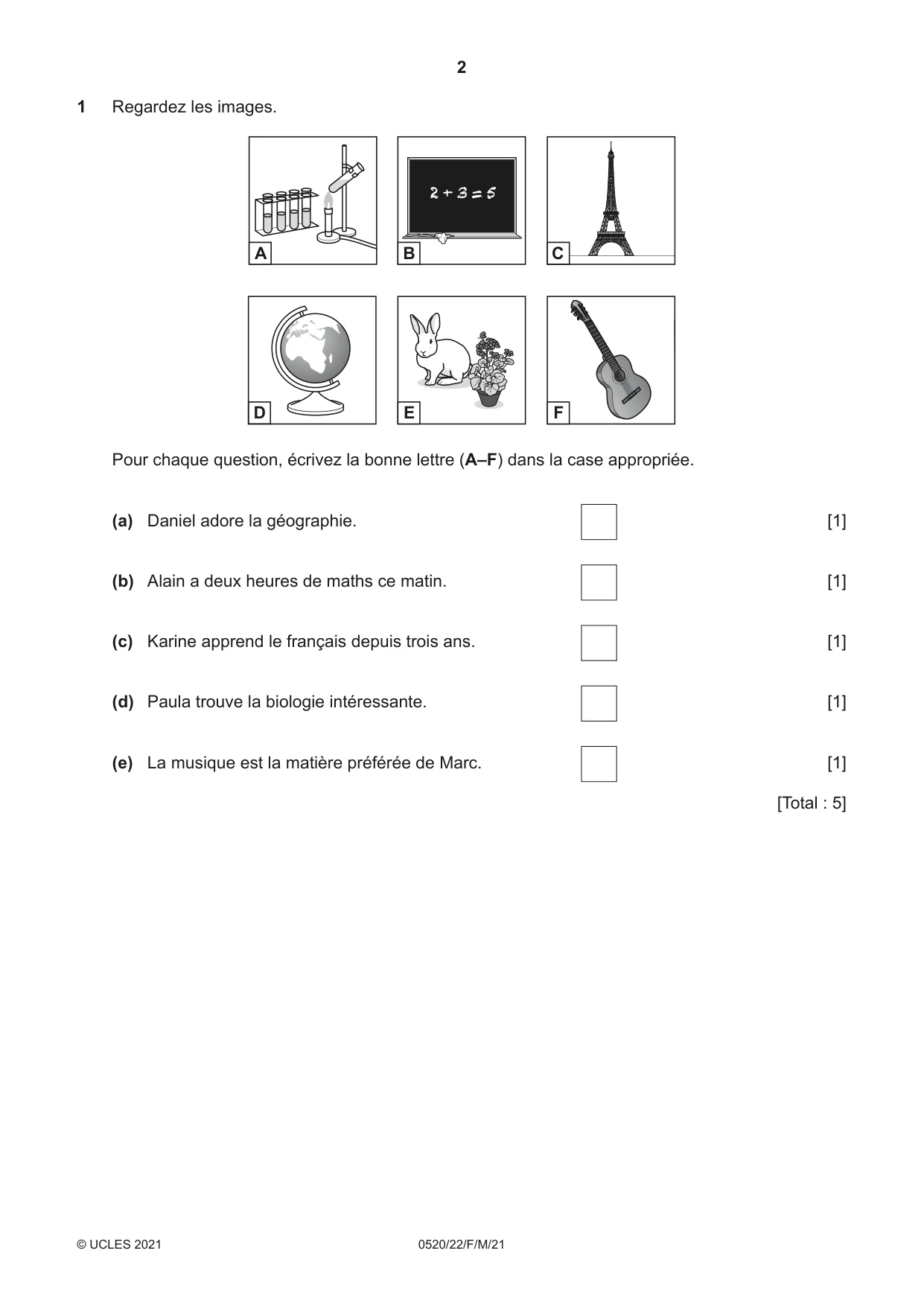
3 0520/22/F/M/21 © UCLES 2021 [Turn over 2 Regardez les panneaux. En ville CINÉMA PHARMACIE RESTAURANT BOUCHERIE PARKING HÔTEL DE VILLE POISSONNERIE POS T E A B C D E F G H Pour chaque question, écrivez la bonne lettre (A–H) dans la case appropriée. (a) Je dois acheter de la viande pour le dîner. [1] (b) Je dois garer ma voiture en ville. [1] (c) Je veux regarder un film de science-fiction. [1] (d) J’aimerais envoyer un paquet. [1] (e) J’ai besoin de médicaments. [1] [Total: 5]
Question paper, page 4
4 0520/22/F/M/21 © UCLES 2021 3 Lisez le texte. Pour chaque question, cochez (3) la case qui correspond à la bonne réponse. Salut Karim, J’ai trouvé un petit job dans une boulangerie. Mon ami, Paul, travaillait déjà là et il a parlé de moi au patron. Je suis très content parce que je voulais de l’argent pour pouvoir acheter des cadeaux de Noël pour ma famille. Je dois faire mes devoirs le dimanche, parce que je travaille toute la journée le samedi. À midi, le patron me donne un sandwich. J’aime bien aller manger au parc parce que c’est calme et je peux me relaxer. La seule chose que je n’aime pas du tout, c’est que je dois me lever à six heures. La boulangerie n’est pas loin de chez moi, donc je peux y aller à vélo. J’aime bien ça. Marco (a) Marco a trouvé un poste dans… A un magasin. B un collège. C une banque. [1] (b) Paul est… A le cousin de Marco. B le copain de Marco. C le frère de Marco. [1] (c) Marco voudrait… A sortir avec sa famille. B faire des achats. C partir en vacances. [1]
Question paper, page 5
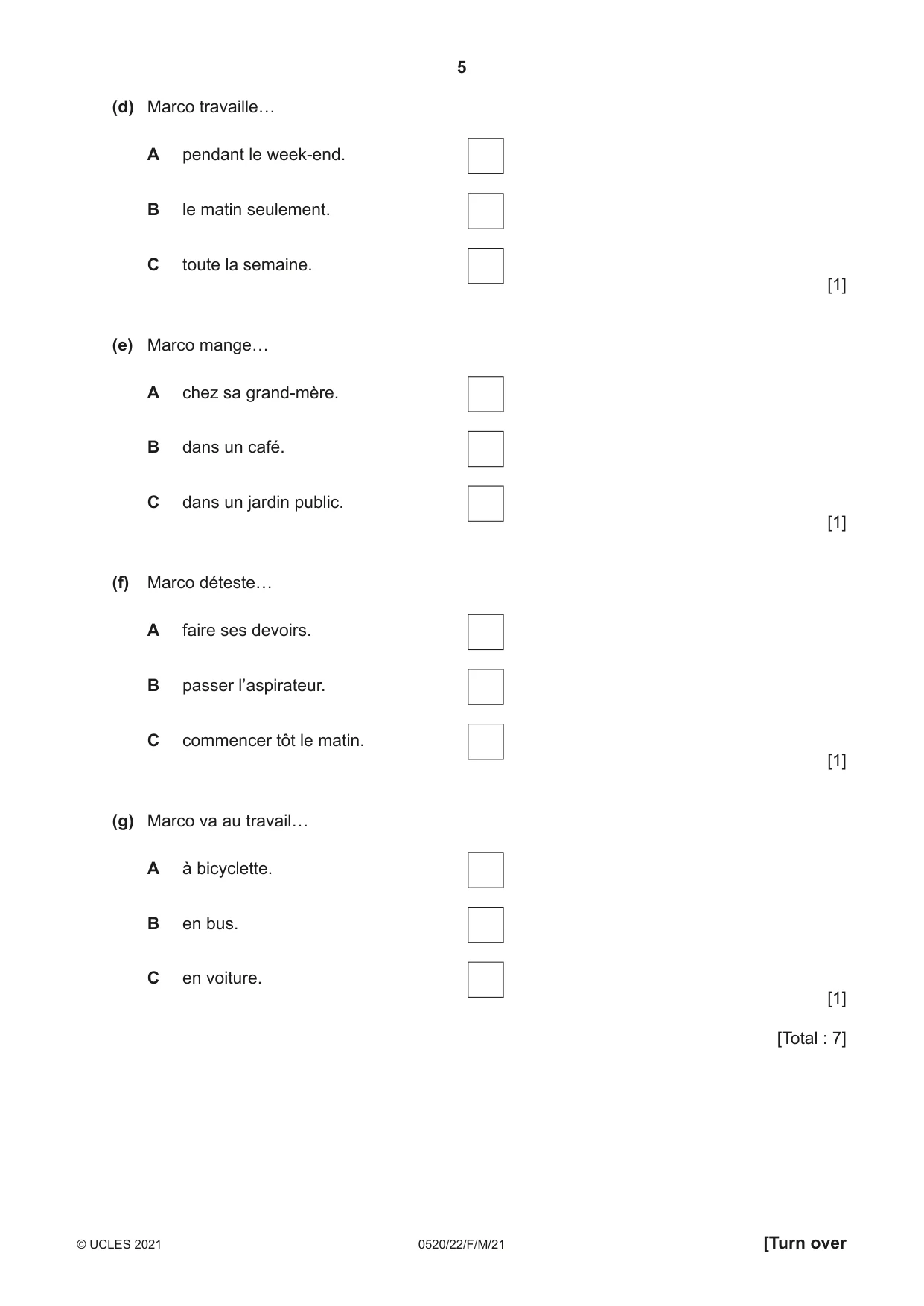
5 0520/22/F/M/21 © UCLES 2021 [Turn over (d) Marco travaille… A pendant le week-end. B le matin seulement. C toute la semaine. [1] (e) Marco mange… A chez sa grand-mère. B dans un café. C dans un jardin public. [1] (f) Marco déteste… A faire ses devoirs. B passer l’aspirateur. C commencer tôt le matin. [1] (g) Marco va au travail… A à bicyclette. B en bus. C en voiture. [1] [Total : 7]
Question paper, page 6
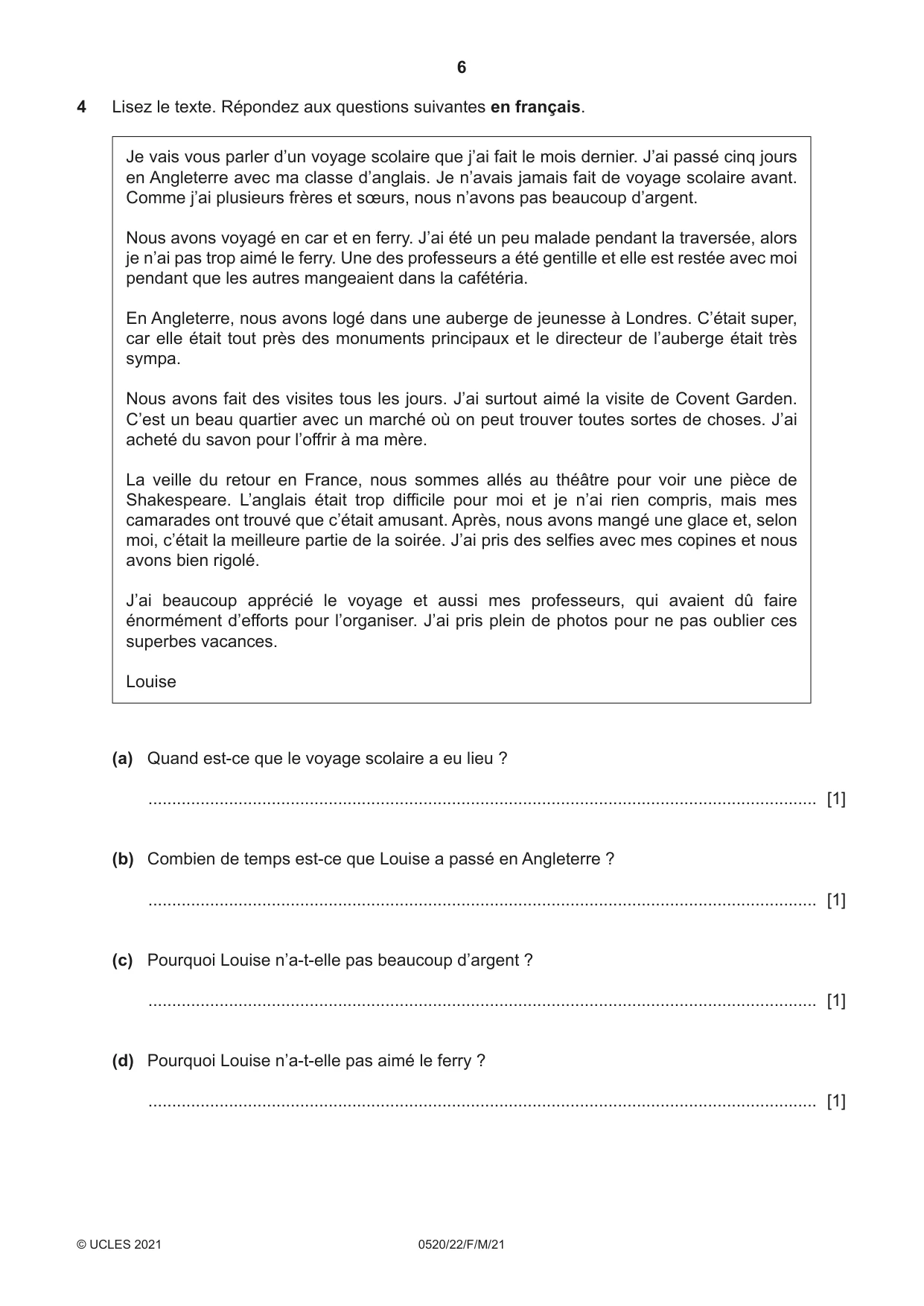
6 0520/22/F/M/21 © UCLES 2021 4 Lisez le texte. Répondez aux questions suivantes en français. Je vais vous parler d’un voyage scolaire que j’ai fait le mois dernier. J’ai passé cinq jours en Angleterre avec ma classe d’anglais. Je n’avais jamais fait de voyage scolaire avant. Comme j’ai plusieurs frères et sœurs, nous n’avons pas beaucoup d’argent. Nous avons voyagé en car et en ferry. J’ai été un peu malade pendant la traversée, alors je n’ai pas trop aimé le ferry. Une des professeurs a été gentille et elle est restée avec moi pendant que les autres mangeaient dans la cafétéria. En Angleterre, nous avons logé dans une auberge de jeunesse à Londres. C’était super, car elle était tout près des monuments principaux et le directeur de l’auberge était très sympa. Nous avons fait des visites tous les jours. J’ai surtout aimé la visite de Covent Garden. C’est un beau quartier avec un marché où on peut trouver toutes sortes de choses. J’ai acheté du savon pour l’offrir à ma mère. La veille du retour en France, nous sommes allés au théâtre pour voir une pièce de Shakespeare. L’anglais était trop difficile pour moi et je n’ai rien compris, mais mes camarades ont trouvé que c’était amusant. Après, nous avons mangé une glace et, selon moi, c’était la meilleure partie de la soirée. J’ai pris des selfies avec mes copines et nous avons bien rigolé. J’ai beaucoup apprécié le voyage et aussi mes professeurs, qui avaient dû faire énormément d’efforts pour l’organiser. J’ai pris plein de photos pour ne pas oublier ces superbes vacances. Louise (a) Quand est-ce que le voyage scolaire a eu lieu ? … [1] (b) Combien de temps est-ce que Louise a passé en Angleterre ? … [1] (c) Pourquoi Louise n’a-t-elle pas beaucoup d’argent ? … [1] (d) Pourquoi Louise n’a-t-elle pas aimé le ferry ? … [1]
Question paper, page 7
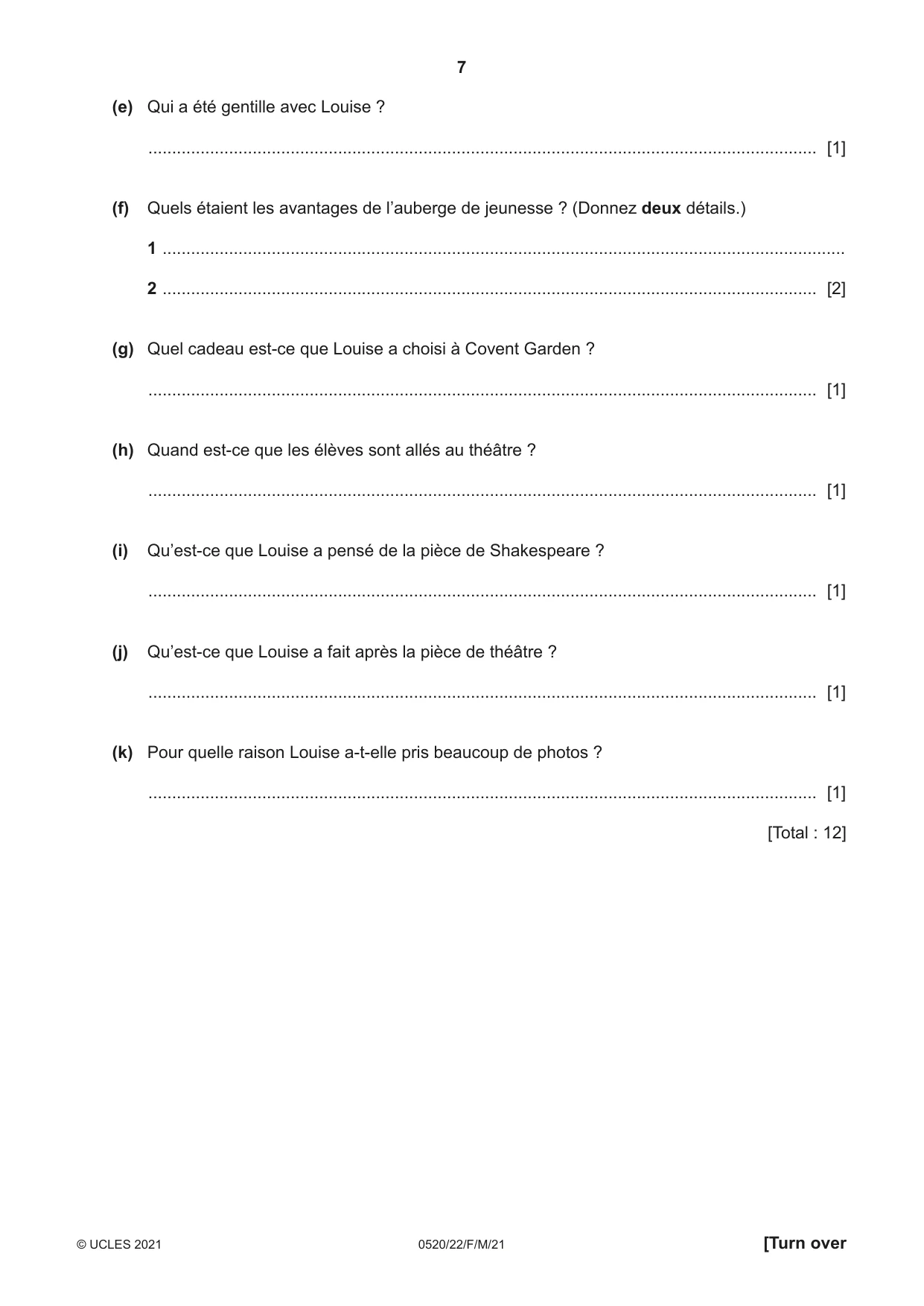
7 0520/22/F/M/21 © UCLES 2021 [Turn over (e) Qui a été gentille avec Louise ? … [1] (f) Quels étaient les avantages de l’auberge de jeunesse ? (Donnez deux détails.) 1 … 2 … [2] (g) Quel cadeau est-ce que Louise a choisi à Covent Garden ? … [1] (h) Quand est-ce que les élèves sont allés au théâtre ? … [1] (i) Qu’est-ce que Louise a pensé de la pièce de Shakespeare ? … [1] (j) Qu’est-ce que Louise a fait après la pièce de théâtre ? … [1] (k) Pour quelle raison Louise a-t-elle pris beaucoup de photos ? … [1] [Total : 12]
Question paper, page 8
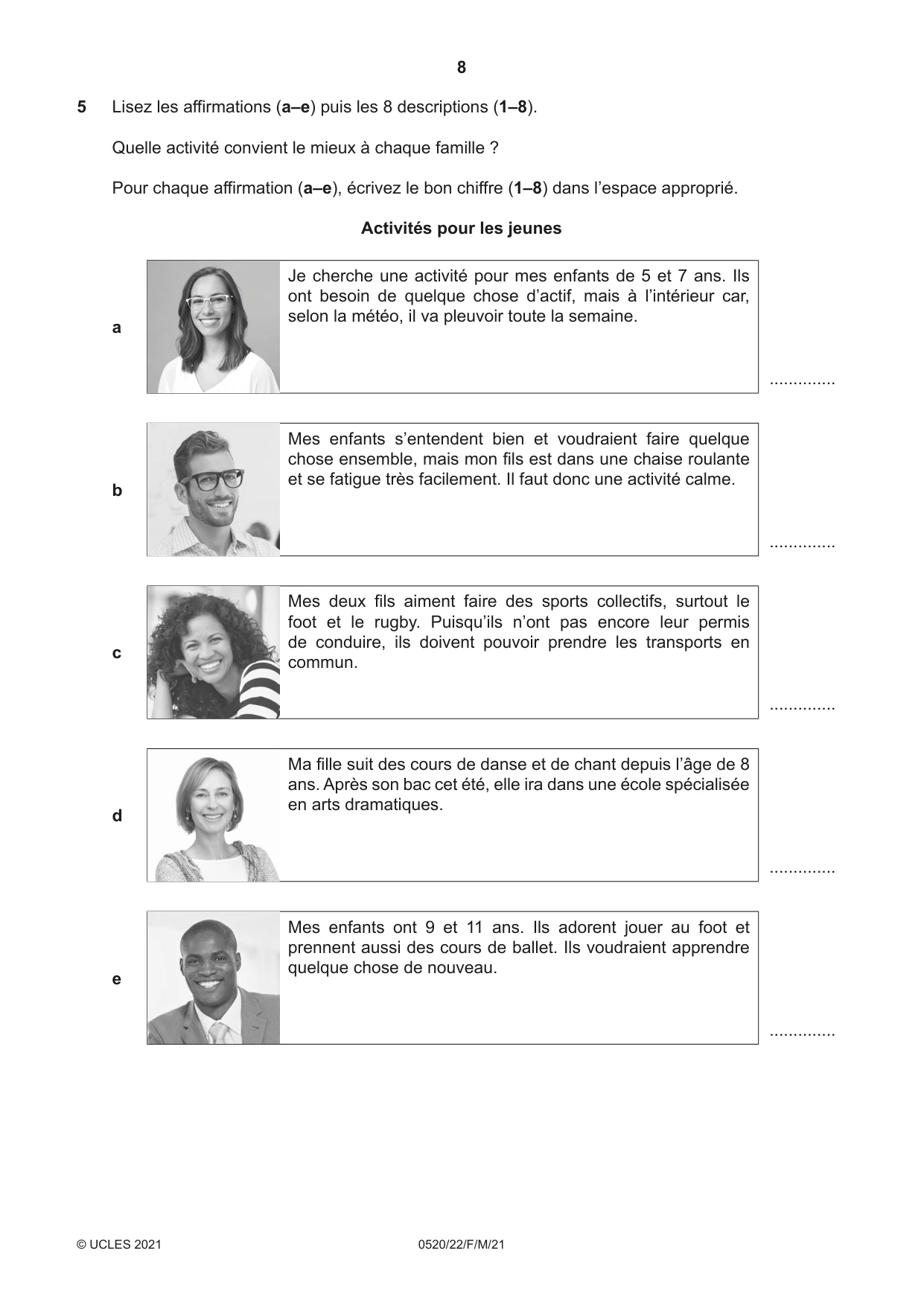
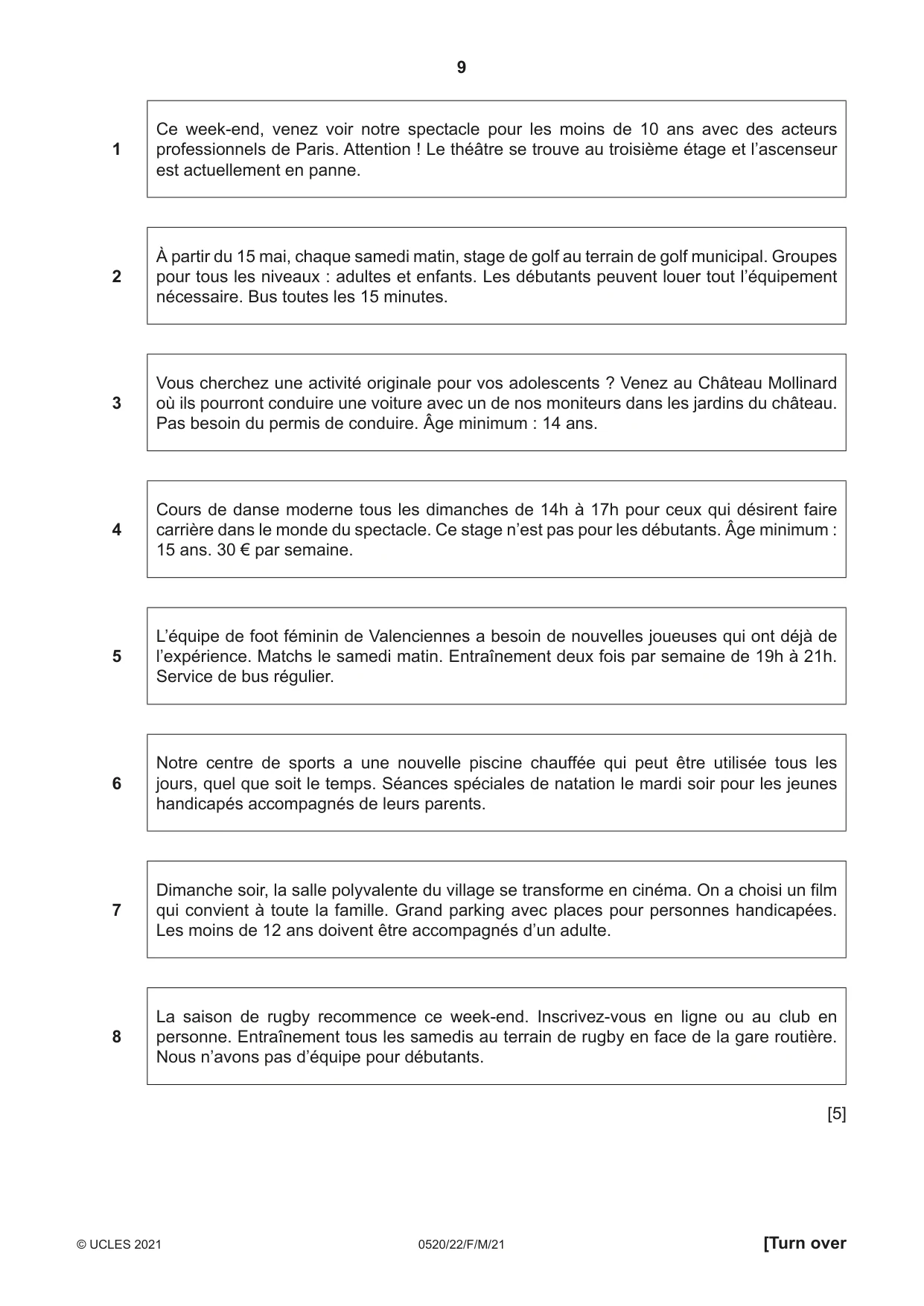
8 0520/22/F/M/21 © UCLES 2021 5 Lisez les affirmations (a–e) puis les 8 descriptions (1–8). Quelle activité convient le mieux à chaque famille ? Pour chaque affirmation (a–e), écrivez le bon chiffre (1–8) dans l’espace approprié. Activités pour les jeunes a Je cherche une activité pour mes enfants de 5 et 7 ans. Ils ont besoin de quelque chose d’actif, mais à l’intérieur car, selon la météo, il va pleuvoir toute la semaine. … b Mes enfants s’entendent bien et voudraient faire quelque chose ensemble, mais mon fils est dans une chaise roulante et se fatigue très facilement. Il faut donc une activité calme. … c Mes deux fils aiment faire des sports collectifs, surtout le foot et le rugby. Puisqu’ils n’ont pas encore leur permis de conduire, ils doivent pouvoir prendre les transports en commun. … d Ma fille suit des cours de danse et de chant depuis l’âge de 8 ans. Après son bac cet été, elle ira dans une école spécialisée en arts dramatiques. … e Mes enfants ont 9 et 11 ans. Ils adorent jouer au foot et prennent aussi des cours de ballet. Ils voudraient apprendre quelque chose de nouveau. …
Question paper, page 9
9 0520/22/F/M/21 © UCLES 2021 [Turn over 1 Ce week-end, venez voir notre spectacle pour les moins de 10 ans avec des acteurs professionnels de Paris. Attention ! Le théâtre se trouve au troisième étage et l’ascenseur est actuellement en panne. 2 À partir du 15 mai, chaque samedi matin, stage de golf au terrain de golf municipal. Groupes pour tous les niveaux : adultes et enfants. Les débutants peuvent louer tout l’équipement nécessaire. Bus toutes les 15 minutes. 3 Vous cherchez une activité originale pour vos adolescents ? Venez au Château Mollinard où ils pourront conduire une voiture avec un de nos moniteurs dans les jardins du château. Pas besoin du permis de conduire. Âge minimum : 14 ans. 4 Cours de danse moderne tous les dimanches de 14h à 17h pour ceux qui désirent faire carrière dans le monde du spectacle. Ce stage n’est pas pour les débutants. Âge minimum : 15 ans. 30 € par semaine. 5 L’équipe de foot féminin de Valenciennes a besoin de nouvelles joueuses qui ont déjà de l’expérience. Matchs le samedi matin. Entraînement deux fois par semaine de 19h à 21h. Service de bus régulier. 6 Notre centre de sports a une nouvelle piscine chauffée qui peut être utilisée tous les jours, quel que soit le temps. Séances spéciales de natation le mardi soir pour les jeunes handicapés accompagnés de leurs parents. 7 Dimanche soir, la salle polyvalente du village se transforme en cinéma. On a choisi un film qui convient à toute la famille. Grand parking avec places pour personnes handicapées. Les moins de 12 ans doivent être accompagnés d’un adulte. 8 La saison de rugby recommence ce week-end. Inscrivez-vous en ligne ou au club en personne. Entraînement tous les samedis au terrain de rugby en face de la gare routière. Nous n’avons pas d’équipe pour débutants. [5]
Question paper, page 10
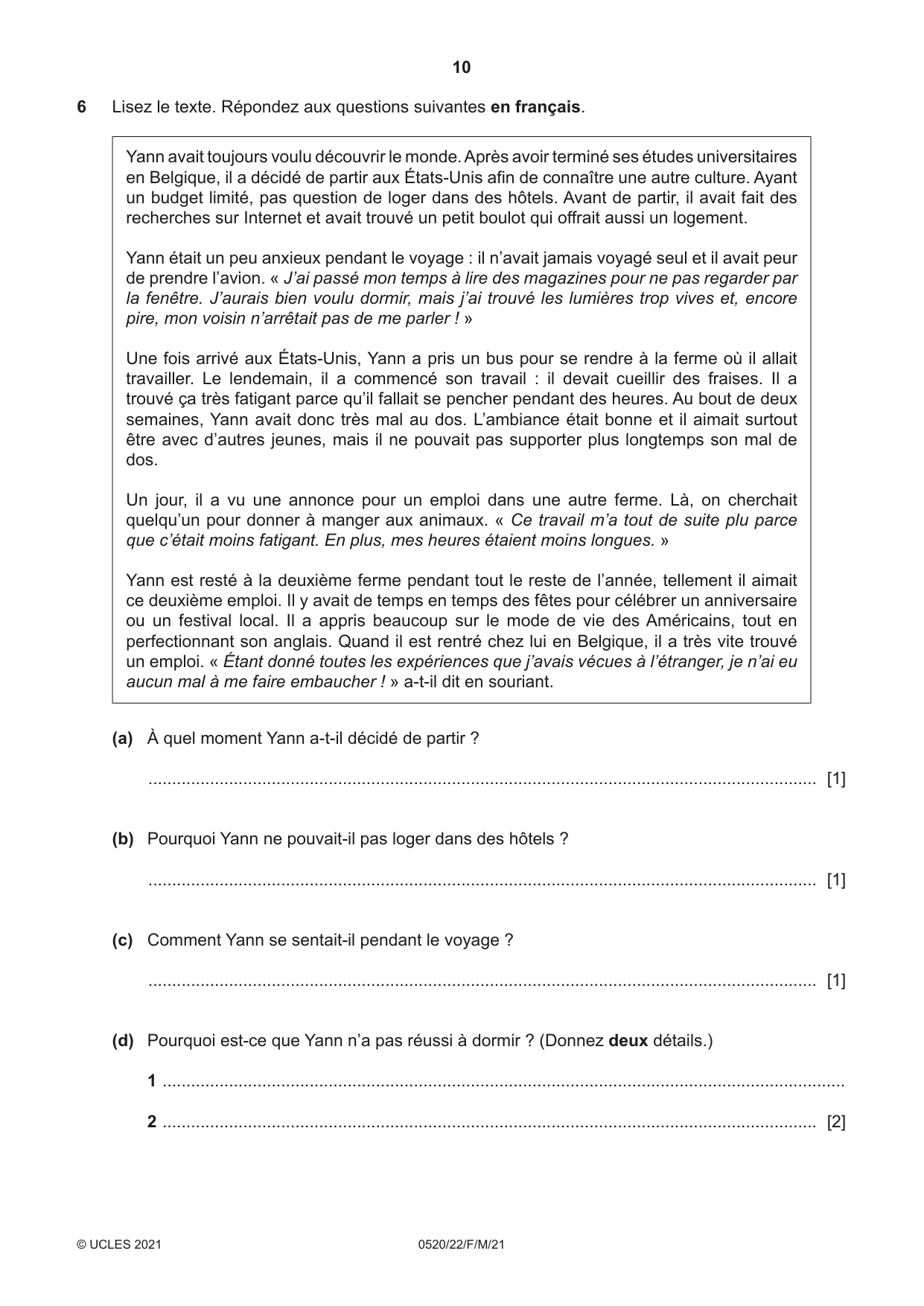
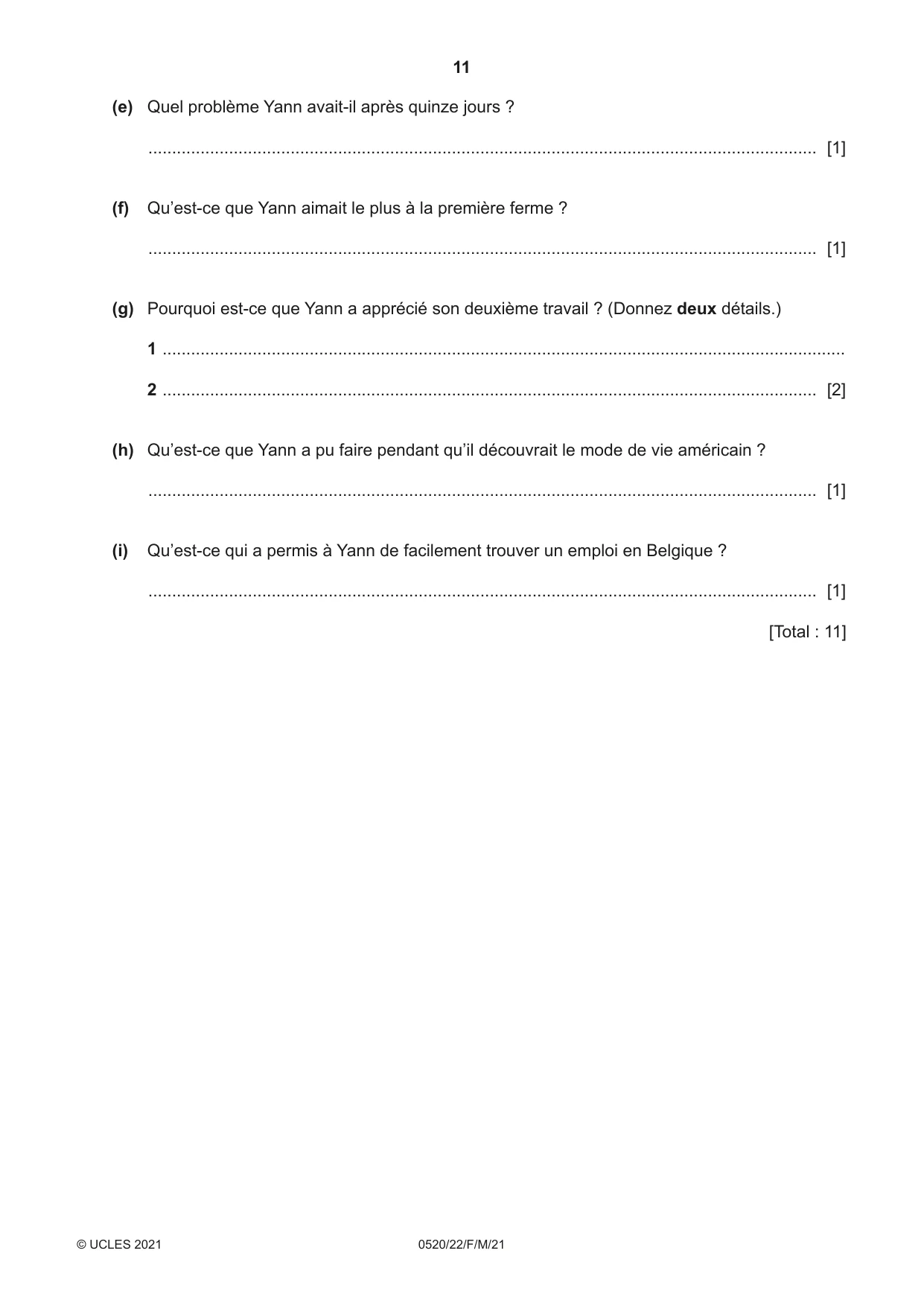
10 0520/22/F/M/21 © UCLES 2021 6 Lisez le texte. Répondez aux questions suivantes en français. Yann avait toujours voulu découvrir le monde. Après avoir terminé ses études universitaires en Belgique, il a décidé de partir aux États-Unis afin de connaître une autre culture. Ayant un budget limité, pas question de loger dans des hôtels. Avant de partir, il avait fait des recherches sur Internet et avait trouvé un petit boulot qui offrait aussi un logement. Yann était un peu anxieux pendant le voyage : il n’avait jamais voyagé seul et il avait peur de prendre l’avion. « J’ai passé mon temps à lire des magazines pour ne pas regarder par la fenêtre. J’aurais bien voulu dormir, mais j’ai trouvé les lumières trop vives et, encore pire, mon voisin n’arrêtait pas de me parler ! » Une fois arrivé aux États-Unis, Yann a pris un bus pour se rendre à la ferme où il allait travailler. Le lendemain, il a commencé son travail : il devait cueillir des fraises. Il a trouvé ça très fatigant parce qu’il fallait se pencher pendant des heures. Au bout de deux semaines, Yann avait donc très mal au dos. L’ambiance était bonne et il aimait surtout être avec d’autres jeunes, mais il ne pouvait pas supporter plus longtemps son mal de dos. Un jour, il a vu une annonce pour un emploi dans une autre ferme. Là, on cherchait quelqu’un pour donner à manger aux animaux. « Ce travail m’a tout de suite plu parce que c’était moins fatigant. En plus, mes heures étaient moins longues. » Yann est resté à la deuxième ferme pendant tout le reste de l’année, tellement il aimait ce deuxième emploi. Il y avait de temps en temps des fêtes pour célébrer un anniversaire ou un festival local. Il a appris beaucoup sur le mode de vie des Américains, tout en perfectionnant son anglais. Quand il est rentré chez lui en Belgique, il a très vite trouvé un emploi. « Étant donné toutes les expériences que j’avais vécues à l’étranger, je n’ai eu aucun mal à me faire embaucher ! » a-t-il dit en souriant. (a) À quel moment Yann a-t-il décidé de partir ? … [1] (b) Pourquoi Yann ne pouvait-il pas loger dans des hôtels ? … [1] (c) Comment Yann se sentait-il pendant le voyage ? … [1] (d) Pourquoi est-ce que Yann n’a pas réussi à dormir ? (Donnez deux détails.) 1 … 2 … [2]
Question paper, page 11
11 0520/22/F/M/21 © UCLES 2021 (e) Quel problème Yann avait-il après quinze jours ? … [1] (f) Qu’est-ce que Yann aimait le plus à la première ferme ? … [1] (g) Pourquoi est-ce que Yann a apprécié son deuxième travail ? (Donnez deux détails.) 1 … 2 … [2] (h) Qu’est-ce que Yann a pu faire pendant qu’il découvrait le mode de vie américain ? … [1] (i) Qu’est-ce qui a permis à Yann de facilement trouver un emploi en Belgique ? … [1] [Total : 11]
Question paper, page 12
12 0520/22/F/M/21 © UCLES 2021 Permission to reproduce items where third-party owned material protected by copyright is included has been sought and cleared where possible. Every reasonable effort has been made by the publisher (UCLES) to trace copyright holders, but if any items requiring clearance have unwittingly been included, the publisher will be pleased to make amends at the earliest possible opportunity. To avoid the issue of disclosure of answer-related information to candidates, all copyright acknowledgements are reproduced online in the Cambridge Assessment International Education Copyright Acknowledgements Booklet. This is produced for each series of examinations and is freely available to download at www.cambridgeinternational.org after the live examination series. Cambridge Assessment International Education is part of the Cambridge Assessment Group. Cambridge Assessment is the brand name of the University of Cambridge Local Examinations Syndicate (UCLES), which itself is a department of the University of Cambridge. BLANK PAGE
Mark scheme, page 1
This document consists of 9 printed pages. © UCLES 2021 [Turn over Cambridge IGCSE™ FRENCH 0520/22 Paper 2 Reading March 2021 MARK SCHEME Maximum Mark: 45 Published This mark scheme is published as an aid to teachers and candidates, to indicate the requirements of the examination. It shows the basis on which Examiners were instructed to award marks. It does not indicate the details of the discussions that took place at an Examiners’ meeting before marking began, which would have considered the acceptability of alternative answers. Mark schemes should be read in conjunction with the question paper and the Principal Examiner Report for Teachers. Cambridge International will not enter into discussions about these mark schemes. Cambridge International is publishing the mark schemes for the March 2021 series for most Cambridge IGCSE™, Cambridge International A and AS Level components and some Cambridge O Level components.
Mark scheme, page 2
0520/22 Cambridge IGCSE – Mark Scheme PUBLISHED March 2021 © UCLES 2021 Page 2 of 9 Generic Marking Principles These general marking principles must be applied by all examiners when marking candidate answers. They should be applied alongside the specific content of the mark scheme or generic level descriptors for a question. Each question paper and mark scheme will also comply with these marking principles. GENERIC MARKING PRINCIPLE 1: Marks must be awarded in line with: • the specific content of the mark scheme or the generic level descriptors for the question • the specific skills defined in the mark scheme or in the generic level descriptors for the question • the standard of response required by a candidate as exemplified by the standardisation scripts. GENERIC MARKING PRINCIPLE 2: Marks awarded are always whole marks (not half marks, or other fractions). GENERIC MARKING PRINCIPLE 3: Marks must be awarded positively: • marks are awarded for correct/valid answers, as defined in the mark scheme. However, credit is given for valid answers which go beyond the scope of the syllabus and mark scheme, referring to your Team Leader as appropriate • marks are awarded when candidates clearly demonstrate what they know and can do • marks are not deducted for errors • marks are not deducted for omissions • answers should only be judged on the quality of spelling, punctuation and grammar when these features are specifically assessed by the question as indicated by the mark scheme. The meaning, however, should be unambiguous. GENERIC MARKING PRINCIPLE 4: Rules must be applied consistently, e.g. in situations where candidates have not followed instructions or in the application of generic level descriptors. GENERIC MARKING PRINCIPLE 5: Marks should be awarded using the full range of marks defined in the mark scheme for the question (however; the use of the full mark range may be limited according to the quality of the candidate responses seen). GENERIC MARKING PRINCIPLE 6: Marks awarded are based solely on the requirements as defined in the mark scheme. Marks should not be awarded with grade thresholds or grade descriptors in mind.
Mark scheme, page 3
0520/22 Cambridge IGCSE – Mark Scheme PUBLISHED March 2021 © UCLES 2021 Page 3 of 9 Additional Guidance The following guidance underpins the detailed instructions provided in the mark scheme. Where a decision is taken to deviate from this guidance for a particular question, this will be specified in the mark scheme. Often the additional guidance points will have to be weighed up against each other, e.g. the answer might look or sound like the intended word/phrase in French, but if what the candidate has written means something different in French from what is expected, the mark cannot be awarded. It is not possible to list all acceptable alternatives in the mark scheme. If you encounter an answer which is not covered by the mark scheme, you will need to make a decision about whether it communicates the required elements (in consultation with your Team Leader if necessary, or with your Product Manager if you are a single examiner), and award marks accordingly. • Crossing out: (a) If a candidate changes his/her mind about an answer and crosses out an attempt, award a mark if the final attempt is correct. (b) If a candidate crosses out an answer to a whole question but makes no second attempt at it, mark the crossed out work. • More than the stipulated number of boxes ticked/crossed by the candidate: (a) If more than one attempt is visible but the candidate has clearly indicated which attempt is his/her final answer (e.g. by crossing out other attempts or by annotating the script in some way), mark in the usual way. (b) If two attempts are visible (e.g. two boxes ticked instead of the one box stipulated), and neither has been crossed out/discounted by the candidate, no mark can be awarded. • For questions requiring more than one element for the answer, 1 and 2, where the answers are interchangeable: (a) Both of the correct answers are on line 1 and line 2 blank (or vice versa) = 2 marks (b) Both correct answers on line 1 and line 2 contains a wrong answer (or vice versa) = 1 mark
Mark scheme, page 4
0520/22 Cambridge IGCSE – Mark Scheme PUBLISHED March 2021 © UCLES 2021 Page 4 of 9 • Mark for communication: Answers requiring the use of French (rather than a non-verbal response) should be marked for communication. Tolerate inaccuracies provided that the message is clear. However, do not accept incorrect French if the word written by the candidate means something else in French (unless the mark scheme specifies otherwise). (a) If you read aloud what the candidate has written, does it sound like the correct answer? Would a native speaker of French understand it? (b) Does what the candidate has written look like the correct answer, e.g. one letter missing but no other word created? Would a native speaker of French understand it? (c) Tolerate incorrect auxiliaries and incorrect use of the infinitive unless the mark scheme specifies otherwise. • Annotations used in the mark scheme: (a) INV = invalidation. This is used when the additional material included by the candidate is judged to invalidate an otherwise correct answer and therefore prevents him/her from scoring the mark. (INV = 0) (b) tc = ‘tout court’. This means that, on its own, the material is not sufficient to score the mark. (c) HA = harmless addition. This means that the candidate has included additional material which, in conjunction with the correct answer, does not prevent him/her from scoring the mark. • No response and ‘0’ marks: (a) Award NR (no response): If there is nothing written at all in the answer space or If there is only a comment which does not in any way relate to the question being asked (e.g. ‘can’t do’ or ‘don’t know’) or If there is only a mark which isn’t an attempt at the question (e.g. a dash, a question mark). (b) Award 0: If there is any attempt that earns no credit, e.g. the candidate has copied out part or all of the question.
Mark scheme, page 5
0520/22 Cambridge IGCSE – Mark Scheme PUBLISHED March 2021 © UCLES 2021 Page 5 of 9 • Extra material: Candidates need to answer the questions in such a way as to demonstrate that they have understood the text. The mark scheme cannot cover all eventualities so where specific instructions are not provided, the examiner must check the text to ensure that the correct elements which would attract the mark are not contradicted or distorted by any extra material. The following general rules should be applied: (a) Extra material, mentioned in the mark scheme, which reinforces the correct answer or in itself constitutes an alternative correct answer: This is acceptable and is not penalised. (b) Extra material which constitutes an alternative answer, but which is not explicitly mentioned in the mark scheme: The examiner needs to decide, by consulting the transcript/text and the Team Leader if necessary, whether the alternative answer constitutes: (i) an alternative correct answer, in which case this falls into category (a) and the answer should be rewarded, or (ii) an answer which on its own would be rejected, in which case this falls into category (c) and the answer should be rejected. (c) Extra material which constitutes an alternative answer specifically rejected in the mark scheme: This puts the examiner in the position of having to ‘choose’ which the intended answer is. The examiner cannot therefore be sure what the candidate has understood and the mark cannot be awarded. (d) Extra material which distorts or contradicts the correct answer: This affects communication. The examiner cannot be sure what the candidate has understood and therefore the mark cannot be awarded. (e) Extra material introduced by the candidate and which does not feature in the original text: This affects communication. The examiner cannot be sure what the candidate has understood and therefore the mark cannot be awarded. It can sometimes be difficult to draw the line between what is a deduction made by an able candidate on the basis of what they have read and pure guesswork. Therefore, where a particular answer is not covered by the mark scheme, the examiner should consult the Team Leader.
Mark scheme, page 6
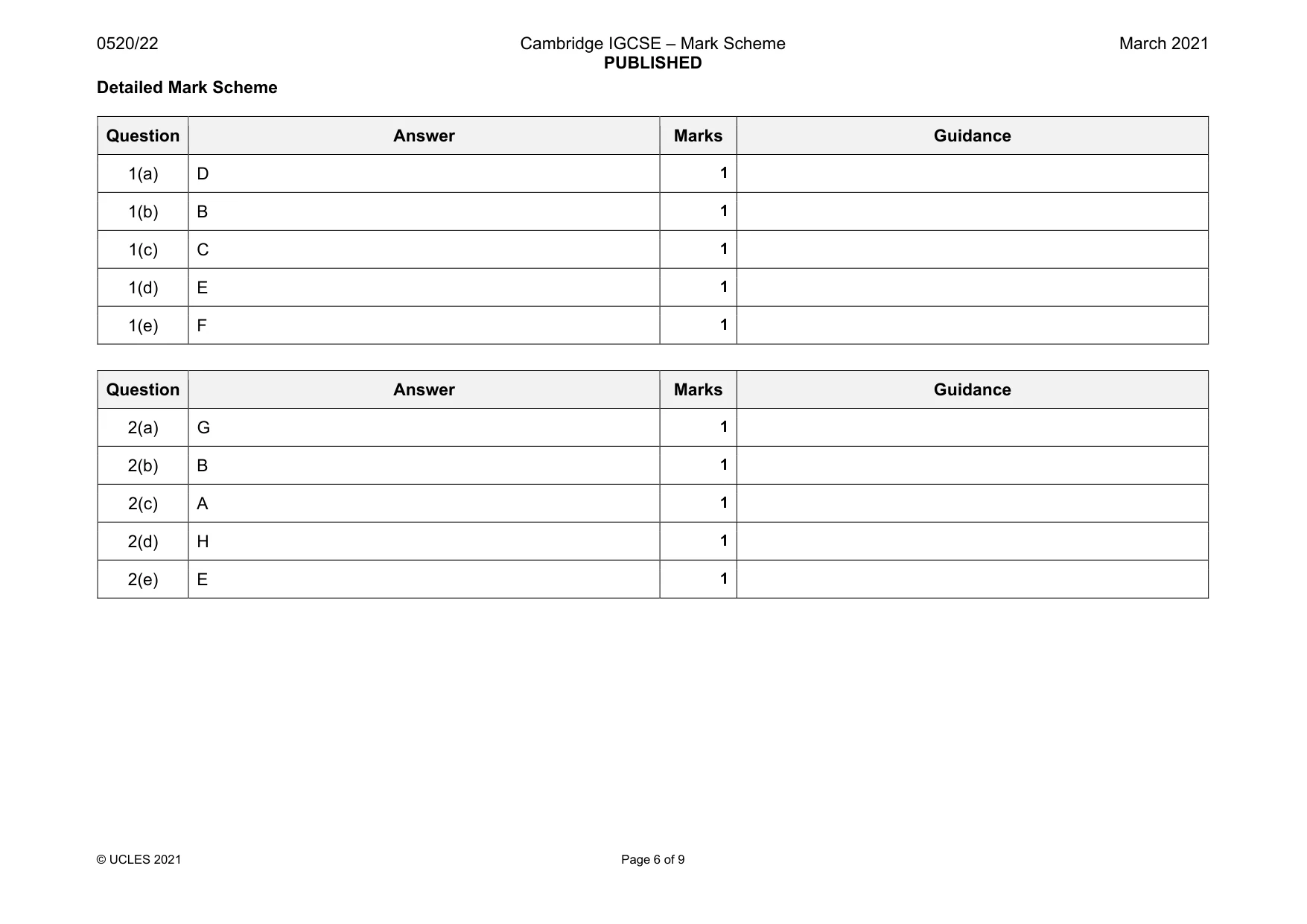
0520/22 Cambridge IGCSE – Mark Scheme PUBLISHED March 2021 © UCLES 2021 Page 6 of 9 Detailed Mark Scheme Question Answer Marks Guidance 1(a) D 1 1(b) B 1 1(c) C 1 1(d) E 1 1(e) F 1 Question Answer Marks Guidance 2(a) G 1 2(b) B 1 2(c) A 1 2(d) H 1 2(e) E 1
Mark scheme, page 7
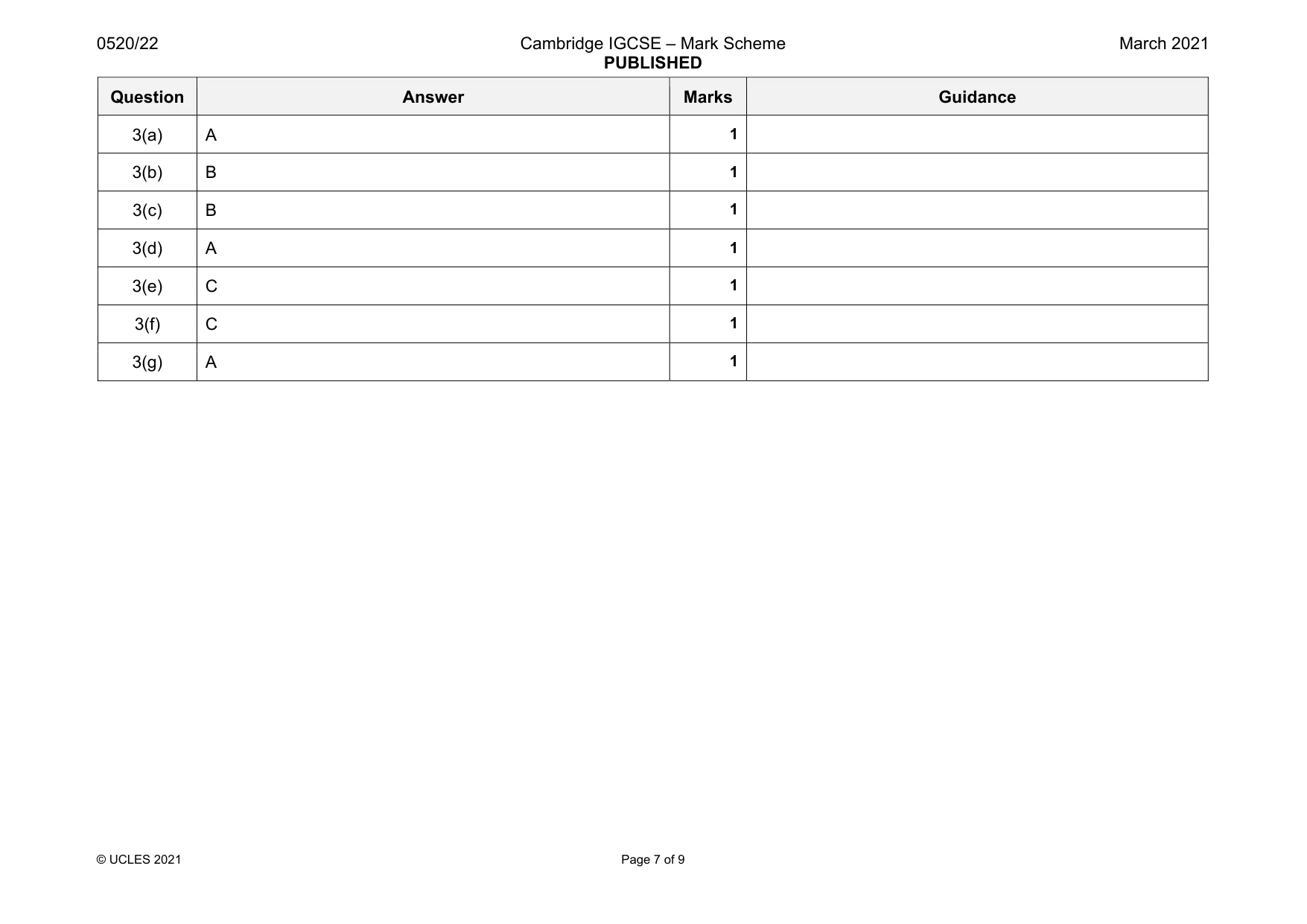
0520/22 Cambridge IGCSE – Mark Scheme PUBLISHED March 2021 © UCLES 2021 Page 7 of 9 Question Answer Marks Guidance 3(a) A 1 3(b) B 1 3(c) B 1 3(d) A 1 3(e) C 1 3(f) C 1 3(g) A 1
Mark scheme, page 8
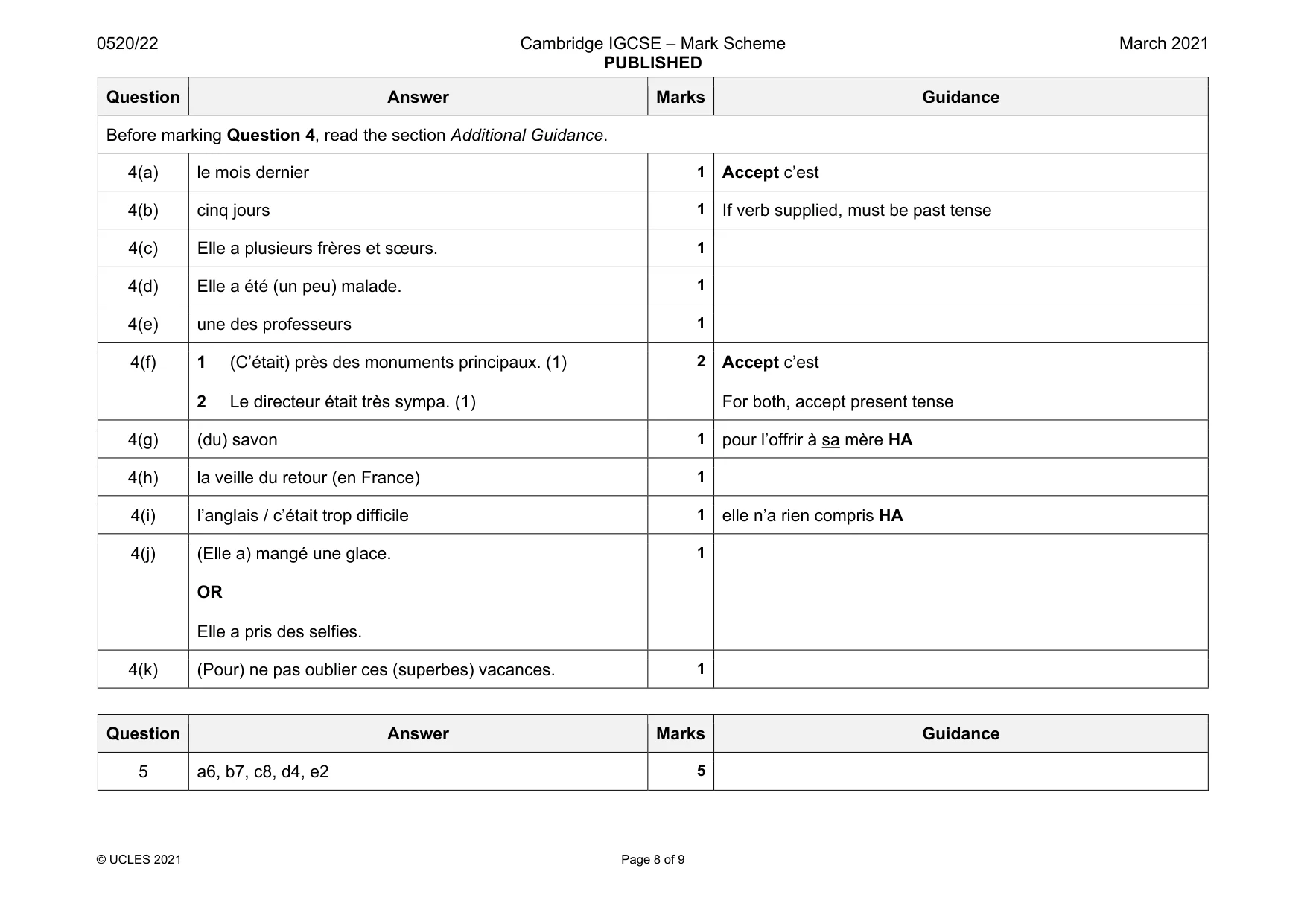
0520/22 Cambridge IGCSE – Mark Scheme PUBLISHED March 2021 © UCLES 2021 Page 8 of 9 Question Answer Marks Guidance Before marking Question 4, read the section Additional Guidance. 4(a) le mois dernier 1 Accept c’est 4(b) cinq jours 1 If verb supplied, must be past tense 4(c) Elle a plusieurs frères et sœurs. 1 4(d) Elle a été (un peu) malade. 1 4(e) une des professeurs 1 4(f) 1 (C’était) près des monuments principaux. (1) 2 Le directeur était très sympa. (1) 2 Accept c’est For both, accept present tense 4(g) (du) savon 1 pour l’offrir à sa mère HA 4(h) la veille du retour (en France) 1 4(i) l’anglais / c’était trop difficile 1 elle n’a rien compris HA 4(j) (Elle a) mangé une glace. OR Elle a pris des selfies. 1 4(k) (Pour) ne pas oublier ces (superbes) vacances. 1 Question Answer Marks Guidance 5 a6, b7, c8, d4, e2 5
Mark scheme, page 9
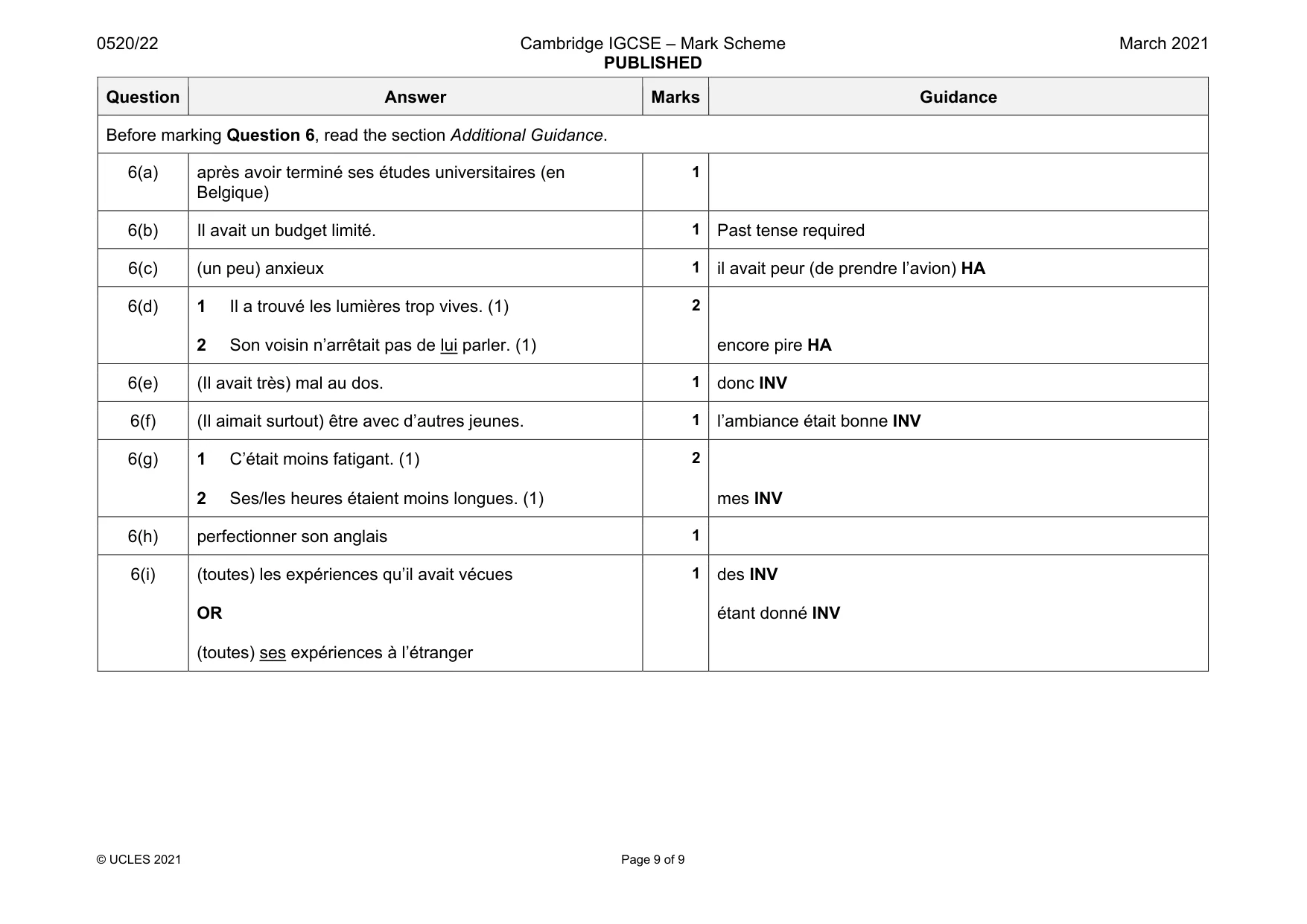
0520/22 Cambridge IGCSE – Mark Scheme PUBLISHED March 2021 © UCLES 2021 Page 9 of 9 Question Answer Marks Guidance Before marking Question 6, read the section Additional Guidance. 6(a) après avoir terminé ses études universitaires (en Belgique) 1 6(b) Il avait un budget limité. 1 Past tense required 6(c) (un peu) anxieux 1 il avait peur (de prendre l’avion) HA 6(d) 1 Il a trouvé les lumières trop vives. (1) 2 Son voisin n’arrêtait pas de lui parler. (1) 2 encore pire HA 6(e) (Il avait très) mal au dos. 1 donc INV 6(f) (Il aimait surtout) être avec d’autres jeunes. 1 l’ambiance était bonne INV 6(g) 1 C’était moins fatigant. (1) 2 Ses/les heures étaient moins longues. (1) 2 mes INV 6(h) perfectionner son anglais 1 6(i) (toutes) les expériences qu’il avait vécues OR (toutes) ses expériences à l’étranger 1 des INV étant donné INV
What you needed in this session
Cambridge’s own grade thresholds for 2021 Feb/March, Paper 2 · Variant 2. A higher threshold means an easier paper — the bar moves with how the cohort did.