Cambridge IGCSE French - Foreign Language 0520 — 2020 Feb/March Paper 2 · Variant 2
0520/22/F/M/20 · 45 marks · ≈51 min
The question paper and its mark scheme, free to read here and free to download. This is Cambridge’s own paper, exactly as it was sat.
Question paper16 pages


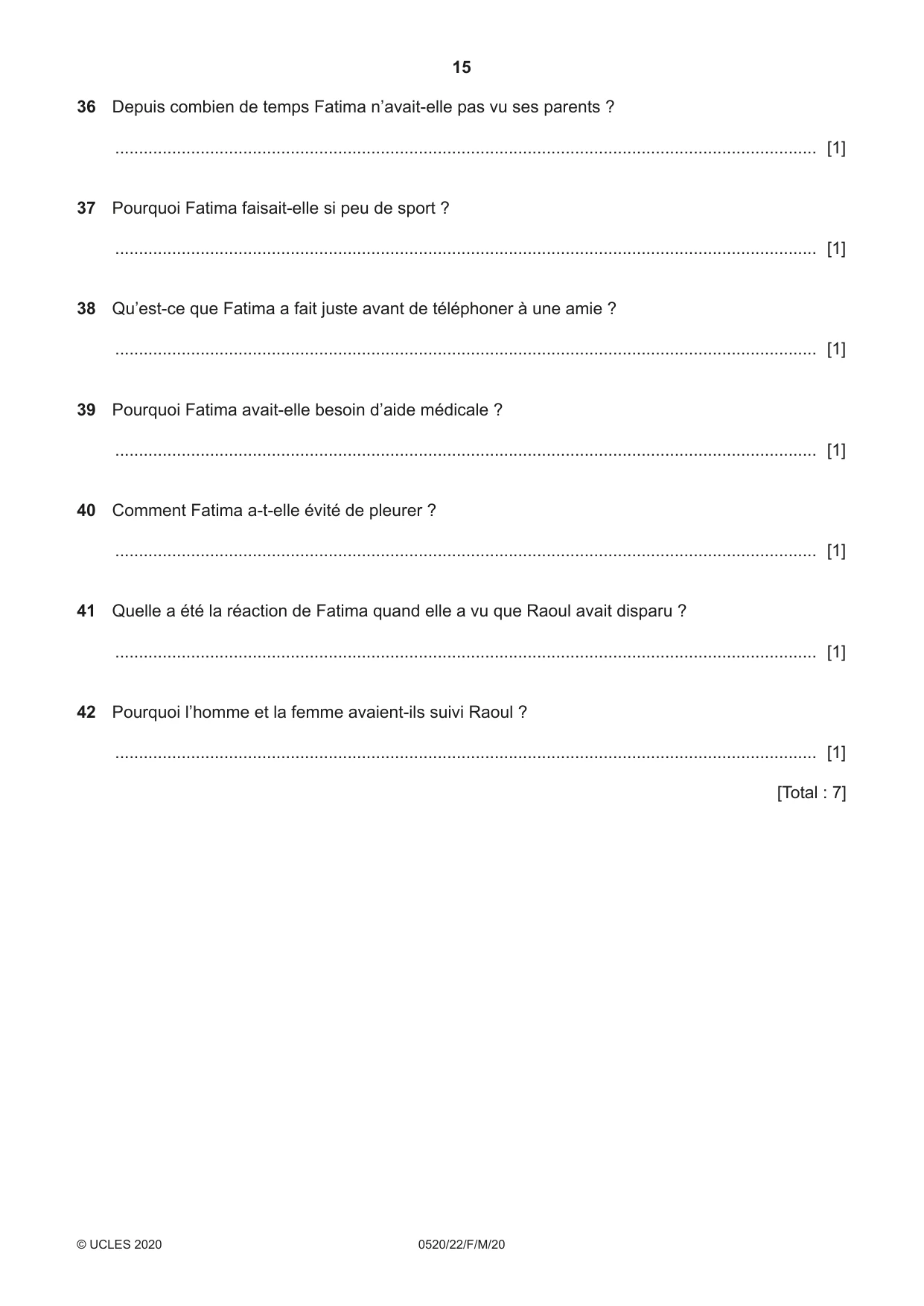
Mark scheme13 pages
Answers below. Sit the paper first if you are practising.
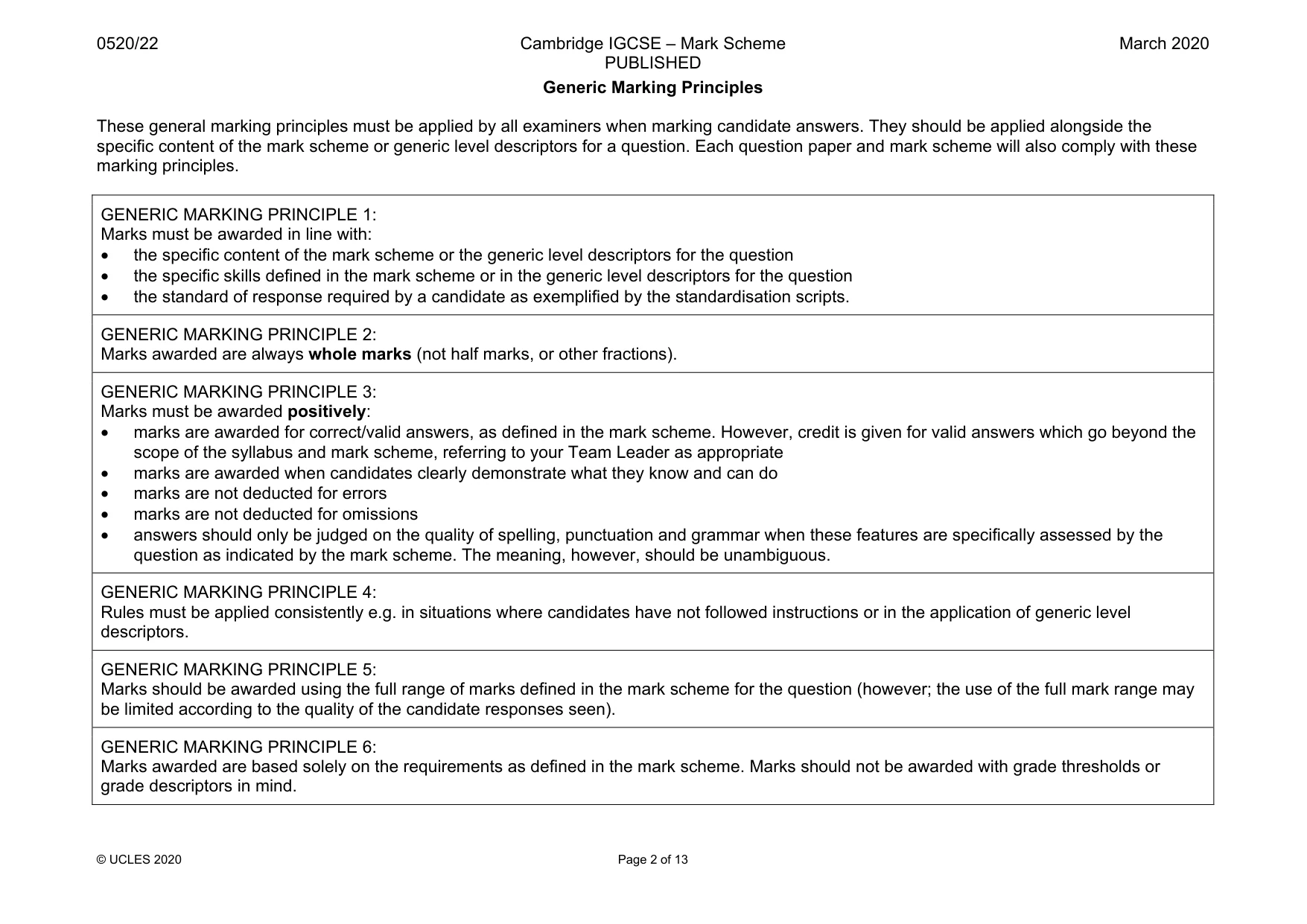
Paper as text
Question paper, page 1
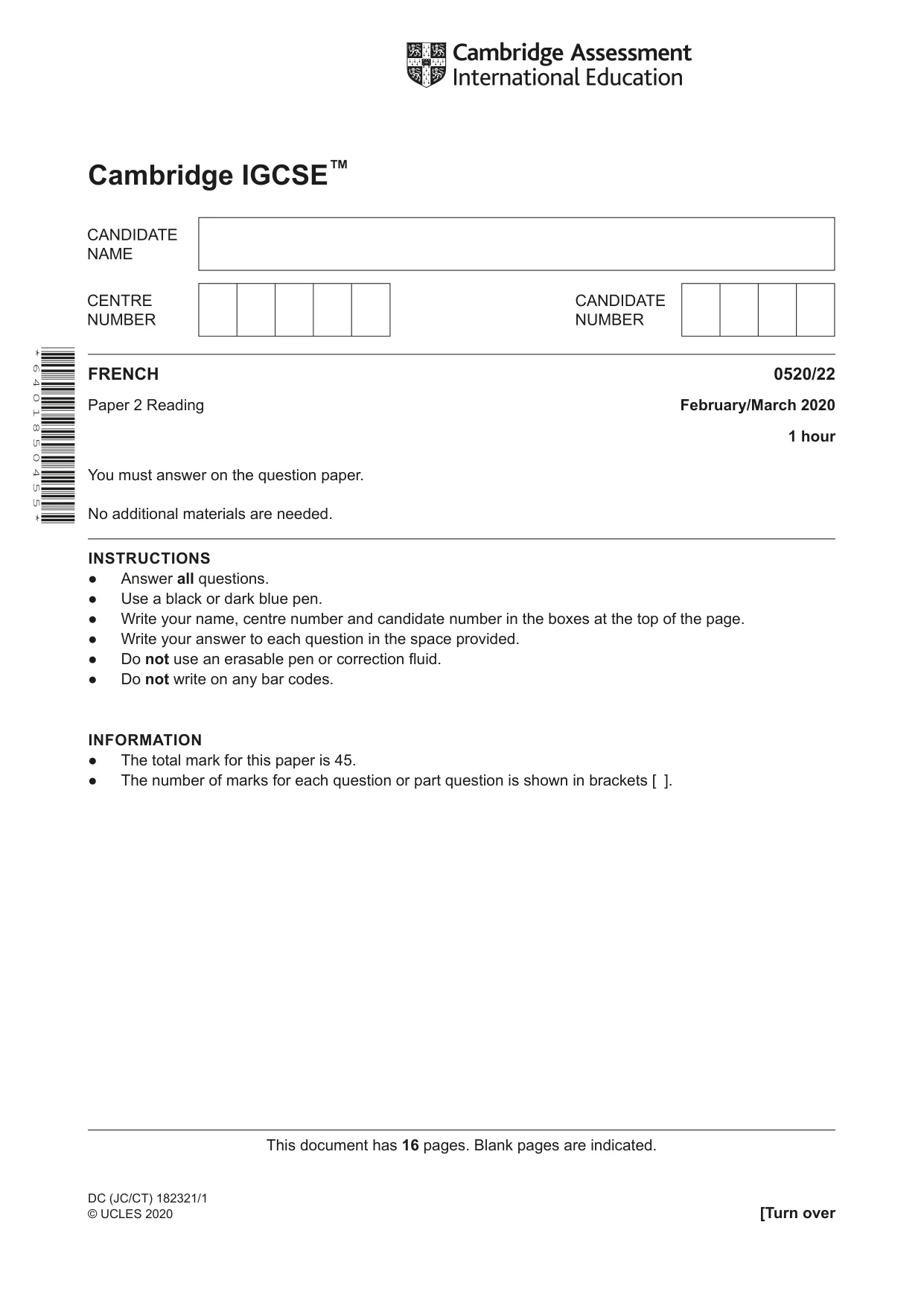
Cambridge IGCSE™ DC (JC/CT) 182321/1 © UCLES 2020 [Turn over This document has 16 pages. Blank pages are indicated. * 6 4 0 1 8 5 0 4 5 5 * FRENCH 0520/22 Paper 2 Reading February/March 2020 1 hour You must answer on the question paper. No additional materials are needed. INSTRUCTIONS ● Answer all questions. ● Use a black or dark blue pen. ● Write your name, centre number and candidate number in the boxes at the top of the page. ● Write your answer to each question in the space provided. ● Do not use an erasable pen or correction fluid. ● Do not write on any bar codes. INFORMATION ● The total mark for this paper is 45. ● The number of marks for each question or part question is shown in brackets [ ].
Question paper, page 2
2 0520/22/F/M/20 © UCLES 2020 BLANK PAGE
Question paper, page 3
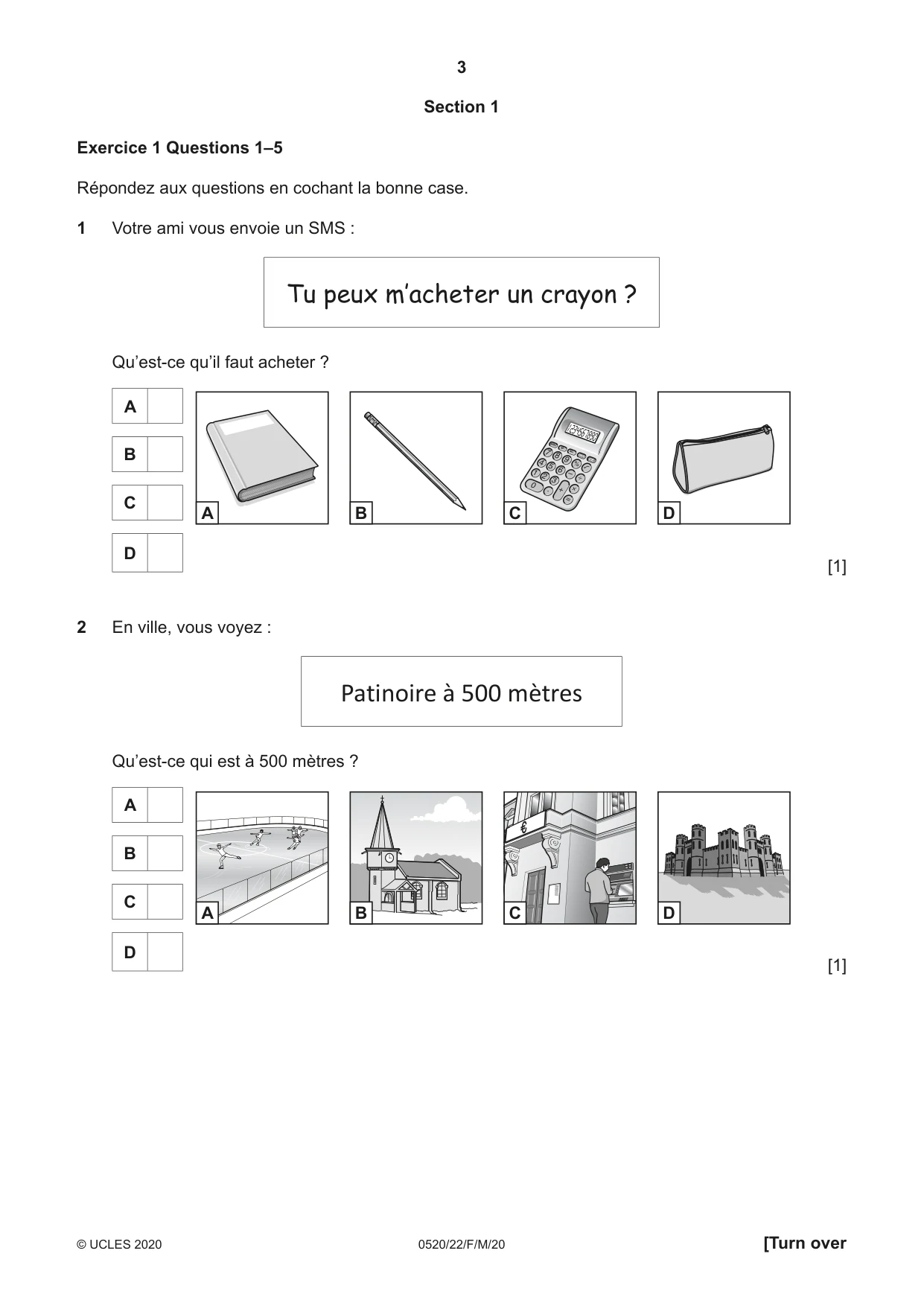
3 0520/22/F/M/20 © UCLES 2020 [Turn over Section 1 Exercice 1 Questions 1–5 Répondez aux questions en cochant la bonne case. 1 Votre ami vous envoie un SMS : Tu peux m’acheter un crayon ? Qu’est-ce qu’il faut acheter ? A A B C D [1] B C D 2 En ville, vous voyez : Patinoire à 500 mètres Qu’est-ce qui est à 500 mètres ? A A B C D [1] B C D
Question paper, page 4
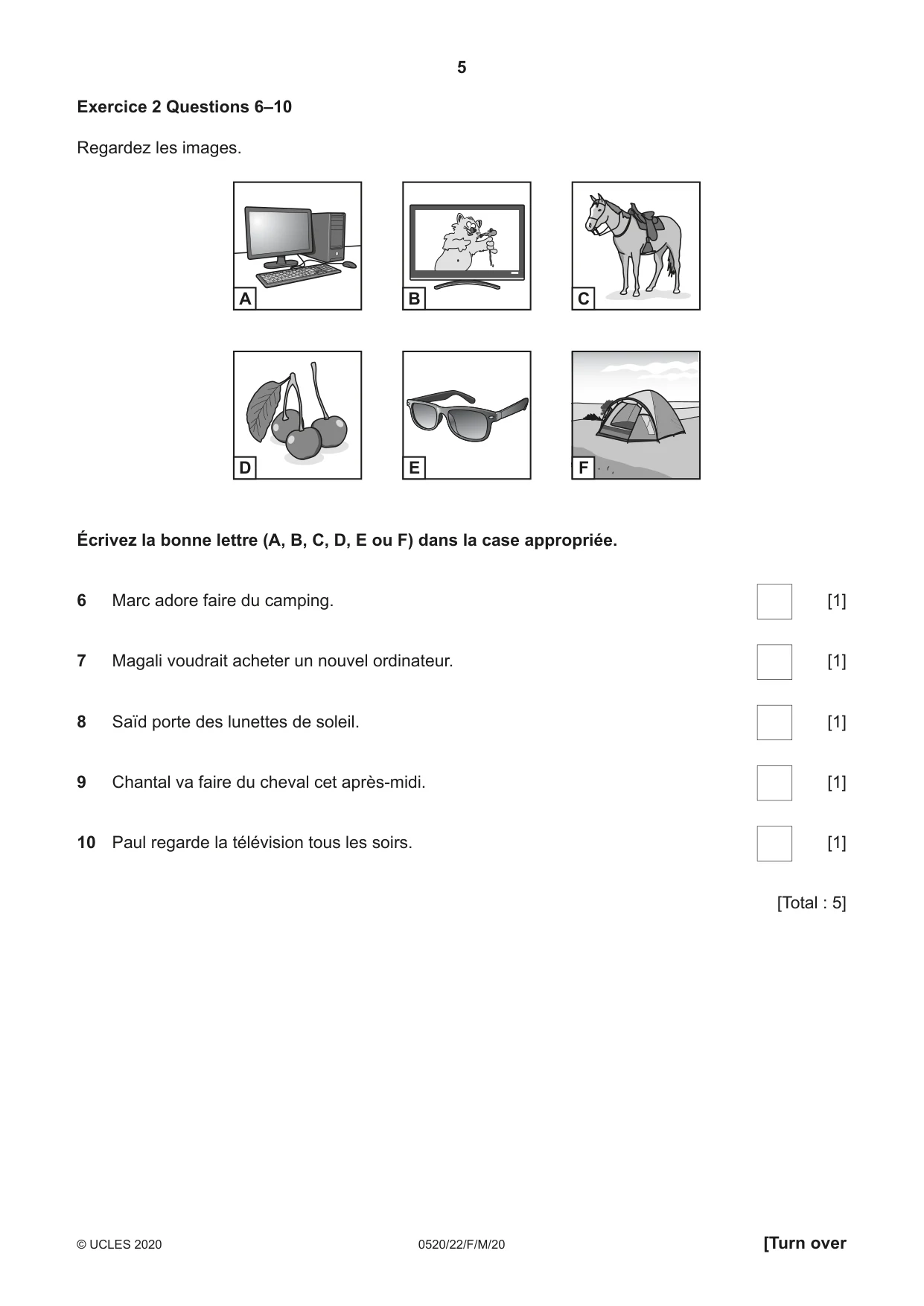
4 0520/22/F/M/20 © UCLES 2020 3 Votre sœur vous laisse un message : Je peux emprunter ton pull ? Qu’est-ce que votre sœur veut ? A A B C D [1] B C D 4 Au restaurant, vous voyez : Poulet 10 € Qu’est-ce qui coûte 10 € ? A A B C D [1] B C D 5 Votre père vous laisse un message : Est-ce que tu peux faire la vaisselle ? Qu’est-ce que vous devez faire ? A A B C D [1] B C D [Total : 5]
Question paper, page 5
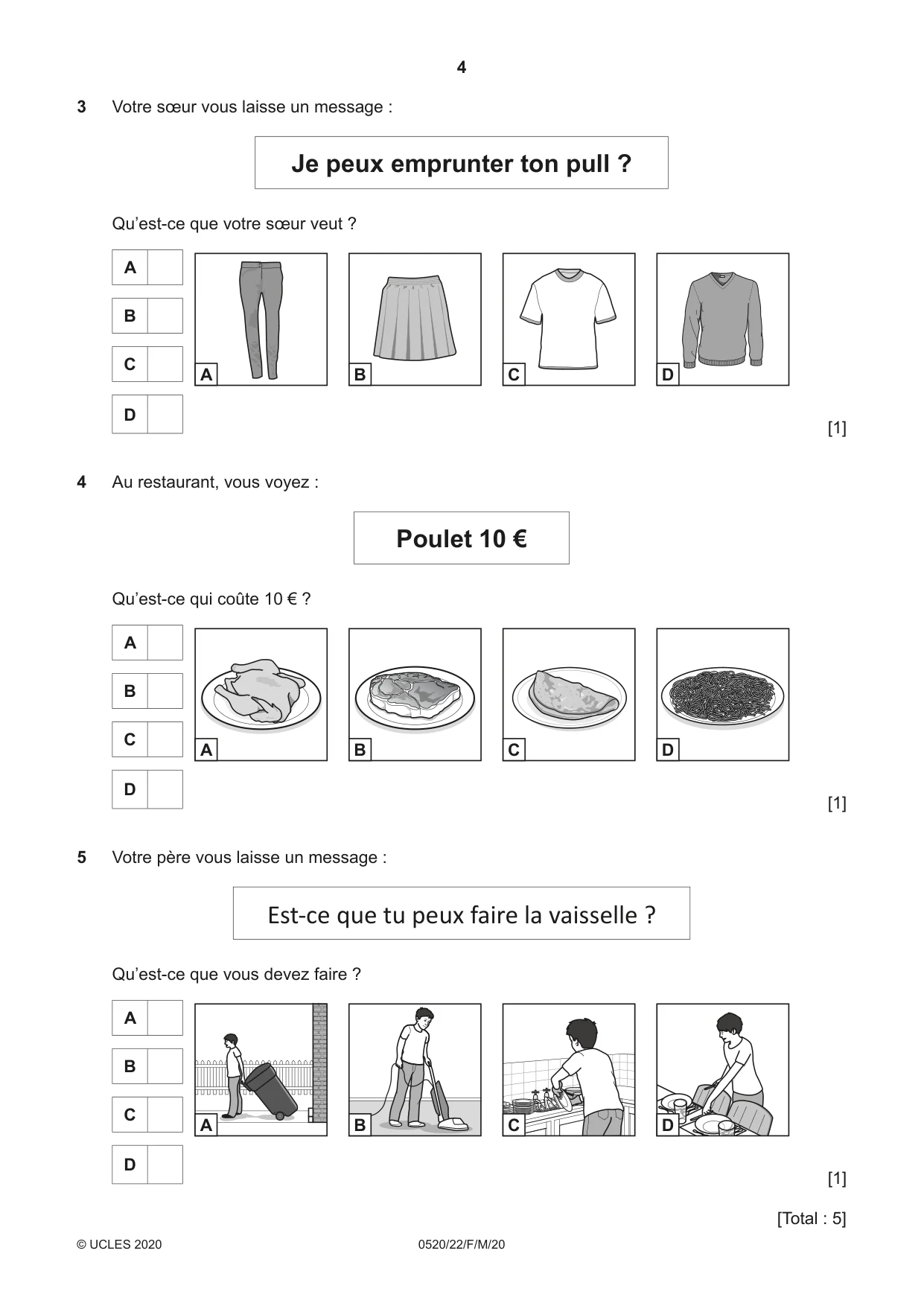
5 0520/22/F/M/20 © UCLES 2020 [Turn over Exercice 2 Questions 6–10 Regardez les images. A B C D E F Écrivez la bonne lettre (A, B, C, D, E ou F) dans la case appropriée. 6 Marc adore faire du camping. [1] 7 Magali voudrait acheter un nouvel ordinateur. [1] 8 Saïd porte des lunettes de soleil. [1] 9 Chantal va faire du cheval cet après-midi. [1] 10 Paul regarde la télévision tous les soirs. [1] [Total : 5]
Question paper, page 6
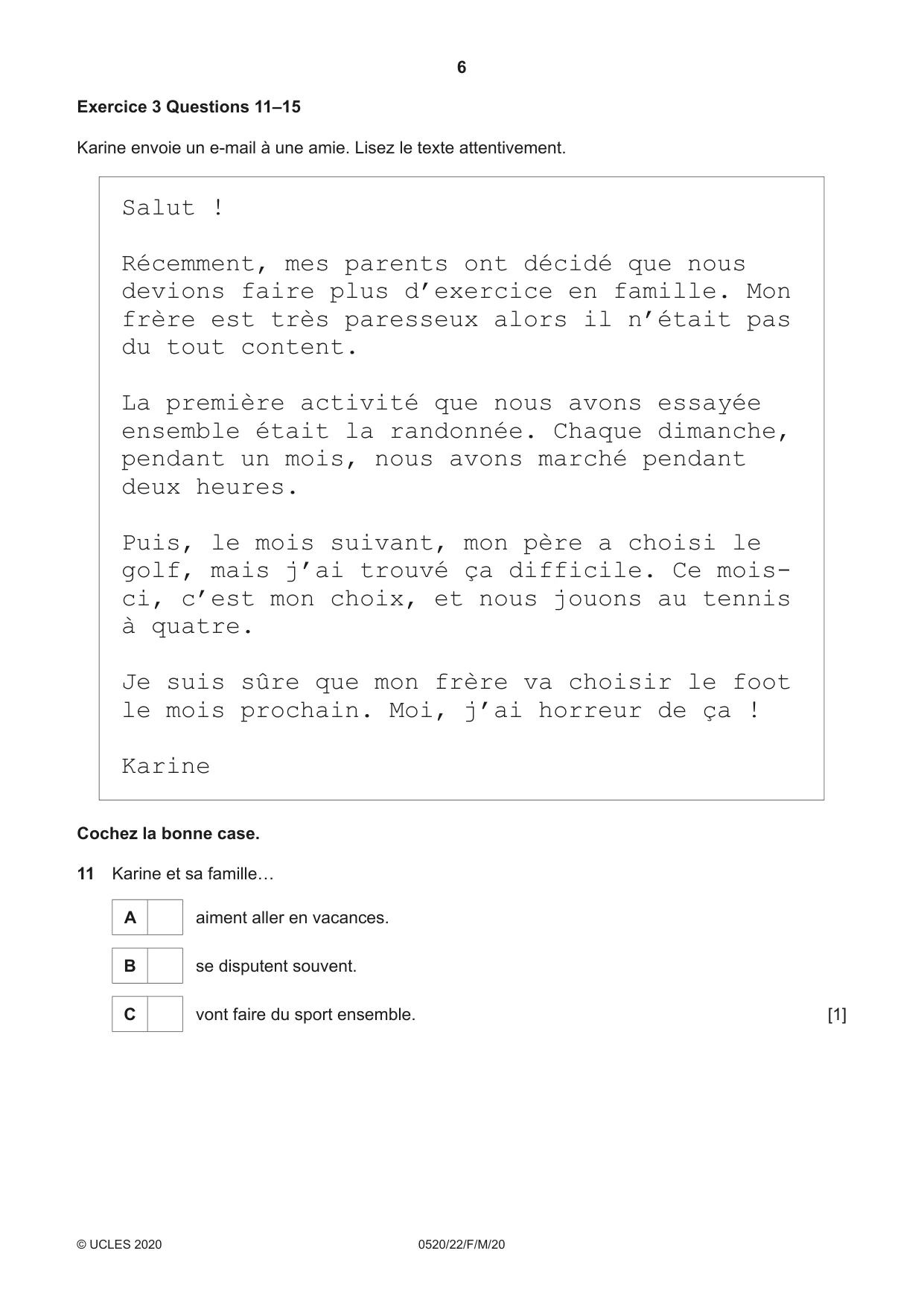
6 0520/22/F/M/20 © UCLES 2020 Exercice 3 Questions 11–15 Karine envoie un e-mail à une amie. Lisez le texte attentivement. Salut ! Récemment, mes parents ont décidé que nous devions faire plus d’exercice en famille. Mon frère est très paresseux alors il n’était pas du tout content. La première activité que nous avons essayée ensemble était la randonnée. Chaque dimanche, pendant un mois, nous avons marché pendant deux heures. Puis, le mois suivant, mon père a choisi le golf, mais j’ai trouvé ça difficile. Ce mois- ci, c’est mon choix, et nous jouons au tennis à quatre. Je suis sûre que mon frère va choisir le foot le mois prochain. Moi, j’ai horreur de ça ! Karine Cochez la bonne case. 11 Karine et sa famille… A aiment aller en vacances. B se disputent souvent. C vont faire du sport ensemble. [1]
Question paper, page 7
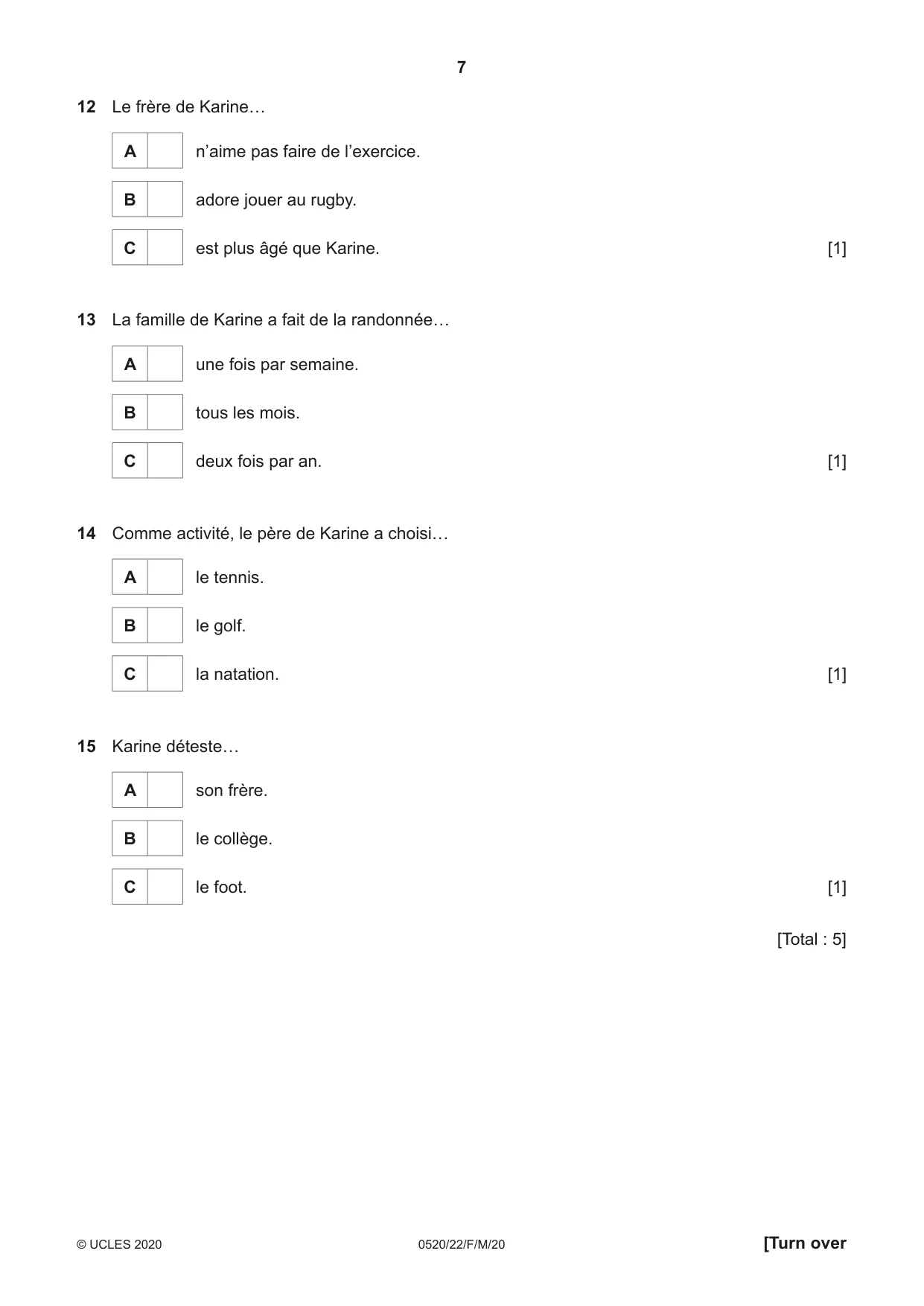
7 0520/22/F/M/20 © UCLES 2020 [Turn over 12 Le frère de Karine… A n’aime pas faire de l’exercice. B adore jouer au rugby. C est plus âgé que Karine. [1] 13 La famille de Karine a fait de la randonnée… A une fois par semaine. B tous les mois. C deux fois par an. [1] 14 Comme activité, le père de Karine a choisi… A le tennis. B le golf. C la natation. [1] 15 Karine déteste… A son frère. B le collège. C le foot. [1] [Total : 5]
Question paper, page 8
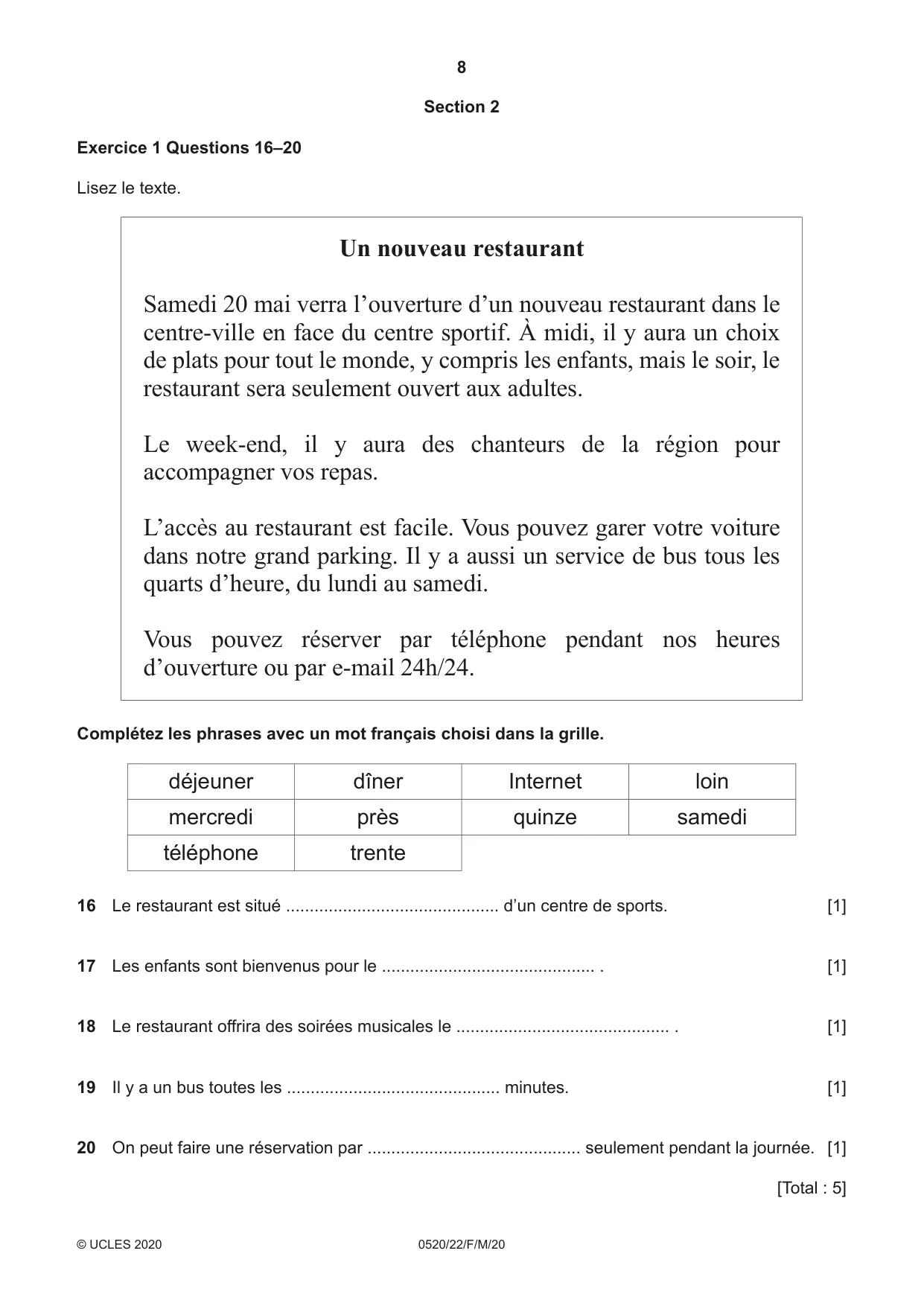
8 0520/22/F/M/20 © UCLES 2020 Section 2 Exercice 1 Questions 16–20 Lisez le texte. Un nouveau restaurant Samedi 20 mai verra l’ouverture d’un nouveau restaurant dans le centre-ville en face du centre sportif. À midi, il y aura un choix de plats pour tout le monde, y compris les enfants, mais le soir, le restaurant sera seulement ouvert aux adultes. Le week-end, il y aura des chanteurs de la région pour accompagner vos repas. L’accès au restaurant est facile. Vous pouvez garer votre voiture dans notre grand parking. Il y a aussi un service de bus tous les quarts d’heure, du lundi au samedi. Vous pouvez réserver par téléphone pendant nos heures d’ouverture ou par e-mail 24h/24. Complétez les phrases avec un mot français choisi dans la grille. déjeuner dîner Internet loin mercredi près quinze samedi téléphone trente 16 Le restaurant est situé … d’un centre de sports. [1] 17 Les enfants sont bienvenus pour le … . [1] 18 Le restaurant offrira des soirées musicales le … . [1] 19 Il y a un bus toutes les … minutes. [1] 20 On peut faire une réservation par … seulement pendant la journée. [1] [Total : 5]
Question paper, page 9
9 0520/22/F/M/20 © UCLES 2020 [Turn over Tournez la page pour l’Exercice 2.
Question paper, page 10
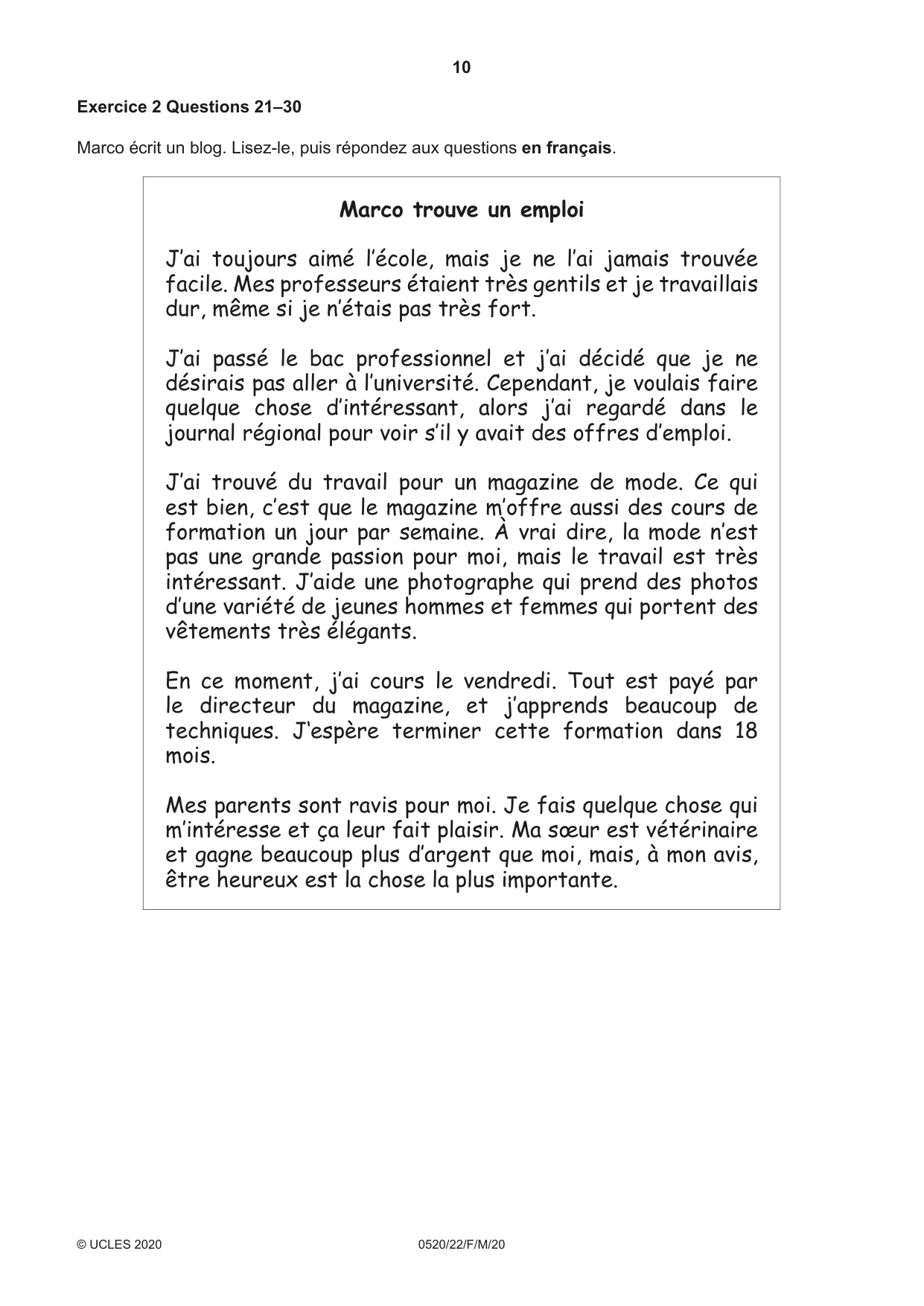
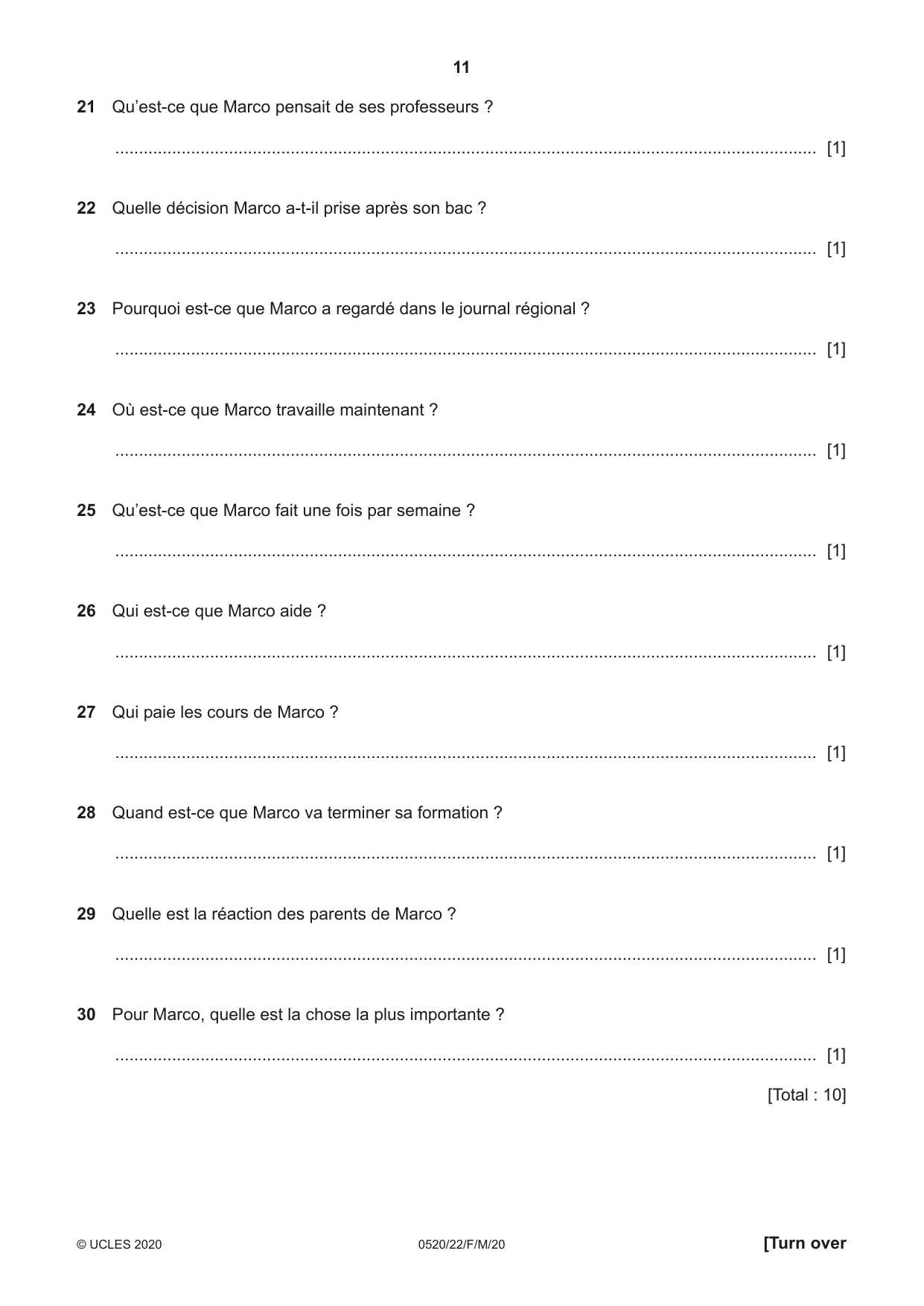
10 0520/22/F/M/20 © UCLES 2020 Exercice 2 Questions 21–30 Marco écrit un blog. Lisez-le, puis répondez aux questions en français. Marco trouve un emploi J’ai toujours aimé l’école, mais je ne l’ai jamais trouvée facile. Mes professeurs étaient très gentils et je travaillais dur, même si je n’étais pas très fort. J’ai passé le bac professionnel et j’ai décidé que je ne désirais pas aller à l’université. Cependant, je voulais faire quelque chose d’intéressant, alors j’ai regardé dans le journal régional pour voir s’il y avait des offres d’emploi. J’ai trouvé du travail pour un magazine de mode. Ce qui est bien, c’est que le magazine m’offre aussi des cours de formation un jour par semaine. À vrai dire, la mode n’est pas une grande passion pour moi, mais le travail est très intéressant. J’aide une photographe qui prend des photos d’une variété de jeunes hommes et femmes qui portent des vêtements très élégants. En ce moment, j’ai cours le vendredi. Tout est payé par le directeur du magazine, et j’apprends beaucoup de techniques. J‘espère terminer cette formation dans 18 mois. Mes parents sont ravis pour moi. Je fais quelque chose qui m’intéresse et ça leur fait plaisir. Ma sœur est vétérinaire et gagne beaucoup plus d’argent que moi, mais, à mon avis, être heureux est la chose la plus importante.
Question paper, page 11
11 0520/22/F/M/20 © UCLES 2020 [Turn over 21 Qu’est-ce que Marco pensait de ses professeurs ? … [1] 22 Quelle décision Marco a-t-il prise après son bac ? … [1] 23 Pourquoi est-ce que Marco a regardé dans le journal régional ? … [1] 24 Où est-ce que Marco travaille maintenant ? … [1] 25 Qu’est-ce que Marco fait une fois par semaine ? … [1] 26 Qui est-ce que Marco aide ? … [1] 27 Qui paie les cours de Marco ? … [1] 28 Quand est-ce que Marco va terminer sa formation ? … [1] 29 Quelle est la réaction des parents de Marco ? … [1] 30 Pour Marco, quelle est la chose la plus importante ? … [1] [Total : 10]
Question paper, page 12
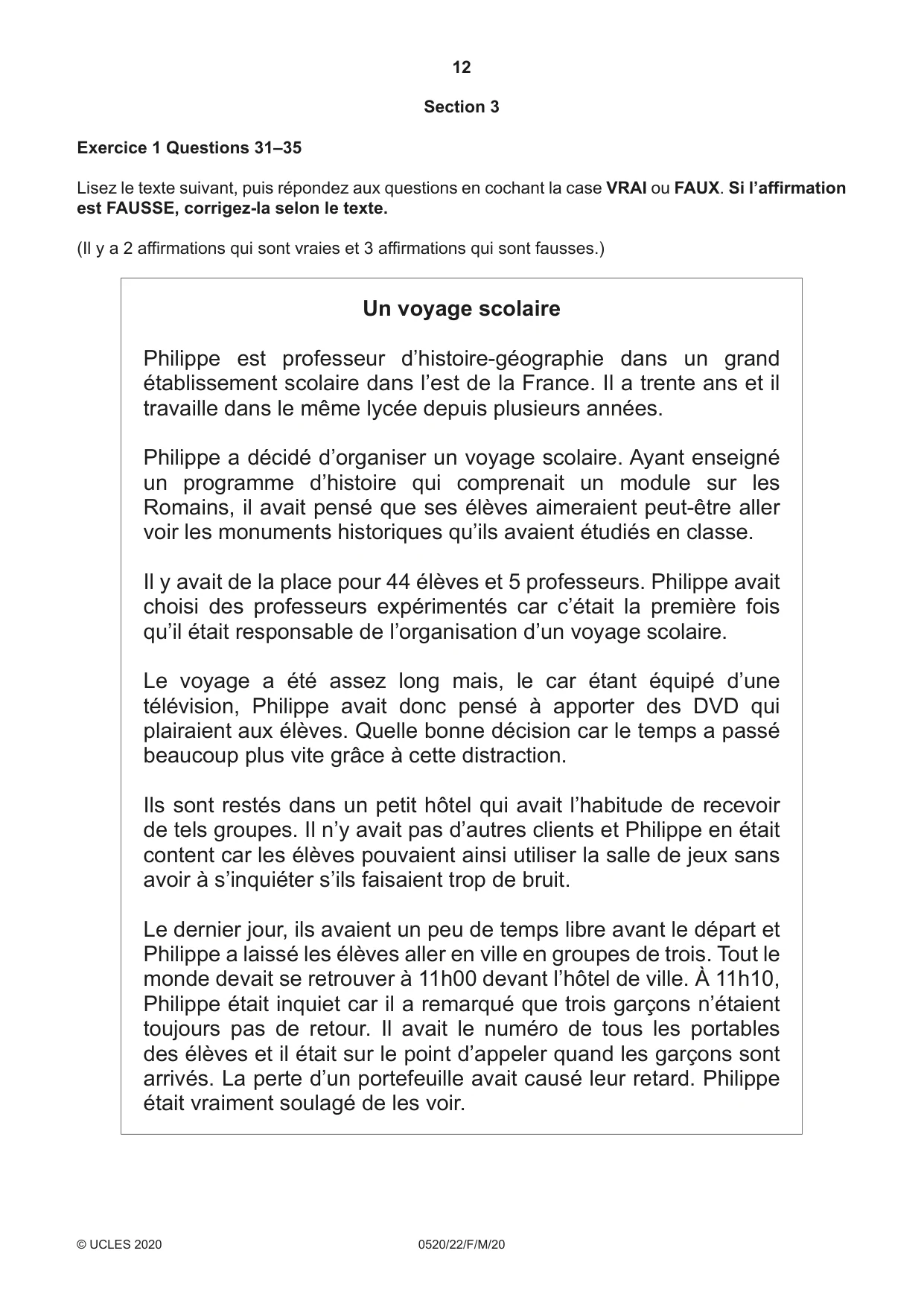
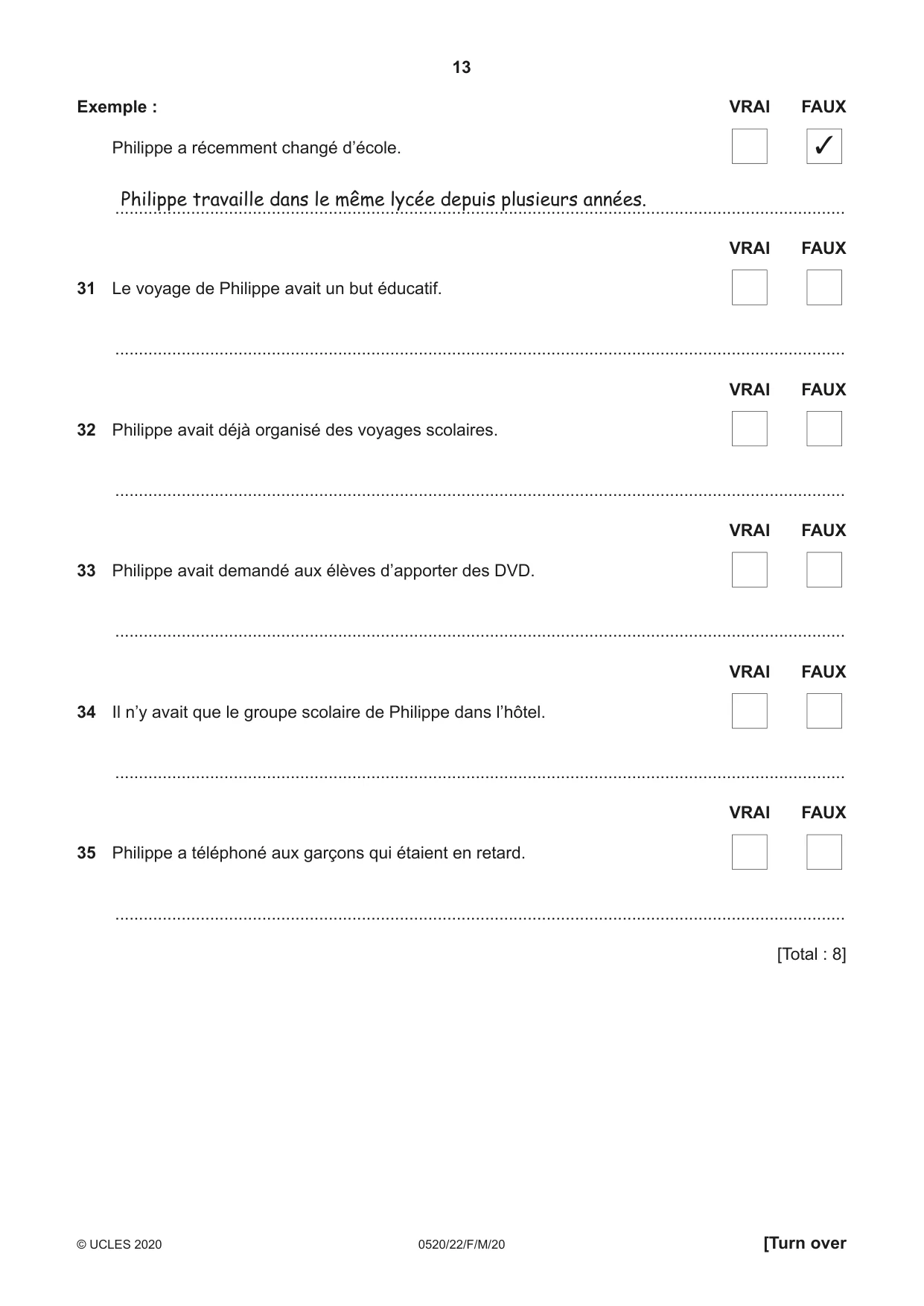
12 0520/22/F/M/20 © UCLES 2020 Section 3 Exercice 1 Questions 31–35 Lisez le texte suivant, puis répondez aux questions en cochant la case VRAI ou FAUX. Si l’affirmation est FAUSSE, corrigez-la selon le texte. (Il y a 2 affirmations qui sont vraies et 3 affirmations qui sont fausses.) Un voyage scolaire Philippe est professeur d’histoire-géographie dans un grand établissement scolaire dans l’est de la France. Il a trente ans et il travaille dans le même lycée depuis plusieurs années. Philippe a décidé d’organiser un voyage scolaire. Ayant enseigné un programme d’histoire qui comprenait un module sur les Romains, il avait pensé que ses élèves aimeraient peut-être aller voir les monuments historiques qu’ils avaient étudiés en classe. Il y avait de la place pour 44 élèves et 5 professeurs. Philippe avait choisi des professeurs expérimentés car c’était la première fois qu’il était responsable de l’organisation d’un voyage scolaire. Le voyage a été assez long mais, le car étant équipé d’une télévision, Philippe avait donc pensé à apporter des DVD qui plairaient aux élèves. Quelle bonne décision car le temps a passé beaucoup plus vite grâce à cette distraction. Ils sont restés dans un petit hôtel qui avait l’habitude de recevoir de tels groupes. Il n’y avait pas d’autres clients et Philippe en était content car les élèves pouvaient ainsi utiliser la salle de jeux sans avoir à s’inquiéter s’ils faisaient trop de bruit. Le dernier jour, ils avaient un peu de temps libre avant le départ et Philippe a laissé les élèves aller en ville en groupes de trois. Tout le monde devait se retrouver à 11h00 devant l’hôtel de ville. À 11h10, Philippe était inquiet car il a remarqué que trois garçons n’étaient toujours pas de retour. Il avait le numéro de tous les portables des élèves et il était sur le point d’appeler quand les garçons sont arrivés. La perte d’un portefeuille avait causé leur retard. Philippe était vraiment soulagé de les voir.
Question paper, page 13
13 0520/22/F/M/20 © UCLES 2020 [Turn over Exemple : VRAI FAUX Philippe a récemment changé d’école. ✓ Philippe travaille dans le même lycée depuis plusieurs années. … VRAI FAUX 31 Le voyage de Philippe avait un but éducatif. … VRAI FAUX 32 Philippe avait déjà organisé des voyages scolaires. … VRAI FAUX 33 Philippe avait demandé aux élèves d’apporter des DVD. … VRAI FAUX 34 Il n’y avait que le groupe scolaire de Philippe dans l’hôtel. … VRAI FAUX 35 Philippe a téléphoné aux garçons qui étaient en retard. … [Total : 8]
Question paper, page 14
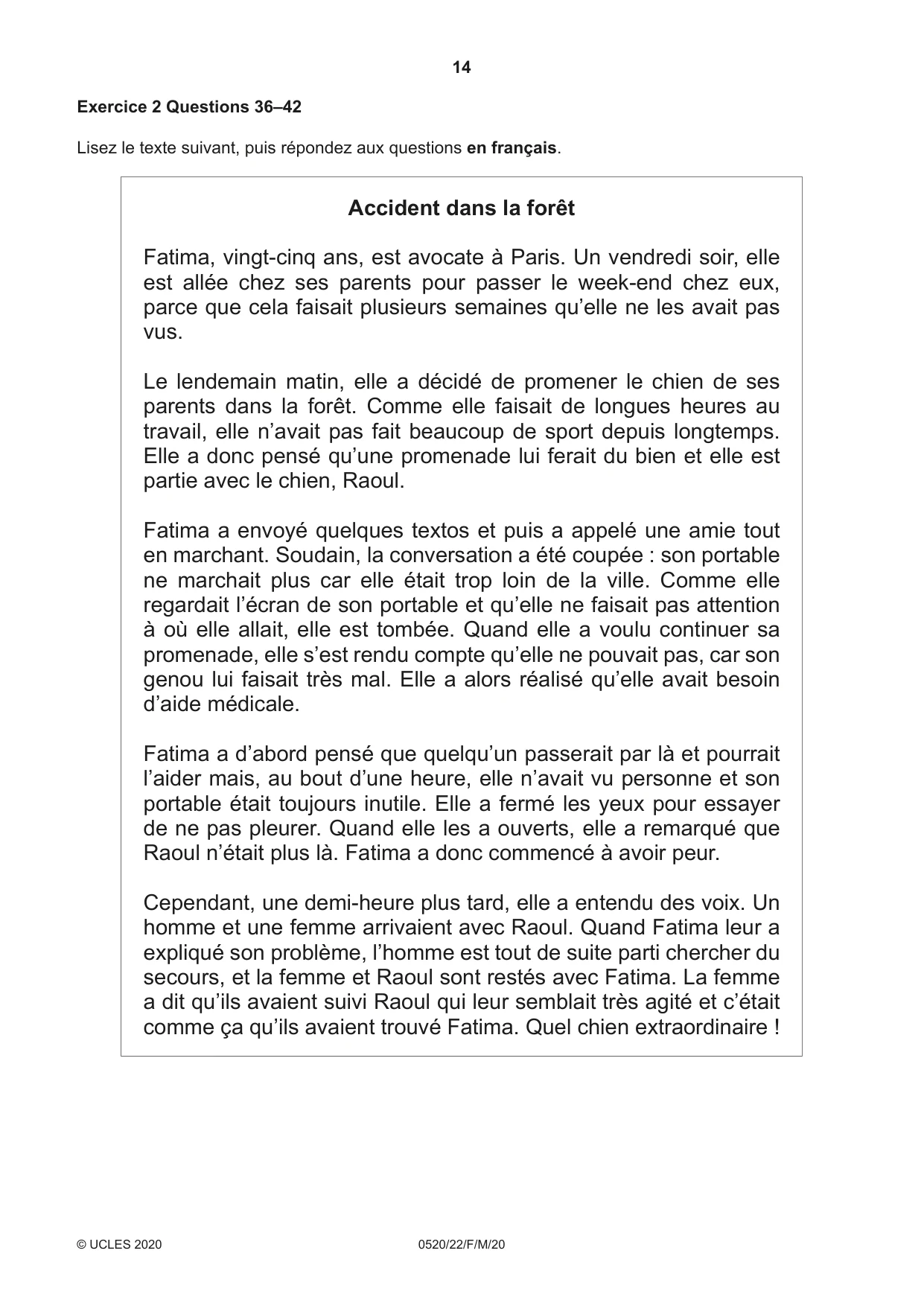
14 0520/22/F/M/20 © UCLES 2020 Exercice 2 Questions 36–42 Lisez le texte suivant, puis répondez aux questions en français. Accident dans la forêt Fatima, vingt-cinq ans, est avocate à Paris. Un vendredi soir, elle est allée chez ses parents pour passer le week-end chez eux, parce que cela faisait plusieurs semaines qu’elle ne les avait pas vus. Le lendemain matin, elle a décidé de promener le chien de ses parents dans la forêt. Comme elle faisait de longues heures au travail, elle n’avait pas fait beaucoup de sport depuis longtemps. Elle a donc pensé qu’une promenade lui ferait du bien et elle est partie avec le chien, Raoul. Fatima a envoyé quelques textos et puis a appelé une amie tout en marchant. Soudain, la conversation a été coupée : son portable ne marchait plus car elle était trop loin de la ville. Comme elle regardait l’écran de son portable et qu’elle ne faisait pas attention à où elle allait, elle est tombée. Quand elle a voulu continuer sa promenade, elle s’est rendu compte qu’elle ne pouvait pas, car son genou lui faisait très mal. Elle a alors réalisé qu’elle avait besoin d’aide médicale. Fatima a d’abord pensé que quelqu’un passerait par là et pourrait l’aider mais, au bout d’une heure, elle n’avait vu personne et son portable était toujours inutile. Elle a fermé les yeux pour essayer de ne pas pleurer. Quand elle les a ouverts, elle a remarqué que Raoul n’était plus là. Fatima a donc commencé à avoir peur. Cependant, une demi-heure plus tard, elle a entendu des voix. Un homme et une femme arrivaient avec Raoul. Quand Fatima leur a expliqué son problème, l’homme est tout de suite parti chercher du secours, et la femme et Raoul sont restés avec Fatima. La femme a dit qu’ils avaient suivi Raoul qui leur semblait très agité et c’était comme ça qu’ils avaient trouvé Fatima. Quel chien extraordinaire !
Question paper, page 15
15 0520/22/F/M/20 © UCLES 2020 36 Depuis combien de temps Fatima n’avait-elle pas vu ses parents ? … [1] 37 Pourquoi Fatima faisait-elle si peu de sport ? … [1] 38 Qu’est-ce que Fatima a fait juste avant de téléphoner à une amie ? … [1] 39 Pourquoi Fatima avait-elle besoin d’aide médicale ? … [1] 40 Comment Fatima a-t-elle évité de pleurer ? … [1] 41 Quelle a été la réaction de Fatima quand elle a vu que Raoul avait disparu ? … [1] 42 Pourquoi l’homme et la femme avaient-ils suivi Raoul ? … [1] [Total : 7]
Question paper, page 16
16 0520/22/F/M/20 © UCLES 2020 Permission to reproduce items where third-party owned material protected by copyright is included has been sought and cleared where possible. Every reasonable effort has been made by the publisher (UCLES) to trace copyright holders, but if any items requiring clearance have unwittingly been included, the publisher will be pleased to make amends at the earliest possible opportunity. To avoid the issue of disclosure of answer-related information to candidates, all copyright acknowledgements are reproduced online in the Cambridge Assessment International Education Copyright Acknowledgements Booklet. This is produced for each series of examinations and is freely available to download at www.cambridgeinternational.org after the live examination series. Cambridge Assessment International Education is part of the Cambridge Assessment Group. Cambridge Assessment is the brand name of the University of Cambridge Local Examinations Syndicate (UCLES), which itself is a department of the University of Cambridge. BLANK PAGE
Mark scheme, page 1
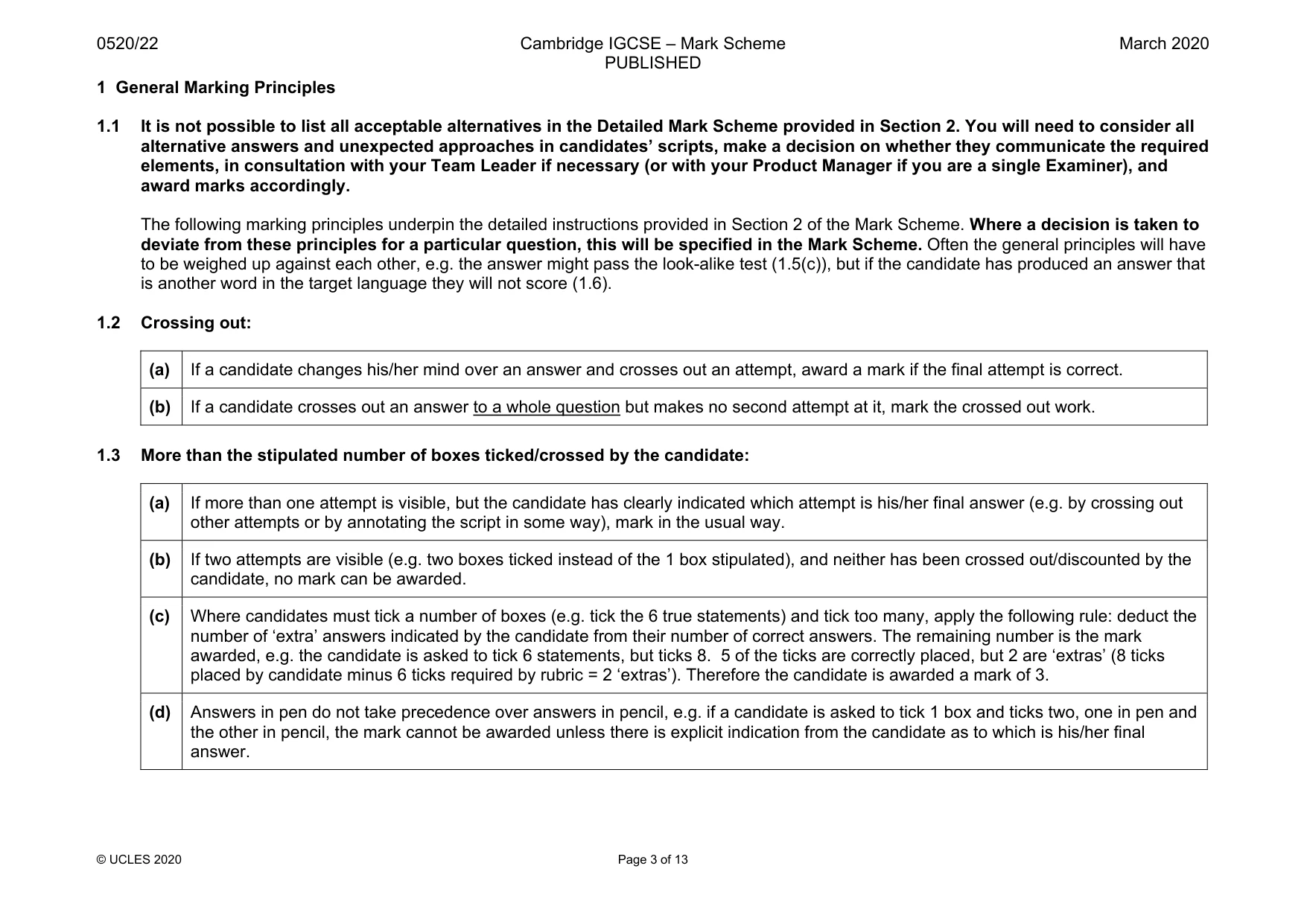
This document consists of 13 printed pages. © UCLES 2020 [Turn over Cambridge IGCSE™ FRENCH 0520/22 Paper 2 Reading March 2020 MARK SCHEME Maximum Mark: 45 Published This mark scheme is published as an aid to teachers and candidates, to indicate the requirements of the examination. It shows the basis on which Examiners were instructed to award marks. It does not indicate the details of the discussions that took place at an Examiners’ meeting before marking began, which would have considered the acceptability of alternative answers. Mark schemes should be read in conjunction with the question paper and the Principal Examiner Report for Teachers. Cambridge International will not enter into discussions about these mark schemes. Cambridge International is publishing the mark schemes for the March 2020 series for most Cambridge IGCSE™, Cambridge International A and AS Level components and some Cambridge O Level components.
Mark scheme, page 2
0520/22 Cambridge IGCSE – Mark Scheme PUBLISHED March 2020 © UCLES 2020 Page 2 of 13 Generic Marking Principles These general marking principles must be applied by all examiners when marking candidate answers. They should be applied alongside the specific content of the mark scheme or generic level descriptors for a question. Each question paper and mark scheme will also comply with these marking principles. GENERIC MARKING PRINCIPLE 1: Marks must be awarded in line with: • the specific content of the mark scheme or the generic level descriptors for the question • the specific skills defined in the mark scheme or in the generic level descriptors for the question • the standard of response required by a candidate as exemplified by the standardisation scripts. GENERIC MARKING PRINCIPLE 2: Marks awarded are always whole marks (not half marks, or other fractions). GENERIC MARKING PRINCIPLE 3: Marks must be awarded positively: • marks are awarded for correct/valid answers, as defined in the mark scheme. However, credit is given for valid answers which go beyond the scope of the syllabus and mark scheme, referring to your Team Leader as appropriate • marks are awarded when candidates clearly demonstrate what they know and can do • marks are not deducted for errors • marks are not deducted for omissions • answers should only be judged on the quality of spelling, punctuation and grammar when these features are specifically assessed by the question as indicated by the mark scheme. The meaning, however, should be unambiguous. GENERIC MARKING PRINCIPLE 4: Rules must be applied consistently e.g. in situations where candidates have not followed instructions or in the application of generic level descriptors. GENERIC MARKING PRINCIPLE 5: Marks should be awarded using the full range of marks defined in the mark scheme for the question (however; the use of the full mark range may be limited according to the quality of the candidate responses seen). GENERIC MARKING PRINCIPLE 6: Marks awarded are based solely on the requirements as defined in the mark scheme. Marks should not be awarded with grade thresholds or grade descriptors in mind.
Mark scheme, page 3
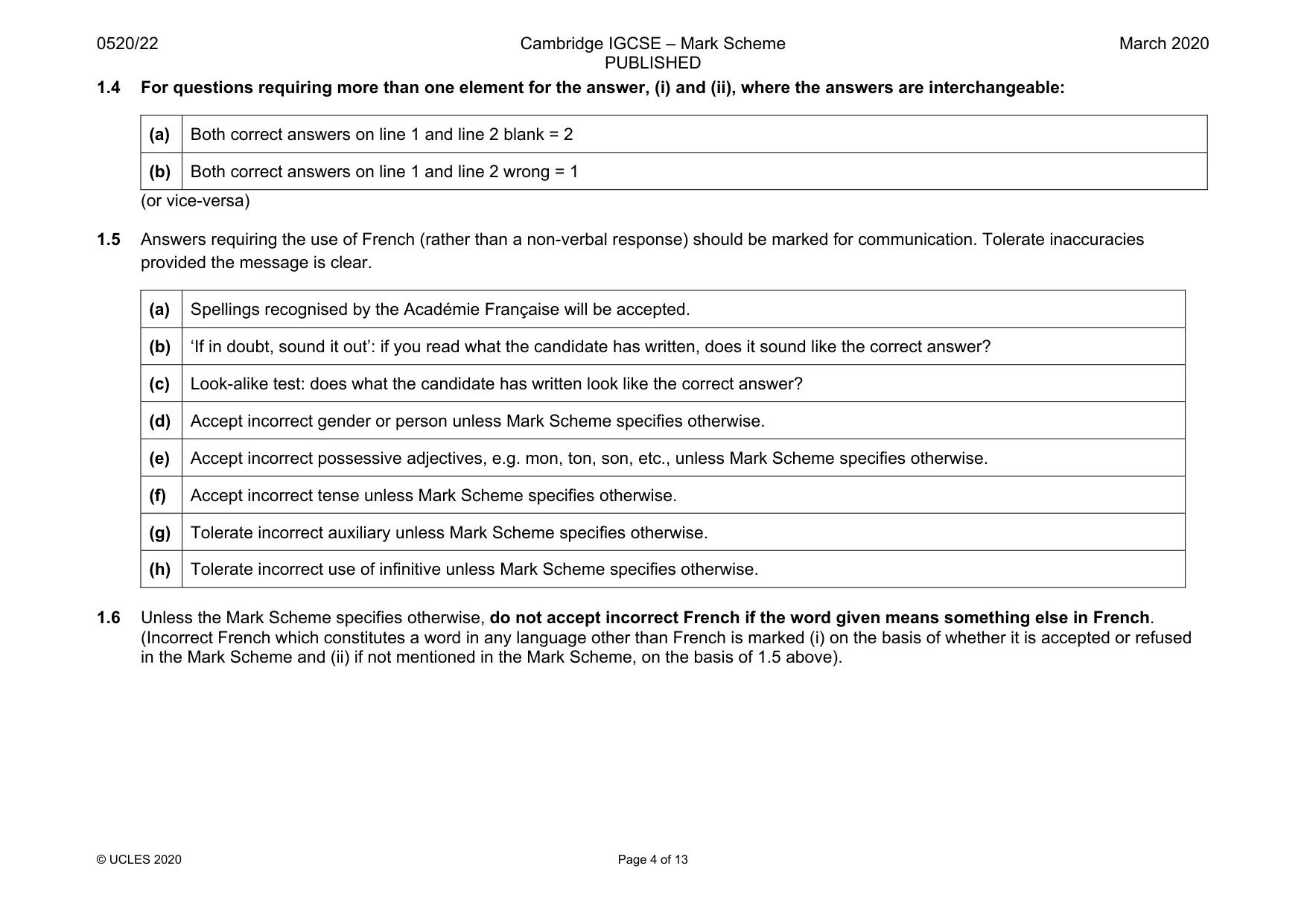
0520/22 Cambridge IGCSE – Mark Scheme PUBLISHED March 2020 © UCLES 2020 Page 3 of 13 1 General Marking Principles 1.1 It is not possible to list all acceptable alternatives in the Detailed Mark Scheme provided in Section 2. You will need to consider all alternative answers and unexpected approaches in candidates’ scripts, make a decision on whether they communicate the required elements, in consultation with your Team Leader if necessary (or with your Product Manager if you are a single Examiner), and award marks accordingly. The following marking principles underpin the detailed instructions provided in Section 2 of the Mark Scheme. Where a decision is taken to deviate from these principles for a particular question, this will be specified in the Mark Scheme. Often the general principles will have to be weighed up against each other, e.g. the answer might pass the look-alike test (1.5(c)), but if the candidate has produced an answer that is another word in the target language they will not score (1.6). 1.2 Crossing out: (a) If a candidate changes his/her mind over an answer and crosses out an attempt, award a mark if the final attempt is correct. (b) If a candidate crosses out an answer to a whole question but makes no second attempt at it, mark the crossed out work. 1.3 More than the stipulated number of boxes ticked/crossed by the candidate: (a) If more than one attempt is visible, but the candidate has clearly indicated which attempt is his/her final answer (e.g. by crossing out other attempts or by annotating the script in some way), mark in the usual way. (b) If two attempts are visible (e.g. two boxes ticked instead of the 1 box stipulated), and neither has been crossed out/discounted by the candidate, no mark can be awarded. (c) Where candidates must tick a number of boxes (e.g. tick the 6 true statements) and tick too many, apply the following rule: deduct the number of ‘extra’ answers indicated by the candidate from their number of correct answers. The remaining number is the mark awarded, e.g. the candidate is asked to tick 6 statements, but ticks 8. 5 of the ticks are correctly placed, but 2 are ‘extras’ (8 ticks placed by candidate minus 6 ticks required by rubric = 2 ‘extras’). Therefore the candidate is awarded a mark of 3. (d) Answers in pen do not take precedence over answers in pencil, e.g. if a candidate is asked to tick 1 box and ticks two, one in pen and the other in pencil, the mark cannot be awarded unless there is explicit indication from the candidate as to which is his/her final answer.
Mark scheme, page 4
0520/22 Cambridge IGCSE – Mark Scheme PUBLISHED March 2020 © UCLES 2020 Page 4 of 13 1.4 For questions requiring more than one element for the answer, (i) and (ii), where the answers are interchangeable: (a) Both correct answers on line 1 and line 2 blank = 2 (b) Both correct answers on line 1 and line 2 wrong = 1 (or vice-versa) 1.5 Answers requiring the use of French (rather than a non-verbal response) should be marked for communication. Tolerate inaccuracies provided the message is clear. (a) Spellings recognised by the Académie Française will be accepted. (b) ‘If in doubt, sound it out’: if you read what the candidate has written, does it sound like the correct answer? (c) Look-alike test: does what the candidate has written look like the correct answer? (d) Accept incorrect gender or person unless Mark Scheme specifies otherwise. (e) Accept incorrect possessive adjectives, e.g. mon, ton, son, etc., unless Mark Scheme specifies otherwise. (f) Accept incorrect tense unless Mark Scheme specifies otherwise. (g) Tolerate incorrect auxiliary unless Mark Scheme specifies otherwise. (h) Tolerate incorrect use of infinitive unless Mark Scheme specifies otherwise. 1.6 Unless the Mark Scheme specifies otherwise, do not accept incorrect French if the word given means something else in French. (Incorrect French which constitutes a word in any language other than French is marked (i) on the basis of whether it is accepted or refused in the Mark Scheme and (ii) if not mentioned in the Mark Scheme, on the basis of 1.5 above).
Mark scheme, page 5
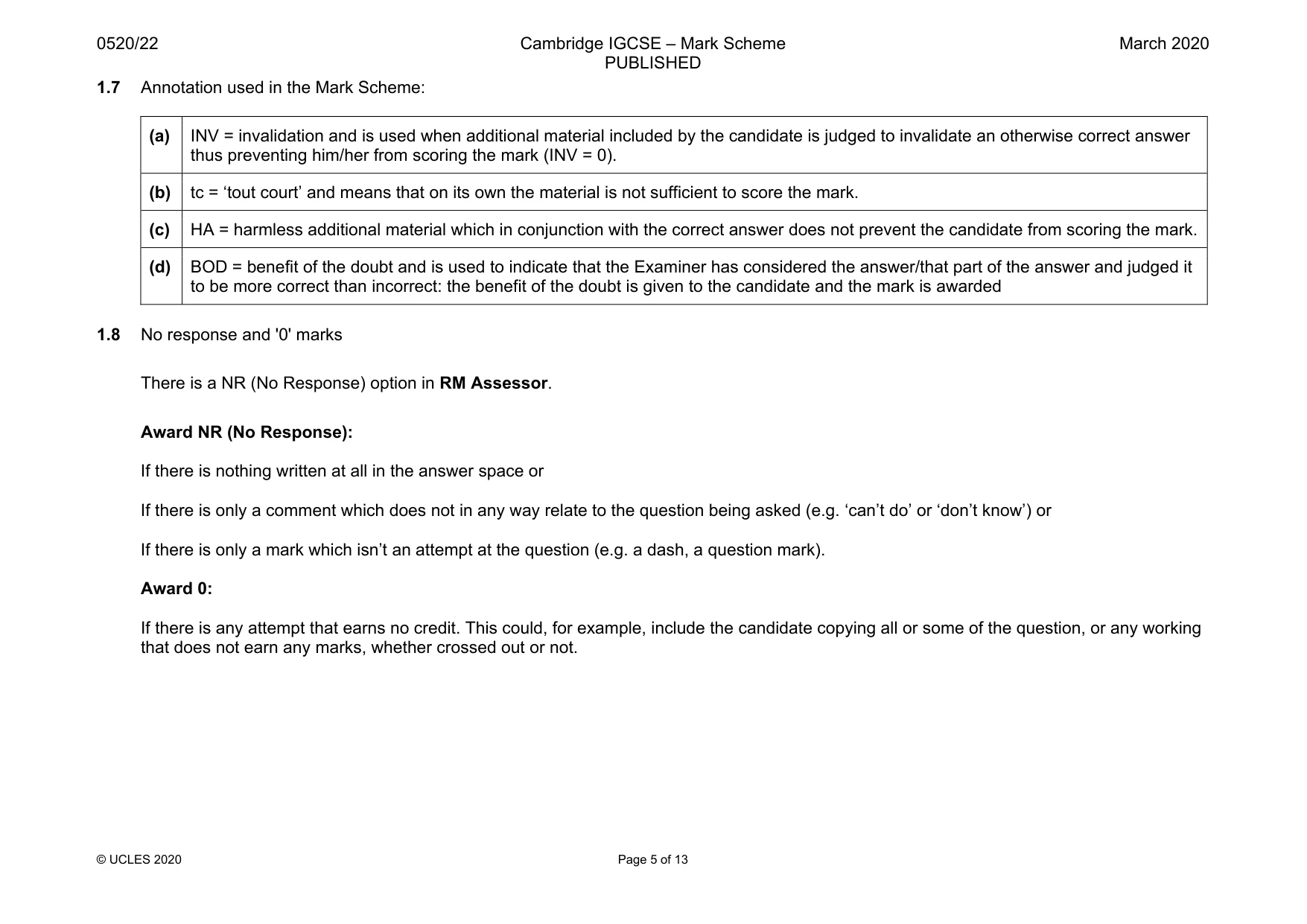
0520/22 Cambridge IGCSE – Mark Scheme PUBLISHED March 2020 © UCLES 2020 Page 5 of 13 1.7 Annotation used in the Mark Scheme: (a) INV = invalidation and is used when additional material included by the candidate is judged to invalidate an otherwise correct answer thus preventing him/her from scoring the mark (INV = 0). (b) tc = ‘tout court’ and means that on its own the material is not sufficient to score the mark. (c) HA = harmless additional material which in conjunction with the correct answer does not prevent the candidate from scoring the mark. (d) BOD = benefit of the doubt and is used to indicate that the Examiner has considered the answer/that part of the answer and judged it to be more correct than incorrect: the benefit of the doubt is given to the candidate and the mark is awarded 1.8 No response and '0' marks There is a NR (No Response) option in RM Assessor. Award NR (No Response): If there is nothing written at all in the answer space or If there is only a comment which does not in any way relate to the question being asked (e.g. ‘can’t do’ or ‘don’t know’) or If there is only a mark which isn’t an attempt at the question (e.g. a dash, a question mark). Award 0: If there is any attempt that earns no credit. This could, for example, include the candidate copying all or some of the question, or any working that does not earn any marks, whether crossed out or not.
Mark scheme, page 6
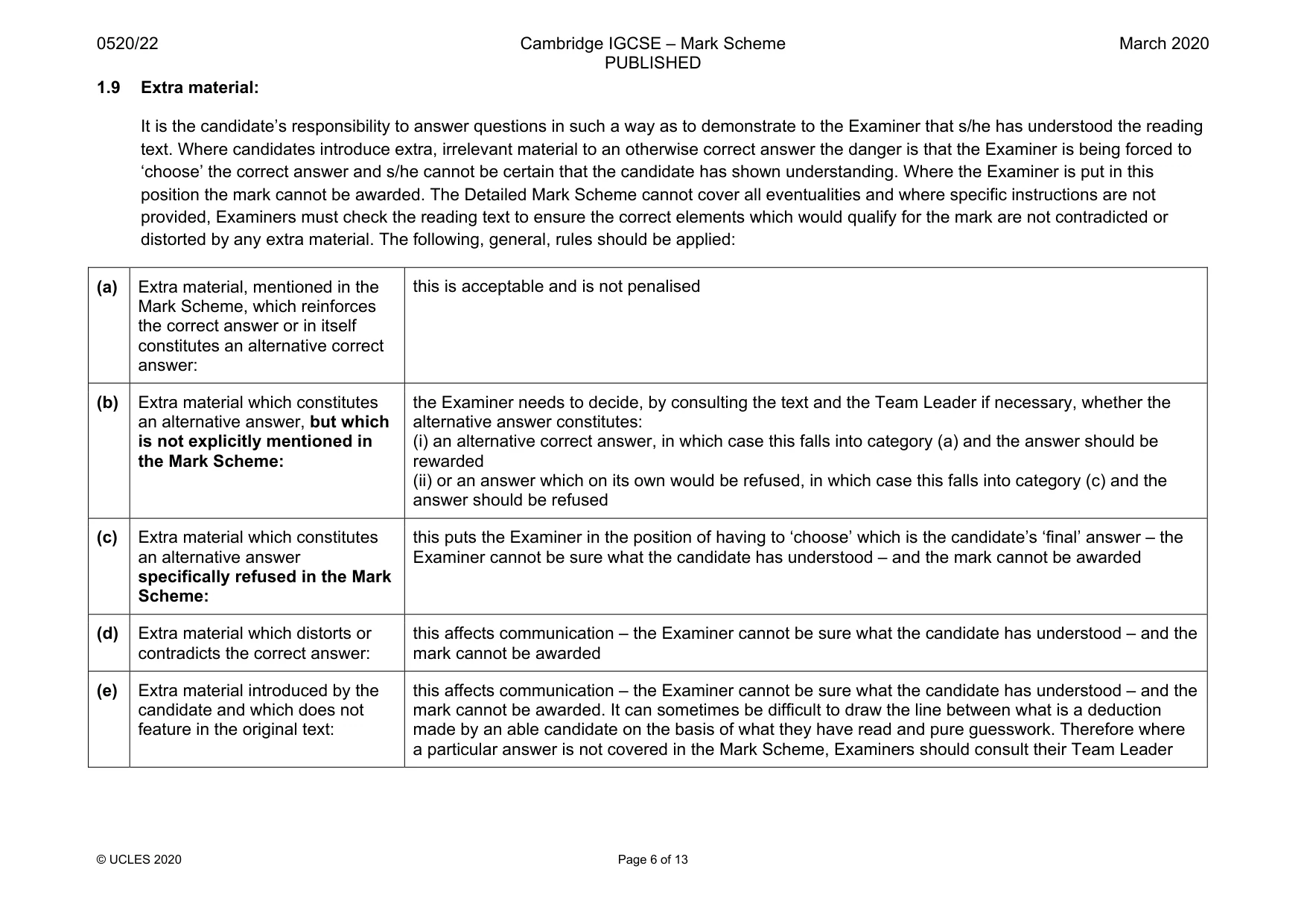
0520/22 Cambridge IGCSE – Mark Scheme PUBLISHED March 2020 © UCLES 2020 Page 6 of 13 1.9 Extra material: It is the candidate’s responsibility to answer questions in such a way as to demonstrate to the Examiner that s/he has understood the reading text. Where candidates introduce extra, irrelevant material to an otherwise correct answer the danger is that the Examiner is being forced to ‘choose’ the correct answer and s/he cannot be certain that the candidate has shown understanding. Where the Examiner is put in this position the mark cannot be awarded. The Detailed Mark Scheme cannot cover all eventualities and where specific instructions are not provided, Examiners must check the reading text to ensure the correct elements which would qualify for the mark are not contradicted or distorted by any extra material. The following, general, rules should be applied: (a) Extra material, mentioned in the Mark Scheme, which reinforces the correct answer or in itself constitutes an alternative correct answer: this is acceptable and is not penalised (b) Extra material which constitutes an alternative answer, but which is not explicitly mentioned in the Mark Scheme: the Examiner needs to decide, by consulting the text and the Team Leader if necessary, whether the alternative answer constitutes: (i) an alternative correct answer, in which case this falls into category (a) and the answer should be rewarded (ii) or an answer which on its own would be refused, in which case this falls into category (c) and the answer should be refused (c) Extra material which constitutes an alternative answer specifically refused in the Mark Scheme: this puts the Examiner in the position of having to ‘choose’ which is the candidate’s ‘final’ answer – the Examiner cannot be sure what the candidate has understood – and the mark cannot be awarded (d) Extra material which distorts or contradicts the correct answer: this affects communication – the Examiner cannot be sure what the candidate has understood – and the mark cannot be awarded (e) Extra material introduced by the candidate and which does not feature in the original text: this affects communication – the Examiner cannot be sure what the candidate has understood – and the mark cannot be awarded. It can sometimes be difficult to draw the line between what is a deduction made by an able candidate on the basis of what they have read and pure guesswork. Therefore where a particular answer is not covered in the Mark Scheme, Examiners should consult their Team Leader
Mark scheme, page 7
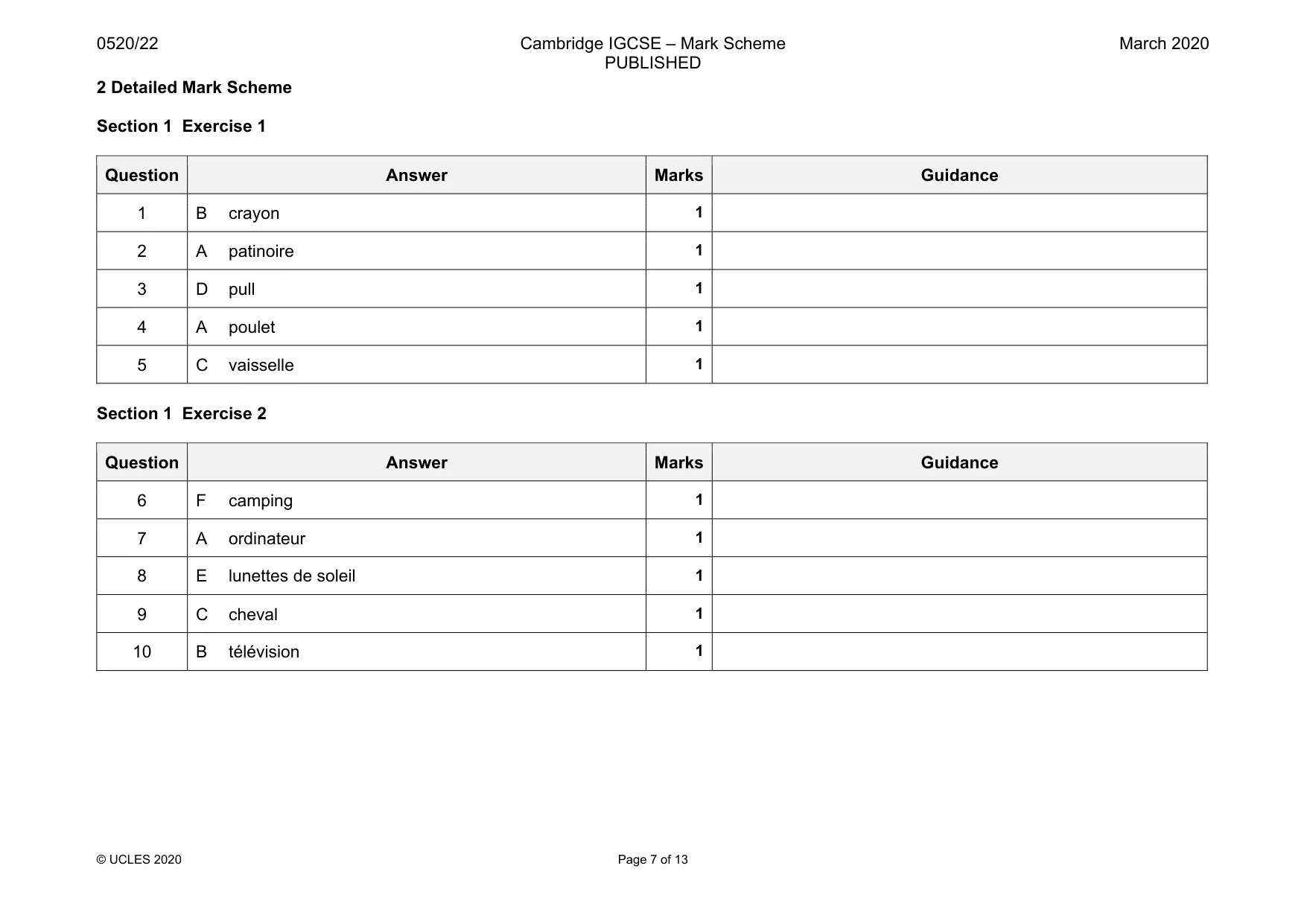
0520/22 Cambridge IGCSE – Mark Scheme PUBLISHED March 2020 © UCLES 2020 Page 7 of 13 2 Detailed Mark Scheme Section 1 Exercise 1 Question Answer Marks Guidance 1 B crayon 1 2 A patinoire 1 3 D pull 1 4 A poulet 1 5 C vaisselle 1 Section 1 Exercise 2 Question Answer Marks Guidance 6 F camping 1 7 A ordinateur 1 8 E lunettes de soleil 1 9 C cheval 1 10 B télévision 1
Mark scheme, page 8
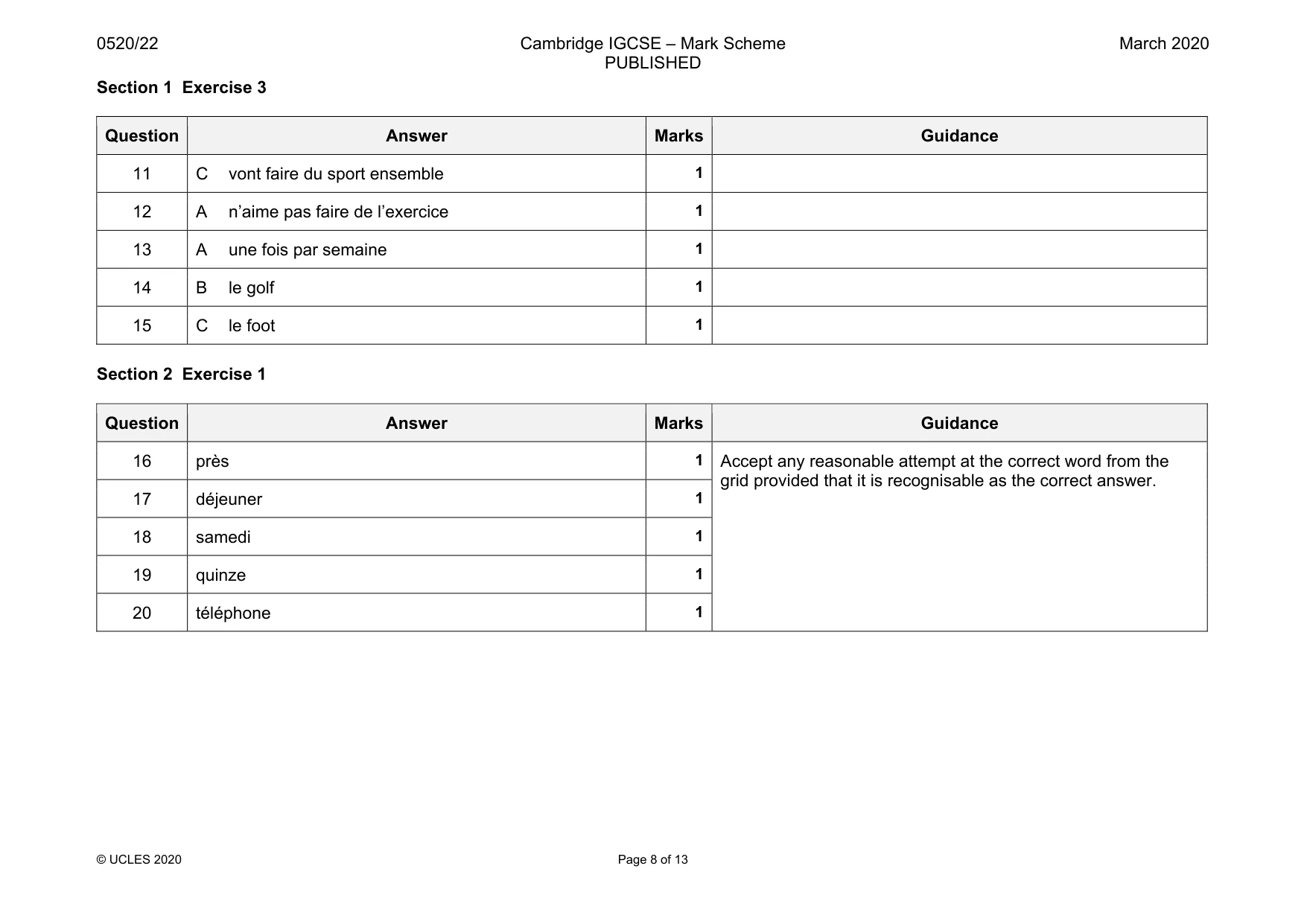
0520/22 Cambridge IGCSE – Mark Scheme PUBLISHED March 2020 © UCLES 2020 Page 8 of 13 Section 1 Exercise 3 Question Answer Marks Guidance 11 C vont faire du sport ensemble 1 12 A n’aime pas faire de l’exercice 1 13 A une fois par semaine 1 14 B le golf 1 15 C le foot 1 Section 2 Exercise 1 Question Answer Marks Guidance 16 près 1 Accept any reasonable attempt at the correct word from the grid provided that it is recognisable as the correct answer. 17 déjeuner 1 18 samedi 1 19 quinze 1 20 téléphone 1
Mark scheme, page 9
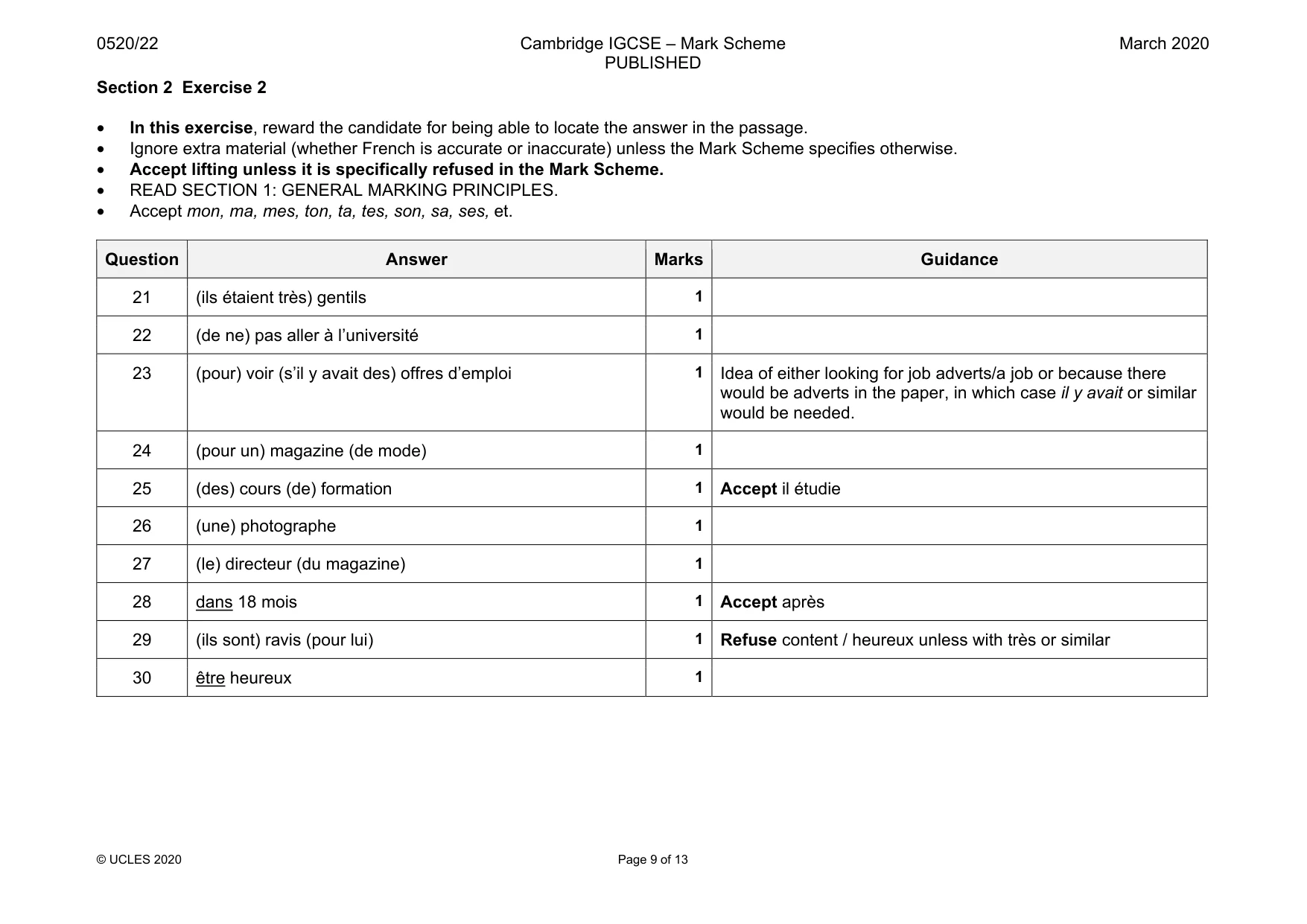
0520/22 Cambridge IGCSE – Mark Scheme PUBLISHED March 2020 © UCLES 2020 Page 9 of 13 Section 2 Exercise 2 • In this exercise, reward the candidate for being able to locate the answer in the passage. • Ignore extra material (whether French is accurate or inaccurate) unless the Mark Scheme specifies otherwise. • Accept lifting unless it is specifically refused in the Mark Scheme. • READ SECTION 1: GENERAL MARKING PRINCIPLES. • Accept mon, ma, mes, ton, ta, tes, son, sa, ses, et. Question Answer Marks Guidance 21 (ils étaient très) gentils 1 22 (de ne) pas aller à l’université 1 23 (pour) voir (s’il y avait des) offres d’emploi 1 Idea of either looking for job adverts/a job or because there would be adverts in the paper, in which case il y avait or similar would be needed. 24 (pour un) magazine (de mode) 1 25 (des) cours (de) formation 1 Accept il étudie 26 (une) photographe 1 27 (le) directeur (du magazine) 1 28 dans 18 mois 1 Accept après 29 (ils sont) ravis (pour lui) 1 Refuse content / heureux unless with très or similar 30 être heureux 1
Mark scheme, page 10
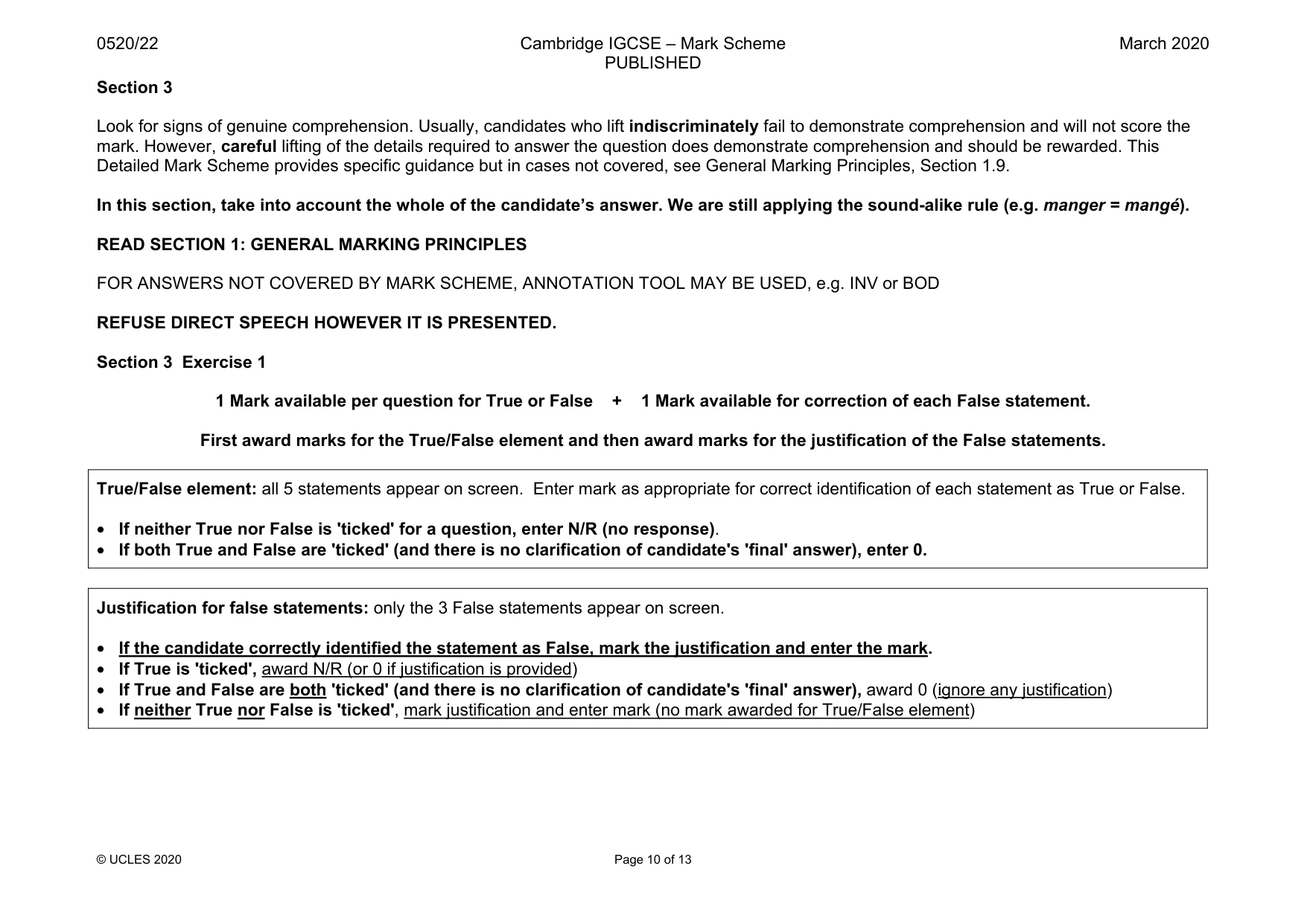
0520/22 Cambridge IGCSE – Mark Scheme PUBLISHED March 2020 © UCLES 2020 Page 10 of 13 Section 3 Look for signs of genuine comprehension. Usually, candidates who lift indiscriminately fail to demonstrate comprehension and will not score the mark. However, careful lifting of the details required to answer the question does demonstrate comprehension and should be rewarded. This Detailed Mark Scheme provides specific guidance but in cases not covered, see General Marking Principles, Section 1.9. In this section, take into account the whole of the candidate’s answer. We are still applying the sound-alike rule (e.g. manger = mangé). READ SECTION 1: GENERAL MARKING PRINCIPLES FOR ANSWERS NOT COVERED BY MARK SCHEME, ANNOTATION TOOL MAY BE USED, e.g. INV or BOD REFUSE DIRECT SPEECH HOWEVER IT IS PRESENTED. Section 3 Exercise 1 1 Mark available per question for True or False + 1 Mark available for correction of each False statement. First award marks for the True/False element and then award marks for the justification of the False statements. True/False element: all 5 statements appear on screen. Enter mark as appropriate for correct identification of each statement as True or False. • If neither True nor False is 'ticked' for a question, enter N/R (no response). • If both True and False are 'ticked' (and there is no clarification of candidate's 'final' answer), enter 0. Justification for false statements: only the 3 False statements appear on screen. • If the candidate correctly identified the statement as False, mark the justification and enter the mark. • If True is 'ticked', award N/R (or 0 if justification is provided) • If True and False are both 'ticked' (and there is no clarification of candidate's 'final' answer), award 0 (ignore any justification) • If neither True nor False is 'ticked', mark justification and enter mark (no mark awarded for True/False element)
Mark scheme, page 11
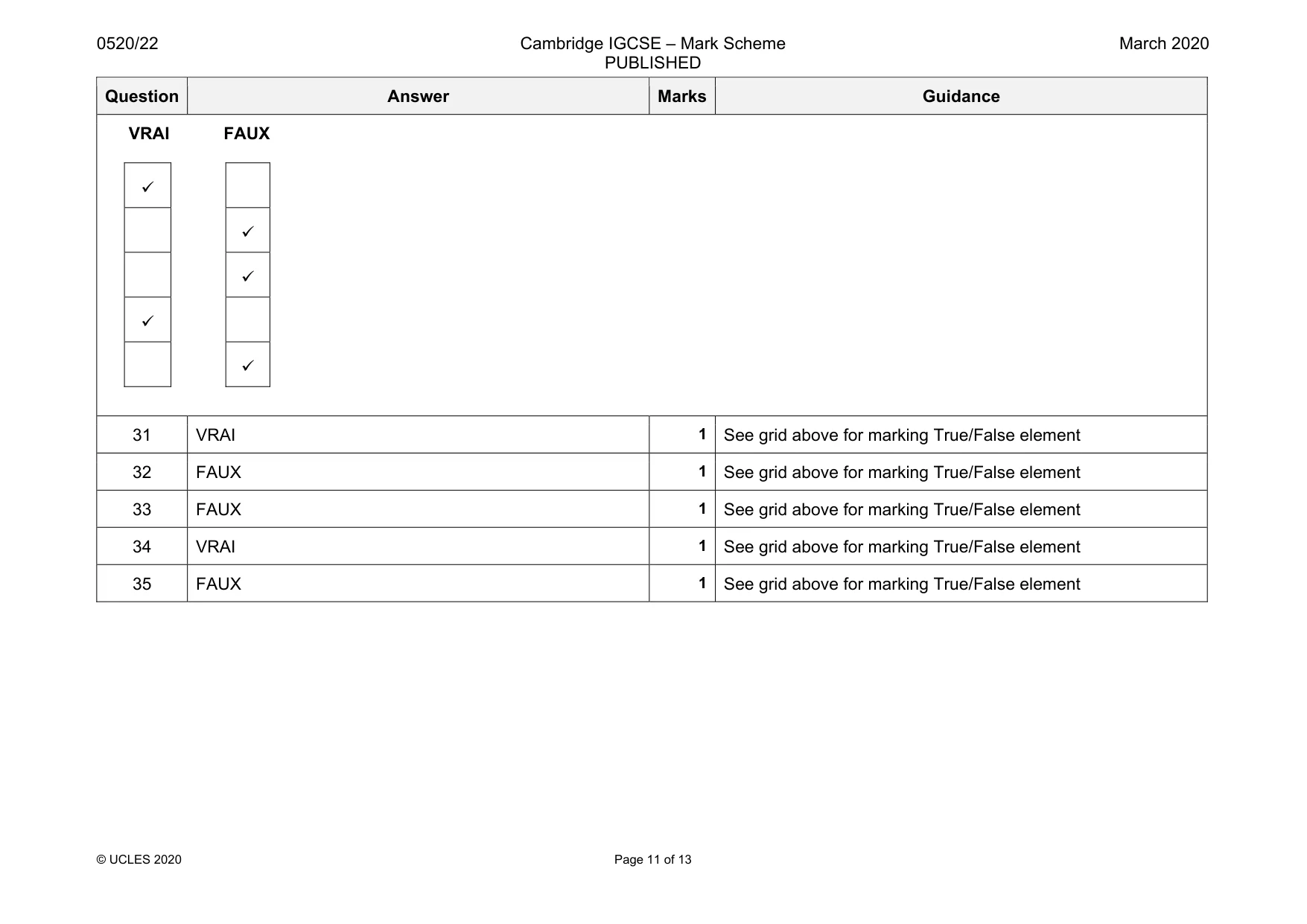
0520/22 Cambridge IGCSE – Mark Scheme PUBLISHED March 2020 © UCLES 2020 Page 11 of 13 Question Answer Marks Guidance VRAI FAUX 31 VRAI 1 See grid above for marking True/False element 32 FAUX 1 See grid above for marking True/False element 33 FAUX 1 See grid above for marking True/False element 34 VRAI 1 See grid above for marking True/False element 35 FAUX 1 See grid above for marking True/False element
Mark scheme, page 12
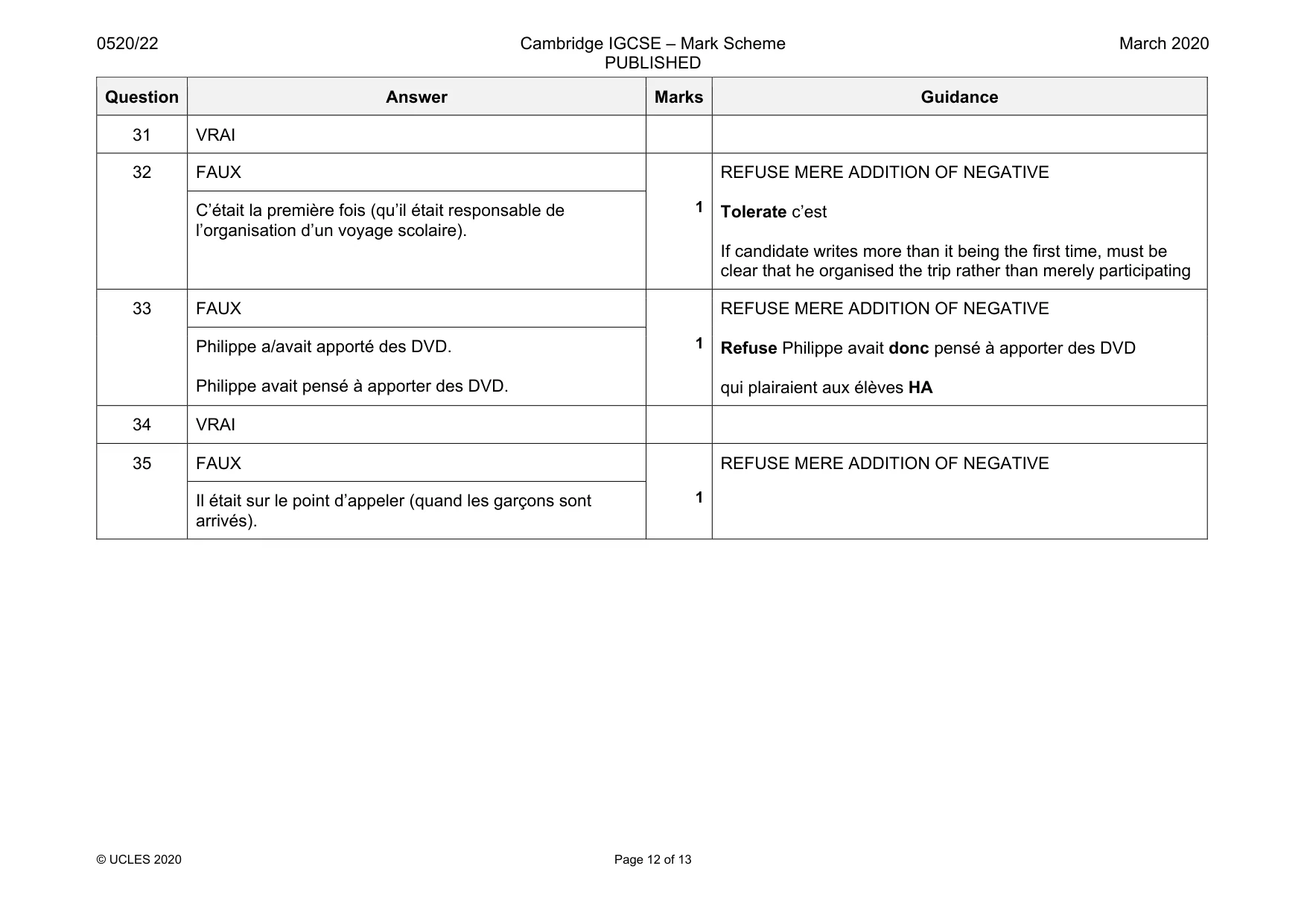
0520/22 Cambridge IGCSE – Mark Scheme PUBLISHED March 2020 © UCLES 2020 Page 12 of 13 Question Answer Marks Guidance 31 VRAI 32 FAUX 1 REFUSE MERE ADDITION OF NEGATIVE Tolerate c’est If candidate writes more than it being the first time, must be clear that he organised the trip rather than merely participating C’était la première fois (qu’il était responsable de l’organisation d’un voyage scolaire). 33 FAUX 1 REFUSE MERE ADDITION OF NEGATIVE Refuse Philippe avait donc pensé à apporter des DVD qui plairaient aux élèves HA Philippe a/avait apporté des DVD. Philippe avait pensé à apporter des DVD. 34 VRAI 35 FAUX 1 REFUSE MERE ADDITION OF NEGATIVE Il était sur le point d’appeler (quand les garçons sont arrivés).
Mark scheme, page 13
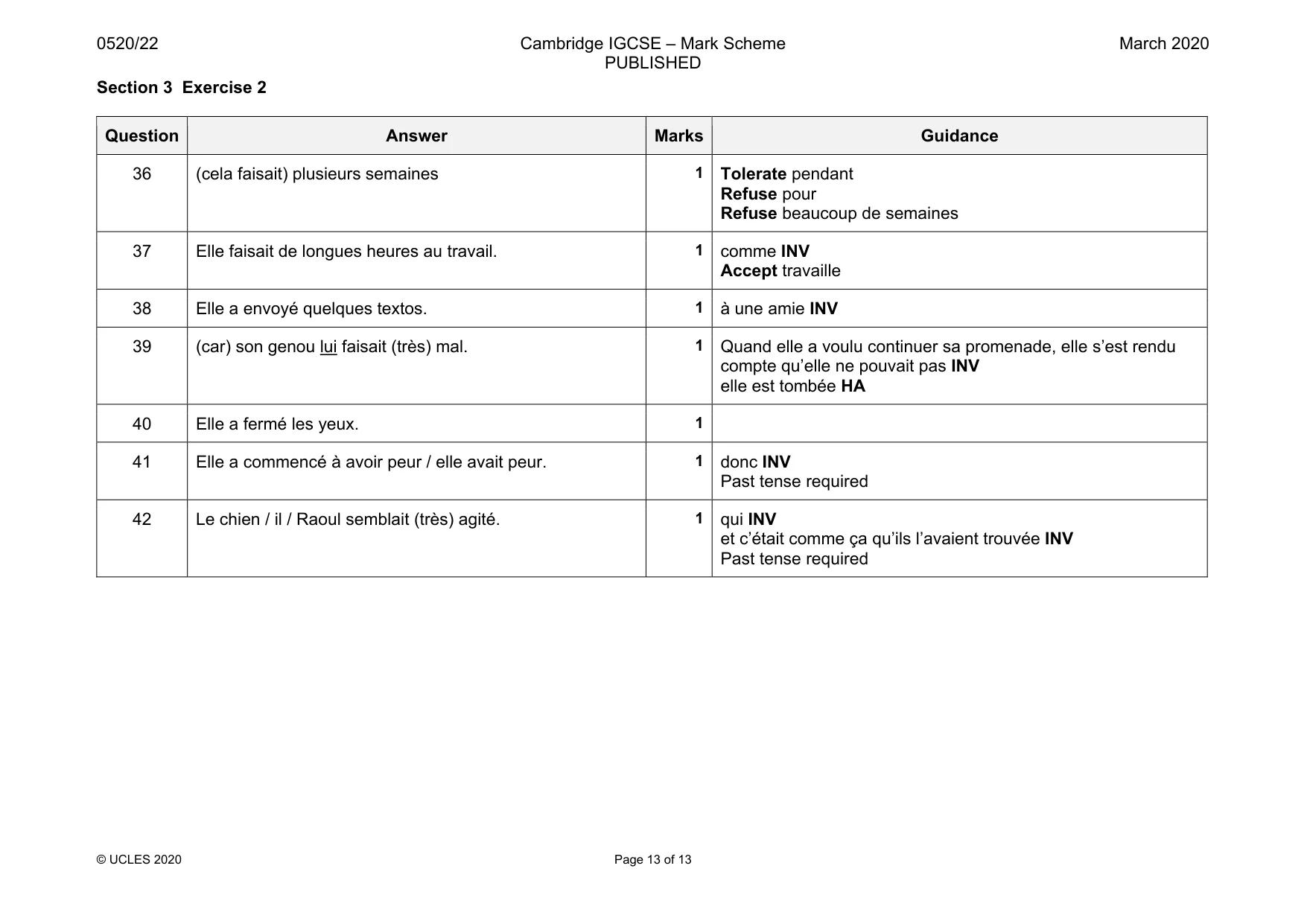
0520/22 Cambridge IGCSE – Mark Scheme PUBLISHED March 2020 © UCLES 2020 Page 13 of 13 Section 3 Exercise 2 Question Answer Marks Guidance 36 (cela faisait) plusieurs semaines 1 Tolerate pendant Refuse pour Refuse beaucoup de semaines 37 Elle faisait de longues heures au travail. 1 comme INV Accept travaille 38 Elle a envoyé quelques textos. 1 à une amie INV 39 (car) son genou lui faisait (très) mal. 1 Quand elle a voulu continuer sa promenade, elle s’est rendu compte qu’elle ne pouvait pas INV elle est tombée HA 40 Elle a fermé les yeux. 1 41 Elle a commencé à avoir peur / elle avait peur. 1 donc INV Past tense required 42 Le chien / il / Raoul semblait (très) agité. 1 qui INV et c’était comme ça qu’ils l’avaient trouvée INV Past tense required
What you needed in this session
Cambridge’s own grade thresholds for 2020 Feb/March, Paper 2 · Variant 2. A higher threshold means an easier paper — the bar moves with how the cohort did.