Cambridge IGCSE French - Foreign Language 0520 — 2017 Oct/Nov Paper 1 · Variant 1
0520/11/O/N/17 · 45 marks · ≈51 min
The question paper and its mark scheme, free to read here and free to download. This is Cambridge’s own paper, exactly as it was sat.
Question paper12 pages

Mark scheme13 pages
Answers below. Sit the paper first if you are practising.
Paper as text
Question paper, page 1
* 2 3 0 2 3 2 2 9 4 6 * This document consists of 11 printed pages and 1 blank page. DC (LK/SW) 136184/3 © UCLES 2017 [Turn over FRENCH 0520/11 Paper 1 Listening October/November 2017 Approx. 45 minutes Candidates answer on the Question Paper. No Additional Materials are required. READ THESE INSTRUCTIONS FIRST Write your Centre number, candidate number and name in the spaces at the top of this page. Write in dark blue or black pen. Do not use staples, paper clips, glue or correction fluid. DO NOT WRITE IN ANY BARCODES. Answer all questions. The number of marks is given in brackets [ ] at the end of each question or part question. The syllabus is approved for use in England, Wales and Northern Ireland as a Cambridge International Level 1/Level 2 Certificate. Cambridge International Examinations Cambridge International General Certificate of Secondary Education
Question paper, page 2
2 0520/11/O/N/17 © UCLES 2017 BLANK PAGE
Question paper, page 3
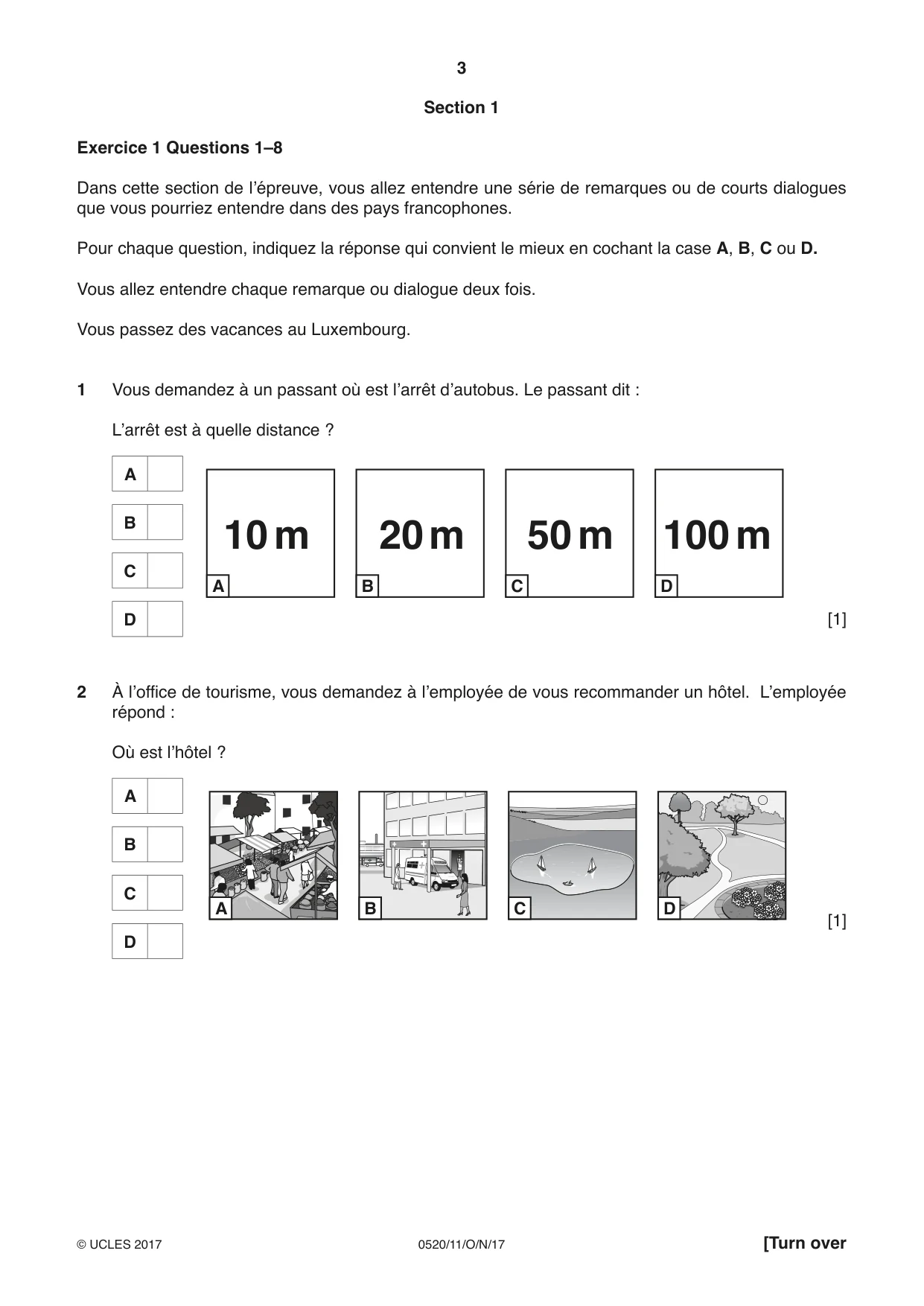
3 0520/11/O/N/17 © UCLES 2017 [Turn over Section 1 Exercice 1 Questions 1–8 Dans cette section de l’épreuve, vous allez entendre une série de remarques ou de courts dialogues que vous pourriez entendre dans des pays francophones. Pour chaque question, indiquez la réponse qui convient le mieux en cochant la case A, B, C ou D. Vous allez entendre chaque remarque ou dialogue deux fois. Vous passez des vacances au Luxembourg. 1 Vous demandez à un passant où est l’arrêt d’autobus. Le passant dit : L’arrêt est à quelle distance ? A 10 m 20 m 50 m 100 m A B C D [1] B C D 2 À l’office de tourisme, vous demandez à l’employée de vous recommander un hôtel. L’employée répond : Où est l’hôtel ? A A B C D [1] B C D
Question paper, page 4
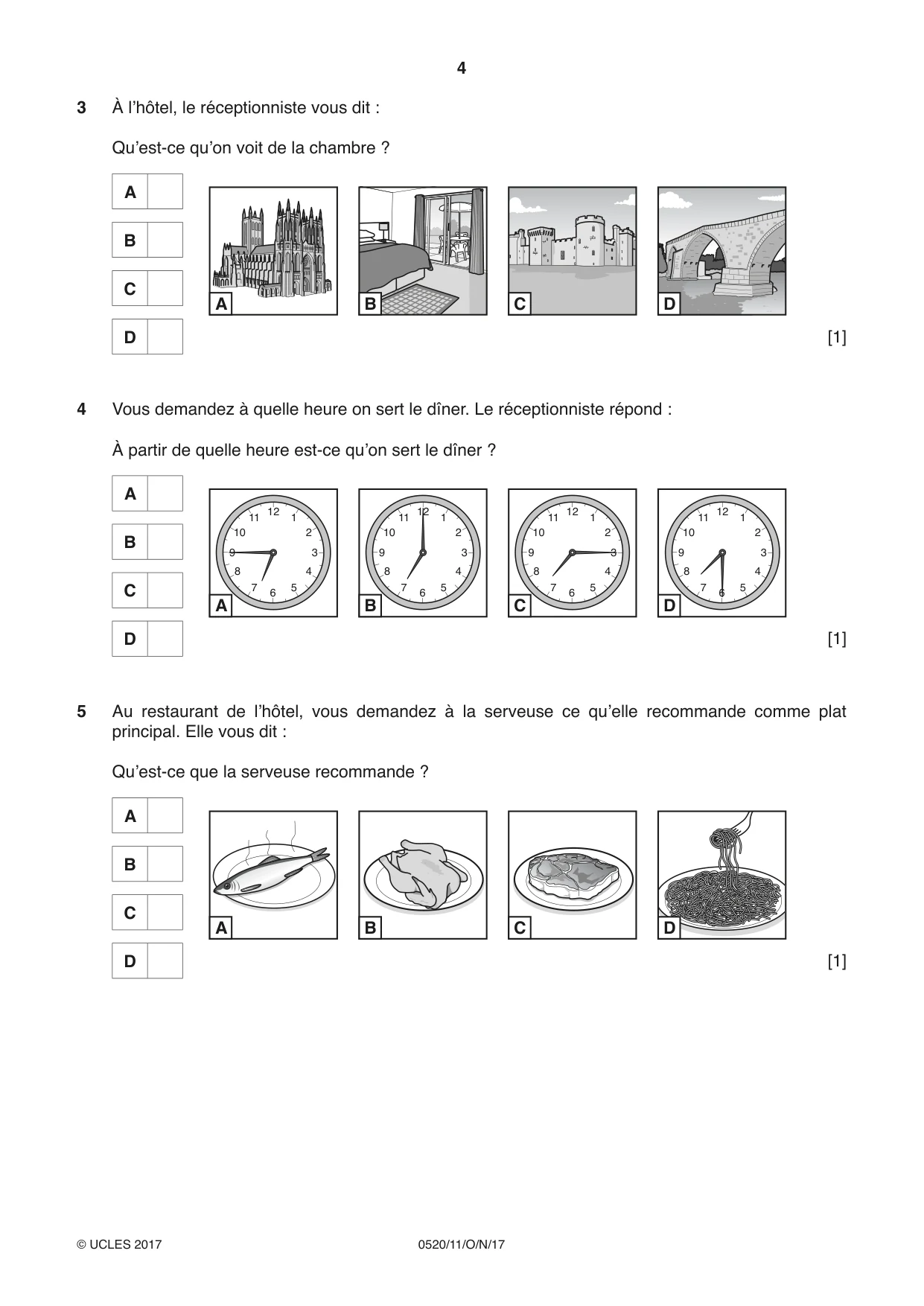
4 0520/11/O/N/17 © UCLES 2017 3 À l’hôtel, le réceptionniste vous dit : Qu’est-ce qu’on voit de la chambre ? A A B C D [1] B C D 4 Vous demandez à quelle heure on sert le dîner. Le réceptionniste répond : À partir de quelle heure est-ce qu’on sert le dîner ? A 12 6 3 9 10 2 8 4 11 1 7 5 12 6 3 9 10 2 8 4 11 1 7 5 12 6 3 9 10 2 8 4 11 1 7 5 12 6 3 9 10 2 8 4 11 1 7 5 A B C D [1] B C D 5 Au restaurant de l’hôtel, vous demandez à la serveuse ce qu’elle recommande comme plat principal. Elle vous dit : Qu’est-ce que la serveuse recommande ? A A B C D [1] B C D
Question paper, page 5
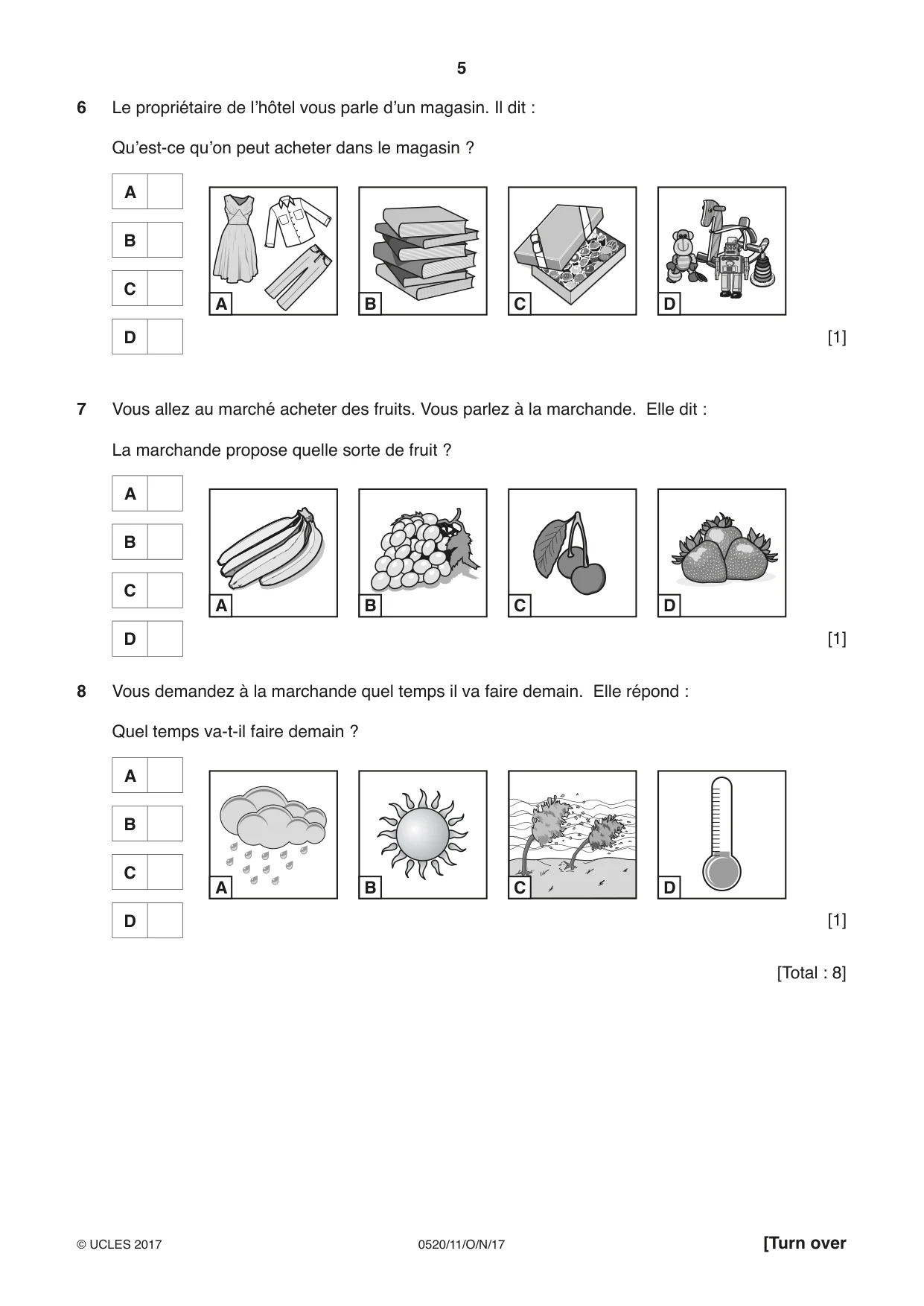
5 0520/11/O/N/17 © UCLES 2017 [Turn over 6 Le propriétaire de l’hôtel vous parle d’un magasin. Il dit : Qu’est-ce qu’on peut acheter dans le magasin ? A A B C D [1] B C D 7 Vous allez au marché acheter des fruits. Vous parlez à la marchande. Elle dit : La marchande propose quelle sorte de fruit ? A A B C D [1] B C D 8 Vous demandez à la marchande quel temps il va faire demain. Elle répond : Quel temps va-t-il faire demain ? A A B C D [1] B C D [Total : 8]
Question paper, page 6
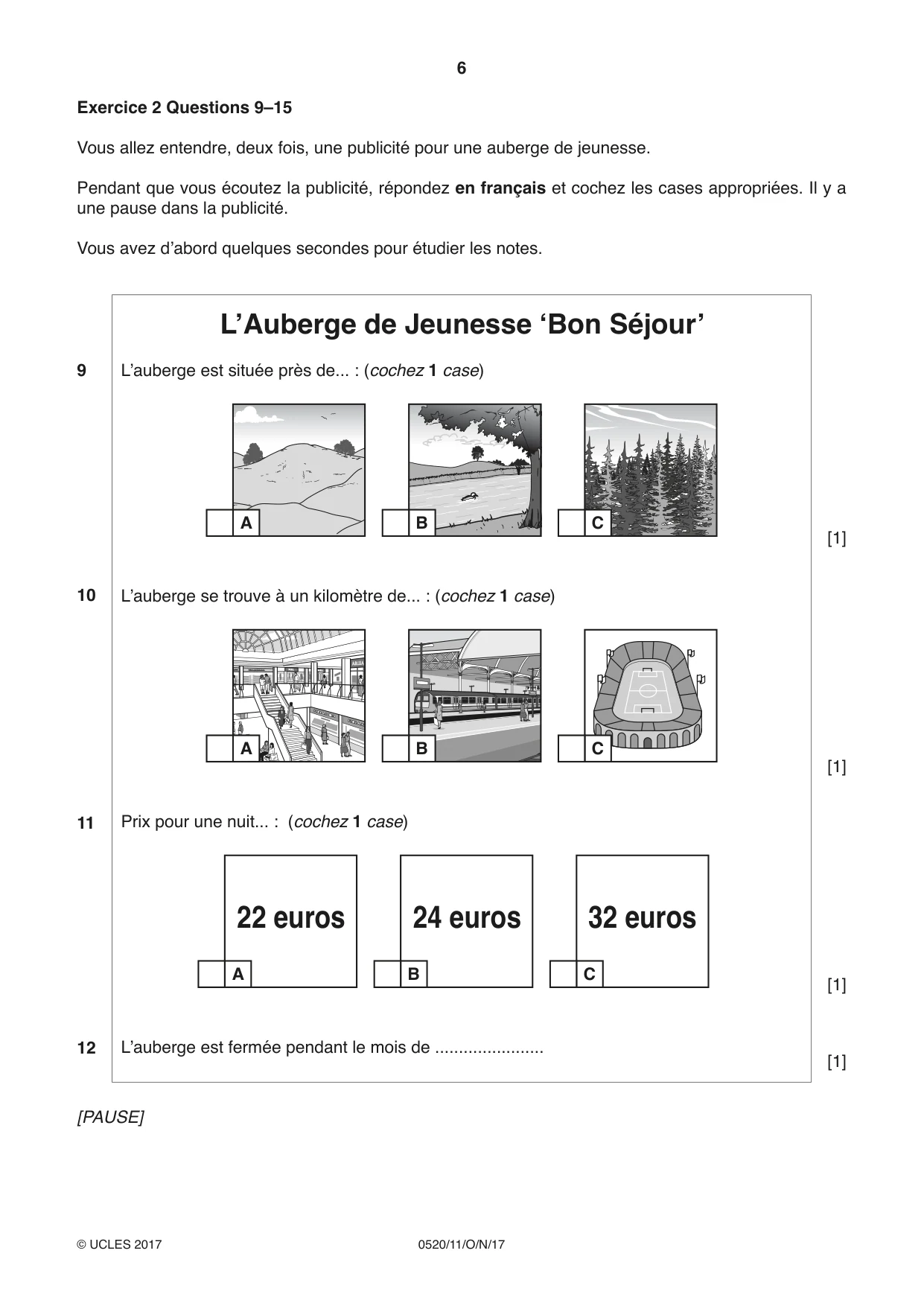
6 0520/11/O/N/17 © UCLES 2017 Exercice 2 Questions 9–15 Vous allez entendre, deux fois, une publicité pour une auberge de jeunesse. Pendant que vous écoutez la publicité, répondez en français et cochez les cases appropriées. Il y a une pause dans la publicité. Vous avez d’abord quelques secondes pour étudier les notes. 9 10 11 12 L’Auberge de Jeunesse ‘Bon Séjour’ L’auberge est située près de... : (cochez 1 case) A B C L’auberge se trouve à un kilomètre de... : (cochez 1 case) A B C Prix pour une nuit... : (cochez 1 case) 22 euros 24 euros 32 euros A B C L’auberge est fermée pendant le mois de … [1] [1] [1] [1] [PAUSE]
Question paper, page 7
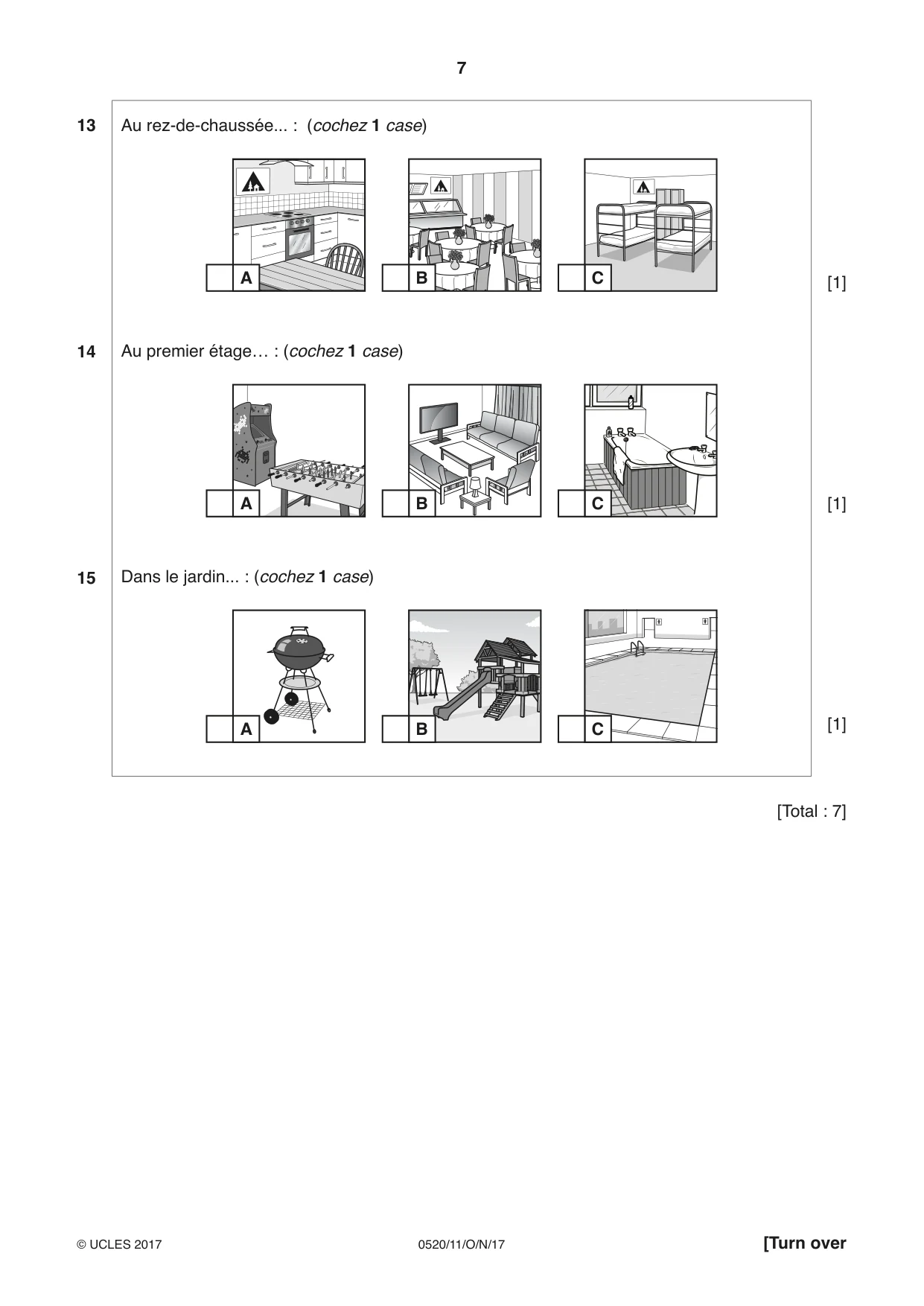
7 0520/11/O/N/17 © UCLES 2017 [Turn over 13 14 15 Au rez-de-chaussée... : (cochez 1 case) A B C Au premier étage… : (cochez 1 case) A B C Dans le jardin... : (cochez 1 case) A B C [1] [1] [1] [Total : 7]
Question paper, page 8
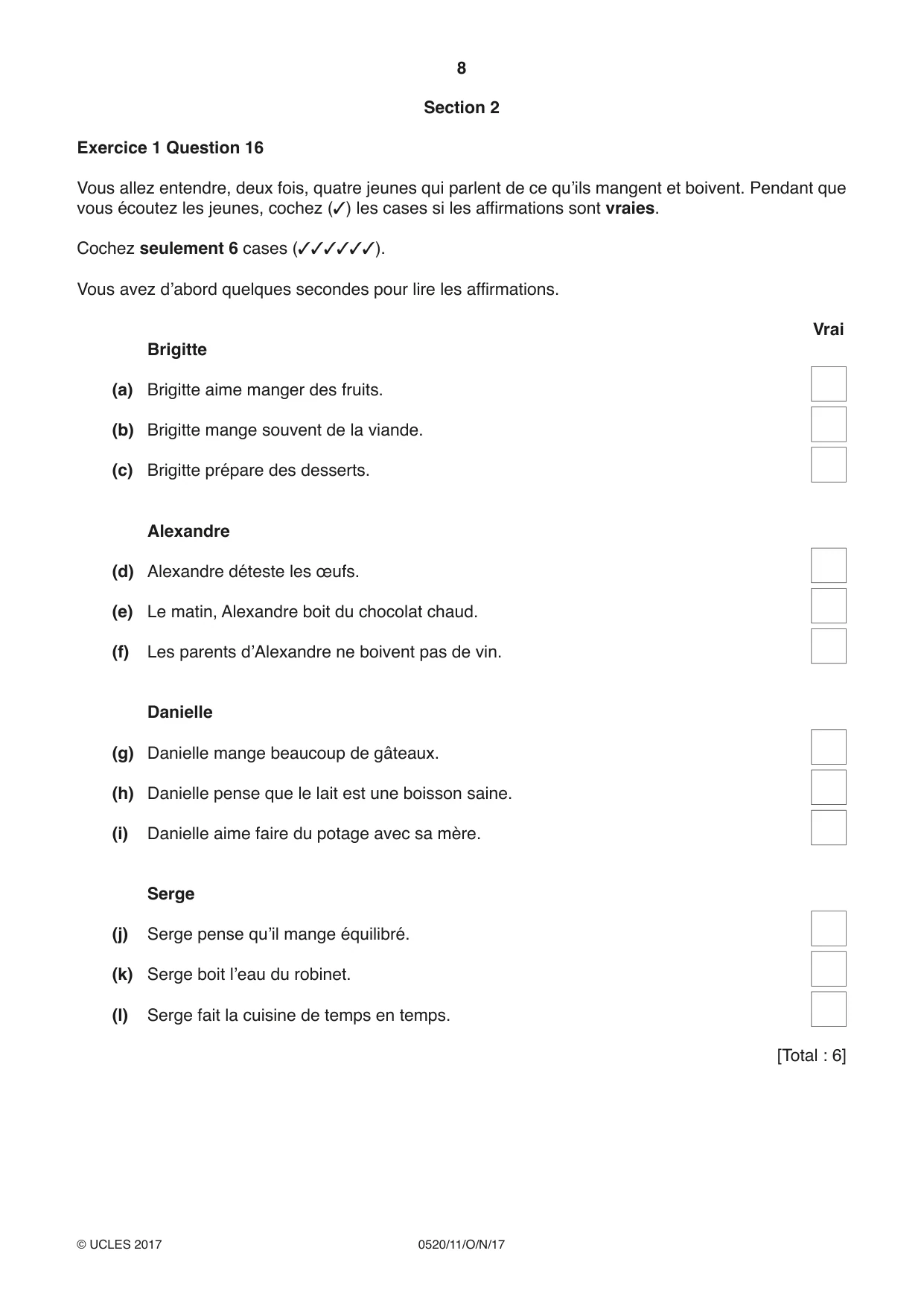
8 0520/11/O/N/17 © UCLES 2017 Section 2 Exercice 1 Question 16 Vous allez entendre, deux fois, quatre jeunes qui parlent de ce qu’ils mangent et boivent. Pendant que vous écoutez les jeunes, cochez (3) les cases si les affirmations sont vraies. Cochez seulement 6 cases (333333). Vous avez d’abord quelques secondes pour lire les affirmations. Vrai Brigitte (a) Brigitte aime manger des fruits. (b) Brigitte mange souvent de la viande. (c) Brigitte prépare des desserts. Alexandre (d) Alexandre déteste les œufs. (e) Le matin, Alexandre boit du chocolat chaud. (f) Les parents d’Alexandre ne boivent pas de vin. Danielle (g) Danielle mange beaucoup de gâteaux. (h) Danielle pense que le lait est une boisson saine. (i) Danielle aime faire du potage avec sa mère. Serge (j) Serge pense qu’il mange équilibré. (k) Serge boit l’eau du robinet. (l) Serge fait la cuisine de temps en temps. [Total : 6]
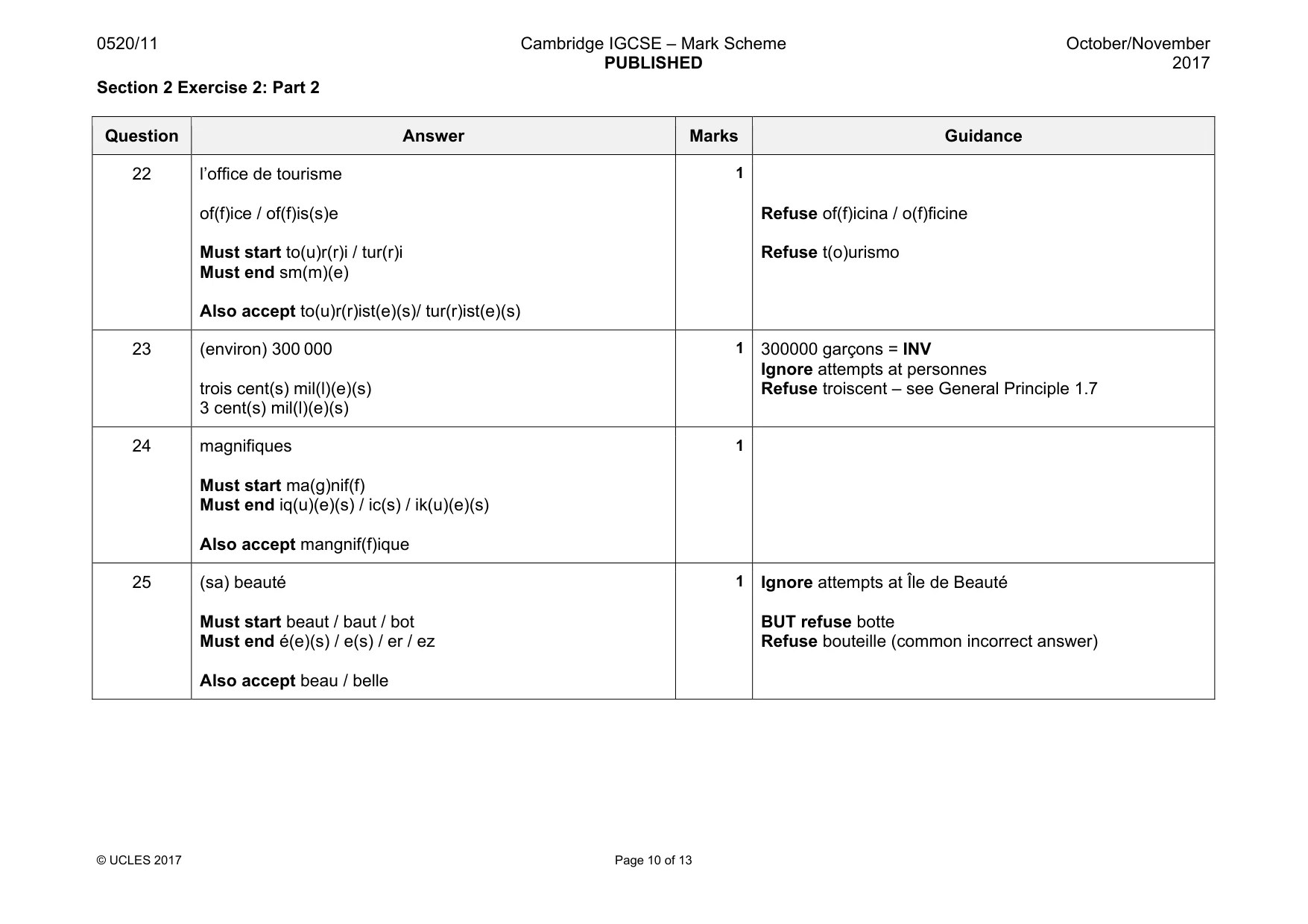
Question paper, page 9
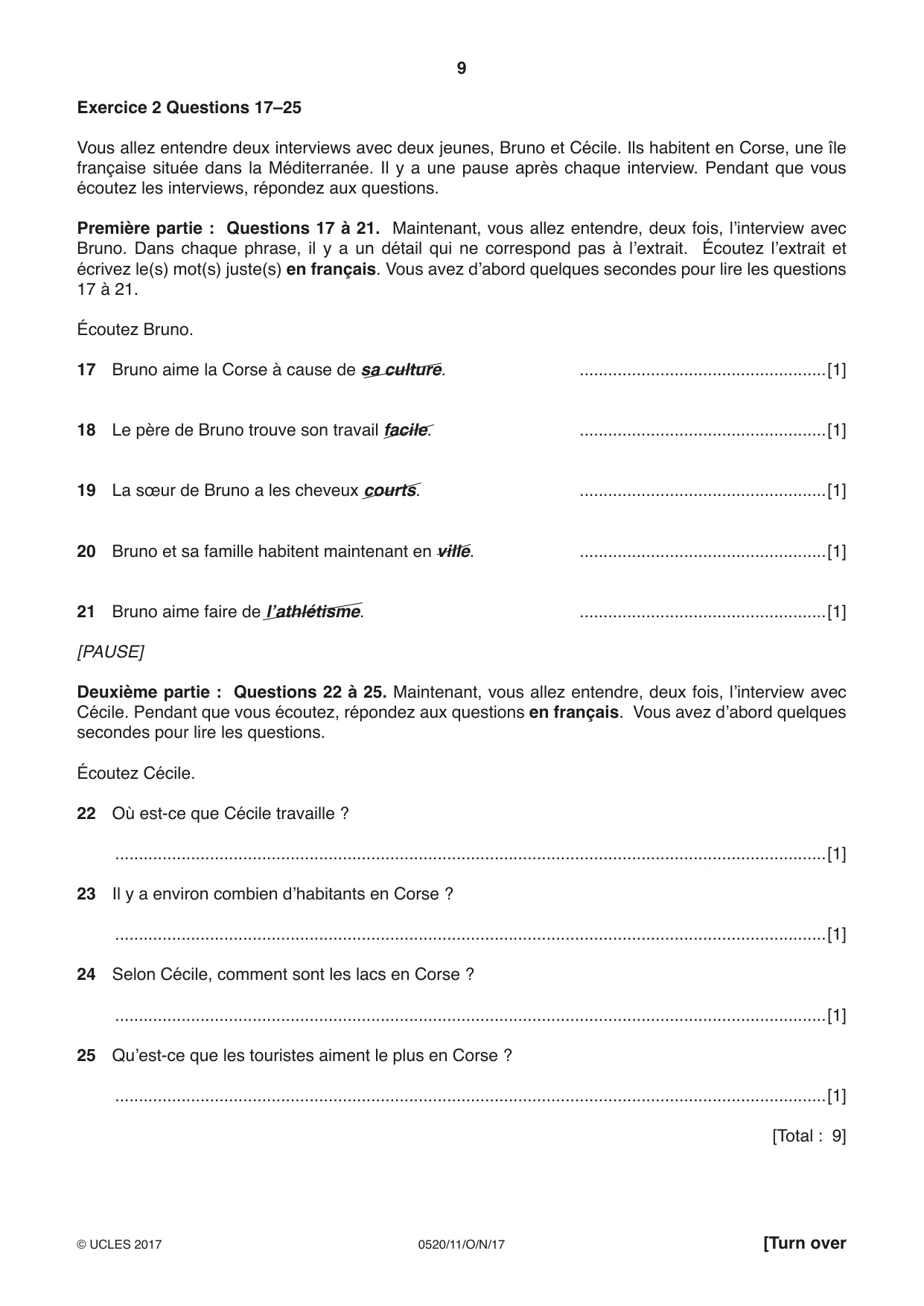
9 0520/11/O/N/17 © UCLES 2017 [Turn over Exercice 2 Questions 17–25 Vous allez entendre deux interviews avec deux jeunes, Bruno et Cécile. Ils habitent en Corse, une île française située dans la Méditerranée. Il y a une pause après chaque interview. Pendant que vous écoutez les interviews, répondez aux questions. Première partie : Questions 17 à 21. Maintenant, vous allez entendre, deux fois, l’interview avec Bruno. Dans chaque phrase, il y a un détail qui ne correspond pas à l’extrait. Écoutez l’extrait et écrivez le(s) mot(s) juste(s) en français. Vous avez d’abord quelques secondes pour lire les questions 17 à 21. Écoutez Bruno. 17 Bruno aime la Corse à cause de sa culture. …[1] 18 Le père de Bruno trouve son travail facile. …[1] 19 La sœur de Bruno a les cheveux courts. …[1] 20 Bruno et sa famille habitent maintenant en ville. …[1] 21 Bruno aime faire de l’athlétisme. …[1] [PAUSE] Deuxième partie : Questions 22 à 25. Maintenant, vous allez entendre, deux fois, l’interview avec Cécile. Pendant que vous écoutez, répondez aux questions en français. Vous avez d’abord quelques secondes pour lire les questions. Écoutez Cécile. 22 Où est-ce que Cécile travaille ? …[1] 23 Il y a environ combien d’habitants en Corse ? …[1] 24 Selon Cécile, comment sont les lacs en Corse ? …[1] 25 Qu’est-ce que les touristes aiment le plus en Corse ? …[1] [Total : 9]
Question paper, page 10
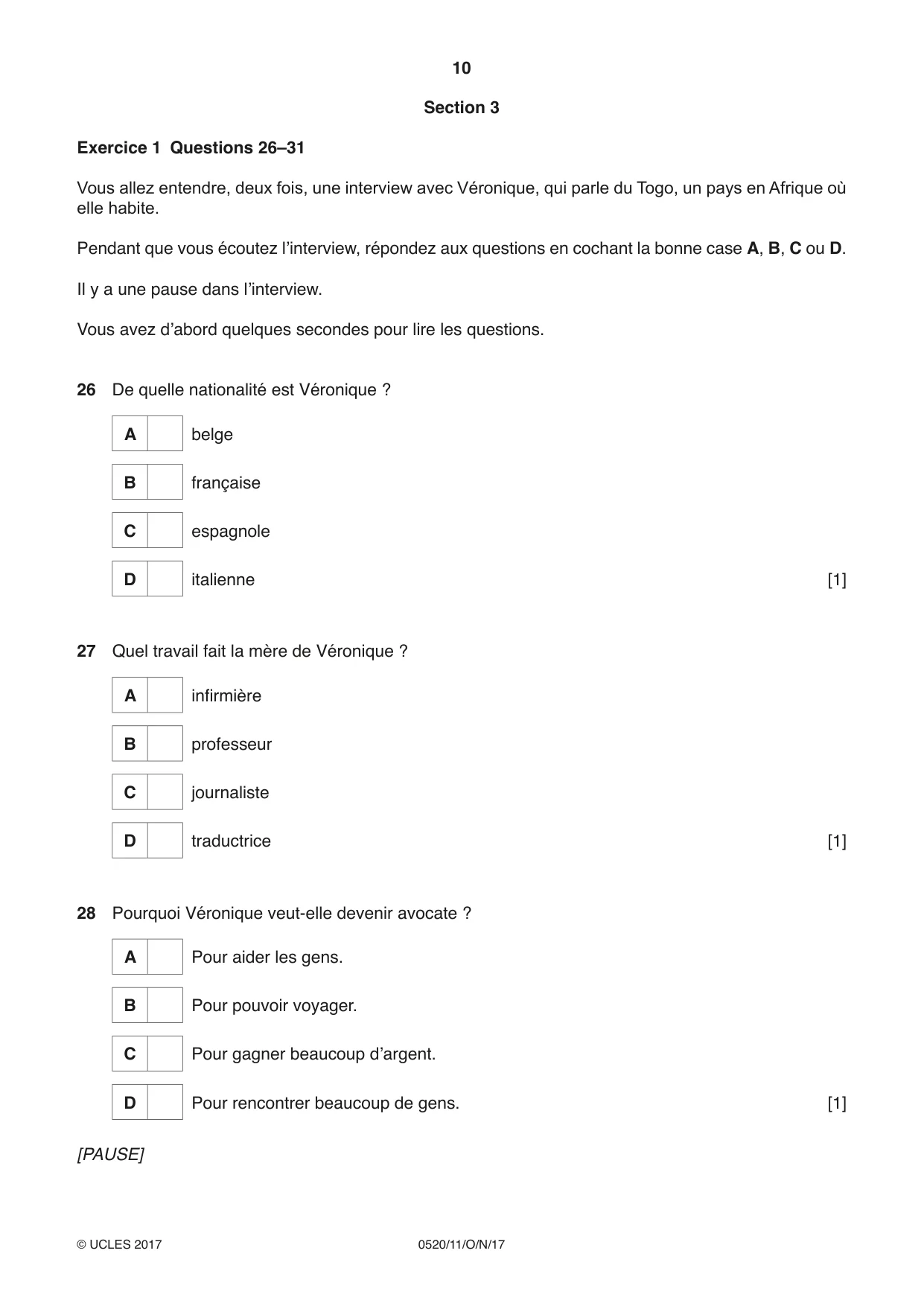
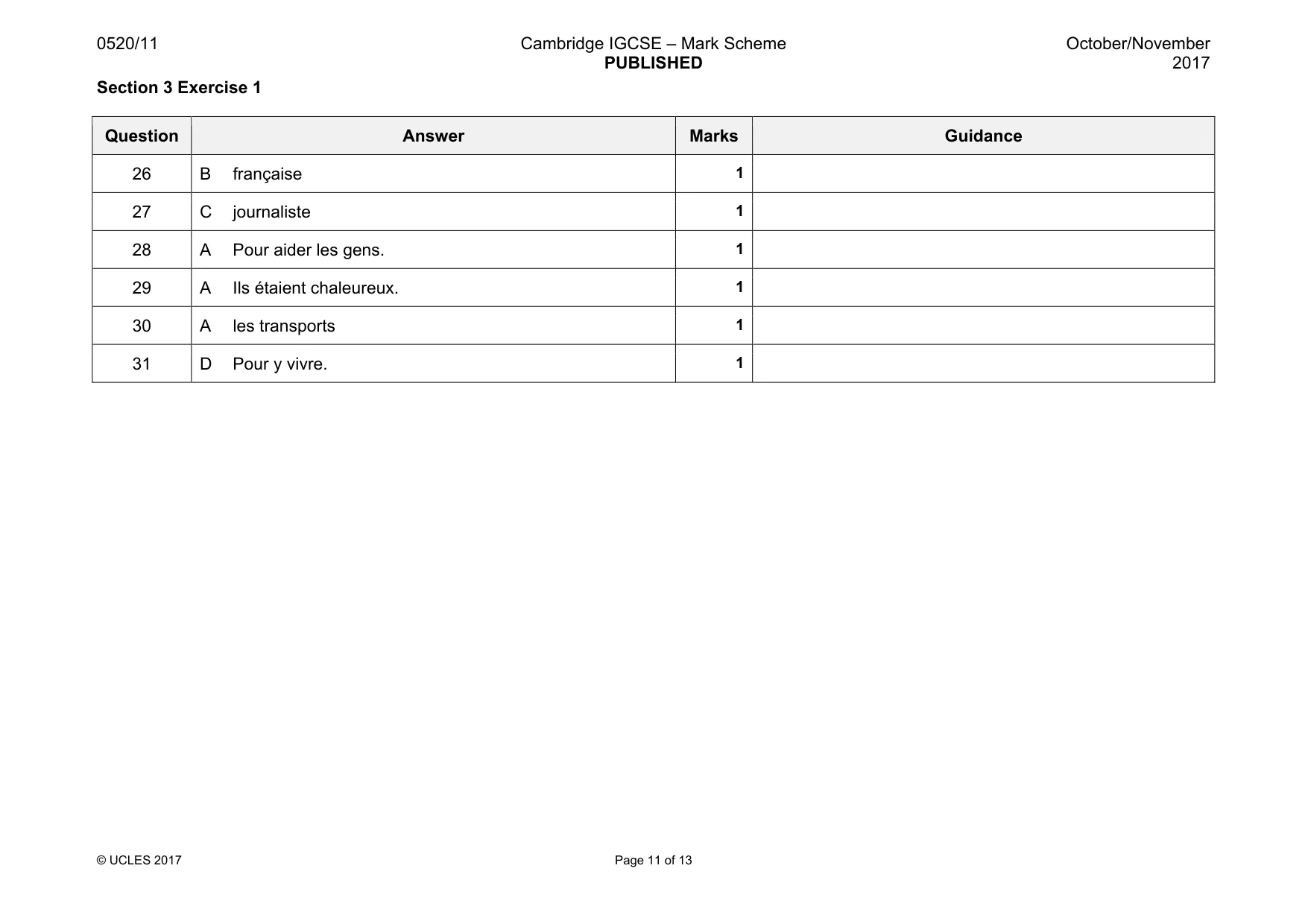
10 0520/11/O/N/17 © UCLES 2017 Section 3 Exercice 1 Questions 26–31 Vous allez entendre, deux fois, une interview avec Véronique, qui parle du Togo, un pays en Afrique où elle habite. Pendant que vous écoutez l’interview, répondez aux questions en cochant la bonne case A, B, C ou D. Il y a une pause dans l’interview. Vous avez d’abord quelques secondes pour lire les questions. 26 De quelle nationalité est Véronique ? A belge B française C espagnole D italienne [1] 27 Quel travail fait la mère de Véronique ? A infirmière B professeur C journaliste D traductrice [1] 28 Pourquoi Véronique veut-elle devenir avocate ? A Pour aider les gens. B Pour pouvoir voyager. C Pour gagner beaucoup d’argent. D Pour rencontrer beaucoup de gens. [1] [PAUSE]
Question paper, page 11
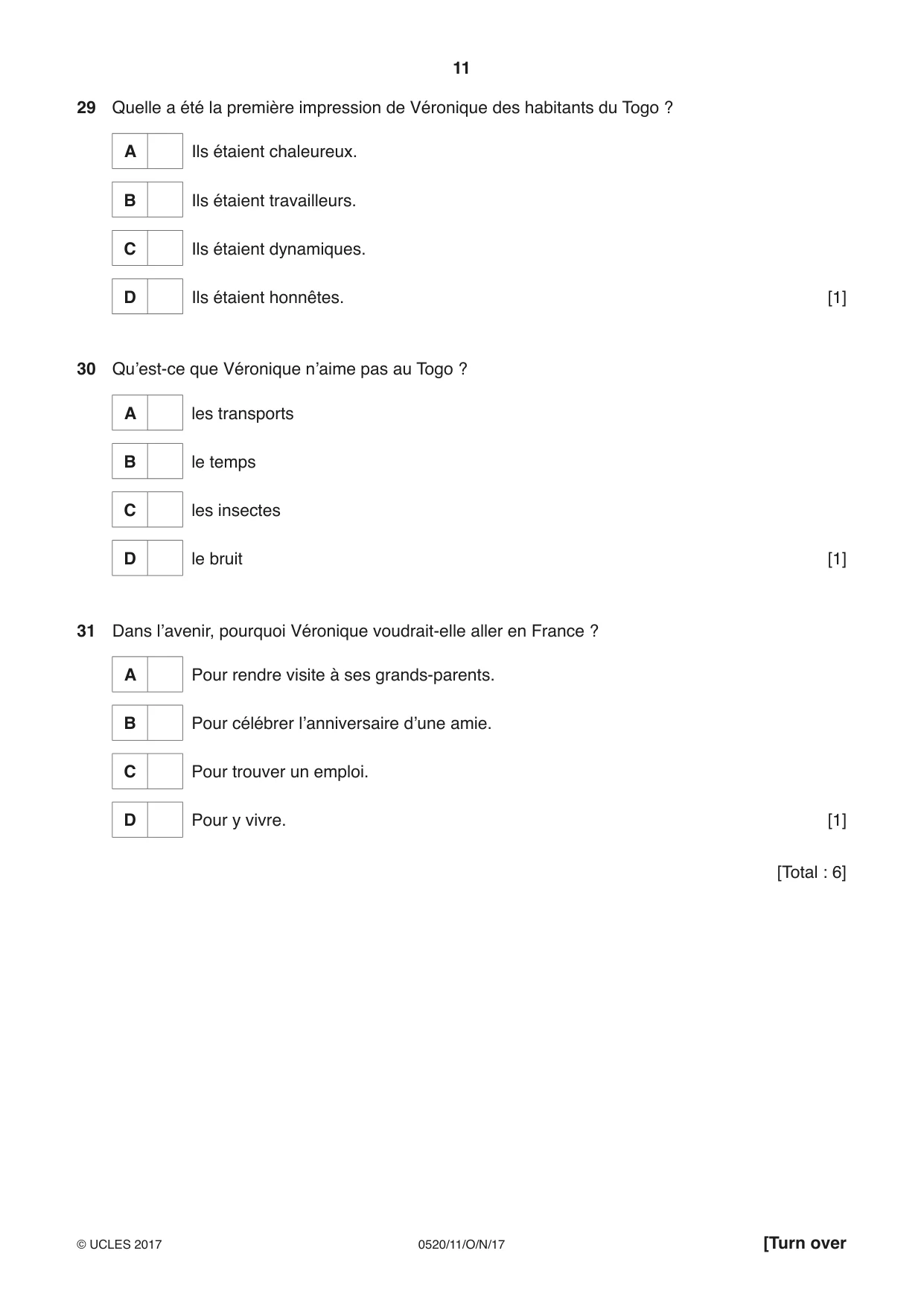
11 0520/11/O/N/17 © UCLES 2017 [Turn over 29 Quelle a été la première impression de Véronique des habitants du Togo ? A Ils étaient chaleureux. B Ils étaient travailleurs. C Ils étaient dynamiques. D Ils étaient honnêtes. [1] 30 Qu’est-ce que Véronique n’aime pas au Togo ? A les transports B le temps C les insectes D le bruit [1] 31 Dans l’avenir, pourquoi Véronique voudrait-elle aller en France ? A Pour rendre visite à ses grands-parents. B Pour célébrer l’anniversaire d’une amie. C Pour trouver un emploi. D Pour y vivre. [1] [Total : 6]
Question paper, page 12
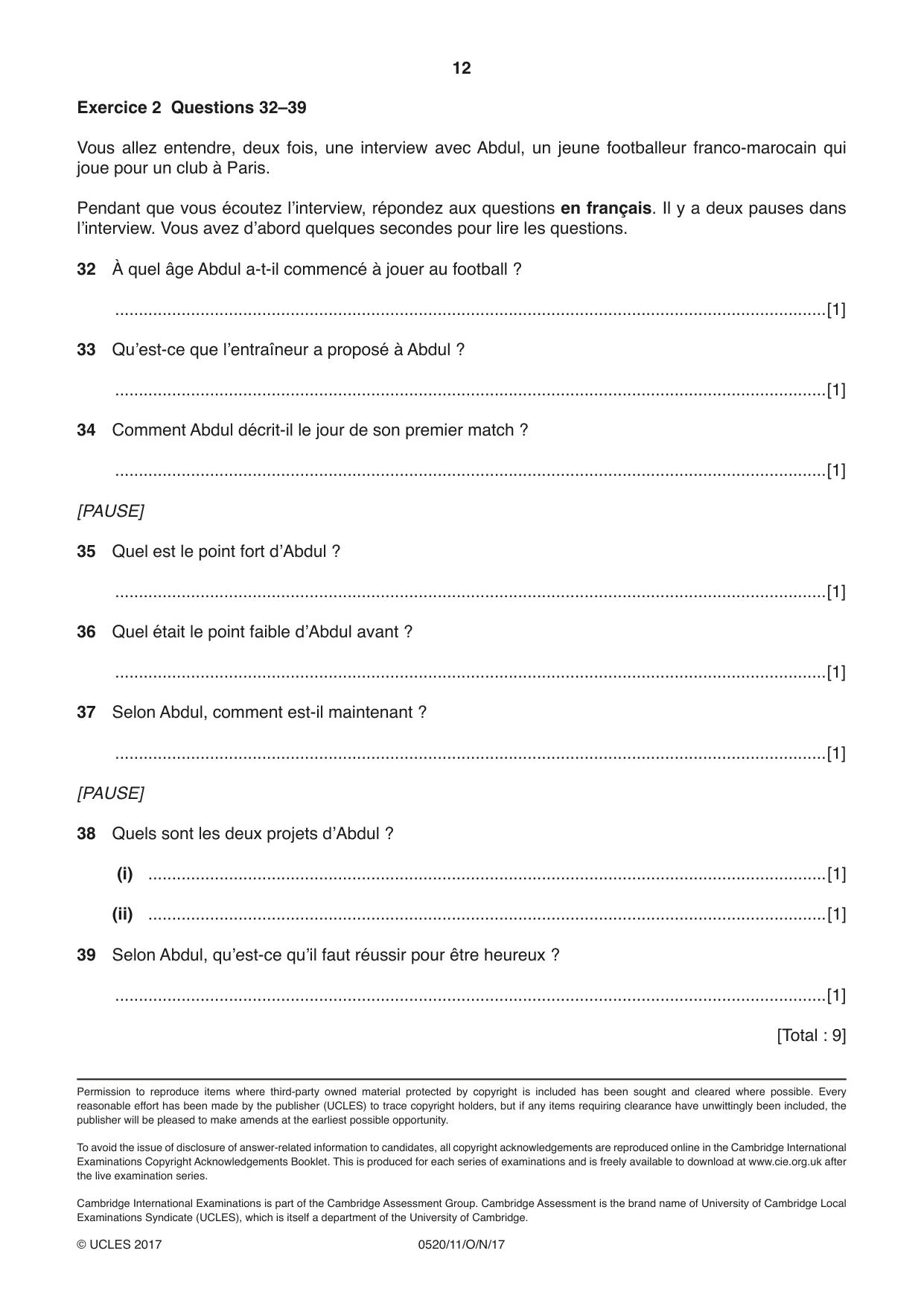
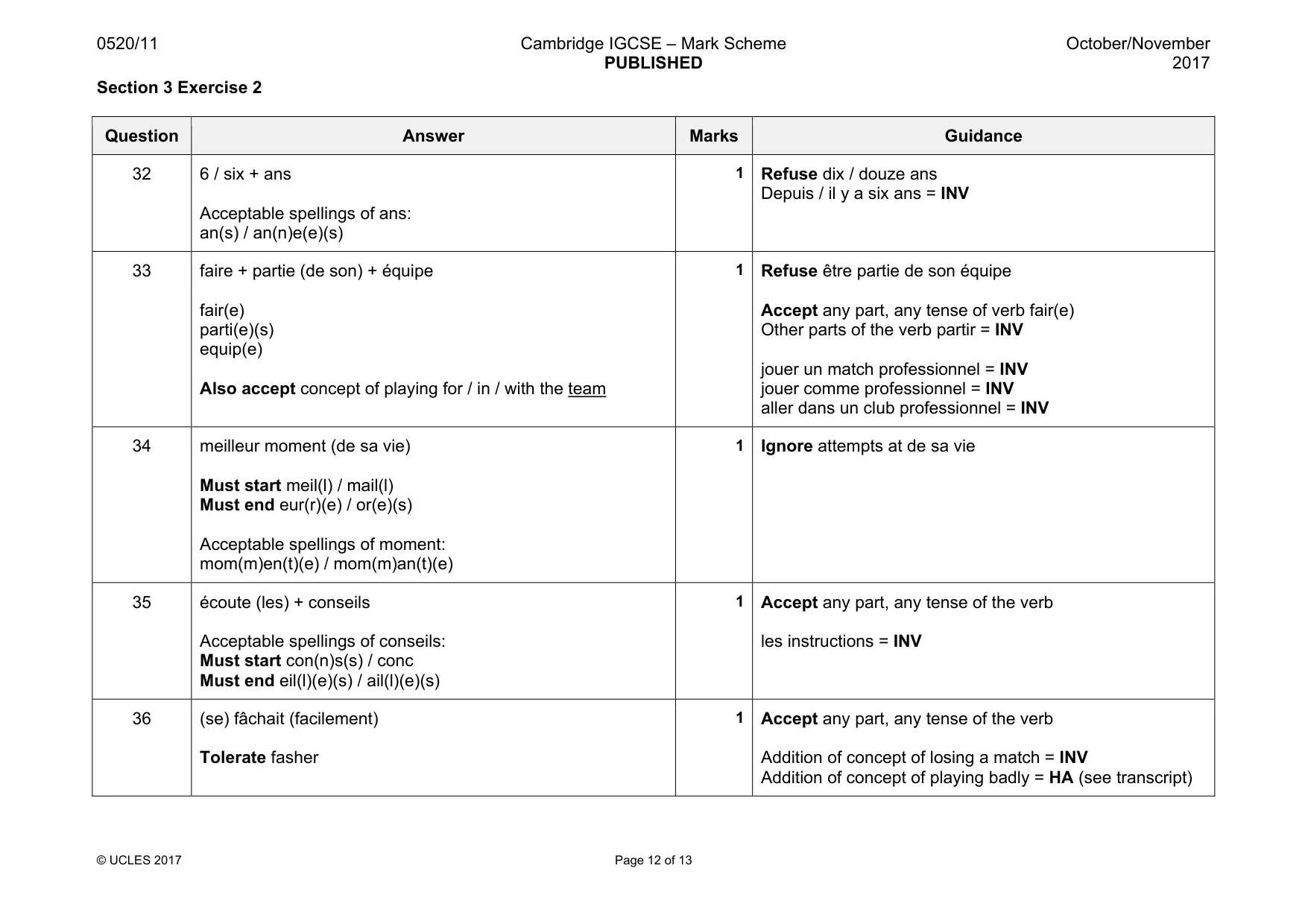
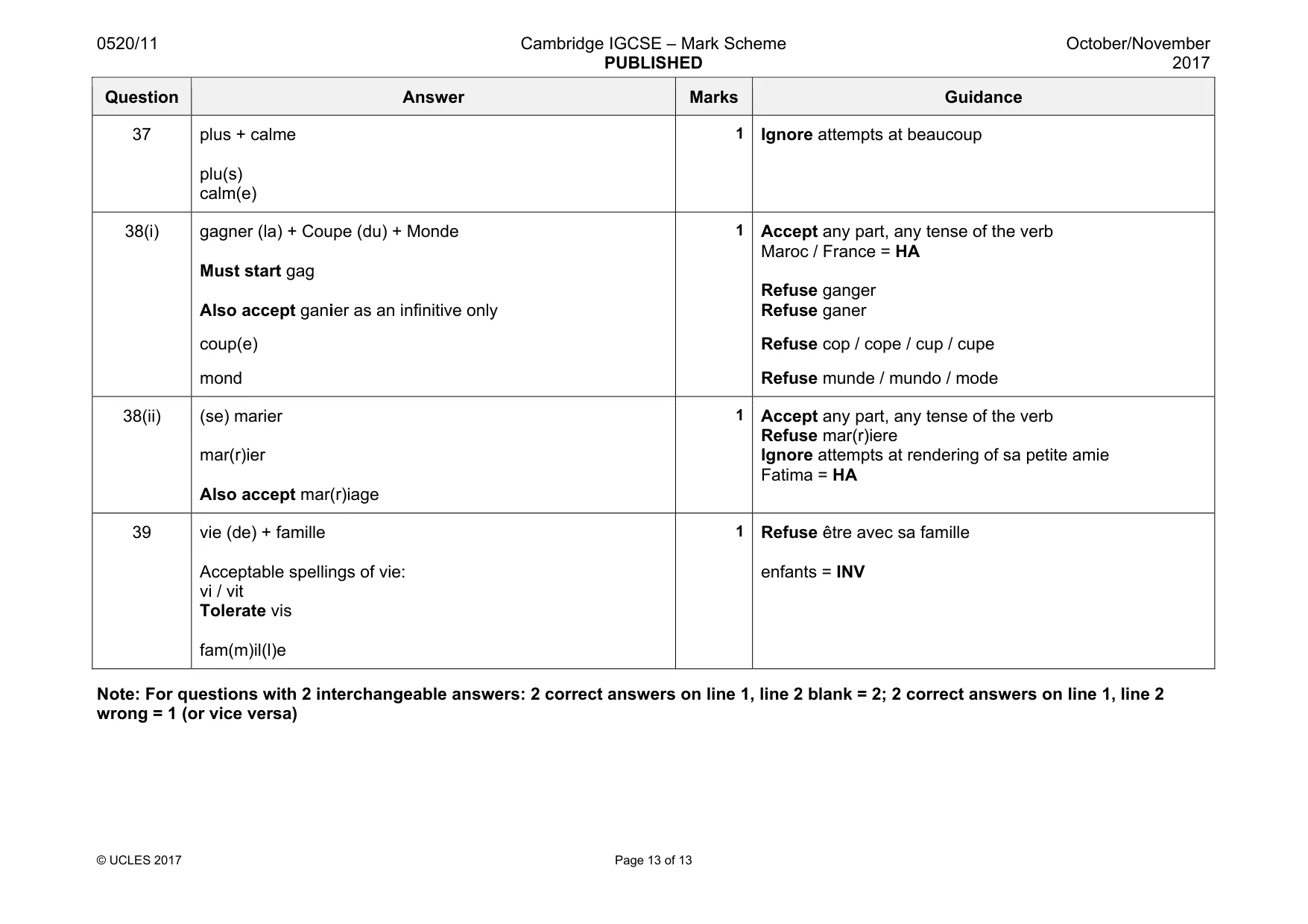
12 0520/11/O/N/17 © UCLES 2017 Permission to reproduce items where third-party owned material protected by copyright is included has been sought and cleared where possible. Every reasonable effort has been made by the publisher (UCLES) to trace copyright holders, but if any items requiring clearance have unwittingly been included, the publisher will be pleased to make amends at the earliest possible opportunity. To avoid the issue of disclosure of answer-related information to candidates, all copyright acknowledgements are reproduced online in the Cambridge International Examinations Copyright Acknowledgements Booklet. This is produced for each series of examinations and is freely available to download at www.cie.org.uk after the live examination series. Cambridge International Examinations is part of the Cambridge Assessment Group. Cambridge Assessment is the brand name of University of Cambridge Local Examinations Syndicate (UCLES), which is itself a department of the University of Cambridge. Exercice 2 Questions 32–39 Vous allez entendre, deux fois, une interview avec Abdul, un jeune footballeur franco-marocain qui joue pour un club à Paris. Pendant que vous écoutez l’interview, répondez aux questions en français. Il y a deux pauses dans l’interview. Vous avez d’abord quelques secondes pour lire les questions. 32 À quel âge Abdul a-t-il commencé à jouer au football ? …[1] 33 Qu’est-ce que l’entraîneur a proposé à Abdul ? …[1] 34 Comment Abdul décrit-il le jour de son premier match ? …[1] [PAUSE] 35 Quel est le point fort d’Abdul ? …[1] 36 Quel était le point faible d’Abdul avant ? …[1] 37 Selon Abdul, comment est-il maintenant ? …[1] [PAUSE] 38 Quels sont les deux projets d’Abdul ? (i) …[1] (ii) …[1] 39 Selon Abdul, qu’est-ce qu’il faut réussir pour être heureux ? …[1] [Total : 9]
Mark scheme, page 1
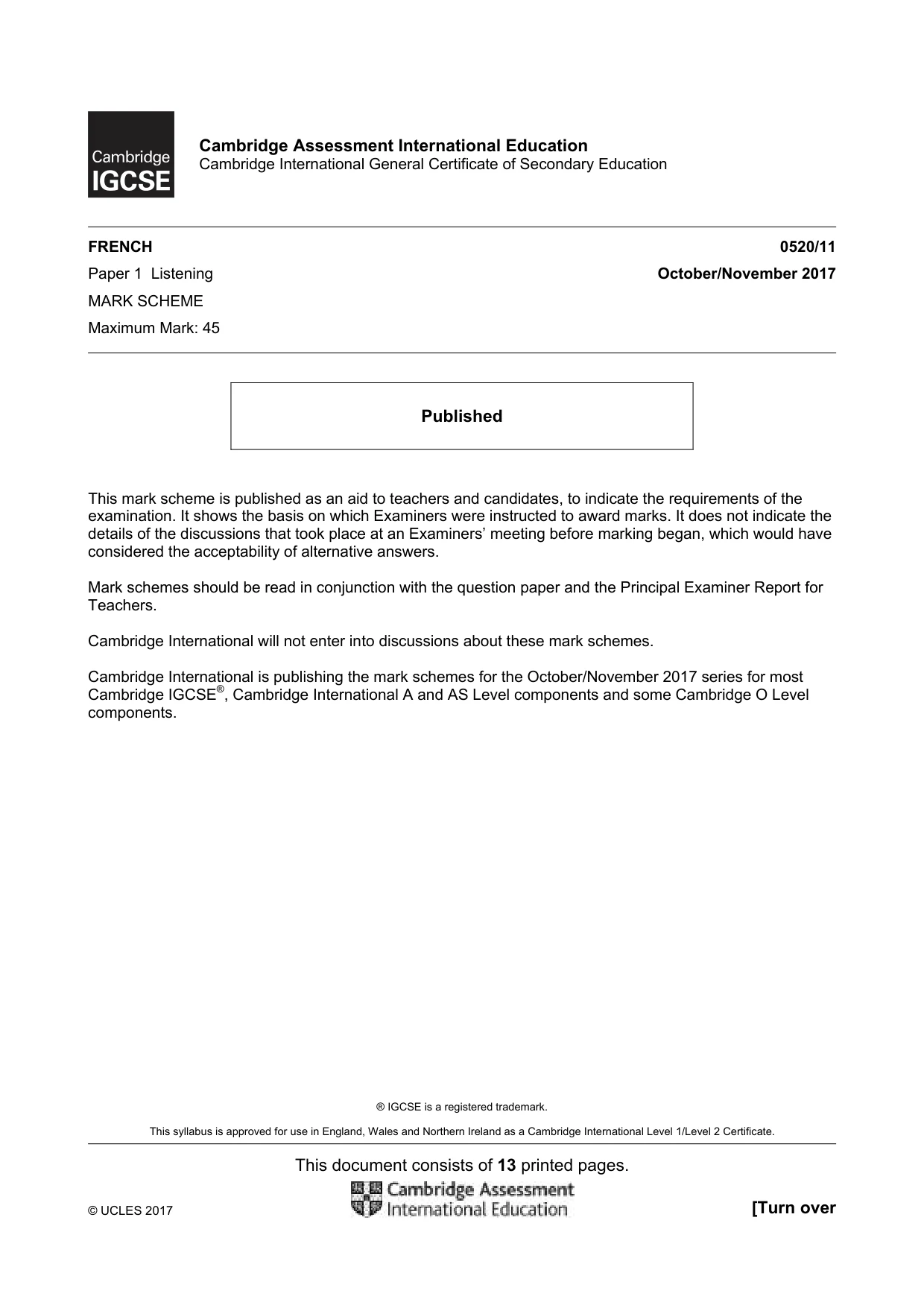
® IGCSE is a registered trademark. This syllabus is approved for use in England, Wales and Northern Ireland as a Cambridge International Level 1/Level 2 Certificate. This document consists of 13 printed pages. © UCLES 2017 [Turn over Cambridge Assessment International Education Cambridge International General Certificate of Secondary Education FRENCH 0520/11 Paper 1 Listening October/November 2017 MARK SCHEME Maximum Mark: 45 Published This mark scheme is published as an aid to teachers and candidates, to indicate the requirements of the examination. It shows the basis on which Examiners were instructed to award marks. It does not indicate the details of the discussions that took place at an Examiners’ meeting before marking began, which would have considered the acceptability of alternative answers. Mark schemes should be read in conjunction with the question paper and the Principal Examiner Report for Teachers. Cambridge International will not enter into discussions about these mark schemes. Cambridge International is publishing the mark schemes for the October/November 2017 series for most Cambridge IGCSE®, Cambridge International A and AS Level components and some Cambridge O Level components.
Mark scheme, page 2
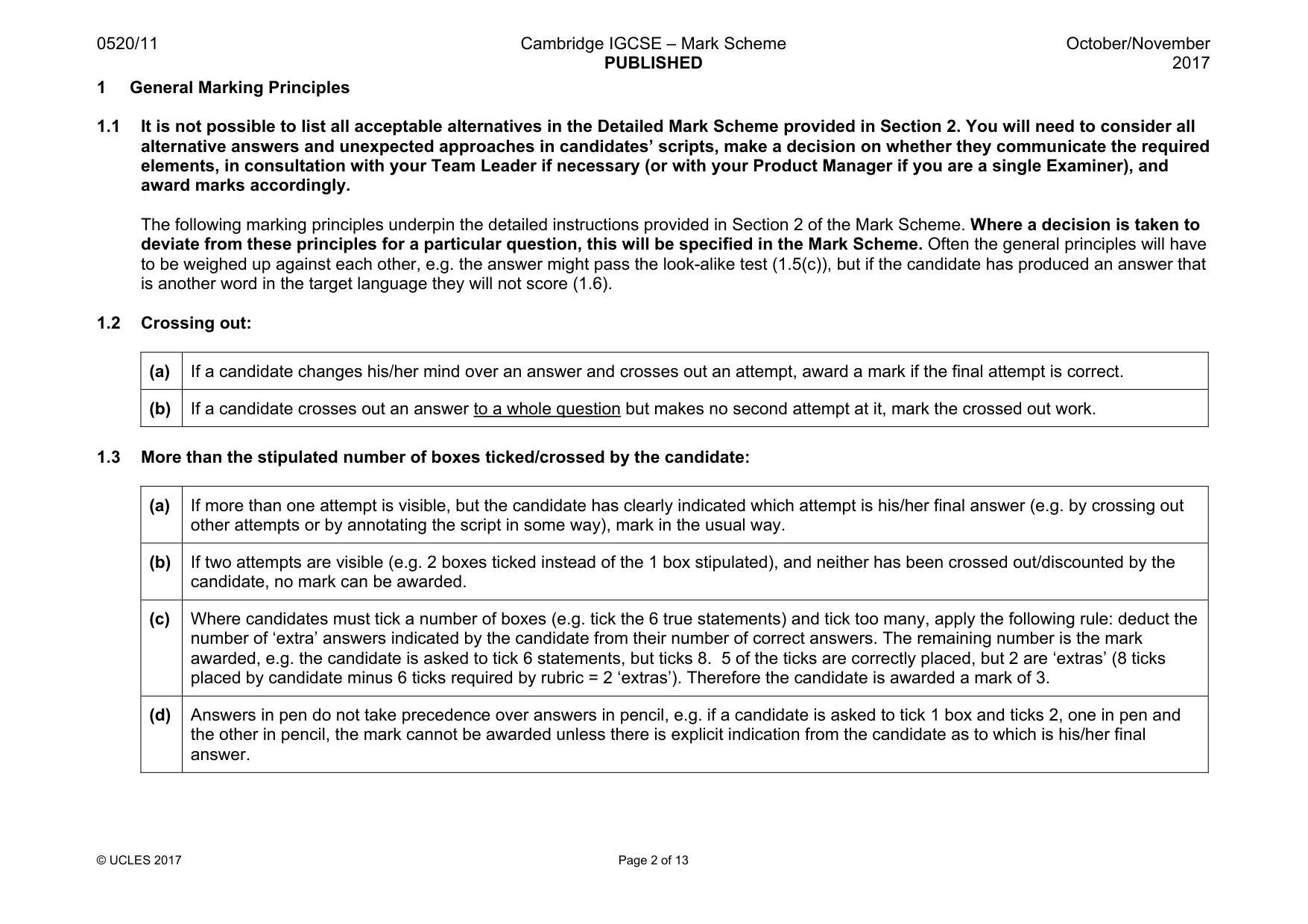
0520/11 Cambridge IGCSE – Mark Scheme PUBLISHED October/November 2017 © UCLES 2017 Page 2 of 13 1 General Marking Principles 1.1 It is not possible to list all acceptable alternatives in the Detailed Mark Scheme provided in Section 2. You will need to consider all alternative answers and unexpected approaches in candidates’ scripts, make a decision on whether they communicate the required elements, in consultation with your Team Leader if necessary (or with your Product Manager if you are a single Examiner), and award marks accordingly. The following marking principles underpin the detailed instructions provided in Section 2 of the Mark Scheme. Where a decision is taken to deviate from these principles for a particular question, this will be specified in the Mark Scheme. Often the general principles will have to be weighed up against each other, e.g. the answer might pass the look-alike test (1.5(c)), but if the candidate has produced an answer that is another word in the target language they will not score (1.6). 1.2 Crossing out: (a) If a candidate changes his/her mind over an answer and crosses out an attempt, award a mark if the final attempt is correct. (b) If a candidate crosses out an answer to a whole question but makes no second attempt at it, mark the crossed out work. 1.3 More than the stipulated number of boxes ticked/crossed by the candidate: (a) If more than one attempt is visible, but the candidate has clearly indicated which attempt is his/her final answer (e.g. by crossing out other attempts or by annotating the script in some way), mark in the usual way. (b) If two attempts are visible (e.g. 2 boxes ticked instead of the 1 box stipulated), and neither has been crossed out/discounted by the candidate, no mark can be awarded. (c) Where candidates must tick a number of boxes (e.g. tick the 6 true statements) and tick too many, apply the following rule: deduct the number of ‘extra’ answers indicated by the candidate from their number of correct answers. The remaining number is the mark awarded, e.g. the candidate is asked to tick 6 statements, but ticks 8. 5 of the ticks are correctly placed, but 2 are ‘extras’ (8 ticks placed by candidate minus 6 ticks required by rubric = 2 ‘extras’). Therefore the candidate is awarded a mark of 3. (d) Answers in pen do not take precedence over answers in pencil, e.g. if a candidate is asked to tick 1 box and ticks 2, one in pen and the other in pencil, the mark cannot be awarded unless there is explicit indication from the candidate as to which is his/her final answer.
Mark scheme, page 3
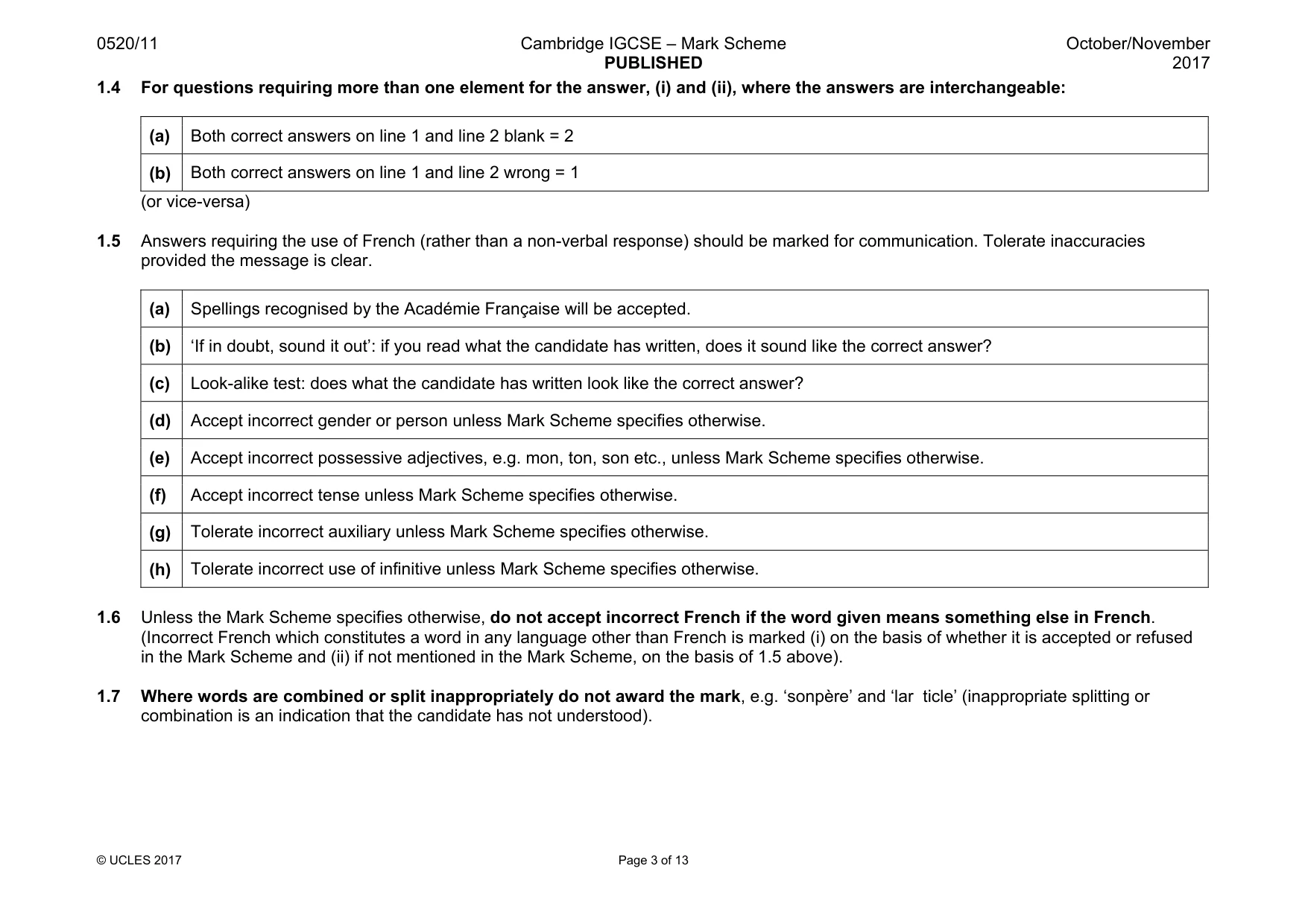
0520/11 Cambridge IGCSE – Mark Scheme PUBLISHED October/November 2017 © UCLES 2017 Page 3 of 13 1.4 For questions requiring more than one element for the answer, (i) and (ii), where the answers are interchangeable: (a) Both correct answers on line 1 and line 2 blank = 2 (b) Both correct answers on line 1 and line 2 wrong = 1 (or vice-versa) 1.5 Answers requiring the use of French (rather than a non-verbal response) should be marked for communication. Tolerate inaccuracies provided the message is clear. (a) Spellings recognised by the Académie Française will be accepted. (b) ‘If in doubt, sound it out’: if you read what the candidate has written, does it sound like the correct answer? (c) Look-alike test: does what the candidate has written look like the correct answer? (d) Accept incorrect gender or person unless Mark Scheme specifies otherwise. (e) Accept incorrect possessive adjectives, e.g. mon, ton, son etc., unless Mark Scheme specifies otherwise. (f) Accept incorrect tense unless Mark Scheme specifies otherwise. (g) Tolerate incorrect auxiliary unless Mark Scheme specifies otherwise. (h) Tolerate incorrect use of infinitive unless Mark Scheme specifies otherwise. 1.6 Unless the Mark Scheme specifies otherwise, do not accept incorrect French if the word given means something else in French. (Incorrect French which constitutes a word in any language other than French is marked (i) on the basis of whether it is accepted or refused in the Mark Scheme and (ii) if not mentioned in the Mark Scheme, on the basis of 1.5 above). 1.7 Where words are combined or split inappropriately do not award the mark, e.g. ‘sonpère’ and ‘lar ticle’ (inappropriate splitting or combination is an indication that the candidate has not understood).
Mark scheme, page 4
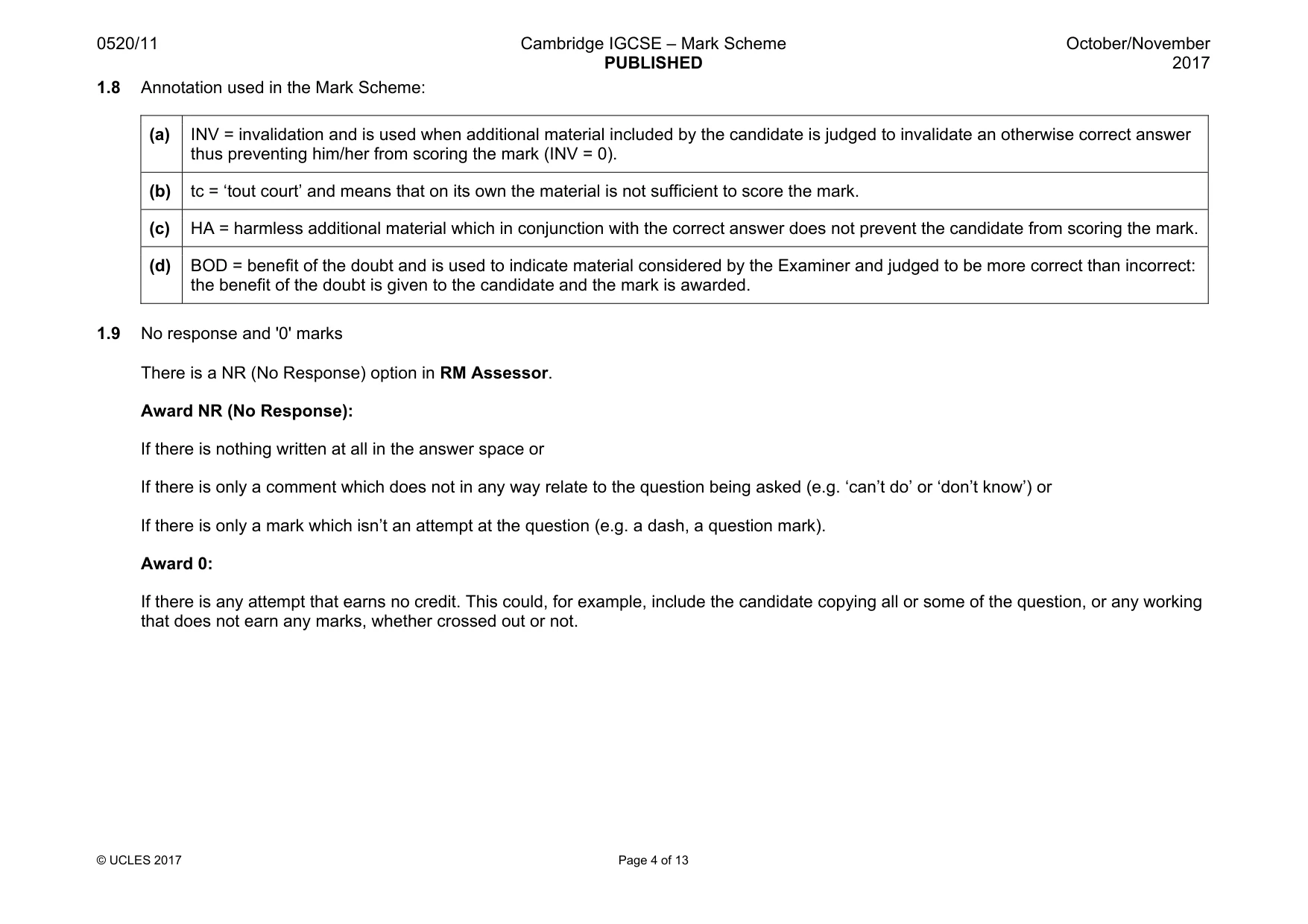
0520/11 Cambridge IGCSE – Mark Scheme PUBLISHED October/November 2017 © UCLES 2017 Page 4 of 13 1.8 Annotation used in the Mark Scheme: (a) INV = invalidation and is used when additional material included by the candidate is judged to invalidate an otherwise correct answer thus preventing him/her from scoring the mark (INV = 0). (b) tc = ‘tout court’ and means that on its own the material is not sufficient to score the mark. (c) HA = harmless additional material which in conjunction with the correct answer does not prevent the candidate from scoring the mark. (d) BOD = benefit of the doubt and is used to indicate material considered by the Examiner and judged to be more correct than incorrect: the benefit of the doubt is given to the candidate and the mark is awarded. 1.9 No response and '0' marks There is a NR (No Response) option in RM Assessor. Award NR (No Response): If there is nothing written at all in the answer space or If there is only a comment which does not in any way relate to the question being asked (e.g. ‘can’t do’ or ‘don’t know’) or If there is only a mark which isn’t an attempt at the question (e.g. a dash, a question mark). Award 0: If there is any attempt that earns no credit. This could, for example, include the candidate copying all or some of the question, or any working that does not earn any marks, whether crossed out or not.
Mark scheme, page 5
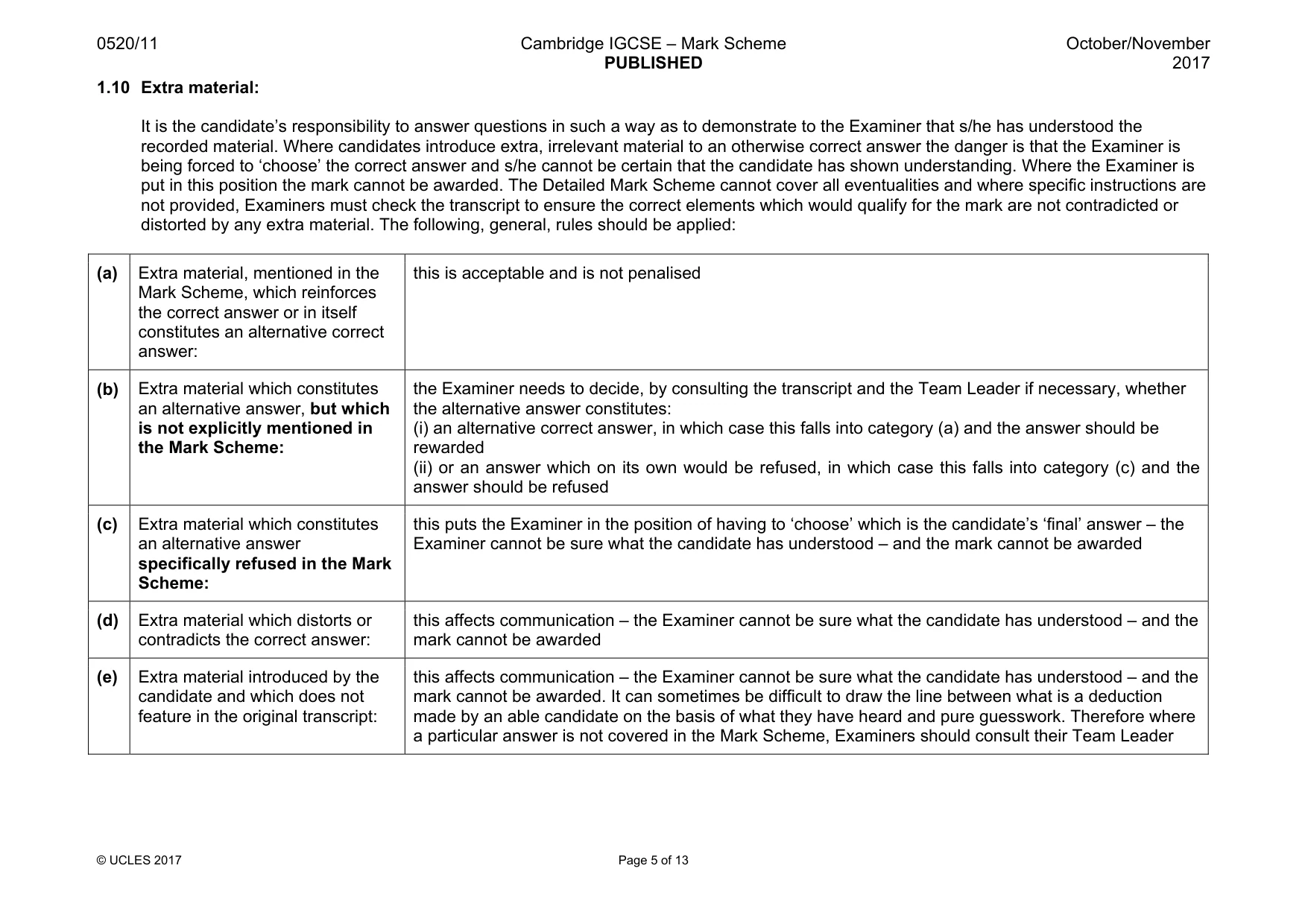
0520/11 Cambridge IGCSE – Mark Scheme PUBLISHED October/November 2017 © UCLES 2017 Page 5 of 13 1.10 Extra material: It is the candidate’s responsibility to answer questions in such a way as to demonstrate to the Examiner that s/he has understood the recorded material. Where candidates introduce extra, irrelevant material to an otherwise correct answer the danger is that the Examiner is being forced to ‘choose’ the correct answer and s/he cannot be certain that the candidate has shown understanding. Where the Examiner is put in this position the mark cannot be awarded. The Detailed Mark Scheme cannot cover all eventualities and where specific instructions are not provided, Examiners must check the transcript to ensure the correct elements which would qualify for the mark are not contradicted or distorted by any extra material. The following, general, rules should be applied: (a) Extra material, mentioned in the Mark Scheme, which reinforces the correct answer or in itself constitutes an alternative correct answer: this is acceptable and is not penalised (b) Extra material which constitutes an alternative answer, but which is not explicitly mentioned in the Mark Scheme: the Examiner needs to decide, by consulting the transcript and the Team Leader if necessary, whether the alternative answer constitutes: (i) an alternative correct answer, in which case this falls into category (a) and the answer should be rewarded (ii) or an answer which on its own would be refused, in which case this falls into category (c) and the answer should be refused (c) Extra material which constitutes an alternative answer specifically refused in the Mark Scheme: this puts the Examiner in the position of having to ‘choose’ which is the candidate’s ‘final’ answer – the Examiner cannot be sure what the candidate has understood – and the mark cannot be awarded (d) Extra material which distorts or contradicts the correct answer: this affects communication – the Examiner cannot be sure what the candidate has understood – and the mark cannot be awarded (e) Extra material introduced by the candidate and which does not feature in the original transcript: this affects communication – the Examiner cannot be sure what the candidate has understood – and the mark cannot be awarded. It can sometimes be difficult to draw the line between what is a deduction made by an able candidate on the basis of what they have heard and pure guesswork. Therefore where a particular answer is not covered in the Mark Scheme, Examiners should consult their Team Leader
Mark scheme, page 6
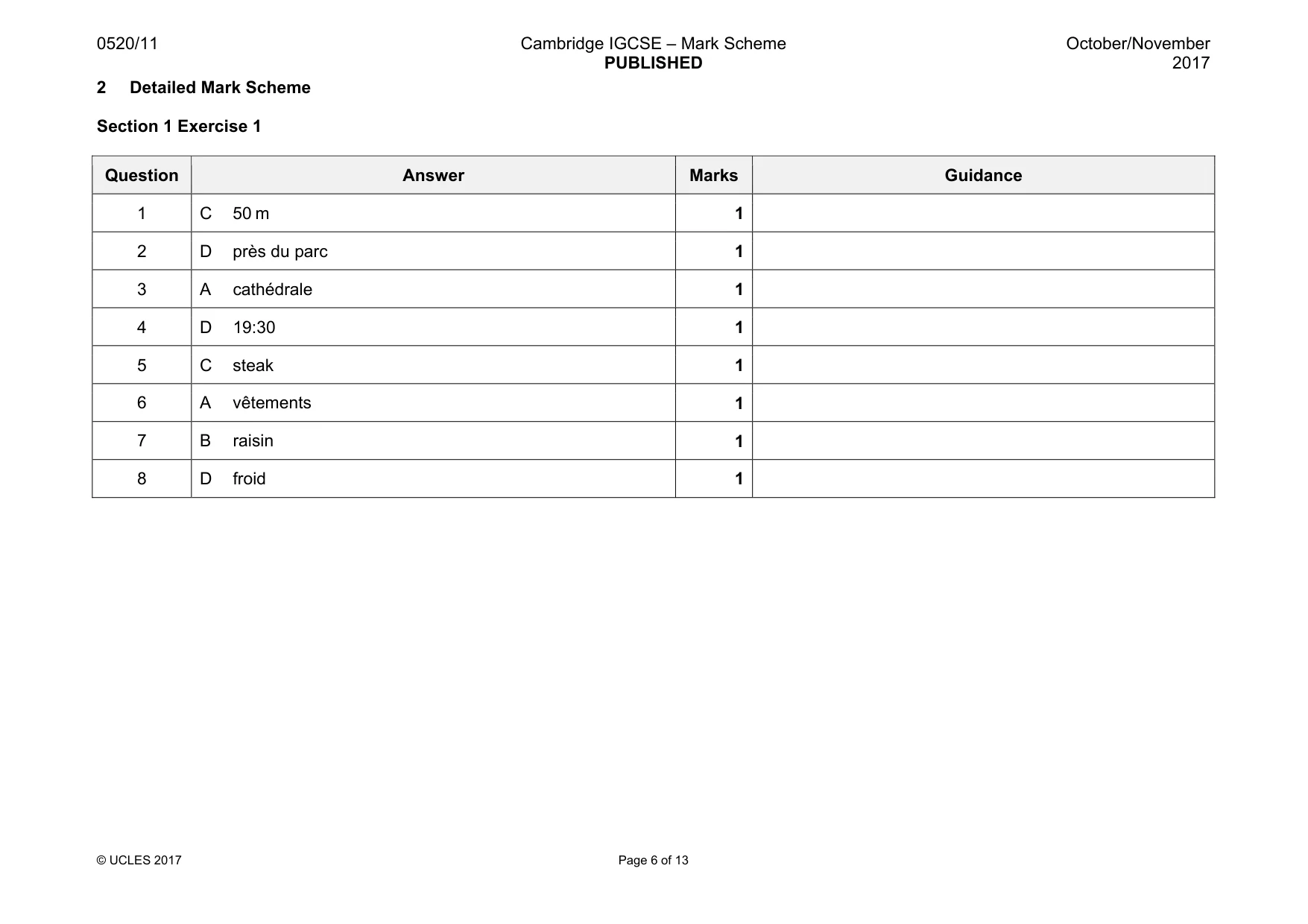
0520/11 Cambridge IGCSE – Mark Scheme PUBLISHED October/November 2017 © UCLES 2017 Page 6 of 13 2 Detailed Mark Scheme Section 1 Exercise 1 Question Answer Marks Guidance 1 C 50 m 1 2 D près du parc 1 3 A cathédrale 1 4 D 19:30 1 5 C steak 1 6 A vêtements 1 7 B raisin 1 8 D froid 1
Mark scheme, page 7
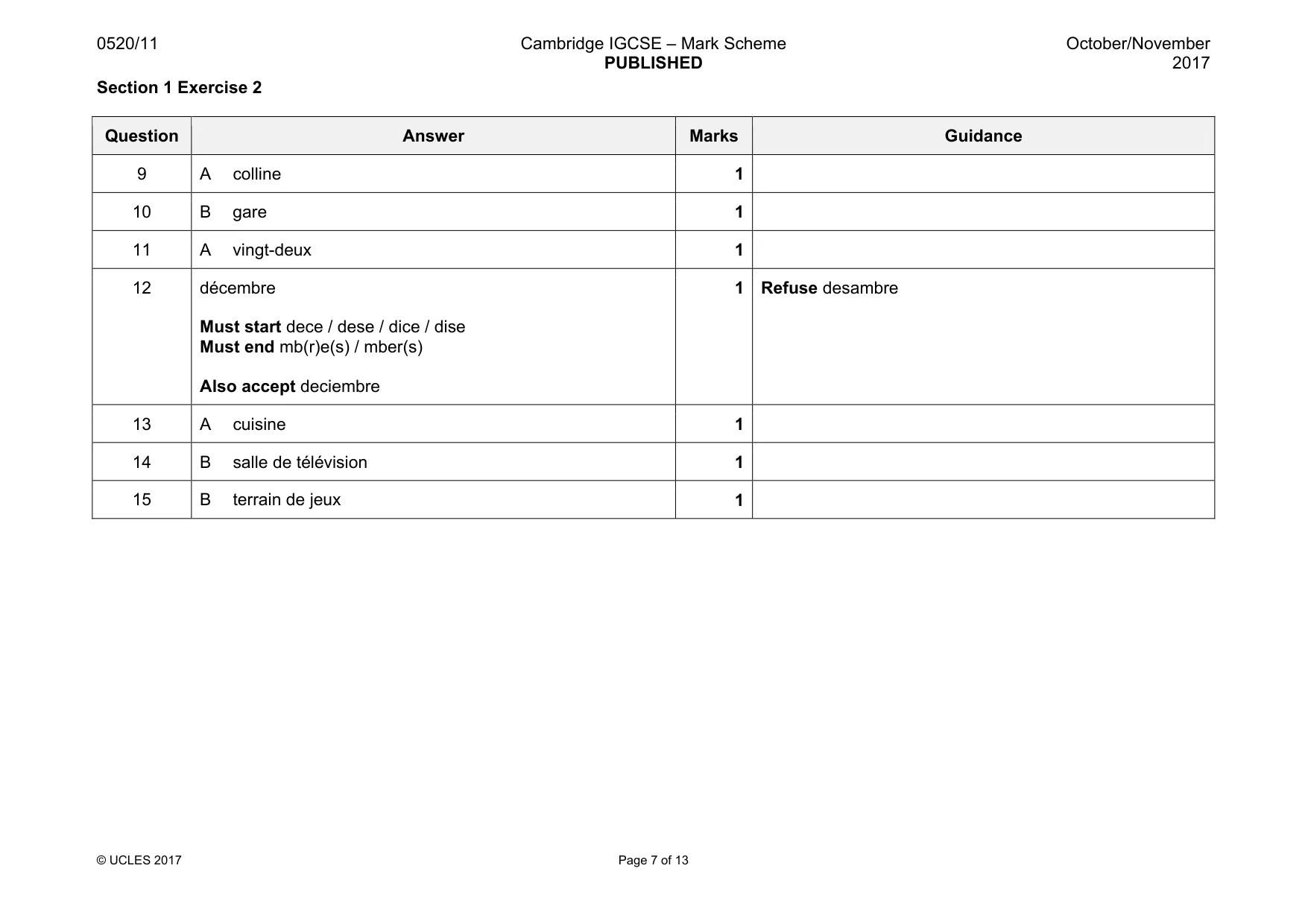
0520/11 Cambridge IGCSE – Mark Scheme PUBLISHED October/November 2017 © UCLES 2017 Page 7 of 13 Section 1 Exercise 2 Question Answer Marks Guidance 9 A colline 1 10 B gare 1 11 A vingt-deux 1 12 décembre Must start dece / dese / dice / dise Must end mb(r)e(s) / mber(s) Also accept deciembre 1 Refuse desambre 13 A cuisine 1 14 B salle de télévision 1 15 B terrain de jeux 1
Mark scheme, page 8
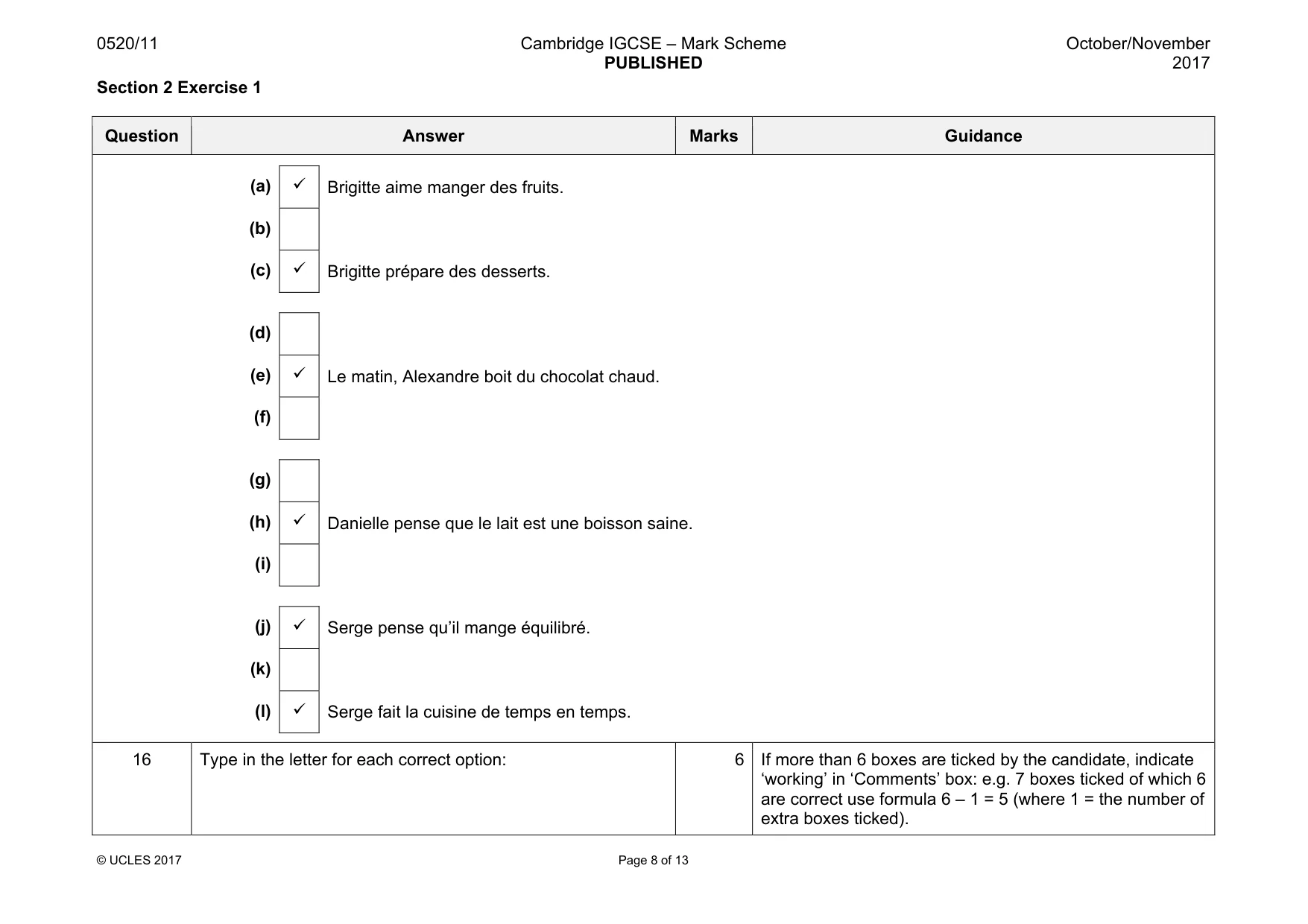
0520/11 Cambridge IGCSE – Mark Scheme PUBLISHED October/November 2017 © UCLES 2017 Page 8 of 13 Section 2 Exercise 1 Question Answer Marks Guidance (a) 9 Brigitte aime manger des fruits. (b) (c) 9 Brigitte prépare des desserts. (d) (e) 9 Le matin, Alexandre boit du chocolat chaud. (f) (g) (h) 9 Danielle pense que le lait est une boisson saine. (i) (j) 9 Serge pense qu’il mange équilibré. (k) (l) 9 Serge fait la cuisine de temps en temps. 16 Type in the letter for each correct option: 6 If more than 6 boxes are ticked by the candidate, indicate ‘working’ in ‘Comments’ box: e.g. 7 boxes ticked of which 6 are correct use formula 6 – 1 = 5 (where 1 = the number of extra boxes ticked).
Mark scheme, page 9
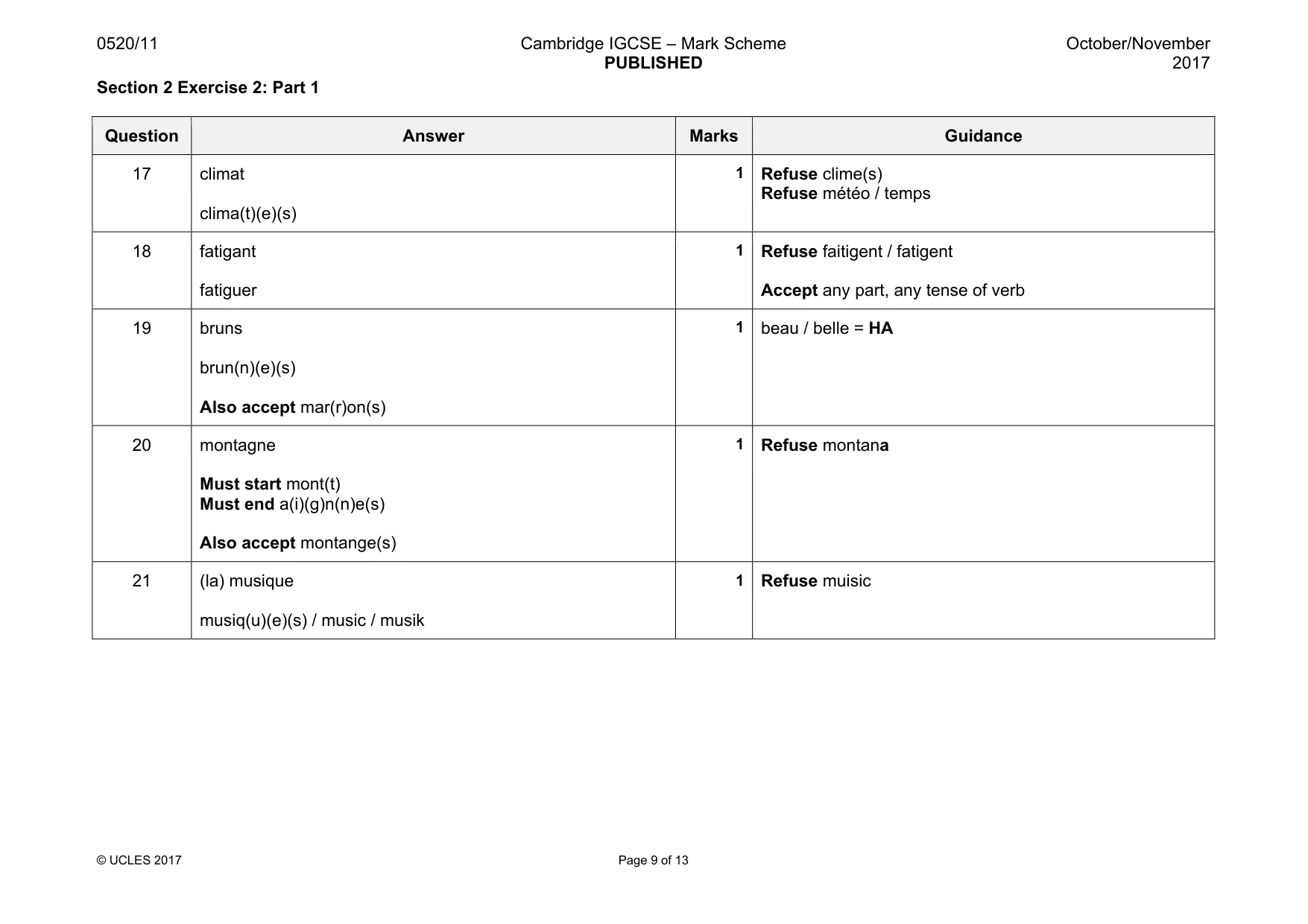
0520/11 Cambridge IGCSE – Mark Scheme PUBLISHED October/November 2017 © UCLES 2017 Page 9 of 13 Section 2 Exercise 2: Part 1 Question Answer Marks Guidance 17 climat clima(t)(e)(s) 1 Refuse clime(s) Refuse météo / temps 18 fatigant fatiguer 1 Refuse faitigent / fatigent Accept any part, any tense of verb 19 bruns brun(n)(e)(s) Also accept mar(r)on(s) 1 beau / belle = HA 20 montagne Must start mont(t) Must end a(i)(g)n(n)e(s) Also accept montange(s) 1 Refuse montana 21 (la) musique musiq(u)(e)(s) / music / musik 1 Refuse muisic
Mark scheme, page 10
0520/11 Cambridge IGCSE – Mark Scheme PUBLISHED October/November 2017 © UCLES 2017 Page 10 of 13 Section 2 Exercise 2: Part 2 Question Answer Marks Guidance 22 l’office de tourisme of(f)ice / of(f)is(s)e Must start to(u)r(r)i / tur(r)i Must end sm(m)(e) Also accept to(u)r(r)ist(e)(s)/ tur(r)ist(e)(s) 1 Refuse of(f)icina / o(f)ficine Refuse t(o)urismo 23 (environ) 300 000 trois cent(s) mil(l)(e)(s) 3 cent(s) mil(l)(e)(s) 1 300000 garçons = INV Ignore attempts at personnes Refuse troiscent – see General Principle 1.7 24 magnifiques Must start ma(g)nif(f) Must end iq(u)(e)(s) / ic(s) / ik(u)(e)(s) Also accept mangnif(f)ique 1 25 (sa) beauté Must start beaut / baut / bot Must end é(e)(s) / e(s) / er / ez Also accept beau / belle 1 Ignore attempts at Île de Beauté BUT refuse botte Refuse bouteille (common incorrect answer)
Mark scheme, page 11
0520/11 Cambridge IGCSE – Mark Scheme PUBLISHED October/November 2017 © UCLES 2017 Page 11 of 13 Section 3 Exercise 1 Question Answer Marks Guidance 26 B française 1 27 C journaliste 1 28 A Pour aider les gens. 1 29 A Ils étaient chaleureux. 1 30 A les transports 1 31 D Pour y vivre. 1
Mark scheme, page 12
0520/11 Cambridge IGCSE – Mark Scheme PUBLISHED October/November 2017 © UCLES 2017 Page 12 of 13 Section 3 Exercise 2 Question Answer Marks Guidance 32 6 / six + ans Acceptable spellings of ans: an(s) / an(n)e(e)(s) 1 Refuse dix / douze ans Depuis / il y a six ans = INV 33 faire + partie (de son) + équipe fair(e) parti(e)(s) equip(e) Also accept concept of playing for / in / with the team 1 Refuse être partie de son équipe Accept any part, any tense of verb fair(e) Other parts of the verb partir = INV jouer un match professionnel = INV jouer comme professionnel = INV aller dans un club professionnel = INV 34 meilleur moment (de sa vie) Must start meil(l) / mail(l) Must end eur(r)(e) / or(e)(s) Acceptable spellings of moment: mom(m)en(t)(e) / mom(m)an(t)(e) 1 Ignore attempts at de sa vie 35 écoute (les) + conseils Acceptable spellings of conseils: Must start con(n)s(s) / conc Must end eil(l)(e)(s) / ail(l)(e)(s) 1 Accept any part, any tense of the verb les instructions = INV 36 (se) fâchait (facilement) Tolerate fasher 1 Accept any part, any tense of the verb Addition of concept of losing a match = INV Addition of concept of playing badly = HA (see transcript)
Mark scheme, page 13
0520/11 Cambridge IGCSE – Mark Scheme PUBLISHED October/November 2017 © UCLES 2017 Page 13 of 13 Question Answer Marks Guidance 37 plus + calme plu(s) calm(e) 1 Ignore attempts at beaucoup 38(i) gagner (la) + Coupe (du) + Monde Must start gag Also accept ganier as an infinitive only coup(e) mond 1 Accept any part, any tense of the verb Maroc / France = HA Refuse ganger Refuse ganer Refuse cop / cope / cup / cupe Refuse munde / mundo / mode 38(ii) (se) marier mar(r)ier Also accept mar(r)iage 1 Accept any part, any tense of the verb Refuse mar(r)iere Ignore attempts at rendering of sa petite amie Fatima = HA 39 vie (de) + famille Acceptable spellings of vie: vi / vit Tolerate vis fam(m)il(l)e 1 Refuse être avec sa famille enfants = INV Note: For questions with 2 interchangeable answers: 2 correct answers on line 1, line 2 blank = 2; 2 correct answers on line 1, line 2 wrong = 1 (or vice versa)
What you needed in this session
Cambridge’s own grade thresholds for 2017 Oct/Nov, Paper 1 · Variant 1. A higher threshold means an easier paper — the bar moves with how the cohort did.