Cambridge IGCSE Environmental Management 0680 — 2022 Feb/March Paper 1 · Variant 2
0680/12/F/M/22 · 80 marks · ≈90 min
The question paper and its mark scheme, free to read here and free to download. This is Cambridge’s own paper, exactly as it was sat.
Question paper20 pages




Mark scheme12 pages
Answers below. Sit the paper first if you are practising.
Paper as text
Question paper, page 1
This document has 20 pages. Any blank pages are indicated. [Turn over DC (PQ/SG) 305525/1 © UCLES 2022 ENVIRONMENTAL MANAGEMENT 0680/12 Paper 1 Theory February/March 2022 1 hour 45 minutes You must answer on the question paper. No additional materials are needed. INSTRUCTIONS ● Answer all questions. ● Use a black or dark blue pen. You may use an HB pencil for any diagrams or graphs. ● Write your name, centre number and candidate number in the boxes at the top of the page. ● Write your answer to each question in the space provided. ● Do not use an erasable pen or correction fluid. ● Do not write on any bar codes. ● You may use a calculator. ● You should show all your working and use appropriate units. INFORMATION ● The total mark for this paper is 80. ● The number of marks for each question or part question is shown in brackets [ ]. Cambridge IGCSE™ * 8 0 0 7 2 0 9 4 1 7 *
Question paper, page 2
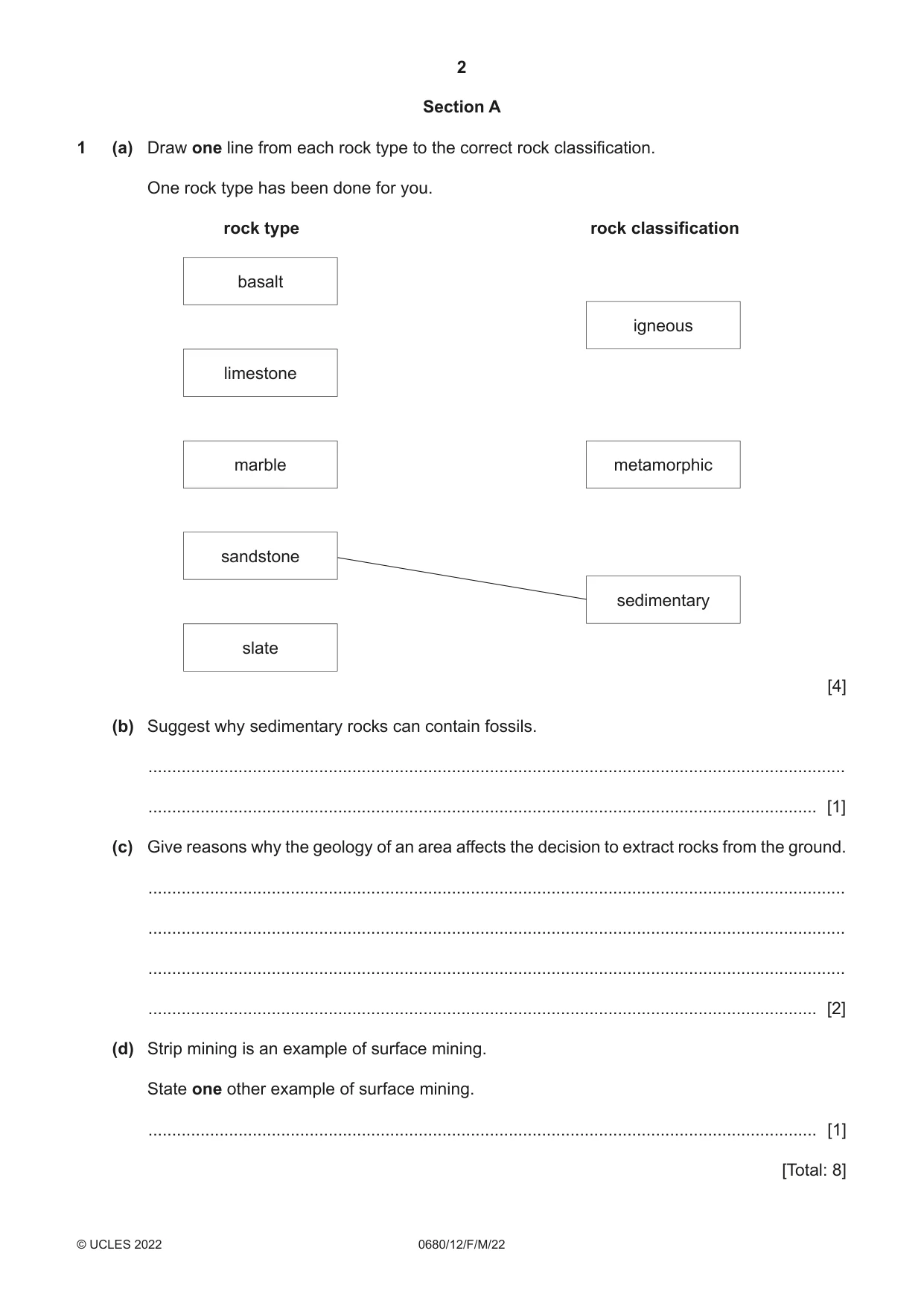
2 0680/12/F/M/22 © UCLES 2022 Section A 1 (a) Draw one line from each rock type to the correct rock classification. One rock type has been done for you. rock type rock classification basalt limestone marble sandstone igneous metamorphic sedimentary slate [4] (b) Suggest why sedimentary rocks can contain fossils. … … [1] (c) Give reasons why the geology of an area affects the decision to extract rocks from the ground. … … … … [2] (d) Strip mining is an example of surface mining. State one other example of surface mining. … [1] [Total: 8]
Question paper, page 3
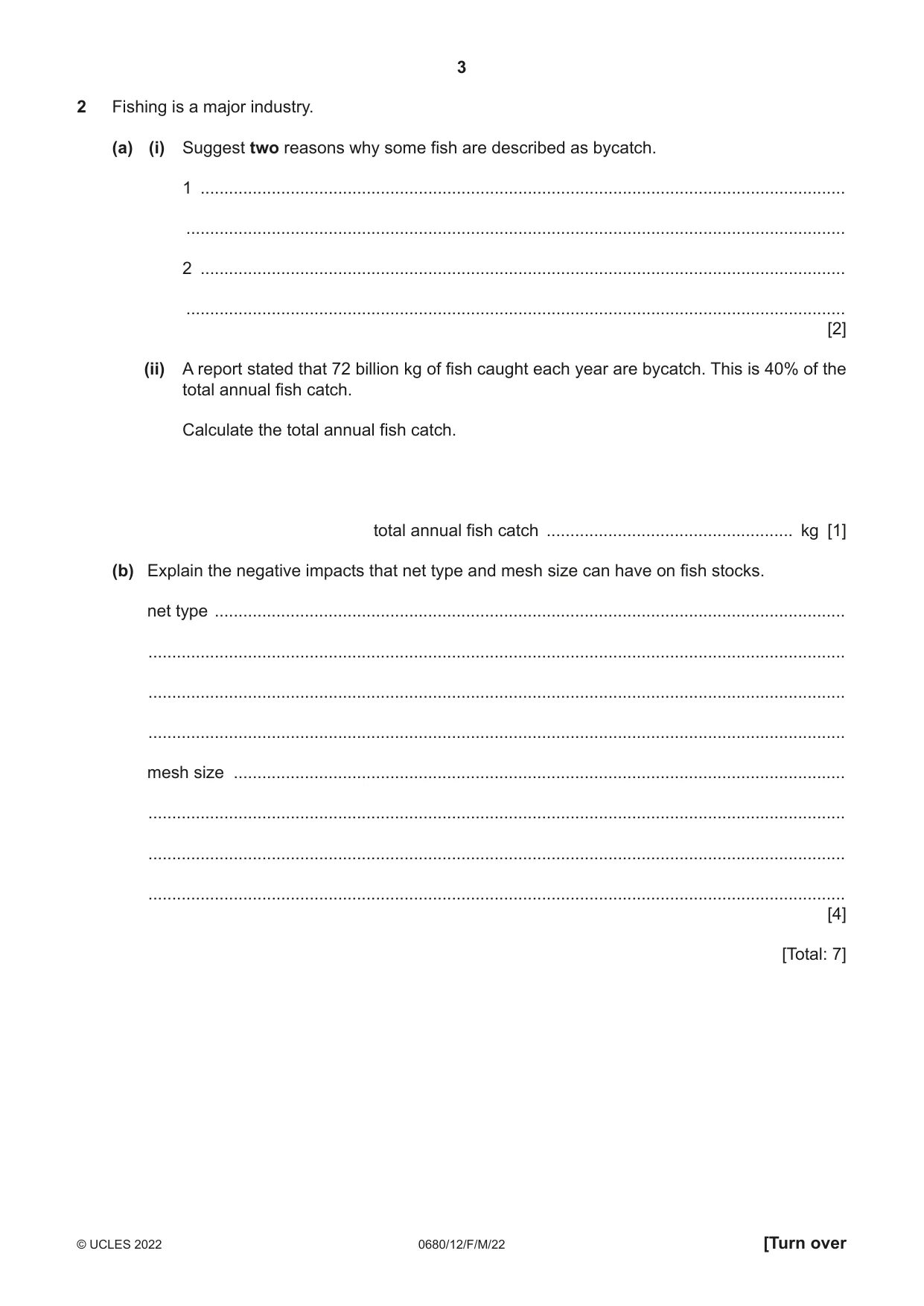
3 0680/12/F/M/22 © UCLES 2022 [Turn over 2 Fishing is a major industry. (a) (i) Suggest two reasons why some fish are described as bycatch. 1 … … 2 … … [2] (ii) A report stated that 72 billion kg of fish caught each year are bycatch. This is 40% of the total annual fish catch. Calculate the total annual fish catch. total annual fish catch … kg [1] (b) Explain the negative impacts that net type and mesh size can have on fish stocks. net type … … … … mesh size … … … … [4] [Total: 7]
Question paper, page 4
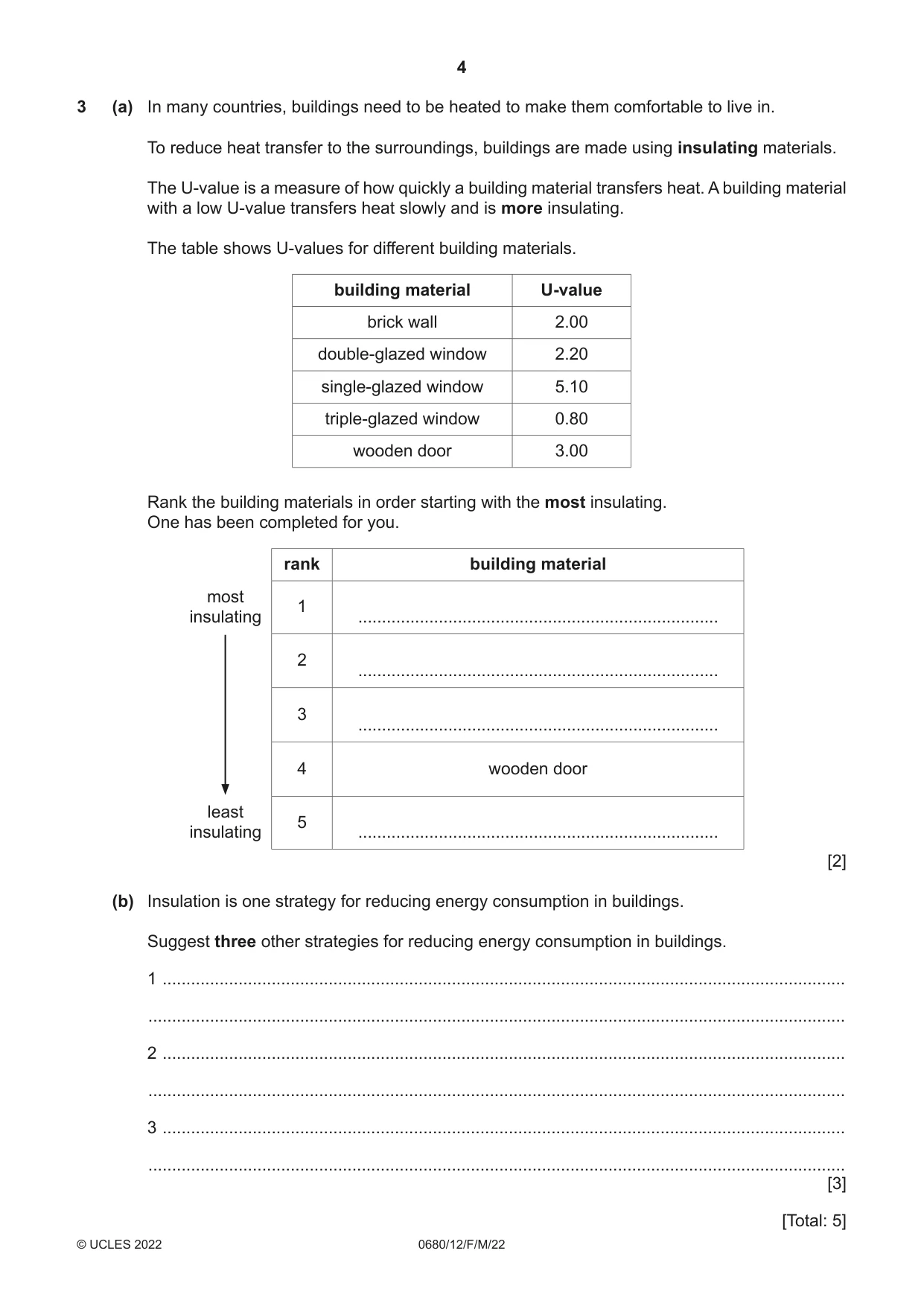
4 0680/12/F/M/22 © UCLES 2022 3 (a) In many countries, buildings need to be heated to make them comfortable to live in. To reduce heat transfer to the surroundings, buildings are made using insulating materials. The U-value is a measure of how quickly a building material transfers heat. A building material with a low U-value transfers heat slowly and is more insulating. The table shows U-values for different building materials. building material U‑value brick wall 2.00 double-glazed window 2.20 single-glazed window 5.10 triple-glazed window 0.80 wooden door 3.00 Rank the building materials in order starting with the most insulating. One has been completed for you. rank building material most insulating 1 … 2 … 3 … 4 wooden door least insulating 5 … [2] (b) Insulation is one strategy for reducing energy consumption in buildings. Suggest three other strategies for reducing energy consumption in buildings. 1 … … 2 … … 3 … … [3] [Total: 5]
Question paper, page 5
5 0680/12/F/M/22 © UCLES 2022 [Turn over BLANK PAGE
Question paper, page 6
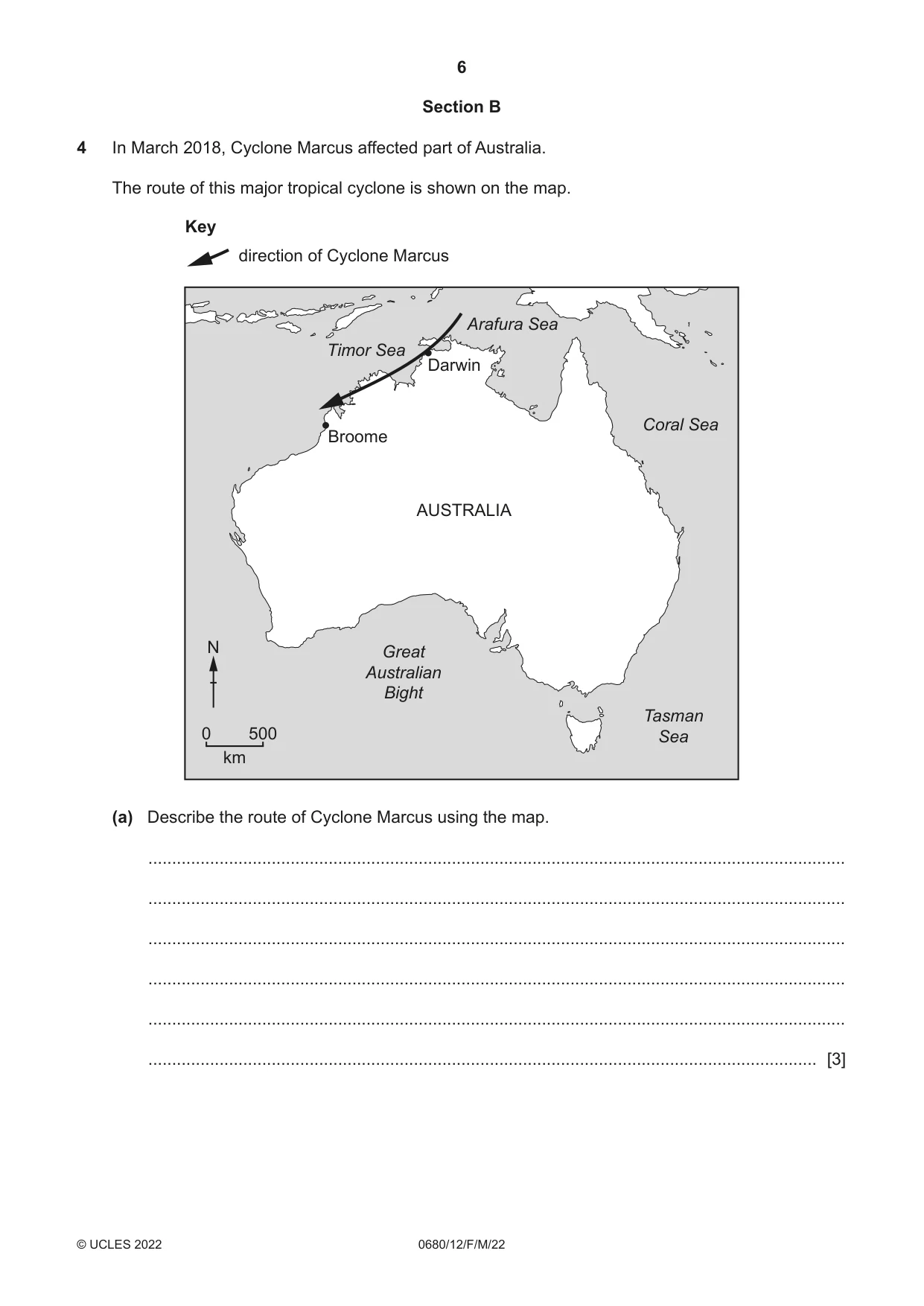
6 0680/12/F/M/22 © UCLES 2022 Section B 4 In March 2018, Cyclone Marcus affected part of Australia. The route of this major tropical cyclone is shown on the map. Broome Darwin AUSTRALIA Tasman Sea Great Australian Bight Timor Sea Arafura Sea Coral Sea 0 500 km N Key direction of Cyclone Marcus (a) Describe the route of Cyclone Marcus using the map. … … … … … … [3]
Question paper, page 7
7 0680/12/F/M/22 © UCLES 2022 [Turn over (b) State the conditions required for a tropical cyclone to form. … … … … … … [3] (c) Cyclone Marcus was the most powerful tropical cyclone to affect the area in over 40 years. However, it caused no deaths. Suggest two impacts of Cyclone Marcus. 1 … … 2 … … [2] (d) Cyclone Marcus caused no deaths. A weaker tropical cyclone in Myanmar in 2008 caused over 135 000 deaths. Suggest reasons for the difference in the number of deaths between these two tropical cyclones. … … … … … … … … [4] [Total: 12]
Question paper, page 8
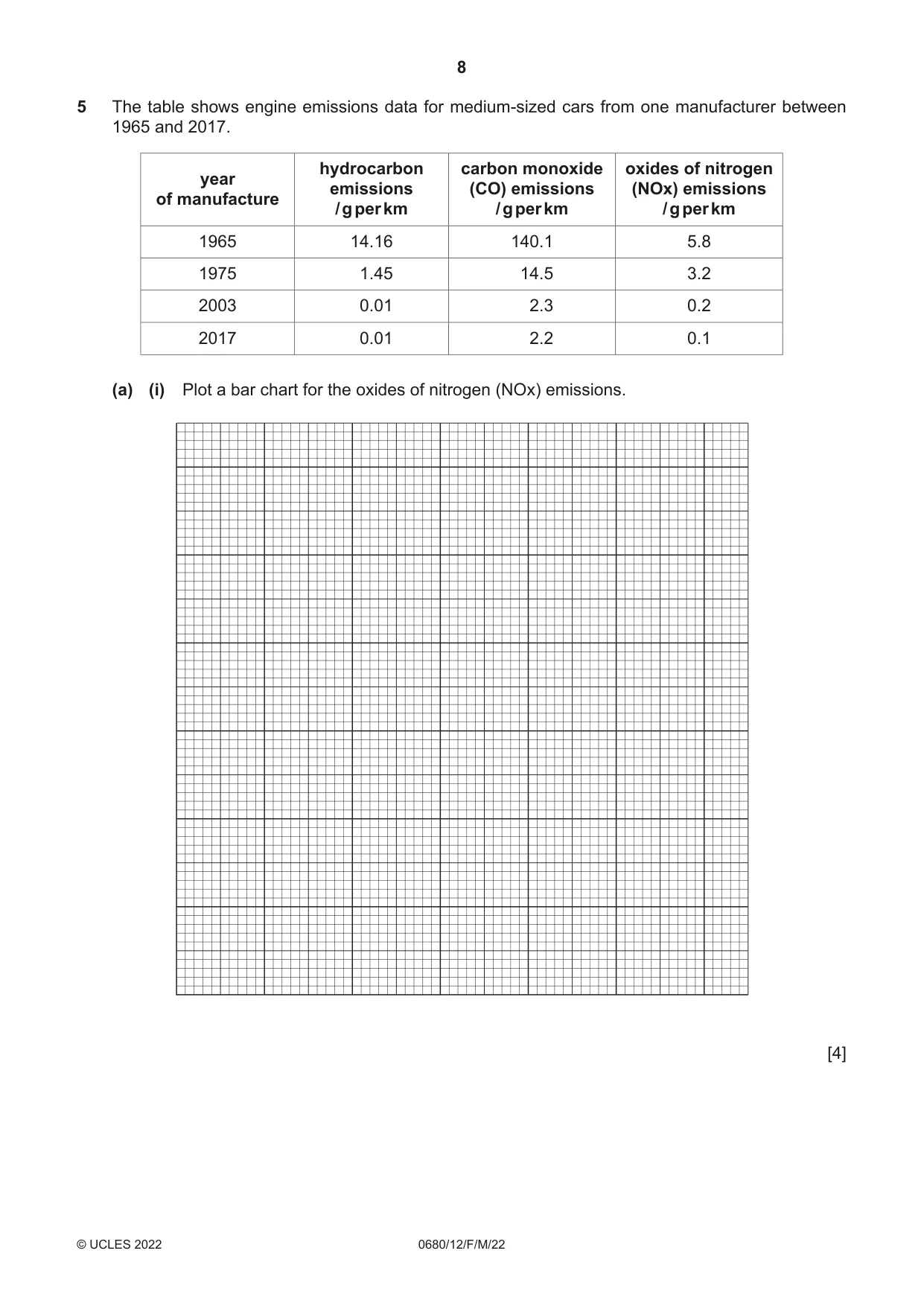
8 0680/12/F/M/22 © UCLES 2022 5 The table shows engine emissions data for medium-sized cars from one manufacturer between 1965 and 2017. year of manufacture hydrocarbon emissions / g per km carbon monoxide (CO) emissions / g per km oxides of nitrogen (NOx) emissions / g per km 1965 14.16 140.1 5.8 1975 1.45 14.5 3.2 2003 0.01 2.3 0.2 2017 0.01 2.2 0.1 (a) (i) Plot a bar chart for the oxides of nitrogen (NOx) emissions. [4]
Question paper, page 9
9 0680/12/F/M/22 © UCLES 2022 [Turn over (ii) Use the table to estimate the percentage decrease in carbon monoxide (CO) emissions for medium-sized cars manufactured in 2017 compared with 1965. Circle one correct answer. 64% 70% 85% 98% [1] (iii) The rate of reduction of engine emissions for medium-sized cars has decreased in recent years. Suggest why. … … [1] (b) Some scientists think that reducing car engine emissions is not enough to reduce the level of air pollution in cities. Describe other strategies to reduce the level of air pollution caused by cars in a city. … … … … … … [3] [Total: 9]
Question paper, page 10
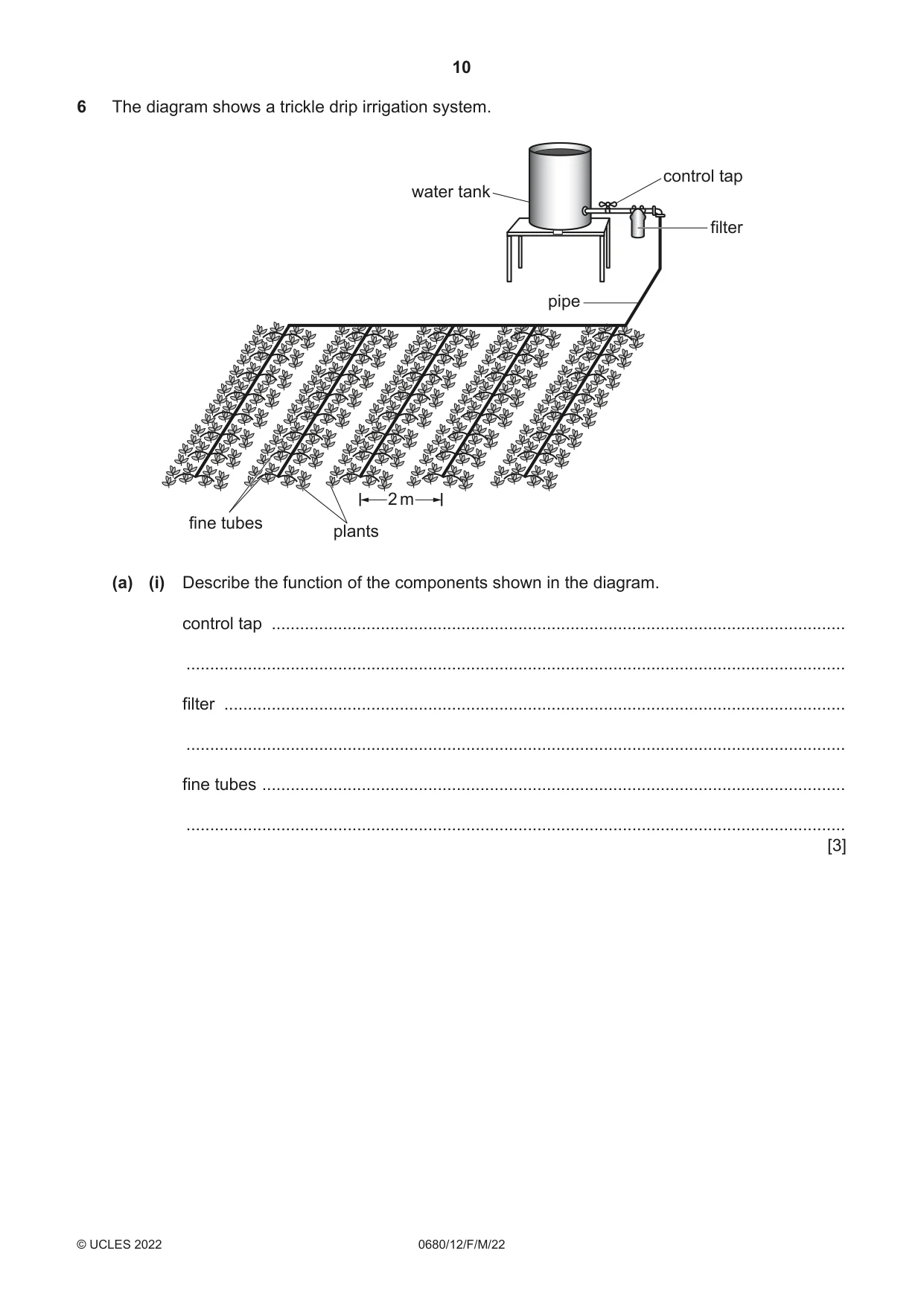
10 0680/12/F/M/22 © UCLES 2022 6 The diagram shows a trickle drip irrigation system. plants fine tubes water tank pipe control tap filter 2 m (a) (i) Describe the function of the components shown in the diagram. control tap … … filter … … fine tubes … … [3]
Question paper, page 11
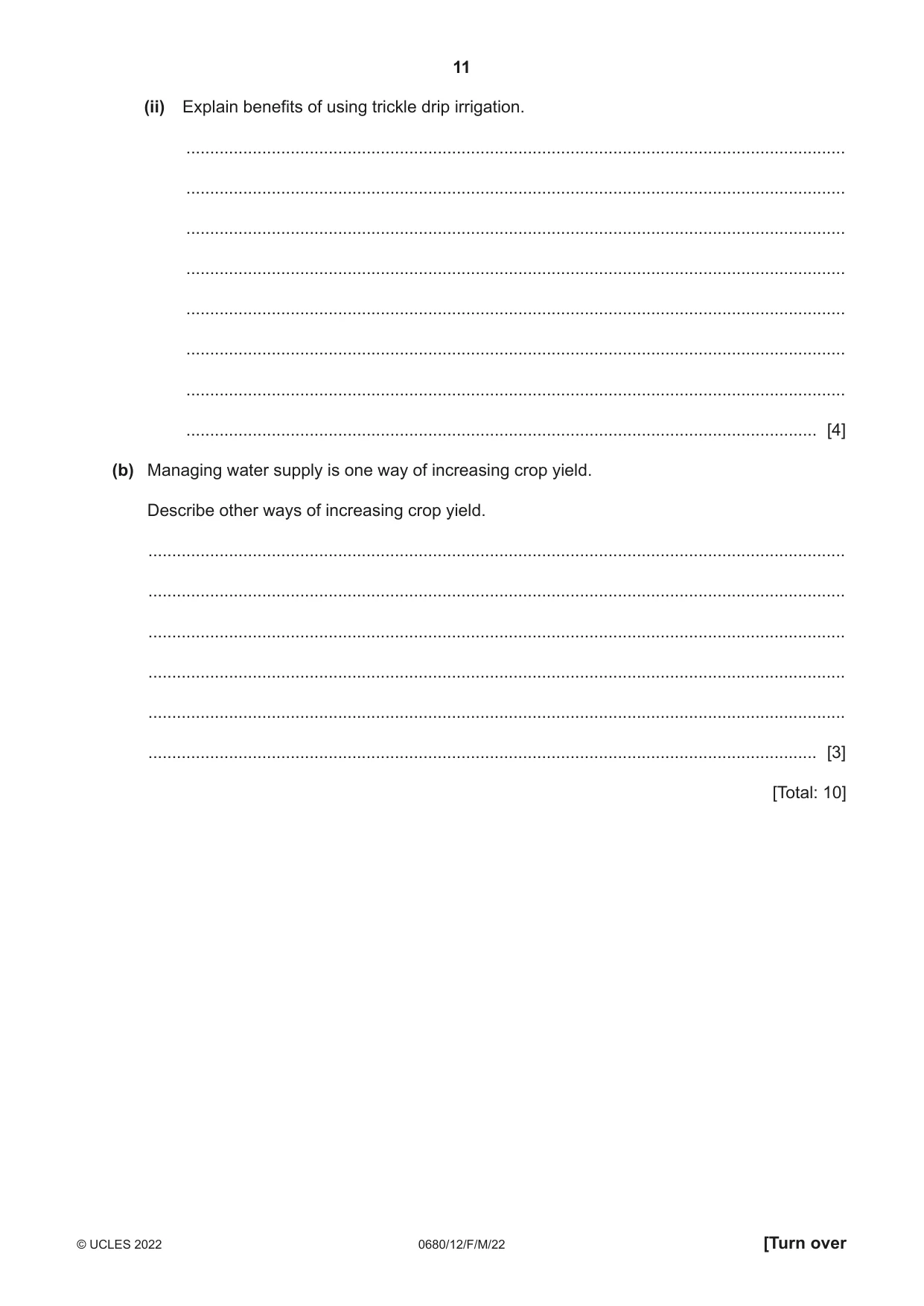
11 0680/12/F/M/22 © UCLES 2022 [Turn over (ii) Explain benefits of using trickle drip irrigation. … … … … … … … … [4] (b) Managing water supply is one way of increasing crop yield. Describe other ways of increasing crop yield. … … … … … … [3] [Total: 10]
Question paper, page 12
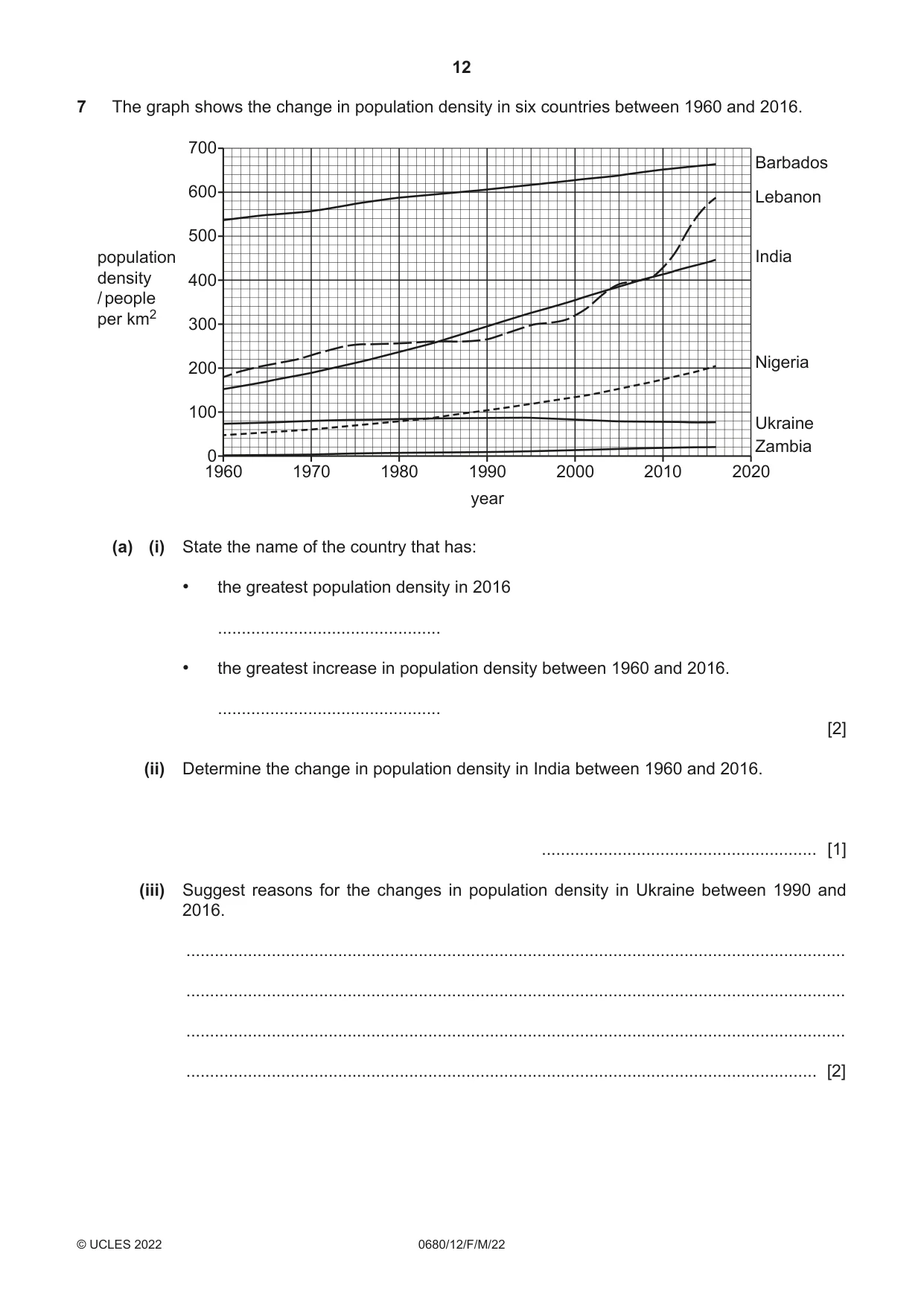
12 0680/12/F/M/22 © UCLES 2022 7 The graph shows the change in population density in six countries between 1960 and 2016. 0 100 200 300 400 500 600 700 1960 1970 1980 1990 year 2000 2010 2020 population density / people per km2 Barbados Lebanon India Nigeria Ukraine Zambia (a) (i) State the name of the country that has: • the greatest population density in 2016 … • the greatest increase in population density between 1960 and 2016. … [2] (ii) Determine the change in population density in India between 1960 and 2016. … [1] (iii) Suggest reasons for the changes in population density in Ukraine between 1990 and 2016. … … … … [2]
Question paper, page 13
13 0680/12/F/M/22 © UCLES 2022 [Turn over (b) Bulgaria is a country in Europe. Bulgaria has a decreasing population. Suggest how a decreasing population can benefit the natural environment of Bulgaria. … … … … … … … … … … [5] [Total: 10]
Question paper, page 14
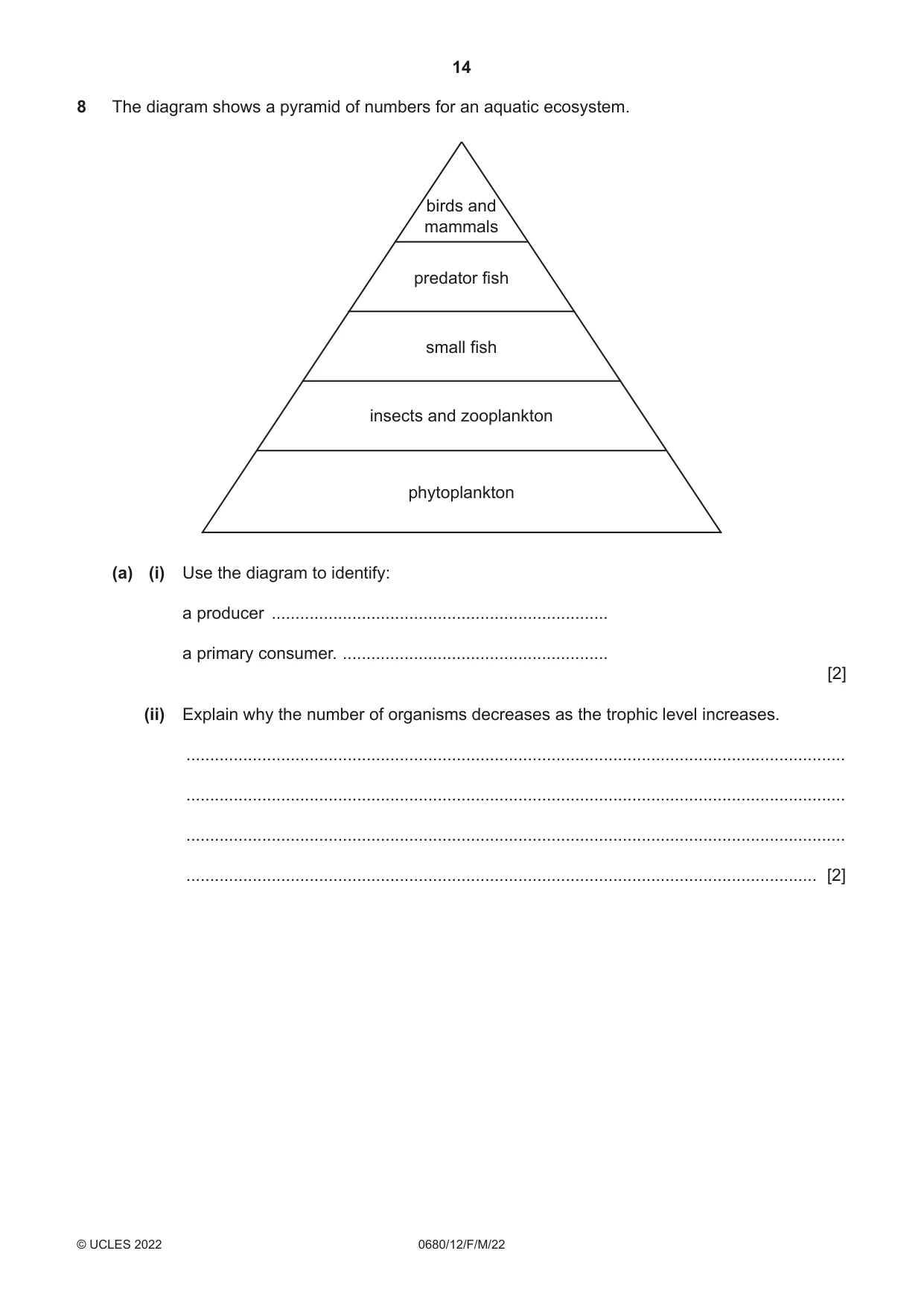
14 0680/12/F/M/22 © UCLES 2022 8 The diagram shows a pyramid of numbers for an aquatic ecosystem. phytoplankton small fish predator fish birds and mammals insects and zooplankton (a) (i) Use the diagram to identify: a producer … a primary consumer. … [2] (ii) Explain why the number of organisms decreases as the trophic level increases. … … … … [2]
Question paper, page 15
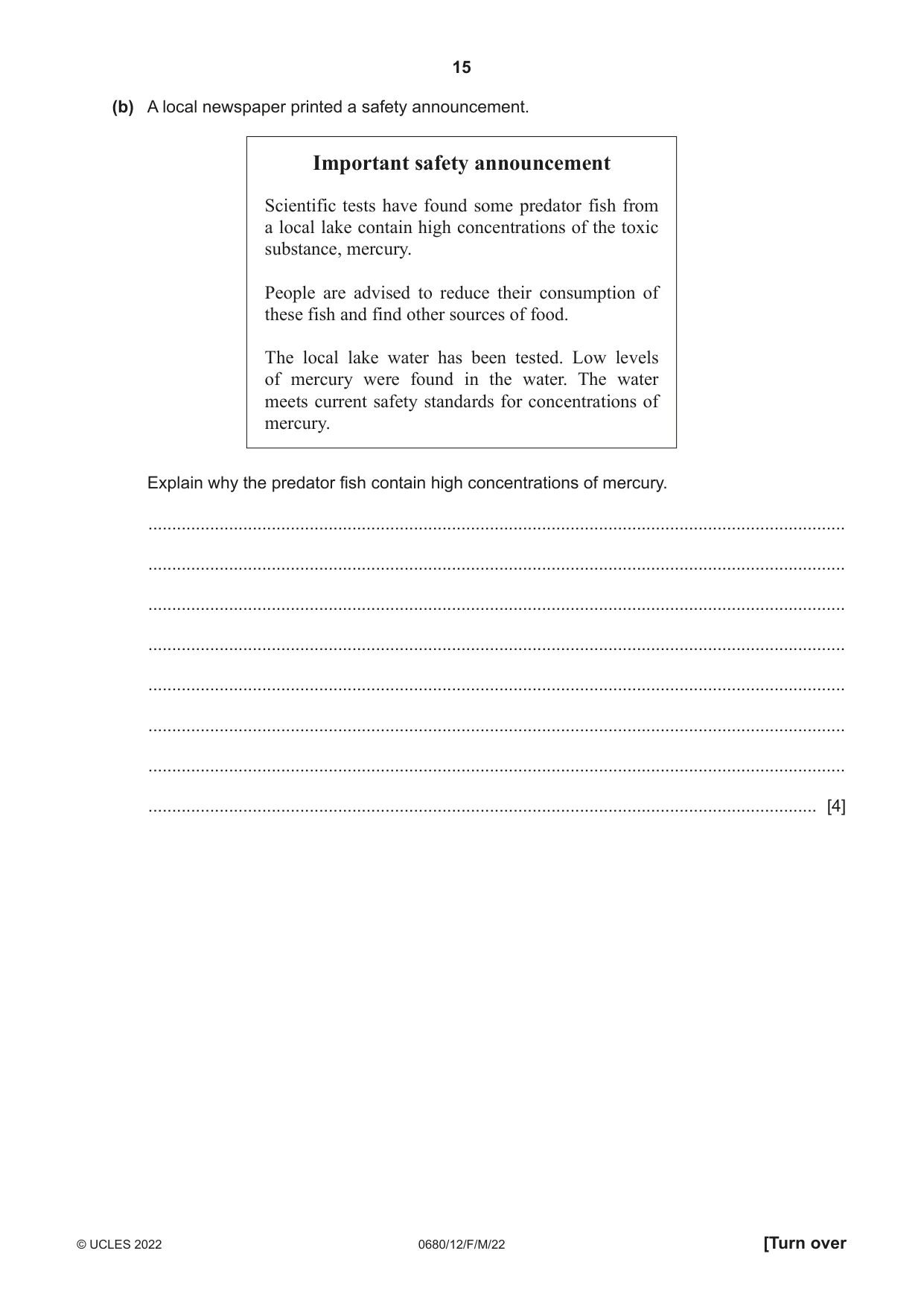
15 0680/12/F/M/22 © UCLES 2022 [Turn over (b) A local newspaper printed a safety announcement. Important safety announcement Scientific tests have found some predator fish from a local lake contain high concentrations of the toxic substance, mercury. People are advised to reduce their consumption of these fish and find other sources of food. The local lake water has been tested. Low levels of mercury were found in the water. The water meets current safety standards for concentrations of mercury. Explain why the predator fish contain high concentrations of mercury. … … … … … … … … [4]
Question paper, page 16
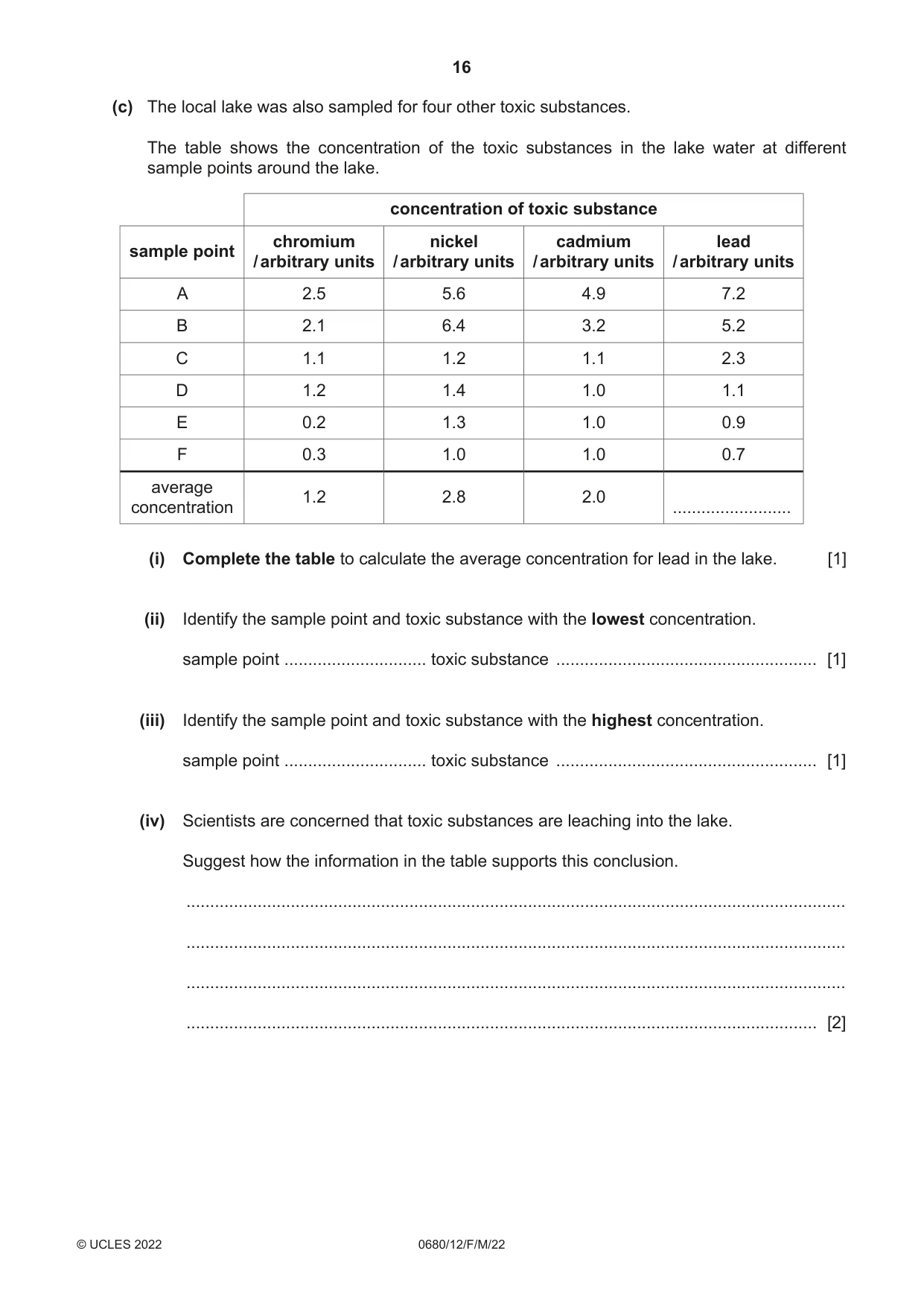
16 0680/12/F/M/22 © UCLES 2022 (c) The local lake was also sampled for four other toxic substances. The table shows the concentration of the toxic substances in the lake water at different sample points around the lake. concentration of toxic substance sample point chromium / arbitrary units nickel / arbitrary units cadmium / arbitrary units lead / arbitrary units A 2.5 5.6 4.9 7.2 B 2.1 6.4 3.2 5.2 C 1.1 1.2 1.1 2.3 D 1.2 1.4 1.0 1.1 E 0.2 1.3 1.0 0.9 F 0.3 1.0 1.0 0.7 average concentration 1.2 2.8 2.0 … (i) Complete the table to calculate the average concentration for lead in the lake. [1] (ii) Identify the sample point and toxic substance with the lowest concentration. sample point … toxic substance … [1] (iii) Identify the sample point and toxic substance with the highest concentration. sample point … toxic substance … [1] (iv) Scientists are concerned that toxic substances are leaching into the lake. Suggest how the information in the table supports this conclusion. … … … … [2]
Question paper, page 17
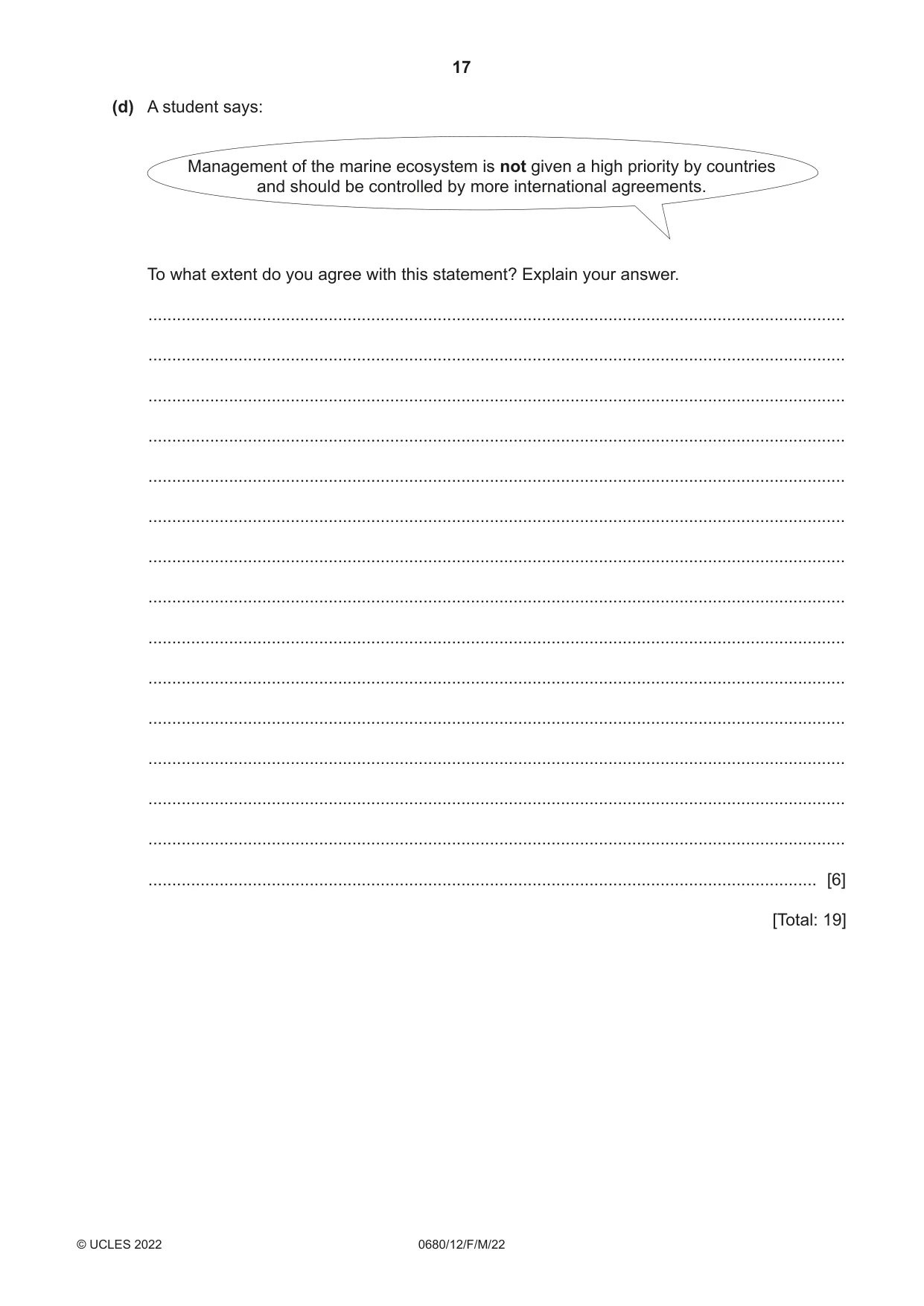
17 0680/12/F/M/22 © UCLES 2022 (d) A student says: Management of the marine ecosystem is not given a high priority by countries and should be controlled by more international agreements. To what extent do you agree with this statement? Explain your answer. … … … … … … … … … … … … … … … [6] [Total: 19]
Question paper, page 18
18 0680/12/F/M/22 © UCLES 2022 BLANK PAGE
Question paper, page 19
19 0680/12/F/M/22 © UCLES 2022 BLANK PAGE
Question paper, page 20
20 0680/12/F/M/22 © UCLES 2022 The boundaries and names shown, the designations used and the presentation of material on any maps contained in this question paper/insert do not imply official endorsement or acceptance by Cambridge Assessment International Education concerning the legal status of any country, territory, or area or any of its authorities, or of the delimitation of its frontiers or boundaries. Permission to reproduce items where third-party owned material protected by copyright is included has been sought and cleared where possible. Every reasonable effort has been made by the publisher (UCLES) to trace copyright holders, but if any items requiring clearance have unwittingly been included, the publisher will be pleased to make amends at the earliest possible opportunity. To avoid the issue of disclosure of answer-related information to candidates, all copyright acknowledgements are reproduced online in the Cambridge Assessment International Education Copyright Acknowledgements Booklet. This is produced for each series of examinations and is freely available to download at www.cambridgeinternational.org after the live examination series. Cambridge Assessment International Education is part of Cambridge Assessment. Cambridge Assessment is the brand name of the University of Cambridge Local Examinations Syndicate (UCLES), which is a department of the University of Cambridge. BLANK PAGE
Mark scheme, page 1
This document consists of 12 printed pages. © UCLES 2022 [Turn over Cambridge IGCSE™ ENVIRONMENTAL MANAGEMENT 0680/12 Paper 1 Theory February/March 2022 MARK SCHEME Maximum Mark: 80 Published This mark scheme is published as an aid to teachers and candidates, to indicate the requirements of the examination. It shows the basis on which Examiners were instructed to award marks. It does not indicate the details of the discussions that took place at an Examiners’ meeting before marking began, which would have considered the acceptability of alternative answers. Mark schemes should be read in conjunction with the question paper and the Principal Examiner Report for Teachers. Cambridge International will not enter into discussions about these mark schemes. Cambridge International is publishing the mark schemes for the February/March 2022 series for most Cambridge IGCSE™, Cambridge International A and AS Level components and some Cambridge O Level components.
Mark scheme, page 2
0680/12 Cambridge IGCSE – Mark Scheme PUBLISHED February/March 2022 © UCLES 2022 Page 2 of 12 Generic Marking Principles These general marking principles must be applied by all examiners when marking candidate answers. They should be applied alongside the specific content of the mark scheme or generic level descriptors for a question. Each question paper and mark scheme will also comply with these marking principles. GENERIC MARKING PRINCIPLE 1: Marks must be awarded in line with: • the specific content of the mark scheme or the generic level descriptors for the question • the specific skills defined in the mark scheme or in the generic level descriptors for the question • the standard of response required by a candidate as exemplified by the standardisation scripts. GENERIC MARKING PRINCIPLE 2: Marks awarded are always whole marks (not half marks, or other fractions). GENERIC MARKING PRINCIPLE 3: Marks must be awarded positively: • marks are awarded for correct/valid answers, as defined in the mark scheme. However, credit is given for valid answers which go beyond the scope of the syllabus and mark scheme, referring to your Team Leader as appropriate • marks are awarded when candidates clearly demonstrate what they know and can do • marks are not deducted for errors • marks are not deducted for omissions • answers should only be judged on the quality of spelling, punctuation and grammar when these features are specifically assessed by the question as indicated by the mark scheme. The meaning, however, should be unambiguous. GENERIC MARKING PRINCIPLE 4: Rules must be applied consistently, e.g. in situations where candidates have not followed instructions or in the application of generic level descriptors.
Mark scheme, page 3
0680/12 Cambridge IGCSE – Mark Scheme PUBLISHED February/March 2022 © UCLES 2022 Page 3 of 12 GENERIC MARKING PRINCIPLE 5: Marks should be awarded using the full range of marks defined in the mark scheme for the question (however; the use of the full mark range may be limited according to the quality of the candidate responses seen). GENERIC MARKING PRINCIPLE 6: Marks awarded are based solely on the requirements as defined in the mark scheme. Marks should not be awarded with grade thresholds or grade descriptors in mind. Science-Specific Marking Principles 1 Examiners should consider the context and scientific use of any keywords when awarding marks. Although keywords may be present, marks should not be awarded if the keywords are used incorrectly. 2 The examiner should not choose between contradictory statements given in the same question part, and credit should not be awarded for any correct statement that is contradicted within the same question part. Wrong science that is irrelevant to the question should be ignored. 3 Although spellings do not have to be correct, spellings of syllabus terms must allow for clear and unambiguous separation from other syllabus terms with which they may be confused (e.g. ethane / ethene, glucagon / glycogen, refraction / reflection). 4 The error carried forward (ecf) principle should be applied, where appropriate. If an incorrect answer is subsequently used in a scientifically correct way, the candidate should be awarded these subsequent marking points. Further guidance will be included in the mark scheme where necessary and any exceptions to this general principle will be noted. 5 ‘List rule’ guidance For questions that require n responses (e.g. State two reasons …): • The response should be read as continuous prose, even when numbered answer spaces are provided. • Any response marked ignore in the mark scheme should not count towards n. • Incorrect responses should not be awarded credit but will still count towards n. • Read the entire response to check for any responses that contradict those that would otherwise be credited. Credit should not be awarded for any responses that are contradicted within the rest of the response. Where two responses contradict one another, this should be treated as a single incorrect response. • Non-contradictory responses after the first n responses may be ignored even if they include incorrect science.
Mark scheme, page 4
0680/12 Cambridge IGCSE – Mark Scheme PUBLISHED February/March 2022 © UCLES 2022 Page 4 of 12 6 Calculation specific guidance Correct answers to calculations should be given full credit even if there is no working or incorrect working, unless the question states ‘show your working’. For questions in which the number of significant figures required is not stated, credit should be awarded for correct answers when rounded by the examiner to the number of significant figures given in the mark scheme. This may not apply to measured values. For answers given in standard form (e.g. a × 10n) in which the convention of restricting the value of the coefficient (a) to a value between 1 and 10 is not followed, credit may still be awarded if the answer can be converted to the answer given in the mark scheme. Unless a separate mark is given for a unit, a missing or incorrect unit will normally mean that the final calculation mark is not awarded. Exceptions to this general principle will be noted in the mark scheme. 7 Guidance for chemical equations Multiples / fractions of coefficients used in chemical equations are acceptable unless stated otherwise in the mark scheme. State symbols given in an equation should be ignored unless asked for in the question or stated otherwise in the mark scheme.
Mark scheme, page 5
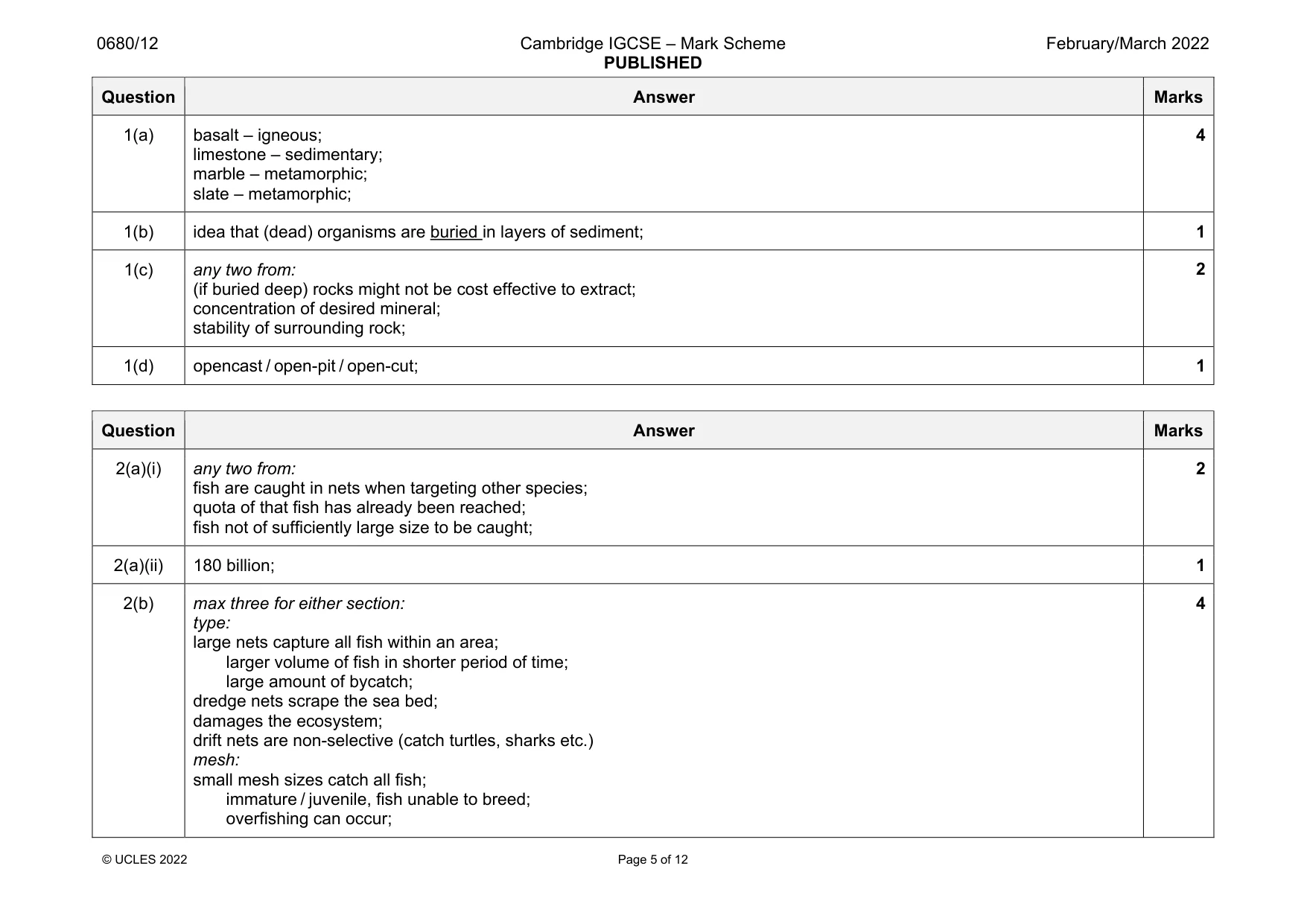
0680/12 Cambridge IGCSE – Mark Scheme PUBLISHED February/March 2022 © UCLES 2022 Page 5 of 12 Question Answer Marks 1(a) basalt – igneous; limestone – sedimentary; marble – metamorphic; slate – metamorphic; 4 1(b) idea that (dead) organisms are buried in layers of sediment; 1 1(c) any two from: (if buried deep) rocks might not be cost effective to extract; concentration of desired mineral; stability of surrounding rock; 2 1(d) opencast / open-pit / open-cut; 1 Question Answer Marks 2(a)(i) any two from: fish are caught in nets when targeting other species; quota of that fish has already been reached; fish not of sufficiently large size to be caught; 2 2(a)(ii) 180 billion; 1 2(b) max three for either section: type: large nets capture all fish within an area; larger volume of fish in shorter period of time; large amount of bycatch; dredge nets scrape the sea bed; damages the ecosystem; drift nets are non-selective (catch turtles, sharks etc.) mesh: small mesh sizes catch all fish; immature / juvenile, fish unable to breed; overfishing can occur; 4
Mark scheme, page 6
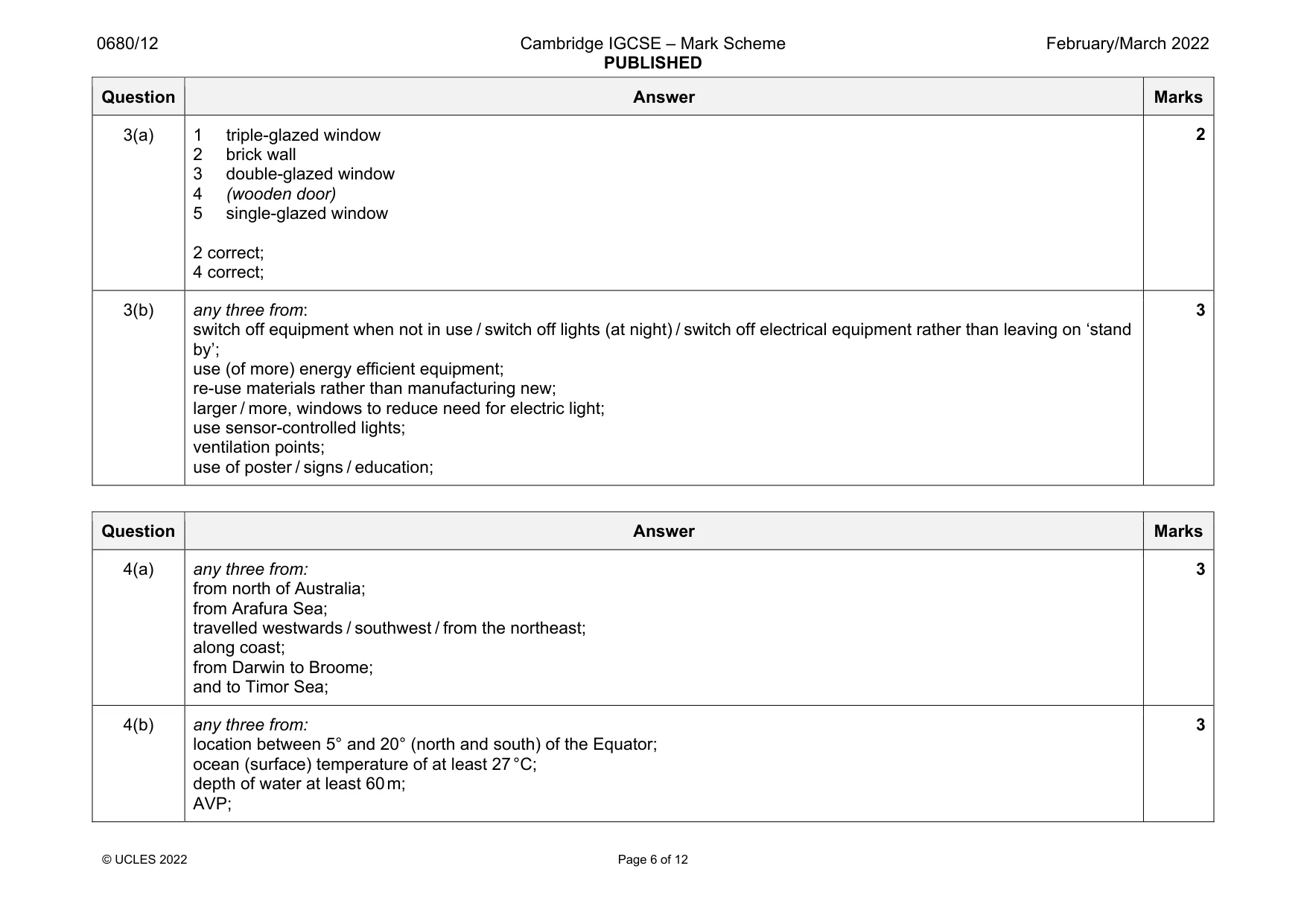
0680/12 Cambridge IGCSE – Mark Scheme PUBLISHED February/March 2022 © UCLES 2022 Page 6 of 12 Question Answer Marks 3(a) 1 triple-glazed window 2 brick wall 3 double-glazed window 4 (wooden door) 5 single-glazed window 2 correct; 4 correct; 2 3(b) any three from: switch off equipment when not in use / switch off lights (at night) / switch off electrical equipment rather than leaving on ‘stand by’; use (of more) energy efficient equipment; re-use materials rather than manufacturing new; larger / more, windows to reduce need for electric light; use sensor-controlled lights; ventilation points; use of poster / signs / education; 3 Question Answer Marks 4(a) any three from: from north of Australia; from Arafura Sea; travelled westwards / southwest / from the northeast; along coast; from Darwin to Broome; and to Timor Sea; 3 4(b) any three from: location between 5° and 20° (north and south) of the Equator; ocean (surface) temperature of at least 27 °C; depth of water at least 60 m; AVP; 3
Mark scheme, page 7
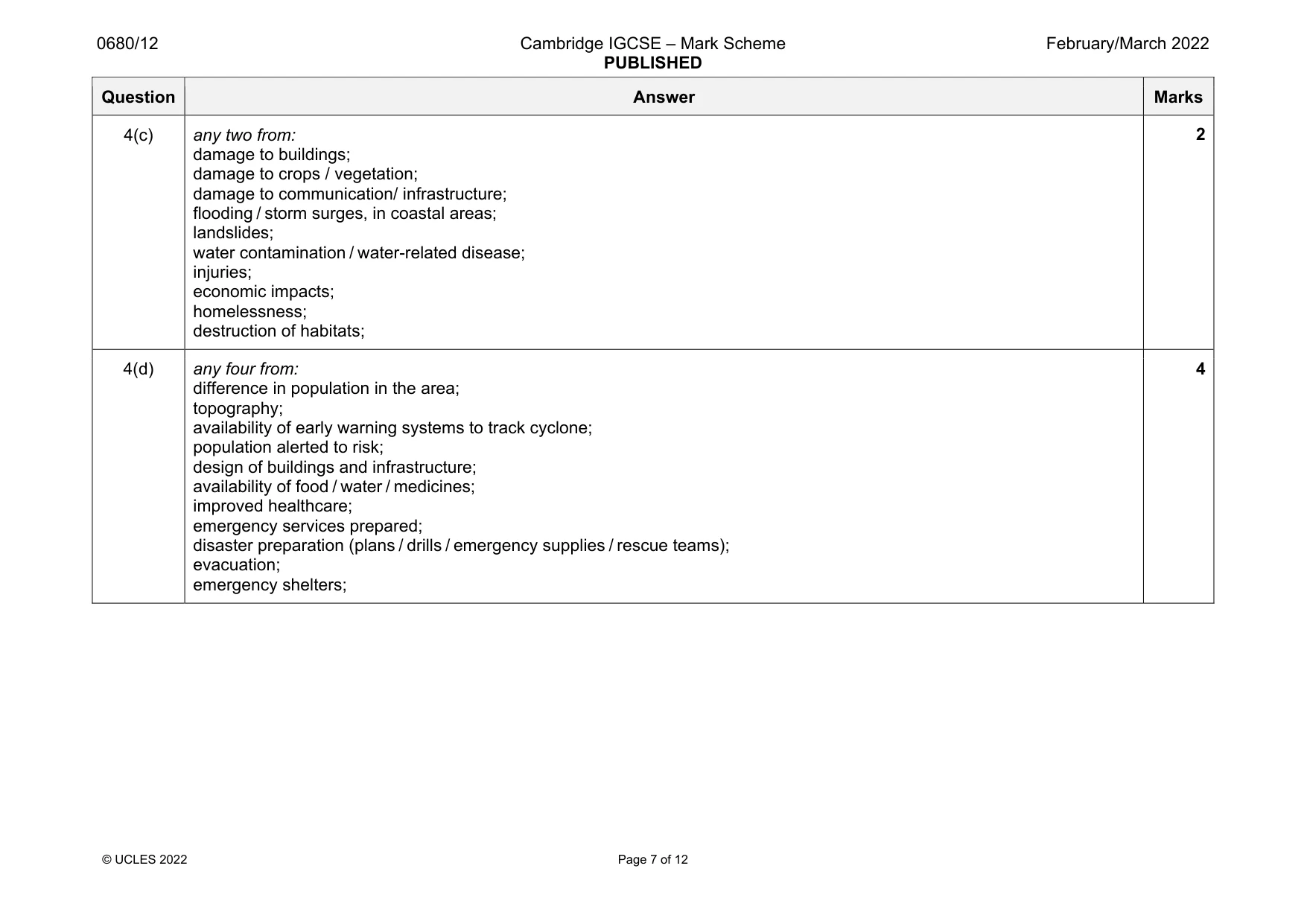
0680/12 Cambridge IGCSE – Mark Scheme PUBLISHED February/March 2022 © UCLES 2022 Page 7 of 12 Question Answer Marks 4(c) any two from: damage to buildings; damage to crops / vegetation; damage to communication/ infrastructure; flooding / storm surges, in coastal areas; landslides; water contamination / water-related disease; injuries; economic impacts; homelessness; destruction of habitats; 2 4(d) any four from: difference in population in the area; topography; availability of early warning systems to track cyclone; population alerted to risk; design of buildings and infrastructure; availability of food / water / medicines; improved healthcare; emergency services prepared; disaster preparation (plans / drills / emergency supplies / rescue teams); evacuation; emergency shelters; 4
Mark scheme, page 8
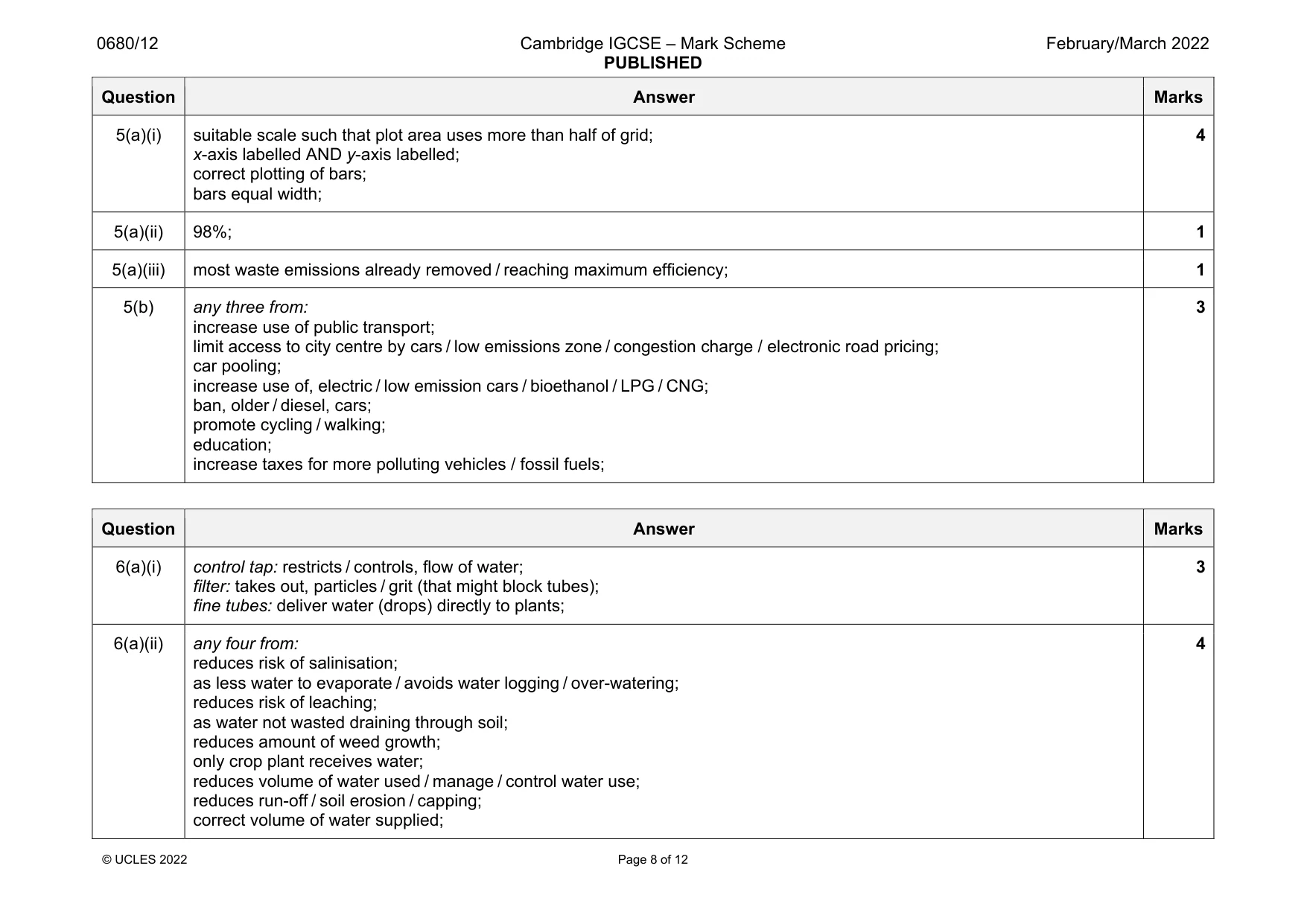
0680/12 Cambridge IGCSE – Mark Scheme PUBLISHED February/March 2022 © UCLES 2022 Page 8 of 12 Question Answer Marks 5(a)(i) suitable scale such that plot area uses more than half of grid; x-axis labelled AND y-axis labelled; correct plotting of bars; bars equal width; 4 5(a)(ii) 98%; 1 5(a)(iii) most waste emissions already removed / reaching maximum efficiency; 1 5(b) any three from: increase use of public transport; limit access to city centre by cars / low emissions zone / congestion charge / electronic road pricing; car pooling; increase use of, electric / low emission cars / bioethanol / LPG / CNG; ban, older / diesel, cars; promote cycling / walking; education; increase taxes for more polluting vehicles / fossil fuels; 3 Question Answer Marks 6(a)(i) control tap: restricts / controls, flow of water; filter: takes out, particles / grit (that might block tubes); fine tubes: deliver water (drops) directly to plants; 3 6(a)(ii) any four from: reduces risk of salinisation; as less water to evaporate / avoids water logging / over-watering; reduces risk of leaching; as water not wasted draining through soil; reduces amount of weed growth; only crop plant receives water; reduces volume of water used / manage / control water use; reduces run-off / soil erosion / capping; correct volume of water supplied; 4
Mark scheme, page 9
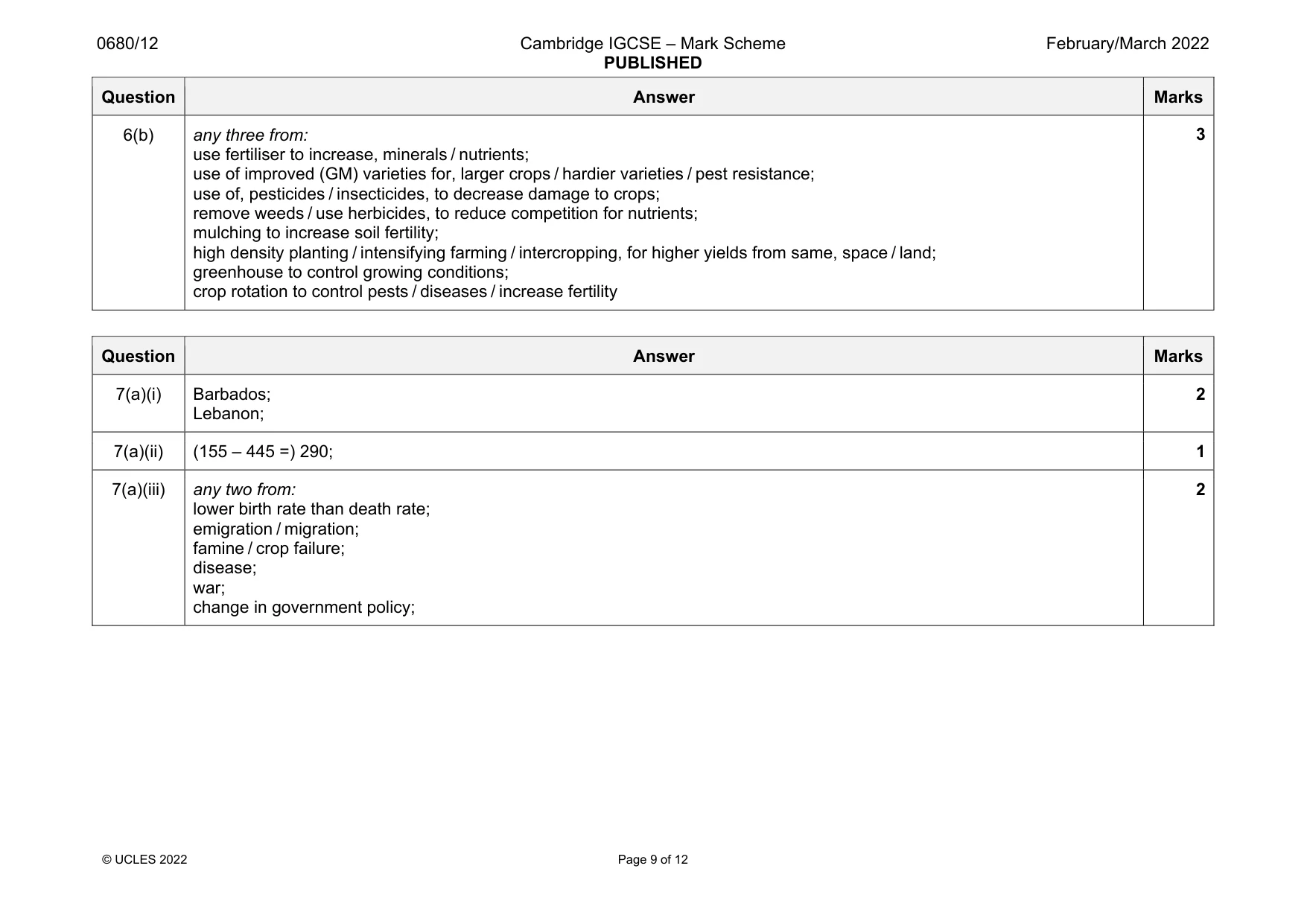
0680/12 Cambridge IGCSE – Mark Scheme PUBLISHED February/March 2022 © UCLES 2022 Page 9 of 12 Question Answer Marks 6(b) any three from: use fertiliser to increase, minerals / nutrients; use of improved (GM) varieties for, larger crops / hardier varieties / pest resistance; use of, pesticides / insecticides, to decrease damage to crops; remove weeds / use herbicides, to reduce competition for nutrients; mulching to increase soil fertility; high density planting / intensifying farming / intercropping, for higher yields from same, space / land; greenhouse to control growing conditions; crop rotation to control pests / diseases / increase fertility 3 Question Answer Marks 7(a)(i) Barbados; Lebanon; 2 7(a)(ii) (155 – 445 =) 290; 1 7(a)(iii) any two from: lower birth rate than death rate; emigration / migration; famine / crop failure; disease; war; change in government policy; 2
Mark scheme, page 10
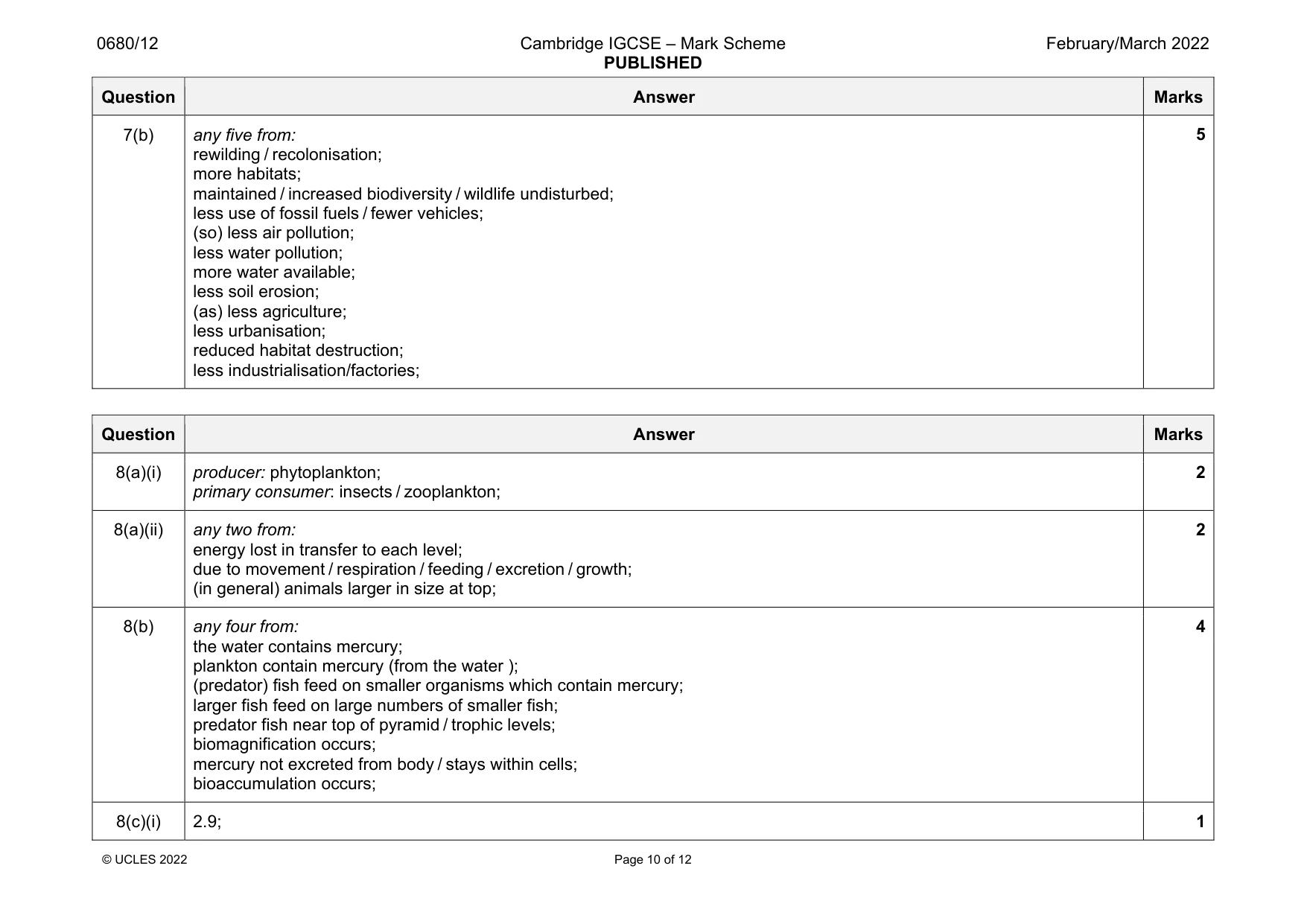
0680/12 Cambridge IGCSE – Mark Scheme PUBLISHED February/March 2022 © UCLES 2022 Page 10 of 12 Question Answer Marks 7(b) any five from: rewilding / recolonisation; more habitats; maintained / increased biodiversity / wildlife undisturbed; less use of fossil fuels / fewer vehicles; (so) less air pollution; less water pollution; more water available; less soil erosion; (as) less agriculture; less urbanisation; reduced habitat destruction; less industrialisation/factories; 5 Question Answer Marks 8(a)(i) producer: phytoplankton; primary consumer: insects / zooplankton; 2 8(a)(ii) any two from: energy lost in transfer to each level; due to movement / respiration / feeding / excretion / growth; (in general) animals larger in size at top; 2 8(b) any four from: the water contains mercury; plankton contain mercury (from the water ); (predator) fish feed on smaller organisms which contain mercury; larger fish feed on large numbers of smaller fish; predator fish near top of pyramid / trophic levels; biomagnification occurs; mercury not excreted from body / stays within cells; bioaccumulation occurs; 4 8(c)(i) 2.9; 1
Mark scheme, page 11
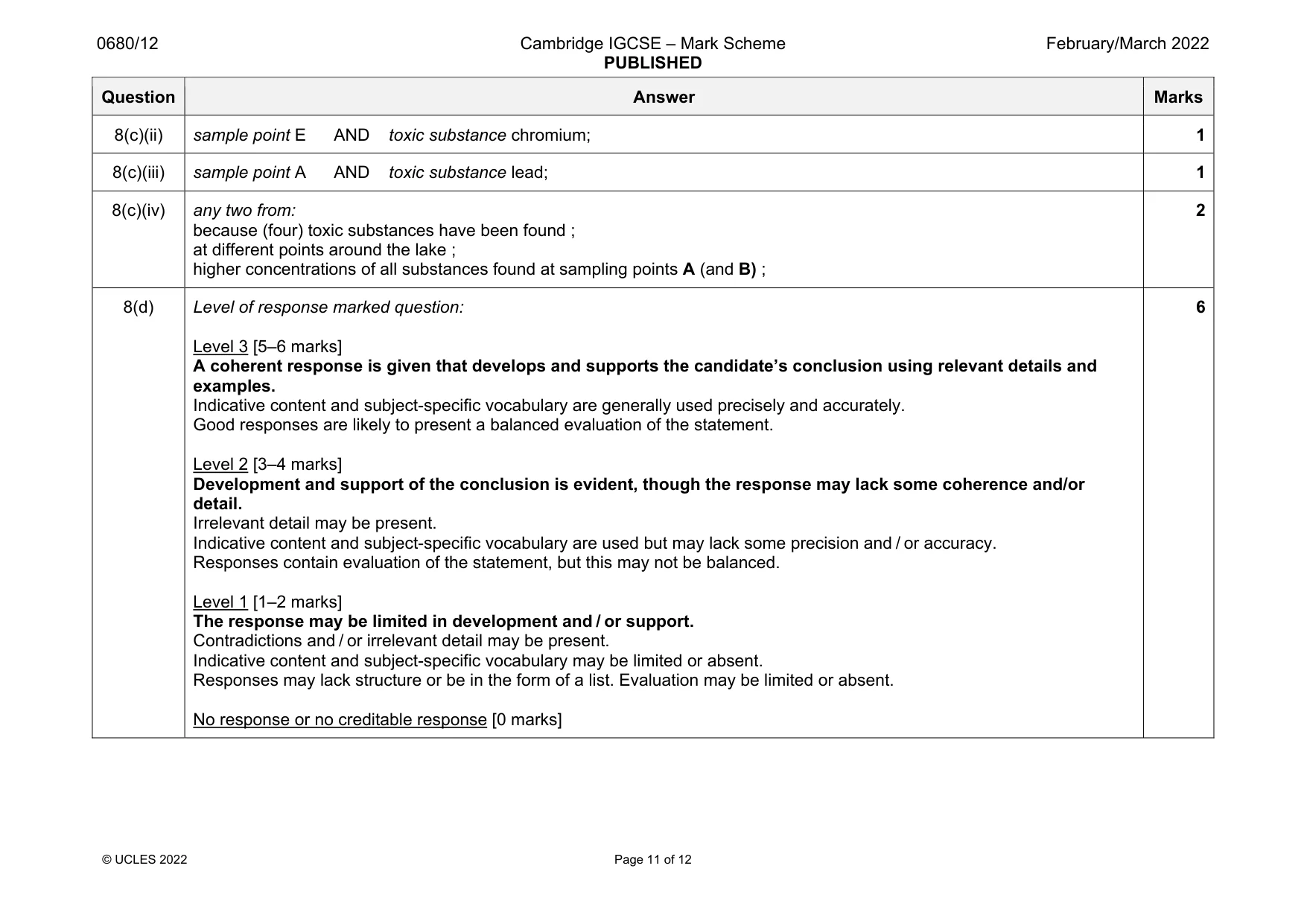
0680/12 Cambridge IGCSE – Mark Scheme PUBLISHED February/March 2022 © UCLES 2022 Page 11 of 12 Question Answer Marks 8(c)(ii) sample point E AND toxic substance chromium; 1 8(c)(iii) sample point A AND toxic substance lead; 1 8(c)(iv) any two from: because (four) toxic substances have been found ; at different points around the lake ; higher concentrations of all substances found at sampling points A (and B) ; 2 8(d) Level of response marked question: Level 3 [5–6 marks] A coherent response is given that develops and supports the candidate’s conclusion using relevant details and examples. Indicative content and subject-specific vocabulary are generally used precisely and accurately. Good responses are likely to present a balanced evaluation of the statement. Level 2 [3–4 marks] Development and support of the conclusion is evident, though the response may lack some coherence and/or detail. Irrelevant detail may be present. Indicative content and subject-specific vocabulary are used but may lack some precision and / or accuracy. Responses contain evaluation of the statement, but this may not be balanced. Level 1 [1–2 marks] The response may be limited in development and / or support. Contradictions and / or irrelevant detail may be present. Indicative content and subject-specific vocabulary may be limited or absent. Responses may lack structure or be in the form of a list. Evaluation may be limited or absent. No response or no creditable response [0 marks] 6
Mark scheme, page 12
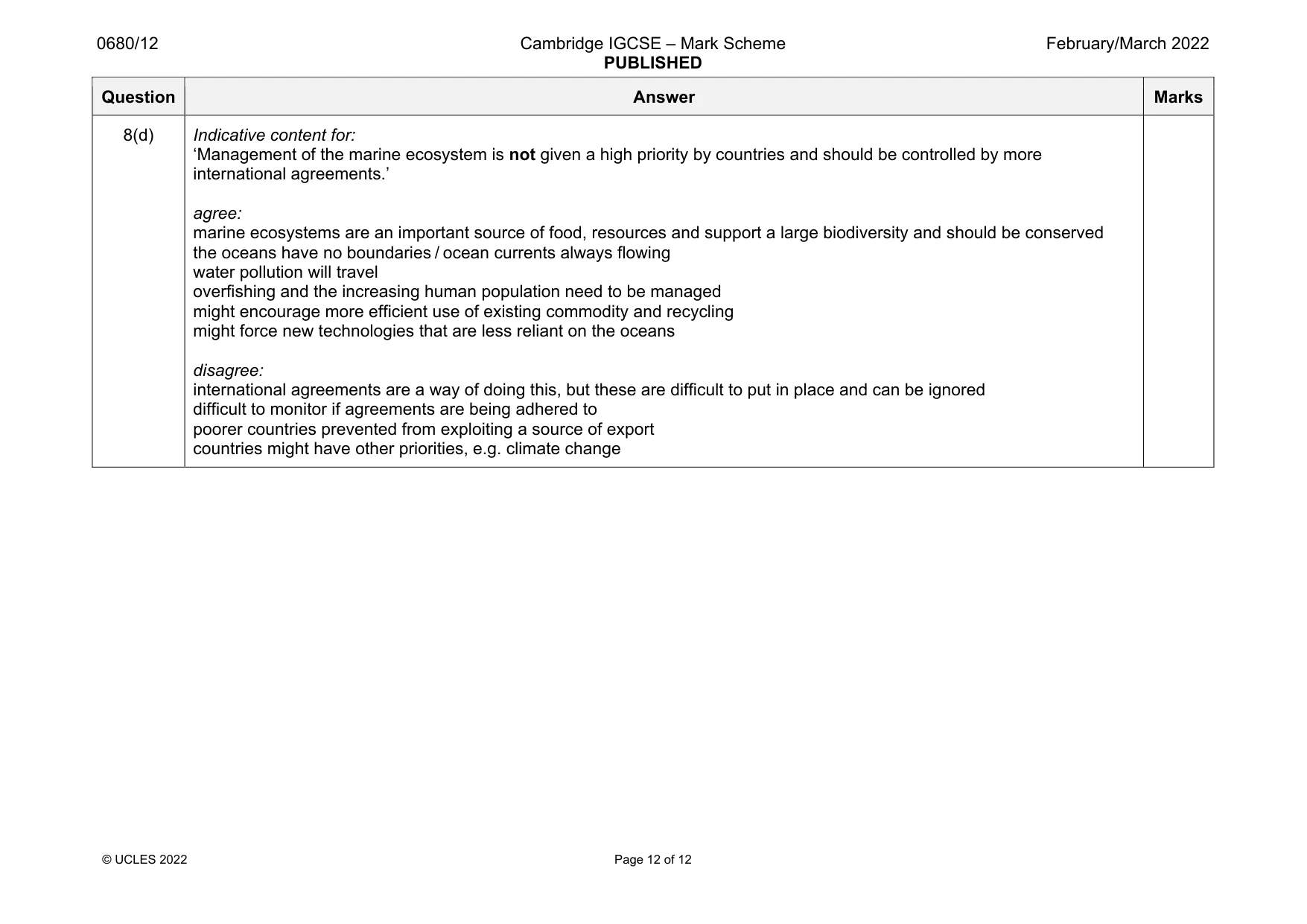
0680/12 Cambridge IGCSE – Mark Scheme PUBLISHED February/March 2022 © UCLES 2022 Page 12 of 12 Question Answer Marks 8(d) Indicative content for: ‘Management of the marine ecosystem is not given a high priority by countries and should be controlled by more international agreements.’ agree: marine ecosystems are an important source of food, resources and support a large biodiversity and should be conserved the oceans have no boundaries / ocean currents always flowing water pollution will travel overfishing and the increasing human population need to be managed might encourage more efficient use of existing commodity and recycling might force new technologies that are less reliant on the oceans disagree: international agreements are a way of doing this, but these are difficult to put in place and can be ignored difficult to monitor if agreements are being adhered to poorer countries prevented from exploiting a source of export countries might have other priorities, e.g. climate change
What you needed in this session
Cambridge’s own grade thresholds for 2022 Feb/March, Paper 1 · Variant 2. A higher threshold means an easier paper — the bar moves with how the cohort did.