Cambridge IGCSE Environmental Management 0680 — 2021 Feb/March Paper 1 · Variant 2
0680/12/F/M/21 · 80 marks · ≈90 min
The question paper and its mark scheme, free to read here and free to download. This is Cambridge’s own paper, exactly as it was sat.
Question paper24 pages



Mark scheme14 pages
Answers below. Sit the paper first if you are practising.
Paper as text
Question paper, page 1
This document has 24 pages. Any blank pages are indicated. DC (RW/CB) 208138/2 © UCLES 2021 [Turn over * 2 4 6 3 4 5 0 0 4 1 * ENVIRONMENTAL MANAGEMENT 0680/12 Paper 1 Theory February/March 2021 1 hour 45 minutes You must answer on the question paper. No additional materials are needed. INSTRUCTIONS ● Answer all questions. ● Use a black or dark blue pen. You may use an HB pencil for any diagrams or graphs. ● Write your name, centre number and candidate number in the boxes at the top of the page. ● Write your answer to each question in the space provided. ● Do not use an erasable pen or correction fluid. ● Do not write on any bar codes. ● You may use a calculator. ● You should show all your working and use appropriate units. INFORMATION ● The total mark for this paper is 80. ● The number of marks for each question or part question is shown in brackets [ ]. Cambridge IGCSE™
Question paper, page 2
2 0680/12/F/M/21 © UCLES 2021 Section A 1 (a) Ozone depletion occurs in the ozone layer. (i) Name the layer of the Earth’s atmosphere that contains the ozone layer. … [1] (ii) Describe the impacts of ozone depletion. … … … … [2] (b) Suggest reasons why strategies to prevent further ozone depletion require international agreement. … … … … [2] [Total: 5]
Question paper, page 3
3 0680/12/F/M/21 © UCLES 2021 [Turn over 2 (a) Typhoid is an infectious bacterial disease. People are infected by eating or drinking contaminated food or water. Give reasons why typhoid is more likely to occur in informal settlements (shanty towns) than in planned urban areas. … … … … … … [3] (b) State the name of one other infectious bacterial disease that is caused by eating or drinking contaminated food or water. … [1] [Total: 4]
Question paper, page 4
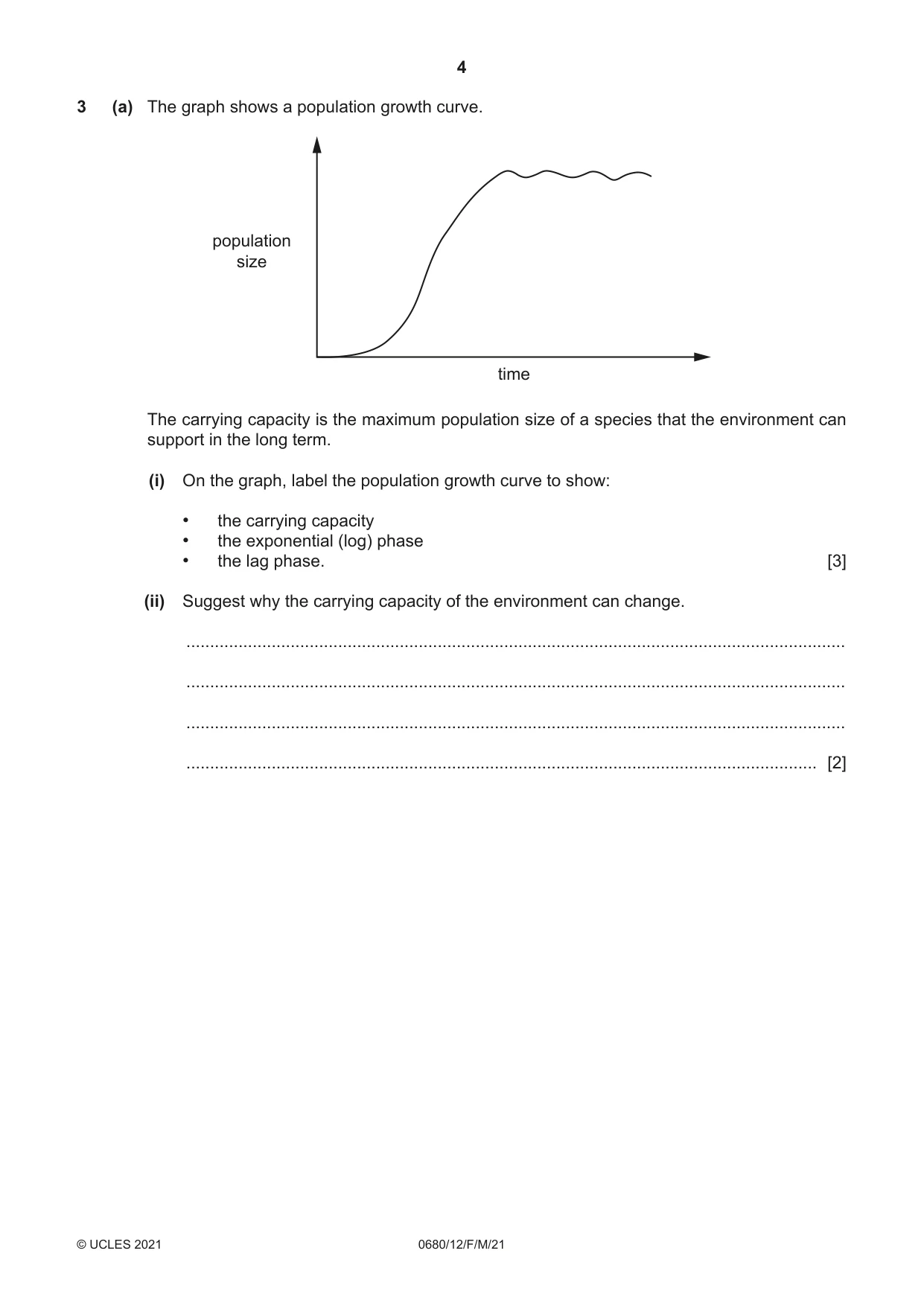
4 0680/12/F/M/21 © UCLES 2021 3 (a) The graph shows a population growth curve. time population size The carrying capacity is the maximum population size of a species that the environment can support in the long term. (i) On the graph, label the population growth curve to show: • the carrying capacity • the exponential (log) phase • the lag phase. [3] (ii) Suggest why the carrying capacity of the environment can change. … … … … [2]
Question paper, page 5
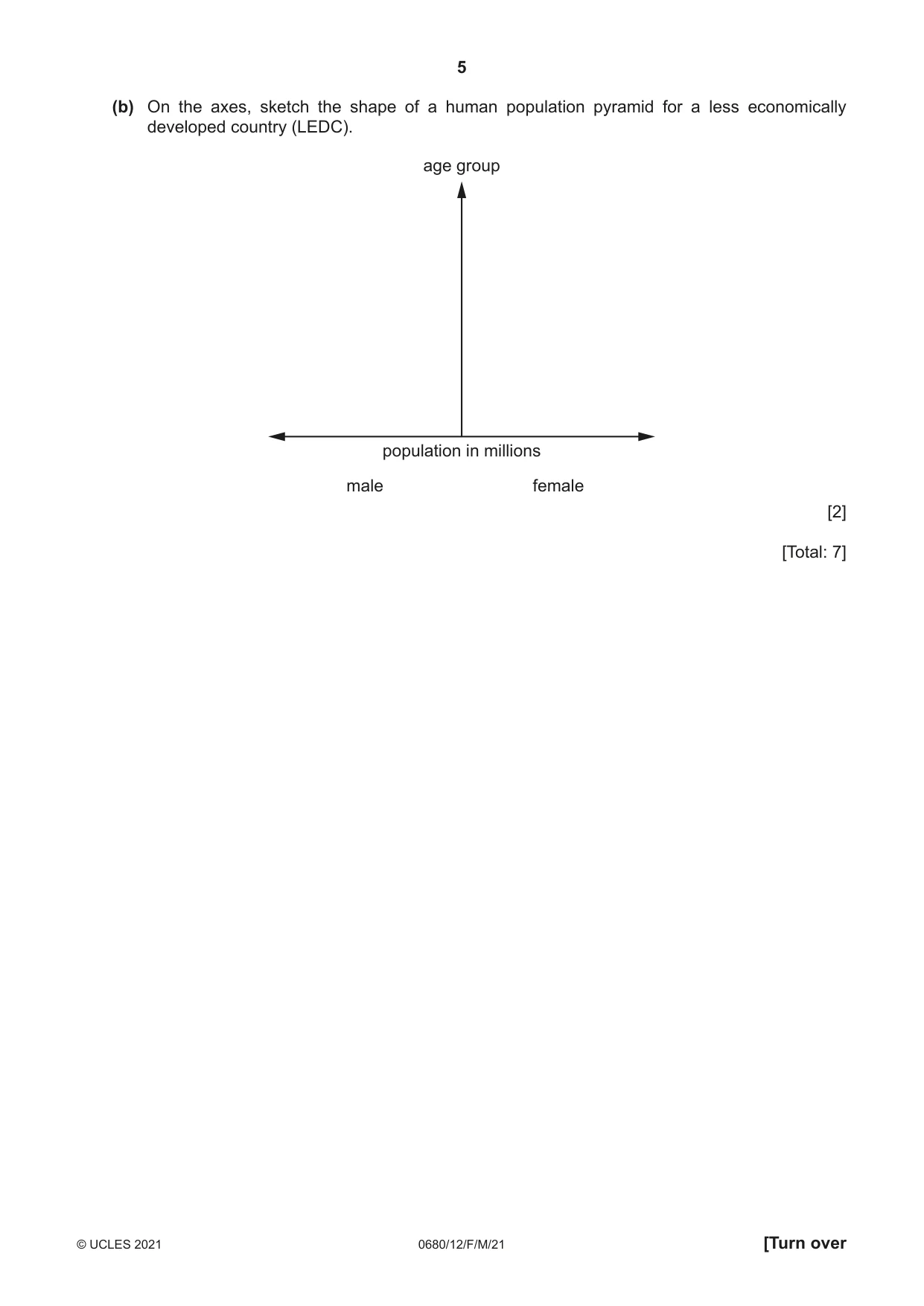
5 0680/12/F/M/21 © UCLES 2021 [Turn over (b) On the axes, sketch the shape of a human population pyramid for a less economically developed country (LEDC). age group population in millions male female [2] [Total: 7]
Question paper, page 6
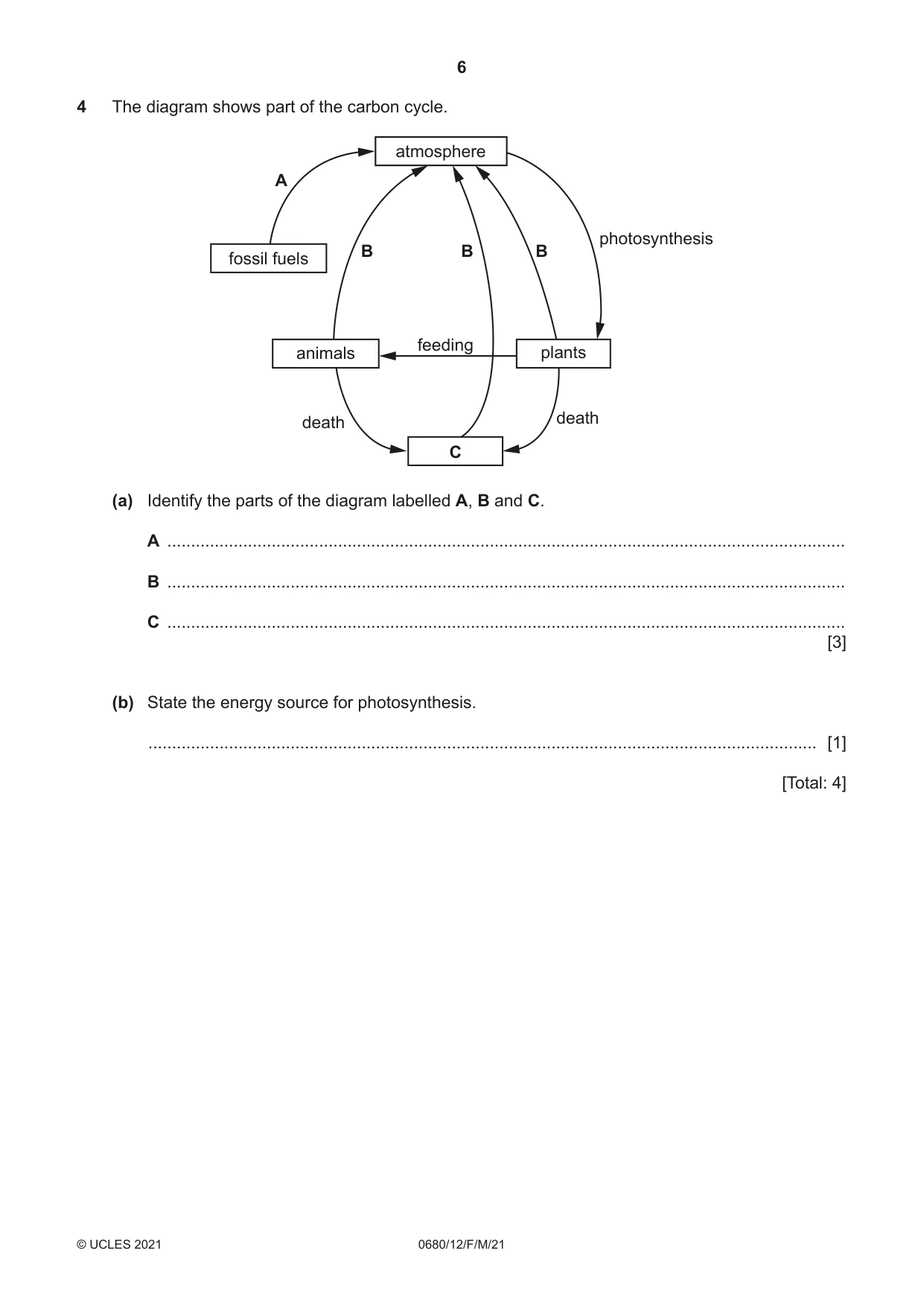
6 0680/12/F/M/21 © UCLES 2021 4 The diagram shows part of the carbon cycle. atmosphere fossil fuels animals plants C A B B B death photosynthesis death feeding (a) Identify the parts of the diagram labelled A, B and C. A … B … C … [3] (b) State the energy source for photosynthesis. … [1] [Total: 4]
Question paper, page 7
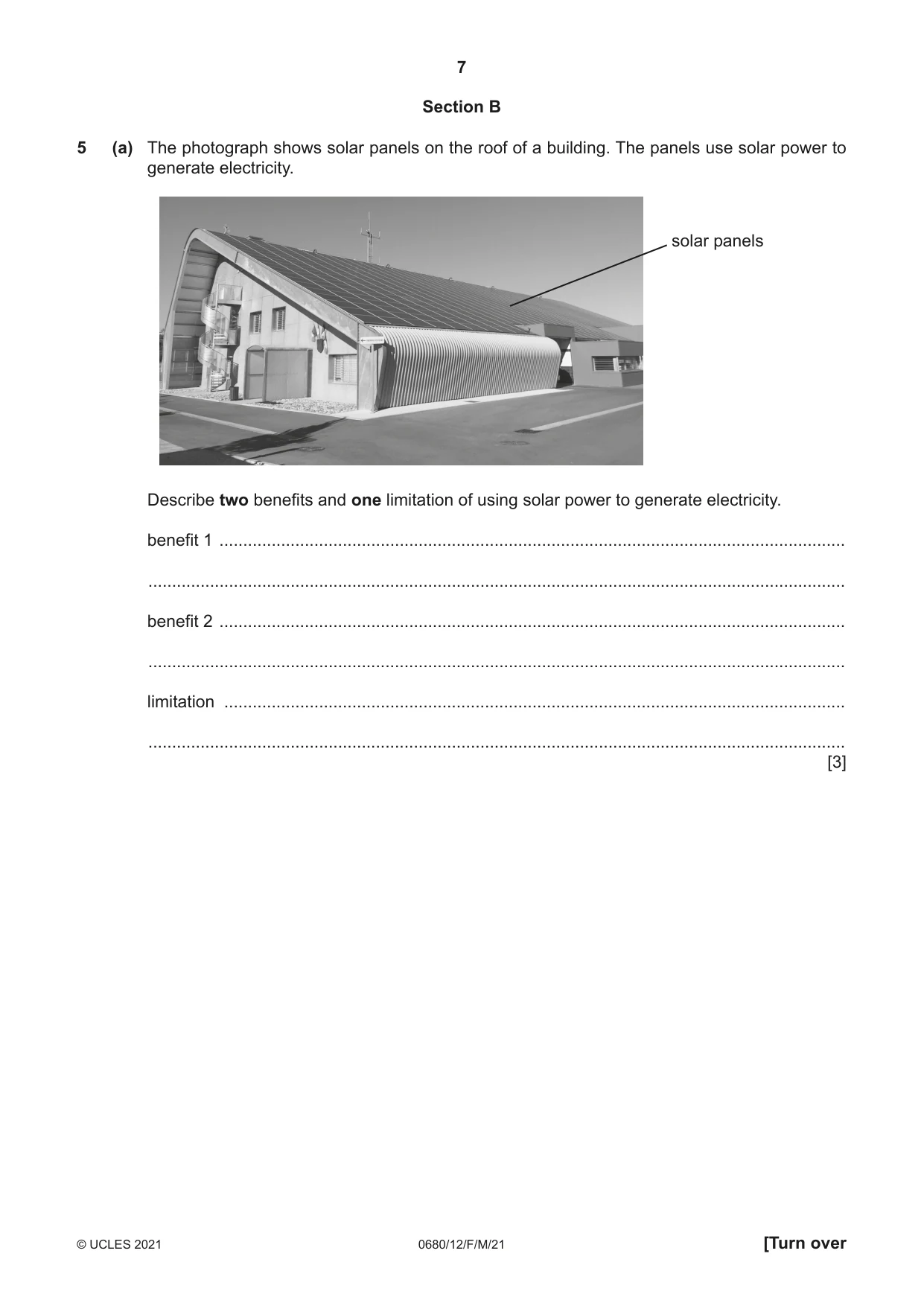
7 0680/12/F/M/21 © UCLES 2021 [Turn over Section B 5 (a) The photograph shows solar panels on the roof of a building. The panels use solar power to generate electricity. solar panels Describe two benefits and one limitation of using solar power to generate electricity. benefit 1 … … benefit 2 … … limitation … … [3]
Question paper, page 8
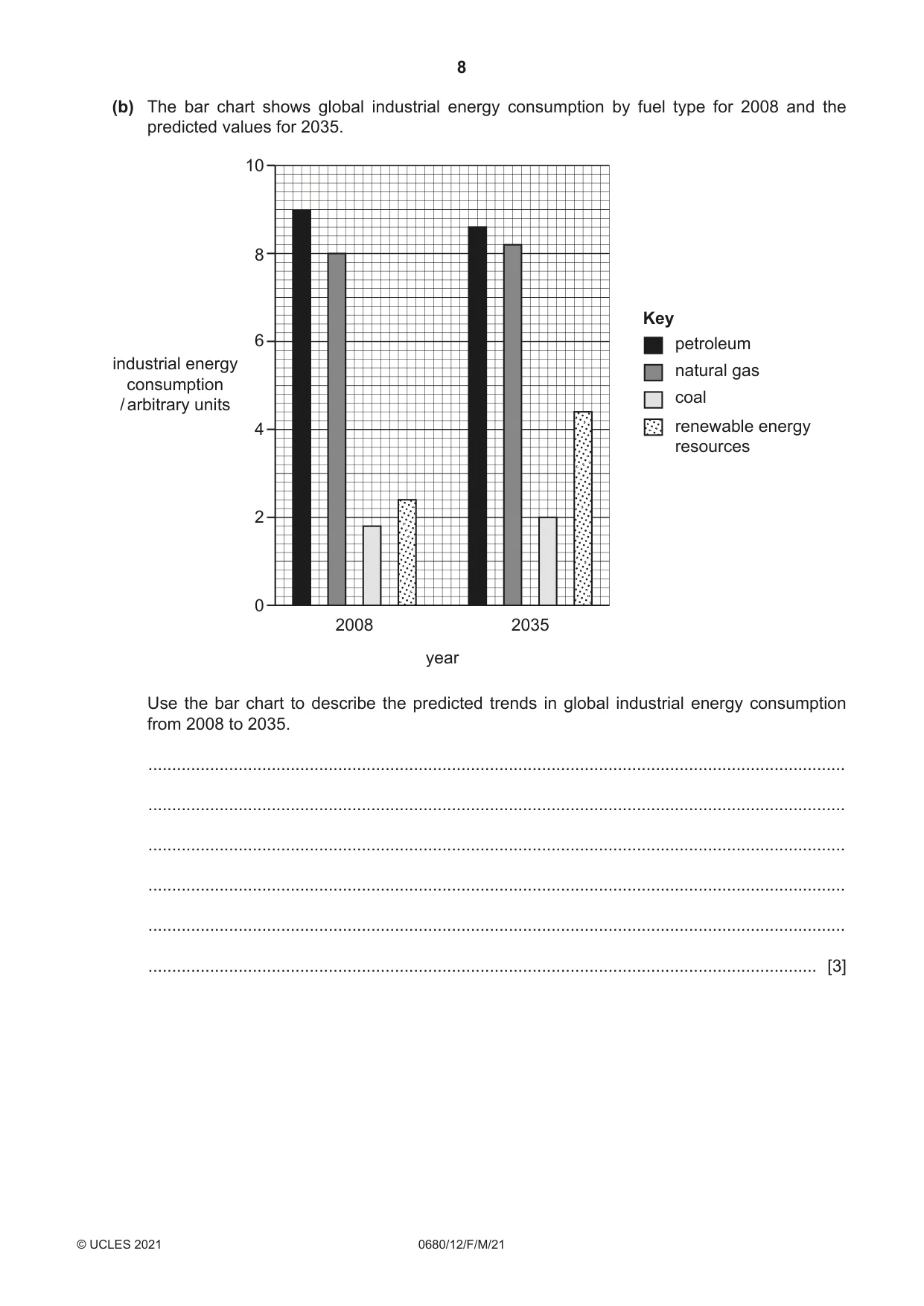
8 0680/12/F/M/21 © UCLES 2021 (b) The bar chart shows global industrial energy consumption by fuel type for 2008 and the predicted values for 2035. 2008 2035 year industrial energy consumption / arbitrary units 0 2 4 6 8 10 petroleum natural gas coal renewable energy resources Key Use the bar chart to describe the predicted trends in global industrial energy consumption from 2008 to 2035. … … … … … … [3]
Question paper, page 9
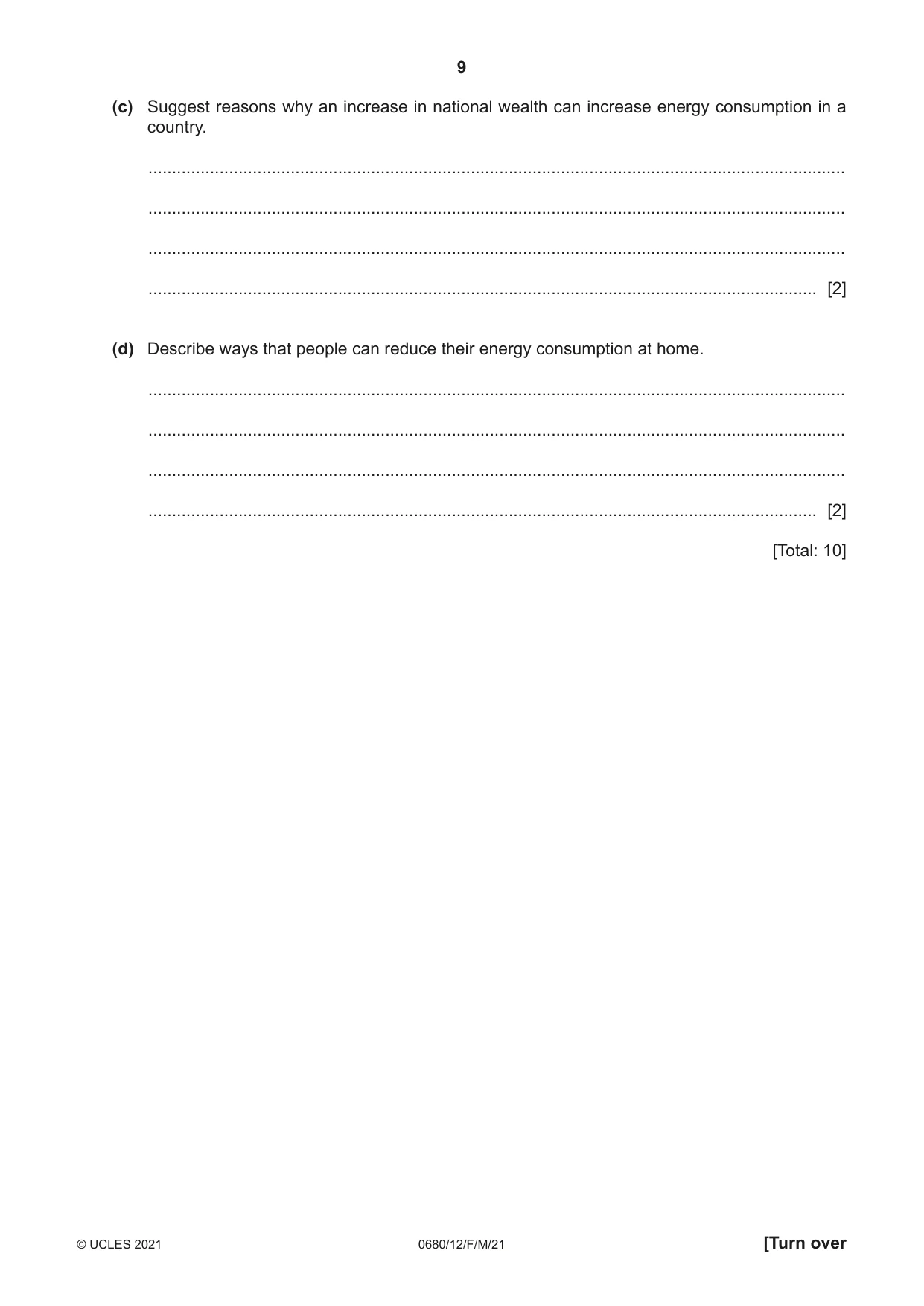
9 0680/12/F/M/21 © UCLES 2021 [Turn over (c) Suggest reasons why an increase in national wealth can increase energy consumption in a country. … … … … [2] (d) Describe ways that people can reduce their energy consumption at home. … … … … [2] [Total: 10]
Question paper, page 10
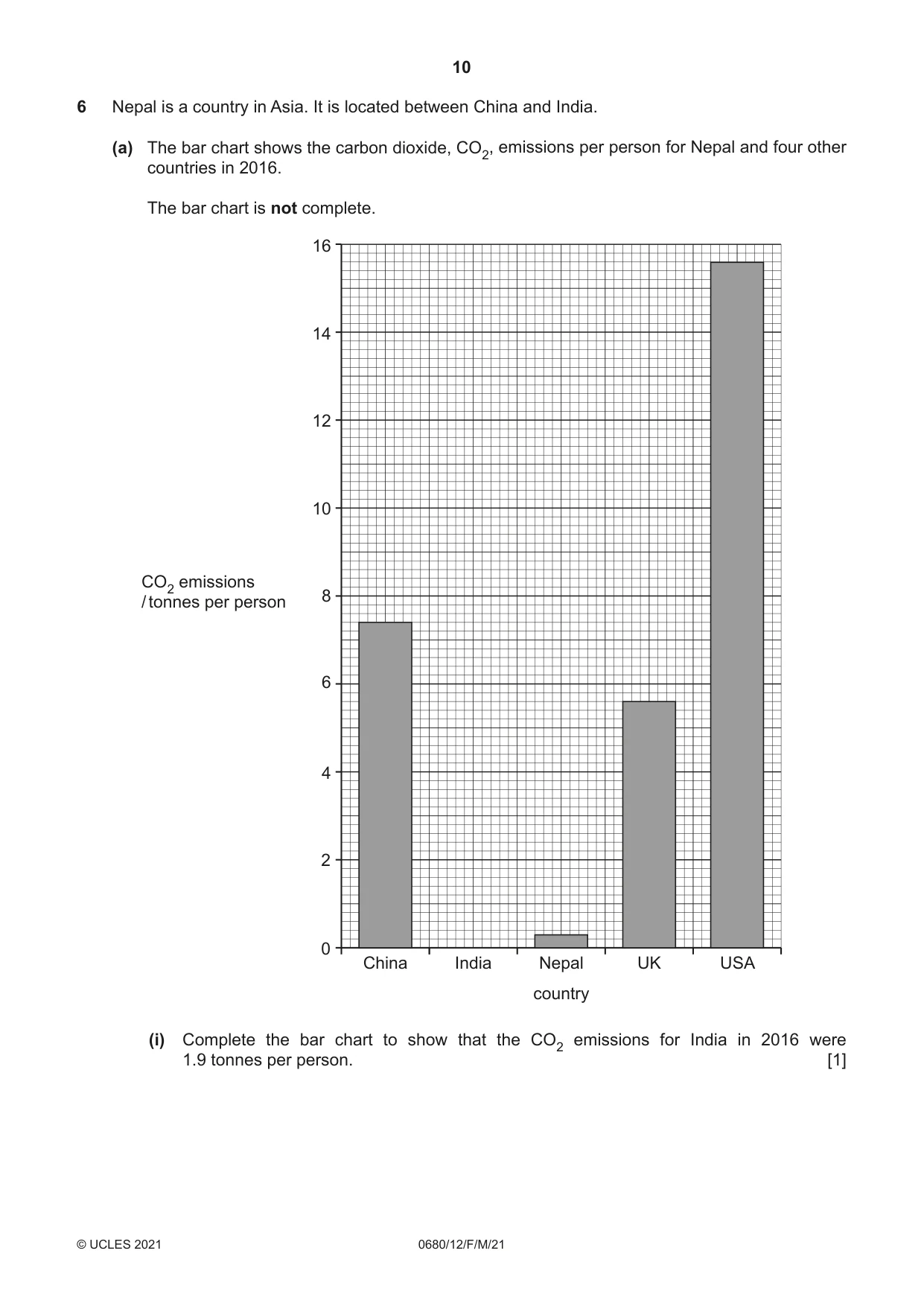
10 0680/12/F/M/21 © UCLES 2021 6 Nepal is a country in Asia. It is located between China and India. (a) The bar chart shows the carbon dioxide, CO2, emissions per person for Nepal and four other countries in 2016. The bar chart is not complete. CO2 emissions / tonnes per person 2 0 4 6 8 10 12 14 16 China India Nepal UK USA country (i) Complete the bar chart to show that the CO2 emissions for India in 2016 were 1.9 tonnes per person. [1]
Question paper, page 11
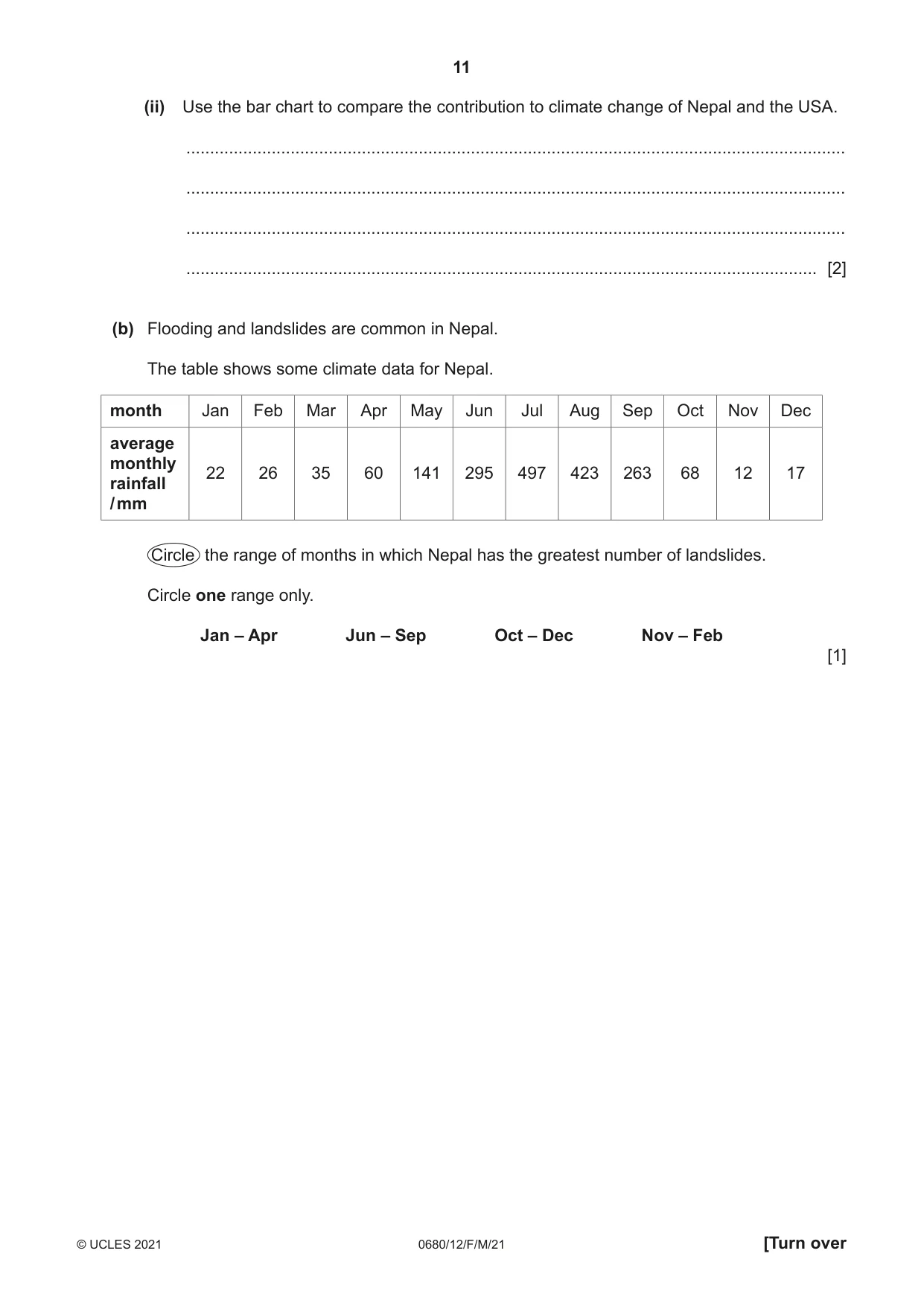
11 0680/12/F/M/21 © UCLES 2021 [Turn over (ii) Use the bar chart to compare the contribution to climate change of Nepal and the USA. … … … … [2] (b) Flooding and landslides are common in Nepal. The table shows some climate data for Nepal. month Jan Feb Mar Apr May Jun Jul Aug Sep Oct Nov Dec average monthly rainfall / mm 22 26 35 60 141 295 497 423 263 68 12 17 Circle the range of months in which Nepal has the greatest number of landslides. Circle one range only. Jan – Apr Jun – Sep Oct – Dec Nov – Feb [1]
Question paper, page 12
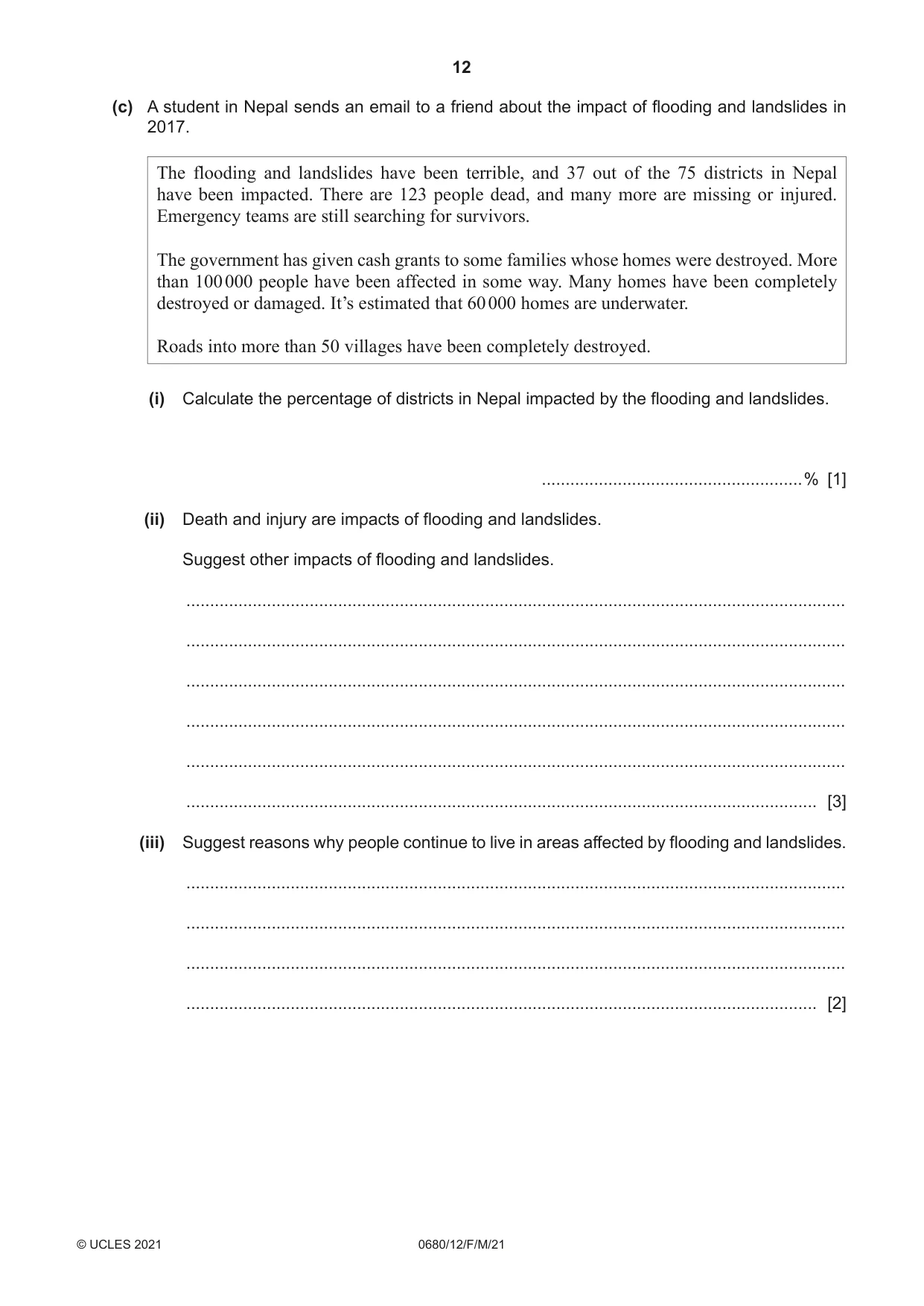
12 0680/12/F/M/21 © UCLES 2021 (c) A student in Nepal sends an email to a friend about the impact of flooding and landslides in 2017. The flooding and landslides have been terrible, and 37 out of the 75 districts in Nepal have been impacted. There are 123 people dead, and many more are missing or injured. Emergency teams are still searching for survivors. The government has given cash grants to some families whose homes were destroyed. More than 100 000 people have been affected in some way. Many homes have been completely destroyed or damaged. It’s estimated that 60 000 homes are underwater. Roads into more than 50 villages have been completely destroyed. (i) Calculate the percentage of districts in Nepal impacted by the flooding and landslides. …% [1] (ii) Death and injury are impacts of flooding and landslides. Suggest other impacts of flooding and landslides. … … … … … … [3] (iii) Suggest reasons why people continue to live in areas affected by flooding and landslides. … … … … [2]
Question paper, page 13
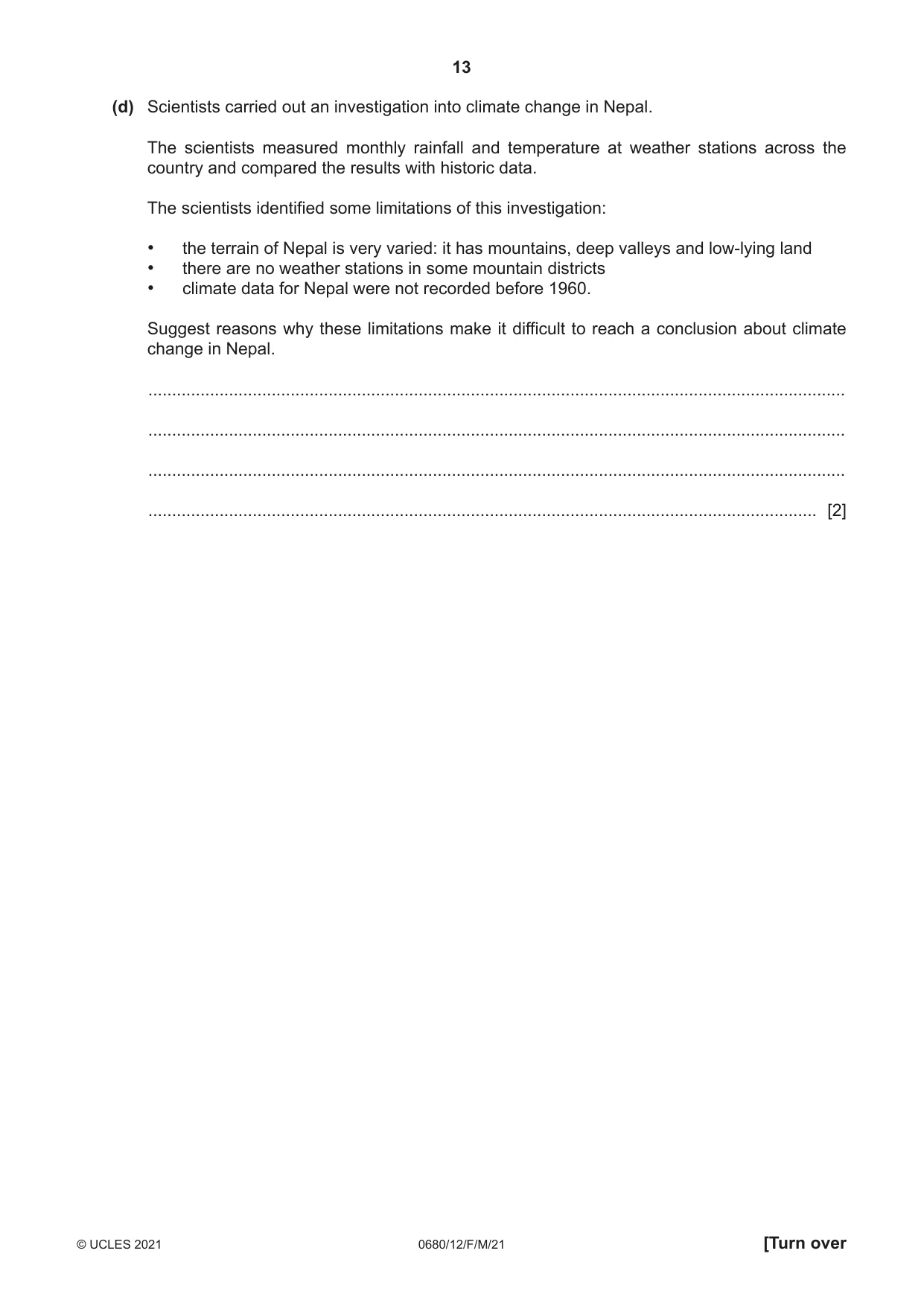
13 0680/12/F/M/21 © UCLES 2021 [Turn over (d) Scientists carried out an investigation into climate change in Nepal. The scientists measured monthly rainfall and temperature at weather stations across the country and compared the results with historic data. The scientists identified some limitations of this investigation: • the terrain of Nepal is very varied: it has mountains, deep valleys and low‑lying land • there are no weather stations in some mountain districts • climate data for Nepal were not recorded before 1960. Suggest reasons why these limitations make it difficult to reach a conclusion about climate change in Nepal. … … … … [2]
Question paper, page 14
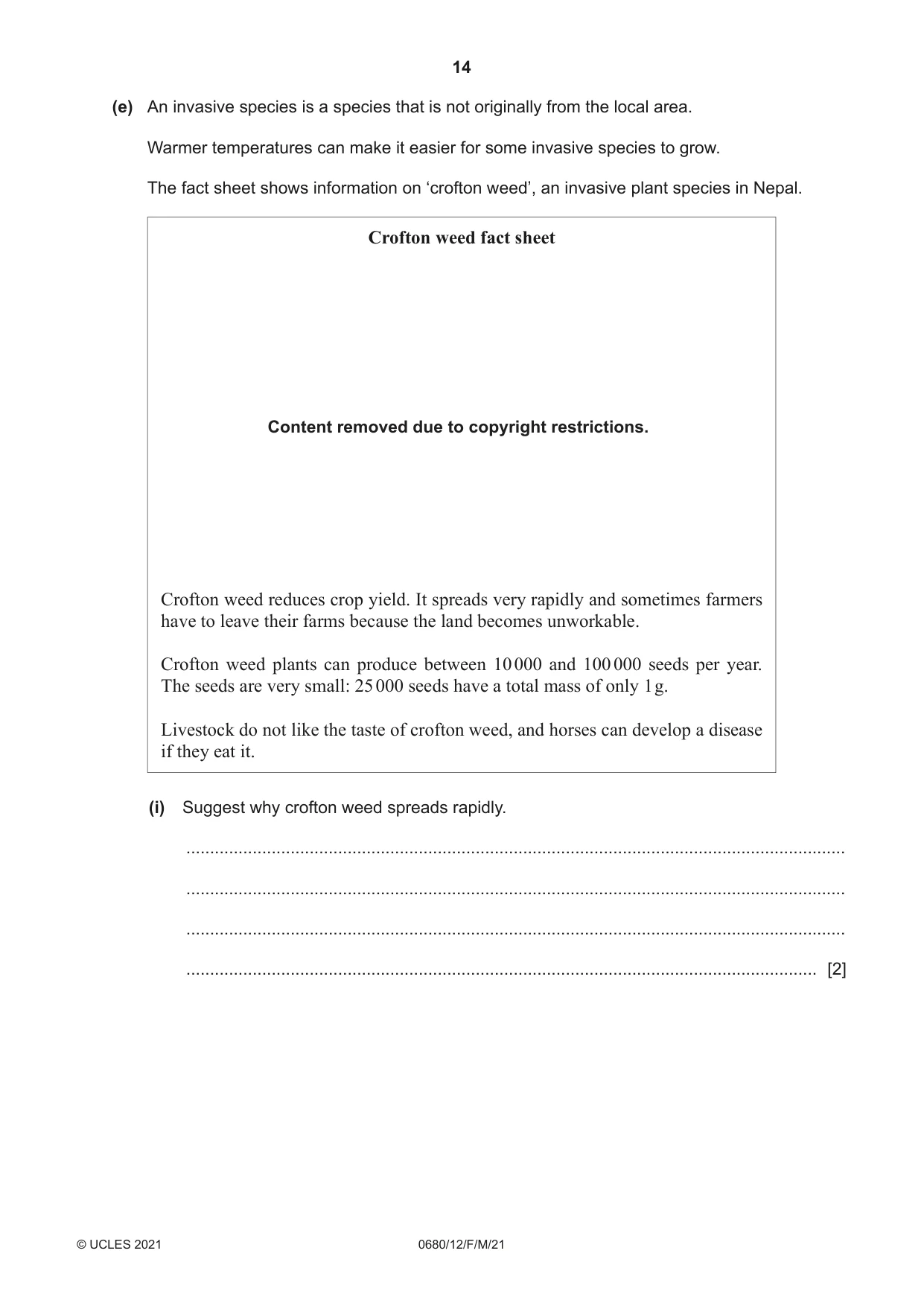
14 0680/12/F/M/21 © UCLES 2021 (e) An invasive species is a species that is not originally from the local area. Warmer temperatures can make it easier for some invasive species to grow. The fact sheet shows information on ‘crofton weed’, an invasive plant species in Nepal. Crofton weed fact sheet Crofton weed reduces crop yield. It spreads very rapidly and sometimes farmers have to leave their farms because the land becomes unworkable. Crofton weed plants can produce between 10 000 and 100 000 seeds per year. The seeds are very small: 25 000 seeds have a total mass of only 1 g. Livestock do not like the taste of crofton weed, and horses can develop a disease if they eat it. (i) Suggest why crofton weed spreads rapidly. … … … … [2] Content removed due to copyright restrictions.
Question paper, page 15
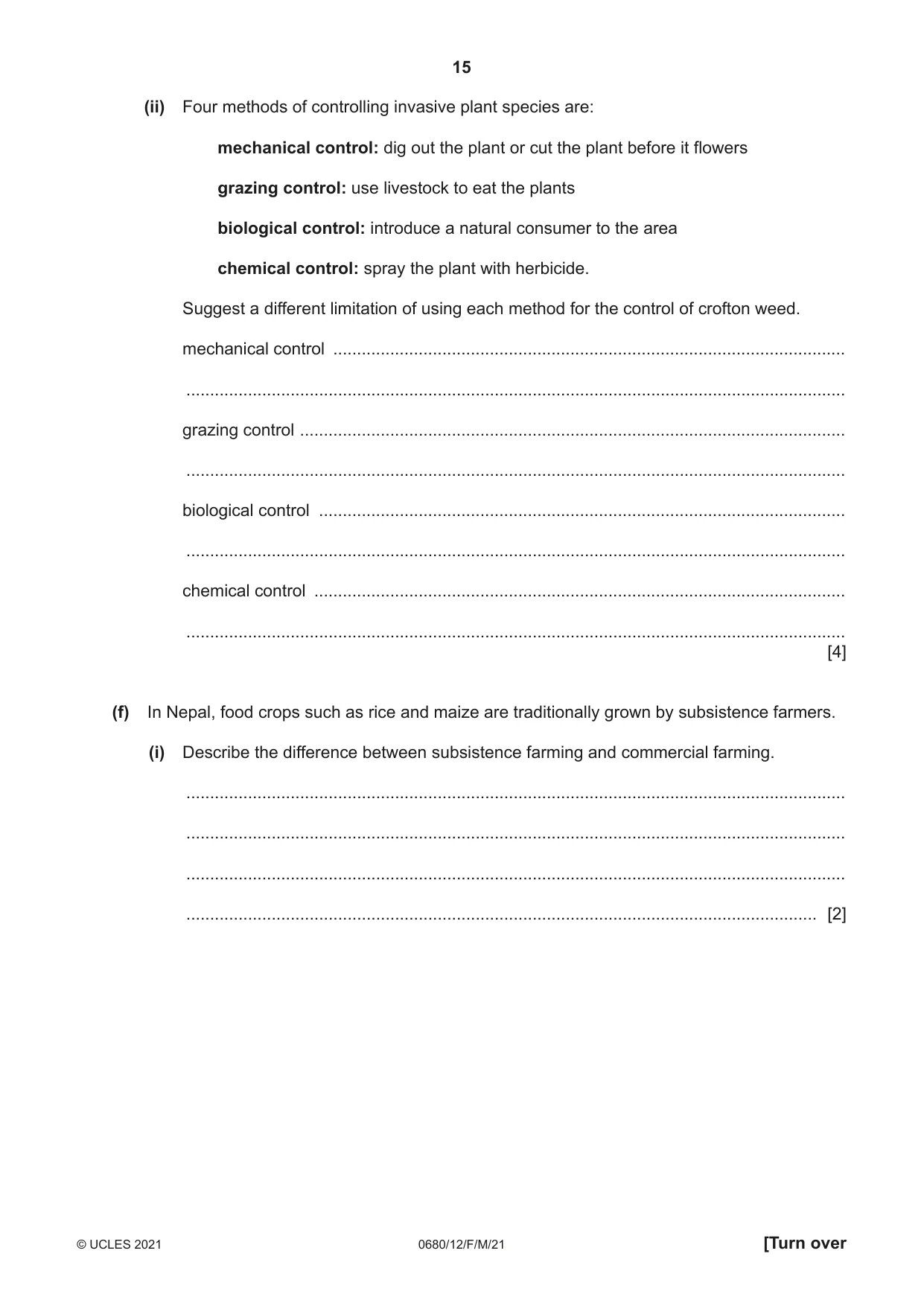
15 0680/12/F/M/21 © UCLES 2021 [Turn over (ii) Four methods of controlling invasive plant species are: mechanical control: dig out the plant or cut the plant before it flowers grazing control: use livestock to eat the plants biological control: introduce a natural consumer to the area chemical control: spray the plant with herbicide. Suggest a different limitation of using each method for the control of crofton weed. mechanical control … … grazing control … … biological control … … chemical control … … [4] (f) In Nepal, food crops such as rice and maize are traditionally grown by subsistence farmers. (i) Describe the difference between subsistence farming and commercial farming. … … … … [2]
Question paper, page 16
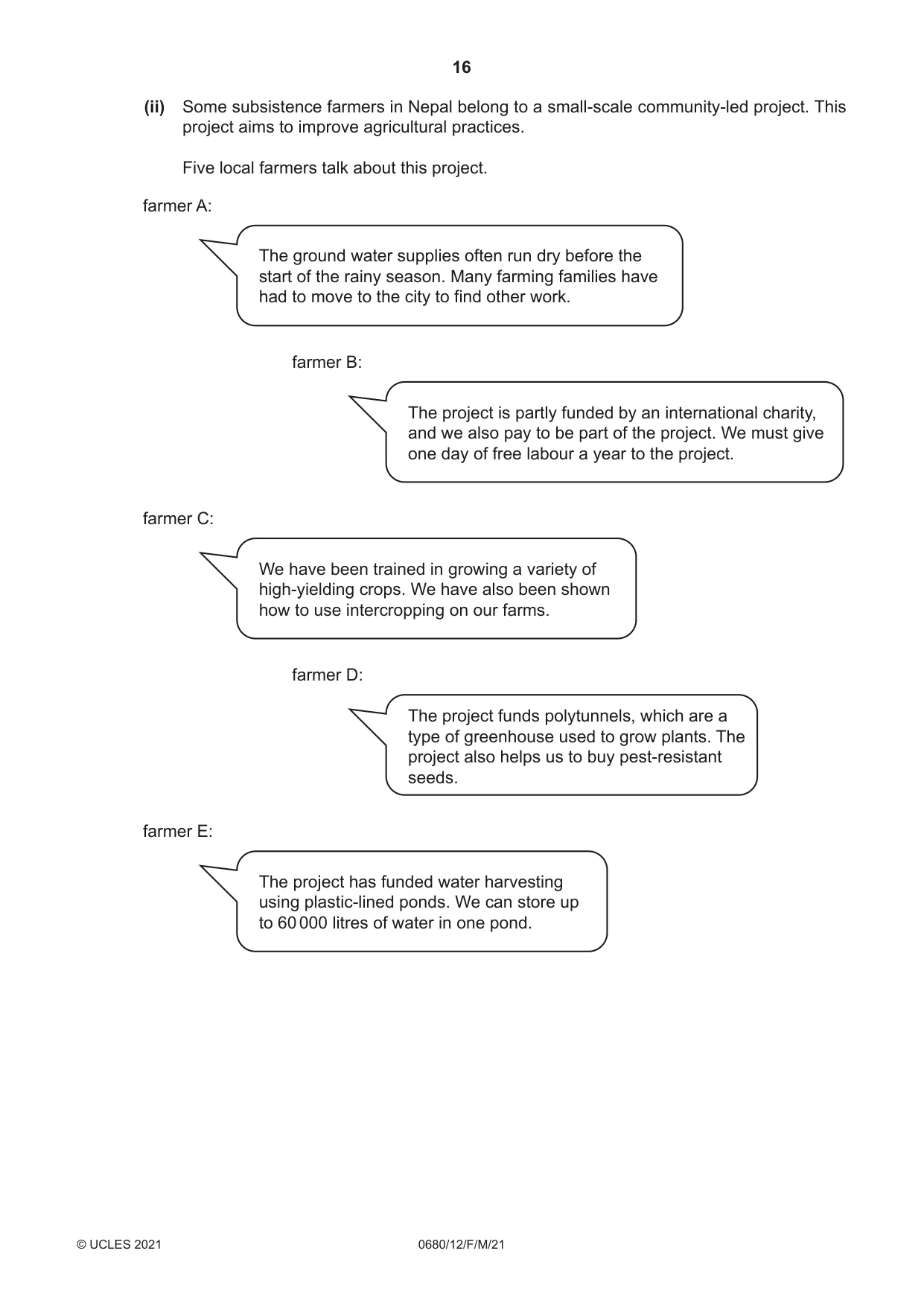
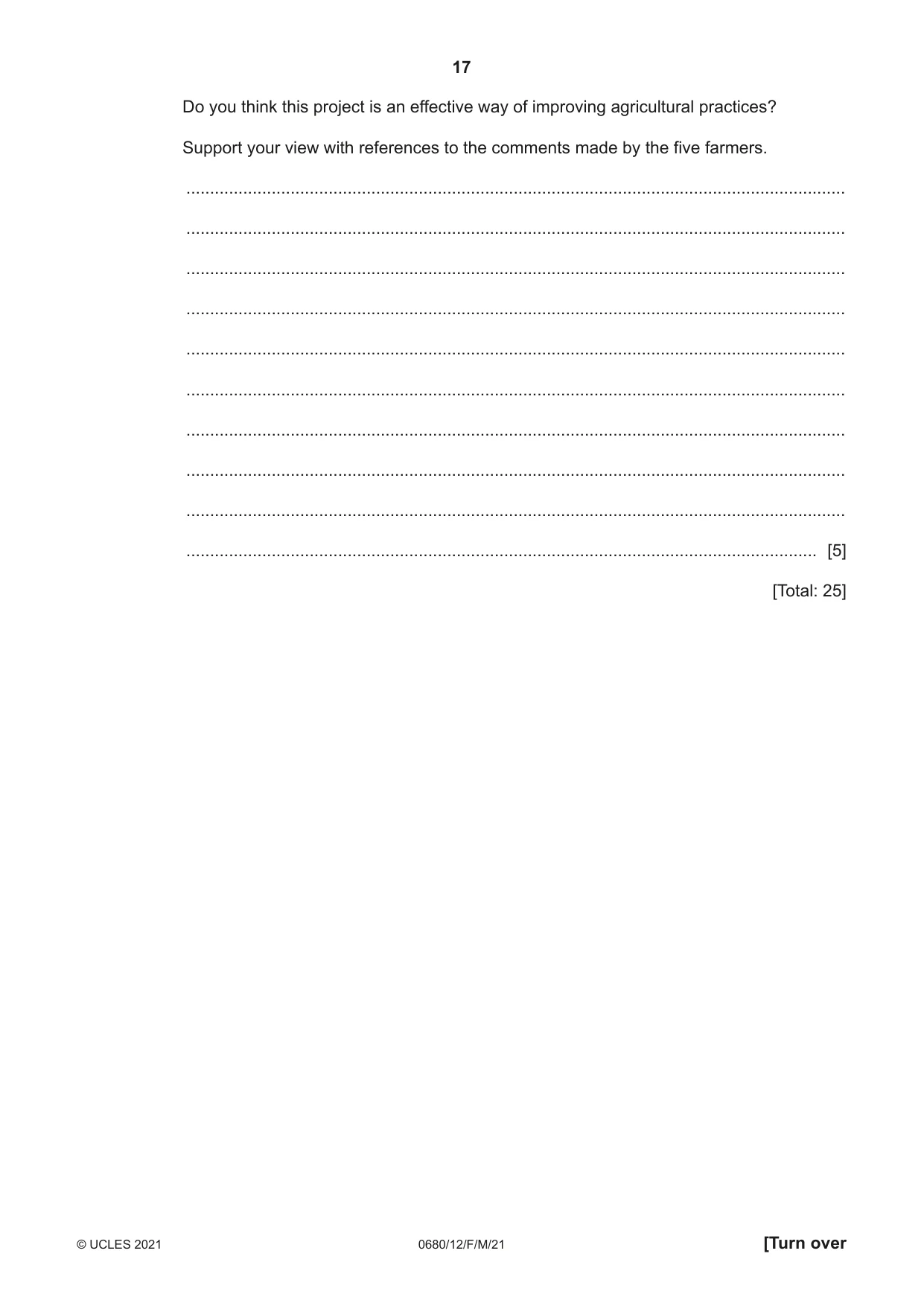
16 0680/12/F/M/21 © UCLES 2021 (ii) Some subsistence farmers in Nepal belong to a small‑scale community‑led project. This project aims to improve agricultural practices. Five local farmers talk about this project. The ground water supplies often run dry before the start of the rainy season. Many farming families have had to move to the city to find other work. farmer A: The project is partly funded by an international charity, and we also pay to be part of the project. We must give one day of free labour a year to the project. farmer B: We have been trained in growing a variety of high-yielding crops. We have also been shown how to use intercropping on our farms. farmer C: The project funds polytunnels, which are a type of greenhouse used to grow plants. The project also helps us to buy pest-resistant seeds. farmer D: The project has funded water harvesting using plastic-lined ponds. We can store up to 60 000 litres of water in one pond. farmer E:
Question paper, page 17
17 0680/12/F/M/21 © UCLES 2021 [Turn over Do you think this project is an effective way of improving agricultural practices? Support your view with references to the comments made by the five farmers. … … … … … … … … … … [5] [Total: 25]
Question paper, page 18
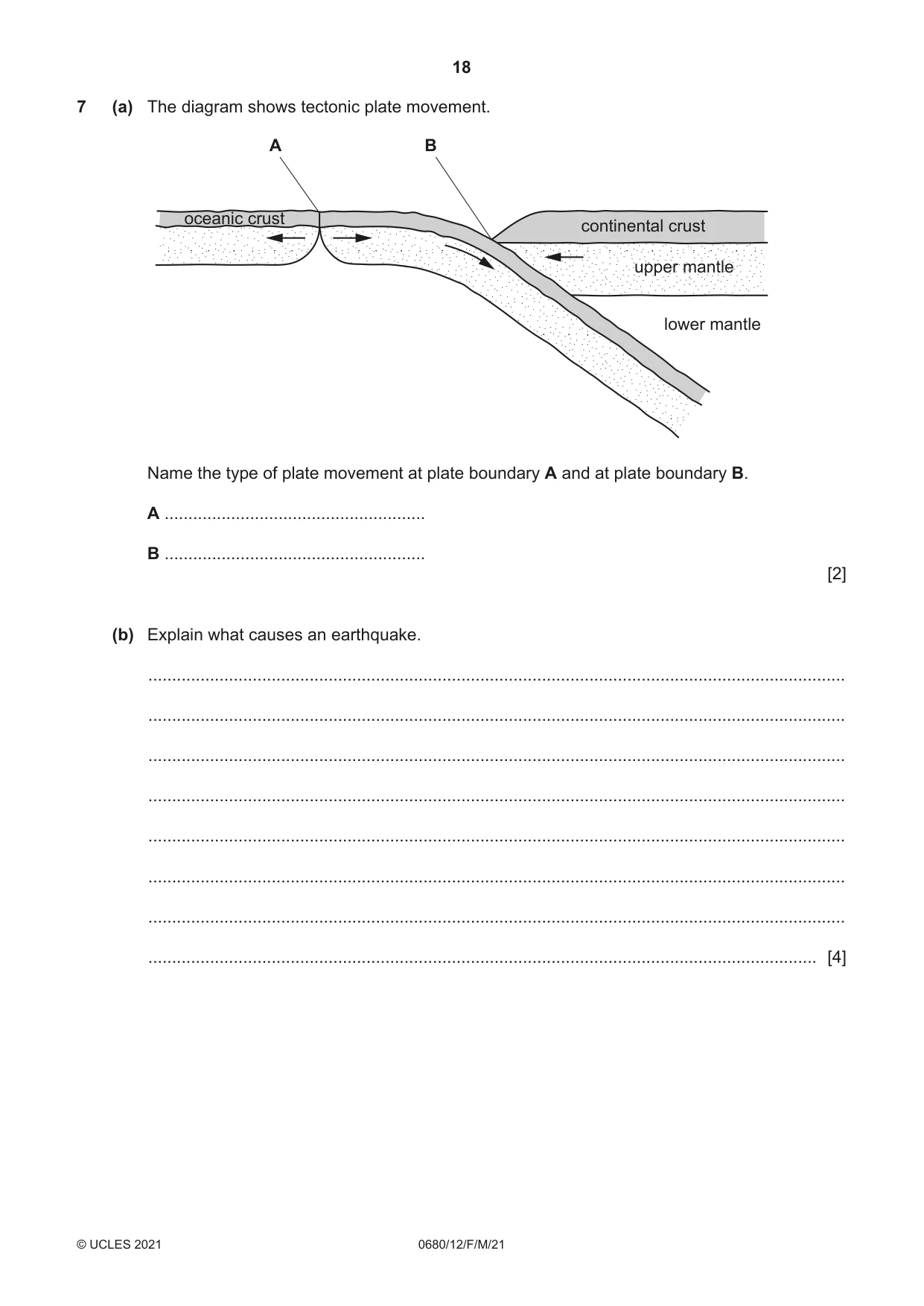
18 0680/12/F/M/21 © UCLES 2021 7 (a) The diagram shows tectonic plate movement. A B upper mantle lower mantle continental crust oceanic crust Name the type of plate movement at plate boundary A and at plate boundary B. A … B … [2] (b) Explain what causes an earthquake. … … … … … … … … [4]
Question paper, page 19
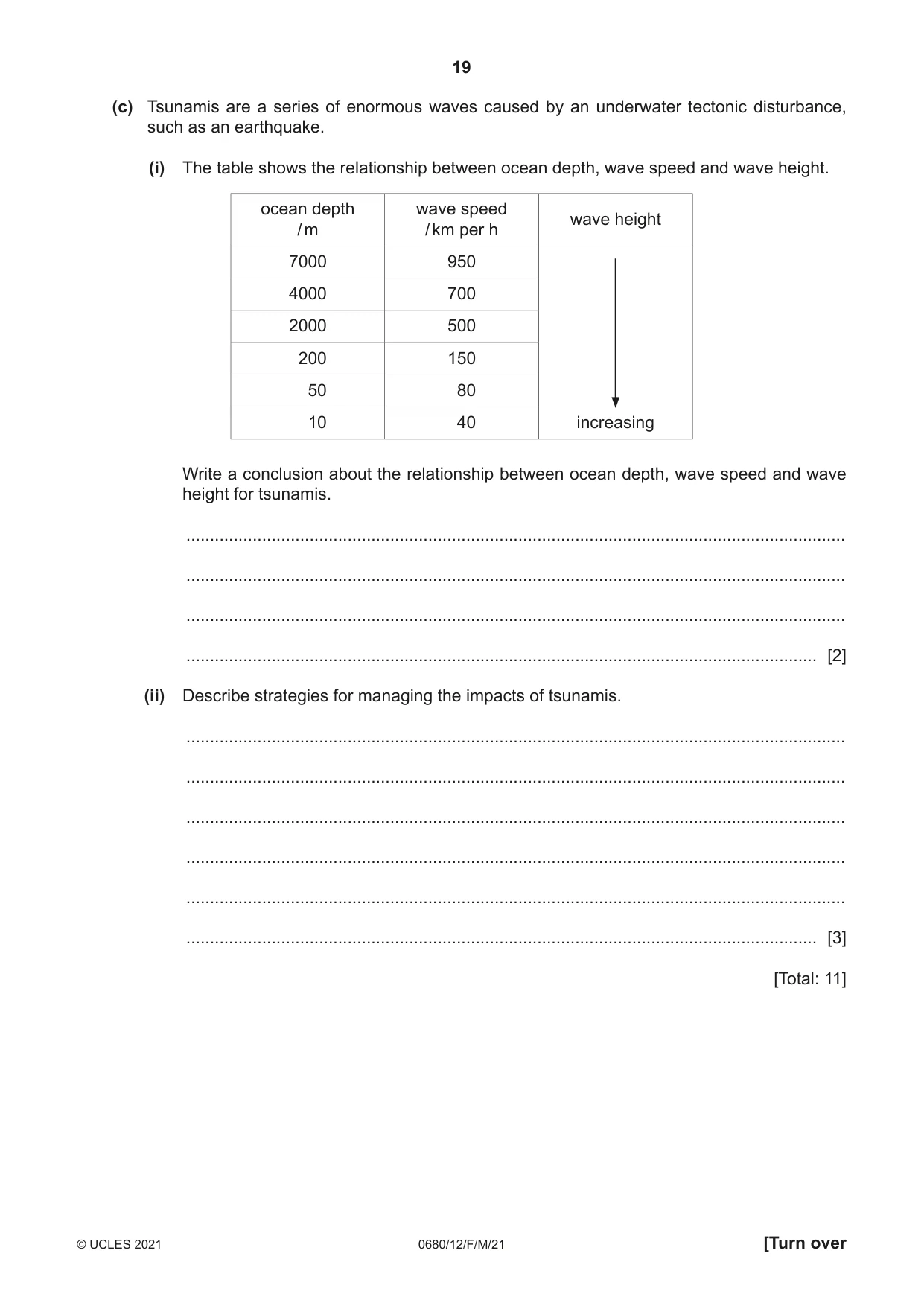
19 0680/12/F/M/21 © UCLES 2021 [Turn over (c) Tsunamis are a series of enormous waves caused by an underwater tectonic disturbance, such as an earthquake. (i) The table shows the relationship between ocean depth, wave speed and wave height. ocean depth / m wave speed / km per h wave height 7000 950 increasing 4000 700 2000 500 200 150 50 80 10 40 Write a conclusion about the relationship between ocean depth, wave speed and wave height for tsunamis. … … … … [2] (ii) Describe strategies for managing the impacts of tsunamis. … … … … … … [3] [Total: 11]
Question paper, page 20
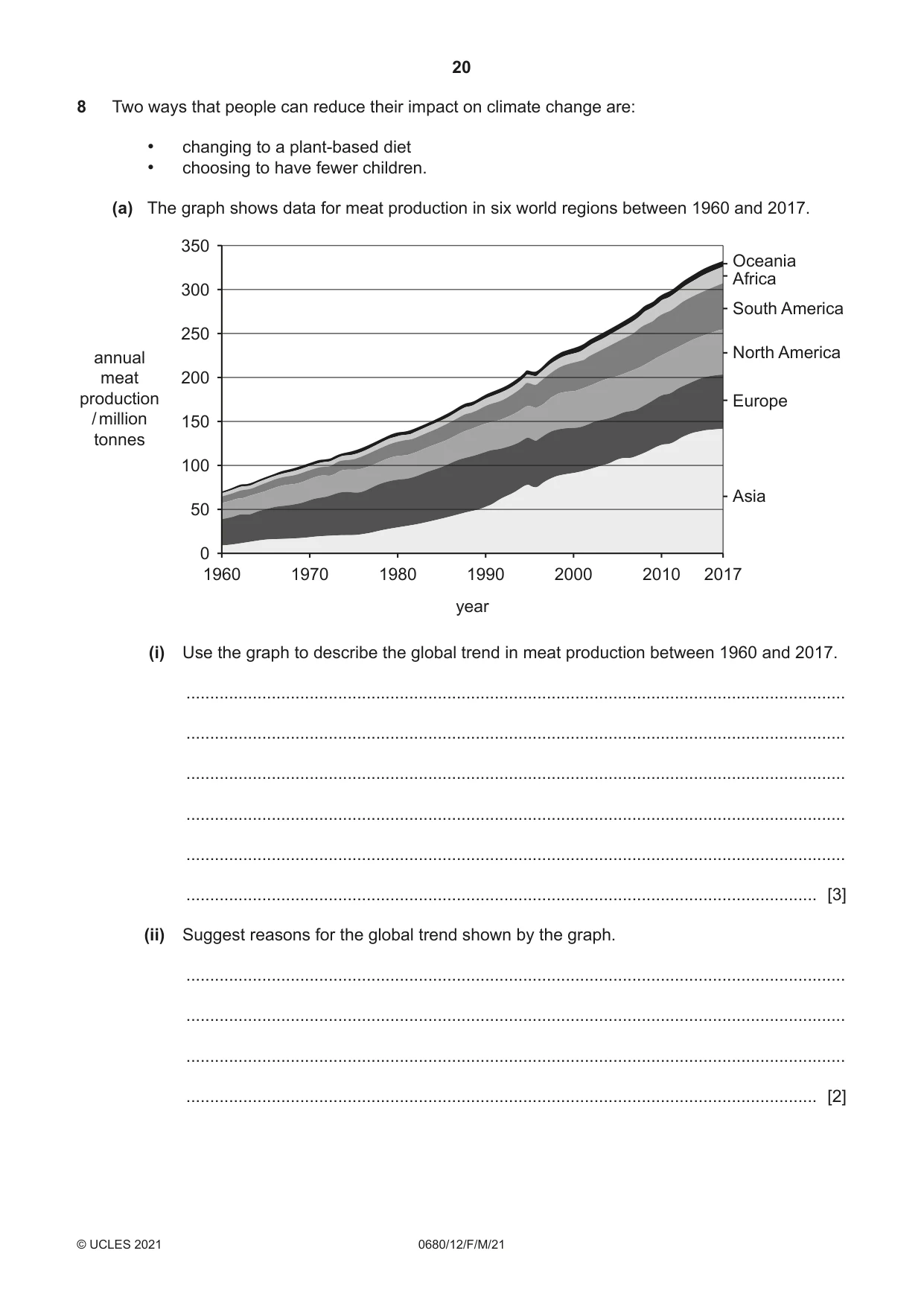
20 0680/12/F/M/21 © UCLES 2021 8 Two ways that people can reduce their impact on climate change are: • changing to a plant‑based diet • choosing to have fewer children. (a) The graph shows data for meat production in six world regions between 1960 and 2017. 1960 0 50 100 150 200 250 300 350 1970 1980 1990 year Oceania Africa North America South America Europe Asia annual meat production / million tonnes 2000 2010 2017 (i) Use the graph to describe the global trend in meat production between 1960 and 2017. … … … … … … [3] (ii) Suggest reasons for the global trend shown by the graph. … … … … [2]
Question paper, page 21
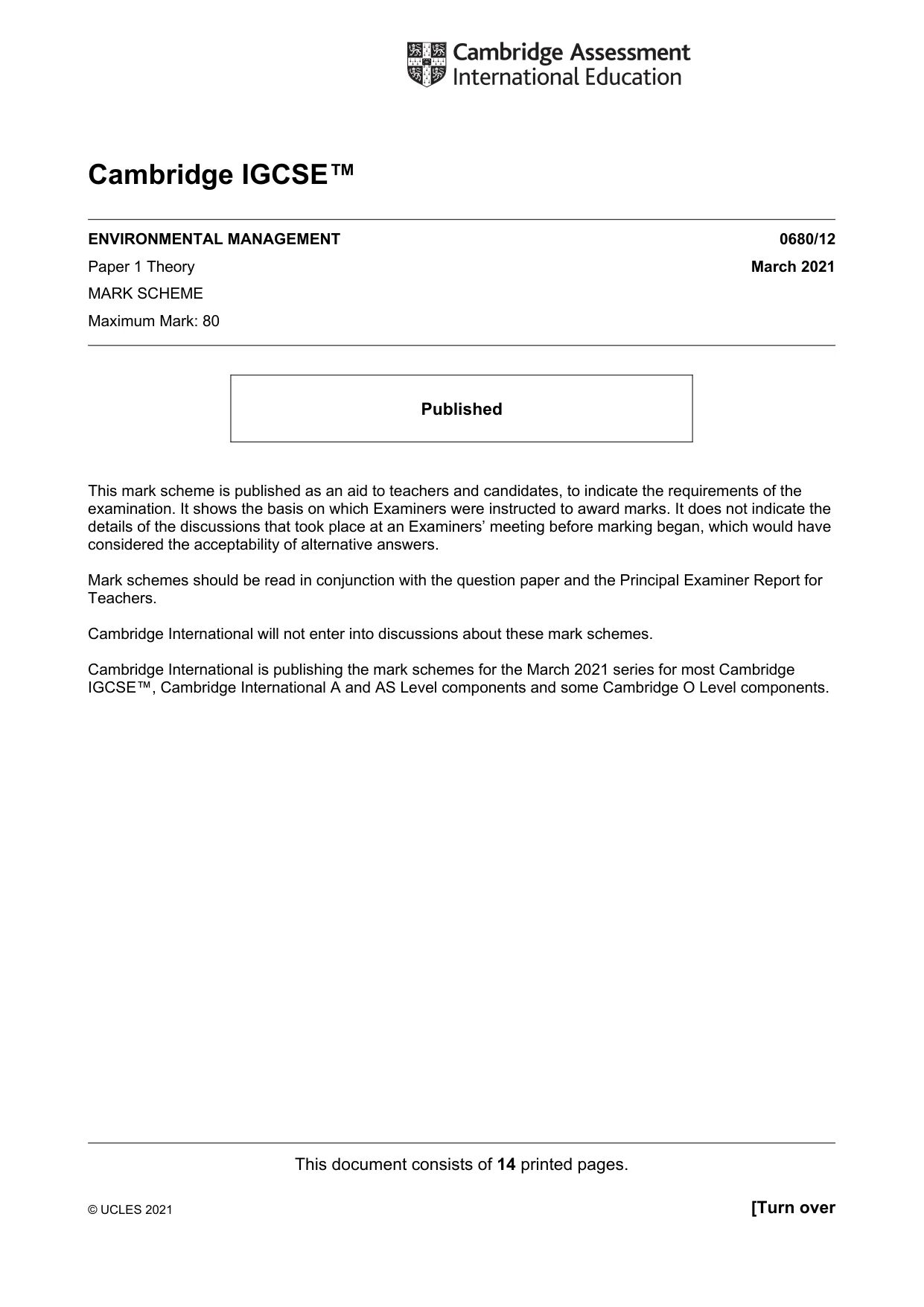
21 0680/12/F/M/21 © UCLES 2021 (b) (i) Suggest why changing to a plant‑based diet has an effect on climate change. … … [1] (ii) Describe how having fewer children has an effect on climate change. … … … … [2] (c) ‘Improved education of women is the best way of managing human population size.’ To what extent do you agree with this statement? Give reasons for your answer. … … … … … … … … … … … … … … … … [6] [Total: 14]
Question paper, page 22
22 0680/12/F/M/21 © UCLES 2021 BLANK PAGE
Question paper, page 23
23 0680/12/F/M/21 © UCLES 2021 BLANK PAGE
Question paper, page 24
24 0680/12/F/M/21 © UCLES 2021 Permission to reproduce items where third‑party owned material protected by copyright is included has been sought and cleared where possible. Every reasonable effort has been made by the publisher (UCLES) to trace copyright holders, but if any items requiring clearance have unwittingly been included, the publisher will be pleased to make amends at the earliest possible opportunity. To avoid the issue of disclosure of answer‑related information to candidates, all copyright acknowledgements are reproduced online in the Cambridge Assessment International Education Copyright Acknowledgements Booklet. This is produced for each series of examinations and is freely available to download at www.cambridgeinternational.org after the live examination series. Cambridge Assessment International Education is part of the Cambridge Assessment Group. Cambridge Assessment is the brand name of the University of Cambridge Local Examinations Syndicate (UCLES), which itself is a department of the University of Cambridge. BLANK PAGE
Mark scheme, page 1
This document consists of 14 printed pages. © UCLES 2021 [Turn over Cambridge IGCSE™ ENVIRONMENTAL MANAGEMENT 0680/12 Paper 1 Theory March 2021 MARK SCHEME Maximum Mark: 80 Published This mark scheme is published as an aid to teachers and candidates, to indicate the requirements of the examination. It shows the basis on which Examiners were instructed to award marks. It does not indicate the details of the discussions that took place at an Examiners’ meeting before marking began, which would have considered the acceptability of alternative answers. Mark schemes should be read in conjunction with the question paper and the Principal Examiner Report for Teachers. Cambridge International will not enter into discussions about these mark schemes. Cambridge International is publishing the mark schemes for the March 2021 series for most Cambridge IGCSE™, Cambridge International A and AS Level components and some Cambridge O Level components.
Mark scheme, page 2
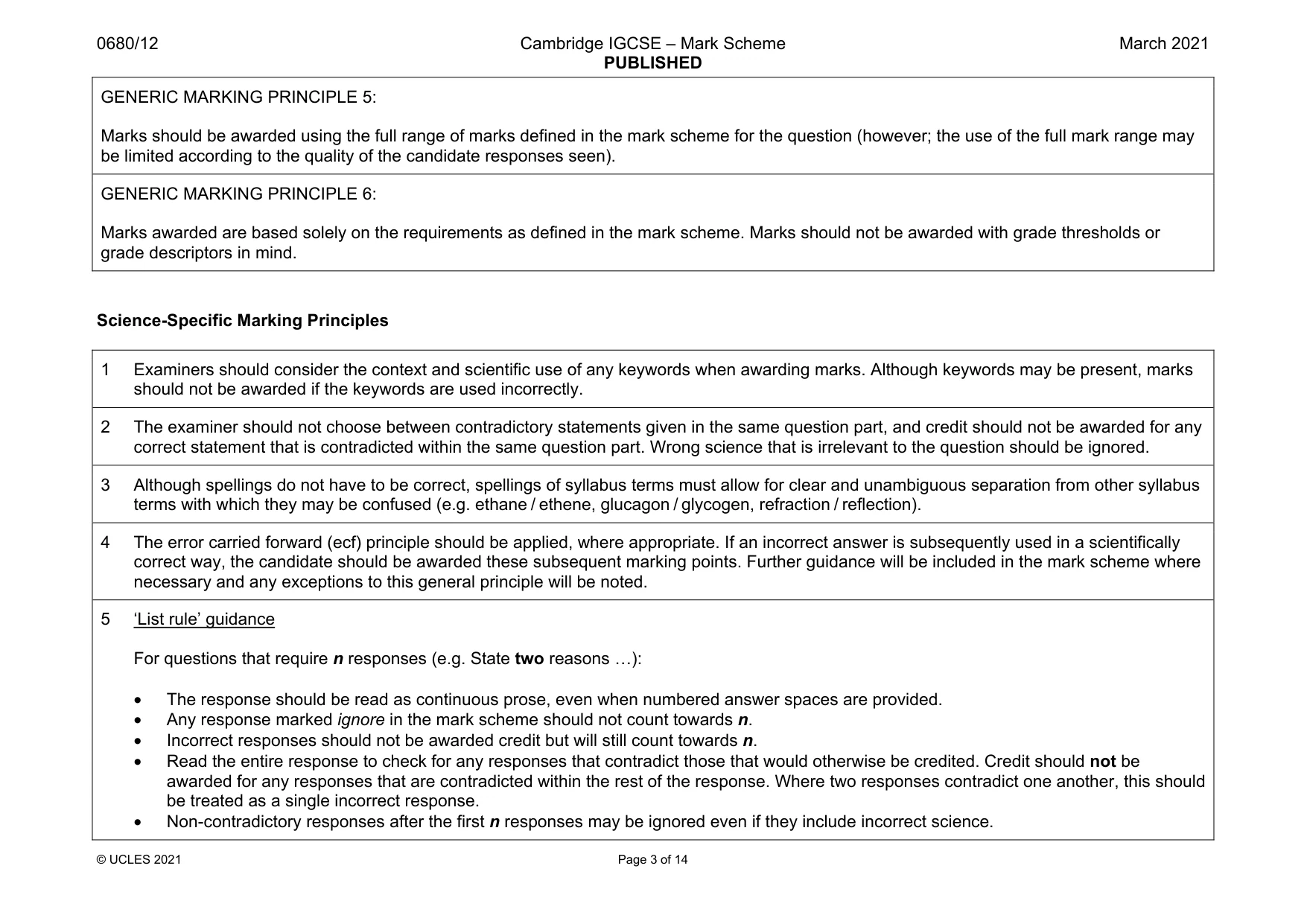
0680/12 Cambridge IGCSE – Mark Scheme PUBLISHED March 2021 © UCLES 2021 Page 2 of 14 Generic Marking Principles These general marking principles must be applied by all examiners when marking candidate answers. They should be applied alongside the specific content of the mark scheme or generic level descriptors for a question. Each question paper and mark scheme will also comply with these marking principles. GENERIC MARKING PRINCIPLE 1: Marks must be awarded in line with: • the specific content of the mark scheme or the generic level descriptors for the question • the specific skills defined in the mark scheme or in the generic level descriptors for the question • the standard of response required by a candidate as exemplified by the standardisation scripts. GENERIC MARKING PRINCIPLE 2: Marks awarded are always whole marks (not half marks, or other fractions). GENERIC MARKING PRINCIPLE 3: Marks must be awarded positively: • marks are awarded for correct/valid answers, as defined in the mark scheme. However, credit is given for valid answers which go beyond the scope of the syllabus and mark scheme, referring to your Team Leader as appropriate • marks are awarded when candidates clearly demonstrate what they know and can do • marks are not deducted for errors • marks are not deducted for omissions • answers should only be judged on the quality of spelling, punctuation and grammar when these features are specifically assessed by the question as indicated by the mark scheme. The meaning, however, should be unambiguous. GENERIC MARKING PRINCIPLE 4: Rules must be applied consistently, e.g. in situations where candidates have not followed instructions or in the application of generic level descriptors.
Mark scheme, page 3
0680/12 Cambridge IGCSE – Mark Scheme PUBLISHED March 2021 © UCLES 2021 Page 3 of 14 GENERIC MARKING PRINCIPLE 5: Marks should be awarded using the full range of marks defined in the mark scheme for the question (however; the use of the full mark range may be limited according to the quality of the candidate responses seen). GENERIC MARKING PRINCIPLE 6: Marks awarded are based solely on the requirements as defined in the mark scheme. Marks should not be awarded with grade thresholds or grade descriptors in mind. Science-Specific Marking Principles 1 Examiners should consider the context and scientific use of any keywords when awarding marks. Although keywords may be present, marks should not be awarded if the keywords are used incorrectly. 2 The examiner should not choose between contradictory statements given in the same question part, and credit should not be awarded for any correct statement that is contradicted within the same question part. Wrong science that is irrelevant to the question should be ignored. 3 Although spellings do not have to be correct, spellings of syllabus terms must allow for clear and unambiguous separation from other syllabus terms with which they may be confused (e.g. ethane / ethene, glucagon / glycogen, refraction / reflection). 4 The error carried forward (ecf) principle should be applied, where appropriate. If an incorrect answer is subsequently used in a scientifically correct way, the candidate should be awarded these subsequent marking points. Further guidance will be included in the mark scheme where necessary and any exceptions to this general principle will be noted. 5 ‘List rule’ guidance For questions that require n responses (e.g. State two reasons …): • The response should be read as continuous prose, even when numbered answer spaces are provided. • Any response marked ignore in the mark scheme should not count towards n. • Incorrect responses should not be awarded credit but will still count towards n. • Read the entire response to check for any responses that contradict those that would otherwise be credited. Credit should not be awarded for any responses that are contradicted within the rest of the response. Where two responses contradict one another, this should be treated as a single incorrect response. • Non-contradictory responses after the first n responses may be ignored even if they include incorrect science.
Mark scheme, page 4
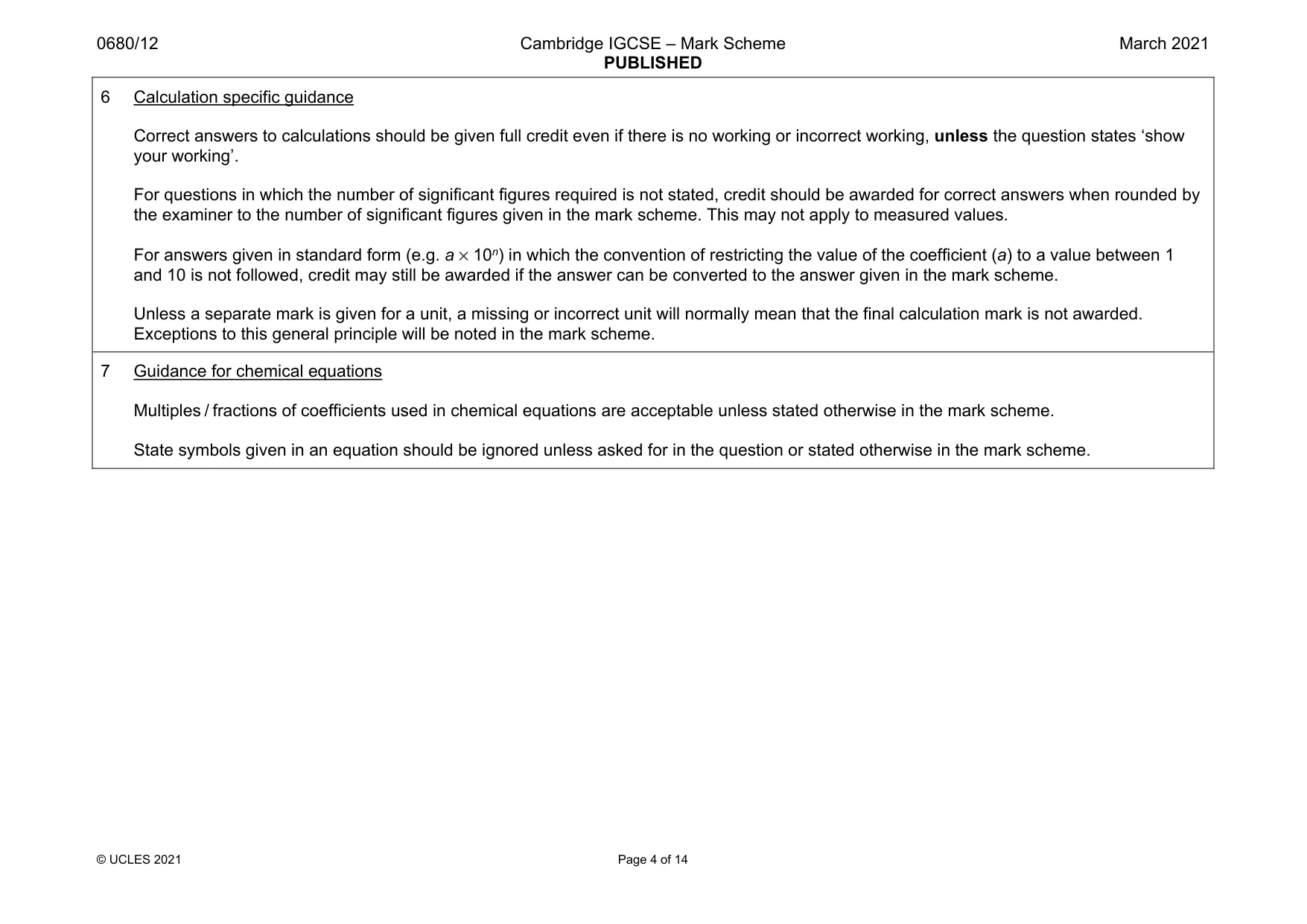
0680/12 Cambridge IGCSE – Mark Scheme PUBLISHED March 2021 © UCLES 2021 Page 4 of 14 6 Calculation specific guidance Correct answers to calculations should be given full credit even if there is no working or incorrect working, unless the question states ‘show your working’. For questions in which the number of significant figures required is not stated, credit should be awarded for correct answers when rounded by the examiner to the number of significant figures given in the mark scheme. This may not apply to measured values. For answers given in standard form (e.g. a × 10n) in which the convention of restricting the value of the coefficient (a) to a value between 1 and 10 is not followed, credit may still be awarded if the answer can be converted to the answer given in the mark scheme. Unless a separate mark is given for a unit, a missing or incorrect unit will normally mean that the final calculation mark is not awarded. Exceptions to this general principle will be noted in the mark scheme. 7 Guidance for chemical equations Multiples / fractions of coefficients used in chemical equations are acceptable unless stated otherwise in the mark scheme. State symbols given in an equation should be ignored unless asked for in the question or stated otherwise in the mark scheme.
Mark scheme, page 5
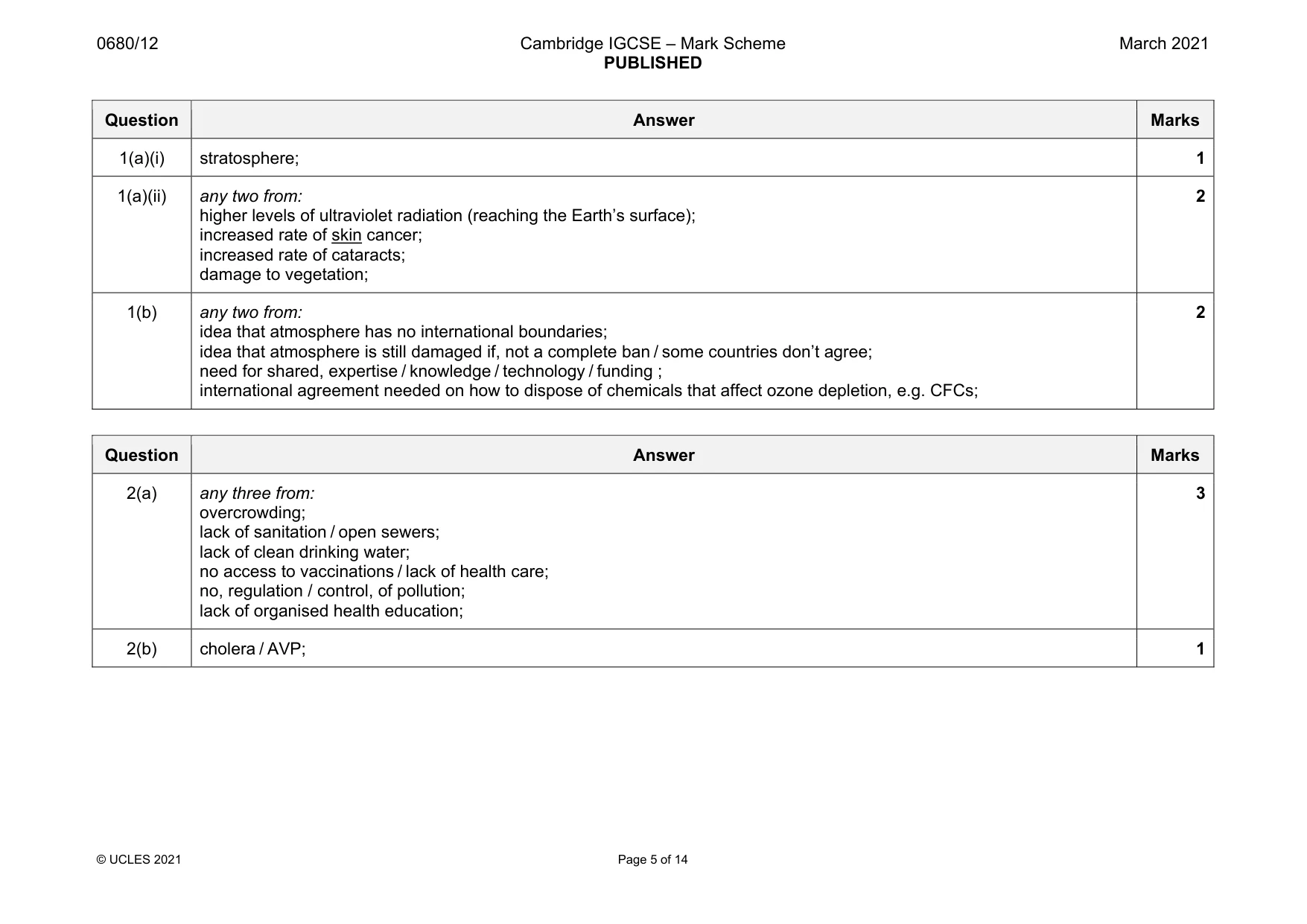
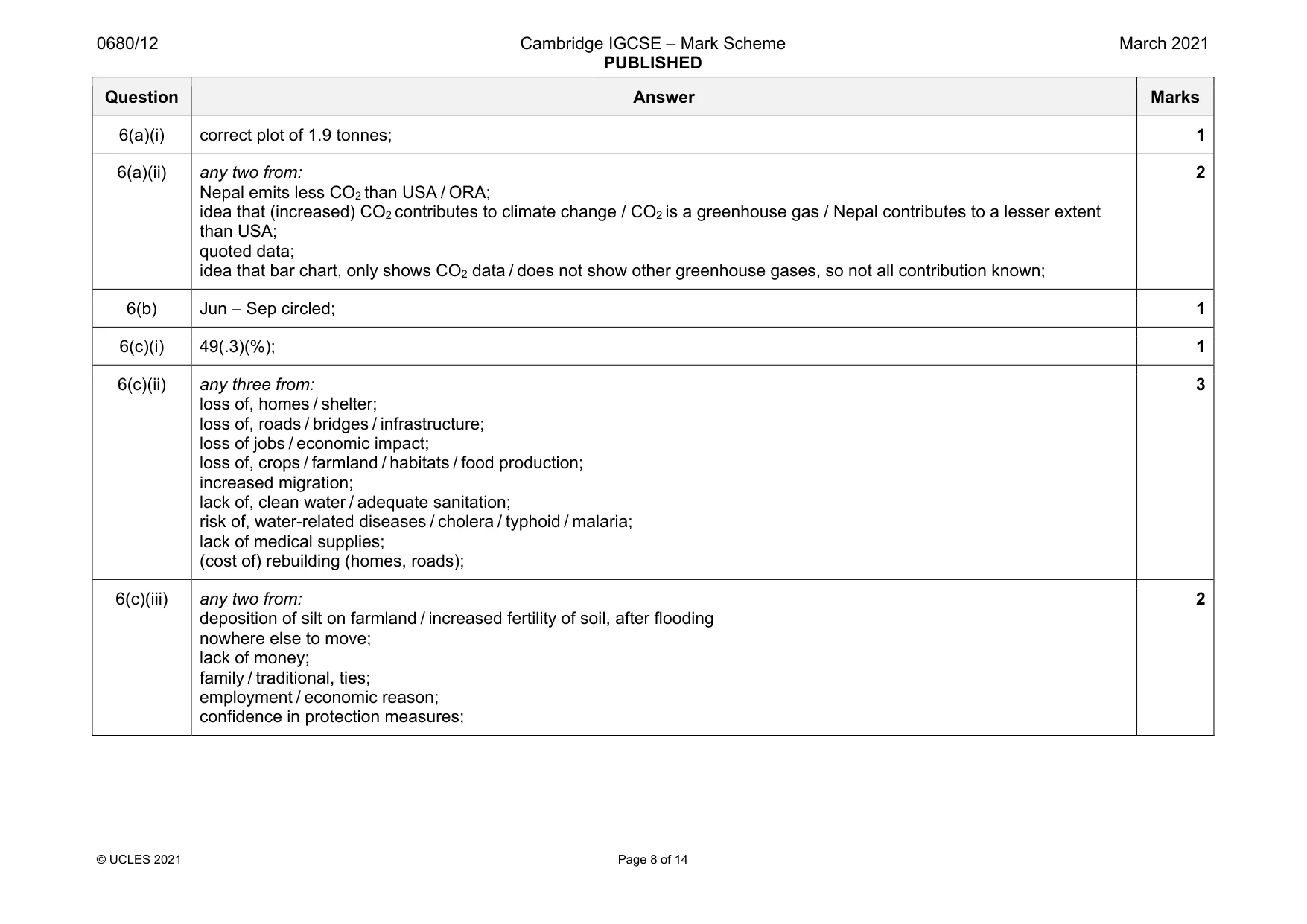
0680/12 Cambridge IGCSE – Mark Scheme PUBLISHED March 2021 © UCLES 2021 Page 5 of 14 Question Answer Marks 1(a)(i) stratosphere; 1 1(a)(ii) any two from: higher levels of ultraviolet radiation (reaching the Earth’s surface); increased rate of skin cancer; increased rate of cataracts; damage to vegetation; 2 1(b) any two from: idea that atmosphere has no international boundaries; idea that atmosphere is still damaged if, not a complete ban / some countries don’t agree; need for shared, expertise / knowledge / technology / funding ; international agreement needed on how to dispose of chemicals that affect ozone depletion, e.g. CFCs; 2 Question Answer Marks 2(a) any three from: overcrowding; lack of sanitation / open sewers; lack of clean drinking water; no access to vaccinations / lack of health care; no, regulation / control, of pollution; lack of organised health education; 3 2(b) cholera / AVP; 1
Mark scheme, page 6
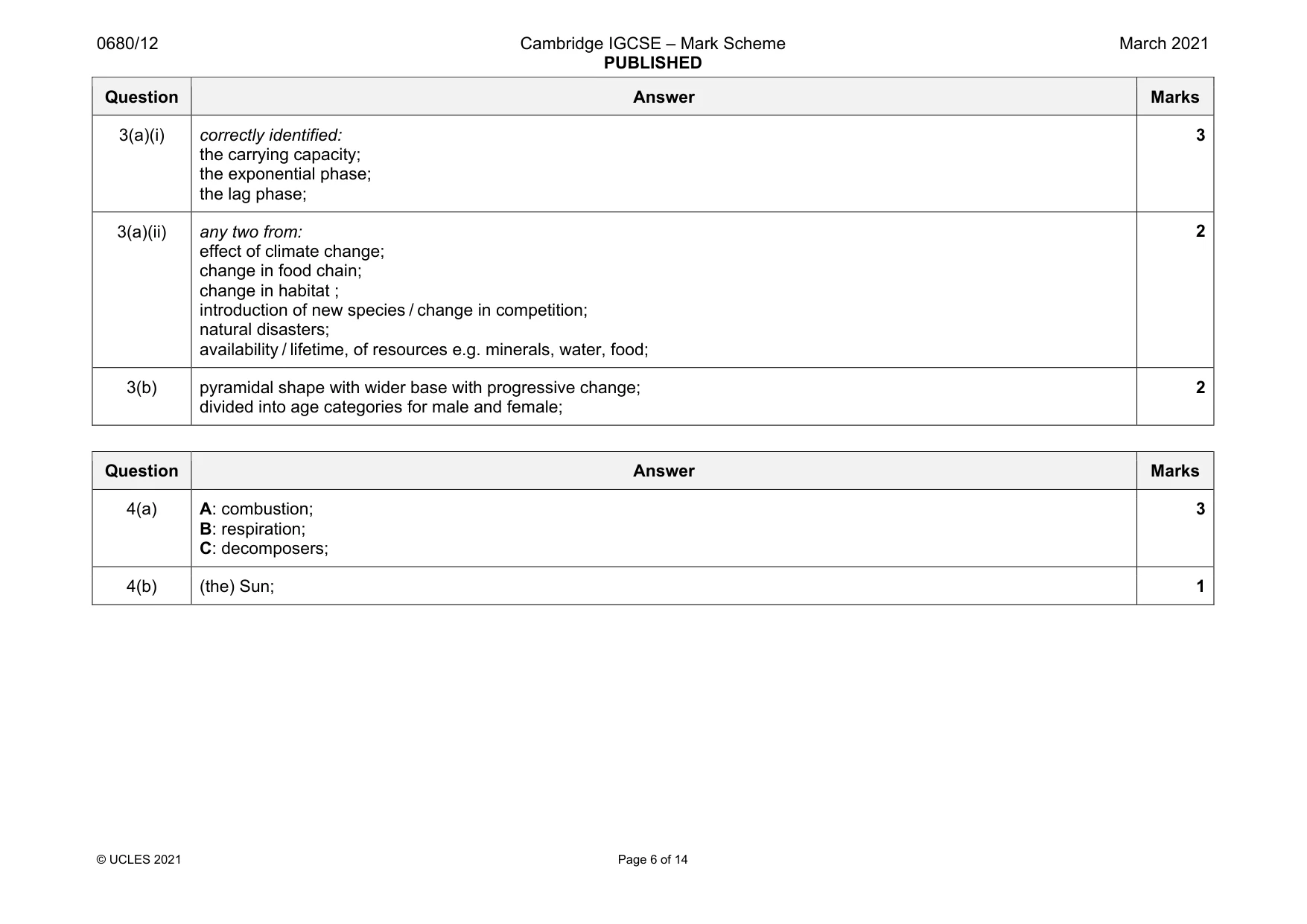
0680/12 Cambridge IGCSE – Mark Scheme PUBLISHED March 2021 © UCLES 2021 Page 6 of 14 Question Answer Marks 3(a)(i) correctly identified: the carrying capacity; the exponential phase; the lag phase; 3 3(a)(ii) any two from: effect of climate change; change in food chain; change in habitat ; introduction of new species / change in competition; natural disasters; availability / lifetime, of resources e.g. minerals, water, food; 2 3(b) pyramidal shape with wider base with progressive change; divided into age categories for male and female; 2 Question Answer Marks 4(a) A: combustion; B: respiration; C: decomposers; 3 4(b) (the) Sun; 1
Mark scheme, page 7
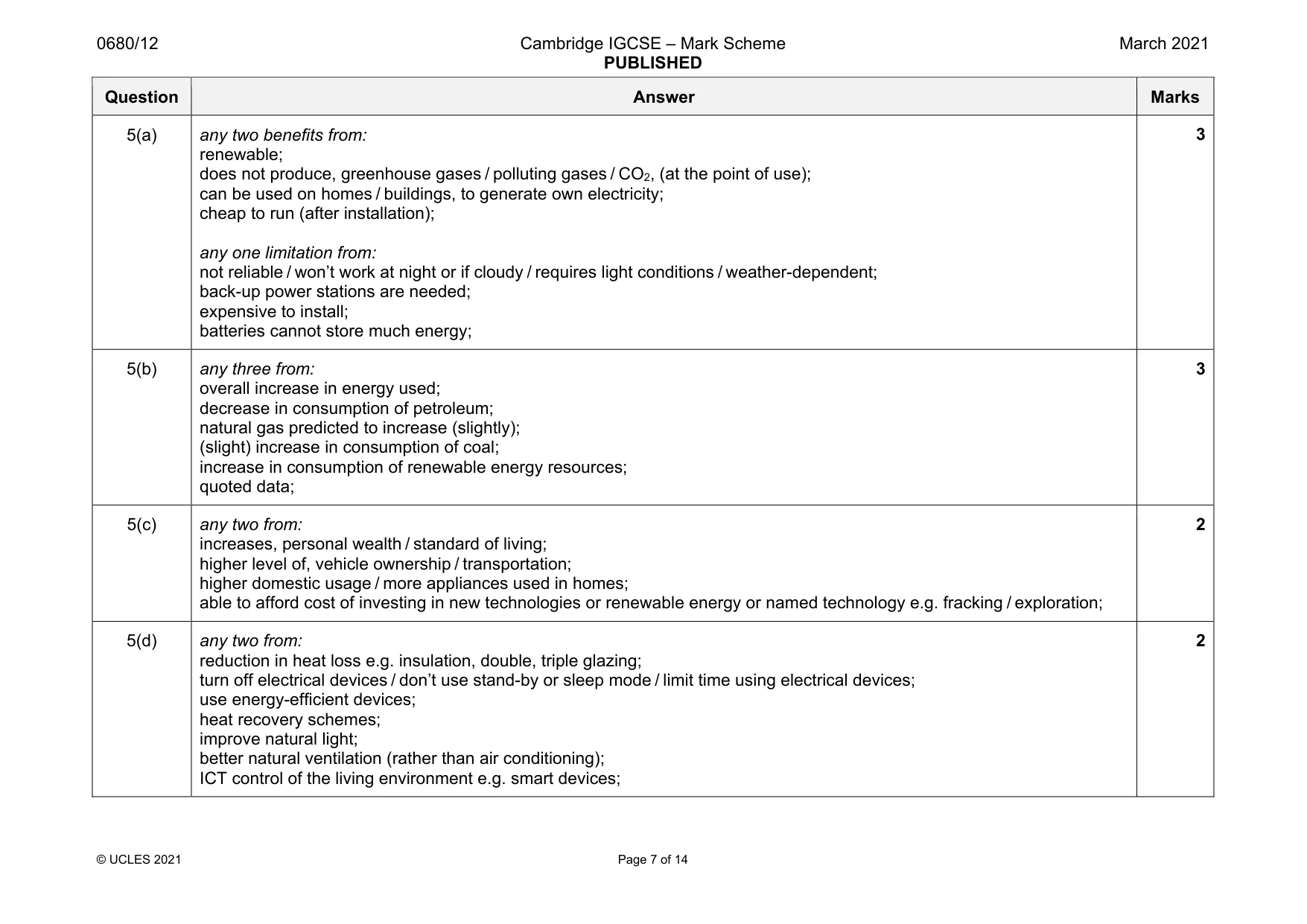
0680/12 Cambridge IGCSE – Mark Scheme PUBLISHED March 2021 © UCLES 2021 Page 7 of 14 Question Answer Marks 5(a) any two benefits from: renewable; does not produce, greenhouse gases / polluting gases / CO2, (at the point of use); can be used on homes / buildings, to generate own electricity; cheap to run (after installation); any one limitation from: not reliable / won’t work at night or if cloudy / requires light conditions / weather-dependent; back-up power stations are needed; expensive to install; batteries cannot store much energy; 3 5(b) any three from: overall increase in energy used; decrease in consumption of petroleum; natural gas predicted to increase (slightly); (slight) increase in consumption of coal; increase in consumption of renewable energy resources; quoted data; 3 5(c) any two from: increases, personal wealth / standard of living; higher level of, vehicle ownership / transportation; higher domestic usage / more appliances used in homes; able to afford cost of investing in new technologies or renewable energy or named technology e.g. fracking / exploration; 2 5(d) any two from: reduction in heat loss e.g. insulation, double, triple glazing; turn off electrical devices / don’t use stand-by or sleep mode / limit time using electrical devices; use energy-efficient devices; heat recovery schemes; improve natural light; better natural ventilation (rather than air conditioning); ICT control of the living environment e.g. smart devices; 2
Mark scheme, page 8
0680/12 Cambridge IGCSE – Mark Scheme PUBLISHED March 2021 © UCLES 2021 Page 8 of 14 Question Answer Marks 6(a)(i) correct plot of 1.9 tonnes; 1 6(a)(ii) any two from: Nepal emits less CO2 than USA / ORA; idea that (increased) CO2 contributes to climate change / CO2 is a greenhouse gas / Nepal contributes to a lesser extent than USA; quoted data; idea that bar chart, only shows CO2 data / does not show other greenhouse gases, so not all contribution known; 2 6(b) Jun – Sep circled; 1 6(c)(i) 49(.3)(%); 1 6(c)(ii) any three from: loss of, homes / shelter; loss of, roads / bridges / infrastructure; loss of jobs / economic impact; loss of, crops / farmland / habitats / food production; increased migration; lack of, clean water / adequate sanitation; risk of, water-related diseases / cholera / typhoid / malaria; lack of medical supplies; (cost of) rebuilding (homes, roads); 3 6(c)(iii) any two from: deposition of silt on farmland / increased fertility of soil, after flooding nowhere else to move; lack of money; family / traditional, ties; employment / economic reason; confidence in protection measures; 2
Mark scheme, page 9
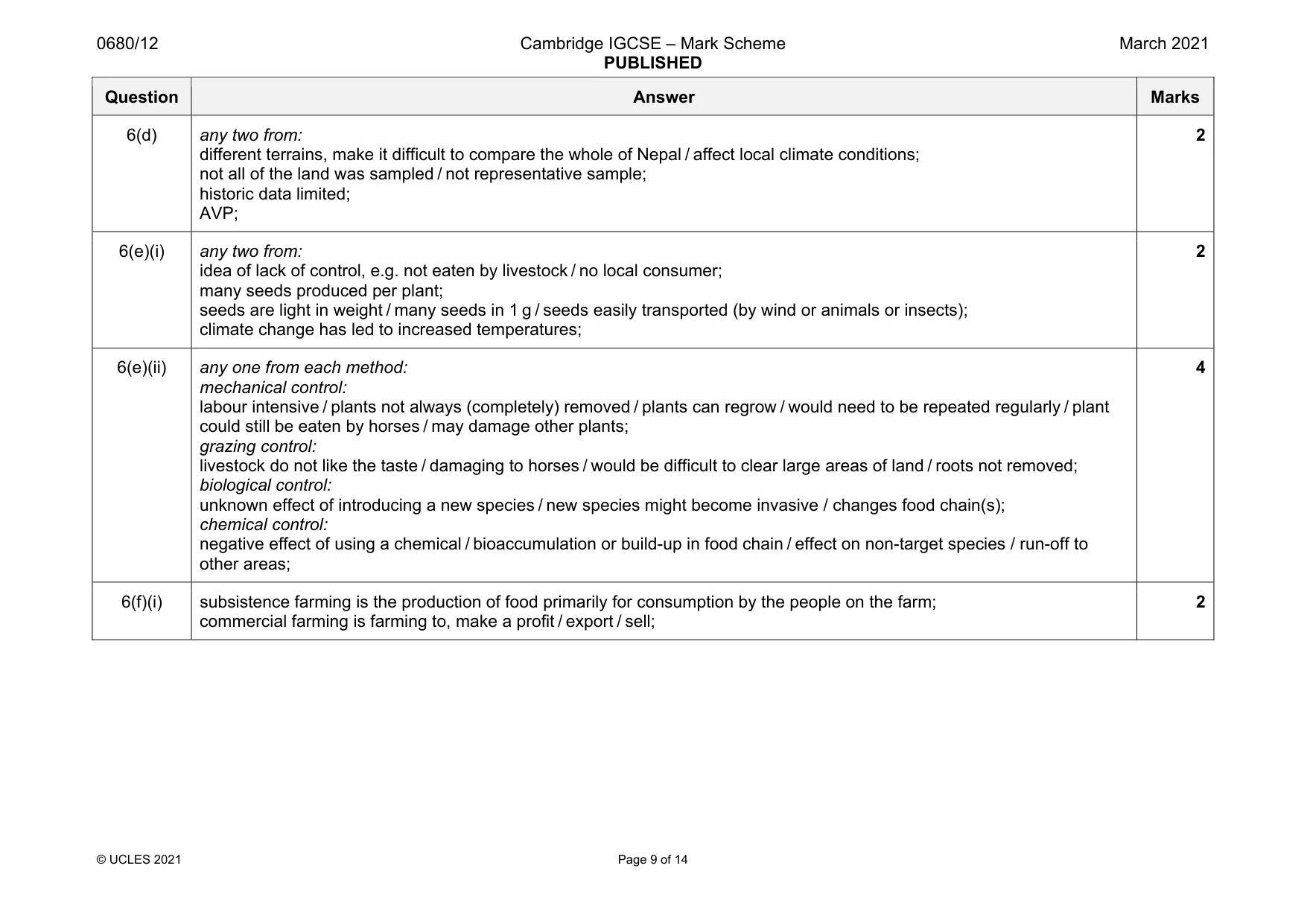
0680/12 Cambridge IGCSE – Mark Scheme PUBLISHED March 2021 © UCLES 2021 Page 9 of 14 Question Answer Marks 6(d) any two from: different terrains, make it difficult to compare the whole of Nepal / affect local climate conditions; not all of the land was sampled / not representative sample; historic data limited; AVP; 2 6(e)(i) any two from: idea of lack of control, e.g. not eaten by livestock / no local consumer; many seeds produced per plant; seeds are light in weight / many seeds in 1 g / seeds easily transported (by wind or animals or insects); climate change has led to increased temperatures; 2 6(e)(ii) any one from each method: mechanical control: labour intensive / plants not always (completely) removed / plants can regrow / would need to be repeated regularly / plant could still be eaten by horses / may damage other plants; grazing control: livestock do not like the taste / damaging to horses / would be difficult to clear large areas of land / roots not removed; biological control: unknown effect of introducing a new species / new species might become invasive / changes food chain(s); chemical control: negative effect of using a chemical / bioaccumulation or build-up in food chain / effect on non-target species / run-off to other areas; 4 6(f)(i) subsistence farming is the production of food primarily for consumption by the people on the farm; commercial farming is farming to, make a profit / export / sell; 2
Mark scheme, page 10
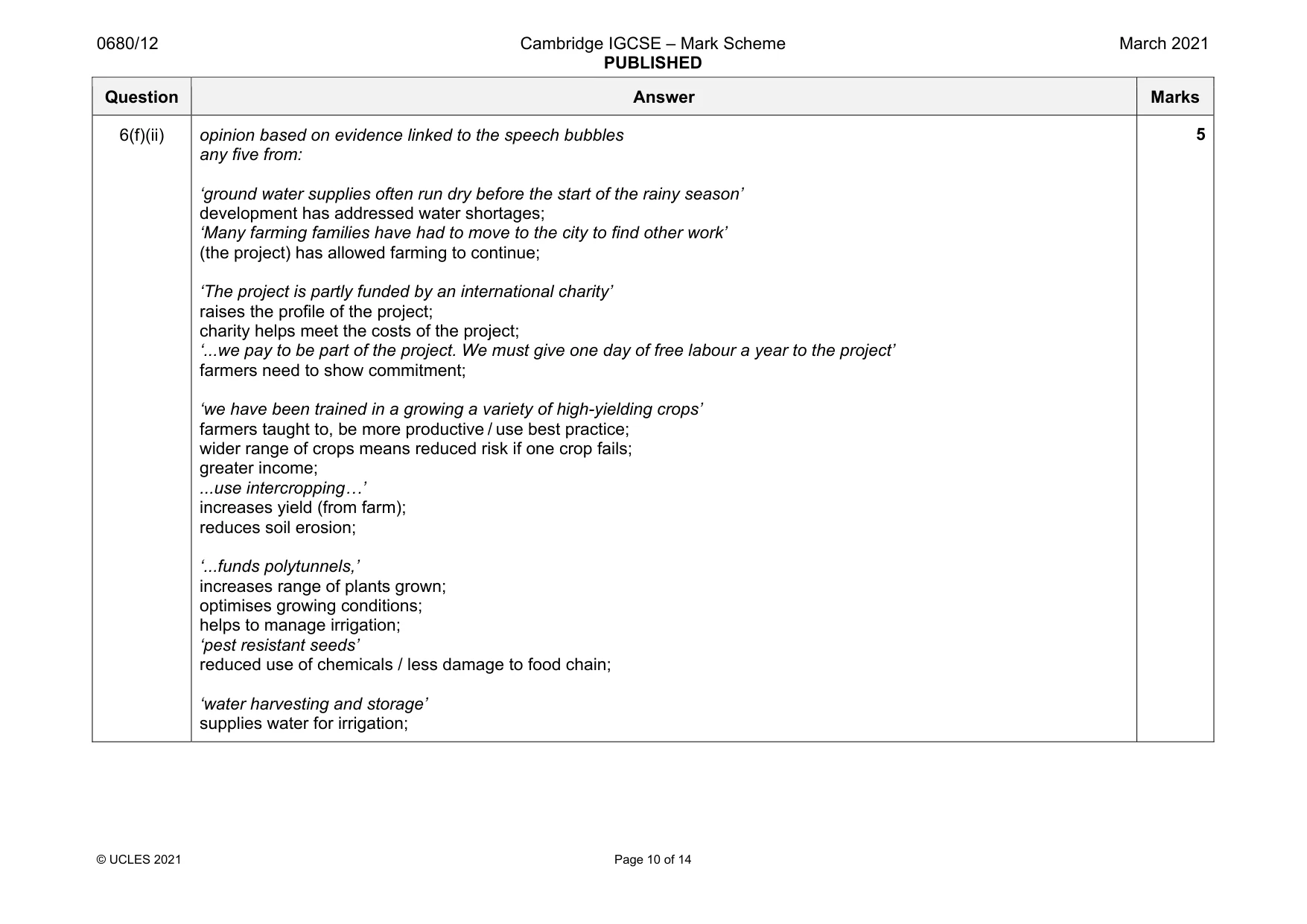
0680/12 Cambridge IGCSE – Mark Scheme PUBLISHED March 2021 © UCLES 2021 Page 10 of 14 Question Answer Marks 6(f)(ii) opinion based on evidence linked to the speech bubbles any five from: ‘ground water supplies often run dry before the start of the rainy season’ development has addressed water shortages; ‘Many farming families have had to move to the city to find other work’ (the project) has allowed farming to continue; ‘The project is partly funded by an international charity’ raises the profile of the project; charity helps meet the costs of the project; ‘...we pay to be part of the project. We must give one day of free labour a year to the project’ farmers need to show commitment; ‘we have been trained in a growing a variety of high-yielding crops’ farmers taught to, be more productive / use best practice; wider range of crops means reduced risk if one crop fails; greater income; ...use intercropping…’ increases yield (from farm); reduces soil erosion; ‘...funds polytunnels,’ increases range of plants grown; optimises growing conditions; helps to manage irrigation; ‘pest resistant seeds’ reduced use of chemicals / less damage to food chain; ‘water harvesting and storage’ supplies water for irrigation; 5
Mark scheme, page 11
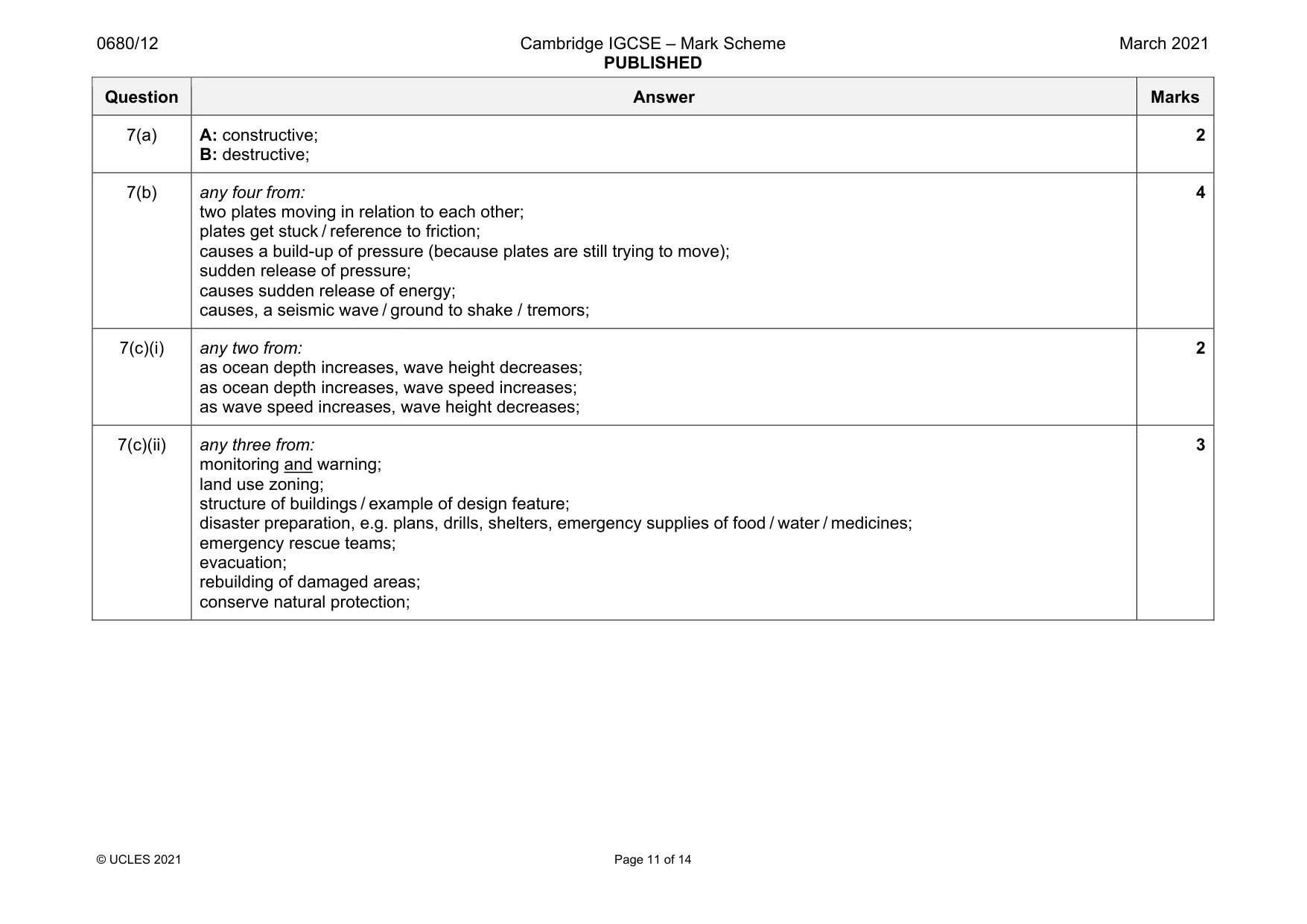
0680/12 Cambridge IGCSE – Mark Scheme PUBLISHED March 2021 © UCLES 2021 Page 11 of 14 Question Answer Marks 7(a) A: constructive; B: destructive; 2 7(b) any four from: two plates moving in relation to each other; plates get stuck / reference to friction; causes a build-up of pressure (because plates are still trying to move); sudden release of pressure; causes sudden release of energy; causes, a seismic wave / ground to shake / tremors; 4 7(c)(i) any two from: as ocean depth increases, wave height decreases; as ocean depth increases, wave speed increases; as wave speed increases, wave height decreases; 2 7(c)(ii) any three from: monitoring and warning; land use zoning; structure of buildings / example of design feature; disaster preparation, e.g. plans, drills, shelters, emergency supplies of food / water / medicines; emergency rescue teams; evacuation; rebuilding of damaged areas; conserve natural protection; 3
Mark scheme, page 12
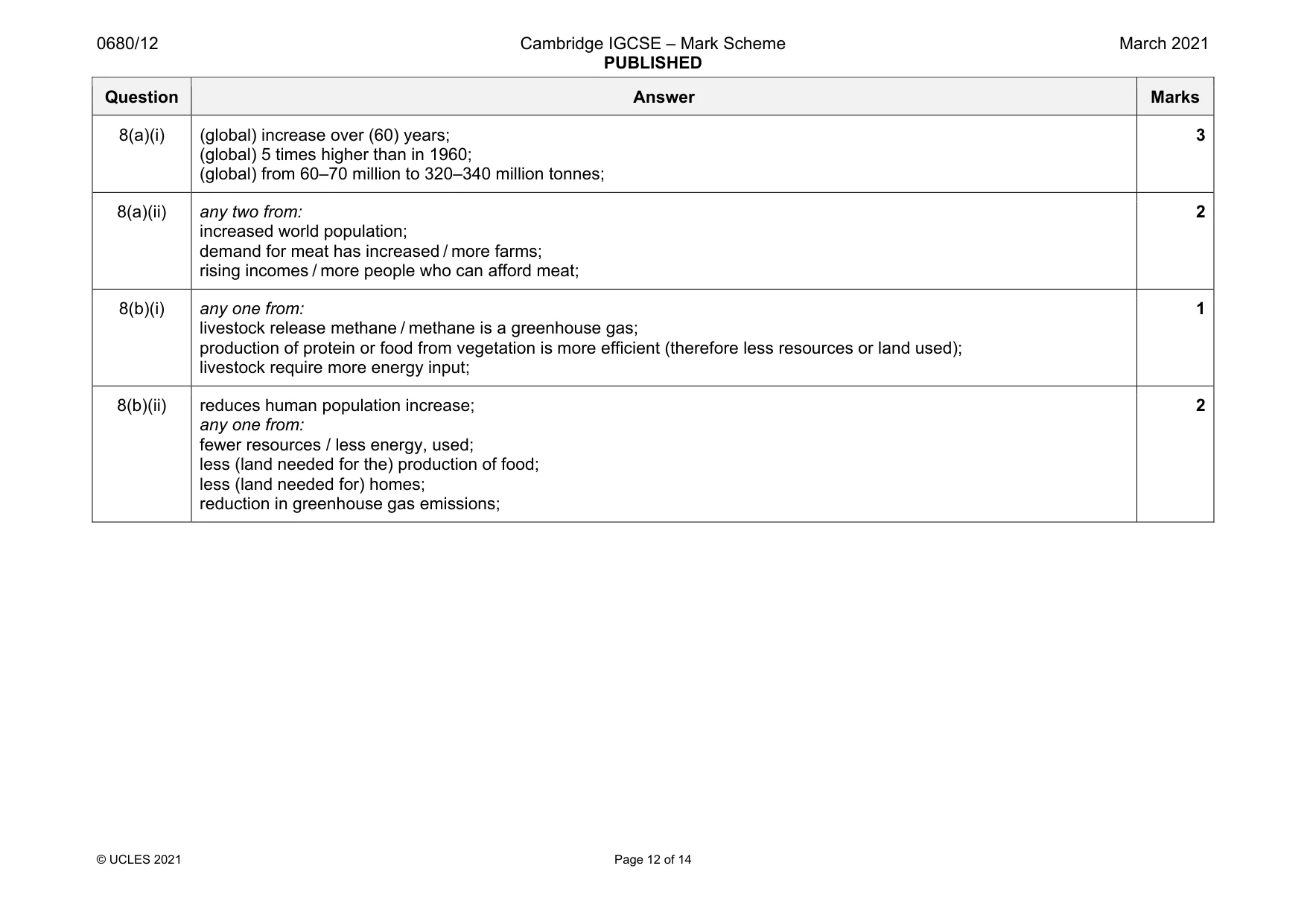
0680/12 Cambridge IGCSE – Mark Scheme PUBLISHED March 2021 © UCLES 2021 Page 12 of 14 Question Answer Marks 8(a)(i) (global) increase over (60) years; (global) 5 times higher than in 1960; (global) from 60–70 million to 320–340 million tonnes; 3 8(a)(ii) any two from: increased world population; demand for meat has increased / more farms; rising incomes / more people who can afford meat; 2 8(b)(i) any one from: livestock release methane / methane is a greenhouse gas; production of protein or food from vegetation is more efficient (therefore less resources or land used); livestock require more energy input; 1 8(b)(ii) reduces human population increase; any one from: fewer resources / less energy, used; less (land needed for the) production of food; less (land needed for) homes; reduction in greenhouse gas emissions; 2
Mark scheme, page 13
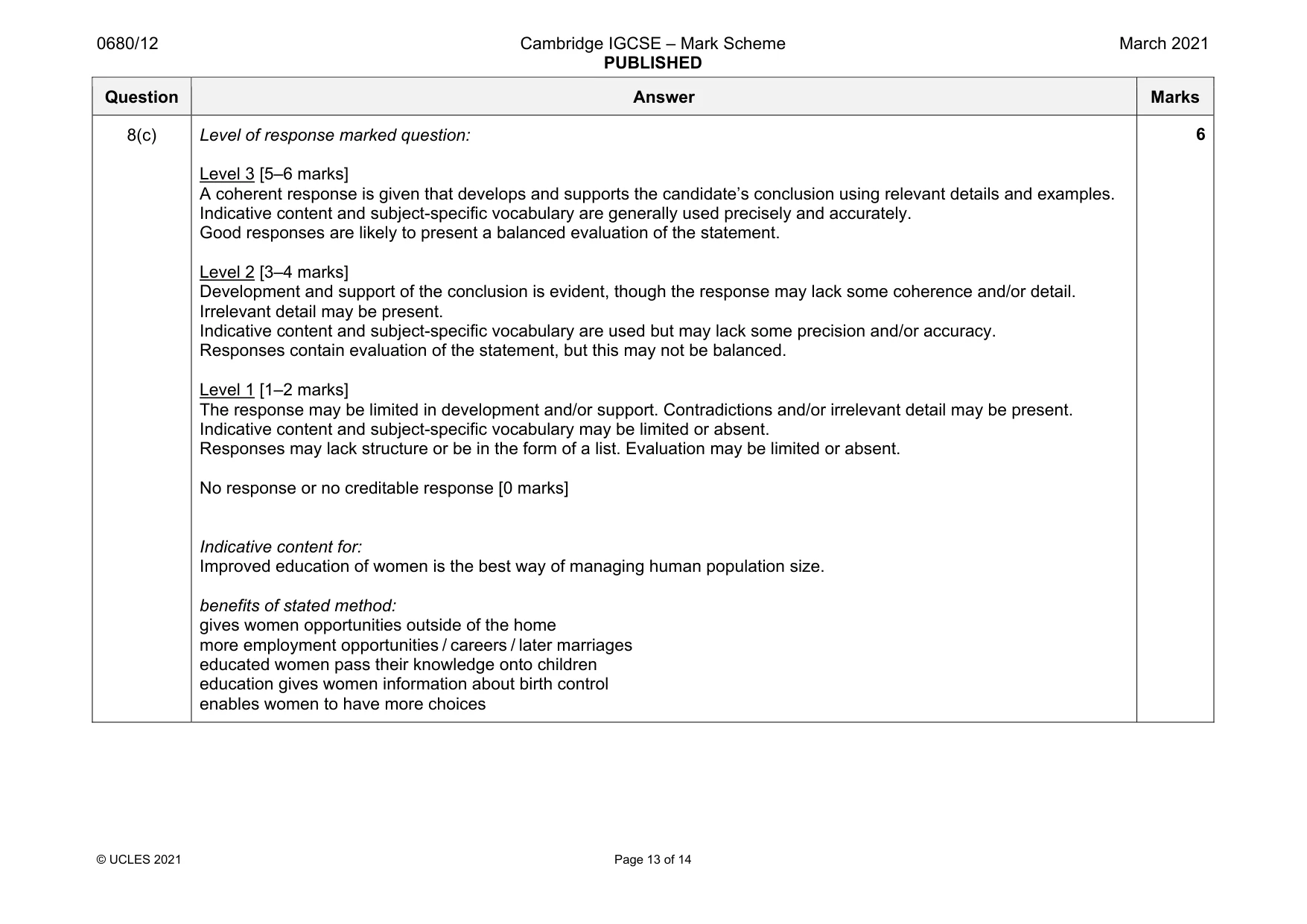
0680/12 Cambridge IGCSE – Mark Scheme PUBLISHED March 2021 © UCLES 2021 Page 13 of 14 Question Answer Marks 8(c) Level of response marked question: Level 3 [5–6 marks] A coherent response is given that develops and supports the candidate’s conclusion using relevant details and examples. Indicative content and subject-specific vocabulary are generally used precisely and accurately. Good responses are likely to present a balanced evaluation of the statement. Level 2 [3–4 marks] Development and support of the conclusion is evident, though the response may lack some coherence and/or detail. Irrelevant detail may be present. Indicative content and subject-specific vocabulary are used but may lack some precision and/or accuracy. Responses contain evaluation of the statement, but this may not be balanced. Level 1 [1–2 marks] The response may be limited in development and/or support. Contradictions and/or irrelevant detail may be present. Indicative content and subject-specific vocabulary may be limited or absent. Responses may lack structure or be in the form of a list. Evaluation may be limited or absent. No response or no creditable response [0 marks] Indicative content for: Improved education of women is the best way of managing human population size. benefits of stated method: gives women opportunities outside of the home more employment opportunities / careers / later marriages educated women pass their knowledge onto children education gives women information about birth control enables women to have more choices 6
Mark scheme, page 14
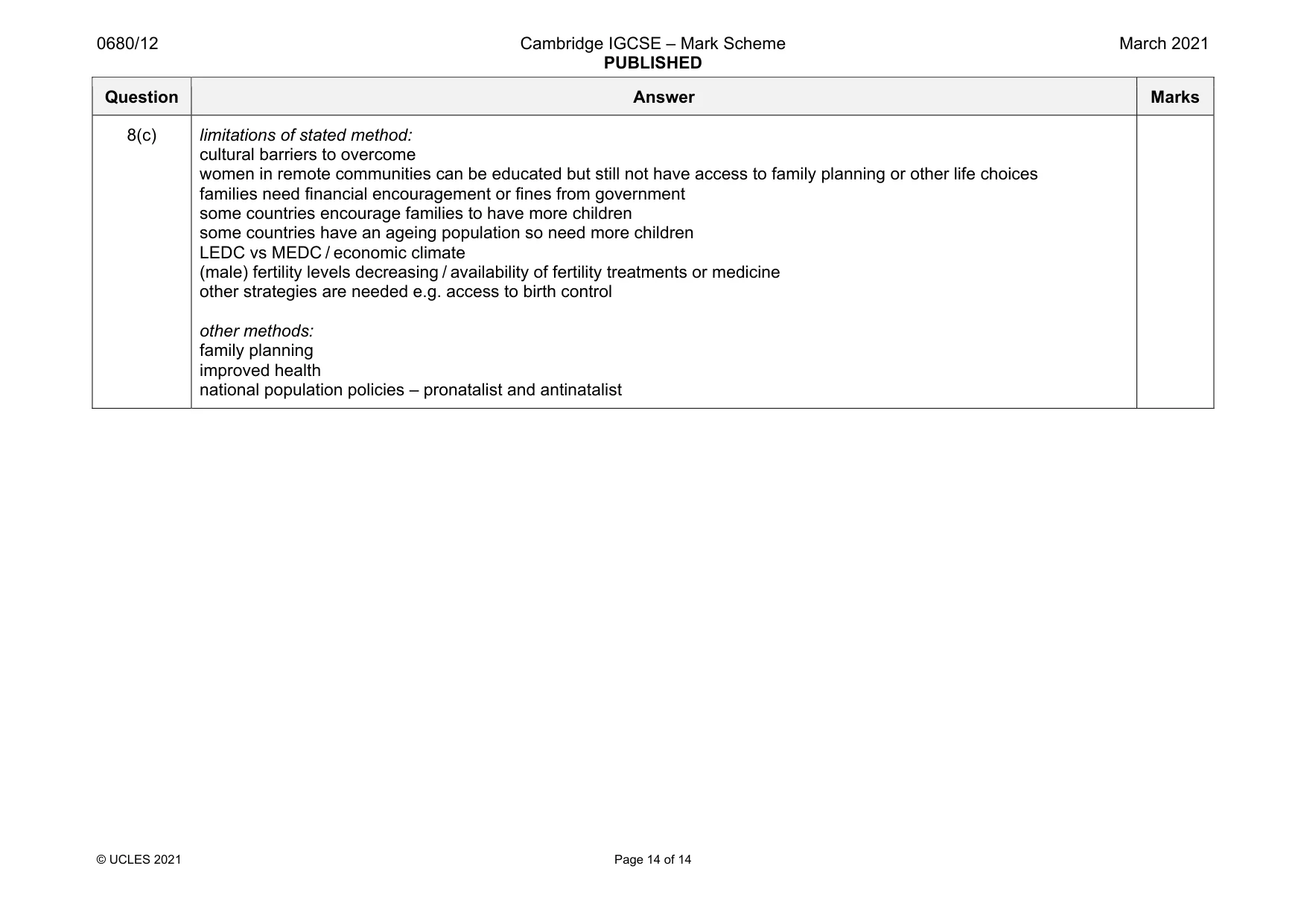
0680/12 Cambridge IGCSE – Mark Scheme PUBLISHED March 2021 © UCLES 2021 Page 14 of 14 Question Answer Marks 8(c) limitations of stated method: cultural barriers to overcome women in remote communities can be educated but still not have access to family planning or other life choices families need financial encouragement or fines from government some countries encourage families to have more children some countries have an ageing population so need more children LEDC vs MEDC / economic climate (male) fertility levels decreasing / availability of fertility treatments or medicine other strategies are needed e.g. access to birth control other methods: family planning improved health national population policies – pronatalist and antinatalist
What you needed in this session
Cambridge’s own grade thresholds for 2021 Feb/March, Paper 1 · Variant 2. A higher threshold means an easier paper — the bar moves with how the cohort did.