Cambridge IGCSE Environmental Management 0680 — 2020 Feb/March Paper 1 · Variant 2
0680/12/F/M/20 · 80 marks · ≈90 min
The question paper and its mark scheme, free to read here and free to download. This is Cambridge’s own paper, exactly as it was sat.
Question paper20 pages



Mark scheme13 pages
Answers below. Sit the paper first if you are practising.
Paper as text
Question paper, page 1
Cambridge IGCSE™ This document has 20 pages. Blank pages are indicated. DC (ST/CT) 184893/2 © UCLES 2020 [Turn over ENVIRONMENTAL MANAGEMENT 0680/12 Paper 1 Theory February/March 2020 1 hour 45 minutes You must answer on the question paper. No additional materials are needed. INSTRUCTIONS ● Answer all questions. ● Use a black or dark blue pen. You may use an HB pencil for any diagrams or graphs. ● Write your name, centre number and candidate number in the boxes at the top of the page. ● Write your answer to each question in the space provided. ● Do not use an erasable pen or correction fluid. ● Do not write on any bar codes. ● You may use a calculator. ● You should show all your working and use appropriate units. INFORMATION ● The total mark for this paper is 80. ● The number of marks for each question or part question is shown in brackets [ ]. * 0 6 7 1 6 1 8 1 6 7 *
Question paper, page 2
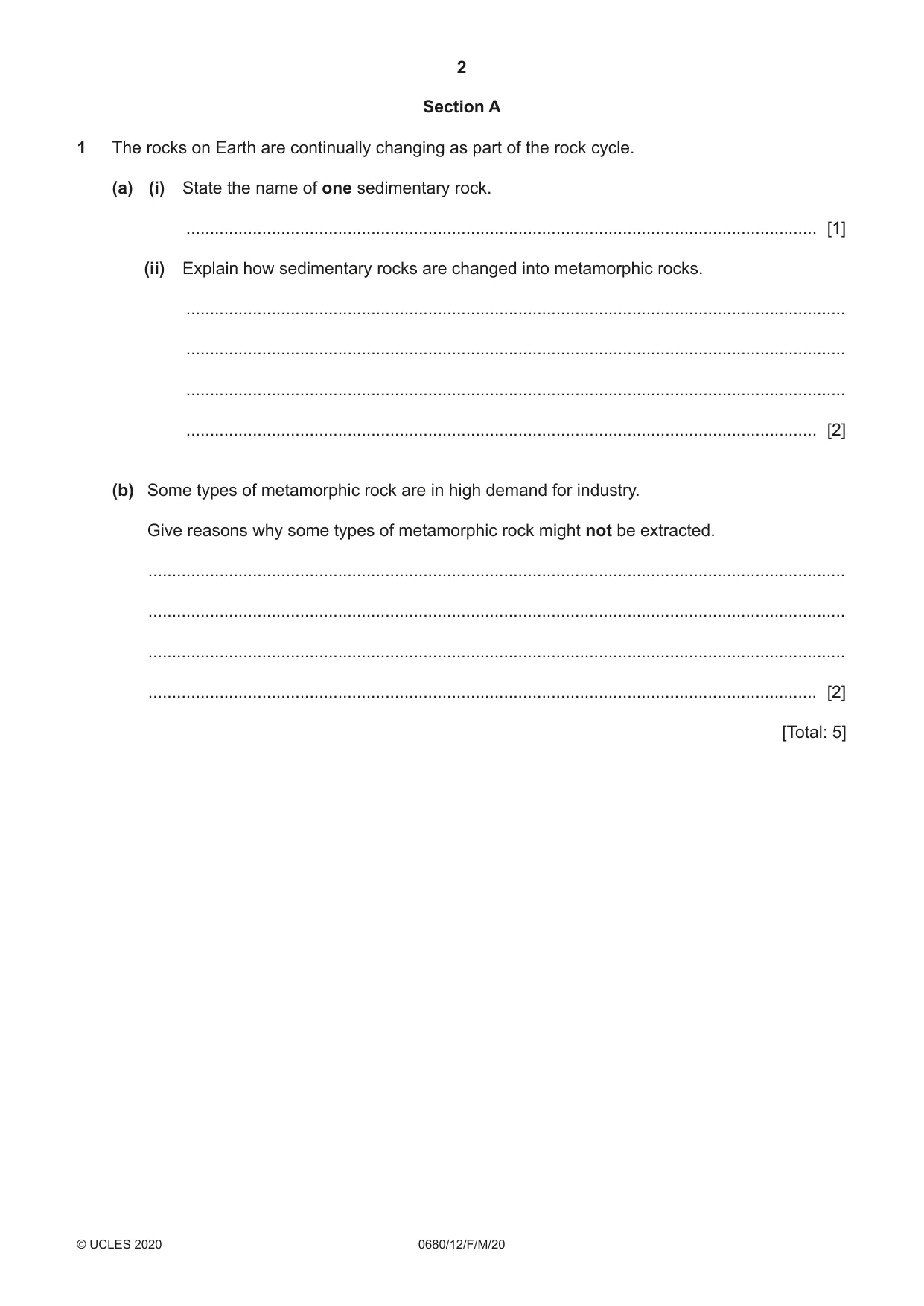
2 0680/12/F/M/20 © UCLES 2020 Section A 1 The rocks on Earth are continually changing as part of the rock cycle. (a) (i) State the name of one sedimentary rock. … [1] (ii) Explain how sedimentary rocks are changed into metamorphic rocks. … … … … [2] (b) Some types of metamorphic rock are in high demand for industry. Give reasons why some types of metamorphic rock might not be extracted. … … … … [2] [Total: 5]
Question paper, page 3
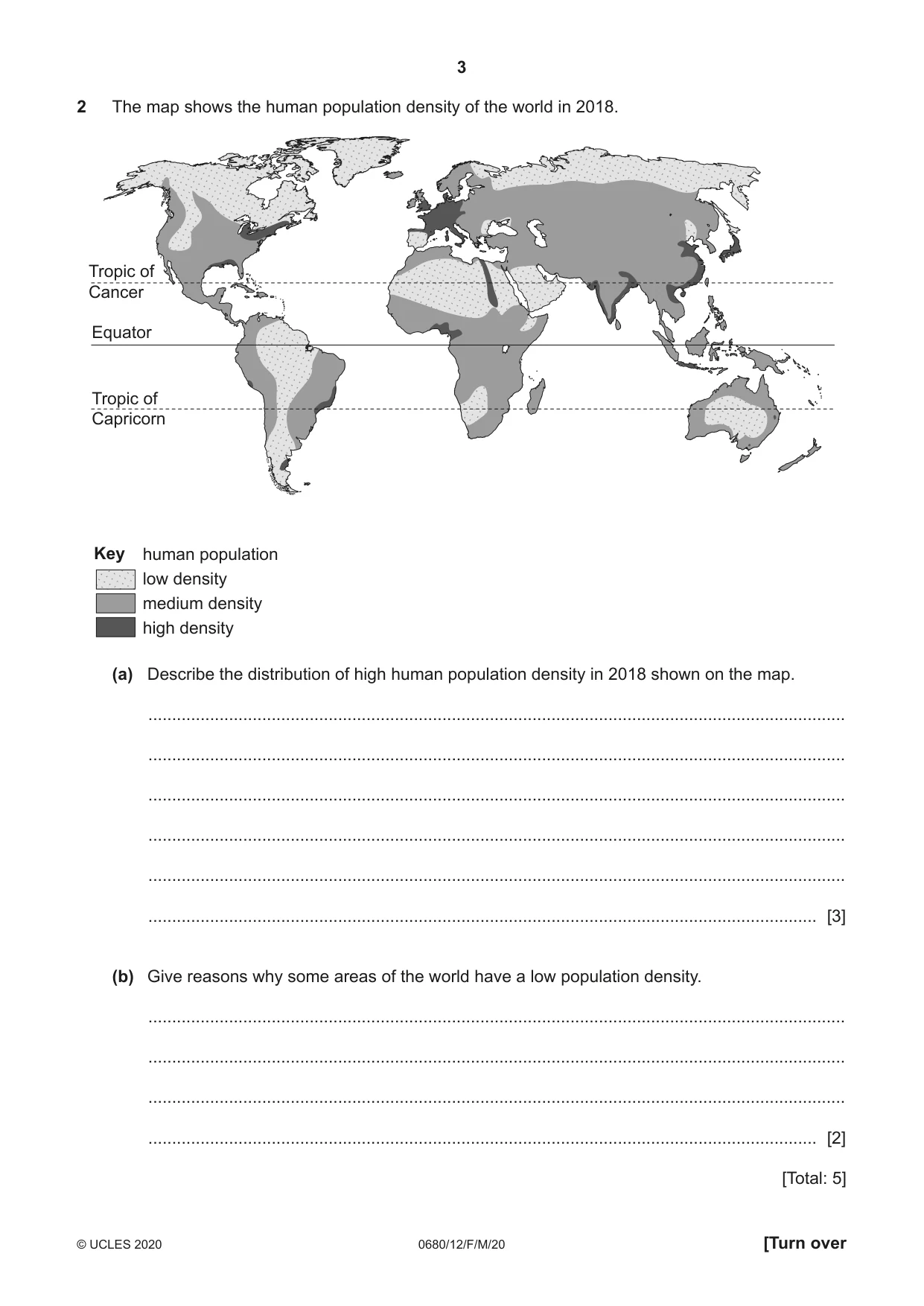
3 0680/12/F/M/20 © UCLES 2020 [Turn over 2 The map shows the human population density of the world in 2018. Equator Tropic of Capricorn Key low density human population Tropic of Cancer medium density high density (a) Describe the distribution of high human population density in 2018 shown on the map. … … … … … … [3] (b) Give reasons why some areas of the world have a low population density. … … … … [2] [Total: 5]
Question paper, page 4
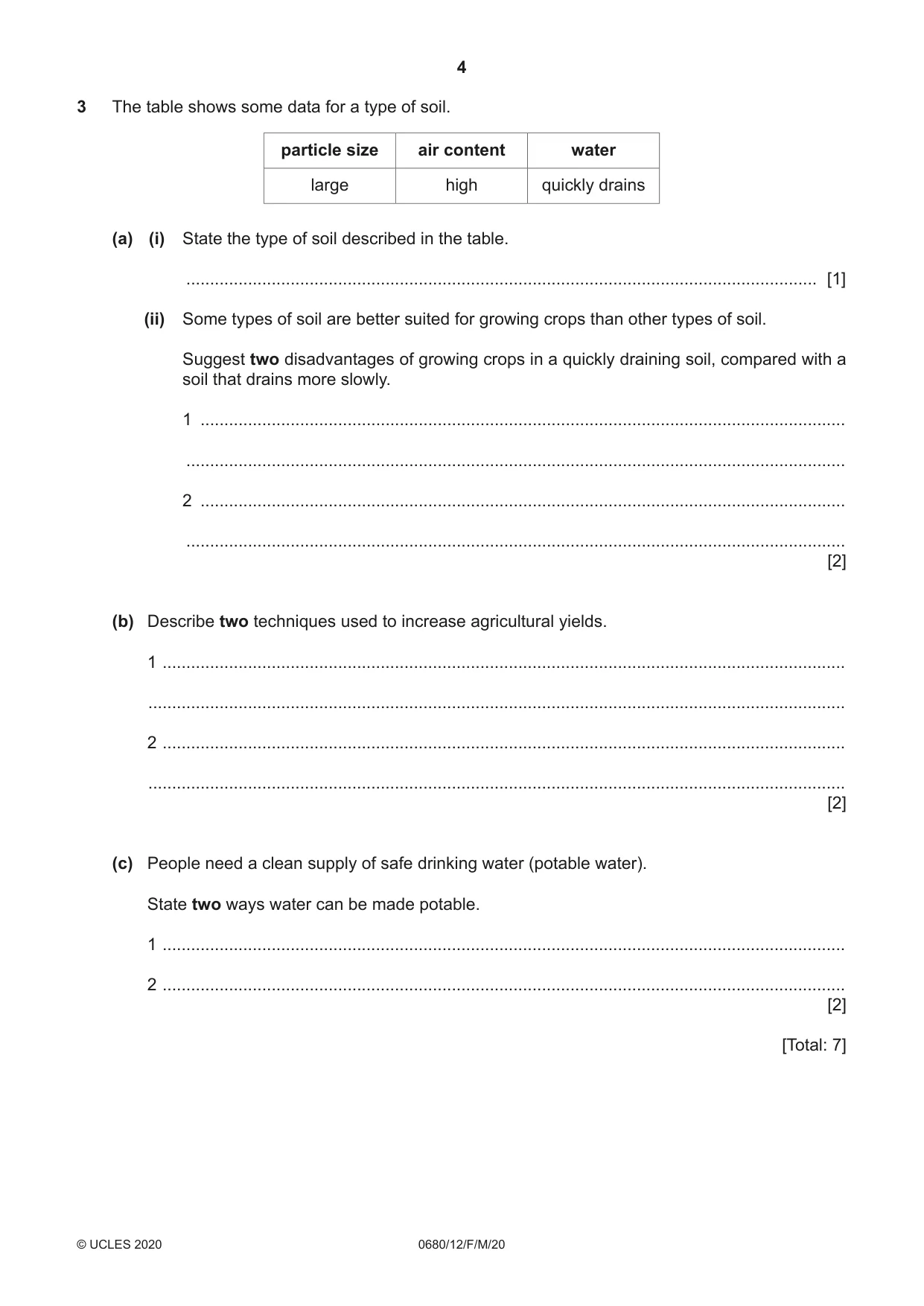
4 0680/12/F/M/20 © UCLES 2020 3 The table shows some data for a type of soil. particle size air content water large high quickly drains (a) (i) State the type of soil described in the table. … [1] (ii) Some types of soil are better suited for growing crops than other types of soil. Suggest two disadvantages of growing crops in a quickly draining soil, compared with a soil that drains more slowly. 1 … … 2 … … [2] (b) Describe two techniques used to increase agricultural yields. 1 … … 2 … … [2] (c) People need a clean supply of safe drinking water (potable water). State two ways water can be made potable. 1 … 2 … [2] [Total: 7]
Question paper, page 5
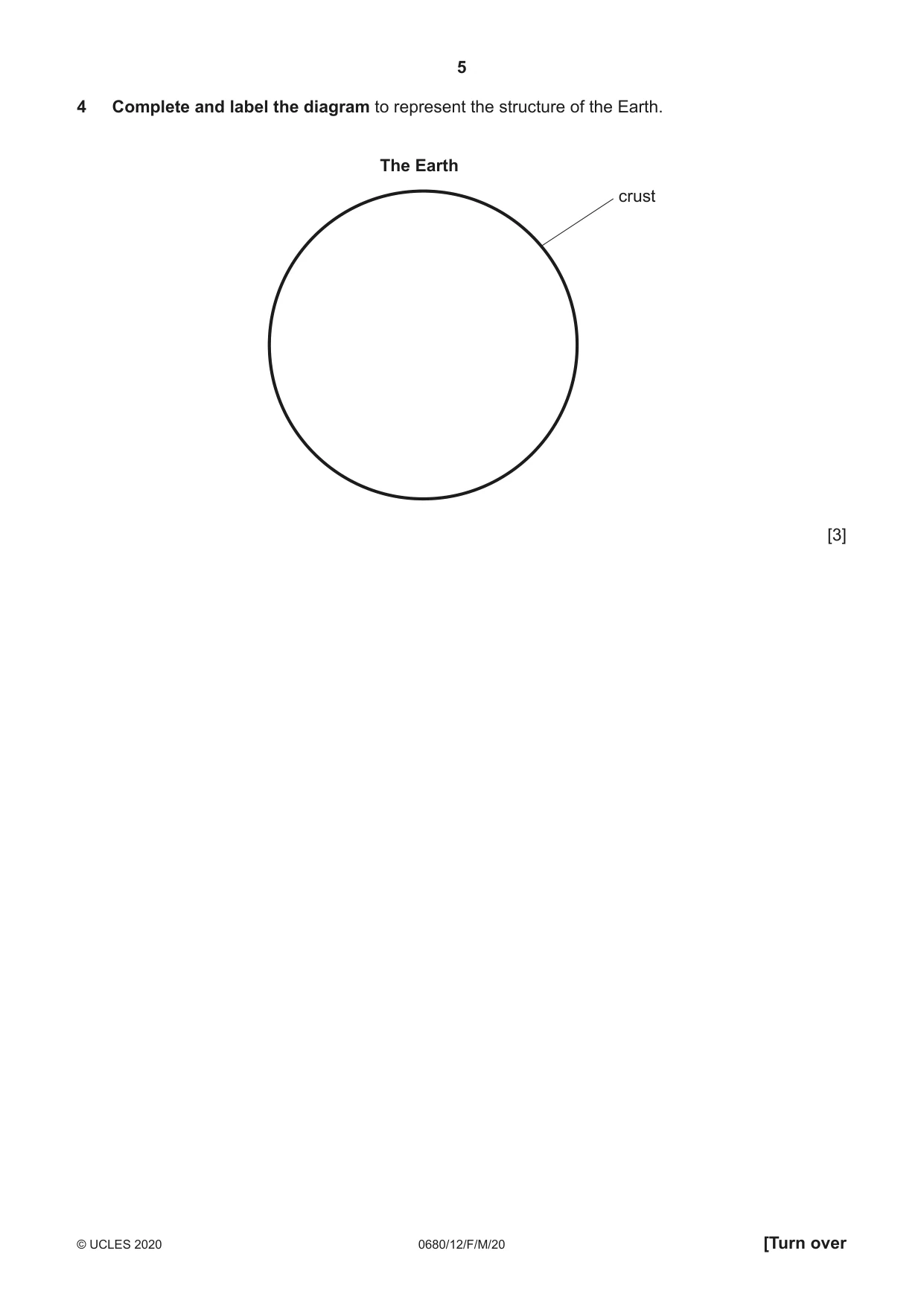
5 0680/12/F/M/20 © UCLES 2020 [Turn over 4 Complete and label the diagram to represent the structure of the Earth. The Earth crust [3]
Question paper, page 6
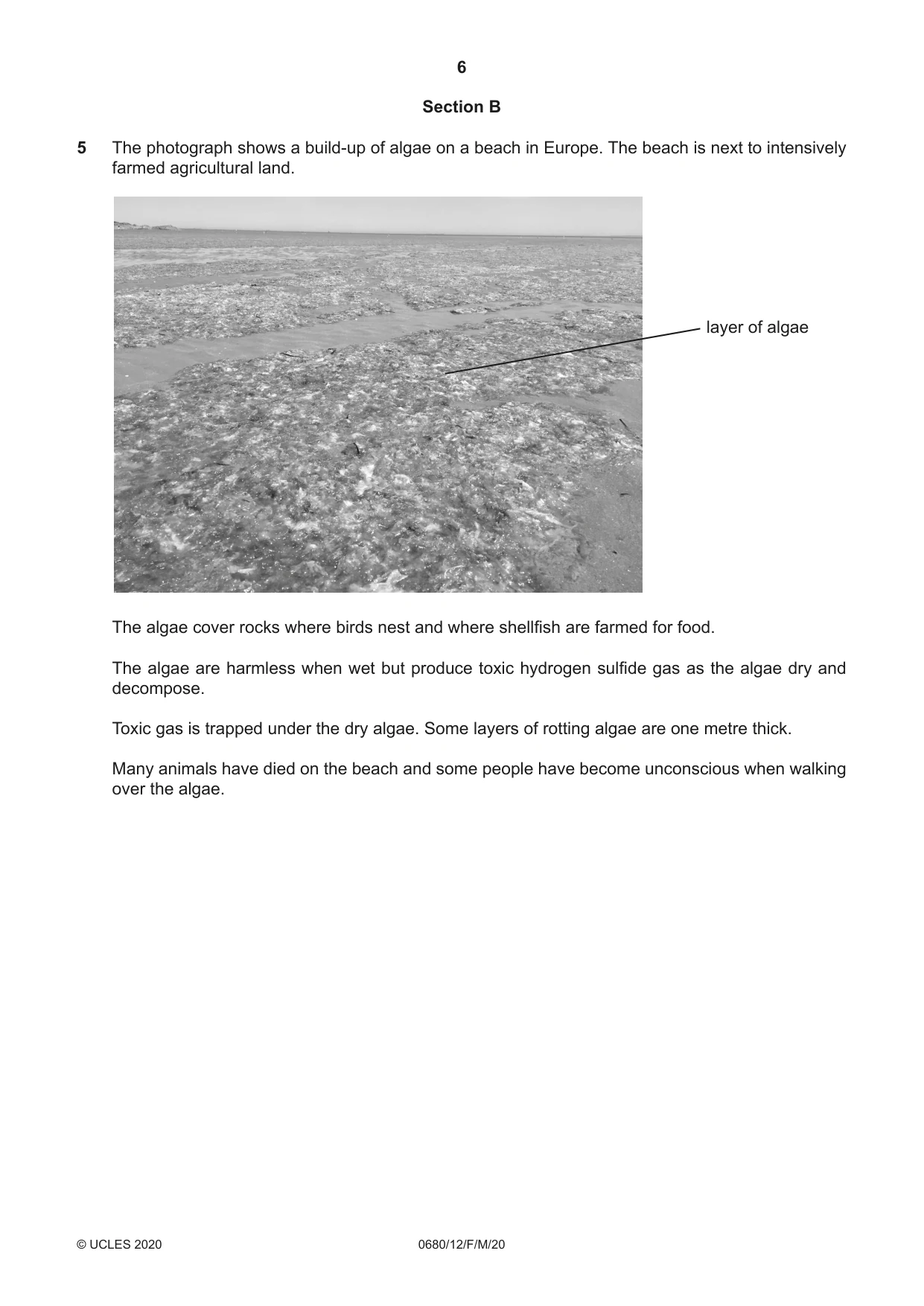
6 0680/12/F/M/20 © UCLES 2020 Section B 5 The photograph shows a build-up of algae on a beach in Europe. The beach is next to intensively farmed agricultural land. layer of algae The algae cover rocks where birds nest and where shellfish are farmed for food. The algae are harmless when wet but produce toxic hydrogen sulfide gas as the algae dry and decompose. Toxic gas is trapped under the dry algae. Some layers of rotting algae are one metre thick. Many animals have died on the beach and some people have become unconscious when walking over the algae.
Question paper, page 7
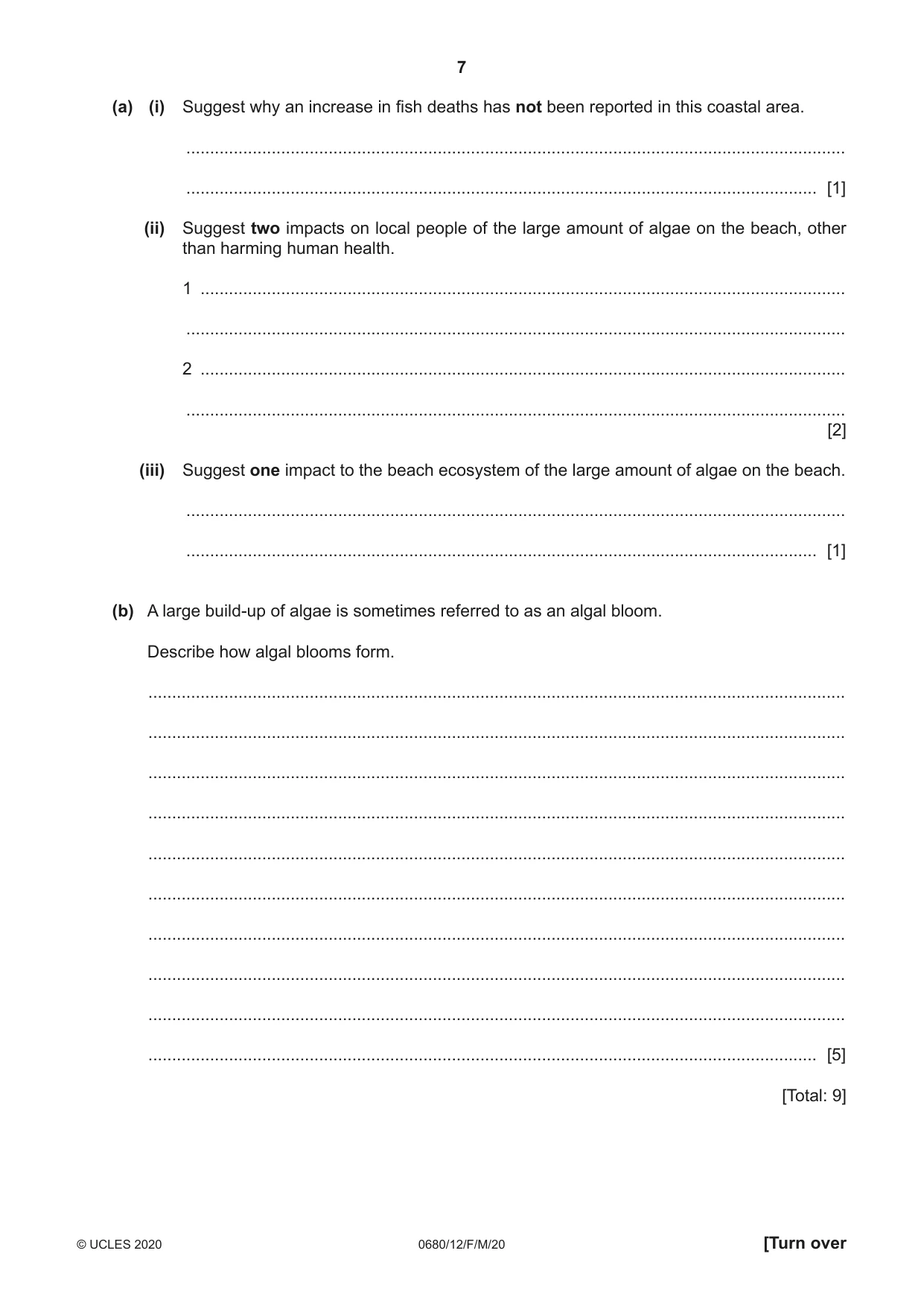
7 0680/12/F/M/20 © UCLES 2020 [Turn over (a) (i) Suggest why an increase in fish deaths has not been reported in this coastal area. … … [1] (ii) Suggest two impacts on local people of the large amount of algae on the beach, other than harming human health. 1 … … 2 … … [2] (iii) Suggest one impact to the beach ecosystem of the large amount of algae on the beach. … … [1] (b) A large build-up of algae is sometimes referred to as an algal bloom. Describe how algal blooms form. … … … … … … … … … … [5] [Total: 9]
Question paper, page 8
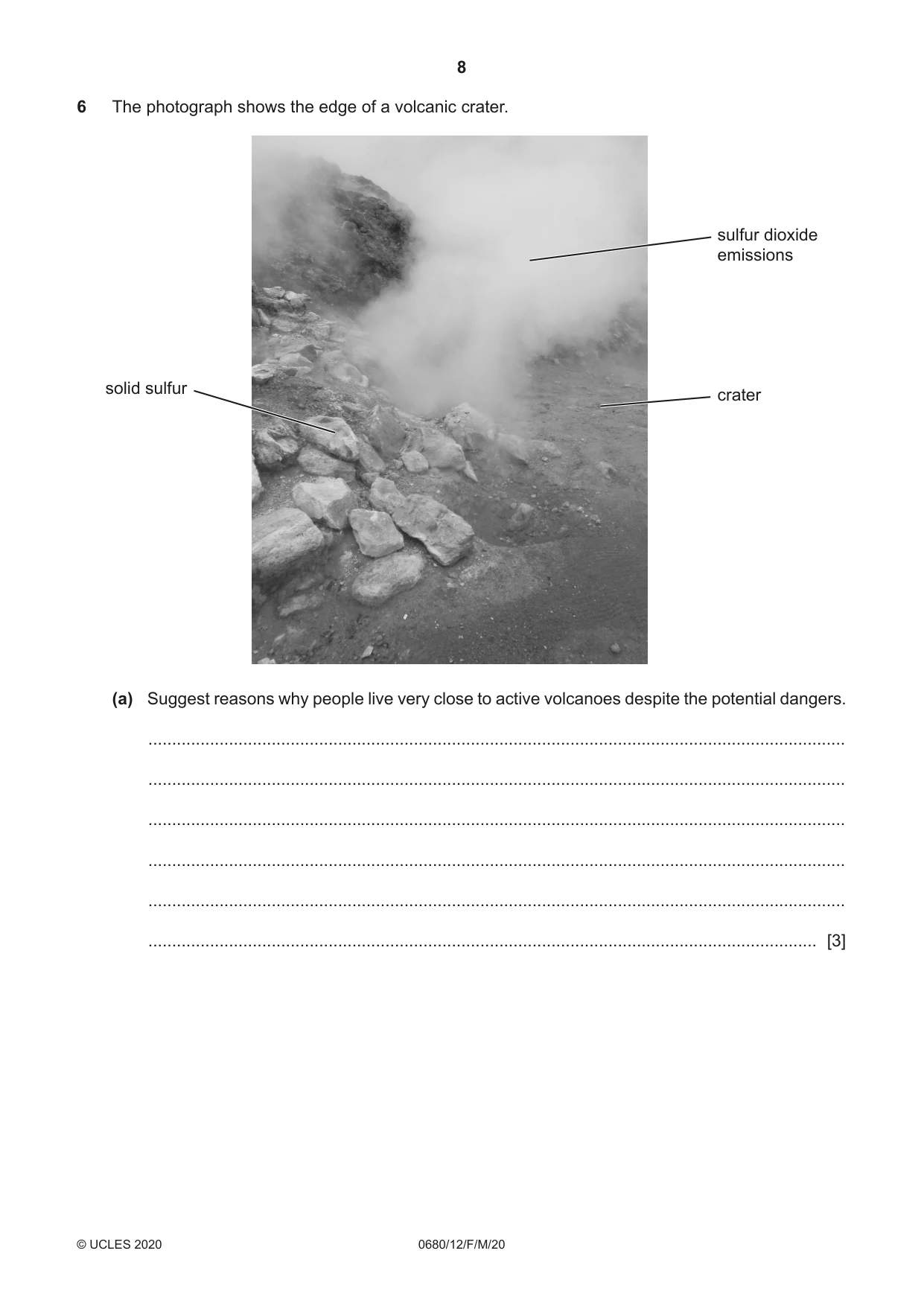
8 0680/12/F/M/20 © UCLES 2020 6 The photograph shows the edge of a volcanic crater. solid sulfur sulfur dioxide emissions crater (a) Suggest reasons why people live very close to active volcanoes despite the potential dangers. … … … … … … [3]
Question paper, page 9
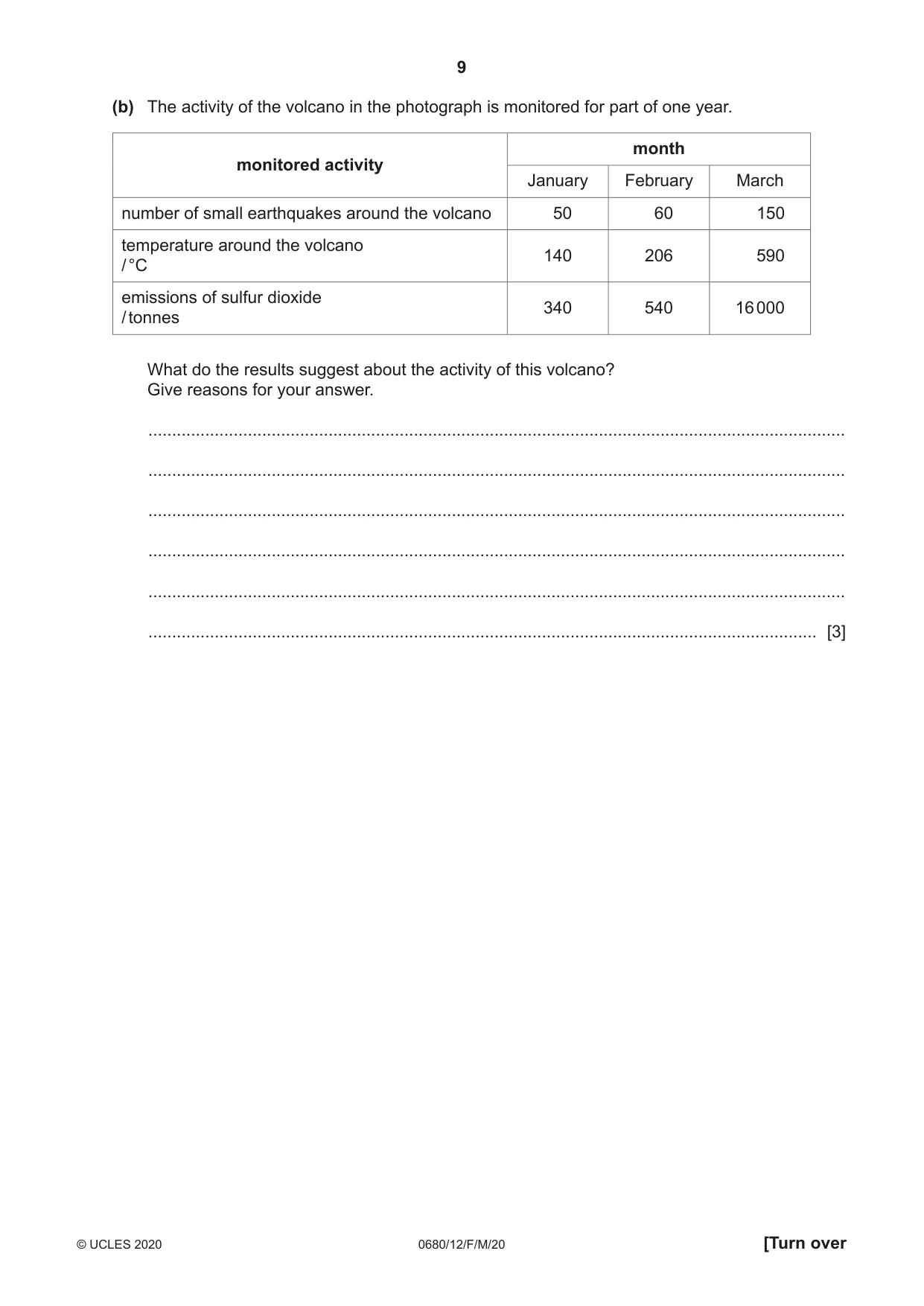
9 0680/12/F/M/20 © UCLES 2020 [Turn over (b) The activity of the volcano in the photograph is monitored for part of one year. monitored activity month January February March number of small earthquakes around the volcano 50 60 150 temperature around the volcano / °C 140 206 590 emissions of sulfur dioxide / tonnes 340 540 16 000 What do the results suggest about the activity of this volcano? Give reasons for your answer. … … … … … … [3]
Question paper, page 10
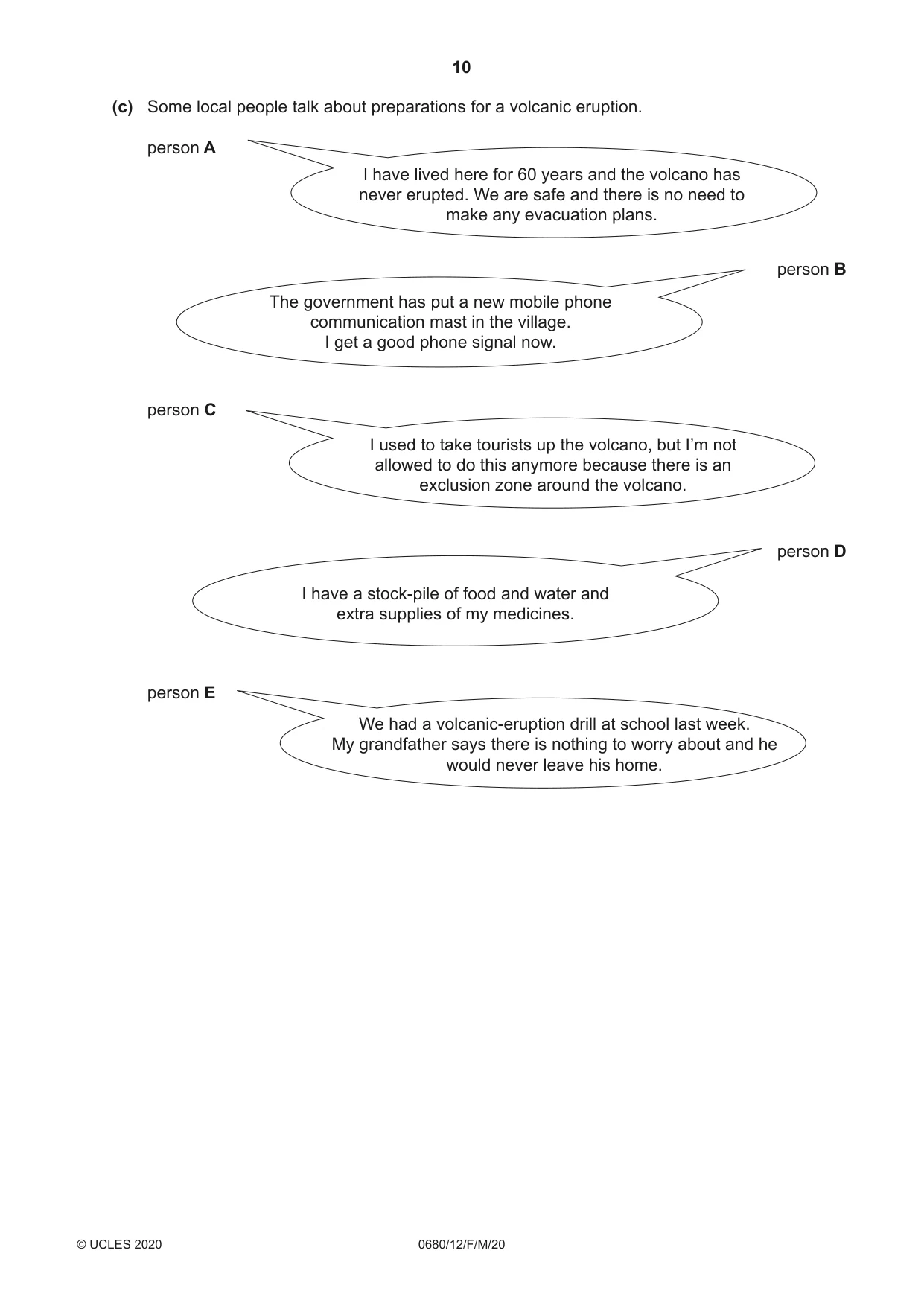
10 0680/12/F/M/20 © UCLES 2020 (c) Some local people talk about preparations for a volcanic eruption. person A person B person C person D person E I have lived here for 60 years and the volcano has never erupted. We are safe and there is no need to make any evacuation plans. The government has put a new mobile phone communication mast in the village. I get a good phone signal now. I used to take tourists up the volcano, but I’m not allowed to do this anymore because there is an exclusion zone around the volcano. I have a stock-pile of food and water and extra supplies of my medicines. We had a volcanic-eruption drill at school last week. My grandfather says there is nothing to worry about and he would never leave his home.
Question paper, page 11
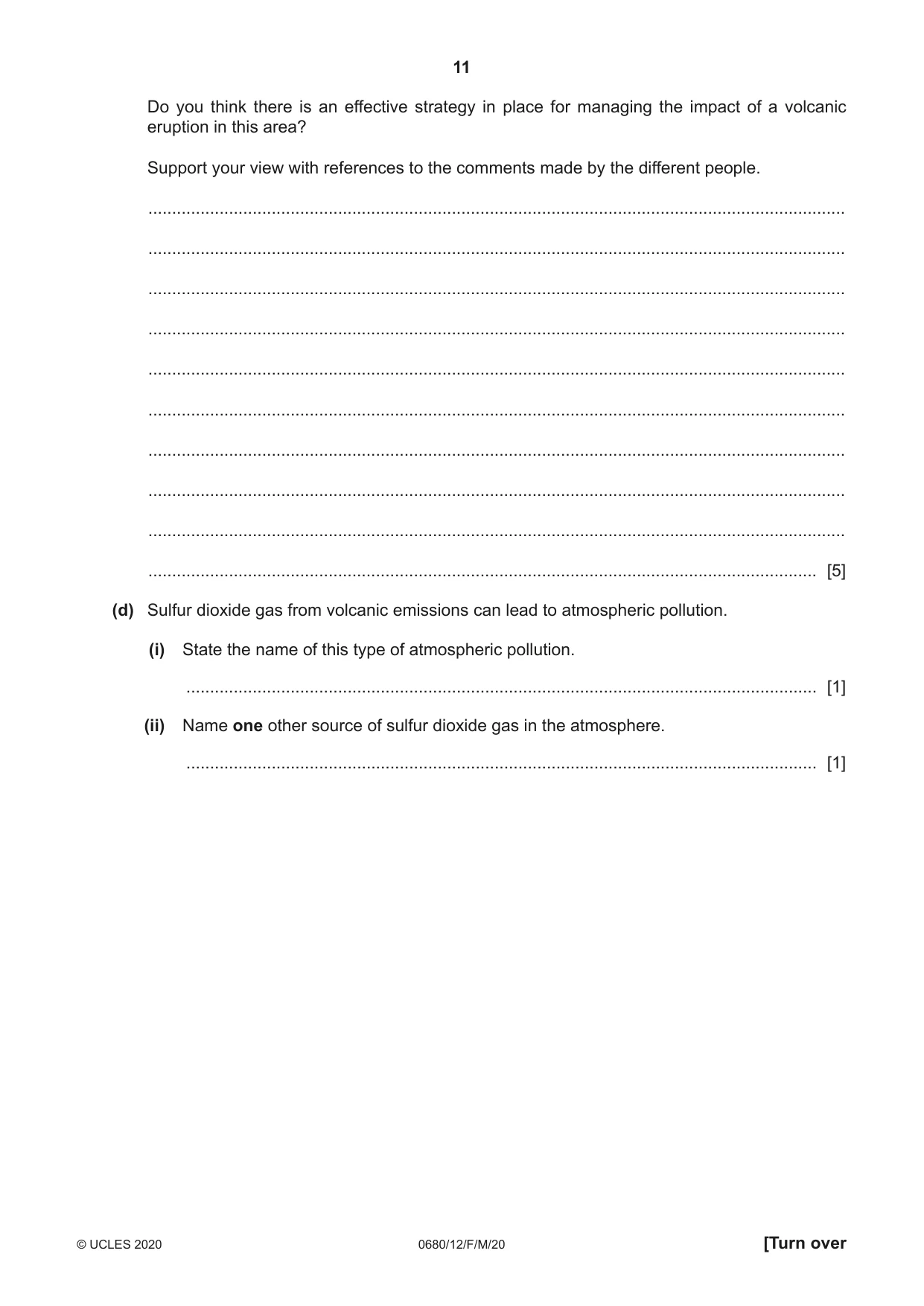
11 0680/12/F/M/20 © UCLES 2020 [Turn over Do you think there is an effective strategy in place for managing the impact of a volcanic eruption in this area? Support your view with references to the comments made by the different people. … … … … … … … … … … [5] (d) Sulfur dioxide gas from volcanic emissions can lead to atmospheric pollution. (i) State the name of this type of atmospheric pollution. … [1] (ii) Name one other source of sulfur dioxide gas in the atmosphere. … [1]
Question paper, page 12
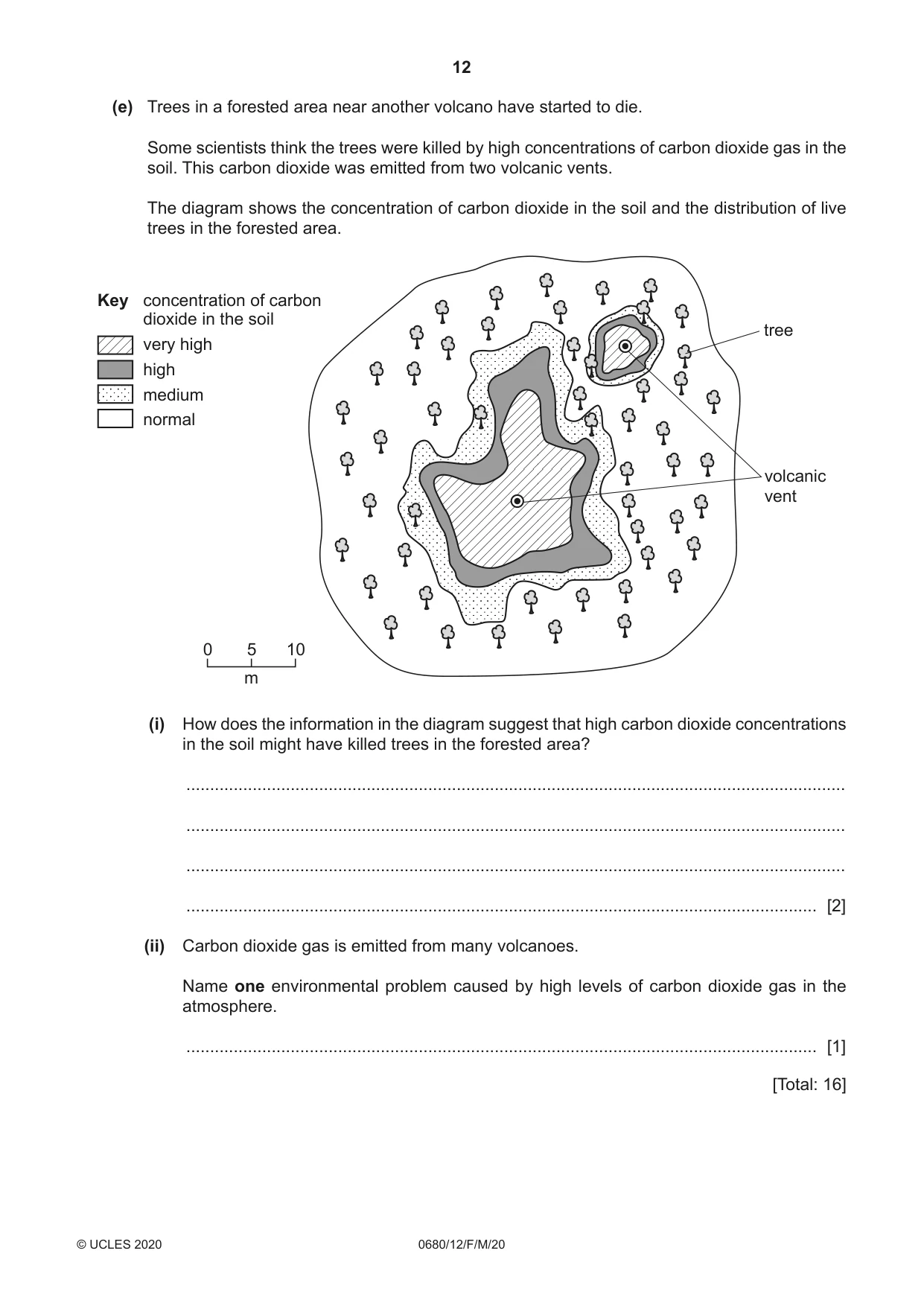
12 0680/12/F/M/20 © UCLES 2020 (e) Trees in a forested area near another volcano have started to die. Some scientists think the trees were killed by high concentrations of carbon dioxide gas in the soil. This carbon dioxide was emitted from two volcanic vents. The diagram shows the concentration of carbon dioxide in the soil and the distribution of live trees in the forested area. Key concentration of carbon dioxide in the soil very high high medium normal 0 5 10 m tree volcanic vent (i) How does the information in the diagram suggest that high carbon dioxide concentrations in the soil might have killed trees in the forested area? … … … … [2] (ii) Carbon dioxide gas is emitted from many volcanoes. Name one environmental problem caused by high levels of carbon dioxide gas in the atmosphere. … [1] [Total: 16]
Question paper, page 13
13 0680/12/F/M/20 © UCLES 2020 [Turn over BLANK PAGE
Question paper, page 14
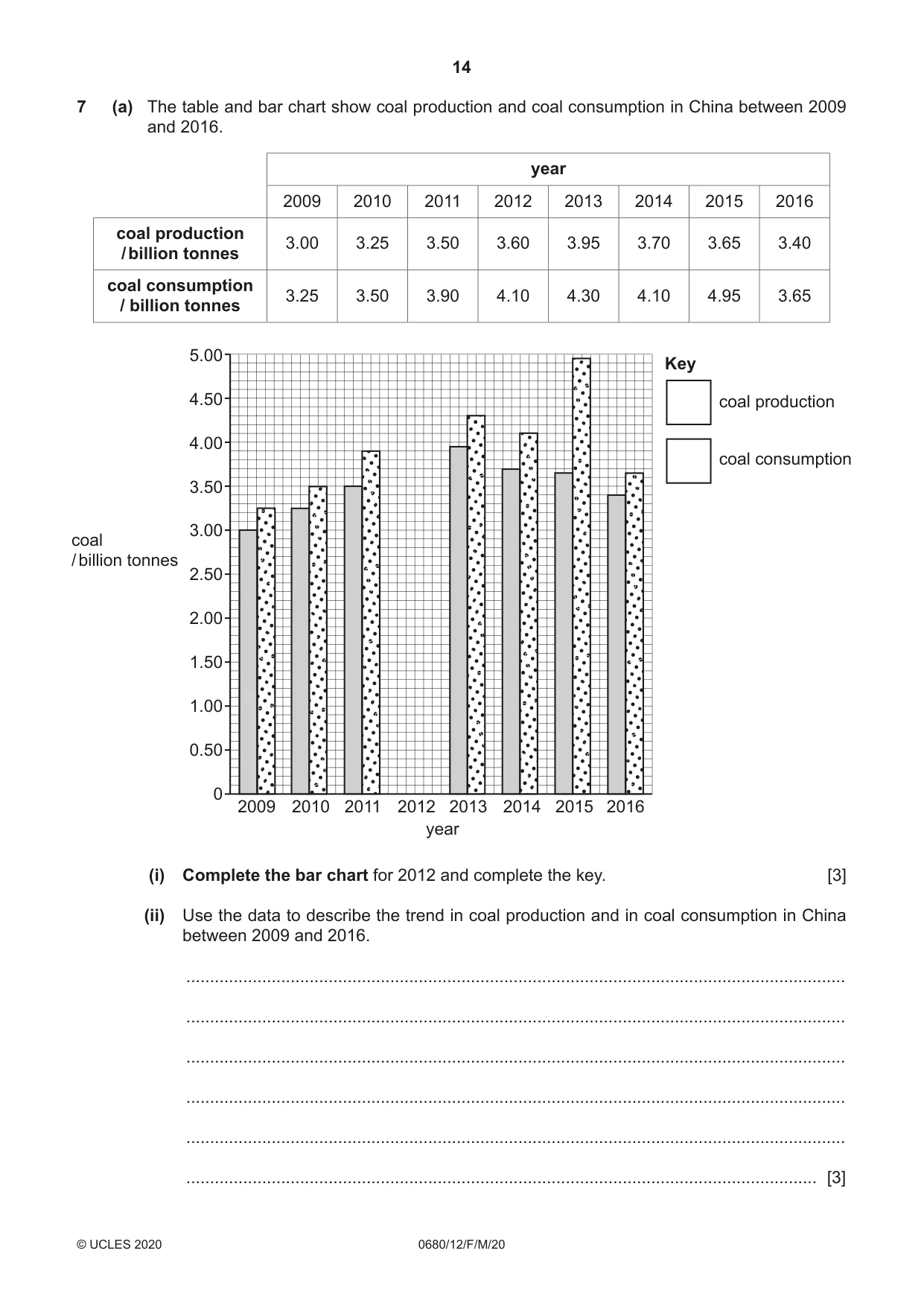
14 0680/12/F/M/20 © UCLES 2020 7 (a) The table and bar chart show coal production and coal consumption in China between 2009 and 2016. year 2009 2010 2011 2012 2013 2014 2015 2016 coal production / billion tonnes 3.00 3.25 3.50 3.60 3.95 3.70 3.65 3.40 coal consumption / billion tonnes 3.25 3.50 3.90 4.10 4.30 4.10 4.95 3.65 0 2009 2010 2011 2012 year 2013 2014 2015 2016 0.50 1.00 1.50 2.00 2.50 3.00 coal / billion tonnes 3.50 4.00 4.50 5.00 Key coal production coal consumption (i) Complete the bar chart for 2012 and complete the key. [3] (ii) Use the data to describe the trend in coal production and in coal consumption in China between 2009 and 2016. … … … … … … [3]
Question paper, page 15
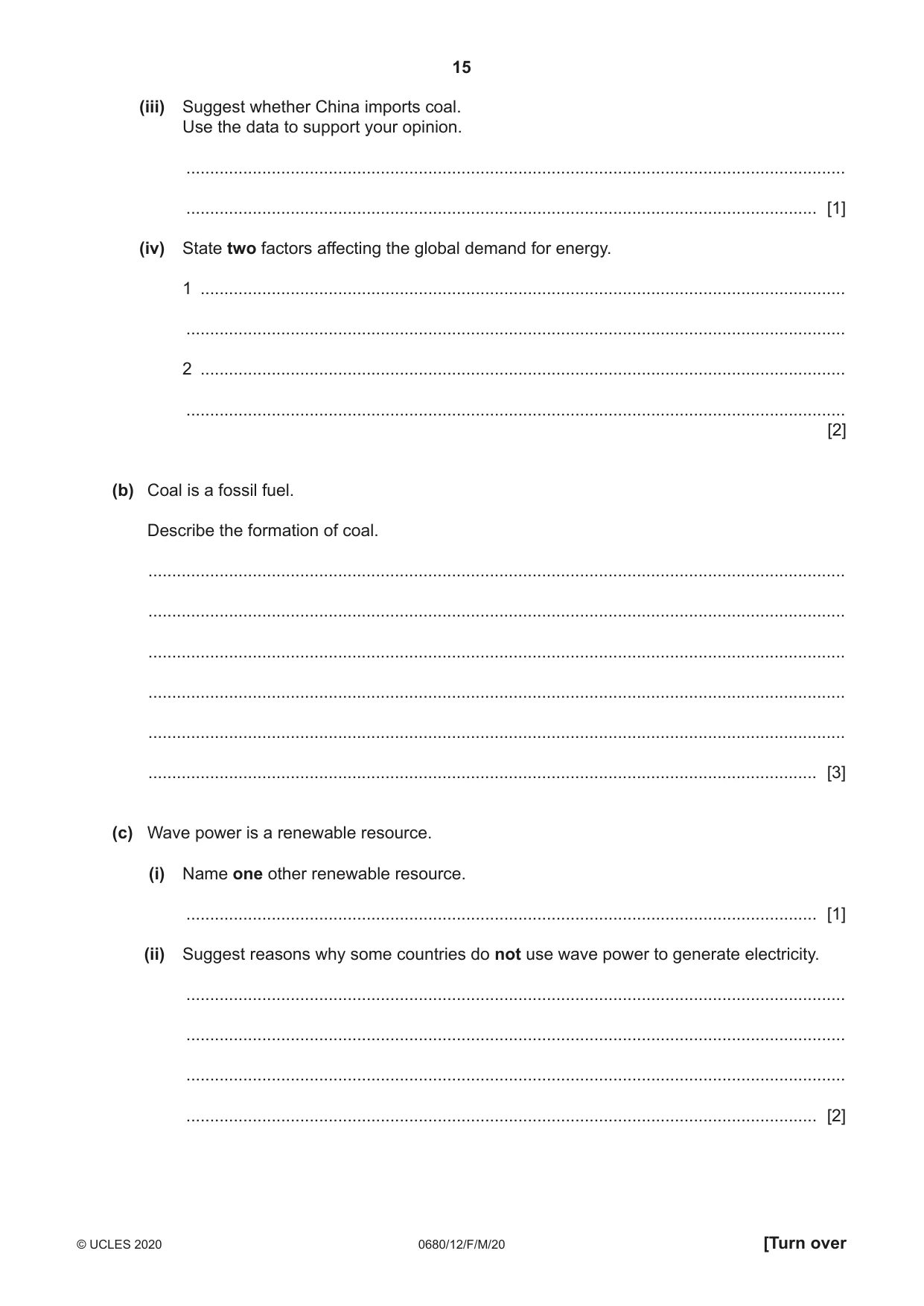
15 0680/12/F/M/20 © UCLES 2020 [Turn over (iii) Suggest whether China imports coal. Use the data to support your opinion. … … [1] (iv) State two factors affecting the global demand for energy. 1 … … 2 … … [2] (b) Coal is a fossil fuel. Describe the formation of coal. … … … … … … [3] (c) Wave power is a renewable resource. (i) Name one other renewable resource. … [1] (ii) Suggest reasons why some countries do not use wave power to generate electricity. … … … … [2]
Question paper, page 16
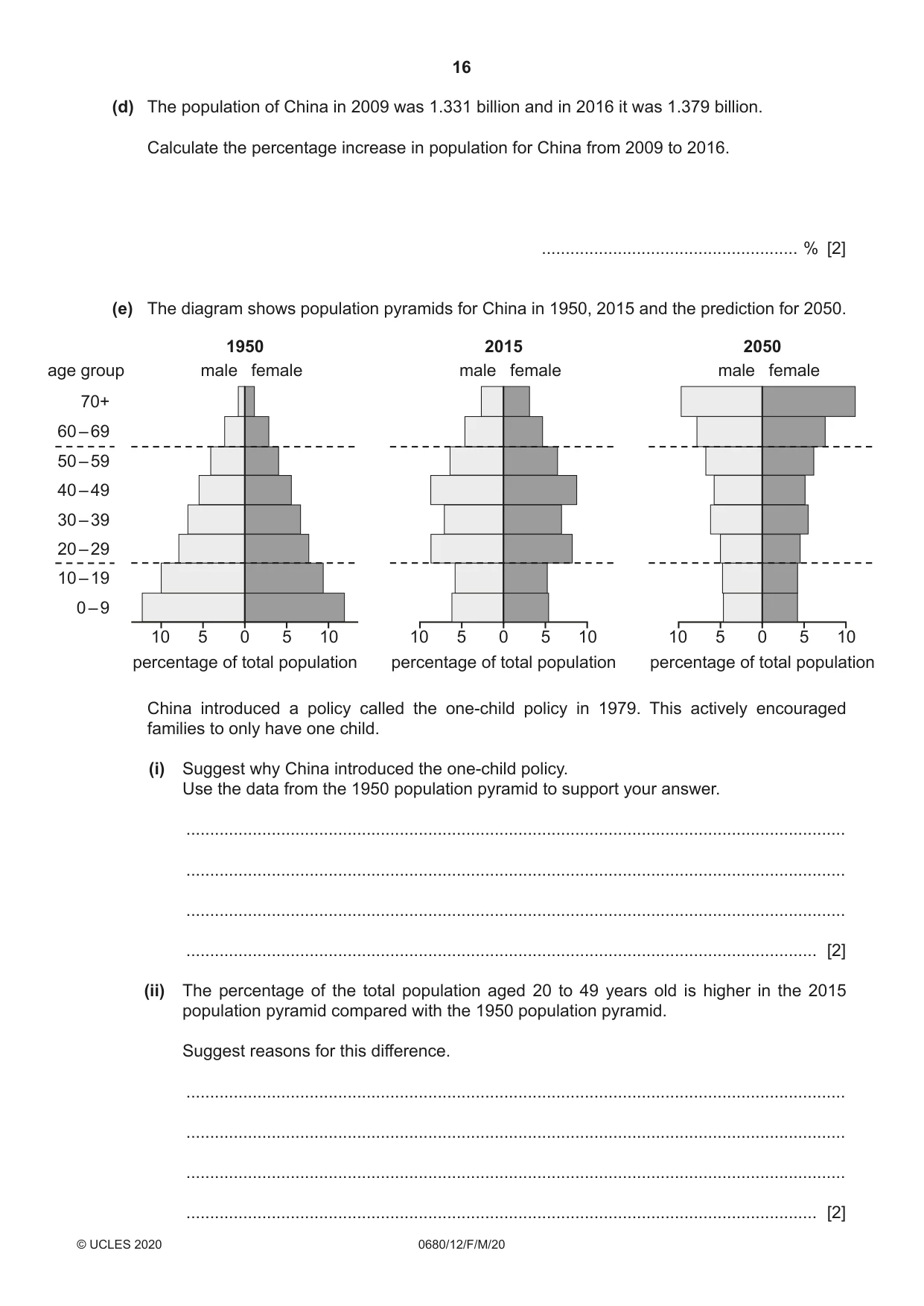
16 0680/12/F/M/20 © UCLES 2020 (d) The population of China in 2009 was 1.331 billion and in 2016 it was 1.379 billion. Calculate the percentage increase in population for China from 2009 to 2016. … % [2] (e) The diagram shows population pyramids for China in 1950, 2015 and the prediction for 2050. 0 5 10 70+ 60 – 69 50 – 59 40 – 49 30 – 39 20 – 29 10 – 19 0 – 9 10 5 1950 percentage of total population male age group female 0 5 10 10 5 2015 percentage of total population male female 0 5 10 10 5 2050 percentage of total population male female China introduced a policy called the one-child policy in 1979. This actively encouraged families to only have one child. (i) Suggest why China introduced the one-child policy. Use the data from the 1950 population pyramid to support your answer. … … … … [2] (ii) The percentage of the total population aged 20 to 49 years old is higher in the 2015 population pyramid compared with the 1950 population pyramid. Suggest reasons for this difference. … … … … [2]
Question paper, page 17
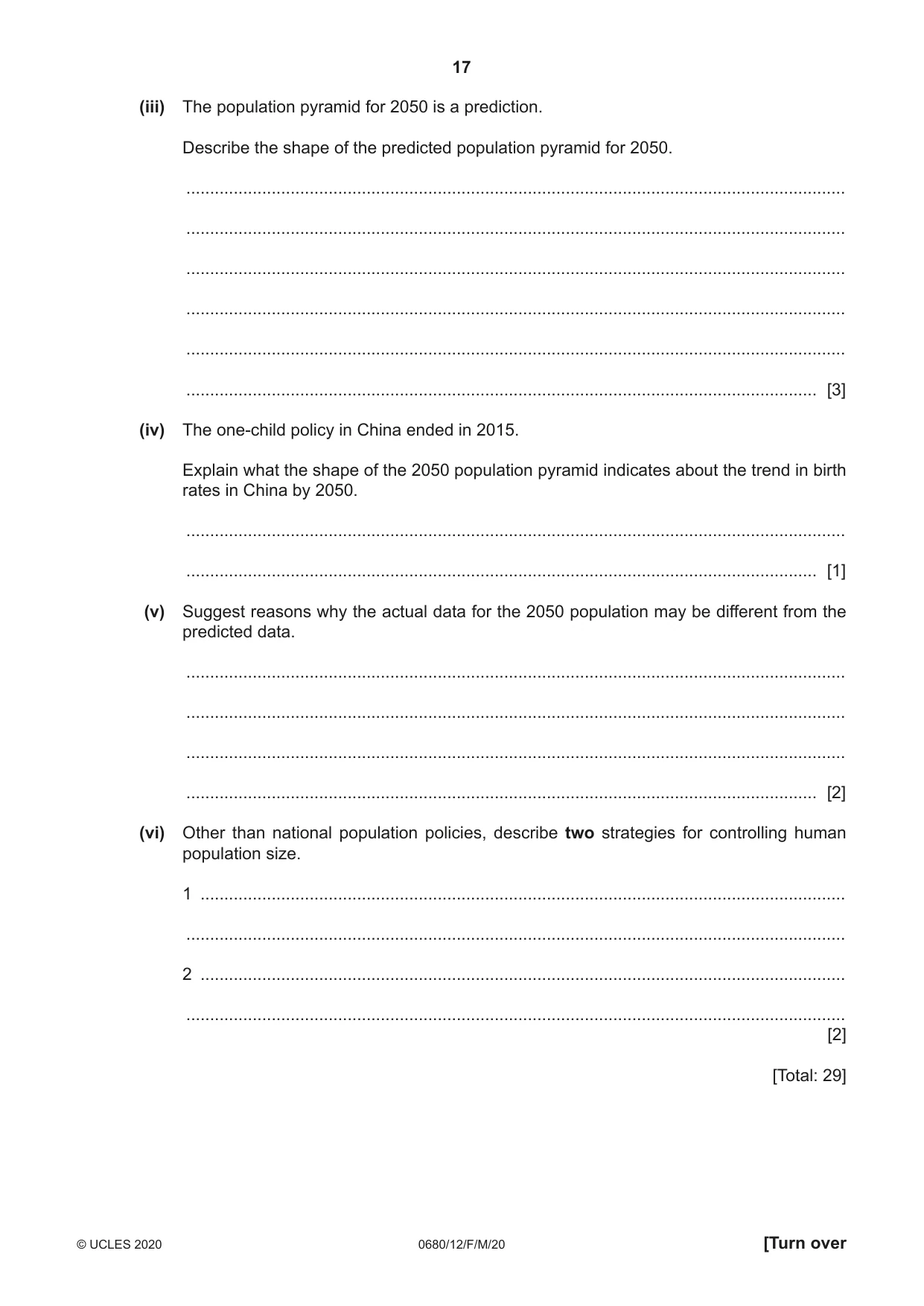
17 0680/12/F/M/20 © UCLES 2020 [Turn over (iii) The population pyramid for 2050 is a prediction. Describe the shape of the predicted population pyramid for 2050. … … … … … … [3] (iv) The one-child policy in China ended in 2015. Explain what the shape of the 2050 population pyramid indicates about the trend in birth rates in China by 2050. … … [1] (v) Suggest reasons why the actual data for the 2050 population may be different from the predicted data. … … … … [2] (vi) Other than national population policies, describe two strategies for controlling human population size. 1 … … 2 … … [2] [Total: 29]
Question paper, page 18
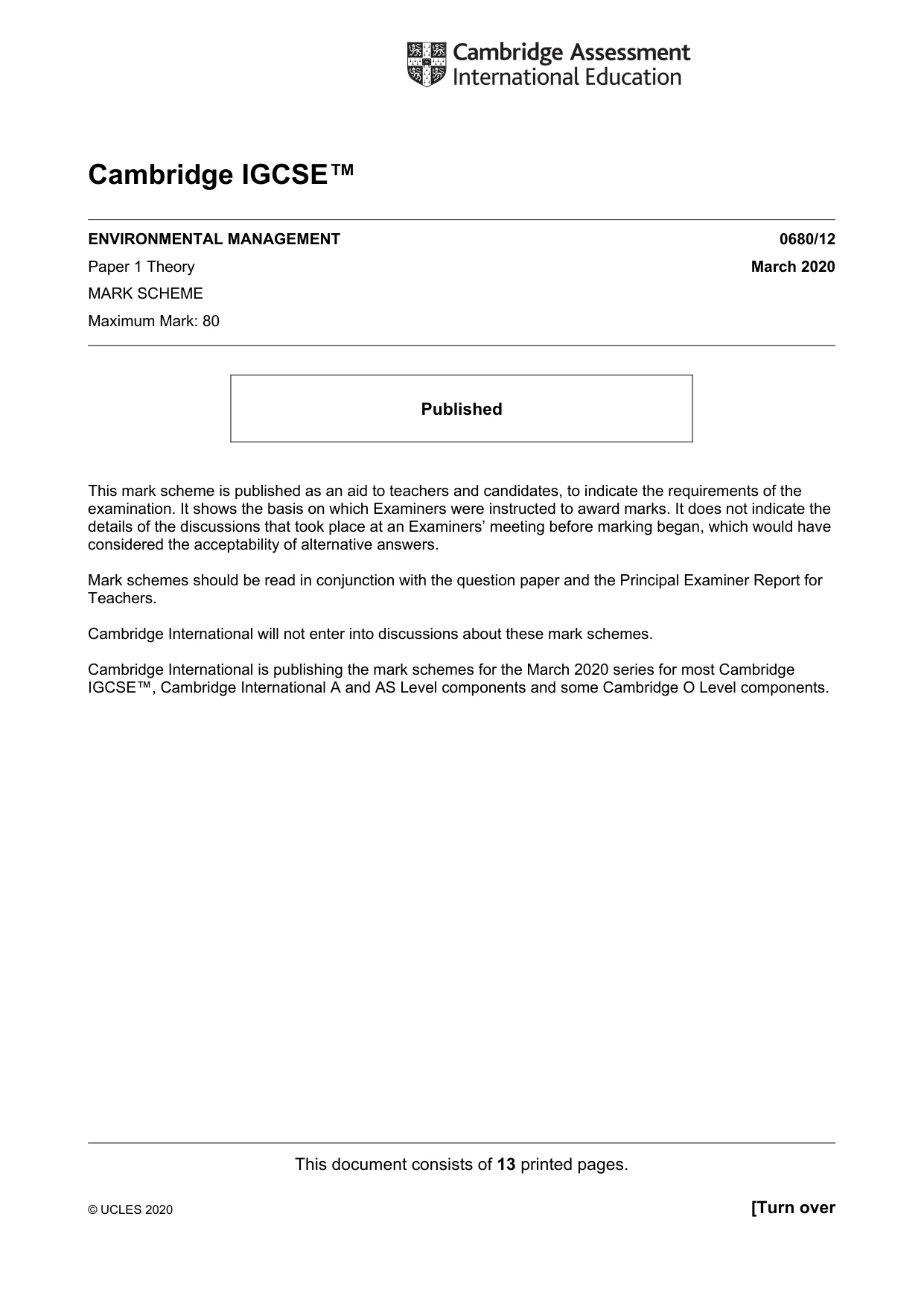
18 0680/12/F/M/20 © UCLES 2020 8 The photograph shows a dolphin in captivity. ‘Zoos and captive breeding programmes are the best way of conserving biodiversity.’ To what extent do you agree with this statement? Give reasons for your answer. … … … … … … … … … … … … … … … [6]
Question paper, page 19
19 0680/12/F/M/20 © UCLES 2020 BLANK PAGE
Question paper, page 20
20 0680/12/F/M/20 © UCLES 2020 Permission to reproduce items where third-party owned material protected by copyright is included has been sought and cleared where possible. Every reasonable effort has been made by the publisher (UCLES) to trace copyright holders, but if any items requiring clearance have unwittingly been included, the publisher will be pleased to make amends at the earliest possible opportunity. To avoid the issue of disclosure of answer-related information to candidates, all copyright acknowledgements are reproduced online in the Cambridge Assessment International Education Copyright Acknowledgements Booklet. This is produced for each series of examinations and is freely available to download at www.cambridgeinternational.org after the live examination series. Cambridge Assessment International Education is part of the Cambridge Assessment Group. Cambridge Assessment is the brand name of the University of Cambridge Local Examinations Syndicate (UCLES), which itself is a department of the University of Cambridge. BLANK PAGE
Mark scheme, page 1
This document consists of 13 printed pages. © UCLES 2020 [Turn over Cambridge IGCSE™ ENVIRONMENTAL MANAGEMENT 0680/12 Paper 1 Theory March 2020 MARK SCHEME Maximum Mark: 80 Published This mark scheme is published as an aid to teachers and candidates, to indicate the requirements of the examination. It shows the basis on which Examiners were instructed to award marks. It does not indicate the details of the discussions that took place at an Examiners’ meeting before marking began, which would have considered the acceptability of alternative answers. Mark schemes should be read in conjunction with the question paper and the Principal Examiner Report for Teachers. Cambridge International will not enter into discussions about these mark schemes. Cambridge International is publishing the mark schemes for the March 2020 series for most Cambridge IGCSE™, Cambridge International A and AS Level components and some Cambridge O Level components.
Mark scheme, page 2
0680/12 Cambridge IGCSE – Mark Scheme PUBLISHED March 2020 © UCLES 2020 Page 2 of 13 Generic Marking Principles These general marking principles must be applied by all examiners when marking candidate answers. They should be applied alongside the specific content of the mark scheme or generic level descriptors for a question. Each question paper and mark scheme will also comply with these marking principles. GENERIC MARKING PRINCIPLE 1: Marks must be awarded in line with: • the specific content of the mark scheme or the generic level descriptors for the question • the specific skills defined in the mark scheme or in the generic level descriptors for the question • the standard of response required by a candidate as exemplified by the standardisation scripts. GENERIC MARKING PRINCIPLE 2: Marks awarded are always whole marks (not half marks, or other fractions). GENERIC MARKING PRINCIPLE 3: Marks must be awarded positively: • marks are awarded for correct/valid answers, as defined in the mark scheme. However, credit is given for valid answers which go beyond the scope of the syllabus and mark scheme, referring to your Team Leader as appropriate • marks are awarded when candidates clearly demonstrate what they know and can do • marks are not deducted for errors • marks are not deducted for omissions • answers should only be judged on the quality of spelling, punctuation and grammar when these features are specifically assessed by the question as indicated by the mark scheme. The meaning, however, should be unambiguous. GENERIC MARKING PRINCIPLE 4: Rules must be applied consistently e.g. in situations where candidates have not followed instructions or in the application of generic level descriptors.
Mark scheme, page 3
0680/12 Cambridge IGCSE – Mark Scheme PUBLISHED March 2020 © UCLES 2020 Page 3 of 13 GENERIC MARKING PRINCIPLE 5: Marks should be awarded using the full range of marks defined in the mark scheme for the question (however; the use of the full mark range may be limited according to the quality of the candidate responses seen). GENERIC MARKING PRINCIPLE 6: Marks awarded are based solely on the requirements as defined in the mark scheme. Marks should not be awarded with grade thresholds or grade descriptors in mind. Science-Specific Marking Principles 1 Examiners should consider the context and scientific use of any keywords when awarding marks. Although keywords may be present, marks should not be awarded if the keywords are used incorrectly. 2 The examiner should not choose between contradictory statements given in the same question part, and credit should not be awarded for any correct statement that is contradicted within the same question part. Wrong science that is irrelevant to the question should be ignored. 3 Although spellings do not have to be correct, spellings of syllabus terms must allow for clear and unambiguous separation from other syllabus terms with which they may be confused (e.g. ethane / ethene, glucagon / glycogen, refraction / reflection). 4 The error carried forward (ecf) principle should be applied, where appropriate. If an incorrect answer is subsequently used in a scientifically correct way, the candidate should be awarded these subsequent marking points. Further guidance will be included in the mark scheme where necessary and any exceptions to this general principle will be noted.
Mark scheme, page 4
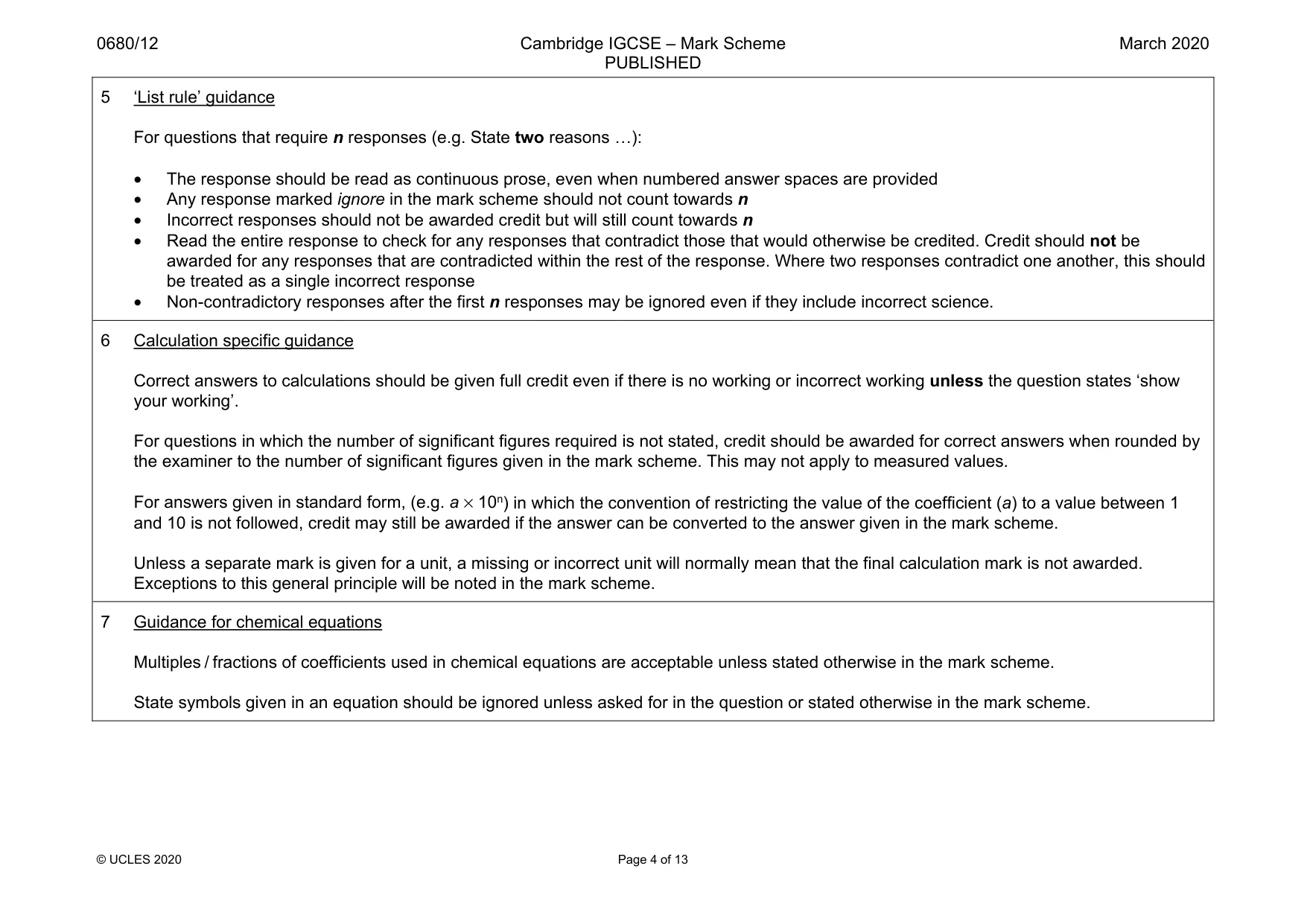
0680/12 Cambridge IGCSE – Mark Scheme PUBLISHED March 2020 © UCLES 2020 Page 4 of 13 5 ‘List rule’ guidance For questions that require n responses (e.g. State two reasons …): • The response should be read as continuous prose, even when numbered answer spaces are provided • Any response marked ignore in the mark scheme should not count towards n • Incorrect responses should not be awarded credit but will still count towards n • Read the entire response to check for any responses that contradict those that would otherwise be credited. Credit should not be awarded for any responses that are contradicted within the rest of the response. Where two responses contradict one another, this should be treated as a single incorrect response • Non-contradictory responses after the first n responses may be ignored even if they include incorrect science. 6 Calculation specific guidance Correct answers to calculations should be given full credit even if there is no working or incorrect working unless the question states ‘show your working’. For questions in which the number of significant figures required is not stated, credit should be awarded for correct answers when rounded by the examiner to the number of significant figures given in the mark scheme. This may not apply to measured values. For answers given in standard form, (e.g. a × 10n) in which the convention of restricting the value of the coefficient (a) to a value between 1 and 10 is not followed, credit may still be awarded if the answer can be converted to the answer given in the mark scheme. Unless a separate mark is given for a unit, a missing or incorrect unit will normally mean that the final calculation mark is not awarded. Exceptions to this general principle will be noted in the mark scheme. 7 Guidance for chemical equations Multiples / fractions of coefficients used in chemical equations are acceptable unless stated otherwise in the mark scheme. State symbols given in an equation should be ignored unless asked for in the question or stated otherwise in the mark scheme.
Mark scheme, page 5
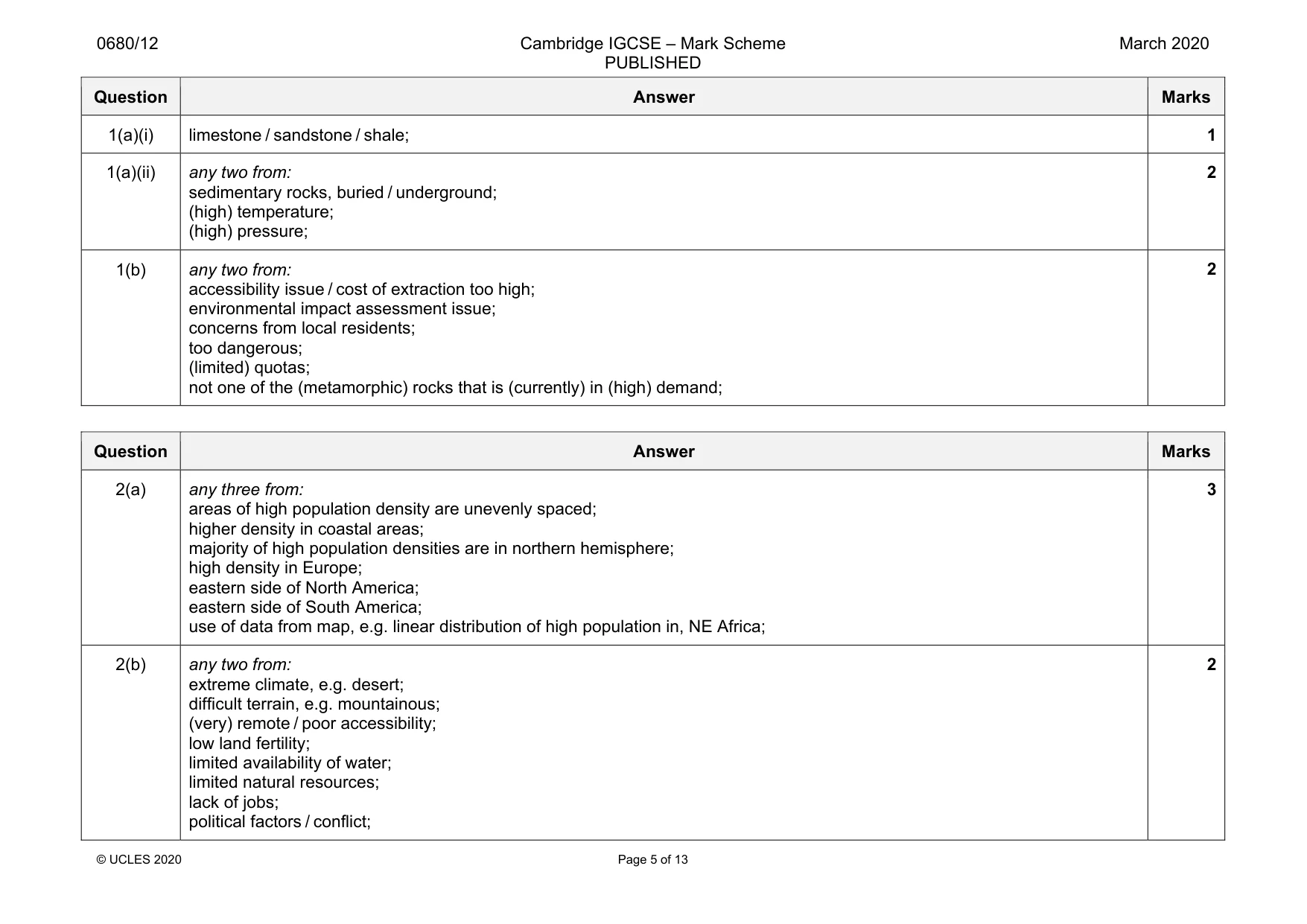
0680/12 Cambridge IGCSE – Mark Scheme PUBLISHED March 2020 © UCLES 2020 Page 5 of 13 Question Answer Marks 1(a)(i) limestone / sandstone / shale; 1 1(a)(ii) any two from: sedimentary rocks, buried / underground; (high) temperature; (high) pressure; 2 1(b) any two from: accessibility issue / cost of extraction too high; environmental impact assessment issue; concerns from local residents; too dangerous; (limited) quotas; not one of the (metamorphic) rocks that is (currently) in (high) demand; 2 Question Answer Marks 2(a) any three from: areas of high population density are unevenly spaced; higher density in coastal areas; majority of high population densities are in northern hemisphere; high density in Europe; eastern side of North America; eastern side of South America; use of data from map, e.g. linear distribution of high population in, NE Africa; 3 2(b) any two from: extreme climate, e.g. desert; difficult terrain, e.g. mountainous; (very) remote / poor accessibility; low land fertility; limited availability of water; limited natural resources; lack of jobs; political factors / conflict; 2
Mark scheme, page 6
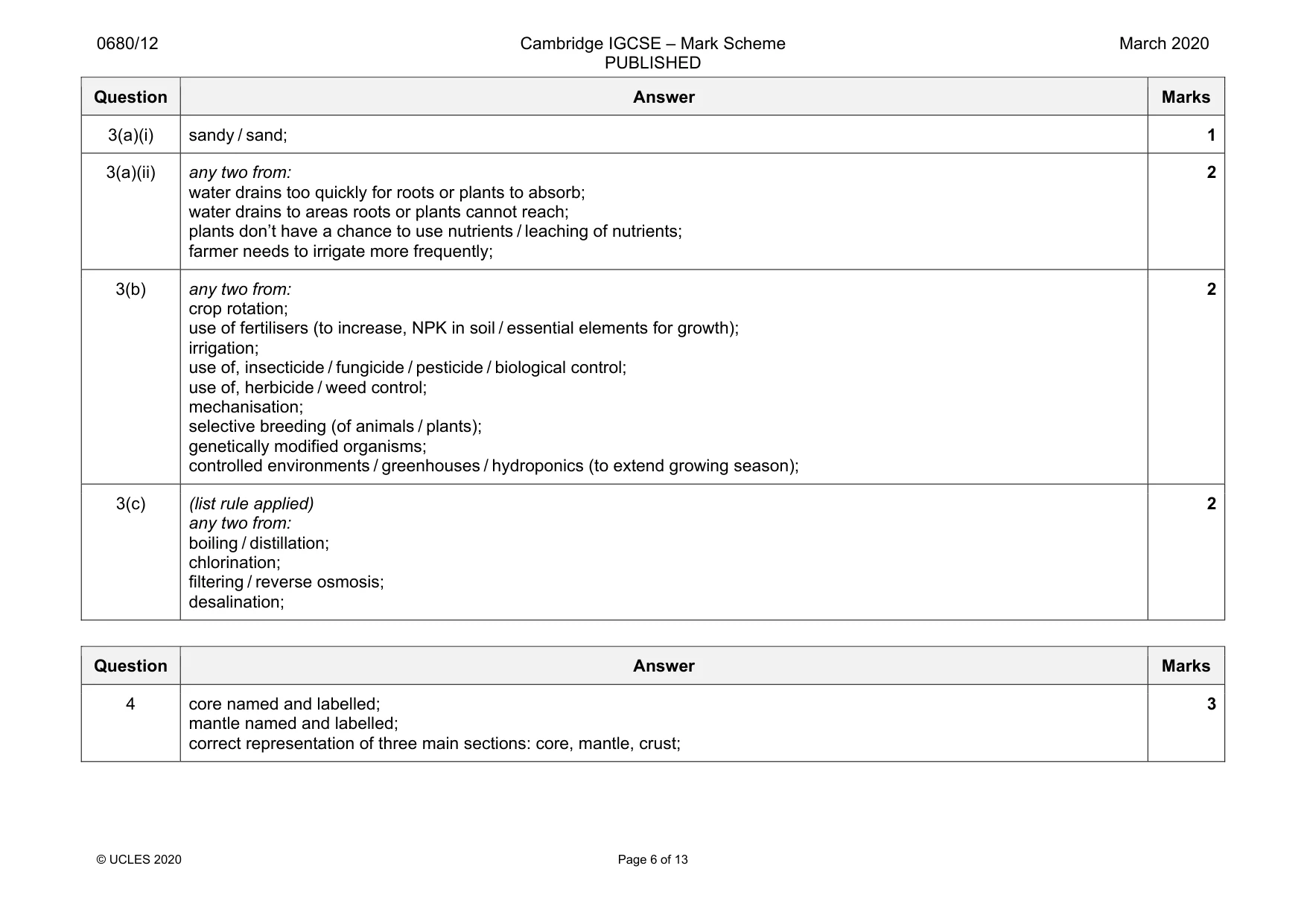
0680/12 Cambridge IGCSE – Mark Scheme PUBLISHED March 2020 © UCLES 2020 Page 6 of 13 Question Answer Marks 3(a)(i) sandy / sand; 1 3(a)(ii) any two from: water drains too quickly for roots or plants to absorb; water drains to areas roots or plants cannot reach; plants don’t have a chance to use nutrients / leaching of nutrients; farmer needs to irrigate more frequently; 2 3(b) any two from: crop rotation; use of fertilisers (to increase, NPK in soil / essential elements for growth); irrigation; use of, insecticide / fungicide / pesticide / biological control; use of, herbicide / weed control; mechanisation; selective breeding (of animals / plants); genetically modified organisms; controlled environments / greenhouses / hydroponics (to extend growing season); 2 3(c) (list rule applied) any two from: boiling / distillation; chlorination; filtering / reverse osmosis; desalination; 2 Question Answer Marks 4 core named and labelled; mantle named and labelled; correct representation of three main sections: core, mantle, crust; 3
Mark scheme, page 7
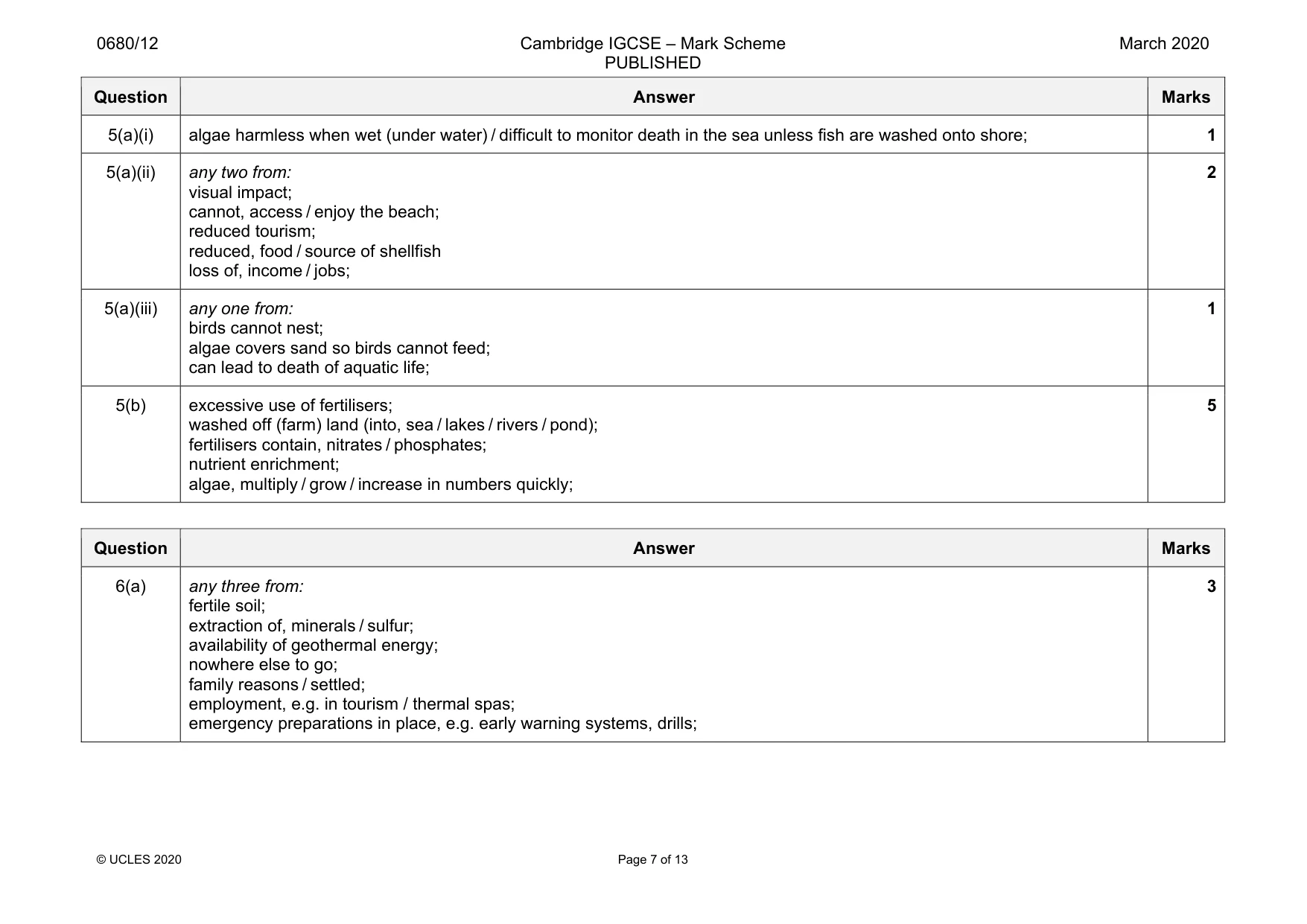
0680/12 Cambridge IGCSE – Mark Scheme PUBLISHED March 2020 © UCLES 2020 Page 7 of 13 Question Answer Marks 5(a)(i) algae harmless when wet (under water) / difficult to monitor death in the sea unless fish are washed onto shore; 1 5(a)(ii) any two from: visual impact; cannot, access / enjoy the beach; reduced tourism; reduced, food / source of shellfish loss of, income / jobs; 2 5(a)(iii) any one from: birds cannot nest; algae covers sand so birds cannot feed; can lead to death of aquatic life; 1 5(b) excessive use of fertilisers; washed off (farm) land (into, sea / lakes / rivers / pond); fertilisers contain, nitrates / phosphates; nutrient enrichment; algae, multiply / grow / increase in numbers quickly; 5 Question Answer Marks 6(a) any three from: fertile soil; extraction of, minerals / sulfur; availability of geothermal energy; nowhere else to go; family reasons / settled; employment, e.g. in tourism / thermal spas; emergency preparations in place, e.g. early warning systems, drills; 3
Mark scheme, page 8
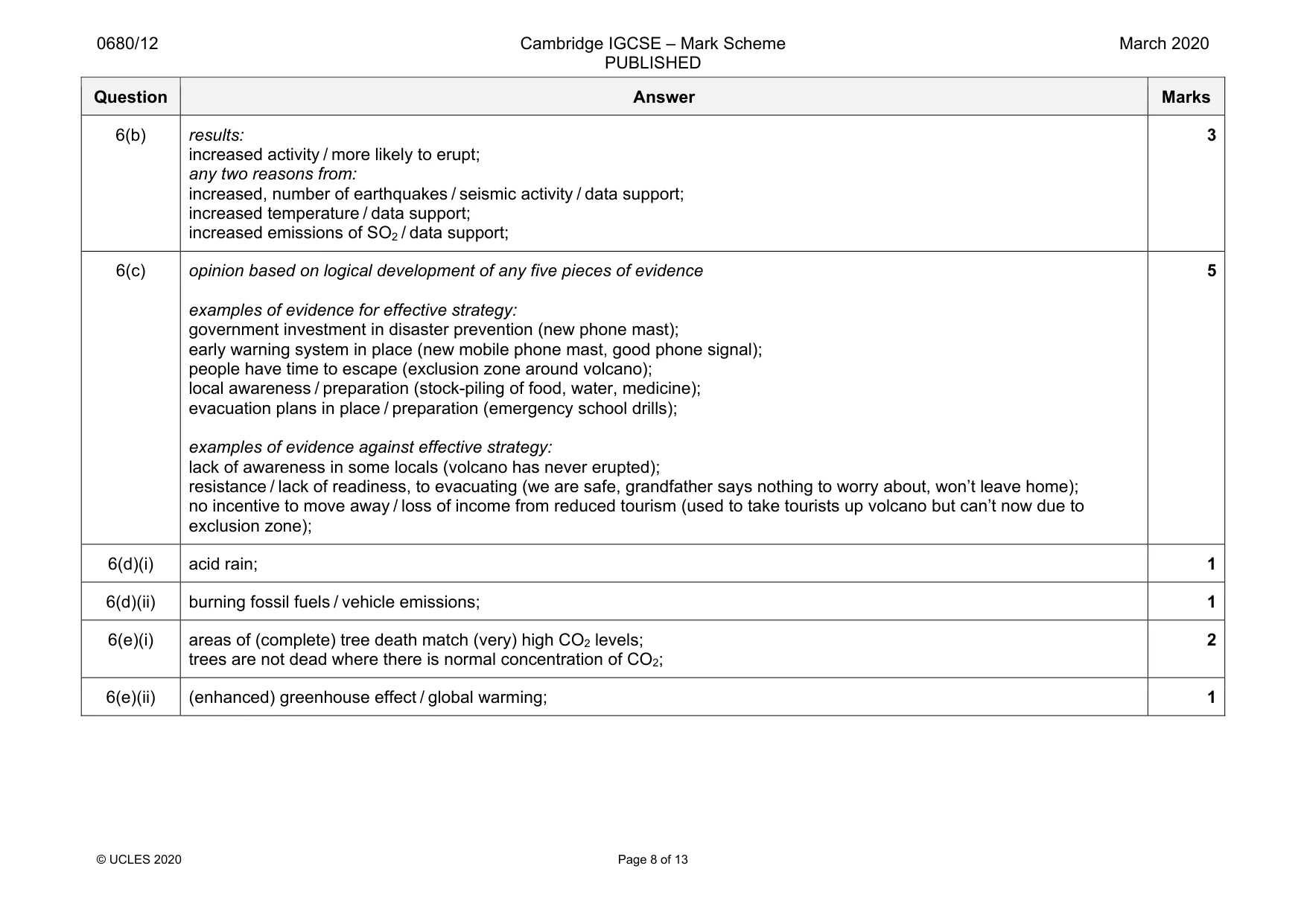
0680/12 Cambridge IGCSE – Mark Scheme PUBLISHED March 2020 © UCLES 2020 Page 8 of 13 Question Answer Marks 6(b) results: increased activity / more likely to erupt; any two reasons from: increased, number of earthquakes / seismic activity / data support; increased temperature / data support; increased emissions of SO2 / data support; 3 6(c) opinion based on logical development of any five pieces of evidence examples of evidence for effective strategy: government investment in disaster prevention (new phone mast); early warning system in place (new mobile phone mast, good phone signal); people have time to escape (exclusion zone around volcano); local awareness / preparation (stock-piling of food, water, medicine); evacuation plans in place / preparation (emergency school drills); examples of evidence against effective strategy: lack of awareness in some locals (volcano has never erupted); resistance / lack of readiness, to evacuating (we are safe, grandfather says nothing to worry about, won’t leave home); no incentive to move away / loss of income from reduced tourism (used to take tourists up volcano but can’t now due to exclusion zone); 5 6(d)(i) acid rain; 1 6(d)(ii) burning fossil fuels / vehicle emissions; 1 6(e)(i) areas of (complete) tree death match (very) high CO2 levels; trees are not dead where there is normal concentration of CO2; 2 6(e)(ii) (enhanced) greenhouse effect / global warming; 1
Mark scheme, page 9
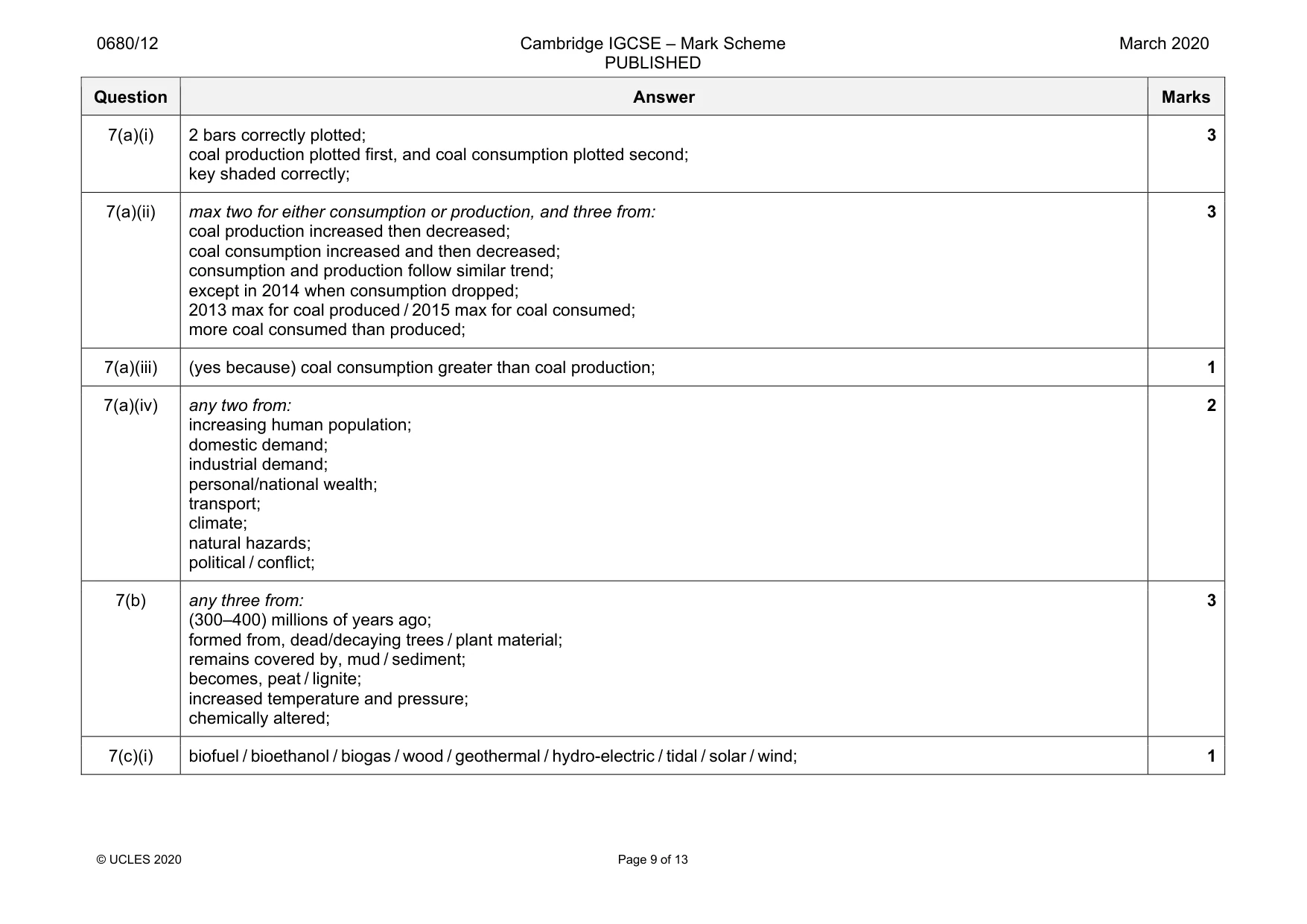
0680/12 Cambridge IGCSE – Mark Scheme PUBLISHED March 2020 © UCLES 2020 Page 9 of 13 Question Answer Marks 7(a)(i) 2 bars correctly plotted; coal production plotted first, and coal consumption plotted second; key shaded correctly; 3 7(a)(ii) max two for either consumption or production, and three from: coal production increased then decreased; coal consumption increased and then decreased; consumption and production follow similar trend; except in 2014 when consumption dropped; 2013 max for coal produced / 2015 max for coal consumed; more coal consumed than produced; 3 7(a)(iii) (yes because) coal consumption greater than coal production; 1 7(a)(iv) any two from: increasing human population; domestic demand; industrial demand; personal/national wealth; transport; climate; natural hazards; political / conflict; 2 7(b) any three from: (300–400) millions of years ago; formed from, dead/decaying trees / plant material; remains covered by, mud / sediment; becomes, peat / lignite; increased temperature and pressure; chemically altered; 3 7(c)(i) biofuel / bioethanol / biogas / wood / geothermal / hydro-electric / tidal / solar / wind; 1
Mark scheme, page 10
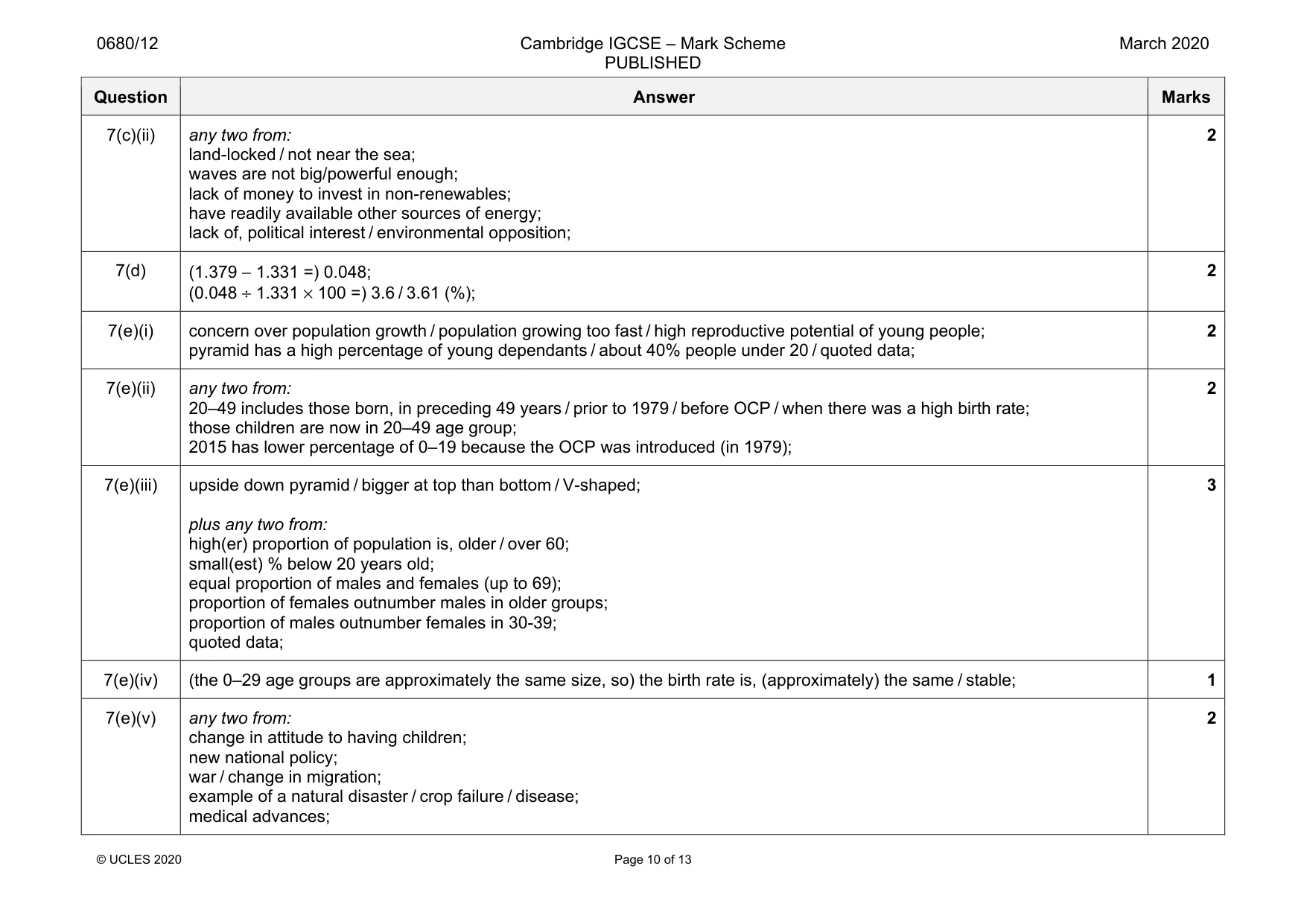
0680/12 Cambridge IGCSE – Mark Scheme PUBLISHED March 2020 © UCLES 2020 Page 10 of 13 Question Answer Marks 7(c)(ii) any two from: land-locked / not near the sea; waves are not big/powerful enough; lack of money to invest in non-renewables; have readily available other sources of energy; lack of, political interest / environmental opposition; 2 7(d) (1.379 − 1.331 =) 0.048; (0.048 ÷ 1.331 × 100 =) 3.6 / 3.61 (%); 2 7(e)(i) concern over population growth / population growing too fast / high reproductive potential of young people; pyramid has a high percentage of young dependants / about 40% people under 20 / quoted data; 2 7(e)(ii) any two from: 20–49 includes those born, in preceding 49 years / prior to 1979 / before OCP / when there was a high birth rate; those children are now in 20–49 age group; 2015 has lower percentage of 0–19 because the OCP was introduced (in 1979); 2 7(e)(iii) upside down pyramid / bigger at top than bottom / V-shaped; plus any two from: high(er) proportion of population is, older / over 60; small(est) % below 20 years old; equal proportion of males and females (up to 69); proportion of females outnumber males in older groups; proportion of males outnumber females in 30-39; quoted data; 3 7(e)(iv) (the 0–29 age groups are approximately the same size, so) the birth rate is, (approximately) the same / stable; 1 7(e)(v) any two from: change in attitude to having children; new national policy; war / change in migration; example of a natural disaster / crop failure / disease; medical advances; 2
Mark scheme, page 11
0680/12 Cambridge IGCSE – Mark Scheme PUBLISHED March 2020 © UCLES 2020 Page 11 of 13 Question Answer Marks 7(e)(vi) any two from: family planning; education on contraception; availability of contraception; improved health education; improved education of women / careers for women; 2
Mark scheme, page 12
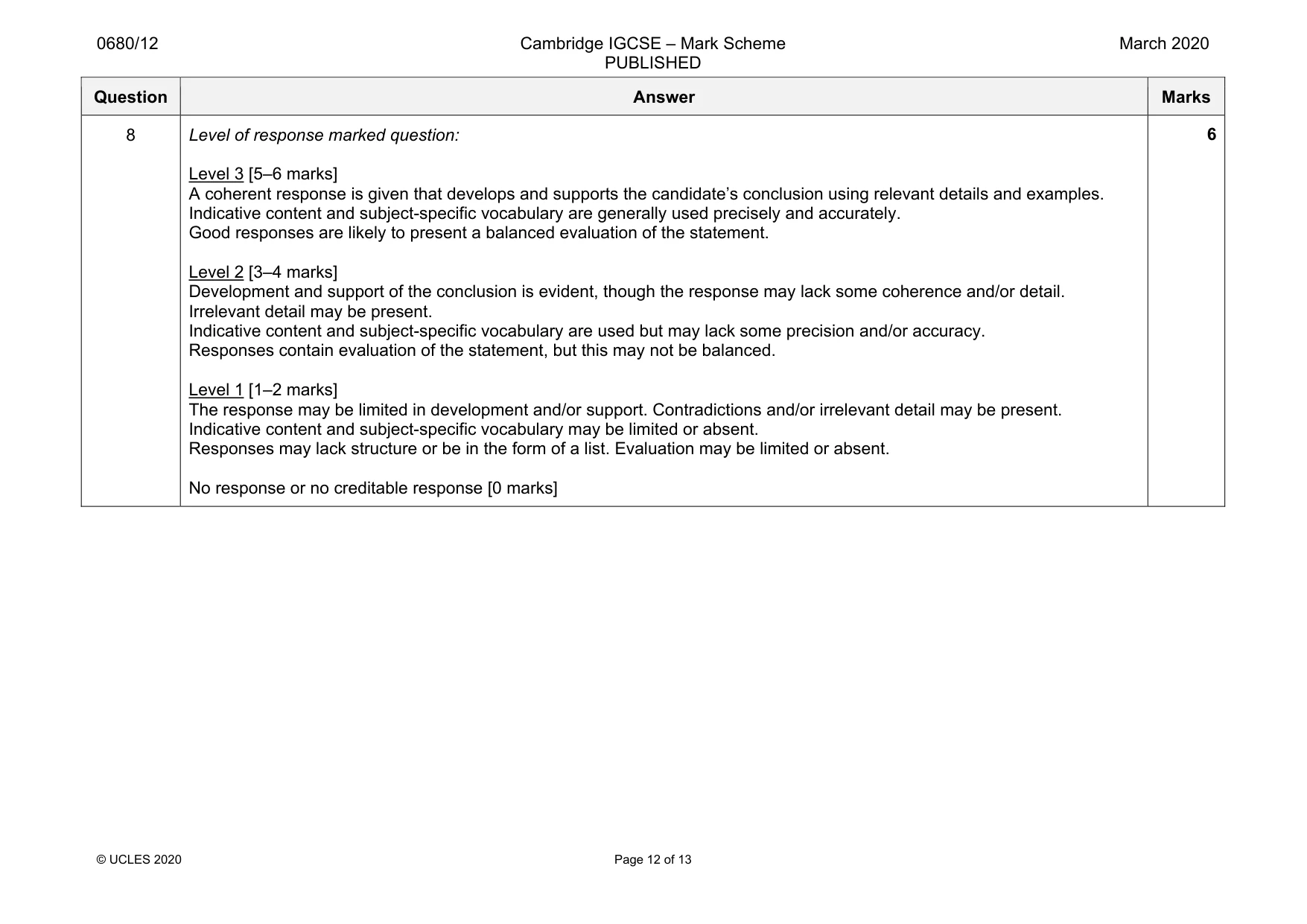
0680/12 Cambridge IGCSE – Mark Scheme PUBLISHED March 2020 © UCLES 2020 Page 12 of 13 Question Answer Marks 8 Level of response marked question: Level 3 [5–6 marks] A coherent response is given that develops and supports the candidate’s conclusion using relevant details and examples. Indicative content and subject-specific vocabulary are generally used precisely and accurately. Good responses are likely to present a balanced evaluation of the statement. Level 2 [3–4 marks] Development and support of the conclusion is evident, though the response may lack some coherence and/or detail. Irrelevant detail may be present. Indicative content and subject-specific vocabulary are used but may lack some precision and/or accuracy. Responses contain evaluation of the statement, but this may not be balanced. Level 1 [1–2 marks] The response may be limited in development and/or support. Contradictions and/or irrelevant detail may be present. Indicative content and subject-specific vocabulary may be limited or absent. Responses may lack structure or be in the form of a list. Evaluation may be limited or absent. No response or no creditable response [0 marks] 6
Mark scheme, page 13
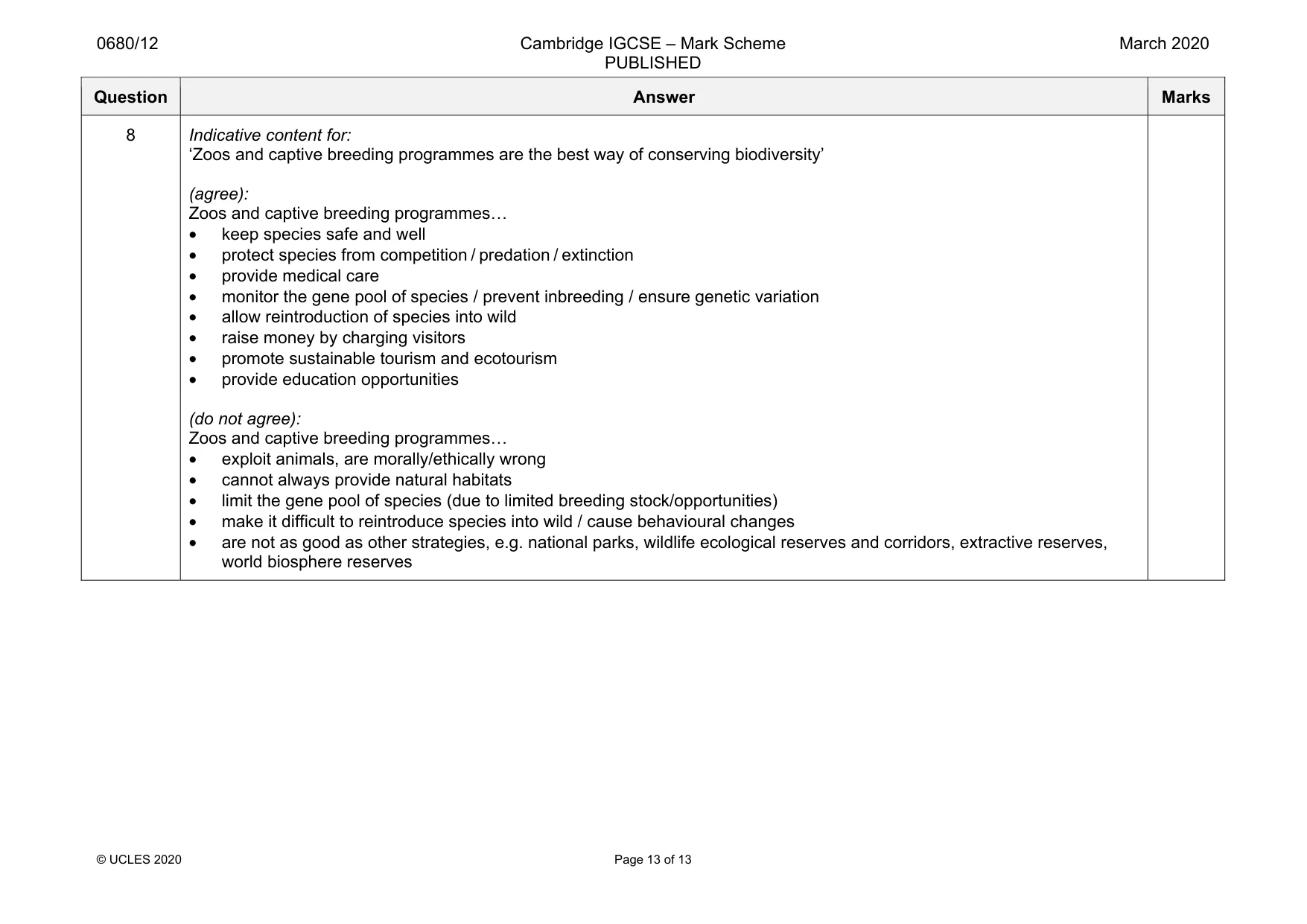
0680/12 Cambridge IGCSE – Mark Scheme PUBLISHED March 2020 © UCLES 2020 Page 13 of 13 Question Answer Marks 8 Indicative content for: ‘Zoos and captive breeding programmes are the best way of conserving biodiversity’ (agree): Zoos and captive breeding programmes… • keep species safe and well • protect species from competition / predation / extinction • provide medical care • monitor the gene pool of species / prevent inbreeding / ensure genetic variation • allow reintroduction of species into wild • raise money by charging visitors • promote sustainable tourism and ecotourism • provide education opportunities (do not agree): Zoos and captive breeding programmes… • exploit animals, are morally/ethically wrong • cannot always provide natural habitats • limit the gene pool of species (due to limited breeding stock/opportunities) • make it difficult to reintroduce species into wild / cause behavioural changes • are not as good as other strategies, e.g. national parks, wildlife ecological reserves and corridors, extractive reserves, world biosphere reserves
What you needed in this session
Cambridge’s own grade thresholds for 2020 Feb/March, Paper 1 · Variant 2. A higher threshold means an easier paper — the bar moves with how the cohort did.