Cambridge IGCSE Environmental Management 0680 — 2019 Feb/March Paper 1 · Variant 2
0680/12/F/M/19 · 80 marks · ≈90 min
The question paper and its mark scheme, free to read here and free to download. This is Cambridge’s own paper, exactly as it was sat.
Question paper24 pages



Mark scheme15 pages
Answers below. Sit the paper first if you are practising.
Paper as text
Question paper, page 1
This document consists of 20 printed pages and 4 blank pages. DC (ST/TP) 167511/2 © UCLES 2019 [Turn over * 4 3 2 3 3 2 7 9 1 1 * ENVIRONMENTAL MANAGEMENT 0680/12 Paper 1 Theory February/March 2019 1 hour 45 minutes Candidates answer on the Question Paper. No Additional Materials are required. READ THESE INSTRUCTIONS FIRST Write your centre number, candidate number and name in the spaces at the top of this page. Write in dark blue or black pen. You may use an HB pencil for any diagrams or graphs. Do not use staples, paper clips, glue or correction fluid. DO NOT WRITE IN ANY BARCODES. Answer all questions. Electronic calculators may be used. You may lose marks if you do not show your working or if you do not use appropriate units. At the end of the examination, fasten all your work securely together. The number of marks is given in brackets [ ] at the end of each question or part question. Cambridge Assessment International Education Cambridge International General Certificate of Secondary Education
Question paper, page 2
2 0680/12/F/M/19 © UCLES 2019 Section A 1 The diagram shows part of the water cycle. ocean precipitation condensation transpiration evaporation ground water flow infiltration ice and snow X Key movement of water process (a) State the process at X in the diagram. … [1] (b) Describe the processes leading to the precipitation in the diagram. … … … … … … … … [4] [Total: 5]
Question paper, page 3
3 0680/12/F/M/19 © UCLES 2019 [Turn over 2 The diagram shows the approximate altitude of the first four layers of the Earth’s atmosphere. 85 to 500 km 0 to 15 km 15 to 50 km 50 to 85 km the Earth (a) Complete the diagram by labelling the four layers. Use words from the list. mesosphere stratosphere thermosphere troposphere [3] (b) The ozone layer is part of one of the layers of the atmosphere. CFCs have depleted the ozone layer. Describe the impacts of ozone depletion. … … … … [2] [Total: 5]
Question paper, page 4
4 0680/12/F/M/19 © UCLES 2019 3 During 2011 the world population reached seven billion. The world’s population continues to increase. (a) State two strategies for controlling population growth. 1 … … 2 … … [2] (b) The increasing population means that there is a shortage of food in some parts of the world. (i) Describe how the use of fertilisers can increase agricultural yields. … … [1] (ii) Describe how the overuse of fertilisers can impact river ecosystems. … … … … … … [3] [Total: 6]
Question paper, page 5
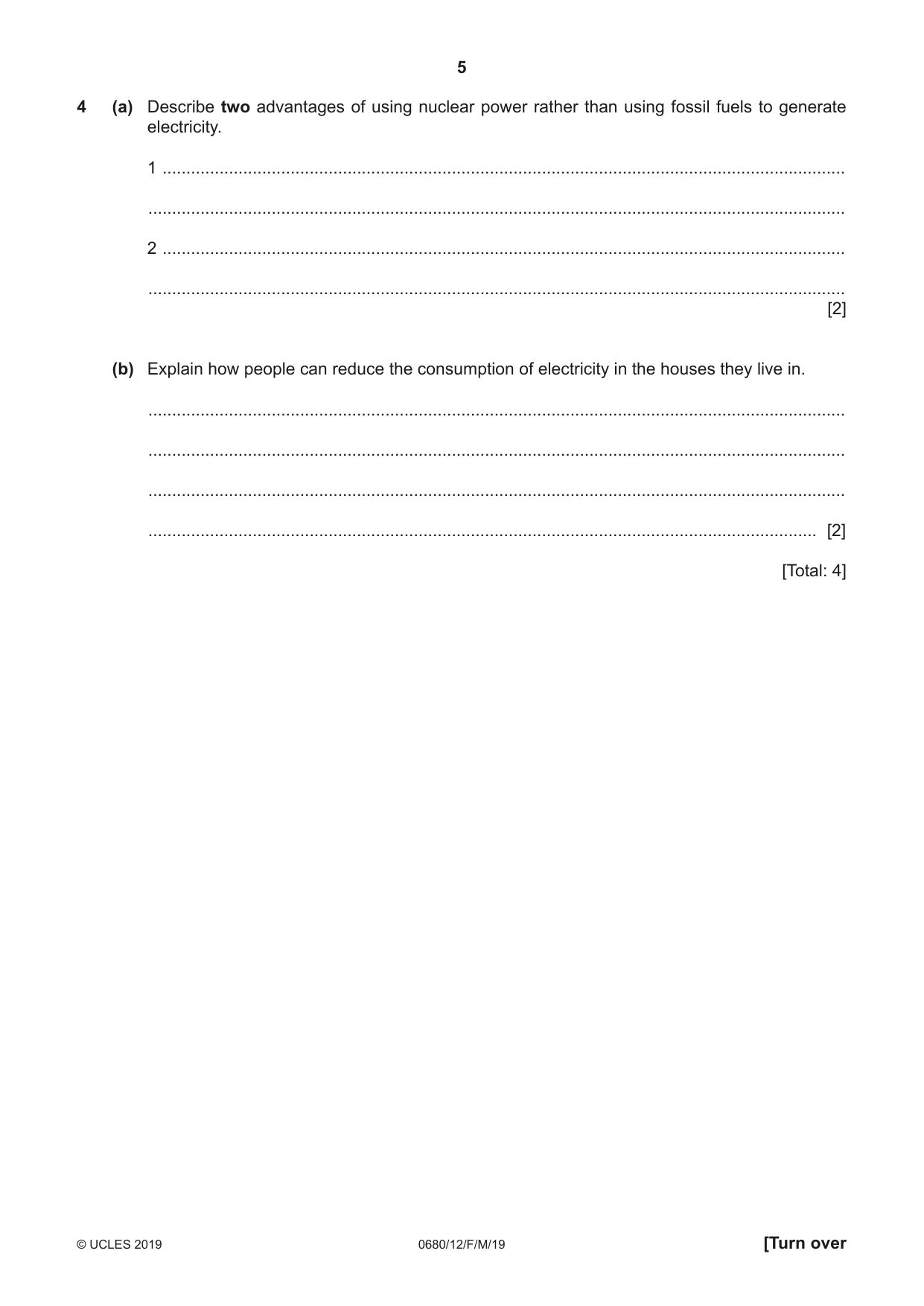
5 0680/12/F/M/19 © UCLES 2019 [Turn over 4 (a) Describe two advantages of using nuclear power rather than using fossil fuels to generate electricity. 1 … … 2 … … [2] (b) Explain how people can reduce the consumption of electricity in the houses they live in. … … … … [2] [Total: 4]
Question paper, page 6
6 0680/12/F/M/19 © UCLES 2019 BLANK PAGE
Question paper, page 7
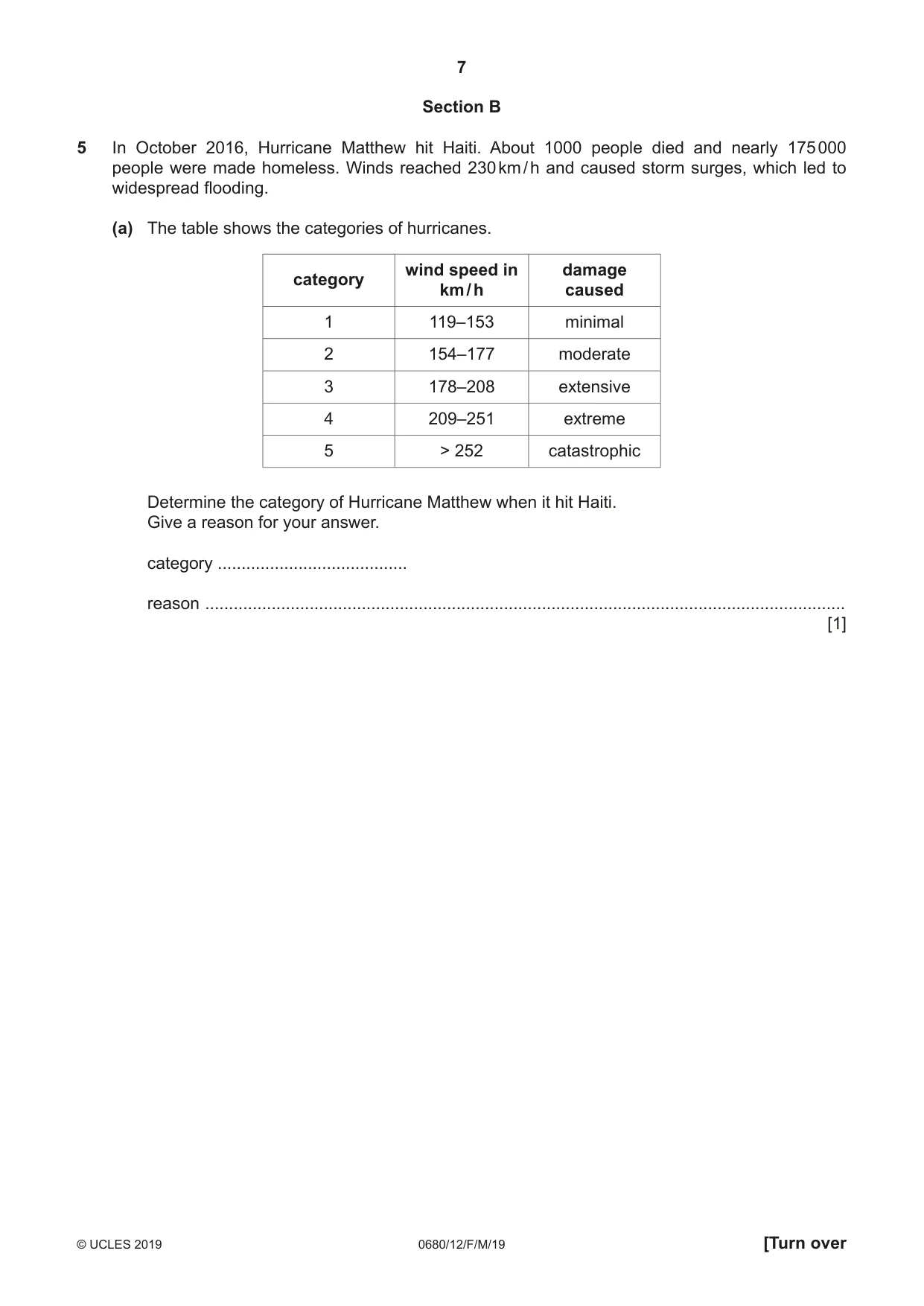
7 0680/12/F/M/19 © UCLES 2019 [Turn over Section B 5 In October 2016, Hurricane Matthew hit Haiti. About 1000 people died and nearly 175 000 people were made homeless. Winds reached 230 km / h and caused storm surges, which led to widespread flooding. (a) The table shows the categories of hurricanes. category wind speed in km / h damage caused 1 119–153 minimal 2 154–177 moderate 3 178–208 extensive 4 209–251 extreme 5 > 252 catastrophic Determine the category of Hurricane Matthew when it hit Haiti. Give a reason for your answer. category … reason … [1]
Question paper, page 8
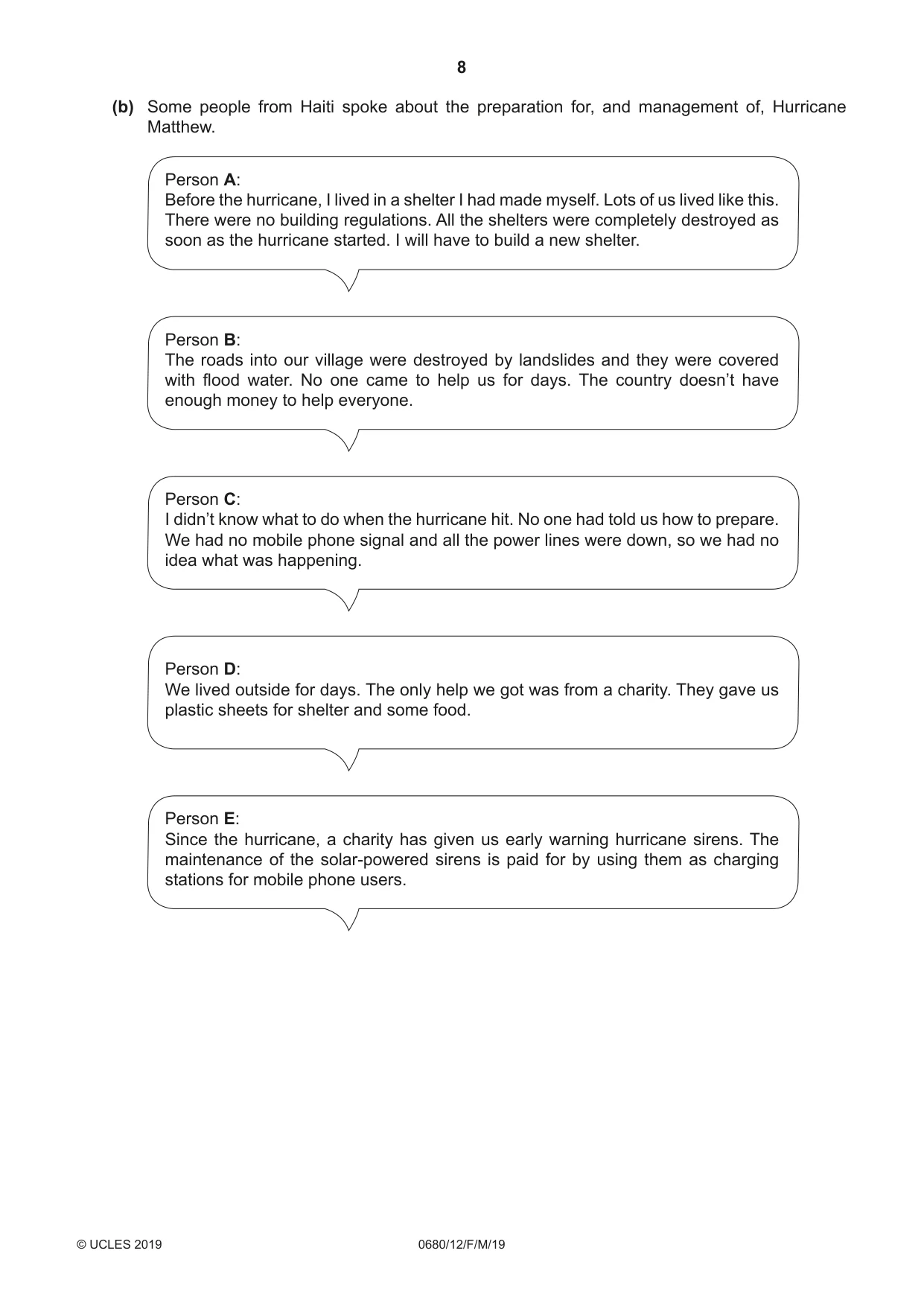
8 0680/12/F/M/19 © UCLES 2019 (b) Some people from Haiti spoke about the preparation for, and management of, Hurricane Matthew. Person A: Before the hurricane, I lived in a shelter I had made myself. Lots of us lived like this. There were no building regulations. All the shelters were completely destroyed as soon as the hurricane started. I will have to build a new shelter. Person B: The roads into our village were destroyed by landslides and they were covered with flood water. No one came to help us for days. The country doesn’t have enough money to help everyone. Person C: I didn’t know what to do when the hurricane hit. No one had told us how to prepare. We had no mobile phone signal and all the power lines were down, so we had no idea what was happening. Person D: We lived outside for days. The only help we got was from a charity. They gave us plastic sheets for shelter and some food. Person E: Since the hurricane, a charity has given us early warning hurricane sirens. The maintenance of the solar-powered sirens is paid for by using them as charging stations for mobile phone users.
Question paper, page 9
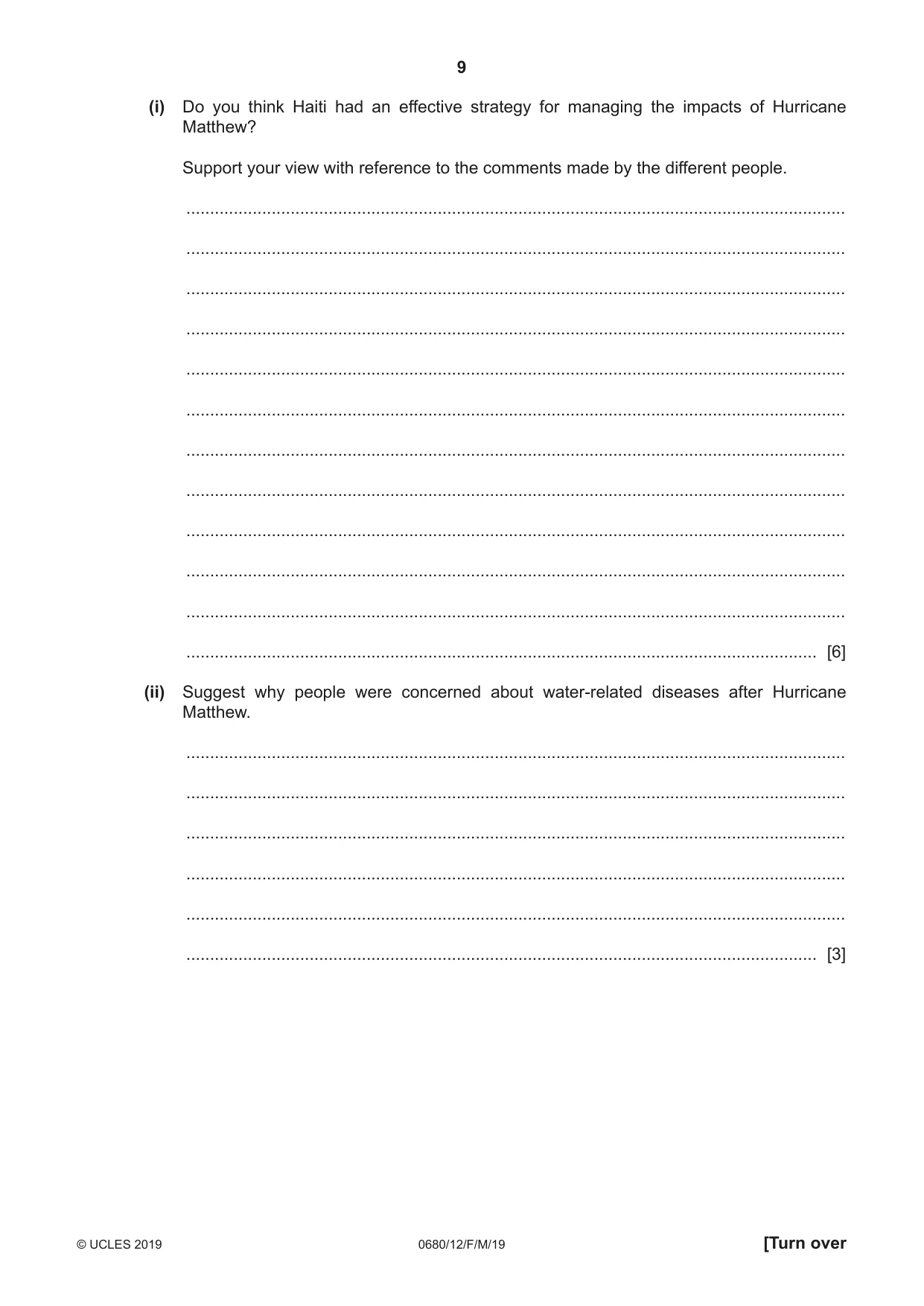
9 0680/12/F/M/19 © UCLES 2019 [Turn over (i) Do you think Haiti had an effective strategy for managing the impacts of Hurricane Matthew? Support your view with reference to the comments made by the different people. … … … … … … … … … … … … [6] (ii) Suggest why people were concerned about water-related diseases after Hurricane Matthew. … … … … … … [3]
Question paper, page 10
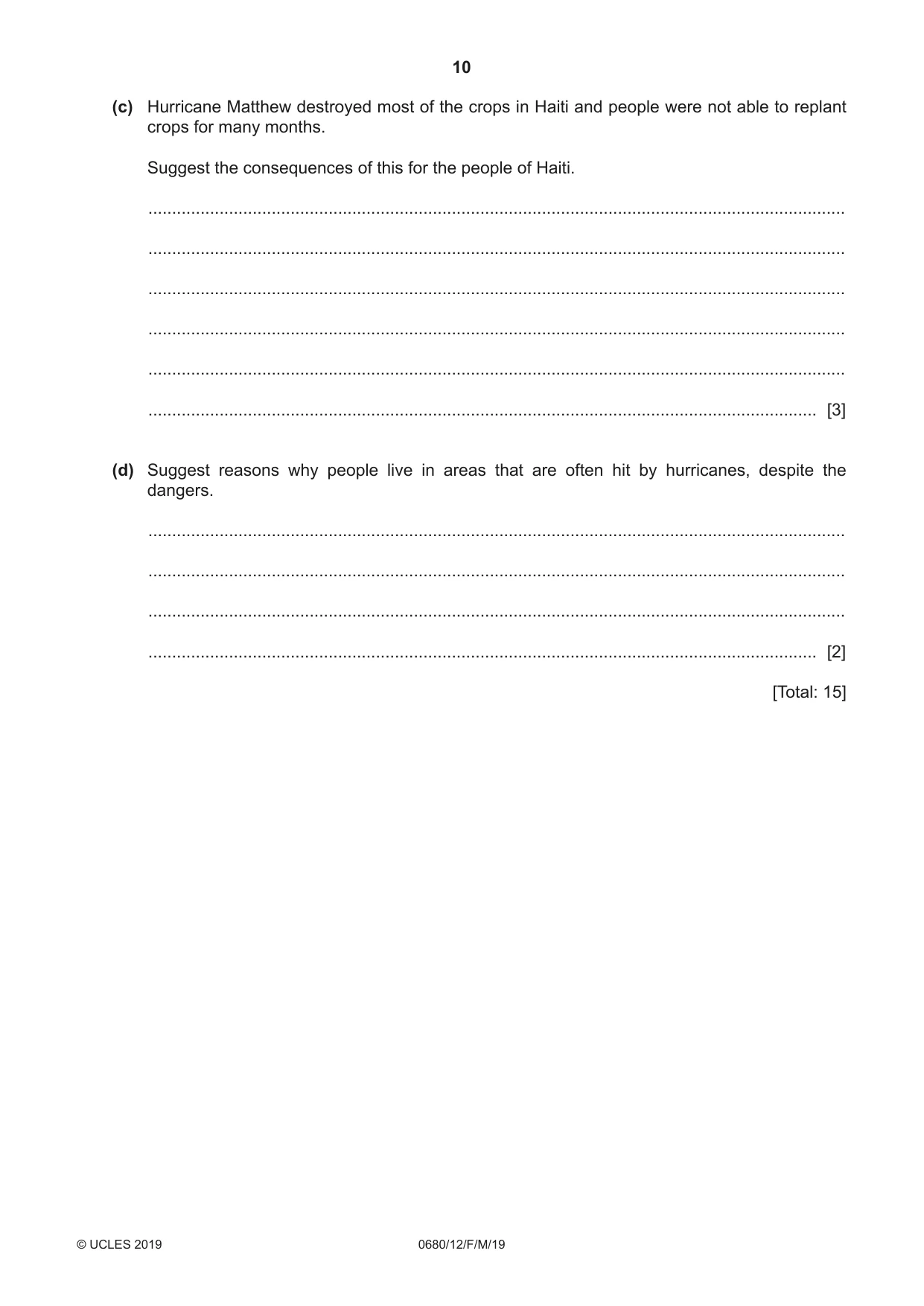
10 0680/12/F/M/19 © UCLES 2019 (c) Hurricane Matthew destroyed most of the crops in Haiti and people were not able to replant crops for many months. Suggest the consequences of this for the people of Haiti. … … … … … … [3] (d) Suggest reasons why people live in areas that are often hit by hurricanes, despite the dangers. … … … … [2] [Total: 15]
Question paper, page 11
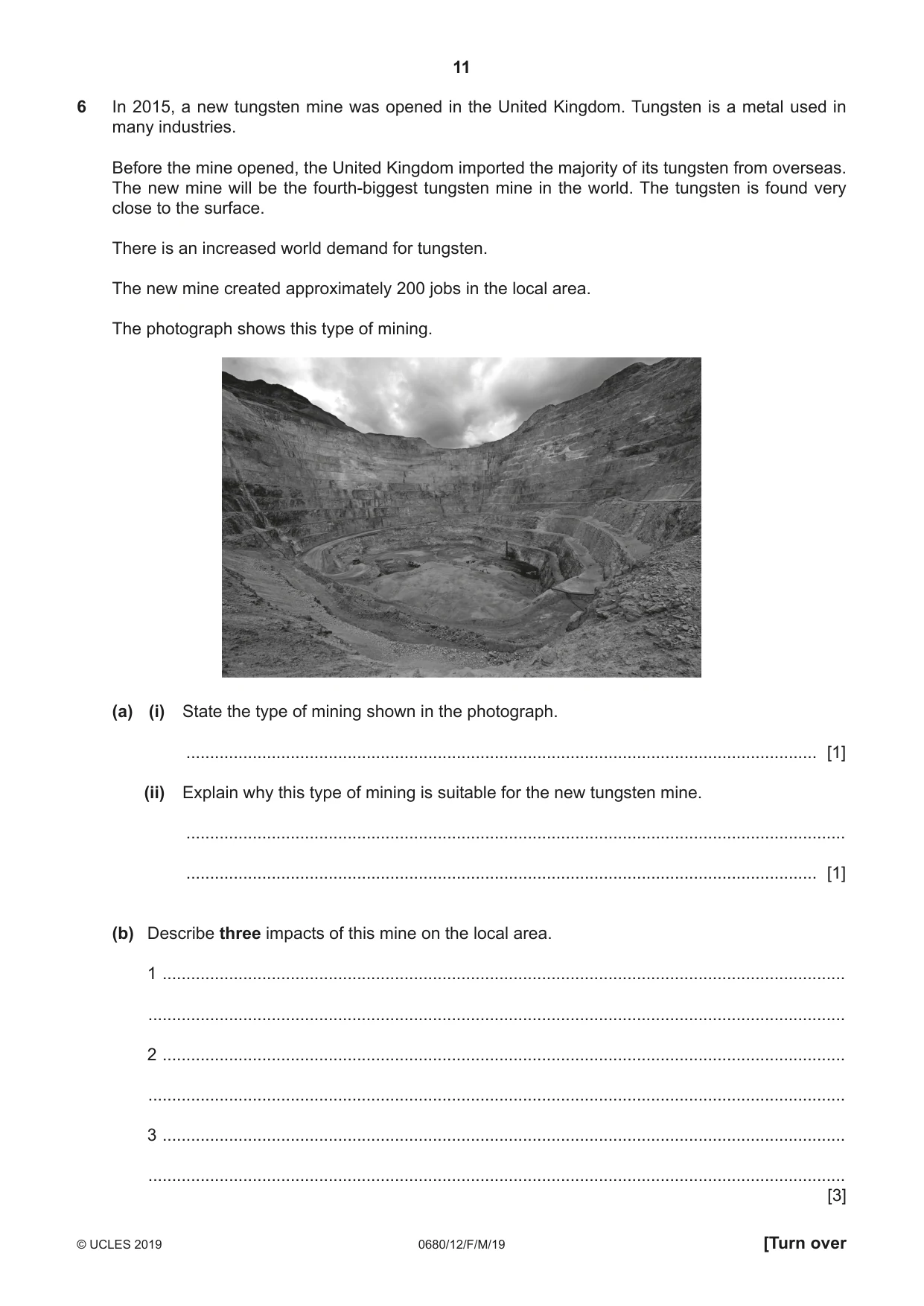
11 0680/12/F/M/19 © UCLES 2019 [Turn over 6 In 2015, a new tungsten mine was opened in the United Kingdom. Tungsten is a metal used in many industries. Before the mine opened, the United Kingdom imported the majority of its tungsten from overseas. The new mine will be the fourth-biggest tungsten mine in the world. The tungsten is found very close to the surface. There is an increased world demand for tungsten. The new mine created approximately 200 jobs in the local area. The photograph shows this type of mining. (a) (i) State the type of mining shown in the photograph. … [1] (ii) Explain why this type of mining is suitable for the new tungsten mine. … … [1] (b) Describe three impacts of this mine on the local area. 1 … … 2 … … 3 … … [3]
Question paper, page 12
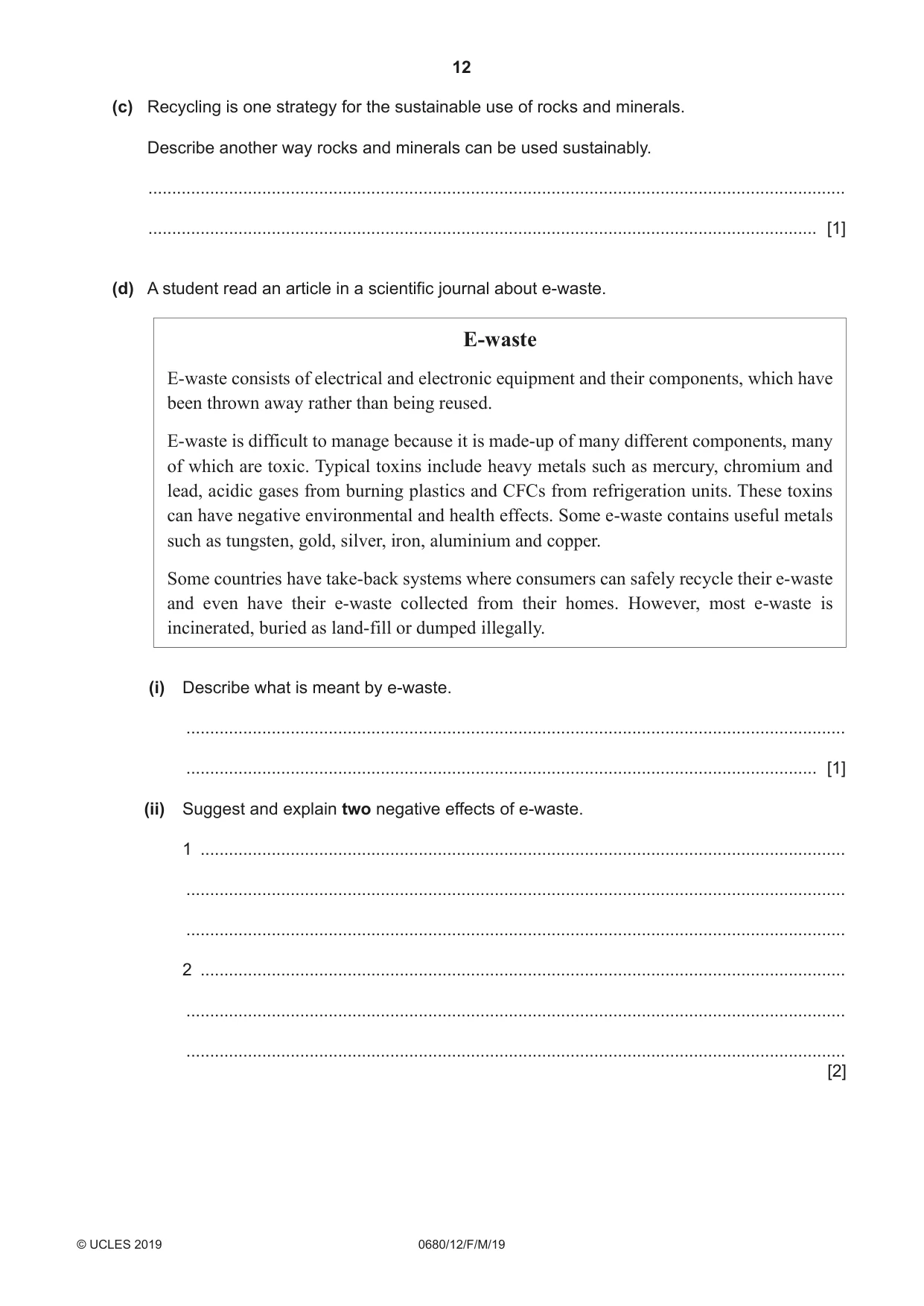
12 0680/12/F/M/19 © UCLES 2019 (c) Recycling is one strategy for the sustainable use of rocks and minerals. Describe another way rocks and minerals can be used sustainably. … … [1] (d) A student read an article in a scientific journal about e-waste. E-waste E-waste consists of electrical and electronic equipment and their components, which have been thrown away rather than being reused. E-waste is difficult to manage because it is made-up of many different components, many of which are toxic. Typical toxins include heavy metals such as mercury, chromium and lead, acidic gases from burning plastics and CFCs from refrigeration units. These toxins can have negative environmental and health effects. Some e-waste contains useful metals such as tungsten, gold, silver, iron, aluminium and copper. Some countries have take-back systems where consumers can safely recycle their e-waste and even have their e-waste collected from their homes. However, most e-waste is incinerated, buried as land-fill or dumped illegally. (i) Describe what is meant by e-waste. … … [1] (ii) Suggest and explain two negative effects of e-waste. 1 … … … 2 … … … [2]
Question paper, page 13
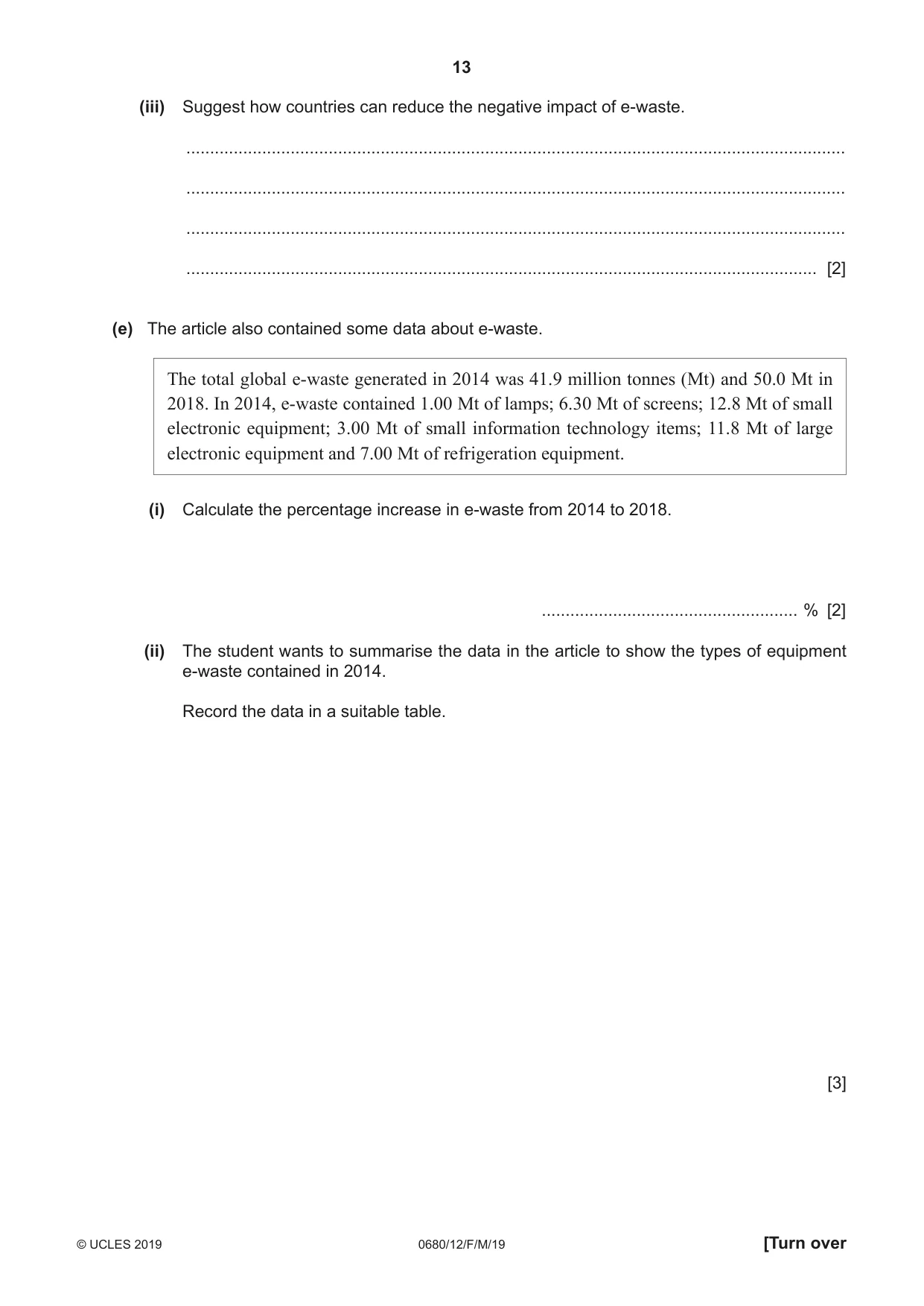
13 0680/12/F/M/19 © UCLES 2019 [Turn over (iii) Suggest how countries can reduce the negative impact of e-waste. … … … … [2] (e) The article also contained some data about e-waste. The total global e-waste generated in 2014 was 41.9 million tonnes (Mt) and 50.0 Mt in 2018. In 2014, e-waste contained 1.00 Mt of lamps; 6.30 Mt of screens; 12.8 Mt of small electronic equipment; 3.00 Mt of small information technology items; 11.8 Mt of large electronic equipment and 7.00 Mt of refrigeration equipment. (i) Calculate the percentage increase in e-waste from 2014 to 2018. … % [2] (ii) The student wants to summarise the data in the article to show the types of equipment e-waste contained in 2014. Record the data in a suitable table. [3]
Question paper, page 14
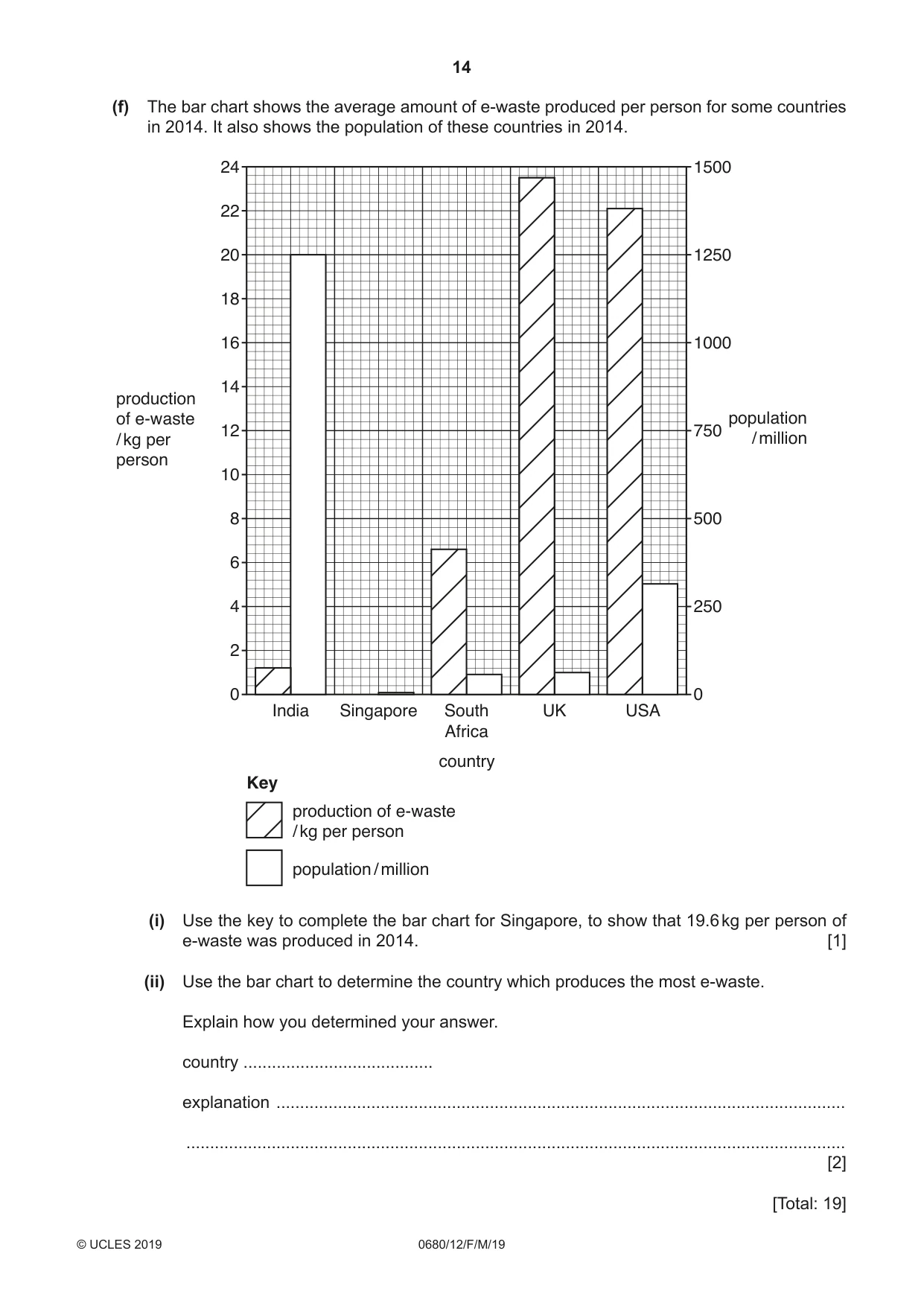
14 0680/12/F/M/19 © UCLES 2019 (f) The bar chart shows the average amount of e-waste produced per person for some countries in 2014. It also shows the population of these countries in 2014. 24 22 20 18 16 14 12 10 8 6 1500 1250 1000 750 500 250 0 4 2 0 Key production of e-waste / kg per person production of e-waste / kg per person country population / million population / million India Singapore South Africa UK USA (i) Use the key to complete the bar chart for Singapore, to show that 19.6 kg per person of e-waste was produced in 2014. [1] (ii) Use the bar chart to determine the country which produces the most e-waste. Explain how you determined your answer. country … explanation … … [2] [Total: 19]
Question paper, page 15
15 0680/12/F/M/19 © UCLES 2019 [Turn over BLANK PAGE
Question paper, page 16
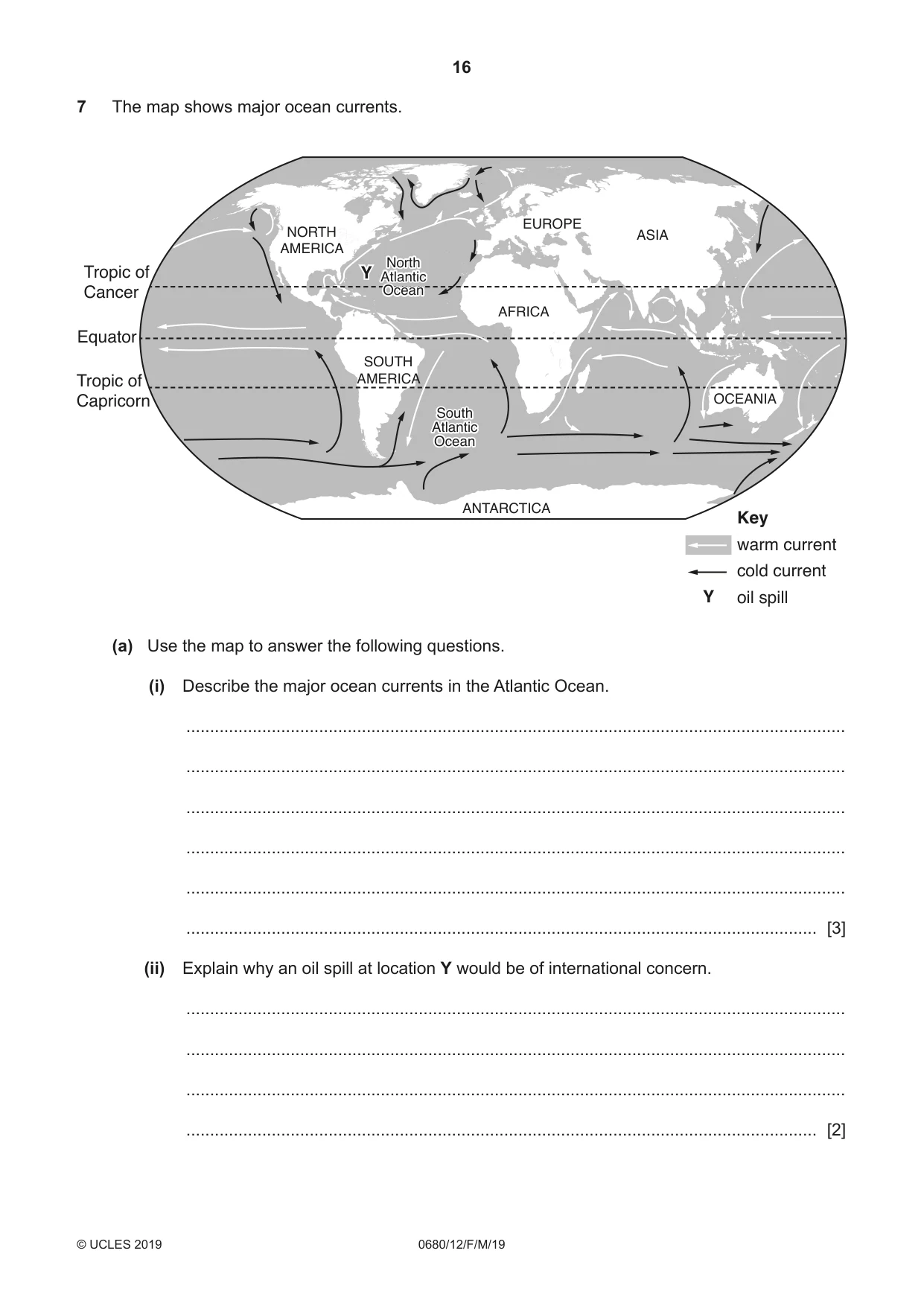
16 0680/12/F/M/19 © UCLES 2019 7 The map shows major ocean currents. Key warm current cold current oil spill Tropic of Cancer Equator Tropic of Capricorn ANTARCTICA Y Y South Atlantic Ocean North Atlantic Ocean Europe Africa Asia Oceania South America North America South Atlantic Ocean North Atlantic Ocean EUROPE AFRICA ASIA OCEANIA SOUTH AMERICA NORTH AMERICA (a) Use the map to answer the following questions. (i) Describe the major ocean currents in the Atlantic Ocean. … … … … … … [3] (ii) Explain why an oil spill at location Y would be of international concern. … … … … [2]
Question paper, page 17
17 0680/12/F/M/19 © UCLES 2019 [Turn over (iii) Large fish populations are found off the west coast of southern Africa. Explain why. … … … … [2]
Question paper, page 18
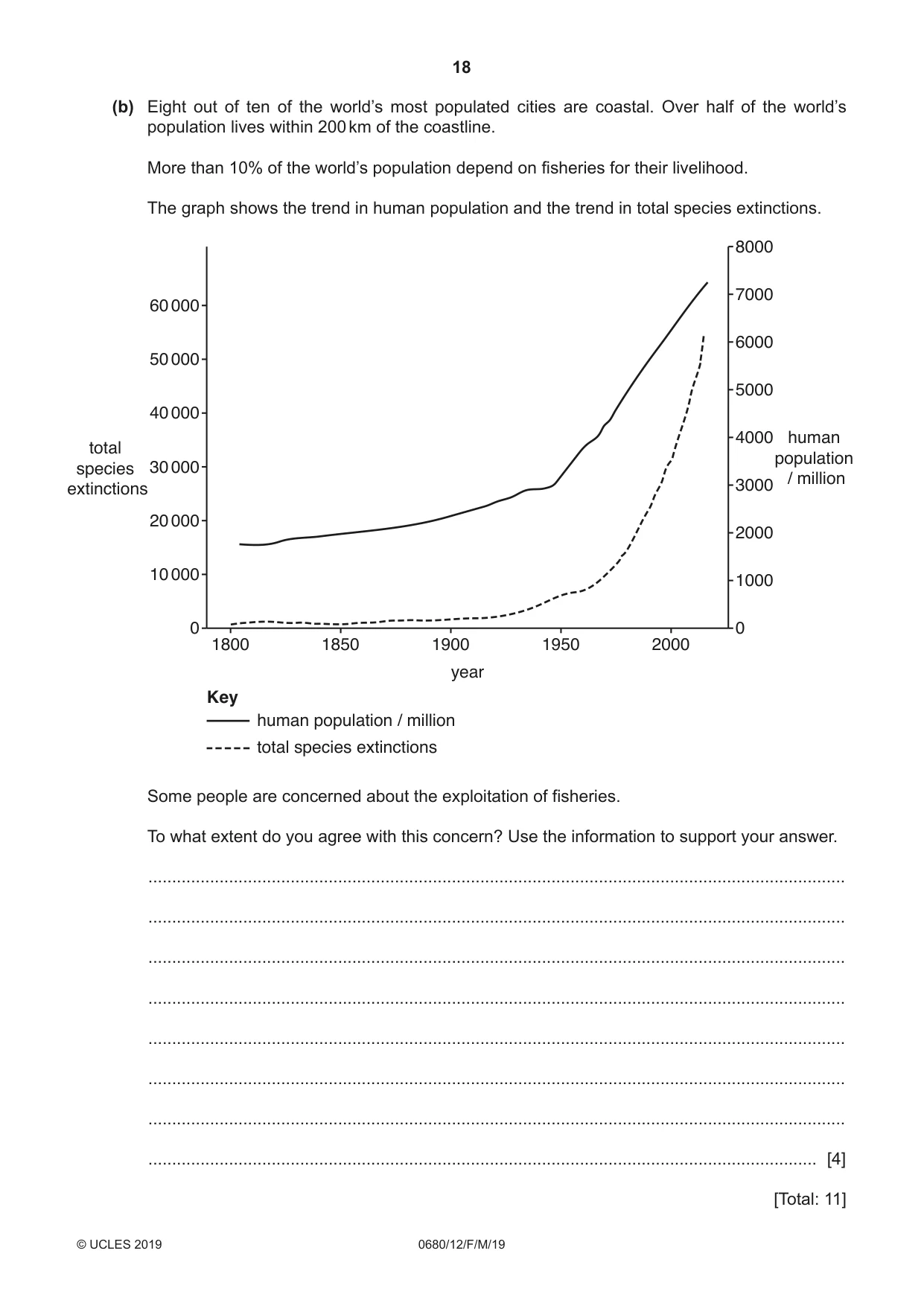
18 0680/12/F/M/19 © UCLES 2019 (b) Eight out of ten of the world’s most populated cities are coastal. Over half of the world’s population lives within 200 km of the coastline. More than 10% of the world’s population depend on fisheries for their livelihood. The graph shows the trend in human population and the trend in total species extinctions. 50 000 60 000 40 000 30 000 20 000 10 000 0 0 1000 2000 3000 4000 5000 6000 7000 8000 1800 1850 1900 1950 2000 year Key human population / million human population / million total species extinctions total species extinctions Some people are concerned about the exploitation of fisheries. To what extent do you agree with this concern? Use the information to support your answer. … … … … … … … … [4] [Total: 11]
Question paper, page 19
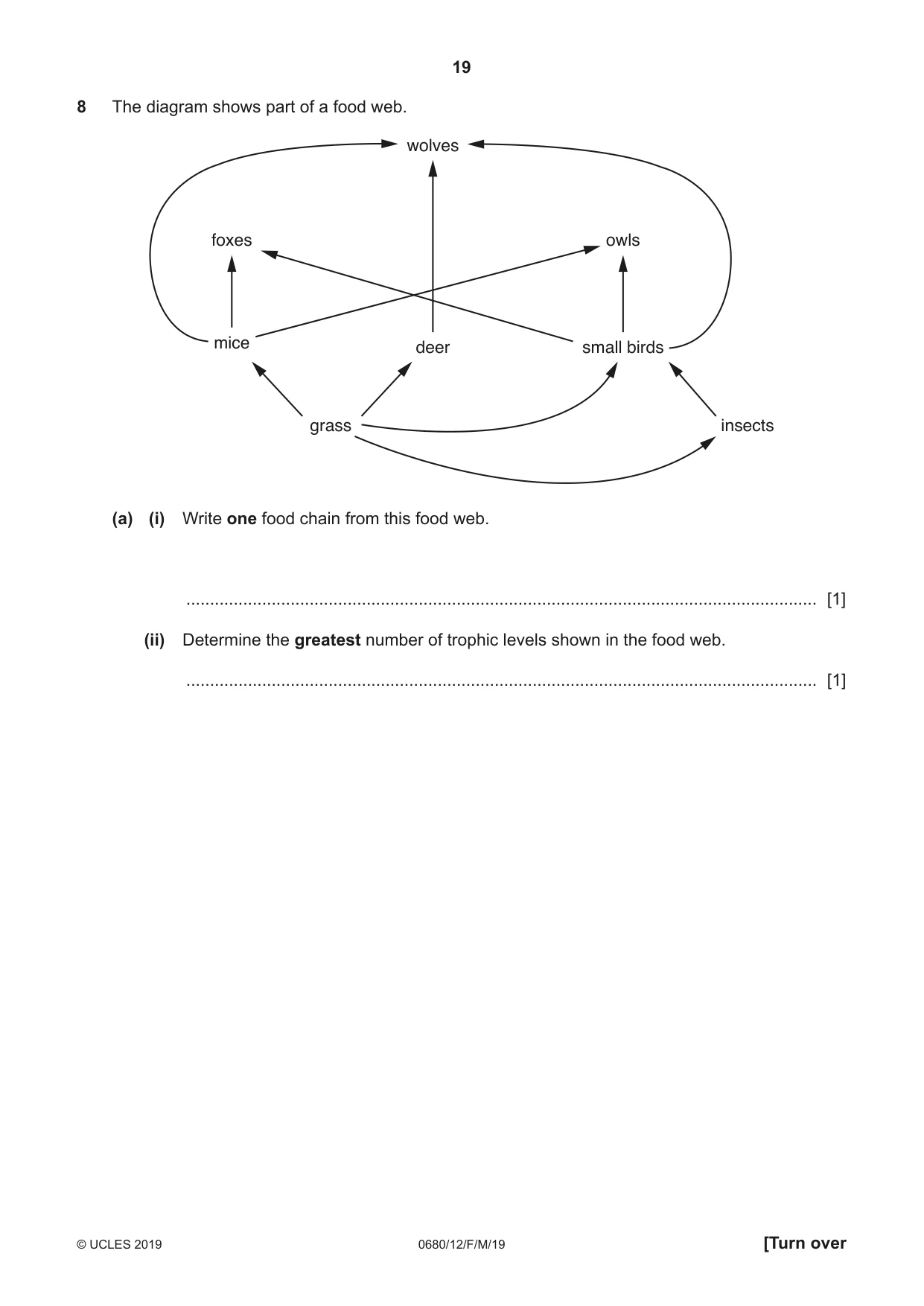
19 0680/12/F/M/19 © UCLES 2019 [Turn over 8 The diagram shows part of a food web. wolves deer grass small birds owls foxes mice insects (a) (i) Write one food chain from this food web. … [1] (ii) Determine the greatest number of trophic levels shown in the food web. … [1]
Question paper, page 20
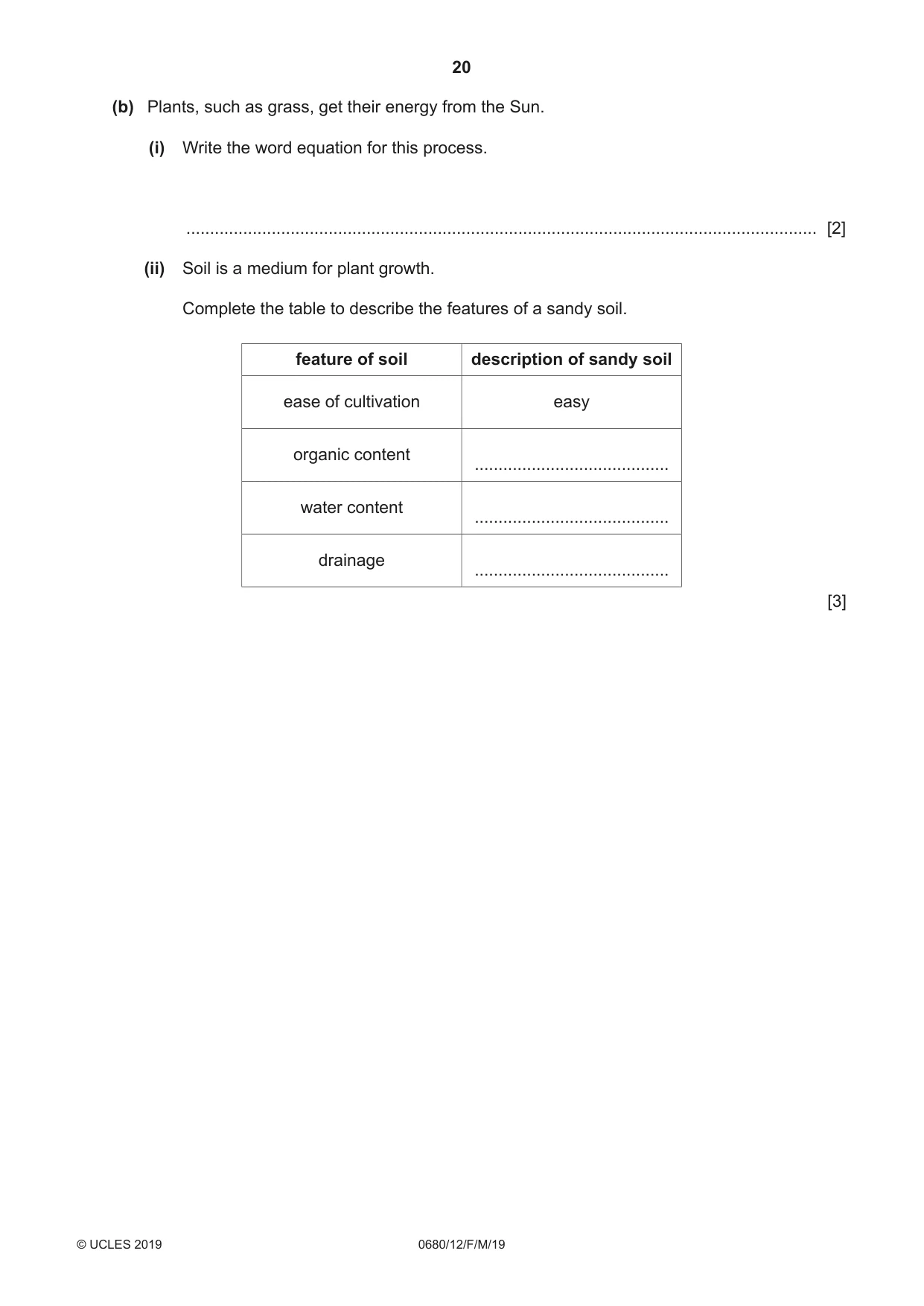
20 0680/12/F/M/19 © UCLES 2019 (b) Plants, such as grass, get their energy from the Sun. (i) Write the word equation for this process. … [2] (ii) Soil is a medium for plant growth. Complete the table to describe the features of a sandy soil. feature of soil description of sandy soil ease of cultivation easy organic content … water content … drainage … [3]
Question paper, page 21
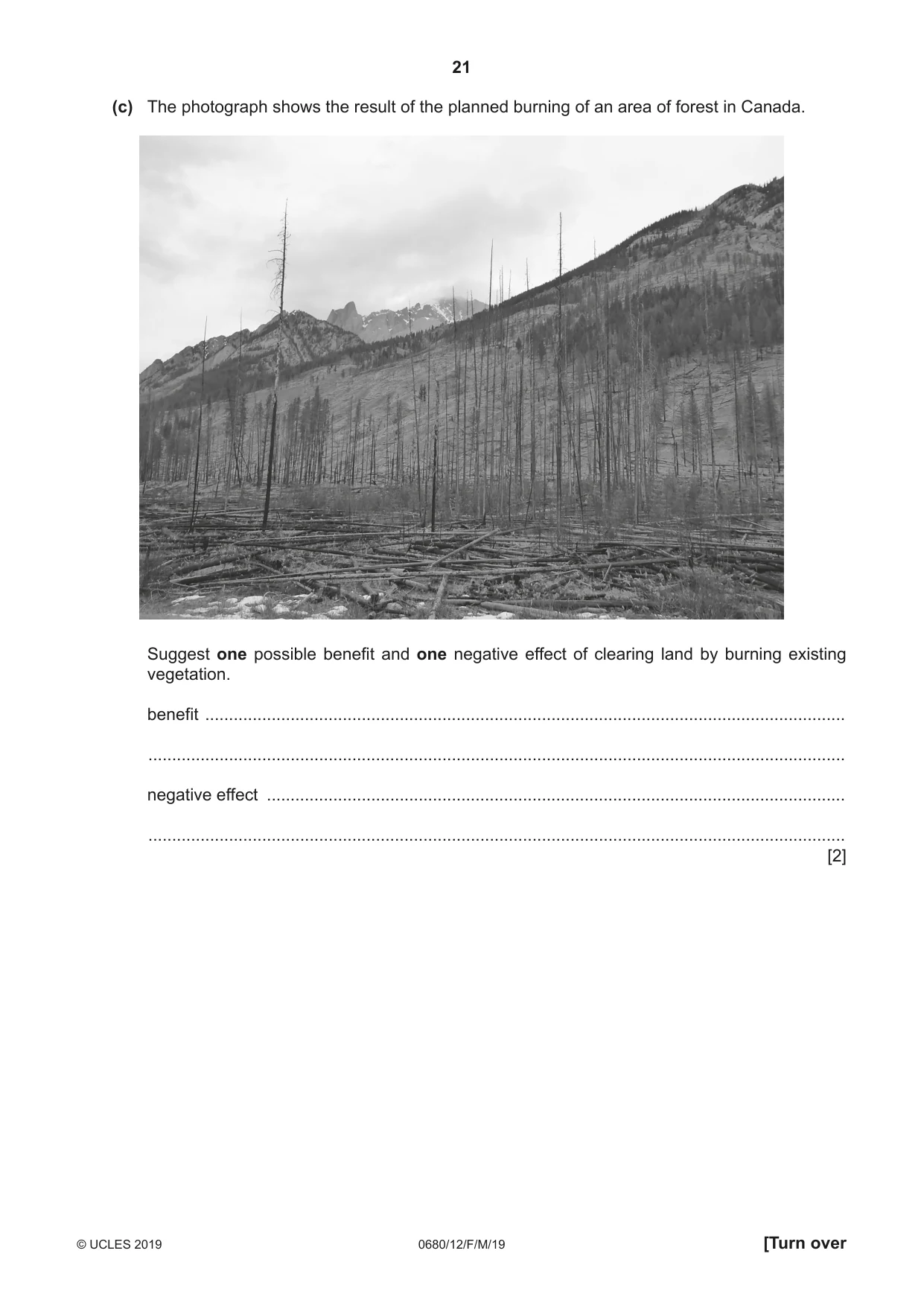
21 0680/12/F/M/19 © UCLES 2019 [Turn over (c) The photograph shows the result of the planned burning of an area of forest in Canada. Suggest one possible benefit and one negative effect of clearing land by burning existing vegetation. benefit … … negative effect … … [2]
Question paper, page 22
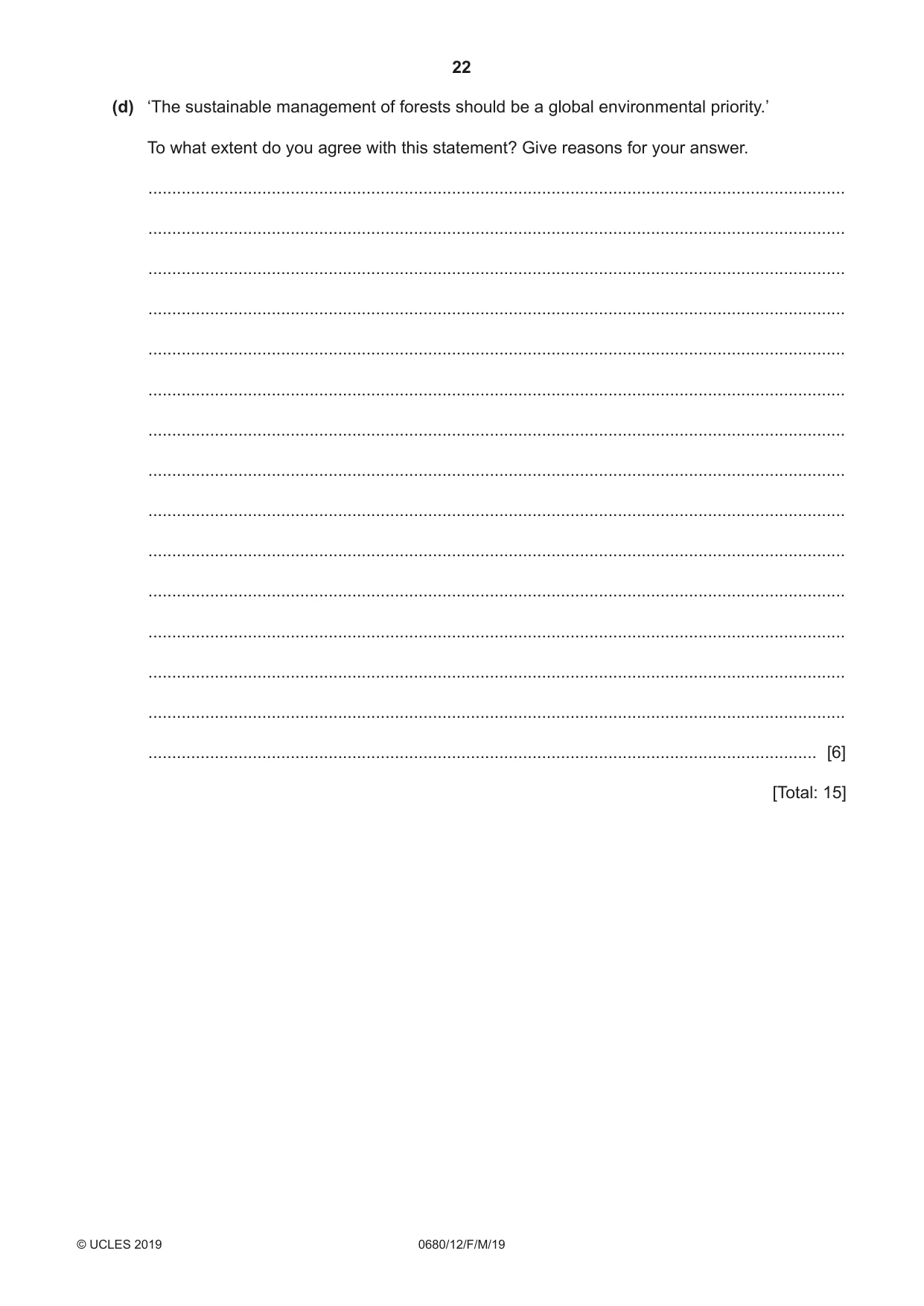
22 0680/12/F/M/19 © UCLES 2019 (d) ‘The sustainable management of forests should be a global environmental priority.’ To what extent do you agree with this statement? Give reasons for your answer. … … … … … … … … … … … … … … … [6] [Total: 15]
Question paper, page 23
23 0680/12/F/M/19 © UCLES 2019 BLANK PAGE
Question paper, page 24
24 0680/12/F/M/19 © UCLES 2019 Permission to reproduce items where third-party owned material protected by copyright is included has been sought and cleared where possible. Every reasonable effort has been made by the publisher (UCLES) to trace copyright holders, but if any items requiring clearance have unwittingly been included, the publisher will be pleased to make amends at the earliest possible opportunity. To avoid the issue of disclosure of answer-related information to candidates, all copyright acknowledgements are reproduced online in the Cambridge Assessment International Education Copyright Acknowledgements Booklet. This is produced for each series of examinations and is freely available to download at www.cambridgeinternational.org after the live examination series. Cambridge Assessment International Education is part of the Cambridge Assessment Group. Cambridge Assessment is the brand name of the University of Cambridge Local Examinations Syndicate (UCLES), which itself is a department of the University of Cambridge. BLANK PAGE
Mark scheme, page 1
This document consists of 15 printed pages. © UCLES 2019 [Turn over Cambridge Assessment International Education Cambridge International General Certificate of Secondary Education ENVIRONMENTAL MANAGEMENT 0680/12 Paper 1 Theory March 2019 MARK SCHEME Maximum Mark: 80 Published This mark scheme is published as an aid to teachers and candidates, to indicate the requirements of the examination. It shows the basis on which Examiners were instructed to award marks. It does not indicate the details of the discussions that took place at an Examiners’ meeting before marking began, which would have considered the acceptability of alternative answers. Mark schemes should be read in conjunction with the question paper and the Principal Examiner Report for Teachers. Cambridge International will not enter into discussions about these mark schemes. Cambridge International is publishing the mark schemes for the March 2019 series for most Cambridge IGCSE™, Cambridge International A and AS Level components and some Cambridge O Level components.
Mark scheme, page 2
0680/12 Cambridge IGCSE – Mark Scheme PUBLISHED March 2019 © UCLES 2019 Page 2 of 15 Generic Marking Principles These general marking principles must be applied by all examiners when marking candidate answers. They should be applied alongside the specific content of the mark scheme or generic level descriptors for a question. Each question paper and mark scheme will also comply with these marking principles. GENERIC MARKING PRINCIPLE 1: Marks must be awarded in line with: • the specific content of the mark scheme or the generic level descriptors for the question • the specific skills defined in the mark scheme or in the generic level descriptors for the question • the standard of response required by a candidate as exemplified by the standardisation scripts. GENERIC MARKING PRINCIPLE 2: Marks awarded are always whole marks (not half marks, or other fractions). GENERIC MARKING PRINCIPLE 3: Marks must be awarded positively: • marks are awarded for correct/valid answers, as defined in the mark scheme. However, credit is given for valid answers which go beyond the scope of the syllabus and mark scheme, referring to your Team Leader as appropriate • marks are awarded when candidates clearly demonstrate what they know and can do • marks are not deducted for errors • marks are not deducted for omissions • answers should only be judged on the quality of spelling, punctuation and grammar when these features are specifically assessed by the question as indicated by the mark scheme. The meaning, however, should be unambiguous. GENERIC MARKING PRINCIPLE 4: Rules must be applied consistently e.g. in situations where candidates have not followed instructions or in the application of generic level descriptors.
Mark scheme, page 3
0680/12 Cambridge IGCSE – Mark Scheme PUBLISHED March 2019 © UCLES 2019 Page 3 of 15 GENERIC MARKING PRINCIPLE 5: Marks should be awarded using the full range of marks defined in the mark scheme for the question (however; the use of the full mark range may be limited according to the quality of the candidate responses seen). GENERIC MARKING PRINCIPLE 6: Marks awarded are based solely on the requirements as defined in the mark scheme. Marks should not be awarded with grade thresholds or grade descriptors in mind.
Mark scheme, page 4
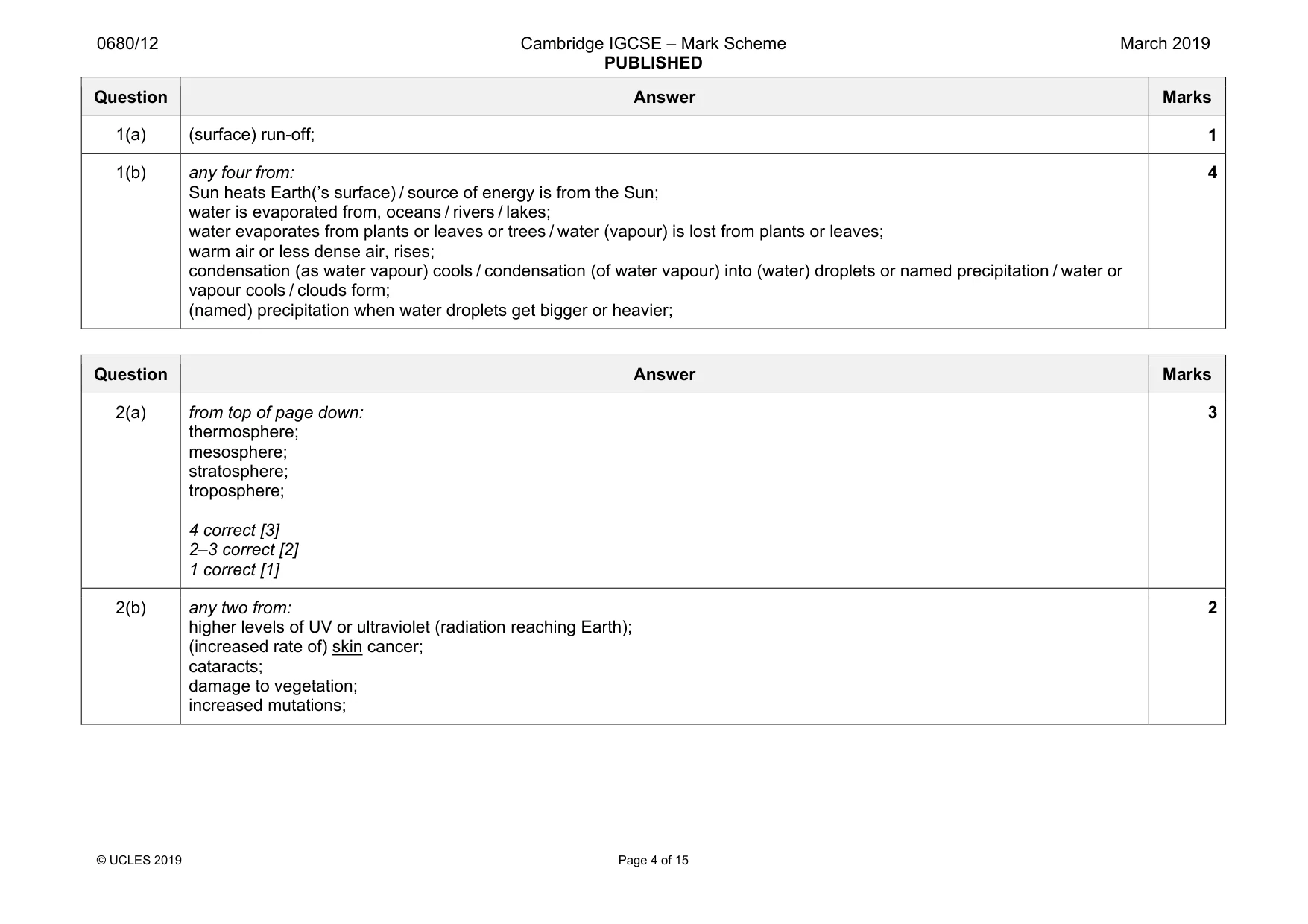
0680/12 Cambridge IGCSE – Mark Scheme PUBLISHED March 2019 © UCLES 2019 Page 4 of 15 Question Answer Marks 1(a) (surface) run-off; 1 1(b) any four from: Sun heats Earth(’s surface) / source of energy is from the Sun; water is evaporated from, oceans / rivers / lakes; water evaporates from plants or leaves or trees / water (vapour) is lost from plants or leaves; warm air or less dense air, rises; condensation (as water vapour) cools / condensation (of water vapour) into (water) droplets or named precipitation / water or vapour cools / clouds form; (named) precipitation when water droplets get bigger or heavier; 4 Question Answer Marks 2(a) from top of page down: thermosphere; mesosphere; stratosphere; troposphere; 4 correct [3] 2–3 correct [2] 1 correct [1] 3 2(b) any two from: higher levels of UV or ultraviolet (radiation reaching Earth); (increased rate of) skin cancer; cataracts; damage to vegetation; increased mutations; 2
Mark scheme, page 5
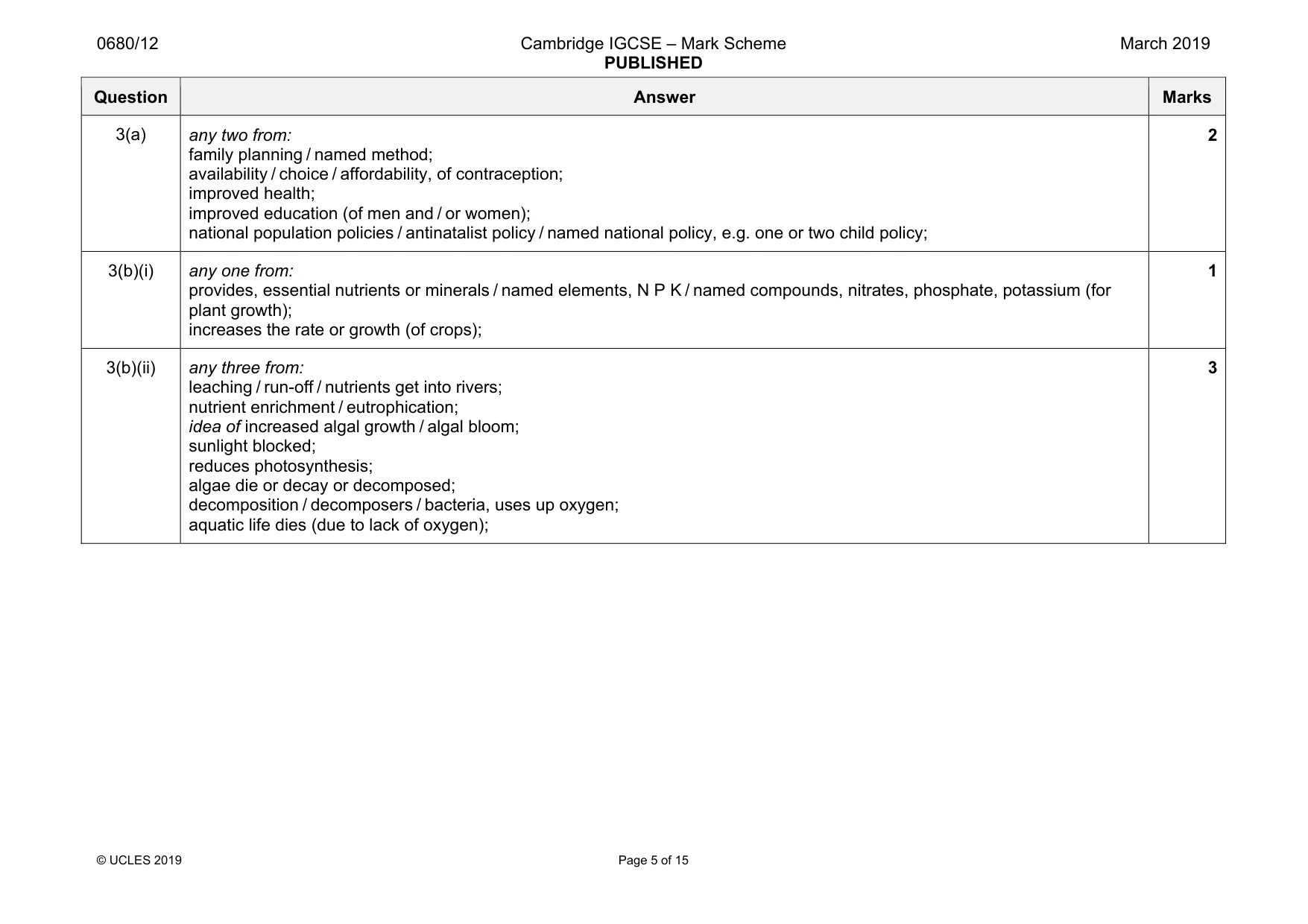
0680/12 Cambridge IGCSE – Mark Scheme PUBLISHED March 2019 © UCLES 2019 Page 5 of 15 Question Answer Marks 3(a) any two from: family planning / named method; availability / choice / affordability, of contraception; improved health; improved education (of men and / or women); national population policies / antinatalist policy / named national policy, e.g. one or two child policy; 2 3(b)(i) any one from: provides, essential nutrients or minerals / named elements, N P K / named compounds, nitrates, phosphate, potassium (for plant growth); increases the rate or growth (of crops); 1 3(b)(ii) any three from: leaching / run-off / nutrients get into rivers; nutrient enrichment / eutrophication; idea of increased algal growth / algal bloom; sunlight blocked; reduces photosynthesis; algae die or decay or decomposed; decomposition / decomposers / bacteria, uses up oxygen; aquatic life dies (due to lack of oxygen); 3
Mark scheme, page 6
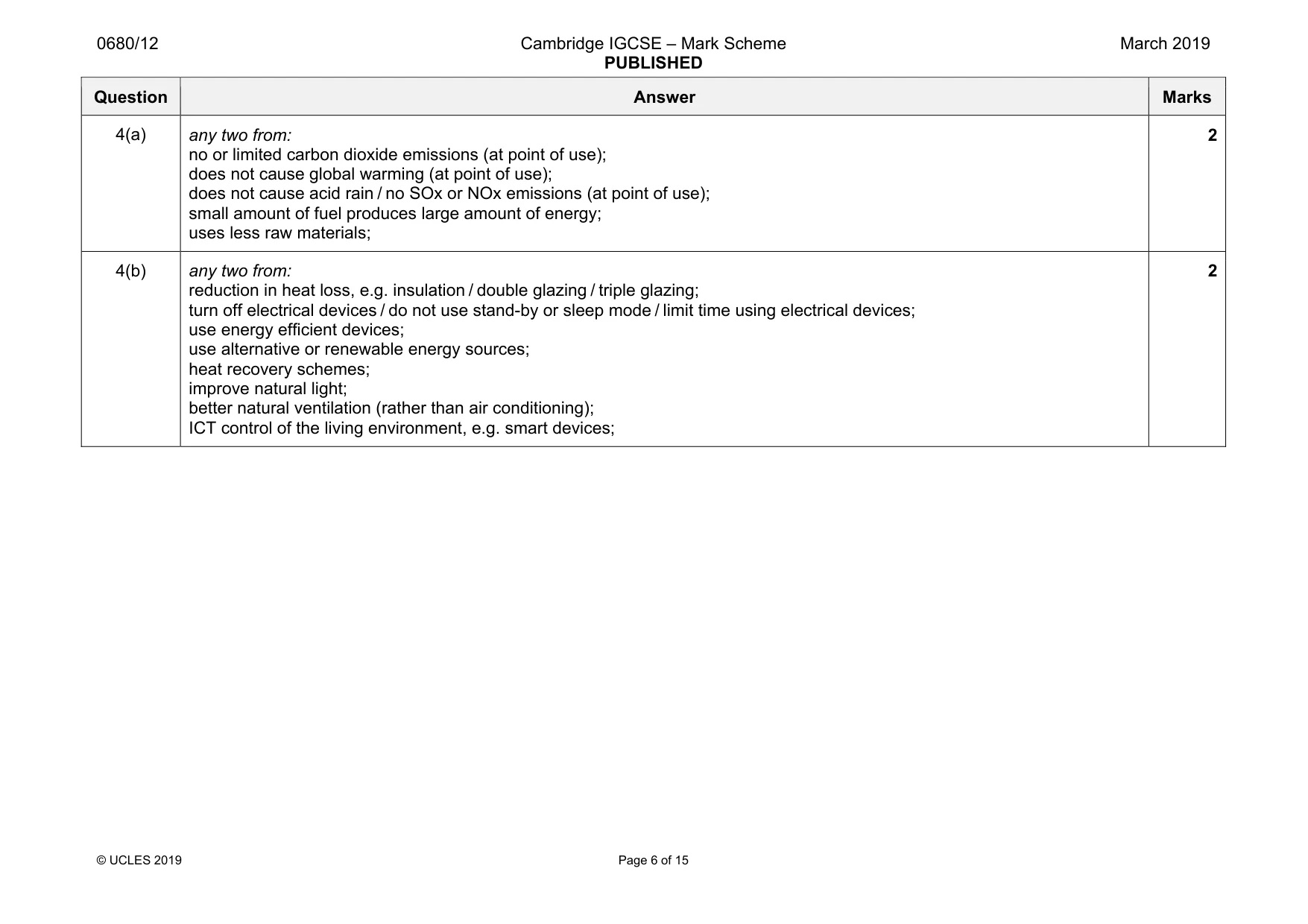
0680/12 Cambridge IGCSE – Mark Scheme PUBLISHED March 2019 © UCLES 2019 Page 6 of 15 Question Answer Marks 4(a) any two from: no or limited carbon dioxide emissions (at point of use); does not cause global warming (at point of use); does not cause acid rain / no SOx or NOx emissions (at point of use); small amount of fuel produces large amount of energy; uses less raw materials; 2 4(b) any two from: reduction in heat loss, e.g. insulation / double glazing / triple glazing; turn off electrical devices / do not use stand-by or sleep mode / limit time using electrical devices; use energy efficient devices; use alternative or renewable energy sources; heat recovery schemes; improve natural light; better natural ventilation (rather than air conditioning); ICT control of the living environment, e.g. smart devices; 2
Mark scheme, page 7
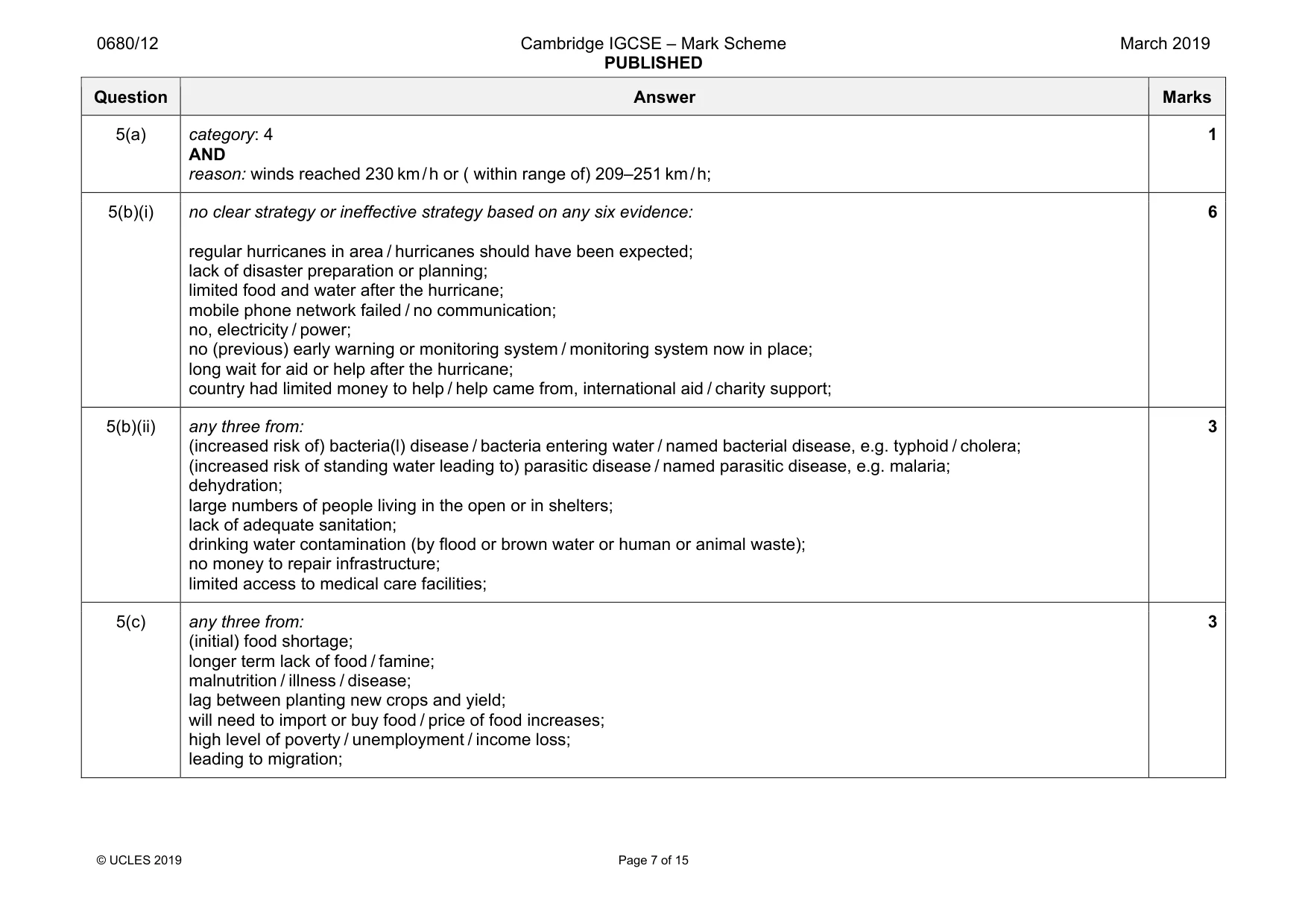
0680/12 Cambridge IGCSE – Mark Scheme PUBLISHED March 2019 © UCLES 2019 Page 7 of 15 Question Answer Marks 5(a) category: 4 AND reason: winds reached 230 km/h or ( within range of) 209–251 km/h; 1 5(b)(i) no clear strategy or ineffective strategy based on any six evidence: regular hurricanes in area / hurricanes should have been expected; lack of disaster preparation or planning; limited food and water after the hurricane; mobile phone network failed / no communication; no, electricity / power; no (previous) early warning or monitoring system / monitoring system now in place; long wait for aid or help after the hurricane; country had limited money to help / help came from, international aid / charity support; 6 5(b)(ii) any three from: (increased risk of) bacteria(l) disease / bacteria entering water / named bacterial disease, e.g. typhoid / cholera; (increased risk of standing water leading to) parasitic disease / named parasitic disease, e.g. malaria; dehydration; large numbers of people living in the open or in shelters; lack of adequate sanitation; drinking water contamination (by flood or brown water or human or animal waste); no money to repair infrastructure; limited access to medical care facilities; 3 5(c) any three from: (initial) food shortage; longer term lack of food / famine; malnutrition / illness / disease; lag between planting new crops and yield; will need to import or buy food / price of food increases; high level of poverty / unemployment / income loss; leading to migration; 3
Mark scheme, page 8
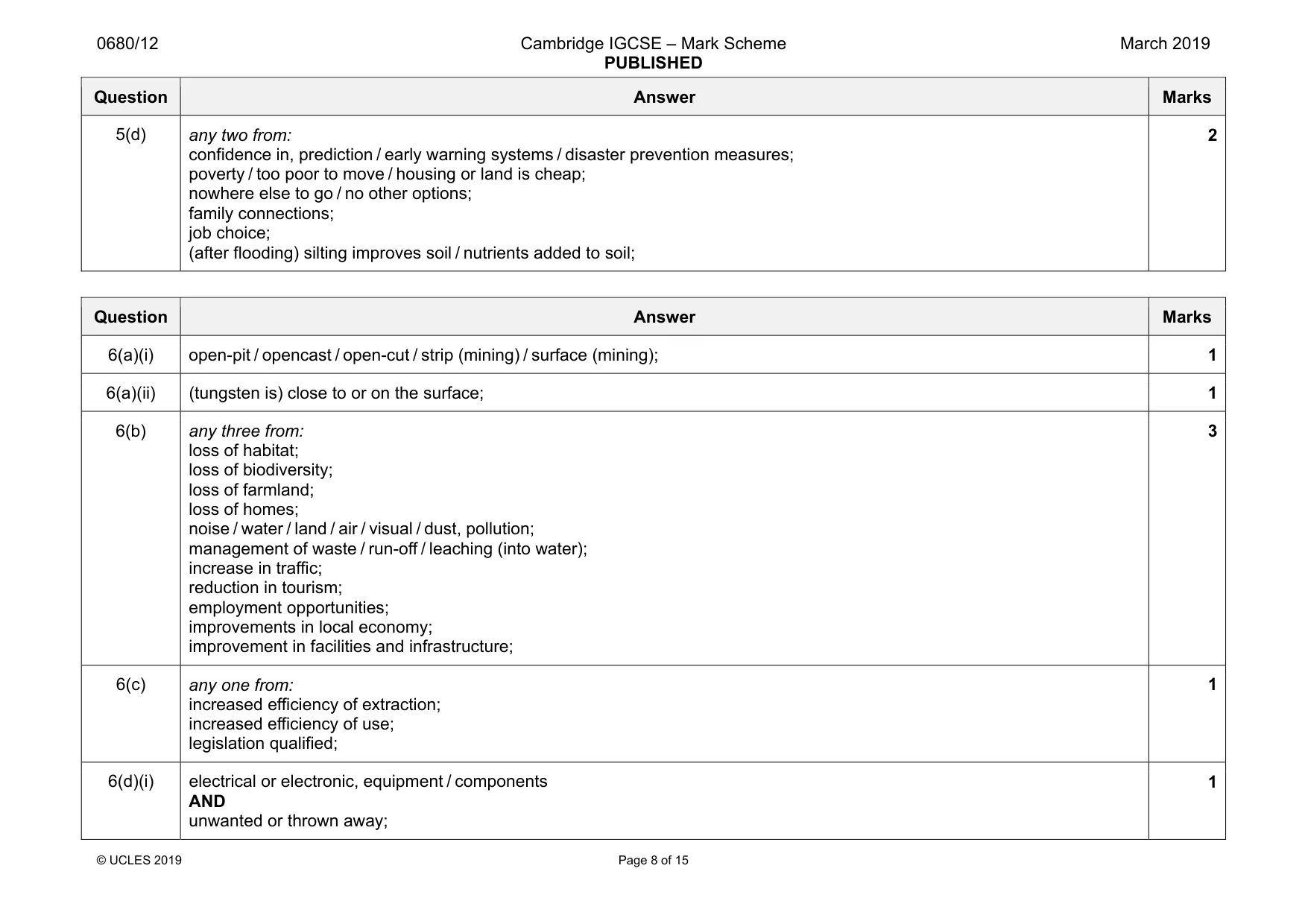
0680/12 Cambridge IGCSE – Mark Scheme PUBLISHED March 2019 © UCLES 2019 Page 8 of 15 Question Answer Marks 5(d) any two from: confidence in, prediction / early warning systems / disaster prevention measures; poverty / too poor to move / housing or land is cheap; nowhere else to go / no other options; family connections; job choice; (after flooding) silting improves soil / nutrients added to soil; 2 Question Answer Marks 6(a)(i) open-pit / opencast / open-cut / strip (mining) / surface (mining); 1 6(a)(ii) (tungsten is) close to or on the surface; 1 6(b) any three from: loss of habitat; loss of biodiversity; loss of farmland; loss of homes; noise / water / land / air / visual / dust, pollution; management of waste / run-off / leaching (into water); increase in traffic; reduction in tourism; employment opportunities; improvements in local economy; improvement in facilities and infrastructure; 3 6(c) any one from: increased efficiency of extraction; increased efficiency of use; legislation qualified; 1 6(d)(i) electrical or electronic, equipment / components AND unwanted or thrown away; 1
Mark scheme, page 9
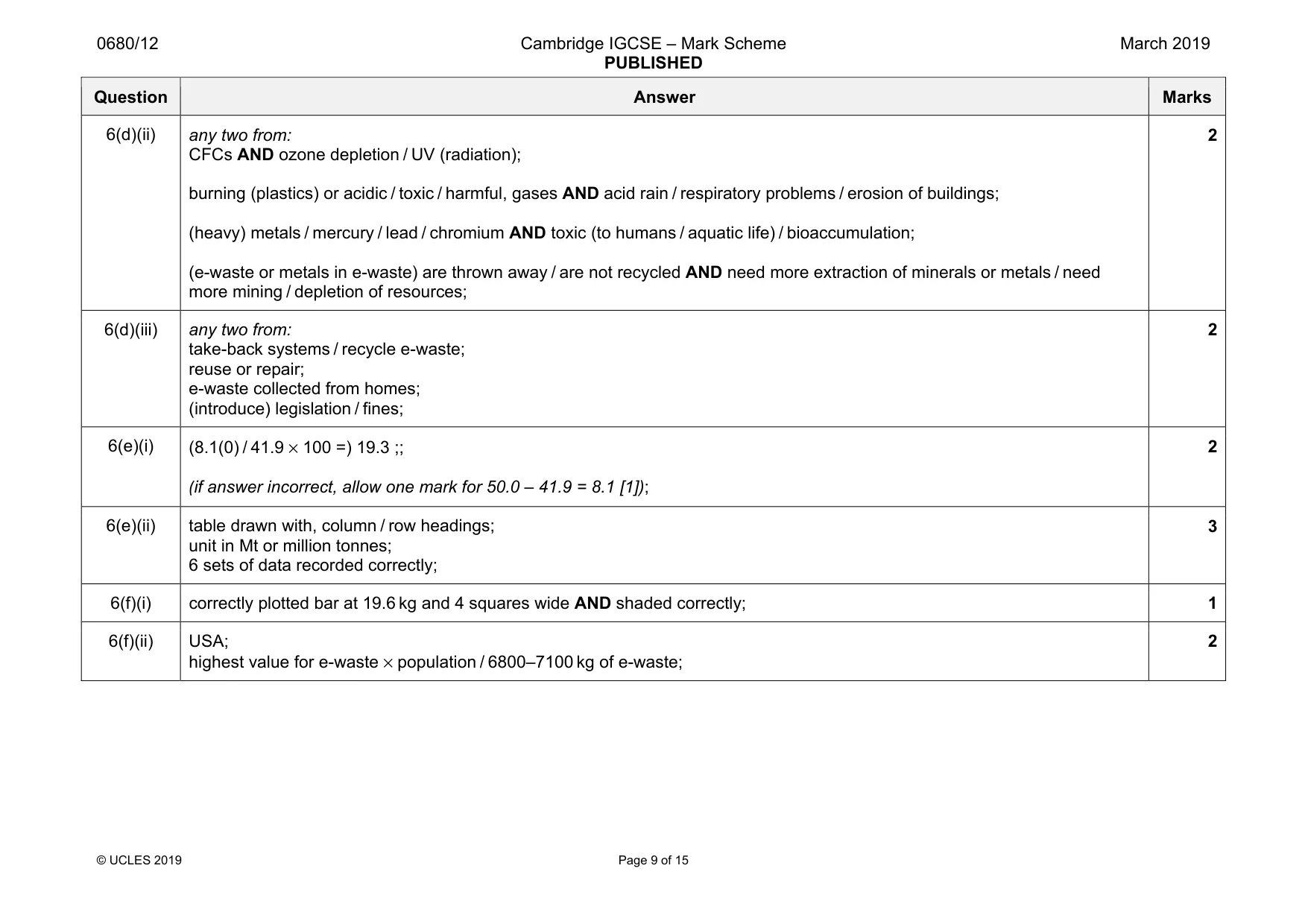
0680/12 Cambridge IGCSE – Mark Scheme PUBLISHED March 2019 © UCLES 2019 Page 9 of 15 Question Answer Marks 6(d)(ii) any two from: CFCs AND ozone depletion / UV (radiation); burning (plastics) or acidic / toxic / harmful, gases AND acid rain / respiratory problems / erosion of buildings; (heavy) metals / mercury / lead / chromium AND toxic (to humans / aquatic life) / bioaccumulation; (e-waste or metals in e-waste) are thrown away / are not recycled AND need more extraction of minerals or metals / need more mining / depletion of resources; 2 6(d)(iii) any two from: take-back systems / recycle e-waste; reuse or repair; e-waste collected from homes; (introduce) legislation / fines; 2 6(e)(i) (8.1(0) / 41.9 × 100 =) 19.3 ;; (if answer incorrect, allow one mark for 50.0 – 41.9 = 8.1 [1]); 2 6(e)(ii) table drawn with, column / row headings; unit in Mt or million tonnes; 6 sets of data recorded correctly; 3 6(f)(i) correctly plotted bar at 19.6 kg and 4 squares wide AND shaded correctly; 1 6(f)(ii) USA; highest value for e-waste × population / 6800–7100 kg of e-waste; 2
Mark scheme, page 10
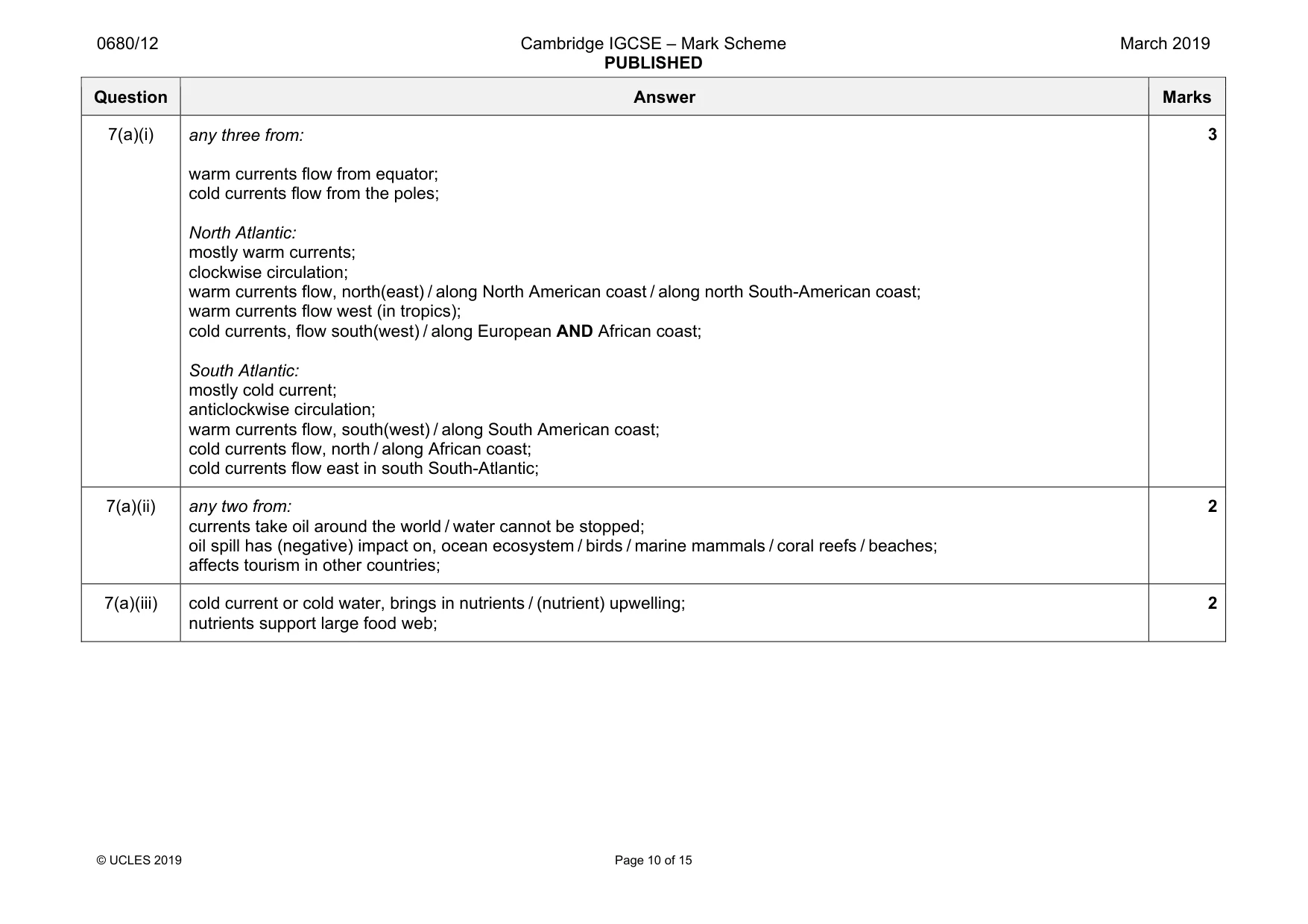
0680/12 Cambridge IGCSE – Mark Scheme PUBLISHED March 2019 © UCLES 2019 Page 10 of 15 Question Answer Marks 7(a)(i) any three from: warm currents flow from equator; cold currents flow from the poles; North Atlantic: mostly warm currents; clockwise circulation; warm currents flow, north(east) / along North American coast / along north South-American coast; warm currents flow west (in tropics); cold currents, flow south(west) / along European AND African coast; South Atlantic: mostly cold current; anticlockwise circulation; warm currents flow, south(west) / along South American coast; cold currents flow, north / along African coast; cold currents flow east in south South-Atlantic; 3 7(a)(ii) any two from: currents take oil around the world / water cannot be stopped; oil spill has (negative) impact on, ocean ecosystem / birds / marine mammals / coral reefs / beaches; affects tourism in other countries; 2 7(a)(iii) cold current or cold water, brings in nutrients / (nutrient) upwelling; nutrients support large food web; 2
Mark scheme, page 11
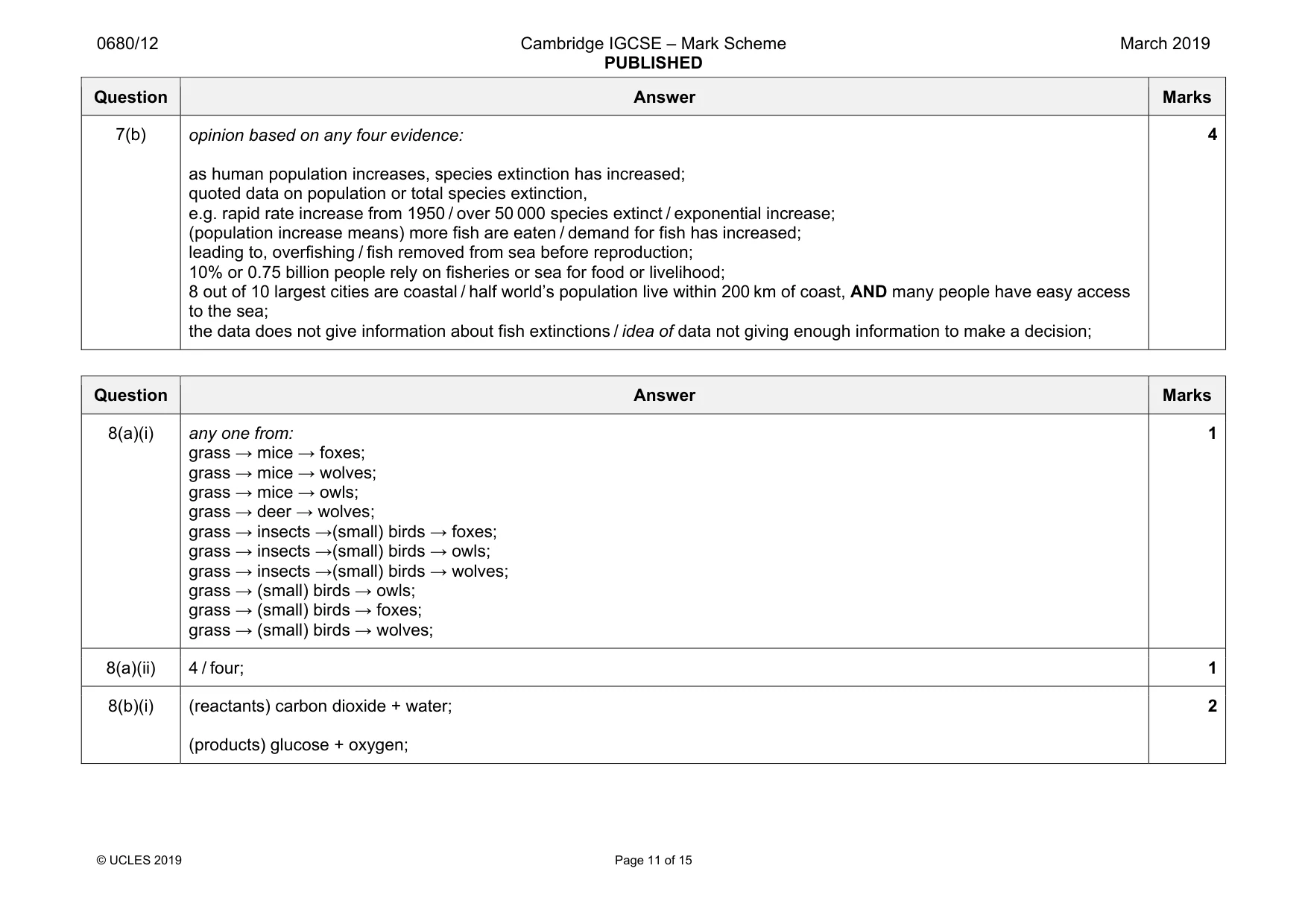
0680/12 Cambridge IGCSE – Mark Scheme PUBLISHED March 2019 © UCLES 2019 Page 11 of 15 Question Answer Marks 7(b) opinion based on any four evidence: as human population increases, species extinction has increased; quoted data on population or total species extinction, e.g. rapid rate increase from 1950 / over 50 000 species extinct / exponential increase; (population increase means) more fish are eaten / demand for fish has increased; leading to, overfishing / fish removed from sea before reproduction; 10% or 0.75 billion people rely on fisheries or sea for food or livelihood; 8 out of 10 largest cities are coastal / half world’s population live within 200 km of coast, AND many people have easy access to the sea; the data does not give information about fish extinctions / idea of data not giving enough information to make a decision; 4 Question Answer Marks 8(a)(i) any one from: grass → mice → foxes; grass → mice → wolves; grass → mice → owls; grass → deer → wolves; grass → insects →(small) birds → foxes; grass → insects →(small) birds → owls; grass → insects →(small) birds → wolves; grass → (small) birds → owls; grass → (small) birds → foxes; grass → (small) birds → wolves; 1 8(a)(ii) 4 / four; 1 8(b)(i) (reactants) carbon dioxide + water; (products) glucose + oxygen; 2
Mark scheme, page 12
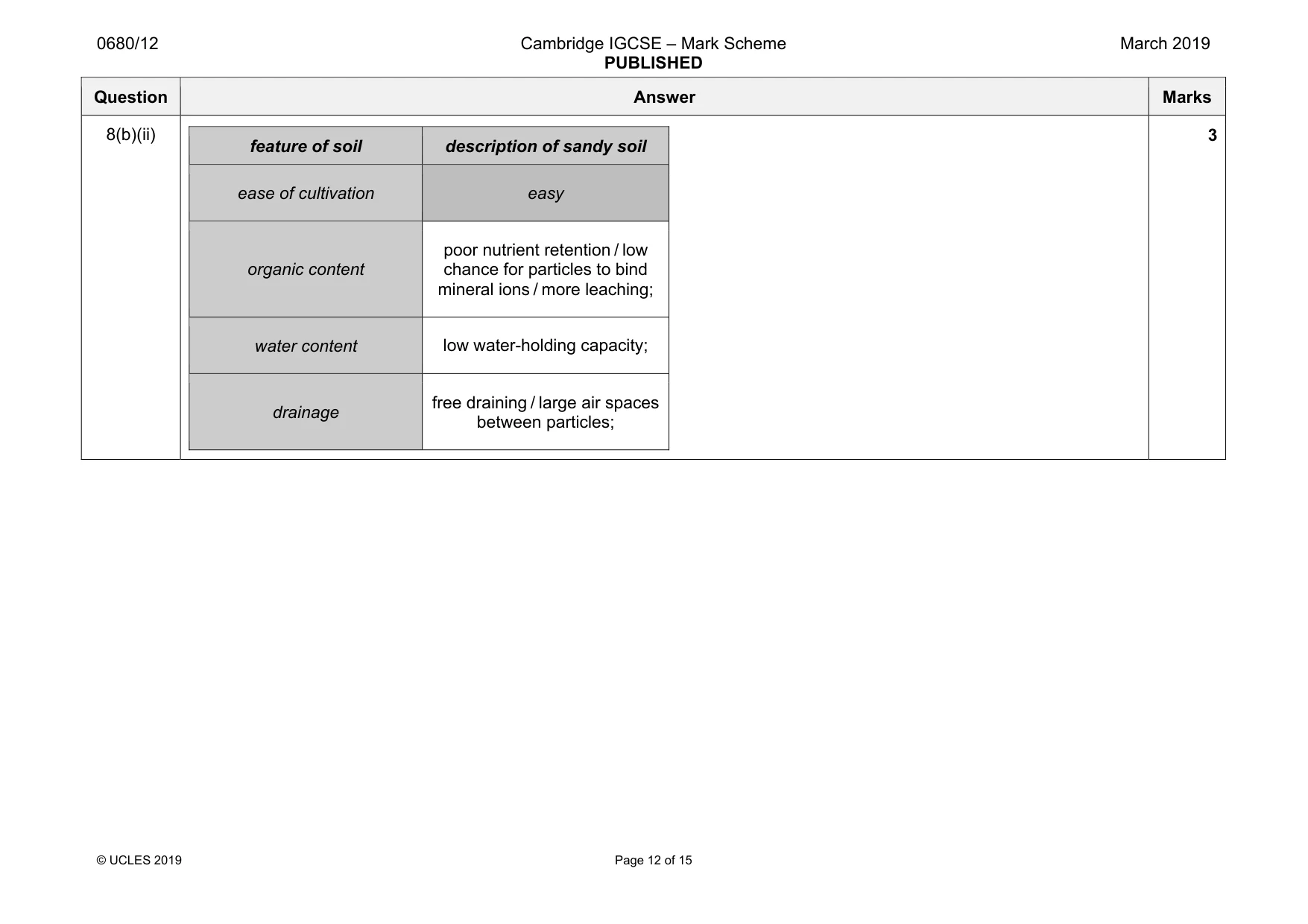
0680/12 Cambridge IGCSE – Mark Scheme PUBLISHED March 2019 © UCLES 2019 Page 12 of 15 Question Answer Marks 8(b)(ii) feature of soil description of sandy soil ease of cultivation easy organic content poor nutrient retention / low chance for particles to bind mineral ions / more leaching; water content low water-holding capacity; drainage free draining / large air spaces between particles; 3
Mark scheme, page 13
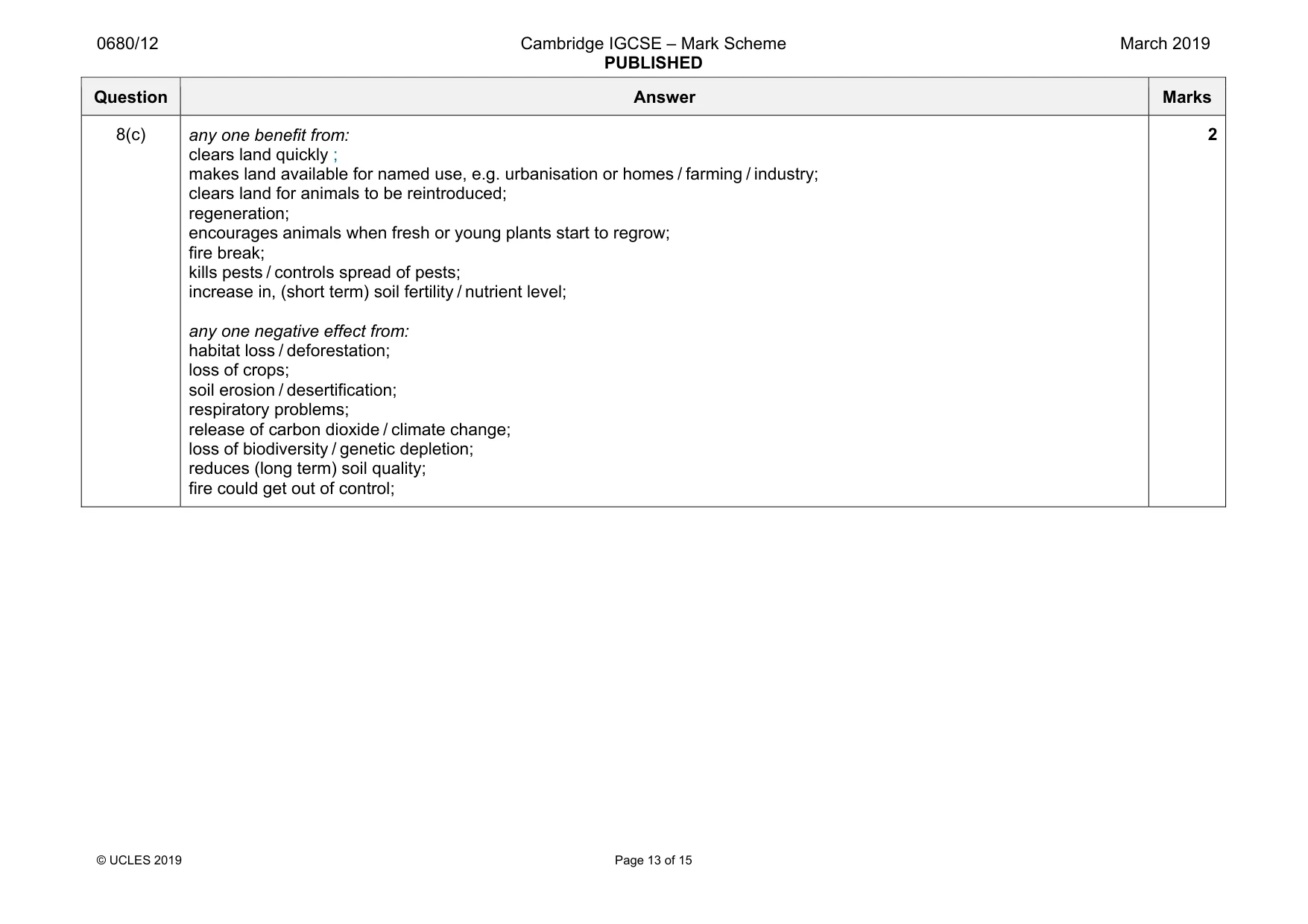
0680/12 Cambridge IGCSE – Mark Scheme PUBLISHED March 2019 © UCLES 2019 Page 13 of 15 Question Answer Marks 8(c) any one benefit from: clears land quickly ; makes land available for named use, e.g. urbanisation or homes / farming / industry; clears land for animals to be reintroduced; regeneration; encourages animals when fresh or young plants start to regrow; fire break; kills pests / controls spread of pests; increase in, (short term) soil fertility / nutrient level; any one negative effect from: habitat loss / deforestation; loss of crops; soil erosion / desertification; respiratory problems; release of carbon dioxide / climate change; loss of biodiversity / genetic depletion; reduces (long term) soil quality; fire could get out of control; 2
Mark scheme, page 14
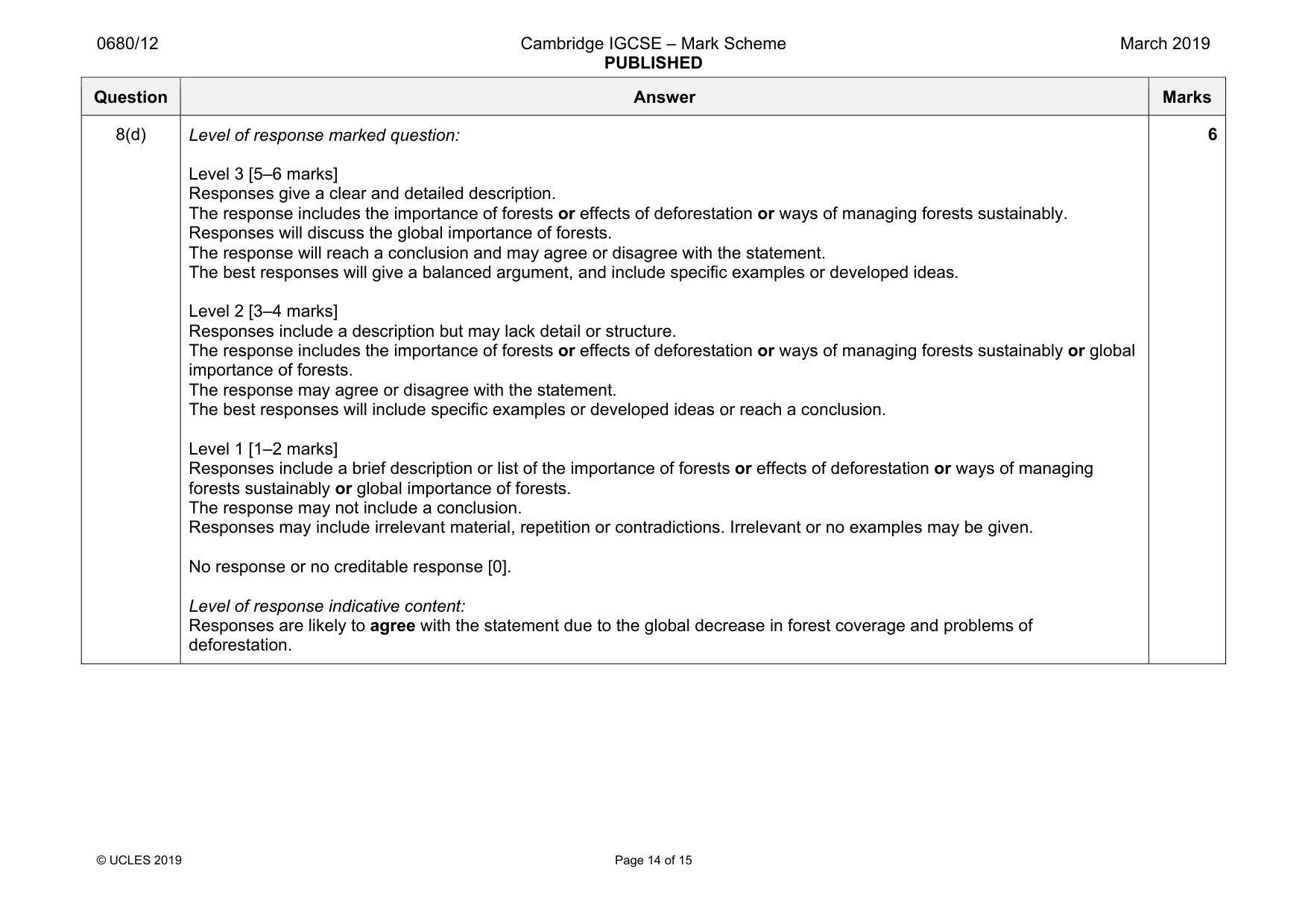
0680/12 Cambridge IGCSE – Mark Scheme PUBLISHED March 2019 © UCLES 2019 Page 14 of 15 Question Answer Marks 8(d) Level of response marked question: Level 3 [5–6 marks] Responses give a clear and detailed description. The response includes the importance of forests or effects of deforestation or ways of managing forests sustainably. Responses will discuss the global importance of forests. The response will reach a conclusion and may agree or disagree with the statement. The best responses will give a balanced argument, and include specific examples or developed ideas. Level 2 [3–4 marks] Responses include a description but may lack detail or structure. The response includes the importance of forests or effects of deforestation or ways of managing forests sustainably or global importance of forests. The response may agree or disagree with the statement. The best responses will include specific examples or developed ideas or reach a conclusion. Level 1 [1–2 marks] Responses include a brief description or list of the importance of forests or effects of deforestation or ways of managing forests sustainably or global importance of forests. The response may not include a conclusion. Responses may include irrelevant material, repetition or contradictions. Irrelevant or no examples may be given. No response or no creditable response [0]. Level of response indicative content: Responses are likely to agree with the statement due to the global decrease in forest coverage and problems of deforestation. 6
Mark scheme, page 15
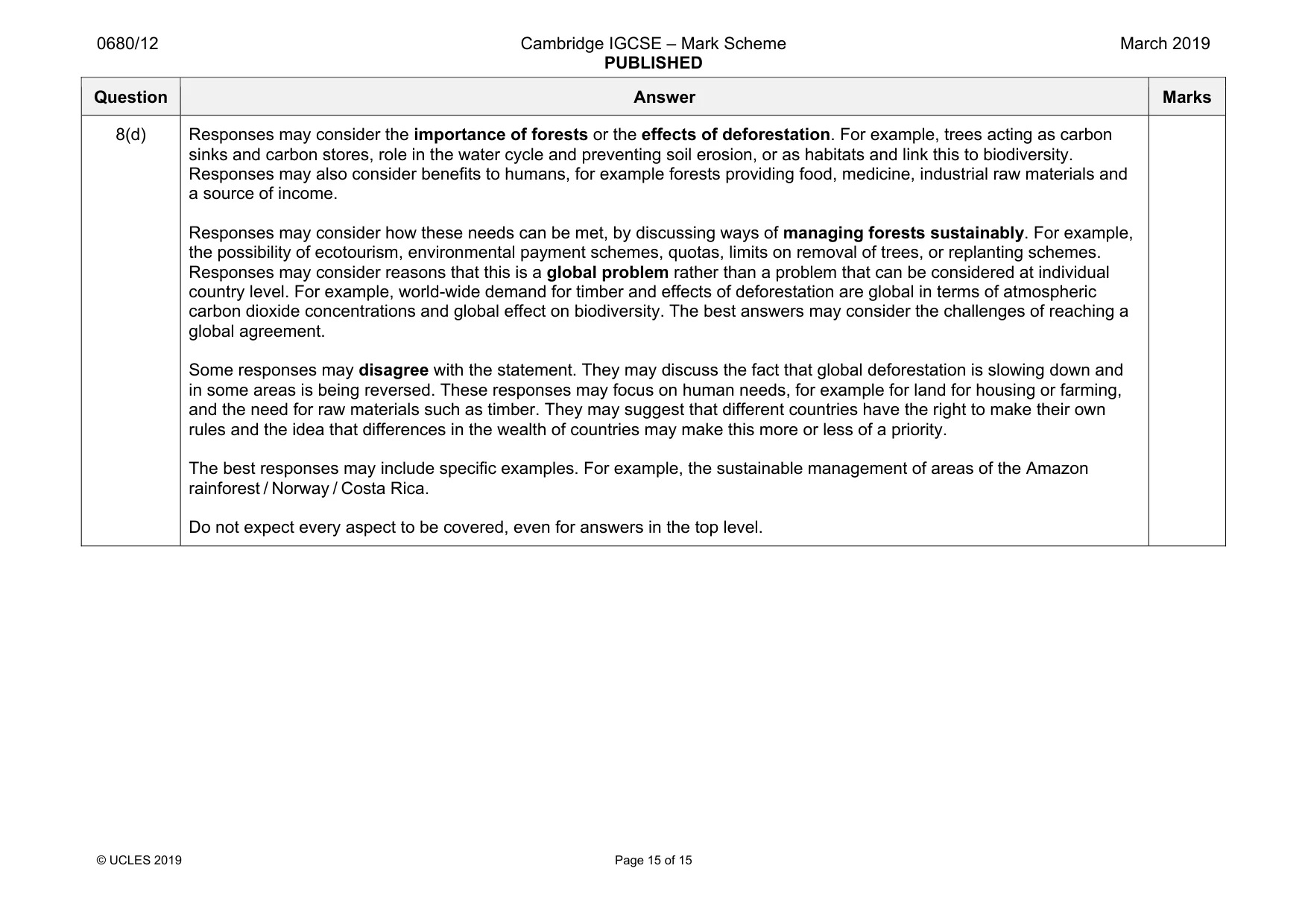
0680/12 Cambridge IGCSE – Mark Scheme PUBLISHED March 2019 © UCLES 2019 Page 15 of 15 Question Answer Marks 8(d) Responses may consider the importance of forests or the effects of deforestation. For example, trees acting as carbon sinks and carbon stores, role in the water cycle and preventing soil erosion, or as habitats and link this to biodiversity. Responses may also consider benefits to humans, for example forests providing food, medicine, industrial raw materials and a source of income. Responses may consider how these needs can be met, by discussing ways of managing forests sustainably. For example, the possibility of ecotourism, environmental payment schemes, quotas, limits on removal of trees, or replanting schemes. Responses may consider reasons that this is a global problem rather than a problem that can be considered at individual country level. For example, world-wide demand for timber and effects of deforestation are global in terms of atmospheric carbon dioxide concentrations and global effect on biodiversity. The best answers may consider the challenges of reaching a global agreement. Some responses may disagree with the statement. They may discuss the fact that global deforestation is slowing down and in some areas is being reversed. These responses may focus on human needs, for example for land for housing or farming, and the need for raw materials such as timber. They may suggest that different countries have the right to make their own rules and the idea that differences in the wealth of countries may make this more or less of a priority. The best responses may include specific examples. For example, the sustainable management of areas of the Amazon rainforest / Norway / Costa Rica. Do not expect every aspect to be covered, even for answers in the top level.
What you needed in this session
Cambridge’s own grade thresholds for 2019 Feb/March, Paper 1 · Variant 2. A higher threshold means an easier paper — the bar moves with how the cohort did.