Cambridge IGCSE Environmental Management 0680 — 2017 Feb/March Paper 1 · Variant 2
0680/12/F/M/17 · 60 marks · ≈68 min
The question paper and its mark scheme, free to read here and free to download. This is Cambridge’s own paper, exactly as it was sat.
Question paper16 pages


Mark scheme8 pages
Answers below. Sit the paper first if you are practising.
Paper as text
Question paper, page 1
This document consists of 14 printed pages and 2 blank pages. DC (NF/FC) 129759/3 © UCLES 2017 [Turn over Cambridge International Examinations Cambridge International General Certificate of Secondary Education * 1 8 0 9 7 9 0 1 9 7 * ENVIRONMENTAL MANAGEMENT 0680/12 Paper 1 February/March 2017 1 hour 30 minutes Candidates answer on the Question Paper. No Additional Materials are required. READ THESE INSTRUCTIONS FIRST Write your Centre number, candidate number and name on all the work you hand in. Write in dark blue or black pen. You may use an HB pencil for any diagrams or graphs. Do not use staples, paper clips, glue or correction fluid. DO NOT WRITE IN ANY BARCODES. Answer all questions. Electronic calculators may be used. You may lose marks if you do not show your working or if you do not use appropriate units. At the end of the examination, fasten all your work securely together. The number of marks is given in brackets [ ] at the end of each question or part question.
Question paper, page 2
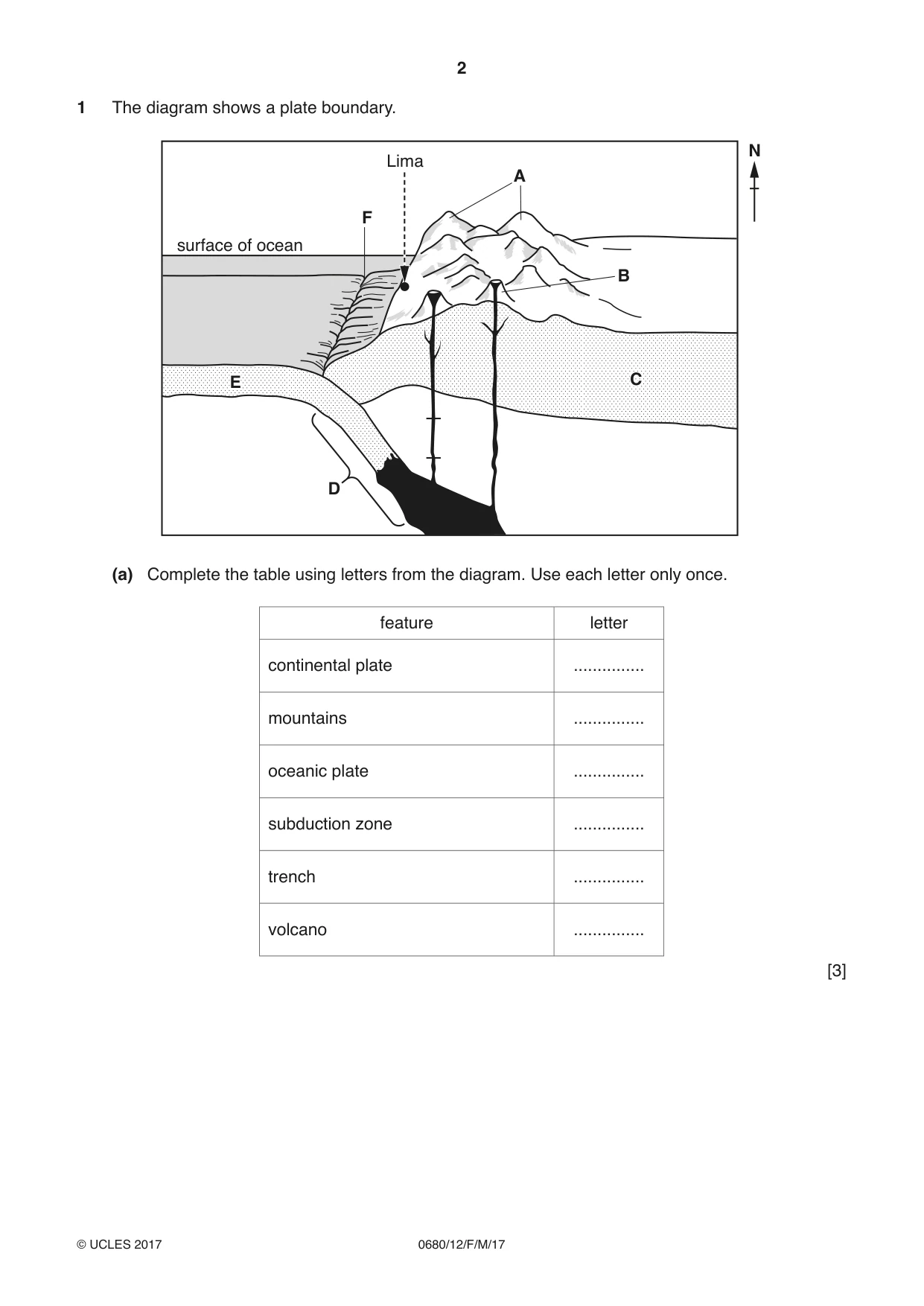
2 0680/12/F/M/17 © UCLES 2017 1 The diagram shows a plate boundary. N surface of ocean Lima F A B C D E C (a) Complete the table using letters from the diagram. Use each letter only once. feature letter continental plate … mountains … oceanic plate … subduction zone … trench … volcano … [3]
Question paper, page 3
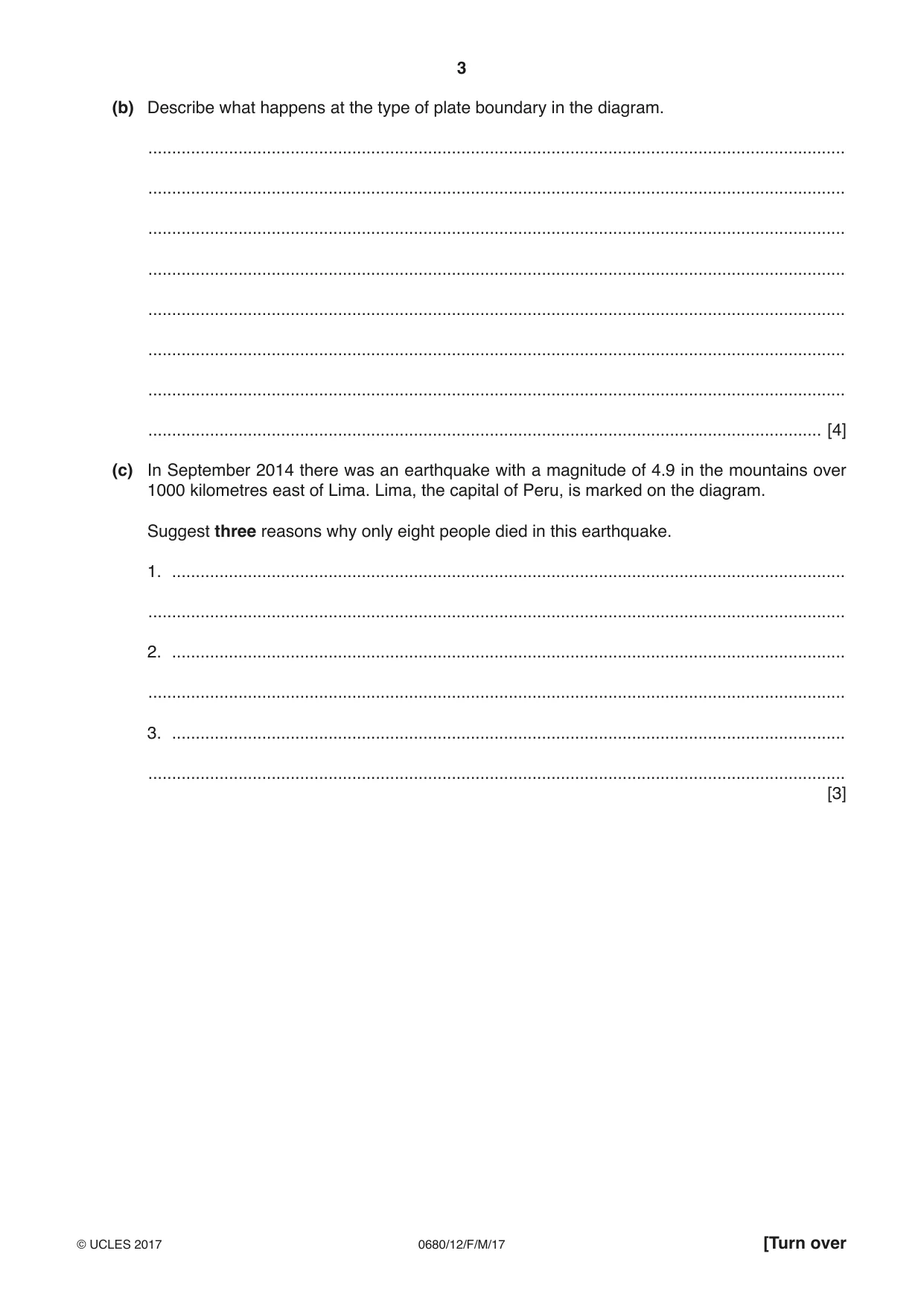
3 0680/12/F/M/17 © UCLES 2017 [Turn over (b) Describe what happens at the type of plate boundary in the diagram. … … … … … … … … [4] (c) In September 2014 there was an earthquake with a magnitude of 4.9 in the mountains over 1000 kilometres east of Lima. Lima, the capital of Peru, is marked on the diagram. Suggest three reasons why only eight people died in this earthquake. 1. … … 2. … … 3. … … [3]
Question paper, page 4
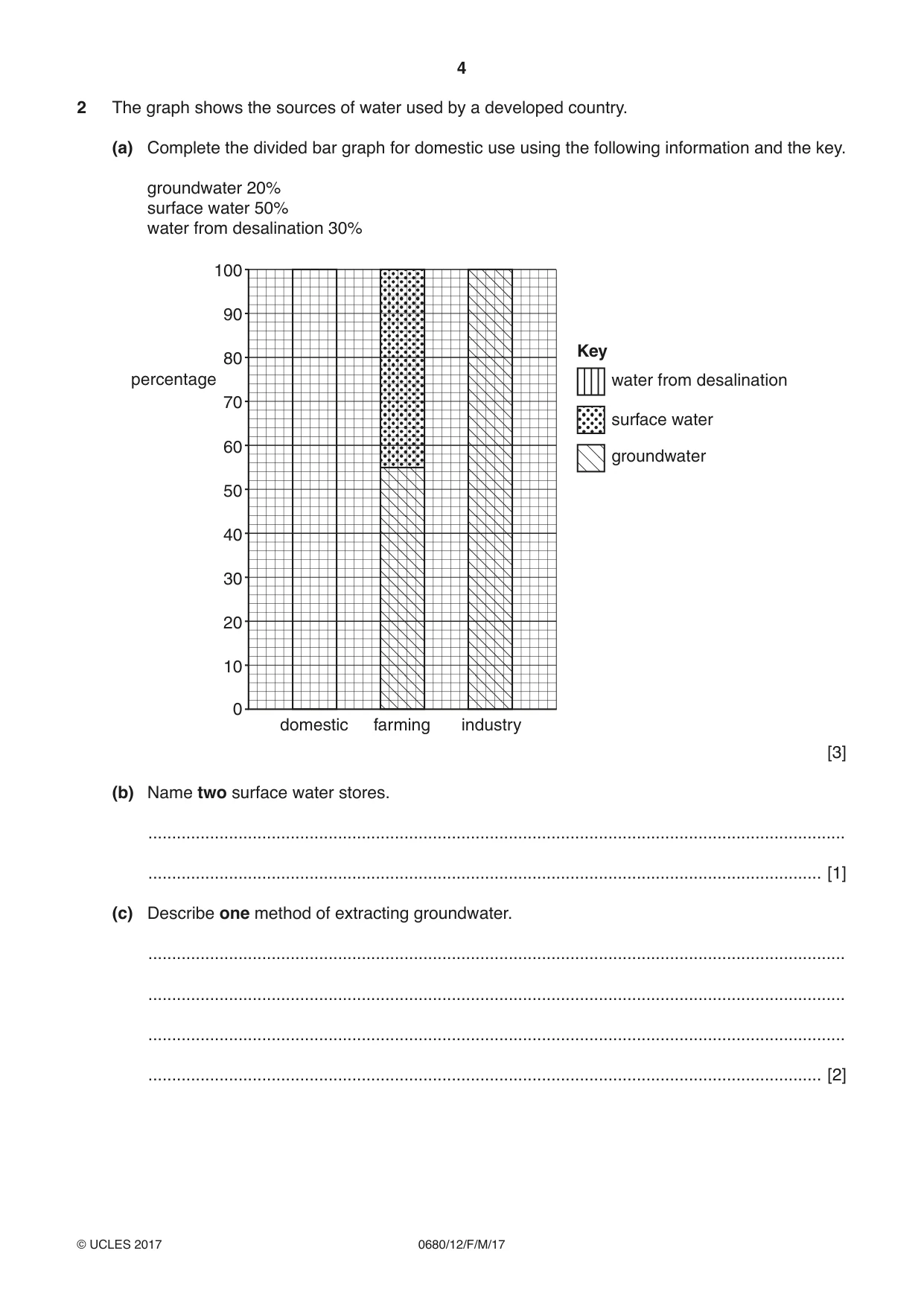
4 0680/12/F/M/17 © UCLES 2017 2 The graph shows the sources of water used by a developed country. (a) Complete the divided bar graph for domestic use using the following information and the key. groundwater 20% surface water 50% water from desalination 30% Key water from desalination surface water groundwater domestic farming industry 10 0 20 30 40 50 60 70 80 90 percentage 100 [3] (b) Name two surface water stores. … … [1] (c) Describe one method of extracting groundwater. … … … … [2]
Question paper, page 5
5 0680/12/F/M/17 © UCLES 2017 [Turn over (d) (i) State what is meant by the term desalination. … … [1] (ii) Suggest reasons why very few countries use desalination to provide drinking water. … … … … … … [3]
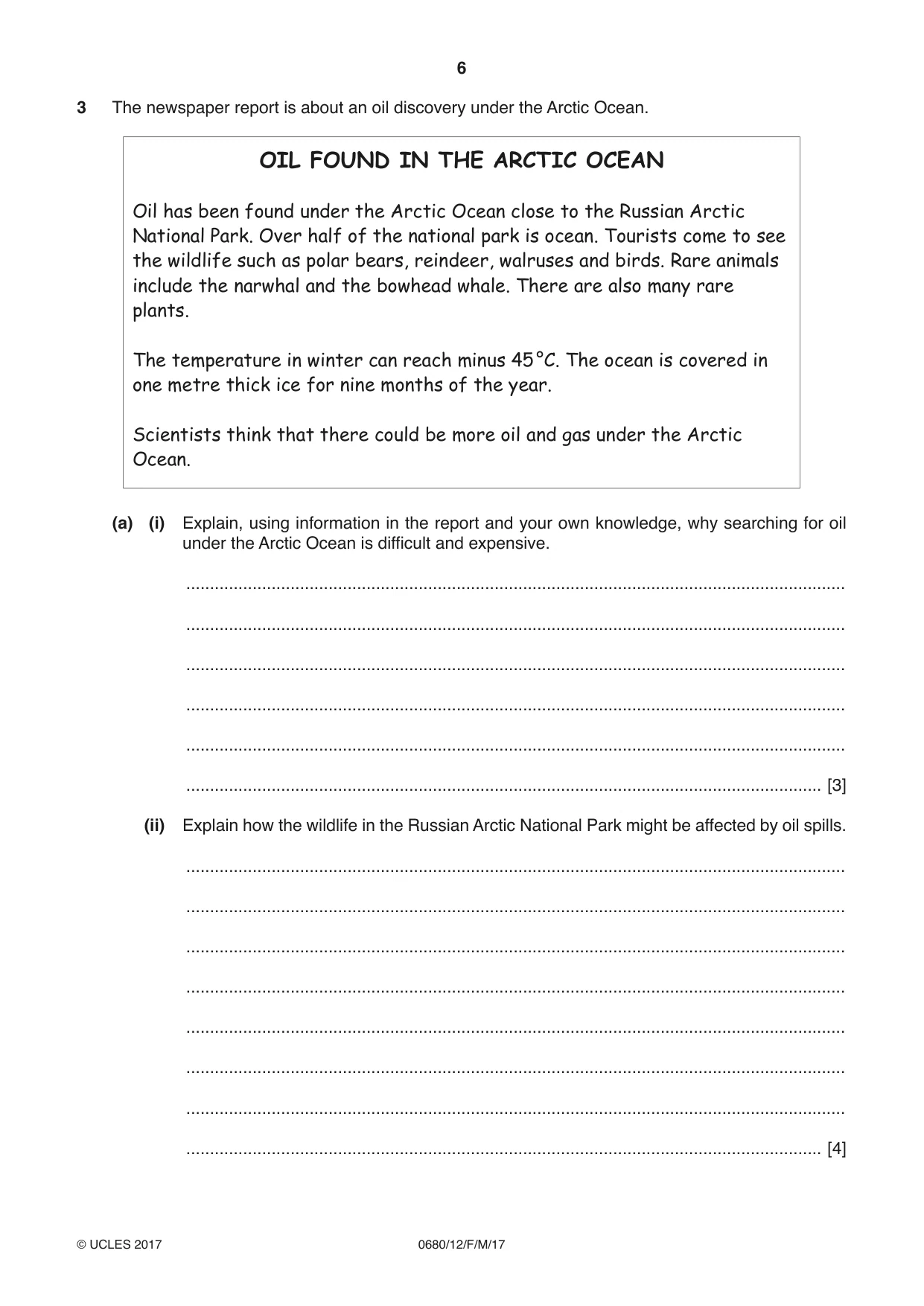
Question paper, page 6
6 0680/12/F/M/17 © UCLES 2017 3 The newspaper report is about an oil discovery under the Arctic Ocean. OIL FOUND IN THE ARCTIC OCEAN Oil has been found under the Arctic Ocean close to the Russian Arctic National Park. Over half of the national park is ocean. Tourists come to see the wildlife such as polar bears, reindeer, walruses and birds. Rare animals include the narwhal and the bowhead whale. There are also many rare plants. The temperature in winter can reach minus 45 °C. The ocean is covered in one metre thick ice for nine months of the year. Scientists think that there could be more oil and gas under the Arctic Ocean. (a) (i) Explain, using information in the report and your own knowledge, why searching for oil under the Arctic Ocean is difficult and expensive. … … … … … … [3] (ii) Explain how the wildlife in the Russian Arctic National Park might be affected by oil spills. … … … … … … … … [4]
Question paper, page 7
7 0680/12/F/M/17 © UCLES 2017 [Turn over (b) Describe three ways of reducing the impacts of oil spills. … … … … … [3]
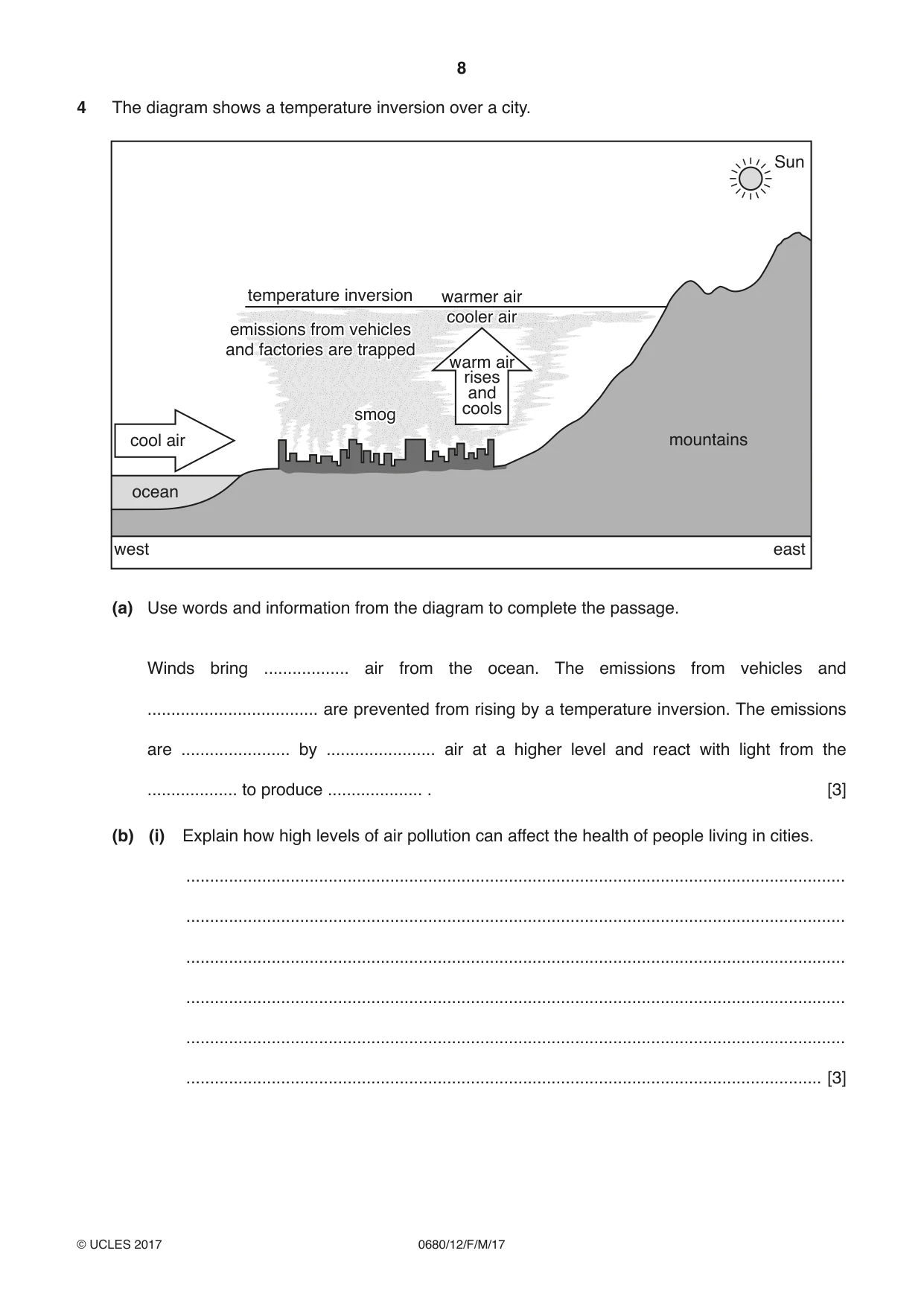
Question paper, page 8
8 0680/12/F/M/17 © UCLES 2017 4 The diagram shows a temperature inversion over a city. mountains ocean temperature inversion warmer air Sun cooler air cooler air smog smog emissions from vehicles and factories are trapped emissions from vehicles and factories are trapped cool air west east warm air rises and cools (a) Use words and information from the diagram to complete the passage. Winds bring … air from the ocean. The emissions from vehicles and … are prevented from rising by a temperature inversion. The emissions are … by … air at a higher level and react with light from the … to produce … . [3] (b) (i) Explain how high levels of air pollution can affect the health of people living in cities. … … … … … … [3]
Question paper, page 9
9 0680/12/F/M/17 © UCLES 2017 [Turn over (ii) Describe ways of reducing air pollution in cities. … … … … … … … … [4]
Question paper, page 10
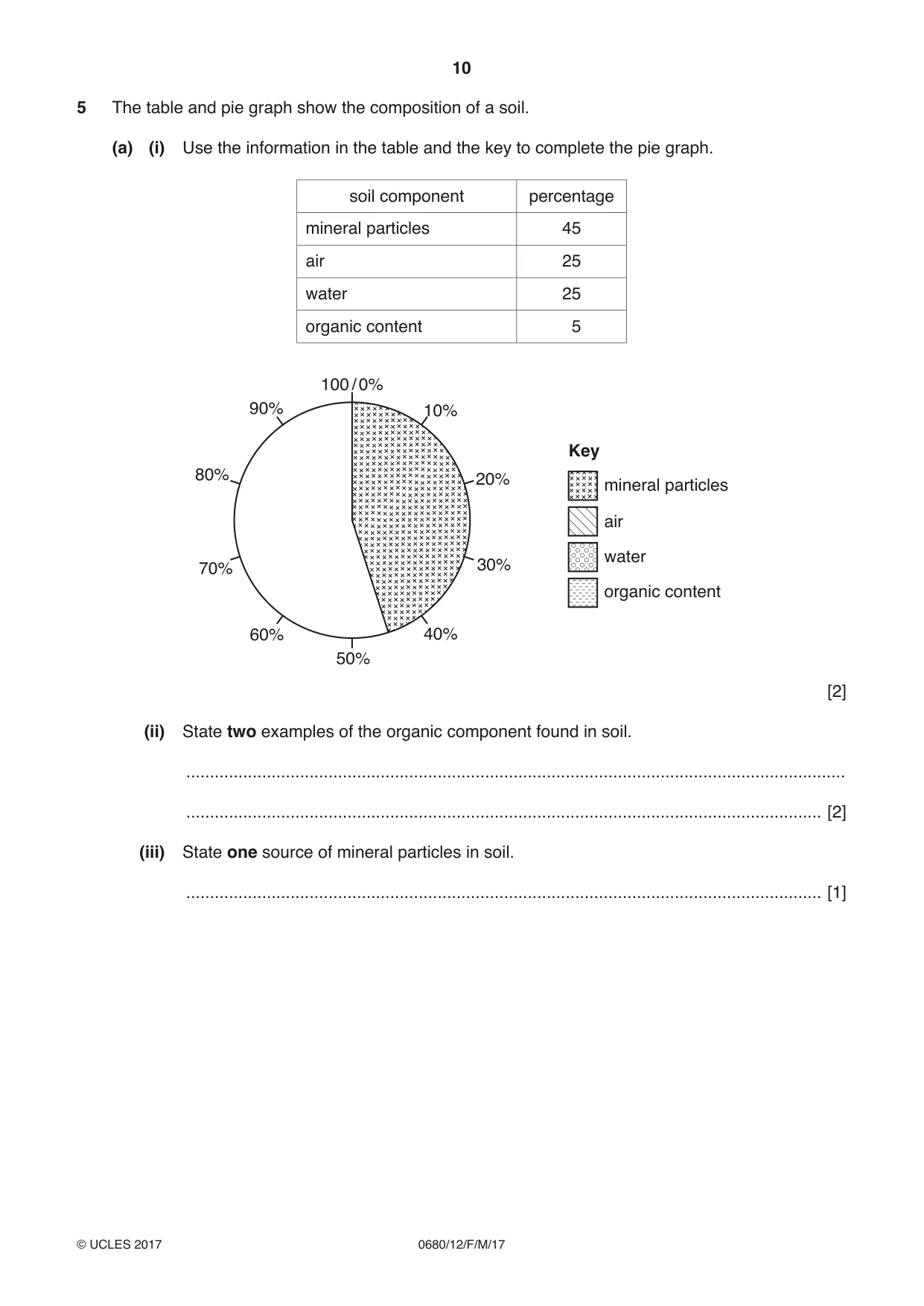
10 0680/12/F/M/17 © UCLES 2017 5 The table and pie graph show the composition of a soil. (a) (i) Use the information in the table and the key to complete the pie graph. soil component percentage mineral particles 45 air 25 water 25 organic content 5 100 / 0% 10% 20% 30% 40% 50% 60% 70% 80% 90% Key mineral particles air water organic content [2] (ii) State two examples of the organic component found in soil. … … [2] (iii) State one source of mineral particles in soil. … [1]
Question paper, page 11
11 0680/12/F/M/17 © UCLES 2017 [Turn over (b) (i) Suggest why planting trees conserves soil. … … … … … … [3] (ii) Describe one other strategy for conserving soil. … … … … [2]
Question paper, page 12
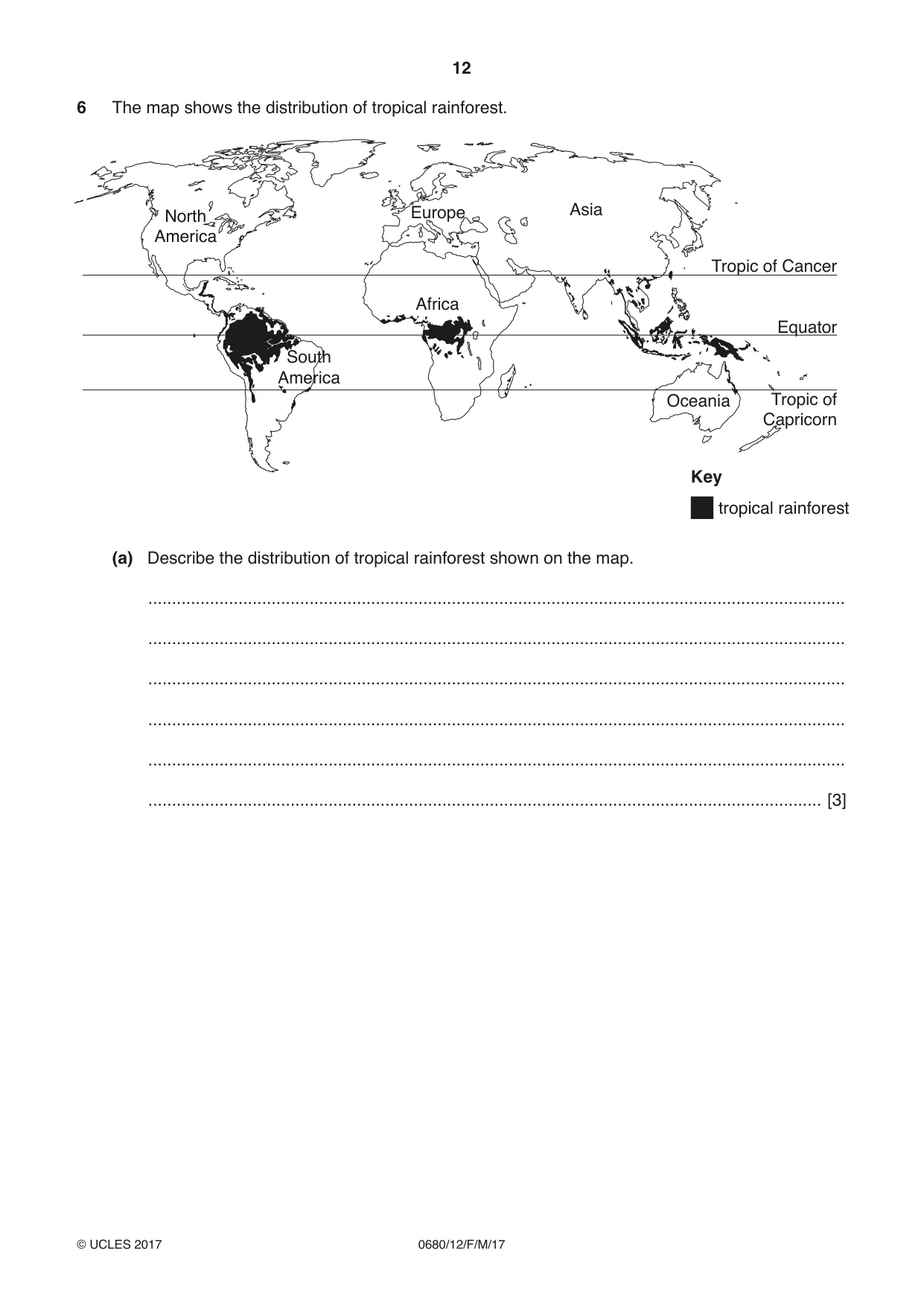
12 0680/12/F/M/17 © UCLES 2017 6 The map shows the distribution of tropical rainforest. Tropic of Cancer Tropic of Capricorn Equator North America South America Africa Europe Asia Oceania Key tropical rainforest (a) Describe the distribution of tropical rainforest shown on the map. … … … … … … [3]
Question paper, page 13
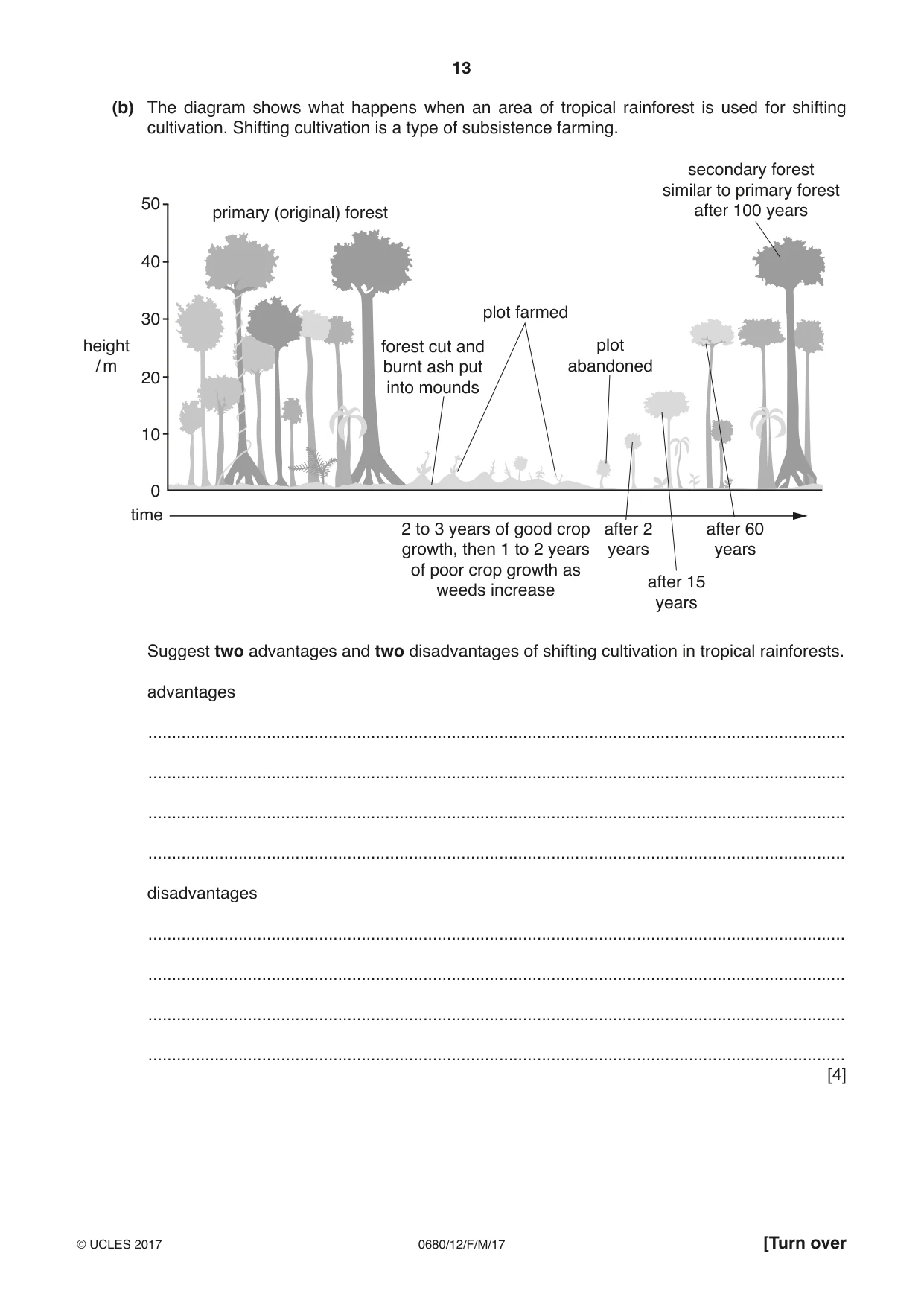
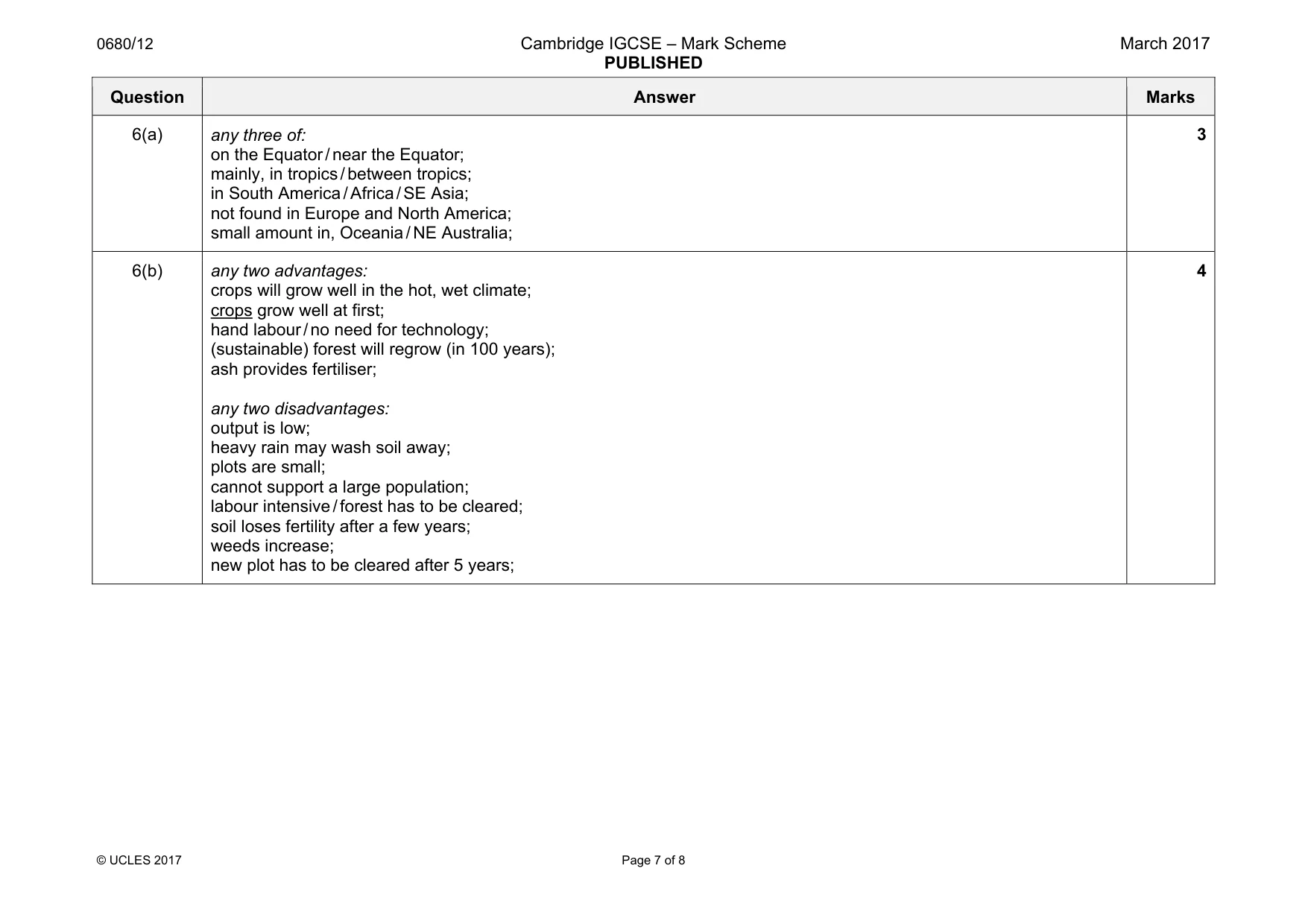
13 0680/12/F/M/17 © UCLES 2017 [Turn over (b) The diagram shows what happens when an area of tropical rainforest is used for shifting cultivation. Shifting cultivation is a type of subsistence farming. 40 30 50 20 10 0 time height / m primary (original) forest plot farmed forest cut and burnt ash put into mounds secondary forest similar to primary forest after 100 years plot abandoned 2 to 3 years of good crop growth, then 1 to 2 years of poor crop growth as weeds increase after 2 years after 15 years after 60 years Suggest two advantages and two disadvantages of shifting cultivation in tropical rainforests. advantages … … … … disadvantages … … … … [4]
Question paper, page 14
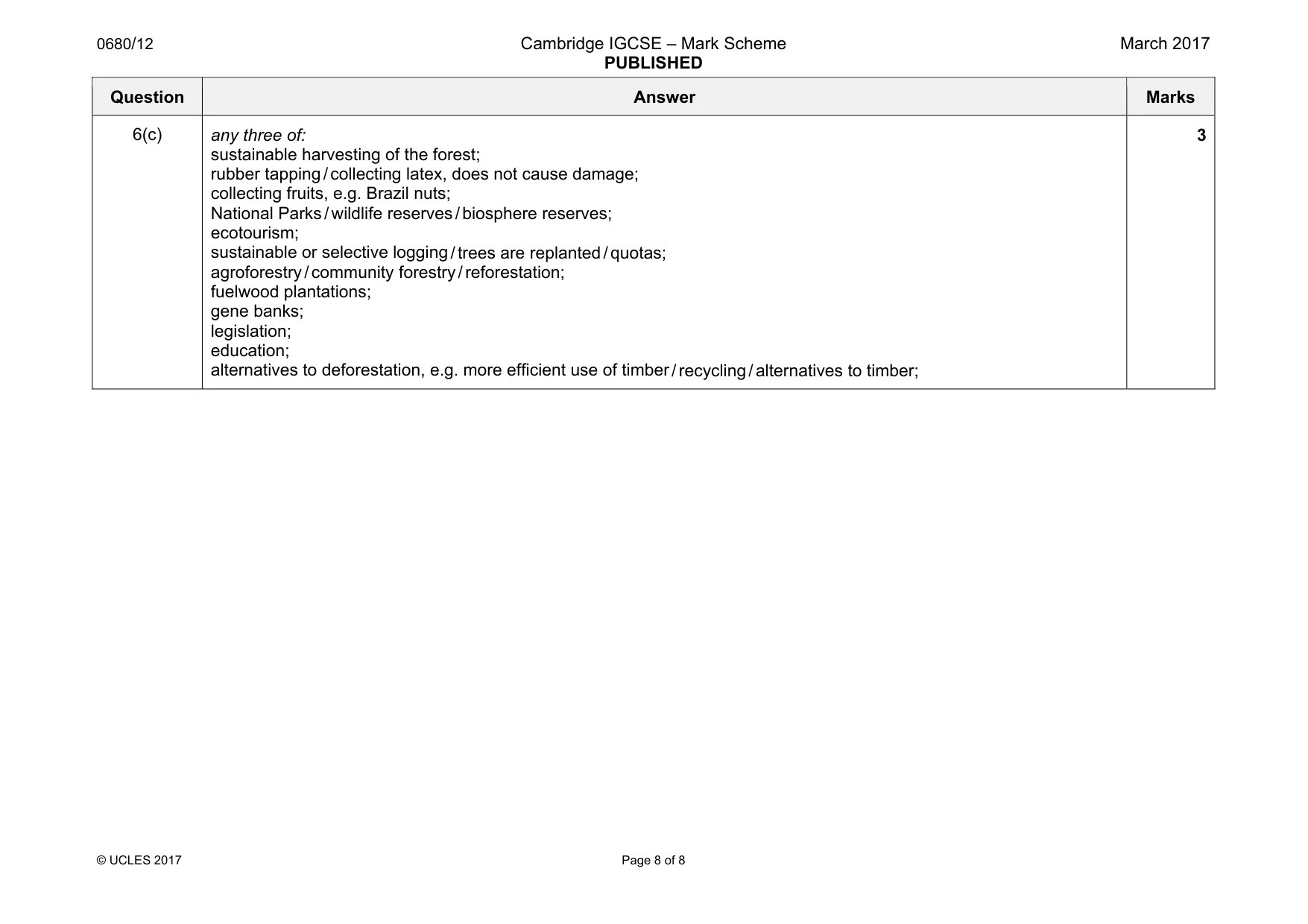
14 0680/12/F/M/17 © UCLES 2017 (c) In the last 50 years people have destroyed half of the world’s tropical rainforests. Suggest strategies to conserve tropical rainforests. … … … … … … [3]
Question paper, page 15
15 0680/12/F/M/17 © UCLES 2017 BLANK PAGE
Question paper, page 16
16 0680/12/F/M/17 © UCLES 2017 BLANK PAGE Permission to reproduce items where third-party owned material protected by copyright is included has been sought and cleared where possible. Every reasonable effort has been made by the publisher (UCLES) to trace copyright holders, but if any items requiring clearance have unwittingly been included, the publisher will be pleased to make amends at the earliest possible opportunity. To avoid the issue of disclosure of answer-related information to candidates, all copyright acknowledgements are reproduced online in the Cambridge International Examinations Copyright Acknowledgements Booklet. This is produced for each series of examinations and is freely available to download at www.cie.org.uk after the live examination series. Cambridge International Examinations is part of the Cambridge Assessment Group. Cambridge Assessment is the brand name of University of Cambridge Local Examinations Syndicate (UCLES), which is itself a department of the University of Cambridge.
Mark scheme, page 1
® IGCSE is a registered trademark. This document consists of 8 printed pages. © UCLES 2017 [Turn over Cambridge International Examinations Cambridge International General Certificate of Secondary Education ENVIRONMENTAL MANAGEMENT 0680/12 Paper 1 March 2017 MARK SCHEME Maximum Mark: 60 Published This mark scheme is published as an aid to teachers and candidates, to indicate the requirements of the examination. It shows the basis on which Examiners were instructed to award marks. It does not indicate the details of the discussions that took place at an Examiners’ meeting before marking began, which would have considered the acceptability of alternative answers. Mark schemes should be read in conjunction with the question paper and the Principal Examiner Report for Teachers. Cambridge will not enter into discussions about these mark schemes. Cambridge is publishing the mark schemes for the March 2017 series for most Cambridge IGCSE®, Cambridge International A and AS Level components and some Cambridge O Level components.
Mark scheme, page 2
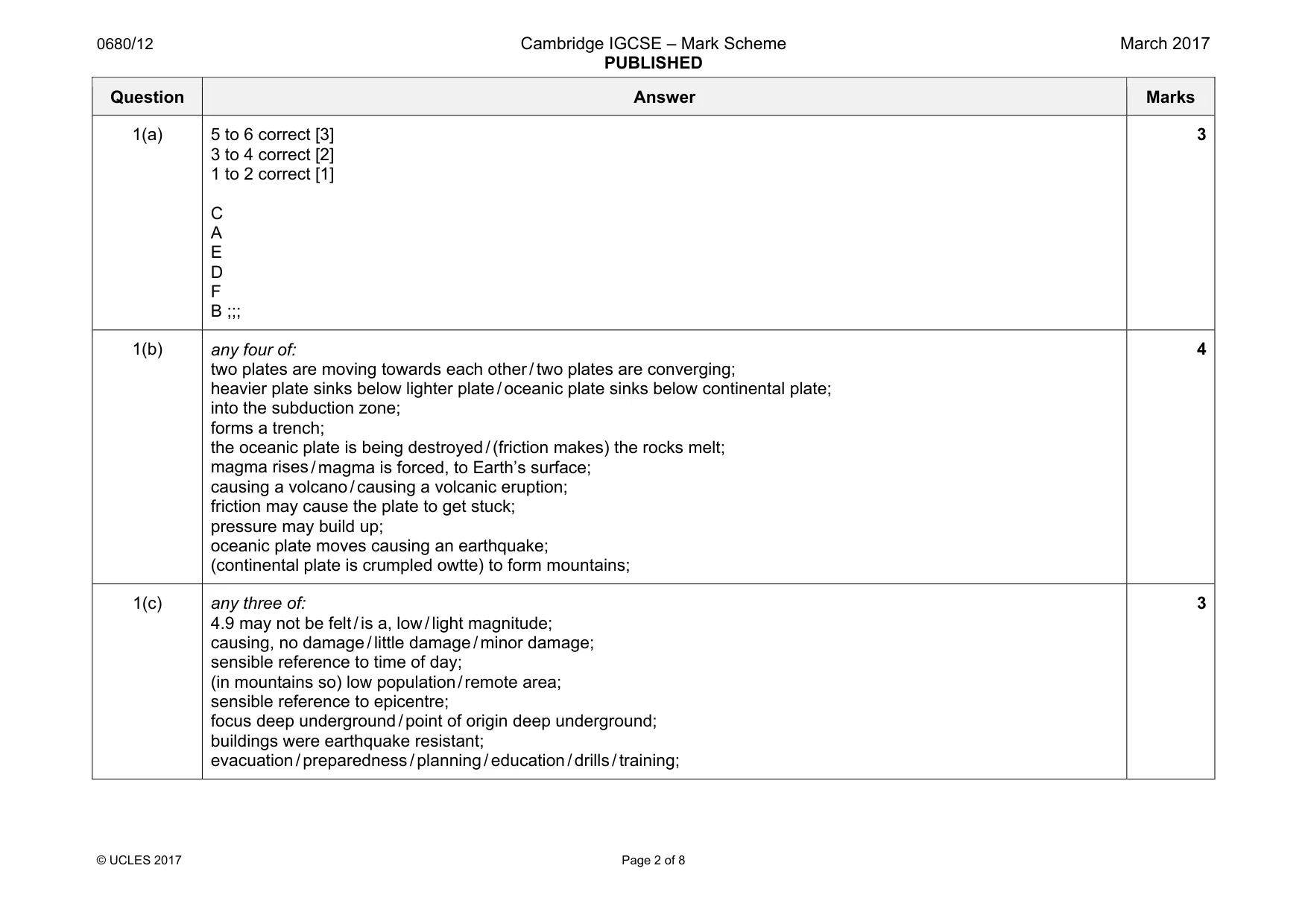
0680/12 Cambridge IGCSE – Mark Scheme PUBLISHED March 2017 © UCLES 2017 Page 2 of 8 Question Answer Marks 1(a) 5 to 6 correct [3] 3 to 4 correct [2] 1 to 2 correct [1] C A E D F B ;;; 3 1(b) any four of: two plates are moving towards each other / two plates are converging; heavier plate sinks below lighter plate / oceanic plate sinks below continental plate; into the subduction zone; forms a trench; the oceanic plate is being destroyed / (friction makes) the rocks melt; magma rises / magma is forced, to Earth’s surface; causing a volcano / causing a volcanic eruption; friction may cause the plate to get stuck; pressure may build up; oceanic plate moves causing an earthquake; (continental plate is crumpled owtte) to form mountains; 4 1(c) any three of: 4.9 may not be felt / is a, low / light magnitude; causing, no damage / little damage / minor damage; sensible reference to time of day; (in mountains so) low population / remote area; sensible reference to epicentre; focus deep underground / point of origin deep underground; buildings were earthquake resistant; evacuation / preparedness / planning / education / drills / training; 3
Mark scheme, page 3
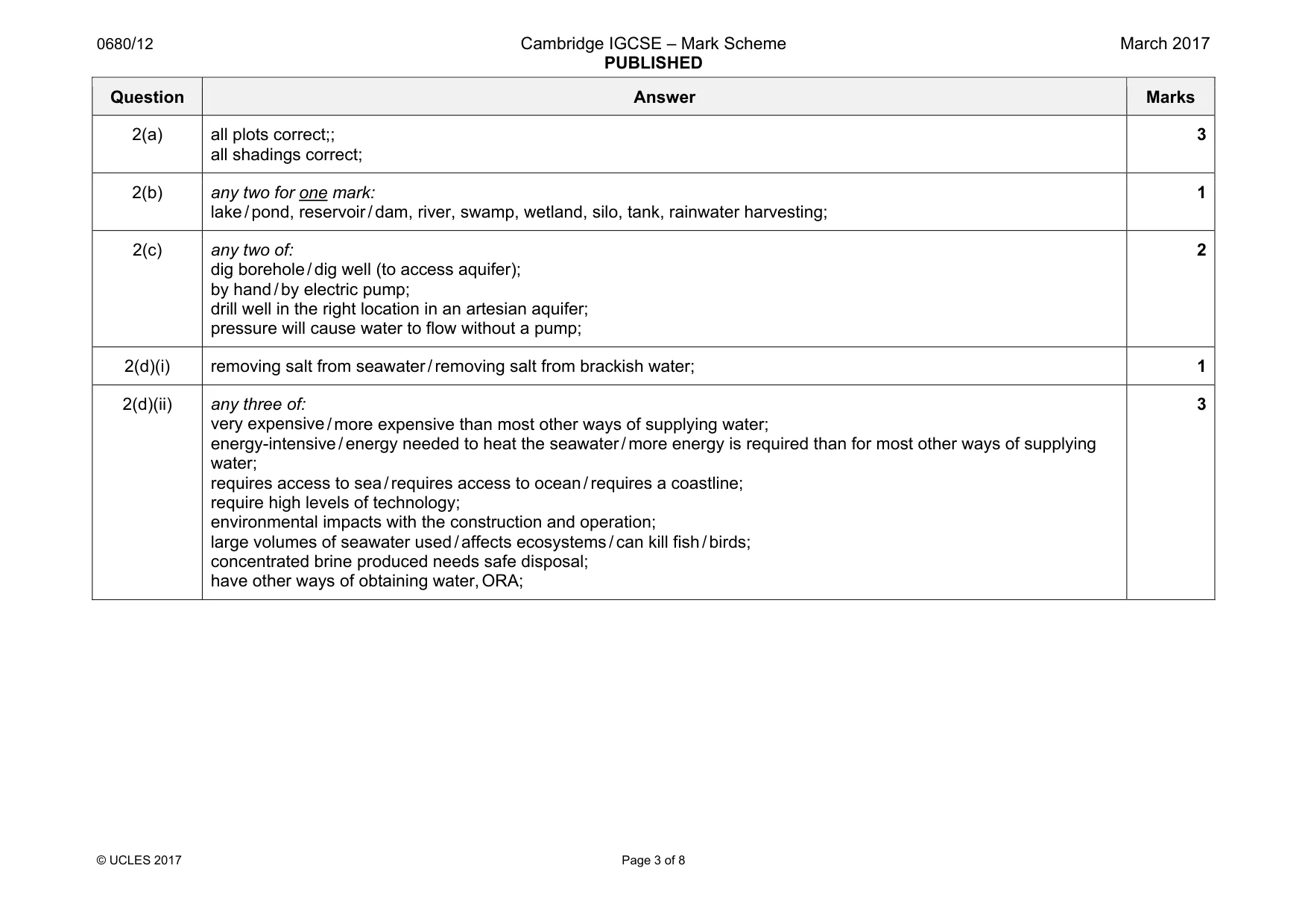
0680/12 Cambridge IGCSE – Mark Scheme PUBLISHED March 2017 © UCLES 2017 Page 3 of 8 Question Answer Marks 2(a) all plots correct;; all shadings correct; 3 2(b) any two for one mark: lake / pond, reservoir / dam, river, swamp, wetland, silo, tank, rainwater harvesting; 1 2(c) any two of: dig borehole / dig well (to access aquifer); by hand / by electric pump; drill well in the right location in an artesian aquifer; pressure will cause water to flow without a pump; 2 2(d)(i) removing salt from seawater / removing salt from brackish water; 1 2(d)(ii) any three of: very expensive / more expensive than most other ways of supplying water; energy-intensive / energy needed to heat the seawater / more energy is required than for most other ways of supplying water; requires access to sea / requires access to ocean / requires a coastline; require high levels of technology; environmental impacts with the construction and operation; large volumes of seawater used / affects ecosystems / can kill fish / birds; concentrated brine produced needs safe disposal; have other ways of obtaining water, ORA; 3
Mark scheme, page 4
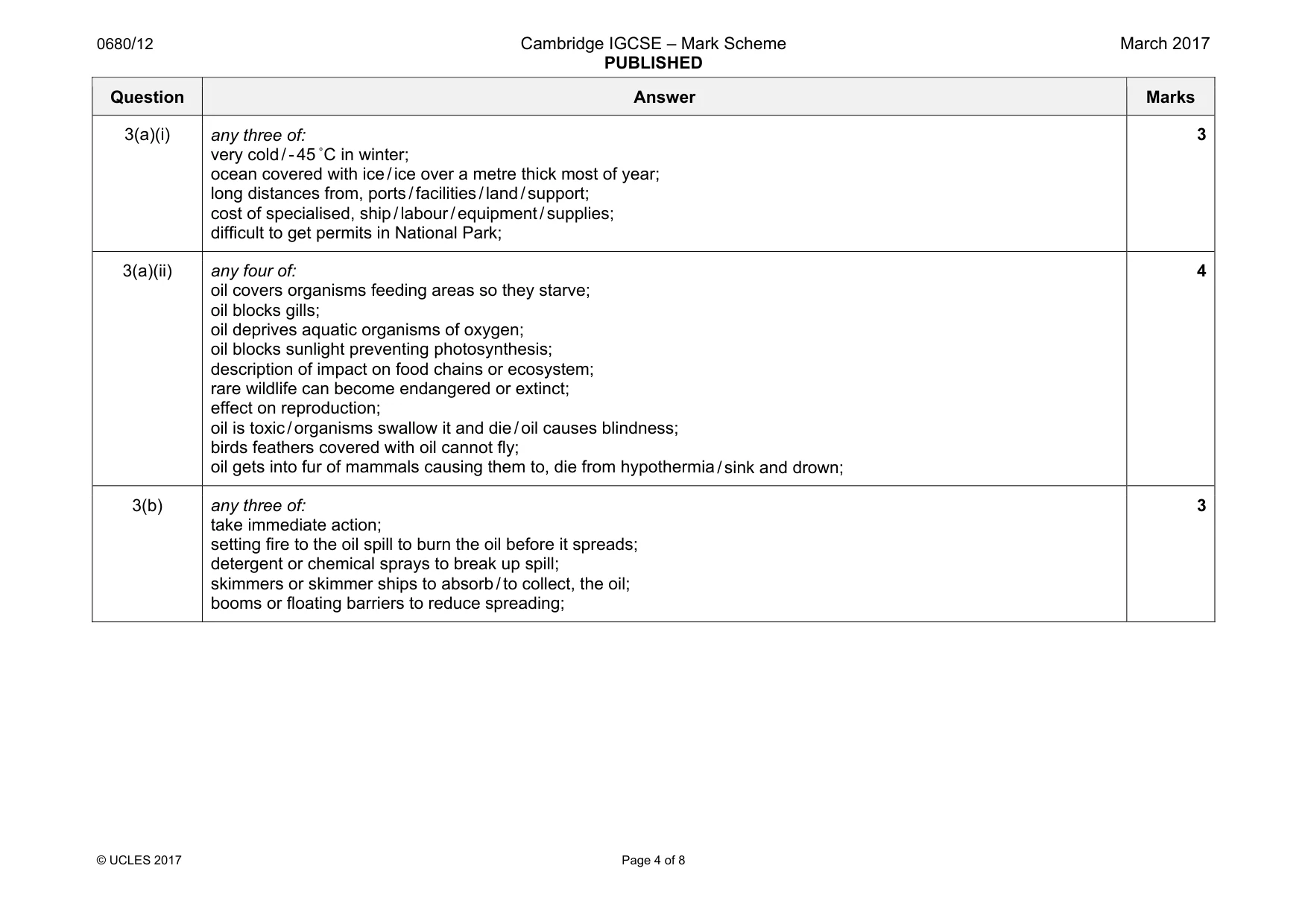
0680/12 Cambridge IGCSE – Mark Scheme PUBLISHED March 2017 © UCLES 2017 Page 4 of 8 Question Answer Marks 3(a)(i) any three of: very cold / - 45 ˚С in winter; ocean covered with ice / ice over a metre thick most of year; long distances from, ports / facilities / land / support; cost of specialised, ship / labour / equipment / supplies; difficult to get permits in National Park; 3 3(a)(ii) any four of: oil covers organisms feeding areas so they starve; oil blocks gills; oil deprives aquatic organisms of oxygen; oil blocks sunlight preventing photosynthesis; description of impact on food chains or ecosystem; rare wildlife can become endangered or extinct; effect on reproduction; oil is toxic / organisms swallow it and die / oil causes blindness; birds feathers covered with oil cannot fly; oil gets into fur of mammals causing them to, die from hypothermia / sink and drown; 4 3(b) any three of: take immediate action; setting fire to the oil spill to burn the oil before it spreads; detergent or chemical sprays to break up spill; skimmers or skimmer ships to absorb / to collect, the oil; booms or floating barriers to reduce spreading; 3
Mark scheme, page 5
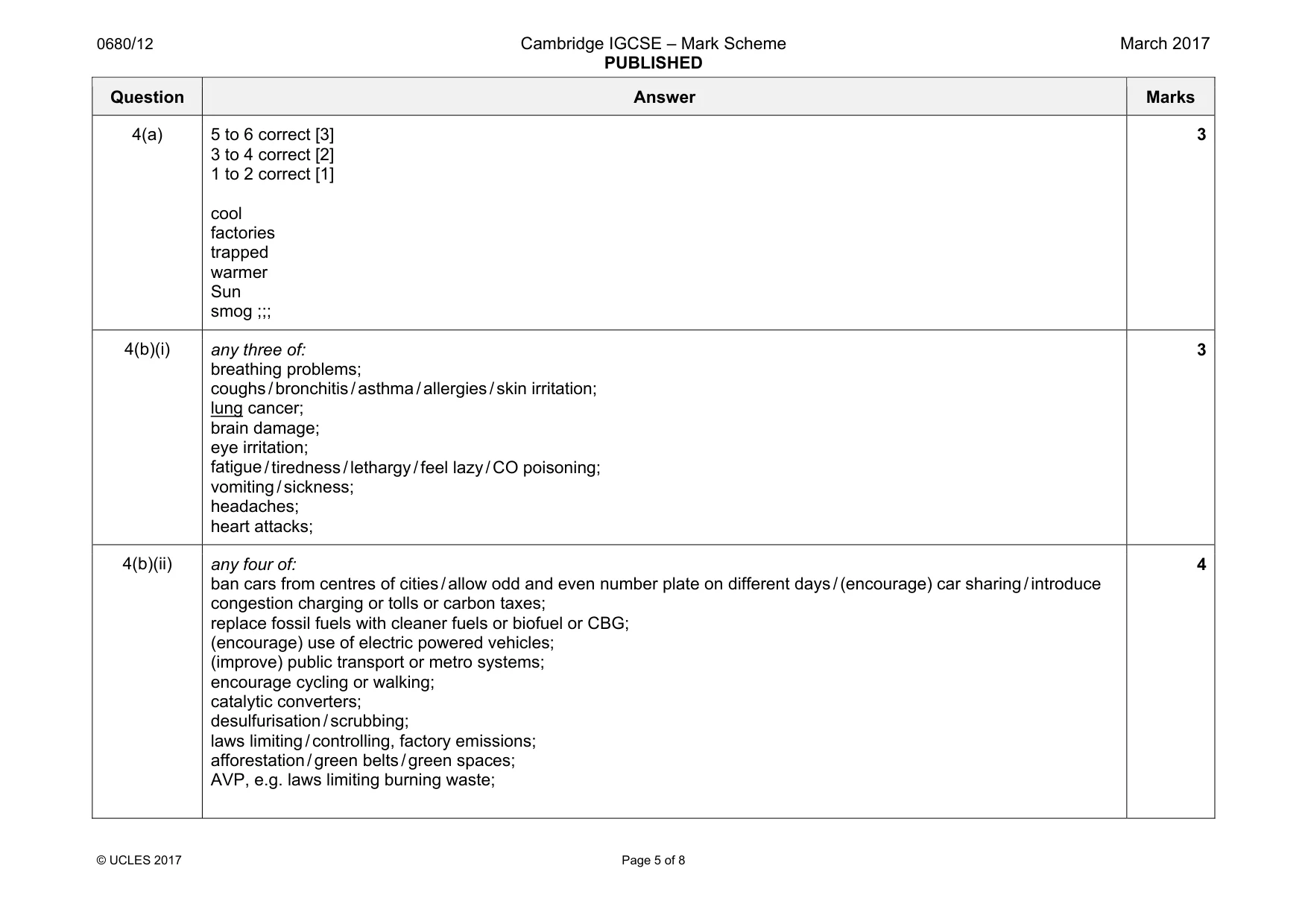
0680/12 Cambridge IGCSE – Mark Scheme PUBLISHED March 2017 © UCLES 2017 Page 5 of 8 Question Answer Marks 4(a) 5 to 6 correct [3] 3 to 4 correct [2] 1 to 2 correct [1] cool factories trapped warmer Sun smog ;;; 3 4(b)(i) any three of: breathing problems; coughs / bronchitis / asthma / allergies / skin irritation; lung cancer; brain damage; eye irritation; fatigue / tiredness / lethargy / feel lazy / CO poisoning; vomiting / sickness; headaches; heart attacks; 3 4(b)(ii) any four of: ban cars from centres of cities / allow odd and even number plate on different days / (encourage) car sharing / introduce congestion charging or tolls or carbon taxes; replace fossil fuels with cleaner fuels or biofuel or CBG; (encourage) use of electric powered vehicles; (improve) public transport or metro systems; encourage cycling or walking; catalytic converters; desulfurisation / scrubbing; laws limiting / controlling, factory emissions; afforestation / green belts / green spaces; AVP, e.g. laws limiting burning waste; 4
Mark scheme, page 6
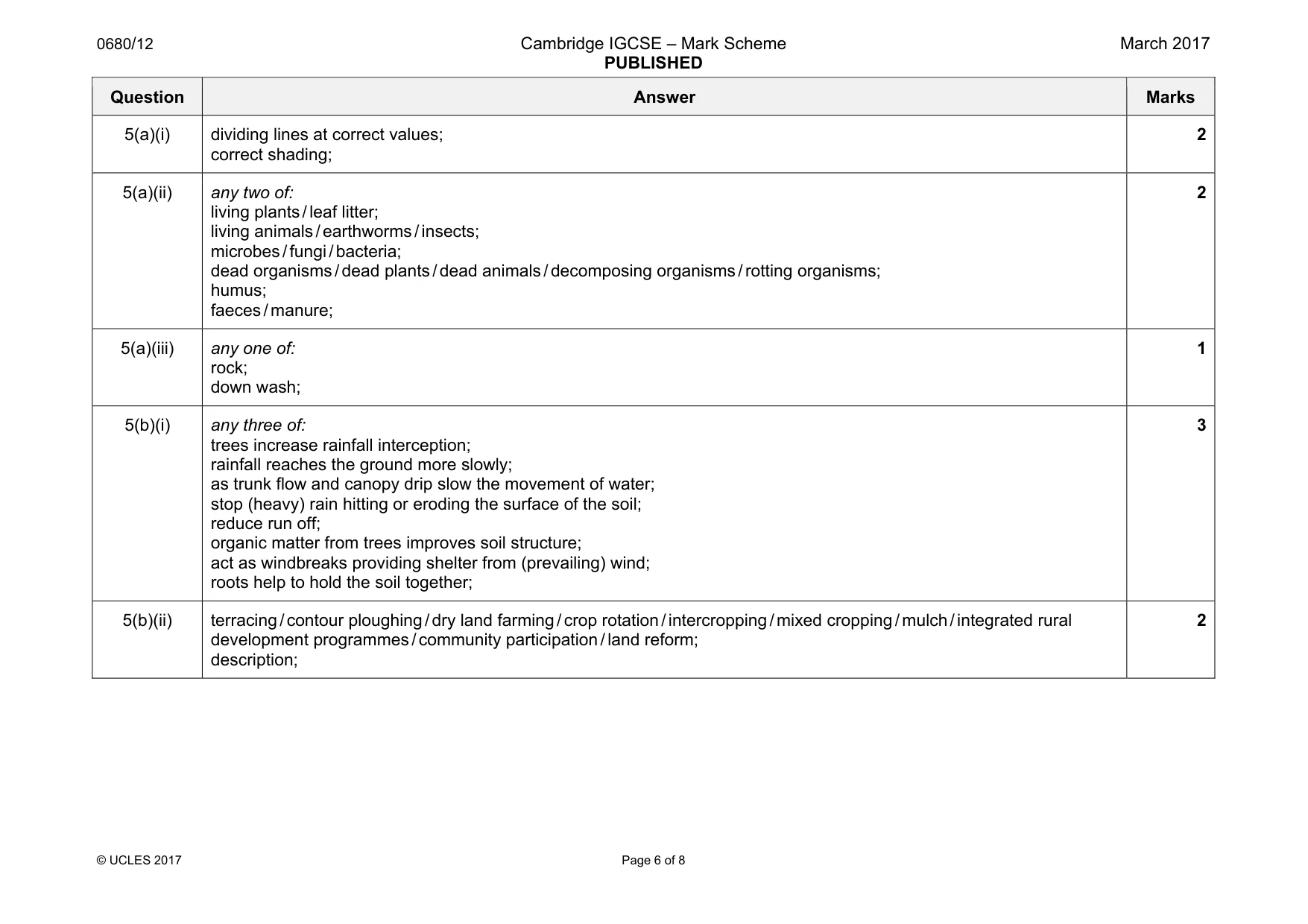
0680/12 Cambridge IGCSE – Mark Scheme PUBLISHED March 2017 © UCLES 2017 Page 6 of 8 Question Answer Marks 5(a)(i) dividing lines at correct values; correct shading; 2 5(a)(ii) any two of: living plants / leaf litter; living animals / earthworms / insects; microbes / fungi / bacteria; dead organisms / dead plants / dead animals / decomposing organisms / rotting organisms; humus; faeces / manure; 2 5(a)(iii) any one of: rock; down wash; 1 5(b)(i) any three of: trees increase rainfall interception; rainfall reaches the ground more slowly; as trunk flow and canopy drip slow the movement of water; stop (heavy) rain hitting or eroding the surface of the soil; reduce run off; organic matter from trees improves soil structure; act as windbreaks providing shelter from (prevailing) wind; roots help to hold the soil together; 3 5(b)(ii) terracing / contour ploughing / dry land farming / crop rotation / intercropping / mixed cropping / mulch / integrated rural development programmes / community participation / land reform; description; 2
Mark scheme, page 7
0680/12 Cambridge IGCSE – Mark Scheme PUBLISHED March 2017 © UCLES 2017 Page 7 of 8 Question Answer Marks 6(a) any three of: on the Equator / near the Equator; mainly, in tropics / between tropics; in South America / Africa / SE Asia; not found in Europe and North America; small amount in, Oceania / NE Australia; 3 6(b) any two advantages: crops will grow well in the hot, wet climate; crops grow well at first; hand labour / no need for technology; (sustainable) forest will regrow (in 100 years); ash provides fertiliser; any two disadvantages: output is low; heavy rain may wash soil away; plots are small; cannot support a large population; labour intensive / forest has to be cleared; soil loses fertility after a few years; weeds increase; new plot has to be cleared after 5 years; 4
Mark scheme, page 8
0680/12 Cambridge IGCSE – Mark Scheme PUBLISHED March 2017 © UCLES 2017 Page 8 of 8 Question Answer Marks 6(c) any three of: sustainable harvesting of the forest; rubber tapping / collecting latex, does not cause damage; collecting fruits, e.g. Brazil nuts; National Parks / wildlife reserves / biosphere reserves; ecotourism; sustainable or selective logging / trees are replanted / quotas; agroforestry / community forestry / reforestation; fuelwood plantations; gene banks; legislation; education; alternatives to deforestation, e.g. more efficient use of timber / recycling / alternatives to timber; 3
What you needed in this session
Cambridge’s own grade thresholds for 2017 Feb/March, Paper 1 · Variant 2. A higher threshold means an easier paper — the bar moves with how the cohort did.