Cambridge IGCSE Environmental Management 0680 — 2016 Feb/March Paper 1 · Variant 2
0680/12/F/M/16 · 60 marks · ≈68 min
The question paper and its mark scheme, free to read here and free to download. This is Cambridge’s own paper, exactly as it was sat.
Question paper16 pages





Mark scheme12 pages
Answers below. Sit the paper first if you are practising.
Paper as text
Question paper, page 1
This document consists of 13 printed pages and 3 blank pages. DC (ST/FD) 106670/6 © UCLES 2016 [Turn over Cambridge International Examinations Cambridge International General Certificate of Secondary Education * 4 7 9 1 3 6 2 3 8 4 * ENVIRONMENTAL MANAGEMENT 0680/12 Paper 1 February/March 2016 1 hour 30 minutes Candidates answer on the Question Paper. No Additional Materials are required. READ THESE INSTRUCTIONS FIRST Write your Centre number, candidate number and name on all the work you hand in. Write in dark blue or black pen. You may use an HB pencil for any diagrams or graphs. Do not use staples, paper clips, glue or correction fluid. DO NOT WRITE IN ANY BARCODES. Answer all questions. Electronic calculators may be used. You may lose marks if you do not show your working or if you do not use appropriate units. At the end of the examination, fasten all your work securely together. The number of marks is given in brackets [ ] at the end of each question or part question.
Question paper, page 2
2 0680/12/F/M/16 © UCLES 2016 1 Look at the diagram below, which shows part of the water cycle. D A E D lake ocean land D B B C (a) Complete the table below using letters from the diagram. [3] water cycle process letter condensation … evaporation … groundwater flow … precipitation … transpiration … (b) Large dams are built to store water in reservoirs. (i) Describe three factors that are important when choosing a site for a large dam and reservoir. … … … … … …[3]
Question paper, page 3
3 0680/12/F/M/16 © UCLES 2016 [Turn over (ii) Explain why people living near the proposed site of a large dam might not want it to be built. … … … … … … … …[4]
Question paper, page 4
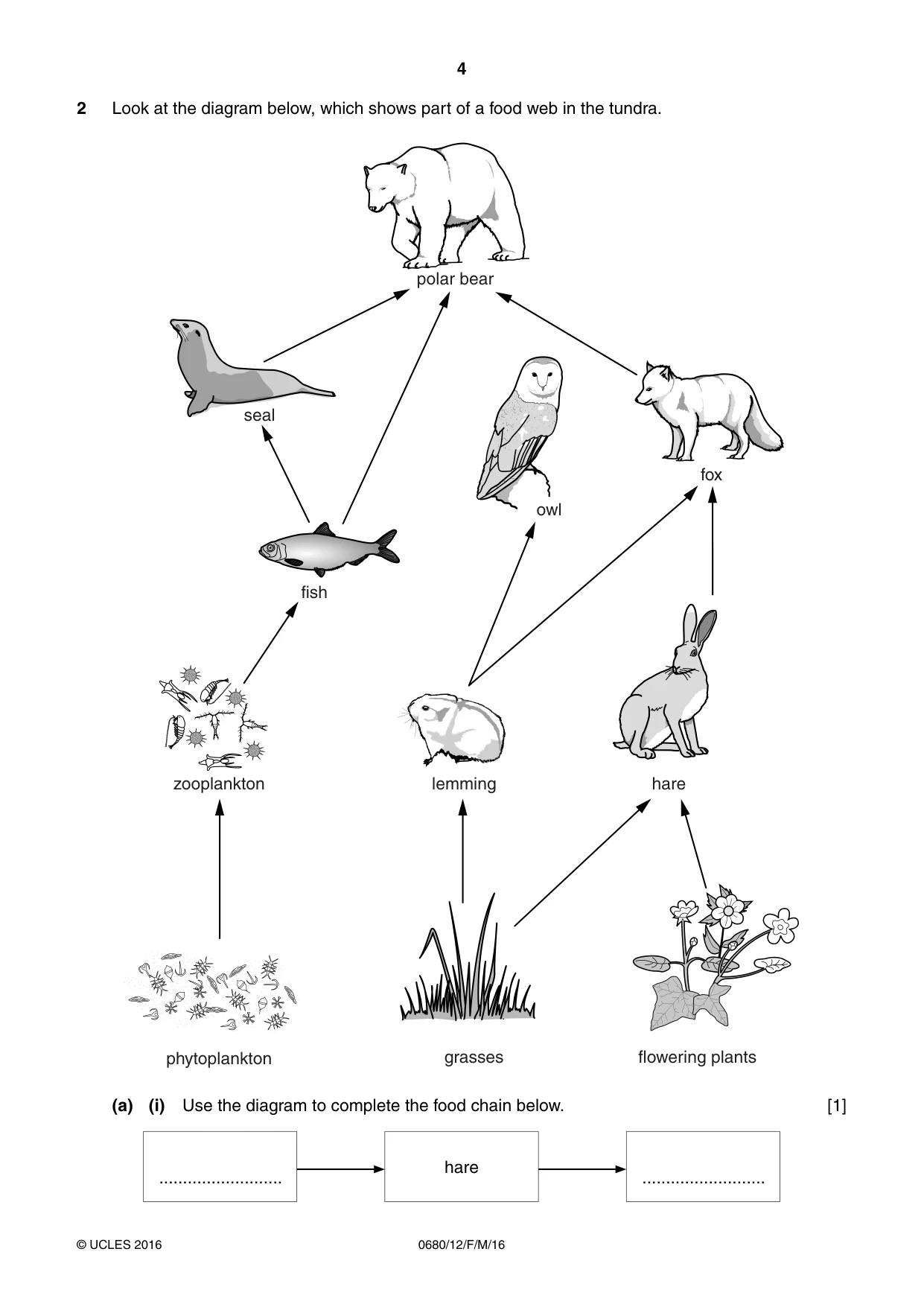
4 0680/12/F/M/16 © UCLES 2016 2 Look at the diagram below, which shows part of a food web in the tundra. seal polar bear fish owl hare lemming zooplankton phytoplankton fox grasses flowering plants (a) (i) Use the diagram to complete the food chain below. [1] … hare …
Question paper, page 5
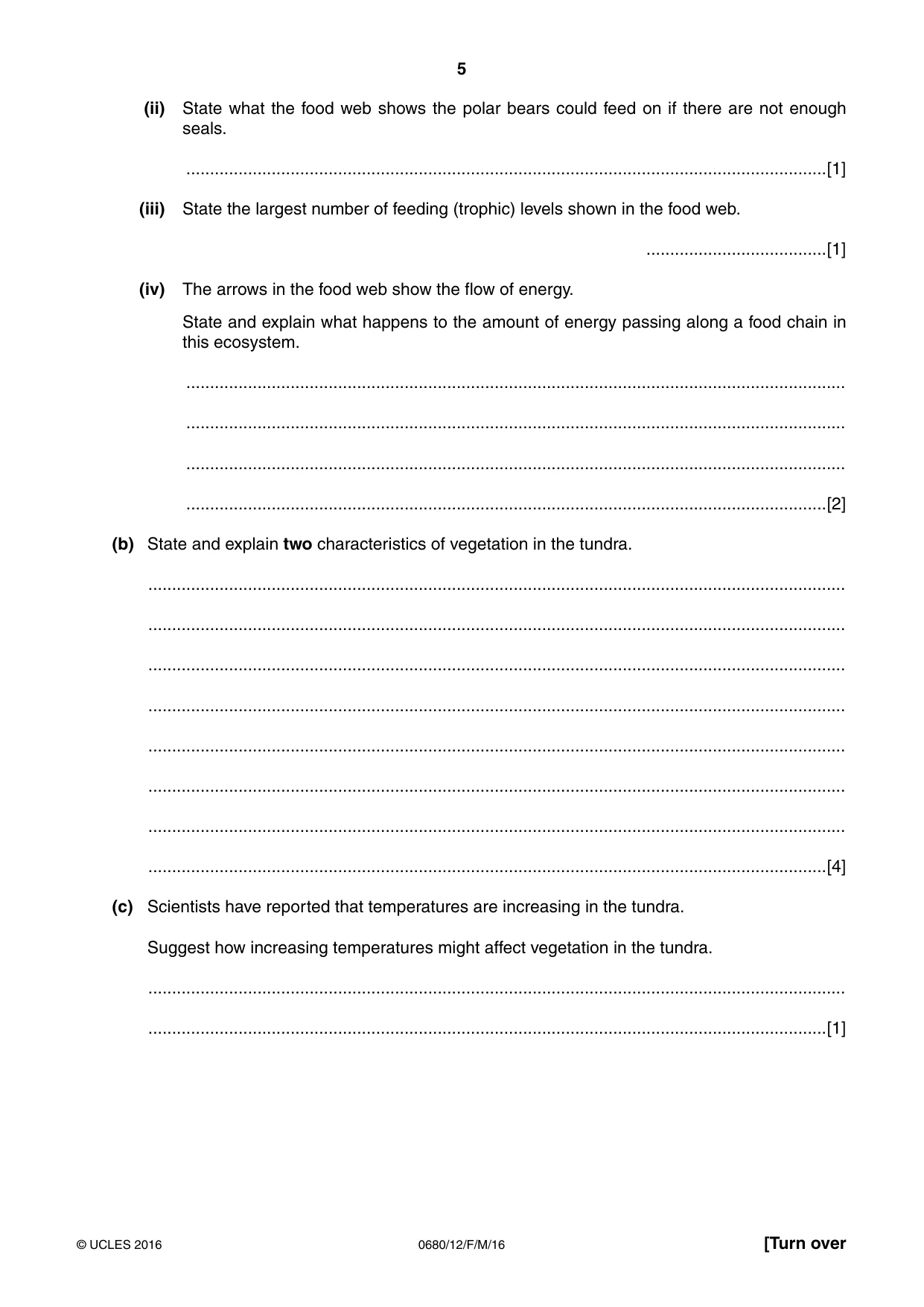
5 0680/12/F/M/16 © UCLES 2016 [Turn over (ii) State what the food web shows the polar bears could feed on if there are not enough seals. …[1] (iii) State the largest number of feeding (trophic) levels shown in the food web. …[1] (iv) The arrows in the food web show the flow of energy. State and explain what happens to the amount of energy passing along a food chain in this ecosystem. … … … …[2] (b) State and explain two characteristics of vegetation in the tundra. … … … … … … … …[4] (c) Scientists have reported that temperatures are increasing in the tundra. Suggest how increasing temperatures might affect vegetation in the tundra. … …[1]
Question paper, page 6
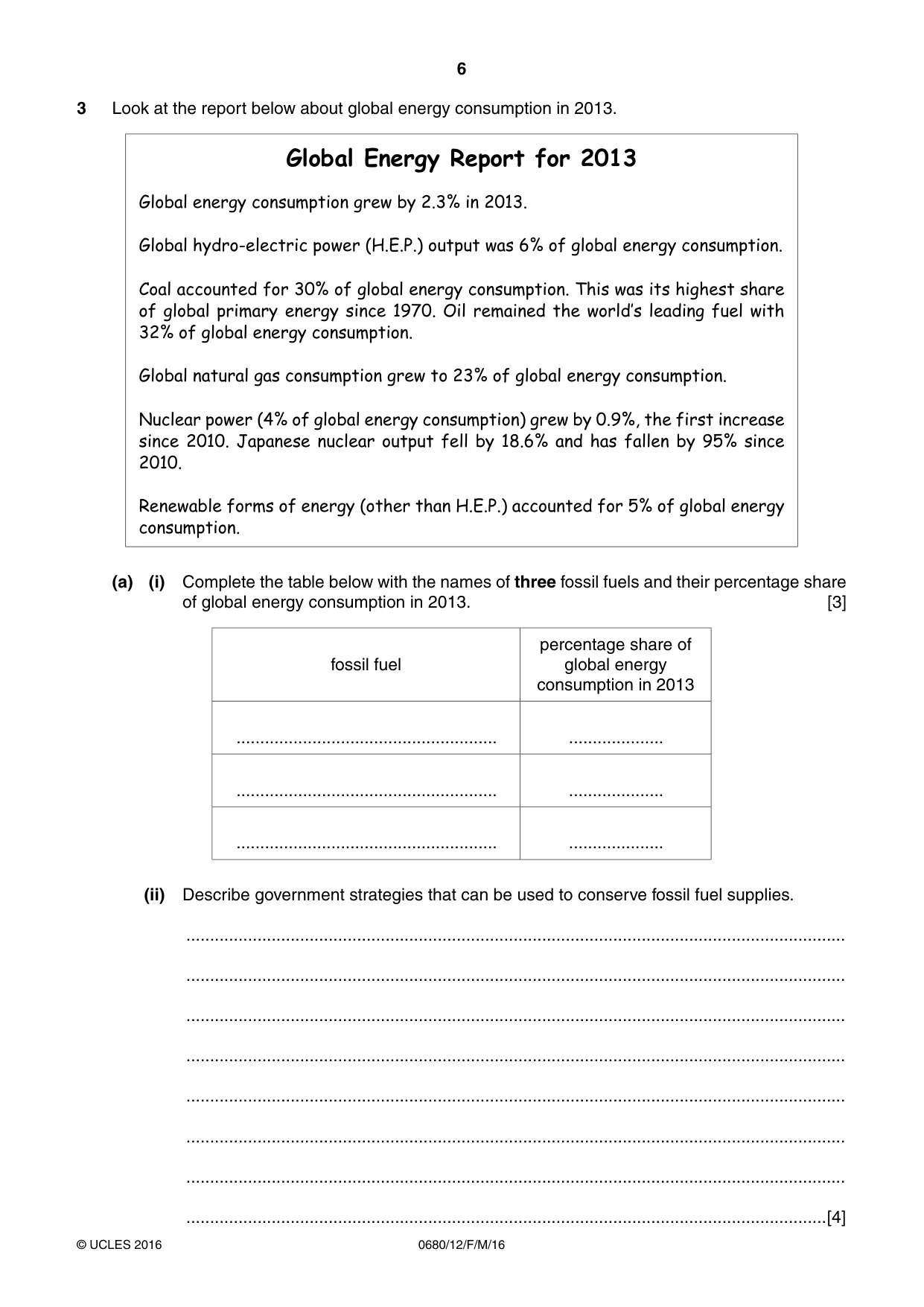
6 0680/12/F/M/16 © UCLES 2016 3 Look at the report below about global energy consumption in 2013. Global Energy Report for 2013 Global energy consumption grew by 2.3% in 2013. Global hydro-electric power (H.E.P.) output was 6% of global energy consumption. Coal accounted for 30% of global energy consumption. This was its highest share of global primary energy since 1970. Oil remained the world‛s leading fuel with 32% of global energy consumption. Global natural gas consumption grew to 23% of global energy consumption. Nuclear power (4% of global energy consumption) grew by 0.9%, the first increase since 2010. Japanese nuclear output fell by 18.6% and has fallen by 95% since 2010. Renewable forms of energy (other than H.E.P.) accounted for 5% of global energy consumption. (a) (i) Complete the table below with the names of three fossil fuels and their percentage share of global energy consumption in 2013. [3] fossil fuel percentage share of global energy consumption in 2013 … … … … … … (ii) Describe government strategies that can be used to conserve fossil fuel supplies. … … … … … … … …[4]
Question paper, page 7
7 0680/12/F/M/16 © UCLES 2016 [Turn over (b) Suggest reasons why some countries do not want nuclear power stations. … … … … … …[3]
Question paper, page 8
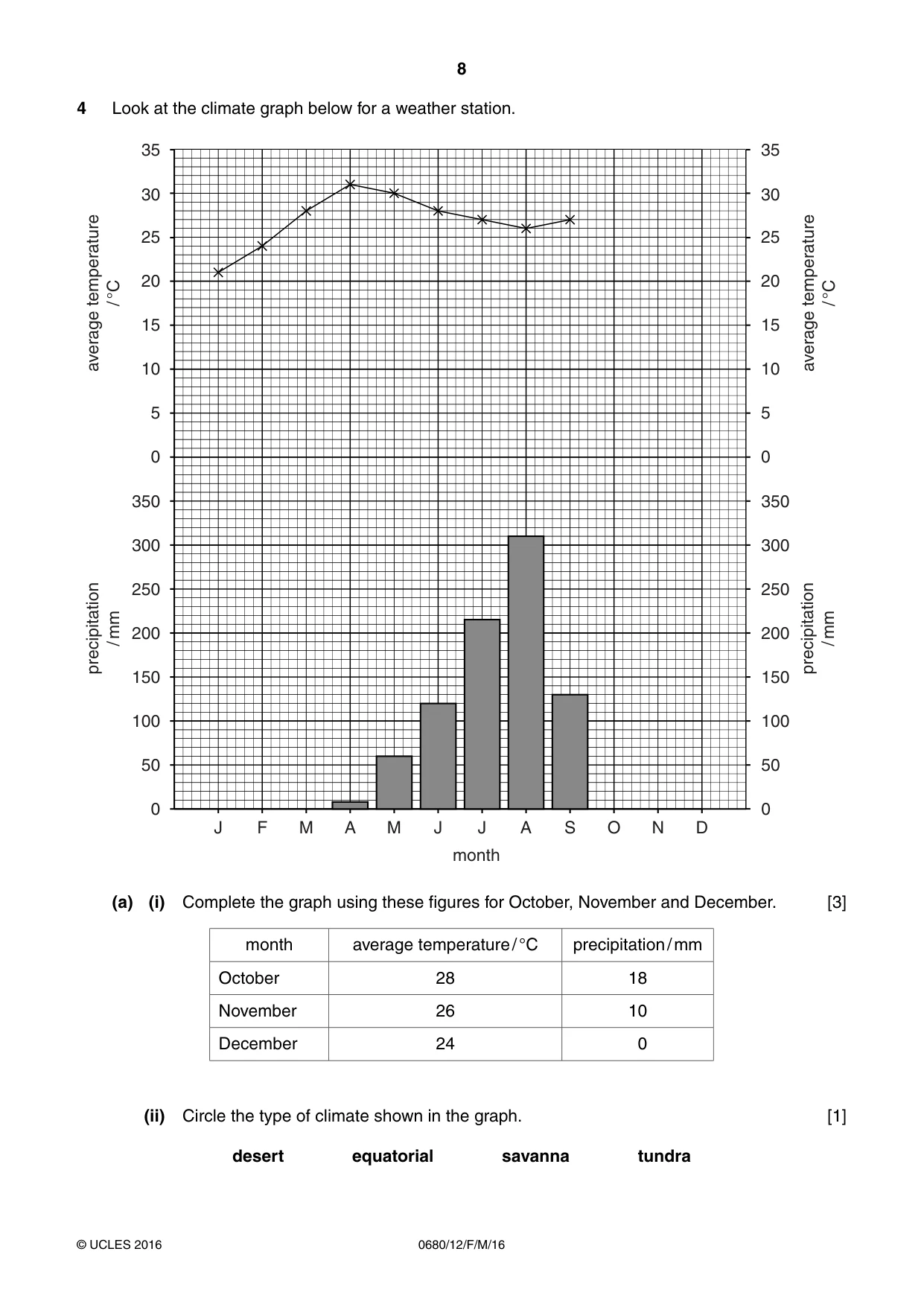
8 0680/12/F/M/16 © UCLES 2016 4 Look at the climate graph below for a weather station. J 0 50 100 150 200 250 300 350 0 50 100 150 200 250 300 350 0 5 10 15 20 25 30 35 0 5 10 15 20 25 30 35 F M A M J month average temperature / °C average temperature / °C precipitation / mm precipitation / mm J A S O N D (a) (i) Complete the graph using these figures for October, November and December. [3] month average temperature / °C precipitation / mm October 28 18 November 26 10 December 24 0 (ii) Circle the type of climate shown in the graph. [1] desert equatorial savanna tundra
Question paper, page 9
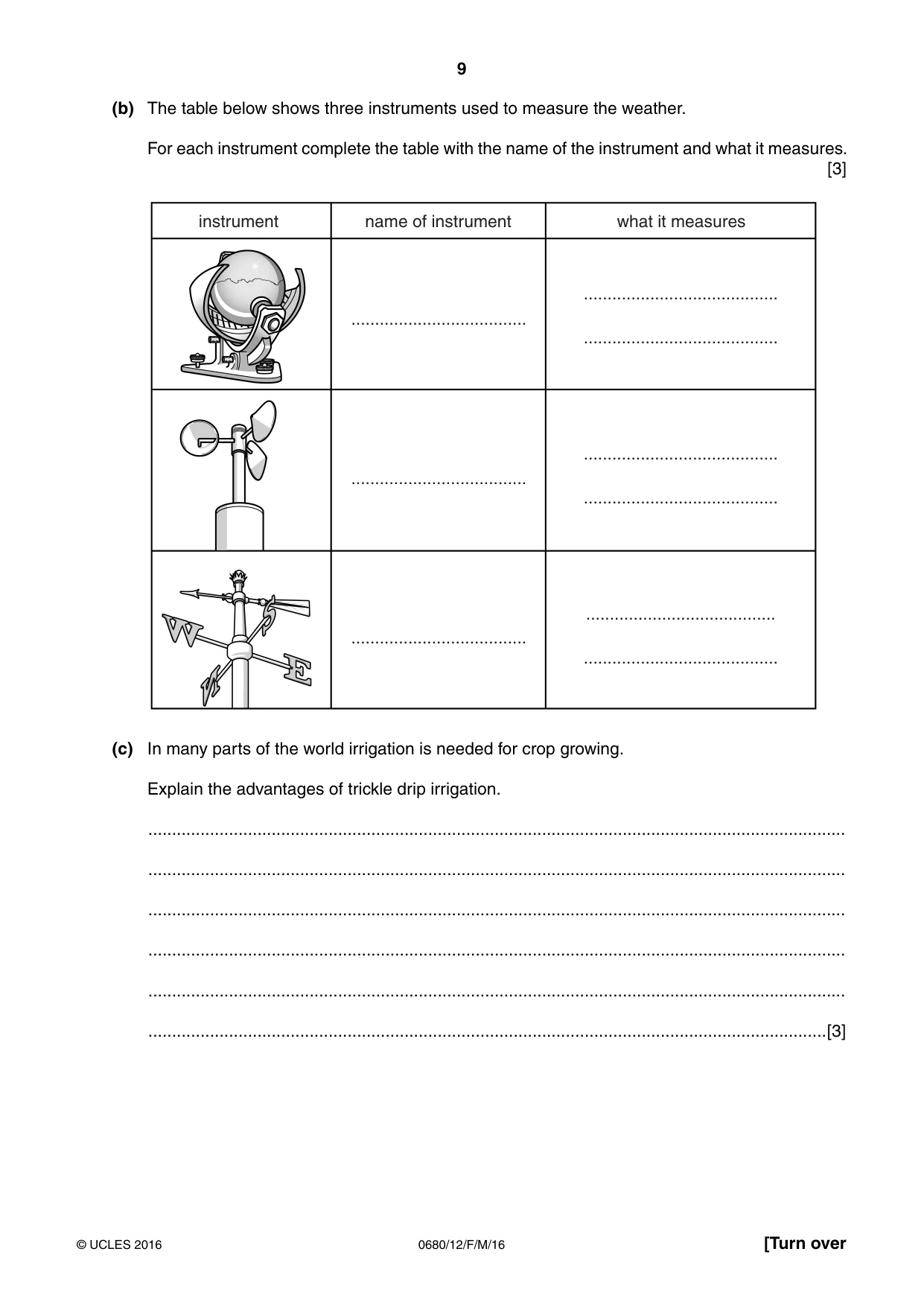
9 0680/12/F/M/16 © UCLES 2016 [Turn over (b) The table below shows three instruments used to measure the weather. For each instrument complete the table with the name of the instrument and what it measures. [3] instrument name of instrument … … … … … … … … … what it measures (c) In many parts of the world irrigation is needed for crop growing. Explain the advantages of trickle drip irrigation. … … … … … …[3]
Question paper, page 10
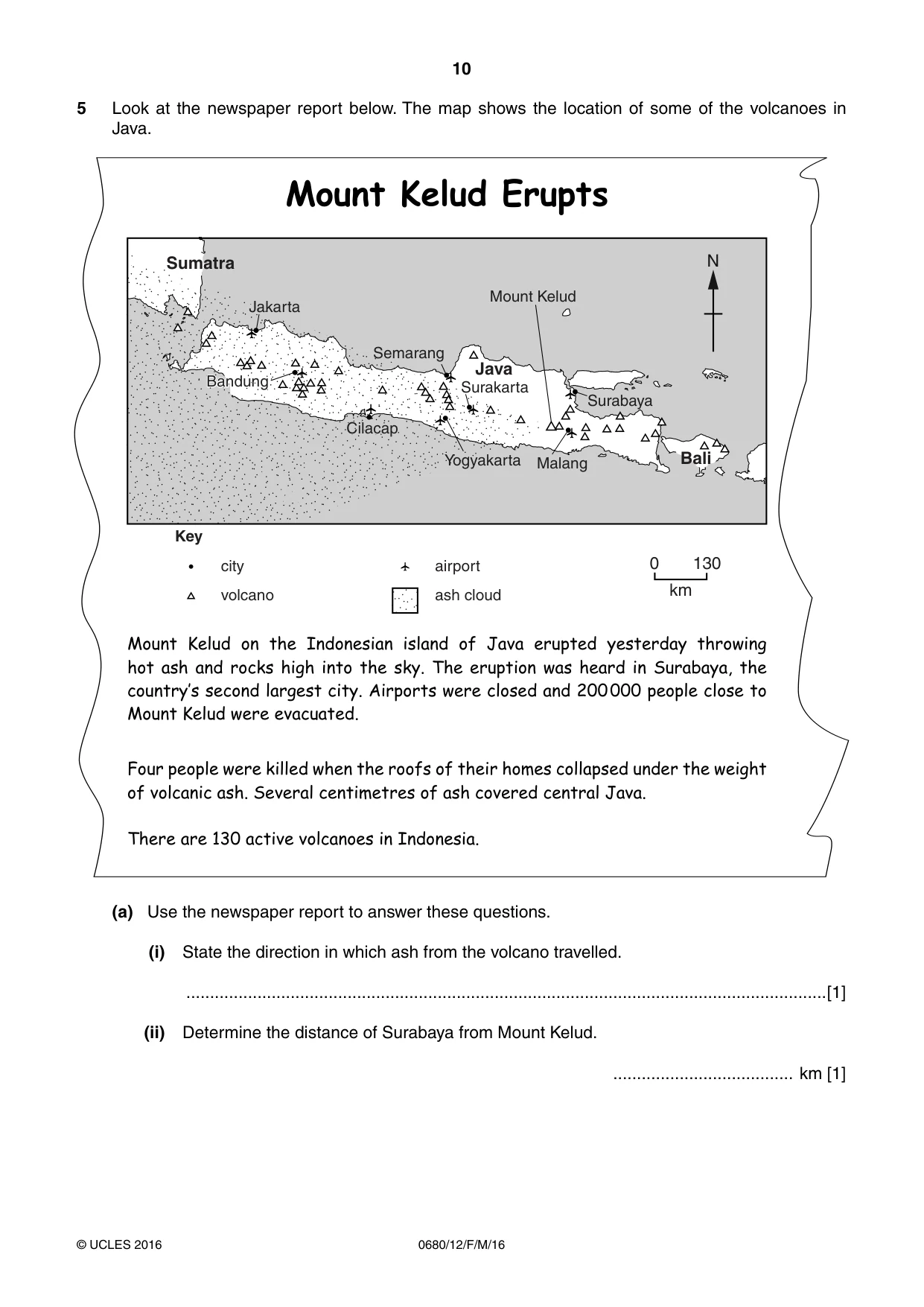
10 0680/12/F/M/16 © UCLES 2016 5 Look at the newspaper report below. The map shows the location of some of the volcanoes in Java. Mount Kelud Erupts Key city volcano airport ash cloud km 0 130 Java Surakarta Semarang Cilacap Cilacap Surabaya Malang Jakarta Yogyakarta Sumatra Bandung Bandung Bali N Mount Kelud Mount Kelud on the Indonesian island of Java erupted yesterday throwing hot ash and rocks high into the sky. The eruption was heard in Surabaya, the country‛s second largest city. Airports were closed and 200 000 people close to Mount Kelud were evacuated. Four people were killed when the roofs of their homes collapsed under the weight of volcanic ash. Several centimetres of ash covered central Java. There are 130 active volcanoes in Indonesia. (a) Use the newspaper report to answer these questions. (i) State the direction in which ash from the volcano travelled. …[1] (ii) Determine the distance of Surabaya from Mount Kelud. … km [1]
Question paper, page 11
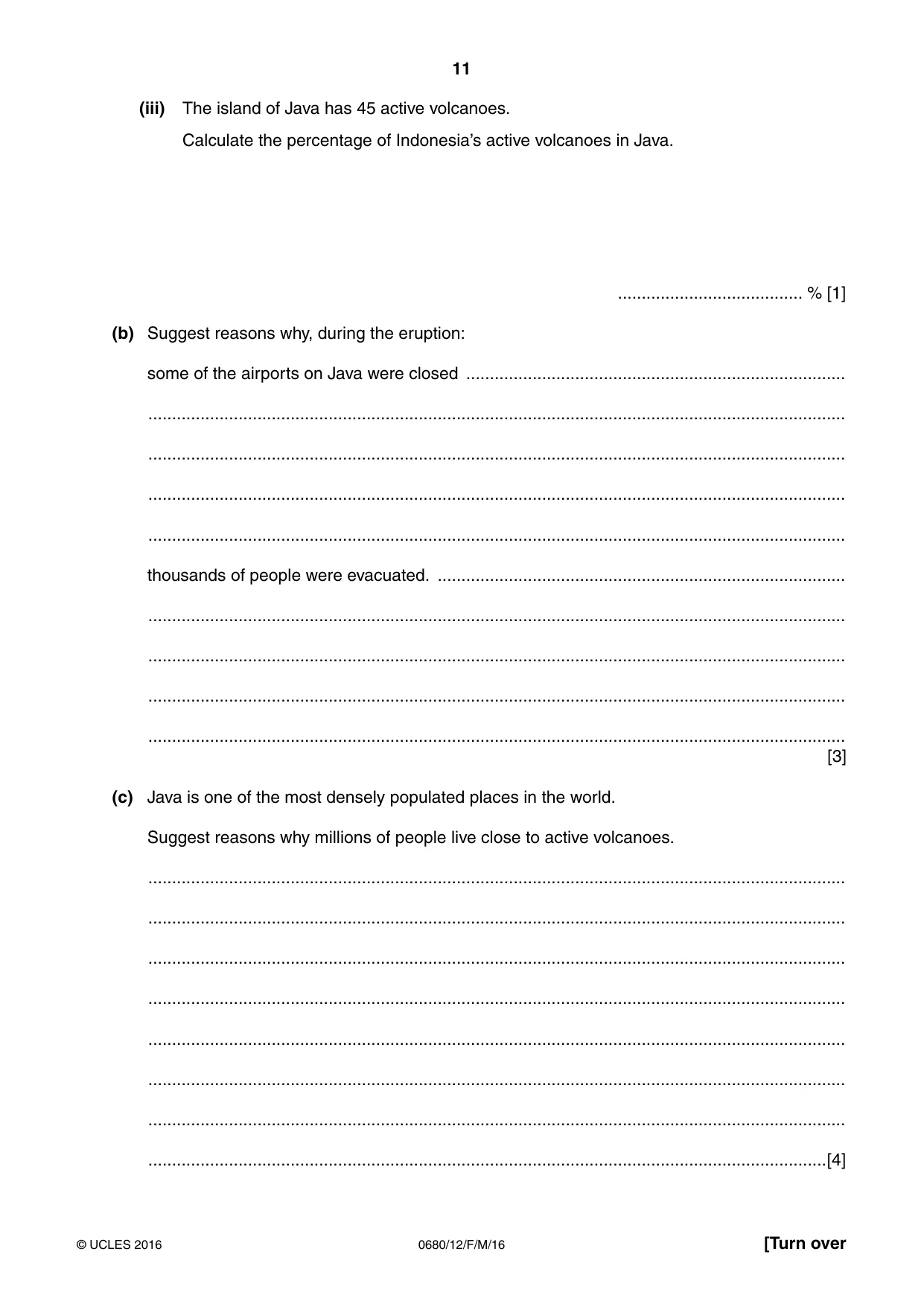
11 0680/12/F/M/16 © UCLES 2016 [Turn over (iii) The island of Java has 45 active volcanoes. Calculate the percentage of Indonesia’s active volcanoes in Java. … % [1] (b) Suggest reasons why, during the eruption: some of the airports on Java were closed … … … … … thousands of people were evacuated. … … … … … [3] (c) Java is one of the most densely populated places in the world. Suggest reasons why millions of people live close to active volcanoes. … … … … … … … …[4]
Question paper, page 12
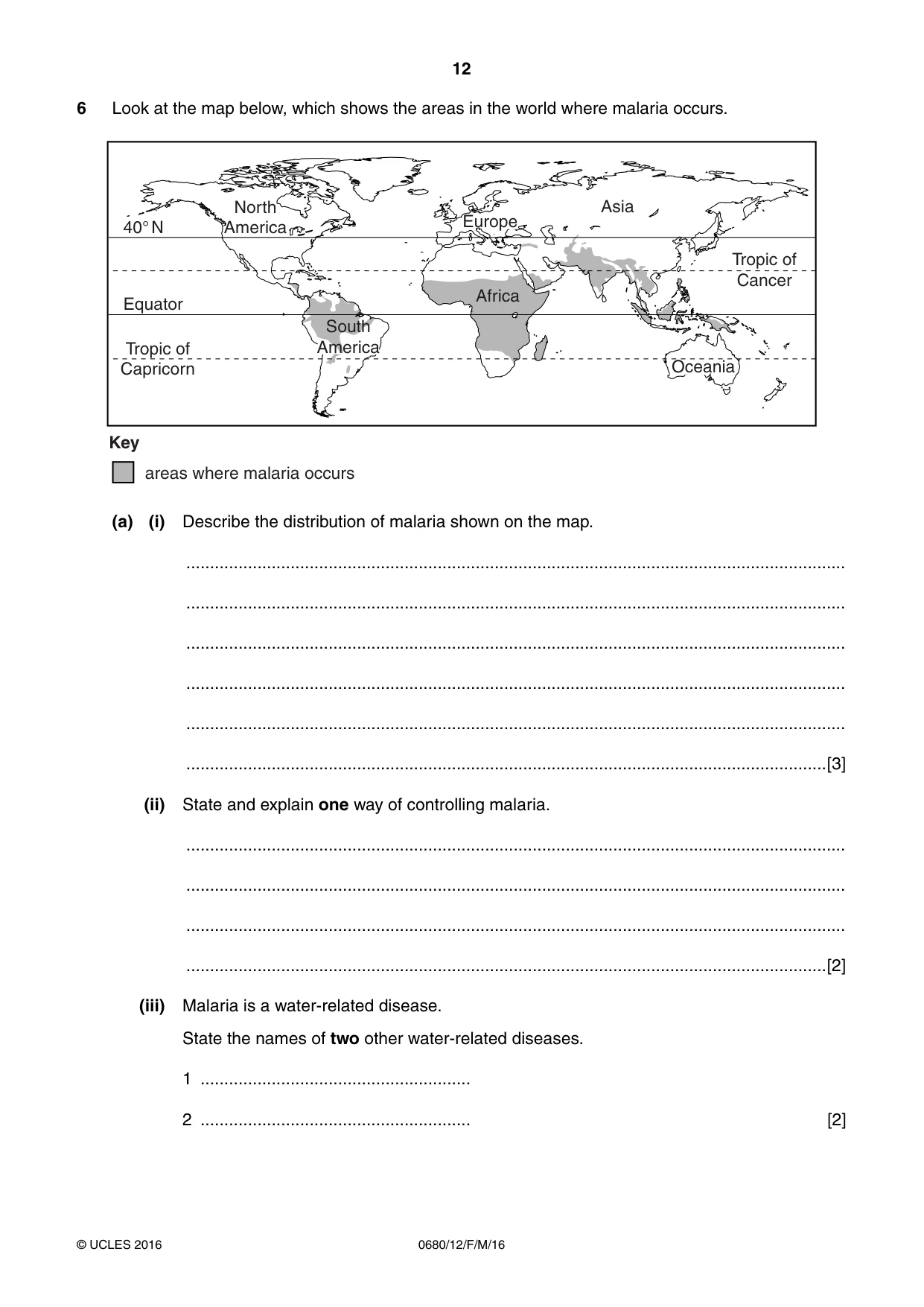
12 0680/12/F/M/16 © UCLES 2016 6 Look at the map below, which shows the areas in the world where malaria occurs. Equator areas where malaria occurs Key 40° N Tropic of Capricorn Tropic of Cancer North America South America Africa Asia Europe Oceania (a) (i) Describe the distribution of malaria shown on the map. … … … … … …[3] (ii) State and explain one way of controlling malaria. … … … …[2] (iii) Malaria is a water-related disease. State the names of two other water-related diseases. 1 … 2 … [2]
Question paper, page 13
13 0680/12/F/M/16 © UCLES 2016 (b) Suggest three reasons why, in many parts of the world, the water in urban areas is usually safer to drink than water in rural areas. … … … … … …[3]
Question paper, page 14
14 0680/12/F/M/16 © UCLES 2016 BLANK PAGE
Question paper, page 15
15 0680/12/F/M/16 © UCLES 2016 BLANK PAGE
Question paper, page 16
16 0680/12/F/M/16 © UCLES 2016 Permission to reproduce items where third-party owned material protected by copyright is included has been sought and cleared where possible. Every reasonable effort has been made by the publisher (UCLES) to trace copyright holders, but if any items requiring clearance have unwittingly been included, the publisher will be pleased to make amends at the earliest possible opportunity. To avoid the issue of disclosure of answer-related information to candidates, all copyright acknowledgements are reproduced online in the Cambridge International Examinations Copyright Acknowledgements Booklet. This is produced for each series of examinations and is freely available to download at www.cie.org.uk after the live examination series. Cambridge International Examinations is part of the Cambridge Assessment Group. Cambridge Assessment is the brand name of University of Cambridge Local Examinations Syndicate (UCLES), which is itself a department of the University of Cambridge. BLANK PAGE
Mark scheme, page 1
® IGCSE is the registered trademark of Cambridge International Examinations. CAMBRIDGE INTERNATIONAL EXAMINATIONS Cambridge International General Certificate of Secondary Education MARK SCHEME for the March 2016 series 0680 ENVIRONMENTAL MANAGEMENT 0680/12 Paper 12, maximum raw mark 60 This mark scheme is published as an aid to teachers and candidates, to indicate the requirements of the examination. It shows the basis on which Examiners were instructed to award marks. It does not indicate the details of the discussions that took place at an Examiners’ meeting before marking began, which would have considered the acceptability of alternative answers. Mark schemes should be read in conjunction with the question paper and the Principal Examiner Report for Teachers. Cambridge will not enter into discussions about these mark schemes. Cambridge is publishing the mark schemes for the March 2016 series for most Cambridge IGCSE® and Cambridge International A and AS Level components.
Mark scheme, page 2
Page 2 Mark Scheme Syllabus Paper Cambridge IGCSE – March 2016 0680 12 © Cambridge International Examinations 2016 Abbreviations used in this mark scheme / separates alternative answers e.g. copper / gold / silver / lead / zinc ; alternatives for the award of a mark e.g. hot; wet; underline word must be used by candidates e.g. air pollution. ORA or reverse argument AW alternative wording / OWTTE ‘or words to that effect’ ( ) the word / phrase in brackets is not required to gain marks e.g. fertile soils (for farming); ECF error carried forward. If an incorrect answer is given to part of a question, and this answer is subsequently used by a candidate in later parts of the question, ECF indicates that the candidate’s incorrect answer will be used as a starting point for marking the later parts of the question.
Mark scheme, page 3
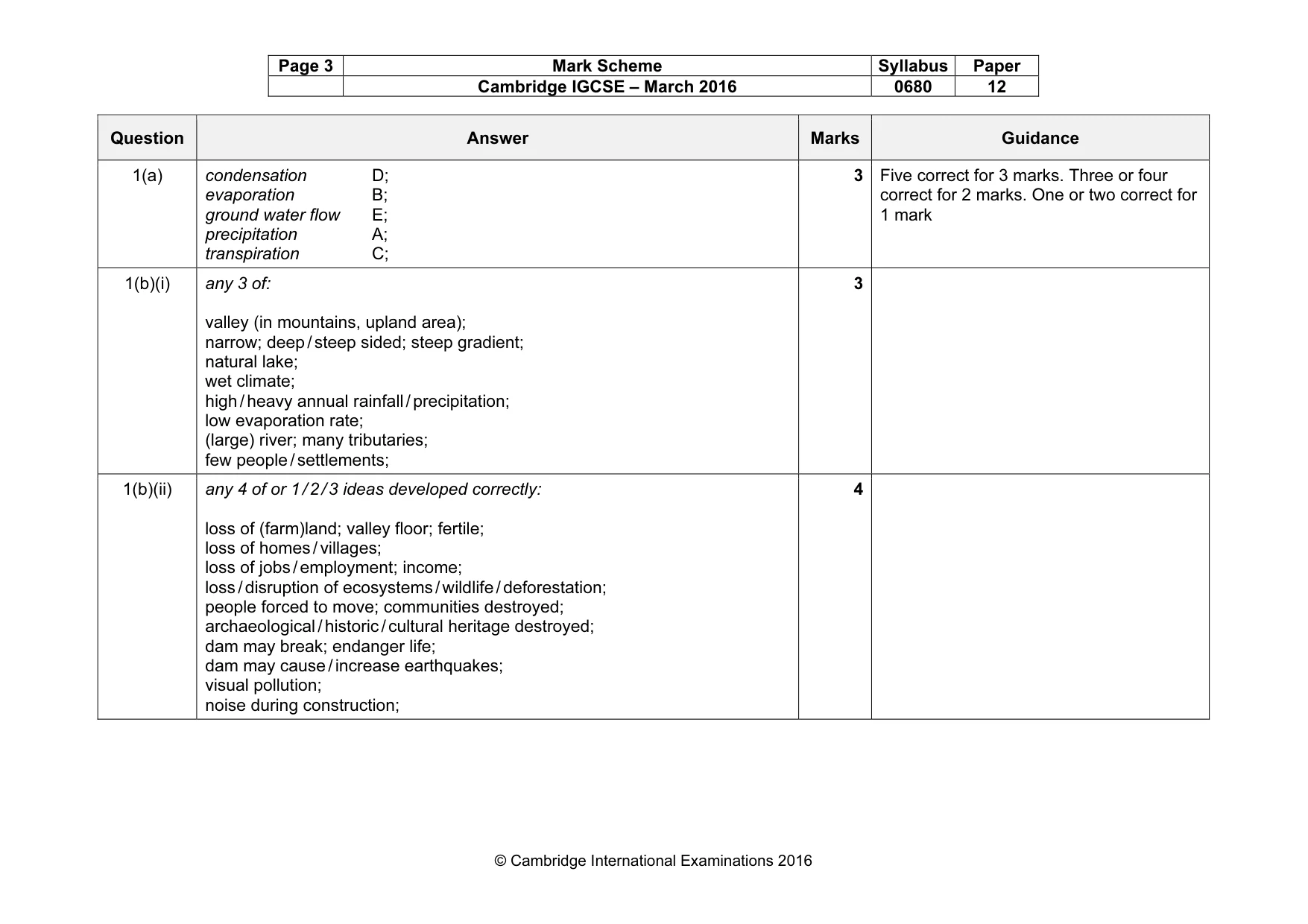
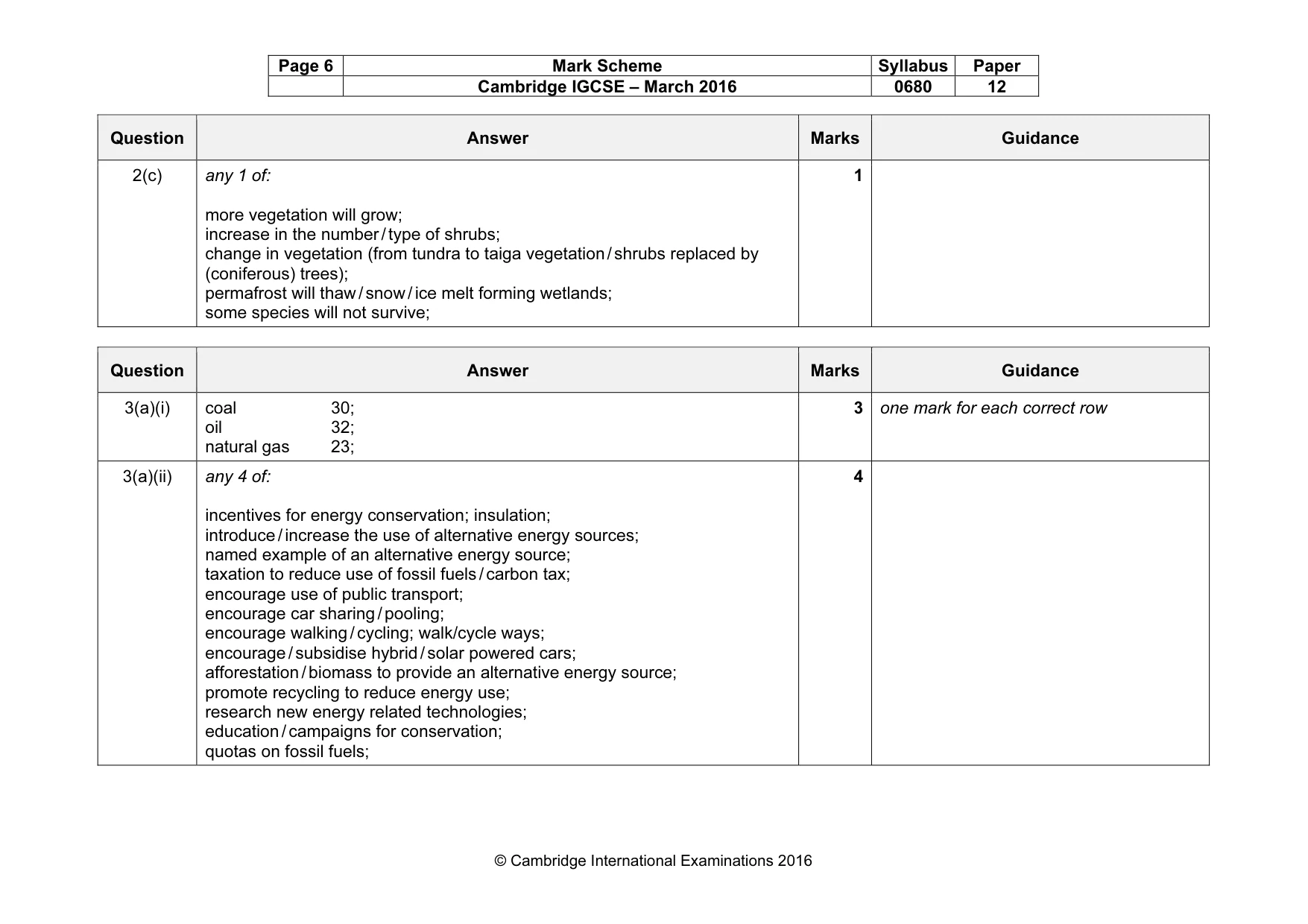
Page 3 Mark Scheme Syllabus Paper Cambridge IGCSE – March 2016 0680 12 © Cambridge International Examinations 2016 Question Answer Marks Guidance 1(a) condensation D; evaporation B; ground water flow E; precipitation A; transpiration C; 3 Five correct for 3 marks. Three or four correct for 2 marks. One or two correct for 1 mark 1(b)(i) any 3 of: valley (in mountains, upland area); narrow; deep / steep sided; steep gradient; natural lake; wet climate; high / heavy annual rainfall / precipitation; low evaporation rate; (large) river; many tributaries; few people / settlements; 3 1(b)(ii) any 4 of or 1 / 2 / 3 ideas developed correctly: loss of (farm)land; valley floor; fertile; loss of homes / villages; loss of jobs / employment; income; loss / disruption of ecosystems / wildlife / deforestation; people forced to move; communities destroyed; archaeological / historic / cultural heritage destroyed; dam may break; endanger life; dam may cause / increase earthquakes; visual pollution; noise during construction; 4
Mark scheme, page 4
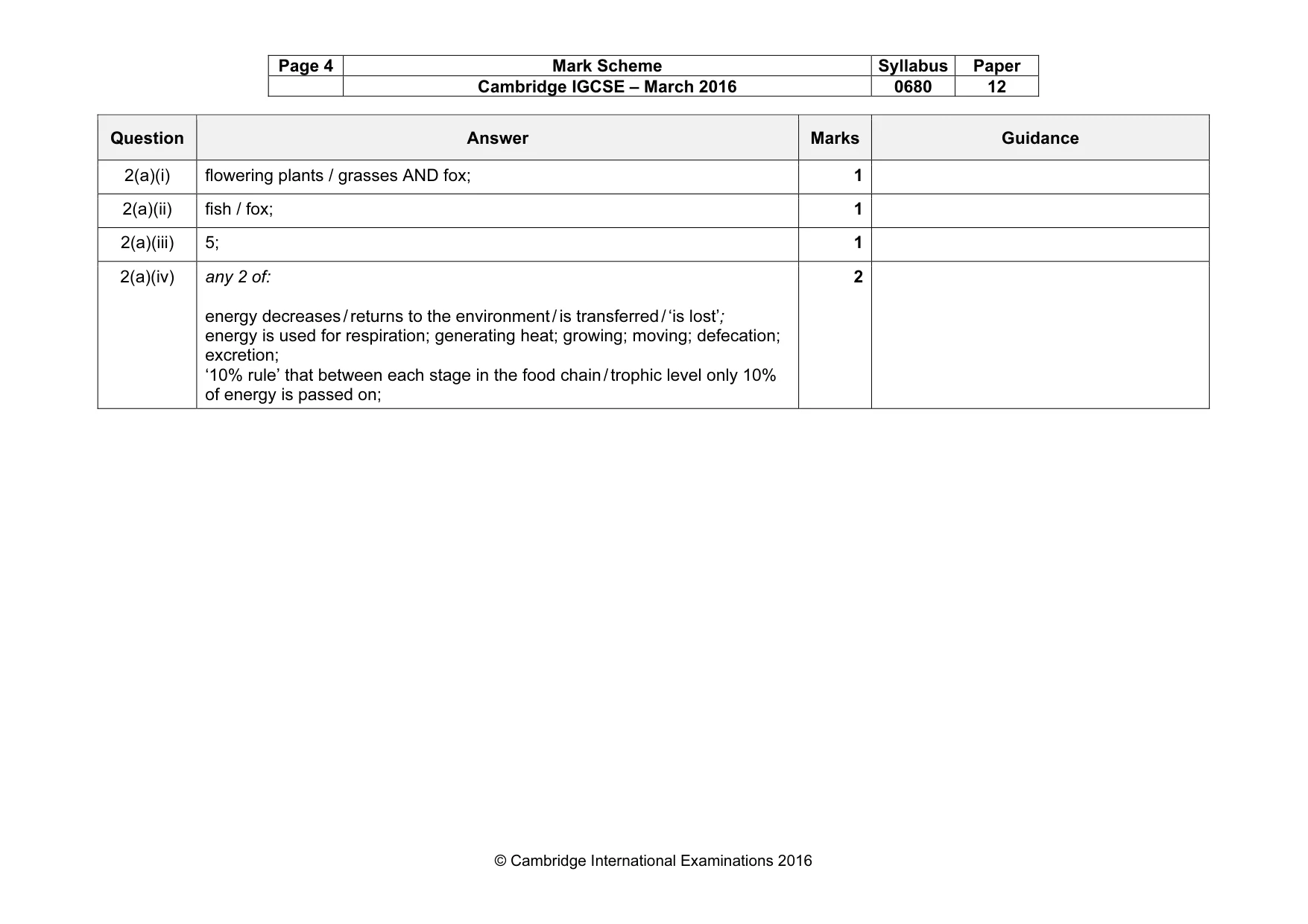
Page 4 Mark Scheme Syllabus Paper Cambridge IGCSE – March 2016 0680 12 © Cambridge International Examinations 2016 Question Answer Marks Guidance 2(a)(i) flowering plants / grasses AND fox; 1 2(a)(ii) fish / fox; 1 2(a)(iii) 5; 1 2(a)(iv) any 2 of: energy decreases / returns to the environment / is transferred / ‘is lost’; energy is used for respiration; generating heat; growing; moving; defecation; excretion; ‘10% rule’ that between each stage in the food chain / trophic level only 10% of energy is passed on; 2
Mark scheme, page 5
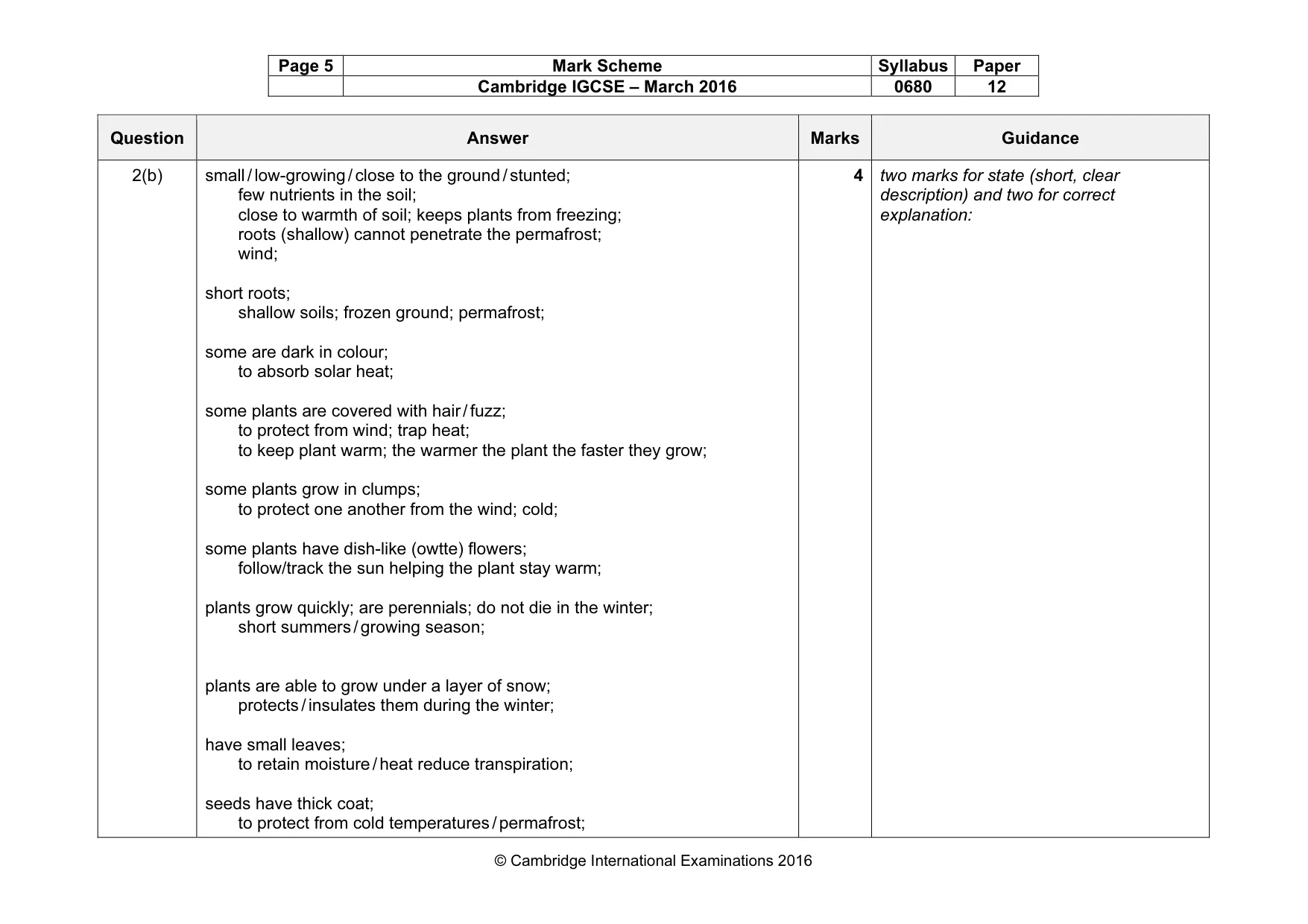
Page 5 Mark Scheme Syllabus Paper Cambridge IGCSE – March 2016 0680 12 © Cambridge International Examinations 2016 Question Answer Marks Guidance 2(b) small / low-growing / close to the ground / stunted; few nutrients in the soil; close to warmth of soil; keeps plants from freezing; roots (shallow) cannot penetrate the permafrost; wind; short roots; shallow soils; frozen ground; permafrost; some are dark in colour; to absorb solar heat; some plants are covered with hair / fuzz; to protect from wind; trap heat; to keep plant warm; the warmer the plant the faster they grow; some plants grow in clumps; to protect one another from the wind; cold; some plants have dish-like (owtte) flowers; follow/track the sun helping the plant stay warm; plants grow quickly; are perennials; do not die in the winter; short summers / growing season; plants are able to grow under a layer of snow; protects / insulates them during the winter; have small leaves; to retain moisture / heat reduce transpiration; seeds have thick coat; to protect from cold temperatures / permafrost; 4 two marks for state (short, clear description) and two for correct explanation:
Mark scheme, page 6
Page 6 Mark Scheme Syllabus Paper Cambridge IGCSE – March 2016 0680 12 © Cambridge International Examinations 2016 Question Answer Marks Guidance 2(c) any 1 of: more vegetation will grow; increase in the number / type of shrubs; change in vegetation (from tundra to taiga vegetation / shrubs replaced by (coniferous) trees); permafrost will thaw / snow / ice melt forming wetlands; some species will not survive; 1 Question Answer Marks Guidance 3(a)(i) coal 30; oil 32; natural gas 23; 3 one mark for each correct row 3(a)(ii) any 4 of: incentives for energy conservation; insulation; introduce / increase the use of alternative energy sources; named example of an alternative energy source; taxation to reduce use of fossil fuels / carbon tax; encourage use of public transport; encourage car sharing / pooling; encourage walking / cycling; walk/cycle ways; encourage / subsidise hybrid / solar powered cars; afforestation / biomass to provide an alternative energy source; promote recycling to reduce energy use; research new energy related technologies; education / campaigns for conservation; quotas on fossil fuels; 4
Mark scheme, page 7
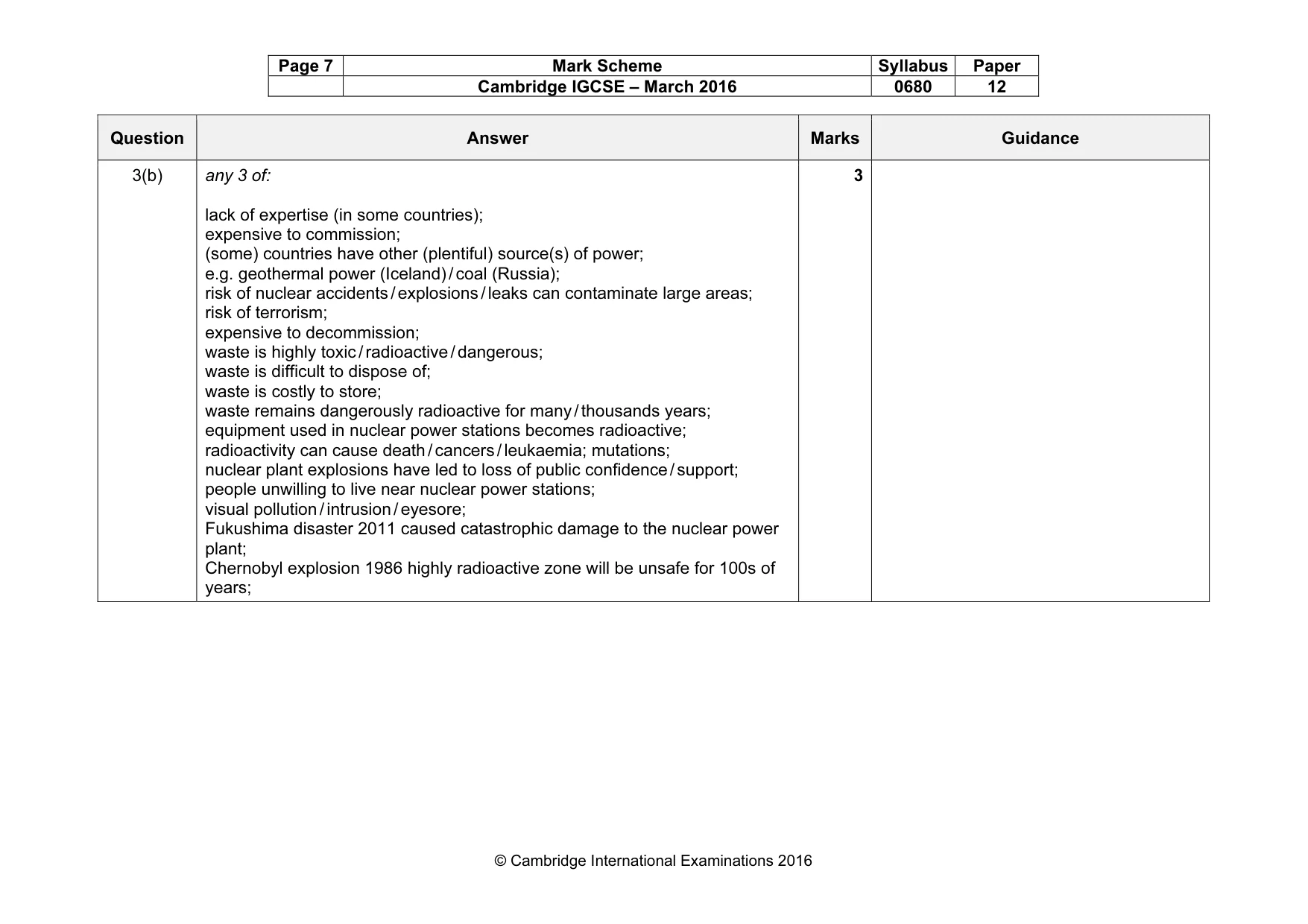
Page 7 Mark Scheme Syllabus Paper Cambridge IGCSE – March 2016 0680 12 © Cambridge International Examinations 2016 Question Answer Marks Guidance 3(b) any 3 of: lack of expertise (in some countries); expensive to commission; (some) countries have other (plentiful) source(s) of power; e.g. geothermal power (Iceland) / coal (Russia); risk of nuclear accidents / explosions / leaks can contaminate large areas; risk of terrorism; expensive to decommission; waste is highly toxic / radioactive / dangerous; waste is difficult to dispose of; waste is costly to store; waste remains dangerously radioactive for many / thousands years; equipment used in nuclear power stations becomes radioactive; radioactivity can cause death / cancers / leukaemia; mutations; nuclear plant explosions have led to loss of public confidence / support; people unwilling to live near nuclear power stations; visual pollution / intrusion / eyesore; Fukushima disaster 2011 caused catastrophic damage to the nuclear power plant; Chernobyl explosion 1986 highly radioactive zone will be unsafe for 100s of years; 3
Mark scheme, page 8
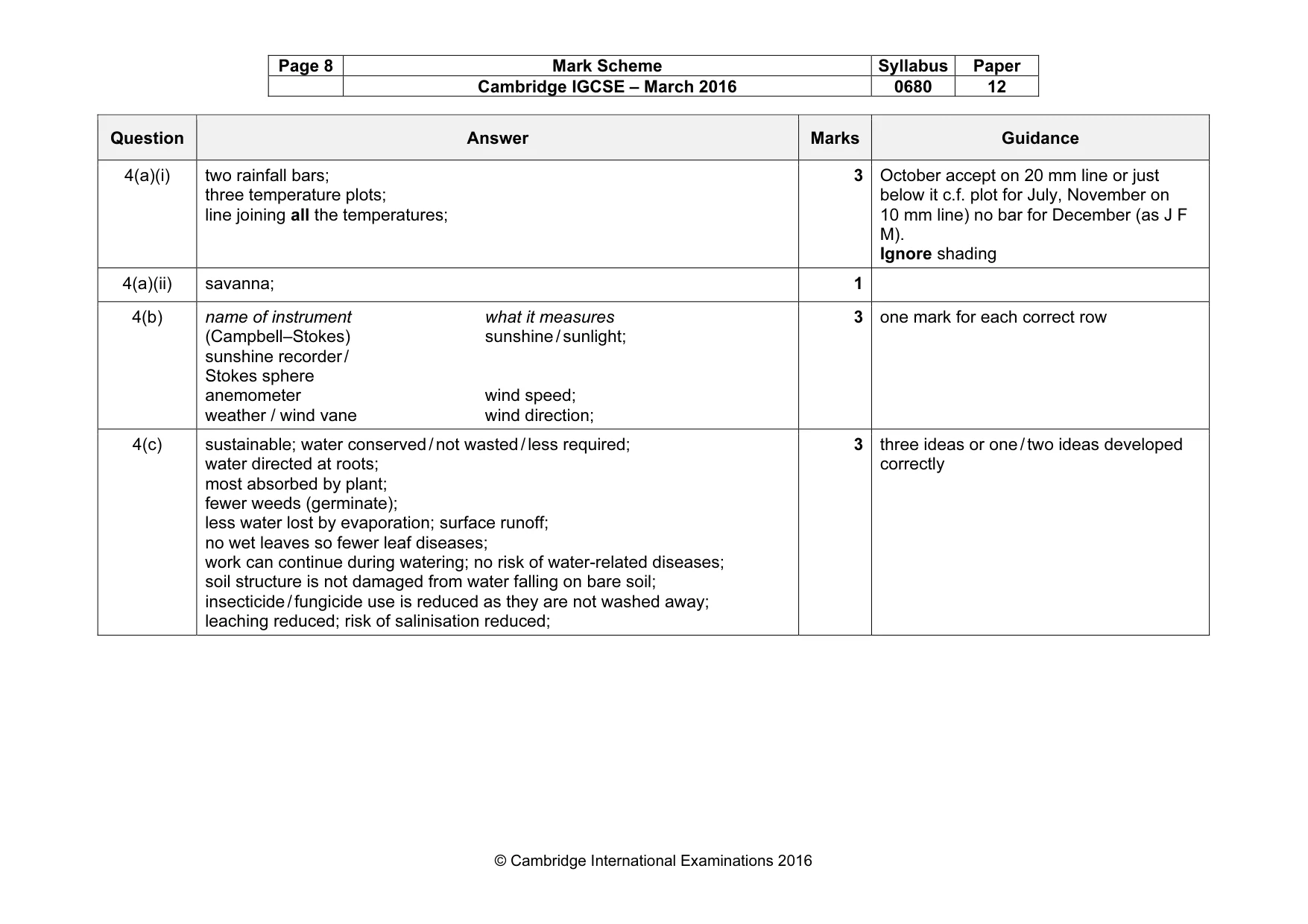
Page 8 Mark Scheme Syllabus Paper Cambridge IGCSE – March 2016 0680 12 © Cambridge International Examinations 2016 Question Answer Marks Guidance 4(a)(i) two rainfall bars; three temperature plots; line joining all the temperatures; 3 October accept on 20 mm line or just below it c.f. plot for July, November on 10 mm line) no bar for December (as J F M). Ignore shading 4(a)(ii) savanna; 1 4(b) name of instrument what it measures (Campbell–Stokes) sunshine / sunlight; sunshine recorder / Stokes sphere anemometer wind speed; weather / wind vane wind direction; 3 one mark for each correct row 4(c) sustainable; water conserved / not wasted / less required; water directed at roots; most absorbed by plant; fewer weeds (germinate); less water lost by evaporation; surface runoff; no wet leaves so fewer leaf diseases; work can continue during watering; no risk of water-related diseases; soil structure is not damaged from water falling on bare soil; insecticide / fungicide use is reduced as they are not washed away; leaching reduced; risk of salinisation reduced; 3 three ideas or one / two ideas developed correctly
Mark scheme, page 9
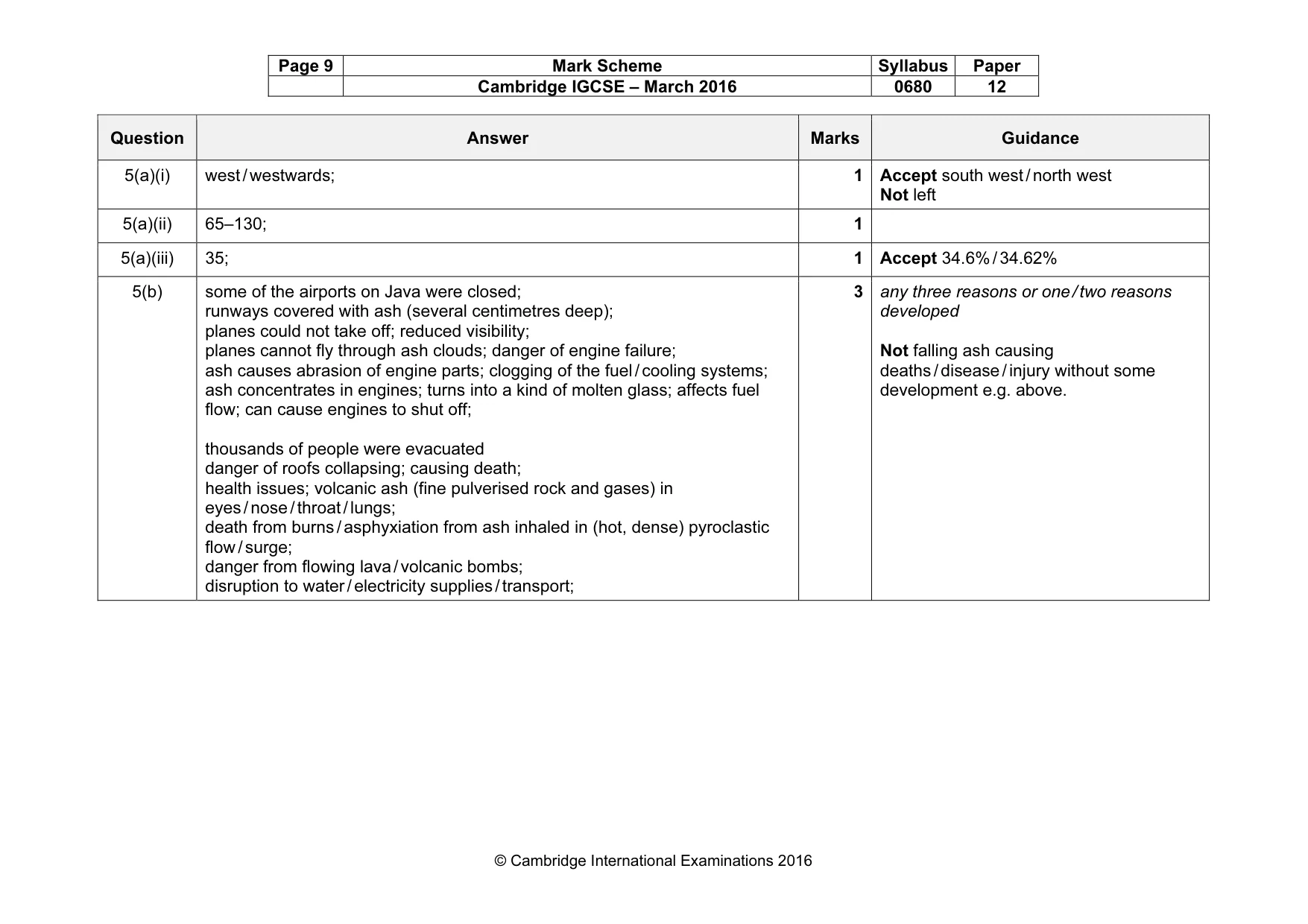
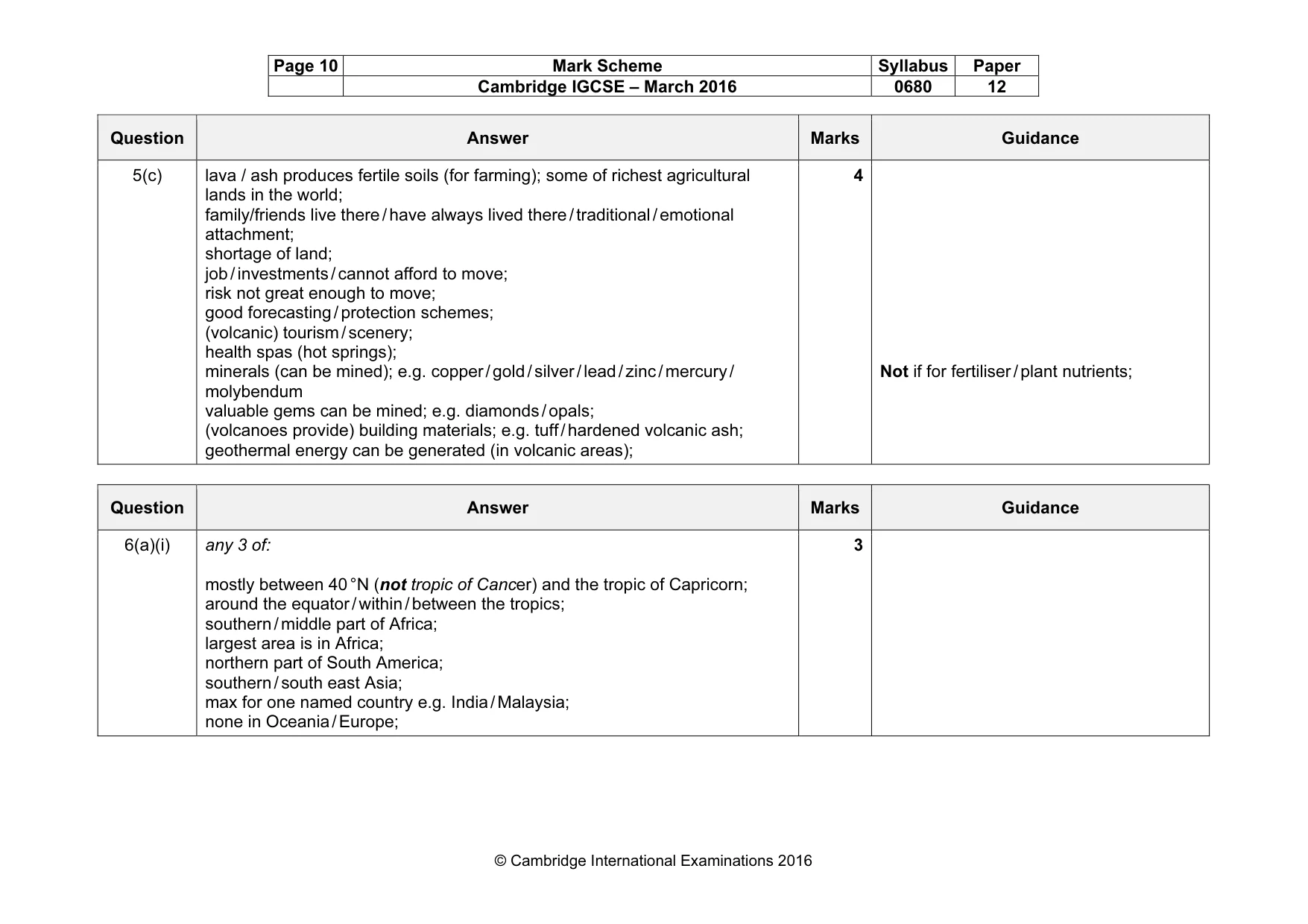
Page 9 Mark Scheme Syllabus Paper Cambridge IGCSE – March 2016 0680 12 © Cambridge International Examinations 2016 Question Answer Marks Guidance 5(a)(i) west / westwards; 1 Accept south west / north west Not left 5(a)(ii) 65–130; 1 5(a)(iii) 35; 1 Accept 34.6% / 34.62% 5(b) some of the airports on Java were closed; runways covered with ash (several centimetres deep); planes could not take off; reduced visibility; planes cannot fly through ash clouds; danger of engine failure; ash causes abrasion of engine parts; clogging of the fuel / cooling systems; ash concentrates in engines; turns into a kind of molten glass; affects fuel flow; can cause engines to shut off; thousands of people were evacuated danger of roofs collapsing; causing death; health issues; volcanic ash (fine pulverised rock and gases) in eyes / nose / throat / lungs; death from burns / asphyxiation from ash inhaled in (hot, dense) pyroclastic flow / surge; danger from flowing lava / volcanic bombs; disruption to water / electricity supplies / transport; 3 any three reasons or one / two reasons developed Not falling ash causing deaths / disease / injury without some development e.g. above.
Mark scheme, page 10
Page 10 Mark Scheme Syllabus Paper Cambridge IGCSE – March 2016 0680 12 © Cambridge International Examinations 2016 Question Answer Marks Guidance 5(c) lava / ash produces fertile soils (for farming); some of richest agricultural lands in the world; family/friends live there / have always lived there / traditional / emotional attachment; shortage of land; job / investments / cannot afford to move; risk not great enough to move; good forecasting / protection schemes; (volcanic) tourism / scenery; health spas (hot springs); minerals (can be mined); e.g. copper / gold / silver / lead / zinc / mercury / molybendum valuable gems can be mined; e.g. diamonds / opals; (volcanoes provide) building materials; e.g. tuff / hardened volcanic ash; geothermal energy can be generated (in volcanic areas); 4 Not if for fertiliser / plant nutrients; Question Answer Marks Guidance 6(a)(i) any 3 of: mostly between 40 °N (not tropic of Cancer) and the tropic of Capricorn; around the equator / within / between the tropics; southern / middle part of Africa; largest area is in Africa; northern part of South America; southern / south east Asia; max for one named country e.g. India / Malaysia; none in Oceania / Europe; 3
Mark scheme, page 11
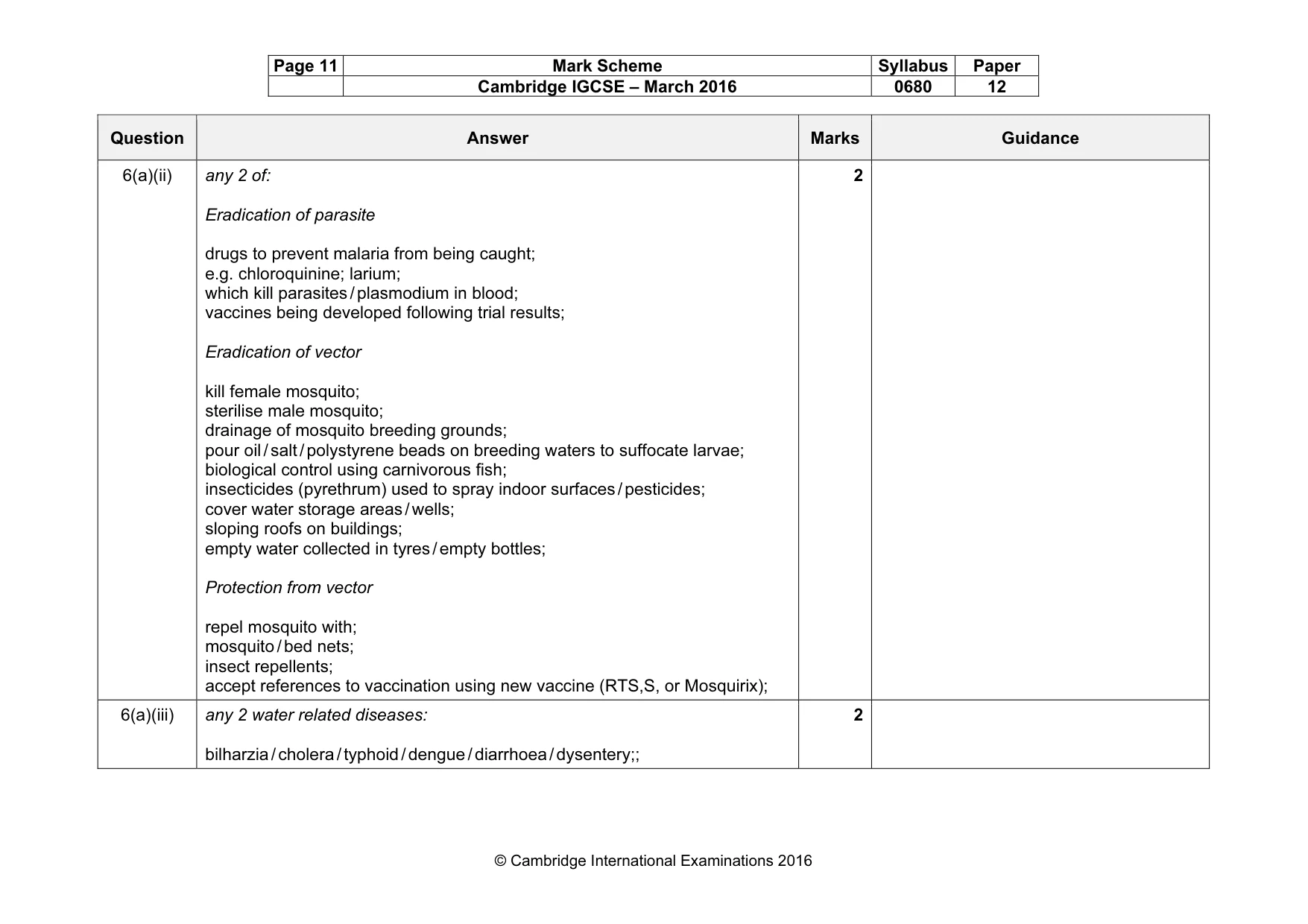
Page 11 Mark Scheme Syllabus Paper Cambridge IGCSE – March 2016 0680 12 © Cambridge International Examinations 2016 Question Answer Marks Guidance 6(a)(ii) any 2 of: Eradication of parasite drugs to prevent malaria from being caught; e.g. chloroquinine; larium; which kill parasites / plasmodium in blood; vaccines being developed following trial results; Eradication of vector kill female mosquito; sterilise male mosquito; drainage of mosquito breeding grounds; pour oil / salt / polystyrene beads on breeding waters to suffocate larvae; biological control using carnivorous fish; insecticides (pyrethrum) used to spray indoor surfaces / pesticides; cover water storage areas / wells; sloping roofs on buildings; empty water collected in tyres / empty bottles; Protection from vector repel mosquito with; mosquito / bed nets; insect repellents; accept references to vaccination using new vaccine (RTS,S, or Mosquirix); 2 6(a)(iii) any 2 water related diseases: bilharzia / cholera / typhoid / dengue / diarrhoea / dysentery;; 2
Mark scheme, page 12
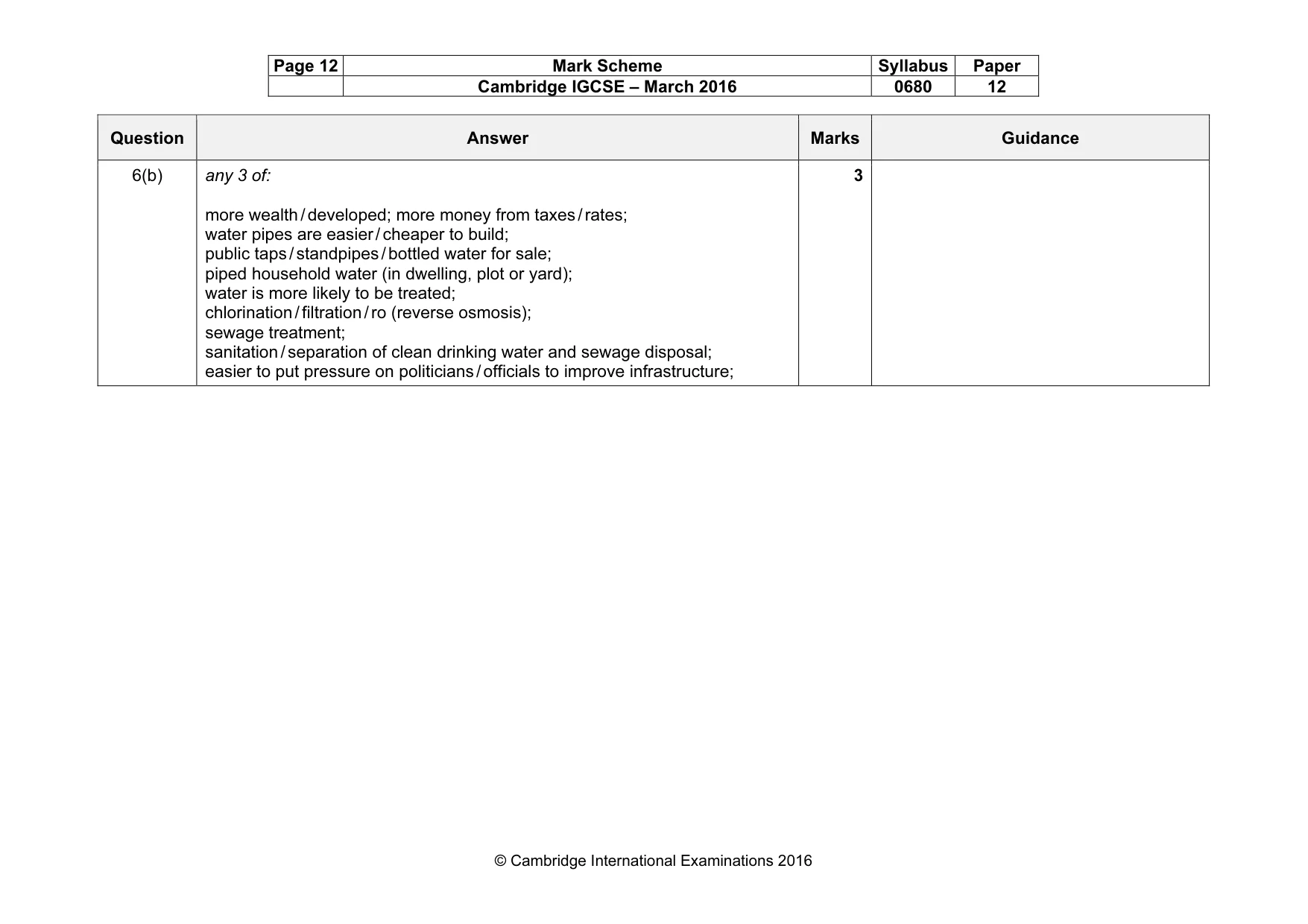
Page 12 Mark Scheme Syllabus Paper Cambridge IGCSE – March 2016 0680 12 © Cambridge International Examinations 2016 Question Answer Marks Guidance 6(b) any 3 of: more wealth / developed; more money from taxes / rates; water pipes are easier / cheaper to build; public taps / standpipes / bottled water for sale; piped household water (in dwelling, plot or yard); water is more likely to be treated; chlorination / filtration / ro (reverse osmosis); sewage treatment; sanitation / separation of clean drinking water and sewage disposal; easier to put pressure on politicians / officials to improve infrastructure; 3
What you needed in this session
Cambridge’s own grade thresholds for 2016 Feb/March, Paper 1 · Variant 2. A higher threshold means an easier paper — the bar moves with how the cohort did.