Cambridge IGCSE Environmental Management 0680 — 2009 Oct/Nov Paper 1 · Variant 1
0680/11/O/N/09 · 60 marks · ≈68 min
The question paper and its mark scheme, free to read here and free to download. This is Cambridge’s own paper, exactly as it was sat.
Question paper16 pages


Mark scheme5 pages
Answers below. Sit the paper first if you are practising.
Paper as text
Question paper, page 1
This document consists of 13 printed pages and 3 blank pages. SP (NF/SW) T74843/2 © UCLES 2009 [Turn over UNIVERSITY OF CAMBRIDGE INTERNATIONAL EXAMINATIONS International General Certificate of Secondary Education READ THESE INSTRUCTIONS FIRST Write your Centre number, candidate number and name on all the work you hand in. Write in dark blue or black pen. You may use a soft pencil for any diagrams, graphs or rough working. Do not use staples, paper clips, highlighters, glue or correction fluid. DO NOT WRITE IN ANY BARCODES. Answer all questions. At the end of the examination, fasten all your work securely together. The number of marks is given in brackets [ ] at the end of each question or part question. * 2 2 7 7 3 8 0 0 8 4 * ENVIRONMENTAL MANAGEMENT 0680/01 Paper 1 October/November 2009 1 hour 30 minutes Candidates answer on the Question Paper. Additional Materials: Ruler For Examiner’s Use 1 2 3 4 5 6 Total www.XtremePapers.com
Question paper, page 2
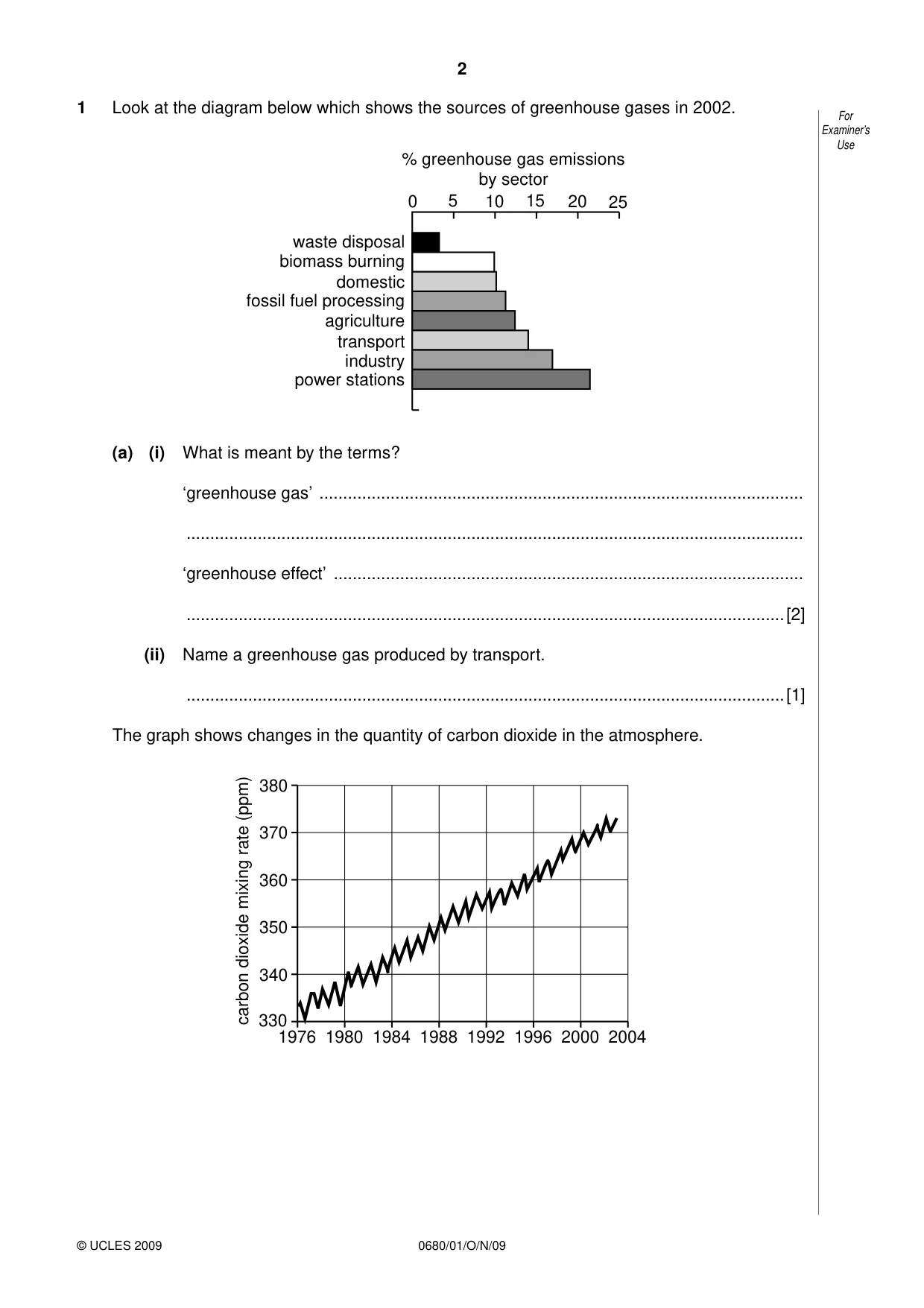
2 0680/01/O/N/09 © UCLES 2009 For Examiner’s Use 1 Look at the diagram below which shows the sources of greenhouse gases in 2002. waste disposal biomass burning domestic fossil fuel processing agriculture transport industry power stations 0 5 % greenhouse gas emissions by sector 10 15 20 25 (a) (i) What is meant by the terms? ‘greenhouse gas’ … … ‘greenhouse effect’ … …[2] (ii) Name a greenhouse gas produced by transport. …[1] The graph shows changes in the quantity of carbon dioxide in the atmosphere. 1976 1980 1984 1988 1992 1996 2000 2004 330 340 carbon dioxide mixing rate (ppm) 350 360 370 380
Question paper, page 3
3 0680/01/O/N/09 © UCLES 2009 [Turn over For Examiner’s Use (b) Describe and explain the changes shown in the graph. … … … … …[3] (c) (i) Give a source of CFC. …[1] (ii) Give a source of methane. …[1] (iii) Suggest how pollution from each of these gases might be reduced. … … … …[2] [Total: 10]
Question paper, page 4
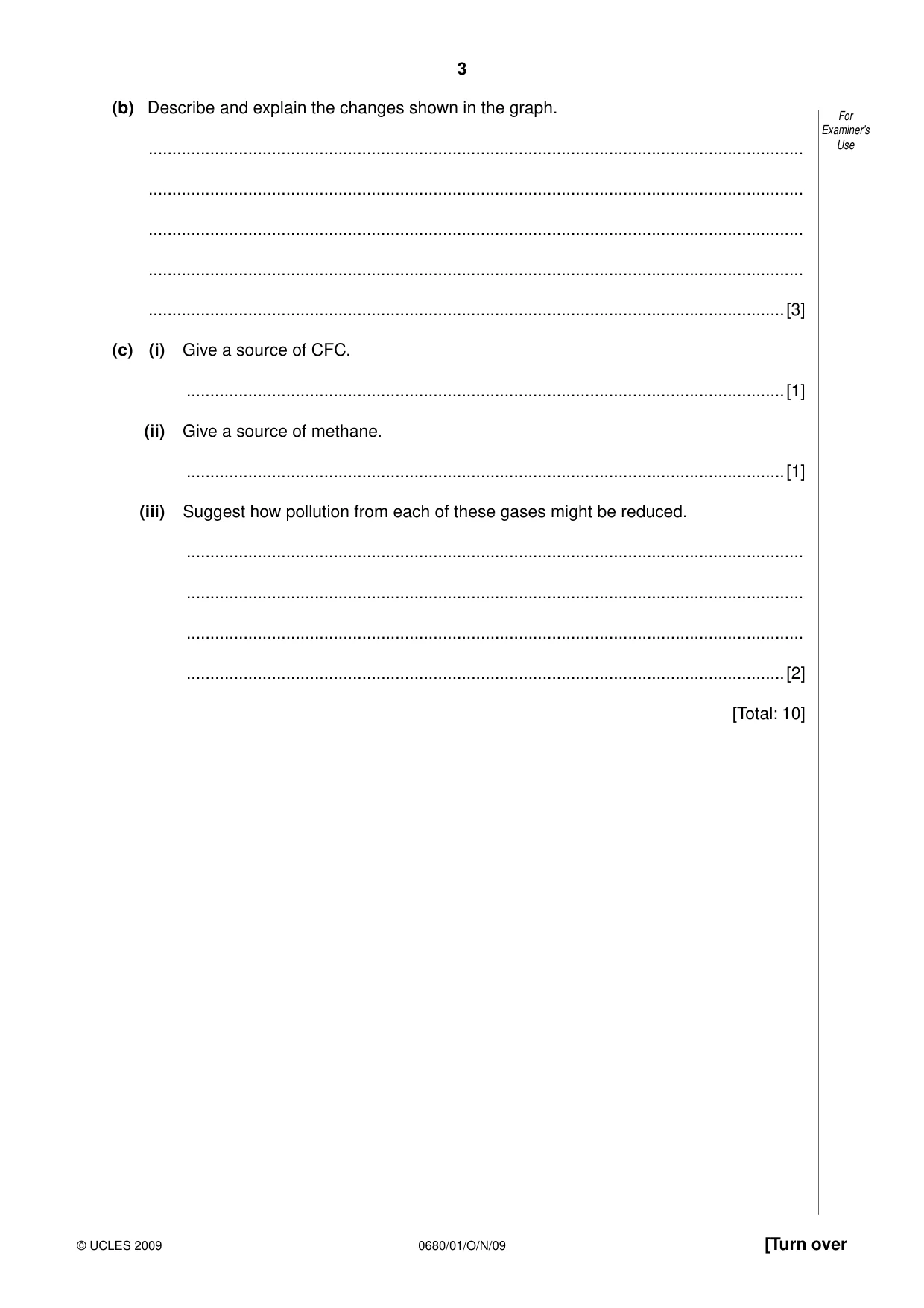
4 0680/01/O/N/09 © UCLES 2009 For Examiner’s Use 2 Read the following passage about the Island of Montserrat, where a major volcanic eruption began in July 1995 and is still going on. The Caribbean island of Montserrat is situated on a destructive plate boundary. Underneath Montserrat the Atlantic plate is slowly being forced under the Caribbean plate. This happens because the Atlantic plate is more dense than the Caribbean plate. Most land suitable for farming was in the south of the island, close to the volcano and before the eruption Montserrat was self sufficient. (a) (i) Draw a labelled, diagram in the box below to show a destructive plate boundary and the volcano caused by it. [4] (ii) Suggest why the good farmland was close to the volcano. … … …[2]
Question paper, page 5
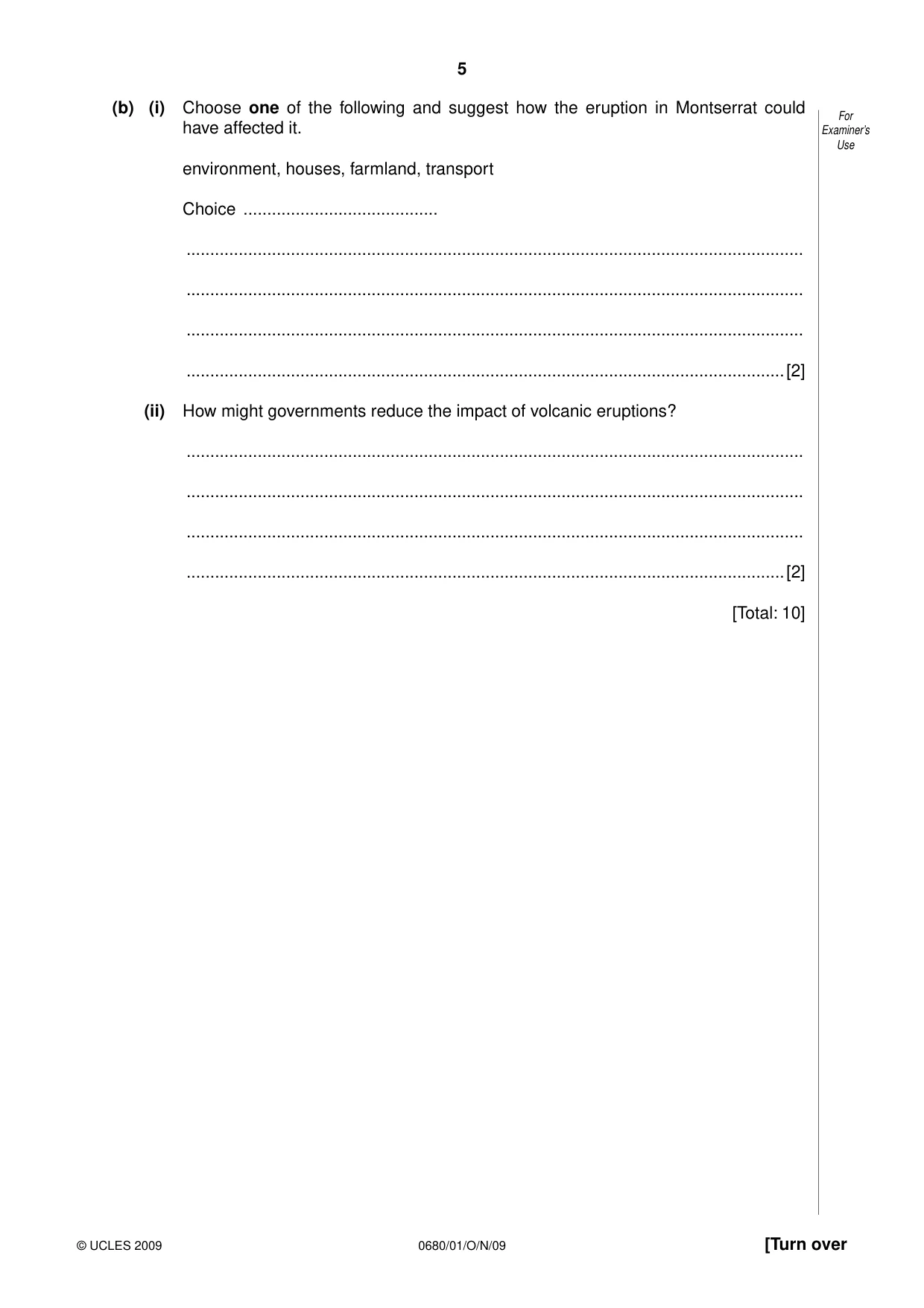
5 0680/01/O/N/09 © UCLES 2009 [Turn over For Examiner’s Use (b) (i) Choose one of the following and suggest how the eruption in Montserrat could have affected it. environment, houses, farmland, transport Choice … … … … …[2] (ii) How might governments reduce the impact of volcanic eruptions? … … … …[2] [Total: 10]
Question paper, page 6
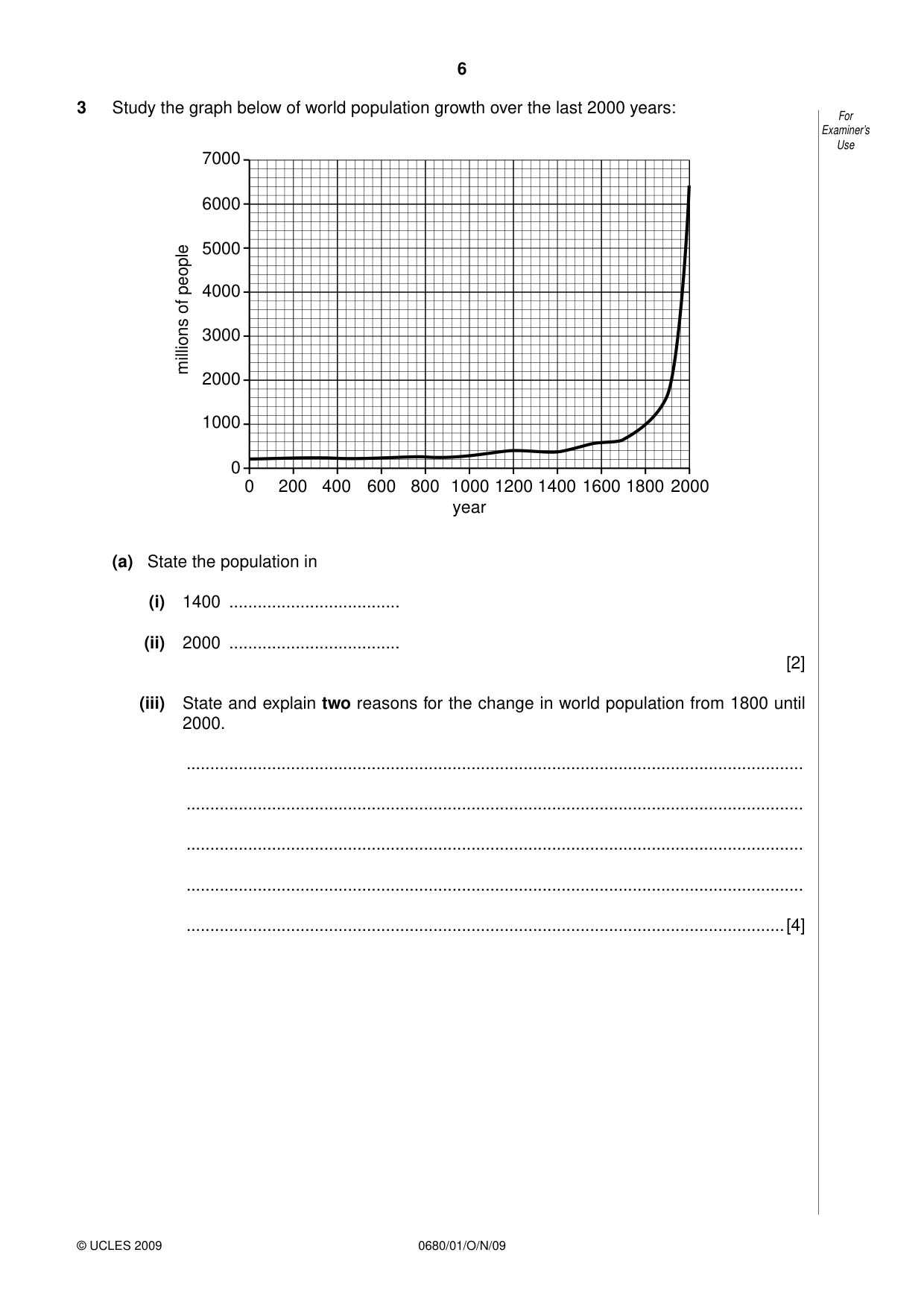
6 0680/01/O/N/09 © UCLES 2009 For Examiner’s Use 3 Study the graph below of world population growth over the last 2000 years: year 0 0 1000 2000 3000 4000 5000 6000 7000 200 millions of people 400 600 800 1000 1200 1400 1600 1800 2000 (a) State the population in (i) 1400 … (ii) 2000 … [2] (iii) State and explain two reasons for the change in world population from 1800 until 2000. … … … … …[4]
Question paper, page 7
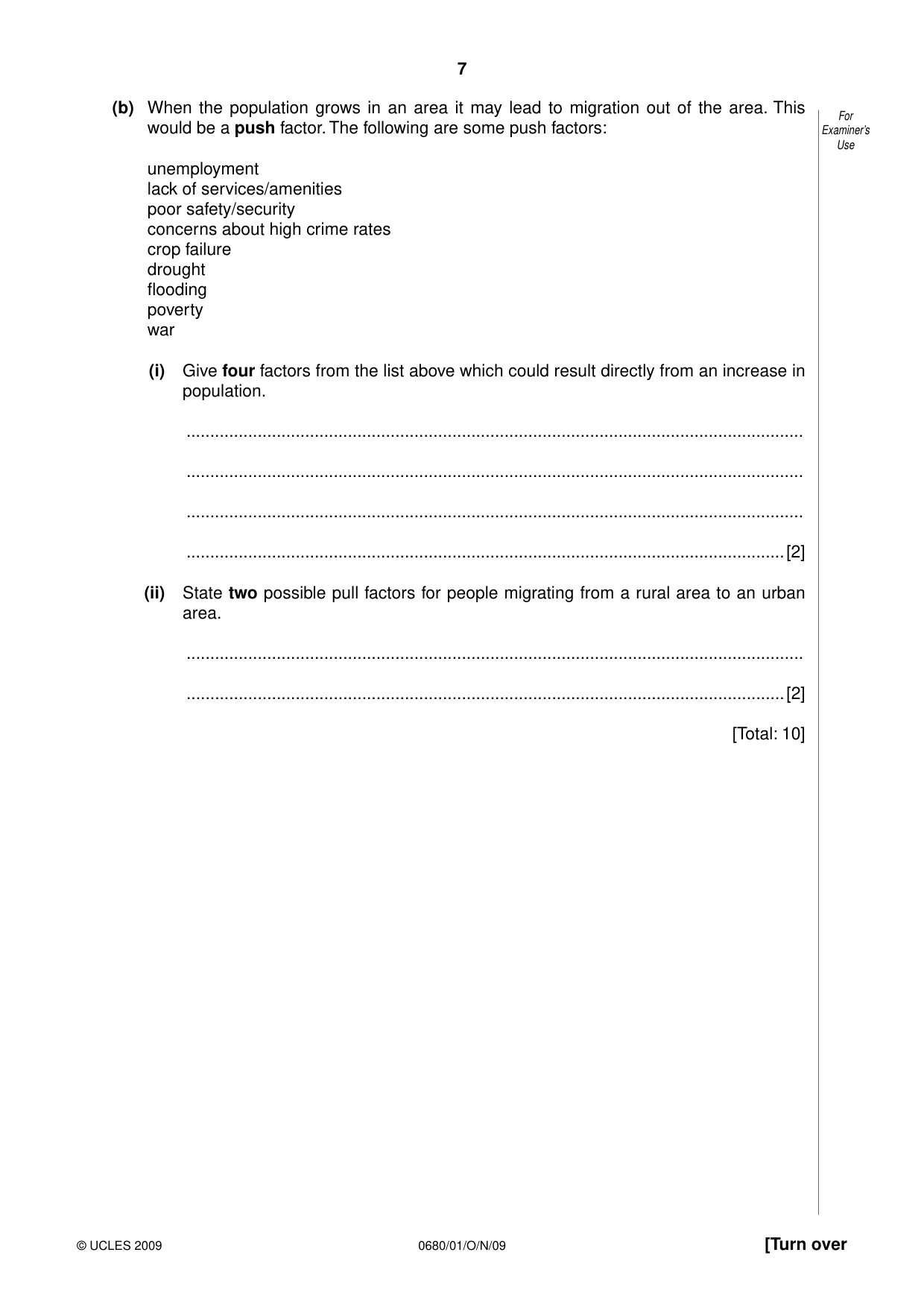
7 0680/01/O/N/09 © UCLES 2009 [Turn over For Examiner’s Use (b) When the population grows in an area it may lead to migration out of the area. This would be a push factor. The following are some push factors: unemployment lack of services/amenities poor safety/security concerns about high crime rates crop failure drought flooding poverty war (i) Give four factors from the list above which could result directly from an increase in population. … … … …[2] (ii) State two possible pull factors for people migrating from a rural area to an urban area. … …[2] [Total: 10]
Question paper, page 8
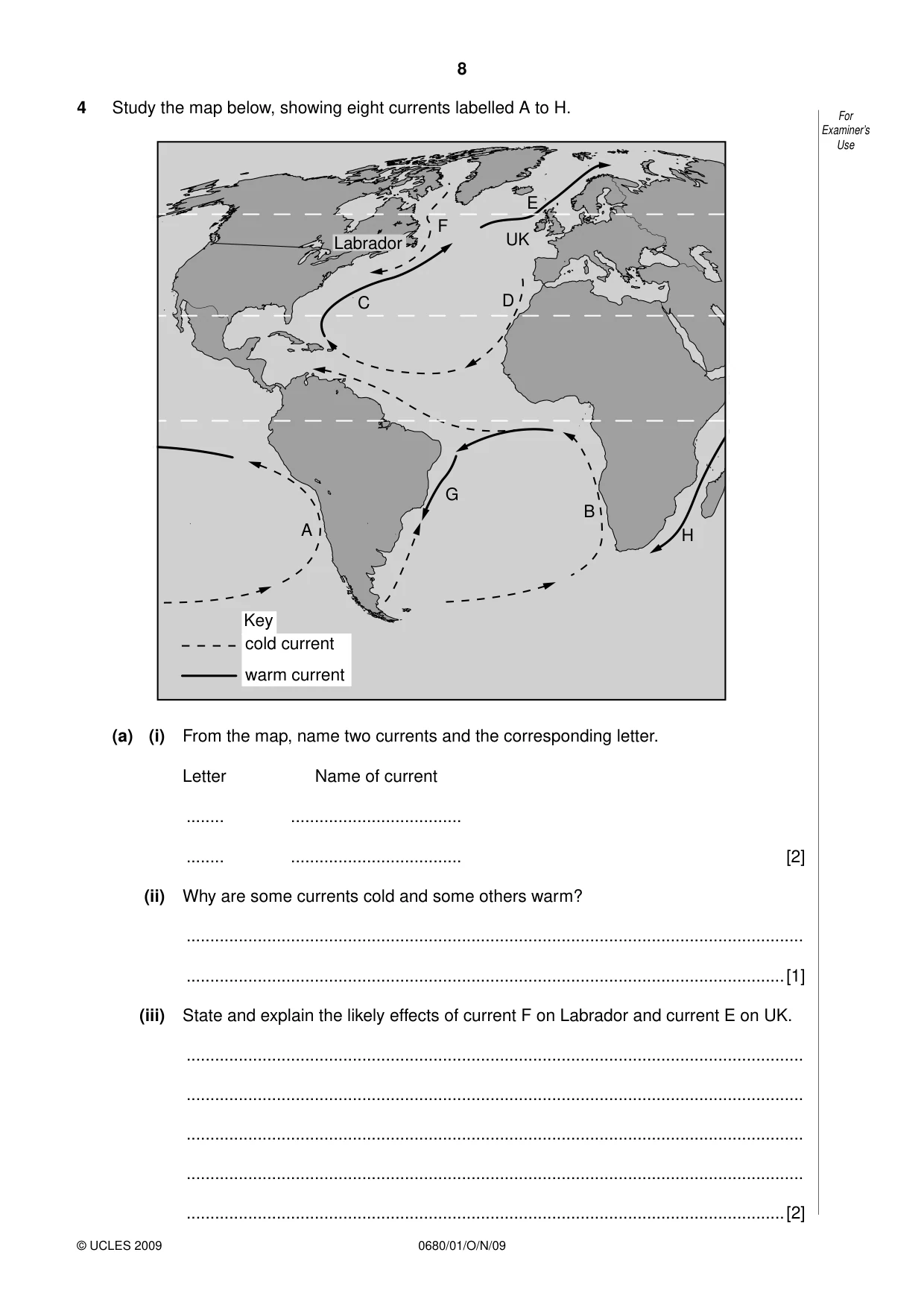
8 0680/01/O/N/09 © UCLES 2009 For Examiner’s Use 4 Study the map below, showing eight currents labelled A to H. C F E D G B H A Labrador UK cold current warm current Key (a) (i) From the map, name two currents and the corresponding letter. Letter Name of current … … … … [2] (ii) Why are some currents cold and some others warm? … …[1] (iii) State and explain the likely effects of current F on Labrador and current E on UK. … … … … …[2]
Question paper, page 9
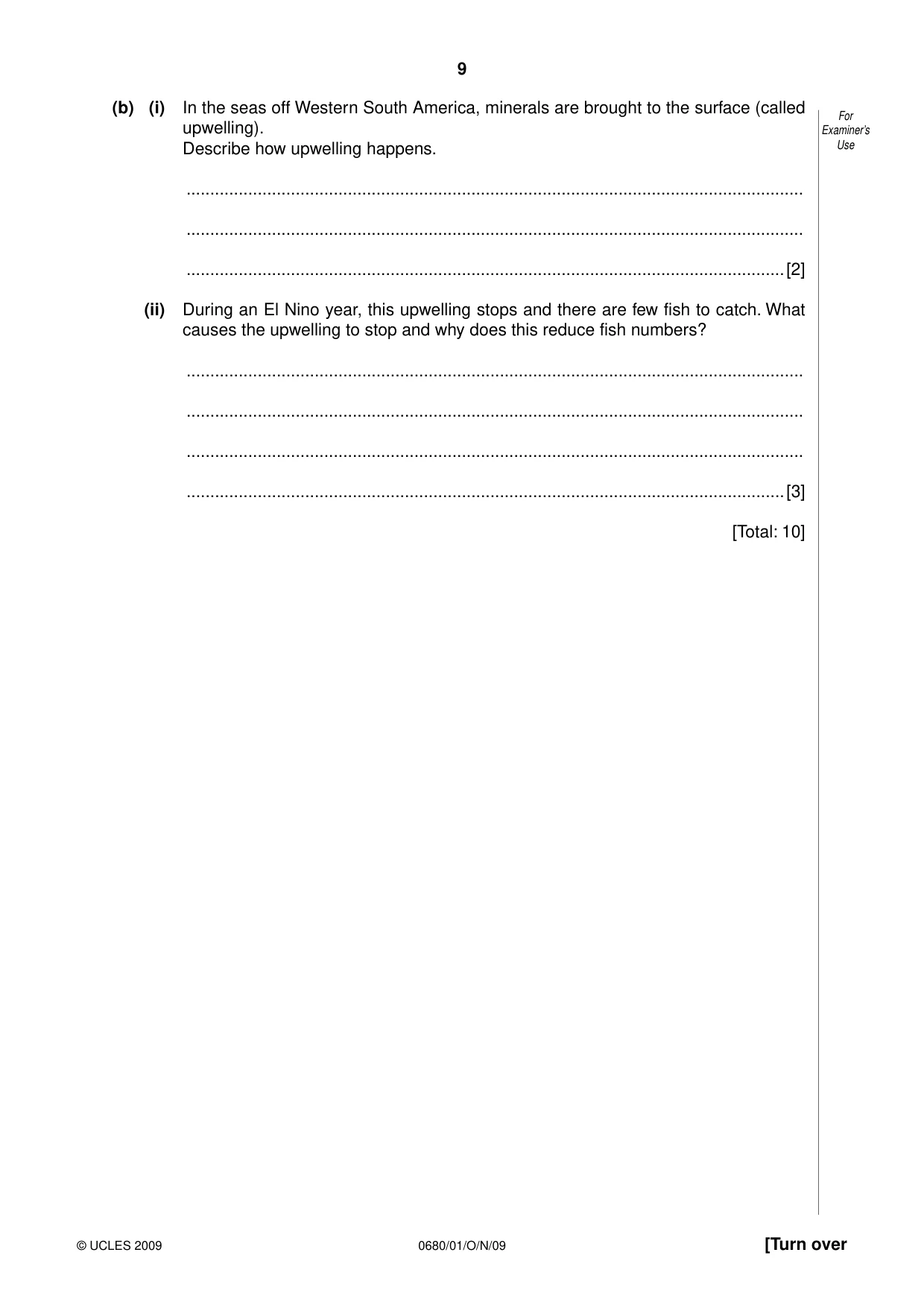
9 0680/01/O/N/09 © UCLES 2009 [Turn over For Examiner’s Use (b) (i) In the seas off Western South America, minerals are brought to the surface (called upwelling). Describe how upwelling happens. … … …[2] (ii) During an El Nino year, this upwelling stops and there are few fish to catch. What causes the upwelling to stop and why does this reduce fish numbers? … … … …[3] [Total: 10]
Question paper, page 10
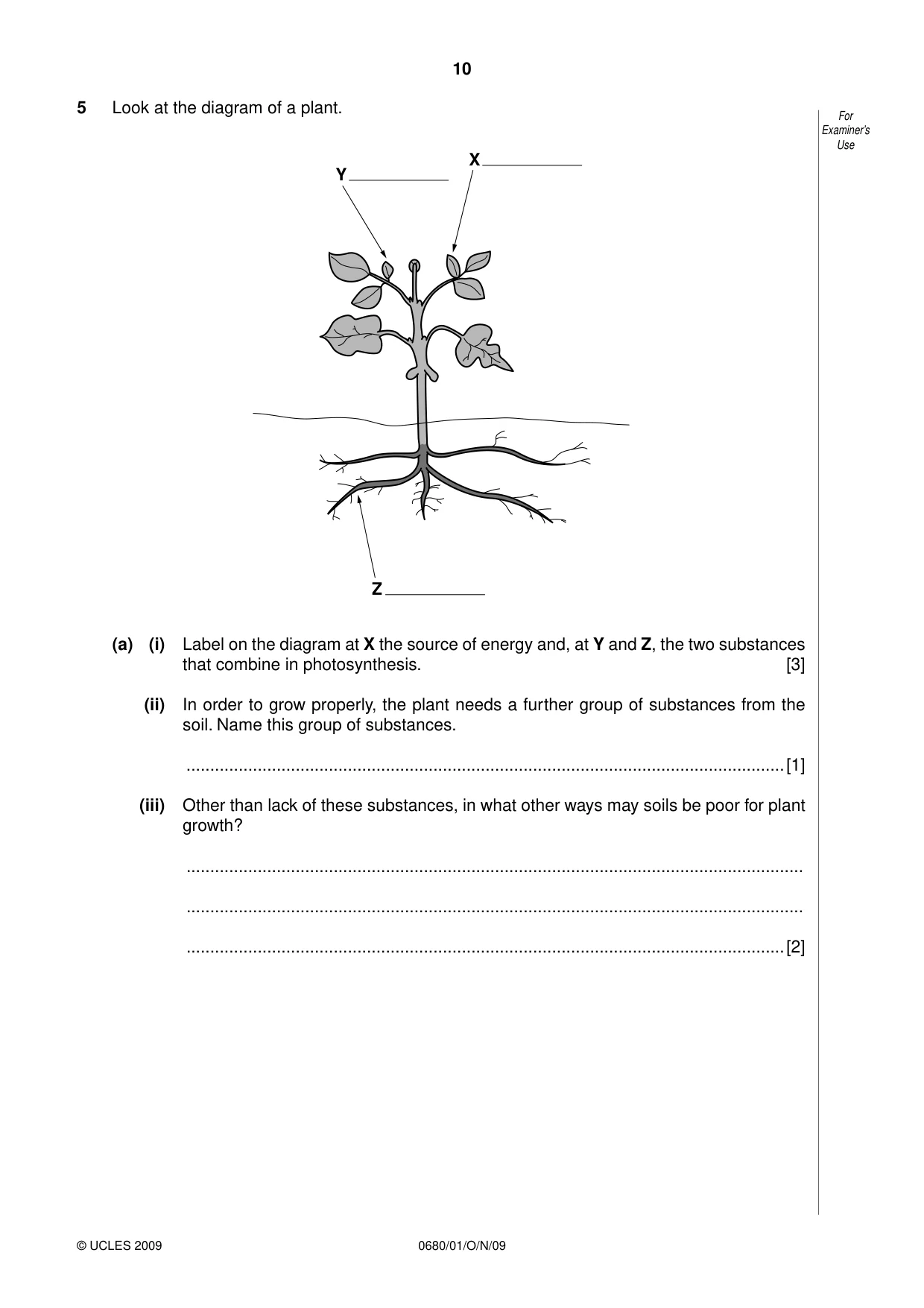
10 0680/01/O/N/09 © UCLES 2009 For Examiner’s Use 5 Look at the diagram of a plant. Y X Z (a) (i) Label on the diagram at X the source of energy and, at Y and Z, the two substances that combine in photosynthesis. [3] (ii) In order to grow properly, the plant needs a further group of substances from the soil. Name this group of substances. …[1] (iii) Other than lack of these substances, in what other ways may soils be poor for plant growth? … … …[2]
Question paper, page 11
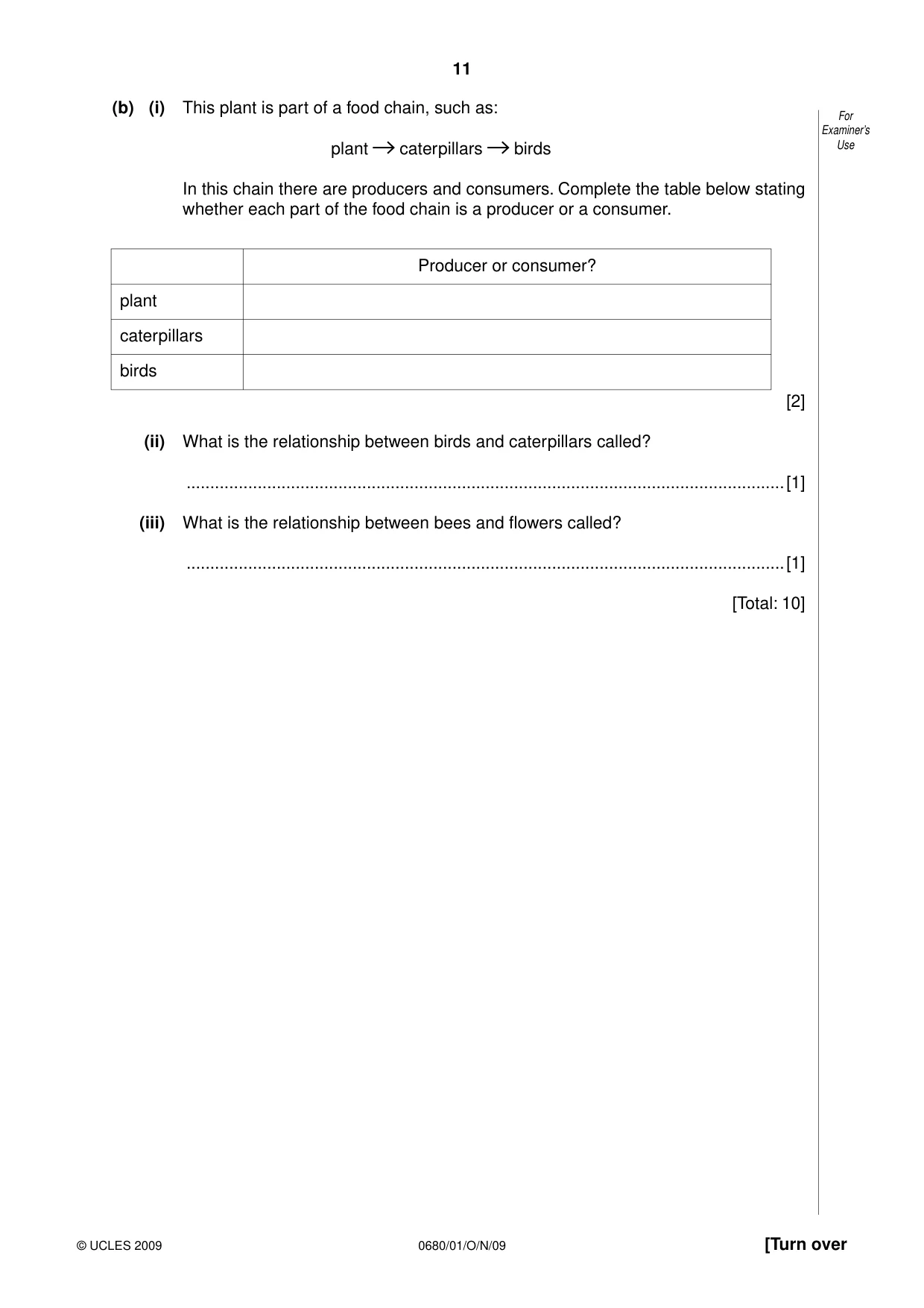
11 0680/01/O/N/09 © UCLES 2009 [Turn over For Examiner’s Use (b) (i) This plant is part of a food chain, such as: plant caterpillars birds In this chain there are producers and consumers. Complete the table below stating whether each part of the food chain is a producer or a consumer. Producer or consumer? plant caterpillars birds [2] (ii) What is the relationship between birds and caterpillars called? …[1] (iii) What is the relationship between bees and flowers called? …[1] [Total: 10]
Question paper, page 12
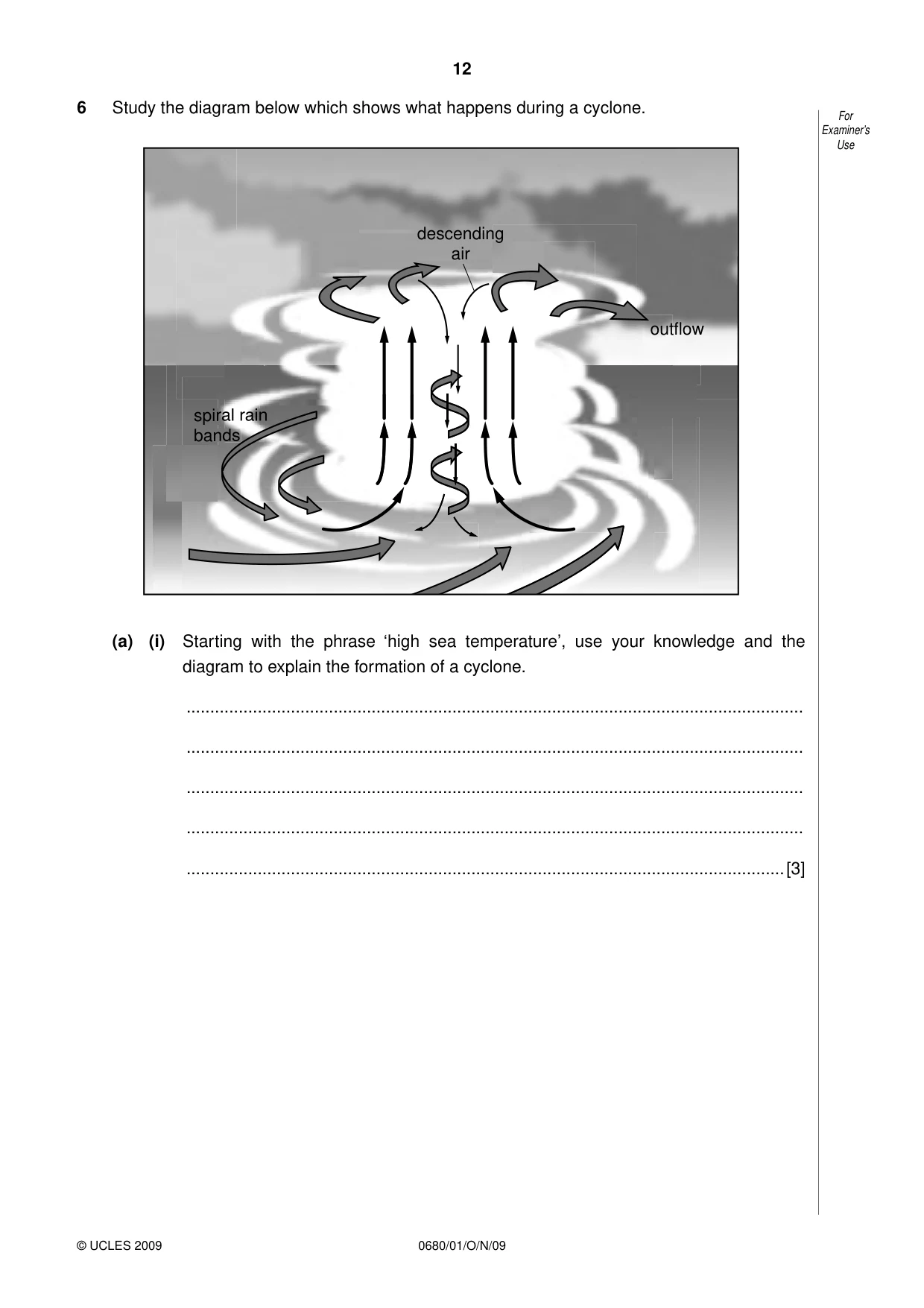
12 0680/01/O/N/09 © UCLES 2009 For Examiner’s Use 6 Study the diagram below which shows what happens during a cyclone. outflow spiral rain bands descending air (a) (i) Starting with the phrase ‘high sea temperature’, use your knowledge and the diagram to explain the formation of a cyclone. … … … … …[3]
Question paper, page 13
13 0680/01/O/N/09 © UCLES 2009 For Examiner’s Use (ii) The map below shows the location of the island of Madagascar and the main track taken by cyclones. Which area X, Y or Z is a cyclone likely to be most powerful? Madagascar cyclone track Key Z Y X …[1] (b) State one impact of a cyclone on: (i) People’s health … … (ii) The environment … …[2] (c) (i) Another climatic hazard is drought. What is meant by this term? … …[2] (ii) Suggest two long term measures that might reduce the effects of drought in affected areas. … … … …[2] [Total: 10]
Question paper, page 16
16 0680/01/O/N/09 BLANK PAGE Permission to reproduce items where third-party owned material protected by copyright is included has been sought and cleared where possible. Every reasonable effort has been made by the publisher (UCLES) to trace copyright holders, but if any items requiring clearance have unwittingly been included, the publisher will be pleased to make amends at the earliest possible opportunity. University of Cambridge International Examinations is part of the Cambridge Assessment Group. Cambridge Assessment is the brand name of University of Cambridge Local Examinations Syndicate (UCLES), which is itself a department of the University of Cambridge.
Mark scheme, page 1
UNIVERSITY OF CAMBRIDGE INTERNATIONAL EXAMINATIONS International General Certificate of Secondary Education MARK SCHEME for the October/November 2009 question paper for the guidance of teachers 0680 ENVIRONMENTAL MANAGEMENT 0680/01 Paper 1, maximum raw mark 60 This mark scheme is published as an aid to teachers and candidates, to indicate the requirements of the examination. It shows the basis on which Examiners were instructed to award marks. It does not indicate the details of the discussions that took place at an Examiners’ meeting before marking began, which would have considered the acceptability of alternative answers. Mark schemes must be read in conjunction with the question papers and the report on the examination. • CIE will not enter into discussions or correspondence in connection with these mark schemes. CIE is publishing the mark schemes for the October/November 2009 question papers for most IGCSE, GCE Advanced Level and Advanced Subsidiary Level syllabuses and some Ordinary Level syllabuses. www.XtremePapers.com
Mark scheme, page 2
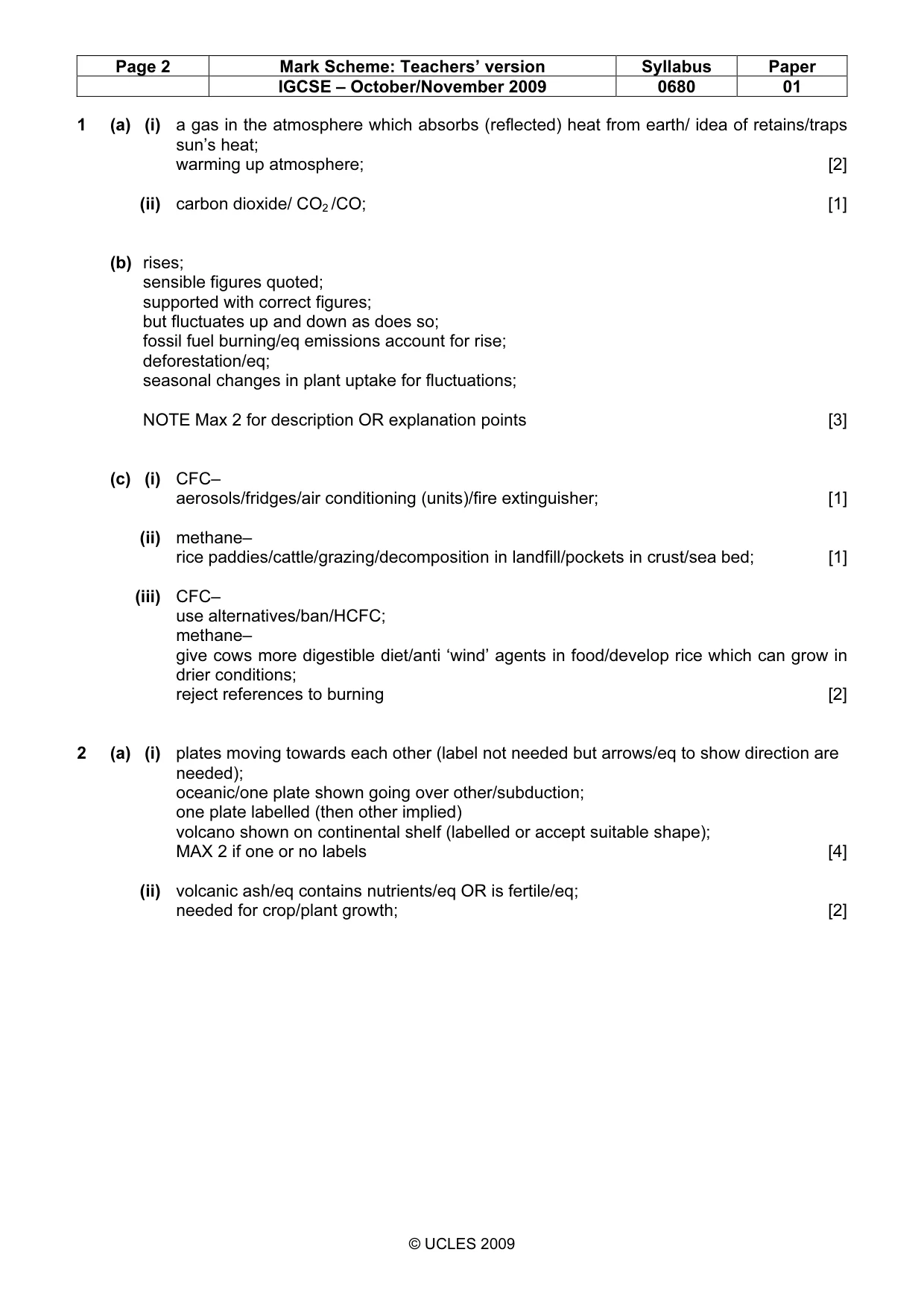
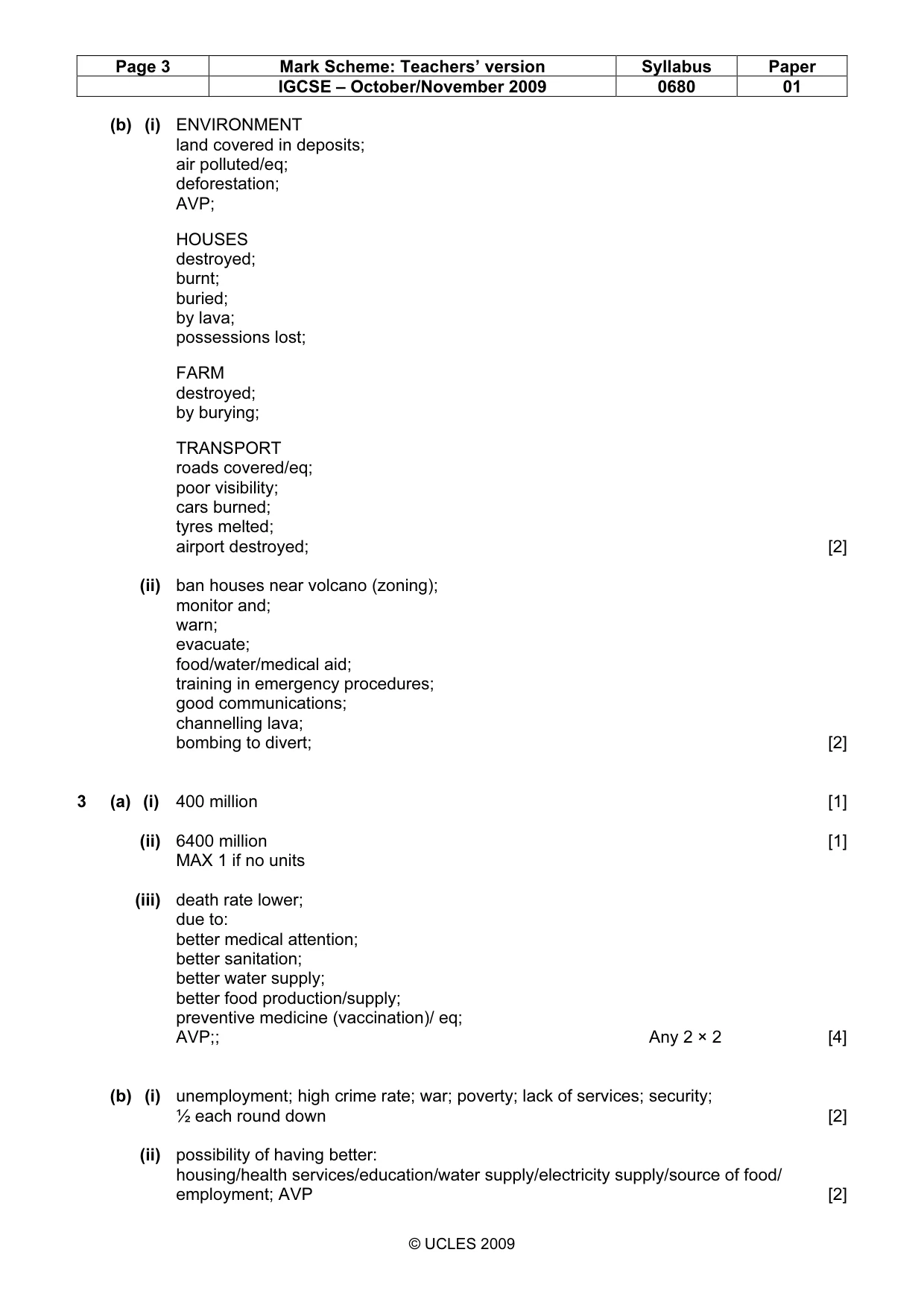
Page 2 Mark Scheme: Teachers’ version Syllabus Paper IGCSE – October/November 2009 0680 01 © UCLES 2009 1 (a) (i) a gas in the atmosphere which absorbs (reflected) heat from earth/ idea of retains/traps sun’s heat; warming up atmosphere; [2] (ii) carbon dioxide/ CO2 /CO; [1] (b) rises; sensible figures quoted; supported with correct figures; but fluctuates up and down as does so; fossil fuel burning/eq emissions account for rise; deforestation/eq; seasonal changes in plant uptake for fluctuations; NOTE Max 2 for description OR explanation points [3] (c) (i) CFC– aerosols/fridges/air conditioning (units)/fire extinguisher; [1] (ii) methane– rice paddies/cattle/grazing/decomposition in landfill/pockets in crust/sea bed; [1] (iii) CFC– use alternatives/ban/HCFC; methane– give cows more digestible diet/anti ‘wind’ agents in food/develop rice which can grow in drier conditions; reject references to burning [2] 2 (a) (i) plates moving towards each other (label not needed but arrows/eq to show direction are needed); oceanic/one plate shown going over other/subduction; one plate labelled (then other implied) volcano shown on continental shelf (labelled or accept suitable shape); MAX 2 if one or no labels [4] (ii) volcanic ash/eq contains nutrients/eq OR is fertile/eq; needed for crop/plant growth; [2]
Mark scheme, page 3
Page 3 Mark Scheme: Teachers’ version Syllabus Paper IGCSE – October/November 2009 0680 01 © UCLES 2009 (b) (i) ENVIRONMENT land covered in deposits; air polluted/eq; deforestation; AVP; HOUSES destroyed; burnt; buried; by lava; possessions lost; FARM destroyed; by burying; TRANSPORT roads covered/eq; poor visibility; cars burned; tyres melted; airport destroyed; [2] (ii) ban houses near volcano (zoning); monitor and; warn; evacuate; food/water/medical aid; training in emergency procedures; good communications; channelling lava; bombing to divert; [2] 3 (a) (i) 400 million [1] (ii) 6400 million [1] MAX 1 if no units (iii) death rate lower; due to: better medical attention; better sanitation; better water supply; better food production/supply; preventive medicine (vaccination)/ eq; AVP;; Any 2 × 2 [4] (b) (i) unemployment; high crime rate; war; poverty; lack of services; security; ½ each round down [2] (ii) possibility of having better: housing/health services/education/water supply/electricity supply/source of food/ employment; AVP [2]
Mark scheme, page 4
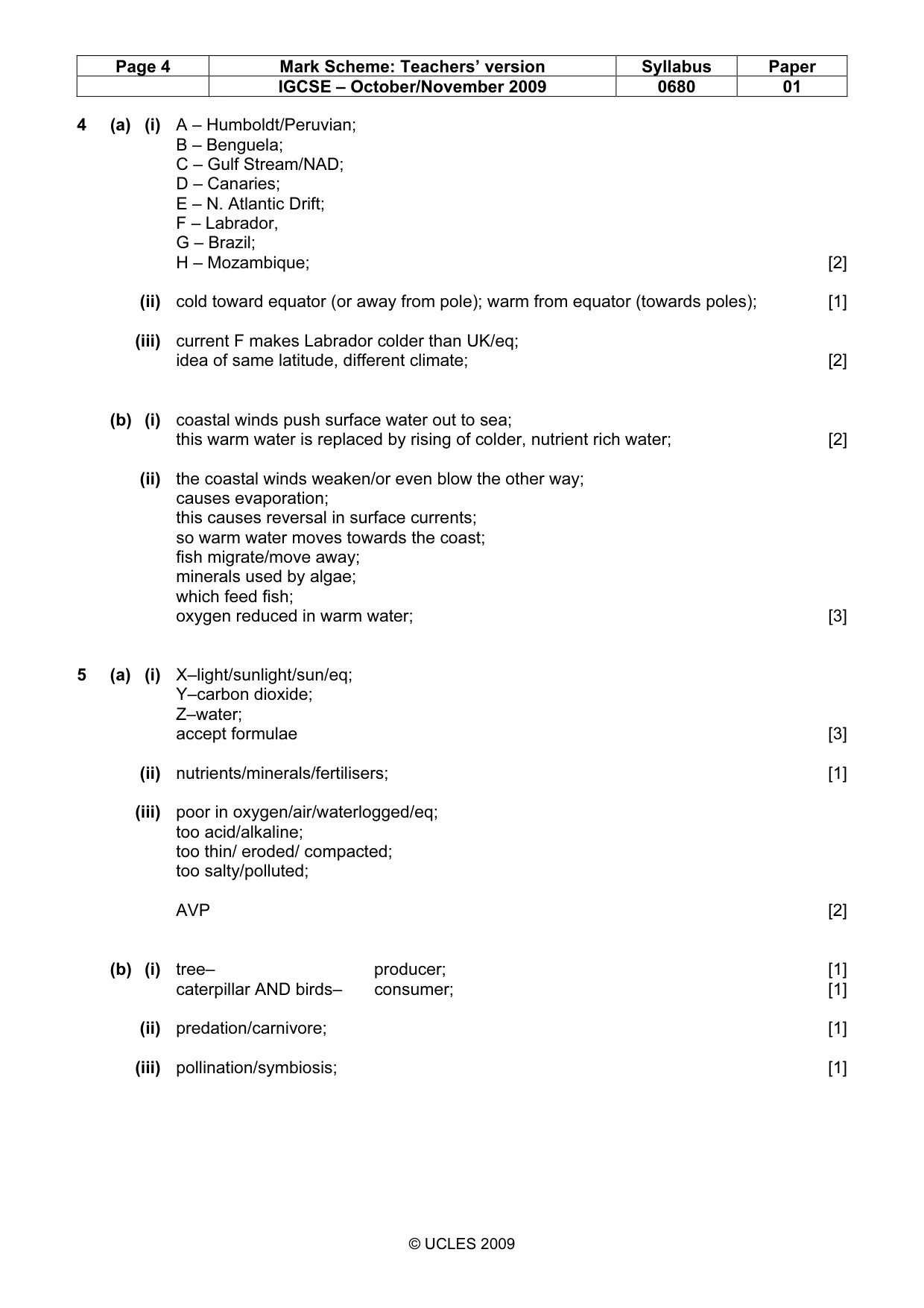
Page 4 Mark Scheme: Teachers’ version Syllabus Paper IGCSE – October/November 2009 0680 01 © UCLES 2009 4 (a) (i) A – Humboldt/Peruvian; B – Benguela; C – Gulf Stream/NAD; D – Canaries; E – N. Atlantic Drift; F – Labrador, G – Brazil; H – Mozambique; [2] (ii) cold toward equator (or away from pole); warm from equator (towards poles); [1] (iii) current F makes Labrador colder than UK/eq; idea of same latitude, different climate; [2] (b) (i) coastal winds push surface water out to sea; this warm water is replaced by rising of colder, nutrient rich water; [2] (ii) the coastal winds weaken/or even blow the other way; causes evaporation; this causes reversal in surface currents; so warm water moves towards the coast; fish migrate/move away; minerals used by algae; which feed fish; oxygen reduced in warm water; [3] 5 (a) (i) X–light/sunlight/sun/eq; Y–carbon dioxide; Z–water; accept formulae [3] (ii) nutrients/minerals/fertilisers; [1] (iii) poor in oxygen/air/waterlogged/eq; too acid/alkaline; too thin/ eroded/ compacted; too salty/polluted; AVP [2] (b) (i) tree– producer; [1] caterpillar AND birds– consumer; [1] (ii) predation/carnivore; [1] (iii) pollination/symbiosis; [1]
Mark scheme, page 5
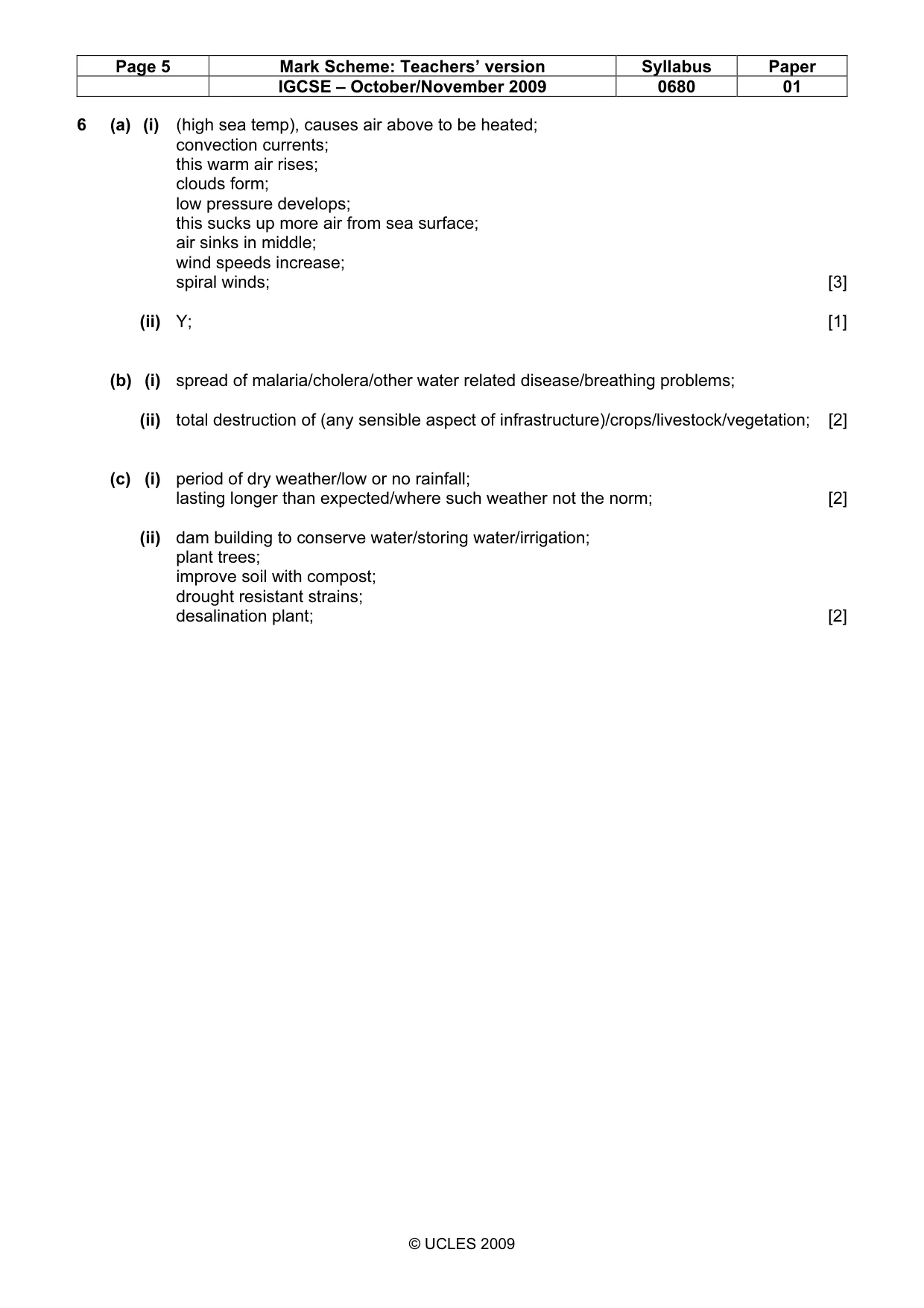
Page 5 Mark Scheme: Teachers’ version Syllabus Paper IGCSE – October/November 2009 0680 01 © UCLES 2009 6 (a) (i) (high sea temp), causes air above to be heated; convection currents; this warm air rises; clouds form; low pressure develops; this sucks up more air from sea surface; air sinks in middle; wind speeds increase; spiral winds; [3] (ii) Y; [1] (b) (i) spread of malaria/cholera/other water related disease/breathing problems; (ii) total destruction of (any sensible aspect of infrastructure)/crops/livestock/vegetation; [2] (c) (i) period of dry weather/low or no rainfall; lasting longer than expected/where such weather not the norm; [2] (ii) dam building to conserve water/storing water/irrigation; plant trees; improve soil with compost; drought resistant strains; desalination plant; [2]
What you needed in this session
Cambridge’s own grade thresholds for 2009 Oct/Nov, Paper 1 · Variant 1. A higher threshold means an easier paper — the bar moves with how the cohort did.