Cambridge IGCSE Environmental Management 0680 — 2009 May/June Paper 1 · Variant 1
0680/11/M/J/09 · 60 marks · ≈68 min
The question paper and its mark scheme, free to read here and free to download. This is Cambridge’s own paper, exactly as it was sat.
Question paper16 pages
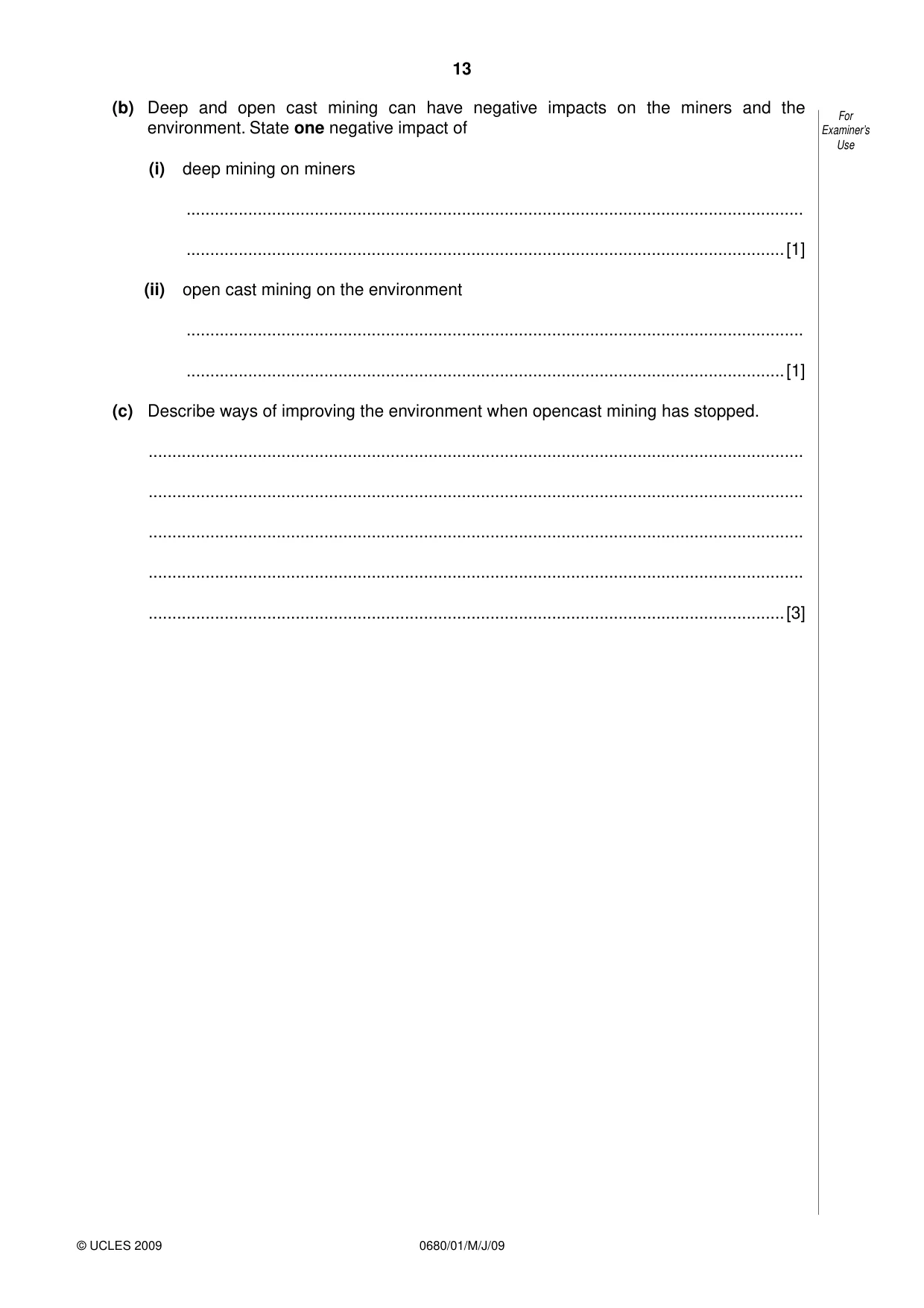


Mark scheme5 pages
Answers below. Sit the paper first if you are practising.
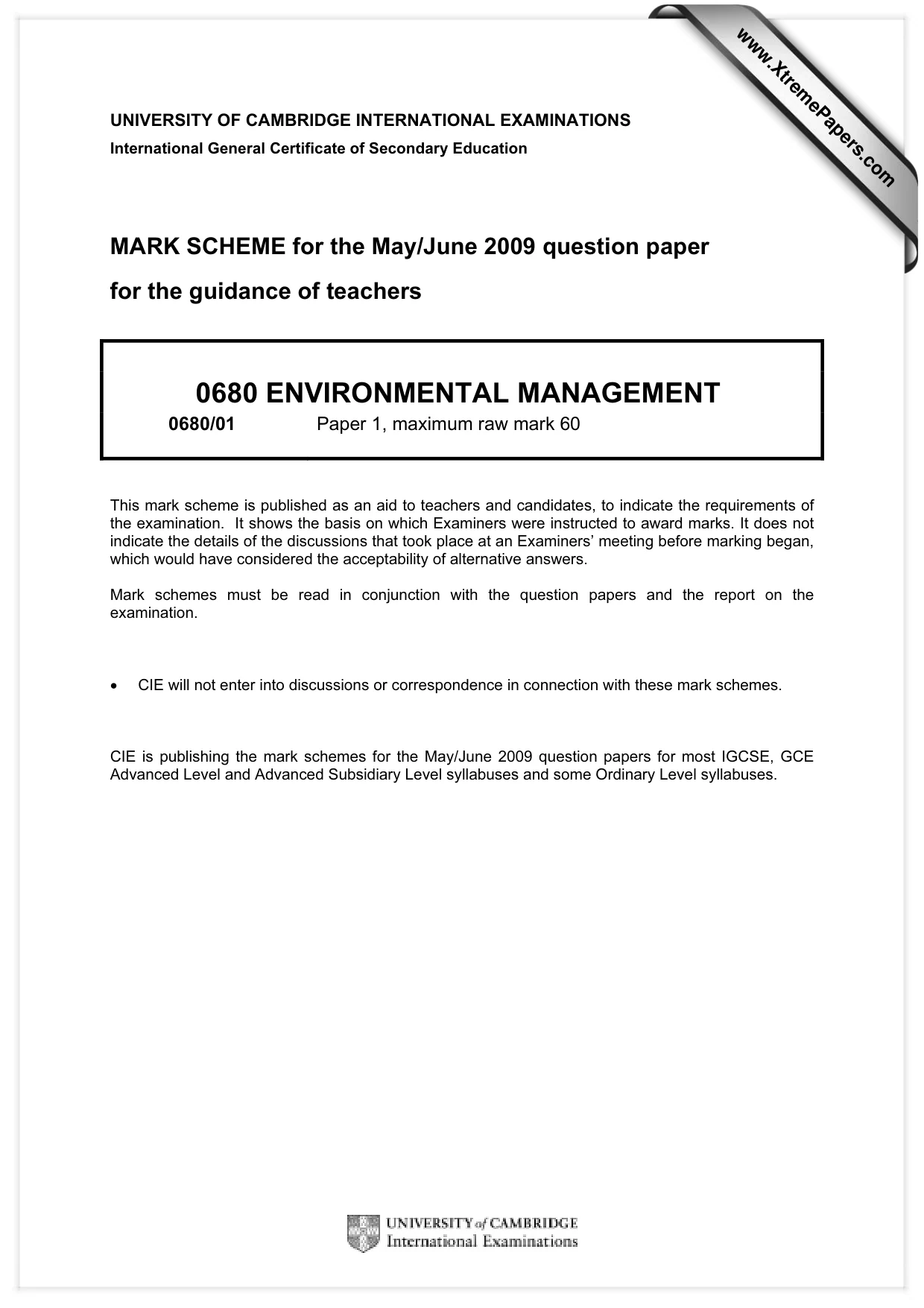
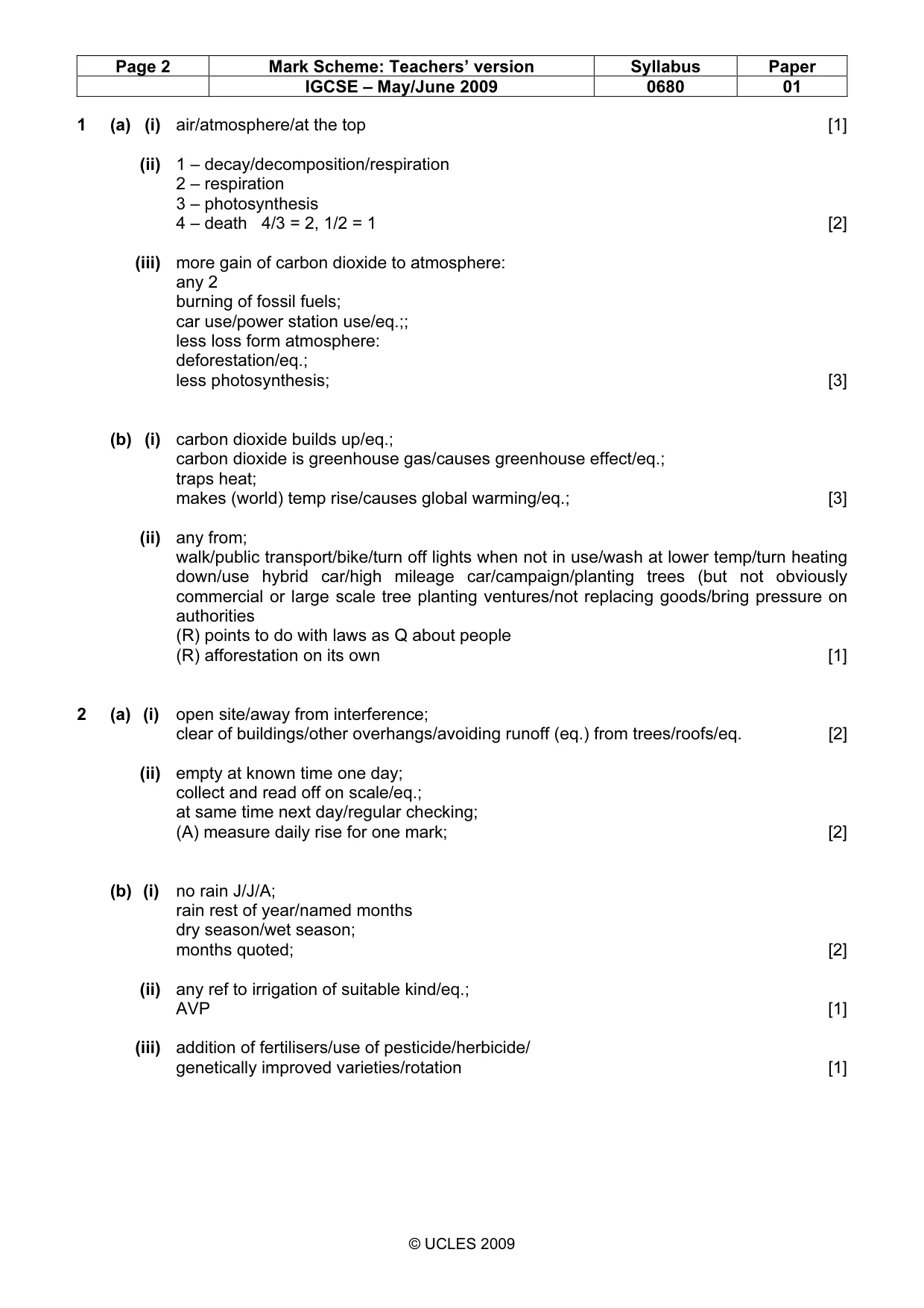
Paper as text
Question paper, page 1
This document consists of 13 printed pages and 3 blank pages. SP (NF/CGW) T76668/3 © UCLES 2009 [Turn over UNIVERSITY OF CAMBRIDGE INTERNATIONAL EXAMINATIONS International General Certificate of Secondary Education READ THESE INSTRUCTIONS FIRST Write your Centre number, candidate number and name on all the work you hand in. Write in dark blue or black pen. You may use a soft pencil for any diagrams, graphs or rough working. Do not use staples, paper clips, highlighters, glue or correction fluid. DO NOT WRITE IN ANY BARCODES. Answer all questions. At the end of the examination, fasten all your work securely together. The number of marks is given in brackets [ ] at the end of each question or part question. * 1 8 6 9 1 6 1 5 1 5 * ENVIRONMENTAL MANAGEMENT 0680/01 Paper 1 May/June 2009 1 hour 30 minutes Candidates answer on the Question Paper. Additional Materials: Ruler For Examiner’s Use 1 2 3 4 5 6 Total www.XtremePapers.com
Question paper, page 2
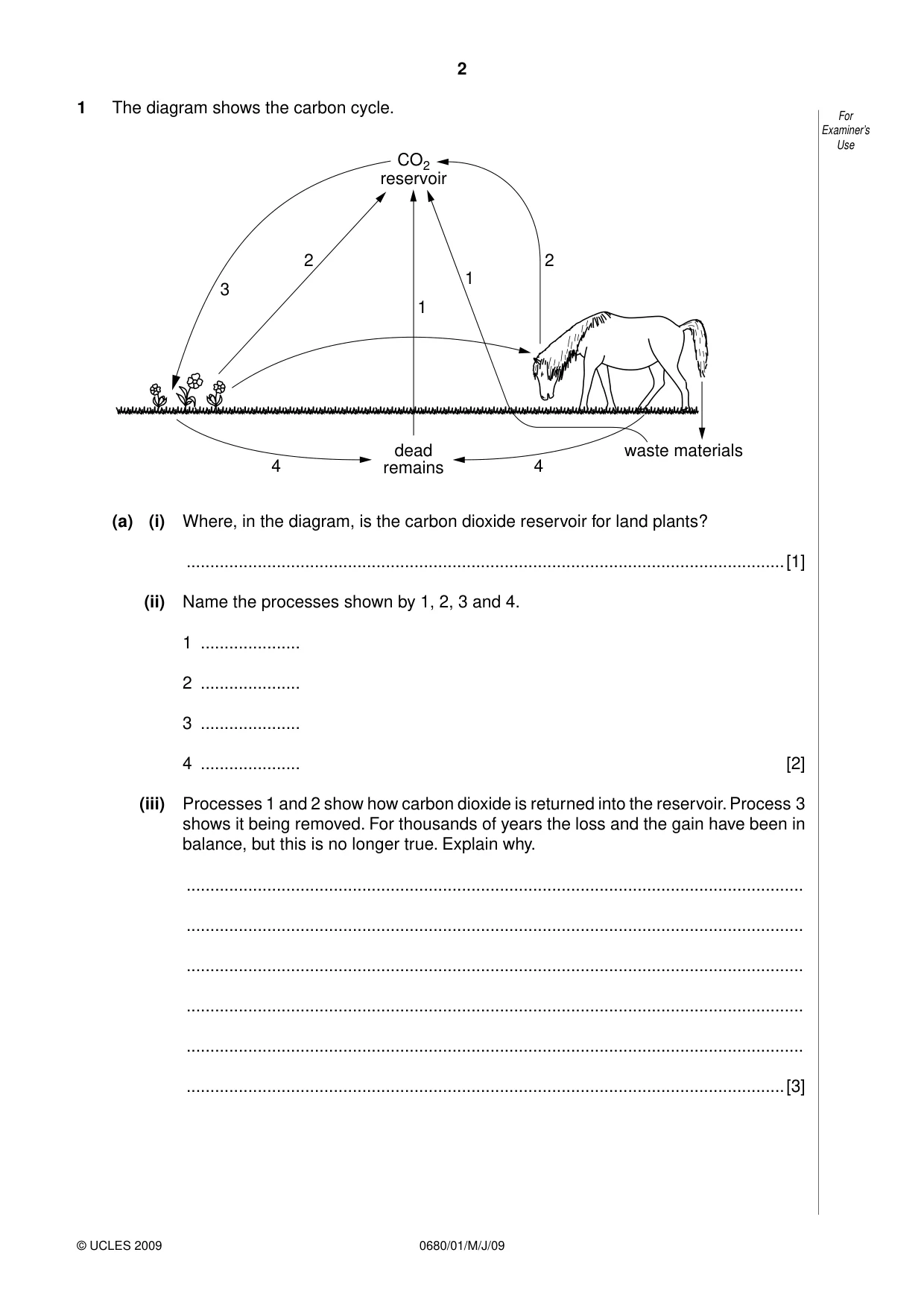
2 0680/01/M/J/09 © UCLES 2009 For Examiner’s Use 1 The diagram shows the carbon cycle. dead remains 1 1 4 4 2 2 3 waste materials reservoir CO2 (a) (i) Where, in the diagram, is the carbon dioxide reservoir for land plants? …[1] (ii) Name the processes shown by 1, 2, 3 and 4. 1 … 2 … 3 … 4 … [2] (iii) Processes 1 and 2 show how carbon dioxide is returned into the reservoir. Process 3 shows it being removed. For thousands of years the loss and the gain have been in balance, but this is no longer true. Explain why. … … … … … …[3]
Question paper, page 3
3 0680/01/M/J/09 © UCLES 2009 [Turn over For Examiner’s Use (b) (i) Explain how this lack of balance between carbon dioxide loss and gain might lead to climate change. … … … … …[3] (ii) State one way people might take action to reduce this problem of climate change. … …[1]
Question paper, page 4
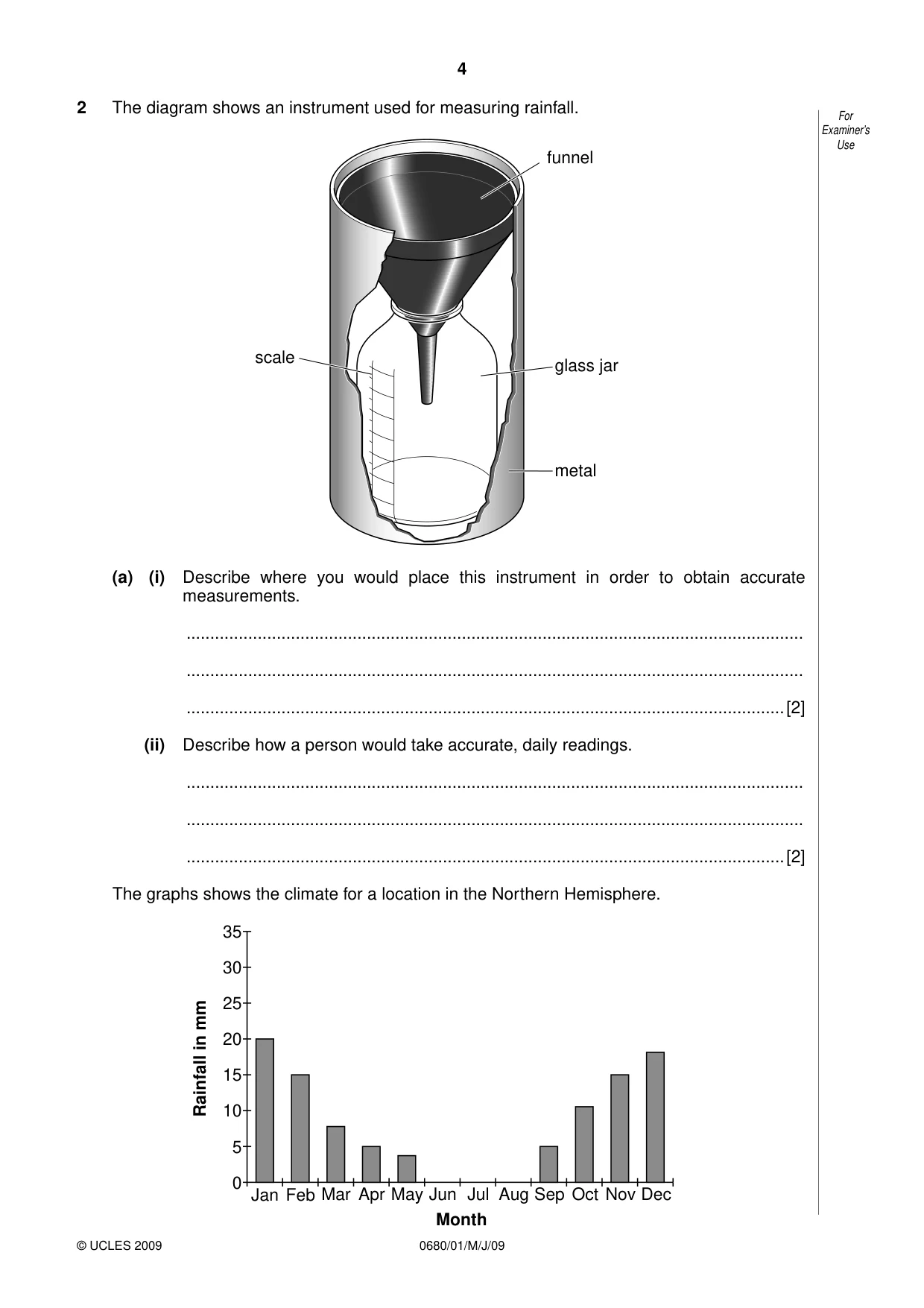
4 0680/01/M/J/09 © UCLES 2009 For Examiner’s Use 2 The diagram shows an instrument used for measuring rainfall. glass jar metal funnel scale (a) (i) Describe where you would place this instrument in order to obtain accurate measurements. … … …[2] (ii) Describe how a person would take accurate, daily readings. … … …[2] The graphs shows the climate for a location in the Northern Hemisphere. Jan 0 5 10 15 20 25 30 35 Feb Mar Apr May Jun Jul Month Rainfall in mm Aug Sep Oct Nov Dec
Question paper, page 5
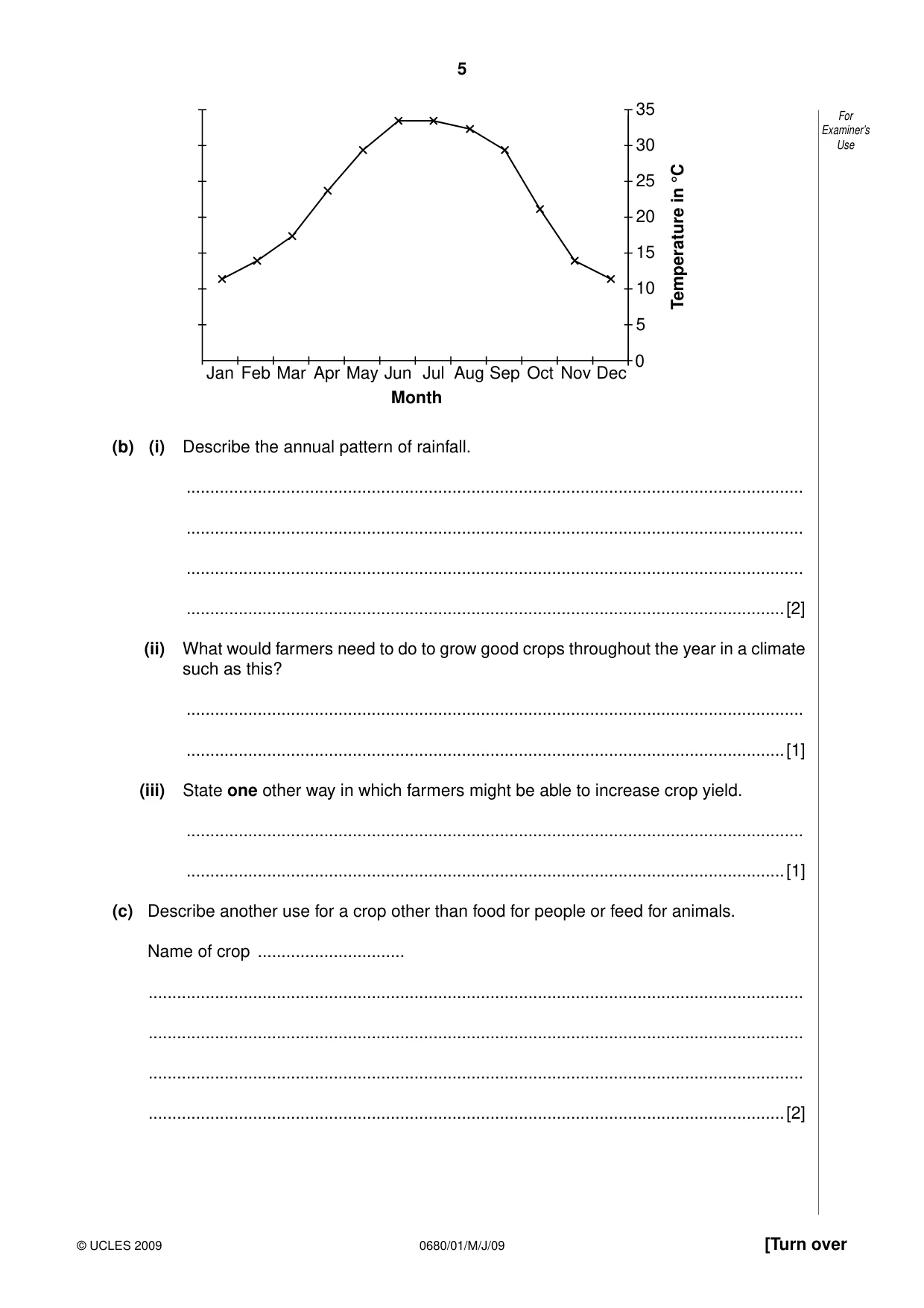
5 0680/01/M/J/09 © UCLES 2009 [Turn over For Examiner’s Use Jan 0 Feb Mar Apr May Jun Jul Month Temperature in °C Aug Sep Oct Nov Dec 5 10 15 20 25 30 35 (b) (i) Describe the annual pattern of rainfall. … … … …[2] (ii) What would farmers need to do to grow good crops throughout the year in a climate such as this? … …[1] (iii) State one other way in which farmers might be able to increase crop yield. … …[1] (c) Describe another use for a crop other than food for people or feed for animals. Name of crop … … … … …[2]
Question paper, page 6
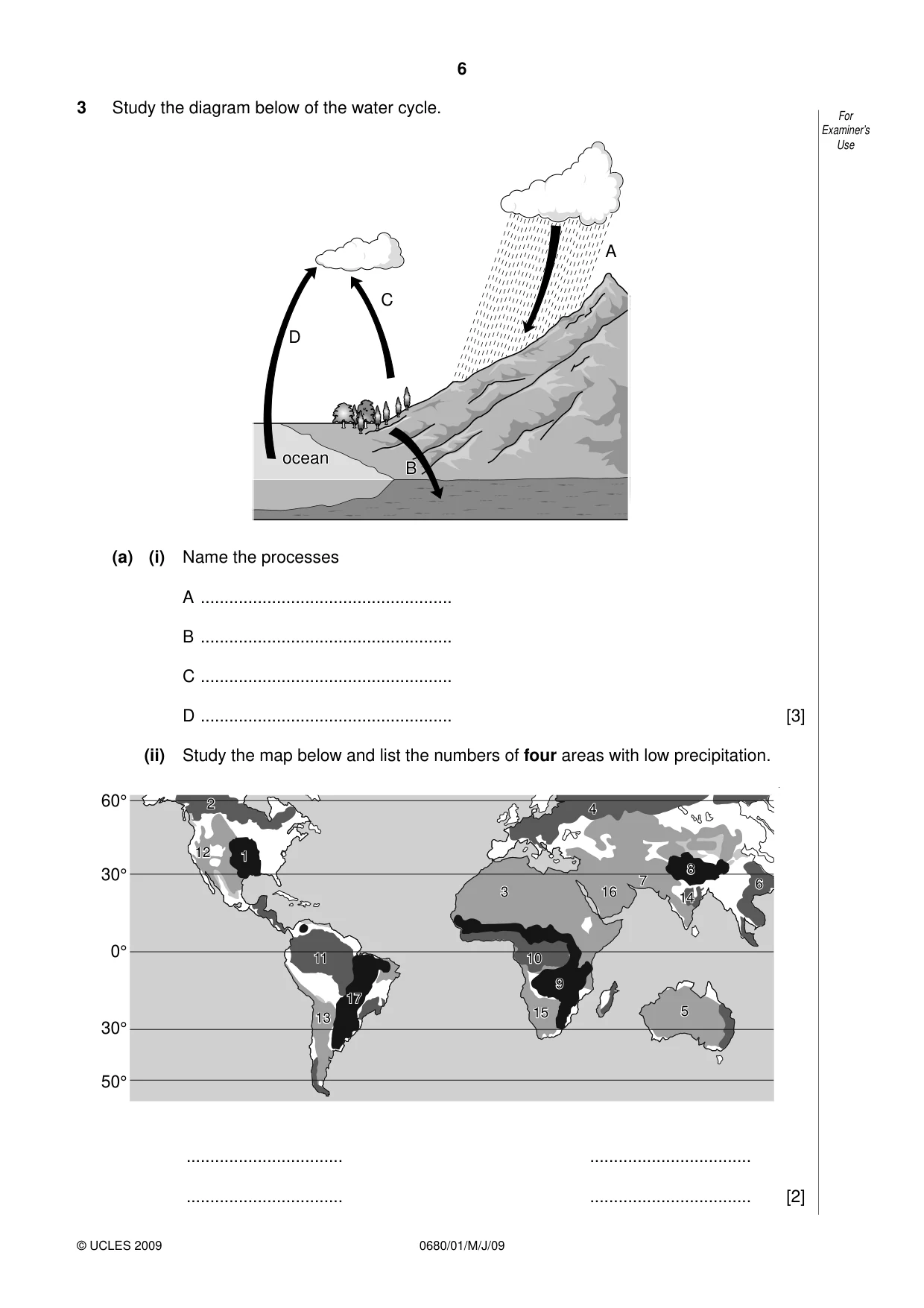
6 0680/01/M/J/09 © UCLES 2009 For Examiner’s Use 3 Study the diagram below of the water cycle. ocean A C D B ocean (a) (i) Name the processes A … B … C … D … [3] (ii) Study the map below and list the numbers of four areas with low precipitation. 0° 2 30° 60° 50° 30° 2 12 1 11 17 13 3 10 9 15 5 16 4 7 8 6 14 12 11 17 13 3 10 9 15 5 16 4 7 8 6 14 … … … … [2]
Question paper, page 7
7 0680/01/M/J/09 © UCLES 2009 [Turn over For Examiner’s Use (b) Even in areas of high precipitation, water may not be of good quality for human use. Two problems are pollution and water related diseases. (i) Name one water pollutant and state one way it affects humans. … … … …[2] (ii) Name one water related disease. …[1] (iii) How might the water related disease you have named be controlled? … … …[2]
Question paper, page 8
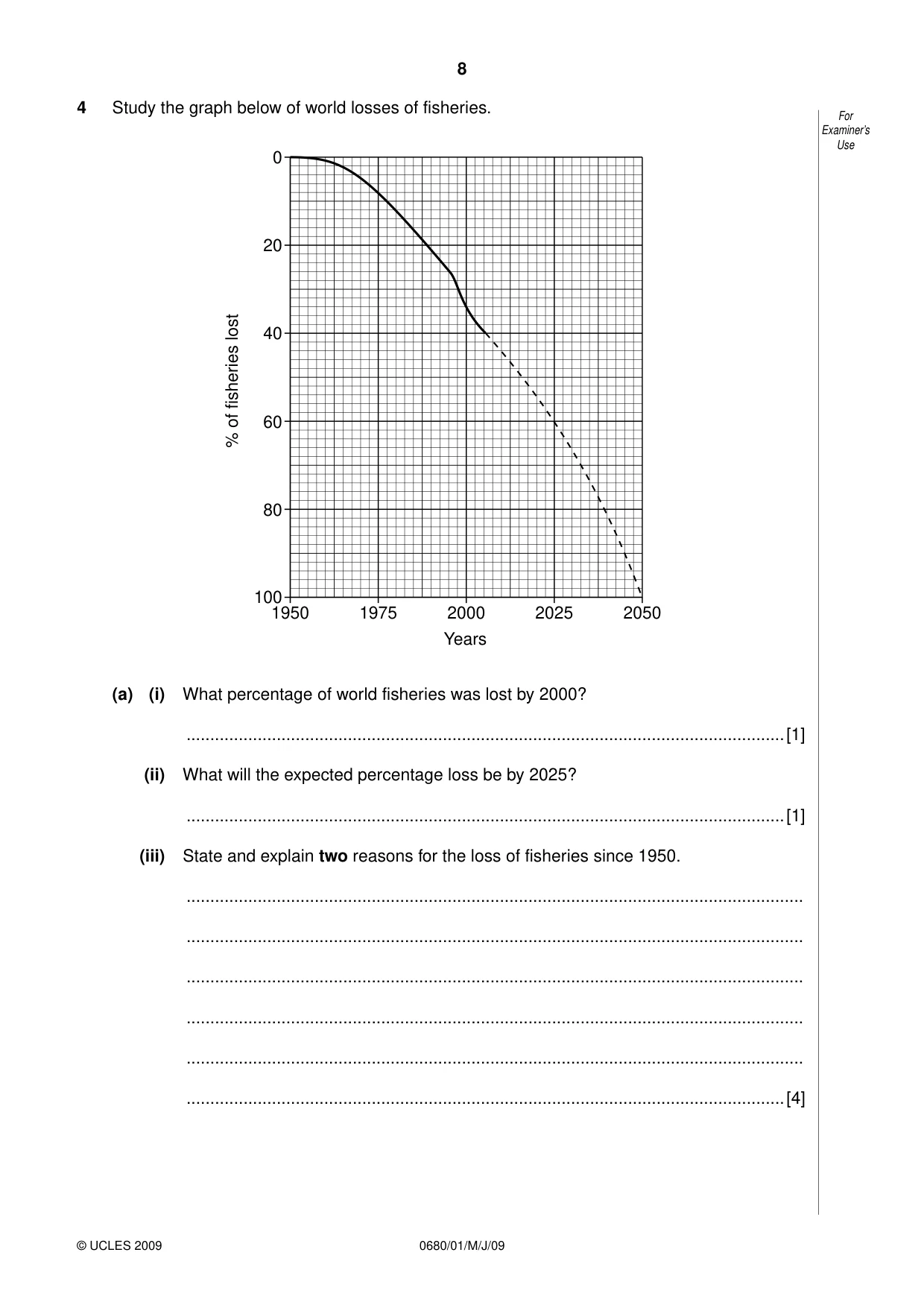
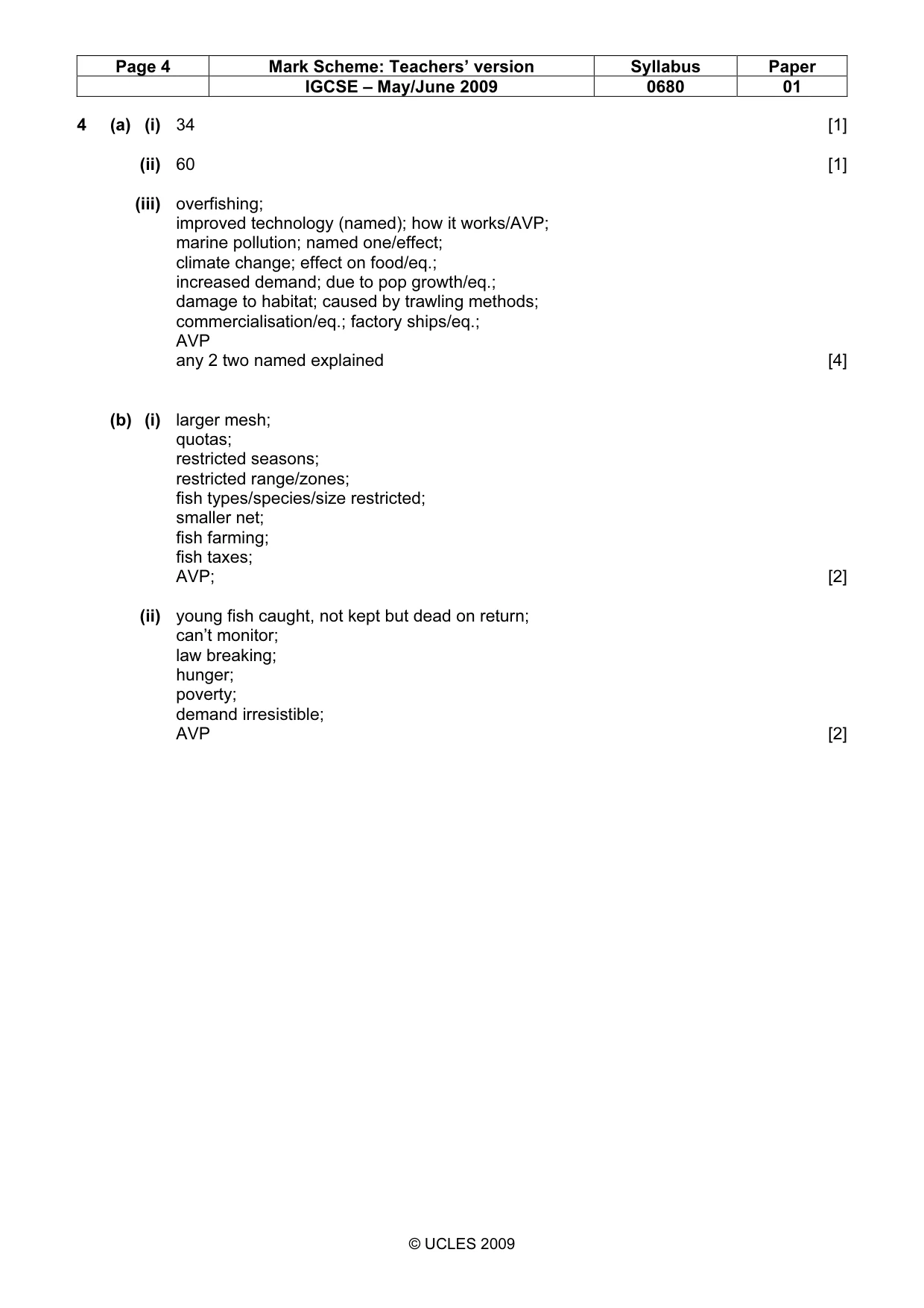
8 0680/01/M/J/09 © UCLES 2009 For Examiner’s Use 4 Study the graph below of world losses of fisheries. 0 20 40 60 % of fisheries lost 80 100 1950 1975 2000 Years 2025 2050 (a) (i) What percentage of world fisheries was lost by 2000? …[1] (ii) What will the expected percentage loss be by 2025? …[1] (iii) State and explain two reasons for the loss of fisheries since 1950. … … … … … …[4]
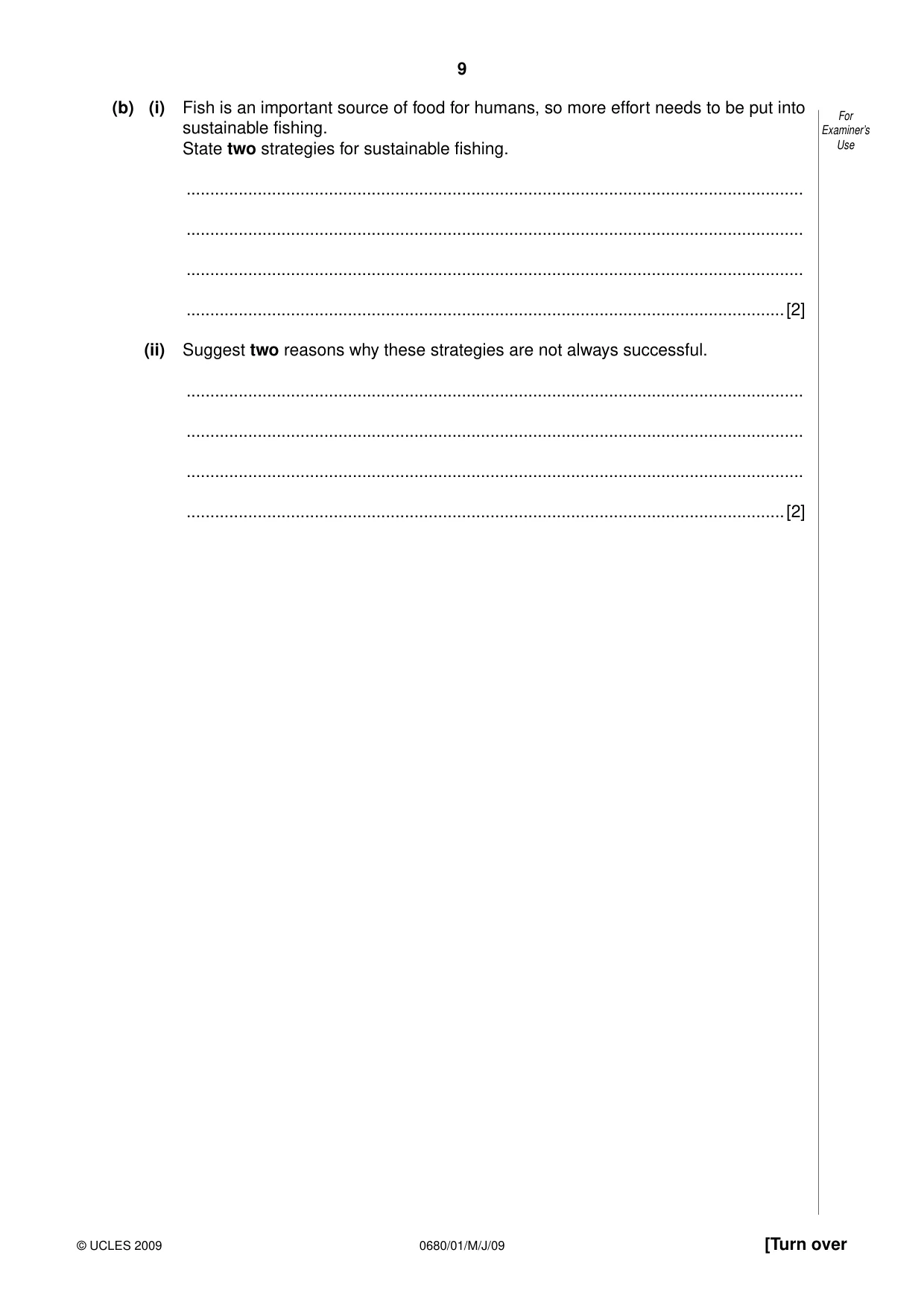
Question paper, page 9
9 0680/01/M/J/09 © UCLES 2009 [Turn over For Examiner’s Use (b) (i) Fish is an important source of food for humans, so more effort needs to be put into sustainable fishing. State two strategies for sustainable fishing. … … … …[2] (ii) Suggest two reasons why these strategies are not always successful. … … … …[2]
Question paper, page 10
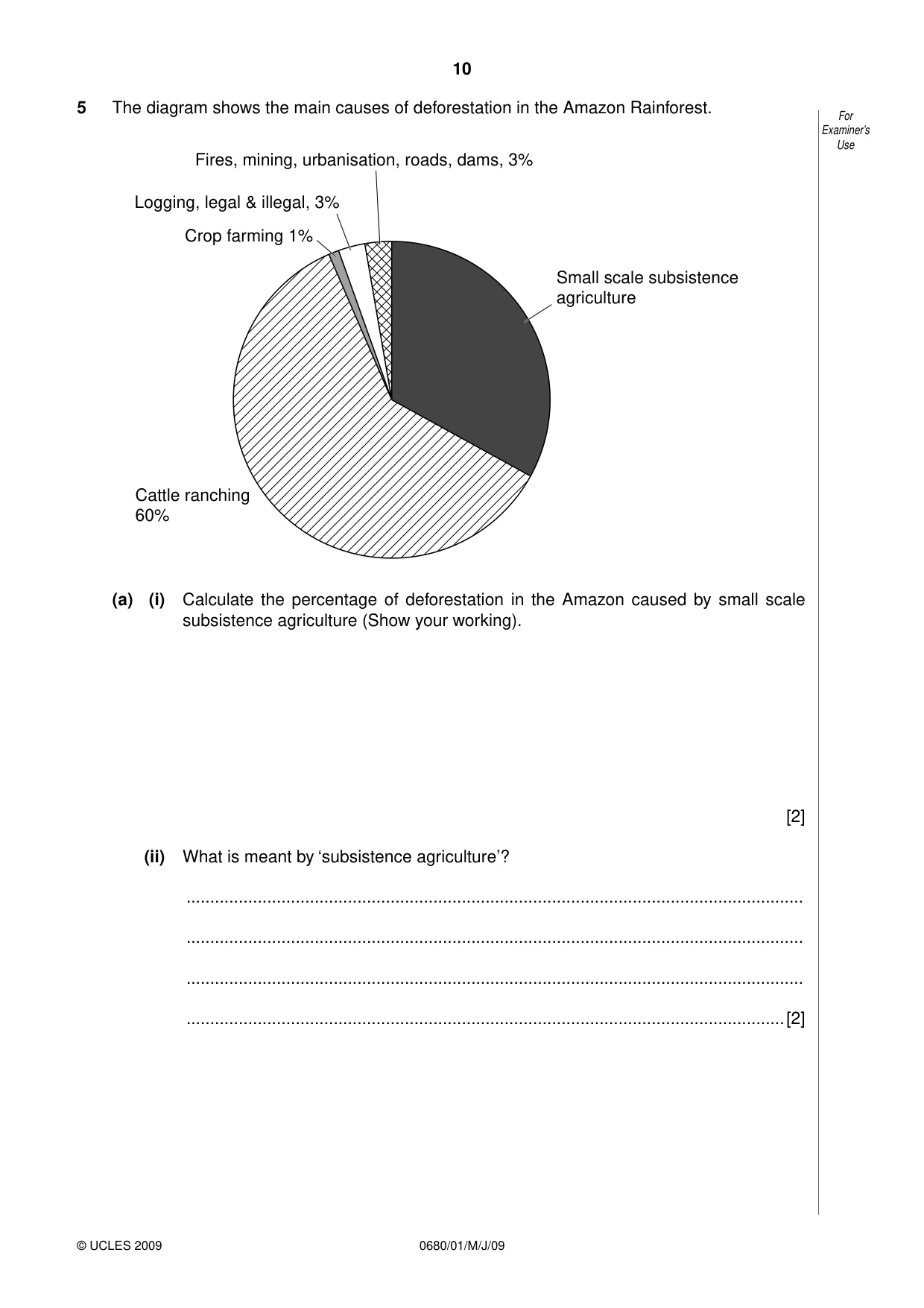
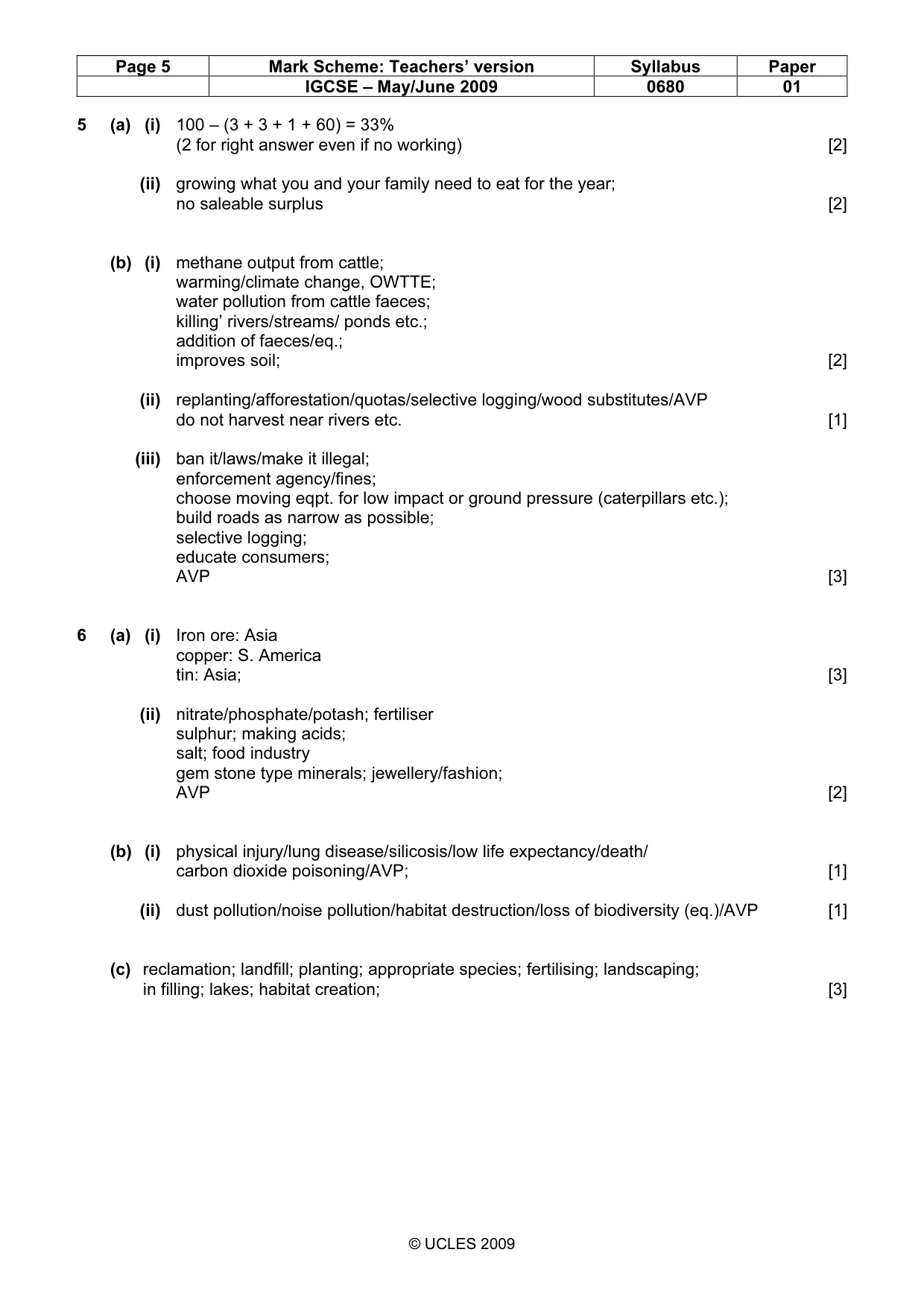
10 0680/01/M/J/09 © UCLES 2009 For Examiner’s Use 5 The diagram shows the main causes of deforestation in the Amazon Rainforest. Cattle ranching 60% Crop farming 1% Small scale subsistence agriculture Logging, legal & illegal, 3% Fires, mining, urbanisation, roads, dams, 3% (a) (i) Calculate the percentage of deforestation in the Amazon caused by small scale subsistence agriculture (Show your working). [2] (ii) What is meant by ‘subsistence agriculture’? … … … …[2]
Question paper, page 11
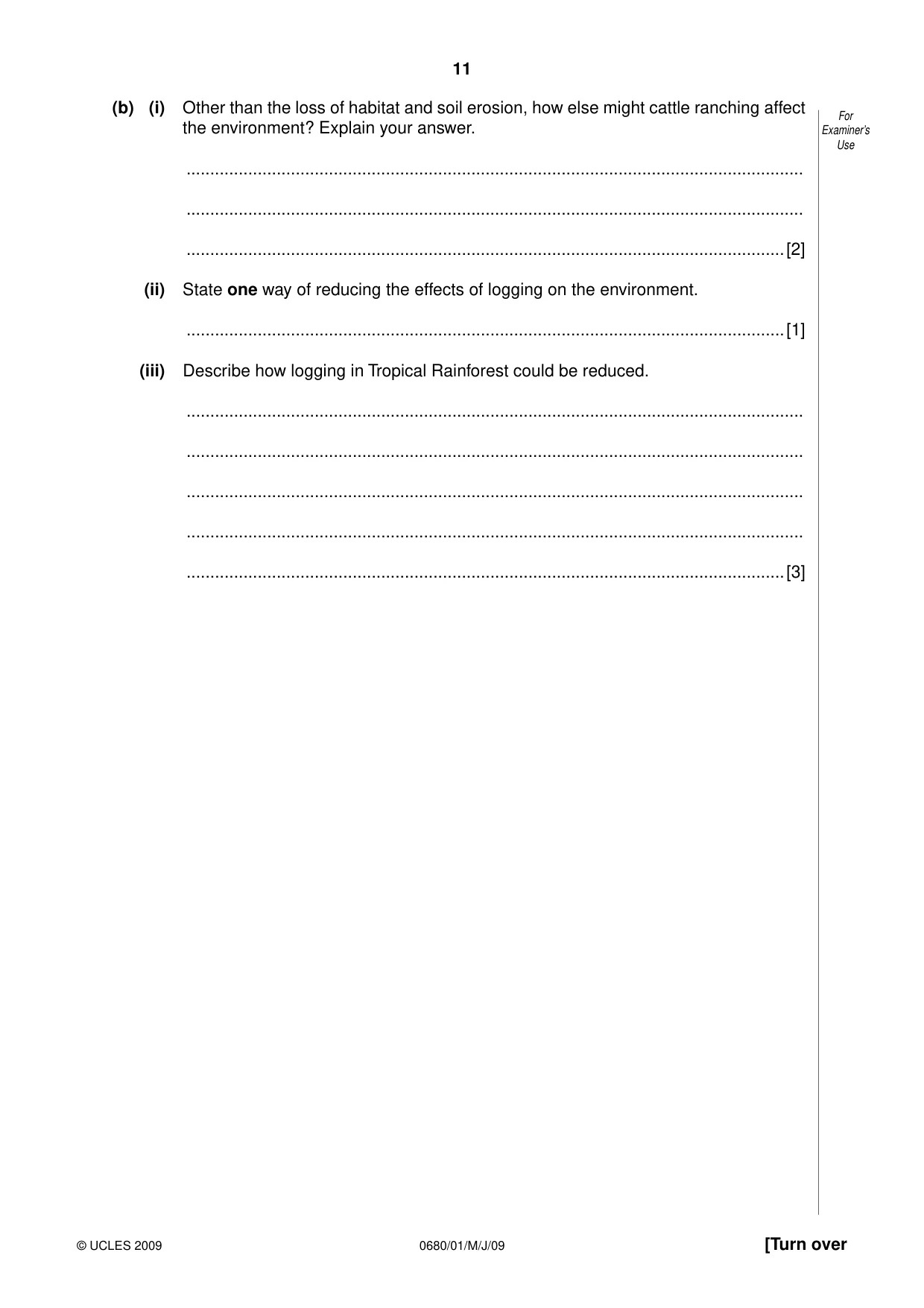
11 0680/01/M/J/09 © UCLES 2009 [Turn over For Examiner’s Use (b) (i) Other than the loss of habitat and soil erosion, how else might cattle ranching affect the environment? Explain your answer. … … …[2] (ii) State one way of reducing the effects of logging on the environment. …[1] (iii) Describe how logging in Tropical Rainforest could be reduced. … … … … …[3]
Question paper, page 12
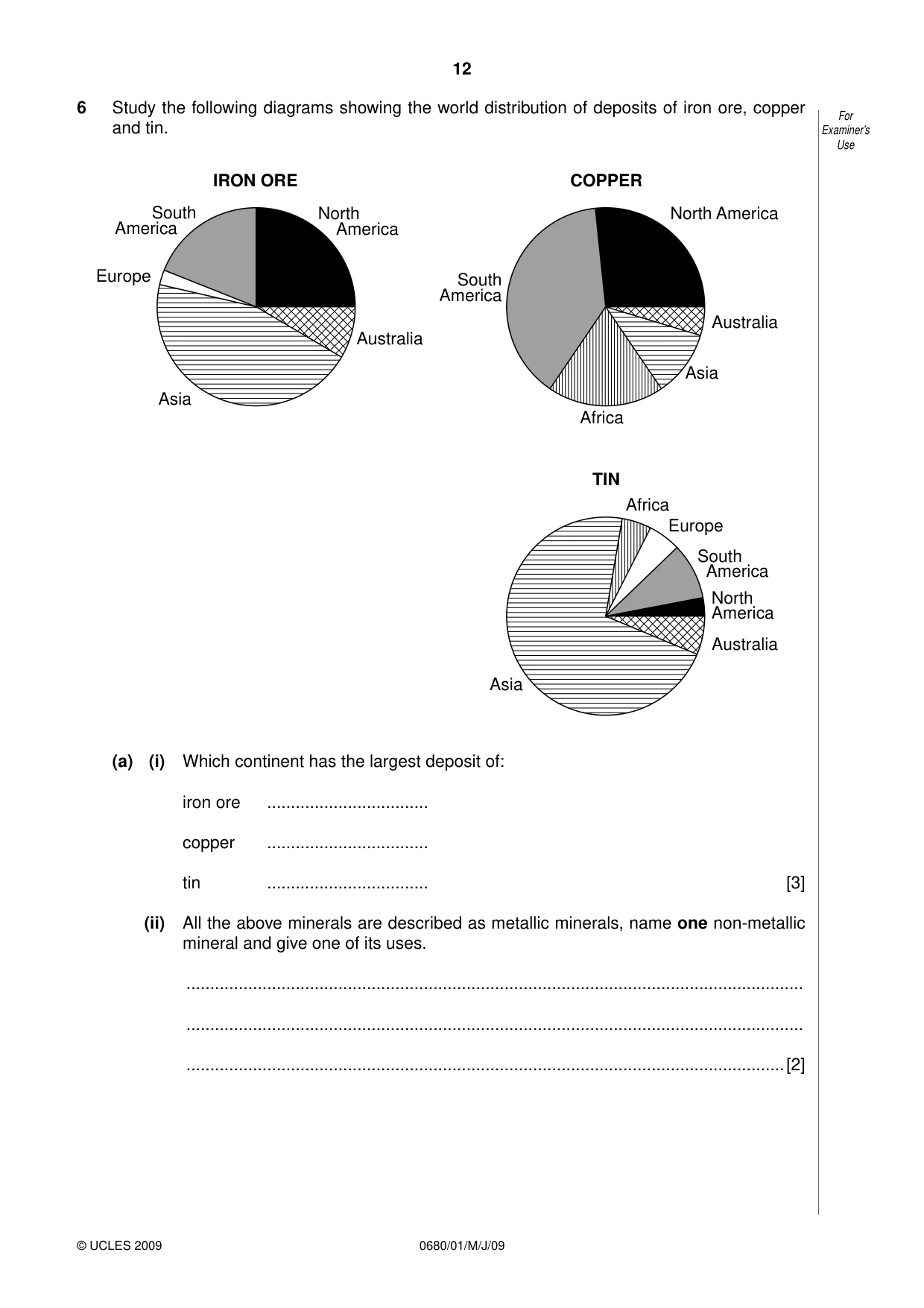
12 0680/01/M/J/09 © UCLES 2009 For Examiner’s Use 6 Study the following diagrams showing the world distribution of deposits of iron ore, copper and tin. North America North America Australia IRON ORE COPPER TIN Australia Australia North America South America South America South America Europe Europe Africa Africa Asia Asia Asia (a) (i) Which continent has the largest deposit of: iron ore … copper … tin … [3] (ii) All the above minerals are described as metallic minerals, name one non-metallic mineral and give one of its uses. … … …[2]
Question paper, page 13
13 0680/01/M/J/09 © UCLES 2009 For Examiner’s Use (b) Deep and open cast mining can have negative impacts on the miners and the environment. State one negative impact of (i) deep mining on miners … …[1] (ii) open cast mining on the environment … …[1] (c) Describe ways of improving the environment when opencast mining has stopped. … … … … …[3]
Question paper, page 16
16 0680/01/M/J/09 BLANK PAGE Permission to reproduce items where third-party owned material protected by copyright is included has been sought and cleared where possible. Every reasonable effort has been made by the publisher (UCLES) to trace copyright holders, but if any items requiring clearance have unwittingly been included, the publisher will be pleased to make amends at the earliest possible opportunity. University of Cambridge International Examinations is part of the Cambridge Assessment Group. Cambridge Assessment is the brand name of University of Cambridge Local Examinations Syndicate (UCLES), which is itself a department of the University of Cambridge.
Mark scheme, page 1
UNIVERSITY OF CAMBRIDGE INTERNATIONAL EXAMINATIONS International General Certificate of Secondary Education MARK SCHEME for the May/June 2009 question paper for the guidance of teachers 0680 ENVIRONMENTAL MANAGEMENT 0680/01 Paper 1, maximum raw mark 60 This mark scheme is published as an aid to teachers and candidates, to indicate the requirements of the examination. It shows the basis on which Examiners were instructed to award marks. It does not indicate the details of the discussions that took place at an Examiners’ meeting before marking began, which would have considered the acceptability of alternative answers. Mark schemes must be read in conjunction with the question papers and the report on the examination. • CIE will not enter into discussions or correspondence in connection with these mark schemes. CIE is publishing the mark schemes for the May/June 2009 question papers for most IGCSE, GCE Advanced Level and Advanced Subsidiary Level syllabuses and some Ordinary Level syllabuses. www.XtremePapers.com
Mark scheme, page 2
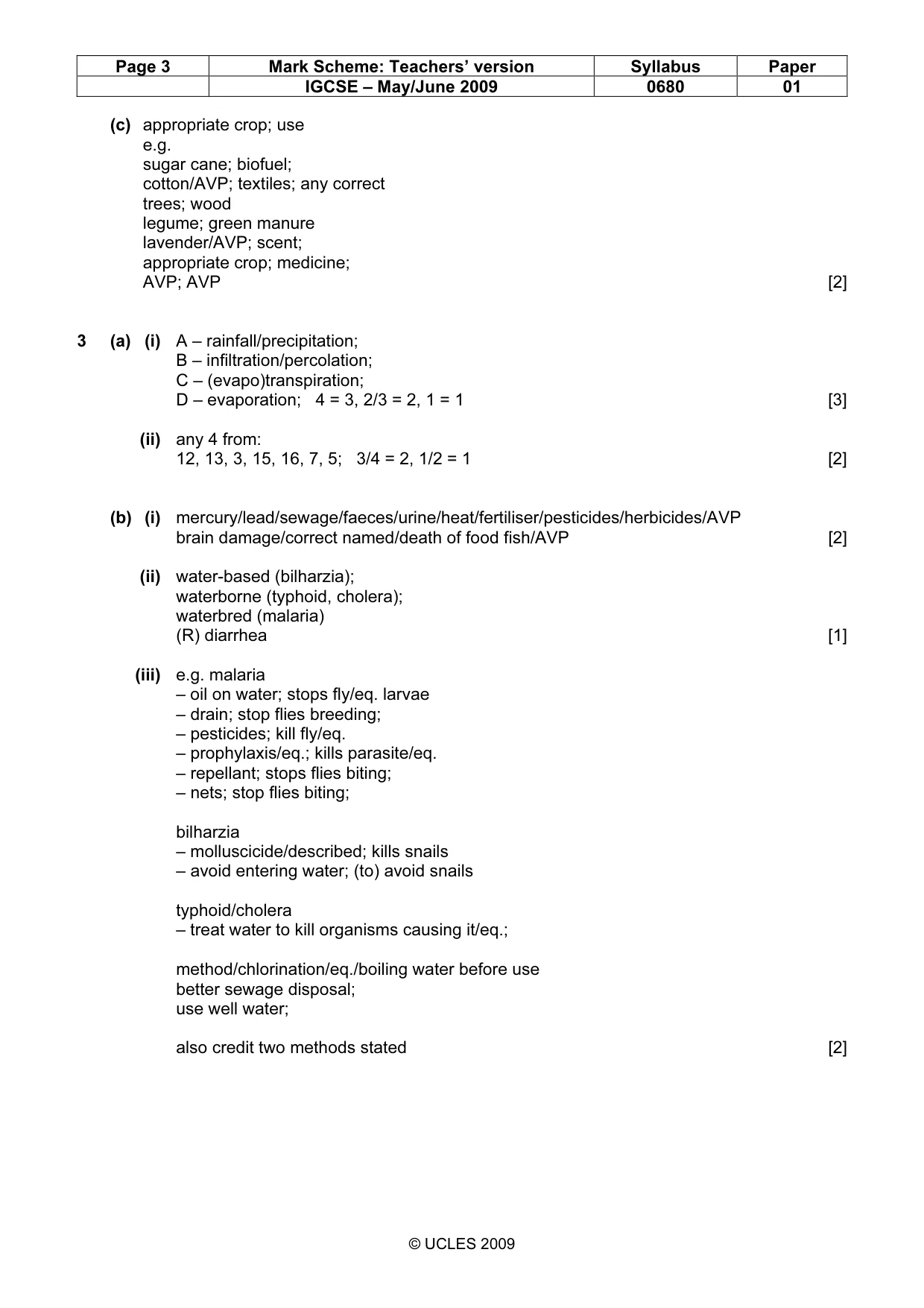
Page 2 Mark Scheme: Teachers’ version Syllabus Paper IGCSE – May/June 2009 0680 01 © UCLES 2009 1 (a) (i) air/atmosphere/at the top [1] (ii) 1 – decay/decomposition/respiration 2 – respiration 3 – photosynthesis 4 – death 4/3 = 2, 1/2 = 1 [2] (iii) more gain of carbon dioxide to atmosphere: any 2 burning of fossil fuels; car use/power station use/eq.;; less loss form atmosphere: deforestation/eq.; less photosynthesis; [3] (b) (i) carbon dioxide builds up/eq.; carbon dioxide is greenhouse gas/causes greenhouse effect/eq.; traps heat; makes (world) temp rise/causes global warming/eq.; [3] (ii) any from; walk/public transport/bike/turn off lights when not in use/wash at lower temp/turn heating down/use hybrid car/high mileage car/campaign/planting trees (but not obviously commercial or large scale tree planting ventures/not replacing goods/bring pressure on authorities (R) points to do with laws as Q about people (R) afforestation on its own [1] 2 (a) (i) open site/away from interference; clear of buildings/other overhangs/avoiding runoff (eq.) from trees/roofs/eq. [2] (ii) empty at known time one day; collect and read off on scale/eq.; at same time next day/regular checking; (A) measure daily rise for one mark; [2] (b) (i) no rain J/J/A; rain rest of year/named months dry season/wet season; months quoted; [2] (ii) any ref to irrigation of suitable kind/eq.; AVP [1] (iii) addition of fertilisers/use of pesticide/herbicide/ genetically improved varieties/rotation [1]
Mark scheme, page 3
Page 3 Mark Scheme: Teachers’ version Syllabus Paper IGCSE – May/June 2009 0680 01 © UCLES 2009 (c) appropriate crop; use e.g. sugar cane; biofuel; cotton/AVP; textiles; any correct trees; wood legume; green manure lavender/AVP; scent; appropriate crop; medicine; AVP; AVP [2] 3 (a) (i) A – rainfall/precipitation; B – infiltration/percolation; C – (evapo)transpiration; D – evaporation; 4 = 3, 2/3 = 2, 1 = 1 [3] (ii) any 4 from: 12, 13, 3, 15, 16, 7, 5; 3/4 = 2, 1/2 = 1 [2] (b) (i) mercury/lead/sewage/faeces/urine/heat/fertiliser/pesticides/herbicides/AVP brain damage/correct named/death of food fish/AVP [2] (ii) water-based (bilharzia); waterborne (typhoid, cholera); waterbred (malaria) (R) diarrhea [1] (iii) e.g. malaria – oil on water; stops fly/eq. larvae – drain; stop flies breeding; – pesticides; kill fly/eq. – prophylaxis/eq.; kills parasite/eq. – repellant; stops flies biting; – nets; stop flies biting; bilharzia – molluscicide/described; kills snails – avoid entering water; (to) avoid snails typhoid/cholera – treat water to kill organisms causing it/eq.; method/chlorination/eq./boiling water before use better sewage disposal; use well water; also credit two methods stated [2]
Mark scheme, page 4
Page 4 Mark Scheme: Teachers’ version Syllabus Paper IGCSE – May/June 2009 0680 01 © UCLES 2009 4 (a) (i) 34 [1] (ii) 60 [1] (iii) overfishing; improved technology (named); how it works/AVP; marine pollution; named one/effect; climate change; effect on food/eq.; increased demand; due to pop growth/eq.; damage to habitat; caused by trawling methods; commercialisation/eq.; factory ships/eq.; AVP any 2 two named explained [4] (b) (i) larger mesh; quotas; restricted seasons; restricted range/zones; fish types/species/size restricted; smaller net; fish farming; fish taxes; AVP; [2] (ii) young fish caught, not kept but dead on return; can’t monitor; law breaking; hunger; poverty; demand irresistible; AVP [2]
Mark scheme, page 5
Page 5 Mark Scheme: Teachers’ version Syllabus Paper IGCSE – May/June 2009 0680 01 © UCLES 2009 5 (a) (i) 100 – (3 + 3 + 1 + 60) = 33% (2 for right answer even if no working) [2] (ii) growing what you and your family need to eat for the year; no saleable surplus [2] (b) (i) methane output from cattle; warming/climate change, OWTTE; water pollution from cattle faeces; killing’ rivers/streams/ ponds etc.; addition of faeces/eq.; improves soil; [2] (ii) replanting/afforestation/quotas/selective logging/wood substitutes/AVP do not harvest near rivers etc. [1] (iii) ban it/laws/make it illegal; enforcement agency/fines; choose moving eqpt. for low impact or ground pressure (caterpillars etc.); build roads as narrow as possible; selective logging; educate consumers; AVP [3] 6 (a) (i) Iron ore: Asia copper: S. America tin: Asia; [3] (ii) nitrate/phosphate/potash; fertiliser sulphur; making acids; salt; food industry gem stone type minerals; jewellery/fashion; AVP [2] (b) (i) physical injury/lung disease/silicosis/low life expectancy/death/ carbon dioxide poisoning/AVP; [1] (ii) dust pollution/noise pollution/habitat destruction/loss of biodiversity (eq.)/AVP [1] (c) reclamation; landfill; planting; appropriate species; fertilising; landscaping; in filling; lakes; habitat creation; [3]
What you needed in this session
Cambridge’s own grade thresholds for 2009 May/June, Paper 1 · Variant 1. A higher threshold means an easier paper — the bar moves with how the cohort did.