Cambridge IGCSE Environmental Management 0680 — 2008 Oct/Nov Paper 1 · Variant 1
0680/11/O/N/08 · 60 marks · ≈68 min
The question paper and its mark scheme, free to read here and free to download. This is Cambridge’s own paper, exactly as it was sat.
Question paper12 pages

Mark scheme4 pages
Answers below. Sit the paper first if you are practising.
Paper as text
Question paper, page 1
This document consists of 12 printed pages. SP (NF/CGW) T53384/4 © UCLES 2008 [Turn over UNIVERSITY OF CAMBRIDGE INTERNATIONAL EXAMINATIONS International General Certificate of Secondary Education READ THESE INSTRUCTIONS FIRST Write your Centre number, candidate number and name on all the work you hand in. Write in dark blue or black pen. You may use a soft pencil for any diagrams, graphs or rough working. Do not use staples, paper clips, highlighters, glue or correction fluid. DO NOT WRITE IN ANY BARCODES. Answer all questions. At the end of the examination, fasten all your work securely together. The number of marks is given in brackets [ ] at the end of each question or part question. * 9 9 8 7 5 0 0 7 4 5 * ENVIRONMENTAL MANAGEMENT 0680/01 Paper 1 October/November 2008 1 hour 30 minutes Candidates answer on the Question Paper. Additional Materials: Ruler For Examiner’s Use 1 2 3 4 5 6 Total www.XtremePapers.com
Question paper, page 2
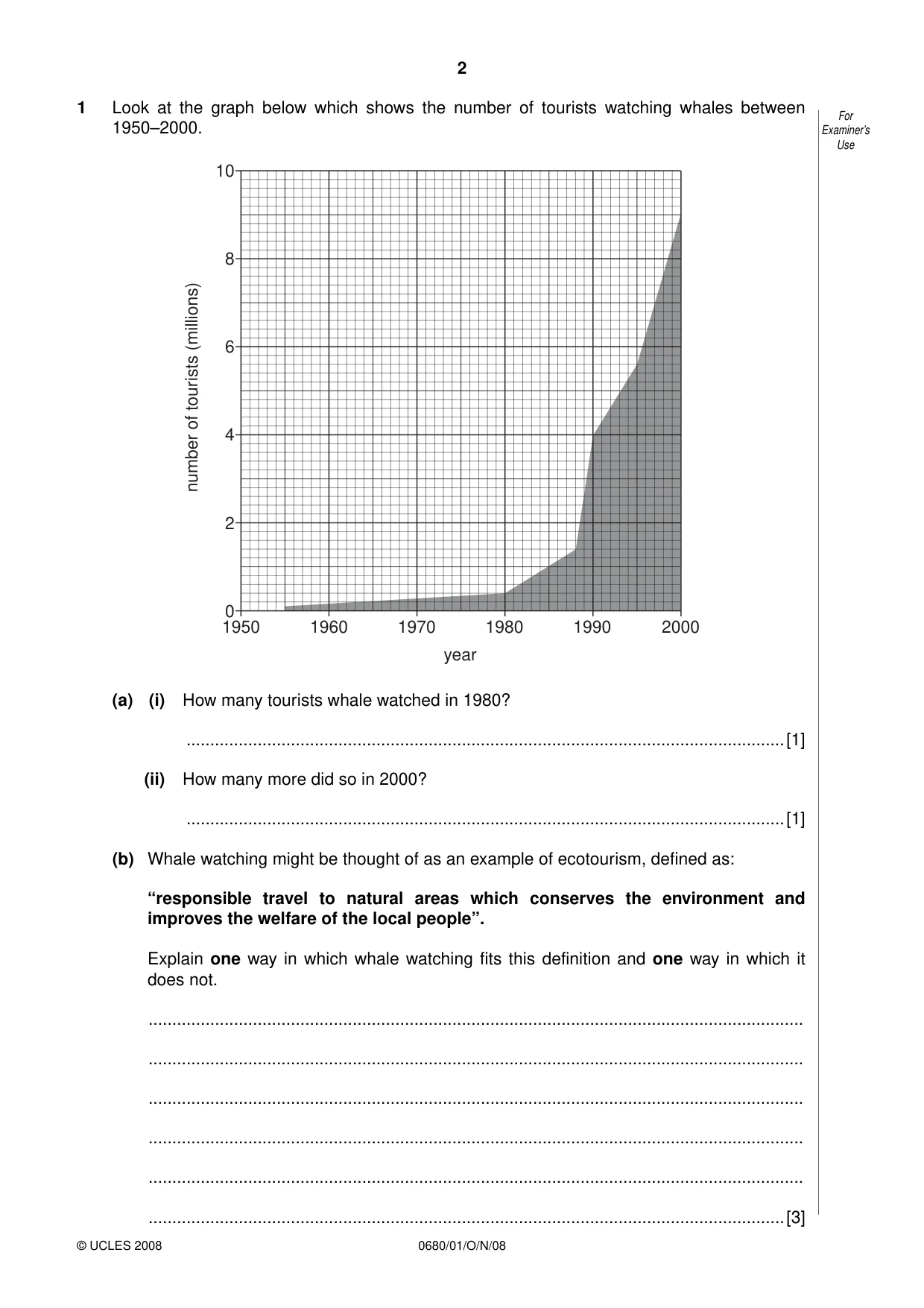
2 0680/01/O/N/08 © UCLES 2008 For Examiner’s Use 1 Look at the graph below which shows the number of tourists watching whales between 1950–2000. 0 1950 1960 1970 year number of tourists (millions) 1980 1990 2000 2 4 6 8 10 (a) (i) How many tourists whale watched in 1980? …[1] (ii) How many more did so in 2000? …[1] (b) Whale watching might be thought of as an example of ecotourism, defined as: “responsible travel to natural areas which conserves the environment and improves the welfare of the local people”. Explain one way in which whale watching fits this definition and one way in which it does not. … … … … … …[3]
Question paper, page 3
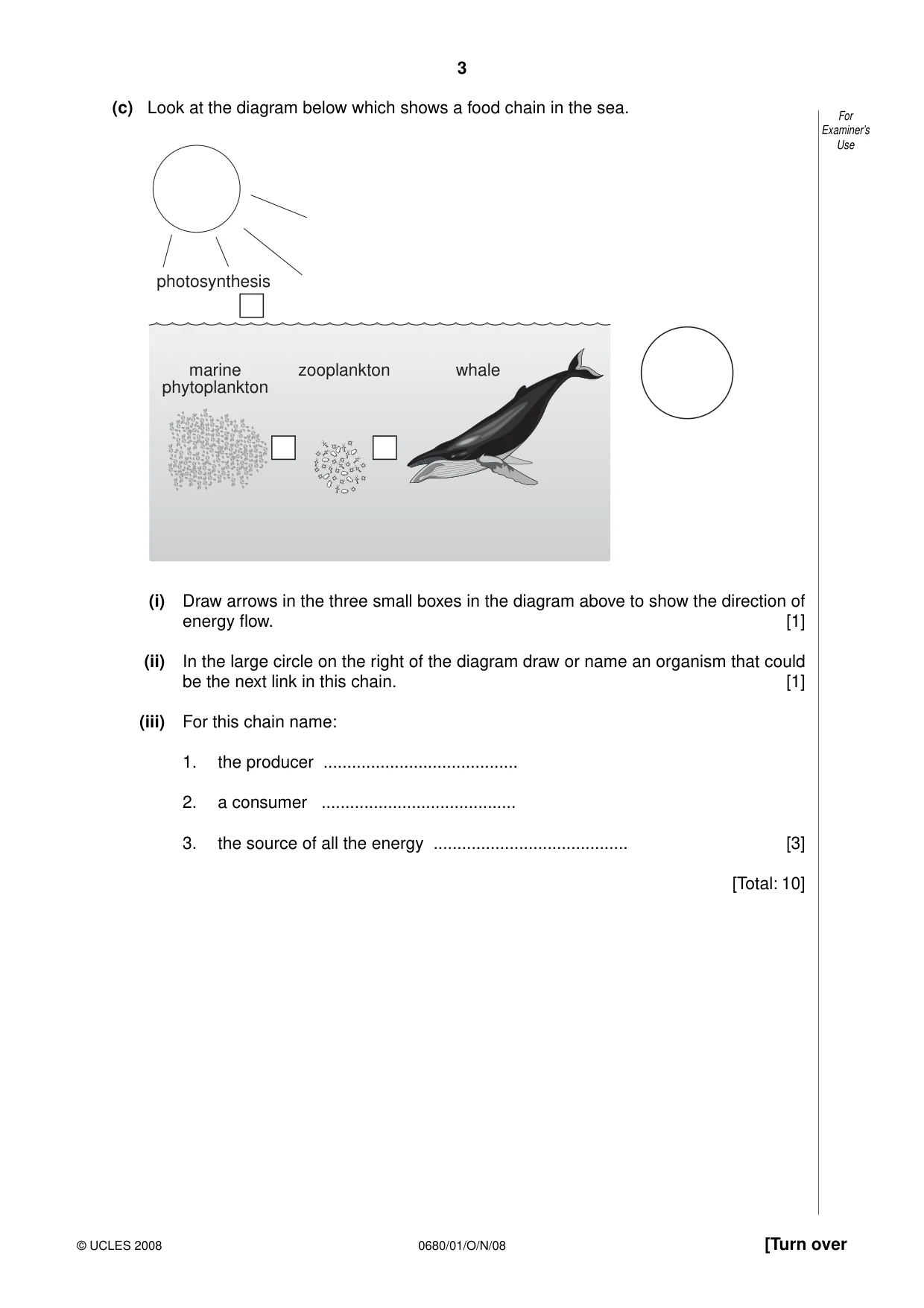
3 0680/01/O/N/08 © UCLES 2008 [Turn over For Examiner’s Use (c) Look at the diagram below which shows a food chain in the sea. whale zooplankton marine phytoplankton photosynthesis (i) Draw arrows in the three small boxes in the diagram above to show the direction of energy flow. [1] (ii) In the large circle on the right of the diagram draw or name an organism that could be the next link in this chain. [1] (iii) For this chain name: 1. the producer … 2. a consumer … 3. the source of all the energy … [3] [Total: 10]
Question paper, page 4
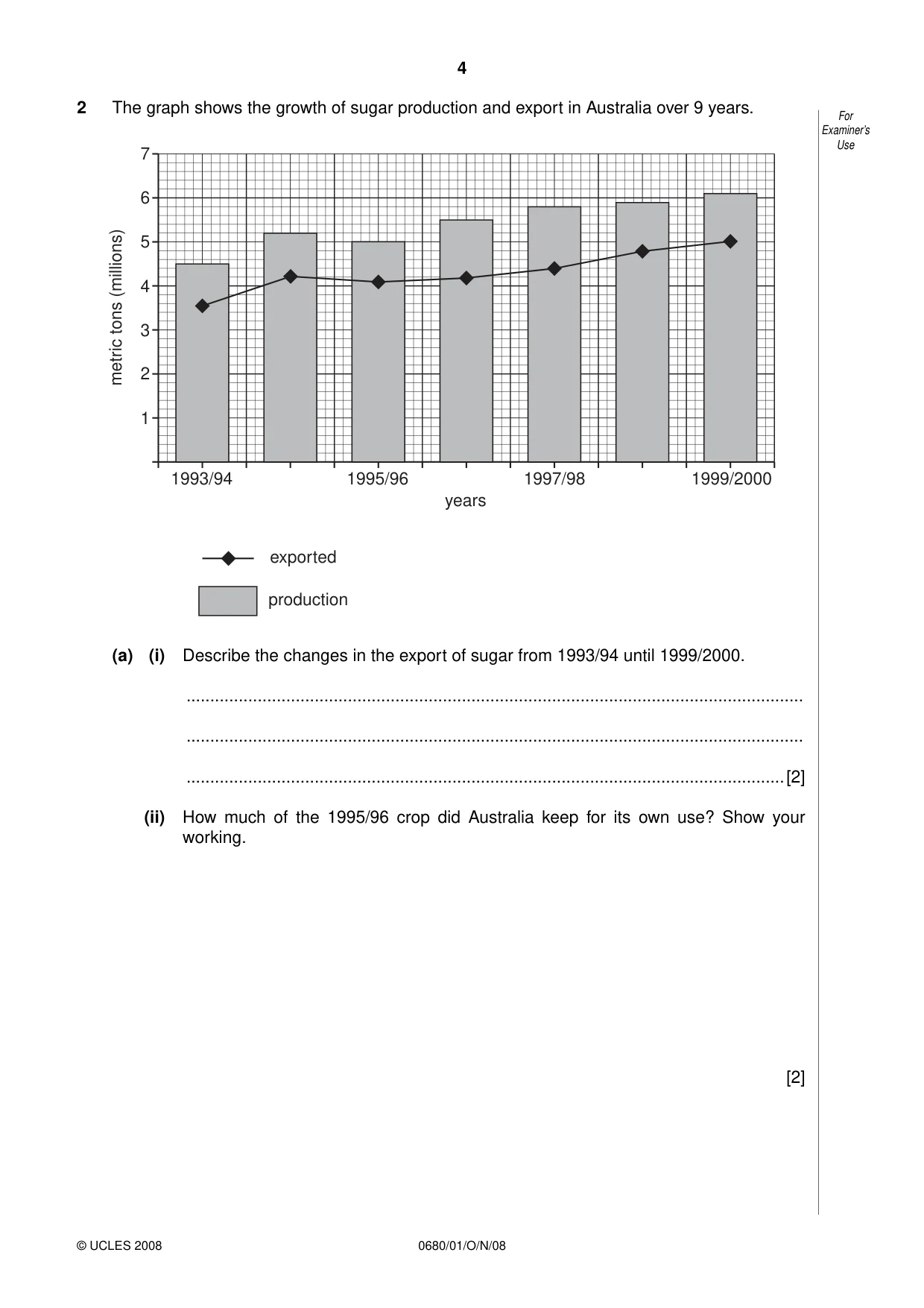
4 0680/01/O/N/08 © UCLES 2008 For Examiner’s Use 2 The graph shows the growth of sugar production and export in Australia over 9 years. 1 1993/94 metric tons (millions) 1995/96 exported production years 1997/98 1999/2000 2 3 4 5 6 7 (a) (i) Describe the changes in the export of sugar from 1993/94 until 1999/2000. … … …[2] (ii) How much of the 1995/96 crop did Australia keep for its own use? Show your working. [2]
Question paper, page 5
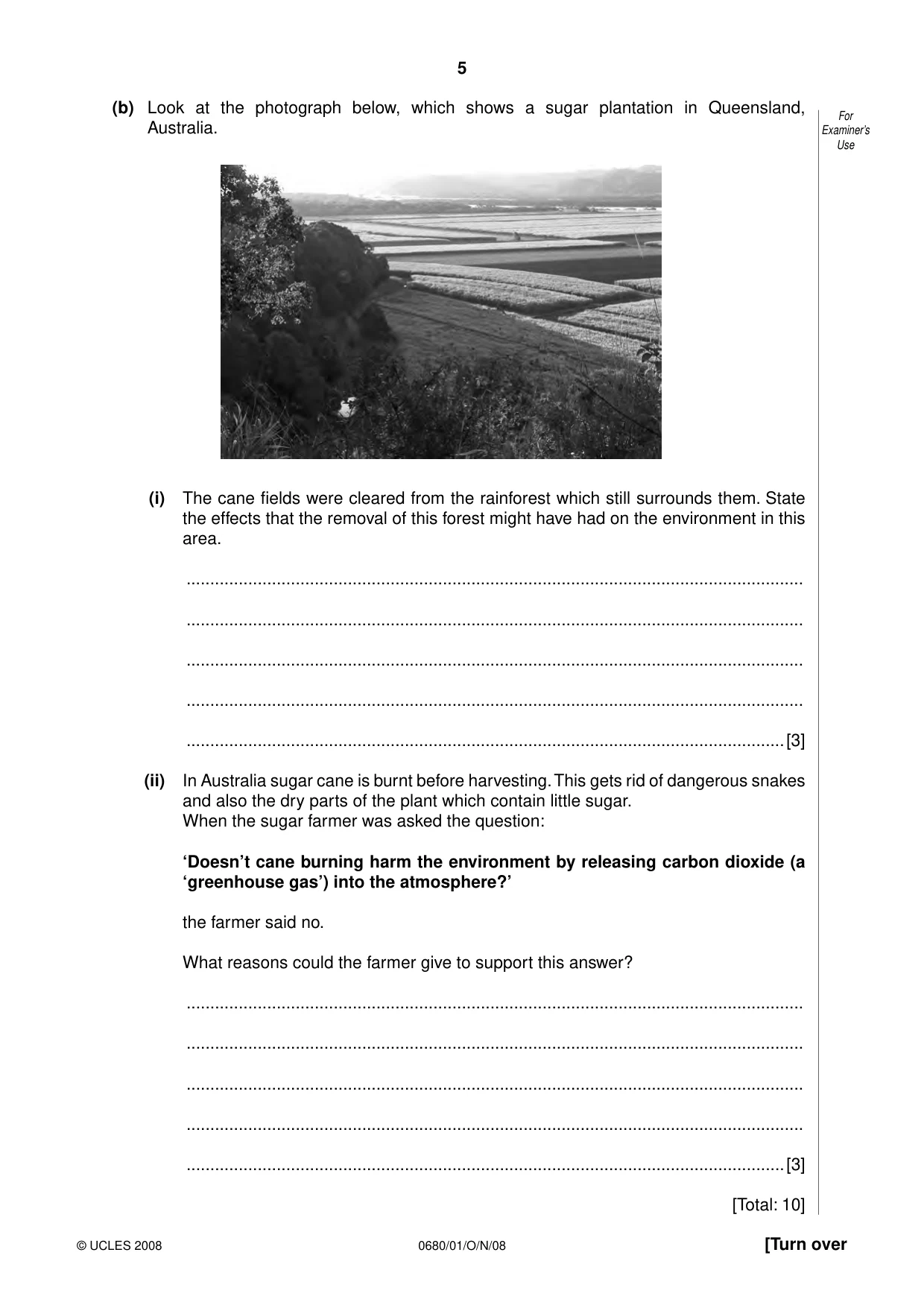
5 0680/01/O/N/08 © UCLES 2008 [Turn over For Examiner’s Use (b) Look at the photograph below, which shows a sugar plantation in Queensland, Australia. (i) The cane fields were cleared from the rainforest which still surrounds them. State the effects that the removal of this forest might have had on the environment in this area. … … … … …[3] (ii) In Australia sugar cane is burnt before harvesting. This gets rid of dangerous snakes and also the dry parts of the plant which contain little sugar. When the sugar farmer was asked the question: ‘Doesn’t cane burning harm the environment by releasing carbon dioxide (a ‘greenhouse gas’) into the atmosphere?’ the farmer said no. What reasons could the farmer give to support this answer? … … … … …[3] [Total: 10]
Question paper, page 6
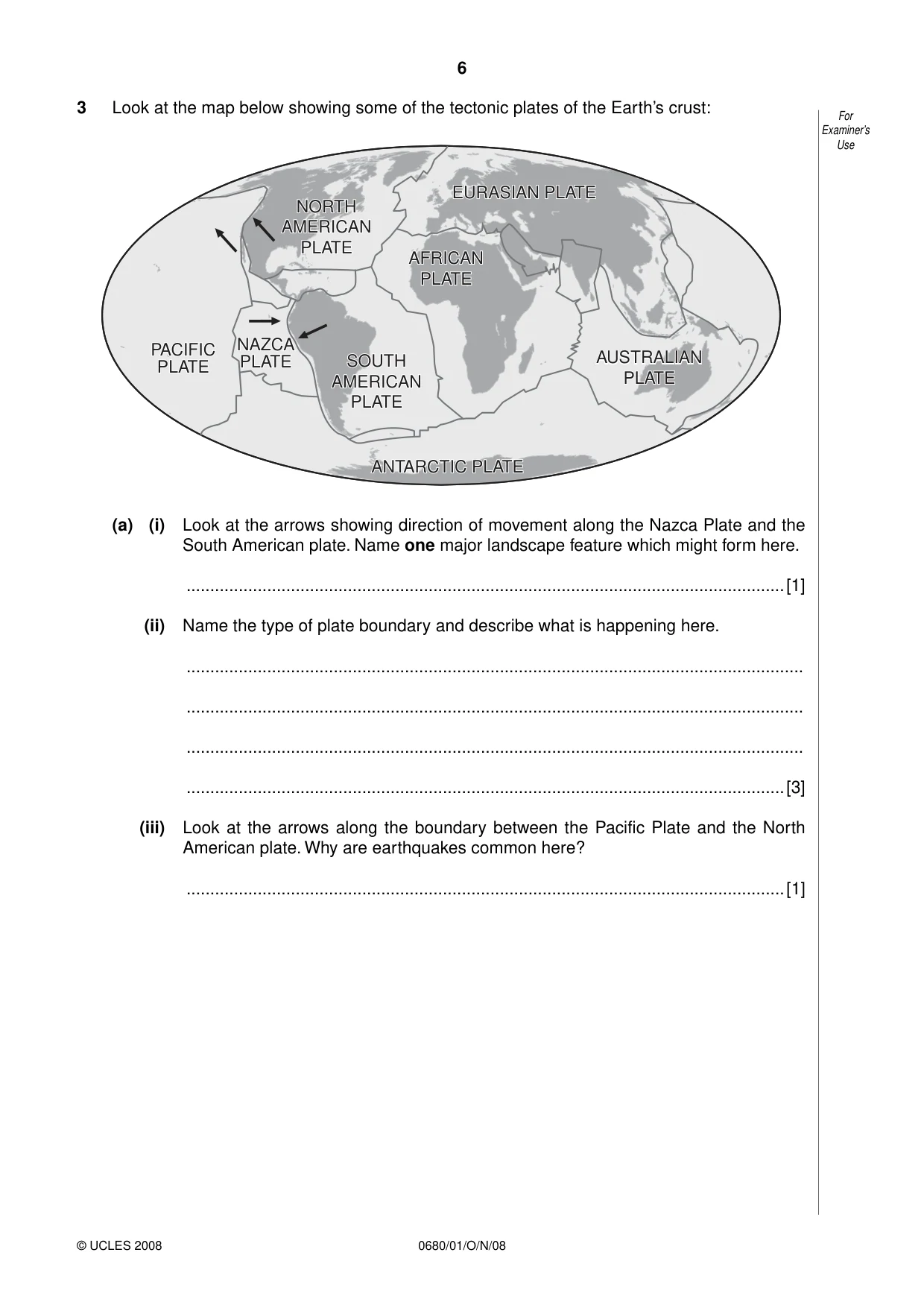
6 0680/01/O/N/08 © UCLES 2008 For Examiner’s Use 3 Look at the map below showing some of the tectonic plates of the Earth’s crust: EURASIAN PLATE EURASIAN PLATE EURASIAN PLATE AFRICAN AFRICAN PLATE PLATE AFRICAN PLATE AUSTRALIAN AUSTRALIAN PLATE PLATE AUSTRALIAN PLATE ANTARCTIC PLATE ANTARCTIC PLATE ANTARCTIC PLATE SOUTH SOUTH AMERICAN AMERICAN PLATE PLATE SOUTH AMERICAN PLATE NORTH NORTH AMERICAN AMERICAN PLATE PLATE NAZCA NAZCA PLATE PLATE NAZCA PLATE PACIFIC PACIFIC PLATE PLATE PACIFIC PLATE NORTH AMERICAN PLATE (a) (i) Look at the arrows showing direction of movement along the Nazca Plate and the South American plate. Name one major landscape feature which might form here. …[1] (ii) Name the type of plate boundary and describe what is happening here. … … … …[3] (iii) Look at the arrows along the boundary between the Pacific Plate and the North American plate. Why are earthquakes common here? …[1]
Question paper, page 7
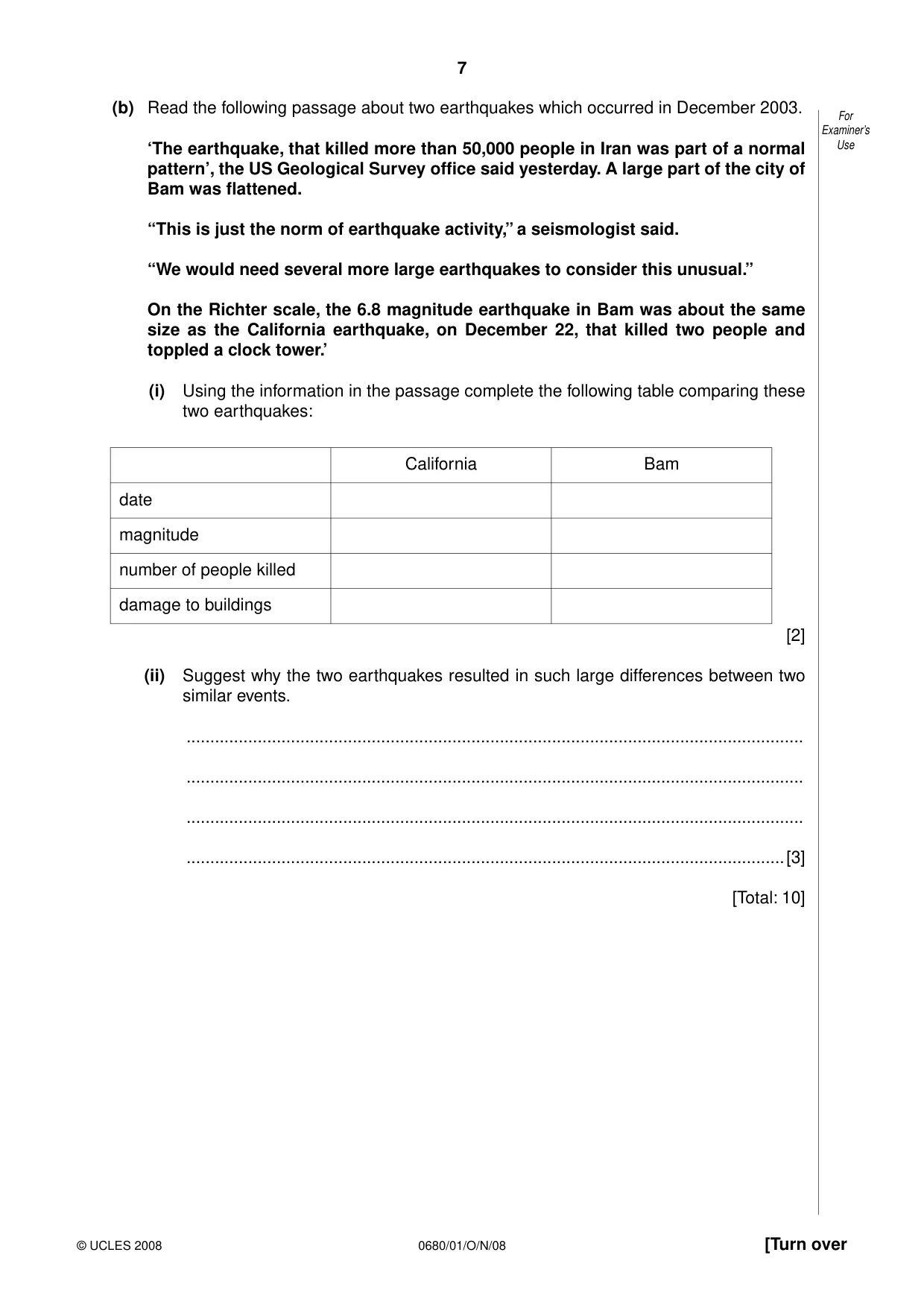
7 0680/01/O/N/08 © UCLES 2008 [Turn over For Examiner’s Use (b) Read the following passage about two earthquakes which occurred in December 2003. ‘The earthquake, that killed more than 50,000 people in Iran was part of a normal pattern’, the US Geological Survey office said yesterday. A large part of the city of Bam was flattened. “This is just the norm of earthquake activity,” a seismologist said. “We would need several more large earthquakes to consider this unusual.” On the Richter scale, the 6.8 magnitude earthquake in Bam was about the same size as the California earthquake, on December 22, that killed two people and toppled a clock tower.’ (i) Using the information in the passage complete the following table comparing these two earthquakes: California Bam date magnitude number of people killed damage to buildings [2] (ii) Suggest why the two earthquakes resulted in such large differences between two similar events. … … … …[3] [Total: 10]
Question paper, page 8
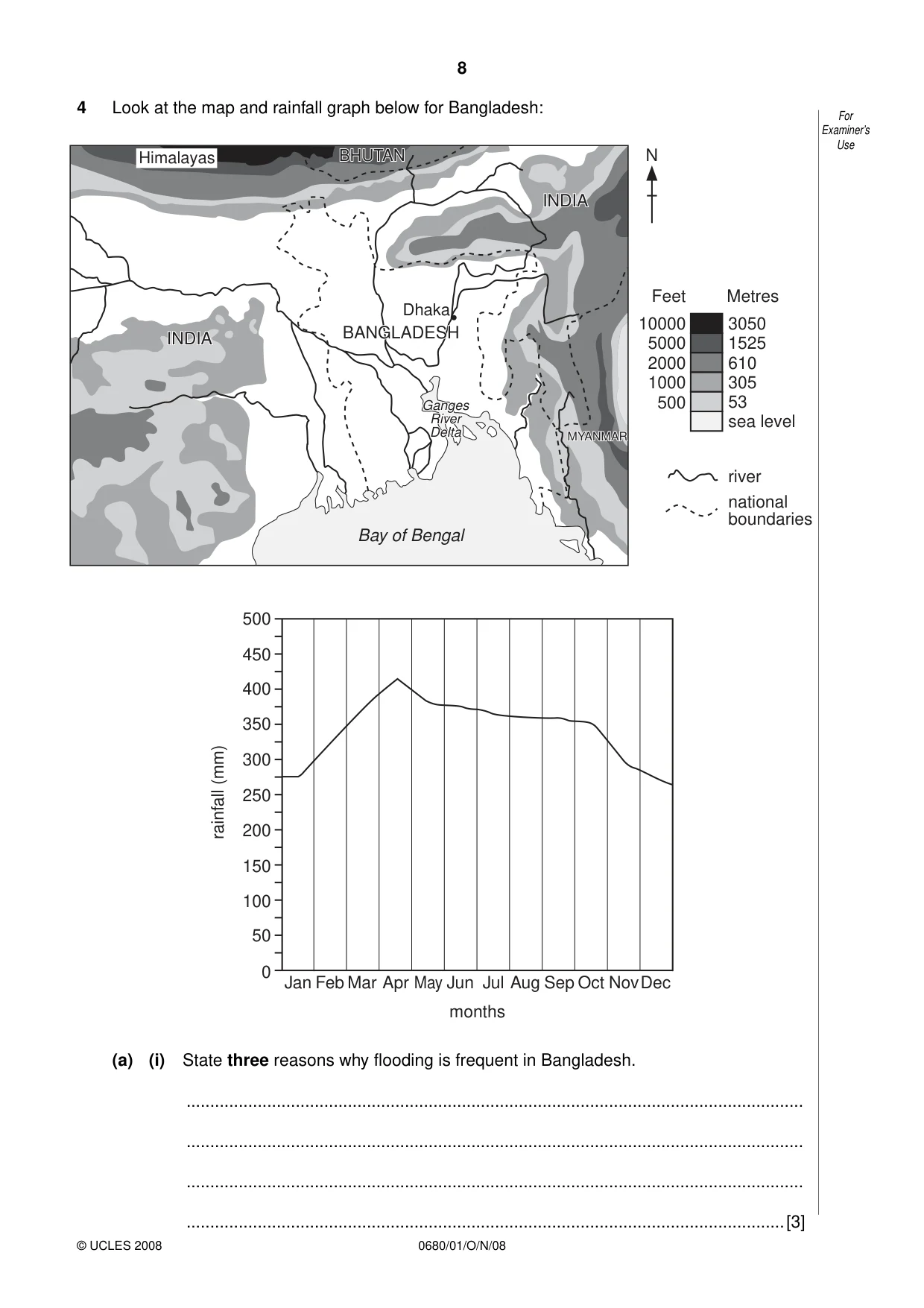
8 0680/01/O/N/08 © UCLES 2008 For Examiner’s Use 4 Look at the map and rainfall graph below for Bangladesh: Dhakz Dhakz Bay of Bengal Ganges Ganges River River Delta Delta Himalayas INDIA INDIA INDIA 10000 Feet N Metres 5000 2000 1000 500 3050 1525 610 305 53 sea level river national boundaries INDIA INDIA INDIA BANGLADESH BANGLADESH BANGLADESH Dhaka BHUTAN BHUTAN MYANMAR MYANMAR MYANMAR BHUTAN Ganges River Delta 0 Jan Feb Mar Apr May Jun months rainfall (mm) Jul Aug Sep Oct NovDec 50 100 150 200 250 300 350 400 450 500 (a) (i) State three reasons why flooding is frequent in Bangladesh. … … … …[3]
Question paper, page 9
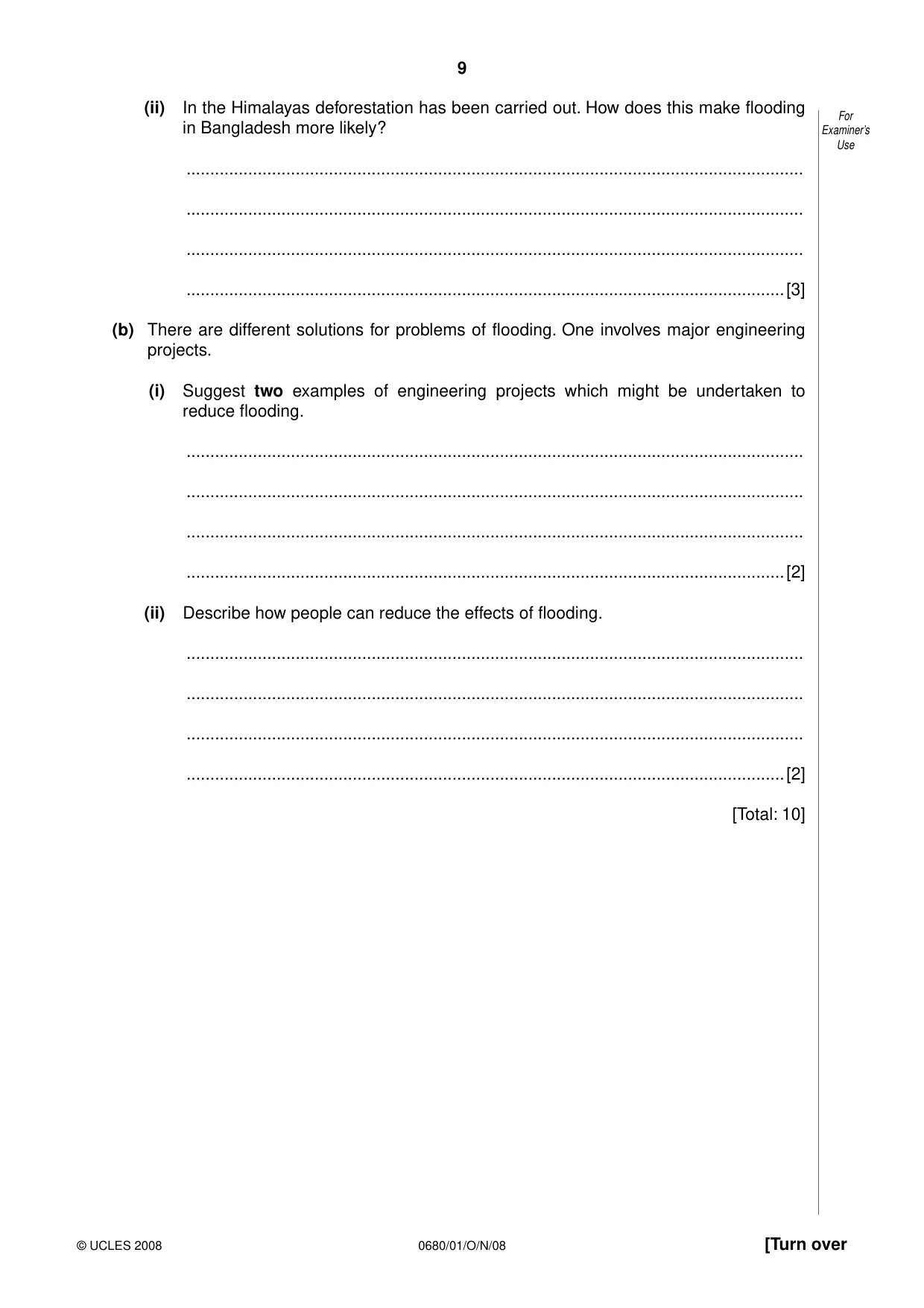
9 0680/01/O/N/08 © UCLES 2008 [Turn over For Examiner’s Use (ii) In the Himalayas deforestation has been carried out. How does this make flooding in Bangladesh more likely? … … … …[3] (b) There are different solutions for problems of flooding. One involves major engineering projects. (i) Suggest two examples of engineering projects which might be undertaken to reduce flooding. … … … …[2] (ii) Describe how people can reduce the effects of flooding. … … … …[2] [Total: 10]
Question paper, page 10
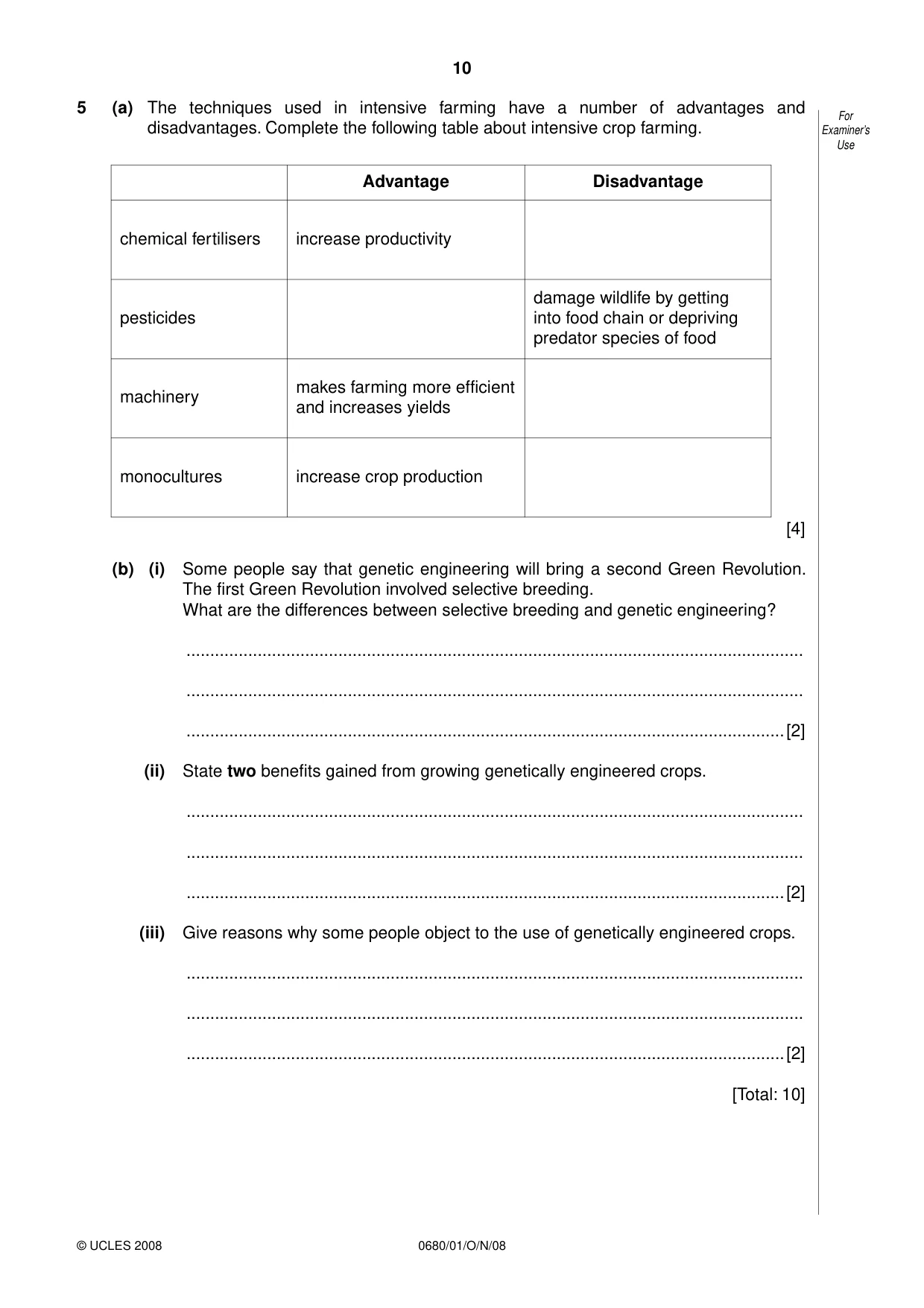
10 0680/01/O/N/08 © UCLES 2008 For Examiner’s Use 5 (a) The techniques used in intensive farming have a number of advantages and disadvantages. Complete the following table about intensive crop farming. Advantage Disadvantage chemical fertilisers increase productivity pesticides damage wildlife by getting into food chain or depriving predator species of food machinery makes farming more efficient and increases yields monocultures increase crop production [4] (b) (i) Some people say that genetic engineering will bring a second Green Revolution. The first Green Revolution involved selective breeding. What are the differences between selective breeding and genetic engineering? … … …[2] (ii) State two benefits gained from growing genetically engineered crops. … … …[2] (iii) Give reasons why some people object to the use of genetically engineered crops. … … …[2] [Total: 10]
Question paper, page 11
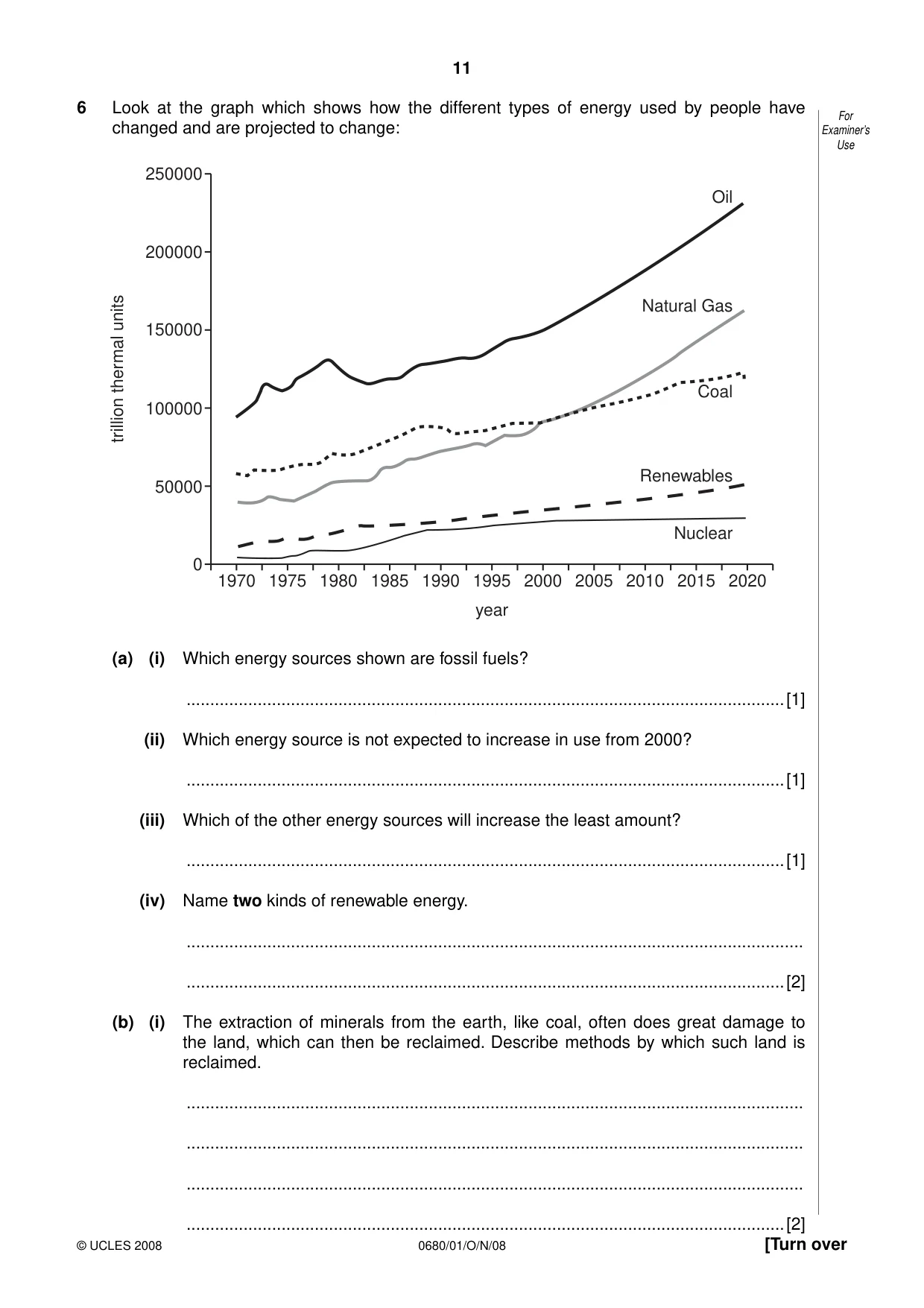
11 0680/01/O/N/08 © UCLES 2008 [Turn over For Examiner’s Use 6 Look at the graph which shows how the different types of energy used by people have changed and are projected to change: 250000 200000 150000 trillion thermal units 100000 50000 0 1970 1975 1980 1985 1990 1995 year 2000 2005 2010 2015 2020 Oil Coal Renewables Nuclear Natural Gas (a) (i) Which energy sources shown are fossil fuels? …[1] (ii) Which energy source is not expected to increase in use from 2000? …[1] (iii) Which of the other energy sources will increase the least amount? …[1] (iv) Name two kinds of renewable energy. … …[2] (b) (i) The extraction of minerals from the earth, like coal, often does great damage to the land, which can then be reclaimed. Describe methods by which such land is reclaimed. … … … …[2]
Question paper, page 12
12 0680/01/O/N/08 © UCLES 2008 (ii) Some methods for energy conservation in houses in cold climates are shown in diagrams A–D. Which house will be the most energy efficient? Explain your answer. A B C D Roof and Double glazing, Single glazing, Roof insulated walls insulated no roof or wall no roof or wall insulation insulation House … … … … [3] [Total: 10] Permission to reproduce items where third-party owned material protected by copyright is included has been sought and cleared where possible. Every reasonable effort has been made by the publisher (UCLES) to trace copyright holders, but if any items requiring clearance have unwittingly been included, the publisher will be pleased to make amends at the earliest possible opportunity. University of Cambridge International Examinations is part of the Cambridge Assessment Group. Cambridge Assessment is the brand name of University of Cambridge Local Examinations Syndicate (UCLES), which is itself a department of the University of Cambridge. For Examiner’s Use
Mark scheme, page 1
UNIVERSITY OF CAMBRIDGE INTERNATIONAL EXAMINATIONS International General Certificate of Secondary Education MARK SCHEME for the October/November 2008 question paper 0680 ENVIRONMENTAL MANAGEMENT 0680/01 Paper 1, maximum raw mark 60 This mark scheme is published as an aid to teachers and candidates, to indicate the requirements of the examination. It shows the basis on which Examiners were instructed to award marks. It does not indicate the details of the discussions that took place at an Examiners’ meeting before marking began. All Examiners are instructed that alternative correct answers and unexpected approaches in candidates’ scripts must be given marks that fairly reflect the relevant knowledge and skills demonstrated. Mark schemes must be read in conjunction with the question papers and the report on the examination. • CIE will not enter into discussions or correspondence in connection with these mark schemes. CIE is publishing the mark schemes for the October/November 2008 question papers for most IGCSE, GCE Advanced Level and Advanced Subsidiary Level syllabuses and some Ordinary Level syllabuses. www.XtremePapers.com
Mark scheme, page 2
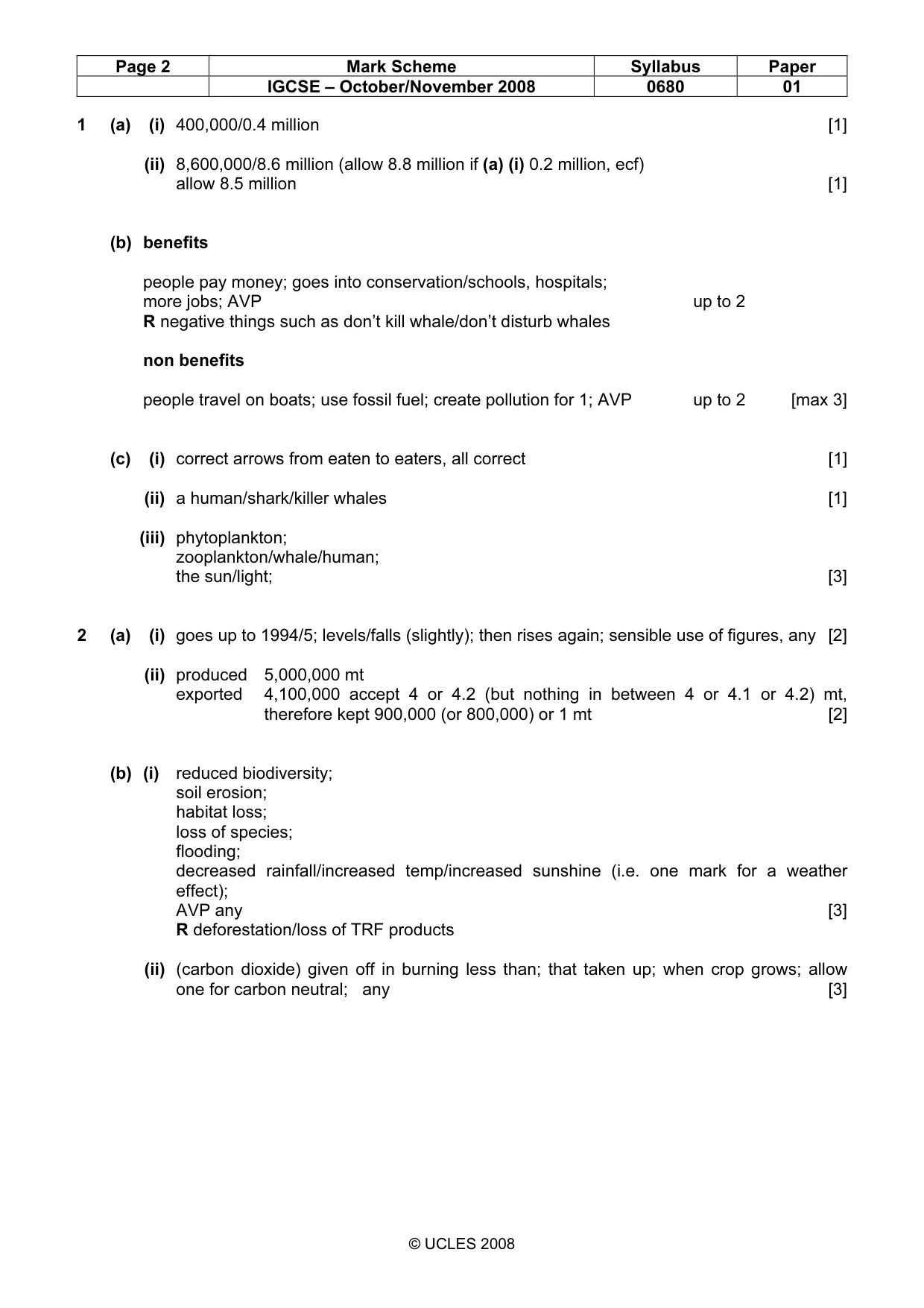
Page 2 Mark Scheme Syllabus Paper IGCSE – October/November 2008 0680 01 © UCLES 2008 1 (a) (i) 400,000/0.4 million [1] (ii) 8,600,000/8.6 million (allow 8.8 million if (a) (i) 0.2 million, ecf) allow 8.5 million [1] (b) benefits people pay money; goes into conservation/schools, hospitals; more jobs; AVP up to 2 R negative things such as don’t kill whale/don’t disturb whales non benefits people travel on boats; use fossil fuel; create pollution for 1; AVP up to 2 [max 3] (c) (i) correct arrows from eaten to eaters, all correct [1] (ii) a human/shark/killer whales [1] (iii) phytoplankton; zooplankton/whale/human; the sun/light; [3] 2 (a) (i) goes up to 1994/5; levels/falls (slightly); then rises again; sensible use of figures, any [2] (ii) produced 5,000,000 mt exported 4,100,000 accept 4 or 4.2 (but nothing in between 4 or 4.1 or 4.2) mt, therefore kept 900,000 (or 800,000) or 1 mt [2] (b) (i) reduced biodiversity; soil erosion; habitat loss; loss of species; flooding; decreased rainfall/increased temp/increased sunshine (i.e. one mark for a weather effect); AVP any [3] R deforestation/loss of TRF products (ii) (carbon dioxide) given off in burning less than; that taken up; when crop grows; allow one for carbon neutral; any [3]
Mark scheme, page 3
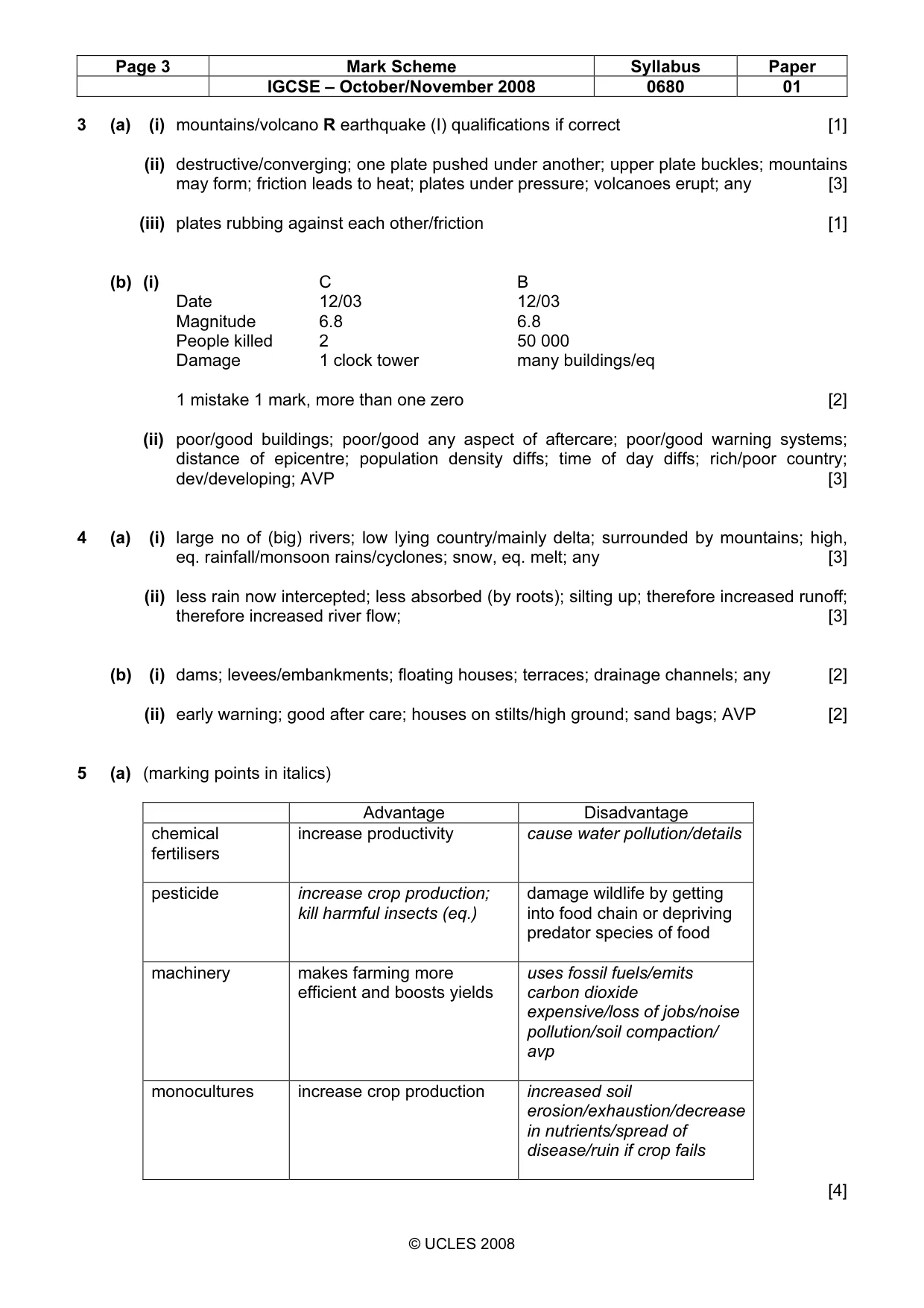
Page 3 Mark Scheme Syllabus Paper IGCSE – October/November 2008 0680 01 © UCLES 2008 3 (a) (i) mountains/volcano R earthquake (I) qualifications if correct [1] (ii) destructive/converging; one plate pushed under another; upper plate buckles; mountains may form; friction leads to heat; plates under pressure; volcanoes erupt; any [3] (iii) plates rubbing against each other/friction [1] (b) (i) C B Date 12/03 12/03 Magnitude 6.8 6.8 People killed 2 50 000 Damage 1 clock tower many buildings/eq 1 mistake 1 mark, more than one zero [2] (ii) poor/good buildings; poor/good any aspect of aftercare; poor/good warning systems; distance of epicentre; population density diffs; time of day diffs; rich/poor country; dev/developing; AVP [3] 4 (a) (i) large no of (big) rivers; low lying country/mainly delta; surrounded by mountains; high, eq. rainfall/monsoon rains/cyclones; snow, eq. melt; any [3] (ii) less rain now intercepted; less absorbed (by roots); silting up; therefore increased runoff; therefore increased river flow; [3] (b) (i) dams; levees/embankments; floating houses; terraces; drainage channels; any [2] (ii) early warning; good after care; houses on stilts/high ground; sand bags; AVP [2] 5 (a) (marking points in italics) Advantage Disadvantage chemical fertilisers increase productivity cause water pollution/details pesticide increase crop production; kill harmful insects (eq.) damage wildlife by getting into food chain or depriving predator species of food machinery makes farming more efficient and boosts yields uses fossil fuels/emits carbon dioxide expensive/loss of jobs/noise pollution/soil compaction/ avp monocultures increase crop production increased soil erosion/exhaustion/decrease in nutrients/spread of disease/ruin if crop fails [4]
Mark scheme, page 4
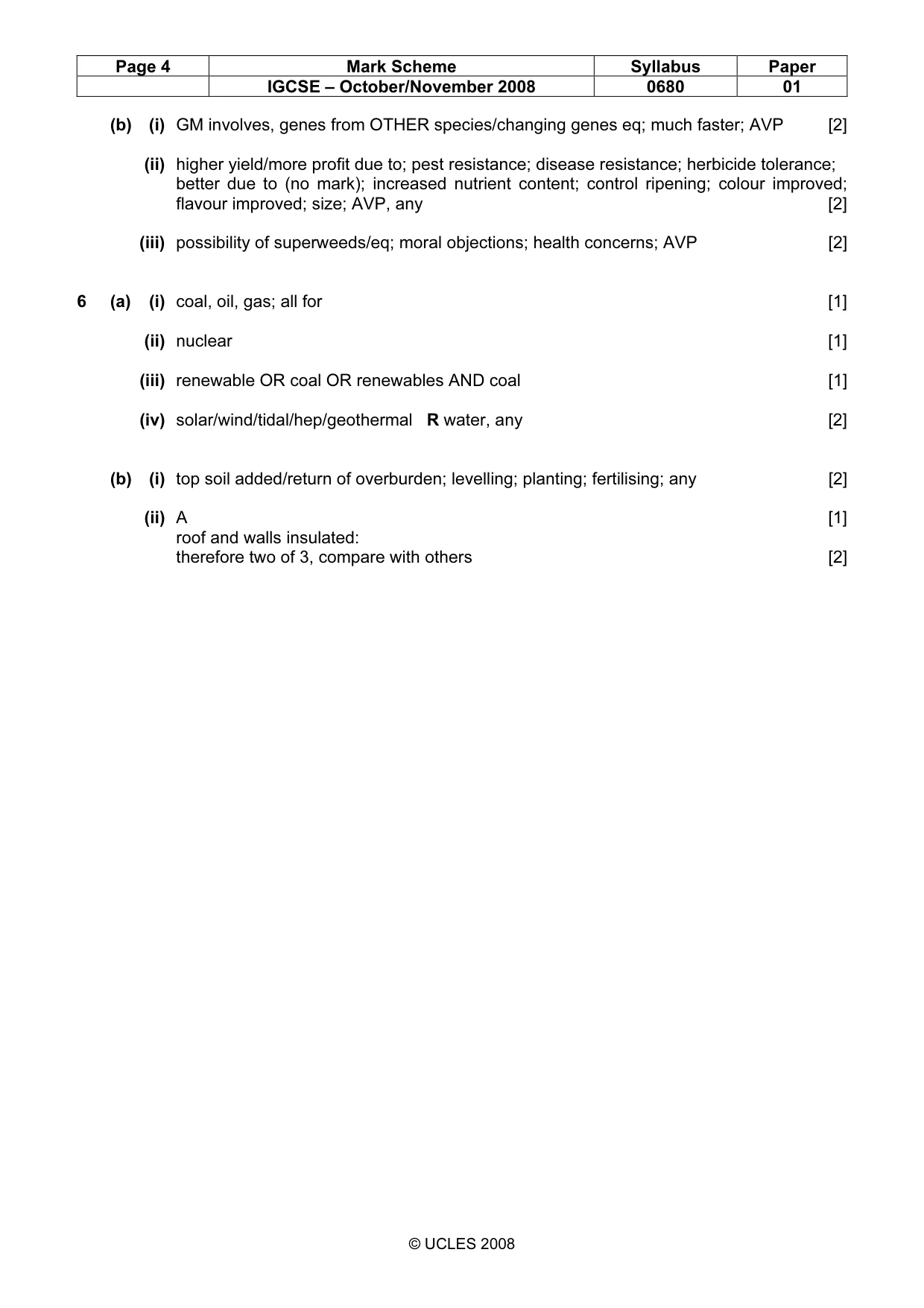
Page 4 Mark Scheme Syllabus Paper IGCSE – October/November 2008 0680 01 © UCLES 2008 (b) (i) GM involves, genes from OTHER species/changing genes eq; much faster; AVP [2] (ii) higher yield/more profit due to; pest resistance; disease resistance; herbicide tolerance; better due to (no mark); increased nutrient content; control ripening; colour improved; flavour improved; size; AVP, any [2] (iii) possibility of superweeds/eq; moral objections; health concerns; AVP [2] 6 (a) (i) coal, oil, gas; all for [1] (ii) nuclear [1] (iii) renewable OR coal OR renewables AND coal [1] (iv) solar/wind/tidal/hep/geothermal R water, any [2] (b) (i) top soil added/return of overburden; levelling; planting; fertilising; any [2] (ii) A [1] roof and walls insulated: therefore two of 3, compare with others [2]
What you needed in this session
Cambridge’s own grade thresholds for 2008 Oct/Nov, Paper 1 · Variant 1. A higher threshold means an easier paper — the bar moves with how the cohort did.