Cambridge IGCSE Environmental Management 0680 — 2008 May/June Paper 1 · Variant 1
0680/11/M/J/08 · 60 marks · ≈68 min
The question paper and its mark scheme, free to read here and free to download. This is Cambridge’s own paper, exactly as it was sat.
Question paper12 pages

Mark scheme3 pages
Answers below. Sit the paper first if you are practising.
Paper as text
Question paper, page 1
This document consists of 11 printed pages and 1 blank page. SP (CW/CGW) T48942/2 © UCLES 2008 [Turn over UNIVERSITY OF CAMBRIDGE INTERNATIONAL EXAMINATIONS International General Certificate of Secondary Education READ THESE INSTRUCTIONS FIRST Write your Centre number, candidate number and name on all the work you hand in. Write in dark blue or black pen. You may use a soft pencil for any diagrams, graphs or rough working. Do not use staples, paper clips, highlighters, glue or correction fluid. DO NOT WRITE IN ANY BARCODES. Answer all questions. At the end of the examination, fasten all your work securely together. The number of marks is given in brackets [ ] at the end of each question or part question. * 9 4 9 2 2 2 7 4 1 7 * ENVIRONMENTAL MANAGEMENT 0680/01 Paper 1 May/June 2008 1 hour 30 minutes Candidates answer on the Question Paper. Additional Materials: Ruler For Examiner’s Use 1 2 3 4 5 6 Total www.XtremePapers.com
Question paper, page 2
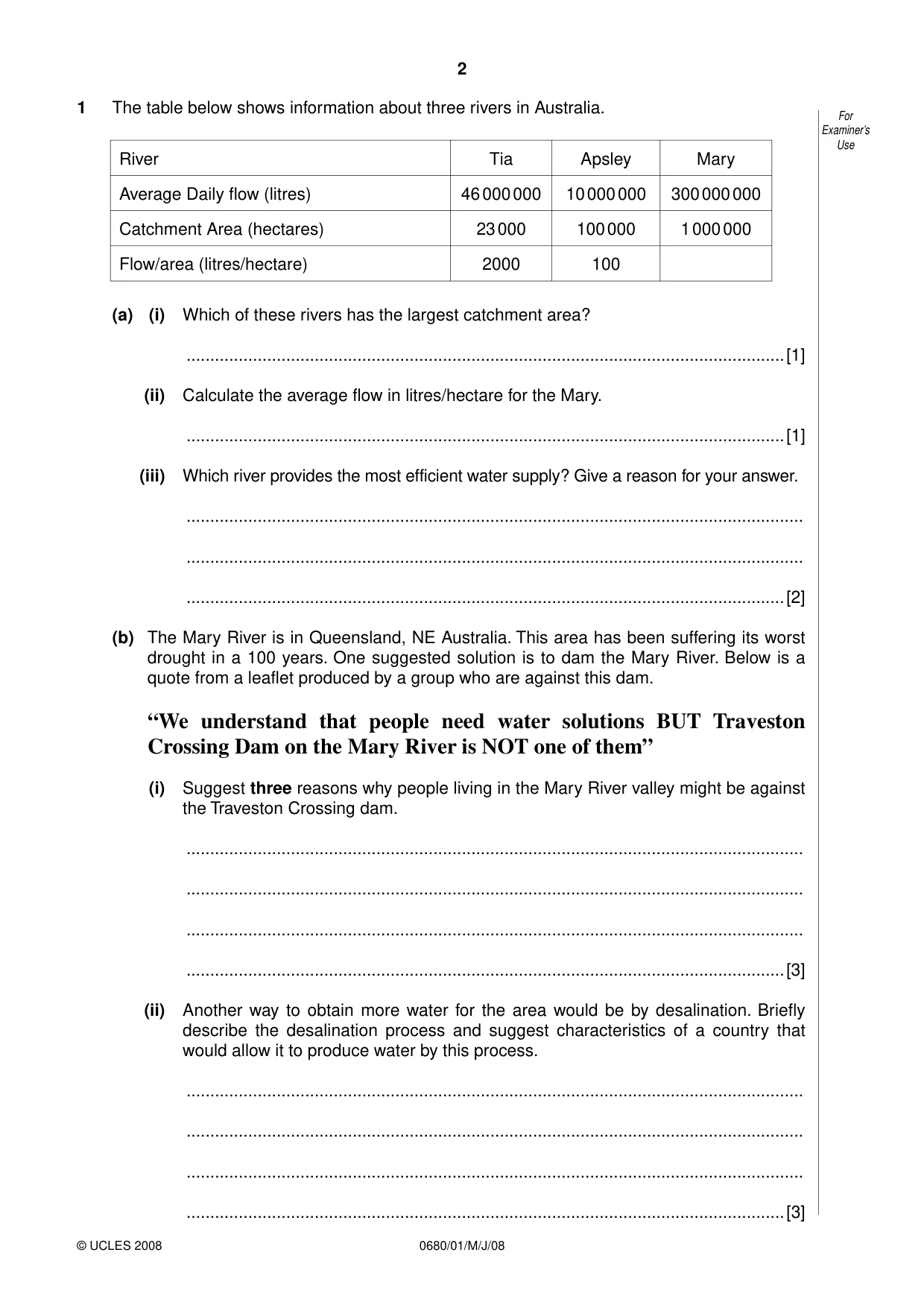
2 © UCLES 2008 For Examiner’s Use 0680/01/M/J/08 1 The table below shows information about three rivers in Australia. River Tia Apsley Mary Average Daily flow (litres) 46 000 000 10 000 000 300 000 000 Catchment Area (hectares) 23 000 100 000 1 000 000 Flow/area (litres/hectare) 2000 100 (a) (i) Which of these rivers has the largest catchment area? …[1] (ii) Calculate the average flow in litres/hectare for the Mary. …[1] (iii) Which river provides the most efficient water supply? Give a reason for your answer. … … …[2] (b) The Mary River is in Queensland, NE Australia. This area has been suffering its worst drought in a 100 years. One suggested solution is to dam the Mary River. Below is a quote from a leaflet produced by a group who are against this dam. “We understand that people need water solutions BUT Traveston Crossing Dam on the Mary River is NOT one of them” (i) Suggest three reasons why people living in the Mary River valley might be against the Traveston Crossing dam. … … … …[3] (ii) Another way to obtain more water for the area would be by desalination. Briefly describe the desalination process and suggest characteristics of a country that would allow it to produce water by this process. … … … …[3]
Question paper, page 3
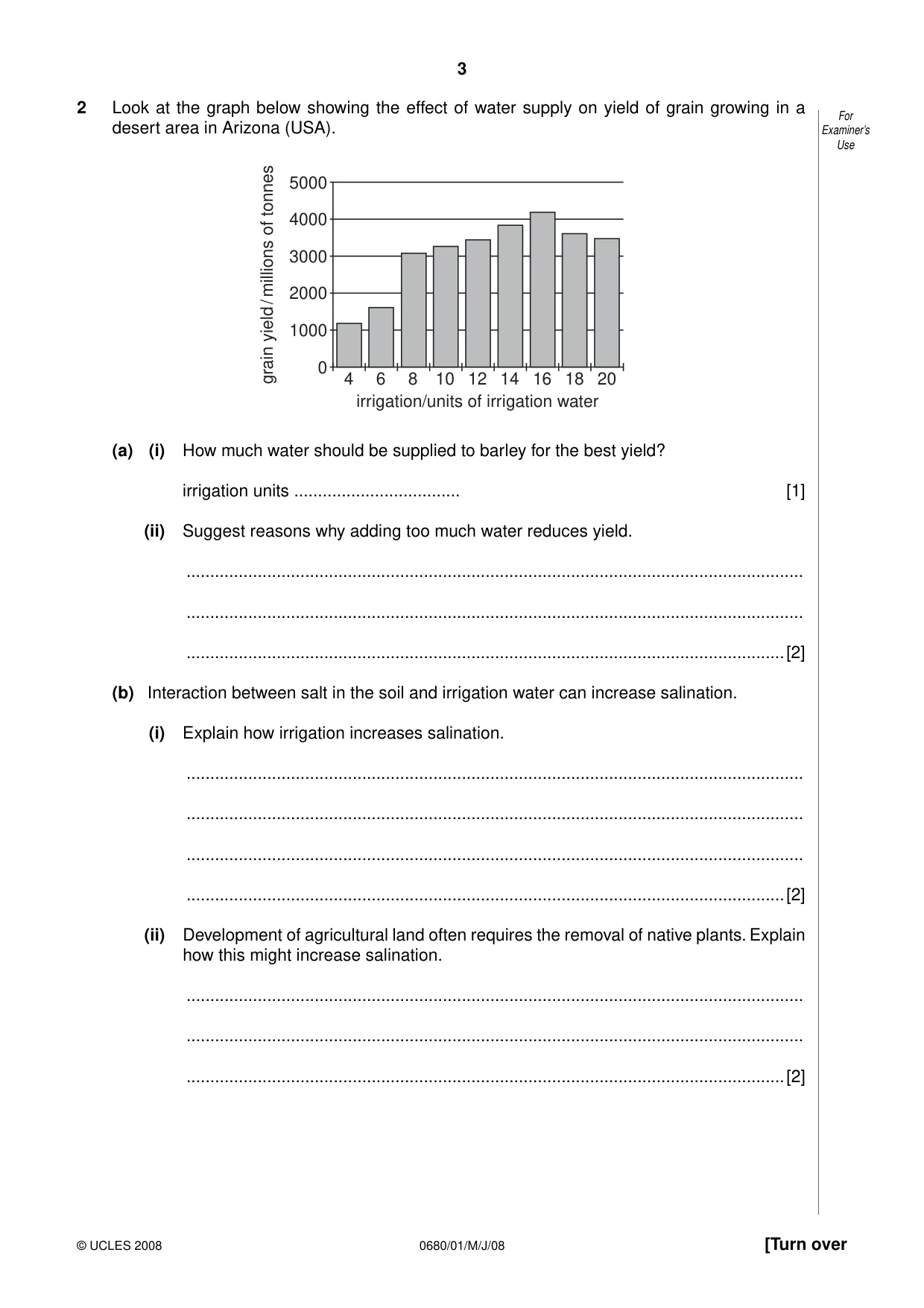
3 © UCLES 2008 [Turn over For Examiner’s Use 0680/01/M/J/08 2 Look at the graph below showing the effect of water supply on yield of grain growing in a desert area in Arizona (USA). 5000 4000 3000 grain yield / millions of tonnes 2000 1000 0 4 8 12 irrigation/units of irrigation water 16 20 10 14 18 6 (a) (i) How much water should be supplied to barley for the best yield? irrigation units … [1] (ii) Suggest reasons why adding too much water reduces yield. … … …[2] (b) Interaction between salt in the soil and irrigation water can increase salination. (i) Explain how irrigation increases salination. … … … …[2] (ii) Development of agricultural land often requires the removal of native plants. Explain how this might increase salination. … … …[2]
Question paper, page 4
4 © UCLES 2008 For Examiner’s Use 0680/01/M/J/08 (iii) One method for preventing an increase in salination is to use trickle drip irrigation. Explain how this works and prevents salination. … … … … …[3]
Question paper, page 5
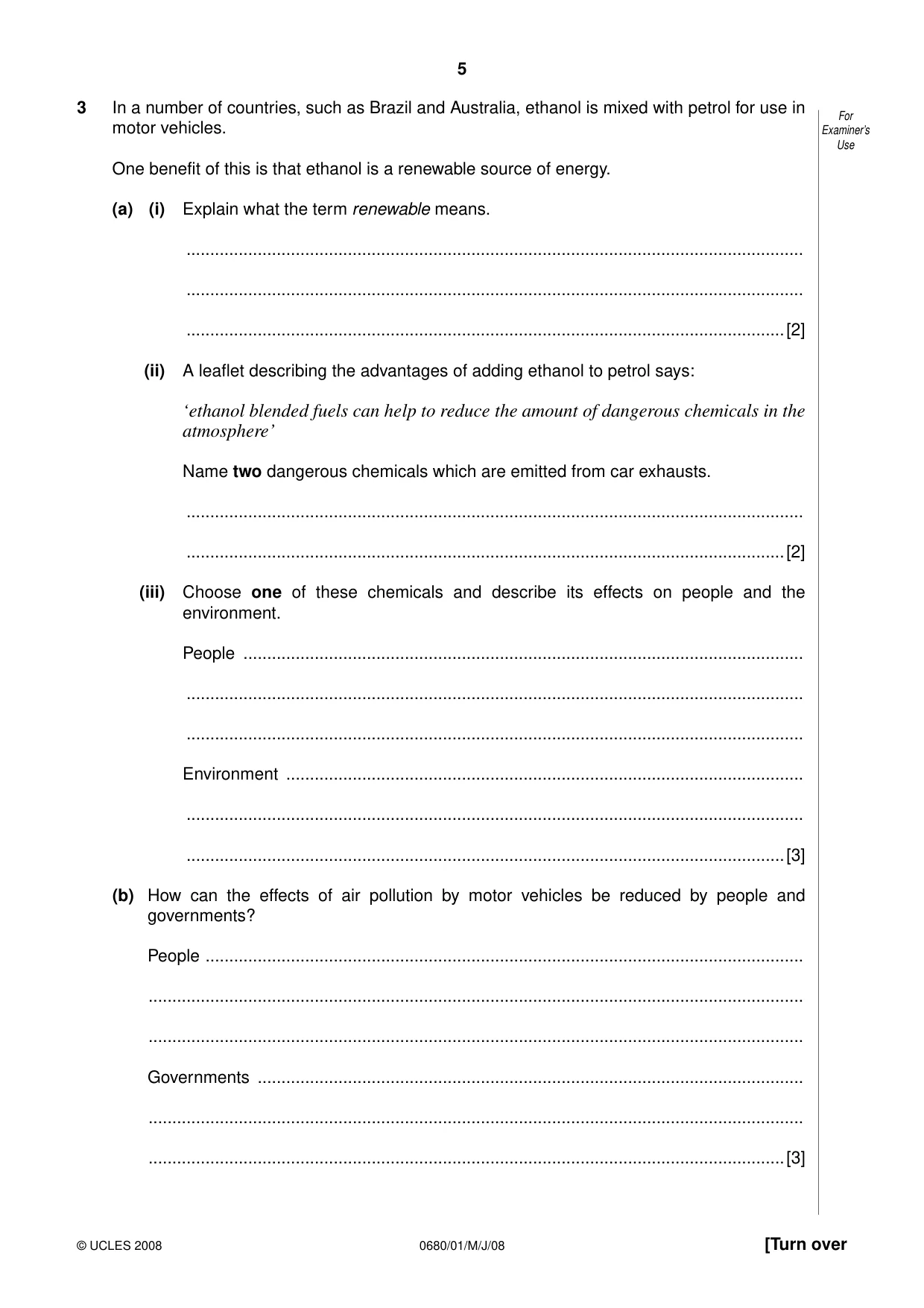
5 © UCLES 2008 [Turn over For Examiner’s Use 0680/01/M/J/08 3 In a number of countries, such as Brazil and Australia, ethanol is mixed with petrol for use in motor vehicles. One benefit of this is that ethanol is a renewable source of energy. (a) (i) Explain what the term renewable means. … … …[2] (ii) A leaflet describing the advantages of adding ethanol to petrol says: ʻethanol blended fuels can help to reduce the amount of dangerous chemicals in the atmosphereʼ Name two dangerous chemicals which are emitted from car exhausts. … …[2] (iii) Choose one of these chemicals and describe its effects on people and the environment. People … … … Environment … … …[3] (b) How can the effects of air pollution by motor vehicles be reduced by people and governments? People … … … Governments … … …[3]
Question paper, page 6
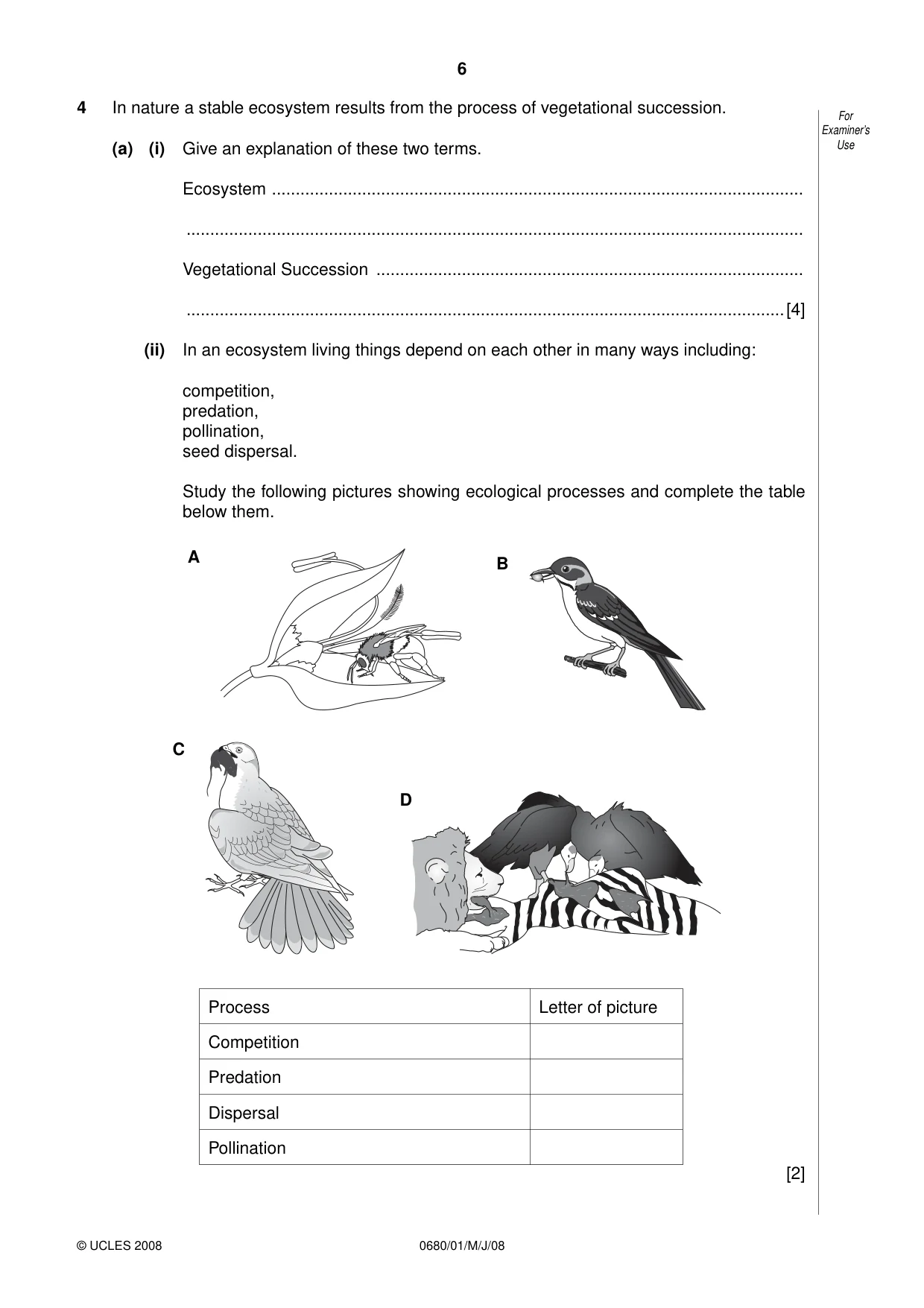
6 © UCLES 2008 For Examiner’s Use 0680/01/M/J/08 4 In nature a stable ecosystem results from the process of vegetational succession. (a) (i) Give an explanation of these two terms. Ecosystem … … Vegetational Succession … …[4] (ii) In an ecosystem living things depend on each other in many ways including: competition, predation, pollination, seed dispersal. Study the following pictures showing ecological processes and complete the table below them. A B C D Process Letter of picture Competition Predation Dispersal Pollination [2]
Question paper, page 7
7 © UCLES 2008 [Turn over For Examiner’s Use 0680/01/M/J/08 (b) Natural ecosystems are often cleared by people. Give reasons why such clearance might occur. … … … … … …[4]
Question paper, page 8
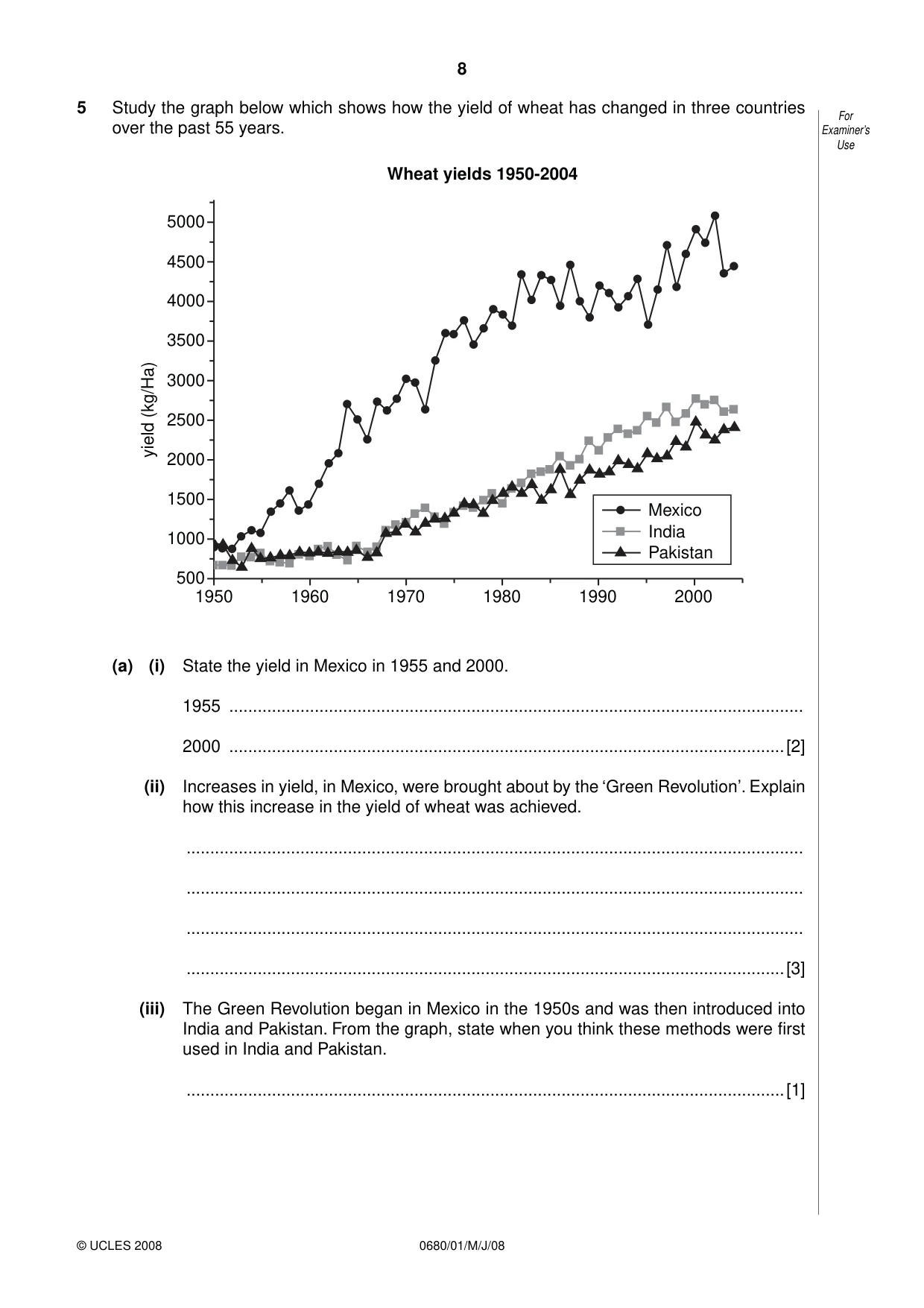
8 © UCLES 2008 For Examiner’s Use 0680/01/M/J/08 5 Study the graph below which shows how the yield of wheat has changed in three countries over the past 55 years. 5000 Wheat yields 1950-2004 4500 4000 3500 3000 yield (kg/Ha) 2500 2000 1500 1000 500 1950 1960 1970 1980 1990 Mexico India Pakistan 2000 (a) (i) State the yield in Mexico in 1955 and 2000. 1955 … 2000 …[2] (ii) Increases in yield, in Mexico, were brought about by the ‘Green Revolution’. Explain how this increase in the yield of wheat was achieved. … … … …[3] (iii) The Green Revolution began in Mexico in the 1950s and was then introduced into India and Pakistan. From the graph, state when you think these methods were first used in India and Pakistan. …[1]
Question paper, page 9
9 © UCLES 2008 [Turn over For Examiner’s Use 0680/01/M/J/08 (b) Describe and explain two problems resulting from the Green Revolution. … … … … … …[4]
Question paper, page 10
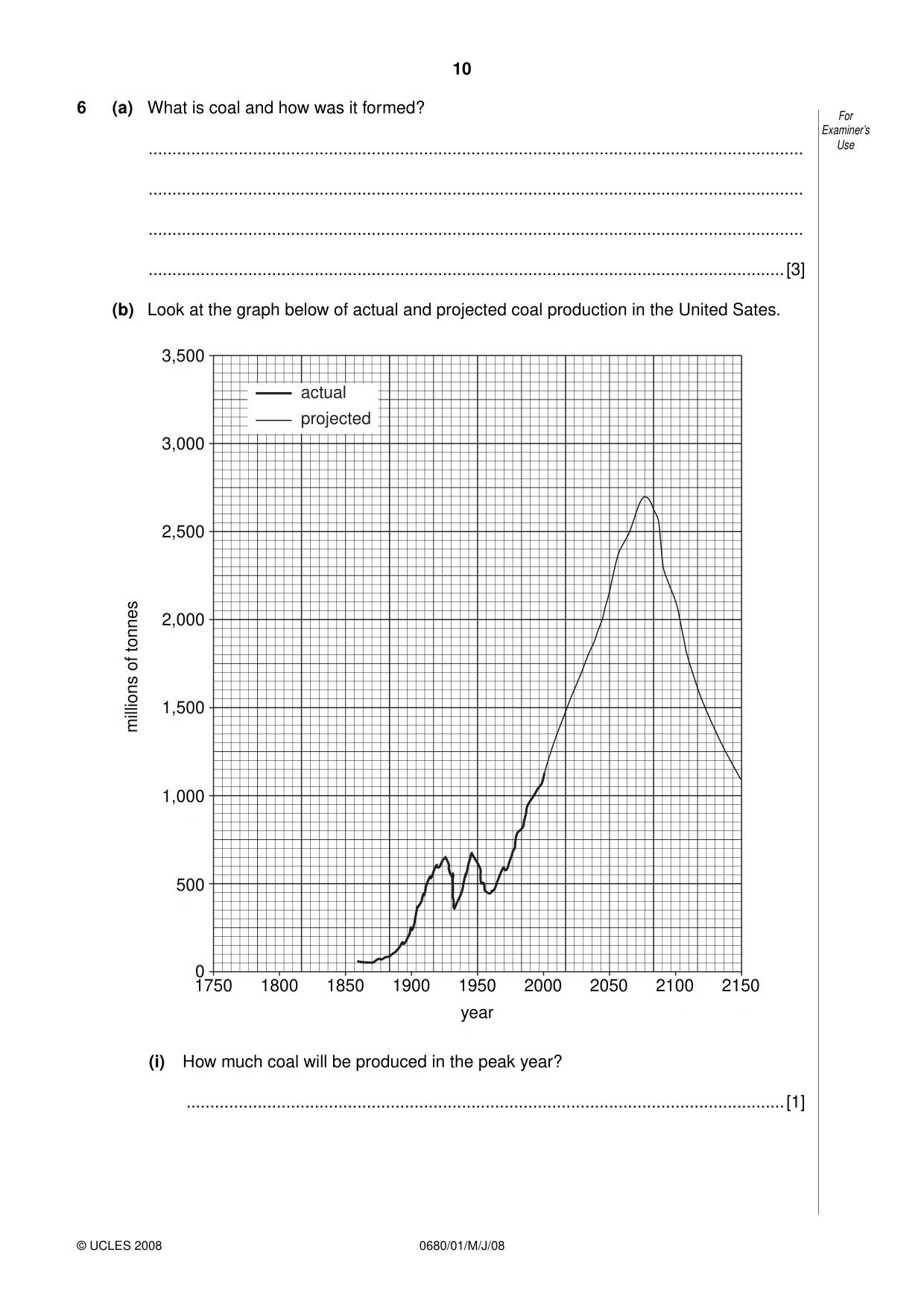
10 © UCLES 2008 For Examiner’s Use 0680/01/M/J/08 6 (a) What is coal and how was it formed? … … … …[3] (b) Look at the graph below of actual and projected coal production in the United Sates. 1750 0 500 1,000 1,500 2,000 millions of tonnes 2,500 3,000 3,500 1800 1850 1900 1950 year 2000 2050 2100 2150 actual projected (i) How much coal will be produced in the peak year? …[1]
Question paper, page 11
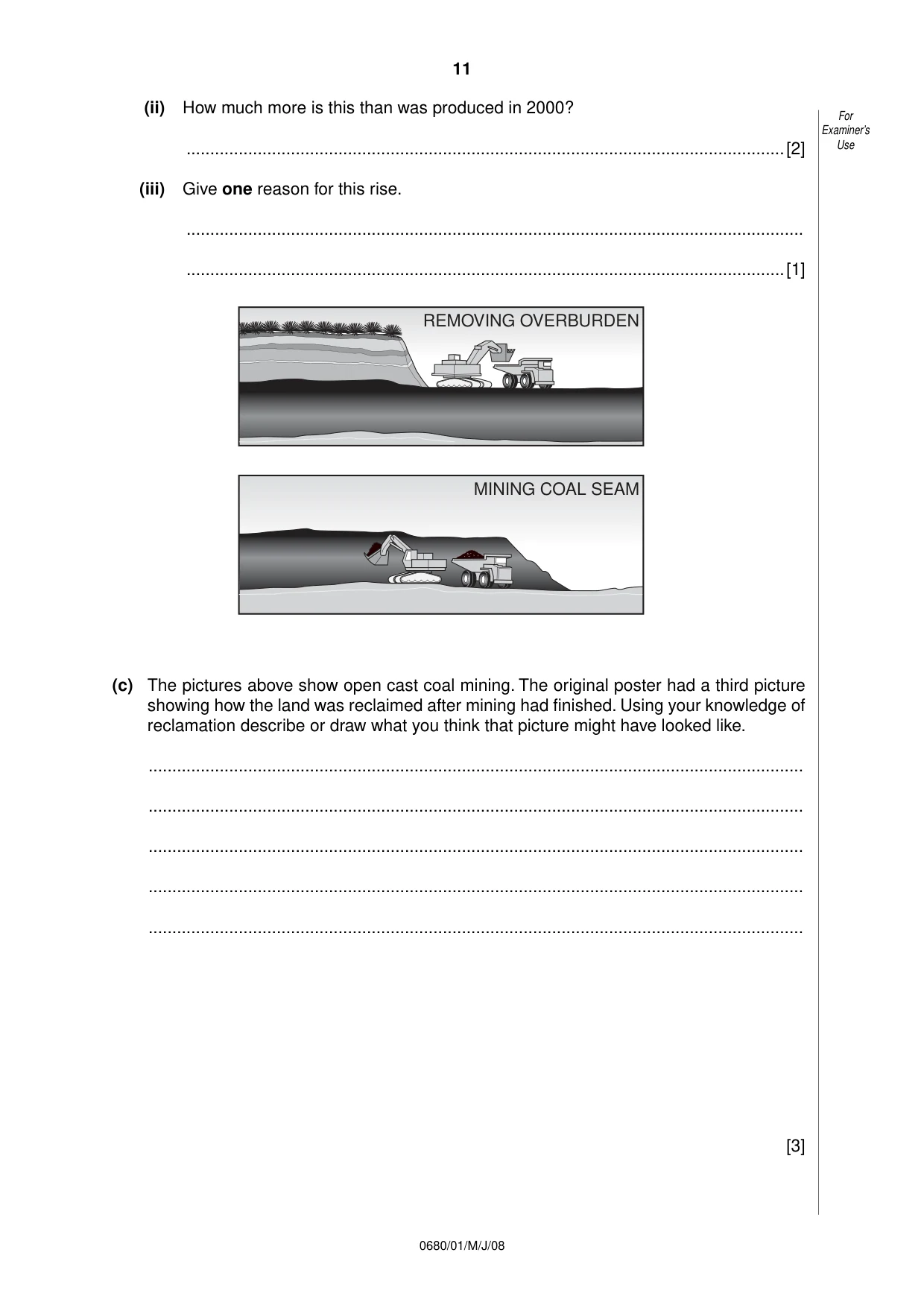
11 For Examiner’s Use 0680/01/M/J/08 (ii) How much more is this than was produced in 2000? …[2] (iii) Give one reason for this rise. … …[1] MINING COAL SEAM REMOVING OVERBURDEN (c) The pictures above show open cast coal mining. The original poster had a third picture showing how the land was reclaimed after mining had finished. Using your knowledge of reclamation describe or draw what you think that picture might have looked like. … … … … … [3]
Question paper, page 12
12 0680/01/M/J/08 © UCLES 2008 Permission to reproduce items where third-party owned material protected by copyright is included has been sought and cleared where possible. Every reasonable effort has been made by the publisher (UCLES) to trace copyright holders, but if any items requiring clearance have unwittingly been included, the publisher will be pleased to make amends at the earliest possible opportunity. University of Cambridge International Examinations is part of the Cambridge Assessment Group. Cambridge Assessment is the brand name of University of Cambridge Local Examinations Syndicate (UCLES), which is itself a department of the University of Cambridge. BLANK PAGE
Mark scheme, page 1
UNIVERSITY OF CAMBRIDGE INTERNATIONAL EXAMINATIONS International General Certificate of Secondary Education MARK SCHEME for the May/June 2008 question paper 0680 ENVIRONMENTAL MANAGEMENT 0680/01 Paper 1, maximum raw mark 60 This mark scheme is published as an aid to teachers and candidates, to indicate the requirements of the examination. It shows the basis on which Examiners were instructed to award marks. It does not indicate the details of the discussions that took place at an Examiners’ meeting before marking began. All Examiners are instructed that alternative correct answers and unexpected approaches in candidates’ scripts must be given marks that fairly reflect the relevant knowledge and skills demonstrated. Mark schemes must be read in conjunction with the question papers and the report on the examination. • CIE will not enter into discussions or correspondence in connection with these mark schemes. CIE is publishing the mark schemes for the May/June 2008 question papers for most IGCSE, GCE Advanced Level and Advanced Subsidiary Level syllabuses and some Ordinary Level syllabuses. www.XtremePapers.com
Mark scheme, page 2
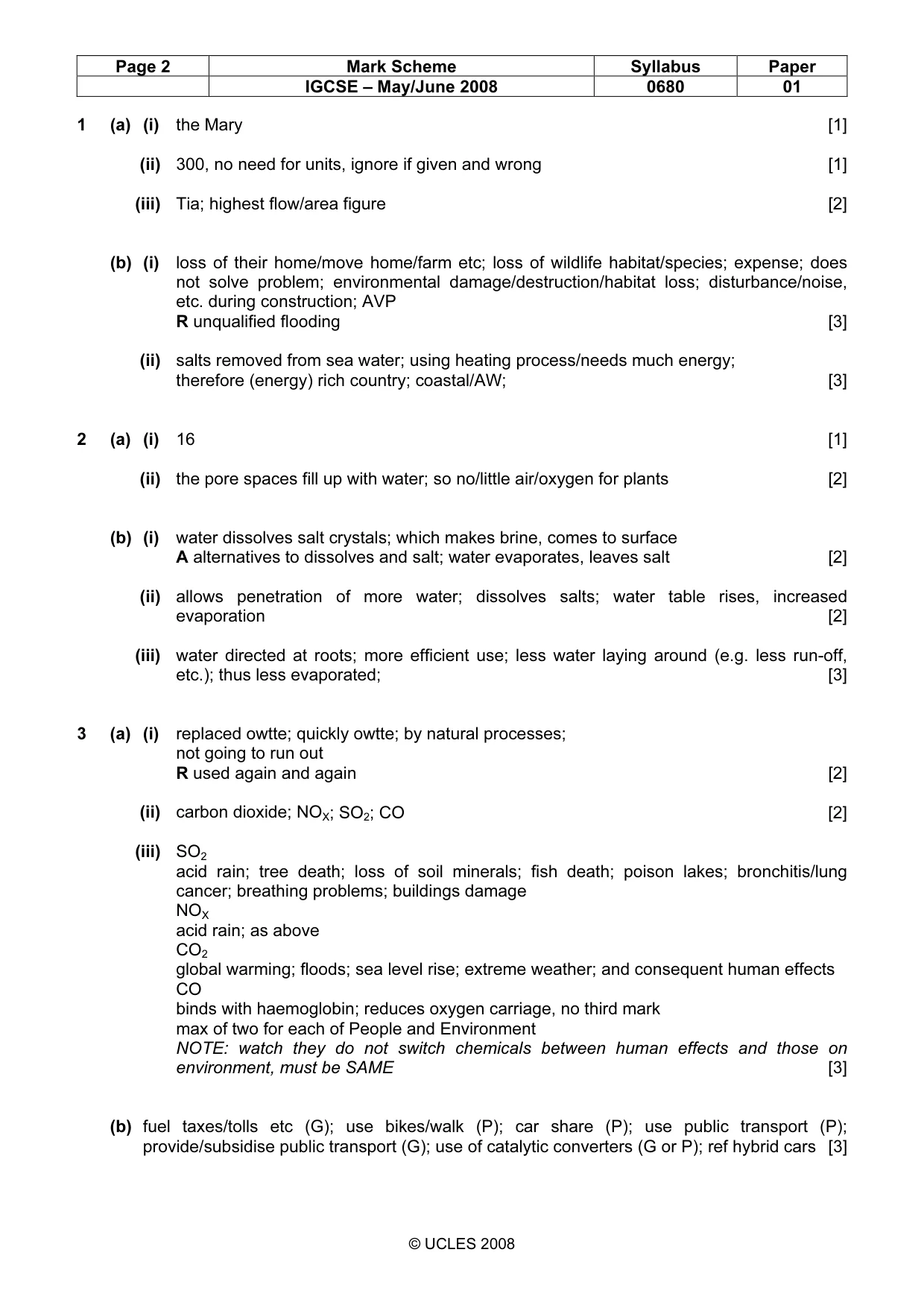
Page 2 Mark Scheme Syllabus Paper IGCSE – May/June 2008 0680 01 © UCLES 2008 1 (a) (i) the Mary [1] (ii) 300, no need for units, ignore if given and wrong [1] (iii) Tia; highest flow/area figure [2] (b) (i) loss of their home/move home/farm etc; loss of wildlife habitat/species; expense; does not solve problem; environmental damage/destruction/habitat loss; disturbance/noise, etc. during construction; AVP R unqualified flooding [3] (ii) salts removed from sea water; using heating process/needs much energy; therefore (energy) rich country; coastal/AW; [3] 2 (a) (i) 16 [1] (ii) the pore spaces fill up with water; so no/little air/oxygen for plants [2] (b) (i) water dissolves salt crystals; which makes brine, comes to surface A alternatives to dissolves and salt; water evaporates, leaves salt [2] (ii) allows penetration of more water; dissolves salts; water table rises, increased evaporation [2] (iii) water directed at roots; more efficient use; less water laying around (e.g. less run-off, etc.); thus less evaporated; [3] 3 (a) (i) replaced owtte; quickly owtte; by natural processes; not going to run out R used again and again [2] (ii) carbon dioxide; NOX; SO2; CO [2] (iii) SO2 acid rain; tree death; loss of soil minerals; fish death; poison lakes; bronchitis/lung cancer; breathing problems; buildings damage NOX acid rain; as above CO2 global warming; floods; sea level rise; extreme weather; and consequent human effects CO binds with haemoglobin; reduces oxygen carriage, no third mark max of two for each of People and Environment NOTE: watch they do not switch chemicals between human effects and those on environment, must be SAME [3] (b) fuel taxes/tolls etc (G); use bikes/walk (P); car share (P); use public transport (P); provide/subsidise public transport (G); use of catalytic converters (G or P); ref hybrid cars [3]
Mark scheme, page 3
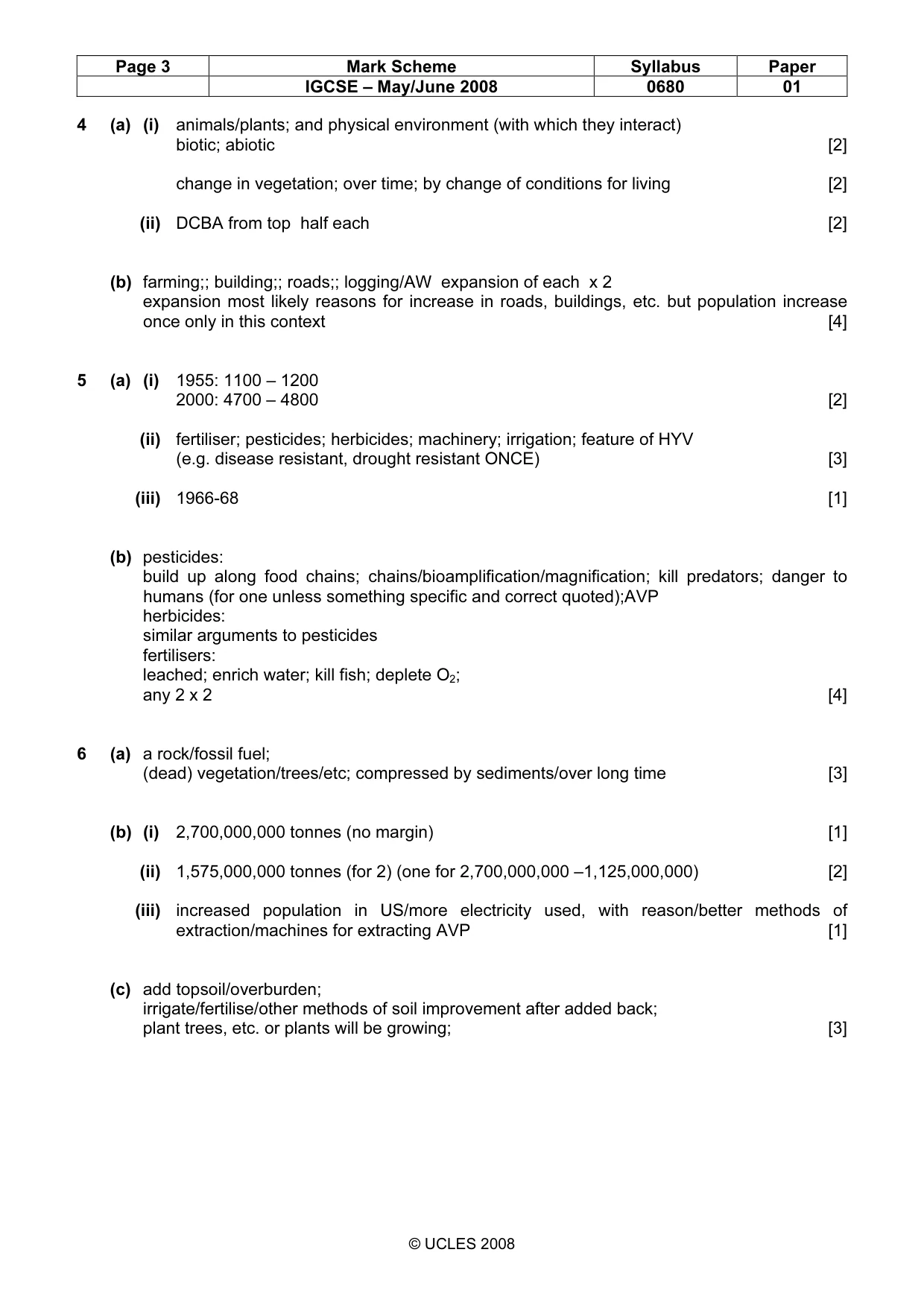
Page 3 Mark Scheme Syllabus Paper IGCSE – May/June 2008 0680 01 © UCLES 2008 4 (a) (i) animals/plants; and physical environment (with which they interact) biotic; abiotic [2] change in vegetation; over time; by change of conditions for living [2] (ii) DCBA from top half each [2] (b) farming;; building;; roads;; logging/AW expansion of each x 2 expansion most likely reasons for increase in roads, buildings, etc. but population increase once only in this context [4] 5 (a) (i) 1955: 1100 – 1200 2000: 4700 – 4800 [2] (ii) fertiliser; pesticides; herbicides; machinery; irrigation; feature of HYV (e.g. disease resistant, drought resistant ONCE) [3] (iii) 1966-68 [1] (b) pesticides: build up along food chains; chains/bioamplification/magnification; kill predators; danger to humans (for one unless something specific and correct quoted);AVP herbicides: similar arguments to pesticides fertilisers: leached; enrich water; kill fish; deplete O2; any 2 x 2 [4] 6 (a) a rock/fossil fuel; (dead) vegetation/trees/etc; compressed by sediments/over long time [3] (b) (i) 2,700,000,000 tonnes (no margin) [1] (ii) 1,575,000,000 tonnes (for 2) (one for 2,700,000,000 –1,125,000,000) [2] (iii) increased population in US/more electricity used, with reason/better methods of extraction/machines for extracting AVP [1] (c) add topsoil/overburden; irrigate/fertilise/other methods of soil improvement after added back; plant trees, etc. or plants will be growing; [3]
What you needed in this session
Cambridge’s own grade thresholds for 2008 May/June, Paper 1 · Variant 1. A higher threshold means an easier paper — the bar moves with how the cohort did.