Cambridge IGCSE Environmental Management 0680 — 2006 Oct/Nov Paper 1 · Variant 1
0680/11/O/N/06 · 60 marks · ≈68 min
The question paper and its mark scheme, free to read here and free to download. This is Cambridge’s own paper, exactly as it was sat.
Question paper12 pages

Mark scheme5 pages
Answers below. Sit the paper first if you are practising.
Paper as text
Question paper, page 1
This document consists of 11 printed pages and 1 blank page. SP (CW/CGW) T04112/4 © UCLES 2006 [Turn over UNIVERSITY OF CAMBRIDGE INTERNATIONAL EXAMINATIONS International General Certificate of Secondary Education ENVIRONMENTAL MANAGEMENT Paper 1 0680/01 October/November 2006 1 hour 30 minutes Candidates answer on the Question Paper. Additional Materials: Ruler READ THESE INSTRUCTIONS FIRST Write your Centre number, candidate number and name on all the work you hand in. Write in dark blue or black pen. You may use a soft pencil for any diagrams, graphs or rough working. Do not use staples, paper clips, highlighters, glue or correction fluid. Answer all questions. At the end of the examination, fasten all your work securely together. The number of marks is given in brackets [ ] at the end of each question or part question. For Examiner’s Use 1 2 3 4 5 6 Total www.XtremePapers.com
Question paper, page 2
2 0680/01/O/N/06 © UCLES 2006 For Examiner’s Use 1 Some Problems and Benefits of Ecotourism in Developing Countries One of the most important resources, that developing countries have, is the abundant wildlife that live in them. There is an increasing interest amongst wealthy people from developed countries to visit and see the wildlife. This trend brings some benefits, but also some problems. (a) (i) A visitor to a tropical rainforest area was advised to wear a long sleeved shirt and long trousers when outside, mainly at night. Explain one reason for this advice being given. … … …[2] (ii) If a visitor did not take this advice, explain one other way in which they might avoid problems. … …[2] (b) A recently opened National Park, next to the Manumbolo River in Madagascar, was being visited by a group of tourists from a developed country who camped on a site in the park. The problems included a fly infested pit latrine and poor access to a clean water supply. (i) How could these problems have affected the tourists? … … …[2] (ii) How could the Government and Park Authorities improve the conditions for the tourists here? … … …[2] (iii) What benefits would the Park Authorities and the local people get from any improvements they made to this campsite? … … …[2] [Total : 10]
Question paper, page 3
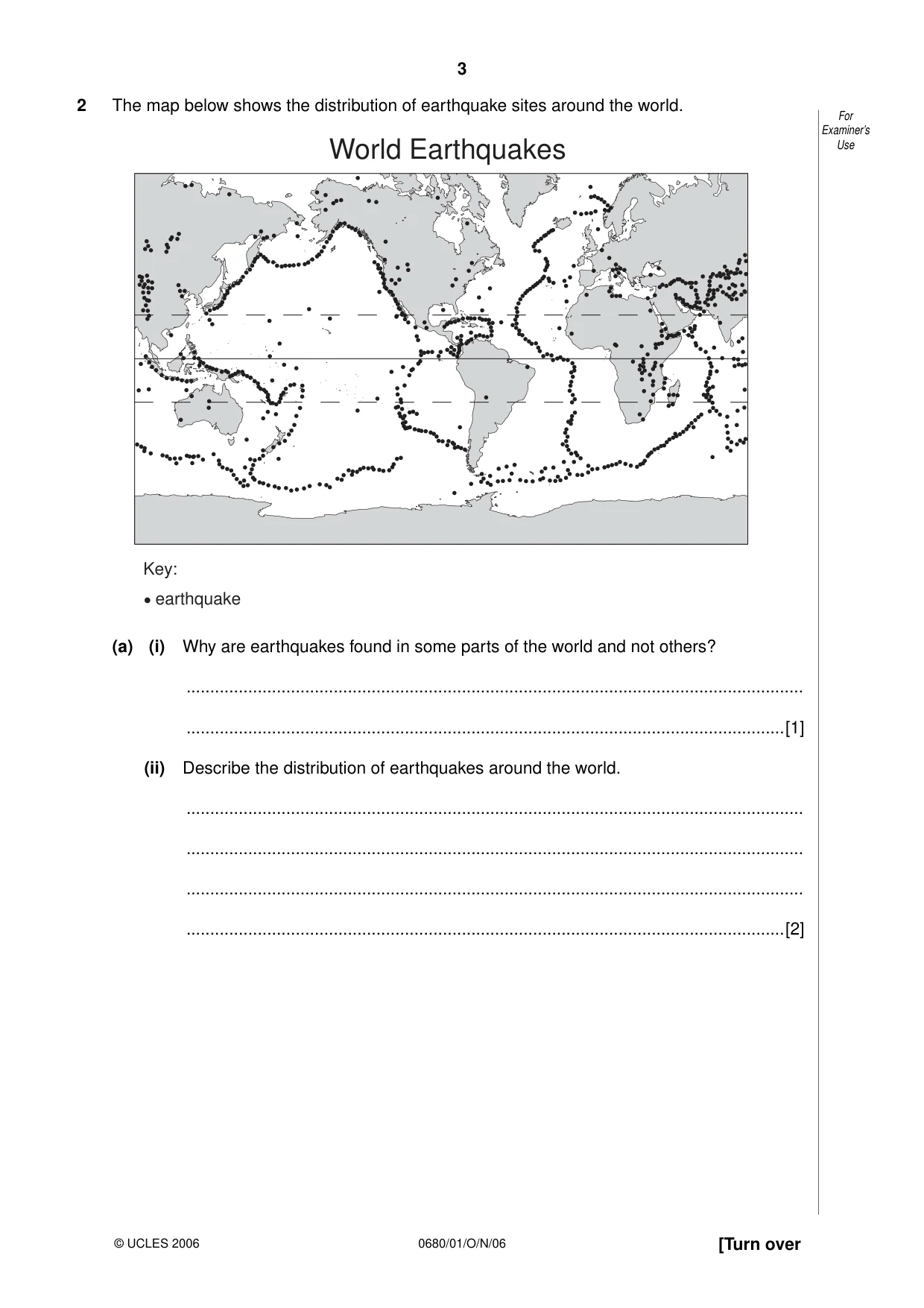
3 0680/01/O/N/06 [Turn over © UCLES 2006 For Examiner’s Use 2 The map below shows the distribution of earthquake sites around the world. World Earthquakes Key: earthquake (a) (i) Why are earthquakes found in some parts of the world and not others? … …[1] (ii) Describe the distribution of earthquakes around the world. … … … …[2]
Question paper, page 4
4 0680/01/O/N/06 © UCLES 2006 For Examiner’s Use (b) (i) Explain why some earthquakes have a greater impact than others. You may use the following terms in your answer: Richter Scale population density buildings rural … … … … … …[4] (ii) How can National Governments and International Aid Agencies reduce the impact of an earthquake? … … … … … …[3] [Total : 10]
Question paper, page 5
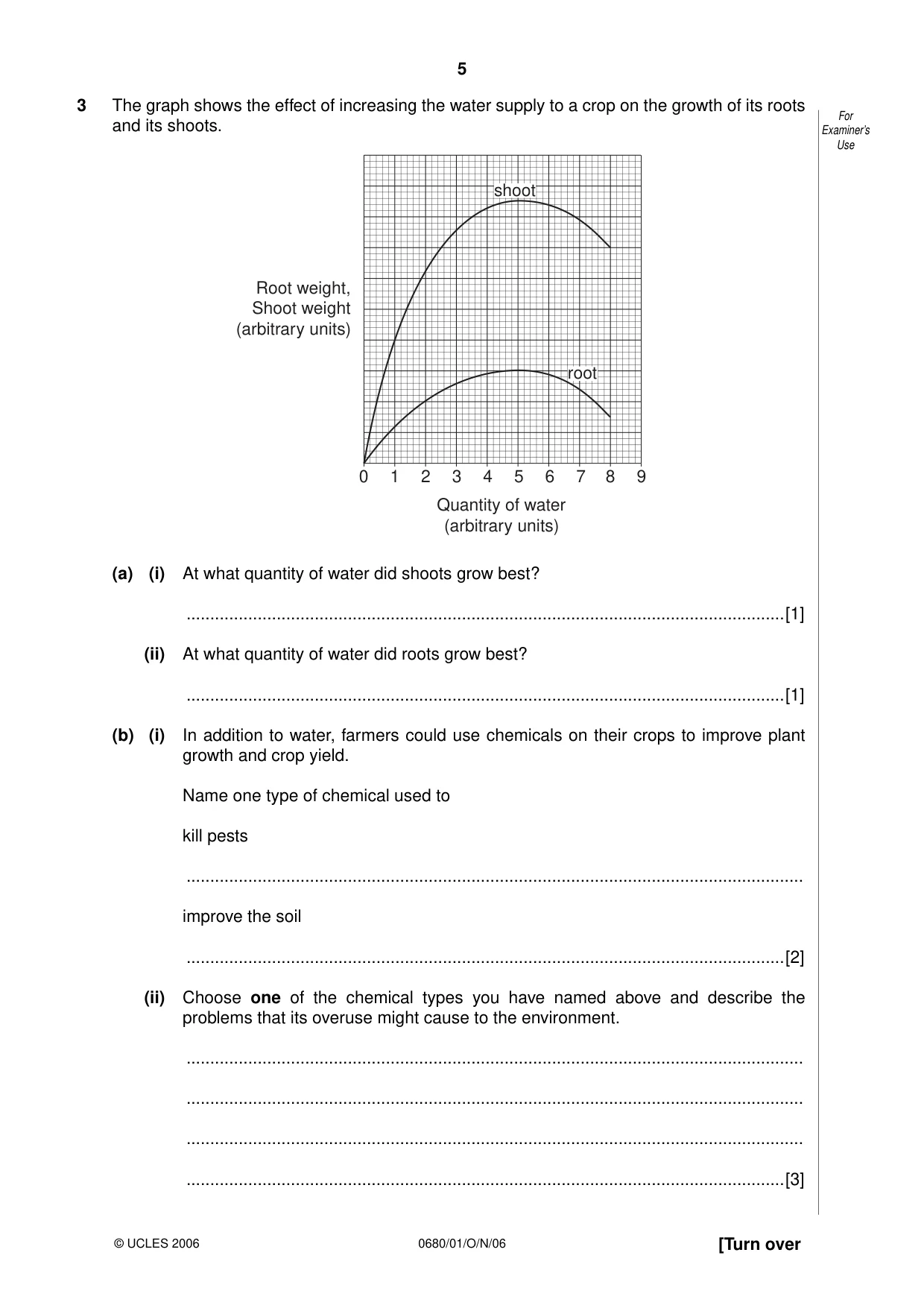
5 0680/01/O/N/06 [Turn over © UCLES 2006 For Examiner’s Use 3 The graph shows the effect of increasing the water supply to a crop on the growth of its roots and its shoots. 0 1 2 3 4 Quantity of water (arbitrary units) 5 6 7 8 9 shoot Root weight, Shoot weight (arbitrary units) root (a) (i) At what quantity of water did shoots grow best? …[1] (ii) At what quantity of water did roots grow best? …[1] (b) (i) In addition to water, farmers could use chemicals on their crops to improve plant growth and crop yield. Name one type of chemical used to kill pests … improve the soil …[2] (ii) Choose one of the chemical types you have named above and describe the problems that its overuse might cause to the environment. … … … …[3]
Question paper, page 6
6 0680/01/O/N/06 © UCLES 2006 For Examiner’s Use (iii) Another way of killing pests that does not use chemicals is called biological control. Explain what is meant by this term. … … … … …[3] [Total : 10]
Question paper, page 7
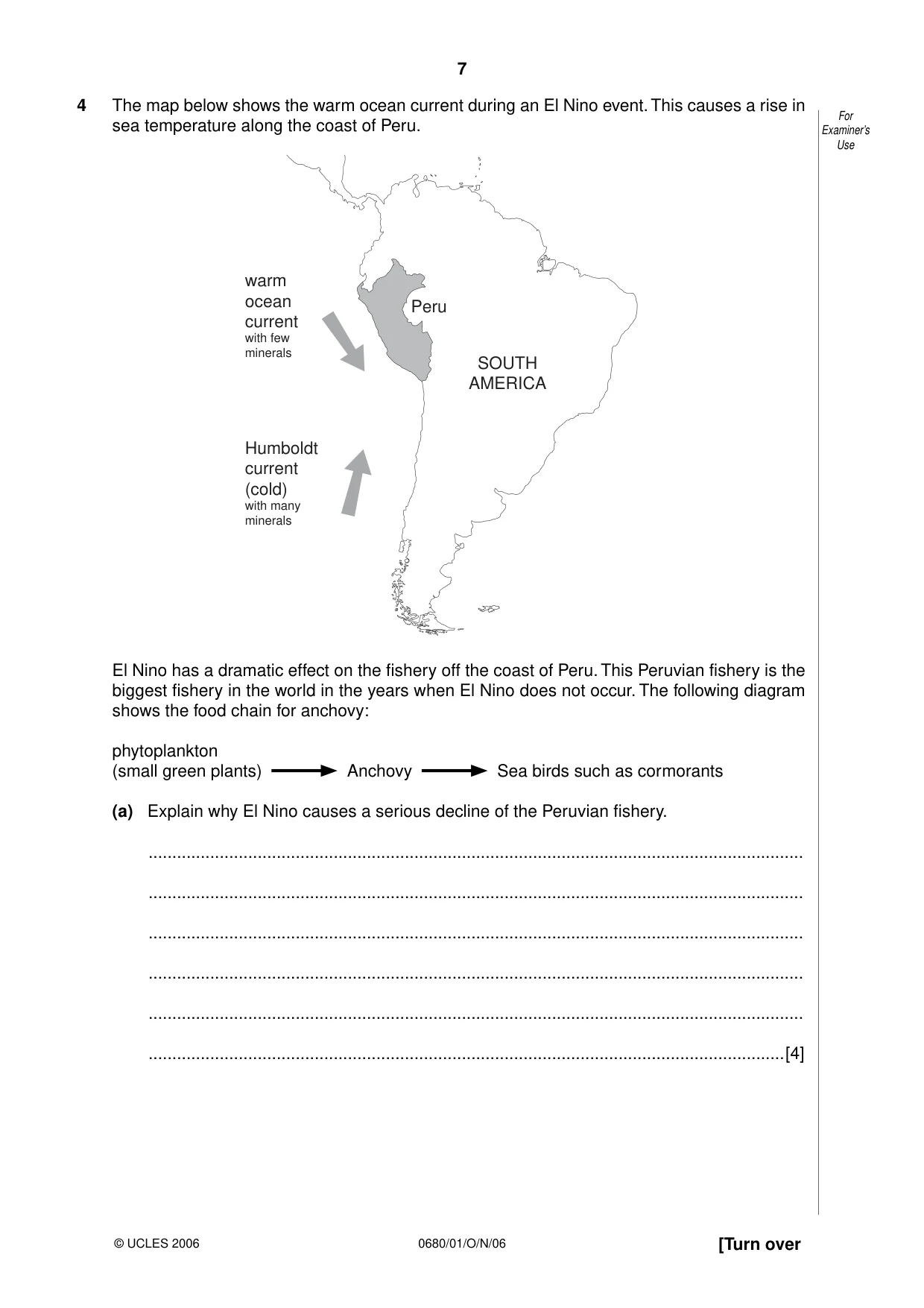
7 0680/01/O/N/06 [Turn over © UCLES 2006 For Examiner’s Use 4 The map below shows the warm ocean current during an El Nino event. This causes a rise in sea temperature along the coast of Peru. Peru warm ocean current with few minerals Humboldt current (cold) with many minerals SOUTH AMERICA El Nino has a dramatic effect on the fishery off the coast of Peru. This Peruvian fishery is the biggest fishery in the world in the years when El Nino does not occur. The following diagram shows the food chain for anchovy: phytoplankton (small green plants) Anchovy Sea birds such as cormorants (a) Explain why El Nino causes a serious decline of the Peruvian fishery. … … … … … …[4]
Question paper, page 8
8 0680/01/O/N/06 © UCLES 2006 For Examiner’s Use (b) El Nino is a natural event. Other threats to world fish stocks, such as oil spills, are caused by humans. (i) Explain the effect that oil spills have on coastal fisheries. … … … … … …[4] (ii) How can the effects of an oil spill be reduced? … … … …[2] [Total : 10]
Question paper, page 9
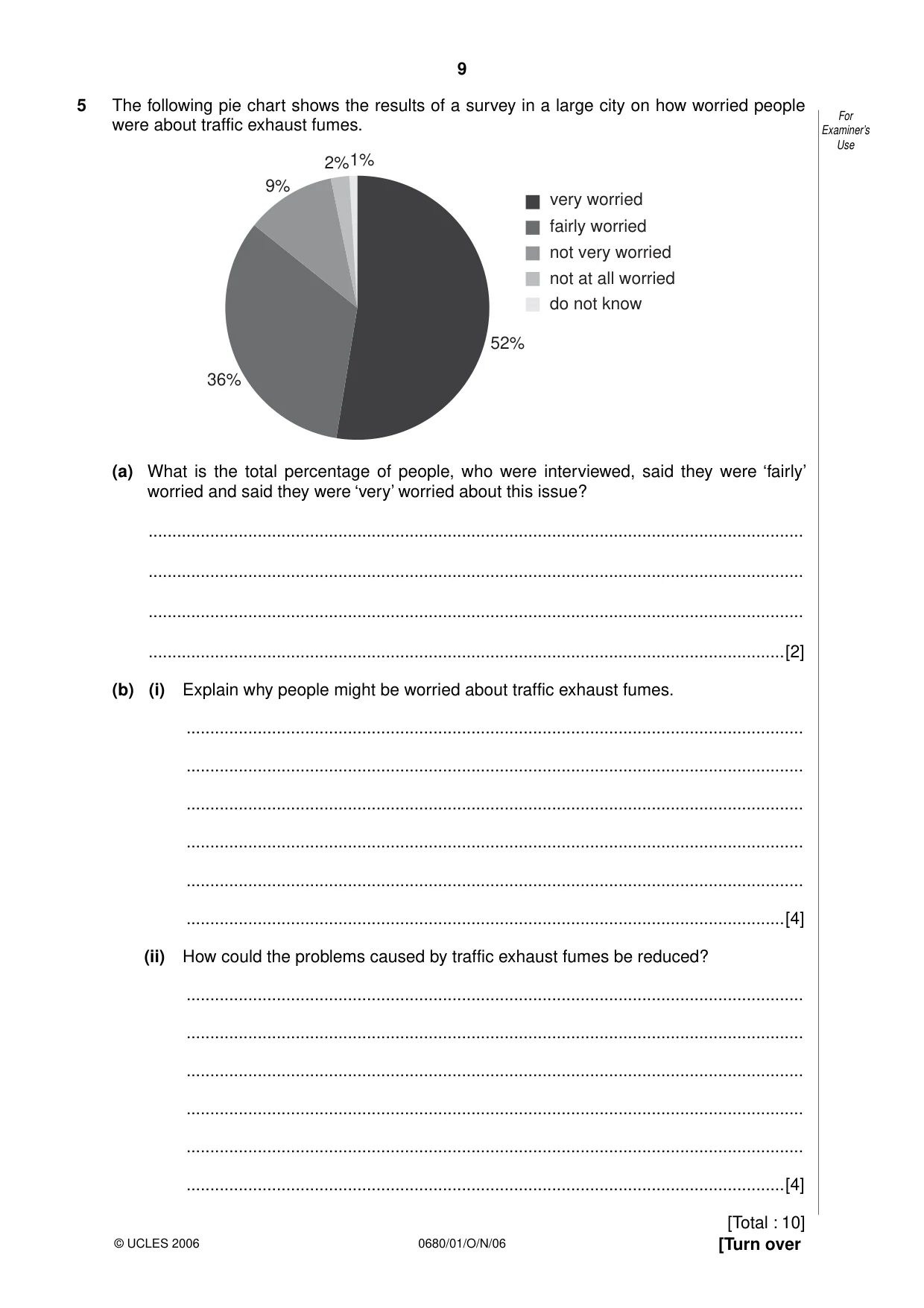
9 0680/01/O/N/06 [Turn over © UCLES 2006 For Examiner’s Use 5 The following pie chart shows the results of a survey in a large city on how worried people were about traffic exhaust fumes. very worried 9% 36% 52% 2%1% fairly worried not very worried not at all worried do not know (a) What is the total percentage of people, who were interviewed, said they were ‘fairly’ worried and said they were ‘very’ worried about this issue? … … … …[2] (b) (i) Explain why people might be worried about traffic exhaust fumes. … … … … … …[4] (ii) How could the problems caused by traffic exhaust fumes be reduced? … … … … … …[4] [Total : 10]
Question paper, page 10
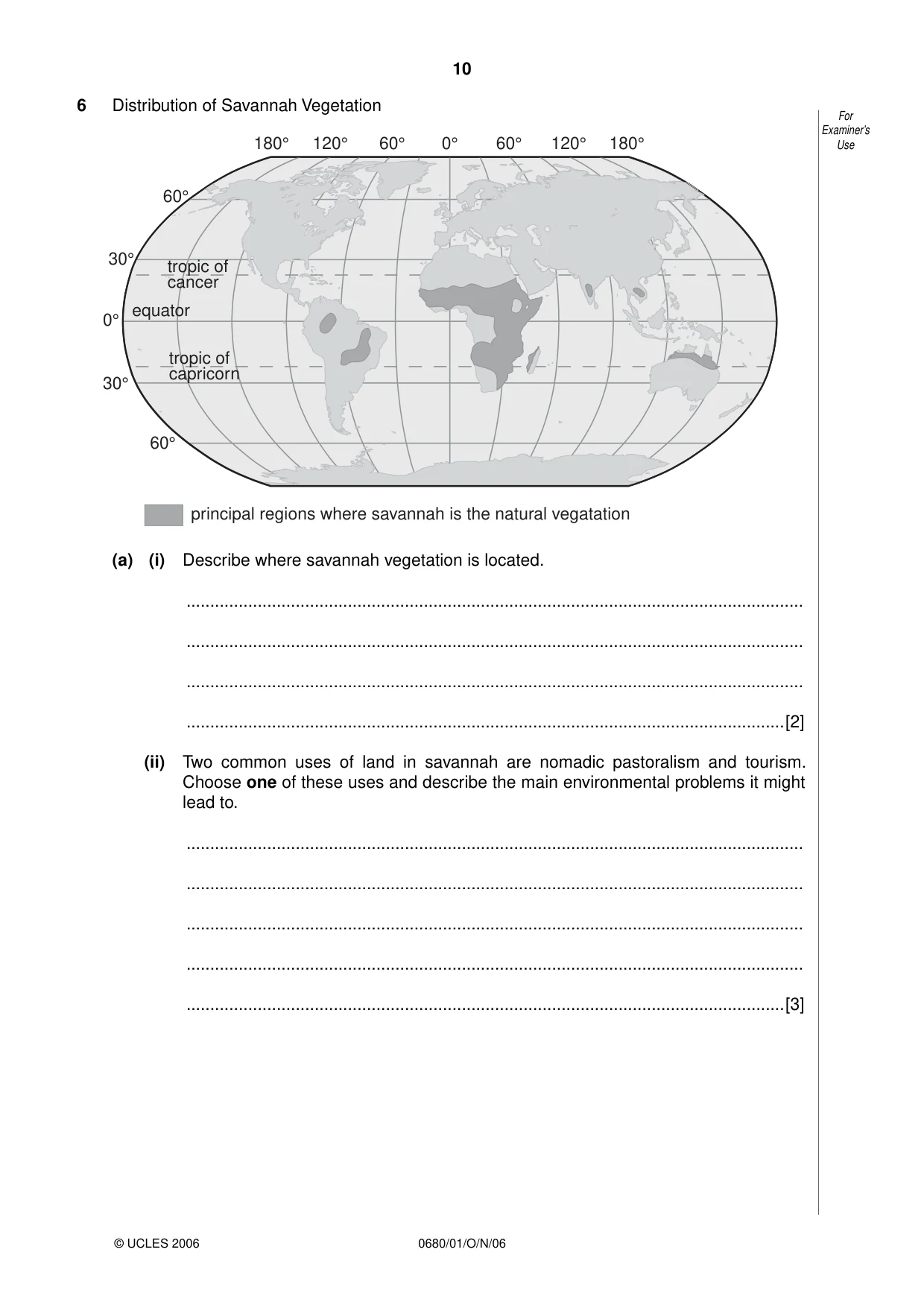
10 0680/01/O/N/06 © UCLES 2006 For Examiner’s Use 6 Distribution of Savannah Vegetation tropic of capricorn tropic of cancer equator 0° 30° 30° 60° 0° 60° 60° 120° 120° 180° principal regions where savannah is the natural vegatation 180° 60° (a) (i) Describe where savannah vegetation is located. … … … …[2] (ii) Two common uses of land in savannah are nomadic pastoralism and tourism. Choose one of these uses and describe the main environmental problems it might lead to. … … … … …[3]
Question paper, page 11
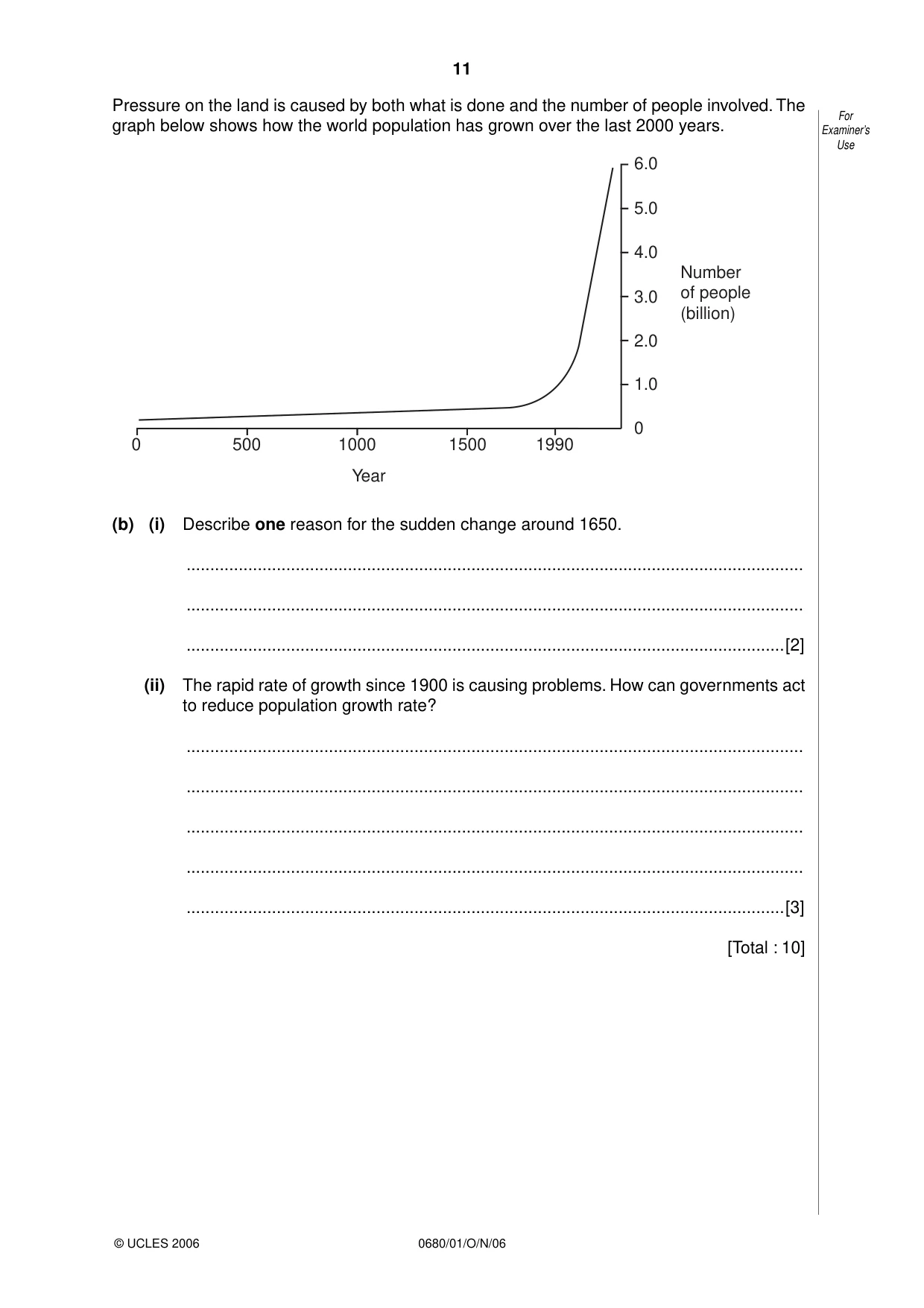
11 0680/01/O/N/06 © UCLES 2006 For Examiner’s Use Pressure on the land is caused by both what is done and the number of people involved. The graph below shows how the world population has grown over the last 2000 years. 6.0 5.0 4.0 3.0 2.0 1.0 0 1990 1500 1000 Year Number of people (billion) 500 0 (b) (i) Describe one reason for the sudden change around 1650. … … …[2] (ii) The rapid rate of growth since 1900 is causing problems. How can governments act to reduce population growth rate? … … … … …[3] [Total : 10]
Question paper, page 12
12 0680/01/O/N/06 BLANK PAGE Copyright Acknowledgements: Question 5 © Crown copyright material is reproduced with the permission of the Controller of HMSO and the Queen’s Printer for Scotland. Permission to reproduce items where third-party owned material protected by copyright is included has been sought and cleared where possible. Every reasonable effort has been made by the publisher (UCLES) to trace copyright holders, but if any items requiring clearance have unwittingly been included, the publisher will be pleased to make amends at the earliest possible opportunity. University of Cambridge International Examinations is part of the University of Cambridge Local Examinations Syndicate (UCLES), which is itself a department of the University of Cambridge.
Mark scheme, page 1
UNIVERSITY OF CAMBRIDGE INTERNATIONAL EXAMINATIONS International General Certificate of Secondary Education MARK SCHEME for the October/November 2006 question paper 0680 ENVIRONMENTAL MANAGEMENT 0680/01 Paper 1, maximum raw mark 60 This mark scheme is published as an aid to teachers and students, to indicate the requirements of the examination. It shows the basis on which Examiners were instructed to award marks. It does not indicate the details of the discussions that took place at an Examiners’ meeting before marking began. All Examiners are instructed that alternative correct answers and unexpected approaches in candidates’ scripts must be given marks that fairly reflect the relevant knowledge and skills demonstrated. Mark schemes must be read in conjunction with the question papers and the report on the examination. The grade thresholds for various grades are published in the report on the examination for most IGCSE, GCE Advanced Level and Advanced Subsidiary Level syllabuses. • CIE will not enter into discussions or correspondence in connection with these mark schemes. CIE is publishing the mark schemes for the October/November 2006 question papers for most IGCSE, GCE Advanced Level and Advanced Subsidiary Level syllabuses and some Ordinary Level syllabuses. www.XtremePapers.com
Mark scheme, page 2
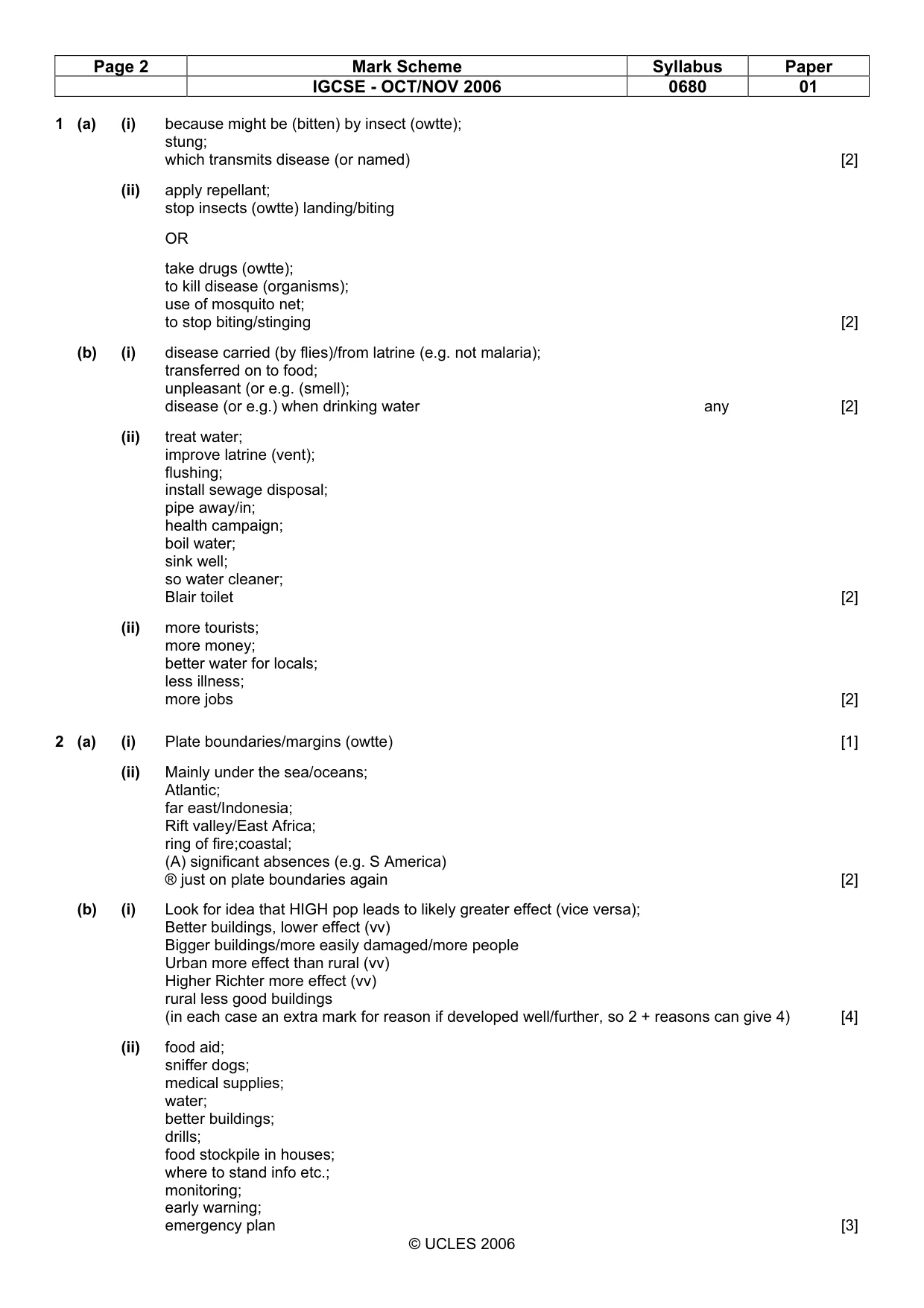
Page 2 Mark Scheme Syllabus Paper IGCSE - OCT/NOV 2006 0680 01 © UCLES 2006 1 (a) (i) because might be (bitten) by insect (owtte); stung; which transmits disease (or named) [2] (ii) apply repellant; stop insects (owtte) landing/biting OR take drugs (owtte); to kill disease (organisms); use of mosquito net; to stop biting/stinging [2] (b) (i) disease carried (by flies)/from latrine (e.g. not malaria); transferred on to food; unpleasant (or e.g. (smell); disease (or e.g.) when drinking water any [2] (ii) treat water; improve latrine (vent); flushing; install sewage disposal; pipe away/in; health campaign; boil water; sink well; so water cleaner; Blair toilet [2] (ii) more tourists; more money; better water for locals; less illness; more jobs [2] 2 (a) (i) Plate boundaries/margins (owtte) [1] (ii) Mainly under the sea/oceans; Atlantic; far east/Indonesia; Rift valley/East Africa; ring of fire;coastal; (A) significant absences (e.g. S America) ® just on plate boundaries again [2] (b) (i) Look for idea that HIGH pop leads to likely greater effect (vice versa); Better buildings, lower effect (vv) Bigger buildings/more easily damaged/more people Urban more effect than rural (vv) Higher Richter more effect (vv) rural less good buildings (in each case an extra mark for reason if developed well/further, so 2 + reasons can give 4) [4] (ii) food aid; sniffer dogs; medical supplies; water; better buildings; drills; food stockpile in houses; where to stand info etc.; monitoring; early warning; emergency plan [3]
Mark scheme, page 3
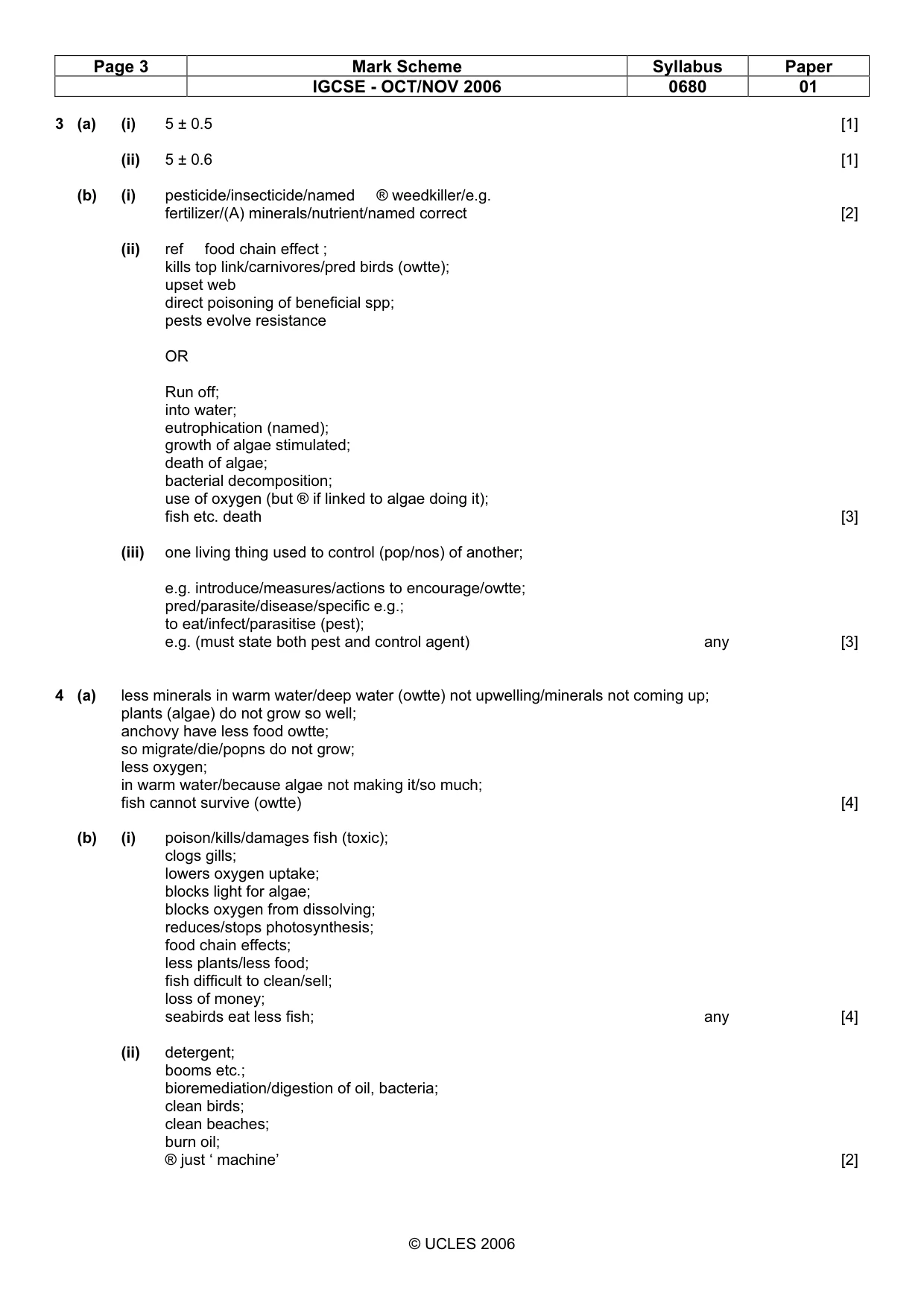
Page 3 Mark Scheme Syllabus Paper IGCSE - OCT/NOV 2006 0680 01 © UCLES 2006 3 (a) (i) 5 ± 0.5 [1] (ii) 5 ± 0.6 [1] (b) (i) pesticide/insecticide/named ® weedkiller/e.g. fertilizer/(A) minerals/nutrient/named correct [2] (ii) ref food chain effect ; kills top link/carnivores/pred birds (owtte); upset web direct poisoning of beneficial spp; pests evolve resistance OR Run off; into water; eutrophication (named); growth of algae stimulated; death of algae; bacterial decomposition; use of oxygen (but ® if linked to algae doing it); fish etc. death [3] (iii) one living thing used to control (pop/nos) of another; e.g. introduce/measures/actions to encourage/owtte; pred/parasite/disease/specific e.g.; to eat/infect/parasitise (pest); e.g. (must state both pest and control agent) any [3] 4 (a) less minerals in warm water/deep water (owtte) not upwelling/minerals not coming up; plants (algae) do not grow so well; anchovy have less food owtte; so migrate/die/popns do not grow; less oxygen; in warm water/because algae not making it/so much; fish cannot survive (owtte) [4] (b) (i) poison/kills/damages fish (toxic); clogs gills; lowers oxygen uptake; blocks light for algae; blocks oxygen from dissolving; reduces/stops photosynthesis; food chain effects; less plants/less food; fish difficult to clean/sell; loss of money; seabirds eat less fish; any [4] (ii) detergent; booms etc.; bioremediation/digestion of oil, bacteria; clean birds; clean beaches; burn oil; ® just ‘ machine’ [2]
Mark scheme, page 4
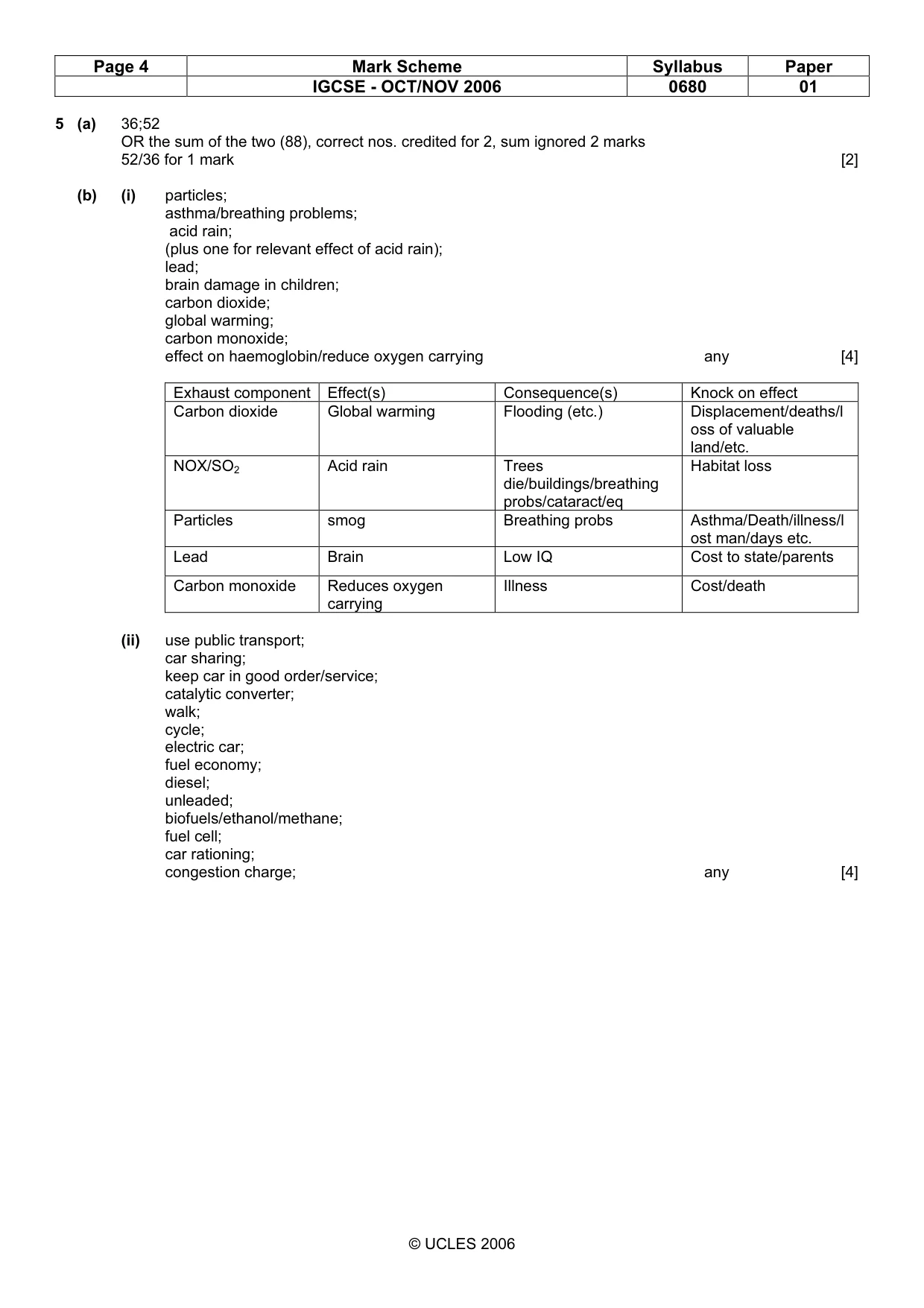
Page 4 Mark Scheme Syllabus Paper IGCSE - OCT/NOV 2006 0680 01 © UCLES 2006 5 (a) 36;52 OR the sum of the two (88), correct nos. credited for 2, sum ignored 2 marks 52/36 for 1 mark [2] (b) (i) particles; asthma/breathing problems; acid rain; (plus one for relevant effect of acid rain); lead; brain damage in children; carbon dioxide; global warming; carbon monoxide; effect on haemoglobin/reduce oxygen carrying any [4] Exhaust component Effect(s) Consequence(s) Knock on effect Carbon dioxide Global warming Flooding (etc.) Displacement/deaths/l oss of valuable land/etc. NOX/SO2 Acid rain Trees die/buildings/breathing probs/cataract/eq Habitat loss Particles smog Breathing probs Asthma/Death/illness/l ost man/days etc. Lead Brain Low IQ Cost to state/parents Carbon monoxide Reduces oxygen carrying Illness Cost/death (ii) use public transport; car sharing; keep car in good order/service; catalytic converter; walk; cycle; electric car; fuel economy; diesel; unleaded; biofuels/ethanol/methane; fuel cell; car rationing; congestion charge; any [4]
Mark scheme, page 5
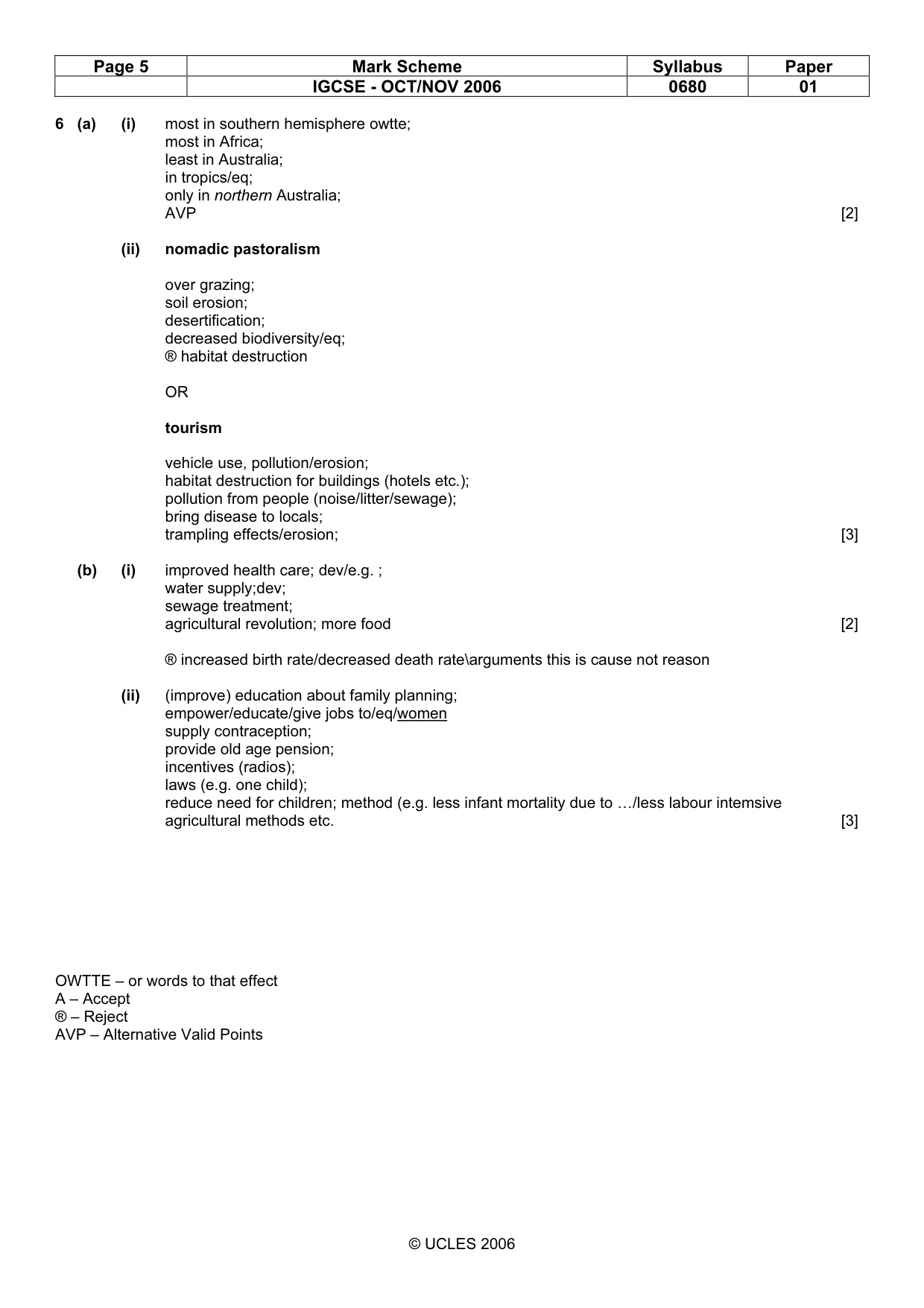
Page 5 Mark Scheme Syllabus Paper IGCSE - OCT/NOV 2006 0680 01 © UCLES 2006 6 (a) (i) most in southern hemisphere owtte; most in Africa; least in Australia; in tropics/eq; only in northern Australia; AVP [2] (ii) nomadic pastoralism over grazing; soil erosion; desertification; decreased biodiversity/eq; ® habitat destruction OR tourism vehicle use, pollution/erosion; habitat destruction for buildings (hotels etc.); pollution from people (noise/litter/sewage); bring disease to locals; trampling effects/erosion; [3] (b) (i) improved health care; dev/e.g. ; water supply;dev; sewage treatment; agricultural revolution; more food [2] ® increased birth rate/decreased death rate\arguments this is cause not reason (ii) (improve) education about family planning; empower/educate/give jobs to/eq/women supply contraception; provide old age pension; incentives (radios); laws (e.g. one child); reduce need for children; method (e.g. less infant mortality due to …/less labour intemsive agricultural methods etc. [3] OWTTE – or words to that effect A – Accept ® – Reject AVP – Alternative Valid Points
What you needed in this session
Cambridge’s own grade thresholds for 2006 Oct/Nov, Paper 1 · Variant 1. A higher threshold means an easier paper — the bar moves with how the cohort did.