Cambridge IGCSE Environmental Management 0680 — 2006 May/June Paper 1 · Variant 1
0680/11/M/J/06 · 60 marks · ≈68 min
The question paper and its mark scheme, free to read here and free to download. This is Cambridge’s own paper, exactly as it was sat.
Question paper16 pages



Mark scheme3 pages
Answers below. Sit the paper first if you are practising.
Paper as text
Question paper, page 1
This document consists of 12 printed pages and 4 blank pages. SPA (DR) T04111/2 © UCLES 2006 [Turn over UNIVERSITY OF CAMBRIDGE INTERNATIONAL EXAMINATIONS International General Certificate of Secondary Education ENVIRONMENTAL MANAGEMENT 0680/01 Paper 1 May/June 2006 1 hour 30 minutes Candidates answer on the Question Paper. Additional Materials: Ruler READ THESE INSTRUCTIONS FIRST Write your Centre number, candidate number and name on all the work you hand in. Write in dark blue or black pen. You may use a soft pencil for any diagrams, graphs or rough working. Do not use staples, paper clips, highlighters, glue or correction fluid. Answer all questions. At the end of the examination, fasten all your work securely together. The number of marks is given in brackets [ ] at the end of each question or part question. Centre Number Candidate Number Name For Examiner’s Use 1 2 3 4 5 6 Total www.XtremePapers.com
Question paper, page 2
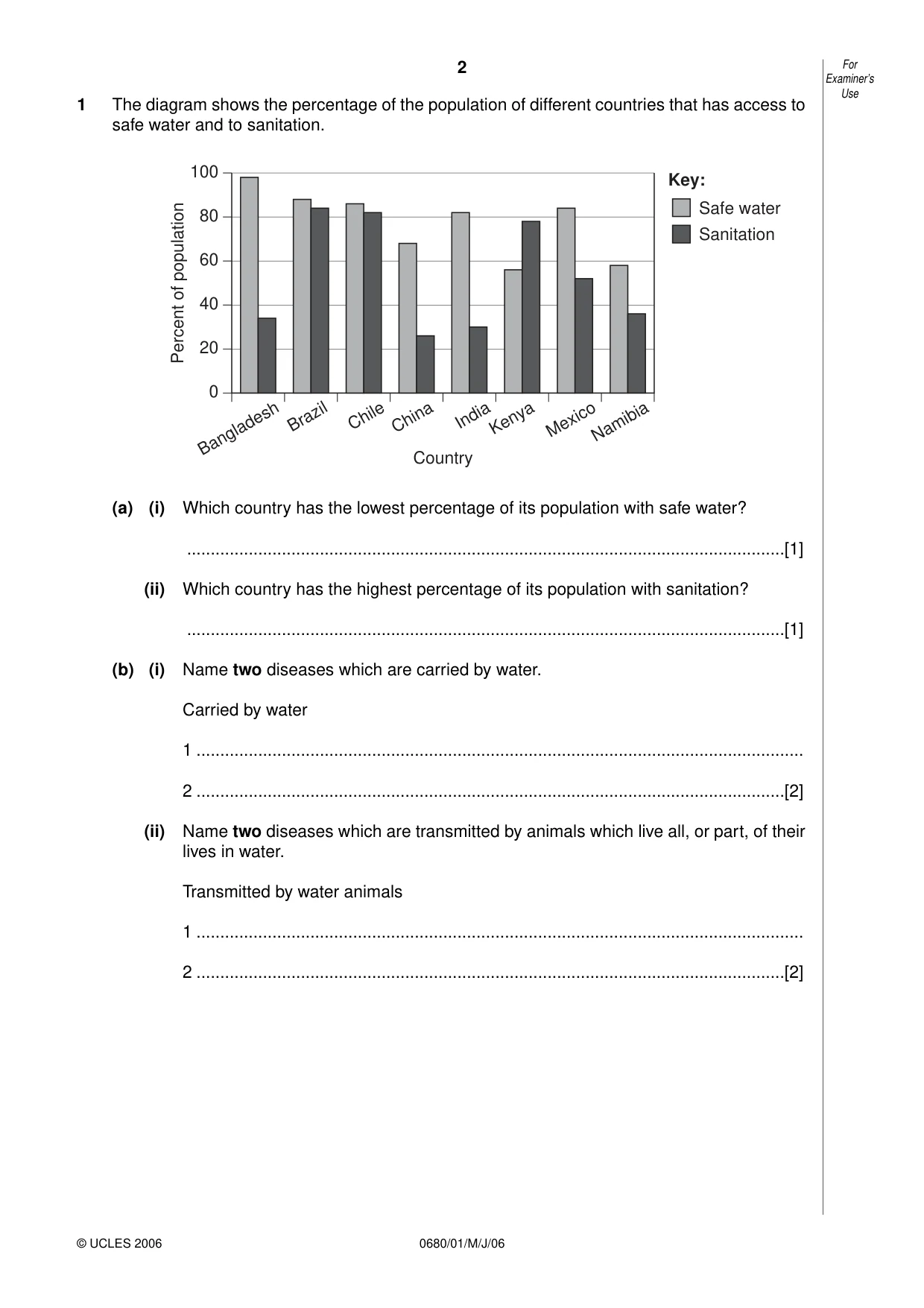
2 0680/01/M/J/06 1 The diagram shows the percentage of the population of different countries that has access to safe water and to sanitation. (a) (i) Which country has the lowest percentage of its population with safe water? …[1] (ii) Which country has the highest percentage of its population with sanitation? …[1] (b) (i) Name two diseases which are carried by water. Carried by water 1 … 2 …[2] (ii) Name two diseases which are transmitted by animals which live all, or part, of their lives in water. Transmitted by water animals 1 … 2 …[2] 0 20 40 60 80 100 Percent of population Bangladesh Brazil Chile China India Kenya Mexico Namibia Country Key: Safe water Sanitation For Examiner’s Use © UCLES 2006
Question paper, page 3
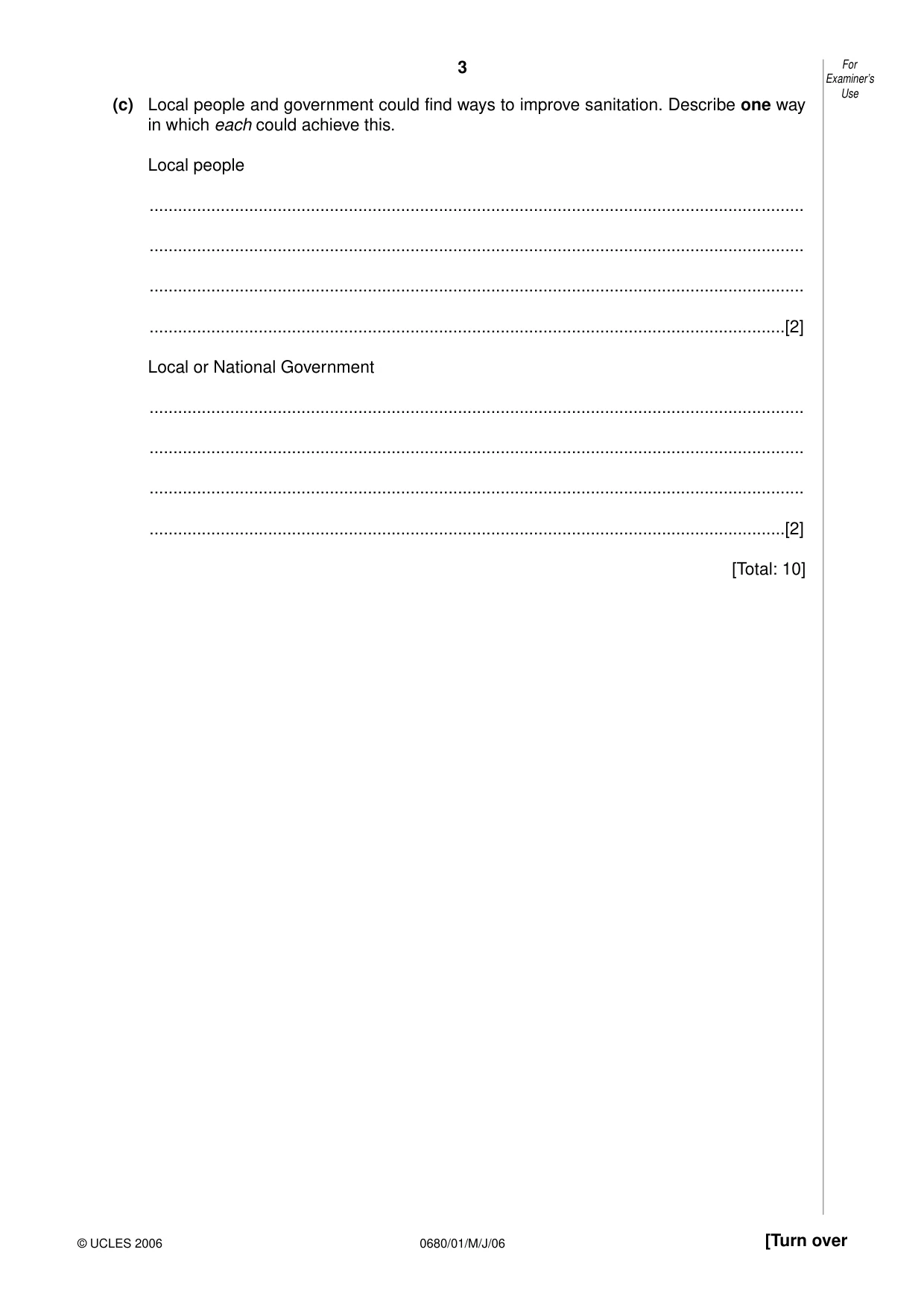
3 0680/01/M/J/06 [Turn over (c) Local people and government could find ways to improve sanitation. Describe one way in which each could achieve this. Local people … … … …[2] Local or National Government … … … …[2] [Total: 10] For Examiner’s Use © UCLES 2006
Question paper, page 4
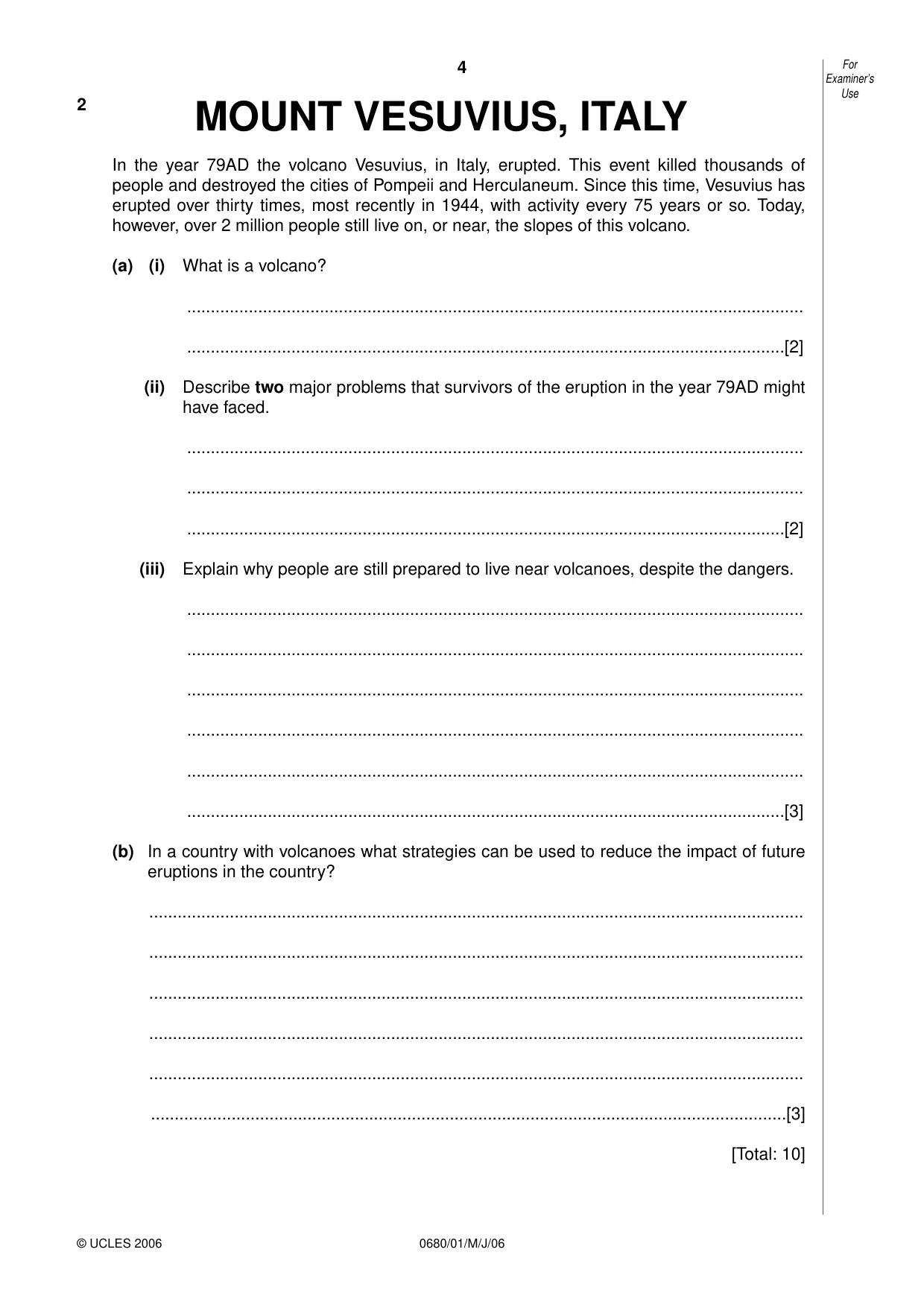
4 0680/01/M/J/06 2 MOUNT VESUVIUS, ITALY In the year 79AD the volcano Vesuvius, in Italy, erupted. This event killed thousands of people and destroyed the cities of Pompeii and Herculaneum. Since this time, Vesuvius has erupted over thirty times, most recently in 1944, with activity every 75 years or so. Today, however, over 2 million people still live on, or near, the slopes of this volcano. (a) (i) What is a volcano? … …[2] (ii) Describe two major problems that survivors of the eruption in the year 79AD might have faced. … … …[2] (iii) Explain why people are still prepared to live near volcanoes, despite the dangers. … … … … … …[3] (b) In a country with volcanoes what strategies can be used to reduce the impact of future eruptions in the country? … … … … … …[3] [Total: 10] For Examiner’s Use © UCLES 2006
Question paper, page 6
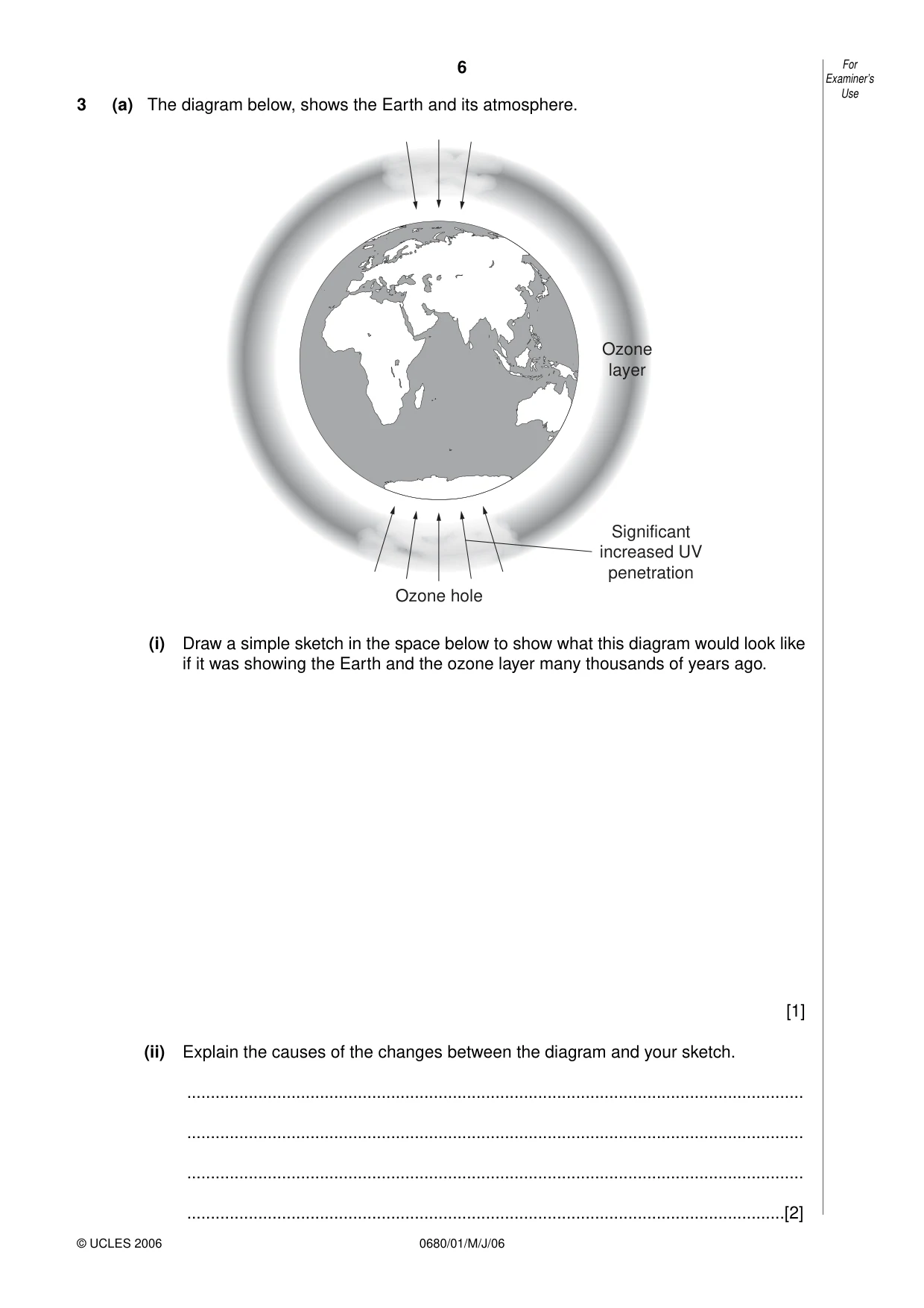
6 0680/01/M/J/06 3 (a) The diagram below, shows the Earth and its atmosphere. (i) Draw a simple sketch in the space below to show what this diagram would look like if it was showing the Earth and the ozone layer many thousands of years ago. [1] (ii) Explain the causes of the changes between the diagram and your sketch. … … … …[2] Ozone layer Ozone hole Significant increased UV penetration For Examiner’s Use © UCLES 2006
Question paper, page 7
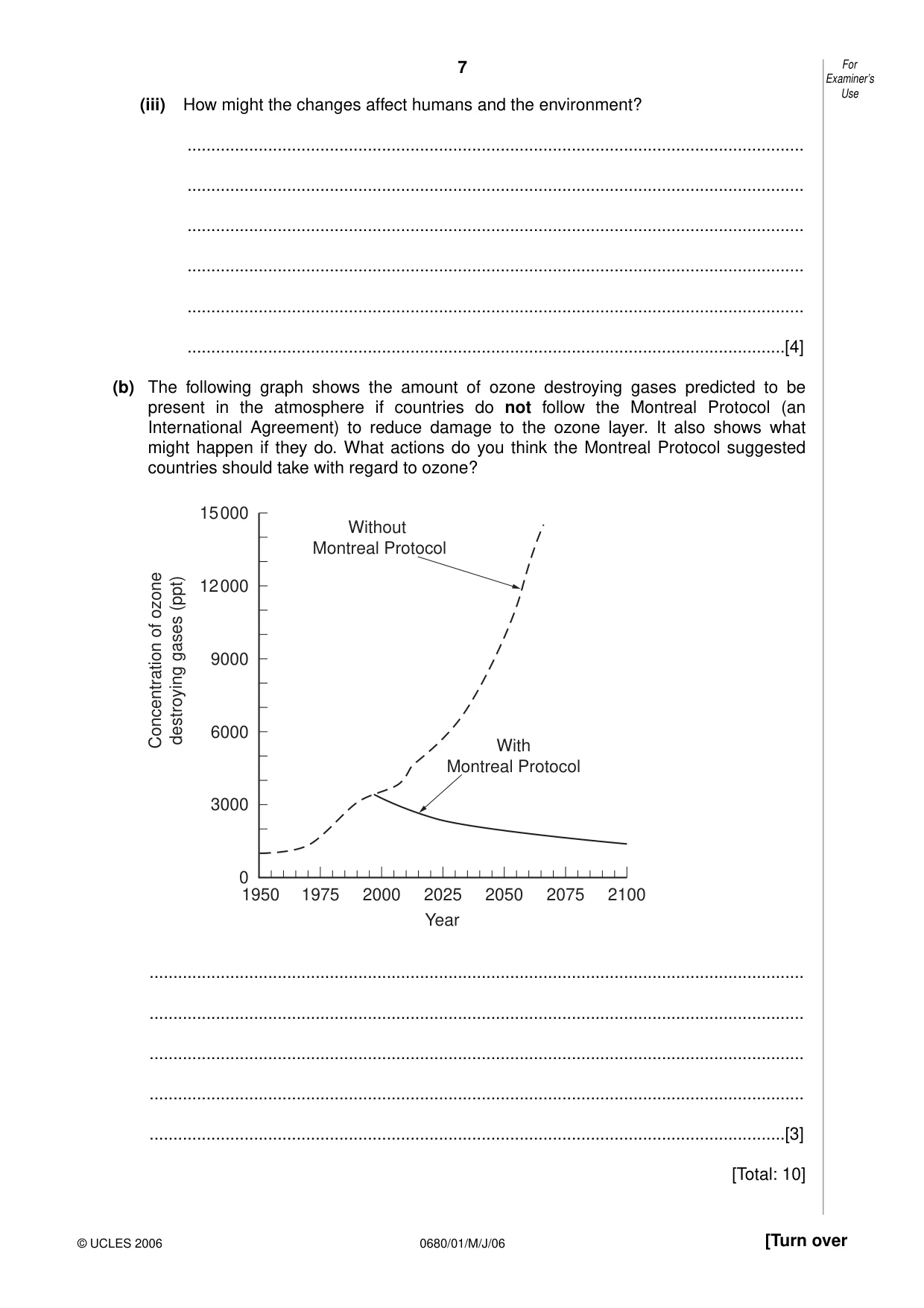
7 0680/01/M/J/06 [Turn over (iii) How might the changes affect humans and the environment? … … … … … …[4] (b) The following graph shows the amount of ozone destroying gases predicted to be present in the atmosphere if countries do not follow the Montreal Protocol (an International Agreement) to reduce damage to the ozone layer. It also shows what might happen if they do. What actions do you think the Montreal Protocol suggested countries should take with regard to ozone? … … … … …[3] [Total: 10] 1950 1975 2000 2025 Year 2050 2075 2100 0 3000 6000 9000 12000 15000 Concentration of ozone destroying gases (ppt) Without Montreal Protocol With Montreal Protocol For Examiner’s Use © UCLES 2006
Question paper, page 8
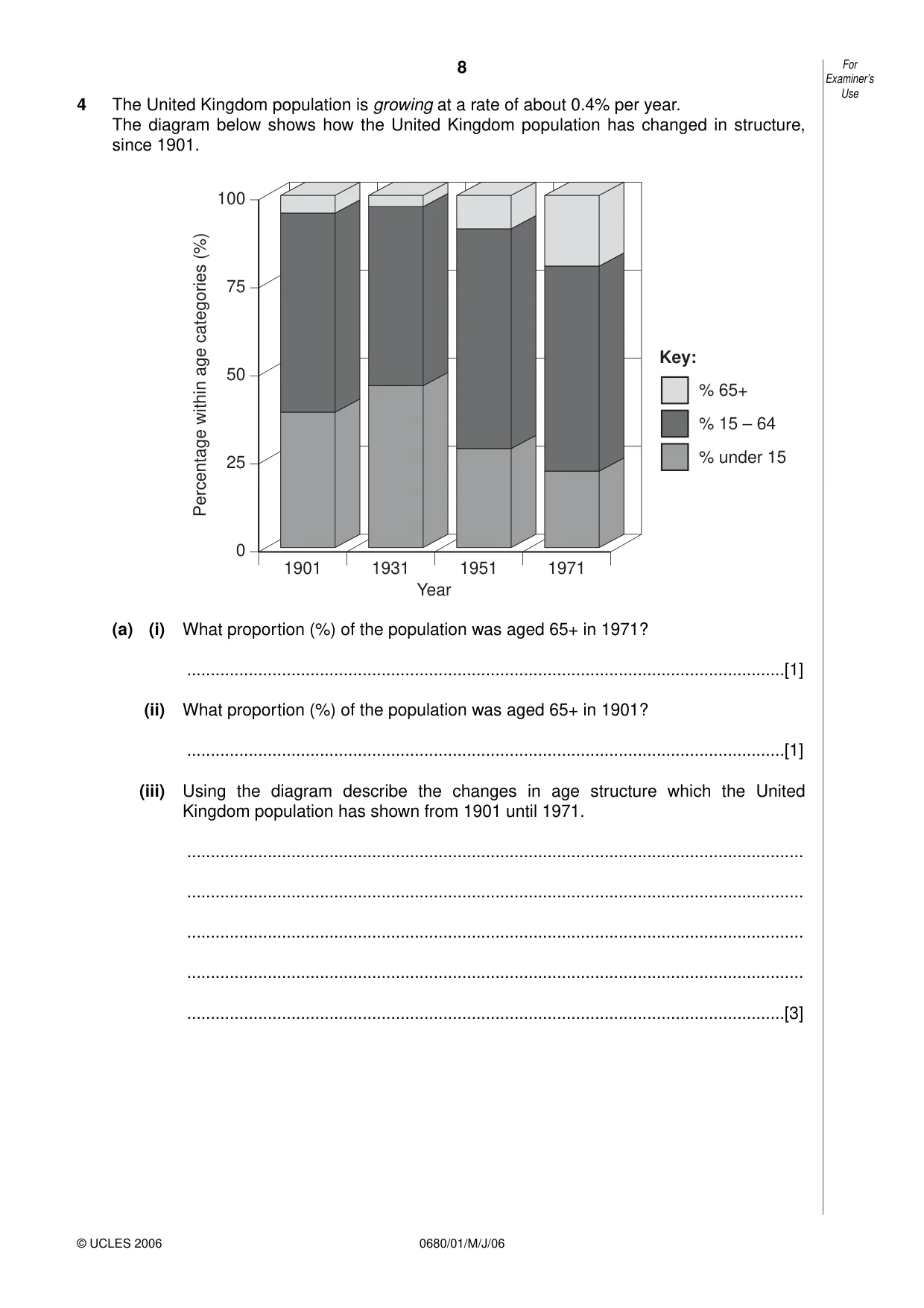
8 0680/01/M/J/06 4 The United Kingdom population is growing at a rate of about 0.4% per year. The diagram below shows how the United Kingdom population has changed in structure, since 1901. (a) (i) What proportion (%) of the population was aged 65+ in 1971? …[1] (ii) What proportion (%) of the population was aged 65+ in 1901? …[1] (iii) Using the diagram describe the changes in age structure which the United Kingdom population has shown from 1901 until 1971. … … … … …[3] 1901 1931 1951 1971 0 25 50 75 100 Percentage within age categories (%) Year % 65+ % 15 – 64 % under 15 Key: For Examiner’s Use © UCLES 2006
Question paper, page 9
9 0680/01/M/J/06 [Turn over (b) Niger, a country in Africa, has a population growth rate of nearly 3% per year. (i) State two environmental problems that such a high population growth rate might cause in Niger. … … … …[2] (ii) How can the governments in countries such as Niger reduce this high growth rate? … … … …[3] [Total: 10] For Examiner’s Use © UCLES 2006
Question paper, page 10
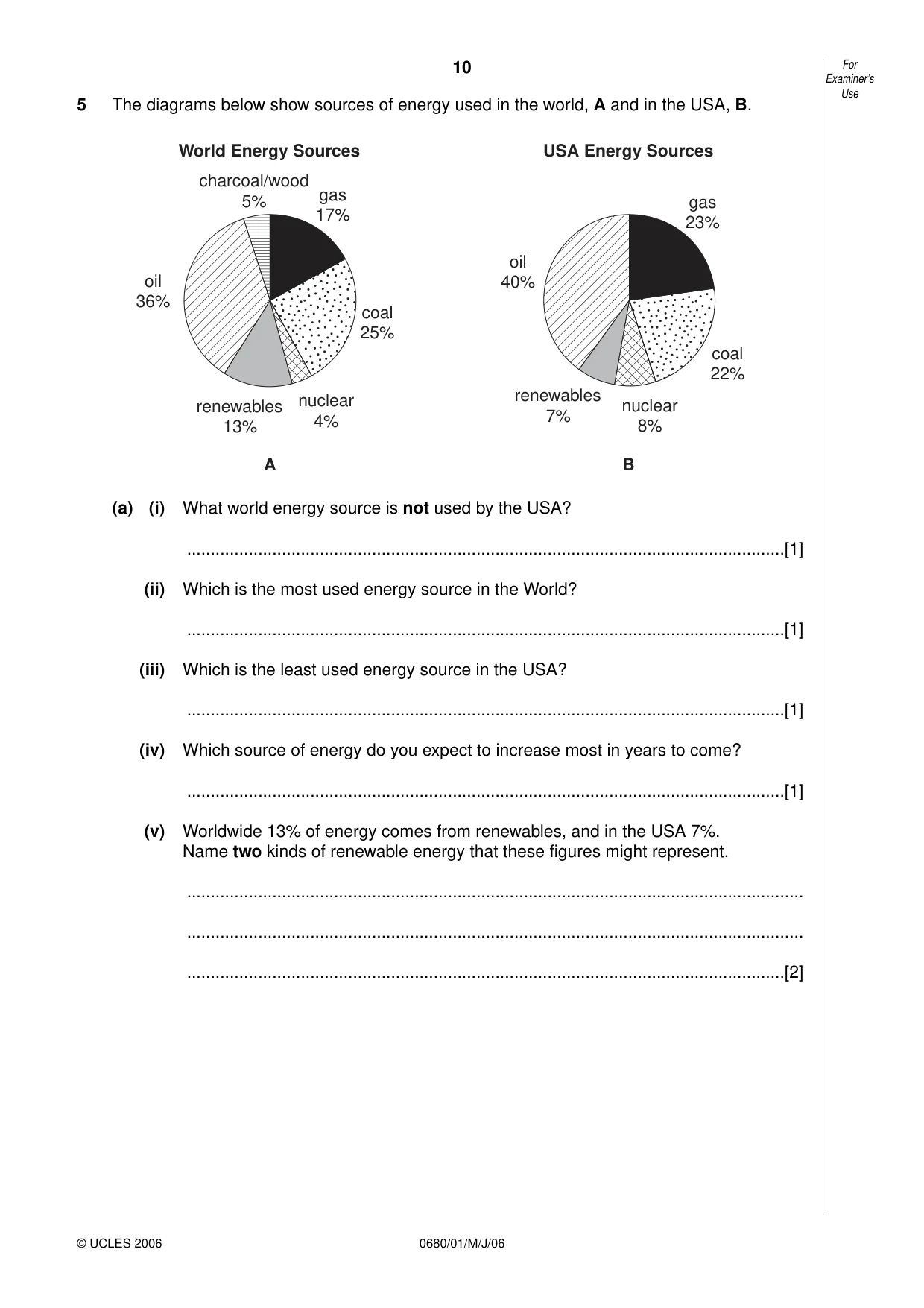
10 0680/01/M/J/06 5 The diagrams below show sources of energy used in the world, A and in the USA, B. (a) (i) What world energy source is not used by the USA? …[1] (ii) Which is the most used energy source in the World? …[1] (iii) Which is the least used energy source in the USA? …[1] (iv) Which source of energy do you expect to increase most in years to come? …[1] (v) Worldwide 13% of energy comes from renewables, and in the USA 7%. Name two kinds of renewable energy that these figures might represent. … … …[2] World Energy Sources USA Energy Sources A B charcoal/wood 5% gas 17% gas 23% coal 22% nuclear 8% renewables 7% coal 25% nuclear 4% renewables 13% oil 36% oil 40% For Examiner’s Use © UCLES 2006
Question paper, page 11
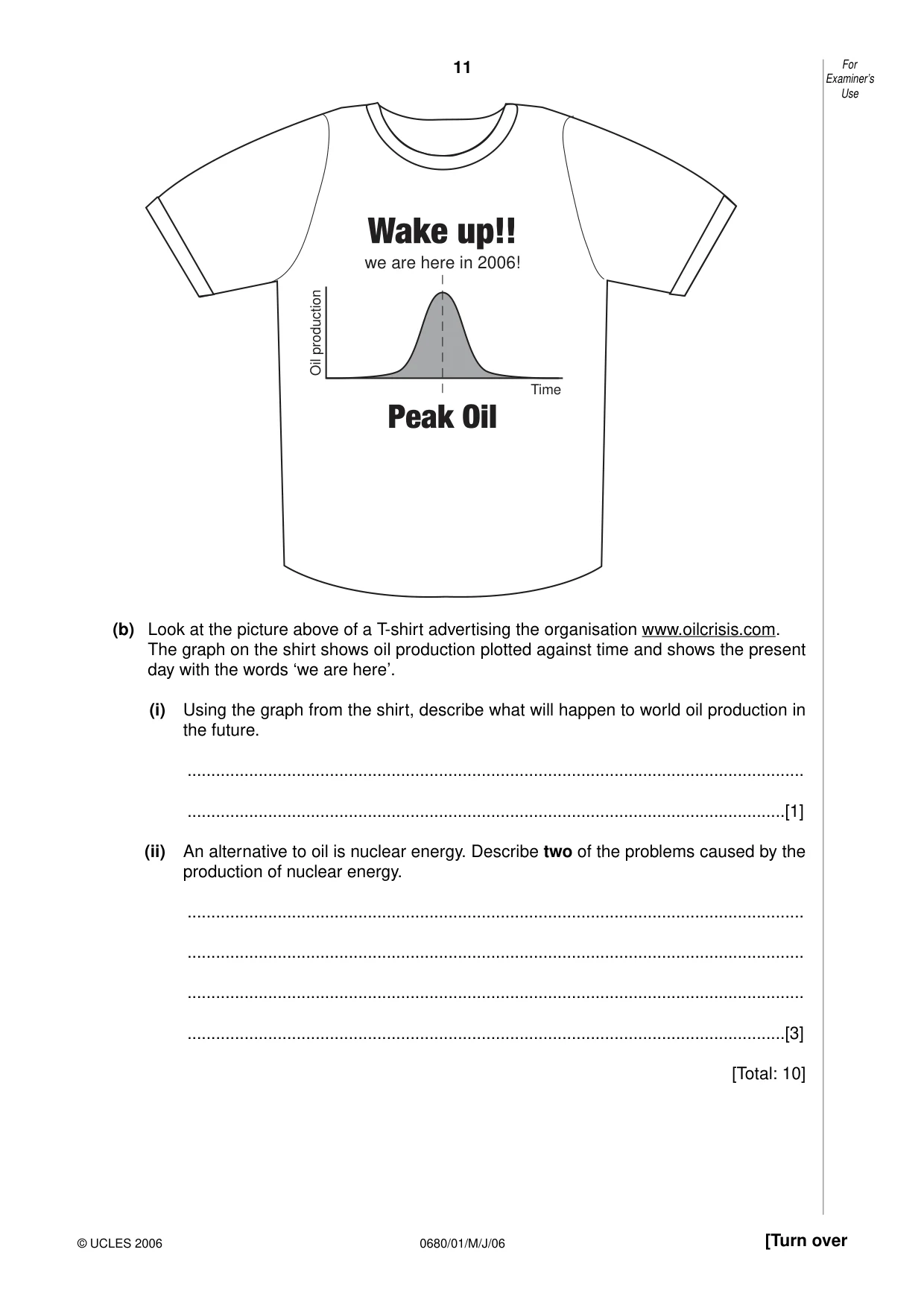
11 0680/01/M/J/06 [Turn over (b) Look at the picture above of a T-shirt advertising the organisation www.oilcrisis.com. The graph on the shirt shows oil production plotted against time and shows the present day with the words ‘we are here’. (i) Using the graph from the shirt, describe what will happen to world oil production in the future. … …[1] (ii) An alternative to oil is nuclear energy. Describe two of the problems caused by the production of nuclear energy. … … … …[3] [Total: 10] we are here in 2006! Oil production Time For Examiner’s Use © UCLES 2006
Question paper, page 12
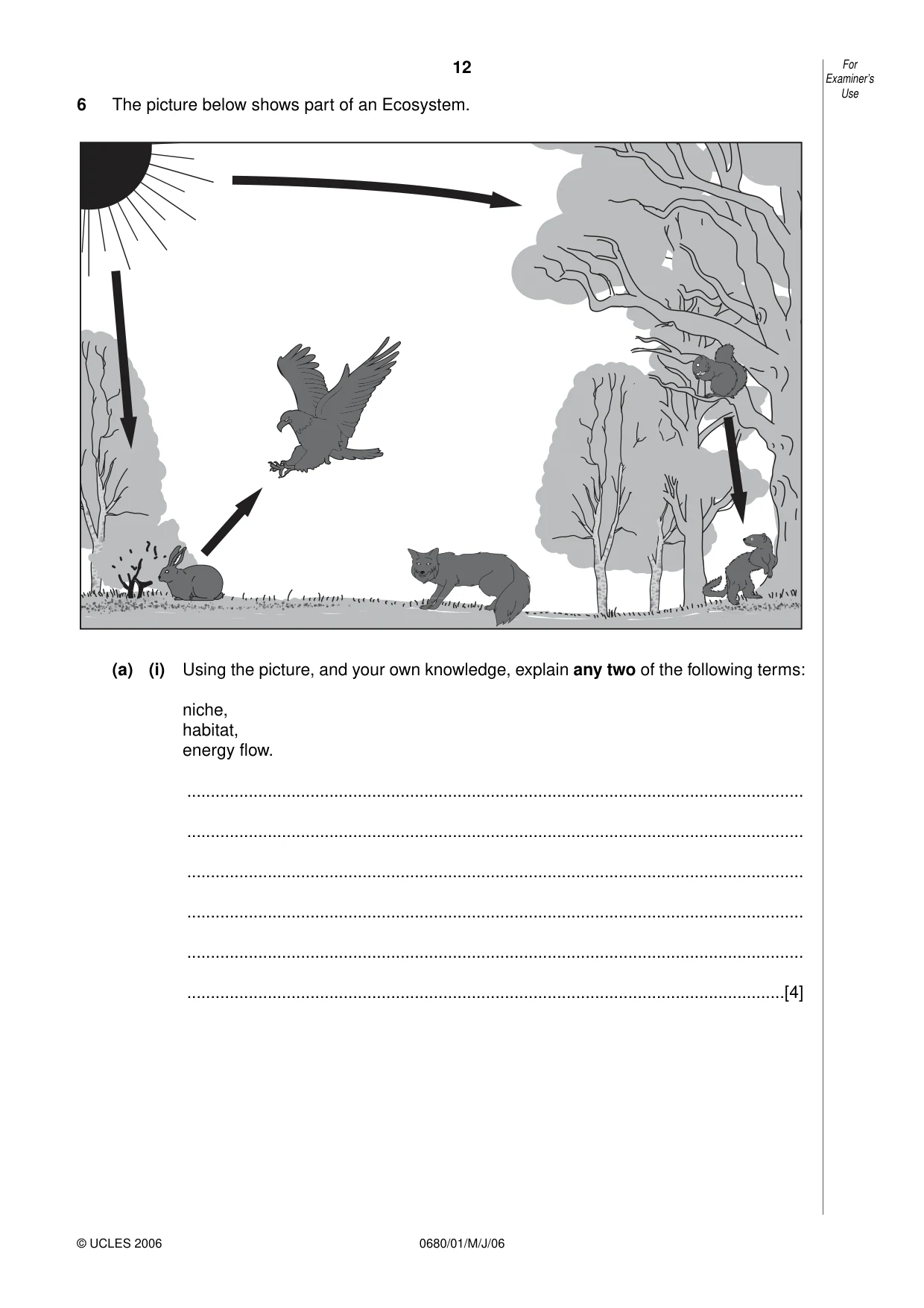
12 0680/01/M/J/06 6 The picture below shows part of an Ecosystem. (a) (i) Using the picture, and your own knowledge, explain any two of the following terms: niche, habitat, energy flow. … … … … … …[4] For Examiner’s Use © UCLES 2006
Question paper, page 13
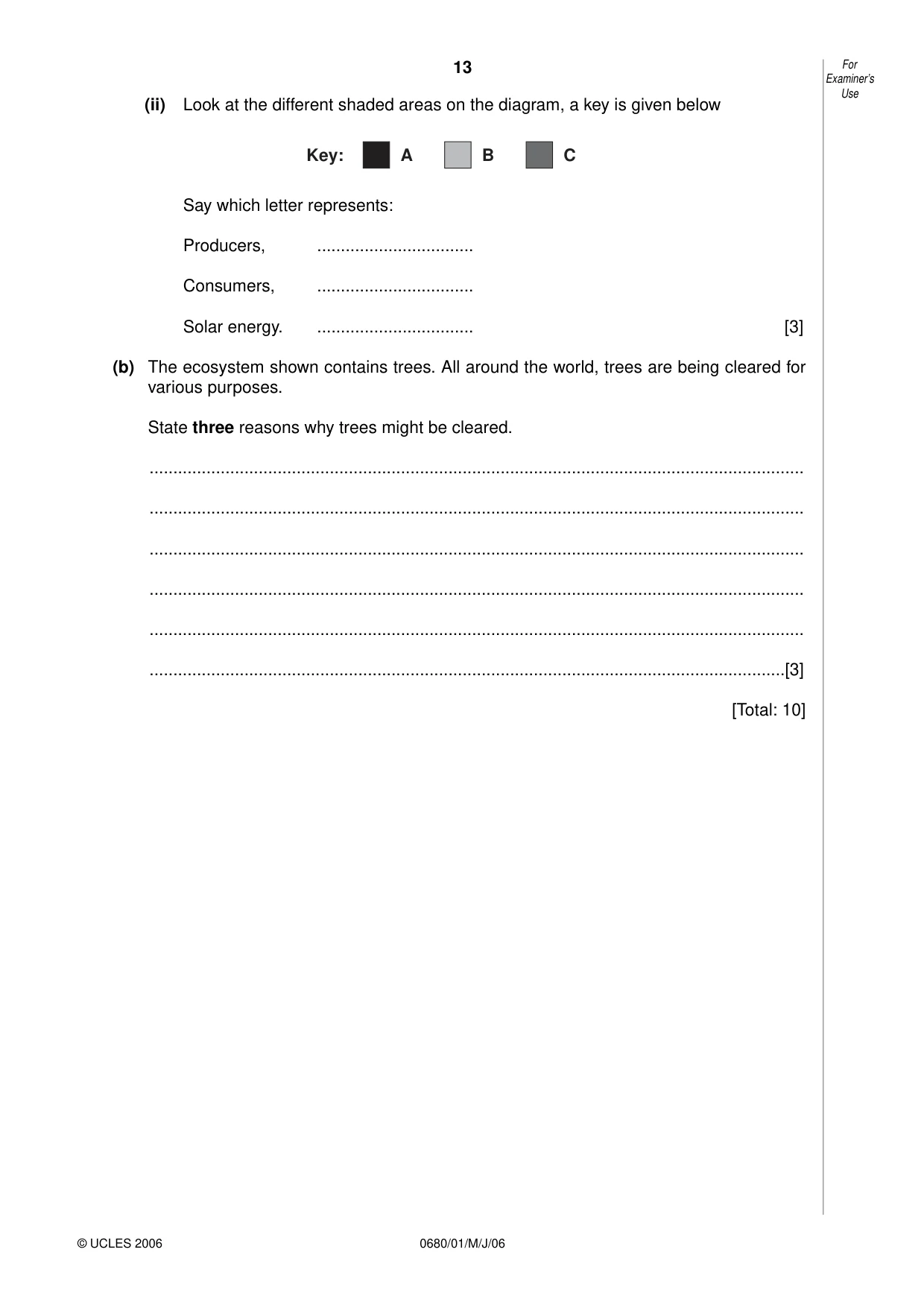
13 0680/01/M/J/06 (ii) Look at the different shaded areas on the diagram, a key is given below Say which letter represents: Producers, … Consumers, … Solar energy. … [3] (b) The ecosystem shown contains trees. All around the world, trees are being cleared for various purposes. State three reasons why trees might be cleared. … … … … … …[3] [Total: 10] A B C Key: For Examiner’s Use © UCLES 2006
Question paper, page 16
16 0680/01/M/J/06 BLANK PAGE Copyright Acknowledgements: Question 1 © Global Eye; WorldAware. Question 3 © http://www.ecocentre.org.uk/global-warming.html Question 5(b) © www.cafepress.com/peakoilaware Permission to reproduce items where third-party owned material protected by copyright is included has been sought and cleared where possible. Every reasonable effort has been made by the publisher (UCLES) to trace copyright holders, but if any items requiring clearance have unwittingly been included, the publisher will be pleased to make amends at the earliest possible opportunity. University of Cambridge International Examinations is part of the University of Cambridge Local Examinations Syndicate (UCLES), which is itself a department of the University of Cambridge.
Mark scheme, page 1
UNIVERSITY OF CAMBRIDGE INTERNATIONAL EXAMINATIONS International General Certificate of Secondary Education MARK SCHEME for the May/June 2006 question paper 0680 ENVIRONMENTAL MANAGEMENT 0680/01 Paper 1, maximum raw mark 60 These mark schemes are published as an aid to teachers and students, to indicate the requirements of the examination. They show the basis on which Examiners were initially instructed to award marks. They do not indicate the details of the discussions that took place at an Examiners’ meeting before marking began. Any substantial changes to the mark scheme that arose from these discussions will be recorded in the published Report on the Examination. All Examiners are instructed that alternative correct answers and unexpected approaches in candidates’ scripts must be given marks that fairly reflect the relevant knowledge and skills demonstrated. Mark schemes must be read in conjunction with the question papers and the Report on the Examination. The minimum marks in these components needed for various grades were previously published with these mark schemes, but are now instead included in the Report on the Examination for this session. • CIE will not enter into discussion or correspondence in connection with these mark schemes. CIE is publishing the mark schemes for the May/June 2006 question papers for most IGCSE and GCE Advanced Level and Advanced Subsidiary Level syllabuses and some Ordinary Level syllabuses. www.XtremePapers.com
Mark scheme, page 2
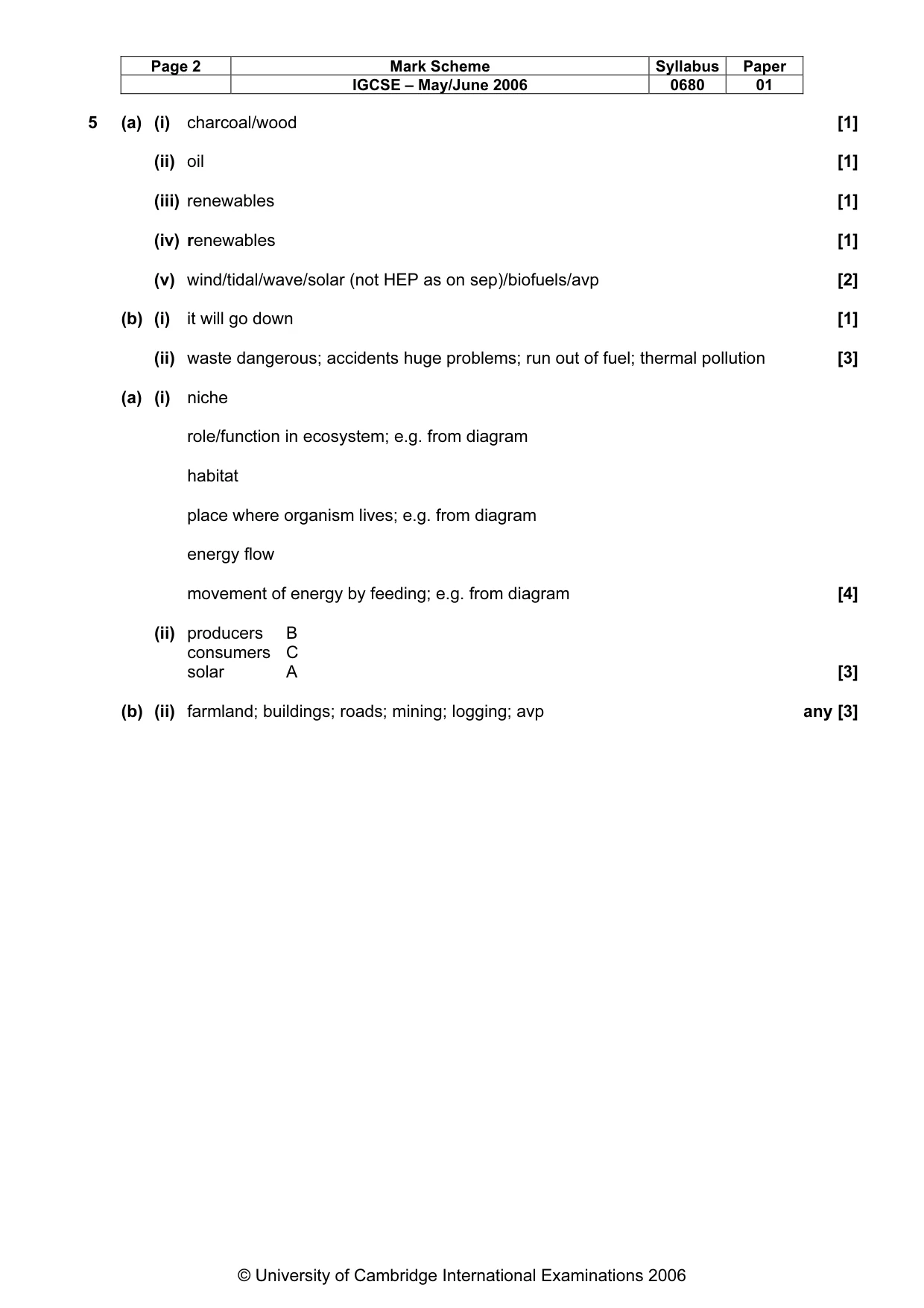
Page 1 Mark Scheme Syllabus Paper IGCSE – May/June 2006 0680 01 © University of Cambridge International Examinations 2006 1 (a) (i) Kenya [1] (ii) Brazil [1] (b) (i) cholera/typhoid/avp [2] (ii) malaria/bilharzias/avp [2] (c) local people; personal hygiene points most likely here, washing, boiling water; not using as toilet; reason [1] govt. [1] provision of good water disposal (sewerage system); compost toilets; reason [2] 2 (a) (i) hole/fissure/crack owtte in earth's crust; through which molten lava/rock/ash erupts; cone shaped mountain on surface [2] (ii) disease; named disease; lack of food; contaminated water; lack of housing; communications; travel AVP any [2] (iii) thought it was end of cycle in 1631/distant past; fertile soil; therefore plants grow well; bigger crop yield; mineral deposits; fatalism; always have any [3] (b) better buildings; drills; emergency supplies in advance; better prediction any [3] 3 (a) (i) diagram as shown with no holes at either pole [1] (ii) CFC gases/aerosols/fridges; destroy ozone [2] (iii) UV causes cancer; UV kills crops; blindness; cataracts; immune system suppressed; AVP [4] (b) stop using CFC driven aerosols; use non CFC fridge coolants; do not export; import such products [3] 4 (a) (i) 23% (± 1%) [1] (ii) 5% [1] (iii) more old; less young (owtte); less working [3] (b) (i) deforestation; soil erosion; desertification; sewage pollution (owtte) AVP [2] (ii) education about family planning; FP clinics; supply free contraceptives; provide pensions; AVP [3]
Mark scheme, page 3
Page 2 Mark Scheme Syllabus Paper IGCSE – May/June 2006 0680 01 © University of Cambridge International Examinations 2006 5 (a) (i) charcoal/wood [1] (ii) oil [1] (iii) renewables [1] (iv) renewables [1] (v) wind/tidal/wave/solar (not HEP as on sep)/biofuels/avp [2] (b) (i) it will go down [1] (ii) waste dangerous; accidents huge problems; run out of fuel; thermal pollution [3] (a) (i) niche role/function in ecosystem; e.g. from diagram habitat place where organism lives; e.g. from diagram energy flow movement of energy by feeding; e.g. from diagram [4] (ii) producers B consumers C solar A [3] (b) (ii) farmland; buildings; roads; mining; logging; avp any [3]
What you needed in this session
Cambridge’s own grade thresholds for 2006 May/June, Paper 1 · Variant 1. A higher threshold means an easier paper — the bar moves with how the cohort did.