Cambridge IGCSE Environmental Management 0680 — 2005 Oct/Nov Paper 1 · Variant 1
0680/11/O/N/05
The question paper and its mark scheme, free to read here and free to download. This is Cambridge’s own paper, exactly as it was sat.
Question paper16 pages


Mark scheme4 pages
Answers below. Sit the paper first if you are practising.
Paper as text
Question paper, page 1
This document consists of 13 printed pages and 3 blank pages. SPA (DR) T02627/3 © UCLES 2005 [Turn over UNIVERSITY OF CAMBRIDGE INTERNATIONAL EXAMINATIONS International General Certificate of Secondary Education ENVIRONMENTAL MANAGEMENT Paper 1 0680/01 October/November 2005 1 hour 30 minutes Candidates answer on the Question Paper. Additional Materials: Ruler (cm/mm) READ THESE INSTRUCTIONS FIRST Write your Centre number, candidate number and name on all the work you hand in. Write in dark blue or black pen in the spaces provided on the Question Paper. You may use a soft pencil for any diagrams, graphs or rough working. Do not use staples, paper clips, highlighters, glue or correction fluid. Answer all questions. The number of marks is given in brackets [ ] at the end of each question or part question. DO NOT WRITE IN THE BARCODE. DO NOT WRITE IN THE GREY AREAS BETWEEN THE PAGES. If you have been given a label, look at the details. If any details are incorrect or missing, please fill in your correct details in the space given at the top of this page. Stick your personal label here, if provided. FOR EXAMINER’S USE 1 2 3 4 5 6 TOTAL www.XtremePapers.com
Question paper, page 2
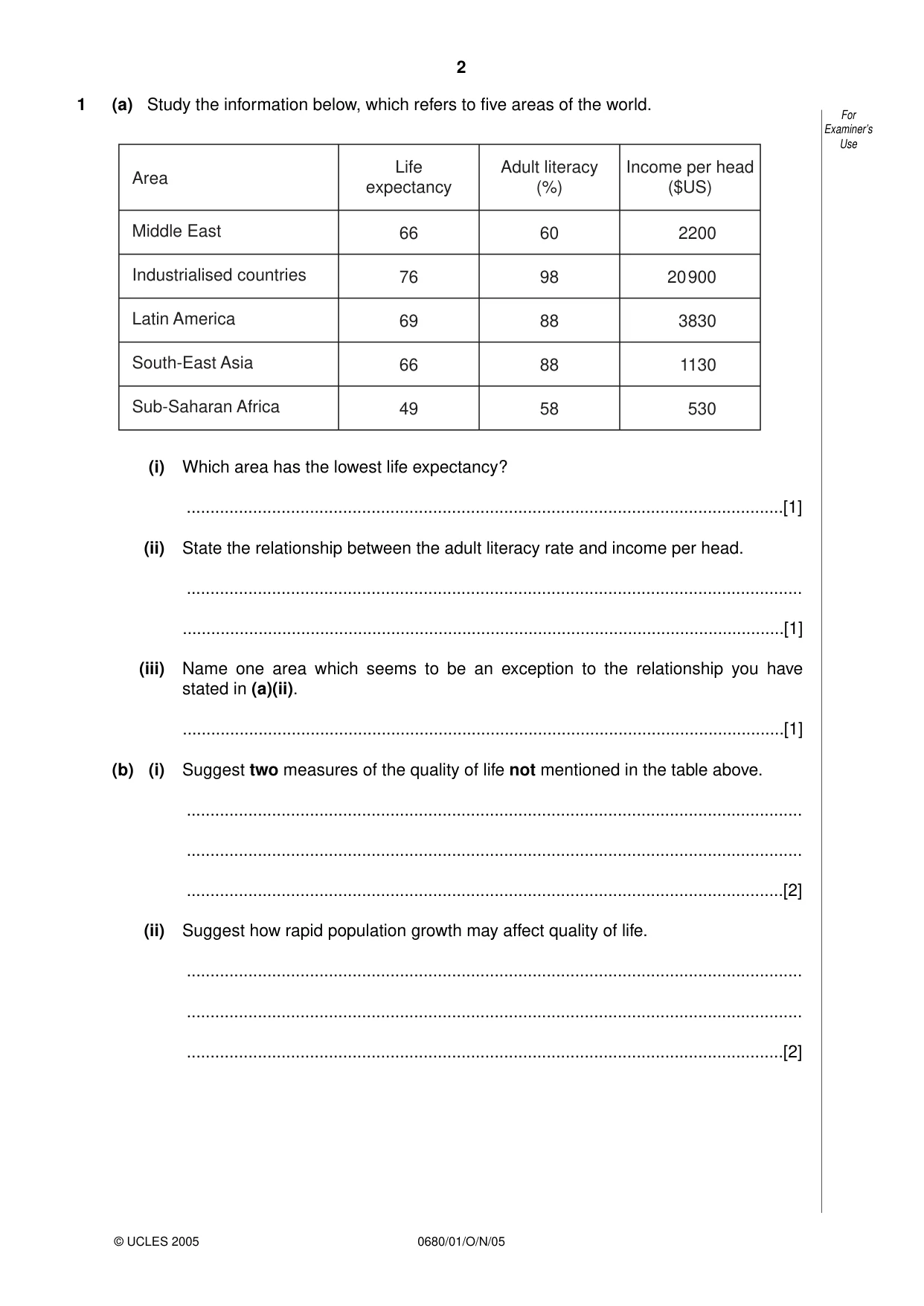
2 0680/01/O/N/05 For Examiner’s Use © UCLES 2005 1 (a) Study the information below, which refers to five areas of the world. (i) Which area has the lowest life expectancy? …[1] (ii) State the relationship between the adult literacy rate and income per head. … …[1] (iii) Name one area which seems to be an exception to the relationship you have stated in (a)(ii). …[1] (b) (i) Suggest two measures of the quality of life not mentioned in the table above. … … …[2] (ii) Suggest how rapid population growth may affect quality of life. … … …[2] Area Middle East Industrialised countries Latin America South-East Asia Sub-Saharan Africa Life expectancy Adult literacy (%) Income per head ($US) 66 76 69 66 49 60 98 88 88 58 2200 20900 3830 1130 530
Question paper, page 3
3 [Turn over (c) Suggest how improved trade might help to overcome world inequalities. … … … … … …[3] Total [10] For Examiner’s Use 0680/01/O/N/05 © UCLES 2005
Question paper, page 4
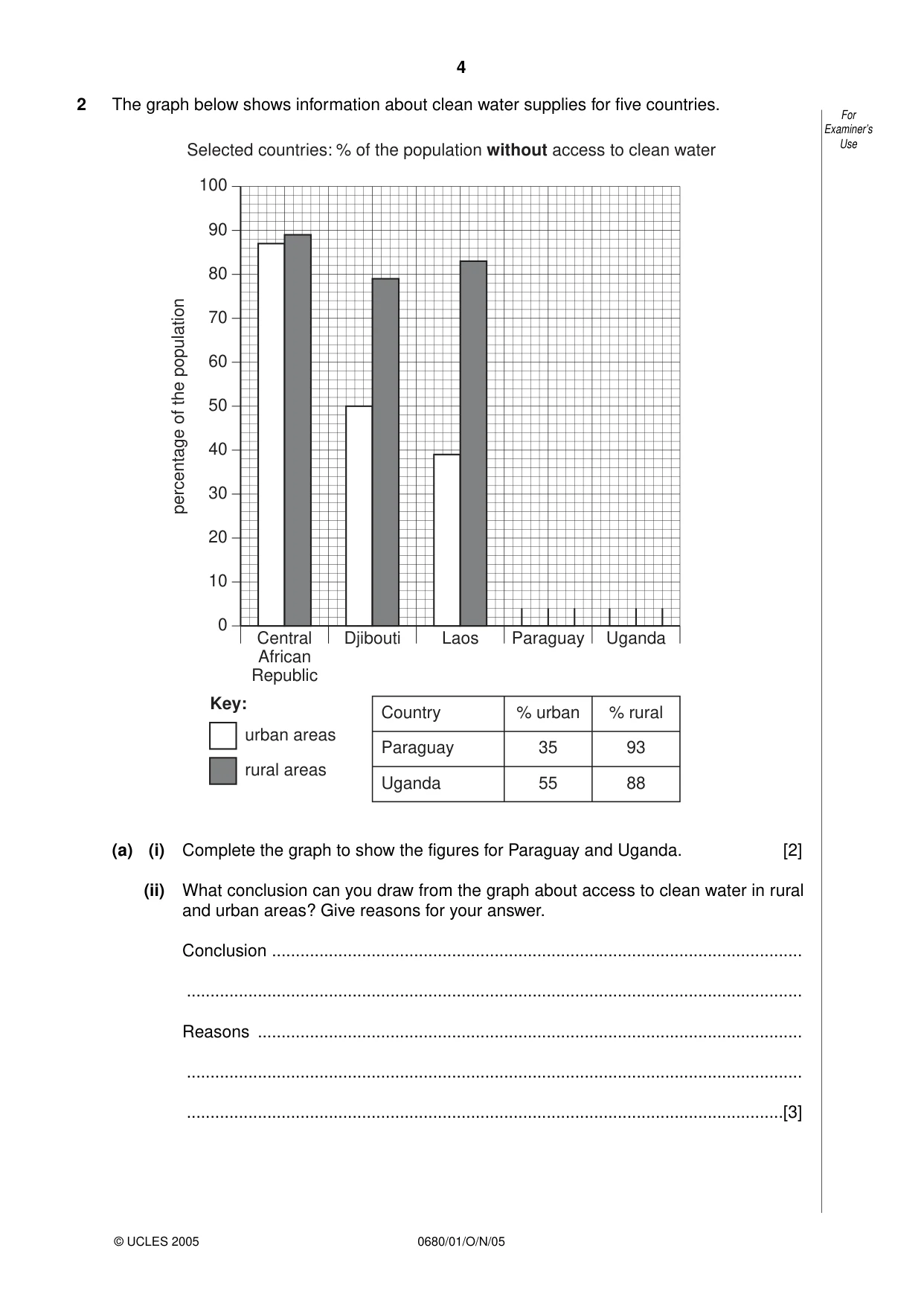
4 0680/01/O/N/05 2 The graph below shows information about clean water supplies for five countries. (a) (i) Complete the graph to show the figures for Paraguay and Uganda. [2] (ii) What conclusion can you draw from the graph about access to clean water in rural and urban areas? Give reasons for your answer. Conclusion … … Reasons … … …[3] 0 10 20 30 40 50 60 70 80 90 100 Central African Republic Djibouti Laos Paraguay Uganda percentage of the population % urban % rural 35 93 55 88 Country Paraguay Uganda Key: urban areas rural areas Selected countries: % of the population without access to clean water For Examiner’s Use © UCLES 2005
Question paper, page 5
5 [Turn over (b) Explain why access to clean water is important for human health. … … … … … …[2] (c) Describe one strategy for improving water quality in developing countries. … … … … …[3] Total [10] For Examiner’s Use 0680/01/O/N/05 © UCLES 2005
Question paper, page 6
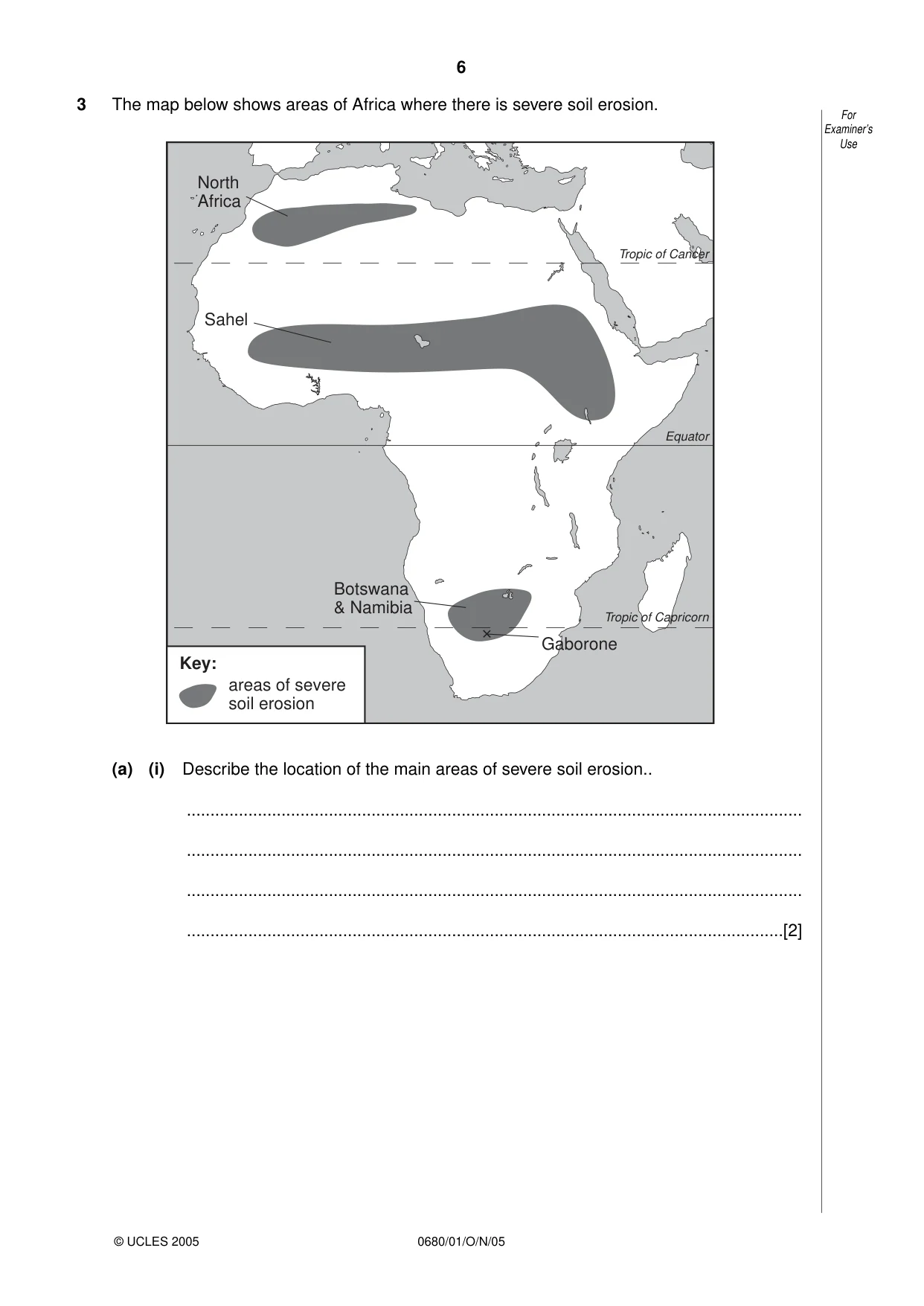
6 0680/01/O/N/05 3 The map below shows areas of Africa where there is severe soil erosion. (a) (i) Describe the location of the main areas of severe soil erosion.. … … … …[2] North Africa Sahel Botswana & Namibia Gaborone Tropic of Cancer Equator Tropic of Capricorn Key: areas of severe soil erosion For Examiner’s Use © UCLES 2005
Question paper, page 7
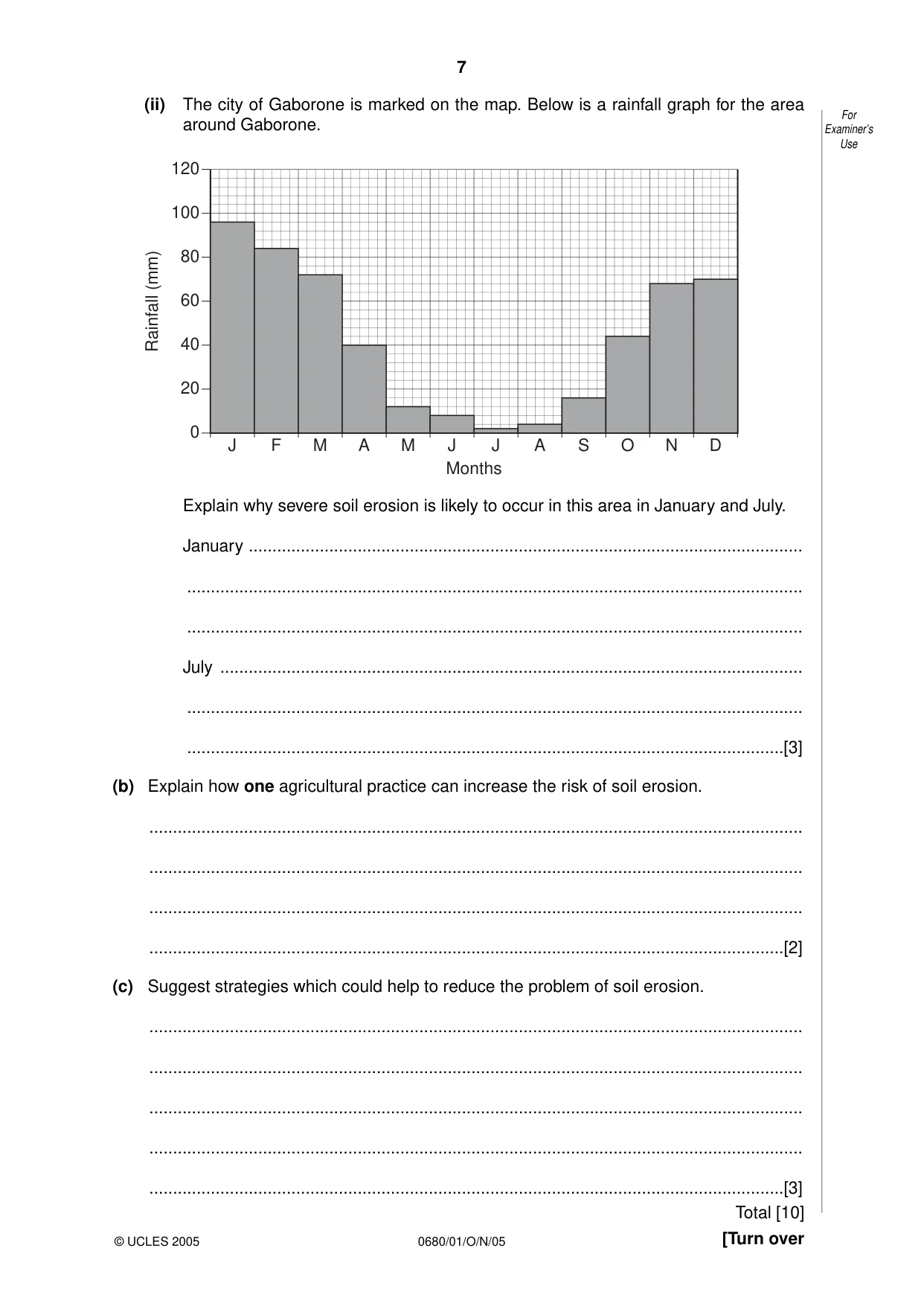
7 [Turn over (ii) The city of Gaborone is marked on the map. Below is a rainfall graph for the area around Gaborone. Explain why severe soil erosion is likely to occur in this area in January and July. January … … … July … … …[3] (b) Explain how one agricultural practice can increase the risk of soil erosion. … … … …[2] (c) Suggest strategies which could help to reduce the problem of soil erosion. … … … … …[3] Total [10] J F M A M J J A S O N D 0 20 40 60 80 100 120 Rainfall (mm) Months For Examiner’s Use 0680/01/O/N/05 © UCLES 2005
Question paper, page 8
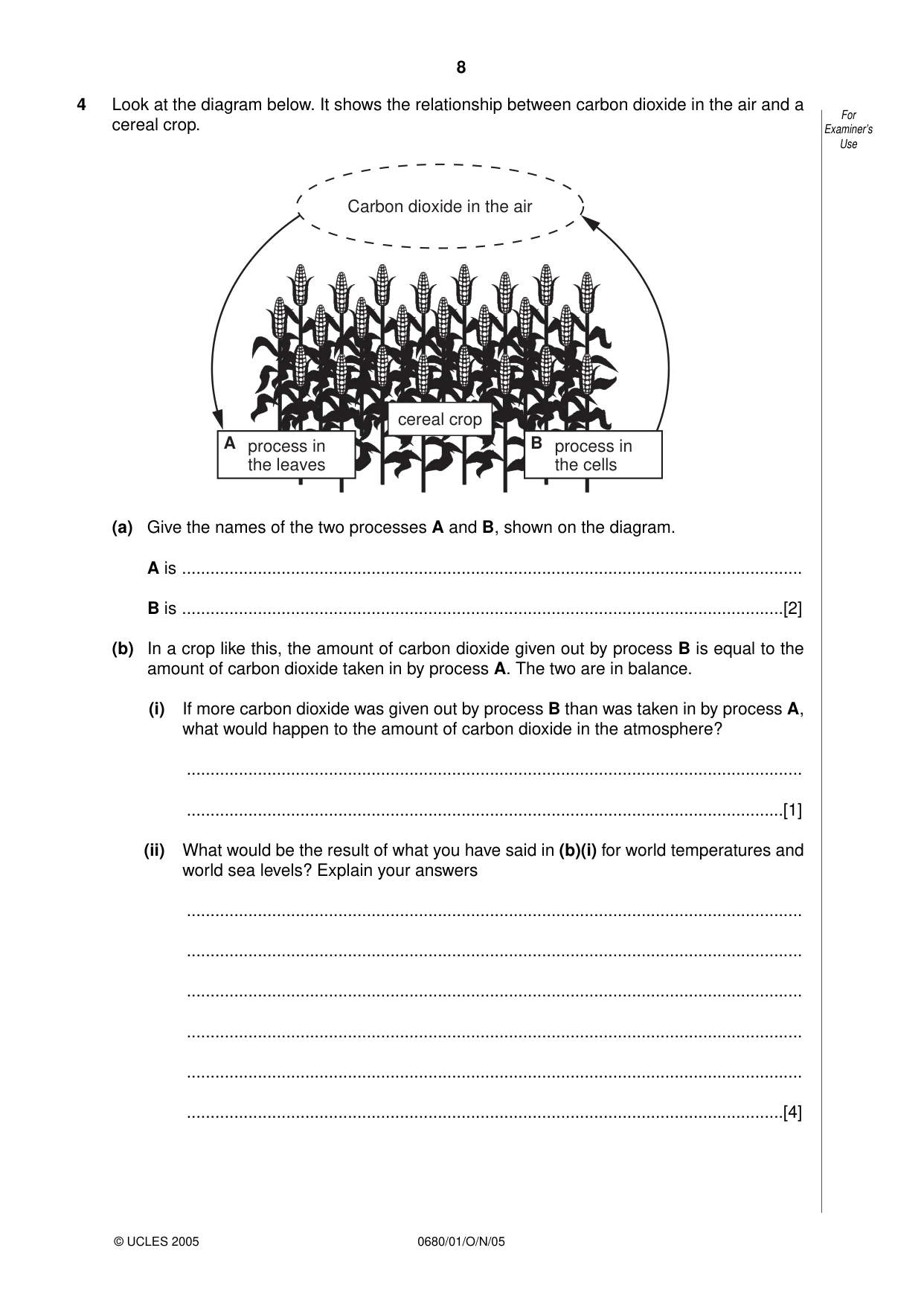
8 0680/01/O/N/05 4 Look at the diagram below. It shows the relationship between carbon dioxide in the air and a cereal crop. (a) Give the names of the two processes A and B, shown on the diagram. A is … B is …[2] (b) In a crop like this, the amount of carbon dioxide given out by process B is equal to the amount of carbon dioxide taken in by process A. The two are in balance. (i) If more carbon dioxide was given out by process B than was taken in by process A, what would happen to the amount of carbon dioxide in the atmosphere? … …[1] (ii) What would be the result of what you have said in (b)(i) for world temperatures and world sea levels? Explain your answers … … … … … …[4] Carbon dioxide in the air cereal crop A process in the leaves B process in the cells For Examiner’s Use © UCLES 2005
Question paper, page 9
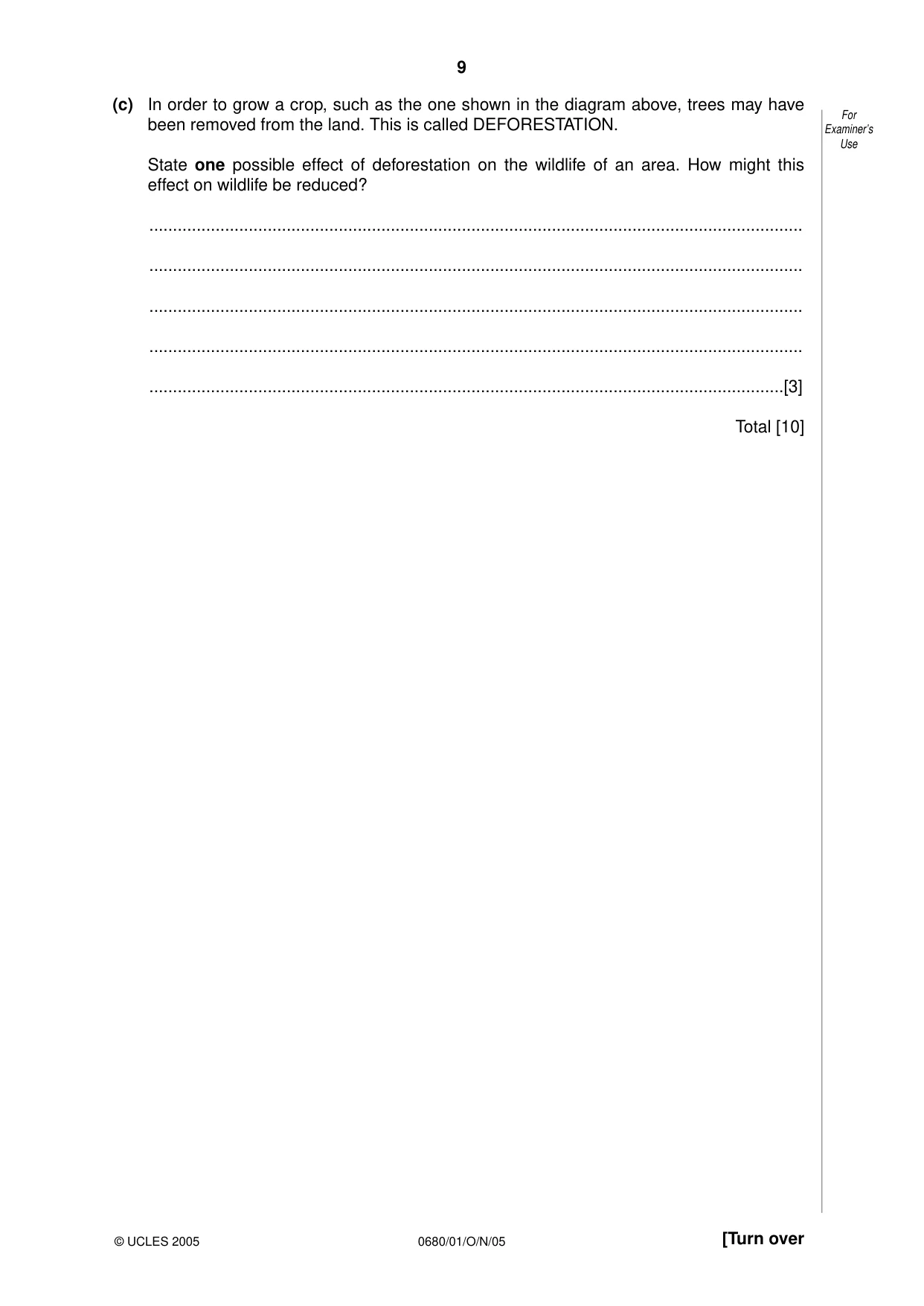
9 [Turn over (c) In order to grow a crop, such as the one shown in the diagram above, trees may have been removed from the land. This is called DEFORESTATION. State one possible effect of deforestation on the wildlife of an area. How might this effect on wildlife be reduced? … … … … …[3] Total [10] For Examiner’s Use 0680/01/O/N/05 © UCLES 2005
Question paper, page 10
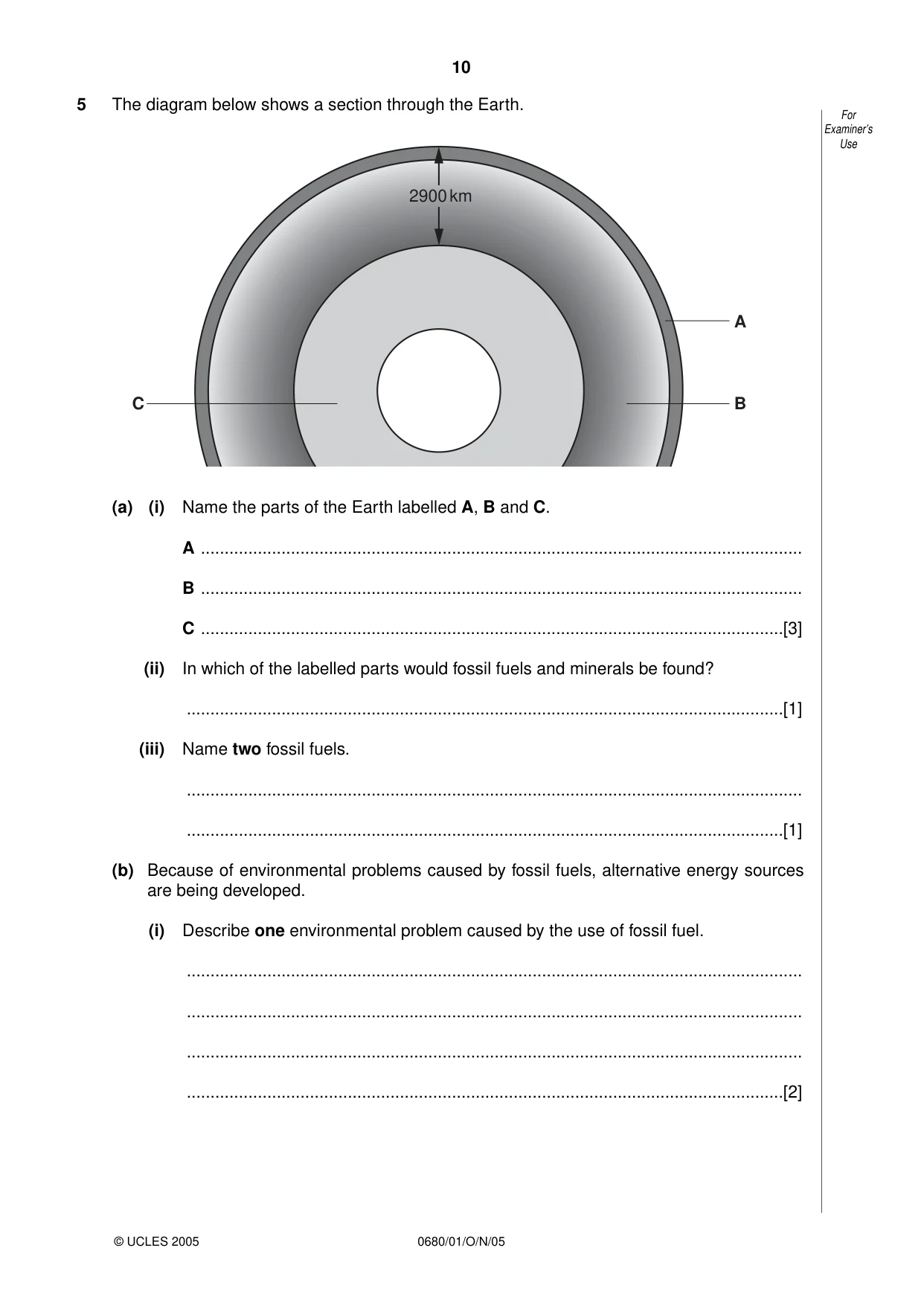
10 0680/01/O/N/05 5 The diagram below shows a section through the Earth. (a) (i) Name the parts of the Earth labelled A, B and C. A … B … C …[3] (ii) In which of the labelled parts would fossil fuels and minerals be found? …[1] (iii) Name two fossil fuels. … …[1] (b) Because of environmental problems caused by fossil fuels, alternative energy sources are being developed. (i) Describe one environmental problem caused by the use of fossil fuel. … … … …[2] A B C 2900 km For Examiner’s Use © UCLES 2005
Question paper, page 11
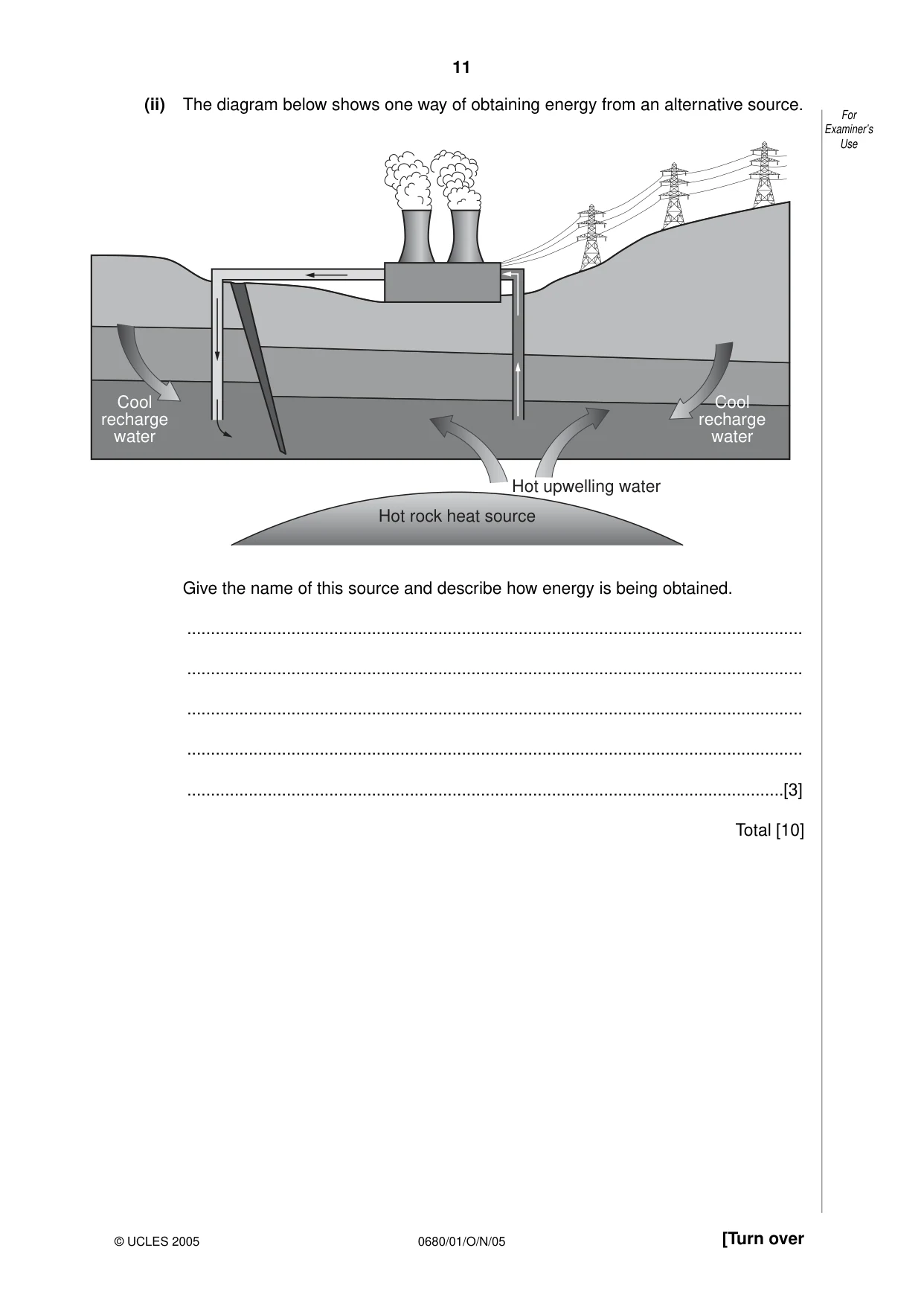
11 [Turn over (ii) The diagram below shows one way of obtaining energy from an alternative source. Give the name of this source and describe how energy is being obtained. … … … … …[3] Total [10] Hot rock heat source Hot upwelling water Cool recharge water Cool recharge water For Examiner’s Use 0680/01/O/N/05 © UCLES 2005
Question paper, page 12
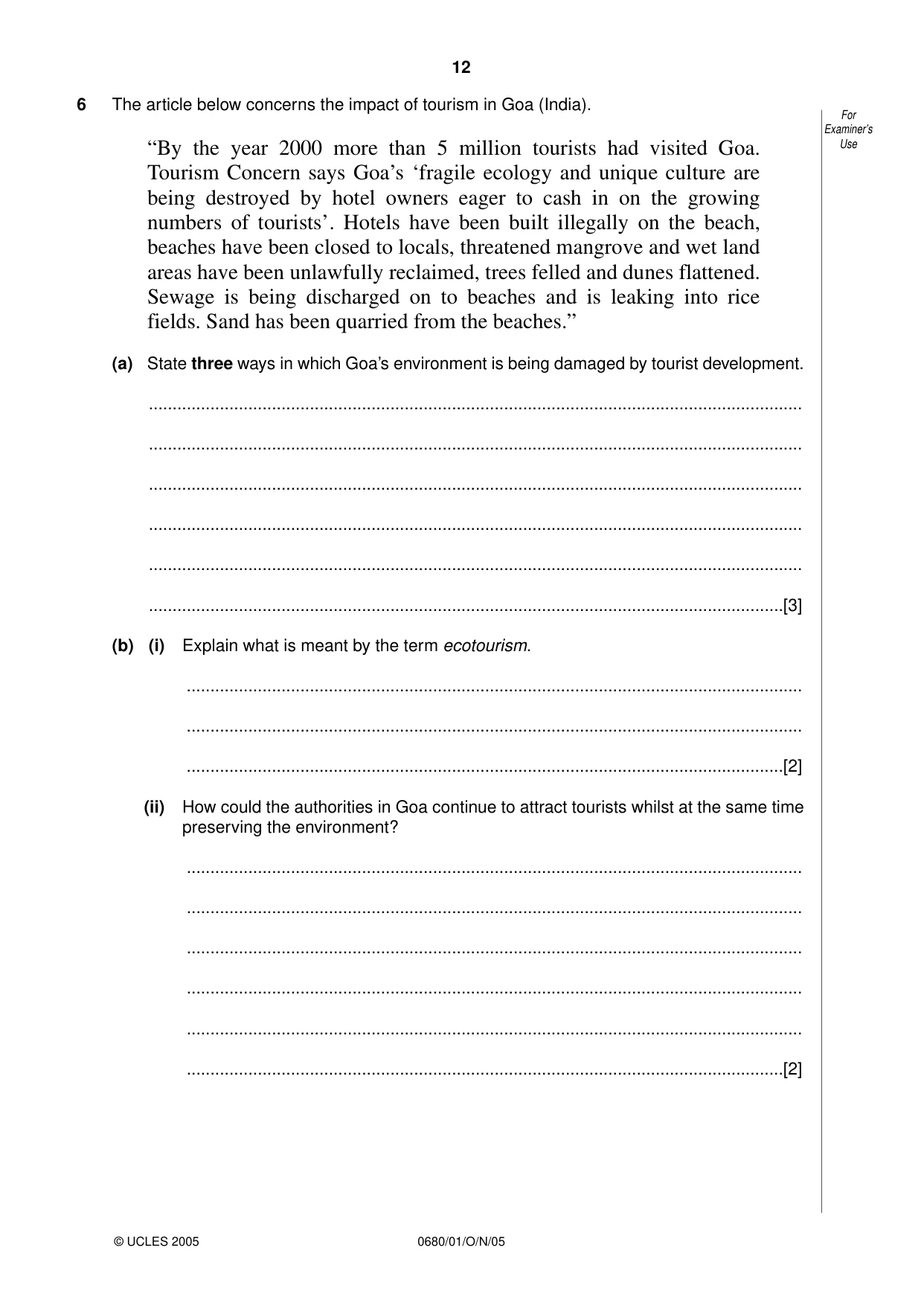
12 0680/01/O/N/05 6 The article below concerns the impact of tourism in Goa (India). “By the year 2000 more than 5 million tourists had visited Goa. Tourism Concern says Goa’s ‘fragile ecology and unique culture are being destroyed by hotel owners eager to cash in on the growing numbers of tourists’. Hotels have been built illegally on the beach, beaches have been closed to locals, threatened mangrove and wet land areas have been unlawfully reclaimed, trees felled and dunes flattened. Sewage is being discharged on to beaches and is leaking into rice fields. Sand has been quarried from the beaches.” (a) State three ways in which Goa’s environment is being damaged by tourist development. … … … … … …[3] (b) (i) Explain what is meant by the term ecotourism. … … …[2] (ii) How could the authorities in Goa continue to attract tourists whilst at the same time preserving the environment? … … … … … …[2] For Examiner’s Use © UCLES 2005
Question paper, page 13
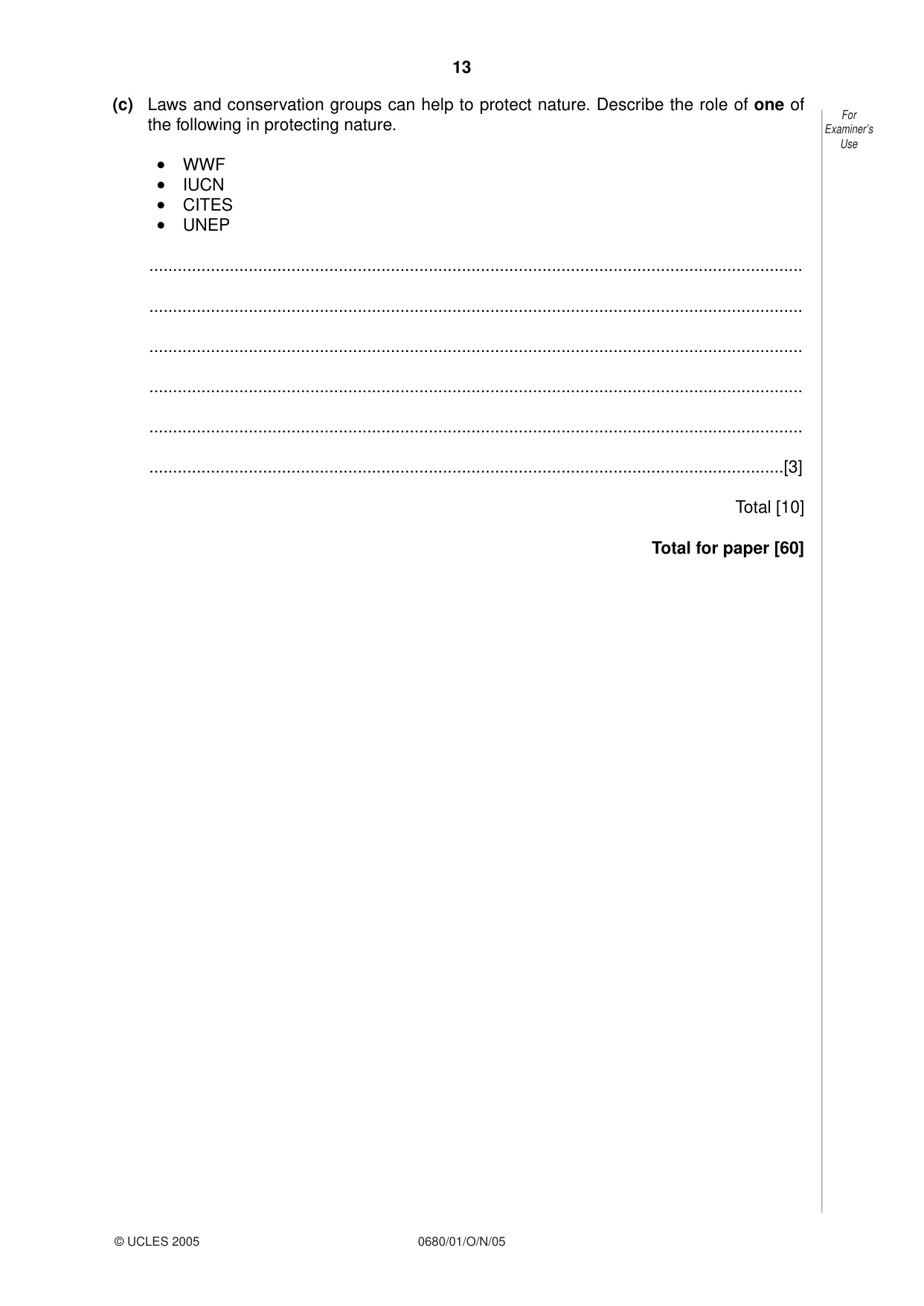
For Examiner’s Use 0680/01/O/N/05 © UCLES 2005 13 (c) Laws and conservation groups can help to protect nature. Describe the role of one of the following in protecting nature. • WWF • IUCN • CITES • UNEP … … … … … …[3] Total [10] Total for paper [60]
Question paper, page 16
16 0680/01/O/N/05 BLANK PAGE Copyright Acknowledgements: Question 3 Diagram © D. Waugh and T. Bushell, New Geography; Nelson Thornes, 2002. Question 5 Taken from website, http://geosun1.sjsu.edu/~dreed/images/exer2/earth-layers.GIF Permission to reproduce items where third-party owned material protected by copyright is included has been sought and cleared where possible. Every reasonable effort has been made by the publisher (UCLES) to trace copyright holders, but if any items requiring clearance have unwittingly been included, the publisher will be pleased to make amends at the earliest possible opportunity. University of Cambridge International Examinations is part of the University of Cambridge Local Examinations Syndicate (UCLES), which is itself a department of the University of Cambridge.
Mark scheme, page 1
UNIVERSITY OF CAMBRIDGE INTERNATIONAL EXAMINATIONS International General Certificate of Secondary Education MARK SCHEME for the November 2005 question paper 0680 ENVIRONMENTAL MANAGEMENT 0680/01 Paper 1 (Alternative to Coursework), maximum mark 60 This mark scheme is published as an aid to teachers and students, to indicate the requirements of the examination. It shows the basis on which Examiners were initially instructed to award marks. It does not indicate the details of the discussions that took place at an Examiners’ meeting before marking began. Any substantial changes to the mark scheme that arose from these discussions will be recorded in the published Report on the Examination. All Examiners are instructed that alternative correct answers and unexpected approaches in candidates’ scripts must be given marks that fairly reflect the relevant knowledge and skills demonstrated. Mark schemes must be read in conjunction with the question papers and the Report on the Examination. The minimum marks in these components needed for various grades were previously published with these mark schemes, but are now instead included in the Report on the Examination for this session. • CIE will not enter into discussion or correspondence in connection with these mark schemes. CIE is publishing the mark schemes for the November 2005 question papers for most IGCSE and GCE Advanced Level and Advanced Subsidiary Level syllabuses and some Ordinary Level syllabuses. www.XtremePapers.com
Mark scheme, page 2
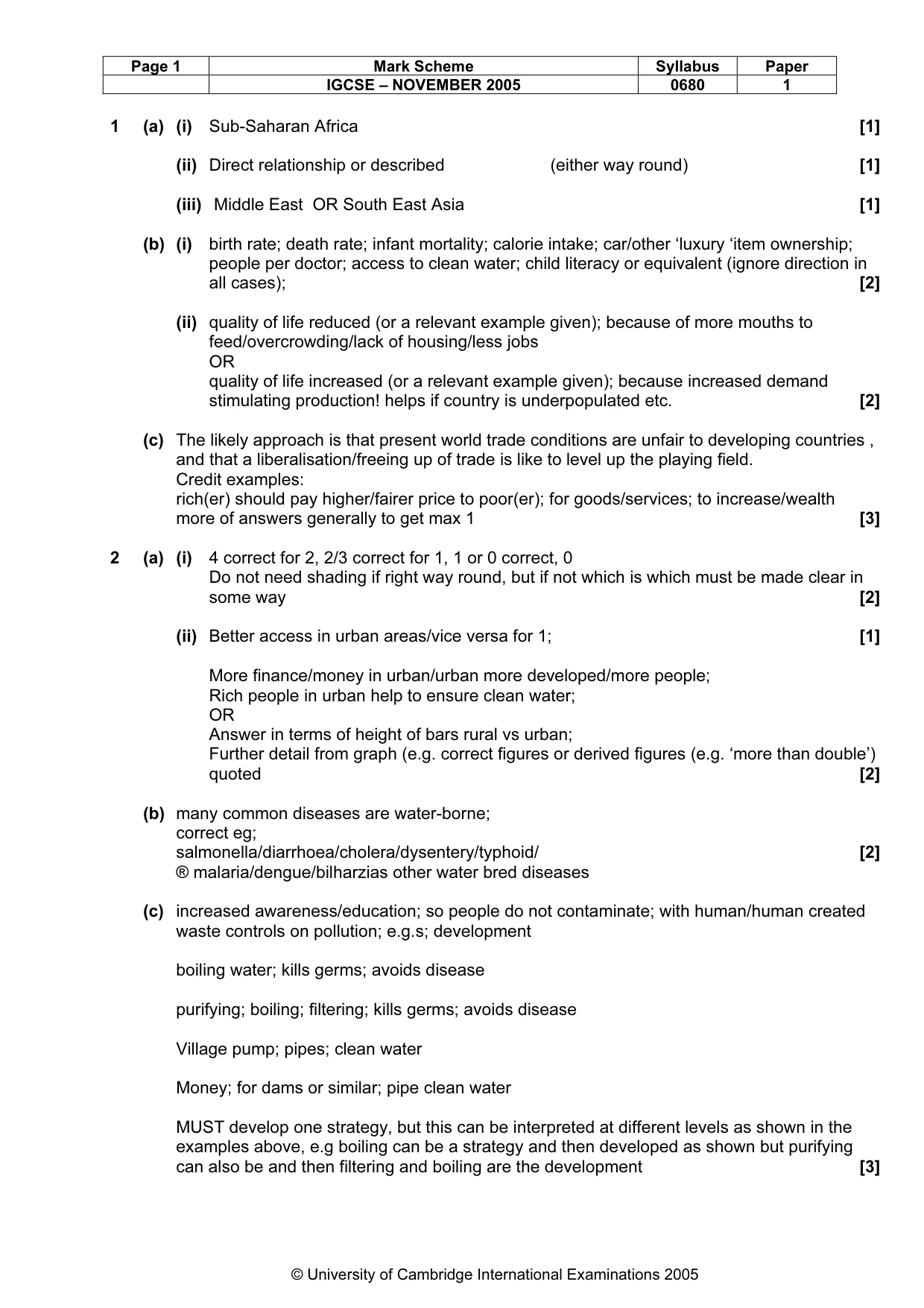
Page 1 Mark Scheme Syllabus Paper IGCSE – NOVEMBER 2005 0680 1 © University of Cambridge International Examinations 2005 1 (a) (i) Sub-Saharan Africa [1] (ii) Direct relationship or described (either way round) [1] (iii) Middle East OR South East Asia [1] (b) (i) birth rate; death rate; infant mortality; calorie intake; car/other ‘luxury ‘item ownership; people per doctor; access to clean water; child literacy or equivalent (ignore direction in all cases); [2] (ii) quality of life reduced (or a relevant example given); because of more mouths to feed/overcrowding/lack of housing/less jobs OR quality of life increased (or a relevant example given); because increased demand stimulating production! helps if country is underpopulated etc. [2] (c) The likely approach is that present world trade conditions are unfair to developing countries , and that a liberalisation/freeing up of trade is like to level up the playing field. Credit examples: rich(er) should pay higher/fairer price to poor(er); for goods/services; to increase/wealth more of answers generally to get max 1 [3] 2 (a) (i) 4 correct for 2, 2/3 correct for 1, 1 or 0 correct, 0 Do not need shading if right way round, but if not which is which must be made clear in some way [2] (ii) Better access in urban areas/vice versa for 1; [1] More finance/money in urban/urban more developed/more people; Rich people in urban help to ensure clean water; OR Answer in terms of height of bars rural vs urban; Further detail from graph (e.g. correct figures or derived figures (e.g. ‘more than double’) quoted [2] (b) many common diseases are water-borne; correct eg; salmonella/diarrhoea/cholera/dysentery/typhoid/ [2] ® malaria/dengue/bilharzias other water bred diseases (c) increased awareness/education; so people do not contaminate; with human/human created waste controls on pollution; e.g.s; development boiling water; kills germs; avoids disease purifying; boiling; filtering; kills germs; avoids disease Village pump; pipes; clean water Money; for dams or similar; pipe clean water MUST develop one strategy, but this can be interpreted at different levels as shown in the examples above, e.g boiling can be a strategy and then developed as shown but purifying can also be and then filtering and boiling are the development [3]
Mark scheme, page 3
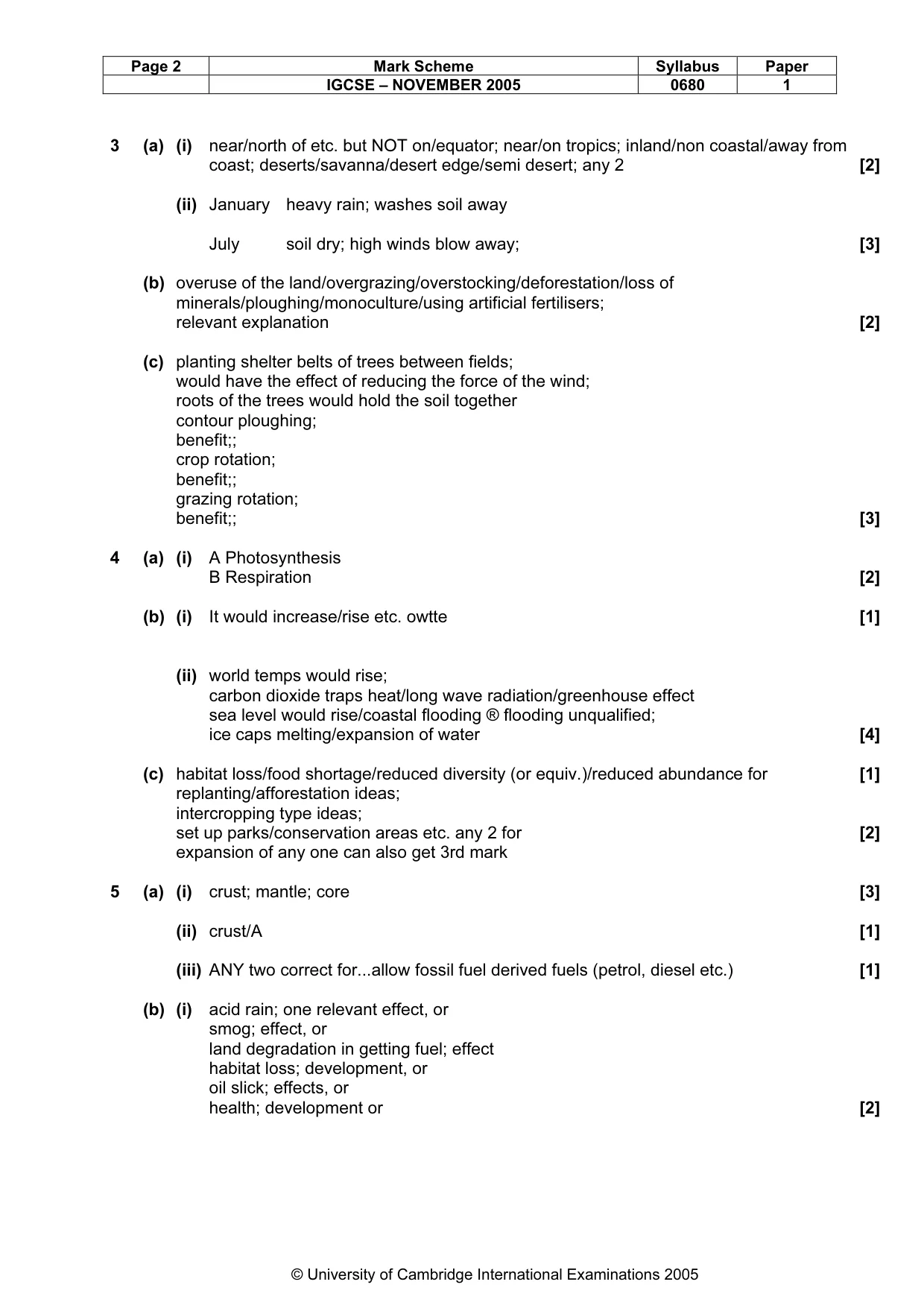
Page 2 Mark Scheme Syllabus Paper IGCSE – NOVEMBER 2005 0680 1 © University of Cambridge International Examinations 2005 3 (a) (i) near/north of etc. but NOT on/equator; near/on tropics; inland/non coastal/away from coast; deserts/savanna/desert edge/semi desert; any 2 [2] (ii) January heavy rain; washes soil away July soil dry; high winds blow away; [3] (b) overuse of the land/overgrazing/overstocking/deforestation/loss of minerals/ploughing/monoculture/using artificial fertilisers; relevant explanation [2] (c) planting shelter belts of trees between fields; would have the effect of reducing the force of the wind; roots of the trees would hold the soil together contour ploughing; benefit;; crop rotation; benefit;; grazing rotation; benefit;; [3] 4 (a) (i) A Photosynthesis B Respiration [2] (b) (i) It would increase/rise etc. owtte [1] (ii) world temps would rise; carbon dioxide traps heat/long wave radiation/greenhouse effect sea level would rise/coastal flooding ® flooding unqualified; ice caps melting/expansion of water [4] (c) habitat loss/food shortage/reduced diversity (or equiv.)/reduced abundance for [1] replanting/afforestation ideas; intercropping type ideas; set up parks/conservation areas etc. any 2 for [2] expansion of any one can also get 3rd mark 5 (a) (i) crust; mantle; core [3] (ii) crust/A [1] (iii) ANY two correct for...allow fossil fuel derived fuels (petrol, diesel etc.) [1] (b) (i) acid rain; one relevant effect, or smog; effect, or land degradation in getting fuel; effect habitat loss; development, or oil slick; effects, or health; development or [2]
Mark scheme, page 4
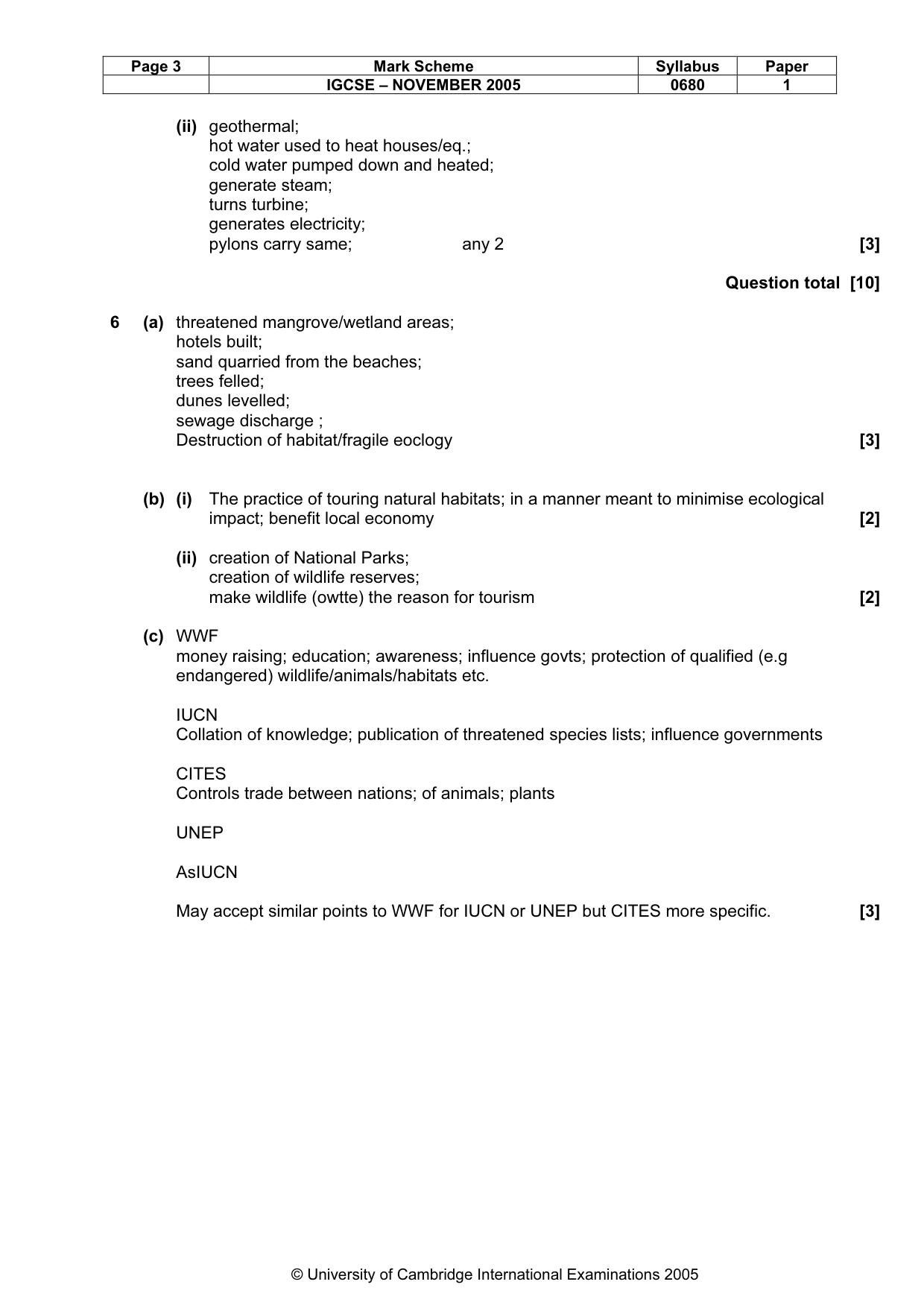
Page 3 Mark Scheme Syllabus Paper IGCSE – NOVEMBER 2005 0680 1 © University of Cambridge International Examinations 2005 (ii) geothermal; hot water used to heat houses/eq.; cold water pumped down and heated; generate steam; turns turbine; generates electricity; pylons carry same; any 2 [3] Question total [10] 6 (a) threatened mangrove/wetland areas; hotels built; sand quarried from the beaches; trees felled; dunes levelled; sewage discharge ; Destruction of habitat/fragile eoclogy [3] (b) (i) The practice of touring natural habitats; in a manner meant to minimise ecological impact; benefit local economy [2] (ii) creation of National Parks; creation of wildlife reserves; make wildlife (owtte) the reason for tourism [2] (c) WWF money raising; education; awareness; influence govts; protection of qualified (e.g endangered) wildlife/animals/habitats etc. IUCN Collation of knowledge; publication of threatened species lists; influence governments CITES Controls trade between nations; of animals; plants UNEP AsIUCN May accept similar points to WWF for IUCN or UNEP but CITES more specific. [3]