Cambridge IGCSE Environmental Management 0680 — 2005 May/June Paper 1 · Variant 1
0680/11/M/J/05
The question paper and its mark scheme, free to read here and free to download. This is Cambridge’s own paper, exactly as it was sat.
Question paper16 pages


Mark scheme6 pages
Answers below. Sit the paper first if you are practising.
Paper as text
Question paper, page 1
This document consists of 13 printed pages and 3 blank pages. SPA (DR) S92064/3.1 © UCLES 2005 [Turn over UNIVERSITY OF CAMBRIDGE INTERNATIONAL EXAMINATIONS International General Certificate of Secondary Education ENVIRONMENTAL MANAGEMENT Paper 1 0680/01 May/June 2005 1 hour 30 minutes Candidates answer on the Question Paper. Additional Materials: Ruler (cm/mm) READ THESE INSTRUCTIONS FIRST Write your Centre number, candidate number and name on all the work you hand in. Write in dark blue or black pen in the spaces provided on the Question Paper. You may use a soft pencil for any diagrams, graphs or rough working. Do not use staples, paper clips, highlighters, glue or correction fluid. Answer all questions. The number of marks is given in brackets [ ] at the end of each question or part question. DO NOT WRITE IN THE BARCODE. DO NOT WRITE IN THE GREY AREAS BETWEEN THE PAGES. FOR EXAMINER’S USE 1 2 3 4 5 6 TOTAL Candidate Name Centre Number Candidate Number www.XtremePapers.com
Question paper, page 2
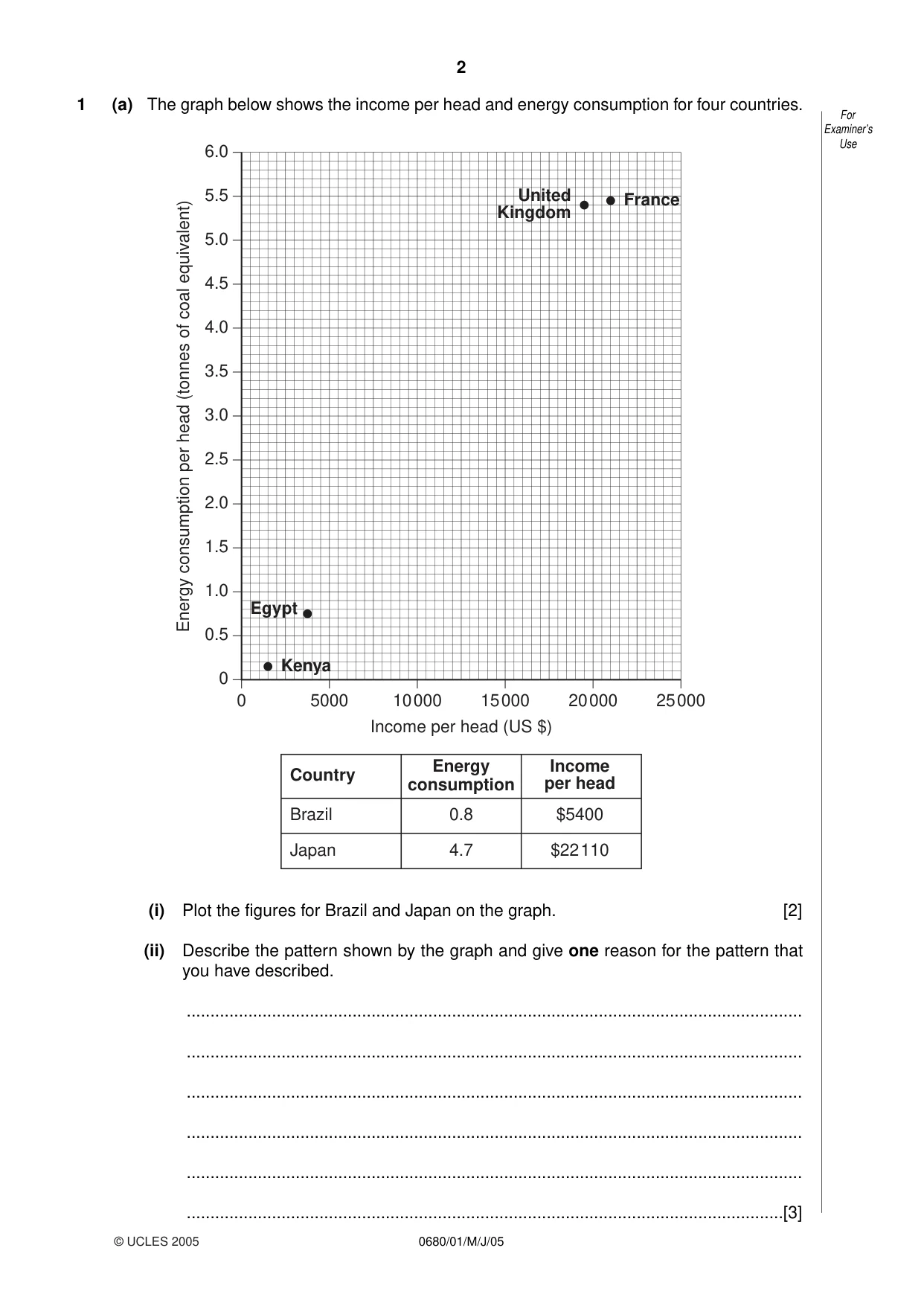
© UCLES 2005 2 0680/01/M/J/05 1 (a) The graph below shows the income per head and energy consumption for four countries. (i) Plot the figures for Brazil and Japan on the graph. [2] (ii) Describe the pattern shown by the graph and give one reason for the pattern that you have described. … … … … … …[3] 0 0.5 1.0 1.5 2.0 2.5 3.0 3.5 4.0 4.5 5.0 5.5 6.0 0 5000 10000 15000 20000 25000 Energy consumption per head (tonnes of coal equivalent) Income per head (US $) Country Energy consumption Income per head Brazil Japan 0.8 4.7 $5400 $22110 Kenya Egypt United Kingdom France For Examiner’s Use
Question paper, page 3
3 0680/01/M/J/05 [Turn over (b) One way of generating electricity is by using nuclear power. State one advantage and one disadvantage of using this method. … … … …[2] (c) Many countries use fossil fuels for most of their energy. How can supplies of such fossil fuels be made to last longer? … … … … …[3] [Total: 10] For Examiner’s Use © UCLES 2005
Question paper, page 4
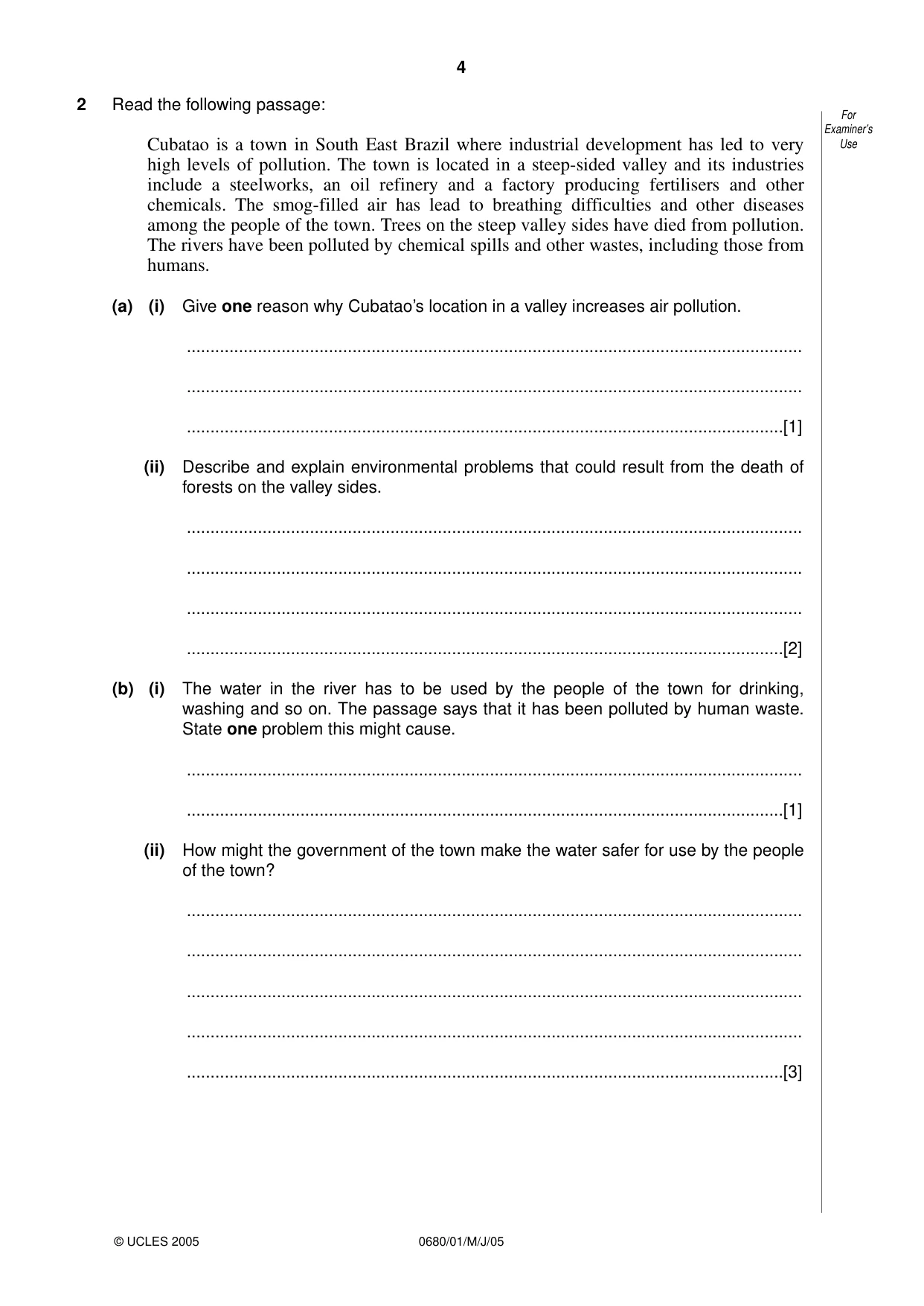
4 0680/01/M/J/05 2 Read the following passage: Cubatao is a town in South East Brazil where industrial development has led to very high levels of pollution. The town is located in a steep-sided valley and its industries include a steelworks, an oil refinery and a factory producing fertilisers and other chemicals. The smog-filled air has lead to breathing difficulties and other diseases among the people of the town. Trees on the steep valley sides have died from pollution. The rivers have been polluted by chemical spills and other wastes, including those from humans. (a) (i) Give one reason why Cubatao’s location in a valley increases air pollution. … … …[1] (ii) Describe and explain environmental problems that could result from the death of forests on the valley sides. … … … …[2] (b) (i) The water in the river has to be used by the people of the town for drinking, washing and so on. The passage says that it has been polluted by human waste. State one problem this might cause. … …[1] (ii) How might the government of the town make the water safer for use by the people of the town? … … … … …[3] For Examiner’s Use © UCLES 2005
Question paper, page 5
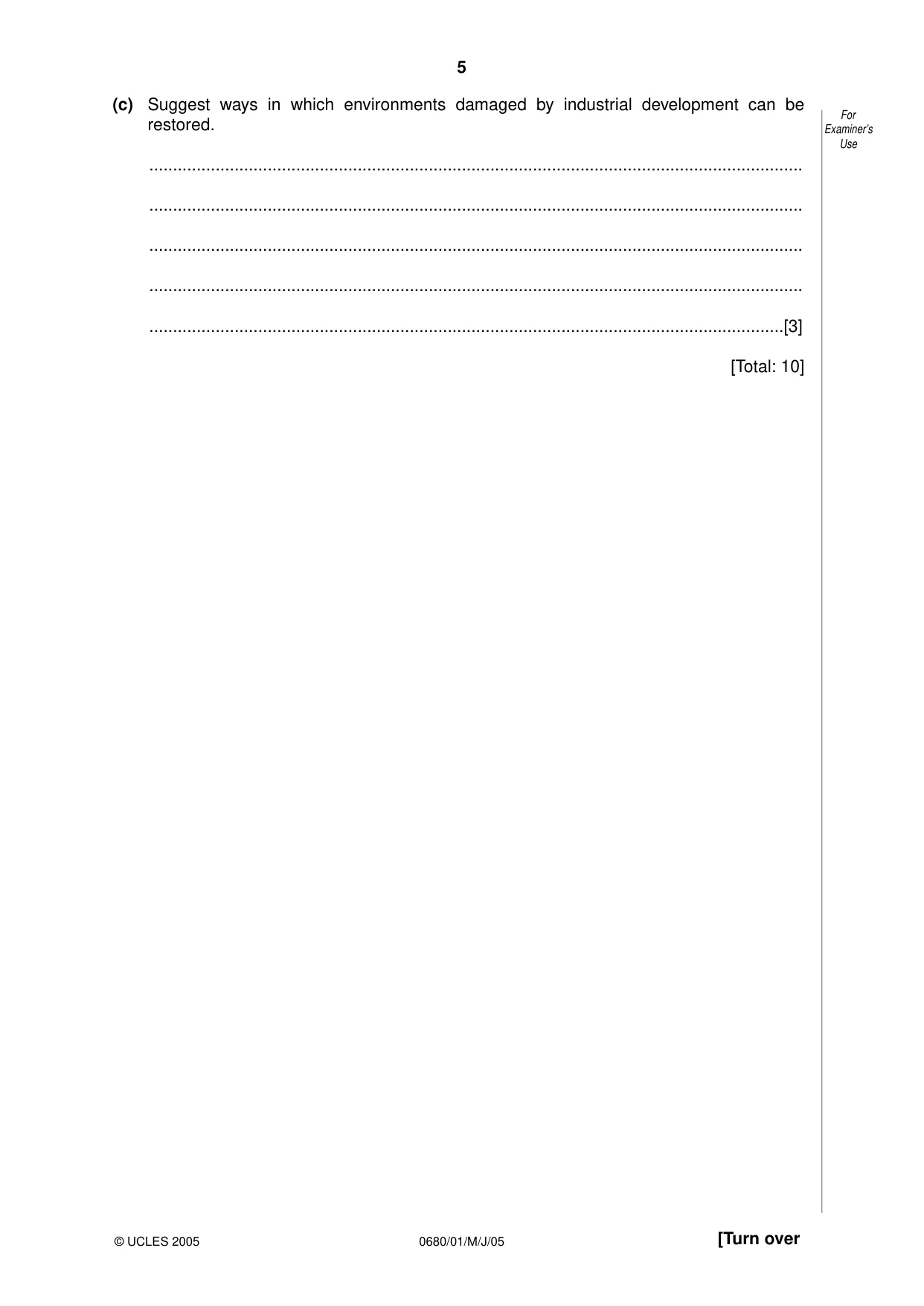
5 0680/01/M/J/05 [Turn over (c) Suggest ways in which environments damaged by industrial development can be restored. … … … … …[3] [Total: 10] For Examiner’s Use © UCLES 2005
Question paper, page 6
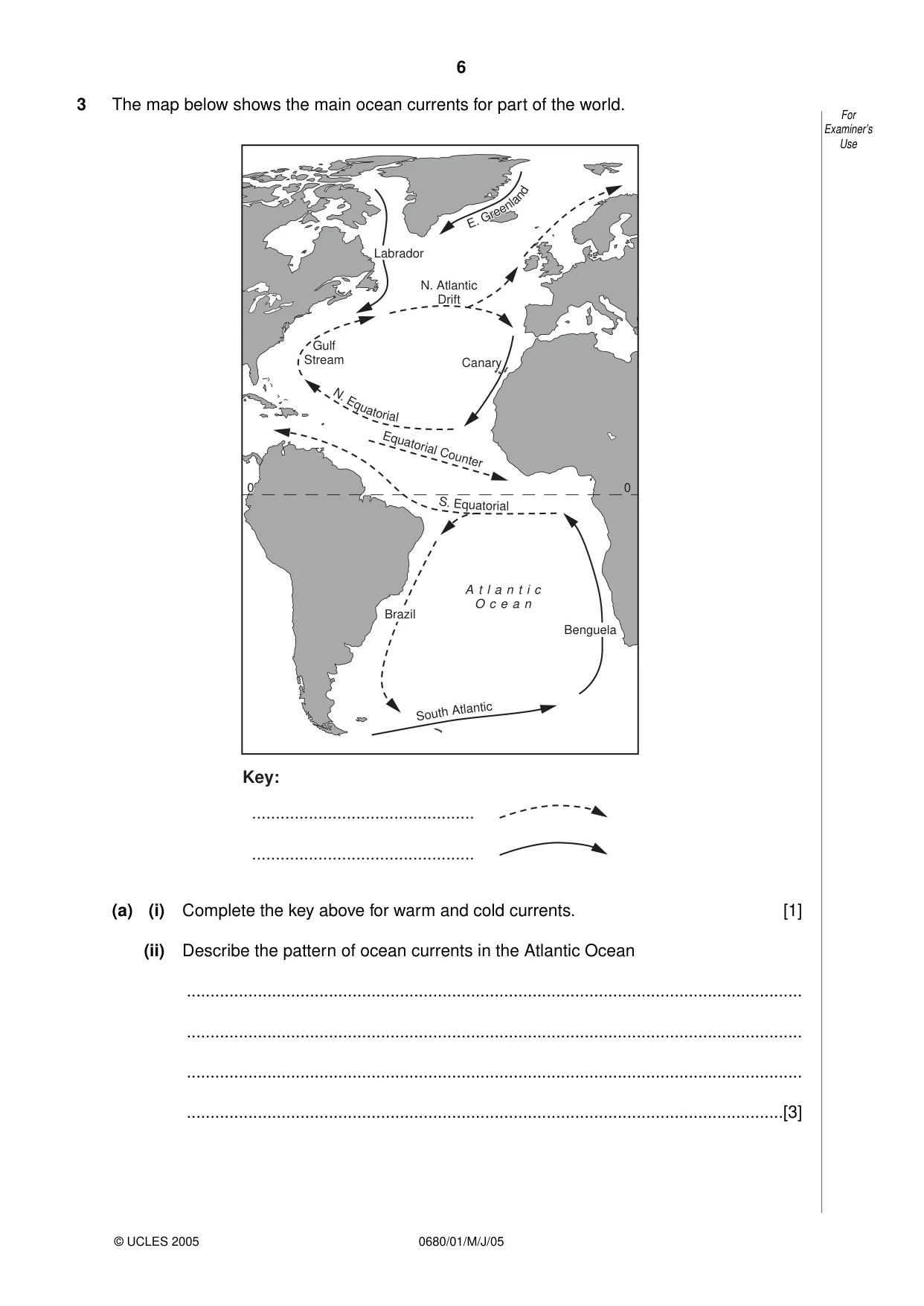
6 0680/01/M/J/05 3 The map below shows the main ocean currents for part of the world. (a) (i) Complete the key above for warm and cold currents. [1] (ii) Describe the pattern of ocean currents in the Atlantic Ocean … … … …[3] N. Eq u a t ori al Equatorial Counter South A tlantic Labrador N. Atlantic Drift Canary S. E quat orial Brazil Benguela Key: Gulf Stream A t l a n t i c O c e a n E. Gr ee n l a n d E. Gr ee n l a n d 0 0 … … For Examiner’s Use © UCLES 2005
Question paper, page 7
7 0680/01/M/J/05 [Turn over (iii) Describe how a cold ocean current may affect the climate of nearby coastal areas. … … …[2] (b) (i) What is overfishing? … …[1] (ii) Explain why international action is needed to bring about sustainable fishing practices. … … … … … …[3] [Total: 10] For Examiner’s Use © UCLES 2005
Question paper, page 8
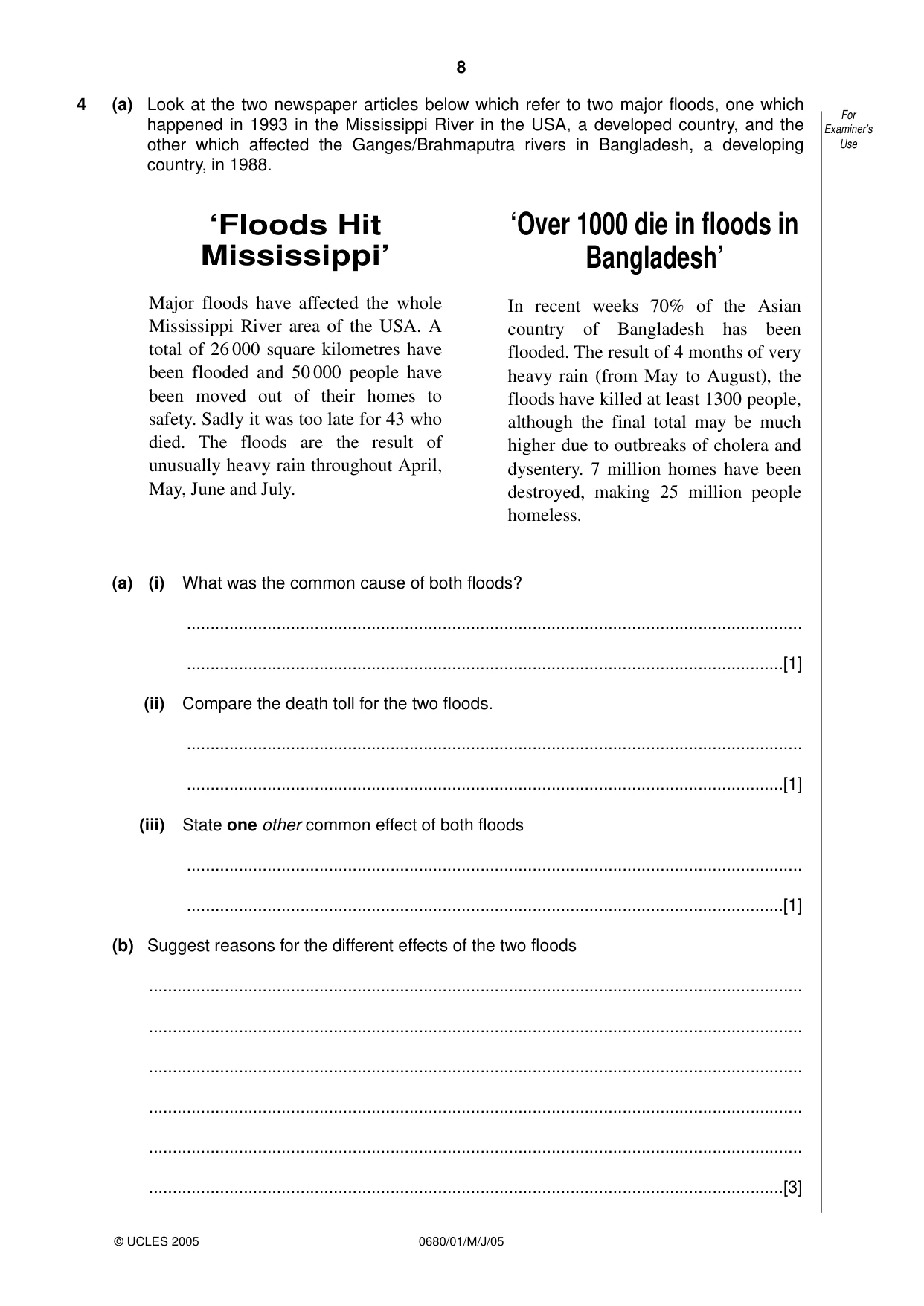
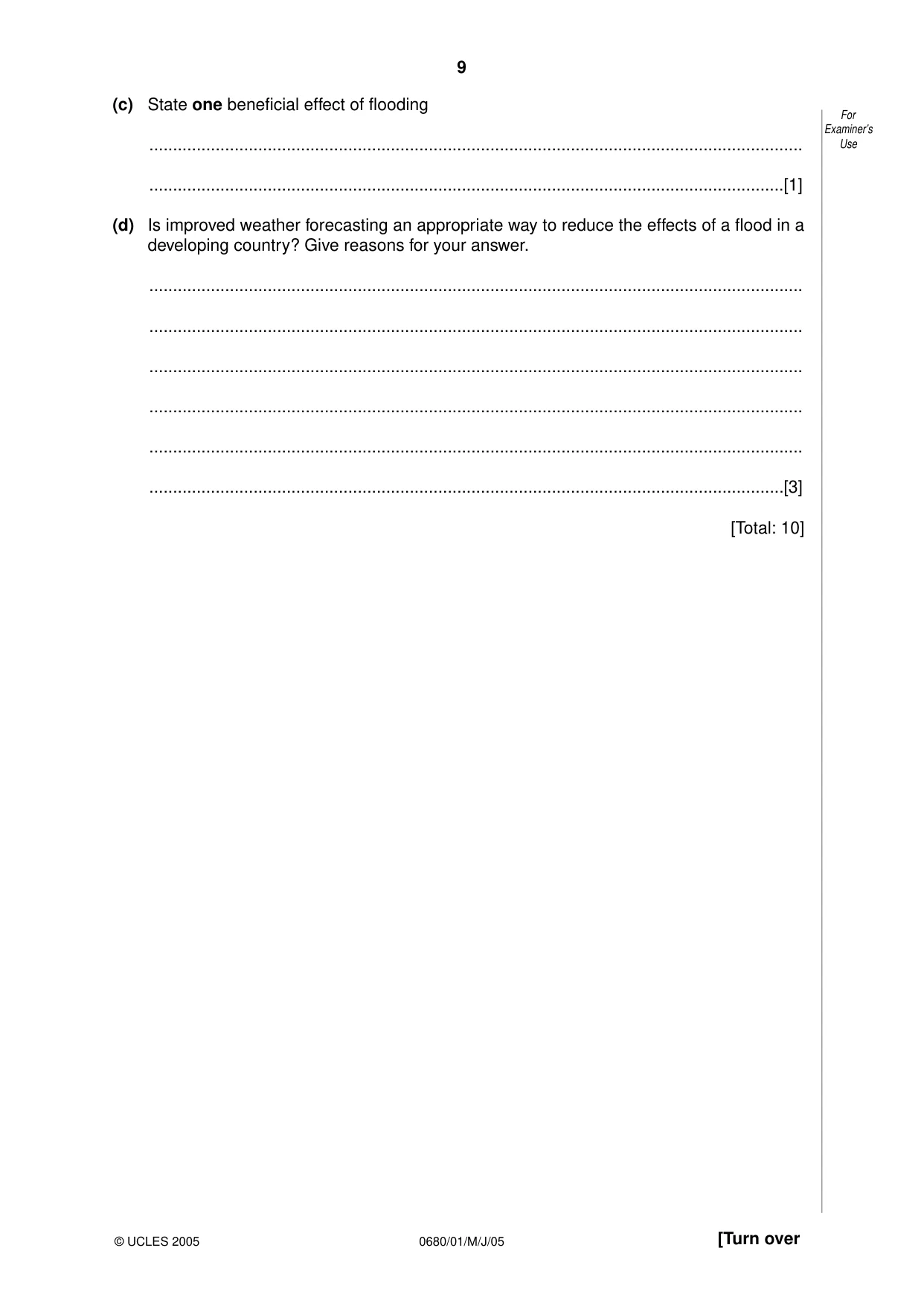
8 0680/01/M/J/05 4 (a) Look at the two newspaper articles below which refer to two major floods, one which happened in 1993 in the Mississippi River in the USA, a developed country, and the other which affected the Ganges/Brahmaputra rivers in Bangladesh, a developing country, in 1988. (a) (i) What was the common cause of both floods? … …[1] (ii) Compare the death toll for the two floods. … …[1] (iii) State one other common effect of both floods … …[1] (b) Suggest reasons for the different effects of the two floods … … … … … …[3] ‘Floods Hit Mississippi’ Major floods have affected the whole Mississippi River area of the USA. A total of 26000 square kilometres have been flooded and 50000 people have been moved out of their homes to safety. Sadly it was too late for 43 who died. The floods are the result of unusually heavy rain throughout April, May, June and July. ‘Over 1000 die in floods in Bangladesh’ In recent weeks 70% of the Asian country of Bangladesh has been flooded. The result of 4 months of very heavy rain (from May to August), the floods have killed at least 1300 people, although the final total may be much higher due to outbreaks of cholera and dysentery. 7 million homes have been destroyed, making 25 million people homeless. For Examiner’s Use © UCLES 2005
Question paper, page 9
9 0680/01/M/J/05 [Turn over (c) State one beneficial effect of flooding … …[1] (d) Is improved weather forecasting an appropriate way to reduce the effects of a flood in a developing country? Give reasons for your answer. … … … … … …[3] [Total: 10] For Examiner’s Use © UCLES 2005
Question paper, page 10
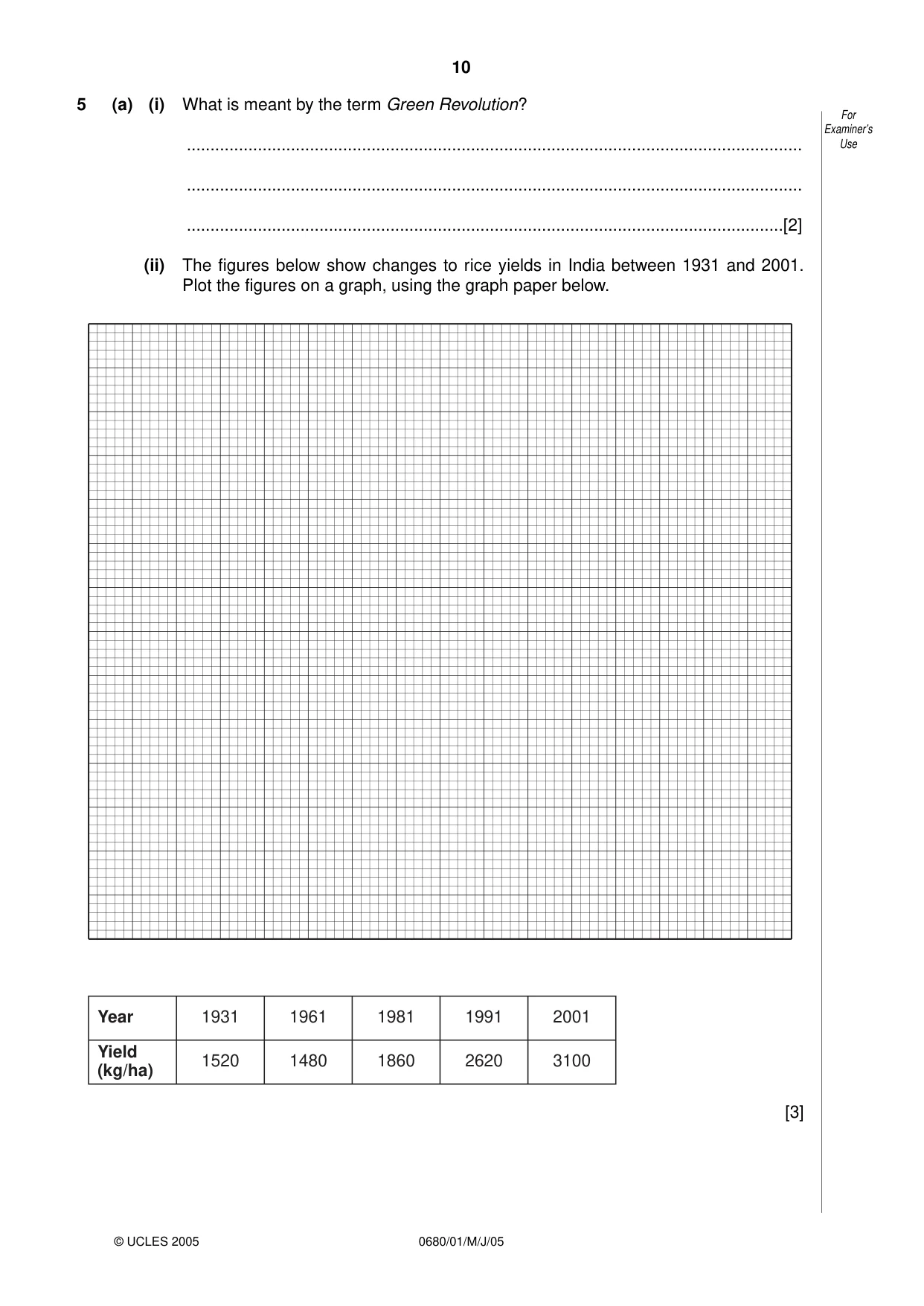
10 0680/01/M/J/05 5 (a) (i) What is meant by the term Green Revolution? … … …[2] (ii) The figures below show changes to rice yields in India between 1931 and 2001. Plot the figures on a graph, using the graph paper below. [3] Year Yield (kg/ha) 1931 1961 1981 1991 2001 1520 1480 1860 2620 3100 For Examiner’s Use © UCLES 2005
Question paper, page 11
11 0680/01/M/J/05 [Turn over (iii) Describe the changes in yield between 1931 and 2001. … … … …[2] (b) One feature of the Green Revolution is that more of the land is owned by fewer people. Do you think that this is a good thing? Give reasons for your answer. … … … … … …[3] [Total: 10] For Examiner’s Use © UCLES 2005
Question paper, page 12
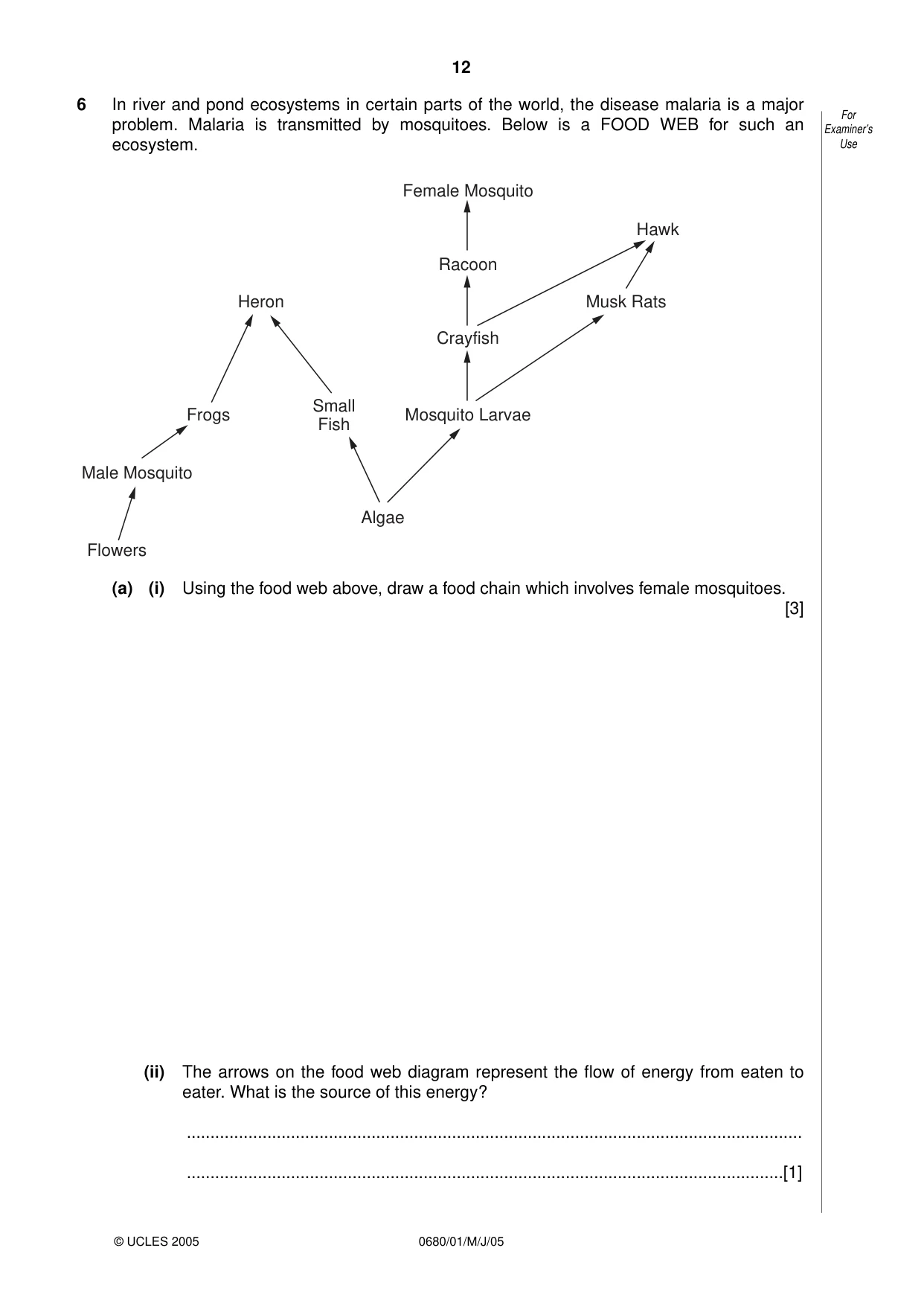
12 0680/01/M/J/05 6 In river and pond ecosystems in certain parts of the world, the disease malaria is a major problem. Malaria is transmitted by mosquitoes. Below is a FOOD WEB for such an ecosystem. (a) (i) Using the food web above, draw a food chain which involves female mosquitoes. [3] (ii) The arrows on the food web diagram represent the flow of energy from eaten to eater. What is the source of this energy? … …[1] Female Mosquito Male Mosquito Flowers Racoon Heron Musk Rats Hawk Crayfish Mosquito Larvae Small Fish Frogs Algae For Examiner’s Use © UCLES 2005
Question paper, page 13
13 0680/01/M/J/05 (b) (i) Give details of one strategy for reducing mosquito numbers in an area. … … … …[2] (ii) Describe and explain two ways in which the strategy described in b (i) might affect the numbers of animals and/or plants (other than mosquitoes) in the food web above. … … … … … … …[4] [Total: 10] [Paper Total: 60] For Examiner’s Use © UCLES 2005
Question paper, page 16
16 0680/01/M/J/05 BLANK PAGE © UCLES 2005 Copyright Acknowledgements: Question 2 © Bunce, V (1995) Debt/Environment Cycle in Contexts, Pearson Education. Permission to reproduce items where third-party owned material protected by copyright is included has been sought and cleared where possible. Every reasonable effort has been made by the publisher (UCLES) to trace copyright holders, but if any items requiring clearance have unwittingly been included, the publisher will be pleased to make amends at the earliest possible opportunity. University of Cambridge International Examinations is part of the University of Cambridge Local Examinations Syndicate (UCLES), which is itself a department of the University of Cambridge.
Mark scheme, page 1
UNIVERSITY OF CAMBRIDGE INTERNATIONAL EXAMINATIONS International General Certificate of Secondary Education MARK SCHEME for the June 2005 question paper 0680 ENVIRONMENTAL MANAGEMENT 0680/01 Paper 1 (Alternative to Coursework), maximum mark 60 This mark scheme is published as an aid to teachers and students, to indicate the requirements of the examination. It shows the basis on which Examiners were initially instructed to award marks. It does not indicate the details of the discussions that took place at an Examiners’ meeting before marking began. Any substantial changes to the mark scheme that arose from these discussions will be recorded in the published Report on the Examination. All Examiners are instructed that alternative correct answers and unexpected approaches in candidates’ scripts must be given marks that fairly reflect the relevant knowledge and skills demonstrated. Mark schemes must be read in conjunction with the question papers and the Report on the Examination. • CIE will not enter into discussion or correspondence in connection with these mark schemes. CIE is publishing the mark schemes for the June 2005 question papers for most IGCSE and GCE Advanced Level and Advanced Subsidiary Level syllabuses and some Ordinary Level syllabuses. www.XtremePapers.com
Mark scheme, page 2
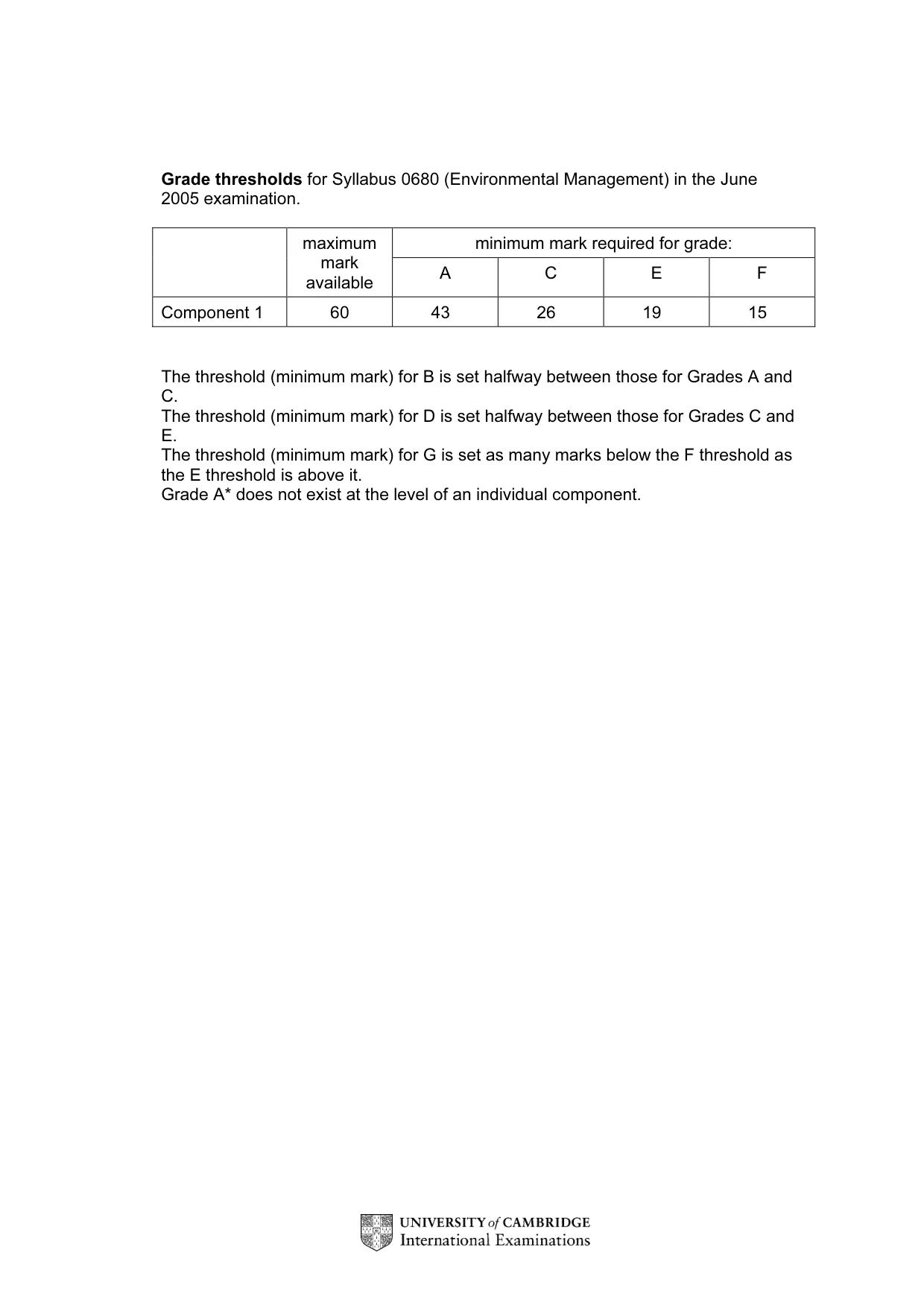
Grade thresholds for Syllabus 0680 (Environmental Management) in the June 2005 examination. minimum mark required for grade: maximum mark available A C E F Component 1 60 43 26 19 15 The threshold (minimum mark) for B is set halfway between those for Grades A and C. The threshold (minimum mark) for D is set halfway between those for Grades C and E. The threshold (minimum mark) for G is set as many marks below the F threshold as the E threshold is above it. Grade A* does not exist at the level of an individual component.
Mark scheme, page 3
June 2005 IGCSE MARK SCHEME MAXIMUM MARK: 60 SYLLABUS/COMPONENT: 0680/01 ENVIRONMENTAL MANAGEMENT (Alternative to Coursework)
Mark scheme, page 4
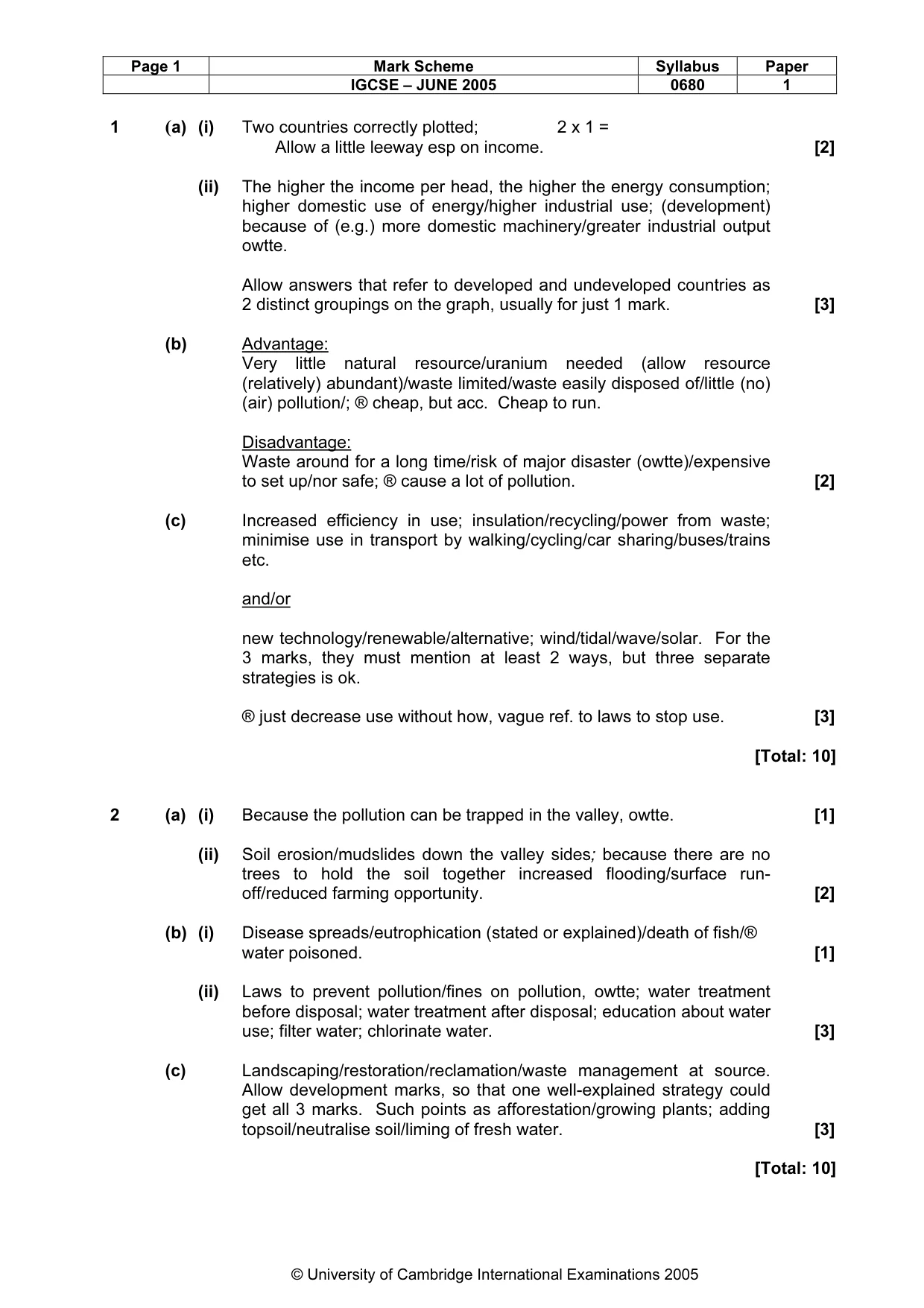
Page 1 Mark Scheme Syllabus Paper IGCSE – JUNE 2005 0680 1 © University of Cambridge International Examinations 2005 1 (a) (i) Two countries correctly plotted; 2 x 1 = Allow a little leeway esp on income. [2] (ii) The higher the income per head, the higher the energy consumption; higher domestic use of energy/higher industrial use; (development) because of (e.g.) more domestic machinery/greater industrial output owtte. Allow answers that refer to developed and undeveloped countries as 2 distinct groupings on the graph, usually for just 1 mark. [3] (b) Advantage: Very little natural resource/uranium needed (allow resource (relatively) abundant)/waste limited/waste easily disposed of/little (no) (air) pollution/; ® cheap, but acc. Cheap to run. Disadvantage: Waste around for a long time/risk of major disaster (owtte)/expensive to set up/nor safe; ® cause a lot of pollution. [2] (c) Increased efficiency in use; insulation/recycling/power from waste; minimise use in transport by walking/cycling/car sharing/buses/trains etc. and/or new technology/renewable/alternative; wind/tidal/wave/solar. For the 3 marks, they must mention at least 2 ways, but three separate strategies is ok. ® just decrease use without how, vague ref. to laws to stop use. [3] [Total: 10] 2 (a) (i) Because the pollution can be trapped in the valley, owtte. [1] (ii) Soil erosion/mudslides down the valley sides; because there are no trees to hold the soil together increased flooding/surface run- off/reduced farming opportunity. [2] (b) (i) Disease spreads/eutrophication (stated or explained)/death of fish/® water poisoned. [1] (ii) Laws to prevent pollution/fines on pollution, owtte; water treatment before disposal; water treatment after disposal; education about water use; filter water; chlorinate water. [3] (c) Landscaping/restoration/reclamation/waste management at source. Allow development marks, so that one well-explained strategy could get all 3 marks. Such points as afforestation/growing plants; adding topsoil/neutralise soil/liming of fresh water. [3] [Total: 10]
Mark scheme, page 5
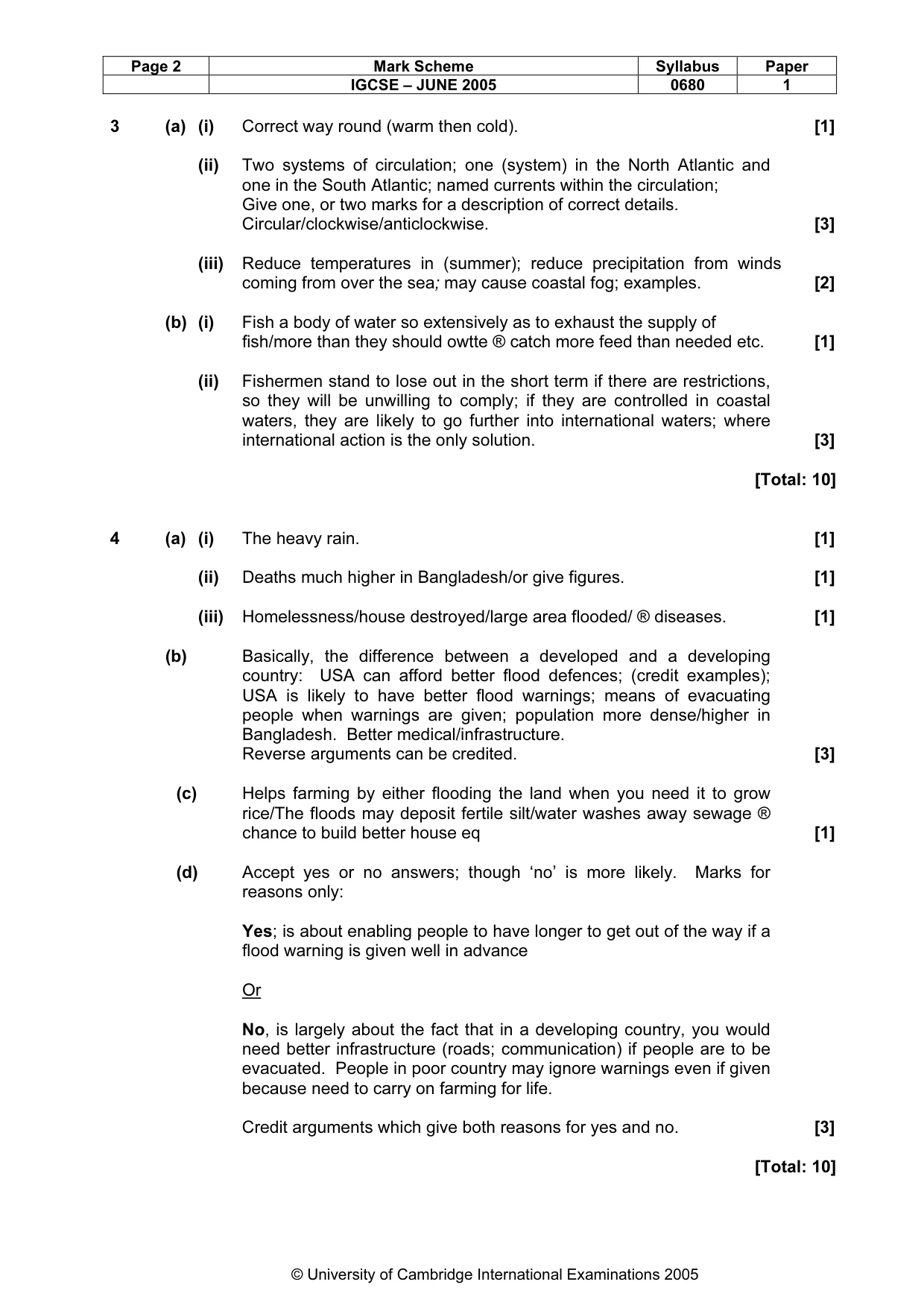
Page 2 Mark Scheme Syllabus Paper IGCSE – JUNE 2005 0680 1 © University of Cambridge International Examinations 2005 3 (a) (i) Correct way round (warm then cold). [1] (ii) Two systems of circulation; one (system) in the North Atlantic and one in the South Atlantic; named currents within the circulation; Give one, or two marks for a description of correct details. Circular/clockwise/anticlockwise. [3] (iii) Reduce temperatures in (summer); reduce precipitation from winds coming from over the sea; may cause coastal fog; examples. [2] (b) (i) Fish a body of water so extensively as to exhaust the supply of fish/more than they should owtte ® catch more feed than needed etc. [1] (ii) Fishermen stand to lose out in the short term if there are restrictions, so they will be unwilling to comply; if they are controlled in coastal waters, they are likely to go further into international waters; where international action is the only solution. [3] [Total: 10] 4 (a) (i) The heavy rain. [1] (ii) Deaths much higher in Bangladesh/or give figures. [1] (iii) Homelessness/house destroyed/large area flooded/ ® diseases. [1] (b) Basically, the difference between a developed and a developing country: USA can afford better flood defences; (credit examples); USA is likely to have better flood warnings; means of evacuating people when warnings are given; population more dense/higher in Bangladesh. Better medical/infrastructure. Reverse arguments can be credited. [3] (c) Helps farming by either flooding the land when you need it to grow rice/The floods may deposit fertile silt/water washes away sewage ® chance to build better house eq [1] (d) Accept yes or no answers; though ‘no’ is more likely. Marks for reasons only: Yes; is about enabling people to have longer to get out of the way if a flood warning is given well in advance Or No, is largely about the fact that in a developing country, you would need better infrastructure (roads; communication) if people are to be evacuated. People in poor country may ignore warnings even if given because need to carry on farming for life. Credit arguments which give both reasons for yes and no. [3] [Total: 10]
Mark scheme, page 6
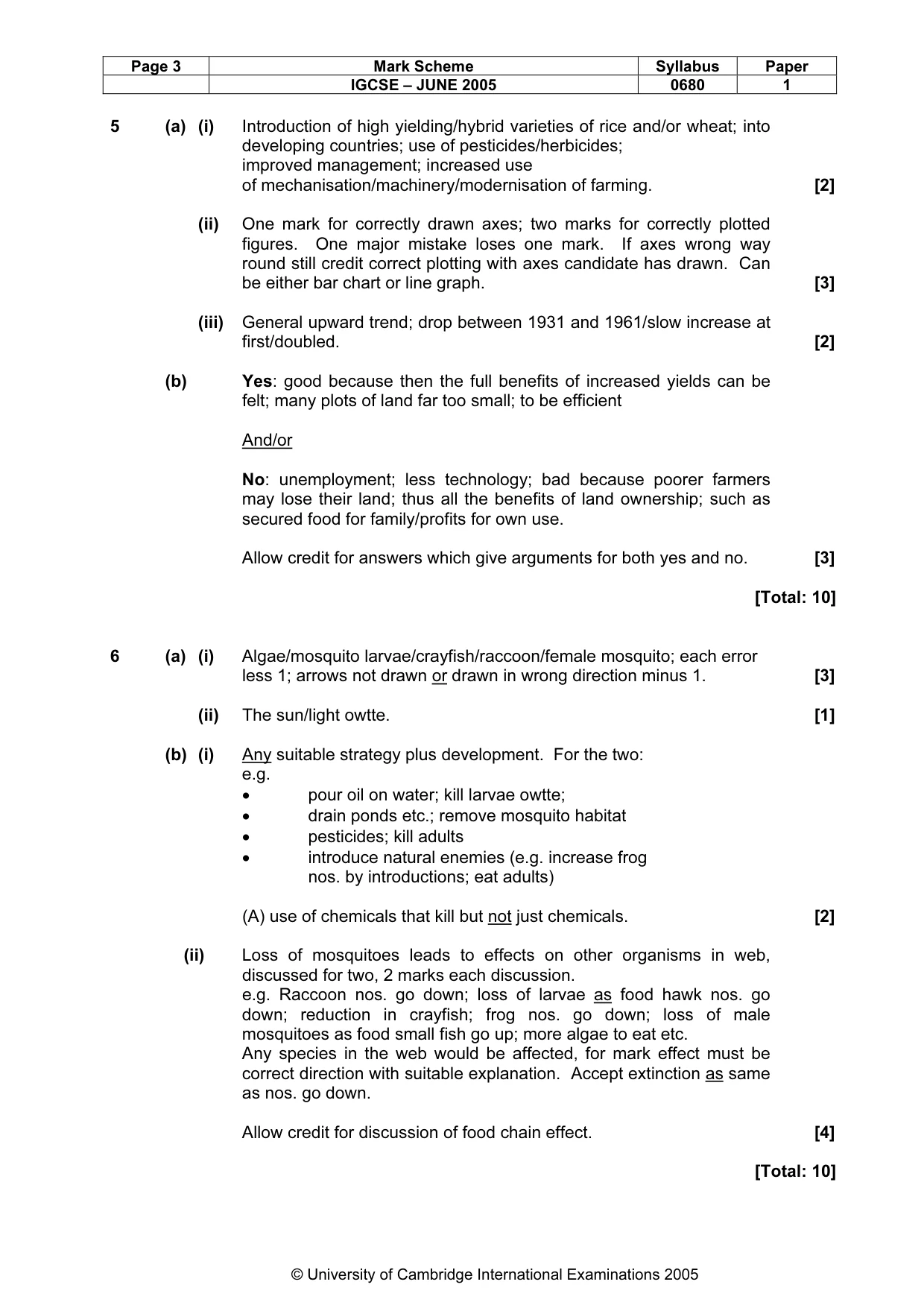
Page 3 Mark Scheme Syllabus Paper IGCSE – JUNE 2005 0680 1 © University of Cambridge International Examinations 2005 5 (a) (i) Introduction of high yielding/hybrid varieties of rice and/or wheat; into developing countries; use of pesticides/herbicides; improved management; increased use of mechanisation/machinery/modernisation of farming. [2] (ii) One mark for correctly drawn axes; two marks for correctly plotted figures. One major mistake loses one mark. If axes wrong way round still credit correct plotting with axes candidate has drawn. Can be either bar chart or line graph. [3] (iii) General upward trend; drop between 1931 and 1961/slow increase at first/doubled. [2] (b) Yes: good because then the full benefits of increased yields can be felt; many plots of land far too small; to be efficient And/or No: unemployment; less technology; bad because poorer farmers may lose their land; thus all the benefits of land ownership; such as secured food for family/profits for own use. Allow credit for answers which give arguments for both yes and no. [3] [Total: 10] 6 (a) (i) Algae/mosquito larvae/crayfish/raccoon/female mosquito; each error less 1; arrows not drawn or drawn in wrong direction minus 1. [3] (ii) The sun/light owtte. [1] (b) (i) Any suitable strategy plus development. For the two: e.g. • pour oil on water; kill larvae owtte; • drain ponds etc.; remove mosquito habitat • pesticides; kill adults • introduce natural enemies (e.g. increase frog nos. by introductions; eat adults) (A) use of chemicals that kill but not just chemicals. [2] (ii) Loss of mosquitoes leads to effects on other organisms in web, discussed for two, 2 marks each discussion. e.g. Raccoon nos. go down; loss of larvae as food hawk nos. go down; reduction in crayfish; frog nos. go down; loss of male mosquitoes as food small fish go up; more algae to eat etc. Any species in the web would be affected, for mark effect must be correct direction with suitable explanation. Accept extinction as same as nos. go down. Allow credit for discussion of food chain effect. [4] [Total: 10]