Cambridge IGCSE Environmental Management 0680 — 2004 Oct/Nov Paper 1 · Variant 1
0680/11/O/N/04
The question paper and its mark scheme, free to read here and free to download. This is Cambridge’s own paper, exactly as it was sat.
Question paper12 pages
Mark scheme6 pages
Answers below. Sit the paper first if you are practising.
Paper as text
Question paper, page 1
This document consists of 12 printed pages. (DR) S78896 © UCLES 2004 [Turn over UNIVERSITY OF CAMBRIDGE INTERNATIONAL EXAMINATIONS International General Certificate of Secondary Education ENVIRONMENTAL MANAGEMENT Paper 1 0680/01 October/November 2004 1 hour 30 minutes Candidates answer on the Question Paper. Additional Materials: Ruler (cm/mm) READ THESE INSTRUCTIONS FIRST Write your Centre number, candidate number and name on all the work you hand in. Write in dark blue or black pen in the spaces provided on the Question Paper. You may use a soft pencil for any diagrams, graphs or rough working. Do not use staples, paper clips, highlighters, glue or correction fluid. Answer all questions. The number of marks is given in brackets [ ] at the end of each question or part question. DO NOT WRITE IN THE BARCODE. DO NOT WRITE IN THE GREY AREAS BETWEEN THE PAGES. FOR EXAMINER’S USE 1 2 3 4 5 6 TOTAL If you have been given a label, look at the details. If any details are incorrect or missing, please fill in your correct details in the space given on this page. Stick your personal label here, if provided. Candidate Name Centre Number Candidate Number www.XtremePapers.com
Question paper, page 2
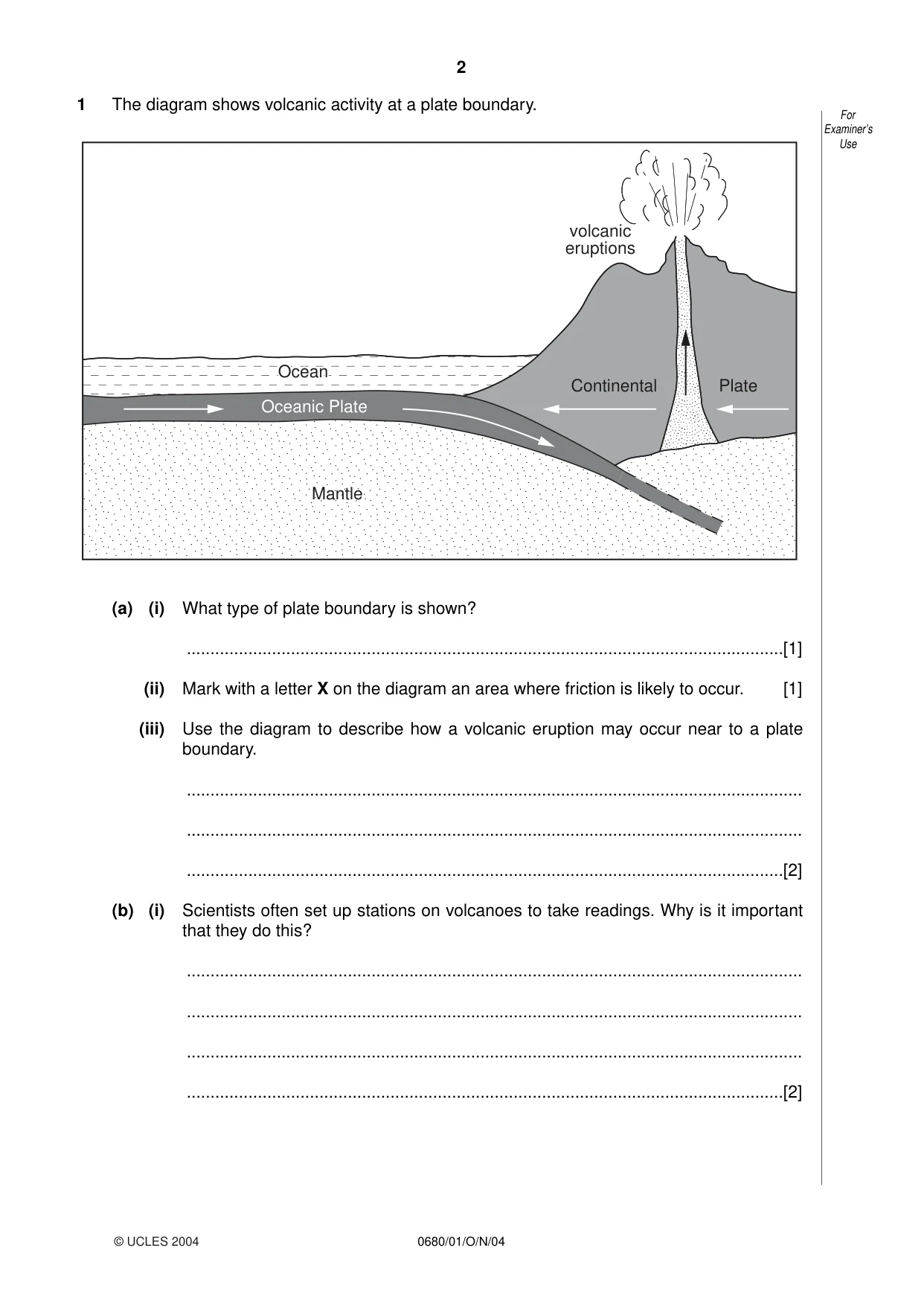
© UCLES 2004 2 0680/01/O/N/04 1 The diagram shows volcanic activity at a plate boundary. (a) (i) What type of plate boundary is shown? …[1] (ii) Mark with a letter X on the diagram an area where friction is likely to occur. [1] (iii) Use the diagram to describe how a volcanic eruption may occur near to a plate boundary. … … …[2] (b) (i) Scientists often set up stations on volcanoes to take readings. Why is it important that they do this? … … … …[2] Oceanic Plate Mantle Continental Plate volcanic eruptions Ocean Ocean Ocean For Examiner’s Use
Question paper, page 3
3 0680/01/O/N/04 [Turn over (ii) About 500 million people live in areas at risk from volcanic eruptions. Suggest two reasons why people live near to active volcanoes. 1 … … 2 … …[2] (c) Describe one form of disaster relief that would be necessary after a volcanic eruption. … … …[2] Total [10] For Examiner’s Use © UCLES 2004
Question paper, page 4
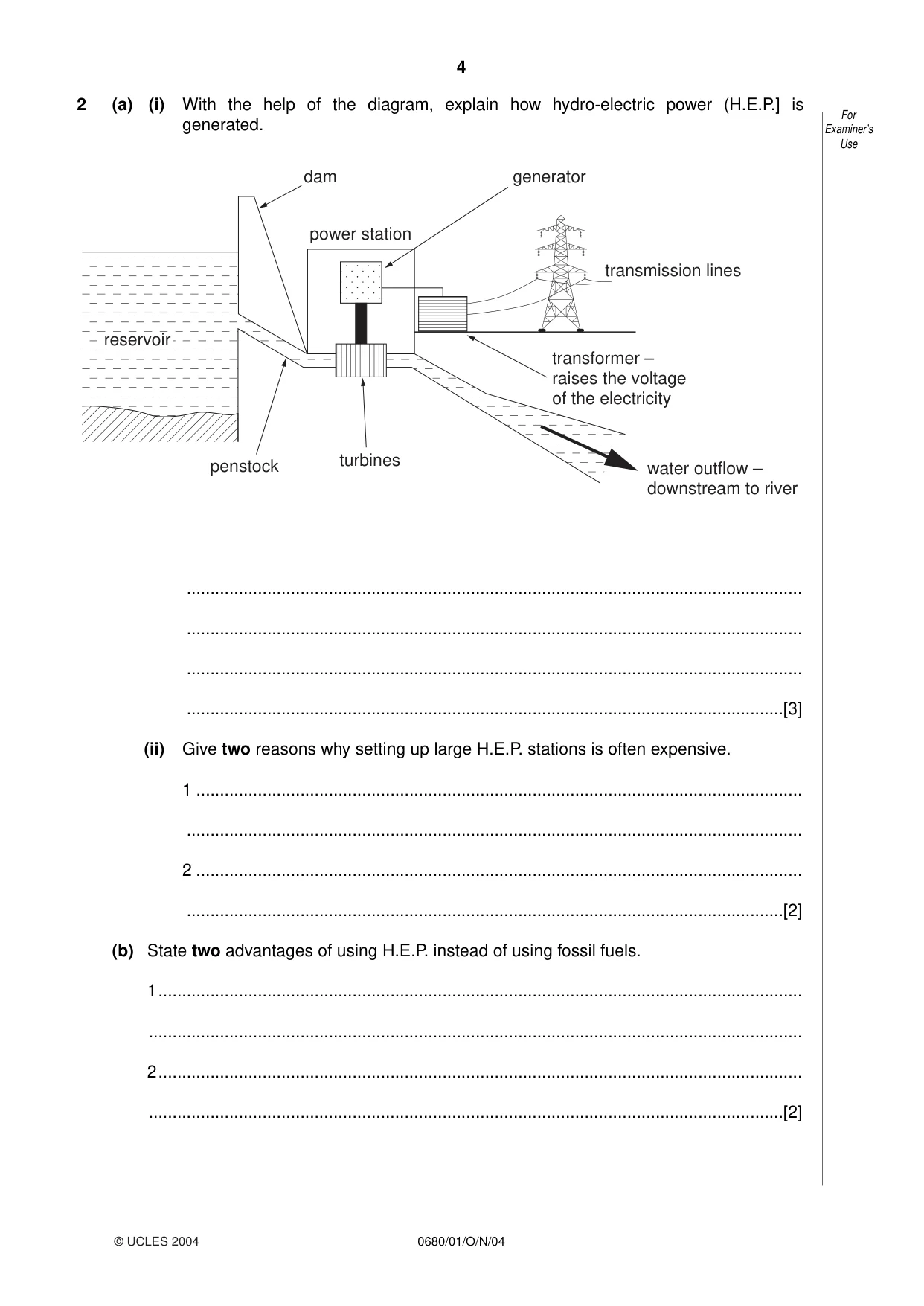
© UCLES 2004 4 0680/01/O/N/04 2 (a) (i) With the help of the diagram, explain how hydro-electric power (H.E.P.] is generated. … … … …[3] (ii) Give two reasons why setting up large H.E.P. stations is often expensive. 1 … … 2 … …[2] (b) State two advantages of using H.E.P. instead of using fossil fuels. 1… … 2… …[2] dam turbines penstock power station generator transmission lines transformer – raises the voltage of the electricity water outflow – downstream to river reservoir For Examiner’s Use
Question paper, page 5
5 0680/01/O/N/04 [Turn over (c) Describe some of the environmental problems that can be caused by large H.E.P. stations. … … … … …[3] Total [10] For Examiner’s Use © UCLES 2004
Question paper, page 6
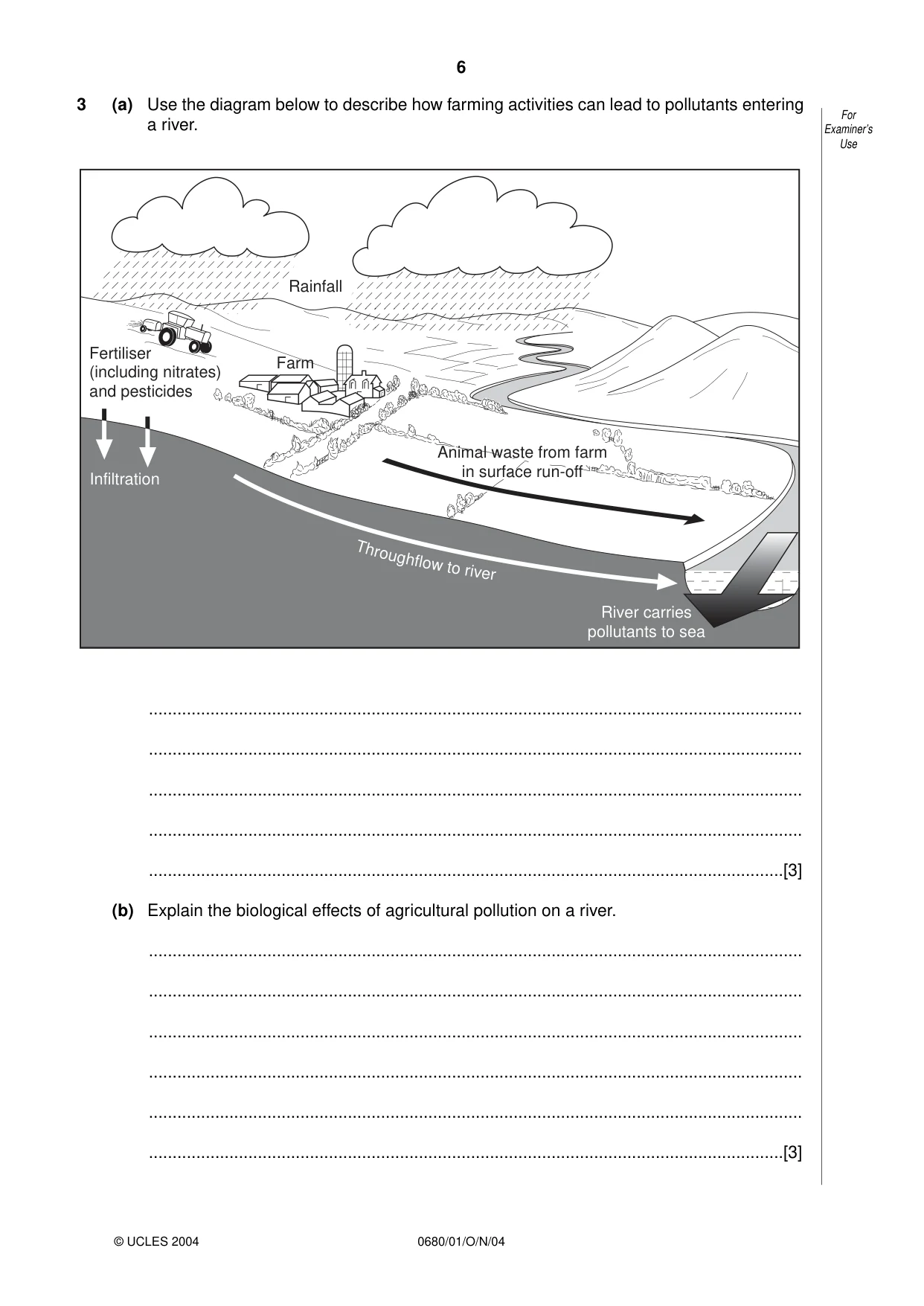
6 0680/01/O/N/04 3 (a) Use the diagram below to describe how farming activities can lead to pollutants entering a river. … … … … …[3] (b) Explain the biological effects of agricultural pollution on a river. … … … … … …[3] Farm Fertiliser (including nitrates) and pesticides Animal waste from farm in surface run-off River carries pollutants to sea Infiltration Throu ghflo w to river Rainfall For Examiner’s Use © UCLES 2004
Question paper, page 7
7 0680/01/O/N/04 [Turn over (c) Why is it difficult to reduce river pollution in large rivers in developing countries? … … … … … … … …[4] Total [10] For Examiner’s Use © UCLES 2004
Question paper, page 8
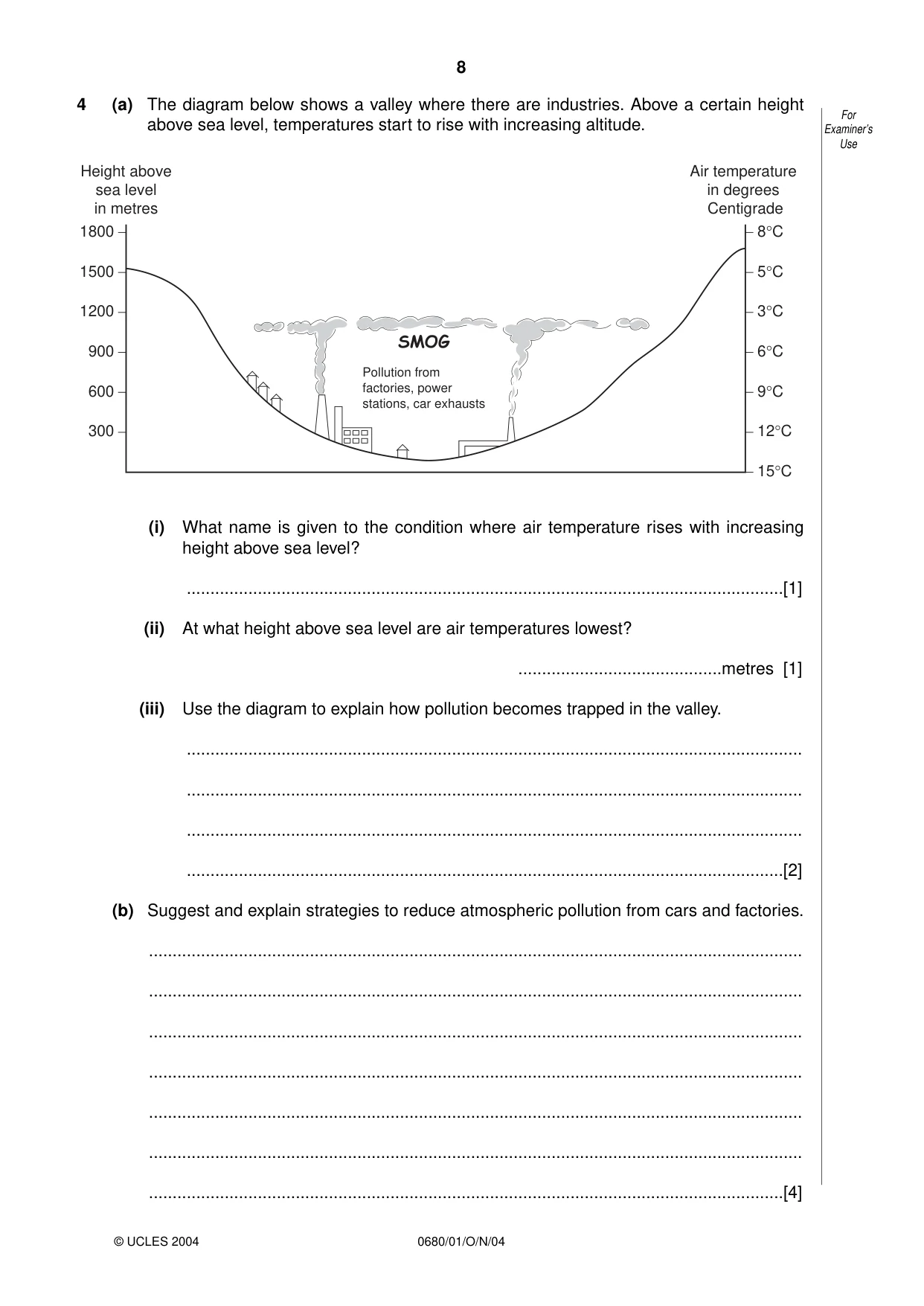
8 0680/01/O/N/04 4 (a) The diagram below shows a valley where there are industries. Above a certain height above sea level, temperatures start to rise with increasing altitude. (i) What name is given to the condition where air temperature rises with increasing height above sea level? …[1] (ii) At what height above sea level are air temperatures lowest? …metres [1] (iii) Use the diagram to explain how pollution becomes trapped in the valley. … … … …[2] (b) Suggest and explain strategies to reduce atmospheric pollution from cars and factories. … … … … … … …[4] 15°C 12°C 9°C 6°C 3°C 5°C 8°C Air temperature in degrees Centigrade Height above sea level in metres 300 600 900 1200 1500 1800 SMOG Pollution from factories, power stations, car exhausts For Examiner’s Use © UCLES 2004
Question paper, page 9
9 0680/01/O/N/04 [Turn over (c) Explain why CFCs are known to be atmospheric pollutants. … … … … …[2] Total [10] For Examiner’s Use © UCLES 2004
Question paper, page 10
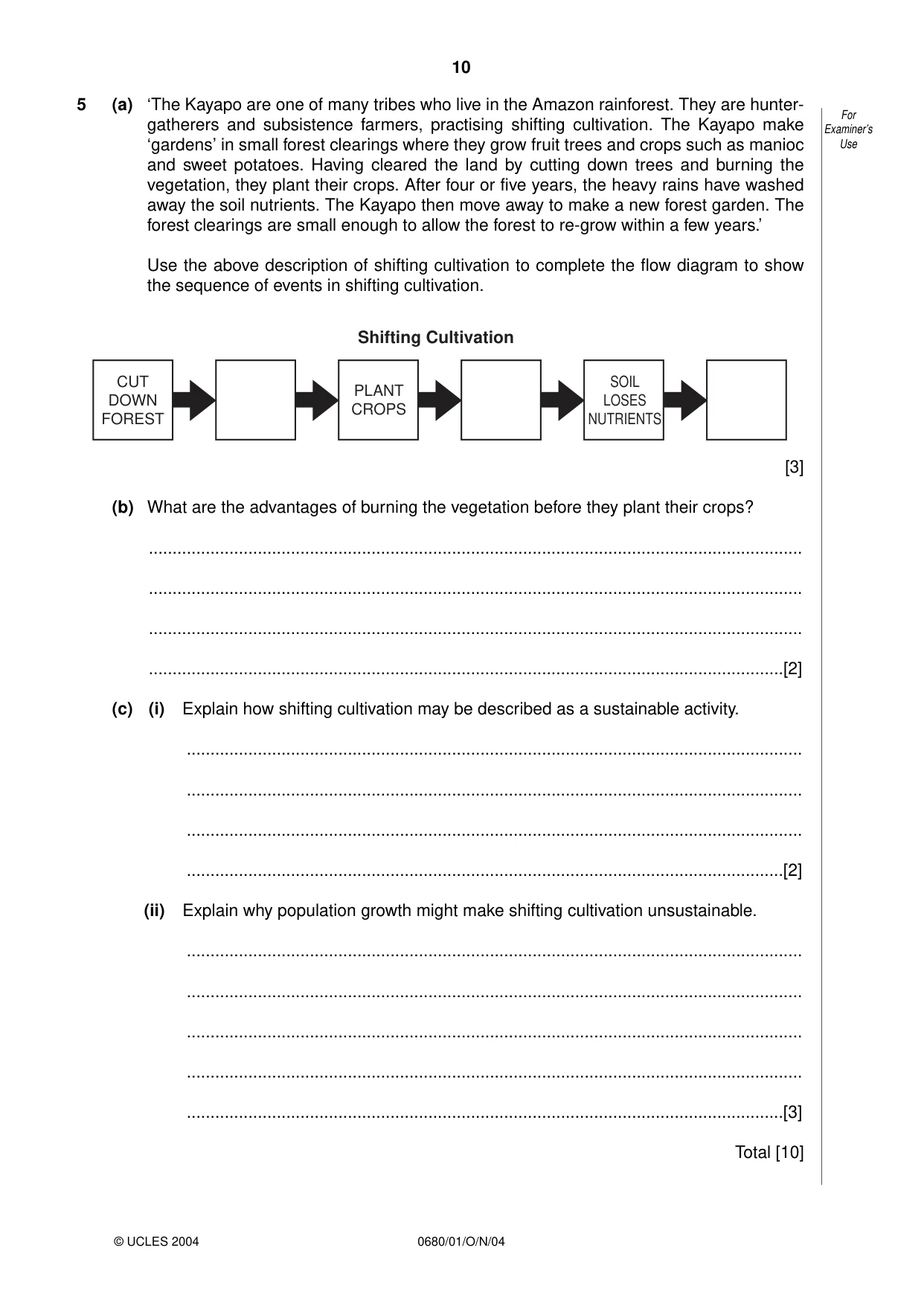
10 0680/01/O/N/04 5 (a) ‘The Kayapo are one of many tribes who live in the Amazon rainforest. They are hunter- gatherers and subsistence farmers, practising shifting cultivation. The Kayapo make ‘gardens’ in small forest clearings where they grow fruit trees and crops such as manioc and sweet potatoes. Having cleared the land by cutting down trees and burning the vegetation, they plant their crops. After four or five years, the heavy rains have washed away the soil nutrients. The Kayapo then move away to make a new forest garden. The forest clearings are small enough to allow the forest to re-grow within a few years.’ Use the above description of shifting cultivation to complete the flow diagram to show the sequence of events in shifting cultivation. [3] (b) What are the advantages of burning the vegetation before they plant their crops? … … … …[2] (c) (i) Explain how shifting cultivation may be described as a sustainable activity. … … … …[2] (ii) Explain why population growth might make shifting cultivation unsustainable. … … … … …[3] Total [10] CUT DOWN FOREST PLANT CROPS SOIL LOSES NUTRIENTS Shifting Cultivation For Examiner’s Use © UCLES 2004
Question paper, page 11
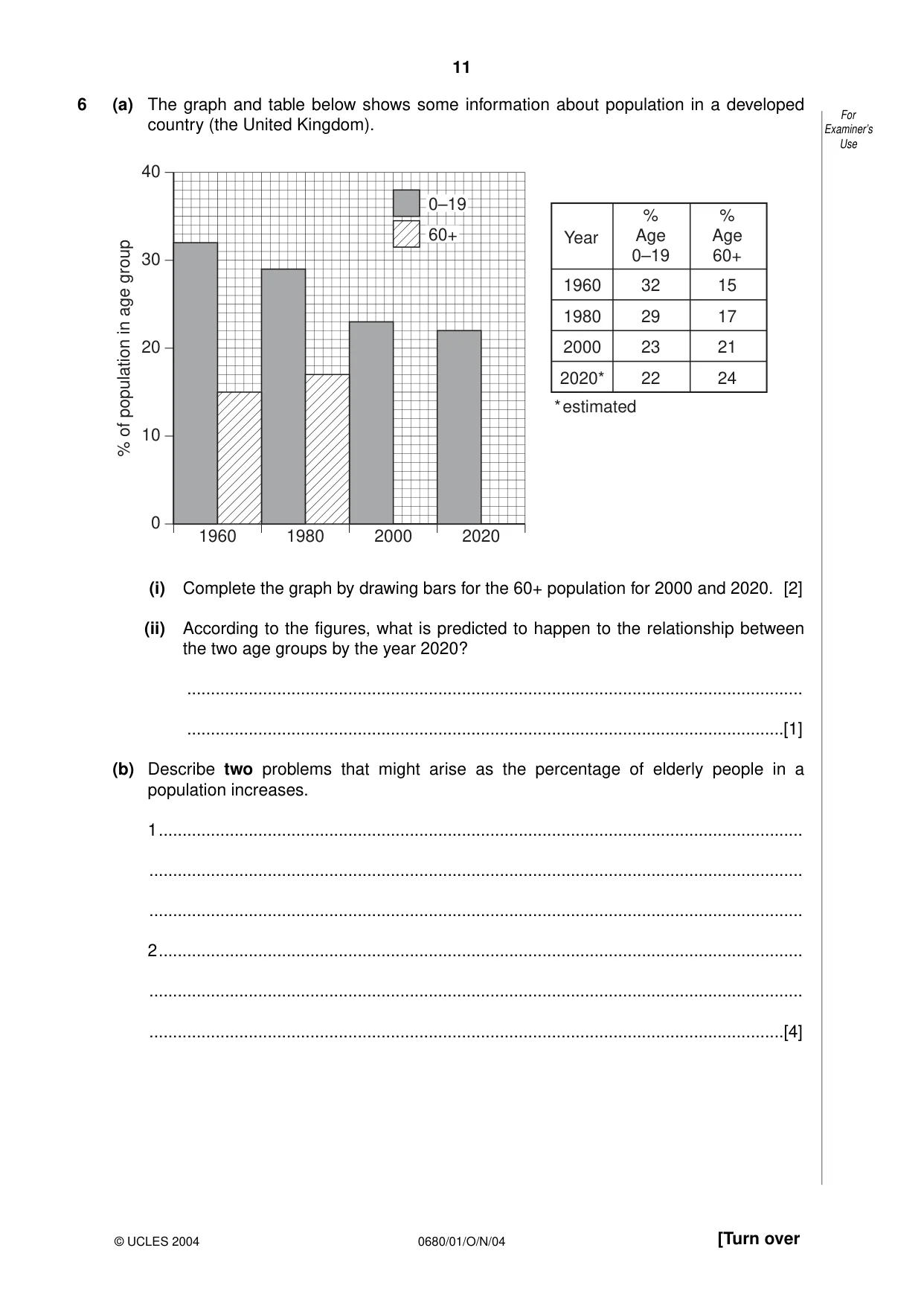
11 0680/01/O/N/04 [Turn over 6 (a) The graph and table below shows some information about population in a developed country (the United Kingdom). (i) Complete the graph by drawing bars for the 60+ population for 2000 and 2020. [2] (ii) According to the figures, what is predicted to happen to the relationship between the two age groups by the year 2020? … …[1] (b) Describe two problems that might arise as the percentage of elderly people in a population increases. 1… … … 2… … …[4] 0 10 20 30 40 1960 1980 2000 2020 % of population in age group 0–19 60+ % Age 0–19 % Age 60+ 32 29 23 22 1960 1980 2000 2020* 15 17 21 24 *estimated Year For Examiner’s Use © UCLES 2004
Question paper, page 12
12 0680/01/O/N/04 (c) Describe strategies that may help reduce high levels of population increase in developing countries. … … … … … …[3] Total [10] Total for paper [60] For Examiner’s Use © UCLES 2004 University of Cambridge International Examinations is part of the University of Cambridge Local Examinations Syndicate (UCLES) which is itself a department of the University of Cambridge.
Mark scheme, page 1
UNIVERSITY OF CAMBRIDGE INTERNATIONAL EXAMINATIONS International General Certificate of Secondary Education MARK SCHEME for the November 2004 question paper 0680 ENVIRONMENTAL MANAGEMENT 0680/01 Paper 1 (Alternative to Coursework), maximum mark 60 This mark scheme is published as an aid to teachers and students, to indicate the requirements of the examination. It shows the basis on which Examiners were initially instructed to award marks. It does not indicate the details of the discussions that took place at an Examiners’ meeting before marking began. Any substantial changes to the mark scheme that arose from these discussions will be recorded in the published Report on the Examination. All Examiners are instructed that alternative correct answers and unexpected approaches in candidates’ scripts must be given marks that fairly reflect the relevant knowledge and skills demonstrated. Mark schemes must be read in conjunction with the question papers and the Report on the Examination. • CIE will not enter into discussion or correspondence in connection with these mark schemes. CIE is publishing the mark schemes for the November 2004 question papers for most IGCSE and GCE Advanced Level syllabuses. www.XtremePapers.com
Mark scheme, page 2
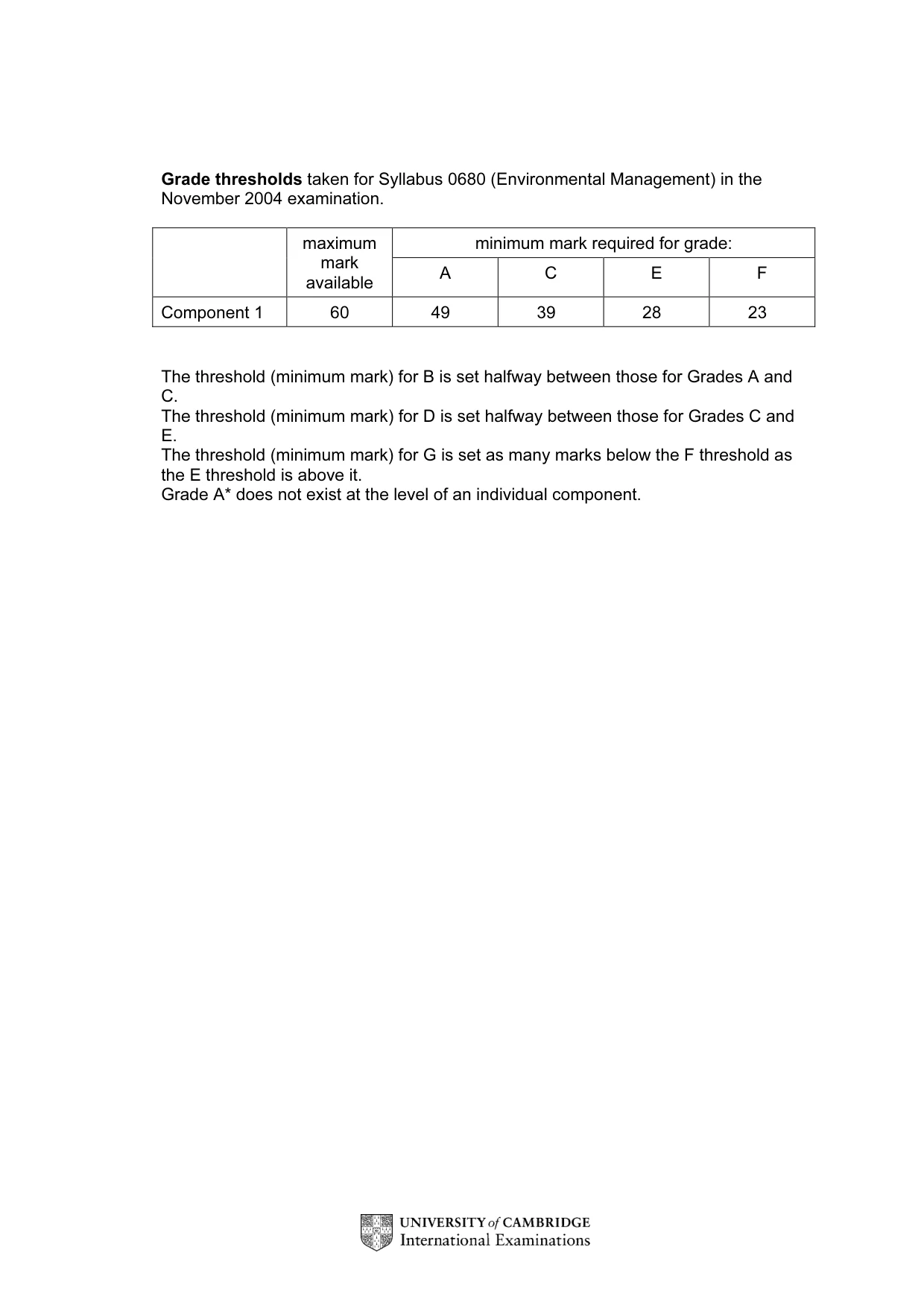
Grade thresholds taken for Syllabus 0680 (Environmental Management) in the November 2004 examination. minimum mark required for grade: maximum mark available A C E F Component 1 60 49 39 28 23 The threshold (minimum mark) for B is set halfway between those for Grades A and C. The threshold (minimum mark) for D is set halfway between those for Grades C and E. The threshold (minimum mark) for G is set as many marks below the F threshold as the E threshold is above it. Grade A* does not exist at the level of an individual component.
Mark scheme, page 3
November 2004 INTERNATIONAL GCSE MARK SCHEME MAXIMUM MARK: 60 SYLLABUS/COMPONENT: 0680/01 ENVIRONMENTAL MANAGEMENT (Alternative to Coursework)
Mark scheme, page 4
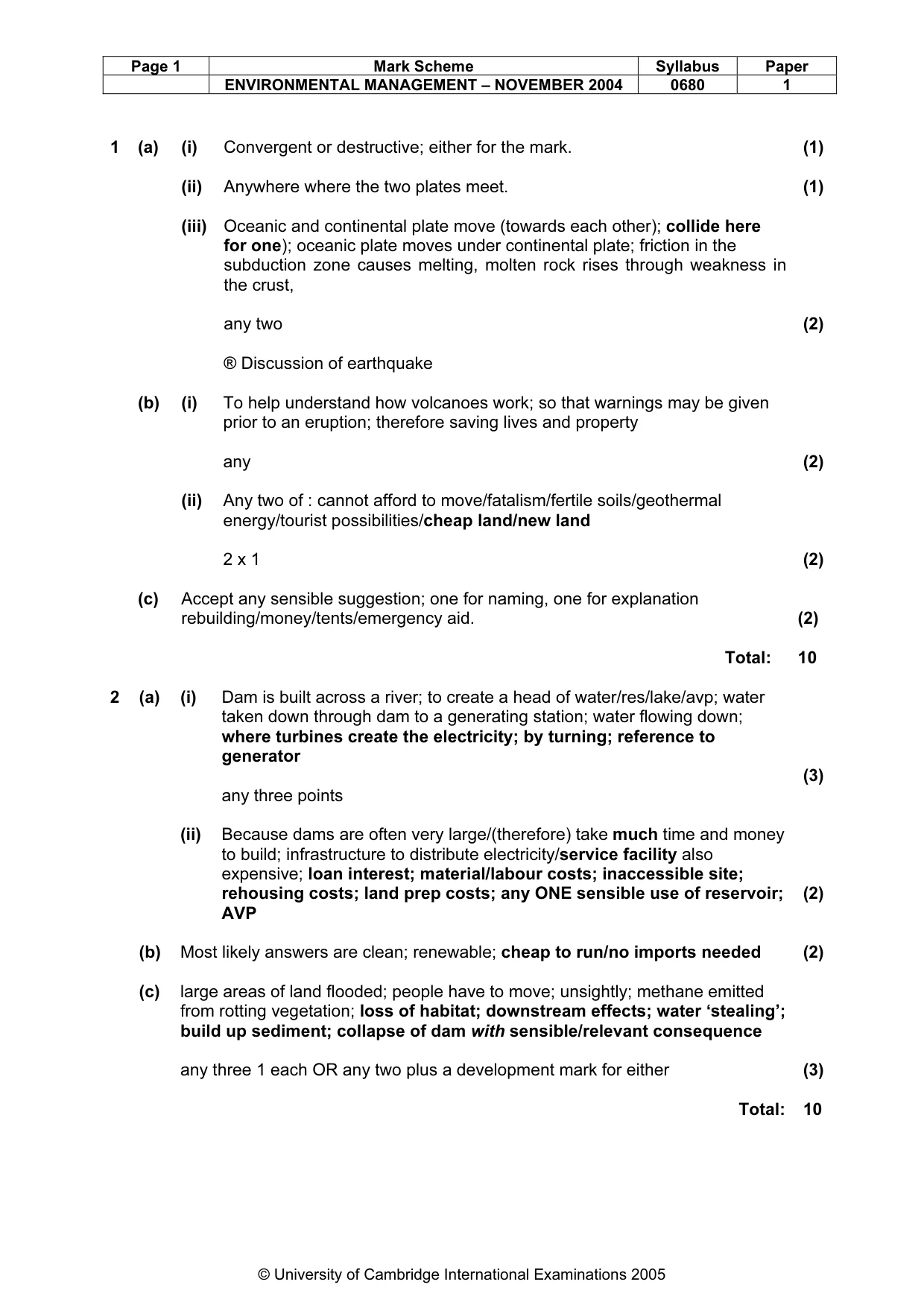
Page 1 Mark Scheme Syllabus Paper ENVIRONMENTAL MANAGEMENT – NOVEMBER 2004 0680 1 © University of Cambridge International Examinations 2005 1 (a) (i) Convergent or destructive; either for the mark. (1) (ii) Anywhere where the two plates meet. (1) (iii) Oceanic and continental plate move (towards each other); collide here for one); oceanic plate moves under continental plate; friction in the subduction zone causes melting, molten rock rises through weakness in the crust, any two ® Discussion of earthquake (2) (b) (i) To help understand how volcanoes work; so that warnings may be given prior to an eruption; therefore saving lives and property any (2) (ii) Any two of : cannot afford to move/fatalism/fertile soils/geothermal energy/tourist possibilities/cheap land/new land 2 x 1 (2) (c) Accept any sensible suggestion; one for naming, one for explanation rebuilding/money/tents/emergency aid. Total: (2) 10 2 (a) (i) Dam is built across a river; to create a head of water/res/lake/avp; water taken down through dam to a generating station; water flowing down; where turbines create the electricity; by turning; reference to generator any three points (3) (ii) Because dams are often very large/(therefore) take much time and money to build; infrastructure to distribute electricity/service facility also expensive; loan interest; material/labour costs; inaccessible site; rehousing costs; land prep costs; any ONE sensible use of reservoir; AVP (2) (b) Most likely answers are clean; renewable; cheap to run/no imports needed (2) (c) large areas of land flooded; people have to move; unsightly; methane emitted from rotting vegetation; loss of habitat; downstream effects; water ‘stealing’; build up sediment; collapse of dam with sensible/relevant consequence any three 1 each OR any two plus a development mark for either (3) Total: 10
Mark scheme, page 5
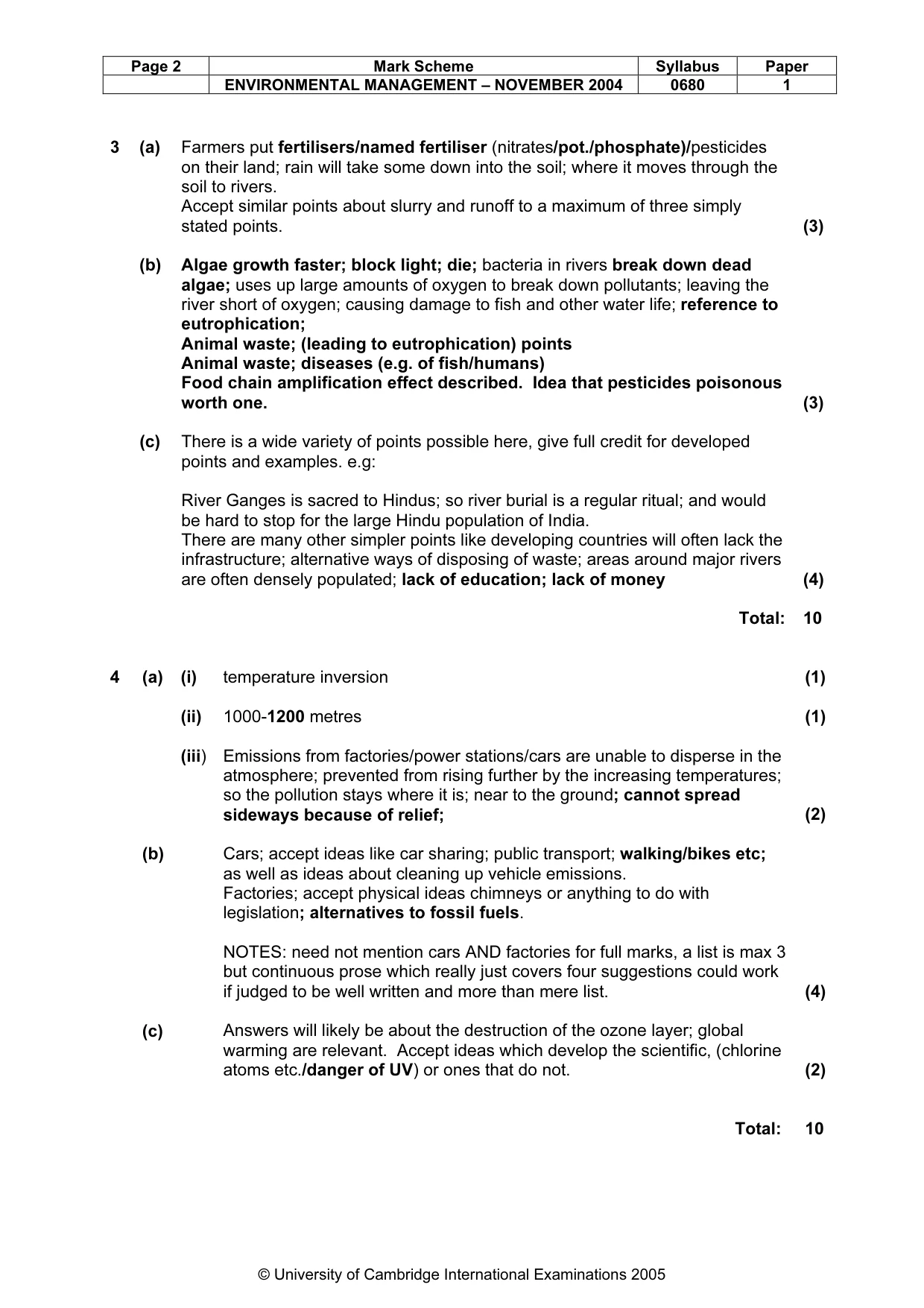
Page 2 Mark Scheme Syllabus Paper ENVIRONMENTAL MANAGEMENT – NOVEMBER 2004 0680 1 © University of Cambridge International Examinations 2005 3 (a) Farmers put fertilisers/named fertiliser (nitrates/pot./phosphate)/pesticides on their land; rain will take some down into the soil; where it moves through the soil to rivers. Accept similar points about slurry and runoff to a maximum of three simply stated points. (3) (b) Algae growth faster; block light; die; bacteria in rivers break down dead algae; uses up large amounts of oxygen to break down pollutants; leaving the river short of oxygen; causing damage to fish and other water life; reference to eutrophication; Animal waste; (leading to eutrophication) points Animal waste; diseases (e.g. of fish/humans) Food chain amplification effect described. Idea that pesticides poisonous worth one. (3) (c) There is a wide variety of points possible here, give full credit for developed points and examples. e.g: River Ganges is sacred to Hindus; so river burial is a regular ritual; and would be hard to stop for the large Hindu population of India. There are many other simpler points like developing countries will often lack the infrastructure; alternative ways of disposing of waste; areas around major rivers are often densely populated; lack of education; lack of money Total: (4) 10 4 (a) (i) temperature inversion (1) (ii) 1000-1200 metres (1) (b) (c) (iii) Emissions from factories/power stations/cars are unable to disperse in the atmosphere; prevented from rising further by the increasing temperatures; so the pollution stays where it is; near to the ground; cannot spread sideways because of relief; Cars; accept ideas like car sharing; public transport; walking/bikes etc; as well as ideas about cleaning up vehicle emissions. Factories; accept physical ideas chimneys or anything to do with legislation; alternatives to fossil fuels. NOTES: need not mention cars AND factories for full marks, a list is max 3 but continuous prose which really just covers four suggestions could work if judged to be well written and more than mere list. Answers will likely be about the destruction of the ozone layer; global warming are relevant. Accept ideas which develop the scientific, (chlorine atoms etc./danger of UV) or ones that do not. Total: (2) (4) (2) 10
Mark scheme, page 6
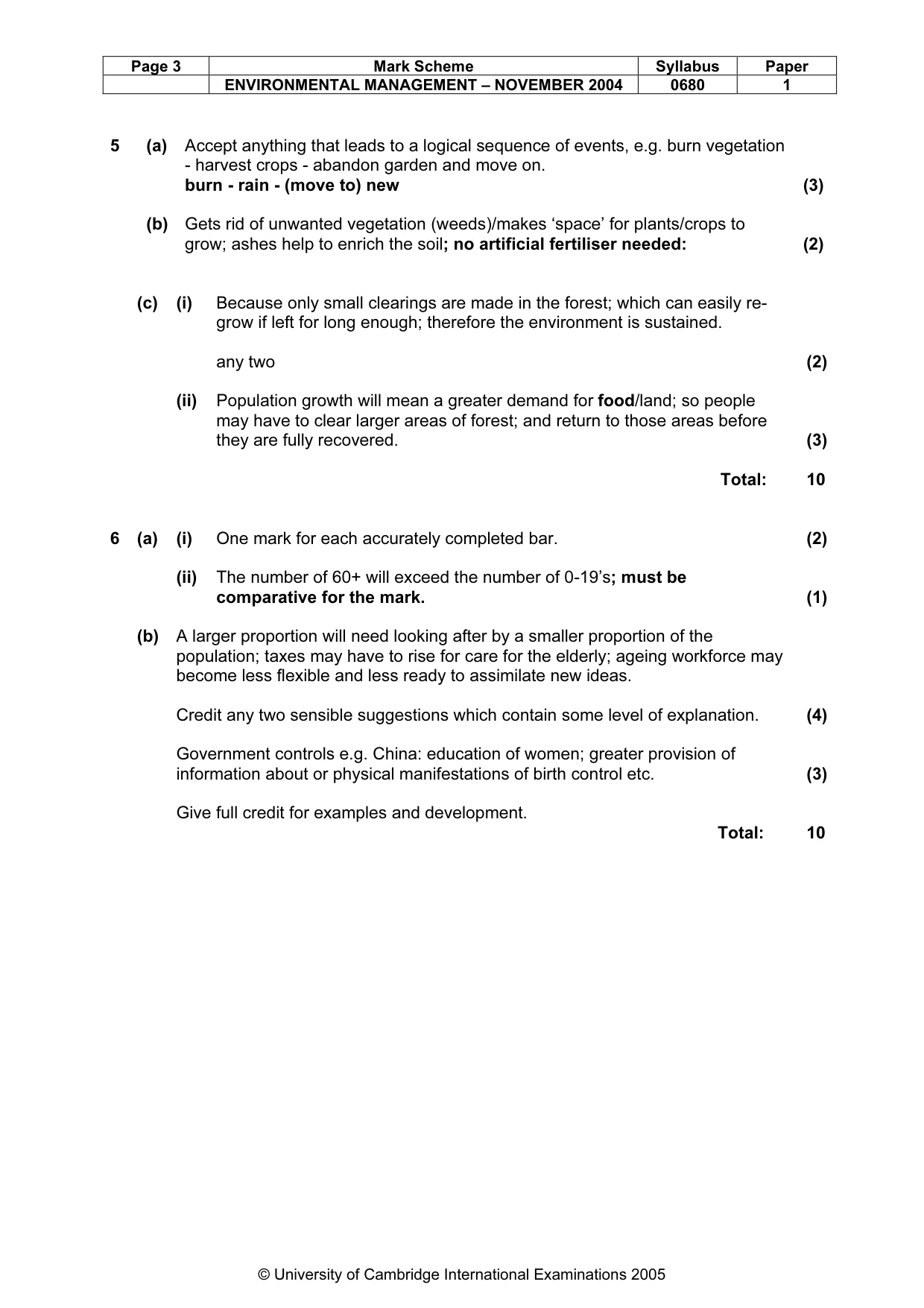
Page 3 Mark Scheme Syllabus Paper ENVIRONMENTAL MANAGEMENT – NOVEMBER 2004 0680 1 © University of Cambridge International Examinations 2005 5 (a) Accept anything that leads to a logical sequence of events, e.g. burn vegetation - harvest crops - abandon garden and move on. burn - rain - (move to) new (3) (b) Gets rid of unwanted vegetation (weeds)/makes ‘space’ for plants/crops to grow; ashes help to enrich the soil; no artificial fertiliser needed: (2) (c) (i) Because only small clearings are made in the forest; which can easily re- grow if left for long enough; therefore the environment is sustained. any two (2) (ii) Population growth will mean a greater demand for food/land; so people may have to clear larger areas of forest; and return to those areas before they are fully recovered. Total: (3) 10 6 (a) (i) One mark for each accurately completed bar. (2) (ii) The number of 60+ will exceed the number of 0-19’s; must be comparative for the mark. (1) (b) A larger proportion will need looking after by a smaller proportion of the population; taxes may have to rise for care for the elderly; ageing workforce may become less flexible and less ready to assimilate new ideas. Credit any two sensible suggestions which contain some level of explanation. Government controls e.g. China: education of women; greater provision of information about or physical manifestations of birth control etc. Give full credit for examples and development. Total: (4) (3) 10