Cambridge IGCSE Enterprise 0454 — 2020 Oct/Nov Paper 1 · Variant 3
0454/13/O/N/20 · 100 marks · ≈113 min
The question paper and its mark scheme, free to read here and free to download. This is Cambridge’s own paper, exactly as it was sat.
Question paper16 pages










Mark scheme16 pages
Answers below. Sit the paper first if you are practising.
Paper as text
Question paper, page 1
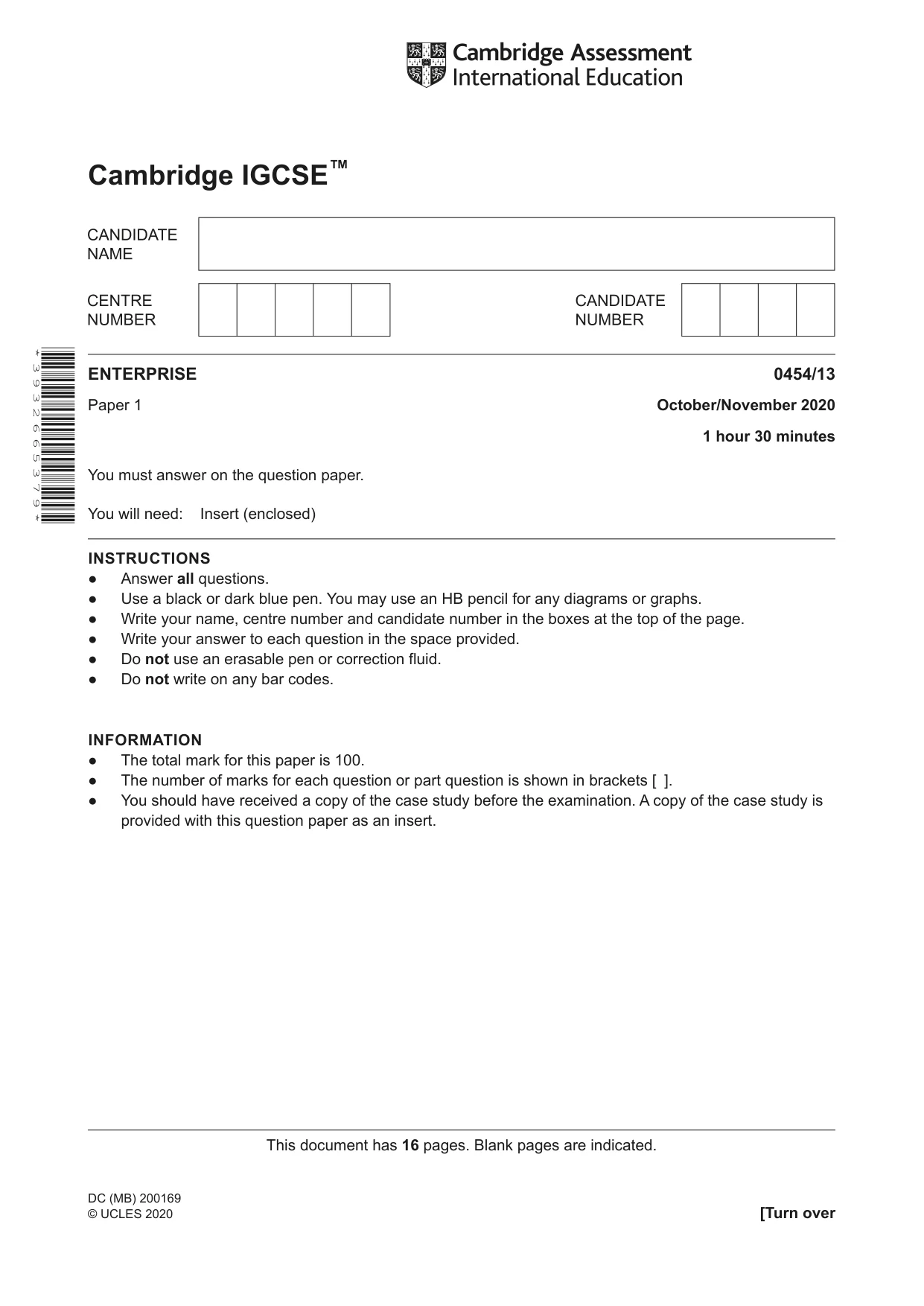
Cambridge IGCSE™ This document has 16 pages. Blank pages are indicated. DC (MB) 200169 © UCLES 2020 [Turn over * 3 9 3 2 6 6 5 3 7 9 * ENTERPRISE 0454/13 Paper 1 October/November 2020 1 hour 30 minutes You must answer on the question paper. You will need: Insert (enclosed) INSTRUCTIONS ● Answer all questions. ● Use a black or dark blue pen. You may use an HB pencil for any diagrams or graphs. ● Write your name, centre number and candidate number in the boxes at the top of the page. ● Write your answer to each question in the space provided. ● Do not use an erasable pen or correction fluid. ● Do not write on any bar codes. INFORMATION ● The total mark for this paper is 100. ● The number of marks for each question or part question is shown in brackets [ ]. ● You should have received a copy of the case study before the examination. A copy of the case study is provided with this question paper as an insert.
Question paper, page 2
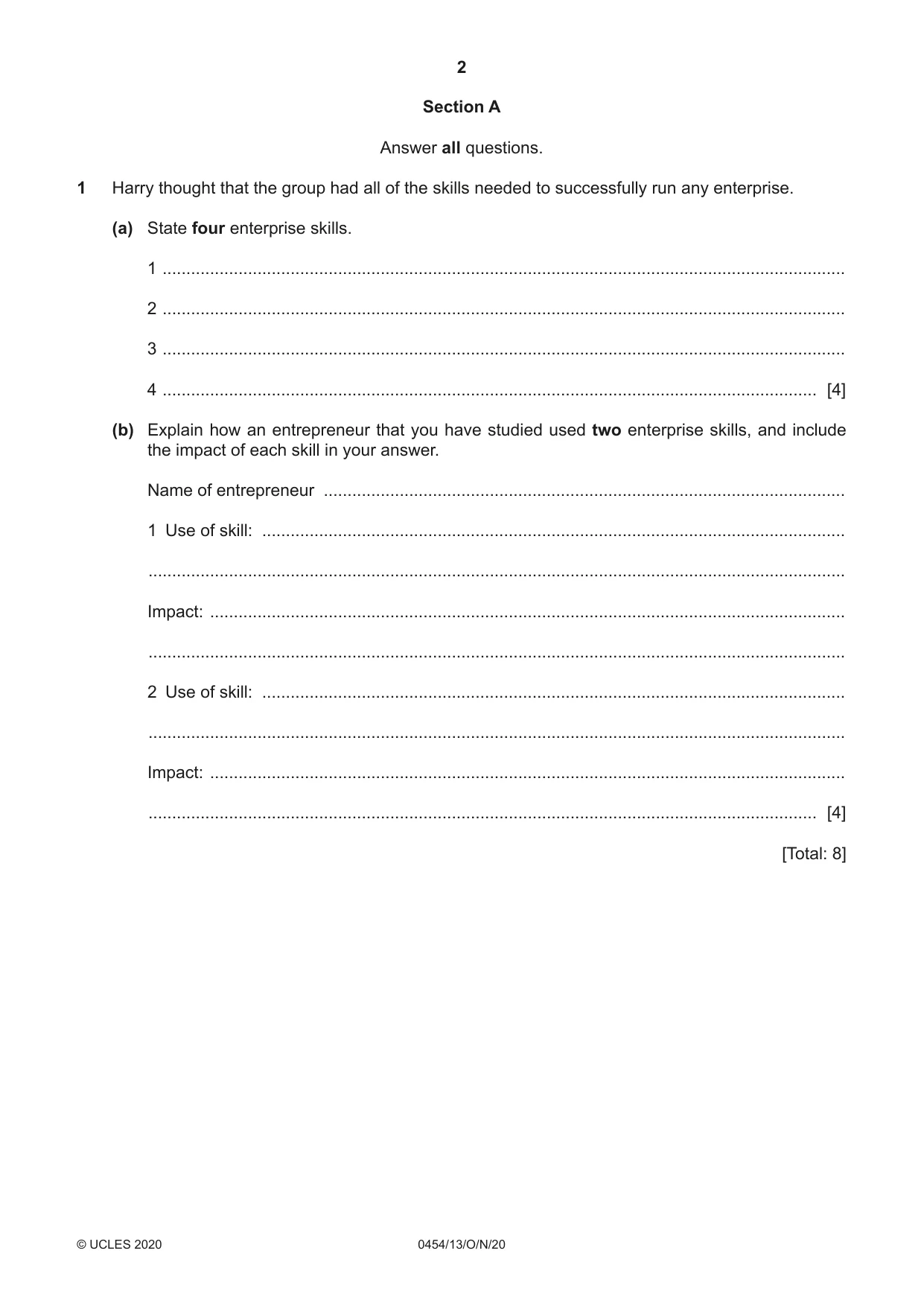
2 0454/13/O/N/20 © UCLES 2020 Section A Answer all questions. 1 Harry thought that the group had all of the skills needed to successfully run any enterprise. (a) State four enterprise skills. 1 … 2 … 3 … 4 … [4] (b) Explain how an entrepreneur that you have studied used two enterprise skills, and include the impact of each skill in your answer. Name of entrepreneur … 1 Use of skill: … … Impact: … … 2 Use of skill: … … Impact: … … [4] [Total: 8]
Question paper, page 3
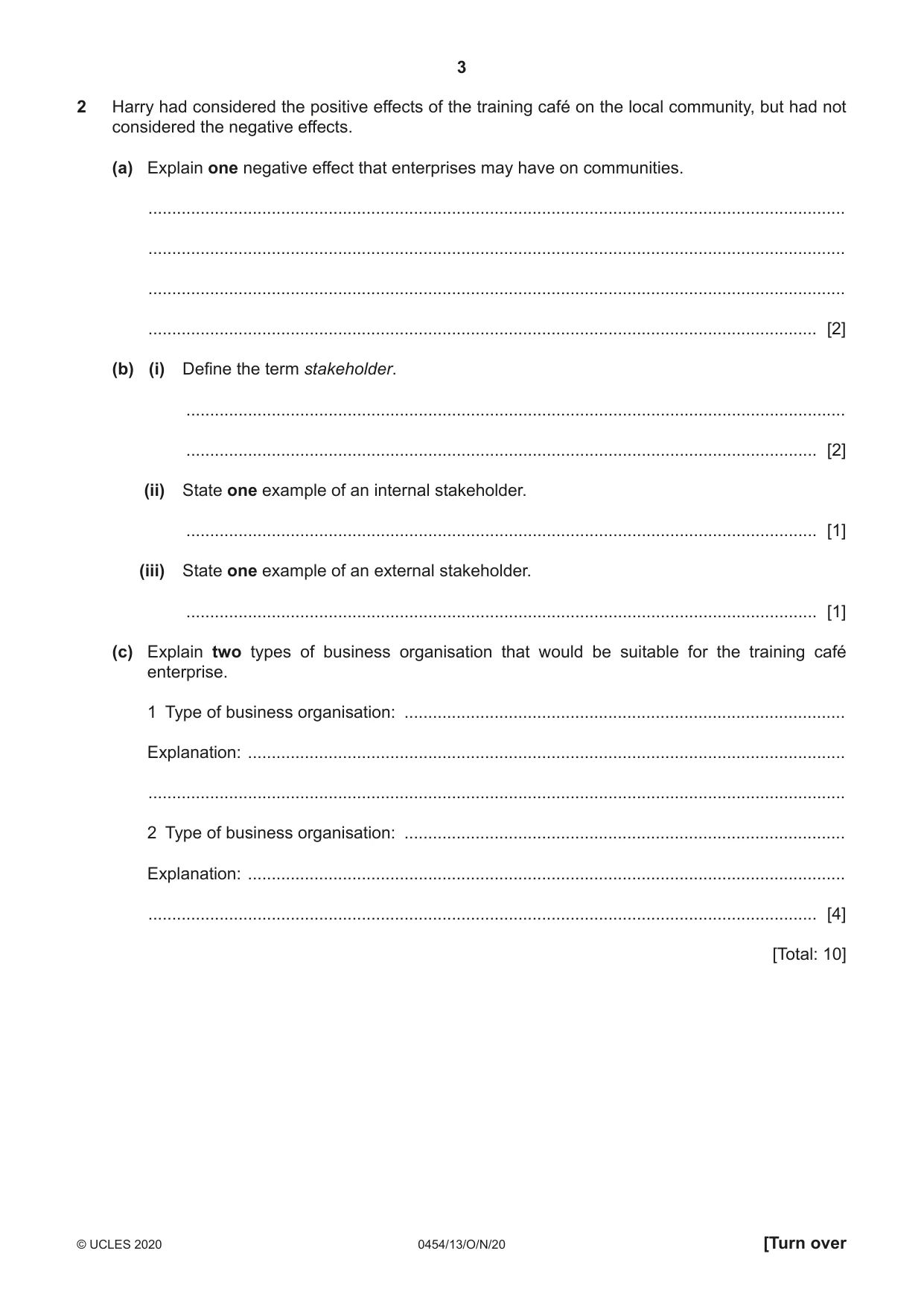
3 0454/13/O/N/20 © UCLES 2020 [Turn over 2 Harry had considered the positive effects of the training café on the local community, but had not considered the negative effects. (a) Explain one negative effect that enterprises may have on communities. … … … … [2] (b) (i) Define the term stakeholder. … … [2] (ii) State one example of an internal stakeholder. … [1] (iii) State one example of an external stakeholder. … [1] (c) Explain two types of business organisation that would be suitable for the training café enterprise. 1 Type of business organisation: … Explanation: … … 2 Type of business organisation: … Explanation: … … [4] [Total: 10]
Question paper, page 4
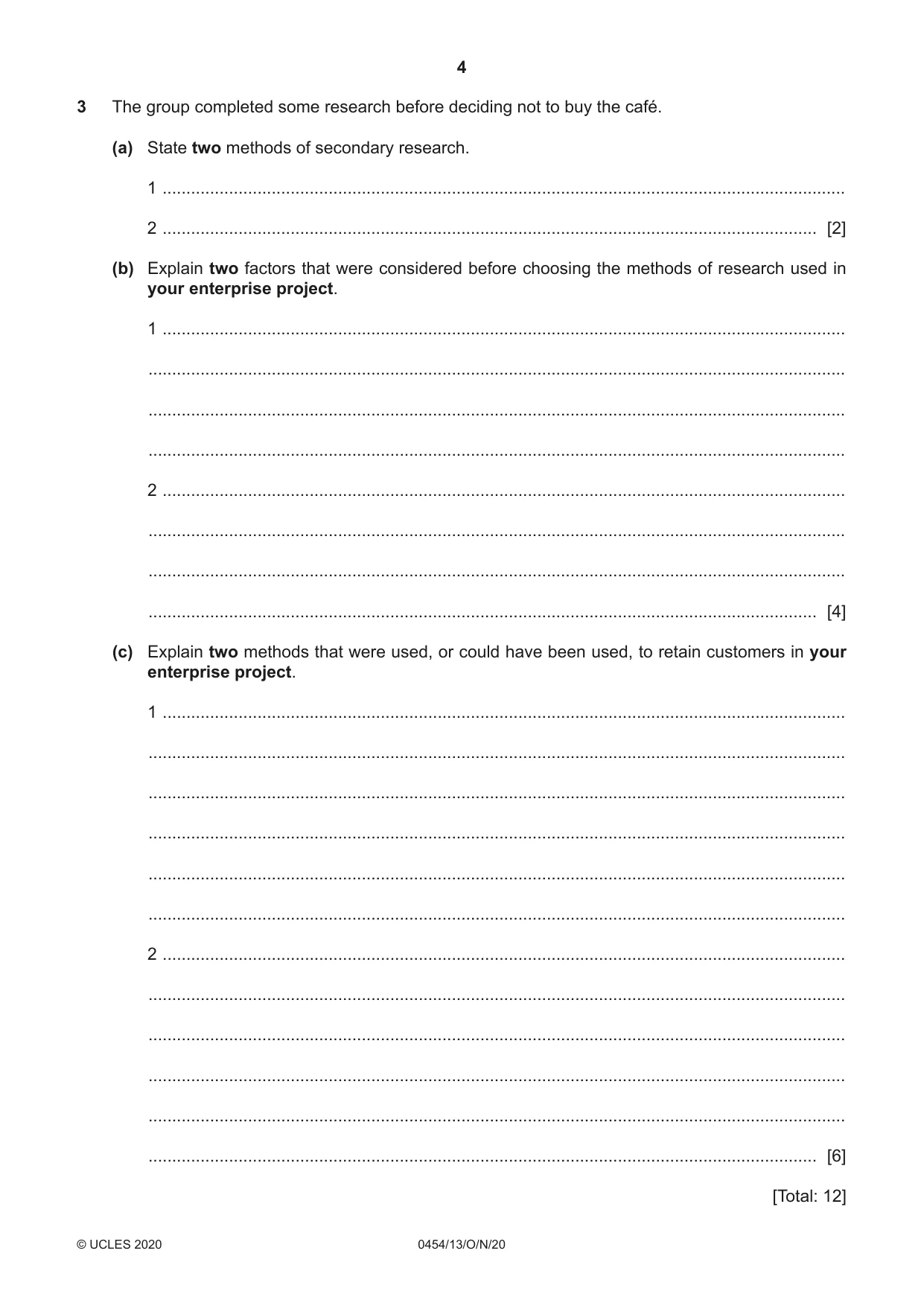
4 0454/13/O/N/20 © UCLES 2020 3 The group completed some research before deciding not to buy the café. (a) State two methods of secondary research. 1 … 2 … [2] (b) Explain two factors that were considered before choosing the methods of research used in your enterprise project. 1 … … … … 2 … … … … [4] (c) Explain two methods that were used, or could have been used, to retain customers in your enterprise project. 1 … … … … … … 2 … … … … … … [6] [Total: 12]
Question paper, page 5
5 0454/13/O/N/20 © UCLES 2020 [Turn over 4 The group planned to use their personal savings to start their enterprise. The café would be expensive to purchase. The group wanted to stay within their budget. (a) Define the term budget. … … [2] (b) Explain one problem that the group could experience by using their personal savings to fund the enterprise. … … … … [2] (c) Analyse two suitable sources of finance that could have been used to set up the training café, other than personal savings. 1 … … … … … … 2 … … … … … … [6] [Total: 10]
Question paper, page 6
6 0454/13/O/N/20 © UCLES 2020 5 Harry and Thomasine had different attitudes towards risk. (a) State two risks involved in an enterprise. 1 … 2 … [2] (b) Describe one method of identifying risks involved in an enterprise. … … … … [2] (c) Explain how Harry’s attitude to risk was different from Thomasine’s attitude to risk. Use examples from the case study to support your answer. … … … … … … … … … … … … [6] [Total: 10]
Question paper, page 7
7 0454/13/O/N/20 © UCLES 2020 [Turn over Section B Answer all questions. 6 (a) Harry and four friends were planning to set up an enterprise. Discuss the advantages for the friends of working as a team in their enterprise. Use examples to support your answer. [10] … … … … … … … … … … … … … … … … … … … … … … … …
Question paper, page 8
8 0454/13/O/N/20 © UCLES 2020 (b) The group decided not to buy this café but Harry thought that this was the wrong decision. Evaluate whether it was the best decision for the training café enterprise not to buy this café. [15] … … … … … … … … … … … … … … … … … … … … … … … … … …
Question paper, page 9
9 0454/13/O/N/20 © UCLES 2020 [Turn over … … … … … … … … … … … … … … … … … … … … … … … … … … … [Total: 25]
Question paper, page 10
10 0454/13/O/N/20 © UCLES 2020 BLANK PAGE
Question paper, page 11
11 0454/13/O/N/20 © UCLES 2020 [Turn over 7 Now consider your enterprise project. (a) Discuss two actions that you could have taken which would have improved the effectiveness of negotiation in your enterprise project. Use examples to support your answer. [10] … … … … … … … … … … … … … … … … … … … … … … … … … …
Question paper, page 12
12 0454/13/O/N/20 © UCLES 2020 (b) Harry and his group produced both an action plan and a business plan before starting their enterprise. Evaluate the importance of your action plan to the success of your enterprise project. [15] … … … … … … … … … … … … … … … … … … … … … … … … … …
Question paper, page 13
13 0454/13/O/N/20 © UCLES 2020 … … … … … … … … … … … … … … … … … … … … … … … … … … … [Total: 25]
Question paper, page 14
14 0454/13/O/N/20 © UCLES 2020 BLANK PAGE
Question paper, page 15
15 0454/13/O/N/20 © UCLES 2020 BLANK PAGE
Question paper, page 16
16 0454/13/O/N/20 © UCLES 2020 Permission to reproduce items where third-party owned material protected by copyright is included has been sought and cleared where possible. Every reasonable effort has been made by the publisher (UCLES) to trace copyright holders, but if any items requiring clearance have unwittingly been included, the publisher will be pleased to make amends at the earliest possible opportunity. To avoid the issue of disclosure of answer-related information to candidates, all copyright acknowledgements are reproduced online in the Cambridge Assessment International Education Copyright Acknowledgements Booklet. This is produced for each series of examinations and is freely available to download at www.cambridgeinternational.org after the live examination series. Cambridge Assessment International Education is part of the Cambridge Assessment Group. Cambridge Assessment is the brand name of the University of Cambridge Local Examinations Syndicate (UCLES), which itself is a department of the University of Cambridge. BLANK PAGE
Mark scheme, page 1
This document consists of 16 printed pages. © UCLES 2020 [Turn over Cambridge IGCSE™ ENTERPRISE 0454/13 Paper 1 October/November 2020 MARK SCHEME Maximum Mark: 100 Published This mark scheme is published as an aid to teachers and candidates, to indicate the requirements of the examination. It shows the basis on which Examiners were instructed to award marks. It does not indicate the details of the discussions that took place at an Examiners’ meeting before marking began, which would have considered the acceptability of alternative answers. Mark schemes should be read in conjunction with the question paper and the Principal Examiner Report for Teachers. Cambridge International will not enter into discussions about these mark schemes. Cambridge International is publishing the mark schemes for the October/November 2020 series for most Cambridge IGCSE, Cambridge International A and AS Level and Cambridge Pre-U components, and some Cambridge O Level components.
Mark scheme, page 2
0454/13 Cambridge IGCSE – Mark Scheme PUBLISHED October/November 2020 © UCLES 2020 Page 2 of 16 Generic Marking Principles These general marking principles must be applied by all examiners when marking candidate answers. They should be applied alongside the specific content of the mark scheme or generic level descriptors for a question. Each question paper and mark scheme will also comply with these marking principles. GENERIC MARKING PRINCIPLE 1: Marks must be awarded in line with: • the specific content of the mark scheme or the generic level descriptors for the question • the specific skills defined in the mark scheme or in the generic level descriptors for the question • the standard of response required by a candidate as exemplified by the standardisation scripts. GENERIC MARKING PRINCIPLE 2: Marks awarded are always whole marks (not half marks, or other fractions). GENERIC MARKING PRINCIPLE 3: Marks must be awarded positively: • marks are awarded for correct/valid answers, as defined in the mark scheme. However, credit is given for valid answers which go beyond the scope of the syllabus and mark scheme, referring to your Team Leader as appropriate • marks are awarded when candidates clearly demonstrate what they know and can do • marks are not deducted for errors • marks are not deducted for omissions • answers should only be judged on the quality of spelling, punctuation and grammar when these features are specifically assessed by the question as indicated by the mark scheme. The meaning, however, should be unambiguous. GENERIC MARKING PRINCIPLE 4: Rules must be applied consistently, e.g. in situations where candidates have not followed instructions or in the application of generic level descriptors.
Mark scheme, page 3
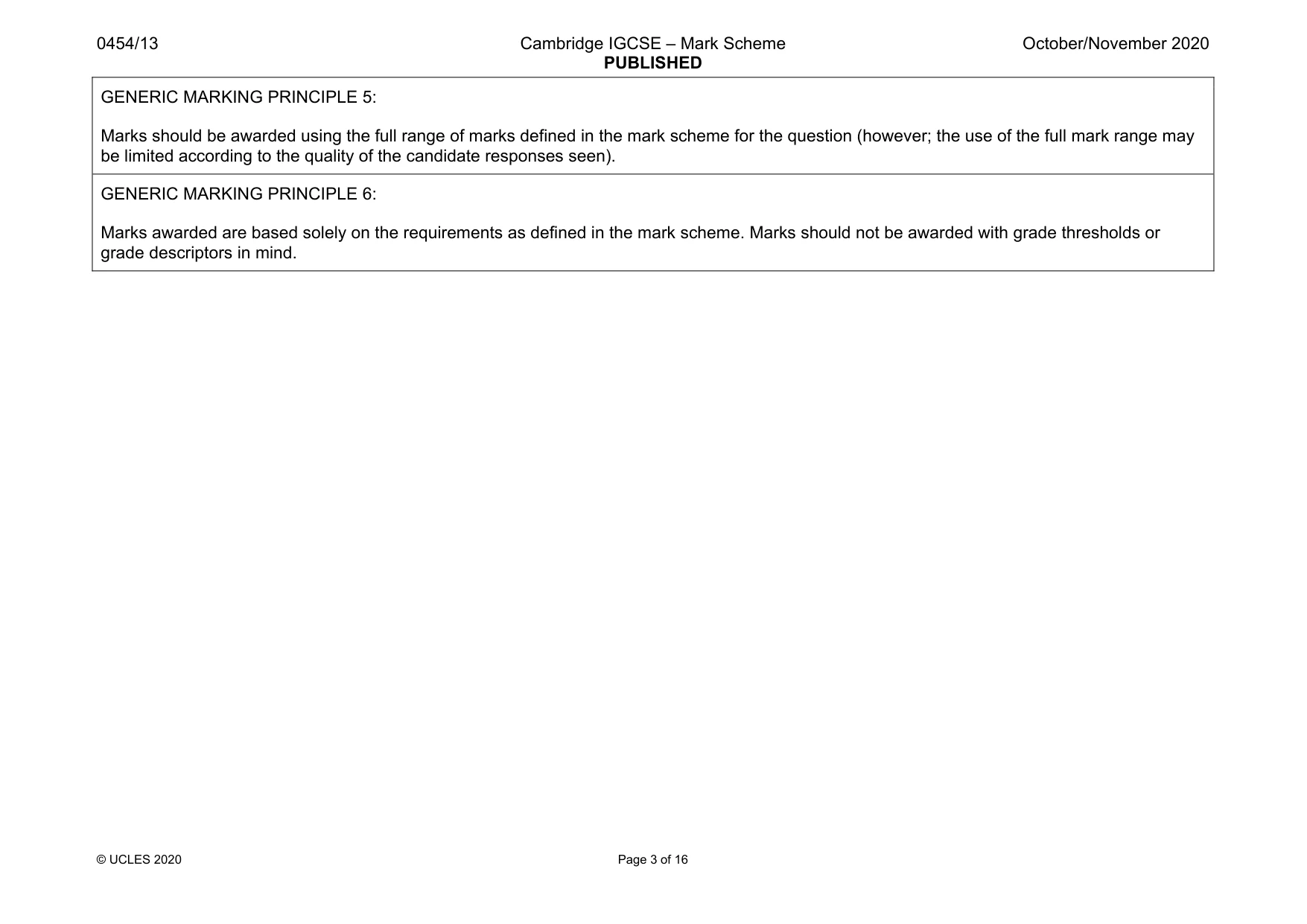
0454/13 Cambridge IGCSE – Mark Scheme PUBLISHED October/November 2020 © UCLES 2020 Page 3 of 16 GENERIC MARKING PRINCIPLE 5: Marks should be awarded using the full range of marks defined in the mark scheme for the question (however; the use of the full mark range may be limited according to the quality of the candidate responses seen). GENERIC MARKING PRINCIPLE 6: Marks awarded are based solely on the requirements as defined in the mark scheme. Marks should not be awarded with grade thresholds or grade descriptors in mind.
Mark scheme, page 4
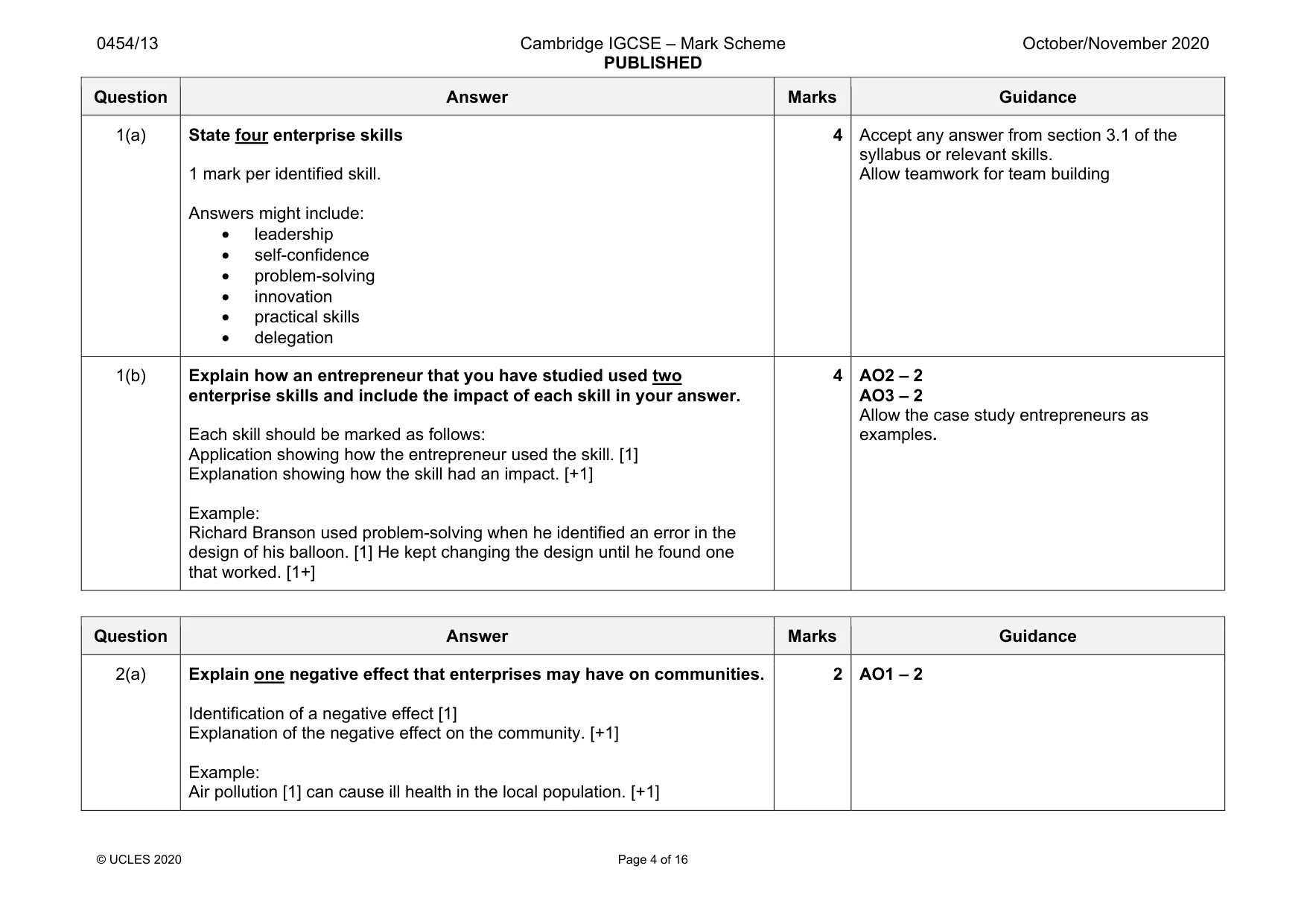
0454/13 Cambridge IGCSE – Mark Scheme PUBLISHED October/November 2020 © UCLES 2020 Page 4 of 16 Question Answer Marks Guidance 1(a) State four enterprise skills 1 mark per identified skill. Answers might include: • leadership • self-confidence • problem-solving • innovation • practical skills • delegation 4 Accept any answer from section 3.1 of the syllabus or relevant skills. Allow teamwork for team building 1(b) Explain how an entrepreneur that you have studied used two enterprise skills and include the impact of each skill in your answer. Each skill should be marked as follows: Application showing how the entrepreneur used the skill. [1] Explanation showing how the skill had an impact. [+1] Example: Richard Branson used problem-solving when he identified an error in the design of his balloon. [1] He kept changing the design until he found one that worked. [1+] 4 AO2 – 2 AO3 – 2 Allow the case study entrepreneurs as examples. Question Answer Marks Guidance 2(a) Explain one negative effect that enterprises may have on communities. Identification of a negative effect [1] Explanation of the negative effect on the community. [+1] Example: Air pollution [1] can cause ill health in the local population. [+1] 2 AO1 – 2
Mark scheme, page 5
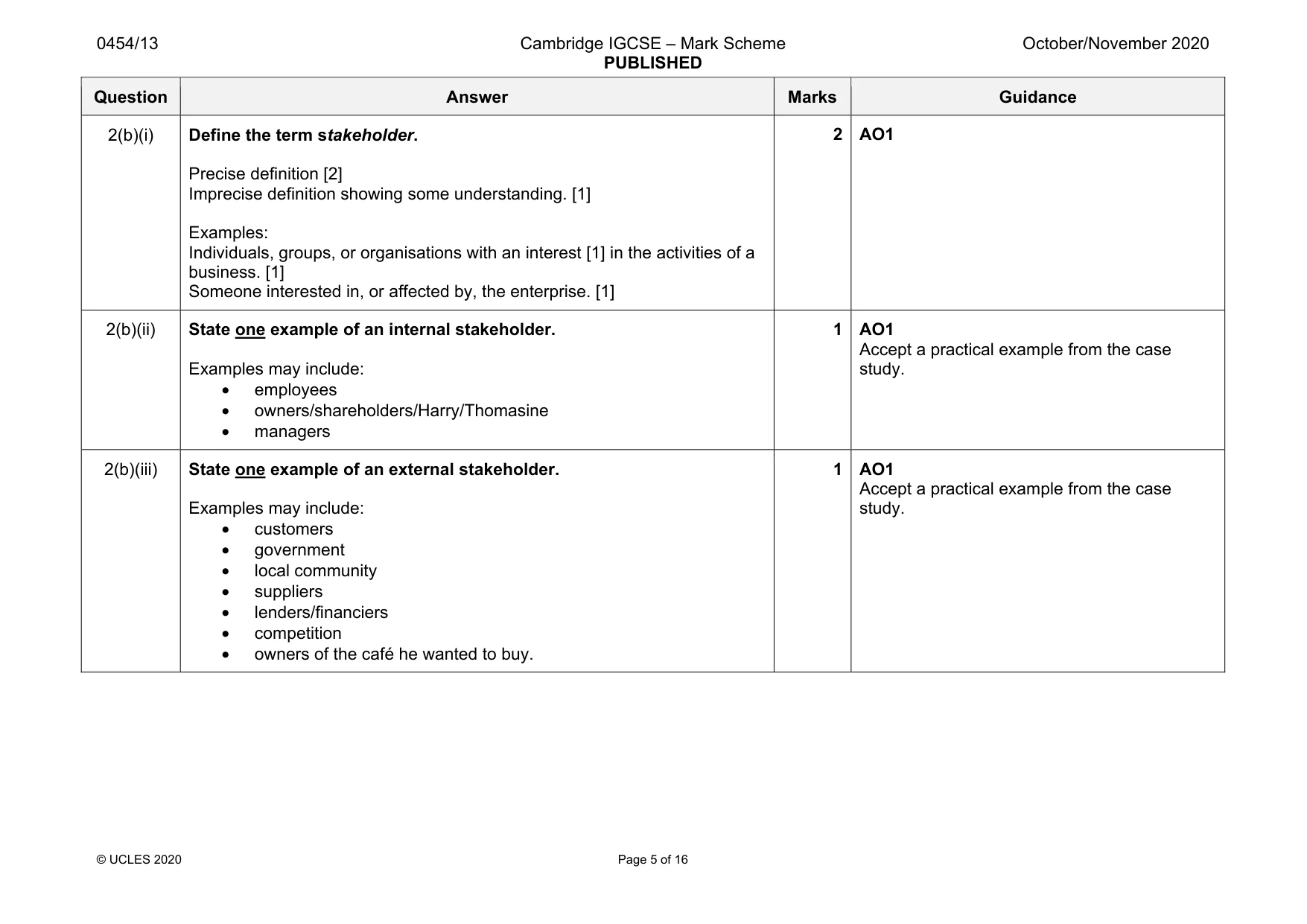
0454/13 Cambridge IGCSE – Mark Scheme PUBLISHED October/November 2020 © UCLES 2020 Page 5 of 16 Question Answer Marks Guidance 2(b)(i) Define the term stakeholder. Precise definition [2] Imprecise definition showing some understanding. [1] Examples: Individuals, groups, or organisations with an interest [1] in the activities of a business. [1] Someone interested in, or affected by, the enterprise. [1] 2 AO1 2(b)(ii) State one example of an internal stakeholder. Examples may include: • employees • owners/shareholders/Harry/Thomasine • managers 1 AO1 Accept a practical example from the case study. 2(b)(iii) State one example of an external stakeholder. Examples may include: • customers • government • local community • suppliers • lenders/financiers • competition • owners of the café he wanted to buy. 1 AO1 Accept a practical example from the case study.
Mark scheme, page 6
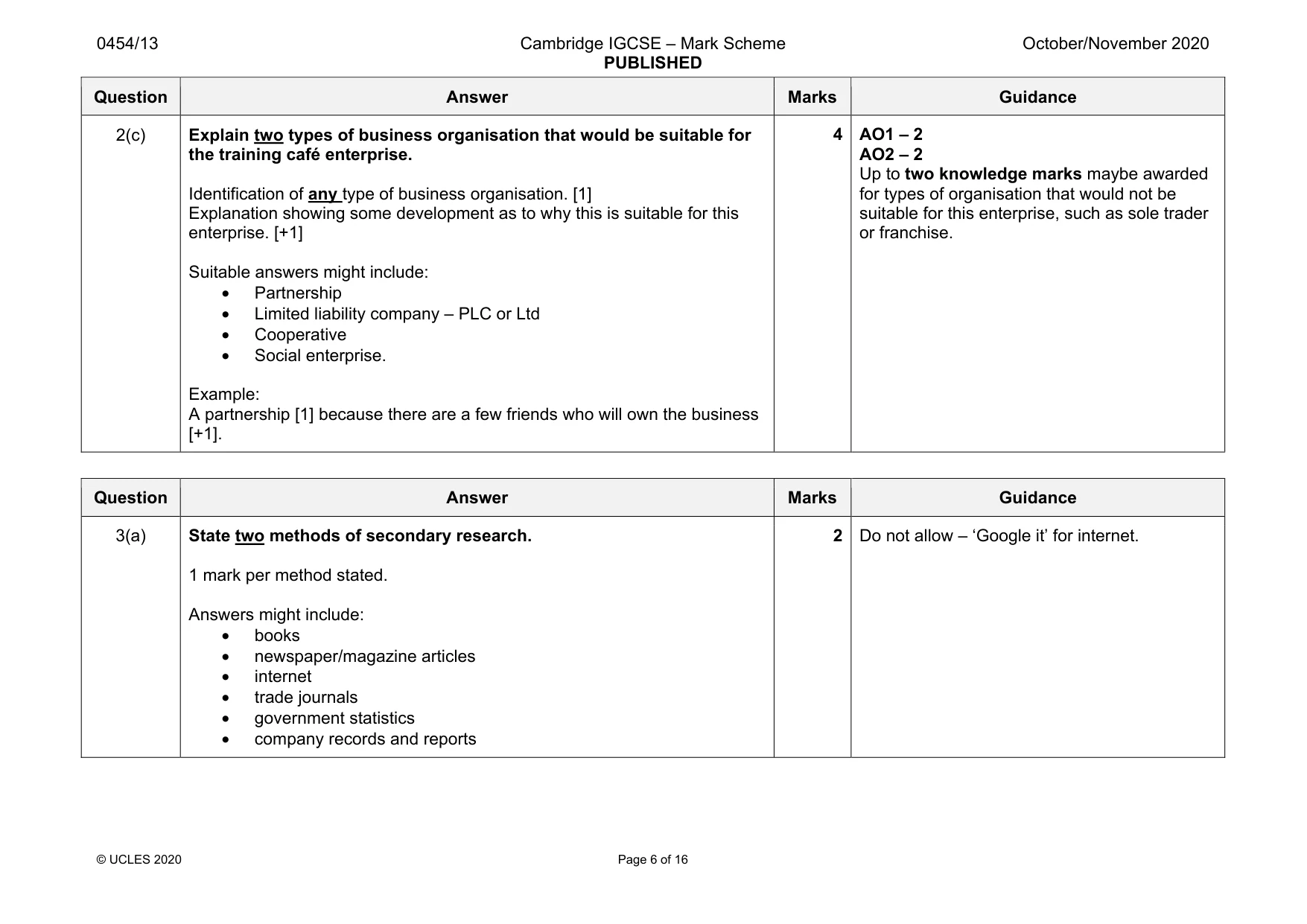
0454/13 Cambridge IGCSE – Mark Scheme PUBLISHED October/November 2020 © UCLES 2020 Page 6 of 16 Question Answer Marks Guidance 2(c) Explain two types of business organisation that would be suitable for the training café enterprise. Identification of any type of business organisation. [1] Explanation showing some development as to why this is suitable for this enterprise. [+1] Suitable answers might include: • Partnership • Limited liability company – PLC or Ltd • Cooperative • Social enterprise. Example: A partnership [1] because there are a few friends who will own the business [+1]. 4 AO1 – 2 AO2 – 2 Up to two knowledge marks maybe awarded for types of organisation that would not be suitable for this enterprise, such as sole trader or franchise. Question Answer Marks Guidance 3(a) State two methods of secondary research. 1 mark per method stated. Answers might include: • books • newspaper/magazine articles • internet • trade journals • government statistics • company records and reports 2 Do not allow – ‘Google it’ for internet.
Mark scheme, page 7
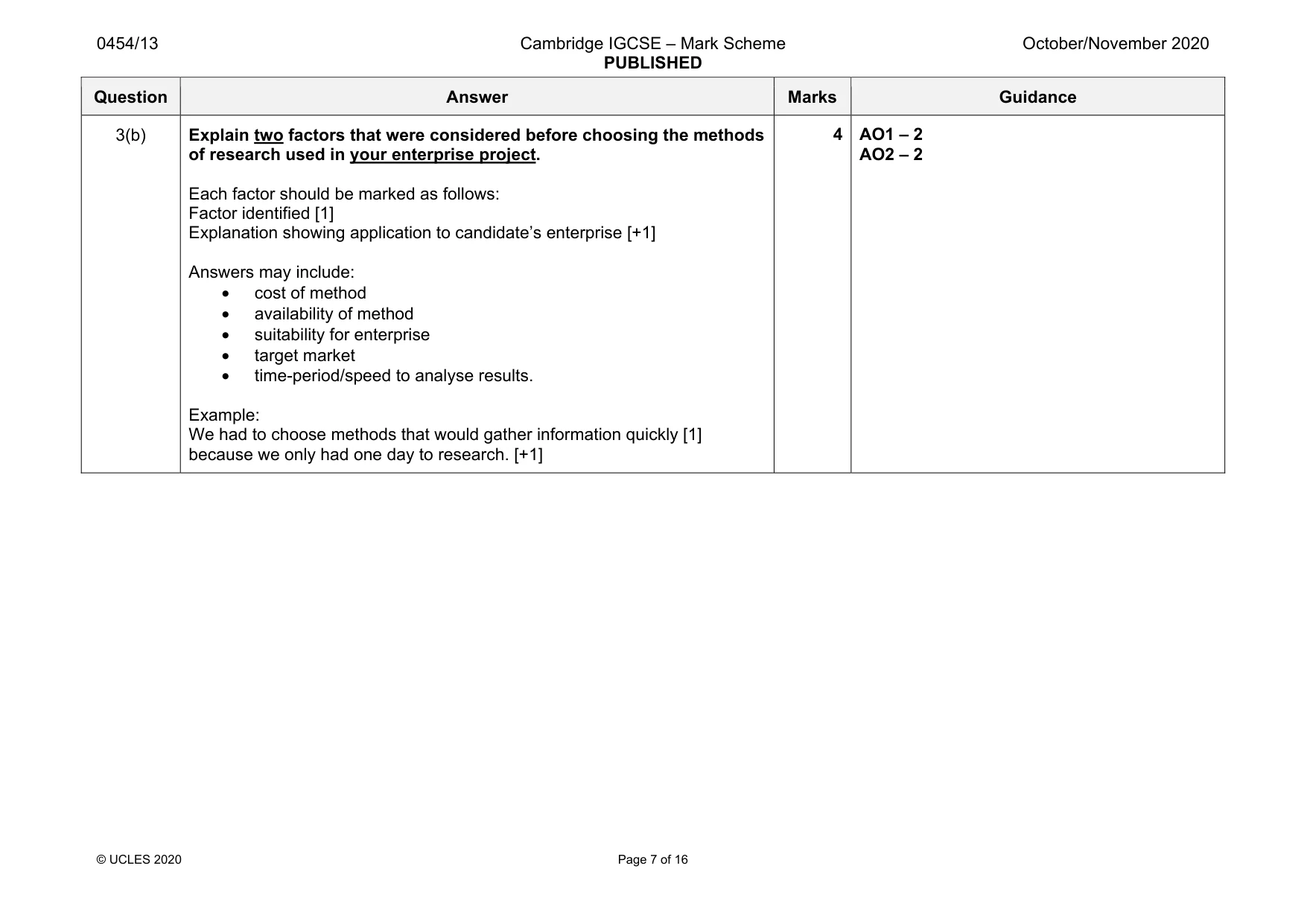
0454/13 Cambridge IGCSE – Mark Scheme PUBLISHED October/November 2020 © UCLES 2020 Page 7 of 16 Question Answer Marks Guidance 3(b) Explain two factors that were considered before choosing the methods of research used in your enterprise project. Each factor should be marked as follows: Factor identified [1] Explanation showing application to candidate’s enterprise [+1] Answers may include: • cost of method • availability of method • suitability for enterprise • target market • time-period/speed to analyse results. Example: We had to choose methods that would gather information quickly [1] because we only had one day to research. [+1] 4 AO1 – 2 AO2 – 2
Mark scheme, page 8
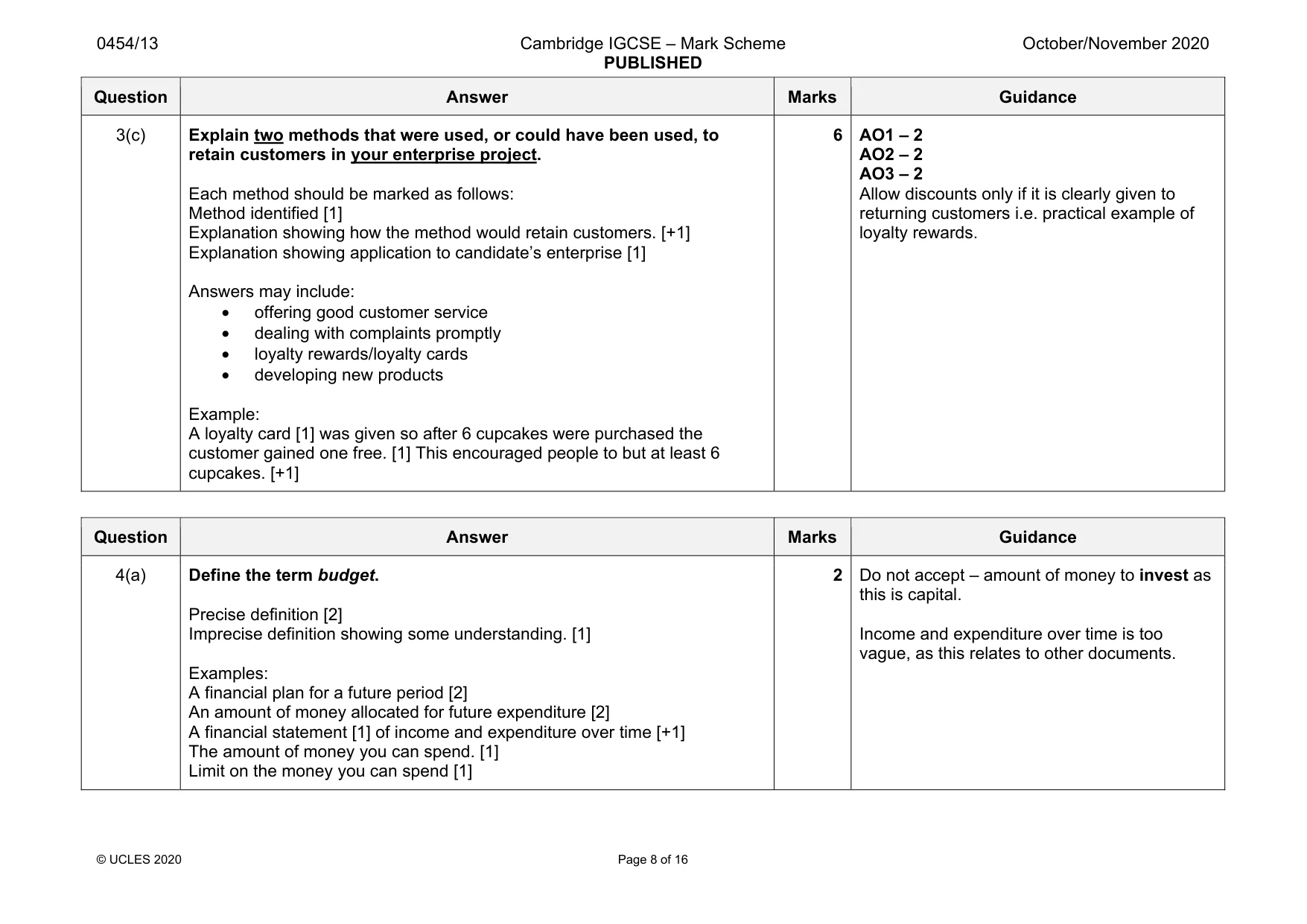
0454/13 Cambridge IGCSE – Mark Scheme PUBLISHED October/November 2020 © UCLES 2020 Page 8 of 16 Question Answer Marks Guidance 3(c) Explain two methods that were used, or could have been used, to retain customers in your enterprise project. Each method should be marked as follows: Method identified [1] Explanation showing how the method would retain customers. [+1] Explanation showing application to candidate’s enterprise [1] Answers may include: • offering good customer service • dealing with complaints promptly • loyalty rewards/loyalty cards • developing new products Example: A loyalty card [1] was given so after 6 cupcakes were purchased the customer gained one free. [1] This encouraged people to but at least 6 cupcakes. [+1] 6 AO1 – 2 AO2 – 2 AO3 – 2 Allow discounts only if it is clearly given to returning customers i.e. practical example of loyalty rewards. Question Answer Marks Guidance 4(a) Define the term budget. Precise definition [2] Imprecise definition showing some understanding. [1] Examples: A financial plan for a future period [2] An amount of money allocated for future expenditure [2] A financial statement [1] of income and expenditure over time [+1] The amount of money you can spend. [1] Limit on the money you can spend [1] 2 Do not accept – amount of money to invest as this is capital. Income and expenditure over time is too vague, as this relates to other documents.
Mark scheme, page 9
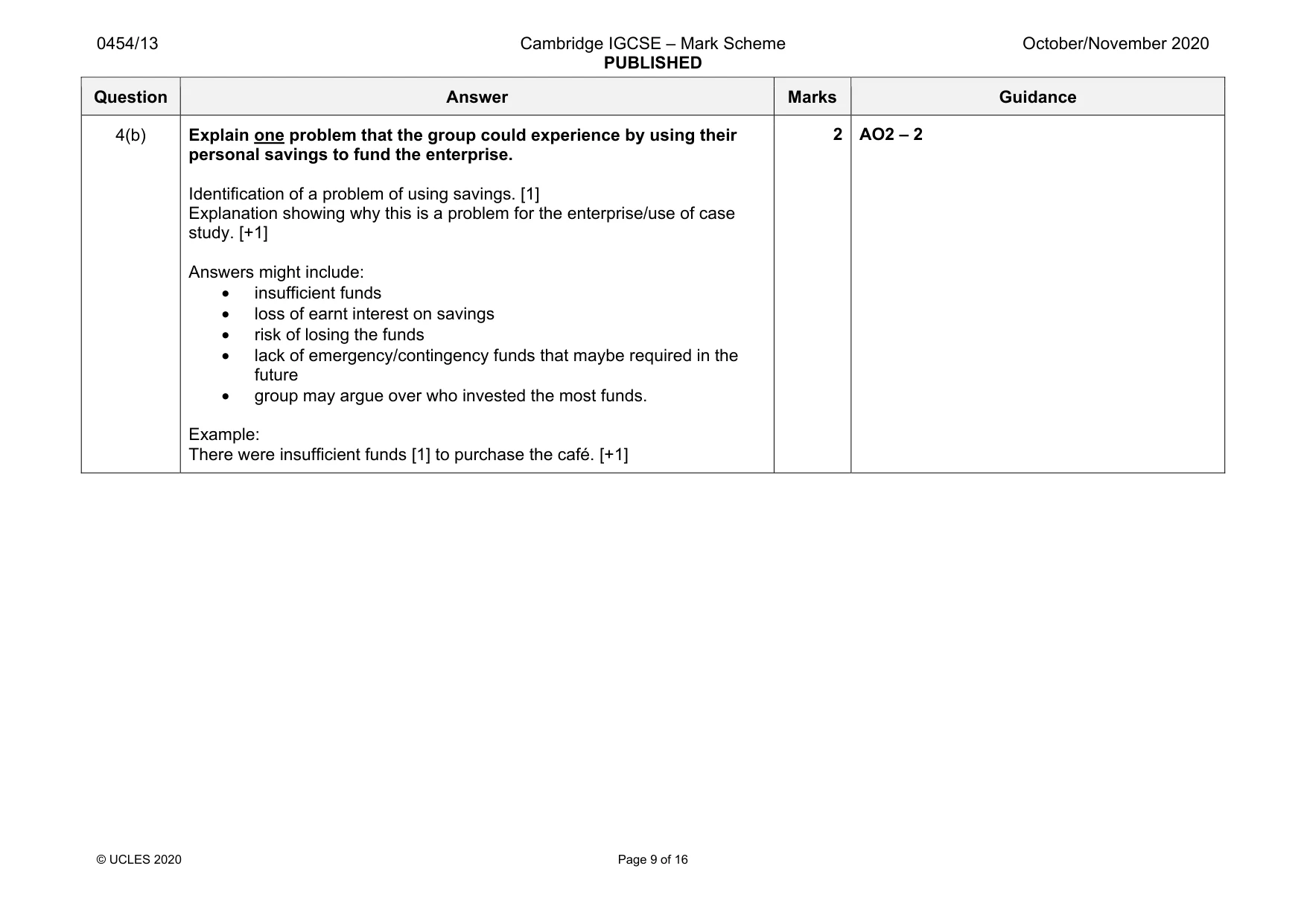
0454/13 Cambridge IGCSE – Mark Scheme PUBLISHED October/November 2020 © UCLES 2020 Page 9 of 16 Question Answer Marks Guidance 4(b) Explain one problem that the group could experience by using their personal savings to fund the enterprise. Identification of a problem of using savings. [1] Explanation showing why this is a problem for the enterprise/use of case study. [+1] Answers might include: • insufficient funds • loss of earnt interest on savings • risk of losing the funds • lack of emergency/contingency funds that maybe required in the future • group may argue over who invested the most funds. Example: There were insufficient funds [1] to purchase the café. [+1] 2 AO2 – 2
Mark scheme, page 10
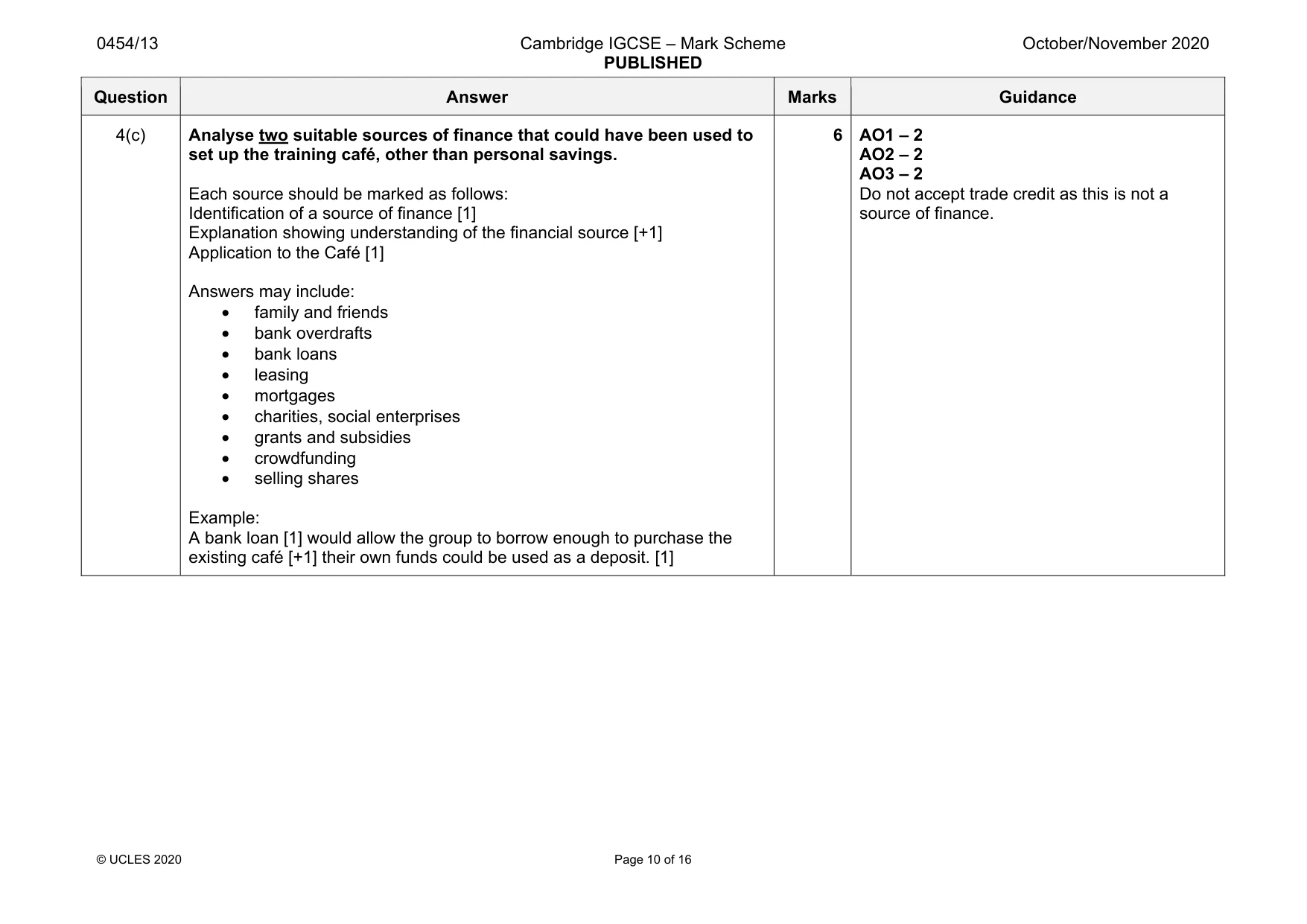
0454/13 Cambridge IGCSE – Mark Scheme PUBLISHED October/November 2020 © UCLES 2020 Page 10 of 16 Question Answer Marks Guidance 4(c) Analyse two suitable sources of finance that could have been used to set up the training café, other than personal savings. Each source should be marked as follows: Identification of a source of finance [1] Explanation showing understanding of the financial source [+1] Application to the Café [1] Answers may include: • family and friends • bank overdrafts • bank loans • leasing • mortgages • charities, social enterprises • grants and subsidies • crowdfunding • selling shares Example: A bank loan [1] would allow the group to borrow enough to purchase the existing café [+1] their own funds could be used as a deposit. [1] 6 AO1 – 2 AO2 – 2 AO3 – 2 Do not accept trade credit as this is not a source of finance.
Mark scheme, page 11
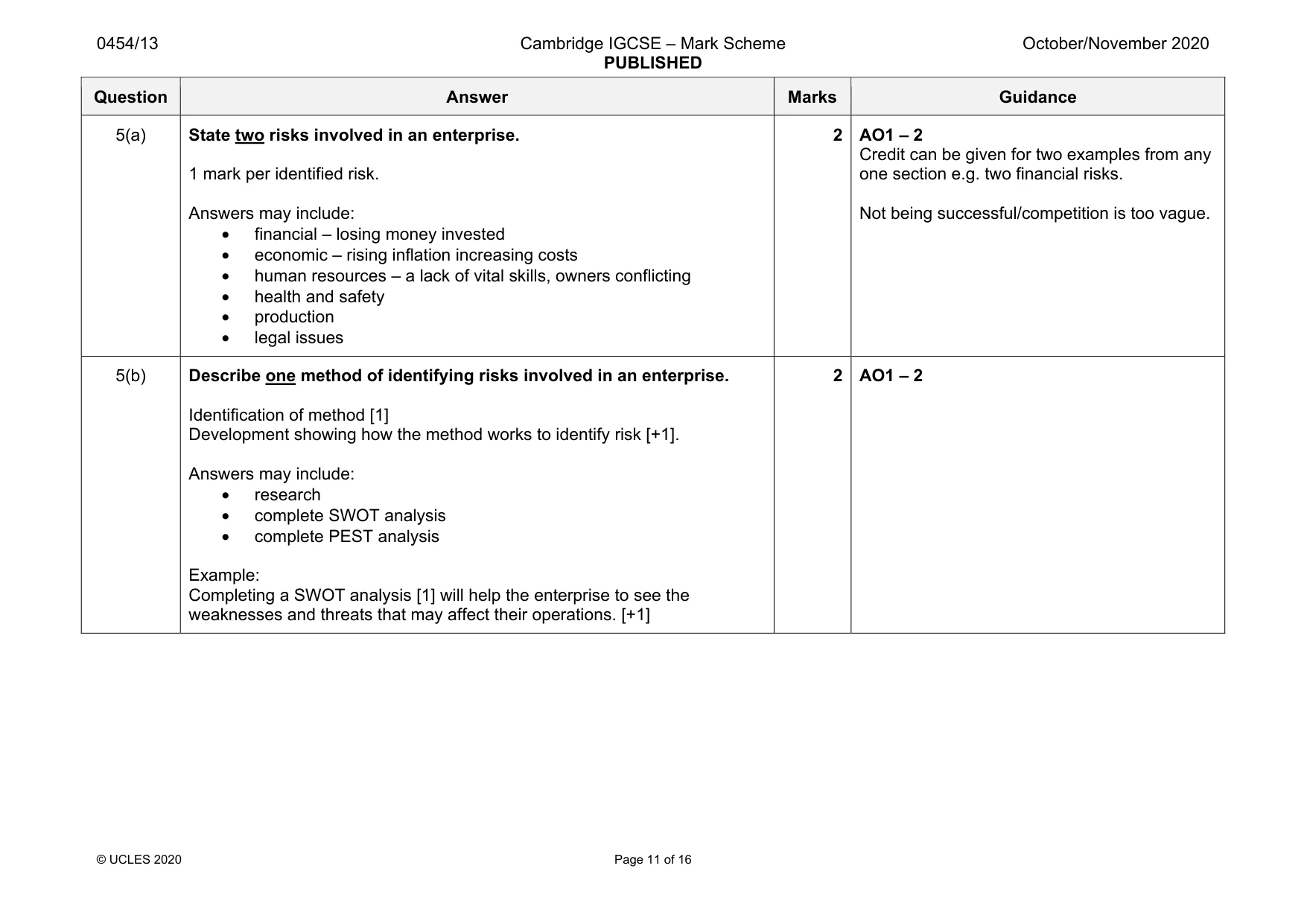
0454/13 Cambridge IGCSE – Mark Scheme PUBLISHED October/November 2020 © UCLES 2020 Page 11 of 16 Question Answer Marks Guidance 5(a) State two risks involved in an enterprise. 1 mark per identified risk. Answers may include: • financial – losing money invested • economic – rising inflation increasing costs • human resources – a lack of vital skills, owners conflicting • health and safety • production • legal issues 2 AO1 – 2 Credit can be given for two examples from any one section e.g. two financial risks. Not being successful/competition is too vague. 5(b) Describe one method of identifying risks involved in an enterprise. Identification of method [1] Development showing how the method works to identify risk [+1]. Answers may include: • research • complete SWOT analysis • complete PEST analysis Example: Completing a SWOT analysis [1] will help the enterprise to see the weaknesses and threats that may affect their operations. [+1] 2 AO1 – 2
Mark scheme, page 12
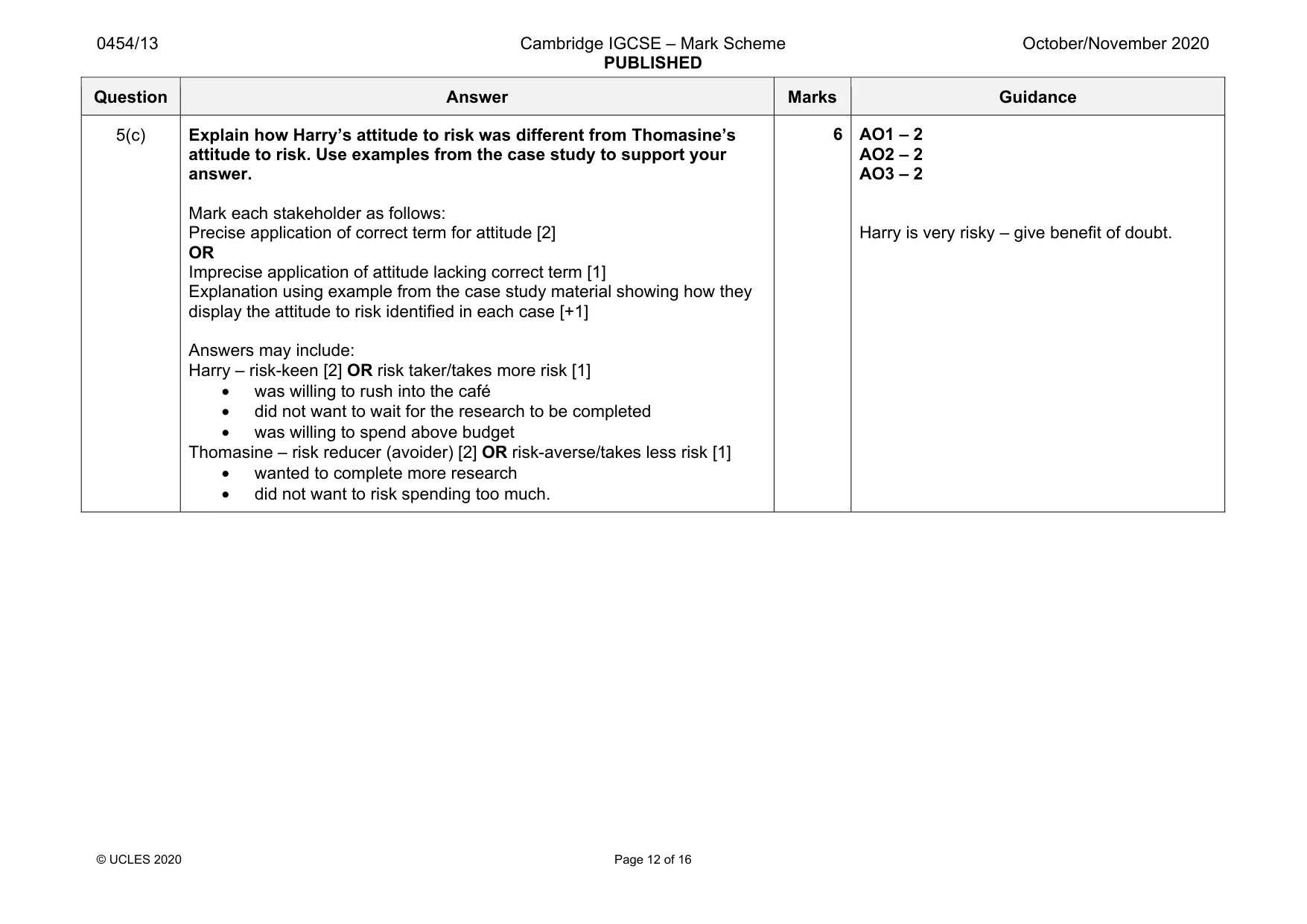
0454/13 Cambridge IGCSE – Mark Scheme PUBLISHED October/November 2020 © UCLES 2020 Page 12 of 16 Question Answer Marks Guidance 5(c) Explain how Harry’s attitude to risk was different from Thomasine’s attitude to risk. Use examples from the case study to support your answer. Mark each stakeholder as follows: Precise application of correct term for attitude [2] OR Imprecise application of attitude lacking correct term [1] Explanation using example from the case study material showing how they display the attitude to risk identified in each case [+1] Answers may include: Harry – risk-keen [2] OR risk taker/takes more risk [1] • was willing to rush into the café • did not want to wait for the research to be completed • was willing to spend above budget Thomasine – risk reducer (avoider) [2] OR risk-averse/takes less risk [1] • wanted to complete more research • did not want to risk spending too much. 6 AO1 – 2 AO2 – 2 AO3 – 2 Harry is very risky – give benefit of doubt.
Mark scheme, page 13
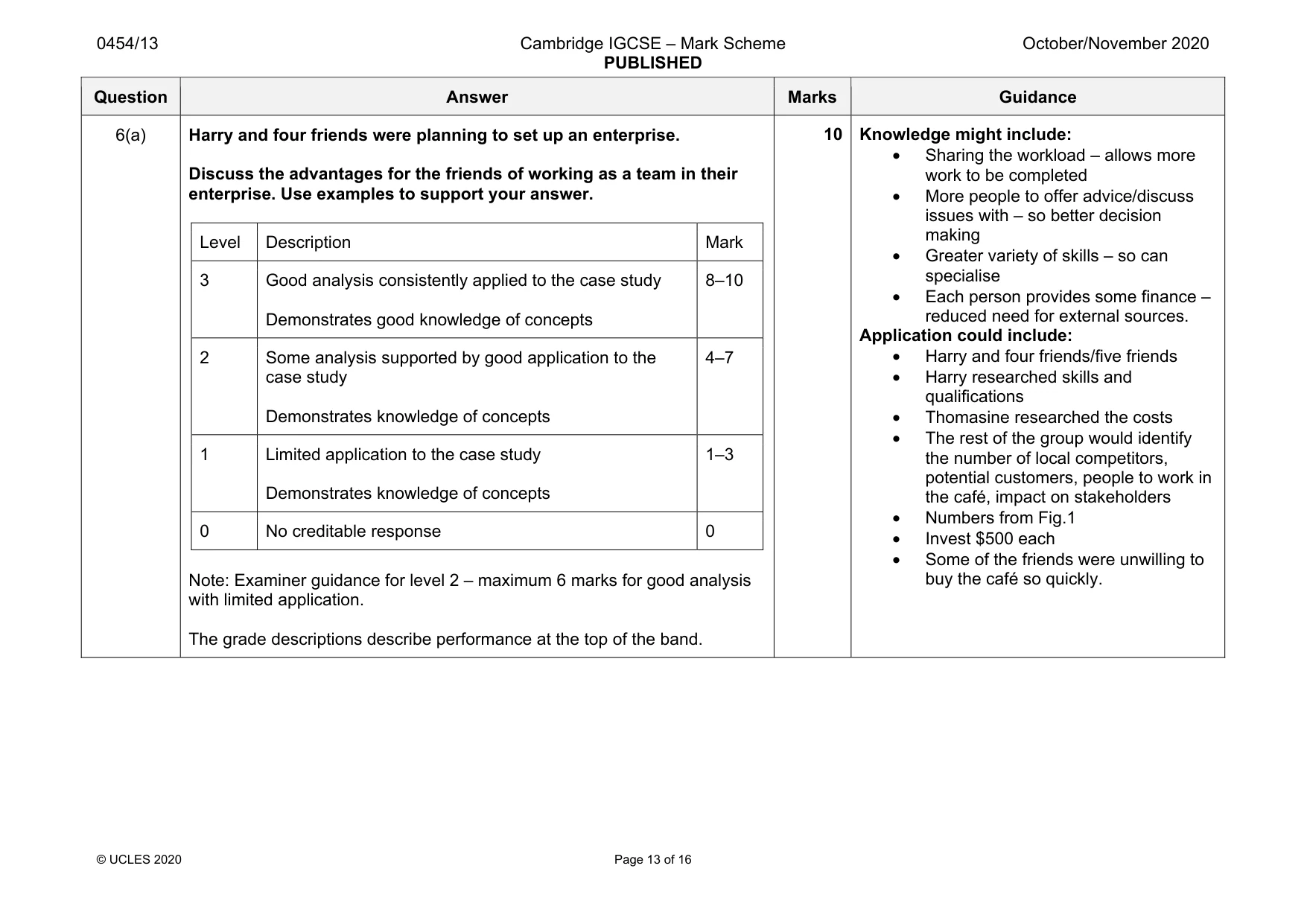
0454/13 Cambridge IGCSE – Mark Scheme PUBLISHED October/November 2020 © UCLES 2020 Page 13 of 16 Question Answer Marks Guidance 6(a) Harry and four friends were planning to set up an enterprise. Discuss the advantages for the friends of working as a team in their enterprise. Use examples to support your answer. Level Description Mark 3 Good analysis consistently applied to the case study Demonstrates good knowledge of concepts 8–10 2 Some analysis supported by good application to the case study Demonstrates knowledge of concepts 4–7 1 Limited application to the case study Demonstrates knowledge of concepts 1–3 0 No creditable response 0 Note: Examiner guidance for level 2 – maximum 6 marks for good analysis with limited application. The grade descriptions describe performance at the top of the band. 10 Knowledge might include: • Sharing the workload – allows more work to be completed • More people to offer advice/discuss issues with – so better decision making • Greater variety of skills – so can specialise • Each person provides some finance – reduced need for external sources. Application could include: • Harry and four friends/five friends • Harry researched skills and qualifications • Thomasine researched the costs • The rest of the group would identify the number of local competitors, potential customers, people to work in the café, impact on stakeholders • Numbers from Fig.1 • Invest $500 each • Some of the friends were unwilling to buy the café so quickly.
Mark scheme, page 14
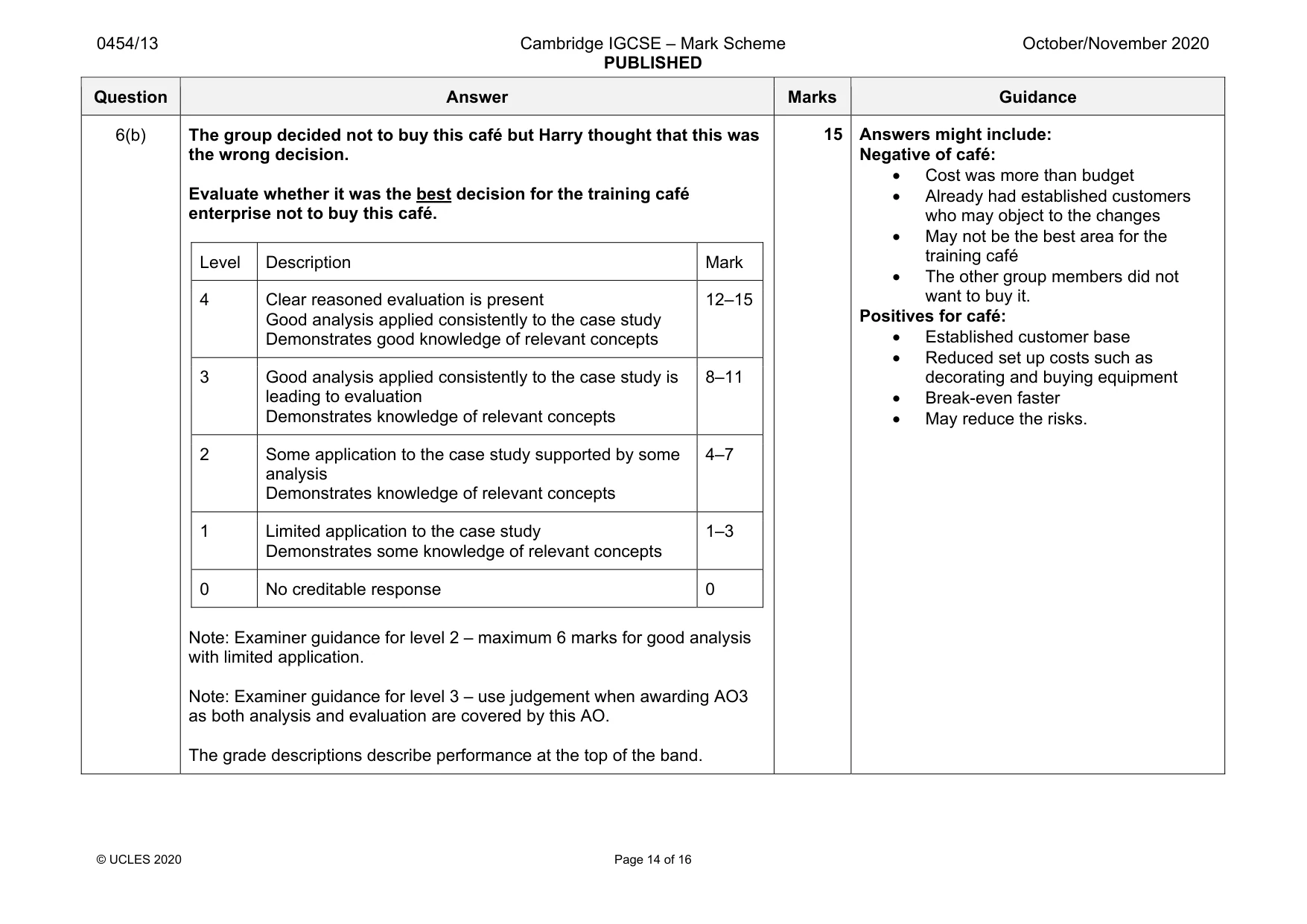
0454/13 Cambridge IGCSE – Mark Scheme PUBLISHED October/November 2020 © UCLES 2020 Page 14 of 16 Question Answer Marks Guidance 6(b) The group decided not to buy this café but Harry thought that this was the wrong decision. Evaluate whether it was the best decision for the training café enterprise not to buy this café. Level Description Mark 4 Clear reasoned evaluation is present Good analysis applied consistently to the case study Demonstrates good knowledge of relevant concepts 12–15 3 Good analysis applied consistently to the case study is leading to evaluation Demonstrates knowledge of relevant concepts 8–11 2 Some application to the case study supported by some analysis Demonstrates knowledge of relevant concepts 4–7 1 Limited application to the case study Demonstrates some knowledge of relevant concepts 1–3 0 No creditable response 0 Note: Examiner guidance for level 2 – maximum 6 marks for good analysis with limited application. Note: Examiner guidance for level 3 – use judgement when awarding AO3 as both analysis and evaluation are covered by this AO. The grade descriptions describe performance at the top of the band. 15 Answers might include: Negative of café: • Cost was more than budget • Already had established customers who may object to the changes • May not be the best area for the training café • The other group members did not want to buy it. Positives for café: • Established customer base • Reduced set up costs such as decorating and buying equipment • Break-even faster • May reduce the risks.
Mark scheme, page 15
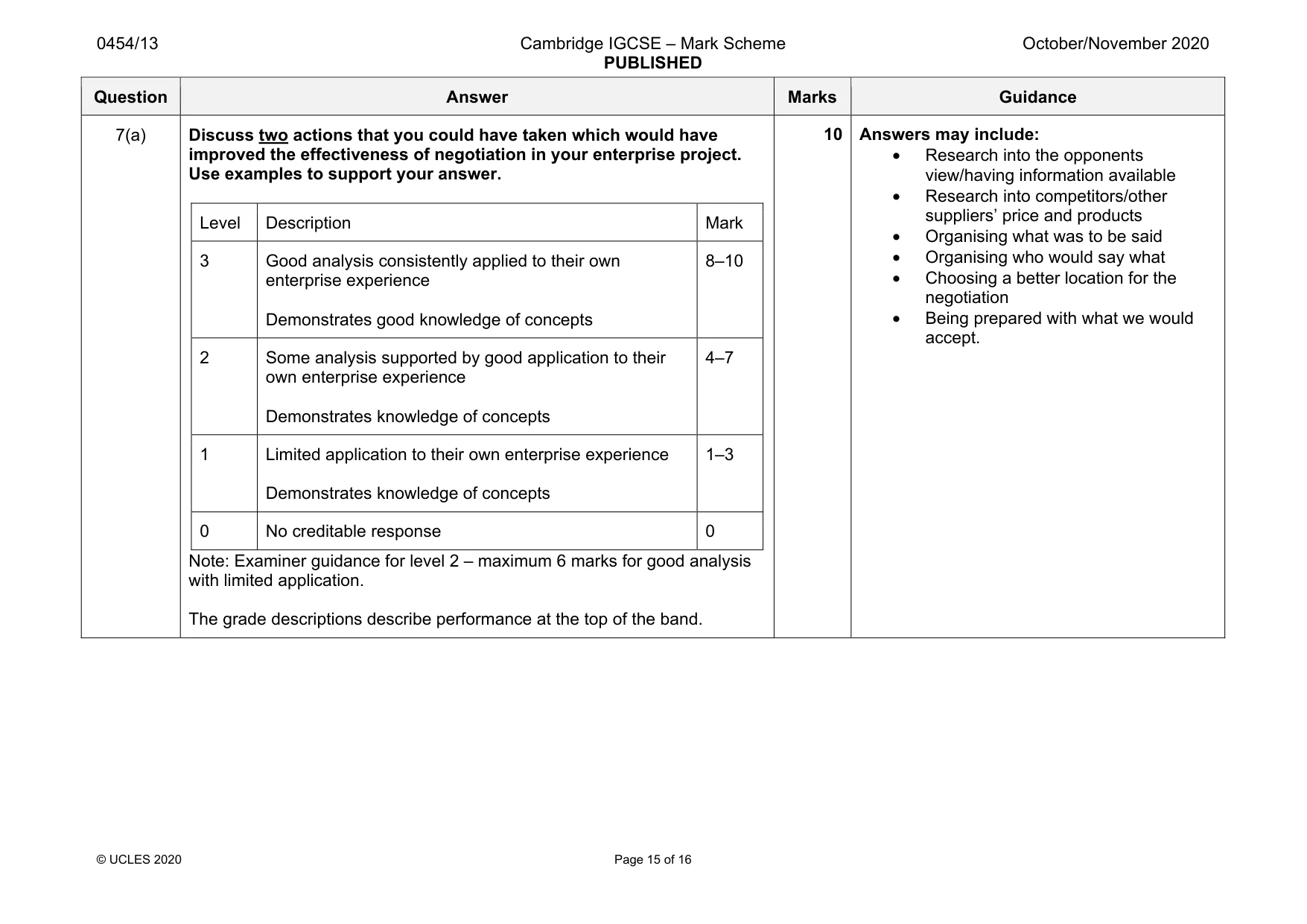
0454/13 Cambridge IGCSE – Mark Scheme PUBLISHED October/November 2020 © UCLES 2020 Page 15 of 16 Question Answer Marks Guidance 7(a) Discuss two actions that you could have taken which would have improved the effectiveness of negotiation in your enterprise project. Use examples to support your answer. Level Description Mark 3 Good analysis consistently applied to their own enterprise experience Demonstrates good knowledge of concepts 8–10 2 Some analysis supported by good application to their own enterprise experience Demonstrates knowledge of concepts 4–7 1 Limited application to their own enterprise experience Demonstrates knowledge of concepts 1–3 0 No creditable response 0 Note: Examiner guidance for level 2 – maximum 6 marks for good analysis with limited application. The grade descriptions describe performance at the top of the band. 10 Answers may include: • Research into the opponents view/having information available • Research into competitors/other suppliers’ price and products • Organising what was to be said • Organising who would say what • Choosing a better location for the negotiation • Being prepared with what we would accept.
Mark scheme, page 16
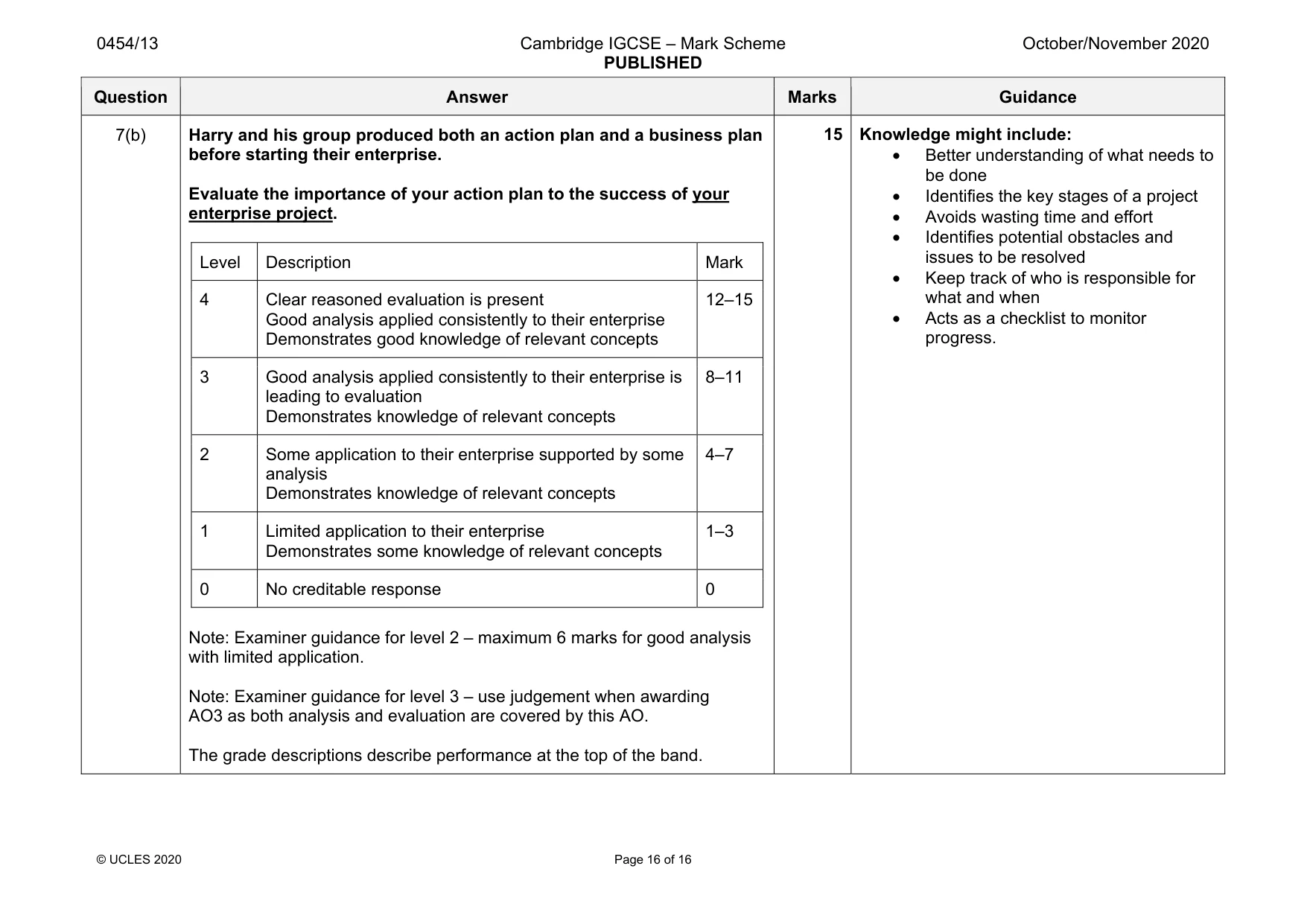
0454/13 Cambridge IGCSE – Mark Scheme PUBLISHED October/November 2020 © UCLES 2020 Page 16 of 16 Question Answer Marks Guidance 7(b) Harry and his group produced both an action plan and a business plan before starting their enterprise. Evaluate the importance of your action plan to the success of your enterprise project. Level Description Mark 4 Clear reasoned evaluation is present Good analysis applied consistently to their enterprise Demonstrates good knowledge of relevant concepts 12–15 3 Good analysis applied consistently to their enterprise is leading to evaluation Demonstrates knowledge of relevant concepts 8–11 2 Some application to their enterprise supported by some analysis Demonstrates knowledge of relevant concepts 4–7 1 Limited application to their enterprise Demonstrates some knowledge of relevant concepts 1–3 0 No creditable response 0 Note: Examiner guidance for level 2 – maximum 6 marks for good analysis with limited application. Note: Examiner guidance for level 3 – use judgement when awarding AO3 as both analysis and evaluation are covered by this AO. The grade descriptions describe performance at the top of the band. 15 Knowledge might include: • Better understanding of what needs to be done • Identifies the key stages of a project • Avoids wasting time and effort • Identifies potential obstacles and issues to be resolved • Keep track of who is responsible for what and when • Acts as a checklist to monitor progress.
What you needed in this session
Cambridge’s own grade thresholds for 2020 Oct/Nov, Paper 1 · Variant 3. A higher threshold means an easier paper — the bar moves with how the cohort did.