Cambridge IGCSE Enterprise 0454 — 2020 Oct/Nov Paper 1 · Variant 2
0454/12/O/N/20 · 100 marks · ≈113 min
The question paper and its mark scheme, free to read here and free to download. This is Cambridge’s own paper, exactly as it was sat.
Question paper16 pages







Mark scheme17 pages
Answers below. Sit the paper first if you are practising.
Paper as text
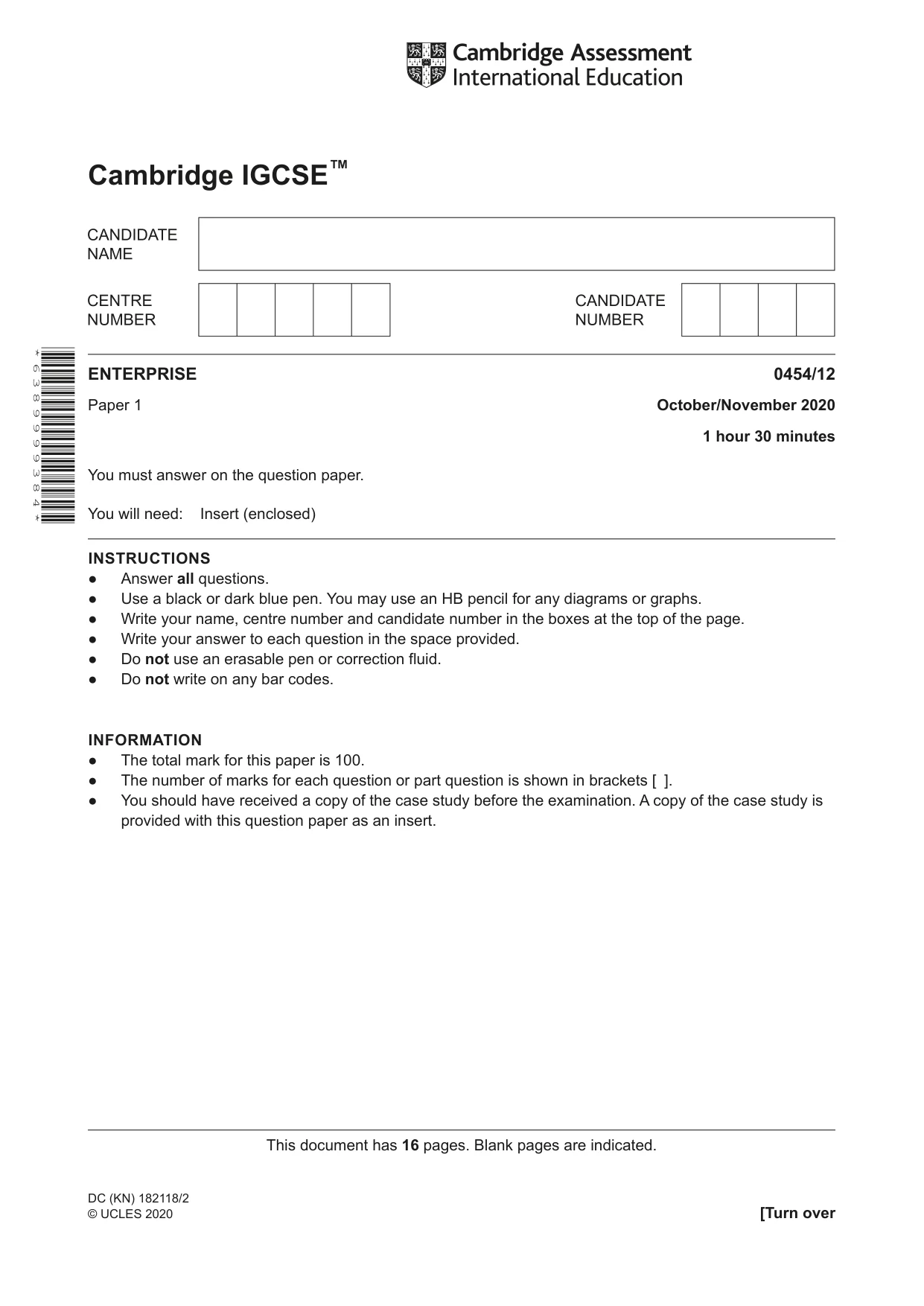
Question paper, page 1
Cambridge IGCSE™ DC (KN) 182118/2 © UCLES 2020 [Turn over This document has 16 pages. Blank pages are indicated. * 6 3 8 9 9 9 9 3 8 4 * ENTERPRISE 0454/12 Paper 1 October/November 2020 1 hour 30 minutes You must answer on the question paper. You will need: Insert (enclosed) INSTRUCTIONS ● Answer all questions. ● Use a black or dark blue pen. You may use an HB pencil for any diagrams or graphs. ● Write your name, centre number and candidate number in the boxes at the top of the page. ● Write your answer to each question in the space provided. ● Do not use an erasable pen or correction fluid. ● Do not write on any bar codes. INFORMATION ● The total mark for this paper is 100. ● The number of marks for each question or part question is shown in brackets [ ]. ● You should have received a copy of the case study before the examination. A copy of the case study is provided with this question paper as an insert.
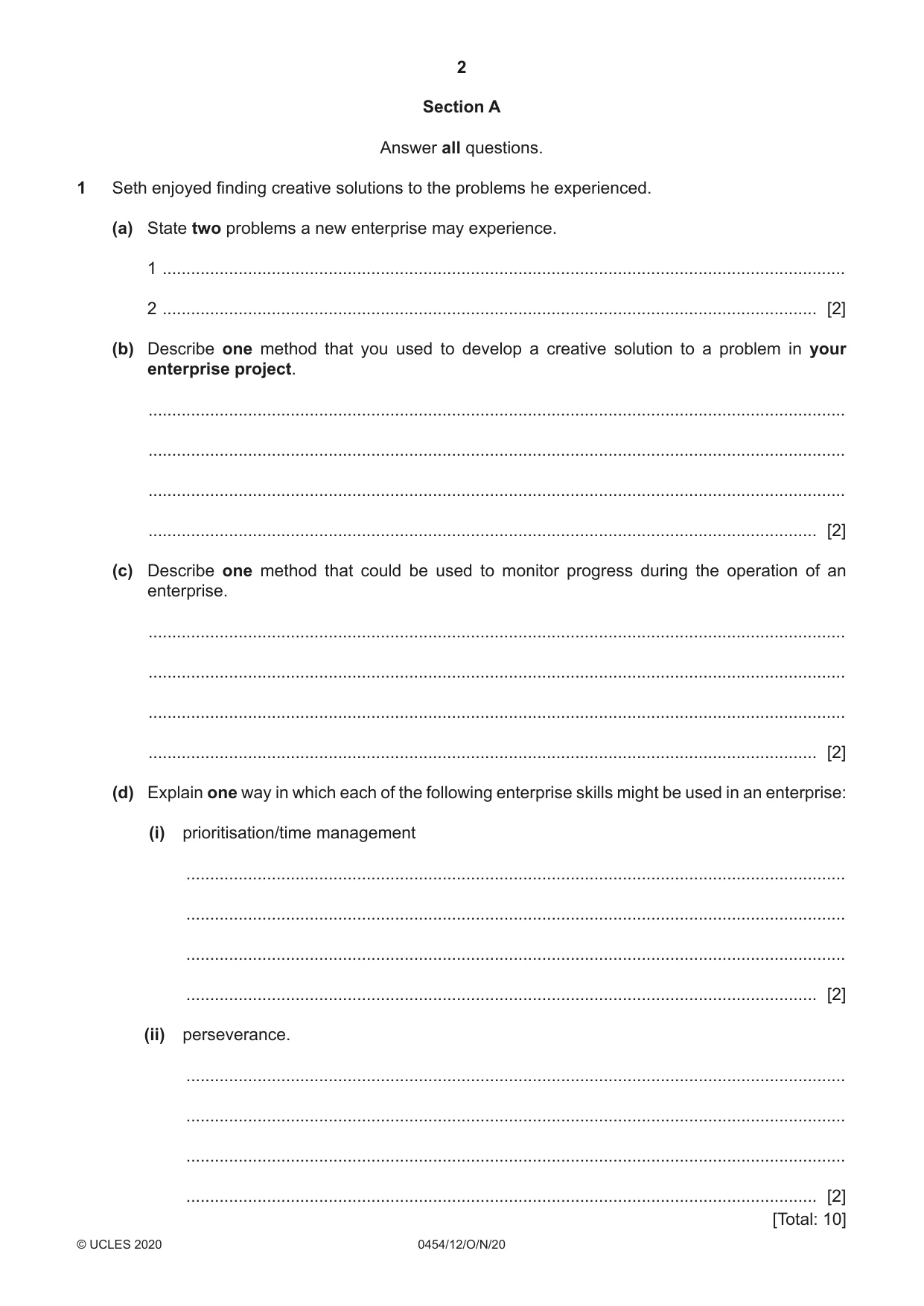
Question paper, page 2
2 0454/12/O/N/20 © UCLES 2020 Section A Answer all questions. 1 Seth enjoyed finding creative solutions to the problems he experienced. (a) State two problems a new enterprise may experience. 1 … 2 … [2] (b) Describe one method that you used to develop a creative solution to a problem in your enterprise project. … … … … [2] (c) Describe one method that could be used to monitor progress during the operation of an enterprise. … … … … [2] (d) Explain one way in which each of the following enterprise skills might be used in an enterprise: (i) prioritisation/time management … … … … [2] (ii) perseverance. … … … … [2] [Total: 10]
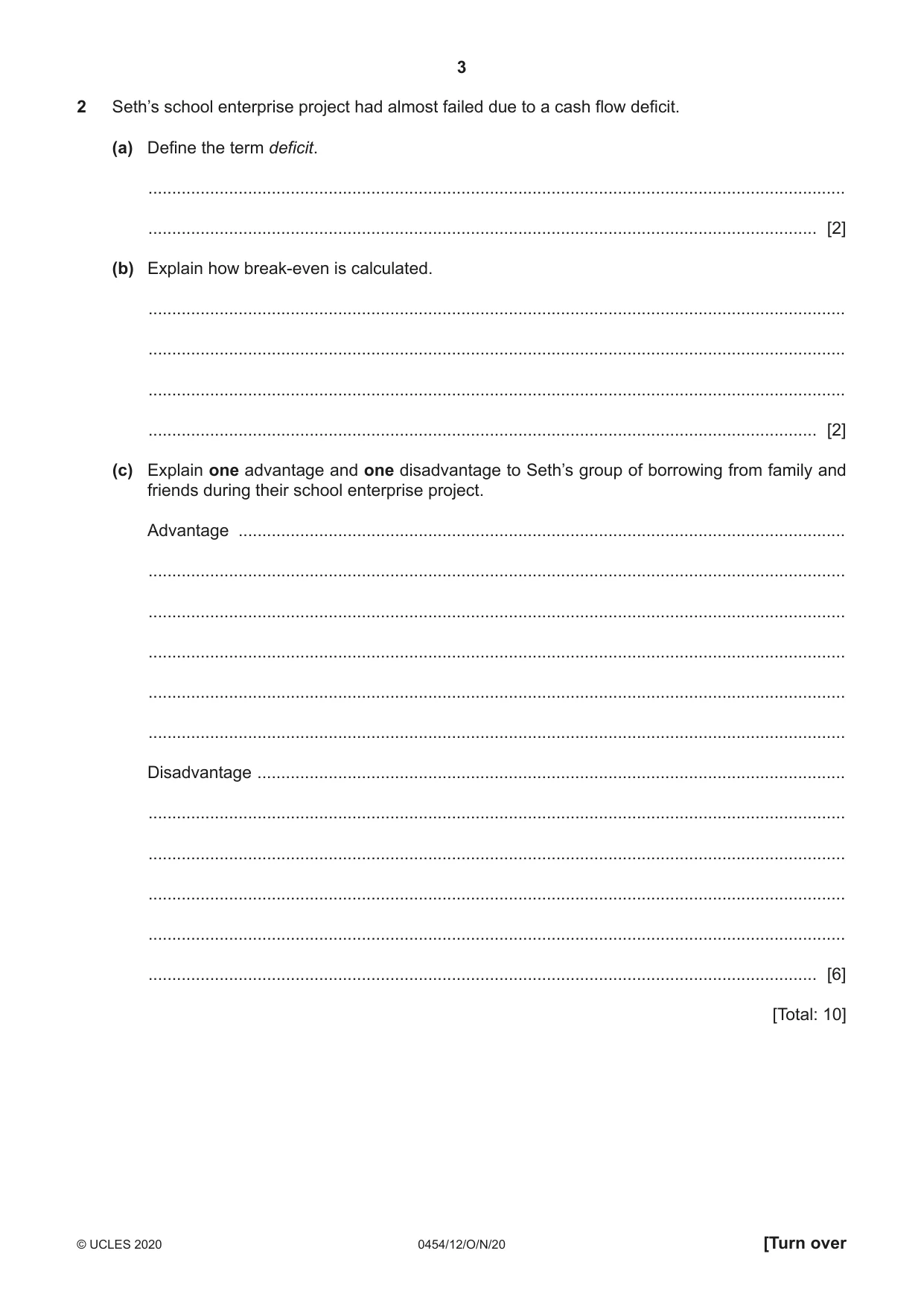
Question paper, page 3
3 0454/12/O/N/20 © UCLES 2020 [Turn over 2 Seth’s school enterprise project had almost failed due to a cash flow deficit. (a) Define the term deficit. … … [2] (b) Explain how break-even is calculated. … … … … [2] (c) Explain one advantage and one disadvantage to Seth’s group of borrowing from family and friends during their school enterprise project. Advantage … … … … … … Disadvantage … … … … … … [6] [Total: 10]
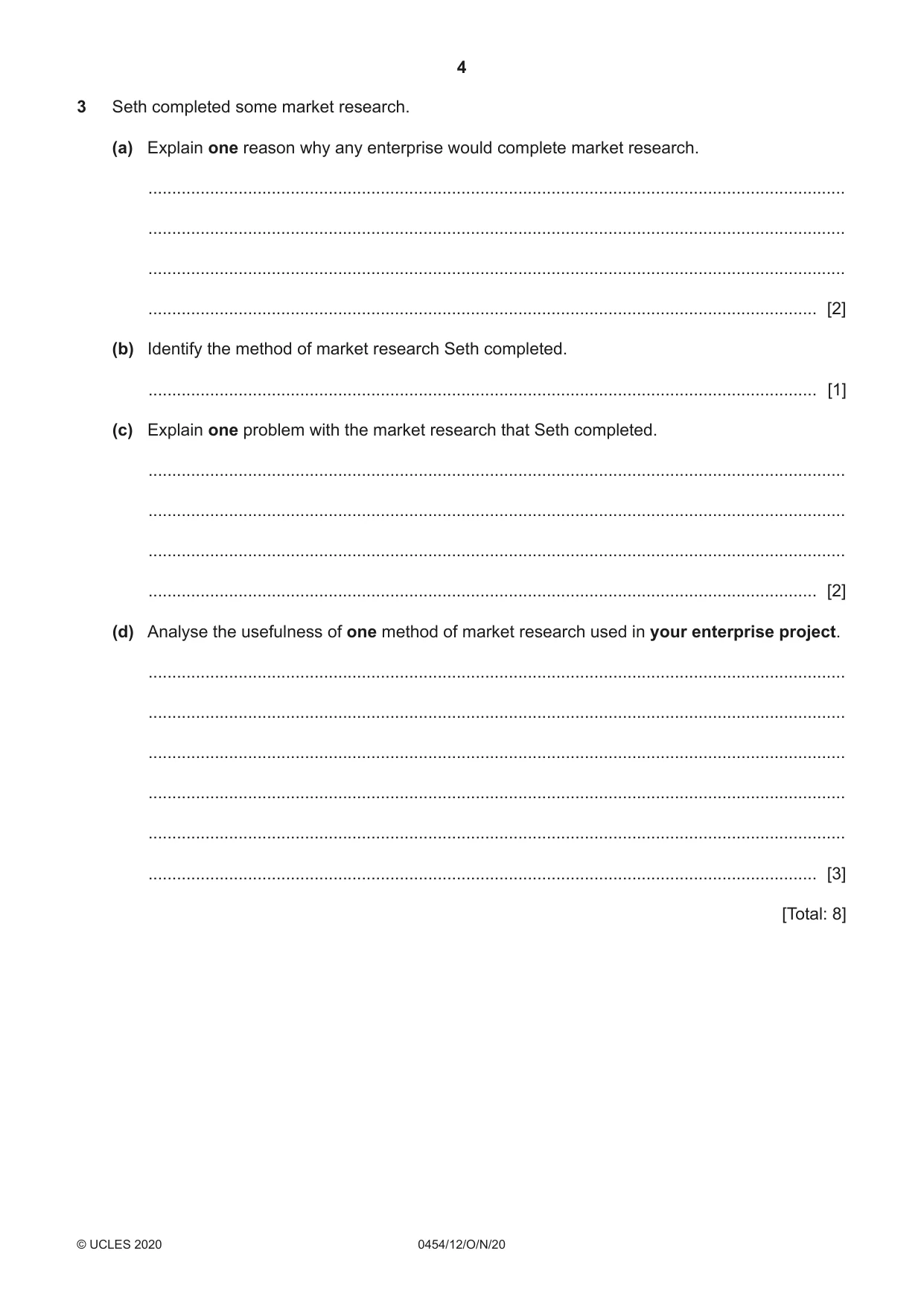
Question paper, page 4
4 0454/12/O/N/20 © UCLES 2020 3 Seth completed some market research. (a) Explain one reason why any enterprise would complete market research. … … … … [2] (b) Identify the method of market research Seth completed. … [1] (c) Explain one problem with the market research that Seth completed. … … … … [2] (d) Analyse the usefulness of one method of market research used in your enterprise project. … … … … … … [3] [Total: 8]
Question paper, page 5
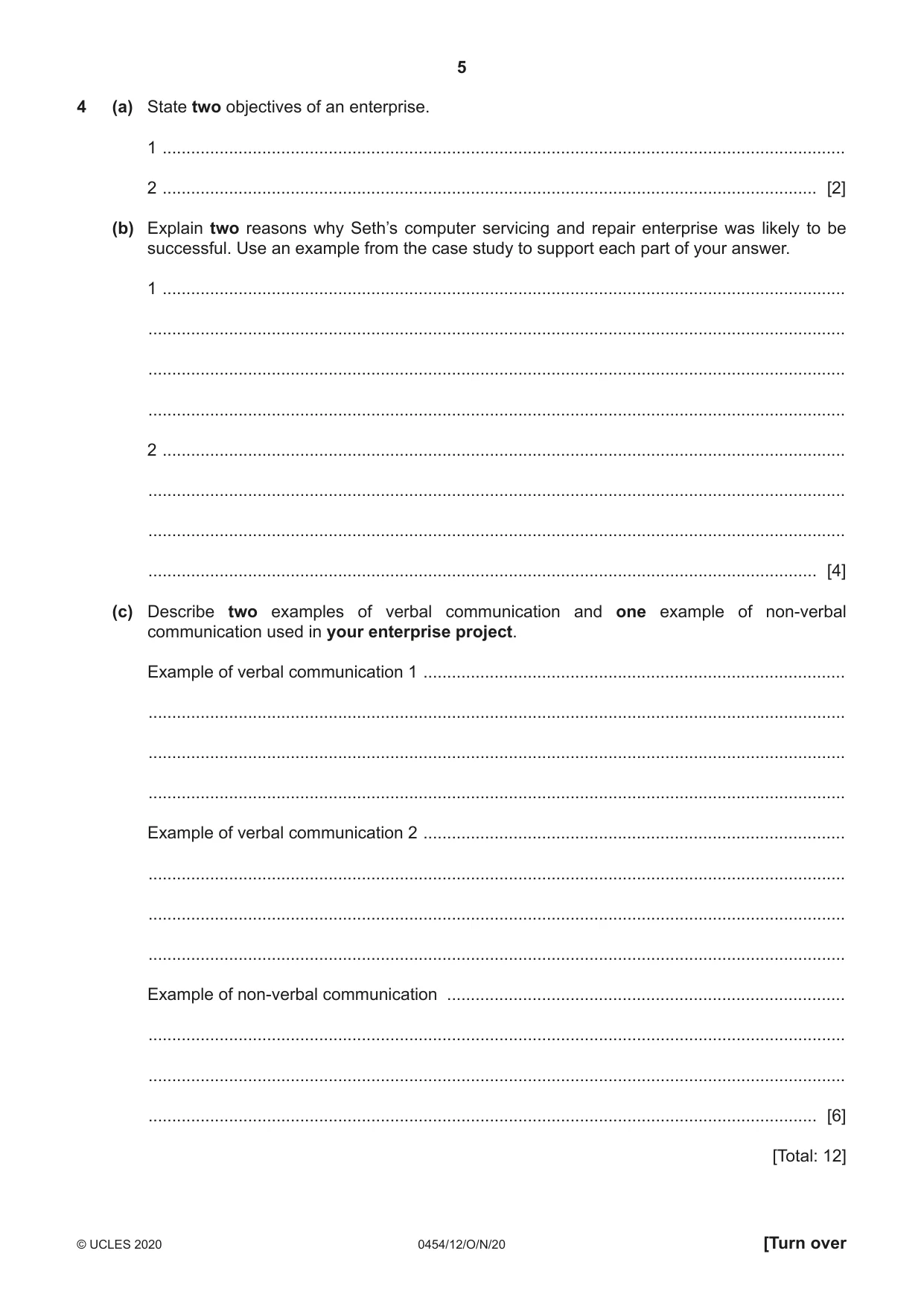
5 0454/12/O/N/20 © UCLES 2020 [Turn over 4 (a) State two objectives of an enterprise. 1 … 2 … [2] (b) Explain two reasons why Seth’s computer servicing and repair enterprise was likely to be successful. Use an example from the case study to support each part of your answer. 1 … … … … 2 … … … … [4] (c) Describe two examples of verbal communication and one example of non-verbal communication used in your enterprise project. Example of verbal communication 1 … … … … Example of verbal communication 2 … … … … Example of non-verbal communication … … … … [6] [Total: 12]
Question paper, page 6
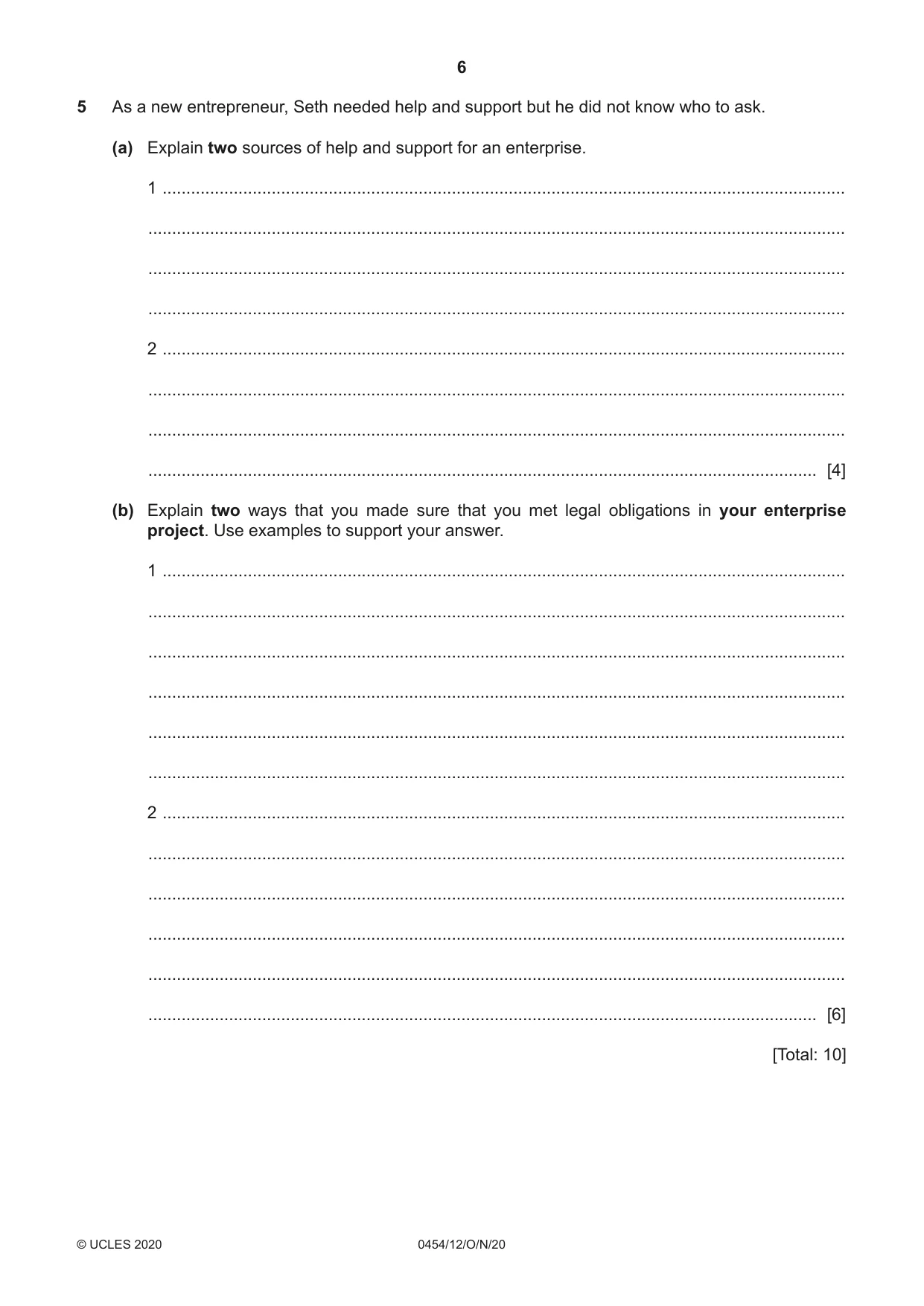
6 0454/12/O/N/20 © UCLES 2020 5 As a new entrepreneur, Seth needed help and support but he did not know who to ask. (a) Explain two sources of help and support for an enterprise. 1 … … … … 2 … … … … [4] (b) Explain two ways that you made sure that you met legal obligations in your enterprise project. Use examples to support your answer. 1 … … … … … … 2 … … … … … … [6] [Total: 10]
Question paper, page 7
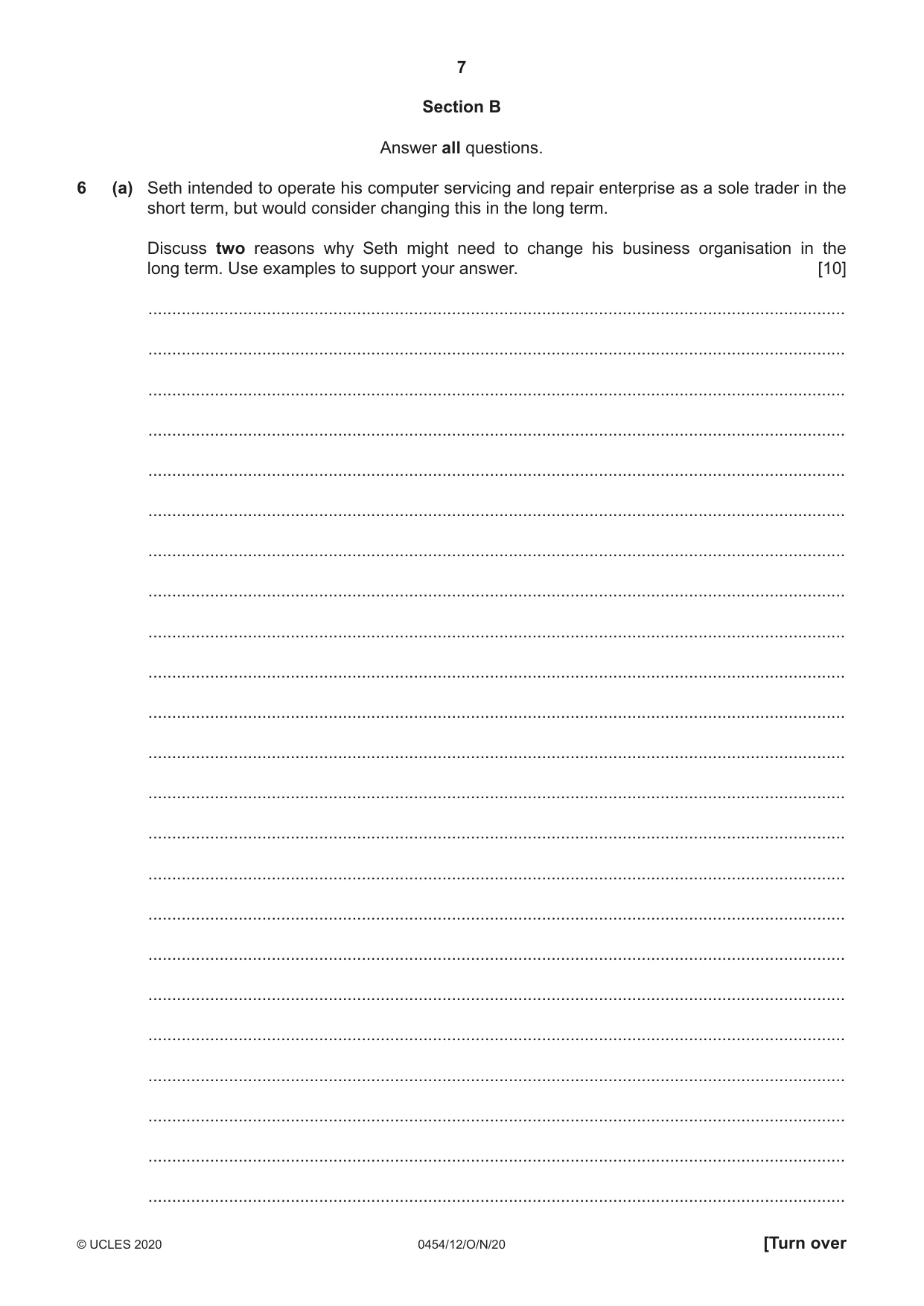
7 0454/12/O/N/20 © UCLES 2020 [Turn over Section B Answer all questions. 6 (a) Seth intended to operate his computer servicing and repair enterprise as a sole trader in the short term, but would consider changing this in the long term. Discuss two reasons why Seth might need to change his business organisation in the long term. Use examples to support your answer. [10] … … … … … … … … … … … … … … … … … … … … … … …
Question paper, page 8
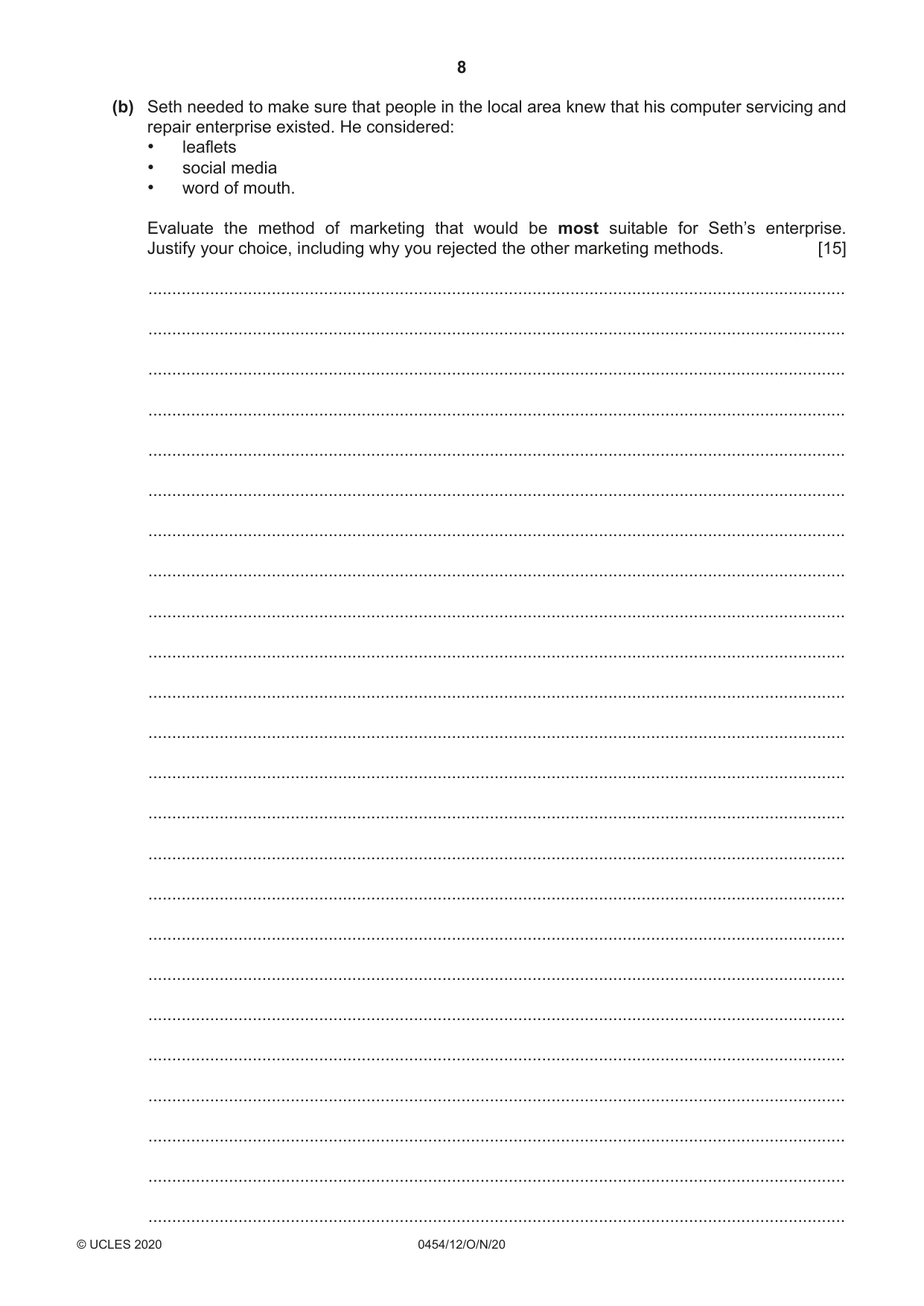
8 0454/12/O/N/20 © UCLES 2020 (b) Seth needed to make sure that people in the local area knew that his computer servicing and repair enterprise existed. He considered: • leaflets • social media • word of mouth. Evaluate the method of marketing that would be most suitable for Seth’s enterprise. Justify your choice, including why you rejected the other marketing methods. [15] … … … … … … … … … … … … … … … … … … … … … … … …
Question paper, page 9
9 0454/12/O/N/20 © UCLES 2020 [Turn over … … … … … … … … … … … … … … … … … … … … … … … … … … … [Total: 25]
Question paper, page 10
10 0454/12/O/N/20 © UCLES 2020 BLANK PAGE
Question paper, page 11
11 0454/12/O/N/20 © UCLES 2020 [Turn over 7 Now consider your enterprise project. (a) Seth wanted to avoid the risk of debt. Discuss how your attitude to risk affected the operation of your enterprise project. Use examples to support your answer. [10] … … … … … … … … … … … … … … … … … … … … … … … … …
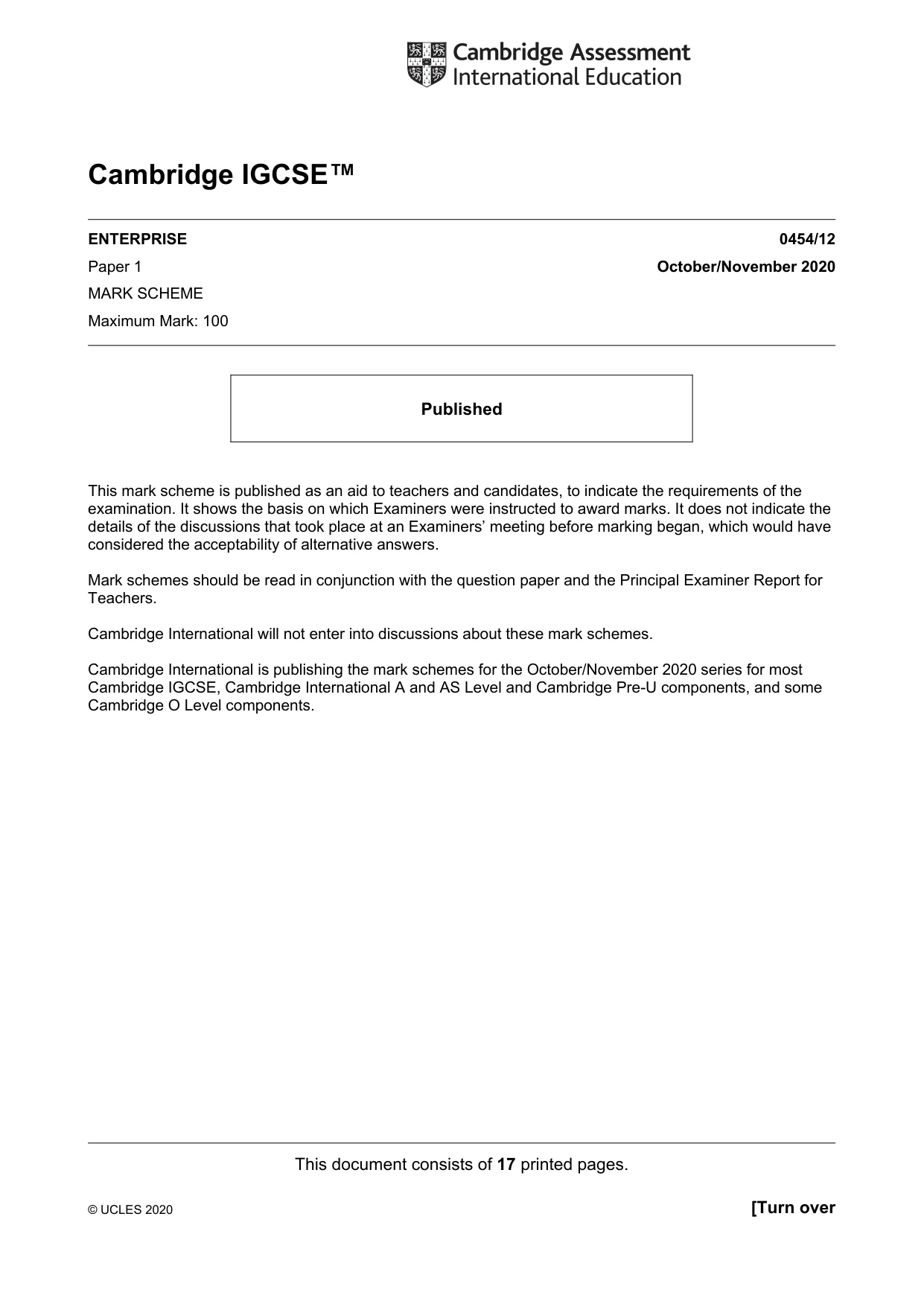
Question paper, page 12
12 0454/12/O/N/20 © UCLES 2020 (b) Seth planned some aspects of his new enterprise but he did not complete any formal documents such as: • an action plan • a business plan • a cash flow forecast. Evaluate the usefulness of two of these documents to your enterprise project. [15] … … … … … … … … … … … … … … … … … … … … … … … …
Question paper, page 13
13 0454/12/O/N/20 © UCLES 2020 … … … … … … … … … … … … … … … … … … … … … … … … … … … [Total: 25]
Question paper, page 14
14 0454/12/O/N/20 © UCLES 2020 BLANK PAGE
Question paper, page 15
15 0454/12/O/N/20 © UCLES 2020 BLANK PAGE
Question paper, page 16
16 0454/12/O/N/20 © UCLES 2020 Permission to reproduce items where third-party owned material protected by copyright is included has been sought and cleared where possible. Every reasonable effort has been made by the publisher (UCLES) to trace copyright holders, but if any items requiring clearance have unwittingly been included, the publisher will be pleased to make amends at the earliest possible opportunity. To avoid the issue of disclosure of answer-related information to candidates, all copyright acknowledgements are reproduced online in the Cambridge Assessment International Education Copyright Acknowledgements Booklet. This is produced for each series of examinations and is freely available to download at www.cambridgeinternational.org after the live examination series. Cambridge Assessment International Education is part of the Cambridge Assessment Group. Cambridge Assessment is the brand name of the University of Cambridge Local Examinations Syndicate (UCLES), which itself is a department of the University of Cambridge. BLANK PAGE
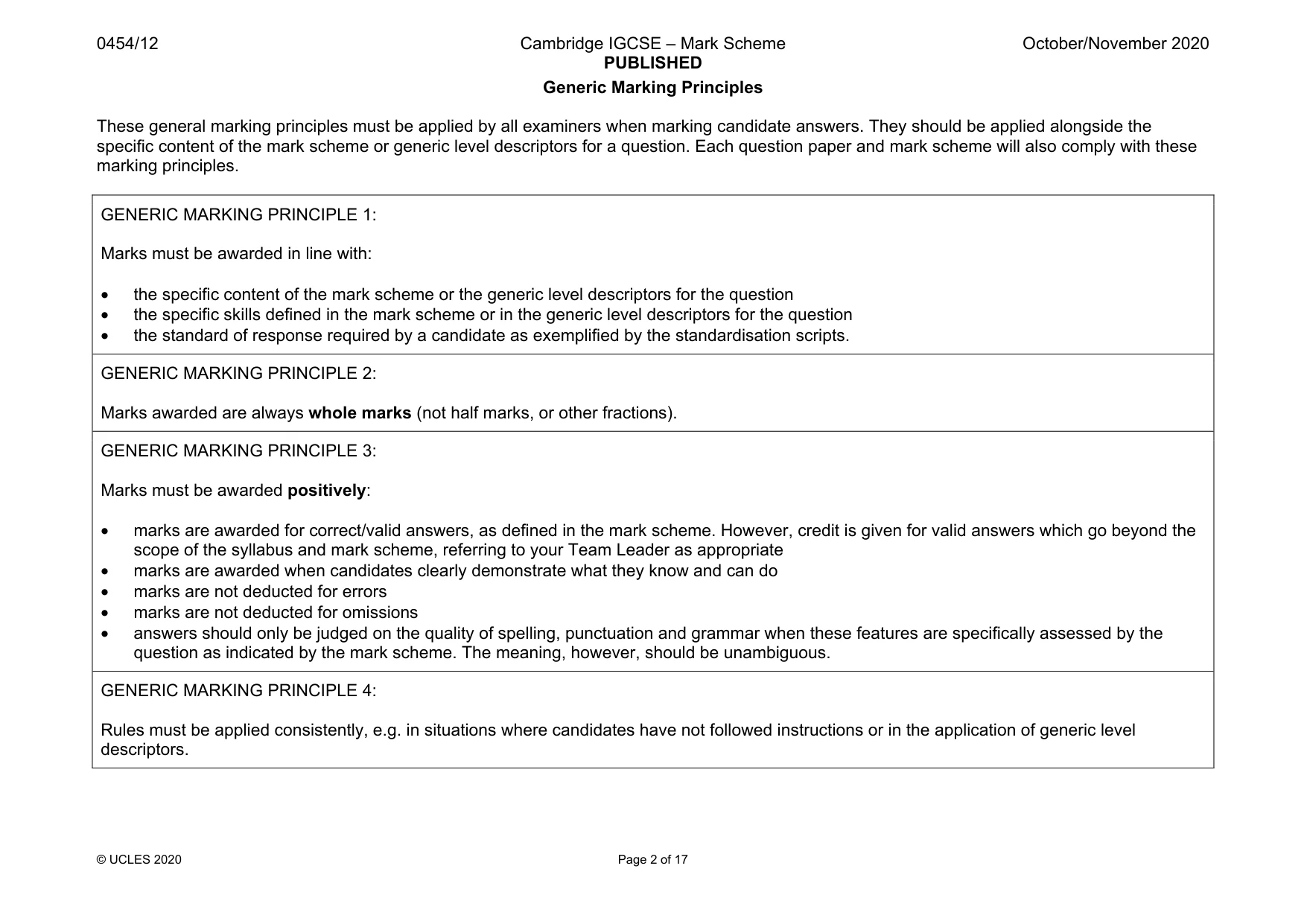
Mark scheme, page 1
This document consists of 17 printed pages. © UCLES 2020 [Turn over Cambridge IGCSE™ ENTERPRISE 0454/12 Paper 1 October/November 2020 MARK SCHEME Maximum Mark: 100 Published This mark scheme is published as an aid to teachers and candidates, to indicate the requirements of the examination. It shows the basis on which Examiners were instructed to award marks. It does not indicate the details of the discussions that took place at an Examiners’ meeting before marking began, which would have considered the acceptability of alternative answers. Mark schemes should be read in conjunction with the question paper and the Principal Examiner Report for Teachers. Cambridge International will not enter into discussions about these mark schemes. Cambridge International is publishing the mark schemes for the October/November 2020 series for most Cambridge IGCSE, Cambridge International A and AS Level and Cambridge Pre-U components, and some Cambridge O Level components.
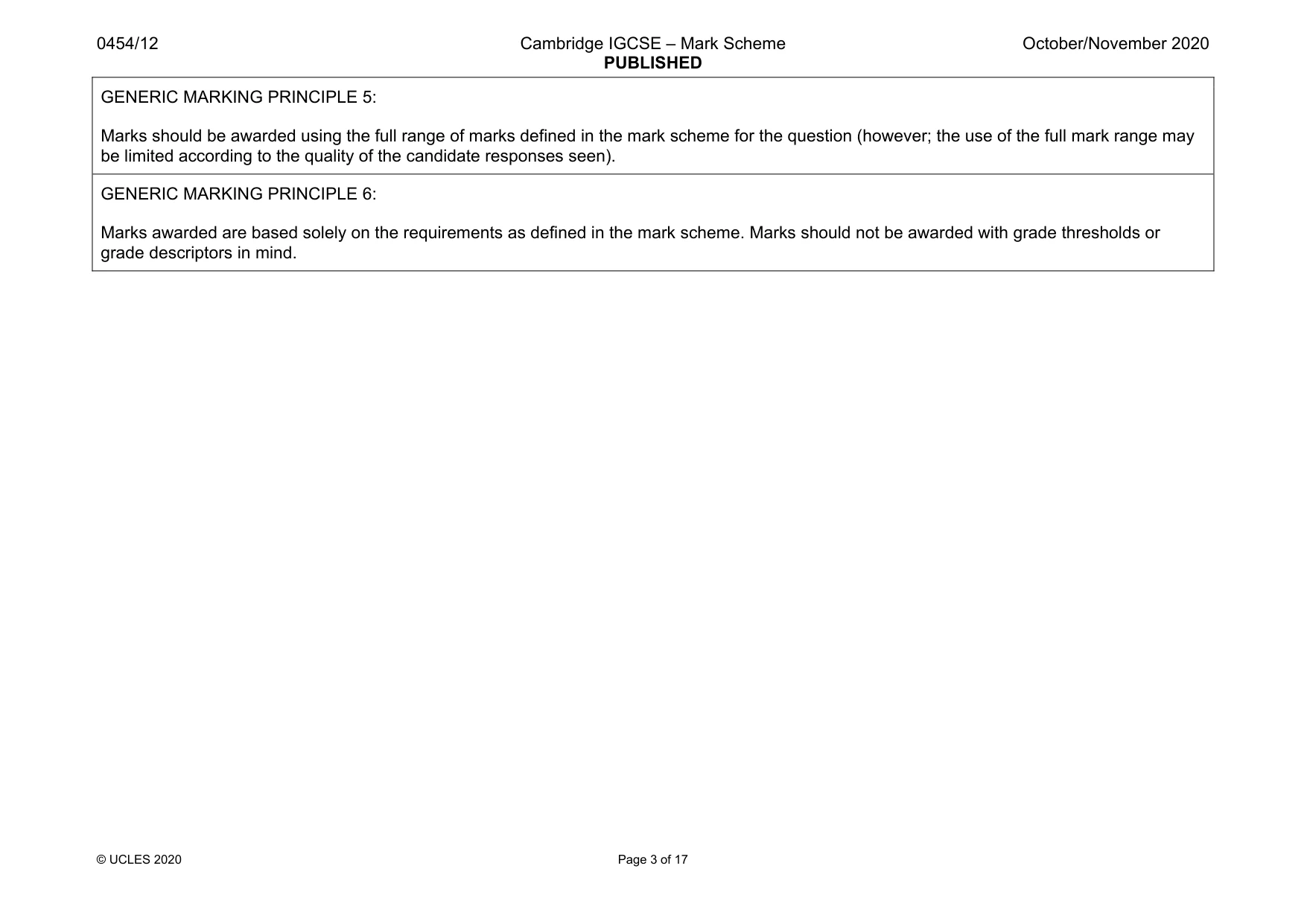
Mark scheme, page 2
0454/12 Cambridge IGCSE – Mark Scheme PUBLISHED October/November 2020 © UCLES 2020 Page 2 of 17 Generic Marking Principles These general marking principles must be applied by all examiners when marking candidate answers. They should be applied alongside the specific content of the mark scheme or generic level descriptors for a question. Each question paper and mark scheme will also comply with these marking principles. GENERIC MARKING PRINCIPLE 1: Marks must be awarded in line with: • the specific content of the mark scheme or the generic level descriptors for the question • the specific skills defined in the mark scheme or in the generic level descriptors for the question • the standard of response required by a candidate as exemplified by the standardisation scripts. GENERIC MARKING PRINCIPLE 2: Marks awarded are always whole marks (not half marks, or other fractions). GENERIC MARKING PRINCIPLE 3: Marks must be awarded positively: • marks are awarded for correct/valid answers, as defined in the mark scheme. However, credit is given for valid answers which go beyond the scope of the syllabus and mark scheme, referring to your Team Leader as appropriate • marks are awarded when candidates clearly demonstrate what they know and can do • marks are not deducted for errors • marks are not deducted for omissions • answers should only be judged on the quality of spelling, punctuation and grammar when these features are specifically assessed by the question as indicated by the mark scheme. The meaning, however, should be unambiguous. GENERIC MARKING PRINCIPLE 4: Rules must be applied consistently, e.g. in situations where candidates have not followed instructions or in the application of generic level descriptors.
Mark scheme, page 3
0454/12 Cambridge IGCSE – Mark Scheme PUBLISHED October/November 2020 © UCLES 2020 Page 3 of 17 GENERIC MARKING PRINCIPLE 5: Marks should be awarded using the full range of marks defined in the mark scheme for the question (however; the use of the full mark range may be limited according to the quality of the candidate responses seen). GENERIC MARKING PRINCIPLE 6: Marks awarded are based solely on the requirements as defined in the mark scheme. Marks should not be awarded with grade thresholds or grade descriptors in mind.
Mark scheme, page 4
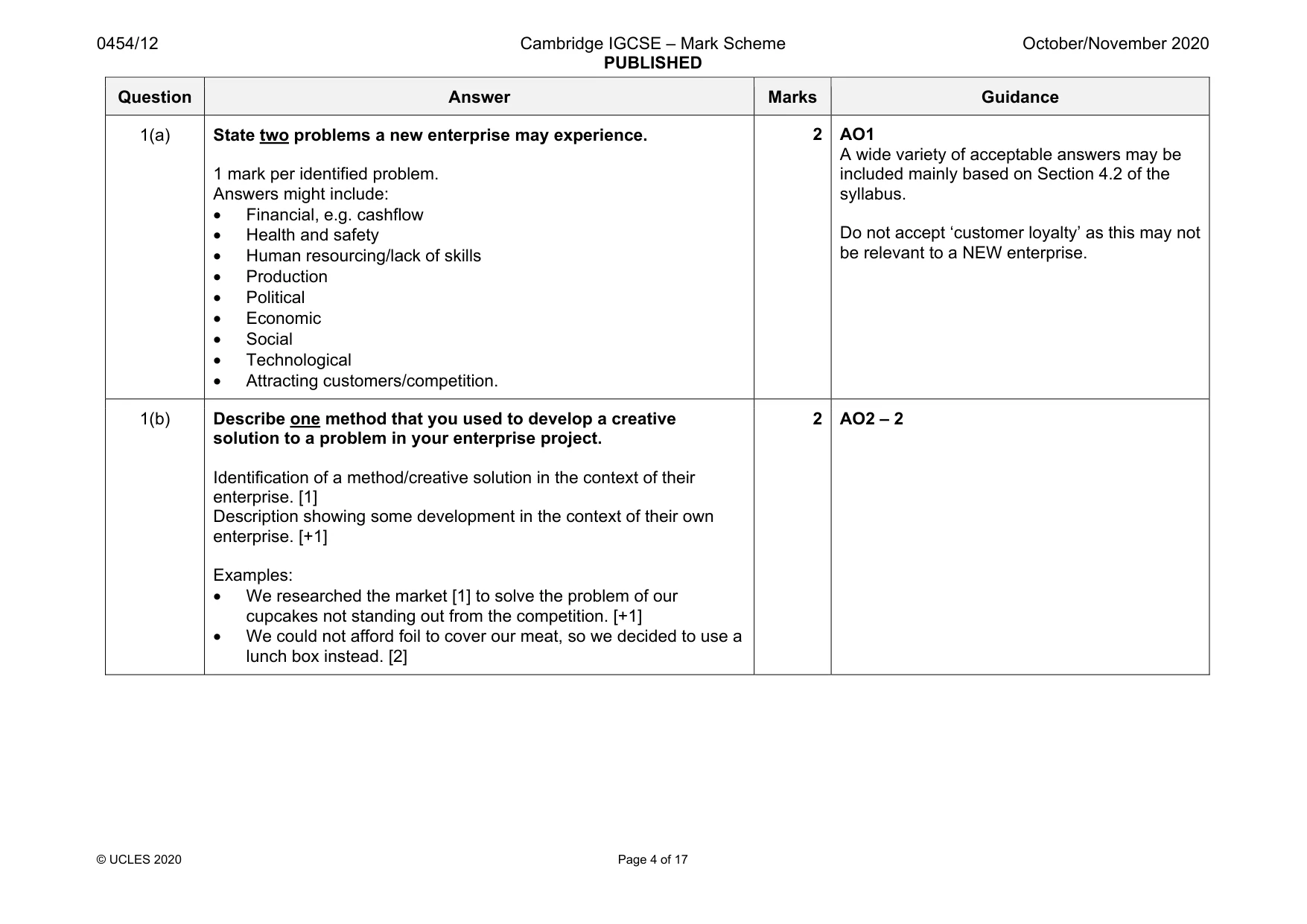
0454/12 Cambridge IGCSE – Mark Scheme PUBLISHED October/November 2020 © UCLES 2020 Page 4 of 17 Question Answer Marks Guidance 1(a) State two problems a new enterprise may experience. 1 mark per identified problem. Answers might include: • Financial, e.g. cashflow • Health and safety • Human resourcing/lack of skills • Production • Political • Economic • Social • Technological • Attracting customers/competition. 2 AO1 A wide variety of acceptable answers may be included mainly based on Section 4.2 of the syllabus. Do not accept ‘customer loyalty’ as this may not be relevant to a NEW enterprise. 1(b) Describe one method that you used to develop a creative solution to a problem in your enterprise project. Identification of a method/creative solution in the context of their enterprise. [1] Description showing some development in the context of their own enterprise. [+1] Examples: • We researched the market [1] to solve the problem of our cupcakes not standing out from the competition. [+1] • We could not afford foil to cover our meat, so we decided to use a lunch box instead. [2] 2 AO2 – 2
Mark scheme, page 5
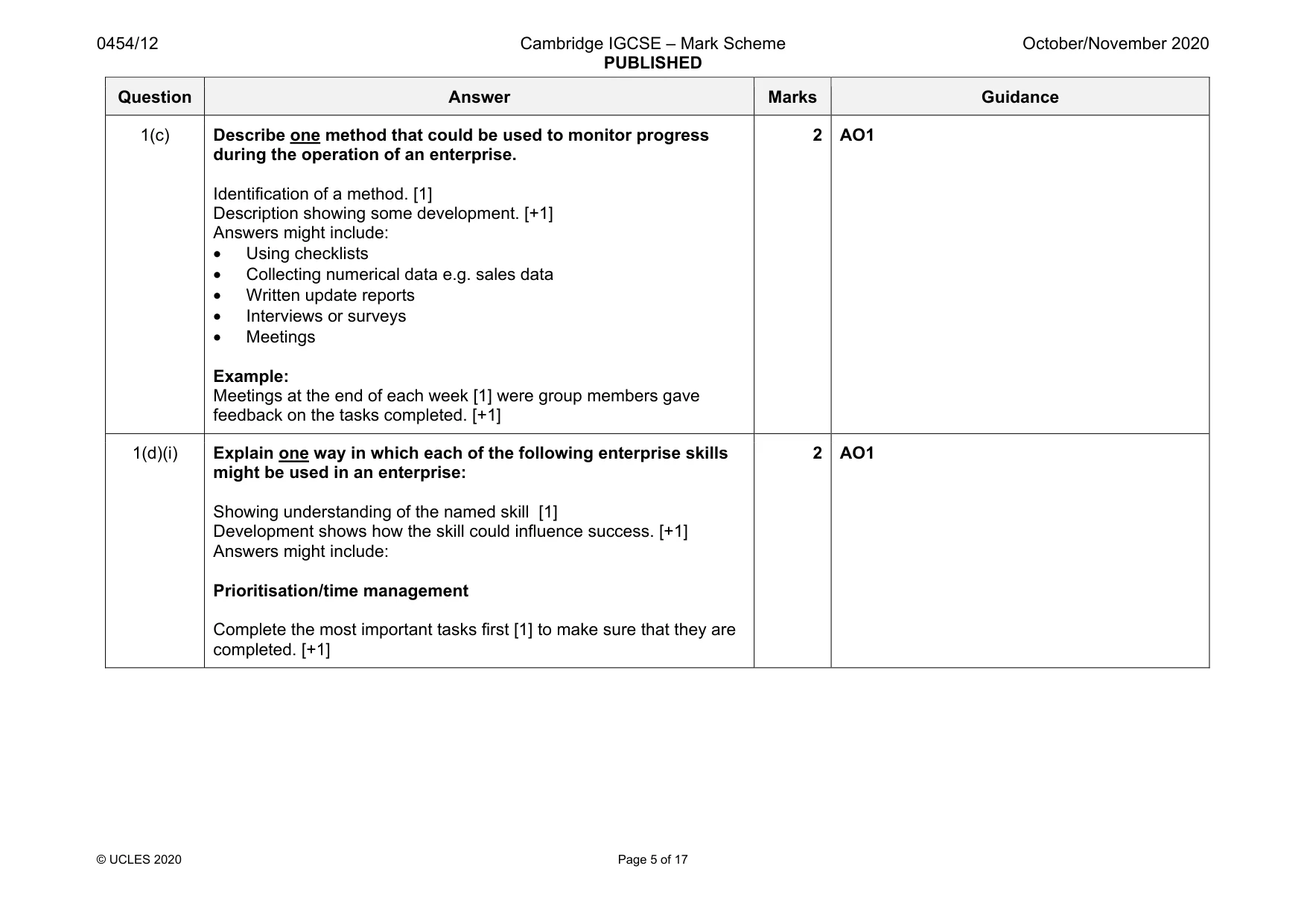
0454/12 Cambridge IGCSE – Mark Scheme PUBLISHED October/November 2020 © UCLES 2020 Page 5 of 17 Question Answer Marks Guidance 1(c) Describe one method that could be used to monitor progress during the operation of an enterprise. Identification of a method. [1] Description showing some development. [+1] Answers might include: • Using checklists • Collecting numerical data e.g. sales data • Written update reports • Interviews or surveys • Meetings Example: Meetings at the end of each week [1] were group members gave feedback on the tasks completed. [+1] 2 AO1 1(d)(i) Explain one way in which each of the following enterprise skills might be used in an enterprise: Showing understanding of the named skill [1] Development shows how the skill could influence success. [+1] Answers might include: Prioritisation/time management Complete the most important tasks first [1] to make sure that they are completed. [+1] 2 AO1
Mark scheme, page 6
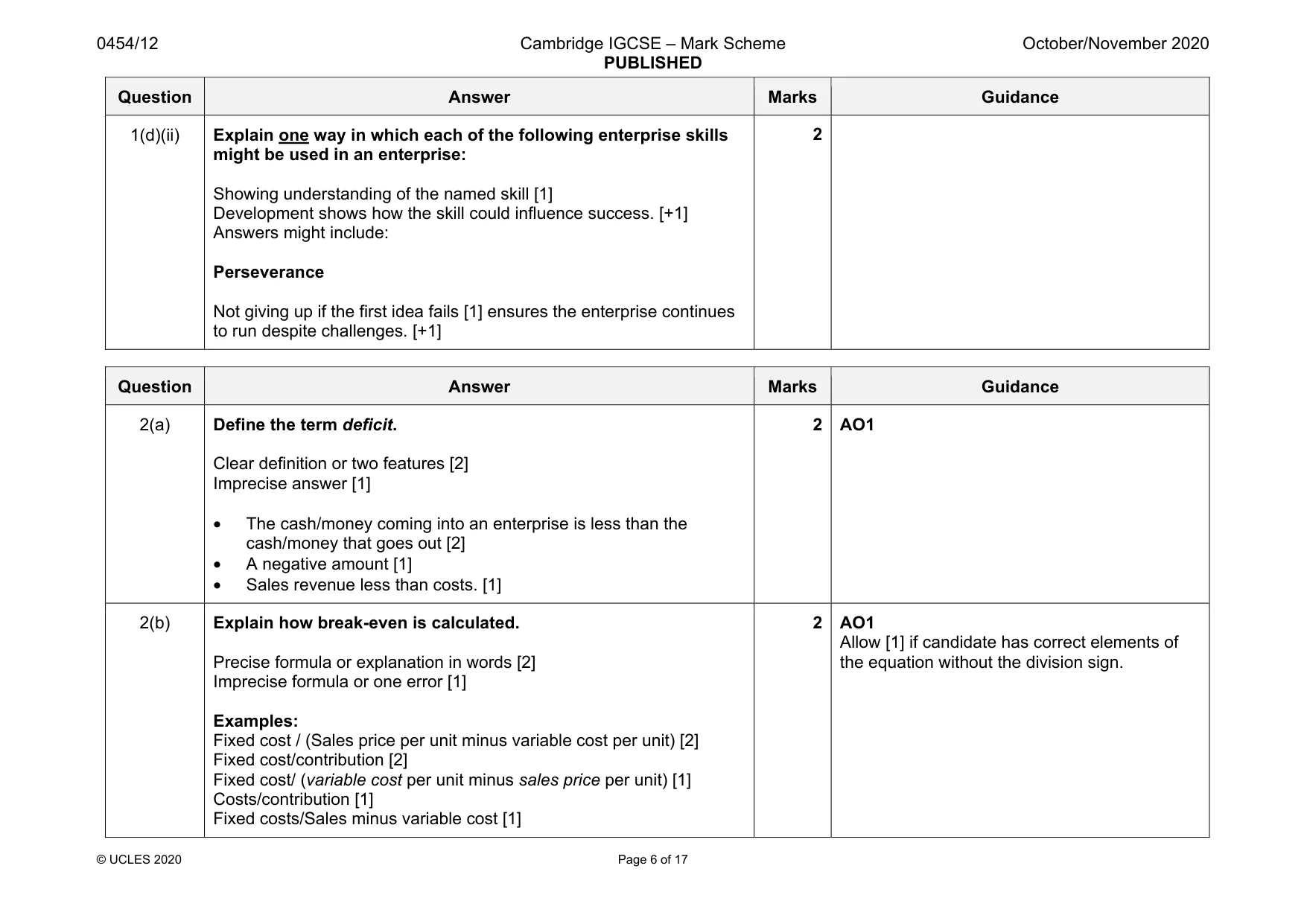
0454/12 Cambridge IGCSE – Mark Scheme PUBLISHED October/November 2020 © UCLES 2020 Page 6 of 17 Question Answer Marks Guidance 1(d)(ii) Explain one way in which each of the following enterprise skills might be used in an enterprise: Showing understanding of the named skill [1] Development shows how the skill could influence success. [+1] Answers might include: Perseverance Not giving up if the first idea fails [1] ensures the enterprise continues to run despite challenges. [+1] 2 Question Answer Marks Guidance 2(a) Define the term deficit. Clear definition or two features [2] Imprecise answer [1] • The cash/money coming into an enterprise is less than the cash/money that goes out [2] • A negative amount [1] • Sales revenue less than costs. [1] 2 AO1 2(b) Explain how break-even is calculated. Precise formula or explanation in words [2] Imprecise formula or one error [1] Examples: Fixed cost / (Sales price per unit minus variable cost per unit) [2] Fixed cost/contribution [2] Fixed cost/ (variable cost per unit minus sales price per unit) [1] Costs/contribution [1] Fixed costs/Sales minus variable cost [1] 2 AO1 Allow [1] if candidate has correct elements of the equation without the division sign.
Mark scheme, page 7
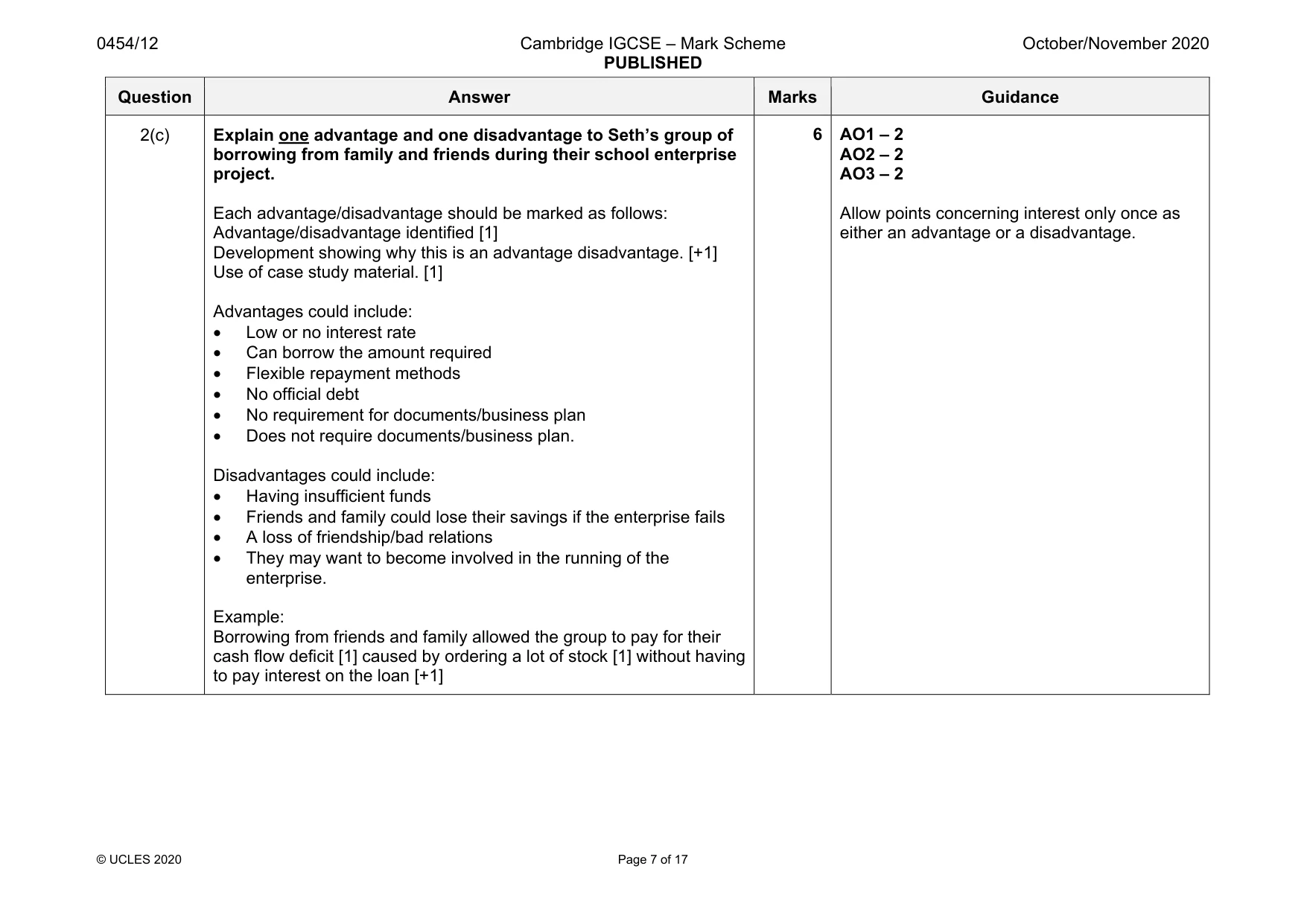
0454/12 Cambridge IGCSE – Mark Scheme PUBLISHED October/November 2020 © UCLES 2020 Page 7 of 17 Question Answer Marks Guidance 2(c) Explain one advantage and one disadvantage to Seth’s group of borrowing from family and friends during their school enterprise project. Each advantage/disadvantage should be marked as follows: Advantage/disadvantage identified [1] Development showing why this is an advantage disadvantage. [+1] Use of case study material. [1] Advantages could include: • Low or no interest rate • Can borrow the amount required • Flexible repayment methods • No official debt • No requirement for documents/business plan • Does not require documents/business plan. Disadvantages could include: • Having insufficient funds • Friends and family could lose their savings if the enterprise fails • A loss of friendship/bad relations • They may want to become involved in the running of the enterprise. Example: Borrowing from friends and family allowed the group to pay for their cash flow deficit [1] caused by ordering a lot of stock [1] without having to pay interest on the loan [+1] 6 AO1 – 2 AO2 – 2 AO3 – 2 Allow points concerning interest only once as either an advantage or a disadvantage.
Mark scheme, page 8
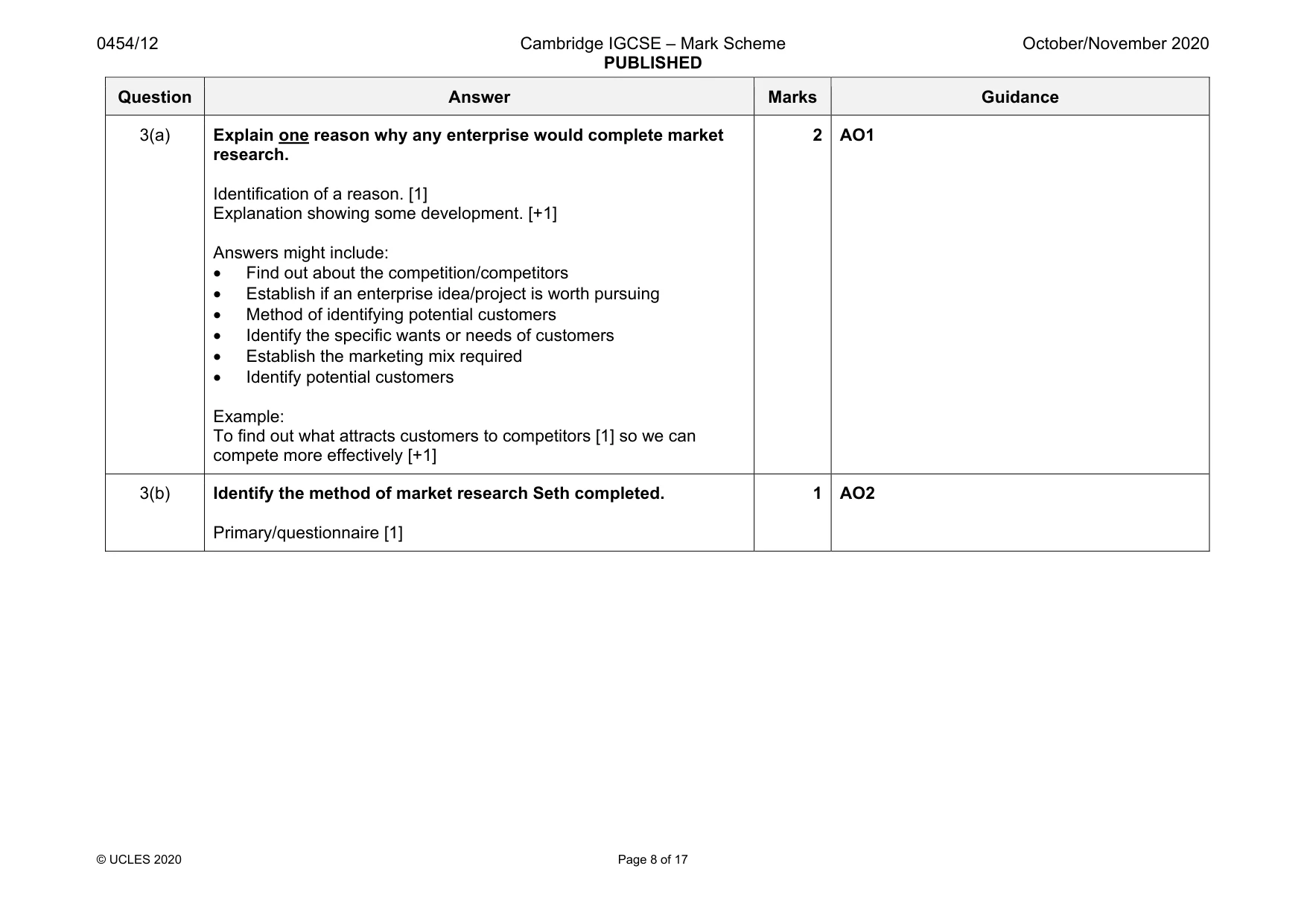
0454/12 Cambridge IGCSE – Mark Scheme PUBLISHED October/November 2020 © UCLES 2020 Page 8 of 17 Question Answer Marks Guidance 3(a) Explain one reason why any enterprise would complete market research. Identification of a reason. [1] Explanation showing some development. [+1] Answers might include: • Find out about the competition/competitors • Establish if an enterprise idea/project is worth pursuing • Method of identifying potential customers • Identify the specific wants or needs of customers • Establish the marketing mix required • Identify potential customers Example: To find out what attracts customers to competitors [1] so we can compete more effectively [+1] 2 AO1 3(b) Identify the method of market research Seth completed. Primary/questionnaire [1] 1 AO2
Mark scheme, page 9
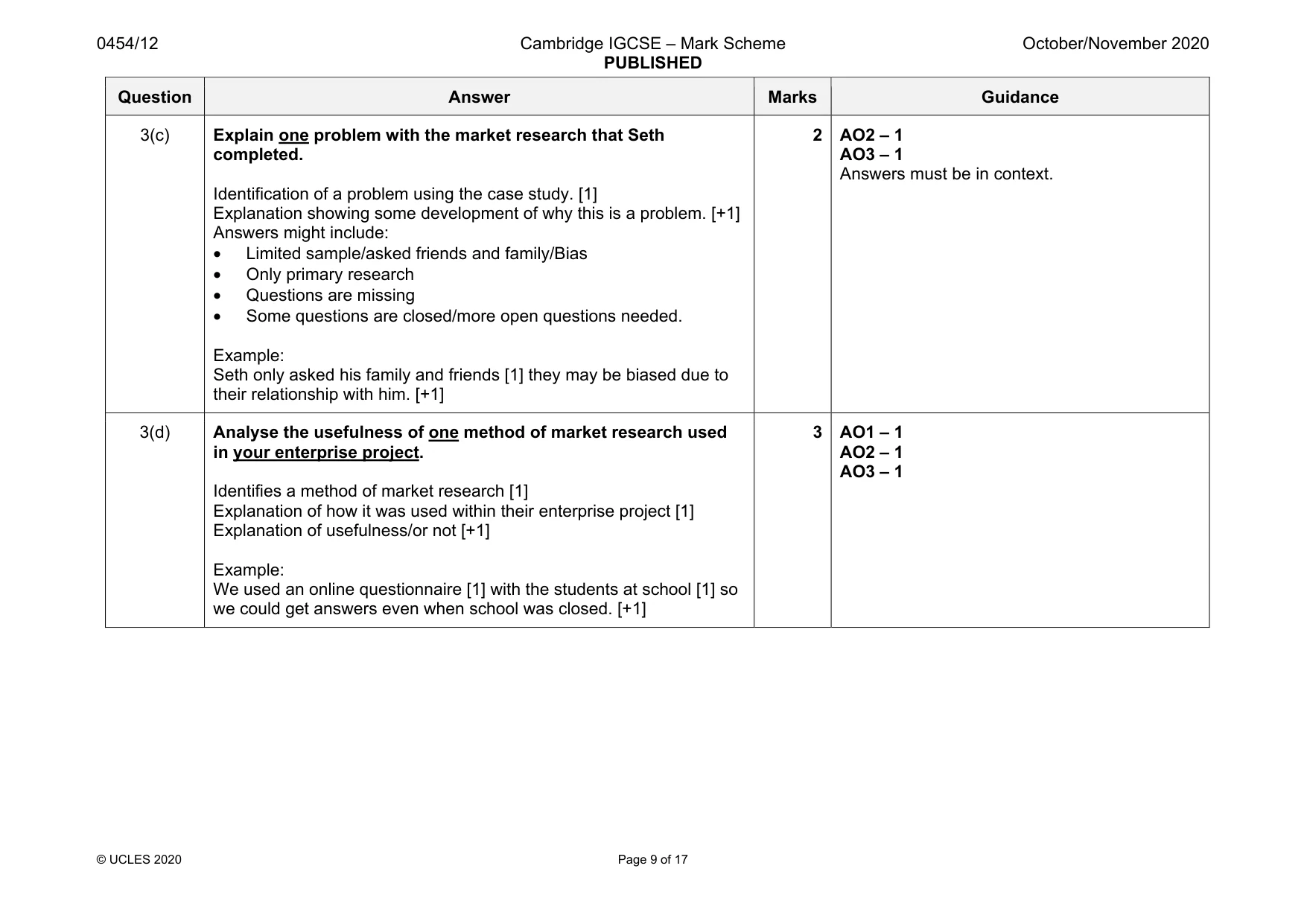
0454/12 Cambridge IGCSE – Mark Scheme PUBLISHED October/November 2020 © UCLES 2020 Page 9 of 17 Question Answer Marks Guidance 3(c) Explain one problem with the market research that Seth completed. Identification of a problem using the case study. [1] Explanation showing some development of why this is a problem. [+1] Answers might include: • Limited sample/asked friends and family/Bias • Only primary research • Questions are missing • Some questions are closed/more open questions needed. Example: Seth only asked his family and friends [1] they may be biased due to their relationship with him. [+1] 2 AO2 – 1 AO3 – 1 Answers must be in context. 3(d) Analyse the usefulness of one method of market research used in your enterprise project. Identifies a method of market research [1] Explanation of how it was used within their enterprise project [1] Explanation of usefulness/or not [+1] Example: We used an online questionnaire [1] with the students at school [1] so we could get answers even when school was closed. [+1] 3 AO1 – 1 AO2 – 1 AO3 – 1
Mark scheme, page 10
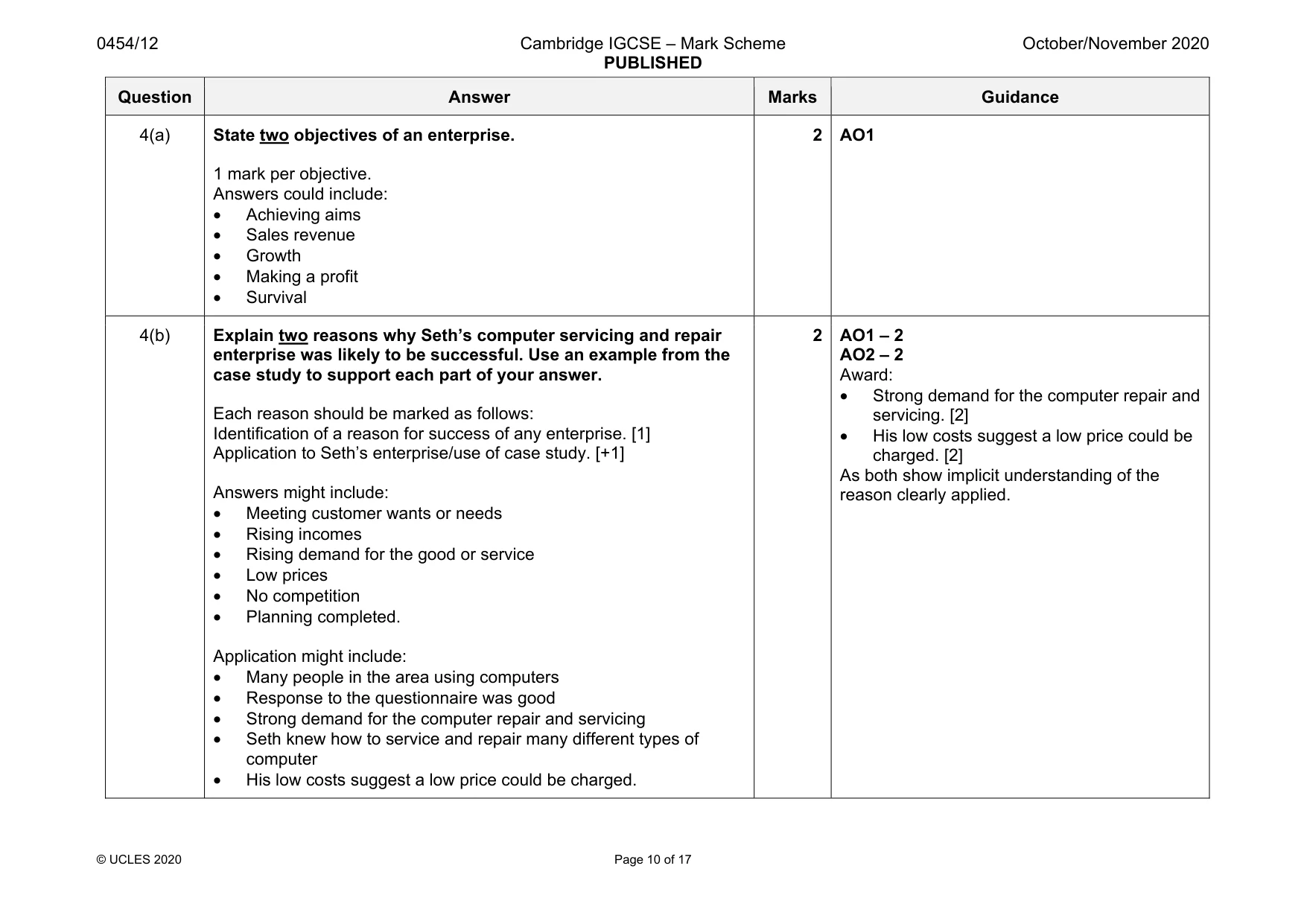
0454/12 Cambridge IGCSE – Mark Scheme PUBLISHED October/November 2020 © UCLES 2020 Page 10 of 17 Question Answer Marks Guidance 4(a) State two objectives of an enterprise. 1 mark per objective. Answers could include: • Achieving aims • Sales revenue • Growth • Making a profit • Survival 2 AO1 4(b) Explain two reasons why Seth’s computer servicing and repair enterprise was likely to be successful. Use an example from the case study to support each part of your answer. Each reason should be marked as follows: Identification of a reason for success of any enterprise. [1] Application to Seth’s enterprise/use of case study. [+1] Answers might include: • Meeting customer wants or needs • Rising incomes • Rising demand for the good or service • Low prices • No competition • Planning completed. Application might include: • Many people in the area using computers • Response to the questionnaire was good • Strong demand for the computer repair and servicing • Seth knew how to service and repair many different types of computer • His low costs suggest a low price could be charged. 2 AO1 – 2 AO2 – 2 Award: • Strong demand for the computer repair and servicing. [2] • His low costs suggest a low price could be charged. [2] As both show implicit understanding of the reason clearly applied.
Mark scheme, page 11
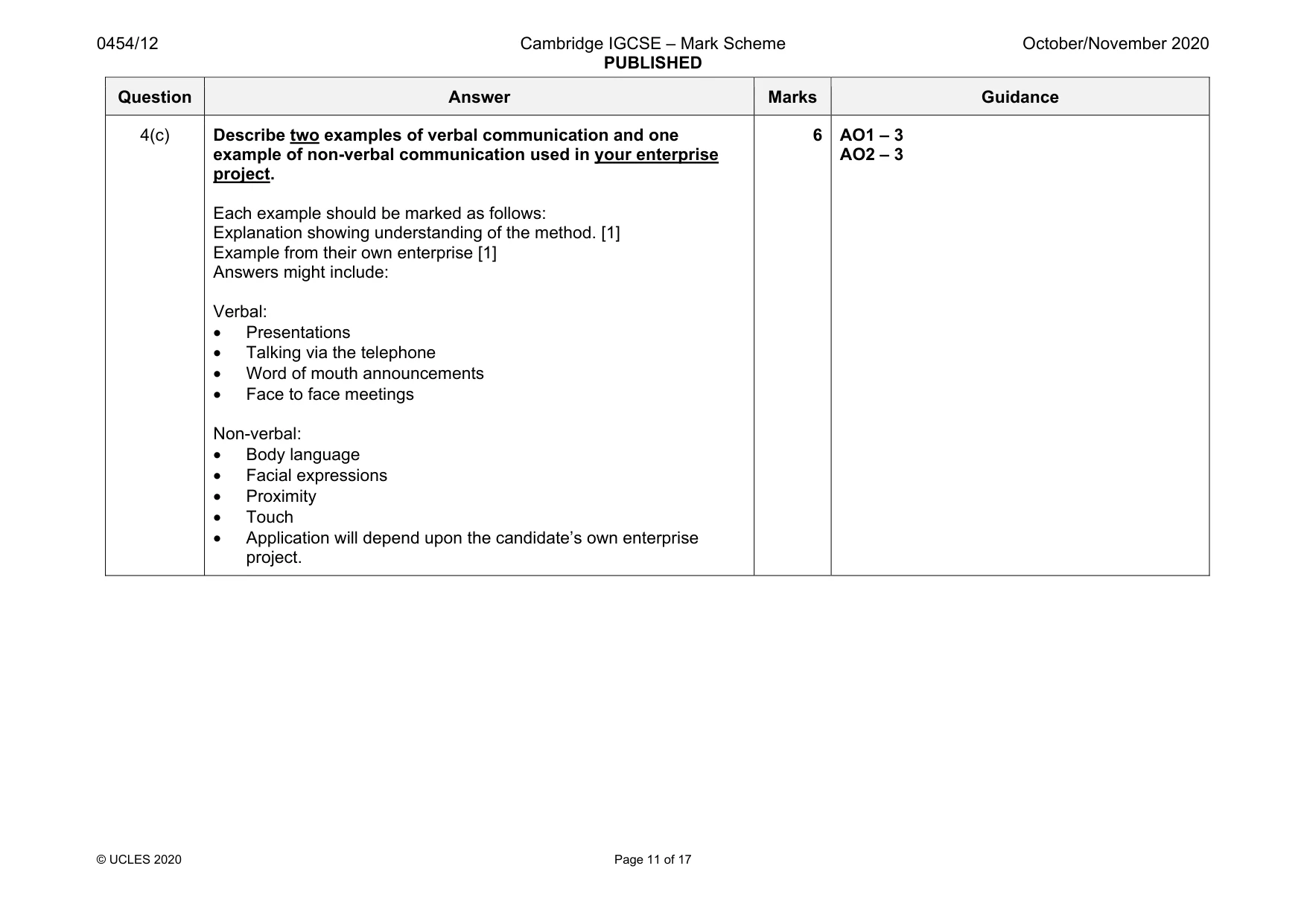
0454/12 Cambridge IGCSE – Mark Scheme PUBLISHED October/November 2020 © UCLES 2020 Page 11 of 17 Question Answer Marks Guidance 4(c) Describe two examples of verbal communication and one example of non-verbal communication used in your enterprise project. Each example should be marked as follows: Explanation showing understanding of the method. [1] Example from their own enterprise [1] Answers might include: Verbal: • Presentations • Talking via the telephone • Word of mouth announcements • Face to face meetings Non-verbal: • Body language • Facial expressions • Proximity • Touch • Application will depend upon the candidate’s own enterprise project. 6 AO1 – 3 AO2 – 3
Mark scheme, page 12
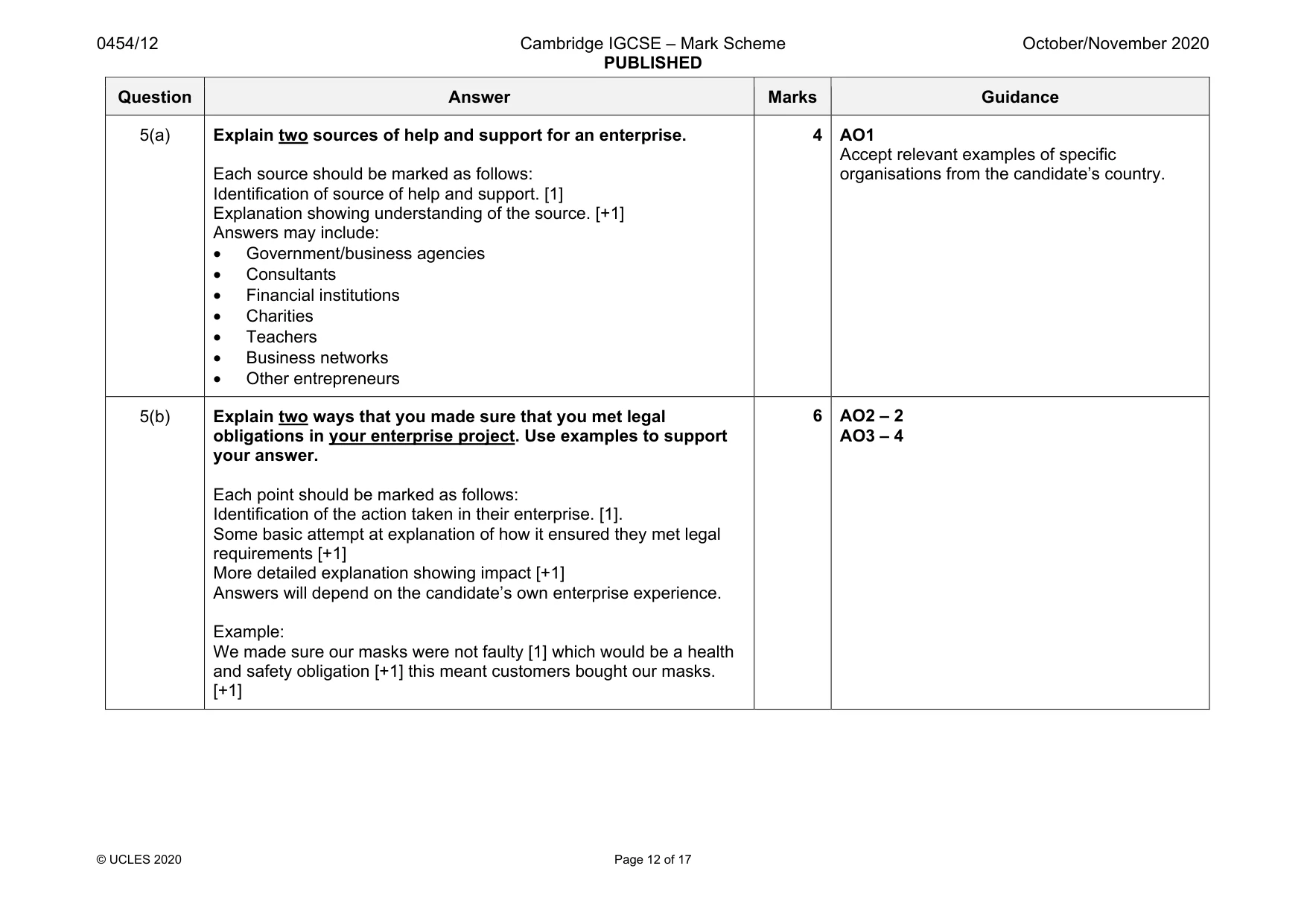
0454/12 Cambridge IGCSE – Mark Scheme PUBLISHED October/November 2020 © UCLES 2020 Page 12 of 17 Question Answer Marks Guidance 5(a) Explain two sources of help and support for an enterprise. Each source should be marked as follows: Identification of source of help and support. [1] Explanation showing understanding of the source. [+1] Answers may include: • Government/business agencies • Consultants • Financial institutions • Charities • Teachers • Business networks • Other entrepreneurs 4 AO1 Accept relevant examples of specific organisations from the candidate’s country. 5(b) Explain two ways that you made sure that you met legal obligations in your enterprise project. Use examples to support your answer. Each point should be marked as follows: Identification of the action taken in their enterprise. [1]. Some basic attempt at explanation of how it ensured they met legal requirements [+1] More detailed explanation showing impact [+1] Answers will depend on the candidate’s own enterprise experience. Example: We made sure our masks were not faulty [1] which would be a health and safety obligation [+1] this meant customers bought our masks. [+1] 6 AO2 – 2 AO3 – 4
Mark scheme, page 13
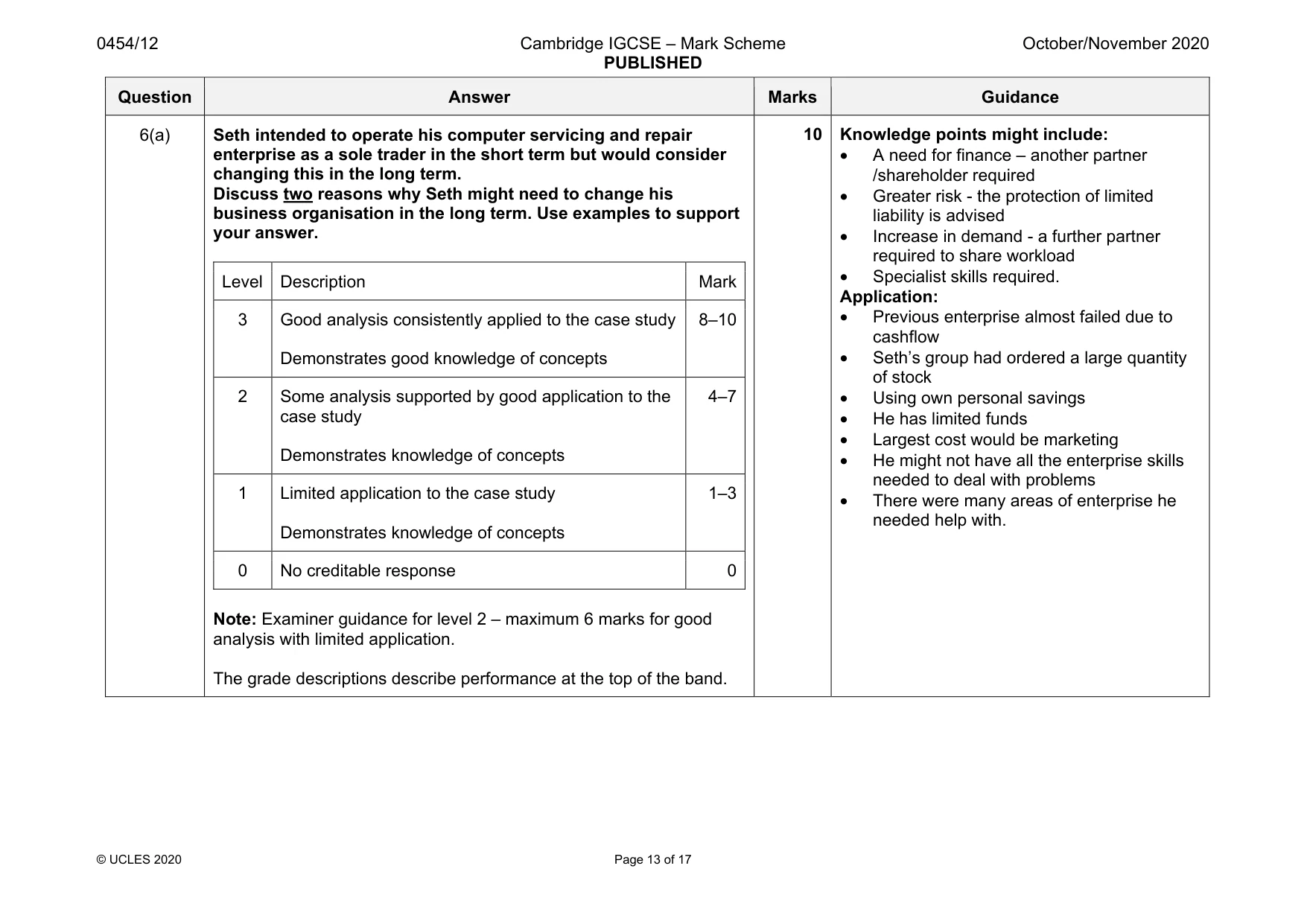
0454/12 Cambridge IGCSE – Mark Scheme PUBLISHED October/November 2020 © UCLES 2020 Page 13 of 17 Question Answer Marks Guidance 6(a) Seth intended to operate his computer servicing and repair enterprise as a sole trader in the short term but would consider changing this in the long term. Discuss two reasons why Seth might need to change his business organisation in the long term. Use examples to support your answer. Level Description Mark 3 Good analysis consistently applied to the case study Demonstrates good knowledge of concepts 8–10 2 Some analysis supported by good application to the case study Demonstrates knowledge of concepts 4–7 1 Limited application to the case study Demonstrates knowledge of concepts 1–3 0 No creditable response 0 Note: Examiner guidance for level 2 – maximum 6 marks for good analysis with limited application. The grade descriptions describe performance at the top of the band. 10 Knowledge points might include: • A need for finance – another partner /shareholder required • Greater risk - the protection of limited liability is advised • Increase in demand - a further partner required to share workload • Specialist skills required. Application: • Previous enterprise almost failed due to cashflow • Seth’s group had ordered a large quantity of stock • Using own personal savings • He has limited funds • Largest cost would be marketing • He might not have all the enterprise skills needed to deal with problems • There were many areas of enterprise he needed help with.
Mark scheme, page 14
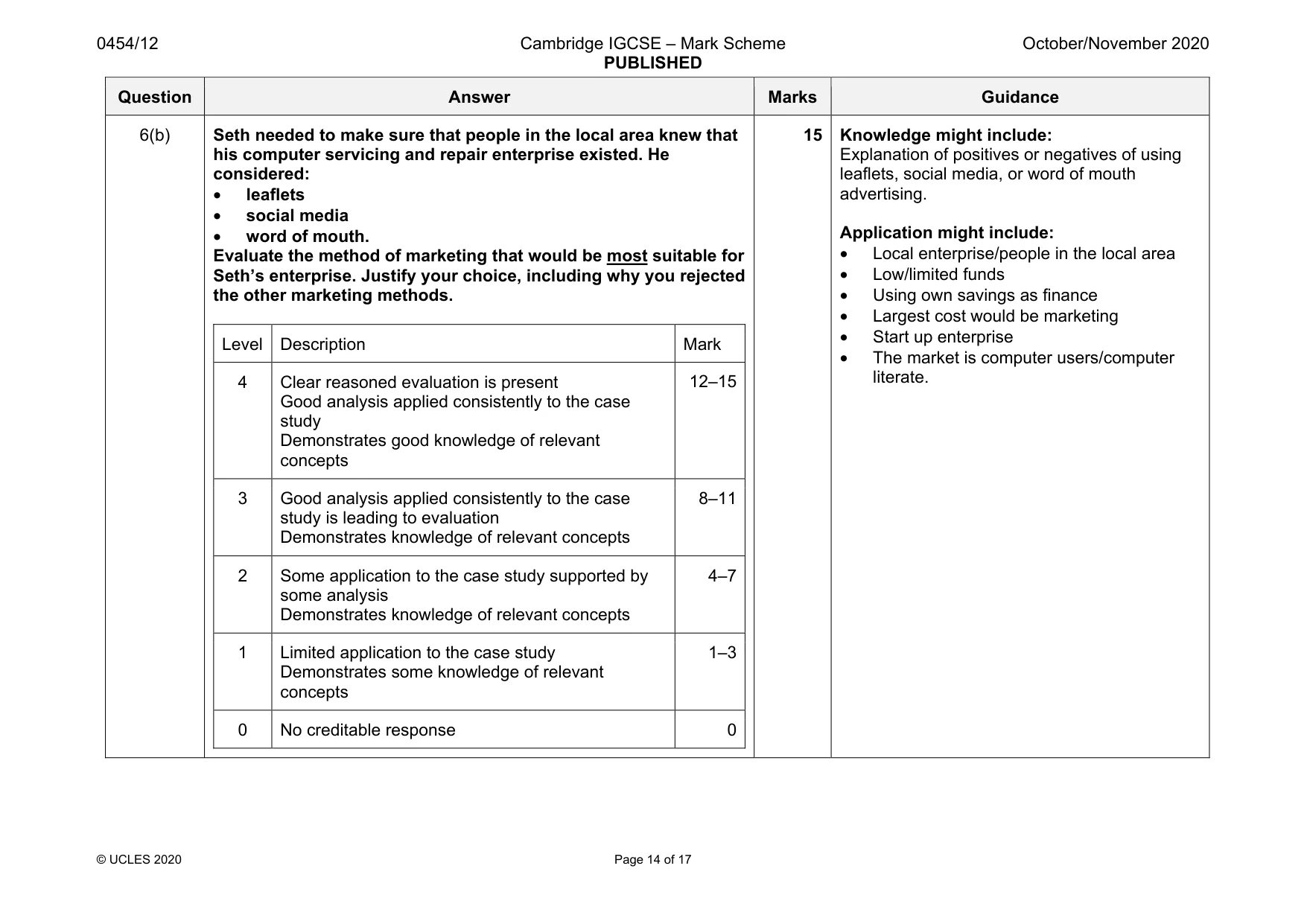
0454/12 Cambridge IGCSE – Mark Scheme PUBLISHED October/November 2020 © UCLES 2020 Page 14 of 17 Question Answer Marks Guidance 6(b) Seth needed to make sure that people in the local area knew that his computer servicing and repair enterprise existed. He considered: • leaflets • social media • word of mouth. Evaluate the method of marketing that would be most suitable for Seth’s enterprise. Justify your choice, including why you rejected the other marketing methods. Level Description Mark 4 Clear reasoned evaluation is present Good analysis applied consistently to the case study Demonstrates good knowledge of relevant concepts 12–15 3 Good analysis applied consistently to the case study is leading to evaluation Demonstrates knowledge of relevant concepts 8–11 2 Some application to the case study supported by some analysis Demonstrates knowledge of relevant concepts 4–7 1 Limited application to the case study Demonstrates some knowledge of relevant concepts 1–3 0 No creditable response 0 15 Knowledge might include: Explanation of positives or negatives of using leaflets, social media, or word of mouth advertising. Application might include: • Local enterprise/people in the local area • Low/limited funds • Using own savings as finance • Largest cost would be marketing • Start up enterprise • The market is computer users/computer literate.
Mark scheme, page 15
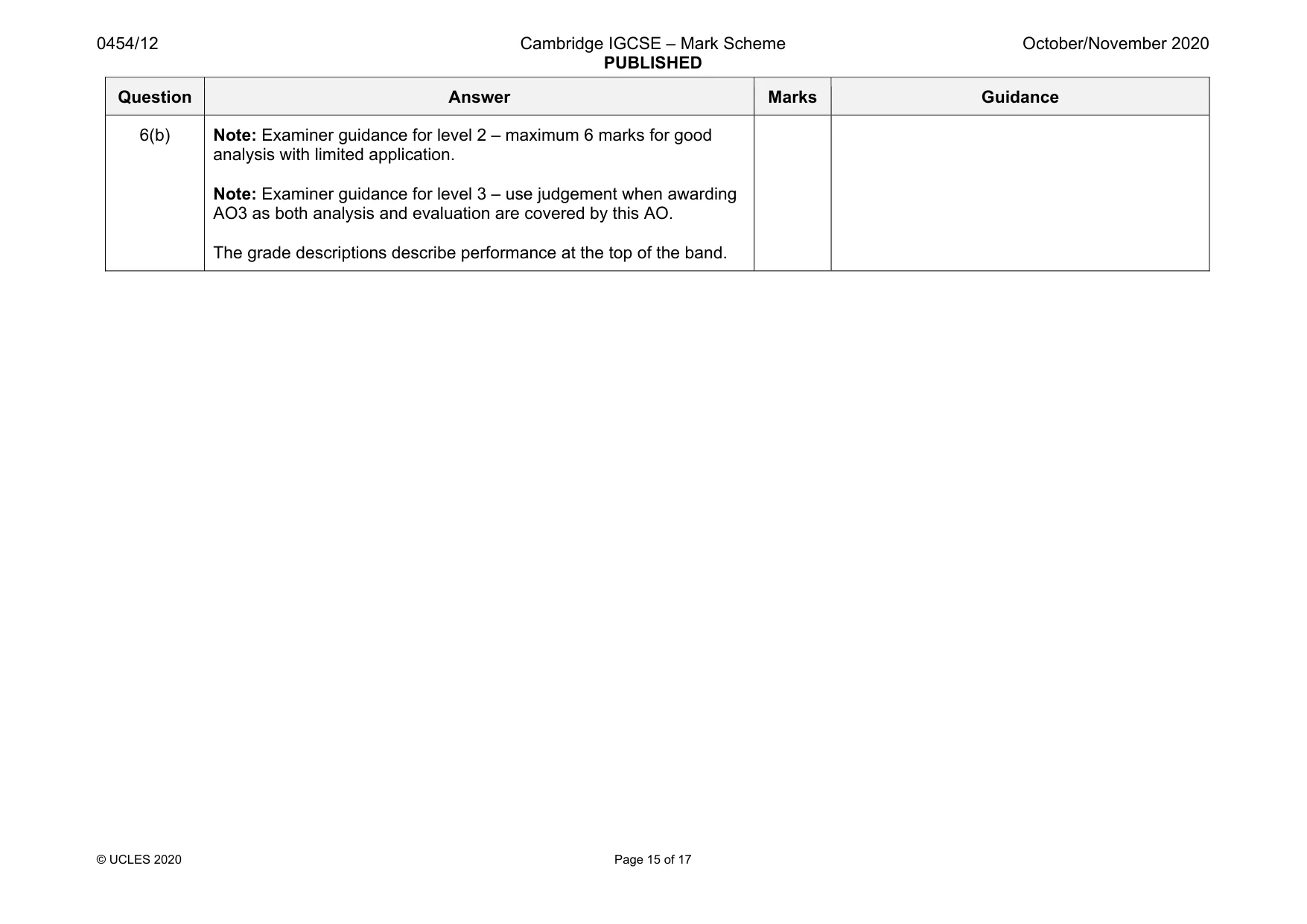
0454/12 Cambridge IGCSE – Mark Scheme PUBLISHED October/November 2020 © UCLES 2020 Page 15 of 17 Question Answer Marks Guidance 6(b) Note: Examiner guidance for level 2 – maximum 6 marks for good analysis with limited application. Note: Examiner guidance for level 3 – use judgement when awarding AO3 as both analysis and evaluation are covered by this AO. The grade descriptions describe performance at the top of the band.
Mark scheme, page 16
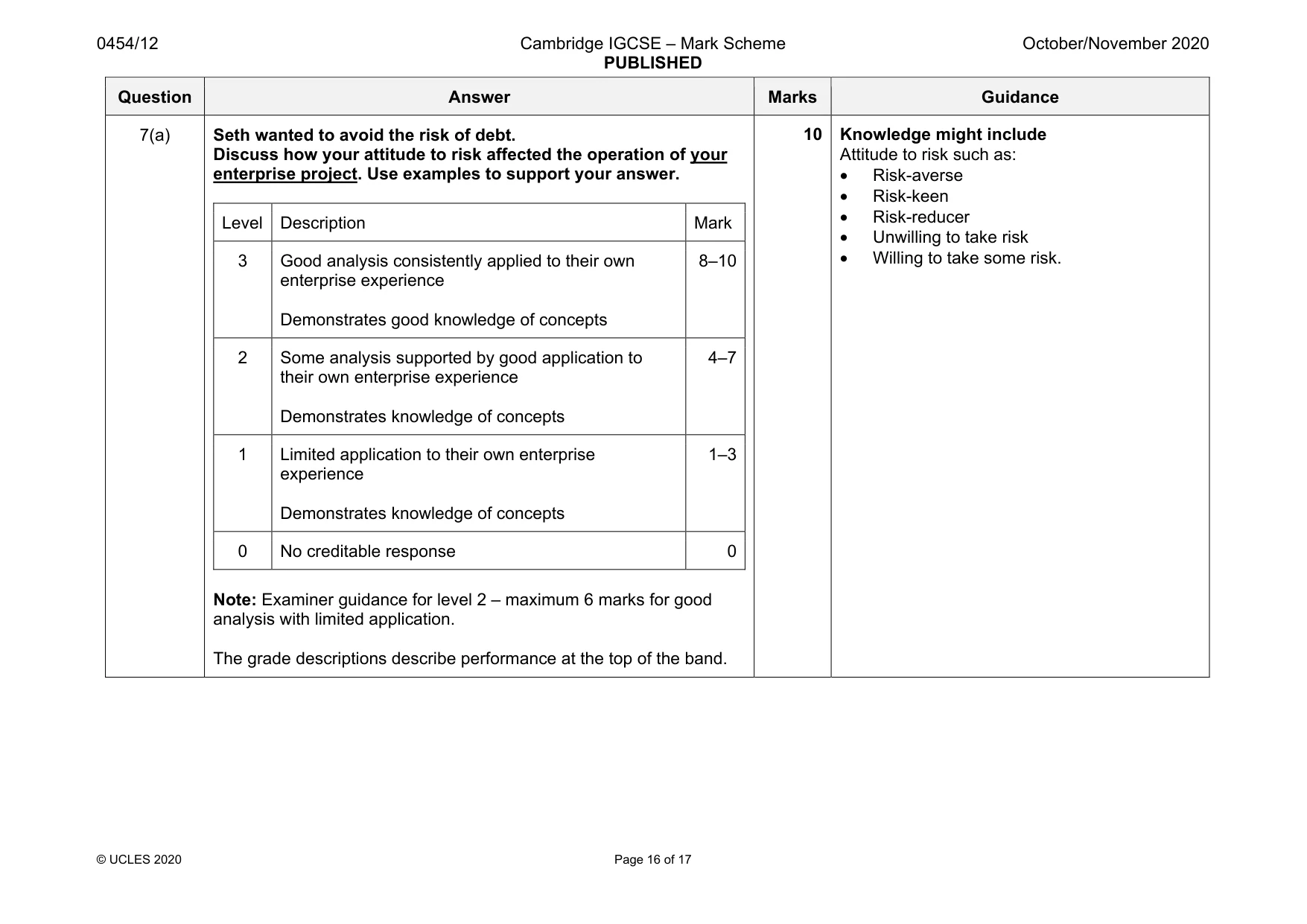
0454/12 Cambridge IGCSE – Mark Scheme PUBLISHED October/November 2020 © UCLES 2020 Page 16 of 17 Question Answer Marks Guidance 7(a) Seth wanted to avoid the risk of debt. Discuss how your attitude to risk affected the operation of your enterprise project. Use examples to support your answer. Level Description Mark 3 Good analysis consistently applied to their own enterprise experience Demonstrates good knowledge of concepts 8–10 2 Some analysis supported by good application to their own enterprise experience Demonstrates knowledge of concepts 4–7 1 Limited application to their own enterprise experience Demonstrates knowledge of concepts 1–3 0 No creditable response 0 Note: Examiner guidance for level 2 – maximum 6 marks for good analysis with limited application. The grade descriptions describe performance at the top of the band. 10 Knowledge might include Attitude to risk such as: • Risk-averse • Risk-keen • Risk-reducer • Unwilling to take risk • Willing to take some risk.
Mark scheme, page 17
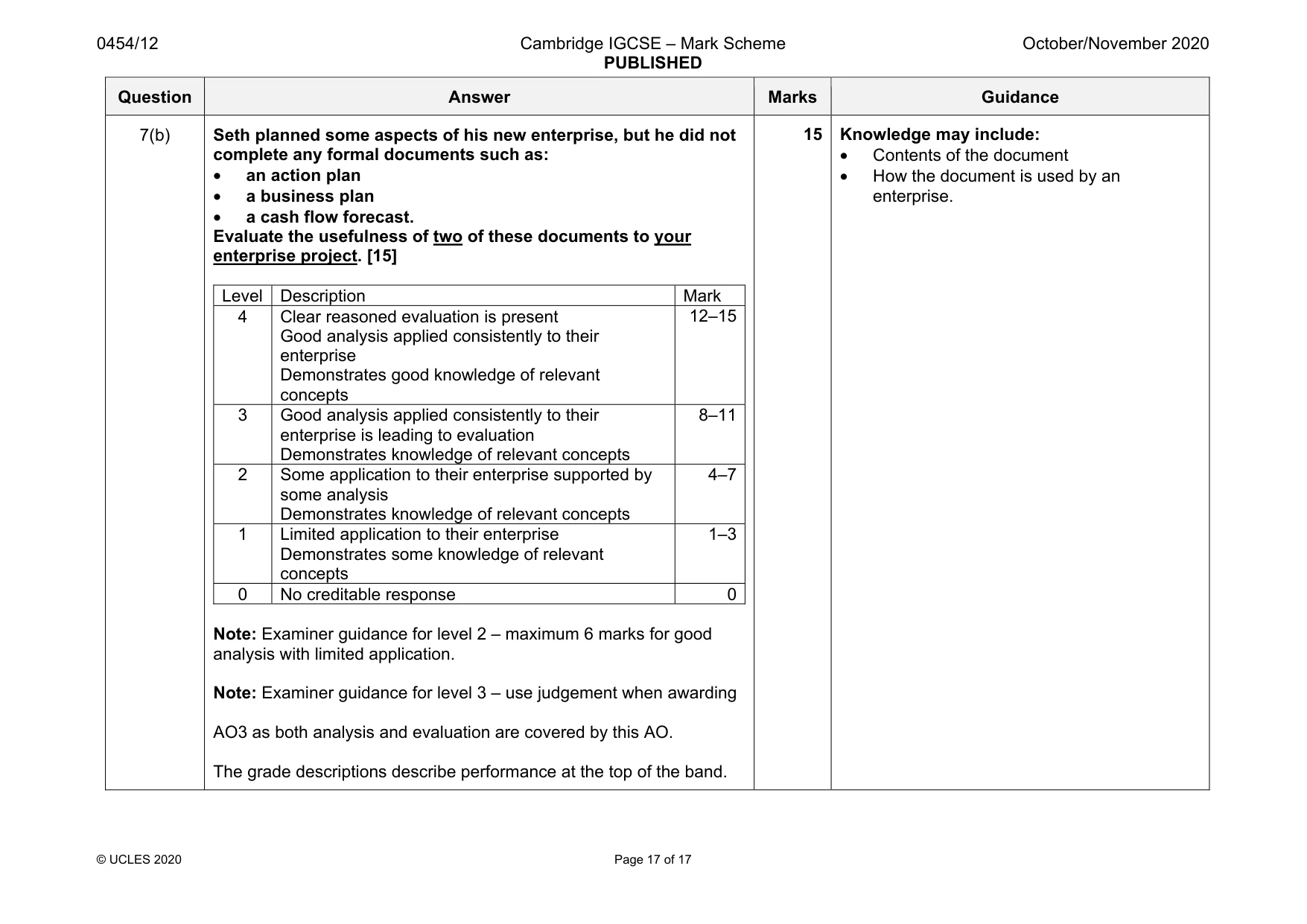
0454/12 Cambridge IGCSE – Mark Scheme PUBLISHED October/November 2020 © UCLES 2020 Page 17 of 17 Question Answer Marks Guidance 7(b) Seth planned some aspects of his new enterprise, but he did not complete any formal documents such as: • an action plan • a business plan • a cash flow forecast. Evaluate the usefulness of two of these documents to your enterprise project. [15] Level Description Mark 4 Clear reasoned evaluation is present Good analysis applied consistently to their enterprise Demonstrates good knowledge of relevant concepts 12–15 3 Good analysis applied consistently to their enterprise is leading to evaluation Demonstrates knowledge of relevant concepts 8–11 2 Some application to their enterprise supported by some analysis Demonstrates knowledge of relevant concepts 4–7 1 Limited application to their enterprise Demonstrates some knowledge of relevant concepts 1–3 0 No creditable response 0 Note: Examiner guidance for level 2 – maximum 6 marks for good analysis with limited application. Note: Examiner guidance for level 3 – use judgement when awarding AO3 as both analysis and evaluation are covered by this AO. The grade descriptions describe performance at the top of the band. 15 Knowledge may include: • Contents of the document • How the document is used by an enterprise.
What you needed in this session
Cambridge’s own grade thresholds for 2020 Oct/Nov, Paper 1 · Variant 2. A higher threshold means an easier paper — the bar moves with how the cohort did.