Cambridge IGCSE Enterprise 0454 — 2023 May/June Paper 1 · Variant 3
0454/13/M/J/23 · 100 marks · ≈113 min
The question paper and its mark scheme, free to read here and free to download. This is Cambridge’s own paper, exactly as it was sat.
Question paper16 pages






Mark scheme24 pages
Answers below. Sit the paper first if you are practising.
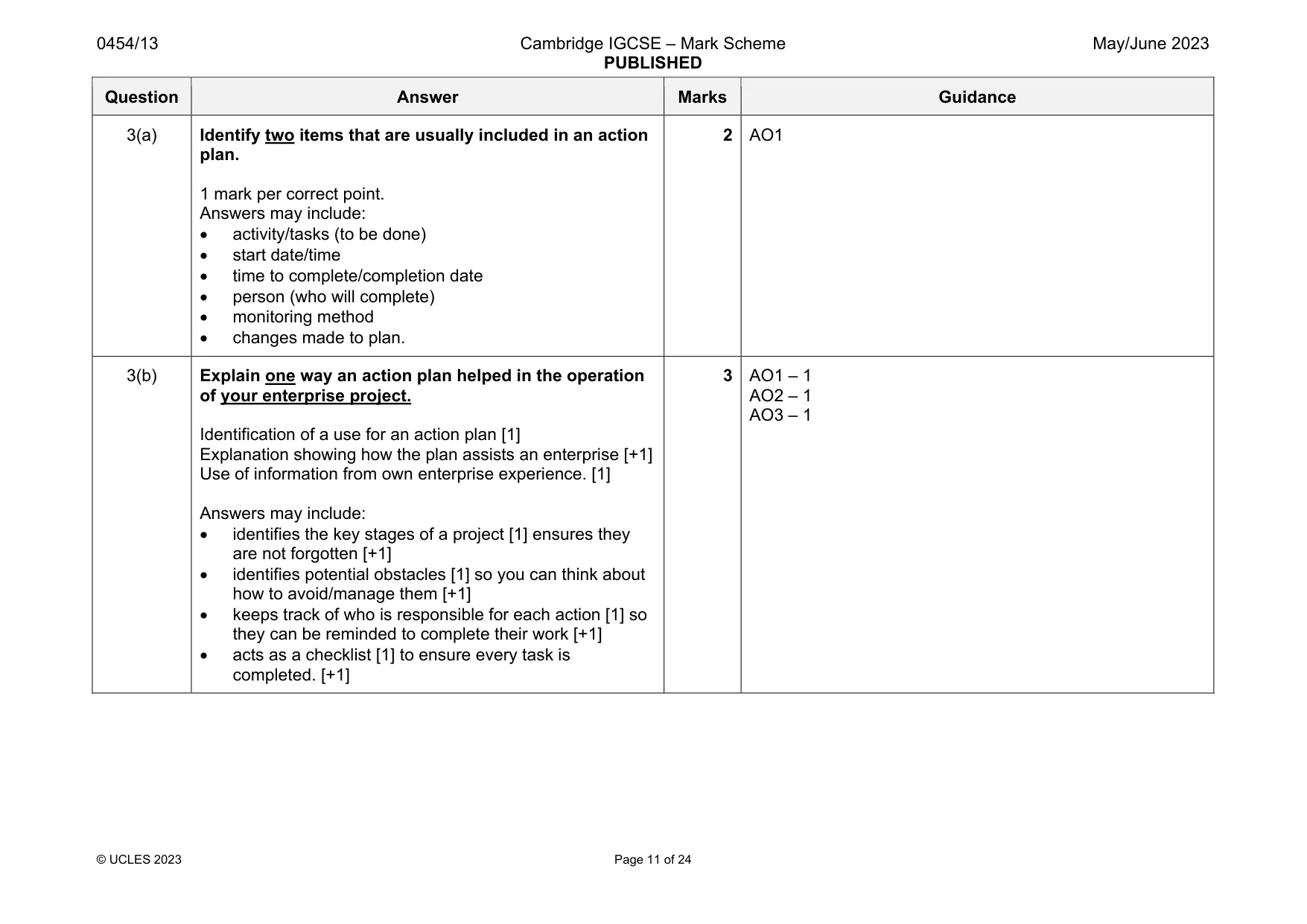
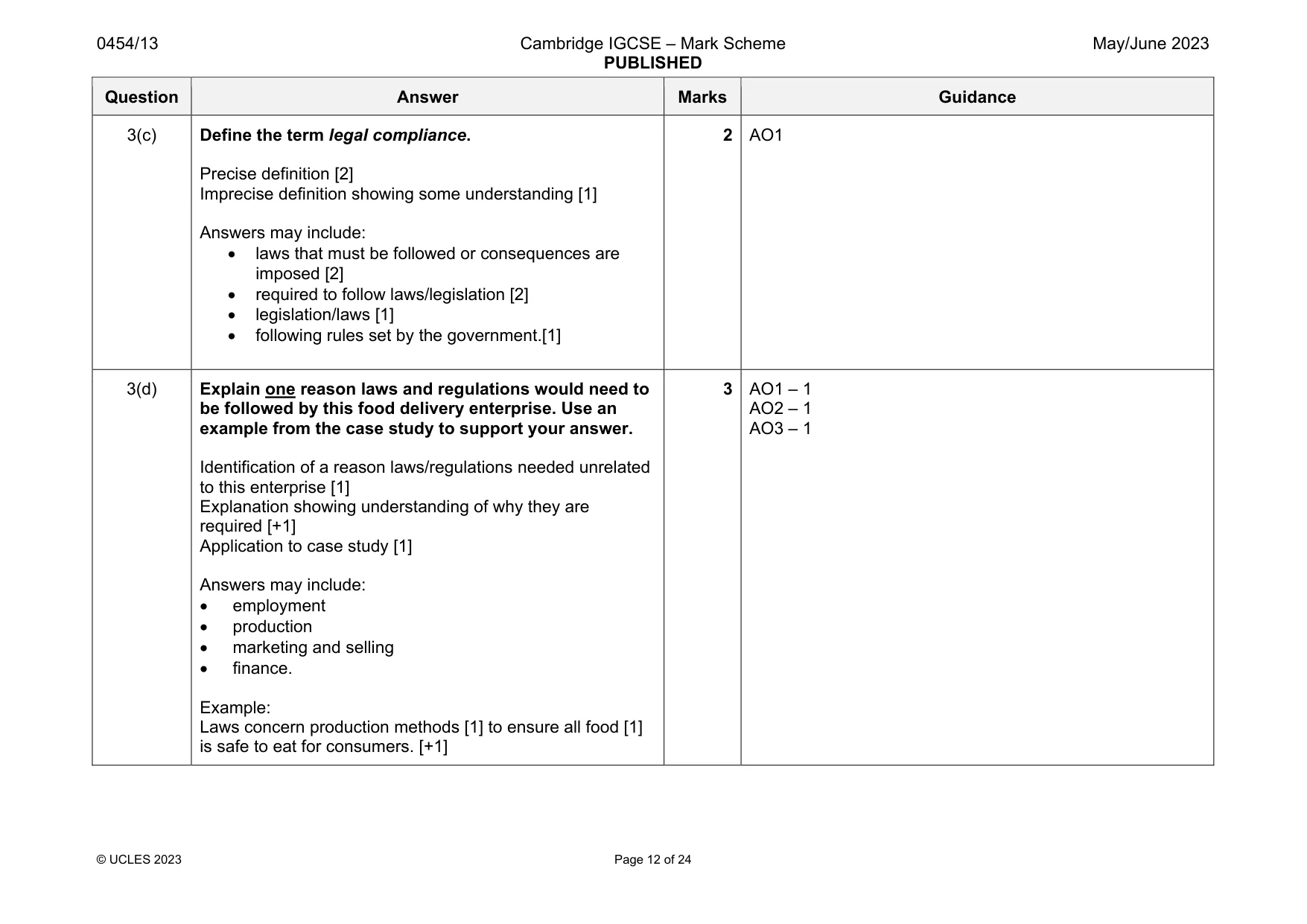
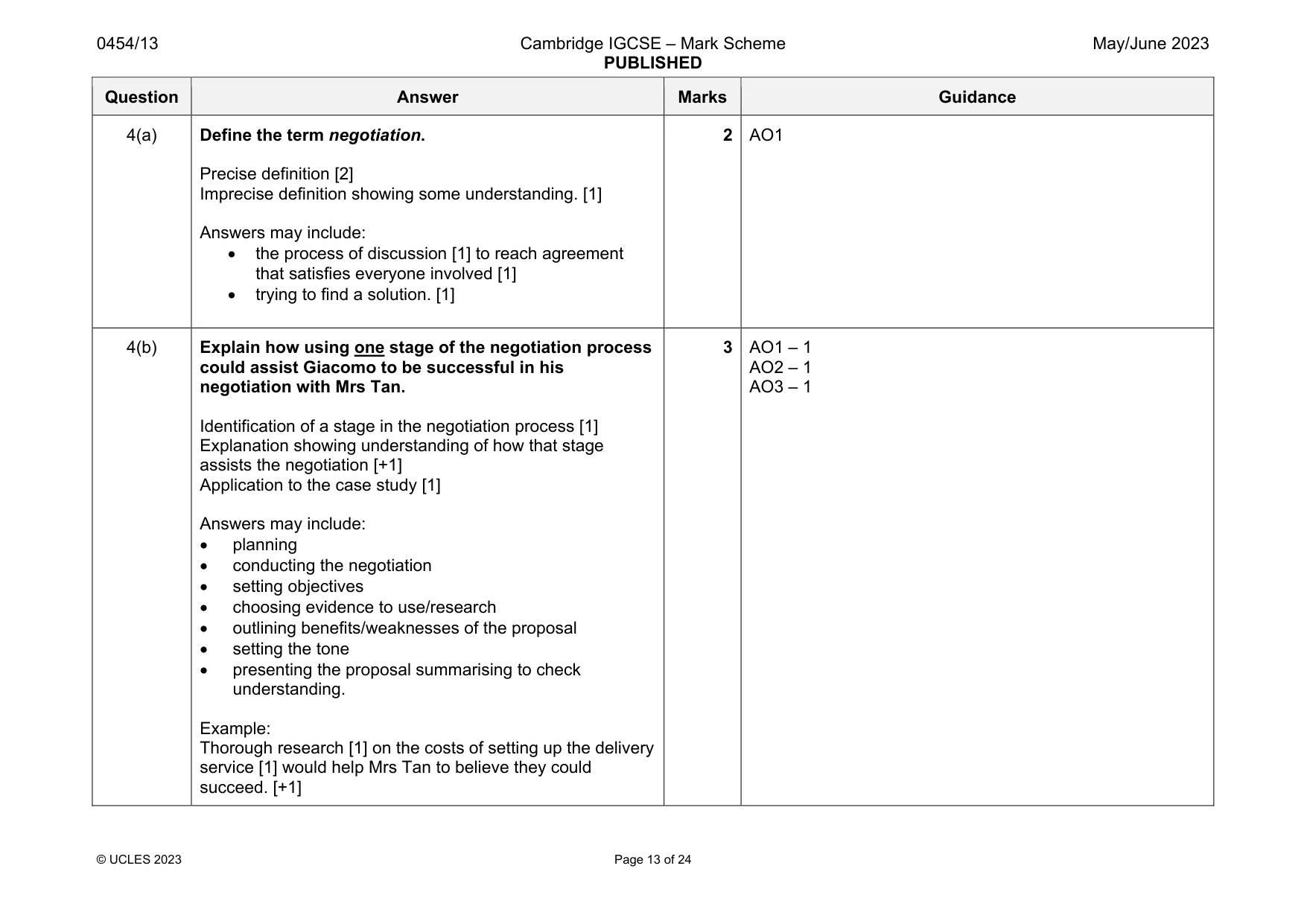
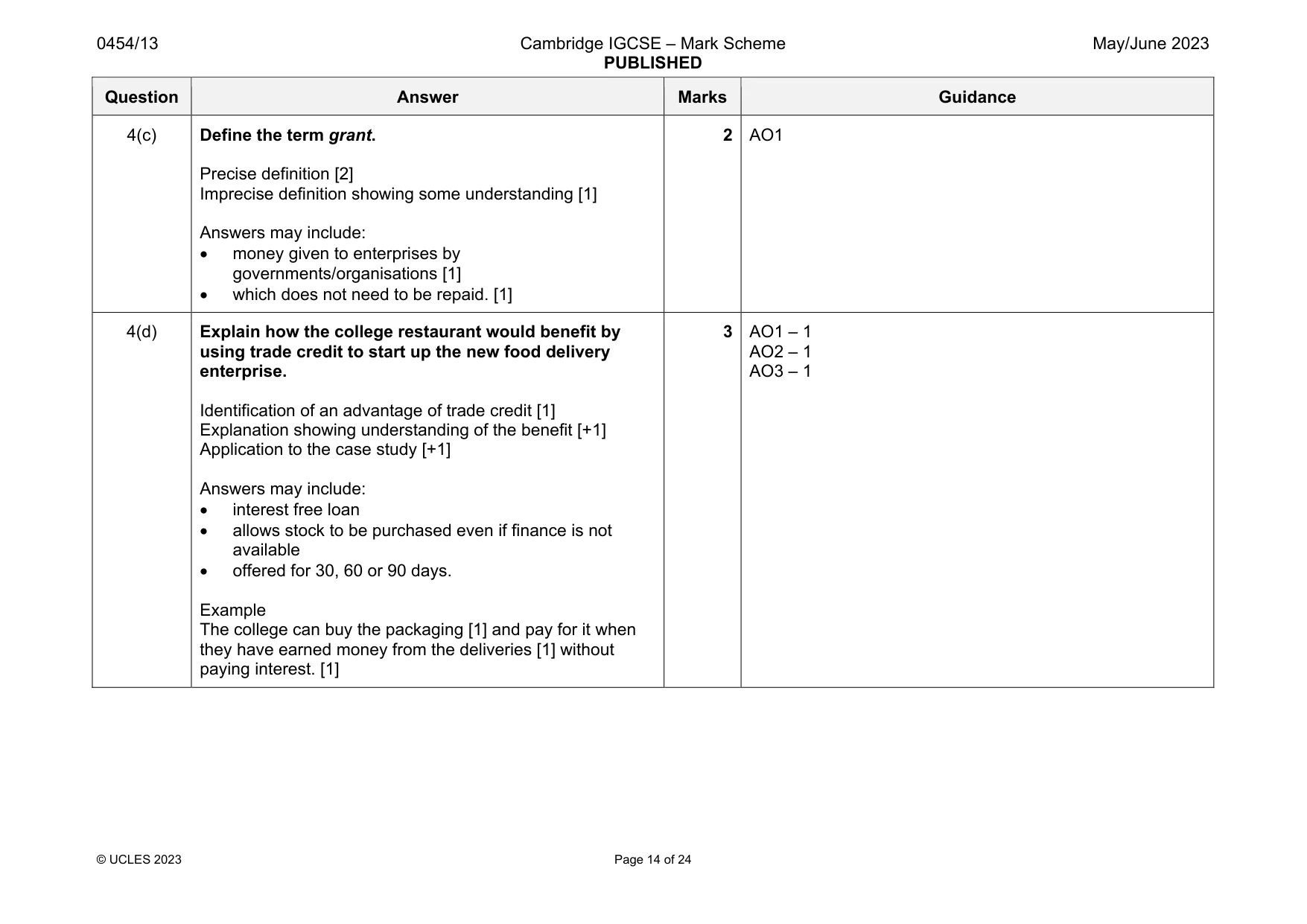
Paper as text
Question paper, page 1
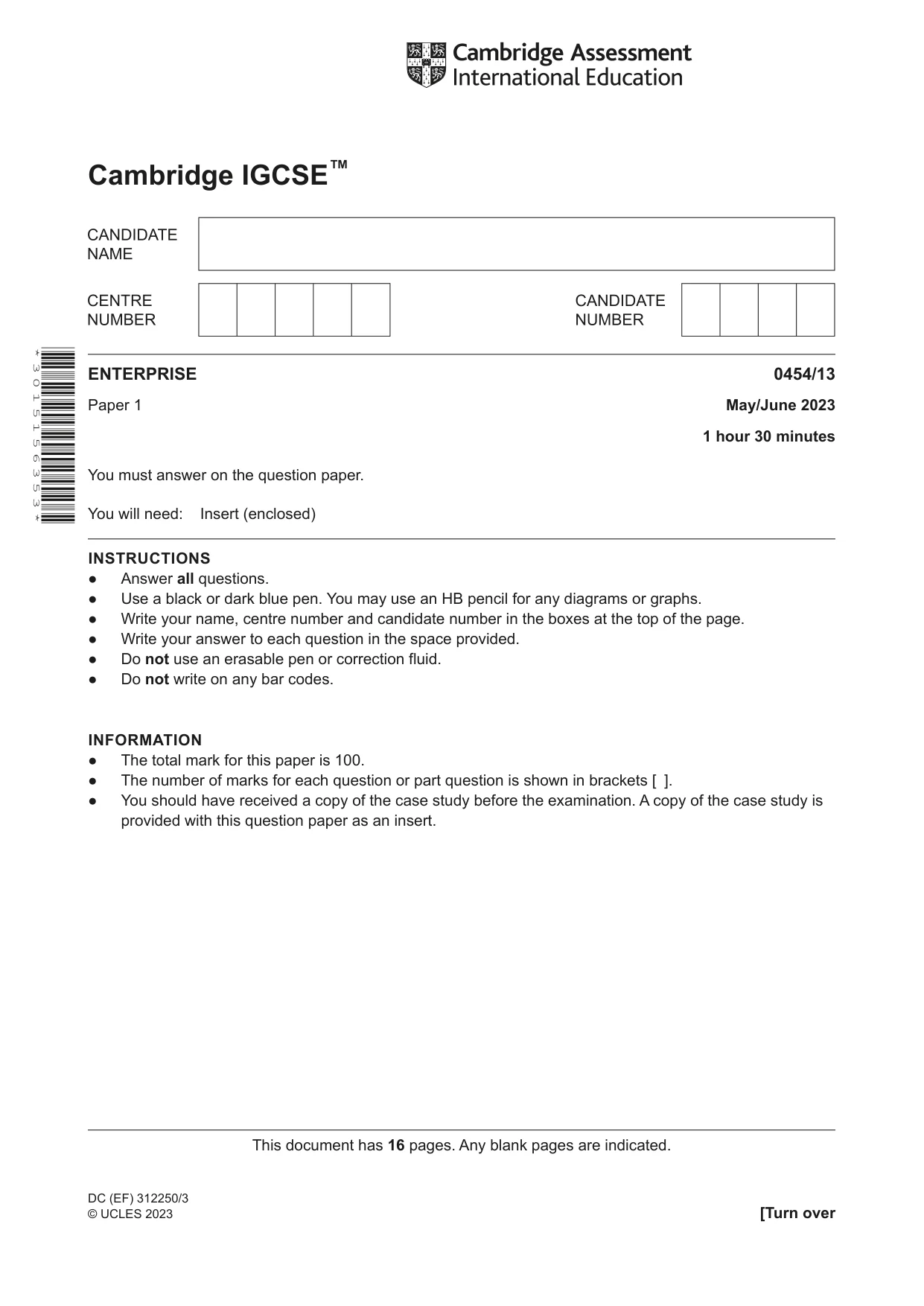
This document has 16 pages. Any blank pages are indicated. [Turn over Cambridge IGCSE™ * 3 0 1 5 1 5 6 3 5 3 * DC (EF) 312250/3 © UCLES 2023 ENTERPRISE 0454/13 Paper 1 May/June 2023 1 hour 30 minutes You must answer on the question paper. You will need: Insert (enclosed) INSTRUCTIONS ● Answer all questions. ● Use a black or dark blue pen. You may use an HB pencil for any diagrams or graphs. ● Write your name, centre number and candidate number in the boxes at the top of the page. ● Write your answer to each question in the space provided. ● Do not use an erasable pen or correction fluid. ● Do not write on any bar codes. INFORMATION ● The total mark for this paper is 100. ● The number of marks for each question or part question is shown in brackets [ ]. ● You should have received a copy of the case study before the examination. A copy of the case study is provided with this question paper as an insert.
Question paper, page 2
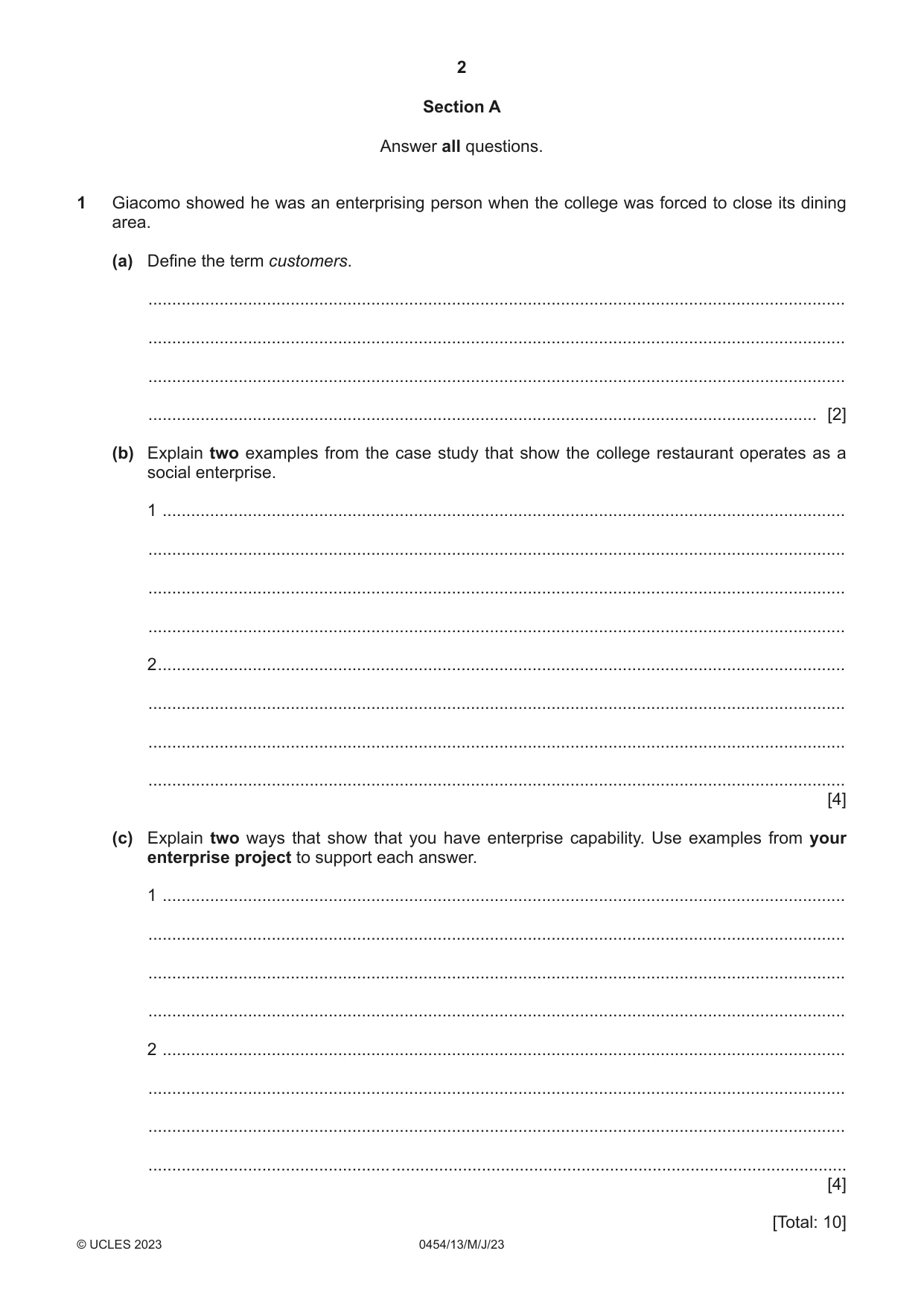
2 0454/13/M/J/23 © UCLES 2023 Section A Answer all questions. 1 Giacomo showed he was an enterprising person when the college was forced to close its dining area. (a) Define the term customers. … … … … [2] (b) Explain two examples from the case study that show the college restaurant operates as a social enterprise. 1 … … … … 2 … … … … [4] (c) Explain two ways that show that you have enterprise capability. Use examples from your enterprise project to support each answer. 1 … … … … 2 … … … … [4] [Total: 10]
Question paper, page 3
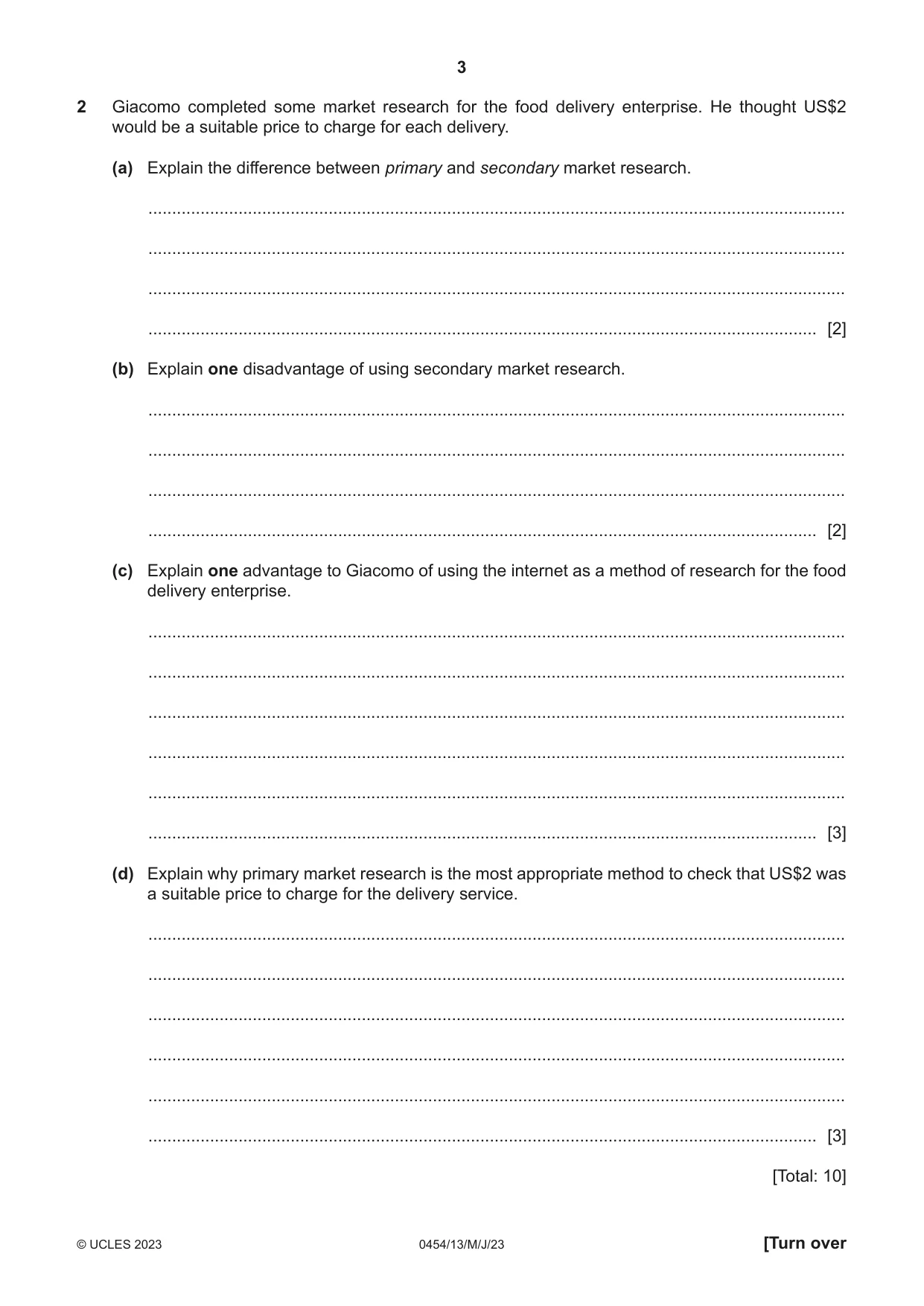
3 0454/13/M/J/23 © UCLES 2023 [Turn over 2 Giacomo completed some market research for the food delivery enterprise. He thought US$2 would be a suitable price to charge for each delivery. (a) Explain the difference between primary and secondary market research. … … … … [2] (b) Explain one disadvantage of using secondary market research. … … … … [2] (c) Explain one advantage to Giacomo of using the internet as a method of research for the food delivery enterprise. … … … … … … [3] (d) Explain why primary market research is the most appropriate method to check that US$2 was a suitable price to charge for the delivery service. … … … … … … [3] [Total: 10]
Question paper, page 4
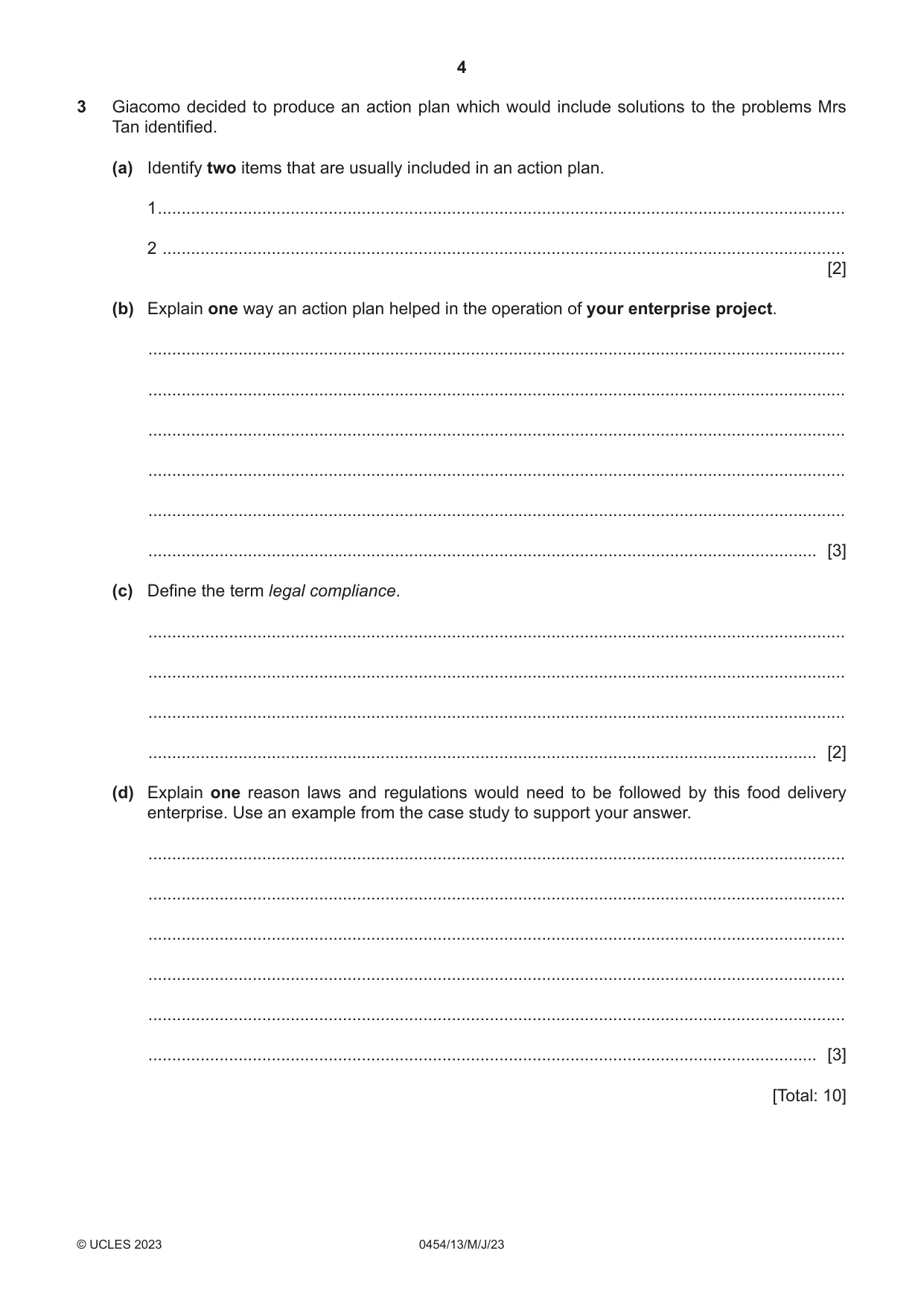
4 0454/13/M/J/23 © UCLES 2023 3 Giacomo decided to produce an action plan which would include solutions to the problems Mrs Tan identified. (a) Identify two items that are usually included in an action plan. 1 … 2 … [2] (b) Explain one way an action plan helped in the operation of your enterprise project. … … … … … … [3] (c) Define the term legal compliance. … … … … [2] (d) Explain one reason laws and regulations would need to be followed by this food delivery enterprise. Use an example from the case study to support your answer. … … … … … … [3] [Total: 10]
Question paper, page 5
5 0454/13/M/J/23 © UCLES 2023 [Turn over 4 Giacomo intended to negotiate with Mrs Tan to be allowed to start one of the two delivery services. (a) Define the term negotiation. … … … … [2] (b) Explain how using one stage of the negotiation process could assist Giacomo to be successful in his negotiation with Mrs Tan. Stage … Explanation … … … … … [3] (c) Define the term grant. … … … … [2] (d) Explain how the college restaurant would benefit by using trade credit to start up the new food delivery enterprise. … … … … … … [3] [Total: 10]
Question paper, page 6
6 0454/13/M/J/23 © UCLES 2023 5 Giacomo researched items needed for a food delivery enterprise. The results of this research are shown in the case study in Fig. 1. (a) Explain one reason why Giacomo should choose the recyclable packaging. … … … … [2] (b) Calculate how many deliveries are required to break even if only recyclable packaging is used. Show your working. … … … … … … … … … Number of deliveries required to break even … [5] (c) Explain one way that Giacomo could reduce the number of deliveries needed to break even. … … … … … … [3] [Total: 10]
Question paper, page 7
7 0454/13/M/J/23 © UCLES 2023 [Turn over Section B Answer all questions. 6 (a) The college restaurant is a popular venue with many loyal customers from the local community. Analyse two methods the college restaurant could use to retain existing customers if they choose to operate a food delivery enterprise. … … … … … … … … … … … … … … … … … … … … … … … [10]
Question paper, page 8
8 0454/13/M/J/23 © UCLES 2023 (b) Giacomo decided to present both ideas to Mrs Tan. The two ideas for delivery services were: • a restaurant cooked meal • a ‘prepare at home’ meal. Evaluate which of the two ideas would be the most appropriate to ensure the success of the college restaurant. You should consider the risks and rewards of each idea to support your answer. … … … … … … … … … … … … … … … … … … … … … … … …
Question paper, page 9
9 0454/13/M/J/23 © UCLES 2023 [Turn over … … … … … … … … … … … … … … … … … … … … … … … … … … … [15] [Total: 25]
Question paper, page 10
10 0454/13/M/J/23 © UCLES 2023 BLANK PAGE
Question paper, page 11
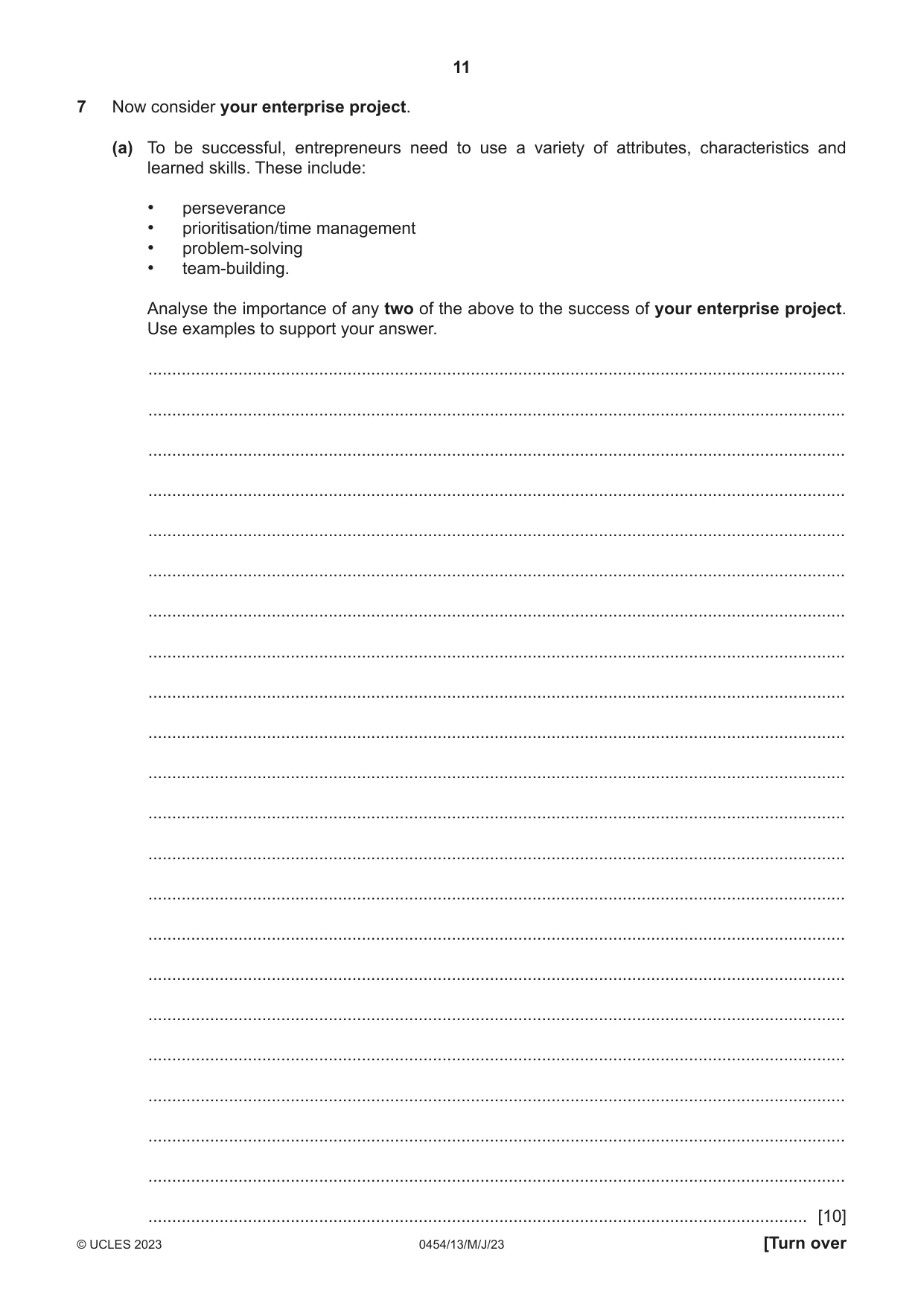
11 0454/13/M/J/23 © UCLES 2023 [Turn over 7 Now consider your enterprise project. (a) To be successful, entrepreneurs need to use a variety of attributes, characteristics and learned skills. These include: • perseverance • prioritisation/time management • problem‑solving • team‑building. Analyse the importance of any two of the above to the success of your enterprise project. Use examples to support your answer. … … … … … … … … … … … … … … … … … … … … … … [10]
Question paper, page 12
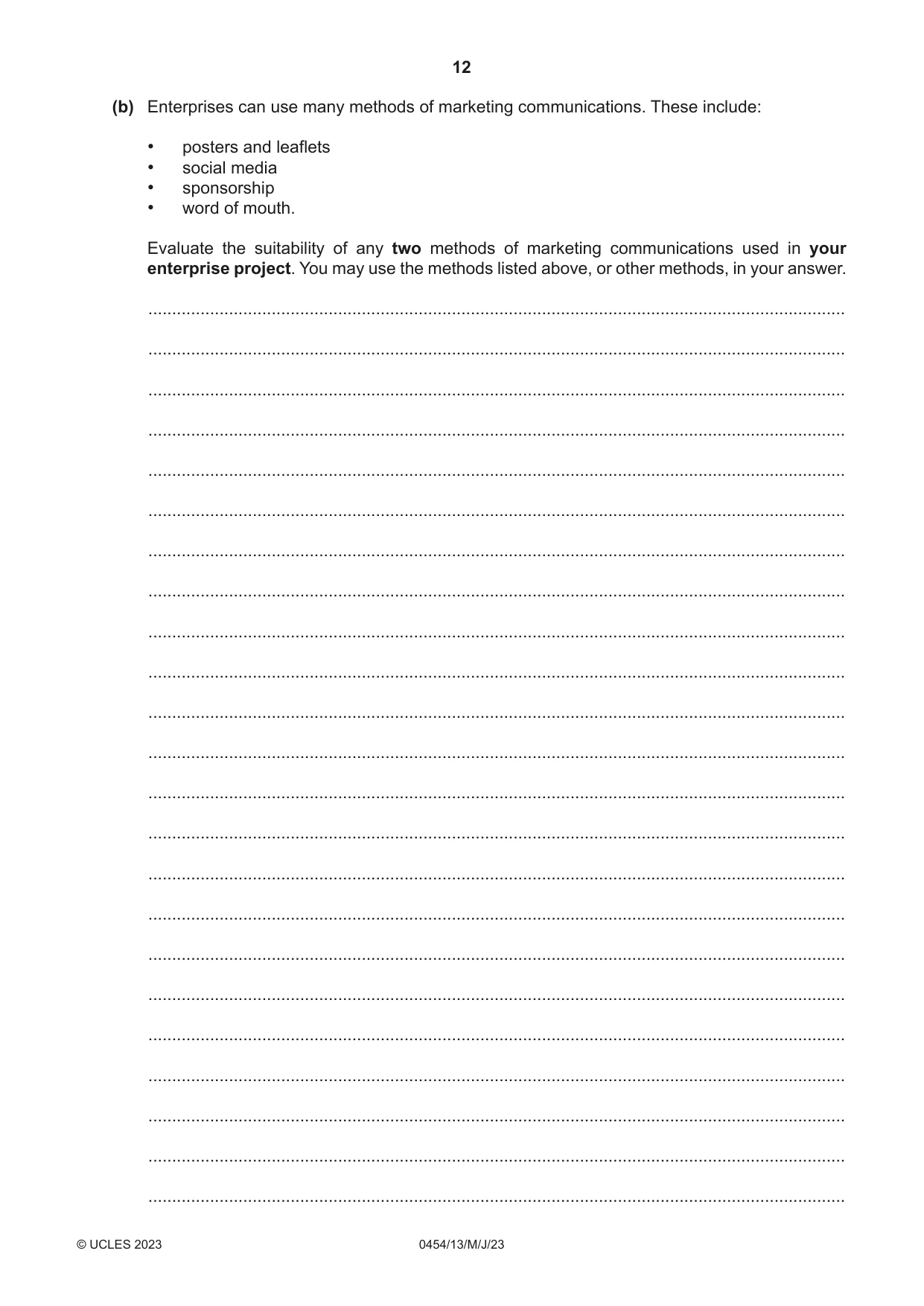
12 0454/13/M/J/23 © UCLES 2023 (b) Enterprises can use many methods of marketing communications. These include: • posters and leaflets • social media • sponsorship • word of mouth. Evaluate the suitability of any two methods of marketing communications used in your enterprise project. You may use the methods listed above, or other methods, in your answer. … … … … … … … … … … … … … … … … … … … … … … …
Question paper, page 13
13 0454/13/M/J/23 © UCLES 2023 … … … … … … … … … … … … … … … … … … … … … … … … … … … [15] [Total: 25]
Question paper, page 14
14 0454/13/M/J/23 © UCLES 2023 BLANK PAGE
Question paper, page 15
15 0454/13/M/J/23 © UCLES 2023 BLANK PAGE
Question paper, page 16
16 0454/13/M/J/23 © UCLES 2023 Permission to reproduce items where third‑party owned material protected by copyright is included has been sought and cleared where possible. Every reasonable effort has been made by the publisher (UCLES) to trace copyright holders, but if any items requiring clearance have unwittingly been included, the publisher will be pleased to make amends at the earliest possible opportunity. To avoid the issue of disclosure of answer‑related information to candidates, all copyright acknowledgements are reproduced online in the Cambridge Assessment International Education Copyright Acknowledgements Booklet. This is produced for each series of examinations and is freely available to download at www.cambridgeinternational.org after the live examination series. Cambridge Assessment International Education is part of Cambridge Assessment. Cambridge Assessment is the brand name of the University of Cambridge Local Examinations Syndicate (UCLES), which is a department of the University of Cambridge. BLANK PAGE
Mark scheme, page 1
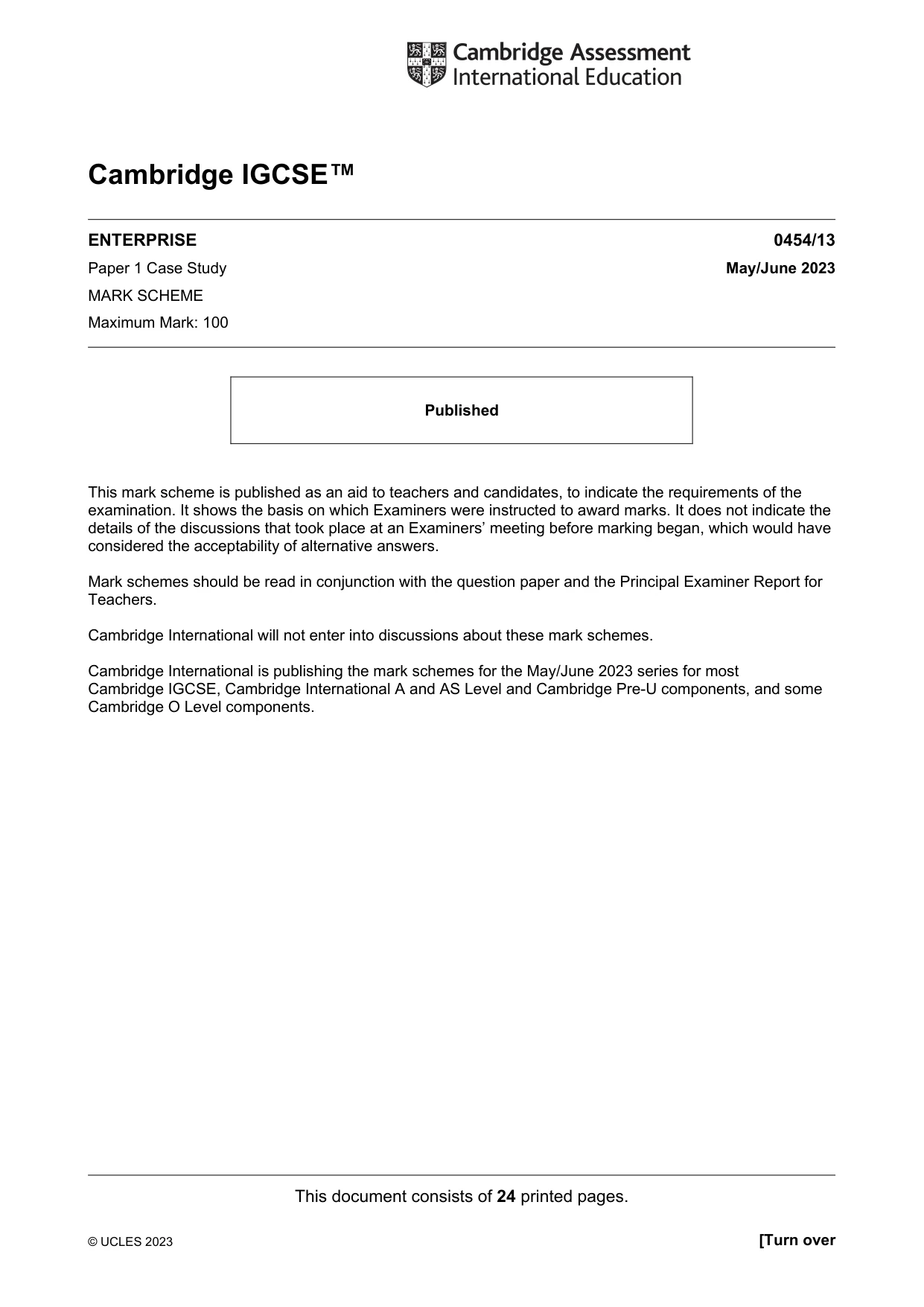
This document consists of 24 printed pages. © UCLES 2023 [Turn over Cambridge IGCSE™ ENTERPRISE 0454/13 Paper 1 Case Study May/June 2023 MARK SCHEME Maximum Mark: 100 Published This mark scheme is published as an aid to teachers and candidates, to indicate the requirements of the examination. It shows the basis on which Examiners were instructed to award marks. It does not indicate the details of the discussions that took place at an Examiners’ meeting before marking began, which would have considered the acceptability of alternative answers. Mark schemes should be read in conjunction with the question paper and the Principal Examiner Report for Teachers. Cambridge International will not enter into discussions about these mark schemes. Cambridge International is publishing the mark schemes for the May/June 2023 series for most Cambridge IGCSE, Cambridge International A and AS Level and Cambridge Pre-U components, and some Cambridge O Level components.
Mark scheme, page 2
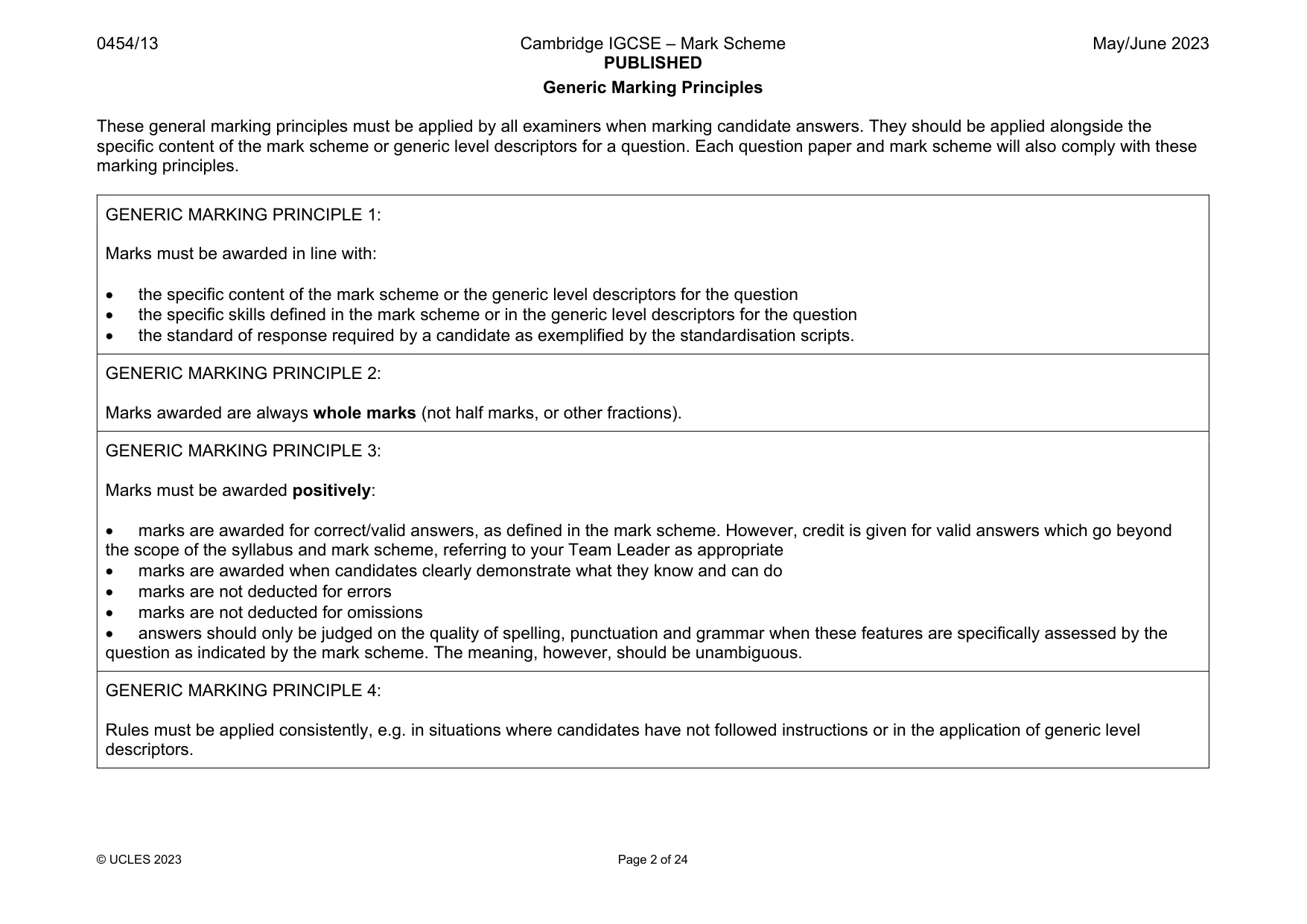
0454/13 Cambridge IGCSE – Mark Scheme PUBLISHED May/June 2023 © UCLES 2023 Page 2 of 24 Generic Marking Principles These general marking principles must be applied by all examiners when marking candidate answers. They should be applied alongside the specific content of the mark scheme or generic level descriptors for a question. Each question paper and mark scheme will also comply with these marking principles. GENERIC MARKING PRINCIPLE 1: Marks must be awarded in line with: the specific content of the mark scheme or the generic level descriptors for the question the specific skills defined in the mark scheme or in the generic level descriptors for the question the standard of response required by a candidate as exemplified by the standardisation scripts. GENERIC MARKING PRINCIPLE 2: Marks awarded are always whole marks (not half marks, or other fractions). GENERIC MARKING PRINCIPLE 3: Marks must be awarded positively: marks are awarded for correct/valid answers, as defined in the mark scheme. However, credit is given for valid answers which go beyond the scope of the syllabus and mark scheme, referring to your Team Leader as appropriate marks are awarded when candidates clearly demonstrate what they know and can do marks are not deducted for errors marks are not deducted for omissions answers should only be judged on the quality of spelling, punctuation and grammar when these features are specifically assessed by the question as indicated by the mark scheme. The meaning, however, should be unambiguous. GENERIC MARKING PRINCIPLE 4: Rules must be applied consistently, e.g. in situations where candidates have not followed instructions or in the application of generic level descriptors.
Mark scheme, page 3
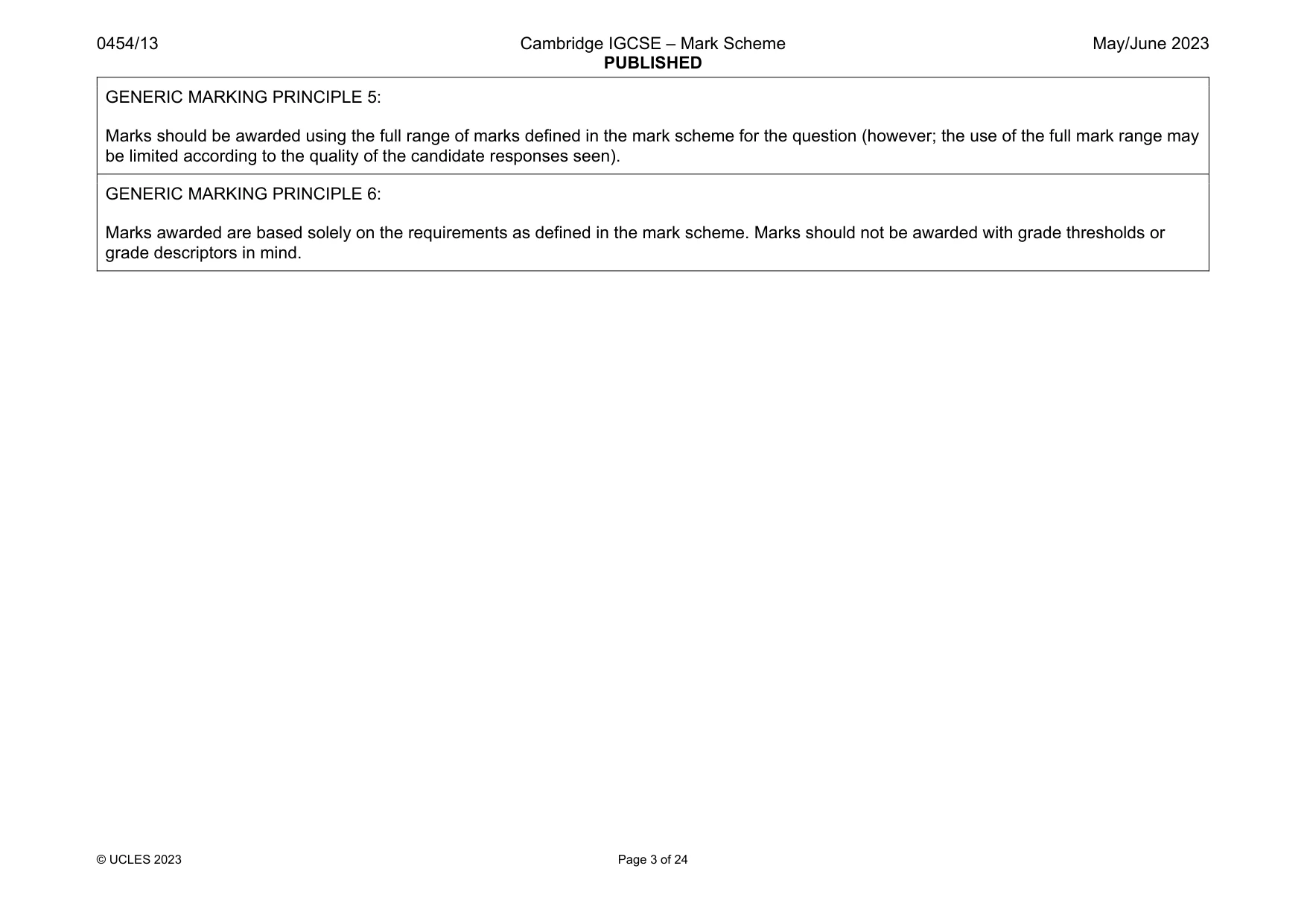
0454/13 Cambridge IGCSE – Mark Scheme PUBLISHED May/June 2023 © UCLES 2023 Page 3 of 24 GENERIC MARKING PRINCIPLE 5: Marks should be awarded using the full range of marks defined in the mark scheme for the question (however; the use of the full mark range may be limited according to the quality of the candidate responses seen). GENERIC MARKING PRINCIPLE 6: Marks awarded are based solely on the requirements as defined in the mark scheme. Marks should not be awarded with grade thresholds or grade descriptors in mind.
Mark scheme, page 4
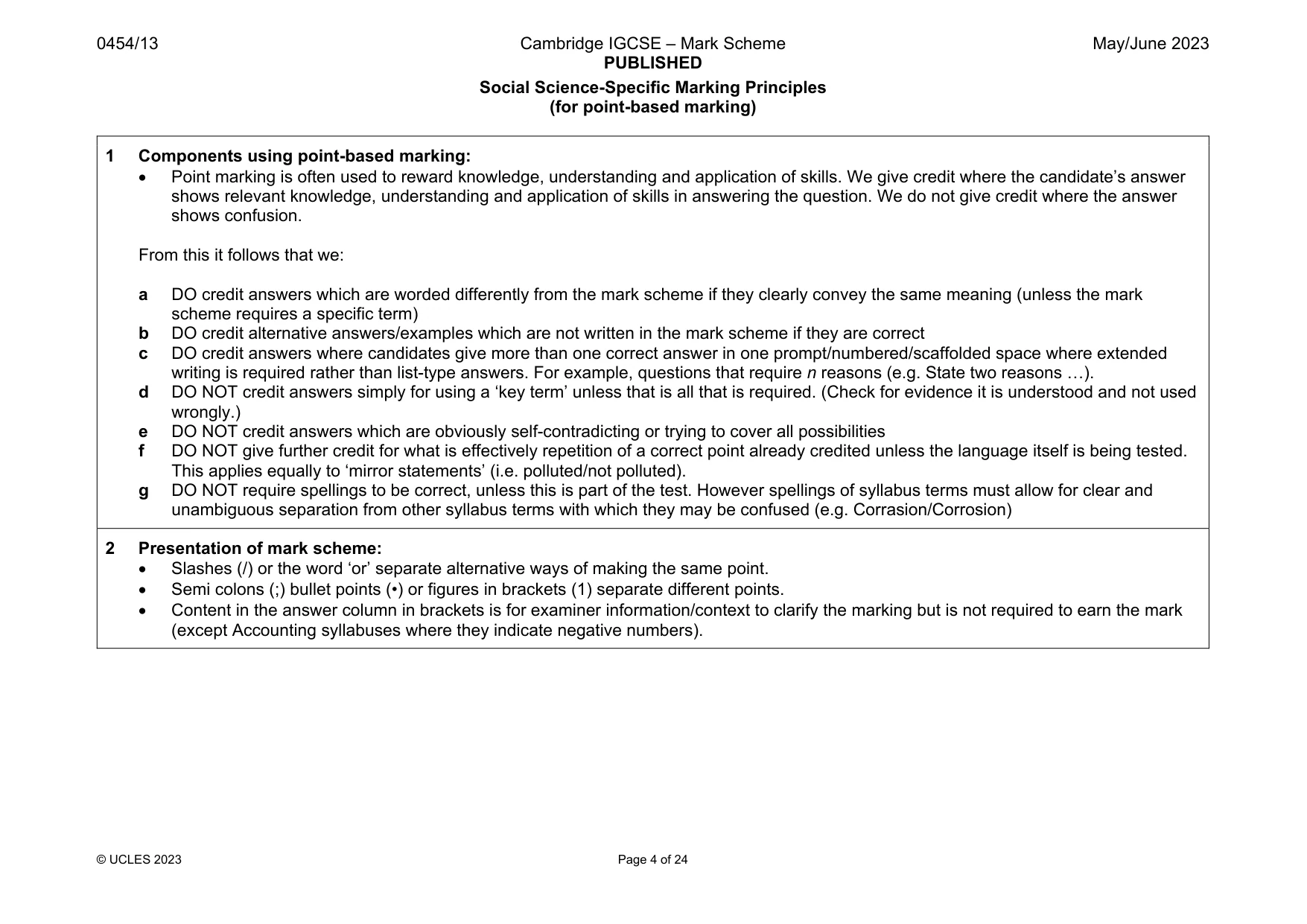
0454/13 Cambridge IGCSE – Mark Scheme PUBLISHED May/June 2023 © UCLES 2023 Page 4 of 24 Social Science-Specific Marking Principles (for point-based marking) 1 Components using point-based marking: Point marking is often used to reward knowledge, understanding and application of skills. We give credit where the candidate’s answer shows relevant knowledge, understanding and application of skills in answering the question. We do not give credit where the answer shows confusion. From this it follows that we: a DO credit answers which are worded differently from the mark scheme if they clearly convey the same meaning (unless the mark scheme requires a specific term) b DO credit alternative answers/examples which are not written in the mark scheme if they are correct c DO credit answers where candidates give more than one correct answer in one prompt/numbered/scaffolded space where extended writing is required rather than list-type answers. For example, questions that require n reasons (e.g. State two reasons …). d DO NOT credit answers simply for using a ‘key term’ unless that is all that is required. (Check for evidence it is understood and not used wrongly.) e DO NOT credit answers which are obviously self-contradicting or trying to cover all possibilities f DO NOT give further credit for what is effectively repetition of a correct point already credited unless the language itself is being tested. This applies equally to ‘mirror statements’ (i.e. polluted/not polluted). g DO NOT require spellings to be correct, unless this is part of the test. However spellings of syllabus terms must allow for clear and unambiguous separation from other syllabus terms with which they may be confused (e.g. Corrasion/Corrosion) 2 Presentation of mark scheme: Slashes (/) or the word ‘or’ separate alternative ways of making the same point. Semi colons (;) bullet points (•) or figures in brackets (1) separate different points. Content in the answer column in brackets is for examiner information/context to clarify the marking but is not required to earn the mark (except Accounting syllabuses where they indicate negative numbers).
Mark scheme, page 5
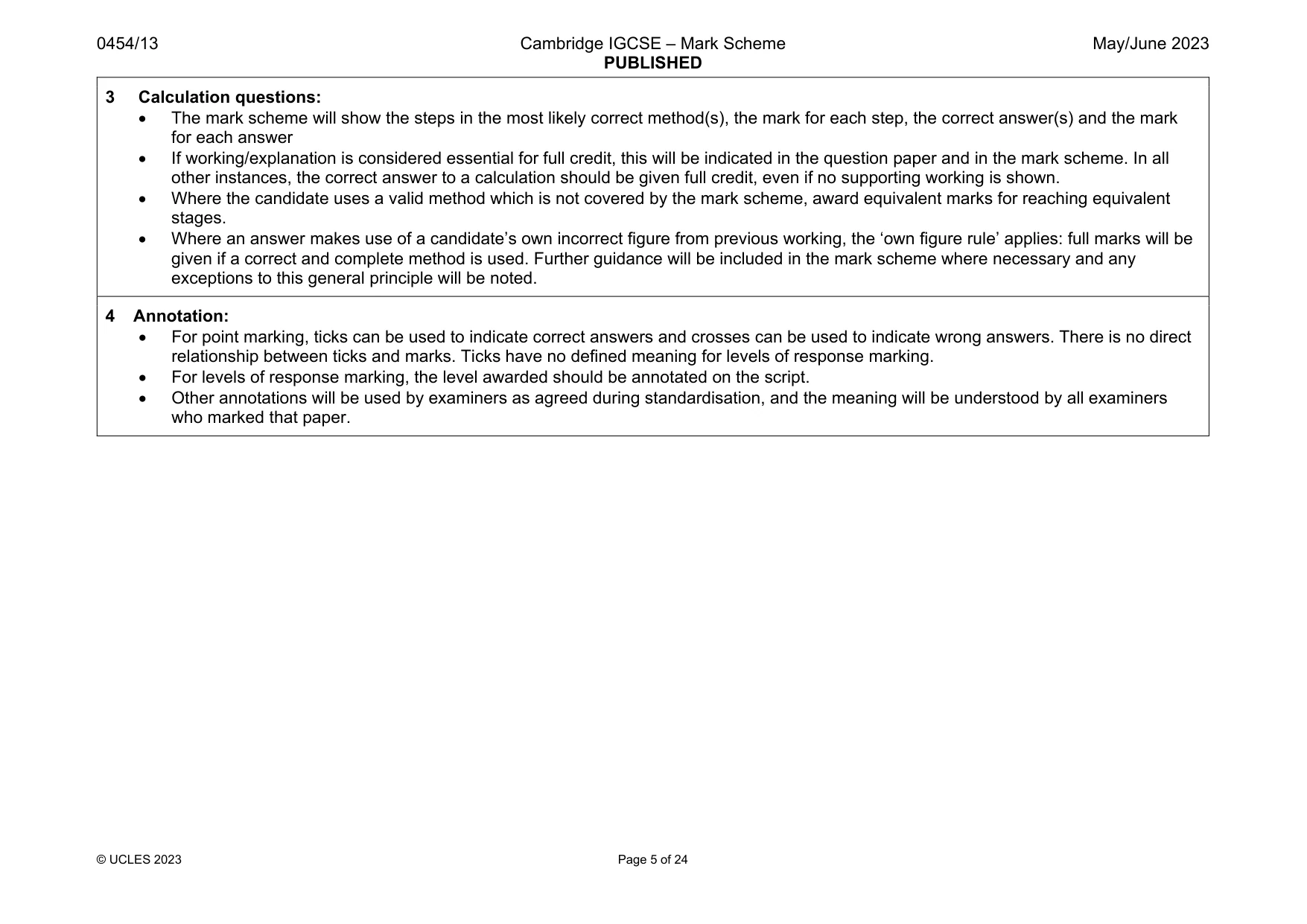
0454/13 Cambridge IGCSE – Mark Scheme PUBLISHED May/June 2023 © UCLES 2023 Page 5 of 24 3 Calculation questions: The mark scheme will show the steps in the most likely correct method(s), the mark for each step, the correct answer(s) and the mark for each answer If working/explanation is considered essential for full credit, this will be indicated in the question paper and in the mark scheme. In all other instances, the correct answer to a calculation should be given full credit, even if no supporting working is shown. Where the candidate uses a valid method which is not covered by the mark scheme, award equivalent marks for reaching equivalent stages. Where an answer makes use of a candidate’s own incorrect figure from previous working, the ‘own figure rule’ applies: full marks will be given if a correct and complete method is used. Further guidance will be included in the mark scheme where necessary and any exceptions to this general principle will be noted. 4 Annotation: For point marking, ticks can be used to indicate correct answers and crosses can be used to indicate wrong answers. There is no direct relationship between ticks and marks. Ticks have no defined meaning for levels of response marking. For levels of response marking, the level awarded should be annotated on the script. Other annotations will be used by examiners as agreed during standardisation, and the meaning will be understood by all examiners who marked that paper.
Mark scheme, page 6
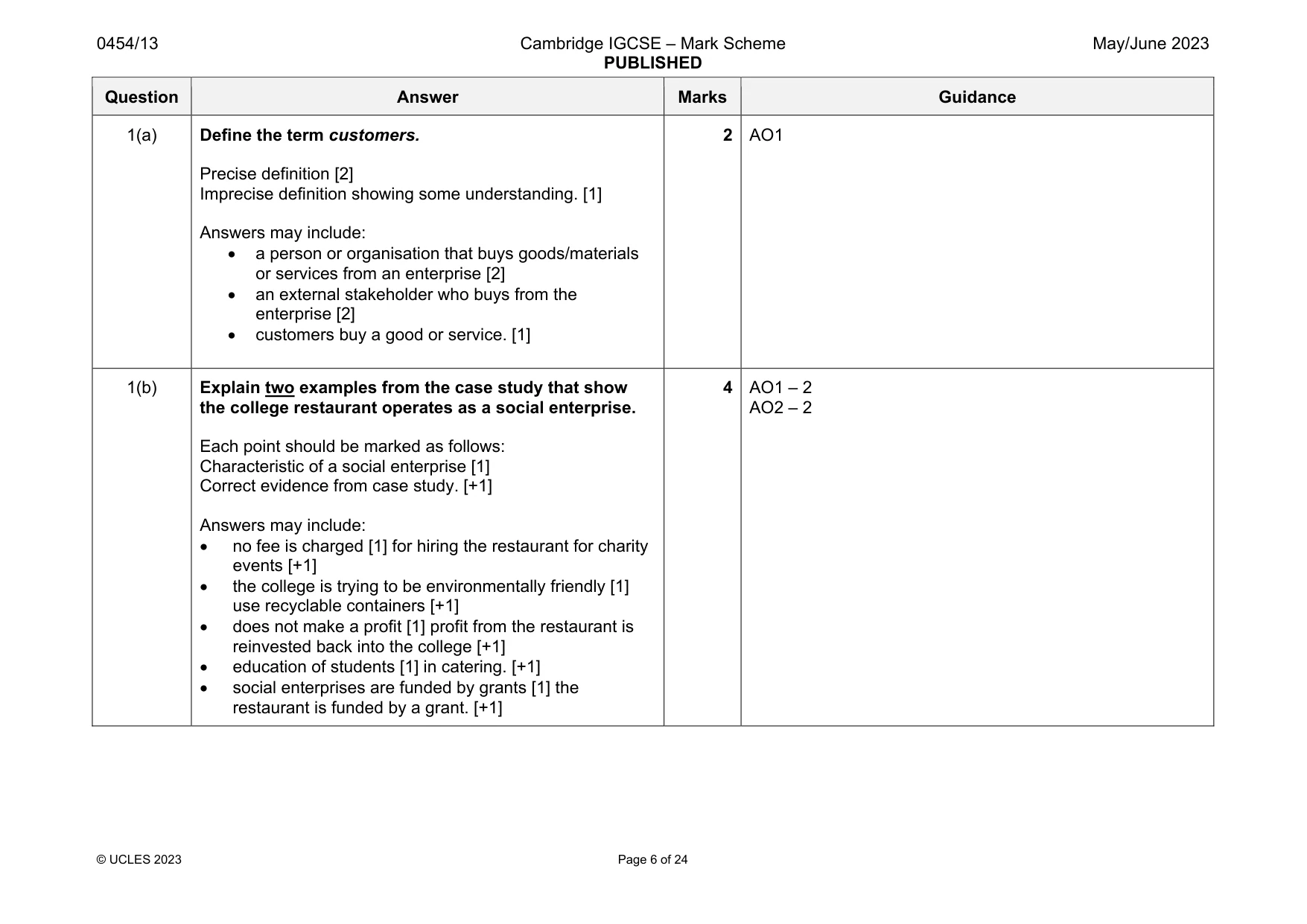
0454/13 Cambridge IGCSE – Mark Scheme PUBLISHED May/June 2023 © UCLES 2023 Page 6 of 24 Question Answer Marks Guidance 1(a) Define the term customers. Precise definition [2] Imprecise definition showing some understanding. [1] Answers may include: a person or organisation that buys goods/materials or services from an enterprise [2] an external stakeholder who buys from the enterprise [2] customers buy a good or service. [1] 2 AO1 1(b) Explain two examples from the case study that show the college restaurant operates as a social enterprise. Each point should be marked as follows: Characteristic of a social enterprise [1] Correct evidence from case study. [+1] Answers may include: no fee is charged [1] for hiring the restaurant for charity events [+1] the college is trying to be environmentally friendly [1] use recyclable containers [+1] does not make a profit [1] profit from the restaurant is reinvested back into the college [+1] education of students [1] in catering. [+1] social enterprises are funded by grants [1] the restaurant is funded by a grant. [+1] 4 AO1 – 2 AO2 – 2
Mark scheme, page 7
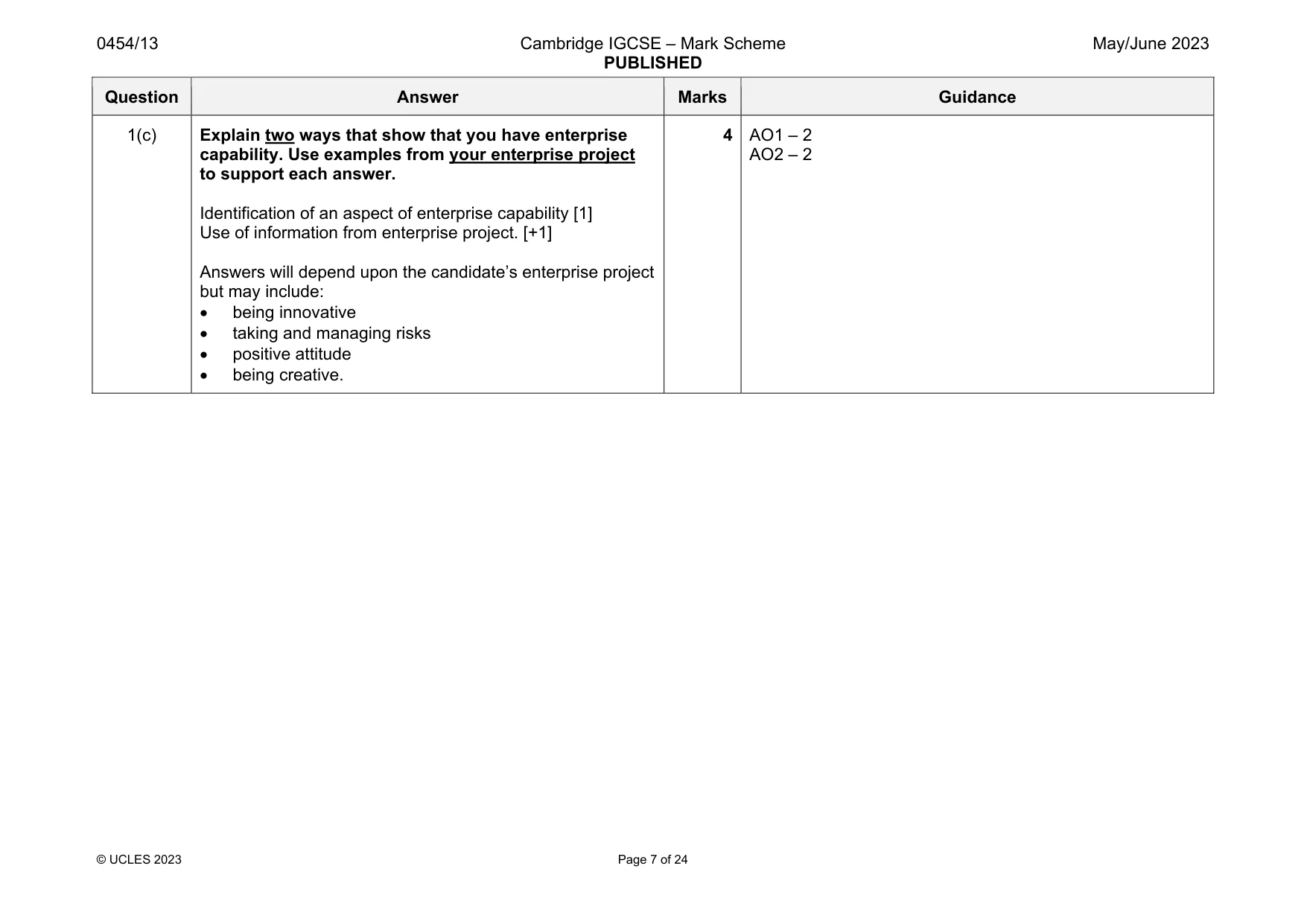
0454/13 Cambridge IGCSE – Mark Scheme PUBLISHED May/June 2023 © UCLES 2023 Page 7 of 24 Question Answer Marks Guidance 1(c) Explain two ways that show that you have enterprise capability. Use examples from your enterprise project to support each answer. Identification of an aspect of enterprise capability [1] Use of information from enterprise project. [+1] Answers will depend upon the candidate’s enterprise project but may include: being innovative taking and managing risks positive attitude being creative. 4 AO1 – 2 AO2 – 2
Mark scheme, page 8
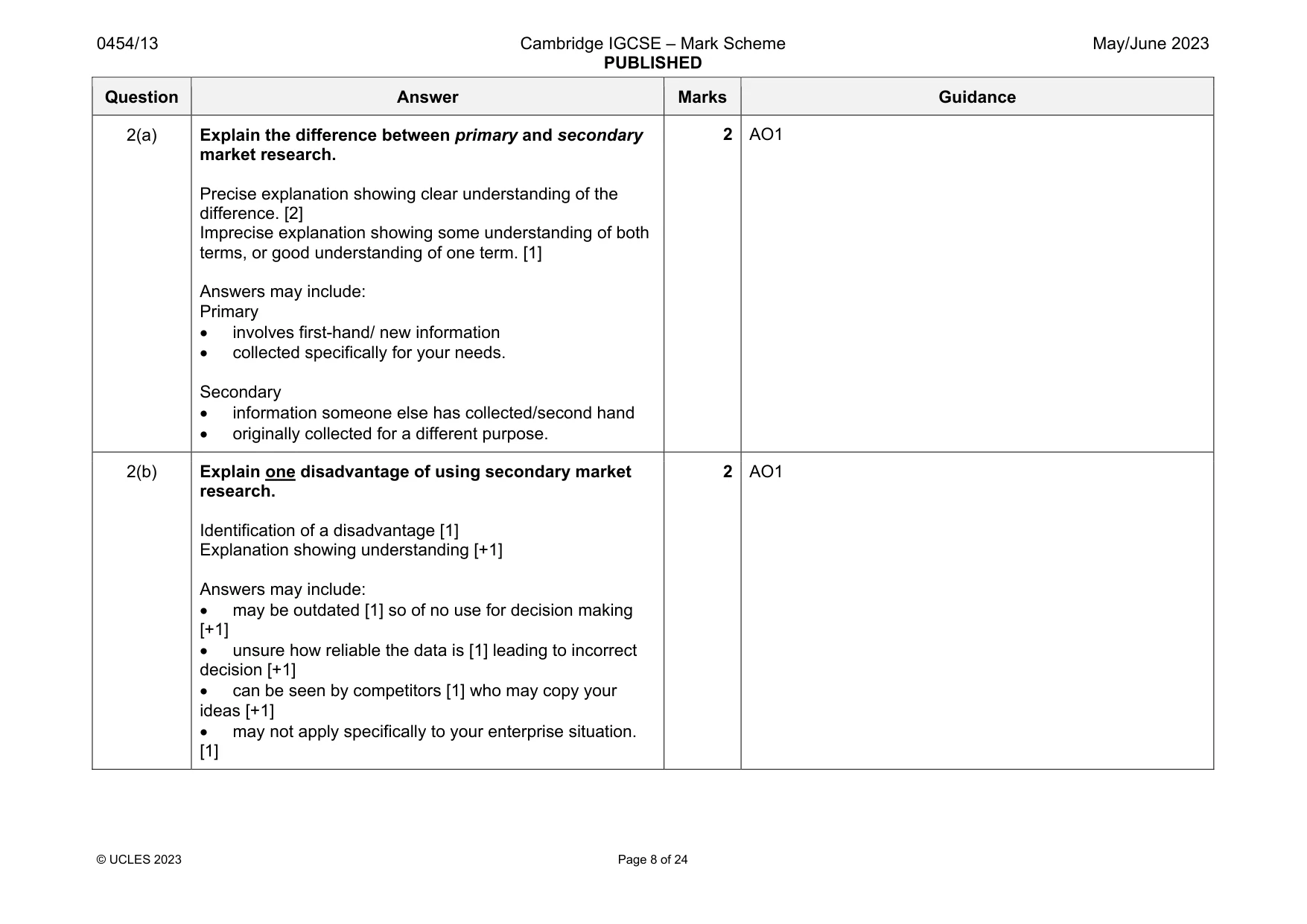
0454/13 Cambridge IGCSE – Mark Scheme PUBLISHED May/June 2023 © UCLES 2023 Page 8 of 24 Question Answer Marks Guidance 2(a) Explain the difference between primary and secondary market research. Precise explanation showing clear understanding of the difference. [2] Imprecise explanation showing some understanding of both terms, or good understanding of one term. [1] Answers may include: Primary involves first-hand/ new information collected specifically for your needs. Secondary information someone else has collected/second hand originally collected for a different purpose. 2 AO1 2(b) Explain one disadvantage of using secondary market research. Identification of a disadvantage [1] Explanation showing understanding [+1] Answers may include: may be outdated [1] so of no use for decision making [+1] unsure how reliable the data is [1] leading to incorrect decision [+1] can be seen by competitors [1] who may copy your ideas [+1] may not apply specifically to your enterprise situation. [1] 2 AO1
Mark scheme, page 9
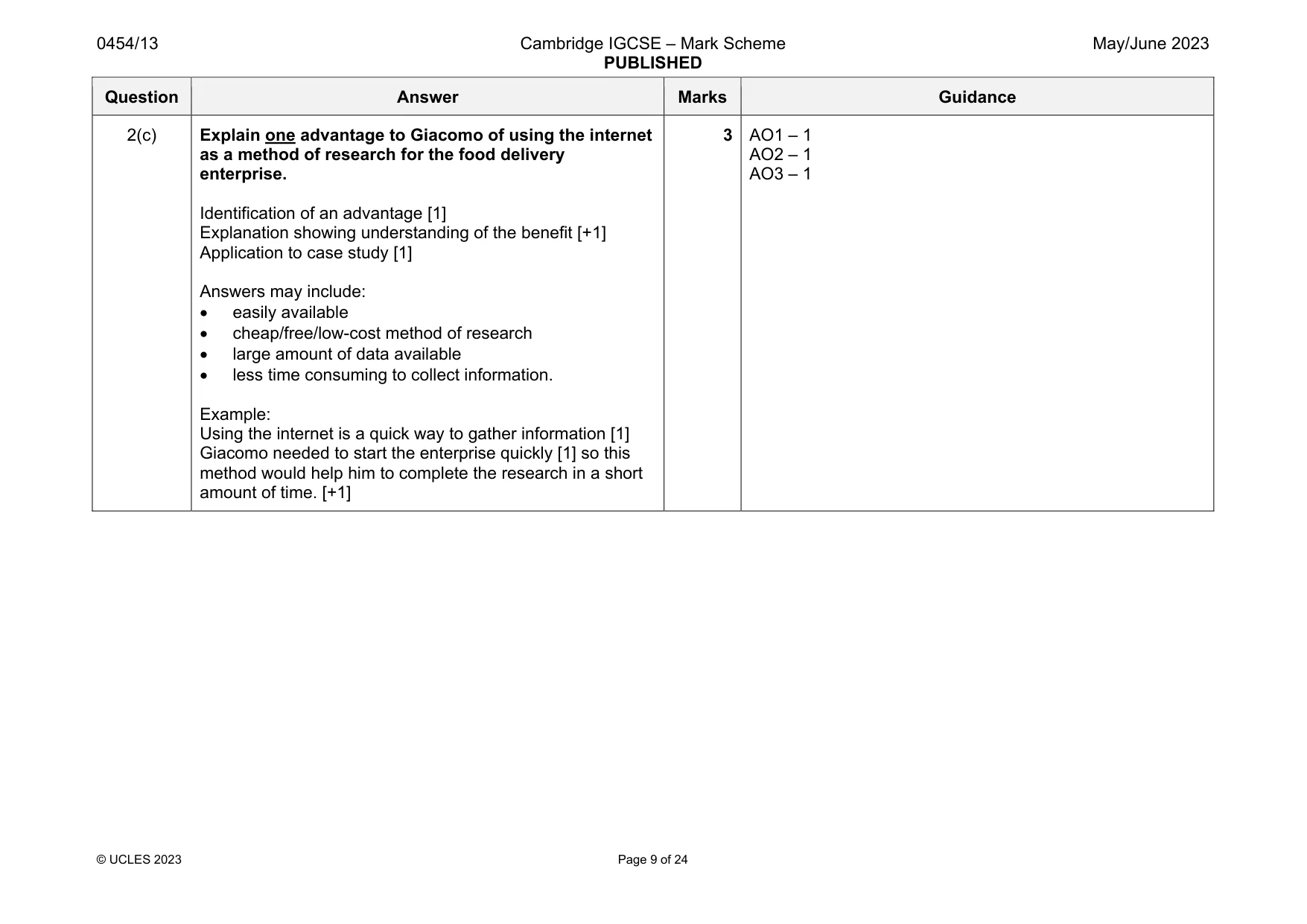
0454/13 Cambridge IGCSE – Mark Scheme PUBLISHED May/June 2023 © UCLES 2023 Page 9 of 24 Question Answer Marks Guidance 2(c) Explain one advantage to Giacomo of using the internet as a method of research for the food delivery enterprise. Identification of an advantage [1] Explanation showing understanding of the benefit [+1] Application to case study [1] Answers may include: easily available cheap/free/low-cost method of research large amount of data available less time consuming to collect information. Example: Using the internet is a quick way to gather information [1] Giacomo needed to start the enterprise quickly [1] so this method would help him to complete the research in a short amount of time. [+1] 3 AO1 – 1 AO2 – 1 AO3 – 1
Mark scheme, page 10
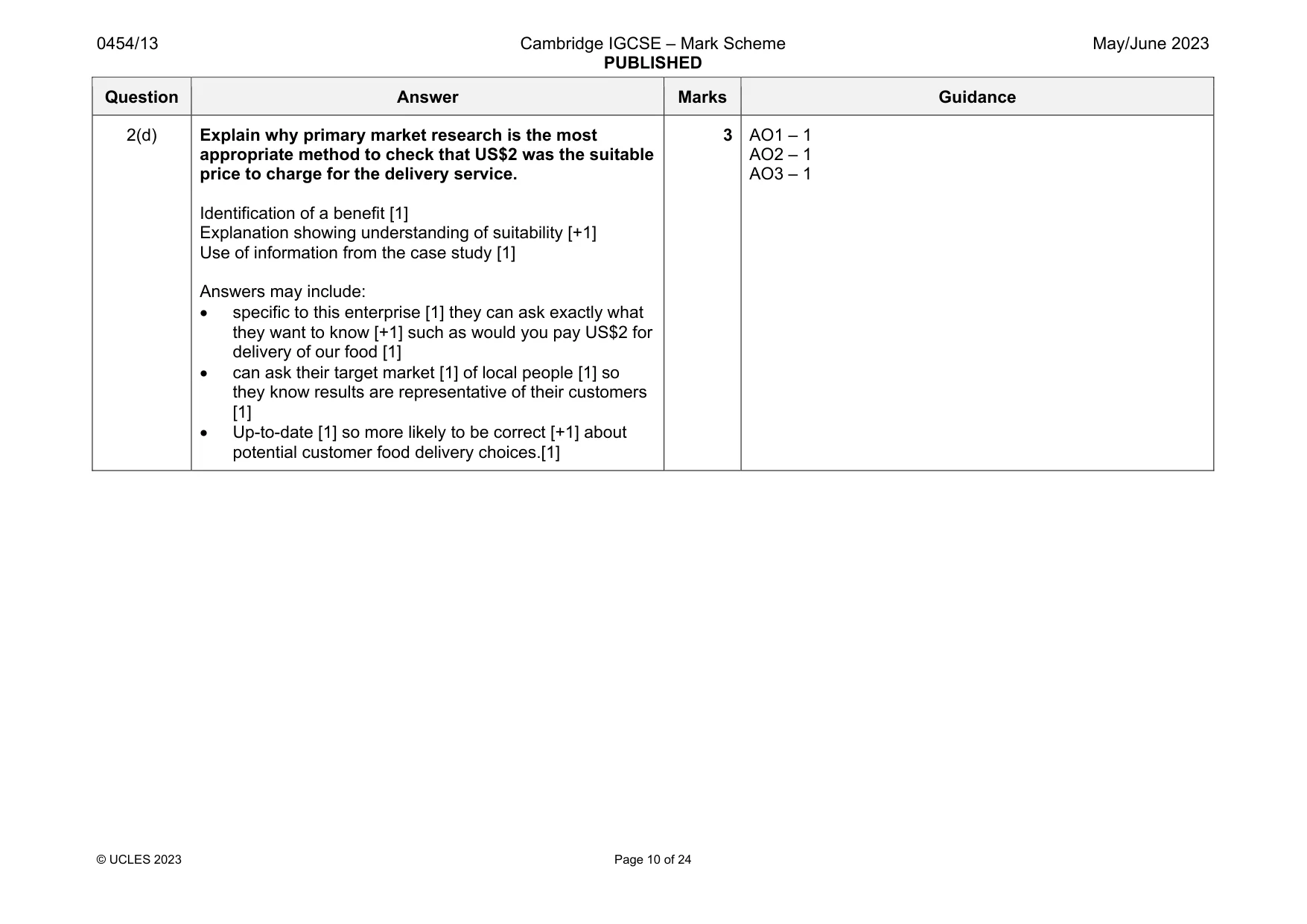
0454/13 Cambridge IGCSE – Mark Scheme PUBLISHED May/June 2023 © UCLES 2023 Page 10 of 24 Question Answer Marks Guidance 2(d) Explain why primary market research is the most appropriate method to check that US$2 was the suitable price to charge for the delivery service. Identification of a benefit [1] Explanation showing understanding of suitability [+1] Use of information from the case study [1] Answers may include: specific to this enterprise [1] they can ask exactly what they want to know [+1] such as would you pay US$2 for delivery of our food [1] can ask their target market [1] of local people [1] so they know results are representative of their customers [1] Up-to-date [1] so more likely to be correct [+1] about potential customer food delivery choices.[1] 3 AO1 – 1 AO2 – 1 AO3 – 1
Mark scheme, page 11
0454/13 Cambridge IGCSE – Mark Scheme PUBLISHED May/June 2023 © UCLES 2023 Page 11 of 24 Question Answer Marks Guidance 3(a) Identify two items that are usually included in an action plan. 1 mark per correct point. Answers may include: activity/tasks (to be done) start date/time time to complete/completion date person (who will complete) monitoring method changes made to plan. 2 AO1 3(b) Explain one way an action plan helped in the operation of your enterprise project. Identification of a use for an action plan [1] Explanation showing how the plan assists an enterprise [+1] Use of information from own enterprise experience. [1] Answers may include: identifies the key stages of a project [1] ensures they are not forgotten [+1] identifies potential obstacles [1] so you can think about how to avoid/manage them [+1] keeps track of who is responsible for each action [1] so they can be reminded to complete their work [+1] acts as a checklist [1] to ensure every task is completed. [+1] 3 AO1 – 1 AO2 – 1 AO3 – 1
Mark scheme, page 12
0454/13 Cambridge IGCSE – Mark Scheme PUBLISHED May/June 2023 © UCLES 2023 Page 12 of 24 Question Answer Marks Guidance 3(c) Define the term legal compliance. Precise definition [2] Imprecise definition showing some understanding [1] Answers may include: laws that must be followed or consequences are imposed [2] required to follow laws/legislation [2] legislation/laws [1] following rules set by the government.[1] 2 AO1 3(d) Explain one reason laws and regulations would need to be followed by this food delivery enterprise. Use an example from the case study to support your answer. Identification of a reason laws/regulations needed unrelated to this enterprise [1] Explanation showing understanding of why they are required [+1] Application to case study [1] Answers may include: employment production marketing and selling finance. Example: Laws concern production methods [1] to ensure all food [1] is safe to eat for consumers. [+1] 3 AO1 – 1 AO2 – 1 AO3 – 1
Mark scheme, page 13
0454/13 Cambridge IGCSE – Mark Scheme PUBLISHED May/June 2023 © UCLES 2023 Page 13 of 24 Question Answer Marks Guidance 4(a) Define the term negotiation. Precise definition [2] Imprecise definition showing some understanding. [1] Answers may include: the process of discussion [1] to reach agreement that satisfies everyone involved [1] trying to find a solution. [1] 2 AO1 4(b) Explain how using one stage of the negotiation process could assist Giacomo to be successful in his negotiation with Mrs Tan. Identification of a stage in the negotiation process [1] Explanation showing understanding of how that stage assists the negotiation [+1] Application to the case study [1] Answers may include: planning conducting the negotiation setting objectives choosing evidence to use/research outlining benefits/weaknesses of the proposal setting the tone presenting the proposal summarising to check understanding. Example: Thorough research [1] on the costs of setting up the delivery service [1] would help Mrs Tan to believe they could succeed. [+1] 3 AO1 – 1 AO2 – 1 AO3 – 1
Mark scheme, page 14
0454/13 Cambridge IGCSE – Mark Scheme PUBLISHED May/June 2023 © UCLES 2023 Page 14 of 24 Question Answer Marks Guidance 4(c) Define the term grant. Precise definition [2] Imprecise definition showing some understanding [1] Answers may include: money given to enterprises by governments/organisations [1] which does not need to be repaid. [1] 2 AO1 4(d) Explain how the college restaurant would benefit by using trade credit to start up the new food delivery enterprise. Identification of an advantage of trade credit [1] Explanation showing understanding of the benefit [+1] Application to the case study [+1] Answers may include: interest free loan allows stock to be purchased even if finance is not available offered for 30, 60 or 90 days. Example The college can buy the packaging [1] and pay for it when they have earned money from the deliveries [1] without paying interest. [1] 3 AO1 – 1 AO2 – 1 AO3 – 1
Mark scheme, page 15
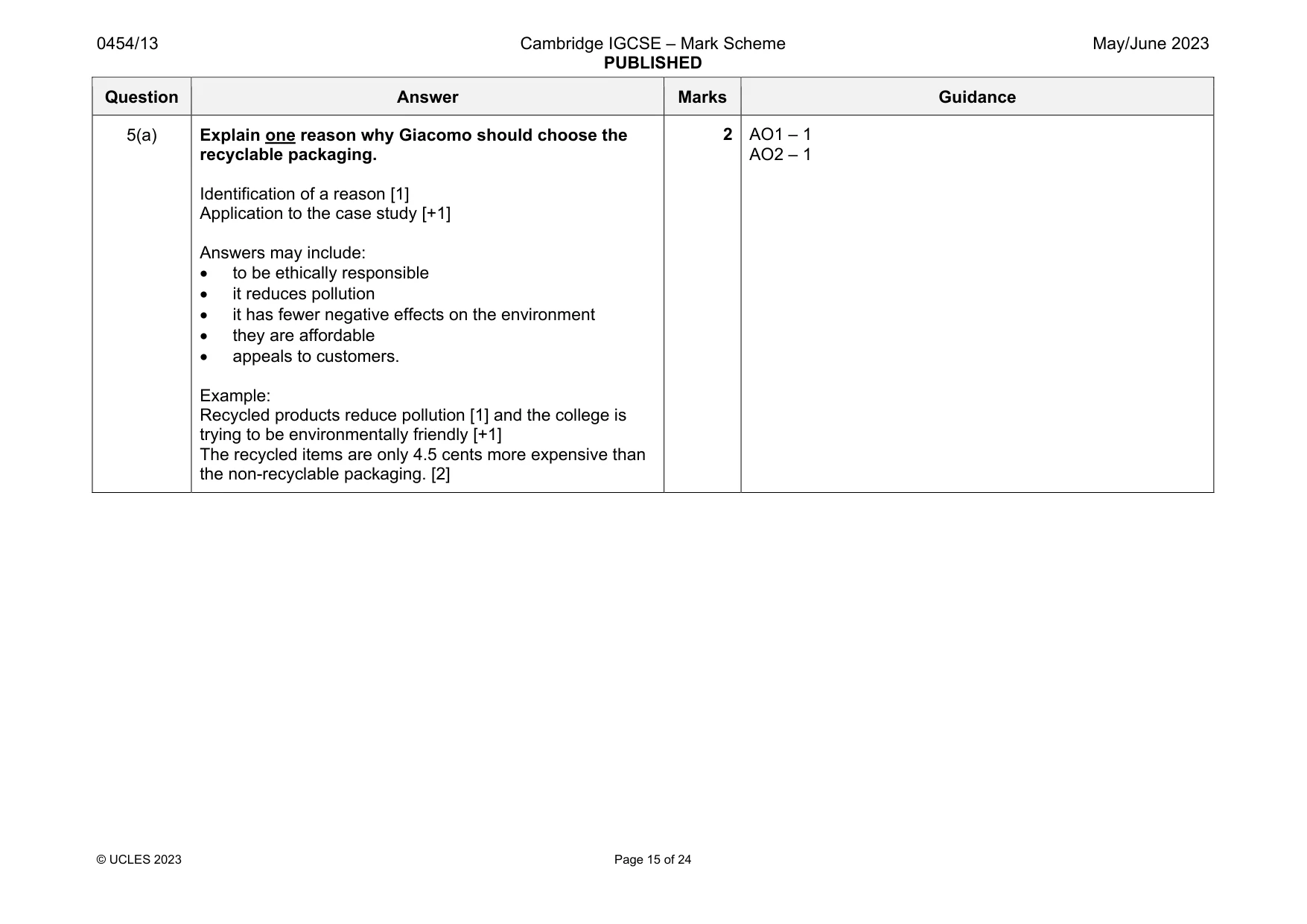
0454/13 Cambridge IGCSE – Mark Scheme PUBLISHED May/June 2023 © UCLES 2023 Page 15 of 24 Question Answer Marks Guidance 5(a) Explain one reason why Giacomo should choose the recyclable packaging. Identification of a reason [1] Application to the case study [+1] Answers may include: to be ethically responsible it reduces pollution it has fewer negative effects on the environment they are affordable appeals to customers. Example: Recycled products reduce pollution [1] and the college is trying to be environmentally friendly [+1] The recycled items are only 4.5 cents more expensive than the non-recyclable packaging. [2] 2 AO1 – 1 AO2 – 1
Mark scheme, page 16
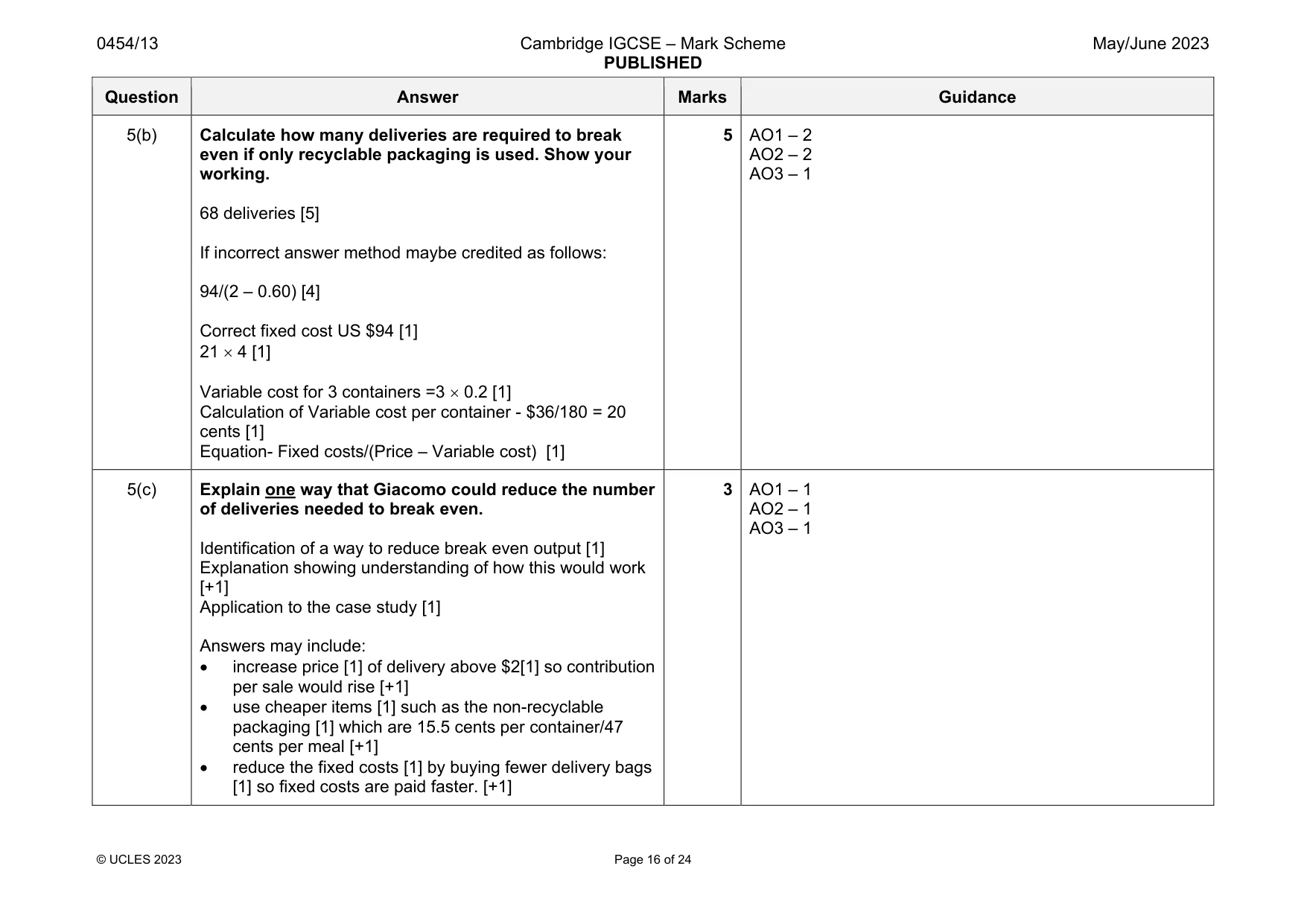
0454/13 Cambridge IGCSE – Mark Scheme PUBLISHED May/June 2023 © UCLES 2023 Page 16 of 24 Question Answer Marks Guidance 5(b) Calculate how many deliveries are required to break even if only recyclable packaging is used. Show your working. 68 deliveries [5] If incorrect answer method maybe credited as follows: 94/(2 – 0.60) [4] Correct fixed cost US $94 [1] 21 4 [1] Variable cost for 3 containers =3 0.2 [1] Calculation of Variable cost per container - $36/180 = 20 cents [1] Equation- Fixed costs/(Price – Variable cost) [1] 5 AO1 – 2 AO2 – 2 AO3 – 1 5(c) Explain one way that Giacomo could reduce the number of deliveries needed to break even. Identification of a way to reduce break even output [1] Explanation showing understanding of how this would work [+1] Application to the case study [1] Answers may include: increase price [1] of delivery above $2[1] so contribution per sale would rise [+1] use cheaper items [1] such as the non-recyclable packaging [1] which are 15.5 cents per container/47 cents per meal [+1] reduce the fixed costs [1] by buying fewer delivery bags [1] so fixed costs are paid faster. [+1] 3 AO1 – 1 AO2 – 1 AO3 – 1
Mark scheme, page 17
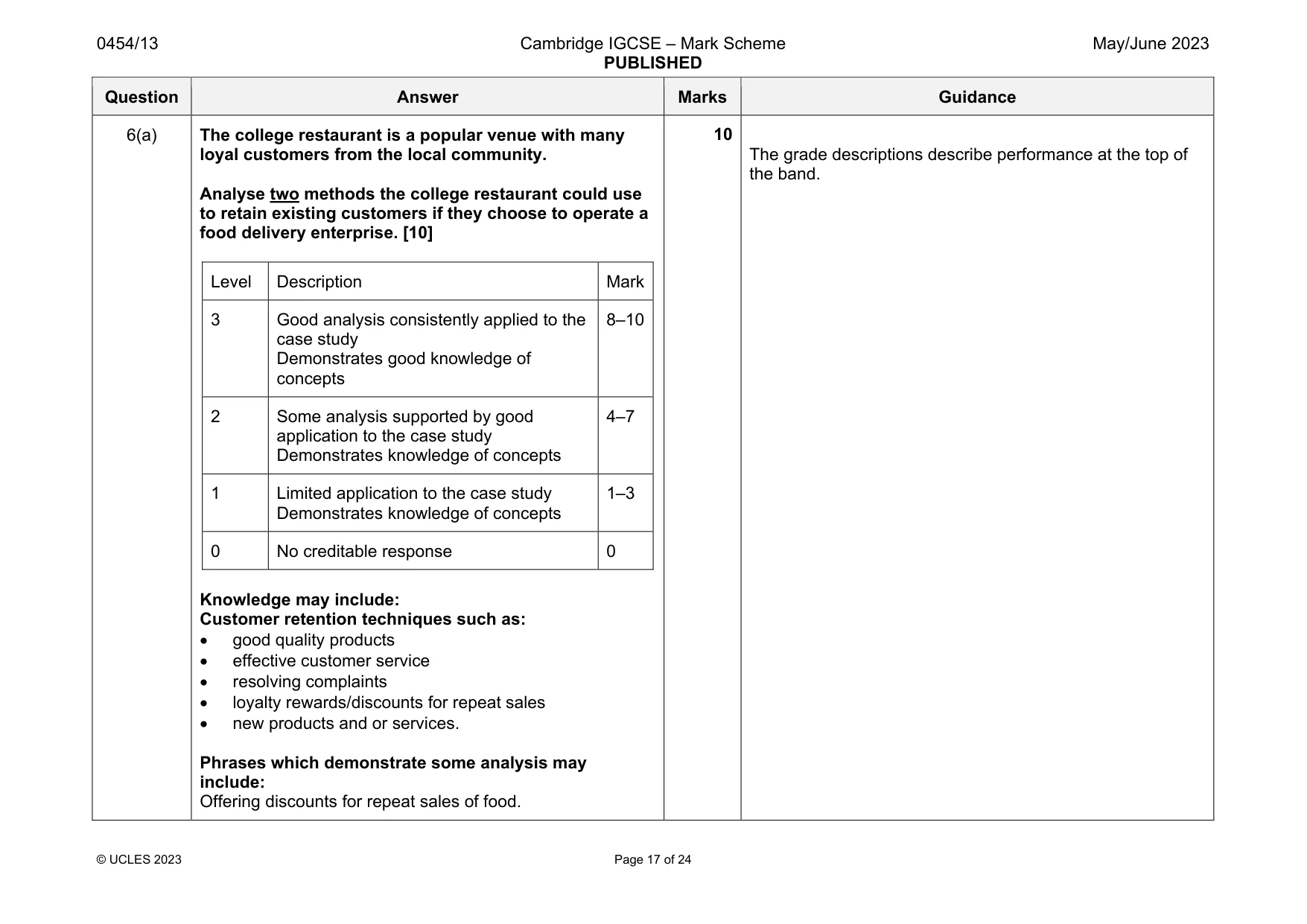
0454/13 Cambridge IGCSE – Mark Scheme PUBLISHED May/June 2023 © UCLES 2023 Page 17 of 24 Question Answer Marks Guidance 6(a) The college restaurant is a popular venue with many loyal customers from the local community. Analyse two methods the college restaurant could use to retain existing customers if they choose to operate a food delivery enterprise. [10] Level Description Mark 3 Good analysis consistently applied to the case study Demonstrates good knowledge of concepts 8–10 2 Some analysis supported by good application to the case study Demonstrates knowledge of concepts 4–7 1 Limited application to the case study Demonstrates knowledge of concepts 1–3 0 No creditable response 0 Knowledge may include: Customer retention techniques such as: good quality products effective customer service resolving complaints loyalty rewards/discounts for repeat sales new products and or services. Phrases which demonstrate some analysis may include: Offering discounts for repeat sales of food. 10 The grade descriptions describe performance at the top of the band.
Mark scheme, page 18
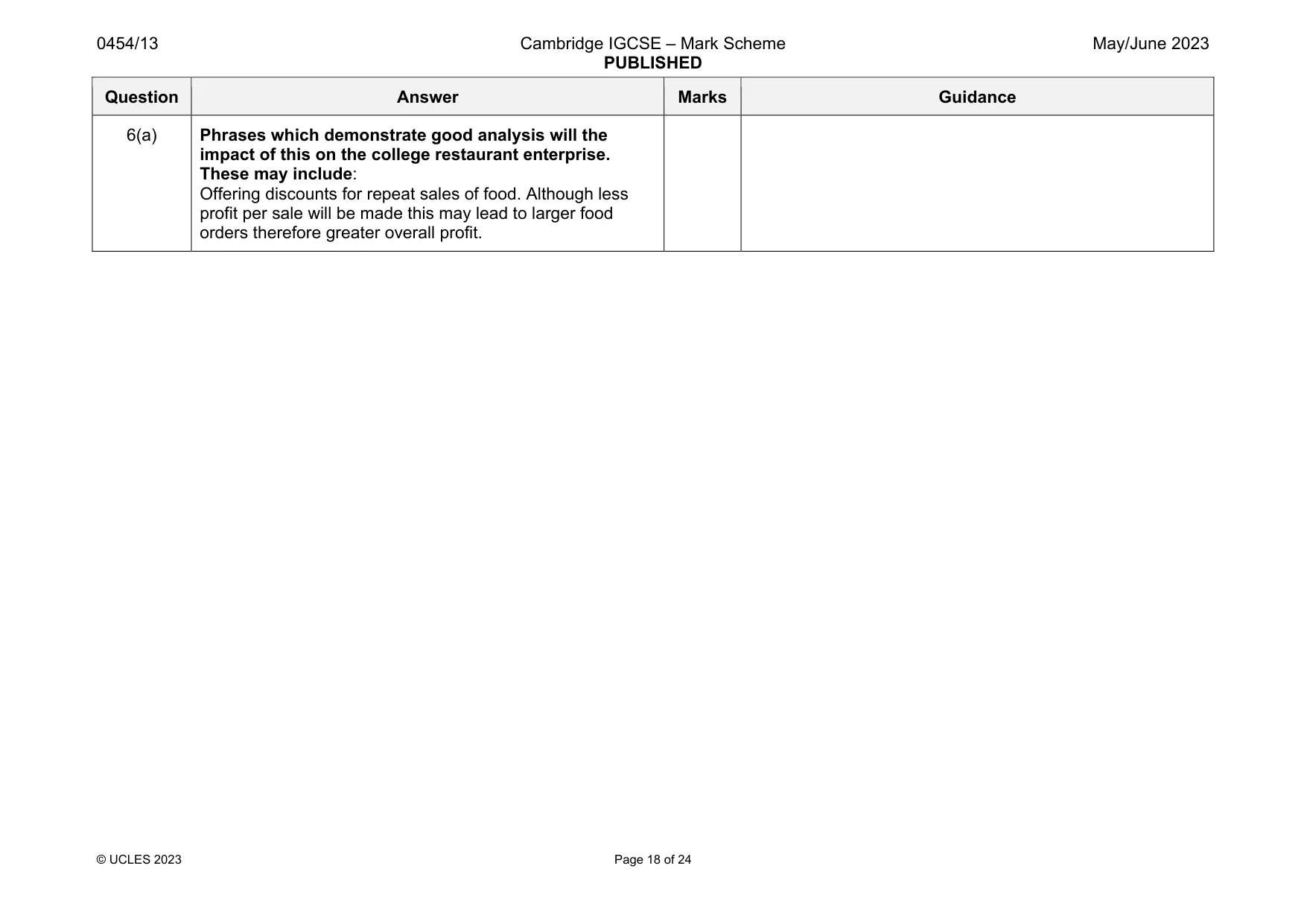
0454/13 Cambridge IGCSE – Mark Scheme PUBLISHED May/June 2023 © UCLES 2023 Page 18 of 24 Question Answer Marks Guidance 6(a) Phrases which demonstrate good analysis will the impact of this on the college restaurant enterprise. These may include: Offering discounts for repeat sales of food. Although less profit per sale will be made this may lead to larger food orders therefore greater overall profit.
Mark scheme, page 19
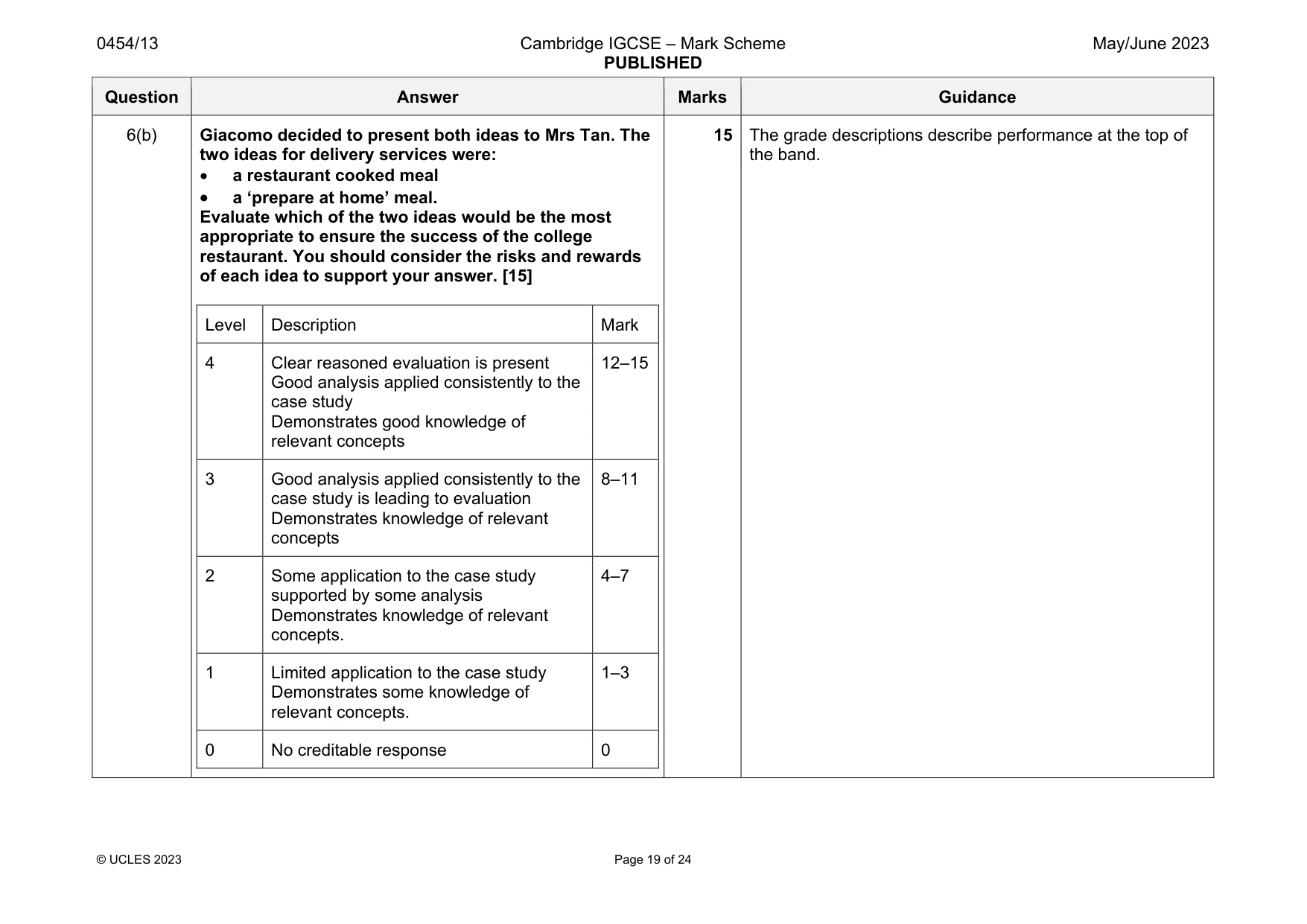
0454/13 Cambridge IGCSE – Mark Scheme PUBLISHED May/June 2023 © UCLES 2023 Page 19 of 24 Question Answer Marks Guidance 6(b) Giacomo decided to present both ideas to Mrs Tan. The two ideas for delivery services were: a restaurant cooked meal a ‘prepare at home’ meal. Evaluate which of the two ideas would be the most appropriate to ensure the success of the college restaurant. You should consider the risks and rewards of each idea to support your answer. [15] Level Description Mark 4 Clear reasoned evaluation is present Good analysis applied consistently to the case study Demonstrates good knowledge of relevant concepts 12–15 3 Good analysis applied consistently to the case study is leading to evaluation Demonstrates knowledge of relevant concepts 8–11 2 Some application to the case study supported by some analysis Demonstrates knowledge of relevant concepts. 4–7 1 Limited application to the case study Demonstrates some knowledge of relevant concepts. 1–3 0 No creditable response 0 15 The grade descriptions describe performance at the top of the band.
Mark scheme, page 20
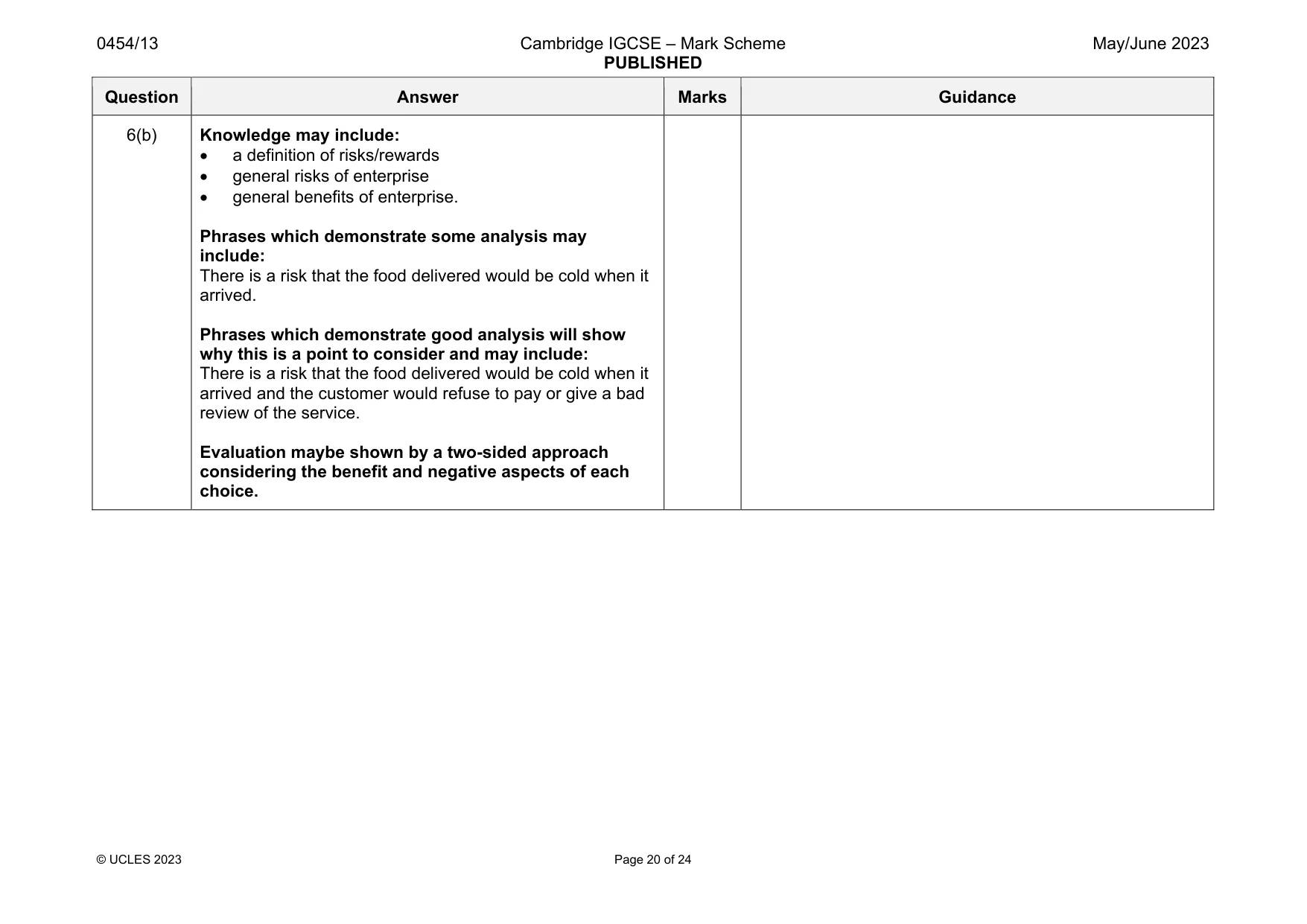
0454/13 Cambridge IGCSE – Mark Scheme PUBLISHED May/June 2023 © UCLES 2023 Page 20 of 24 Question Answer Marks Guidance 6(b) Knowledge may include: a definition of risks/rewards general risks of enterprise general benefits of enterprise. Phrases which demonstrate some analysis may include: There is a risk that the food delivered would be cold when it arrived. Phrases which demonstrate good analysis will show why this is a point to consider and may include: There is a risk that the food delivered would be cold when it arrived and the customer would refuse to pay or give a bad review of the service. Evaluation maybe shown by a two-sided approach considering the benefit and negative aspects of each choice.
Mark scheme, page 21
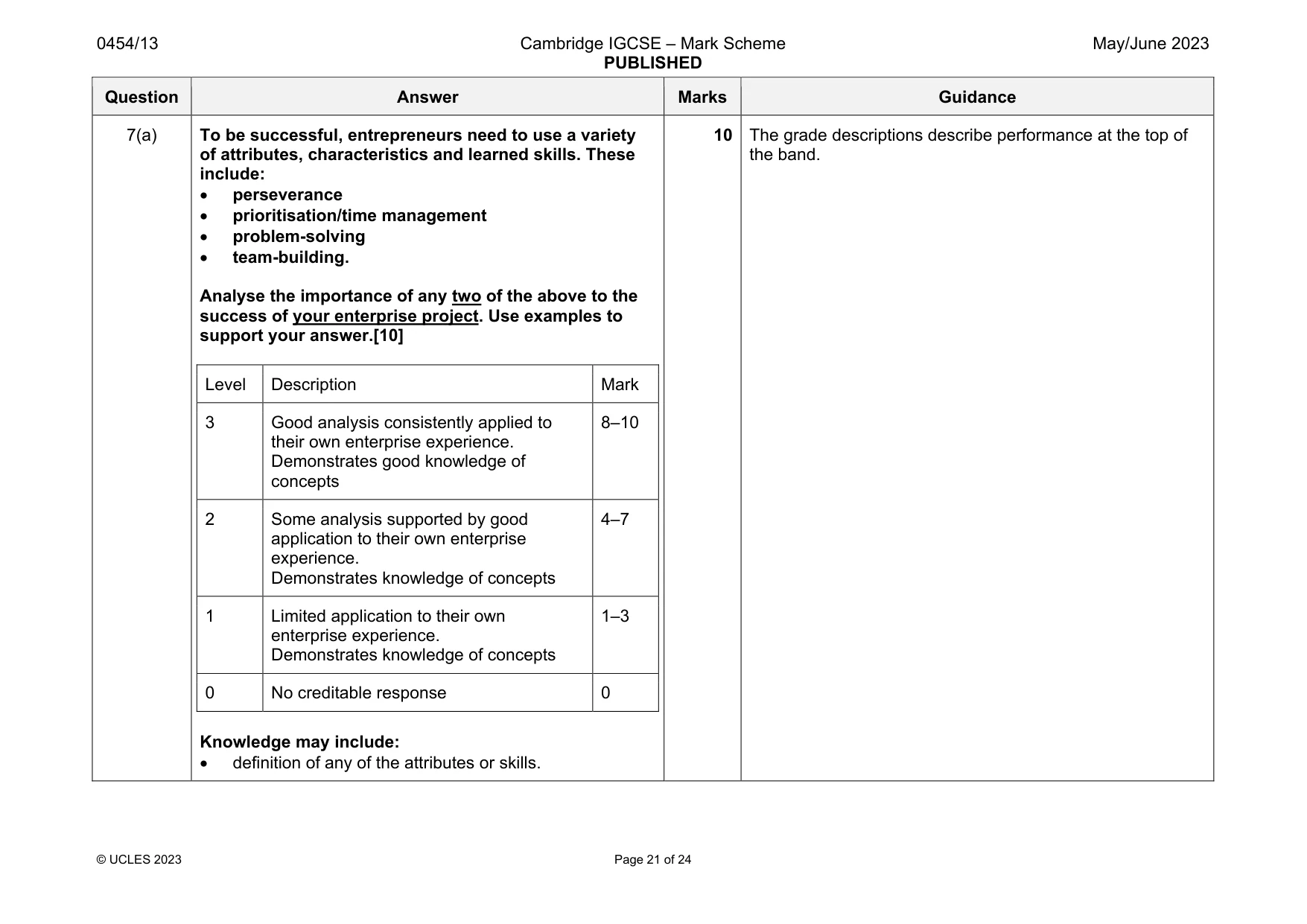
0454/13 Cambridge IGCSE – Mark Scheme PUBLISHED May/June 2023 © UCLES 2023 Page 21 of 24 Question Answer Marks Guidance 7(a) To be successful, entrepreneurs need to use a variety of attributes, characteristics and learned skills. These include: perseverance prioritisation/time management problem-solving team-building. Analyse the importance of any two of the above to the success of your enterprise project. Use examples to support your answer.[10] Level Description Mark 3 Good analysis consistently applied to their own enterprise experience. Demonstrates good knowledge of concepts 8–10 2 Some analysis supported by good application to their own enterprise experience. Demonstrates knowledge of concepts 4–7 1 Limited application to their own enterprise experience. Demonstrates knowledge of concepts 1–3 0 No creditable response 0 Knowledge may include: definition of any of the attributes or skills. 10 The grade descriptions describe performance at the top of the band.
Mark scheme, page 22
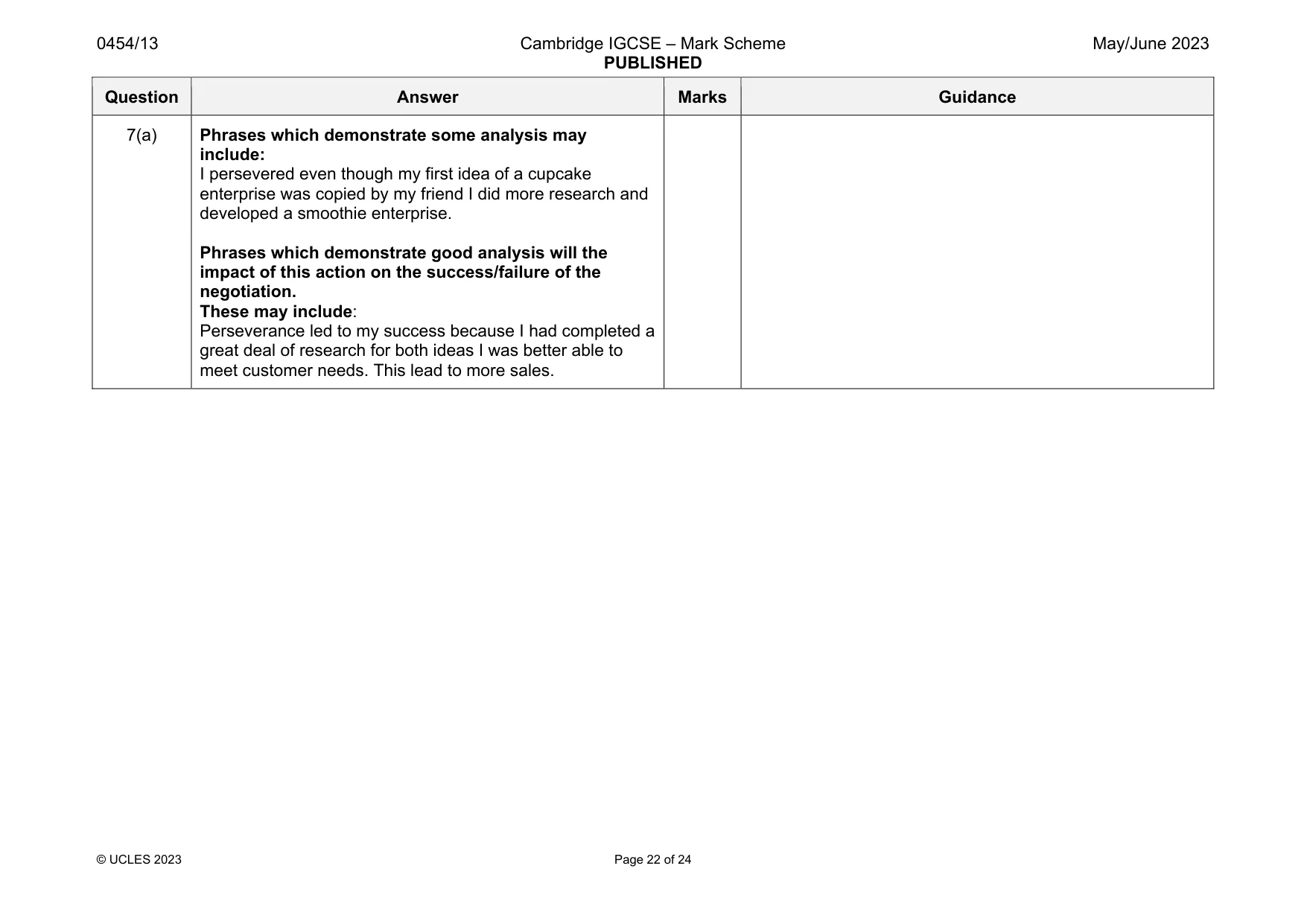
0454/13 Cambridge IGCSE – Mark Scheme PUBLISHED May/June 2023 © UCLES 2023 Page 22 of 24 Question Answer Marks Guidance 7(a) Phrases which demonstrate some analysis may include: I persevered even though my first idea of a cupcake enterprise was copied by my friend I did more research and developed a smoothie enterprise. Phrases which demonstrate good analysis will the impact of this action on the success/failure of the negotiation. These may include: Perseverance led to my success because I had completed a great deal of research for both ideas I was better able to meet customer needs. This lead to more sales.
Mark scheme, page 23
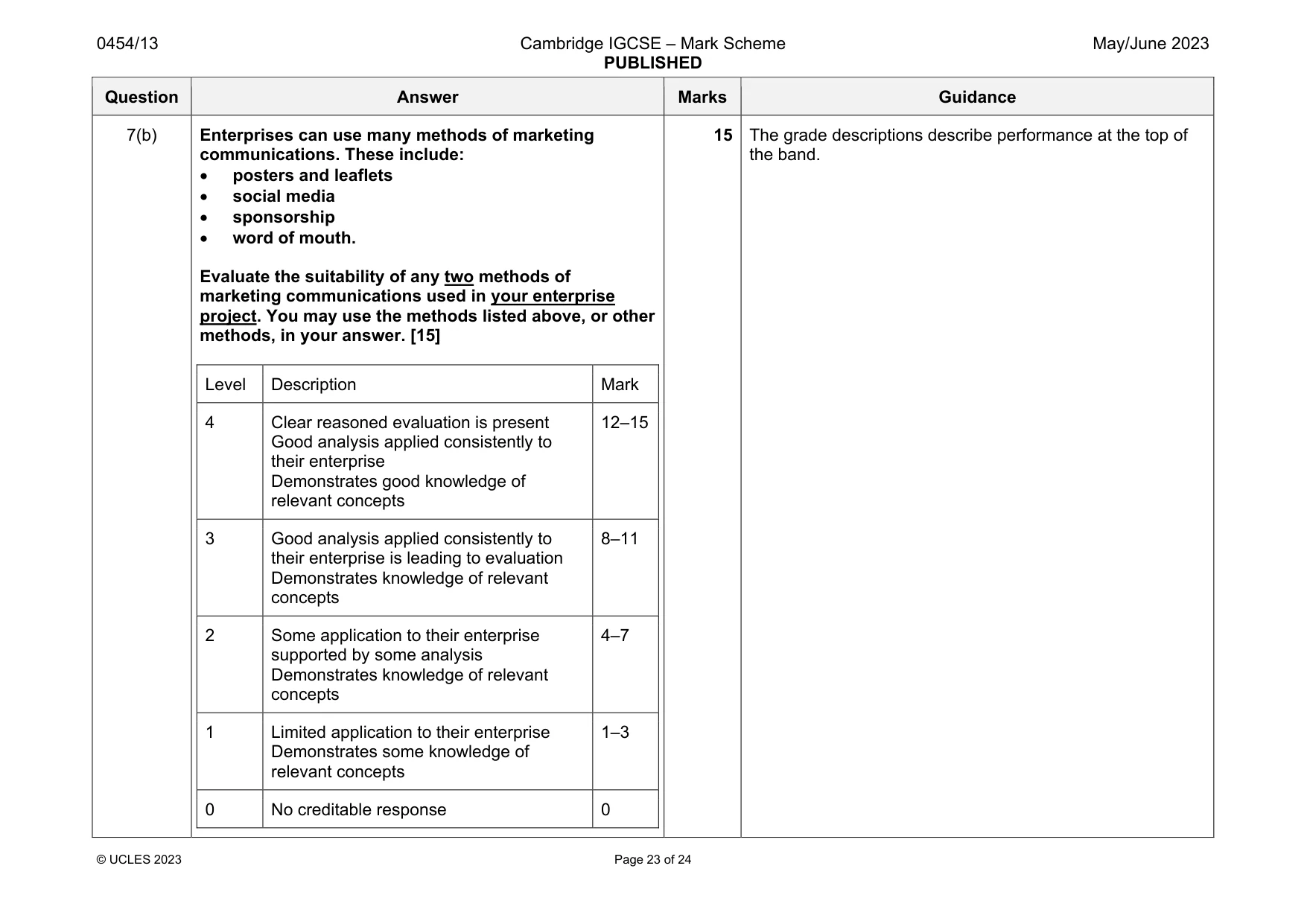
0454/13 Cambridge IGCSE – Mark Scheme PUBLISHED May/June 2023 © UCLES 2023 Page 23 of 24 Question Answer Marks Guidance 7(b) Enterprises can use many methods of marketing communications. These include: posters and leaflets social media sponsorship word of mouth. Evaluate the suitability of any two methods of marketing communications used in your enterprise project. You may use the methods listed above, or other methods, in your answer. [15] Level Description Mark 4 Clear reasoned evaluation is present Good analysis applied consistently to their enterprise Demonstrates good knowledge of relevant concepts 12–15 3 Good analysis applied consistently to their enterprise is leading to evaluation Demonstrates knowledge of relevant concepts 8–11 2 Some application to their enterprise supported by some analysis Demonstrates knowledge of relevant concepts 4–7 1 Limited application to their enterprise Demonstrates some knowledge of relevant concepts 1–3 0 No creditable response 0 15 The grade descriptions describe performance at the top of the band.
Mark scheme, page 24
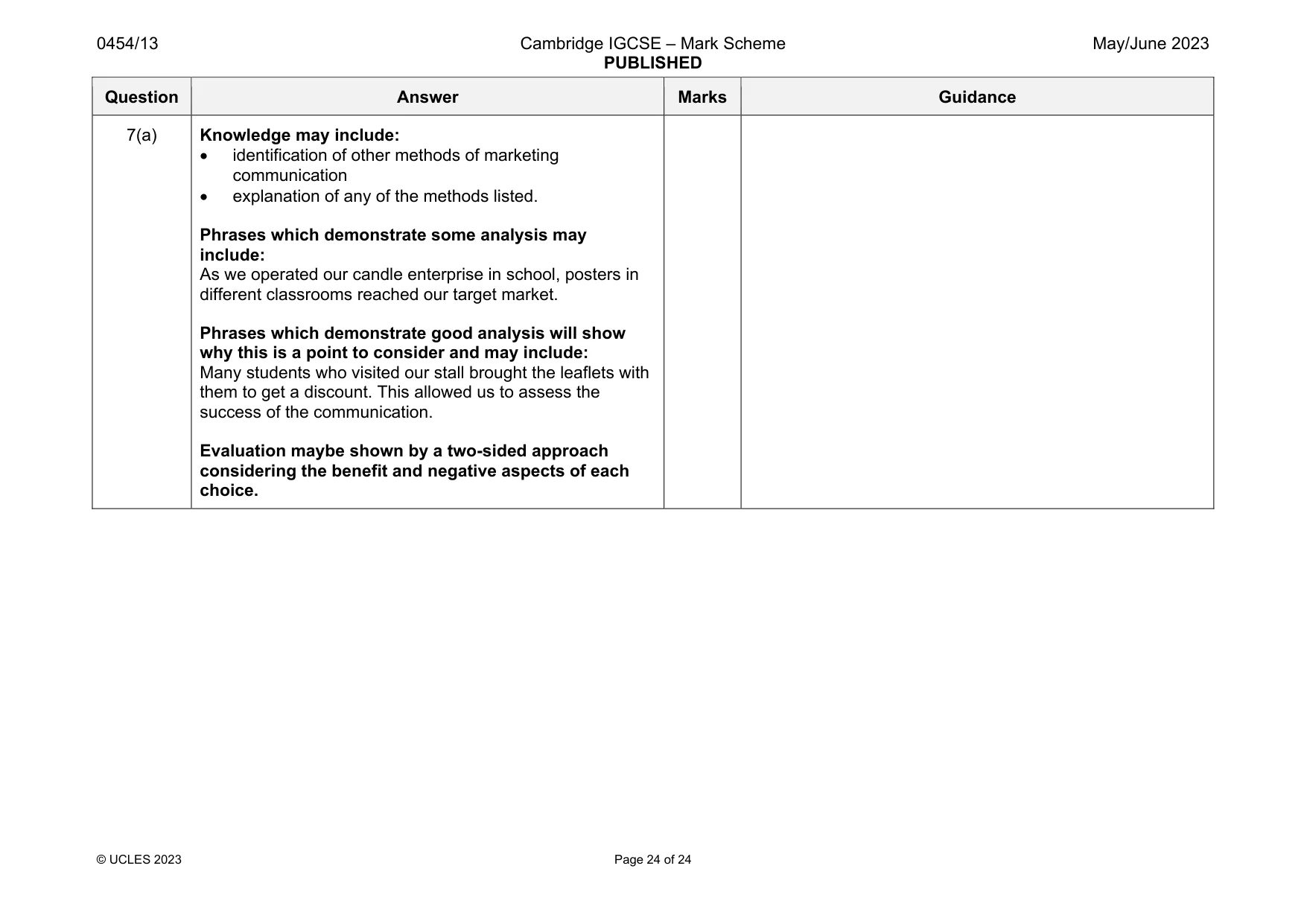
0454/13 Cambridge IGCSE – Mark Scheme PUBLISHED May/June 2023 © UCLES 2023 Page 24 of 24 Question Answer Marks Guidance 7(a) Knowledge may include: identification of other methods of marketing communication explanation of any of the methods listed. Phrases which demonstrate some analysis may include: As we operated our candle enterprise in school, posters in different classrooms reached our target market. Phrases which demonstrate good analysis will show why this is a point to consider and may include: Many students who visited our stall brought the leaflets with them to get a discount. This allowed us to assess the success of the communication. Evaluation maybe shown by a two-sided approach considering the benefit and negative aspects of each choice.
What you needed in this session
Cambridge’s own grade thresholds for 2023 May/June, Paper 1 · Variant 3. A higher threshold means an easier paper — the bar moves with how the cohort did.