Cambridge IGCSE Enterprise 0454 — 2020 May/June Paper 1 · Variant 3
0454/13/M/J/20
The question paper and its mark scheme, free to read here and free to download. This is Cambridge’s own paper, exactly as it was sat.
Question paper16 pages






Mark scheme11 pages
Answers below. Sit the paper first if you are practising.
Paper as text
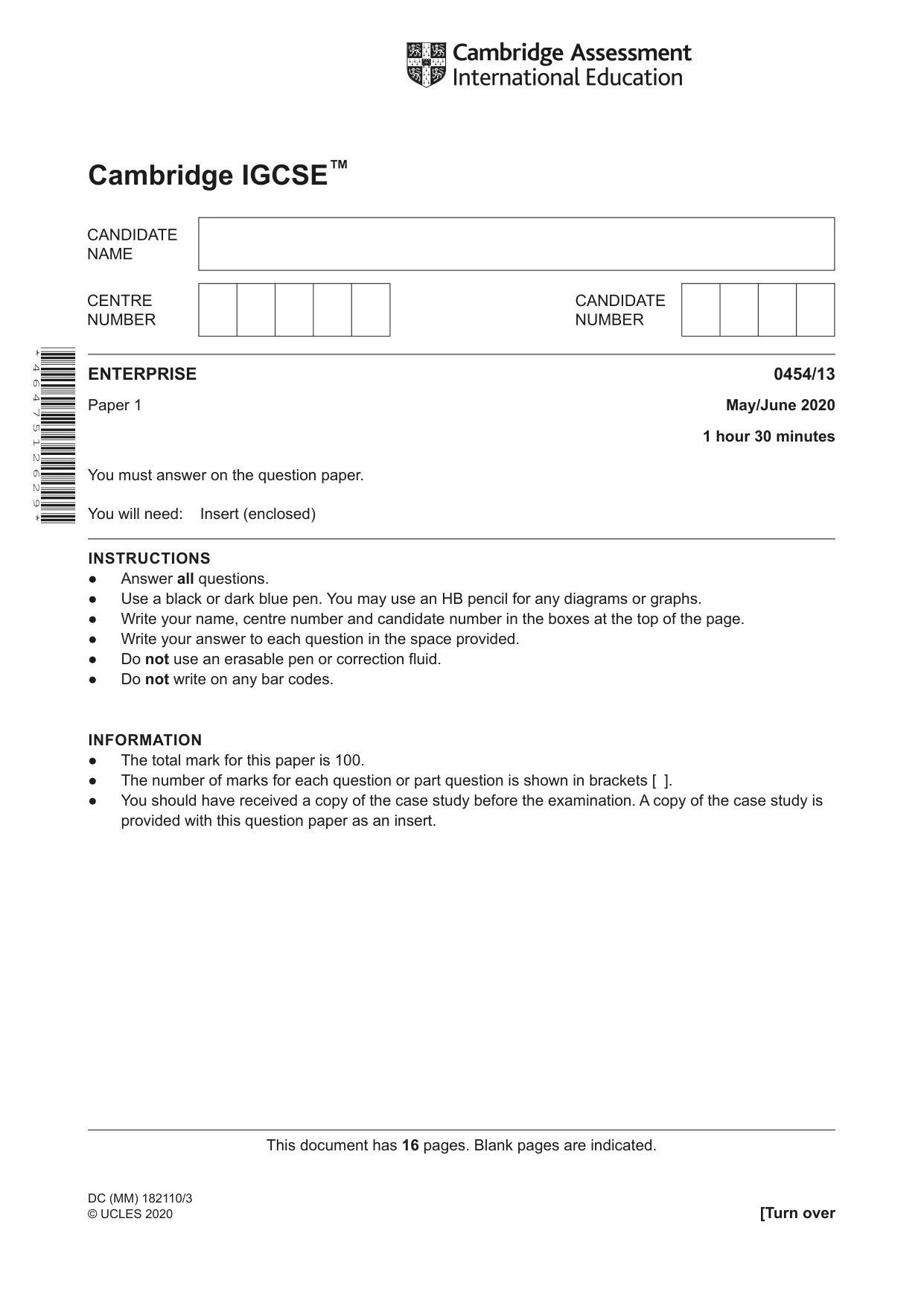
Question paper, page 1
Cambridge IGCSE™ This document has 16 pages. Blank pages are indicated. DC (MM) 182110/3 © UCLES 2020 [Turn over ENTERPRISE 0454/13 Paper 1 May/June 2020 1 hour 30 minutes You must answer on the question paper. You will need: Insert (enclosed) INSTRUCTIONS ● Answer all questions. ● Use a black or dark blue pen. You may use an HB pencil for any diagrams or graphs. ● Write your name, centre number and candidate number in the boxes at the top of the page. ● Write your answer to each question in the space provided. ● Do not use an erasable pen or correction fluid. ● Do not write on any bar codes. INFORMATION ● The total mark for this paper is 100. ● The number of marks for each question or part question is shown in brackets [ ]. ● You should have received a copy of the case study before the examination. A copy of the case study is provided with this question paper as an insert. * 4 6 4 7 5 1 2 6 2 9 *
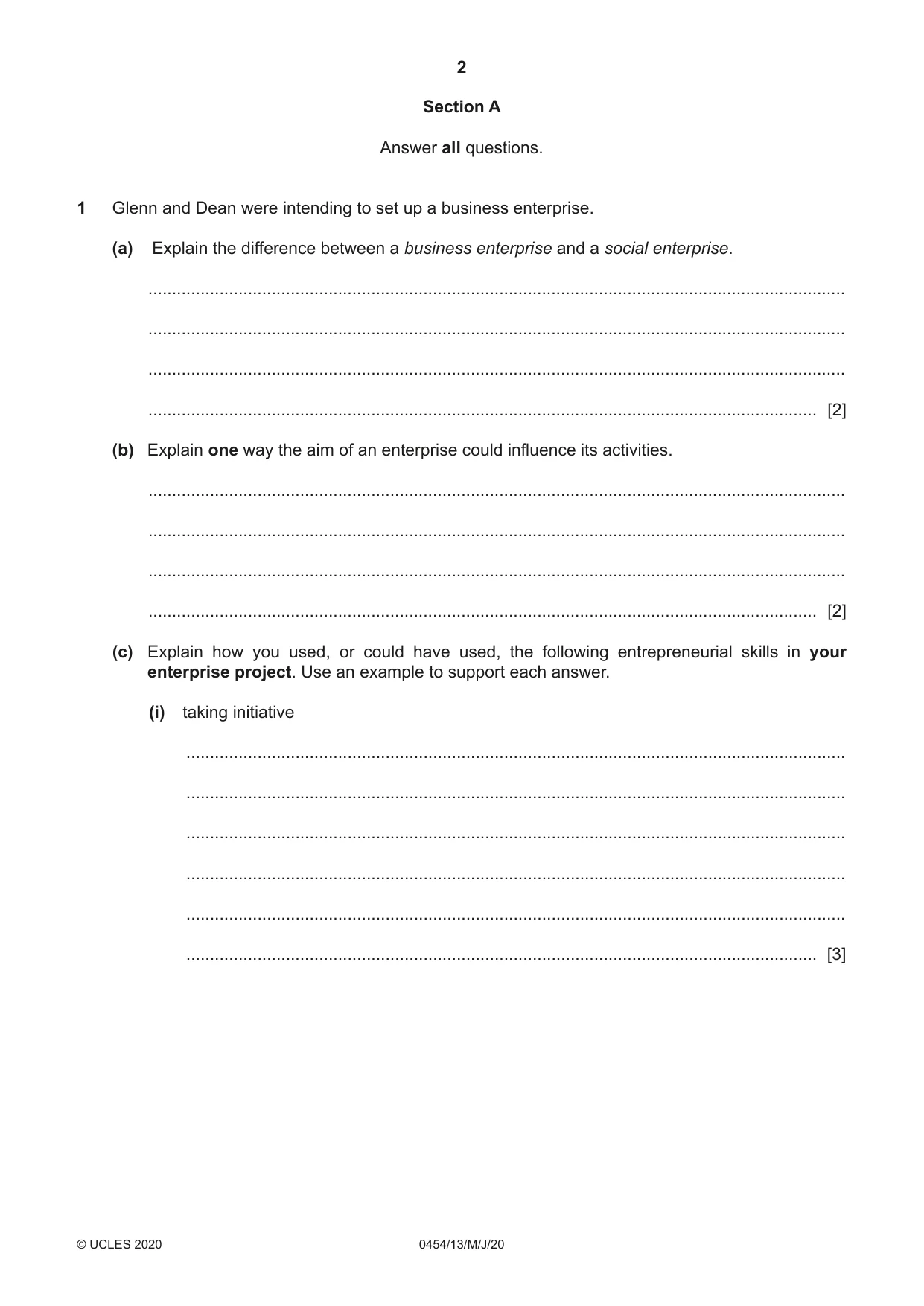
Question paper, page 2
2 0454/13/M/J/20 © UCLES 2020 Section A Answer all questions. 1 Glenn and Dean were intending to set up a business enterprise. (a) Explain the difference between a business enterprise and a social enterprise. … … … … [2] (b) Explain one way the aim of an enterprise could influence its activities. … … … … [2] (c) Explain how you used, or could have used, the following entrepreneurial skills in your enterprise project. Use an example to support each answer. (i) taking initiative … … … … … … [3]
Question paper, page 3
3 0454/13/M/J/20 © UCLES 2020 [Turn over (ii) problem-solving … … … … … … [3] [Total: 10]
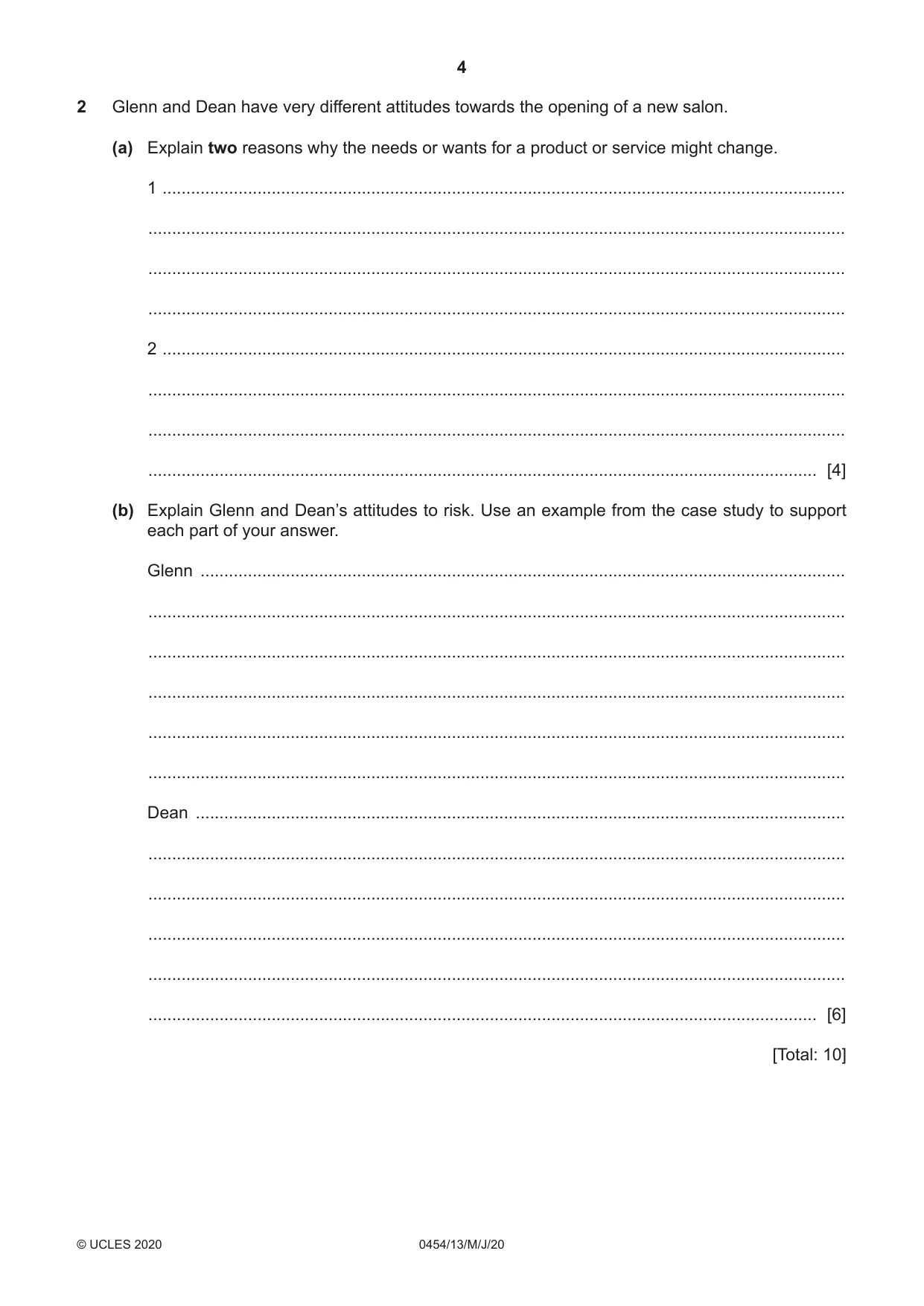
Question paper, page 4
4 0454/13/M/J/20 © UCLES 2020 2 Glenn and Dean have very different attitudes towards the opening of a new salon. (a) Explain two reasons why the needs or wants for a product or service might change. 1 … … … … 2 … … … … [4] (b) Explain Glenn and Dean’s attitudes to risk. Use an example from the case study to support each part of your answer. Glenn … … … … … … Dean … … … … … … [6] [Total: 10]
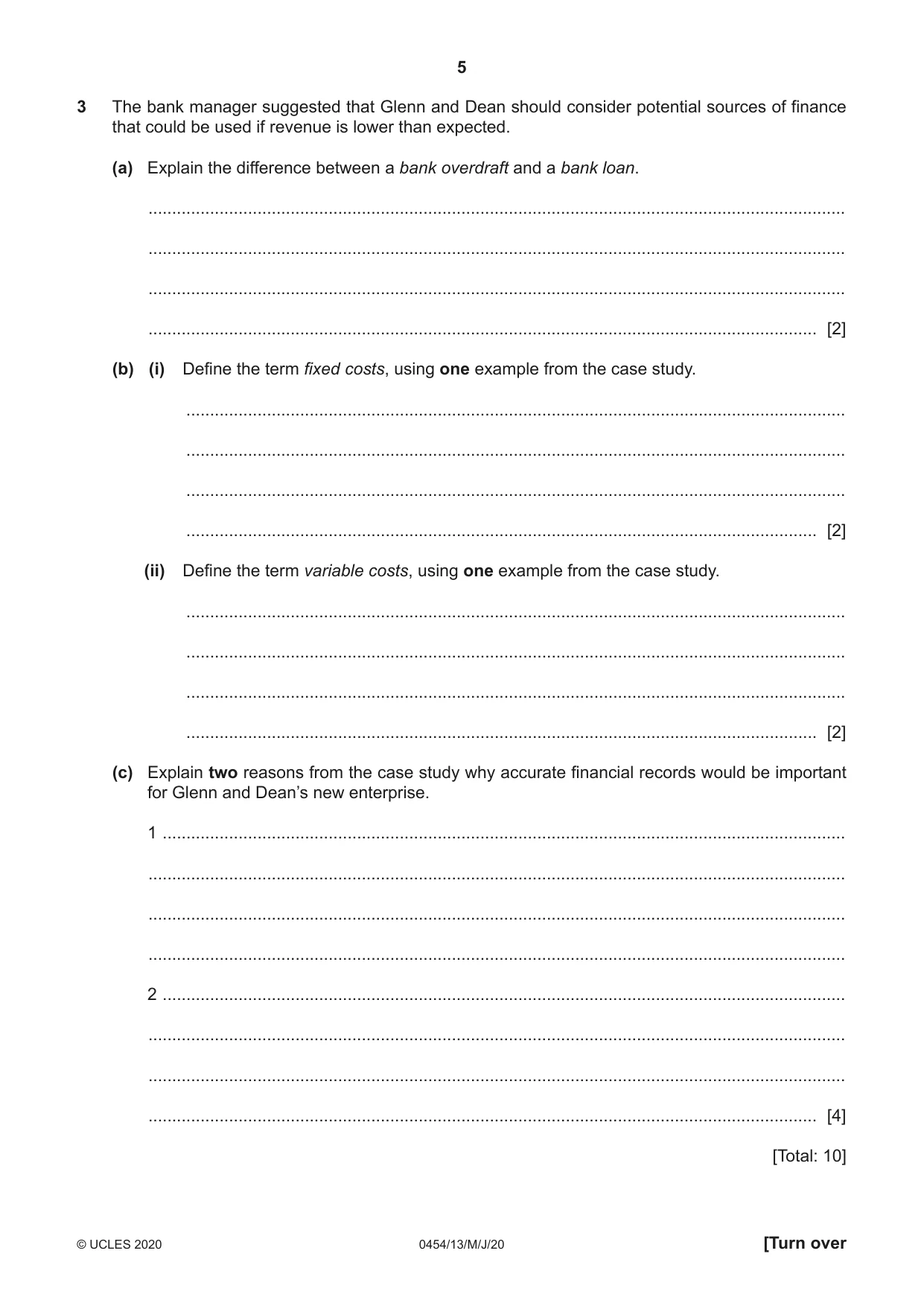
Question paper, page 5
5 0454/13/M/J/20 © UCLES 2020 [Turn over 3 The bank manager suggested that Glenn and Dean should consider potential sources of finance that could be used if revenue is lower than expected. (a) Explain the difference between a bank overdraft and a bank loan. … … … … [2] (b) (i) Define the term fixed costs, using one example from the case study. … … … … [2] (ii) Define the term variable costs, using one example from the case study. … … … … [2] (c) Explain two reasons from the case study why accurate financial records would be important for Glenn and Dean’s new enterprise. 1 … … … … 2 … … … … [4] [Total: 10]
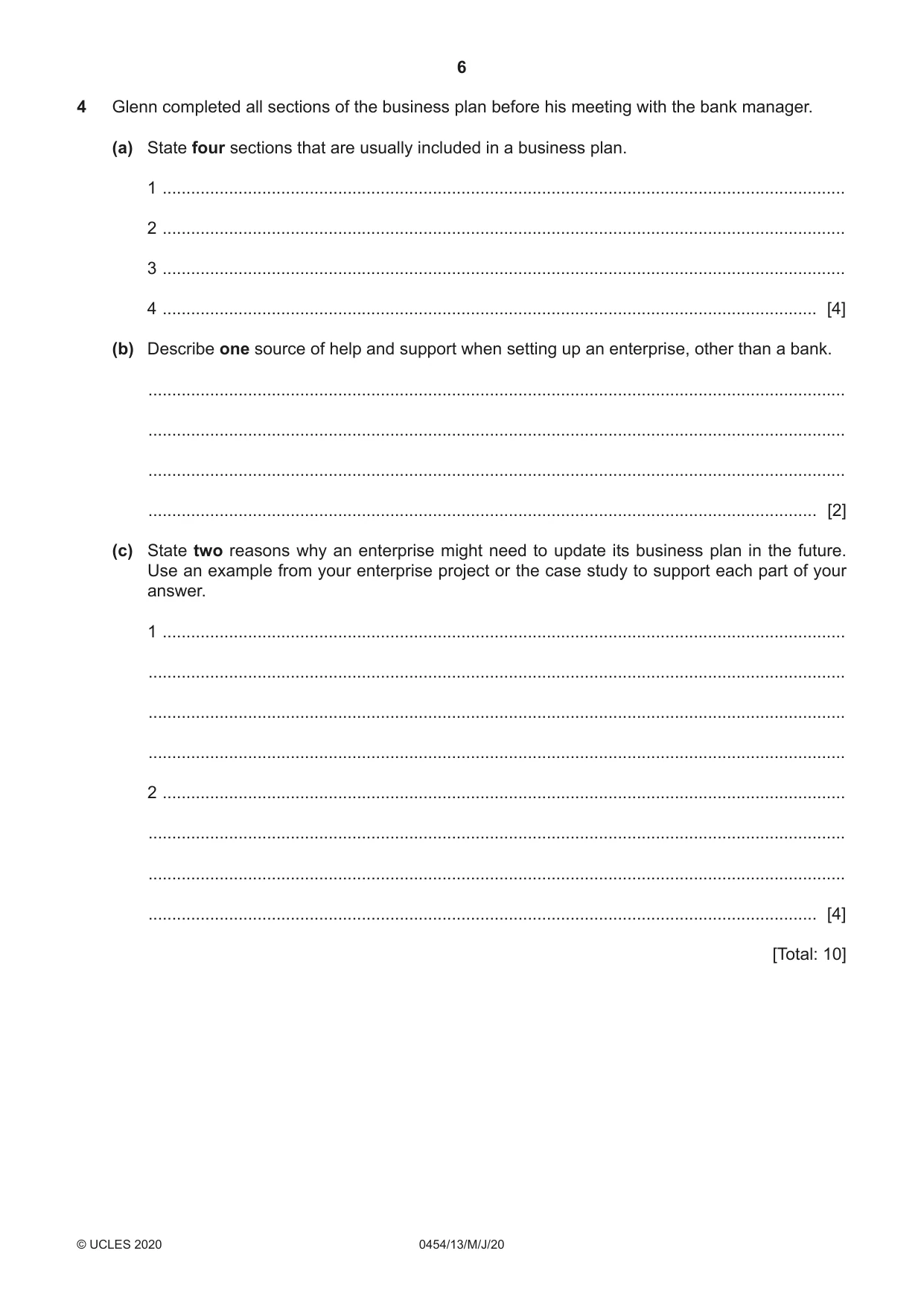
Question paper, page 6
6 0454/13/M/J/20 © UCLES 2020 4 Glenn completed all sections of the business plan before his meeting with the bank manager. (a) State four sections that are usually included in a business plan. 1 … 2 … 3 … 4 … [4] (b) Describe one source of help and support when setting up an enterprise, other than a bank. … … … … [2] (c) State two reasons why an enterprise might need to update its business plan in the future. Use an example from your enterprise project or the case study to support each part of your answer. 1 … … … … 2 … … … … [4] [Total: 10]
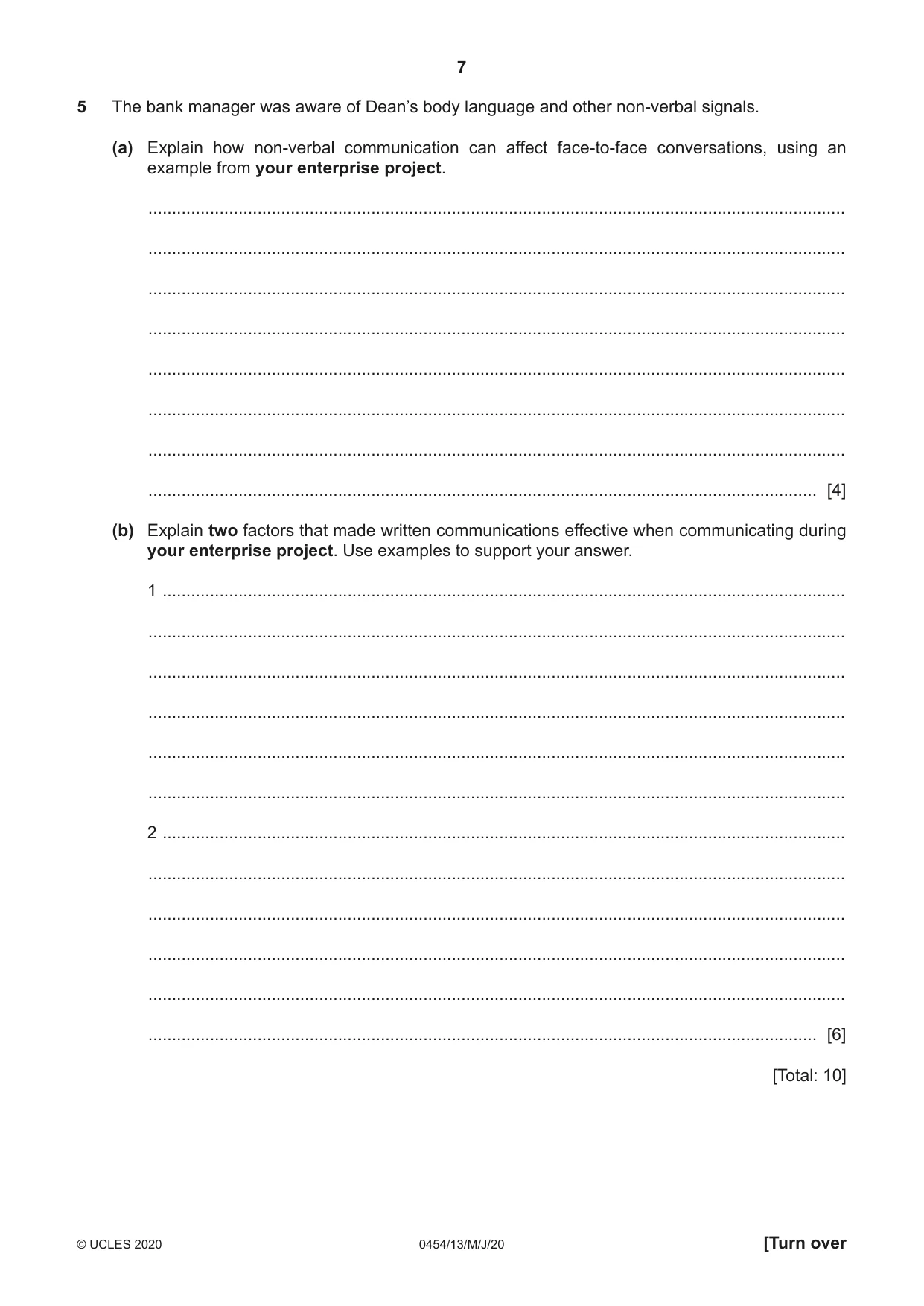
Question paper, page 7
7 0454/13/M/J/20 © UCLES 2020 [Turn over 5 The bank manager was aware of Dean’s body language and other non-verbal signals. (a) Explain how non-verbal communication can affect face-to-face conversations, using an example from your enterprise project. … … … … … … … … [4] (b) Explain two factors that made written communications effective when communicating during your enterprise project. Use examples to support your answer. 1 … … … … … … 2 … … … … … … [6] [Total: 10]
Question paper, page 8
8 0454/13/M/J/20 © UCLES 2020 BLANK PAGE
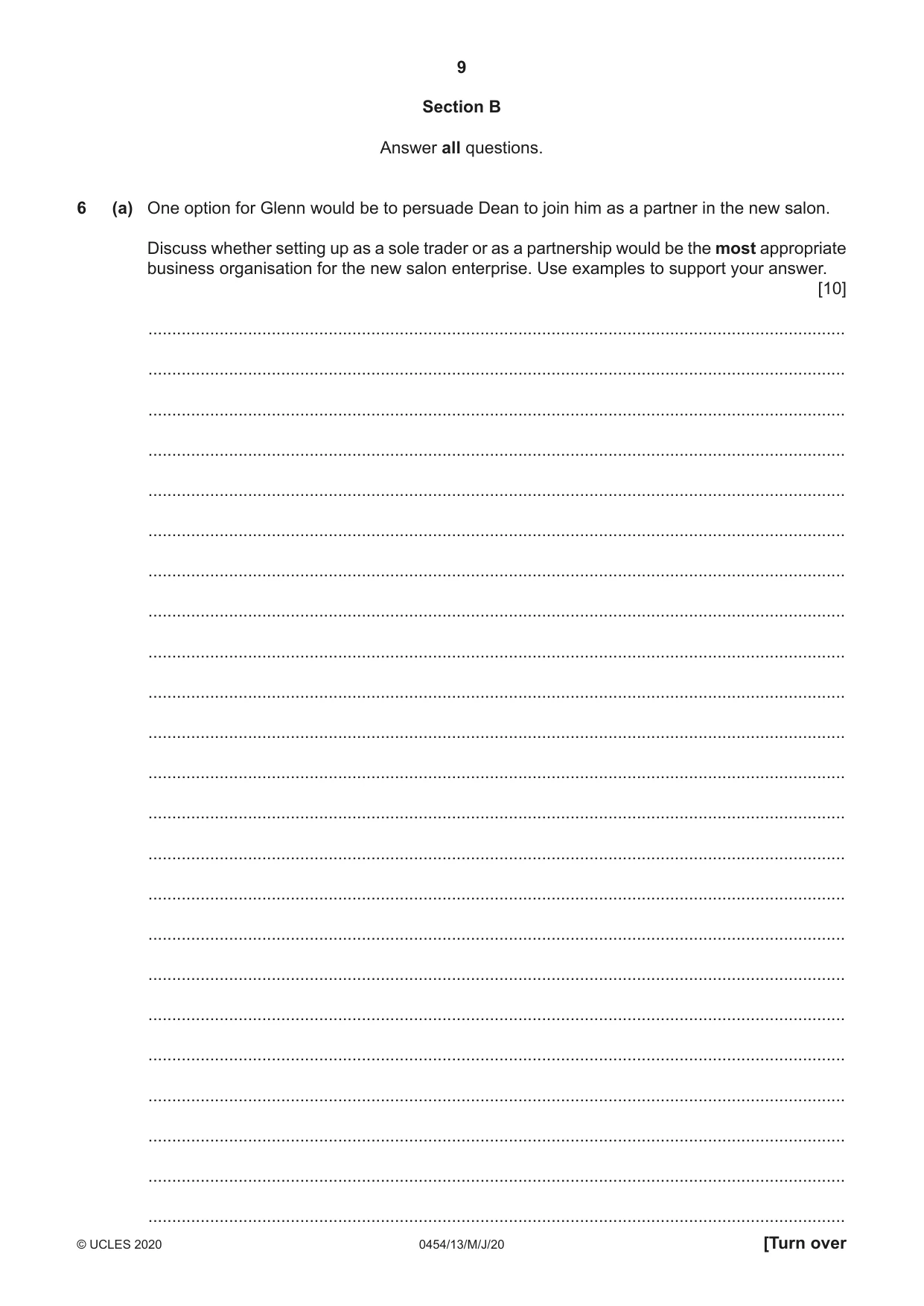
Question paper, page 9
9 0454/13/M/J/20 © UCLES 2020 [Turn over Section B Answer all questions. 6 (a) One option for Glenn would be to persuade Dean to join him as a partner in the new salon. Discuss whether setting up as a sole trader or as a partnership would be the most appropriate business organisation for the new salon enterprise. Use examples to support your answer. [10] … … … … … … … … … … … … … … … … … … … … … … …
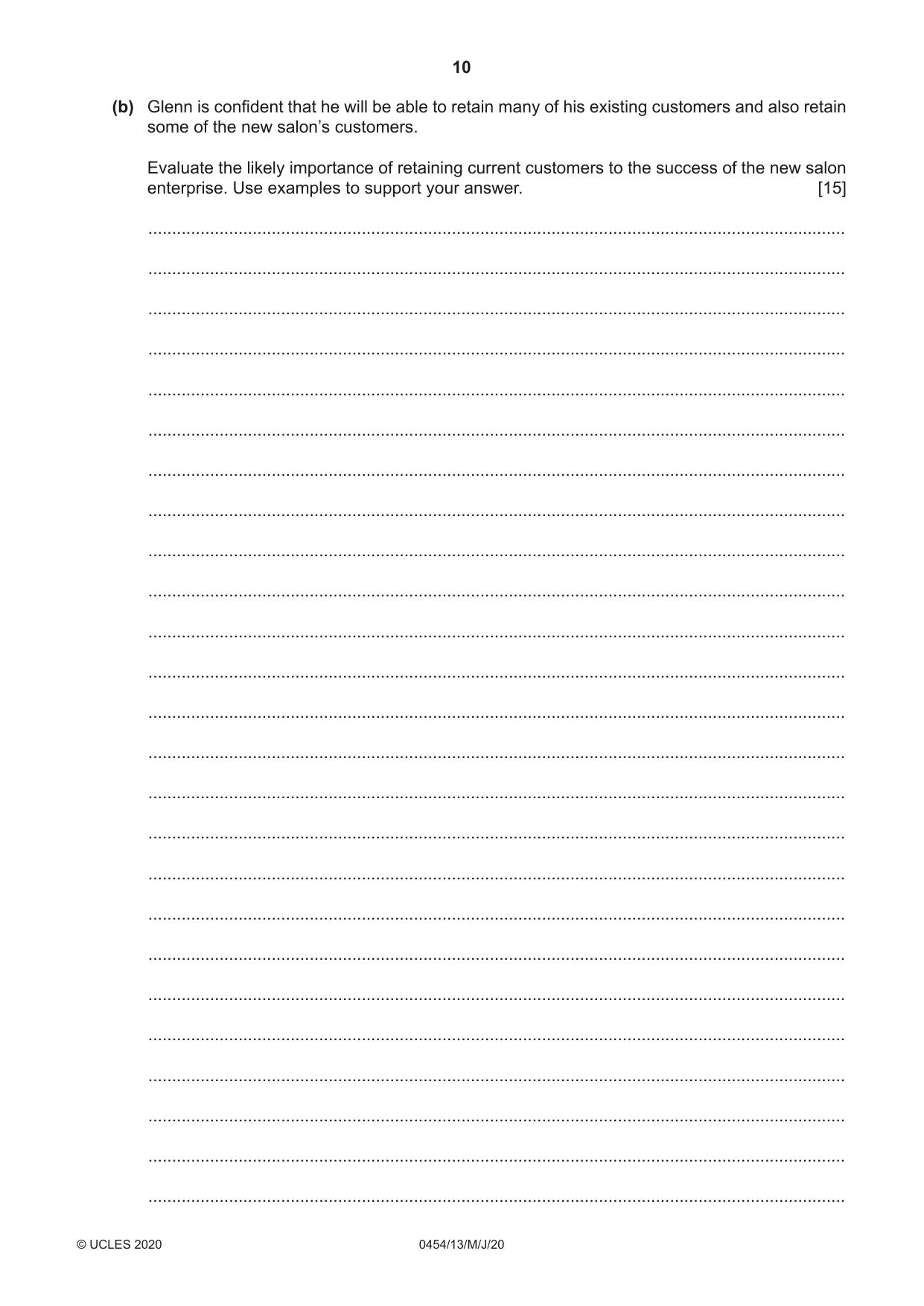
Question paper, page 10
10 0454/13/M/J/20 © UCLES 2020 (b) Glenn is confident that he will be able to retain many of his existing customers and also retain some of the new salon’s customers. Evaluate the likely importance of retaining current customers to the success of the new salon enterprise. Use examples to support your answer. [15] … … … … … … … … … … … … … … … … … … … … … … … … …
Question paper, page 11
11 0454/13/M/J/20 © UCLES 2020 [Turn over … … … … … … … … … … … … … … … … … … … … … … … … … … … [Total: 25]
Question paper, page 12
12 0454/13/M/J/20 © UCLES 2020 BLANK PAGE
Question paper, page 13
13 0454/13/M/J/20 © UCLES 2020 [Turn over 7 Now consider your enterprise project. (a) Analyse the effectiveness of a presentation that you were involved in during your enterprise project. Use examples to support your answer. [10] … … … … … … … … … … … … … … … … … … … … … … … … … …
Question paper, page 14
14 0454/13/M/J/20 © UCLES 2020 (b) The enterprise process involves six stages: 1. identifying the problem or need or want 2. exploring creative solutions 3. action planning 4. implementing the plan 5. monitoring progress 6. evaluation of successes and failures. Evaluate the importance of three of these stages to the overall success of your enterprise project. Use examples to support your answer. [15] … … … … … … … … … … … … … … … … … … … … … … …
Question paper, page 15
15 0454/13/M/J/20 © UCLES 2020 … … … … … … … … … … … … … … … … … … … … … … … … … … … [Total: 25]
Question paper, page 16
16 0454/13/M/J/20 © UCLES 2020 Permission to reproduce items where third-party owned material protected by copyright is included has been sought and cleared where possible. Every reasonable effort has been made by the publisher (UCLES) to trace copyright holders, but if any items requiring clearance have unwittingly been included, the publisher will be pleased to make amends at the earliest possible opportunity. To avoid the issue of disclosure of answer-related information to candidates, all copyright acknowledgements are reproduced online in the Cambridge Assessment International Education Copyright Acknowledgements Booklet. This is produced for each series of examinations and is freely available to download at www.cambridgeinternational.org after the live examination series. Cambridge Assessment International Education is part of the Cambridge Assessment Group. Cambridge Assessment is the brand name of the University of Cambridge Local Examinations Syndicate (UCLES), which itself is a department of the University of Cambridge. BLANK PAGE
Mark scheme, page 1
This document consists of 11 printed pages. © UCLES 2020 [Turn over Cambridge IGCSE™ ENTERPRISE 0454/13 Paper 1 Case Study May/June 2020 MARK SCHEME Maximum Mark: 100 Published Students did not sit exam papers in the June 2020 series due to the Covid-19 global pandemic. This mark scheme is published to support teachers and students and should be read together with the question paper. It shows the requirements of the exam. The answer column of the mark scheme shows the proposed basis on which Examiners would award marks for this exam. Where appropriate, this column also provides the most likely acceptable alternative responses expected from students. Examiners usually review the mark scheme after they have seen student responses and update the mark scheme if appropriate. In the June series, Examiners were unable to consider the acceptability of alternative responses, as there were no student responses to consider. Mark schemes should usually be read together with the Principal Examiner Report for Teachers. However, because students did not sit exam papers, there is no Principal Examiner Report for Teachers for the June 2020 series. Cambridge International will not enter into discussions about these mark schemes. Cambridge International is publishing the mark schemes for the June 2020 series for most Cambridge IGCSE™ and Cambridge International A & AS Level components, and some Cambridge O Level components.
Mark scheme, page 2
0454/13 Cambridge IGCSE – Mark Scheme PUBLISHED May/June 2020 © UCLES 2020 Page 2 of 11 Generic Marking Principles These general marking principles must be applied by all examiners when marking candidate answers. They should be applied alongside the specific content of the mark scheme or generic level descriptors for a question. Each question paper and mark scheme will also comply with these marking principles. GENERIC MARKING PRINCIPLE 1: Marks must be awarded in line with: • the specific content of the mark scheme or the generic level descriptors for the question • the specific skills defined in the mark scheme or in the generic level descriptors for the question • the standard of response required by a candidate as exemplified by the standardisation scripts. GENERIC MARKING PRINCIPLE 2: Marks awarded are always whole marks (not half marks, or other fractions). GENERIC MARKING PRINCIPLE 3: Marks must be awarded positively: • marks are awarded for correct/valid answers, as defined in the mark scheme. However, credit is given for valid answers which go beyond the scope of the syllabus and mark scheme, referring to your Team Leader as appropriate • marks are awarded when candidates clearly demonstrate what they know and can do • marks are not deducted for errors • marks are not deducted for omissions • answers should only be judged on the quality of spelling, punctuation and grammar when these features are specifically assessed by the question as indicated by the mark scheme. The meaning, however, should be unambiguous. GENERIC MARKING PRINCIPLE 4: Rules must be applied consistently e.g. in situations where candidates have not followed instructions or in the application of generic level descriptors. GENERIC MARKING PRINCIPLE 5: Marks should be awarded using the full range of marks defined in the mark scheme for the question (however; the use of the full mark range may be limited according to the quality of the candidate responses seen). GENERIC MARKING PRINCIPLE 6: Marks awarded are based solely on the requirements as defined in the mark scheme. Marks should not be awarded with grade thresholds or grade descriptors in mind.
Mark scheme, page 3
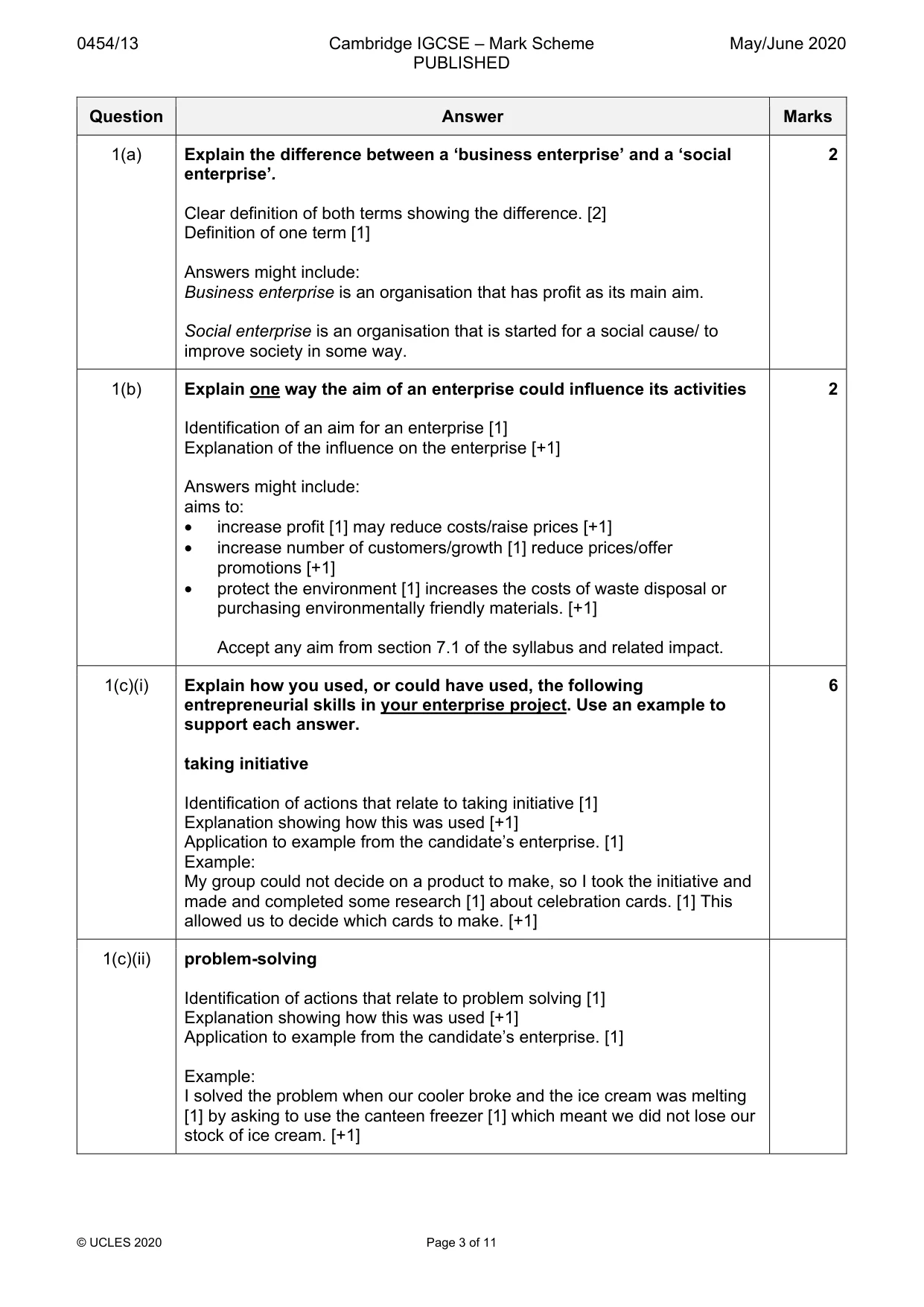
0454/13 Cambridge IGCSE – Mark Scheme PUBLISHED May/June 2020 © UCLES 2020 Page 3 of 11 Question Answer Marks 1(a) Explain the difference between a ‘business enterprise’ and a ‘social enterprise’. Clear definition of both terms showing the difference. [2] Definition of one term [1] Answers might include: Business enterprise is an organisation that has profit as its main aim. Social enterprise is an organisation that is started for a social cause/ to improve society in some way. 2 1(b) Explain one way the aim of an enterprise could influence its activities Identification of an aim for an enterprise [1] Explanation of the influence on the enterprise [+1] Answers might include: aims to: • increase profit [1] may reduce costs/raise prices [+1] • increase number of customers/growth [1] reduce prices/offer promotions [+1] • protect the environment [1] increases the costs of waste disposal or purchasing environmentally friendly materials. [+1] Accept any aim from section 7.1 of the syllabus and related impact. 2 1(c)(i) Explain how you used, or could have used, the following entrepreneurial skills in your enterprise project. Use an example to support each answer. taking initiative Identification of actions that relate to taking initiative [1] Explanation showing how this was used [+1] Application to example from the candidate’s enterprise. [1] Example: My group could not decide on a product to make, so I took the initiative and made and completed some research [1] about celebration cards. [1] This allowed us to decide which cards to make. [+1] 6 1(c)(ii) problem-solving Identification of actions that relate to problem solving [1] Explanation showing how this was used [+1] Application to example from the candidate’s enterprise. [1] Example: I solved the problem when our cooler broke and the ice cream was melting [1] by asking to use the canteen freezer [1] which meant we did not lose our stock of ice cream. [+1]
Mark scheme, page 4
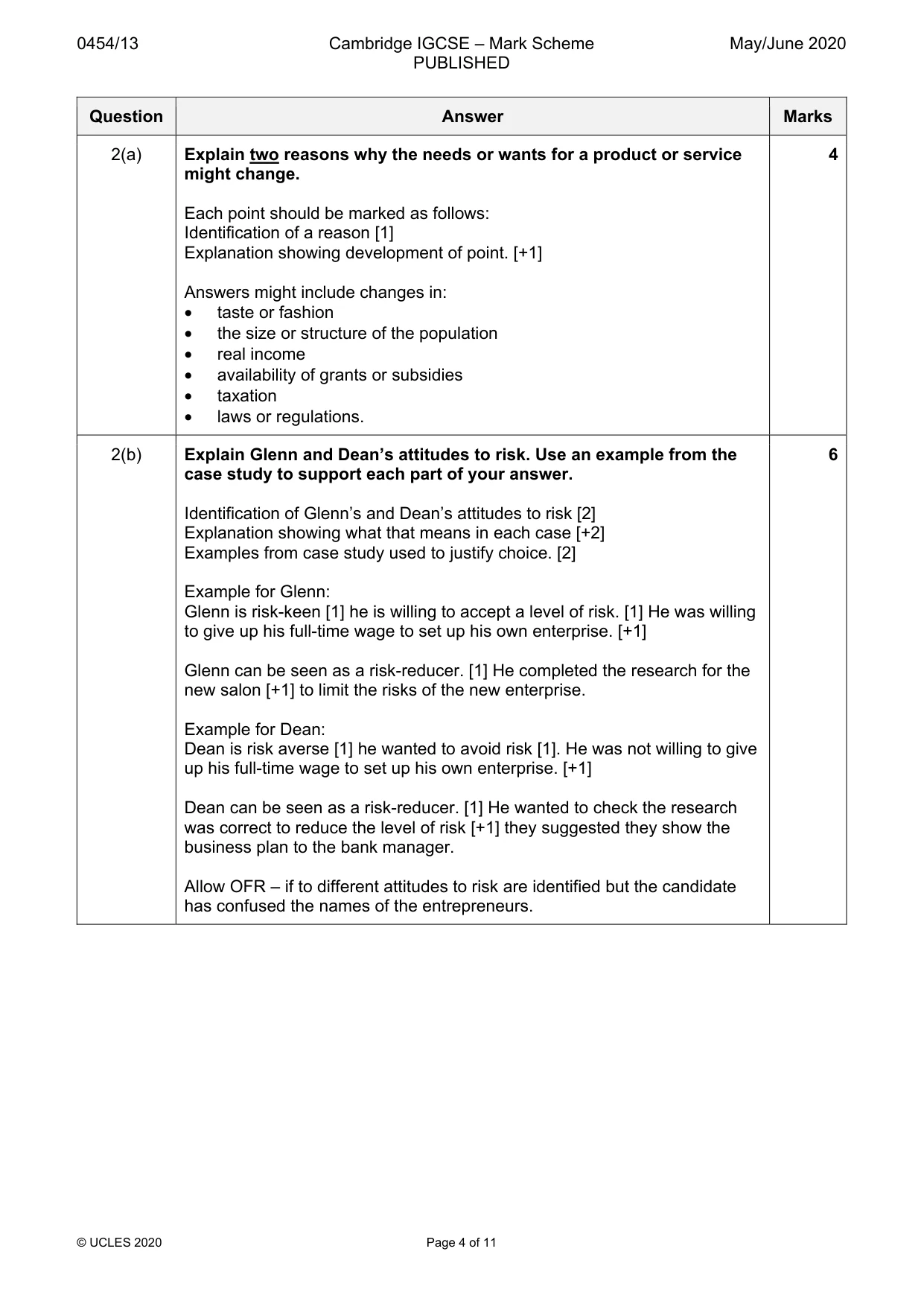
0454/13 Cambridge IGCSE – Mark Scheme PUBLISHED May/June 2020 © UCLES 2020 Page 4 of 11 Question Answer Marks 2(a) Explain two reasons why the needs or wants for a product or service might change. Each point should be marked as follows: Identification of a reason [1] Explanation showing development of point. [+1] Answers might include changes in: • taste or fashion • the size or structure of the population • real income • availability of grants or subsidies • taxation • laws or regulations. 4 2(b) Explain Glenn and Dean’s attitudes to risk. Use an example from the case study to support each part of your answer. Identification of Glenn’s and Dean’s attitudes to risk [2] Explanation showing what that means in each case [+2] Examples from case study used to justify choice. [2] Example for Glenn: Glenn is risk-keen [1] he is willing to accept a level of risk. [1] He was willing to give up his full-time wage to set up his own enterprise. [+1] Glenn can be seen as a risk-reducer. [1] He completed the research for the new salon [+1] to limit the risks of the new enterprise. Example for Dean: Dean is risk averse [1] he wanted to avoid risk [1]. He was not willing to give up his full-time wage to set up his own enterprise. [+1] Dean can be seen as a risk-reducer. [1] He wanted to check the research was correct to reduce the level of risk [+1] they suggested they show the business plan to the bank manager. Allow OFR – if to different attitudes to risk are identified but the candidate has confused the names of the entrepreneurs. 6
Mark scheme, page 5
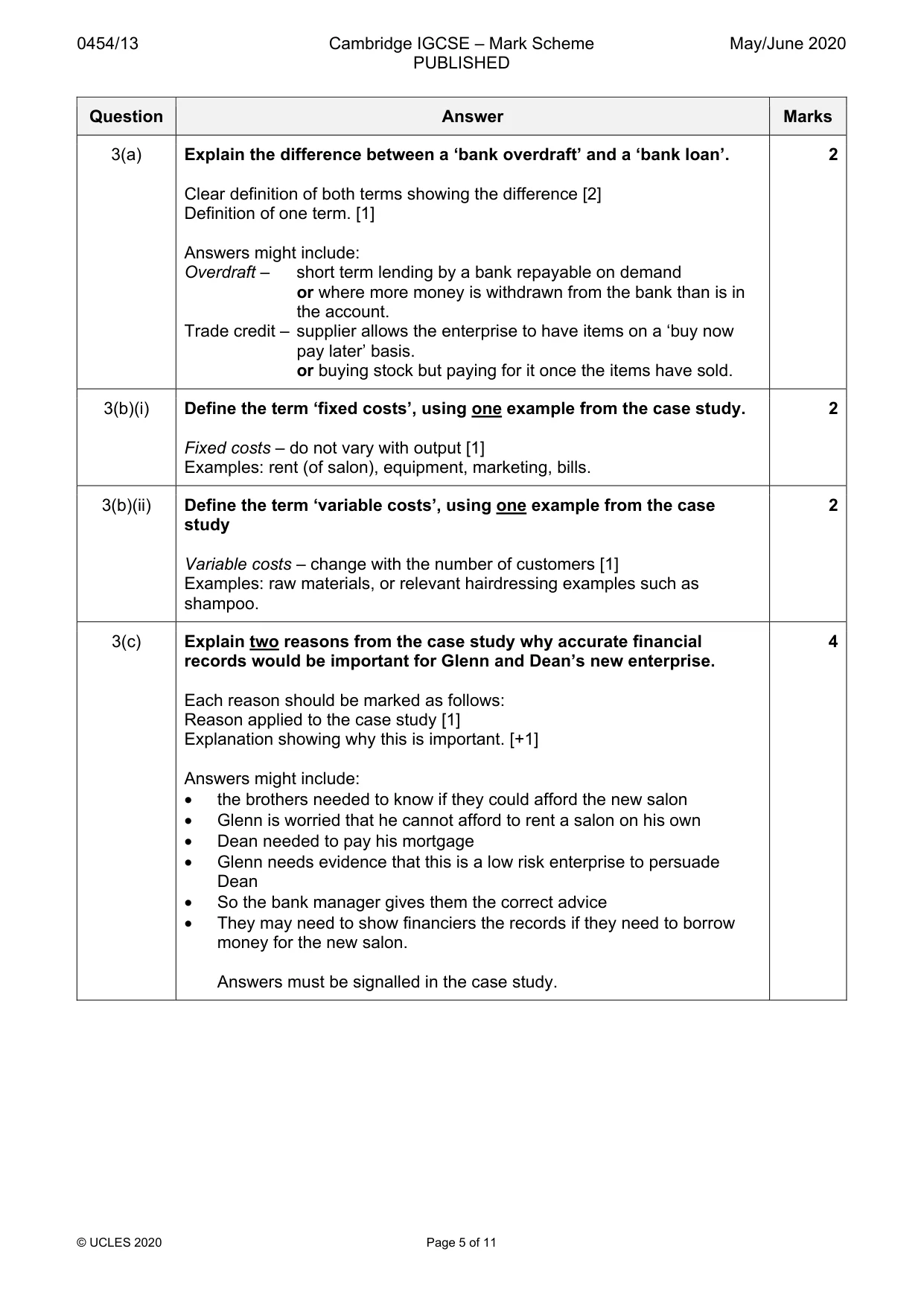
0454/13 Cambridge IGCSE – Mark Scheme PUBLISHED May/June 2020 © UCLES 2020 Page 5 of 11 Question Answer Marks 3(a) Explain the difference between a ‘bank overdraft’ and a ‘bank loan’. Clear definition of both terms showing the difference [2] Definition of one term. [1] Answers might include: Overdraft – short term lending by a bank repayable on demand or where more money is withdrawn from the bank than is in the account. Trade credit – supplier allows the enterprise to have items on a ‘buy now pay later’ basis. or buying stock but paying for it once the items have sold. 2 3(b)(i) Define the term ‘fixed costs’, using one example from the case study. Fixed costs – do not vary with output [1] Examples: rent (of salon), equipment, marketing, bills. 2 3(b)(ii) Define the term ‘variable costs’, using one example from the case study Variable costs – change with the number of customers [1] Examples: raw materials, or relevant hairdressing examples such as shampoo. 2 3(c) Explain two reasons from the case study why accurate financial records would be important for Glenn and Dean’s new enterprise. Each reason should be marked as follows: Reason applied to the case study [1] Explanation showing why this is important. [+1] Answers might include: • the brothers needed to know if they could afford the new salon • Glenn is worried that he cannot afford to rent a salon on his own • Dean needed to pay his mortgage • Glenn needs evidence that this is a low risk enterprise to persuade Dean • So the bank manager gives them the correct advice • They may need to show financiers the records if they need to borrow money for the new salon. Answers must be signalled in the case study. 4
Mark scheme, page 6
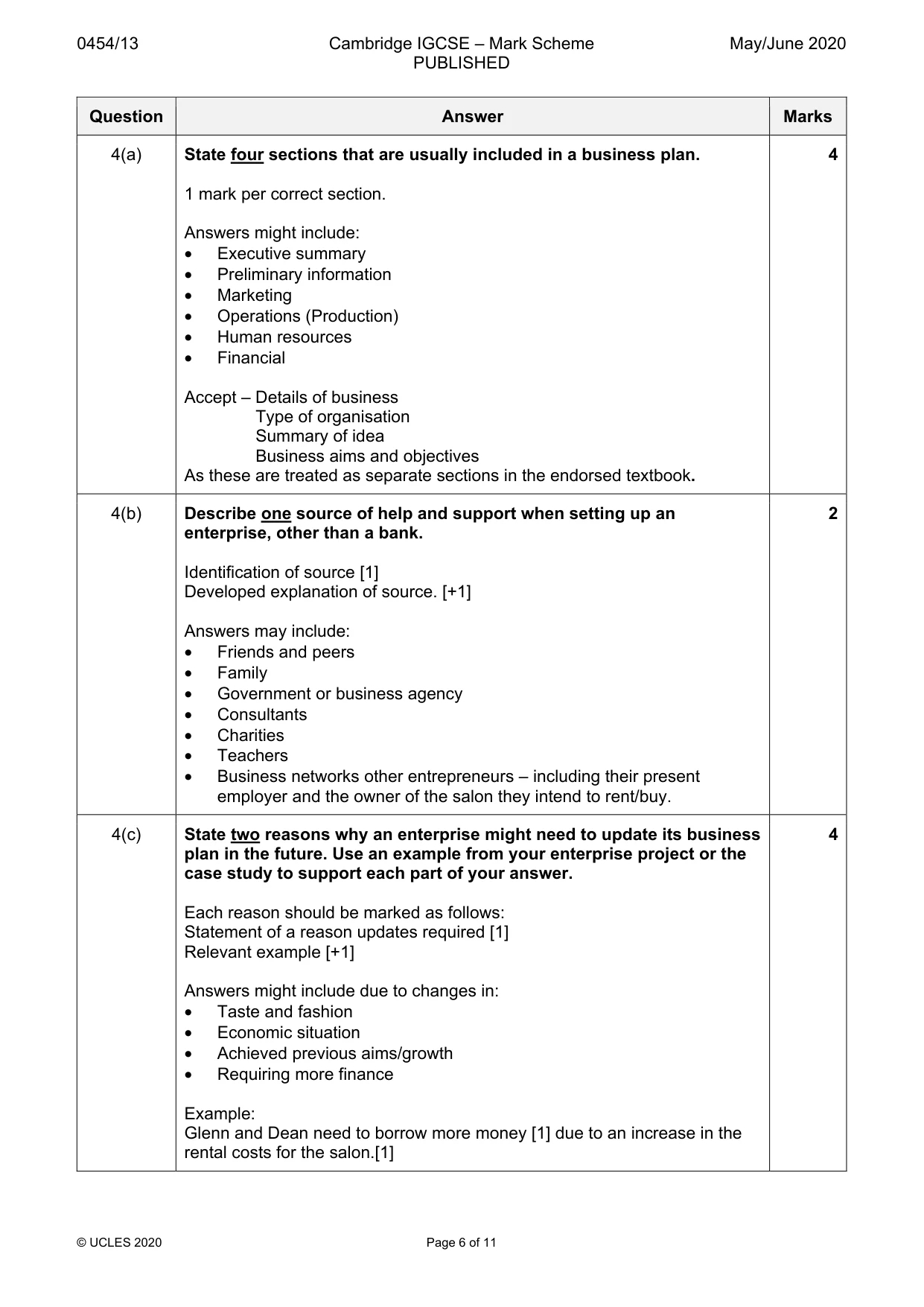
0454/13 Cambridge IGCSE – Mark Scheme PUBLISHED May/June 2020 © UCLES 2020 Page 6 of 11 Question Answer Marks 4(a) State four sections that are usually included in a business plan. 1 mark per correct section. Answers might include: • Executive summary • Preliminary information • Marketing • Operations (Production) • Human resources • Financial Accept – Details of business Type of organisation Summary of idea Business aims and objectives As these are treated as separate sections in the endorsed textbook. 4 4(b) Describe one source of help and support when setting up an enterprise, other than a bank. Identification of source [1] Developed explanation of source. [+1] Answers may include: • Friends and peers • Family • Government or business agency • Consultants • Charities • Teachers • Business networks other entrepreneurs – including their present employer and the owner of the salon they intend to rent/buy. 2 4(c) State two reasons why an enterprise might need to update its business plan in the future. Use an example from your enterprise project or the case study to support each part of your answer. Each reason should be marked as follows: Statement of a reason updates required [1] Relevant example [+1] Answers might include due to changes in: • Taste and fashion • Economic situation • Achieved previous aims/growth • Requiring more finance Example: Glenn and Dean need to borrow more money [1] due to an increase in the rental costs for the salon.[1] 4
Mark scheme, page 7
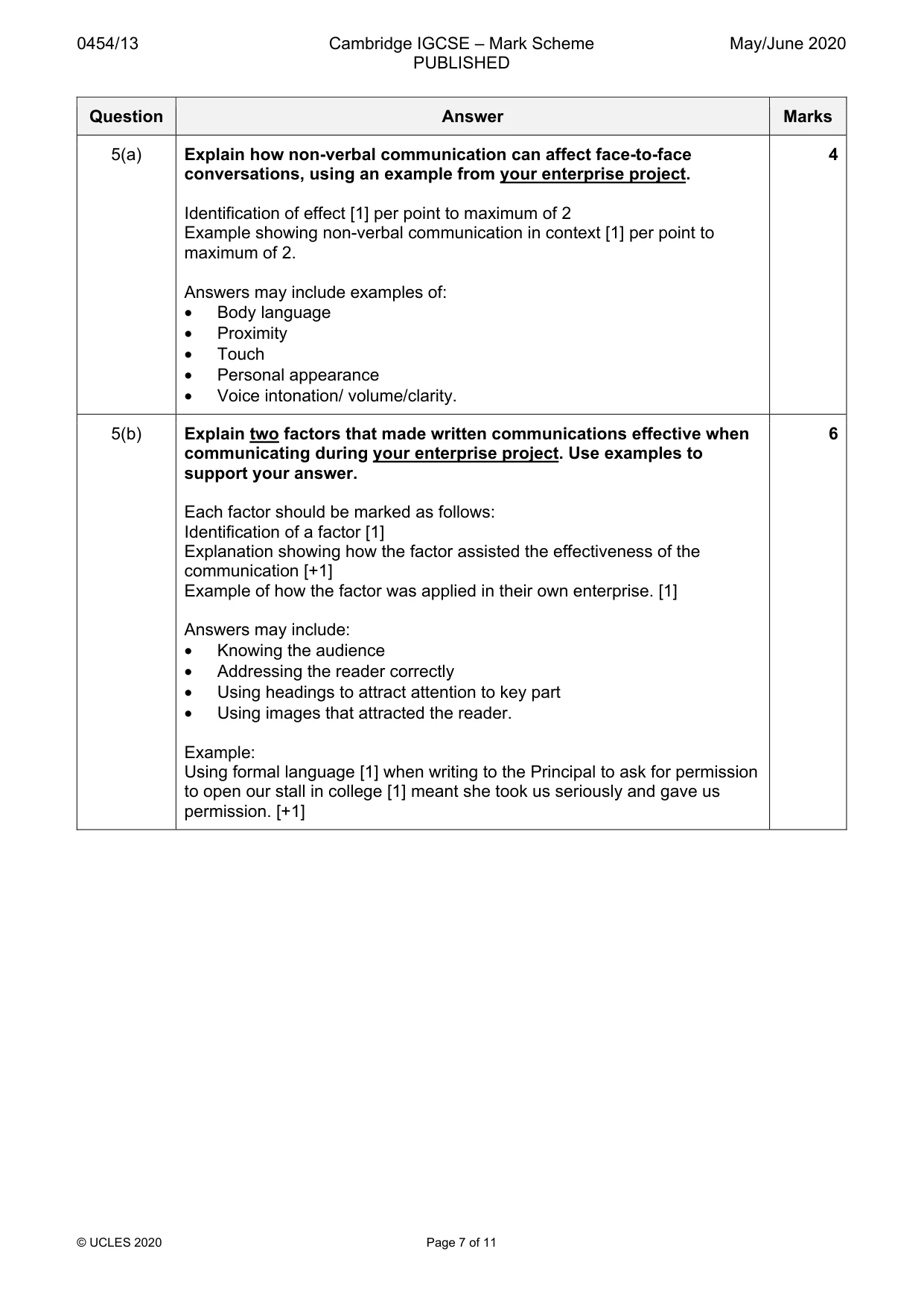
0454/13 Cambridge IGCSE – Mark Scheme PUBLISHED May/June 2020 © UCLES 2020 Page 7 of 11 Question Answer Marks 5(a) Explain how non-verbal communication can affect face-to-face conversations, using an example from your enterprise project. Identification of effect [1] per point to maximum of 2 Example showing non-verbal communication in context [1] per point to maximum of 2. Answers may include examples of: • Body language • Proximity • Touch • Personal appearance • Voice intonation/ volume/clarity. 4 5(b) Explain two factors that made written communications effective when communicating during your enterprise project. Use examples to support your answer. Each factor should be marked as follows: Identification of a factor [1] Explanation showing how the factor assisted the effectiveness of the communication [+1] Example of how the factor was applied in their own enterprise. [1] Answers may include: • Knowing the audience • Addressing the reader correctly • Using headings to attract attention to key part • Using images that attracted the reader. Example: Using formal language [1] when writing to the Principal to ask for permission to open our stall in college [1] meant she took us seriously and gave us permission. [+1] 6
Mark scheme, page 8
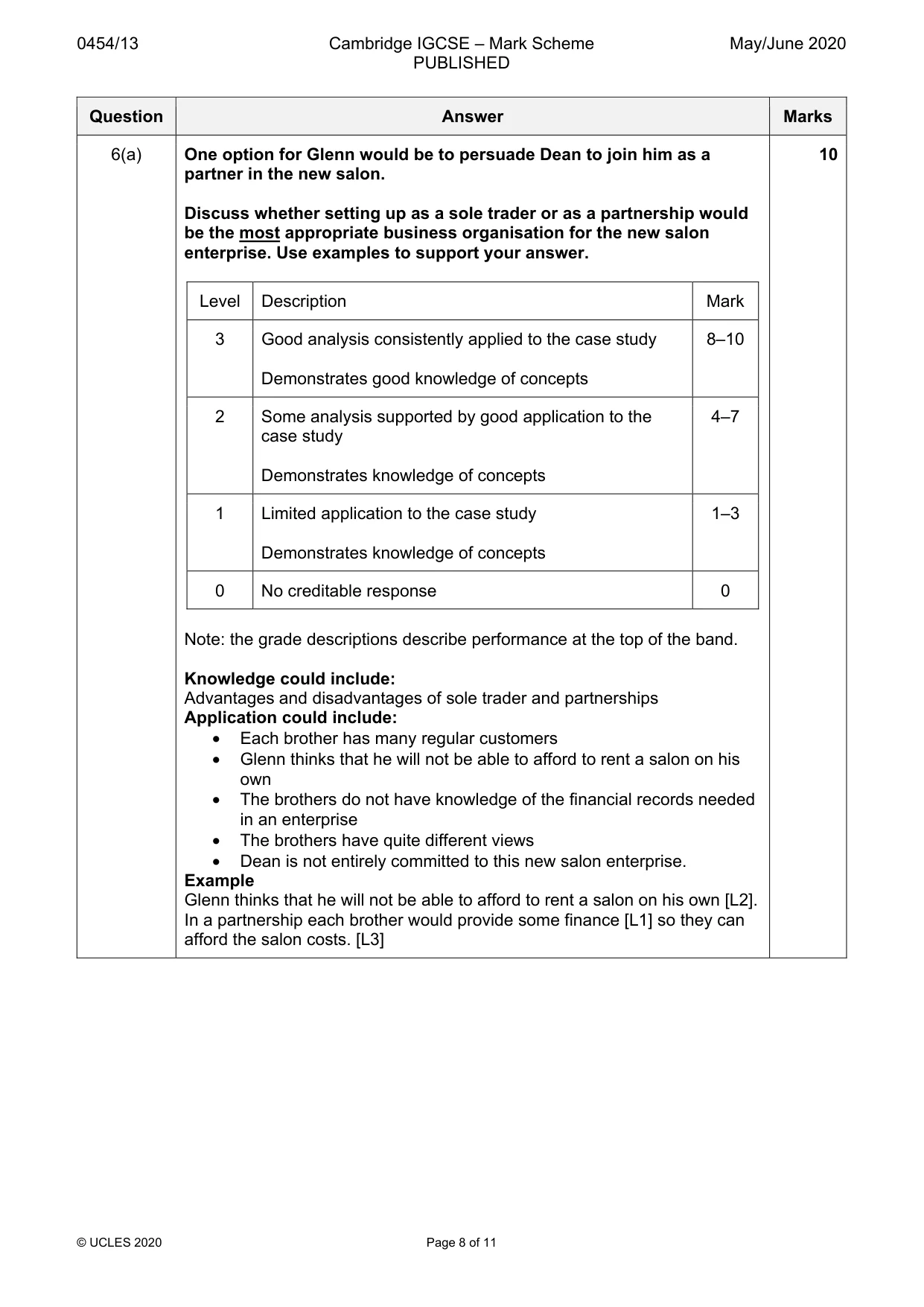
0454/13 Cambridge IGCSE – Mark Scheme PUBLISHED May/June 2020 © UCLES 2020 Page 8 of 11 Question Answer Marks 6(a) One option for Glenn would be to persuade Dean to join him as a partner in the new salon. Discuss whether setting up as a sole trader or as a partnership would be the most appropriate business organisation for the new salon enterprise. Use examples to support your answer. Level Description Mark 3 Good analysis consistently applied to the case study Demonstrates good knowledge of concepts 8–10 2 Some analysis supported by good application to the case study Demonstrates knowledge of concepts 4–7 1 Limited application to the case study Demonstrates knowledge of concepts 1–3 0 No creditable response 0 Note: the grade descriptions describe performance at the top of the band. Knowledge could include: Advantages and disadvantages of sole trader and partnerships Application could include: • Each brother has many regular customers • Glenn thinks that he will not be able to afford to rent a salon on his own • The brothers do not have knowledge of the financial records needed in an enterprise • The brothers have quite different views • Dean is not entirely committed to this new salon enterprise. Example Glenn thinks that he will not be able to afford to rent a salon on his own [L2]. In a partnership each brother would provide some finance [L1] so they can afford the salon costs. [L3] 10
Mark scheme, page 9
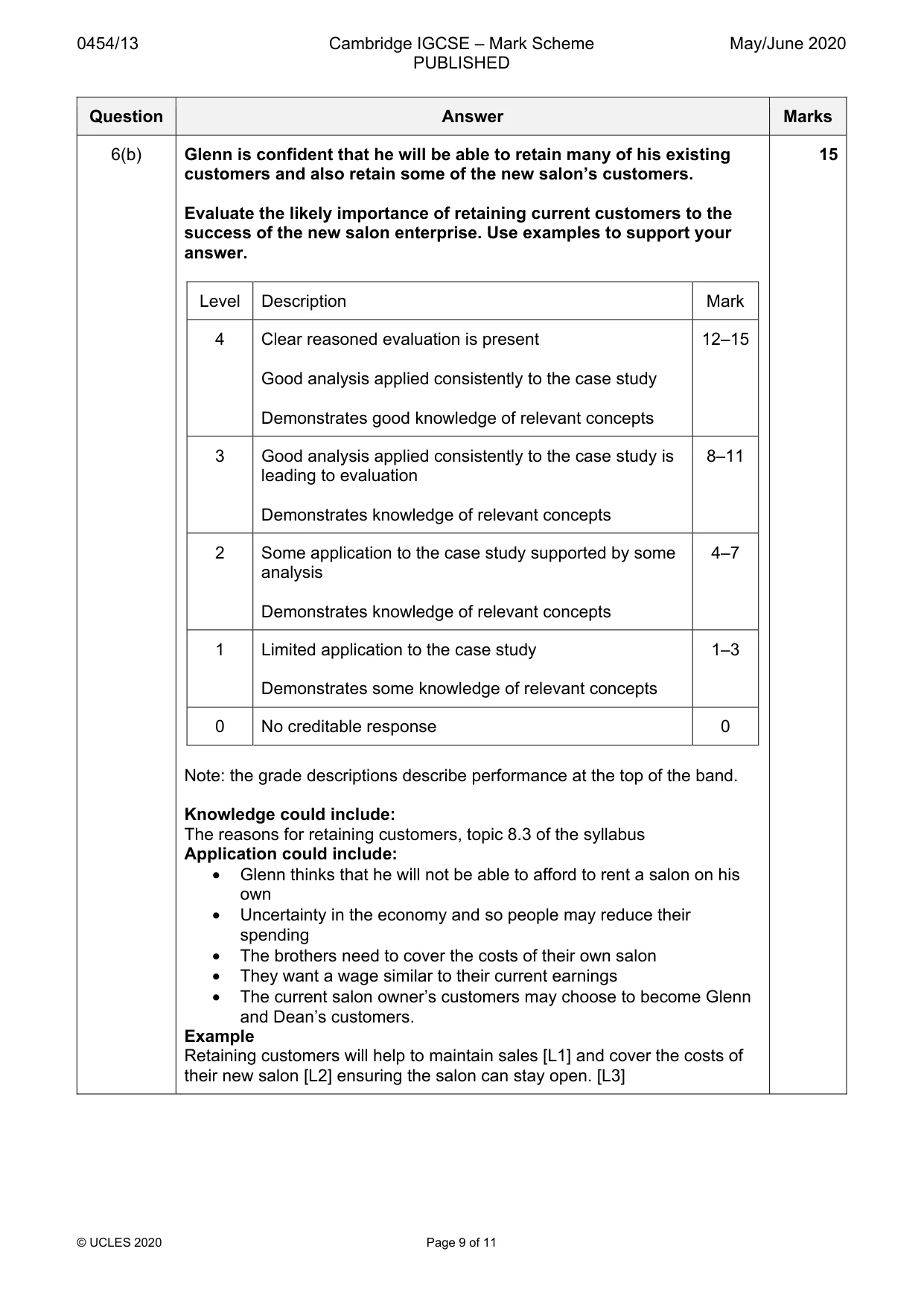
0454/13 Cambridge IGCSE – Mark Scheme PUBLISHED May/June 2020 © UCLES 2020 Page 9 of 11 Question Answer Marks 6(b) Glenn is confident that he will be able to retain many of his existing customers and also retain some of the new salon’s customers. Evaluate the likely importance of retaining current customers to the success of the new salon enterprise. Use examples to support your answer. Level Description Mark 4 Clear reasoned evaluation is present Good analysis applied consistently to the case study Demonstrates good knowledge of relevant concepts 12–15 3 Good analysis applied consistently to the case study is leading to evaluation Demonstrates knowledge of relevant concepts 8–11 2 Some application to the case study supported by some analysis Demonstrates knowledge of relevant concepts 4–7 1 Limited application to the case study Demonstrates some knowledge of relevant concepts 1–3 0 No creditable response 0 Note: the grade descriptions describe performance at the top of the band. Knowledge could include: The reasons for retaining customers, topic 8.3 of the syllabus Application could include: • Glenn thinks that he will not be able to afford to rent a salon on his own • Uncertainty in the economy and so people may reduce their spending • The brothers need to cover the costs of their own salon • They want a wage similar to their current earnings • The current salon owner’s customers may choose to become Glenn and Dean’s customers. Example Retaining customers will help to maintain sales [L1] and cover the costs of their new salon [L2] ensuring the salon can stay open. [L3] 15
Mark scheme, page 10
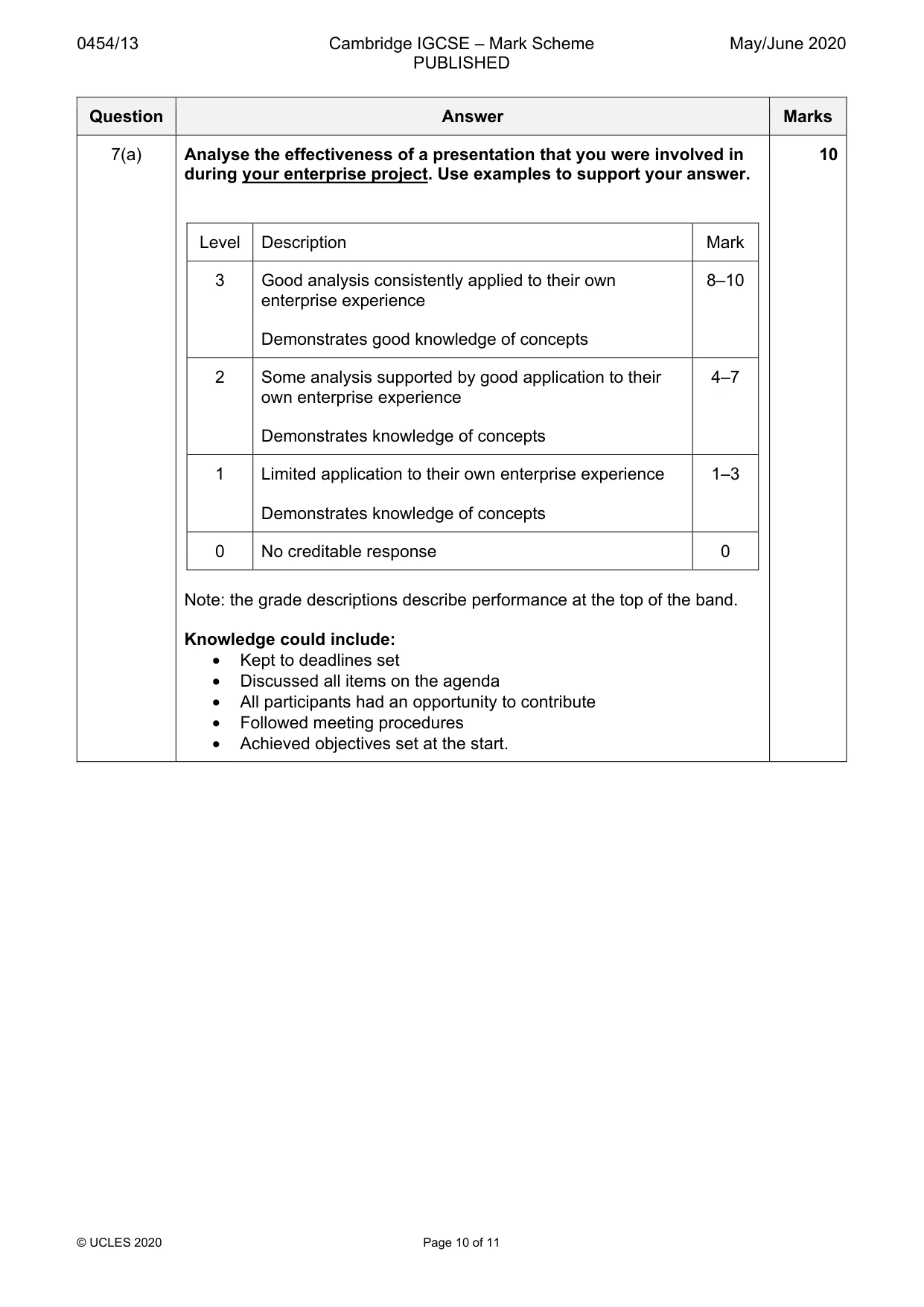
0454/13 Cambridge IGCSE – Mark Scheme PUBLISHED May/June 2020 © UCLES 2020 Page 10 of 11 Question Answer Marks 7(a) Analyse the effectiveness of a presentation that you were involved in during your enterprise project. Use examples to support your answer. Level Description Mark 3 Good analysis consistently applied to their own enterprise experience Demonstrates good knowledge of concepts 8–10 2 Some analysis supported by good application to their own enterprise experience Demonstrates knowledge of concepts 4–7 1 Limited application to their own enterprise experience Demonstrates knowledge of concepts 1–3 0 No creditable response 0 Note: the grade descriptions describe performance at the top of the band. Knowledge could include: • Kept to deadlines set • Discussed all items on the agenda • All participants had an opportunity to contribute • Followed meeting procedures • Achieved objectives set at the start. 10
Mark scheme, page 11
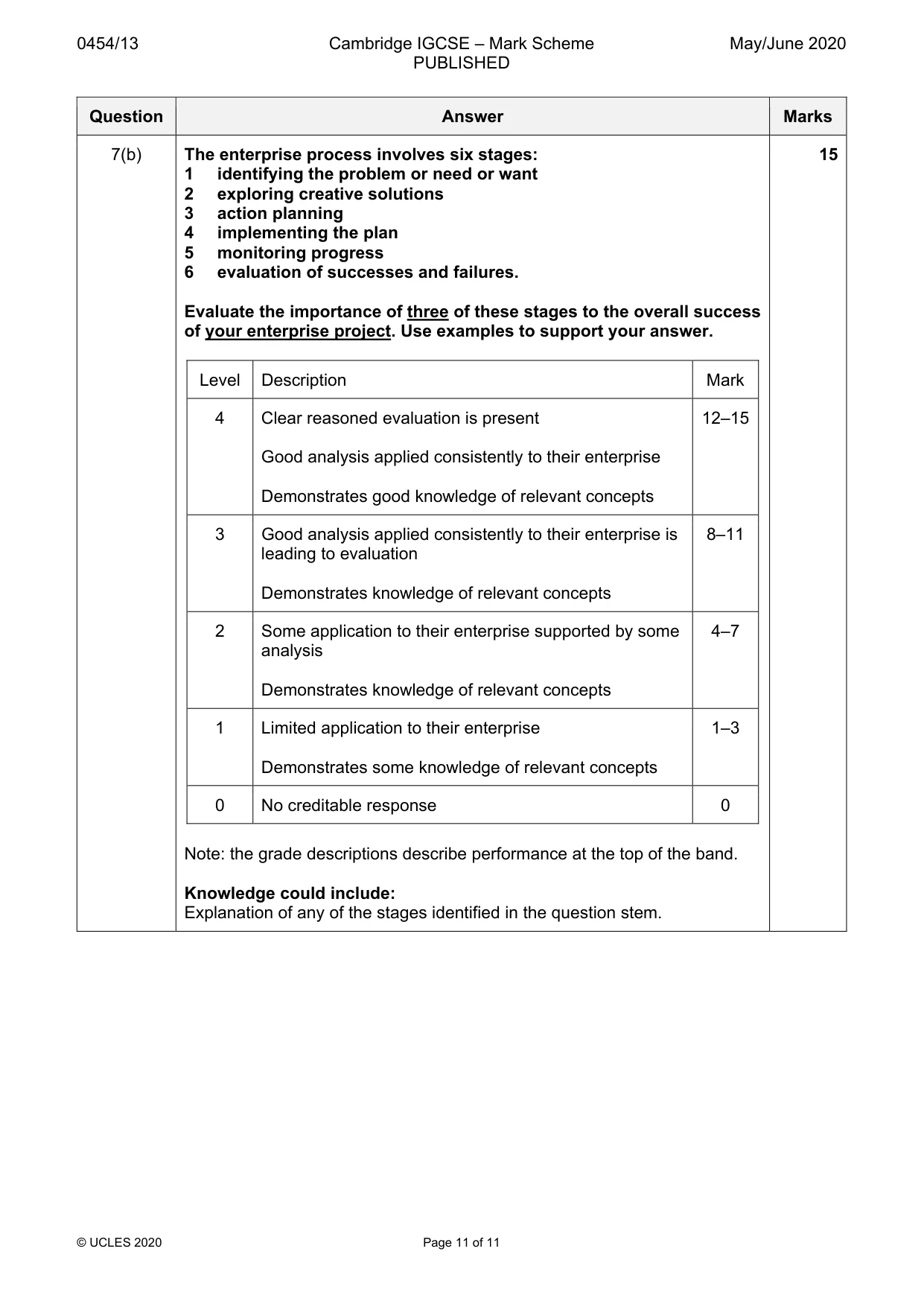
0454/13 Cambridge IGCSE – Mark Scheme PUBLISHED May/June 2020 © UCLES 2020 Page 11 of 11 Question Answer Marks 7(b) The enterprise process involves six stages: 1 identifying the problem or need or want 2 exploring creative solutions 3 action planning 4 implementing the plan 5 monitoring progress 6 evaluation of successes and failures. Evaluate the importance of three of these stages to the overall success of your enterprise project. Use examples to support your answer. Level Description Mark 4 Clear reasoned evaluation is present Good analysis applied consistently to their enterprise Demonstrates good knowledge of relevant concepts 12–15 3 Good analysis applied consistently to their enterprise is leading to evaluation Demonstrates knowledge of relevant concepts 8–11 2 Some application to their enterprise supported by some analysis Demonstrates knowledge of relevant concepts 4–7 1 Limited application to their enterprise Demonstrates some knowledge of relevant concepts 1–3 0 No creditable response 0 Note: the grade descriptions describe performance at the top of the band. Knowledge could include: Explanation of any of the stages identified in the question stem. 15