Cambridge IGCSE Enterprise 0454 — 2020 May/June Paper 1 · Variant 1
0454/11/M/J/20
The question paper and its mark scheme, free to read here and free to download. This is Cambridge’s own paper, exactly as it was sat.
Question paper16 pages








Mark scheme11 pages
Answers below. Sit the paper first if you are practising.
Paper as text
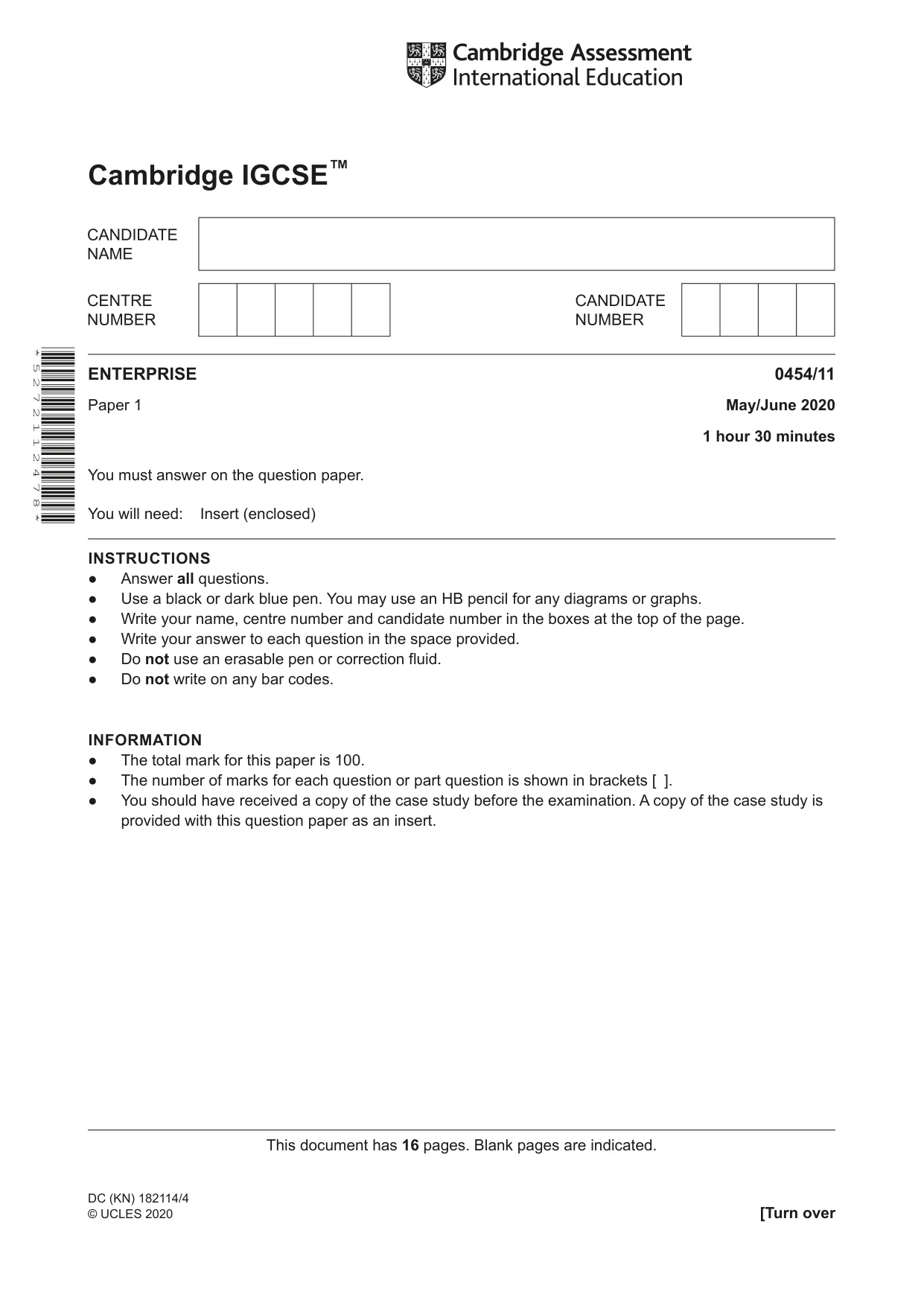
Question paper, page 1
Cambridge IGCSE™ DC (KN) 182114/4 © UCLES 2020 [Turn over This document has 16 pages. Blank pages are indicated. * 5 2 7 2 1 1 2 4 7 8 * ENTERPRISE 0454/11 Paper 1 May/June 2020 1 hour 30 minutes You must answer on the question paper. You will need: Insert (enclosed) INSTRUCTIONS ● Answer all questions. ● Use a black or dark blue pen. You may use an HB pencil for any diagrams or graphs. ● Write your name, centre number and candidate number in the boxes at the top of the page. ● Write your answer to each question in the space provided. ● Do not use an erasable pen or correction fluid. ● Do not write on any bar codes. INFORMATION ● The total mark for this paper is 100. ● The number of marks for each question or part question is shown in brackets [ ]. ● You should have received a copy of the case study before the examination. A copy of the case study is provided with this question paper as an insert.
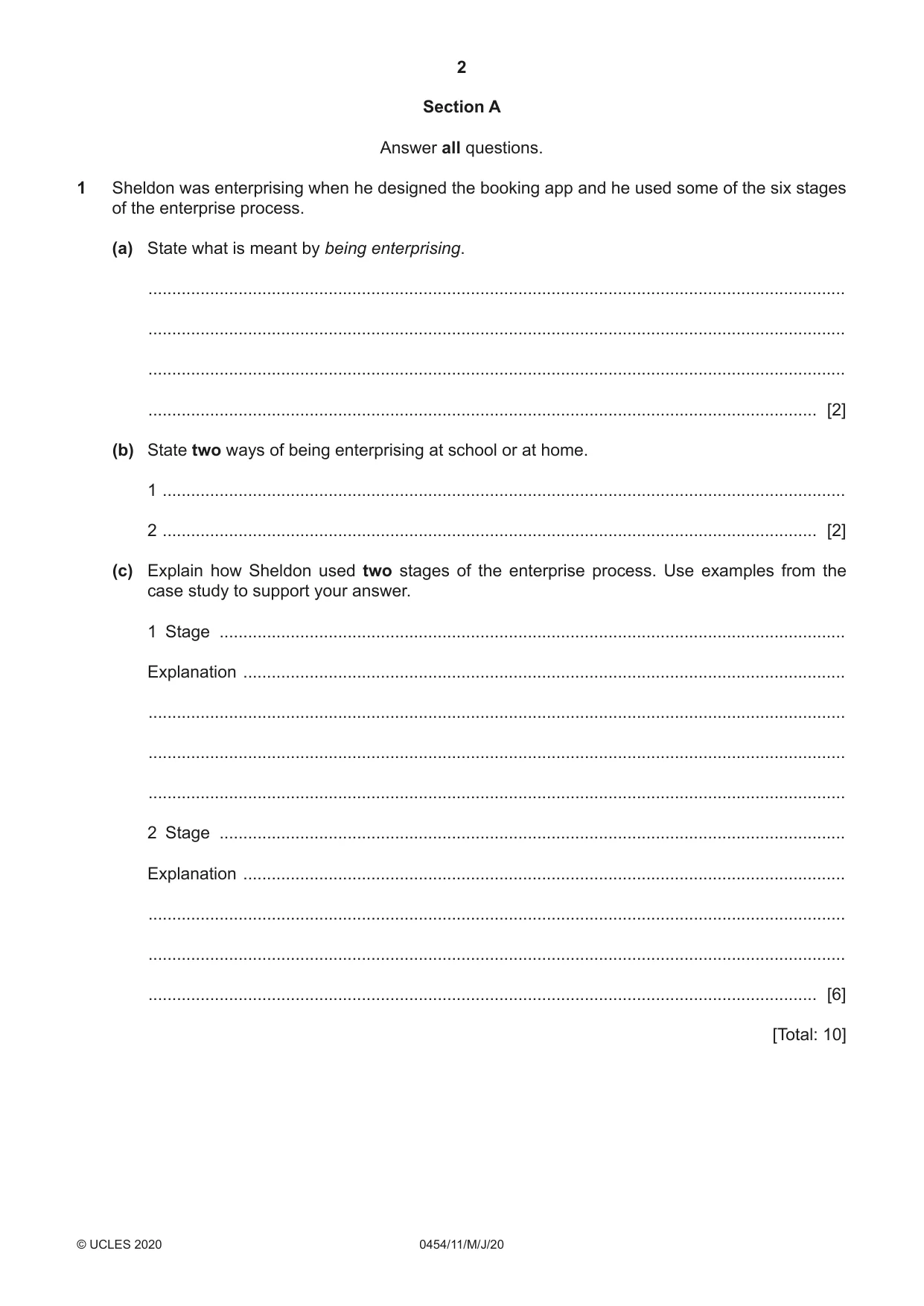
Question paper, page 2
2 0454/11/M/J/20 © UCLES 2020 Section A Answer all questions. 1 Sheldon was enterprising when he designed the booking app and he used some of the six stages of the enterprise process. (a) State what is meant by being enterprising. … … … … [2] (b) State two ways of being enterprising at school or at home. 1 … 2 … [2] (c) Explain how Sheldon used two stages of the enterprise process. Use examples from the case study to support your answer. 1 Stage … Explanation … … … … 2 Stage … Explanation … … … … [6] [Total: 10]
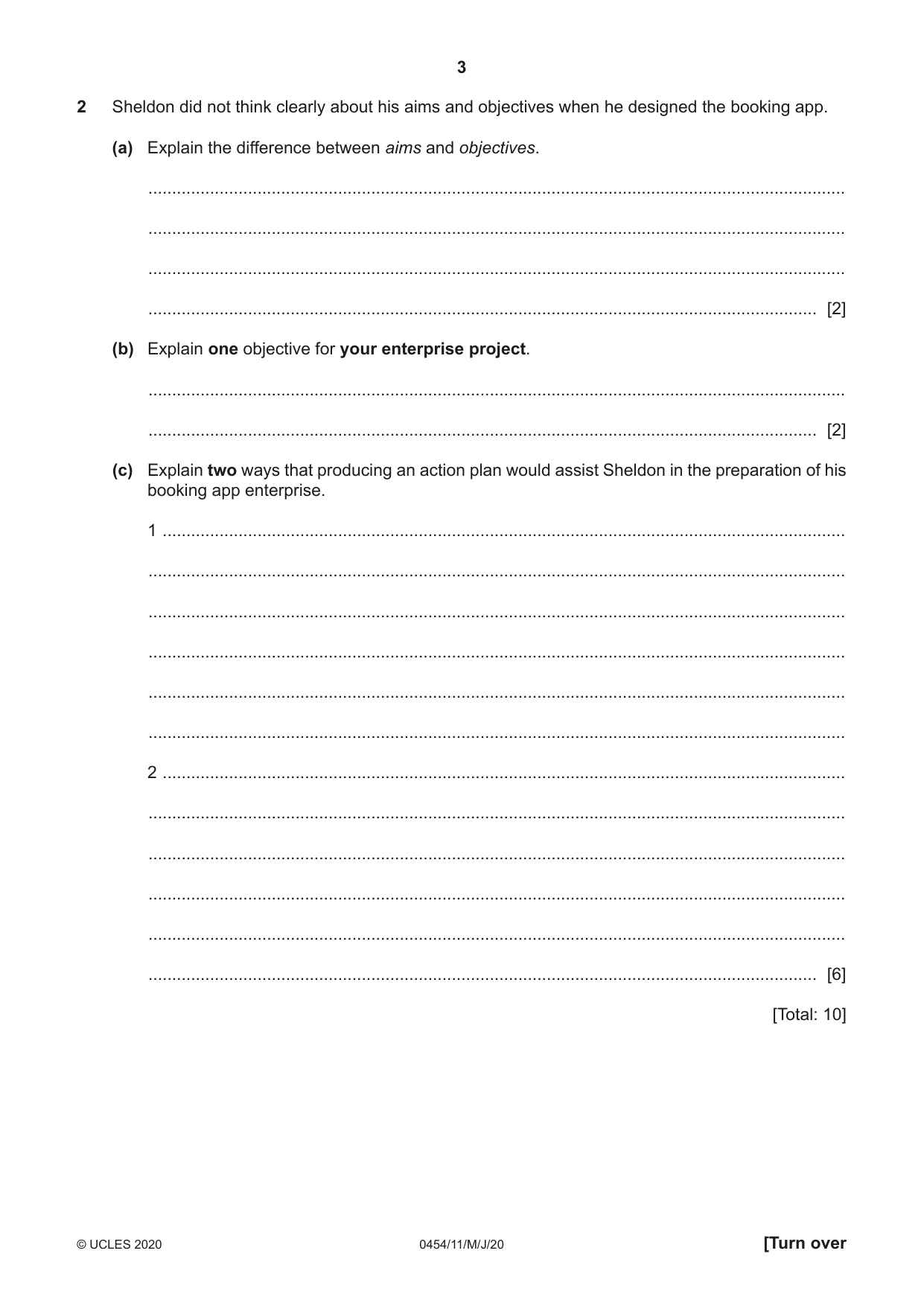
Question paper, page 3
3 0454/11/M/J/20 © UCLES 2020 [Turn over 2 Sheldon did not think clearly about his aims and objectives when he designed the booking app. (a) Explain the difference between aims and objectives. … … … … [2] (b) Explain one objective for your enterprise project. … … [2] (c) Explain two ways that producing an action plan would assist Sheldon in the preparation of his booking app enterprise. 1 … … … … … … 2 … … … … … … [6] [Total: 10]
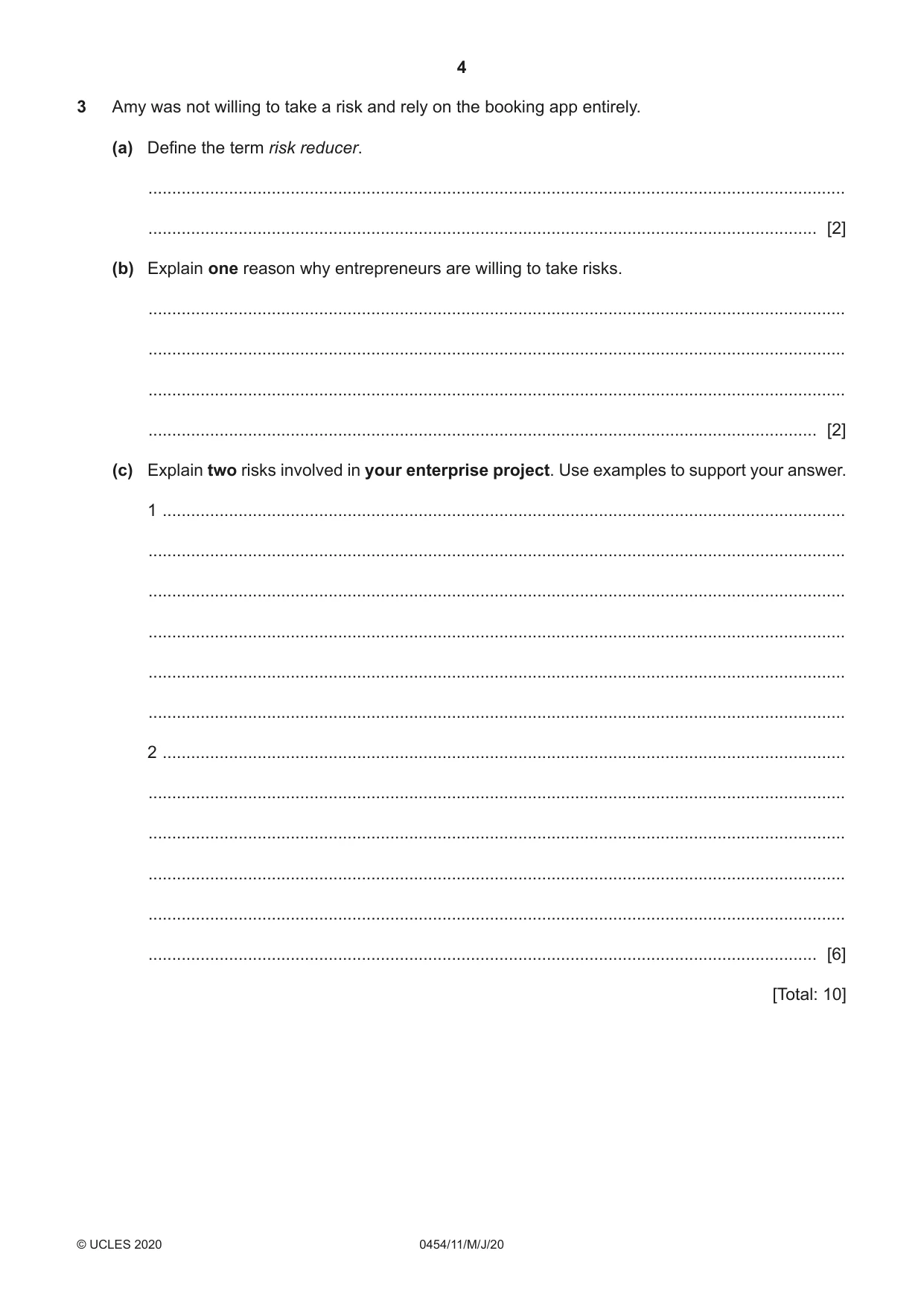
Question paper, page 4
4 0454/11/M/J/20 © UCLES 2020 3 Amy was not willing to take a risk and rely on the booking app entirely. (a) Define the term risk reducer. … … [2] (b) Explain one reason why entrepreneurs are willing to take risks. … … … … [2] (c) Explain two risks involved in your enterprise project. Use examples to support your answer. 1 … … … … … … 2 … … … … … … [6] [Total: 10]
Question paper, page 5
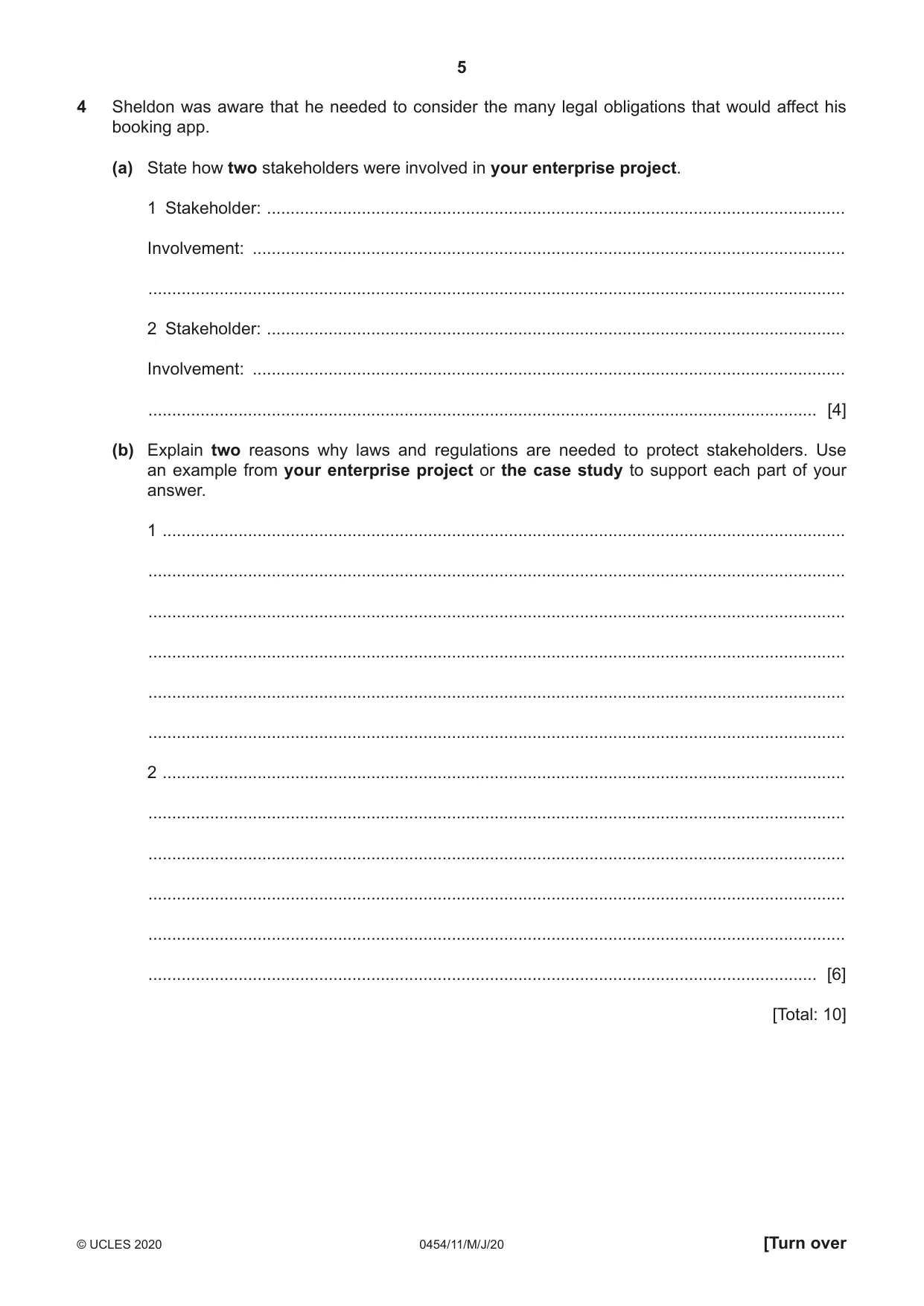
5 0454/11/M/J/20 © UCLES 2020 [Turn over 4 Sheldon was aware that he needed to consider the many legal obligations that would affect his booking app. (a) State how two stakeholders were involved in your enterprise project. 1 Stakeholder: … Involvement: … … 2 Stakeholder: … Involvement: … … [4] (b) Explain two reasons why laws and regulations are needed to protect stakeholders. Use an example from your enterprise project or the case study to support each part of your answer. 1 … … … … … … 2 … … … … … … [6] [Total: 10]
Question paper, page 6
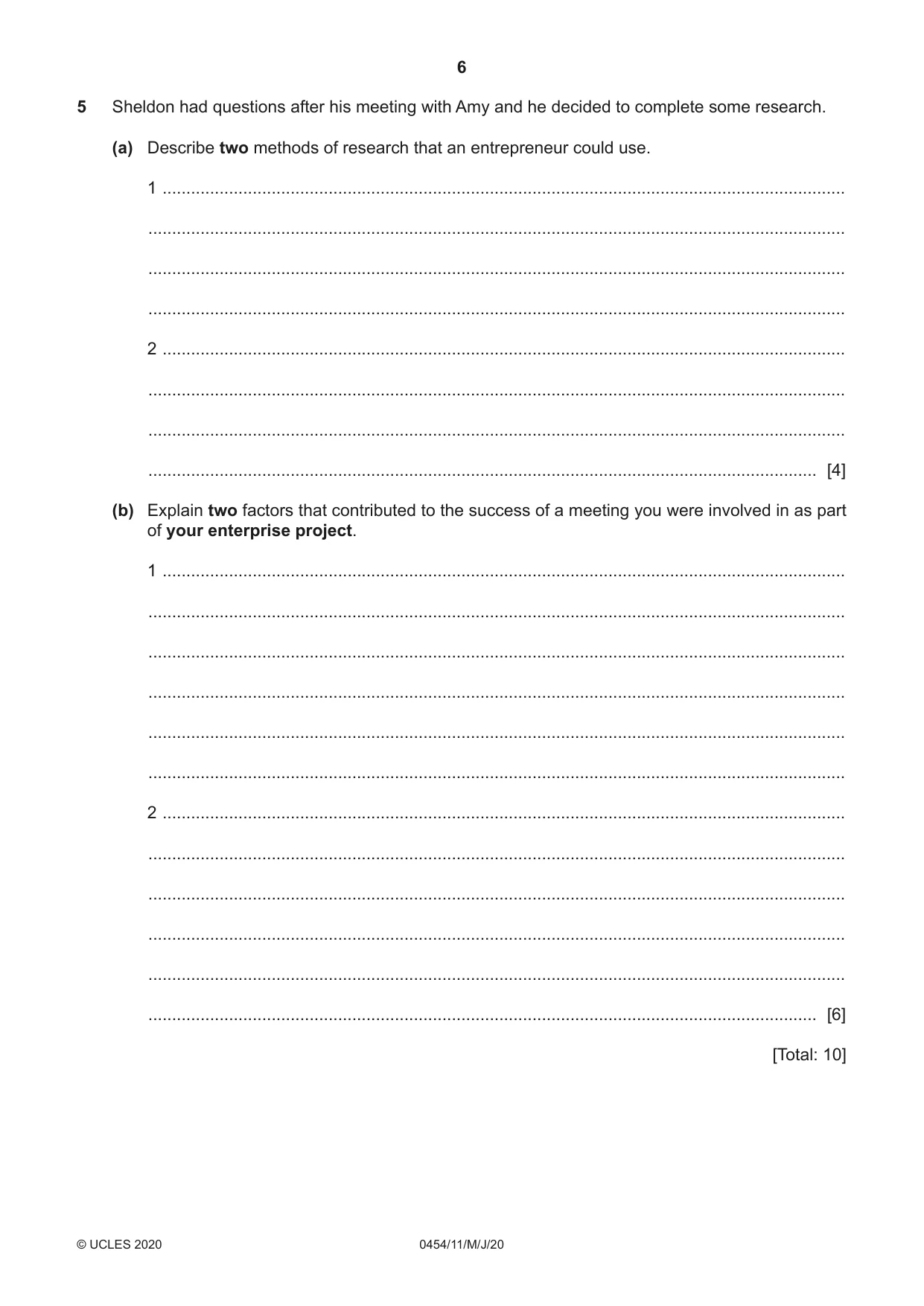
6 0454/11/M/J/20 © UCLES 2020 5 Sheldon had questions after his meeting with Amy and he decided to complete some research. (a) Describe two methods of research that an entrepreneur could use. 1 … … … … 2 … … … … [4] (b) Explain two factors that contributed to the success of a meeting you were involved in as part of your enterprise project. 1 … … … … … … 2 … … … … … … [6] [Total: 10]
Question paper, page 7
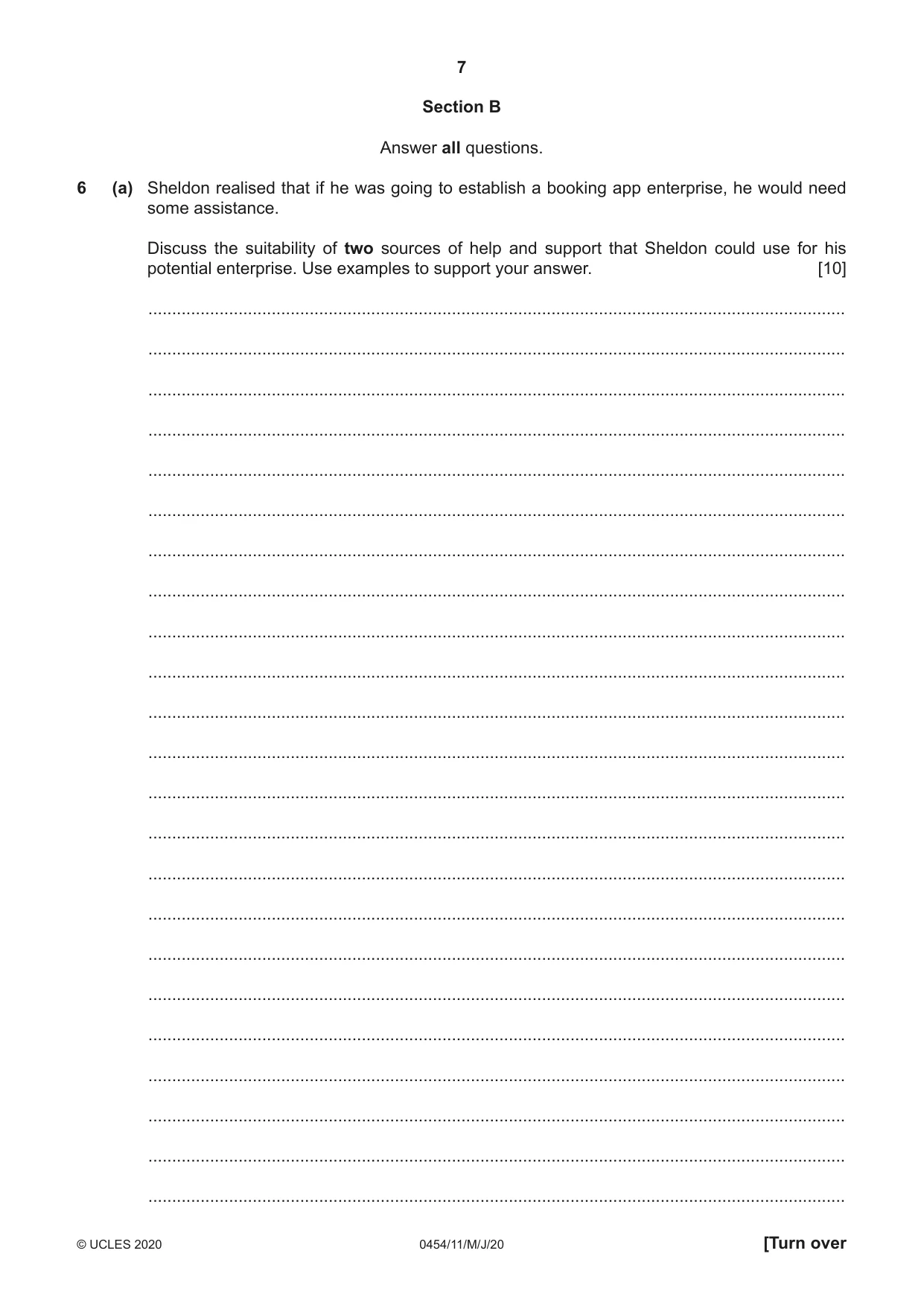
7 0454/11/M/J/20 © UCLES 2020 [Turn over Section B Answer all questions. 6 (a) Sheldon realised that if he was going to establish a booking app enterprise, he would need some assistance. Discuss the suitability of two sources of help and support that Sheldon could use for his potential enterprise. Use examples to support your answer. [10] … … … … … … … … … … … … … … … … … … … … … … …
Question paper, page 8
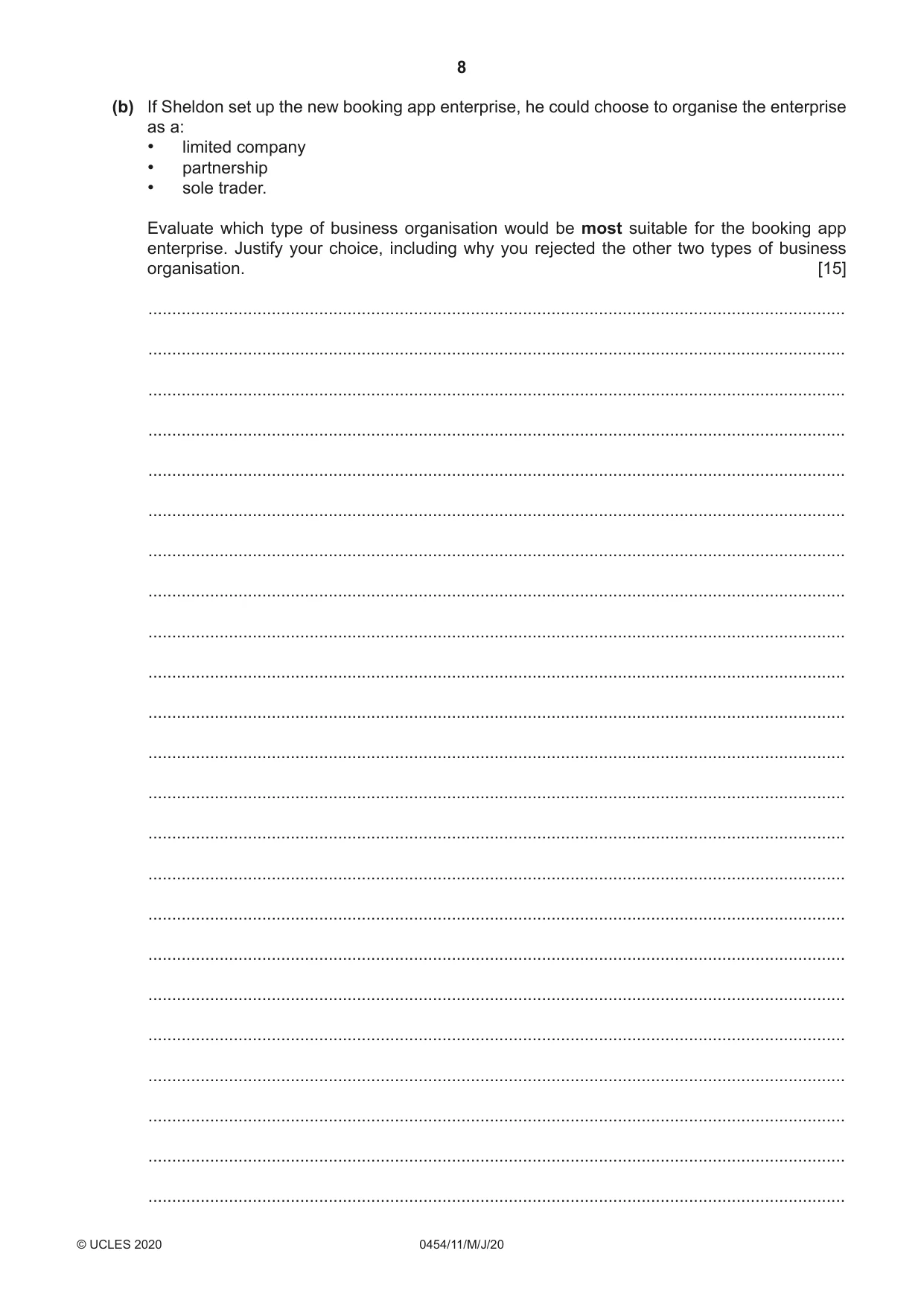
8 0454/11/M/J/20 © UCLES 2020 (b) If Sheldon set up the new booking app enterprise, he could choose to organise the enterprise as a: • limited company • partnership • sole trader. Evaluate which type of business organisation would be most suitable for the booking app enterprise. Justify your choice, including why you rejected the other two types of business organisation. [15] … … … … … … … … … … … … … … … … … … … … … … …
Question paper, page 9
9 0454/11/M/J/20 © UCLES 2020 [Turn over … … … … … … … … … … … … … … … … … … … … … … … … … … … [Total: 25]
Question paper, page 10
10 0454/11/M/J/20 © UCLES 2020 BLANK PAGE
Question paper, page 11
11 0454/11/M/J/20 © UCLES 2020 [Turn over 7 Now consider your enterprise project. (a) Discuss how using two enterprise skills helped the success of your enterprise project. Use examples to support your answer. [10] … … … … … … … … … … … … … … … … … … … … … … … … … …
Question paper, page 12
12 0454/11/M/J/20 © UCLES 2020 (b) Evaluate which was, or could have been, the most successful marketing communication in your enterprise project. You should consider two marketing communications in your answer. [15] … … … … … … … … … … … … … … … … … … … … … … … … … …
Question paper, page 13
13 0454/11/M/J/20 © UCLES 2020 … … … … … … … … … … … … … … … … … … … … … … … … … … … [Total: 25]
Question paper, page 14
14 0454/11/M/J/20 © UCLES 2020 BLANK PAGE
Question paper, page 15
15 0454/11/M/J/20 © UCLES 2020 BLANK PAGE
Question paper, page 16
16 0454/11/M/J/20 © UCLES 2020 Permission to reproduce items where third-party owned material protected by copyright is included has been sought and cleared where possible. Every reasonable effort has been made by the publisher (UCLES) to trace copyright holders, but if any items requiring clearance have unwittingly been included, the publisher will be pleased to make amends at the earliest possible opportunity. To avoid the issue of disclosure of answer-related information to candidates, all copyright acknowledgements are reproduced online in the Cambridge Assessment International Education Copyright Acknowledgements Booklet. This is produced for each series of examinations and is freely available to download at www.cambridgeinternational.org after the live examination series. Cambridge Assessment International Education is part of the Cambridge Assessment Group. Cambridge Assessment is the brand name of the University of Cambridge Local Examinations Syndicate (UCLES), which itself is a department of the University of Cambridge. BLANK PAGE
Mark scheme, page 1
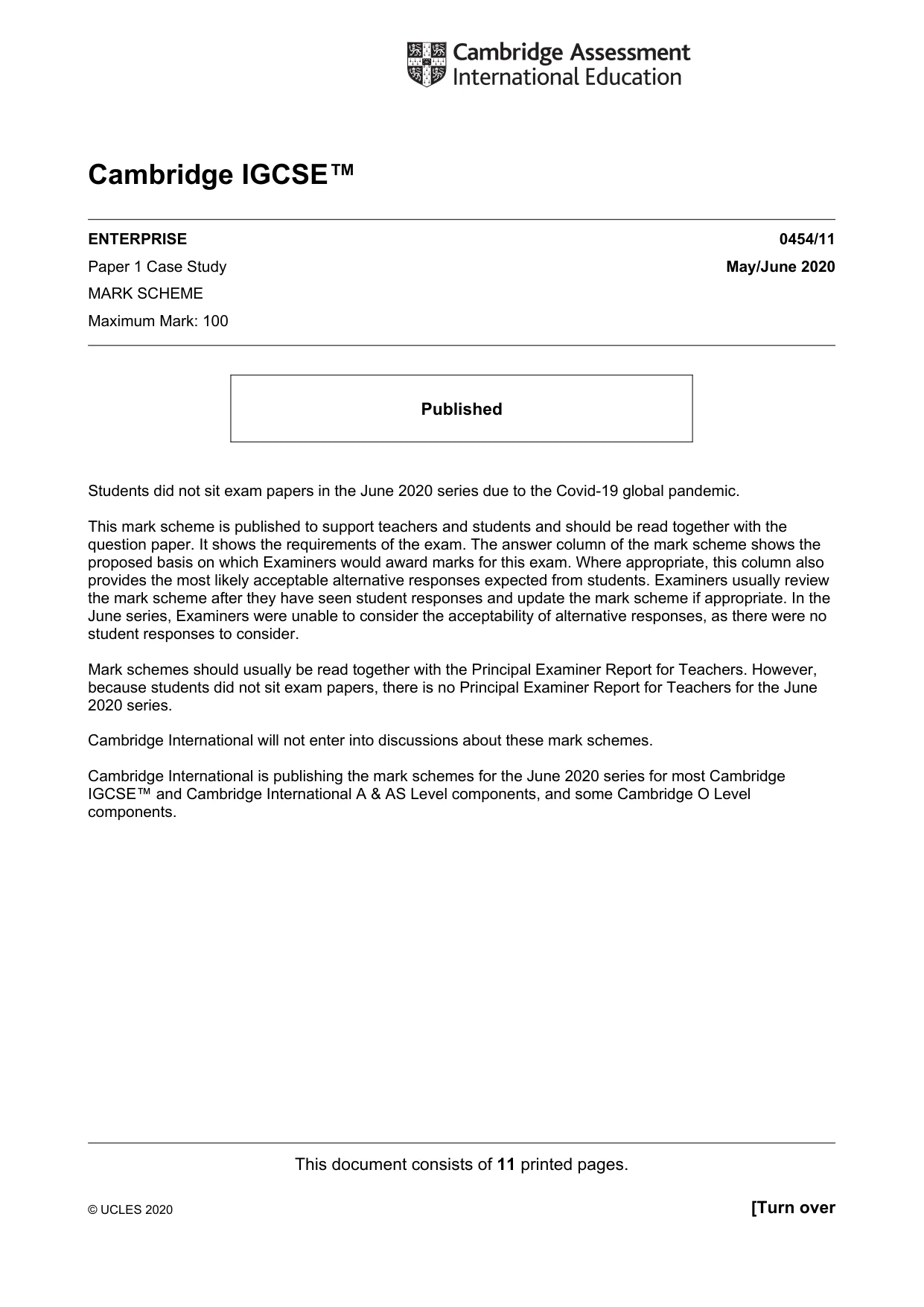
This document consists of 11 printed pages. © UCLES 2020 [Turn over Cambridge IGCSE™ ENTERPRISE 0454/11 Paper 1 Case Study May/June 2020 MARK SCHEME Maximum Mark: 100 Published Students did not sit exam papers in the June 2020 series due to the Covid-19 global pandemic. This mark scheme is published to support teachers and students and should be read together with the question paper. It shows the requirements of the exam. The answer column of the mark scheme shows the proposed basis on which Examiners would award marks for this exam. Where appropriate, this column also provides the most likely acceptable alternative responses expected from students. Examiners usually review the mark scheme after they have seen student responses and update the mark scheme if appropriate. In the June series, Examiners were unable to consider the acceptability of alternative responses, as there were no student responses to consider. Mark schemes should usually be read together with the Principal Examiner Report for Teachers. However, because students did not sit exam papers, there is no Principal Examiner Report for Teachers for the June 2020 series. Cambridge International will not enter into discussions about these mark schemes. Cambridge International is publishing the mark schemes for the June 2020 series for most Cambridge IGCSE™ and Cambridge International A & AS Level components, and some Cambridge O Level components.
Mark scheme, page 2
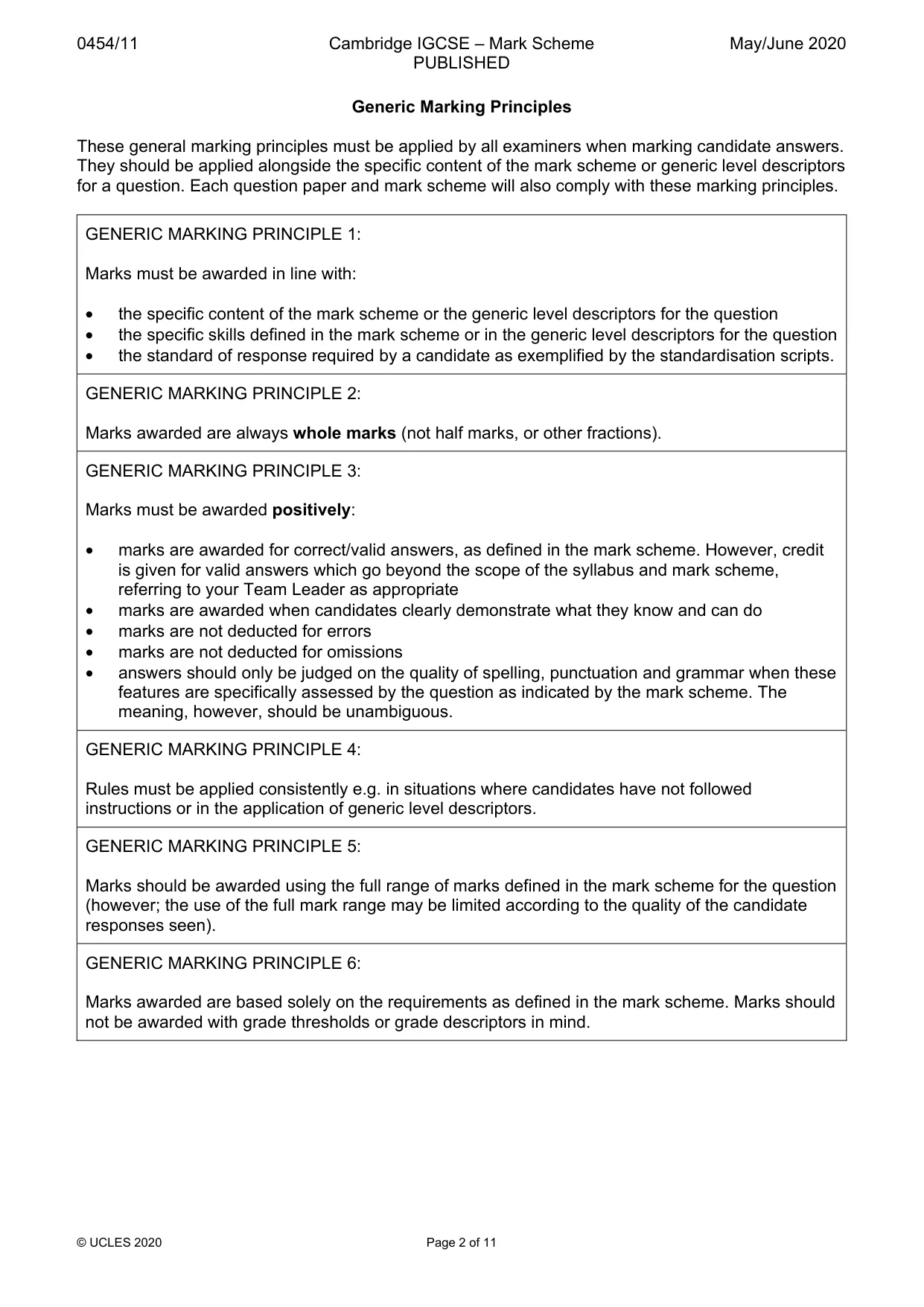
0454/11 Cambridge IGCSE – Mark Scheme PUBLISHED May/June 2020 © UCLES 2020 Page 2 of 11 Generic Marking Principles These general marking principles must be applied by all examiners when marking candidate answers. They should be applied alongside the specific content of the mark scheme or generic level descriptors for a question. Each question paper and mark scheme will also comply with these marking principles. GENERIC MARKING PRINCIPLE 1: Marks must be awarded in line with: • the specific content of the mark scheme or the generic level descriptors for the question • the specific skills defined in the mark scheme or in the generic level descriptors for the question • the standard of response required by a candidate as exemplified by the standardisation scripts. GENERIC MARKING PRINCIPLE 2: Marks awarded are always whole marks (not half marks, or other fractions). GENERIC MARKING PRINCIPLE 3: Marks must be awarded positively: • marks are awarded for correct/valid answers, as defined in the mark scheme. However, credit is given for valid answers which go beyond the scope of the syllabus and mark scheme, referring to your Team Leader as appropriate • marks are awarded when candidates clearly demonstrate what they know and can do • marks are not deducted for errors • marks are not deducted for omissions • answers should only be judged on the quality of spelling, punctuation and grammar when these features are specifically assessed by the question as indicated by the mark scheme. The meaning, however, should be unambiguous. GENERIC MARKING PRINCIPLE 4: Rules must be applied consistently e.g. in situations where candidates have not followed instructions or in the application of generic level descriptors. GENERIC MARKING PRINCIPLE 5: Marks should be awarded using the full range of marks defined in the mark scheme for the question (however; the use of the full mark range may be limited according to the quality of the candidate responses seen). GENERIC MARKING PRINCIPLE 6: Marks awarded are based solely on the requirements as defined in the mark scheme. Marks should not be awarded with grade thresholds or grade descriptors in mind.
Mark scheme, page 3
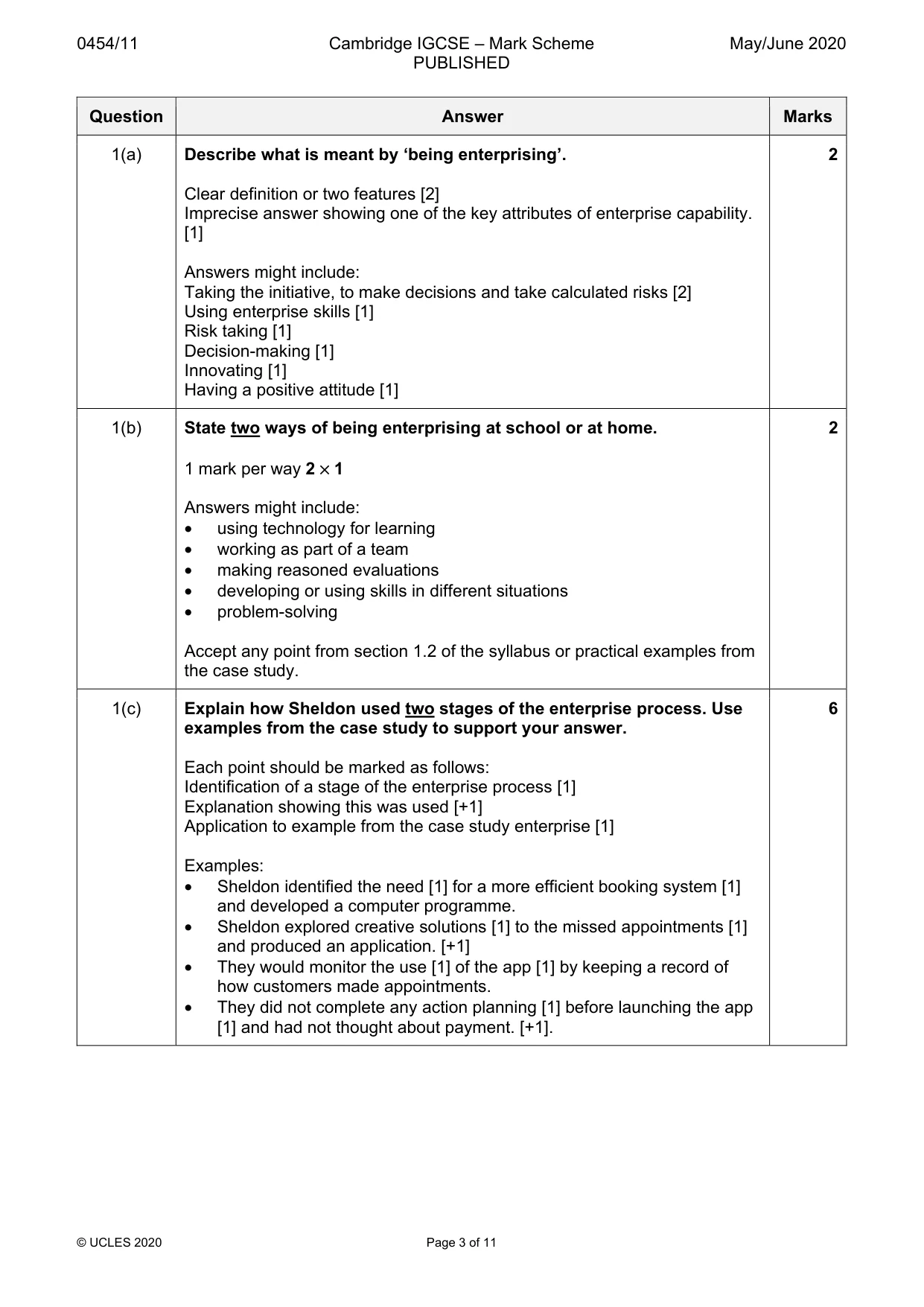
0454/11 Cambridge IGCSE – Mark Scheme PUBLISHED May/June 2020 © UCLES 2020 Page 3 of 11 Question Answer Marks 1(a) Describe what is meant by ‘being enterprising’. Clear definition or two features [2] Imprecise answer showing one of the key attributes of enterprise capability. [1] Answers might include: Taking the initiative, to make decisions and take calculated risks [2] Using enterprise skills [1] Risk taking [1] Decision-making [1] Innovating [1] Having a positive attitude [1] 2 1(b) State two ways of being enterprising at school or at home. 1 mark per way 2 × 1 Answers might include: • using technology for learning • working as part of a team • making reasoned evaluations • developing or using skills in different situations • problem-solving Accept any point from section 1.2 of the syllabus or practical examples from the case study. 2 1(c) Explain how Sheldon used two stages of the enterprise process. Use examples from the case study to support your answer. Each point should be marked as follows: Identification of a stage of the enterprise process [1] Explanation showing this was used [+1] Application to example from the case study enterprise [1] Examples: • Sheldon identified the need [1] for a more efficient booking system [1] and developed a computer programme. • Sheldon explored creative solutions [1] to the missed appointments [1] and produced an application. [+1] • They would monitor the use [1] of the app [1] by keeping a record of how customers made appointments. • They did not complete any action planning [1] before launching the app [1] and had not thought about payment. [+1]. 6
Mark scheme, page 4
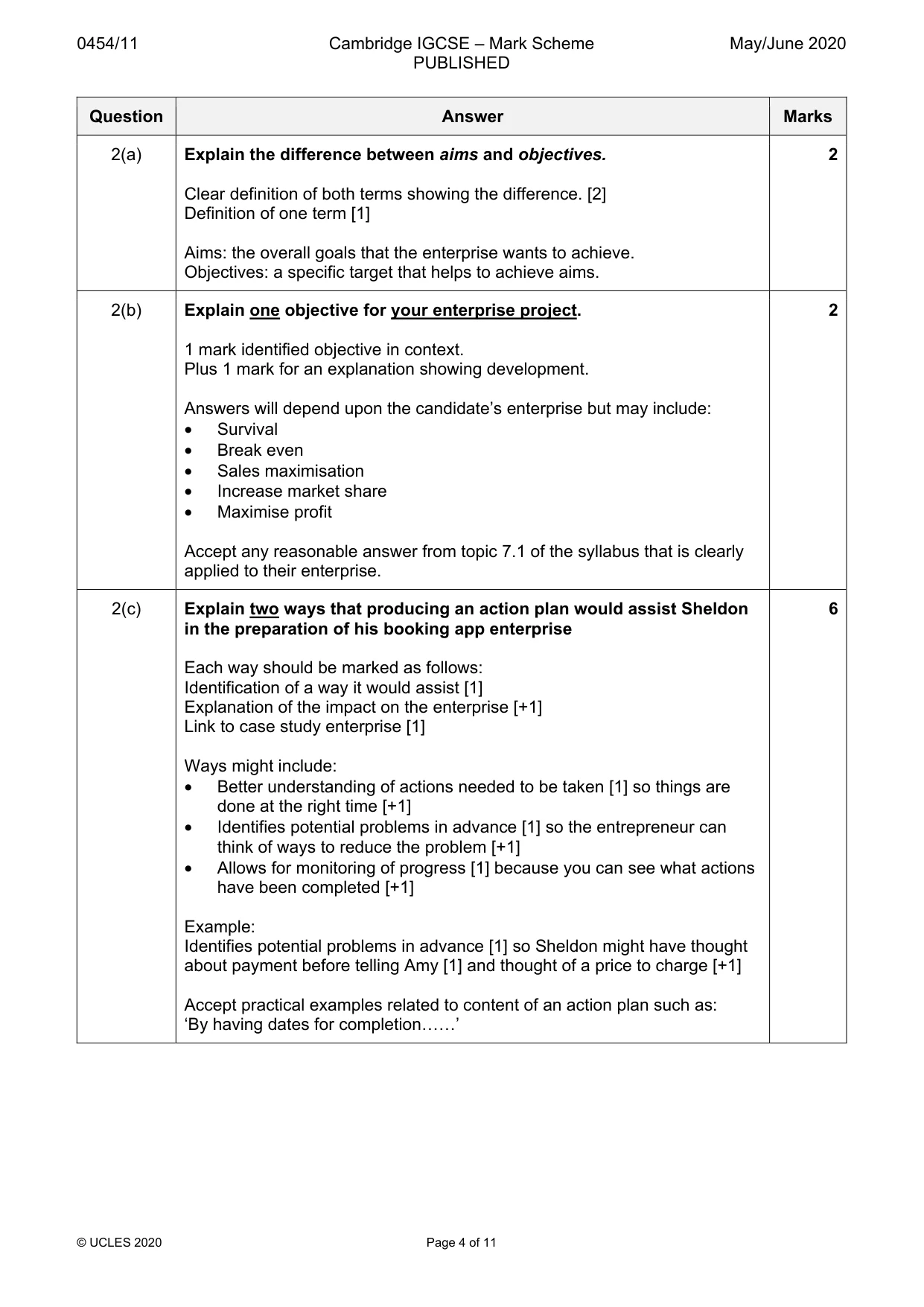
0454/11 Cambridge IGCSE – Mark Scheme PUBLISHED May/June 2020 © UCLES 2020 Page 4 of 11 Question Answer Marks 2(a) Explain the difference between aims and objectives. Clear definition of both terms showing the difference. [2] Definition of one term [1] Aims: the overall goals that the enterprise wants to achieve. Objectives: a specific target that helps to achieve aims. 2 2(b) Explain one objective for your enterprise project. 1 mark identified objective in context. Plus 1 mark for an explanation showing development. Answers will depend upon the candidate’s enterprise but may include: • Survival • Break even • Sales maximisation • Increase market share • Maximise profit Accept any reasonable answer from topic 7.1 of the syllabus that is clearly applied to their enterprise. 2 2(c) Explain two ways that producing an action plan would assist Sheldon in the preparation of his booking app enterprise Each way should be marked as follows: Identification of a way it would assist [1] Explanation of the impact on the enterprise [+1] Link to case study enterprise [1] Ways might include: • Better understanding of actions needed to be taken [1] so things are done at the right time [+1] • Identifies potential problems in advance [1] so the entrepreneur can think of ways to reduce the problem [+1] • Allows for monitoring of progress [1] because you can see what actions have been completed [+1] Example: Identifies potential problems in advance [1] so Sheldon might have thought about payment before telling Amy [1] and thought of a price to charge [+1] Accept practical examples related to content of an action plan such as: ‘By having dates for completion……’ 6
Mark scheme, page 5
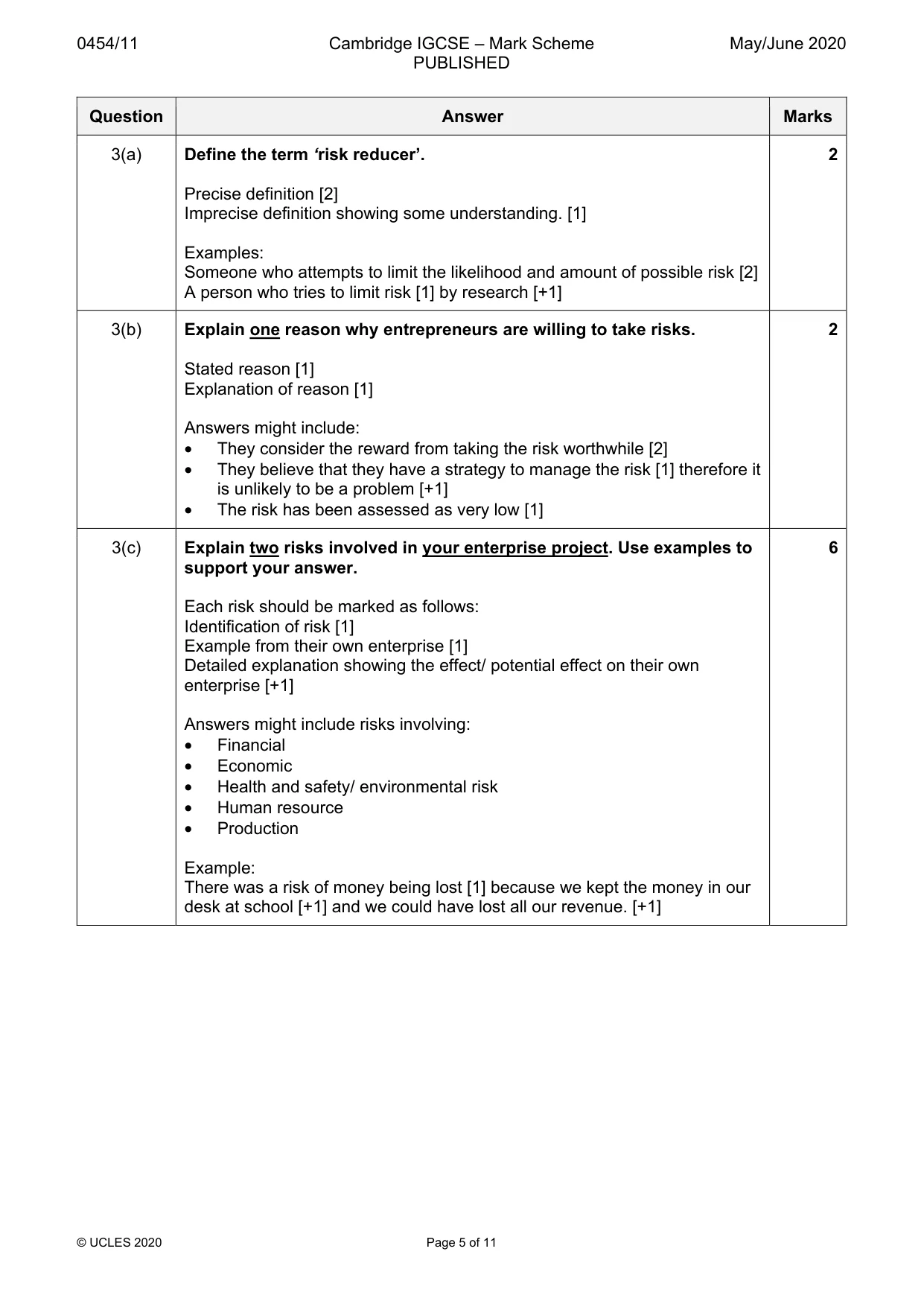
0454/11 Cambridge IGCSE – Mark Scheme PUBLISHED May/June 2020 © UCLES 2020 Page 5 of 11 Question Answer Marks 3(a) Define the term ‘risk reducer’. Precise definition [2] Imprecise definition showing some understanding. [1] Examples: Someone who attempts to limit the likelihood and amount of possible risk [2] A person who tries to limit risk [1] by research [+1] 2 3(b) Explain one reason why entrepreneurs are willing to take risks. Stated reason [1] Explanation of reason [1] Answers might include: • They consider the reward from taking the risk worthwhile [2] • They believe that they have a strategy to manage the risk [1] therefore it is unlikely to be a problem [+1] • The risk has been assessed as very low [1] 2 3(c) Explain two risks involved in your enterprise project. Use examples to support your answer. Each risk should be marked as follows: Identification of risk [1] Example from their own enterprise [1] Detailed explanation showing the effect/ potential effect on their own enterprise [+1] Answers might include risks involving: • Financial • Economic • Health and safety/ environmental risk • Human resource • Production Example: There was a risk of money being lost [1] because we kept the money in our desk at school [+1] and we could have lost all our revenue. [+1] 6
Mark scheme, page 6
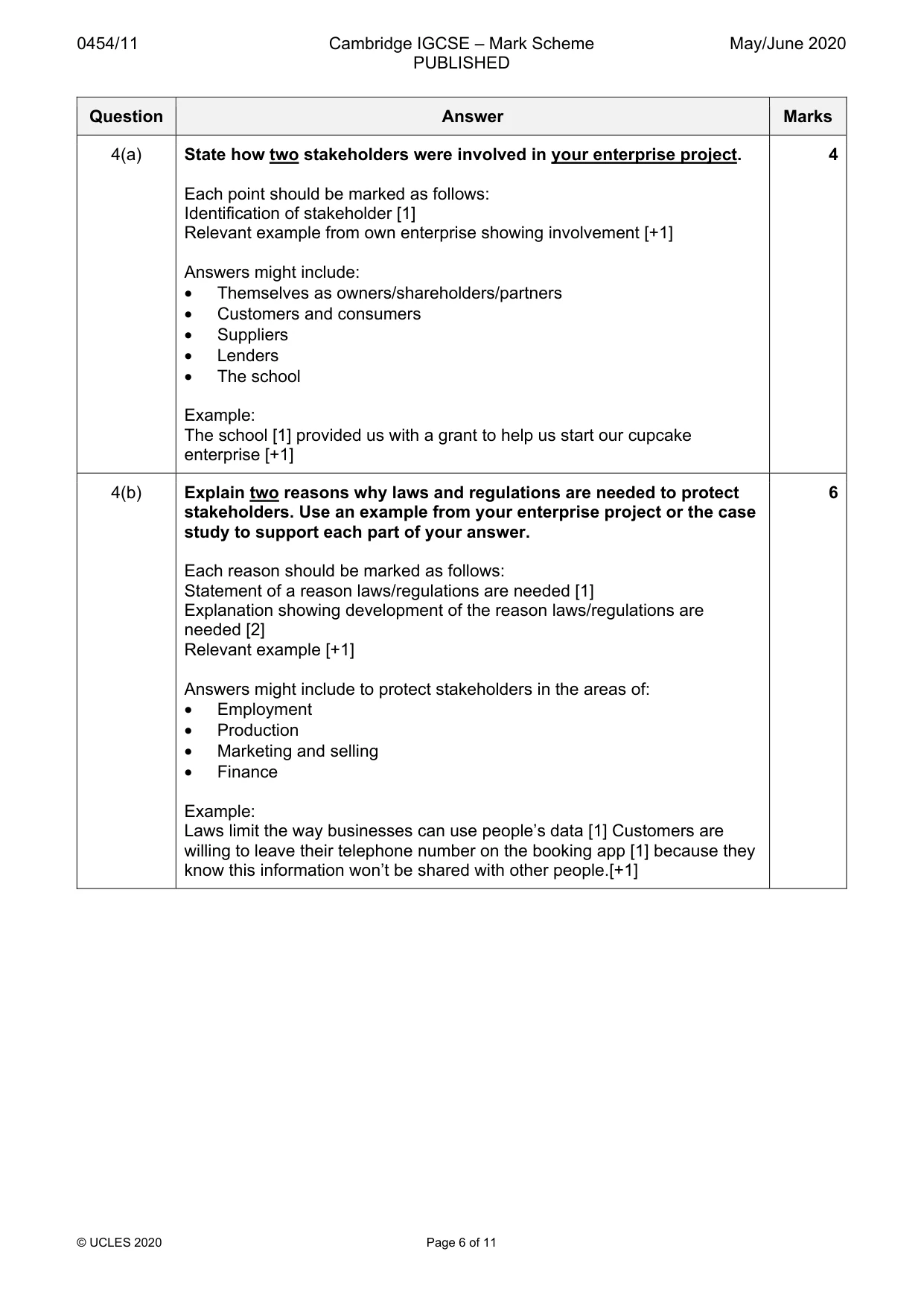
0454/11 Cambridge IGCSE – Mark Scheme PUBLISHED May/June 2020 © UCLES 2020 Page 6 of 11 Question Answer Marks 4(a) State how two stakeholders were involved in your enterprise project. Each point should be marked as follows: Identification of stakeholder [1] Relevant example from own enterprise showing involvement [+1] Answers might include: • Themselves as owners/shareholders/partners • Customers and consumers • Suppliers • Lenders • The school Example: The school [1] provided us with a grant to help us start our cupcake enterprise [+1] 4 4(b) Explain two reasons why laws and regulations are needed to protect stakeholders. Use an example from your enterprise project or the case study to support each part of your answer. Each reason should be marked as follows: Statement of a reason laws/regulations are needed [1] Explanation showing development of the reason laws/regulations are needed [2] Relevant example [+1] Answers might include to protect stakeholders in the areas of: • Employment • Production • Marketing and selling • Finance Example: Laws limit the way businesses can use people’s data [1] Customers are willing to leave their telephone number on the booking app [1] because they know this information won’t be shared with other people.[+1] 6
Mark scheme, page 7
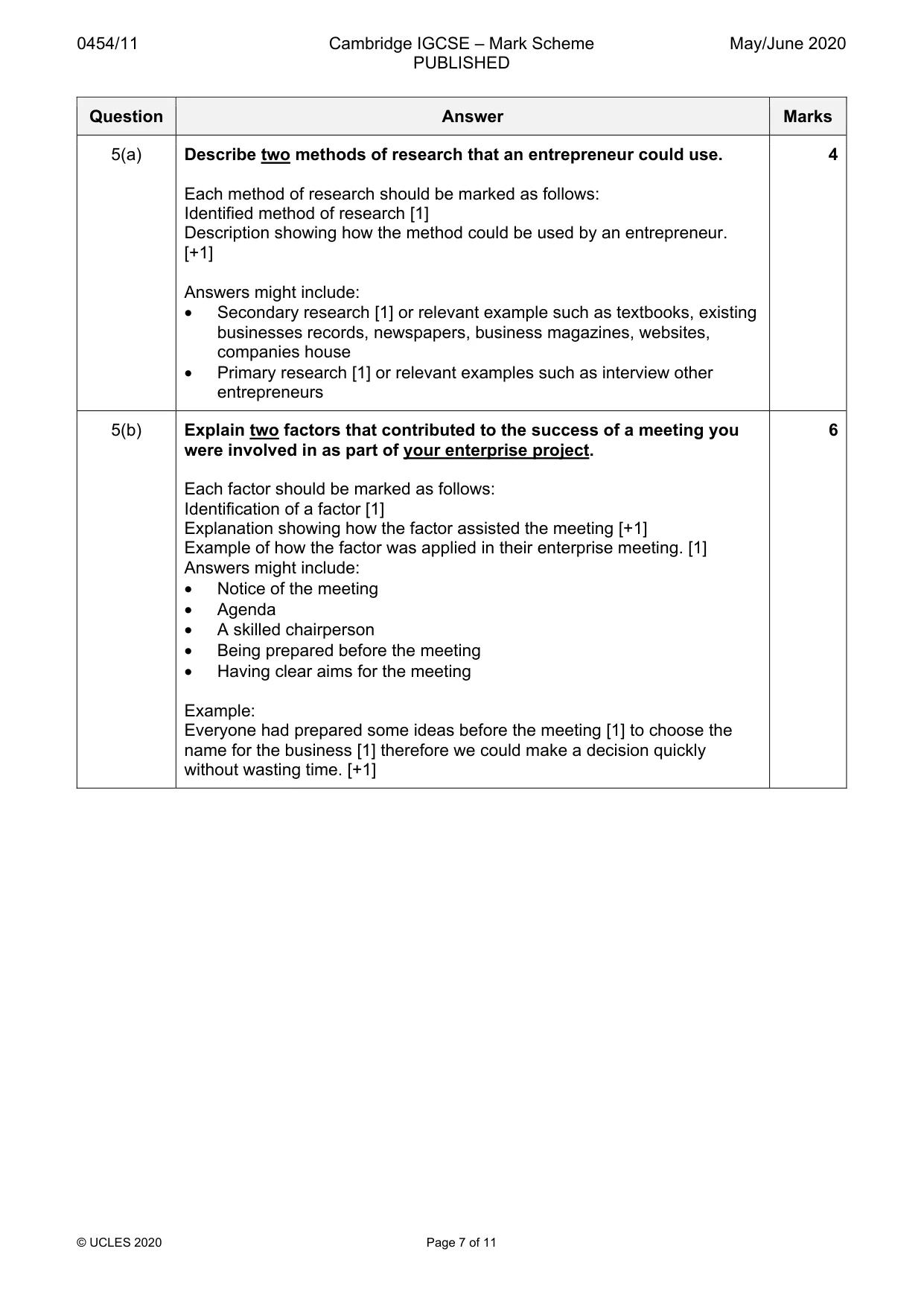
0454/11 Cambridge IGCSE – Mark Scheme PUBLISHED May/June 2020 © UCLES 2020 Page 7 of 11 Question Answer Marks 5(a) Describe two methods of research that an entrepreneur could use. Each method of research should be marked as follows: Identified method of research [1] Description showing how the method could be used by an entrepreneur. [+1] Answers might include: • Secondary research [1] or relevant example such as textbooks, existing businesses records, newspapers, business magazines, websites, companies house • Primary research [1] or relevant examples such as interview other entrepreneurs 4 5(b) Explain two factors that contributed to the success of a meeting you were involved in as part of your enterprise project. Each factor should be marked as follows: Identification of a factor [1] Explanation showing how the factor assisted the meeting [+1] Example of how the factor was applied in their enterprise meeting. [1] Answers might include: • Notice of the meeting • Agenda • A skilled chairperson • Being prepared before the meeting • Having clear aims for the meeting Example: Everyone had prepared some ideas before the meeting [1] to choose the name for the business [1] therefore we could make a decision quickly without wasting time. [+1] 6
Mark scheme, page 8
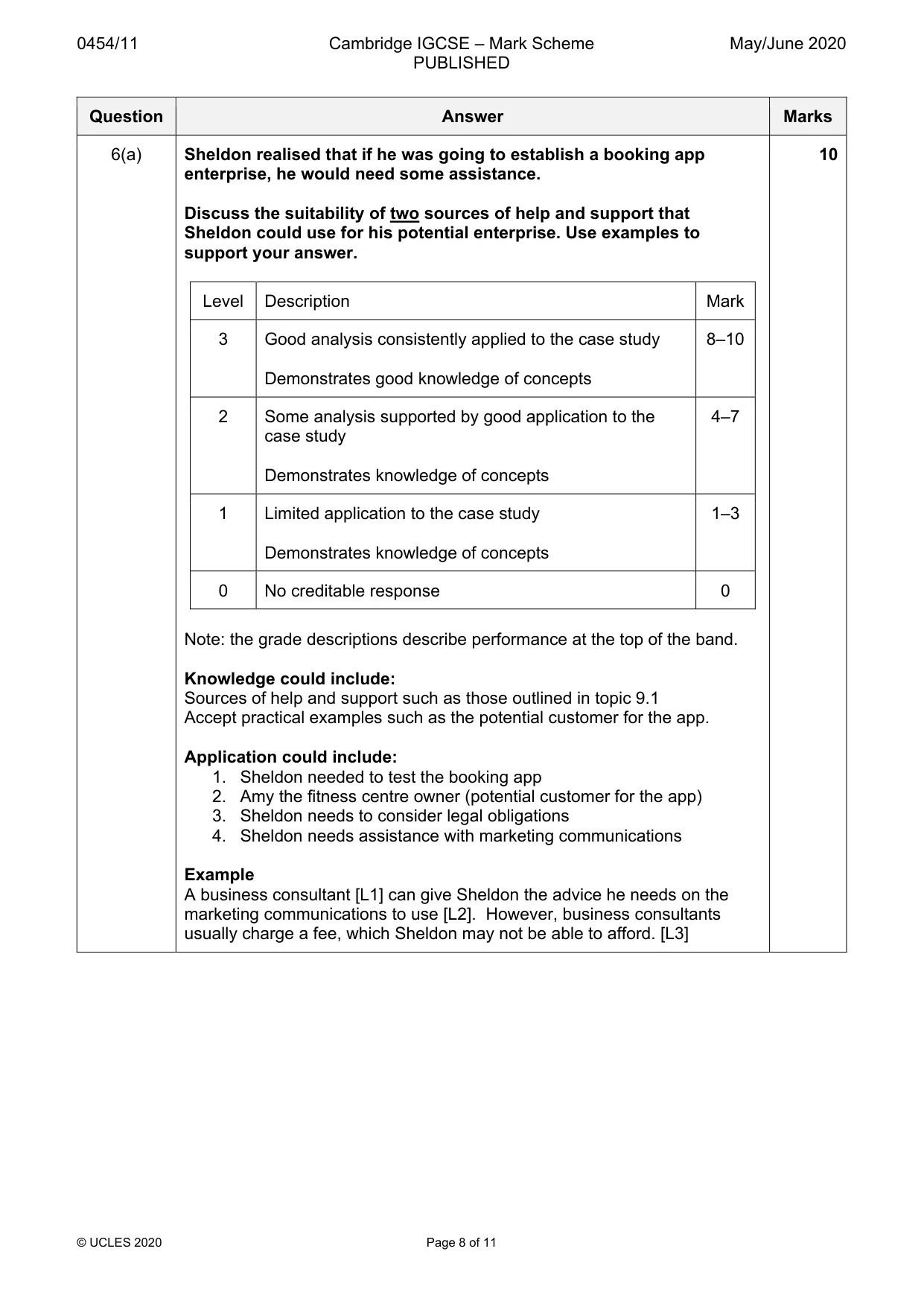
0454/11 Cambridge IGCSE – Mark Scheme PUBLISHED May/June 2020 © UCLES 2020 Page 8 of 11 Question Answer Marks 6(a) Sheldon realised that if he was going to establish a booking app enterprise, he would need some assistance. Discuss the suitability of two sources of help and support that Sheldon could use for his potential enterprise. Use examples to support your answer. Level Description Mark 3 Good analysis consistently applied to the case study Demonstrates good knowledge of concepts 8–10 2 Some analysis supported by good application to the case study Demonstrates knowledge of concepts 4–7 1 Limited application to the case study Demonstrates knowledge of concepts 1–3 0 No creditable response 0 Note: the grade descriptions describe performance at the top of the band. Knowledge could include: Sources of help and support such as those outlined in topic 9.1 Accept practical examples such as the potential customer for the app. Application could include: 1. Sheldon needed to test the booking app 2. Amy the fitness centre owner (potential customer for the app) 3. Sheldon needs to consider legal obligations 4. Sheldon needs assistance with marketing communications Example A business consultant [L1] can give Sheldon the advice he needs on the marketing communications to use [L2]. However, business consultants usually charge a fee, which Sheldon may not be able to afford. [L3] 10
Mark scheme, page 9
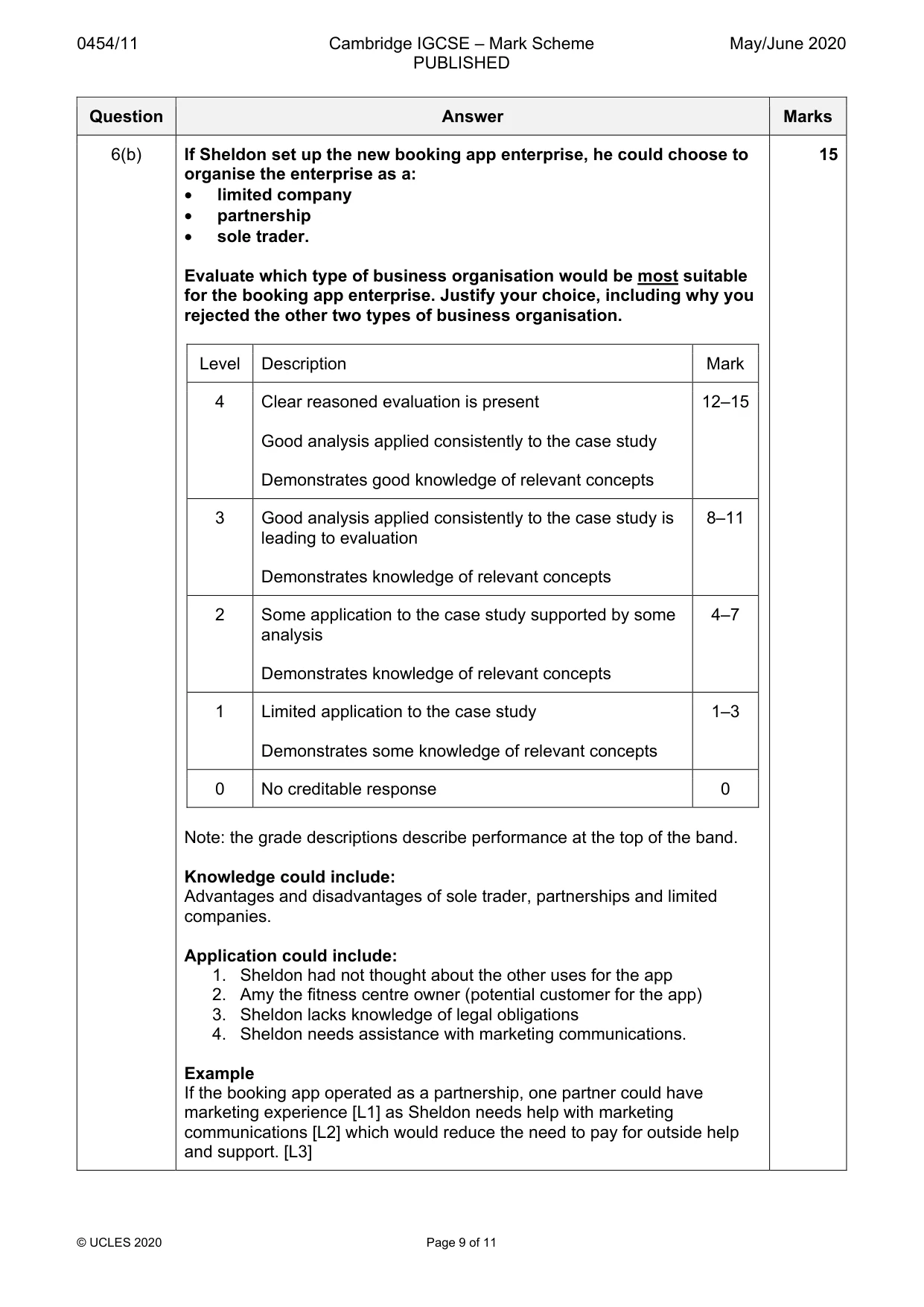
0454/11 Cambridge IGCSE – Mark Scheme PUBLISHED May/June 2020 © UCLES 2020 Page 9 of 11 Question Answer Marks 6(b) If Sheldon set up the new booking app enterprise, he could choose to organise the enterprise as a: • limited company • partnership • sole trader. Evaluate which type of business organisation would be most suitable for the booking app enterprise. Justify your choice, including why you rejected the other two types of business organisation. Level Description Mark 4 Clear reasoned evaluation is present Good analysis applied consistently to the case study Demonstrates good knowledge of relevant concepts 12–15 3 Good analysis applied consistently to the case study is leading to evaluation Demonstrates knowledge of relevant concepts 8–11 2 Some application to the case study supported by some analysis Demonstrates knowledge of relevant concepts 4–7 1 Limited application to the case study Demonstrates some knowledge of relevant concepts 1–3 0 No creditable response 0 Note: the grade descriptions describe performance at the top of the band. Knowledge could include: Advantages and disadvantages of sole trader, partnerships and limited companies. Application could include: 1. Sheldon had not thought about the other uses for the app 2. Amy the fitness centre owner (potential customer for the app) 3. Sheldon lacks knowledge of legal obligations 4. Sheldon needs assistance with marketing communications. Example If the booking app operated as a partnership, one partner could have marketing experience [L1] as Sheldon needs help with marketing communications [L2] which would reduce the need to pay for outside help and support. [L3] 15
Mark scheme, page 10
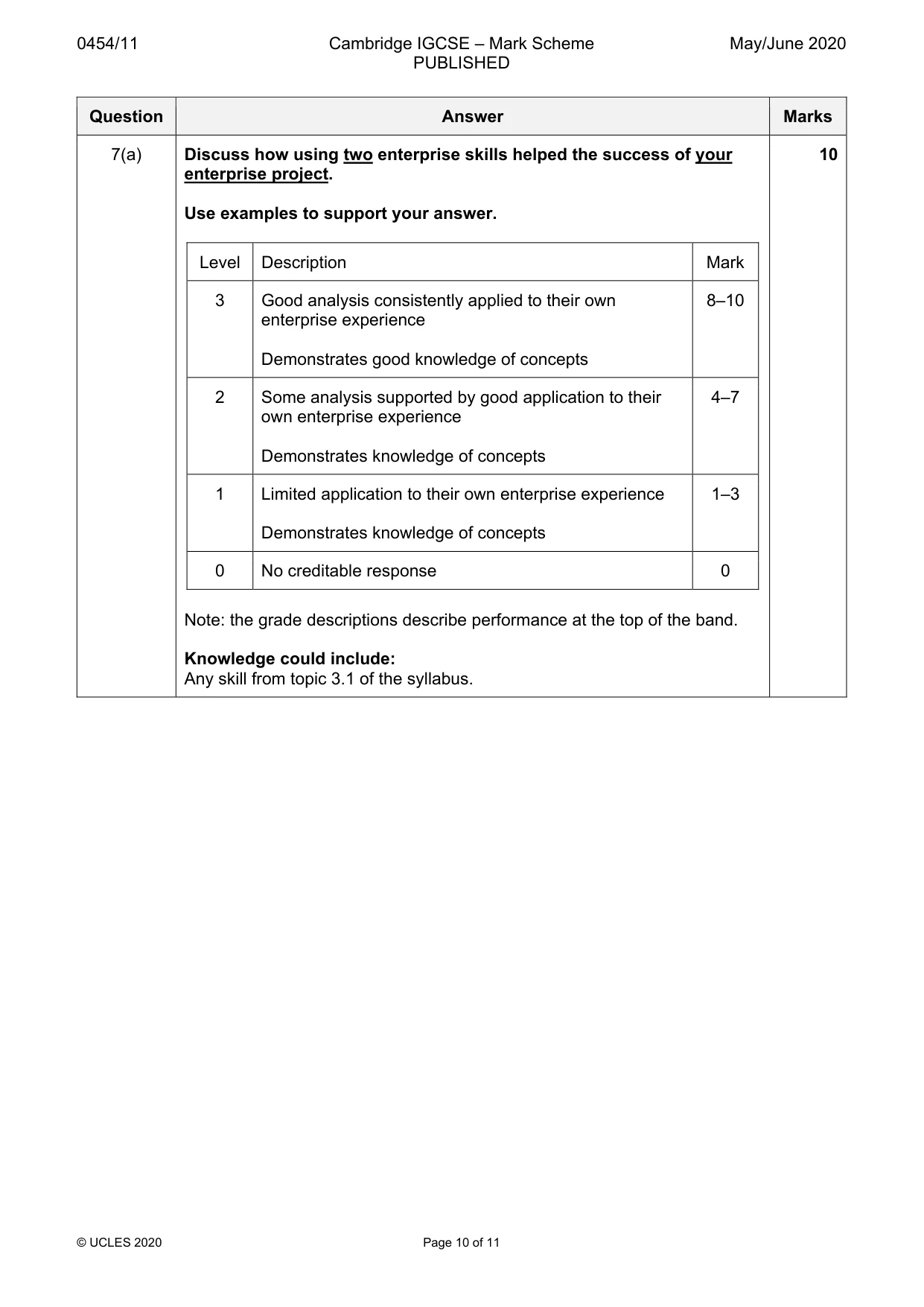
0454/11 Cambridge IGCSE – Mark Scheme PUBLISHED May/June 2020 © UCLES 2020 Page 10 of 11 Question Answer Marks 7(a) Discuss how using two enterprise skills helped the success of your enterprise project. Use examples to support your answer. Level Description Mark 3 Good analysis consistently applied to their own enterprise experience Demonstrates good knowledge of concepts 8–10 2 Some analysis supported by good application to their own enterprise experience Demonstrates knowledge of concepts 4–7 1 Limited application to their own enterprise experience Demonstrates knowledge of concepts 1–3 0 No creditable response 0 Note: the grade descriptions describe performance at the top of the band. Knowledge could include: Any skill from topic 3.1 of the syllabus. 10
Mark scheme, page 11
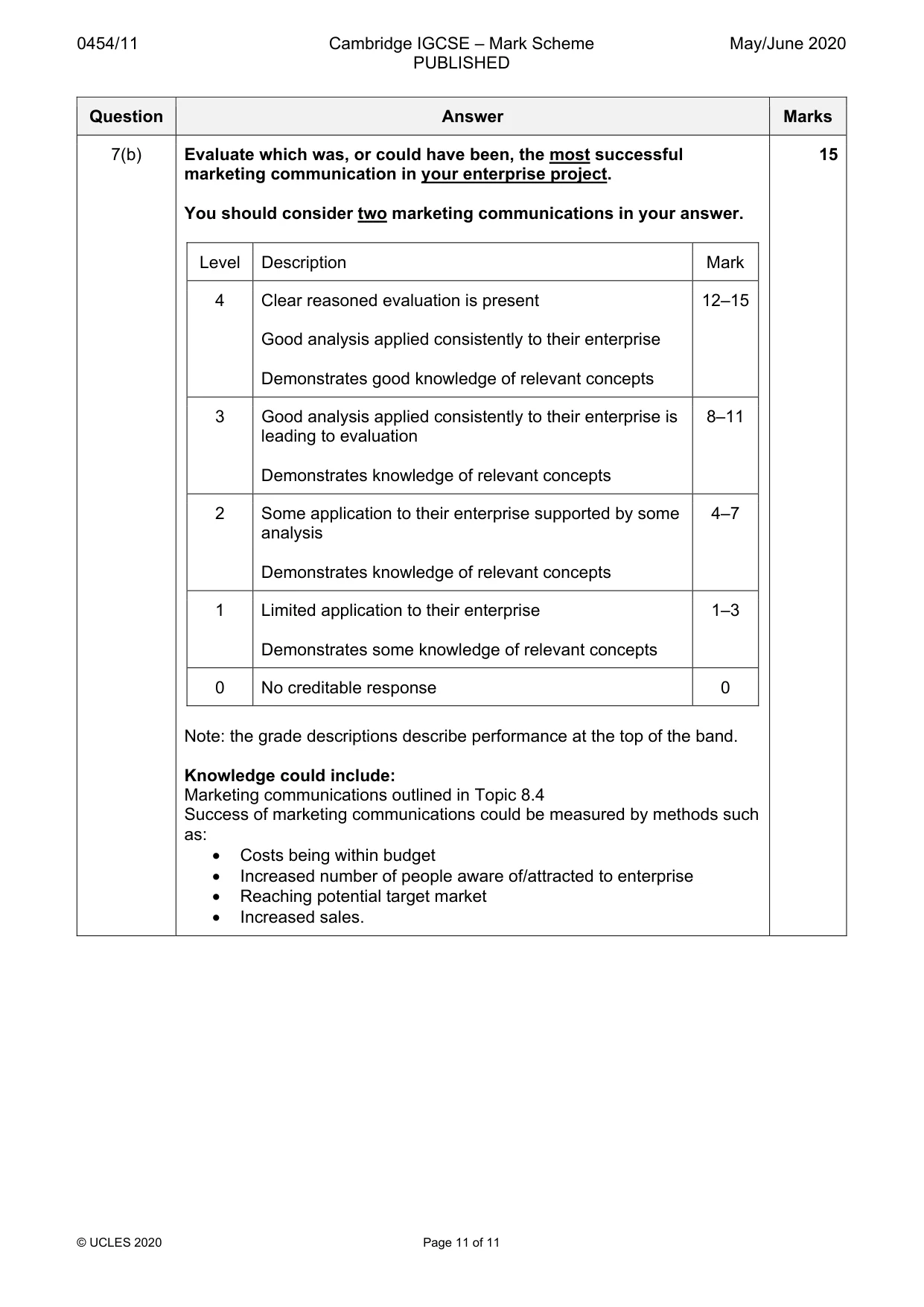
0454/11 Cambridge IGCSE – Mark Scheme PUBLISHED May/June 2020 © UCLES 2020 Page 11 of 11 Question Answer Marks 7(b) Evaluate which was, or could have been, the most successful marketing communication in your enterprise project. You should consider two marketing communications in your answer. Level Description Mark 4 Clear reasoned evaluation is present Good analysis applied consistently to their enterprise Demonstrates good knowledge of relevant concepts 12–15 3 Good analysis applied consistently to their enterprise is leading to evaluation Demonstrates knowledge of relevant concepts 8–11 2 Some application to their enterprise supported by some analysis Demonstrates knowledge of relevant concepts 4–7 1 Limited application to their enterprise Demonstrates some knowledge of relevant concepts 1–3 0 No creditable response 0 Note: the grade descriptions describe performance at the top of the band. Knowledge could include: Marketing communications outlined in Topic 8.4 Success of marketing communications could be measured by methods such as: • Costs being within budget • Increased number of people aware of/attracted to enterprise • Reaching potential target market • Increased sales. 15