Cambridge IGCSE Enterprise 0454 — 2018 Oct/Nov Paper 1 · Variant 3
0454/13/O/N/18 · 100 marks · ≈113 min
The question paper and its mark scheme, free to read here and free to download. This is Cambridge’s own paper, exactly as it was sat.
Question paper16 pages










Mark scheme12 pages
Answers below. Sit the paper first if you are practising.
Paper as text
Question paper, page 1
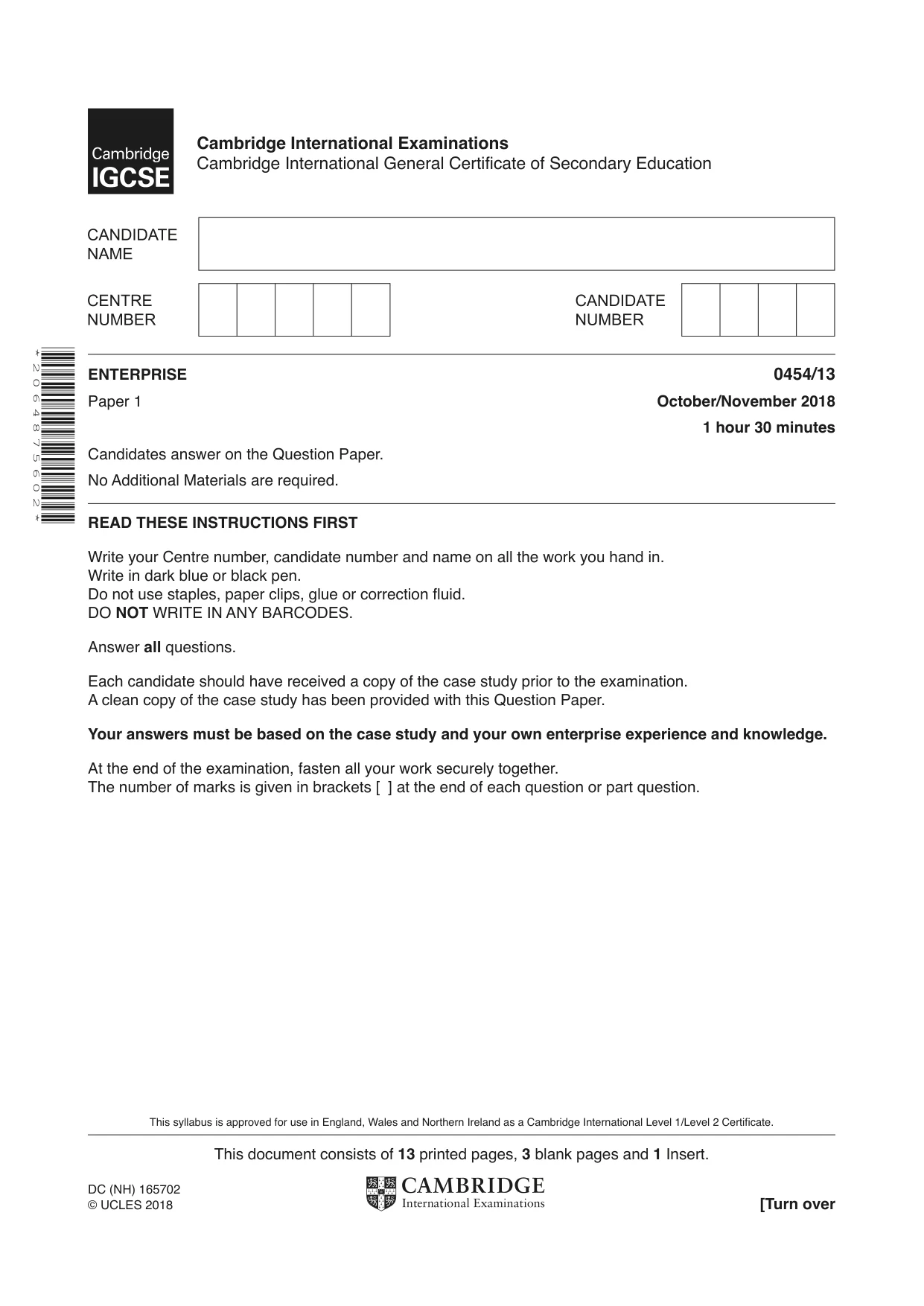
* 2 0 6 4 8 7 5 6 0 2 * This document consists of 13 printed pages, 3 blank pages and 1 Insert. DC (NH) 165702 © UCLES 2018 [Turn over Cambridge International Examinations Cambridge International General Certificate of Secondary Education ENTERPRISE 0454/13 Paper 1 October/November 2018 1 hour 30 minutes Candidates answer on the Question Paper. No Additional Materials are required. READ THESE INSTRUCTIONS FIRST Write your Centre number, candidate number and name on all the work you hand in. Write in dark blue or black pen. Do not use staples, paper clips, glue or correction fluid. DO NOT WRITE IN ANY BARCODES. Answer all questions. Each candidate should have received a copy of the case study prior to the examination. A clean copy of the case study has been provided with this Question Paper. Your answers must be based on the case study and your own enterprise experience and knowledge. At the end of the examination, fasten all your work securely together. The number of marks is given in brackets [ ] at the end of each question or part question. This syllabus is approved for use in England, Wales and Northern Ireland as a Cambridge International Level 1/Level 2 Certificate.
Question paper, page 2
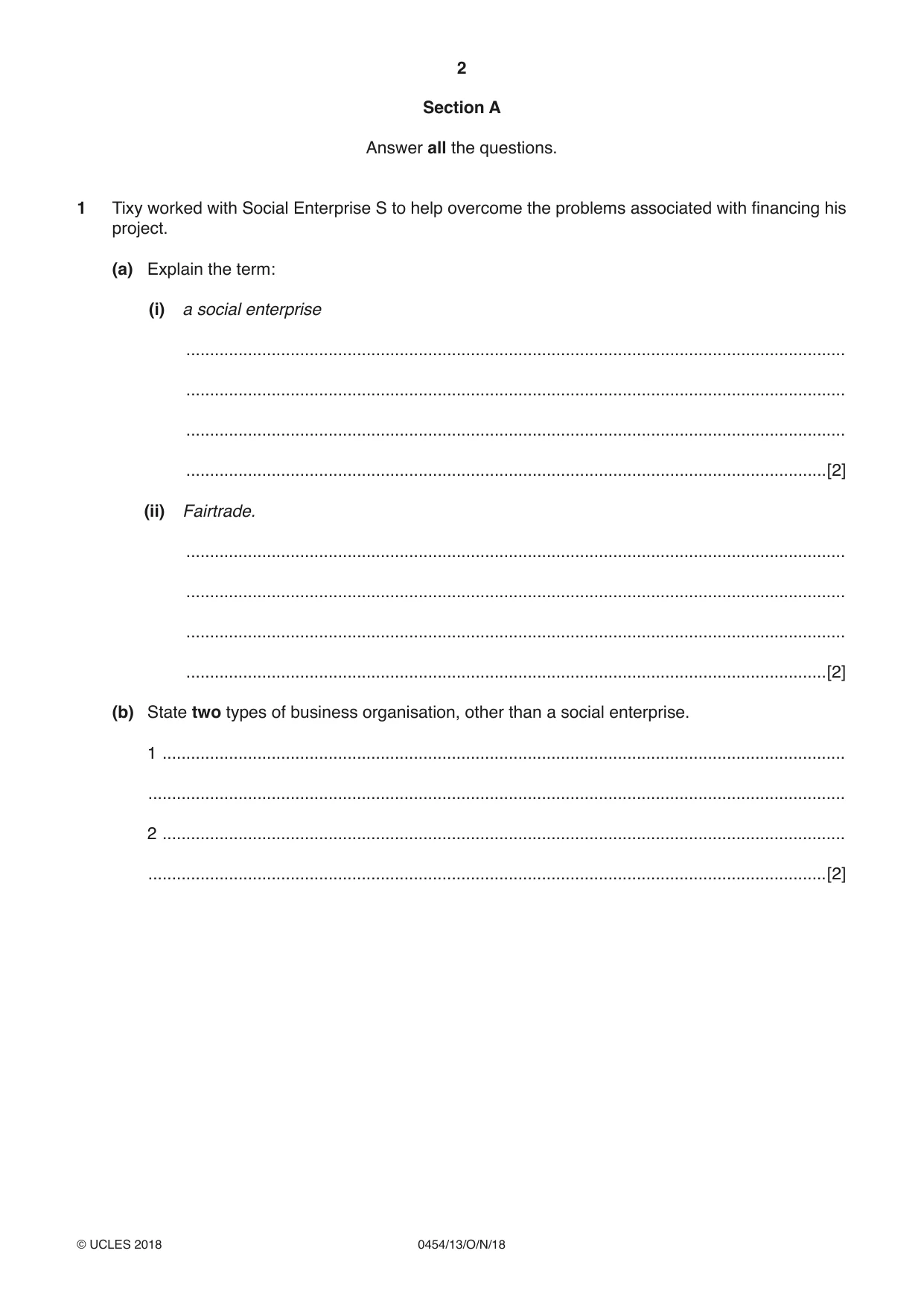
2 0454/13/O/N/18 © UCLES 2018 Section A Answer all the questions. 1 Tixy worked with Social Enterprise S to help overcome the problems associated with financing his project. (a) Explain the term: (i) a social enterprise … … … …[2] (ii) Fairtrade. … … … …[2] (b) State two types of business organisation, other than a social enterprise. 1 … … 2 … …[2]
Question paper, page 3
3 0454/13/O/N/18 © UCLES 2018 [Turn over (c) Explain how you solved two problems when operating your enterprise project. 1 … … … … … … 2 … … … … … …[6] [Total: 12]
Question paper, page 4
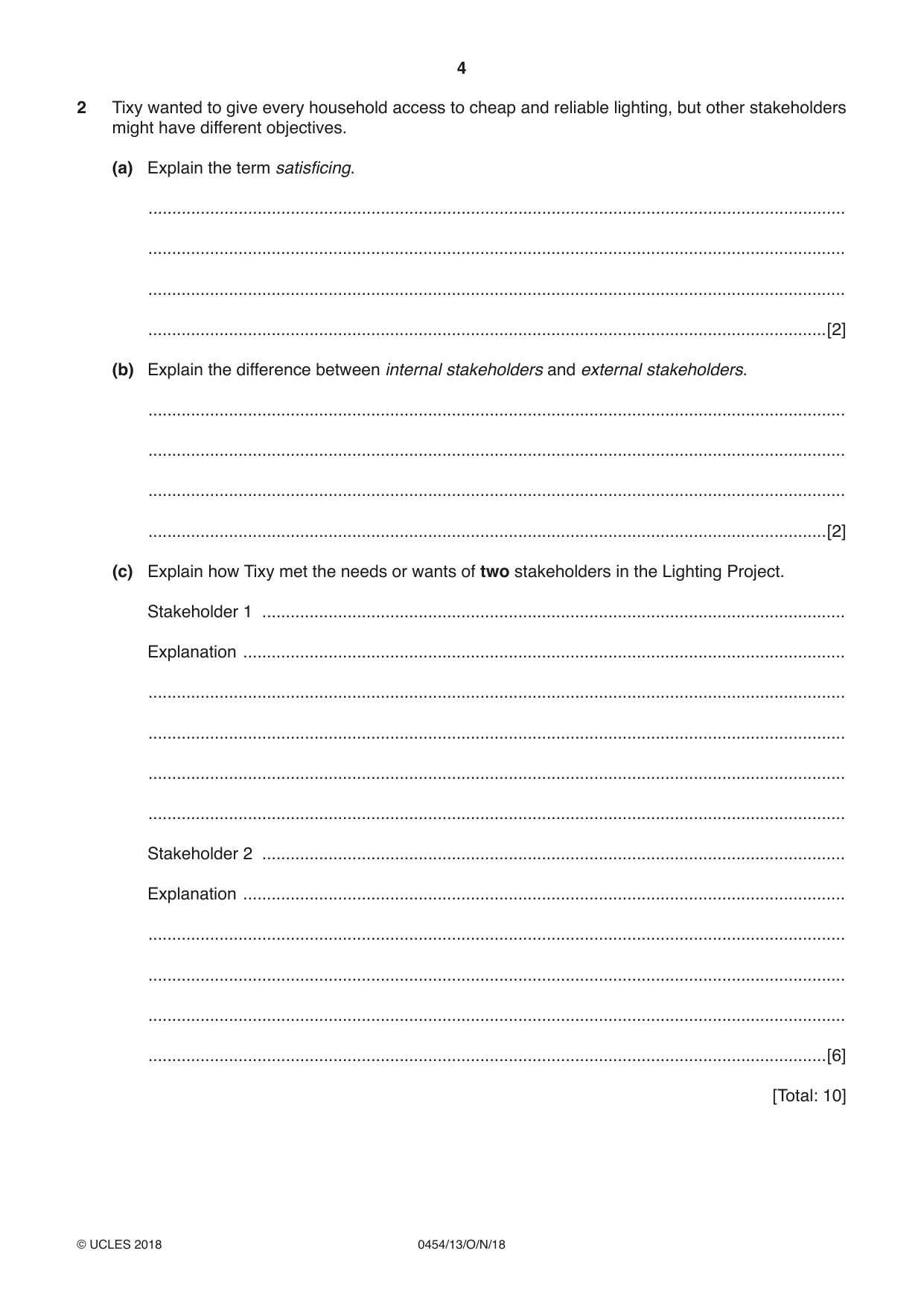
4 0454/13/O/N/18 © UCLES 2018 2 Tixy wanted to give every household access to cheap and reliable lighting, but other stakeholders might have different objectives. (a) Explain the term satisficing. … … … …[2] (b) Explain the difference between internal stakeholders and external stakeholders. … … … …[2] (c) Explain how Tixy met the needs or wants of two stakeholders in the Lighting Project. Stakeholder 1 … Explanation … … … … … Stakeholder 2 … Explanation … … … … …[6] [Total: 10]
Question paper, page 5
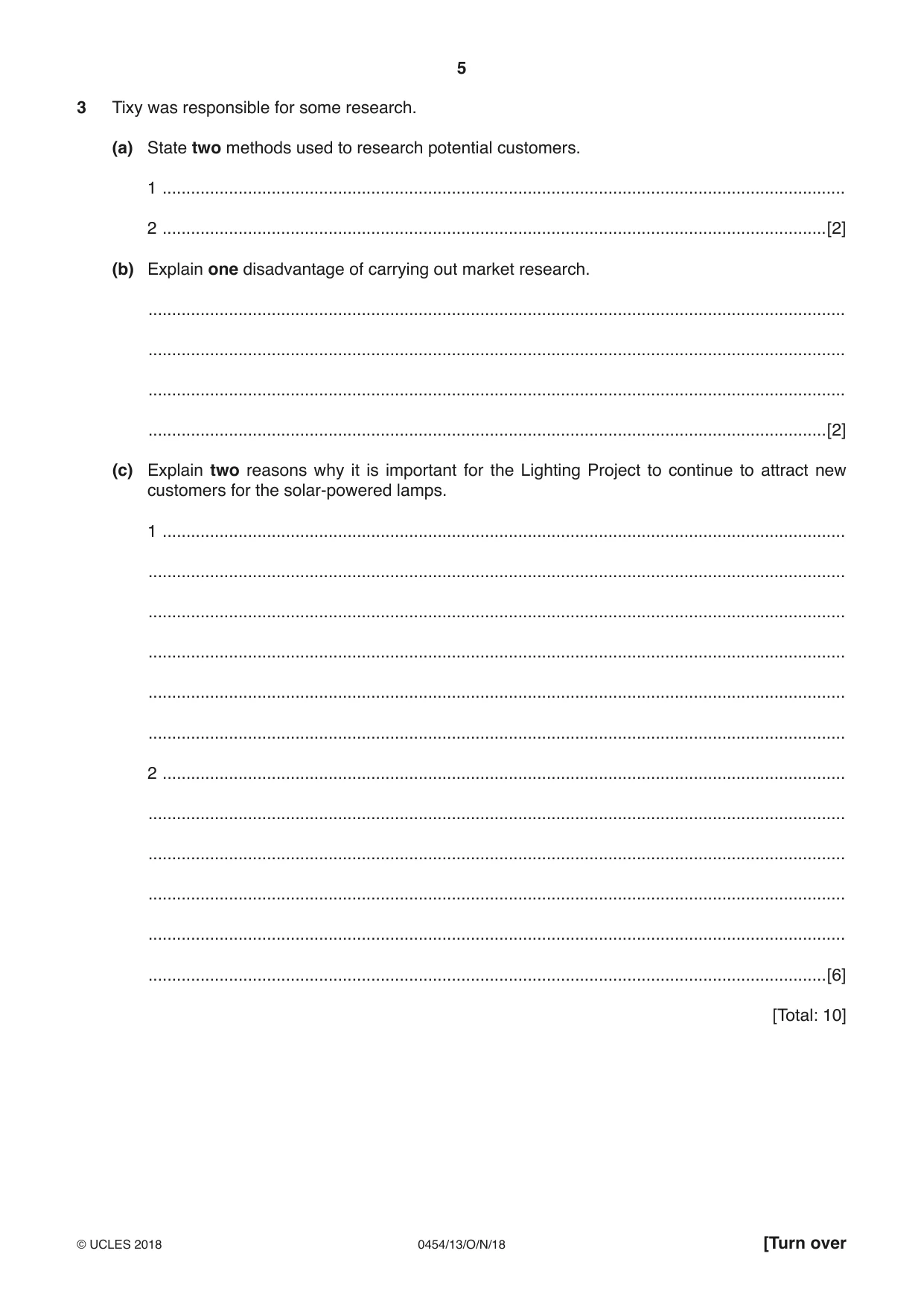
5 0454/13/O/N/18 © UCLES 2018 [Turn over 3 Tixy was responsible for some research. (a) State two methods used to research potential customers. 1 … 2 …[2] (b) Explain one disadvantage of carrying out market research. … … … …[2] (c) Explain two reasons why it is important for the Lighting Project to continue to attract new customers for the solar-powered lamps. 1 … … … … … … 2 … … … … … …[6] [Total: 10]
Question paper, page 6
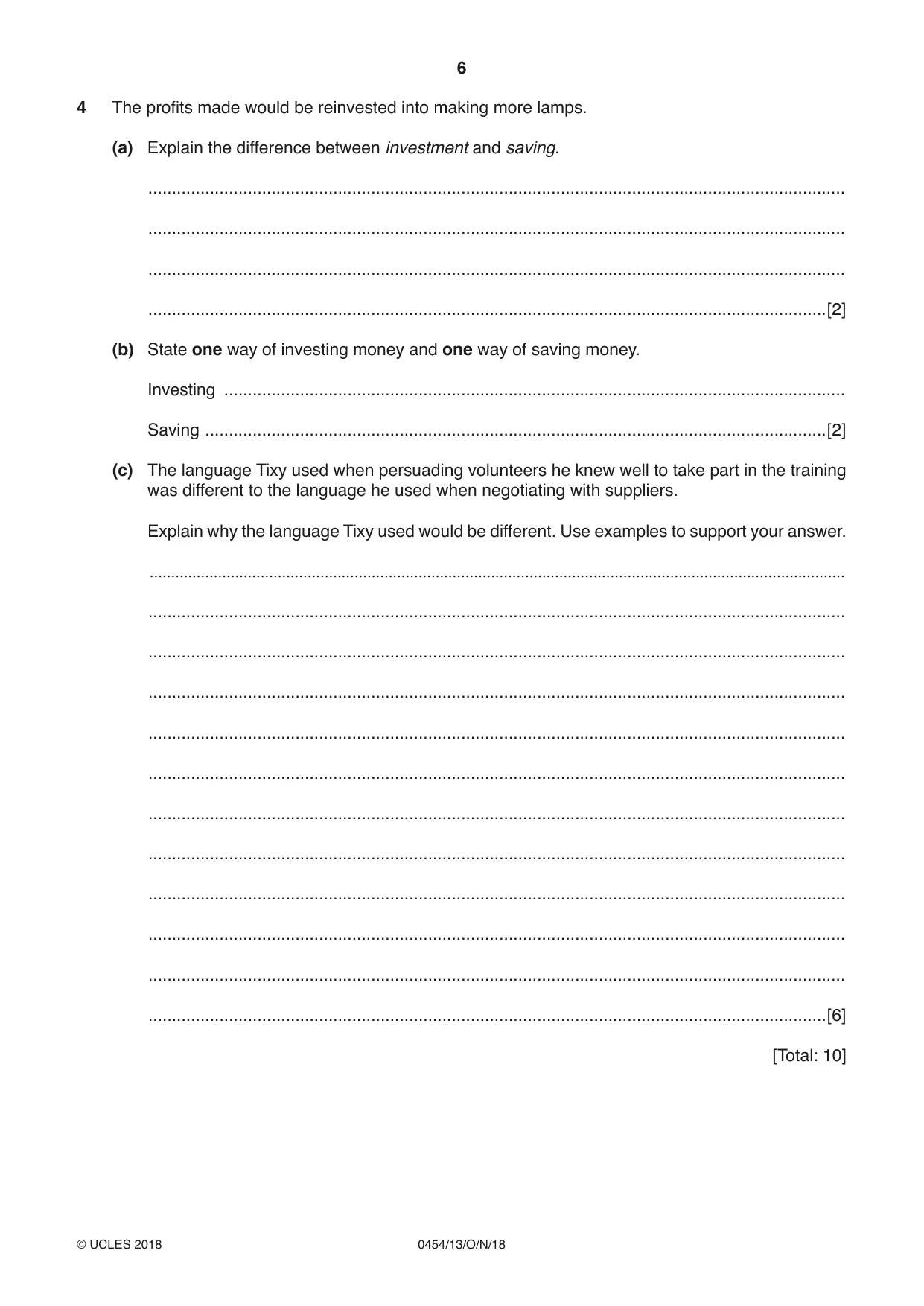
6 0454/13/O/N/18 © UCLES 2018 4 The profits made would be reinvested into making more lamps. (a) Explain the difference between investment and saving. … … … …[2] (b) State one way of investing money and one way of saving money. Investing … Saving …[2] (c) The language Tixy used when persuading volunteers he knew well to take part in the training was different to the language he used when negotiating with suppliers. Explain why the language Tixy used would be different. Use examples to support your answer. … … … … … … … … … … … …[6] [Total: 10]
Question paper, page 7
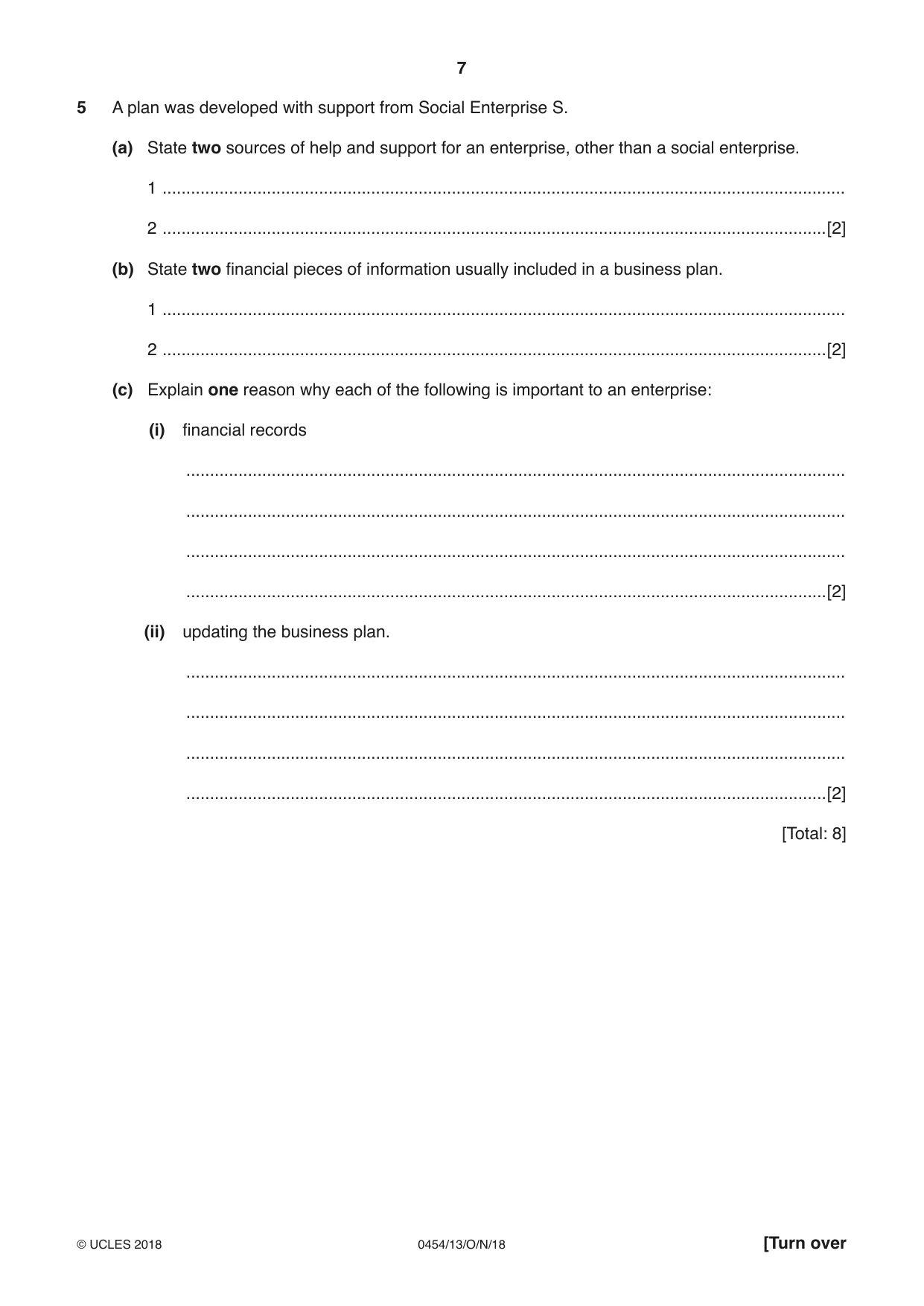
7 0454/13/O/N/18 © UCLES 2018 [Turn over 5 A plan was developed with support from Social Enterprise S. (a) State two sources of help and support for an enterprise, other than a social enterprise. 1 … 2 …[2] (b) State two financial pieces of information usually included in a business plan. 1 … 2 …[2] (c) Explain one reason why each of the following is important to an enterprise: (i) financial records … … … …[2] (ii) updating the business plan. … … … …[2] [Total: 8]
Question paper, page 8
8 0454/13/O/N/18 © UCLES 2018 BLANK PAGE
Question paper, page 9
9 0454/13/O/N/18 © UCLES 2018 [Turn over Section B Answer all the questions. You may use the case study, your own enterprise experience and your knowledge of enterprise where appropriate to answer the following questions. 6 (a) Starting a new enterprise always involves risk. Discuss the various risks involved in attempting to make the Lighting Project a success. [10] … … … … … … … … … … … … … … … … … … … … … …
Question paper, page 10
10 0454/13/O/N/18 © UCLES 2018 (b) The Lighting Project was funded by: • donations made to Social Enterprise S • profits made from the sale of lamps. Evaluate the suitability of the above sources of finance, compared to a loan, for the Lighting Project. [15] … … … … … … … … … … … … … … … … … … … … … … … … …
Question paper, page 11
11 0454/13/O/N/18 © UCLES 2018 [Turn over … … … … … … … … … … … … … … … … … … … … … … … … … … … [Total: 25]
Question paper, page 12
12 0454/13/O/N/18 © UCLES 2018 BLANK PAGE
Question paper, page 13
13 0454/13/O/N/18 © UCLES 2018 [Turn over 7 (a) Cash flow is one element of financial planning for enterprises. Discuss the importance of cash flow to the success of your enterprise project. [10] … … … … … … … … … … … … … … … … … … … … … … … … … …
Question paper, page 14
14 0454/13/O/N/18 © UCLES 2018 (b) Tixy used his negotiating skills when he bought the materials. The negotiation process involves a number of parts, including the following: • preparation • establishing a negotiating environment • negotiating your position • reaching agreement. Evaluate which two parts of the negotiation process listed above were most important to the success of any negotiations within your enterprise project. [15] … … … … … … … … … … … … … … … … … … … … … … …
Question paper, page 15
15 0454/13/O/N/18 © UCLES 2018 … … … … … … … … … … … … … … … … … … … … … … … … … … … [Total: 25]
Question paper, page 16
16 0454/13/O/N/18 © UCLES 2018 Permission to reproduce items where third-party owned material protected by copyright is included has been sought and cleared where possible. Every reasonable effort has been made by the publisher (UCLES) to trace copyright holders, but if any items requiring clearance have unwittingly been included, the publisher will be pleased to make amends at the earliest possible opportunity. To avoid the issue of disclosure of answer-related information to candidates, all copyright acknowledgements are reproduced online in the Cambridge International Examinations Copyright Acknowledgements Booklet. This is produced for each series of examinations and is freely available to download at www.cie.org.uk after the live examination series. Cambridge International Examinations is part of the Cambridge Assessment Group. Cambridge Assessment is the brand name of University of Cambridge Local Examinations Syndicate (UCLES), which is itself a department of the University of Cambridge. BLANK PAGE
Mark scheme, page 1
This syllabus is approved for use in England, Wales and Northern Ireland as a Cambridge International Level 1/Level 2 Certificate. This document consists of 12 printed pages. © UCLES 2018 [Turn over Cambridge Assessment International Education Cambridge International General Certificate of Secondary Education ENTERPRISE 0454/13 Paper 1 Case Study October/November 2018 MARK SCHEME Maximum Mark: 100 Published This mark scheme is published as an aid to teachers and candidates, to indicate the requirements of the examination. It shows the basis on which Examiners were instructed to award marks. It does not indicate the details of the discussions that took place at an Examiners’ meeting before marking began, which would have considered the acceptability of alternative answers. Mark schemes should be read in conjunction with the question paper and the Principal Examiner Report for Teachers. Cambridge International will not enter into discussions about these mark schemes. Cambridge International is publishing the mark schemes for the October/November 2018 series for most Cambridge IGCSE™, Cambridge International A and AS Level components and some Cambridge O Level components.
Mark scheme, page 2
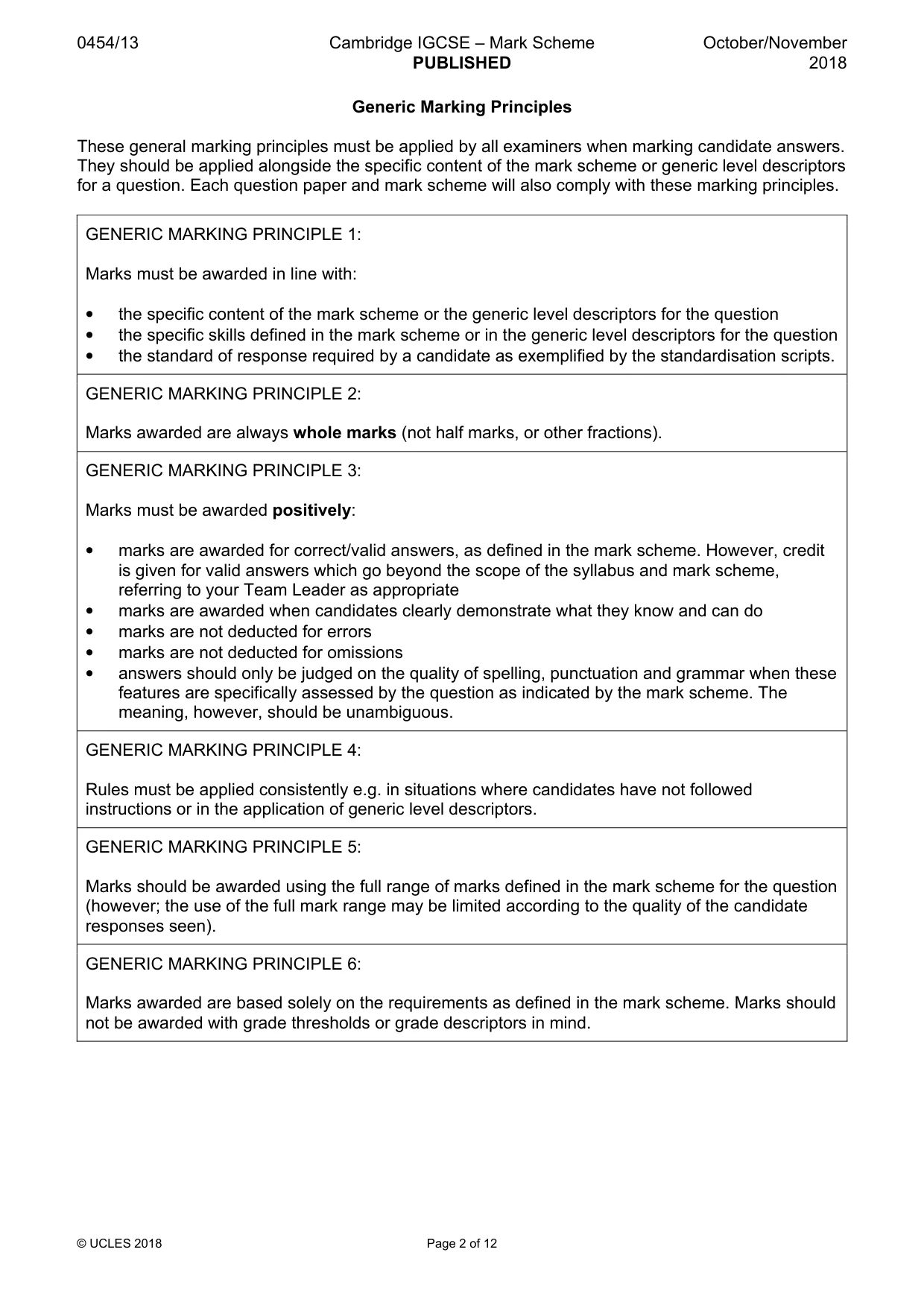
0454/13 Cambridge IGCSE – Mark Scheme PUBLISHED October/November 2018 © UCLES 2018 Page 2 of 12 Generic Marking Principles These general marking principles must be applied by all examiners when marking candidate answers. They should be applied alongside the specific content of the mark scheme or generic level descriptors for a question. Each question paper and mark scheme will also comply with these marking principles. GENERIC MARKING PRINCIPLE 1: Marks must be awarded in line with: • the specific content of the mark scheme or the generic level descriptors for the question • the specific skills defined in the mark scheme or in the generic level descriptors for the question • the standard of response required by a candidate as exemplified by the standardisation scripts. GENERIC MARKING PRINCIPLE 2: Marks awarded are always whole marks (not half marks, or other fractions). GENERIC MARKING PRINCIPLE 3: Marks must be awarded positively: • marks are awarded for correct/valid answers, as defined in the mark scheme. However, credit is given for valid answers which go beyond the scope of the syllabus and mark scheme, referring to your Team Leader as appropriate • marks are awarded when candidates clearly demonstrate what they know and can do • marks are not deducted for errors • marks are not deducted for omissions • answers should only be judged on the quality of spelling, punctuation and grammar when these features are specifically assessed by the question as indicated by the mark scheme. The meaning, however, should be unambiguous. GENERIC MARKING PRINCIPLE 4: Rules must be applied consistently e.g. in situations where candidates have not followed instructions or in the application of generic level descriptors. GENERIC MARKING PRINCIPLE 5: Marks should be awarded using the full range of marks defined in the mark scheme for the question (however; the use of the full mark range may be limited according to the quality of the candidate responses seen). GENERIC MARKING PRINCIPLE 6: Marks awarded are based solely on the requirements as defined in the mark scheme. Marks should not be awarded with grade thresholds or grade descriptors in mind.
Mark scheme, page 3
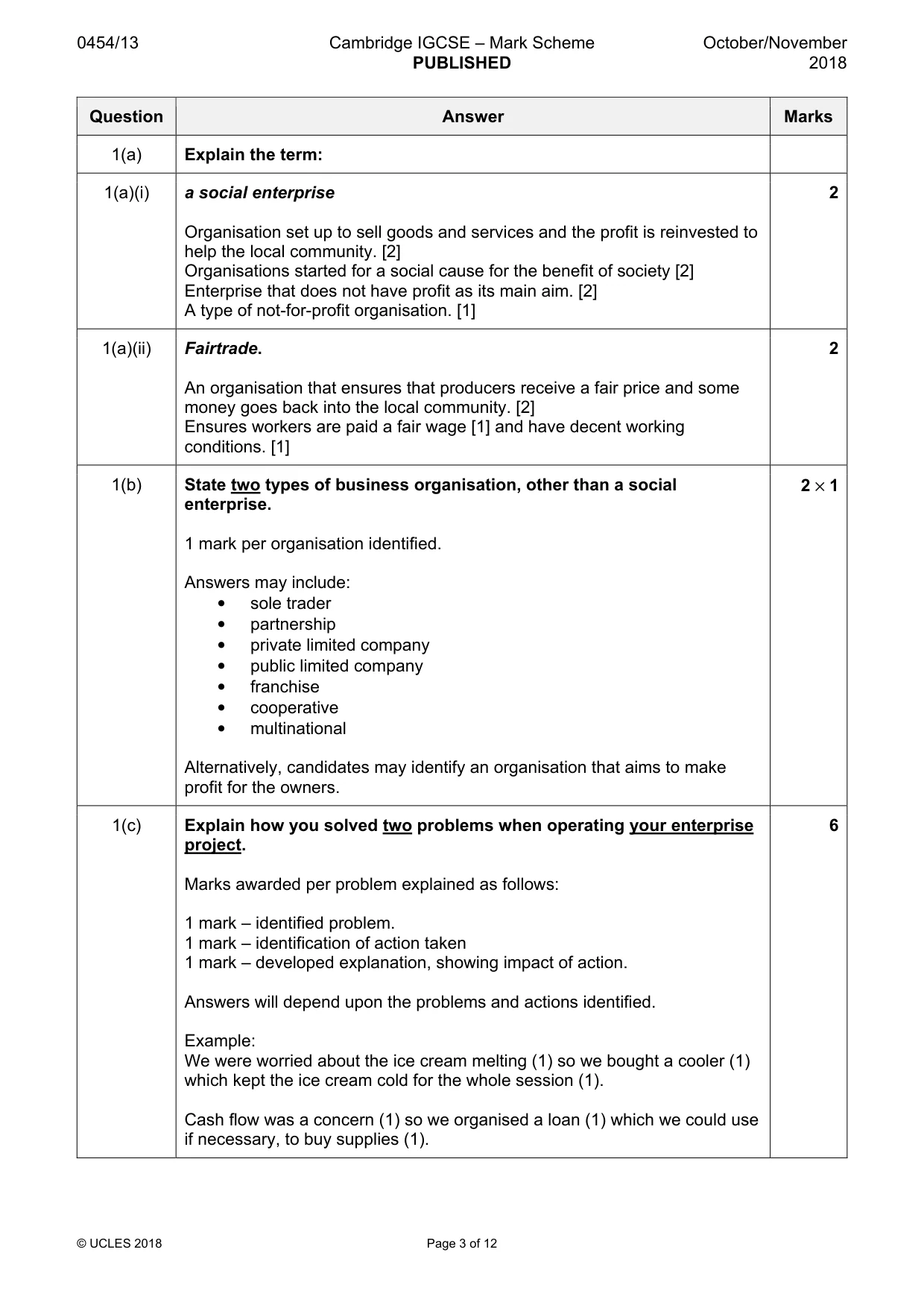
0454/13 Cambridge IGCSE – Mark Scheme PUBLISHED October/November 2018 © UCLES 2018 Page 3 of 12 Question Answer Marks 1(a) Explain the term: 1(a)(i) a social enterprise Organisation set up to sell goods and services and the profit is reinvested to help the local community. [2] Organisations started for a social cause for the benefit of society [2] Enterprise that does not have profit as its main aim. [2] A type of not-for-profit organisation. [1] 2 1(a)(ii) Fairtrade. An organisation that ensures that producers receive a fair price and some money goes back into the local community. [2] Ensures workers are paid a fair wage [1] and have decent working conditions. [1] 2 1(b) State two types of business organisation, other than a social enterprise. 1 mark per organisation identified. Answers may include: • sole trader • partnership • private limited company • public limited company • franchise • cooperative • multinational Alternatively, candidates may identify an organisation that aims to make profit for the owners. 2 × 1 1(c) Explain how you solved two problems when operating your enterprise project. Marks awarded per problem explained as follows: 1 mark – identified problem. 1 mark – identification of action taken 1 mark – developed explanation, showing impact of action. Answers will depend upon the problems and actions identified. Example: We were worried about the ice cream melting (1) so we bought a cooler (1) which kept the ice cream cold for the whole session (1). Cash flow was a concern (1) so we organised a loan (1) which we could use if necessary, to buy supplies (1). 6
Mark scheme, page 4
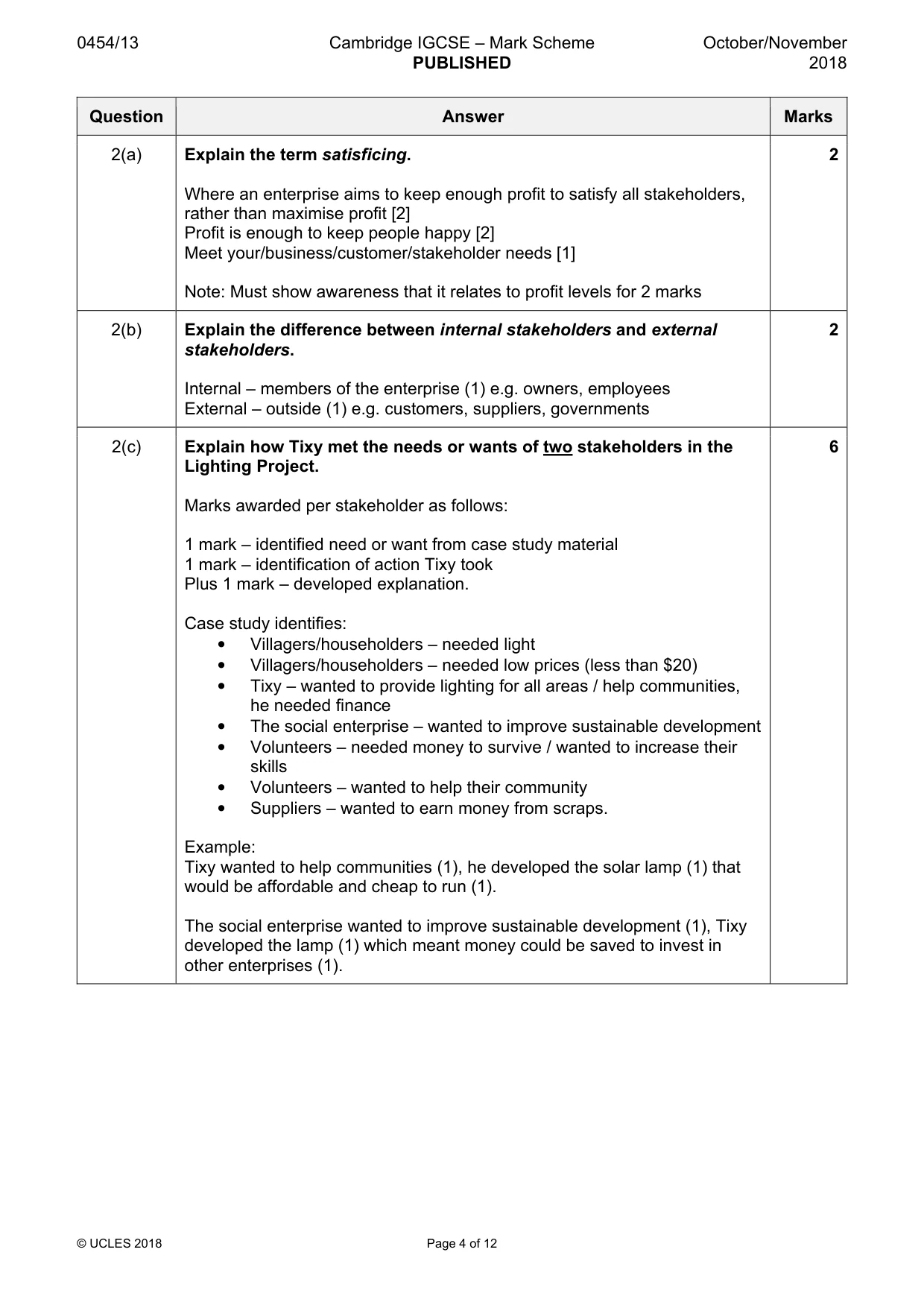
0454/13 Cambridge IGCSE – Mark Scheme PUBLISHED October/November 2018 © UCLES 2018 Page 4 of 12 Question Answer Marks 2(a) Explain the term satisficing. Where an enterprise aims to keep enough profit to satisfy all stakeholders, rather than maximise profit [2] Profit is enough to keep people happy [2] Meet your/business/customer/stakeholder needs [1] Note: Must show awareness that it relates to profit levels for 2 marks 2 2(b) Explain the difference between internal stakeholders and external stakeholders. Internal – members of the enterprise (1) e.g. owners, employees External – outside (1) e.g. customers, suppliers, governments 2 2(c) Explain how Tixy met the needs or wants of two stakeholders in the Lighting Project. Marks awarded per stakeholder as follows: 1 mark – identified need or want from case study material 1 mark – identification of action Tixy took Plus 1 mark – developed explanation. Case study identifies: • Villagers/householders – needed light • Villagers/householders – needed low prices (less than $20) • Tixy – wanted to provide lighting for all areas / help communities, he needed finance • The social enterprise – wanted to improve sustainable development • Volunteers – needed money to survive / wanted to increase their skills • Volunteers – wanted to help their community • Suppliers – wanted to earn money from scraps. Example: Tixy wanted to help communities (1), he developed the solar lamp (1) that would be affordable and cheap to run (1). The social enterprise wanted to improve sustainable development (1), Tixy developed the lamp (1) which meant money could be saved to invest in other enterprises (1). 6
Mark scheme, page 5
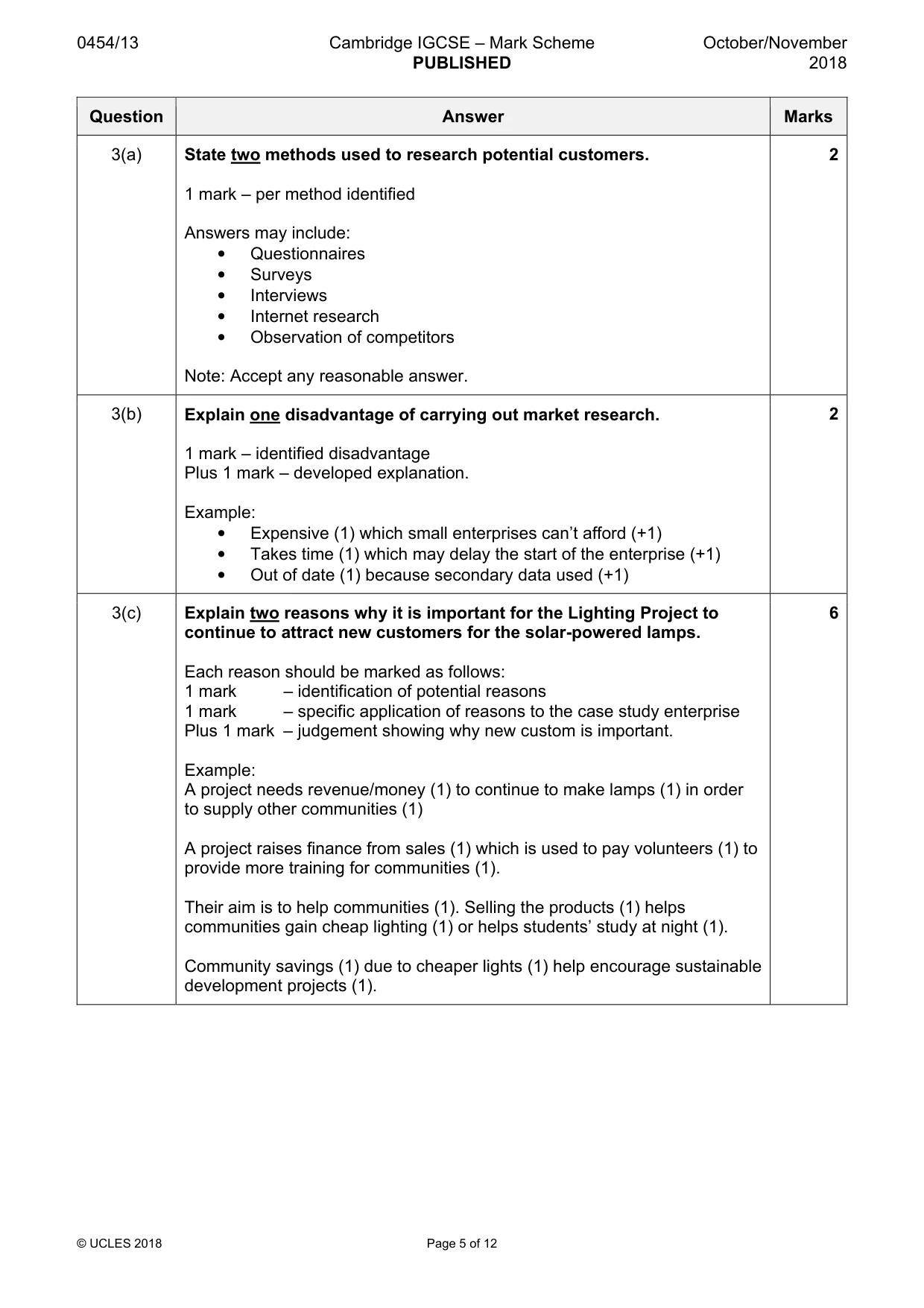
0454/13 Cambridge IGCSE – Mark Scheme PUBLISHED October/November 2018 © UCLES 2018 Page 5 of 12 Question Answer Marks 3(a) State two methods used to research potential customers. 1 mark – per method identified Answers may include: • Questionnaires • Surveys • Interviews • Internet research • Observation of competitors Note: Accept any reasonable answer. 2 3(b) Explain one disadvantage of carrying out market research. 1 mark – identified disadvantage Plus 1 mark – developed explanation. Example: • Expensive (1) which small enterprises can’t afford (+1) • Takes time (1) which may delay the start of the enterprise (+1) • Out of date (1) because secondary data used (+1) 2 3(c) Explain two reasons why it is important for the Lighting Project to continue to attract new customers for the solar-powered lamps. Each reason should be marked as follows: 1 mark – identification of potential reasons 1 mark – specific application of reasons to the case study enterprise Plus 1 mark – judgement showing why new custom is important. Example: A project needs revenue/money (1) to continue to make lamps (1) in order to supply other communities (1) A project raises finance from sales (1) which is used to pay volunteers (1) to provide more training for communities (1). Their aim is to help communities (1). Selling the products (1) helps communities gain cheap lighting (1) or helps students’ study at night (1). Community savings (1) due to cheaper lights (1) help encourage sustainable development projects (1). 6
Mark scheme, page 6
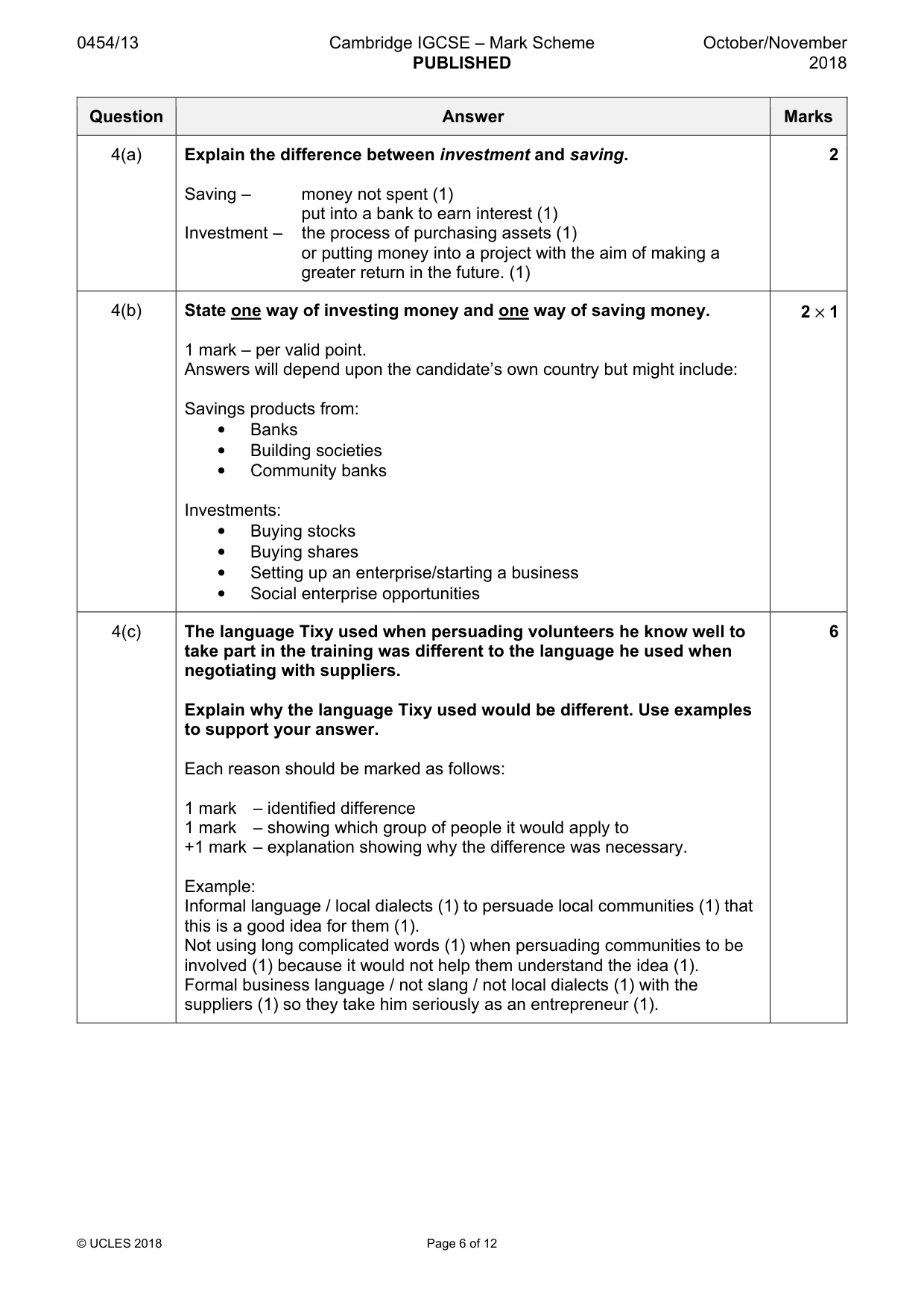
0454/13 Cambridge IGCSE – Mark Scheme PUBLISHED October/November 2018 © UCLES 2018 Page 6 of 12 Question Answer Marks 4(a) Explain the difference between investment and saving. Saving – money not spent (1) put into a bank to earn interest (1) Investment – the process of purchasing assets (1) or putting money into a project with the aim of making a greater return in the future. (1) 2 4(b) State one way of investing money and one way of saving money. 1 mark – per valid point. Answers will depend upon the candidate’s own country but might include: Savings products from: • Banks • Building societies • Community banks Investments: • Buying stocks • Buying shares • Setting up an enterprise/starting a business • Social enterprise opportunities 2 × 1 4(c) The language Tixy used when persuading volunteers he know well to take part in the training was different to the language he used when negotiating with suppliers. Explain why the language Tixy used would be different. Use examples to support your answer. Each reason should be marked as follows: 1 mark – identified difference 1 mark – showing which group of people it would apply to +1 mark – explanation showing why the difference was necessary. Example: Informal language / local dialects (1) to persuade local communities (1) that this is a good idea for them (1). Not using long complicated words (1) when persuading communities to be involved (1) because it would not help them understand the idea (1). Formal business language / not slang / not local dialects (1) with the suppliers (1) so they take him seriously as an entrepreneur (1). 6
Mark scheme, page 7
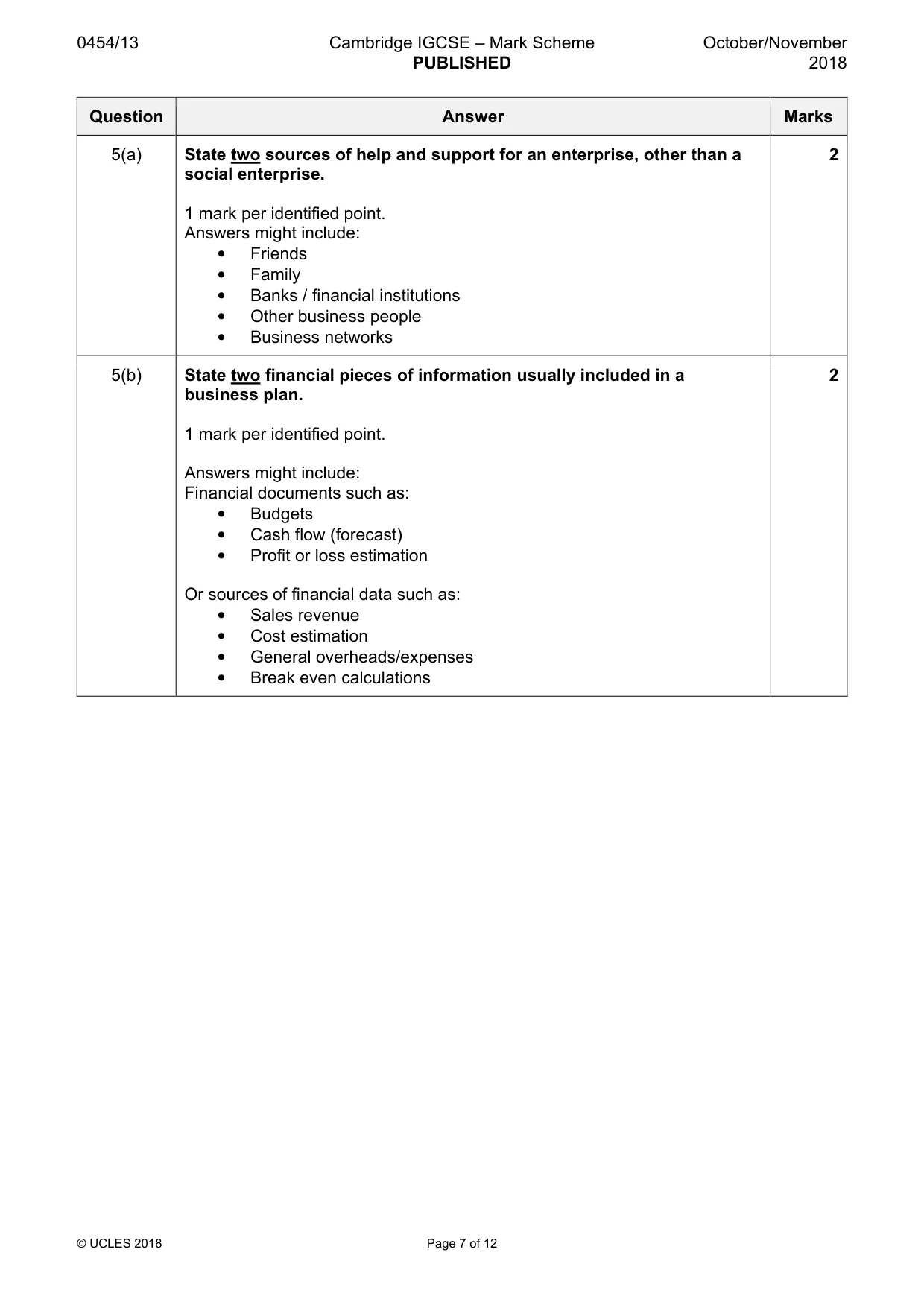
0454/13 Cambridge IGCSE – Mark Scheme PUBLISHED October/November 2018 © UCLES 2018 Page 7 of 12 Question Answer Marks 5(a) State two sources of help and support for an enterprise, other than a social enterprise. 1 mark per identified point. Answers might include: • Friends • Family • Banks / financial institutions • Other business people • Business networks 2 5(b) State two financial pieces of information usually included in a business plan. 1 mark per identified point. Answers might include: Financial documents such as: • Budgets • Cash flow (forecast) • Profit or loss estimation Or sources of financial data such as: • Sales revenue • Cost estimation • General overheads/expenses • Break even calculations 2
Mark scheme, page 8
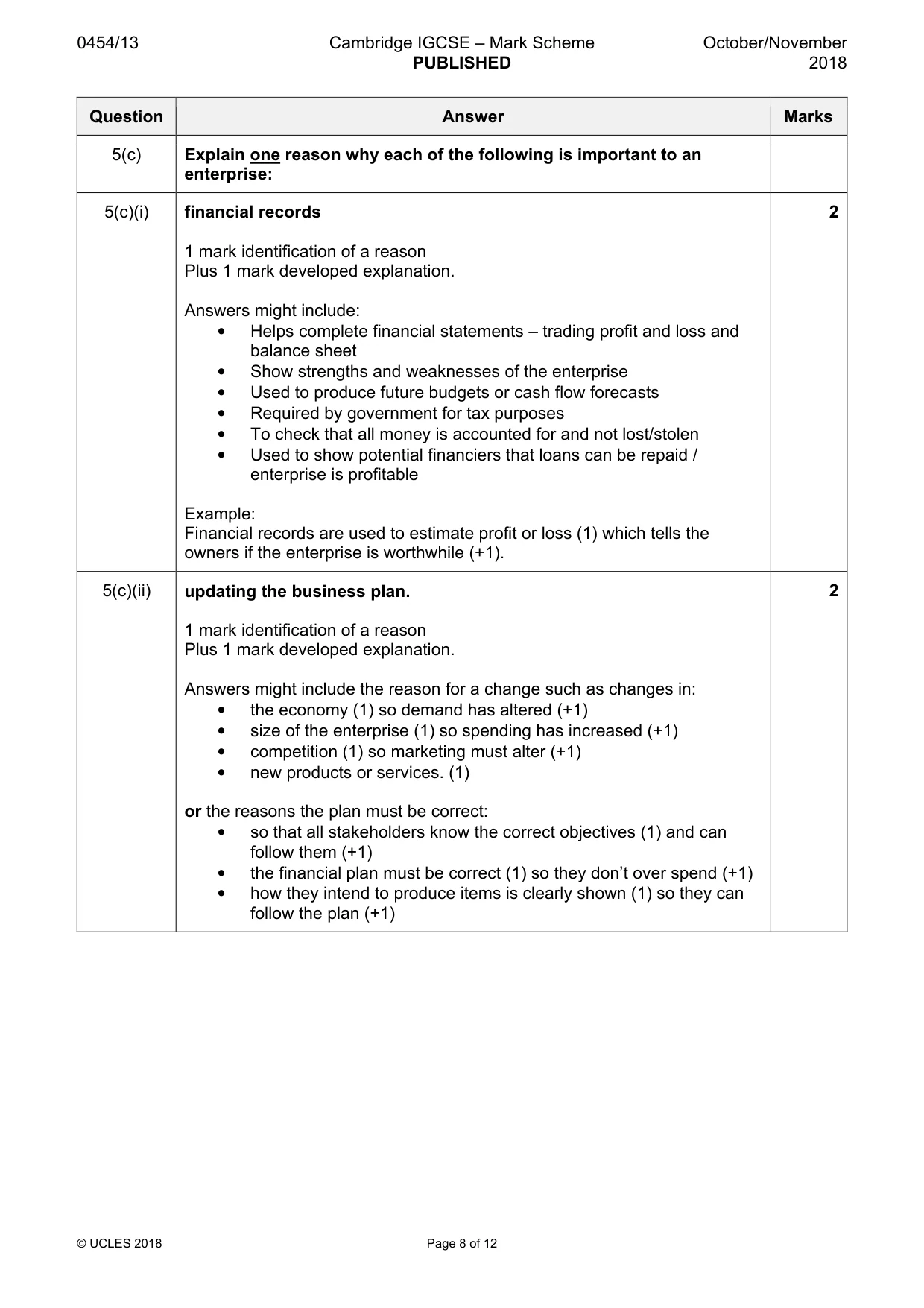
0454/13 Cambridge IGCSE – Mark Scheme PUBLISHED October/November 2018 © UCLES 2018 Page 8 of 12 Question Answer Marks 5(c) Explain one reason why each of the following is important to an enterprise: 5(c)(i) financial records 1 mark identification of a reason Plus 1 mark developed explanation. Answers might include: • Helps complete financial statements – trading profit and loss and balance sheet • Show strengths and weaknesses of the enterprise • Used to produce future budgets or cash flow forecasts • Required by government for tax purposes • To check that all money is accounted for and not lost/stolen • Used to show potential financiers that loans can be repaid / enterprise is profitable Example: Financial records are used to estimate profit or loss (1) which tells the owners if the enterprise is worthwhile (+1). 2 5(c)(ii) updating the business plan. 1 mark identification of a reason Plus 1 mark developed explanation. Answers might include the reason for a change such as changes in: • the economy (1) so demand has altered (+1) • size of the enterprise (1) so spending has increased (+1) • competition (1) so marketing must alter (+1) • new products or services. (1) or the reasons the plan must be correct: • so that all stakeholders know the correct objectives (1) and can follow them (+1) • the financial plan must be correct (1) so they don’t over spend (+1) • how they intend to produce items is clearly shown (1) so they can follow the plan (+1) 2
Mark scheme, page 9
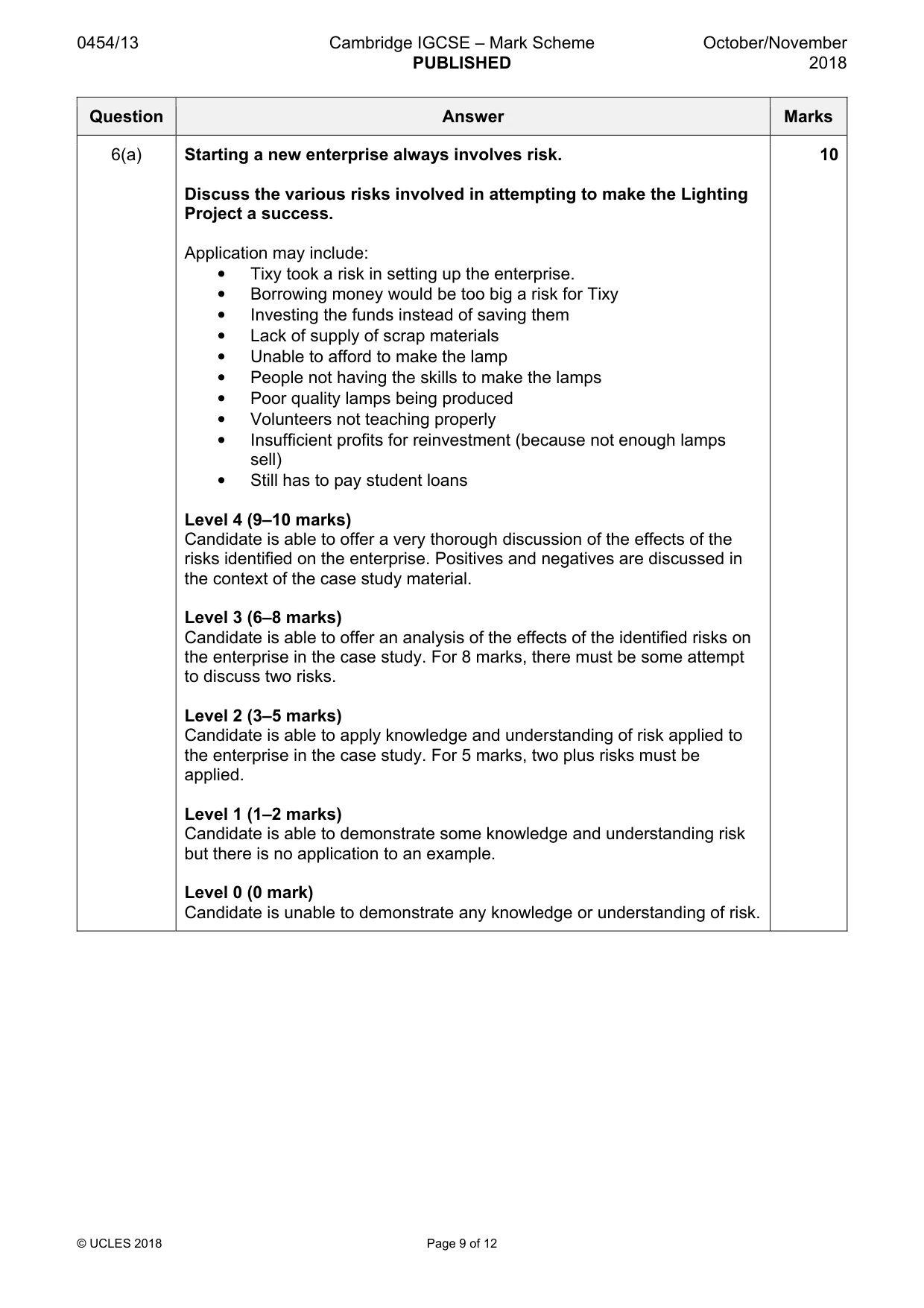
0454/13 Cambridge IGCSE – Mark Scheme PUBLISHED October/November 2018 © UCLES 2018 Page 9 of 12 Question Answer Marks 6(a) Starting a new enterprise always involves risk. Discuss the various risks involved in attempting to make the Lighting Project a success. Application may include: • Tixy took a risk in setting up the enterprise. • Borrowing money would be too big a risk for Tixy • Investing the funds instead of saving them • Lack of supply of scrap materials • Unable to afford to make the lamp • People not having the skills to make the lamps • Poor quality lamps being produced • Volunteers not teaching properly • Insufficient profits for reinvestment (because not enough lamps sell) • Still has to pay student loans Level 4 (9–10 marks) Candidate is able to offer a very thorough discussion of the effects of the risks identified on the enterprise. Positives and negatives are discussed in the context of the case study material. Level 3 (6–8 marks) Candidate is able to offer an analysis of the effects of the identified risks on the enterprise in the case study. For 8 marks, there must be some attempt to discuss two risks. Level 2 (3–5 marks) Candidate is able to apply knowledge and understanding of risk applied to the enterprise in the case study. For 5 marks, two plus risks must be applied. Level 1 (1–2 marks) Candidate is able to demonstrate some knowledge and understanding risk but there is no application to an example. Level 0 (0 mark) Candidate is unable to demonstrate any knowledge or understanding of risk. 10
Mark scheme, page 10
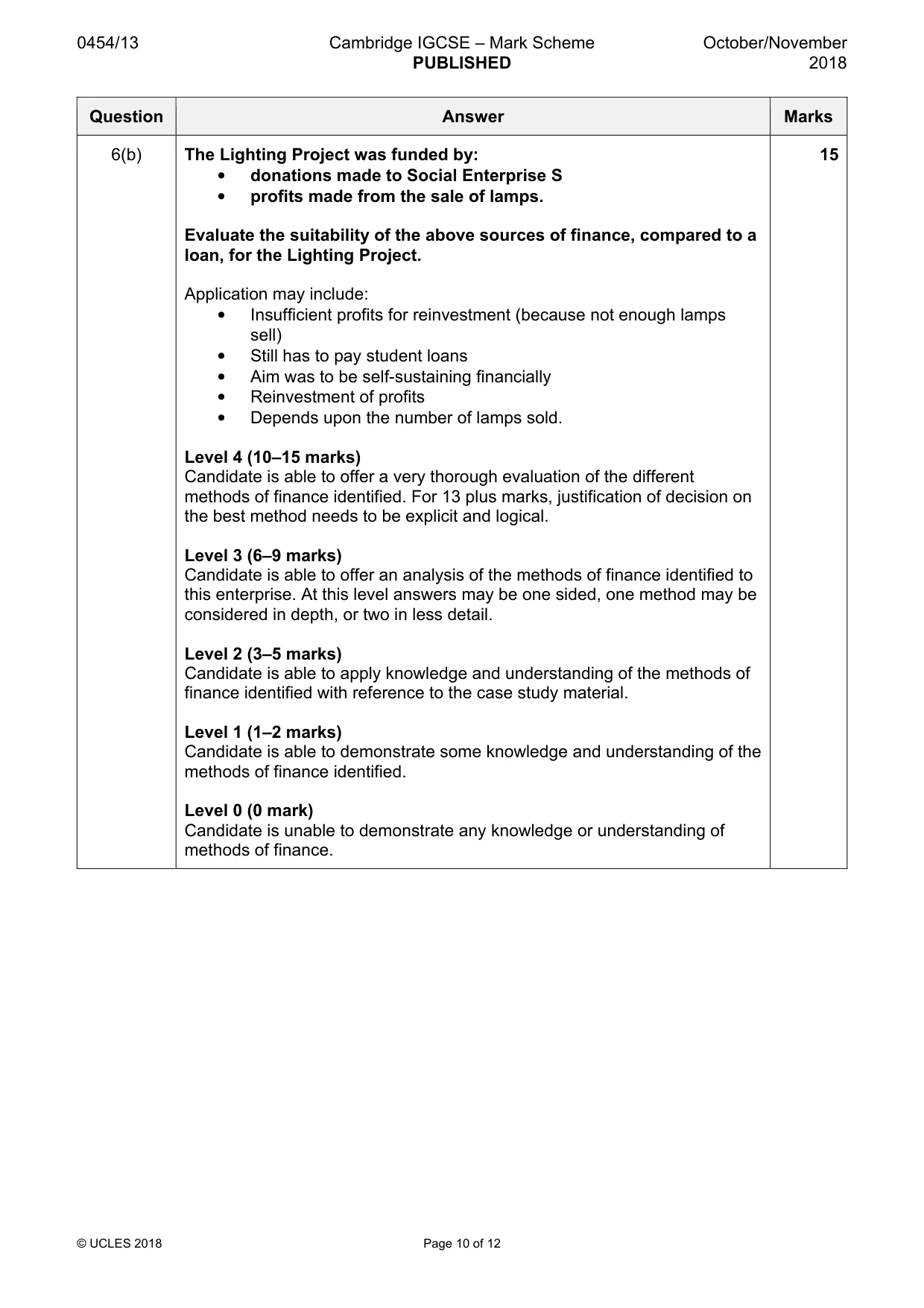
0454/13 Cambridge IGCSE – Mark Scheme PUBLISHED October/November 2018 © UCLES 2018 Page 10 of 12 Question Answer Marks 6(b) The Lighting Project was funded by: • donations made to Social Enterprise S • profits made from the sale of lamps. Evaluate the suitability of the above sources of finance, compared to a loan, for the Lighting Project. Application may include: • Insufficient profits for reinvestment (because not enough lamps sell) • Still has to pay student loans • Aim was to be self-sustaining financially • Reinvestment of profits • Depends upon the number of lamps sold. Level 4 (10–15 marks) Candidate is able to offer a very thorough evaluation of the different methods of finance identified. For 13 plus marks, justification of decision on the best method needs to be explicit and logical. Level 3 (6–9 marks) Candidate is able to offer an analysis of the methods of finance identified to this enterprise. At this level answers may be one sided, one method may be considered in depth, or two in less detail. Level 2 (3–5 marks) Candidate is able to apply knowledge and understanding of the methods of finance identified with reference to the case study material. Level 1 (1–2 marks) Candidate is able to demonstrate some knowledge and understanding of the methods of finance identified. Level 0 (0 mark) Candidate is unable to demonstrate any knowledge or understanding of methods of finance. 15
Mark scheme, page 11
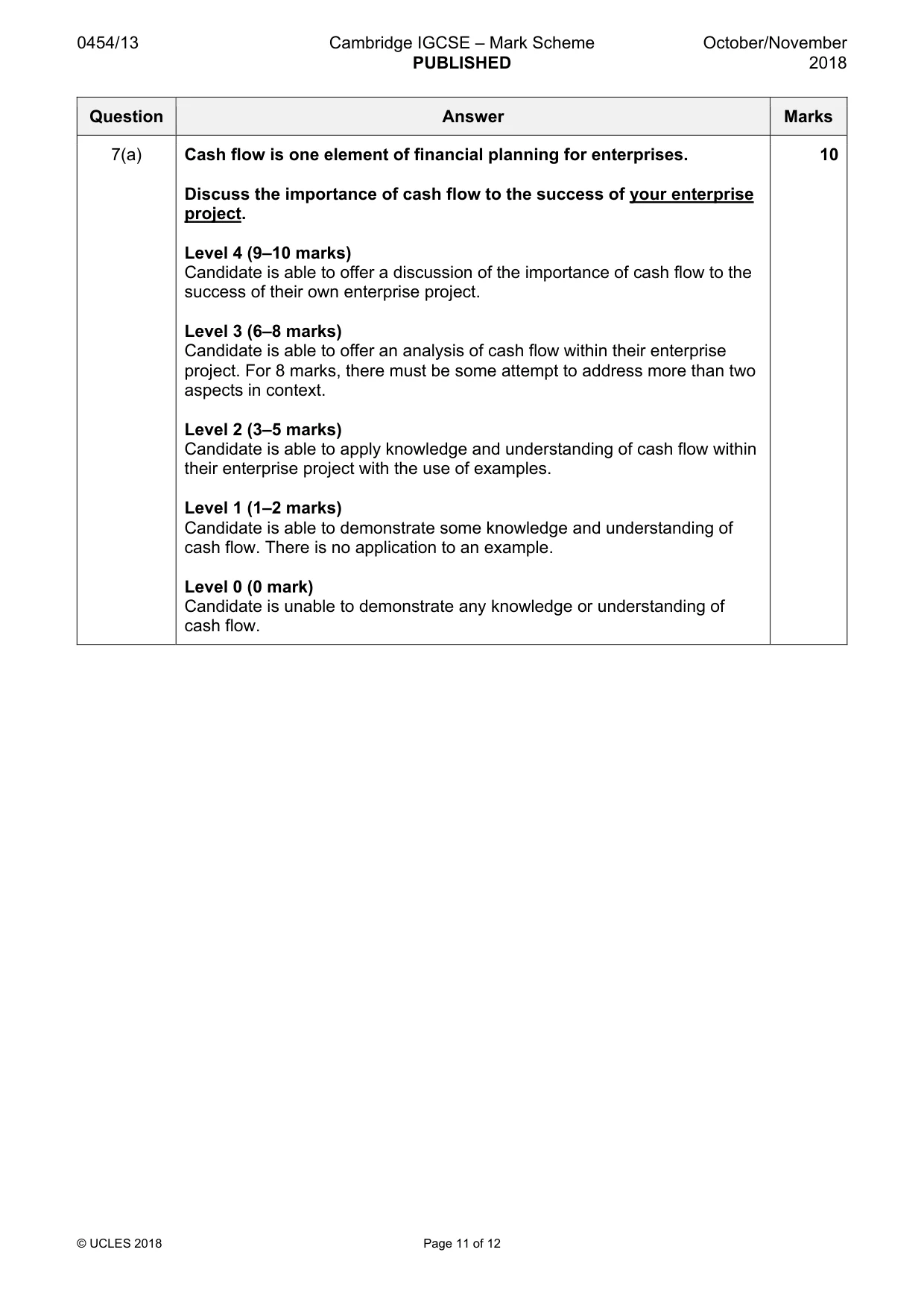
0454/13 Cambridge IGCSE – Mark Scheme PUBLISHED October/November 2018 © UCLES 2018 Page 11 of 12 Question Answer Marks 7(a) Cash flow is one element of financial planning for enterprises. Discuss the importance of cash flow to the success of your enterprise project. Level 4 (9–10 marks) Candidate is able to offer a discussion of the importance of cash flow to the success of their own enterprise project. Level 3 (6–8 marks) Candidate is able to offer an analysis of cash flow within their enterprise project. For 8 marks, there must be some attempt to address more than two aspects in context. Level 2 (3–5 marks) Candidate is able to apply knowledge and understanding of cash flow within their enterprise project with the use of examples. Level 1 (1–2 marks) Candidate is able to demonstrate some knowledge and understanding of cash flow. There is no application to an example. Level 0 (0 mark) Candidate is unable to demonstrate any knowledge or understanding of cash flow. 10
Mark scheme, page 12
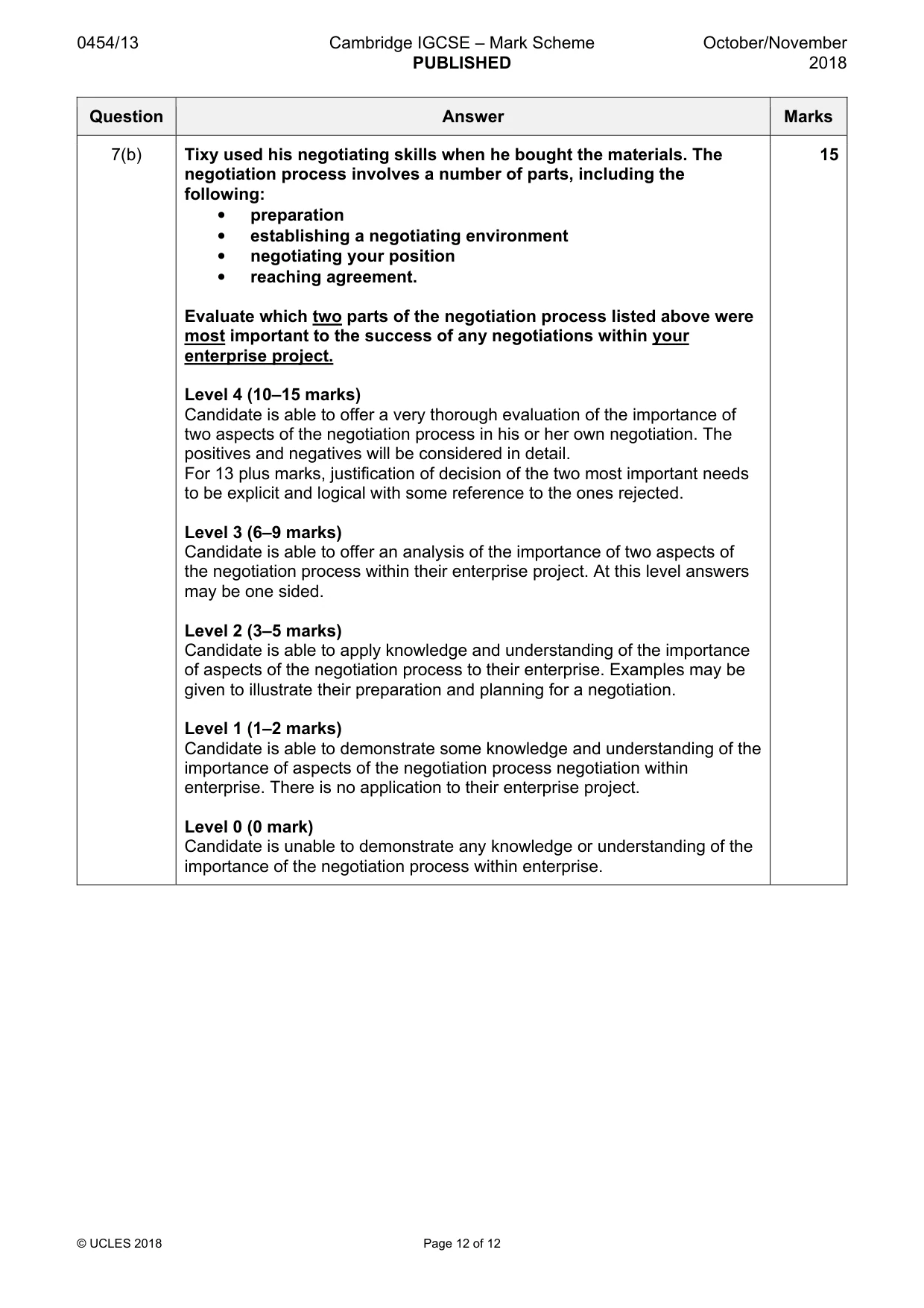
0454/13 Cambridge IGCSE – Mark Scheme PUBLISHED October/November 2018 © UCLES 2018 Page 12 of 12 Question Answer Marks 7(b) Tixy used his negotiating skills when he bought the materials. The negotiation process involves a number of parts, including the following: • preparation • establishing a negotiating environment • negotiating your position • reaching agreement. Evaluate which two parts of the negotiation process listed above were most important to the success of any negotiations within your enterprise project. Level 4 (10–15 marks) Candidate is able to offer a very thorough evaluation of the importance of two aspects of the negotiation process in his or her own negotiation. The positives and negatives will be considered in detail. For 13 plus marks, justification of decision of the two most important needs to be explicit and logical with some reference to the ones rejected. Level 3 (6–9 marks) Candidate is able to offer an analysis of the importance of two aspects of the negotiation process within their enterprise project. At this level answers may be one sided. Level 2 (3–5 marks) Candidate is able to apply knowledge and understanding of the importance of aspects of the negotiation process to their enterprise. Examples may be given to illustrate their preparation and planning for a negotiation. Level 1 (1–2 marks) Candidate is able to demonstrate some knowledge and understanding of the importance of aspects of the negotiation process negotiation within enterprise. There is no application to their enterprise project. Level 0 (0 mark) Candidate is unable to demonstrate any knowledge or understanding of the importance of the negotiation process within enterprise. 15
What you needed in this session
Cambridge’s own grade thresholds for 2018 Oct/Nov, Paper 1 · Variant 3. A higher threshold means an easier paper — the bar moves with how the cohort did.