Cambridge IGCSE Enterprise 0454 — 2018 Oct/Nov Paper 1 · Variant 2
0454/12/O/N/18 · 100 marks · ≈113 min
The question paper and its mark scheme, free to read here and free to download. This is Cambridge’s own paper, exactly as it was sat.
Question paper16 pages







Mark scheme12 pages
Answers below. Sit the paper first if you are practising.
Paper as text
Question paper, page 1
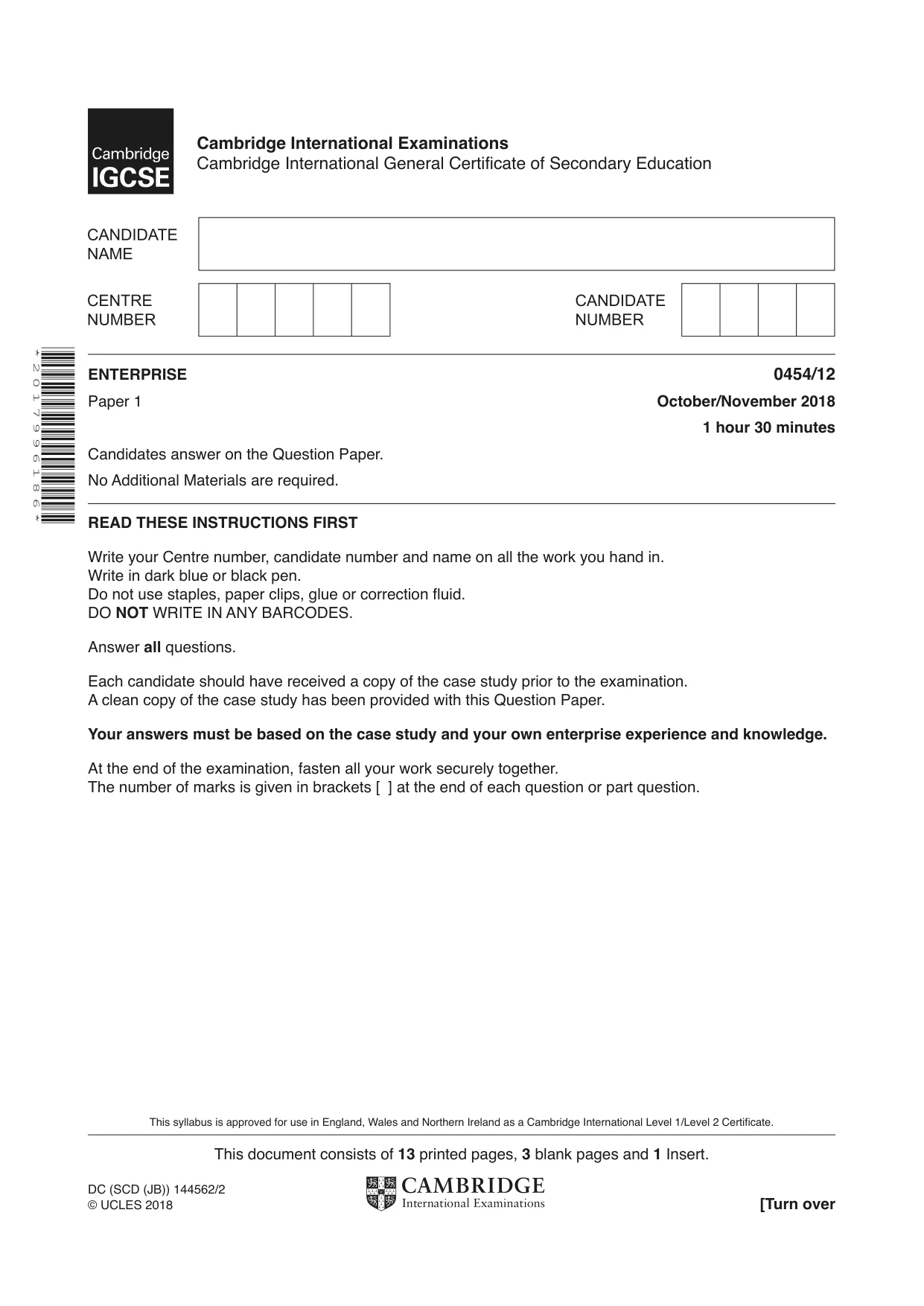
* 2 0 1 7 9 9 6 1 8 6 * This document consists of 13 printed pages, 3 blank pages and 1 Insert. DC (SCD (JB)) 144562/2 © UCLES 2018 [Turn over Cambridge International Examinations Cambridge International General Certificate of Secondary Education ENTERPRISE 0454/12 Paper 1 October/November 2018 1 hour 30 minutes Candidates answer on the Question Paper. No Additional Materials are required. READ THESE INSTRUCTIONS FIRST Write your Centre number, candidate number and name on all the work you hand in. Write in dark blue or black pen. Do not use staples, paper clips, glue or correction fluid. DO NOT WRITE IN ANY BARCODES. Answer all questions. Each candidate should have received a copy of the case study prior to the examination. A clean copy of the case study has been provided with this Question Paper. Your answers must be based on the case study and your own enterprise experience and knowledge. At the end of the examination, fasten all your work securely together. The number of marks is given in brackets [ ] at the end of each question or part question. This syllabus is approved for use in England, Wales and Northern Ireland as a Cambridge International Level 1/Level 2 Certificate.
Question paper, page 2
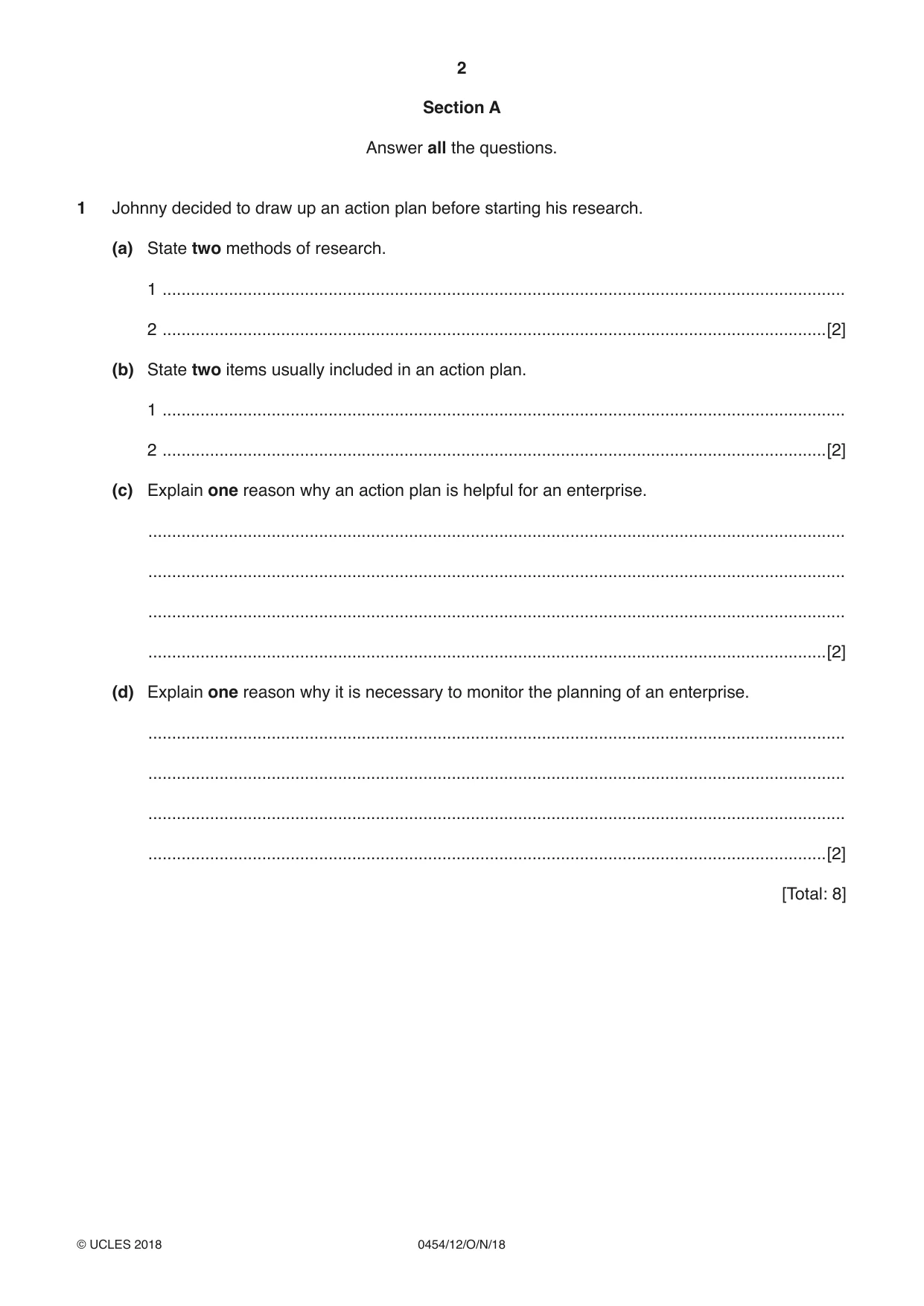
2 0454/12/O/N/18 © UCLES 2018 Section A Answer all the questions. 1 Johnny decided to draw up an action plan before starting his research. (a) State two methods of research. 1 … 2 …[2] (b) State two items usually included in an action plan. 1 … 2 …[2] (c) Explain one reason why an action plan is helpful for an enterprise. … … … …[2] (d) Explain one reason why it is necessary to monitor the planning of an enterprise. … … … …[2] [Total: 8]
Question paper, page 3
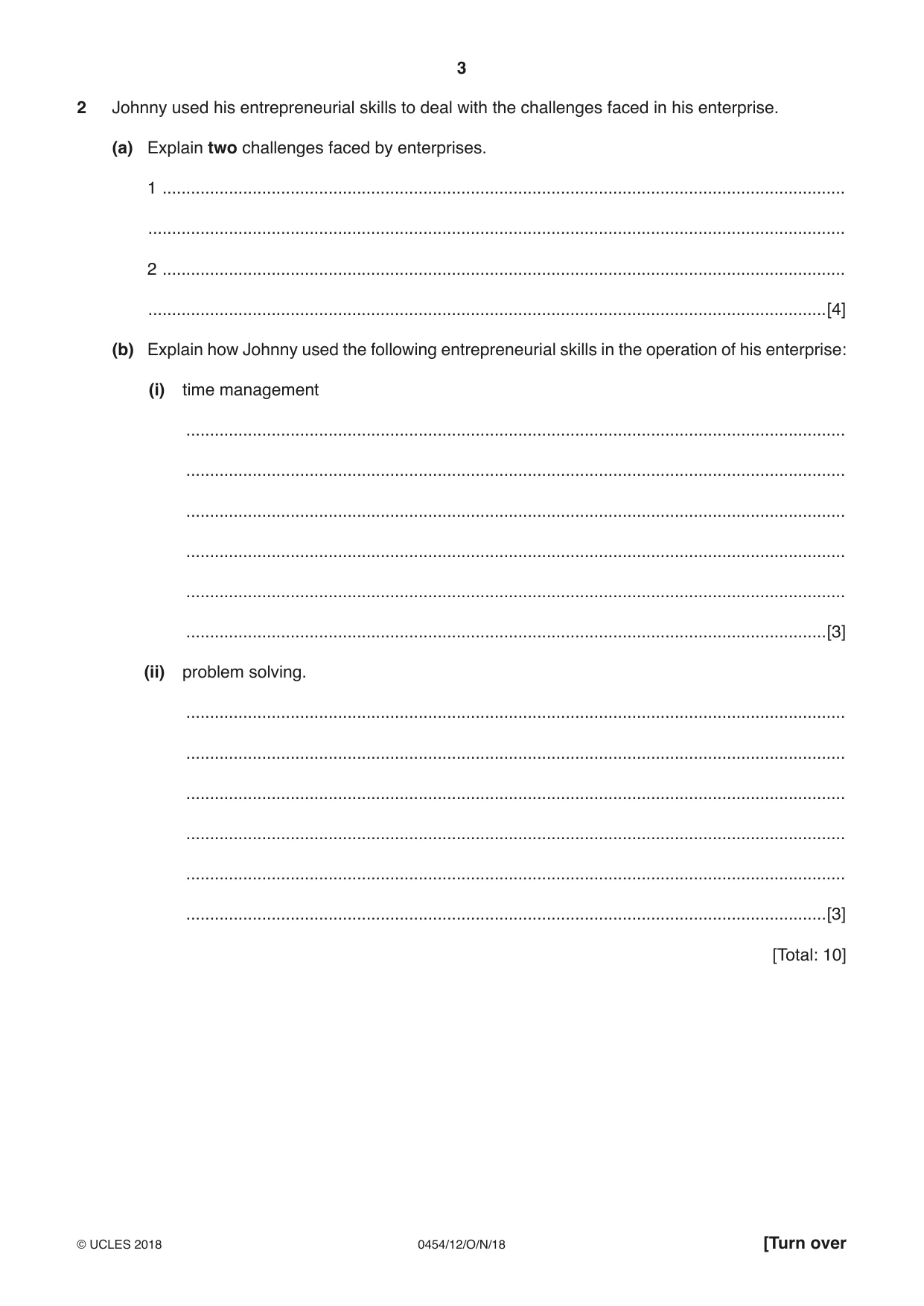
3 0454/12/O/N/18 © UCLES 2018 [Turn over 2 Johnny used his entrepreneurial skills to deal with the challenges faced in his enterprise. (a) Explain two challenges faced by enterprises. 1 … … 2 … …[4] (b) Explain how Johnny used the following entrepreneurial skills in the operation of his enterprise: (i) time management … … … … … …[3] (ii) problem solving. … … … … … …[3] [Total: 10]
Question paper, page 4
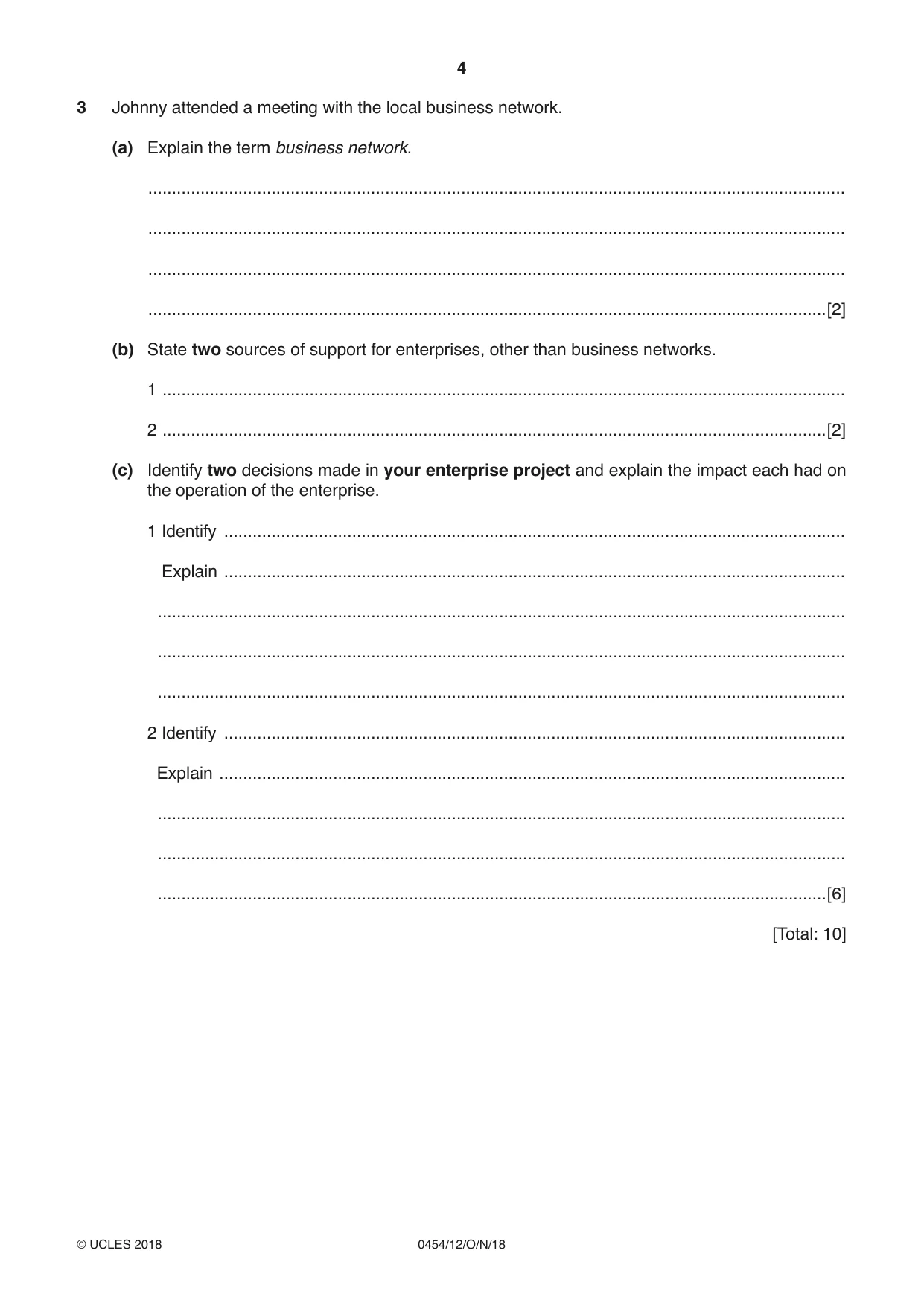
4 0454/12/O/N/18 © UCLES 2018 3 Johnny attended a meeting with the local business network. (a) Explain the term business network. … … … …[2] (b) State two sources of support for enterprises, other than business networks. 1 … 2 …[2] (c) Identify two decisions made in your enterprise project and explain the impact each had on the operation of the enterprise. 1 Identify … Explain … … … … 2 Identify … Explain … … … …[6] [Total: 10]
Question paper, page 5
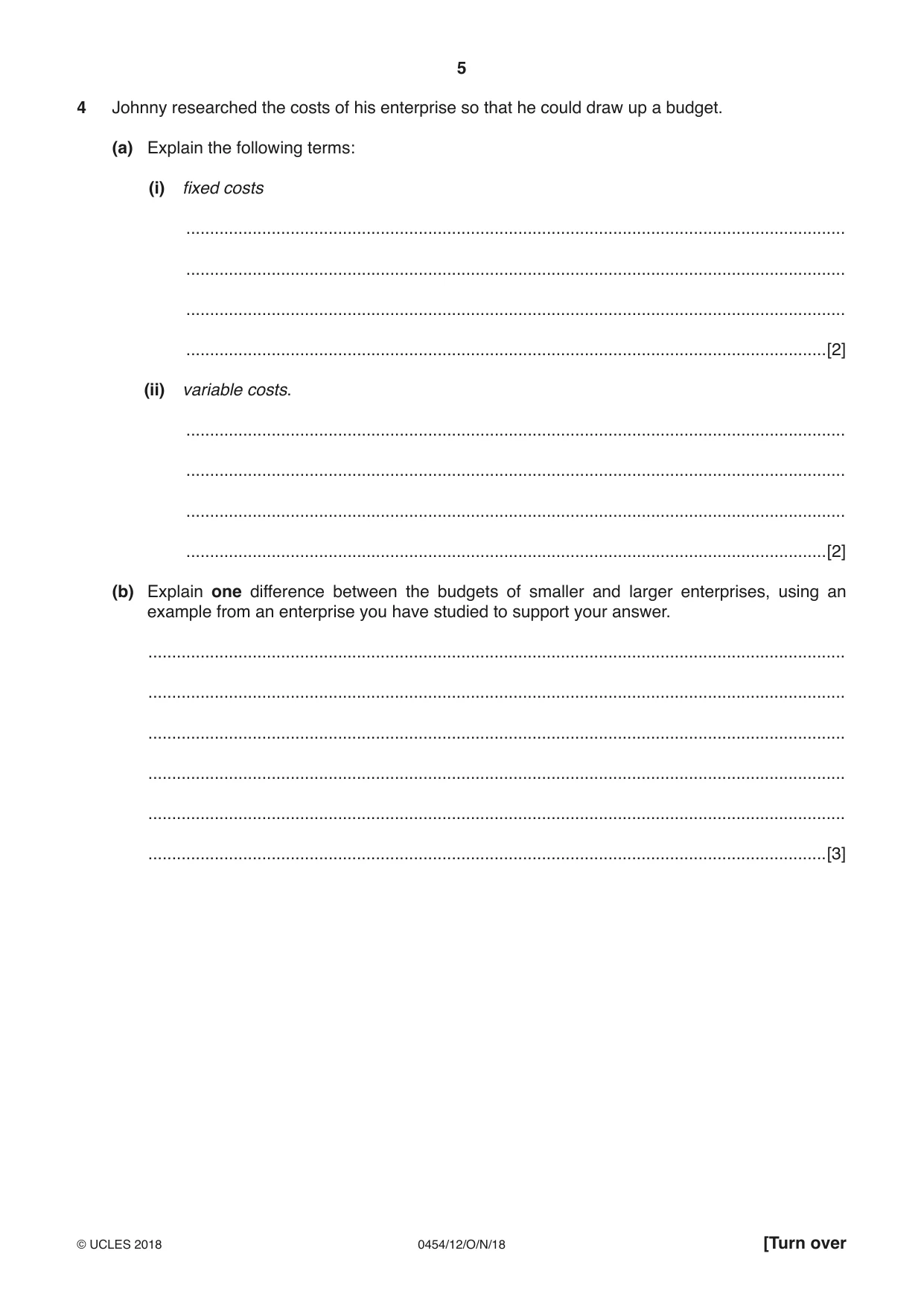
5 0454/12/O/N/18 © UCLES 2018 [Turn over 4 Johnny researched the costs of his enterprise so that he could draw up a budget. (a) Explain the following terms: (i) fixed costs … … … …[2] (ii) variable costs. … … … …[2] (b) Explain one difference between the budgets of smaller and larger enterprises, using an example from an enterprise you have studied to support your answer. … … … … … …[3]
Question paper, page 6
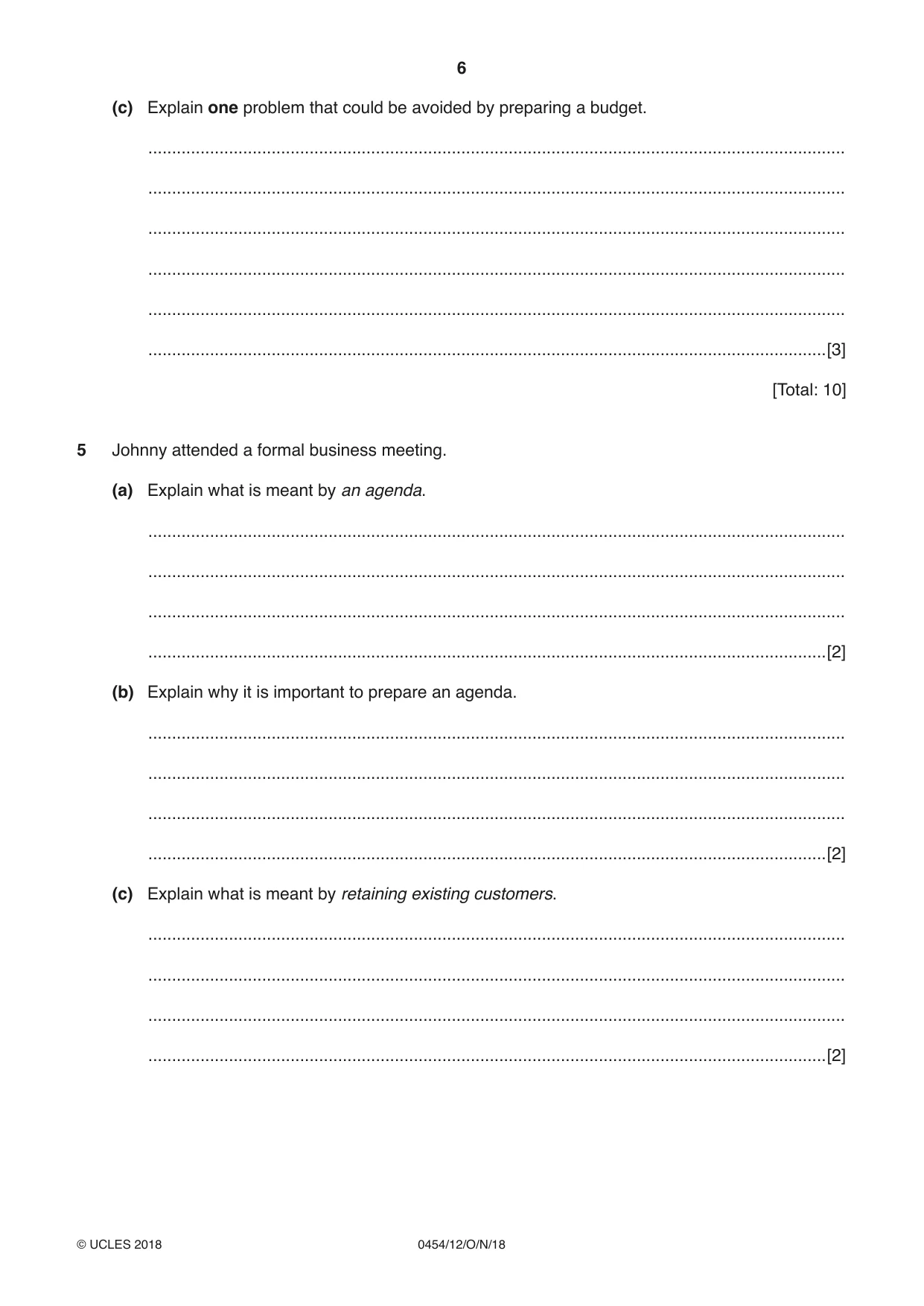
6 0454/12/O/N/18 © UCLES 2018 (c) Explain one problem that could be avoided by preparing a budget. … … … … … …[3] [Total: 10] 5 Johnny attended a formal business meeting. (a) Explain what is meant by an agenda. … … … …[2] (b) Explain why it is important to prepare an agenda. … … … …[2] (c) Explain what is meant by retaining existing customers. … … … …[2]
Question paper, page 7
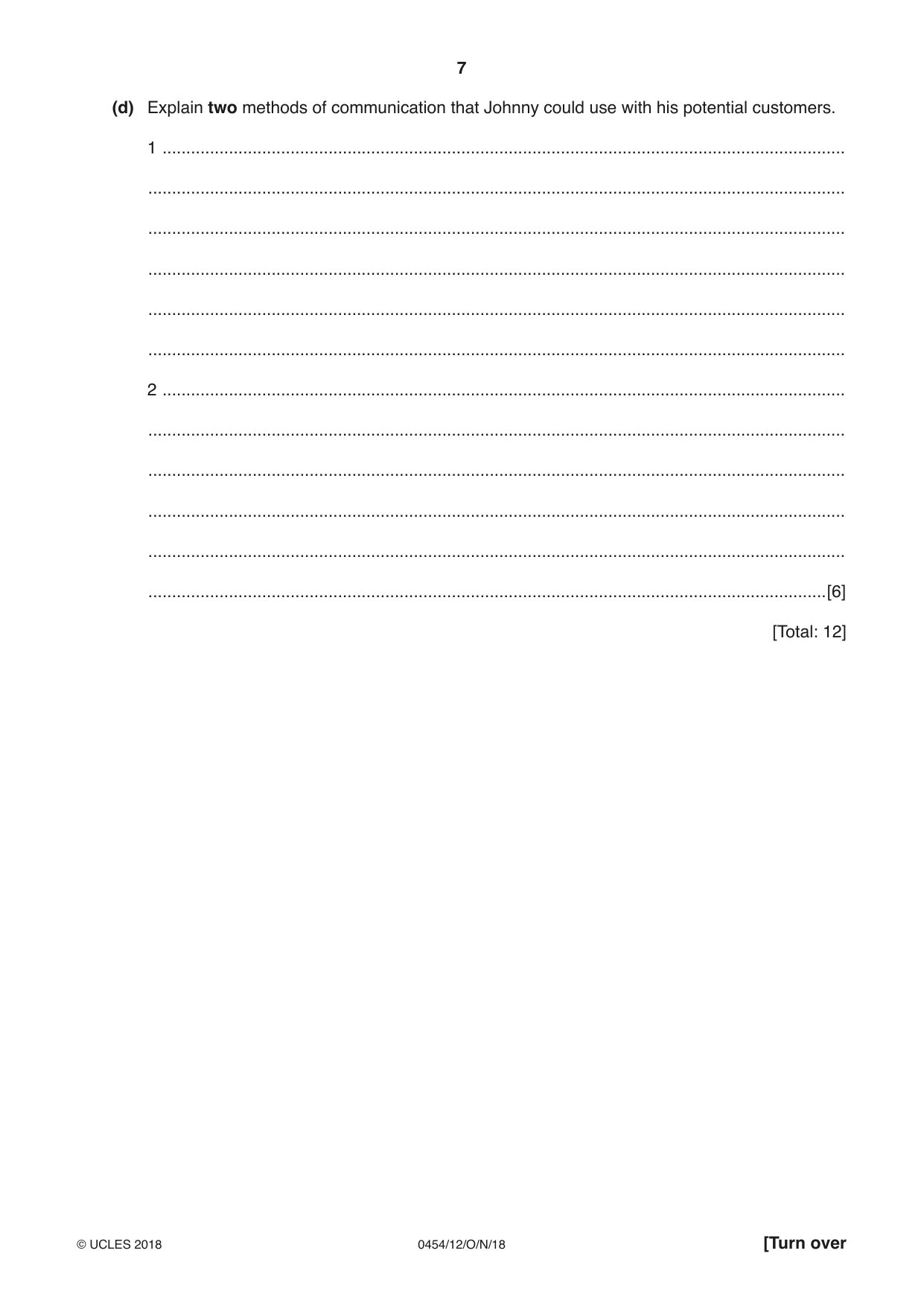
7 0454/12/O/N/18 © UCLES 2018 [Turn over (d) Explain two methods of communication that Johnny could use with his potential customers. 1 … … … … … … 2 … … … … … …[6] [Total: 12]
Question paper, page 8
8 0454/12/O/N/18 © UCLES 2018 BLANK PAGE
Question paper, page 9
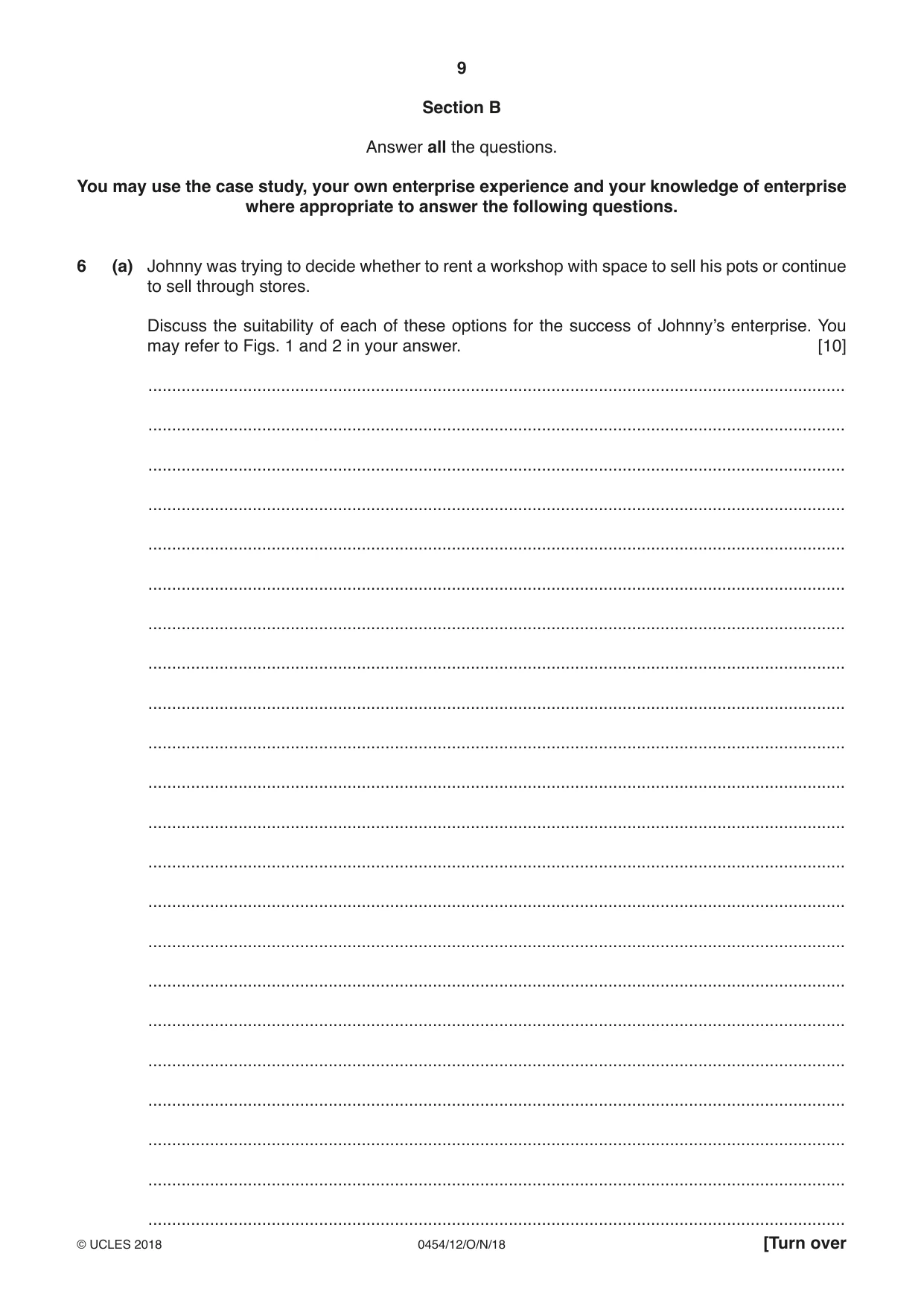
9 0454/12/O/N/18 © UCLES 2018 [Turn over Section B Answer all the questions. You may use the case study, your own enterprise experience and your knowledge of enterprise where appropriate to answer the following questions. 6 (a) Johnny was trying to decide whether to rent a workshop with space to sell his pots or continue to sell through stores. Discuss the suitability of each of these options for the success of Johnny’s enterprise. You may refer to Figs. 1 and 2 in your answer. [10] … … … … … … … … … … … … … … … … … … … … … …
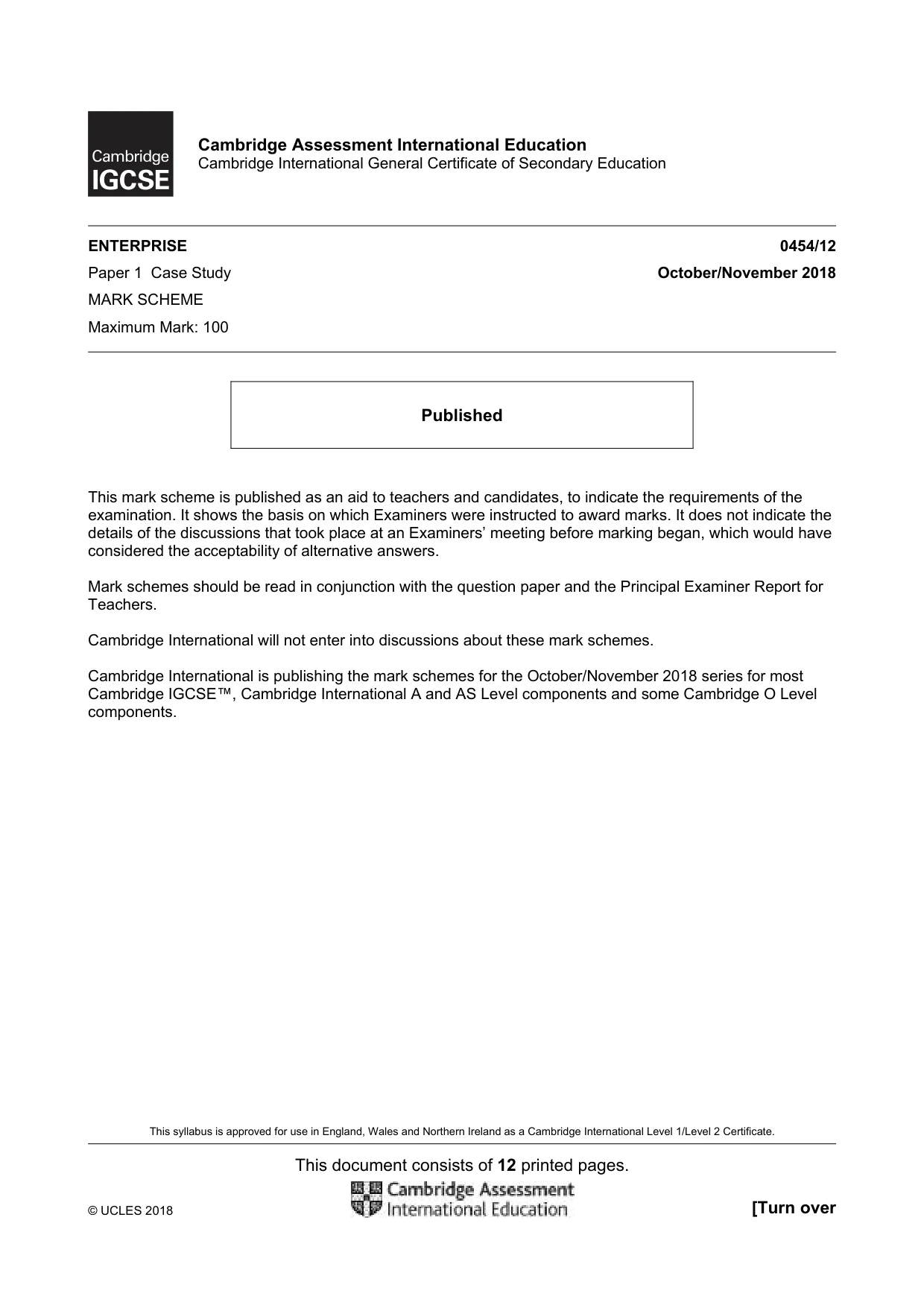
Question paper, page 10
10 0454/12/O/N/18 © UCLES 2018 (b) Johnny needed to finance the new equipment and the rent for his new workshop. He considered using: • a bank loan • his own savings • his family’s savings • inviting a partner to invest in the enterprise. Evaluate which two of these sources of finance he should use. Justify why you rejected the other sources of finance. [15] … … … … … … … … … … … … … … … … … … … … … … …
Question paper, page 11
11 0454/12/O/N/18 © UCLES 2018 [Turn over … … … … … … … … … … … … … … … … … … … … … … … … … … … [Total: 25]
Question paper, page 12
12 0454/12/O/N/18 © UCLES 2018 BLANK PAGE
Question paper, page 13
13 0454/12/O/N/18 © UCLES 2018 [Turn over 7 (a) Johnny knew that giving up his job in the hotel kitchen would be a risk and he tried to minimise that risk. Discuss how effectively you dealt with the risks within your enterprise project. [10] … … … … … … … … … … … … … … … … … … … … … … … … … …
Question paper, page 14
14 0454/12/O/N/18 © UCLES 2018 (b) Johnny communicated with many different people, using a variety of methods. He used different language depending on each situation. Evaluate the importance of: • choosing appropriate methods of communication • using appropriate language to the success of your enterprise project. [15] … … … … … … … … … … … … … … … … … … … … … … … …
Question paper, page 15
15 0454/12/O/N/18 © UCLES 2018 … … … … … … … … … … … … … … … … … … … … … … … … … … … [Total: 25]
Question paper, page 16
16 0454/12/O/N/18 © UCLES 2018 Permission to reproduce items where third-party owned material protected by copyright is included has been sought and cleared where possible. Every reasonable effort has been made by the publisher (UCLES) to trace copyright holders, but if any items requiring clearance have unwittingly been included, the publisher will be pleased to make amends at the earliest possible opportunity. To avoid the issue of disclosure of answer-related information to candidates, all copyright acknowledgements are reproduced online in the Cambridge International Examinations Copyright Acknowledgements Booklet. This is produced for each series of examinations and is freely available to download at www.cie.org.uk after the live examination series. Cambridge International Examinations is part of the Cambridge Assessment Group. Cambridge Assessment is the brand name of University of Cambridge Local Examinations Syndicate (UCLES), which is itself a department of the University of Cambridge. BLANK PAGE
Mark scheme, page 1
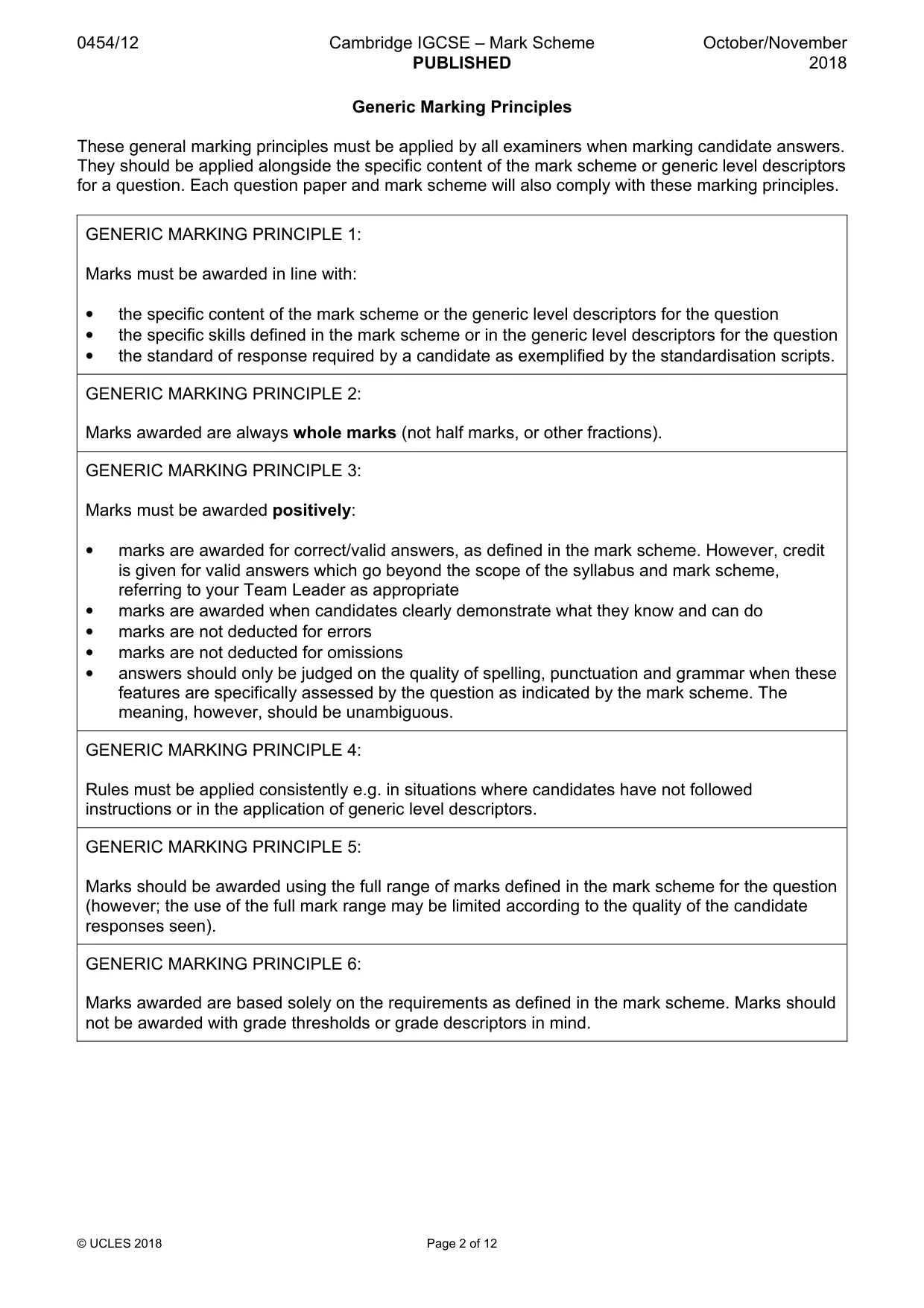
This syllabus is approved for use in England, Wales and Northern Ireland as a Cambridge International Level 1/Level 2 Certificate. This document consists of 12 printed pages. © UCLES 2018 [Turn over Cambridge Assessment International Education Cambridge International General Certificate of Secondary Education ENTERPRISE 0454/12 Paper 1 Case Study October/November 2018 MARK SCHEME Maximum Mark: 100 Published This mark scheme is published as an aid to teachers and candidates, to indicate the requirements of the examination. It shows the basis on which Examiners were instructed to award marks. It does not indicate the details of the discussions that took place at an Examiners’ meeting before marking began, which would have considered the acceptability of alternative answers. Mark schemes should be read in conjunction with the question paper and the Principal Examiner Report for Teachers. Cambridge International will not enter into discussions about these mark schemes. Cambridge International is publishing the mark schemes for the October/November 2018 series for most Cambridge IGCSE™, Cambridge International A and AS Level components and some Cambridge O Level components.
Mark scheme, page 2
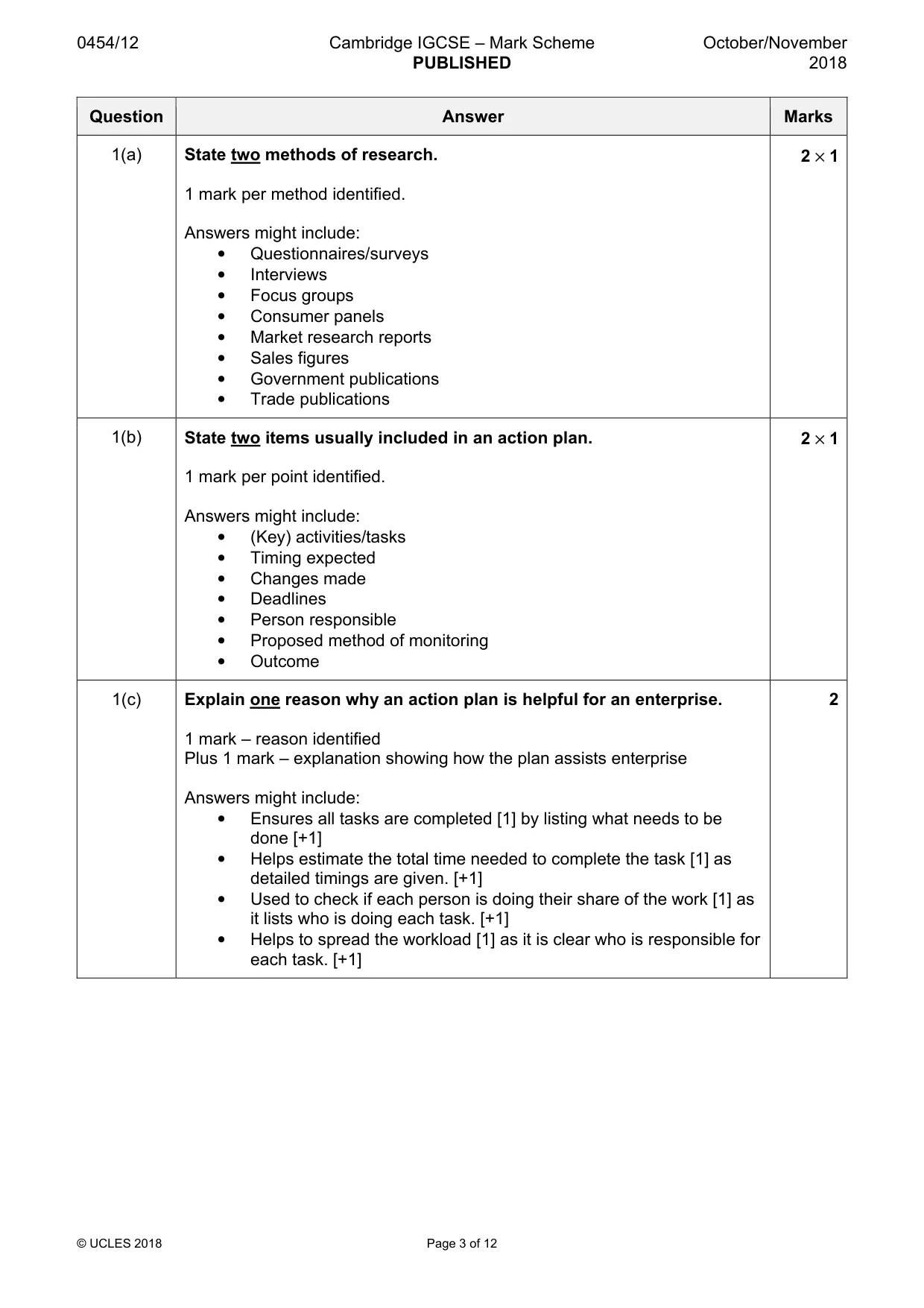
0454/12 Cambridge IGCSE – Mark Scheme PUBLISHED October/November 2018 © UCLES 2018 Page 2 of 12 Generic Marking Principles These general marking principles must be applied by all examiners when marking candidate answers. They should be applied alongside the specific content of the mark scheme or generic level descriptors for a question. Each question paper and mark scheme will also comply with these marking principles. GENERIC MARKING PRINCIPLE 1: Marks must be awarded in line with: • the specific content of the mark scheme or the generic level descriptors for the question • the specific skills defined in the mark scheme or in the generic level descriptors for the question • the standard of response required by a candidate as exemplified by the standardisation scripts. GENERIC MARKING PRINCIPLE 2: Marks awarded are always whole marks (not half marks, or other fractions). GENERIC MARKING PRINCIPLE 3: Marks must be awarded positively: • marks are awarded for correct/valid answers, as defined in the mark scheme. However, credit is given for valid answers which go beyond the scope of the syllabus and mark scheme, referring to your Team Leader as appropriate • marks are awarded when candidates clearly demonstrate what they know and can do • marks are not deducted for errors • marks are not deducted for omissions • answers should only be judged on the quality of spelling, punctuation and grammar when these features are specifically assessed by the question as indicated by the mark scheme. The meaning, however, should be unambiguous. GENERIC MARKING PRINCIPLE 4: Rules must be applied consistently e.g. in situations where candidates have not followed instructions or in the application of generic level descriptors. GENERIC MARKING PRINCIPLE 5: Marks should be awarded using the full range of marks defined in the mark scheme for the question (however; the use of the full mark range may be limited according to the quality of the candidate responses seen). GENERIC MARKING PRINCIPLE 6: Marks awarded are based solely on the requirements as defined in the mark scheme. Marks should not be awarded with grade thresholds or grade descriptors in mind.
Mark scheme, page 3
0454/12 Cambridge IGCSE – Mark Scheme PUBLISHED October/November 2018 © UCLES 2018 Page 3 of 12 Question Answer Marks 1(a) State two methods of research. 1 mark per method identified. Answers might include: • Questionnaires/surveys • Interviews • Focus groups • Consumer panels • Market research reports • Sales figures • Government publications • Trade publications 2 × 1 1(b) State two items usually included in an action plan. 1 mark per point identified. Answers might include: • (Key) activities/tasks • Timing expected • Changes made • Deadlines • Person responsible • Proposed method of monitoring • Outcome 2 × 1 1(c) Explain one reason why an action plan is helpful for an enterprise. 1 mark – reason identified Plus 1 mark – explanation showing how the plan assists enterprise Answers might include: • Ensures all tasks are completed [1] by listing what needs to be done [+1] • Helps estimate the total time needed to complete the task [1] as detailed timings are given. [+1] • Used to check if each person is doing their share of the work [1] as it lists who is doing each task. [+1] • Helps to spread the workload [1] as it is clear who is responsible for each task. [+1] 2
Mark scheme, page 4
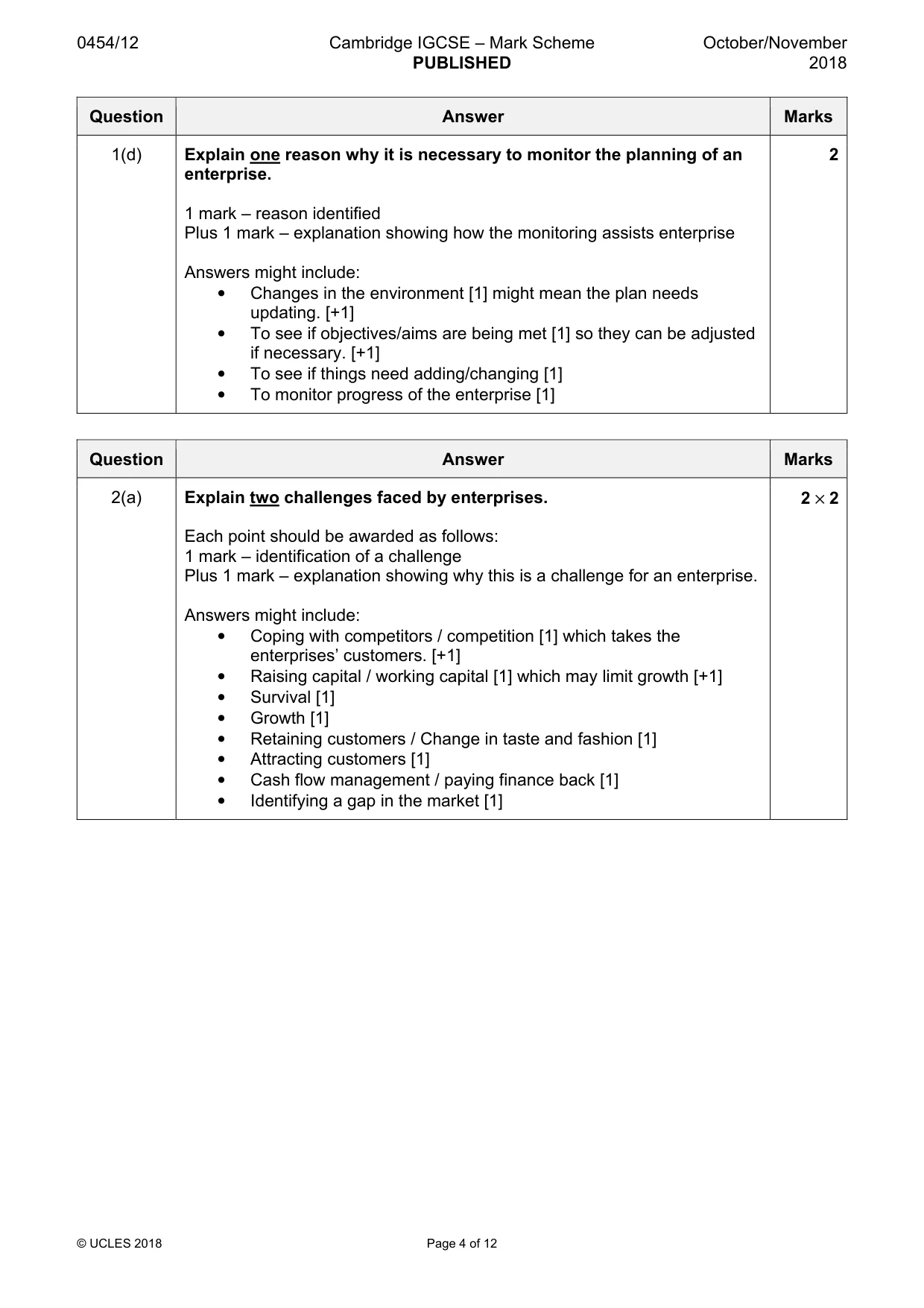
0454/12 Cambridge IGCSE – Mark Scheme PUBLISHED October/November 2018 © UCLES 2018 Page 4 of 12 Question Answer Marks 1(d) Explain one reason why it is necessary to monitor the planning of an enterprise. 1 mark – reason identified Plus 1 mark – explanation showing how the monitoring assists enterprise Answers might include: • Changes in the environment [1] might mean the plan needs updating. [+1] • To see if objectives/aims are being met [1] so they can be adjusted if necessary. [+1] • To see if things need adding/changing [1] • To monitor progress of the enterprise [1] 2 Question Answer Marks 2(a) Explain two challenges faced by enterprises. Each point should be awarded as follows: 1 mark – identification of a challenge Plus 1 mark – explanation showing why this is a challenge for an enterprise. Answers might include: • Coping with competitors / competition [1] which takes the enterprises’ customers. [+1] • Raising capital / working capital [1] which may limit growth [+1] • Survival [1] • Growth [1] • Retaining customers / Change in taste and fashion [1] • Attracting customers [1] • Cash flow management / paying finance back [1] • Identifying a gap in the market [1] 2 × 2
Mark scheme, page 5
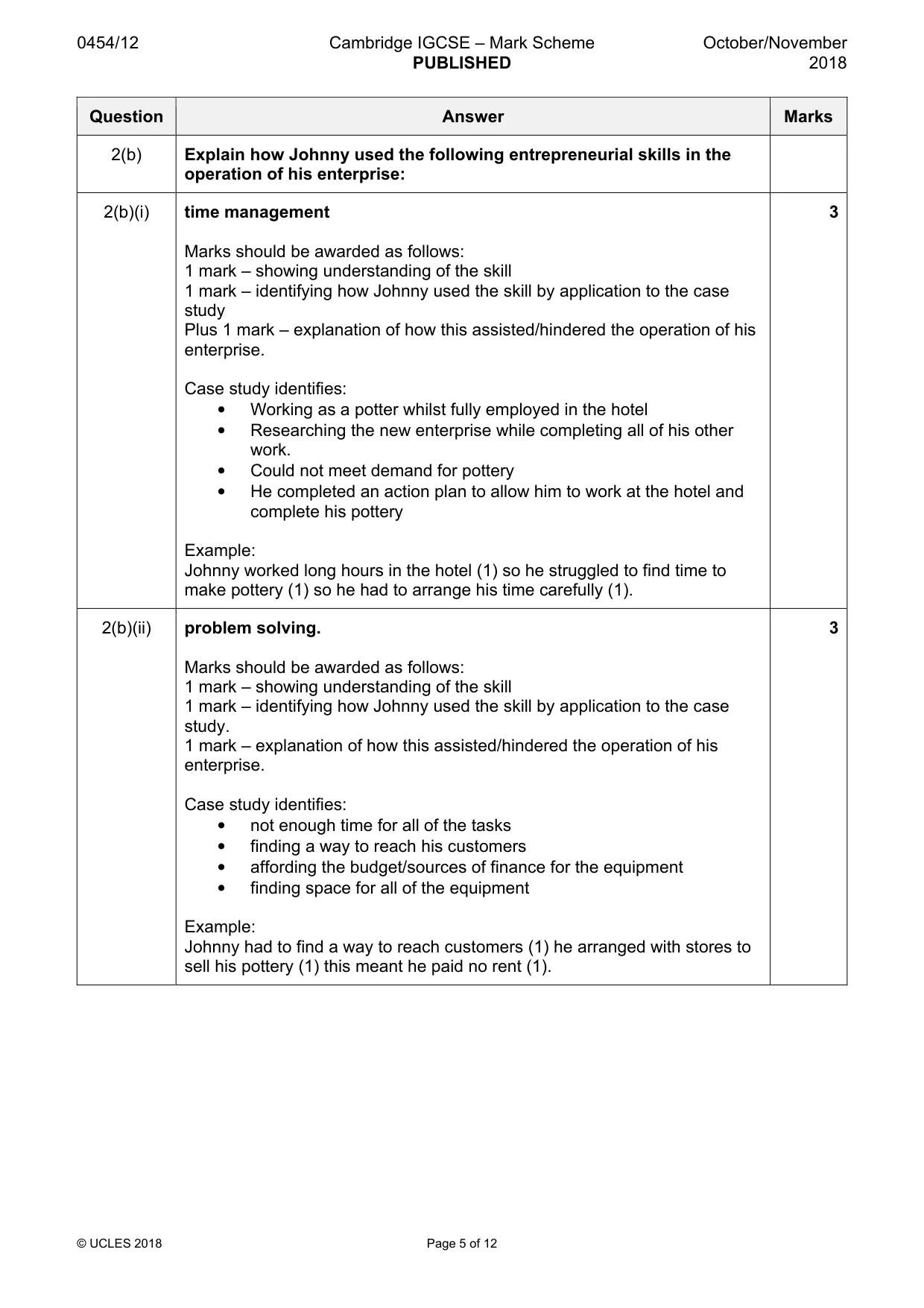
0454/12 Cambridge IGCSE – Mark Scheme PUBLISHED October/November 2018 © UCLES 2018 Page 5 of 12 Question Answer Marks 2(b) Explain how Johnny used the following entrepreneurial skills in the operation of his enterprise: 2(b)(i) time management Marks should be awarded as follows: 1 mark – showing understanding of the skill 1 mark – identifying how Johnny used the skill by application to the case study Plus 1 mark – explanation of how this assisted/hindered the operation of his enterprise. Case study identifies: • Working as a potter whilst fully employed in the hotel • Researching the new enterprise while completing all of his other work. • Could not meet demand for pottery • He completed an action plan to allow him to work at the hotel and complete his pottery Example: Johnny worked long hours in the hotel (1) so he struggled to find time to make pottery (1) so he had to arrange his time carefully (1). 3 2(b)(ii) problem solving. Marks should be awarded as follows: 1 mark – showing understanding of the skill 1 mark – identifying how Johnny used the skill by application to the case study. 1 mark – explanation of how this assisted/hindered the operation of his enterprise. Case study identifies: • not enough time for all of the tasks • finding a way to reach his customers • affording the budget/sources of finance for the equipment • finding space for all of the equipment Example: Johnny had to find a way to reach customers (1) he arranged with stores to sell his pottery (1) this meant he paid no rent (1). 3
Mark scheme, page 6
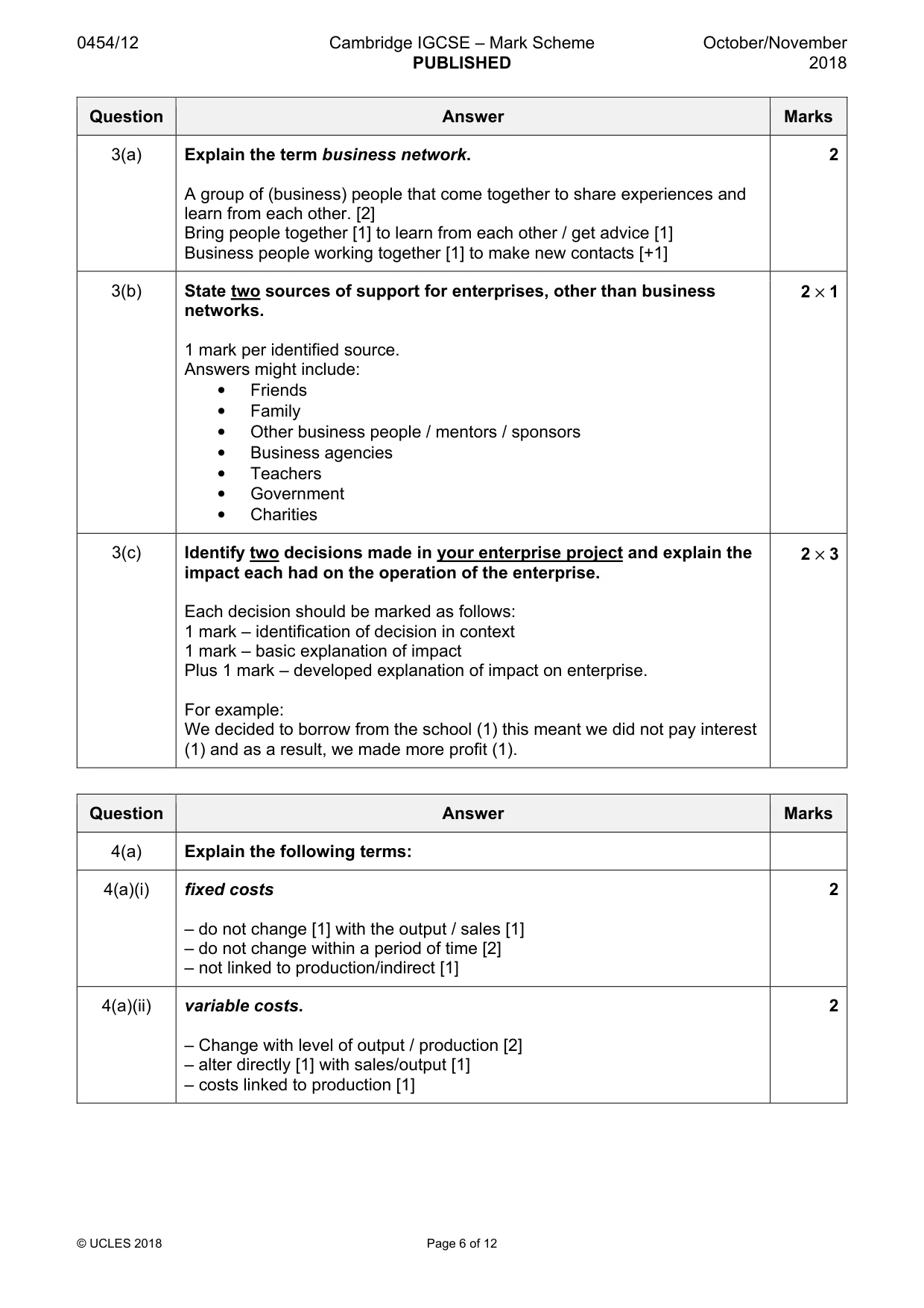
0454/12 Cambridge IGCSE – Mark Scheme PUBLISHED October/November 2018 © UCLES 2018 Page 6 of 12 Question Answer Marks 3(a) Explain the term business network. A group of (business) people that come together to share experiences and learn from each other. [2] Bring people together [1] to learn from each other / get advice [1] Business people working together [1] to make new contacts [+1] 2 3(b) State two sources of support for enterprises, other than business networks. 1 mark per identified source. Answers might include: • Friends • Family • Other business people / mentors / sponsors • Business agencies • Teachers • Government • Charities 2 × 1 3(c) Identify two decisions made in your enterprise project and explain the impact each had on the operation of the enterprise. Each decision should be marked as follows: 1 mark – identification of decision in context 1 mark – basic explanation of impact Plus 1 mark – developed explanation of impact on enterprise. For example: We decided to borrow from the school (1) this meant we did not pay interest (1) and as a result, we made more profit (1). 2 × 3 Question Answer Marks 4(a) Explain the following terms: 4(a)(i) fixed costs – do not change [1] with the output / sales [1] – do not change within a period of time [2] – not linked to production/indirect [1] 2 4(a)(ii) variable costs. – Change with level of output / production [2] – alter directly [1] with sales/output [1] – costs linked to production [1] 2
Mark scheme, page 7
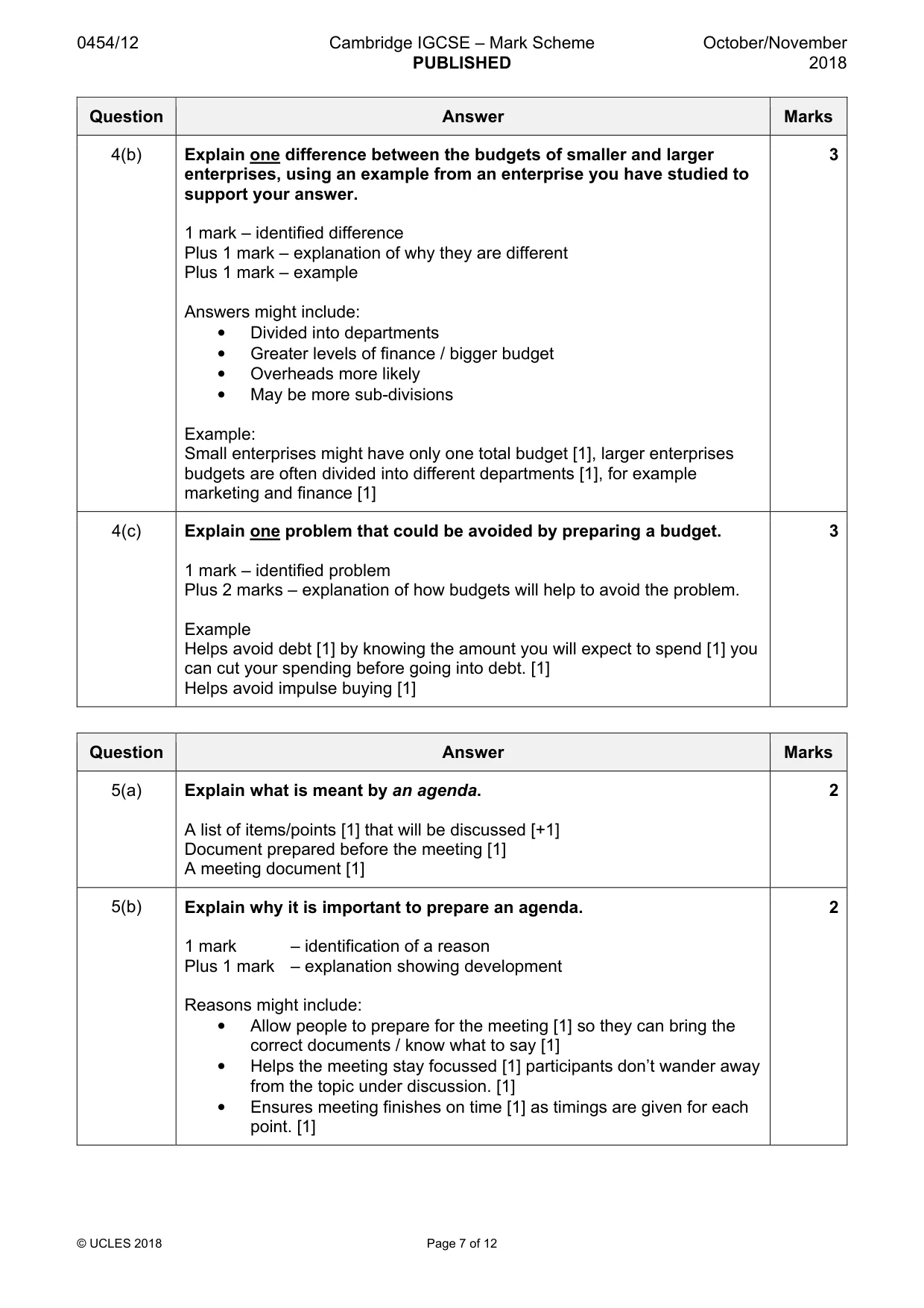
0454/12 Cambridge IGCSE – Mark Scheme PUBLISHED October/November 2018 © UCLES 2018 Page 7 of 12 Question Answer Marks 4(b) Explain one difference between the budgets of smaller and larger enterprises, using an example from an enterprise you have studied to support your answer. 1 mark – identified difference Plus 1 mark – explanation of why they are different Plus 1 mark – example Answers might include: • Divided into departments • Greater levels of finance / bigger budget • Overheads more likely • May be more sub-divisions Example: Small enterprises might have only one total budget [1], larger enterprises budgets are often divided into different departments [1], for example marketing and finance [1] 3 4(c) Explain one problem that could be avoided by preparing a budget. 1 mark – identified problem Plus 2 marks – explanation of how budgets will help to avoid the problem. Example Helps avoid debt [1] by knowing the amount you will expect to spend [1] you can cut your spending before going into debt. [1] Helps avoid impulse buying [1] 3 Question Answer Marks 5(a) Explain what is meant by an agenda. A list of items/points [1] that will be discussed [+1] Document prepared before the meeting [1] A meeting document [1] 2 5(b) Explain why it is important to prepare an agenda. 1 mark – identification of a reason Plus 1 mark – explanation showing development Reasons might include: • Allow people to prepare for the meeting [1] so they can bring the correct documents / know what to say [1] • Helps the meeting stay focussed [1] participants don’t wander away from the topic under discussion. [1] • Ensures meeting finishes on time [1] as timings are given for each point. [1] 2
Mark scheme, page 8
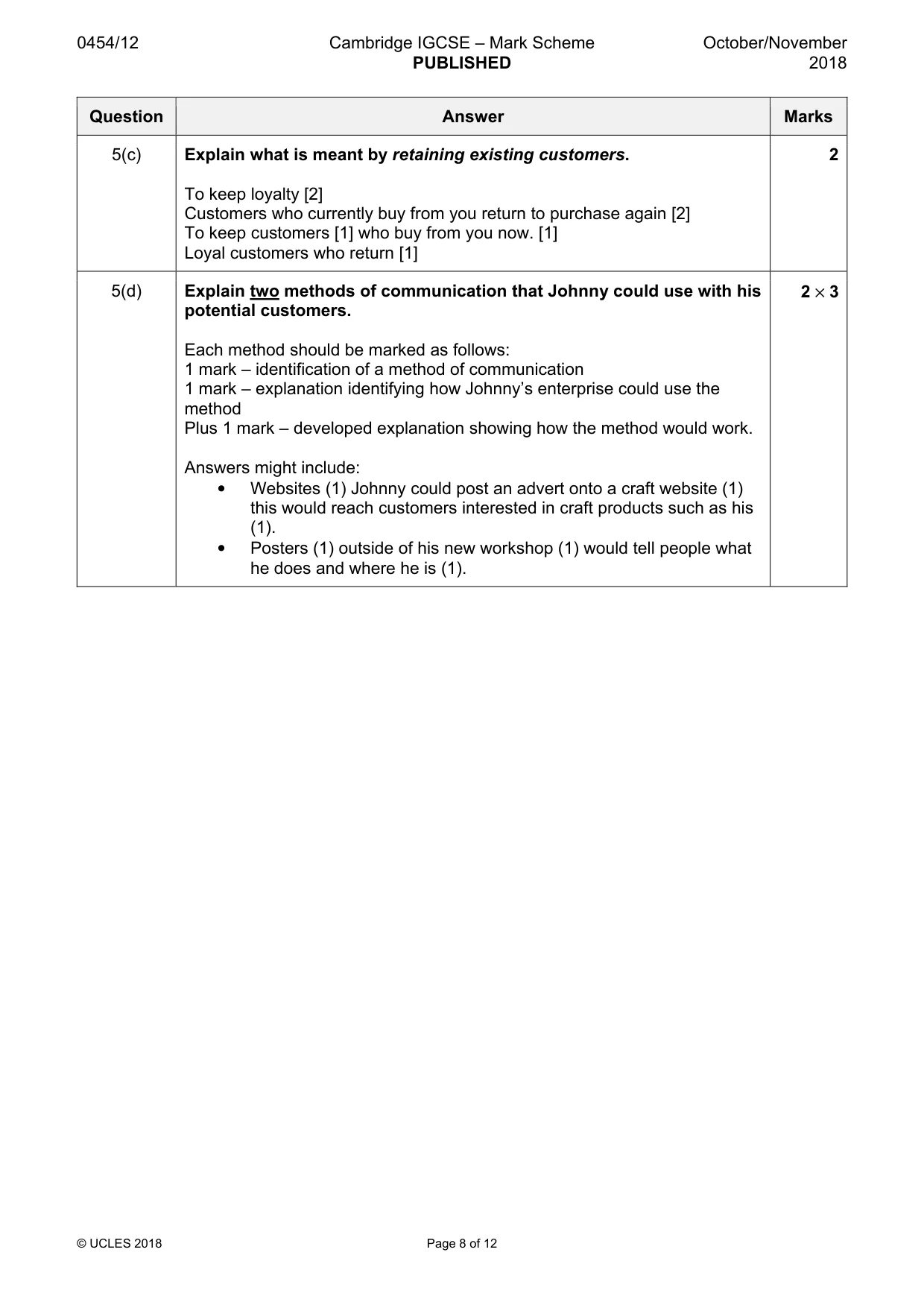
0454/12 Cambridge IGCSE – Mark Scheme PUBLISHED October/November 2018 © UCLES 2018 Page 8 of 12 Question Answer Marks 5(c) Explain what is meant by retaining existing customers. To keep loyalty [2] Customers who currently buy from you return to purchase again [2] To keep customers [1] who buy from you now. [1] Loyal customers who return [1] 2 5(d) Explain two methods of communication that Johnny could use with his potential customers. Each method should be marked as follows: 1 mark – identification of a method of communication 1 mark – explanation identifying how Johnny’s enterprise could use the method Plus 1 mark – developed explanation showing how the method would work. Answers might include: • Websites (1) Johnny could post an advert onto a craft website (1) this would reach customers interested in craft products such as his (1). • Posters (1) outside of his new workshop (1) would tell people what he does and where he is (1). 2 × 3
Mark scheme, page 9
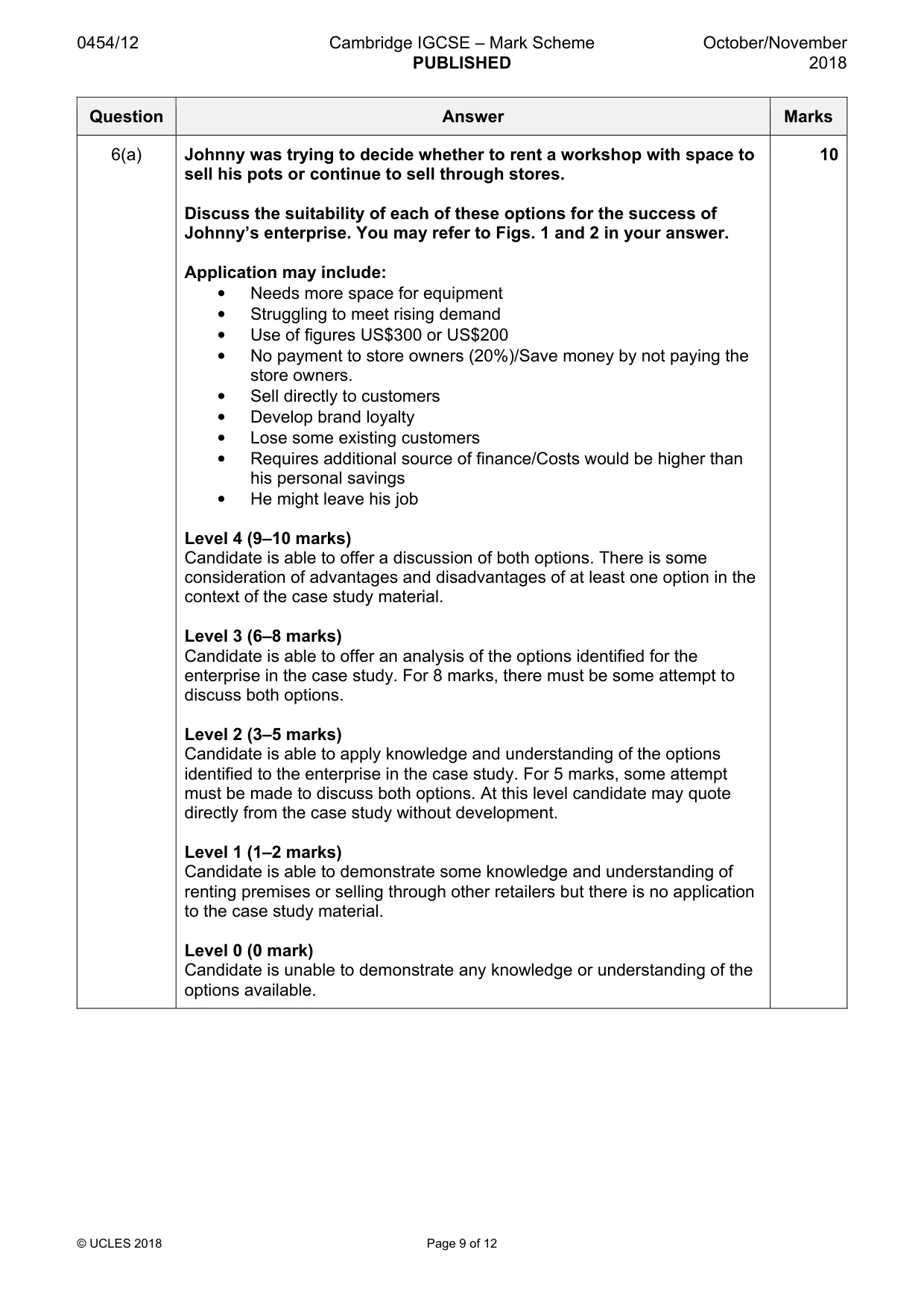
0454/12 Cambridge IGCSE – Mark Scheme PUBLISHED October/November 2018 © UCLES 2018 Page 9 of 12 Question Answer Marks 6(a) Johnny was trying to decide whether to rent a workshop with space to sell his pots or continue to sell through stores. Discuss the suitability of each of these options for the success of Johnny’s enterprise. You may refer to Figs. 1 and 2 in your answer. Application may include: • Needs more space for equipment • Struggling to meet rising demand • Use of figures US$300 or US$200 • No payment to store owners (20%)/Save money by not paying the store owners. • Sell directly to customers • Develop brand loyalty • Lose some existing customers • Requires additional source of finance/Costs would be higher than his personal savings • He might leave his job Level 4 (9–10 marks) Candidate is able to offer a discussion of both options. There is some consideration of advantages and disadvantages of at least one option in the context of the case study material. Level 3 (6–8 marks) Candidate is able to offer an analysis of the options identified for the enterprise in the case study. For 8 marks, there must be some attempt to discuss both options. Level 2 (3–5 marks) Candidate is able to apply knowledge and understanding of the options identified to the enterprise in the case study. For 5 marks, some attempt must be made to discuss both options. At this level candidate may quote directly from the case study without development. Level 1 (1–2 marks) Candidate is able to demonstrate some knowledge and understanding of renting premises or selling through other retailers but there is no application to the case study material. Level 0 (0 mark) Candidate is unable to demonstrate any knowledge or understanding of the options available. 10
Mark scheme, page 10
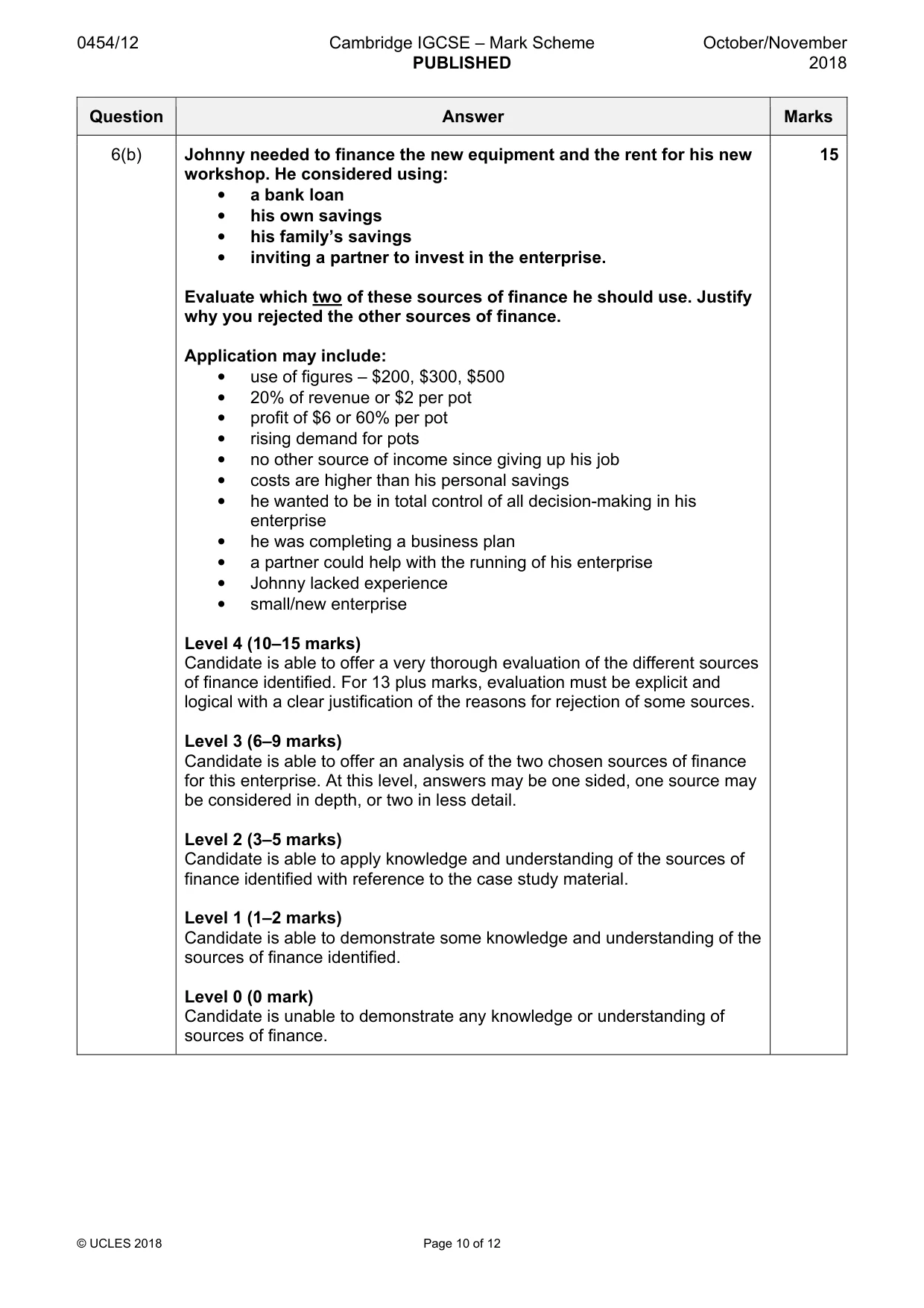
0454/12 Cambridge IGCSE – Mark Scheme PUBLISHED October/November 2018 © UCLES 2018 Page 10 of 12 Question Answer Marks 6(b) Johnny needed to finance the new equipment and the rent for his new workshop. He considered using: • a bank loan • his own savings • his family’s savings • inviting a partner to invest in the enterprise. Evaluate which two of these sources of finance he should use. Justify why you rejected the other sources of finance. Application may include: • use of figures – $200, $300, $500 • 20% of revenue or $2 per pot • profit of $6 or 60% per pot • rising demand for pots • no other source of income since giving up his job • costs are higher than his personal savings • he wanted to be in total control of all decision-making in his enterprise • he was completing a business plan • a partner could help with the running of his enterprise • Johnny lacked experience • small/new enterprise Level 4 (10–15 marks) Candidate is able to offer a very thorough evaluation of the different sources of finance identified. For 13 plus marks, evaluation must be explicit and logical with a clear justification of the reasons for rejection of some sources. Level 3 (6–9 marks) Candidate is able to offer an analysis of the two chosen sources of finance for this enterprise. At this level, answers may be one sided, one source may be considered in depth, or two in less detail. Level 2 (3–5 marks) Candidate is able to apply knowledge and understanding of the sources of finance identified with reference to the case study material. Level 1 (1–2 marks) Candidate is able to demonstrate some knowledge and understanding of the sources of finance identified. Level 0 (0 mark) Candidate is unable to demonstrate any knowledge or understanding of sources of finance. 15
Mark scheme, page 11
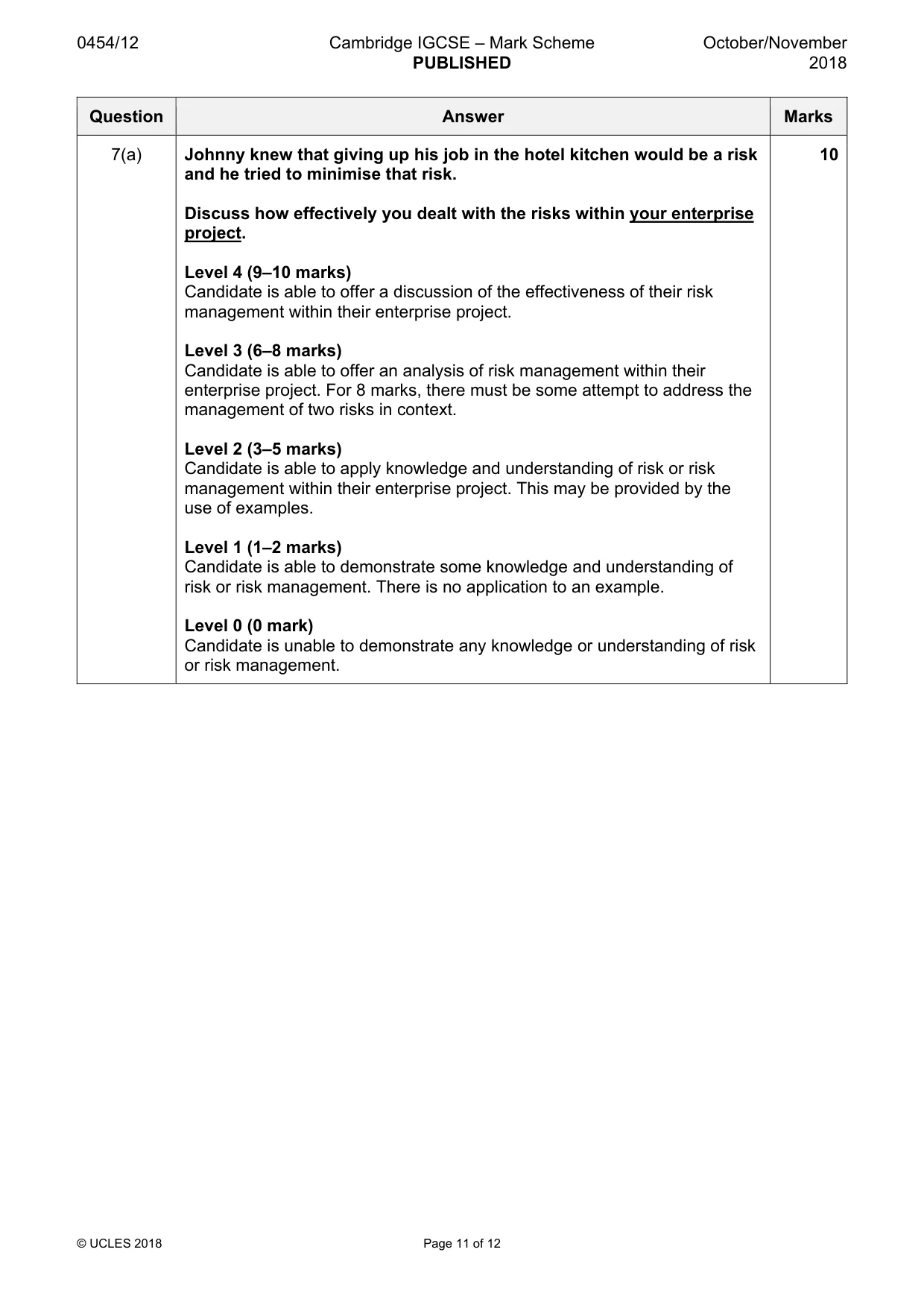
0454/12 Cambridge IGCSE – Mark Scheme PUBLISHED October/November 2018 © UCLES 2018 Page 11 of 12 Question Answer Marks 7(a) Johnny knew that giving up his job in the hotel kitchen would be a risk and he tried to minimise that risk. Discuss how effectively you dealt with the risks within your enterprise project. Level 4 (9–10 marks) Candidate is able to offer a discussion of the effectiveness of their risk management within their enterprise project. Level 3 (6–8 marks) Candidate is able to offer an analysis of risk management within their enterprise project. For 8 marks, there must be some attempt to address the management of two risks in context. Level 2 (3–5 marks) Candidate is able to apply knowledge and understanding of risk or risk management within their enterprise project. This may be provided by the use of examples. Level 1 (1–2 marks) Candidate is able to demonstrate some knowledge and understanding of risk or risk management. There is no application to an example. Level 0 (0 mark) Candidate is unable to demonstrate any knowledge or understanding of risk or risk management. 10
Mark scheme, page 12
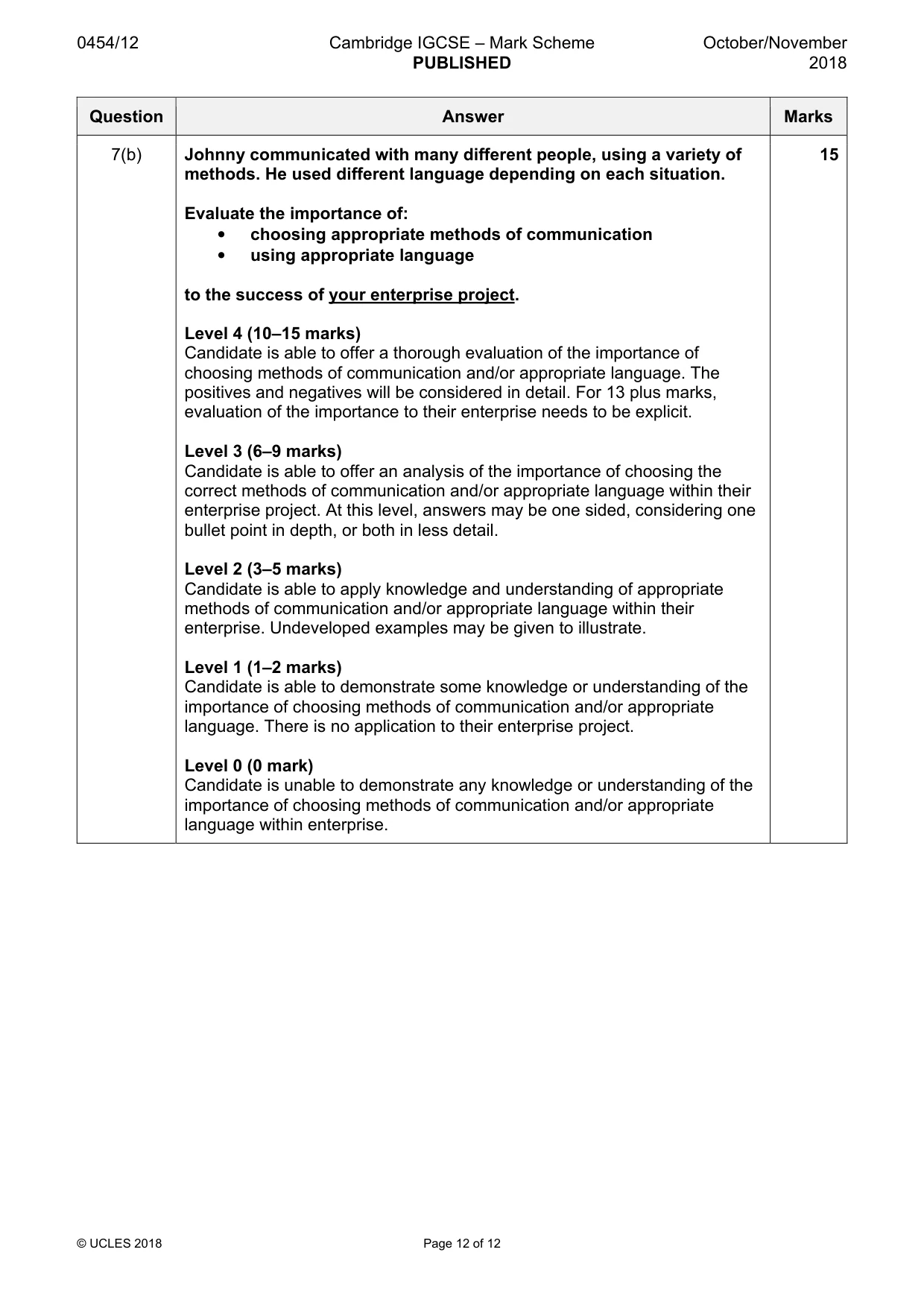
0454/12 Cambridge IGCSE – Mark Scheme PUBLISHED October/November 2018 © UCLES 2018 Page 12 of 12 Question Answer Marks 7(b) Johnny communicated with many different people, using a variety of methods. He used different language depending on each situation. Evaluate the importance of: • choosing appropriate methods of communication • using appropriate language to the success of your enterprise project. Level 4 (10–15 marks) Candidate is able to offer a thorough evaluation of the importance of choosing methods of communication and/or appropriate language. The positives and negatives will be considered in detail. For 13 plus marks, evaluation of the importance to their enterprise needs to be explicit. Level 3 (6–9 marks) Candidate is able to offer an analysis of the importance of choosing the correct methods of communication and/or appropriate language within their enterprise project. At this level, answers may be one sided, considering one bullet point in depth, or both in less detail. Level 2 (3–5 marks) Candidate is able to apply knowledge and understanding of appropriate methods of communication and/or appropriate language within their enterprise. Undeveloped examples may be given to illustrate. Level 1 (1–2 marks) Candidate is able to demonstrate some knowledge or understanding of the importance of choosing methods of communication and/or appropriate language. There is no application to their enterprise project. Level 0 (0 mark) Candidate is unable to demonstrate any knowledge or understanding of the importance of choosing methods of communication and/or appropriate language within enterprise. 15
What you needed in this session
Cambridge’s own grade thresholds for 2018 Oct/Nov, Paper 1 · Variant 2. A higher threshold means an easier paper — the bar moves with how the cohort did.