Cambridge IGCSE Enterprise 0454 — 2018 May/June Paper 1 · Variant 3
0454/13/M/J/18 · 100 marks · ≈113 min
The question paper and its mark scheme, free to read here and free to download. This is Cambridge’s own paper, exactly as it was sat.
Question paper16 pages








Mark scheme12 pages
Answers below. Sit the paper first if you are practising.
Paper as text
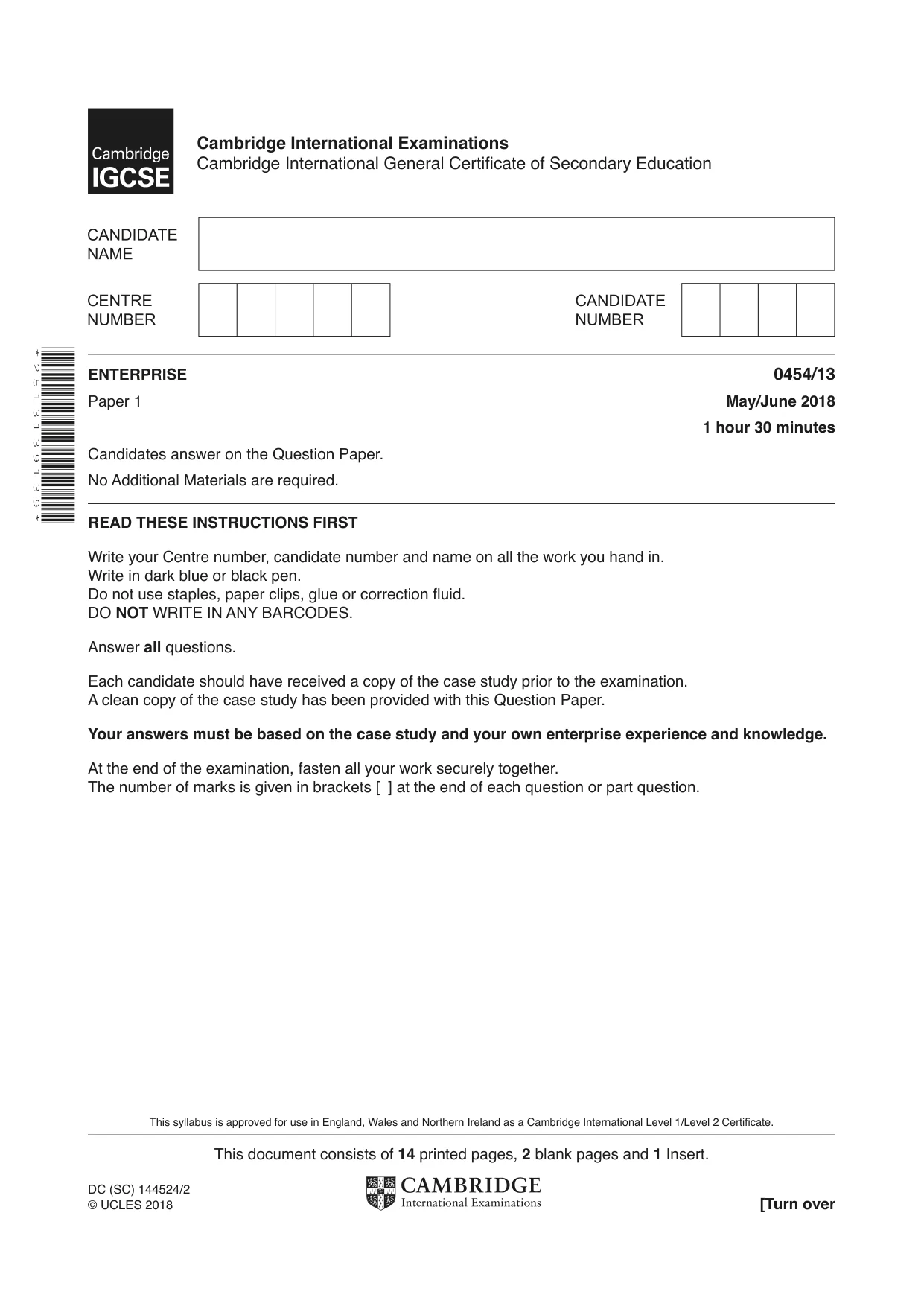
Question paper, page 1
* 2 5 1 3 1 3 9 1 3 9 * This document consists of 14 printed pages, 2 blank pages and 1 Insert. DC (SC) 144524/2 © UCLES 2018 [Turn over Cambridge International Examinations Cambridge International General Certificate of Secondary Education ENTERPRISE 0454/13 Paper 1 May/June 2018 1 hour 30 minutes Candidates answer on the Question Paper. No Additional Materials are required. READ THESE INSTRUCTIONS FIRST Write your Centre number, candidate number and name on all the work you hand in. Write in dark blue or black pen. Do not use staples, paper clips, glue or correction fluid. DO NOT WRITE IN ANY BARCODES. Answer all questions. Each candidate should have received a copy of the case study prior to the examination. A clean copy of the case study has been provided with this Question Paper. Your answers must be based on the case study and your own enterprise experience and knowledge. At the end of the examination, fasten all your work securely together. The number of marks is given in brackets [ ] at the end of each question or part question. This syllabus is approved for use in England, Wales and Northern Ireland as a Cambridge International Level 1/Level 2 Certificate.
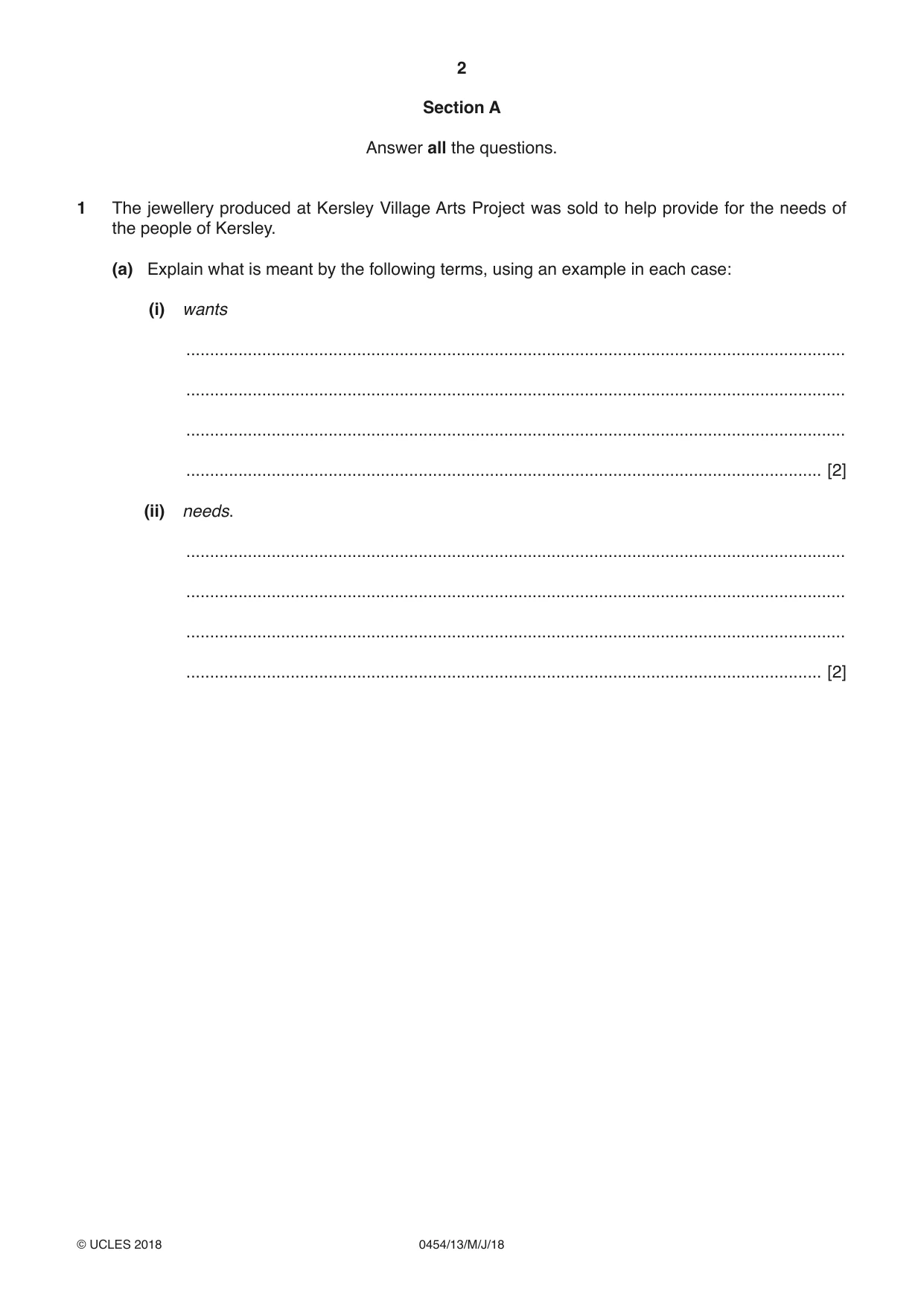
Question paper, page 2
2 0454/13/M/J/18 © UCLES 2018 Section A Answer all the questions. 1 The jewellery produced at Kersley Village Arts Project was sold to help provide for the needs of the people of Kersley. (a) Explain what is meant by the following terms, using an example in each case: (i) wants … … … … [2] (ii) needs. … … … … [2]
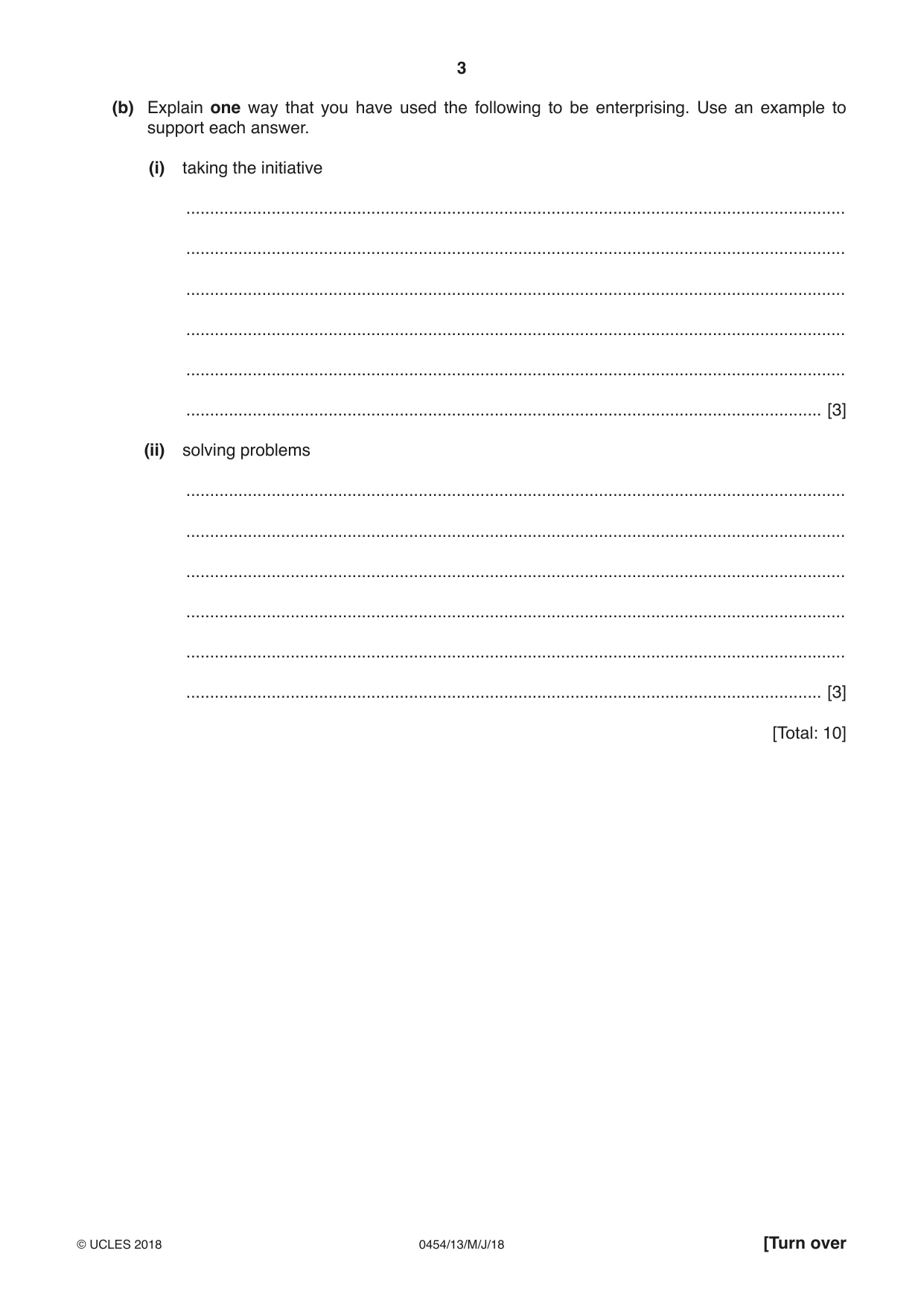
Question paper, page 3
3 0454/13/M/J/18 © UCLES 2018 [Turn over (b) Explain one way that you have used the following to be enterprising. Use an example to support each answer. (i) taking the initiative … … … … … … [3] (ii) solving problems … … … … … … [3] [Total: 10]
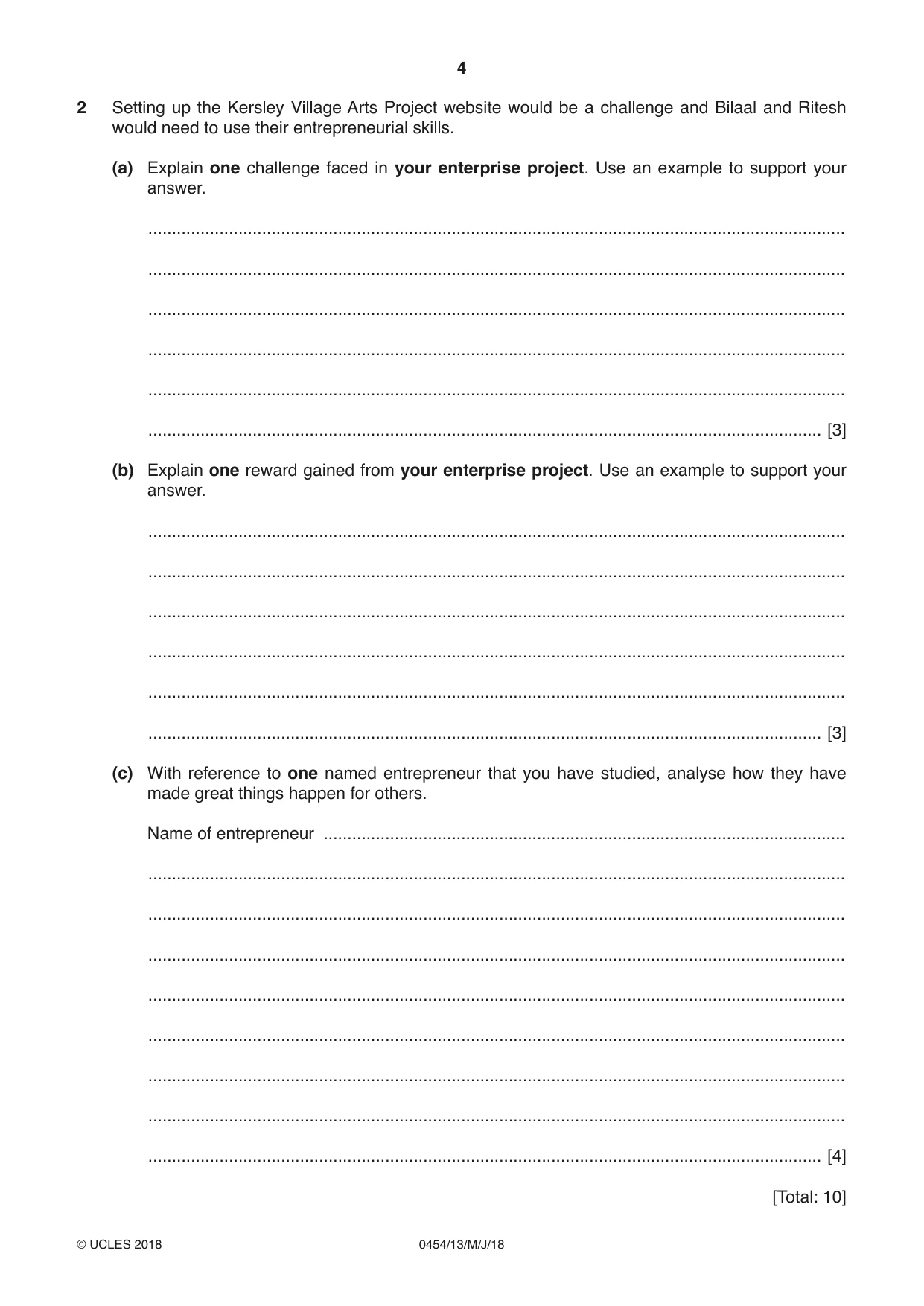
Question paper, page 4
4 0454/13/M/J/18 © UCLES 2018 2 Setting up the Kersley Village Arts Project website would be a challenge and Bilaal and Ritesh would need to use their entrepreneurial skills. (a) Explain one challenge faced in your enterprise project. Use an example to support your answer. … … … … … … [3] (b) Explain one reward gained from your enterprise project. Use an example to support your answer. … … … … … … [3] (c) With reference to one named entrepreneur that you have studied, analyse how they have made great things happen for others. Name of entrepreneur … … … … … … … … … [4] [Total: 10]
Question paper, page 5
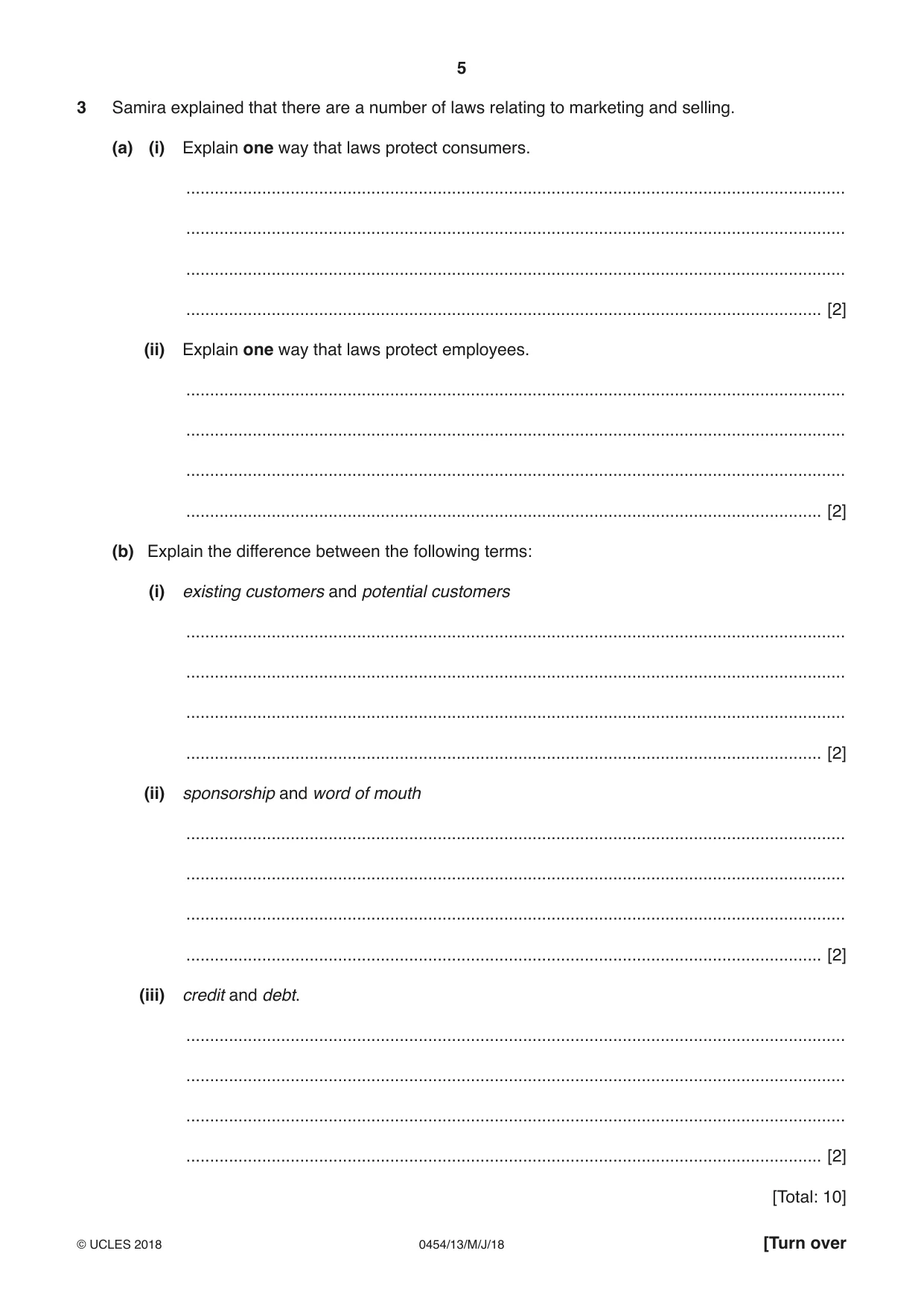
5 0454/13/M/J/18 © UCLES 2018 [Turn over 3 Samira explained that there are a number of laws relating to marketing and selling. (a) (i) Explain one way that laws protect consumers. … … … … [2] (ii) Explain one way that laws protect employees. … … … … [2] (b) Explain the difference between the following terms: (i) existing customers and potential customers … … … … [2] (ii) sponsorship and word of mouth … … … … [2] (iii) credit and debt. … … … … [2] [Total: 10]
Question paper, page 6
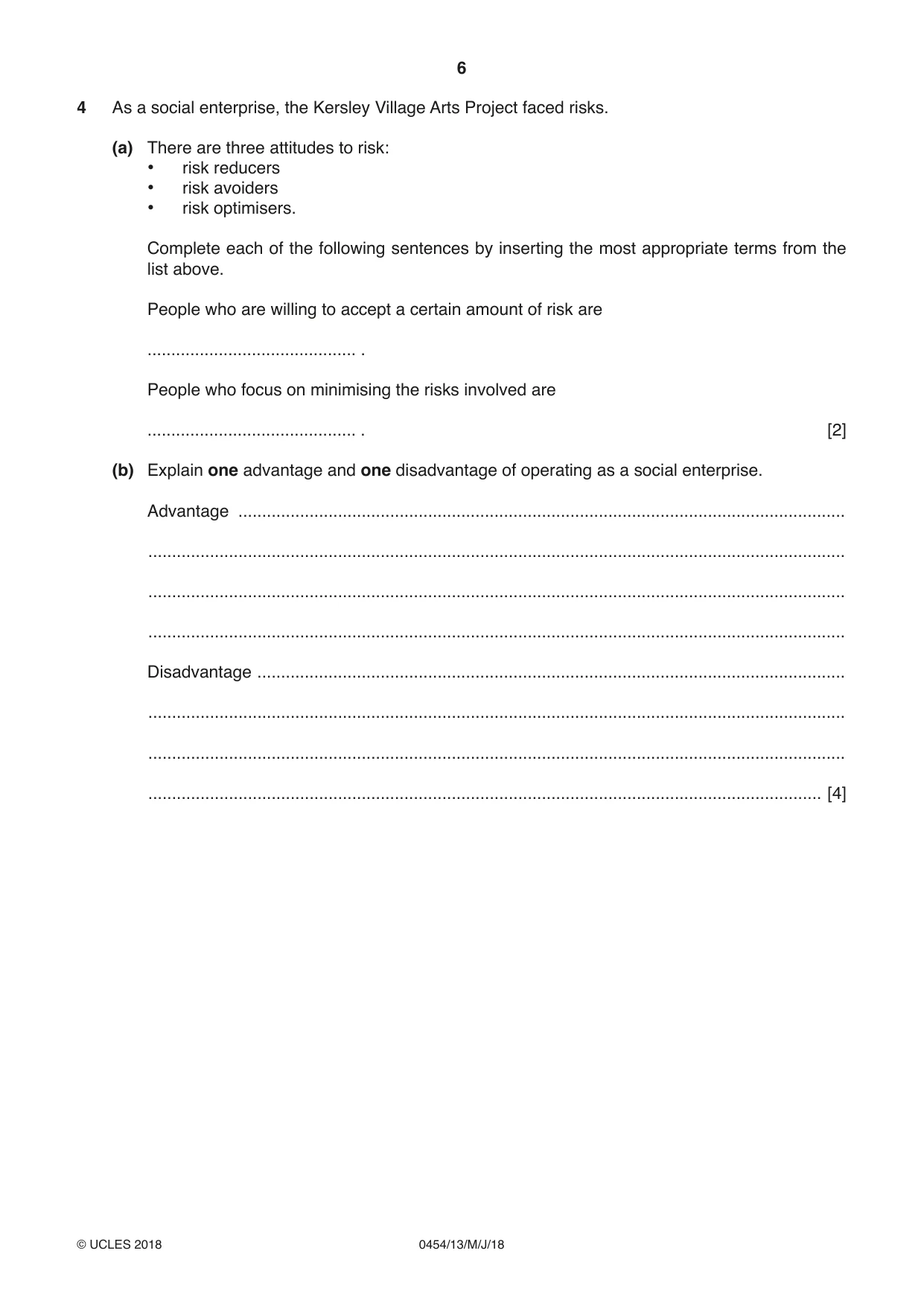
6 0454/13/M/J/18 © UCLES 2018 4 As a social enterprise, the Kersley Village Arts Project faced risks. (a) There are three attitudes to risk: • risk reducers • risk avoiders • risk optimisers. Complete each of the following sentences by inserting the most appropriate terms from the list above. People who are willing to accept a certain amount of risk are … . People who focus on minimising the risks involved are … . [2] (b) Explain one advantage and one disadvantage of operating as a social enterprise. Advantage … … … … Disadvantage … … … … [4]
Question paper, page 7
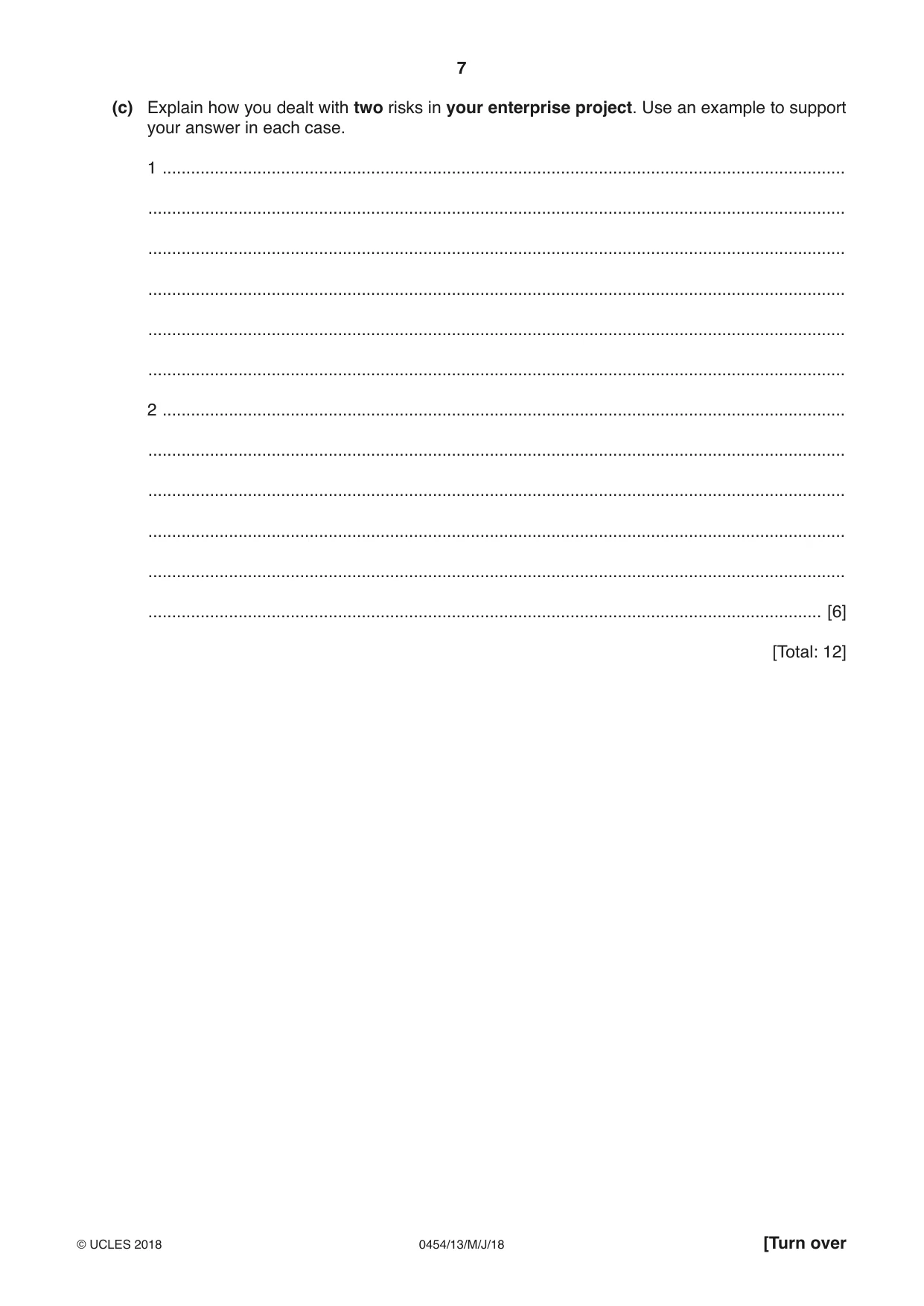
7 0454/13/M/J/18 © UCLES 2018 [Turn over (c) Explain how you dealt with two risks in your enterprise project. Use an example to support your answer in each case. 1 … … … … … … 2 … … … … … … [6] [Total: 12]
Question paper, page 8
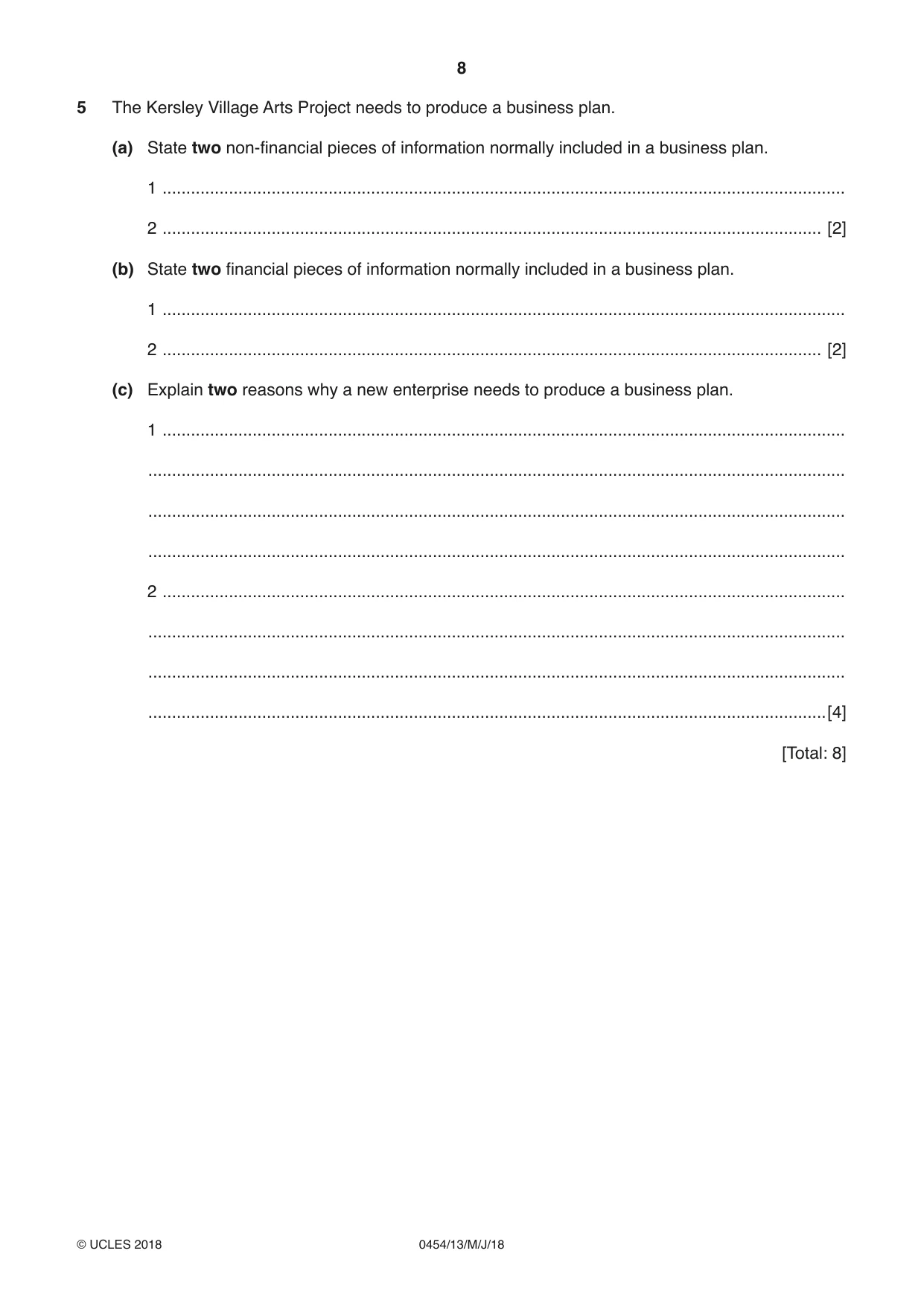
8 0454/13/M/J/18 © UCLES 2018 5 The Kersley Village Arts Project needs to produce a business plan. (a) State two non-financial pieces of information normally included in a business plan. 1 … 2 … [2] (b) State two financial pieces of information normally included in a business plan. 1 … 2 … [2] (c) Explain two reasons why a new enterprise needs to produce a business plan. 1 … … … … 2 … … … …[4] [Total: 8]
Question paper, page 9
9 0454/13/M/J/18 © UCLES 2018 [Turn over Section B Answer all the questions. You may use the case study, your own enterprise experience and your knowledge of enterprise where appropriate to answer the following questions. 6 (a) Bilaal and Ritesh were disappointed with the result of their first meeting. Discuss how Bilaal and Ritesh could improve the effectiveness of their meetings. [10] … … … … … … … … … … … … … … … … … … … … … …
Question paper, page 10
10 0454/13/M/J/18 © UCLES 2018 (b) Opportunities for enterprise arise in a number of different ways, including: • identifying the demand for a product • identifying the ability to meet the demand • taking advantage of government policies • using new technology to reach new markets. Evaluate the importance of two of the above factors to the success of the Kersley Village Arts Project. [15] … … … … … … … … … … … … … … … … … … … … … … … …
Question paper, page 11
11 0454/13/M/J/18 © UCLES 2018 [Turn over … … … … … … … … … … … … … … … … … … … … … … … … … … … [Total: 25]
Question paper, page 12
12 0454/13/M/J/18 © UCLES 2018 BLANK PAGE
Question paper, page 13
13 0454/13/M/J/18 © UCLES 2018 [Turn over 7 (a) Kersley Village Arts Project had the objective of helping the local community. Discuss how the objectives of your enterprise project affected the way that the enterprise operated. Use examples to support your answer. [10] … … … … … … … … … … … … … … … … … … … … … … … … … …
Question paper, page 14
14 0454/13/M/J/18 © UCLES 2018 (b) Customers are very satisfied with the jewellery made by the Kersley Village Arts Project, and this is one of the reasons for the high level of customer retention. Evaluate the methods that you used, or could have used, to increase customer satisfaction and retain customers in your enterprise project. [15] … … … … … … … … … … … … … … … … … … … … … … … … …
Question paper, page 15
15 0454/13/M/J/18 © UCLES 2018 … … … … … … … … … … … … … … … … … … … … … … … … … … … [Total: 25]
Question paper, page 16
16 0454/13/M/J/18 © UCLES 2018 Permission to reproduce items where third-party owned material protected by copyright is included has been sought and cleared where possible. Every reasonable effort has been made by the publisher (UCLES) to trace copyright holders, but if any items requiring clearance have unwittingly been included, the publisher will be pleased to make amends at the earliest possible opportunity. To avoid the issue of disclosure of answer-related information to candidates, all copyright acknowledgements are reproduced online in the Cambridge International Examinations Copyright Acknowledgements Booklet. This is produced for each series of examinations and is freely available to download at www.cie.org.uk after the live examination series. Cambridge International Examinations is part of the Cambridge Assessment Group. Cambridge Assessment is the brand name of University of Cambridge Local Examinations Syndicate (UCLES), which is itself a department of the University of Cambridge. BLANK PAGE
Mark scheme, page 1
IGCSE™ is a registered trademark. This syllabus is approved for use in England, Wales and Northern Ireland as a Cambridge International Level 1/Level 2 Certificate. This document consists of 12 printed pages. © UCLES 2018 [Turn over Cambridge Assessment International Education Cambridge International General Certificate of Secondary Education ENTERPRISE 0454/13 Paper 1 Case Study May/June 2018 MARK SCHEME Maximum Mark: 100 Published This mark scheme is published as an aid to teachers and candidates, to indicate the requirements of the examination. It shows the basis on which Examiners were instructed to award marks. It does not indicate the details of the discussions that took place at an Examiners’ meeting before marking began, which would have considered the acceptability of alternative answers. Mark schemes should be read in conjunction with the question paper and the Principal Examiner Report for Teachers. Cambridge International will not enter into discussions about these mark schemes. Cambridge International is publishing the mark schemes for the May/June 2018 series for most Cambridge IGCSE™, Cambridge International A and AS Level and Cambridge Pre-U components, and some Cambridge O Level components.
Mark scheme, page 2
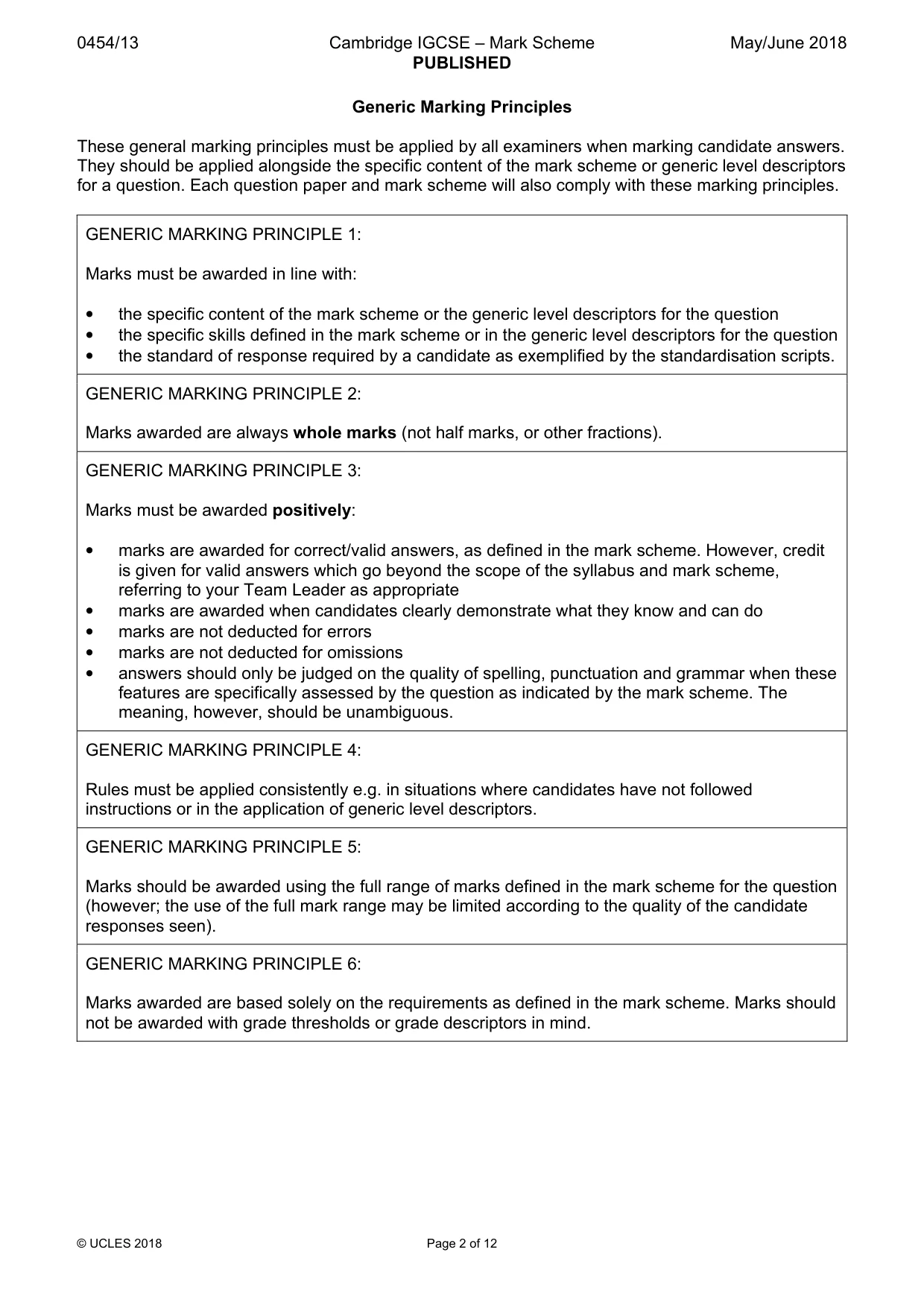
0454/13 Cambridge IGCSE – Mark Scheme PUBLISHED May/June 2018 © UCLES 2018 Page 2 of 12 Generic Marking Principles These general marking principles must be applied by all examiners when marking candidate answers. They should be applied alongside the specific content of the mark scheme or generic level descriptors for a question. Each question paper and mark scheme will also comply with these marking principles. GENERIC MARKING PRINCIPLE 1: Marks must be awarded in line with: • the specific content of the mark scheme or the generic level descriptors for the question • the specific skills defined in the mark scheme or in the generic level descriptors for the question • the standard of response required by a candidate as exemplified by the standardisation scripts. GENERIC MARKING PRINCIPLE 2: Marks awarded are always whole marks (not half marks, or other fractions). GENERIC MARKING PRINCIPLE 3: Marks must be awarded positively: • marks are awarded for correct/valid answers, as defined in the mark scheme. However, credit is given for valid answers which go beyond the scope of the syllabus and mark scheme, referring to your Team Leader as appropriate • marks are awarded when candidates clearly demonstrate what they know and can do • marks are not deducted for errors • marks are not deducted for omissions • answers should only be judged on the quality of spelling, punctuation and grammar when these features are specifically assessed by the question as indicated by the mark scheme. The meaning, however, should be unambiguous. GENERIC MARKING PRINCIPLE 4: Rules must be applied consistently e.g. in situations where candidates have not followed instructions or in the application of generic level descriptors. GENERIC MARKING PRINCIPLE 5: Marks should be awarded using the full range of marks defined in the mark scheme for the question (however; the use of the full mark range may be limited according to the quality of the candidate responses seen). GENERIC MARKING PRINCIPLE 6: Marks awarded are based solely on the requirements as defined in the mark scheme. Marks should not be awarded with grade thresholds or grade descriptors in mind.
Mark scheme, page 3
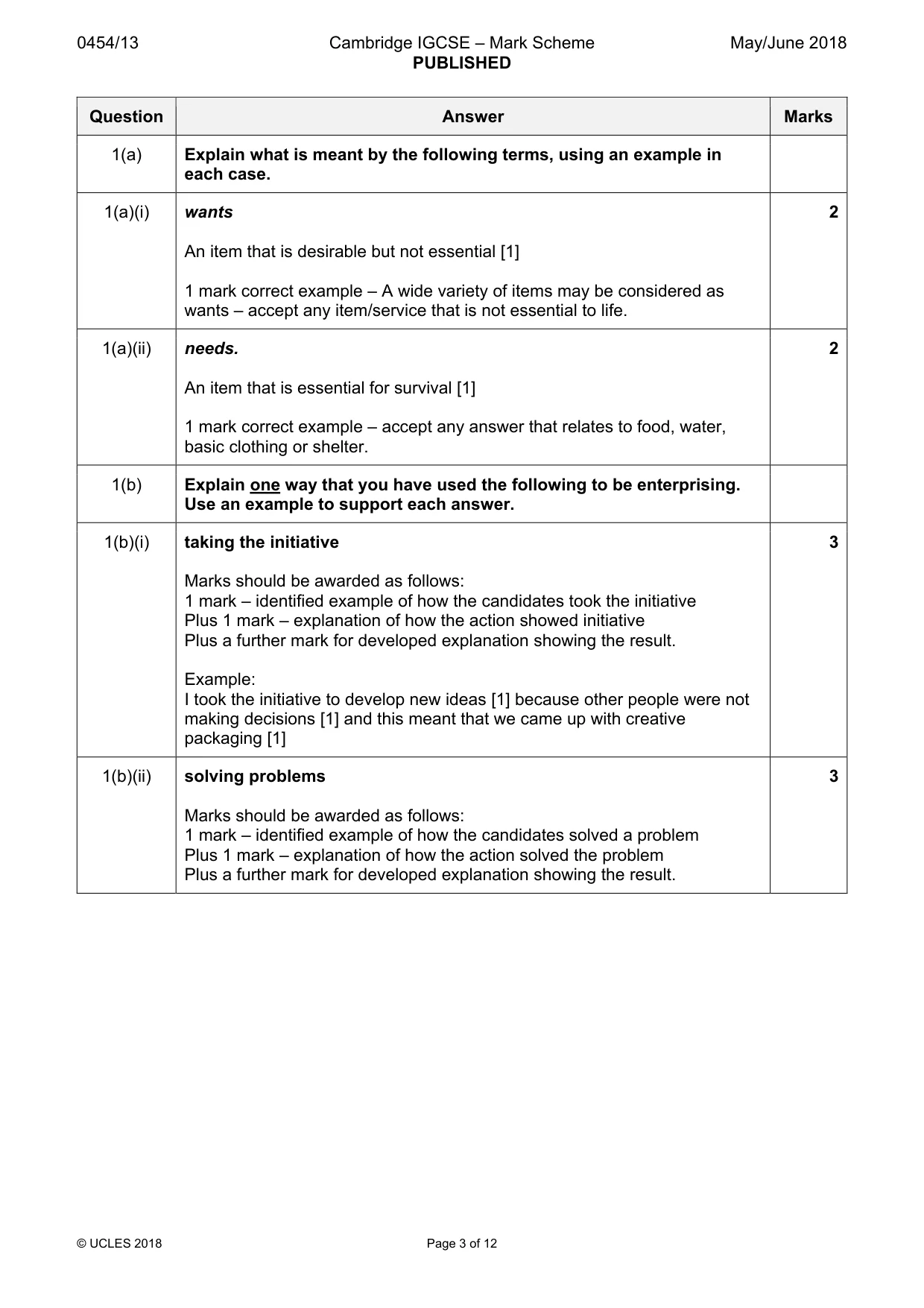
0454/13 Cambridge IGCSE – Mark Scheme PUBLISHED May/June 2018 © UCLES 2018 Page 3 of 12 Question Answer Marks 1(a) Explain what is meant by the following terms, using an example in each case. 1(a)(i) wants An item that is desirable but not essential [1] 1 mark correct example – A wide variety of items may be considered as wants – accept any item/service that is not essential to life. 2 1(a)(ii) needs. An item that is essential for survival [1] 1 mark correct example – accept any answer that relates to food, water, basic clothing or shelter. 2 1(b) Explain one way that you have used the following to be enterprising. Use an example to support each answer. 1(b)(i) taking the initiative Marks should be awarded as follows: 1 mark – identified example of how the candidates took the initiative Plus 1 mark – explanation of how the action showed initiative Plus a further mark for developed explanation showing the result. Example: I took the initiative to develop new ideas [1] because other people were not making decisions [1] and this meant that we came up with creative packaging [1] 3 1(b)(ii) solving problems Marks should be awarded as follows: 1 mark – identified example of how the candidates solved a problem Plus 1 mark – explanation of how the action solved the problem Plus a further mark for developed explanation showing the result. 3
Mark scheme, page 4
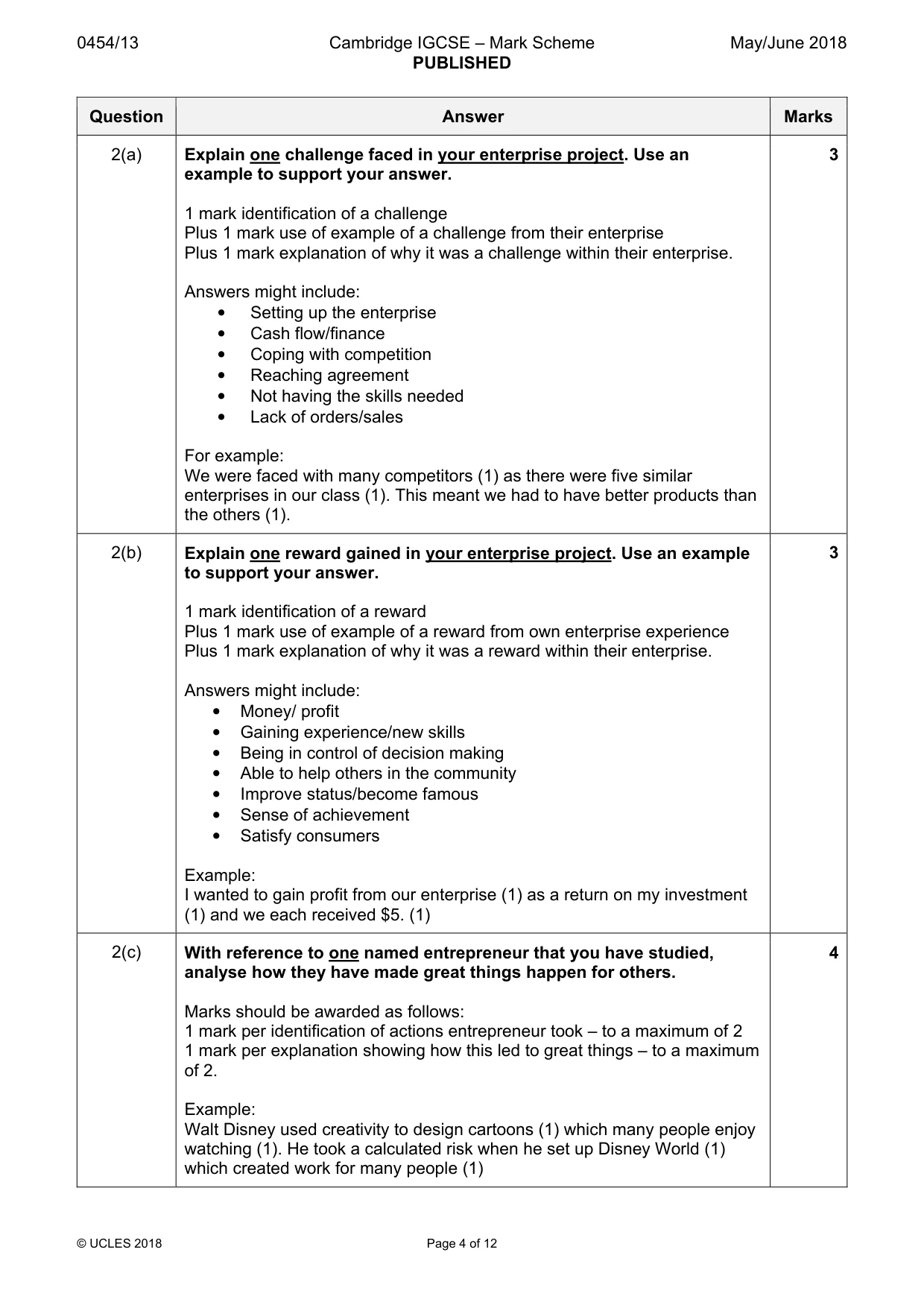
0454/13 Cambridge IGCSE – Mark Scheme PUBLISHED May/June 2018 © UCLES 2018 Page 4 of 12 Question Answer Marks 2(a) Explain one challenge faced in your enterprise project. Use an example to support your answer. 1 mark identification of a challenge Plus 1 mark use of example of a challenge from their enterprise Plus 1 mark explanation of why it was a challenge within their enterprise. Answers might include: • Setting up the enterprise • Cash flow/finance • Coping with competition • Reaching agreement • Not having the skills needed • Lack of orders/sales For example: We were faced with many competitors (1) as there were five similar enterprises in our class (1). This meant we had to have better products than the others (1). 3 2(b) Explain one reward gained in your enterprise project. Use an example to support your answer. 1 mark identification of a reward Plus 1 mark use of example of a reward from own enterprise experience Plus 1 mark explanation of why it was a reward within their enterprise. Answers might include: • Money/ profit • Gaining experience/new skills • Being in control of decision making • Able to help others in the community • Improve status/become famous • Sense of achievement • Satisfy consumers Example: I wanted to gain profit from our enterprise (1) as a return on my investment (1) and we each received $5. (1) 3 2(c) With reference to one named entrepreneur that you have studied, analyse how they have made great things happen for others. Marks should be awarded as follows: 1 mark per identification of actions entrepreneur took – to a maximum of 2 1 mark per explanation showing how this led to great things – to a maximum of 2. Example: Walt Disney used creativity to design cartoons (1) which many people enjoy watching (1). He took a calculated risk when he set up Disney World (1) which created work for many people (1) 4
Mark scheme, page 5
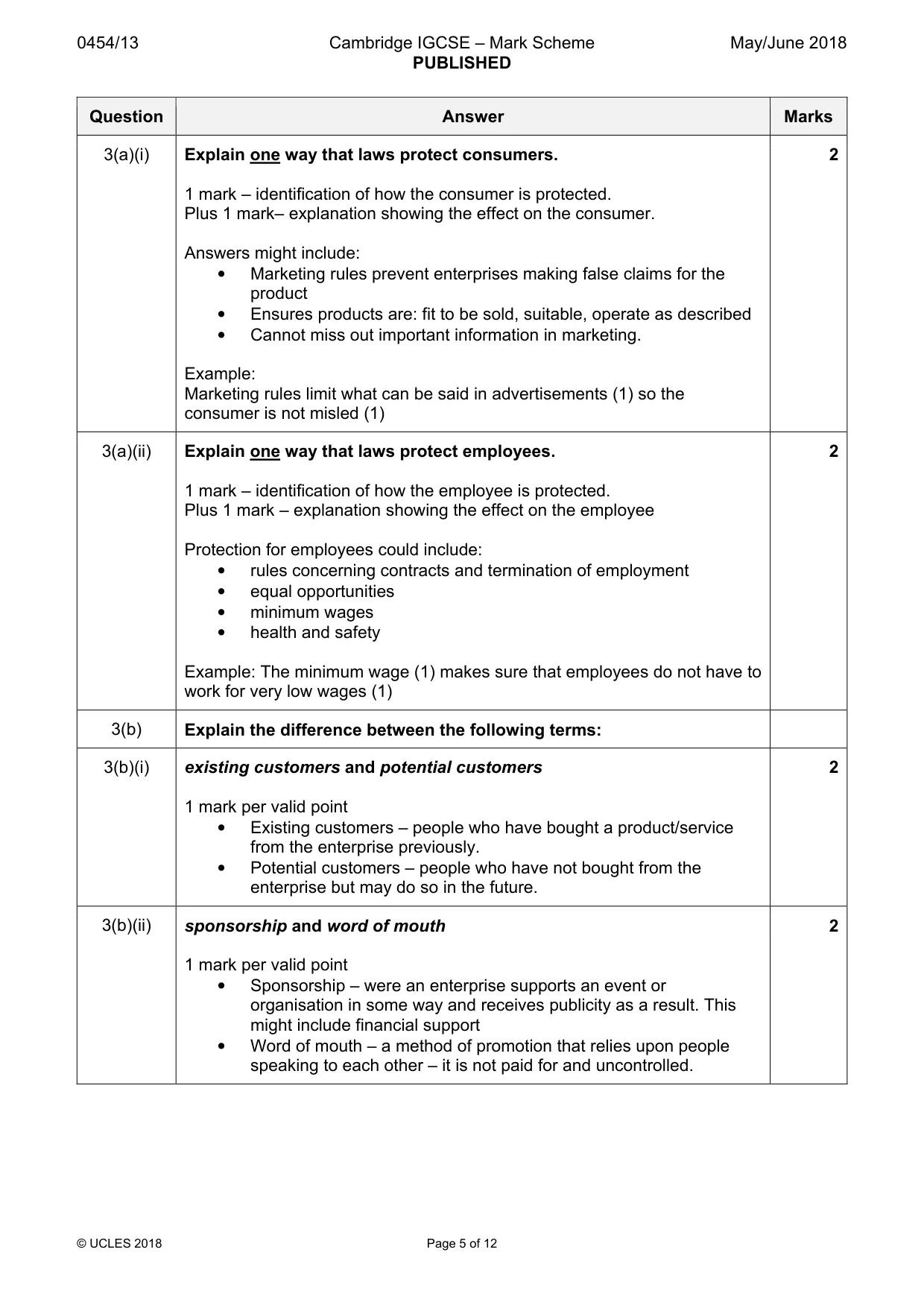
0454/13 Cambridge IGCSE – Mark Scheme PUBLISHED May/June 2018 © UCLES 2018 Page 5 of 12 Question Answer Marks 3(a)(i) Explain one way that laws protect consumers. 1 mark – identification of how the consumer is protected. Plus 1 mark– explanation showing the effect on the consumer. Answers might include: • Marketing rules prevent enterprises making false claims for the product • Ensures products are: fit to be sold, suitable, operate as described • Cannot miss out important information in marketing. Example: Marketing rules limit what can be said in advertisements (1) so the consumer is not misled (1) 2 3(a)(ii) Explain one way that laws protect employees. 1 mark – identification of how the employee is protected. Plus 1 mark – explanation showing the effect on the employee Protection for employees could include: • rules concerning contracts and termination of employment • equal opportunities • minimum wages • health and safety Example: The minimum wage (1) makes sure that employees do not have to work for very low wages (1) 2 3(b) Explain the difference between the following terms: 3(b)(i) existing customers and potential customers 1 mark per valid point • Existing customers – people who have bought a product/service from the enterprise previously. • Potential customers – people who have not bought from the enterprise but may do so in the future. 2 3(b)(ii) sponsorship and word of mouth 1 mark per valid point • Sponsorship – were an enterprise supports an event or organisation in some way and receives publicity as a result. This might include financial support • Word of mouth – a method of promotion that relies upon people speaking to each other – it is not paid for and uncontrolled. 2
Mark scheme, page 6
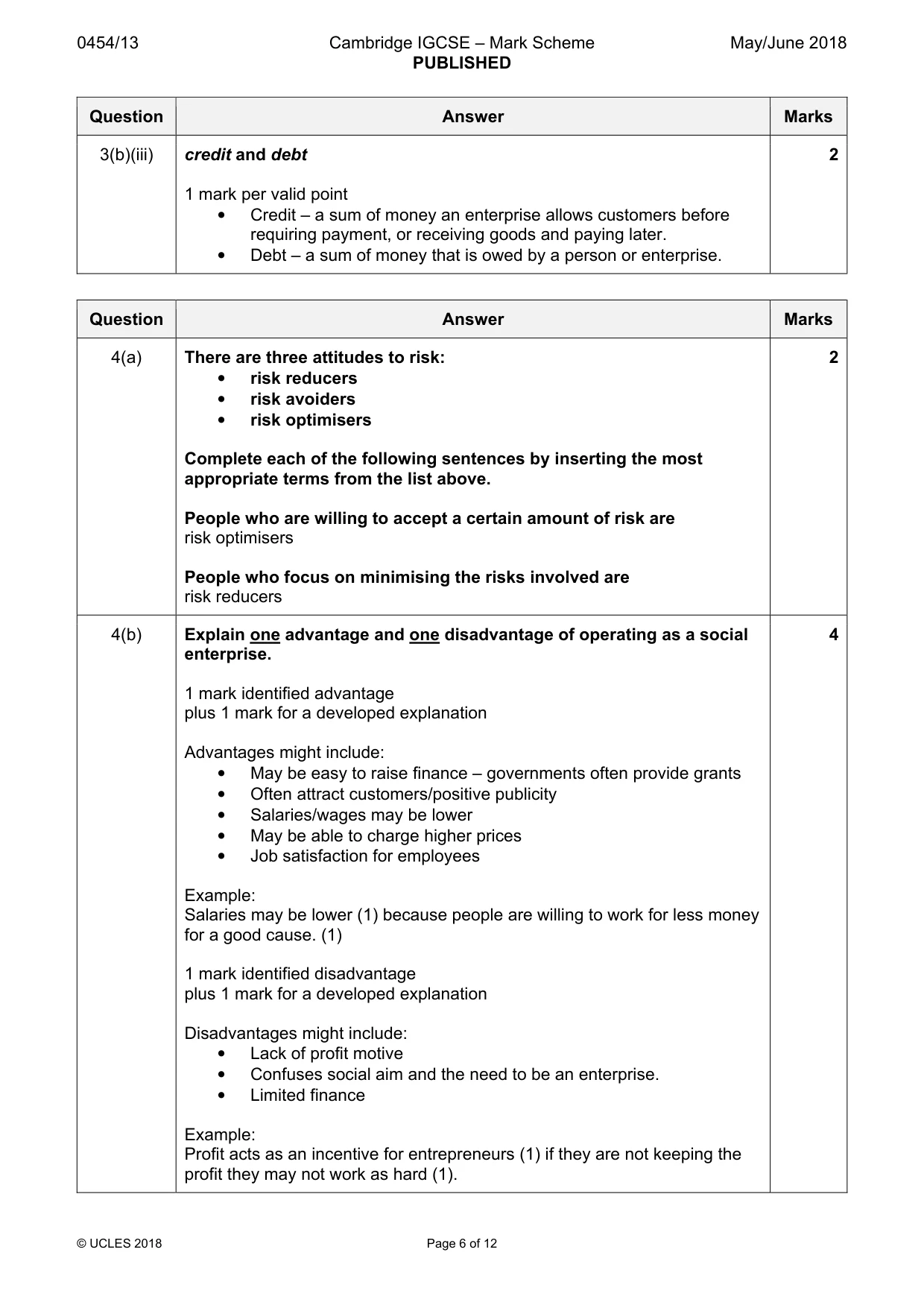
0454/13 Cambridge IGCSE – Mark Scheme PUBLISHED May/June 2018 © UCLES 2018 Page 6 of 12 Question Answer Marks 3(b)(iii) credit and debt 1 mark per valid point • Credit – a sum of money an enterprise allows customers before requiring payment, or receiving goods and paying later. • Debt – a sum of money that is owed by a person or enterprise. 2 Question Answer Marks 4(a) There are three attitudes to risk: • risk reducers • risk avoiders • risk optimisers Complete each of the following sentences by inserting the most appropriate terms from the list above. People who are willing to accept a certain amount of risk are risk optimisers People who focus on minimising the risks involved are risk reducers 2 4(b) Explain one advantage and one disadvantage of operating as a social enterprise. 1 mark identified advantage plus 1 mark for a developed explanation Advantages might include: • May be easy to raise finance – governments often provide grants • Often attract customers/positive publicity • Salaries/wages may be lower • May be able to charge higher prices • Job satisfaction for employees Example: Salaries may be lower (1) because people are willing to work for less money for a good cause. (1) 1 mark identified disadvantage plus 1 mark for a developed explanation Disadvantages might include: • Lack of profit motive • Confuses social aim and the need to be an enterprise. • Limited finance Example: Profit acts as an incentive for entrepreneurs (1) if they are not keeping the profit they may not work as hard (1). 4
Mark scheme, page 7
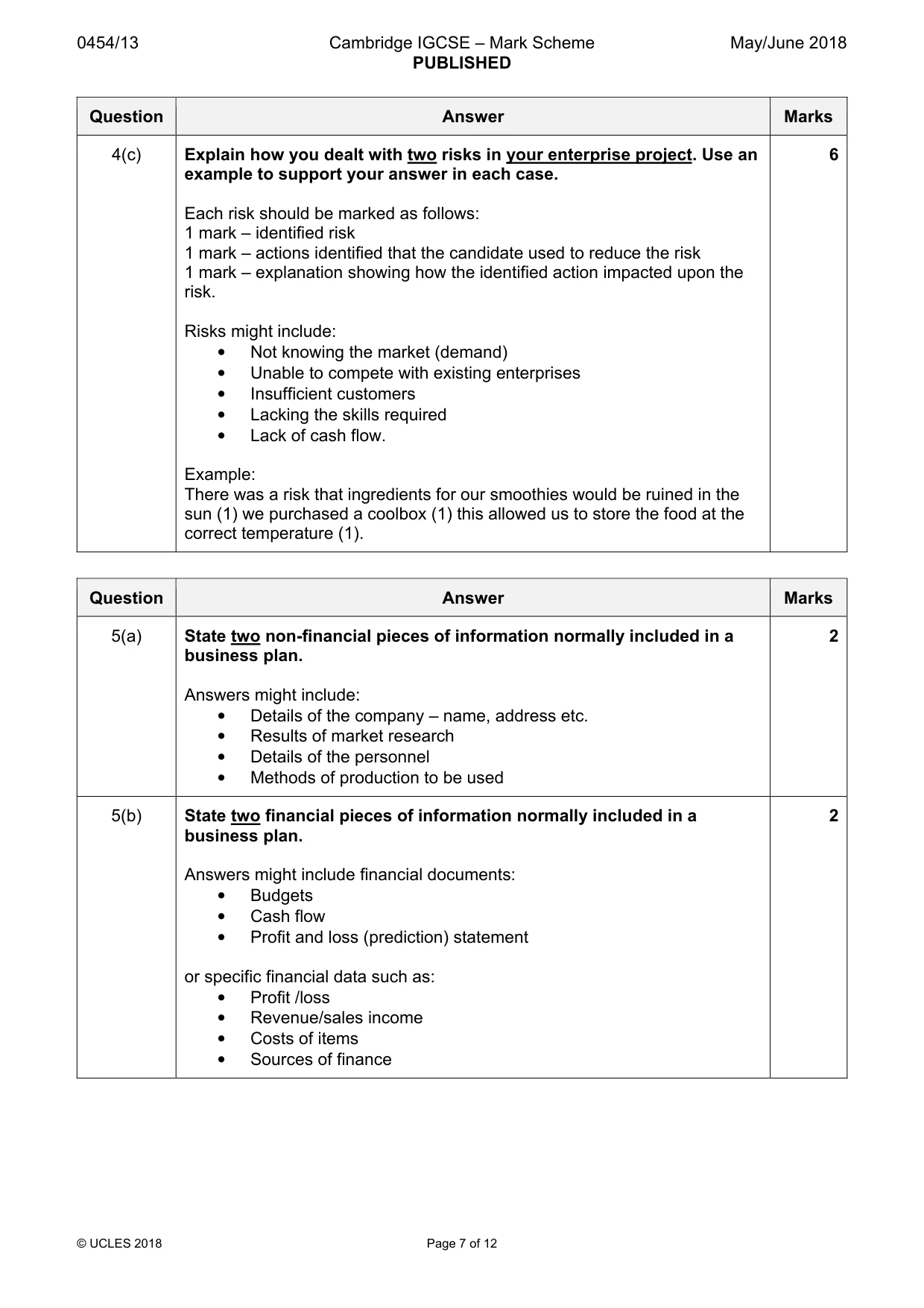
0454/13 Cambridge IGCSE – Mark Scheme PUBLISHED May/June 2018 © UCLES 2018 Page 7 of 12 Question Answer Marks 4(c) Explain how you dealt with two risks in your enterprise project. Use an example to support your answer in each case. Each risk should be marked as follows: 1 mark – identified risk 1 mark – actions identified that the candidate used to reduce the risk 1 mark – explanation showing how the identified action impacted upon the risk. Risks might include: • Not knowing the market (demand) • Unable to compete with existing enterprises • Insufficient customers • Lacking the skills required • Lack of cash flow. Example: There was a risk that ingredients for our smoothies would be ruined in the sun (1) we purchased a coolbox (1) this allowed us to store the food at the correct temperature (1). 6 Question Answer Marks 5(a) State two non-financial pieces of information normally included in a business plan. Answers might include: • Details of the company – name, address etc. • Results of market research • Details of the personnel • Methods of production to be used 2 5(b) State two financial pieces of information normally included in a business plan. Answers might include financial documents: • Budgets • Cash flow • Profit and loss (prediction) statement or specific financial data such as: • Profit /loss • Revenue/sales income • Costs of items • Sources of finance 2
Mark scheme, page 8
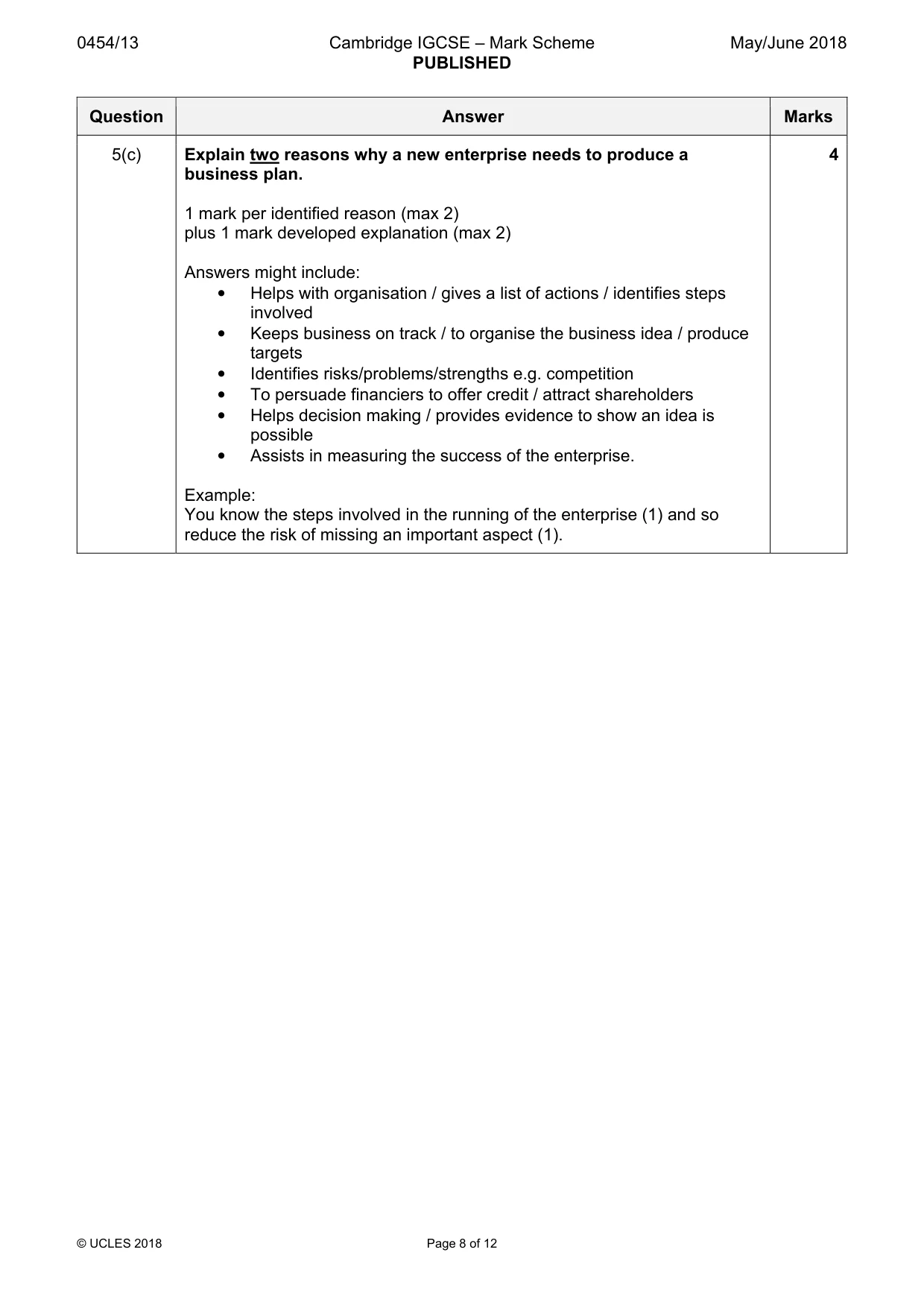
0454/13 Cambridge IGCSE – Mark Scheme PUBLISHED May/June 2018 © UCLES 2018 Page 8 of 12 Question Answer Marks 5(c) Explain two reasons why a new enterprise needs to produce a business plan. 1 mark per identified reason (max 2) plus 1 mark developed explanation (max 2) Answers might include: • Helps with organisation / gives a list of actions / identifies steps involved • Keeps business on track / to organise the business idea / produce targets • Identifies risks/problems/strengths e.g. competition • To persuade financiers to offer credit / attract shareholders • Helps decision making / provides evidence to show an idea is possible • Assists in measuring the success of the enterprise. Example: You know the steps involved in the running of the enterprise (1) and so reduce the risk of missing an important aspect (1). 4
Mark scheme, page 9
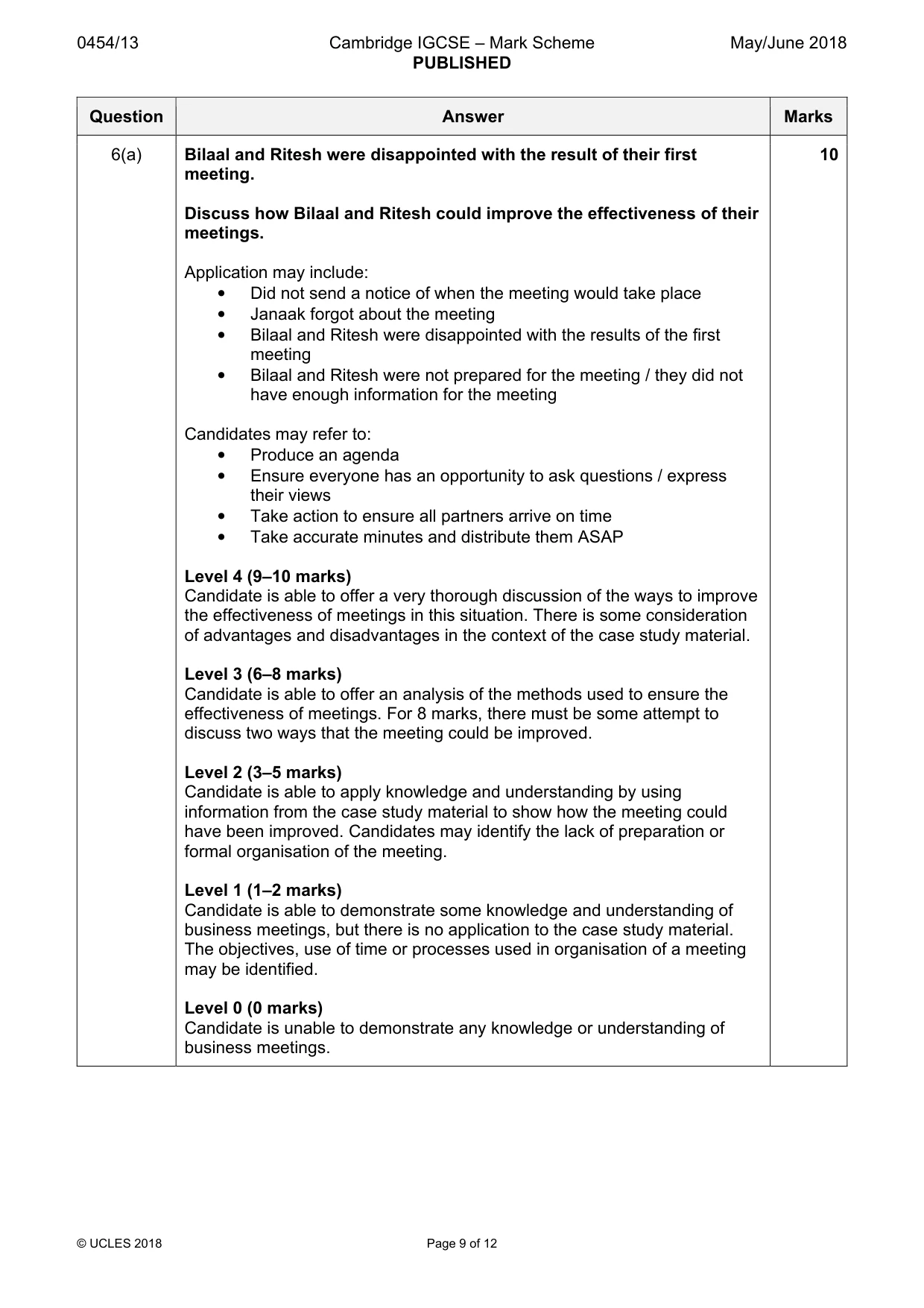
0454/13 Cambridge IGCSE – Mark Scheme PUBLISHED May/June 2018 © UCLES 2018 Page 9 of 12 Question Answer Marks 6(a) Bilaal and Ritesh were disappointed with the result of their first meeting. Discuss how Bilaal and Ritesh could improve the effectiveness of their meetings. Application may include: • Did not send a notice of when the meeting would take place • Janaak forgot about the meeting • Bilaal and Ritesh were disappointed with the results of the first meeting • Bilaal and Ritesh were not prepared for the meeting / they did not have enough information for the meeting Candidates may refer to: • Produce an agenda • Ensure everyone has an opportunity to ask questions / express their views • Take action to ensure all partners arrive on time • Take accurate minutes and distribute them ASAP Level 4 (9–10 marks) Candidate is able to offer a very thorough discussion of the ways to improve the effectiveness of meetings in this situation. There is some consideration of advantages and disadvantages in the context of the case study material. Level 3 (6–8 marks) Candidate is able to offer an analysis of the methods used to ensure the effectiveness of meetings. For 8 marks, there must be some attempt to discuss two ways that the meeting could be improved. Level 2 (3–5 marks) Candidate is able to apply knowledge and understanding by using information from the case study material to show how the meeting could have been improved. Candidates may identify the lack of preparation or formal organisation of the meeting. Level 1 (1–2 marks) Candidate is able to demonstrate some knowledge and understanding of business meetings, but there is no application to the case study material. The objectives, use of time or processes used in organisation of a meeting may be identified. Level 0 (0 marks) Candidate is unable to demonstrate any knowledge or understanding of business meetings. 10
Mark scheme, page 10
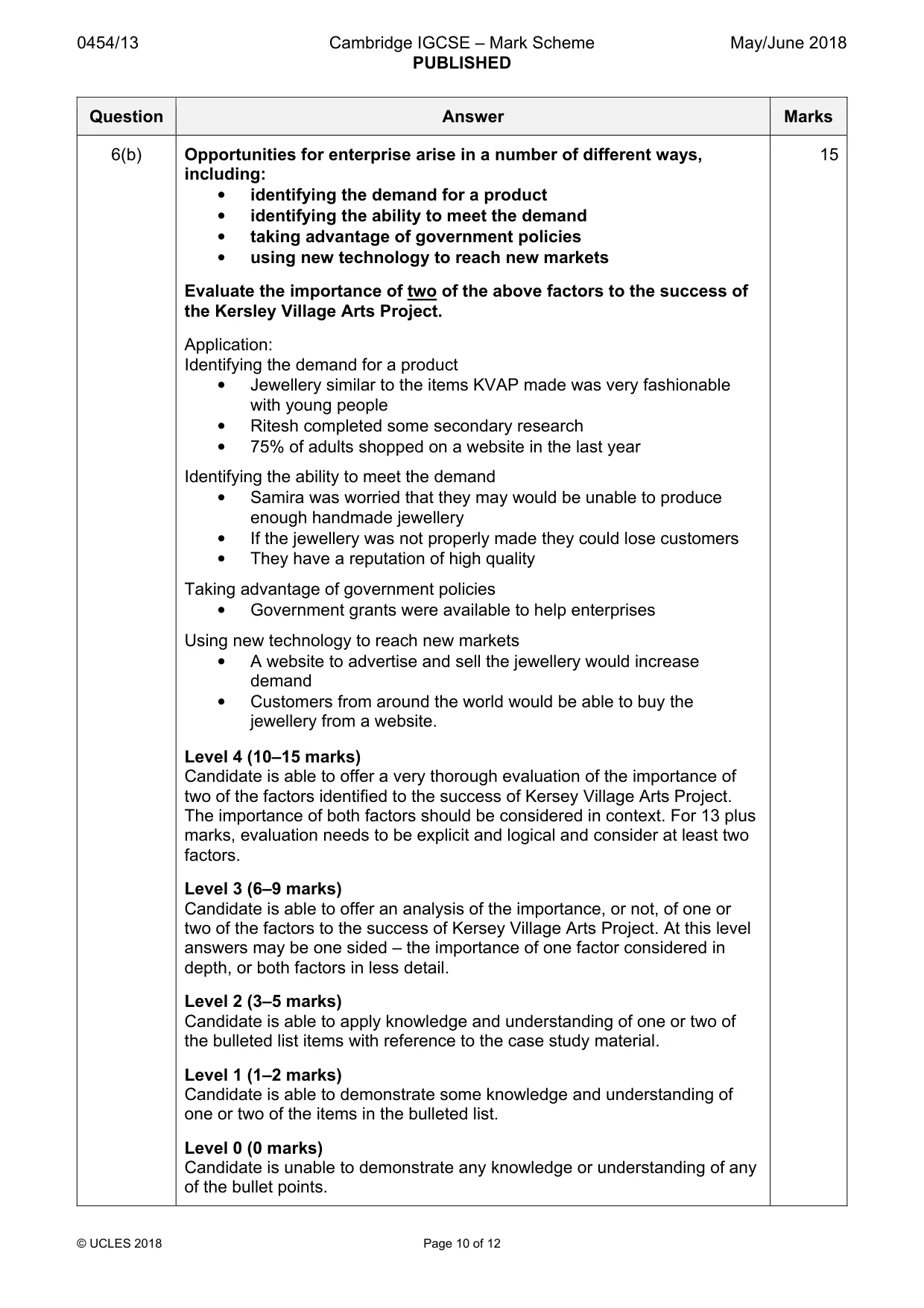
0454/13 Cambridge IGCSE – Mark Scheme PUBLISHED May/June 2018 © UCLES 2018 Page 10 of 12 Question Answer Marks 6(b) Opportunities for enterprise arise in a number of different ways, including: • identifying the demand for a product • identifying the ability to meet the demand • taking advantage of government policies • using new technology to reach new markets Evaluate the importance of two of the above factors to the success of the Kersley Village Arts Project. Application: Identifying the demand for a product • Jewellery similar to the items KVAP made was very fashionable with young people • Ritesh completed some secondary research • 75% of adults shopped on a website in the last year Identifying the ability to meet the demand • Samira was worried that they may would be unable to produce enough handmade jewellery • If the jewellery was not properly made they could lose customers • They have a reputation of high quality Taking advantage of government policies • Government grants were available to help enterprises Using new technology to reach new markets • A website to advertise and sell the jewellery would increase demand • Customers from around the world would be able to buy the jewellery from a website. Level 4 (10–15 marks) Candidate is able to offer a very thorough evaluation of the importance of two of the factors identified to the success of Kersey Village Arts Project. The importance of both factors should be considered in context. For 13 plus marks, evaluation needs to be explicit and logical and consider at least two factors. Level 3 (6–9 marks) Candidate is able to offer an analysis of the importance, or not, of one or two of the factors to the success of Kersey Village Arts Project. At this level answers may be one sided – the importance of one factor considered in depth, or both factors in less detail. Level 2 (3–5 marks) Candidate is able to apply knowledge and understanding of one or two of the bulleted list items with reference to the case study material. Level 1 (1–2 marks) Candidate is able to demonstrate some knowledge and understanding of one or two of the items in the bulleted list. Level 0 (0 marks) Candidate is unable to demonstrate any knowledge or understanding of any of the bullet points. 15
Mark scheme, page 11
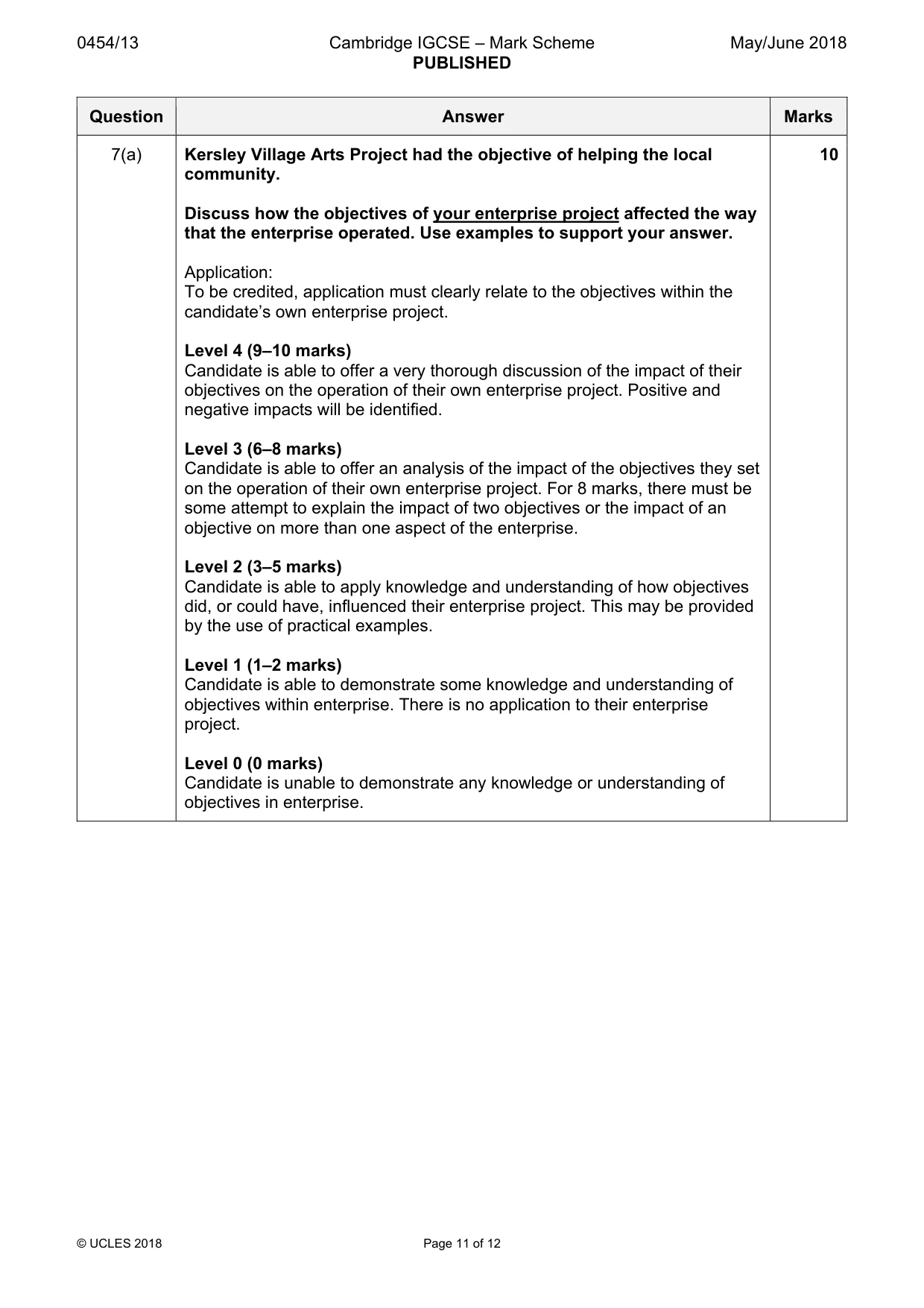
0454/13 Cambridge IGCSE – Mark Scheme PUBLISHED May/June 2018 © UCLES 2018 Page 11 of 12 Question Answer Marks 7(a) Kersley Village Arts Project had the objective of helping the local community. Discuss how the objectives of your enterprise project affected the way that the enterprise operated. Use examples to support your answer. Application: To be credited, application must clearly relate to the objectives within the candidate’s own enterprise project. Level 4 (9–10 marks) Candidate is able to offer a very thorough discussion of the impact of their objectives on the operation of their own enterprise project. Positive and negative impacts will be identified. Level 3 (6–8 marks) Candidate is able to offer an analysis of the impact of the objectives they set on the operation of their own enterprise project. For 8 marks, there must be some attempt to explain the impact of two objectives or the impact of an objective on more than one aspect of the enterprise. Level 2 (3–5 marks) Candidate is able to apply knowledge and understanding of how objectives did, or could have, influenced their enterprise project. This may be provided by the use of practical examples. Level 1 (1–2 marks) Candidate is able to demonstrate some knowledge and understanding of objectives within enterprise. There is no application to their enterprise project. Level 0 (0 marks) Candidate is unable to demonstrate any knowledge or understanding of objectives in enterprise. 10
Mark scheme, page 12
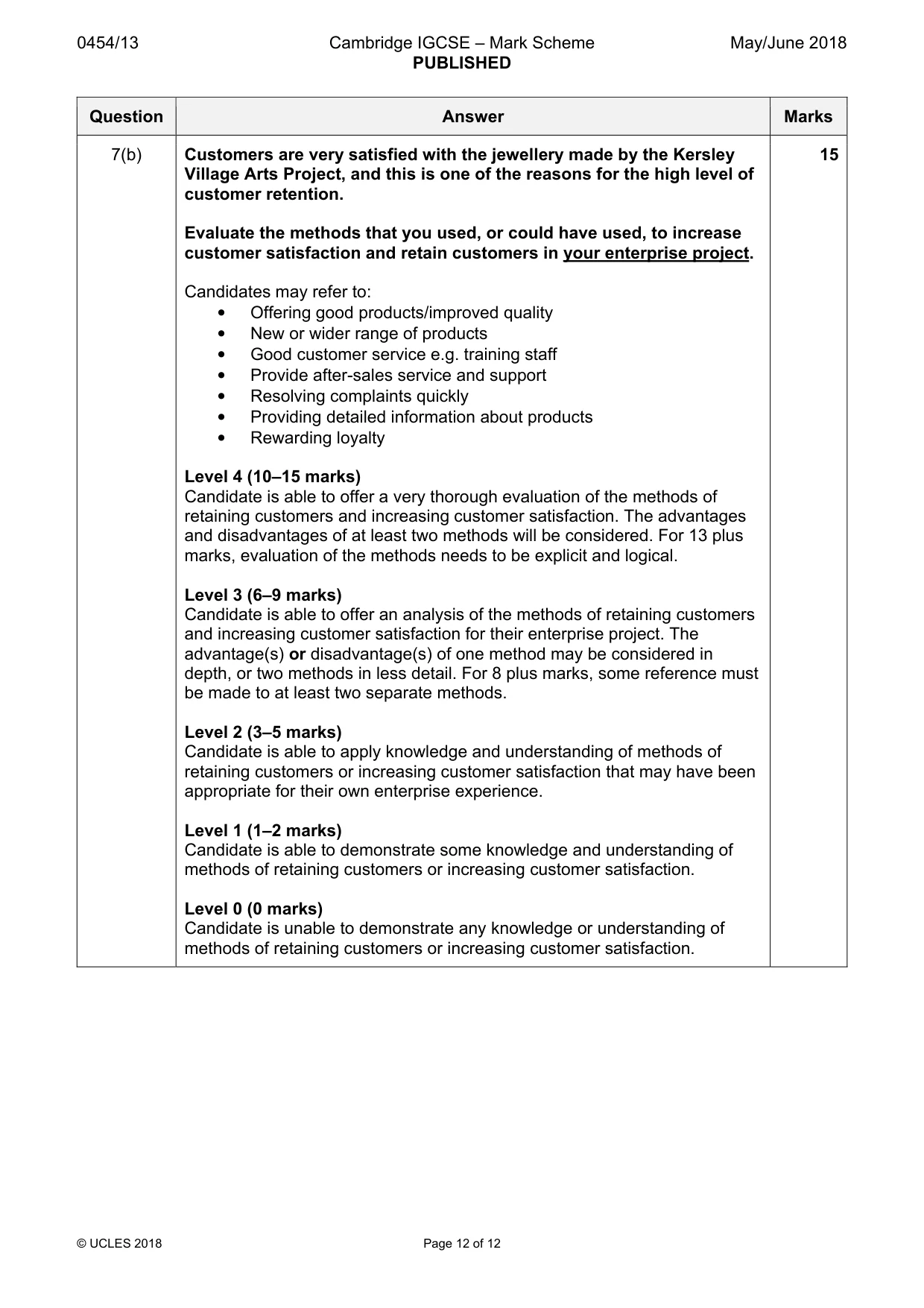
0454/13 Cambridge IGCSE – Mark Scheme PUBLISHED May/June 2018 © UCLES 2018 Page 12 of 12 Question Answer Marks 7(b) Customers are very satisfied with the jewellery made by the Kersley Village Arts Project, and this is one of the reasons for the high level of customer retention. Evaluate the methods that you used, or could have used, to increase customer satisfaction and retain customers in your enterprise project. Candidates may refer to: • Offering good products/improved quality • New or wider range of products • Good customer service e.g. training staff • Provide after-sales service and support • Resolving complaints quickly • Providing detailed information about products • Rewarding loyalty Level 4 (10–15 marks) Candidate is able to offer a very thorough evaluation of the methods of retaining customers and increasing customer satisfaction. The advantages and disadvantages of at least two methods will be considered. For 13 plus marks, evaluation of the methods needs to be explicit and logical. Level 3 (6–9 marks) Candidate is able to offer an analysis of the methods of retaining customers and increasing customer satisfaction for their enterprise project. The advantage(s) or disadvantage(s) of one method may be considered in depth, or two methods in less detail. For 8 plus marks, some reference must be made to at least two separate methods. Level 2 (3–5 marks) Candidate is able to apply knowledge and understanding of methods of retaining customers or increasing customer satisfaction that may have been appropriate for their own enterprise experience. Level 1 (1–2 marks) Candidate is able to demonstrate some knowledge and understanding of methods of retaining customers or increasing customer satisfaction. Level 0 (0 marks) Candidate is unable to demonstrate any knowledge or understanding of methods of retaining customers or increasing customer satisfaction. 15
What you needed in this session
Cambridge’s own grade thresholds for 2018 May/June, Paper 1 · Variant 3. A higher threshold means an easier paper — the bar moves with how the cohort did.