Cambridge IGCSE Enterprise 0454 — 2018 May/June Paper 1 · Variant 2
0454/12/M/J/18 · 100 marks · ≈113 min
The question paper and its mark scheme, free to read here and free to download. This is Cambridge’s own paper, exactly as it was sat.
Question paper16 pages







Mark scheme12 pages
Answers below. Sit the paper first if you are practising.
Paper as text
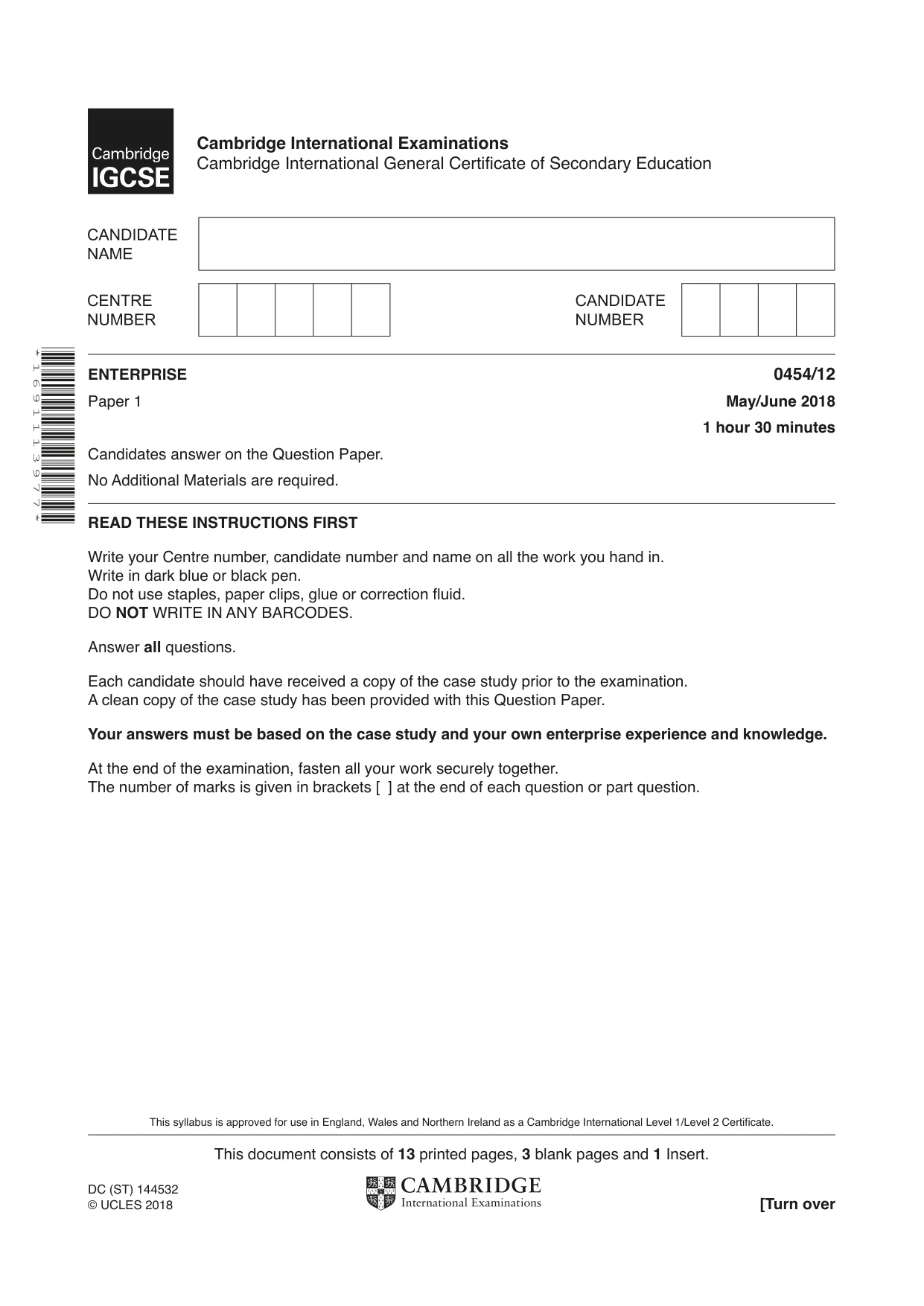
Question paper, page 1
* 1 6 9 1 1 1 3 9 7 7 * This document consists of 13 printed pages, 3 blank pages and 1 Insert. DC (ST) 144532 © UCLES 2018 [Turn over Cambridge International Examinations Cambridge International General Certificate of Secondary Education ENTERPRISE 0454/12 Paper 1 May/June 2018 1 hour 30 minutes Candidates answer on the Question Paper. No Additional Materials are required. READ THESE INSTRUCTIONS FIRST Write your Centre number, candidate number and name on all the work you hand in. Write in dark blue or black pen. Do not use staples, paper clips, glue or correction fluid. DO NOT WRITE IN ANY BARCODES. Answer all questions. Each candidate should have received a copy of the case study prior to the examination. A clean copy of the case study has been provided with this Question Paper. Your answers must be based on the case study and your own enterprise experience and knowledge. At the end of the examination, fasten all your work securely together. The number of marks is given in brackets [ ] at the end of each question or part question. This syllabus is approved for use in England, Wales and Northern Ireland as a Cambridge International Level 1/Level 2 Certificate.
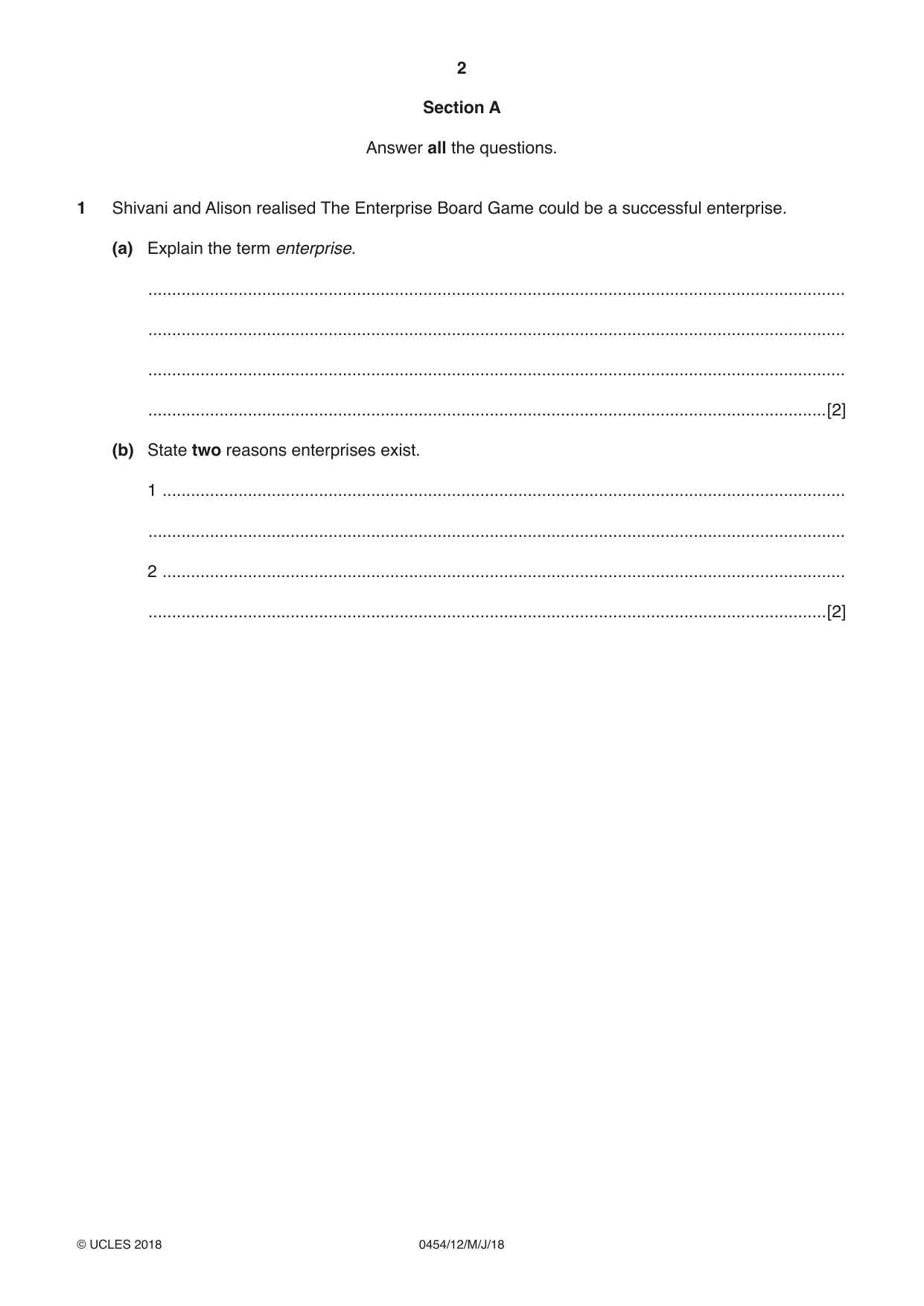
Question paper, page 2
2 0454/12/M/J/18 © UCLES 2018 Section A Answer all the questions. 1 Shivani and Alison realised The Enterprise Board Game could be a successful enterprise. (a) Explain the term enterprise. … … … …[2] (b) State two reasons enterprises exist. 1 … … 2 … …[2]
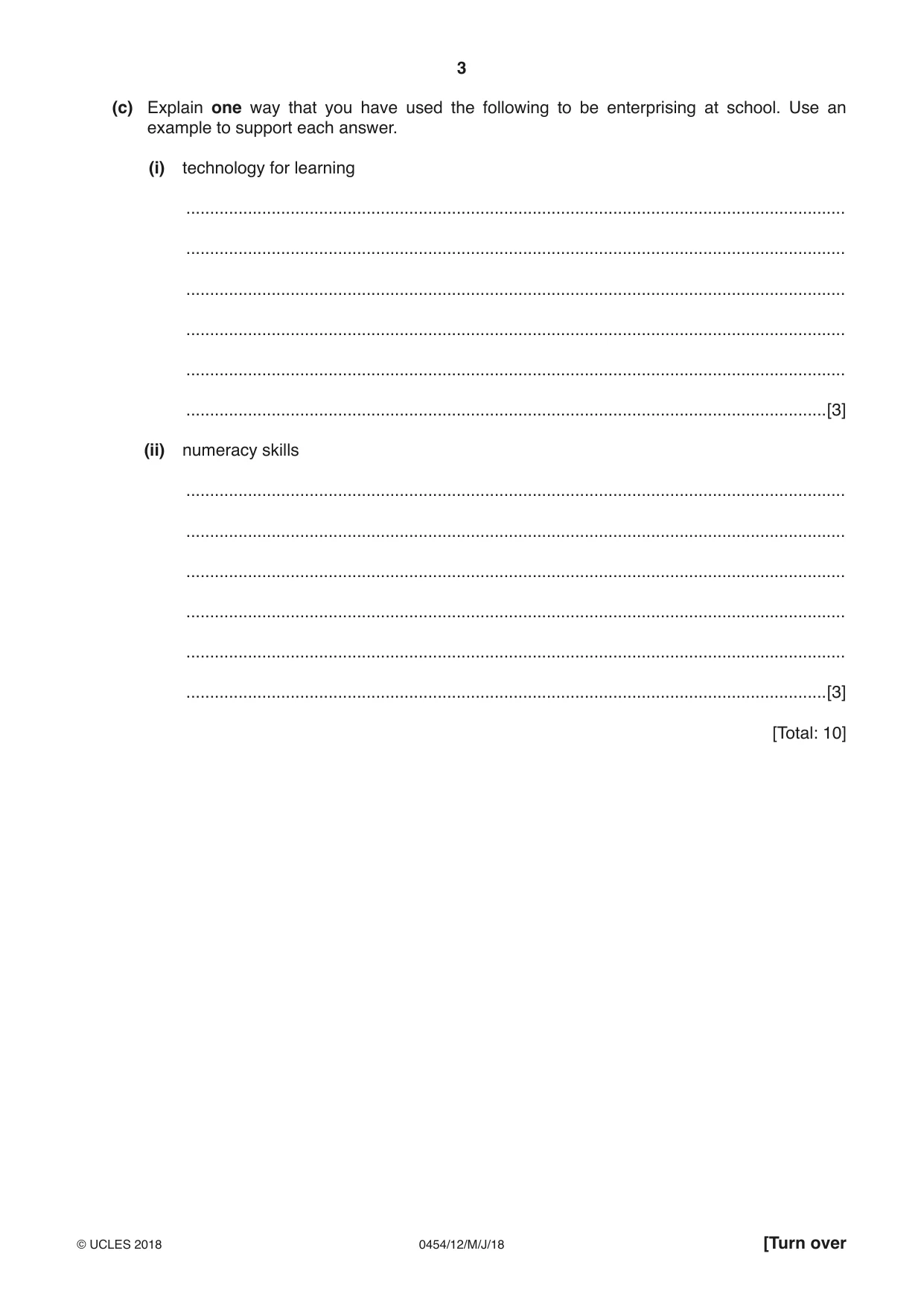
Question paper, page 3
3 0454/12/M/J/18 © UCLES 2018 [Turn over (c) Explain one way that you have used the following to be enterprising at school. Use an example to support each answer. (i) technology for learning … … … … … …[3] (ii) numeracy skills … … … … … …[3] [Total: 10]
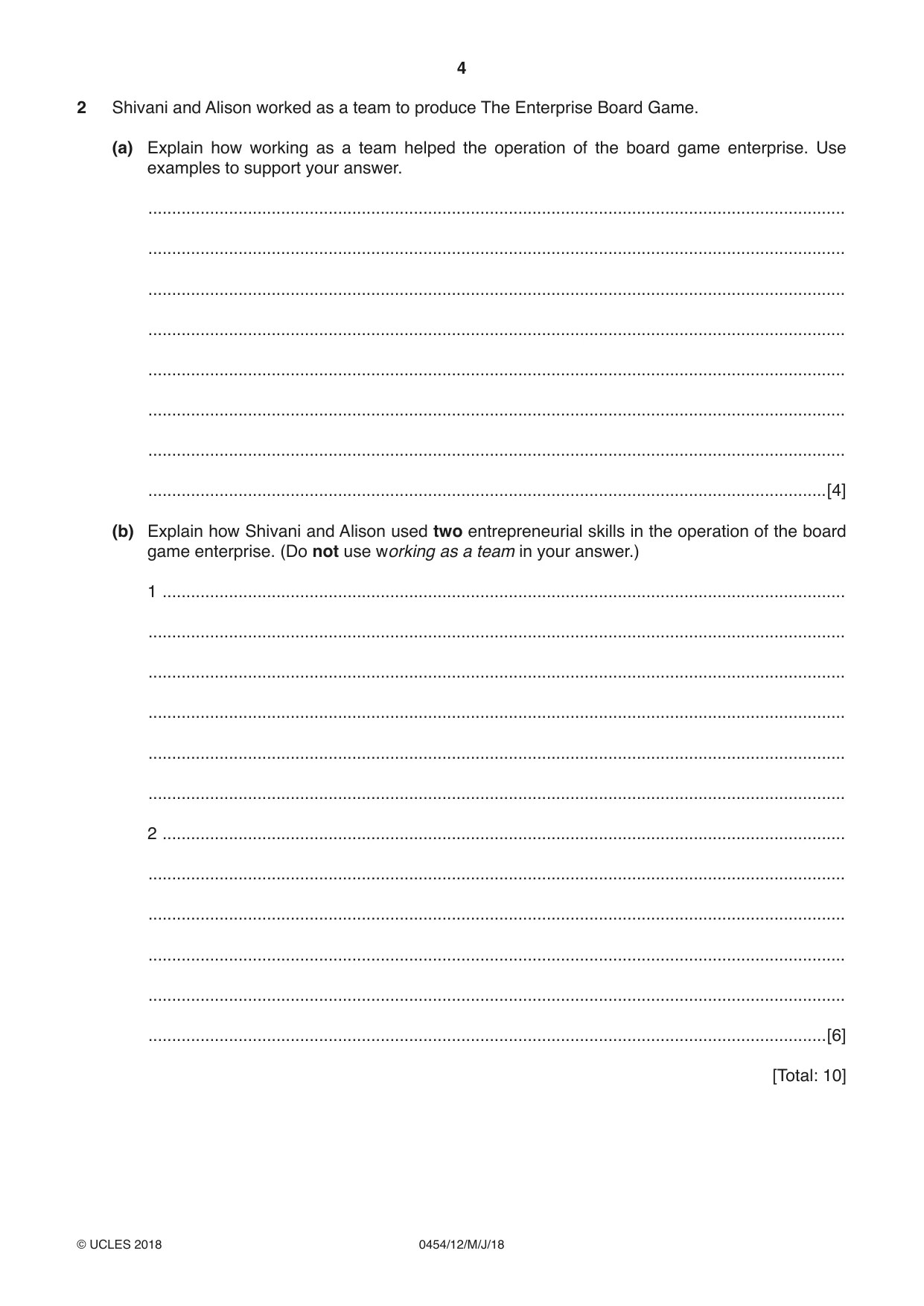
Question paper, page 4
4 0454/12/M/J/18 © UCLES 2018 2 Shivani and Alison worked as a team to produce The Enterprise Board Game. (a) Explain how working as a team helped the operation of the board game enterprise. Use examples to support your answer. … … … … … … … …[4] (b) Explain how Shivani and Alison used two entrepreneurial skills in the operation of the board game enterprise. (Do not use working as a team in your answer.) 1 … … … … … … 2 … … … … … …[6] [Total: 10]
Question paper, page 5
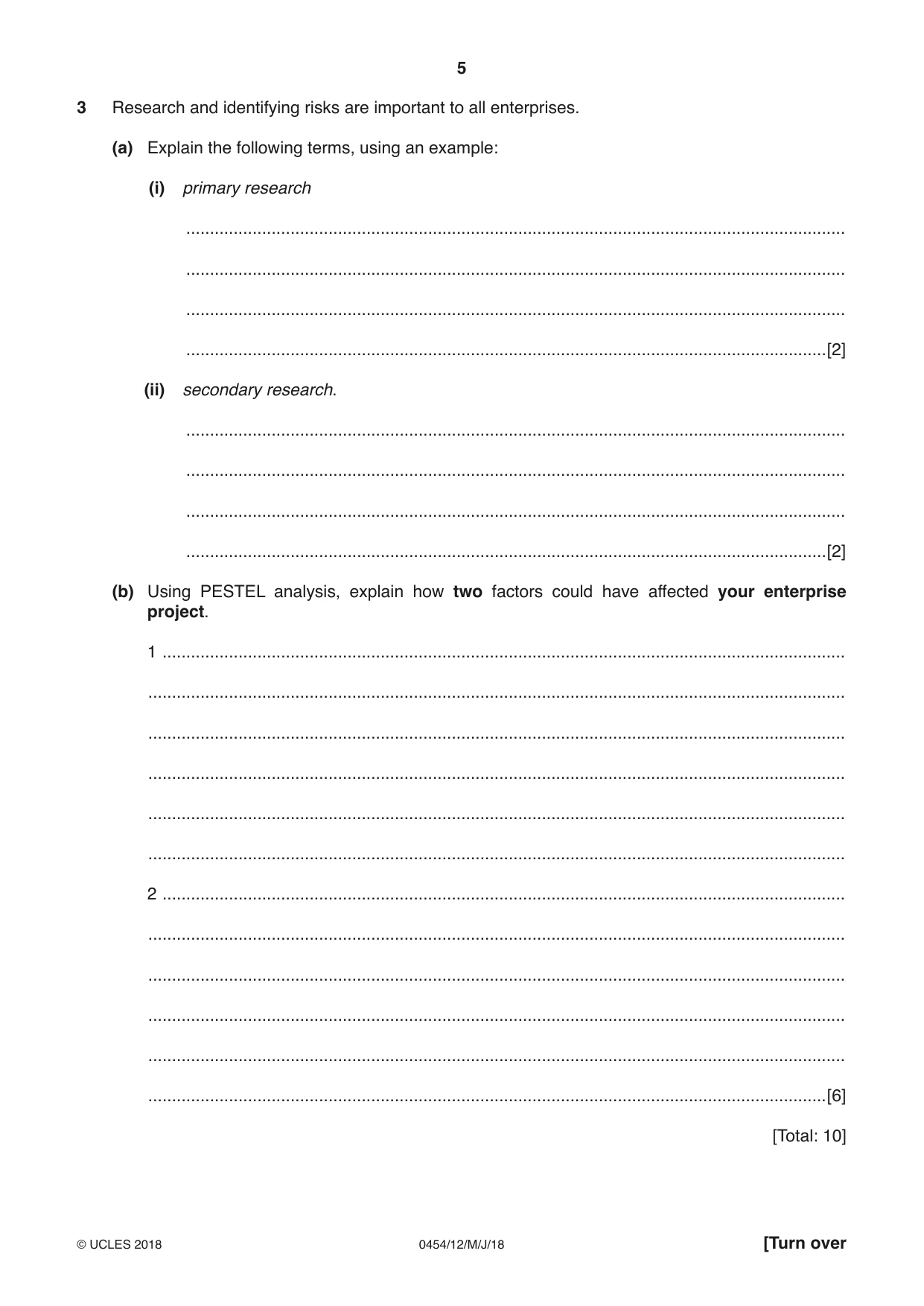
5 0454/12/M/J/18 © UCLES 2018 [Turn over 3 Research and identifying risks are important to all enterprises. (a) Explain the following terms, using an example: (i) primary research … … … …[2] (ii) secondary research. … … … …[2] (b) Using PESTEL analysis, explain how two factors could have affected your enterprise project. 1 … … … … … … 2 … … … … … …[6] [Total: 10]
Question paper, page 6
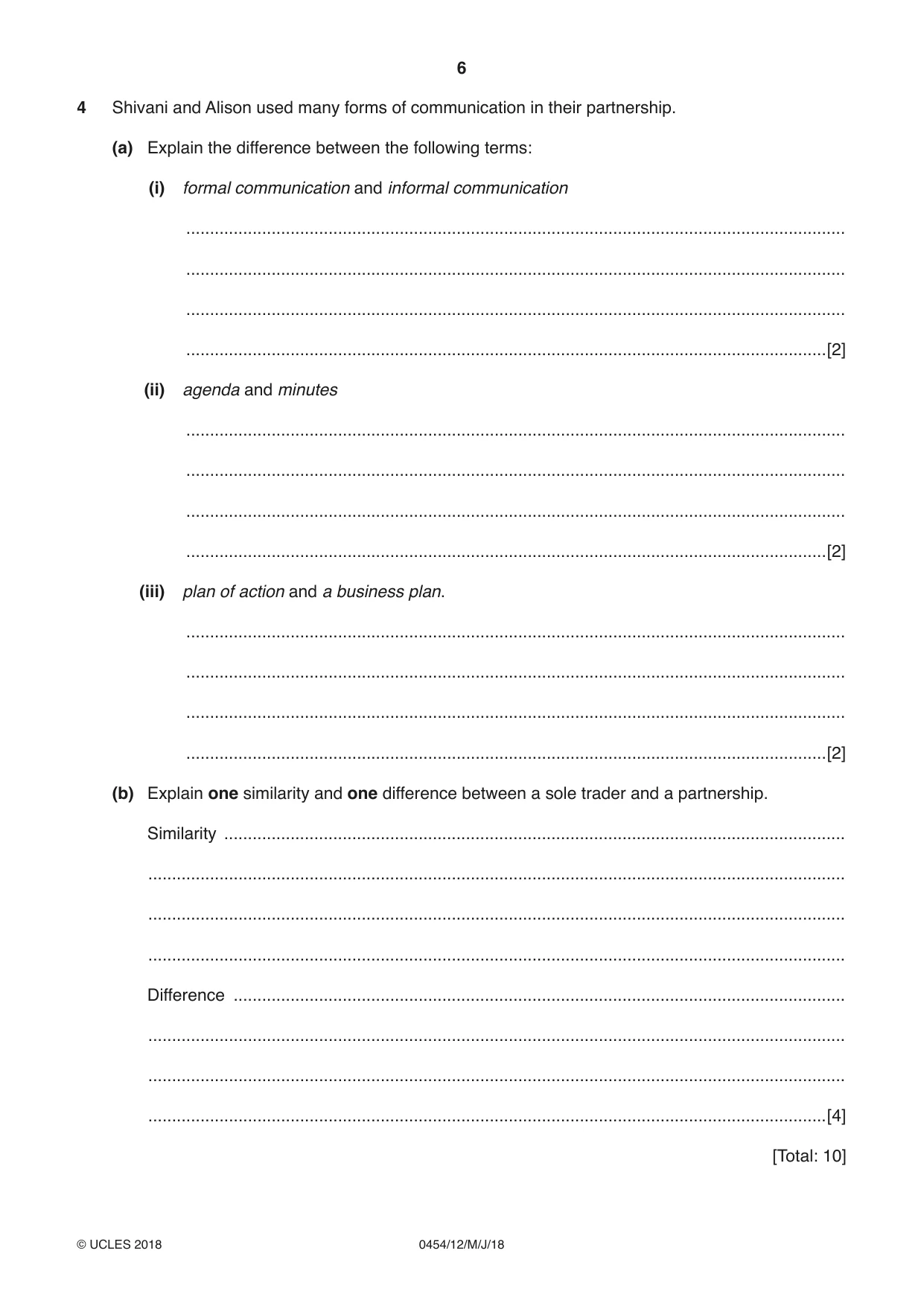
6 0454/12/M/J/18 © UCLES 2018 4 Shivani and Alison used many forms of communication in their partnership. (a) Explain the difference between the following terms: (i) formal communication and informal communication … … … …[2] (ii) agenda and minutes … … … …[2] (iii) plan of action and a business plan. … … … …[2] (b) Explain one similarity and one difference between a sole trader and a partnership. Similarity … … … … Difference … … … …[4] [Total: 10]
Question paper, page 7
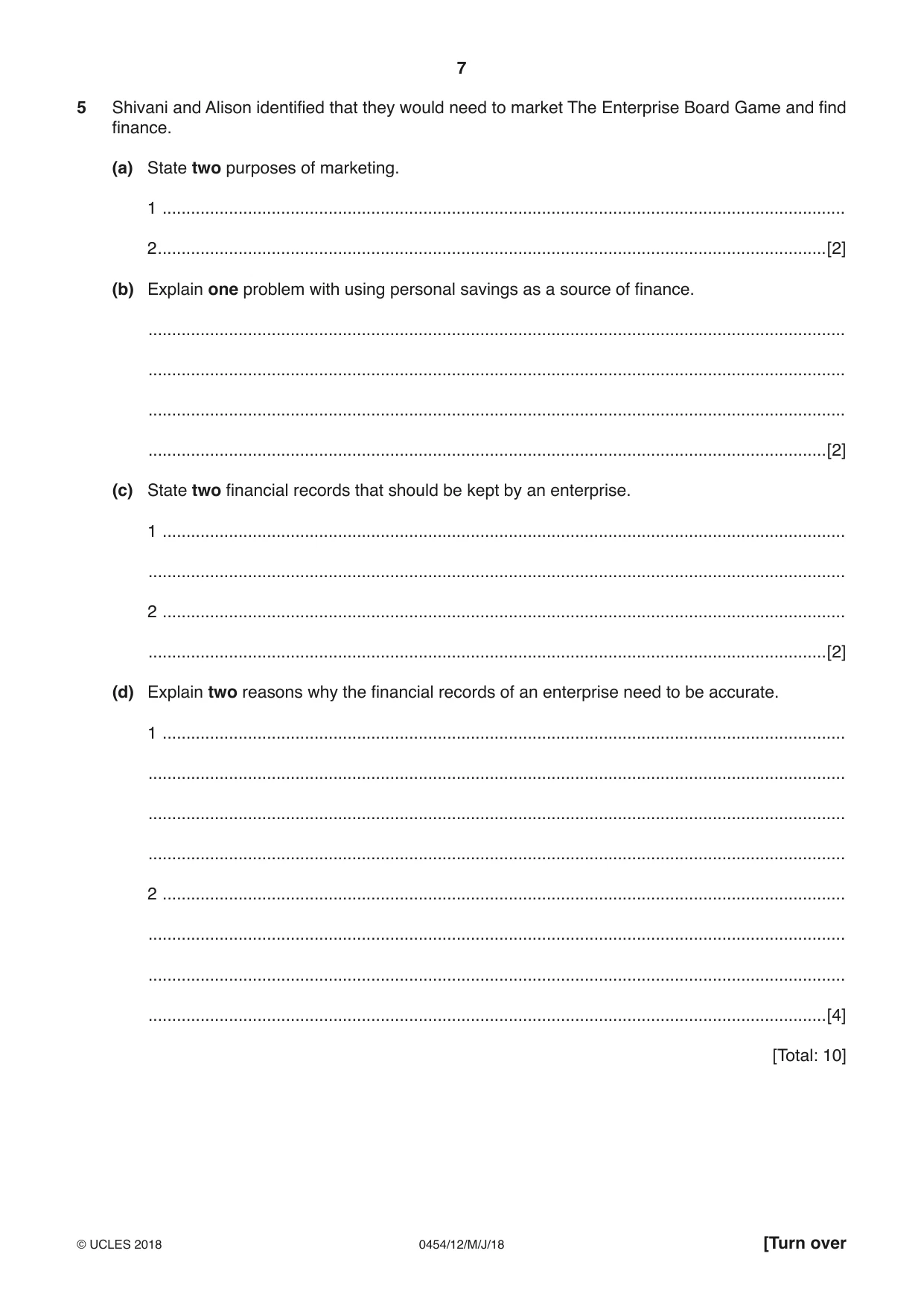
7 0454/12/M/J/18 © UCLES 2018 [Turn over 5 Shivani and Alison identified that they would need to market The Enterprise Board Game and find finance. (a) State two purposes of marketing. 1 … 2 …[2] (b) Explain one problem with using personal savings as a source of finance. … … … …[2] (c) State two financial records that should be kept by an enterprise. 1 … … 2 … …[2] (d) Explain two reasons why the financial records of an enterprise need to be accurate. 1 … … … … 2 … … … …[4] [Total: 10]
Question paper, page 8
8 0454/12/M/J/18 © UCLES 2018 BLANK PAGE
Question paper, page 9
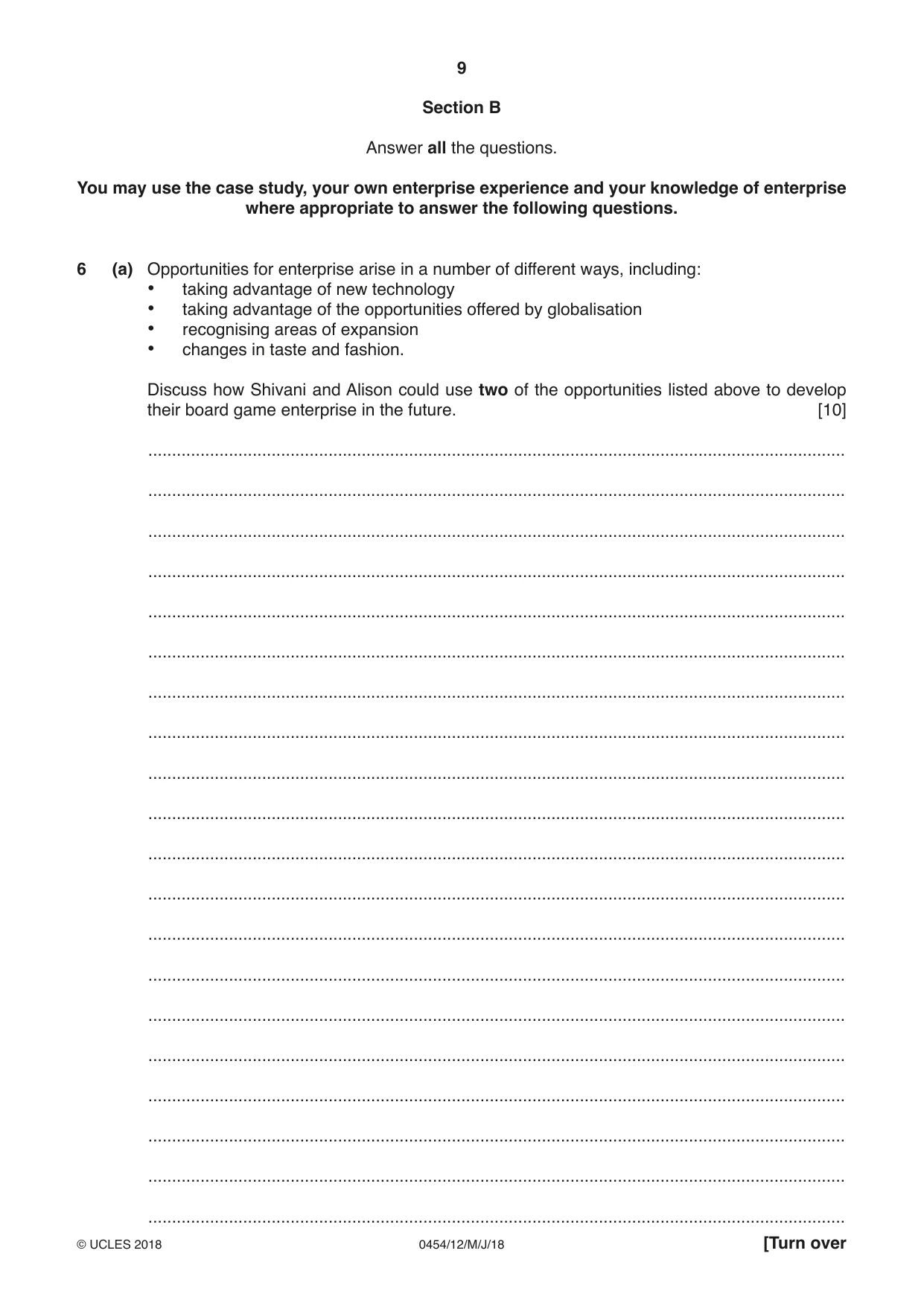
9 0454/12/M/J/18 © UCLES 2018 [Turn over Section B Answer all the questions. You may use the case study, your own enterprise experience and your knowledge of enterprise where appropriate to answer the following questions. 6 (a) Opportunities for enterprise arise in a number of different ways, including: • taking advantage of new technology • taking advantage of the opportunities offered by globalisation • recognising areas of expansion • changes in taste and fashion. Discuss how Shivani and Alison could use two of the opportunities listed above to develop their board game enterprise in the future. [10] … … … … … … … … … … … … … … … … … … … …
Question paper, page 10
10 0454/12/M/J/18 © UCLES 2018 (b) Shivani and Alison intended to sell their board game to other teachers. Evaluate two suitable methods of communication Shivani and Alison could use to reach their potential customers. [15] … … … … … … … … … … … … … … … … … … … … … … … … … …
Question paper, page 11
11 0454/12/M/J/18 © UCLES 2018 [Turn over … … … … … … … … … … … … … … … … … … … … … … … … … … … [Total: 25]
Question paper, page 12
12 0454/12/M/J/18 © UCLES 2018 BLANK PAGE
Question paper, page 13
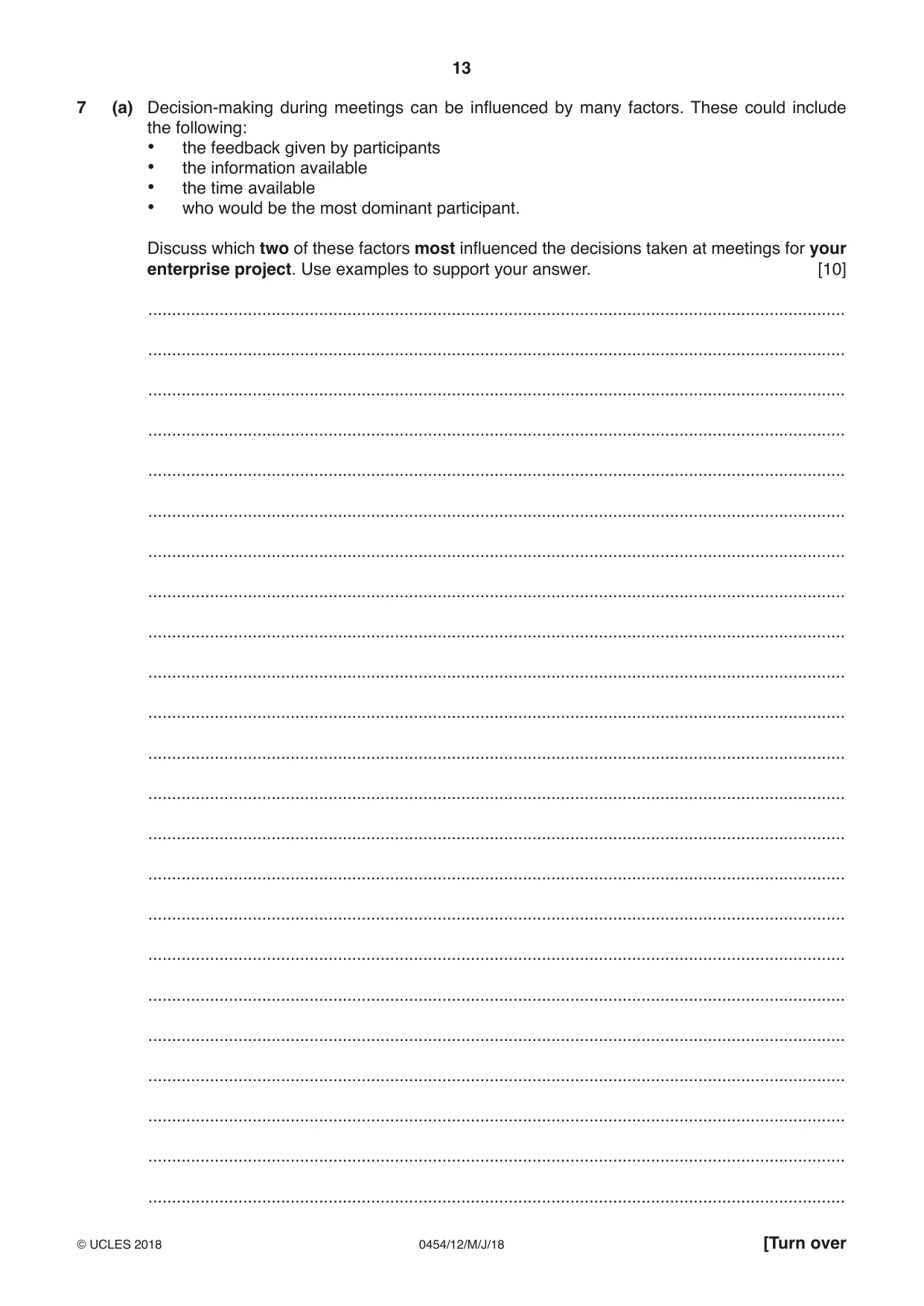
13 0454/12/M/J/18 © UCLES 2018 [Turn over 7 (a) Decision-making during meetings can be influenced by many factors. These could include the following: • the feedback given by participants • the information available • the time available • who would be the most dominant participant. Discuss which two of these factors most influenced the decisions taken at meetings for your enterprise project. Use examples to support your answer. [10] … … … … … … … … … … … … … … … … … … … … … … …
Question paper, page 14
14 0454/12/M/J/18 © UCLES 2018 (b) Shivani thought that producing a business plan would help them to reduce risks in their board game enterprise. Evaluate the importance of planning to the success of your enterprise project. [15] … … … … … … … … … … … … … … … … … … … … … … … … … …
Question paper, page 15
15 0454/12/M/J/18 © UCLES 2018 … … … … … … … … … … … … … … … … … … … … … … … … … … … [Total: 25]
Question paper, page 16
16 0454/12/M/J/18 © UCLES 2018 Permission to reproduce items where third-party owned material protected by copyright is included has been sought and cleared where possible. Every reasonable effort has been made by the publisher (UCLES) to trace copyright holders, but if any items requiring clearance have unwittingly been included, the publisher will be pleased to make amends at the earliest possible opportunity. To avoid the issue of disclosure of answer-related information to candidates, all copyright acknowledgements are reproduced online in the Cambridge International Examinations Copyright Acknowledgements Booklet. This is produced for each series of examinations and is freely available to download at www.cie.org.uk after the live examination series. Cambridge International Examinations is part of the Cambridge Assessment Group. Cambridge Assessment is the brand name of University of Cambridge Local Examinations Syndicate (UCLES), which is itself a department of the University of Cambridge. BLANK PAGE
Mark scheme, page 1
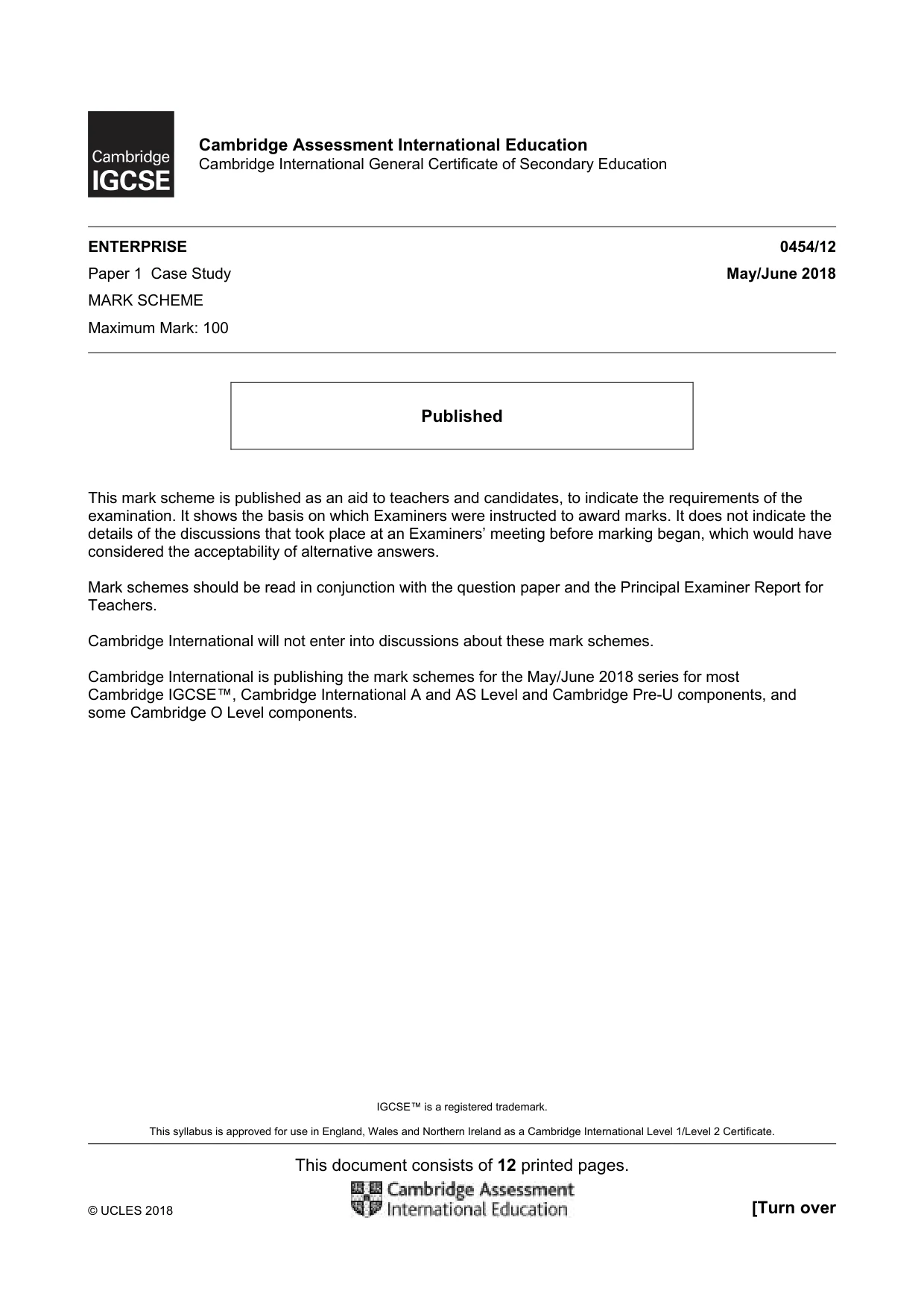
IGCSE™ is a registered trademark. This syllabus is approved for use in England, Wales and Northern Ireland as a Cambridge International Level 1/Level 2 Certificate. This document consists of 12 printed pages. © UCLES 2018 [Turn over Cambridge Assessment International Education Cambridge International General Certificate of Secondary Education ENTERPRISE 0454/12 Paper 1 Case Study May/June 2018 MARK SCHEME Maximum Mark: 100 Published This mark scheme is published as an aid to teachers and candidates, to indicate the requirements of the examination. It shows the basis on which Examiners were instructed to award marks. It does not indicate the details of the discussions that took place at an Examiners’ meeting before marking began, which would have considered the acceptability of alternative answers. Mark schemes should be read in conjunction with the question paper and the Principal Examiner Report for Teachers. Cambridge International will not enter into discussions about these mark schemes. Cambridge International is publishing the mark schemes for the May/June 2018 series for most Cambridge IGCSE™, Cambridge International A and AS Level and Cambridge Pre-U components, and some Cambridge O Level components.
Mark scheme, page 2
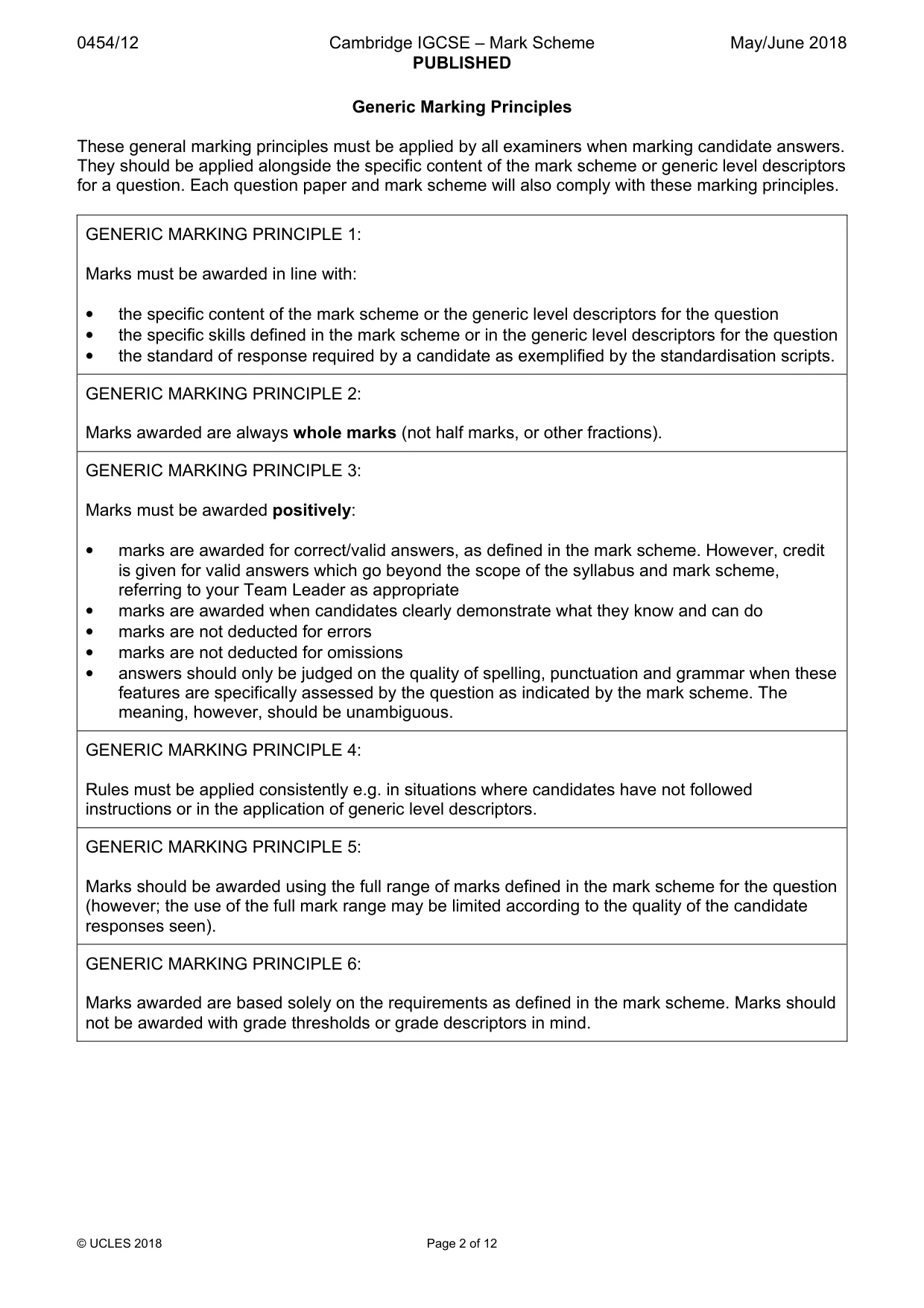
0454/12 Cambridge IGCSE – Mark Scheme PUBLISHED May/June 2018 © UCLES 2018 Page 2 of 12 Generic Marking Principles These general marking principles must be applied by all examiners when marking candidate answers. They should be applied alongside the specific content of the mark scheme or generic level descriptors for a question. Each question paper and mark scheme will also comply with these marking principles. GENERIC MARKING PRINCIPLE 1: Marks must be awarded in line with: • the specific content of the mark scheme or the generic level descriptors for the question • the specific skills defined in the mark scheme or in the generic level descriptors for the question • the standard of response required by a candidate as exemplified by the standardisation scripts. GENERIC MARKING PRINCIPLE 2: Marks awarded are always whole marks (not half marks, or other fractions). GENERIC MARKING PRINCIPLE 3: Marks must be awarded positively: • marks are awarded for correct/valid answers, as defined in the mark scheme. However, credit is given for valid answers which go beyond the scope of the syllabus and mark scheme, referring to your Team Leader as appropriate • marks are awarded when candidates clearly demonstrate what they know and can do • marks are not deducted for errors • marks are not deducted for omissions • answers should only be judged on the quality of spelling, punctuation and grammar when these features are specifically assessed by the question as indicated by the mark scheme. The meaning, however, should be unambiguous. GENERIC MARKING PRINCIPLE 4: Rules must be applied consistently e.g. in situations where candidates have not followed instructions or in the application of generic level descriptors. GENERIC MARKING PRINCIPLE 5: Marks should be awarded using the full range of marks defined in the mark scheme for the question (however; the use of the full mark range may be limited according to the quality of the candidate responses seen). GENERIC MARKING PRINCIPLE 6: Marks awarded are based solely on the requirements as defined in the mark scheme. Marks should not be awarded with grade thresholds or grade descriptors in mind.
Mark scheme, page 3
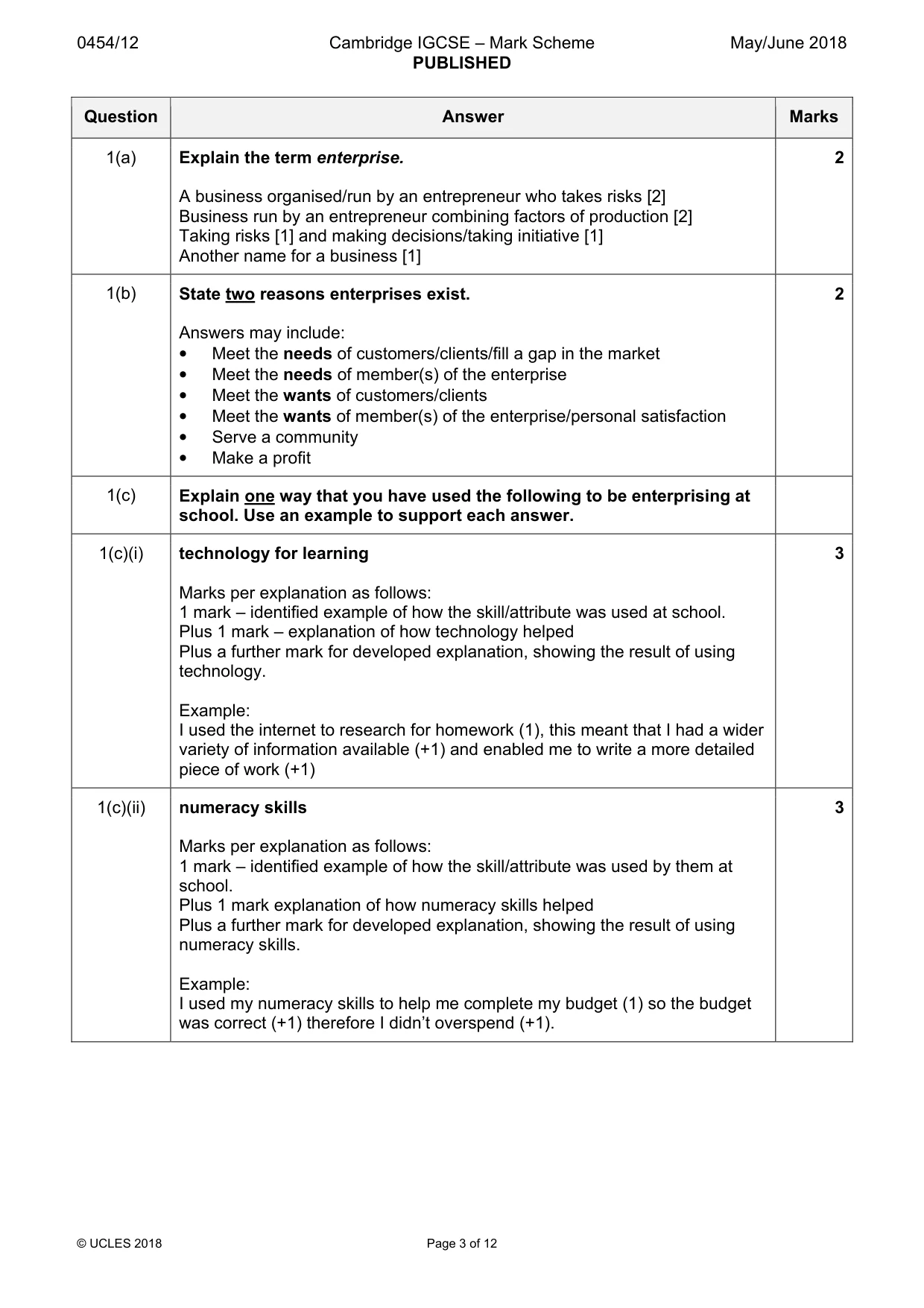
0454/12 Cambridge IGCSE – Mark Scheme PUBLISHED May/June 2018 © UCLES 2018 Page 3 of 12 Question Answer Marks 1(a) Explain the term enterprise. A business organised/run by an entrepreneur who takes risks [2] Business run by an entrepreneur combining factors of production [2] Taking risks [1] and making decisions/taking initiative [1] Another name for a business [1] 2 1(b) State two reasons enterprises exist. Answers may include: • Meet the needs of customers/clients/fill a gap in the market • Meet the needs of member(s) of the enterprise • Meet the wants of customers/clients • Meet the wants of member(s) of the enterprise/personal satisfaction • Serve a community • Make a profit 2 1(c) Explain one way that you have used the following to be enterprising at school. Use an example to support each answer. 1(c)(i) technology for learning Marks per explanation as follows: 1 mark – identified example of how the skill/attribute was used at school. Plus 1 mark – explanation of how technology helped Plus a further mark for developed explanation, showing the result of using technology. Example: I used the internet to research for homework (1), this meant that I had a wider variety of information available (+1) and enabled me to write a more detailed piece of work (+1) 3 1(c)(ii) numeracy skills Marks per explanation as follows: 1 mark – identified example of how the skill/attribute was used by them at school. Plus 1 mark explanation of how numeracy skills helped Plus a further mark for developed explanation, showing the result of using numeracy skills. Example: I used my numeracy skills to help me complete my budget (1) so the budget was correct (+1) therefore I didn’t overspend (+1). 3
Mark scheme, page 4
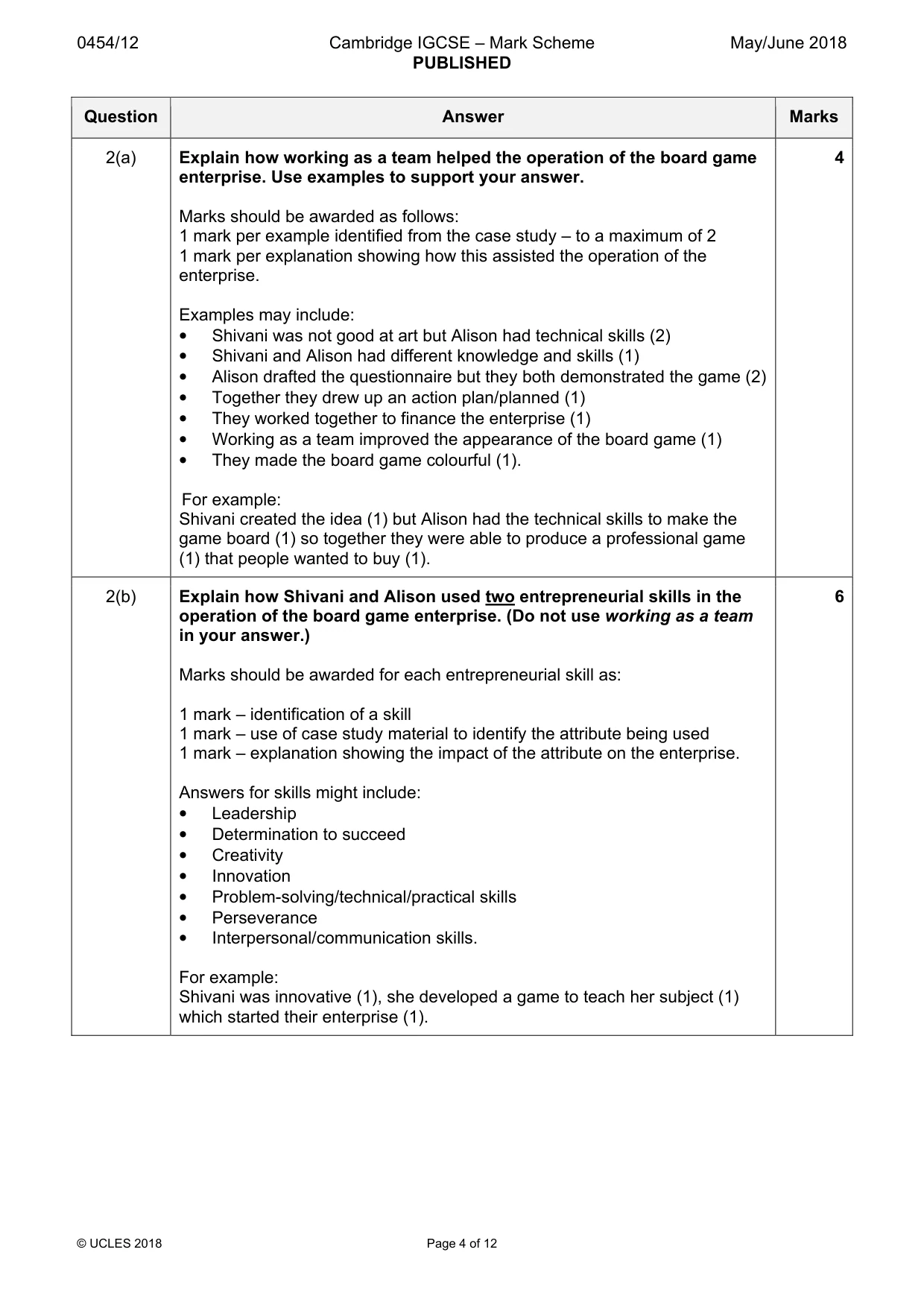
0454/12 Cambridge IGCSE – Mark Scheme PUBLISHED May/June 2018 © UCLES 2018 Page 4 of 12 Question Answer Marks 2(a) Explain how working as a team helped the operation of the board game enterprise. Use examples to support your answer. Marks should be awarded as follows: 1 mark per example identified from the case study – to a maximum of 2 1 mark per explanation showing how this assisted the operation of the enterprise. Examples may include: • Shivani was not good at art but Alison had technical skills (2) • Shivani and Alison had different knowledge and skills (1) • Alison drafted the questionnaire but they both demonstrated the game (2) • Together they drew up an action plan/planned (1) • They worked together to finance the enterprise (1) • Working as a team improved the appearance of the board game (1) • They made the board game colourful (1). For example: Shivani created the idea (1) but Alison had the technical skills to make the game board (1) so together they were able to produce a professional game (1) that people wanted to buy (1). 4 2(b) Explain how Shivani and Alison used two entrepreneurial skills in the operation of the board game enterprise. (Do not use working as a team in your answer.) Marks should be awarded for each entrepreneurial skill as: 1 mark – identification of a skill 1 mark – use of case study material to identify the attribute being used 1 mark – explanation showing the impact of the attribute on the enterprise. Answers for skills might include: • Leadership • Determination to succeed • Creativity • Innovation • Problem-solving/technical/practical skills • Perseverance • Interpersonal/communication skills. For example: Shivani was innovative (1), she developed a game to teach her subject (1) which started their enterprise (1). 6
Mark scheme, page 5
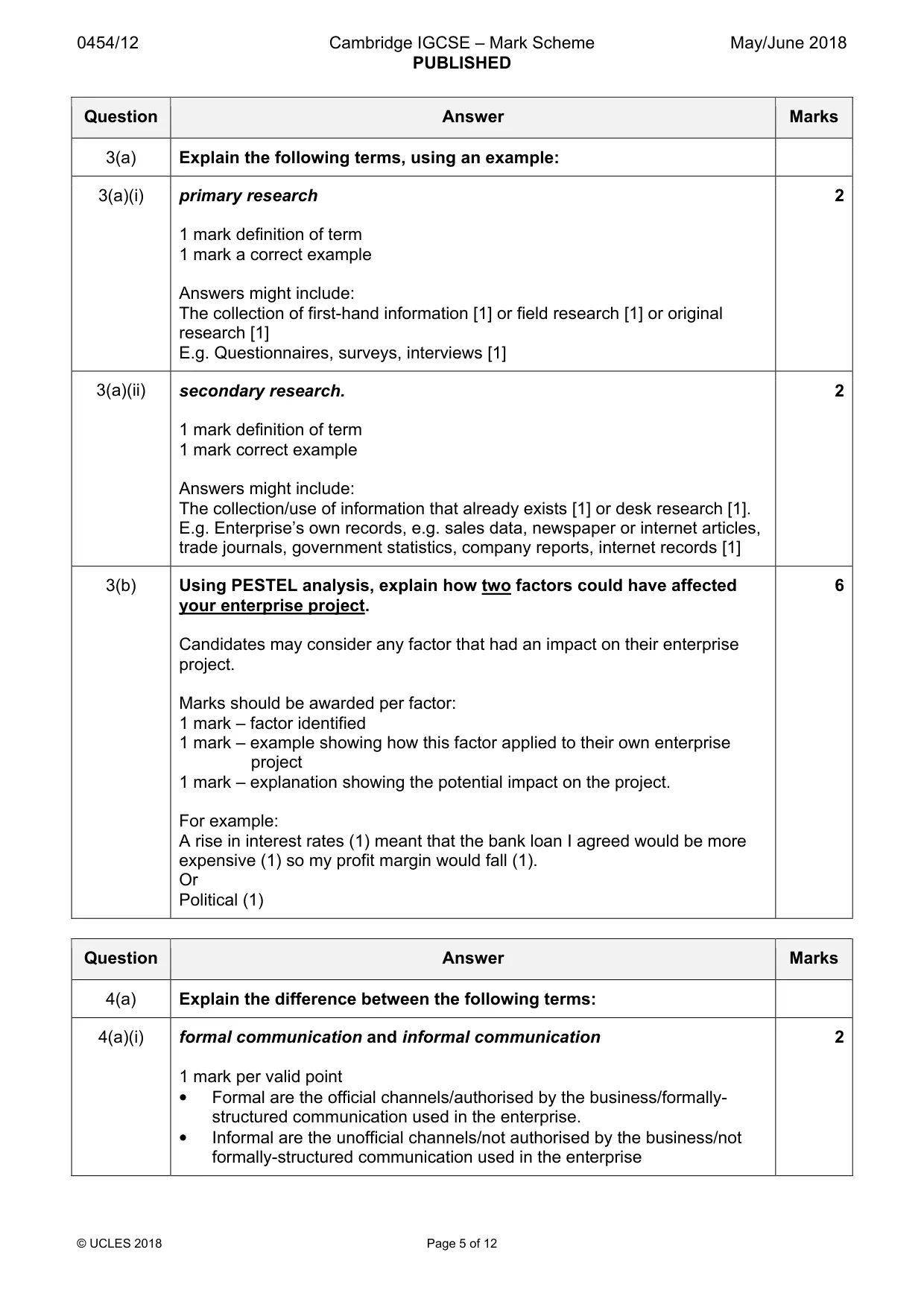
0454/12 Cambridge IGCSE – Mark Scheme PUBLISHED May/June 2018 © UCLES 2018 Page 5 of 12 Question Answer Marks 3(a) Explain the following terms, using an example: 3(a)(i) primary research 1 mark definition of term 1 mark a correct example Answers might include: The collection of first-hand information [1] or field research [1] or original research [1] E.g. Questionnaires, surveys, interviews [1] 2 3(a)(ii) secondary research. 1 mark definition of term 1 mark correct example Answers might include: The collection/use of information that already exists [1] or desk research [1]. E.g. Enterprise’s own records, e.g. sales data, newspaper or internet articles, trade journals, government statistics, company reports, internet records [1] 2 3(b) Using PESTEL analysis, explain how two factors could have affected your enterprise project. Candidates may consider any factor that had an impact on their enterprise project. Marks should be awarded per factor: 1 mark – factor identified 1 mark – example showing how this factor applied to their own enterprise project 1 mark – explanation showing the potential impact on the project. For example: A rise in interest rates (1) meant that the bank loan I agreed would be more expensive (1) so my profit margin would fall (1). Or Political (1) 6 Question Answer Marks 4(a) Explain the difference between the following terms: 4(a)(i) formal communication and informal communication 1 mark per valid point • Formal are the official channels/authorised by the business/formally- structured communication used in the enterprise. • Informal are the unofficial channels/not authorised by the business/not formally-structured communication used in the enterprise 2
Mark scheme, page 6
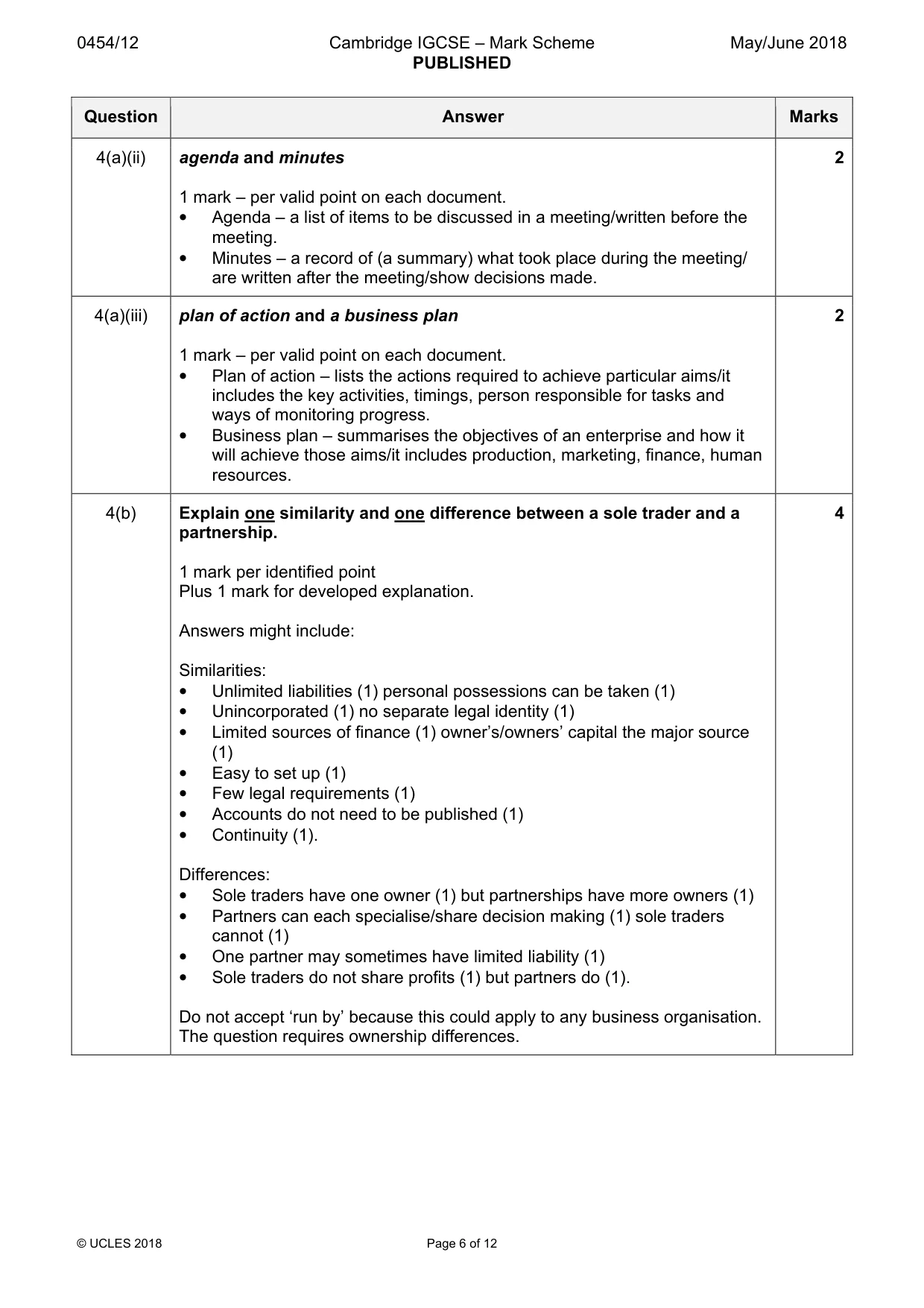
0454/12 Cambridge IGCSE – Mark Scheme PUBLISHED May/June 2018 © UCLES 2018 Page 6 of 12 Question Answer Marks 4(a)(ii) agenda and minutes 1 mark – per valid point on each document. • Agenda – a list of items to be discussed in a meeting/written before the meeting. • Minutes – a record of (a summary) what took place during the meeting/ are written after the meeting/show decisions made. 2 4(a)(iii) plan of action and a business plan 1 mark – per valid point on each document. • Plan of action – lists the actions required to achieve particular aims/it includes the key activities, timings, person responsible for tasks and ways of monitoring progress. • Business plan – summarises the objectives of an enterprise and how it will achieve those aims/it includes production, marketing, finance, human resources. 2 4(b) Explain one similarity and one difference between a sole trader and a partnership. 1 mark per identified point Plus 1 mark for developed explanation. Answers might include: Similarities: • Unlimited liabilities (1) personal possessions can be taken (1) • Unincorporated (1) no separate legal identity (1) • Limited sources of finance (1) owner’s/owners’ capital the major source (1) • Easy to set up (1) • Few legal requirements (1) • Accounts do not need to be published (1) • Continuity (1). Differences: • Sole traders have one owner (1) but partnerships have more owners (1) • Partners can each specialise/share decision making (1) sole traders cannot (1) • One partner may sometimes have limited liability (1) • Sole traders do not share profits (1) but partners do (1). Do not accept ‘run by’ because this could apply to any business organisation. The question requires ownership differences. 4
Mark scheme, page 7
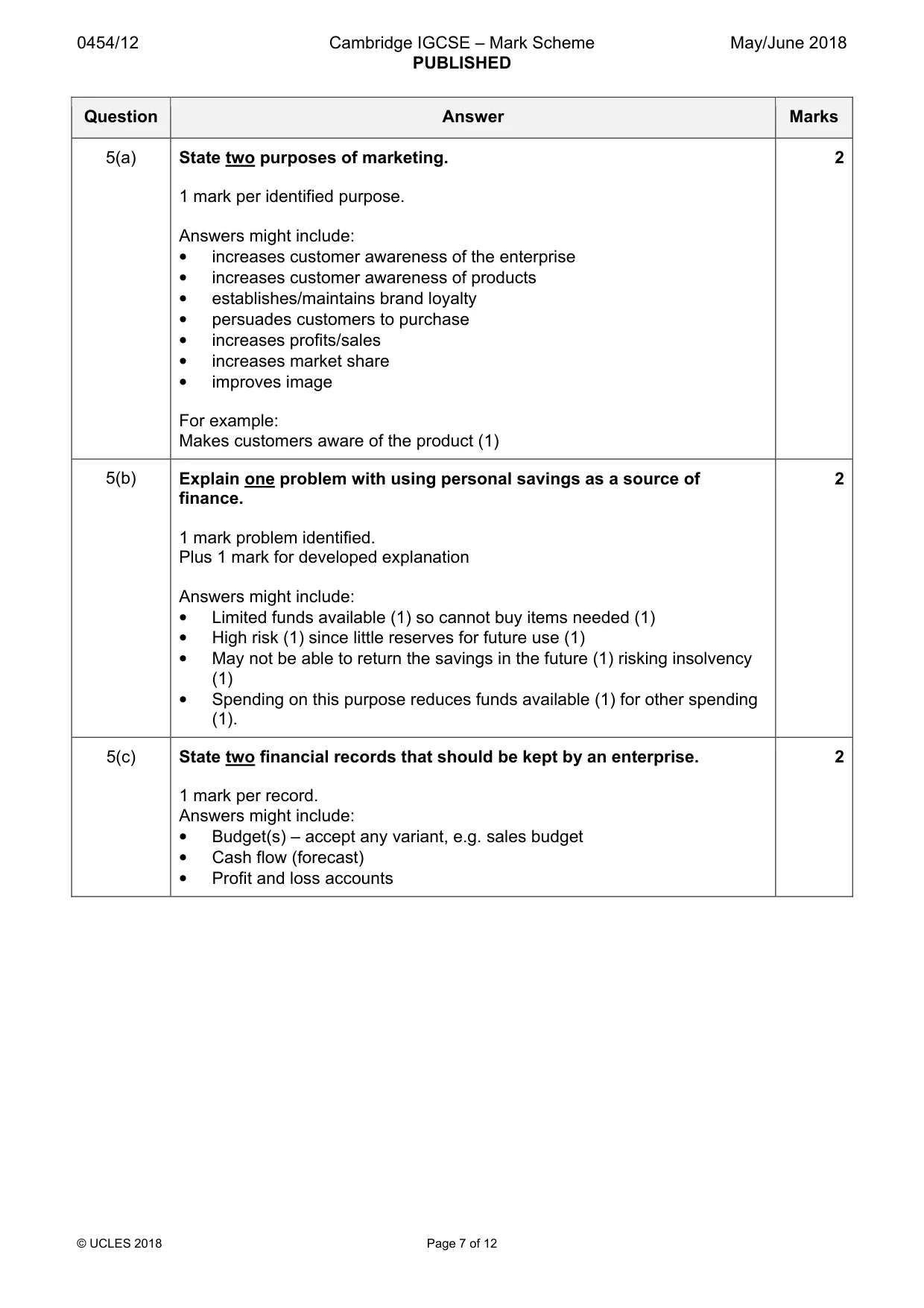
0454/12 Cambridge IGCSE – Mark Scheme PUBLISHED May/June 2018 © UCLES 2018 Page 7 of 12 Question Answer Marks 5(a) State two purposes of marketing. 1 mark per identified purpose. Answers might include: • increases customer awareness of the enterprise • increases customer awareness of products • establishes/maintains brand loyalty • persuades customers to purchase • increases profits/sales • increases market share • improves image For example: Makes customers aware of the product (1) 2 5(b) Explain one problem with using personal savings as a source of finance. 1 mark problem identified. Plus 1 mark for developed explanation Answers might include: • Limited funds available (1) so cannot buy items needed (1) • High risk (1) since little reserves for future use (1) • May not be able to return the savings in the future (1) risking insolvency (1) • Spending on this purpose reduces funds available (1) for other spending (1). 2 5(c) State two financial records that should be kept by an enterprise. 1 mark per record. Answers might include: • Budget(s) – accept any variant, e.g. sales budget • Cash flow (forecast) • Profit and loss accounts 2
Mark scheme, page 8
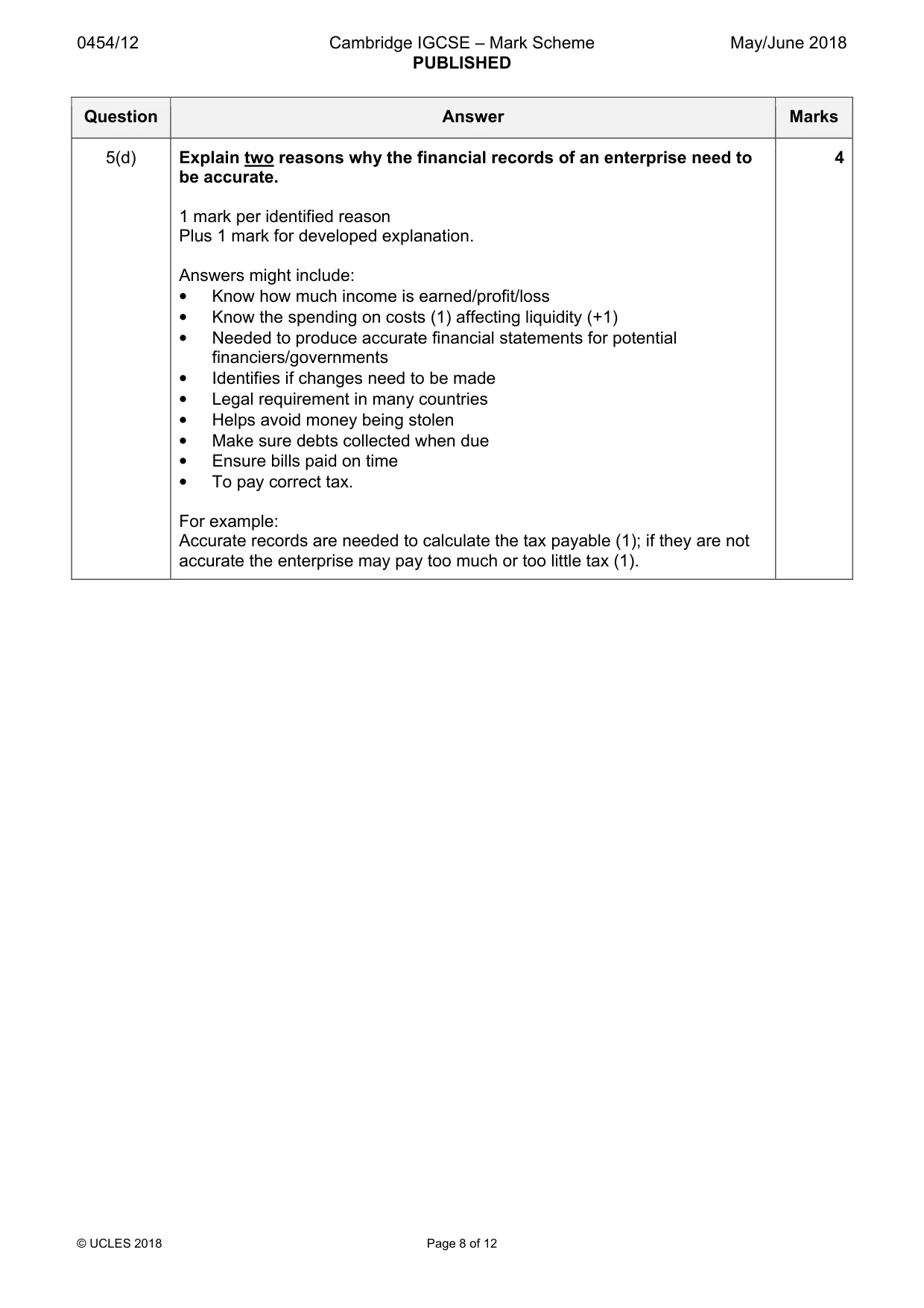
0454/12 Cambridge IGCSE – Mark Scheme PUBLISHED May/June 2018 © UCLES 2018 Page 8 of 12 Question Answer Marks 5(d) Explain two reasons why the financial records of an enterprise need to be accurate. 1 mark per identified reason Plus 1 mark for developed explanation. Answers might include: • Know how much income is earned/profit/loss • Know the spending on costs (1) affecting liquidity (+1) • Needed to produce accurate financial statements for potential financiers/governments • Identifies if changes need to be made • Legal requirement in many countries • Helps avoid money being stolen • Make sure debts collected when due • Ensure bills paid on time • To pay correct tax. For example: Accurate records are needed to calculate the tax payable (1); if they are not accurate the enterprise may pay too much or too little tax (1). 4
Mark scheme, page 9
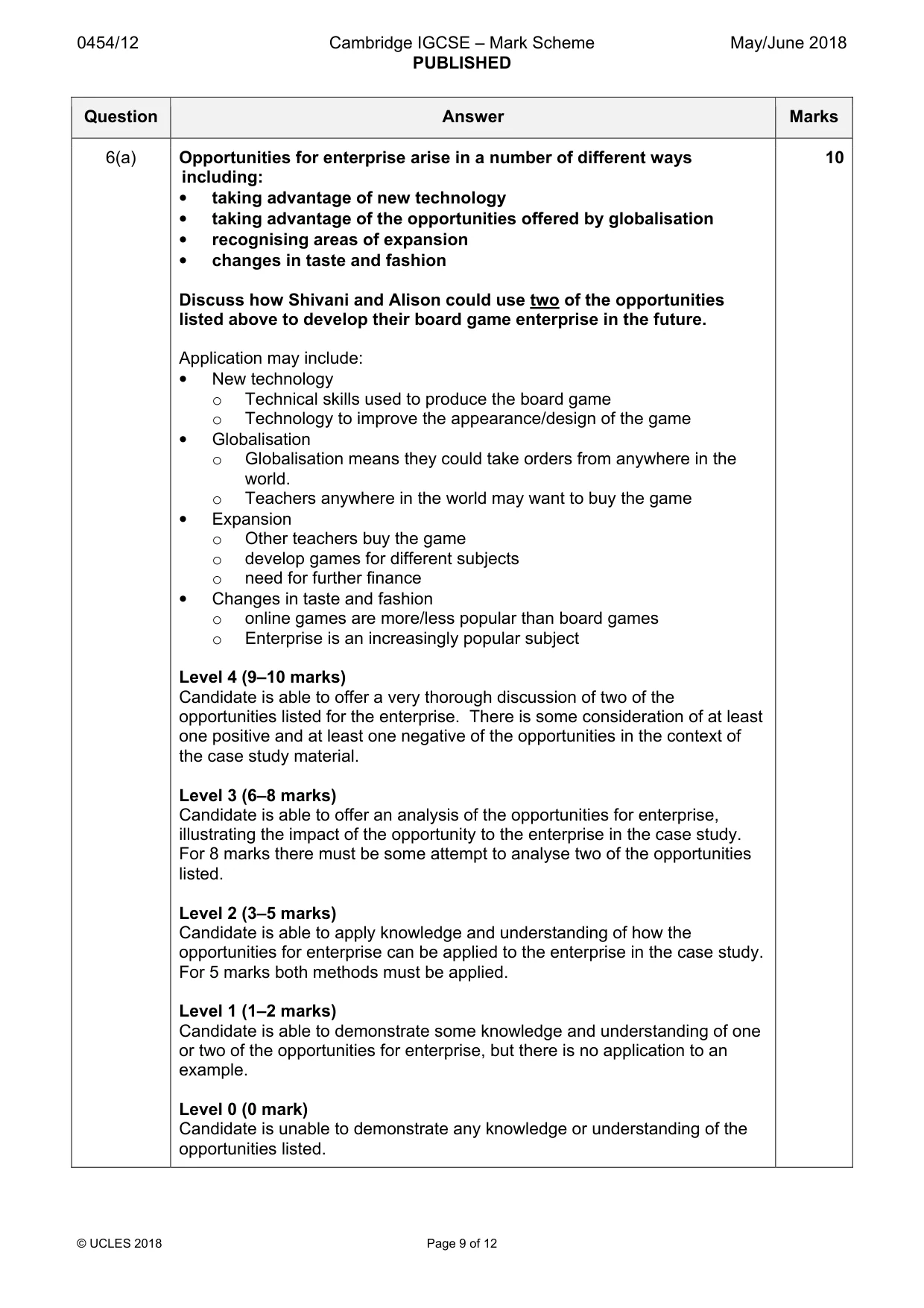
0454/12 Cambridge IGCSE – Mark Scheme PUBLISHED May/June 2018 © UCLES 2018 Page 9 of 12 Question Answer Marks 6(a) Opportunities for enterprise arise in a number of different ways including: • taking advantage of new technology • taking advantage of the opportunities offered by globalisation • recognising areas of expansion • changes in taste and fashion Discuss how Shivani and Alison could use two of the opportunities listed above to develop their board game enterprise in the future. Application may include: • New technology o Technical skills used to produce the board game o Technology to improve the appearance/design of the game • Globalisation o Globalisation means they could take orders from anywhere in the world. o Teachers anywhere in the world may want to buy the game • Expansion o Other teachers buy the game o develop games for different subjects o need for further finance • Changes in taste and fashion o online games are more/less popular than board games o Enterprise is an increasingly popular subject Level 4 (9–10 marks) Candidate is able to offer a very thorough discussion of two of the opportunities listed for the enterprise. There is some consideration of at least one positive and at least one negative of the opportunities in the context of the case study material. Level 3 (6–8 marks) Candidate is able to offer an analysis of the opportunities for enterprise, illustrating the impact of the opportunity to the enterprise in the case study. For 8 marks there must be some attempt to analyse two of the opportunities listed. Level 2 (3–5 marks) Candidate is able to apply knowledge and understanding of how the opportunities for enterprise can be applied to the enterprise in the case study. For 5 marks both methods must be applied. Level 1 (1–2 marks) Candidate is able to demonstrate some knowledge and understanding of one or two of the opportunities for enterprise, but there is no application to an example. Level 0 (0 mark) Candidate is unable to demonstrate any knowledge or understanding of the opportunities listed. 10
Mark scheme, page 10
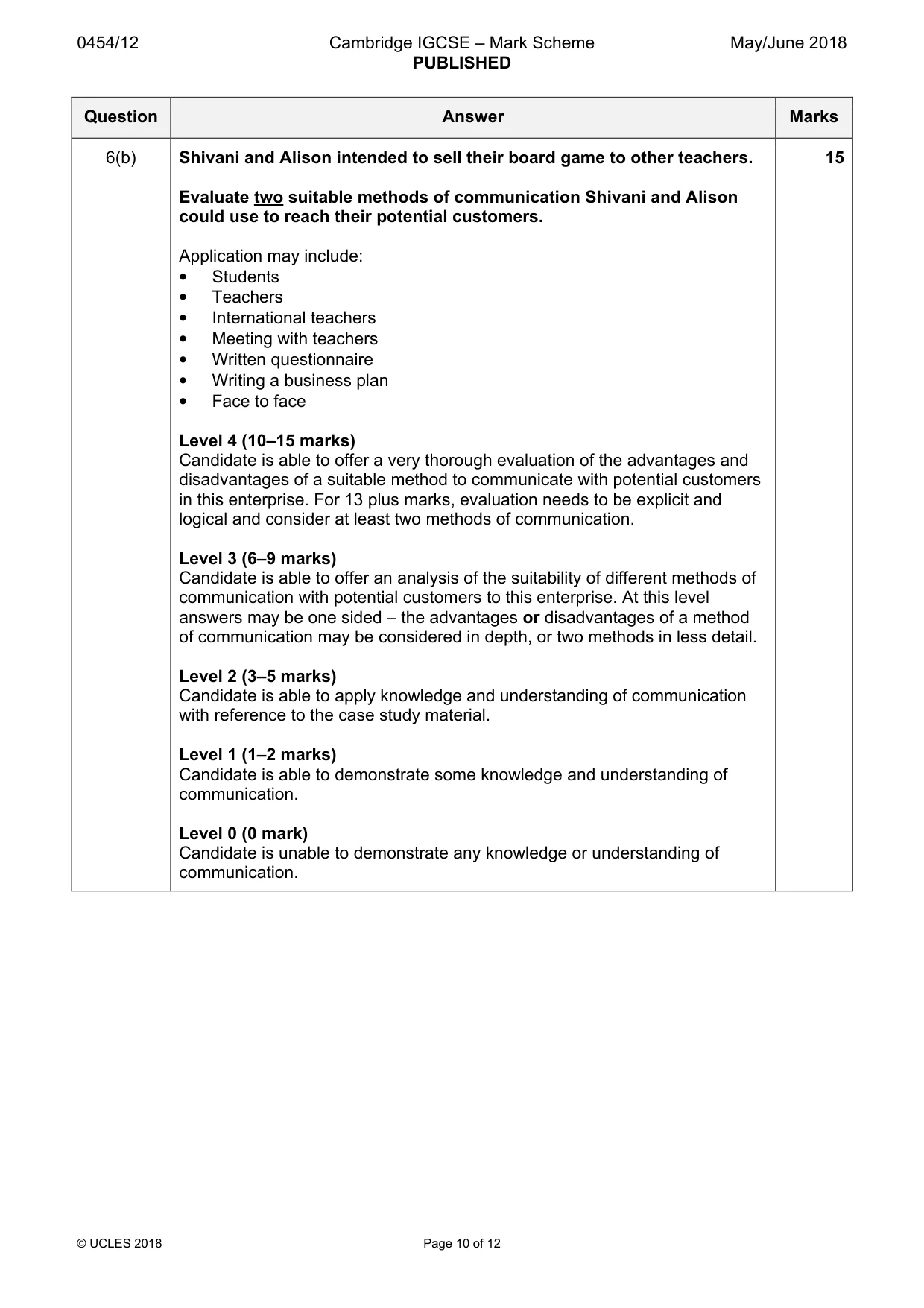
0454/12 Cambridge IGCSE – Mark Scheme PUBLISHED May/June 2018 © UCLES 2018 Page 10 of 12 Question Answer Marks 6(b) Shivani and Alison intended to sell their board game to other teachers. Evaluate two suitable methods of communication Shivani and Alison could use to reach their potential customers. Application may include: • Students • Teachers • International teachers • Meeting with teachers • Written questionnaire • Writing a business plan • Face to face Level 4 (10–15 marks) Candidate is able to offer a very thorough evaluation of the advantages and disadvantages of a suitable method to communicate with potential customers in this enterprise. For 13 plus marks, evaluation needs to be explicit and logical and consider at least two methods of communication. Level 3 (6–9 marks) Candidate is able to offer an analysis of the suitability of different methods of communication with potential customers to this enterprise. At this level answers may be one sided – the advantages or disadvantages of a method of communication may be considered in depth, or two methods in less detail. Level 2 (3–5 marks) Candidate is able to apply knowledge and understanding of communication with reference to the case study material. Level 1 (1–2 marks) Candidate is able to demonstrate some knowledge and understanding of communication. Level 0 (0 mark) Candidate is unable to demonstrate any knowledge or understanding of communication. 15
Mark scheme, page 11
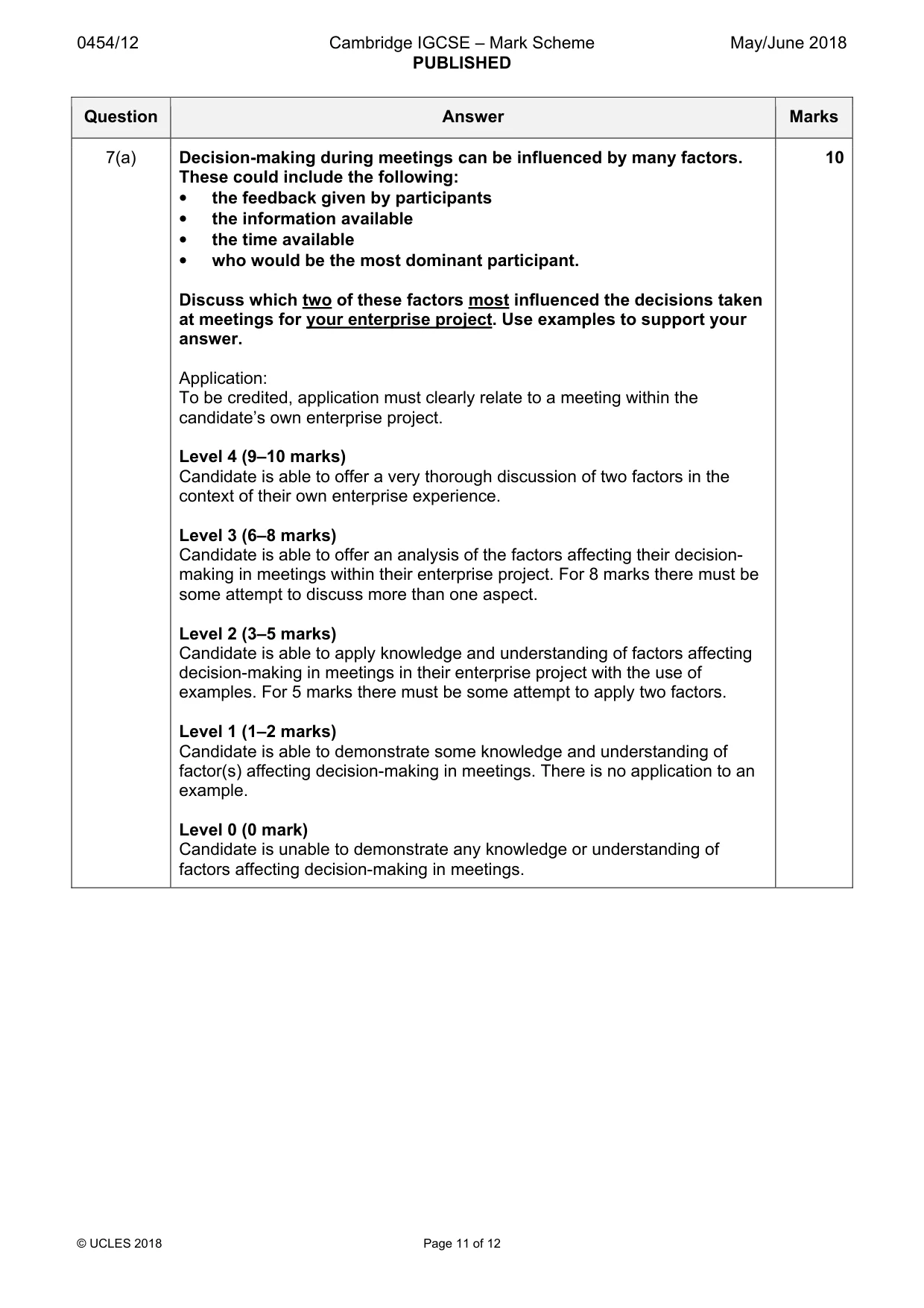
0454/12 Cambridge IGCSE – Mark Scheme PUBLISHED May/June 2018 © UCLES 2018 Page 11 of 12 Question Answer Marks 7(a) Decision-making during meetings can be influenced by many factors. These could include the following: • the feedback given by participants • the information available • the time available • who would be the most dominant participant. Discuss which two of these factors most influenced the decisions taken at meetings for your enterprise project. Use examples to support your answer. Application: To be credited, application must clearly relate to a meeting within the candidate’s own enterprise project. Level 4 (9–10 marks) Candidate is able to offer a very thorough discussion of two factors in the context of their own enterprise experience. Level 3 (6–8 marks) Candidate is able to offer an analysis of the factors affecting their decision- making in meetings within their enterprise project. For 8 marks there must be some attempt to discuss more than one aspect. Level 2 (3–5 marks) Candidate is able to apply knowledge and understanding of factors affecting decision-making in meetings in their enterprise project with the use of examples. For 5 marks there must be some attempt to apply two factors. Level 1 (1–2 marks) Candidate is able to demonstrate some knowledge and understanding of factor(s) affecting decision-making in meetings. There is no application to an example. Level 0 (0 mark) Candidate is unable to demonstrate any knowledge or understanding of factors affecting decision-making in meetings. 10
Mark scheme, page 12
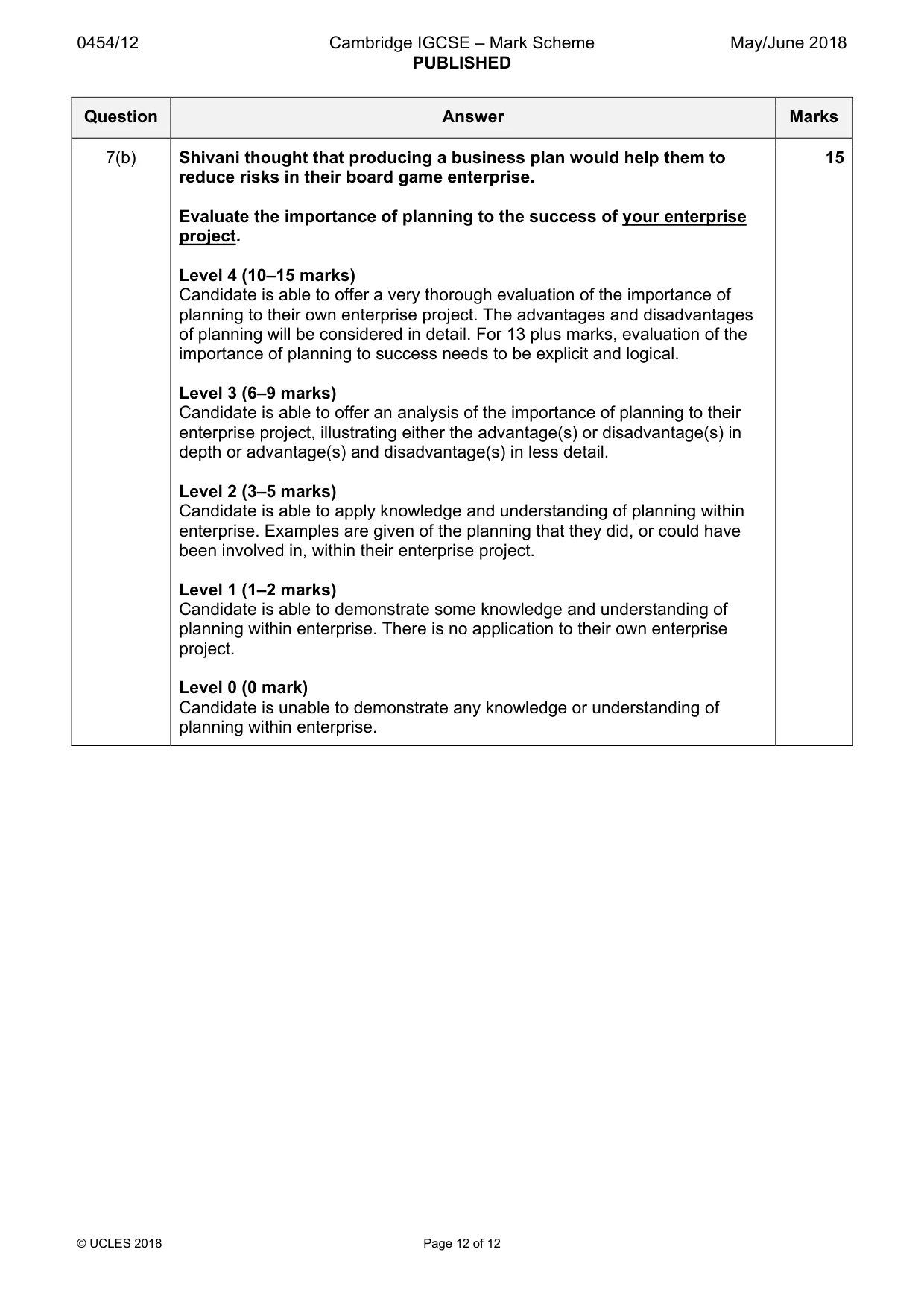
0454/12 Cambridge IGCSE – Mark Scheme PUBLISHED May/June 2018 © UCLES 2018 Page 12 of 12 Question Answer Marks 7(b) Shivani thought that producing a business plan would help them to reduce risks in their board game enterprise. Evaluate the importance of planning to the success of your enterprise project. Level 4 (10–15 marks) Candidate is able to offer a very thorough evaluation of the importance of planning to their own enterprise project. The advantages and disadvantages of planning will be considered in detail. For 13 plus marks, evaluation of the importance of planning to success needs to be explicit and logical. Level 3 (6–9 marks) Candidate is able to offer an analysis of the importance of planning to their enterprise project, illustrating either the advantage(s) or disadvantage(s) in depth or advantage(s) and disadvantage(s) in less detail. Level 2 (3–5 marks) Candidate is able to apply knowledge and understanding of planning within enterprise. Examples are given of the planning that they did, or could have been involved in, within their enterprise project. Level 1 (1–2 marks) Candidate is able to demonstrate some knowledge and understanding of planning within enterprise. There is no application to their own enterprise project. Level 0 (0 mark) Candidate is unable to demonstrate any knowledge or understanding of planning within enterprise. 15
What you needed in this session
Cambridge’s own grade thresholds for 2018 May/June, Paper 1 · Variant 2. A higher threshold means an easier paper — the bar moves with how the cohort did.