Cambridge IGCSE Enterprise 0454 — 2017 May/June Paper 1 · Variant 3
0454/13/M/J/17 · 100 marks · ≈113 min
The question paper and its mark scheme, free to read here and free to download. This is Cambridge’s own paper, exactly as it was sat.
Question paper16 pages






Mark scheme10 pages
Answers below. Sit the paper first if you are practising.
Paper as text
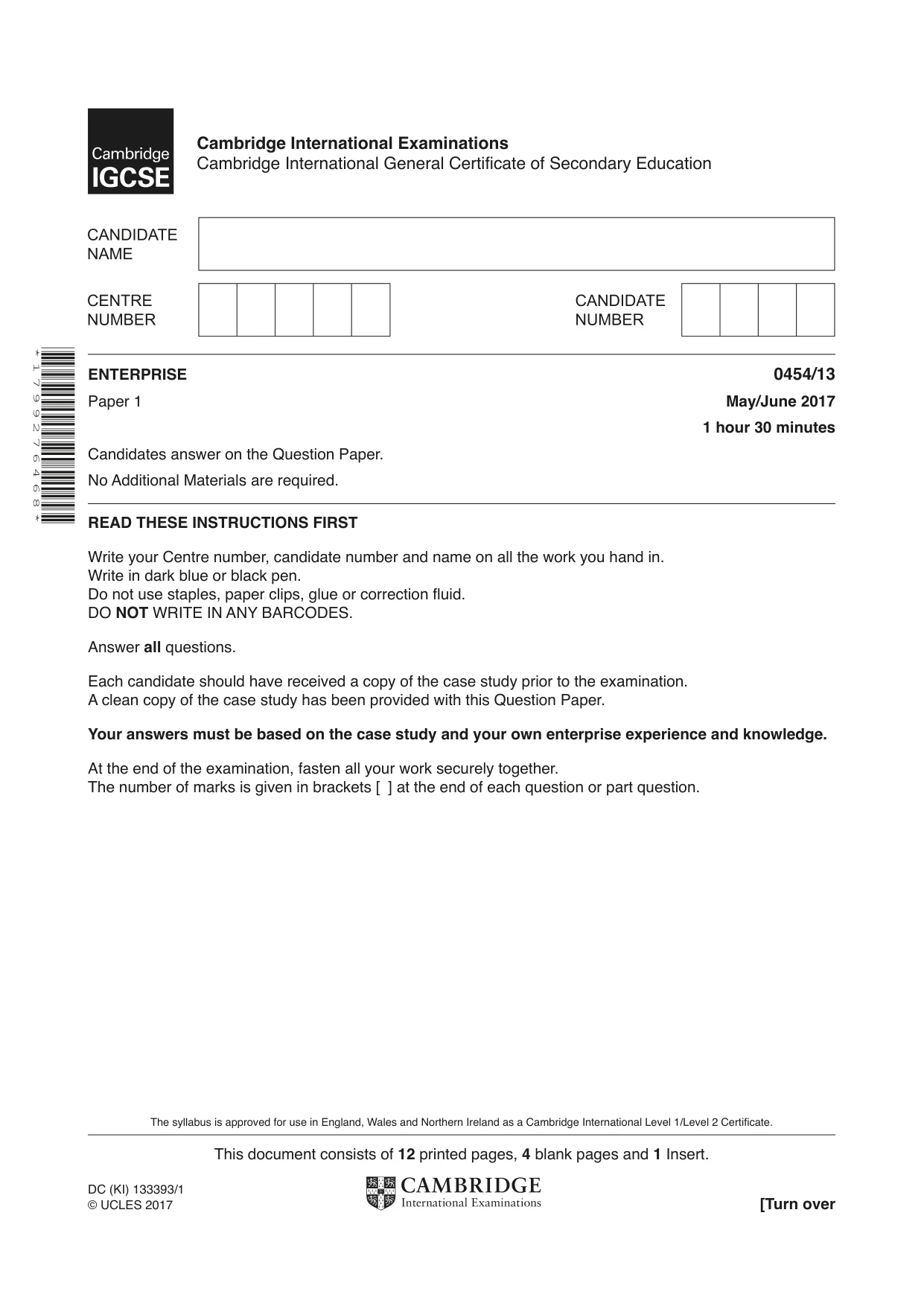
Question paper, page 1
This document consists of 12 printed pages, 4 blank pages and 1 Insert. DC (KI) 133393/1 © UCLES 2017 [Turn over Cambridge International Examinations Cambridge International General Certificate of Secondary Education * 1 7 9 9 2 7 6 4 6 8 * ENTERPRISE 0454/13 Paper 1 May/June 2017 1 hour 30 minutes Candidates answer on the Question Paper. No Additional Materials are required. READ THESE INSTRUCTIONS FIRST Write your Centre number, candidate number and name on all the work you hand in. Write in dark blue or black pen. Do not use staples, paper clips, glue or correction fluid. DO NOT WRITE IN ANY BARCODES. Answer all questions. Each candidate should have received a copy of the case study prior to the examination. A clean copy of the case study has been provided with this Question Paper. Your answers must be based on the case study and your own enterprise experience and knowledge. At the end of the examination, fasten all your work securely together. The number of marks is given in brackets [ ] at the end of each question or part question. The syllabus is approved for use in England, Wales and Northern Ireland as a Cambridge International Level 1/Level 2 Certificate.
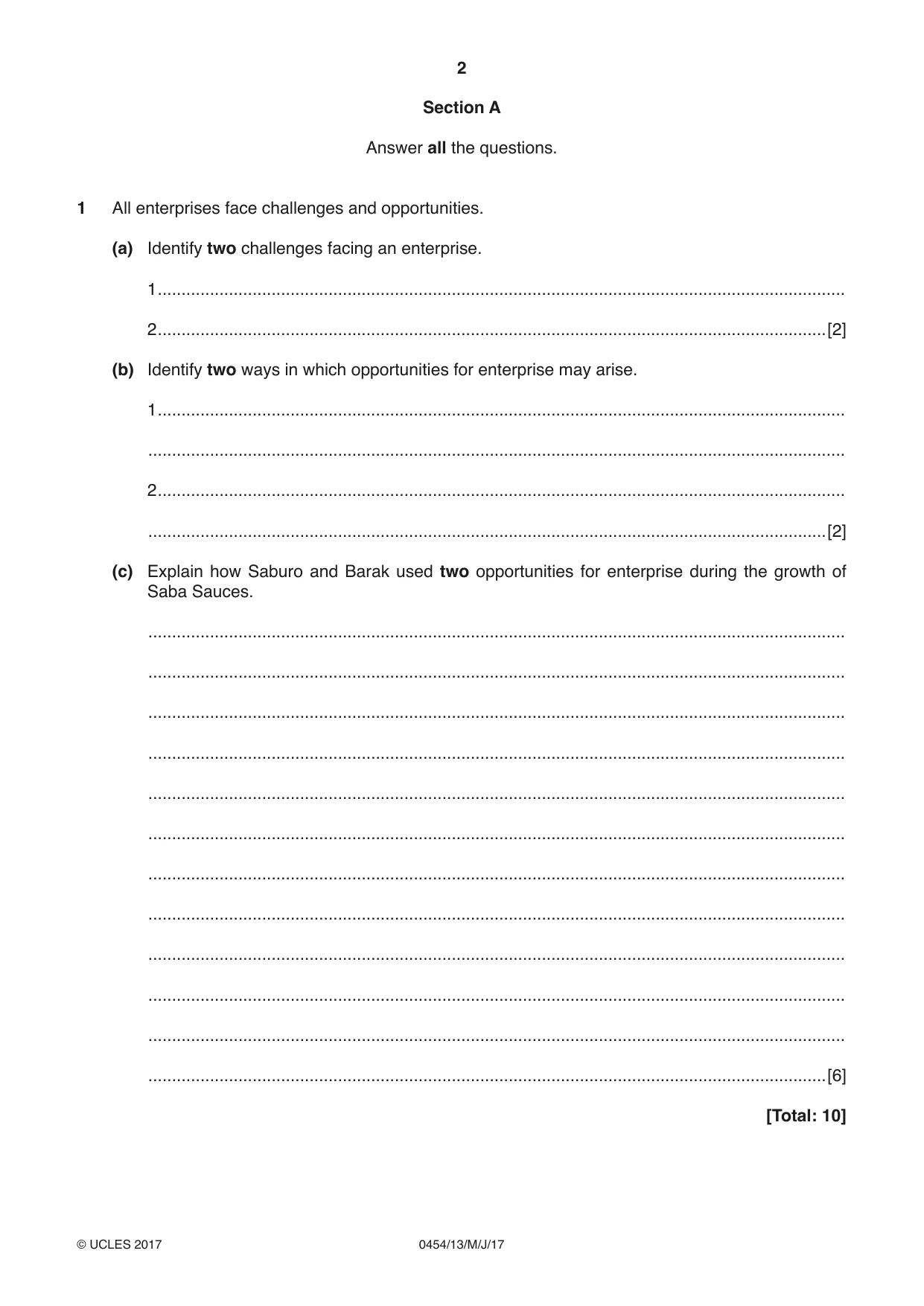
Question paper, page 2
2 0454/13/M/J/17 © UCLES 2017 Section A Answer all the questions. 1 All enterprises face challenges and opportunities. (a) Identify two challenges facing an enterprise. 1 … 2 …[2] (b) Identify two ways in which opportunities for enterprise may arise. 1 … … 2 … …[2] (c) Explain how Saburo and Barak used two opportunities for enterprise during the growth of Saba Sauces. … … … … … … … … … … … …[6] [Total: 10]
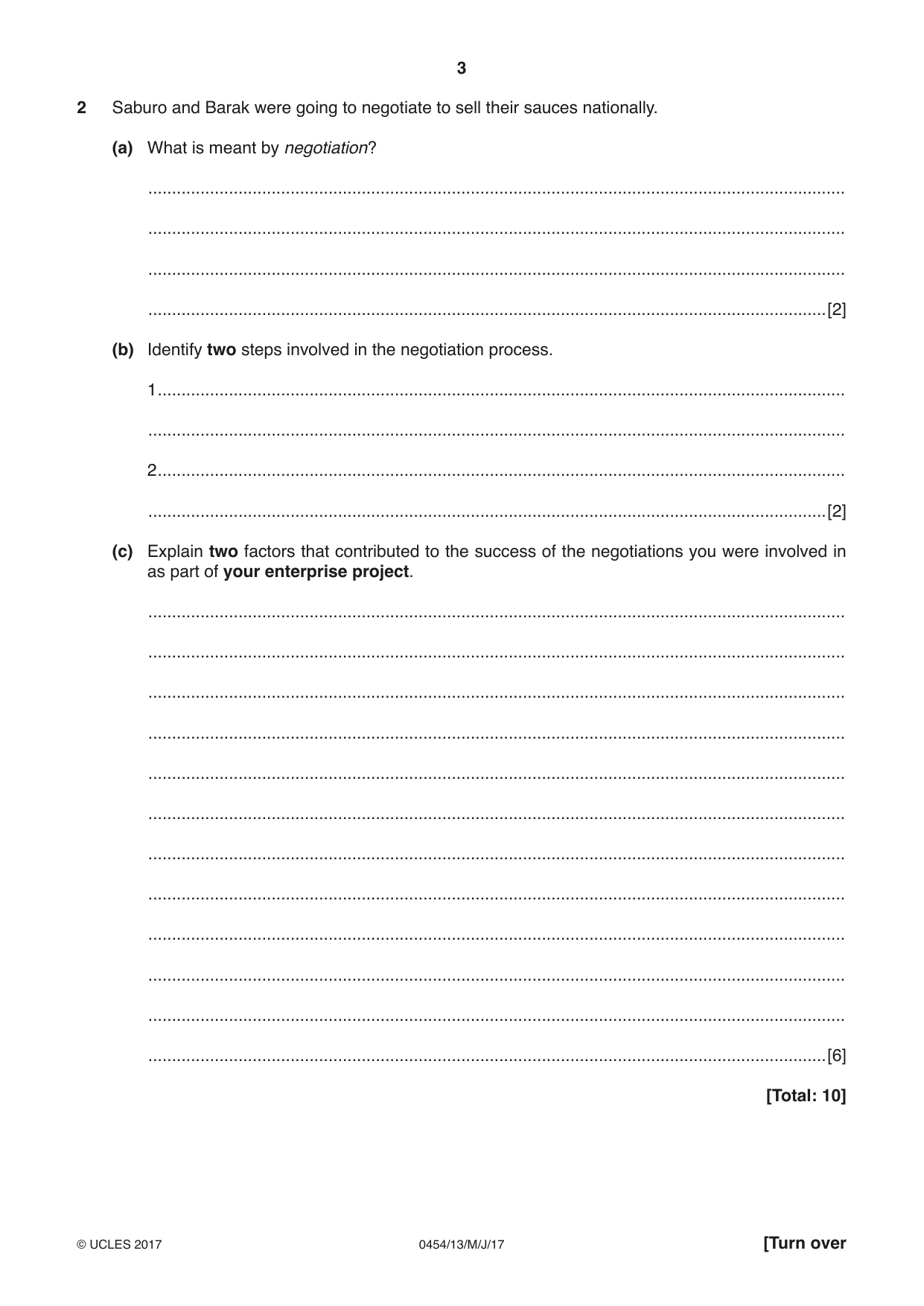
Question paper, page 3
3 0454/13/M/J/17 © UCLES 2017 [Turn over 2 Saburo and Barak were going to negotiate to sell their sauces nationally. (a) What is meant by negotiation? … … … …[2] (b) Identify two steps involved in the negotiation process. 1 … … 2 … …[2] (c) Explain two factors that contributed to the success of the negotiations you were involved in as part of your enterprise project. … … … … … … … … … … … …[6] [Total: 10]
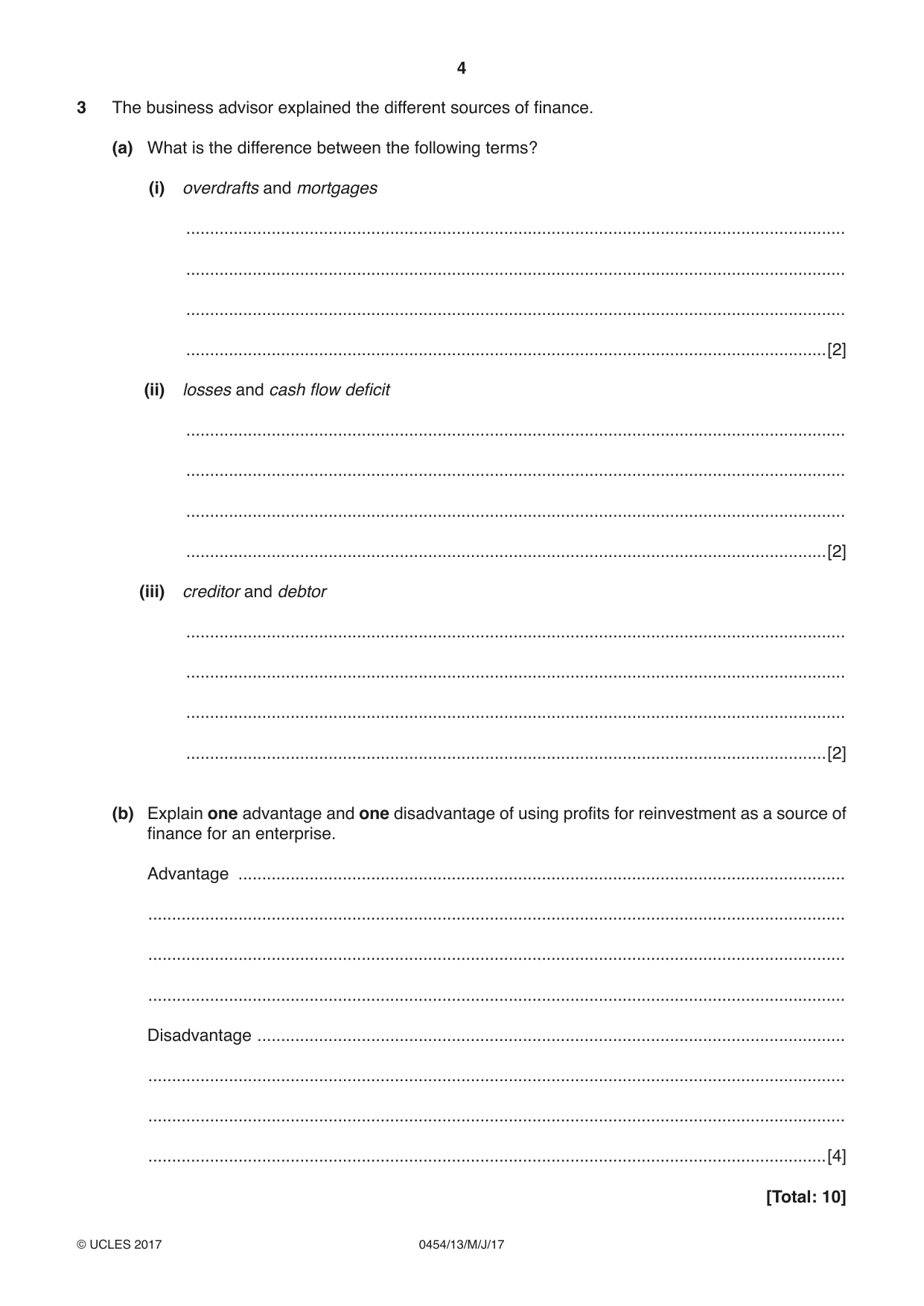
Question paper, page 4
4 0454/13/M/J/17 © UCLES 2017 3 The business advisor explained the different sources of finance. (a) What is the difference between the following terms? (i) overdrafts and mortgages … … … …[2] (ii) losses and cash flow deficit … … … …[2] (iii) creditor and debtor … … … …[2] (b) Explain one advantage and one disadvantage of using profits for reinvestment as a source of finance for an enterprise. Advantage … … … … Disadvantage … … … …[4] [Total: 10]
Question paper, page 5
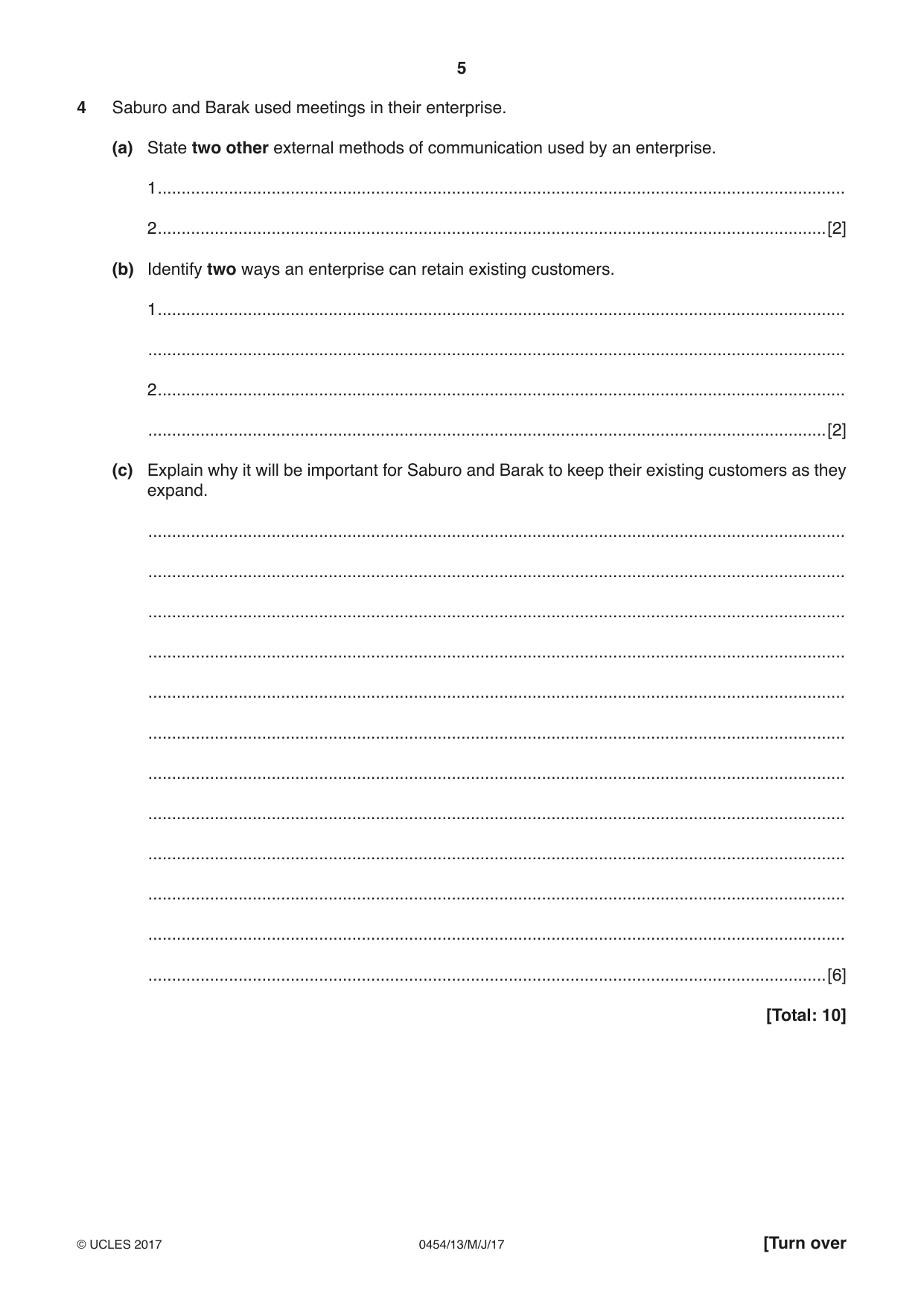
5 0454/13/M/J/17 © UCLES 2017 [Turn over 4 Saburo and Barak used meetings in their enterprise. (a) State two other external methods of communication used by an enterprise. 1 … 2 …[2] (b) Identify two ways an enterprise can retain existing customers. 1 … … 2 … …[2] (c) Explain why it will be important for Saburo and Barak to keep their existing customers as they expand. … … … … … … … … … … … …[6] [Total: 10]
Question paper, page 6
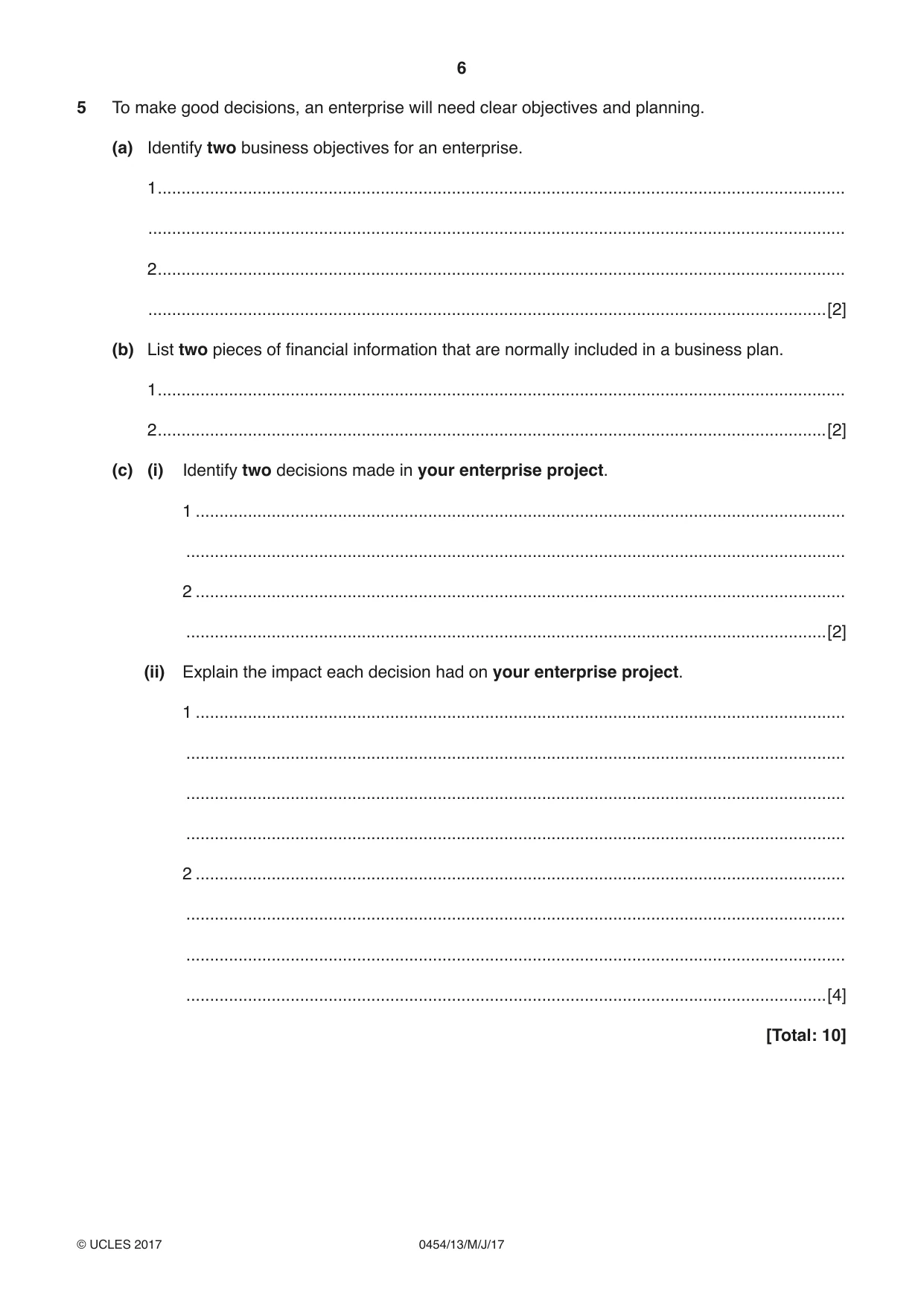
6 0454/13/M/J/17 © UCLES 2017 5 To make good decisions, an enterprise will need clear objectives and planning. (a) Identify two business objectives for an enterprise. 1 … … 2 … …[2] (b) List two pieces of financial information that are normally included in a business plan. 1 … 2 …[2] (c) (i) Identify two decisions made in your enterprise project. 1 … … 2 … …[2] (ii) Explain the impact each decision had on your enterprise project. 1 … … … … 2 … … … …[4] [Total: 10]
Question paper, page 7
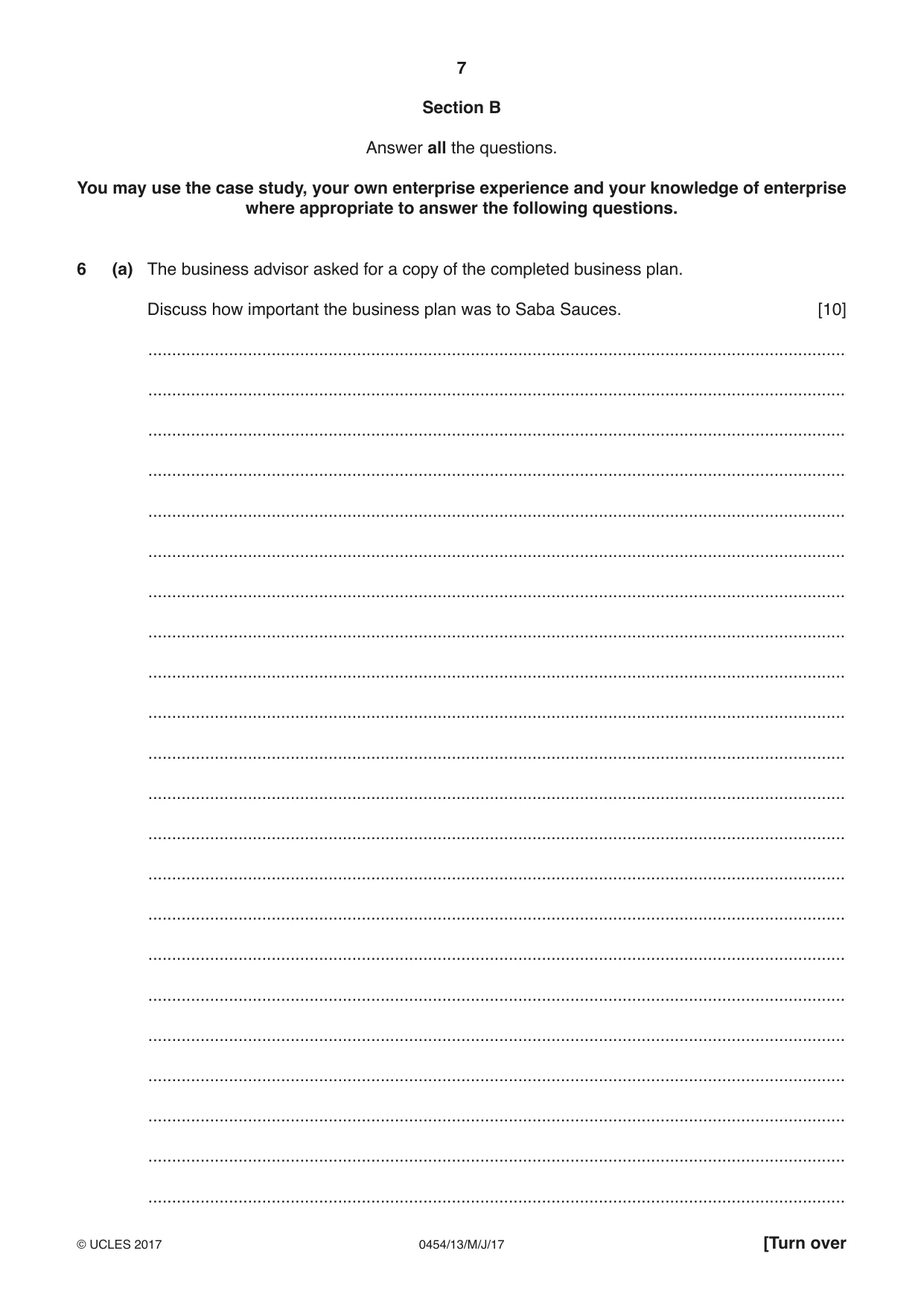
7 0454/13/M/J/17 © UCLES 2017 [Turn over Section B Answer all the questions. You may use the case study, your own enterprise experience and your knowledge of enterprise where appropriate to answer the following questions. 6 (a) The business advisor asked for a copy of the completed business plan. Discuss how important the business plan was to Saba Sauces. [10] … … … … … … … … … … … … … … … … … … … … … …
Question paper, page 8
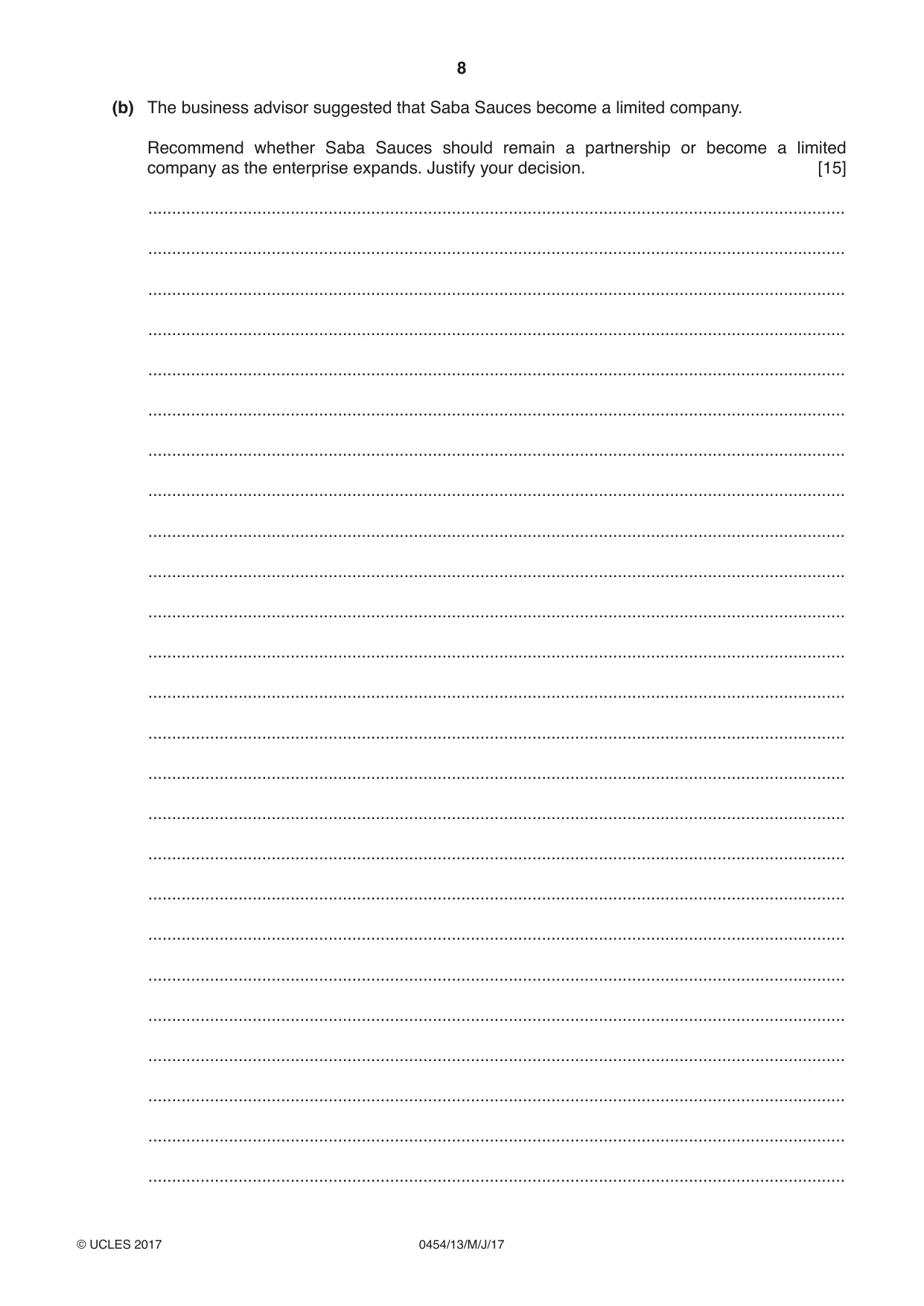
8 0454/13/M/J/17 © UCLES 2017 (b) The business advisor suggested that Saba Sauces become a limited company. Recommend whether Saba Sauces should remain a partnership or become a limited company as the enterprise expands. Justify your decision. [15] … … … … … … … … … … … … … … … … … … … … … … … … …
Question paper, page 9
9 0454/13/M/J/17 © UCLES 2017 [Turn over … … … … … … … … … … … … … … … … … … … … … … … … … … … [Total: 25]
Question paper, page 10
10 0454/13/M/J/17 © UCLES 2017 BLANK PAGE
Question paper, page 11
11 0454/13/M/J/17 © UCLES 2017 [Turn over 7 (a) As a food manufacturer, Saba Sauces is affected by many laws and regulations. Discuss how laws and regulations affected, or could have affected, the operation of your enterprise project. [10] … … … … … … … … … … … … … … … … … … … … … … … … …
Question paper, page 12
12 0454/13/M/J/17 © UCLES 2017 (b) Saburo and Barak had not completed any market research before starting their enterprise. They considered using: • a questionnaire • interviews with potential customers • internet research • records of similar enterprises Evaluate two of these four methods of research which would have been suitable before starting your enterprise project. Give reasons for your answer. [15] … … … … … … … … … … … … … … … … … … … … … … …
Question paper, page 13
13 0454/13/M/J/17 © UCLES 2017 … … … … … … … … … … … … … … … … … … … … … … … … … … … [Total: 25]
Question paper, page 14
14 0454/13/M/J/17 © UCLES 2017 BLANK PAGE
Question paper, page 15
15 0454/13/M/J/17 © UCLES 2017 BLANK PAGE
Question paper, page 16
16 0454/13/M/J/17 © UCLES 2017 BLANK PAGE Permission to reproduce items where third-party owned material protected by copyright is included has been sought and cleared where possible. Every reasonable effort has been made by the publisher (UCLES) to trace copyright holders, but if any items requiring clearance have unwittingly been included, the publisher will be pleased to make amends at the earliest possible opportunity. To avoid the issue of disclosure of answer-related information to candidates, all copyright acknowledgements are reproduced online in the Cambridge International Examinations Copyright Acknowledgements Booklet. This is produced for each series of examinations and is freely available to download at www.cie.org.uk after the live examination series. Cambridge International Examinations is part of the Cambridge Assessment Group. Cambridge Assessment is the brand name of University of Cambridge Local Examinations Syndicate (UCLES), which is itself a department of the University of Cambridge.
Mark scheme, page 1
® IGCSE is a registered trademark. This syllabus is approved for use in England, Wales and Northern Ireland as a Cambridge International Level 1/Level 2 Certificate. This document consists of 10 printed pages. © UCLES 2017 [Turn over Cambridge International Examinations Cambridge International General Certificate of Secondary Education ENTERPRISE 0454/13 Paper 1 Case Study May/June 2017 MARK SCHEME Maximum Mark: 100 Published This mark scheme is published as an aid to teachers and candidates, to indicate the requirements of the examination. It shows the basis on which Examiners were instructed to award marks. It does not indicate the details of the discussions that took place at an Examiners’ meeting before marking began, which would have considered the acceptability of alternative answers. Mark schemes should be read in conjunction with the question paper and the Principal Examiner Report for Teachers. Cambridge will not enter into discussions about these mark schemes. Cambridge is publishing the mark schemes for the May/June 2017 series for most Cambridge IGCSE®, Cambridge International A and AS Level and Cambridge Pre-U components, and some Cambridge O Level components.
Mark scheme, page 2
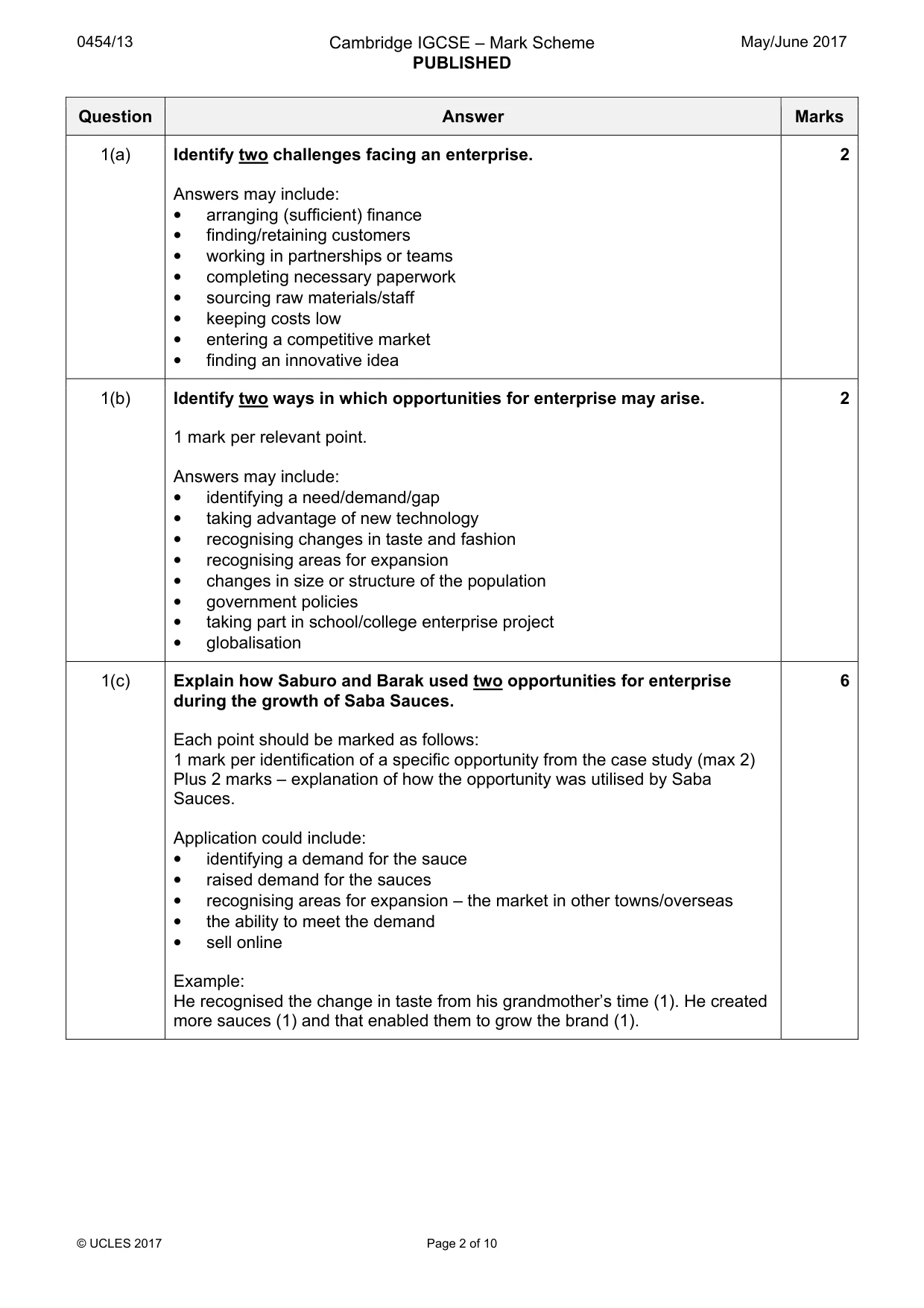
0454/13 Cambridge IGCSE – Mark Scheme PUBLISHED May/June 2017 © UCLES 2017 Page 2 of 10 Question Answer Marks 1(a) Identify two challenges facing an enterprise. Answers may include: • arranging (sufficient) finance • finding/retaining customers • working in partnerships or teams • completing necessary paperwork • sourcing raw materials/staff • keeping costs low • entering a competitive market • finding an innovative idea 2 1(b) Identify two ways in which opportunities for enterprise may arise. 1 mark per relevant point. Answers may include: • identifying a need/demand/gap • taking advantage of new technology • recognising changes in taste and fashion • recognising areas for expansion • changes in size or structure of the population • government policies • taking part in school/college enterprise project • globalisation 2 1(c) Explain how Saburo and Barak used two opportunities for enterprise during the growth of Saba Sauces. Each point should be marked as follows: 1 mark per identification of a specific opportunity from the case study (max 2) Plus 2 marks – explanation of how the opportunity was utilised by Saba Sauces. Application could include: • identifying a demand for the sauce • raised demand for the sauces • recognising areas for expansion – the market in other towns/overseas • the ability to meet the demand • sell online Example: He recognised the change in taste from his grandmother’s time (1). He created more sauces (1) and that enabled them to grow the brand (1). 6
Mark scheme, page 3
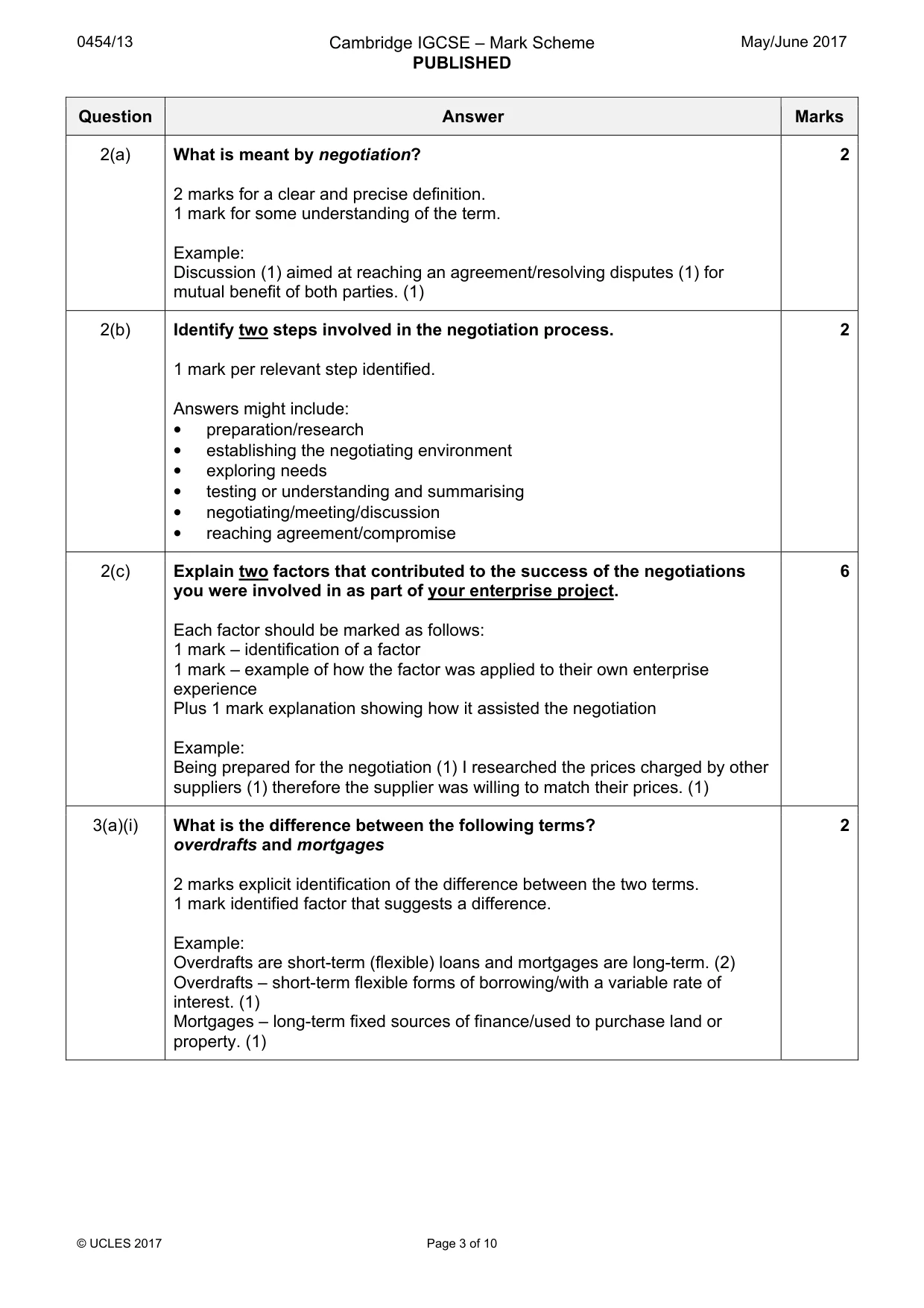
0454/13 Cambridge IGCSE – Mark Scheme PUBLISHED May/June 2017 © UCLES 2017 Page 3 of 10 Question Answer Marks 2(a) What is meant by negotiation? 2 marks for a clear and precise definition. 1 mark for some understanding of the term. Example: Discussion (1) aimed at reaching an agreement/resolving disputes (1) for mutual benefit of both parties. (1) 2 2(b) Identify two steps involved in the negotiation process. 1 mark per relevant step identified. Answers might include: • preparation/research • establishing the negotiating environment • exploring needs • testing or understanding and summarising • negotiating/meeting/discussion • reaching agreement/compromise 2 2(c) Explain two factors that contributed to the success of the negotiations you were involved in as part of your enterprise project. Each factor should be marked as follows: 1 mark – identification of a factor 1 mark – example of how the factor was applied to their own enterprise experience Plus 1 mark explanation showing how it assisted the negotiation Example: Being prepared for the negotiation (1) I researched the prices charged by other suppliers (1) therefore the supplier was willing to match their prices. (1) 6 3(a)(i) What is the difference between the following terms? overdrafts and mortgages 2 marks explicit identification of the difference between the two terms. 1 mark identified factor that suggests a difference. Example: Overdrafts are short-term (flexible) loans and mortgages are long-term. (2) Overdrafts – short-term flexible forms of borrowing/with a variable rate of interest. (1) Mortgages – long-term fixed sources of finance/used to purchase land or property. (1) 2
Mark scheme, page 4
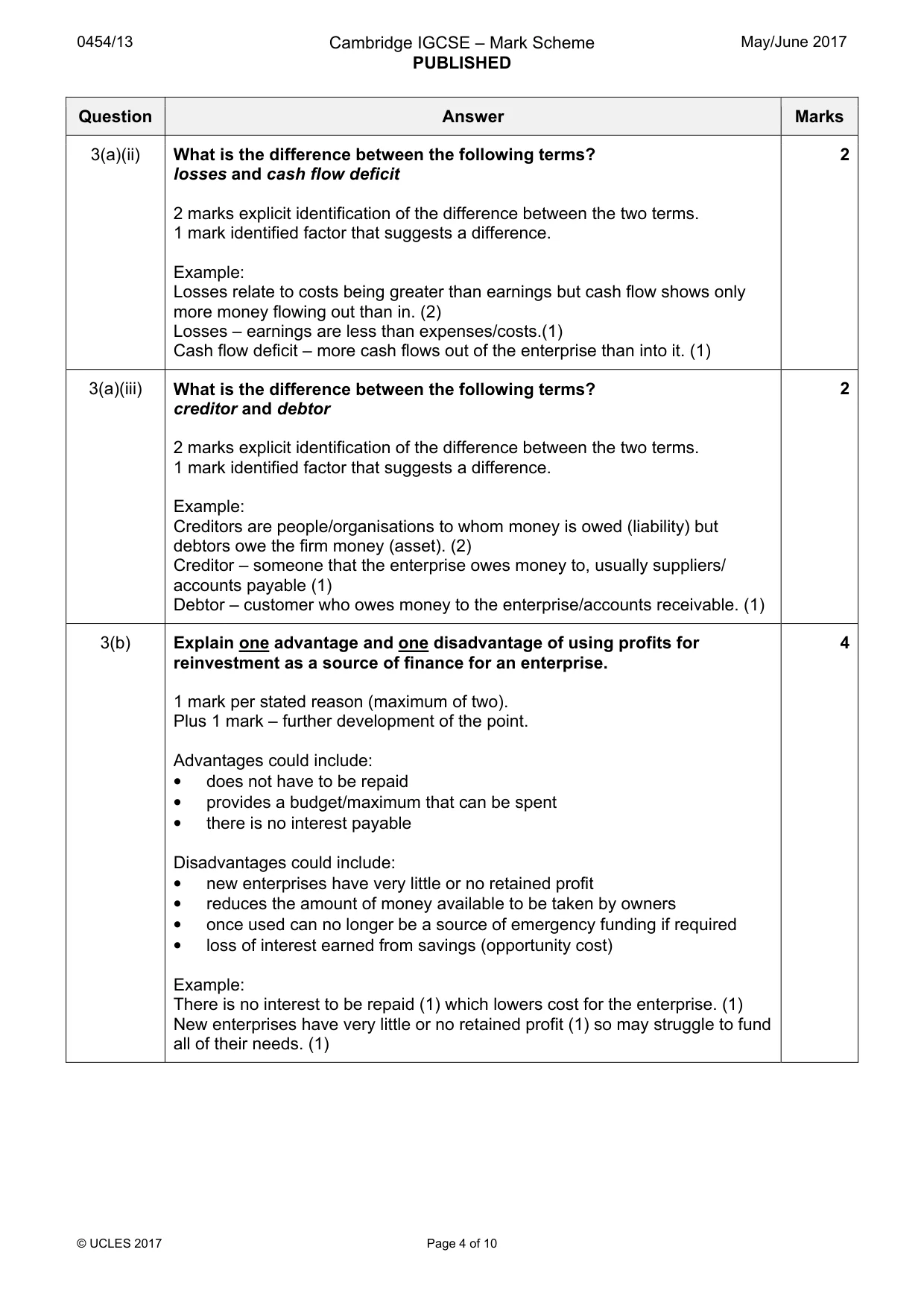
0454/13 Cambridge IGCSE – Mark Scheme PUBLISHED May/June 2017 © UCLES 2017 Page 4 of 10 Question Answer Marks 3(a)(ii) What is the difference between the following terms? losses and cash flow deficit 2 marks explicit identification of the difference between the two terms. 1 mark identified factor that suggests a difference. Example: Losses relate to costs being greater than earnings but cash flow shows only more money flowing out than in. (2) Losses – earnings are less than expenses/costs.(1) Cash flow deficit – more cash flows out of the enterprise than into it. (1) 2 3(a)(iii) What is the difference between the following terms? creditor and debtor 2 marks explicit identification of the difference between the two terms. 1 mark identified factor that suggests a difference. Example: Creditors are people/organisations to whom money is owed (liability) but debtors owe the firm money (asset). (2) Creditor – someone that the enterprise owes money to, usually suppliers/ accounts payable (1) Debtor – customer who owes money to the enterprise/accounts receivable. (1) 2 3(b) Explain one advantage and one disadvantage of using profits for reinvestment as a source of finance for an enterprise. 1 mark per stated reason (maximum of two). Plus 1 mark – further development of the point. Advantages could include: • does not have to be repaid • provides a budget/maximum that can be spent • there is no interest payable Disadvantages could include: • new enterprises have very little or no retained profit • reduces the amount of money available to be taken by owners • once used can no longer be a source of emergency funding if required • loss of interest earned from savings (opportunity cost) Example: There is no interest to be repaid (1) which lowers cost for the enterprise. (1) New enterprises have very little or no retained profit (1) so may struggle to fund all of their needs. (1) 4
Mark scheme, page 5
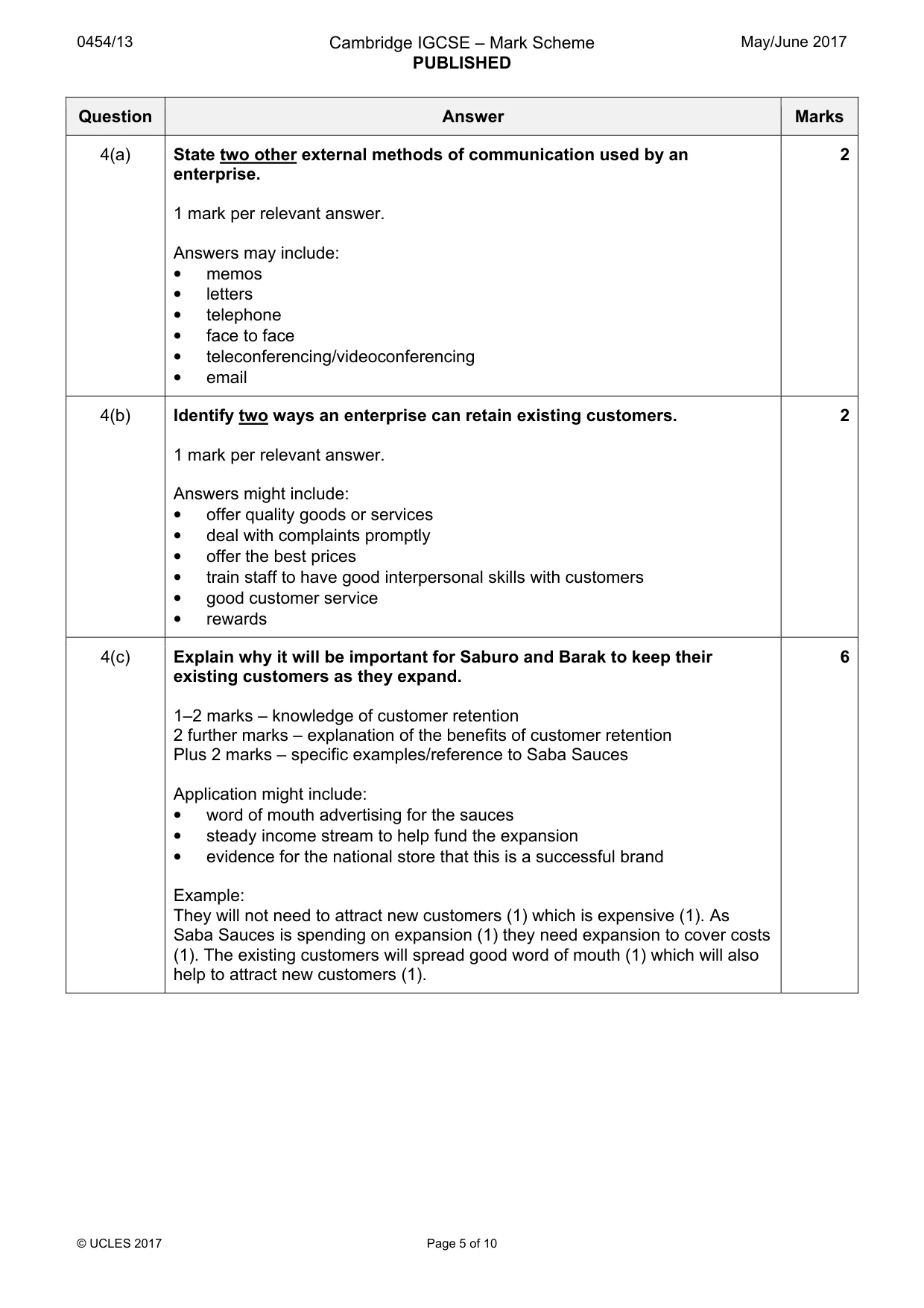
0454/13 Cambridge IGCSE – Mark Scheme PUBLISHED May/June 2017 © UCLES 2017 Page 5 of 10 Question Answer Marks 4(a) State two other external methods of communication used by an enterprise. 1 mark per relevant answer. Answers may include: • memos • letters • telephone • face to face • teleconferencing/videoconferencing • email 2 4(b) Identify two ways an enterprise can retain existing customers. 1 mark per relevant answer. Answers might include: • offer quality goods or services • deal with complaints promptly • offer the best prices • train staff to have good interpersonal skills with customers • good customer service • rewards 2 4(c) Explain why it will be important for Saburo and Barak to keep their existing customers as they expand. 1–2 marks – knowledge of customer retention 2 further marks – explanation of the benefits of customer retention Plus 2 marks – specific examples/reference to Saba Sauces Application might include: • word of mouth advertising for the sauces • steady income stream to help fund the expansion • evidence for the national store that this is a successful brand Example: They will not need to attract new customers (1) which is expensive (1). As Saba Sauces is spending on expansion (1) they need expansion to cover costs (1). The existing customers will spread good word of mouth (1) which will also help to attract new customers (1). 6
Mark scheme, page 6
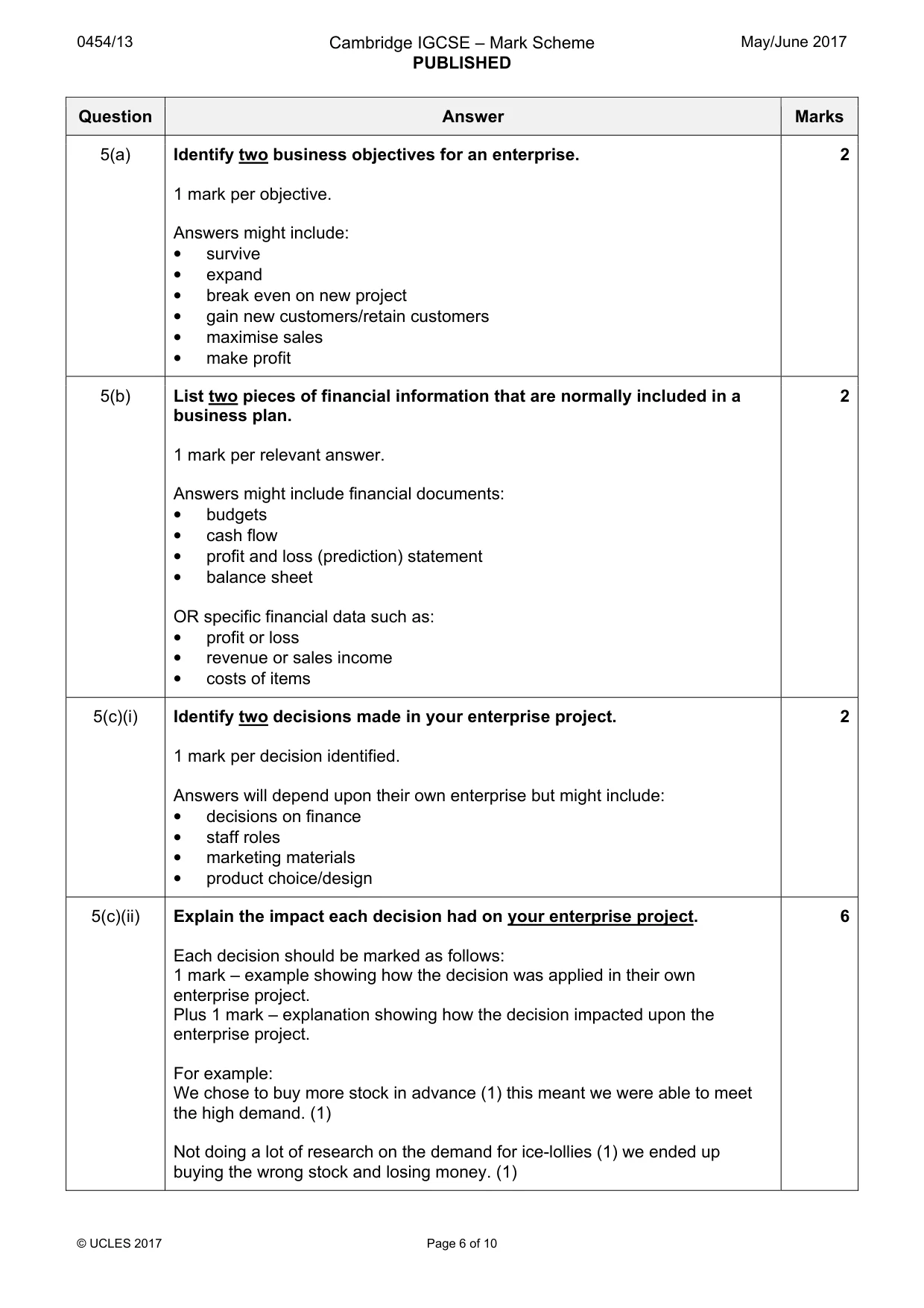
0454/13 Cambridge IGCSE – Mark Scheme PUBLISHED May/June 2017 © UCLES 2017 Page 6 of 10 Question Answer Marks 5(a) Identify two business objectives for an enterprise. 1 mark per objective. Answers might include: • survive • expand • break even on new project • gain new customers/retain customers • maximise sales • make profit 2 5(b) List two pieces of financial information that are normally included in a business plan. 1 mark per relevant answer. Answers might include financial documents: • budgets • cash flow • profit and loss (prediction) statement • balance sheet OR specific financial data such as: • profit or loss • revenue or sales income • costs of items 2 5(c)(i) Identify two decisions made in your enterprise project. 1 mark per decision identified. Answers will depend upon their own enterprise but might include: • decisions on finance • staff roles • marketing materials • product choice/design 2 5(c)(ii) Explain the impact each decision had on your enterprise project. Each decision should be marked as follows: 1 mark – example showing how the decision was applied in their own enterprise project. Plus 1 mark – explanation showing how the decision impacted upon the enterprise project. For example: We chose to buy more stock in advance (1) this meant we were able to meet the high demand. (1) Not doing a lot of research on the demand for ice-lollies (1) we ended up buying the wrong stock and losing money. (1) 6
Mark scheme, page 7
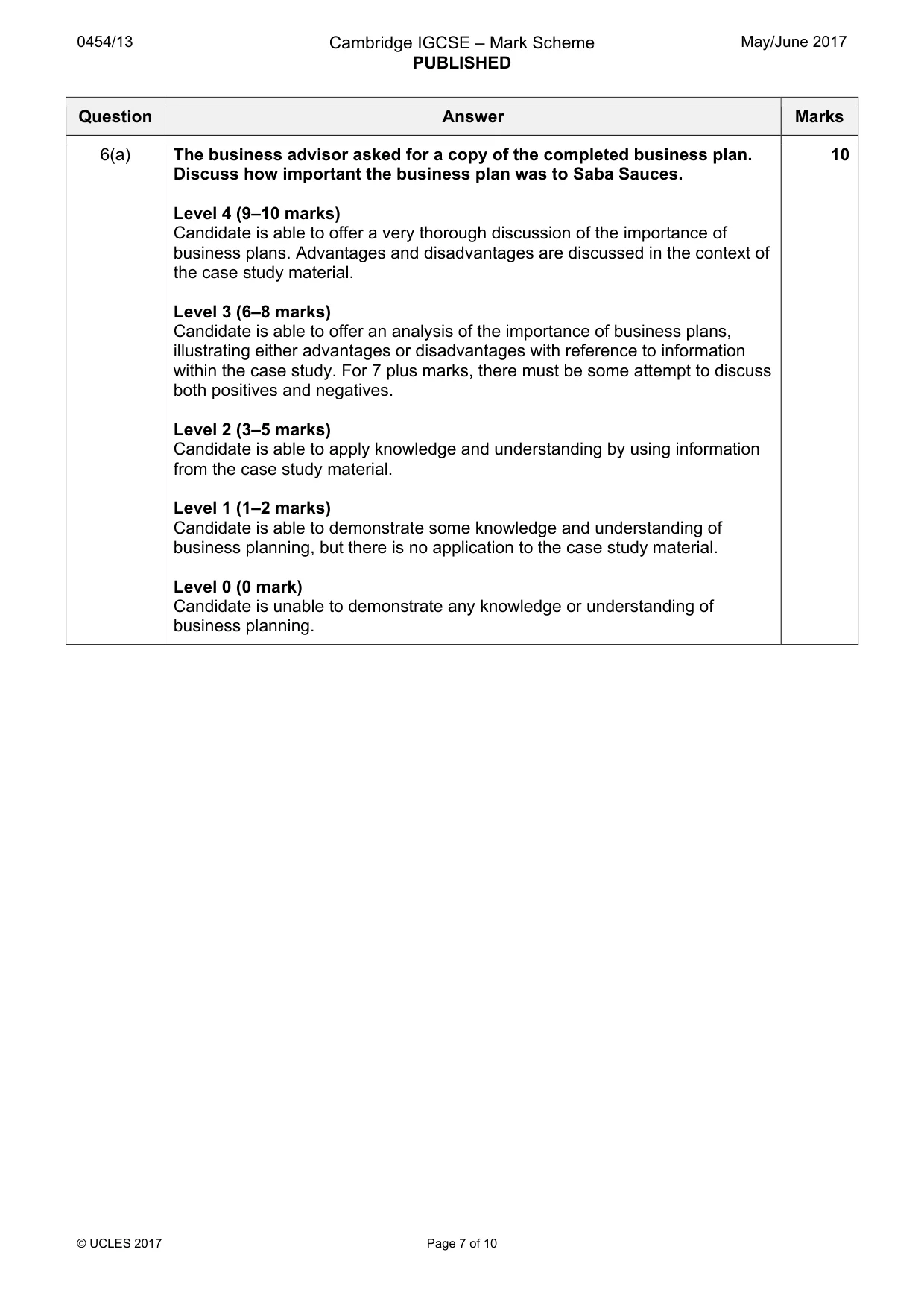
0454/13 Cambridge IGCSE – Mark Scheme PUBLISHED May/June 2017 © UCLES 2017 Page 7 of 10 Question Answer Marks 6(a) The business advisor asked for a copy of the completed business plan. Discuss how important the business plan was to Saba Sauces. Level 4 (9–10 marks) Candidate is able to offer a very thorough discussion of the importance of business plans. Advantages and disadvantages are discussed in the context of the case study material. Level 3 (6–8 marks) Candidate is able to offer an analysis of the importance of business plans, illustrating either advantages or disadvantages with reference to information within the case study. For 7 plus marks, there must be some attempt to discuss both positives and negatives. Level 2 (3–5 marks) Candidate is able to apply knowledge and understanding by using information from the case study material. Level 1 (1–2 marks) Candidate is able to demonstrate some knowledge and understanding of business planning, but there is no application to the case study material. Level 0 (0 mark) Candidate is unable to demonstrate any knowledge or understanding of business planning. 10
Mark scheme, page 8
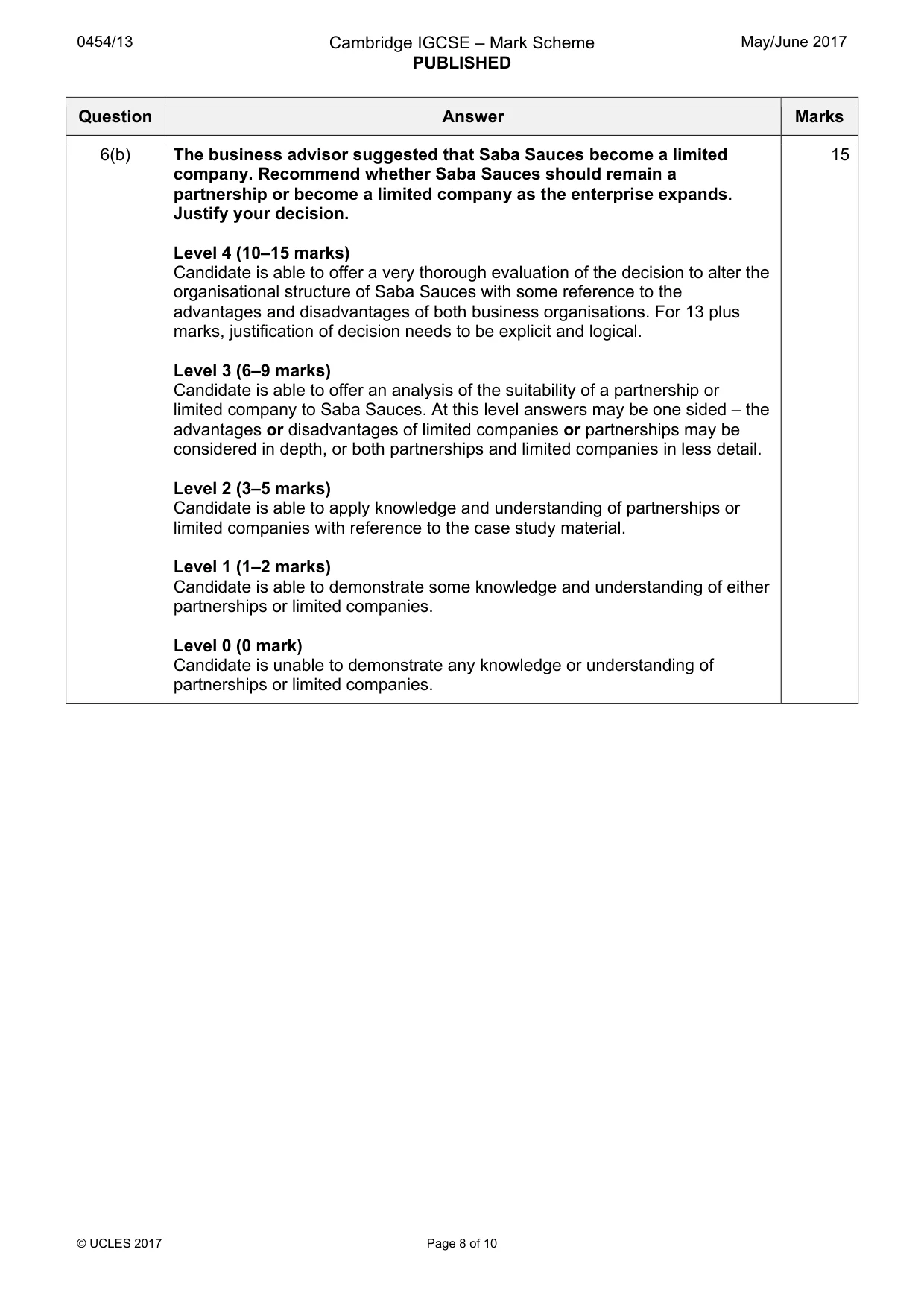
0454/13 Cambridge IGCSE – Mark Scheme PUBLISHED May/June 2017 © UCLES 2017 Page 8 of 10 Question Answer Marks 6(b) The business advisor suggested that Saba Sauces become a limited company. Recommend whether Saba Sauces should remain a partnership or become a limited company as the enterprise expands. Justify your decision. Level 4 (10–15 marks) Candidate is able to offer a very thorough evaluation of the decision to alter the organisational structure of Saba Sauces with some reference to the advantages and disadvantages of both business organisations. For 13 plus marks, justification of decision needs to be explicit and logical. Level 3 (6–9 marks) Candidate is able to offer an analysis of the suitability of a partnership or limited company to Saba Sauces. At this level answers may be one sided – the advantages or disadvantages of limited companies or partnerships may be considered in depth, or both partnerships and limited companies in less detail. Level 2 (3–5 marks) Candidate is able to apply knowledge and understanding of partnerships or limited companies with reference to the case study material. Level 1 (1–2 marks) Candidate is able to demonstrate some knowledge and understanding of either partnerships or limited companies. Level 0 (0 mark) Candidate is unable to demonstrate any knowledge or understanding of partnerships or limited companies. 15
Mark scheme, page 9
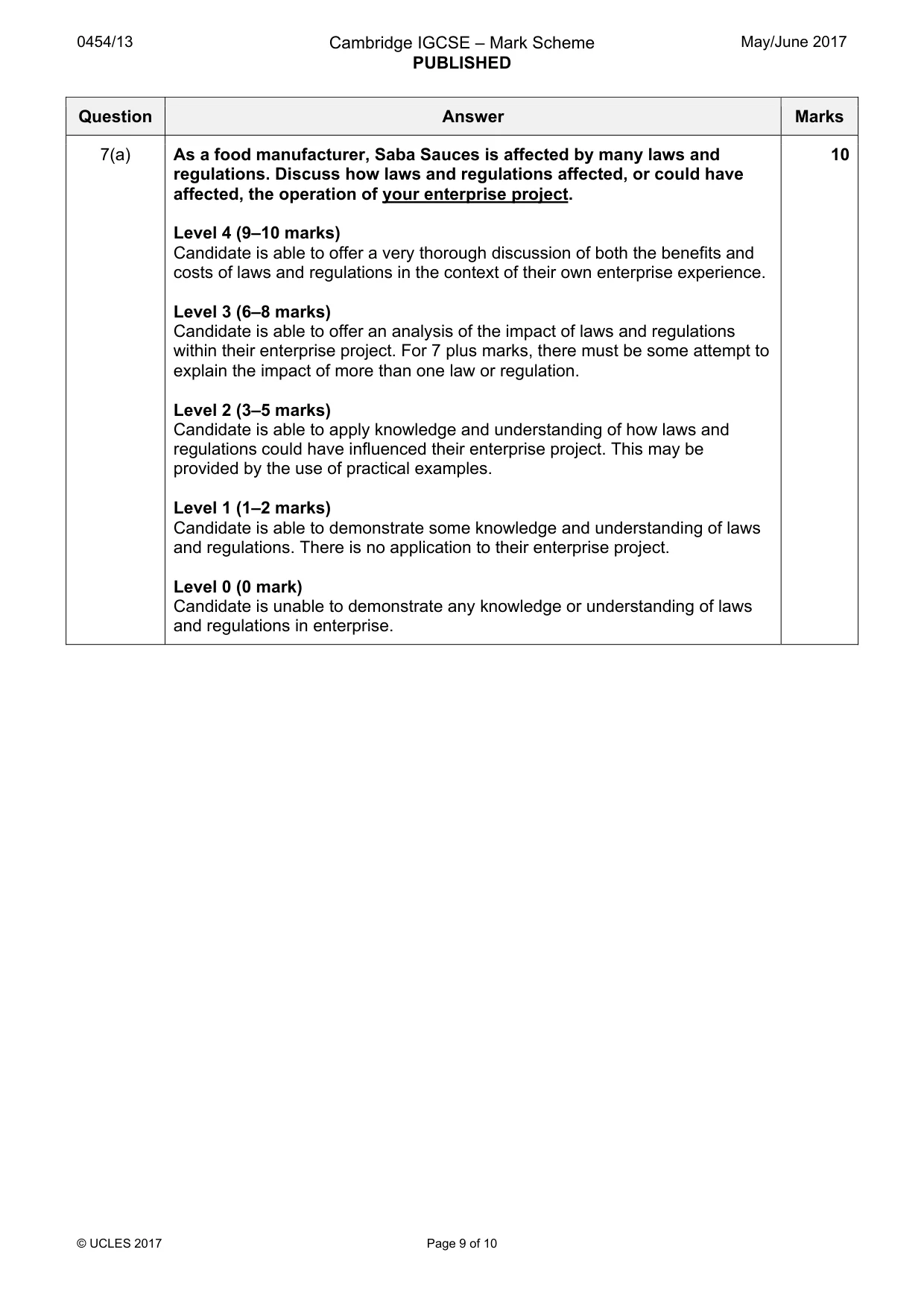
0454/13 Cambridge IGCSE – Mark Scheme PUBLISHED May/June 2017 © UCLES 2017 Page 9 of 10 Question Answer Marks 7(a) As a food manufacturer, Saba Sauces is affected by many laws and regulations. Discuss how laws and regulations affected, or could have affected, the operation of your enterprise project. Level 4 (9–10 marks) Candidate is able to offer a very thorough discussion of both the benefits and costs of laws and regulations in the context of their own enterprise experience. Level 3 (6–8 marks) Candidate is able to offer an analysis of the impact of laws and regulations within their enterprise project. For 7 plus marks, there must be some attempt to explain the impact of more than one law or regulation. Level 2 (3–5 marks) Candidate is able to apply knowledge and understanding of how laws and regulations could have influenced their enterprise project. This may be provided by the use of practical examples. Level 1 (1–2 marks) Candidate is able to demonstrate some knowledge and understanding of laws and regulations. There is no application to their enterprise project. Level 0 (0 mark) Candidate is unable to demonstrate any knowledge or understanding of laws and regulations in enterprise. 10
Mark scheme, page 10
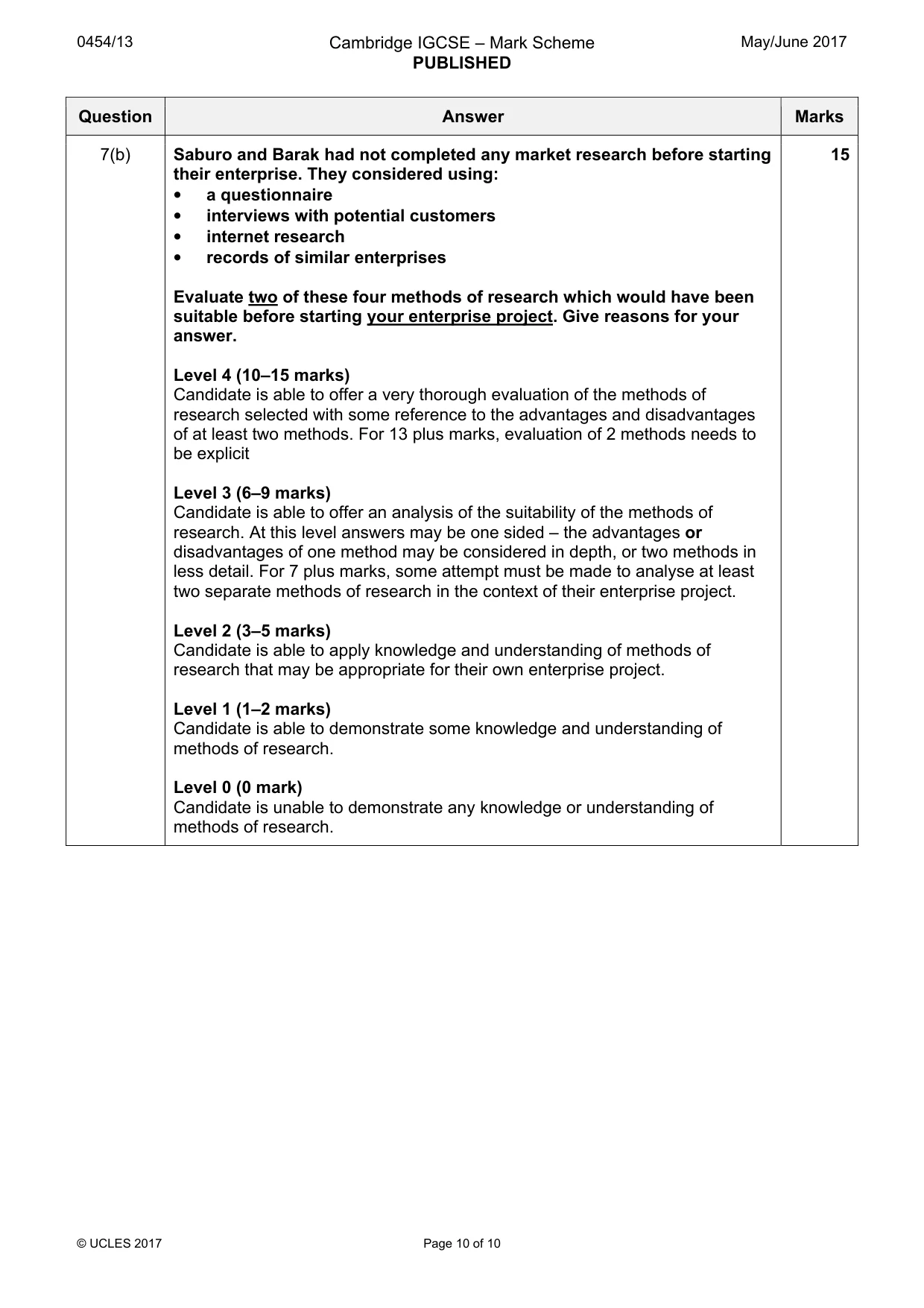
0454/13 Cambridge IGCSE – Mark Scheme PUBLISHED May/June 2017 © UCLES 2017 Page 10 of 10 Question Answer Marks 7(b) Saburo and Barak had not completed any market research before starting their enterprise. They considered using: • a questionnaire • interviews with potential customers • internet research • records of similar enterprises Evaluate two of these four methods of research which would have been suitable before starting your enterprise project. Give reasons for your answer. Level 4 (10–15 marks) Candidate is able to offer a very thorough evaluation of the methods of research selected with some reference to the advantages and disadvantages of at least two methods. For 13 plus marks, evaluation of 2 methods needs to be explicit Level 3 (6–9 marks) Candidate is able to offer an analysis of the suitability of the methods of research. At this level answers may be one sided – the advantages or disadvantages of one method may be considered in depth, or two methods in less detail. For 7 plus marks, some attempt must be made to analyse at least two separate methods of research in the context of their enterprise project. Level 2 (3–5 marks) Candidate is able to apply knowledge and understanding of methods of research that may be appropriate for their own enterprise project. Level 1 (1–2 marks) Candidate is able to demonstrate some knowledge and understanding of methods of research. Level 0 (0 mark) Candidate is unable to demonstrate any knowledge or understanding of methods of research. 15
What you needed in this session
Cambridge’s own grade thresholds for 2017 May/June, Paper 1 · Variant 3. A higher threshold means an easier paper — the bar moves with how the cohort did.